

Page 1
TG661x_662xFX(e).book Page 1 Wednesday, March 2, 2011 2:31 PM
Operating Instructions
Digital Cordless Phone
Model No.
KX-TG6611FX
KX-TG6612FX
Digital Cordless Answering System
Model No.
Model shown is KX-TG6611.
Before initial use, see “Getting Started”
on page 10.
Thank you for purchasing a Panasonic product.
Please read these operating instructions before using the unit and save them for
future reference.
This unit is compatible with Caller ID and SMS. You must subscribe to the
appropriate service offered by your service provider/telephone company.
To use this unit in your country, first change the unit’s region setting to match
your country (page 29). Change the unit’s display language as needed (page
15).
KX-TG6621FX
(For Czech and Slovakia)
This cordless telephone is possible to use according to General licence No.:
VO-R/8/08.2005-23 (for Czech), VPR-7/2001 (for Slovakia).
Page 2
TG661x_662xFX(e).book Page 2 Wednesday, March 2, 2011 2:31 PM
Table of Contents
Introduction
Model composition . . . . . . . . . . . . . . . . . . . . 3
Accessory information . . . . . . . . . . . . . . . . . 4
General information . . . . . . . . . . . . . . . . . . . 5
Important Information
For your safety . . . . . . . . . . . . . . . . . . . . . . . 6
Important safety instructions . . . . . . . . . . . . 7
For best performance . . . . . . . . . . . . . . . . . 7
Other information . . . . . . . . . . . . . . . . . . . . . 8
Specifications. . . . . . . . . . . . . . . . . . . . . . . . 9
Getting Started
Setting up. . . . . . . . . . . . . . . . . . . . . . . . . . 10
Note when setting up . . . . . . . . . . . . . . . . . 11
Controls . . . . . . . . . . . . . . . . . . . . . . . . . . . 12
Display . . . . . . . . . . . . . . . . . . . . . . . . . . . . 13
Turning the power on/off . . . . . . . . . . . . . . 15
Initial settings . . . . . . . . . . . . . . . . . . . . . . . 15
One touch eco mode . . . . . . . . . . . . . . . . . 16
Wall mounting . . . . . . . . . . . . . . . . . . . . . . 16
Greeting message . . . . . . . . . . . . . . . . . . . . 38
Listening to messages using the base unit . 38
Listening to messages using the handset. . 39
Remote operation . . . . . . . . . . . . . . . . . . . . 39
Answering system settings . . . . . . . . . . . . . 40
Voice Mail Service
Voice mail service . . . . . . . . . . . . . . . . . . . . 42
Intercom/Locator
Intercom . . . . . . . . . . . . . . . . . . . . . . . . . . . 43
Handset locator . . . . . . . . . . . . . . . . . . . . . .43
Transferring calls, conference calls. . . . . . . 43
Useful Information
Character entry . . . . . . . . . . . . . . . . . . . . . . 44
Error messages . . . . . . . . . . . . . . . . . . . . . . 46
Troubleshooting . . . . . . . . . . . . . . . . . . . . . 46
Index
Index . . . . . . . . . . . . . . . . . . . . . . . . . . . . . 51
Making/Answering Calls
Making calls . . . . . . . . . . . . . . . . . . . . . . . . 17
Answering calls . . . . . . . . . . . . . . . . . . . . . 17
Useful features during a call . . . . . . . . . . . 18
Key lock . . . . . . . . . . . . . . . . . . . . . . . . . . . 19
Power back-up operation . . . . . . . . . . . . . . 19
Phonebook
Handset phonebook. . . . . . . . . . . . . . . . . . 21
Copying phonebook entries . . . . . . . . . . . . 22
Programming
Programmable settings . . . . . . . . . . . . . . . 23
Special programming . . . . . . . . . . . . . . . . . 27
Registering a unit . . . . . . . . . . . . . . . . . . . . 30
Caller ID Service
Using Caller ID service . . . . . . . . . . . . . . . 32
Caller list . . . . . . . . . . . . . . . . . . . . . . . . . . 32
SMS (Short Message Service)
Using SMS. . . . . . . . . . . . . . . . . . . . . . . . . 34
Turning SMS on/off . . . . . . . . . . . . . . . . . . 34
Storing SMS message centre numbers . . . 34
Sending a message . . . . . . . . . . . . . . . . . . 34
Receiving a message . . . . . . . . . . . . . . . . 35
Other settings . . . . . . . . . . . . . . . . . . . . . . 36
Answering System
Answering system . . . . . . . . . . . . . . . . . . . 37
Turning the answering system on/off . . . . . 37
2
Page 3
TG661x_662xFX(e).book Page 3 Wednesday, March 2, 2011 2:31 PM
Introduction
Model composition
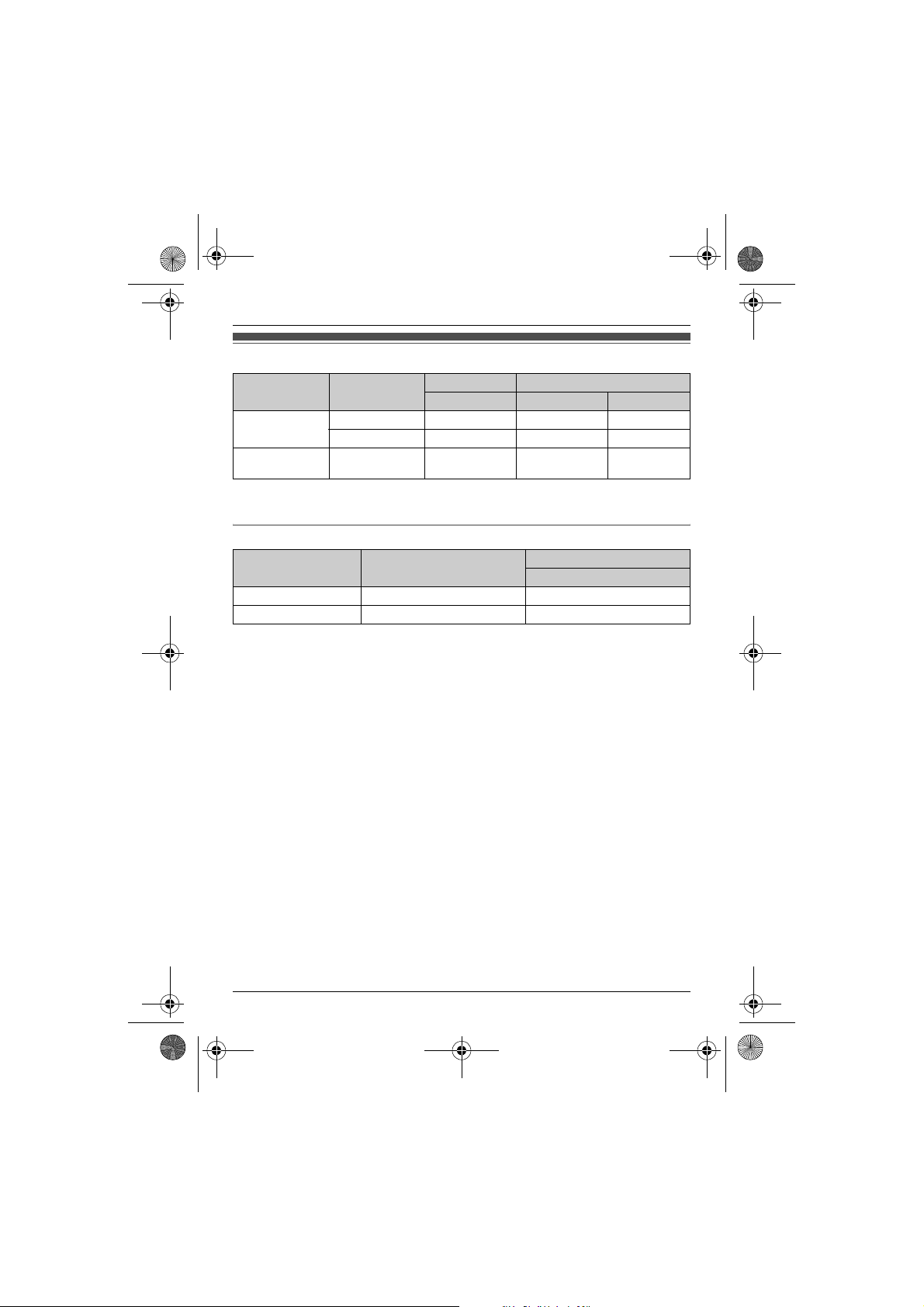
Series Model No.
KX-TG6611
series
KX-TG6621
series
L The suffix (FX) in the following model numbers will be omitted in these instructions:
KX-TG6611FX/KX-TG6612FX/KX-TG6621FX
KX-TG6611 KX-TG6611 KX-TGA661 1
KX-TG6612 KX-TG6611 KX-TGA661 2
KX-TG6621 KX-TG6621 KX-TGA661 1
Feature differences
Series Answering system
KX-TG6611 series – r
KX-TG6621 series rr
*1 Single handset models: Intercom calls can be made between handsets by purchasing and
registering one or more optional handsets (page 5).
Base unit Handset
Part No. Part No. Quantity
Intercom
Between handsets
*1
*1
3
Page 4
TG661x_662xFX(e).book Page 4 Wednesday, March 2, 2011 2:31 PM
Introduction
Accessory information
Supplied accessories
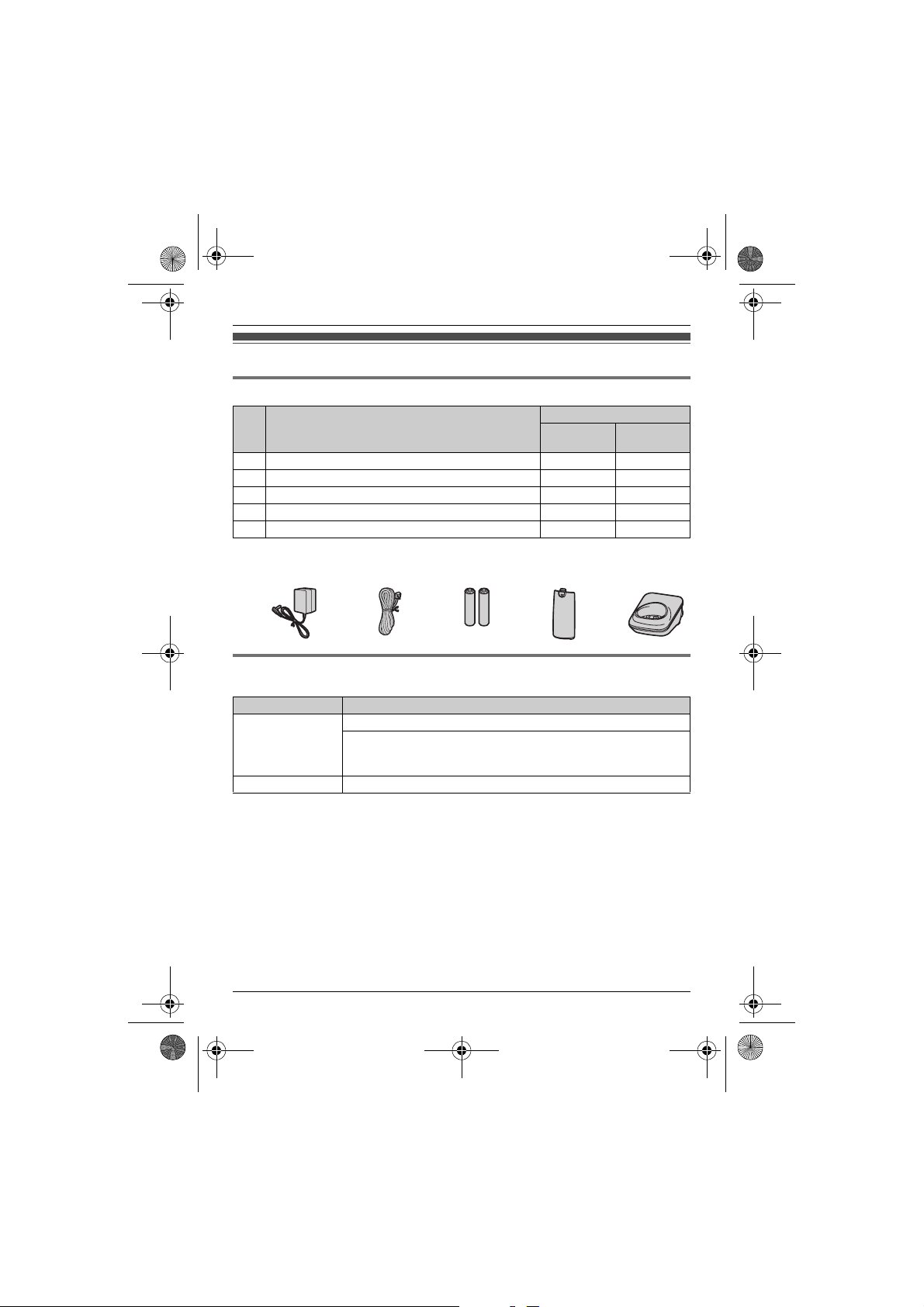
No. Accessory item/Part number
1 AC adaptor/PNLV226CE 1 2
2 Telephone line cord 1 1
3 Rechargeable batteries
4 Handset cover
5 Charger — 1
*1 See page 4 for replacement battery information.
*2 The handset cover comes attached to the handset.
12345
*1
*2
Additional/replacement accessories
Please contact your nearest Panasonic dealer for sales information.
Accessory item Model number
Rechargeable
batteries
DECT repeater KX-A405
*1 Replacement batteries may have a different capacity from that of the supplied batteries.
HHR-4MRT or HHR-4NGE (P03P) or HHR-4MRE (P03I)
Battery type:
– Nickel metal hydride (Ni-MH)
– 2 x AAA (R03) size for each handset
Quantity
KX-TG6611
KX-TG6621
KX-TG6612
24
12
*1
4
Page 5
TG661x_662xFX(e).book Page 5 Wednesday, March 2, 2011 2:31 PM
Introduction
Expanding your phone system
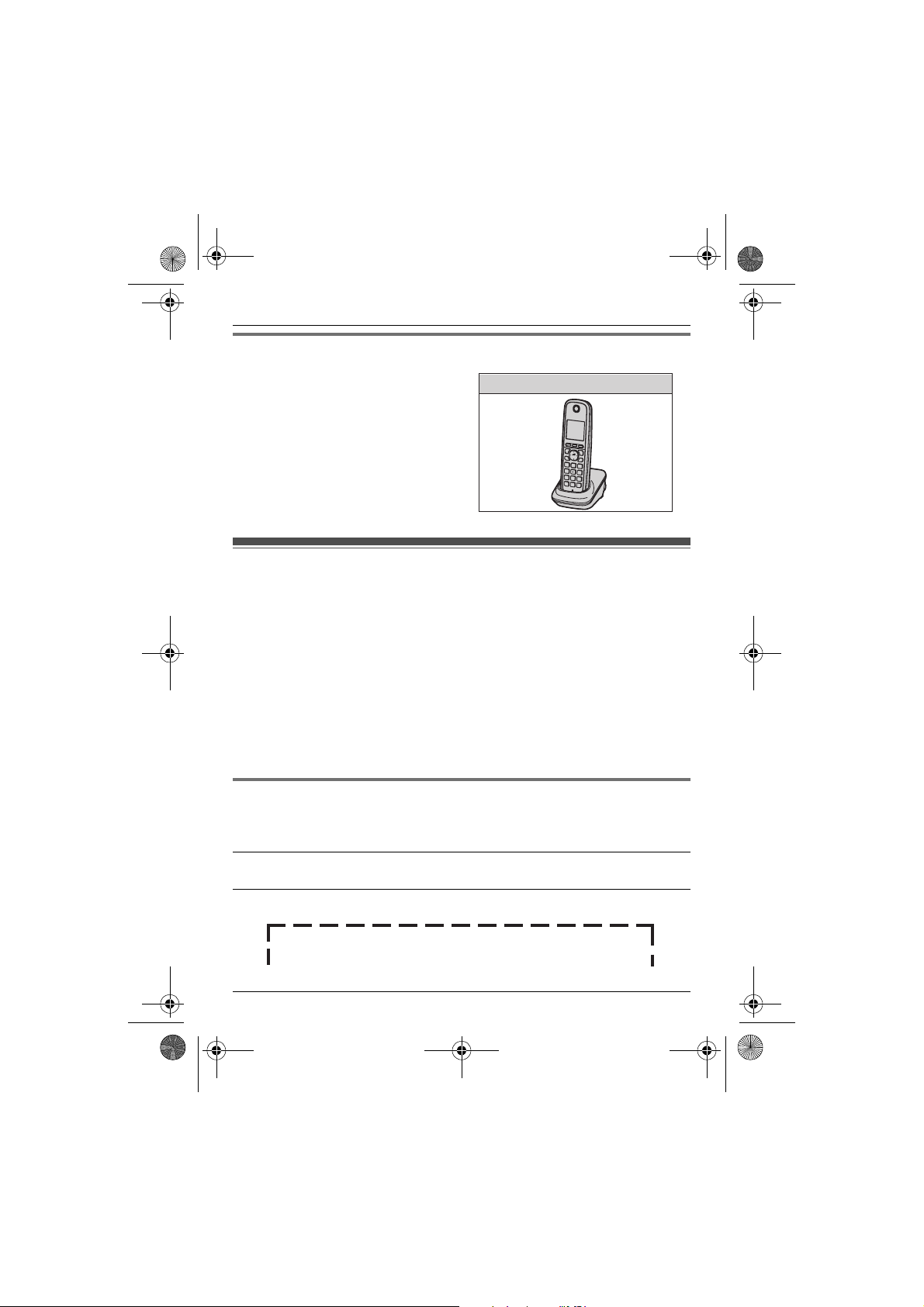
You can expand your phone system by
registering optional handsets (6 max.) to a
single base unit.
L Optional handsets may be a different
colour from that of the supplied handsets.
Handset (optional): KX-TGA661FX
General information
L This equipment is designed for use on the Czech and Slovakia analogue telephone network.
L In the event of problems, you should contact your equipment supplier in the first instance.
L For use in other countries, please contact your equipment supplier.
Declaration of Conformity:
L Panasonic System Networks Co., Ltd. declares that this equipment is in compliance with the
essential requirements and other relevant provisions of Radio & Telecommunications Terminal
Equipment (R&TTE) Directive 1999/5/EC.
Declarations of Conformity for the relevant Panasonic products described in this manual are
available for download by visiting:
http://www.doc.panasonic.de
Contact to Authorised Representative:
Panasonic Testing Centre
Panasonic Marketing Europe GmbH
Winsbergring 15, 22525 Hamburg, Germany
For your future reference
We recommend keeping a record of the following information to assist with any repair under
warranty.
Serial No. Date of purchase
(found on the bottom of the base unit)
Name and address of dealer
Attach your purchase receipt here.
5
Page 6
TG661x_662xFX(e).book Page 6 Wednesday, March 2, 2011 2:31 PM
Important Information
L Do not allow the AC adaptor or telephone
For your safety
To prevent severe injury and loss of life/
property, read this section carefully before
using the product to ensure proper and safe
operation of your product.
WARNING
Power connection
L Use only the power source marked on the
product.
L Do not overload power outlets and
extension cords. This can result in the risk
of fire or electric shock.
L Completely insert the AC adaptor/power
plug into the power outlet. Failure to do so
may cause electric shock and/or excessive
heat resulting in a fire.
L Regularly remove any dust, etc. from the
AC adaptor/power plug by pulling it from the
power outlet, then wiping with a dry cloth.
Accumulated dust may cause an insulation
defect from moisture, etc. resulting in a fire.
L Unplug the product from power outlets if it
emits smoke, an abnormal smell, or makes
an unusual noise. These conditions can
cause fire or electric shock. Confirm that
smoke has stopped emitting and contact an
authorised service centre.
L Unplug from power outlets and never touch
the inside of the product if its casing has
been broken open.
L Never touch the plug with wet hands.
Danger of electric shock exists.
Installation
L To prevent the risk of fire or electrical shock,
do not expose the product to rain or any
type of moisture.
L Do not place or use this product near
automatically controlled devices such as
automatic doors and fire alarms. Radio
waves emitted from this product may cause
such devices to malfunction resulting in an
accident.
line cord to be excessively pulled, bent or
placed under heavy objects.
Operating safeguards
L Unplug the product from power outlets
before cleaning. Do not use liquid or
aerosol cleaners.
L Do not disassemble the product.
L Do not spill liquids (detergents, cleansers,
etc.) onto the telephone line cord plug, or
allow it to become wet at all. This may
cause a fire. If the telephone line cord plug
becomes wet, immediately pull it from the
telephone wall jack, and do not use.
Medical
L Consult the manufacturer of any personal
medical devices, such as pacemakers or
hearing aids, to determine if they are
adequately shielded from external RF
(radio frequency) energy. (The product
operates in the frequency range of 1.88
GHz to 1.90 GHz, and the RF transmission
power is 250 mW (max.).)
L Do not use the product in health care
facilities if any regulations posted in the
area instruct you not to do so. Hospitals or
health care facilities may be using
equipment that could be sensitive to
external RF energy.
CAUTION
Installation and location
L Never install telephone wiring during an
electrical storm.
L Never install telephone line jacks in wet
locations unless the jack is specifically
designed for wet locations.
L Never touch uninsulated telephone wires or
terminals unless the telephone line has
been disconnected at the network interface.
L Use caution when installing or modifying
telephone lines.
L The AC adaptor is used as the main
disconnect device. Ensure that the AC
outlet is installed near the product and is
easily accessible.
6
Page 7
TG661x_662xFX(e).book Page 7 Wednesday, March 2, 2011 2:31 PM
L This product is unable to make calls when:
– the handset batteries need recharging or
have failed.
– there is a power failure.
– the key lock feature is turned on.
Battery
L We recommend using the batteries noted
on page 4. USE ONLY rechargeable Ni-
MH batteries AAA (R03) size.
L Do not mix old and new batteries.
L Do not open or mutilate the batteries.
Released electrolyte from the batteries is
corrosive and may cause burns or injury to
the eyes or skin. The electrolyte is toxic and
may be harmful if swallowed.
L Exercise care when handling the batteries.
Do not allow conductive materials such as
rings, bracelets, or keys to touch the
batteries, otherwise a short circuit may
cause the batteries and/or the conductive
material to overheat and cause burns.
L Charge the batteries provided with or
identified for use with this product only, in
accordance with the instructions and
limitations specified in this manual.
L Only use a compatible base unit (or
charger) to charge the batteries. Do not
tamper with the base unit (or charger).
Failure to follow these instructions may
cause the batteries to swell or explode.
Important safety instructions
When using your product, basic safety
precautions should always be followed to
reduce the risk of fire, electric shock, and
injury to persons, including the following:
1. Do not use this product near water for
example, near a bathtub, washbowl,
kitchen sink, or laundry tub, in a wet
basement or near a swimming pool.
2. Avoid using a telephone (other than a
cordless type) during an electrical storm.
There may be a remote risk of electric
shock from lightning.
3. Do not use the telephone to report a gas
leak in the vicinity of the leak.
4. Use only the power cord and batteries
indicated in this manual. Do not dispose of
batteries in a fire. They may explode.
Check with local codes for possible special
disposal instructions.
SAVE THESE INSTRUCTIONS
For best performance
Base unit location/avoiding noise
The base unit and other compatible Panasonic
units use radio waves to communicate with
each other.
L For maximum coverage and noise-free
communications, place your base unit:
– at a convenient, high, and central
location with no obstructions between
the handset and base unit in an indoor
environment.
– away from electronic appliances such as
TVs, radios, personal computers,
wireless devices, or other phones.
– facing away from radio frequency
transmitters, such as external antennas
of mobile phone cell stations. (Avoid
putting the base unit on a bay window or
near a window.)
L Coverage and voice quality depends on the
local environmental conditions.
L If the reception fo r a base unit location is not
satisfactory, move the base unit to another
location for better reception.
Environment
L Keep the product away from electrical noise
generating devices, such as fluorescent
lamps and motors.
L The product should be kept free from
excessive smoke, dust, high temperature,
and vibration.
L The product should not be exposed to direct
sunlight.
L Do not place heavy objects on top of the
product.
Important Information
7
Page 8
TG661x_662xFX(e).book Page 8 Wednesday, March 2, 2011 2:31 PM
Important Information
L When you leave the product unused for a
long period of time, unplug the product from
the power outlet.
L The product should be kept away from heat
sources such as radiators, cookers, etc. It
should not be placed in rooms where the
temperature is less than 0 °C or greater
than 40 °C. Damp basements should also
be avoided.
L The maximum calling distance may be
shortened when the product is used in the
following places: Near obstacles such as
hills, tunnels, underground, near metal
objects such as wire fences, etc.
L Operating the product near electrical
appliances may cause interference. Move
away from the electrical appliances.
Routine care
L Wipe the outer surface of the product
with a soft moist cloth.
L Do not use benzine, thinner, or any
abrasive powder.
Other information
Notice for product disposal, transfer,
or return
L This product can store your private/
confidential information. To protect your
privacy/confidentiality, we recommend that
you erase information such as phonebook
or caller list entries from the memory before
you dispose of, transfer, or return the
product.
Information for Users on Collection
and Disposal of Old Equipment and
used Batteries
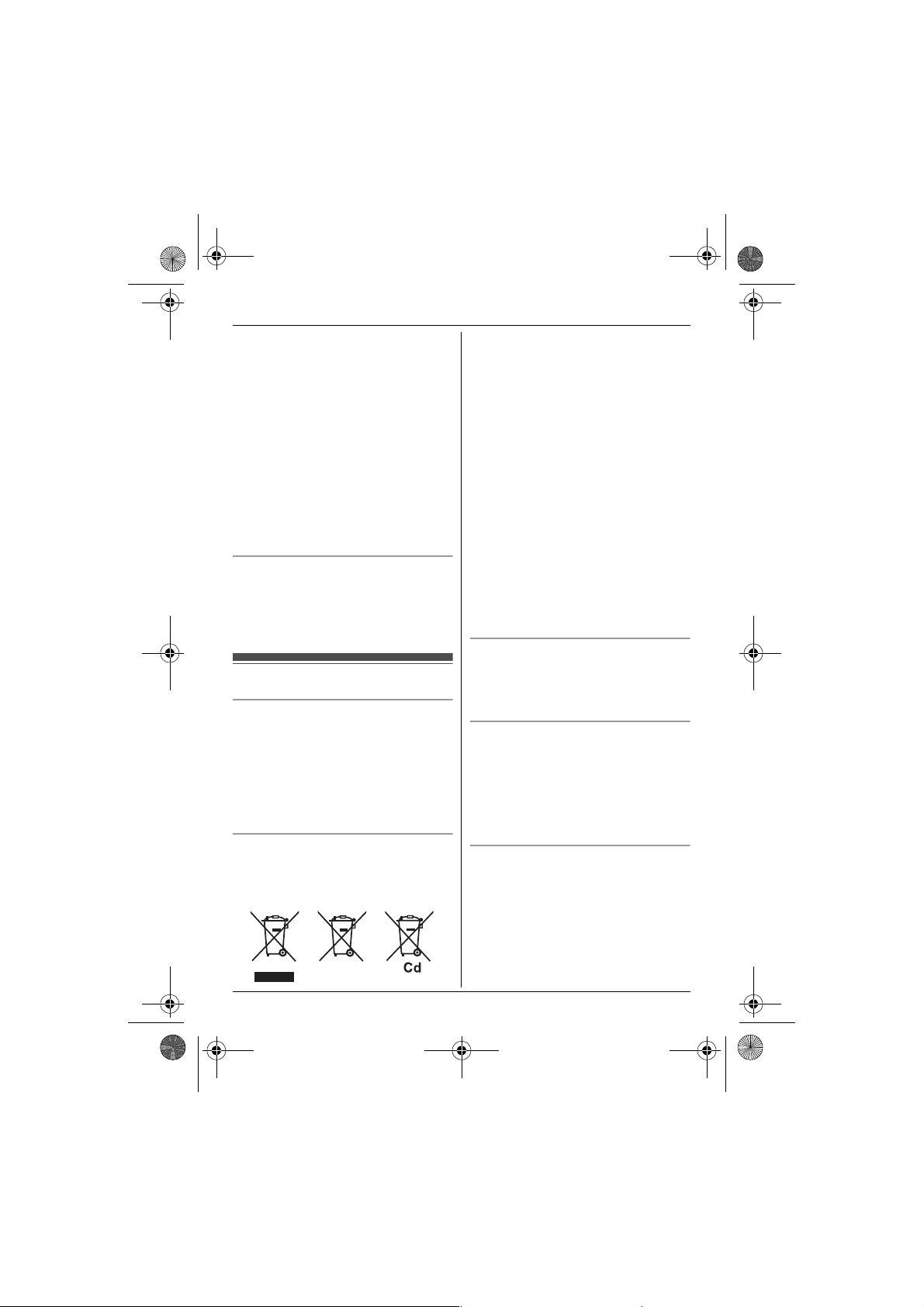
1
2
3
These symbols (1, 2, 3) on the products,
packaging, and/or accompanying documents
mean that used electrical and electronic
products and batteries should not be mixed
with general household waste.
For proper treatment, recovery and recycling
of old products and used batteries, please take
them to applicable collection points, in
accordance with your national legislation and
the Directives 2002/96/EC and 2006/66/EC.
By disposing of these products and batteries
correctly, you will help to save valuable
resources and prevent any potential negative
effects on human health and the environment
which could oth erwise arise from inappropria te
waste handling.
For more information about collection and
recycling of old products and batteries, please
contact your local municipality, your waste
disposal service or the point of sale where you
purchased the items.
Penalties may be applicable for incorrect
disposal of this waste, in accordance with
national legislation.
For business users in the European
Union
If you wish to discard electrical and electronic
equipment, please contact your dealer or
supplier for further information.
Information on Disposal in other
Countries outside the European
Union
These symbols (1, 2, 3) are only valid in the
European Union. If you wish to discard these
items, please contact your local authorities or
dealer and ask for the correct method of
disposal.
Note for the battery symbol
This symbol (2) might be used in combination
with a chemical symbol (3). In this case it
complies with the requirement set by the
Directive for the chemical involved.
8
Page 9
TG661x_662xFX(e).book Page 9 Wednesday, March 2, 2011 2:31 PM
Specifications
■ Stand ard:
DECT (Digital Enhanced
Cordless Telecommunications),
GAP (Generic Access Profile)
■ Frequency range:
1.88 GHz to 1.90 GHz
■ RF transmission power:
Approx. 10 mW (average power per
channel)
■ Power source:
220–240 V AC, 50/60 Hz
■ Power consumption:
Base unit
Standby: Approx. 0.4 W
Maximum: Approx. 2.3 W
Base unit
Standby: Approx. 0.5 W
Maximum: Approx. 2.4 W
Charger:
Standby: Approx. 0.1 W
Maximum: Approx. 1.8 W
■ Operating conditions:
0 °C – 40 °C, 20 % – 80 % relative air
humidity (dry)
*1 KX-TG6611/KX-TG6612
*2 KX-TG6621
Note:
L Design and specifications are subject to
change without notice.
L The illustrations in these instructions may
vary slightly from the actual product.
*1
:
*2
:
Important Information
9
Page 10
TG661x_662xFX(e).book Page 10 Wednesday, March 2, 2011 2:31 PM
Getting Started
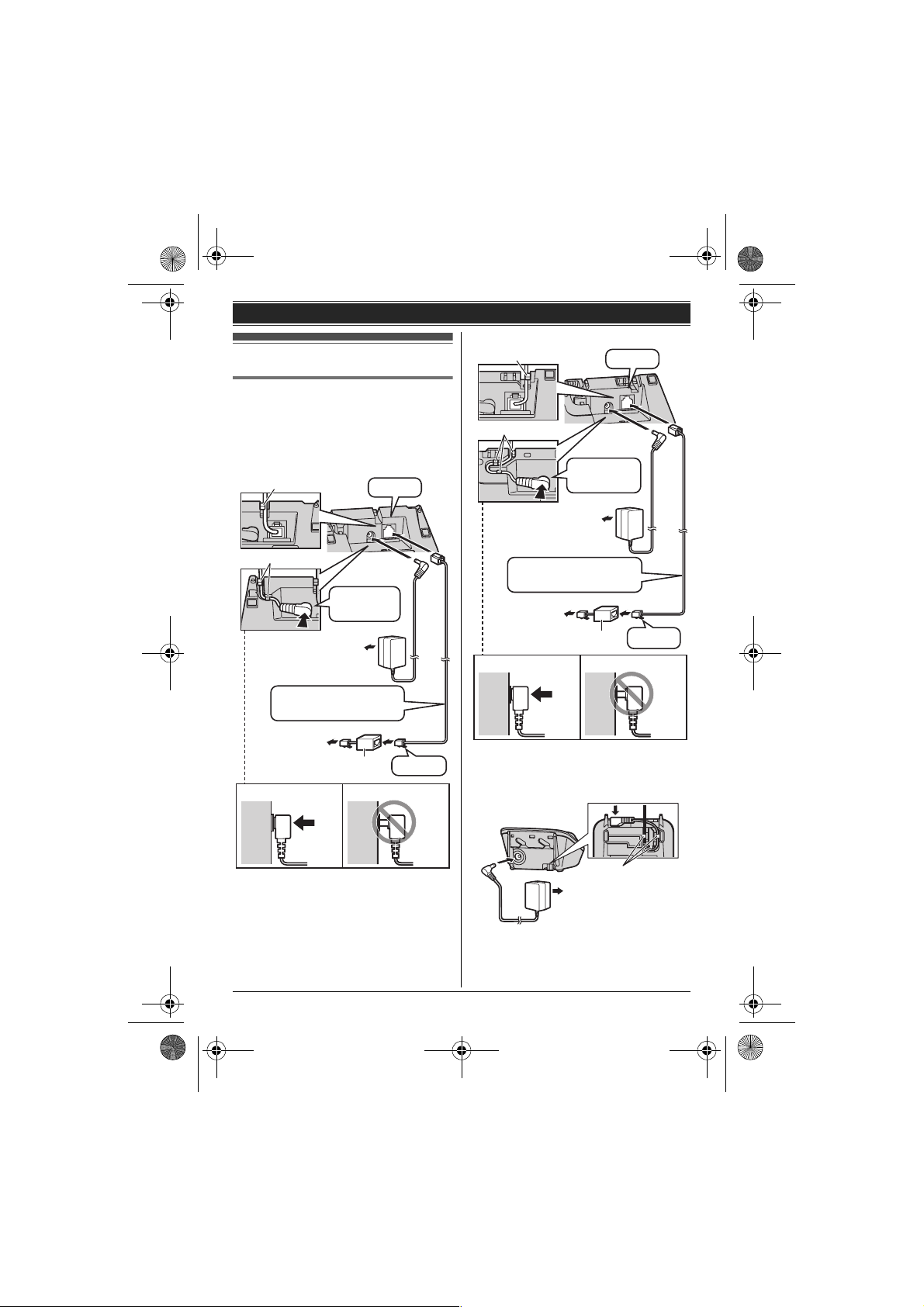
■ Base unit (KX-TG6621)
Setting up
Hook
Connections
L Use only the supplied Panasonic AC
adaptor PNLV226CE.
L When mounting the unit on a wall, see page
16.
■ Base unit (KX-TG6611/KX-TG6612)
Hook
“Click”
Hooks
(220-240 V AC,
50/60 Hz)
“Click”
Press plug
firmly.
Hooks
Press plug
firmly.
(220-240 V AC,
50/60 Hz)
Use only the supplied
telephone line cord.
To telephone
line
DSL/ADSL filter*
“Click”
Correct Wrong
*DSL/ADSL filter (not supplied) is required if
you have DSL/ADSL service.
10
Use only the supplied
telephone line cord.
To telephone
line
DSL/ADSL filter*
“Click”
Correct Wrong
*DSL/ADSL filter (not supplied) is required if
you have DSL/ADSL service.
■ Charger
Hooks
(220-240 V AC,
50/60 Hz)
Page 11
TG661x_662xFX(e).book Page 11 Wednesday, March 2, 2011 2:31 PM
Getting Started
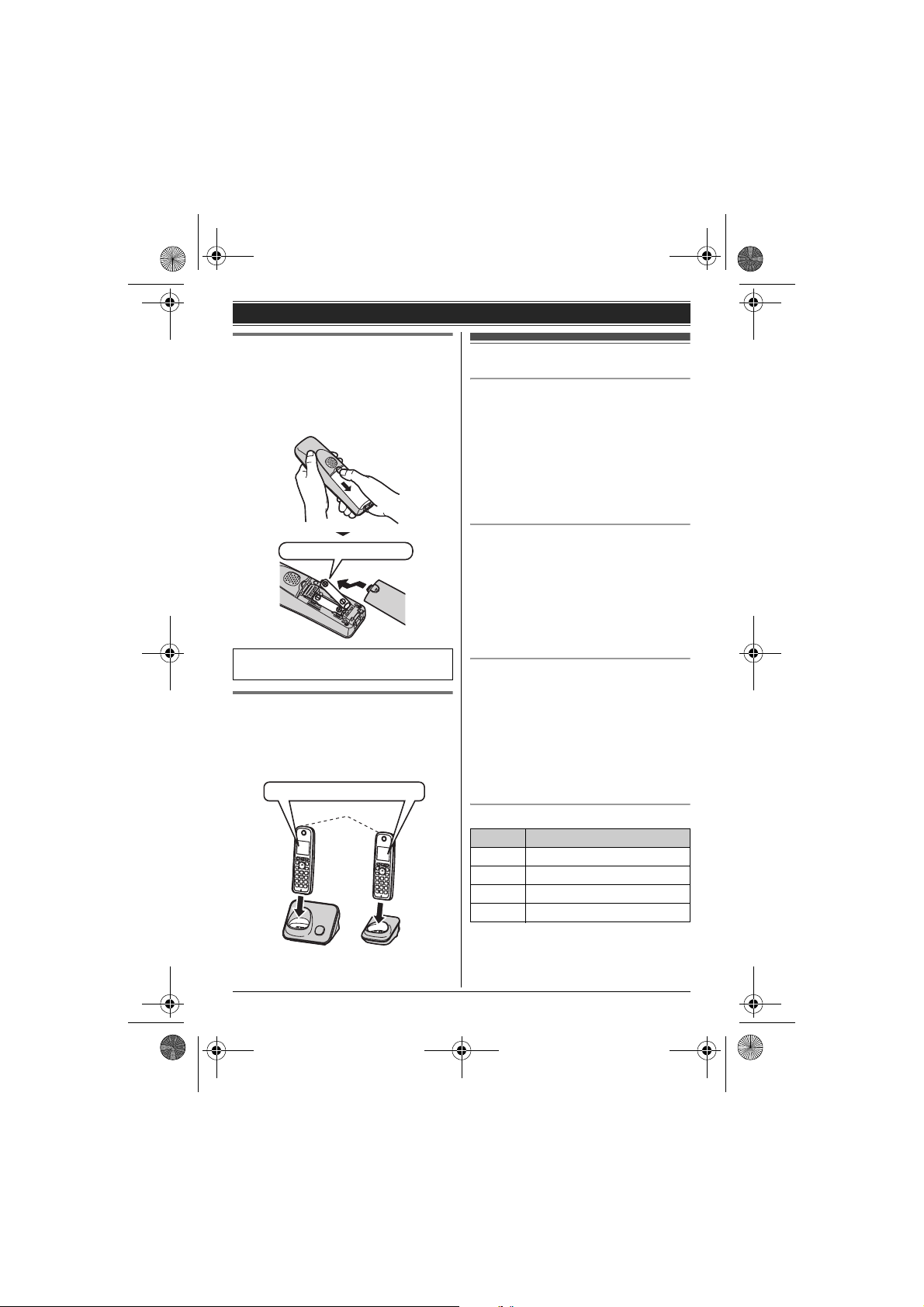
Battery installation
L USE ONLY Ni-MH batteries AAA (R03)
size.
L Do NOT use Alkaline/Manganese/Ni-Cd
batteries.
L Confirm correct polarities (S, T).
Rechargeable Ni-MH ONLY
L When the language selection is
displayed, see page 15.
Battery charging
Charge for about 7 hours.
L When the batteries are fully charged, the
charge indicator goes off and “Fully
charged” is displayed.
Confirm “Charging” is displayed.
Charge indicator
Note when setting up
Note for connections
L The AC adaptor must remain connected at
all times. (It is normal for the adaptor to feel
warm during use.)
L The AC adaptor should be connected to a
vertically oriented or floor-mounted AC
outlet. Do not connect the AC adaptor to a
ceiling-mounted AC outlet, as the weight of
the adaptor may cause it to become
disconnected.
Note for battery installation
L Use the supplied rechargeable batteries.
For replacement, we recommend using the
Panasonic rechargeable batteries noted on
page 4, 7.
L Wipe the battery ends (S, T) with a dry
cloth.
L Avoid touching the battery ends
(S, T) or the unit contacts.
Note for battery charging
L It is normal for the handset to feel warm
during charging.
L Clean the charge contacts of the handset,
base unit, and charger with a soft and dry
cloth once a month. Before cleaning the
unit, disconnect from power outlets and any
telephone line cords. Clean more often if
the unit is exposed to grease, dust, or high
humidity.
Battery level
Icon Battery level
& High
( Medium
) Low
0)4 Needs charging.
11
Page 12
TG661x_662xFX(e).book Page 12 Wednesday, March 2, 2011 2:31 PM
Getting Started
Panasonic Ni-MH battery
performance (supplied batteries)
Operation Operating time
In continuous use 15 hours max.
Not in use
(standby)
Note:
L It is normal for batteries not to reach full
capacity at the initial charge. Maximum
battery performance is reached after a few
complete cycles of charge/discharge (use).
L Actual battery performance depends on
usage and ambient environment.
L Even after the batteries are fully charged,
the handset can be left on the base unit or
charger without any ill effect on the
batteries.
L The battery level may not be displayed
correctly after you replace the batteries. In
this case, place the handset on the base
unit or charger and let it charge for at least 7
hours.
170 hours max.
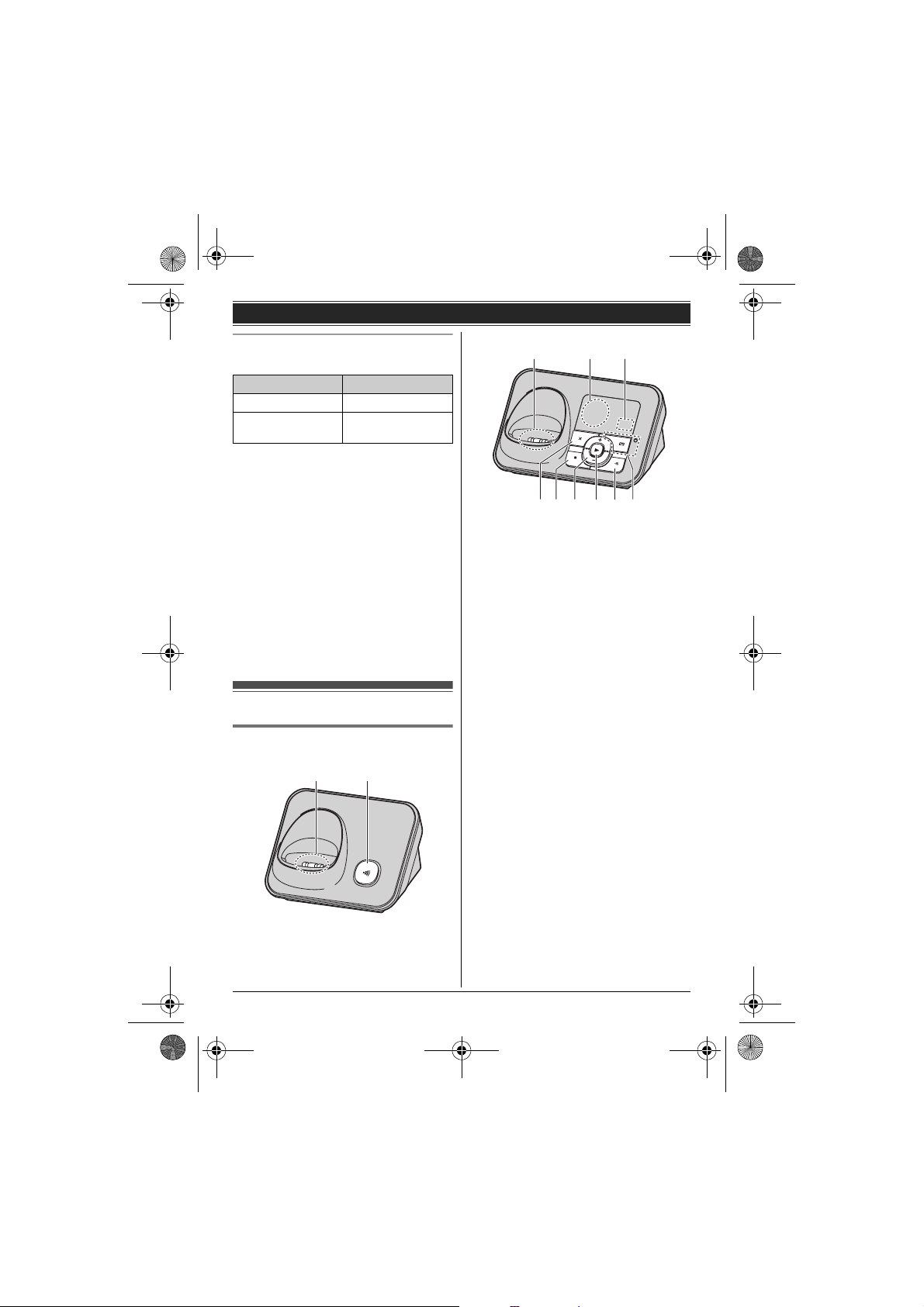
■ KX-TG6621
A B C
D E F IG H
A Charge contacts
B Speaker
C Message counter
D {4} (Erase)
E {■} (Stop)
F {+}/{-} (Volume up/down)
{7}/{8} (Repeat/Skip)
G {6} (Play)
Message indicator
H {x} (Locator)
I {s} (Answer on)
Answer on indicator
Controls
Base unit
■ KX-TG6611/KX-TG6612
A B
A Charge contacts
B {x} (Locator)
12
Page 13
TG661x_662xFX(e).book Page 13 Wednesday, March 2, 2011 2:31 PM
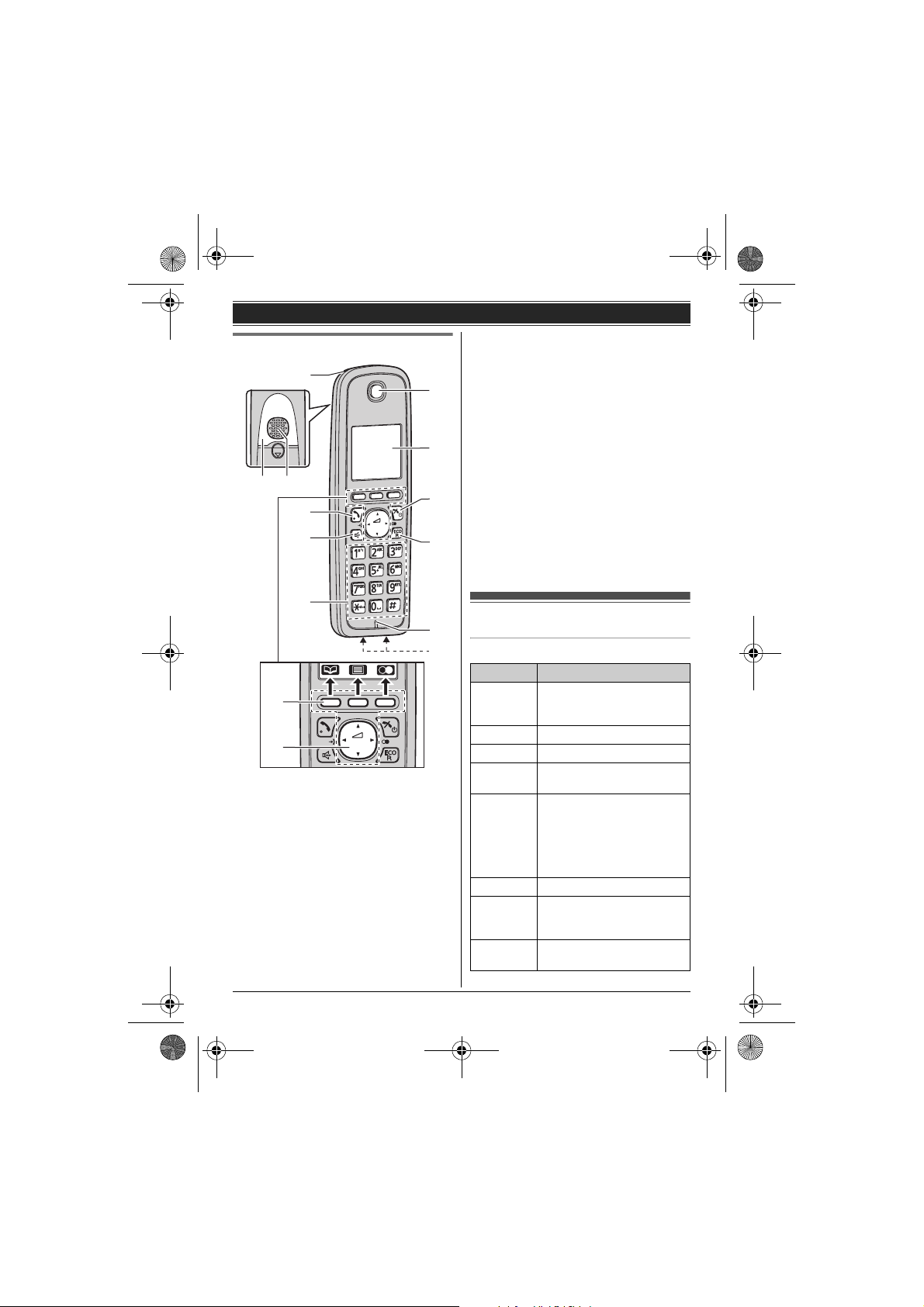
J {ECO/R}
Handset
A
B C
D
E
F
A
B
A Charge indicator
Ringer indicator
B Secure grip
L Secure grip offers support when you
cradle the handset between your
shoulder and ear.
C Speaker
D {C} (Talk)
E {s} (Speakerphone)
F Dial keypad
G Receiver
H Display
I {ic} (Off/Power)
G
H
I
J
K
L
ECO: Eco mode shortcut key
R: Recall/Flash
K Microphone
L Charge contacts
■ Control type
A Soft keys
The handset features 3 soft keys. By
pressing a soft key, you can select the
feature shown directly above it on the
display.
B Navigator key
– {^}, {V}, {<}, or {>}: Scroll through
various lists and items.
– ? (Volume: {^} or {V}): Adjust the
receiver or speaker volume while talking.
– {<} (y: Caller list): View the caller list.
– {>} (R: Redial): View the redial list.
Display
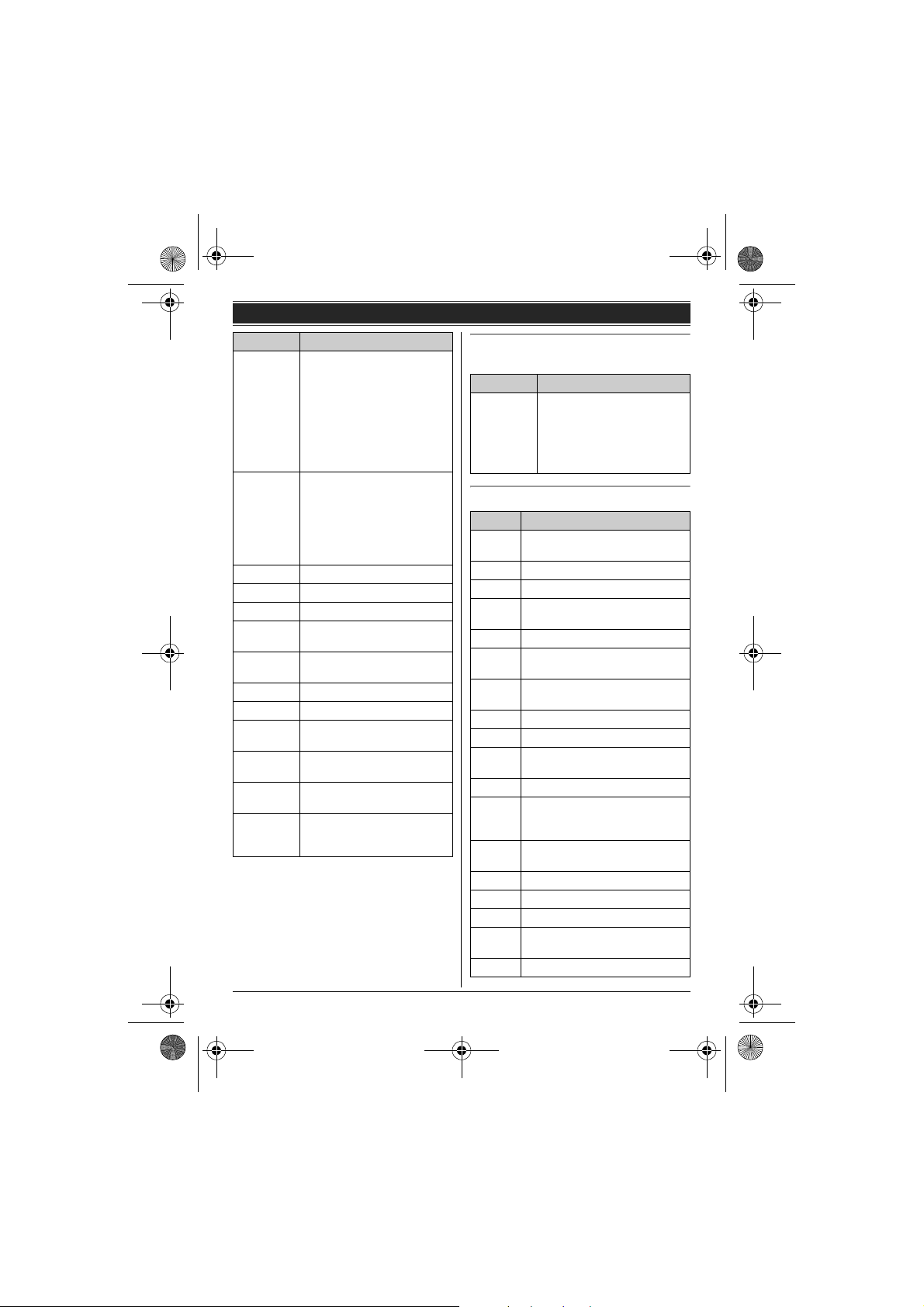
Handset display items
Item Meaning
l Range status: The more
_ Out of base unit range
x Paging, intercom mode.
s Speakerphone is on.
C The line is in use.
y Missed call
i The base unit transmission
k The LCD and key backlight
Getting Started
bars visible, the closer the
handset is to the base unit.
(page 17)
L When flashing slowly:
The call is put on hold.
L When flashing rapidly: An
incoming call is now
being received.
*1
(page 32)
power is set to “Low”.
(page 16)
is off. (page 25)
13
Page 14
TG661x_662xFX(e).book Page 14 Wednesday, March 2, 2011 2:31 PM
Getting Started
Item Meaning
u L When displayed next to
the battery icon:
Answering system is
*2
(page 37)
on.
L When displayed with a
number:
New messages have
been recorded.
(page 39)
*2
d Answering system answers
calls with a greeting
message and caller
messages are not
*2
recorded.
“Greeting Only””,
page 41)
(“Selecting
& Battery level
E Alarm is on. (page 27)
6 Equalizer is set. (page 18)
: Privacy mode is on.
(page 26)
~ Ringer volume is off.
(page 25)
3 Night mode is on. (page 28)
7 Blocked call
h New SMS message
received.
6 New voice mail message
received.
Line in
Someone is using the line.
*1
(page 28, 32)
*3
(page 35)
*4
(page 42)
use
IN USE Answering system is being
*1 Caller ID subscribers only
*2 KX-TG6621
used by another handset or
the base unit.
*2
*3 SMS users only
*4 Voice mail subscribers only
Base unit display items
■ KX-TG6621
Item Meaning
- - Answering system answers
calls with a greeting
message and caller
messages are not recorded.
(“Selecting “Greeting
Only””, page 41)
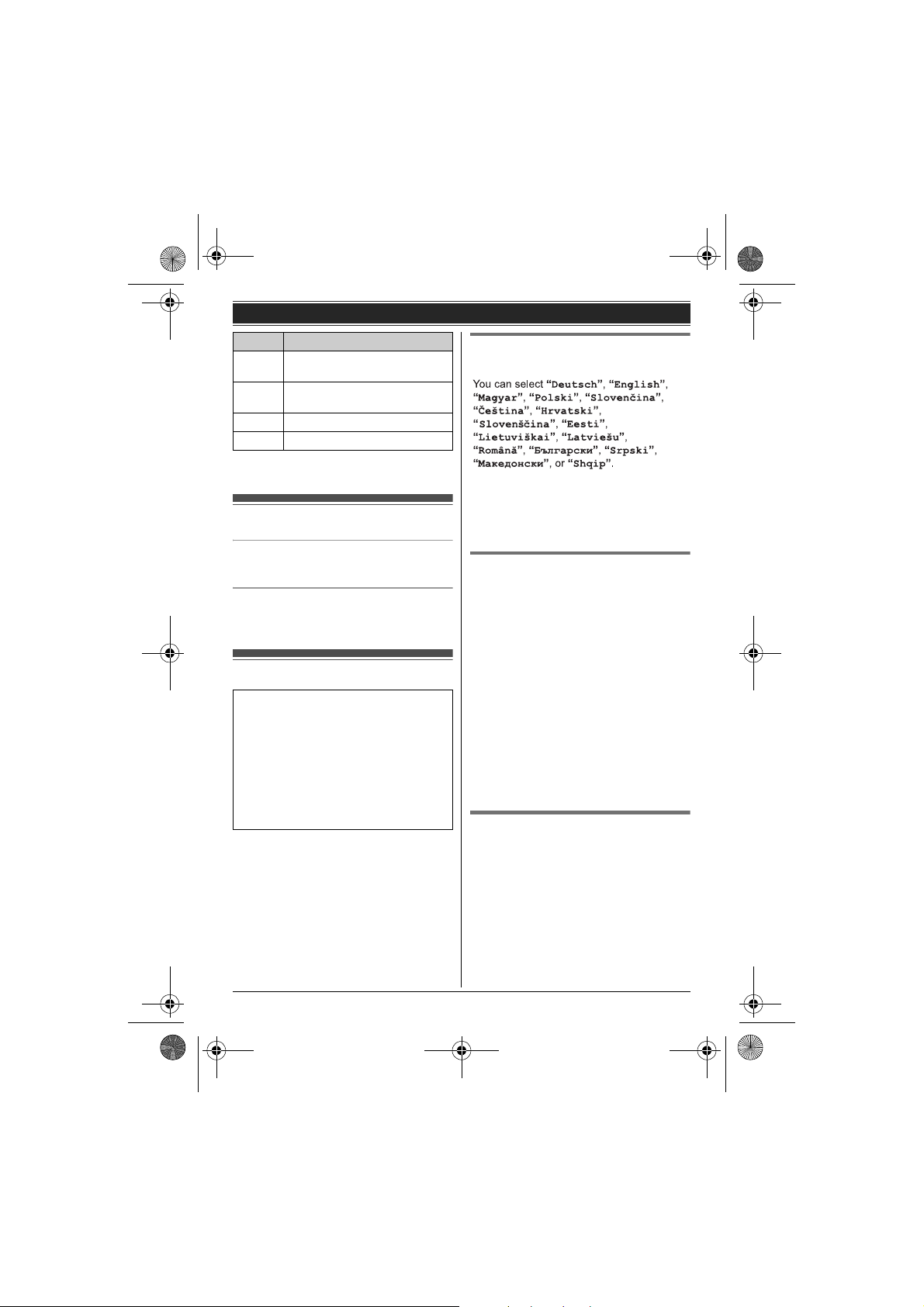
Handset soft key icons
Icon Action
^ Returns to the previous screen
8 Displays the menu.
M Accepts the current selection.
j Displays a previously dialled
] Makes a call. (page 17)
L Temporarily turns off the ringer
/ Sets 24-hour or 12-hour clock
H Places a call on hold.
n Opens the phonebook.
~ Allows you to edit phone
m Adds new entry. (page 21, 28)
k Displays the character entry
& Turns the key lock feature off.
/ Selects a character entry mode.
t Selects handsets. (page 29)
O Stops recording or playback.
I Stores phone numbers.
l Inserts a dialling pause.
or outside call.
phone number.
for incoming calls. (page 17)
format. (page 15)
numbers. (page 28, 32)
mode for phonebook search.
(page 21)
(page 19)
(page 28, 33)
*1
14
Page 15
TG661x_662xFX(e).book Page 15 Wednesday, March 2, 2011 2:31 PM
Getting Started
Icon Action
W Erases the selected item or
4 Allows you to make an intercom
^ Erases a number/character.
1 Puts the call on mute.
*1 KX-TG6621
returns to the outside call.
call. (page 43)
Turning the power on/off
Power on
Press {ic} for about 1 second.
Power off
Press {ic} for about 2 seconds.
Initial settings
■ Direct command code:
Programmable settings can be accessed
by pressing 8, ( and then the
corresponding code on the dial keypad
(page 23).
Example: Press 8(1)1.
■ Symbol meaning:
Example: {r}: “Off”
Press {V} or {^} to select the words in
quotations.
Important:
L When you install the batteries for the first
time, the handset may prompt you to set
display language and region setting.
1 Perform step 2 in “Display language”,
page 15, and then press M.
2 Continue from step 2 in “Changing the
unit’s region setting/Resetting the base
unit”, page 29.
Display language
16 display languages are available.
1 8(11)
2 {r}: Select your desired language. s
M
3 {ic}
Date and time
1 8(1)1
2 Enter the current date, month, and year.
s M
Example: 15 July, 2011
15 )7 11
3 Enter the current hour and minute.
Example: 9:30
)9 3)
L You can select 24-hour or 12-hour
clock format (“AM” or “PM”) by
pressing /.
4 M s {ic}
Note:
L The date and time may be incorrect after a
power failure. In this case, set the date and
time again.
Dialling mode
If you cannot make calls, change this setting
according to your telephone line service. The
default setting is “Tone ”.
“Tone”: For tone dial service.
“Pulse”: For rotary/pulse dial service.
1 8(12)
2 {r}: Select the desired setting.
3 M s {ic}
15
Page 16
)
TG661x_662xFX(e).book Page 16 Wednesday, March 2, 2011 2:31 PM
Getting Started
■ Base unit (KX-TG6611/KX-TG6612)
One touch eco mode
When the handset is on the base unit, the base
unit transmission power is reduced up to
99.9% if only one handset is registered.
Even when the handset is not on the base unit
or several handsets are registered, the base
unit transmission power in standby mode can
be reduced up to 90% by activating one touch
eco mode.
You can turn on/off one touch eco mode b y just
pressing {ECO/R}. The default setting is
“Normal”.
– When the one touch eco mode is on: “Low”
is temporarily displayed and i is shown
on the handset display instead of w.
– When the one touch eco mode is off:
“Normal” is temporarily displayed and
i goes off from the handset display.
Note:
L When there is another cordless phone
nearby and it is in use, the base unit
transmission power may not be reduced.
L Activating one touch eco mode reduces the
range of the base unit in standby mode.
L If you set the repeater mode to “On” (page
31):
– One touch eco mode is cancelled.
– “Eco Setup” is not shown in th e display
menu (page 25).
*1
Hook
■ Base unit (KX-TG6621)
*1
Hooks
*1 When mounting the base unit on a wall, do
not pass the cords through these hooks.
■ Charger
56 mm
Screws
(Not supplied)
83 mm
*1
Screws
(Not supplied
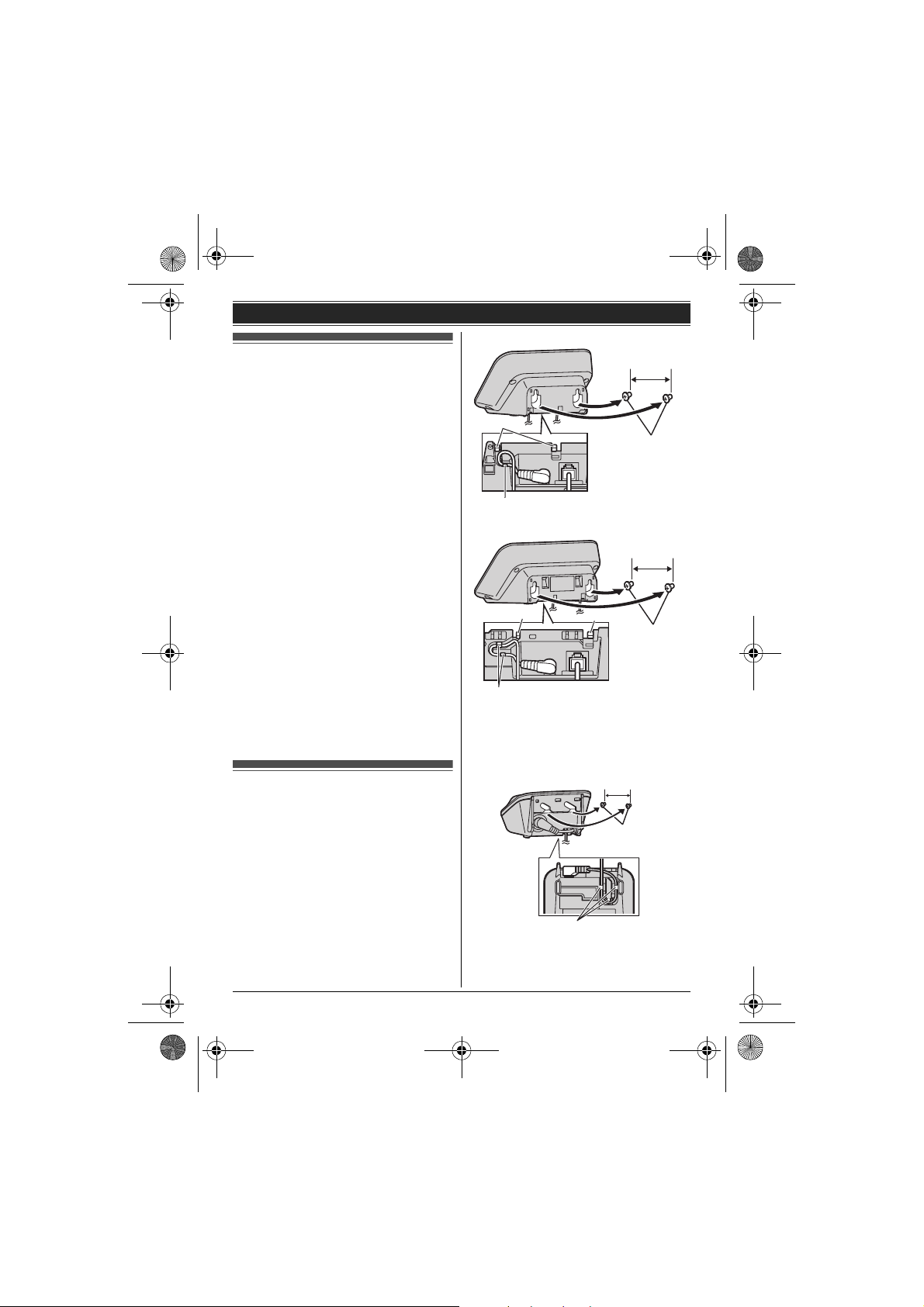
Wall mounting
Note:
L Make sure that the wall and the fixing
method are strong enough to support the
weight of the unit.
16
25 mm
Screws
(Not supplied)
Hooks
Page 17

TG661x_662xFX(e).book Page 17 Wednesday, March 2, 2011 2:31 PM
Making/Answering Calls
Example: If you need to dial the line access
Making calls
1 Lift the handset and dial the phone
number.
L To correct a digit, press ^.
2 Press {C} or ].
3 When you finish talking, press {ic} or
place the handset on the base unit or
charger.
number “0” when making outside calls with a
PBX:
1 ) s l
2 Dial the phone number. s {C}
Note:
L A 3 second pause is ins erted each time l
is pressed. Repeat as needed to create
longer pauses.
Using the speakerphone
1 Dial the phone number and press {s}.
L Speak alternately with the other party.
2 When you finish talking, press {ic}.
Note:
L For best performance, use the
speakerphone in a quiet environment.
L To switch back to the receiver, press
{s}/{C}.
Adjusting the receiver or speaker
volume
Press {^} or {V} repeatedly while talking.
Making a call using the redial list
The last 10 phone numbers dialled are stored
in the redial list (each 24 digits max.).
1 j or {>} (R)
2 {r}: Select the desired phone number.
3 {C}
Erasing a number in the redial list
1 j or {>} (R)
2 {r}: Select the desired phone number.
s W
3 {r}: “Yes” s M s {ic}
Pause (for PBX/long distance service
users)
A pause is sometimes required when making
calls using a PBX or long distance service.
When storing a calling card access number
and/or PIN in the phonebook, a pause is also
needed (page 21).
Answering calls
When a call is being received, the ringer
indicator flashes rapidly.
1 Lift the handset and press {C} or {s}
when the unit rings.
L You can also answer the call by
pressing any dial key fro m ) to 9, *,
or (. (Any key answer feature)
2 When you finish talking, press {ic} or
place the handset on the base unit or
charger.
Auto talk
You can answer calls simply by lifting the
handset off the base unit or charger. You do
not need to pres s {C}. To turn this feature on,
see page 25.
Adjusting the handset ringer volume
■ While the handset is ringing for an
incoming call:
Press {^} or {V} repeatedly to select the
desired volume.
■ Programming the volume beforehand:
1 8(16)
2 {r}: Select the desired volume.
3 M s {ic}
Temporary handset ringer off
While the handset is ringing for a call, you can
turn the ringer off temporarily by pressing L.
17
Page 18

TG661x_662xFX(e).book Page 18 Wednesday, March 2, 2011 2:31 PM
Making/Answering Calls
This feature allows you to receive calls while
Useful features during a call
Hold
This feature allows you to put an outside call
on hold.
1 Press 8 during an outside call.
2 {r}: “Hold” s M
3 To release hold, press {C}.
L Another handset user can take the call
by pressing {C}.
Note:
L If a call is kept on hold for more than 9
minutes, an alarm tone starts to sound and
the ringer indicator flashes rapidly. After 1
additional minute on hold, the call is
disconnected.
L If another phone is connected to the same
line, you can also take the call by lifting its
handset.
you are already talking on the phone. If you
receive a call while on the phone, you will hear
a call waiting tone.
If you subscribe to both Caller ID and Call
Waiting with Caller ID services, the 2nd
caller’s information is displayed after you hear
the call waiting tone on the handset.
1 Press {ECO/R} to answer the 2nd call.
2 To switch between calls, press {ECO/R}.
Note:
L Please contact your service provider/
telephone company for details and
availability of this service in your area.
Temporary tone dialling (for
rotary/pulse service users)
You can temporarily switch the dialling mode
to tone when you need to access touch-tone
services (for example, answering services,
telephone banking services, etc.).
Press * before entering access numbers
which require tone dialling.
Mute
While mute is turned on, you can hear the
other party, but the other party cannot hear
you.
1 Press 1 during conversation.
L 1 flashes.
2 To return to the conversation, press 1
again.
Recall/flash
{ECO/R} allows you to use the special
features of your host PBX such as transferring
an extension call, or accessing optional
telephone services.
Note:
L To change the recall/flash time, see page
26.
For call waiting or Call Waiting
Caller ID service users
To use call waiting or Call Waiting Caller ID,
you must first subscribe with your service
provider/telephone company.
18
Handset equalizer
This feature clarifies the voice of the person
you are talking to, producing a more naturalsounding voice that is easier to hear and
understand.
1 Press 8 while talking.
2 {r}: “Equalizer” s M
3 {r}: Select the desired setting.
4 Press M to exit.
Note:
L When this feature is turned on, 6 is
displayed while talking.
L Depending on the condition and quality of
your telephone line, this feature may
emphasise existing line noise. If it becomes
difficult to hear, turn this feature off.
L This feature is not available while using the
speakerphone.
Page 19

TG661x_662xFX(e).book Page 19 Wednesday, March 2, 2011 2:31 PM
Making/Answering Calls
L Do not touch the handset’s charge contacts
Call share
You can join an existing outside call.
To join the conversation, press {C} when the
other handset is on an outside call.
Note:
L To prevent other users from joining your
conversations with outside callers, turn the
privacy mode on (page 26).
Key lock
The handset can be locked so that no calls or
settings can be made. Incoming calls can be
answered, but all other functions are disabled
while key lock is on.
To turn key lock on, press 8 for about 3
seconds.
L & is displayed.
L To turn key lock off, press & for about 3
seconds.
Note:
L Calls to emergency numbers cannot be
made until key lock is turned off.
during power back-up mode.
L If the battery level is low, the unit will not
work sufficiently during power back-up
mode. In addition, in case handset battery
power runs out, we recommend connecting
a corded-type telephone (without AC
adaptor) to the same telephone line or to
the same telephone line jack, if you have
such a telephone jack in your house.
L Calls cannot be made during a power
failure until key lock is turned off (page 19).
Panasonic Ni-MH battery
performance (supplied batteries)
during power back-up mode
When the batteries are fully charged,
operating time of the handset in power backup mode varies depending on usage.
– Continuous use of the handset in power
back-up mode: 2 hours max.
– Continuous use of the handset other than a
handset in power back-up mode: 3 hours
max.
– Not in use in power back-up mode: 3 hours
max.
Note:
L Actual battery performance depends on
usage and ambient environment.
Power back-up operation
When a power failure occurs, the charged
handset temporarily supplies power to the
base unit (power back-up mode). This allows
you to make and receive calls using a handset
during a power failure. The base unit will not
perform any other functions. You can program
“Power Failure” and the default setting is
“Auto” (page 26).
Important:
L If a handset is not placed on the base unit
when a power failure occurs, “Base no
power Press ic” is displayed. After
pressing {ic} on the handset, place it on
the base unit to start power back-up mode.
L Power back-up mode will not work if the
battery level of the power supplying
handset is )/0)4.
L Do not lift the power supplyin g handset from
the base unit during power back-up mode.
Making calls during a power
failure
■ When only 1 handset is registered:
1 Lift the handset and dial the phone
number.
2 Within 1 minute, place the handset on
the base unit.
L Wait until speakerphone is turned
on automatically and the call is
made.
3 When the other party answers the call,
keep the handset on the base unit and
talk using the speakerphone.
4 When you finish talking, press {ic}.
Note:
L In step 2, if you do not place the handset on
the base unit within 1 minute, the power
19
Page 20

TG661x_662xFX(e).book Page 20 Wednesday, March 2, 2011 2:31 PM
Making/Answering Calls
back-up mode turns off. In this case, press
{ic} on the handset and dial the phone
number. Then try again from step 2.
■ When 2 or more handsets are registered:
You should leave one handset on the base
unit for supplying the power, and use
another handset for making calls. For the
operation, please see “Making calls”, page
17.
Note:
L During a call with the handset placed on the
base unit (power back-up mode), the call
may be disconnected if you touch the
handset. In such case, try to call back.
L The range of the base unit is limited during
a power failure. Please use the handset
close to the base unit.
Making a call using the redial list
■ When only 1 handset is registered:
1 Lift the handset.
2 j or {>} (R)
3 {r}: Select the desired phone number.
4 Within 1 minute, place the handset on
the base unit.
L Wait until speakerphone is turned
on automatically and the call is
made.
■ When 2 or more handsets are registered:
You should leave one handset on the base
unit for supplying the power, and use
another handset for making calls. For the
operation, please see “Making a call using
the redial list”, page 17.
■ When 2 or more handsets are registered:
You should leave one handset on the base
unit for supplying the power, and use
another handset for making calls. For the
operation, please see “Finding and calling
from a phonebook entry”, page 21.
Answering calls during a power
failure
■ When only 1 handset is registered:
1 When the unit rings, keep the handset
on the base unit and press {C} or
{s}.
L Speakerphone is turned on.
2 When you finish talking, press {ic}.
■ When 2 or more handsets are registered:
When the unit rings, use a handset which is
not supplying power to the base unit. For
the operation, please see “Answe ring calls”,
page 17.
L Do not use or lift the handset which is
placed on the base unit during power
back-up mode.
Note:
L During a call with the handset placed on the
base unit (power back-up mode), the call
may be disconnected if you touch the
handset. In such case, try to call back.
L The range of the base unit is limited during
a power failure. Please use the handset
close to the base unit.
Making a call using the handset
phonebook
■ When only 1 handset is registered:
1 Lift the handset.
2 n
3 {r}: Select the desired entry.
4 Within 1 minute, place the handset on
the base unit.
L Wait until speakerphone is turned
on automatically and the call is
made.
20
Page 21

TG661x_662xFX(e).book Page 21 Wednesday, March 2, 2011 2:31 PM
L If there is no entry corresponding to
Handset phonebook
The phonebook allows you to make calls
without having to dial manually. You can add
100 names and phone numbers.
the character you selected, the next
entry is displayed.
3 {r}: Scroll through the phonebook if
necessary.
4 {C}
Phonebook
Adding entries
1
n s m
2 Enter the party’s name (16 characters
max.). s M
L You can change the character entry
mode by pressing / (page 44).
3 Enter the party’s phone number (24 digits
max.). s M 2 times
L To add other entries, repeat from step
2.
4 {ic }
Finding and calling from a
phonebook entry
Scrolling through all entries
1 n
2 {r}: Select the desired entry.
L You can scroll through the phonebook
entry by pressing and holding {V} or
{^}.
3 {C}
Searching by first character
1 n
L Change the character entry mode if
necessary:
k s {r}: Select the character entry
mode. s M
2 Press the dial key () to 9, or () which
contains the character you are searching
for (page 44).
L Press the same dial key repeatedly to
display the first entry corresponding to
each character located on that dial
key.
Editing entries
1
Find the desired entry (page 21). s 8
2 {r}: “Edit” s M
3 Edit the name if necessary (16 characters
max.; page 44). s M
4 Edit the phone number if necessary (24
digits max.). s M 2 times s {ic}
Erasing entries
Erasing an entry
1 Find the desired entry (page 21).
2 W s {r}: “Yes” s M s {ic}
Erasing all entries
1 n s 8
2 {r}: “Erase All” s M
3 {r}: “Yes” s M
4 {r}: “Yes” s M s {ic}
Chain dial
This feature allows you to dial phone numbers
in the phonebook while you are on a call. This
feature can be used, for example, to dial a
calling card access number or bank account
PIN that you have stored in the phonebook,
without having to dial manually.
1 During an outside call, press 8.
2 {r}: “Phonebook” s M
3 {r}: Select the desired entry.
4 Press ] to dial the number.
Note:
L When storing a calling card access number
and your PIN in the phonebook as one
phonebook entry, press l to add pauses
21
Page 22

TG661x_662xFX(e).book Page 22 Wednesday, March 2, 2011 2:31 PM
Phonebook
after the number and PIN as necessary
(page 17).
L If you have rotary/pulse service, you need
to press * before pressing 8 in ste p 1 to
change the dialling mode temporarily to
tone. When adding entries to the
phonebook, we recommend adding * to
the beginning of phone numbers you wish
to chain dial (page 21).
Copying phonebook entries
You can copy phonebook entries between 2
handsets.
*1 Panasonic compatible handset
Copying an entry
*1
1 Find the desired entry (page 21). s 8
2 {r}: “Copy” s M
3 {r}: Select the handset you want to send
the phonebook entry to. s M
L When an entry has been copied,
“Completed” is displayed.
L To continue copying another entry:
{r}: “Yes” s M s {r}: Select the
desired entry. s M
4 {ic}
Copying all entries
1 n s 8
2 {r}: “Copy All” s M
3 {r}: Select the handset you want to send
the phonebook entry to. s M
L When all entries have been copied,
“Completed” is displayed.
4 {ic}
22
Page 23

TG661x_662xFX(e).book Page 23 Wednesday, March 2, 2011 2:31 PM
Programming
Programmable settings
You can customise the unit by programming the following features using the handset.
To access the features, there are 2 methods.
■ Scrolling through the display menus
1 8
2 Press {V} or {^} to select the desired main menu. s M
3 Press {V} or {^} to select the desired item from the next sub-menus. s M
4 Press {V} or {^} to select the desired setting. s M
L This step may vary depending on the feature being programmed.
L To exit the operation, press {ic}.
■ Using the direct command code
1 8 s Enter the desired code.
Example: Press 8(1)1.
2 Select the desired setting. s M
L This step may vary depending on the feature being programmed.
L To exit the operation, press {ic}.
Note:
L In the following table, < > indicates the default settings.
L In the following table, + indicates the reference page number.
L Display menu order and sub-menu may vary depending on your model.
Display the menu tree and direct command code table
Main menu: \ “Caller List”
Operation Code +
Viewing the caller list. #213 32
Main menu: e “Answer System”
Sub-menu 1 Sub-menu 2 Settings Code +
Play New Msg. ––#323 39
Play All Msg. ––#324 39
Erase All Msg.
Greeting Start REC
*2
(Record greeting)
Play Greeting – #303 38
Default
(Reset to pre-recorded
greeting)
*1
––#325 39
*2
*2
– #302 38
– #304 38
23
Page 24

TG661x_662xFX(e).book Page 24 Wednesday, March 2, 2011 2:31 PM
Programming
Sub-menu 1 Sub-menu 2 Settings Code +
Settings Number of Rings
Recording Time
Remote Code
Call Screening 1: <On> 0: Off #310 37
Answer On
Answer Off
*2
*2
Main menu: f “SMS”
Sub-menu 1 Sub-menu 2 Settings Code +
Receive List ––#350 35
Send List ––35
Create ––34
Settings Message Centre1
Message Centre2
PBX Access #
SMS On/Off
Main menu: 4 “Intercom”
Operation Code +
Paging the desired unit. #274 43
Main menu: e “Time Settings”
Sub-menu 1 Sub-menu 2 Settings Code +
Set Date/Time
*2
Alarm – 1: Once
Time Adjustment
Main menu: d “Ringer Setup”
*2, *6
*7
Sub-menu 1 Sub-menu 2 Settings Code +
Ringer Volume
*8
(Handset)
Ringtone
*9, *10
(Handset)
*2
2–6: 2-6 Rings
4: <4 Rings>
#211 40
0: Auto
*2
1: 1 Minute
3: <3 Minutes>
0: Greeting Only
*2
– #306 39
#305 41
*3
––#327 37
––#328 37
*2, *5
*2, *4
*2, *4
*2
<Off> #356 36
<Off> #357 34
– #351 34
– #352 34
––#101 15
#720 27
2: Daily
0: <Off>
– 1: Caller ID
#226 –
0: <Manual>
– 0–6: Off–6 <6> #160 17
–<Ringtone 1> #161 –
24
Page 25

TG661x_662xFX(e).book Page 25 Wednesday, March 2, 2011 2:31 PM
Programming
Sub-menu 1 Sub-menu 2 Settings Code +
Night Mode On/Off 1: On 0: <Off> #238 27
Start/End <23:00/06:00> #237 28
Ring Delay 1: 30 sec.
2: <60 sec.>
3: 90 sec.
4: 120 sec.
0: No Ringing
Main menu: c “Initial Setup”
Sub-menu 1 Sub-menu 2 Settings Code +
Ringer Setup Ringer Volume
– Handset
Ringer Volume
– Base Unit
Ringtone
(Handset)
*8
*1, *2
*9, *10
Night Mode
0–6: Off–6 <6> #160 17
0–6: Off–6 <3> #*160 –
<Ringtone 1> #161 –
1: On 0: <Off> #238 27
– On/Off
Night Mode
<23:00/06:00> #237 28
– Start/End
Night Mode
– Ring Delay
1: 30 sec.
2: <60 sec.>
3: 90 sec.
4: 120 sec.
0: No Ringing
Time Settings Set Date/Time
*2
– #101 15
Alarm 1: Once 2: Daily
0: <Off>
*2, *6
Time Adjustment
1: Caller ID
0: <Manual>
Handset Name ––#104 28
Caller Barred
Eco Setup Transmission Power
*2
––#217 28
*2
1: <Normal> 2: Low #725 16
Display Setup LCD & Key Backlight 1: <On> 0: Off #276 –
Keytones
*11
Call Restrict
Auto Talk
*12
*2
Contrast
(Display contrast)
– 1: <On> 0: Off #165 –
––#256 29
– 1: On 0: <Off> #200 17
1–6: Level 1–6
<3>
#239 28
#239 28
#720 27
#226 –
#145 –
25
Page 26

TG661x_662xFX(e).book Page 26 Wednesday, March 2, 2011 2:31 PM
Programming
Sub-menu 1 Sub-menu 2 Settings Code +
Line Setup Dial Mode
Recall/Flash
Privacy Mode
Base Unit PIN
Repeater Mode
*2, *15
*2
*2
Register Register H.set – #130 30
Cancel Register
*2
Country
Power Failure – 1: <Auto>
Language Display <English> #110 15
*1 KX-TG6621
*2 If you program these settings using one of the handsets, you do not need to program the same
item using another handset.
*3 This menu is not displayed when scrolling through the display menus. It is only available in
direct command code.
*4 If you select the unit’s region setting (page 29) to or , the
default setting will be changed for the selected country.
*5 If you select the unit’s region setting (page 29) to or , the
default setting is “On”.
*6 This feature allows the unit to automatically adjust the date and time each time caller
information including date and time is received.
To turn this feature on, select “Caller ID”. To turn this feature off, select “Manual”. (Caller
ID subscribers only)
To use this feature, set the date and time first (page 15).
*7 KX-TG6611/KX-TG6612
*8 Ringer volume cannot be turned off for alarm, intercom calls, and paging.
*9 If you select one of the melody ringer tones, the ringer tone continues to play for several
seconds even if the caller has already hung up. You may either hear a dial tone or no one on
the line when you answer the call.
*10The preset melodies in this product are used with permission of © 2011 Copyrights Vision Inc.
*11Turn this feature off if you prefer not to hear key tones while you are dialling or pressing any
keys, including confirmation tones and error tones.
*2
*2, *13, *14
1: Pulse 2: <Tone> #120 15
0: 900 msec.
#121 18
1: 700 msec.
2: <600 msec.>
3: 400 msec.
4: 300 msec.
5: 250 msec.
*: 200 msec.
#: 160 msec.
6: 110 msec.
7: 100 msec.
8: 90 msec.
9: 80 msec.
– 1: On 0: <Off> #194 –
–<0000> #132 29
– 1: On 0: <Off> #138 30
*3
– 1:
2:
– #131 30
#136 29
3:
0: Off
#152 19
26
Page 27

TG661x_662xFX(e).book Page 27 Wednesday, March 2, 2011 2:31 PM
Programming
*12If you subscribe to a Caller ID service and want to view the caller’s information after lifting up
the handset to answer a call, turn off this feature.
*13The recall/flash time depends on your telephone exchange or host PBX. Contact your PBX
supplier if necessary.
*14The default setting will be as follows if you select the following regional codes when changing
the unit’s region setting (page 29):
*15To prevent other users from joining your conversations with outside callers, turn this feature
on.
Note:
Special programming
Alarm
An alarm sounds at the set time for 3 minutes
once or daily. Alarm can be set for each
handset.
Important:
L Set the date and time beforehand (page
15).
1 8(72)
2 {r}: Select the desired alarm option. s
M
“Off”
Turns alarm off. Go to step 6.
“Once”
An alarm sounds once at the set time.
“Daily”
An alarm sounds daily at the set time. Go
to step 4.
3 Enter the desired date and month. s
M
4 Set the desired time. s M
5 {r}: Select the desired alarm tone. s
M
L We recommend selecting a different
ringer tone from the one used for
outside calls.
6 M s {ic}
L When the alarm is set, E is displayed.
L To stop the alarm, press {ic} or place
the handset on the base unit or charger.
L When the handset is in use, the alarm will
not sound until the handset is in standby
mode.
Night mode
Night mode allows you to select a period of
time during which the handset will not ring for
outside calls. This feature is useful for time
periods when you do not want to be disturbed,
for example, while sleeping. Night mode can
be set for each handset.
Important:
L Set the date and time beforehand (page
15).
L We recommend turning the base unit ringer
off (page 25) in addition to turning the night
mode on. (KX-TG6621)
L If you have set the alarm, the alarm sounds
even if the night mode is turned on.
Turning night mode on/off
1 8(238
2 {r}: Select the desired setting. s M
L If you select “Off”, press {ic} to
exit.
3 Enter the desired hour and minute you
wish to start this feature. s M
L You can select 24-hour or 12-hour
clock format (“AM” or “PM”) by
pressing /.
4 Enter the desired hour and minute you
wish to end this feature. s M
27
Page 28

TG661x_662xFX(e).book Page 28 Wednesday, March 2, 2011 2:31 PM
Programming
5
{ic}
L When the night mode is set, 3 is
displayed.
Changing the start and end time
1 8(237
2 Continue from step 3, “Turning night
mode on/off”, page 27.
Setting the ring delay
This setting allows the handset to ring during
night mode if the caller waits long enough.
After the selected amount of time passes, the
handset rings. If you select “No Ringing”,
the handset never rings during night mode.
1 8(239
2 {r}: Select the desired setting. s M
s {ic}
Note:
L When the answering system answers the
call, this feature does not work.
(KX-TG6621)
Changing the handset name
Each handset can be given a customised
name (“Bob”, “Kitchen”, etc.). This is useful
when you make intercom calls between
handsets. You can also select whether or not
the handset name is displayed in standby
mode. The default sett ing is “No”. If you select
“Yes” without entering any handset name,
“Handset 1” to “Handset 6” is displayed.
1 8(1)4
2 Enter the desired name (max. 10
characters; page 44).
L If not required, go to step 3.
3 M
4 {r}: Select the desired setting. s M 2
times
5 {ic }
Incoming call barring (Caller ID
subscribers only)
This feature allows the unit to reject calls from
specified phone numbers that you do not want
to answer such as junk calls.
When a call is received, the unit does not ring
while the caller is being identified. If the phone
number matches an en try in the call barred list,
the unit sends out a busy tone to the caller, and
then disconnects the call.
Important:
L When the unit receives a call from a number
that is stored in the call barred list, the call is
logged in the caller list (page 32) with 7
after the call is disconnected.
Storing unwanted callers
You can store up to 30 phone numbers in the
call barred list.
Important:
L You must store the phone number with an
area code in the call barred list.
■ From the caller list:
1 {<} (y)
2 {r}: Select the entry to be barred. s
I
3 {r}: “Caller Barred” s M
4 {r}: “Yes” s M s {ic}
■ By entering phone numbers:
1 8(217 s m
2 Enter the phone number (24 digits
max.). s M
L To erase a digit, press ^.
3 {ic }
Viewing/editing/erasing bar call
numbers
1 8(217
2 {r}: Select the desired entry.
L To exit, press {ic}.
3 To edit a number:
~ s Edit the phone number. s M
s {ic}
To erase a number:
W s {r}: “Yes” s M s {ic}
Note:
L When editing, press the desired dial key to
add, ^ to erase.
28
Page 29

TG661x_662xFX(e).book Page 29 Wednesday, March 2, 2011 2:31 PM
Programming
Setting call restriction
You can restrict selected handsets from
dialling certain numbers. You can assign up to
6 phone numbers to be restricted, and select
which handsets are to be restricted. Storing
area codes here prevents the restricted
handsets from dialling any phone number in
that area code.
1 8(256
2 Enter the base unit PIN (default: “0000”).
L If you forget your PIN, contact an
authorised service centre.
3 {r}: Select the handsets to be restricted.
s t
L All handsets registered to the base unit
are displayed.
L “Q” is displayed next to the selected
handset numbers.
L To cancel a selected handset, press
t again. “Q” disappears.
4 M
5 {r}: Select a memory location. s M
6 Enter the phone number or area code to
be restricted (8 digits max.). s M s
{ic}
L To erase a restricted number, press
^.
Note:
L You can also select a memory location in
step 5 as follows:
Press 1 to 6. s M
Changing the base unit PIN
(Personal Identification Number)
Important:
L If you change the PIN, please make note of
your new PIN. The unit will not reveal the
PIN to you. If you forget your PIN, contact
an authorised service centre.
1 8(132
2 Enter the current 4-digit base unit PIN
(default: “0000”).
3 Enter the new 4-digit base unit PIN. s
M s {ic}
Changing the unit’s region
setting/Resetting the base unit
8(136
1
2 {r}: Select the desired country. s M
3 {r}: “Yes” s M s {ic}
Note:
L The following items will be deleted or reset
to their default settings:
– SMS settings (page 24)
– Answering system settings
(KX-TG6621, page 23)
–Time Adjustment
– Base unit ringer volume
(KX-TG6621)
– Base unit transmission power
– Privacy mode
– Base unit PIN
– Dial mode
– All SMS messages
– Caller list
– Voice mail messages
– Call restrict
L The following items will be retained:
– Display language
– Date and time
– Handset name
– Repeater mode
– Recordings, including your greeting
message and caller messages
(KX-TG6621)
– Call screening (KX-TG6621)
– Call barred list
L If you select the desired country in step 2,
the following default settings will be
changed for the selected country’s default
settings:
– Recall/flash time (page 26)
– Message centre 1 and 2 (page 24)
– SMS on/off (page 24)
29
Page 30

TG661x_662xFX(e).book Page 30 Wednesday, March 2, 2011 2:31 PM
Programming
L According to your country selection in step
2, the answering system announcement
language changes as follows
(KX-TG6621):
L After changing the unit’s region setting/
resetting the base unit, _ is displayed on
the handset momentarily. This is normal
and the handset can be used once w is
displayed.
Registering a unit
Operating additional units
Additional handsets
Up to 6 handsets can be registered to the base
unit.
Important:
L The additional handset model
recommended for use with this unit is noted
on page 5. If another handset model is
used, certain operations (handset settings,
base unit settings, etc.) may not be
available.
Registering a handset to the base
unit
The supplied handset and base unit are preregistered. If for some reason the handset is
not registered to the ba se unit (for example, _
is displayed even when the handset is near the
base unit), re-register the handset.
1 Handset:
8(13)
2 Base unit:
Proceed with the operation for your
model.
■ KX-TG6611/KX-TG6612
Press and hold {x} for about 5
seconds. (No registration tone)
■ KX-TG6621
Press and hold {x} for about 5
seconds, until the registration tone
sounds.
L If all registered handsets start ringing,
press {x} again to stop, then repeat
this step.
L The next step must be completed
within 90 seconds.
3 Handset:
M s Wait until “Base PIN” is
displayed. s Enter the base unit PIN
(default: “0000”). s M
L If you forget your PIN, contact an
authorised service centre.
L When the handset has been registered
successfully, w is displayed.
Note:
L While registering, “Base in
registering” is displayed on all
registered handsets.
L When you purchase an additional handset,
refer to the additional handset’s installation
manual for registration.
Deregistering a handset
A handset can cancel its own registration to
the base unit, or other handsets registered to
the same base unit. This allows the handset to
end its wireless connection with the system.
1 8(131
L All handsets registered to the base
unit are displayed.
2 {r}: Select the handset you want to
cancel. s M
3 {r}: “Yes” s M
L A confirmation tone sounds.
L The handset does not beep when
cancelling its own registration.
4 {ic }
Increasing the range of the base
unit
You can increase the signal range of the base
unit by using a DECT repeater. Please use
only the Panasonic DECT repeater noted on
page 4. Contact your Panasonic dealer for
details.
30
Page 31

TG661x_662xFX(e).book Page 31 Wednesday, March 2, 2011 2:31 PM
Important:
L Before registering the repeater to this base
unit, you must turn the repeater mode on.
L Do not use more than one repeater at a
time.
Setting the repeater mode
1 8(138
2 {r}: Select the desired setting. s M
s {ic}
Note:
L After turning the repeate r mode on or off, _
is displayed on the handset momentarily.
This is normal and the handset can be used
once w is displayed.
Registering the DECT repeater
(KX-A405) to the base unit
Note:
L Please use a repeater that has not yet been
registered to another unit. If the repeater is
registered to another unit, deregister it first,
referring to the Installation Guide for the
DECT repeater.
1 Base unit:
Proceed with the operation for your
model.
■ KX-TG6611/KX-TG6612
Press and hold {x} for about 5
seconds. (No registration tone)
■ KX-TG6621
Press and hold {x} for about 5
seconds, until the registration tone
sounds.
L The next step must be completed
within 90 seconds.
2 DECT repeater:
Connect the AC adaptor, then wait until
the & indicator and w indicator light
green.
3 Base unit:
To exit the registration mode, press {x}.
L The registration tone stops.
(KX-TG6621)
Programming
31
Page 32

TG661x_662xFX(e).book Page 32 Wednesday, March 2, 2011 2:31 PM
Caller ID Service
Using Caller ID service
Important:
L This unit is Caller ID compatible. To use
Caller ID features, you must subscribe to a
Caller ID service. Contact your service
provider/telephone company for details.
Caller ID features
When an outside call is being received, the
caller’s phone number is displayed.
Caller information for the last 50 callers is
logged in the caller list from the most recent
call to the oldest.
L If the unit cannot receive caller information,
the following is displayed:
– “Out of Area”: The caller dials from
an area which does not provide a Caller
ID service.
– “Private Caller”: The caller
requests not to send caller information.
L If the unit is connected to a PBX system,
caller information may not be properly
received. Contact your PBX supplier.
Missed calls
If a call is not answered, the unit treats it as a
missed call and y is displayed. This lets you
know if you should view the caller list to see
who called while you were away.
Even if only one missed call in the caller list is
viewed (page 32), y disappears from the
display. When you receive another new cal l, y
is displayed again.
Note:
L Even when there are unviewed missed
calls, y disappears from the standby
display if the following operation is
performed by one of the registered
handsets:
– Being replaced on the base unit or
charger.
– Pressing {ic}.
Phonebook name display
When caller information is received and it
matches a phone number stored in the
phonebook, the stored name in the phoneboo k
is displayed and logged in the caller list.
Caller list
Important:
L Only 1 person can access the caller list at a
time.
L Make sure the unit’s date and time setting is
correct (page 15).
Viewing the caller list and calling
back
1 {<} (y)
2 Press {V} to search from the most recent
call, or press {^} to search from the oldest
call.
L If > is displayed, not all of the
information is shown. To see the
remaining information, press {>}. To
return to the previous screen, press
{<}.
3 To call back, press {C}.
To exit, press {ic}.
Note:
L If the entry has already been viewed or
answered, “Q” is displayed, even if it was
viewed or answered using another handset.
L If the call matches a n entry in the call barred
list, the number is logged with 7 (page 28).
Editing a caller’s phone number
before calling back
1
{<} (y)
2 {r}: Select the desired entry.
3 ~ s Edit the number.
L Press dial key () to 9) to add, ^ to
delete.
4 {C}
32
Page 33

TG661x_662xFX(e).book Page 33 Wednesday, March 2, 2011 2:31 PM
Erasing selected caller
information
{<} (y)
1
2 {r}: Select the desired entry.
3 W s {r}: “Yes” s M s {ic}
Erasing all caller information
1 {<} (y)
2 W s {r}: “Yes” s M s {ic}
Storing caller information to the
phonebook
{<} (y)
1
2 {r}: Select the desired entry. s I
3 {r}: “Phonebook” s M
4 To store the name, continue from step 2,
“Adding entries”, page 21.
Caller ID Service
33
Page 34

TG661x_662xFX(e).book Page 34 Wednesday, March 2, 2011 2:31 PM
SMS (Short Message Service)
L Contact your service provider/telephone
Using SMS
SMS allows you to send and receive text
messages between other fixed-line and mobile
phones that support compatible SMS
networks and features.
Important:
L To use SMS features, you must:
– subscribe to a Caller ID and/or an
appropriate service such as SMS.
– confirm that SMS is turned on.
– confirm that the correct message centre
numbers are stored.
Contact your service provider/telephone
company for details and availability.
Note:
L A total of 47 messages (at 160 characters/
message) can be saved. Total number may
be more than 47 if length of messages is
less than 160 characters/message.
L If the unit is connected to a PBX system,
you may not be able to use SMS features.
company for more information.
L If you change the unit’s region setting/reset
the base unit, the stored message centre
numbers will be deleted or changed (page
24). In this case, store the numbers again if
necessary.
1 To store “Message Centre1”:
8(351
To store “Message Centre2”:
8(352
2 Edit the number as necessary. s M
s {ic}
Note:
L For PBX users:
– You need to add the PBX line access
number and a dialling pause to the
beginning of the Message Centre 1
number.
– If you only use the Message Centre 1
number for SMS, store the Message
Centre 1 number as is (without adding a
line access number or dialling pause) to
Message Centre 2.
Turning SMS on/off
1 8(357
2 {r}: Select the desired setting. s M
s {ic}
Storing SMS message centre numbers
SMS message centre number s must be stored
in order to send and receive SMS messages.
For Czech:
The message centre numbers (used for SMS
services provided by Telefonica O2) are
preprogrammed in this unit. You can change
them if necessary.
For Slovakia:
The message centre numbers (used for SMS
service provided by Slovak Telecom - T-Com)
are preprogrammed in this unit. You can
change them if necessary.
34
Sending a message
Writing and sending a new
message
1
8(35)
2 {r}: “Create” s M
3 Enter a message. s M
L You can change the character entry
mode by pressing / (page 44).
4 Enter the destination phone number (20
digits max.). s M
To use the redial list:
{>} (R) s {r}: Select the phone
number. s M 2 times
To use the caller list:
{<} (y) s {r}: Select the party. s M
2 times
L If > is displayed, not all of the
information is shown. To see the
remaining information, press {>}. To
Page 35

TG661x_662xFX(e).book Page 35 Wednesday, March 2, 2011 2:31 PM
SMS (Short Message Service)
return to the previous screen, press
{<}.
To use the phonebook:
n s {r}: Select the phonebook entry.
s M 2 times
5 To save the message, select “Yes”. s
M
3 {r}: Select a message. s M
4 8 s {r}: “Erase” s M
L To erase all messages, select “Erase
All”. s M
5 {r}: “Yes” s M s {ic}
6 To send the message, press M.
L To cancel sending, press {ic}.
Note:
L This unit supports SMS messages of up to
612 characters, however, the maximum
number of characters you can send or
receive may be limited by your SMS service
provider/telephone company. Contact your
SMS service provider/telephone company
for details.
L If your message contains over 160
characters, the message is a long message
and “@@Long Text@@” is displayed. Your
service provider/telephone company may
treat long messages differently from other
messages. Contact your service provider/
telephone company for details.
L If your phone is connected to a PBX, store
the PBX line access number (page 36).
Editing/sending a saved
message
1
8(35)
Receiving a message
When an SMS message is received:
– “Receiving SMS Message” is displayed.
– a tone is heard (if the handset ringer is
turned on).
– h is displayed with the total number of
new (unread) SMS messages.
Reading a received message
1 8(35)
2 {r}: “Receive List” s M
3 {r}: Select a message.
L Messages which have already been
read are indicated by a “Q”, even if
they were read using another handset.
L To erase a message, press W. s
{r}: “Yes” s M
4 Press M to read the message content.
Note:
L To call the message sender, press {C}.
2 {r}: “Send List” s M
3 To read a saved message, press {V} or
{^} to select the message. s M
4 To edit the message:
8 s {r}: “Edit Message” s M
s Continue from step 3, “Writing and
sending a new message”, page 34.
To send the message:
8 s {r}: “Send” s M s Press
and hold ^ to erase all numbers. s
Continue from step 4, “Writing and
sending a new message”, page 34.
Erasing saved messages
1
8(35)
2 {r}: “Send List” s M
Replying to a message
1
While reading a received message, press
8.
2 {r}: “Reply” s M
3 Enter a message (page 44). s M
4 Edit the destination phone number if
necessary. s M
5 Continue from step 5, “Writing and
sending a new message”, page 34.
Editing/forwarding a message
1 While reading a received message, press
8.
2 {r}: “Edit Message” s M
35
Page 36

TG661x_662xFX(e).book Page 36 Wednesday, March 2, 2011 2:31 PM
SMS (Short Message Service)
3
Continue from step 3, “Writing and
sending a new message”, page 34.
Erasing received messages
1 While reading a received message, press
8.
2 {r}: “Erase” s M
L To erase all messages, select “Erase
All”. s M
3 {r}: “Yes” s M s {ic}
Storing the sender’s number in
the phonebook
While reading a received message, press
1
8.
2 {r}: “Add Phonebook” s M
3 To store the name, continue from step 2,
“Adding entries”, page 21.
Editing the sender’s number
before calling back
While reading a received message, press
1
8.
2 {r}: “Edit & Call” s M
3 Edit the number. s {C}
Other settings
Storing the PBX line access
number (for PBX users only)
Store your PBX line access number (4 digits
max.) so that SMS messages are sent
properly. When sending SMS messages to
entries in the phonebook or redial list, the PBX
line access number is deleted. The default
setting is “Off”.
1 8(356
2 {r}: “On” s M
3 Enter your PBX line access code and a
dialling pause, if necessary. s M s
{ic}
36
Page 37

TG661x_662xFX(e).book Page 37 Wednesday, March 2, 2011 2:31 PM
announced to callers even though their
Answering system
Available for:
KX-TG6621
The answering system can answer and record
calls for you when you are unavailable to
answer the phone.
You can also set the unit to play a greeting
message but not to record caller messages by
selecting “Greeting Only” as the recording
time setting (page 41).
Important:
L Only 1 person can access the answering
system (listen to messages, record a
greeting message, etc.) at a time.
L When callers leave messages, the unit
records the day and time of each message.
Make sure the date and time have been set
correctly (page 15).
Memory capacity (including your
greeting message)
The total recording capacity is about 15
minutes. A maximum of 64 messages can be
recorded.
Note:
L When message memory becomes full:
– “Messages Full” is shown on the
handset display.
– The answer on indicator on the base unit
flashes rapidly if the answering system is
turned on.
– The message counter on the base unit
flashes if the answering system is turned
on.
– u and the total number of new
messages are not displayed on the
handset even if the answering system is
turned on.
– If you use the pre-recorded greeting
message, the unit automatically switches
to another pre-recorded greeting
message asking callers to call again
later.
– If you recorded your own greeting
message, the same message is still
messages are not recorded.
Turning the answering system on/off
The answering system is preset to on.
Base unit
Press {s} to turn on/off the answering
system.
L When the answering system is turned on:
– The answer on indicator lights up.
– The message counter displays the total
number of messages (old and new).
Handset
1 To tu rn o n:
8(327
To turn off:
8(328
2 {ic}
Note:
L When the answering system is turned on,
u is displayed next to the battery icon.
Call screening
While a caller is leaving a message, you can
listen to the call through the handset’s
speaker. To adjust the speaker volume, press
{^} or {V} repeatedly. You can answer the call
by pressing {C} on the handset. Call
screening can be set for each handset.
The default setting is “On”.
1 8(31)
2 {r}: Select the desired setting. s M
s {ic}
Answering System
37
Page 38

TG661x_662xFX(e).book Page 38 Wednesday, March 2, 2011 2:31 PM
Answering System
Greeting message
When the unit answers a call, a greeting
message is played to callers.
You can use either:
– your own greeting message
– a pre-recorded greeting message
Recording your greeting
message
8(3)2
1
2 {r}: “Yes” s M
3 After a beep sounds, hold the handset
about 20 cm away and speak clearly into
the microphone (50 seconds max.).
4 Press O to stop recording.
5 {ic }
Using a pre-recorded greeting
message
The unit provides 2 pre-recorded greeting
messages:
– If you erase or do not record your own
greeting message, the unit plays a prerecorded greeting asking callers to leave a
message.
– If the message recording time (page 41) is
set to “Greeting Only”, callers’
messages are not recorded and the unit
plays a different pre-recorded greeting
message asking callers to call again.
Resetting to a pre-recorded greeting
message
If you want to use a pre-recorded greeting
message once you record your own greeting
message, you need to erase your own
greeting message.
1 8(3)4
2 M s {ic}
Playing back the greeting
message
8(3)3
1
2 {ic}
Listening to messages using the base unit
When new messages have been recorded,
{6} on the base unit flashes.
Press {6}.
L If new messages have been recorded, the
base unit plays back new messages.
L If there are no new messages, the base unit
plays back all messages.
Operating the answering system
during playback
Key Operation
{+} or {-} Adjust the speaker volume
{7} Repeat message
{8} Skip message
{■} Stop playback
{4} Erase currently playing
message
*1 If pressed within the first 5 seconds of a
message, the previous message is played.
Erasing all messages
Press {4} 2 times while the unit is not in use.
*1
38
Page 39

TG661x_662xFX(e).book Page 39 Wednesday, March 2, 2011 2:31 PM
*1 If pressed within the first 5 seconds of a
Listening to messages using the handset
When new messages have been recorded,
u is displayed on the handset with the total
number of new messages.
1 To listen to new messages:
8(323
To listen to all messages:
8(324
2 When finished, press {ic}.
Note:
L To switch to the receiver, press {C}.
Operating the answering system
8 s {r}: “Answer System” s M
Key Operation
{^} or {V} Adjust the receiver or
1 or {<} Repeat message (during
2 or {>} Skip message (during
3 Enter the “Settings”
4 Play new messages
5 Play all messages
6 Play greeting message
76 Record greeting message
8 Turn answering system on
8 Pause message
9 or O Stop recording
) Turn answering system off
*4
*5 Erase all messages
*6 Reset to a pre-recorded
speaker volume (during
playback)
playback)
playback)
menu
Stop playback
*3
Erase currently playing
message
greeting message
*1
*2
message, the previous message is played.
*2 To resume playback:
{r}: “Play” s M
*3 You can also erase as follows:
W s {r}: “Yes” s M
Calling back (Caller ID
subscribers only)
If caller information is received for the call, you
can call the caller back while listening to a
message.
1 Press 8 during playback.
2 {r}: “Call Back” s M
Editing the number before calling
back
1 Press 8 during playback.
2 {r}: “Edit & Call” s M
3 Edit the number. s {C}
Erasing all messages
1
8(325
2 {r}: “Yes” s M s {ic}
Remote operation
Using a touch-tone phone, you can call your
phone number from outside and access the
unit to listen to messages or change
answering system settings.
Remote access code
A 3-digit remote access code must be entered
when operating the answering system
remotely. This code prevents unauthorised
parties from listening to your messages
remotely.
Important:
L In order to operate the answering system
remotely, you must first set a remote access
code.
1 8(3)6
Answering System
39
Page 40

TG661x_662xFX(e).book Page 40 Wednesday, March 2, 2011 2:31 PM
Answering System
2
To turn on remote operation, enter the
desired 3-digit remote access code.
3 M s {ic}
Deactivating remote operation
Press * in step 2 on “Remote access code”,
page 39.
L The entered remote access code is dele ted.
Using the answering system
remotely
1 Dial your phone number from a touch-
tone phone.
2 After the greeting message starts, enter
your remote access code.
Turning on the answering system
remotely
If the answering system is off, you can turn it
on remotely.
1 Dial your phone number from a touch-
tone phone.
2 Let the phone ring 9 times.
L A long beep is heard.
3 Enter your remote access code within 10
seconds after the long beep.
L The greeting message is played back.
L You can either hang up, or enter your
remote access code again and begin
remote operation (page 39).
3 Enter remote commands.
4 When finished, hang up.
Answering system settings
Remote commands
Key Operation
1 Repeat message
(during playback)
2 Skip message
(during playback)
4 Play new messages
5 Play all messages
6 Play greeting message
7 Record greeting message
9 Stop recording
Stop playback
) Turn answering system off
*4 Erase currently playing message
*5 Erase all messages
*6 Reset to a pre-recorded greeting
message (during greeting message
playback)
*( End remote operation
(or hang up)
*1 If pressed within the first 5 seconds of a
message, the previous message is played.
*1
Number of rings before the unit
answers a call
You can change the number of times the
phone rings “Number of Rings” before the
unit answers a call. You can select 2 to 6 rings,
or “Auto”.
The default setting is “4 Rings”.
“Auto”: The unit’s answering system answers
at the end of the 2nd ring when new messages
have been recorded, or at the end of the 5th
ring when there are no new messages. If you
call your phone from outside to listen to new
messages (page 40), you know that there are
no new messages when the phone rings for
the 3rd time. You can then hang up without
being charged for the call.
1 8(211
2 {r}: Select the desired setting. s M
s {ic}
For voice mail service subscribers
To receive voice mail and use answering
system properly, please note the following:
L To use the voice mail service (page 42)
provided by your service provider/
telephone company rather than the unit’s
40
Page 41

TG661x_662xFX(e).book Page 41 Wednesday, March 2, 2011 2:31 PM
answering system, turn off the answering
system (page 37).
L To use this unit’s answering system rather
than the voice mail service provided by your
service provider/telephone company,
please contact your service provider/
telephone company to deactivate your
voice mail service.
If your service provid er/telephone company
cannot do this:
– Set this unit’s “Number of Rings”
setting so that this unit’s answering
system answers calls before the voice
mail service of your service provider/
telephone company doe s. It is necessary
to check the number of rings required to
activate the voice mail service provided
by your service provider/telephone
company before changing this setting.
– Change the number of rings of the voice
mail service so that the answering
system can answer the call first. To do
so, contact your service provider/
telephone company.
Caller’s recording time
You can change the maximum message
recording time allowed for each caller. The
default setting is “3 Minutes”.
1 8(3)5
2 {r}: Select the desired setting. s M
s {ic}
Answering System
Selecting “Greeting Only”
You can select “Greeting Only” which sets
the unit to announce a greeting message to
callers but not record messages.
Select “Greeting Only” in step 2 on
“Caller’s recording time”, page 41.
Note:
L When you select “Greeting Only”:
– If you do not record your own message,
the unit will play the pre-recorded
greeting-only message asking callers to
call again later.
– If you use y our own message, record the
greeting-only message asking callers to
call again later (page 38).
41
Page 42

TG661x_662xFX(e).book Page 42 Wednesday, March 2, 2011 2:31 PM
Voice Mail Service
Voice mail service
Voice mail is an automatic answering service
offered by your service provider/telephone
company. After you subscribe to this service,
your service provider/telephone company’s
voice mail system answers calls for you when
you are unavailable to answer the phone or
when your line is busy. Messages are
recorded by your service provider/telephone
company, not your telephone. When you have
new messages, 6 is displayed on the handset
if message indication service is available.
Please contact your service provider/
telephone company for details of this service.
Important:
L If 6 still remains on the display even after
you have listened to new messages, turn it
off by pressing and holding ( for 2
seconds.
L To use the voice mail service provided by
your service provider/telephone company
rather than the unit’s answering system,
turn off the answering system (page 37).
For details, see page 40. (KX-TG6621)
42
Page 43

TG661x_662xFX(e).book Page 43 Wednesday, March 2, 2011 2:31 PM
2 {r}: Select the desired unit. s M
Intercom
Intercom calls can be made between
handsets.
Note:
L If you receive an outside call while talking
on the intercom, you hear 2 tones. To
answer the call, press {ic}, then press
{C}.
L When paging the handset, the paged
handset beeps for 1 minute.
Making an intercom call
1 8 s 4
2 {r}: Select the desired unit. s M
L To stop paging, press {ic}.
3 When you finish talking, press {ic}.
3 Wait for the paged party to answer.
L If the paged party does not answer,
press ^ to return to the outside call.
4 To complete the transfer:
Press {ic}.
L The outside call is being routed to the
destination unit.
To establish a conference call:
8 s {r}: “Conference” s M
L To leave the conference, press {ic}.
The other 2 parties can continue the
conversation.
L To put the outside call on hold: 8 s
{r}: “Hold” s M
To resume the conference: 8 s
{r}: “Conference” s M
Note:
L If you want to return to the outside call after
the paged party answers, press W.
Answering an intercom call
1 Press {C} to answer the page.
2 When you finish talking, press {ic}.
Answering a transferred call
Press {C} to answer the page.
Handset locator
You can locate a misplaced handset by paging
it.
1 Base unit: Press {x}.
L All registered handsets beep for 1
minute.
2 To stop paging:
Base unit: Press {x}.
Handset: Press {ic}.
Intercom/Locator
Transferring calls, conference calls
Outside calls can be transferred or a
conference call with an outside party can be
made between 2 handsets.
1 During an outside call, press 4 to put
the call on hold.
43
Page 44

TG661x_662xFX(e).book Page 44 Wednesday, March 2, 2011 2:31 PM
Useful Information
Character entry
The dial keys are used to enter characters and numbers. Each dial key has multiple characters
assigned to it. The characters that can be entered depend on the character entry mode (page 44).
– Press {<} or {>} to move the cursor left or right.
– Press dial keys to enter characters and numbers.
– Press ^ to erase the character or number highlighted by the cursor. Press and hold ^ to
erase all characters or numbers.
– Press * (A→a) to switch between uppercase and lowercase.
– To enter another character located on the same dial key, press {>} to move the cursor to the
next space, then press the appropriate dial key.
– If you do not press any dial key within 5 seconds after entering a character, the character is
fixed and the cursor moves to the next space.
Character entry modes
The available character entry modes are Alphabet (ABC), Numeric (0-9), Greek (F), Ext ended
1 (G), Extended 2 (H), and Cyrillic (I). For SMS messages, Alphabet (ABC), Numeric (0-
9), Greek (F), and Extended 1 (G) modes are available. When in these entry modes except
Numeric, you can select which character is entered by pressing a dial key repeatedly.
When the unit displays the character entry screen:
/ s {r}: Select a character entry mode. s M
Note:
L in the following tables represents a single space.
L The dial keys with *1, *2, and *3 in the following tables have different character assignment for
SMS. See the footnotes with *1, *2, and *3.
Alphabet character table (ABC)
Numeric entry table (0-9)
Greek character table (M)
44
Page 45

TG661x_662xFX(e).book Page 45 Wednesday, March 2, 2011 2:31 PM
Extended 1 character table (N)
L The following are used for both uppercase and lowercase:
Extended 2 character table (O) (Not available for SMS)
L The following are used for both uppercase and lowercase:
Useful Information
Cyrillic character table (P) (Not available for SMS)
45
Page 46

TG661x_662xFX(e).book Page 46 Wednesday, March 2, 2011 2:31 PM
Useful Information
Error messages
Display message Cause/solution
Base no power
or
No link. Reconnect
AC adaptor.
or
No link.
Check Phone Line L The supplied telephone line cord has not been connected yet
*1
Error
Failed L Phonebook copy failed (page 22). Confirm the other handset
Incomplete L The receiver’s phonebook memory is full. Erase the
Invalid Number L You tried to send an SMS message to a phone number saved
Memory Full L The phonebook memory is full. Erase unwanted entries (page
Use rechargeable
battery.
You must first
subscribe to Caller
ID.
*1 KX-TG6621
L The handset has lost communication with the base unit. Move
closer to the base unit and try again.
L Unplug the base unit’s AC adaptor to reset the unit.
Reconnect the adaptor and try again.
L The handset’s registration may have been cancelled. Re-
register the handset (page 30).
L When “No link.” is displayed during a power failure, place
a handset on the base unit to supply power to the base unit.
or not connected properly. Check the connections (page 10).
L Recording was too short. Try again.
(the receiver) is in standby mode and try again.
unwanted phonebook entries from the other handset (the
receiver) and try again.
in the phonebook, caller list, or redial list that is over 20 digits
long.
21).
L Message memory is full. Erase unwanted messages (page
L The call barred list memory is full. Erase unwanted entries
L A wrong type of battery such as Alkaline or Manganese was
L You must subscribe to a Caller ID service. Once you receive
*1
38, 39).
(page 28).
inserted. Use only the rechargeable Ni-MH batteries noted on
page 4, 7.
caller information after subscribing to a Caller ID service, this
message will not be displayed.
Troubleshooting
If you still have difficulties after following the instructions in this section, disconnect the base unit’s
AC adaptor and turn off the handset, then reconnect the base unit’s AC adaptor and turn on the
handset.
46
Page 47

TG661x_662xFX(e).book Page 47 Wednesday, March 2, 2011 2:31 PM
Useful Information
General use
Problem Cause/solution
The handset does not tu rn
on even after installing
charged batteries.
The unit does not work. L Make sure the batteries are installed correctly (page 11).
The handset display is
blank.
I cannot hear a dial tone. L Make sure that you are using the supplied telephone line cord.
L Place the handset on the base unit or charger to turn on the
handset.
L Fully charge the batteries (page 11).
L Check the connections (page 10).
L Unplug the base unit’s AC adaptor to reset the unit and turn off
the handset. Reconnect the adaptor, turn on the handset and
try again.
L The handset has not been registered to the base unit. Register
the handset (page 30).
L The handset is not turned on. Turn the power on (page 15).
Your old telephone line cord may have a different wiring
configuration.
L The base unit’s AC adaptor or telephone line cord is not
connected. Check the connections.
L Disconnect the base unit from the telephone line and connect
the line to a known working telephone. If the working
telephone operates properly, contact our service personnel to
have the unit repaired. If the working telephone does not
operate properly, contact your service provider/telephone
company.
Programmable settings
Problem Cause/solution
The display is in a
language I cannot read.
While programming, the
display returns to standby
mode.
I cannot activate the eco
mode.
I cannot register a
handset to a base unit.
L Change the display language (page 15).
L A call matching an entry in the call barred list is being received.
Wait and try again later.
L You cannot set eco mode when you set the repeater mode
“On”. If required, set the repeater mode to “Off” (page 31).
L The maximum number of handsets (6) is already registered to
the base unit. Cancel unused handset registrations from the
base unit (page 30).
L You entered the wrong PIN. If you forget your PIN, contact an
authorised service centre.
47
Page 48

TG661x_662xFX(e).book Page 48 Wednesday, March 2, 2011 2:31 PM
Useful Information
Battery recharge
Problem Cause/solution
The handset beeps and/or
) flashes.
I fully charged the
batteries, but
– ) still flashes or
– the operating time
seems to be shorter.
Making/answering calls, intercom
Problem Cause/solution
_ is displayed. L The handset is too far from the base unit. Move closer.
Noise is heard,
sound cuts in and
out.
Sound quality seems
to be getting worse.
The handset does
not ring.
The base unit does
*1
not ring.
I cannot make a call. L The dialling mode may be set incorrectly. Change the setting (page
*1 KX-TG6621
L Battery charge is low. Fully charge the batteries (page 11).
L Clean the battery ends (S, T) and the charge contacts with a
dry cloth and charge again.
L It is time to replace the batteries (page 11).
L The base unit’s AC adaptor is not properly connected. Reconnect
AC adaptor to the base unit.
L The handset is not registered to the base unit. Register it (page 30).
L Activating one touch eco mode reduces the range of the base unit
in standby mode. If required, turn eco mode off (page 16).
L You are using the handset or base unit in an area with high
electrical interference. Re-position the base unit and use the
handset away from sources of interference.
L Move closer to the base unit.
L If you use a DSL/ADSL service, we recommend connecting a
DSL/ADSL filter between the base unit and the telephone line jack.
Contact your DSL/ADSL provider for details.
L Unplug the base unit’s AC adaptor to reset the unit and turn off the
handset. Reconnect the adaptor, turn on the handset and try again.
L You have registered a handset that is not recommended (page 5).
The clearest sound quality is only possible by registering the
recommended handset.
L The ringer volume is turned off. Adjust ringer volume (page 17).
L Night mode is turned on. Turn it off (page 27).
L The ringer volume is turned off. Adjust ringer volume (page 25).
15).
L The handset is too far from the base unit. Move closer and try
again.
L Another unit is in use. Wait and try again later.
L Answering system is being used.
L You dialled a call restricted number (page 29).
L The key lock feature is turned on. Turn it off (page 19).
*1
Wait and try again later.
48
Page 49

TG661x_662xFX(e).book Page 49 Wednesday, March 2, 2011 2:31 PM
Useful Information
Caller ID
Problem Cause/solution
Caller information is not
displayed.
Caller information is slow
to display.
Time on the unit has
shifted.
The name stored in the
phonebook is not fully
displayed while an outside
call is being received.
SMS (Short Message Service)
Problem Cause/solution
The SMS message ce ntre
number is logged in the
caller list and the
message is not received.
I cannot send or receive
SMS messages.
“FD” is displayed. L The unit could not connect to the SMS message centre.
“FE” is displayed. L An error occurred while sending the message. Try again.
“E0” is displayed. L Your phone number is permanently withheld or you have not
L You must subscribe to a Caller ID service. Contact your
service provider/telephone company for details.
L If your unit is connected to any additional telephone
equipment, remove and plug the unit directly into the wall jack.
L If you use a DSL/ADSL service, we recommend connecting a
DSL/ADSL filter between the base unit and the telephone line
jack. Contact your DSL/ADSL provider for details.
L Other telephone equipment may be interfering with this unit.
Disconnect the other equipment and try again.
L Depending on your service provider/telephone company, the
unit may display the caller’s information at the 2nd ring or later.
L Move closer to the base unit.
L Incorrect time information from incoming Caller ID changes
the time. Set the time adjustment to “Manual” (off) (page 24).
L Edit the phonebook entry name to fit in 1 line of text (page 21).
L Someone tried to send you a message while SMS is turned off.
Turn it on (page 34).
L You have not subscribed to the appropriate service. Contact
your service provider/telephone company.
L The SMS message centre number(s) are not stored or are
incorrect. Store the correct numbers (page 34).
L Message transmission was interrupted. Wait until the
message has been sent before using other telephone
functions.
L If you use a DSL/ADSL service, we recommend connecting a
DSL/ADSL filter between the base unit and the telephone line
jack. Contact your DSL/ADSL provider for details.
Confirm that the correct SMS message centre numbers are
stored. Confirm that SMS is turned on (page 34).
subscribed to the appropriate service. Contact your service
provider/telephone company.
49
Page 50

TG661x_662xFX(e).book Page 50 Wednesday, March 2, 2011 2:31 PM
Useful Information
Answering system (KX-TG6621)
Problem Cause/solution
The unit does not record
new messages.
My own greeting message
cannot be properly heard.
I cannot operate the
answering system.
I cannot operate the
answering system
remotely.
L The answering system is turned off. Turn it on (page 37).
L The message memory is full. Erase unwanted messages
(page 38).
L The recording time is set to “Greeting Only”. Change the
setting (page 41).
L If your own greeting message is not recorded properly, callers
are unable to leave a message. Record your own greeting
message again (page 38).
L If you subscribe to a voice mail service, messages are
recorded by your service provider/telephone company, not
your telephone. Change the unit’s number of rings setting or
contact your service provider/telephone company (page 40).
L Record your own greeting message again (page 38).
L Someone is using the unit. Wait for the other user to finish.
L A caller is leaving a message. Wait for the caller to finish.
L The handset is too far from the base unit. Move closer.
L The remote access code is not set. Set the remote access
code (page 39).
L You are entering the wrong remote access code. If you have
forgotten your remote access code, enter the remote access
code setting to check your current code (page 39).
L Press each key firmly.
L The answering system is turned off. Turn it on (page 40).
Liquid damage
Problem Cause/solution
Liquid or other form of
moisture has entered the
handset/base unit.
Caution:
L To avoid permanent damage, do not use a microwave oven to speed up the drying process.
L Disconnect the AC adaptor and telephone line cord from the
base unit. Remove the batteries from the handset and leave to
dry for at least 3 days. After the handset/base unit are
completely dry, reconnect the AC adaptor and telephone line
cord. Insert the batteries and charge fully before use. If the unit
does not work properly, contact an authorised service centre.
50
Page 51

TG661x_662xFX(e).book Page 51 Wednesday, March 2, 2011 2:31 PM
M Making calls: 17
Index
A Additional handsets: 30
Alarm: 27
Answering calls: 17
Answering system: 37
Call screening: 37
Erasing messages: 38, 39, 40
Greeting message: 38
Greeting only: 41
Listening to messages: 38, 39, 40
Number of rings: 40
Recording time: 41
Remote access code: 39
Remote operation: 39
Turning on/off: 37, 39, 40
Auto talk: 17
B Base unit
Resetting: 29
Battery: 11
C Caller ID service: 32
Caller list: 32
Caller list edit: 32
Call restriction: 29
Call share: 19
Call waiting: 18
Call Waiting Caller ID: 18
Chain dial: 21
Character entry: 44
Conference calls: 43
Control type: 13
D Date and time: 15
Dialling mode: 15
Direct command code: 23
Display
Contrast: 25
Language: 15
E Eco mode: 16
Equalizer: 18
Error messages: 46
H Handset
Deregistration: 30
Locator: 43
Name: 28
Registration: 30
Hold: 18
I Incoming call barring: 28
Intercom: 43
K Key lock: 19
Keytones: 25
Missed calls: 32
Mute: 18
N Night mode: 27
P Pause: 17
Phonebook: 21
PIN: 29
Power failure (power back-up operation):
19
Power on/off: 15
Privacy mode: 26
R Recall/flash: 18
Redialling: 17
Region setting: 29
Repeater: 30
Ringer tone: 25
S SMS feature: 34
Speakerphone: 17
T Temporary tone dialling: 18
Time adjustment: 24
Transferring calls: 43
Troubleshooting: 46
V Voice mail: 42
Volu me
Receiver: 17
Ringer (Base unit): 25
Ringer (Handset): 17, 25
Speaker: 17
W Wall mounting: 16
Index
51
Page 52

TG661x_662xFX(e).book Page 52 Wednesday, March 2, 2011 2:31 PM
Sales Department:
N Czech
N Slovakia
Thámova 289/13 (Palác Karlín)
186 00 Praha 8
telefon:
centrální fax:
zákaznická linka:
e-mail: panasonic.praha@eu.panasonic.com
e-mail: servis.praha@eu.panasonic.com
aktuální info na www.panasonic.cz
N Romania
B-dul Preciziei, Nr. 24, West Gate Park,
Clădirea H3, Etaj 2, Sector 6,
București, 062204, Romania
Telefon: +40.21.316.31.61
Fax: +40.21.316.04.46
e-mail: suport.clienti@eu.panasonic.com
web: www.panasonic.ro
1-62, 4-chome, Minoshima, Hakata-ku, Fukuoka 812-8531, Japan
© Panasonic System Networks Co., Ltd. 2011
+420-236 032 511
+420-236 032 411
+420-236 032 911
Štúrova 11, 811 02 Bratislava,
Slovenská republika
Telefón: +421-2-2062-2211
Fax: +421-2-2062-2313
zákaznícka linka: +421-2-2062-2911
e-mail: servis.bratislava@eu.panasonic.com
aktuálne info na www.panasonic.sk
PNQX3257ZA TC0311YK0 (A)
FX-2/3
 Loading...