

Page 1
Operating Instructions
Digital Cordless Phone
Model No. KX-TG1805NZ
This unit is Caller ID compatible. To display the caller’s phone
number, you must subscribe to Caller ID service.
Charge the batteries for about 7 hours before initial use.
Please read these operating instructions before using the unit and save them for
future reference.
Page 2

Introduction
Introduction
Thank you for purchasing a new Panasonic digital cordless phone.
For your future reference
Attach or keep original receipt to assist with any repair under warranty.
Serial No. (found on the bottom of the base unit)
Date of purchase
Name and address of dealer
Note:
L In the event of problems, you should contact your equipment supplier in the first instance.
2
Page 3

Table of Contents
Preparation
Accessory information . . . . . . . . . . . . . . .4
Important information . . . . . . . . . . . . . . . .5
Controls and displays . . . . . . . . . . . . . . . .6
Connections . . . . . . . . . . . . . . . . . . . . . . .7
Battery installation . . . . . . . . . . . . . . . . . .8
Battery charge . . . . . . . . . . . . . . . . . . . . .8
Battery replacement . . . . . . . . . . . . . . . . .9
Turning the power on/off. . . . . . . . . . . . . .9
Setting the date and time . . . . . . . . . . . . .9
Making/Answering Calls
Making calls . . . . . . . . . . . . . . . . . . . . . .11
Answering calls . . . . . . . . . . . . . . . . . . .12
Phonebook
Using the phonebook . . . . . . . . . . . . . . .14
Handset Settings
Useful Information
Wall mounting . . . . . . . . . . . . . . . . . . . .31
Available character entries. . . . . . . . . . .32
Troubleshooting . . . . . . . . . . . . . . . . . . .34
Specifications . . . . . . . . . . . . . . . . . . . . .37
Index
Index . . . . . . . . . . . . . . . . . . . . . . . . . . 38
Guide to handset settings. . . . . . . . . . . .16
Ringer setup. . . . . . . . . . . . . . . . . . . . . .17
Night mode . . . . . . . . . . . . . . . . . . . . . . .17
Display setup . . . . . . . . . . . . . . . . . . . . .18
Call options. . . . . . . . . . . . . . . . . . . . . . .18
Other options . . . . . . . . . . . . . . . . . . . . .19
Base Unit Settings
Guide to base unit settings. . . . . . . . . . .21
Ringer setup. . . . . . . . . . . . . . . . . . . . . .22
Call options. . . . . . . . . . . . . . . . . . . . . . .23
Other options . . . . . . . . . . . . . . . . . . . . .25
Caller ID Service
Using Caller ID service. . . . . . . . . . . . . .26
Caller list. . . . . . . . . . . . . . . . . . . . . . . . .26
Call minder . . . . . . . . . . . . . . . . . . . . . . .27
Multi-unit Operation
Operating additional units. . . . . . . . . . . .28
Registering a handset to a base unit . . .28
Intercom between handsets . . . . . . . . . .30
Transferring calls between handsets . . .30
3
Page 4
Preparation
Accessory information
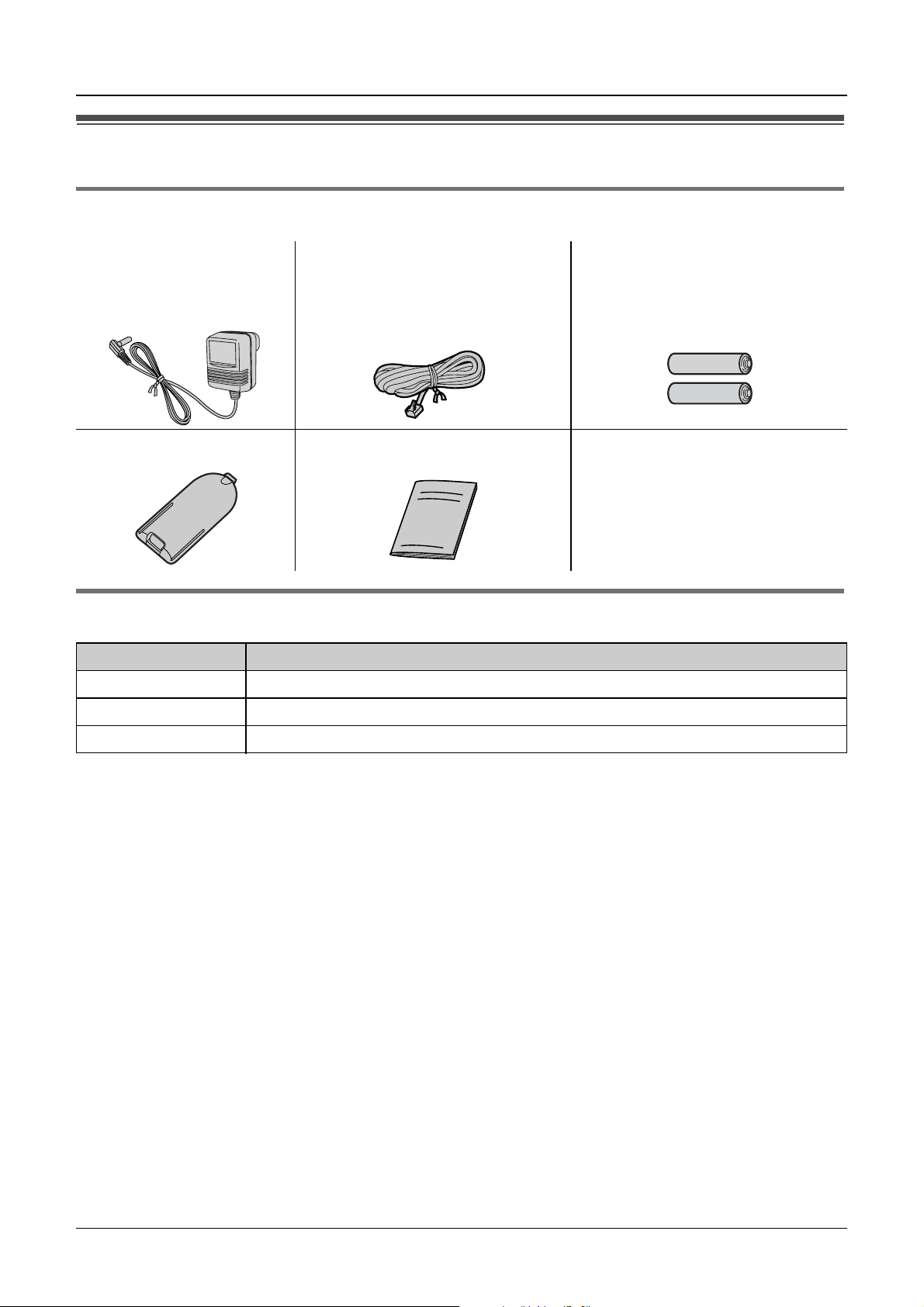
Included accessories
AC adaptor
PQLV19AL
Handset cover Operating instructions
Telephone line cord Rechargeable batteries
(AAA size)
HHR-4EPT
Additional/replacement accessories
Model No. Description
HHR-4EPT 2 rechargeable nickel metal hydride (Ni-MH) batteries
KX-TGA120AZ Additional Digital Cordless Handset
KX-A272 DECT repeater
General Warning:
The grant of a Telepermit for any item of terminal equipment indicates only that Telecom has
accepted that the item complies with minimum conditions for connection to its network. It
indicates no endorsement of the product by Telecom, nor does it provide any sort of warranty.
Above all, it provides no assurance that any item will work correctly in all respects with
another item of Telepermitted equipment of a different make or model, nor does it imply that
any product is compatible with all of Telecom’s network services.
Important Notice:
Under power failure conditions, this telephone may not operate. Please ensure that a
separate telephone, not dependent on local power, is available for emergency use.
4
Page 5

Important information
General
L Use only the AC adaptor included with this
product, noted on page 4.
Preparation
L Unplug this unit from power outlets if it
emits smoke, an abnormal smell or makes
unusual noise. These conditions can
cause fire or electric shock. Confirm that
smoke has stopped and contact an
authorised service centre.
L Do not connect the AC adaptor to any AC
outlet other than a standard 220–240 V
AC outlet.
L This product is unable to make calls when:
– The portable handset battery(ies) need
recharging or have failed.
– There is a power failure.
– The key lock feature is turned on.
– The call bar feature is turned on (only
phone numbers stored in the unit as
emergency numbers can be called).
L Do not open the base unit or handset
other than to replace the battery(ies).
L This product should not be used near
emergency/intensive care medical
equipment and should not be used by
people with pacemakers.
L Care should be taken that objects do not
fall onto, and liquids are not spilled into,
the unit. Do not subject this product to
excessive smoke, dust, mechanical
vibration or shock.
Environment
L Do not use this product near water.
L This product should be kept away from
heat sources such as radiators, cookers,
etc. It should also not be placed in rooms
where the temperature is less than 5 °C or
greater than 40 °C.
L The AC adaptor is used as the main
disconnect device. Ensure that the AC
outlet is installed near the unit and is
easily accessible.
Warning:
L To prevent the risk of electrical shock, do
not expose this product to rain or any
other type of moisture.
Location
L For maximum distance and noise-free
operation, place your base unit:
– Away from electrical appliances such as
TVs, radios, personal computers or
other phones.
– In a convenient, high and central
location.
Battery caution
L We recommend using the battery(ies)
noted on page 4. Use only rechargeable
battery(ies).
L Do not mix old and new batteries.
L Do not dispose of the battery(ies) in a fire,
as they may explode. Check local waste
management codes for special disposal
instructions.
L Do not open or mutilate the battery(ies).
Released electrolyte from the battery(ies)
is corrosive and may cause burns or injury
to the eyes or skin. The electrolyte may be
toxic if swallowed.
L Exercise care when handling the
battery(ies). Do not allow conductive
materials such as rings, bracelets or keys
to touch the battery(ies), otherwise a short
circuit may cause the battery(ies) and/or
the conductive material to overheat and
cause burns.
L Charge the battery(ies) in accordance
with the information provided in these
operating instructions.
L Only use the included base unit (or
charger) to charge the battery(ies). Do not
tamper with the base unit (or charger).
Failure to follow these instructions may
cause the battery(ies) to swell or explode.
5
Page 6
Preparation
Note:
Controls and displays
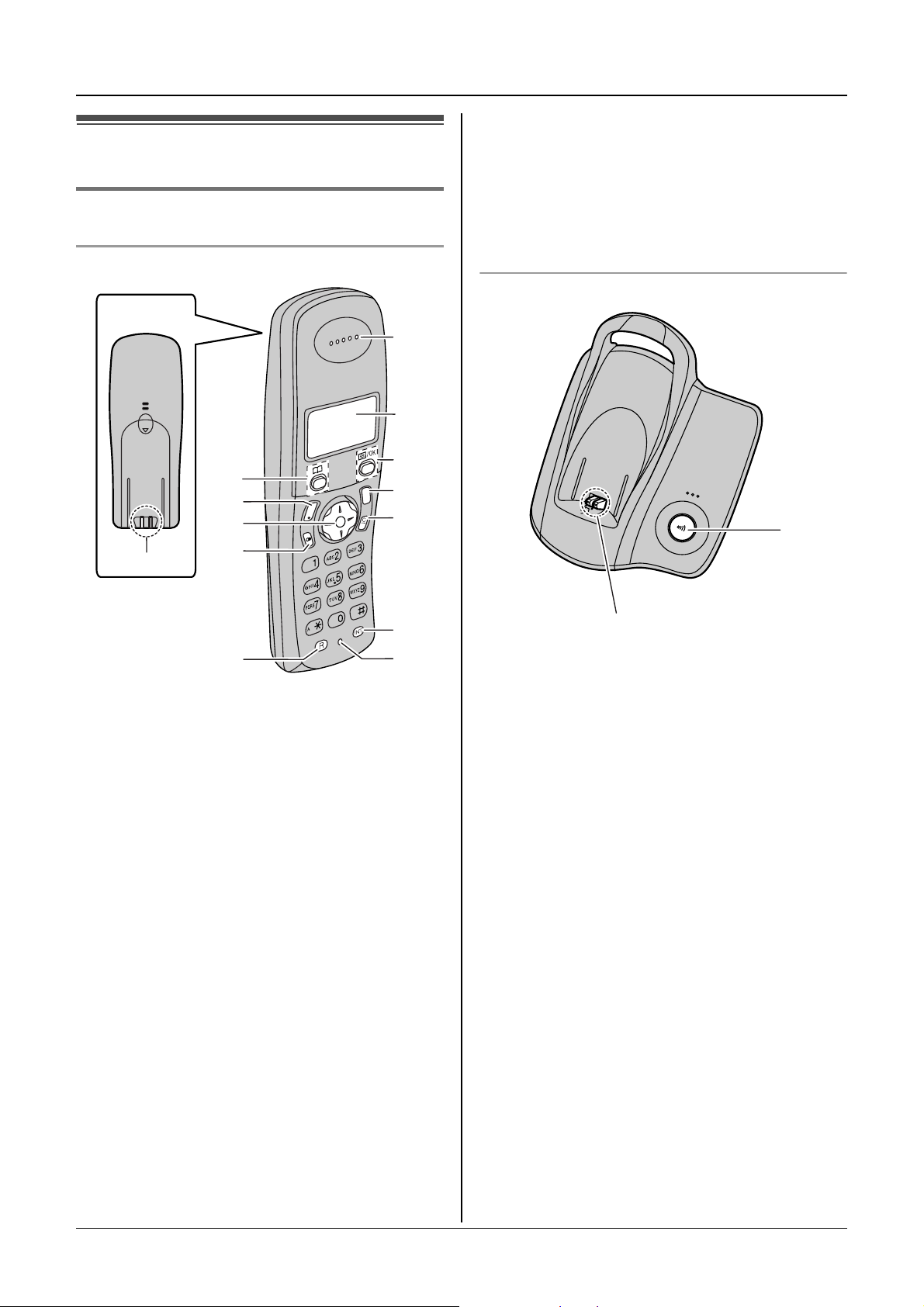
Controls
Handset
A
B
C
D
E
C
i
h
T
L Up to 3 menu items can be displayed at a
time. To select a menu item not shown on
the current page, scroll up or down by
pressing the navigator key, {e} or {v},
respectively.
Base unit
G
H
I
J
K
A
a
N
F
A Charge contact
B {k} (Phonebook)
C {C} (Talk)
D Navigator key
L {e}{v}: To search for the desired
item in menus.
L{>}: To select the desired item or
move the cursor to the right.
L{<}: To return to the previous screen
or move the cursor to the left.
E {R} (Redial/Pause)
F {R} (Recall)
G Receiver
H Display
L
M
B
A {x} (Page)
B Charge contact
I {j/OK} (Menu/OK)
J {ih} (Off/Power)
K {C/T} (Clear/Mute)
L {INT} (Intercom)
M Microphone
6
Page 7
Preparation
Displays
Display icons
Various icons appear on the handset display
to indicate the current status of the unit.
Display
icon
w Within range of a base unit
L Handset is accessing base
Meaning
L When flashing: Handset
is searching for base unit.
(out of range of base unit,
handset is not registered
to base unit, no power on
base unit)
unit. (intercom, paging,
changing base unit settings,
etc.)
Connections
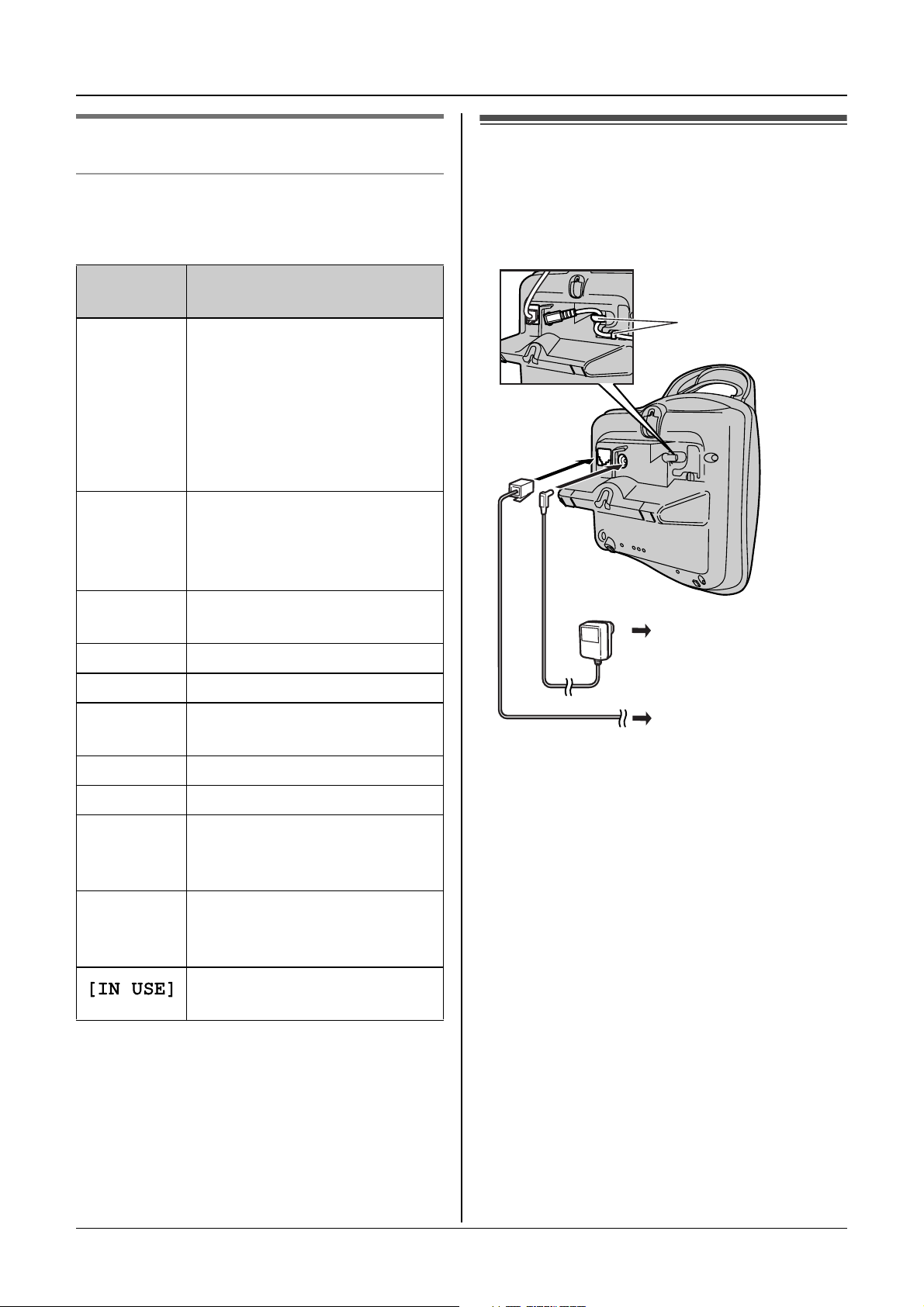
When the AC adaptor is connected, a short
beep will be heard. If it is not heard, check
the connections.
Hooks
k Handset is on an outside
call.
o Call bar is on. (page 19)
5 Battery strength
[VE] Voice enhancer is set to
high or low tone. (page 12)
[N] Night mode is on. (page 18)
[X] Key lock is on. (page 12)
[2] Handset number: The left
icon shows handset 2
example. (page 18)
0 New call minder message
received (call minder users
only; page 27)
Line is being used by
another handset.
(220–240 V, 50 Hz)
To telephone
network
Important:
L Use only the AC adaptor and telephone
line cord supplied with this unit.
Note:
L After connection, you must charge the
batteries to make or answer calls (page
8).
L Never install telephone wiring during a
lightning storm.
L The AC adaptor must remain connected
at all times. (It is normal for the adaptor to
feel warm during use.)
L The AC adaptor should be connected to a
vertically oriented or floor-mounted AC
outlet. Do not connect the AC adaptor to a
ceiling-mounted AC outlet, as the weight
of the adaptor may cause it to become
disconnected.
7
Page 8
Preparation
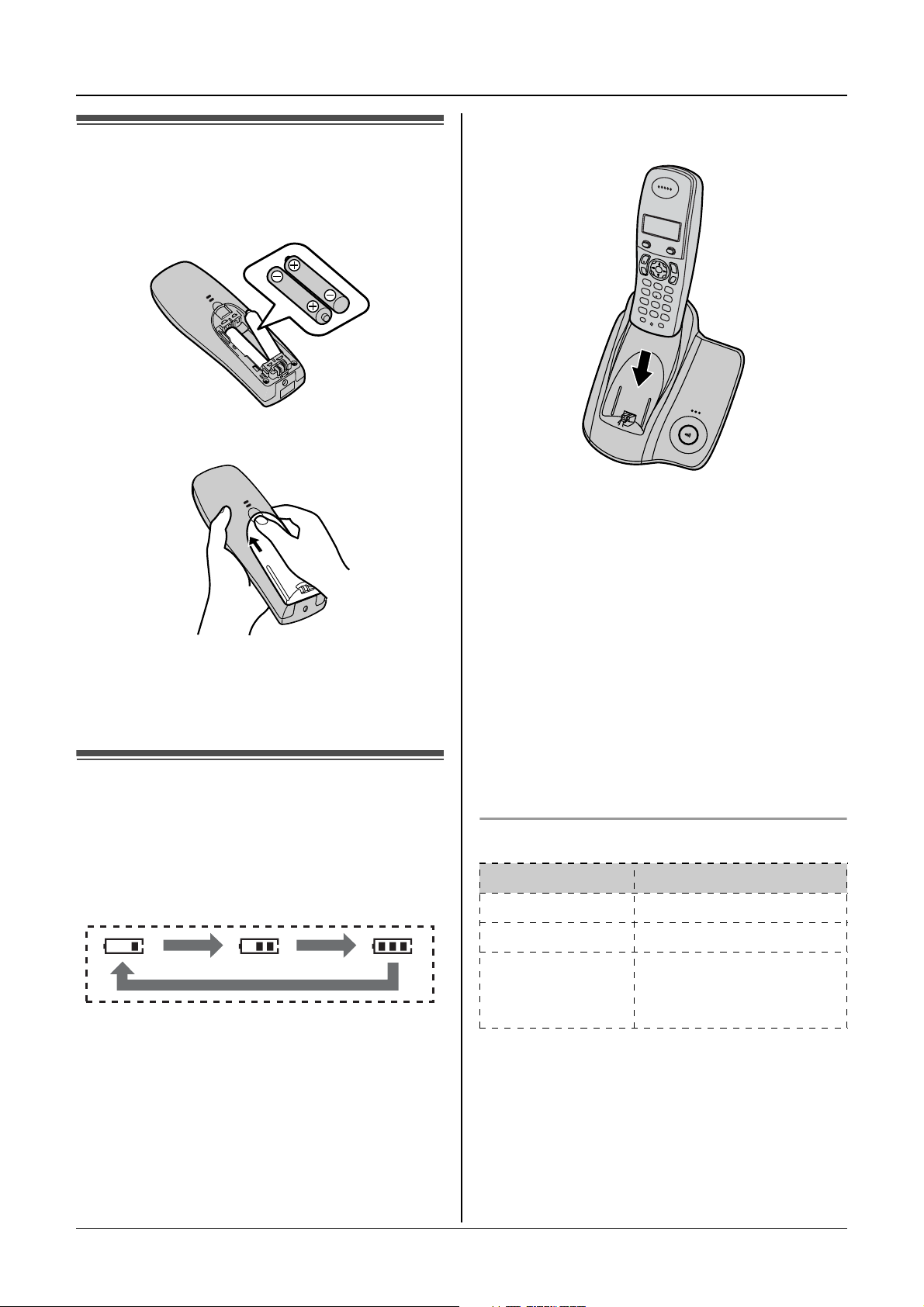
Battery installation
1 Insert the batteries negative (T)
terminal first.
2 Close the handset cover.
When the batteries are fully charged, 5
remains on the display.
Note:
L It is normal for the handset to feel warm
during charging.
Note:
L Use only rechargeable batteries (page 4).
Battery charge
Place the handset on the base unit for
about 7 hours before initial use.
When charging, the battery icon is shown as
follows.
L It takes 7 hours to fully charge the
batteries, however, you can use the
handset before the batteries are fully
charged.
L Clean the charge contacts (page 6) of the
handset and base unit with a soft, dry
cloth once a month, otherwise the
batteries may not charge properly. Clean
more often if the unit is exposed to grease,
dust or high humidity.
Battery strength
Battery icon Battery strength
5 High
6 Medium
7 Low
When flashing: Needs
to be charged.
Note:
L When 7 flashes, recharge the handset
batteries. 7 will continue to flash until
the batteries have been charged for at
least 15 minutes.
8
Page 9
Preparation
L If the handset is turned off, it will be turned
on automatically when it is placed on the
base unit.
Battery life
After your Panasonic batteries are fully
charged, you can expect the following
performance:
Ni-MH batteries (700 mAh)
Operation Operating time
While in use (talking) 20 hours max.
While not in use
(standby)
Note:
L Actual battery performance depends on a
combination of how often the handset is in
use (talking) and how often it is not in use
(standby).
L Battery operating time may be shortened
over time depending on usage conditions
and ambient temperature.
170 hours max.
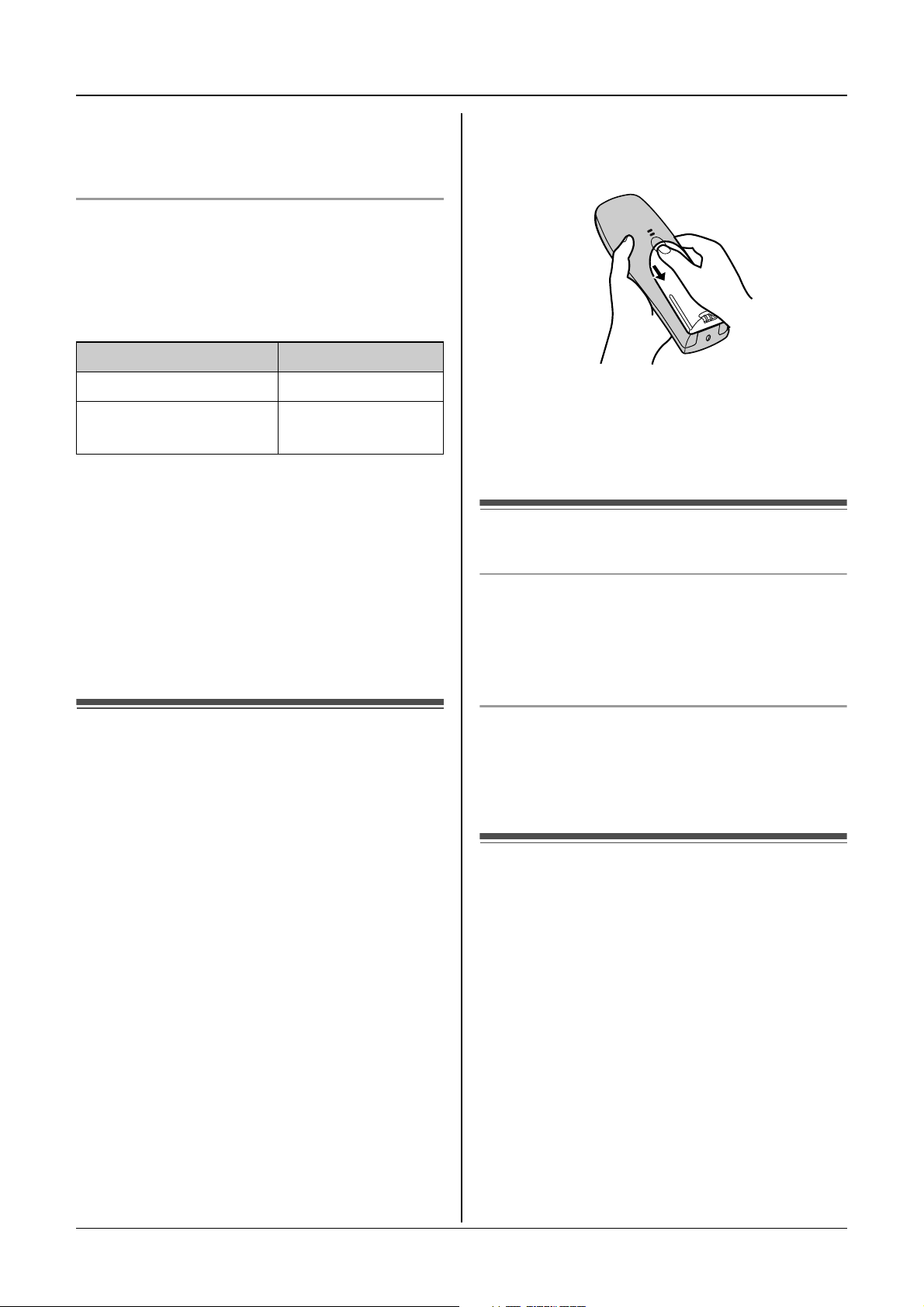
1 Press the notch on the handset cover
firmly and slide it in the direction of the
arrow.
2 Remove the old batteries positive (S)
terminal first and install the new ones.
See page 8 for battery installation.
Turning the power on/off
Power on
Press {ih} for about 1 second.
L The display will change to the standby
mode.
Battery replacement
If 7 flashes even after the handset
batteries have been charged for 7 hours, the
batteries must be replaced.
Important:
L We recommend the use of Panasonic
rechargeable batteries noted on page 4. If
you install non-rechargeable batteries and
start charging, the batteries may leak
electrolyte.
L Do not mix old and new batteries.
Power off
Press {ih} for about 2 seconds.
L The display will go blank.
Setting the date and time
Important:
L Confirm that the AC adaptor is connected.
L Ensure that w is not flashing.
1 Press {j/OK}.
2 Select “Handset Setup”, then press
{>}.
3 Select “Set Date & Time”, then press
{>}.
4 Enter the current day, month and year by
selecting 2 digits for each.
Example: 17 May, 2005
Press {1}{7}{0}{5}{0}{5}.
9
Page 10

Preparation
5 Enter the current hour and minute by
selecting 2 digits for each.
L You can select “AM”, “PM” or 24-hour
time entry by pressing {*} repeatedly.
Example: 3:30 PM
Press {0}{3}{3}{0}, then press {*}
repeatedly until “03:30 PM” is
displayed.
6 Press {j/OK}.
7 Press {ih}.
Note:
L To correct a digit, press {<} or {>} to
move the cursor, then make the
correction.
L The date and time may be incorrect after a
power failure. In this case, set the date
and time again.
10
Page 11

Making calls
1 Lift the handset and dial the phone
number.
L To correct a digit, press {C/T}, then
enter the correct number.
2 Press {C}.
3 When finished talking, press {ih} or
place the handset on the base unit.
Making/Answering Calls
3 Select “Edit and Call”, then press
{>}.
4 Press {<} or {>} to move the cursor,
then edit the number.
L Place the cursor on the number you
wish to erase, then press {C/T}.
L Place the cursor to the right of where
you want to insert a number, then
press the appropriate dial key.
5 Press {C}.
To adjust the receiver volume
Press {e} or {v} while talking. 4 volume
levels are available for the receiver.
Redial feature
Previously dialled phone numbers (each 24
digits max.) can be redialled.
To redial the last number dialled
Press {R}, then press {C}.
Note:
L You can also press {C} before pressing
{R}.
To make a call using the redial list
The last 10 phone numbers dialled are
stored in the redial list.
1 Press {R}.
L The last number dialled will be
displayed.
2 Press {e} or {v} repeatedly to select
the desired number.
L To exit the list, press {ih}.
3 Press {C}.
To erase numbers in the redial list
1 Press {R}.
2 Press {e} or {v} repeatedly to select
the desired number, then press
{j/OK}.
3 Select “Erase”, then press {>}.
L If you want to erase all numbers in the
list, select “Erase All”, then press
{>}.
4 Select “Yes”, then press {>}.
5 Press {ih}.
To store a number from the redial list into
the phonebook
1 Press {R}.
2 Press {e} or {v} repeatedly to select
the desired number, then press
{j/OK}.
3 Select “Add Phonebook”, then press
{>}.
4 Enter a name (16 characters max.; see
page 32 for character entry), then press
{j/OK}.
To edit a number in the redial list before
calling it
1 Press {R}.
2 Press {e} or {v} repeatedly to select
the desired number, then press
{j/OK}.
5 Edit the phone number if necessary,
then press {j/OK}.
6 Select “Save”, then press {>}.
7 Press {ih}.
11
Page 12

Making/Answering Calls
Other features
Voice enhancer
You can change the tone quality of the
receiver while you are on a call. 3 settings
are available.
1 Press {j/OK} during a call.
2 Select the desired setting, then press
{>}.
Note:
L If you select “High Tone” or “Low
Tone”, “[VE]” is displayed.
Mute
You can mute your voice during a
conversation. While mute is turned on, you
will be able to hear the other party, but the
other party will not be able to hear you.
1 To mute your voice, press {C/T}.
2 To return to the conversation, press
{C/T} again.
Key lock
The handset can be locked so that no calls
or settings can be made. Incoming calls can
be answered, but all other functions are
disabled while key lock is on.
To turn key lock on, press {j/OK} for about
2 seconds.
L “[X]” is displayed.
L To turn key lock off, press {j/OK} for
about 2 seconds.
Note:
L Calls to emergency numbers (page 23)
cannot be made until key lock is turned
off.
L Key lock is turned off when the handset is
turned off.
R button (to use the recall feature)
{R} is used to access optional telephone
services. Contact your service provider for
details.
Note:
L If your unit is connected to a PBX (private
branch exchange), pressing {R} can allow
you to access certain features of your host
PBX such as transferring an extension
call. Consult your PBX dealer for details.
L You can change the recall time (page 23).
Call waiting
Call waiting is a service offered by your
service provider whereby a second caller
can be answered while online with the first
caller. To answer the second caller, press
{R}. To return to the first caller, press {R}
again. Please consult your service provider
for details of this service.
Pause button (for PBX/long distance
service users)
A pause is sometimes required when
making calls using a PBX or long distance
service.
Example: If you have to dial {0} before
dialling outside numbers manually, you will
probably pause after dialling {0} until you
hear a dial tone.
1 Press {0}.
2 Press {R}.
3 Dial the phone number, then press
{C}.
Note:
L Pressing {R} 1 time creates 1 pause.
Press {R} repeatedly to create longer
pauses. To change pause length, see
page 23.
Answering calls
1 Lift the handset and press {C} when
the unit rings.
L You can also answer a call by pressing
any dial key from {0} to {9}, {*}, {#},
or {INT}. (Any key answer feature)
12
Page 13

2 When finished talking, press {ih} or
place the handset on the base unit.
Auto talk feature
You can answer calls simply by lifting the
handset off the base unit. You do not need to
press {C}. To turn this feature on, see
page 19.
To adjust the ringer volume when an
outside call comes in
Press {e} or {v} when an outside call
comes in.
Note:
L The ringer volume cannot be adjusted if
the handset is on the base unit.
Making/Answering Calls
Other features
Handset locator
Using this feature, you can locate the
handset if it has been misplaced.
1 Press {x} on the base unit.
L The base unit will page the handset
for about 1 minute.
2 To stop paging, press {x} on the base
unit or press {ih} on the handset.
13
Page 14

Phonebook
Using the phonebook
Scrolling through all entries
1 Press {k}.
The phonebook allows you to make calls
without having to dial manually. You can add
20 names and phone numbers to the
phonebook and search for phonebook
entries by name.
Adding entries to the phonebook
Press {k}, then press {j/OK}.
1
2 Select “New Entry”, then press {>}.
3 Enter the party’s name (16 characters
max.; see page 32 for character entry),
then press {j/OK}.
4 Enter the party’s phone number (24
digits max.), then press {j/OK}.
5 Select “Save”, then press {>}.
6 Press {ih}.
Note:
L If there is no space to store new entries,
“Memory Full” will be displayed. Erase
unnecessary entries (page 14).
To edit/correct a mistake
Press {<} or {>} to place the cursor on the
number or character you wish to erase, then
press {C/T}. Place the cursor to the right of
where you want to insert a number or
character, then press the appropriate dial
key.
Note:
L Press and hold {C/T} to erase all
numbers or characters.
2 Press {e} or {v} repeatedly to display
the desired entry.
Editing entries in the phonebook
Phonebook entries can be edited after you
have saved them. You can change the name
and phone number.
Changing a name and phone number
1 Find the desired entry (page 14), then
press {j/OK}.
2 Select “Edit”, then press {>}.
3 Edit the name if necessary (16
characters max.; see page 32 for
character entry), then press {j/OK}.
4 Edit the phone number if necessary (24
digits max.), then press {j/OK}.
5 Select “Save”, then press {>}.
6 Press {ih}.
Erasing entries from the
phonebook
Erasing an entry
1 Find the desired entry (page 14), then
press {j/OK}.
2 Select “Erase”, then press {>}.
3 Select “Yes”, then press {>}.
4 Press {ih}.
Finding and calling a phonebook
entry
Phonebook entries can be searched for by
scrolling through all phonebook entries.
Once you have found the desired entry,
press {C} to dial the phone number.
14
Erasing all entries
1 Press {k}, then press {j/OK}.
2 Select “Erase All”, then press {>}.
3 Select “Yes”, then press {>}.
4 Select “Yes” again, then press {>}.
5 Press {ih}.
Page 15

Chain dial
This feature allows you to dial phone
numbers in the phonebook while you are on
a call. This feature can be used, for
example, to dial a calling card access
number or bank account PIN that you have
stored in the phonebook, without having to
dial manually.
1 While on a call, press {k}.
2 Press {e} or {v} repeatedly to select
the desired entry.
3 Press {>} to dial the number.
Phonebook
15
Page 16

Handset Settings
Guide to handset settings
For your reference, a chart of all items which can be customised for the handset is printed
below.
L When customising the handset, the current item or setting is indicated by >.
Handset settings
menu
Set Date & Time — — page 9
Ringer Setup Ringer Volume Maximum page 17
Display Setup Standby Display Off page 18
Call Options Call Bar Off page 18
Registration Register H.set — page 28
Other Options Handset PIN 0000 page 19
Sub-menu Sub-menu 2 Default setting Page
Ext. Ringtone Ringtone 1 page 17
Int. Ringtone Ringtone 1 page 17
Night Mode Start/End 23:00/06:00 page 17
On/Off Off page 17
Ring Delay 60 sec. page 18
Contrast Level 3 page 18
Auto Talk Off page 19
Keytones On page 19
Reset Handset —page 19
Note:
L Up to 3 menu items can be displayed at a time. To select a menu item not shown on the
current page, scroll up or down by pressing the navigator key, {e} or {v}, respectively.
16
Page 17

Handset Settings
Ringer setup
Ringer volume
Press {j/OK}.
1
2 Select “Handset Setup”, then press
{>}.
3 Select “Ringer Setup”, then press
{>}.
4 Select “Ringer Volume”, then press
{>}.
5 Press {e} or {v} repeatedly to select
the desired volume.
6 Press {>}.
7 Press {ih}.
Note:
L The handset will ring for intercom calls
and when paged even if the ringer is
turned off.
Night mode
Night mode allows you to select a block of
time during which the handset will not ring
for outside calls. This feature is useful for
times when you do not want to be disturbed,
for example, while sleeping. Night mode can
be set independently for the handset and the
base unit (page 22).
Set the date and time beforehand (page 9).
Setting the start and end time for night
mode
1 Press {j/OK}.
2 Select “Handset Setup”, then press
{>}.
3 Select “Ringer Setup”, then press
{>}.
4 Select “Night Mode”, then press {>}.
5 Select “Start/End”, then press {>}.
Changing ringtones
You can change the ringtone used by the
handset.
“Ext. Ringtone”: Selects the ringtone for
outside calls.
“Int. Ringtone”: Selects the ringtone for
intercom calls.
1 Press {j/OK}.
2 Select “Handset Setup”, then press
{>}.
3 Select “Ringer Setup”, then press
{>}.
4 Select the desired item, then press {>}.
5 Select the desired ringtone, then press
{>}.
6 Press {ih}.
6 Enter the desired hour and minute you
wish to start this feature by selecting 2
digits for each.
L If you use 12-hour time entry, select
“AM” or “PM” by pressing {*}
repeatedly before entering the time.
7 Enter the desired hour and minute you
wish to end this feature by selecting 2
digits for each.
L If you use 12-hour time entry, select
“AM” or “PM” by pressing {*}
repeatedly before entering the time.
8 Press {j/OK}.
9 Press {ih}.
Turning night mode on/off
1 Press {j/OK}.
2 Select “Handset Setup”, then press
{>}.
3 Select “Ringer Setup”, then press
{>}.
17
Page 18

Handset Settings
4 Select “Night Mode”, then press {>}.
5 Select “On/Off”, then press {>}.
6 Select “On” or “Off”, then press {>}.
7 Press {ih}.
Note:
L When the night mode is turned on, “[N]”
is displayed.
Setting the ring delay for night mode
This setting allows the handset to ring during
night mode if the caller waits long enough.
After the selected amount of time passes,
the handset will ring, useful when someone
urgently needs to speak with you. If you
select “No Ringing”, the handset will not
ring during night mode.
1 Press {j/OK}.
2 Select “Handset Setup”, then press
{>}.
3 Select “Ringer Setup”, then press
{>}.
4 Select “Night Mode”, then press {>}.
4 Select “Standby Display”, then
press {>}.
5 Select the desired setting, then press
{>}.
6 Press {ih}.
Note:
L If “Handset Number” is selected and the
current handset number is 2, “[2]” is
displayed.
Changing the display contrast
Press {j/OK}.
1
2 Select “Handset Setup”, then press
{>}.
3 Select “Display Setup”, then press
{>}.
4 Select “Contrast”, then press {>}.
5 Press {e} or {v} repeatedly to select
the desired contrast, then press {>}.
6 Press {ih}.
5 Select “Ring Delay”, then press {>}.
6 Select the desired setting, then press
{>}.
7 Press {ih}.
Display setup
Selecting the standby mode
display
“Handset Number”: The current handset
number is displayed.
“Off”: Only the current date and time are
displayed.
1 Press {j/OK}.
2 Select “Handset Setup”, then press
{>}.
3 Select “Display Setup”, then press
{>}.
Call options
Turning call bar on/off
This feature prohibits making outside calls.
When call bar is turned on, only intercom
calls and calls to emergency numbers (page
23) can be made.
1 Press {j/OK}.
2 Select “Handset Setup”, then press
{>}.
3 Select “Call Options”, then press
{>}.
4 Select “Call Bar”, then press {>}.
5 Enter “0000” (default handset PIN).
L If you changed the PIN, enter it (page
19).
6 Select “On” or “Off”, then press {>}.
18
Page 19

Handset Settings
7 Press {ih}.
Note:
L When call bar is turned on, o is
displayed.
Turning auto talk on/off
When this feature is turned on, you can
answer calls simply by lifting the handset off
the base unit. You do not need to press
{C}.
1 Press {j/OK}.
2 Select “Handset Setup”, then press
{>}.
3 Select “Call Options”, then press
{>}.
4 Select “Auto Talk”, then press {>}.
5 Select “On” or “Off”, then press {>}.
6 Press {ih}.
5 Enter the current 4-digit handset PIN.
6 Enter the new 4-digit handset PIN, then
press {j/OK}.
7 Press {ih}.
Turning keytones on/off
Keytones are tones heard when keys are
pressed. Includes confirmation tones and
error tones.
1 Press {j/OK}.
2 Select “Handset Setup”, then press
{>}.
3 Select “Other Options”, then press
{>}.
4 Select “Keytones”, then press {>}.
5 Select “On” or “Off”, then press {>}.
6 Press {ih}.
Note:
Other options
Changing the handset PIN
(Personal Identification Number)
For security, the handset PIN must be
entered when changing certain settings. The
default PIN is “0000”.
Important:
L If you change the PIN, please make note
of your new PIN. The unit will not reveal
the PIN to you. If you forget your PIN,
consult your nearest Panasonic service
centre.
1 Press {j/OK}.
2 Select “Handset Setup”, then press
{>}.
L If keytones are turned off, error tones will
not sound when you enter the wrong PIN
or when memory is full.
Resetting the handset to its
default settings
Press {j/OK}.
1
2 Select “Handset Setup”, then press
{>}.
3 Select “Other Options”, then press
{>}.
4 Select “Reset Handset”, then press
{>}.
5 Enter “0000” (default handset PIN).
L If you changed the PIN, enter it (page
19).
6 Select “Yes”, then press {>}.
3 Select “Other Options”, then press
{>}.
4 Select “Handset PIN”, then press
{>}.
7 Press {ih}.
Note:
L The following items will be deleted or reset
to their default settings:
19
Page 20

Handset Settings
– Settings listed on page 16
– Redial list
– Voice enhancer
L The following items will be retained:
– Phonebook entries
– Date and time
20
Page 21

Base Unit Settings
Guide to base unit settings
For your reference, a chart of all items which can be customised for the base unit is printed
below.
L When customising the base unit, the current item or setting is indicated by >.
Base unit
settings menu
Ringer Setup Ringer Volume Medium page 22
Call Options Recall 600 msec. page 23
Other Options Base Unit PIN 0000 page 25
Note:
L Up to 3 menu items can be displayed at a time. To select a menu item not shown on the
current page, scroll up or down by pressing the navigator key, {e} or {v}, respectively.
Sub-menu Sub-menu 2 Default setting Page
Night Mode Start/End 23:00/06:00 page 22
On/Off Off page 22
Ring Delay 60 sec. page 22
Pause Length 3 sec. page 23
Emergency No. 111, 911, 999 page 23
ARS Settings Area Code —page 24
Call Restrict —page 24
Repeater Mode Off page 29
Reset Base —page 25
21
Page 22

Base Unit Settings
6 Select “Start/End”, then press {>}.
Ringer setup
Ringer volume
Press {j/OK}.
1
2 Select “Base Unit Setup”, then
press {>}.
3 Enter “0000” (default base unit PIN).
L If you changed the PIN, enter it (page
25).
4 Select “Ringer Setup”, then press
{>}.
5 Select “Ringer Volume”, then press
{>}.
6 Press {e} or {v} repeatedly to select
the desired volume.
7 Press {>}.
8 Press {ih}.
7 Enter the desired hour and minute you
wish to start this feature by selecting 2
digits for each.
L If you use 12-hour time entry, select
“AM” or “PM” by pressing {*}
repeatedly before entering the time.
8 Enter the desired hour and minute you
wish to end this feature by selecting 2
digits for each.
L If you use 12-hour time entry, select
“AM” or “PM” by pressing {*}
repeatedly before entering the time.
9 Press {j/OK}.
10 Press {ih}.
Turning night mode on/off
1 Press {j/OK}.
2 Select “Base Unit Setup”, then
press {>}.
Night mode
Night mode allows you to select a block of
time during which the base unit will not ring
for outside calls. This feature is useful for
times when you do not want to be disturbed,
for example, while sleeping. Night mode can
be set independently for the handset (page
17) and the base unit.
Set the date and time beforehand (page 9).
Setting the start and end time for night
mode
1 Press {j/OK}.
2 Select “Base Unit Setup”, then
press {>}.
3 Enter “0000” (default base unit PIN).
L If you changed the PIN, enter it (page
25).
3 Enter “0000” (default base unit PIN).
L If you changed the PIN, enter it (page
25).
4 Select “Ringer Setup”, then press
{>}.
5 Select “Night Mode”, then press {>}.
6 Select “On/Off”, then press {>}.
7 Select “On” or “Off”, then press {>}.
8 Press {ih}.
Setting the ring delay for night mode
This setting allows the base unit to ring
during night mode if the caller waits long
enough. After the selected amount of time
passes, the base unit will ring, useful when
someone urgently needs to speak with you.
If you select “No Ringing”, the base unit
will not ring during night mode.
4 Select “Ringer Setup”, then press
{>}.
5 Select “Night Mode”, then press {>}.
22
1 Press {j/OK}.
2 Select “Base Unit Setup”, then
press {>}.
Page 23

Base Unit Settings
3 Enter “0000” (default base unit PIN).
L If you changed the PIN, enter it (page
25).
4 Select “Ringer Setup”, then press
{>}.
5 Select “Night Mode”, then press {>}.
6 Select “Ring Delay”, then press {>}.
7 Select the desired setting, then press
{>}.
8 Press {ih}.
Call options
Changing the recall time
Change the recall time, if necessary,
depending on the requirements of your
service provider or PBX.
L If you changed the PIN, enter it (page
25).
4 Select “Call Options”, then press
{>}.
5 Select “Pause Length”, then press
{>}.
6 Select the desired setting, then press
{>}.
7 Press {ih}.
Storing/changing emergency
numbers
These settings determine which phone
numbers can be dialled while the call bar
feature is on (page 18).
1 Press {j/OK}.
2 Select “Base Unit Setup”, then
press {>}.
1 Press {j/OK}.
2 Select “Base Unit Setup”, then
press {>}.
3 Enter “0000” (default base unit PIN).
L If you changed the PIN, enter it (page
25).
4 Select “Call Options”, then press
{>}.
5 Select “Recall”, then press {>}.
6 Select the desired setting, then press
{>}.
7 Press {ih}.
Setting pause length
Change the pause length, if necessary,
depending on the requirements of your
service provider or PBX.
1 Press {j/OK}.
2 Select “Base Unit Setup”, then
press {>}.
3 Enter “0000” (default base unit PIN).
3 Enter “0000” (default base unit PIN).
L If you changed the PIN, enter it (page
25).
4 Select “Call Options”, then press
{>}.
5 Select “Emergency No.”, then press
{>}.
6 Select a memory location, then press
{>}.
L If the memory location already
contains an emergency number, the
number is displayed.
7 Enter/edit the number, then press
{j/OK}.
L To erase an emergency number, press
and hold {C/T}.
8 Press {ih}.
Note:
L The default setting for emergency
numbers are stored in the first 3 memory
locations. It is recommended that you do
not overwrite these numbers.
23
Page 24

Base Unit Settings
Selecting area codes to be deleted
automatically
In some situations, phone numbers stored
automatically in the Caller ID list (page 26)
will include area codes. If you do not want to
dial the area codes when making calls from
the Caller ID list, you can store the area
codes which you want the unit to delete
automatically.
Example: You have stored the area code
“123”. If you make a call from the Caller ID
list to the phone number “123-456-7890”,
the unit dials “456-7890”.
1 Press {j/OK}.
2 Select “Base Unit Setup”, then
press {>}.
3 Enter “0000” (default base unit PIN).
L If you changed the PIN, enter it (page
25).
4 Select “Call Options”, then press
{>}.
5 Select “ARS Settings”, then press
{>}.
6 Select “Area Code”, then press {>}.
select which handsets will be restricted.
Storing area codes here will prevent the
restricted handsets from dialling any phone
number in that area code. If a restricted
number is dialled, the call will not be
connected and the restricted number will
flash on the display.
1 Press {j/OK}.
2 Select “Base Unit Setup”, then
press {>}.
3 Enter “0000” (default base unit PIN).
L If you changed the PIN, enter it (page
25).
4 Select “Call Options”, then press
{>}.
5 Select “Call Restrict”, then press
{>}.
6 Set which handsets will be restricted by
pressing the desired handset number.
L All the registered handset numbers
will be displayed.
L Flashing numbers indicate call
restriction is turned on for the
corresponding handset.
7 Select an area code location (1-4), then
press {>}.
L If the location already contains an
area code, the code is displayed.
8 Enter an area code (5 digits max.), then
press {j/OK}.
9 Press {ih}.
Note:
L The use of this feature can prevent a
National Call from being dialled. E.g., in
the case of the South Island, the “03” will
be omitted and will therefore prevent a
National Call to other areas of the South
Island.
Setting call restriction
You can restrict selected handsets from
dialling certain numbers. You can assign up
to 6 phone numbers to be restricted, and
L To turn call restriction off for a handset,
press the number again. The number
will stop flashing.
7 Press {j/OK}.
8 Select a memory location, then press
{>}.
L If the memory location already
contains a restricted number, the
number is displayed.
9 Enter the phone number or area code to
be restricted (8 digits max.), then press
{j/OK}.
L To erase a restricted number, press
{C/T}.
10 Press {ih}.
24
Page 25

7 Press {ih}.
Base Unit Settings
Other options
Changing the base unit PIN
(Personal Identification Number)
For security, the base unit PIN must be
entered when changing certain settings. The
default PIN is “0000”.
Important:
L If you change the PIN, please make note
of your new PIN. The unit will not reveal
the PIN to you. If you forget your PIN,
consult your nearest Panasonic service
centre.
1 Press {j/OK}.
2 Select “Base Unit Setup”, then
press {>}.
3 Enter “0000” (default base unit PIN).
Note:
L The following items will be deleted or reset
to their default settings:
– Settings listed on page 21
– Caller list
L The following items will be retained:
– Date and time
– Repeater mode
L If you changed the PIN, enter it.
4 Select “Other Options”, then press
{>}.
5 Select “Base Unit PIN”, then press
{>}.
6 Enter the new 4-digit base unit PIN, then
press {j/OK}.
7 Press {ih}.
Resetting the base unit to its
default settings
1
Press {j/OK}.
2 Select “Base Unit Setup”, then
press {>}.
3 Enter “0000” (default base unit PIN).
L If you changed the PIN, enter it (page
25).
4 Select “Other Options”, then press
{>}.
5 Select “Reset Base”, then press {>}.
6 Select “Yes”, then press {>}.
25
Page 26

Caller ID Service
Using Caller ID service
Important:
L This unit is Caller ID compatible. To use
Caller ID features (such as displaying
caller phone numbers), you must
subscribe to Caller ID service. Consult
your service provider for details.
For all local and national incoming calls,
your display will show the area code (e.g. 09
for Auckland) or the cellular prefix (e.g. 0274
for Telecom Cellular) followed by the caller’s
telephone number. An Auckland caller’s
number will be displayed as 09XXXXXXX.
The seven X’s represent the seven digits of
the caller’s telephone number. A caller from
a 6-digit Telecom Cellular number will be
displayed as 0274XXXXXX. For incoming
international calls, your display may only
show “0000”. For business users on a
Centrex line, your display will show Centrex
extension numbers in the shorter extension
number format used within your company.
Using toll services from Telecom or
another company
Your telephone company may charge you
for a local call if the number dialled has the
area code prefix included. If this is
unacceptable, dial only the 7-digit local
number. Do not dial the {0} prefix or the area
code.
L When the caller dialled from an area
which does not provide Caller ID service,
“Out of Area” will be displayed.
L When the caller requested not to send
caller information, either no information or
“Private Caller” will be displayed.
Missed calls
If a call is not answered, the unit treats the
call as a missed call. The number of missed
calls is shown on the display. This lets you
know if you should view the caller list to see
who called while you were out.
Caller list
Viewing the caller list and calling
back
Phone numbers of the last 50 different
callers will be logged in the caller list. When
the 51st call is received, the oldest caller
information will be automatically erased.
You can use this list to return missed calls.
1 Press {j/OK}.
2 Select “Caller List”, then press
{>}.
L The most recent call is displayed.
3 Press {v} repeatedly to search from the
most recent call, or press {e}
repeatedly to search from the oldest call.
Caller ID features
When an outside call is received, the caller’s
phone number can be displayed.
L Phone numbers of the last 50 different
callers will be logged in the caller list.
L When caller information is received and it
matches a phone number stored in the
unit’s phonebook:
– The stored name will be displayed and
logged in the caller list.
L If the unit is connected to a PBX system,
you may not receive the caller information.
26
L If the item has already been viewed or
answered, “Q” is displayed, even if it
was viewed or answered using
another handset.
4 Press {C} to call back the displayed
party.
Note:
L If you do not want to dial the area codes
when making calls from the Caller ID list,
you can store the area codes which you
want the unit to delete automatically (page
24).
Page 27

Editing a caller’s phone number
before calling back
The caller’s telephone number, which is sent
to your telephone from your local telephone
exchange, includes “0” and an area code
prefix. For local calls, “0” and the area code
prefix can be omitted.
1 Press {j/OK}.
2 Select “Caller List”, then press
{>}.
3 Press {e} or {v} repeatedly to display
the desired entry.
4 To add a number
Press the dial key ({0} to {9}).
L The number you pressed is added to
the top of the current number.
To erase a number
Press {j/OK}, select “Edit and
Call”, then press {>}.
Press {<} or {>} to place the cursor on
the number you wish to erase, then
press {C/T}.
5 Press {C}.
Caller ID Service
2 Select “Caller List”, then press
{>}.
3 Press {e} or {v} repeatedly to display
the desired entry, then press {j/OK}.
4 Select “Add Phonebook”, then press
{>}.
5 Continue from step 3, “Adding entries to
the phonebook”, page 14.
Call minder
Call minder is an automatic answering
service offered by your service provider. If
you subscribe to this service, your service
provider’s call minder system can answer
calls for you when you are unavailable to
answer the phone or when your line is busy.
Messages are recorded by the service
provider, not your telephone.
When you have new messages, 0 will be
displayed on the handset.
Please consult your service provider for
details of this service.
Note:
Erasing caller information
Press {j/OK}.
1
2 Select “Caller List”, then press
{>}.
3 Press {e} or {v} repeatedly to display
the desired entry, then press {j/OK}.
4 Select “Erase”, then press {>}.
L To erase all entries, select “Erase
All”, then press {>}.
5 Select “Yes”, then press {>}.
6 Press {ih}.
Storing caller information into the
phonebook
1
Press {j/OK}.
L If 0 still remains on the display even
after you have listened to new messages,
turn it off by pressing and holding {C/T}
for 2 seconds.
27
Page 28

Multi-unit Operation
Operating additional units
2 Press and hold {x} on the base unit for
about 3 seconds, until the registration
tone sounds.
Additional handsets
Up to 6 handsets can be registered to a
single base unit. Additional handsets will
give you the freedom to, for example, have
an intercom call with another handset while
a third handset is on an outside call. See
page 4 for information on ordering additional
handsets.
Important:
L The additional handset model
recommended for use with this unit is
noted on page 4. If other model handset is
used, certain operations (handset
settings, base unit settings, etc.) may not
be available.
L The included handset can be registered to
only 1 base unit. You can use additional
handsets with this base unit, but you
cannot use the included handset with
another base unit unless you first cancel
the base unit from the included handset’s
memory.
3 Place the additional handset on the
base unit. The registration tone
continues to sound. With the handset
still on the base unit, wait until a
confirmation tone sounds and w stops
flashing.
Note:
L If an error tone sounds, or if w is still
flashing, register the handset manually
(manual registration; page 28).
L If all registered handsets start ringing in
step 2, press {x} to stop. Start again from
step 1.
L Charge the batteries of your additional
handset for about 7 hours before initial
use.
Manual registration
You can register a handset to a base unit
manually using the following method.
1 Press {j/OK}.
2 Select “Handset Setup”, then press
{>}.
Registering a handset to a
base unit
To register an additional handset to a
base unit (easy registration)
The included handset and base unit are
preregistered. After purchasing an
additional handset, register it to the base
unit. Ensure that the additional handset is
switched on. If it is not on, press and hold
{ih} for few seconds to turn the handset
on.
1 Lift the additional handset and press
{ih} to put the handset in standby
mode.
3 Select “Registration”, then press
{>} 2 times.
L If “Memory Full” is displayed, the
handset is already registered to a
base unit. You can cancel the base
unit from the handset’s memory if
necessary (page 29).
4 Press and hold {x} on the base unit for
about 3 seconds, until the registration
tone sounds.
L If all registered handsets start ringing,
press {x} to stop, then repeat this
step.
L After pressing {x}, the rest of this
procedure must be completed within 1
minute.
28
Page 29

5 Wait until “Enter Base PIN” is
displayed, then enter “0000” (default
base unit PIN), then press {j/OK}.
L If you changed the PIN, enter it (page
25).
L When the handset has been
registered successfully, w will stop
flashing. If keytones are turned on
(page 19), a confirmation tone will be
heard.
Multi-unit Operation
Cancelling a base unit
A handset can cancel a base unit that it is
registered to. This allows the handset to
“forget” the base unit.
1 Press {j/OK}.
2 Select “Handset Setup”, then press
{>}.
3 Select “Registration”, then press
{>}.
Cancelling a handset
A maximum of 6 handsets can be registered
to a base unit. A handset can cancel its own
registration (or the registration of another
handset) that is stored in the base unit. This
will allow the base unit to “forget” the
handset.
1 Press {j/OK}.
2 Select “Base Unit Setup”, then
press {>}.
3 Enter “0000” (default base unit PIN).
L If you changed the PIN, enter it (page
25).
4 Enter “335”.
5 Select “Cancel Handset”, then press
{>}.
L The numbers of all handsets
registered to the base unit are
displayed.
6 Select the handset(s) you want to
cancel, by pressing the desired handset
number.
L The selected handset number(s) will
flash.
L To cancel a selected handset number,
press the number again. The number
will stop flashing.
4 Enter “335”.
5 Select “Cancel Base”, then press
{>}.
6 Enter “0000” (default handset PIN).
L If you changed the PIN, enter it (page
19).
7 Select “Yes”, then press {>}.
8 Press {ih}.
Note:
L If you cancel the base unit from the
handset’s memory, you cannot use the
handset to make calls or perform other
operations. To use the handset again, you
must first register it to a base unit (page
28).
Increasing the range of the base
unit
You can increase the range of the base unit
by using a DECT repeater. Please use only
the Panasonic DECT repeater noted on
page 4. Consult your Panasonic dealer for
details.
Important:
L Before registering the repeater to this
base unit, you must turn the repeater
mode on.
7 Press {j/OK}.
8 Select “Yes”, then press {>}.
9 Press {ih}.
Turning the repeater mode on/off
1 Press {j/OK}.
2 Select “Base Unit Setup”, then
press {>}.
29
Page 30

Multi-unit Operation
3 Enter “0000” (default base unit PIN).
L If you changed the PIN, enter it (page
25).
4 Select “Other Options”, then press
{>}.
5 Select “Repeater Mode”, then press
{>}.
6 Select “On” or “Off”, then press {>}.
7 Press {ih}.
Note:
L After turning repeater mode on/off, you
will not be able to make or receive calls for
a few moments.
Intercom between
handsets
L If there is no answer, press {INT} to
return to the outside call.
2 Handset 2:
Press {C} to answer the page.
L Handset 2 can talk with handset 1.
3 Handset 1:
To complete the call transfer, press
{ih}.
Transferring a call without speaking to
the other handset user
1 During an outside call, press {INT}, then
press the desired handset number.
L The other handset rings if it is within
range of the base unit and turned on.
2 Press {ih}.
L The outside call rings at the other
handset.
Intercom calls can be made between
handsets in the same radio cell, but not
between handsets in different radio cells.
Example: When handset 1 calls handset 2
1 Handset 1:
Press {INT} and {2} (desired handset
number).
2 Handset 2:
Press {C} to answer.
3 When finished talking, press {ih}.
Transferring calls
between handsets
Outside calls can be transferred between 2
handsets in the same radio cell.
Example: When handset 1 transfers a call
to handset 2
Note:
L k flashes to indicate the outside call is on
hold.
L If the other handset user does not answer
the call within 1 minute, the call will ring at
your handset again.
1 Handset 1:
During an outside call, press {INT} and
{2} (desired handset number).
L The outside call will be put on hold.
30
Page 31

Wall mounting
Useful Information
60 mm
Note:
L Make sure the screws are securely fastened to the wall.
L Do not pinch the telephone line cord and AC adaptor cord between the base unit and the
wall.
L Use the following wall template to position the screws before drilling.
Screws
Hooks
60 mm
31
Page 32

Useful Information
Available character entries
The dial keys are used to enter characters and numbers. Each dial key has multiple
characters assigned to it. The available character entry modes are, Alphabet, Numeric,
Greek, Extended 1, Extended 2, and Cyrillic. When in Alphabet (ABC), Greek (F),
Extended 1 (G), Extended 2 (H), or Cyrillic (I) character entry modes, you can select
which character is entered by pressing a dial key repeatedly.
L When the unit displays the character entry screen:
–Press {<} or {>} to move the cursor.
– Press dial keys to enter characters and numbers.
–Press {C/T} to erase the character or number highlighted by the cursor. Press and hold
{C/T} to erase all characters or numbers.
–Press {*} to switch between uppercase and lowercase.
– To enter another character located on the same dial key, press {>} to move the cursor
to the next space, then press the appropriate dial key.
Character entry modes
Several character entry modes are available. When the unit displays the character entry
screen, press {k}, then select a character entry mode, and press {>}. The default mode is
Alphabet.
Alphabet character table (ABC)
Numeric entry table (0-9)
Greek character table (M)
32
Page 33

Extended 1 character table (N)
L The following are used for both uppercase and lowercase:
Extended 2 character table (O)
Useful Information
L The following are used for both uppercase and lowercase:
Cyrillic character table (P)
33
Page 34

Useful Information
Troubleshooting
If you still have difficulties after following the instructions in this section, disconnect the AC
adaptor and turn off the handset, then reconnect the AC adaptor and turn on the handset.
Initial settings
Problem Cause & solution
w is flashing. LThe handset is not registered to the base unit.
Register it (page 28).
L The handset is too far from the base unit. Move
closer.
L The AC adaptor is not connected. Check the
connections.
The handset display is blank. L The handset is not turned on. Turn the power on
(page 9).
The handset will not turn on. L Make sure that the batteries are installed correctly
(page 8).
L Fully charge the batteries (page 8).
L Clean the charge contact and charge again (page
8).
34
Page 35

Useful Information
Telephone
Problem Cause & solution
I cannot make or receive calls. L The AC adaptor or telephone line cord is not
connected. Check the connections.
L If you are using a BT double adaptor to connect the
unit, remove the adaptor and connect the unit to the
phone wall socket directly. If the unit operates
properly, check or replace the adaptor.
L Disconnect the base unit from the telephone line
and connect the line to a known working telephone.
If the working telephone operates properly, contact
our service personnel to have the unit repaired. If
the working telephone does not operate properly,
contact your service provider.
L The call bar feature is turned on. Turn it off (page
18).
L You dialled a call restricted number (page 24).
L The key lock feature is turned on. Turn it off (page
12).
The unit does not ring. L The ringer volume is turned off. Adjust the handset
ringer volume (page 17) and the base unit ringer
volume (page 22).
L The night mode feature is turned on. Turn it off
(page 17, 22).
The batteries should be charging
but the battery icon does not
change.
A busy tone is heard when {C} is
pressed.
Static is heard, sound cuts in and
out. Interference from other
electrical units.
L Clean the charge contact and charge again (page
8).
L The AC adaptor is disconnected. Plug in the AC
adaptor.
L The handset is too far from the base unit. Move
closer and try again.
L Another handset is on an outside call. Wait for the
other user to complete the call.
L Locate the handset and the base unit away from
other electrical appliances.
L Move closer to the base unit.
The handset stops working while
being used.
L Your unit is connected to a telephone line with
ADSL (JetStream) service. We recommend that
you contact your ADSL service provider to have an
ADSL Splitter installed. We do not recommend the
use of generic ADSL filters.
L Disconnect the AC adaptor and turn off the
handset. Connect the AC adaptor, turn on the
handset and try again.
35
Page 36

Useful Information
Problem Cause & solution
While storing an entry in the
phonebook, the handset starts to
ring.
Pressing {R} does not
display/dial the last number dialled.
The handset beeps intermittently
and/or 7 flashes.
I fully charged the batteries, but
7 still flashes.
Caller information is not displayed. L You must subscribe to Caller ID service.
While viewing caller information,
the display returns to standby
mode.
L A call is being received. To answer the call, press
{C}. Programming will be cancelled. Start again.
L The redialled number was more than 24 digits long.
Redial the number manually.
L Fully charge the batteries (page 8).
L Clean the charge contact and charge again (page
8).
L It is time to replace the batteries (page 9).
L Your unit is connected to a telephone line with
ADSL (JetStream) service. We recommend that
you contact your ADSL service provider to have an
ADSL Splitter installed. We do not recommend the
use of generic ADSL filters.
L Do not pause for over 1 minute while searching.
I cannot register a handset to a
base unit.
L The included handset can be registered to only 1
base unit and it is already registered to a base unit.
Cancel the previous base unit from the handset
(page 29) and try registering the handset again.
L The maximum number of handsets (6) are already
registered to the base unit. Cancel unused handset
registrations from the base unit (page 29).
L You entered the wrong PIN number. If you forget
your PIN, consult your nearest Panasonic service
centre.
L Locate the handset and the base unit away from
other electrical appliances.
36
Page 37

Specifications
■ Standard:
GAP (Generic Access Profile)
■ Number of channels:
120 Duplex Channels
■ Frequency range:
1.88 GHz to 1.9 GHz
■ Duplex procedure:
TDMA (Time Division Multiple Access)
■ Channel spacing:
1,728 kHz
■ Bit rate:
1,152 kbit/s
■ Modulation:
GFSK (Gaussian Frequency Shift Keying)
Useful Information
■ RF transmission power:
Approx. 250 mW
■ Power source:
220–240 V, 50 Hz
■ Power consumption, Base unit:
Standby: Approx. 3.5 W
Maximum: Approx. 9.2 W
■ Operating conditions:
5 °C–40 °C, 20 %–80 % relative air humidity
(dry)
■ Dimensions:
Base unit: Approx. 111 mm × 121 mm ×
123 mm
Handset: Approx. 148 mm × 48 mm ×
32 mm
■ Mass (weight):
Base unit: Approx. 200 g
Handset: Approx. 130 g
Note:
L Specifications are subject to change.
L The illustrations used in these operating
instructions may differ slightly from the
actual product.
37
Page 38

Index
Index
A Answering calls: 12
Auto talk: 13, 19
B Base unit
Cancelling: 29
PIN: 25
Resetting: 25
Settings: 21
Battery
Charge: 8
Installation: 8
Life: 9
Replacement: 9
Strength: 8
C Call bar: 18
Caller ID service: 26
Call minder: 27
Call restriction: 24
Call waiting: 12
Chain dial: 15
Character entry: 32
Connections: 7
D Date and time: 9
Display
Contrast: 18
Icons: 7
Standby mode: 18
Base unit: 22
Handset: 17
P Pause: 12,
Phonebook: 14
Editing: 14
Erasing: 14
Making calls: 14
Storing: 14
PIN
Base unit: 25
Handset: 19
Power on/off: 9
R Recall: 12, 23
Redialling: 11
Redial list: 11
Registration: 28
Repeater: 29
Ringtones: 17
T Transfer calls: 30
V Voice enhancer: 12
Volume
Receiver: 11
Ringer (Base unit): 22
Ringer (Handset): 17
W Wall mounting: 31
23
E Emergency numbers: 23
H Handset
Additional handsets: 28
Cancelling: 29
Locator: 13
PIN: 19
Power on/off: 9
Registration: 28
Resetting: 19
Settings: 16
I Intercom: 30
K Key lock: 12
Keytones: 19
M Making calls: 11
Missed calls: 26
Mute: 12
N Night mode
38
Page 39

39
Page 40

Customer Support Centre Tel. No.: (09) 272 0178
Sales Department:
Panasonic New Zealand Ltd.
350 Te Irirangi Drive
East Tamaki
Private Bag 14911
Panmure
Auckland
NEW ZEALAND
Panasonic Communications Zhuhai Co., Ltd.
3 Ping Xi 8 Lu, Nanping Keji Gongye Yuan, Zhuhai, Guangdong, China 519060
Copyright:
This material is copyrighted by Panasonic Communications Co., Ltd., and may be reproduced
for internal use only. All other reproduction, in whole or in part, is prohibited without the written
consent of Panasonic Communications Co., Ltd.
© 2005 Panasonic Communications Co., Ltd. All Rights Reserved.
PQQX14581ZA CC0405FY0
 Loading...