

Page 1
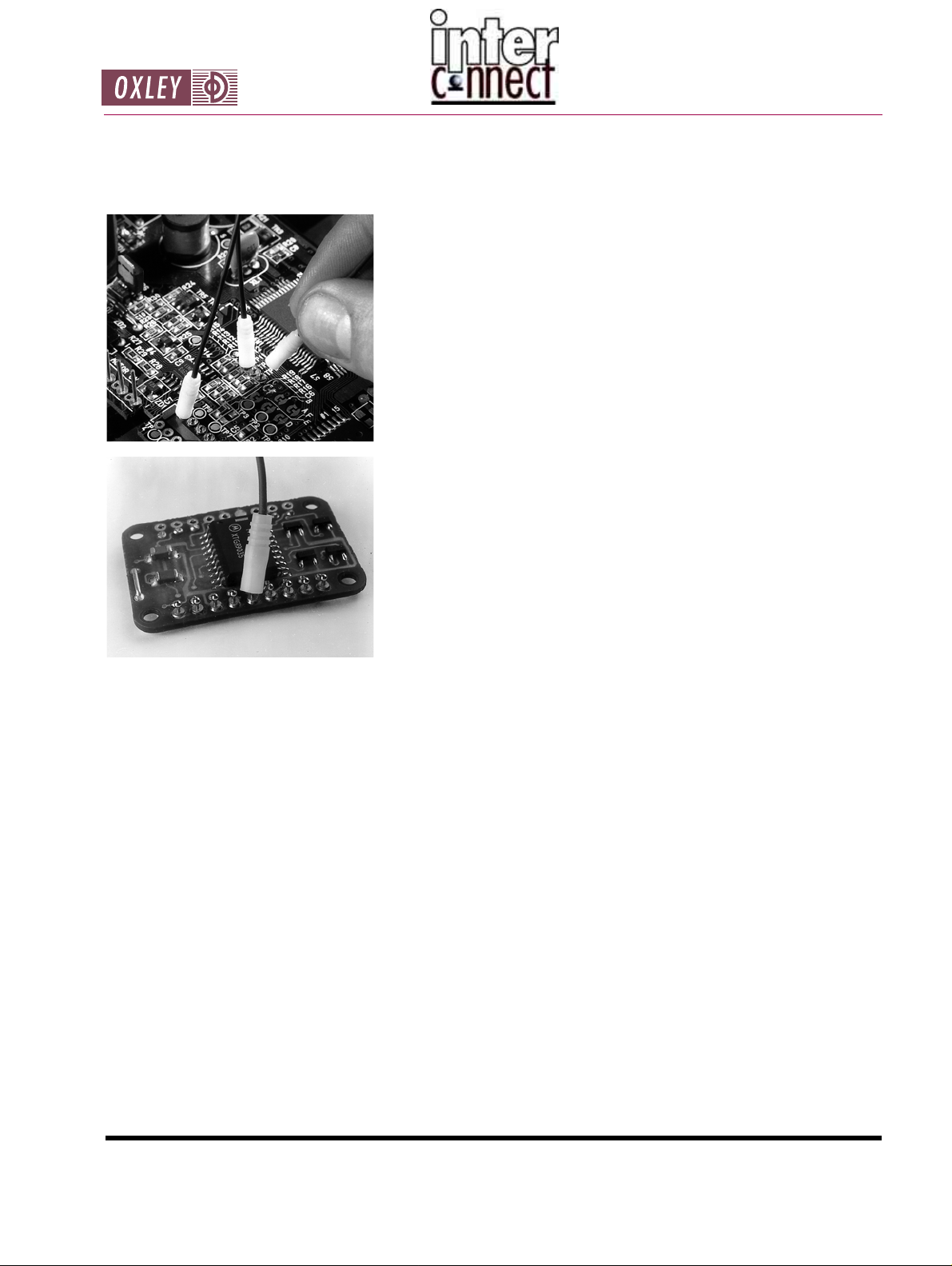
Oxley Interconnect Catalogue
Introduction
Introduction
Oxley is an established design and manufacturer of quality electronic
components.
We meet customer requirements with a complete range of standard electrical
components for interconnection, as well as offering clients custom design
and manufacturing facilities for non-standard solutions.
We offer a wide range of surface mount and through hole interconnect
products off-the-shelf for use in electronic applications:
• Surface Mount PCB Test Points
• Through Hole PCB Test Points
• Through Hole PCB Connectors
• Chassis Mounted Insulated Terminals and Feedthroughs
• Chassis Mounted and In Line Insulated Plugs and Sockets
• Custom Interconnection
In addition, we offer a sub contract precision machining service to produce
tight toleranced turned parts including those made from speciality materials
such as Alumel and Chromel. Parts can be supplied in a wide variety of
plating finishes to various standards.
In terms of design, production and Quality Assurance procedures, the Oxley
high standard has been recognised by National Approvals for manufacture
and research to BS EN ISO 9001: 2000, BS9000 and IECQ-CECC.
www.oxleygroup.com/interconnect
ODCSM:40566/4/2007
Oxley Group Australia Pty Ltd
Email: [email protected]
Tel +61 (2) 9967 9193
Oxley Inc.
Email: [email protected]
Tel: +1 (203) 488 1033
Oxley Developments Company Ltd
Email: [email protected]
Tel: +44 (0)1229 840519
1
Page 2
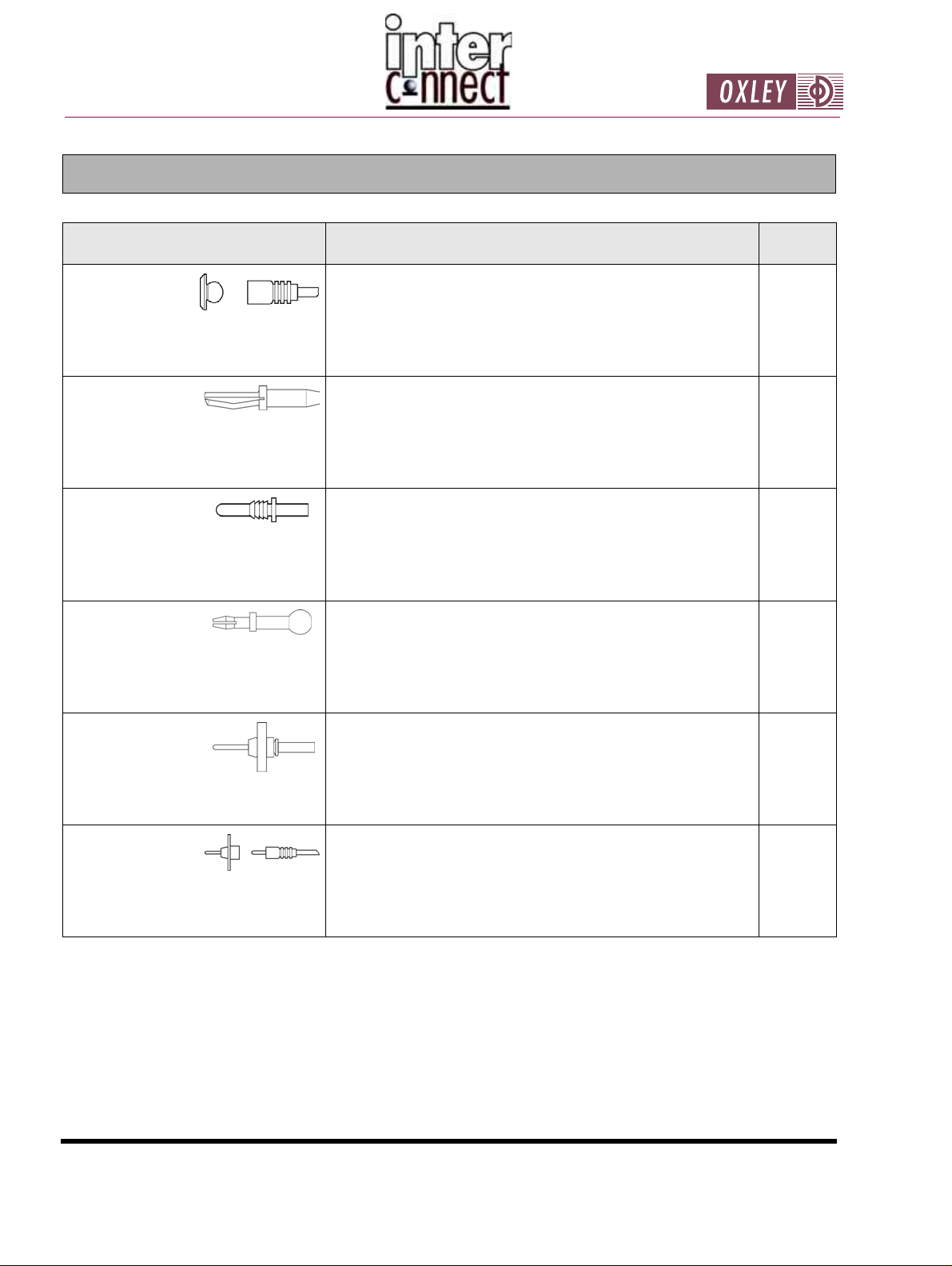
PCB/Panel Mounting
Interconnection Products
Types Features Page
SMOX
Surface Mount
Test points
KINKY PIN PTH
Connectors
Snale
Printed Circuit
Connectors
PCB/Panel Mounting Interconnection Products
Selection Guide
• available either loose or taped and reeled.
• requires minimum pad size of only 2 mm diameter.
• unique retention mechanism prevents damage to
PCB during connection/disconnection of socket.
• designed for plated through hole applications.
• insertion tools available for hand and semi-automatic insertion.
• custom styles available.
• self-retention mechanism provides high retention and rigidity.
• custom styles available.
• Snaplox, holed and test-point styles available.
3
7
12
SNAPLOX
Printed Circuit
Test Point
BARBCONE
LOCK
PTFE Insulated
Terminals
BARBCONE
LOCK
Plugs and
Sockets
• award winning design allows rapid connection/
disconnection.
• self-retaining and straight shank designs available.
• suitable for chassis, PCB and ceramic hybrids.
• insulated terminal designed for mounting on
chassis/frameworks.
• hermetically sealed versions available as standard.
• hand assembly tools available for ease of insertion.
• PCB Edge Mounted Variants available for card-rack systems.
• Colour options for PTFE Bush.
• in-line and stackable styles to reduce real estate.
• ease of assembly to increase production.
16
23
33
Oxley Developments Company Ltd
2
Email:[email protected]
Tel: +44 (0)1229 840607
Oxley Inc.
Email: [email protected]
Tel: +1 (203) 488 1033
Oxley Group Australia Pty Ltd
Email: [email protected]
Tel +61 (2) 9967 9193
www.oxleygroup.com/interconnect
ODCSM:40566/4/2006
Page 3

Features
• Unique retention mechanism enhances
reliability through low stress
connections.
• Minimum contact resistance (less than
2 mΩ) through 8 points of contact.
• Chamfer design allows excellent solder
fillets to be formed.
• Available loose or taped and reeled.
• Award winning kinematic design allows
rapid connection/disconnection.
• Proven application through Snaplox
range of test points.
• Hand or automatic assembly.
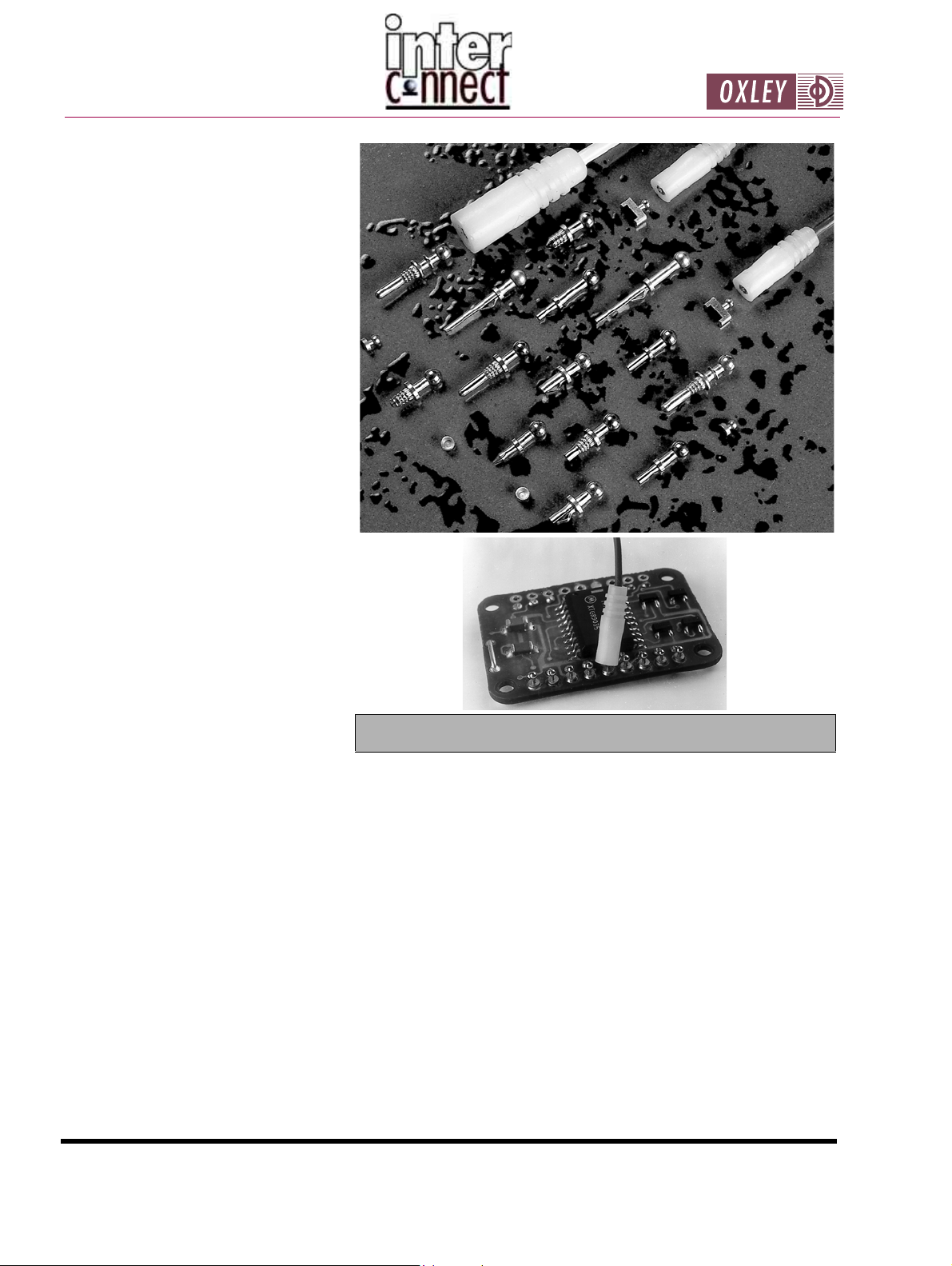
SMOX® Surface Mount Test
Surface Mount Applications
Surface-Mount Oxley (SMOX) Test-Point is available Taped and Reeled,
with a compatible mating socket and is suitable for a range of applications.
Due to the unique nature of the SMOX Connection System, it represents the
only Surface Mount Test Point available on the market with a specially
designed socket for easy low contact resistance and gentle detachment; the
applications and potential uses are limitless.
Requiring a minimum pad size of only two millimetres (0.080”), and being a
singlepole device, the SMOX can be placed accurately by any Pick and
Place machine in even the most congested designs. The socket is normally
used with the recommended PTFE Insulated Sleeve, (diameter 3.2 mm/
0.128”), but for those very close pitch designers, this can be replaced with
alternative insulation techniques.
Detecting and localising board faults is an obvious application, where the
ability to quickly and individually identify faulty components, cracked solder
joints or short circuits can save time of testing via an edge mounted
connector, or under a microscope.
On thick multilayered boards, where complex track designs can lead to very
expensive PCB’s, the benefits of quickly and effectively identifying and
repairing any faulty populated PCB can be easily recognised.
The ability to monitor waveform characteristics and determine the
performance of a circuit with variable components is vital, and not just in a
test laboratory. Where exact frequency output is required, a certain
waveform is needed or the ability to manually set the characteristics of each
production board manufactured; the inclusion of SMOX Test Points fulfils
that requirement.
www.oxleygroup.com/interconnect
ODCSM:40566/4/2007
Oxley Group Australia Pty Ltd
Email: [email protected]
Tel +61 (2) 9967 9193
Oxley Inc.
Email: [email protected]
Tel: +1 (203) 488 1033
Oxley Developments Company Ltd
Email: [email protected]
Tel: +44 (0)1229 840519
3
Page 4

SMOX® Surface Mount Test
Key Characteristics
Gold plated SMOX Test Point for low contact resistance and durability.
SMOX Connector Systems to reduce the risk of accidental damage to the
PCB. Can be used on any Pick and Place machine using vacuum nozzles.
Square or round solder pads can be used, with a minimum pad size of 2 mm
diameter.
Sockets are gently
detached when moved
beyond an angle of 30°
from vertical.
Packaging
The SMOX/060/B1LP.R3K Test Point is available on Tape and Reel, to
enable placement on to PCB’s by a variety of pick and Place machines. The
plastic reels are an industry standard 7” diameter and the R3K extension
denotes 3,000 components in a specially designed carrier tape.
The SMOX/060/B1-R2K test point is available on Tape and Reel, to enable
placement on to PCB’s by a variety of pick and Place machines. The plastic
reels are an industry standard 7” diameter and the .R2K extension denotes
2,000 components in a specially designed carrier tape.
The solid flat bottomed pocket ensures the component is in the correct
vertical position when the heat sealing backing tape is peeled off. 100%
visual inspection by camera during population of the tape ensures no
components are heat sealed in place in the wrong position, or that empty
pockets can be sealed.
For customers requiring the SMOX Socket to be supplied assembled, a
standard product is available on 15” of cable, with differing lengths possible
where demand exists.
Oxley Developments Company Ltd
4
Email:[email protected]
Tel: +44 (0)1229 840607
Oxley Inc.
Email: [email protected]
Tel: +1 (203) 488 1033
Oxley Group Australia Pty Ltd
Email: [email protected]
Tel +61 (2) 9967 9193
www.oxleygroup.com/interconnect
ODCSM:40566/4/2006
Page 5
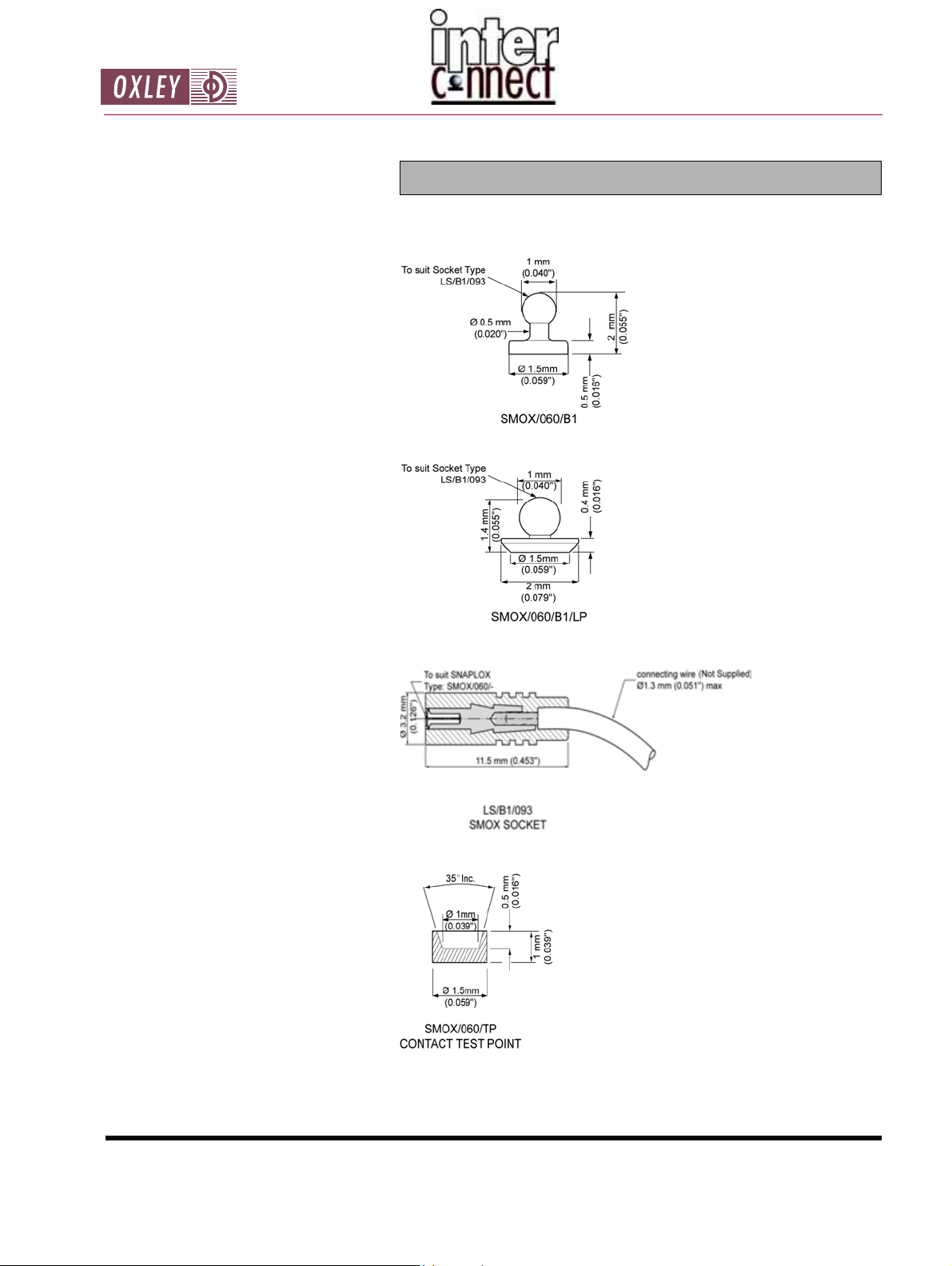
SMOX® Surface Mount Test
SMOX Surface Mount T es t Points
Wires shown for illustration purposes only.
www.oxleygroup.com/interconnect
ODCSM:40566/4/2007
Oxley Group Australia Pty Ltd
Email: [email protected]
Tel +61 (2) 9967 9193
Oxley Inc.
Email: [email protected]
Tel: +1 (203) 488 1033
Oxley Developments Company Ltd
Email: [email protected]
Tel: +44 (0)1229 840519
5
Page 6
SMOX® Surface Mount Test
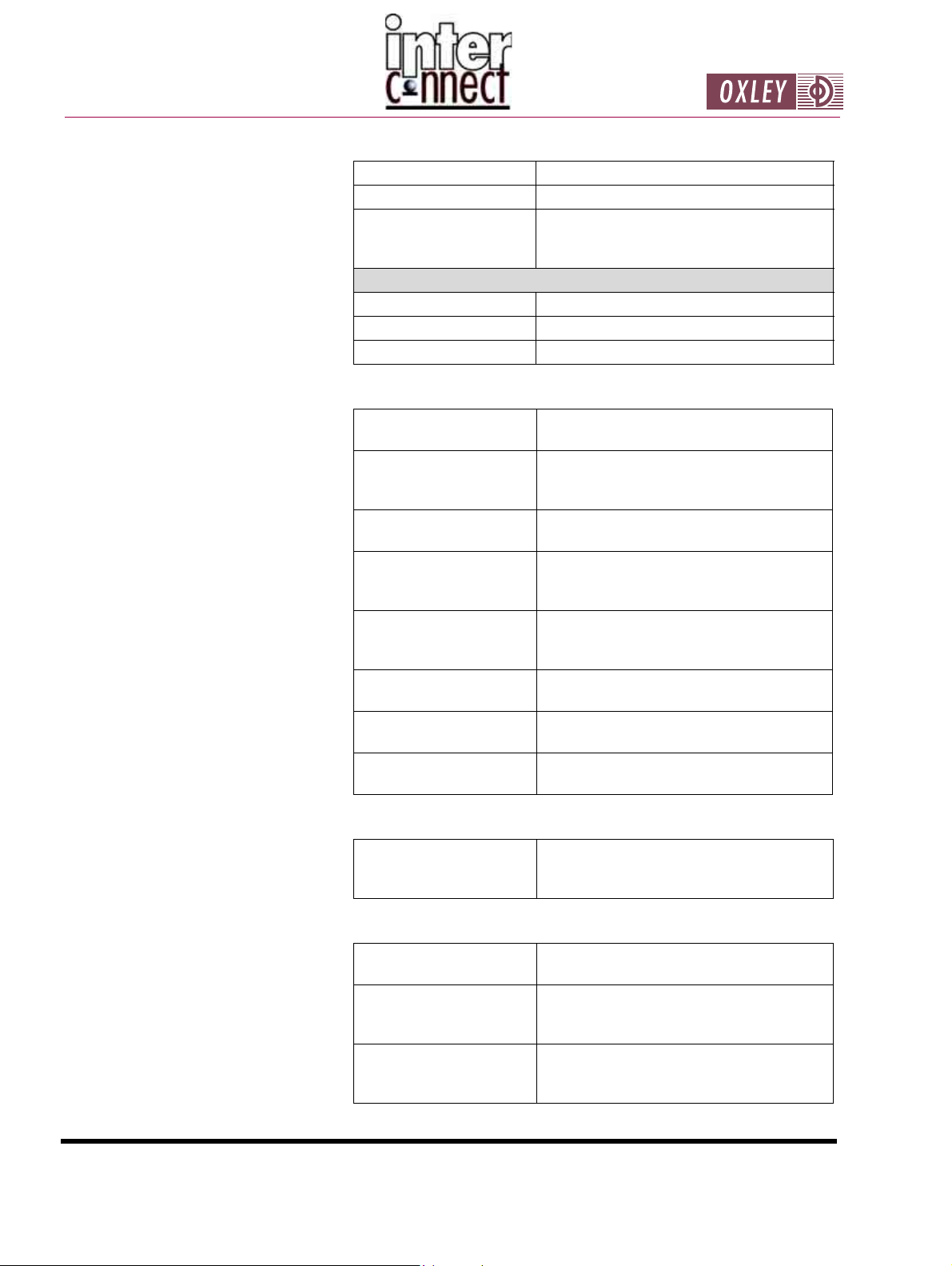
Materials
Characteristics
Test Point Copper Alloy
Socket Body Copper Alloy
Insulation High dispersion grade PTFE standard colours
- white, black and red.
Other colours available on request.
Finishes
Standard Gold
Options Palladium, Silver, Nickel or Tin Lead
Socket Silver
Maximum Contact
2 milliOhms
Resistance (with socket)
Maximum Angular
±30º
Movement before
Disconnection
Socket Insulation
10,000 MOhms minimum
Resistance
Typical Retention Force
0.2 kgs
(angles less than 60° or
±30°) off perpendicular
Typical Retention Torque
200 gcm
(angles greater than 30°)
or perpendicular
Current for 10°C Rise
3 A
Above Ambient
Climatic Category -55 to +125 °C, 56 days damp heat
(IEC 68:55/125/56)
Solderability Exceeds Requirements of BS 2011
(IEC 68) Test T
Assembly Tools
Taping and Reeling
Oxley Developments Company Ltd
6
Email:[email protected]
Tel: +44 (0)1229 840607
Tool Numbers Required
for SMOX Sockets (LS/
B1/093) Assembly
Tape 4 mm pitch
Reel Sizes:
SMOX/060/B1/LP.R3K
7 inch 3,000 components
Reel Sizes:
SMOX/060/B1.R2K
7 inch 2,000 components
Oxley Inc.
Email: [email protected]
Tel: +1 (203) 488 1033
AT1/KP18 and AT1/KP19
8 mm wide
Oxley Group Australia Pty Ltd
Email: [email protected]
Tel +61 (2) 9967 9193
www.oxleygroup.com/interconnect
ODCSM:40566/4/2006
Page 7
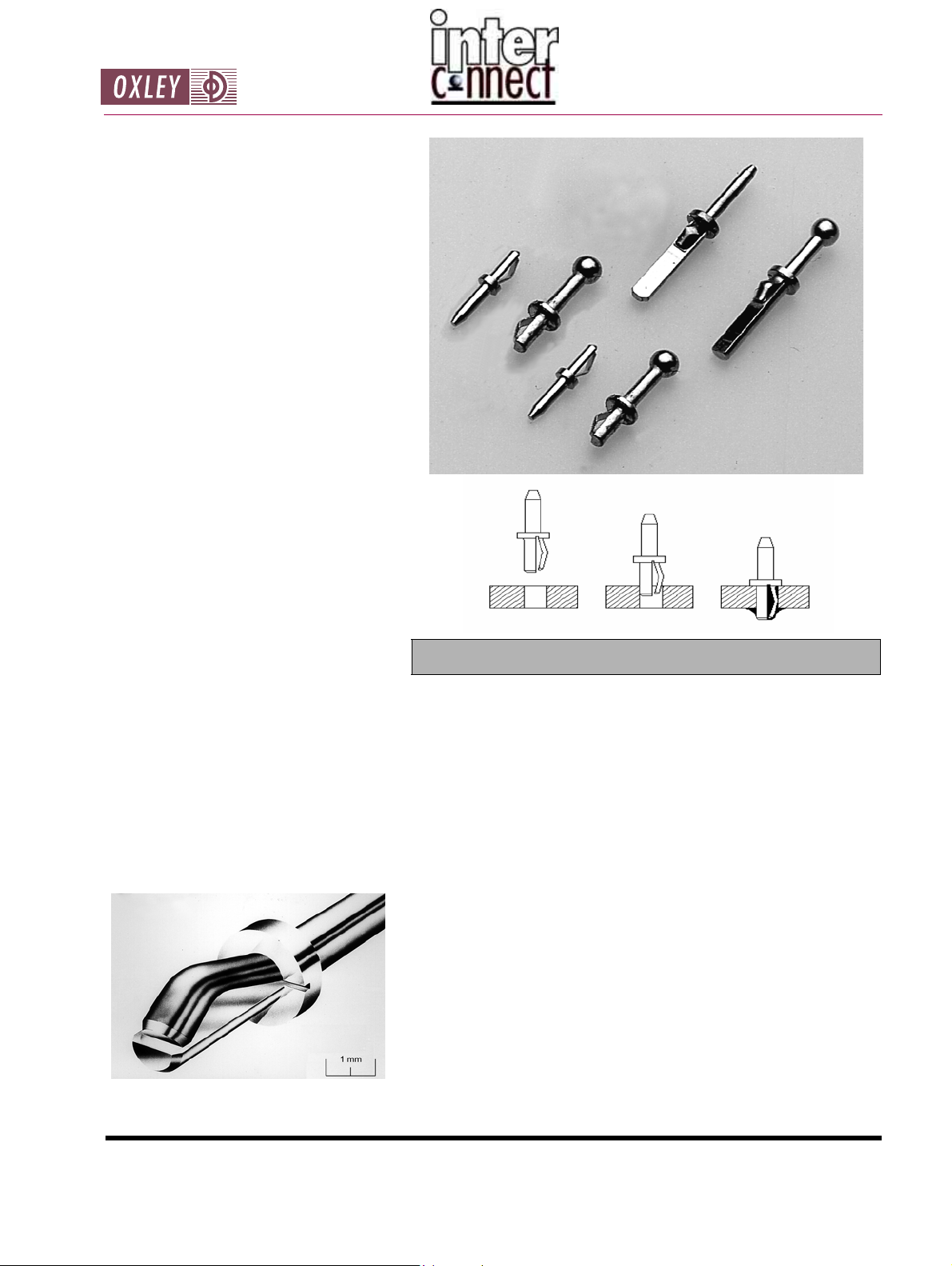
Features
• Unique kinked retention mechanism
retains pin in PCB plated through hole
(PTH) prior to soldering.
• Low insertion force avoids damage to
plating of PTH during assemb l y.
• Slotted design enhances solderability
and reliability.
• Family optimised for a wide range of
PTH diameters
0.508 mm (0.020") -
1.524 mm (0.060").
• Capable of hand and semi-automatic
machine insertion.
• Available in a wide range of styles and
finishes for alternative applications.
• Vibratory bowl fed semi-automatic
insertion machines available, details on
request.
KINKY PIN Plated Through
Hole (PTH) Connectors
Application
• Self retaining compliant pin for plated
through holes in multilayer printed
circuit boards.
Kinky Pins
Kinky Pins were designed specifically to meet the demands of plated
through hole (PTH) technology introduced in printed circuit boards. They
tend to be used with flexi-circuit termination and as solder terminals,
connectors and in multiway pin arrays.
They use a unique kinked retention mechanism which gives a fit in the PTH
that is unsurpassed. The kinked leg provides a tight non-aggressive spring
loaded fit whilst the straight leg ensures the pin is kept perpendicular to the
PCB prior to soldering.
This Kinky Pin mechanism gives an additional benefit which is a key part
of its operation. The slotted design induces wicking of the solder up into the
kink and up to the flange which means that the solder joint is solid and free
of air pockets. This reduces the possibility of dry joints developing and the
life of the solder joint is therefore increased. In our opinion and that of our
customers, there is no better PTH solder-in terminal!
The Kinky Pin range is comprehensive and our in-house high precision
machining capabilities mean that we have the ability to manufacture
bespoke versions on request. Standard finishes are tin lead and gold;
other finishes are available on request.
www.oxleygroup.com/interconnect
ODCSM:40566/4/2007
Oxley Group Australia Pty Ltd
Email: [email protected]
Tel +61 (2) 9967 9193
Oxley Inc.
Email: [email protected]
Tel: +1 (203) 488 1033
Oxley Developments Company Ltd
Email: [email protected]
Tel: +44 (0)1229 840519
7
Page 8
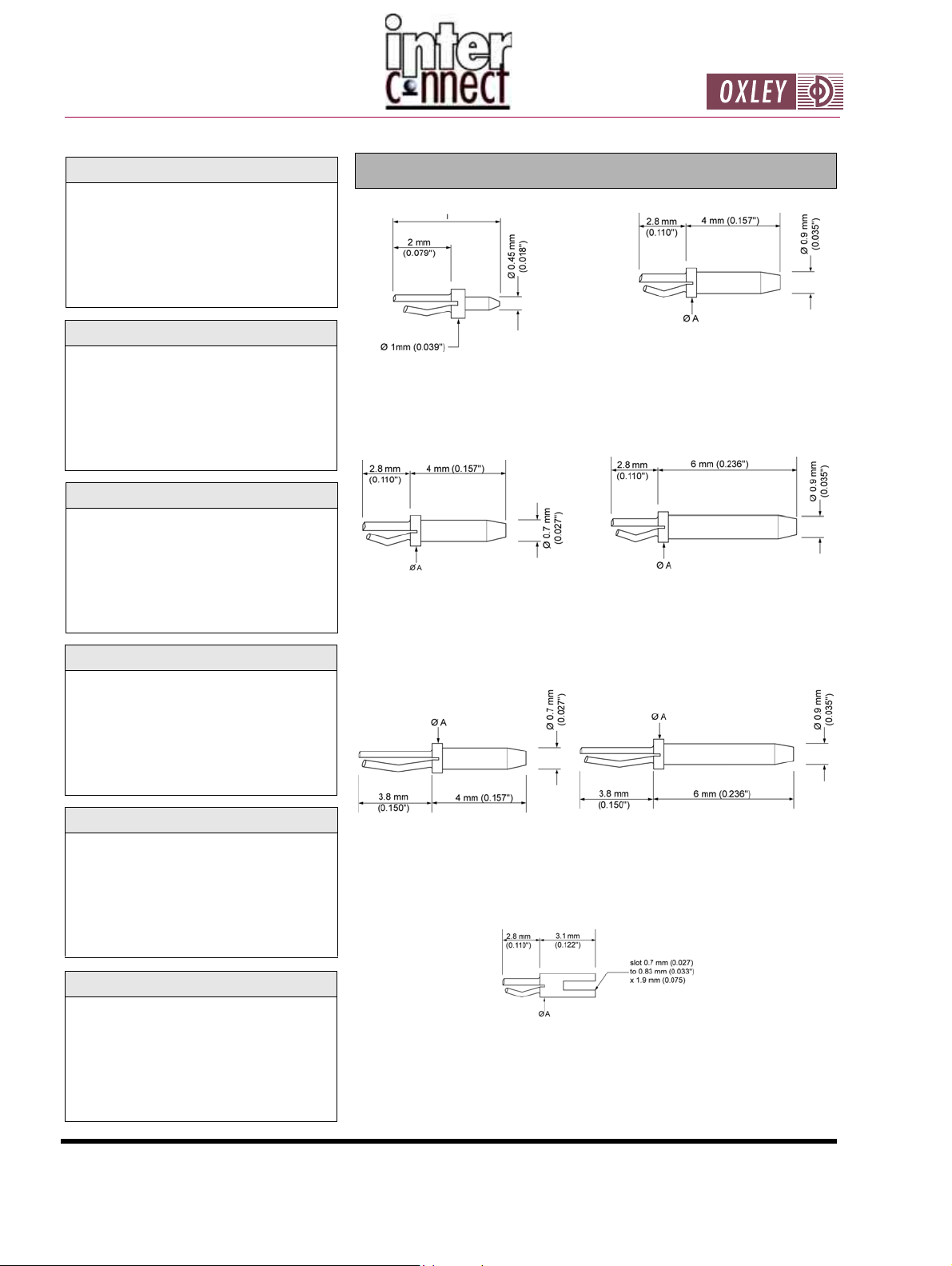
KINKY PIN Plated Through
Hole (PTH) Connectors
Prefix: 020/-
Mounting Hole Diameter:
0.52 mm (0.020") - 0.68 mm (0.027")
Min. Pitch Using Assembly Tool:
2.5 mm (0.098")
Shoulder Diameter A:
1.0 mm (0.039")
Prefix: 028/-
Mounting Hole Diameter:
0.68 mm (0.027") - 0.84 mm (0.033")
Min. Pitch Using Assembly Tool:
2.5 mm (0.098")
Shoulder Diameter A:
1.6 mm (0.063")
Prefix: 030/-
Mounting Hole Diameter:
0.81 mm (0.032") - 0.96 mm (0.038")
Min. Pitch Using Assembly Tool:
2.5 mm (0.098")
Shoulder Diameter A:
1.6 mm (0.063")
Prefix: 040/-
Mounting Hole Diameter:
0.96 mm (0.038") - 1.12 mm (0.044")
Min. Pitch Using Assembly Tool:
2.5 mm (0.098")
Shoulder Diameter A:
1.6 mm (0.063")
Kinky Pin Test Points
020/C/KP2 [I = 3.7 mm (0.146")]
020/PT/KP2 [I = 6.1 mm (0.240")]
020/PT/KP2/L [I = 7.3 mm (0.287")]
028/30P/LA/KP2
030/30P/LA/KP2
040/30P/LA/KP2
050/30P/LA/KP2
060/30P/LA/KP2
028/30P/KP2
030/30P/KP2
040/30P/KP2
050/30P/KP2
060/30P/KP2
028/30P/KP2/L
030/30P/KP2/L
040/30P/KP2/L
050/30P/KP2/L
060/30P/KP2/L
Prefix: 050/-
Mounting Hole Diameter:
1.21 mm (0.048") - 1.37 mm (0.054")
Min. Pitch Using Assembly Tool:
3.0 mm (0.118")
Shoulder Diameter A:
2.4 mm (0.094)
Prefix: 060/-
Mounting Hole Diameter:
1.50 mm (0.059") - 1.65 mm (0.065")
Min. Pitch Using Assembly Tool:
3.0 mm (0.118")
Shoulder Diameter A:
2.4 mm (0.094)
Oxley Developments Company Ltd
8
Email:[email protected]
Tel: +44 (0)1229 840607
028/10P/30P/LA/KP2
030/10P/30P/LA/KP2
040/10P/30P/LA/KP2
050/10P/30P/LA/KP2
060/10P/30P/LA/KP2
Oxley Inc.
Email: [email protected]
Tel: +1 (203) 488 1033
028/T/KP2
030/T/KP2
040/T/KP2
050/T/KP2
060/T/KP2
Oxley Group Australia Pty Ltd
Email: [email protected]
Tel +61 (2) 9967 9193
028/10P/30P/KP2/L
030/10P/30P/KP2/L
040/10P/30P/KP2/L
050/10P/30P/KP2/L
060/10P/30P/KP2/L
www.oxleygroup.com/interconnect
ODCSM:40566/4/2006
Page 9
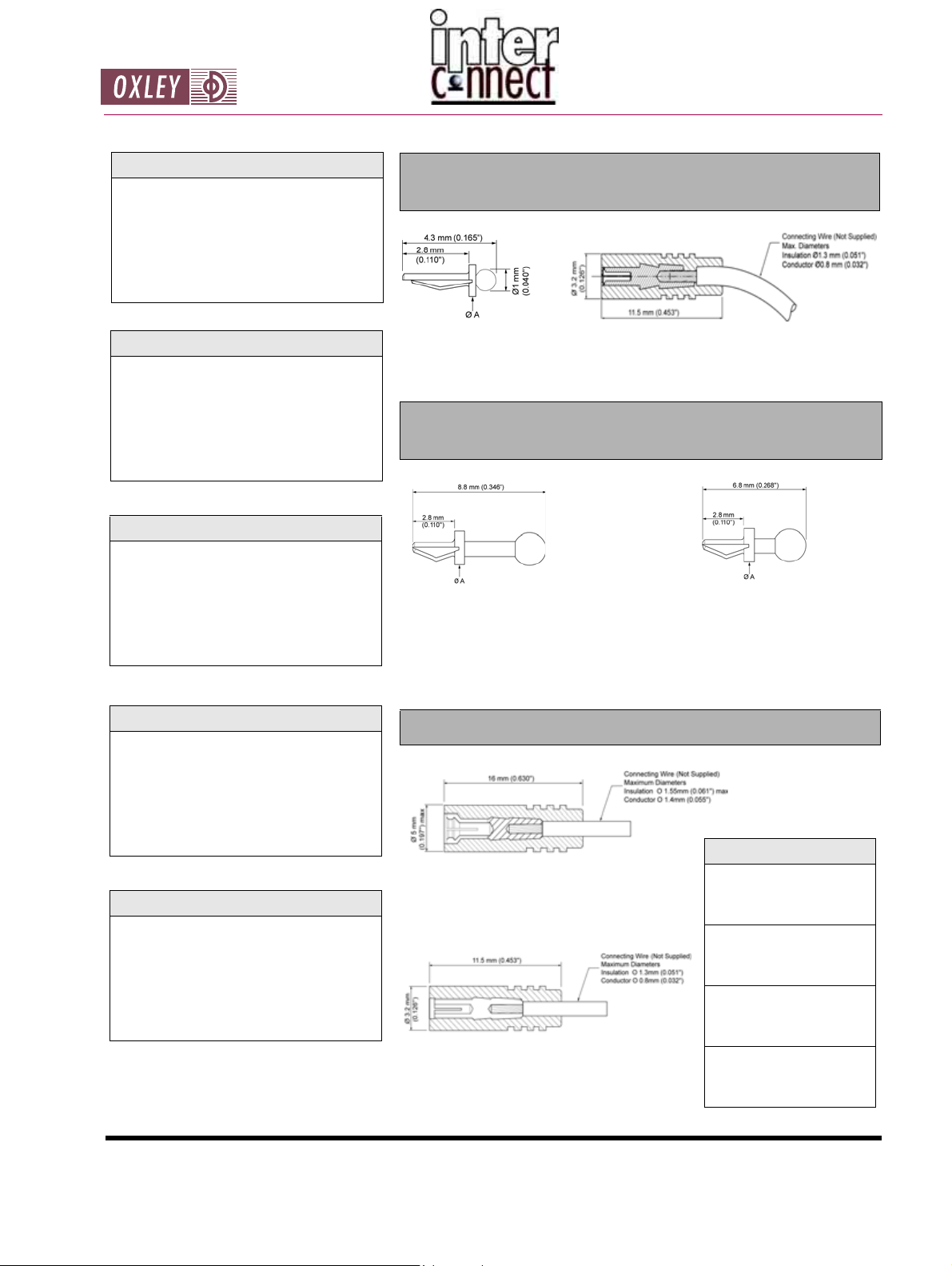
KINKY PIN Plated Through
Hole (PTH) Connectors
Prefix: 028/-
Mounting Hole Diameter:
0.68 mm (0.027") - 0.84 mm (0.033")
Min. Pitch Using Assembly Tool:
2.5 mm (0.098")
Shoulder Diameter A:
1.6 mm (0.063")
Prefix: 030/-
Mounting Hole Diameter:
0.81 mm (0.032") - 0.96 mm (0.038")
Min. Pitch Using Assembly Tool:
2.5 mm (0.098")
Shoulder Diameter A:
1.6 mm (0.063")
Prefix: 040/-
Mounting Hole Diameter:
0.96 mm (0.038") - 1.12 mm (0.044")
Min. Pitch Using Assembly Tool:
2.5 mm (0.098")
Shoulder Diameter A:
1.6 mm (0.063")
1 mm Snaplox Kinky-Pins
(To Suit Socket Type Number LS/B1/093)
Wires Shown for illustration purposes only.
030/B1/KP2
040/B1/KP2
050/B1/KP2
LS/B1/093
(To suit 1 mm Snaplox)
2 mm Snaplox Kinky-Pins
(To Suit Socket Type Number LS/B2/156)
028/SO/BK2F
030/SO/BK2F
040/SO/BK2F
050/SO/BK2F
060/SO/BK2F
028/SO/BK2P
030/SO/BK2P
040/SO/BK2P
050/SO/BK2P
060/SO/BK2P
Prefix: 050/-
Mounting Hole Diameter:
1.21 mm (0.048") - 1.37 mm (0.054")
Min. Pitch Using Assembly Tool:
3.0 mm (0.118")
Shoulder Diameter A:
2.4 mm (0.094)
Prefix: 060/-
Mounting Hole Diameter:
1.50 mm (0.059") - 1.65 mm (0.065")
Min. Pitch Using Assembly Tool:
3.0 mm (0.118")
Shoulder Diameter A:
2.4 mm (0.094)
www.oxleygroup.com/interconnect
ODCSM:40566/4/2007
Oxley Group Australia Pty Ltd
Email: [email protected]
Tel +61 (2) 9967 9193
Socket
Wires Shown for illustration purposes only.
LS/B2/156
(To suit all 2 mm Snaplox)
(To suit -/30P/KP2 AND -/30P/KP2/L))
30/LS/093
Oxley Inc.
Email: [email protected]
Tel: +1 (203) 488 1033
Assembly Tools
-/30P/KP2,
-/30P/KP2/L
AT1/KP1
(028 - 040)/T/KP2,
-/-/BK2F, -/-/BK2P
AT1/KP2
-/10P/30P/KP2/L,
(050 - 060)/T/KP2
AT1/KP3
-/30P/LA/KP2/L,
-/10P/30P/LA/KP2
AT1/KP4
Oxley Developments Company Ltd
Email: [email protected]
Tel: +44 (0)1229 840519
9
Page 10
KINKY PIN Plated Through
Hole (PTH) Connectors
Materials
Characteristics
Pin Copper alloy
Sockets
Contact
Insulation
Brass
High dispersion grade PTFE
Finishes:
Pin
Standard
Options
Tin Lead
Gold (standard on Snaplox Kinky Pins)
Socket
Standard
Options
Contact Resistance
Silver
Gold
less than 5 millohms
(with socket)
Current for 10°C Rise
7 A
Above Ambient
Climatic Category - 55 to +125 °C
Solderability Exceeds Requirements of BS 2011
(IEC 68) Test T
Assembly Tools
Component Type Number Tool Number
-/30P/KP2
AT1/KP1
-/30P/KP2/L
-/LT/30P/KP2/L
(028 - 040) /T/KP2
AT1/KP2
-/LT/T/KP2
-/-/BK2F
-/-/BK2P
-/10P/30P/KP2/L
AT1/KP3
(050 - 060) /T/KP2
-/30P/LA/KP2
AT1/KP4
-/10P/30P/LA/KP2
O20/C/KP2
AT1/KP20
O20/PT/KPT
O20/PT/KP2/L
Oxley Developments Company Ltd
10
Email:[email protected]
Tel: +44 (0)1229 840607
Oxley Inc.
Email: [email protected]
Tel: +1 (203) 488 1033
Oxley Group Australia Pty Ltd
Email: [email protected]
Tel +61 (2) 9967 9193
www.oxleygroup.com/interconnect
ODCSM:40566/4/2006
Page 11
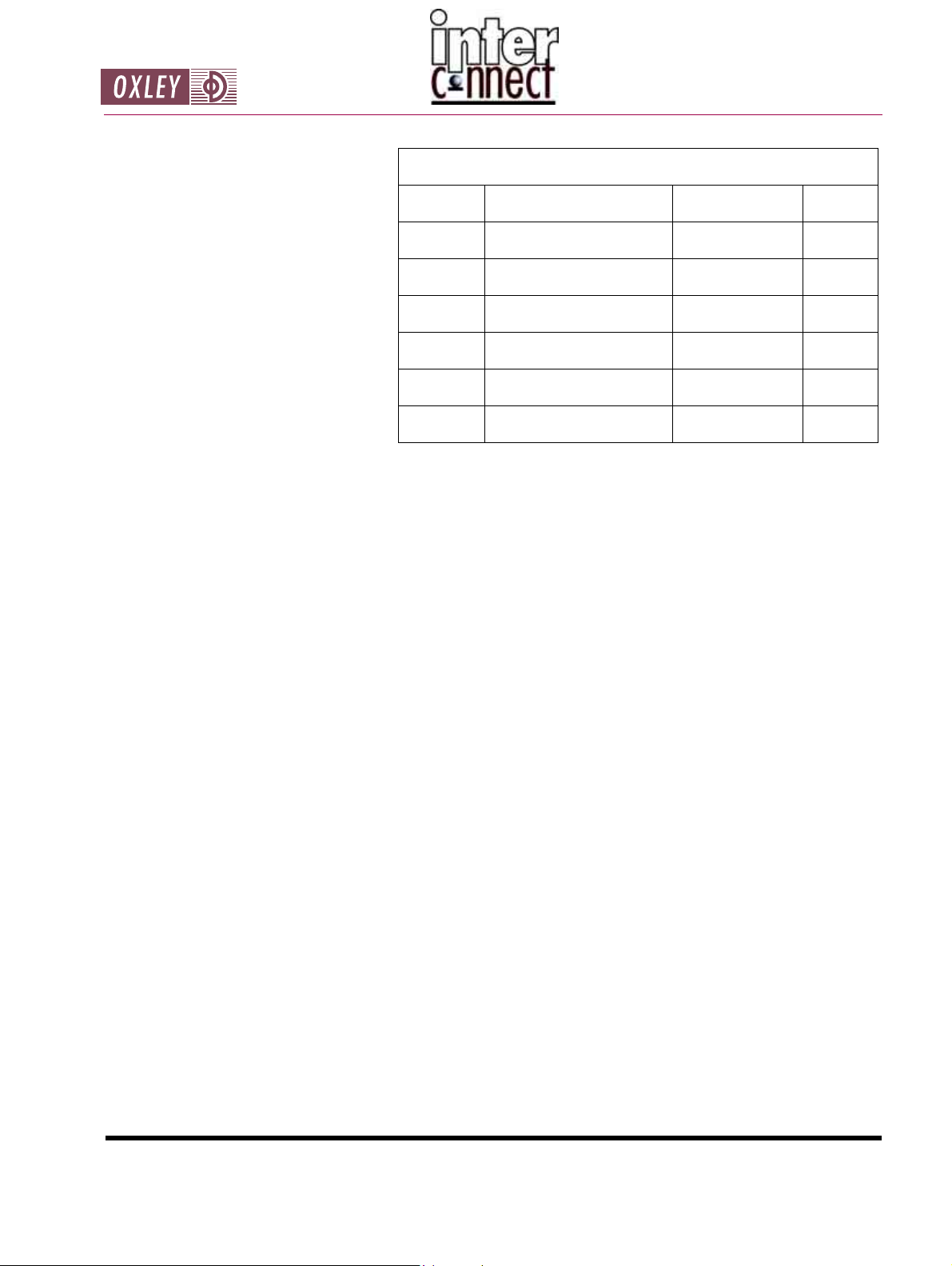
KINKY PIN Plated Through
Hole (PTH) Connectors
Mounting Details and
Shoulder Diameter
Mounting Details : Minimum Board Thickness 1.4 mm (0.055")
0.9 mm (0.036") for 020/- and 2.36 mm (0.093") for -/10P
Prefix No Mounting Hole Dia. After
Through Plating
020/- 0.52 mm (0.020") -
Min. Pitch Using
Assembly Tool
2.5 mm (0.098") 1.0 mm
0.68 mm (0.027")
028/- 0.68 mm (0.027") -
2.5 mm (0.098") 1.6 mm
0.84 mm (0.033")
030/- 0.81 mm (0.032") -
2.5 mm (0.098") 1.6 mm
0.96 mm (0.038")
040/- 0.96 mm (0.038") -
2.5 mm (0.098") 1.6 mm
1.12 mm (0.044")
050/- 1.21 mm (0.048") -
3.0 mm (0.118") 2.4 mm
1.37 mm (0.054")
060/- 1.50 mm (0.059") -
3.0 mm (0.118") 2.4 mm
1.65 mm (0.065")
ØA
(0.039")
(0.063")
(0.063")
(0.063")
(0.094")
(0.094")
www.oxleygroup.com/interconnect
ODCSM:40566/4/2007
Oxley Group Australia Pty Ltd
Email: [email protected]
Tel +61 (2) 9967 9193
Oxley Inc.
Email: [email protected]
Tel: +1 (203) 488 1033
Oxley Developments Company Ltd
Email: [email protected]
Tel: +44 (0)1229 840519
11
Page 12
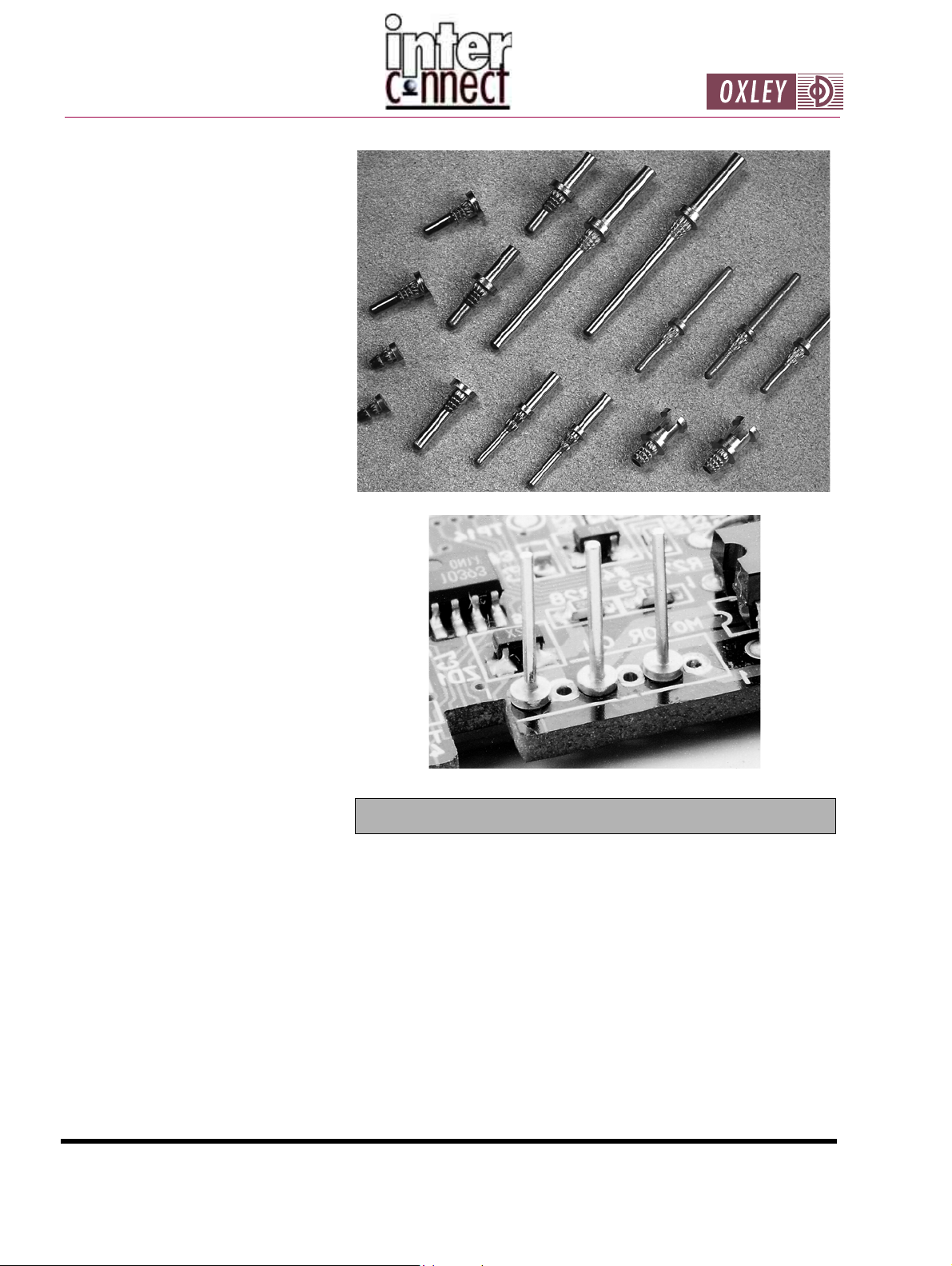
Snale® Printed Circuit
Connectors
Features
• Patented Snale® form provides high
retention and rigidity.
• Low insertion force allows easy hand
assembly.
• Serrated outline inhibits rotation.
• For use with 1.02 mm (0.040") and 1.27
mm (0.050") diameter holes.
• Available in a wide range of styles and
finishes for differing applications.
Application
• Self retaining interference fit pin for
single and double sided printed circuit
boards and chassis.
Oxley Developments Company Ltd
12
Email:[email protected]
Tel: +44 (0)1229 840607
Snale Pins
The use of Snale Pins has been widely established in the commercial and
military electronics market worldwide as the definitive terminal pin for use
with non-plated through hole PCB’s and chassis.
The knurled and barbed retention mechanism gives a low insertion force,
high retention and non-rotation fit ensuring rigidity with ease of assembly.
The snale Pin range is available in a variety of lengths and diameters to suit
applications such as multiway pin headers on aircraft engine control
systems, as pins in connectors and lead-through terminals and solder posts
on flow meters.
They are available in standard Tin Lead and Gold finishes with others
available on request. Bespoke styles are also available due to our in-house
high precision machining capabilities.
Oxley Inc.
Email: [email protected]
Tel: +1 (203) 488 1033
Oxley Group Australia Pty Ltd
Email: [email protected]
Tel +61 (2) 9967 9193
www.oxleygroup.com/interconnect
ODCSM:40566/4/2006
Page 13
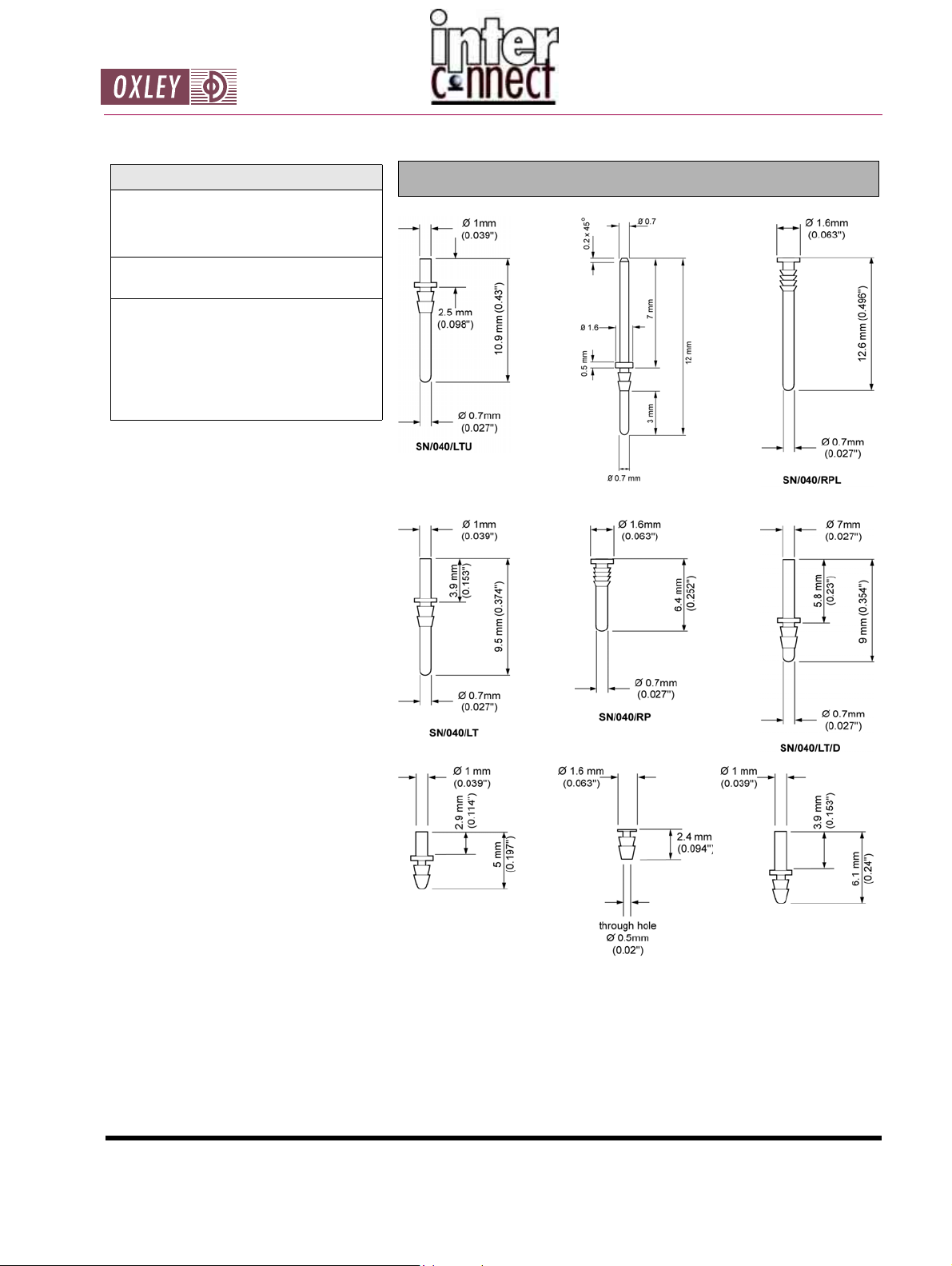
Snale® Printed Circuit
Connectors
Prefix: SN/040/-
Mounting Hole Diameter:
1.02 mm
(0.040"
Board Thickness:
0.8 mm (0.031") min.
Hole Diameter (Copper clad paper
phenolic, 1.6 mm (0.063") thick:
1.05 mm (0.0415"), 1.02 mm
(0.040"), 0.98 mm (0.0385")
Retention Force (kg):
5, 6, 8
± 0.04 mm
± 0.0016")
SN/040/- Series
SN/040/LT/BA
www.oxleygroup.com/interconnect
ODCSM:40566/4/2007
SN/040/SO/PG
Oxley Group Australia Pty Ltd
Email: [email protected]
Tel +61 (2) 9967 9193
SN/040/RP/H
Oxley Inc.
Email: [email protected]
Tel: +1 (203) 488 1033
SN/040/SO
Oxley Developments Company Ltd
Email: [email protected]
Tel: +44 (0)1229 840519
13
Page 14
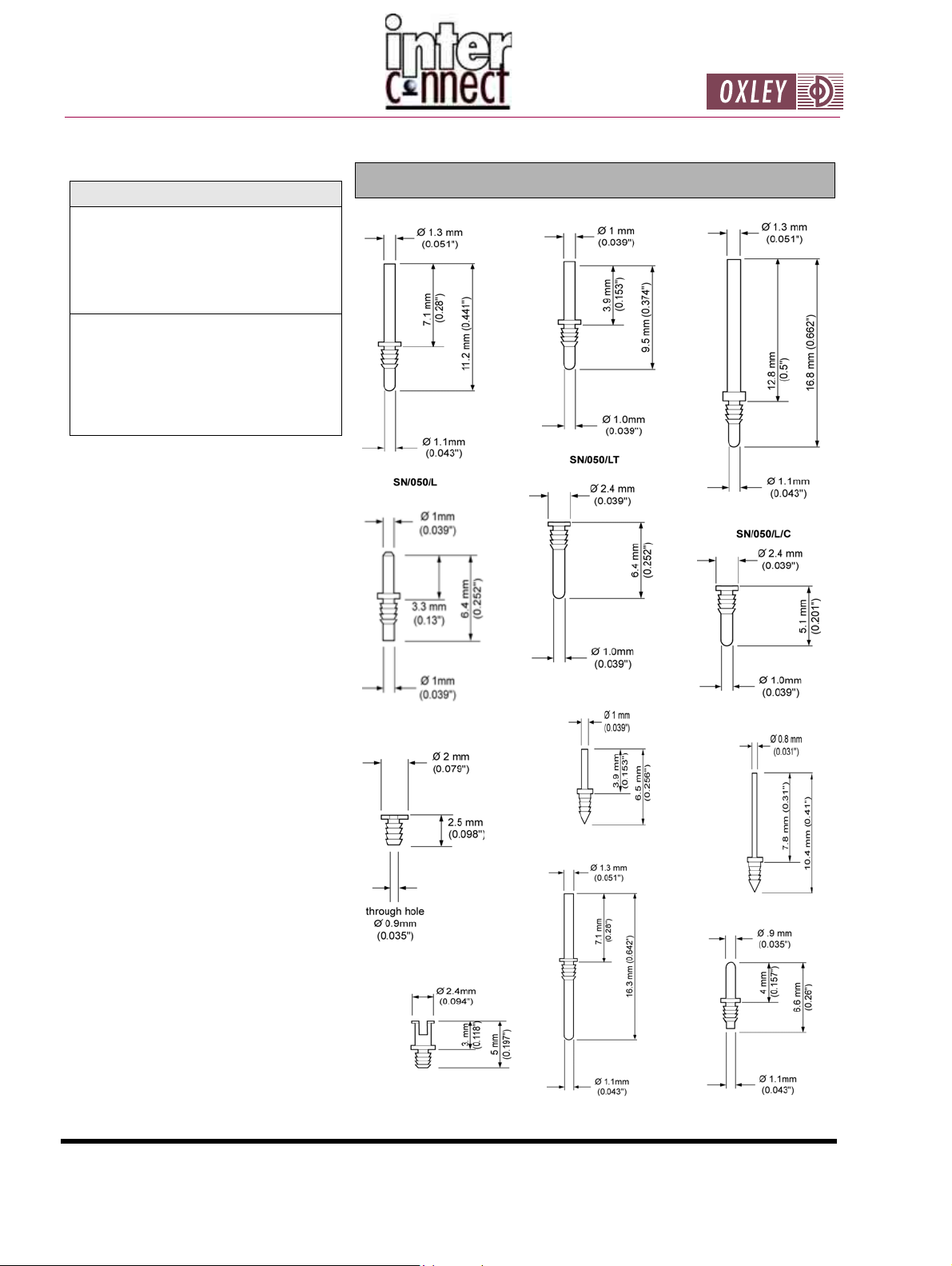
Snale® Printed Circuit
Connectors
Prefix: SN/050/-
Mounting Hole Diameter:
1.31 mm
(0.052"
Board Thickness:
0.8 mm (0.031") min.
Hole Diameter (Copper clad paper
phenolic, 1.6 mm (0.063") thick:
1.32 mm (0.052"), 1.30 mm (0.051"),
1.25 mm (0.049")
Retention Force (kg):
4, 5, 6
± 0.06 mm
± 0.002")
SN/050/- Series
SN/050/PG
SN/050/RP/H
SN/050/T
SN/050/RP
SN/050/SO
SN/050/XL
SN/050/RP/BA
SN/050/SO/LP
SN/050/30P
Oxley Developments Company Ltd
14
Email:[email protected]
Tel: +44 (0)1229 840607
Oxley Inc.
Email: [email protected]
Tel: +1 (203) 488 1033
Oxley Group Australia Pty Ltd
Email: [email protected]
Tel +61 (2) 9967 9193
www.oxleygroup.com/interconnect
ODCSM:40566/4/2006
Page 15
Materials
Characteristics
Snale® Printed Circuit
Connectors
Pin/Contacts Brass
Finishes
Pin/Contacts
Snale
Tin Lead
Snaplox Snale
Socket
Option
Contact Resistance < 2 mOhms (SN/050/30P-30LS/093)
Solderability Exceeds Requirements of BS 2011
Palladium
Silver
Gold
< 10 mOhms (Snaplox Snales)
(IEC 68) Test T
Assembly Tools
Component Type Number Tool Number
SN/040/LT- AT1/10
SN/040/RP- AT1/13
SN/040/RP/H AT2/03/A
SN/040/SO AT1/10
050/- AT1/09
SN/050/30P AT1/18
SN/050/L AT1/11
SN/050/L T AT1/10
SN/050/L/C AT1/02
SN/050/PG AT1/05
SN/050/RP AT1/12
SN/050/RP- AT1/01
SN/050/RP/H AT2/02/A
SN/050/SO/- AT1/10
SN/050/T AT1/06
SN/050/XL AT1/11
30LS/093 AT1/01
ATS 2/08
LS/B2/156 AT2/01
ATS 3/05
Mounting Details
www.oxleygroup.com/interconnect
ODCSM:40566/4/2007
Prefix No Mounting Hole
SN/050/- 1.32 mm (0.052")
SN/040/- 1.05 mm (0.0415")
Oxley Group Australia Pty Ltd
Email: [email protected]
Tel +61 (2) 9967 9193
Diameter
1.30 mm (0.051")
1.25 mm (0.049")
1.02 mm (0,040")
0.98 mm (0.0385")
Oxley Inc.
Email: [email protected]
Tel: +1 (203) 488 1033
Typical
Retention
Force (Kg)
4
5
6
5
6
8
Oxley Developments Company Ltd
Email: [email protected]
Tel: +44 (0)1229 840519
Board
Thickness
0.8 mm
(0.031") min.
0.8 mm
(0.031") min.
15
Page 16
SNAPLOX® Printed
Circuit Test Point
Features
• Award winning kinematic design allows
rapid connection/disconnection.
• High retention force with socket (at
angles less than 30
contact ensures low contact resistance.
• Low detachment force with socket (at
angles greater than 30
inadvertent damage to pcb during test.
• Surface mount, self retaining and
straight shank designs available.
• Hand or semi-automatic machine
assembly. Details on request.
Application
• Plated through hole, multilayer and
ceramic and printed circuits and
hybrids.
°) and eight point
°) reduces risk of
Oxley Developments Company Ltd
16
Email:[email protected]
Tel: +44 (0)1229 840607
Snaplox
The Snaplox® name has firmly established itself in the world electronics
market. The award winning design has yielded use in a vast range of
applications in the commercial and military electronics world. Applications
which use them include towed sonar arrays and rolling stock electronics
equipment.
®
The Snaplox
reducing the risk of board damage. This is due to the unique ball and socket
arrangement which provides 8 points of low resistance contact through a 60°
connection angle. Beyond this 60° the socket disconnects with ease
preventing stress to the pin and board.
The standard finishes are palladium or Gold plated pin and PTFE insulated
Silver plated socket to give a robust, long life, low contact resistance test
point system. Other finishes are available on request.
They are available with a range of PCB (surface mount, Kinky Pin and
Snale) and chassis mounting (Barb Cone-Lock) retention mechanisms to
suit most applications and bespoke styles can be manufactured as needed
due to our in-house, high precision machining capabilities.
Oxley Inc.
Email: [email protected]
Tel: +1 (203) 488 1033
concept enables highly accurate testing to be done whilst
Oxley Group Australia Pty Ltd
Email: [email protected]
Tel +61 (2) 9967 9193
®
www.oxleygroup.com/interconnect
ODCSM:40566/4/2006
Page 17
SNAPLOX® Printed
Circuit Test Point
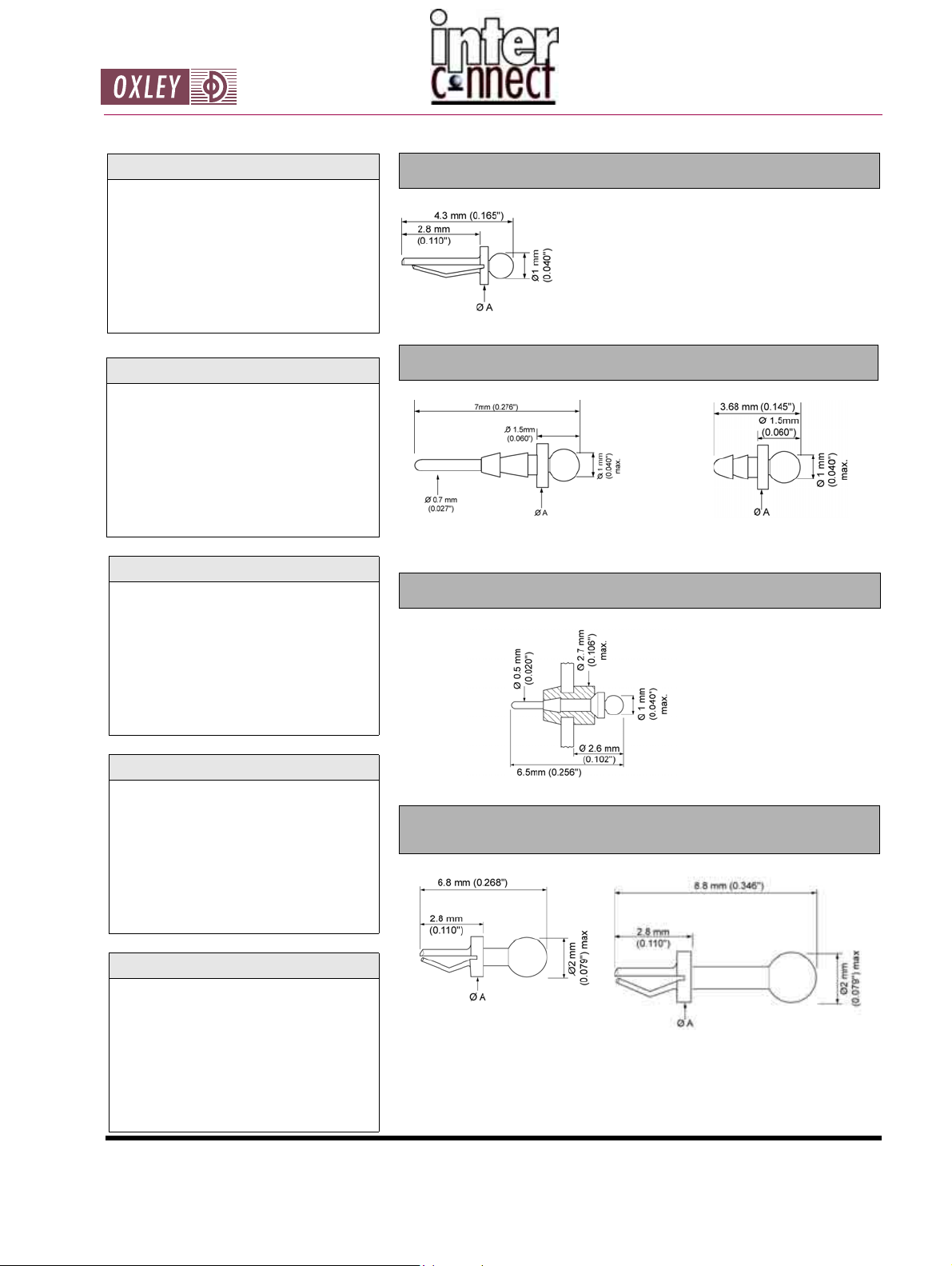
Pa r t N u m b e r : SN/040/-/B1
Mounting Hole Diameter:
0.81 mm (0.032") - 0.96 mm (0.038")
PCB Thickness:
1.4 mm (0.055") min.
Shoulder Diameter A:
1.6 mm (0.063")
Assembly Tool:
Snaplox Kinky-Pins - AT 1/09
Pa r t N u m b e r : 062/B1
Mounting Hole Diameter:
1.57 mm (0.062")
PCB Thickness:
0.56 mm (0.022") - 0.71 (0.028")
Shoulder Diameter A:
N/A
Assembly Tool:
AT 1/01
Prefix: 028/-
Mounting Hole Diameter:
0.68 mm (0.027") - 0.84 mm (0.033")
PCB Thickness:
1.4 mm (0.055") min.
Shoulder Diameter A:
1.6 mm (0.063")
Assembly Tool:
AT 1/KP2
1 mm Miniature Snaplox (Kinky Pin)
030/B1/KP2
040/B1/KP2
050/B1/KP2
1 mm Miniature Snaplox (Snale)
SN/040/LT/B1
SN/040/SO/B1
1 mm Miniature Snaplox (Barb Cone Lock)
062/B1
Prefix: 030/-
Mounting Hole Diameter:
0.81 mm (0.032") - 0.96 mm (0.038")
PCB Thickness:
1.4 mm (0.055") min.
Shoulder Diameter A:
1.6 mm (0.063")
Assembly Tool:
AT 1/KP2
Prefix: 040/-
Mounting Hole Diameter:
0.96 mm (0.038") - 1.12 mm (0.044")
PCB Thickness:
1.4 mm (0.055") min.
Shoulder Diameter A:
1.6 mm (0.063")
Assembly Tool:
AT 1/KP2
www.oxleygroup.com/interconnect
ODCSM:40566/4/2007
Oxley Group Australia Pty Ltd
Email: [email protected]
Tel +61 (2) 9967 9193
Kinky Pin Snaplox
(self retaining compliant fit for plated through hole multilayer pcbs)
028/SO/BK2P
030/SO/BK2P
040/SO/BK2P
050/SO/BK2P
060/SO/BK2P
Oxley Inc.
Email: [email protected]
Tel: +1 (203) 488 1033
Oxley Developments Company Ltd
Email: [email protected]
Tel: +44 (0)1229 840519
028/SO/BK2F
030/SO/BK2F
040/SO/BK2F
050/SO/BK2F
060/SO/BK2F
17
Page 18
SNAPLOX® Printed
Circuit Test Point
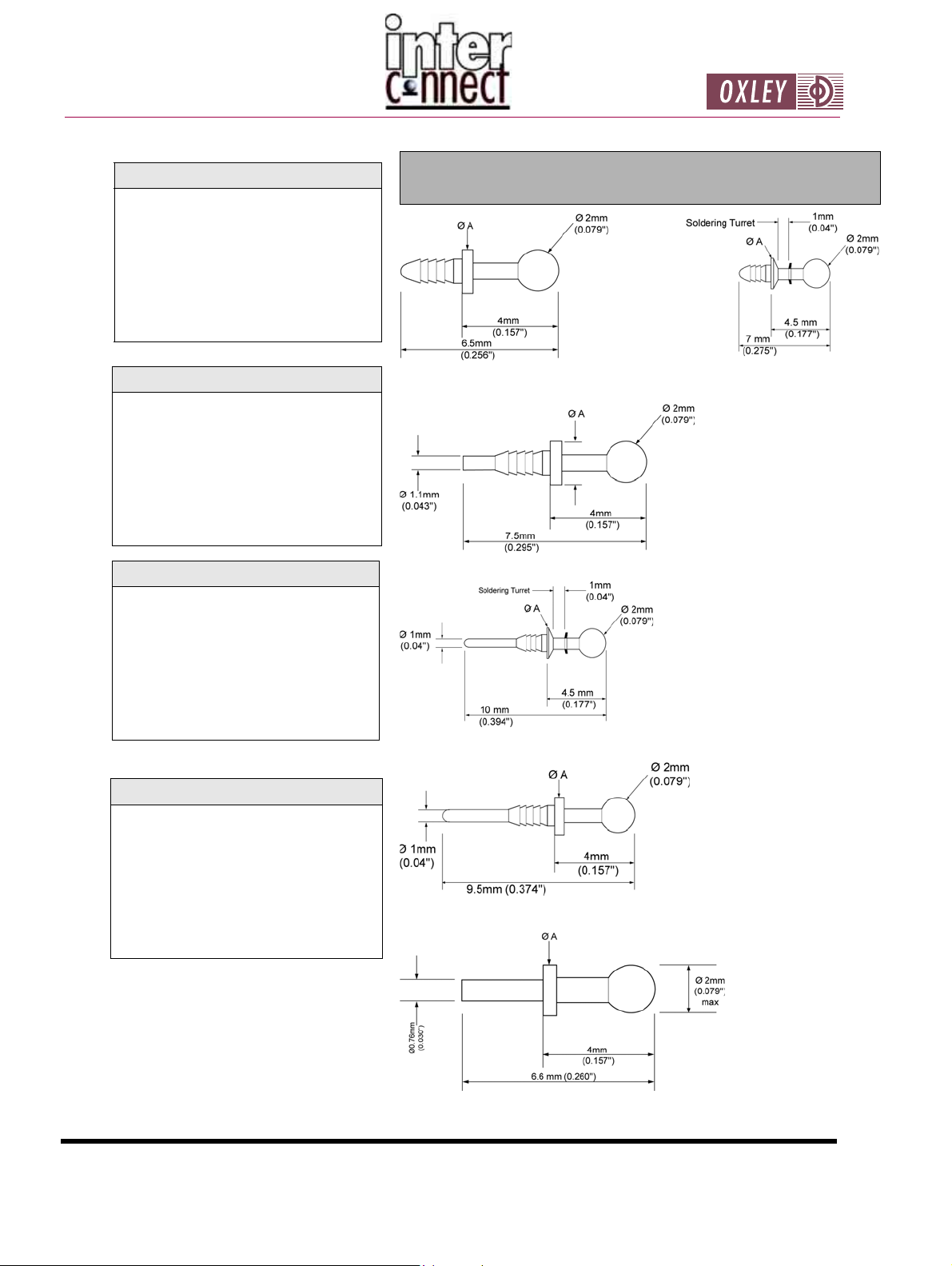
Prefix: 050/-
Mounting Hole Diameter:
1.21 mm (0.048") - 1.37 mm (0.054")
PCB Thickness:
1.4 mm (0.055") min.
Shoulder Diameter A:
2.4 mm (0.094")
Assembly Tool:
AT 1/KP2
Prefix: 060/-
Mounting Hole Diameter:
1.52 mm (0.060") - 1.62 mm (0.064")
PCB Thickness:
1.4 mm (0.055") min.
Shoulder Diameter A:
2.4 mm (0.094")
Assembly Tool:
AT 1/KP2
Prefix: 050/-(Snales)
Mounting Hole Diameter:
1.25 mm (0.049") - 1.40 mm (0.055")
PCB Thickness:
1.4 mm (0.055") min.
Shoulder Diameter A:
2.4 mm (0.094")
Assembly Tool:
AT 1/09
Snale Snaplox
(Self Retaining Fit for Single and Double sided pcbs)
050/SO/BST050/SO/B2
050/SOX/B2
050/LT/BST
Part Number: 030/SO/B2
Mounting Hole Diameter:
0.81 mm (0.032") - 0.92 mm (0.036")
PCB Thickness:
1.65 MM (0.065") - 1.85 MM (0.073")
Shoulder Diameter A:
1.6 mm (0.063")
Assembly Tool:
AT 1/09
Oxley Developments Company Ltd
18
Email:[email protected]
Tel: +44 (0)1229 840607
Oxley Inc.
Email: [email protected]
Tel: +1 (203) 488 1033
Oxley Group Australia Pty Ltd
Email: [email protected]
Tel +61 (2) 9967 9193
050/LT/B2
030/SO/B2
www.oxleygroup.com/interconnect
ODCSM:40566/4/2006
Page 19
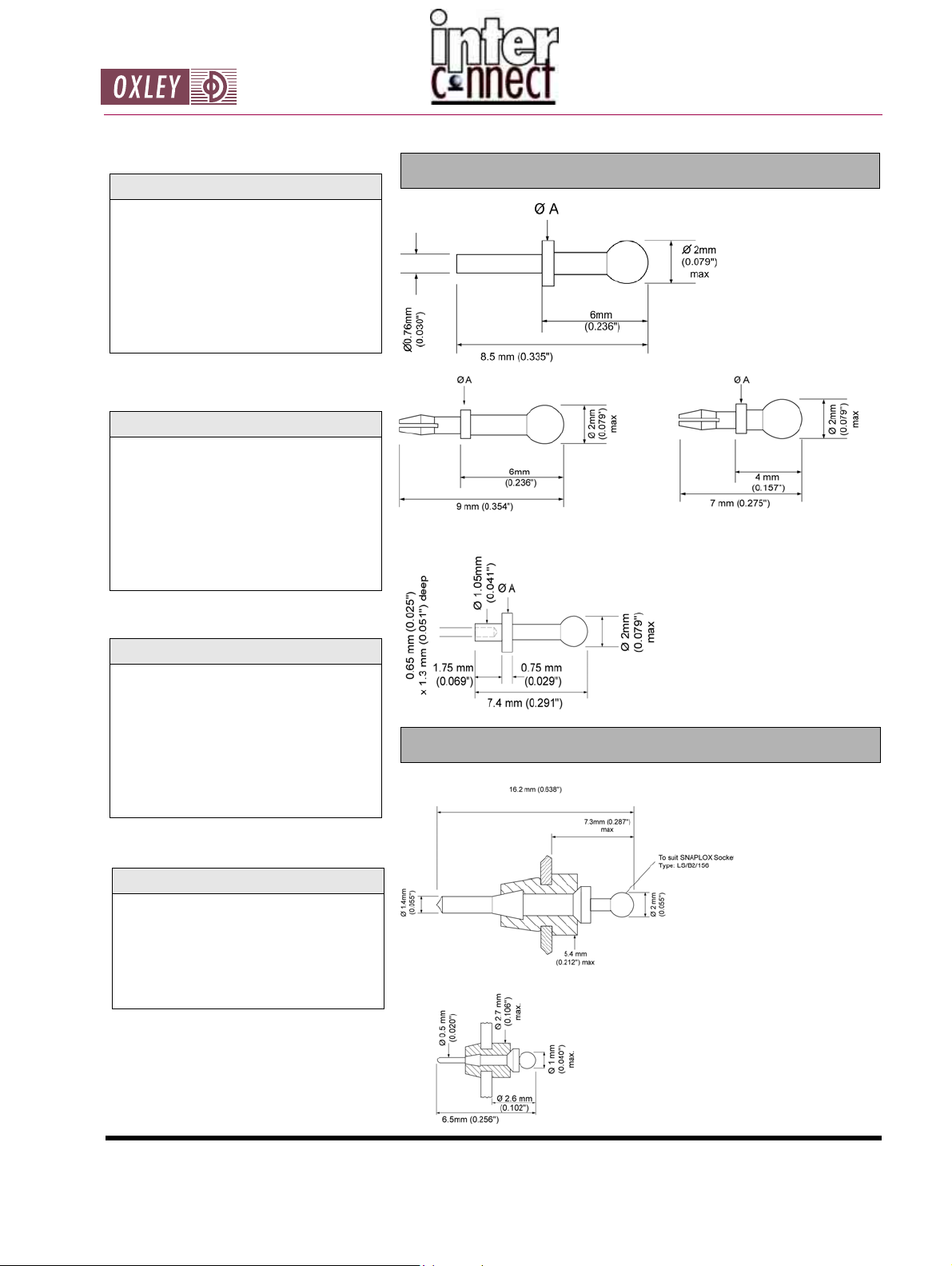
SNAPLOX® Printed
Circuit Test Point
Part Number: 030/SO/BF
Mounting Hole Diameter:
0.81 mm (0.032") - 0.92 mm (0.036")
PCB Thickness:
1.65 MM (0.065") - 1.85 MM (0.073")
Shoulder Diameter A:
1.6 mm (0.063")
Assembly Tool:
AT 1/09
Part Number: 030/SO/BCS/-
Mounting Hole Diameter:
0.81 mm (0.032") - 0.92 mm (0.036")
PCB Thickness:
1.65 MM (0.065") - 1.85 MM (0.073")
Shoulder Diameter A:
1.6 mm (0.063")
Assembly Tool:
AT 1/09 or AT 1/KP2
Part Number: 050/B2/RS
Mounting Hole Diameter:
1.25 mm (0.049") - 1.37 mm (0.054")
PCB Thickness:
N/A
Shoulder Diameter A:
2.4 mm (0.094")
Assembly Tool:
AT 1/09
Snale Snaplox Continued
030/SO/BF
030/SO/BCS/F 030/SO/BCS/P
050/B2/RS
Insulated Terminals Snaplox
Part Number: 156/LP/B2
Mounting Hole Diameter:
3.95 mm (0.155") - 4.05 mm (0.159")
Chassis Thickness:
1.2mm (0.047") - 1.6 mm (0.063"
Assembly Tool:
AT 1/09
www.oxleygroup.com/interconnect
ODCSM:40566/4/2007
Oxley Group Australia Pty Ltd
Email: [email protected]
Tel +61 (2) 9967 9193
156/LP/B2
)
062/B1
Oxley Inc.
Email: [email protected]
Tel: +1 (203) 488 1033
Oxley Developments Company Ltd
Email: [email protected]
Tel: +44 (0)1229 840519
19
Page 20
SNAPLOX® Printed
Circuit Test Point
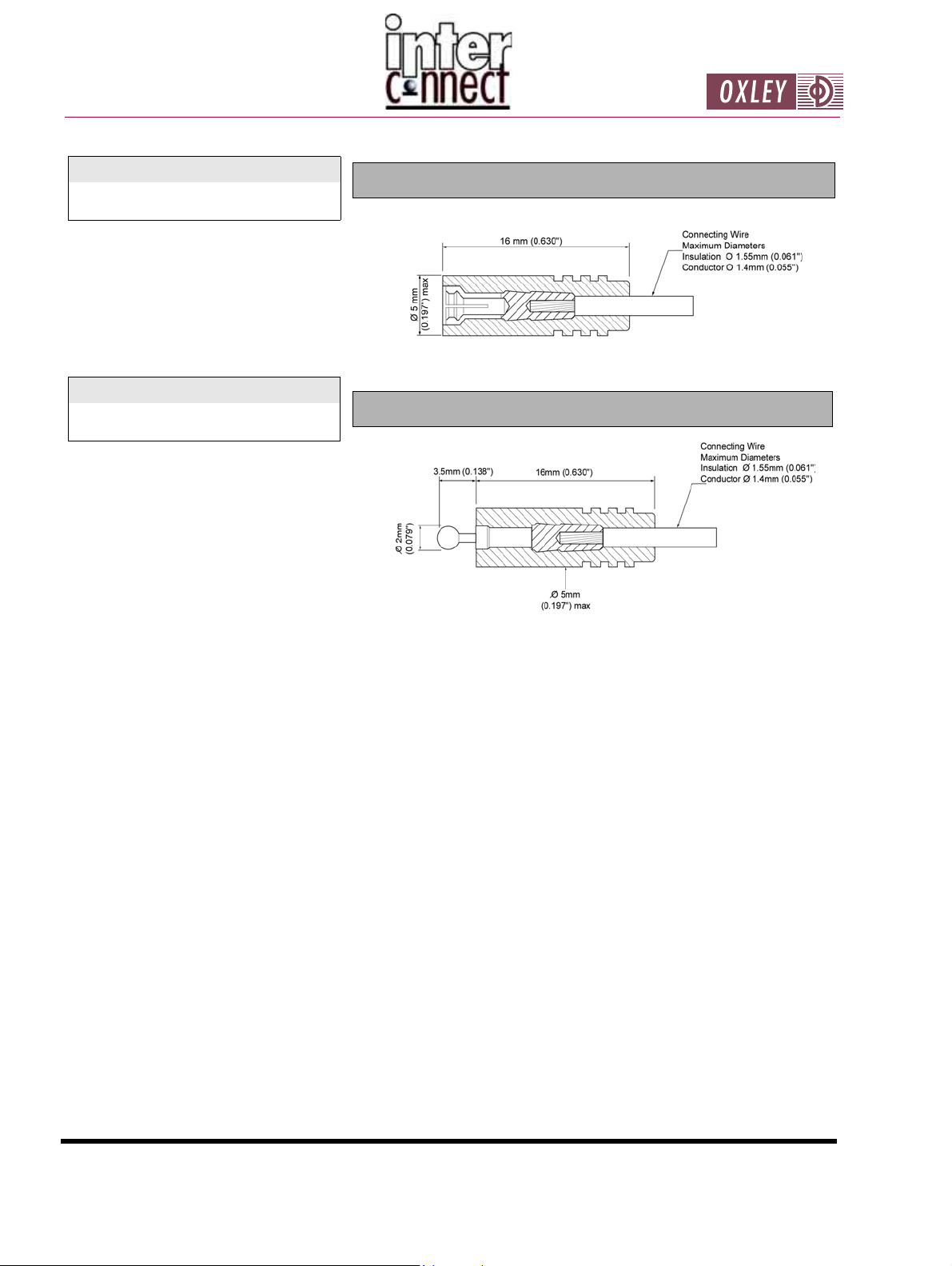
Part Number: LS/B2/156
Assembly Tool:
AT 2/05 & ATS 3/05
Part Number: LP/B2/156
Assembly Tool:
AT 1/09
Socket (Connects with all 2 mm Snaplox)
LS/B2/156
Line Plug (Connects with LS/B2/156)
LP/B2/156
(To suit LS/B2/156))
Wires shown for illustration purposes only.
Oxley Developments Company Ltd
20
Email:[email protected]
Tel: +44 (0)1229 840607
Oxley Inc.
Email: [email protected]
Tel: +1 (203) 488 1033
Oxley Group Australia Pty Ltd
Email: [email protected]
Tel +61 (2) 9967 9193
www.oxleygroup.com/interconnect
ODCSM:40566/4/2006
Page 21
Materials
SNAPLOX® Printed
Circuit Test Point
Pin Brass
Exceptions
Kinky Pin Snaplox
SMOX Test Points
Socket Copper Alloy
Insulation High dispersion grade PTFE standard
Finishes
Pin Palladium
Exceptions
Kinky Pin Snaplox Gold
Socket Silver
Copper alloy
Copper alloy
colours - white, black and red.
Other colours available on request.
Characteristics
Maximum Contact Resistance
2 milliOhms
(with socket)
Maximum Angular Movement
±30°
before Disconnection
Socket Insulation Resistance 10,000 MOhms minimum
Typical Retention Force
2 kg (0.2kgs for SMOX/-)
(angles less than 30°)
Typical Retention Torque
200 gcm
(angles greater than 30°)
Current for 10°C Rise
7 A (3 A for SMOX/-)
Above Ambient
Climatic Category -55 to +125 °C, 56 days damp heat
(IEC 68:55/125/56)
Solderability Exceeds Requirements of BS 2011
(IEC 68) Test T
www.oxleygroup.com/interconnect
ODCSM:40566/4/2007
Oxley Group Australia Pty Ltd
Email: [email protected]
Tel +61 (2) 9967 9193
Oxley Inc.
Email: [email protected]
Tel: +1 (203) 488 1033
Oxley Developments Company Ltd
Email: [email protected]
Tel: +44 (0)1229 840519
21
Page 22
SNAPLOX® Printed
Circuit Test Point
Mounting Details and Shoulder
Diameter
Pin Ty p e No Mounting Hole
PCB Thickness ØA
Details
028/- 0.68 mm (0.027") -
0.84 mm (0.033")
030/- 0.81 mm (0.032") -
0.96 mm (0.038")
030/SO/B2 0.81 mm (0.032") -
0.92 mm (0.036")
030/SO/BF 0.81 mm (0.032") -
0.92 mm (0.036")
030/SO/BCS/ 0.81 mm (0.032") -
0.92 mm (0.036")
040/- 0.96 mm (0.038") -
1.12 mm (0.044")
050/- 1.21 mm (0.048") -
1.37 mm (0.054")
050/(Snales)
1.25 mm (0.049") -
1.40 mm (0.055")
050/B2/RS 1.25 mm (0.049") -
1.37 mm (0.054")
060/- 1.52 mm (0.060") -
1.62 mm (0.064")
B2/PCA/- 0.9 mm (0.035") -
1.4 mm (0.055") min. 1.6 mm
(0.063")
1.4 mm (0.055") min. 1.6 mm
(0.063")
1.65 mm (0.065") -
1.85 mm (0.073")
1.65 mm (0.065") -
1.85 mm (0.073")
1.65 mm (0.065") -
1.85 mm (0.073")
1.6 mm
(0.063")
1.6 mm
(0.063")
1.6 mm
(0.063")
1.4 mm (0.055") min. 1.6 mm
(0.063")
1.4 mm (0.055") min. 2.4 mm
(0.094")
1.4 mm (0.055") min. 2.4 mm
(0.094")
N/A 2.4 mm
(0.094")
1.4 mm (0.055") min. 2.4 mm
(0.094")
1.4 mm (0.055") min. N/A
1.1 mm (0.043")
156/LP/B2 3.95 mm (0.155") -
4.05 mm (0.159")
1.2 mm (0.047") -
1.6 mm (0.063")
N/A
SMOX/- 2.0 mm min. pad N/A N/A
062/B1 1.57 mm (0.062") 0.56 mm (0.022") -
N/A
0.71 (0.028")
Assembly Tools
Oxley Developments Company Ltd
22
Email:[email protected]
Tel: +44 (0)1229 840607
Component Type Number Tool Number
Snaplox Kinky Pins AT 1/KP2
Snaplox Snale Pins AT 1/09
030/SO/B2 AT 1/09
030/SO/BF AT 1/09
030/SO/BCS/- AT 1/09 OR at 1/KP2
050/B2/RS AT 1/09
LS/B1/093 AT1/KP18 & AT1/KP19
LS/B2/156 AT 2/01 & ATS 3/05
LP/B2/156 AT 1/09 & ATS 3/05
156/LP/B2 AT 1/09
Oxley Inc.
Email: [email protected]
Tel: +1 (203) 488 1033
Oxley Group Australia Pty Ltd
Email: [email protected]
Tel +61 (2) 9967 9193
www.oxleygroup.com/interconnect
ODCSM:40566/4/2006
Page 23
Features
• Simple economical assembly.
• Self-retaining mechanism.
• Rapid assembly.
• High insulation resistance.
• Low capacitance.
• Pressure Sealing.
Application
• Chassis mounting insulated stand off
and lead through terminals.
• Pressure bulkhead feedthrough sealing
applications.
BARB CONE LOCK® PTFE
Insulated Terminals
www.oxleygroup.com/interconnect
ODCSM:40566/4/2007
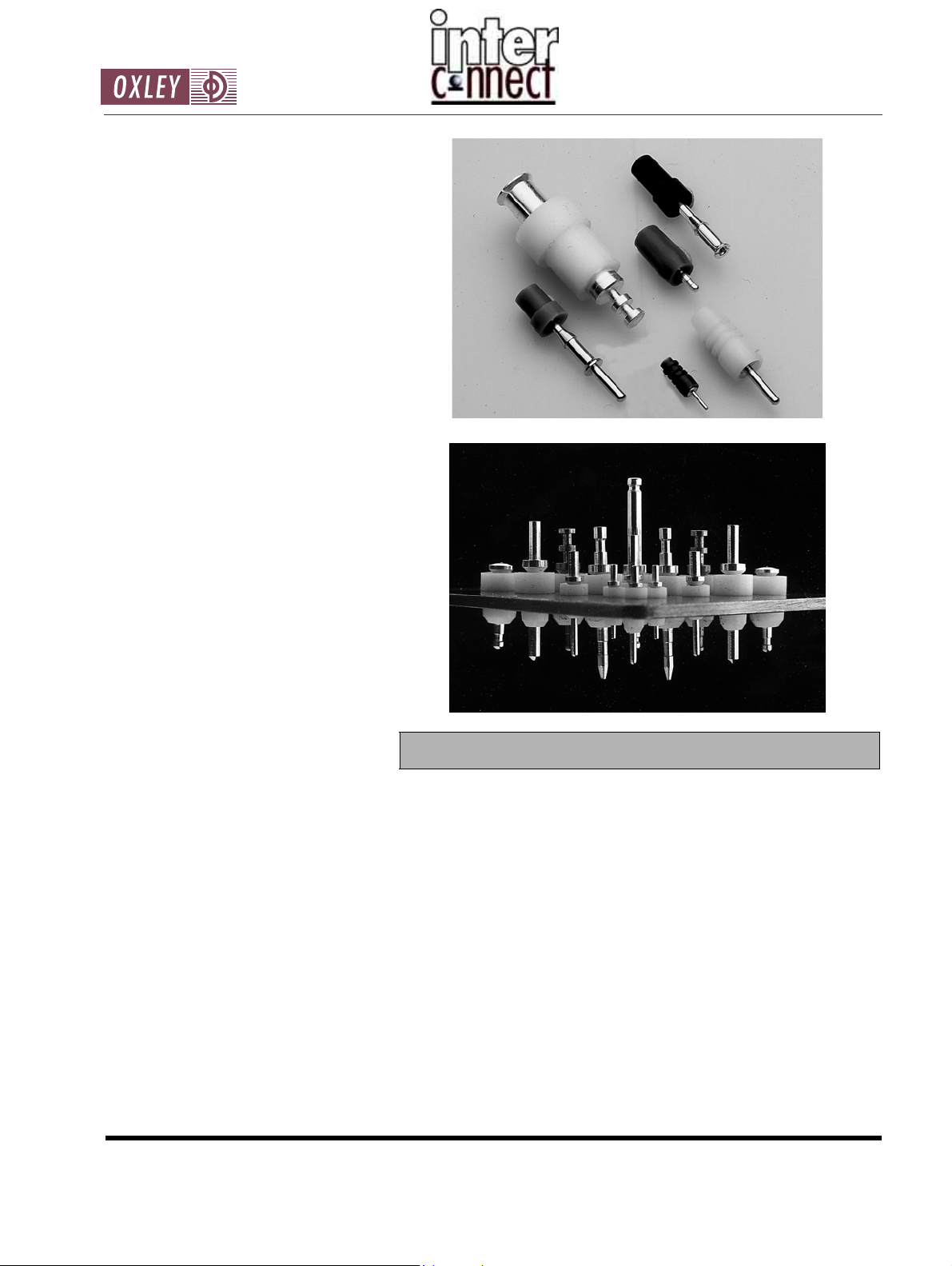
Oxley Developments designed the Barb Cone Lock
constructed from PTFE and have an elastic property which allows the barbed
metal spill to lock itself in place by gently expanding the PTFE underneath
the chassis during insertion. This ensures a long life, stable fixing in the
chassis which is a fundamental part of the product’s success.
The product has seen use in a whole host of applications from the military,
nuclear and space industries to the medical and telecommunications
industries. There is a vast range of types and styles to suit a variety of hole
sizes and chassis thicknesses. There are also the "CEEL" high sealing
versions for use in applications involving vacuums and differential pressures.
The spills are precision turned, high specification brass material with a silver
plating finish as standard. Other finishes are available on request.
We also have the capability to manufacture Barb Cone Locks
of exotic metals for thermocouple applications.
Oxley Group Australia Pty Ltd
Email: [email protected]
Tel +61 (2) 9967 9193
Barb Cone Lock® Insulated Terminals
®
technology. They are
®
Oxley Inc.
Email: [email protected]
Tel: +1 (203) 488 1033
Oxley Developments Company Ltd
Email: [email protected]
Tel: +44 (0)1229 840519
in a variety
23
Page 24
BARB CONE LOCK® PTFE
Insulated Terminals
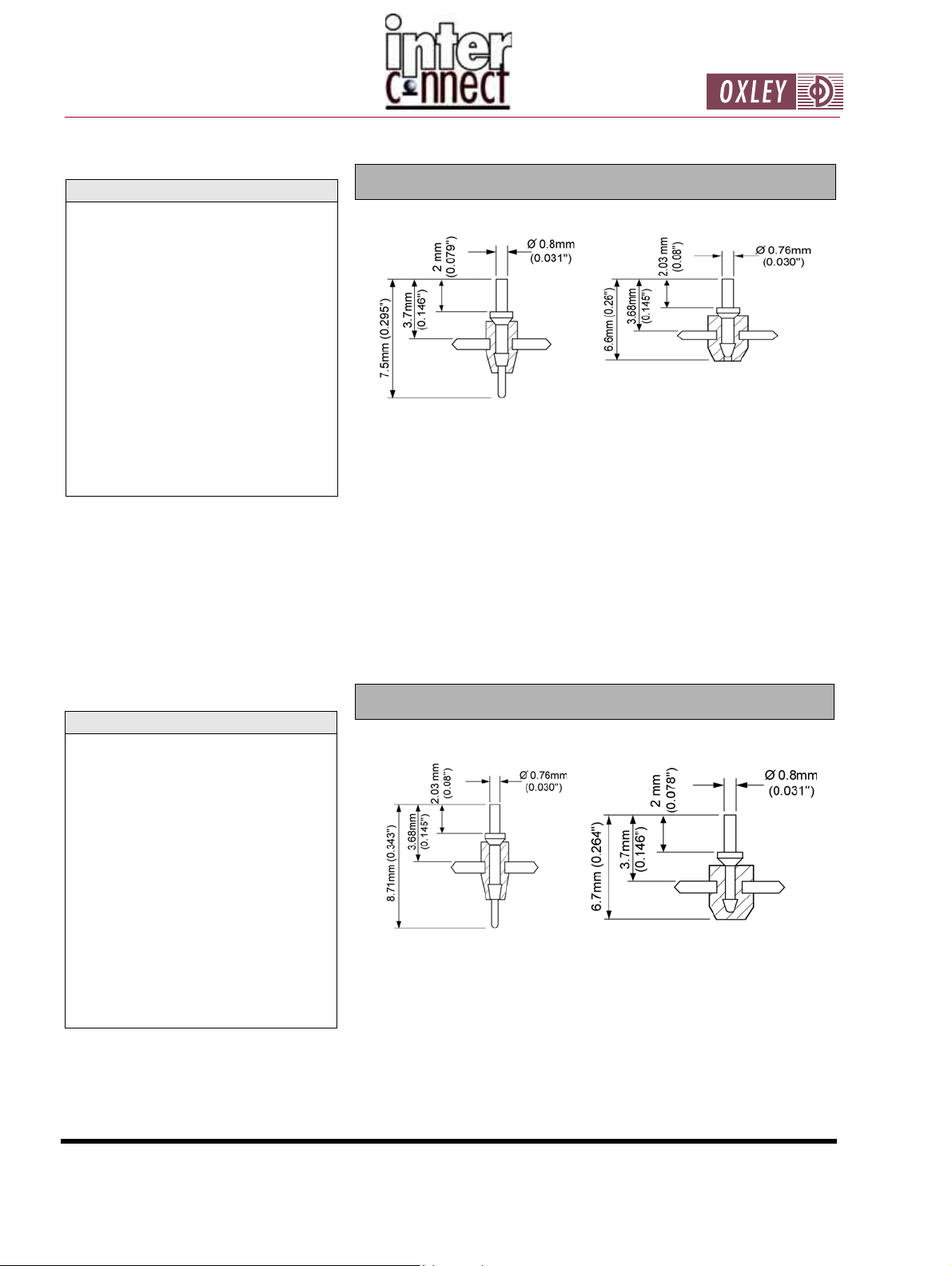
Prefix: 062/-
Mounting Hole Diameter:
1.57 mm (0.062") nominal
Chassis Thickness:
0.56 mm (0.022") - 0.71 mm (0.028")
Max. Outside Dia. of Bush:
2.7 mm (0.106")
Current Rating (A):
0.5
Rated V oltage at Sea Level (kV d.c.):
0.5
Proof V oltage at Sea Level (kV d.c.):
2.5
Capacitance (pF) (max):
0.5
Assembly Tool:
AT 1/01
062
062 Range
062/SO
Prefix: 078/-
Mounting Hole Diameter:
1.98 mm (0.078") nominal
Chassis Thickness:
1.2 mm (0.047") - 1.6 mm (0.062")
Max. Outside Dia. of Bush:
2.8 mm (0.110")
Current Rating (A):
1
Rated V oltage at Sea Level (kV d.c.):
0.5
Proof V oltage at Sea Level (kV d.c.):
2.5
Capacit ance (pF) (max):
0.5
Assembly Tool:
AT 1/01
Oxley Developments Company Ltd
24
Email:[email protected]
Tel: +44 (0)1229 840607
Oxley Inc.
Email: [email protected]
Tel: +1 (203) 488 1033
078 Range
078
Oxley Group Australia Pty Ltd
Email: [email protected]
Tel +61 (2) 9967 9193
078/SO
www.oxleygroup.com/interconnect
ODCSM:40566/4/2006
Page 25
BARB CONE LOCK® PTFE
Insulated Terminals
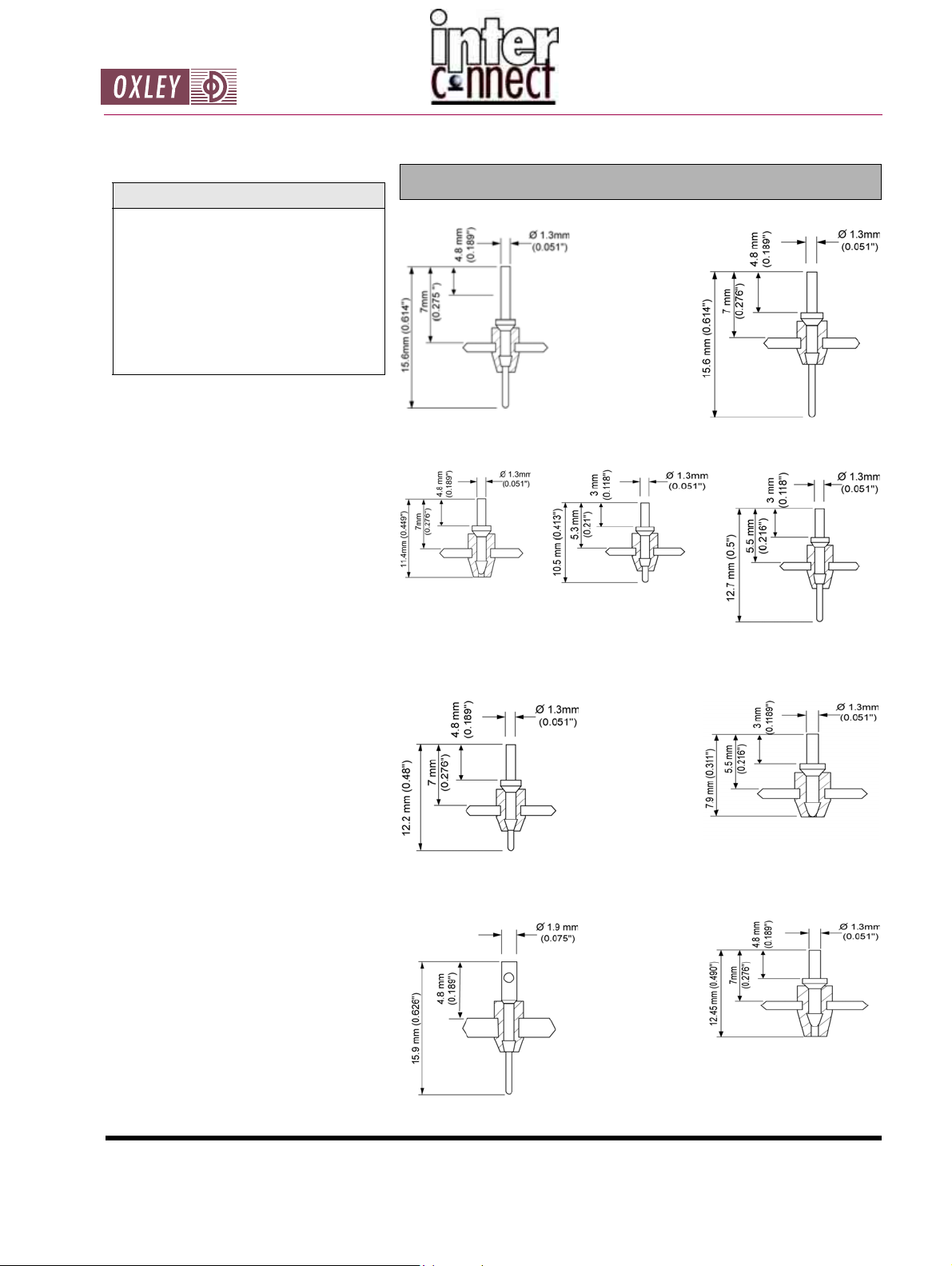
Prefix: 093/-
Mounting Hole Diameter:
2.36 mm (0.093")
Chassis Thickness:
2.03 mm (0.08") - 2.3 mm (0.09")
Max. Outside Dia. of Bush:
3.6 mm (0.142")
Assembly Tool:
AT 1/11
093/16P
093/SO/16P
093 Range
093/093
093/20P
093/18P
www.oxleygroup.com/interconnect
ODCSM:40566/4/2007
Oxley Group Australia Pty Ltd
Email: [email protected]
Tel +61 (2) 9967 9193
093/20/LP
093/6/H
Oxley Inc.
Email: [email protected]
Tel: +1 (203) 488 1033
093/SO/18P
093/093/SO
Oxley Developments Company Ltd
Email: [email protected]
Tel: +44 (0)1229 840519
25
Page 26
BARB CONE LOCK® PTFE
Insulated Terminals
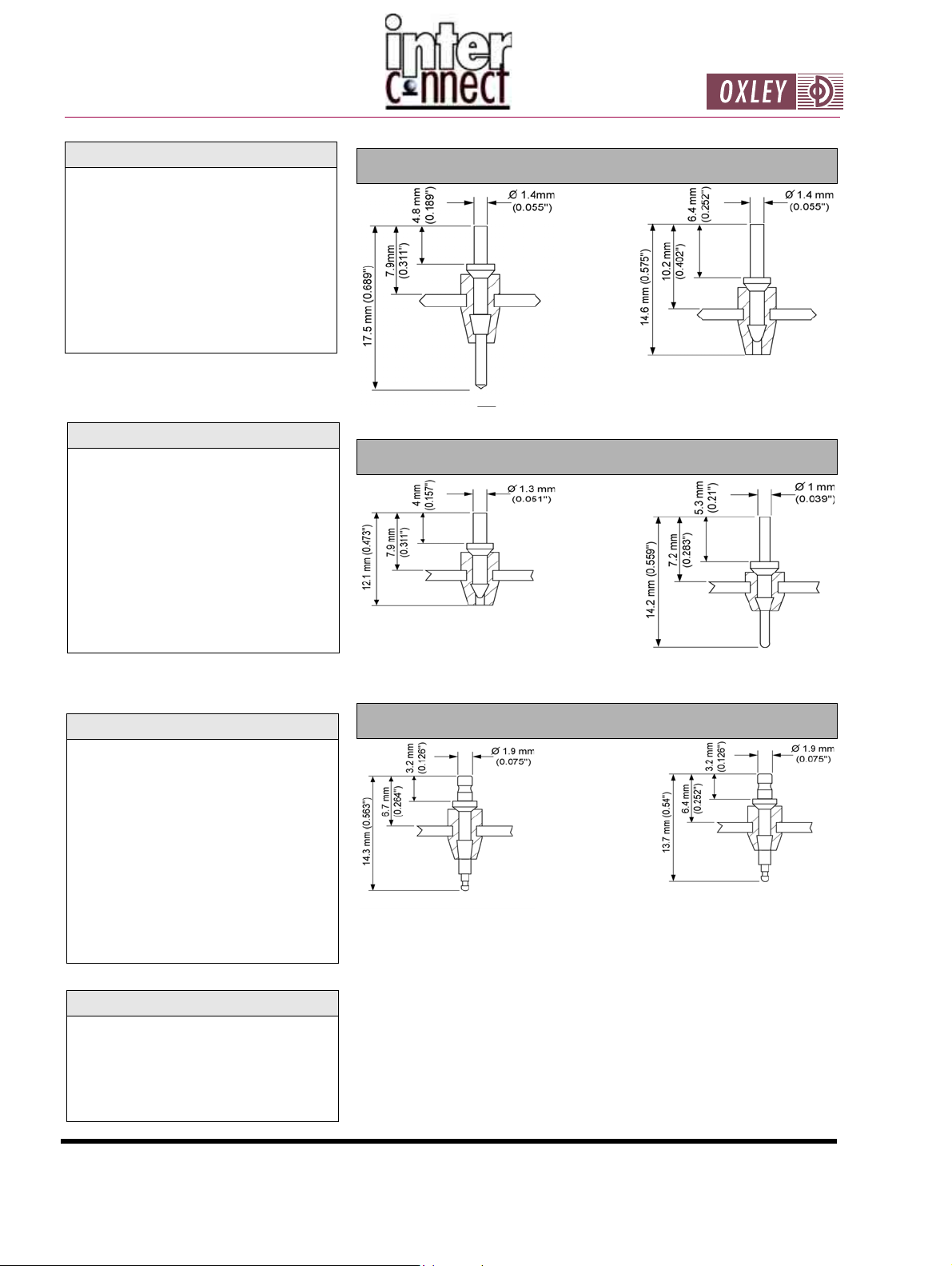
Prefix: 125/-
Mounting Hole Diameter:
3.18 mm (0.125")
Chassis Thickness:
1.2 mm (0.047") - 1.6 mm (0.063")
Max. Outside Dia. of Bush after
Assembly:
5.7 mm (0.224")
Assembly Tool:
AT 1/05
Prefix: 136/-
Mounting Hole Diameter:
3.45 mm (0.136")
Chassis Thickness:
1.2 mm (0.047") - 1.6 mm (0.063")
Max. Outside Dia. of Bush after
Assembly:
4.7 mm (0.185")
Assembly Tool:
136/SO AT 1/11
136/LP AT 1/17
125 Range
125/LP 125/SO/LP
136 Range
Prefix: 156/-
Mounting Hole Diameter:
3.96 mm (0.156")
Chassis Thickness:
1.2 mm (0.047") - 1.6 mm (0.063")
Max. Outside Dia. of Bush after
Assembly:
5.4 mm (0.213")
Assembly Tool:
156, 156/20, 156/20/S:
156/DT:
AT 1/02
AT 1/06
Exceptions:
Chassis Thickness:
-/20:
0.71 mm (0.028") - 0.91 mm (0.036")
-/DT:
1 mm (0.039") - 1.4 mm (0.0055")
136/SO 136/LP
156 Range
156 156/20
Oxley Developments Company Ltd
26
Email:[email protected]
Tel: +44 (0)1229 840607
Oxley Inc.
Email: [email protected]
Tel: +1 (203) 488 1033
Oxley Group Australia Pty Ltd
Email: [email protected]
Tel +61 (2) 9967 9193
www.oxleygroup.com/interconnect
ODCSM:40566/4/2006
Page 27
BARB CONE LOCK® PTFE
Insulated Terminals
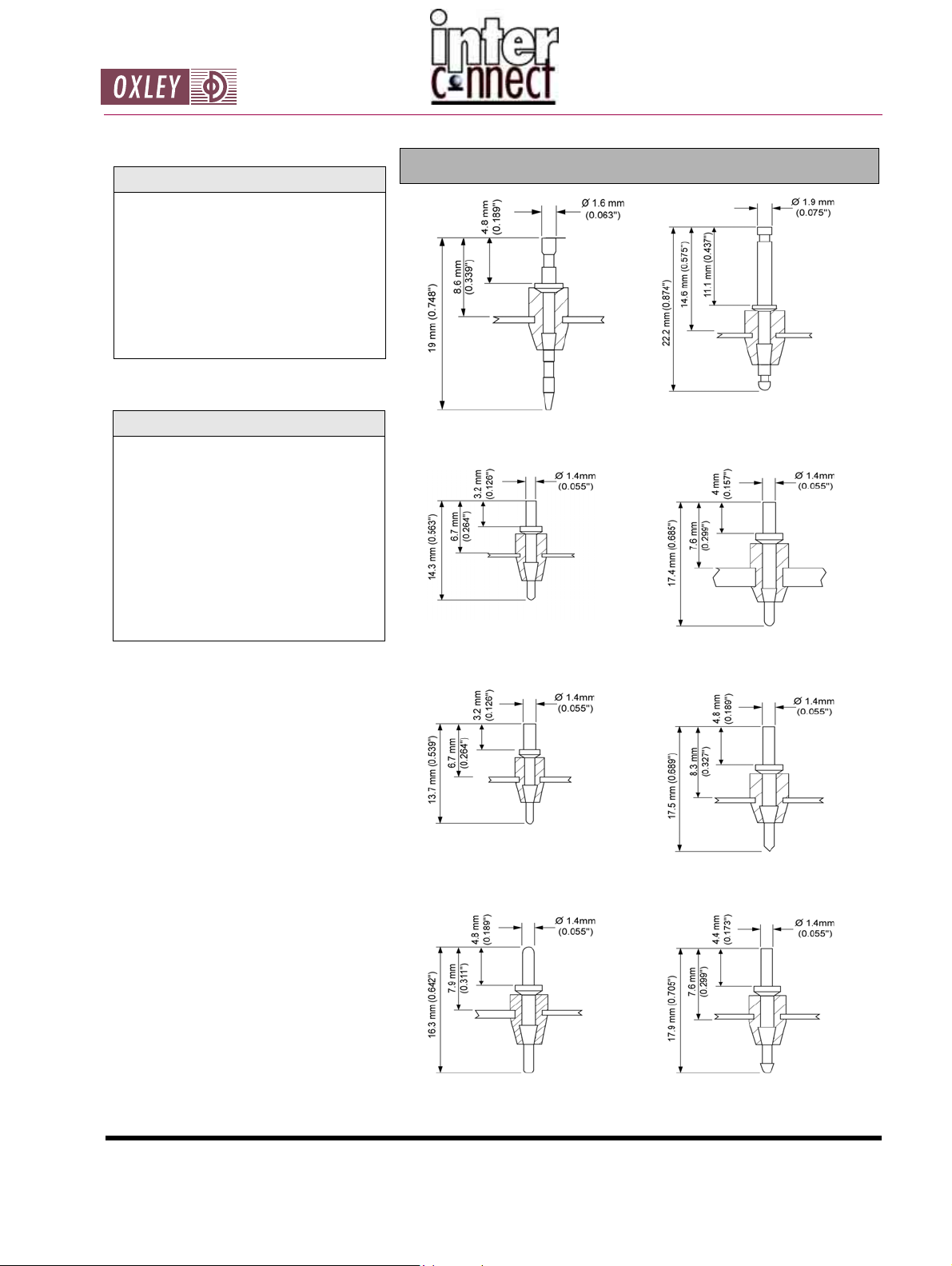
Prefix: 156/-
Mounting Hole Diameter:
3.96 mm (0.156")
Chassis Thickness:
1.2 mm (0.047") - 1.6 mm (0.062")
Max. Outside Dia. of Bush:
5.4 mm (0.213")
Assembly Tool:
AT 1/05
Exceptions:
Chassis Thickness:
-/10P:
2.3 mm (0.09") - 3.2 mm (0126")
-/20P:
0.71 mm (0.028") - 0.91 mm (0.036")
Assembly Tool:
156E: AT 1/02
156L: AT 1/14
CEEL:156: 10/281/m
CEEL:156: 10/500/m
156 Range (continued)
156/E 156/L
156/P
156/10P
www.oxleygroup.com/interconnect
ODCSM:40566/4/2007
Oxley Group Australia Pty Ltd
Email: [email protected]
Tel +61 (2) 9967 9193
156/20P
156/LPR 156/AT
Oxley Inc.
Email: [email protected]
Tel: +1 (203) 488 1033
Oxley Developments Company Ltd
Email: [email protected]
Tel: +44 (0)1229 840519
156/LP
27
Page 28
BARB CONE LOCK® PTFE
Insulated Terminals
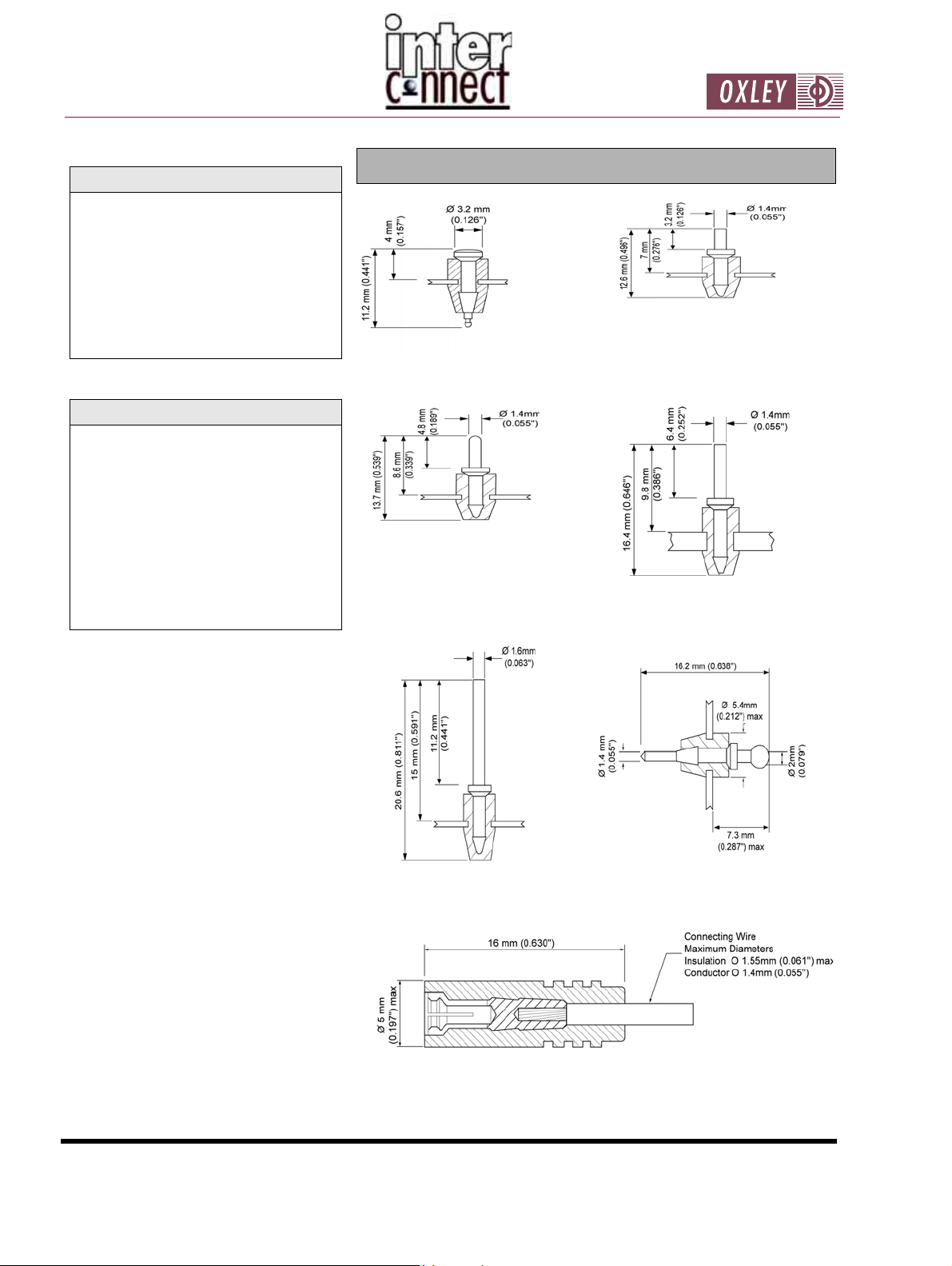
Prefix: 156/-
Mounting Hole Diameter:
3.96 mm (0.156")
Chassis Thickness:
1.2 mm (0.047") - 1.6 mm (0.062")
Max. Outside Dia. of Bush:
5.4 mm (0.213")
Assembly Tool:
AT 1/04
Exceptions:
Chassis Thickness:
-/10P:
2.3 mm (0.09") - 3.2 mm (0126")
-/20P:
0.71 mm (0.028") - 0.91 mm (0.036")
Assembly Tool:
156/SO/XL: AT 1/02
156/LP/B2: AT 1/09
LS/B2/156: AT 2/01
ATS 3/05
156/M
156/SO/LPR
156 Range (continued)
156/SO/P
156/SO/10P
Oxley Developments Company Ltd
28
Email:[email protected]
Tel: +44 (0)1229 840607
156/SO/XL
Oxley Inc.
Email: [email protected]
Tel: +1 (203) 488 1033
156/LP/B2
Wires shown for illustration purposes only.
LS/B2/156
To suit 156/LP/B2)
Oxley Group Australia Pty Ltd
Email: [email protected]
Tel +61 (2) 9967 9193
www.oxleygroup.com/interconnect
ODCSM:40566/4/2006
Page 29
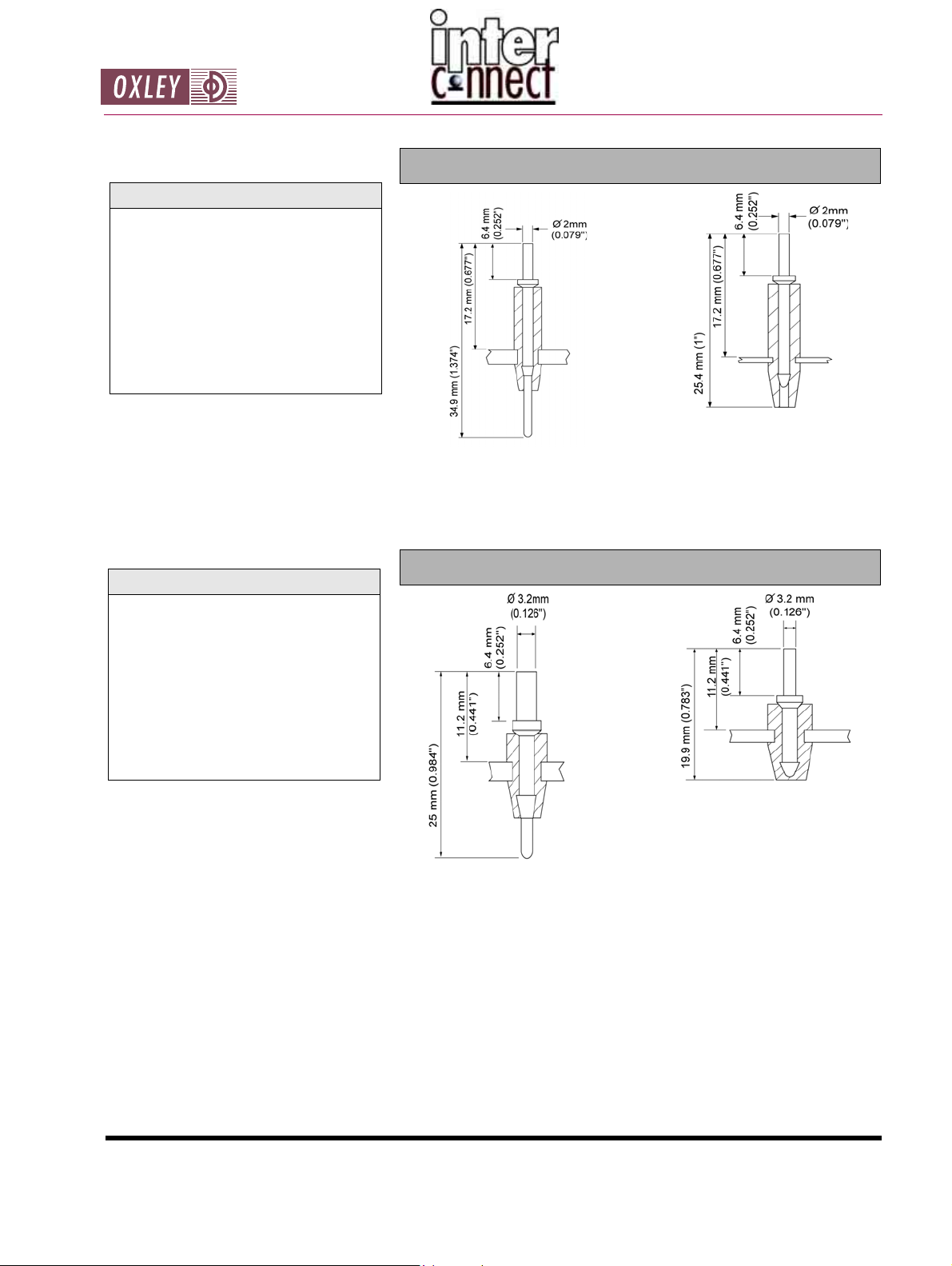
Prefix: 187/-
Mounting Hole Diameter:
4.75 mm (0.187")
Chassis Thickness:
1.6 mm (0.062") - 2.3 mm (0.09")
Max. Outside Dia. of Bush after
Assembly:
7.4 mm (0.291")
Assembly Tool:
AT 1/06
BARB CONE LOCK® PTFE
Insulated Terminals
187 Range
187/SO
187
Prefix: 250/-
Mounting Hole Diameter:
6.35 mm (0.250")
Chassis Thickness:
2.3 mm (0.09") - 3.2 mm (0.126")
Max. Outside Dia. of Bush after
Assembly:
8.9 mm (0.350")
Assembly Tool:
AT 1/07
250 Range
250/SO
250
www.oxleygroup.com/interconnect
ODCSM:40566/4/2007
Oxley Group Australia Pty Ltd
Email: [email protected]
Tel +61 (2) 9967 9193
Oxley Inc.
Email: [email protected]
Tel: +1 (203) 488 1033
Oxley Developments Company Ltd
Email: [email protected]
Tel: +44 (0)1229 840519
29
Page 30
BARB CONE LOCK® PTFE
Insulated Terminals
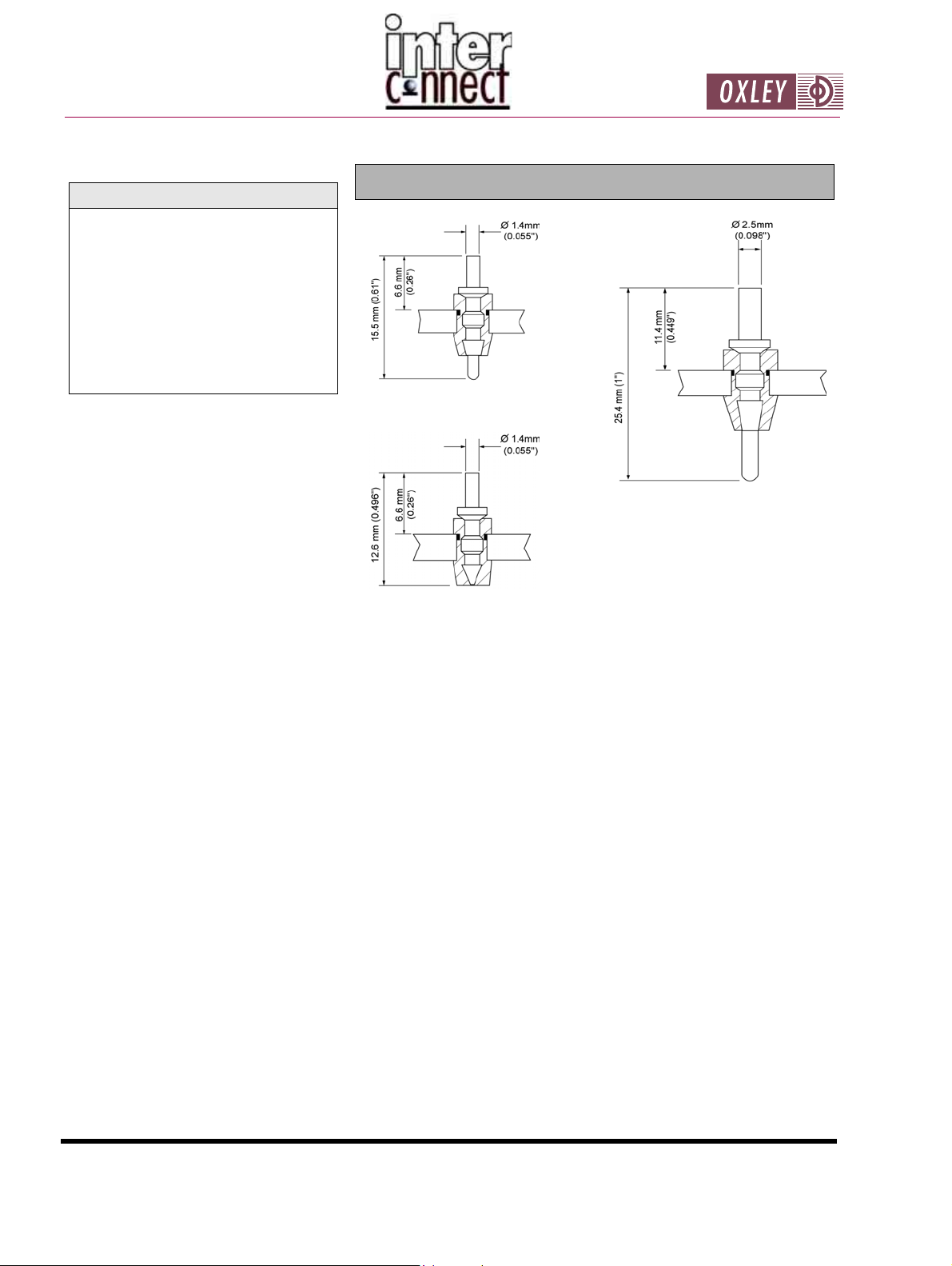
Suffix: CEEL
Mounting Hole Diameter: 156/
3.96 mm (0.156")
Mounting Hole Diameter: 250/
6.35 mm (0.250")
Chassis Thickness:
2.4 mm (0.094") - 3.2 mm (0.126")
Assembly Tool:
156/-/CEEL AT1/05
250/-/CEEL AT1/07
Leakage Rate (-/-CEEL)
Less than 10-3 µl/sec of Helium.
1 atmosphere differential pressure
(15 lb/in
of 10 m in sea water.
2
) at 20 ºC , equivalent to a depth
CEEL (Improved Environmental Sealing)
156/10P/CEEL
250/10P/CEEL
156/SO/10P/CEEL
Oxley Developments Company Ltd
30
Email:[email protected]
Tel: +44 (0)1229 840607
Oxley Inc.
Email: [email protected]
Tel: +1 (203) 488 1033
Oxley Group Australia Pty Ltd
Email: [email protected]
Tel +61 (2) 9967 9193
www.oxleygroup.com/interconnect
ODCSM:40566/4/2006
Page 31
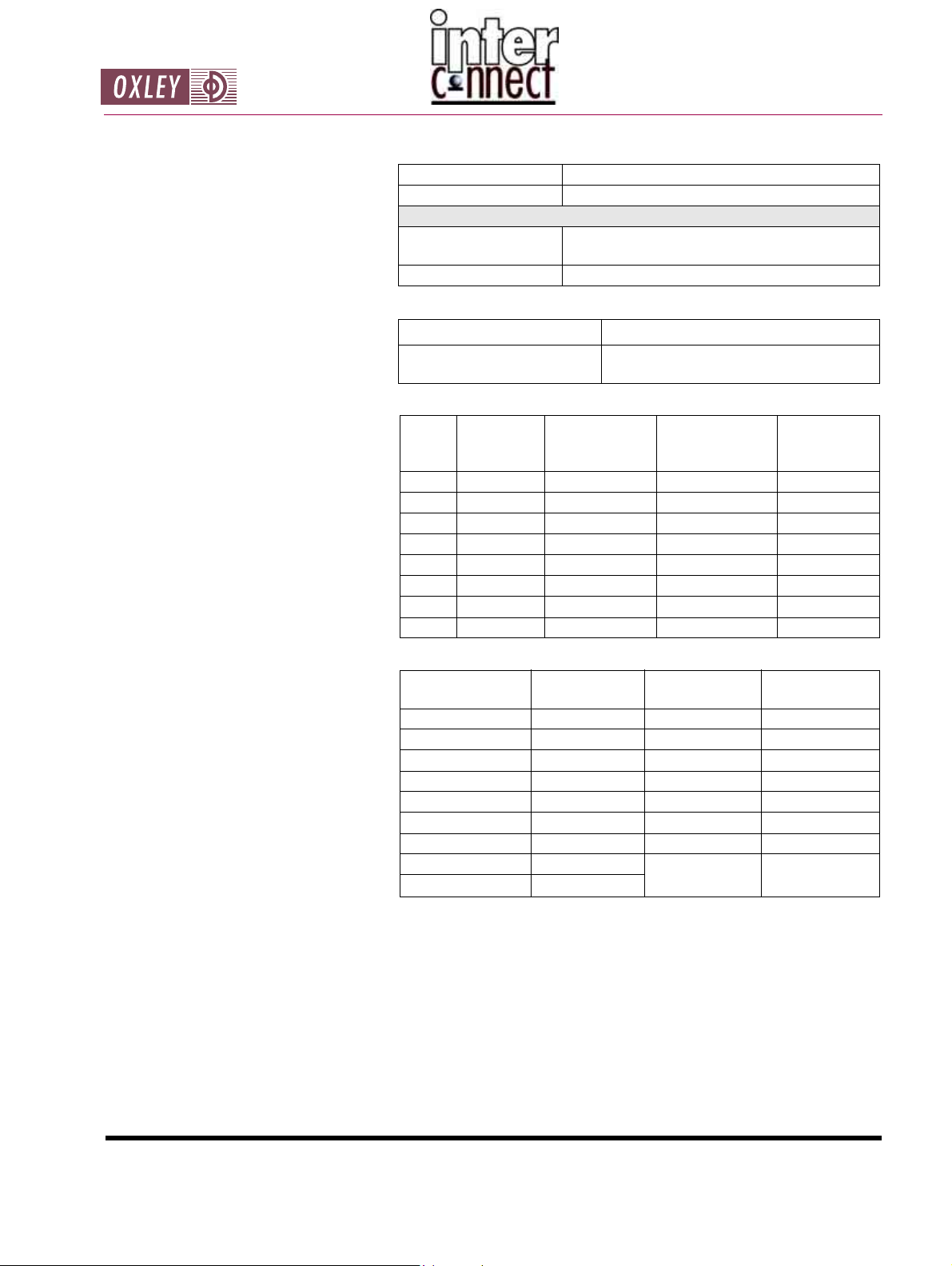
Materials
Characteristics
BARB CONE LOCK® PTFE
Insulated Terminals
Spill Brass
Bush High dispersion grade PTFE
Finishes:
Spill Standard silver, other finishes available on
request
Bush Colours available: white, black and red
Insulation Resistance
Climatic Category -55 to +125 °C, 56 days damp heat
> 2 x 10⁶ MOhms
(IEC 68:55/125/56)
Assembly Tools
Prefix
No.
Component Type
Number
062/- AT 1/01 156/SO/XL AT 1/02
078/- AT 1/01 156/- AT 1/05
093/- AT 1/11 156/-/CEEL AT 1/05
125/- AT 1/05 156/L AT 1/14
136/SO AT 1/11 187/- AT 1/06
136/LP AT 1/17 250/- AT 1/07
156/E AT 1/02 156/LP/B2 AT 1/09
156/20 AT 1/02 LS/B2/156 AT 2/01
156 AT 1/02
Current
Rating (A)
062 0.5 0.5 2.5 0.5
078 1 0.5 2.5 0.5
093 1 1.5 4.5 0.8
125 5 2 5.5 0.8
136 5 2 5.5 0.8
156 5 3 7.5 0.8
187 5 5 11.5 1
250 15 4 9.5 1.7
Rated Voltage
at Sea Level
(kV d.c.)
Tool Number Component
Proof Voltage at
Sea Level (kV
d.c.)
Type Number
Capacitance
(pF) max.
Tool Number
ATS 3/05
Assembly Procedure
www.oxleygroup.com/interconnect
ODCSM:40566/4/2007
1 Ensure holes are within tolerance and deburred.
2 Place bush into hole supporting the chassis underneath and using the
appropriate assembly tool, press the spill slowly through the bush until
the positive detent action firmly locks the assembly into place.
Oxley Group Australia Pty Ltd
Email: [email protected]
Tel +61 (2) 9967 9193
Oxley Inc.
Email: [email protected]
Tel: +1 (203) 488 1033
Oxley Developments Company Ltd
Email: [email protected]
Tel: +44 (0)1229 840519
31
Page 32
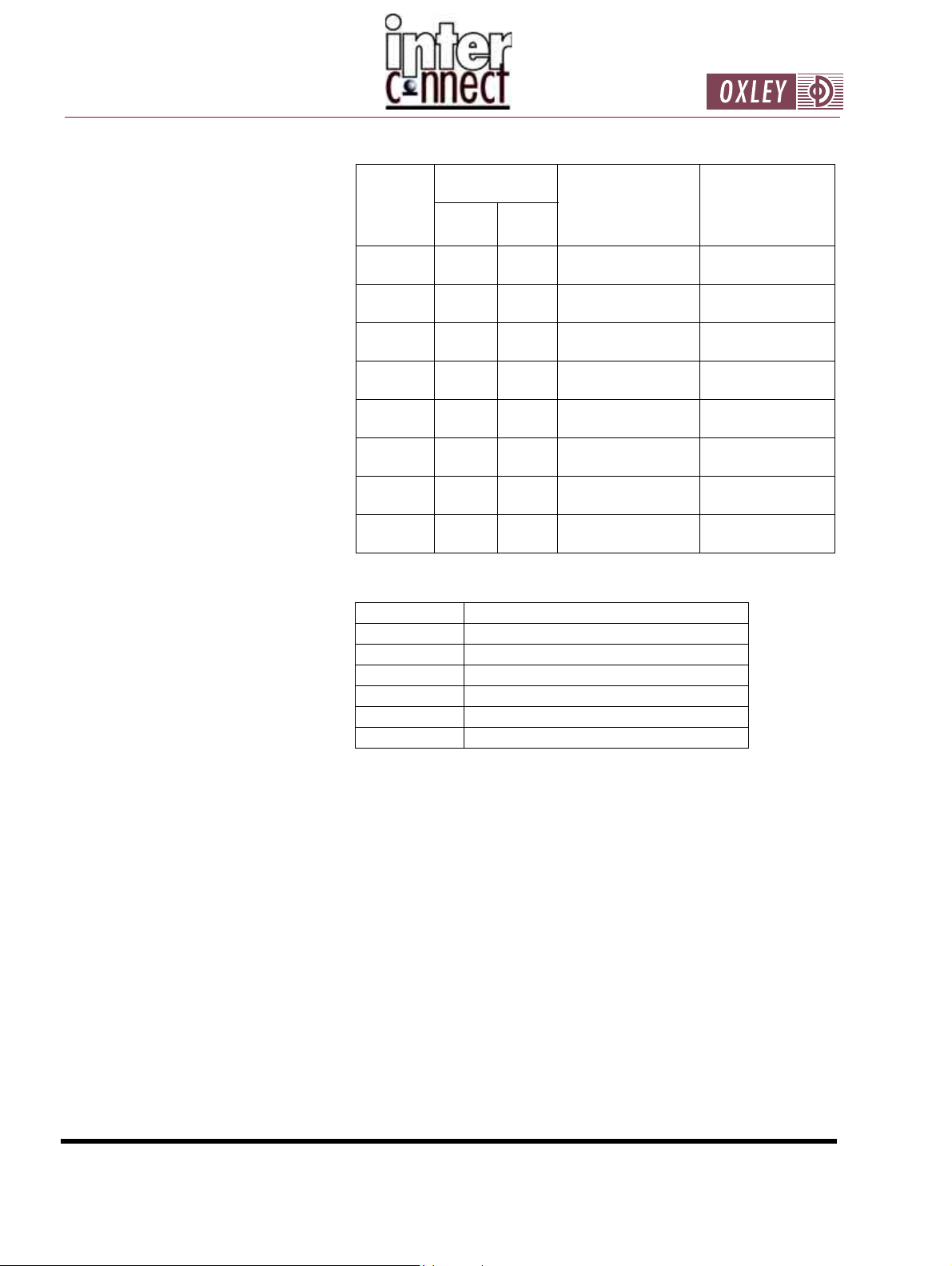
BARB CONE LOCK® PTFE
Insulated Terminals
Mounting Details and
Shoulder Diameter
Prefix No. Mounting Hole
Details
±
ins
0.002
062 0.062 1.57 0.56 mm (0.022") -
078 0.078 1.98 1.2 mm (0.047") -
093 0.093 2.36 2.03 mm (0.08") -
125 0.125 3.18 1.2 mm (0.047") -
136 0.136 3.45 1.2 mm (0.047") -
156 0.156 3.96 1.2 mm (0.047") -
187 0.187 4.75 1.6 mm (0.062") -
250 0.250 6.35 2.3 mm (0.09") -
mm ±
0.05
Chassis Thickness Max. Outside Dia.
0.71 mm (0.028")
1.6 mm (0.062")
2.3 mm (0.09")
1.6 mm (0.062")
1.6 mm (0.062")
1.6 mm (0.062")
2.3 mm (0.09")
3.2 mm (0.126")
of Bush After
Assembly
2.7 mm (0.106")
2.8 mm (0.110")
3.6 mm (0.142")
5.7 mm (0.224")
4.7 mm (0.185")
5.4 mm (0.213")
7.4 mm (0.291")
8.9 mm (0.350")
Chassis Thickness Exceptions
Type Chassis Thickness
-/10P 2.3 mm (0.09") - 3.2 mm (0.126")
-/16P 1.2 mm (0.047") - 1.6 mm (0.063")
-/18P 0.91 mm (0.036") - 1.2 mm (0.047")
-/20P 0.71 mm (0.028") - 0.91 mm (0.036")
093/20/LP 0.71 mm (0.028") - 0.91 mm (0.036")
093/SO/20LP 0.71 mm (0.028") - 0.91 mm (0.036")
Oxley Developments Company Ltd
32
Email:[email protected]
Tel: +44 (0)1229 840607
Oxley Inc.
Email: [email protected]
Tel: +1 (203) 488 1033
Oxley Group Australia Pty Ltd
Email: [email protected]
Tel +61 (2) 9967 9193
www.oxleygroup.com/interconnect
ODCSM:40566/4/2006
Page 33
Features
• Simple economical assembly.
• High reliability.
• Low contact resistance.
• High insulation resistance.
• Line and chassis mounting styles.
Application
• Chassis mounting adaptable
connections.
• Stackable applications for test
purposes.
• PCB edge mounted variations ideal for
card rack systems.
BARB CONE LOCK
Plugs and Sockets
®
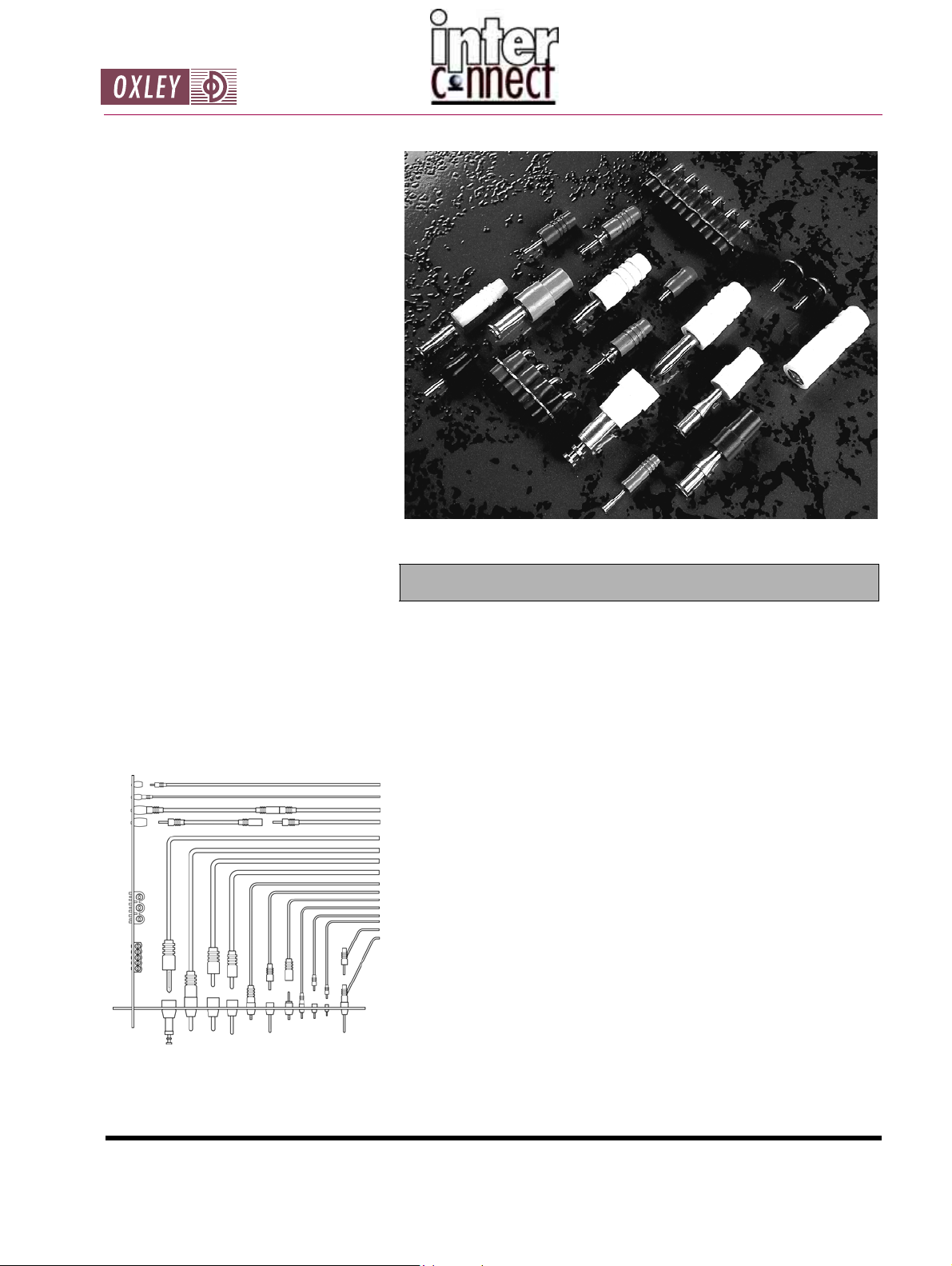
Barb Cone Lock® Plugs and Sockets
Using the same technology as the Barb Cone Lock® Insulated Terminals,
this product range utilise High Dispersion Grade PTFE for insulation and
reliability.
The range includes chassis mounting plugs and sockets, line plugs and
sockets and multiway edge mounting sockets all in a range of diameters from
0.5 mm to 4 mm with current ratings from 1 to 5 Amps. Typical applications
are for test equipment and card rack systems in the military, aerospace and
nuclear industries and for high voltage applications up to 2 kV.
The simple assembly provides a product with high insulation resistance and
low contact resistance.
Standard finishes are Gold flash on a Silver undercoat for the plugs, and
Silver on the sockets helping to maintain a low contact resistance
performance over many mating cycles. Other finishes are available on
request.
www.oxleygroup.com/interconnect
ODCSM:40566/4/2007
Oxley Group Australia Pty Ltd
Email: [email protected]
Tel +61 (2) 9967 9193
Oxley Inc.
Email: [email protected]
Tel: +1 (203) 488 1033
Oxley Developments Company Ltd
Email: [email protected]
Tel: +44 (0)1229 840519
33
Page 34
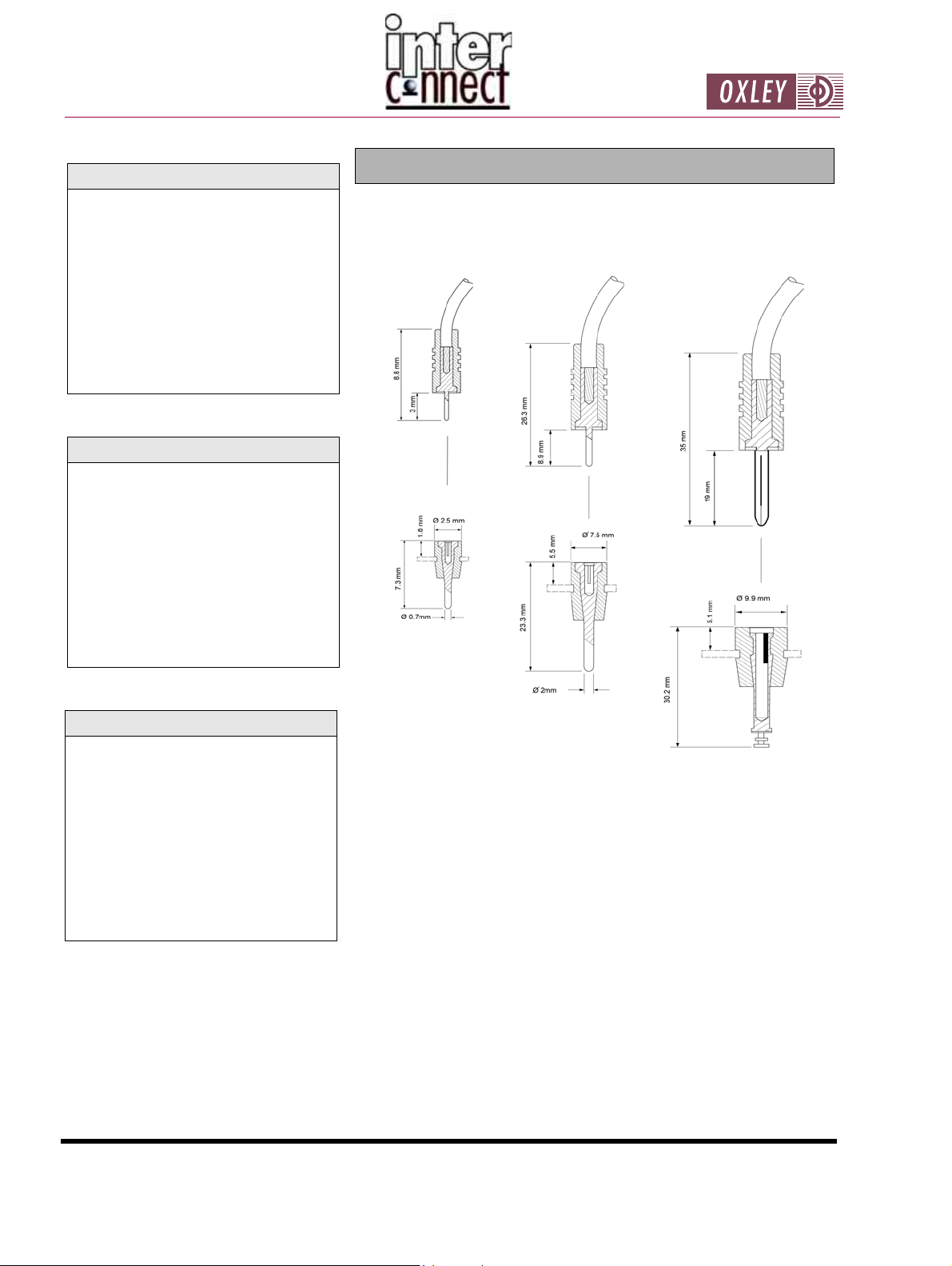
BARB CONE LOCK®
Plugs and Sockets
Prefix: 0.55
Mounting Hole Diameter:
2 mm (0.079")
Nom. Diameter plug and socket:
0.55 mm (0.022")
Max Wire Diameter:
Conductor: 0.65 mm (0.025")
Insulator: 1.15 mm (0.045")
Assembly Tool:
P/2: AT 1/23
S/2: AT 2/15
Prefix: 2
Mounting Hole Diameter:
6 mm (0.236")
Nom. Diameter plug and socket:
2 mm (0.079")
Max Wire Diameter:
Conductor: 2.6 mm (0.102")
Insulator: 3.7 mm (0.146")
Assembly Tool:
2P/6: AT 1/22 & ATS 3/16
2S/6: AT 2/13
0.55P/2
0.55-, 2-, 4- Range
4P/82P/6
Prefix: 4
Mounting Hole Diameter:
8 mm (0.312")
Nom. Diameter plug and socket:
4 mm (0.157")
Max Wire Diameter:
Conductor: 2.64 mm (0.104")
Insulator: 3.8 mm (0.150")
Assembly Tool:
4P/8: N/A
4S/8: AT 2/13
Oxley Developments Company Ltd
34
Email:[email protected]
Tel: +44 (0)1229 840607
0.55S/2
Chassis Thickness
0.9 mm (0.036")/
1.2 mm (0.048")
Oxley Inc.
Email: [email protected]
Tel: +1 (203) 488 1033
2S/6
Chassis Thickness
1.6 mm (0.064")/
2.3 mm (0.092")
Wires shown for illustration purposes only.
Oxley Group Australia Pty Ltd
Email: [email protected]
Tel +61 (2) 9967 9193
Chassis Thickness
1.6 mm (0.064")/
3.2 mm (0.128")
www.oxleygroup.com/interconnect
ODCSM:40566/4/2006
4S/8
Page 35
BARB CONE LOCK
Plugs and Sockets
®
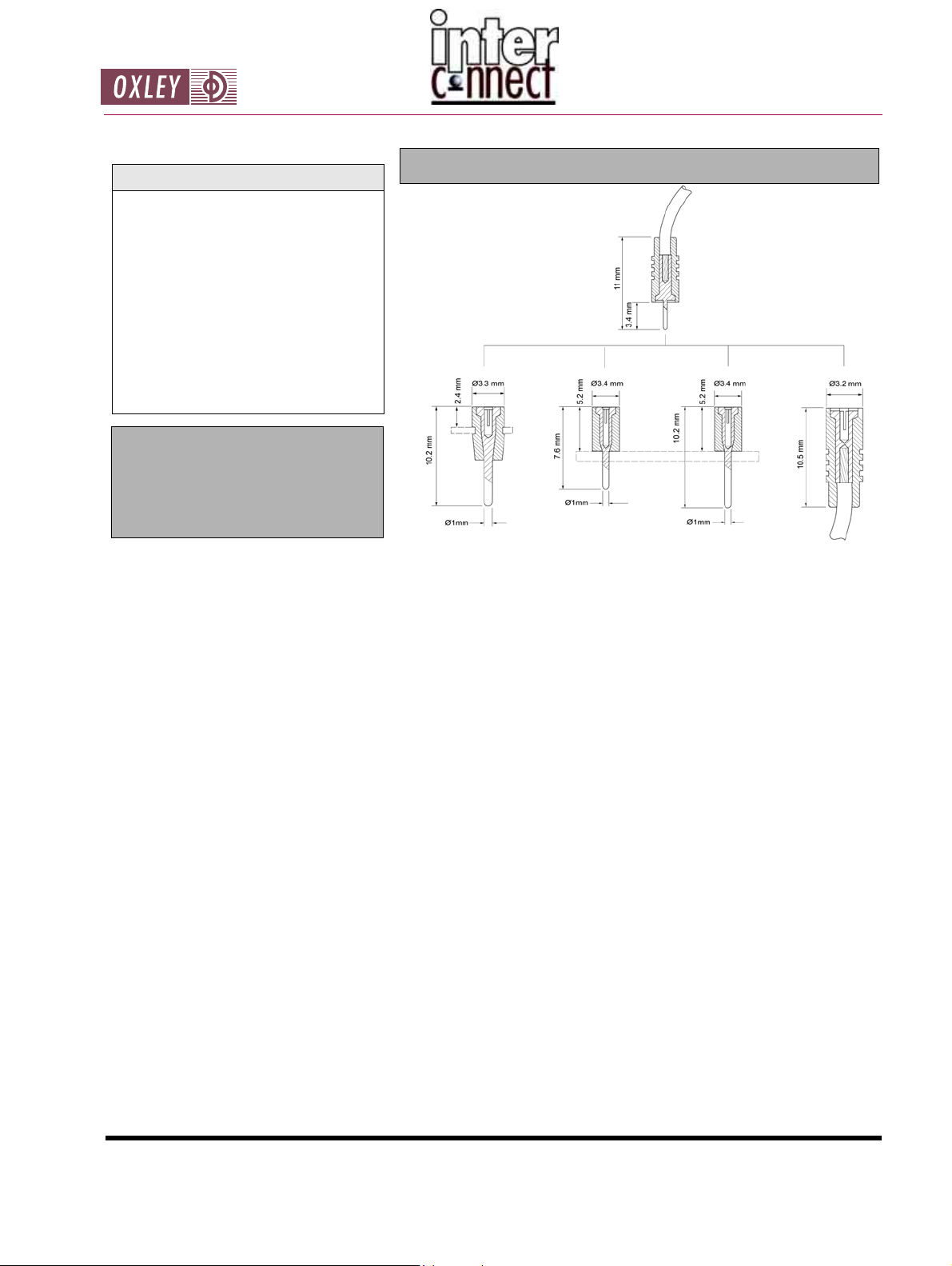
Prefix: 30/-
Mounting Hole Diameter:
2.4 mm (0.093")
Nom Diameter plug and socket:
0.90 mm (0.035")
Max Wire Diameter:
Conductor: 0.80mm (0.031")
Insulator: 1.2 mm (0.047")
Assembly Tool:
30S/093/V , 30S/093/VL: N/A
30S/093: A T 2/12
30S/093, 30LS/093: A T 1/21 & ATS 3/08
Chassis Thickness 0.9 mm 0.036"
Maximum Chassis Thickness:
Type -/V 2.4 mm 0.093"
Type -/VL 4.0 mm 0.156"
(Sockets supplied pre-assembled)
30S/093
30 Range
30P/093
30S/093/V
Wires shown for illustration purposes only.
30S/093/VL 30LS/093
www.oxleygroup.com/interconnect
ODCSM:40566/4/2007
Oxley Group Australia Pty Ltd
Email: [email protected]
Tel +61 (2) 9967 9193
Oxley Inc.
Email: [email protected]
Tel: +1 (203) 488 1033
Oxley Developments Company Ltd
Email: [email protected]
Tel: +44 (0)1229 840519
35
Page 36
BARB CONE LOCK®
Plugs and Sockets
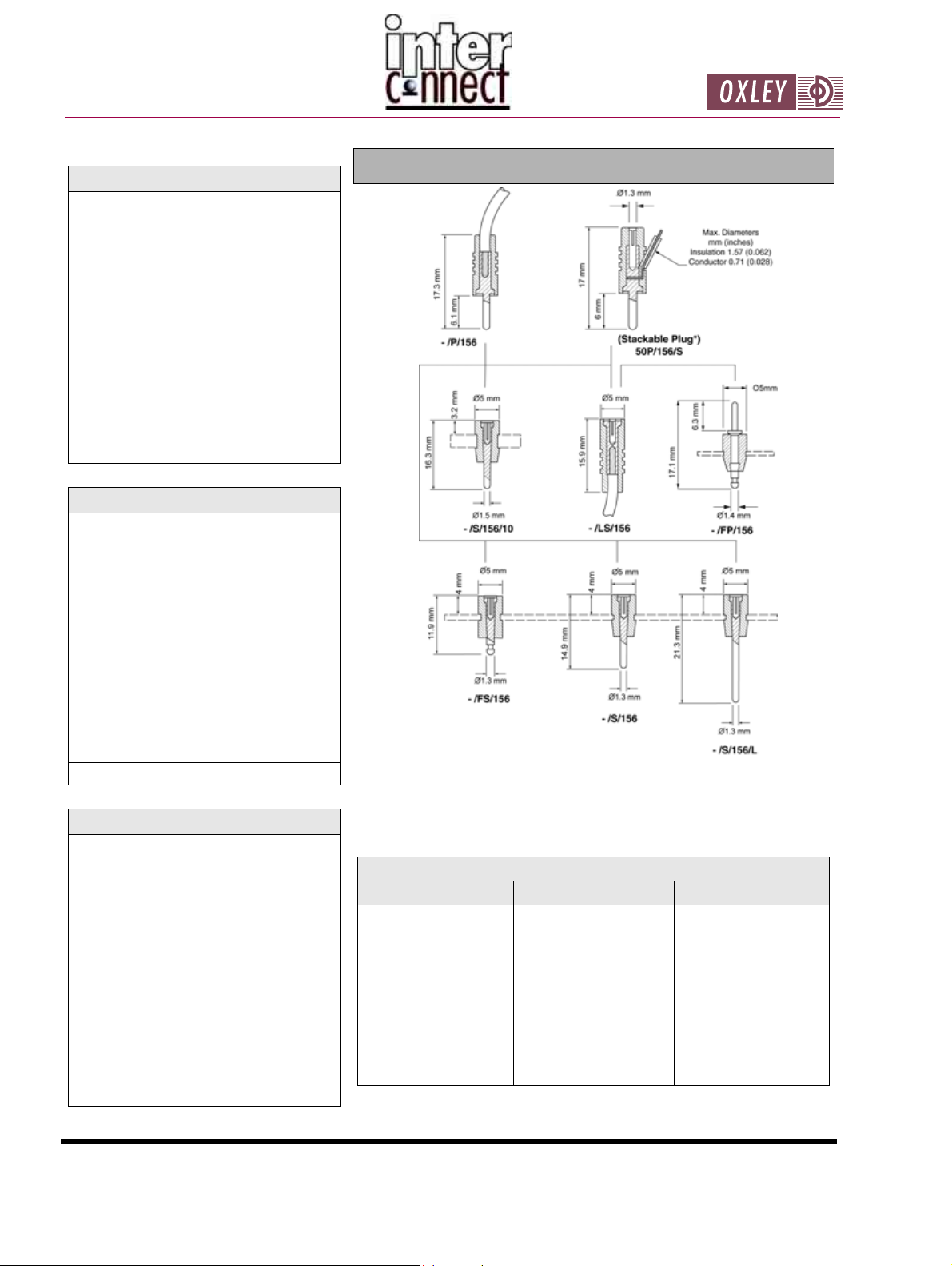
Prefix: 40/-
Nominal Diameter Plug & Socket:
1.02 mm (0.040")
Mounting Hole Diameter:
4 mm (0.156")
Maximum Wire Diameter:
Conductor: 1.6 mm (0.063")
Insulation: 2 mm (0.079")
Resistance to Axial Pull:
6.8 kgf (15 lbf)
Capacitance to Chassis (max.):
1.0 pF
Current Rating: 3 A
Rated Voltage: 2 kV d.c.
Prefix: 50/-
Nominal Diameter Plug & Socket:
1.27 mm (0.050")
Mounting Hole Diameter:
4 mm (0.156")
Maximum Wire Diameter:
Conductor: 1.6 mm (0.063")
Insulation: 2 mm (0.079")
Resistance to Axial Pull:
6.8 kgf (15 lbf)
Capacitance to Chassis (max.):
1.0 pF
Current Rating: 3 A
Rated Voltage: 2 kV d.c.
40/50/60 Range
Wires shown for illustration purposes only
Prefix: 60/-
Nominal Diameter Plug & Socket:
1.52 mm (0.060")
Mounting Hole Diameter:
4 mm (0.156")
Maximum Wire Diameter:
Conductor: 1.6 mm (0.063")
Insulation: 2 mm (0.079")
Resistance to Axial Pull:
6.8 kgf (15 lbf)
Capacitance to Chassis (max.):
1.0 pF
Current Rating: 3 A
Rated Voltage: 2 kV d.c.
Oxley Developments Company Ltd
36
Email:[email protected]
Tel: +44 (0)1229 840607
Note: Stackable plug 50P/156/S mates with 50S/- type sockets only.
Assembly Tools
Prefix: 40 Prefix: 50 Prefix: 60
-P/156: AT 1/17 &
-FP/156: AT 1/17 -P/156/S: AT 1/18 -FP/156: AT 1/19
-LS/156: AT 2/08 &
-S/156: AT 2/11 -FP/156: AT 1/18 -S/156: AT 2/09
-/-: AT 2/11 -/-: AT 2/09
Oxley Inc.
Email: [email protected]
Tel: +1 (203) 488 1033
ATS 3/05
ATS 3/05
-P/156: AT 1/18 &
ATS 3/05
-LS/156: AT 2/07 &
ATS 3/05
-S/156: AT 2/10
-/-: AT 2/10
Oxley Group Australia Pty Ltd
Email: [email protected]
Tel +61 (2) 9967 9193
-P/156: AT 1/19 &
-LS/156: AT 2/06 &
www.oxleygroup.com/interconnect
ODCSM:40566/4/2006
ATS 3/05
ATS 3/05
Page 37
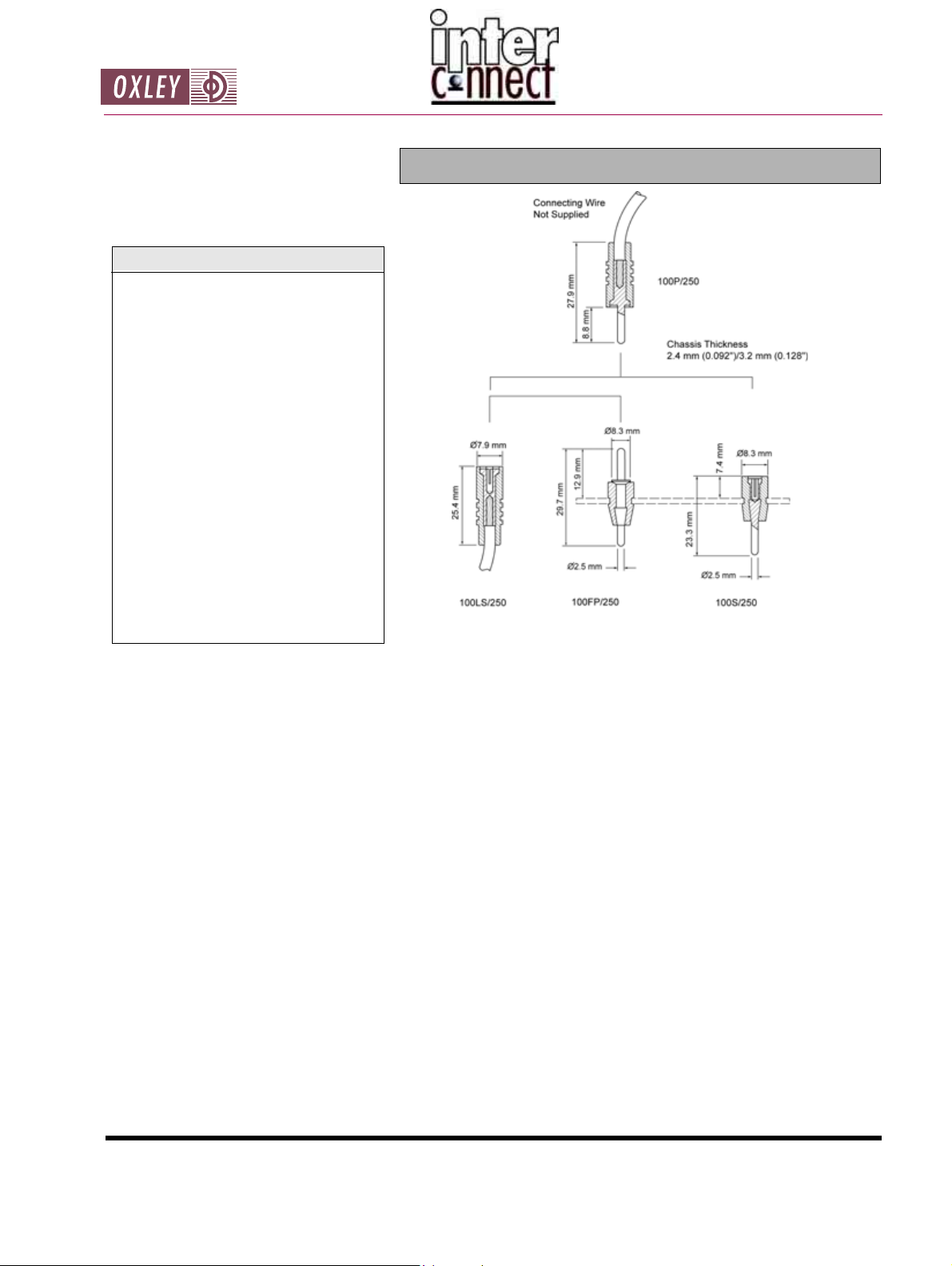
Prefix: 100/-
Nominal Diameter Plug & Socket:
2.54 mm (0.100")
Mounting Hole Diameter:
6.4 mm (0.250")
Maximum Wire Diameter:
Conductor: 3.1 mm (0.122")
Insulation: 4.1 mm (0.161")
Resistance to Axial Pull:
15 kgf (30 lbf)
Capacitance to Chassis (max.):
2.0 pF
Current Rating: 5 A
Rated Voltage: 4 kV d.c.
Assembly Tools:
100P-250: AT 1/20 & ATS 3/16
100 FP/250: AT 1/20
100LS/250: AT 2/04 & ATS 3/16
100S/250: AT 2/05
BARB CONE LOCK
Plugs and Sockets
100 Range
Wires shown for illustration purposes only.
®
www.oxleygroup.com/interconnect
ODCSM:40566/4/2007
Oxley Group Australia Pty Ltd
Email: [email protected]
Tel +61 (2) 9967 9193
Oxley Inc.
Email: [email protected]
Tel: +1 (203) 488 1033
Oxley Developments Company Ltd
Email: [email protected]
Tel: +44 (0)1229 840519
37
Page 38
BARB CONE LOCK®
Plugs and Sockets
Assembly Tools
Component
Ty pe Number
0.55P/2 AT 1/23
0.55S/2 AT 2/15
2P/6 AT 1/22 & ATS 3/16 50FP/156 AT 1/18
2S/6 AT 2/14 50LS/156 AT 2/07 & ATS 3/05
4P/8 N/A
4S/8 AT 2/13
30P/093 AT 1/21 & ATS 3/08 50-/- AT 2/10
30S/093 AT 2/12 60P/156 AT 1/19 & ATS 3/05
30S/093/V N/A 60FP/156 AT 1/19
30S/093/VL N/A 60LS/156 AT 2/06 & ATS 3/05
30LS/093 AT 2/12 & ATS 3/08 60S/156 AT 2/09
40P/156 AT 1/17 & ATS 3/05 60S/156/V N/A
40FP/156 AT 1/17 60-/- AT 2/09
40LS/156 AT 2/08 & ATS 3/05
40S/156 AT 2/11
40S/156/V N/A 100LS/250 AT 2/04 & ATS 3/16
40-/- AT 2/11
T ool Number Component
Ty pe Number
50P/156 AT 1/18 & ATS 3/05
50P/156/S AT 1/18
50S/156 AT 2/10
50S/156/V N/A
100P/250 AT 1/20 & ATS 3/16
100FP/250 AT 1/20
100S/250 AT 2/05
Tool Number
Assembly Procedure - Plugs
Assembly Procedure
- Sockets
1. Thread the connecting wire through the insulating sleeve.
2. Solder the wire into the hole on the probe.
3. Assemble the sleeve and probe with the appropriate insertion tools or by
hand.
1. Ensure the holes are within tolerance and deburred.
2. Place the bush into the hole.Support the chassis underneath throughout
this operation.
3. Using the appropriate assembly tool, slowly press the socket tube into
the bush until it is just below the top surface of the bush. Support the
chassis underneath throughout this operation.
Oxley Barb Cone Lock self locking plugs and sockets are designed to take
advantage of the outstanding electrical and physical properties of high
dispersion grade PTFE (polytetrafluorethylene).
The socket contact is slit longitudinally to exploit the inherent elastic of the
surrounding PTFE, thus providing the necessary retention and low contact
resistance even after repeated insertions.
The chassis mounted connectors are assembled by first inserting the PTFE
bush into the mounting hole and then slowly, but firmly, inserting the contact
spill through the bush until a positive action firmly locks the assembly in
place.
The flying connector is assembled by first threading the PTFE sleeve on to
the connecting wire, then soldering the wire in the solder bucket, before
pressing home the sleeve onto the spill.
Oxley Developments Company Ltd
38
Email:[email protected]
Tel: +44 (0)1229 840607
Oxley Inc.
Email: [email protected]
Tel: +1 (203) 488 1033
Oxley Group Australia Pty Ltd
Email: [email protected]
Tel +61 (2) 9967 9193
www.oxleygroup.com/interconnect
ODCSM:40566/4/2006
 Loading...