

Page 1

Oregon Scientific (UK) Ltd
Unit 1 Switchback
Gardener Road
Maidenhead
Berkshire SL6 7RJ
Tel:01628 580154
Fax: 01628 634981
OFFICIAL SPONSOR TO THE
Acknowledgements:
The Will Carling and Frank Dick quotes are
reprinted from
‘The Mental Game Plan’
with the
kind permission of Bull, Albinson & Shambrook
1996. The Muhammed Ali quote is from
‘Gold
Mines - The Psychology of Winning Sport’
reprinted with the kind permission of Brian Miller.
The Sally Gunnell quote is from ‘Running Tall’ by
Sally Gunnell and Christopher Priest, and is
reprinted with kind permission of Bloomsbury
Publishing plc.
mind over matter
www.oregonscientific.co.uk
‘For success, first performers must have
talent, second they must work hard, and
third they must have control of their mind.’
OFFICIAL SPONSOR TO THE
Page 2

what is mind over matter?
Professor Ian Maynard
is one of the UK’s leading authorities
on sports psychology and motivation.
Accredited in 1988 by the British
Association for Sport and Exercise
Science , he has been a consultant
at World Championship level in six
different sports, is recognised by the
British Olympic Association and is
a chartered member of the British
Psychological Society. Currently,
he is Professor of Sports Psychology
at Sheffield Hallam University’s Centre
of Sport and Exercise Science.
He has come together with Oregon Scientific
through their joint involvement with the
British Triathlon Association and Oregon’s
work in producing lifestyle products
which enhance health and fitness,
including the new Outbreakers range of
performance watches featured herein.
Mental power - five steps to success
Inspiration from the experts
Nutrition, diet and hydration
Distractions and barriers
Measurement tools
Achievable goals - SMART
Technique
Training
Enjoyment and the Environment
Range of Oregon Outbreakers performance watches
m
i
n
d
OVER
m
a
t
t
e
r
Mind over matter is when mind and body work in
harmony to achieve new heights in physical and
personal performance.
The same principles apply whether you’re a professional
or amateur sports enthusiast. Mental preparation and
attitude are crucial to physical success, whether you are
about to embark on your first run in 20 years or your
final training session before the Olympics.
Peak performance is about being mentally tough
– never about physical skills alone. The techniques,
skills and strategies used by sports stars to find the best
mind/body balance are transferable. Anyone with the
commitment and right mental approach can extend the
limits of their fitness capability and safely push
themselves to achieve more, faster and for longer.
But mental toughness isn’t just a pre-requisite for peak
physical performance – it can also make you a real
winner in life, helping you to perform to the best of your
ability in everything you do.
It starts with setting ‘smart’ goals that are Specific,
Measurable, Achievable,Recorded and Time-phased.
In fitness terms, this is about gradual increases in
frequency,intensity and time (the FIT principle) to
produce ever-higher results. Decide what’s important to
you and structure training by adjusting FIT variables to
break through fitness and achievement barriers.
Research into the mindset of the sporting elite clearly
shows they attribute their success (or failure) to factors
within their control. They don’t blame the referee,the
weather, the crowd – they analyse aspects of their
performance that can be honed to make the difference
next time. Focus on improving the controllables in your
fitness regime – strength, agility, stamina, nutrition,
hydration, positive thinking, specific skills – to develop
your winning streak.
This booklet aims to guide you through the processes
that lead to peaks of fitness and performance, and
shows you how you can monitor progress with some of
the latest personal electronic measurement products
from Oregon Scientific.
Ian Maynard
Professor of Sports Psychology
Sheffield Hallam University
Page 3

inspiration
mental power - 5 steps to success
nutrition, diet and hydration
1 Positive attitude.
Don’t dwell on the problems, the things that went wrong. Focus on the possibilities and finding solutions for moving forward.
Extend your positive attitude to all aspects of your life and thinking. Positive thoughts generate positive results and vice versa.
‘If you believe, you will succeed.’
2 Focus on the here and now
- the race you will run, the putt you are about to make, the ace you will serve.
Exclude the opposition’s ability, past performances, external distractions from your thoughts.
3 Go with the Flow.
You don’t need to go through emotional or physical pain to succeed.Make your goals demanding but realistic.
Take one step at a time – recognise success may take months, not days.
4 Worry only about the controllables
- those things you can change – your own performance, training levels,diet, for example rather than uncontrollables
like winning, losing and opposition. Once you have these controllables under control,and can score 10 out of 10 on each variable,
you can virtually forget about them.
5 Simplify your life in general
Prioritise your major goals in life and cut out the less important coulds, shoulds and wants until another time.
Create 5 daily ‘must dos’ and concentrate on those alone.
‘It is mental power that separates the
exceptional from the very good. When they
line up for the 100 meter final at the Olympics
there is nothing to choose between them, talent
for talent, training for training. What separates
them is what goes on behind the eyes.’
Frank Dick, former coach to the GB track and field team
‘You reach the finish line one step at a time, one day
at a time, and with the understanding that it will
take many steps and many days to ensure you get
there first. You achieve your goal one step at a time,
focused and diligent, always moving forward.’
Muhammed Ali, boxer
Only one in a hundred sports enthusiasts ever fulfil their true
potential. Many plateau, hitting what they think is their absolute
best and then lose interest and motivation without realising they
could go so much further.
Our sporting elite should be inspiration to us all. Whilst they have
undoubted talent they all agree that mind games play a key part in
their success. But it’s not just about a positive attitude and self-belief,
it’s also about understanding how to make your body perform and
also how to hurdle the barriers and ignore the distractions.
Read on to discover how you can push yourself to achieve your
true potential.
Understanding how to
make your body perform
Nutrition and hydration significantly
affect how your body performs. Feed
it well with a balanced diet. During
training or competition, eat low fat,
high carbohydrate meals. Starchy
foods – bread,pasta, rice, cereals –
keep stores loaded with glycogen for
energy.High fibre, high fat foods take
longer to digest, and are best avoided
before exercise. Replenish energy
with a high carbohydrate meal or
snack as soon as possible
afterwards.
Hydration is essential to
performance. Mild dehydration
immediately affects concentration
and physical discomfort follows
– headache, dizziness, nausea,
lethargy.In advance stages of
dehydration, the body will stop
sweating and overheat,
then collapse.
Thirst is a poor indicator of
dehydration. Rely instead on colour
of urine – it should be straw-coloured
and plentiful. Keep it that way by
drinking little and often, mixing
isotonic sports drinks and water.
Monitor your body weight before and
after exercise – for every kilo of
weight lost, consume 1.5l of fluid.
Page 4

measurement of achievable goals
distractions and barriers
‘Negative thoughts lead to a negative
performance; the connection is as
straightforward as that. The solution is to
focus on the race…keep the concentration as
unbroken as possible and try to change
negative thoughts into positive ones.’
Sally Gunnell, Olympic gold medal athlete
Here are the five most common mental and physical barriers
to optimum performance and how to overcome them.
1 Nerves
Refocus your thoughts to combat nervousness. Repeat cue
words such as calm, relax, easy or flow to keep muscles loose
and the mind clear and focused. Shake out hands, shoulders
and neck or slowly stretch taut muscles to eliminate tension.
Breathe out slowly for 10 seconds while focusing on the
movement of the chest and say the word ‘relax’ to yourself,
condition exhalation to relaxation – the technique requires
practice to become a relaxation skill for high pressure situations.
2 Positive reinforcement
- When you just can’t be bothered, remind yourself just how
much better you’ll feel afterwards.
3 Demanding routines
- Keeping momentum going is never easy.Establish a habit
you know you can stick to. Alter your training or sport, day by
day or week by week, to give variety and avert boredom.
4 Performance plateaux
- Everyone reaches a plateau of fitness or performance at
some time. That’s the time to redefine your ‘smart’ goals,
stepping up frequency,intensity or time (see training.) or
profile your performance. Profiling involves identifying all the
major factors that influence your best performance. Analyse
each factor and score yourself out of 10. Lower scores
indicate the next focus for training.
5 Energy Drainage
- Conserve your time and energy for your priorities in life.
Refuse to waste time and energy on meaningless tasks.
‘The purpose of goals is to focus attention. Vision expands the horizons;
the greater the vision, the greater the goal that will be achieved.’
Will Carling, former England Rugby Union captain
Setting goals is essential, but remember to keep them SMART
– specific, measurable, achievable,recorded and time-phased.
Specific: It’s not about ‘going for a run’ but about ‘running for
30 minutes on the treadmill at 5km pace’
Measurable: You need to be able to measure your goal to know
that you’ve achieved it eg: ‘my goal is to get my resting heart-rate
down to 70 beats per minute. (Products from the Oregon Scientific
health and fitness range, including the new Outbreaker watch
range, are available to help you do this.)
Achievable: Unrealistic goals are demotivating.Set challenging but
achievable goals for maximum motivation eg 7 out of 10 difficulty.
Recorded:Write down your goals using the table below and keep this
with you to stay focused and check your progress. You may want to set
up 5 different strategies against each goal or just one specific action
which is set harder each time.
Time-phased: Set dates when specific goals must be achieved by
to help you make the extra effort and focus to rise to the challenge.
Keep a record of daily achievements.
1. 1.
2. 2.
3. 3.
4. 4.
5. 5.
1. 1.
2. 2.
3. 3.
4. 4.
5. 5.
1. 1.
2. 2.
3. 3.
4. 4.
5. 5.
Strategy Time Scale Notes
Months
1 2 3 4 5 6
Specific
(eg run for 30 minutes
at 5km pace)
Measurable
(eg heart rate kept at
90 beats pm)
Achievable &
Controllable
(eg difficulty levels/
70 percent good starts)
Now go and set your own SMART goals
Page 5
environment and enjoyment
training
‘Every time I go afloat I think of three
things I am going to especially
concentrate on that day. Over time, my
weaknesses slowly turn into strengths.
Informal or formal goal setting is the
key to rapid learning and improvement.’
Ian Walker, twice Olympic medallist and skipper
of the GB America’s Cup team (2002-3)
Training can help achieve these SMART goals and break through fitness and achievement barriers by
following the
FIT principle which is about gradual increases in frequency, intensity and time.
Frequency - physiologists and fitness consultants agree that two good workouts a week will maintain your
fitness but that at least three or four sessions a week are required to improve (The American College of
Sports Medicine advise five 20 to 30 minute sessions a week to maintain a healthy lifestyle).
Intensity - To improve fitness you must work the body harder and hence increase the intensity of your
workouts. This must of course be achieved in a safe environment,hence many sports enthusiasts will use
heart-rate as a measure of intensity.Never work above the 50-80% of your maximum heart-rate capacity
(roughly 220 minus your age) without expert assistance and guidance.
Time (duration) - The length of your training sessions is a further variable.The longer you train the more
calories you will burn-off. Hence longer, lower intensity workouts are often complemented by those with a
goal of weight loss. For elite athletes, high quality/ high intensity but short duration sessions tend to be
more appropriate, especially when working towards a‘peak’ for a specific event.
Keep a record of everyday accomplishments and over time you’ll be amazed at how much you’ve improved.
Creating the best possible environment in which to train can have a big
impact on success. Establish a routine with a friend or group or use music.
Training with your personal stereo not only helps you feel up-beat, but also
helps to distract you from any discomfort that the training is bringing.
But perhaps the most important part of success in sport – as in life – is
enjoyment. You will only succeed if you pursue a sport or regime which you
enjoy or which gives you fulfilment. If you’re simply going through the
motions, you’ll always find an excuse to do something else.
...perhaps the most important
part of success in sport – as in
life – is enjoyment.
...perhaps the most important
part of success in sport – as in
life – is enjoyment.
Page 6
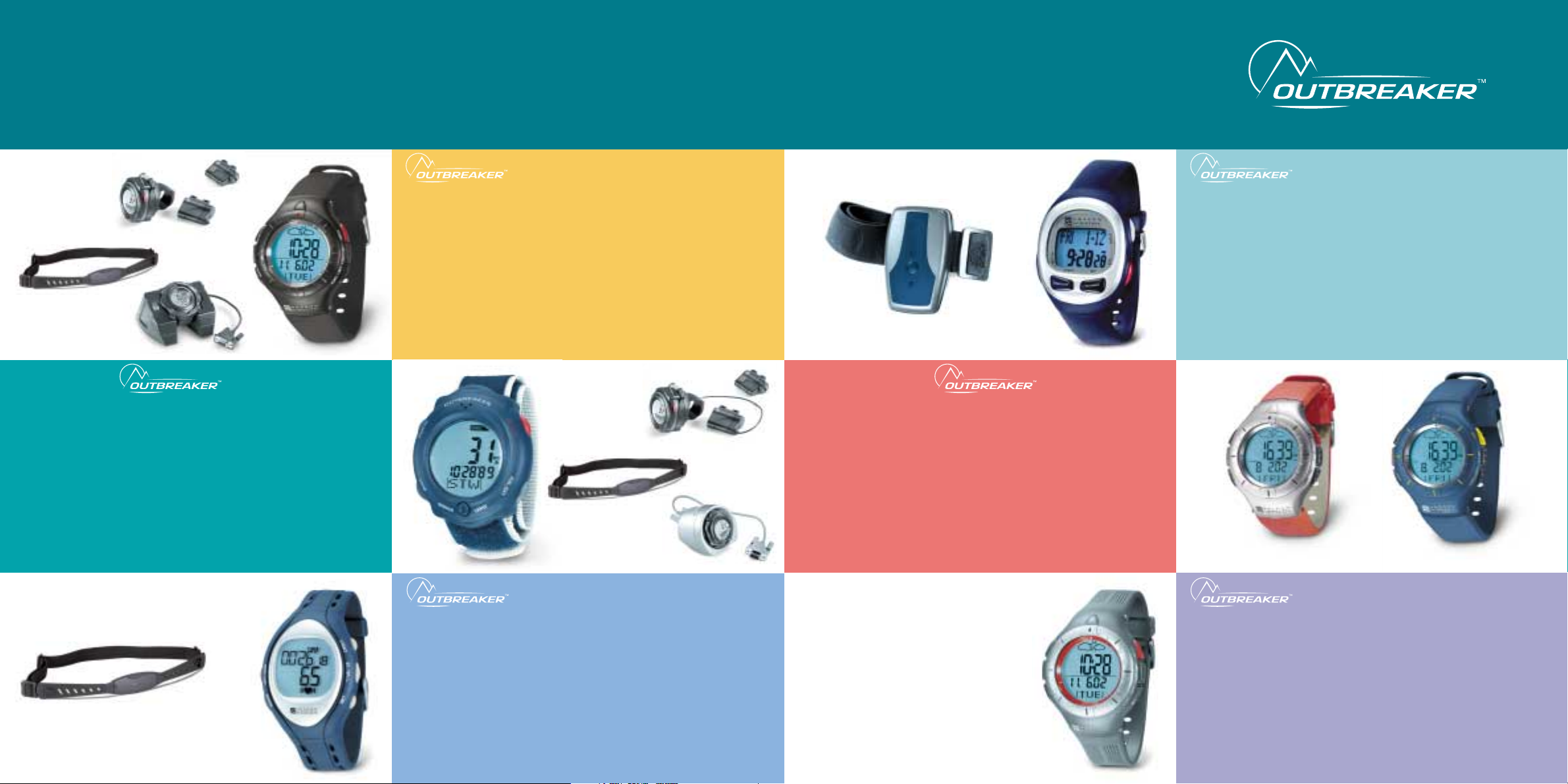
Oregon ‘Outbreaker’ sport performance watches: ‘achieve your goals’
Bike Pro - RP 109
Bike Computer
PC Linkage
Speed & Cadence Wireless sensors
Heart Rate Monitor
99 Lap Memory
Barometer with easy-to-read weather forecasting icons
Real-time Altimeter
Thermometer
Clock, Calender and Alarm
Water-resistant up to 50 meters
Virbra Trainer Pro - SE 132
Unique Vibration Heart Rate Limit Alert
44 Lap Memory
SMART Training Program
Av.Heart Rate reading
Hi/Lo Heart Rate Limit Program
Measure Calories Burned as well as % fat burn
Fitness Index
Stopwatch
Clock, Calender and Alarm
Water-resistant up to 50 meters
Speed and Distance GPS - GP 801
GPS Speed & Distance Measurement
Measure of Current, AV,Highest Speed & Pace in Km/h or m/h resolution 1/10 Accuracy
Distance Calculation
50 Lap Memory
Stopwatch/Countdown
Clock, Calender and Alarm
Automatic Timing by GPS rec
Water-resistant up to 50 meters
Receiver Splash Proof
Mountain - RA 109
Real-time Altimeter with user set alarms
Barometer with easy-to-read weather forecasting icons
Sea level calibration
Thermometer
Clock, Calender and Alarm
HiGlo backlight
Water-resistant up to 50 metres
Bike Cardio - TS 120
Bike Computer
PC Linkage
Wireless speed & wired cadence Sensors
Heart Rate Monitor
Clock, Calender and Alarm
Water-resistant up to 30 meters
2 wriststraps included velcro and rubber
Sailor - RA 201L
10’/6’ or Individually Set Regatta Count Down
Durable plexi-glass face
99 Lap Memory
Barometer with easy-to-read weather forecasting icons
Real-time Altimeter
Thermometer
Clock, Calender and Alarm
Water-resistant up to 50 meters
 Loading...