

Page 1

Density Determination Kit
Instruction Manual
Kit de determinación de densidad
Manual de uso
Kit de détermination de la densité
Manuel d’instruction
Dichtebestimmungs-Kit
Bedienungs-anleitung
Kit di Determinazione della Densità
Manuale di Istruzioni
This Kit is compatible with OHAUS
AS153x), Pioneer, Explorer
readability of 0.1mg and 1mg, Explorer® models with capacities up to 1100g and readability of 0.1mg and 1mg.
Before using this accessory, carefully read these instructions.
Este kit es compatible con OHAUS® Adventurer™, Adventurer™ Pro (excepto AV53x), Adventurer™ SL (excepto
AS153x), Pioneer, Explorer® Pro, Voyager® y los modelos de Voyager® Pro con capacidad hasta 610 g y
resolución de 0,1 mg y 1 mg; modelos de Explorer® con capacidad hasta 1100 g y resolución de 0,1 mg y 1 mg.
Antes de utilizar este accesorio, lea estas instrucciones con atención.
Le présent kit est compatible avec les modèles OHAUS® Adventurer™, Adventurer™ Pro (except AV53x),
Adventurer™ SL (except AS153x), Pioneer, Explorer® Pro, Voyager® and Voyager® Pro ayant des
capacités atteignant jusqu’à 610g et une lisibilité de 0,1mg et 1mg, mes modèles Explorer® avec des capacités
atteignant jusqu’à 1100g et une lisibilité de 0,1mg et 1mg. Avant de commencer à utiliser cet accessoire, veuillez
lire attentivement les présentes instructions.
Dieses Kit ist kompatibel mit OHAUS ® Adventurer™, Adventurer™ Pro (ausgenommen AV53x), Adventurer™
SL (ausgenommen AS153x), Pioneer, Explorer® Pro, Voyager® und Voyager® Pro-Modelle mit den
Kapazitäten bis zu 610g und Ablesbarkeit von 0,1mg und 1mg, Explorer® -Modelle mit den Kapazitäten bis zu
1100g und Ablesbarkeit von 0,1mg und 1mg. Bevor Sie dieses Zubehör verwenden, lesen Sie diese Anweisungen
sorgfältig durch.
Questo Kit è compatibile con i modelli OHAUS® Adventurer™, Adventurer™ Pro (salvo AV53x), Adventurer™ SL
(salvo AS153x), Pioneer, Explorer® Pro, Voyager® e Voyager® Pro con portata fino a 610g e risoluzione di
lettura di 0,1mg e 1mg, modelli Explorer® con portata fino a 1100g e risoluzione di lettura di 0,1mg e 1mg. Leggere
attentamente le istruzioni prima di utilizzare questo accessorio.
Find Quality Products Online at: [email protected]
®
Adventurer™, Adventurer™ Pro (except AV53x), Adventurer™ SL (except
®
Pro, Voyager
®
and Voyager
®
Pro models with capacities up to 610g and
www.GlobalTestSupply.com
Page 2

Table of
Contents
1 Introduction ................................................................................................................................ EN-1
1.1 Before we begin .................................................................................................................... EN-1
1.2 Standard equipment .............................................................................................................. EN-1
3 Principle of the density determination ................................................................................... EN-3
4 Density determination of solids .............................................................................................. EN-4
4.1 Fundamentals ....................................................................................................................... EN-4
4.2 Performing the density determination of solids ..................................................................... EN-4
4.3 Improving the accuracy of the result ..................................................................................... EN-6
5 Density determination of liquids ............................................................................................. EN-6
5.1 Fundamentals ....................................................................................................................... EN-6
5.2 Performing the density determination of liquids .................................................................... EN-7
5.3 Improving the accuracy of the result ..................................................................................... EN-8
6 Supplementary information ..................................................................................................... EN-8
6.1 Influencing factors ................................................................................................................. EN-8
6.2 Density table for distilled
6.3 Density table for ethanol...................................................................................................... EN-11
water
............................................................................................ EN-10
Find Quality Products Online at: [email protected]
www.GlobalTestSupply.com
Page 3
Density Determination Kit EN-1
1
G
lass beaker
2
3
For
4
5
Ho
6
7
P
8
t)
1 Introduction
1.1 Before we begin
Thanks for purchasing the density determination kit for your OHAUS balances. With the aid of th is kit you can
use your balance for the determination of the density of solids and liquids.
1.2 Standard equipment
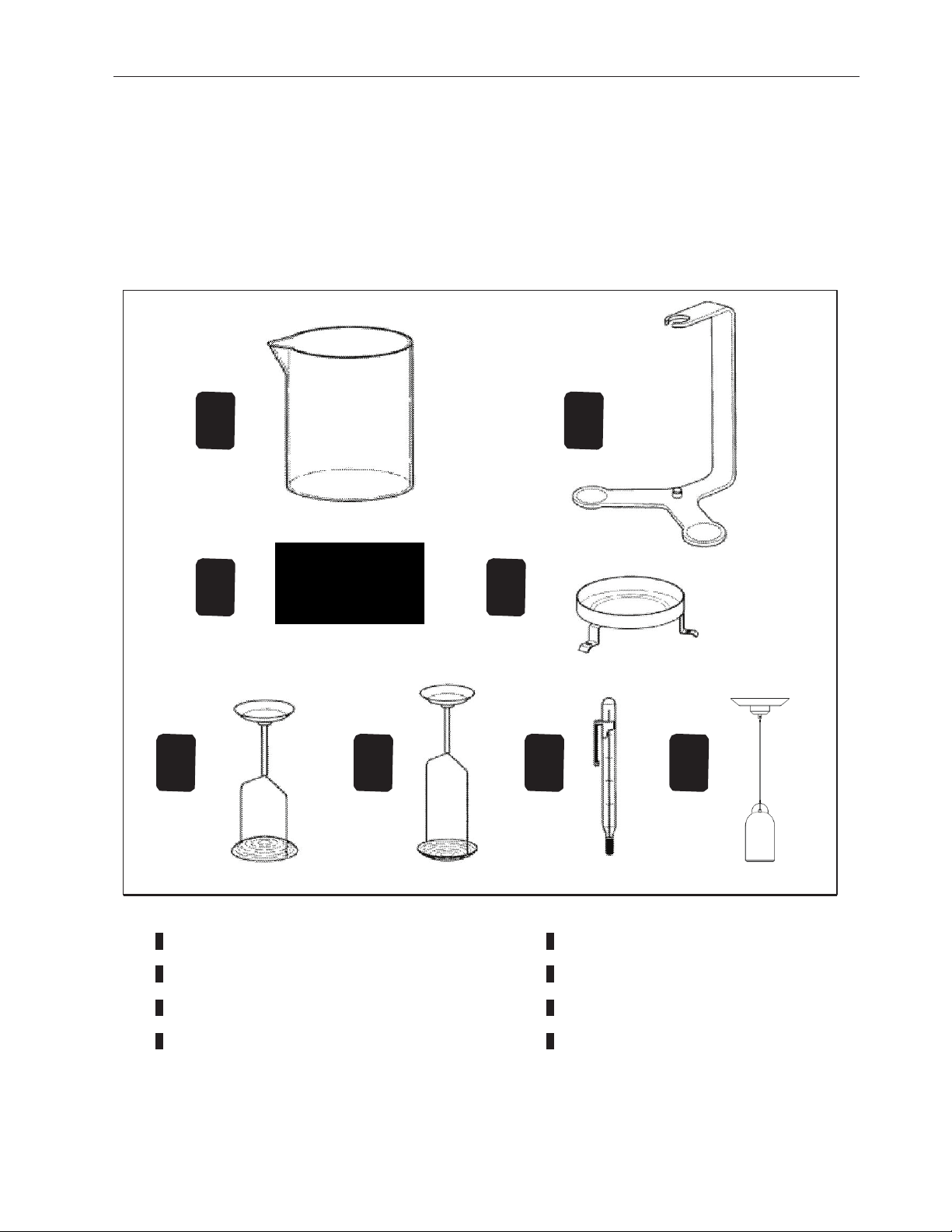
The kit contains the individual parts shown in the illustration below.
For the density determination of liquids, y ou need the kit and also the o ptional 10ml sinker.
1 2
3 4
5 6 7 8
Bracket
ceps
lder for floating solids
recision thermometer with holder
Find Quality Products Online at: [email protected]
www.GlobalTestSupply.com
Platforms
Holder fo r non floati ng s oli ds
Sinker 10ml (optional equipmen
Page 4
EN-2 Density Determination Kit
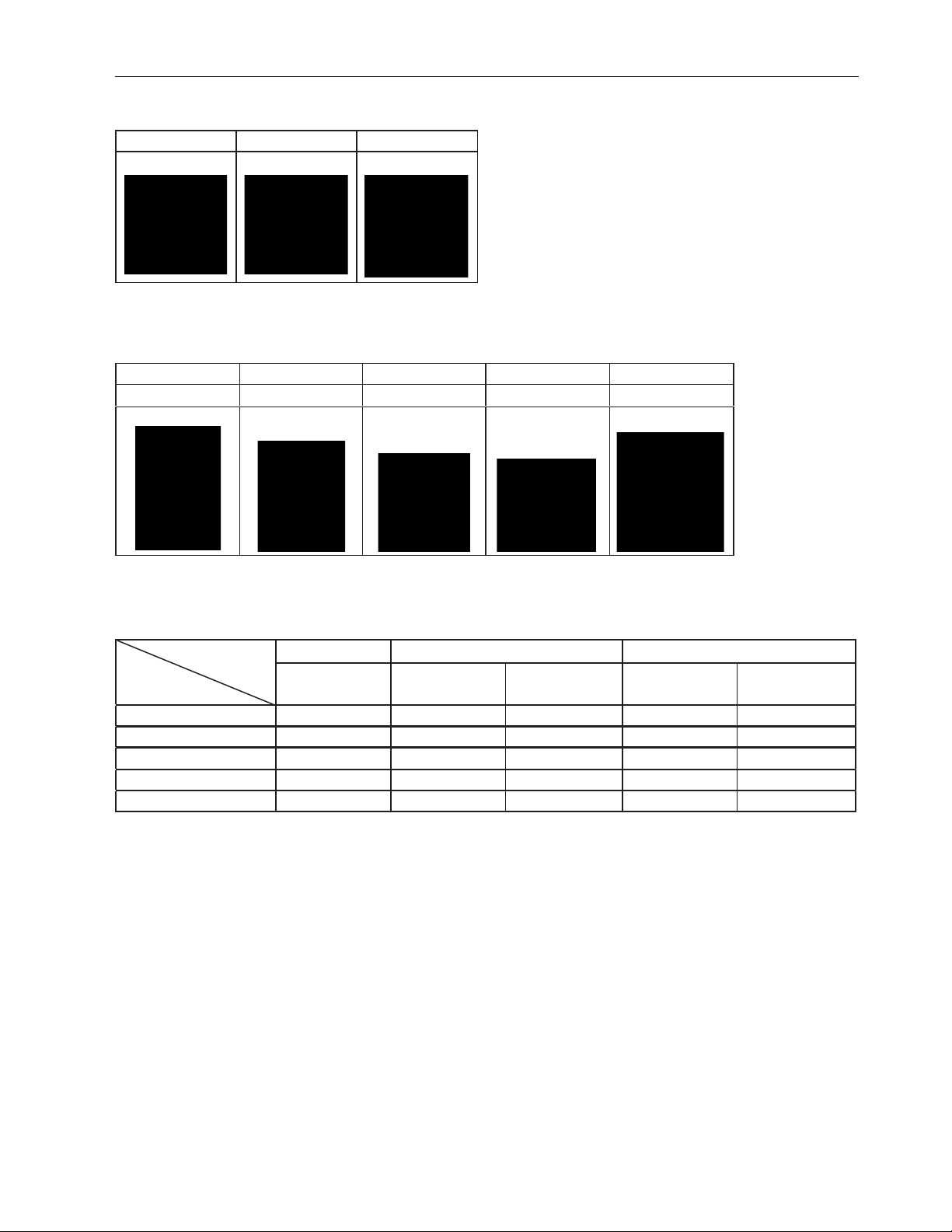
ABC
DEFGH
18.3 mm
22.3 mm
22.8 mm
30 mm
23.5 mm
Re ada bility
Series
0.01mg
0.1mg
1mg
Pan Support
Pan Support
Offsetting
Weight
Pan Support
Offsetting
Weight
EXGD/F
AAX/D/E/
PXGDCF
/
PA/H/F
B
PXP/PR/PJX
/DCF/
Offsetting Weight
Pan Support
Find Quality Products Online at: [email protected]
www.GlobalTestSupply.com
Page 5
Density Determination Kit EN-3
2 Preparing the balance for density determinations
This section describes how you can convert your balance to determine
densitie s. P lease foll ow th e step s as bel ow.
Select the pan support according to your balance as described in Section 1.2.
Remove the cover of tape on the pan support, and adhere centrally to the bottom
of the bracket (2).
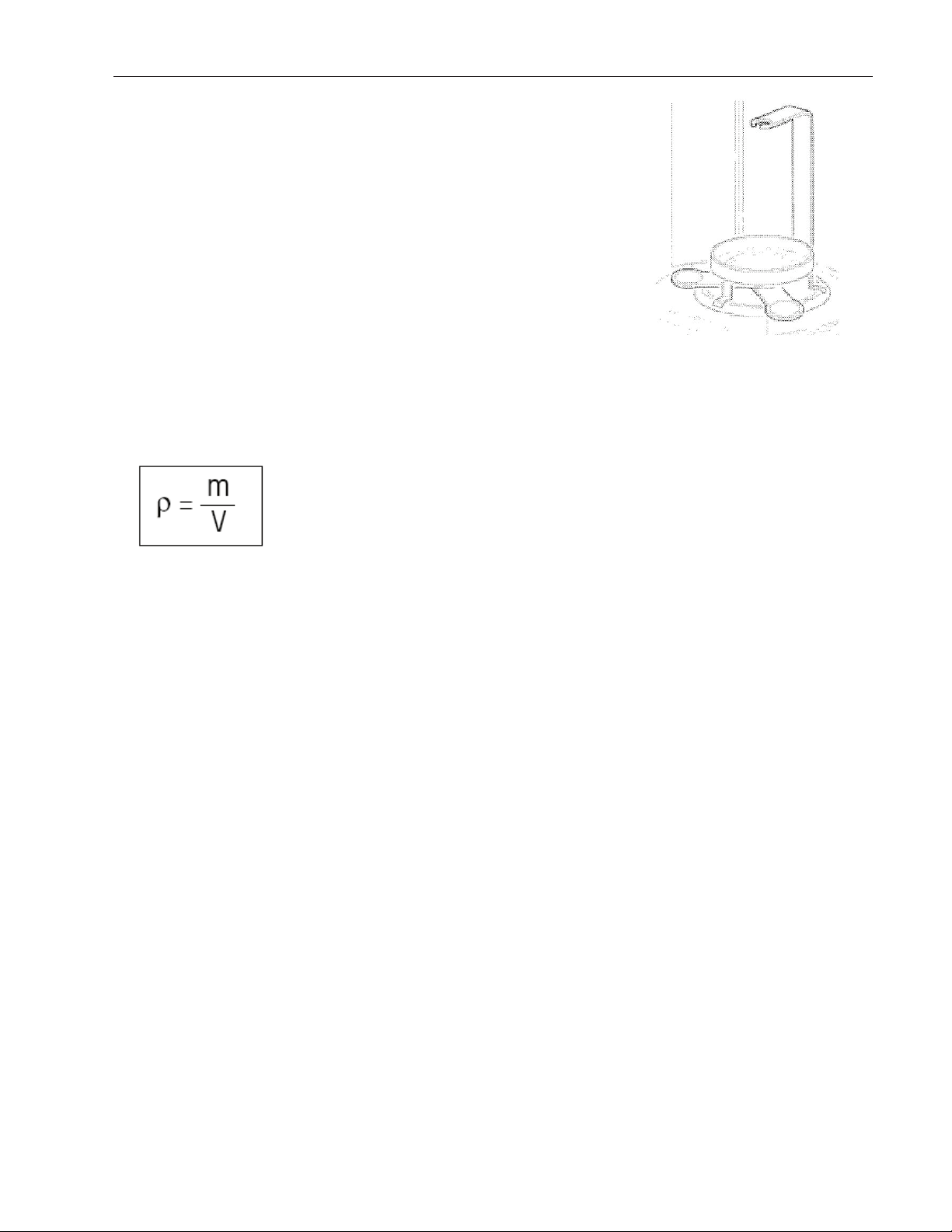
1. Open the draft shield door and remove the weighing pan.
2. Place the bracket with the pan support on the weighing cone.
3. Place the platform (4) above the bracket. The three support feet should be
between the weighing arms of bracket and stand stably on the bottom
plate of draft shield.
Note: The bracket must not touch the platform under any
circumstances!
3 Principle of the density determination
The de n s i ty ρ is the quotient of the mass m and the volume V.
The international system of units specifies Kg/m3 as the unit of density. However, the unit g/cm3 is better suited
to lab purposes.
Density determinations are frequently performed by Archimedes’ principle, which is also us ed with the d ensity
determination kit for the balances. This principle states that every solid body immersed in a fluid apparently
loses weight by an amount equal to that of the fluid it displaces.
The procedure for the density determination by Archimedes’ principle depends on whether the density of
solids or liquids has to be determined.
Find Quality Products Online at: [email protected]
www.GlobalTestSupply.com
Page 6
EN-4 Density Determination Kit
L
4 Density determination of solids
4.1 Fundamentals
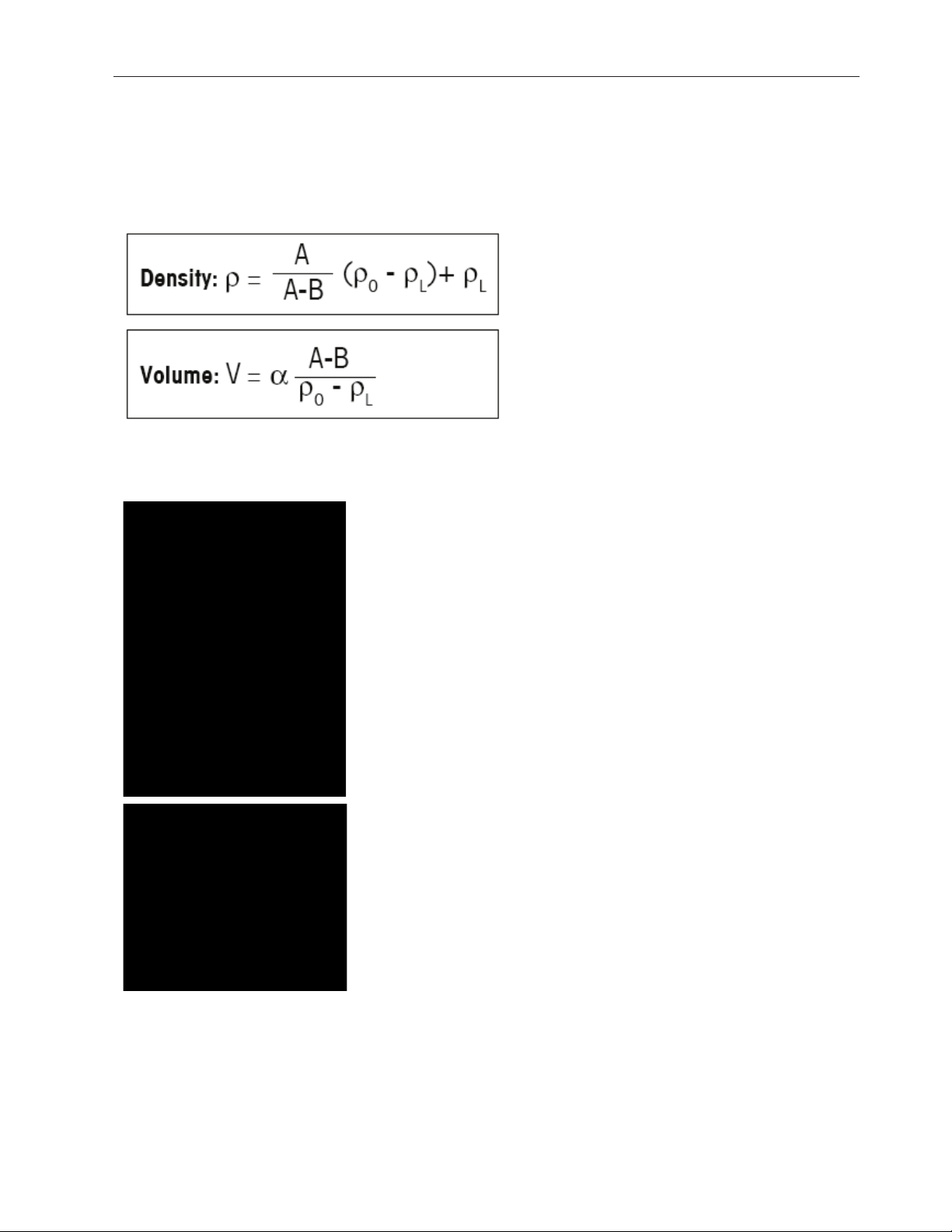
The density of a solid is determined with the aid of a liquid whose density ρ
usually used as auxiliary liquids). The solid is weighed in air (A) and then in the auxiliary liquid (B). The density ρ
can be calculated from the two weighings as follows:
ρ = Density of sample
A = Weight of sample in air
B = Weight of sample in the auxiliary liquid
ρ
= Density of the auxiliary liquid
0
ρ = Air density (0.0012 g/cm
α = Balance correc tion factor (0.99985), takes air
buoyancy of the adjustment weight into account.
4.2 Performing the density determination of solids
Note: These instructions explain how to work with the d ensit y
determination kit. They describe the procedure for performing a density
determination manually.
If you need information about operating your balance, please refer to the
instruction manual provided with the balance.
For the density determination of solids, use the glass beaker (2) and one of
the two holde rs for solids which float (5) or sink (6). For c ertain OHAUS
1mg balances, use off setting weights according to your balance as described
in Section 1.2.
Prepare the balance for the density determination (install platform and
bracket) as described in Section 2.
Suspend the supplied thermometer (7) from the edge of the beaker (1).
Place the beaker on the platform and fill it with auxiliary liquid (liquid of
known density ρ
usually distilled water or ethanol). Add enough liquid to
0’
ensure the solid is covered by at least 1 cm liquid after immersion.
Suspend the suitable holder (5) or (6) for solids which float or sink from the
bracket (the adjacent illustration shows the holder for solid which sink).
Ensure that no air bubbles adhere to the immersed part of the holder
(Remove any air bubbles by moving the holder or by means of a fine
brush).
For certain OHAUS 1mg balances, place off setting weights on the holder
(the adjacent illustration shows the weights for EP/VP 1mg balances).
Close the draft shield doors and tare the balance.
is known (water or ethanol are
0
3
)
Find Quality Products Online at: [email protected]
www.GlobalTestSupply.com
Page 7

Density Determination Kit EN-5
Place the solid in one of th e two weighing pans of the bracket (2). Wait until
the weight display of the balance is stable and note the displayed weight A
(weight of sampl e in ai r).
Note for 0.1mg models
When solids w ith a weight greater than 20g are weighed in air, place in
the pan at the top of the holder (above 20g corner load errors may appear
on one arm in the weighing).
Remove the solid from the pan, close the draft shield doors and tare the
balance.
Place the solid after in the holder (6). Ensure that no air bubbles adhere to
the solid (remove any air bubbles with a fine brush).
Note
With solids with a density less than 1g/cm
3
the holder for floating
solids (5) must be used as it h ol ds the solid body below the sur fac e of the
auxiliary liquid. If the buoyancy of the solid is greater than the weight of
the holder, the holder must be weighted by placing an additional weight on
the top weighing pan of the bracket. After loading the additional weight,
tare the balance and restart the density determination procedure by
first weighing the solid in air (A) and then in the auxiliary liquid (B).
Wait until the balance has reached stability and note the displayed weight
B (weight of sample in the auxiliary liquid).
Now determine the density ρ of the solid according to the preceding
4.1).
formula ( Sec tion
Find Quality Products Online at: [email protected]
www.GlobalTestSupply.com
Page 8
EN-6 Density Determination Kit
3
4.3 Improving the accuracy of the result
The following tips should help you improve the accuracy of the results in the density determination of solids.
Temperature
Solids are generally so insensitive to temperature fluctuations that the corresponding density changes are of no
consequence. However, as work is performed with an auxiliary liquid in the density determination of solids
following Arc himedes’ principle, their tem perature must be taken into account as the temperature has a great
effect with liquids and causes density changes of order of magnitude 0.1 to 1% per
apparent in the third decimal place of the result.
°C. This effect is alread y
To obtain accurate results, we recommend that you always take the temperature of the auxiliary li quid
into account in all density determinations. You can take the appropriate values from a book of tables. You
will find tables for distilled water and ethanol in Section 6.
Surface tension of the auxiliary liquid
Adhesion of the auxiliary liquid to the s uspension wires of th e holder causes an apparent weight increase of up
to 3mg.
As the holder is immersed in the auxiliary liquid in both weighings of the solid (in air and in the auxiliary liquid)
and the balance is tared before every measurement, the influence of the apparent weight increase can be
neglected.
If the greatest possible accuracy is required, use a few drops of the wetting agent.
5 Density determination of liquids
5.1 Fundamentals
The density of a liquid is d etermined using a sinker of know n volume. The sinker is weighed in air and the n in
the liquid whose density is to be determined. The density ρ can be determined from the two weighings as
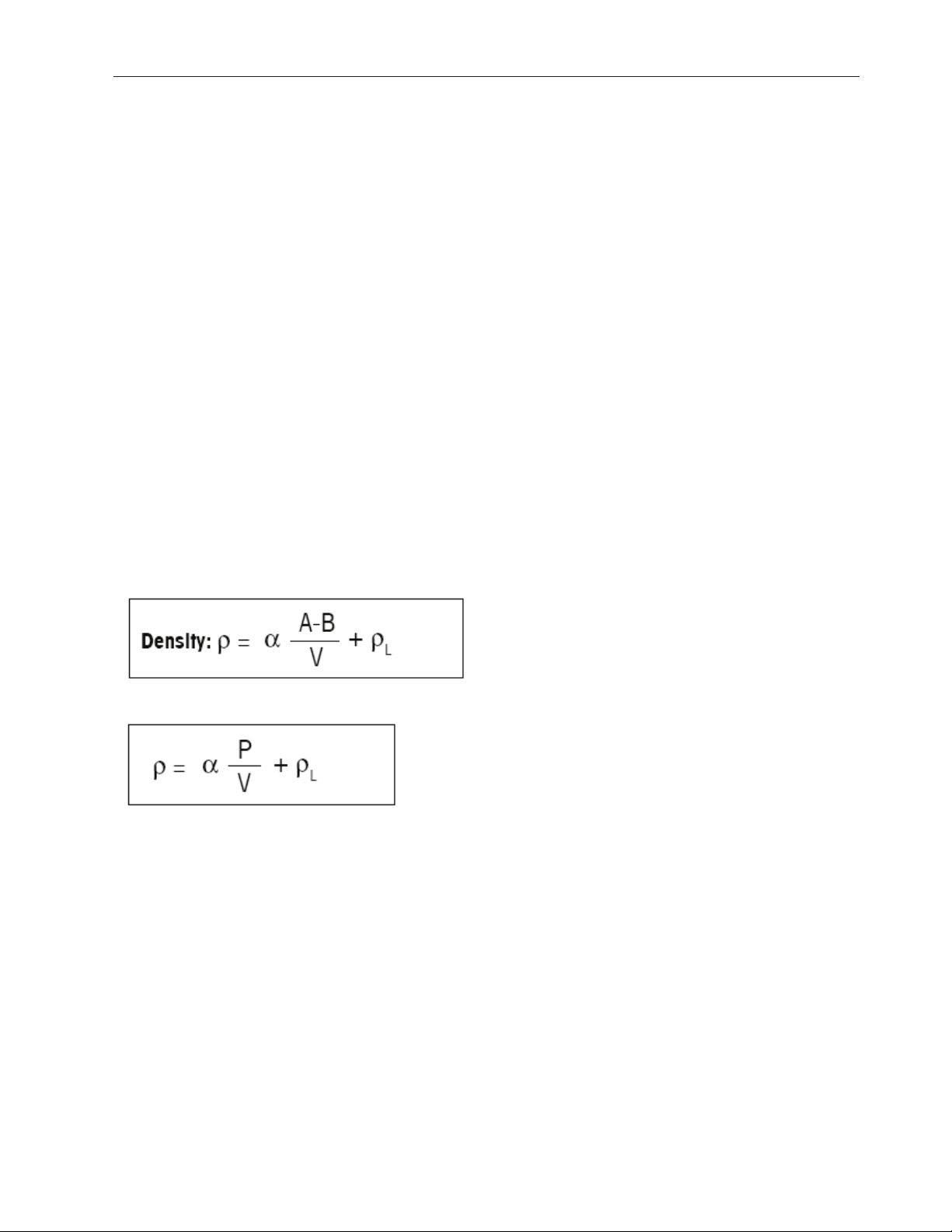
follows:
With an electronic balance it is possible to determine
the weight of the displaced liquid P (P=A-B), and thus the
buoyancy, allowing the preceding formula to be simplified
to:
ρ = Density of liquid
A = Weight of sinker in air
B = Weight of sinker in the liquid
V = Volume of sinker
ρ
= Air density (0.0012 g/cm )
L
α = Balance correction factor (0.99985), takes air
buoyancy of the adjustment weight into a ccount
P = Weight of displaced liquid (P = A - B)
Find Quality Products Online at: [email protected]
www.GlobalTestSupply.com
Page 9

Density Determination Kit EN-7
5.2 Performing the density determination of liquids
Note: These instructions explain how to work with the density determination kit. They describe the procedure for
performing a density determination manually .
If you need information about operating your balance, please refer to the instruction manual which you received
with the balance.
For the density determination of liquids, use the glass bea ker (1) a nd the optional sinker (8).
Prepare the balance for the density determination (install the platform and
bracket) as described in Section 2.
Place the empty beaker (1) on the platform and suspend the thermometer
supplied (7) from the edge of the beaker.
Suspend the sinker (8) from the bracket and ensure that it does not touch
either the beaker or the thermometer.
Tare the
balance.
Find Quality Products Online at: [email protected]
www.GlobalTestSupply.com
Page 10

EN-8 Density Determination Kit
Add the liquid whose density you wish to determine to the beaker (up to
approx. 1 cm above the suspension eye of the sinker). Ensure that no air
bubbles adhere to the sinker (remove any air bubbles with a fine brush).
Wait until the we ig ht dis pla y of the b alanc e is stable a nd no te t he
displayed value P (weight of displaced liquid)
Now determine the density ρ of th e liquid (at the temperature read off on
the thermometer), according to the preceding formula (Se ction 5.1).
5.3 Improving the accuracy of the result
The following tips will help you improve th e accuracy of the result s in the density determination of liquids.
V olume tolerance of the sinker
The optional sinker recommended for the density determination of liquids corresponds to the requirements of
the German Weights and Measures Regulation (EO 13-4, paragraph 9.21). The volume of the sinker including
the upper half of the suspension wire is so adjusted that the maximum error in the density determination of
20°C
water at a temperature of
is ± 0.0005 g/cm
3
6 Supplementary information
This section offers information on the influencing factors which can have an adverse effect on the accuracy of
the experimental result s. In addition, you will find density tables for distilled w ater and ethanol i n this section.
6.1 Influencing factors
In addition to temperature, air buoyancy and surface tension of the liquid, the following factors can affect the
experimental results:
- Immersion depth of the holder or the sinker
- Air bubbles
- Porosity of the solid body
Immersion depth of the holder or sinker
The sinker for the density determination of liquids is suspended from a platinum wire of 0.2 mm diameter. In
water the wire experiences a buoyancy of approximately 0.3 mg per 10mm immersion depth.
Example: If the liquid is 10mm above the suspension eye of the sinker, approx. 40mm wire is immersed. This
results in a buoyancy of 1.2m g at densities around 1. Owing to division of the buo yancy by
the sinker), the error in the result is negligibly small and need not be corrected.
The immiscible part of the holders for the density determination of solids comprises 2 wires each of
diameter 0.7mm. With a liquid densit y of 1, this results in a buo yanc y of approx. 0 .4mg millimet er
immersion depth.
In the weighing of the solid in air, the immersion depth of the holder remains the same. The buoyancy force on
the holder is thus constant and can therefore be neglected. However, it is important to ensure that the liquid
level is not changed between weighings (the change in the liquid level by immersion of the solid is us ually
insignificant).
Air bubbles
With poorly wetting liquids (e.g. water without wetting agent), it is possible that air bubbles remain adhered to
the immersed parts (solid, sinker, and holder) and influence the result owing to their buoyancy. A bubble with a
diameter of 1 mm causes a buoyancy of 0.5 mg, whereas one of diameter 2 mm results in buoyancy as high as
10cm
3 (=volume of
Find Quality Products Online at: [email protected]
www.GlobalTestSupply.com
Page 11

Density Determination Kit EN-9
4 mg. T o avoid air bubbles, we advise the following precautionary measures:
- Degrease solvent-resistant solids
- Clean holders and sinker at regular intervals, never touched parts which are immersed with your hand
- Gently shake holders and sinker on first-time immersion to dislodge any air bubbles.
- Remove tenaciously adhering air bubbles with a fine brush.
- Use enclosed or commercial wetting agent or organic liquids (the density change experienced by distilled
water on the addition of wetting agent can be neglected).
Porosity of the solid
When solid bodies are immersed in a liquid, usually not all the air in the pores is displaced. This leads to
buoyancy errors and thus the density of porous bodies can only be determined approximately.
Find Quality Products Online at: [email protected]
www.GlobalTestSupply.com
Page 12
EN-10 Density Determination Kit
T/"C
0.0 0.1 0.2 0.3 0.4 0.5 0.6 0.7 0.8 0.9
10.
11.
12.
13.
14.
15.
16.
17.
18.
19.
20.
21.
22.
23.
24.
25.
26.
27.
28.
29.
30.
0.99973
0.99963
0.99953
0.99941
0.99927
0.99913
0.99897
0.99880
0.99862
0.99843
0.99823
0.99802
0.99780
0.99756
0.99732
0.99707
0.99681
0.99654
0.99626
0.99597
0.99567
0.99972
0.99962
0.99951
0.99939
0.99926
0.9991 1
0.99896
0.99879
0.99860
0.99841
0.99821
0.99800
0.99777
0.99754
0.99730
0.99704
0.99678
0.99651
0.99623
0.99594
0.99564
0.99971
0.99961
0.99950
0.99938
0.99924
0.99910
0.99894
0.99877
0.99859
0.99839
0.99819
0.99798
0.99775
0.99752
0.99727
0.99702
0.99676
0.99648
0.99620
0.99591
0.99561
0.99970
0.99960
0.99949
0.99937
0.99923
0.99908
0.99892
0.99875
0.99857
0.99837
0.99817
0.99795
0.99773
0.99749
0.99725
0.99699
0.99673
0.99646
0.99617
0.99588
0.99558
0.99969
0.99959
0.99948
0.99935
0.99922
0.99907
0.99891
0.99873
0.99855
0.99835
0.99815
0.99793
0.99771
0.99747
0.99722
0.99697
0.99670
0.99643
0.99614
0.99585
0.99555
0.99968
0.99958
0.99947
0.99934
0.99920
0.99905
0.99889
0.99871
0.99853
0.99833
0.99813
0.99791
0.99768
0.99744
0.99720
0.99694
0.99668
0.99640
0.99612
0.99582
0.99552
0.99967
0.99957
0.99946
0.99933
0.99919
0.99904
0.99887
0.99870
0.99851
0.99831
0.99811
0.99789
0.99766
0.99742
0.99717
0.99691
0.99665
0.99637
0.99609
0.99579
0.99549
0.99966
0.99956
0.99944
0.99931
0.99917
0.99902
0.99885
0.99868
0.99849
0.99829
0.99808
0.99786
0.99764
0.99740
0.99715
0.99689
0.99662
0.99634
0.99606
0.99576
0.99546
0.99965
0.99955
0.99943
0.99930
0.99916
0.99900
0.99884
0.99866
0.99847
0.99827
0.99806
0.99784
0.99761
0.99737
0.99712
0.99686
0.99659
0.99632
0.99603
0.99573
0.99543
0.99964
0.99954
0.99942
0.99929
0.99914
0.99899
0.99882
0.99864
0.99845
0.99825
0.99804
0.99782
0.99759
0.99735
0.99710
0.99684
0.99657
0.99629
0.99600
0.99570
0.99540
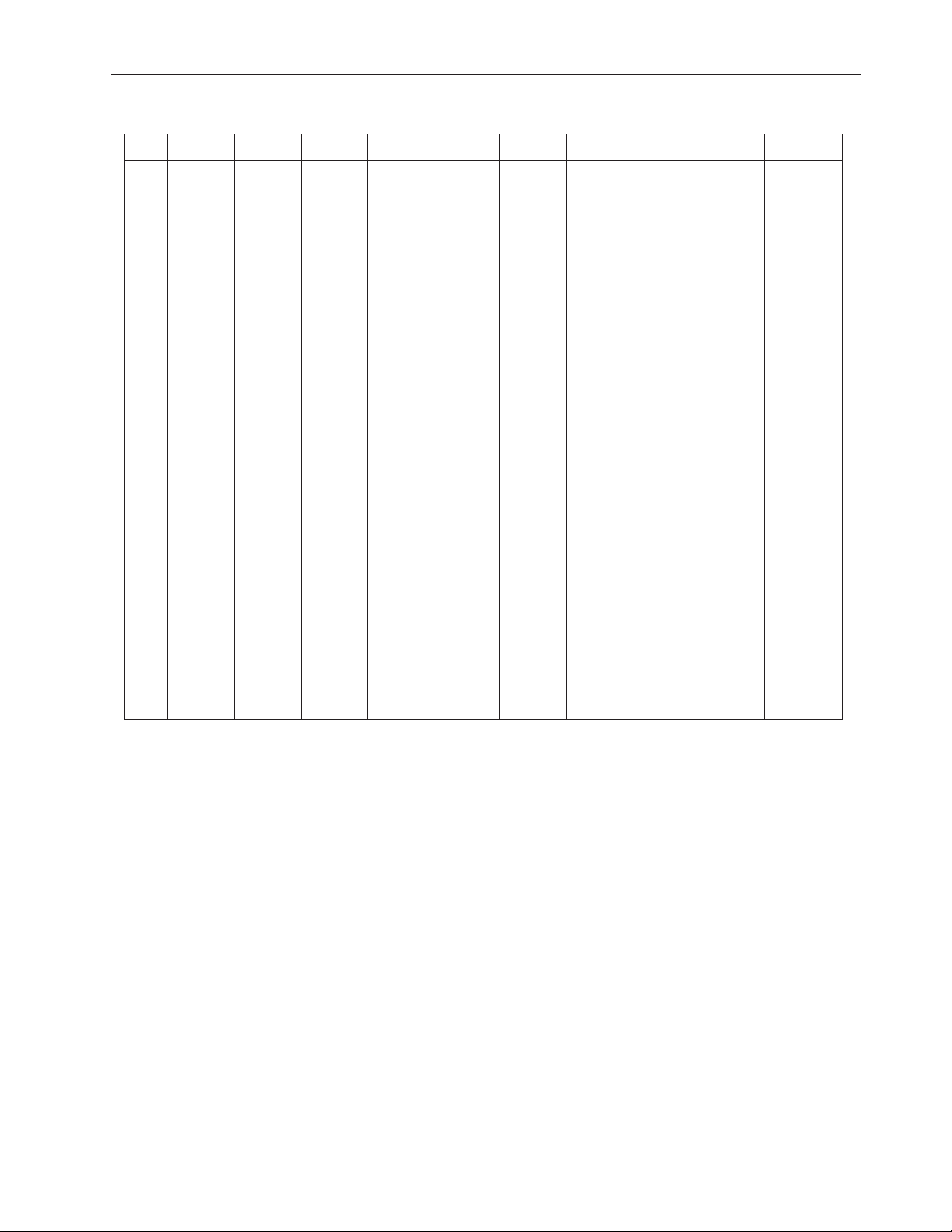
6.2 Density table for distilled
water
Find Quality Products Online at: [email protected]
www.GlobalTestSupply.com
Page 13
Density Determination Kit EN-11
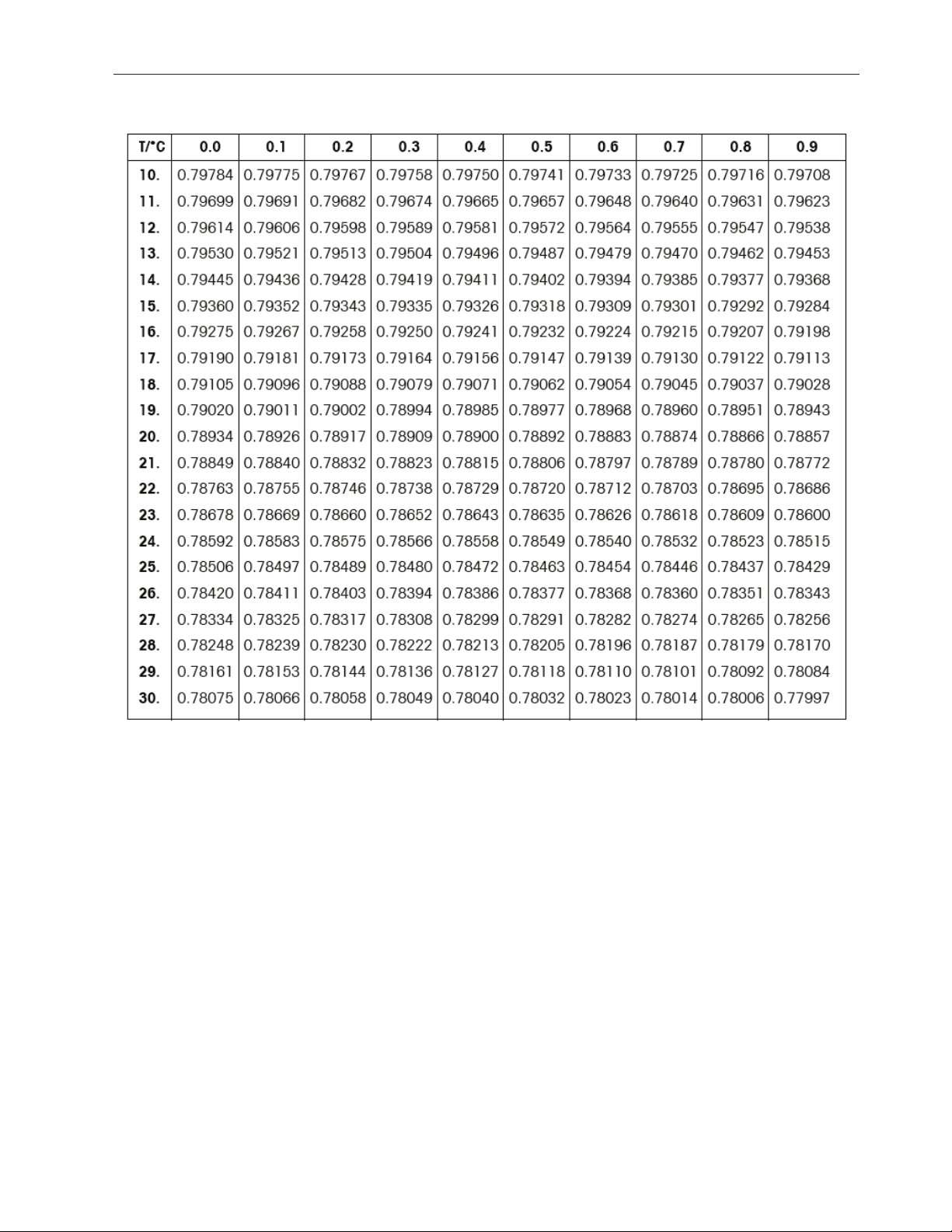
6.3 Density table for ethanol
Density values of C
OH taken from “American Institute of Physics Handbook”.
2H5
Find Quality Products Online at: [email protected]
www.GlobalTestSupply.com
 Loading...