

Page 1
INSTALLATION AND OPERATING
ge (
(
[
g
g
q
g
g
g
g
g
g
y
INSTRUCTIONS
442 443 452 453
482 483 462 463
WARNING
Improper installation, adjustment, alteration, service, or maintenance can
cause injury or property damage. Refer to this manual. For assistance or
additional information consult a qualified installer, service agency, or the
gas supplier.
FOR YOUR SAFETY
Do not store or use gasoline or other
flammable vapors and liquid in the vicinity of this or any other appliance.
FOR YOUR SAFETY
If you smell gas:
1. Open windows
2. Do not touch any electrical
switches
3. Extinguish any open flame
4. Immediately call your gas supplier
Contents
Safety Precautions..............................................2
Extended Service Protection Plan......................4
Ventilation Re
Installation Instructions........................................8
Decorative Door Panel Installation....................11
Reversin
Li
hting and Start-Up Instructions.....................14
Operatin
Refri
erator Maintenance..................................17
Trouble Shooting................................................19
Failure of Refri
Replacement Parts............................................20
Wirin
Diagrams................................................21
Warrant
uirements....................................5
Door Swing......................................11
and User Instructions.......................15
erator.......................................20
............................................................23
These refrigerators are designed to operate on the following energy sources:
LP GAS OPERATION - 11.0 inches Propane & 12 volt DC control volta
AC OPERATION - 120 volts AC
DC OPERATION Operation where these specifications are exceeded will void the refri
MODEL NO.______________________________ SERIAL NO.______________________________
The refri
Part No.: 618484B (95-09)
erator’s model number and serial number are on the serial plate loc ated in the refrigerator.
3-WAY MODELS] 12 volts DC (15.4 volts max., 11.5 volts min.).
132 volts max., 108 volts min.) and 12 volt DC control voltage.
15.4 volts max., 10.5 volts min.).
erator warranty.
Page 2
Safety Precautions
Read this manual and become thoroughly acquainted with it before installing or starting
the refrigerator. The following safety precautions and recommendations contained herein
are for your protection.
Improper installation, adjustment, or operation can cause injury or property damage.
The safety symbols used in this manual contain Safety Alert information. Understand their
meanings and be safety conscious.
DANGER
WARNING
CAUTION
General
Keep the unit and surrounding area clean. Never use the area behind refrigerator for
•
storage; in particular, storing flammable materials (oily rags, paper, aerosol cans,
and chemicals.). Stored materials not only present a safety hazard but could block
the ventilation to the system.
Provide appropriate fire extinguishers installed in convenient locations. Consult your
•
local fire department for the correct type to use. Do not use foam on electrical fires.
Use extinguisher rated by NFPA.
Make sure all fasteners, supports, seals, electrical covers ar e secure.
•
LP Gas System
A SITUATION WHICH, IF NOT AVOIDED, WILL RESULT IN DEATH OR SERIOUS INJURY.
A SITUATION WHICH, IF NOT AVOIDED,
SULT IN DEATH OR SERIOUS INJURY.
A SITUATION WHICH, IF NOT AVOIDED, MAY RESULT IN MINOR OR MODERATE INJURY.
COULD RE-
LP gas is highly flammable. Gas connections must be leak tight. Do not smoke,
•
create sparks or use an open flame when checking gas connections. Do not ignore
the "rotten egg" smell of gas fumes.
Protect all gas lines from physical damage, vibration, or excessive heat.
•
Insure that the supply gas pressure is within the tolerance specified on the front
•
cover of this manual. The gas controls are designed for safety. Never tamper with
the adjustment or function of the controls other than as directed by the Lighting and
Shutdown Instructions. All repairs must be done by a qualified service person.
Exhaust Gases
Proper ventilation to remove exhaust gases is extremely important. These gases,
•
generated in the GAS mode at the rear of the refrigerator, replace the oxygen in the
air and in extreme cases can produce dangerous levels of carbon monoxide. This
manual contains installation instructions to safely remove the exhaust gases and
seal the zone from the living area. The installation instructions are certified by American Gas Association and Canadian Gas Association and must be followed.
Check the burner for proper flame characteristics at the initial start-up and at least
•
once every year. The information for this check is located in this manual and must
be performed by a qualified service person.
2
Page 3
Safety Precautions -
Electrical Circuits - AC and DC
The 120 volt AC circuit must be properly grounded. Never cut or remove the round
•
grounding prong from the re friger ator’s AC co rd. Do not us e a two- prong adapter . Do
not use an extension cord to connect to the approved AC receptacle.
Protect all wiring from physical damage, vibration, or excessive heat.
•
Always disconnect both AC and DC sources of power when working on either circuit
•
(only a qualified service person).
Insure all terminating connections are clean and tight to prevent arcing or over-
•
heating.
Never allow Leak Detecting fluids or any other liquids to spill on electrical connec-
•
tions. Many liquids are electrically conductive and could cause serious arcing damage and, in some case, fires.
Refrigerant System
Never physically bend, drop, drill, weld, or hammer the refrigerant system. Doing so
•
could cause the system to rupture and release dangerous chemicals which can
cause severe burns to the eyes or skin. If ignited, these chemicals will burn with
intense flame. A leaking system can release certain chromium components which, if
inhaled, can cause cancer.
Never apply direct heat in excess of 240° F to the refrigerant system. Because the
•
refrigerant is hermetically sealed under pressure, a temperature sensitive safety device opens to protect the system from erupting under excessive pressure. However,
the expelled refrigerant could ignite and burn if an ignition source were near.
Never attempt to repair or recharge the refrigerant system. If defective, it must be
•
replaced.
continued
Child Entrapment
Never install door locks or other restraints which could entrap small children within
•
the refrigerator. The Travel Latch system must not be modified.
Handling the Refrigerator
Never lift the refrigerator without assistance. Protect yourself from body strain.
•
Avoid hot surfaces at the rear of the refrigerator when operating. The absorption
•
type refrigerator produces several hot areas at the rear of the unit. This is true
whether in GAS or ELECTRIC mode.
Take care to avoid brushing against the irregular shapes and sheet metal parts at the
•
rear of the refrigerator. Cuts or abrasions could result.
3
Page 4
g
g
g
y
g
g
g
g
g
g
g
g
g
g
g
g
g
q
y
(
g
y
y
g
g
g
(
y
g
g
y
g
g
g
g
g
g
y
y
g
g
g
g
(pay
y
y (90)
E.S.P.
EXTENDED COOLING UNIT SERVICE PROTECTION PLAN
An additional four year Service Contract is now
available to ori
erators. For onl
* Four extra
failure.
* Automatic replacement of defective coolin
* Pre-paid frei
return.
* Labor free of char
The E.S.P.
can be obtained b
U.S. funds to:
inal purchasers of Norcold refrig-
$40.00 you get:
ears protection against cooling unit
unit.
ht from your dealer to Norcold and
e.
Extended Service Protection) plan
mailing your check for $40.00*,
NORCOLD
P O BOX 4248
SIDNEY OH 45365-4248
If mailing in Canada:
GREG LUND PRODUCTS LTD
P O BOX 760
OAKVILLE ONTARIO CANADA L6J 5C4
E.S.P. is a service contract between Norcold and
the ori
placement of a defective
refri
tional period of four
ori
delivered to Norcold Service Center to
the Norcold E.S.P. card showin
An E.S.P. card will be mailed to the ori
chaser upon receipt of a completed Service Contract Application form and a check coverin
E.S.P. char
inal purchaser. The contract provides re-
cooling unit only
erator (freight, parts, and labor) for an addi-
ears after expiration of the
inal Limited Warranty. The refrigerator must be
E.S.P. coverage.
E.S.P. coverage is non-transfer-
e.
for this
ether with
inal pur-
the
able and no n-ref undable .
To register your refrigerator, fill out the warrant
Service Contract Application - i.e.: Tear Sheet
Form in
information (Please Print Clearly):
1. Owner’s name and address.
2. Refri
3. Refri
4. Date of purchase.
5. Refri
6. Check for $40.00*
Applications will be accepted onl
within ninet
*Ohio residents, add $2.60 sales tax.
ellow envelope or include the followin
erator model number.
erator serial number.
erator proof of purchase
able to Norcold).
if they are mailed
days after date of purchase.
General Instructions - All Models
The refrigerators described in this manual are de-
si
ned for built-in installations and require cut out di-
mensions as indicated on pa
The refri
level floor awa
floor must be stron
wei
Never install the refri
To protect carpetin
on a metal or wood panel extendin
width and depth of the refri
erators must be placed on a solid and
from heat generating sources. The
enough to support the combined
ht of the refrigerator and its food load.
, the refrigerator must be placed
e .
erator directly on carpeting.
at least the full
erator.
Keep the refri
and free of combustible materials,
other flammable materials.
Note: These appliances are not approved for
erator and the surrounding area clear
asoline, and
use as a Free-Standin
refri
erator must be used in the manner
for which it was desi
manual for installation, operatin
dures, and the refri
This appliance is e
and cannot be converted to an
els
Natural Gas, Butane, etc.).
refrigerator. The
ned. Refer to this
erator intended use.
uipped for LP gas
proce-
other fu-
4
Page 5
VENTILATION REQUIREMENTS
g
g
y
g
g
g
q
)
g
g
y
q
g
g
g
(
g
y
y
g
g
g
g
(
(
g
g
y
g
g
g
y
q
g sy
y
g
y
)
y
q
WARNING: Carbon Monoxide can cause
nausea, fainting, or death. Inadequate ventilation or partial blockage of the refrigerator’s flue can result in increased carbon
monoxide emissions when operating in the
gas mode. To prevent the emission of levels of carbon monoxide, installation must
assure complete isolation of the living
space of the R.V. from the refrigerator’s
combustion system. Follow Norcold’s Ventilation and Installation recommendations
explicity.
Ventin
is required in an R.V. refrigerator installation to remove the products of combustion, to isolate
the livin
s
stem of the refrigerator, to remove the excess heat
from the
space of the vehicle from the combustion
enerator area of the refrigerator’s coolin
system, and to remove the heat that is extracted
from the refri
Certified installation re
erator cabinet.
uires that one intake (lower
and one exhaust (upper) be used. For the models
6052, 6053, 652, and 653, the installer has the option of exhaustin
through the roof or through an upper side wall vent. Whether r oof or side wall exhaust
ventin
directed b
erator performance, a continuous air flow is re
across the refri
The air passa
tor coils and from the refri
exhaust vent
, the specified vent kit must be installed as
this manual. To insure adequate refrig-
uired
erator’s cooling system.
e from the intake vent to the refrigera-
erator coils through the
must be unobstructed
.
The vents for these refri
erators are certified b
A.G.A. and CGA and must be installed as directed
b
this manual
without modification. Any deviation
or substitution:
* Can result in carbon monoxide levels in the livin
space of the vehicle.
* Will void the a
* Will void the refri
* Will effect refri
The intake vent
encies’ certification.
erator warranty.
erator performance.
lower) also serves as a access
service entrance) door. The bottom of the intake
vent openin
the refri
an
leaking propane to ventilate to the outside.
A.G.A. And CGA certification permits installin
refri
erator with zero (0) inches minimum clearance
between the refri
certification does not specif
ance. However, to insure ade
the coolin
must be flush with the surface on which
erator is mounted. This configuration allows
the
erator and any adjacent walls. This
any maximum clear-
uate air flow across
stem, the clearance must be minimized. The combination of the two vents and the
minimum clearances provide the necessar
throu
h the creation of a natural draft, or "chimne
air flow
effect" across the cooling system.
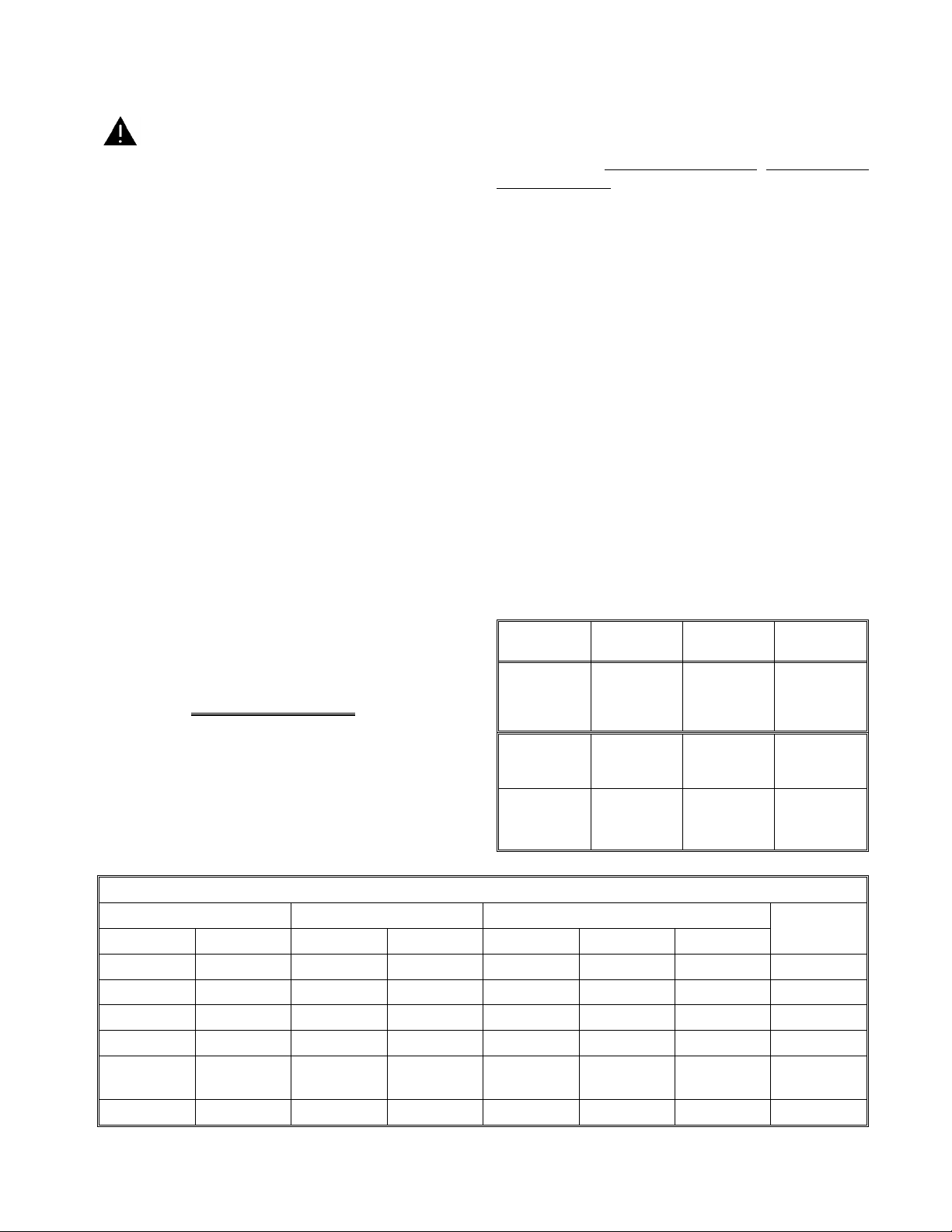
Certified Vent Kits
Kit Number
2 & 3
Certified Lower
Vent Door
615998
616009
616010
617778
Certified
Roof Jack
615791 All Models
Models
TABLE 1
DIMENSIONS
Part No. T
INCHES) for Vent Kits 2, 3, and 4
pe Length Width Height Width Radius
617778 Plastic - - - - 13 3/4 21 1/2 - - All Models
616010 S
. Corner - - - - 13 3/4 21 3/4 - - All Models
616009 Rad. corner - - - - 13 3/4 21 7/8 3 1/4 All Models
615998 Rad. Corner - - - - 13 3/4 21 7/8 3 1/4 All Models
85 Upper Side
vent
615791 Roof Jack 24 5 1/4 - - - - - - All Models
Kit Number
4
Certified Lower
Vent Door
615998
616009
616010
617778
Certified
Upper Side
Exhaust
617485
Models
442. 443
452, 453
ONLY
Cut - Out Dimension (inches
Roof Jack Lower Intake Vent Approved
Models
-- -- 7 1/4 18 -- 6052, 6053
652, 653
5
Page 6
g
g
g
y
g
g
g
g
g
g
g
g
g
g
g
j
(
j
)
(
j
)
1
g
g
(
)
3
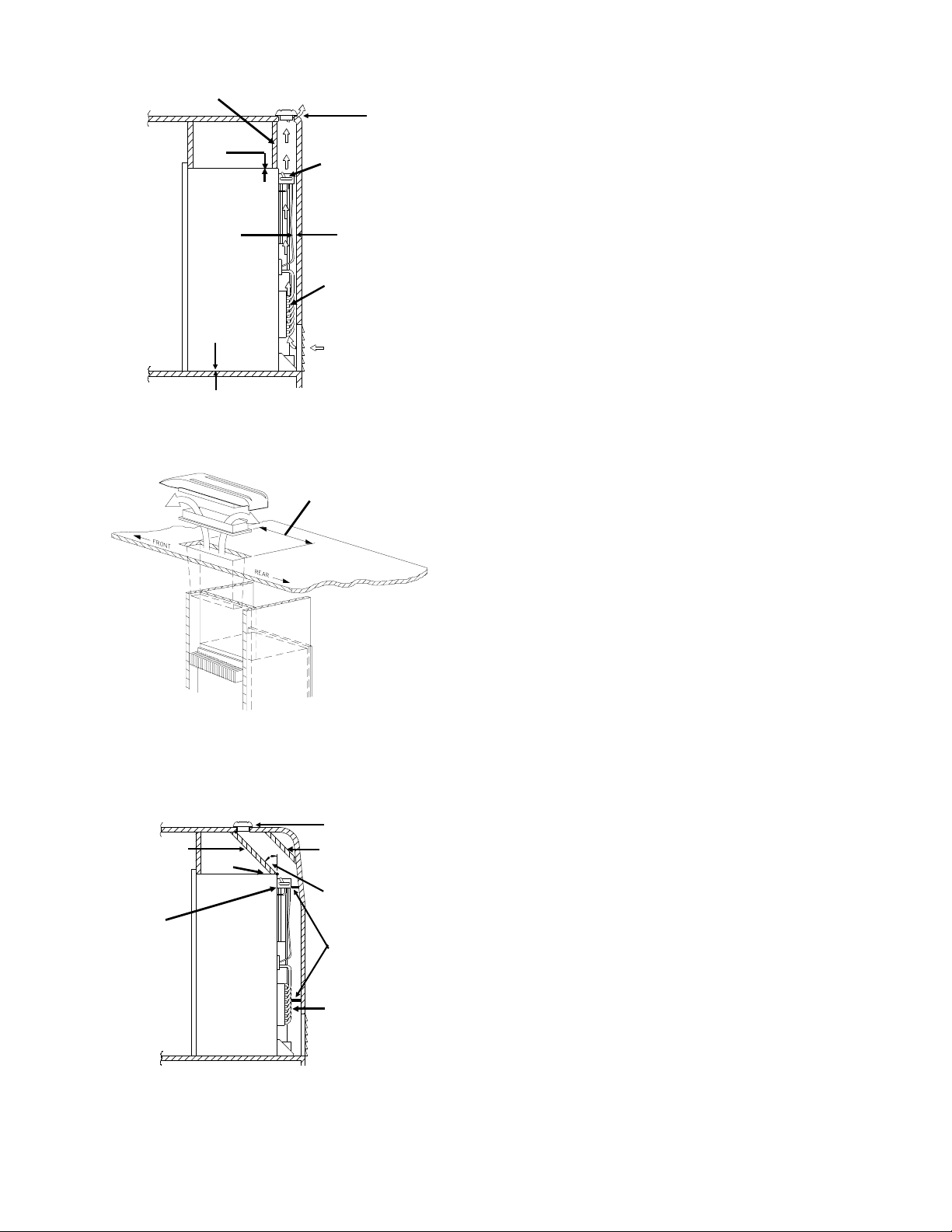
Optimum Installation - Figure 1
Fi
ure 1
2
Condenser
source of
ected heat
re
4
The optimum installation is illus trated in Figure 1.
1. Area above refri
prevent trappin
2. 0 -1/4 inch c lear anc e at the t op of the r e fri
3. Exhaust vent centered directl
erator blocked (baffled) off to
of hot air abov e the r efrigerato r.
erator.
over refrigera-
tor’s condenser.
Absorber
source of
ected heat
re
5
4. 0 - 1 inch at rear of the refri
5. 0 inch clearance at bottom of refri
erator.
erator.
Air flow path
Exhaust vent openin
centered over condenser
front to rear of vehicle
Exhaust Vent Centered - Figure 2
Figure 2 further illustrates the requirement to center
the exhaust vent openin
refri
erator.
.
over the condenser of the
Figure 2
Condenser
Figure 3
Alternate Construction Requirements
1
2
3
2
4
5
Absorber
Figure 3
1. Exhaust vent opening is inboard in relation to
the rear of the refri
2. Baffles added to the top of the refri
assist in directin
3. 0-1/4 inch clearance at the top of the refri
4. An
le between baffles and rear top edge of the
refri
erator not to exceed 45 degrees.
5. Deflectors added at rear in strate
ad
acent to the cooling units condenser and ab-
sorber coils to reduce cl earance to 0 to 1 inch.
erator.
erator to
air flow out the exhaust vent.
ic locations
erator.
6
Page 7
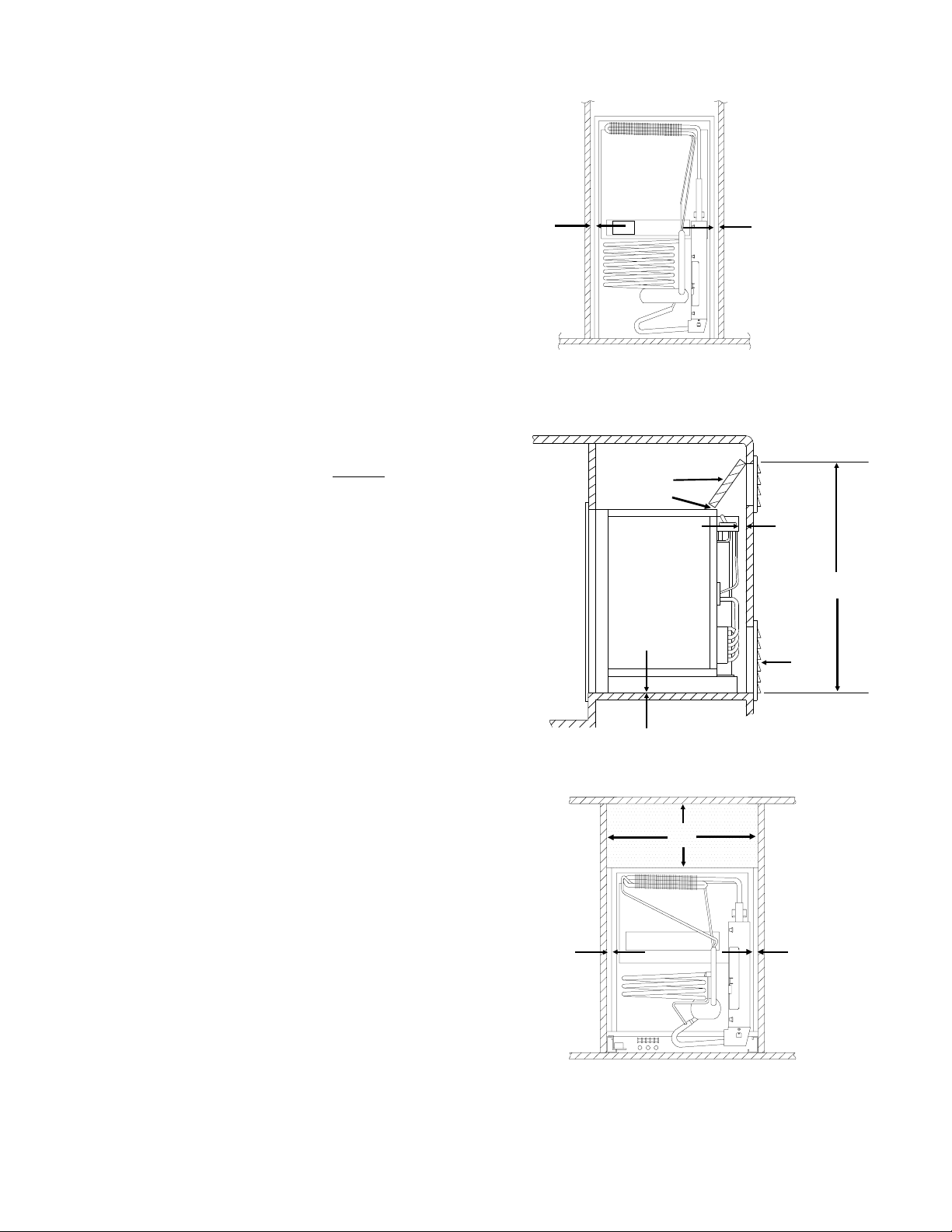
Side Wall Clearance - Figure 4
g
g
g
g
g
g
g
(
)
(
g
g
y
g
1. Figure 4 illustrates the requirement to minimize
the clearance at the sides of the refri
The clearance is not to exceed 1/2 inch. Side
clearances in excess of 1/2 inch must be either
filled with Fiber
elin
, etc.
las batting or blocked with pan-
erator.
Upper Side Wall Exhaust Vent For Models 452, 453, 44 2, and 443 ONLY
Figure 5
1. Area above refrigerator blocked (baffled) off to
prevent trappin
tor.
2. 0 - 1/4 inch clearance at the top of the refri
erator.
3. Upper Side vent Location. Floor level to top of
openin
for models 452 & 453. See Table 1 for vent
dimensions,
4. 0 - 1 inch clearance at the rear of the refri
tor.
inch
5. Intake
face on which the refri
6. O inch clearance at bottom of refri
. 38 1/8" for models 442 & 443. 50 1/2"
See Figure 3 when clearance exceeds 1
.
lower) vent installed flush with the sur-
of hot air above the refrigera-
era-
erator is mounted.
erator.
-
1
Figure 4
Figure 5
B
1
1
2
4
3
6
5
1
Top and Side Wall Clearance-All Models
Figure 6
1. Top baffle fills the total area above the refrigerator an is properl
construction.
2. 0 - 1/2 inch at the sides of the refri
aligned with the side wall
erator.
2
Figure 6
2
7
Page 8

INSTALLATION INSTRUCTIONS
y
y
y
y
g
y
gy
g
q
q
q
y
g
q
g
g
g
g
g
g
g
g
g
g
g
g
g
(
)
Certification and Code Requirements
The refrigerators described herein are certified under the latest edition of ANSI Z21.19 Standards b
the American Gas Association (A.G.A.) for installation in mobile home or recreational vehicle and approval b
Installation must be made in accordance with these
standards and with the installation instructions provided in this manual for the Norcold factor
to be in effect.
Installation must conform with local codes, or in the
absence of local codes, with the followin
as applicable:
In the United States:
When an external electrical ener
refri
ance with local codes, or in the absence of local
codes, the National electrical Code, ANSI/NFPA 70.
In Canada:
When installed, the appliance must be electricall
rounded in accordance with the current Canadian
Electrical Code C22.2 Parts 1 and 2.
the Canadian Gas Association (CGA).
warrant
standards
a. National Fuel Gas Code, ANSI Z223.1.
b. Manufactured Home Construction and Safet
Standard, Title 24 CFR, Part 23-80.
c. Standard for Recreational Vehicles,ANSI
A119.2, latest edition.
is utilized, the
erator must be electrically grounded in accord-
a. Current CGA B149.1 and B149.2 installation
code for Propane Appliances and E
b. Current CSA Z240.4.2 installation code for Pro-
pane Appliances and E
tional Vehicles.
c. Current CSA Z240.6.2/C22.2 No. 148 Electrical
Re
uirement for Recreational Vehicles.
uipment in Recrea-
uipment..
Combustion Seals
Combustion seals (foam strips) are attached to the
back surface of the refri
These seals isolate the products of combustion from
the vehicle’s livin
space.
erator’s mounting flanges.
The seals must be continuous between the wall and the mounting
flanges to
When installin
that the seals are not missin
assure a complete combustion sea
or removing the refrigerator, insure
or damaged.
Lower Flange Installation
The lower mounting flange and mounting screws
are located in a clear plastic ba
coils at the rear of the refri
plastic ba
closure and attach the lower mountin
the lower mountin
the bottom control cover and secure with the screws
provided. Refer to Fi
, slide the refrigerator partially into the en-
flange by maneuvering it under
erator. After removing the
ure 7.
tion of the lower mounting flange. This flange is
part of the combustion seal.
positioned in the
flange. Install
Do not omit installa-
l.
Cut-Out Dimensions
The refrigerators certified for built installation and
re
uires cut-out dimensions as indicated in Table 2
below.
Figure 7
TABLE 2
REFRIGERATOR CUT-OUT OPENINGS
Model
462, 463
482, 483
452,453
442,443
Height
52 7/8
59 7/8
43 1/4
30 7/8
Width
23 1/2
23 1/2
23 1/2
23 1/2
INCHES
Depth
24
24
24
24
Securing the Refrigerator
Secure the refrigerator with screws through the
mountin
and the holes at floor level at the rear of the refri
erator. Screw covers are provided to cover the front
mountin
flange holes at the front of the refrigerator
flange holes.
-
8
Page 9

Gas Connection
g
g
g
g
y
y
g
g
y
g
y
g
g
g
g
g
g
y
g
y
y
g
g
g
g
g
g
g
g
g
g
(
g
g
g
y
y
The refrigerators are designed to operate on propane
column. A pressure re
refri
the refrigerator directly to the main propane tank
without a pressure regulator.
Use supply piping and fittings that comply with local,
state, and national codes
These components should also compl
501C. Flexible metal connectors must compl
the current CAN 1-6.10 Standard. To prevent
pressure loss to the refri
be supplies b
The
b
fittin
Route the
abrasion. The
fri
rear of the refri
proximatel
clearance for the pipin
place, appl
of entr
serve as a barrier to external mois ture.
the inlet to the manual
tom rear of the refri
obtained throu
must be taken when connectin
refri
as at a supply pressure of 11 inches water
ulator is required between the
erator and the main gas tank.
overning type and size.
erator, the propane should
a 3/8 inch diameter copper piping.
as supply piping is connected to the refrigerator
means of 3/8 inch SAE (UNF 5/8 - 18) male flare
.
as supply piping to limit vibration and
as supply piping should enter the re-
erator enclosure near the gas connection at the
erator. The hole through which the
as piping enters should be of sufficient size (ap-
1/2 inch diameter) to provide adequate
. Once the gas piping is in
a sealant around the piping at its point
to minimize abrasion and vibration, and to
CAUTION: Use two wrenches when manipulating the gas inlet fitting. Failure to
use two wrenches can over stress the piping and create gas leaks.
Manual Shut-Off Valve
Hold
Turn
Figure 8
as supply is connected to the refrigerator at
The
as valve located at the bot-
erator. Access to this area is
h the vehicle’s lower vent door. Care
erator to insure the fittings are secure.
Do not connect
with NFPA
with
3/8 " Gas Suppl
the gas piping to the
as
Figure 9 Rear View
120 Volt AC Connection
WARNING: The refrigerators are designed
to operate on a 120 volt, 60 Hertz
grounded AC circuit. The refrigerator’s AC
power cord is equipped with a three-prong
grounding plug which must mate with a
three-prong grounded receptacle to protect
against possible electrical shock hazards.
Operating the refrigerator without proper
ground can cause property damage, severe personal injury, or death. It is the installer’s responsibility and obligation to
provide a properly grounded electrical circuit to the refrigerator accordance with local codes, or in the absence of local
codes, the National Electrical Code,
ANSI/NFPA 70. Do not cut or remove the
round grounding prong from the refrigerator’s AC power cord. Do not use a two
prong adapter or an extension cord.
The free len
is 24 inches. It is recommended that the three-pron
rounded receptacle be located to the left side of the
refri
erator (viewed from rear) and approximately 12
inches from the floor
power cord must be routed so as not to contact the
erator’s burner, flue pipe, or any other compo-
refri
nent which could dama
th of the refrigerator’s AC power cord
see Figure 9 above). The AC
e the cord insulation.
12 Volt DC Connection
A 12 volt DC supply is required to maintain the
flame i
models, to provide power for the DC heater. The DC
nition circuit in the gas mode and for 3-Wa
9
Page 10

supply connects to the terminal block at the rear of
g
g
g
(2)
(+)
g
(-)
y
g
g
g
g
y
y
y
g
g
g
(
ying
g
(
y
q
g
g
g
g
y
q
(
(Fig
g
g
y
)
g
y
(Fig
g
g (
g
g
g
the refri
DC should enter the refri
refri
at
DC input lead connects to terminal marked
the DC
marked
erator (See Figure 9 on page 8). The 12 volt
erator’s enclosure near the
erator’s terminal block. The 12 volt DC connects
one quarter inch quick connects. The positive
, and
round input lead connects to terminal
.
CAUTION: Correct polarity must be observed when connecting the DC supply.
Do not use the chassis of the refrigerator
or the vehicle frame as one of the conductors. Connect DC supply wires at the battery and route to the refrigerator.
tional Electric Code
When this conductor is used to bond the non-current
carr
bondin
See Figure 10 ).
metal parts of the refrigerator, a No. 10-32
terminal is provided to make the connection.
ANSI/NFPA No. 70, Art. 551).
The distance the current travels from the batter
the refri
wire can result in a volta
watta
duced refri
the installation of a fuse in the suppl
the batter
tion, install the fuse as close to the batter
ble.
TABLE 3
12 VOLT SUPPLY WIRING AND FUSE SIZE
0 - 20’ 18
over
20’18AWG
If a wire size is installed which is lar
minimum size indicated the table above, it must be
fused in accordance with the R.V.I.A. A119.2 standard or local
erator dictates the wire size. Undersized
e drop, which will affect the
e output of the DC heater and result in re-
erator performance. Norcold recommends
wiring between
and the refrigerator. For optimum protec-
as possi-
WARNING: A circuit overload can result in
an electrical fire when undersized wires or
improperly sized fuses are used. To prevent a possible electrical fire, follow
R.V.I.A. A119.2 Standards, Norcold’s wire
size and fuse specifications, or applicable
state and local codes.
482, 462
452, 442
min.
wire
size
AWG
max.
fuse
size
6 Amp 10
6 Amp 8
overning codes.
483, 463 453, 443
min.
wire
size
AWG30Amp12AWG20Amp
AWG40Amp10AWG30Amp
max.
fuse
size
Min.
wire
size
er than the
to
max.
fuse
size
Chassis Bonding Connection
A No. 8 AWG copper conductor is commonly used
to meet the chassis bondin
requirements of the Na-
Figure 10
Hypot Test
A Dielectric Strength test (hypot) has been con-
ducted at the factor
uire an additional test. If hypot tests are conducted
on the vehicle’s 12 volt circuit, the 12 vol ts
disconnected from the refri
flame i
nition circuit.
; this refrigerator does not re-
must
be
erator to protect the
Testing the Vehicle’s Gas Supply Piping
When installation of the refrigerator is complete, the
propane
tested for leaks from the refri
suppl
test for leaks with an open flame.
If compressed air is used for leak testing, the gauge
pressure must not exceed 1/2 pound per s
14 inches water column).
The appliance and its individual s hut-off valve
ure 11 on pa
as supply system during any pressure testing of that
s
stem at test pressures greater than 1/2 psig (14
inches water column
The appliance must be isolated from the
system by closing its individual manual shut-off val ve
ure 11 on page 10) during any pressure testin
of that system at test pressure equal to or less than
1/2 psi
Check the
other
not exceed 11 inches water column. With other appliances operatin
10.5 inches water column.
as supply piping must be inspected and
erator to the main gas
tank. Use a leak detection solution.
e 10) must be disconnected from the
.
14 inches water column).
as pressure to the refrigerator without
as appliances operating. The pressure should
the pressure should not be less than
Do not
uare inch
as suppl
-
10
Page 11

g
g
y
g
g
g
g
(4)
g
g
y
g
y
(
)
INSTRUCTIONS
y
ying
y (A) by
(B). (
y
g
y
j
j
g
g
g
(
y
g
y
y
g
y
g
(
)
Figure 12
Figure 11
Check Out - Flame Failure Safety Device
Before placing the refrigerator into operation, the
as safety device must be tested (see Operating Instructions on pa
safet
device is to prevent the escape of unburned
as from the burner if the burner flame is extinuished. Once a flame is established, c lose the man-
ual shut-off valve of the refri
uish and ignition spark will continue. Wait a
extin
minimum of four
shut-off valve. The burner flame will not r e-establish,
indicatin
the gas safety control is functional.
e 13). The purpose of the gas
erator. The flame will
minutes and re-open the manual
Door Panel Installation
The Norcold refrigerator doors provide slots for in-
sertin
decorative panels. Installation of the panels is
accomplished b
the decorative panel, and re-inserting the
sertin
handle assembl
doors.
ness up to 3/16" maximum.
See Figure 12
The frame slots are designed to accept panel thick-
removing the handle assembly, in-
. This procedure applies to both
1. Prepare panel b
compan
2. Remove handle assembl
screws
3. Slide panel into frame slots.
4. R e pla ce t he ha ndl e as sem bl
cutting to size indicated in ac-
chart. (See TABLE 4)
removing four
See Figure 12)
.
Instructions for Reversing Door Swing
Your refrigerator is equipped with convertible door
hin
es. The hinging of the doors can be changed to
the opposite side an
TOOLS REQUIRED
Phillips Screw driver - Size #2
Two Slotted Screwdrivers
REMOVING THE DOORS
1. Remove all items of food,
doors. Remove the
Close both doors b e f o r e r e m o vi n
2. Remove the top hin
ted screwdrivers. Remove the center hin
both pieces) using the two slotted screwdrivers; one on each end of the pin. Lastl
the bottom hin
for reassembl
time you wish.
uices, etc., from the
uice rack and storage bins.
hinge pins.
e pin using one of the slot-
e pin
, remove
e pin. Be sure to save the pins
later. (See Figure 19)
TABLE 4
PANEL DIMENSIONS
462, 463 482, 483
Upper Door 19 11/16" x 16" 19 11/16" x 16"
Lower Door 19 11/16" x 32 1/4" 19 11/16" x 39 1/4"
Figure 13
442, 443 452, 453
Door Panel 19 11/16" x 27 1/4" 19 11/16" x 39 1/4"
3. Remove the upper door b
sli
htly and pulling the bottom of the door awa
from the refrigerator. Allow enough room to
slide the door down off of the upper hin
shoulder.
See Figure 13
opening the door
e pin
11
Page 12

4 Remove the lower door by opening it slightl
y
g
g
(
g
g
(
)
g
g
g
g
j
g
g
y. (
)
q
g
q
y
g
g
j
y
g
y. (
y
g
g
g
g
(
gag
g
(
g
g
g
and pulling the top of the door away from the
refri
erator. Allow enough room so the door
can be lifted up and off of the bottom hin
shoulder
hin
middle hin
See Figures 19A, 19B, and 19C
Figure 14
REMOVING AND RELOCATING THE HINGE
BRACKETS
See Figure 18). Be sure to save the
e plates along with the spacer used in the
e bracket, for reassembly later.
e pin
RELOCATING THE TRAVEL LATCHES
8. Remove both travel latches b
two screws holdin
Use the #2 Phillips screwdriver. Remove the
two screws from each of the correspondin
holes on the opposite side of the refrigerator.
Relocate them in the two holes
the removal of the latches. Attach the latch in
the new position so the tab points towards the
opposite side of the refri
screws completel
Figure 16
each to the refrigerator.
See Figure 16)
taking out the
ust exposed b
erator. Do not tighten
5. Remove the middle hin
#2 Phillips screwdriver and takin
screws holdin
three screws on the opposite side correspondin
to the center hinge location. Relocate them
in the holes
hin
e bracket. Attach the hinge bracket to the
refri
erator on the opposite side. Do not tighten
screws completel
Figure 15
6. Remove the top hinge bracket and reposition it
in the opposite bottom corner. Use the same
techni
7. Remove the bottom hin
tion it in the opposite top corner. Use the same
techni
ue as outlined in Step #5.
ue as outlined in Step #5.
it in place. Next, remove the
ust exposed by the removal of the
e bracket by using the
out the three
See Figure 15
e bracket and reposi-
9. Turn the door over so that the end previousl
at the bottom is now at the top. Relocate the
bottom of the door on the bottom hin
shoulder. Close door and ali
hin
e brackets. The magnetic gasket will hold
the door in place. Before reinstallin
door, check to insure that the spacer is in
place.
ure 17
Fi
10. Reposition the upper door i n a simil ar manner
as described in Step #9, except the top of the
door must be en
shoulder before settin
See Figure 18)
11. Startin
the slotted screwdrivers. Tighten all screws.
See Figures 17 and 19C)
ed into the hinge pin
at the top, replace the hinge pins usin
n holes in top
the door in place.
e pin
the top
12
Page 13

g
g
j
g
g
y
g
g
y
y
g
j
(
g
A: Top Hinge B: Bottom Hinge
g
Figure 18
ALIGNMENT OF THE DOORS
12. Ali
n the upper door with the lower so that
there is a parallel
around the frame. Ad
net so the
Ti
hten the screws holding the hinge brackets
ap between the doors and
ust the doors to the cabi-
askets seal but do not bind.
in place.
13. Door Seal: The door seal can be checked b
closing the door on a 1" x 6" strip of paper. A
sli
ht drag should be noticed when the paper is
pulled out from between the
asket and the
cabinet. Repeat the process around all four
sides of the door. If the door does not seal
properl
14. Position the travel latches so that the
, readjust the hinge brackets.
secure
the doors when closed but does not prevent
the doors from closin
properly. Tighten the
two screws in each travel latch.
15. Replace the
uice rack and storage bins into
the door. Make sure that the milk bins
stora
e bins) are installed in the lowest door
position.
wider
C: Middle Hin
Figure 19
e D: M iddle Hinge
13
Page 14

Lighting and Start Up Procedures
g
g
(C)
g
g
(D)
(D)
(B)
(
y
(B)
g
g
y
g
g
(B)
(C)
g
g g
g
y
g
g
(C)
g
(D)
y
g
(A)
(C)
(E)
g
(D)
y
(D)
g
(C)
)
y
(E)
y
WARNING:
DO NOT HOLD GAS VALVE (D) IN MORE THAN 30 SECONDS. IF FLAME IS NOT INDICATED WITHIN
THIS TIME, TURN GAS TO OFF, WAIT 2 MINUTES AND RETRY. CONTINUING TO HOLD GAS VALVE IN
WILL CAUSE GAS BUILD-UP IN THE BURNER AREA AND CAN RESULT IN AN EXPLOSION WHICH
CAN CAUSE PERSONAL INJURY OR DEATH.
2-Way and 3-Way Models
Lighting Instructions: Gas Operation
1. Make certain that 12 Volts DC is available to
the refri
MAL position.
2. Turn on
3. Set thermostat control
4. Set i
le light (A) located on the switch will illuminate
if 12 volts DC is present.
5. Push and rotate the "ELEC-OFF-GAS" control
on the knob. Push the control knob
hold until the flame indicator
continuous glow). Continue to hold approximatel
cator
NOTE: In normal use the flame should i
6. Move thermostat control
7. The ignitor switch (A) should be left in the
"ON" position durin
switch is turned off, the refri
normall
the reli
erator and divider switch is in NOR-
as supply at the tank.
to COLDEST setting.
nitor switch (A) to "ON" position. The tog-
counter-clockwise so that "GAS" is visible
in and
illuminates
5 seconds, then release. The flame indi-
will remain on. If not repeat this step.
nite
within 10 seconds. On initial refri
start-up, it ma
onds to allow air to be pur
as line, as indicated by the flame indica-
tor
failing to illuminate.
Do not hold gas control valve (D) in more
than 30 seconds. See WARNING above.
. However, in case of flame blowout,
hter does not function.
take longer than 10 sec-
to desired settin
as operation. If the
erator will cycle
erator
ed from the
Start-Up Instructions: AC Elec tric Ope rati on
1. Make certain that 120 Volts AC and 12 Volts
DC are available to the refri
switch is in NORMAL position.
2. Set thermostat control
3. Set i
4. Push and rotate the "ELEC-OFF-GAS" control
nitor switch (A) to "OFF" position.
erator and divider
to desired setting.
clockwise so that "ELEC" is visible on the
knob. Upon release, note that the knob moves
toward
into electric operation.
ou, indicating that the control is locked
Start-Up Instructions: DC Electric Operation - 3-Way models
1. Make certain that 12 Volts DC is available
to the refri
MAL position, and "GAS IGNITOR" switch
is "OFF".
2. Set thermostat control
3. Set "AC-STDBY-DC" switch
tion.
4. Set i
5. Push and rotate the "ELEC-OFF-GAS" control
nitor switch (A) to "OFF" position.
clockwise so that "ELEC" is visible on the
knob. Upon release, note that the knob moves
toward
into electric operation.
erator, divider switch is in NOR-
to desired setting.
to "DC" posi-
ou, indicating that the control is locked
Operation Shut-Down: All Modes
1. Set ignitor switch (A) to "OFF" position.
2. Push and turn "ELEC-OFF-GAS" control
to "OFF".
3. For lon
STORAGE-HUMIDITY switch to STORAGE.
Operation Note
to shut off all cooling operation (both Gas and
Electric
MAL-STORAGE-HUMIDITY" switch must be shut off
independentl
STDBY-DC" switch
shut off AC or DC operation.
er periods of shut-down, set NORMAL-
: Use the "ELEC-OFF-GAS" control
. The "GAS IGNITOR" switch and the "NOR-
. The "STDBY" position of the "AC-
can be used to temporaril
14
Page 15

OPERATING AND USER INSTRUCTIONS
THIS APPLIANCE HAS BEEN DESIGNED FOR
STORAGE OF FOODS, STORAGE OF FROZEN
FOODS, AND MAKING ICE WHEN INSTALLED AS
DIRECTED BY THIS MANUAL.
Location of Controls
Figure 18 illustrates the location of the 400 Series
refrigerator’s operating controls. All oper ating controls
are conveniently located below the door .
Figure 20
Ignition Switch
Flame
Indicator Lamp
Thermostat
Gas On/Electric
and Safety Valve
AC/DC Selector Switch
3-Way Models Only
Operating Controls Function
Ignition S witch
The ignition switch is used for the Gas operation
only. When the ignition switch is turned "ON", the
switch will illuminate indicating that 12 volt DC is
available and being supplied to the electronic ignition
which generates ignition spark to the burner.
Flame Indicator Lamp
When a flame is established at the burner, the
Flame Indicator Lamp will illuminate indicating the refrigerator is operating on gas.
Thermostat
For AC electric, push and turn clockwise until the
knob is pointing to"ELEC". Note, upon release the
knob will move towards you, indi cating that the operating control is locked into the A C electric mode.
Safety Valve
- During the gas ignition process, the
safety valve knob must be held in until a flame is
established at the burner.
The safety valve is designed so that any loss of
flame will stop the gas flow to the burner. It is controlled by means of a thermocouple that is positioned
in the flame. As long as a flame is detected by the
thermocouple, the valve will remain open. Upon
flame failure, the valve closes, shutting off the gas
flow to the burner.
AC/DC Selector Switch
This switch is utilized on 3-Way models
only
. The
switch selects either 120 volt AC or DC electric
modes of operation. The center position of the switch
is a "Stand-By" mode which will temporarily turn off
the electric positions.
Gas Operation
The gas burner is designed to operate on propane
gas only. The gas control is equipped with an ignition
relighter, offering the features of automatic re-ignition
in case of flame blowout, positive fl ame sensing, and
easier gas start-up. The ignition relighter is powered
by 12 volts DC and is controlled by the ignitor switch
located on the control panel. When the switch is in
the "OFF" position, no ignition spark is present.
When the switch is in the "ON" position, the relighter
produces a rapid spark at the gas burner. The spark
occurs at a rate of 1 to 2 times per second until a
flame is present (Refer to "Lighting Instructions").
The spark continues until a flame is sensed or until
the ignitor switch is turned off. When the flame is
sensed, the relighter discontinues the spark and the
flame indicator illuminates. The flame indicator lamp
will cease to illuminate upon loss of burner flame.
During gas operation, the current draw for the re-ignition system is very low, approximately 30 milliamps
(.030 amps).
The thermostat controls all modes of operations,
thereby eliminating the necessity of resetting each
time a different power source is selected. Rotate the
knob clockwise to make the refrigerator cabinet
colder.
Gas ON/Electric and Safety Valve
Gas ON/ELECTRIC
allows the user to select an
operating mode. For gas, push and turn the knob
counter-clockwise until the knob is pointi ng to "GAS".
120 Volt AC Operation
While parked, the coach normally operates from a
120 volt AC source. The refrigerator can be very easily switched to AC operation.
!2 Volt DC Electric Op eration
The refrigerator receives its DC power from the vehicle’s 12 volt system; either an auxiliary battery, a
converter, or the engine battery. The 12 volt DC sys-
15
Page 16

tem not only supplies power to the refrigerator, but to
other DC components in the vehicle.
DC electric operation is not as efficient as LP Gas
or AC electric operation, and should therefore be
used only when the other modes are unavailable (for
example; while in transit - 4 to 6 hours). Reminder,
before using the DC electric mode, the refrigerator
must be cooled using either gas or electric.
High Humidity - Storage Switch
Models 482,3 & 462,3 Only
Figure 21
The models 482,3 and 462,3 are equipped with a
heater that prevents moisture from forming on the
center divider between the freezer and the fresh food
compartment doors. The heater is activated by turning the NORMAL OPERATION-STORAGE-HIGH
HUMIDITY switch to the HIGH HUMIDITY position.
The switch should be left in the NORMAL OPERATION position unless condensation is observed in
this area.
When your RV is being stored for the winter, the
High Humidity - Storage switch should be placed in
the STORAGE (light off) position and ELEC-OFFGAS control to OFF. This shuts off all DC power to
the light and humidity heater and allows the refrigerator door to be left open for airing without chance of
battery drain during storage (See "Information Regarding Battery Drain")
Interior Light-Models 482,3 & 462,3 Only
The interior light is located at the top of the fresh
food compartment. The light will turn on when the
fresh food compartment door is opened and off when
the door is closed. Power to the light is activated
when the NORMAL OPERATION-STORAGE-HIGH
HUMIDITY switch is set to either NORMAL OPERA TION or HIGH HUMIDITY positions.
To replace the light bulb, disconnect the 12 volt DC
from the refrigerator from the rear of the refrigerator.
Remove the light cover by sl iding it towards the fron t
to gain access to the bulb.
Remove the bulb from its bracket. Replace the bulb
with a GE #214-2 bulb (Norcold part number
61628922), which can be purchased from most retail
automotive centers. Re-install light cover. Reconnect
the 12 volt DC.
Information Regarding Battery Drain
A 12 volt DC source is required for the gas mode
and the DC electric mode of operations. For the
gas operation, the DC power source supplies voltage for the electronic ignition. The current draw is
less than 30 milliamps. For models 482,3 and
462,3, if the HIGH HUMIDITY (MOISTURE REDUCTION HEATER) and the interior light were left
on, the total DC current draw would be 900 milliamps (.9 amps). This indicates that the drain on
the battery is very low and has little effect on "battery run down" unless the battery is left connected
for long per iods of time w ithout recha rging.
During AC electric operation there is no battery current drain, unless the interior light or moistur e reduction heater (HIGH HUMIDITY) is energized (
482,3 and 462,3
For the DC electric operation, the DC power source
supplies voltage for the cartridge heating element.
For models 443 and 453, the DC electric operation
draws approximately 9 amps at 12 volt DC. For models 483 and 463, the DC electric operation draws approximately 14 amps at 12 volt DC. If the battery
charging means is lost during DC operation, for instance during short stops, the refrigerator could be
switched to Gas, AC (if connected) or to the Standby
switch position until the charging means is re-established.
The DC voltage should be checked whi le operating
in the DC mode. The voltage at the refrigerator
should never drop below 11.5 vol ts.
During periods when the refrigerator is not used
(seasonal storage, etc.) the NORMAL OPERATIONSTORAGE-HIGH HUMIDITY switch should be
switched to STORAGE and the ELEC-OFF-GAS set
at OFF. This shuts off all DC drain. The Ignitor switch
must be turned off when not in use.
).
models
Operation in Transit
While the refrigerator should be level when the vehicle is stopped, performance during transit is not
normally affected.
Refrigerator Storage Volume
CAUTION: Do not replace with a bulb of
higher wattage. Higher wattage bulbs can
damage the interior surface of the fresh
food compartment.
Models 482,3 462,3
Storage Volume 7.5 cu. ft. 5.9 cu. ft
Models 442,3 452,3
Storage Volume 3.1 cu.ft. 4.3 cu. ft.
16
Page 17

Leveling
Comfortable vehicle leveling is well within the refrigerator’s operating requirements of 3 degrees off
level side-to-side and 6 degrees off level front-toback (looking at the front of the refrigerator). Continued operation outside of these limits can result
in irreparable damage to the cooling system.
Freezer Compartment
This compartment is not designed for the quick
freezing of food but designed to retain food in a frozen state. Foods purchased for storage in the freezer
compartment should be frozen when purchased to
reduce the load on the refrigerator system.
IMPORTANT
Water will freeze more rapidly if the thermostat is at
it’s coldest setting.
For models 482,3 and 462,3, the freezer shelf can
be adjusted or removed to meet your s torage needs.
: Ice trays must be placed on the
bottom freezer surface when
making ice.
Fresh Food Compartment
erator interior. This will help to prolong the life of the
gaskets.
Door Latch
The refrigerator’s built-in door latch prevents the
door from flying open during transit. There are no
chains or slides to remember to actuate when the
vehicle starts moving (See Figure 25). Always close
the door to the sealed position (audible clicks) to prevent cooling loss and heavy frost.
Important Notice:
Read and understand this notice before removing this refrigerator, re-installing this refrigerator,
or performing any maintenance on this refrigerator. Norcold will not accept responsibility for improper installation, adjustment, alteration, service, or maintenance performed by anyone other
than a qualified dealer or a Norcold service center. Costs or related consequential problems resulting from improper installation, adjustments,
alteration, service, or maintenance are the refrigerator owner’s responsibility.
The fresh food compartment stores and cools food.
For best cooling performance, air must be free to
circulate within the fresh food compartment.
Do not
cover the shelves with paper, pl astic, etc.
To reduce frost formation on the cooling fins, cover
liquids and moist foods, do not place hot foods in the
compartment, and do not leave the door open longer
than needed.
Allow the refrigerator to cool for 8 hours before
loading foods. Loading a warm refrigerator with warm
food increases the cool down period.
Defrosting and Cleaning the Refrigerator
Interior
Your refrigerator is not frost free and will require periodic defrosting. To defrost, turn the refrigerator off.
Empty the freezer and the fresh food compartments.
Placing a pan of hot water in the freezer will reduce
the defrosting time. Leave the drip tray under the
cooling fins. After frost has melted, empty the drip
tray and clean the refrigerator.
Add a small quantity of mild dish detergent to lukewarm water and wash the interior of the refriger ator.
Do not use abrasive cleansers; they can damage
the interior surfaces of the refrigerator
both compartments in a solution of baking soda and
water (one table spoon of baking soda to one quart
of water) will freshen the interiors and neutralize
odors. Dry the interior with a soft cloth to remove
excess moisture and to prevent water spots. Clean
the door gaskets in the same manner as the refrig-
. Rinsing
Refrigerator Maintenance
1. Leak test gas supply piping and fittings at least
once a year. This procedure should only be
performed by your dealer or a Norcold service
center. These facilities are familiar with gas refrigerators and propane gas systems.
2. Check the main line gas pressure periodically
and adjust if necessary. The correct input gas
pressure is 11 inches water column. It is recommended that your dealer or a Norcold service center perform this task.
3. Clean the refrigerator’s burner and burner orifice. This procedure is required once a year
minimum and should only be performed by
your dealer or a Norcold service center. These
facilities are familiar with gas refrigerators and
propane gas systems.
4. Insure that the LP gas supply is Propane, not
another fuel such as Butane or Butane mixtures.
5. Periodically inspect the burner flame appearance during gas operation. See "Burner Flame
Inspection on page 17.
6. Inspect the electrode assembly to insure it is
secure to the burner bracket.
7. Inspect the flue of the refrigerator’s cooling system. This area must be free of foreign materials. Foreign materials observed in the flue indicate the burner requires cleaning.
8. Insure the area directly behind the refrigerator
17
Page 18

is not being used for storage. Keep the refrigerator area clear and free from combustible
materials, gasoline, and other flammable vapors and liquids.
9. Periodically inspect the ventilation system. The
air passage from the bottom intake vent to the
refrigerator coils and from the refrigerator coils
through the upper exhaust vent must be unobstructed.
10. Inspect combustion seals (visual check without
removing the refrigerator). Combustion seals
are attached the back surfaces of the refrigerator’s mounting flanges and must be continuous
between the wall and the mounting flanges to
assure a complete combustion seal.
11. Periodically inspect door seals. See "Checking
Door Seals" below.
Checking Door Seals
To insure cooling efficiency and to prevent frost for-
mation, the door gasket must seal compl etely.
To check for proper door seal, lay a strip of paper
between the gasket and the refrigerator. Close the
door and withdraw the paper. A frictional drag should
be noticed. Repeat all around the door. If the paper
does not have a noticeable drag, the gasket is not
sealing. Contact your dealer or a Norcold service
center for corrective procedures.
Refrigerator Storage
When the refrigerator will not be in use for an extended (seasonal) period of time, it is recommended
that all power to the refrigerator be disconnected. Unplug the refrigerator’s AC power cord from the wall
receptacle and disconnect the 12 volt DC from the
refrigerator’s terminal block located at the rear of the
refrigerator. Clean the refrigerator interior and leave
the door(s) open to keep the interior odor free. After
the extended shut-down period, the burner, burner
orifice, and flue must be inspected before igniting the
burner flame. These areas must be free from dust,
spider webs, or other obstructions which might restrict the combustion system.
Burner Flame Inspection
The efficiency of your refrigerator while operating in
the gas mode is independent upon the correct burner
flame. The burner flame provides energy to the refrigerator’s cooling system.
The burner flame efficiency is a function of correct
input gas supply pressure, air input, and burner and
burner orifice cleanliness.
A visual check of the burner flame should be made
regularly. The flame should be sharp blue with a sta-
ble burning appearance (Figure 22). If there is a constant yellow component observed or if the flame appears erratic or unstable, switch the refrigerator to
electric or turn the refrigerator "OFF" and contact
Figure 22
your dealer or a Norcold service center.
Refrigerator Removal a nd Replacement
1.
1. Turn off the gas at the main supply tank(s).
2. Turn the refrigerator off.
3. Turn the refrigerators manual shut-off to off.
4. Disconnect the refrigerator’s AC power cord
from the wall receptacle.
5. Disconnect the 12 volt DC supply from the refrigerator’s terminal block.
6. Disconnect the LP gas supply li ne from the refrigerator.
7. Remove the mounting screws securing the refrigerator
or to the enclosure.
8. Remove refrigerator form the enclosure.
To Reinstall the Refrigerator:
1. Before reinstalling the refrigerator, inspect the
areas behind the mounting flanges for damaged or missing seal strips (combustion s eals).
These seal strips serve as a combustion seal
which isolates the living space of the vehicle
form the refrigerator’s combustion system.
2. Reinstall the refrigerator by reversing the above
procedures.
3. After reinstalling the refrigerator, check the gas
fitting connections for leaks. Do not check for
leaks with an open flame. Use an approved
leak-detection solution.
18
Page 19

SYMPTOM
Refrigerator does not
operate in AC Mode
SYMPTOM
Refrigerator does not
operate in Gas Mode
Trouble Shooting
Possible Causes
* Mode Selection switch may be set to
"OFF" or "GAS".
* Temperature Selector set too low.
* Refrigerator’s power cord may not be se-
curely plugged in.
* Circuit breaker or fuse may be tripped
or blown (AC power source to refrigera-
tor).
* Wall outlet may be inoperative. (This
can be checked by trying a different ap-
pliance in the same outlet.)
* If unit fails to operate after the above
items have been checked, unplug refrig-
erator and contact a service center.
Possible Causes
* Temperature Selector set too low.
* May be using gas other than LP gas.
TURN OFF GAS AND CONTACT
SERVICE CENTER.
* Gas not available to refrigerator
(clogged gas supply line, empty tanks,
etc.). Contact service center.
* Burner and orifice need cleaned.
* Spark ignitor needs replaced.
* If unit fails to operate after the above
items have been checked, unplug the
unit and contact a service center.
SYMPTOM
Poor Performance,
Gas and Electric
Possible Causes
* Incorrect power supply.
* Incorrect installation.
* Refrigerator off level.
* Unusually high ambient temperatures.
* Door opened frequently or for extended
periods.
* Internal cabinet air circulation (wire
shelves) blocked by food items, paper,
or plastic.
* Hot foods placed in refrigerator.
* Refrigerator needs defrosting.
* Temperature selector set too low.
19
Page 20

FAILURE OF REFRIGERATION
Failure of refrigeration does not necessarily indicate
that the cooling system is defective. Other factors
governing its operation must be checked.
If the refrigerator is operating on gas and a loss of
cooling is noticed, switch the refriger ator to AC electric operation. (See "Operating Instructions on page
13). If the refrigerator has been operating on elec tric,
switch to gas operation. After the refrigerator has
been switched from one power source to the other
allow several hours to assure the refrigerator is cycling properly. This will help to determine if a component failure in the electric or gas control’s is causing
the cooling fault. If no cooling is evident after eight
hours (or overnight), you must contact your dealer or
a Norcold service center to determine the cause of
failure.
Note: Do not attempt to operate the refrigerator on DC when analyzing the cooling
unit performance. The DC electric mode of
operation is designed for short periods of
operation only and will not power the cooling unit to its full capabilities.
Replacement Parts
* Available at most auto supply companies.
20 Amp. Fus e Littelfuse SFE-20
15 Amp Fuse Littlefuse SFE-15
3 Amp. Fuse Littelfuse 1 AG-3
5 Amp. Fuse Buss AGC-5
Description Model 4423 Model 452,3
Milk Bin 61579425 61579425
Dairy Keeper Lid 61580425 61580425
Ice Cube Tray 61630422 61630422
Crisper -------- 61571325
Storage Bin 61564025 61564025
Outer Door Gasket 61640030 61568030
Freezer Door Gasket 61618730 61618730
Burner Orifice 61452122 61452122
Burner Gasket 61475122 61475122
Knob - Thermostat 61642322 61642322
Knob Selector 61641822 61641822
Fuse - DC Heater *61446022 *61446022
(3-Way only) (15 Amp) (15 Amp)
Fuse - 12 Volt Control *61654622 * 61654622
(3 Amp) (3 Amp)
Fuse - AC *61611622 * 61611622
(5 Amp) (5 Amp)
Owner’s Manual 618484 618484
The following is a list of parts which can be replaced by the owner and are obtainable from all Norcold Service Centers.
Description Model 482,3 Model 462,3
Ice Cube Tray 61630422 61630422
Crisper 61571340 61571340
Juice Rack 61580525 61580525
Storage Bin 61564025 61564025
Milk Bin 61579425 61579425
Freezer Door Gasket 61567830 61567830
Lower Door Gasket 61568030 61567930
Cabinet Lamp 61628922** 61628922**
Burner Orifice 61452222 61452222
Burner Gasket 61475122 61475122
Knob - Thermostat 61642322 61642322
Knob Selector 61641822 61641822
Fuse/DC Heater *61440522 *61440522
(3-Way Only) (20 Amp) (20 Amp)
3 Amp Fuse/12 Volt 61654622* 61654622*
5 Amp Fuse/AC 61611622* 61611622*
Owner’s Manual 618484 618484
** GE PART NUMBER 214-2: DO NOT SUB STITUTE.
Le manuel de langue anglaise est disponsible sur
demande, par l’lintermédiaire de vorte revendeur.
N° de piéce: 618506
.
SERVICE INFORMATION
IF SERVICE OR PARTS ARE REQUIRED,
CONTACT THE NEAREST NORCOLD
SERVICE CENTER.
A NORCOLD SERVICE CENTER BOOKLET HAS BEEN INCLUDED WITH THE REFRIGERATOR INFORMATION PACKET.
202122
Page 21

Page 22

Page 23

LIMITED WARRANTY
NORCOLD SERVICE CENTER
P O BOX 4248
SIDNEY OH 45365-4248
This Limited Warranty is given by NORCOLD ("Company") to the original consumer-purchaser of any new
refrigerating equipment ("Equipment") supplied by the Company, excluding glassware and electric light bulbs,
and will be effective for a period of one year from date of original purchase. The Company war rants, provided
that the Equipment shall at all times have been in possession of and used by the original consumer-purchaser, that:
A. The Company will provide free service and replacement of defective parts at no charge at all authorized
Norcold Service Centers for a period of one year from the date of original purchase. This Limited Warranty covers labor costs incurred in removing and re-installing the refrigerator only when necessary to
replace a defective part. The Company will pay inbound and outbound transportation costs of any defective part, for a 1-year period commencing with date of purc hase. The original consumer-purchaser must
pay all expenses incurred in making the equipment available at one of the Norcold Service Centers.
B. The following procedure must be followed by an original consumer-purchaser desiring to obtain per-
formance under the terms of this Limited Warranty. The refrigerator must be brought to any of the
Norcold Service Centers and the original consumer-purchaser must present evidence (1) to identify
the original consumer-purchaser: and (2) that the item claimed to be defective is still within the
warranty coverage. If the original consumer-purchaser is unable to accomplish this task, written notice should be immediately directed to Norcold and advice will be promptly given concerning the
manner in which warranty service may be obtained. Inability to physically bring the refrigerator to a
Norcold Service Center will not void the warranty, but any additional costs thereby incurred are solely
the responsibility of the original consumer-purchaser.
C. The Company will not be liable under this Limited W arranty for any of the following:
(1) Defec ts which arise by r eason of transit damage, mis use, neglect or acci dent.
(2) Manufacturing defects found at the time of purchase which are not communicated to the Company
within 30 days.
(3) D efects in glassware and electric light bulbs.
(4) Defec ts arising from improper i nstallation or adjustment of the Equipment.
(5) The need for normal maintenance of this refrigerator, including the cleaning of the flue di lution assem-
bly and orifice, and the adjustment of the gas pressure regulator in the case of gas-electric models.
(6) Defec ts arising from the improper use of parts or parts not manufactured or supplied by the Company
in the course of repairs or replacements to the Equipment.
D. Employees and agents of the Company, and its authorized service representatives, hav e no authority to
vary the terms of the Limited Warranty, whi ch applies only to Equipment purchased and installed i n the
United States of America and the Dominion of Canada. The Company reserves the right to make any
improvements or changes in parts or models without notice to any or iginal consumer-purchaser.
E. The Company shall not be liable or in any way respons ible for any loss or damage to person or property,
or lost profits or other similar loss or damage that may result or be claimed to have resulted from a
defect in any parts of the Equipment covered by this Limited Warranty. Some states do not allow the
exclusion or limitations of any incidental of consequential damages, so the above limitation or exclusion
may not apply to you.
F. A NY IMPLIED WARRANTY OF MERCHANTABLITY OR FITNESS FOR A PARTICULAR PURPOSE:
(1) APPLICABLE TO A PART OR PARTS OF THE REFRIGERATOR IS LIMITED TO A PERIOD OF
ONE YEAR FROM DATE OF PURCHASE.
(2) SOME S TATES DO NOT ALLOW LIMITATIONS ON HOW LONG AN IMPLIED WARRANTY LASTS.
THE ABOVE LIMITATIONS MAY NOT APPLY TO YOU.
G. This Warranty gives you specific legal rights, and you may also have other rights which vary from state
to state.
23
 Loading...