

MULTIQUIP Essick, Essick PRO12, Essick PRO12E51, Essick PRO12E53-460V, Essick PRO12E53 Operation Manual
Page 1

OPERATION MANUAL
SERIES
MODELS
PRO12/PRO12E51
PRO12E53/PRO12E53-460V
HYDRAULIC PLASTER/MORTAR MIXERS
(HONDA GX390RT2-QNB2 GASOLINE ENGINE/
TECO WESTINGHOUSE 5HP ELECTRIC MOTOR)
Revision #4 (10/30/19)
To find the latest revision of this publication or
associated parts manual, visit our website at:
To find the latest revision of this
publication, visit our website at:
www.multiquip.com
www.multiquip.com
THIS MANUAL MUST ACCOMPANY THE EQUIPMENT AT ALL TIMES.
Page 2

PROPOSITION 65 WARNING
PAGE 2 — PRO12 HYDRAULIC MIXER • OPERATION MANUAL — REV. #4 (10/30/19)
Page 3

SILICOSIS/RESPIRATORY WARNINGS
WARNING
SILICOSIS WARNING RESPIRATORY HAZARDS
Grinding/cutting/drilling of masonry, concrete, metal and
other materials with silica in their composition may give
off dust or mists containing crystalline silica. Silica is a
basic component of sand, quartz, brick clay, granite and
numerous other minerals and rocks. Repeated and/or
substantial inhalation of airborne crystalline silica can
cause serious or fatal respiratory diseases, including
silicosis.In addition, California and some other
authorities have listed respirable crystalline silica as a
substance known to cause cancer. When cutting such
materials, always follow the respiratory precautions
mentioned above.
WARNING
Grinding/cutting/drilling of masonry, concrete, metal and
other materials can generate dust, mists and fumes
containing chemicals known to cause serious or fatal
injury or illness, such as respiratory disease, cancer,
birth defects or other reproductive harm. If you are
unfamiliar with the risks associated with the particular
process and/or material being cut or the composition of
the tool being used, review the material safety data
sheet and/or consult your employer, the material
manufacturer/supplier, governmental agencies such as
OSHA and NIOSH and other sources on hazardous
materials. California and some other authorities, for
instance, have published lists of substances known to
cause cancer, reproductive toxicity,or other harmful
effects.
Control dust, mist and fumes at the source where
possible. In this regard use good work practices and
follow the recommendations of the manufacturers or
suppliers, OSHA/NIOSH, and occupational and trade
associations.Water should be used for dust
suppression when wet cutting is feasible. When the
hazards from inhalation of dust, mists and fumes cannot
be eliminated, the operator and any bystanders should
always wear a respirator approved by NIOSH/MSHA for
the materials being used.
PRO12 HYDRAULIC MIXER • OPERATION MANUAL — REV. #4 (10/30/19) — PAGE 3
Page 4

PRO12 Hydraulic Mixer
Proposition 65 Warning ........................................... 2
Silicosis/Respiratory Warnings ................................ 3
Table of Contents ..................................................... 4
Safety Information ............................................. 6–10
Specifications ........................................................ 11
Dimensions ............................................................ 12
General Information ............................................... 13
Components (Mixer) ........................................ 14–15
Components (Engine) ............................................ 16
Electric Motor ........................................................ 17
Inspection ........................................................ 18–20
Paddle Blade Adjustment ...................................... 21
Operation ......................................................... 22–26
Maintenance .................................................... 27–29
Troubleshooting (Engine) ................................. 31–32
Troubleshooting (Motor) ......................................... 33
Troubleshooting (Mixer) ......................................... 34
Hydraulic Hose Connections ................................. 35
Hydraulic System Locator ...................................... 36
Hydraulic System Diagram .................................... 37
Electric Motor (Single Phase) Wiring Diagram ...... 38
Electric Motor (Three Phase) Wiring Diagram ....... 39
TABLE OF CONTENTS
NOTICE
Specifications and part numbers are subject to change
without notice.
PAGE 4 — PRO12 HYDRAULIC MIXER • OPERATION MANUAL — REV. #4 (10/30/19)
Page 5

NOTES
PRO12 HYDRAULIC MIXER • OPERATION MANUAL — REV. #4 (10/30/19) — PAGE 5
Page 6
SAFETY INFORMATION
Do not operate or service the equipment before reading
the entire manual. Safety precautions should be followed
at all times when operating this equipment.
Failure to read and understand the safety
messages and operating instructions could
result in injury to yourself and others.
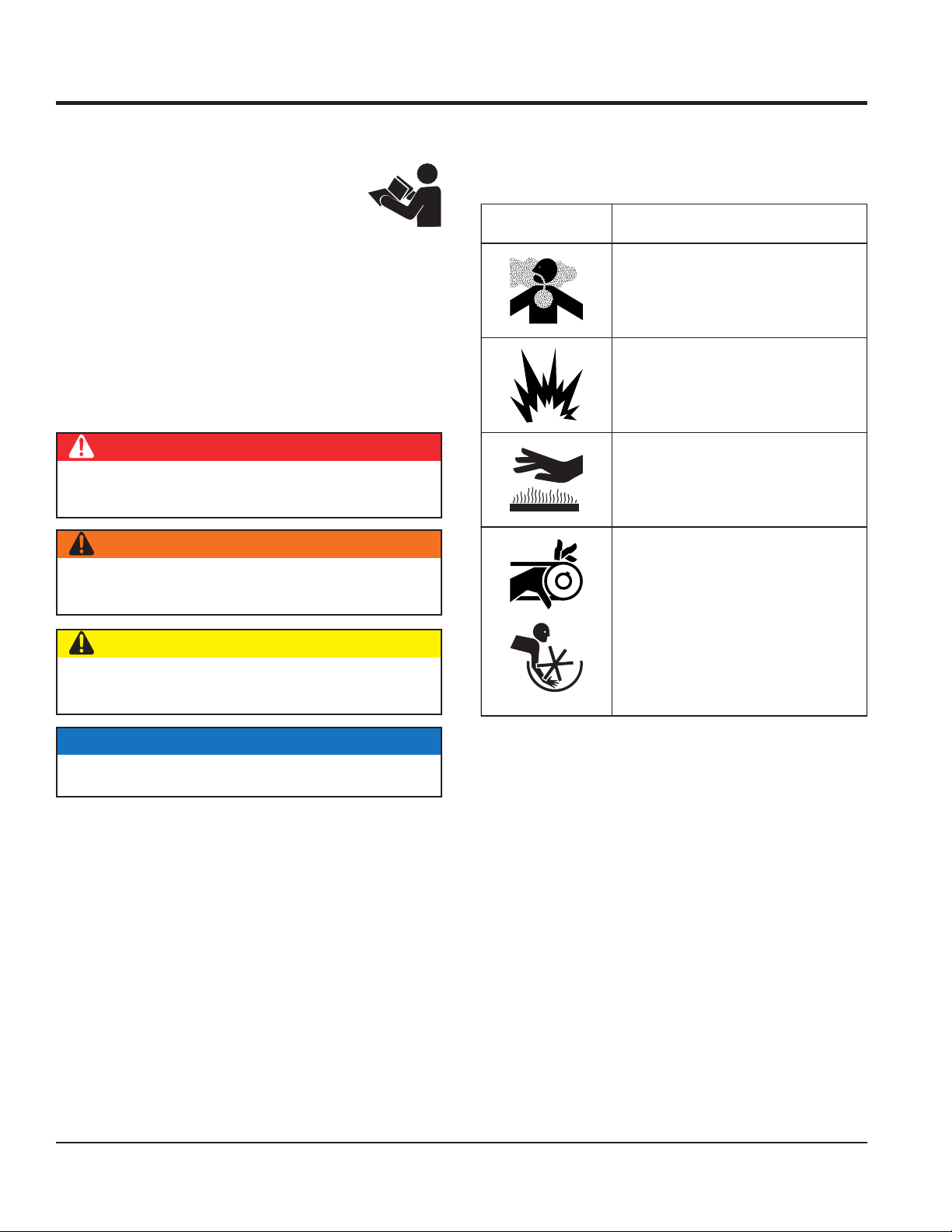
SAFETY MESSAGES
The four safety messages shown below will inform you
about potential hazards that could injure you or others. The
safety messages specifi cally address the level of exposure
to the operator and are preceded by one of four words:
DANGER, WARNING, CAUTION
SAFETY SYMBOLS
Potential hazards associated with the operation of this
equipment will be referenced with hazard symbols which
may appear throughout this manual in conjunction with
safety messages.
DANGER
Indicates a hazardous situation which, if not avoided,
WILL result in DEATH or SERIOUS INJURY.
WARNING
Indicates a hazardous situation which, if not avoided,
COULD result in DEATH or SERIOUS INJURY.
CAUTION
Indicates a hazardous situation which, if not avoided,
COULD result in MINOR or MODERATE INJURY.
or NOTICE.
Symbol Safety Hazard
Lethal exhaust gas hazards
Explosive fuel hazards
Burn hazards
Rotating parts hazards
NOTICE
Addresses practices not related to personal injury.
PAGE 6 — PRO12 HYDRAULIC MIXER • OPERATION MANUAL — REV. #4 (10/30/19)
Page 7

GENERAL SAFETY
NOTICE
This equipment should only be operated by trained and
Whenever necessary, replace nameplate, operation and
Manufacturer does not assume responsibility for any
accident due to equipment modifi cations. Unauthorized
use accessories or attachments that are not
recommended by Multiquip for this equipment. Damage
keep
Also, know the phone numbers
fi re department.
This information will be invaluable in the case of an
SAFETY INFORMATION
CAUTION
NEVER operate this equipment without proper protective
clothing, shatterproof glasses, respiratory protection,
hearing protection, steel-toed boots and other protective
devices required by the job or city and state regulations.
Avoid wearing jewelry or loose fi tting clothes that may
snag on the controls or moving parts as this can cause
serious injury.
NEVER operate this equipment when not
feeling well due to fatigue, illness or when
under medication.
NEVER operate this equipment under the
infl uence of drugs or alcohol.
ALWAYS clear the work area of any debris, tools, etc.
that would constitute a hazard while the equipment is
in operation.
ALWAYS check the equipment for loosened threads or
bolts before starting.
DO NOT use the equipment for any purpose other than
its intended purposes or applications.
qualifi ed personnel 18 years of age and older.
safety decals when they become diffi cult read.
equipment modifi cation will void all warranties.
NEVER
to the equipment and/or injury to user may result.
ALWAYS know the location of the nearest
fi re extinguisher.
ALWAYS know the location of the nearest
fi rst aid kit.
ALWAYS know the location of the nearest phone or
a phone on the job site.
of the nearest ambulance, doctor and
emergency.
PRO12 HYDRAULIC MIXER • OPERATION MANUAL — REV. #4 (10/30/19) — PAGE 7
Page 8
SAFETY INFORMATION
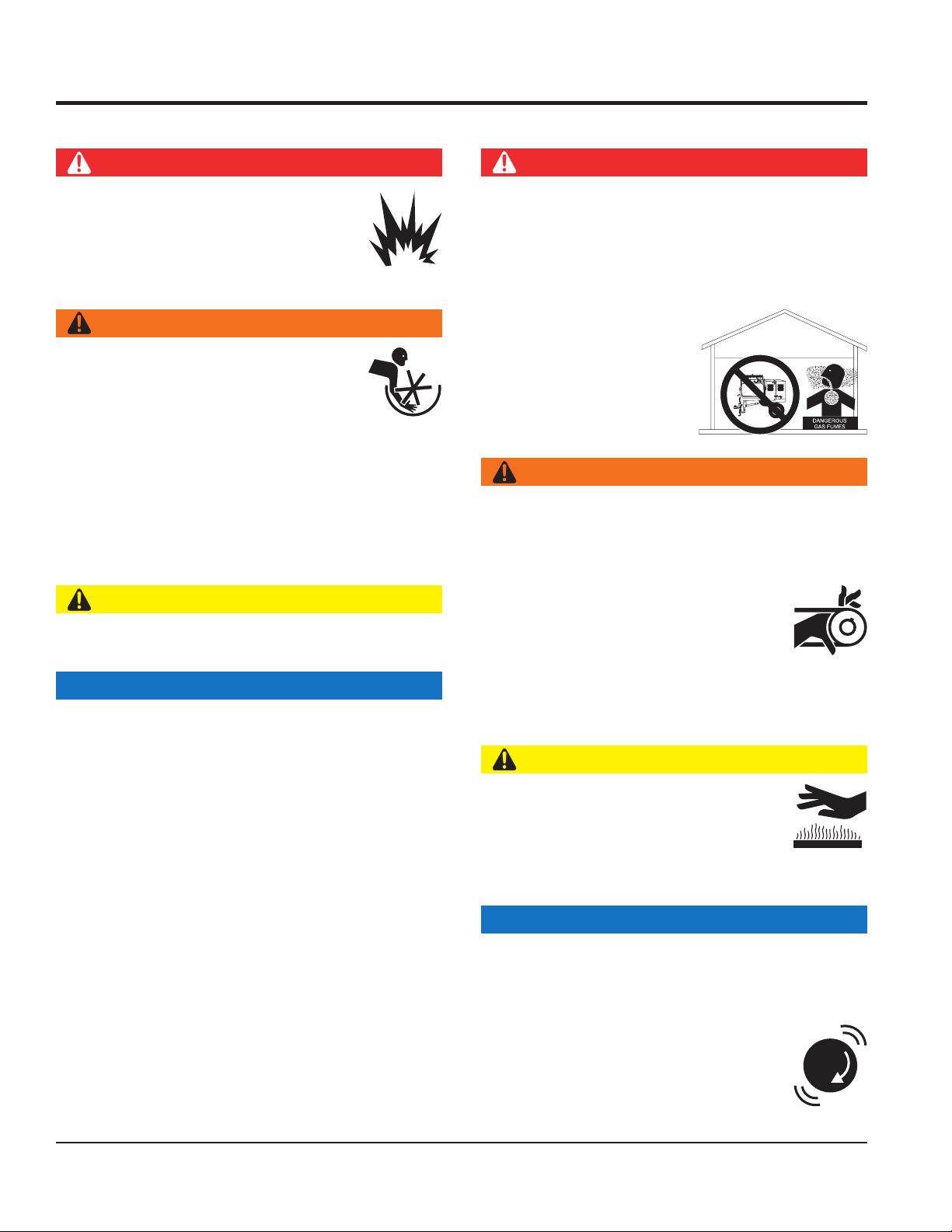
MIXER SAFETY
ENGINE SAFETY (GASOLINE MODELS ONLY)
Engine fuel exhaust gases contain poisonous carbon
monoxide. This gas is colorless and odorless, and can
The engine of this equipment requires an adequate
operate this equipment
place hands or fingers inside engine
operate the engine with heat shields or
while the engine is hot. Hot oil will gush out of the oil
tank and severely scald any persons in the general area
Make certain the operator knows how to and is capable
run engine without an air fi lter or with a dirty air
fi lter. Severe engine damage may occur. Service air fi lter
DANGER
NEVER operate the equipment in an explosive
atmosphere or near combustible materials. An
explosion or fi re could result causing severe
bodily harm or even death.
DO NOT mix fl ammable or explosive substances.
WARNING
NEVER place your hands inside the drum
while starting or operating this equipment.
NEVER disconnect any emergency
or safety devices. These devices are
intended for operator safety. Disconnection of these
devices can cause severe injury, bodily harm or even
death. Disconnection of any of these devices will void
all warranties.
Before operating mixer, ensure that safety grate is in
position and correctly fi tted.
CAUTION
NEVER lubricate components or attempt service on a
running machine.
NOTICE
DANGER
cause death if inhaled.
free fl ow of cooling air. NEVER
in any enclosed or narrow
area where free fl ow of the
air is restricted. If the air
fl ow is restricted it will cause
injury to people and property
and serious damage to the
equipment or engine.
WARNING
DO NOT
compartment when engine is running.
NEVER
guards removed.
Keep fi ngers, hands hair and clothing away
from all moving parts to prevent injury.
DO NOT remove the engine oil drain plug
ALWAYS keep the machine in proper running condition.
ALWAYS ensure mixer is on level ground before mixing.
Fix damage to machine and replace any broken parts
immediately.
DO NOT tip mixer onto drum mouth when the drum is
rotating.
Ensure the drum is rotating while fi lling and emptying
the drum.
ALWAYS store equipment properly when it is not being
used. Equipment should be stored in a clean, dry location
out of the reach of children and unauthorized personnel.
ALWAYS deploy stabilizer jack stands prior to use.
PAGE 8 — PRO12 HYDRAULIC MIXER • OPERATION MANUAL — REV. #4 (10/30/19)
of the mixer.
CAUTION
NEVER touch the hot exhaust manifold,
muffl er or cylinder. Allow these parts to cool
before servicing equipment.
of turning the engine OFF in case of an emergency.
NOTICE
NEVER
frequently to prevent engine malfunction.
NEVER tamper with the factory settings
of the engine or engine governor. Damage
to the engine or equipment can result
if operating in speed ranges above the
maximum allowable.
Page 9

SAFETY INFORMATION
FUEL SAFETY (GASOLINE MODELS ONLY)
GENERATOR SAFETY
ELECTRIC MOTOR SAFETY (ELECTRIC MODELS
Operate electric motor only at the specifi ed voltage
disconnect AC power plug from power source
cables or cords when
connecting equipment to generator. Inspect for cuts in
Make sure power cables are securely connected.
Incorrect connections may cause electrical shock and
Ensure that cables and cords will not be tripped over or
make certain that proper power or extension
DANGER
DO NOT add fuel to equipment if it is placed inside truck
bed with plastic liner. Possibility exists of explosion or
fi re due to static electricity.
FUEL
FUEL
DO NOT start the engine near spilled fuel or combustible
fl uids. Fuel is extremely fl ammable and its vapors can
cause an explosion if ignited.
If using a generator to power mixer, refer
to applicable generator manual safety
information section.
ONLY)
NOTICE
indicated on the nameplate.
DO NOT spray water onto electric motor.
ALWAYS
before moving mixer.
ALWAYS make sure the ON/OFF switch
on the electric motor is in the OFF position
when not in use and before inserting the
mixer’s power plug into an AC receptacle.
Power Cord/Cable Safety
DANGER
ALWAYS refuel in a well-ventilated area, away from
sparks and open fl ames.
ALWAYS use extreme caution when working with
fl ammable liquids.
DO NOT fi ll the fuel tank while the engine is running
or hot.
DO NOT overfi ll tank, since spilled fuel could ignite if it
comes into contact with hot engine parts or sparks from
the ignition system.
Store fuel in appropriate containers, in well-ventilated
areas and away from sparks and fl ames.
NEVER use fuel as a cleaning agent.
DO NOT smoke around or near the
equipment. Fire or explosion could result
from fuel vapors or if fuel is spilled on a
hot engine.
NEVER let power cords or cables lay in water.
NEVER use damaged or worn
the insulation.
NEVER grab or touch a live power
cord or cable with wet hands. The
possibility exists of electrical shock,
electrocution or death.
damage to the mixer.
CAUTION
trapped underneath the mixer.
NOTICE
ALWAYS
cord has been selected for the job.
PRO12 HYDRAULIC MIXER • OPERATION MANUAL — REV. #4 (10/30/19) — PAGE 9
Page 10

TRANSPORTING SAFETY
CAUTION
ENVIRONMENTAL SAFETY/
Decommissioning is a controlled process used to safely
retire a piece of equipment that is no longer serviceable.
If the equipment poses an unacceptable and unrepairable
safety risk due to wear or damage or is no longer cost
effective to maintain (beyond life-cycle reliability) and is to
be decommissioned (demolition and dismantlement),be
sure to follow rules below.
When the life cycle of this equipment is over, remove
battery if equipped and bring to appropriate facility for
lead reclamation. Use safety precautions when handling
When the life cycle of this equipment is over, it is
recommended that the mixer frame and all other metal
Metal recycling involves the collection of metal from
discarded products and its transformation into raw
Recyclers and manufacturers alike promote the process
of recycling metal. Using a metal recycling center
The gasoline engine used in this equipment has been
designed to reduce harmful levels of carbon monoxide
(CO), hydrocarbons (HC) and nitrogen oxides (NOx)
This engine has been certifi ed to meet US EPA Evaporative
Attempting to modify or make adjustments to the engine
emmission system by unauthorized personnel without
proper training could damage the equipment or create an
Additionally, modifying the fuel system may adversely affect
evaporative emissions, resulting in fi nes or other penalties.
The emission control label is an integral part of the emission
If a replacement emission label is needed, please contact
NEVER allow any person or animal to stand underneath
the equipment while lifting.
NOTICE
ALWAYS make sure forklift forks are inserted into pockets
(if applicable) as far as possible when lifting the mixer.
ALWAYS shutdown engine before transporting.
NEVER lift the equipment while the engine is running.
Tighten fuel tank cap securely and close fuel cock to
prevent fuel from spilling.
DO NOT lift machine to unnecessary heights.
ALWAYS tie down equipment during transport by
securing the equipment with rope.
SAFETY INFORMATION
batteries that contain sulfuric acid.
parts be sent to a recycling center.
materials to use in manufacturing a new product.
promotes energy cost savings.
EMISSIONS INFORMATION
NOTICE
NEVER tip the engine to extreme angles during lifting as
it may cause oil to gravitate into the cylinder head, making
the engine start diffi cult.
DECOMMISSIONING
NOTICE
DO NOT pour waste or oil directly onto the ground, down
a drain or into any water source.
Contact your country's Department of
Public Works or recycling agency in your
area and arrange for proper disposal of
any electrical components, waste or oil
associated with this equipment.
contained in gasoline exhaust emissions.
emissions requirements in the installed confi guration.
unsafe condition.
Emission Control Label
system and is strictly controlled by regulation(s).
The label must remain with the engine for its entire life.
your authorized engine distributor.
PAGE 10 — PRO12 HYDRAULIC MIXER • OPERATION MANUAL — REV. #4 (10/30/19)
Page 11

SPECIFICATIONS
Table 1. Mixer Specifications
Capacity 12.0 cu. ft. (340 liters)
Bag Capacity 3 to 4 bags
Operating Weight 1,580 lb. (716.67 kg)
Maximum Aggregate Size 1 in. (25.4 mm)
Adjustable Drum Discharge Height Up to 42.5 in. (1,079.5 mm)
Drive System Hydraulic
Dump Action Hydraulic
Table 2. Engine Specifications
Model Honda GX390RT2-QNB2
Type Air-cooled, 4-stroke, horizontal-shaft, gasoline engine
Bore × Stroke 3.46 in. × 2.51 in. (88 mm × 64 mm)
Displacement 23.7 cu. in. (389 cc)
Max. Output 11.7 hp @ 3,600 rpm
Continuous Output 9.0 hp @ 3,600 rpm
Fuel Tank Capacity Approx. 5.0 U.S. gallons (18.9 liters)
Fuel Unleaded gasoline
Lube Oil Capacity 1.16 qt. (1.1 liters)
Speed Control Method Centrifugal fly-weight type
Starting Method Electric start
Table 3. Electric Motor Specifications
Model Teco Westinghouse Model 3414 Teco Westinghouse Model 3481
Enclosure TEFC TEFC
Horsepower 5 5
Input Voltage (VAC) 230 230/460
Phase 1 3
Frequency (Hz) 60 60
Max Output @ RPM 5 hp @ 1,745 5 hp @ 1,725
Full Load Amps 30 12.24/6.12
Weight 103 lb. (46.7 kg) 103 lb. (46.7 kg)
Dimensions (L × W × H)
PRO12 HYDRAULIC MIXER • OPERATION MANUAL — REV. #4 (10/30/19) — PAGE 11
18.03 × 8.8 × 10.5 in.
(458 × 223.5 × 266.7 mm)
15.79 × 8.8 × 10.5 in
(401 × 223.5 × 266.7 mm)
Page 12
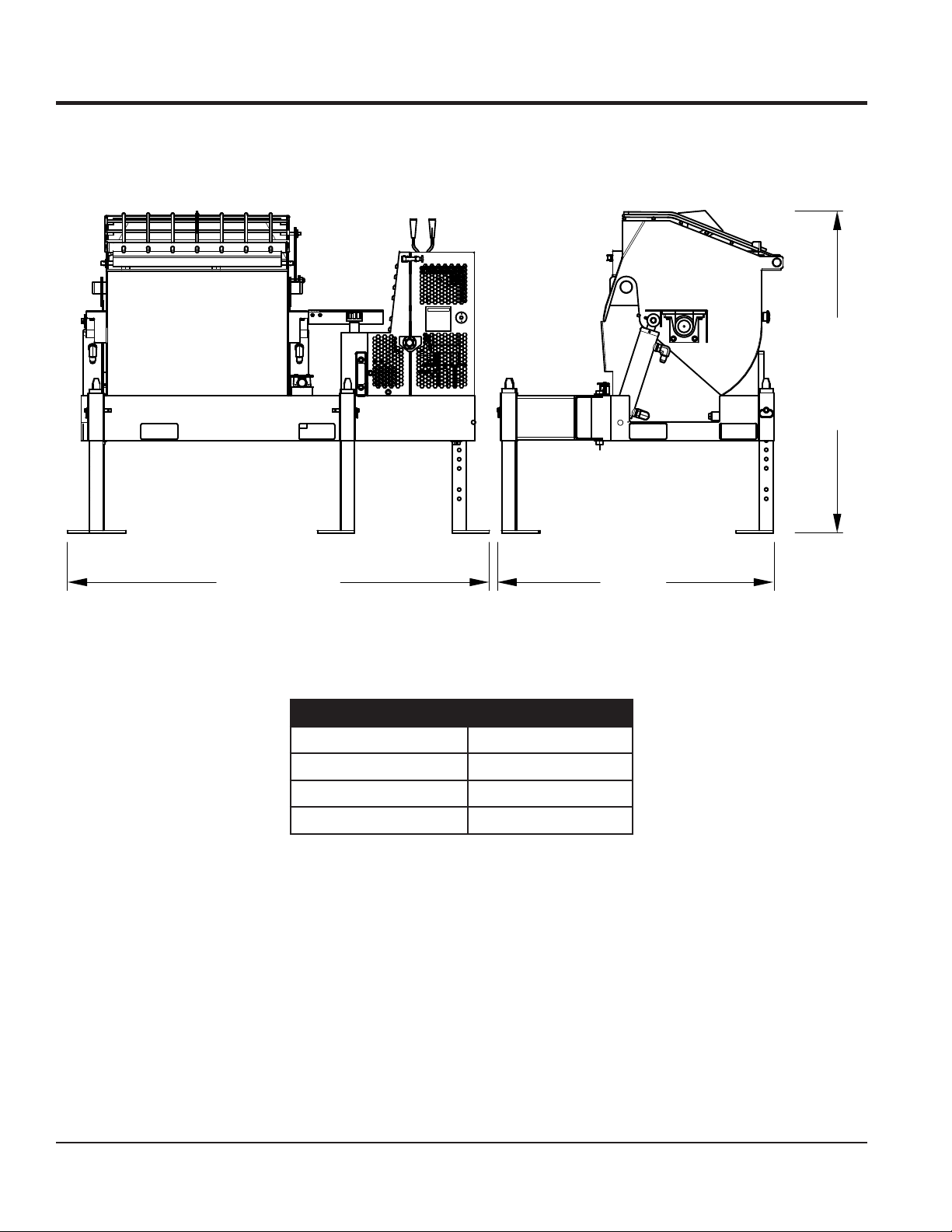
DIMENSIONS
C
A B
Figure 1. Mixer Dimensions
Table 4. Mixer Dimensions
Reference Designator Dimension in. (mm.)
A (Length) 73.5 (1,917.7)
B (Width) 35.0 (889)
C (Height) 45.0 (1,143)
PAGE 12 — PRO12 HYDRAULIC MIXER • OPERATION MANUAL — REV. #4 (10/30/19)
Page 13

GENERAL INFORMATION
APPLICATION
The Multiquip PRO12 hydraulic mixer (with drum capacity of
12.0 cubic feet/340 liters) is shipped completely assembled,
factory tested, and ready for use. This mixer has a batch
capacity of 3-1/2 to 4-1/2 bags.
WARNING
This mixer is intended only for the mixing of plaster
and mortar. The mixer must be used for its intended
purpose and is not suitable for mixing flammable or
explosive substances. The mixer must not be used
in an explosive atmosphere.
POWER PLANTS
This hydraulic mixer is powered by either an 11.7 hp Honda
GX390RT2-QNB2 air-cooled, 4-stroke, gasoline engine
(reference Table 2), or a 5 hp electric motor. Reference
Table 3 for more detailed information regarding the electric
motor.
ENGINE MAINTENANCE
EXTENSION CABLES
The extension cable should be a 3-wire configuration that
includes a ground wire that conforms to UL code. The wire
cross section must be a minimum of 2.5 mm². Choose an
extension cord of adequate current-carrying capacity as
referenced in Table 7. Remember, cable distance affects
the current-voltage capacity of the extension cable.
Ensure that the extension cable is carefully laid out avoiding
wet areas, sharp edges, and locations where vehicles
might run over it. Avoid allowing the extension cable to be
trapped underneath the mixer.
Unroll the extension cable fully or it will overheat and could
catch fire. Make sure that all extension cable connections
are dry and safe. Replace any defective or badly worn
extension cables immediately.
HARDWARE
Check all hardware on the mixer before starting. Periodically
inspect all hardware. Loose hardware can contribute to
early component failure and poor performance. Keep all
mixer hardware components tight.
For basic engine maintenance, refer to the engine
maintenance section in this manual. For more detailed
engine maintenance, refer to the Honda Engine Owner’s
Manual furnished with the engine.
ELECTRICAL
If the mixer is equipped with an electric motor, make sure
that the power being supplied to the motor corresponds to
the voltage rating label on the motor. Supplying the wrong
voltage to the electric motor will cause severe electrical
damage to the motor. Reference Table 3 for electric motor
specifications.
Always make sure the ON/OFF switch on the electric motor
is in the OFF position before applying power.
PRO12 HYDRAULIC MIXER • OPERATION MANUAL — REV. #4 (10/30/19) — PAGE 13
Page 14

COMPONENTS (MIXER)
12
10
20
11
13
1
14
7
8
9
6
2
3
4
5
6
18
15
16
19
3
17
12
10
20
21
19
22
Figure 2. Mixer Components
PAGE 14 — PRO12 HYDRAULIC MIXER • OPERATION MANUAL — REV. #4 (10/30/19)
Page 15

COMPONENTS (MIXER)
1. Hydraulic Paddle Control Lever — 3-position lever.
Push inward for clockwise mixing rotation of blades.
Place in center position for no rotation (neutral/off).
2. Hydraulic Dump Lever — This lever is only provided
on mixers with hydraulic dump capability. Pull the lever
outward to activate the dump cylinder.
3. Latch — Use this latch to secure the engine
compartment enclosure.
4. Engine Cover — Lift this cover to gain access to the
engine or electric motor.
5. Hydraulic Oil Sight Gauge — This gauge indicates
the level and temperature of the hydraulic oil. For
normal operation, the oil level should be visible at the
midpoint on the sight gauge.
6. Adjustable Stabilizer Jack Stands — Use these jack
stands to adjust the mixer to the desired height.
7. Hydraulic Pump — Supplies hydraulic fluid to the
hydraulic control valve.
8. Mixing Drum — Drum capacity is 12 cubic feet
(340 liters). Mixing materials such as mortar and plaster
are to be placed into this drum for mixing. Always clean
the drum after each use.
9. Shaft Seals — There is a Zerk grease fitting at each
end of the mixing drum. These grease fittings lubricate
the paddle shaft seals. Fittings require daily greasing
with lithium-based EP grease.
10. Hydraulic Dump Cylinders — When activated, these
cylinders will rotate the mixing drum to the dump
position. These cylinders are equipped on mixers with
hydraulic dump capability.
11. Drum Bearing — There is a pillow block bearing on
each end of the mixing drum. Bearings require daily
greasing with lithium-based EP grease.
13. Mixing Paddles — This mixer uses plastic and rubber
mixing paddles for the mixing of plaster and mortar.
Always clean the paddles after each use.
14. Bag Cutter — This feature allows mixing bags to be
opened easily, therefore allowing the contents of the
bag to fall directly into the mixing drum.
15. Emergency Stop Switch — This switch is located on
the side of the engine cover. When activated it will shut
down the engine (gasoline only).
16. Hydraulic Valve — Directional hydraulic control valve.
Controls the direction of hydraulic fluid supplied to the
dump cylinder and paddle shaft.
17. Hydraulic Motor — Bidirectional hydraulic motor that is
used in conjunction with the directional control valve to
operate the hydraulic dump cylinder and paddle shaft.
18. Safety Grill — Provided for operator safety. This safety
grill is designed to keep hands and solid objects out
of the mixing drum when in use. This grill should be
closed at all times when the mixer is in use. DO NOT
remove the grill or grill opening bar. Keep the grill clean
by washing it down daily.
19. Swivel Jack Stands — These jack stands swivel out
to support the mixer.
20. Forklift Pockets — When lifting of the mixer is
required, use these forklift pockets to lift the mixer.
Remember to insert the forks of the forklift a minimum
of 24 inches into the lift pockets.
21. Hydraulic Oil Filter — 10-micron hydraulic filter. Filters
out small particles that are harmful to the hydraulic
system.
22. Charcoal Canister — A container filled with activated
charcoal traps gasoline vapors emitted by the fuel
system (gasoline only).
12. Pivot Point/Zerk Fitting — There is a Zerk grease
fitting on each end of the mixing drum. These fittings
lubricate the dumping mechanism. Lubricate both
fittings at least twice a week.
PRO12 HYDRAULIC MIXER • OPERATION MANUAL — REV. #4 (10/30/19) — PAGE 15
Page 16

COMPONENTS (ENGINE)
2
11
12
10
9
8
7
Figure 3. Engine Components
1
3
4
6
5
INITIAL SERVICING
The engine (Figure 3) must be checked for proper
lubrication and filled with fuel prior to operation. Refer to the
engine manufacturer’s manual for instructions and details
on operation and servicing.
1. Throttle Lever — Use to adjust engine RPM speed
(lever advanced forward SLOW, lever back toward
operator FAST).
4. Engine ON/OFF Switch — ON position permits engine
starting, OFF position stops engine operation.
5. Recoil Starter (pull rope) — Manual starting method.
Pull the starter grip slowly until resistance is felt, then
pull briskly and smoothly to start the engine.
6. Fuel Valve Lever — OPEN to let fuel flow, CLOSE to
stop the flow of fuel.
7. Oil Drain Bolt — Remove to drain engine oil from the
crankcase.
8. Oil Dipstick — Remove to check the amount and
condition of oil in the crankcase.
9. Choke Lever — Used in the starting of a cold engine,
or in cold weather conditions. The choke enriches the
fuel mixture.
10. Spark Plug — Provides spark to the ignition
system. Set the spark plug gap to 0.028–0.031 inch
(0.7–0.8 mm). Clean the spark plug once a week.
11. Muffler — Reduces noise and emissions.
WARNING
Engine components can generate extreme
heat. To prevent burns, DO NOT touch
these areas while the engine is running or
immediately after operating. NEVER operate
the engine with the muffler removed.
2. Fuel Filler Cap — Remove this cap to add unleaded
gasoline to the fuel tank. Make sure the cap is tightened
securely. DO NOT overfill.
DANGER
Adding fuel to the tank should be done
only when the engine is stopped and has
had an opportunity to cool down. In the
event of a fuel spill, DO NOT attempt to
start the engine until the fuel residue has
been completely wiped up, and the area surrounding
the engine is dry.
3. Fuel Tank — Holds unleaded gasoline. For additional
information refer to the engine owner’s manual.
PAGE 16 — PRO12 HYDRAULIC MIXER • OPERATION MANUAL — REV. #4 (10/30/19)
12. Air Cleaner — Prevents dirt and other debris from
entering the fuel system. Remove the wing nut on top of
the air filter canister to gain access to the filter element.
NOTICE
Operating the engine without an air filter, with a damaged
air filter, or with a filter in need of replacement will allow
dirt to enter the engine, causing rapid engine wear.
Page 17

ELECTRIC MOTOR
ELECTRIC MOTOR
For operation and maintenance of the electric motor, refer
to the electric motor instruction booklet furnished with
the motor.
Protect the electric motor from dust as much as possible
and keep ventilating openings clean.
CAUTION
DO NOT spray water at any time on the electric motor.
DO NOT operate the electric motor in an explosive
environment.
The electric motor (Figure 4) equipped on these mixers
is available in two configurations—5 hp, 1Ø @ 230 VAC
or 5 hp, 3Ø @ 230/460 VAC. Pay special attention to the
nameplate on the electric motor when supplying power to
the electric motor. Applying incorrect power to the motor
can severely damage the motor and may cause serious
bodily injury!
ALWAYS make certain that the correct voltage is being
supplied to the motor. The input voltage requirements can
be found on the electric motor’s nameplate.
ELECTRIC MOTOR POWER CONNECTIONS
The electric motor used on these mixers is equipped with
either a 3-prong (1Ø) or a 4-prong (3Ø) plug.
Reference Figure 4 for connection to a power source.
Reference Table 5 to determine the required NEMA mating
receptacle.
NOTICE
It is strongly recommended that all electrical wiring be
done by a licensed electrician. Pay special attention to
the nameplate on the electric motor. Make certain that
the voltage supplied to the electric motor matches the
required operating voltage printed on the nameplate.
Table 5. Electric Motor Wiring Information
Electric Motor
Horsepower
Rating
5 hp
230 VAC - 1Ø 230/460 VAC - 3Ø
NEMA Plug
Connector
3-Prong
L6-30P
NEMA Receptacle
Connector
3-Prong
L6-30R
NEMA Plug
Connector
4-Prong
L15-30P
L16-30P
NEMA Receptacle
Connector
4-Prong
L15-30R
L16-30R
1Ø OR 3Ø
2-POLE CIRCUIT
BREAKER
BLACK
L1
L2
ON/OFF
SWITCH
NEMA L6-30P PLUG
1Ø, 230 VOLT
BLACK
T2
T1
WHITE
L3
GREEN
T3
WHITE
NEMA L15-30P PLUG
3Ø, 230 VOLT
NEMA L16-30P PLUG
3Ø, 460 VOLT
ELECTRIC MOTOR
BLUE
ORANGE
RED
YELLOW
BLACK
WHITE
GREEN
1
GND.
POINT
A
BLACK (L1)
WHITE (L2)
B
B
A
Figure 4. Electric Motor
PRO12 HYDRAULIC MIXER • OPERATION MANUAL — REV. #4 (10/30/19) — PAGE 17
Page 18

INSPECTION
BEFORE STARTING
1. Read the safety instructions at the
beginning of this manual.
2. Clean the mixer, removing dirt and
dust—particularly the engine cooling
air inlet, carburetor, and air cleaner.
3. Check the air filter for dirt and dust. If the air filter is
dirty, replace it with a new one as required.
4. Check the carburetor for external dirt and dust. Clean
with dry compressed air.
5. Check fastening nuts and bolts for tightness.
ENGINE OIL CHECK
1. Place the mixer on secure, level ground with the engine
stopped.
2. Remove the filler dipstick from the engine oil filler hole
(Figure 5) and wipe it clean.
Table 6. Oil Type
Season Temperature Oil Type
Summer 25°C or Higher SAE 10W-30
Spring/Fall 25°C–10°C SAE 10W-30/20
Winter 0°C or Lower SAE 10W-10
FUEL CHECK
DANGER
Motor fuels are highly flammable and can
be dangerous if mishandled. DO NOT
smoke while refueling. DO NOT attempt
to refuel the pump if the engine is hot!
or running.
1. Remove the gasoline cap located on top of the fuel tank.
2. Visually inspect to see if the fuel level is low. If fuel is
low, replenish with unleaded gasoline.
3. When refueling, be sure to use a strainer for filtration.
DO NOT top off fuel. Wipe up any spilled fuel
immediately!
DIPSTICK
Figure 5. Engine Oil Dipstick (Removal)
3. Insert and remove the dipstick without screwing it into
the filler neck. Check the oil level shown on the dipstick.
4. If the oil level is low (See Figure 6), fill to the edge
of the oil filler hole with the recommended oil type
as listed in Table 6. Maximum oil capacity is 1.16 quarts
(1.1 liters).
UPPER LIMIT
LOWER LIMIT
Figure 6. Engine Oil Dipstick (Oil Level)
HYDRAULIC OIL
Check the hydraulic oil sight gauge (Figure 7) to ensure
that the hydraulic oil is at the midway level.
Figure 7. Hydraulic Oil Sight Gauge
HYDRAULIC HOSES
Check hydraulic hoses to make sure they are not worn,
frayed or defective.
PAGE 18 — PRO12 HYDRAULIC MIXER • OPERATION MANUAL — REV. #4 (10/30/19)
Page 19

INSPECTION
GREASE FITTINGS (SHAFT SEALS)
Check the Zerk grease fittings (Figure 8) at each end
of the mixing drum. These grease fittings lubricate the
paddle shaft seals. Grease daily with lithium-based EP
grease, preferably at the end of the day. Grease until visible
inside the drum to ensure that the cavity area is free of
contamination.
BEARING
GREASE
FITTING
GREASE FITTINGS (DUMP CYLINDERS)
Check the Zerk grease fittings on the dump cylinders
(Figure 9). These grease fittings lubricate the hydraulic
dumping mechanism. Give the fittings one shot of
lithium-based EP grease every week.
GREASE FITTING
GREASE FITTING CAP
DUMP CYLINDER
Figure 8. Grease Fittings (Bearings and Seals)
GREASE FITTINGS (BEARINGS)
Check the Zerk fittings on the pillow block bearings
(Figure 8). Grease with two shots of lithium-based EP
grease daily.
GREASE FITTING CAP
GREASE FITTING
Figure 9. Grease Fittings (Dump Cylinders)
PRO12 HYDRAULIC MIXER • OPERATION MANUAL — REV. #4 (10/30/19) — PAGE 19
Page 20

INSPECTION
EMERGENCY STOP SWITCH
(GASOLINE ENGINE MODELS ONLY)
The engine emergency stop switch (Figure 10)
should be tested every time the engine is started. See
Starting the Mixer (Gasoline Engine) in the Operation
section for more information.
EMERGENCY
STOP SWITCH
PUSH
TO STOP
Figure 10. Emergency Stop Switch
PADDLE BLADE CHECK
Check for worn or defective paddle blades (Figure 11).
Make sure that all blades are adjusted properly. Refer to the
Paddle Blade Adjustment procedure (Figure 12). Replace
all defective or damaged blades immediately.
WORN RUBBER
CRACKS
MISSING
RUBBER
Figure 11. Worn Paddle Blade
CAUTION
NEVER disable or disconnect the emergency stop
switch. It is provided for operator safety. Injury may result
if it is disabled, disconnected or improperly maintained.
PAGE 20 — PRO12 HYDRAULIC MIXER • OPERATION MANUAL — REV. #4 (10/30/19)
Page 21

PADDLE BLADE ADJUSTMENT
DRUM END AND SIDE WALLS
STEEL DRUM
ENGINE END
CAST PADDLE
CENTER TOW END
CAST PADDLE
CENTER ENGINE
END CAST PADDLE
CAST PADDLE
DRUM END
PADDLE BLADE IS TOO
TIGHT AGAINST DRUM
SIDE WALLS.
DRUM SIDE
INCORRECT
INCORRECT
CORRECT
SIDE PADDLE BLADE
ROTATION
INCORRECT
CORRECT
PADDLE BLADE IS TOO
TIGHT AGAINST DRUM
SIDE WALLS.
END PADDLE BLADE
Figure 12. Paddle Blade Adjustment
PRO12 HYDRAULIC MIXER • OPERATION MANUAL — REV. #4 (10/30/19) — PAGE 21
ROTATION
Page 22

CAUTION
DO NOT attempt to operate the mixer
until the Safety, General Information and
Inspection sections of this manual have
been read and thoroughly understood.
This section is intended to assist the operator with the
initial start-up of the mixer. It is extremely important that
this section be read carefully before attempting to use the
mixer in the field.
OPERATION
3. Move the throttle lever (Figure 15) away from the slow
position, about 1/3 of the way toward the fast position.
THROTTLE
LEVER
STARTING THE MIXER (GASOLINE ENGINE)
1. Make sure the hydraulic paddle control lever (Figure 13)
is in the neutral position.
NEUTRAL
MIX
REVERSE
HYDRAULIC
PADDLE
CONTROL LEVER
Figure 13. Hydraulic Paddle Control Lever
(Neutral Position)
2. Place the engine fuel valve lever (Figure 14) in the
“ON” position.
FAST
SLOW
Figure 15. Throttle Lever (1/3 Start Position)
4. Place the choke lever (Figure 16) in the “CLOSED”
position if starting a cold engine.
CHOKE LEVER
CLOSE
OPEN
Figure 16. Engine Choke Lever (Closed)
5. Place the choke lever (Figure 17) in the “OPEN”
position if starting a warm engine or the temperature
is warm.
FUEL VALVE
LEVER
OFF
ON
Figure 14. Engine Fuel Valve Lever
(ON Position)
PAGE 22 — PRO12 HYDRAULIC MIXER • OPERATION MANUAL — REV. #4 (10/30/19)
CHOKE LEVER
CLOSE
OPEN
Figure 17. Engine Choke Lever (Open)
Page 23

6. Place the engine ON/OFF switch (Figure 18) in the
“ON” position.
OFF
ON
ENGINE SWITCH
Figure 18. Engine ON/OFF Switch (ON Position)
7. Locate the emergency stop switch (Figure 19) on the
engine cover. Pull this button outward to allow engine
starting.
EMERGENCY
STOP SWITCH
OPERATION
S
T
A
R
T
Figure 20. Engine Ignition Key
9. If the choke lever was moved to the “CLOSED” position
to start the engine, gradually move it to the “OPEN”
position (Figure 21) as the engine warms up. If the
engine has not started, repeat steps 1 through 8.
CHOKE LEVER
PUSH
TO STOP
PULL OUT TO
START
Figure 19. Emergency Stop Switch
(Start Position)
8. Turn the engine ignition key (Figure 20) to the START
position and hold it until the engine starts. When
engine starts, release the key, allowing it to return to
the ON position.
CLOSE
OPEN
Figure 21. Choke Lever (Open)
10. Before the mixer is placed into operation, run the engine
for several minutes. Check for fuel leaks and noises that
could be associated with a loose component.
11. To begin mixing, place the throttle lever (Figure 22) in
the “RUN” position.
THROTTLE
LEVER
RUN
Figure 22. Throttle Lever (Run)
IDLE
PRO12 HYDRAULIC MIXER • OPERATION MANUAL — REV. #4 (10/30/19) — PAGE 23
Page 24

OPERATION
TO
STARTING THE MIXER (ELECTRIC MOTOR)
1. Using an appropriately sized extension cord (Table 7),
connect one end of the extension cord to the plug on
the electric motor, and connect the other end to the
power source. Make sure the motor is configured for
the proper operating voltage.
Table 7. Cable Selection
Cord
Length
ft/m
10 (3.0) 12 GA
25 (7.6) 16 GA 16 GA 16 GA 16 GA 14 GA 14 GA
50 (15.2) 16 GA 16 GA 16 GA 14 GA 14 GA 12 GA
100 (30.5) 16 GA 16 GA 14 GA 12 GA 12 GA
150 (45.7) 16 GA 14 GA 12 GA 12 GA
200 (61.0) 14 GA 14 GA 12 GA 10 GA
0-2 2-5 5-7 7-10 10-12 12-15 12-20
CAUTION: Equipment damage can result from low voltage.
NOTICE
Extension cords must be rated “Heavy Duty” or
“Extra Heavy Duty” and must be a continuous length.
Amperage/Load Rating
3. To start the electric motor, press the black ON/START
switch (Figure 24).
ON
OFF
START
STOP
PRESS
START
Figure 24. Electric Motor ON/OFF Switch (Start)
MIXING
1. Push the hydraulic paddle control lever (Figure 25)
forward for clockwise mixing rotation of the paddle blades.
2. Make sure the hydraulic paddle control lever (Figure 23)
is in the neutral position.
NEUTRAL
MIX
REVERSE
HYDRAULIC
PADDLE
CONTROL LEVER
Figure 23. Hydraulic Paddle Control Lever
(Neutral Position)
PUSH
NEUTRAL
REVERSE
HYDRAULIC
PADDLE
CONTROL LEVER
TO MIX
Figure 25. Hydraulic Paddle Control Lever
(Mix Position)
2. The paddle shaft inside the drum should be rotating
at this time.
3. Add a small amount of water to the mixing drum.
4. Lift the mixing bag compound onto the steel safety
grate over the bag cutter and let the contents fall
into the drum. Add more water if desired and mix the
compound to the desired consistency.
PAGE 24 — PRO12 HYDRAULIC MIXER • OPERATION MANUAL — REV. #4 (10/30/19)
Page 25

OPERATION
DUMPING
1. Push the hydraulic dump lever (Figure 26) forward to
place the drum in the dump position (Figure 27).
PUSH
TO DUMP
PULL TO
RETURN
HYDRAULIC
DUMP LEVER
Figure 26. Hydraulic Dump Lever
WARNING
When rotating the mixing drum from the dump position to
the upright position, keep hands clear of the safety grate.
The possibility exists of hands or fingers being crushed.
STOPPING THE MIXER (GASOLINE ENGINE)
Normal Shutdown
1. Place the throttle lever in the IDLE (slow) position,
and let the engine idle for 3–5 minutes. See Figure 28.
Figure 27. Hydraulic Dump
2. Pull the hydraulic dump lever backward to return the
drum to the upright position.
THROTTLE
LEVER
RUN
IDLE
Figure 28. Throttle Lever (IDLE)
PRO12 HYDRAULIC MIXER • OPERATION MANUAL — REV. #4 (10/30/19) — PAGE 25
Page 26

OPERATION
PRESS
2. Turn the engine ON/OFF switch (Figure 29) to the
OFF position.
OFF
ON
ENGINE SWITCH
Figure 29. Engine ON/OFF Switch (OFF)
3. Place the fuel valve lever (Figure 30) in the OFF
position.
FUEL VALVE
LEVER
STOPPING THE MIXER (ELECTRIC MOTOR)
1. To stop the electric motor, press the red OFF/STOP
switch (Figure 32).
ON
OFF
START
STOP
TO
STOP
Figure 32. Electric Motor ON/OFF Switch (Stop)
2. Disconnect the electric motor’s extension cord from
the power source.
CLEANING THE MIXER
OFF
ON
Figure 30. Fuel Valve Lever (OFF)
Emergency Shutdown
Push the emergency stop switch inward to the STOP
position (Figure 31).
EMERGENCY
STOP SWITCH
PUSH
TO STOP
PUSH IN TO
STOP
After each use, thoroughly clean the entire mixer as
described in the Maintenance section of this manual.
NOTICE
ALWAYS make sure the mixer drum is clean and free
of debris and dried material. DO NOT allow material
to build up inside the drum.
Keep the drum, frame and wheels clean. Excess debris
(buildup of materials) can lead to premature metal fatigue.
Figure 31. Emergency Stop Switch (STOP)
PAGE 26 — PRO12 HYDRAULIC MIXER • OPERATION MANUAL — REV. #4 (10/30/19)
Page 27

Perform engine maintenance procedures as scheduled in Table 8.
Table 8. Engine Maintenance Schedule
MAINTENANCE
First
Description (3) Operation Before
Engine Oil
Air Cleaner
All Nuts and
Bolts
Spark Plug
Cooling Fins CHECK X
Spark Arrester CLEAN X
Fuel Tank CLEAN X
Fuel Filter CHECK X
Idle Speed CHECK-ADJUST X (2)
Valve Clearance CHECK-ADJUST X (2)
Fuel lines CHECK Every 2 years (replace if necessary) (2)
CHECK X
CHANGE X
CHECK X
CHANGE X (1)
Re-tighten If
Necessary
CHECK-CLEAN X
REPLACE X
X
Month or
10 hrs
Every 3
Months or
25 hrs
Every 6
Months or
50 hrs
Every
Year or
100 hrs
Every 2
Years or
200 hrs
1. Service more frequently when used in DUSTY areas.
2. These items should be serviced by your service dealer, unless you have the proper tools and are mechanically proficient.
Refer to the HONDA Shop Manual for service procedures.
3. For commercial use, log hours of operation to determine proper maintenance intervals.
NOTICE
Refer to the engine manufacturer’s manual for specific
servicing instructions.
Table 9. Mixer Maintenance Schedule
Description Operation DAILY WEEKLY
Bearings GREASE X
Shaft Seals GREASE X
Cylinder Pivot GREASE X
INSPECT X
Hydraulic Oil
REPLACE X
Every
500 hrs
PRO12 HYDRAULIC MIXER • OPERATION MANUAL — REV. #4 (10/30/19) — PAGE 27
Page 28

MAINTENANCE
Perform engine maintenance as indicated below:
Daily
1. Thoroughly remove dirt and oil from the engine and
control area.
2. Clean or replace the air cleaner elements as necessary.
3. Check and retighten all fasteners as necessary.
Weekly
1. Remove the fuel filter cap and clean the inside of the
fuel tank.
2. Remove or clean the filter at the bottom of the tank.
3. Remove and clean the spark plug (Figure 33),
then adjust the spark plug gap to 0.028–0.031 inch
(0.7–0.8 mm). This unit has electronic ignition, which
requires no adjustments.
2. Remove the oil drain bolt and sealing washer and allow
the oil to drain into a suitable container (Figure 34).
3. Reinstall the drain bolt with sealing washer and tighten
securely.
4. Replace the engine oil with the recommended oil type
listed in Table 6. DO NOT overfill. See Table 2 for engine
oil capacity.
ENGINE AIR CLEANER
1. Remove the air cleaner cover and foam filter element
as shown in Figure 35.
BLOW COMPRESSED
AIR FROM THE
INSIDE OUT
WING NUT
GAP: 0.028 – 0.031 in.
(0.7 – 0.8 mm)
Figure 33. Spark Plug Gap
ENGINE OIL
NOTICE
ALWAYS drain the engine oil while the oil is warm.
1. Unscrew the oil filler dipstick (Figure 34) from its holder.
OIL FILLER
DIPSTICK
DRAIN
BOLT
SEALING
WASHER
AIR CLEANER
COVER
FOAM FILTER
ELEMENT
GASKET
PAPER FILTER
ELEMENT
Figure 35. Engine Air Cleaner
2. To remove dirt, tap the paper filter element (Figure 35)
several times on a hard surface, or blow compressed
air not exceeding 30 psi (207 kPa, 2.1 kgf/cm²) through
the filter element from the air cleaner case side. NEVER
brush off dirt. Brushing will force dirt into the fibers.
Replace the paper filter element if it is excessively dirty.
3. Clean the foam element in warm, soapy water or
nonflammable solvent. Rinse and dry thoroughly. Dip
the element in clean engine oil and completely squeeze
out the excess oil from the element before installing.
Figure 34. Draining Engine Oil
PAGE 28 — PRO12 HYDRAULIC MIXER • OPERATION MANUAL — REV. #4 (10/30/19)
Page 29

DANGER
To avoid the risk of fire or an explosion,
NEVER use gasoline as a cleaning solvent.
HYDRAULIC OIL FILTER
Replace the hydraulic oil filter (Figure 36) every 500 hours.
Hydraulic tank capacity is 12 gallons (45 liters). Refill with
Shell Tellus 46 hydraulic oil or equivalent.
MAINTENANCE
6. At the end of each day’s operation, place the mixer
drum in an upright position and spray the inside of the
tub immediately with water. This will prevent lumps of
dried mortar or plaster from forming and contaminating
future batches. DO NOT allow a buildup of materials
to form on the blades or anywhere inside the drum.
7. Rotate the mixer drum to the dump position and
remove debris.
8. Thoroughly clean the entire mixer, cabinet and frame.
NOTICE
NEVER pour or spray water over the engine or
electric motor (Figure 37).
Figure 36. Hydraulic Oil Filter
MIXER CLEANING
NOTICE
It is important that the drum interior is kept free of dried
material. Obstructions can cause the paddle blades to
lock against the drum.
1. Stop the engine or electric motor. Follow the
Stopping the Mixer procedure in the Operation
section.
2. Place the hydraulic paddle control lever in the neutral
position to disengage.
3. ALWAYS disconnect the spark plug wire before
cleaning the inside of the drum.
4. Place a Do Not Operate tag on the mixer.
5. Make sure the rear section of the safety grate is
connected to the mixing drum.
Figure 37. No Spraying of Water
9. When cleaning of the entire mixer is complete, return
the mixing drum to the upright position.
LONG-TERM STORAGE
For storage of the mixer for over 30 days, the following is
recommended:
1. Drain the fuel tank completely, or add STA-BIL® to
the fuel.
2. Run the engine until the fuel is completely consumed.
3. Completely drain used oil from the engine crankcase
and fill with fresh, clean oil, then follow the procedures
described in the engine manual for engine storage.
4. Clean the entire mixer and engine compartment.
5. Place the mixing drum in the inverted position (mouth
facing downward).
6. Cover the mixer and place it in a clean, dry area that
is protected from harsh elements.
PRO12 HYDRAULIC MIXER • OPERATION MANUAL — REV. #4 (10/30/19) — PAGE 29
Page 30

NOTES
PAGE 30 — PRO12 HYDRAULIC MIXER • OPERATION MANUAL — REV. #4 (10/30/19)
Page 31

TROUBLESHOOTING (ENGINE)
Practically all breakdowns can be prevented by proper handling and maintenance inspections, but in the event of a
breakdown, please take remedial action following the diagnosis based on the troubleshooting tables. If the problem cannot
be remedied, please leave the unit as is and consult our company’s service department.
Troubleshooting (Engine)
Symptom Possible Problem Solution
Spark plug bridging? Check gap, insulation or replace spark plug.
Carbon deposit on spark plug? Clean or replace spark plug.
Diffi cult to start, fuel is available, but no spark at
spark plug.
Diffi cult to start, fuel is available, and spark is
present at the spark plug.
Diffi cult to start, fuel is available, spark is
present and compression is normal.
Diffi cult to start, fuel is available, spark is
present and compression is low.
No fuel present at carburetor.
Short circuit due to defi cient spark plug
insulation?
Improper spark plug gap? Set to proper gap.
Spark plug is red? Check transistor ignition unit.
Spark plug is bluish white?
No spark present at tip of spark plug?
No oil? Add oil as required.
Oil pressure alarm lamp blinks upon starting? (if
applicable)
ON/OFF switch is shorted? Check switch wiring, replace switch.
Ignition coil defective? Replace ignition coil.
Improper spark gap, points dirty? Set correct spark gap and clean points.
Condenser insulation worn or short circuiting? Replace condenser.
Spark plug wire broken or short circuiting? Replace defective spark plug wiring.
Wrong fuel type?
Water or dust in fuel system? Flush fuel system.
Air cleaner dirty? Clean or replace air cleaner.
Choke open? Close choke.
Suction/exhaust valve stuck or protruded? Reseat valves.
Piston ring and/or cylinder worn? Replace piston rings and/or piston.
Cylinder head and/or spark plug not tightened
properly?
Head gasket and/or spark plug gasket damaged? Replace head and spark plug gaskets.
No fuel in fuel tank? Fill with correct type of fuel.
Fuel cock does not open properly?
Fuel fi lter/lines clogged? Replace fuel fi lter.
Fuel tank cap breather hole clogged? Clean or replace fuel tank cap.
Air in fuel line? Bleed fuel line.
Check spark plug insulation, replace if worn.
If insuffi cient compression, repair or replace
engine. If injected air leaking, correct leak. If
carburetor jets clogged, clean carburetor.
Check if transistor ignition unit is broken, and
replace defective unit. Check if voltage cord
cracked or broken and replace. Check if spark
plug if fouled and replace.
Check automatic shutdown circuit, "oil sensor".
(if applicable)
Flush fuel system, replace with correct type of
fuel.
Torque cylinder head bolts and spark plug.
Apply lubricant to loosen fuel cock lever,
replace if necessary.
PRO12 HYDRAULIC MIXER • OPERATION MANUAL — REV. #4 (10/30/19) — PAGE 31
Page 32

Symptom Possible Problem Solution
Weak in power, compression is proper and
does not misfi re.
Weak in power, compression is proper but
misfi res.
Engine overheats
Rotational speed fl uctuates.
Recoil starter malfunctions. (if applicable)
Starter malfunctions.
Burns too much fuel.
Exhaust color is continuously "white".
Exhaust color is continuously "black".
Will not start, no power with key "ON". (if
applicable)
TROUBLESHOOTING (ENGINE)
Troubleshooting (Engine) - continued
Air cleaner dirty? Clean or replace air cleaner.
Improper level in carburetor? Check fl oat adjustment, rebuild carburetor.
Defective spark plug? Clean or replace spark plug.
Improper spark plug? Set to proper gap.
Water in fuel system?
Dirty spark plug? Clean or replace spark plug.
Ignition coil defective? Replace ignition coil.
Wrong type of fuel? Replace with correct type of fuel.
Cooling fi ns dirty? Clean cooling fi ns.
Intake air restricted?
Oil level too low or too high? Adjust oil to proper level.
Governor adjusted incorrectly? Adjust governor.
Governor spring defective? Replace governor spring.
Fuel fl ow restricted? Check entire fuel system for leaks or clogs.
Recoil mechanism clogged with dust and dirt? Clean recoil assembly with soap and water.
Spiral spring loose? Replace spiral spring.
Loose, damaged wiring?
Battery insuffi ciently charged? Recharge or replace battery.
Starter damaged or internally shorted? Replace starter.
Over-accumulation of exhaust products?
Wrong spark plug?
Lubricating oil is wrong viscosity? Replace lubricating oil with correct viscosity.
Worn rings? Replace rings.
Air cleaner clogged? Clean or replace air cleaner.
Choke valve set to incorrect position? Adjust choke valve to correct position.
Carburetor defective, seal on carburetor
broken?
Poor carburetor adjustment, engine runs too
rich?
ON/OFF device not activated ON? Turn on ON/OFF device.
Battery disconnected or discharged?
Ignition switch/wiring defective? Replace ignition switch. Check wiring.
Flush fuel system and replace with correct
type of fuel.
Clear intake of dirt and debris. Replace air
cleaner elements as necessary.
Ensure tight, clean connections on battery
and starter.
Check and clean valves. Check muffl er and
replace if necessary.
Replace spark plug with manufacturer's
suggested type.
Replace carburetor or seal.
Adjust carburetor.
Check cable connections. Charge or replace
battery
PAGE 32 — PRO12 HYDRAULIC MIXER • OPERATION MANUAL — REV. #4 (10/30/19)
Page 33

TROUBLESHOOTING (MOTOR)
Troubleshooting (Electric Motor)
Symptom Possible Cause Solution
Is there power?
Is power cable plugged in? Plug in power cable.
Electric motor will not start.
Is ON/OFF switch placed in ON
position?
Defective cable? Check cable.
Electric motor continuously stops. Reset button OK? Check power source.
Electric motor RPM's too low. Low voltage? Check input voltage.
Electric motor RPM's too high. High voltage? Check input voltage.
Check power source. Check reset
button.
Place ON/OFF switch in ON position.
PRO12 HYDRAULIC MIXER • OPERATION MANUAL — REV. #4 (10/30/19) — PAGE 33
Page 34

TROUBLESHOOTING (MIXER)
Troubleshooting (Mixer)
Symptom Possible Problem Solution
Paddle blades will not rotate.
Worn or defective main (bull) gear? ¹
Worn or defective pinion gear? ¹
Worn or defective V-belt? ¹ Replace V-belt.
Adjustment lever misaligned? ¹
Material load too heavy, exceeding
mixer capability?
Object stuck inside mixing drum,
jamming paddle rotation?
Improper engine speed? ¹ Check and adjust engine speed.
Engine not running or stalls? ¹ Check engine.
Electric motor not connected? ¹ Check electric motor. Apply power.
Incorrect relief valve pressure? ² Inspect for proper relief pressure.
Defective hydraulic motor or pump? ² Contact MQ Technical Services.
Slow hydraulic cylinder dumping? ² Contact MQ Technical Services.
Contaminated relief cartridge? ³
Check main gear.
Replace if worn or broken.
Check pinion gear.
Replace if worn.
Check position of adjustment lever.
Adjust if necessary.
Reduce amount of material
being mixed.
Stop engine. Empty out drum
contents. Remove obstruction.
Inspect relief pressure.
PRO12 = 1,750 psi
PRO20 = 2,300 psi
Paddle blades rotate too slow.
Material is leaking from drum ends. Worn or defective paddle shaft seals? Replace seals.
Drum is diffi cult to discharge (tilt).
Main (bull) or pinion gear is worn. ¹ Gears out of adjustment?
Gear teeth are not contacting properly. ¹ Worn or damaged pillow block bearings? Adjust or replace pillow block bearings.
¹ If equipped
² Hydraulic models only
³ Models PRO12 and PRO20 only
Mixing paddles slipping under load? Adjust idler wheel tension. ¹
Worn or defective V-belt? ¹ Replace V-belt.
Defective or worn drum support brackets? Apply grease to brackets or replace.
Blades adjusted too tight?
Drum pivot bracket contaminated
with dirt?
Adjust blades until they almost touch
side walls of drum.
Grease bracket.
Inspect for proper gear backlash.
Inspect that gears are properly centered.
PAGE 34 — PRO12 HYDRAULIC MIXER • OPERATION MANUAL — REV. #4 (10/30/19)
Page 35

HYDRAULIC HOSE CONNECTIONS
HYDRAULIC
FILTER
A
B
D
A
C
F
E
HYDRAULIC
MOTOR
E
E
D
HYDRAULIC
VALVE
B
B
D
A
HOSE COLORS SHOWN
FOR CLARITY ONLY
PRO12 HYDRAULIC MIXER • OPERATION MANUAL — REV. #4 (10/30/19) — PAGE 35
C
C
F
D
E
F
HYDRAULIC
PUMP
HYDRAULIC
DUMP CYLINDERS
Page 36

HYDRAULIC SYSTEM LOCATOR
4
10
13
8
5
2
3
9
11
12
1
6
7
PAGE 36 — PRO12 HYDRAULIC MIXER • OPERATION MANUAL — REV. #4 (10/30/19)
Page 37

RETURN
HYDRAULIC SYSTEM DIAGRAM
HYDRAULIC SYSTEM DIAGRAM
FILTER
3
12
TANK
1
BYPASS
25 PSI
6
13
HYDRAULIC
DUMP
8 9
CYLINDER
FORWARD/REVERSE
2
1
RELIEF
VALV E
1750 PSI
11
RELIEF
VALV E
1750 PSI
MOTOR
10
HYD
12
GEAR
PUMP
ENGINE
5
SUCTION
STRAINER
2
4
TANK
CYLINDER
7
PRO12 HYDRAULIC MIXER • OPERATION MANUAL — REV. #4 (10/30/19) — PAGE 37
Page 38

ELECTRIC MOTOR (SINGLE PHASE) WIRING DIAGRAM
1Ø ELECTRIC MOTOR
2-POLE CIRCUIT
BREAKER
BLACK
L1
L3
L2
T2
T1
BLACK
T3
L6-30P
TWIST-LOCK
GREEN
WHITE
WHITE
BLUE
ORANGE
RED
YELLOW
BLACK
WHITE
GREEN
1
GND.
POINT
BLACK (L1)
WHITE (L2)
B
A
A
B
1Ø 230 VAC
MIXER DRUM
NOTE:
1
FACTORY WIRED 230 VAC.
230 VAC WINDING
CONNECTIONS
1
(LOW VOLTAGE)
T8
T4 P1
L1
L2
COLOR CODE
WIRE NO. COLOR
1
2
3
4
5
6
7
8
9
BLUE
WHITE
ORANGE
YELLOW
BLACK
PURPLE
PINK
RED
GRAY
T1
T5
PADDLE ROTATION
TOW END VIEW
PAGE 38 — PRO12 HYDRAULIC MIXER • OPERATION MANUAL — REV. #4 (10/30/19)
Page 39

ELECTRIC MOTOR (THREE PHASE) WIRING DIAGRAM
3Ø-PHASE ELECTRIC MOTOR
3-POLE CIRCUIT
BREAKER
BLACK
BLACK
RED
RED
GREEN
L15-30P OR L16-30P
TWIST-LOCK
WHITE
WHITE
3Ø 230 VAC
L15-30P
TWIST-LOCK
Y
WHITE/NEUTRAL
BLACK/LINE
BLACK/LINE
3Ø 460 VAC
L16-30P
TWIST-LOCK
Y
RED/LINE
WHITE/NEUTRAL
RED/LINE
X
Z
X
Z
3-POLE/4-WIRE
GROUNDING
G
GREEN/GROUND
3-POLE/4-WIRE
GROUNDING
G
GREEN/GROUND
230 VAC WINDING
CONNECTIONS
(LOW VOLTAGE)
L1
L2 L3
COLOR CODE
WIRE NO. COLOR
1
2
3
4
5
6
7
8
9
MIXER DRUM
NOTE:
1
TO REVERSE DIRECTION OF
SHAFT ROTATION, INTERCHANGE
RED AND BLACK WIRE LEADS
460 VAC WINDING
L1
BLUE
WHITE
ORANGE
YELLOW
BLACK
PURPLE
PINK
RED
GRAY
CONNECTIONS
(HIGH VOLTAGE)
L2 L3
PADDLE ROTATION
TOW END VIEW
PRO12 HYDRAULIC MIXER • OPERATION MANUAL — REV. #4 (10/30/19) — PAGE 39
Page 40

HERE’S HOW TO GET HELP
© COPYRIGHT 2019, MULTIQUIP INC.
Multiquip Inc
the MQ logo are registered trademarks of Multiquip Inc. and may not be used, reproduced, or altered without written permission. All other trademarks are the property
of their respective owners and used with permission.
This manual
The information and specifi cations included in this publication were in effect at the time of approval for printing. Illustrations, descriptions, references and technical data contained in
this manual are for guidance only and may not be considered as binding. Multiquip Inc. reserves the right to discontinue or change specifi cations, design or the information published
in this publication at any time without notice and without incurring any obligations.
UNITED STATES
Multiquip Inc.
(310) 537- 3700
6141 Katella Avenue Suite 200
Cypress, CA 90630
E-MAIL: mq@multiquip.com
WEBSITE: www.multiquip.com
OPERATION MANUAL
PLEASE HAVE THE MODEL AND SERIAL
NUMBER ON-HAND WHEN CALLING
CANADA
Multiquip Multiquip (UK) Limited Head Offi ce
(450) 625-2244
4110 Industriel Boul.
Laval, Quebec, Canada H7L 6V3
E-MAIL : infocanada@multiquip.com
,
MUST accompany the equipment at all times. This manual is considered a permanent part of the equipment and should remain with the unit if resold.
UNITED KINGDOM
0161 339 2223
Unit 2, Northpoint Industrial Estate,
Globe Lane,
Dukinfi eld, Cheshire SK16 4UJ
E-MAIL : sales@multiquip.co.uk
 Loading...