

Page 1

OPERATION AND PARTS MANUAL
MODEL BS90C
WALK-BEHIND TROWEL
(SUBARU EX270DE5013 GASOLINE ENGINE)
Revision #0 (9/4/15)
Original Version
To find the latest revision of this
publication, visit our website at:
www.multiquip.com
THIS MANUAL MUST ACCOMPANY THE EQUIPMENT AT ALL TIMES.
P/N 30226
Page 2

FUEL AND CHEMICAL EXPOSURE WARNINGS
Gasoline engine exhaust and some of
its constituents, and some dust created
by power sanding, sawing, grinding,
drillingandotherconstructionactivities
contains chemicals known to the State
of California to cause cancer, birth
defects and other reproductive harm.
Some examples of these chemicals are:
Leadfromlead-basedpaints.
Crystallinesilicafrombricks.
Cementandothermasonryproducts.
Arsenicandchromiumfromchemically
treatedlumber.
Your risk from these exposures varies,
dependingonhowoftenyoudo this type
of work. To reduce your exposure to
these chemicals: work in aALWAYS
well ventilated area, and work with
approved safety equipment, suchas
dust masks that are specially designed
to filter out microscopic particles.
PAGE 2 — BS90C WALK-BEHIND TROWEL • OPERATION AND PARTS MANUAL — REV. #0 (9/4/15)
Page 3

SILICOSIS/RESPIRATORY WARNINGS
WARNING
SILICOSIS WARNING RESPIRATORY HAZARDS
Grinding/cutting/drilling of masonry, concrete, metal and
other materials with silica in their composition may give
off dust or mists containing crystalline silica. Silica is a
basic component of sand, quartz, brick clay, granite and
numerous other minerals and rocks. Repeated and/or
substantial inhalation of airborne crystalline silica can
cause serious or fatal respiratory diseases, including
silicosis.In addition, California and some other
authorities have listed respirable crystalline silica as a
substance known to cause cancer. When cutting such
materials, always follow the respiratory precautions
mentioned above.
WARNING
Grinding/cutting/drilling of masonry, concrete, metal and
other materials can generate dust, mists and fumes
containing chemicals known to cause serious or fatal
injury or illness, such as respiratory disease, cancer,
birth defects or other reproductive harm. If you are
unfamiliar with the risks associated with the particular
process and/or material being cut or the composition of
the tool being used, review the material safety data
sheet and/or consult your employer, the material
manufacturer/supplier, governmental agencies such as
OSHA and NIOSH and other sources on hazardous
materials. California and some other authorities, for
instance, have published lists of substances known to
cause cancer, reproductive toxicity,or other harmful
effects.
Control dust, mist and fumes at the source where
possible. In this regard use good work practices and
follow the recommendations of the manufacturers or
suppliers, OSHA/NIOSH, and occupational and trade
associations.Water should be used for dust
suppression when wet cutting is feasible. When the
hazards from inhalation of dust, mists and fumes cannot
be eliminated, the operator and any bystanders should
always wear a respirator approved by NIOSH/MSHA for
the materials being used.
BS90C WALK-BEHIND TROWEL • OPERATION AND PARTS MANUAL — REV. #0 (9/4/15)— PAGE 3
Page 4

TABLE OF CONTENTS
BS90C WALK-BEHIND
TROWEL
Fuel And Chemical Exposure Warnings .................. 2
Silicosis/Respiratory Warnings ................................ 3
Table Of Contents .................................................... 4
Parts Ordering Procedures ...................................... 5
Training Checklist .................................................... 6
Daily Pre-Operation Checklist ................................. 7
Safety Information .............................................. 8-12
Trowel Specifications/Dimensions ......................... 13
Engine Specifications ............................................ 14
General Information ............................................... 15
Trowel Components .......................................... 16-17
Engine Components .............................................. 18
Assembly And Installation ................................ 19-23
Inspection ......................................................... 23-24
Operation .......................................................... 25-29
Options ............................................................. 30-31
Maintenance ..................................................... 32-40
Troubleshooting ................................................ 41-44
Wiring Diagram ...................................................... 45
Explanation Of Code In Remarks Column............. 46
Suggested Spare Parts ......................................... 47
Honda GX270UT2QA2 Gasoline
Engine
Crankcase Assembly ........................................ 70-71
Crankshaft Assembly ........................................ 72-73
Muffler Assembly .............................................. 74-75
Air Cleaner Assembly ....................................... 76-77
Governor Assembly .......................................... 78-79
Blower Assembly .............................................. 80-81
Recoil Starter Assembly ................................... 82-83
Fuel Tank Assembly .......................................... 84-85
Carburetor Assembly ........................................ 86-87
Ignition Coil Assembly ...................................... 88-89
Oil Sensor Assembly ........................................ 90-91
Terms And Conditions Of Sale — Parts ................ 92
NOTICE
Specifications and part numbers are subject to change
without notice.
Component Drawings
Nameplates And Decals ................................... 48-49
Standard Handle Assembly .............................. 50-53
Quick Pitch Handle Assembly .......................... 54-57
Guard Ring And Engine Mounting Assembly ... 58-59
Stabilizer Ring Assembly .................................. 60-61
Gearbox Assembly ...........................................62-63
Engine And Clutch Assembly ........................... 64-65
Spider Assembly ............................................... 66-67
Blades And Pan Assembly ...............................68-69
PAGE 4 — BS90C WALK-BEHIND TROWEL • OPERATION AND PARTS MANUAL — REV. #0 (9/4/15)
Page 5

PARTS ORDERING PROCEDURES
www.multiquip.com
Ordering parts has never been easier!
If you have an MQ Account, to obtain a Username
parts@multiquip.
To obtain an MQ Account, contact your
Effective:
, 2006
Choose from three easy options:
January 1
st
Best Deal!
Order via Internet (Dealers Only):
Order parts on-line using Multiquip’s SmartEquip website!
■ View Parts Diagrams
■ Order Parts
■ Print Specification Information
Goto www.multiquip.com and click on
Order Parts
to log in and save!
Order via Fax (Dealers Only):
All customers are welcome to order parts via Fax.
Domestic (US) Customers dial:
1-800-6-PARTS-7 (800-672-7877)
Order via Phone:
Non-Dealer Customers:
Contact your local Multiquip Dealer for
parts or call 800-427-1244 for help in
locating a dealer near you.
and Password, E-mail us at:
com.
District Sales Manager for more information.
Use the internet and qualify for a 5% Discount
on Standard orders for all orders which include
complete part numbers.*
Fax your order in and qualify for a 2% Discount
on Standard orders for all orders which include
complete part numbers.*
Domestic (US) Dealers Call:
1-800-427-1244
International Customers should contact
their local Multiquip Representatives for
Parts Ordering information.
Note: Discounts Are Subject To Change
Note: Discounts Are Subject To Change
When ordering parts, please supply:
❒ Dealer Account Number
❒ Dealer Name and Address
❒ Shipping Address (if different than billing address)
❒ Return Fax Number
❒ Applicable Model Number
❒ Quantity, Part Number and Description of Each Part
NOTICE
All orders are treated as Standard Orders and will
ship the same day if received prior to 3PM PST.
WE ACCEPT ALL MAJOR CREDIT CARDS!
BS90C WALK-BEHIND TROWEL • OPERATION AND PARTS MANUAL — REV. #0 (9/4/15)— PAGE 5
❒ Specify Preferred Method of Shipment:
✓ UPS/Fed Ex ✓ DHL
■ Priority One ✓ Tr uck
■ Ground
■ Next Day
■ Second/Third Day
Page 6

TRAINING CHECKLIST
Training Checklist
No. Description OK? Date
1
2
3 Fuel system, refueling procedure.
4
5
6 Emergency stop procedures.
7 Startup of machine, engine choke.
8 Maintaining a hover.
9 Maneuvering.
10 Pitching.
11 Concrete fi nishing techniques.
12 Shutdown of machine.
Read operation manual
completely.
Machine layout, location of
components, checking of engine
oil level.
Operation of controls (machine
not running).
Safety controls, safety stop switch
operation.
13 Lifting of machine (lifting bale).
14 Machine transport and storage.
PAGE 6 — BS90C WALK-BEHIND TROWEL • OPERATION AND PARTS MANUAL — REV. #0 (9/4/15)
Page 7

DAILY PRE-OPERATION CHECKLIST
Daily Pre-Operation Checklist
1 Engine oil level
2 Gearbox oil level
3 Condition of blades
4 Blade pitch operation
5 Safety stop switch operation
BS90C WALK-BEHIND TROWEL • OPERATION AND PARTS MANUAL — REV. #0 (9/4/15)— PAGE 7
Page 8

SAFETY INFORMATION
Do not operate or service the equipment before reading
the entire manual. Safety precautions should be followed
at all times when operating this equipment.
Failure to read and understand the safety
messages and operating instructions could
result in injury to yourself and others.
SAFETY MESSAGES
The four safety messages shown below will inform you
about potential hazards that could injure you or others. The
safety messages specifically address the level of exposure
to the operator and are preceded by one of four words:
DANGER, WARNING, CAUTION
SAFETY SYMBOLS
Potential hazard associated with the operation of this
which
may appear throughout this manual in conjunction with
associated with the operation of this
equipment will be referenced with hazard symbols
safety messages.
or NOTICE.
DANGER
Indicates a hazardous situation which, if not avoided,
WILL result in DEATH or SERIOUS INJURY.
WARNING
Indicates a hazardous situation which, if not avoided,
COULD result in DEATH or SERIOUS INJURY.
CAUTION
Indicates a hazardous situation which, if not avoided,
COULD result in MINOR or MODERATE INJURY.
NOTICE
Addresses practices not related to personal injury.
SYMBOL
Inhaling exhaust fumes can result in severe
injury or death.
Only operate equipment in well ventilated areas.
Gasoline fuel can cause fire or explosion. Stop
engine before refueling.
Keep cigarettes, sparks and flames away from hot
surfaces.
HOT PARTS can burn skin.
DO NOT
amount of time to cool before performing maintenance.
SAFETY HAZARD
WARNING
Lethal Exhaust Gas Hazard
inhale exhaust gases/fumes.DO NOT
WARNING
Explosive Fuel Hazard
CAUTION
Burn Hazard
touch hot parts. Allow machine a sufficient
Warning decals
equipment are defined below:
DECAL
Keep hands and feet clear of guard rings.
Stop engine before servicing.
To avoid injury you must read and
understand operator’s manual before
using this machine.
NEVER
to stand underneath the trowel while lifting.
ALWAYS
P/N 23700
On Quick Pitch™ models make sure T-Handle
latch is locked (engaged).
ALWAYS wear protective clothing when
P/N360
99
operating this equipment
This machine to be operated by qualified
personnel. Ask for training as needed.
SAFETY HAZARD
WARNING
Rotating Blade Hazard
WARNING
Read Manual
WARNING
Lifting Crush Hazard
allow any person
lift trowel with pans attached.DO NOT
make sure handle is securely attached.
WARNING
Training
PAGE 8 — BS90C WALK-BEHIND TROWEL • OPERATION AND PARTS MANUAL — REV. #0 (9/4/15)
WARNING
Guard Hazard
NEVER operate this equipment with guards
removed. Keep hands clear.
Page 9

GENERAL SAFETY
NOTICE
This equipment should only be operated by trained and
Whenever necessary, replace nameplate, operation and
Manufacturer does not assume responsibility for any
accident due to equipment modifications. Unauthorized
use accessories or attachments that are not
recommended by Multiquip for this equipment. Damage
keep
Also, know the phone numbers
fire department.
This information will be invaluable in the case of an
SAFETY INFORMATION
CAUTION
NEVER operate this equipment without proper protective
clothing, shatterproof glasses, respiratory protection,
hearing protection, steel-toed boots and other protective
devices required by the job or city and state regulations.
Avoid wearing jewelry or loose fitting clothes that may
snag on the controls or moving parts as this can cause
serious injury.
NEVER operate this equipment when not
feeling well due to fatigue, illness or when
under medication.
NEVER operate this equipment under the
influence of drugs or alcohol.
ALWAYS clear the work area of any debris, tools, etc.
that would constitute a hazard while the equipment is
in operation.
No one other than the operator is to be in the working
area when the equipment is in operation.
qualified personnel 18 years of age and older.
safety decals when they become difficult read.
equipment modification will void all warranties.
NEVER
to the equipment and/or injury to user may result.
ALWAYS know the location of the nearest
fire extinguisher.
ALWAYS know the location of the nearest
first aid kit.
ALWAYS know the location of the nearest phone or
a phone on the job site.
of the nearest ambulance, doctor and
emergency.
DO NOT use the equipment for any purpose other than
its intended purposes or applications.
BS90C WALK-BEHIND TROWEL • OPERATION AND PARTS MANUAL — REV. #0 (9/4/15)— PAGE 9
Page 10

SAFETY INFORMATION
TROWEL SAFETY
ALWAYS keep work area
Fix damage to machine and replace any broken parts
store equipment properly when it is not being
used. Equipment should be stored in a clean, dry location
out of the reach of children and unauthorized personnel.
A safety manual for operating and maintenance
personnel of concrete power trowels produced by the
Association of Equipment Manufacturers (AEM) can be
obtained for a fee by ordering through their website at
place hands or fingers inside engine
operate the engine with heat shields or
while the engine is hot. Allow the oil to cool before
performing maintenance. This will prevent scalding of
DANGER
Engine fuel exhaust gases contain poisonous carbon
monoxide. This gas is colorless and odorless, and can
cause death if inhaled.
The engine of this equipment requires an adequate free
flow of cooling air. NEVER operate this equipment in any
enclosed or narrow area
where free flow of the air is
restricted. If the air flow is
restricted it will cause injury
to people and property and
serious damage to the
equipment or engine.
NEVER operate the equipment in an explosive
atmosphere or near combustible materials. An
explosion or fire could result causing severe
bodily harm or even death.
WARNING
ALWAYS keep clear of rotating or moving
parts while operating the trowel.
DO NOT start or operate the trowel if the
drive train will not disengage. Centrifugal
force between the trowel and surface when starting can
cause uncontrolled handle movement that can cause
serious injury. The handle must not move while pulling
the engine recoil starter.
NEVER disconnect any emergency or safety devices.
These devices are intended for operator safety.
Disconnection of these devices can cause severe injury,
bodily harm or even death. Disconnection of any of these
devices will void all warranties.
CAUTION
DANGEROUS
GAS FUMES
clear around the trowel.
Make sure it is free of
C
L
P
E
E
A
E
K
R
debris and objects.
NOTICE
ALWAYS keep the machine in proper running condition.
immediately.
ALWAYS
www.aem.org.
Order FORM PT-160
ENGINE SAFETY
WARNING
DO NOT
compartment when engine is running.
NEVER
guards removed.
Keep fingers, hands hair and clothing away
from all moving parts to prevent injury.
DO NOT remove the engine oil drain plug
NEVER stand on trowel during operation.
NEVER lubricate components or attempt service on a
running machine.
NEVER place your feet or hands inside the guard rings
while starting or operating this equipment.
PAGE 10 — BS90C WALK-BEHIND TROWEL • OPERATION AND PARTS MANUAL — REV. #0 (9/4/15)
personnel.
CAUTION
NEVER touch the hot exhaust manifold,
muffler or cylinder. Allow these parts to cool
before servicing equipment.
Page 11

NOTICE
FUEL SAFETY
Store fuel in appropriate containers, in well-ventilated
Some walk-behind trowels can be lifted or moved by two
people utilizing lifting tubes or other special attachments.
Generally, however, they must be lifted using lifting bales
transport trowel with float pans attached unless
safety catches are used and are specifically cleared for
hoist the trowel more than three feet off the
Before lifting, make sure that the lifting bales are not
Always make sure crane or lifting device has been
Tighten fuel tank cap securely and close fuel cock to
Use adequate lifting cable (wire or rope) of sufficient
tie down equipment during transport by
NEVER run engine without an air filter or with a dirty air
filter. Severe engine damage may occur. Service air filter
frequently to prevent engine malfunction.
NEVER tamper with the factory settings
of the engine or engine governor. Damage
to the engine or equipment can result
if operating in speed ranges above the
maximum allowable.
SAFETY INFORMATION
areas and away from sparks and flames.
NEVER use fuel as a cleaning agent.
DO NOT smoke around or near the
equipment. Fire or explosion could result
from fuel vapors or if fuel is spilled on a
hot engine.
TRANSPORTING SAFETY
CAUTION
DO NOT add fuel to equipment if it is placed inside
truck bed with plastic liner. Possibility exists of explosion
or fire due to static electricity.
DO NOT start the engine near spilled fuel or combustible
fluids. Fuel is extremely flammable and its vapors can
cause an explosion if ignited.
ALWAYS refuel in a well-ventilated area, away from
sparks and open flames.
ALWAYS use extreme caution when working with
flammable liquids.
DO NOT fill the fuel tank while the engine is running
or hot.
DO NOT overfill tank, since spilled fuel could ignite if it
comes into contact with hot engine parts or sparks from
the ignition system.
DANGER
FUEL
FUEL
NEVER allow any person or animal to
stand underneath the equipment while
lifting.
NOTICE
and cranes, hoists, or forklifts.
NEVER
such transport by the manufacturer.
NEVER
ground with float pans attached.
damaged.
properly secured to the lifting bales of the equipment.
ALWAYS shutdown engine before transporting.
NEVER lift the equipment while the engine is running.
prevent fuel from spilling.
strength.
DO NOT lift machine to unnecessary heights.
ALWAYS
securing the equipment with rope.
BS90C WALK-BEHIND TROWEL • OPERATION AND PARTS MANUAL — REV. #0 (9/4/15)— PAGE 11
Page 12

SAFETY INFORMATION
ENVIRONMENTAL SAFETY/DECOMMISSIONING
Decommissioning is a controlled process used to safely
retire a piece of equipment that is no longer serviceable.
If the equipment poses an unacceptable and unrepairable
safety risk due to wear or damage or is no longer cost
effective to maintain (beyond life-cycle reliability) and is to
be decommissioned (demolition and dismantlement),be
sure to follow rules below.
EMISSIONS INFORMATION
The gasoline engine used in this equipment has been
designed to reduce harmful levels of carbon monoxide
(CO), hydrocarbons (HC) and nitrogen oxides (NOx)
This engine has been certified to meet US EPA Evaporative
Attempting to modify or make adjustments to the engine
emmission system by unauthorized personnel without
proper training could damage the equipment or create an
Additionally, modifying the fuel system may adversely affect
evaporative emissions, resulting in fines or other penalties.
The emission control label is an integral part of the emission
If a replacement emission label is needed, please contact
NOTICE
DO NOT pour waste or oil directly onto the ground, down
a drain or into any water source.
Contact your country's Department of
Public Works or recycling agency in your
area and arrange for proper disposal of
any electrical components, waste or oil
associated with this equipment.
When the life cycle of this equipment is over, remove
battery and bring to appropriate facility for lead
reclamation. Use safety precautions when handling
batteries that contain sulfuric acid.
When the life cycle of this equipment is over, it is
recommended that the trowel frame and all other metal
parts be sent to a recycling center.
Metal recycling involves the collection of metal from
discarded products and its transformation into raw
materials to use in manufacturing a new product.
Recyclers and manufacturers alike promote the process
of recycling metal. Using a metal recycling center
promotes energy cost savings.
NOTICE
contained in gasoline exhaust emissions.
emissions requirements in the installed configuration.
unsafe condition.
Emission Control Label
system and is strictly controlled by regulation(s).
The label must remain with the engine for its entire life.
your authorized engine distributor.
PAGE 12 — BS90C WALK-BEHIND TROWEL • OPERATION AND PARTS MANUAL — REV. #0 (9/4/15)
Page 13

TROWEL SPECIFICATIONS/DIMENSIONS
AAA
B
SIDE VIEW
TOPVIEW
C
D
Figure 1. Dimensions
Table 1. Trowel Specifications
A–Height (Lifting Bale) – in (mm.) 34.5 (876.2) Path Width – in (mm.) 48 (233)
B–Height (Handle) – in (mm.) Standard 41.1 (1,044.2)
Quick Pitch™ 41.1 (1,044.2)
C–Width (Ring Diameter) – in (mm.) 46.0 (1,168.4) Gear Box Oil Capacity – oz (ml.)
D–Width – in (mm.) 75.2 (1,910.1)
Number of Blades 4
Rotor – RPM (Dry Concrete) 60-130
28 (828)
Shipping Weight – lbs. (kg)
Standard
Quick Pitch™
218 (98.8)
218(98.8)
BS90C WALK-BEHIND TROWEL • OPERATION AND PARTS MANUAL — REV. #0 (9/4/15)— PAGE 13
Page 14
ENGINE SPECIFICATIONS
Table 2. BS90C Noise and Vibration Emissions
Model BS90C
Guaranteed ISO 11201:2010 Based
Sound Pressure Level at Operator Station in dB(A)
Guaranteed ISO 3744:2010 Based
Sound Power Level in dB(A)
Hand-Arm Vibration Per ISO 5349-1:
2001 in m/s
NOTES:
1. Sound Pressure and Power Levels are “A” weighted Measures per ISO 226:2003 (ANSI S1.4-1981). They are measured with the operating
condition of the machine which generates the most repeatable but highest values of the sound levels. Under normal circumstances, the sound
level will vary depending on the condition of the material being worked upon.
2. The vibration level indicated is the vector sum of the RMS (Root Mean Square) Values of amplitudes on each axis, standardized to an 8 hour
exposure period, and obtained using operating condition of the machine that generates the most repeatable but highest values in accordance
with the applicable standards for the machine.
3. Per EU Directive 2002/44/EC, the daily exposure action value for whole body vibration is 0.5 m/s2 SA(8). The daily exposure limit value is
1.15 m/s2 SA(8).
2
SA(8)
Standard Handle (SXHC) 1.55
TM
Quick Pitch
Handle (QXHC) 1.55
123
94
Table 3. Engine Specifications/Dimensions
Model Subaru EX270DE5013 Engine
Type
Bore X Stroke
Displacement
Max. Output
Fuel Tank Capacity
Fuel
Lube Oil Capacity
Oil Type
Speed Control Method
Cooling System
Starting Method
Spark Plug Type
Spark Plug Gap
Dimensions (L x W x H)
Dry Net Weight
Air-cooled 4 stroke, Slant Single Cylinder, OHC, Horizontal PTO Shaft Gasoline Engine
2.95 in. X 2.36 in. (75 mm x 60 mm)
16.17 cu-in. (265 cc)
9.0 H.P. @ 4000 RPM
Approx. 1.59 U.S. Gallons (6.1 Liters)
Unleaded Gasoline
1.0 qt. (1.0 liters)
4-Stroke API, SF or SG SAE 10W-30 General Use
Centrifugal Fly-weight Type
Forced Air
Recoil Start
NKG BR6HS
0.028-0.031 in. (0.70 - 0.80 mm)
13.82 x 16.54 X 16.14 in. (351 X 420 X 410 mm)
46.31 lbs (21 Kg.)
PAGE 14 — BS90C WALK-BEHIND TROWEL • OPERATION AND PARTS MANUAL — REV. #0 (9/4/15)
Page 15

GENERAL INFORMATION
INTENDED USE
Operate this trowel, tools and components in accordance
with the manufacturer's instructions. Use of any other tools
for stated operation is considered contrary to designated
use. The risk of such use lies entirely with the user. The
manufacturer cannot be held liable for damages as a result
of misuse
TROWEL FAMILIARIZATION
This walk-behind trowel is designed for the floating and
finishing of concrete slabs.
Take a walk around the trowel. Take notice of all the major
components (Figure 2 and Figure 3) like the engine, blades,
steering handle, kill switch, gearbox, etc. Check that there
is always oil in the engine.
Read all the safety instructions carefully. Safety instructions
will be found throughout this manual and on the trowel. Keep
all safety information in good, readable condition. Operators
should be well trained on the operation and maintenance
of the trowel.
Before using your trowel, test it on a flat watered down
section of finished concrete that is free of any debris and
other objects.
GEARBOX
The gearbox is located beneath the engine and transfers
power to the spider assembly. The gearbox controls the
rotational speed of the trowel and is equipped with two
shafts (input and output).
SPIDER
The vertical output shaft of the gearbox connects to a cast
hub called the spider. The spider has 4 arms that extend
outward that are used for attachment of blades or other
accessories. Remember as the gearbox output shaft rotates
so does the spider assembly.
GUARD RING
This unit is equipped with a safety guard ring. It is designed
to help protect items from coming into contact with the
rotating blades while the trowel is in operation.
BLADES
The blades of the trowel finish the concrete as they are
rotated around the surface. This trowel comes equipped
with four combination blades (8 in./203 mm wide) per
rotor equally spaced in a radial pattern and attached to a
vertical rotating shaft by means of a spider assembly.
This trial test run will increase your confidence in using the
trowel and at the same time it will familiarize you with the
trowel’s controls. In addition you will understand how the
trowel handles under actual conditions.
ENGINE
This trowel is equipped with a SUBARU 9.0 HP gasoline
engine. Refer to the engine owner’s manual for instructions
regarding the operation and maintenance of your engine.
Please contact your nearest Multiquip Dealer for a
replacement should the original manual disappear or
otherwise become unusable.
DRIVE SYSTEM
Power is transferred from the engine to the gearbox input
shaft via a V-belt pulley drive system. The pulley engages
using a centrifugal clutch. See parts section of this manual
for a breakdown of the drive system.
TRAINING
For proper training, please use the “TRAINING CHECKLIST”
form located in the front of this manual. This checklist will
provide an outline for an experienced operator to provide
training to a new operator.
BS90C WALK-BEHIND TROWEL • OPERATION AND PARTS MANUAL — REV. #0 (9/4/15)— PAGE 15
Page 16

TROWEL COMPONENTS
5
10
3
2
6
7
8
4
9
15
1
Figure 2. Trowel Control and Components
Figure 2 and Figure 3 shows the location of the basic
controls or components, for the trowel. Listed below is a
brief explanation of each control or component.
1. Access Panel — Allows access to the blade area.
NEVER run the trowel with this access panel removed.
2. Engine — Subaru 9.0 HP gasoline engine.
3. Lifting Bale — Attach a suitable lifting device to lifting
bale whenever lifting of the trowel is required.
4. Throttle Lever — Controls engine speed. Returns
engine to idle when released.
5. Clutch Levers — Left and right clutch engagement
levers begin blade rotation when engaged.
6. Vibratory Handle Bar — Installed rubber shock
mounts/isolators reduces vibration when the trowel
is operating.
7. Star Wheel Pitch Knob (4-Blade)— To adjust the pitch
of the blades, rotate the star wheel clockwise to pitch
blades upwards. Rotate star wheel counterclockwise
to pitch blades flat (no pitch).
8. Handle Bar Pad — Foam rubber pad that protects the
body when coming in contact with handle bar.
9. Hand Grips — When maneuvering of the trowel is
required ALWAYS place both hands on each grip to
operate the trowel. Replace hand grips when they
become worn or damaged.
10. Star Wheel Knob (Handlebar Adjuster) — Changes
the angle/height of the handlebar. Loosen the star
wheel (turn counterclockwise) to place the handlebar
in the desired position. Tightewn the star wheen (turn
clockwise) to lock handlebar.
PAGE 16 — BS90C WALK-BEHIND TROWEL • OPERATION AND PARTS MANUAL — REV. #0 (9/4/15)
Page 17

TROWEL COMPONENTS
17
15
13
Figure 3. Trowel Control and Components (Cont.)
14
12
11. Blades — This trowel is equipped with combination
blades. These blades are versatile and should take
care of most troweling needs. In addition float discs
can be attached to the trowel arms that will allow the
trowel to float on "wet" concrete.
12. V-Belt Cover — Remove this cover to gain access to
the V-belt. NEVER operate the trowel with this cover
removed.
13. Guard Ring — NEVER put hands or feet inside guard
ring while the machine is running.
14. Gearbox — Helical worm gear drive gearbox. Provides
rotation of blades via engine interface. ALWAYS check
gearbox oil level (sight glass) prior to each use. Fill with
recommended type gearbox oil.
11
16
QUICK PITCH ™
HANDLE
(OPTION)
15. Trowel Arm — NEVER operate the trowel with a bent,
broken or out of adjustment trowel arm. If the blades
show uneven wear patterns or some blades wear out
faster than others, the trowel arm may need to be
adjusted. Use the trowel arm adjustment tool P/N 1817
to adjust the trowel arms.
16. Quick Pitch™ Control Handle — Contact MQ unit
sales for this option.
17. Right Clutch Lever — Pull up to engage the clutch.
4-blade rotation will start. This is the secondary control
lever.
BS90C WALK-BEHIND TROWEL • OPERATION AND PARTS MANUAL — REV. #0 (9/4/15)— PAGE 17
Page 18

Figure 4. Engine Controls and Components
INITIAL SERVICING
1. Muffler – Used to reduce noise and emissions. NEVER
touch when hot!
2. Air Cleaner – Prevents dirt and other debris from
entering the fuel system. Remove wing-nut on top of
air filter canister to gain access to filter element.
NOTICE
Operating the engine without an air filter, with a
damaged air filter, or a filter in need of replacement
will allow dirt to enter the engine, causing rapid engine
wear.
3. Fuel Tank – Fill with unleaded gasoline. Reference
Table 3 for fuel tank capacity. For additional information
refer to Honda engine owner's manual.
DANGER
Add fuel to the tank only when the engine
is stopped and has had an opportunity to
cool down. In the event of a fuel spill, DO
NOT attempt to start the engine until the
fuel residue has been completely wiped up
and the area surrounding the engine is dry.
4. Fuel Filler Cap – Remove this cap to add unleaded
gasoline to the fuel tank. Make sure cap is tightened
securely. DO NOT over fill.
ENGINE COMPONENTS
5. Throttle Lever – Used to adjust engine RPM speed.
This lever is connect to the throttle lever cable located
on the handle bars. Reference throttle cable installation
procedure in this manual.
6. Recoil Starter (pull rope) – Manual-starting method.
Pull the starter grip until resistance is felt, then pull
briskly and smoothly.
7. Choke Lever – Used in the starting of a cold engine,
or in cold weather conditions. The choke enriches the
fuel mixture.
8. Fuel Valve Lever – OPEN to let fuel flow, CLOSE to
stop the flow of fuel.
9. Spark Plug – Provides spark to the ignition system.
Set spark plug gap according to engine manufacturer's
instructions. Clean spark plug once a week.
10. Engine ON/OFF Switch – ON position permits engine
starting, OFF position stops engine operation.
11. Oil Drain Plug – Remove this plug to remove oil from
the engine's crankcase.
12. Dipstick/Oil Filler Cap – Remove this cap to determine
if the engine oil is low. Add oil through this filler port as
recommended in Table 4.
PAGE 18 — BS90C WALK-BEHIND TROWEL • OPERATION AND PARTS MANUAL — REV. #0 (9/4/15)
Page 19

ASSEMBLY AND INSTALLATION
UNPACKING THE TROWEL
This trowel is equipped with a folding upper handle (Figure 5).
1. To place the handlebar in the operational position,
simply turn the star wheel counterclockwise to release
it from its locked/stowed position.
2. Next, pull back on the handlebar and place the
handlebar in the desired position. Turn star wheel
clockwise to lock handlebar firmly in place so that it
will not move or slip.
STAR WHEEL
OPERATIONAL
POSITION
OPERATIONAL
FOLDED
POSITION
POSITION
ASSEMBLY AND INSTALLATION
Before the trowel can be put into operation there are some
components that must be installed. This section provides
general instructions on how to install those components.
MAIN HANDLE TUBE INSTALLATION
1. Attach the main handle tube to the gearbox using the
supplied hardware as shown in Figure 6.
MAIN HANDLE
(TUBE)
3/8 FLAT
WASHER
3/8-16
NYLOC NUT
3/8-16 X 3.25
HHC SCREW
UPPER
HANDLE
Figure 5. Trowel Folded and Operational
Positions
GEARBOX
Figure 6. Handle Installation
2. The handlebar is already attached to the main handle
tube.
3. If readjustment is necessary, loosen the star wheel
as shown in Figure 7 and move the handlebar to the
desired position.
T-HANDLE BAR
HEIGHT
ADJUSTMENT
STAR WHEEL
Figure 7. Upper Handle Adjustment
BS90C WALK-BEHIND TROWEL • OPERATION AND PARTS MANUAL — REV. #0 (9/4/15)— PAGE 19
Page 20

INCREASE
DECREASE
ASSEMBLY AND INSTALLATION
BLADE PITCH CABLE INSTALLATION
1. For trowels equipped with a Standard handle (SXHC),
simply turn the star wheel counterclockwise to pitch
the blades flat. This will release the tension on the blade
pitch cable (Figure 8).
BLADE PITCH
(CW)
Figure 8. Adjusting Cable Blade
Pitch (Standard Handle)
2. For trowels equipped with a Quick Pitch™ T-handle
(QXHC), simply squeeze the trigger lock and push
the T-handle towards the engine to pitch the blades
downward. Pushing the T-handle towards the engine
will cause the blades to lay flat (Figure 9). This will
release the tension on the blade pitch cable.
BLADE PITCH
(CCW)
3. Remove brass set nut #1 from the blade pitch cable
end. See Figure 10.
BLADE
PITCH
CABLE
BRASS SET
NUT #1
BRASS SET
NUT #2
Figure 10. Blade Pitch Cable
4. Thread the brass set nut #2 towards the cable as far
as possible. See Figure 10.
5. Insert the cable end through the yoke eyelet (Figure 11).
Tighten brass set nut #1 by hand to remove all the slack
from the cable.
T-HANDLE
TRIGGER
LOCK
NO
PITCH
FULL
PITCH
Figure 9. Adjusting Cable Blade Pitch
(Quick-Pitch™ Handle)
WARNING
The Quick Pitch™ T-handle is under spring tension
and can snap in the direction of force (toward user) if
not firmly grasped which may cause bodily injury.
BLADE
PITCH
CABLE
YOKE
YOKE
EYELET
BRASS SET
NUT #1
Figure 11. Cable Yoke Attachment
BRASS SET
NUT #2
6. Using a wrench, tighten the brass set nut #2 up against
the yoke boss. This will lock the cable in place.
7. Using a wrench, tighten the brass set nut #1 against
the yoke boss.
PAGE 20 — BS90C WALK-BEHIND TROWEL • OPERATION AND PARTS MANUAL — REV. #0 (9/4/15)
Page 21

CLAMP/SCREW
CABLE
ANCHOR
HANDLEBAR
CLUTCH
CABLE
ASSEMBLY AND INSTALLATION
THROTTLE CABLE INSTALLATION
Refer to Figure 12 for the location of components.
ENGINE
THROTTLE
LEVER
CABLE
THROTTLE
CABLE
CABLE HOUSING
Figure 12. Throttle Cable Installation
1. Uncoil the throttle cable and housing.
2. Feed the throttle cable through the cable housing.
3. Connect the trowel throttle cable to the engine
throttle linkage (Figure 13). There should be a piece
of wire installed on the trowel to show where to route
the throttle cable.
4. Route cable end through the cable locking screw.
When connecting the cable housing, make sure that
no more than 1/4" (6.4 mm) of the cable housing
protrudes past the housing clamp on the engine.
5. Tighten cable clamp screw.
LOCKING
SCREW
1/4”
(6.35 MM)
7. Adjust cable tenstion by loosening or tightening the
locking nut and cable retaining screw on the throttle
lever (see Figure 13).
THROTTLE
CABLE
NUT
THROTTLE
WIRE
RECEIVER
RUN
IDLE
THROTTLE
LEVER
CABLE
RETAINING
SCREW
LOCKING
THROTTLE CABLE
Figure 13. Adjusting Cable Tension
NOTICE
If the throttle lever does not return to the "neutral"
position with throttle backed off, loosen adjusting nut
1/2 turn at a time, tighten and recheck. Readjust throttle
tension as necessary.
INSTACLUTCH CABLE INSTALLATION
1. Uncoil the free end of the clutch cable.
2. Check that the clutch cable (Figure 14) is attached to
the handlebar cable anchor.
6. After the trowel throttle cable has been connected to
the engine throttle linkage, adjust and tighten operator
position of the T-bar handle to lock the throttle cable at
the proper length.
BS90C WALK-BEHIND TROWEL • OPERATION AND PARTS MANUAL — REV. #0 (9/4/15)— PAGE 21
Figure 14. Handlebar Clutch Cable
3. Check that the clutch cable is fed along the tube and
secured with zip ties.
Page 22
ASSEMBLY AND INSTALLATION
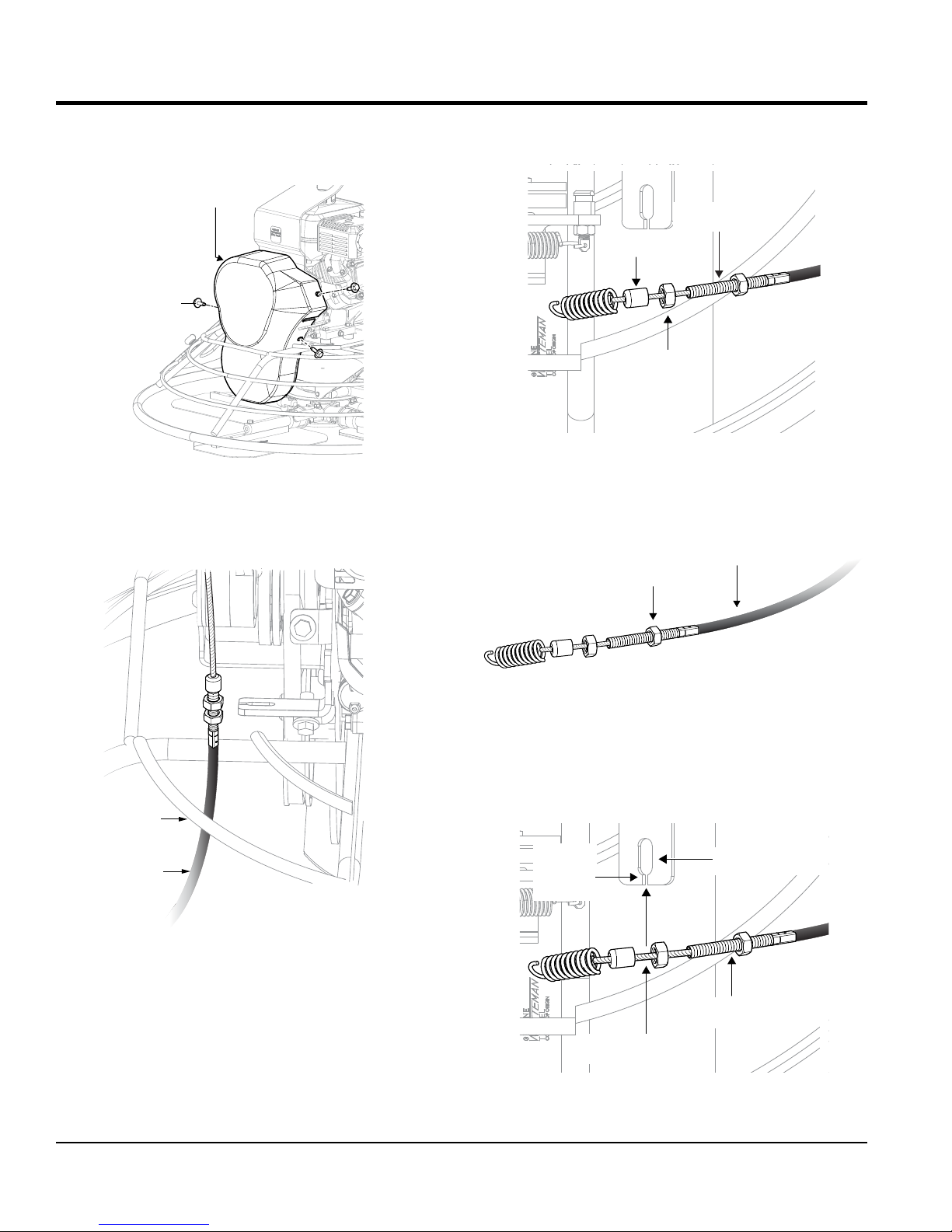
4. Using a 7/16” wrench remove the three 1/4" retaining
bolts (Figure 15) that secure the clutch cover to the
frame.
CLUTCH COVER
BOLT
Figure 15. Clutch Cover Removal
5. Route the clutch cable (Figure 16) underneath the top
most rung of the guard ring.
6. Remove the 5/16” outer nut (Figure 17) and rubber cap
from the threaded end on the clutch cable.
THREADED END
RUBBER
CAP
CLUTCH CABLE
5/16”
OUTER
NUT
Figure 17. Outer Nut And Rubber Cap Removal
7. Adjust the 5/16" inner nut (Figure 18) for a 7/8" distance
from the threaded end on the clutch cable to the inner
nut.
5/16”
INNER
NUT
CLUTCH CABLE
Figure 18. Inner Nut Adjustment
8. Insert the exposed cable (Figure 19) into the cable slot
TOP RUNG
OF
GUARD
RING
CLUTCH
CABLE
Figure 16. Clutch Cable Routing
on the cable anchor.
CABLE
ANCHOR
CABLE
SLOT
EXPOSED
CABLE
Figure 19. Inserting Clutch Cable
Into Cable Anchor
CABLE ANCHOR
THREADED END
CLUTCH CABLE
PAGE 22 — BS90C WALK-BEHIND TROWEL • OPERATION AND PARTS MANUAL — REV. #0 (9/4/15)
Page 23

ASSEMBLY AND INSTALLATION/INSPECTION
9. Connect the clutch cable to the clutch anchor by placing
the spring loop over the clutch anchor flats as shown
in Figure 20. Use needle nose pliers to slide the spring
loop fully into the groove.
CLUTCH
ANCHOR
FLAT
SPRING
LOOP
CLUTCH
CABLE
SPRING
Figure 20. Spring Loop Attachment.
CLUTCH
ANCHOR
10. Tighten the inner nut (Figure 21) against the clutch
cable support bracket until there is no longer any slack
in the cable between the threaded cable end and the
clutch cable spring.
Before Starting
1. Read all safety instructions at the beginning of manual.
2. Clean the trowel, removing dirt and dust, particularly
the engine cooling air inlet, carburetor and air cleaner.
3. Check the air filter for dirt and dust. If air filter is dirty,
replace air filter with a new one as required.
4. Check carburetor for external dirt and dust. Clean with
dry compressed air.
5. Check fastening nuts and bolts for tightness.
Engine Oil Check
1. To check the engine oil level, place the trowel on secure
level ground with the engine stopped.
2. Remove the dipstick from the engine oil filler hole
(Figure 22) and wipe clean.
CLUTCH
EXPOSED
CABLE
OUTER NUT
INNER NUT
CABLE
HOUSING
CABLE
SUPPORT
BRACKET
Figure 21. Attaching Clutch Cable
To Cable Support Bracket
11. Using two 1/2" wrenches tighten the inner and outer
nut against the clutch cable support bracket.
Figure 22. Engine Oil Dipstick Removal
3. Insert and remove the dipstick without screwing it into
the filler neck. Check the oil level shown on the dipstick.
BS90C WALK-BEHIND TROWEL • OPERATION AND PARTS MANUAL — REV. #0 (9/4/15)— PAGE 23
Page 24

OIL SIGHT GLASS/
PLUG
GEARBOX
INSPECTION
4. If the oil level is low (Figure 23), fill to the edge of the
oil filler hole with the recommended oil type as listed
in Table 4. Reference Table 3 for maximum engine oil
capacity.
Figure 23. Engine Oil Dipstick (Oil Level)
Table 4. Oil Type
Season Temperature Oil Type
Summer 25°C or Higher SAE 10W-30
Spring/Fall 25°C~10°C SAE 10W-30/20
Winter 0°C or Lower SAE 10W-10
Gearbox Oil
1. Determine if the gearbox oil is low by removing the oil
plug located on the side of the gearbox. (Figure 24) This
plug will be marked by the "check" decal. The correct
level of the lubrication oil should be to the bottom of
the fill plug.
FILL PLUG
DRAIN
Figure 24. Gearbox
2. If lubrication oil begins to seep out as the drain plug
is being removed, then it can be assumed that the
gearbox has a sufficient amount of oil.
DANGER
EXPLOSIVE FUEL!
Motor fuels are highly flammable and can
be dangerous if mishandled. DO NOT
smoke while refueling. DO NOT attempt
to refuel the trowel if the engine is hot! or
running.
Fuel Check
1. Visually inspect to see if fuel level is low. If fuel is low,
replenish with unleaded fuel.
2. When refueling, be sure to use a strainer for filtration.
DO NOT top-off fuel. Wipe up any spilled fuel
immediately.
3. If lubrication oil does not seep out as the drain plug
is being removed, fill with type ISO 680 (P/N 10139)
gearbox lubricant oil until the oil filler hole overflows.
V-Belt Check
A worn or damaged V-belt can adversely affect the
performance of the trowel. If a V-belt is defective or worn
simply replace the V-belt as outlined in the maintenance
section of this manual.
Belt Guard Check
Check for damage, loose or missing hardware.
Blade Check
Check for worn or damaged blades. Check to see if one
blade is worn out while the others look new. If this is
the case there could be a blade pitch problem. Refer to
the maintenance section of this manual for blade pitch
adjustment procedure. Replace any worn blades.
PAGE 24 — BS90C WALK-BEHIND TROWEL • OPERATION AND PARTS MANUAL — REV. #0 (9/4/15)
Page 25

OPERATION
Operation
This section is intended to assist the operator with the initial
start-up of the walk-behind trowel. It is extremely important
that this section be read carefully before attempting to use
the trowel in the field. DO NOT use your trowel until this
section is thoroughly understood.
Lifting the Trowel Onto a Slab
Extra care should be taken when lifting the trowel off the
ground. Serious damage to the machine or personal injury
could be caused by dropping a trowel.
WARNING
NEVER attempt to lift this machine alone. NEVER lift
the trowel by the guard ring as it may rotate and cause
injury.
ALWAYS make certain the handle is secure and use
only the manufacturer's approved lifting point. The
trowel may be lifted at the center lifting bale by crane
or other lifting device of adequate capacity.
Lifting Bale
The lift bale provides an optimal lift point for lifting the trowel.
When lifting the trowel onto a concrete slab, attach a chain
or rope to the lifting bale. Make sure the lifting device has
adequate lifting capacity to lift the trowel.
Using a crane or forklift (Figure 25) to lift the trowel is highly
recommended, and is perfectly safe for the trowel. ALWAYS
use extra care when lifting the trowel off the ground.
LIFT
NOTICE
DO NOT attempt to operate the trowel until the Safety,
General Information and Inspection sections of this
manual have been read and thoroughly understood.
NOTICE
The trowel is heavy and awkward to move around. Use
proper heavy lifting procedures and DO NOT lift the
trowel by the guard rings.
Figure 25. Lifting the Trowel
NEVER lift the trowel to unnecessary heights. DO NOT
stand underneath the trowel while it is being lifted. Serious
damage to the machine or personal injury could be caused
by dropping a trowel.
BS90C WALK-BEHIND TROWEL • OPERATION AND PARTS MANUAL — REV. #0 (9/4/15)— PAGE 25
Page 26

OPERATION
Starting the Engine
1. Turn the engine start/stop switch to the "ON" position
(Figure 26).
Figure 26. Engine ON/OFF Switch
(ON Position)
2. Place the engine fuel valve lever (Figure 27) in the
"ON" position.
4. Place the choke lever (Figure 29) in the "OPEN "
position.
Figure 29. Choke Lever Open
5. Grasp the starter grip (Figure 30) and slowly pull it
out. The resistance becomes the hardest at a certain
position, corresponding to the compression point. Pull
the starter grip briskly and smoothly for starting.
Figure 27. Engine Fuel Valve Lever (ON)
3. Push the throttle lever (Figure 28) in the "idle" position.
IDLE
THROTTLE
LEVER
Figure 28. Throttle (Idle Position)
PAGE 26 — BS90C WALK-BEHIND TROWEL • OPERATION AND PARTS MANUAL — REV. #0 (9/4/15)
Figure 30. Starter Grip
6. If the engine has started, slowly return the choke lever
(Figure 31) to the CLOSED position. If the engine has
not started repeat steps 1 through 5.
Figure 31. Choke Lever Closed
Page 27

OPERATION
7. Before the trowel is placed into operation, run the
engine for several minutes. Check for fuel leaks, and
noises that would associate with a loose guard ring
and/or covers.
To Begin Troweling
1. To begin troweling, place the throttle lever (Figure 32) in
the "RUN" position.
.
Figure 32. Throttle Lever (Run)
2. Squeeze the pull the clutch lever (Figure 33) to begin
4-blade rotation. Verify that the blades are rotating.
RUN
THROTTLE
LEVER
Pitching the Blades (Standard Handle)
To pitch the blades upwards using the "Standard" handle,
(Figure 34) simply turn the star-wheel clockwise. Turning the
star wheel counter clockwise will cause the blades to lay flat.
BLADE PITCH
STAR WHEEL
INCREASE
BLADE PITCH
(CW)
DECREASE
BLADE PITCH
(CCW)
Right Clutch
Lever
Left Clutch
Lever
Figure 33. Clutch Levers (Blade Activation)
Concrete Finishing Techniques
The following steps are intended as a basic guide to machine
operation, and are not to be considered a complete guide to
concrete finishing. We suggest that all operators (experienced
and novice) read “Slabs on Grade” published by the
American Concrete Institute, Detroit, Michigan. Read the
“Training” section of this manual for more information.
Figure 34. Blade Pitch Star Wheel
Pitching the Blades (Quick Pitch™ Handle)
To pitch the blades upwards using the "Quick Pitch™"
handle, (Figure 35) simply pull the T-handle backwards while
squeezing the trigger. Pushing the T-handle forward will cause
the blades to lay flat.
T-HANDLE
TRIGGER
(SQUEEZE)
NO PITCH
(BLADES FLAT)
BLADES PITCHED
UPWARDS FLAT
Figure 35. Blade Pitch T-Handle
BS90C WALK-BEHIND TROWEL • OPERATION AND PARTS MANUAL — REV. #0 (9/4/15)— PAGE 27
Page 28

OPERATION
Maneuvering the Trowel
1. Get into the operator’s position behind the handle. With
a secure foothold and a firm grasp on the handle, slowly
increase the engine speed until the desired blade speed
is obtained.
2. Figure 36 below illustrates a typical walk-behind trowel
application. Practice maneuvering the trowel. The trick
is to let the trowel do the work.
3. Continue to practice maneuvering the trowel. Try to
practice as if you were finishing a slab of concrete.
Practice edging and covering a large area.
Remember a good finishing technique is to work
backwards. Be careful when moving backwards so
that hazards can be avoided. The best way to get
accustomed to the trowel is repeated use.
CAUTION
NEVER place your feet or hands inside the guard rings
while starting or operating this equipment.
PAGE 28 — BS90C WALK-BEHIND TROWEL • OPERATION AND PARTS MANUAL — REV. #0 (9/4/15)
Figure 36. Maneuvering the Trowel
CAUTION
ALWAYS keep clear of rotating or moving parts while
operating this equipment.
Page 29

OPERATION
Stopping The Engine
1. Move the throttle lever to the (Figure 37) "IDLE"
position and run the engine for three minutes at low
speed.
IDLE
THROTTLE
LEVER
Figure 37. Throttle Lever (Idle)
2. After the engine cools, turn the engine start/stop switch
to the “OFF” position (Figure 38).
3. Close the fuel shut-off valve (Figure 39) by moving the
fuel valve lever to the OFF position.
Figure 39. Fuel Valve Lever (OFF)
Figure 38. Engine ON/OFF Switch
(OFF Position)
BS90C WALK-BEHIND TROWEL • OPERATION AND PARTS MANUAL — REV. #0 (9/4/15)— PAGE 29
Page 30

OPTIONS
NOTICE
Trowel blades should be changed when they fail to finish
concrete in a satisfactory manner.
Blades are a vital part of finishing concrete. This trowel,
or finisher, has been designed to finish concrete and the
blades are built to stringent quality standards out of the
finest steel.
If you need replacement blades, consult the parts list in
this manual for part numbers and order them from your
Multiquip parts dealer or importer.
Combo Blades
This trowel is equipped with combination float/finish (Figure
40) blades as original equipment. These blades have been
designed for optimum performance in both the floating and
finishing operations. These blades are versatile and should
take care of most troweling needs.
Clip-On Float Blades (Optional)
These blades will clip (Figure 42) onto an existing installed
blade, allowing your finisher to float on “wet” concrete so
that the troweling operation can begin as early as possible.
These blades are easily removable, so that after the floating
operation, when the concrete is sufficiently cured, they
can be removed to expose the finish blades for continued
troweling.
Figure 42. Clip-On Float Blade
Float Discs (Optional)
These round discs (Figure 43) attach to the spiders and
allow the machine to “float” on “wet” concrete. The disc
design allows early floating and easy movement from wet
to dry areas. They are also very effective in embedding
large aggregates and surface hardeners.
Figure 40. Combination Blade
Finish Blades (Optional)
These blades (Figure 41) have been specifically designed
for finish operations with this trowel. They will provide a
premium surface finishing capability from your trowel.
They should only be used after the concrete has set to
the point where the trowel does not sink into the concrete
when placed on it.
Figure 41. Finish Blade
Figure 43. Float Disc/Pan
NOTICE
For optimum panning performance blade speed must
be changed. Use Low Speed Kit. Reference Engine
and Clutch Assembly in parts section of this manual.
PAGE 30 — BS90C WALK-BEHIND TROWEL • OPERATION AND PARTS MANUAL — REV. #0 (9/4/15)
Page 31

OPTIONS
Trowel Arm Adjustment Tool (Optional)
If blades show uneven wear patterns or some tend to
wear out faster than others, the trowel arms may need to
be adjusted. A special tool is available (Figure 44) that will
adjust all of the trowel arms consistently. The Trowel Arm
Fixture P/N is 1817.
Figure 44. Trowel Arm Adjustment Fixture
Quick Pitch™ Handle (Optional)
This feature (Figure 45) is not standard equipment on this
model walk-behind trowel. To order this feature please
contact MQ unit sales.
T-HANDLE
TRIGGER
Figure 45. Quick Pitch™ Handle (Option)
The Quick Pitch™ Handle feature allows the operator to
adjust the pitch of the blades by grasping the handle, then
squeezing the trigger lever and then moving the handle
either forward or backwards to achieve the desired blade
pitch.
BS90C WALK-BEHIND TROWEL • OPERATION AND PARTS MANUAL — REV. #0 (9/4/15)— PAGE 31
Page 32

Table 5. Engine Maintenance Schedule
MAINTENANCE
EVERY
YEAR
OR 300
HRS.
DESCRIPTION
(3)
OPERATION
BEFORE
EACH
USE
FIRST
MONTH OR
20 HRS.
EVERY 6
MONTHS
OR 100
HRS.
Check X
Engine Oil
Change X X
Engine Oil Filter Replace Every 200 Hrs.
Check X
Air Cleaner
Clean X (1)
Change X (*)
Check/Adjust X
Spark Plugs
Replace X
Spark Arrester Clean X
Fuel Filter Replace X (2)
Fuel Tube Check Every 2 years (replace if necessary) (2)
* - Replace the paper filter element only.
(1) Service more frequently when used in DUSTY areas.
EVERY 2
YEARS OR
500 HRS.
(2) These items should be serviced by your service dealer, unless you have the proper tools and are mechanically proficient.
Refer to the HONDA Shop Manual for service procedures.
(3) For commercial use, log hours of operation to determine proper maintenance intervals.
Table 6. Trowel Maintenance Schedule
Periodic Maintenance Interval
ITEM OPERATION DAILY
Every
50-60 Hrs
Every
200-300 Hrs
Every
2000-2500 Hrs
V-Belt Check/Replace X
Relube Trowel Arms Grease X
Blades Check/Replace X
Trowel Arms Remove/Clean X
Thrust Collar/Bushing Remove/Clean X
Blade Arms Adjust X
Arm Bushing Remove/Replace X
Wear Ring Remove/Replace X
Thrust Collar Bearing Remove/Replace X
Pitch Control Cable Check X
Clutch Remove/Clean X
PAGE 32 — BS90C WALK-BEHIND TROWEL • OPERATION AND PARTS MANUAL — REV. #0 (9/4/15)
Page 33

MAINTENANCE
BLOW COMPRESSED
AIR FROM THE
INSIDE OUT
General maintenance practices are crucial to the
performance and longevity of your trowel. This equipment
requires routine cleaning, blade and trowel arm inspection,
lubrication and V-belt inspection for wear and damage.
Reference Table 5 and Table 6 for scheduled engine and
trowel maintenance.
The following procedures, devoted to maintenance, can
prevent serious trowel damage or malfunctioning.
NOTICE
Reference HONDA engine manual supplied with your
trowel for more detailed engine maintenance and
troubleshooting.
CAUTION
ALWAYS allow the engine to cool before
servicing. NEVER attempt any maintenance
work on a hot engine.
CAUTION
ALWAYS disconnect the spark plug wire from the spark
plug and secure away from the engine before performing
maintenance or adjustments on the machine.
Engine Air Cleaner
DANGER
DO NOT use gasoline or low flash point
solvents for cleaning the air cleaner, the
possibility exists of fire or explosion which
can cause damage to the equipment and
severe bodily harm or even DEATH!
CAUTION
Wear protective equipment such as
approved safety glasses or face shields
and dust masks or respirators when
cleaning air filters with compressed air.
This engine is equipped with a replaceable, high-density
paper air cleaner element. See Figure 46 for air cleaner
components.
1. Remove the air cleaner cover and foam filter element.
2. Tap the paper filter element several times on a hard
surface to remove dirt, or blow compressed air not
exceeding 30 psi (207 kPa, 2.1 kgf/cm2) through the
filter element from the inside out. NEVER brush off
dirt. Brushing will force dirt into the fibers. Replace the
paper filter element if it is excessively dirty.
WARNING
Some maintenance operations may
require the engine to be run. Ensure
that the maintenance area is well
ventilated. Gasoline engine exhaust
contains poisonous carbon monoxide
gas that can cause unconsciousness
and may result in DEATH
GENERAL CLEANLINESS
Clean the trowel daily. Remove all dust and slurry buildup.
If the trowel is steam-cleaned, ensure that lubrication is
accomplished AFTER steam cleaning.
ENGINE CHECK
Check daily for any oil and/or fuel leakage, thread nut and
bolt tightness, and overall cleanliness.
3. Clean foam element in warm, soapy water or
nonflammable solvent. Rinse and dry thoroughly. Dip
the element in clean engine oil and completely squeeze
out the excess oil from the element before installing.
Figure 46. Engine Air Cleaner
BS90C WALK-BEHIND TROWEL • OPERATION AND PARTS MANUAL — REV. #0 (9/4/15)— PAGE 33
Page 34

MAINTENANCE
GAP
IN.
)
NOTICE
Operating the engine with loose or damaged air cleaner
components could allow unfiltered air into the engine
causing premature wear and failure.
ENGINE OIL
1. Drain the engine oil when the oil is warm as shown in
Figure 47.
2. Remove the oil drain bolt and sealing washer and allow
the oil to drain into a suitable container.
3. Replace engine oil with recommended type oil as listed
in Table 4. For engine oil capacity, see Table 3 (engine
specifications). DO NOT overfill.
4. Reinstall drain bolt with sealing washer and tighten
securely.
SPARK PLUG
NOTICE
NEVER use a spark plug of incorrect heat range.
1. Remove and clean spark plug (Figure 48) with a wire
brush if it is to be reused. Discard spark plug if the
insulator is cracked or chipped.
2. Using a feeler gauge adjust spark plug gap to 0.028
~0.031 inch (0.7~0.8 mm).
3. Thread spark plug into cylinder hole by hand to prevent
cross-threading, then tighten securely.
.028 - .031
(0.7- 0.8 MM.
Figure 47. Draining Engine Oil
Figure 48. Spark Plug Gap
PAGE 34 — BS90C WALK-BEHIND TROWEL • OPERATION AND PARTS MANUAL — REV. #0 (9/4/15)
Page 35

MAINTENANCE
OIL SOAKED
MISSING RUBBER
WEAR
SCREEN
WIRE
V-BELT
Visually examine the V-belt (Figure 49) and determine if it
is full of tiny cracks, frayed, has pieces of rubber missing,
is peeling or otherwise damaged.
Also, examine the belt and determine if it is oil soaked or
"glazed " (hard shiny appearance on the sides of the belt).
Either of these two conditions can cause the belt to run hot,
which can weaken it and increase the danger of it breaking.
If the V-belt exhibits any of the above wear conditions
replace the V-belt immediately.
GLAZED
CORD FAILURE
WORN BACK
COVER
SPARK ARRESTER CLEANING
Clean the spark arrester every 6 months or 100 hours.
1. Remove the 4 mm screw (3) from the exhaust deflector,
then remove the deflector. See Figure 50
2. Remove the 5 mm screw (4) from the muffler protector,
then remove the muffler protector.
3. Remove the 4 mm screw from the spark arrestor, then
remove the spark arrester.
CRACKS
SIDEWALL
BROKEN
Figure 49. V-Belt Inspection
Figure 50. Spark Arrester Removal
4. Carefully remove carbon deposits from the spark
arrester screen (Figure 51) with a wire brush.
BRUSH
SPARK
ARRESTER
Figure 51. Cleaning The Spark Arrester
5. If the spark arrester is damaged and has breaks or
holes, replace with a new one.
6. Reinstall the spark arrester and muffler protector in
reverse order of disassembly.
BS90C WALK-BEHIND TROWEL • OPERATION AND PARTS MANUAL — REV. #0 (9/4/15)— PAGE 35
Page 36

BLADE PITCH
BLADE
MAINTENANCE
BOLT
FINISHED CONCRETE
PITCH
BLADE PITCH ADJUSTMENT PROCEDURE
The maintenance adjustment of blade pitch is an adjustment
that is made by a bolt (Figure 52) on the arm of the trowel
arm lever. This bolt is the contact point of the trowel arm
lever to the lower wear plate on the thrust collar. The goal
of the adjustment is to promote consistent blade pitch and
finishing quality. Adjustments are made by tightening or
loosening the blade pitch adjustment bolt.
ADJUSTMENT
BOLT
TROWEL LEVER
FINGER
TROWEL
ARM
SPIDER
PLATE
TROWEL
Figure 52. Blade Pitch Adjustment Bolt
Watch for the following indications when determining if
blade pitch adjustments are necessary:
• Is the machine wearing out blades unevenly, (i.e. one
blade is completely worn out while the others look
new)?
• Does the machine have a perceptible rolling or
bouncing motion when in use?
• Look at the machine while it is running, do the guard
rings “rock up and down” relative to the ground?
If it is determined that blade pitch adjustments are required
do the following:
NOTICE
Before any blade pitch adjustments can be made it
is essential to have a clean level area free of dirt and
debris to test the trowel. Any unlevel spots in the floor
or debris under the trowel blades will give an incorrect
perception of adjustment. Ideally, a 5 x 5 ft. (1.5 x 1.5
meter), three-quarter inch (19 mm) thick FLAT steel
plate should be used for testing.
1. Place the trowel on a flat, level area free of dirt and
debris.
2. Pitch the blades as flat as possible. The pitch
adjustment bolts (Figure 53) should all barely make
contact (0.10 inch max. clearance) with the lower
wear plate on the spider. All pitch alignment bolts
should be spaced the same distance from the lower
wear plate. If one is not making contact, adjustment
will be necessary.
GEARBOX
TROWEL
ARM
STEEL TEST
SURFACE
PITCH
ADJUSTMENT
LOWER
WEAR PLATE
MOUNTING
BAR
BLADE
Figure 53. Correct Blade Pitch (Flat)
3. Adjust the “high” bolts down to the level of the one that
is not touching, or adjust the “low” bolt up to the level
of the higher ones. If possible, adjust the low bolt up
to the level of the rest of the bolts. This is the fastest
way, but may not always work. Verify after adjustment
the blades pitch correctly.
4. Blades that are incorrectly adjusted often will not be
able to pitch flat. This can occur if the adjusting bolts
are raised too high. Conversely, adjusting bolts that
are too low will not allow the blades to be pitched high
enough for finishing operations.
5. If, after making blade pitch adjustments the machine
is still finishing poorly, blades, trowel arms, and trowel
arm bushings may be suspect and should be looked
at for adjustment, wear, or damage.
6. Figure 54 illustrates, "incorrect alignment", worn spider
bushings or bent trowel arms.
ADJUSTMENT
BOLT
NO
LOWER
WEAR PLATE
“DISHED” EFFECT ON
Figure 54. Incorrect Spider Plate Alignment
PAGE 36 — BS90C WALK-BEHIND TROWEL • OPERATION AND PARTS MANUAL — REV. #0 (9/4/15)
Page 37

GEARBOX
ARM
MAINTENANCE
BLADE
SPIDER REMOVAL
Remove the spider assembly from the gearbox shaft as
follows:
1. Locate the cone point square head set screw
(Figure 55) and attached jam nut found on the side of
the spider assembly.
2. Loosen the jam nut and cone point square head set
screw.
3. Carefully lift the upper trowel/gearbox assembly off of
the spider assembly. A slight tap with a rubber mallet
may be necessary to dislodge the spider from the main
shaft of the gearbox.
YOKE
GEARBOX
SHAFT
THRUST COLLAR
BEARING
CHANGING BLADES
It is recommended that ALL the blades on the trowel
are changed at the same time. If only one or some of the
blades are changed, the machine will not finish concrete
consistently and the machine may wobble or bounce.
Perform the following procedure when changing blades:
Please note the blade orientation on the trowel arm before
removing.
1. Lift the trowel up, placing blocks under the main guard
ring to support it.
2. Remove the bolts and lock washers from all the
towel arms, and then remove the blades as shown in
Figure 56.
ATTACHMENT
SCREWS
TROWEL ARM
SET SCREW
(CONE POINT SQ.HD.)
Figure 55. Spider Removal
JAM
NUT
WEAR RING
THRUST COLLAR
W/BUSHING
LOWER WEAR
PLATE
SPIDER PLATE
BLADE
ATTACHMENT
BAR
TROWEL
BLADE
Figure 56. Blade Removal
3. Wire brush and remove all concrete and debris from
all six sides of each of the four trowel arms. This is
important to properly seat the new blades.
4. Install the new blades, maintaining the proper blade
orientation for direction of rotation.
5. Reinstall the bolts and lock washers.
BS90C WALK-BEHIND TROWEL • OPERATION AND PARTS MANUAL — REV. #0 (9/4/15)— PAGE 37
Page 38

MAINTENANCE
F HEXAGONAL
LEVER
MOUNTING
SHAFT SECTION
TROWEL
TROWEL
TEST
(.004 IN/0.10 MM)
(.005 IN/0.127 MM)
TROWEL ARM REMOVAL
1. Each trowel arm is held in place at the spider plate
by a hex head bolt (zerk grease fitting) and a roll
pin. Remove both the hex head bolt and the roll
pin (Figure 57) from the spider plate.
2. Remove the trowel arm from the spider plate.
3. Should the trowel arm inserts ( bushing ) come out with
the trowel arm, remove the bushing from the trowel arm
and set aside in a safe place. If the bushing is retained
inside the spider plate, carefully remove the bushing
4. Examine the trowel arm bushing insert (Figure 57),
clean if necessary. Replace bushing if out of round
or worn.
SPIDER PLATE
ROLL PIN
TROWEL
ARM
CAP
ZERK
GREASE
FITTING
BUSHING
1. Use a thick steel plate, granite slab or any surface
which is true and flat, to check all six sides of each
trowel arm for flatness (Figure 59).
2. Check each of the six sides of the trowel arm (hex
section). A feeler gauge of .004 inch (0.10 mm) should
not pass between the flat of the trowel arm and the test
surface along its length on the test surface.
ARM
ARM
FEELER GAUGE
FEELER GAUGE
FLAT
SURFACE
Figure 59. Checking Trowel Arm Flatness
3. Next, check the clearance between the round shaft
and the test surface as one of the flat hex sections of
the arm rests on the test surface. Rotate the arm to
each of the flat hex sections and check the clearance
of the round shaft. Use a feeler gauge (Figure 60) of
.005 inch (0.127 mm). Each section should have the
same clearance between the round of the trowel arm
shaft and the test surface.
CHECKING TROWEL ARM STRAIGHTNESS
Trowel arms (Figure 58) can be damaged by rough
handling, such as dropping the trowel on the pad, or
by striking exposed plumbing, forms, or rebar while in
operation. A bent trowel arm will not allow the trowel to
operate in a smooth fluid rotation. If bent trowel arms are
suspect, check for flatness as follows:
Figure 57. Trowel Arm Removal
SLOT
TROWEL ARM
ROUND SHAFT
SECTION
ROLL PIN
HOLE
Figure 58. Trowel Arm
HEXAGONAL (HEX)
BLADE ATTACHMENT
BOLT HOLE
FLATO
TROWEL ARM
SHAFT (TOP OF ARM)
4. If the trowel arm is found to be uneven or bent, replace
the trowel arm.
PAGE 38 — BS90C WALK-BEHIND TROWEL • OPERATION AND PARTS MANUAL — REV. #0 (9/4/15)
Page 39

MAINTENANCE
SHIM
ADJUSTMENT FIXTURE
TROWEL
ANCE
TROWEL ARM LEVER ADJUSTMENT
The easiest and most consistent way to adjust the trowel
arm lever is to use the Trowel Arm Adjustment Fixture
(P.N. 1817).
As each trowel arm is locked into the fixture, the arm bolt
is adjusted to where it contacts a stop on the fixture. This
will consistently adjust all of the trowel arms, keeping the
finisher as flat and evenly pitched as possible.
This fixture will allow consistent adjustment of the trowel
arm lever. It comes with all the hardware necessary to
properly accomplish this maintenance and instructions on
how to properly utilize this tool. Adjusting the trowel arm
lever without a fixture requires a special talent.
Perform the following procedure when adjusting the trowel
arm lever:
1. Unscrew the locking bolts on the adjustment fixture and
place the trowel arm (lever attached) into the fixture
channel as shown in Figure 60.
2. Ensure the fixture arm is in the up position.
6. Loosen the locking nut on the trowel arm lever, then
turn the trowel arm adjusting bolt until it barely touches
(.010") the fixture adjusting bolt.
7. Once the correct adjustment is made, tighten the lock
nut on the trowel arm to lock in place.
8. Loosen locking nuts on the adjustment fixture, and
remove trowel arm.
9. Repeat steps for the remaining trowel arms.
REASSEMBLY
1. Clean and examine the upper/lower wear plates and
thrust collar. Examine the entire spider assembly. Wire
brush any concrete or rust buildup. If any of the spider
components are found to be damaged or out of round,
replace them.
2. Make sure that the bronze trowel arm bushing is not
damage or out of round. Clean the bushing if necessary.
If the bronze bushing is damaged or worn, replace it.
3. Reinstall bronze bushing onto trowel arm.
3. A thin shim may be required to cover the blade holes on
the trowel arm. Make sure to align the trowel adjustment
bolt with the fixture adjustment bolt.
ARM
LOCKING
BOLTS
Figure 60. Trowel Arm Adjustment Fixture
ARM
LEVER
TROWEL ARM
FIXTURE
ARM
ADJUSTMENT
ADJUSTMENT
BOLT
DIST
.010 INCH
BOLT
4. Use an allen wrench to tighten the locking bolts
securing the trowel arm in place.
5. Adjust the bolt distance shown in Figure 60 to match
one of the arms. The other arms will be adjusted to
match this distance.
4. Repeat steps 2 -3 for each trowel arm.
5. Make sure that the spring tensioner is in the correct
position to exert tension on the trowel arm.
6. Insert all trowel arms with levers into spider plate (with
bronze bushing already installed) using care to align
grease hole on bronze bushing with grease hole fitting
on spider plate.
7. Lock trowel arms in place by tightening the hex head
bolt with zerk grease fitting and jam nut.
8. Reinstall the blades onto the trowel arms.
9. Install stabilizer ring onto spider assembly.
10. Reinstall lower wear plate, thrust collar and upper wear
ring in the reverse order that they were disassembled
onto the spider shaft. Make sure that there is little or
no lateral movement between the thrust collar and the
spider shaft.
11. Carefully lift the upper trowel assembly, line up the
keyway on gear box main shaft and insert into spider
assembly.
BS90C WALK-BEHIND TROWEL • OPERATION AND PARTS MANUAL — REV. #0 (9/4/15)— PAGE 39
Page 40

MAINTENANCE
Y
KNOB,
Z-CLIP
12. Reinstall square head cone point into spider plate and
tighten in place. Tighten jam nut. Use care in making
sure point of set screw engages groove in gear box
main shaft.
13. Lubricate all grease points (zerk fittings) with premium
"Lithum 12" based grease, conforming to NLGI Grade
#2 consistency.
INSTALLING PANS ONTO FINISHER BLADES
These round discs, sometimes referred to as "pans", attach
to the spiders arms and allow early floating on wet concrete
and easy movement from wet to dry areas. They are also
very effective in embedding large aggregates and surface
hardeners.
Refer to Figure 61 when installing pans onto finisher blades.
TIE-DOWN
PANS
TIE-DOWN, BLADE
LONG-TERM STORAGE
For storage of the trowel for over 30 days, the following is
required:
Drain the fuel tank completely, or add STA-BIL to the fuel.
Run the engine until the gasoline in the carburetor is
completely consumed.
Completely drain the oil from the crankcase and refill
with fresh oil.
Remove the spark plug. Pour 5 to 10 cc of SAE 30 oil
into the cylinder. Turn the engine switch to the START
position for a few seconds to distribute the oil. Reinstall
the spark plug.
Clean all external parts of the trowel with a cloth.
Cover the trowel and store in a clean, dry place.
Z-CLIP, PAN
Figure 61. Z-Clip Finisher Pan Installation
BLADE ASSEMBL
1. Lift trowel just enough to slide pan under blades. Lower
finisher onto pan with blades adjacent to Z-Clips.
2. Rotate blades into position under Z-Clips. Ensure that
the blades are rotated in the direction of travel when
the machine is in operation or use the engine to rotate
the blades into position.
3. Attach the blade tie-downs to the far side of the Z-Clip
brackets with tie-down knobs as shown in Figure 61.
4. Check to make certain that the blade edges are
secured under the Z-Clips and the tie-downs are
secured completely over the edges of the blade bar
before the machine is put back into operation.
PAGE 40 — BS90C WALK-BEHIND TROWEL • OPERATION AND PARTS MANUAL — REV. #0 (9/4/15)
Page 41

Symptom Possible Problem Solution
Diffi cult to start, fuel is available, but no spark
at spark plug.
Diffi cult to start, fuel is available, and spark is
present at the spark plug.
Diffi cult to start, fuel is available, spark is
present and compression is normal.
Diffi cult to start, fuel is available, spark is
present and compression is low.
No fuel present at carburetor.
TROUBLESHOOTING
Troubleshooting (Engine)
Spark plug bridging? Check gap, insulation or replace spark plug.
Carbon deposit on spark plug? Clean or replace spark plug.
Short circuit due to defi cient spark plug
insulation?
Improper spark plug gap? Set to proper gap.
Fuel reaching carburetor? Check fuel line.
Water in fuel tank? Flush or replace fuel tank.
Fuel fi lter clogged? Replace fuel fi lter.
Stuck carburetor? Check fl oat mechanism.
Spark plug is red? Check transistor ignition unit.
Spark plug is bluish white?
No spark present at tip of spark plug?
No oil? Add oil as required.
Oil pressure alarm lamp blinks upon starting?
(if applicable)
ON/OFF switch is shorted? Check switch wiring, replace switch.
Ignition coil defective? Replace ignition coil.
Improper spark gap, points dirty? Set correct spark gap and clean points.
Condenser insulation worn or short circuiting? Replace condenser.
Spark plug wire broken or short circuiting? Replace defective spark plug wiring.
Wrong fuel type?
Water or dust in fuel system? Flush fuel system.
Air cleaner dirty? Clean or replace air cleaner.
Choke open? Close choke.
Suction/exhaust valve stuck or protruded? Reseat valves.
Piston ring and/or cylinder worn? Replace piston rings and/or piston.
Cylinder head and/or spark plug not tightened
properly?
Head gasket and/or spark plug gasket damaged? Replace head and spark plug gaskets.
No fuel in fuel tank? Fill with correct type of fuel.
Fuel cock does not open properly?
Fuel fi lter/lines clogged? Replace fuel fi lter.
Fuel tank cap breather hole clogged? Clean or replace fuel tank cap.
Air in fuel line? Bleed fuel line.
Check spark plug insulation, replace if worn.
If insuffi cient compression, repair or replace
engine. If injected air leaking, correct leak. If
carburetor jets clogged, clean carburetor.
Check transistor ignition unit is broken, and
replace defective unit. Check if voltage cord
cracked or broken and replace. Check if
spark plug if fouled and replace.
Check automatic shutdown circuit, "oil
sensor". (if applicable)
Flush fuel system, and replace with correct
type of fuel.
Torque cylinder head bolts and spark plug.
Apply lubricant to loosen fuel cock lever,
replace if necessary.
BS90C WALK-BEHIND TROWEL • OPERATION AND PARTS MANUAL — REV. #0 (9/4/15)— PAGE 41
Page 42

Symptom Possible Problem Solution
Weak in power, compression is proper and
does not misfi re.
Weak in power, compression is proper but
misfi res.
Engine overheats.
Rotational speed fl uctuates.
Recoil starter malfunctions. (if applicable)
Starter malfunctions.
Burns too much fuel.
Exhaust color is continuously "white".
Exhaust color is continuously "black".
Will not start, no power with ON/OFF switch
in "ON" position.
TROUBLESHOOTING
Troubleshooting (Engine) - continued
Air cleaner dirty? Clean or replace air cleaner.
Improper level in carburetor? Check fl oat adjustment, rebuild carburetor.
Defective spark plug? Clean or replace spark plug.
Improper spark plug? Set to proper gap.
Water in fuel system?
Dirty spark plug? Clean or replace spark plug.
Ignition coil defective? Replace ignition coil.
Spark plug heat value incorrect? Replace with correct type of spark plug.
Wrong type of fuel? Replace with correct type of fuel.
Cooling fi ns dirty? Clean cooling fi ns.
Intake air restricted?
Oil level too low or too high? Adjust oil to proper level.
Governor adjusted incorrectly? Adjust governor.
Governor spring defective? Replace governor spring.
Fuel fl ow restricted? Check entire fuel system for leaks or clogs.
Recoil mechanism clogged with dust and
dirt?
Spiral spring loose? Replace spiral spring.
Loose, damaged wiring?
Battery insuffi ciently charged? Recharge or replace battery.
Starter damaged or internally shorted? Replace starter.
Over-accumulation of exhaust products?
Wrong spark plug?
Lubricating oil is wrong viscosity? Replace lubricating oil with correct viscosity.
Worn rings? Replace rings.
Air cleaner clogged? Clean or replace air cleaner.
Choke valve set to incorrect position? Adjust choke valve to correct position.
Carburetor defective, seal on carburetor
broken?
Poor carburetor adjustment, engine runs too
rich?
ON/OFF switch not activated ON? Turn on ON/OFF Switch.
ON/OFF switch/wiring defective? Replace ON/OFF switch. Check wiring.
Centrifugal stop switch not activated ON? Turn on centrifugal stop switch.
Centrifugal stop switch/wiring defective? Replace centrifugal stop switch. Check wiring.
Flush fuel system and replace with correct
type of fuel.
Clear intake of dirt and debris. Replace air
cleaner elements as necessary.
Clean recoil assembly with soap and water.
Ensure tight, clean connections on battery
and starter.
Check and clean valves. Check muffl er and
replace if necessary.
Replace spark plug with manufacturer's
suggested type.
Replace carburetor or seal.
Adjust carburetor.
PAGE 42 — BS90C WALK-BEHIND TROWEL • OPERATION AND PARTS MANUAL — REV. #0 (9/4/15)
Page 43

Symptom Possible Problem Solution
Engine running rough or not at all.
Trowel bounces, rolls concrete, or makes
uneven swirls in concrete.
TROUBLESHOOTING
Troubleshooting (Walk-Behind Trowel)
Engine ON/OFF Switch in "OFF" position
or malfunctioning?
Centrifugal ON/OFF Switch in "OFF"
position or malfunctioning?
Fuel?
Ignition?
Loose wire connections Check wiring. Replace or repair as necessary.
Bad contacts in ON/OFF switch? Replace ON/OFF switch.
Blades?
Pitch adjustment?
Bent trowel arms?
Spider?
Thrust collar?
Thrust collar bushing?
Thrust bearing worn?
Make sure that the Engine ON/OFF Switch is ON
or replace switch if necessary.
Place centrifugal stop switch in "ON" position.
Check wiring. Replace switch if necessary.
Look at the fuel system. Make sure there is fuel
being supplied to the engine. Check to ensure that
the fuel fi lter is not clogged.
Check to ensure that the ignition switch has power
and is functioning correctly.
Make certain blades are in good condition, not
excessively worn. Finish blades should measure
no less than 2"" (50mm) from the blade bar to
the trailing edge, combo blades should measure
no less that 3.5"" (89mm). Trailing edge of blade
should be straight and parallel to the blade bar.
Check that all blades are set at the same
pitch angle as measured at the spider. A fi eld
adjustment tool is available for height adjustment
of the trowel arms. (Contact Parts Dept.)
Check the spider assembly for bent trowel arms.
If one of the arms is even slightly bent, replace it
immediately.
Check fi t of arms in spider. This can be done by
moving the trowel arms up and down. If there is
more than 1/8 inch (3.2 mm) of travel at the tip of
the arm, the spider and arms should be replaced.
Check the fl atness of the thrust collar by rotating
it on the spider. If it varies by more than 0.02 inch
(0.5 mm) replace the thrust collar.
Check the thrust collar by rocking it on the spider.
If it can tilt more than 3/32 inch (2.4 mm) - as
measured at the thrust collar O.D., replace the
thrust collar.
Check the thrust bearing to see that it is spinning
freely. Replace if necessary.
BS90C WALK-BEHIND TROWEL • OPERATION AND PARTS MANUAL — REV. #0 (9/4/15)— PAGE 43
Page 44

TROUBLESHOOTING
assembly should be checked for straightness.
Troubleshooting (Walk-Behind Trowel) - continued
Symptom Possible Problem Solution
The main output shaft of the gearbox
Machine has a perceptible rolling motion
while running.
Clutch slipping or sluggish response to
engine speed change.
Trowel blades do not rotate.
Main shaft?
Yoke?
Blade Pitch?
Worn V-belts? Replace V-belt.
Hand clutch out of adjustment?
Worn or defective hand clutch parts? Replace parts as necessary.
Worn bearings in gearbox?
Worn or broken gears in gearbox?
Defective clutch? Replace clutch.
Broken V-belt? Replace V-belt.
Defective ON/OFF switch?
Defective centrifugal ON/OFF switch?
The main shaft must run straight and cannot
be more than 0.003"" (0.08 mm) out of round
at the spider attachment point.
Check to make sure that both fi ngers of the
yoke press evenly on the wear cap. Replace
yoke as necessary.
Check to ensure that each blade is adjusted
to have the same pitch as all other blades.
Adjust per maintenance section in manual.
Adjust per instructions in maintenance
section of this manual.
Rotate input shaft by hand. If shaft rotates
with diffi culty, check the input and output
shaft bearings. Replace as necessary.
Verify that the gearbox shaft rotates when
the input shaft is rotated. Replace both the
worm and worm gear as a set.
Check and replace ON/OFF switch if
necessary.
Check and replace centrifugal ON/OFF
switch if necessary.
PAGE 44 — BS90C WALK-BEHIND TROWEL • OPERATION AND PARTS MANUAL — REV. #0 (9/4/15)
Page 45

INDICA
K
RECOIL
STARTER
COVER
SCREW
BLK BLK
WIRING DIAGRAM
OIL LEVEL
SWITCH
OIL LEVEL
TOR
GRN
YEL
BLK
BLK
YEL
OIL ALERT
UNIT
SPLICE TAP
CONNECTOR
BLK
ENGINE
SWITCH
CHASSIS
GND.
STOP
UNIT
TRANSISTORIZED
IGNITION UNIT
IGNITION
COIL
SPAR
PLUG
BS90C WALK-BEHIND TROWEL • OPERATION AND PARTS MANUAL — REV. #0 (9/4/15)— PAGE 45
Page 46

EXPLANATION OF CODE IN REMARKS COLUMN
The following section explains the different symbols and
remarks used in the Parts section of this manual. Use the
help numbers found on the back page of the manual if there
are any questions.
SAMPLE PARTS LIST
NO.
1 12345 BOLT
2% WASHER, 1/4 IN.
2% 12347 WASHER, 3/8 IN.
3 12348 HOSE
4 12349 BEARING
NO. Column
PART NO. Column
QTY. Column
— Item quantity can be indicated by a
A/R (As Required) is generally used for hoses or other
A blank entry generally indicates that the item is not sold
separately. Other entries will be clarifi ed in the “Remarks”
Some of the most common notes found in the “Remarks”
Column are listed below. Other additional notes needed
— All items on the parts list with the
same unique symbol will be included when this item is
— Used to list an effective serial
— Indicates that the part
is used only with the specifi c model number or model
number variant listed. It can also be used to show a
part is NOT used on a specifi c model or model number
— Indicates that the part can
be purchased at any hardware shop or made out of
available items. Examples include battery cables, shims,
— Indicates that an item cannot
be purchased as a separate item and is either part of an
assembly/kit that can be purchased, or is not available
Numbers Used
number, a blank entry, or A/R.
NOTICE
The contents and part numbers listed in the parts
section are subject to change without notice. Multiquip
does not guarantee the availability of the parts listed.
PART NO. PART NAME QTY. REMARKS
.....................1 .....INCLUDES ITEMS W/%
..........NOT SOLD SEPARATELY
..1 .....MQ-45T ONLY
..................A/R ...MAKE LOCALLY
..............1 .....S/N 2345B AND ABOVE
Unique Symbols — All items with same unique symbol
(@, #, +, %, or >) in the number column belong to the
same assembly or kit, which is indicated by a note in the
“Remarks” column.
Duplicate Item Numbers — Duplicate numbers indicate
multiple part numbers, which are in effect for the same
general item, such as different size saw blade guards in
use or a part that has been updated on newer versions
of the same machine.
parts that are sold in bulk and cut to length.
Column.
REMARKS Column
to describe the item can also be shown.
Assembly/Kit
purchased.
Indicated by:
“INCLUDES ITEMS W/(unique symbol)”
Serial Number Break
number range where a particular part is used.
Indicated by:
“S/N XXXXX AND BELOW”
“S/N XXXX AND ABOVE”
“S/N XXXX TO S/N XXX”
NOTICE
When ordering a part that has more than one item
number listed, check the remarks column for help in
determining the proper part to order.
Numbers Used — Part numbers can be indicated by a
number, a blank entry, or TBD.
TBD (To Be Determined) is generally used to show a
part that has not been assigned a formal part number
at the time of publication.
A blank entry generally indicates that the item is not sold
separately or is not sold by Multiquip. Other entries will
be clarifi ed in the “Remarks” Column.
PAGE 46 — BS90C WALK-BEHIND TROWEL • OPERATION AND PARTS MANUAL — REV. #0 (9/4/15)
Specifi c Model Number Use
variant.
Indicated by:
“XXXXX ONLY”
“NOT USED ON XXXX”
“Make/Obtain Locally”
and certain washers and nuts.
“Not Sold Separately”
for sale through Multiquip.
Page 47

SUGGESTED SPARE PARTS
BS90C WALK-BEHIND TROWELS
1 to 3 Units
Qty. P/N Description
1............21172 ....................CABLE, THROTTLE
1............20285 ....................CABLE, CONTROL, (STD)
1............20297 ....................CABLE, CONTROL (Q.P.)
1............30230 ....................CABLE, INSTACLUTCH
2............0152 3 ...................V-BELT, A28
4............1157 A .................. BUSHING, TROWEL ARM
4............2827-1 ..................ARM, TROWEL, B- EXTENDED, SILVER
1............10968 ....................THRUST BEARING KIT
2............20111 ....................OIL, MOBIL SYNTHETIC 22OZ.
SUBARU EX270DE5013
Qty. P/N Description
3............0650140150 ..........SPARK PLUG
1............X430440161 ......... TANK CAP
3............2793260618 ..........AIR CLEANER ELEMENT
1............2795011008 ..........ROPE, RECOIL
NOTICE
Part numbers on this Suggested Spare Parts list may
supersede/replace the part numbers shown in the
following parts lists.
BS90C WALK-BEHIND TROWEL • OPERATION AND PARTS MANUAL — REV. #0 (9/4/15)— PAGE 47
Page 48

NAMEPLATES AND DECALS
5
N36099
P/
4
8
P/N36099
7
P/N 23700
6
3
2
1
P/N 23700
L
WA
XXXdB
P/N 23803-XXX
9
SERIAL NO.
MFG. DATE
MODEL
kW/hp
11
Walk-Behind Trowel
18910Wilmington Ave
kg/lb
DESIGNED AND ASSEMBLED IN USA
Multiquip Inc.
Carson,CA 90746
WALK-BEHIND
POWER TR OWEL
WWW.MULTIQUIP.C
O
M
13
12
I
C
U
K
16
15
Q
14
P
H
I
T
C
17
J
FINISH
PRELOAD TRIM INDICATOR
FINISH
36”
PAGE 48 — BS90C WALK-BEHIND TROWEL • OPERATION AND PARTS MANUAL — REV. #0 (9/4/15)
COMBO
COMBO
J
COMBO
FINISH
FINISH
COMBO
48”
COM
B
O
J
O
MB
O
C
OR
INISH
AT
48”
C
O
M
H
S
B
I
OF
IN
MINDIC
F
RI
J
BO
M
O
C
F
I
N
IS
H
36”
PRELOADT
INISH
F
Page 49

NAMEPLATES AND DECALS
NO. PART NO. PART NAME QTY. REMARKS
1# 23698 ISO DECAL: ROTATING BLADE HAZARD, 2.00” DIA. 1
2# 23810 ISO DECAL: INHALATION HAZARD, 2.00” DIA 1
3# 23699 ISO DECAL: READ MANUAL, 2.00” DIA. 1
4# 23700 ISO DECAL: LIFTING/CRUSH, 2.4” X 2.0” 1
5# 36099 ISO DECAL: PROTECTIVE CLOTHING, 3.50” X 1.13” 1
6# 23701 ISO DECAL: ASK FOR TRAINING, 2.00” DIA. 1
7 2942 DECAL: MQ WHITEMAN 13" WHITE 1
8 1492 DECAL: FINISHER HANDLE 1
9 23803-111 ISO DECAL: GUARANTEED SOUND 111 dbA 1
10# 20816 DECAL: MQ LOGO 6.78” X .80” 2
11 23824 DECAL: SERIAL PLATE ....................................1................CONTACT MQ
PARTS DEPARTMENT
12 4014 SCREW, 2-3/16 P-K TYPE U-DRIVE 2
13 30319 DECAL KIT ........................................................1................INCLUDES ITEMS W/#
14 12405 DECAL: WHITEMAN QUICK PITCH 1
15# 22070 DECAL: MQ MULTIQUIP ROUND 3.78” DIA. 1
16# 23704 ISO DECAL: GUARD WARNING 2.00” DIA. 1
17 1735 DECAL: PRELOAD TRIM INDICATOR 1
BS90C WALK-BEHIND TROWEL • OPERATION AND PARTS MANUAL — REV. #0 (9/4/15)— PAGE 49
Page 50

48
1
BLUE
LOCTITE
STANDARD HANDLE ASSY.
34
50
51
32
14
1
S
N
STR UCTIO
N
I
17
19
15
18
16
13
5
8
49
25
6
2
42
11
10
9
6
A
A
20
21
4
3
1
7
33
12
39
2
46
45
31
44
27
43
40
42
41
24
22
36
47
29
28
37
38
35
NOTES:
1
USE LOCTITE BLUE# 246 W/ ALL SCREWS.
2
PART OF ITEM# 47 ASSEMBLY.
PAGE 50 — BS90C WALK-BEHIND TROWEL • OPERATION AND PARTS MANUAL — REV. #0 (9/4/15)
Page 51

STANDARD HANDLE ASSY.
NO. PART NO. PART NAME QTY. REMARKS
1#% 30155 HANDLE 1
2#% 30203 PIN, ROLL, 3/16" X 7/8" 3
3#% 22208 PLUG, THROTTLE LEVER 2
4#% 30174 GRIP 2
5#% 30169 CASTING, RIGHT PADDLE 1
6#% 30173 BUSHING, FLANGED, BRONZE, .51" ID X .625" OD 2
7#% 22732 THROTTLE LEVER ASSY. 1
8#% 30172 ROD, TORSION BAR 1
9#% 30171 CASTING, CABLE PULL 1
10#% 30170 CASTING, LEFT PADDLE 1
11#% 22166 COVER, VIBE CONTROL HANDLE PAD 1
12# 30156 UPPER HANDLE ASSY.. ...................................1................INCLUDES ITEMS W/%
13# 20819 HAND WHEEL ASSY., PITCH CONTROL .........1................INCLUDES ITEMS W/$
14#$ 0122 C SCREW, SHS 3/8-16 X 1/2" 1
15#$ 0281 BEARING, THRUST 1
16#$ 1478 SHAFT, TROWEL CONTROL 1
17#$ 3615 COLLAR, SET 3/4" ID 1
18#$ 20282 BEARING, TROWEL CONTROL 1
19#$ 20817 WHEEL, HANDLE 1
20# 0786 SCREW, BHC 1/4-20 X 3/8" NYL PATCH, NP 2
21# 0786 A SPACER, SLIDE BLOCK GUIDE, .360" X 17/64" X 1/8"L 1
22# 1116 NUT, BRASS JAM 5/16-18 2
24# 20285 CABLE, CONTROL 1
25# 20287 SLIDE BLOCK, TROWEL CONTROL 1
27# 21017 SCREW, HHC 3/8-16 x 3-1/4" FULL THRD GRD5 1
28# 21172 CABLE, THROTTLE 1
29# 21173 HOUSING, THROTTLE CABLE 1
31# 22095-P HANDLE, W/ FIN VIBE CONTROL 1
32# 30220 KIT, HANDLE INSTALLATION ...........................1................INCLUDES ITEMS W/♦
33# 30230 CABLE, CLUTCH 1
34 SXHC MAIN HANDLE ASSY. .......................................1................INCLUDES ITEMS W/#
CONTACT UNIT SALES
BS90C WALK-BEHIND TROWEL • OPERATION AND PARTS MANUAL — REV. #0 (9/4/15)— PAGE 51
Page 52

48
1
BLUE
LOCTITE
STANDARD HANDLE ASSY.
34
50
51
32
14
1
S
N
STR UCTIO
N
I
17
19
15
18
16
13
5
8
49
25
6
2
42
11
10
9
6
A
A
20
21
4
3
1
7
33
12
39
2
46
45
31
44
27
43
40
42
41
24
22
36
47
29
28
37
38
35
NOTES:
1
USE LOCTITE BLUE# 246 W/ ALL SCREWS.
2
PART OF ITEM# 47 ASSEMBLY.
PAGE 52 — BS90C WALK-BEHIND TROWEL • OPERATION AND PARTS MANUAL — REV. #0 (9/4/15)
Page 53

STANDARD HANDLE ASSY.
NO. PART NO. PART NAME QTY. REMARKS
35# 20280 BLOCK, PITCH CONTROL ...............................1................INCLUDES ITEMS W/@
36#@ 20279 PIN, SUPPORT BLOCK 1
37#@ 1118 PULLEY, PITCH CABLE ASSY. 1
38#@ 20275 BLOCK, SUPPORT 1
39#❖ 1665 SCREW, HHC 3/8-16 X 2" 2
40#❖ 3233 WASHER, FENDER, 1.5"OD X 3/8"ID 4
41#❖ 9154 SCREW, HHC 3/8-16 X 1-3/4" 1
42#❖♦ 10133 NUT, NYLOC 3/8-16" 4
43#❖ 22059 ISOLATOR, VIBRATION 3
44#❖ 22167 SCREW, HHC 3/8-16 X 6.5" GRD 5 1
45#❖ 22206 CHASSIS, CAST VIBRATION ISOLATOR 1
46#❖ 20439 WHEEL ASSY. , HAND 1
47# 30206 VIBE CHASSIS ASSY. .......................................1................INCLUDES ITEMS W/❖
48# 60097 LOCTITE, BLUE #246 1
49#♦ 21746 SPRING, PRIMARY THROTTLE RETURN 1
50#♦ 1493 SCREW, HHC 3/8-16 X 3-1/4" 1
51#♦ 10136 WASHER, 3/8" FLAT 2
BS90C WALK-BEHIND TROWEL • OPERATION AND PARTS MANUAL — REV. #0 (9/4/15)— PAGE 53
Page 54

59
QUICK PITCH HANDLE ASSY.
35
61
62
43
47
58
27
31
11
10
5
8
9
6
A
44
48
23
42
46
S
N
STR UCTIO
N
I
6
60
63
51
49
17
50
52
53
2
A
4
3
7
1
57
32
41
33
22
40
39
21
30
28
29
38
26
12
64
1
20
19
15
14
16
18
17
24
13
25
37
54
55
NOTES:
PART OF ITEM# 13 ASSEMBLY.
34
1
PAGE 54 — BS90C WALK-BEHIND TROWEL • OPERATION AND PARTS MANUAL — REV. #0 (9/4/15)
Page 55

QUICK PITCH HANDLE ASSY.
NO. PART NO. PART NAME QTY. REMARKS
1#% 30155 HANDLE 1
2#% 30203 PIN, ROLL, 3/16" X 7/8" 3
3#% 22208 PLUG, THROTTLE LEVER 2
4#% 30174 GRIP 2
5#% 30169 CASTING, RIGHT PADDLE 1
6#% 30173 BUSHING, FLANGED, BRONZE, .51" ID X .625" OD 2
7#% 22732 THROTTLE LEVER ASSY. 1
8#% 30172 ROD, TORSION BAR 1
9#% 30171 CASTING, CABLE PULL 1
10#% 30170 CASTING, LEFT PADDLE 1
11#% 22166 COVER, VIBE CONTROL HANDLE PAD 1
12# 30156 UPPER HANDLE ASSY. ....................................1................INCLUDES ITEMS W/%
13# 30206 VIBE CHASSIS ASSY. .......................................1................INCLUDES ITEMS W/@
14#@ 20439 WHEEL ASSY. , HAND 1
15#@ 22059 ISOLATOR, VIBRATION 3
16#@ 3233 WASHER, FENDER, 1.5"OD X 3/8"ID 4
17#@♦ 10133 NUT, NYLOC 3/8-16 4
18#@ 22206 CHASSIS, CAST VIBRATION ISOLATOR .........1................REPLACES P/N 22056
19#@ 9154 SCREW, HHC 3/8-16 X 1-3/4" 1
20#@ 22167 SCREW, HHC 3/8-16 X 6-1/2” GRD 5 1
21# 1116 NUT, BRASS JAM 5/16-18 2
22# 20297 CABLE, CONTROL 1
23# 30220 KIT, INSTACLUTCH HANDLE INSTALLATION ..1................INCLUDES ITEMS W/♦
24# 1717 SCREW, Q.P. TRIM ADJUSTMENT 1
25# 1718 NUT , Q.P. TRIM CONTROL ADJUSTMENT 1
26# 1719 BUSHING, PIVOT PLATE 2
27# 1729 PIN, ROLL 3/16" X 1-1/4" 2
28# 1732 Q.P. ADJUSTMENT PIN 1
29# 1733 WASHER, 1/2" X 1/32" 2
30# 1737 RING, SNAP 1
31# 4568 PIN, ROLL 3/16" X 1" 1
32# 20270 Q.P. ADJUSTMENT BLOCK 1
33# 20280 BLOCK, PITCH CONTROL ...............................1................INCLUDES ITEMS W/◊
34# 21017 SCREW, HHC 3/8-16 X 3-1/4" FULL THRD GRD5 1
35# 20390 TRIGGER, QP ASSY .........................................1................INCLUDES ITEMS W/$
37# 22060-P MAIN HANDLE, Q.P. VIBE CONTROL 1
38# 1715 Q.P. SPRING CENTER BALANCE 1
39#◊ 1118 PULLEY, PITCH CABLE HANDLE 1
40#◊ 20279 PIN, SUPPORT BLOCK 3/8" X 1.59" 1
41#◊ 20275 BLOCK, SUPPORT 1
42#◊ 1706 SPRING, COMPRESSION 1
43#◊ 1724 GRIP, HANDLE 1
44#◊ 1729 PIN, ROLL 3/16 X 1-1/4" 1
46#◊ 20437 PIN, Q.P. LATCH 1
47#◊ 1746 TRIGGER, Q.P. 1
BS90C WALK-BEHIND TROWEL • OPERATION AND PARTS MANUAL — REV. #0 (9/4/15)— PAGE 55
Page 56

59
QUICK PITCH HANDLE ASSY.
35
61
62
43
47
58
27
31
11
10
5
8
9
6
A
44
48
23
42
46
S
N
STR UCTIO
N
I
6
60
63
51
49
17
50
52
53
2
A
4
3
7
1
57
32
41
33
22
40
39
21
30
28
29
38
26
12
64
1
20
19
15
14
16
18
17
24
13
25
37
54
55
NOTES:
PART OF ITEM# 13 ASSEMBLY.
34
1
PAGE 56 — BS90C WALK-BEHIND TROWEL • OPERATION AND PARTS MANUAL — REV. #0 (9/4/15)
Page 57

QUICK PITCH HANDLE ASSY.
NO. PART NO. PART NAME QTY. REMARKS
48#$ 20389 TRIGGER, Q.P. 1
49#❖ 20269 BLOCK, CABLE SLIDE 1
50#❖ 20443 ARM, SLIDE CONTROL 1
51#❖ 1709 Q.P. DOGBONE 1
52#♦ 20276 PIN, ROLL, 1/4" X 1-3/4 1
53#♦ 1731 PIN, ROLL, 1/4" X 3/4" 1
54# 21173 HOUSING, THROTTLE CABLES 1
55# 21172 CABLE, THROTTLE 68”L 1
57# 30230 CABLE, INSTACLUTCH 1
58# 1711 SHAFT, CONTROL Q.P. 1
59 QXHC MAIN HANDLE ASSY. .......................................1................INCLUDES ITEMS W/#
60#♦ 21746 SPRING, PRIMARY THROTTLE RETURN 1
61#♦ 1493 SCREW, HHC 3/8-16 X 3-1/4" 1
62#♦ 10136 WASHER, 3/8" FLAT 2
63 20293 LINKAGE, Q.P. CONTROL .................................1................INCLUDES ITEMS W/❖
64 1665 SCREW, HHC 3/8-16 X 2" 2
BS90C WALK-BEHIND TROWEL • OPERATION AND PARTS MANUAL — REV. #0 (9/4/15)— PAGE 57
Page 58

GUARD RING AND ENGINE MOUNTING ASSY.
14
13
BLUE
LOCTITE
1
4
3
5
2
7
3
8
6
BLUE
LOCTITE
2
9
10
11
12
1
NOTES:
1
USE LOCTITE BLUE# 246 W/ ALL SCREWS.
2 TORQUE TO 8 FT.-LBS. (10.8 N m)
3 TORQUE TO 14.5 FT.-LBS. (20 N m)
4 TORQUE TO 23 FT.-LBS. (31 N m)
PAGE 58 — BS90C WALK-BEHIND TROWEL • OPERATION AND PARTS MANUAL — REV. #0 (9/4/15)
Page 59

GUARD RING AND ENGINE MOUNTING ASSY.
NO. PART NO. PART NAME QTY. REMARKS
1 21973 GUARD RING 1
2 0205 SCREW, HHC 3/8-16 X 1" 4
3 13351 WASHER, FLAT 3/8 EXT THICK HIGH STRGTH 4
4 1391 SCREW, HHC 5/16-24 X 1-1/2 ZINC 4
5 933241 WASHER, FLAT SAE 5/16 GRD 9 YZ 4
6 21979 ACCESS PANEL 1
7 26250 SCREW, HHC 1/4-20 X 1-3/4" 2
8 21893 SCREW, FAST LEAD 1
9 21986 WASHER, FAST LEAD-STAINLESS 1
10 21894 CLIP, FAST LEAD 1
11 21922 CLAMP, 0.625"ID PIPE 2
12 10024 NUT, NYLOC 1/4-20 2
13 60097 BLUE LOCTITE, #246 AR
BS90C WALK-BEHIND TROWEL • OPERATION AND PARTS MANUAL — REV. #0 (9/4/15)— PAGE 59
Page 60

STABILIZER RING ASSY.
2
1
4
5
NOTES:
1
TORQUE TO 17 FT.-LBS. (23 N m)
1
3
PAGE 60 — BS90C WALK-BEHIND TROWEL • OPERATION AND PARTS MANUAL — REV. #0 (9/4/15)
Page 61

STABILIZER RING ASSY.
NO. PART NO. PART NAME QTY. REMARKS
1 6014 C NUT, HEX FINISH 5/16-24 8
2 1483 RING, STABILIZER 1
3 1237 SCREW, SHC 5/16-18 X 7/8, NYL PATCH, NP 4
4 1723 ROD END, 5/16 DIA X 5/16-24 MALE END RH 4
5 0300 B WASHER, FLAT SAE 5/16 4
BS90C WALK-BEHIND TROWEL • OPERATION AND PARTS MANUAL — REV. #0 (9/4/15)— PAGE 61
Page 62

GEARBOX ASSY.
BLUE
LOCTITE
36
2
1
1
3
4
4
12
7
31
6
9
GEARBOX
OIL
6
7
11
22 OZ.
(650 ML)
7
30
9
13
8
6
WHITE
LOCTITE
14
37
2
10
15
2
33
34
18
16
19
32
35
17
13
8
20
NOTES:
APPLY THREAD LOCK, LOCTITE
1
242 BLUE P/N 60091 OR EQUIVALENT.
APPLY THREAD LOCK, LOCTITE
2
572 WHITE P/N 60096 OR EQUIVALENT.
TORQUE TO 15 FT-LBS (20 N m)
3
GASKETS ARE NOT SOLD SEPARATELY.
4
SHIM(GASKETS) AS NECESSARY FOR
INPUT SHAFT END-PLAY.
GASKETS ARE NOT SOLD SEPARATELY.
5
SHIM(GASKETS) AS NECESSARY FOR
OUTPUT SHAFT END-PLAY.
USE SPECIALLY FORMULATED
WHITEMAN GEARBOX LUBRICANT
P/N 20111 OR MOBIL SYNTHETIC OIL.
6
GEARBOX REQUIRES 26 OZ. (769 ML)
OF GEARBOX LUBRICANT FOR
OPERATION.
GASKET AND SEAL KIT INCLUDES
7
ITEMS 1,4, 25, AND 29 PLUS GASKETS.
BEARING KIT INCLUDES ITEMS 6,7,18
8
AND 19.
.
19
18
22
21
12
5
7
25
29
26
27
28
3
GEARBOX ASSEMBLYITEM 30,
INCLUDES ITEMS WITHIN DASHED LINE
9
EXCEPT ITEMS 12,13 AND 31.
PAGE 62 — BS90C WALK-BEHIND TROWEL • OPERATION AND PARTS MANUAL — REV. #0 (9/4/15)
Page 63

GEARBOX ASSY.
NO. PART NO. PART NAME QTY. REMARKS
1%$ 0753 SEAL, OIL 1
2% 0131A SCREW, HHC 1/4-20 X 3/4" 4
3% 12876 FLANGE, INPUT SHAFT 1
4%$ 20395 O-RING, 2" 1
6%# 20466 BEARING, CUP, TIMKEN #M11910 2
7%# 20465 BEARING, CONE, TIMKEN #LM11949 2
9% 1851 GEAR, WORM "B" INPUT SHAFT 1
10% 12874 CASE, WORM GEAR 1
11% 21218 VENT, AIR 1
12 21046 GASKET/SEAL KIT ............................................1................INCLUDES ITEMS W/$
13 21047 BEARING KIT ....................................................1................INCLUDES ITEMS W/#
14% 20476 SCREW, HHC 1/4-28 X 3/8" 2
15% 21033 SIGHT GLASS, 3/4 M PIPE STEEL 1
16% 0121 A FITTING, PLUG 3/8 MP SQ HEAD 1
17% 1138 RING, SNAP 1
18%# 20475 BEARING, CUP TIMKEN #M86610 2
19%# 20474 BEARING, CONE TIMKEN #M86647 2
20% 1140 GEAR, WORM, COMPOSITE 1
21% 20470 SHAFT, OUTPUT 1
22% 1139 KEY, WOODRUFF #810 1
25%$ 20396 O-RING 1
26% 12875 COVER, GEARBOX 1
27% 10235 WASHER, C/S EXT. SHKP 4
28% 20875 SCREW, FHSC 5/16-18 X 3/4" 4
29%$ 0254 SEAL, OIL 1
30 20407 GEARBOX ASSY. ..............................................1................INCLUDES ITEMS W/%
31 20111 OIL, MOBIL SYNTHETIC SHC634, 22 OZ. (650 ML) 2
32 22292 SPACER, 0.5" X 0.402" X .25"L UNTREATED 2
33 20802 RING, SNAP 2
34 1150 YOKE ARM 1
35 20801 PIN, YOKE 1
36 60091 LOCTITE, BLUE #242 AR
37 60096 LOCTITE, WHITE #572 AR
BS90C WALK-BEHIND TROWEL • OPERATION AND PARTS MANUAL — REV. #0 (9/4/15)— PAGE 63
Page 64

55
ENGINE AND CLUTCH ASSY.
LOW SPEED
KIT
1 3
1 5
52
41
50
45
2
1
BLUE
LOCTITE
114
5
1
36
19
54
46
25
49
35
32
4
1
43
2
1
44
PAGE 64 — BS90C WALK-BEHIND TROWEL • OPERATION AND PARTS MANUAL — REV. #0 (9/4/15)
NOTES:
USE LOCTITE BLUE# 246.
1
( FOR CLUTCH AND PULLEY: TO ALL SET SCREWS)
TORQUE TO 8 FT.-LBS. (10.8 N m)
2
TORQUE TO 13 FT.-LBS. (18 N m)
3
TORQUE TO 14.5 FT.-LBS. (19.6 N m)
4
5
TORQUE TO 26 FT.-LBS. (35 N m)
Page 65

ENGINE AND CLUTCH ASSY.
NO. PART NO. PART NAME QTY. REMARKS
1 0152 3 BELT, A28 1
2 60097 BLUE LOCTITE, #246 AR
4 0627 KEY, 3/16" X 1-1/4" 1
5 22538-001 SCREW, HEX FLANGE, 1/4-20 X 0.5" 1
19 10229 SCREW, HHC 5/16-24 X 1" 4
25 21140 PULLEY AK54 X 3/4" 1
32 21984 LIFTING BALE ASSY. 1
35 22623 ENGINE, HONDA GX27OUT2QAP2 (8.5 HP) 1
36 22891 CLUTCH, FRICTION DRIVE, 1.0" SHAFT 1
41 23965 SCREW, FHSC, 7/16-20 X 1.00 1
43 30119 SCREW, 1/4-20X7/8 IND HEX, DOG PT 3
44 30344 BELT GUARD 1
45 30200 BRACKET, 1" SHAFT 1
46 30202 ANCHOR, SPRING 1
49 30236 SPACER, 1" SHAFT 1
50 30240 END CAP, 1" SHAFT 1
52 32448 SCREW, BHC, 5/16-18 x 1/2" 4
54 933241 WASHER, FLAT SAE 5/16 GRD 9 YZ 8
55 22587 LOW SPEED KIT ...................................................................... 1 ........... INCLUDES ITEMS
W/$
BS90C WALK-BEHIND TROWEL • OPERATION AND PARTS MANUAL — REV. #0 (9/4/15)— PAGE 65
Page 66

25
SPIDER ASSY.
17
18
26
22
5
BOLT KIT
15
16
19
20
3
21
2
1
1
11
1
14
4
13
23
BLUE
LOCTITE
2
7
9
10
6
24
PAGE 66 — BS90C WALK-BEHIND TROWEL • OPERATION AND PARTS MANUAL — REV. #0 (9/4/15)
4
8
5
NOTES:
1
APPLY LOCTITE P/N 1477 TO ITEMS 1 AND 14
SPIDER ASSEMBLYP/N 1215
2
INCLUDES ALL ITEMS WITHIN OUTLINE.
INCLUDED WITH ITEM 19 OR CAN BE
3
ORDERED SEPARATELY(P/N 1471)
TORQUE TO 23 FT.-LBS (31 N m)
4
5
TORQUE TO 17 FT.-LBS (23 N m)
3
12
Page 67

SPIDER ASSY.
NO. PART NO. PART NAME QTY. REMARKS
1% 0164 B SCREW, HHC ROUNDED 3/8-16, FULL THREAD 4
2% 0166 A LOCK WASHER 3/8" MED 4
3% 1157 A BUSHING, TROWEL ARM 4
4% 1161-1 SPIDER PLATE, 1-1/8" SHAFT 4BLD, SILVER 1
5% 1162 A CAP, GREASE ZERK #2 YELLOW 4
6% 1163-1 LEVER, TROWEL ARM, RIGHT HAND, SILVER 4
7% 1316 SPRING, LS ARM RETURN 4
8% 1322 RETAINING SCREW ASSY. 4
9% 1456 NUT, HEX FINISH 3/8-16 1
10% 1875 WASHER, INT. SHKP. 3/8” 4
11% 1876 NUT, HEX JAM 3/8-16 CLASS 2B 4
12% 2827-1 ARM, TROWEL, B EXTENDED, SILVER 4
13% 4164 ROLL PIN 5/16" X 1-3/4” 4
14% 12097 SCREW, SQHS 3/8-16 X 1-3/4" CONE GRD 8 PLTD 1
15 1490 SPIDER PLATE ASSY., .....................................1................INCLUDES ITEMS W/%
16 10968 THRUST COLLAR ASSY. ..................................1................INCLUDES ITEMS W/$
17$ 12208 WEAR RING 1
18$ 12778 FLANGE BEARING 1
19$ 10793 THRUST COLLAR ............................................1................INCLUDES ITEMS W/#
20$# 1471 THRUST COLLAR BUSHING 1
21$ 1154 A WEAR PLATE 1
22@ 21906 SCREW, HHCS 5/16-18 X 1-1/2" GRD 5 12
23 1477 BLUE LOCTITE, #242 AR
24 BLADE ASSY .....................................................4................CONTACT MQ UNIT SALES DEPT.
25 23648 KIT, BOLT SAE ...................................................1................INCLUDES ITEMS W/@
26@ 1434 PLUG, BLADE 4
BS90C WALK-BEHIND TROWEL • OPERATION AND PARTS MANUAL — REV. #0 (9/4/15)— PAGE 67
Page 68

BLADES AND PAN ASSY.
3
3
1
2
8
14
15
11
16
17
18
12
9
10
13
5
PAGE 68 — BS90C WALK-BEHIND TROWEL • OPERATION AND PARTS MANUAL — REV. #0 (9/4/15)
6
7
Page 69

BLADES AND PAN ASSY.
NO. PART NO. PART NAME QTY. REMARKS
1 BLADE, COMBO 8" X 14" .......................................4 ............(ALL EXCEPT 30")
2 BLADE, COMBO 8 X 10⁻¹/2". ................................. 4 ............(30" TROWEL ONLY)
3 21906 SCREW, HHFS 5/16-18 X 1-1/2" GR5 ....................8 ............ALL
5 20646 LATCH PIN FOR FLOAT PANS ..............................4 ............CONTACT UNIT SALES DEPT./ACC. ITEM
6 1817 TRWL ARM ADJ. FIXTURE 36" TO 46" MODELS..1 ............CONTACT UNIT SALES DEPT./ACC. ITEM
7 FLOAT DISC ...........................................................1 ............CONTACT UNIT SALES DEPT./ACC. ITEM
8 FLOAT BLADE ........................................................ 4 ............CONTACT UNIT SALES DEPT./ACC. ITEM
9 FINISH BLADE .......................................................4 ............CONTACT UNIT SALES DEPT./ACC. ITEM
10 COMBO FLOAT &FINISH BLADE ..........................4 ............CONTACT UNIT SALES DEPT./ACC. ITEM
11 ENDURO UNIVERSAL FINISH BLADE .................4 ............CONTACT UNIT SALES DEPT./ACC. ITEM
12 ENDURO UNIVERSAL COMBO BLADE ................4 ............CONTACT UNIT SALES DEPT./ACC. ITEM
13 REVERSIBLE COMBO BLADE ..............................4 ............CONTACT UNIT SALES DEPT./ACC. ITEM
14 UNIVERSAL MOUNTING BAR...............................4 ............CONTACT UNIT SALES DEPT./ACC. ITEM
15 QS1869 SNAP PIN FOR QC BLADES .................................8 ............CONTACT UNIT SALES DEPT./ACC. ITEM
16 1434 PLUG, BLADE (FINISH BLADE ONLY) 4
17 0202 SCREW, HHC 5/16-18 X 1" ZINC 4
18 0201 LUG, GUARD RING 4
BS90C WALK-BEHIND TROWEL • OPERATION AND PARTS MANUAL — REV. #0 (9/4/15)— PAGE 69
Page 70

EX27 — CRANKCASE ASSY.
PAGE 70 — BS90C WALK-BEHIND TROWEL • OPERATION AND PARTS MANUAL — REV. #0 (9/4/15)
Page 71

EX27 — CRANKCASE ASSY.
NO. PART NO. PART NAME QTY. REMARKS
10 2791010611 CRANK CASE CP .............................................1................INCLUDES ITEMS W/$
20# 2371420203 VALVE GUIDE 2
26# 2771601001 STEM SEAL 1
30$ 0440300160 OIL SEAL 1
40$ 0600300370 BALL BEARING 1
50$ 2771501103 PIPE KNOCK 2
60# 0105080250 STUD 2
70# 0105060410 STUD 2
75$ 0440060020 OIL SEAL 1
80 0401140030 PLUG 1
90@ 0211140020 GASKET 1
210 2791100221 MAIN BEARING COVER C ...............................1................INCLUDES ITEMS W/%
220% 0440300160 OIL SEAL 1
230% 0600300370 BALL BEARING 1
250 27745004K1 GOVERNOR GEAR CP 1
260 2774190203 GOVERNOR SLEEVE 1
270 2796360113 OIL GAUGE 2
280@ 0213200050 GASKET 1
300 0010408350 FLANGE BOLT 7
610 2791300121 CYLINDER HEAD CP .......................................1................INCLUDES ITEMS W/#
620@ 2791500133 GASKET (HEAD) 1
630 0110080240 FLANGE BOLT 4
631 0110080310 FLANGE BOLT 1
680 2771550301 ROCKER COVER CP 1
690@ 2771600113 GASKET (ROCKER COVER) 1
700 2771501103 PIPE KNOCK 2
710 0110060020 FLANGE BOLT 4
960 2799900127 GASKET SET ...................................................1................INCLUDES ITEMS W/@ AND
............................................................................................. ITEM 340 MUFFLER ASSY.
BS90C WALK-BEHIND TROWEL • OPERATION AND PARTS MANUAL — REV. #0 (9/4/15)— PAGE 71
Page 72

EX27 — CRANKSHAFT ASSY.
PAGE 72 — BS90C WALK-BEHIND TROWEL • OPERATION AND PARTS MANUAL — REV. #0 (9/4/15)
Page 73

EX27 — CRANKSHAFT ASSY.
NO. PART NO. PART NAME QTY. REMARKS
10 2792090161 CRANK SHAFT CP 1
50 0180180010 FLANGE NUT 1
70 0323030010 WOODRUFF KEY 1
80 2072600103 KEY 1
310 2792250120 CONNECTING ROD ASSY. ...............................1................INCLUDES ITEMS W/#
320# 2792300103 CONNECTING ROD BOLT 2
350 2792330113 PISTON PIN 1
360 27923401H3 PISTON 1
370 2792351117 PISTON RING SET 1
380 0565180010 CLIP 2
BS90C WALK-BEHIND TROWEL • OPERATION AND PARTS MANUAL — REV. #0 (9/4/15)— PAGE 73
Page 74

EX27 — MUFFLER ASSY.
PAGE 74 — BS90C WALK-BEHIND TROWEL • OPERATION AND PARTS MANUAL — REV. #0 (9/4/15)
Page 75

EX27 — MUFFLER ASSY.
NO. PART NO. PART NAME QTY. REMARKS
10 2793160121 CAM SHAFT CP ...............................................1................INCLUDES ITEMS W/%
25 2773510103 PIN (CAM SHAFT) 1
27 0240060030 O RING 1
34% 2773860103 PIN (SPRING) 1
35% 2793640103 RELEASE LEVER 1
37% 2773650103 CLIP 1
38% 2773870303 RETURN SPRING 1
60 2793360103 VALVE SPRING 2
70 2693370103 SPRING RETAINER 2
80 27933401H3 INTAKE VALVE 1
90 27933501H3 EXHAUST VALVE 1
95 13210KA031 COLLET-VALVE 4
150 27935602H1 TIMING CHAIN CP 1
160 2773691103 TENTIONER 1
163 2773710103 SPRING (TENTIONER) 1
166 2773690203 PIN (TENTIONER) 1
170 2773691313 CHAIN GUIDE 1
200 2773500401 PIN (ROCKER) CP ...........................................1................INCLUDES ITEMS W/+
202+ 0031305000 CLIP 1
220 2773620100 ROCKER ARM (IN) ASSY. .................................1................INCLUDES ITEMS W/#
225 2773620200 ROCKER ARM (EX) ASSY. ................................1................INCLUDES ITEMS W/@
230# 0149050020 ADJUST SCREW 1
231@ 0149050020 ADJUST SCREW 1
240# 0170050030 NUT 1
241@ 0170050030 NUT 1
290 0110060010 FLANGE BOLT 1
310 27930111L1 MUFFLER CP 1
315 2793760101 SPARK ARRESTER CP 1
317 0150040060 TAPPING SCREW 1
320 2793420121 MUFFLER COVER CP 1
340 2773520113 GASKET (MUFFLER) 1
350 0023808000 FLANGE NUT 2
360 0152060090 TAPPING BOLT 2
361 0110060010 FLANGE BOLT 1
365 0110080320 FLANGE BOLT 1
387 0150040060 TAPPING SCREW 2
440 27737001H1 DEFLECTOR CP 1
540 27932902J1 INSULATOR CP ................................................1................INCLUDES ITEMS W/$
560$ 27935902J3 GASKET 1 (INSULATOR) 1
570 0023806000 FLANGE NUT 2
580 0010406200 FLANGE BOLT 1
BS90C WALK-BEHIND TROWEL • OPERATION AND PARTS MANUAL — REV. #0 (9/4/15)— PAGE 75
Page 76

EX27 — AIR CLEANER ASSY.
PAGE 76 — BS90C WALK-BEHIND TROWEL • OPERATION AND PARTS MANUAL — REV. #0 (9/4/15)
Page 77

EX27 — AIR CLEANER ASSY.
NO. PART NO. PART NAME QTY. REMARKS
510 2793261570 AIR CLEANER ASSY. .........................1................INCLUDES ITEMS W/#
510-210# 2793272008 PACKING 1
510-220# 2793265018 GASKET 1
510-250# 2793264318 COVER 1
510-260# 2793273008 LABEL 1
510-270# 2793274008 WING NUT 2
510-520# 2793260618 ELEMENT SET 1
570 0023806000 FLANGE NUT 2
580 0010406200 FLANGE BOLT 1
BS90C WALK-BEHIND TROWEL • OPERATION AND PARTS MANUAL — REV. #0 (9/4/15)— PAGE 77
Page 78

EX27 — GOVERNOR ASSY.
PAGE 78 — BS90C WALK-BEHIND TROWEL • OPERATION AND PARTS MANUAL — REV. #0 (9/4/15)
Page 79

EX27 — GOVERNOR ASSY.
NO. PART NO. PART NAME QTY. REMARKS
10 2794230153 GOVERNOR LEVER 1
20 2774220133 GOVERNOR SHAFT 1
30 2794270111 GOVERNOR ROD CP 1
40 2774280123 ROD SPRING 1
50 0031305000 CLIP 1
60 0011406250 BOLT AND WASHER AY 1
70 0186060020 NUT 1
80 2794250273 GOVERNOR SPRING 1
310 2774330301 SPEED CONT. LEVER CP 1
322 2774370101 LINK ROD CP 1
340 2774350203 STOP PLATE 1
350 2774450103 WASHER 1
355 0217060070 FRICTION WASHER 1
360 0043106250 SCREW, PAN HEAD 1
365 2374500423 SPRING (ADJUST) 1
395 2774390203 CLAMP 1
396 0131050030 SCREW AND WASHER AY 1
435 2774600201 SPEED CONT. BRKT CP 1
440 0043104080 SCREW 1
450 0023506000 SELF LOCK NUT 1
480 2774510303 RETURN SPRING 1
485 0110060020 FLANGE BOLT 2
BS90C WALK-BEHIND TROWEL • OPERATION AND PARTS MANUAL — REV. #0 (9/4/15)— PAGE 79
Page 80

EX27 — BLOWER ASSY.
PAGE 80 — BS90C WALK-BEHIND TROWEL • OPERATION AND PARTS MANUAL — REV. #0 (9/4/15)
Page 81

EX27 — BLOWER ASSY.
NO. PART NO. PART NAME QTY. REMARKS
10 2795120201 BLOWER HOUSING CP 1
20 0732005820 LABEL (TRADE MARK) 1
40 0110060030 FLANGE BOLT 4
60 2795271111 BAFFLE 1 (CASE) CP 1
61 2795270213 BAFFLE 2 (HEAD) 1
80 20A0111500 FLANGE BOLT 1
81 0110060020 FLANGE BOLT 1
220 0130060281 FLANGE BOLT 4
BS90C WALK-BEHIND TROWEL • OPERATION AND PARTS MANUAL — REV. #0 (9/4/15)— PAGE 81
Page 82

EX27 — RECOIL STARTER ASSY.
PAGE 82 — BS90C WALK-BEHIND TROWEL • OPERATION AND PARTS MANUAL — REV. #0 (9/4/15)
Page 83

EX27 — RECOIL STARTER ASSY.
NO. PART NO. PART NAME QTY. REMARKS
210 2795030120 RECOIL STARTER AY ..............................1................INCLUDES ITEMS W/#
210-1# 2265071608 SPIRAL SPRING 1
210-2# 2775012108 REEL 1
210-3# 2795011008 STARTER ROPE 1
210-4# 2265070118 STARTER KNOB 1
210-5# 2815032508 RACHET 2
210-6# 2815033008 FRICTION SPRING 1
210-8# 2265074108 FRICTION PLATE 1
210-11# 2795014508 STARTER PULLEY 1
210-49# 2815035108 CENTER SCREW 1
BS90C WALK-BEHIND TROWEL • OPERATION AND PARTS MANUAL — REV. #0 (9/4/15)— PAGE 83
Page 84

EX27 — FUEL TANK ASSY.
PAGE 84 — BS90C WALK-BEHIND TROWEL • OPERATION AND PARTS MANUAL — REV. #0 (9/4/15)
Page 85

EX27 — FUEL TANK ASSY.
NO. PART NO. PART NAME QTY. REMARKS
10 2796010211 FUEL TANK CP 1
20 0732005181 LABEL (WARNING) 1
23 2799511203 LABEL (MODEL) 1
30 X430440161 FUEL TANK CAP CP 1
40 X641360010 FUEL FILTER 1
48 0505120020 UNION 1
60 0023808000 FLANGE NUT 2
63 0110080250 FLANGE BOLT 2
70 2796260201 FUEL PIPE CP ..................................................1................INCLUDES ITEMS W/$
80 X851061580 RUBBER PIPE 1
90$ 0561110050 HOSE CLAMP 2
BS90C WALK-BEHIND TROWEL • OPERATION AND PARTS MANUAL — REV. #0 (9/4/15)— PAGE 85
Page 86

EX27 — CARBURETOR ASSY.
PAGE 86 — BS90C WALK-BEHIND TROWEL • OPERATION AND PARTS MANUAL — REV. #0 (9/4/15)
Page 87

EX27 — CARBURETOR ASSY.
NO. PART NO. PART NAME QTY. REMARKS
210 2796230240 CARBURETOR ASSY. ...............................1................INCLUDES ITEMS W/#
210-1# 2796253608 VALVE THROTTLE 1
210-2# 2516245008 SCREW 2
210-3# 2796252708 VALVE CHOKE 1
210-5# 2796242008 JET SLOW 1
210-8# 2796252008 SHAFT CHOKE 1
210-11# 2796253008 SHAFT SUB ASSY (TH) 1
210-12# 2516245308 SCREW 1
210-14# 2796250008 VALVE ASSY NEEDLE 1
210-15# 2796251508 PIN FLOAT LEVER 1
210-16# 2856255008 FLOAT CHAMBER SUB ASSY. 1
210-17# 2516235008 GASKET 1
210-18# 2796254008 GASKET CHAMBER 1
210-19# 2796250508 FLOAT SUB ASSY. 1
210-22# 2796240108 JET MAIN 1
210-28# 2856255108 DRAIN SCREW 1
210-40# 2796235318 SCREW ADJUSTING 1
210-41# 2836235708 SPRING 1
210-79# 2856255208 GASKET 1
210-102# 2796256108 BUSH 1
210-103# 2796256208 COLLAR 1
210-151# 2796245108 O-RING 1
210-152# 2796245208 O-RING 1
210-300# 2796210310 COCK BODY-A ......................................... 1 ................INCLUDES ITEMS W/$
210-302#$ 2776211018 PACKING 1
210-303#$ 2776210018 CUP 1
210-325# 0062610061 O-RING 1
210-327# 2796258508 SCREW 2
224 2774380101 CHOKE LEVER CP 1
BS90C WALK-BEHIND TROWEL • OPERATION AND PARTS MANUAL — REV. #0 (9/4/15)— PAGE 87
Page 88

EX27 — IGNITION COIL ASSY.
PAGE 88 — BS90C WALK-BEHIND TROWEL • OPERATION AND PARTS MANUAL — REV. #0 (9/4/15)
Page 89

EX27 — IGNITION COIL ASSY.
NO. PART NO. PART NAME QTY. REMARKS
10 2797923101 FLYWHEEL CP 1
11 2797943001 IGNITION COIL CP 1
30 0010406200 BOLT AND WASHER AY 2
50 27773101H1 WIRE 1 CP 1
100 0650140150 SPARK PLUG 1
110 0655000270 SPARK PLUG CAP 1
705 KU31107101 FLOAT C/U CP3 1
741 0110060010 FLANGE BOLT 1
780 0569000020 PURSE LOCK 1
BS90C WALK-BEHIND TROWEL • OPERATION AND PARTS MANUAL — REV. #0 (9/4/15)— PAGE 89
Page 90

EX27 — OIL SENSOR ASSY.
PAGE 90 — BS90C WALK-BEHIND TROWEL • OPERATION AND PARTS MANUAL — REV. #0 (9/4/15)
Page 91

EX27 — OIL SENSOR ASSY.
NO. PART NO. PART NAME QTY. REMARKS
700 2797630151 OIL SENSOR CP 1
740 0010406140 BOLT AND WASHER AY 2
770 2797550123 WIRE CLAMP 1
775 0152060050 TAPPING BOLT 1
780 0569000020 PURSE LOCK 1
BS90C WALK-BEHIND TROWEL • OPERATION AND PARTS MANUAL — REV. #0 (9/4/15)— PAGE 91
Page 92

PAYMENT TERMS
Terms of payment for parts are net 30 days.
FREIGHT POLICY
All parts orders will be shipped collect or
prepaid with the charges added to the invoice.
All shipments are F.O.B. point of origin.
Multiquip’s responsibility ceases when a
signed manifest has been obtained from the
carrier, and any claim for shortage or damage
must be settled between the consignee and
the carrier.
MINIMUM ORDER
The minimum charge for orders from Multiquip
is $15.00 net. Customers will be asked for
instructions regarding handling of orders not
meeting this requirement.
RETURNED GOODS POLICY
Return shipments will be accepted and
credit will be allowed, subject to the following
provisions:
1.
2.
3.
4.
Parts must be in new and resalable 5.
Multiquip reserves the right to quote and
sell direct to Government agencies, and to
Original Equipment Manufacturer accounts
who use our products as integral parts of their
A $35.00 surcharge will be added to the
invoice for special handling including bus
shipments, insured parcel post or in cases
where Multiquip must personally deliver the
LIMITATIONS OF SELLER’S LIABILITY
Multiquip shall not be liable hereunder for
damages in excess of the purchase price of
the item with respect to which damages are
claimed, and in no event shall Multiquip be
liable for loss of profit or good will or for any
other special, consequential or incidental
No warranties, express or implied, are
made in connection with the sale of parts or
trade accessories nor as to any engine not
manufactured by Multiquip. Such warranties
made in connection with the sale of new,
complete units are made exclusively by a
statement of warranty packaged with such
units, and Multiquip neither assumes nor
authorizes any person to assume for it
any other obligation or liability whatever in
connection with the sale of its products. Apart
from such written statement of warranty,
there are no warranties, express, implied or
statutory, which extend beyond the description
A Returned Material Authorization
must be approved by Multiquip prior to
shipment.
To obtain a Return Material Authorization,
a list must be provided to Multiquip
Parts Sales that defines item numbers,
quantities, and descriptions of the items
to be returned.
The parts numbers and descriptions a.
must match the current parts price
list.
The list must be typed or computer b.
generated.
The list must state the reason(s) c.
for the return.
The list must reference the sales d.
order(s) or invoice(s) under
which the items were originally
purchased.
The list must include the name e.
and phone number of the person
requesting the RMA.
A copy of the Return Material Authorizatio n
must accompany the return shipment.
Freight is at the sender’s expense. All
parts must be returned freight prepaid to
Multiquip’s designated receiving point.
TERMS AND CONDITIONS OF SALE — PARTS
condition, in the original Multiquip
package (if any), and with Multiquip part
numbers clearly marked.
The following items are not returnable:6.
Obsolete parts. (If an item is in the a.
price book and shows as being
replaced by another item, it is
obsolete.)
Any parts with a limited shelf life b.
(such as gaskets, seals, “O” rings,
and other rubber parts) that were
purchased more than six months
prior to the return date.
Any line item with an extended c.
dealer net price of less than
$5.00.
Special order items.d.
Electrical components.e.
Paint, chemicals, and lubricants.f.
Decals and paper products.g.
Items purchased in kits.h.
The sender will be notified of any material 7.
received that is not acceptable.
Such material will be held for five 8.
working days from notification, pending
instructions. If a reply is not received
within five days, the material will be
returned to the sender at his expense.
Credit on returned parts will be issued 9.
at dealer net price at time of the original
purchase, less a 15% restocking
charge.
In cases where an item is accepted, for 10.
which the original purchase document
can not be determined, the price will be
based on the list price that was effective
twelve months prior to the RMA date.
Credit issued will be applied to future 11.
purchases only.
PRICING AND REBATES
Prices are subject to change without prior
notice. Price changes are effective on a
specific date and all orders received on or
after that date will be billed at the revised price.
Rebates for price declines and added charges
for price increases will not be made for stock
on hand at the time of any price change.
own products.
SPECIAL EXPEDITING SERVICE
parts to the carrier.
damages.
LIMITATION OF WARRANTIES
of the products on the face hereof.
Effective: February 22, 2006
PAGE 92 — BS90C WALK-BEHIND TROWEL • OPERATION AND PARTS MANUAL — REV. #0 (9/4/15)
Page 93

NOTES
BS90C WALK-BEHIND TROWEL • OPERATION AND PARTS MANUAL — REV. #0 (9/4/15)— PAGE 93
Page 94

OPERATION AND PARTS MANUAL
HERE’S HOW TO GET HELP
© COPYRIGHT 2015, MULTIQUIP INC.
Multiquip Inc
the MQ logo are registered trademarks of Multiquip Inc. and may not be used, reproduced, or altered without written permission. All other trademarks are the property
of their respective owners and used with permission.
This manual
The information and specifi cations included in this publication were in effect at the time of approval for printing. Illustrations, descriptions, references and technical data contained in
this manual are for guidance only and may not be considered as binding. Multiquip Inc. reserves the right to discontinue or change specifi cations, design or the information published
in this publication at any time without notice and without incurring any obligations.
PLEASE HAVE THE MODEL AND SERIAL
NUMBER ON-HAND WHEN CALLING
UNITED STATES
Multiquip Corporate Offi ce MQ Parts Department
18910 Wilmington Ave.
Carson, CA 90746
Contact : mq@multiquip.com
Service Department Warranty Department
800-421-1244
310-537-3700
Technical Assistance
800-478-1244 Fax: 310-943-2238
CANADA
Multiquip Multiquip (UK) Limited Head Offi ce
4110 Industriel Boul.
Laval, Quebec, Canada H7L 6V3
Contact : jmartin@multiquip.com
Tel. (800) 421-1244
Fax (310) 537-3927
Fax: 310-537-4259 800-421-1244
Tel: (450) 625-2244
Tel: (877) 963-4411
Fax: (450) 625-8664
800-427-1244
310-537-3700
310-537-3700
UNITED KINGDOM
Unit 2, Northpoint Industrial Estate,
Globe Lane,
Dukinfi eld, Cheshire SK16 4UJ
Contact : sales@multiquip.co.uk
Fax: 800-672-7877
Fax: 310-637-3284
Fax: 310-943-2249
Tel: 0161 339 2223
Fax: 0161 339 3226
,
MUST accompany the equipment at all times. This manual is considered a permanent part of the equipment and should remain with the unit if resold.
Your Local Dealer is:
PN: 30226
 Loading...