

Page 1
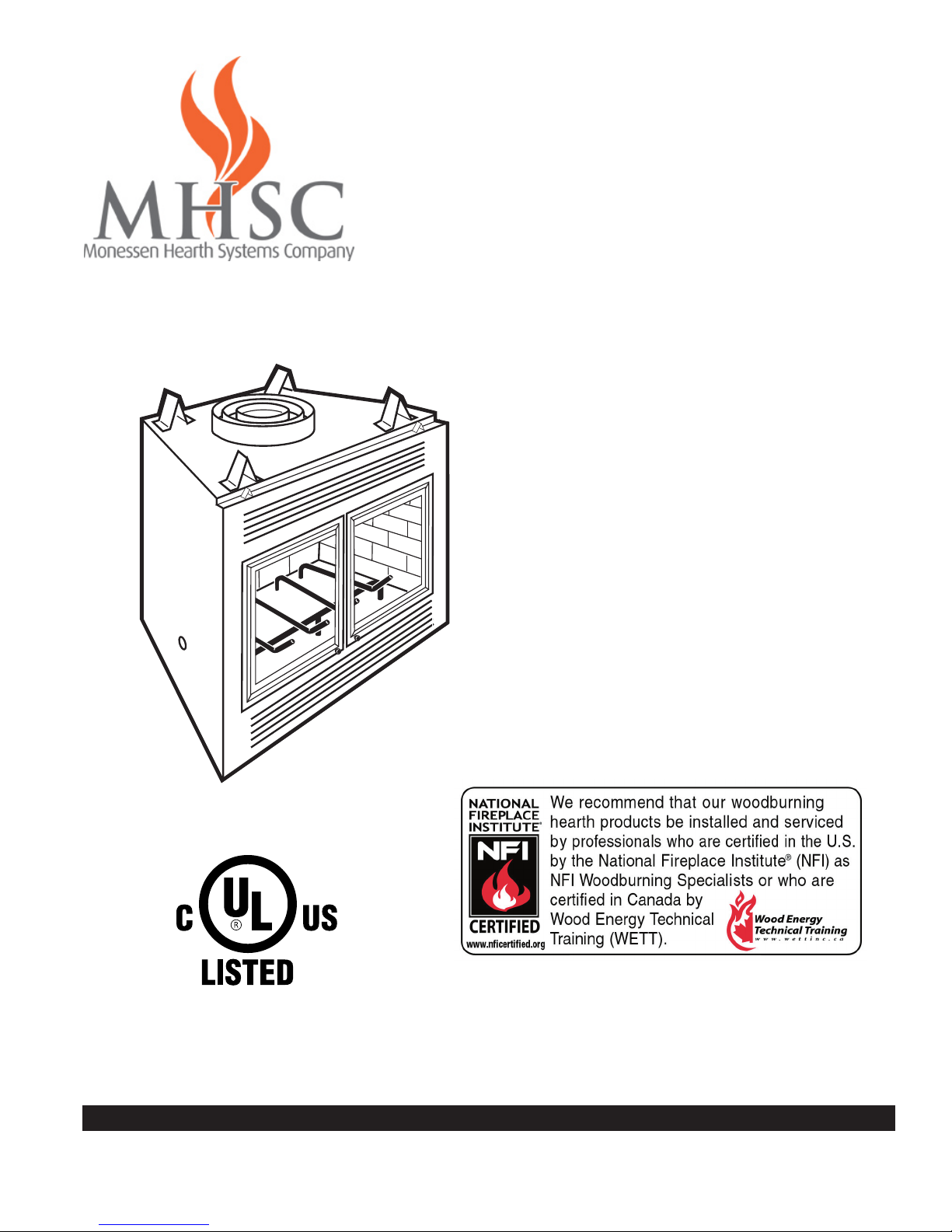
BFC
Balanced Flue
(Closed Combustion)
Heat-Circulating Fireplace
Model:
BFC36
Homeowner’s Installation and
For use in the U.S. / Canada
Underwriter’s Laboratories
Report No. MH7603
Operating Manual
DO NOT DISCARD THIS MANUAL: Retain for future use.
7412647 5/12 Rev. 20
Page 2

BFC36 Balanced Flue Heat-Circulating Fireplace
Table of Contents
Safety Information ......................................................................................3
Specications and Framing .......................................................................4
Parts Identication ....................................................................................6
Chimney Requirements ............................................................................7
Planning Information .................................................................................. 8
Installation .................................................................................................9
Replacement Parts ..................................................................................19
Accessories .............................................................................................21
Warranty...................................................................................................23
2
BFC36
Listed
UL127 / ULC-S610
Standard for Factory Built Fireplaces
7412647
Page 3
BFC36 Balanced Flue Heat-Circulating Fireplace
Safety Information
Please Read This Manual Before Installing and Using Fireplace
IMPORTANT: Read all instructions and warnings carefully before starting installation. Failure to follow these instruc-
tions may result in a possible re hazard and will void the warranty.
Description
The BFC36 replace is a solid fuel, woodburning replace. The BFC36 is a balanced ue (closed combustion) heat-circulating replace which receives outside
combustion air through the chimney system. This
unique system results in much higher efciency since
valuable room air is not used for combustion.
The BFC36 is a decorative replace which provides
efcient supplemental heat compared to other wood
burning replaces. It should not be used as a primary
source of heat.
CAUTION: Overloading the rebox with wood may result in overring and damage to refractory components,
the grate and doors.
Consult local building codes to ensure that you are in
compliance before installing the replace.
This replace and chimney system must be vented to
the out-of-doors.
Do not obstruct or modify air inlets/outlets in any
manner.
Do not install combustible materials on any of the
black replace surround.
Burn only solid wood fuel or gas logs.
The BFC36 is intended for operation only with the
doors closed.
Do not install a solid fuel burning insert or other
products not specied for use with this replace.
Precautions
MHSC replaces and component parts have been
thoroughly tested and will operate safely when installed
in accordance with instructions provided in this manual.
Carefully read and understand all instructions before
beginning installation.
If you notice any damage to replace or component
parts, immediately report damage to your MHSC dealer.
Only use MHSC components or the warranty will be
voided and a re hazard may be created.
MHSC warranty will be voided by and MHSC disclaims
any responsibility for the following actions:
• Installation by any other than a qualied
installer, preferably NFI or WETT (Canada)
certied.
• Installation of any damaged replace or chim-
ney component;
• Modication of replace, chimney assembly
or any component parts thereof; (except for
chase ashings as detailed in MHSC Chimney
Top installation instructions).
• Installation other than as instructed by MHSC;
or
• Installation and/or use of any component part
not manufactured or approved by MHSC in
combination or assembly with a MHSC replace system, notwithstanding any independent testing laboratory or other third party
approval of such component parts or accessory.
Any such action may possibly cause a re hazard.
7412647
Proposition 65 Warning: Fuels used in gas, woodburning or oil red appliances, and the products of
combustion of such fuels, contain chemicals known
to the State of California to cause cancer, birth defects and other reproductive harm.
California Health & Safety Code Sec. 25249.6
WARNING: Check with your electronics manufacturer before installing a television or other electronic device above this replace.
Drafts
The replace should not be located in areas that create
drafts (ie: frequently opened doors and central heating
air inlets/outlets) that hamper the normal ow of air into
the re.
Gas Logs
If you plan to install a gas log, the gas line should be
installed before framing the replace. The gas line must
be installed by a certied gas line installer.
3
Page 4
BFC36 Balanced Flue Heat-Circulating Fireplace
6
" (16mm)
56O" (13mm)
56O"
326"
(829mm)
41(6" (1064mm)
6"
(16mm)
56QE"
(49mm)
" (914mm)
"
(533mm)
56QE" (176mm)
56QE" (179mm)
Recessed
Nailing
Flange
1356O" Dia.
(343mm)
Rough Opening Width 43"
Rough
Opening
Height
Rough
Opening
Depth
Gas Line
Access
5156QE" (1297mm)
5156QE"
(1297mm)
6QE
" (1834mm)
6M"
(197mm)
23"
(584mm)
"
(610mm)
6QE"
(624mm)
3956M"
(997mm)
556QE"
(246mm)
35"
(889mm)
"
(279mm)
Gas Line
Access
56O"
(902mm)
36"
(914mm)
(1092mm)
11" Dia.
(179mm)
8" Dia.
(203mm)
56
" (918mm)
A
B
C
BFC36 Balanced Flue Heat-Circulating Fireplace
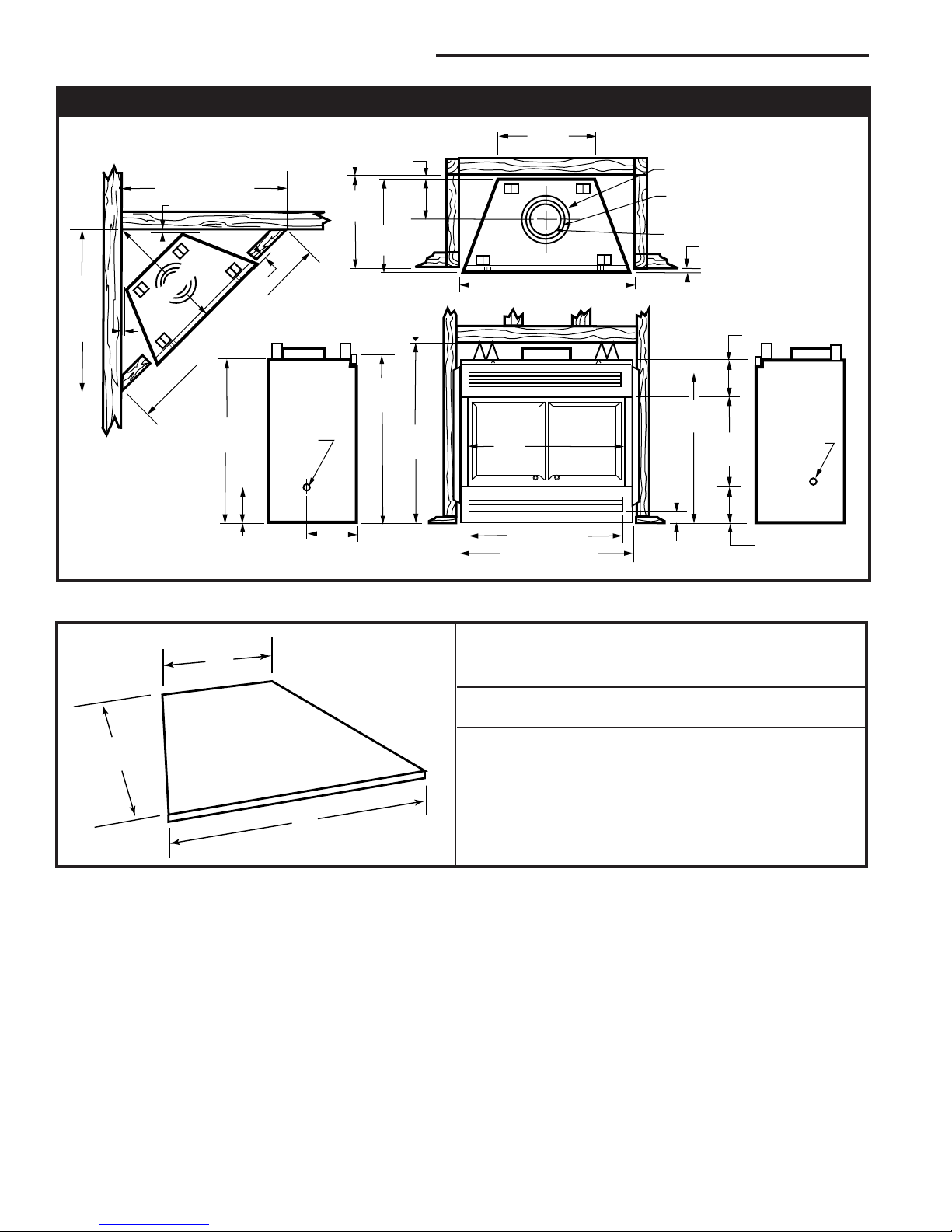
Fig. 1 BFC36 specications and framing.
Fig. 1a Hearth dimensions.
Front Width Back Width Depth
A B C
BFC36 32Z\x" 20M\zn" 17C\v"
(826 mm) (519 mm) (451 mm)
FP1531
4
7412647
Page 5
Batt Insulation
(Cut out around
restop)
Firestop
Ceiling Level
BFC36 Balanced Flue Heat-Circulating Fireplace
Termination Cap
Storm Collar
Pan Flashing
Draftstop
Gas Line Access Hole
(Each Side)
Top Grille and Air Outlet
Standoff
Trim Ledge
Standoff
Surround
Glass Door
Romex Pigtail
Gas Line Access Knockout (Each Side)
Air Inlet
Basket Grate
Bottom Grille
Metal Safety Strip(s)
Shown not inplace
(1,2 or 3 pieces)
Nailing Flange
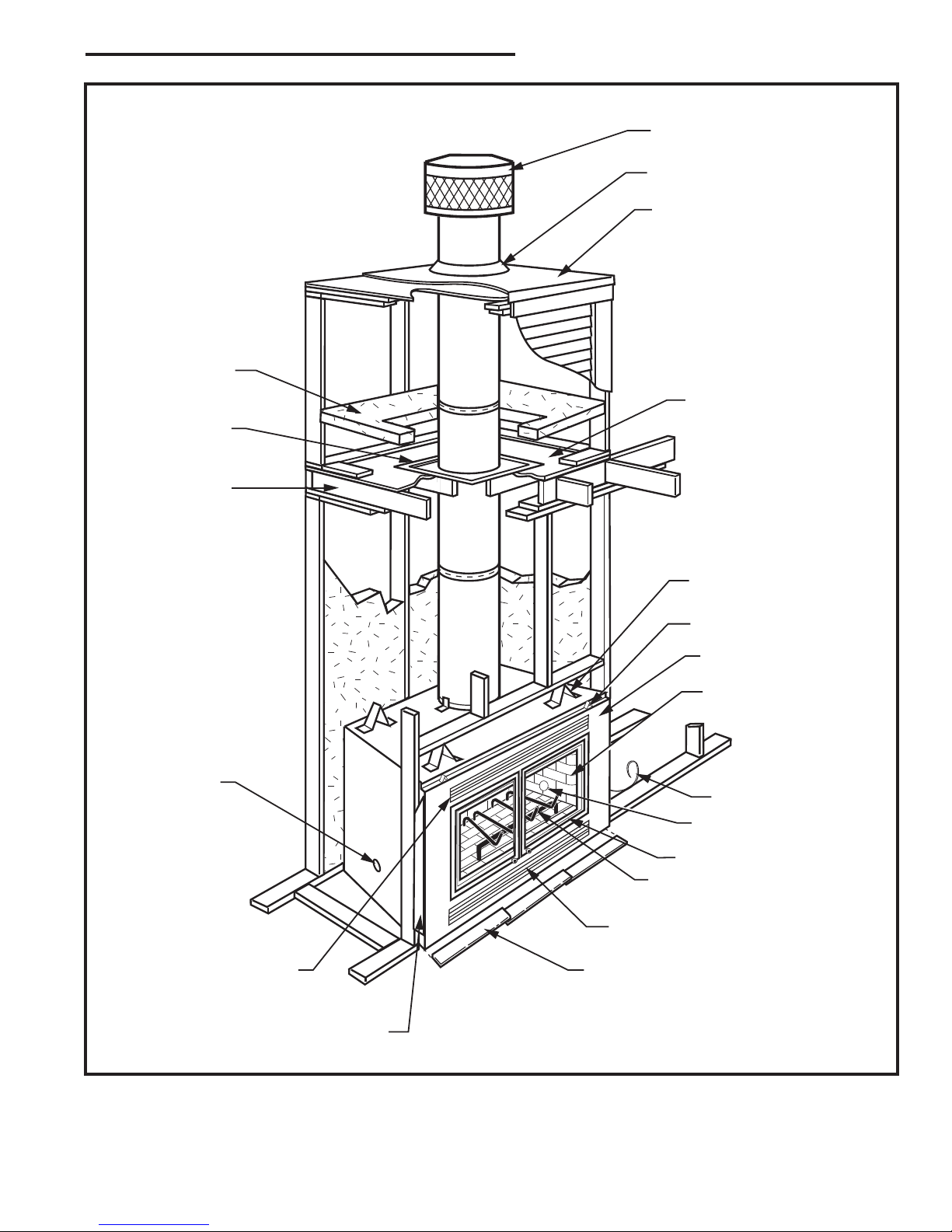
Fig. 2 Fireplace and chase parts identication.
7412647
FP554c
5
Page 6
BFC36 Balanced Flue Heat-Circulating Fireplace
D
Rise
B
G
H
B
Offset
C
E
6 FT.
G
H
A
Hearth
Floor
Chimney
Section
CHIMNEY FLUE EXIT
Elbow
TCS8A
Support
Example 1 Example 2 Example 3
Offset
Rise
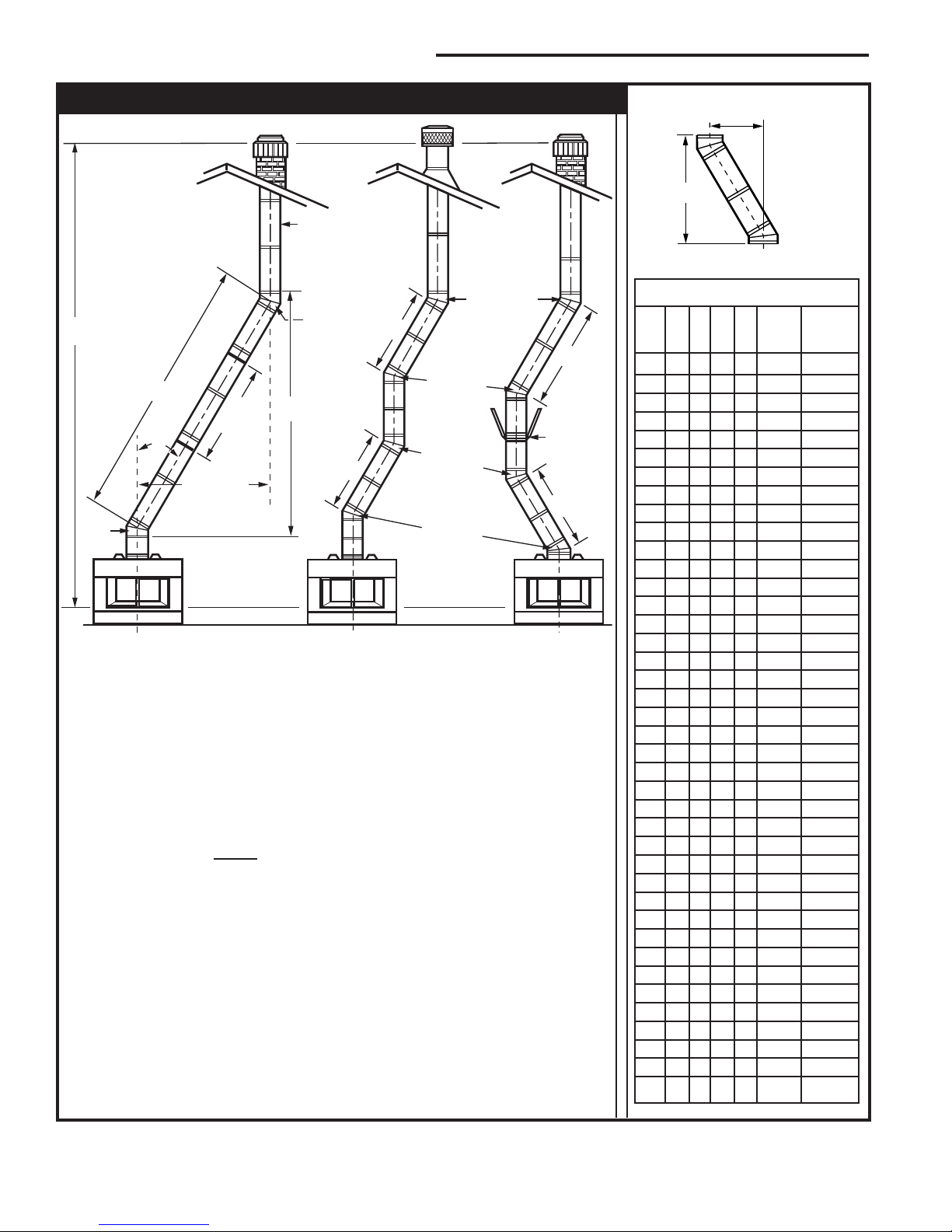
Chimney Requirements - Offset Installations
Notes: G + H cannot exceed 20 feet.
Air Space Clearances: = 2” Min. to Combustibles
Illustration Key
The following safety rules apply to
offset installations (letters correspond
with illustration above):
A. Height of the chimney is measured
from the hearth to the chimney exit.
BFC36
Maximum: 50’0”
Minimum:
Without Elbows 14’6”
With 2 Elbows* 14’6”
With 4 Elbows* 21’0”
B. Do not use more than 4 elbows per
chimney.
Attach the straps of the return (top)
elbow to a structural framing member.
The offset (rst) elbow of any pair does
not have straps.
Offset
IWF282
Rise
30°
Return
Elbow
30°
Offset
Elbow
30°
Return
Elbow
30°
Offset
Elbow
FP269
C. The chimney cannot be more than 30˚
(45˚ in Canada) from the vertical plane in
any installation*.
D. The maximum length of the angled run
of the total chimney system is 20 feet. (G
plus H cannot exceed 20 feet.)
E. A chimney support (Model TCS8A)
is required every 6 feet of angled run of
chimney. Chimney supports are required
for every 30 feet and 60 feet of vertical
chimney height above the hearth.
Determine the offset distance of your
chimney arrangement from the centerline
of the replace to the centerline of the
chimney where it is to pass through the
rst ceiling.
NOTE: This offset distance may not be
your full offset distance. See Examples 2
and 3.
30˚ Elbow Offsets
1’
0 0 0 0 0 3” 11”
1 0 0 0 0 8Z\v" 20"
0 1 0 0 0 11Z\v" 25Z\v"
2 0 0 0 0 13Z\x" 29Z\v"
1 1 0 0 0 16Z\x" 34Z\v"
0 0 1 0 0 20Z\v" 40C\v"
2 1 0 0 0 21C\v" 43Z\x"
0 0 0 1 0 26Z\v" 51Z\v"
0 1 1 0 0 28Z\x" 55Z\v"
1 0 0 1 0 31Z\x" 60Z\v”
0 1 0 1 0 34Z\x" 65Z\x"
0 0 2 0 0 37Z\x" 70C\v"
1 1 0 1 1 41Z\x" 77C\v"
0 0 1 1 1 45" 83C\v"
0 1 2 0 1 47Z\v" 87Z\x"
0 0 0 2 1 51" 94"
0 1 1 1 1 53Z\v" 98"
0 0 3 0 1 56Z\v" 103Z\v"
0 1 0 2 1 59Z\v" 108Z\x"
0 0 2 1 1 62Z\v" 113Z\x"
0 1 3 0 1 64Z\x" 117Z\x"
0 0 1 2 1 68Z\v" 124"
0 1 2 1 1 70Z\x" 128"
0 0 0 3 1 74Z\v" 134Z\x"
0 1 1 2 2 78" 140C\v"
0 0 3 1 2 81" 146"
0 1 0 3 2 84" 151Z\v"
0 0 2 2 2 87" 156Z\x"
0 1 3 1 2 89Z\v" 160Z\v"
0 0 1 3 2 93" 166C\v"
0 1 2 2 2 95Z\v" 170C\v"
0 0 0 4 2 99Z\v" 177C\v"
0 1 1 3 2 101Z\v" 181C\v"
0 0 3 2 2 104Z\v" 186Z\v"
0 1 0 4 2 107Z\v" 191Z\x"
0 0 2 3 2 110Z\v" 196C\v"
0 1 3 2 3 114" 203Z\v"
0 0 1 4 3 117C\v" 209C\v"
0 1 2 3 3 120" 213Z\x"
0 0 0 5 3 123C\v" 220"
1¹⁄₂'
3’ 4’
Chimney
Support
Fig. 3 Chimney system requirements.
6
7412647
Page 7
BFC36 Balanced Flue Heat-Circulating Fireplace
L
1
L
1
L
T
TOTAL
LENGTH
(LT)
INSTALLED
LENGTH
(L1)
56O
"
56O
"
56O
"
56O
"
56O
"
56O
"
56O
"
56O
"
TRIPLE
WALL
81
818
83
84
2' Min.
2' Min.
3'
Min.
0 To 10'
3'
Min.
0 To 10'
Reference
Point
Planning Information
Preplanning an installation is very important to ensure
safety and to save time and money. An installer must
predetermine where a replace will be set and how the
chimney system will be run.
Mounting the Fireplace
A replace may only be mounted on the following surfaces:
1. A at combustible surface.
2. A raised wooden platform.
3. A concrete block or other solid object placed beneath each of the four (4) corners of the replace.
The replace must be spaced 1” (25mm) from a combustible back wall and 1/2” (13mm) from a combustible
side wall or support. (Page 13, Fig. 17)
Planning the Chimney Run
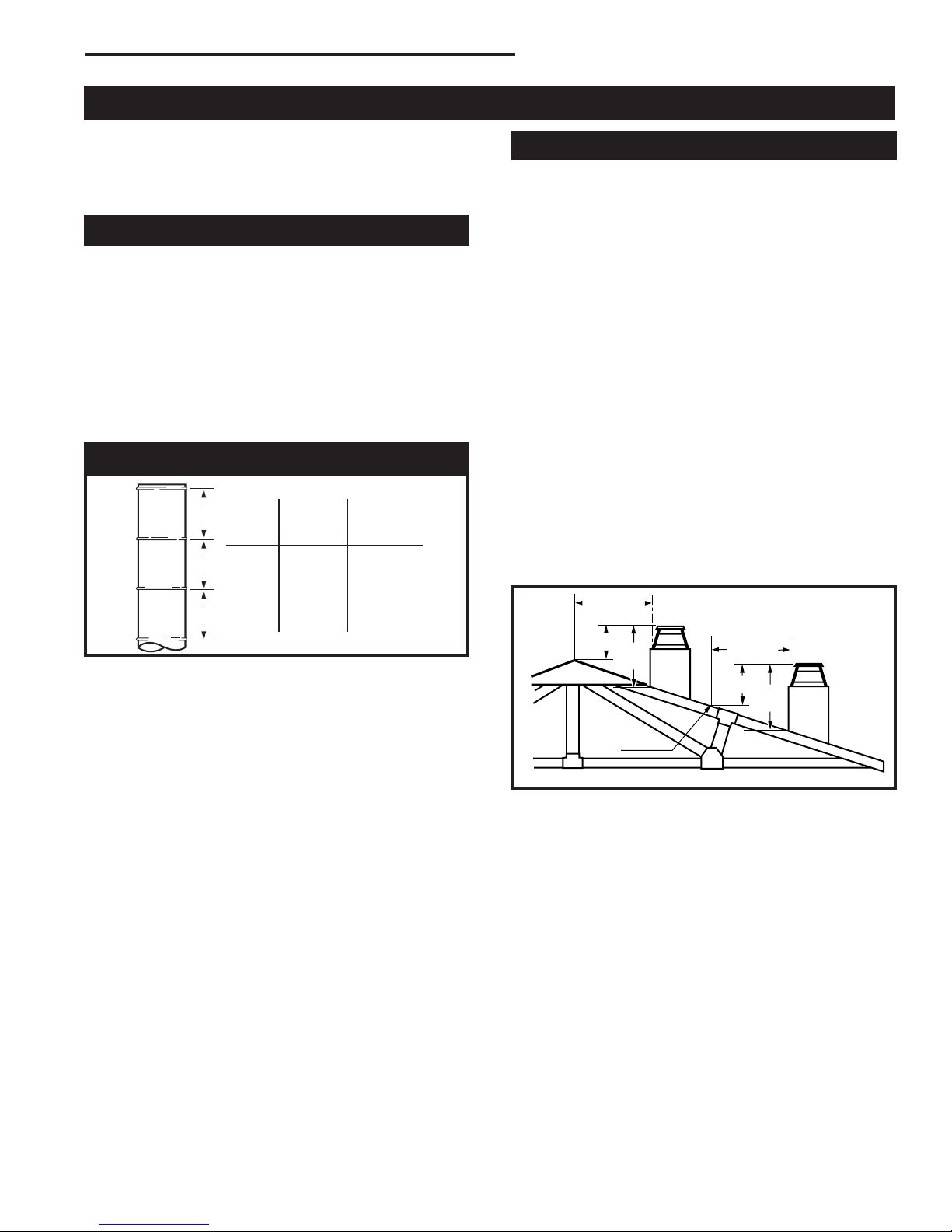
The Ten Foot Rule
Major U.S. building codes specify a minimum chimney
height above the roof top. The “Ten Foot Rule” is a re
safety rule and not a draft rule. To ensure proper draft,
it is recommended that you always meet or exceed the
“Ten Foot Rule,” especially when installing a termination
on a high pitch roof. (Fig. 5)
The key points of the “Ten Foot Rule” are:
1. If the horizontal distance from the chimney to the
peak of the roof is 10’ (3m) or less, the top of the
chimney must be at least 2’ (610mm) above the peak
of the roof, but never less than 3’ (914mm) in height
above the highest point where it passes through the
roof.
2. If a horizontal distance from the chimney to the peak
of the roof is more than 10’ (3m), a chimney height
reference point is established on the surface of the
roof a distance of 10’ (3m) from the chimney in a
horizontal plane. The top of the chimney must be
at least 2’ (610mm) above the reference point, but
never less than 3’ (914mm) in height above the highest point where it passes through the roof.
Fig. 4 Installed lengths of chimney sections.
Determine how the chimney will be run, length of run
and chimney components required to complete the
job. (Fig. 4) Never install a chimney below minimum
heights.
In planning a chimney system, it is important to know:
1. The height of a chimney is measured from the
hearth to the exit point on the termination.
2. A chimney cannot be offset more than 30° from a
vertical plane.
3. A chimney may run straight up or it may be necessary to offset it to avoid obstructions.
4. The maximum length of an angled run (total chimney
system) is 20’ (6m).
5. No more than 2 offsets (4 total 30° elbows in U.S./or
2 total 45° elbows in Canada) per replace may be
used.
6. A guy wire stabilizer is required for chimneys extending more than 6’ (1.8m) above a roof line.
7412647
FP288a
AC246
Fig. 5 Ten Foot Rule illustration.
7
Page 8
BFC36 Balanced Flue Heat-Circulating Fireplace
Chimney Supports
The chimney system is supported by the replace for
vertical chimney heights less than 30’ (9m) above the
hearth. Chimney supports are required if the vertical
height exceeds 30’ (9m). Locate chimney supports
at ceiling holes or other structural framing at 30’ (9m)
heights. Spacing between chimney supports must not
exceed 30’ (9m). Use Chimney Support Model TCS8A.
(NOTE: The TCS8A cannot be mounted directly to
the replace.) Support provided by elbow straps fullls
the support requirement only if they are spaced as previously described. (A chimney support is 2Z\x" (64mm)
long when installed.)
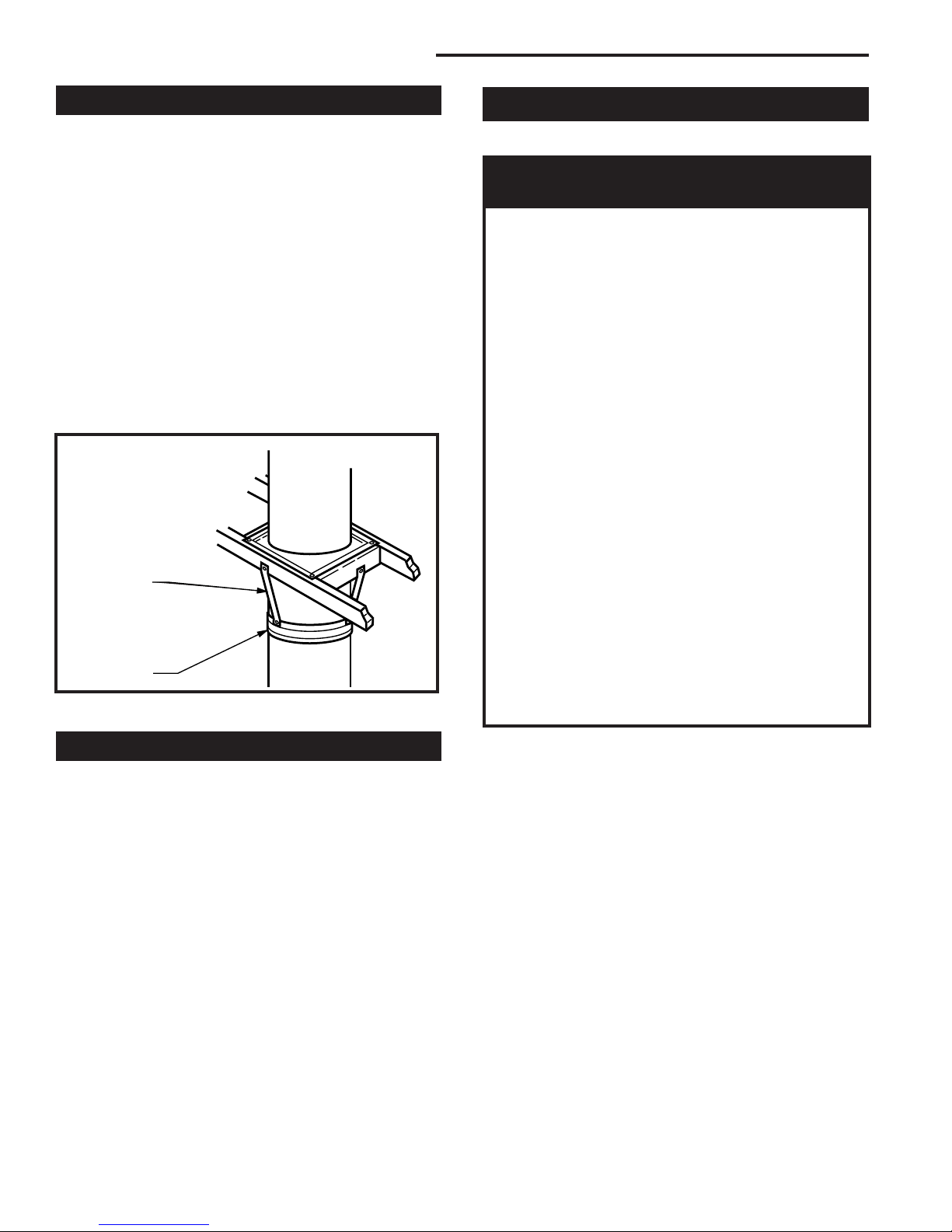
Angled chimney runs require a support every 6’ 1.8m)
in addition to the elbow straps. Chimney supports are
used for this function. (Fig. 6)
Chimney Support Strap
TCS8A
Fig. 6 Chimney support installation.
FP284a
Installation
Insulating Fireplace Enclosure
for Cold Climates
If you live in a cold climate, it is not required but
highly recommended that you insulate replace
enclosure to eliminate cold air penetration as much
as possible.
Insulate base of replace with a noncombustible
insulation rated for a minimum of 300°F. Insulating
is very important for outside wall installations over
a concrete slab. If replace is installed on a platform,
insulation should be placed on top of the platform
before replace is set. (Fig. 7)
When a replace is installed in a chase or on a
outside wall, enclosure should be treated like any
outside wall in a home. Insulation should be installed
on the inside wall as well as the outside wall(s). In
a chase, it is also a good idea to install a restop at
the rst ceiling level above the replace and enclose
the chase with sheeting material. Insulation may
then be installed above sheeting material to assure
the space around the replace is totally protected.
(Fig. 2)
When installing the chimney, DO NOT caulk between outer pipe and restop. It is vital that some air
be allowed to ow through this very thin gap.
CAUTION: When installing a replace in an insulated enclosure, be sure all required air spaces
are maintained. (Page 13, Fig. 17)
Chase Installation
A chase is a vertical box-like structure which encloses
the replace and/or chimney. Chases are typically built
on the outside of the house with replace opening cut
into the outer wall of a room. (Page 4, Fig. 2)
If you need help in determining replace location or how
the chimney system should be run, contact your MHSC
dealer for assistance.
8
7412647
Page 9

Hard Flat
Surface
BFC36 Balanced Flue Heat-Circulating Fireplace
4. Using supplied junction box assembly, connect and
secure house romex wiring to duplex outlet. Ensure
correct polarity and that the ground wire is securely
connected.
5. Secure romex wiring using supplied strain relief
tting at rear of junction box. Re-assemble junction
box.
6. Secure romex wiring at strain relief tting in replace
outer wrapper.
7. Mount junction box mounting plate to inside face of
right side oor support using two self-tapping sheet
metal screws.
8. Plug blower cord into duplex outlet.
9. Replace lower grille.
Insulation
Platform
FPC555a
Fig. 7 Insulating between platform and replace.
Framing
Framing can be constructed before or after the replace
is set in place, however, most installers build the frame
before setting the replace.
Frame replace with 2 x 4 lumber or heavier materials. Refer to framing dimensions in Figure 1 for basic
replace specications.
NOTE: Framing should be positioned to accommodate
wall covering and replace facing material.
Electrical Wire Installation
The fan requires 120V AC, 60 Hz power which may be
connected from the right side of the replace. This power connection must be completed before the replace is
secured and nish material applied.
The lower cavity of the replace may be accessed by
removing the lower grille. Lift grille and pull lower side
out to remove.
1. If using romex type power supply wiring, install a
strain relief tting into the small access hole in the
lower right side of the replace outer wrapper.
2. Route house power wires into the replace through
the tting.
3. Extend these wires through large front hole of right
side oor support.
Chimney Set-up
Since you have already preplanned the chimney run,
you should know exactly how the installation is to
be accomplished — how much pipe is required, the
number of elbows, if any, and type of termination to be
used.
CAUTION: REPORT TO YOUR DEALERS ANY
PARTS DAMAGED IN SHIPMENT, SPECIFICALLY
CHECK THE END CONNECTION OF CHIMNEY SECTIONS AND ELBOWS.
NOTE: The BFC36 replace must use MHSC Model
triple wall 8” chimney components only. The installation
procedure described in this manual applies only to this
system.
Straight-Up Chimney Installation
To mark the centerline of the ue, put the replace in
nal position and measure out from the wall: 8C\v" (222
mm). Mark a spot on the ceiling directly above the replace. Draw a line parallel to the back wall through this
mark. (Fig. 8)
Using a plumb bob positioned directly over center point
of replace ue collar, mark the ceiling to establish the
chimney center point. (Fig. 8)
Offset Installation
In order to clear an obstruction, it may be necessary to
offset chimney from vertical. This is accomplished by
using elbows. Use the 30° Offset Elbow table on Page
5 to determine proper offset and parts required.
Each offset requires two (2) elbows. The second elbow
is equipped with support straps. It is very important to
install the second elbow in each offset as close to the
ceiling or support as possible so that the elbow straps
can be secured to framing members to help support the
weight of the chimney.
7412647
9
Page 10

BFC36 Balanced Flue Heat-Circulating Fireplace
86M"
(222mm)
Chimney Centerline
Actual Centerpoint
Plumb Line
Plumb Bob
Imaginary Centerpoint
Cutting the Hole
Cover replace collar opening and cut proper sized
chimney hole in chimney.
Framing the Ceiling Hole
Frame the ceiling chimney hole as shown in Figure 9. It
is good practice to use framing lumber that is the same
size as the ceiling joists; this is a requirement at attic
level.
Existing
Ceiling
Joists
New
Framing
Members
Fig. 9 Typical frame for ceiling chimney hole.
The following table gives restop spacer model numbers:
17Z\x”
(445mm)
17Z\x”
(445mm)
Ceiling
Chimney
Hole
FP551b
FPC556a
Fig. 8 Locate centerline of chimney with plumb line.
Determine offset distance of your chimney arrangement
from centerline of replace to centerline of chimney
where it is to pass through ceiling.
Locate center point of the chimney on ceiling as though
a straight up chimney arrangement is to be used. Measure your offset dimension from straight up chimney
center point on ceiling.
Ceiling Chimney Hole/
Possible Obstructions
The size of the hole in ceiling will vary with the angle at
which the chimney passes through ceiling.
Drive a nail up through ceiling at marked chimney center point. Go to oor above and see where hole will be
cut. Check to see where existing ceiling joists and other
possible obstructions are located...i.e. wiring, plumbing
etc... If necessary, re-position chimney and/or replace
to avoid obstructions.
Chimney Hole Size
Angle of Chimney
at Ceiling
Size of Chimney Vertical 30°
FS2A FS6A
8” Flue 17Z\x” x 17Z\x” 17M\₈” x 29⁵\₈”
(445 x 445mm) (454 x 753mm)
Fig. 10 Ceiling chimney hole sizes necessary for installing
restop spacer.
The inside dimension of the frame must be the same
as the hole size selected from Figure 10 in order to
provide required the 2” (51mm) air space between the
outside diameter of the chimney and the edges of the
framed ceiling hole.
10
7412647
Page 11

Positioning, Safety Strips,
Securing the Fireplace
Slide replace into position.
Lift the replace front slightly and slide the metal safety
strips under front bottom edge about 1Z\x” (38 mm),
allowing the remainder to extend in front of rebox.
Overlap strips at least 1/2” (13 mm) to provide a positive joint. (Flat safety strips are packed with replace.)
(Fig. 11)
Safety strips are used to ensure that any combustible
materials in front of the replace are protected even
though a non-combustible hearth extension is required.
If replace is to be elevated above the oor, a “Z”
shaped metal safety strip must be fabricated and used
to protect combustible surfaces in front of the replace.
This “Z” shaped safety strip is not provided but must be
fabricated of metal with each horizontal leg at least 1Z\x”
(38mm) wide and equal in length to the metals strips
provided with the replace.
NOTE: Safety strips are not required over non-combustible oors where all supports at the base of the
replace are noncombustible.
Four (4) nailing anges are supplied with the replace
(found on the replace hearth). To level the box and
secure it rmly in place, remove the nailing anges from
the hearth and install at the sides of the replace as
shown in Figure 12.
BFC36 Balanced Flue Heat-Circulating Fireplace
Metal Safety Strips
(1,2 or 3 pcs.)
“Z” Safety
Strip
(not supplied)
Hearth Ext.
FP557b
Nail Top
Standoffs
Nail SideNailing
Flanges
Z\x” (13mm)
1Z\x”
(38mm)
Fig. 11 Safety strip installation.
Min. Overlap
Fireplace
Platform
7412647
FPC549a
Fig. 12 Fasten replace in position.
11
Page 12

BFC36 Balanced Flue Heat-Circulating Fireplace
UP
Installing the
Chimney System
Start by attaching the rst chimney section to the collar
on top of the replace.
Install the pipe as pictured in Figure 13. When you
get a good lock, you will hear the pipe clearly snap
together. Once sections are snap-locked in place, it is
extremely difcult to get them apart. Make sure the
pipe is rmly snapped and locked together as each
pipe section is mounted.
When installing elbows, only outer pipe will snaplock. Middle pipes simply slide into position. Be sure
to always attach straps on upper elbow to a structural
framing member. (Fig. 14)
Continue installing the pipe as required until pipe is
installed up through the ceiling. At this point, you must
install a restop spacer.
Installing the Firestop Spacer
in the Ceiling Hole
A restop spacer is used to keep pipe spaced properly
and required for safety.
Nail the restop spacer (at each corner) to the framing
members of the ceiling hole. NOTE: A restop spacer
is not required at the roof.
Hole sizes listed in Figure 10 for angled restop spacers provide minimum required air space to chimney
pipe for ceiling thickness up to 8” (203 mm). When
combined thickness of ceiling material, ceiling joists
and ooring material exceeds 8” (203 mm), adjustments
must be made in framing to assure that minimum air
spaces to chimney are maintained.
Pipe Section
Pipe
Rim
Hem
Lance
Pipe
Hem
FPC558a
Fig. 13 Install pipe, listening for the snap-lock to fasten.
Elbow Strap
Angled Strap
Support Structure
Elbow Strap
(must be tight)
Ceiling
Hole Framing
Angled Firestop
Proper Firestop Spacer Installation
Figure 15 shows different installation procedures for
both an area that is an attic and an area that is not an
attic.
If the area above the ceiling is not an attic, position
the restop spacer with the
ange on the ceiling side
and the angled portion extending up into the hole.
If the area above the ceiling is an attic, position the
restop spacer with the
ange on the top of the
framed hole and the angled
portion extending down into
the hole.
12
Attic Installation
NOTE: If the attic insulation shield is used, the
restop is not required in the attic installation.
Fig. 15 Installing restop spacer.
FP270/271
Fig. 14 Attach straps to a structural framing member.
Chimney Support Strap
(must be tight)
Ceiling Installation
Nails (4)
Firestop
Spacer
Firestop
Joist
Spacer
Nails (4)
FP593
Joist
7412647
Page 13

BFC36 Balanced Flue Heat-Circulating Fireplace
Firestop spacers are not available for, nor are they
required on vertical walls.
DO NOT put any sealant around the area where the
outer pipe slides through the restop spacer. If you
seal this area, it may cause a re hazard.
Canadian Requirements
for Insulation Shield
In Canada, an attic insulation shield is required to
prevent attic insulation from contacting the chimney
section. NOTE: If the attic insulation shield is used, the
restop is not required in the attic installation. Framing dimensions for the chimney hole should measure
17Z\x” x 17Z\x” (445 x 445mm). An attic shield MUST be
installed on top of attic joists (above the oor level).
(Fig. 16)
Attic Insulation Shield
Nails
(4 required)
A chimney support is 2Z\x" (64 mm) long when installed.
Consider this dimension when determining how many
straight chimney sections are needed.
NOTE: Chimney supports are generally used in long
runs in a chase installation.
Additional Ceilings
If you encounter additional ceilings, repeat same steps
required for rst ceiling installation. See restop illustration in Page 11, Figure 15.
Penetrating the Roof
Run pipe to rooine. Since chimney system must be
vented to the out-of-doors, you must use an approved
MHSC termination.
If a chase is used, refer to the installation manual provided with the termination cap.
Locate Chimney Centerpoint On Roof
Use same procedure detailed in locating center point of
the ue system.
Drive a nail up through roof at the center point. This will
determine center point on outside of the roof.
Attic Joist
Base Flanges
Ceiling
FP263
Fig. 16 Attic shield installation (Canadian requirement).
NOTE: In the U.S., it is a good idea, although not al-
ways required, to install an attic insulation shield where
blown-in insulation is planned to be used in the attic.
Install the attic insulation shield with the anges on its
base extending down into the framing hole. Nail each
corner of attic insulation shield to the framing members
of the ceiling hole using 8d nails. Attic shields are not
required at the roof.
Continue Installing Pipe to Complete Run
Continue attaching pipe sections to complete system
to next level always being careful that the pipe is rmly
snap-locked in place before proceeding to next pipe
section.
Chimney Supports
If chimney supports are required, they are installed the
same as elbows. Nail chimney support straps to adjacent structural framing, as shown on Page 8, Figure
8. Bend straps as necessary and make sure they are
secure so they will support the weight of the chimney.
Cut and Frame Roof Hole
Size of roof hole varies with the type of chimney
termination installed. Refer to installation instructions
provided with MHSC chimney termination to nd correct
size of roof hole.
There must be a 1Z\x” (38 mm) air space between outermost portion of chimney sections and any adjacent
combustible surfaces. (Combustible surfaces include
burnable materials such as: ceiling members, joists,
ooring, combustible insulation and roof structures.)
WARNING: Do not pack required air spaces with
insulation or other materials.
Mark an outline of the roof hole around the center of the
point nail. NOTE: Hole dimensions given in the chimney top installation instructions are horizontal dimensions; therefore, the hole size must be marked on the
roof accordingly.
Cover the opening of the installed chimney so debris
cannot get into the system.
Cut and frame the hole. It is good practice to use framing lumber that is the same size as the rafters. Install
the frame securely because the chimney top and ashing anchored to the frame must be able to withstand
heavy winds.
Install Remainder of Chimney Sections
Since you have already preplanned the height of your
termination according to the Ten Foot Rule, continue to
install pipe to the predetermined height.
7412647
13
Page 14

BFC36 Balanced Flue Heat-Circulating Fireplace
FRONT VIEW
SIDE VIEW
Air Space Clearances
Check the chimney top installation instructions for
details on how high above the roof top the chimney sections (all pipes) should extend.
Installing Top Housing
or Termination
Follow the installation instructions provided with the
MHSC chimney termination you have selected.
Installing Chimney in a Chase
Refer to Page 4, Figure 2 for an illustration of a typical
chase installation.
CAUTION: Treatment of restop spacers and construction of chase may vary with type of building. These
instructions are not a substitute for local building codes.
You must check your local building codes to determine
specic requirements for your city or state. NOTE:
Other building materials may be required in addition to
restop spacers.
Combustible framing material MUST NOT
penetrate AIR SPACE (shaded areas).
2”
Standoff
Z\x” air space to
sides
Firestop
Finishing
CAUTION: All joints between the nished wall and the
replace surround (top/sides) must be sealed with noncombustible material to prevent cold air leakage into
the room. Only noncombustible material may be applied
to the facing of the replace surround. (Black painted
area) (Fig. 17)
Finish Wall
Finish the wall with material of your choice. Do not
install a combustible mantel shelf less than 12”
(305 mm) above the grille opening. Do not install a
mantel face plate less than 6” (159 mm) from top
of grille opening. (Fig. 20) If a combustible material is
used below a at mantel shelf, consult your local building codes for minimum clearance from top of replace
opening to bottom of mantel shelf.
All joints (top, bottom and sides) where wall or decorative facing material meets replace surround must
be completely sealed with a noncombustible material.
(Figures 18 and 19)
NOTE: No side wall protection is required for replaces
installed at 45° to two (2) side walls (corner installation).
Wall
Shield
Only noncombustible material
may be applied as
facing to the black
replace surround.
Fig. 17 Minimum clearances to combustibles.
Hearth Extension
1” Air
Space to
Back
Z\x” Air
Space to
Sides
0” Clearance to
Floor
FPC559a
14
7412647
Page 15

1Z\x"
Ref.
B
C
Combustible materials are
permitted within a shaded area
shown in Figure 21 titled
Minimum Wall Clearances.
*
* *
Z\x"
12"
(305mm)
Max.
12" (305mm)
Min.
1Z\x"
(38mm)
6"
(159mm)
Min.
Combustible
Mantel Shelf
and Trim
Side View
BFC36 Balanced Flue Heat-Circulating Fireplace
Finished Wall
Stud
Standoff
Noncombustible
Material
Circulating
Front
Fireplace Opening
2 x 4 Stud
Finished Wall
Fireplace
Front
Must be sealed with noncombustible material
Fig. 18 Mantel clearance.
* 12” from top of grille opening.
** 6” from top of grille opening.
FP531b
Face Plate
Fig. 19 Combustible mantel clearances.
7412647
MA81
15
Page 16

BFC36 Balanced Flue Heat-Circulating Fireplace
Minimum Wall Clearances
WITH
Noncombustible
Surround Facing
WITHOUT
Noncombustible
Surround Facing
Minimum Hearth Extension Dimensions
(for On-Site Construction)
G
H
G
J
Seal cracks
between the
fireplace
and hearth
extension with
noncombustible
material
Safety strips
must overlap
56O" minimum
May install
noncombustible
decorative
covering
OR .018" min.
sheet metal
Fireplace
Hearth
Combustible
Floor
1/2” Min.
EH2416 or
equal “R”
value
4" MIN.
Firebox
Opening
A - Min. clearance
to combustible
perpendicular wall
B - Min. clearance
to combustible
perpendicular wall when
using noncombustible wall shield*
Side
Wall
Side
Wall
F**
C**
E
E
D
4" Brick
(Example material)
Combustible material permitted within shaded area.
*
Noncombustible wall shield requires 1" EH2416
insulation (minimum R Value = 1.85) between decorative
noncombustible rigid covering and combustible wall.
Minimum height and width is 40" x 40".
**
Dimension/degree of angle will vary depending on thickness
of noncombustible surround facing.
Shaded area
starts 1/2" from
away from edge
of unit
4"
Side Wall Protection
Adjacent combustible side walls that are within minimum dimensions shown in Figure 23 of the replace
opening must be protected with a specically built wall
shield as described in Figure 17.
The special wall shield design described in Figure 18 is
an alternate method of adding protection to side walls.
Rt must =1.09 minimum.
Examples of wall shield insulation:
1. Manville - CERAFORM 126, K=.27,
1/2 inches thick
2. EH2416, K = .458,
1 inch thick required.
Hearth Installation
A hearth extension is required to protect a combustible
oor in front of the replace. Refer to Figure 20 for minimum dimensions and mounting detail.
Note: Hearth Extension must not cover the air inlet
opening of a replace.
The hearth extension described in Figure 20 must be
a durable non-combustible material with a minimum
(total) Rt value of 1.09; refer to Figure 21 for examples.
The overall height (above a combustible oor), depth
and width must be as indicated, with the extension centered to the replace opening.
The top of insulation must be covered with a non-combustible decorative covering or a piece of .018” minimum sheet metal, to protect hearth extension material.
(Fig. 20)
Secure the hearth extension to the oor to prevent
shifting, using trim molding or other similar means at
three (3) outer edges. Seal crack between the replace
hearth and hearth extension with a non-combustible
material. (Figs. 20 and 22)
Fig. 20 Combustible side wall protection and hearth extension dimensions.
16
A B C D E F G H J
BFC36 26” 12” 17° 25° 12” 8” 8” 18” 47Z\v”
660 mm 305 mm 305 mm 203 mm 203 mm 457 mm 1200 mm
FP594b
7412647
Page 17

BFC36 Balanced Flue Heat-Circulating Fireplace
COMMON MATERIALS AND FACTORS
MATERIAL K*
R
MINIMUM
THICKNESS
EH2416
Micor 300
Common Brick
0.458
5.0
1.09 0.50 in.**
0.10 5.46 in.**
R Value is for 1/2 inch.
* Units of K = BTU/SQ FT/HR/˚F/IN
** Thickness of Listed Material
WARNING: Hearth extension must be installed in
accordance with Figure 22 and must not cover the
bottom front opening of the circulating model.
Alternate noncombustible materials may be used providing the (total) thermal resistance (Rt value) of the alternate material employed is greater than or equal to R
= 1.09 Thermal resistance (R) or thermal conductivity
(K), may be obtained from manufacturer of the material.
Factors are related by the formula K = 1/R. (Fig. 21)
T = given thickness
R = thermal resistance for a given thickness (T)
K = thermal conductivity
Noncombustible material with a lower R value may
be used, provided thickness of material is sufciently
greater to maintain an equivalent (total) thermal resis-
tance (Rt).
Wall Covering
Noncombustible
Decorative Facing
Seal all cracks
between replace
surround and wall
materials with noncombustible material.
Noncombustible Decorative
Covering
Hearth Extension Insulation
FP550
Fig. 22 Sealing gaps.
Side View
2 x 4” Header
- Do not notch at
standoffs
Seal crack between
replace and hearth
extension with noncombustible material
Safety Strips Must be overlapped 1/2”
minimum
Fig. 21 Hearth extension material factors.
Example of Determining Hearth Extension
Equivalents
To determine the thickness required for any new material:
NEW K of new material (per inch) thickness
required = --------------------------------------- X of listed
thickness K of listed material (per inch) material
Example for Common Brick
T (new) = 5.0/0.458 x 0.50 in. = 5.46 in. (new required
thickness).
7412647
FP533ADD
Glass Door Operation
The BFC36 is intended for use only with the doors fully
closed. (Fig. 23)
Correct Wrong
Fig. 23 Correct door position.
KT108b
17
Page 18

BFC36 Balanced Flue Heat-Circulating Fireplace
1"
Min.
1/2"
Operation
Before the rst re, the location of the upper refractory
bafe (ceiling panel) should be checked. This part oats
intentionally and may move out of place during shipping or installation of the replace. If the bafe is out
of place, the resulting improper air ow will cause dirty
glass and improper combustion. The bafe should be
centered side-to-side between the refractory sidewalls
and be pulled forward (toward the glass doors) until it
rests on the front sheet metal ledge.
Refer to the publication “How to Enjoy Your Woodburning Fireplace” for starting and maintaining a wood re.
Note that the BFC36 does not have a damper to open
or close. This is a tremendous efciency increasing
advantage since there is no damper to potentially leave
open after a re dies down. House air will not escape
up the chimney. Note also that the doors should remain
closed at all times except when starting or reloading a
re.
Burn only seasoned rewood. Typically, only two or
three burning logs are needed to provide efcient supplemental heat and a bright decorative re. In general,
fresh wood should not be loaded higher than about 2/3
the height of the rebox.
Installing Line for Gas Logs
MHSC replaces are designed to accept a 1/2” (13 mm)
gas line for installation of an approved gas appliance.
(MHSC manufactures a wide variety of gas logs for use
in MHSC replaces.)
Be sure to have the appliance installed in accordance
with building codes.
Gas connection may enter from either left or right side
of the replace.
Locate appropriate gas line in the outer casing of replace and remove insulation from gas line tube. (Fig.
24)
From inside the replace, locate the knockout on the
rebrick -- be sure you are on the appropriate or “gas
line” side of the replace. Using a at bladed screwdriver or small chisel and hammer, carefully tap around
the knockout until it loosens and falls out.
Install 1/2” (13 mm) certied gas pipe through opening.
After gas pipe installation is complete, use insulation
that was removed from gas line tube to repack space
around the pipe. Material should be inserted from
outside of the replace and packed tightly to totally seal
between the pipe and tube.
NOTE: Gas pipe should not come in contact with
any wood structures until it has reached a point at
least 1” (25 mm) away from replace side.
Hole in Outer Casing
Gas Line
Tube
Ceramic
Knockout
Hole in
Outer Casing
Fig. 24 Gas line access.
Fireplace Top View
Supply
Line
Repack Insulation
Ceramic Knockout
(both sides)
FP560a
BTU input of a gas appliance installed in replace
should be rated less than 100,000 BTU/Hr.
Gas pipe installation is intended for connection to a
decorative gas appliance only when (1.) incorporating
an automatic shutoff device and (2.) complying with the
Standard for Decorative Gas Appliances for Installation in Vented Fireplaces (ANSI Z21.60) or CSA draft
requirements for Gas-Fired Log Lighters for Woodburning Fireplaces (Draft No. 4, August 1993).
Decorative gas appliance should be installed in accordance with the National Fuel Gas Code, ANSI Z223.1/
NFPA 54 (latest edition).
CAUTION: When using decorative gas
appliance, ue damper must be set in fully
open position. Glass doors on the replace
must also be fully opened.
WARNING: Do not operate an unvented gas
log set in this replace with the chimney
removed.
WARNING: When installing an unvented
gas log set, the model CABL or CABR 4”
adjustable hood must be used.
18
7412647
Page 19

BFC36 Balanced Flue Heat-Circulating Fireplace
1
2
3
5
6
7
8
9
10
11
12
13
14
16
15
19
18
17
4
24
20
22
21
25
23
23
26
27
28
29
MHSC reserves the right to make changes in design, materials, specications, prices and discontinue colors and products at any time, without
notice.
BFC Balanced Flue Fireplace
Ref. Description BFC36
1. Top Grille - Painted 3126160
2. Bottom Grille - Painted 3126160
3. Grate Assembly 7579218
4. Left Door Assembly Complete 30004361
5. Right Door Assembly Complete 30004362
6. Rear Firebrick 2353145
7. Side Firebrick (two per replace) 2353146
8. Hearth Firebrick 2353140
9. Nailing Flange (four per replace) 2422198
10. Fiberglas Rope Gasket (Outer Collar) 7547137
11. Top Refractory 2353147
12. Front Brick Retainer 2353163
19
13. Cable Clip (For Blower Assembly) 7522241
14. Plug Button (two per replace) 7522239
15. Left Door Gasket 20013999
16. Right Door Gasket 20013998
7412647
Page 20

BFC36 Balanced Flue Heat-Circulating Fireplace
BFC Balanced Flue Fireplace (continued)
Ref. Description BFC36
17. Blower Assembly - FKSX-A 20000620
18. Grate Retainer 2353179
19. Junction Box Assembly 3126161
20. Ceramic Glass Panel (two per replace) 30004352
21. Flat Gasket 3/4” Wide (two per replace) 20013997
22. Knob (two per replace) 1600657
23. Bushing (four per replace) 1201895
24. Pan Hd, PH 1/4-20 x 1 Black (two per replace) 1200907
25. Spacer (two per replace) 1600070
26. Spring Clip 30004450
27. #8-18 x 1/2” Decorative Screw 7521180
28. Hinge Spacer (two per replace) 30004360
29. BFC Door Assembly 20014006
20
7412647
Page 21

BFC36 Balanced Flue Heat-Circulating Fireplace
Accessories
The following accessories for this appliance are available from your local MHSC distributor. Should you need additional information beyond what your distributor can furnish, contact: MHSC, 149 Cleveland Drive, Paris, KY 40361,
Attn: Technical Services.
CAUTION: This replace and chimney assembly is a highly engineered system, and, as such, must be operated only with MHSC approved components. If you use an unapproved component to make any modications,
you may create a possible re hazard and will void the MHSC warranty. In addition, such action may void the
coverage provided by the owner’s insurance.
Model NumberDescriptionAccessory
Hearth Extension Insulation Provides hearth extension oor protection EH2416
Grate for BR/BC36/42 Holds rewood in rebox RBG-BFC36
Hearth Patch Compound Patch cracks in hearth HPC-1
See your MHSC Fireplaces distributor or dealer
for nishing Marble and Mantels, available in a
wide selection of styles.
7412647
21
Page 22

BFC36 Balanced Flue Heat-Circulating Fireplace
Chimney Components
Component Description Model Number
Chimney Support Used to support chimney for each of TCS8A
30’ vertical height and 6’ of angled chimney run (8” ue)
Firestop Required at each oor level and attic on FS2A (8” straight ue)
multi-story installation FS6A (8” 30° inclined ue)
Attic Insulation Shield Required in Canada FS2100HT
Traditional Top Housing Top housing of simulated brick pattern T20B
available in red, tan or white. Appropriate (single ue)
adapter is required (8CA). Flashing included. TL20B
(extra tall single ue)
Housing Extension Extends Traditional Top Housing on 202036
steep pitched roofs (single ue)
Contemporary Chase Top Used to terminate chimney at the top of a
Termination chase. Flashing is not included. TT200C
Adapter Kit (TT8CB) is required.
Chase Top Housing Used with chase terminations to prevent rain entry. FL88
(8” ue)
Contemporary Flashing 8-6-12 with 8” ue
Required for Contemporary Round Top 0 to 6/12 pitch
termination to prevent rain entry. 8-12-12 with 8” ue
(6/12 to 12/12 pitch)
Chimney Sections 8” ue
81 (1’ long)
Used to build chimney systems. 818 (1Z\x’ long)
83 (3’ long)
84 (4’ long)
Chimney Elbows Used to develop offset chimney systems.
Only 30° elbows are available. (Elbows 830A-2
packed 2 per carton - upper and lower (8” 30° ue)
elbow set.)
Round Top Termination Used to terminate chimney on the roof. RT8C
Flashing not included. (8” ue)
Extended Round Top Chase Used to terminate chimney at the top of a RT8CL
Termination chase. Adapter Kit included. Flashing not (8” ue)
included.
Adapter Kit Required to connect triple-wall chimney 8CA
with Traditional Top Housing (T20B or TL20B) (8” ue)
Adapter Kit Required to unite chimney with TT8CB
Contemporary Chase Top. (TT200C)
22
7412647
Page 23

BFC36 Balanced Flue Heat-Circulating Fireplace
LIMITED WARRANTY
Factory-Build Fireplace and Components
(Except Blowers)
What is Covered and For How Long
Five-Year Coverage: For ve years from the date this replace and components are rst purchased for use, MHSC
will, at its option, repair or replace any defective part of this replace or components, or refund to you a sum not to
exceed the factory retail price in effect at the time of purchase.
Ten-Year Coverage: From the sixth through the tenth year following the date this replace or accessory is rst
purchased for use, MHSC will make available to you, at our factory, a free replacement for any defective part in this
replace or accessory.
Twenty-Five-Year Availability of Replacement Parts: From the eleventh through the twenty-fth year following the
date this replace or accessory is rst purchased for use, MHSC will make available at our factory replacement parts
for this replace or accessory, which you may purchase for the list price current at the time your purchase order is
received.
What is Not Covered
• This limited warranty does not cover:
• Transportation or shipping cost.
• The cost of a service call to diagnose trouble.
• Painted surfaces.
• Damage or defect caused by improper installation, accident, misuse, abuse or alteration.
• Poor ventilation of smoke or gases caused by air-conditioning and heating systems, exhaust fans, or pressure differentials produced by wind.
• Broken glass components.
• Cracks in ceramic and castable parts that do not affect safe operation.
• We do not warrant this replace to be in compliance with your local building code. Building codes vary greatly
throughout the country, and you should determine whether your local building code contains restrictions on the use
of this replace before you purchase it.
• Blowers or fans, which are warranted separately.
• Heat loss due to the passage of heat or air through or around the replace.
Also, under our ve year coverage, we do not pay the cost of removal and replacement of any portion of the structure
in which the replace is situated, made necessary by the repair, removal or re-installation of the replace.
And under our twenty-ve year warranty of availability of replacement parts, we only promise to maintain a supply of
replacement parts at our factory for you to purchase.
Limitations and Exclusions
1. No one has authority to add to or vary this limited warranty, or to create for MHSC any other obligations of liability
in connection with this replace and accessory.
2. MHSC shall not be liable for incidental, consequential, special or contingent damages you might suffer as a result
of its breach of this written warranty or any implied warranty. Some states do not allow the exclusion of limitation of
incidental or consequential damages, so the above limitations may not apply to you.
3. This warranty applies only to a replace sold and used in the United States.
For information about this warranty, contact:
MHSC
149 Cleveland Drive
Paris, Kentucky 40361
7412647
23
Page 24

MHSC
149 Cleveland Drive • Paris, Kentucky 40361
www.mhsc.com
 Loading...