

Page 1
P
MITSUBISHI IGBT MODULES
CM75TX-24S
- 6th Generation NX series -
Collector current IC .............…............…
Collector-emitter voltage V
Maximum junction temperature T
●Flat base Type
●Copper base plate (non-plating)
●Tin plating pin terminals
●RoHS Directive compliant
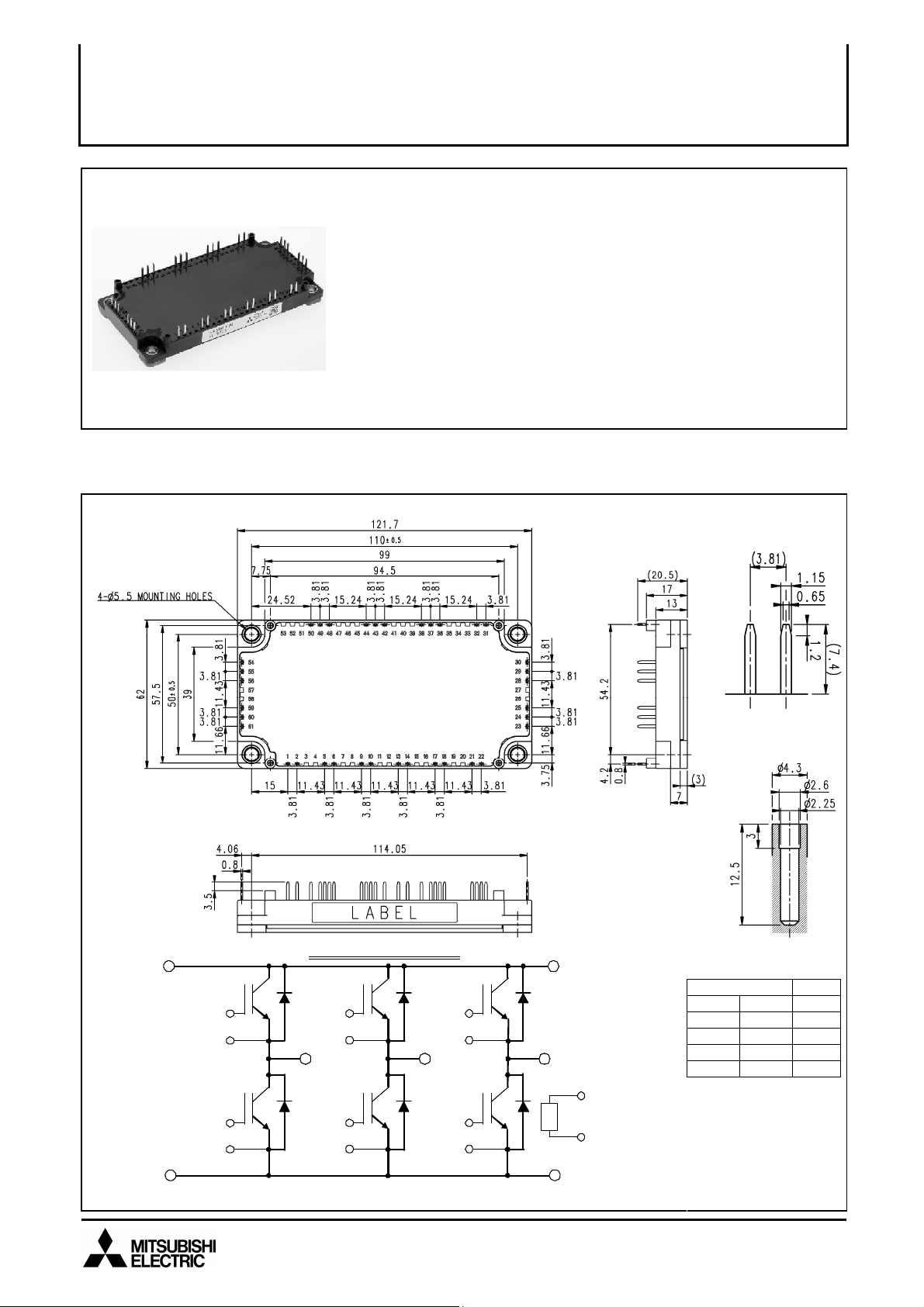
sixpack (3φ inverter)
APPLICATION
AC Motor Control, Motion/Servo Control, Power supply, etc.
OUTLINE DRAWING & INTERNAL CONNECTION
●UL Recognized under UL1557, File E323585
CM75TX-24S
HIGH POWER SWITCHING USE
INSULATED TYPE
A
V
°C
...........…
CES
jmax
75
1200
...
175
Dimension in mm
TERMINAL
(54~56)
N(59~61)
INTERNAL CONNECTION
P1(28~30)
GUP(1)
EsUP(2)
GUN(5)
EsUN(6) EsVN(14) EsW N(22)
Caution: Each (three) pin terminal of P/N/P1/N1/U/V/W is connected in the module,
but should use all each three pins for the external wiring.
GVP(9)
EsVP(10 )
U(48~50)
GVN(13)
GWP(17)
EsWP(18)
V(42~44)
GW N( 21 )
W(36~38)
NTC
N1(23~ 25)
TH1(31)
TH2(32)
t=0.8
SECTION A
Tolerance otherwise specified
Division of Dimension Tolerance
0.5 to 3 ±0.2
over 3 to 6 ±0.3
over 6 to 30 ±0.5
over 30 to 120 ±0.8
over 120 to 400 ±1.2
The tolerance of size between
terminals is assumed to be ±0.4.
1
Feb. 2011
Page 2
MITSUBISHI IGBT MODULES
CM75TX-24S
HIGH POWER SWITCHING USE
INSULATED TYPE
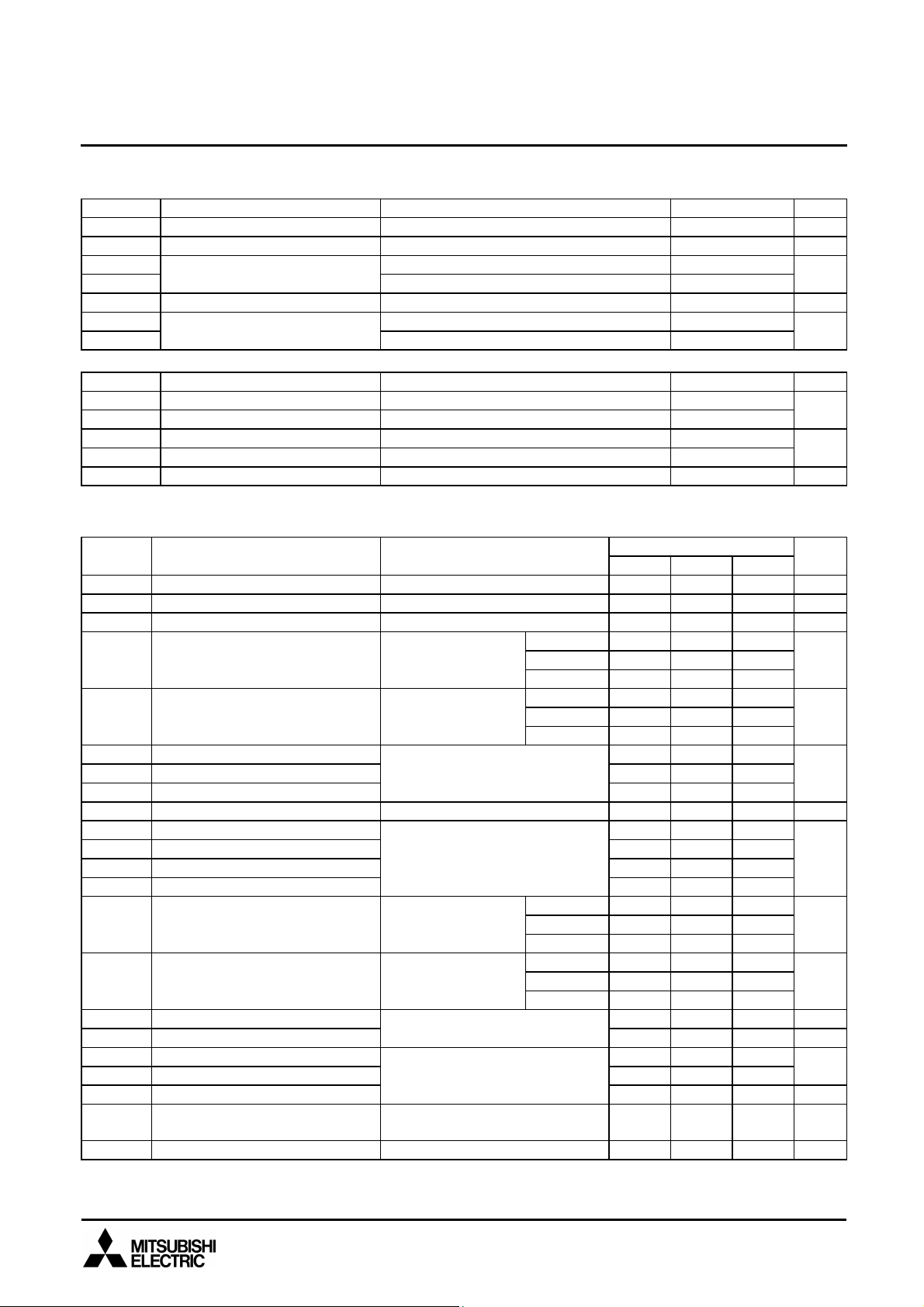
ABSOLUTE MAXIMUM RATINGS (Tj=25 °C, unless otherwise specified)
Inverter part IGBT/FWDi
Symbol Item Conditions Rating Unit
V
Collector-emitter voltage G-E short-circuited 1200 V
CES
V
Gate-emitter voltage C-E short-circuited ±20 V
GES
IC DC, TC=122 °C
I
CRM
P
Total power dissipation TC=25 °C
tot
IE
I
ERM
(Note.1)
(Note.1)
Collector current
Emitter current
(Note.3)
Pulse
TC=25 °C
(Note.3)
Pulse
(Note.2)
75
150
(Note.2, 4)
600 W
(Note.2, 4)
75
150
A
A
Module
Symbol Item Conditions Rating Unit
T
Maximum junction temperature - 175
jmax
T
Maximum case temperature
Cmax
T
Operating junction temperature - -40 ~ +150
jop
T
Storage temperature - -40 ~ +125
stg
V
Isolation voltage Terminals to base plate, RMS, f=60 Hz, AC 1 min 2500 V
isol
(Note.2)
125
°C
°C
ELECTRICAL CHARACTERISTICS (Tj=25 °C, unless otherwise specified)
Inverter part IGBT/FWDi
Symbol Item Conditions
I
Collector-emitter cut-off current VCE=V
CES
I
Gate-emitter leakage current VGE=V
GES
V
Gate-emitter threshold voltage IC=7.5 mA, VCE=10 V 5.4 6.0 6.6 V
GE(th)
I
V
CEsat
(Terminal)
V
CEsat
(Chip)
C
Input capacitance - - 7.5
ies
C
oes
C
res
Collector-emitter saturation voltage
Collector-emitter saturation voltage
Output capacitance - - 1.5
Reverse transfer capacitance
C
V
I
C
V
V
, G-E short-circuited - - 1 mA
CES
, C-E short-circuited - - 0.5 μA
GES
(Note.5)
=75 A
=15 V
GE
=75 A
=15 V
GE
=10 V, G-E short-circuited
CE
(Note.5)
,
,
Tj=25 °C - 1.80 2.25
Tj=125 °C - 2.00 -
=150 °C - 2.05 -
T
j
Tj=25 °C - 1.70 2.15
Tj=125 °C - 1.90 -
=150 °C - 1.95 -
T
j
Min. Typ. Max.
- - 0.13
QG Gate charge VCC=600 V, IC=75 A, VGE=15 V - 175 - nC
t
Turn-on delay time - - 300
d(on)
tr Rise time
t
Turn-off delay time - - 600
d(off)
tf Fall time
(Note.1)
VEC
(Terminal)
VEC
(Chip)
(Note.1)
trr
(Note.1)
Qrr
Emitter-collector voltage
(Note.1)
Emitter-collector voltage
Reverse recovery time VCC=600 V, IE=75 A, VGE=±15 V, - - 300 ns
Reverse recovery charge RG=8.2 Ω, Inductive load - 4.0 - μC
V
=600 V, IC=75 A, VGE=±15 V,
CC
=8.2 Ω, Inductive load
R
G
I
=75 A
E
(Note.5)
,
G-E short-circuited
I
=75 A
E
(Note.5)
,
G-E short-circuited
- - 200
- - 300
Tj=25 °C - 1.8 2.25
Tj=125 °C - 1.8 -
=150 °C - 1.8 -
T
j
Tj=25 °C - 1.7 2.15
Tj=125 °C - 1.7 -
=150 °C - 1.7 -
T
j
Eon Turn-on switching energy per pulse VCC=600 V, IC=IE=75 A, - 7.3 -
E
Turn-off switching energy per pulse VGE=±15 V, RG=8.2 Ω, Tj=150 °C, - 8.0 -
off
(Note.1)
Err
R
Reverse recovery energy per pulse Inductive load - 6.9 - mJ
Internal lead resistance
CC'+EE'
Main terminals-chip, per switch,
=25 °C
T
C
(Note.2)
- - 2.4 mΩ
rg Internal gate resistance Per switch - 0 - Ω
Limits
Unit
V
V
nF
ns
V
V
mJ
2
Feb. 2011
Page 3
MITSUBISHI IGBT MODULES
CM75TX-24S
HIGH POWER SWITCHING USE
INSULATED TYPE
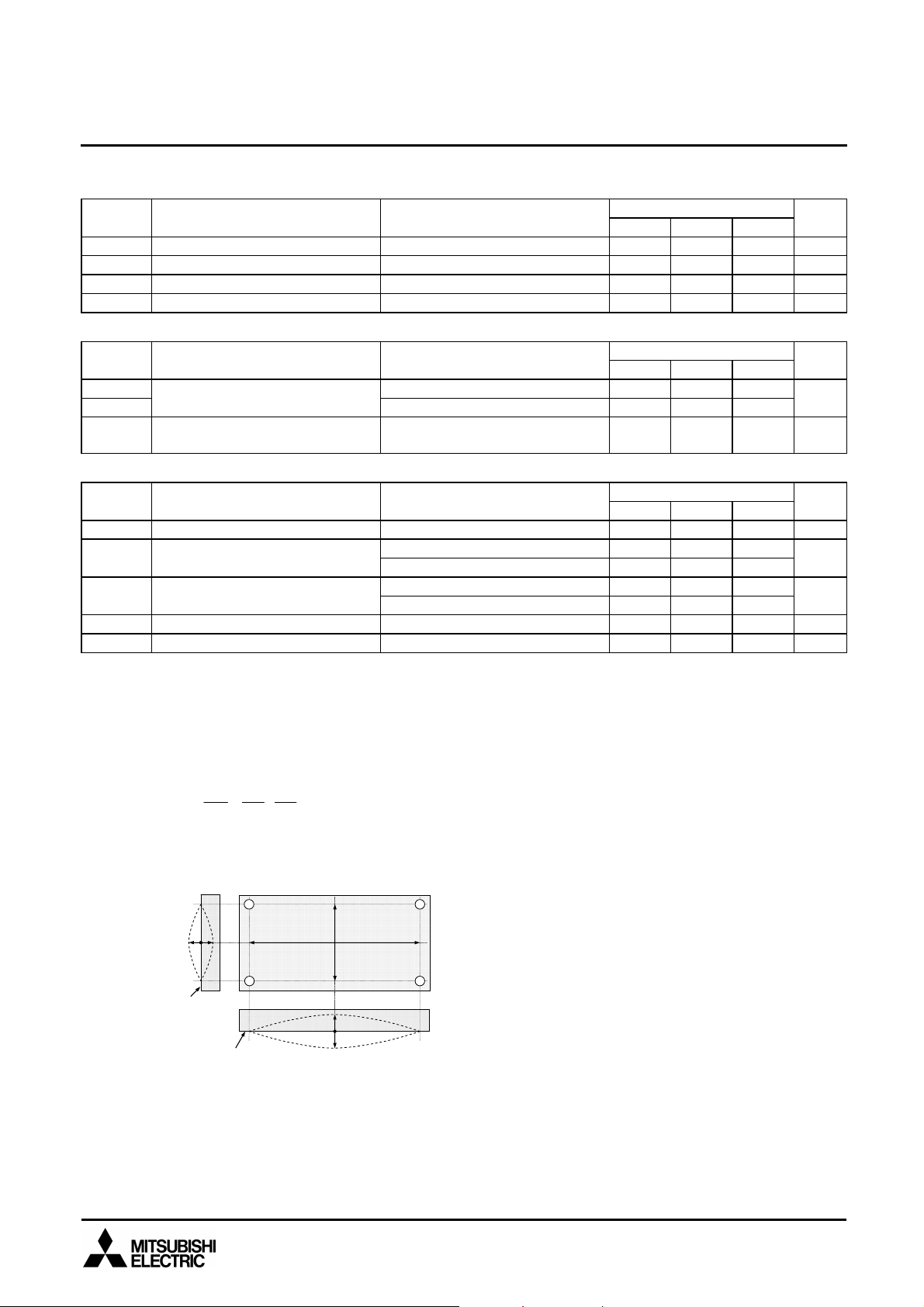
ELECTRICAL CHARACTERISTICS (cont.; Tj=25 °C, unless otherwise specified)
NTC thermistor part
Symbol Item Conditions
R25 Zero power resistance TC=25 °C
ΔR/R Deviation of resistance TC=100 °C, R
B
B constant Approximate by equation
(25/50)
P25 Power dissipation TC=25 °C
(Note.2)
4.85 5.00 5.15 kΩ
=493 Ω -7.3 - +7.8 %
100
(Note.2)
- - 10 mW
(Note.6)
- 3375 - K
Min. Typ. Max.
Limits
Unit
THERMAL RESISTANCE CHARACTERISTICS
Symbol Item Conditions
R
Junction to case, per IGBT - - 0.25
th(j-c)Q
R
th(j-c)D
R
th(c-s)
Thermal resistance
Contact thermal resistance
(Note. 2)
(Note.2)
Junction to case, per FWDi - - 0.40
Case to heat sink, per 1 module,
Thermal grease applied
(Note.7)
Min. Typ. Max.
- 15 - K/kW
Limits
Unit
K/W
MECHANICAL CHARACTERISTICS
Symbol Item Conditions
Min. Typ. Max.
Ms Mounting torque Mounting to heat sink M 5 screw 2.5 3.0 3.5 N·m
ds Creepage distance
da Clearance
Terminal to terminal 10.28 - -
Terminal to base plate 14.27 - -
Terminal to terminal 10.28 - -
Terminal to base plate 12.33 - -
m Weight - - 300 - g
ec Flatness of base plate On the centerline X, Y
(Note.8)
±0 - +100 μm
Note.1: Represent ratings and characteristics of the anti-parallel, emitter-collector free wheeling diode (FWDi).
Note.2: Case temperature (T
) and heat sink temperature (Ts) are defined on the each surface (mounting side) of base plate
C
and heat sink just under the chips. Refer to the figure of chip location.
The heat sink thermal resistance should measure just under the chips.
Note.3: Pulse width and repetition rate should be such that the device junction temperature (T
Note.4: Junction temperature (T
) should not increase beyond T
j
jmax
rating.
j
Note.5: Pulse width and repetition rate should be such as to cause negligible temperature rise.
Note.6:
(Refer to the figure of test circuit for V
R
25
/()
ln(B
)/(
5025
R
: resistance at absolute temperature T25 [K]; T25=25 [°C]+273.15=298.15 [K]
R
25
R
: resistance at absolute temperature T50 [K]; T50=50 [°C]+273.15=323.15 [K]
50
11
−=
)
,
TT
502550
CEsat
, VEC.)
Note.7: Typical value is measured by using thermally conductive grease of λ=0.9 W/(m·K).
Note.8: The base plate (mounting side) flatness measurement points (X, Y) are as follows of the following figure.
Y
mounting side
-:Concave
mounting side
+:Convex
-:Concave
X
Limits
) dose not exceed T
jmax
Unit
mm
mm
rating.
mounting side
+:Convex
Note.9: Japan Electronics and Information Technology Industries Association (JEITA) standards,
"EIAJ ED-4701/300: Environmental and endurance test methods for semiconductor devices (Stress test I)"
Note.10: Use the following screws when mounting the printed circuit board (PCB) on the stand offs.
"M2.6×10 or M2.6×12 self tapping screw"
The length of the screw depends on the thickness of the PCB.
3
Feb. 2011
Page 4

MITSUBISHI IGBT MODULES
CM75TX-24S
HIGH POWER SWITCHING USE
INSULATED TYPE
RECOMMENDED OPERATING CONDITIONS (Ta=25 °C, unless otherwise specified)
Symbol Item Conditions
VCC DC supply voltage
V
Gate (-emitter drive) voltage
GEon
RG External gate resistance Per switch 8.2 - 82 Ω
Applied across
P-N / P1-N1 terminals
Applied across
G*P-Es*P / G*N-Es*N terminals
CHIP LOCATION (top view)
Min. Typ. Max.
- 600 850 V
13.5 15.0 16.5 V
Dimension in mm, Tolerance: ±1 mm
Limits
Unit
Tr*P/Tr*N: IGBT, Di*P/Di*N: FWDi, Th: NTC thermistor. Each mark points the center position of each chip.
TEST CIRCUIT AND WAVEFORMS
V
CC
i
C
0.1×V
0 V
0 A
t
d(on)
CC
v
GE
〜
〜
90 %
i
0
E
t
Q
=0.5×Irr×t
rr
rr
t
rr
IE
i
C
〜
〜
90 %
0 A
Irr
10%
t
r
t
d(off)
V
CC
ICM
0.02×I
t
i
t
f
t
i
E
v
CE
0 A
CM
t0
IEM
v
EC
ti
0.5×I
V
t
rr
CC
t
t0 V
VCC
iE
Load
VCE
iC
+
i
C
-VGE
R
G
+V
GE
0 V
-V
vCE
VGE
GE
Switching characteristics test circuit and waveforms trr, Qrr test waveform
I
CM
0.1×I
0
CM
ti
IGBT Turn-on switching energy IGBT Turn-off switching energy FWDi reverse recovery energy
Turn-on / Turn-off switching energy and Reverse recovery energy test waveforms (Integral time instruction drawing)
0.1×VCC
t
4
Feb. 2011
Page 5

MITSUBISHI IGBT MODULES
TEST CIRCUIT
VGE=15 V
Short-circ uited
Short-circui ted
VGE=15 V
Gate-emitter
short-circuited
28~30
1
2
V
5
6
23~25
P1
GUP
EsUP
GUN
EsUN
N1
GVP-EsVP, GWP-EsWP,
GVN-EsVN, GWN-EsWN
UP / UN IGBT
54~56
48~50
59~61
P
U
N
CM75TX-24S
HIGH POWER SWITCHING USE
INSULATED TYPE
IC
VGE=15 V
Short-circ uited
Short-circui ted
V
IC
VGE=15 V
Gate-emitter
short-circuited
28~30
9
10
V
13
14
23~25
P1
GVP
EsV P
GVN
EsVN
N1
GUP-EsUP, GWP-EsWP,
GUN-EsUN, GWN-EsWN
VP / VN IGBT
TEST CIRCUIT
V
CEsat
54~56
42~44
59~61
P
V
N
I
C
V
IC
VGE=15 V
Short-circ uited
Short-circui ted
VGE=15 V
Gate-emitter
short-circuited
28~30
17
18
V
21
22
23~25
P1
GWP
EsW P
GWN
EsWN
N1
GUP-EsUP, GVP-EsVP,
GUN-EsUN, GVN-EsVN
WP / WN IGBT
54~56
36~38
59~61
P
V
W
IC
N
I
C
Short-circ uited
Short-circui ted
Short-circui ted
Gate-emitter
short-circuited
28~30
Shor t-
circuited
1
2
V
5
6
23~25
P1
GUP
EsUP
GUN
EsUN
N1
GVP-EsVP, GWP-EsWP,
GVN-EsVN, GWN-EsWN
UP / UN FWDi
54~56
48~50
59~61
P
U
N
IE
V
IE
Short-circ uited
Short-circui ted
Short-circui ted
Gate-emitter
short-circuited
28~30
Short-
circ uited
9
10
V
13
14
23~25
P1
GVP
EsV P
GVN
EsVN
N1
GUP-EsUP, GWP-EsWP,
GUN-EsUN, GWN-EsWN
VP / VN FWDi
TEST CIRCUIT
V
EC
54~56
I
E
42~44
59~61
P
V
N
V
I
E
Short-circ uited
Short-circui ted
Short-circui ted
Gate-emitter
short-circuited
28~30
Short-
circuited
17
18
V
21
22
23~25
P1
GWP
EsW P
GWN
EsWN
N1
GUP-EsUP, GVP-EsVP,
GUN-EsUN, GVN-EsVN
WP / WN FWDi
* In the above test circuit, should use all three main pin terminals (P/N/U/V/W) for connection with the terminals
and the current source.
54~56
36~38
59~61
P
W
N
I
E
V
I
E
5
Feb. 2011
Page 6

MITSUBISHI IGBT MODULES
CM75TX-24S
HIGH POWER SWITCHING USE
INSULATED TYPE
PERFORMANCE CURVES
INVERTER PART
150
125
(A)
C
100
75
50
COLLECTOR CURRENT I
25
Tj=25 °C
VGE=20 V
15 V
OUTPUT CHARACTERISTICS
(TYPICAL)
(Chip)
13.5 V
12 V
11 V
10 V
9 V
COLLECTOR-EMITTER SATURATION VOLTAGE
CHARACTERISTICS
(TYPICAL)
3.5
(V)
2.5
CE
1.5
COLLECTOR-EMITTER
VGE=15 V
3
Tj=125 °C
2
1
SATURATION VOLTAGE V
0.5
(Chip)
Tj=150 °C
Tj=25 °C
0
0246810
0
0 50 100 150
COLLECTOR-EMITTER VOLTAGE VCE (V) COLLECTOR CURRENT IC (A)
COLLECTOR-EMITTER SATURATION VOLTAGE
CHARACTERISTIC
(V)
CE
COLLECTOR-EMITTER
SATURATION VOLTAGE V
Tj=25 °C
10
9
8
7
6
5
4
3
2
1
(TYPICAL)
IC=150 A
IC=75 A
IC=30 A
(Chip)
1000
(A)
E
100
EMITTER CURRENT I
Tj=150 °C
FREE WHEELING DIODE
FORWARD CHARACTERISTICS
(TYPICAL)
G-E short-circuited
Tj=125 °C
Tj=25 °C
(Chip)
0
6 8 10 12 14 16 18 20
10
0.5 1 1.5 2 2.5 3
GATE-EMITTER VOLTAGE VGE (V) EMITTER-COLLECTOR VOLTAGE VEC (V)
6
Feb. 2011
Page 7

MITSUBISHI IGBT MODULES
1000
100
10
SWITCHING TIME (ns)
SWITCHING CHARACTERISTICS
HALF-BRIDGE
(TYPICAL)
VCC=600 V, VGE=±15 V, RG=8.2 Ω,
--------------- : T
=150 °C, - - - - -: Tj=125 °C
j
t
d(off)
tf
t
d(on)
tr
SWITCHING CHARACTERISTICS
VCC=600 V, VGE=±15 V, IC=75 A,
1000
100
--------------- : T
SWITCHING TIME (ns)
CM75TX-24S
HIGH POWER SWITCHING USE
INSULATED TYPE
HALF-BRIDGE
(TYPICAL)
=150 °C, - - - - -: Tj=125 °C
j
tf
t
d(off)
t
d(on)
tr
1
1 10 100
10
1 10 100
COLLECTOR CURRENT IC (A) EXTERNAL GATE RESISTANCE RG (Ω)
(TYPICAL)
VCC=600 V, VGE=±15 V, RG=8.2 Ω,
SWITCHING CHARACTERISTICS
10
1
--------------- : T
=150 °C, - - - - -: Tj=125 °C
j
Err
E
off
Eon
100
10
SWITCHING CHARACTERISTICS
VCC=600 V, VGE=±15 V, IC=75 A,
--------------- : T
HALF-BRIDGE
HALF-BRIDGE
(TYPICAL)
=150 °C, - - - - -: Tj=125 °C
j
E
on
E
off
SWITCHING ENERGY (mJ)
REVERSE RECOVERY ENERGY (mJ)
0.1
1 10 100
COLLECTOR CURRENT IC (A)
EMITTER CURRENT I
(A)
E
SWITCHING ENERGY (mJ)
REVERSE RECOVERY ENERGY (mJ)
1
1 10 100
GATE RESISTANCE R
7
G
(Ω)
E
rr
Feb. 2011
Page 8

MITSUBISHI IGBT MODULES
100
10
1
CAPACITANCE (nF)
0.1
CAPACITANCE CHARACTERISTICS
(TYPICAL)
G-E short-circuited, Tj=25 °C
CM75TX-24S
HIGH POWER SWITCHING USE
INSULATED TYPE
REVERSE RECOVERY CHARACTERISTICS
1000
C
ies
(A)
rr
C
oes
C
res
100
(ns), I
rr
t
FREE WHEELING DIODE
(TYPICAL)
VCC=600 V, VGE=±15 V, RG=8.2 Ω,
--------------- : T
=150 °C, - - - - -: Tj=125 °C
j
Irr
trr
0.01
0.1 1 10 100
10
1 10 100
COLLECTOR-EMITTER VOLTAGE VCE (V) EMITTER CURRENT IE (A)
TRANSIENT THERMAL IMPEDANCE
CHARACTERISTICS
(MAXIMUM)
Single pulse, TC=25 °C
1
0.1
20
15
(V)
GE
10
5
GATE-EMITTER VOLTAGE V
GATE CHARGE CHARACTERISTICS
(TYPICAL)
VCC=600 V, IC=75 A, Tj=25 °C
th(j-c)
Z
0.01
0.001
0
0 50 100 150 200 250
NORMALIZED TRANSIENT THERMAL RESISTANCE
0.00001 0.0001 0.001 0.01 0.1 1 10
R
=0.25 K/W, R
th(j-c)Q
=0.40 K/W
th(j-c)D
GATE CHARGE QG (nC) TIME (S)
8
Feb. 2011
Page 9

MITSUBISHI IGBT MODULES
CM75TX-24S
HIGH POWER SWITCHING USE
INSULATED TYPE
Keep safety first in your circuit designs!
• Mitsubishi Electric Corporation puts the maximum effort into making semiconductor products better and more reliable, but there is
always the possibility that trouble may occur with them. Trouble with semiconductors may lead to personal injury, fire or property
damage.
Remember to give due consideration to safety when making your circuit designs, with appropriate measures such as (i) placement of
substitutive, auxiliary circuits, (ii) use of non-flammable material or (iii) prevention against any malfunction or mishap.
Notes regarding these materials
• These materials are intended as a reference to assist our customers in the selection of the Mitsubishi semiconductor product best
suited to the customer's application; they do not convey any license under any intellectual property rights, or any other rights, belonging
to Mitsubishi Electric Corporation or a third party.
• Mitsubishi Electric Corporation assumes no responsibility for any damage, or infringement of any third-party's rights, originating in the
use of any product data, diagrams, charts, programs, algorithms, or circuit application examples contained in these materials.
• All information contained in these materials, including product data, diagrams, charts, programs and algorithms represents information
on products at the time of publication of these materials, and are subject to change by Mitsubishi Electric Corporation without notice due
to product improvements or other reasons. It is therefore recommended that customers contact Mitsubishi Electric Corporation or an
authorized Mitsubishi Semiconductor product distributor for the latest product information before purchasing a product listed herein.
The information described here may contain technical inaccuracies or typographical errors. Mitsubishi Electric Corporation assumes no
responsibility for any damage, liability, or other loss rising from these inaccuracies or errors.
Please also pay attention to information published by Mitsubishi Electric Corporation by various means, including the Mitsubishi
Semiconductor home page (http://www.mitsubishichips.com/Global/index.html).
• When using any or all of the information contained in these materials, including product data, diagrams, charts, programs, and
algorithms, please be sure to evaluate all information as a total system before making a final decision on the applicability of the
information and products. Mitsubishi Electric Corporation assumes no responsibility for any damage, liability or other loss resulting from
the information contained herein.
• Mitsubishi Electric Corporation semiconductors are not designed or manufactured for use in a device or system that is used under
circumstances in which human life is potentially at stake. Please contact Mitsubishi Electric Corporation or an authorized Mitsubishi
Semiconductor product distributor when considering the use of a product contained herein for any specific purposes, such as apparatus
or systems for transportation, vehicular, medical, aerospace, nuclear, or undersea repeater use.
• The prior written approval of Mitsubishi Electric Corporation is necessary to reprint or reproduce in whole or in part these materials.
• If these products or technologies are subject to the Japanese export control restrictions, they must be exported under a license from
the Japanese government and cannot be imported into a country other than the approved destination.
Any diversion or reexport contrary to the export control laws and regulations of Japan and/or the country of destination is prohibited.
• Please contact Mitsubishi Electric Corporation or an authorized Mitsubishi Semiconductor product distributor for further details on
these materials or the products contained therein.
9
Feb. 2011
 Loading...