

Page 1
WHAT ARE F.R.L.’s?
HOW THEY WORK
WHERE TO USE THEM
INSTRUCTION SHEET
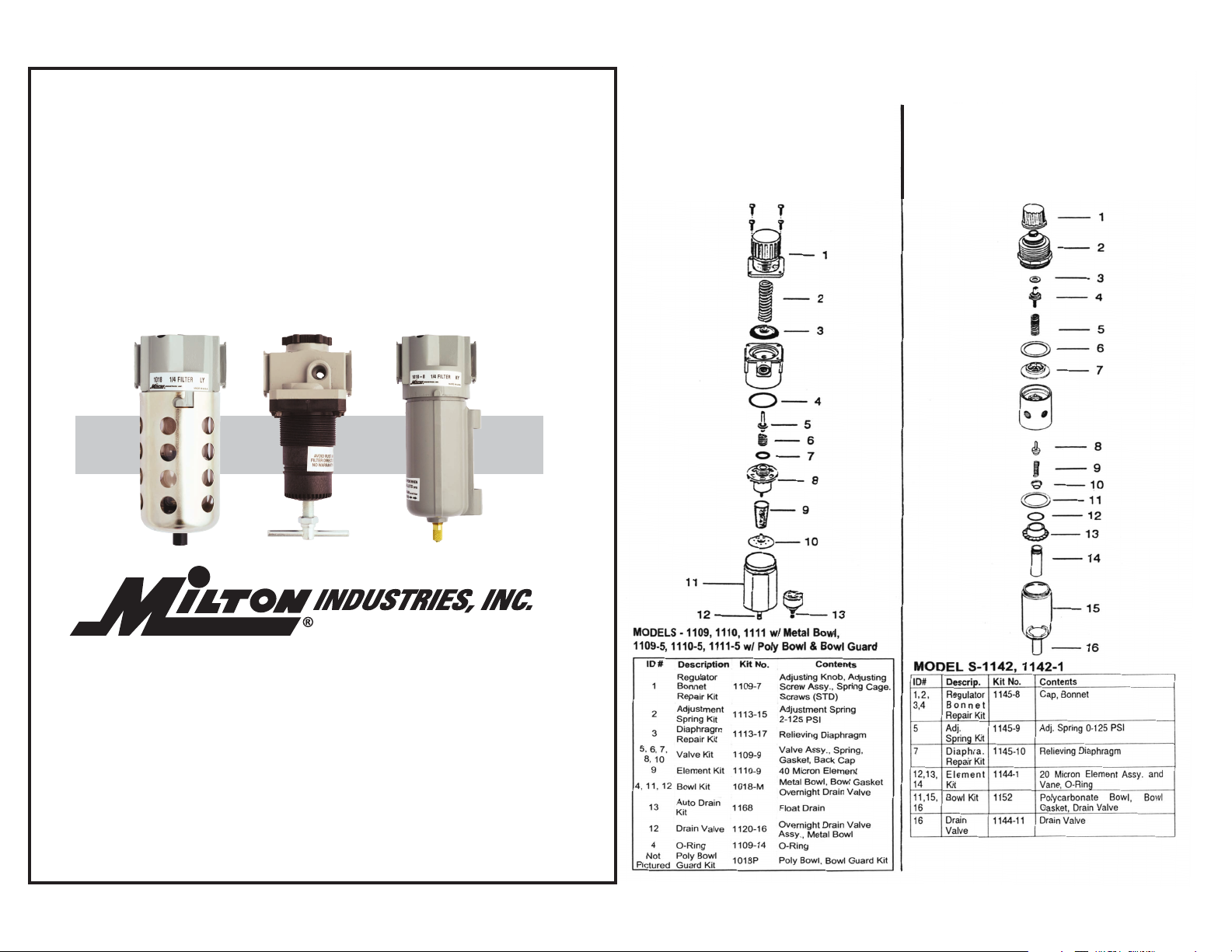
For Filter / Regulator
Piggyback
Bowl Type Max. Inlet Pressure Temperature Range
Polycarbonate 150 PSI 40¡ F to 125¡ F
Metal 200 PSI 40¡ F to 160¡ F
w/Auto Drain 30 TO 175 PSI 40¡ F to 120¡ F
For Miniature Filter / Regulator
Piggyback
Bowl Type Max. Inlet Pressure Temperature Range
Polycarbonate 150 PSI 40¡ F to 125¡ F
THE QUALITY NAME
FORM NO. 8X925
PIGGYBACK FILTER-REGULATOR
7-07
Page 1
Page 2
MICRO-FILTERS
Although the Micro-Filter is the simplest of
the three basic air control devices, it is also
the least understood and the one most
frequently installed improperly. Read on.
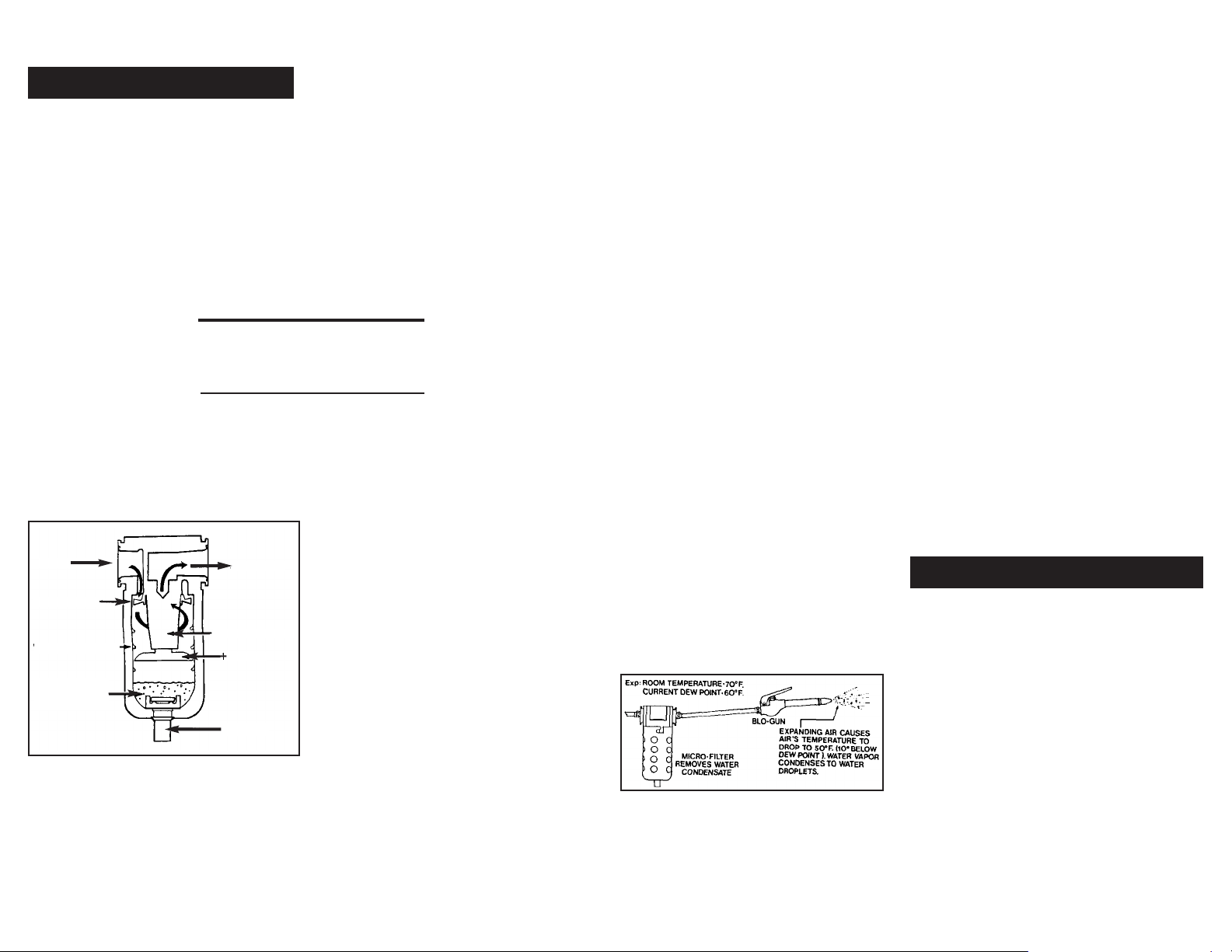
How they work -These filters remove two
kinds of contaminants: (1) solid, particulate
matter such as rust and pipe scale and (2)
water condensate. The first is removed by a
nominally rated 40 micron porous sintered
metal element. However, because of it’s
unique "tortuous path" design, it will actually
trap particles down to 10
microns in size (about
0.0004 inches)
The water is removed
through a violent swirling
action imparted to the air by a set of fixed
vanes at the top of the filter. The process is
exactly like that of the spin-dry cycle in a
washing machine. Centrifugal force throws
the water droplets against the side of the
bowl where they roll down and collect at the
bottom.
AIR IN
FIXED VANES
WATER DROPLETS
WATER
CONDENSATE
Condensate removal in a Micro-Filter.
Small is better -The more rapidly the air is
swirled, the more effectively the water
condensate is thrown out against the filter
wall. If you pass the same volume of air
(SCFM) through a small filter and a large
filter, it will swirl more rapidly in the small one.
" The filter ... is the one least
understood and the one most
frequently installed improperly "
AIR OUT
SINTERED FILTER
BAFFLE
DRAIN
Although you may think a big filter is more
effective, the reverse may actually be true if
too little air passes through. Always select
filter size based on your air flow or SCFM
requirements.
How small is too small - As long as the
pressure difference between the inlet and
the outlet of the filter does not exceed 3 PSI
at the required air flow (SCFM), the filter is
not too small. For more information, please
refer to the FRL sizing chart in the Milton
Catalog, page 60.
What a filter does and doesn’t do - A
properly selected and
installed filter removes
particulate matter and
water condensate.
However, it does not and
cannot remove water
vapor from the air. Water vapor must be
converted to water condensate before this
type of filter can remove it (See the OTHER
FILTERS section).
Water vapor and water condensate Water vapor is an invisible gas; water
condensate is a liquid, even if it is in mist or
droplet form. To convert water vapor to a
condensate, the air must be cooled down actually, down to or below the "dew point."
The dew point is the temperature at which
dew or water condensate forms. It varies
with the RH (Relative Humidity). It’s low with
low RH and approaches ambient
temperature with high RH.
This explains why you sometimes see water
droplets or mist coming from a blow gun or
paint sprayer when there is no "apparent"
water in the air lines. The rapid expansion of
the air as it leaves the blow gun or sprayer
causes the air’s temperature to drop (same
principle as an air conditioning system). If
this temperature falls below the dew point,
the water vapor in the air line converts instantly
to water condensate.
If you sometimes experience a problem like
this, you will require, in addition to the MicroFilter, a desiccant dryer filter (see OTHER
FILTERS section).
Choosing a different drain system All filters (except the Mini) come with an
Overnight Drain that opens when line
pressure falls, after turning off the
compressor, to 5 PSI. These drains can also
be opened manually by pushing them
sideways (poly bowls) or twisting them in the
direction of the arrow (metal bowls).
You can also install an Automatic Drain
Valve (Model 1168) in place of the supplied
Overnight Drain Valve. These valves open
automatically whenever the water level in
the bowl reaches a certain point, whether
the system is under pressure or not. These
are good for high humidity conditions or
around-the-clock systems.
Metal bowl vs. polycarbonate bowl -
The advantage of the poly bowl is in quick
and easy water level checking. If you have a
situation where water may fill the bowl
before the overnight drain can function (e.g.,
high humidity), it is helpful to be able to
visually check water level.
Other than this, the advantage is with the metal
bowl. This is especially true if you are using
synthetic oils in your compressor or have
volatile solvents in the area. (See list of
chemicals that are not compatible with poly
bowls.)
When you need a desiccant dryer
One filter is never enough - A well designed system requires a minimum of two
filters: (1) a master filter near the
compressor and (2) a smaller filter at each
work station or air operated device. The master
filter is usually a 1/2" NPT or larger unit.
This filter should never be installed at the output
of the compressor, but rather at the output of
the after-cooler or the receiving tank. These
units allow the hot, high pressure air from the
compressor to cool down enough to condense
out much of the water vapor. The main line filter
and regulator should be placed at least 20 Feet
from the compressor.
The additional filter at each station, besides
removing still more condensate, also traps any
debris (rust and pipe scale) that may make its
way down the distribution pipe. Try to locate this
filter as close to the device as possible.
Installation tips - Align the filter vertically, with
the drain at the bottom. Note that the air from
the compressor enters the "IN" port and exits
the "OUT" port. If connected backwards, the
filter will still pass air but will not extract the
water condensate.
Easy maintenance - Since there are no
moving parts to wear out, there is little to go
wrong. Periodically wash the sintered filter
element in a detergent solution and blow it out;
if too clogged to be washed, replace it.
OTHER FILTERS
Sometimes a Micro-Filter alone is not the
answer. Although they remove much of the
water, in some applications, such as spray
painting, it’s not enough.
When you need exceptionally dry air or
essentially oil-free air, you can choose from two
other filter types: (1) the desiccant dryer and (2)
the oil removing filter.
The desiccant dryer filter - This is the ultimate
filter for dry air; it takes over where the MicroFilter leaves off. This filter absorbs directly,
through a chemical process, the water vapor in
the air.
So effectively does it remove water, that the air
frequently has a dew point of 0°F or lower.
Page 2 / REV 03-2008
Page 3
This is sufficiently dry for practically any
purpose, including spray painting.
However, this drying efficiency comes with a
price. The desiccant that absorbs the water
vapor eventually becomes saturated with
water and can no longer absorb anymore.
Fortunately, you are alerted to this by a
change in desiccant color - from bluish-white
to pink.
When this happens, you have two choices,
depending on which desiccant system you
are using. If it is the rechargeable type,
simply remove the desiccant, dry it in a
vented oven at 275°F for two or three hours,
then put it back in the filter.
If it is the disposable type, such as the Mini
In-line Desiccant Dryer (Models 1173/1174),
it’s even easier - just throw it away.
The Mini In-line Dryer is designed for those
users who do not need full-time dry air and
who wish to avoid the cost of installing a
rechargeable desiccant system. One Mini
Dryer will supply enough bone-dry air,
depending on humidity, to spray paint
several cars.
Remember though, all desiccant dryers
must be preceded by a Micro-Filter to
remove the water condensate. In addition,
they should also be preceded by an oilremoving filter (described below). Failure to
do this will result in short desiccant life.
Oil-removing & Coalescing filters In addition to water and particulate matter,
oil can also be a contaminant in an air
system. This is especially true in paint
spraying.
A special series of Sub-Micron Oil Removing
Filters is available for this purpose. It will
remove particles down to 0.9 microns (0.03
microns for coalescing filters), over forty to
one hundred times as small as those
extracted by the standard Micro-Filter. This
is small enough to capture oil vapors (e.g.,
compressor blow-by) as well as water mist
too fine to be removed by a standard filter.
It achieves this exceptional filtration through
a white borosilicate element that can be
replaced when necessary. Similar to the
standard filter, these units also have an
over-night drain. Since they are not intended
to remove large quantities of water, they
should always be preceded by a MicroFilter.
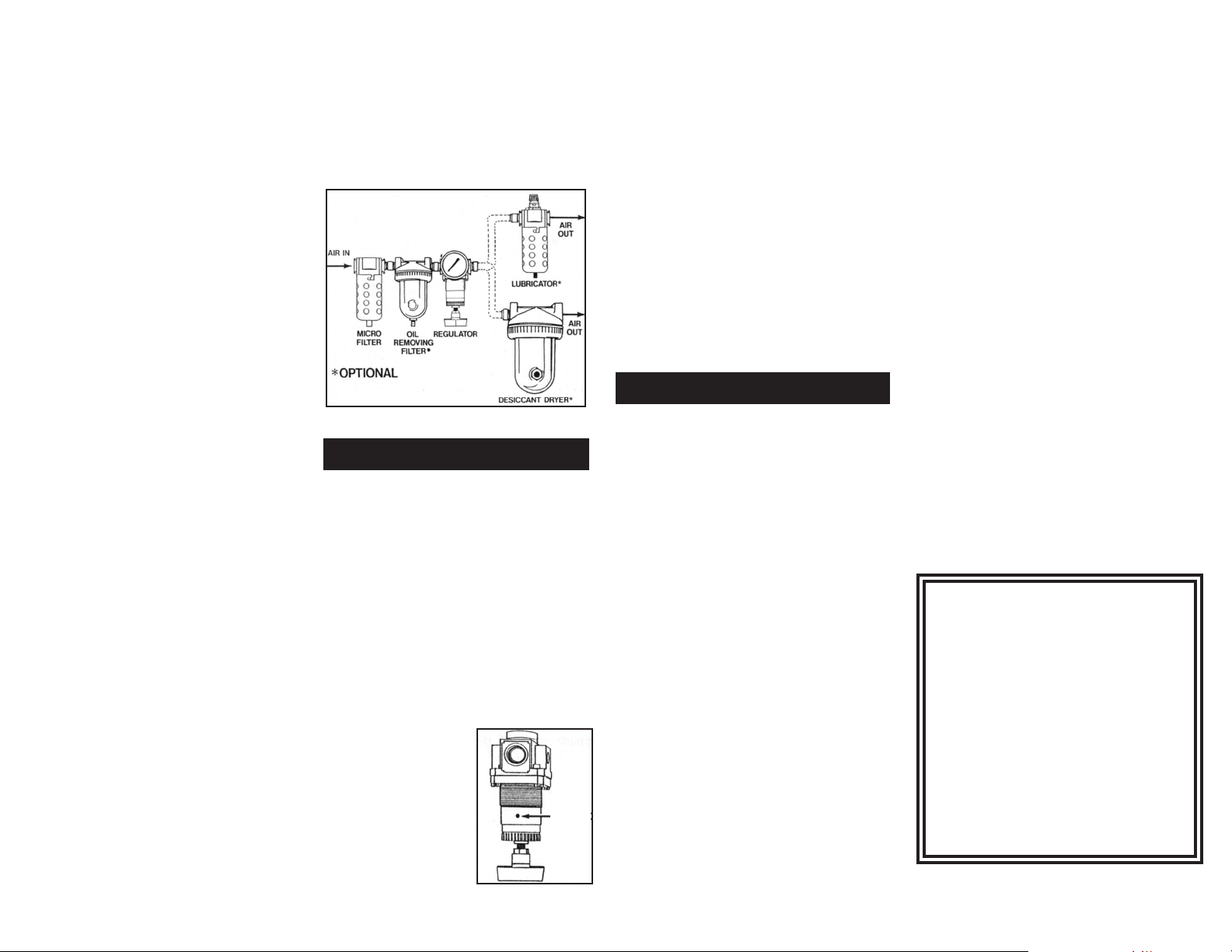
Proper sequence of F-R-L components.
REGULATORS
Regulators, despite their precision valving
system, can be very long-lived devices. Ten
to twenty years is not unusual.
Keep it clean - The secret to this longevity
is clean air. Always, without exception,
precede your regulator with a Micro-Filter
and install it as close as you can get it. This
is why the Piggyback Filter-Regulator or
FRL Trio is such a good choice - they always
come with a filter. And never precede a
regulator with a desiccant dryer filter or a
lubricator nor use Teflon tape on the "IN"
port (use standard pipe dope).
That little hole in the
side - This is a relieving
port that allows the
regulator to be used on
dead-ended
applications. This
means that you can
raise or lower the
desired pressure
without any air flow.
VENT
HOLE
Normally, you will neither feel nor hear any
air coming from this hole. If you do, it means
either: (1) the regulator diaphragm has a
leak, (2) the little valve under the knurled
cap is dirty or (3) the regulator has been
installed backwards. If, on a new installation,
the regulator does not respond properly or
you hear air escaping, make sure you have
not reversed the IN and OUT ports - it
happens.
Pressure ranges - Regulators come in two
standard ranges: (1) 2 to 125 PSI and (2) 10
to 250 PSI. The maximum inlet pressure in
either case is 250 PSI. A special low
pressure mini-regulator is also available that
covers 3 to 60 PSI. This is the same
regulator that is used on the Model 1174
Desiccant Dryer system.
LUBRICATORS
These devices play a vital role in many air
delivery systems. Be sure you select the
type best suited to your applications.
Two types available - Lubricators come in
two basic styles: (1) the drip type and (2) the
wick type. The drip type is the most popular
and the one best suited to the average
repair shop application. The wick type is
normally used for industrial applications.
The drip type - This style injects lubrication
into the system by allowing oil drops
periodically to drop into the air stream. The
rate at which the drops enter the stream is
fully adjustable. And once adjusted, the
adjusting knob can be removed to prevent
tampering.
The question is: How much oil to inject and
how is this accomplished? For the average
repair shop, 3 to 4 drops per minute is a
good starting point; you can raise or lower it
as you see fit. Since the lubricator delivers
oil only when air is flowing, here is one
method for setting the drip rate: Connect a
tubeless tire valve to the system (via a tire
chuck) and let the air pass through freely.
This is about the same volume of air
consumed by an impact wrench. Adjust the
drip rate to produce 3 to 4 drops per minute.
The wick type - In this system, oil is
transferred to the air stream by having the
air pass over a wick saturated in oil. The
amount of oil injected this way is determined
by how much of the wick is exposed to the
air. The normal factory setting is for 50%
wick exposure. Raise or lower the wick, by
opening the lubricator, for more or less oil.
The wick type lubricator requires a fairly high
volume of air to function - a minimum of 30
SCFM. This is roughly equivalent to seven,
1/2-inch impact wrenches operating
simultaneously. Generally speaking,
compressors of 10 horsepower or less do
not have the capacity to handle a wick type
lubricator.
Poly bowl vs. Metal bowl - If you are using
a standard lubricant, such as 10 weight
non-detergent motor oil, either bowl is
satisfactory. If you are using a proprietary air
tool oil or a specialty lubricant, opt for the
metal bowl. Some of these special lubricants
may damage poly bowls. For rotary screw
compressor applications use a metal bowl.
Poly bowls damaged by chemicals are not
covered by warranty. Always install a
lubricator after a filter or regulator, never
before.
WARNING! - ALL FRL’s
FOR COMPRESSED AIR
SERVICE ONLY.
NOT TO BE USED ON
LIFE SUPPORT OR
BREATHING AIR
SYSTEMS.
Page 3 / REV 03-2008
Page 4
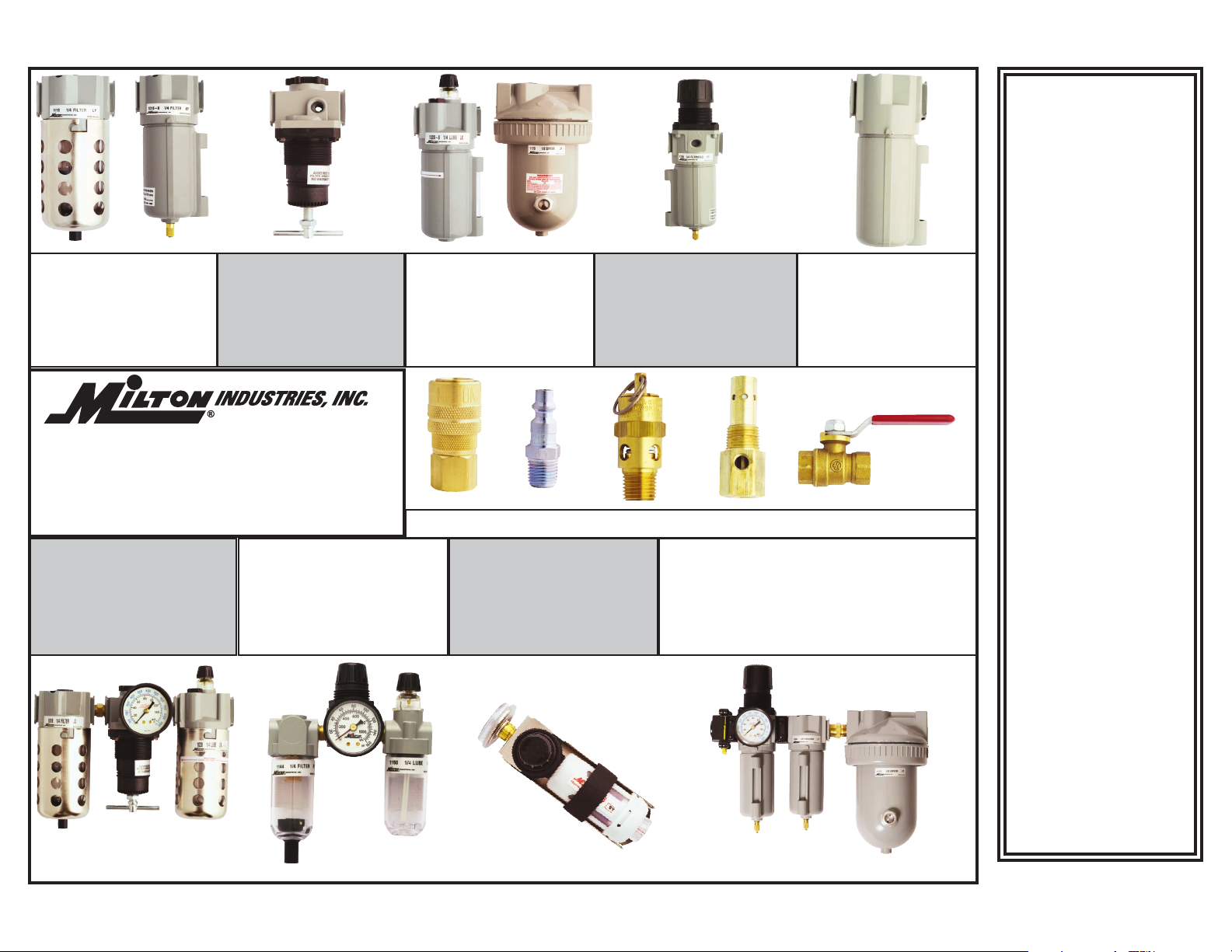
FILTERS
The basic air control device
for all systems. Removes
solid particulate matter and
water condensate. Available
in a wide variety of sizes.
REGULATORS
A full line of regulators in
both standard pressure (2125 psi) and high pressure
(10-250 psi). All metal
construction.
The air management people
See your jobber for the full product line
4500 W. Cortland Street, Chicago, Illinois 60639
Phone: (773) 235-9400 FAX: (773) 235-3221
Web Site: www.miltonindustries.com
F-R-L TRIO
A complete system for standard
shop applications. Includes a
standard Micro-Filter, regulator
and lubricator in one easy-toinstall package.
MINI F-R-L TRIO
Ideal for low air volume
applications such as art studios,
model shops and laboratories.
Regulator, filter and lubricator
also available separately.
LUBRICATORS
Precision lubricators to automatically provide essential
oil to all your pneumatic
tools. Can be adjusted to
deliver the correct amount.
PIGGYBACK REGULATOR
The ideal package for a basic
air control system. Same
features as our standard
regulator and standard MicroFilter. Easy installation.
OIL REMOVING FILTER
Removes oil and oil vapors
from the air line. Prevents
oil pull-over from entering
your paint spray gun and
marring the paint job.
A COMPLETE LINE OF COUPLERS, PLUGS, CHECK VALVES, SAFETY VALVES ...
MINI AIR STATION
A self-contained desiccant filter
for spray painting. Complete
with desiccant and low
pressure regulator. Clips to
your belt.
DESICCANT DRYER SYSTEM
For the ultimate in water-free and oil-free air you
can’t beat the Deluxe Desiccant Dryer System.
Complete with Micro-filter, oil removing filter,
pressure regulator and desiccant dryer. Ready to
go with nothing else to buy.
CHEMICALS
NOT TO BE USED
WITH POLY BOWLS
Do not use synthetic oils
or oils containing
phosphate esters or
chlorinated hydrocarbons.
They can carry over from
the compressor into the
air lines and attack or
crack poly bowls. Do not
expose these bowls, even
from external sources,
to: alcohol,
carbon tetrachloride,
trichlorethylene, acetone,
paint thinner, cleaning
fluids and similar
materials. These
chemicals and other
similar chemicals can
craze or crack a poly
bowl. If in doubt, use a
metal bowl, especially
since poly bowls
damaged by chemicals
are not covered by
warranty.
ROTARY SCREW
COMPRESSORS
For these applications
use a metal bowl.
METAL BOWL
LUBRICATORS
The sight glass in
these units will crack
if exposed to alcohol
or alcohol based fluids.
Page 4 / REV 03/2008
 Loading...