

Page 1
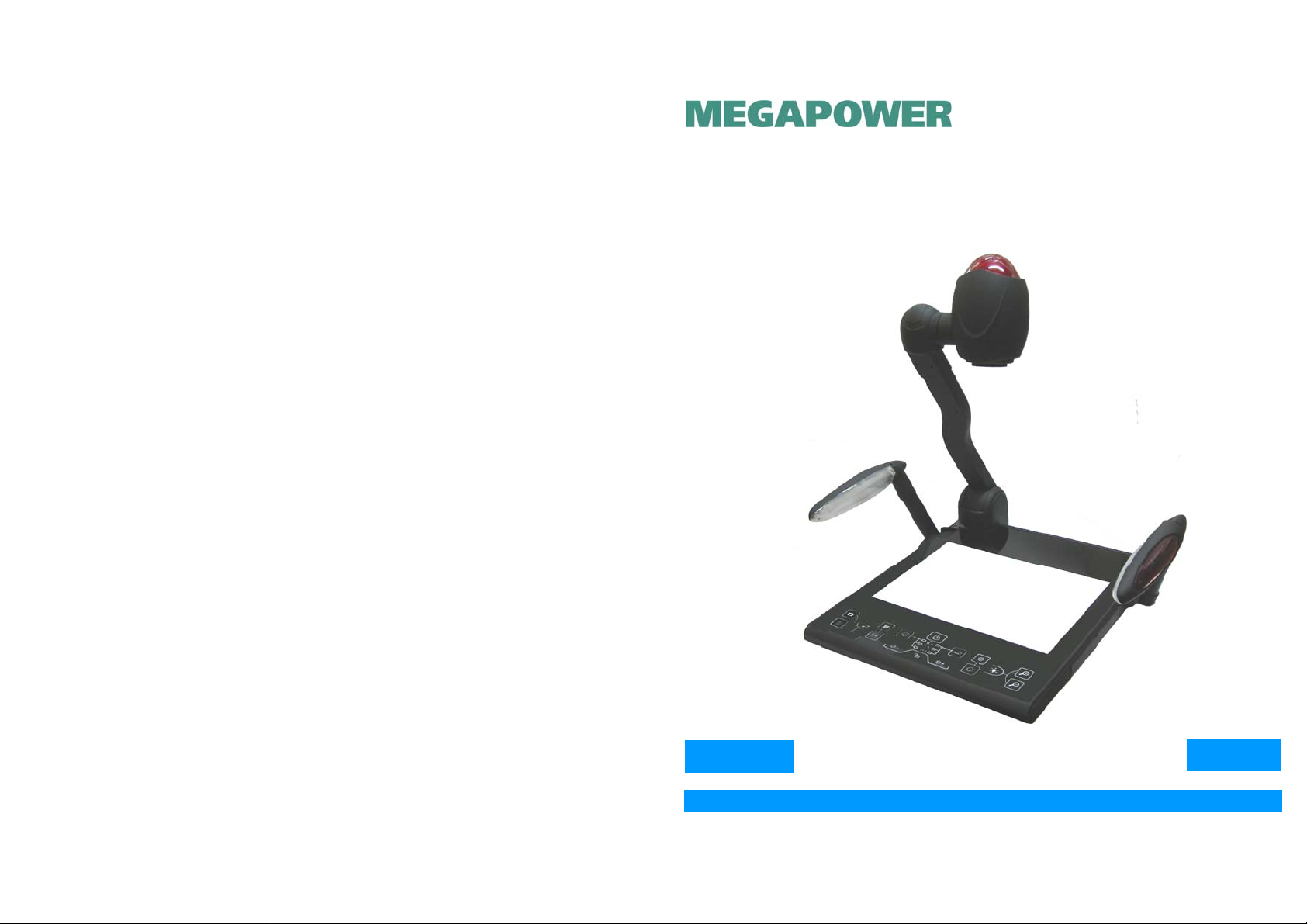
User’s Manual
MODEL MVP736
DIGITAL PRESENTER
DIGITAL PRESENTER
Page 2

TABLE OF CONTENTS
Chapter 1 - Introduction ---------------------------------------------------------------------- 1-3
1.1 About Your Digital Visual Presenter ---------------------------------------------------- 1
1.2 Safety Information -------------------------------------------------------------------------- 1
1.3 System Contents --------------------------------------------------------------------------- 3
Chapter 2 - Installation ----------------------------------------------------------------------- 4-5
2.1 Structure -------------------------------------------------------------------------------------- 4
2.2 Connector Panel----------------------------------------------------------------------------- 5
Chapter 3 - Using the Visual Presenter ------------------------------------------------- 6-12
3.1 Control Panel --------------------------------------------------------------------------------- 6
3.2 Remote Control------------------------------------------------------------------------------- 7
3.3 PC Control (USB) & RS-232C Control Setup----------------------------------------- 8
3.4 RS-232C Control Operation--------------------------------------------------------------- 8
3.5 Connecting to External Equipments----------------------------------------------------- 8
3.6 Operating the Digital Presenter----------------------------------------------------------- 9
3.7 Image Adjustment--------------------------------------------------------------------------- 10
Adjusting the Size -------------------------------------------------------------------------- 10
Negative / Positive Film Selection------------------------------------------------------ 10
Adjusting the Brightness ------------------------------------------------------------------ 10
Adjusting the Focus------------------------------------------------------------------------- 10
Image Rotate---------------------------------------------------------------------------------- 10
Save Image------------------------------------------------------------------------------------ 11
Image Retrieval------------------------------------------------------------------------------- 11
Freeze Image--------------------------------------------------------------------------------- 11
Compare Image ----------------------------------------------------------------------------- 11
OSD Control ---------------------------------------------------------------------------------- 12
Chapter 4 - Care and Maintenance ---------------------------------------------------------- 13
4.1 Cleaning the Digital Presenter Housing ----------------------------------------------- 13
4.2 Cleaning the CCD Camera Lens -------------------------------------------------------- 13
4.3 Transporting the Digital Presenter ------------------------------------------------------ 13
Chapter 5 - Troubleshooting Guide ---------------------------------------------------------- 14
Page 3

Chapter 1
Chapter 5
Introduction
1.1 About Your Digital Presenter
The MVP-736 Digital Presenter is a convenient, versatile, state-of-the-art
presentation system. It is an effective and valuable tool for presenting printed material,
slides or 3-D objects on a digital display such as plasma monitor or LCD monitor TV etc.
or through a multimedia projector onto a large screen. The digital output from the presenter
delivers crystal sharp, color rich and extremely stable image. The enlarged display
allows large groups to simultaneously view the object clearly and lively, and is
particularly well suited for business meetings, conferences and group instruction.
The following lists some of the specific features of the MVP-736 Digital Presenter:-
- The 12 times optical motorized zoom together with automatic focusing keeps the
displayed object always clearly in focus.
- High sensitivity and low illumination.
- Dual Upper lighting units for even and bright illumination.
- Perfect Positive/Negative function gives very good color reproduction for negatives.
- Image Storage Function (Image Freeze) allows for display of image while changing the
displayed object. This is an indispensable feature for professional presentations.
- Stores 16 picture images.
- 90 degrees image rotation plus scrolling.
- USB for image downloading.
- The Digital Presenter has a RS-232C connector and driver for PC remote control under
Microsoft Windows environment.
Troubleshooting Guide
If you are having a problem operating the Digital Presenter, firstr make sure you have set
it up according to the instruction in Chapter 3. You should also check the adjustments and
the INPUT connections. Verify that all power is switched on. Before calling for service,
check the troubleshooting suggestions in this chapter.
Problem Solutions
No image on the Monitor Check VGA cable connections. Check INPUT source
selection is correct.
Remote Control does not function Check that there are no obdyscles between the remote
control and the Digital Presenter.
Check the batteries in the remote control.
The Focus cannot be controlled Control the focus manually.
Automatically
There is no sound Check that the Audio cable is properly connected to the
PC IN port on the rear panel.
Check the speaker.
The lights cannot be switched on Check that the AC power cord is plugged into the wall
socket.
Check that the light bulb is not damaged.
1.2 Safety Information
Please read these instructions before using your Digital Presenter. Failure to comply with
these instructions could result in electric shock, fire, personal injury or damage to your
Digital Presenter.
Power Source
Check the power specification plate on the back of the Digital Presenter. Ensure that your
line voltage matches with the rating of the Digital Presenter. The Digital Presenter accepts
AC power 100-240V, 50-60 Hz, three-wired type grounded sources. Operate the Digital
Presenter only from a three-wired grounding type power source.
1
There is no suoud from the Check that the microphone is properly connected to
microphone the Microphone Port on the rear panel.
Check to ensure that the Microphone is functioning
properly.
14
Page 4

Chapter 4
Care and Maintenance
The information in this chapter describes how to care for and prevent accidental damage to
your Digital Presenter . You should treat your Digital Presenter with the same care you would
give to any other valuable equipment.
Power Adaptor
Use only the power adaptor supplied with the Digital Presenter. Do not use the power
adaptor if it has become damaged or frayed. For a replacement power adaptor, contact
your authorized dealer.
Do not allow anything to rest on the power adaptor. Do not place this projector where the
cord may be abused by persons walking on it.
Grounding
This Digital Presenter is grounded through the conductor of the power cord. To avoid electric
shock, plug the power cord into a properly wired receptacle. Do not defeat the safety purpose
of the grounding type plug.
4.1 Cleaning the Digital Presenter Housing
DO NOT try to service the Digital Presenter. Except for the lamps, the interior of the Digital
Presenter contains no user-serviceable parts. Refer all Digital Presenter servicing to your
dealer. Failure to do so can result in serious personnel injury or damage to the Digital
Presenter.
DO NOT clean the housing with organic solvents, such as those containing acetone. Wipe
the exterior of the housing wiht a soft, damp cloth. Protect the Digital Presenter from rain,
snow or extreme temperature.
4.2 Cleaning the Camera Lens
To clean the camera lens:
1. Remove the lens cover and set it aside.
2. Apply a non-abrasive glass cleaner to a soft, dry cleaning cloth. Be careful not to use
exessive amount of liquid glass cleaner. Also, do not use abrasive cleaners, solvents,
or other harsh chemicals that might scratch the lens.
3. Lightly wipe the cleaning cloth over the lens from center to the edge in circular motion.
4. Replace the lens cover.
4.3 Transporting the Digital Presenter
The Digital Presenter is a highly sophisticated piece of electronic equipment that is sensitive
to impact, excessive heat, cold and humidity. When transporting the Digital Presenter, use a
protective carrying bag or use the original packing carton to minimize shock and impact.
Store and transport the Digital Presenter at temperature between 0 and 140 degrees
Fahrenheit (-17 to 60 degrees Centigrade). Avoid storage in automobiles during seasonal
temperature extremes. Automobile interior temperatures can exceed 160 degree Fahrenheit
(70 degrees Centigrade) in summer. If the Digital Presenter has been exposed to extremely
hot, cold or humid conditions, allow it to stand at room temperature for 30 minutes befroe use.
Overloading
Do not overload wall outlets and extension cords as this can result in the risk of fire or electric
shock.
Cabinet Slots
Never insert objects of any kind into the Digital Presenter through cabinet slots as they may
touch dangerous voltage points or short out parts that could result in a risk of fire or electric
shock.
Liquid Spills
Do not set drinks or other liquids on top of the Digital Presenter. Do not place the Digital
Presenter near water, for example, near a bathtub, washbowl, kitchen, sink, or laundry tub, in
a wet basement, or near a swimming pool. Spilled liquids can flow inside the Digital Presenter
and cause damage.
Repair
Do not disassemble the Digital Presenter. Take it to an authorized technical staff when service
or repair work is required. Opening or removing the cover may expose you to dangerous
voltages or other risks. Incorrect re-assembly can cause electric shock when the appliance
is subsequently used.
Technical Service
Unplug this Digital Presenter from the wall outlet and refer servicing to authorized technical
staff under the following conditions:
1. When the power adaptor or plug is damaged or frayed.
2. If liquid has been spilled into the Digital Presenter.
3. If the Digital Presenter has been exposed to rain or water.
4. If the Digital Presenter does not operate normally by following the operating instructions.
Adjust only those controls, which are covered by the operating instructions. Improper
adjustment of other controls may result in damage and will often require extensive work
by the authorized technical staff to restore the Digital Presenter to normal operation.
5. If the Digital Presenter has been dropped or the cabinet has been damaged.
6. If the Digital Presenter exhibits a distinct change in performance.
213
Page 5

1.3 System Contents
OSD Control
Handle your Digital Processor carefully as you remove it from the shipping box.
Accessories
Video CablePower Adaptor
Remote Control
Audio Cable
User's
Manual
VGA Cable
USB Cable
RS-232 Cable
TER
DIGITAL PRESEN
are Driver
Softw
Driver Software
OSD menu: PICTURE, RGB, RESOLUTION & SYSTEM
Continuously press the "AF" button on remote control for over
3 seconds to enter OSD Menu
then use "TELE", "WIDE", "FAR" & "NEAR" buttons to select or
adjust the menu.
User's Manual
If any included accessories are missing, please contact your dealer immediately.
3
12
Page 6

Save Image
You can store up to 8 images in the digital presenter. When required these 8 images can be
retrieved one by one on screen.
Chapter 2
Installation
Press "CAPTURE" button to store the current image into
the memory of the digital presenter. Each time the "CAPTURE"
button is pressed, another image is stored. When all the 8
images are stored, the next saved image will overwrite the first image.
Note: due to the data size of the stored image, it may take up to 1-2 second to save one image.
Image Retrieval
Press "PLAYBACK" button to display the stored image.
or Press "NEXT" button to display the next image
Press RECALL
Freeze Image
Press the "FREEZE" button to freeze the current image display.
Press the "FREEZE" button again to exit this mode.
FREEZE
Compare Image
Press "DIVISION" button to compare live image (left side)
with saved image (right side).
Press "DIVISION" button again to exit this mode.
2.1 Structure
Front View
Arm
Upper Light
Control Panel
1. Pull the arm up to the preset position.
2. Lift up the two Upper Lamps.
1 2
Infra Red Receiver Window
CCD Camera Head
Lens Cover
Base Light
Original
Image
11
Right size
saved image
4
Page 7

3. Adjust by rotating the two Upper Lamps to a suitable position.
4. Slide the arm upward to the preset position.
3 4
3.7 Image Adjustment
Adjusting the Size
Press the "WIDE" or "TELE" button to change the size of the displayed object.
5. Rotate the CCD camera head and adjust its angle to a suitable position.
6. Remove the Lens Cover and attach other accessories if required.
5 6
2.2 Connector Panel
This illustration shows the connector panel on your Digital Presenter. Refer to this figure
when connecting the Digital Presenter.
DC-IN-12V
RS-232C
VOL
S-VIDEO
VIDEO
AUDIO
OUT OUT
PC IN USB
MIC
RGB
IN
AUDIO
WIDE TELE
Negative/Positive Film Selection
If you are viewing negative film, press "NEGATIVE" button
to get the right color. Press this button once more to return
to the normal state.
Positive Film Negative Film
Adjusting the Brightness
Press "BRIT+/-" to change the brightness of the image.
Adjusting the Focus
Press "FOCUS" to automatically adjust the focus.
Press "FAR" or "NEAR" to adjust the focus.
Image Rotate
Press "ROTATE" button to rotate the image 90 degrees.
5
10
Page 8

Connecting to External VGA Input
Chapter 3
+
-
S-VIDEO
VIDEO
AUDIO
DC-IN-12V
Connect one end of the VGA cable to the PC (or notebook) VGA out put port and the
other end to the VGA IN on the Digital Presenter. The VGA signal from the PC or
notebook can then be selected through the Digital Presenter.
RS-232C
OUT OUT
PC IN USB
PC
Notebook
3.6 Operating the Digital Presenter
1. Setup the digital presenter on a flat surface and connect it to a proper AC power source.
2. Connect the required external equipment to the digital presenter.
3. Press the Power ON/Off button on the front panel. Switch on the external equipment
such as notebook or multimedia projector.
4. Check to ensure that the cables are properly connected. Press "MONITOR" or
"PROJECTOR" button to select the desired source to be displayed.
The default selection is Body or Internal source.
5. Place the object or document to be displayed on the base platform. Adjust the camera
head so it is directed towards the object.
6. If necessary, remove the close up lens. This depends on the distance of the object from
the camera. If the object is placed on the base platform, then the close up lens must be
used. If the object exceeds this distance, then remove the close up lens from the camera.
7. Light Source Selection: select the light source by pressing "LAMP" button to obtain the best
image. In a dark environment, please select and turn on the upper lights. When displaying
positive or negative film, press "LAMP" button to turn on the base light.
< Off---Upper Light---Base Light---Off >
8. Focus Adjustment: in most cases, the camera will automatically adjust the focus to get a
clear and sharp image. In critical situation when it does not deliver a very sharp image,
press "AF" button to activate the automatic focus function again. If this still does not produce
the best result, use manual focus by pressing "FAR" or "NEAR" to get a sharp image.
9. Freezing of image: press the "FREEZE" button to freeze the current image of the camera.
The image can then be studied and viewed clearly. Press "FREEZE" button to cancel the
freeze function.
10. Selecting External Equipment: selects the external equipment as the source for display
through the RGB OUT port of the Digital Presenter. If no image is displayed, please check
that the cables are properly connected. Press "SIGNAL" button on the remote control to
select the desired source for display.
Using the Digital Prsesnter
3.1 Control Panel
The following describes the control button on the control panel of the Digital Presenter.
FUNCTION OF BUTTONS
POWER
MONITOR
PROJECTOR
ROATATE
LOCK
LAMP
BRIT +/-
ZOOM +
ZOOM -
AF
CAPTURE
PLAYBACK
DELETE
DIVISION
NEXT
Power ON/OFF the presenter
Signal output to Monitor:
Selects signal:- internal, PC signal and RGB signal
Signal output to Projector:
Selects signal:- internal, PC signal and RGB signal
Rotate image 180 degree
Lock & Unlock function. Presenter acquieses it will lock
after 20 seconds automatically without any touching
Selects lights:- Upper Light-----Base Light-----Off
Increase or Decrease brightness
Zooms In and Enlarges size of object
Zooms Out and Reduces size of object
Auto Focus
Stores images
Display stored images
Deletes stored images
Compare image
Shown next stored image
9
6
Page 9

3.2 Remote Control
The following describes the control button on the remote control of the Digital Presenter.
1
2
4
7
3
5
6
8
3.3 PC Control (USB) & RS-232C Control Setup
S-VIDEO
VIDEO
AUDIO
DC-IN-12V
RS-232C
OUT OUT
PC IN USB
PC
+
-
9
Use the USB cable to connect the USB port of the digital presenter
Notebook
and the PC. Install the USB Driver Software onto the PC.
10
12
11
13
15
16
19
20
1
POWER
MONITOR
2
PROJECTOR
3
LAMP
4
TELE
5
6
SIGNAL
7
FAR
8
AF
9
NEAR
10
ROTATE
WIDE
11
DIVISION
12
VOL+
13
VOL-
14
FREEZE
15
NEGATIVE
16
17
DELETE
18
CAPTURE
19
TEXT
20
B.W.
21
PLAYBACK
22
7
NEXT
turns Power to the digital Presenter On/Off
selects signal output to Monitor
selects signal output to Projector
selects lights: Upper Light - Base Light - Off
zooms in and enlarges size of object
toggle between RGB & internal AV output
focus out
automatically adjusts focus to mantain a sharp image
focus in
rotates images 180 degree
zooms out and reduces size of object
compare images
increase volume
decrease volume
freezes the current image
negative function button
deletes stored images
stores images
toggles between Text and Image Mode
selects Black/White or Color
display the stored image
shown next stored image
14
17
18
21
22
Presenter can be controlled by the PC via the USB port only when Driver is installed.
Use the RS-232C cable to connect the RS-232C port of the digital presenter to
COM1 port on the PC. The Digital Presenter can be controlled via the RS-232C
through the installed RS232C driver software.
3.4 RS-232C Control Operation
Load the RS-232C Driver Software onto any folder on the hard disk of the PC. Execute the driver
to activate the RS-232C control software.
The RS-232C control window will be displayed on the PC. The use is identical to the buttons on
the digital presenter or remote control.
The application software is compatible with Win98, WinME, Windows 2000 & Windows XP.
3.5 Connecting to External Equipments
Connecting to PC Monitor or Multimedia Projector
RGB, Composite Video or
S-Video output signal
+
-
S-VIDEO
VIDEO
AUDIO
DC-IN-12V
RS-232C
OUT OUT
PC IN USB
VGA Cable: Connect one end to the PC Monitor or Multimedia Projector and the other
end to the PC Out port of the Visual Presenter
Stereo Audio Cable: Connect one end to the audio equipment (or Multimedia Projector) and
the other end to the PC Out (Audio) port of the Visual Presenter
RCA Cable: Plug the yellow connector into the video port of the TV or Multimedia
Projector
S-Video Cable: A better image will be obtained through the S-Video signal, which only
delivers internal signal from the Visual Presenter
PC Monitor
or TV
Multimedia Projector
8
 Loading...