

Page 1
IT
0476
EN
DE
easyjet pro
FR
ES
PL
Version of turbine connector
®
Unix
- Unix L
Multiex® - Multiex lux
Sirona® R - Sirona® B
Roto Quick® - Roto Quick Lux
Borden
Midwest
®
®
®
Manuale d’uso e manutenzione
Manual of use and maintenance
Gebrauchs- und Wartungshandbuch
Notice d’utilisation et d’entretien
Manual de uso y mantenimiento
Podręcznik użytkowania i konserwacji
Page 2

Sommario
00.0 Introduzione ................................................................................................................................ .........4
00.1 Premessa ........................................................................................................................... .........4
00.2 Descrizione dell’apparecchio ............................................................................................. .........4
00.3 Destinazione d’uso ............................................................................................................ .........4
00.4 Prescrizioni di sicurezza .................................................................................................... .........5
01.0 Dati di identicazione.................................................................................................................. .........6
01.1 Dati anagraci ................................................................................................................... .........6
01.2 Targa di identicazione apparecchio .................................................................................. .........6
02.0 Collaudo ..................................................................................................................................... .........7
02.1 Collaudo dell’apparecchio .................................................................................................. .........7
03.0 Consegna ................................................................................................................................... .........7
03.1 Consegna dell’apparecchio ............................................................................................... .........7
03.2 Lista materiale in dotazione Standard ............................................................................... .........8
04.0 Installazione................................................................................................................................ .........9
04.1 Prescrizioni di sicurezza nella fase di installazione ........................................................... .........9
04.2 Allacciamento dell’apparecchio .......................................................................................... .........9
05.0 Uso ............................................................................................................................................. .......10
05.1 Prescrizioni di sicurezza in fase d’uso ............................................................................... .......10
05.2 Istruzioni d’uso ................................................................................................................... .......12
06.0 Pulizia, disinfezione, sterilizzazione ........................................................................................... .......13
06.1 Pulizia e disinfezione corpo Easyjet pro ............................................................................ .......13
06.2 Procedure di sterilizzazione ............................................................................................... .......13
06.3 Pulizia e sterilizzazione in autoclave del terminale anteriore pulitore ................................ .......14
07.0 Manutenzione periodica ............................................................................................................. .......14
08.0 Modalità e precauzioni per lo smaltimento ................................................................................. .......15
09.0 Simboli ........................................................................................................................................ .......15
10.0 Soluzione inconvenienti .............................................................................................................. .......16
11.0 Dati tecnici .................................................................................................................................. .......18
12.0 Garanzia ..................................................................................................................................... .......19
IT
Unix® - Unix L® is a registered trademark of Bien-Air company
Multiex® - Multiex lux® is a registered trademark of KaVo company
Sirona® R - Sirona® B is a registered trademark of SIRONA company
Roto Quick® - Roto Quick Lux® is a registered trademark of W&H company
easyjet pro - manuale d‘uso e manutenzione
3
Page 3
00.0 Introduzione
�
�
00.1 Premessa
Leggere attentamente questo manuale prima di procedere alle operazioni di installazione, utilizzo,
manutenzione o altri interventi sull’apparecchio.
Tenere sempre a portata di mano il presente manuale.
Importante: Per evitare danni a persone o cose, leggere con particolare attenzione tutti i paragra
“Prescrizioni di sicurezza” presenti nel manuale.
Secondo il grado di gravità le prescrizioni di sicurezza sono classicate con le seguenti indicazioni:
PERICOLO (riferito sempre a danni a persone)
ATTENZIONE (riferito a possibili danni a cose)
Lo scopo del presente manuale è di portare a conoscenza dell’operatore le prescrizioni di sicurezza, le
procedure d’installazione, le istruzioni per un corretto utilizzo e manutenzione dell’apparecchio.
Per nessun motivo l’utente è autorizzato alla manomissione dell’apparecchio.
Per ogni anomalia riscontrata, rivolgersi a un Centro di Assistenza Mectron.
Qualsiasi tentativo di manomissione, modica da parte dell’utilizzatore o da personale non autorizzato,
invaliderà la garanzia e solleverà la Ditta Costruttrice dal rispondere per ogni eventuale danno a persone
o a cose.
Le informazioni ed illustrazioni, del presente manuale, sono aggiornate alla data di edizione riportata alla
pagina 104.
La MECTRON è impegnata nel continuo aggiornamento dei propri prodotti con possibili modiche a
componenti dell’apparecchio. Nel caso si riscontrino discordanze tra quanto descritto nel presente
manuale, e l’apparecchiatura in Vs. possesso, chiedere chiarimenti al Vostro Rivenditore o al Servizio
Post-Vendita della MECTRON.
Si vieta l’utilizzo del presente manuale, per scopi diversi da quelli strettamente legati all’installazione,
all’utilizzo e alla manutenzione dell’apparecchio.
00.2 Descrizione dell’apparecchio
L’Easyjet pro è un compatto sbiancatore a getto di polvere di bicarbonato con innesto rapido alla turbina.
Easyjet pro condivide con i più noti apparecchi da tavola tutti i vantaggi essenziali:
- un getto di polvere costante ed efciente
- l’uso semplice e l’afdabilità.
Il principio di funzionamento dell’Easyjet pro è basato sull’azione meccanica ottenuta da un getto di
cristalli di bicarbonato di sodio accelerati da un usso di aria compressa. L’energia cinetica così impressa
alle particelle, si viene a dissipare quasi completamente nell’urto contro la supercie dello smalto
producendo una delicata ma efcace azione di pulizia. L’azione è completata da un getto d’acqua che,
sfruttando la depressione creata intorno all’ugello, si dispone a campana intorno al usso principale
producendo un duplice effetto: impedire per buona parte il rimbalzo e la fuoriuscita della nube di
bicarbonato ed operare un continuo lavaggio della zona trattata mandando in soluzione il bicarbonato.
00.3 Destinazione d’uso
Pulitore a getto di bicarbonato. Indicazioni:
- Rimozione della placca batterica;
- Rimozione di macchie dalla supercie dentale dovute a tabacco, caffè, the e clorixidina;
- Prolassi su pazienti in terapia ortodontica.
4
easyjet pro - manuale d‘uso e manutenzione
Page 4
00.4 Prescrizioni di sicurezza
�
�
�
�
�
�
�
�
�
La Mectron declina ogni responsabilità per danni diretti o indiretti, a persone o cose, nei seguenti casi:
1 L’apparecchio non è impiegato secondo la destinazione d’uso per cui è previsto.
2 L’apparecchio non è utilizzato conformemente a tutte le istruzioni e prescrizioni descritte nel presente
manuale.
3 L’impianto elettrico dei locali in cui è utilizzato l’apparecchio non è conforme alle norme vigenti e alle
relative prescrizioni.
4 Le operazioni di assemblaggio, estensioni, regolazioni, modiche e riparazioni sono effettuate da
personale non autorizzato da Mectron.
5 Le condizioni ambientali di conservazione ed immagazzinamento del dispositivo non sono conformi
alle prescrizioni indicate nella sez. dati tecnici.
PERICOLO: Personale qualicato e specializzato.
L’apparecchio deve essere utilizzato esclusivamente da personale specializzato ed opportunamente
addestrato quali il dentista e l’igenista. L’impiego dell’apparecchio non produce effetti collaterali se
utilizzato correttamente.
PERICOLO: Destinazione d’uso.
Impiegare l’apparecchio esclusivamente per la destinazione d‘uso per cui è previsto (vedere paragrafo
“00.3”). L’inosservanza di questa prescrizione può provocare gravi lesioni al paziente, all’operatore e
danni/guasti al dispositivo.
PERICOLO: Pulizia, disinfezione, sterilizzazione dei prodotti nuovi o riparati.
Tutti i prodotti nuovi o riparati sono consegnati non sterili. Prima del trattamento tutti i prodotti nuovi o
riparati devono essere puliti, disinfettati e sterilizzati seguendo scrupolosamente le istruzioni riportate al
capitolo “06.0”.
PERICOLO: Controllo delle infezioni.
Per la massima sicurezza del paziente e dell’operatore, utilizzare esclusivamente accessori puliti,
disinfettati e sterilizzati. Seguire scrupolosamente le istruzioni riportate al capitolo “06.0”.
PERICOLO: Utilizzare esclusivamente accessori e ricambi originali Mectron.
IT
ATTENZIONE: Utilizzare esclusivamente polvere di produzione Mectron (prophylaxis powder).
Non utilizzare polveri prodotte da altri fabbricanti in quanto potrebbero danneggiare l’apparecchio, fornire
prestazioni insufcienti e invalidare la garanzia dell’apparecchio.
PERICOLO: Controllo dello stato del dispositivo prima del trattamento.
Prima di ogni trattamento controllare sempre il perfetto funzionamento dell’apparecchio e l’efcienza
degli accessori. Nel caso in cui si riscontrassero anomalie di funzionamento, non eseguire il trattamento.
Rivolgersi alla assistenza tecnica autorizzata se le anomalie riguardano l’apparecchio.
PERICOLO: Controindicazioni.
Non utilizzare il dispositivo su pazienti che presentano patologie all’apparato respiratorio quali bronchiti
croniche, asma, ensema, etc.
PERICOLO: Controindicazioni.
I pazienti che indossano lenti a contatto devono rimuoverle prima di sottoporsi al trattamento con il
pulitore a getto di bicarbonato.
easyjet pro - manuale d‘uso e manutenzione
5
Page 5
�
PERICOLO: Controindicazioni.
�
�
�
Non direzionare il getto di aria/bicarbonato/acqua verso gli occhi.
L’inosservanza di questa prescrizione può causare lesioni oculari gravi. Si consiglia di indossare occhiali
di protezione a tutte le persone interessate (paziente, igienista e dentista).
PERICOLO: Controindicazioni.
Si consiglia al dentista e all’igienista di utilizzare una maschera protettiva per limitare l’inalazione di
polvere.
PERICOLO: Controindicazioni.
Non direzionare il getto di aria/bicarbonato/acqua verso compositi, otturazioni e ponti. L’inosservanza di
questa prescrizione può causarne danneggiamenti.
PERICOLO: Controindicazioni.
Non direzionare il getto di aria/bicarbonato/acqua sui tessuti molli o dentro il solco gengivale.
L’inosservanza di questa prescrizione può causare un ensema tissutale gengivale (ensema delle
mucose e/o sottocutaneo).
01.0 Dati di identicazione
01.1 Dati anagraci
Una esatta descrizione del modello e del numero di serie dell’apparecchio faciliterà risposte rapide ed
efcaci da parte del nostro Servizio Post-Vendita.
Riferire sempre questi dati ogni volta che si contatta un centro di Assistenza tecnica Mectron.
01.2 Targa di identicazione apparecchio
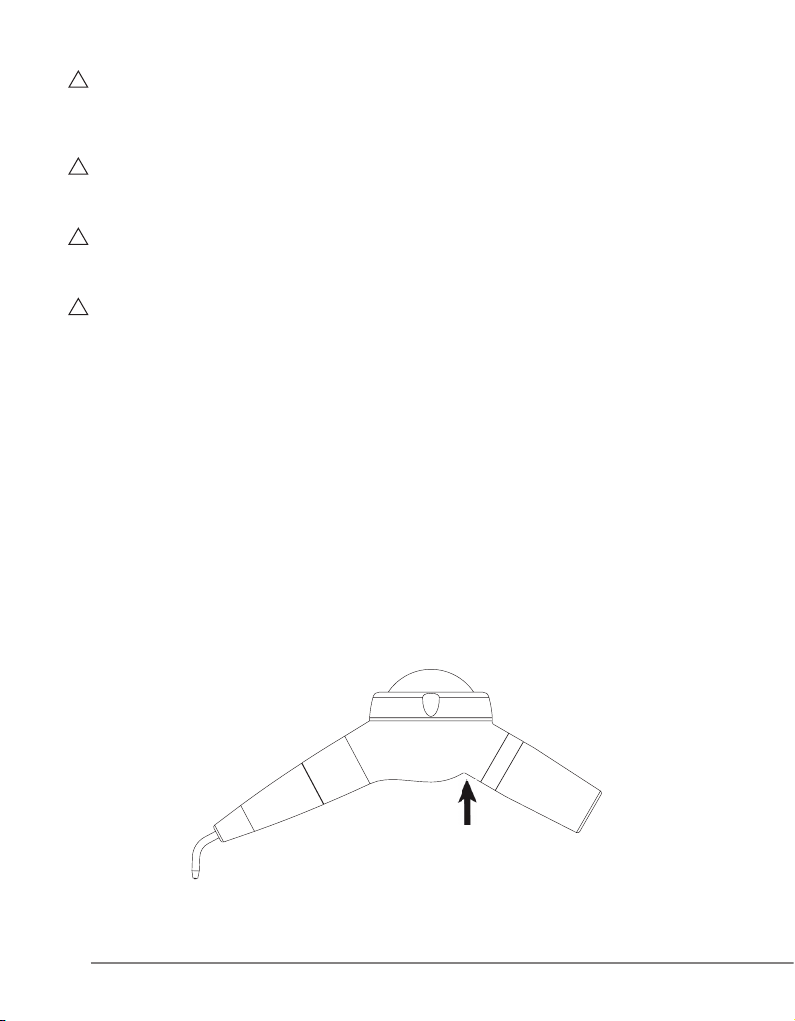
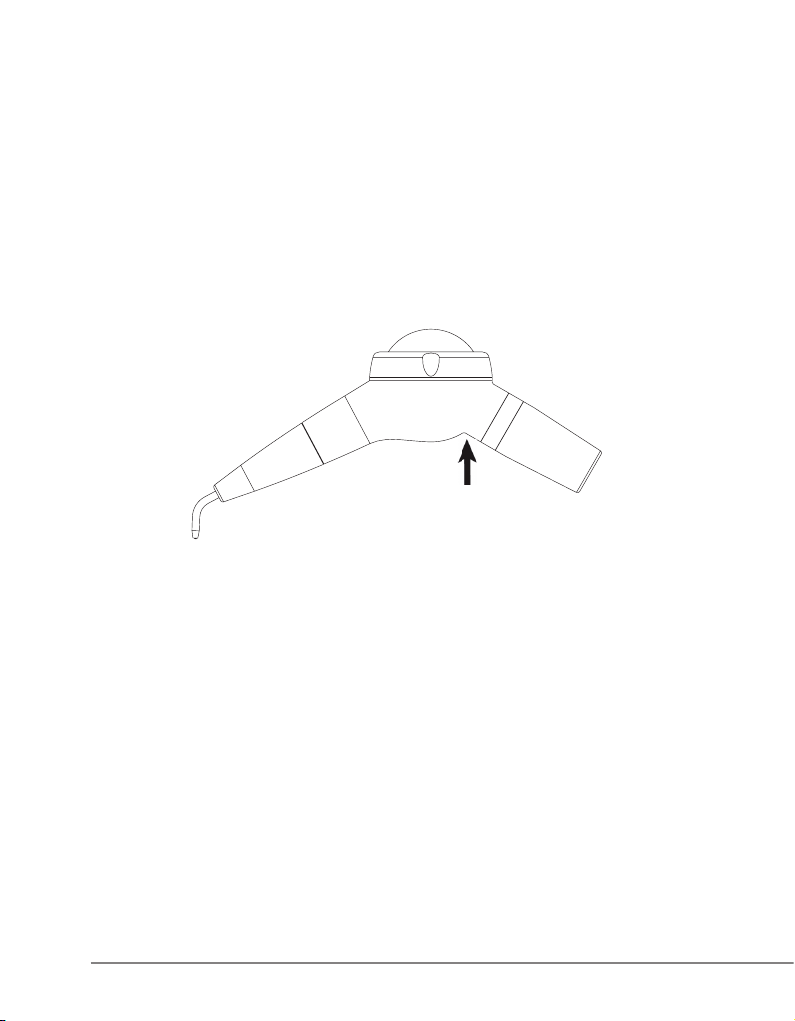
Ogni apparecchio è fornito di un numero di serie (Fig.1 - Rif.A). I restanti dati sono inseriti in questo
manuale (vedere sezione “11.0”).
A
Fig. 1
6
easyjet pro - manuale d‘uso e manutenzione
Page 6

02.0 Collaudo
02.1 Collaudo dell’apparecchio
Tutti gli apparecchi prodotti dalla MECTRON sono rigorosamente controllati e collaudati in ogni
componente.
Durante tale collaudo i componenti sono sottoposti ad una serie di cicli di lavoro.
In questa fase sono evidenziati eventuali malfunzionamenti dovuti a componenti difettosi.
Questa procedura garantisce un prodotto funzionante ed afdabile in tutti i suoi componenti.
03.0 Consegna
03.1 Consegna dell’apparecchio
L’imballo dell’apparecchio teme i forti urti in quanto contiene componenti elettronici. Quindi sia il trasporto
che lo stoccaggio deve essere effettuato con particolari cautele.
Non sovrapporre più cartoni per non schiacciare gli imballi sottostanti.
Tutto il materiale spedito dalla MECTRON è stato controllato all’atto della spedizione.
L’apparecchio viene consegnato opportunamente protetto ed imballato.
Al ricevimento dell’apparecchio controllare eventuali danni subiti durante il trasporto e in caso affermativo
sporgere reclamo al trasportatore.
IT
easyjet pro - manuale d‘uso e manutenzione
7
Page 7
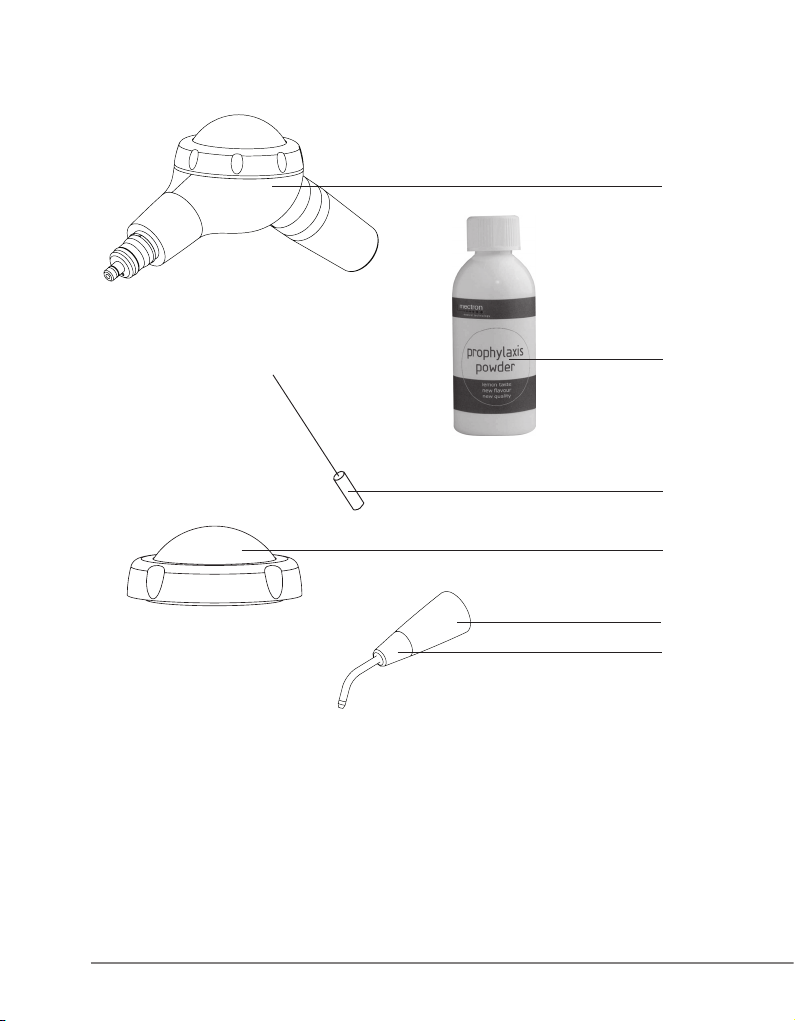
Fig. 2
03.2 Lista materiale in dotazione Standard
1 Corpo apparecchio (Fig.2 - Rif.A);
1 Barattolo polvere prophylaxis powder (Fig.2 - Rif.B);
1 Ago per la pulizia del terminale anteriore pulitore (Fig.2 - Rif.C);
1 Cupola di ricambio Easyjet pro (Fig.2 - Rif.D);
1 Terminale anteriore pulitore (Fig.2 - Rif.E);
1 Cappuccio puntale terminale anteriore (Fig.2 - Rif.F).
Tale dotazione può variare in caso di campagne promozionali.
A
B
C
D
E
F
8
easyjet pro - manuale d‘uso e manutenzione
Page 8
04.0 Installazione
�
�
�
�
�
�
�
�
04.1 Prescrizioni di sicurezza nella fase di installazione
ATTENZIONE: Non esporre l’apparecchio alla luce diretta del sole o a fonti di luce UV.
ATTENZIONE: L’apparecchio è trasportabile ma deve essere maneggiato con cura quando viene
spostato.
Per rendere operativo l’apparecchio è necessario controllare:
1 Alimetazione acqua spray turbina;
2 Alimentazione aria turbina;
3 Presenza polvere;
ATTENZIONE: Se l’alimentazione di acqua e aria è sufciente per la turbina, l’Easyjet deve
funzionare.
Alimentazione standard fornita dal riunito per una turbina:
- acqua da 0 a 3 bar (da 0 hPa a 3000 hPa) max 40°C;
- aria 2,3 - 3,2 bar (2300 hPa - 3200 hPa)
04.2 Allacciamento dell’apparecchio
ATTENZIONE: Controllare che il connettore della turbina sia in buono stato.
ATTENZIONE: Non collegare l’Easyjet pro quando la turbina è sottopressione.
ATTENZIONE: Non premere il pedale di comando della turbina durante la connessione dell’Easyjet
pro.
ATTENZIONE: Se si dispone di una turbina con luce, spegnerla.
ATTENZIONE: Il terminale anteriore pulitore e iI raccordo della turbina devono essere perfettamente
asciutti. La presenza di umidità può provocare l’otturazione dei canali di circolazione aria/polvere.
L’Easyjet pro è provvisto di un adattatore specico che corrisponde al raccordo della vostra turbina
presente sul riunito. Usare l’Easyjet pro solo per il raccordo della turbina in possesso. Collegare l’Easyjet
pro ad altro connettore potrebbe daneggiarlo.
IT
easyjet pro - manuale d‘uso e manutenzione
9
Page 9
05.0 Uso
�
�
�
�
�
�
�
�
�
�
�
05.1 Prescrizioni di sicurezza in fase d’uso
PERICOLO: Controindicazioni.
Non utilizzare il dispositivo su pazienti che presentano patologie all’apparato respiratorio quali bronchiti
croniche, asma, ensema, etc.
PERICOLO: Controindicazioni.
I pazienti che indossano lenti a contatto devono rimuoverle prima di sottoporsi al trattamento con il
pulitore a getto di bicarbonato.
PERICOLO: Controindicazioni.
Non direzionare il getto di aria/bicarbonato/acqua verso gli occhi.
L’inosservanza di questa prescrizione può causare lesioni oculari gravi. Si consiglia di indossare occhiali
di protezione a tutte le persone interessate (paziente, igienista e dentista).
PERICOLO: Controindicazioni.
Si consiglia al dentista e all’igienista di utilizzare una maschera protettiva per limitare l’inalazione di
polvere.
PERICOLO: Controindicazioni.
Non direzionare il getto di aria/bicarbonato/acqua verso compositi, otturazioni e ponti.
L’inosservanza di questa prescrizione può causarne danneggiamenti.
PERICOLO: Controindicazioni.
Non direzionare il getto di aria/bicarbonato/acqua sui tessuti molli o dentro il solco gengivale.
L’inosservanza di questa prescrizione può causare un ensema tissutale gengivale (ensema delle
mucose e/o sottocutaneo).
PERICOLO: Controllo dello stato del dispositivo prima del trattamento.
Prima di ogni trattamento controllare sempre il perfetto funzionamento dell’apparecchio e l’efcienza
degli accessori. Nel caso in cui si riscontrassero anomalie di funzionamento, non eseguire il trattamento.
Rivolgersi alla assistenza tecnica autorizzata se le anomalie riguardano l’apparecchio.
PERICOLO: Controllo delle infezioni e pulizia dei circuiti acqua e aria.
Per la massima sicurezza del paziente e dell’operatore, dopo ogni trattamento, seguire tutte le prescrizioni
indicare al capitolo “06.0”.
ATTENZIONE: Utilizzare esclusivamente polvere di produzione Mectron (prophylaxis powder).
Non utilizzare polveri prodotte da altri fabbricanti in quanto potrebbero danneggiare l’apparecchio, fornire
prestazioni insufcienti e invalidare la garanzia dell’apparecchio.
ATTENZIONE: Non tentare di svitare il tappo del contenitore polvere quando è in pressione.
ATTENZIONE: Assicurarsi che il serbatoio polvere sia perfettamente asciutto.
La presenza di umidità può creare l’ostruzione dei canali.
10
easyjet pro - manuale d‘uso e manutenzione
Page 10
IT
A
B
C
Fig. 3
BA
Fig. 4
easyjet pro - manuale d‘uso e manutenzione
11
Page 11
05.2 Istruzioni d’uso
�
�
�
�
�
�
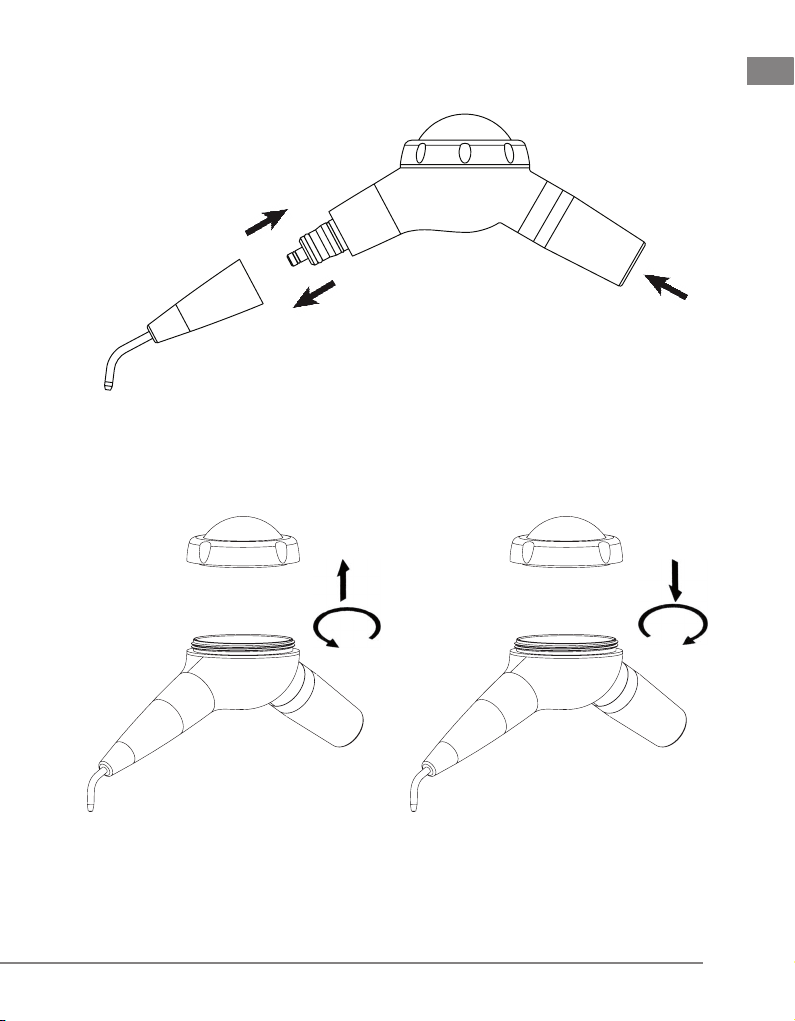
1 Inserire il terminale anteriore pulitore (sterile) (Fig.3 - Rif.A) portandolo in battuta;
2 Collegare l’Easyjet pro alla turbina del riunito (Fig.3 - Rif.B);
3 Regolare la portata dell’acqua a partire dal proprio riunuto per ottenere un getto d’acqua uniforme. La
regolazione è più facile in assenza di polvere;
4 Svitare la cupola del contenitore polvere (Fig.4 - Rif.A);
5 Versare nel contenitore la polvere, evitando che il livello raggiunga gli ugelli posti all’interno;
ATTENZIONE: Si consiglia di utilizzare il tappo misurino della confezione prophylaxis powder
riempiendolo no al livello Easyjet pro.
ATTENZIONE: Si consiglia di non agitare l’Easyjet pro dopo aver inserito la polvere per evitare
l’ostruzione degli ugelli.
6 Riavvitare la cupola del contenitore polvere senza serrarla eccessivamente (Fig.4 - Rif.B);
ATTENZIONE: Eliminare i residui di polvere dalla lettatura della cupola prima di avvitarla.
7 Premere il pedale della turbina per eseguire il trattamento;
ATTENZIONE: Utilizzare la cannula d’aspirazione per eliminare la miscela
aria/bicarbonato/acqua dalla bocca del paziente.
8 Eseguire il trattamento effettuando piccoli movimenti circolari. Dirigere l’ugello unicamente verso lo
smalto dentario, dal solco gengivale verso il bordo incisivo del dente rispettando una distanza da 3 a
5 mm.
9 Lucidare alla ne tutte le superci dentarie, regolando la portata dell’acqua al massimo;
ATTENZIONE: Quando si solleva il piede dal pedale di comando, il getto aria/bicarbonato/acqua
continua ancora per alcuni secondi. Finire il trattamento tenendo conto di questi secondi
supplementari.
10 Dopo il trattamento, i denti sono puliti e la cuticola dentaria è tolalmente eliminata. La sua
ricostituzione da parte delle proteine salivari necessita tra le 2 e 3 ore, tempo in cui i denti non
possiedono più la protezione naturale contro i coloranti. Informare il paziente che nel corso di questo
lasso di tempo, non si deve né fumare, né consumare alimenti o bevande che potrebbero fortemente
colorare il dente (tè, caffè, ...).
NOTA IMPORTANTE: Terminale anteriore pulitore otturato (non esce polvere).
1 Scollegare il terminale anteriore pulitore dal corpo Easyjet pro (Fig.3 - Rif.C).
2 Liberare il canale dai residui di polvere utilizzando l’apposito ago di pulizia dato in dotazione (Fig.2 -
Rif.C) seguendo i movimenti indicati (Fig. 5). Sofare aria compressa con la siringa nel foro centrale
del terminale da entrambi le parti.
ATTENZIONE: Pulire il canale dell’ugello utilizzando esclusivamente l’ago per la pulizia
dato in dotazione con l’apparecchio (Fig.2 - Rif.D).
3 Pulire in modo accurato anche la parte di connessione anteriore del corpo Easyjet pro. Se necessario
rimuovere eventuali residui di polvere sofando aria compressa con la siringa.
4 Connettere il terminale pulitore anteriore al corpo Easyjet pro (Fig.3 - Rif.A).
12
easyjet pro - manuale d‘uso e manutenzione
Page 12
06.0 Pulizia, disinfezione, sterilizzazione
�
�
�
�
�
�
�
06.1 Pulizia e disinfezione corpo Easyjet pro
PERICOLO: Scollegare l’Easyjet pro dalla turbina.
Scollegare sempre l’Easyjet pro dalla turbina prima di effettuare interventi di pulizia, disinfezione e
sterilizzazione.
PERICOLO: L’Easyjet pro non è protetto contro la penetrazione di liquidi. Non immergerlo; non
spruzzare liquidi direttamente sulla supercie dell’involucro dell’apparecchio.
PERICOLO: L’Easyjet pro non è sterilizzabile.
Dopo ogni trattamento eseguire le seguenti operazioni:
1 Scollegare il terminale anteriore pulitore dal corpo Easyjet pro (Fig.3 - Rif.C).
2 Rimuovere eventuali residui di polvere dal contenitore Easyjet pro.
3 Pulire e disinfettare le superci mediante un panno inumidito con una soluzione detergente/
disinfettante non aggressiva a PH neutro (PH7), ponendo particolare attenzione alla parte lettata
della cavità anteriore. Se necessario rimuovere eventuali residui di polvere sofando aria compressa
con la siringa.
ATTENZIONE: Seguire con attenzione le istruzioni fornite dal produttore della soluzione
disinfettante.
NOTA: Soluzioni disinfettanti a base d’acqua, con PH neutro, sono altamente raccomandate. Alcune
soluzioni disinfettanti a base alcolica possono essere nocive e discolorare, danneggiare i materiali plastici.
Detergenti in polvere possono rovinare le superci dell’Easyjet pro.
06.2 Procedure di sterilizzazione
ATTENZIONE: Eseguire la sterilizzazione utilizzando esclusivamente autoclave a vapore
d’acqua.
Non utilizzare nessun altro procedimento di sterilizzazione (calore secco, irradiazione, ossido di etilene,
gas, plasma a bassa temperatura, etc.).
IT
PERICOLO: L’Easyjet pro non è sterilizzabile.
PERICOLO: Controllo delle infezioni - Parti sterilizzabili - Rimuovere scrupolosamente ogni
residuo prima della sterilizzazione.
Per evitare infezioni da batteri o da virus pulire, disinfettare e sterilizzare sempre dopo ogni trattamento i
seguenti componenti:
1 Terminale anteriore pulitore (Fig.2 - Rif.E).
2 Ago per la pulizia del terminale anteriore pulitore (Fig.2 - Rif.C).
Tali componenti sono costruiti con materiali che resistono a una temperatura massima di 135°C per un
tempo massimo di 20 minuti.
I processi di sterilizzazione in autoclave a vapore deve essere eseguita con uno dei due parametri:
- Ciclo a 121°C. per 16 minuti;
- Ciclo a 134°C. per 4 minuti.
Tutte le fasi di sterilizzazione devono essere eseguite dall’operatore in conformità alle norme
UNI EN ISO 17665-1:2007 e UNI EN 556-1:2002.
easyjet pro - manuale d‘uso e manutenzione
13
Page 13
06.3 Pulizia e sterilizzazione in autoclave del terminale anteriore pulitore
�
�
�
�
1 Scollegare il terminale anteriore pulitore dal corpo Easyjet pro (Fig.3 - Rif.C).
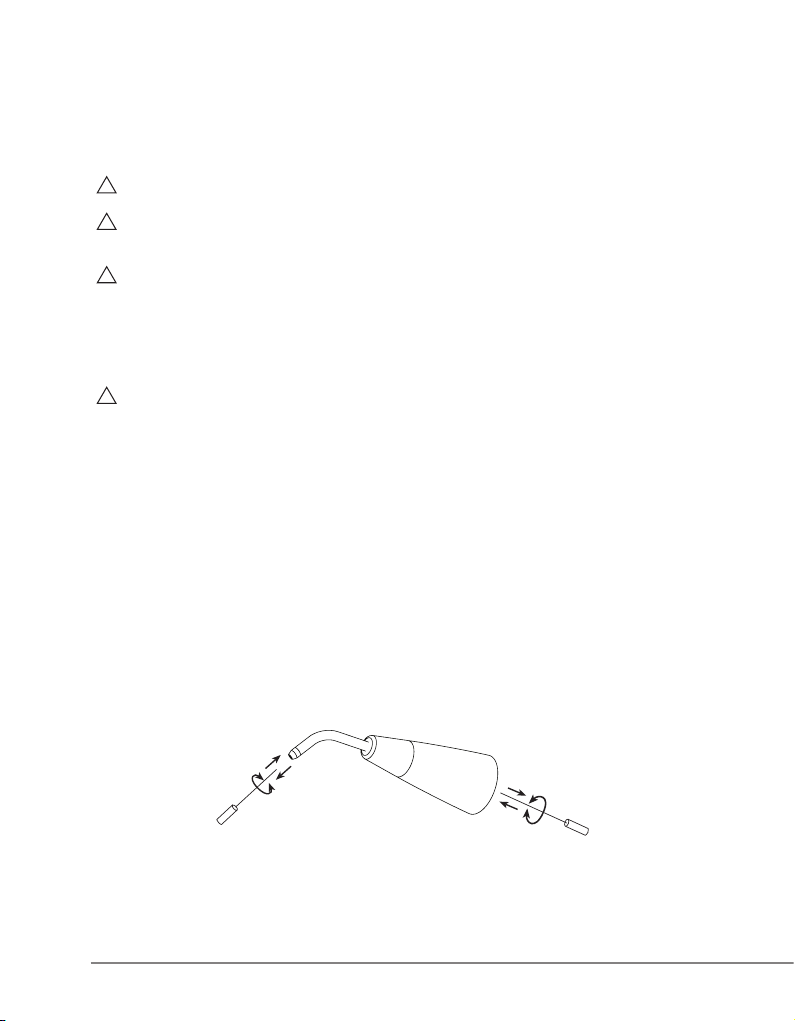
2 Liberare il canale dai residui di polvere utilizzando l’apposito ago di pulizia dato in dotazione (Fig.2 -
Rif.C) seguendo i movimenti indicati (Fig.5). Sofare aria compressa con la siringa nel foro centrale
del terminale da entrambi le parti.
ATTENZIONE: Pulire il canale dell’ugello utilizzando esclusivamente l’ago per la pulizia
dato in dotazione con l’apparecchio (Fig.2 - Rif.C).
3
ATTENZIONE: L’eccessiva presenza di calcare nell’acqua può determinare un’insufciente spray
d’acqua. Per eliminare l’inconveniente si consiglia di immergere il terminale anteriore pulitore per
alcuni minuti in una soluzione di acido cloridrico al 2 %.
ATTENZIONE: Sciacquare accuratamente il terminale con acqua distillata in modo da eliminare
ogni residuo della soluzione di acido cloridrico. Asciugare, sofando aria compressa con la siringa nel
foro centrale del terminale da entrambi le parti.
4 Disinfettare il terminale utilizzando una soluzione disinfettante non aggressiva a PH neutro.
Asciugare, sofando aria compressa con la siringa nel foro centrale del terminale da entrambi le parti.
5 Inserire l’ago di pulizia nel canale del terminale anteriore e sigillare il tutto in buste monouso.
6 Sterilizzare la busta contenente il terminale anteriore pulitore e l’ago di pulizia.
ATTENZIONE: Prima di utilizzare il terminale anteriore, sofare aria compressa con la siringa,
per evitare che al suo interno rimanga umidità residua.
07.0 Manutenzione periodica
1 Se il passaggio aria del terminale anteriore si ottura, basta azionare l’apparecchio per alcuni istanti
utilizzando gli aghi in dotazione (Fig.5) per liberare il canale dai residui di polvere.
2 Nel caso in cui il terminale anteriore si otturi, a causa di una eccessiva presenza di calcare
nell’acqua, si consiglia di tenerlo immerso per alcuni minuti in una soluzione di acido cloridrico al 2 %.
3 Ad ogni rimozione del terminale anteriore, è necessario sofare aria compressa con la siringa, sia
nella cavità del connettore del manipolo, sia nel foro centrale posteriore del terminale anteriore, per
evitare accumuli di polvere residui.
4 Si consiglia di svuotare almeno una volta al giorno il contenitore polvere dell’Easyjet pro per evitare
otturazioni.
Fig. 5
14
easyjet pro - manuale d‘uso e manutenzione
Page 14
08.0 Modalità e precauzioni per lo smaltimento
�
0476
Le modalità e le precauzioni da prendere per lo smaltimento del dispositivo, devono seguire le procedure
previste dalle legislazioni vigenti come per qualsiasi altra apparecchiatura elettronica fuori uso.
09.0 Simboli
Attenzione leggere le istruzioni per l’uso
Apparecchio conforme alla direttiva CE 93/42 CEE
Ente noticato CERMET
IT
easyjet pro - manuale d‘uso e manutenzione
15
Page 15

10.0 Soluzione inconvenienti
Se l’apparecchio sembra non funzionare correttamente, leggere nuovamente le istruzioni e quindi
controllare la tabella sotto.
SINTOMO CAUSA POSSIBILE SOLUZIONE
Non si svita il tappo del
contenitore polvere.
Durante il funzionamento non
esce polvere dal terminale
anteriore pulitore.
Durante il funzionamento non
esce acqua dal terminale
anteriore del pulitore.
L’Easyjet pro è collegato alla
turbina e il contenitore polvere è
in pressione.
Riunito non collegato al circuito
aria.
Il serbatoio dell’Easyjet pro è
vuoto.
Terminale anteriore pulitore
otturato a causa di una eccessiva
quantità di umidità nella polvere o
di una insufciente
pulizia/manutenzione.
Il livello della polvere nel
contenitore supera quello
massimo consentito.
Polvere non idonea.
Riunito non collegato al
circuito acqua.
Eccessiva presenza di calcare
nell’acqua.
Filtro acqua del riunito ostruito.
Scollegare l’Easyjet pro dalla
turbina in modo che si
depressurizzi il circuito interno.
Controllare il collegamento del
riunito al circuito aria.
Leggere il paragrafo “05.2”.
Leggere il paragrafo “06.1 e
06.3”.
Togliere la polvere dal contenitore
e pulirlo con un panno asciutto.
Leggere il paragrafo “07.0”.
Ripristinare il corretto livello della
polvere nel contenitore (vedere
paragrafo “05.2”).
Per un corretto funzionamento
dell’apparecchio utilizzare solo
polvere di produzione
MECTRON.
Controllare il collegamento del
riunito al circuito acqua al riunito.
Leggere il paragrafo “06.3 - 07.0”.
Controllare il collegamento al
circuito acqua del riunito.
16
easyjet pro - manuale d‘uso e manutenzione
Page 16
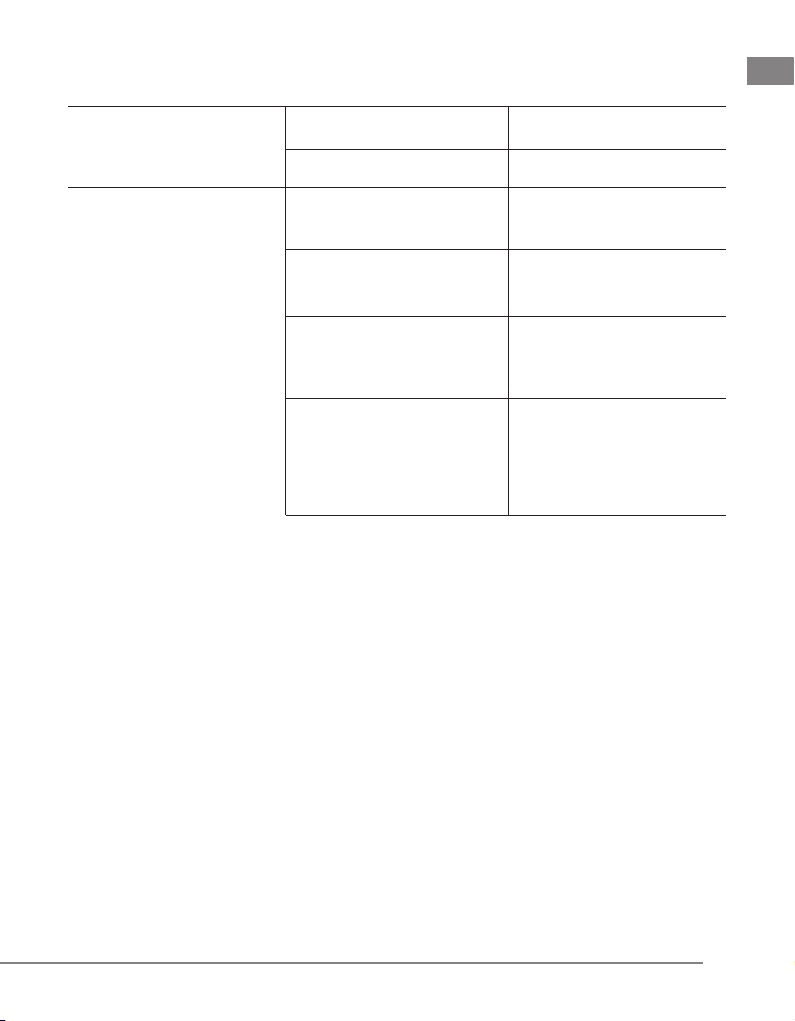
SINTOMO CAUSA POSSIBILE SOLUZIONE
IT
Perdita di polvere attraverso il
tappo contenitore polvere.
Terapia non efcace Insufciente pressione del circuito
Tappo non correttamente avvitato.
Residui di polvere nella lettatura.
di alimentazione dell’aria.
Insufciente o eccessivo
livello polvere nel contenitore.
Polvere non idonea.
Terminale anteriore pulitore
otturato a causa di una eccessiva
quantità di umidità nella polvere o
di una insufciente
pulizia/manutenzione.
Avvitare correttamente il tappo.
Leggere il paragrafo “06.1”
Controllare la pressione circuito
aria del riunito.
Ripristinare il corretto livello della
polvere nel contenitore (vedere
paragrafo “05.2”).
Per un corretto funzionamento
dell’apparecchio utilizzare solo
polvere di produzione
MECTRON.
Leggere il paragrafo “06.1 e
06.3”.
Togliere la polvere dal contenitore
e pulirlo con un panno asciutto.
Leggere il paragrafo “07.0”.
easyjet pro - manuale d‘uso e manutenzione
17
Page 17

11.0 Dati tecnici
Apparecchio conforme alla Dir. 93/42/CEE: Classe II a.
Apparecchio per funzionamento intermittente: 60” ON 10” OFF.
Alimentazione acqua standard fornita dal riunito per una turbina:
da 0 a 3 bar (da 0 hPa a 3000 hPa) max 40°C.
Alimentazione aria standard fornita dal riunito per una turbina:
2,3 - 3,2 bar (2300 hPa - 3200 hPa).
Condizioni ambientali d’uso: da +10°C a +40°C.
Umidità relativa da 30% a 75%.
Condizioni di trasporto e di magazzino: da -10°C a +70°C.
Umidità relativa da 10% a 90%.
Pressione dell’aria P: 500hPa/1060hPa.
Pesi e dimensioni: 125 g.
18
easyjet pro - manuale d‘uso e manutenzione
Page 18

12.0 Garanzia
Tutti gli apparecchi MECTRON, prima di essere commercializzati, sono sottoposti ad un accurato controllo
nale che ne verica la piena funzionalità.
MECTRON garantisce i propri prodotti, acquistati nuovi da un rivenditore o importatore MECTRON, contro
difetti di materiale e fabbricazione per il periodo di 1 (UNO) anno, dalla data di acquisto.
Durante il periodo di validità della garanzia, MECTRON si impegna a riparare (o a sua libera scelta
sostituire) gratuitamente quelle parti dei prodotti che si dimostrassero, a suo giudizio, difettose.
E’ esclusa la sostituzione integrale dei prodotti MECTRON.
La Mectron declina ogni responsabilità per danni diretti o indiretti, a persone o cose, nei seguenti casi:
- L’apparecchio non è impiegato secondo la destinazione d’uso per cui è previsto.
- L’apparecchio non è utilizzato conformemente a tutte le istruzioni e prescrizioni descritte nel presente
manuale.
- L’impianto elettrico dei locali in cui è utilizzato l’apparecchio non è conforme alle norme vigenti e alle
relative prescrizioni.
- Le operazioni di assemblaggio, estensioni, regolazioni, modiche e riparazioni sono effettuate da
personale non autorizzato da Mectron.
- Le condizioni ambientali di conservazione ed immagazzinamento del dispositivo non sono conformi
alle prescrizioni indicate nella sez. dati tecnici.
Dalla garanzia sono escluse le rotture accidentali per trasporto, per uso non corretto o per incuria, per
allacciamento a tensione diversa da quella prevista, le spie, le manopole e tutti gli accessori.
La garanzia decade quando l’apparecchio sia stato manomesso o riparato da personale non autorizzato.
ATTENZIONE
La garanzia è valida solo se il tagliando di garanzia allegato al prodotto è stato compilato in tutte le sue
parti e sempre che la sua spedizione presso la nostra sede, o eventualmente al rivenditore o importatore
MECTRON, avvenga entro 20 (VENTI) GIORNI dalla data di acquisto, della quale fa fede la bolla/fattura
di acquisto emessa dal rivenditore/importatore.
Per avvalersi del servizio di garanzia il cliente deve restituire, a sue spese, l’apparecchio da riparare al
rivenditore/importatore MECTRON dal quale ha acquistato il prodotto.
L’apparecchio deve essere restituito idoneamente imballato (possibilmente nell’imballo originale),
accompagnato da tutti gli accessori e da una scheda comprendente:
a) Dati del proprietario con recapito telefonico;
b) Dati del rivenditore/importatore;
c) Fotocopia bolla/fattura di acquisto dell’apparecchio da parte del proprietario ove sono riportate, oltre
la data, il nome dell’apparecchio e il numero di serie;
d) Descrizione del malfunzionamento.
Il trasporto ed i danni causati dal trasporto non sono coperti da garanzia.
Nel caso di guasti dovuti ad incidente o uso improprio oppure nel caso di garanzia scaduta le riparazioni
dei prodotti MECTRON verranno addebitate in base al costo effettivo dei materiali e della manodopera
impiegati.
IT
Le indicazioni che appaiono su questa pubblicazione non sono vincolanti e possono essere modicate senza
preavviso.
easyjet pro - manuale d‘uso e manutenzione
19
Page 19

Summary
00.0 Introduction ................................................................................................................................. .......21
00.1 Foreword ............................................................................................................................ .......21
00.2 Description of the apparatus .............................................................................................. .......21
00.3 Applications ....................................................................................................................... .......22
00.4 Safety requirements .......................................................................................................... .......22
01.0 Identication data ....................................................................................................................... .......24
01.1 Identication data .............................................................................................................. .......24
01.2 Equipment identication plate ........................................................................................... .......24
02.0 Testing ........................................................................................................................................ .......24
02.1 Testing of the equipment .................................................................................................... .......24
03.0 Delivery....................................................................................................................................... .......24
03.1 Delivery of the apparatus ................................................................................................... .......24
03.2 Lists of material included in the standard supply ............................................................... .......25
04.0 Installation .................................................................................................................................. .......26
04.1 Safety requirements during installation .............................................................................. .......26
04.2 Connection of the device ................................................................................................... .......26
05.0 Use ............................................................................................................................................. .......27
05.1 Safety precautions during use ........................................................................................... .......27
05.2 Instructions for use ............................................................................................................ .......29
06.0 Cleaning, disinfection and sterilisation ....................................................................................... .......30
06.1 Cleaning and disinfecting the casing of the Easyjet pro .................................................... .......30
06.2 Sterilisation procedures .................................................................................................... .......30
06.3 Autoclave sterilisation of the front terminal of the polisher ................................................. .......31
07.0 Scheduled maintenance ............................................................................................................. .......31
08.0 Procedures and precautions for disposal ................................................................................... .......32
09.0 Symbols ...................................................................................................................................... .......32
10.0 Troubleshooting .......................................................................................................................... .......33
11.0 Technical specications .............................................................................................................. .......34
12.0 Warranty ..................................................................................................................................... .......35
Unix® - Unix L® is a registered trademark of Bien-Air company
Multiex® - Multiex lux® is a registered trademark of KaVo company
Sirona® R - Sirona® B is a registered trademark of SIRONA company
Roto Quick® - Roto Quick Lux® is a registered trademark of W&H company
20
easyjet pro - manual of use and maintenance
Page 20
00.0 Introduction
�
�
00.1 Foreword
Before proceeding with the installation, use, maintenance or any other activities on the equipment
please read this manual carefully.
Always keep this manual within easy reach.
Important: To avoid causing personal injuries or damage to property, read all the points concerning
“Safety requirements” contained in this manual with particular attention.
Depending on the level of risk involved, safety requirements are classed under the following indications:
DANGER (always referred to personal injury)
WARNING (referred to possible damage to property)
The purpose of this manual is to ensure that operators are aware of the safety requirements, of the installation procedures and of the instructions for correct use and maintenance of the apparatus.
The user is not authorised to tamper with the equipment under any circumstances.
If any problems are encountered, please contact a Mectron Service Centre.
Any attempts on the part of the user or any unauthorised personnel to tamper with or alter the apparatus
will invalidate the warranty and release the Manufacturers from any liability in respect of any harm or
damage to persons or property.
The information and illustrations contained in this manual are up-dated to the date of publication indicated
on page 104.
MECTRON are committed to continuous up-dating of their products, which may entail changes to
components of the equipment. If there are any discrepancies between the descriptions contained in this
manual and your equipment, please contact your dealer or the MECTRON After-Sale service for
explanations.
Using this manual for purposes other than those relating to the installation, use and maintenance of the
equipment is strictly prohibited.
00.2 Description of the apparatus
The Easyjet pro is a compact bicarbonate-jet whitening system with a quick-t connection to the turbine.
The Easyjet pro has all the main advantages of the best-known table-top devices:
- a steady and efcient stream of powder
- simplicity of use and reliability.
The operating principle of the Easyjet pro is based on the mechanical action obtained with a jet of crystals
of sodium bicarbonate accelerated by a stream of compressed air. The kinetic energy impressed in this
way on the particles is almost entirely dissipated as they strike the surface of the enamel, giving rise to a
gentle but effective cleansing effect. This action is completed by a jet of water that exploits the depression
created around the nozzle to form a bell shape around the main stream, producing two effects: it prevents
to a great extent the cloud of bicarbonate from splashing and spilling out and performs continuous rinsing
of the area being treated, dissolving the bicarbonate.
EN
easyjet pro - manual of use and maintenance
21
Page 21
00.3 Applications
�
�
�
�
�
�
�
Bicarbonate-jet polisher. Indications.
- Removal of bacterial plaque;
- Removal of stains caused by tobacco, coffee, tea and chlorhexidine from the surfaces of teeth;
- Prophylaxis in patients undergoing orthodontic treatment.
00.4 Safety requirements
Mectron will not accept any liability for direct or incidental personal injury or damage to property in the
following cases:
1 If the equipment is used for purposes other than that for which it is intended.
2 If the equipment is not used in accordance with all the instructions and requirements described in this
manual.
3 If the wiring system in the room where the equipment is used does not comply with the applicable
standards and appropriate requirements.
4 If any assembly operations, extensions, settings, alterations or repairs have been carried out by
personnel not authorised by Mectron.
5 If the environmental conditions in which the device is kept and stored do not comply with the
requirements indicated in the chapter on technical specications.
DANGER: Qualied and specialised personnel.
The equipment should be used only by specialised personnel having the appropriate training such as
dentists and hygienists. The equipment does not produce any side effects if it is correctly used.
DANGER: Intended use.
Use the equipment solely for the purpose for which it is intended (see point “00.3”). Failure to comply with
this requirement could lead to serious harm to the patient and/or to the operator and/or damage to/failure
of the equipment.
DANGER: Cleaning, disinfection and sterilisation of new or repaired products.
All new or repaired products are delivered in non sterile conditions. Before being used for treatments, all
new or repaired products should be cleaned, disinfected and sterilised following the instructions provided
under point “06.0” strictly.
DANGER: Infection control.
In order to ensure maximum safety for both the patient and the operator, use only accessories that have
been cleaned, disinfected and sterilised. Follow the instructions provided under point “06.0” closely.
DANGER: Use only original Mectron accessories and spare parts.
WARNING: Use only powder manufactured by Mectron (prophylaxis powder).
Do not use powders made by other manufacturers since they could damage the device, give rise to low
performance levels and invalidate the warranty covering the device.
DANGER: Check the condition of the device before treatment.
Before each treatment always check that the equipment is in proper working order and that the
accessories are efcient. Do not carry out the treatment if any problems are encountered in operating the
device. If the problems concern the equipment contact an authorised technical service centre.
22
easyjet pro - manual of use and maintenance
Page 22
�
DANGER: Contraindications.
�
�
�
�
�
Do not use the device on patients with diseases of the respiratory apparatus, such as chronic bronchitis,
asthma, emphysema, etc.
DANGER: Contraindications.
Patients who use contact lenses should remove them before undergoing treatment with the
bicarbonate-jet polisher.
DANGER: Contraindications.
Do not turn the stream of air/bicarbonate/water in the direction of the eyes.
Failure to observe this requirement can cause serious eye damage. It is advisable for everyone involved
(patient, dentist and dental personnel) to wear protective goggles).
DANGER: Contraindications.
Dentists and other dental personnel are advised to use protective masks in order to limit inhalation of the
powder.
DANGER: Contraindications.
Do not direct the stream of air/bicarbonate/water onto composites, llings or bridges. Failure to observe
this requirement may cause them to be damaged.
DANGER: Contraindications.
Do not direct the jet of air/bicarbonate/water against the soft tissues or into the gingival groove. Failure
to comply with this requirement could cause a tissue emphysema of the gum (mucous membrane and/or
subcutaneous emphysema).
EN
easyjet pro - manual of use and maintenance
23
Page 23
01.0 Identication data
01.1 Identication data
An exact description of the model including the serial number of the equipment will make it easier for our
After-Sale Service to respond quickly and efciently to your queries.
Always provide the above information whenever you contact a Mectron Service Centre.
01.2 Equipment identication plate
Each device has an individual serial number (Fig.1 - Ref.A). All the remaining data are contained in this
manual (see section “11.0”).
A
Fig. 1
02.0 Testing
02.1 Testing of the equipment
All equipment manufactured by MECTRON is thoroughly checked and tested, including all components.
During the testing procedure the components are subjected to a number of work cycles.
The tests highlight any malfunctioning due to faulty components.
This procedure ensures proper functioning and reliability of all components.
03.0 Delivery
03.1 Delivery of the apparatus
The equipment contains electronic components that may be damaged by impacts even inside the
packaging. Special care must therefore be taken for both transport and storage.
In order to avoid crushing, do not place cartons on top of one.
All material shipped by MECTRON is checked at the time of shipment.
The equipment is delivered properly protected and packaged.
At the time of receipt of the equipment check it for possible transport damage. If any damage is found,
make a complaint to the carrier.
24
easyjet pro - manual of use and maintenance
Page 24
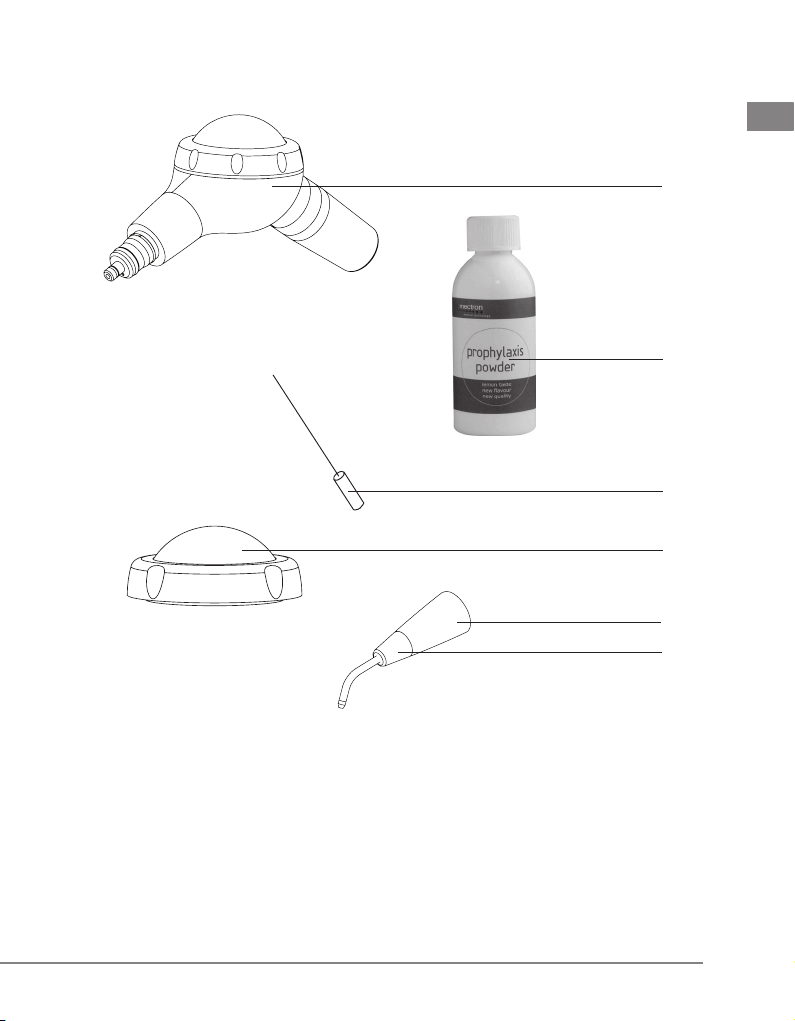
Fig. 2
EN
A
B
C
D
E
F
03.2 Lists of material included in the standard supply
1 Body of the apparatus (Fig.2 - Ref.A).
1 Pack of prophylaxis powder (Fig.2 - Ref.B);
1 Needles for cleaning the front terminal of the polisher (Fig.2 - Ref.C).
1 Spare Easyjet pro cap (Fig.2 - Ref.D);
1 Jet polisher handpiece head (Fig.2 - Ref.E);
1 Front terminal nose cap (Fig.2 - Ref.F).
This equipment may vary at the time of promotional campaigns.
easyjet pro - manual of use and maintenance
25
Page 25
04.0 Installation
�
�
�
�
�
�
�
�
04.1 Safety requirements during installation
WARNING: Do not expose the apparatus to direct sunlight or to sources of UV light.
WARNING: The apparatus is transportable, however it must be handled with care when it is moved.
To ensure that the device is in working order, it is necessary to check the following:
1 Supply of water to the turbine spray;
2 Supply of air to the turbine;
3 Presence of powder;
WARNING: If the supply of water and air is sufcient for the turbine, the Easyjet must work properly.
Standard supplies from the dental unit for a turbine:
- water from 0 to 3 bars (from 0 hPa to 3000 hPa), max. 40°C;
- air 2.3 – 3.2 bars (2300 hPa - 3200 hPa)
04.2 Connection of the device
WARNING: Check that the connector of the turbine is in good condition.
WARNING: Do not connect the Easyjet pro when the turbine is under pressure.
WARNING: Do not press the turbine control pedal while connecting the Easyjet pro.
WARNING: If your turbine has a light, turn the light off.
WARNING: The front polisher terminal and the tting of the turbine must be perfectly dry. The
presence of moisture could cause clogging of the channels in which the air/powder circulate.
The Easyjet pro has a specic adaptor corresponding to the tting of the turbine on your dental unit. Use
the Easyjet pro only for the tting on your own turbine. Fitting the Easyjet pro to a different connector
could damage it.
26
easyjet pro - manual of use and maintenance
Page 26
05.0 Use
�
�
�
�
�
�
�
�
�
�
�
05.1 Safety precautions during use
DANGER: Contraindications.
Do not use the device on patients with diseases of the respiratory apparatus, such as chronic bronchitis,
asthma, emphysema, etc.
DANGER: Contraindications.
Patients who use contact lenses should remove them before undergoing treatment with the
bicarbonate-jet polisher.
DANGER: Contraindications.
Do not turn the stream of air/bicarbonate/water in the direction of the eyes.
Failure to observe this requirement can cause serious eye damage. It is advisable for everyone involved
(patient, dentist and dental personnel) to wear protective goggles).
DANGER: Contraindications.
Dentists and other dental personnel are advised to use protective masks in order to limit inhalation of the
powder.
DANGER: Contraindications.
Do not direct the stream of air/bicarbonate/water onto composites, llings or bridges. Failure to observe
this requirement may cause them to be damaged.
DANGER: Contraindications.
Do not direct the jet of air/bicarbonate/water against the soft tissues or into the gingival groove. Failure
to comply with this requirement could cause a tissue emphysema of the gum (mucous membrane and/or
subcutaneous emphysema).
DANGER: Check the condition of the device before treatment.
Before each treatment always check that the equipment is in proper working order and that the
accessories are efcient. Do not carry out the treatment if any problems are encountered in operating the
device. If the problems concern the equipment contact an authorised technical service centre.
EN
DANGER: Infection control and cleaning of the water and air circuits.
In order to ensure maximum safety for both the patient and the operator, after each treatment follow the
instructions indicated under point “06.0”.
WARNING: Use only powder supplied by Mectron (prophylaxis powder).
Do not use powders made by other manufacturers since they could damage the device, give rise to low
performance levels and invalidate the warranty covering the device.
WARNING: Do not attempt to unscrew the cap of the powder container when it is under
pressure.
WARNING: Make sure that the powder tank is perfectly dry.
The presence of moisture could case clogging of the channels.
easyjet pro - manual of use and maintenance
27
Page 27
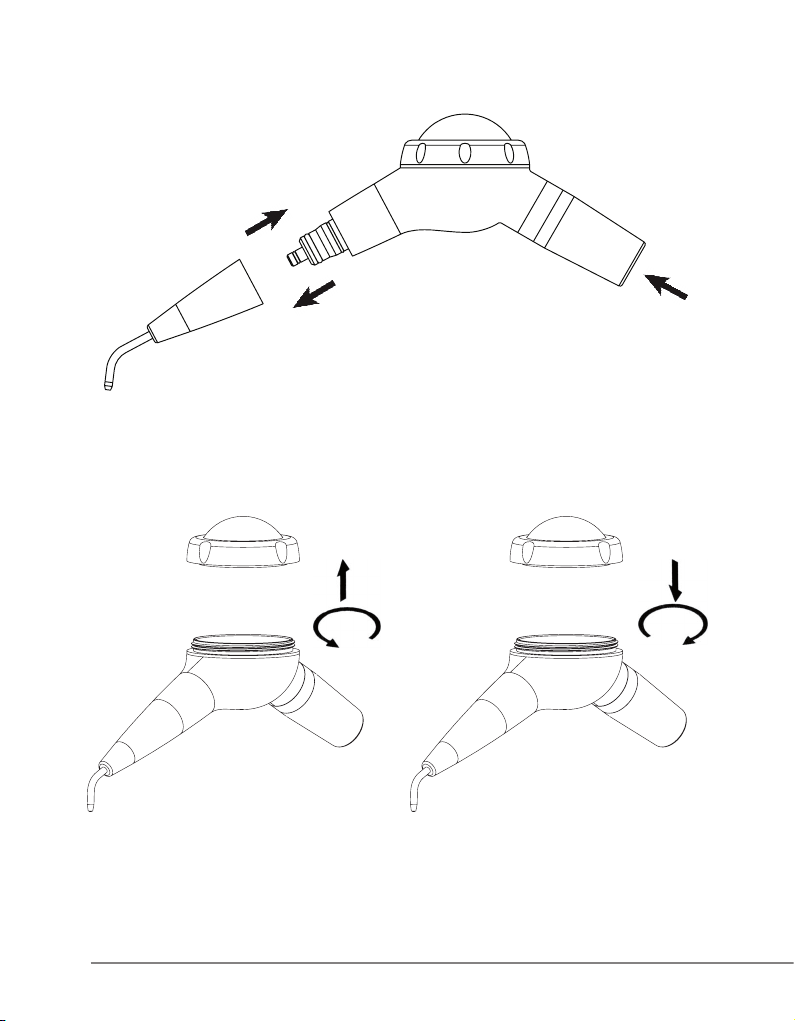
A
B
C
Fig. 3
BA
28
Fig. 4
easyjet pro - manual of use and maintenance
Page 28
05.2 Instructions for use
�
�
�
�
�
�
1 Insert the front terminal of the polisher (sterile) (Fig.3 - Ref.A) so that it ts closely;
2 Connect Easyjet pro to the turbine of the dental unit (Fig.3 - Ref.B);
3 Adjust the water ow rate on your dental unit in order to obtain a steady stream of water. It is easier to
adjust the ow rate without powder;
4 Unscrew the cap of the power container (Fig.4 - Ref.A);
5 Pour powder into the container, making sure that the level does not reach the nozzles inside the
container;
WARNING: It is advisable to use the measuring cap of the pack of prophylaxis powder, lling it to
the correct level for the Easyjet pro.
WARNING: It is advisable not to shake the Easyjet pro after lling it with powder, as this could
clog the nozzles.
6 Screw the cap of the powder container back on, without tightening it excessively (Fig.4 - Ref.B);
WARNING: Remove any residues of powder from the thread of the cap before screwing it on.
7 Press the turbine pedal to carry out the treatment;
WARNING: Use the suction cannula to evacuate the mixture of air, bicarbonate and water from
the patient’s mouth.
8 Carry out the treatment using small circular movements. Direct the nozzle only towards the enamel
of the teeth, from the gingival sulcus towards the incisal edge of the tooth, keeping at a distance of
between 3 and 5 mm.
9 Upon completion, polish all the surfaces of the teeth, setting the water ow rate to the maximum;
WARNING: The stream of air, bicarbonate and water will continue for several seconds after
removing your foot from the control pedal. Take these few extra seconds into account when nishing
the treatment.
10 After the treatment, the treated teeth will be clean and the dental cuticle will have been completely
eliminated. It will take the proteins contained in the saliva between two and three hours to form it
again. For this lapse of time, the teeth will no longer have their natural protection against stains. The
patient must be warned not to smoke and not to eat or drink anything that might stain the teeth (tea,
coffee, etc.).
IMPORTANT NOTE: Front terminal of the polisher clogged (no powder coming out).
1 Disconnect the front terminal of the polisher from the main body of the Easyjet pro (Fig.3 - Ref.C).
2 Use the cleaning needle supplied with the device to free the channel from any residues of powder
(Fig.2 - Ref.C), carrying out the movements indicated (Fig.5). Blow compressed air into the central
hole of the terminal from both ends, using the syringe.
WARNING: Clean the channel of the nozzle using only the cleaning needle supplied with
the device (Fig.2 - Ref.D).
3 Also clean the front connecting part of the casing of the Easyjet pro thoroughly. If necessary, remove
any residues of powder by blowing compressed air onto them with the syringe.
4 Connect the front terminal of the polisher to the Easyjet pro (Fig.3 - Ref.A).
EN
easyjet pro - manual of use and maintenance
29
Page 29
06.0 Cleaning, disinfection and sterilisation
�
�
�
�
�
�
�
06.1 Cleaning and disinfecting the casing of the Easyjet pro
DANGER: Disconnect the Easyjet pro from the turbine.
Always disconnect the Easyjet pro from the turbine before carrying out any cleaning, disinfection and
sterilisation activities.
DANGER: The Easyjet pro is not protected against the penetration of liquids. Do not dip it into
any liquids and do not spray liquids directly onto the casing of the device.
DANGER: The Easyjet pro is not sterilisable.
After each treatment, proceed as follows:
1 Disconnect the front terminal of the polisher from the main body of the Easyjet pro (Fig.3 - Ref.C).
2 Remove any residues of powder from the Easyjet pro container.
3 Clean and disinfect the surfaces using a cloth moistened with a mild detergent or disinfectant having
a neutral pH (pH7), paying special attention to the threaded part of the front cavity. If necessary,
remove any residues of power by blowing compressed air on them with the syringe.
WARNING: Follow the instructions provided by the manufacturer of the disinfectant carefully.
NOTE: Water-based disinfectant solutions with a neutral pH are strongly recommended. Some
alcohol-based disinfectants may be harmful and discolour or damage plastic materials. Detergents in
powder form may damage the surfaces of Easyjet pro.
06.2 Sterilisation procedures
WARNING: The only method to be used for sterilising the device is the steam autoclave
method.
Do not use any other sterilisation procedures (dry heat, radiation, ethylene oxide, gas, low-temperature
plasma, etc.).
DANGER: The Easyjet pro is not sterilisable.
DANGER: Infection control - Sterilisable parts - Remove all resides thoroughly before
sterilising.
To avoid infections cased by bacteria or viruses, always clean, disinfect and sterilise the following
components after each treatment:
1 Jet polisher handpiece head (Fig.2 - Ref.E).
2 Needle for cleaning the front terminal of the polisher (Fig.2 - Ref.C).
These components are made of materials able to withstand a maximum temperature of 135°C for a
maximum of 20 minutes.
The autoclave sterilisation process must be carried out using either of the following parameters:
- Cycle at 121°C for 16 minutes;
- Cycle at 134°C for 4 minutes.
All the stages of sterilisation must be carried out by the operator in accordance with EN ISO 17665-1:2006
and EN 556-1:2001 standards.
30
easyjet pro - manual of use and maintenance
Page 30
06.3 Autoclave sterilisation of the front terminal of the polisher
�
�
�
�
1 Disconnect the front terminal of the polisher from the body of the Easyjet pro (Fig.3 - Ref.C).
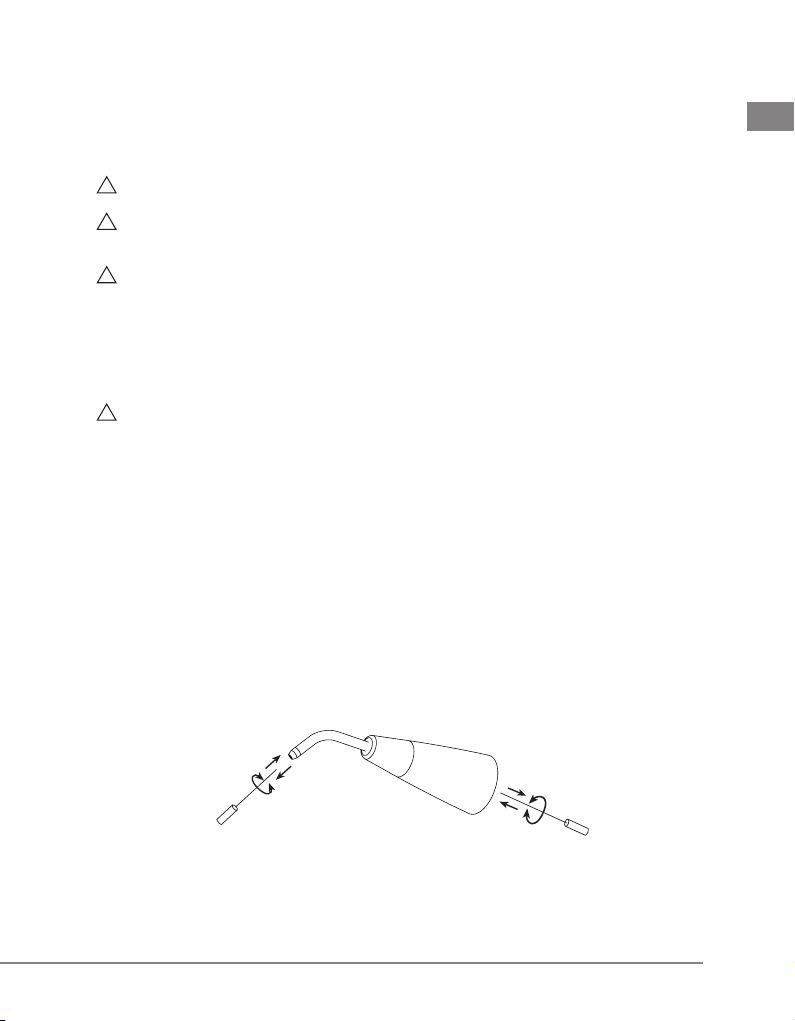
2 Free the channel from any residues of powder using the cleaning needle included in the supply (Fig.2
- Ref.C) carrying out the movements indicated (Fig.5). Blow compressed air into the central hole of
the terminal from both sides with the syringe.
WARNING: Use only the cleaning needle supplied with the apparatus to clean the channel
of the nozzle (Fig.2 - Ref.C).
3
WARNING: If the water is too hard, this may cause the spray of water to be too weak. To
eliminate thus problem, dipping the front terminal of the polisher in a 2 % solution ot hydrochloric acid
for a few minutes is recommended.
WARNING: Rinse the terminal thoroughly in distilled water to eliminate all the residues of the
hydrochloric acid solution. Dry it by blowing compressed air into the central hole of the terminal from
both sides with the syringe.
4 Disinfect the terminal using a mild disinfectant solution with a neutral pH. Dry it by blowing
compressed air into the central hole of the terminal from both sides with the syringe.
5 Insert the cleaning needle into the channel in the front terminal and seal both items inside a
disposable bag.
6 Sterilise the bag containing the front terminal of the polisher and the cleaning needle.
WARNING: Blow compressed air into the front terminal with the syringe before using it again, to
make sure that no residual mixture is left inside it.
07.0 Scheduled maintenance
1 If the air passage in the front terminal gets clogged, it is sufcient to switch on the device for a few
seconds and to use the needles included in the supply (Fig. 5) to free the channel from any resides of
powder.
2 If the front terminal gets clogged due to the excessively hard water, it is recommended to dip it in a
2 % solution of hydrochloric acid for a few minutes.
3 Whenever the front terminal is removed, it is necessary to blow compressed air with the syringe, both
into the cavity of the handpiece connector and into the rear central hole of the front terminal, so as to
avoid the accumulation of residues of powder.
4 To avoid clogging, it is advisable to empty the powder container of the Easyjet pro at least once a day.
EN
Fig. 5
easyjet pro - manual of use and maintenance
31
Page 31
08.0 Procedures and precautions for disposal
�
0476
The procedures and precautions to be observed for disposing of the apparatus are those indicated in the
current regulations for any other electronic apparatus that is no longer in use.
09.0 Symbols
N.B.: Please read carefully the instructions for use.
Apparatus in accordance with EC Directive 93/42 EEC
Notied body: CERMET.
32
easyjet pro - manual of use and maintenance
Page 32
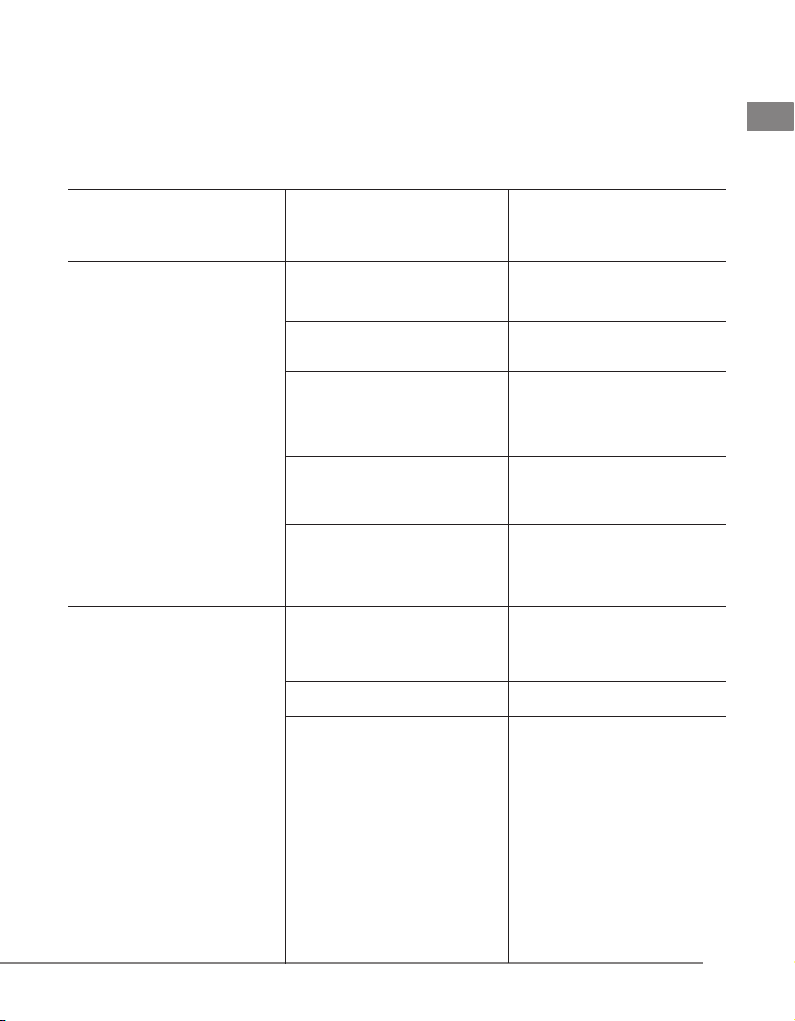
10.0 Troubleshooting
If the apparatus does not seem to be working correctly, read the instructions again and then check the
following table.
PROBLEM POSSIBLE CAUSE SOLUTION
EN
The cap of the powder container
cannot be unscrewed.
No powder comes out of the front
terminal of the polisher during
operation.
No water comes out of the front
terminal of the polisher during
operation.
The Easyjet pro is connected
to the turbine and the powder
container is pressurised.
Dental unit not connected to the
air circuit.
The tank of the Easyjet pro is
empty.
Front terminal polisher clogged
due to excessive moisture in the
powder or insufcient
cleaning/maintenance.
The level of powder inside the
container is higher than permitted.
Unsuitable powder.
Dental unit not connected to the
water circuit.
Water too hard.
Water lter of dental unit clogged.
Disconnect the Easyjet pro from
the turbine so as to depressurise
the internal circuit.
Check the connection between
the dental unit and the air circuit.
Read point “05.2”.
Read point “06.1” and “06.3”.
Remove the powder from the
container and clean it with a dry
cloth. Read point “07.0”
Restore the correct level of
powder in the container (see point
“05.2”).
To enable the apparatus to work
correctly use only powder pro-
duced by MECTRON.
Check the connection between
the dental unit and the water
circuit.
Read point “06.3 - 07.0”.
Check the connection to the water
circuit of the dental unit.
easyjet pro - manual of use and maintenance
33
Page 33

PROBLEM POSSIBLE CAUSE SOLUTION
Leakage of powder from the cap
of the container.
Treatment ineffective Insufcient pressure of the
Cap not correctly screwed in
place.
Residues of powder in the thread.
air-supply circuit.
Level of powder inside the
container too low or too high.
Unsuitable powder.
Front terminal of the polisher
clogged by too much moister in
the powder or insufcient cleaning/maintenance.
Screw the cap on correctly.
Read point “06.1”
Check the pressure in the air
circuit of the dental unit.
Restore the correct level of the
powder inside the container
(see point “05.2”).
To enable the apparatus to work
correctly use only powder
produced by MECTRON.
Read point “06.1” and “06.3”.
Remove the powder from the
container and clean it with a dry
cloth.
Read point “07.0”.
11.0 Technical specications
Apparatus in accordance with EEC Directive 93/42: Class II a.
Apparatus for intermittent operation: 60” ON 30” OFF.
Standard water pressure provided by the dental unit for a turbine:
From 0 to 3 bars (from 0 hPa to 3000 hPa), max
Standard air pressure provided by the dental unit for a turbine:
From 2.3 to 3.2 bars (2300 hPa - 3200 hPa).
Operating conditions: from +10°C to +40°C.
Relative humidity from 30% to 75%.
Transport and storage conditions: from -10°C to +70°C.
Relative humidity from 10% to 90%.
Air pressure P: 500hPa/1060hPa.
Weight and size: 125 g.
40°C.
34
easyjet pro - manual of use and maintenance
Page 34

12.0 Warranty
Before being placed on the market, all MECTRON equipment undergoes a thorough nal check to ensure
that it is are in proper working order.
MECTRON warrant their products, purchased brand-new from authorised MECTRON dealers or
importers, free from material or manufacturing defects for a period of 1 (ONE) year from the date of
purchase.
Throughout the warranty period, MECTRON undertake to repair (or, at their sole discretion, to replace)
free of charge any parts that, in their opinion, are faulty.
Complete replacement of MECTRON products is excluded.
Mectron cannot accept any liability for direct or incidental damage or personal injury in the following
cases:
- If the equipment is used for purposes other than that for which it is intended.
- If the equipment is not used in accordance with all the instructions and requirements described in this
manual.
- If the wiring system in the room where the equipment is used does not comply with the applicable
standards and appropriate requirements.
- If the wiring system in the room where the equipment is used does not comply with the applicable
standards and appropriate requirements.
- If any assembly operations, extensions, settings, alterations or repairs have been carried out by
personnel not authorised by Mectron.
- If the environmental conditions in which the device is kept and stored do not comply with the
requirements indicated in the chapter on technical specications.
Accidental damages due to transport, incorrect use or carelessness or to connection to power
supplies other than as envisaged and damage to the signalling lamps, handpieces and all accessories are
excluded from the warranty.
The warranty will no longer apply if the apparatus has been tampered with or repaired by unauthorised
personnel.
WARNING
The warranty is valid only if the warranty slip enclosed with the product has been completed in full and
returned to us or, if appropriate, to your MECTRON dealer or importer within 20 (TWENTY) DAYS from
the date of purchase, as proven by the consignment note/invoice issued by the dealer/importer.
In order to benet from the warranty service, the customer must return the apparatus to be repaired to the
MECTRON dealer/importer from which it was purchased, at his own expense.
The apparatus should be returned suitably packed (possibly in its original packing material), accompanied
by all the accessories and by the following information:
a) Owner’s details, including his telephone number.
b) Details of the dealer/importer
c) Photocopy of the consignment note/purchase invoice of the apparatus issued to the owner and
indicating, in addition to the date, also the name of the apparatus and its serial number.
d) A description of the problem.
Transport and any damages caused during transport are not covered by the warranty.
In the event of failures due to accidents or improper use, or if the warranty has lapsed, repairs to
MECTRON products will be charged on the basis of the actual cost of the materials and labour required
for such repairs.
The information given in this manual is not binding and can be modied without prior notice.
EN
easyjet pro - manual of use and maintenance
35
Page 35

Inhaltsverzeichnis
00.0 Einleitung ................................................................................................................................... .......37
00.1 Vorwort ............................................................................................................................... .......37
00.2 Beschreibung des Geräts .................................................................................................. .......37
00.3 Verwendungszweck ........................................................................................................... .......38
00.4 Sicherheitsvorschriften ..................................................................................................... .......38
01.0 Kenndaten .................................................................................................................................. .......40
01.1 Kenndaten des Geräts ...................................................................................................... .......40
01.2 Typenschild des Geräts ..................................................................................................... .......40
02.0 Prüfung ....................................................................................................................................... .......40
02.1 Prüfung des Geräts ............................................................................................................ .......40
03.0 Lieferung..................................................................................................................................... .......40
03.1 Lieferung des Geräts ......................................................................................................... .......40
03.2 Standardzubehörverzeichnis ............................................................................................. .......41
04.0 Installation .................................................................................................................................. .......42
04.1 Sicherheitsvorschriften für die Installation ......................................................................... .......42
04.2 Anschluss des Geräts ........................................................................................................ .......42
05.0 Anwendung ................................................................................................................................. .......43
05.1 Sicherheitsvorschriften für die Anwendung ........................................................................ .......43
05.2 Gebrauchsanleitungen ....................................................................................................... .......45
06.0 Reinigung, desinzierung, sterilisation ...................................................................................... .......46
06.1 Reinigung und Desinfektion des Easyjet pro- Körpers ..................................................... .......46
06.2 Sterilisationsverfahren ....................................................................................................... .......46
06.3 Sterilisation des vorderen Endteils des Poliergeräts im Autoclav ...................................... .......47
07.0 Regelmässige wartung ............................................................................................................... .......47
08.0 Bedingungen und Vorsichtsmassnahmen für die Entsorgung .................................................... .......48
09.0 Symbole...................................................................................................................................... .......48
10.0 Behebung von störungen ........................................................................................................... .......49
11.0 Technische daten ........................................................................................................................ .......50
12.0 Garantie ...................................................................................................................................... .......51
Unix® - Unix L® is a registered trademark of Bien-Air company
Multiex® - Multiex lux® is a registered trademark of KaVo company
Sirona® R - Sirona® B is a registered trademark of SIRONA company
Roto Quick® - Roto Quick Lux® is a registered trademark of W&H company
36
easyjet pro - Gebrauchs- und Wartungshandbuch
Page 36
00.0 Einleitung
�
�
00.1 Vorwort
Lesen Sie dieses Handbuch aufmerksam vor der Installation, dem Gebrauch, der Wartung oder
sonstigen Eingriffen am Gerät durch.
Bewahren Sie das Handbuch griffbereit auf.
Wichtig: Zur Vermeidung von Personen- oder Sachschäden lesen Sie alle in diesem Handbuch
enthaltenen Kapitel über die “Sicherheitsvorschriften” besonders gründlich durch.
Je nach Schweregrad sind die Sicherheitsvorschriften nach der folgenden Benennung klassiziert:
GEFAHR (bezieht sich stets auf Personenschäden)
ACHTUNG (bezieht sich auf mögliche Sachschäden)
Dieses Handbuch soll den Bediener mit Beschreibungen und Abbildungen über die Vorschriften und
grundlegenden Kriterien informieren, die für die Installation, die korrekte Anwendung des Gerätes und das
korrekte Wartungsverfahren erforderlich sind.
Der Bediener darf auf keinen Fall unerlaubte Änderungen am Gerät vornehmen.
Bei Betriebsstörungen wenden Sie sich an das am nächsten gelegene Kundendienst-Center von Mectron.
Jeder Ausbauversuch sowie jede Änderung am Gerät seitens des Bedieners oder nicht autorisierten
Personals führt zum Verfall der Garantie und entbindet den Hersteller von der Haftung für eventuelle
Personen- und/oder Sachschäden.
Die Informationen und Abbildungen dieses Handbuches stehen auf dem auf Seite 104 angegebenen
Stand des Ausgabedatums.
Das Unternehmen MECTRON setzt sich ständig für eine weitere Optimierung seiner Produkte ein, was zu
Änderungen an einigen Bestandteilen des Gerätes führen kann.
Falls Sie Abweichungen zwischen den im vorliegenden Handbuch enthaltenen Beschreibungen und dem
von Ihnen gekauften Gerät feststellen, wenden Sie sich bitte an den Wiederverkäufer oder das für Ihr
Gebiet zuständige MECTRON-Kundendienst-Center.
Es ist verboten, das vorliegende Handbuch für andere Zwecke als für die Installation, den Gebrauch und
die Wartung des Gerätes zu verwenden.
00.2 Beschreibung des Geräts
Easyjet pro ist ein kompaktes Poliergerät mit Bikarbonatpulverstrahl und Steckkontakt zur Turbine.
Easyjet pro teilt alle wesentlichen Vorteile mit den bekannten Tischgeräten:
- einen konstanten, leistungsstarken Pulverstrahl;
- die einfache Handhabung und die Zuverlässigkeit.
Die Betriebsweise des Gerätes Easyjet pro beruht auf der mechanischen Wirkung, die durch die Kristalle
eines Natriumbikarbonatstrahls erhalten wird. Die auf diese Weise den Teilchen übertragene kinetische
Energie schwindet fast vollständig beim Aufprall auf die Zahnschmelzoberäche und erzeugt eine
delikate, aber durchgreifende Reinigung. Die Aktion wird von einem Wasserstrahl vervollständigt, der sich
durch Nutzung des Niederdrucks um die Düse herum glockenähnlich um den Hauptstrahl anordnet und
eine doppelte Wirkung erzeugt: Er verhindert zum Grossteil den Rückprall und Austritt der
Bicarbonatwolke und erwirkt die ununterbrochene Wäsche des behandelten Bereichs durch Lösung des
Bicarbonats.
DE
easyjet pro - Gebrauchs- und Wartungshandbuch
37
Page 37
00.3 Verwendungszweck
�
�
�
�
�
�
Bicarbonatstrahl-Poliergerät. Indikation:
- Entfernung des Bakterienbelags;
- Entfernung der Flecken auf der Zahnoberäche, die durch Tabak-, Kaffee- Teegenuss und
Chlorhexidin entstehen;
- Prophylaxe bei Patienten in kieferorthopädischer Behandlung.
00.4 Sicherheitsvorschriften
Mectron übernimmt in den folgenden Fällen keine Haftung für direkte oder indirekte Personen- oder
Sachschäden:
1 Das Gerät wird nicht für den vorgesehenen Verwendungszweck eingesetzt.
2 Das Gerät wird nicht nach den in diesem Handbuch aufgeführten Anweisungen und Vorschriften
angewendet.
3 Die elektrische Anlage der Räume, in denen das Gerät verwendet wird, entspricht nicht den in Kraft
stehenden Gesetzen und den diesbezüglichen Vorschriften.
4 Zusammenbau, Zusätze, Einstellungen, Änderungen und Reparaturen werden nicht von
Mectron-Fachpersonal vorgenommen.
5 Die Raumverhältnisse zur Aufbewahrung und Lagerung des Geräts entsprechen nicht den im Kapitel
Technische Daten aufgeführten Vorschriften.
GEFAHR: Qualiziertes Fachpersonal.
Das Gerät darf nur von geschultem Fachpersonal wie dem Zahnarzt und dem Zahnhygieniker
angewendet werden. Die Anwendung des Geräts erzeugt keine unerwünschten Wirkungen, wenn es
korrekt gehandhabt wird.
GEFAHR: Verwendungszweck.
Das Gerät darf nur für den vorgesehenen Verwendungszweck benutzt werden (siehe Kapitel “00.3”). Der
Verstoß gegen diese Vorschrift kann dem Patienten und dem Bediener schwere Verletzungen zufügen
und am Gerät Schäden/Störungen verursachen.
GEFAHR: Reinigung, Desinzierung, Sterilisation neuer oder reparierter Geräte.
Sämtliche neue oder reparierte Geräte werden in nicht sterilem Zustand ausgeliefert. Vor jeder
Behandlung sind alle neuen oder reparierten Geräte durch genaue Befolgung der im Kapitel “06.0”
aufgeführten Anweisungen zu reinigen, zu desinzieren und zu sterilisieren.
GEFAHR: Infektionskontrolle.
Zur größtmöglichen Sicherheit des Patienten und des Bedieners ist lediglich gereinigtes,
desinziertes und sterilisiertes Zubehör zu verwenden. Dabei sind die in Kapitel “06.0” aufgeführten
Anweisungen streng einzuhalten.
GEFAHR: Ausschließlich Originalzubehör und –ersatzteile von Mectron verwenden.
ACHTUNG: Ausschließlich von Mectron hergestelltes Pulver verwenden (prophylaxis powder).
Es darf kein von anderen Herstellern erzeugtes Pulver verwendet werden, da es das Gerät beschädigen,
eine unzulängliche Leistung erbringen und die Garantie des Geräts nichtig machen könnte.
38
easyjet pro - Gebrauchs- und Wartungshandbuch
Page 38
�
GEFAHR: Kontrolle des Gerätzustands vor der Behandlung.
�
�
�
�
�
�
Vor jeder Behandlung ist der perfekte Betrieb des Geräts und die Funktionstüchtigkeit der Zusatzteile zu
kontrollieren. Sollten sich Betriebsstörungen feststellen lassen, ist die Behandlung zu vermeiden. Wenden
Sie sich an den Vertragskundendienst, wenn die Betriebsstörung das Gerät betrifft.
GEFAHR: Gegenanzeigen.
Das Gerät ist nicht für Patienten mit Krankheiten der Atemwege wie chronische Bronchitis, Asthma,
Emphysem usw. geeignet.
GEFAHR: Gegenanzeigen.
Patienten, die Kontaktlinsen tragen, müssen diese vor der Behandlung mit dem
Bicarbonatstrahl-Poliergerät ablegen.
GEFAHR: Gegenanzeigen.
Richten Sie den Luft-/Bikarbonat-/Wasserstrahl nie auf die Augen!
Der Verstoss gegen diese Vorschrift kann schwere Augenverletzungen verursachen. Es ist allen
anwesenden Personen (Patient, Zahnhygieniker und Zahnarzt) zu empfehlen, eine Schutzbrille zu tragen.
GEFAHR: Gegenanzeigen.
Es ist dem Zahnarzt und dem Zahnhygieniker zu empfehlen, eine Schutzmaske zur Vermeidung einer
Pulverinhalation zu tragen.
GEFAHR: Gegenanzeigen.
Richten Sie den Luft-/Bikarbonat-/Wasserstrahl nie auf Kompositen, Füllungen und Brücken. Der Verstoss
gegen diese Vorschrift kann Schäden verursachen.
GEFAHR: Gegenanzeigen.
Das Weichgewebe oder die Zahneischtasche dürfen dem Luft-/Bicarbonat-/Wasserstrahl nicht
ausgesetzt werden. Wird diese Vorschrift nicht beachtet, kann sich ein Zahneischgewebe-Emphysem
einstellen (Schleimhaut- oder subkutanes Emphysem).
DE
easyjet pro - Gebrauchs- und Wartungshandbuch
39
Page 39
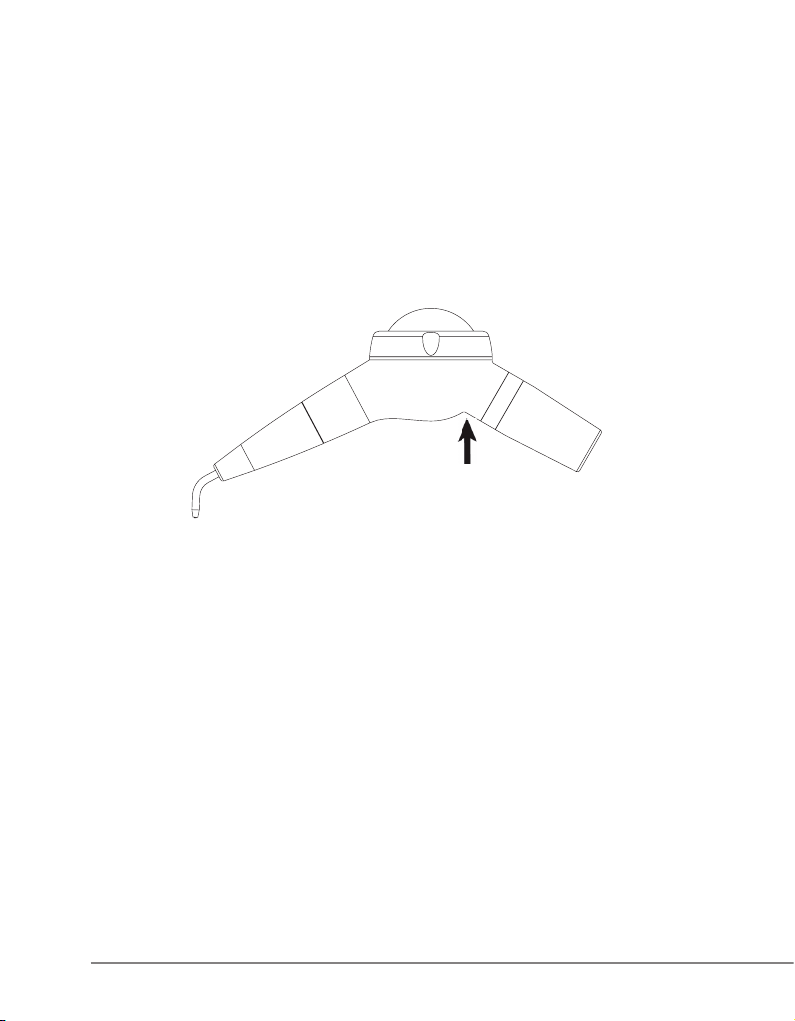
01.0 Kenndaten
01.1 Kenndaten des Geräts
Die genaue Beschreibung des Modells und der Seriennummer des Geräts erleichtert es unserem
Kundendienst, für jedes Problem eine schnelle und efziente Lösung zu nden.
Teilen Sie diese Daten jedes Mal mit, wenn Sie sich an ein Kundendienst-Center von Mectron wenden.
01.2 Typenschild des Geräts
Jedes Gerät ist mit einer Seriennummer versehen (Bild 1 - Ref. A). Die restlichen Daten stehen in diesem
Handbuch (siehe Abschnitt “11.0”).
A
Bild 1
02.0 Prüfung
02.1 Prüfung des Geräts
Alle von MECTRON hergestellten Geräte werden einer strengen Kontrolle unterzogen, jede einzelne
Komponente wird geprüft.
Bei dieser Prüfung werden die Komponenten einer Reihe von Arbeitszyklen unterzogen.
Während dieser Phase werden etwaige Betriebsstörungen festgestellt, die durch defekte Komponenten
verursacht werden.
Dieses Verfahren gewährleistet ein einwandfrei funktionierendes und zuverlässiges Produkt.
03.0 Lieferung
03.1 Lieferung des Geräts
Die Verpackung des Geräts ist stoßempndlich, da sie elektronische Komponenten enthält. Daher ist
sowohl beim Transport als bei der Lagerung besondere Vorsicht geboten.
Die Kartons dürfen nicht gestapelt werden, damit die darunter liegenden Packungen nicht gedrückt
werden.
Die von MECTRON versandte Ware wurde vor dem Versand genau kontrolliert.
Das Gerät wird ordnungsgemäß geschützt und verpackt geliefert.
Bei Eintreffen des Geräts ist sofort auf Transportschäden zu kontrollieren. Etwaige Transportschäden sind
unverzüglich beim Spediteur zu reklamieren.
40
easyjet pro - Gebrauchs- und Wartungshandbuch
Page 40
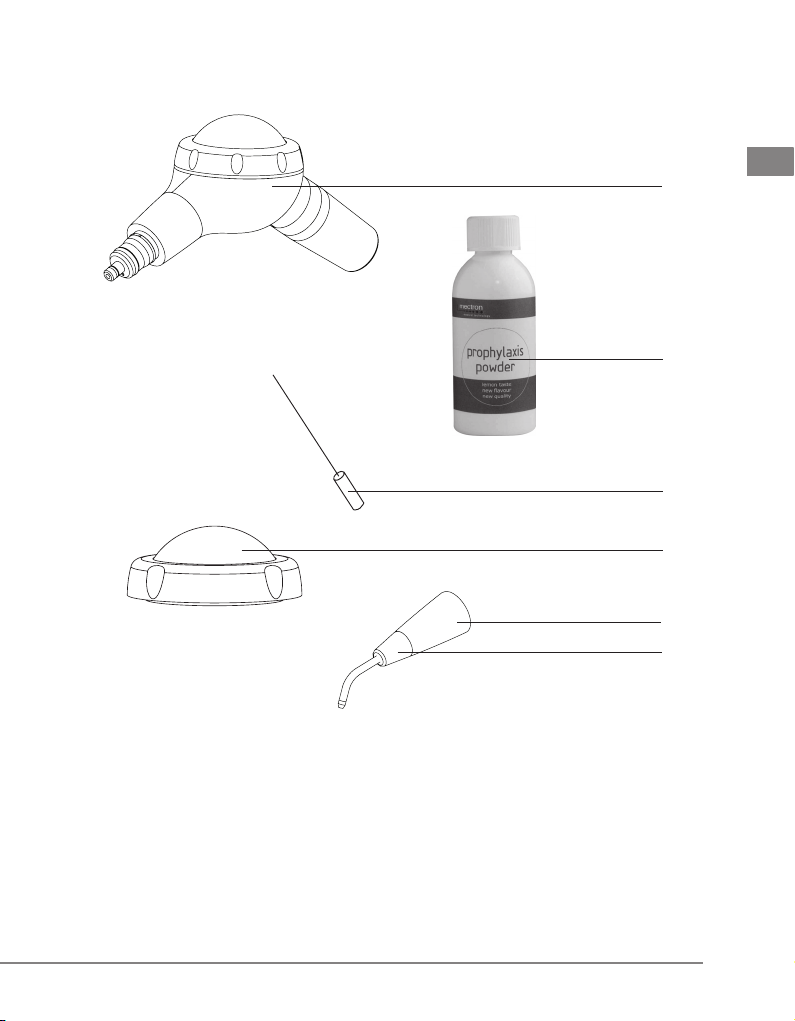
Bild 2
DE
A
B
C
D
E
F
03.2 Standardzubehörverzeichnis
1 Gerätkörper (Bild 2 - Ref.A);
1 Pulverbehälter prophylaxis powder (Bild 2 - Ref.B);
1 Nadel für die Reinigung der vorderen Endteile des Poliergeräts (Bild 2 - Ref.C);
1 Ersatzkappe Easyjet pro (Bild 2 - Ref.D);
1 Vorderes Endteil Poliergerät (Bild 2 - Ref.E);
1 Vordere Endteilekappe (Bild 2 - Ref.F).
Diese Ausstattung kann sich im Falle von Werbekampagnen ändern.
easyjet pro - Gebrauchs- und Wartungshandbuch
41
Page 41
04.0 Installation
�
�
�
�
�
�
�
�
04.1 Sicherheitsvorschriften für die Installation
ACHTUNG: Das Gerät nicht den direkten Sonnenstrahlen oder UV-Lichtquellen aussetzen.
ACHTUNG: Das Gerät ist transportierbar, beim Transport allerdings mit großer Sorgfalt zu
handhaben.
1 Wasserversorgung Spray der Turbine;
2 Luftversorgung der Turbine;
3 Pulvervorrat;
ACHTUNG: Ist die Wasser- und Luftversorgung ausreichend für die Turbine, muss das Easyjet
funktionieren!
Die von der Dentaleinheit zugeführte Standardversorgung für eine Turbine:
- Wasser von 0 bis 3 bar (von 0 hPa bis 3000 hPa) max 40°C;
- Luft 2,3 - 3,2 bar (2300 hPa - 3200 hPa).
04.2 Anschluss des Geräts
ACHTUNG: Kontrollieren Sie, ob der Turbinenverbinder sich in einem guten Zustand bendet.
ACHTUNG: Schliessen Sie Easyjet pro nicht an, wenn die Turbine unter Druck steht.
ACHTUNG: Betätigen Sie das Betriebspedal der Turbine während der Verbindung des Easyjet pro
nicht.
ACHTUNG: Besitzen Sie eine Turbine mit Lichtanschluss, schalten Sie dieses aus.
ACHTUNG: Das vordere Poliererendstück und der Turbinenanschluss müssen völlig trocken sein.
Feuchtigkeit kann ein Verstopfen der Luft-/Pulverumlaufkanäle verursachen.
Easyjet pro ist mit einem speziellen Adapter versehen, der zu dem Anschluss Ihrer auf der Dentaleinheit
bendlichen Turbine passt. Verwenden Sie Easyjet pro nur für den Anschluss der Turbine in Ihrem Besitz.
Eine Kupplung des Easyjet pro mit einem anderen Verbinder könnte es beschädigen.
Zur Inbetriebnahme des Geräts kontrollieren Sie Folgendes:
42
easyjet pro - Gebrauchs- und Wartungshandbuch
Page 42
05.1 Sicherheitsvorschriften für die Anwendung
�
�
�
�
�
�
�
�
�
�
�
05.0 Anwendung
GEFAHR: Gegenanzeigen.
Das Gerät ist nicht für Patienten mit Krankheiten der Atemwege wie chronische Bronchitis, Asthma,
Emphysem usw. geeignet.
GEFAHR: Gegenanzeigen.
Patienten, die Kontaktlinsen tragen, müssen diese vor der Behandlung mit dem
Bicarbonatstrahl-Poliergerät ablegen.
GEFAHR: Gegenanzeigen.
Richten Sie den Luft-/Bikarbonat-/Wasserstrahl nie auf die Augen!
Der Verstoss gegen diese Vorschrift kann schwere Augenverletzungen verursachen. Es ist allen
anwesenden Personen (Patient, Zahnhygieniker und Zahnarzt) zu empfehlen, eine Schutzbrille zu tragen.
GEFAHR: Gegenanzeigen.
Es ist dem Zahnarzt und dem Zahnhygieniker zu empfehlen, eine Schutzmaske zur Vermeidung einer
Pulverinhalation zu tragen.
GEFAHR: Gegenanzeigen.
Richten Sie den Luft-/Bikarbonat-/Wasserstrahl nie auf Kompositen, Füllungen und Brücken. Der Verstoss
gegen diese Vorschrift kann Schäden verursachen.
GEFAHR: Gegenanzeigen.
Das Weichgewebe oder die Zahneischtasche dürfen dem Luft-/Bicarbonat-/Wasserstrahl nicht
ausgesetzt werden. Wird diese Vorschrift nicht beachtet, kann es zu einem
Zahneischgewebe-Emphysem kommen (Schleimhaut- oder subkutanes Emphysem).
GEFAHR: Kontrolle des Gerätzustands vor der Behandlung.
Vor jeder Behandlung ist der perfekte Betrieb des Geräts und die Funktionstüchtigkeit der Zusatzteile zu
kontrollieren. Sollten sich Betriebsstörungen feststellen lassen, ist die Behandlung zu vermeiden. Wenden
Sie sich an den Vertragskundendienst, wenn die Betriebsstörung das Gerät betrifft.
GEFAHR: Infektionskontrolle und Reinigung des Wasser- und Luftkreislaufs.
Für die maximale Sicherheit des Patienten und des Bedieners sind nach jeder Behandlung sämtliche in
Kapitel “06.0” angegebenen Vorschriften zu beachten.
DE
ACHTUNG: Ausschließlich von Mectron hergestelltes Pulver verwenden (Prophylaxis powder).
Es darf kein von anderen Herstellern erzeugtes Pulver verwendet werden, weil es das Gerät beschädigen,
eine unzureichende Leistung erbringen und die Garantie aufheben könnte.
ACHTUNG: Versuchen Sie nicht, die Kappe des Pulverbehälters abzuschrauben, wenn er unter
Druck steht.
ACHTUNG: Kontrollieren Sie, ob der Pulverbehälter vollkommen trocken ist.
Feuchtigkeit kann zur Verstopfung der Kanäle führen.
easyjet pro - Gebrauchs- und Wartungshandbuch
43
Page 43
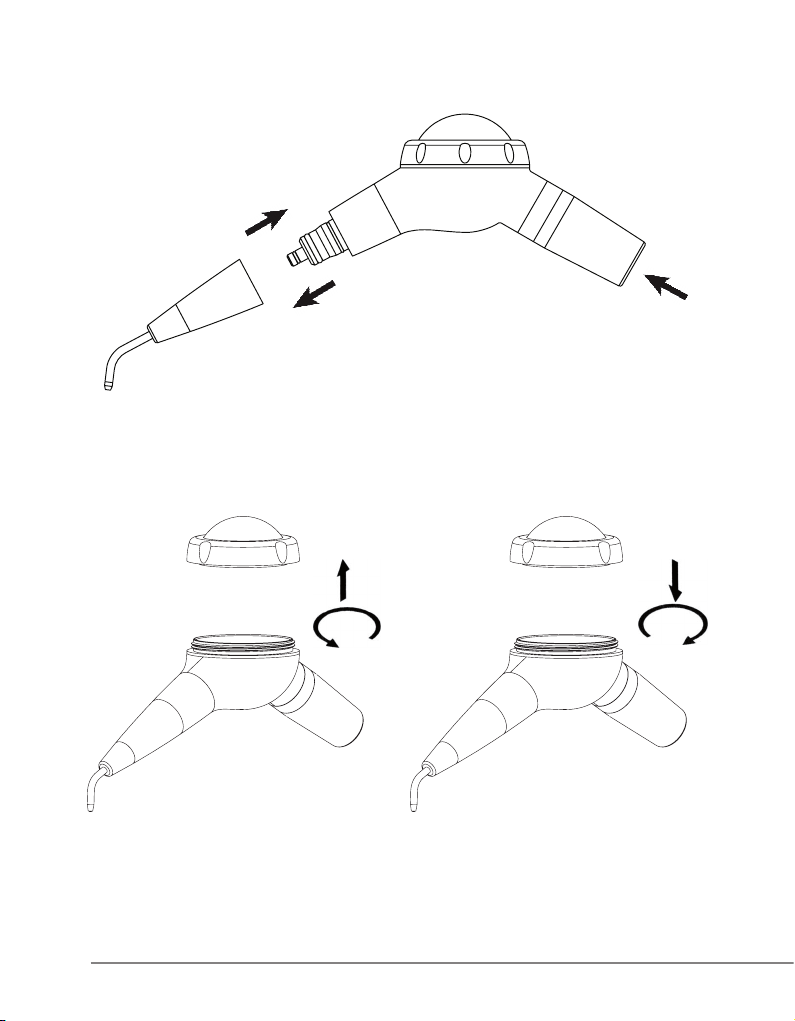
A
B
C
Bild 3
BA
44
Bild 4
easyjet pro - Gebrauchs- und Wartungshandbuch
Page 44
05.2 Gebrauchsanleitungen
�
�
�
�
�
�
1 Fügen Sie das vordere (sterile) Endstück des Poliergeräts (Bild 3 - Ref.A) bis zum Anschlag ein.
2 Verbinden Sie Easyjet pro mit der Turbine der Dentaleinheit (Bild 3 - Ref.B).
3 Stellen Sie den von Ihrer Dentaleinheit ausgehenden Wasserdurchuss ein, um einen
gleichmässigen Wasserstrahl zu erhalten. Die Einstellung ist ohne Pulver leichter.
4 Schrauben Sie die Kappe des Pulverbehälters ab (Bild 4 - Ref.A).
5 Geben Sie das Pulver in den Behälter; es darf keinesfalls die innen liegenden Düsen bedecken.
ACHTUNG: Verwenden Sie dafür den Messbecher in der Packung prophylaxis powder, den Sie
bis zur Markierung Easyjet pro füllen.
ACHTUNG: Schütteln Sie Easyjet pro nicht nach Einfüllen des Pulvers, weil sich sonst eine
Verstopfung der Düsen einstellen kann.
6 Schrauben Sie die Kappe des Pulverbehälters wieder zu, ohne sie zu stark festzudrehen
(Bild 4 - Ref.B).
ACHTUNG: Entfernen Sie vor dem Zuschrauben Pulverreste vom Gewinde der Kappe.
7 Drücken Sie das Pedal der Turbine zur Inbetriebnahme.
ACHTUNG: Verwenden Sie die Absaugkanüle zur Entfernung der Luft-/Bikarbonat-/
Wassermischung aus dem Mund der Patienten.
8 Führen Sie die Behandlung mit kleinen Kreisbewegungen durch. Richten Sie die Düse nur auf den
Zahnschmelz von der Zahneischtasche zum Schneiderand des Zahns mit einer Distanz von 3
bis 5 mm.
9 Polieren Sie abschließend alle Zahnoberächen, wobei Sie den Wasserdurchuss auf Höchstleistung
stellen.
ACHTUNG: Wenn Sie den Fuß vom Betriebspedal nehmen, setzt sich der Luft-/
Bikarbonat-/Wasserstrahl noch einige Sekunden lang fort. Beenden Sie die Behandlung unter
Berücksichtigung dieser zusätzlichen Sekunden.
10 Nach der Behandlung sind die Zähne gereinigt und die Zahnkutikula ist vollkommen entfernt. Ihre
Erneuerung durch die Speichelproteine erfordert 2 bis 3 Stunden, während welcher die Zähne keinen
natürlichen Schutz gegen Färbungsmittel aufweisen. Informieren Sie die Patienten, dass sie in dieser
Zeitspanne weder rauchen noch Nahrungsmittel oder Getränke zu sich nehmen dürfen, die die Zähne
färben können (Tee, Kaffee, …).
WICHTIGE ANMERKUNG: Das vordere Endstück des Polierers ist verstopft (es tritt kein Pulver
aus):
1 Nehmen Sie das vordere Poliererendstück vom Körper des Easyjet pro ab (Bild 3 - Ref.C).
2 Befreien Sie den Kanal mit der mitgelieferten Reinigungsnadel von Pulverresten
(Bild 2 - Ref.C), indem Sie die gezeigten Bewegungen durchführen (Bild 5). Blasen Sie mit der
Spritze von beiden Seiten Druckluft durch das Zentralloch des Endstücks.
ACHTUNG: Reinigen Sie den Kanal der Düse nur mit der Reinigungsnadel, die mit dem
Gerät mitgeliefert wird (Bild 2 - Ref.D)!
3 Reinigen Sie auch die vordere Verbindung des Easyjet pro-Körpers sorgfältig. Falls notwendig,
entfernen Sie Pulverreste durch Druckluftblasen mit der Spritze.
4 Stecken Sie das vordere Poliererendstück wieder auf den Easyjet pro-Körper (Bild 3 - Ref.A).
DE
easyjet pro - Gebrauchs- und Wartungshandbuch
45
Page 45
06.0 Reinigung, desinzierung, sterilisation
�
�
�
�
�
�
�
06.1 Reinigung und Desinfektion des Easyjet pro- Körpers
GEFAHR: Trennen Sie Easyjet pro von der Turbine.
Trennen Sie Easyjet pro stets von der Turbine, bevor Sie Reinigungs-, Desinfektions- und
Sterilisationsarbeiten durchführen.
GEFAHR: Easyjet pro ist nicht vor dem Eindringen von Flüssigkeiten geschützt. Tauchen Sie
das Gerät nicht und spritzen Sie auch keine Flüssigkeiten direkt auf die Oberäche des
Gerätmantels.
GEFAHR: Easyjet pro ist nicht sterilisierbar!
Nach jeder Behandlung führen Sie die folgenden Arbeiten aus:
1 Trennen Sie das vordere Poliererendstück vom Easyjet pro-Körper (Bild 3 - Ref. C).
2 Entfernen Sie etwaige Pulverreste aus dem Easyjet pro-Behälter.
3 Reinigen und desinzieren Sie die Oberächen mit einem Tuch, das Sie mit einer nicht aggressiven
Reinigungs-/Desinfektionsüssigkeit mit neutralem pH (pH7) befeuchten. Geben Sie besonders auf
das Gewinde des vorderen Hohlraums Acht. Falls notwendig, entfernen Sie Pulverreste, indem Sie
Druckluft mit einer Spritze durchblasen.
ACHTUNG: Folgen Sie aufmerksam den Anweisungen des Herstellers der Desinfektionslösung.
ANMERKUNG: Desinfektionslösungen auf Wasserbasis mit neutralem pH sind höchst empfehlenswert.
Desinfektionslösungen auf Alkoholbasis können schädlich sein und das Plastikmaterial entfärben und
beschädigen. Pulvermittel können die Oberäche des Easyjet pro ruinieren.
06.2 Sterilisationsverfahren
ACHTUNG: Führen Sie die Sterilisation nur mit Wasserdampfautoklaven aus!
Verwenden Sie kein anderes Sterilisationssystem (Trockenhitze, Bestrahlung, Äthylenoxid, Gas, Niedertemperaturplasma usw.).
GEFAHR: Easyjet pro ist nicht sterilisierbar!
GEFAHR: Infektionskontrolle - Sterilisierbare Teile - Sorgfältige Entfernung aller Reste vor der
Sterilisation.
Zur Vermeidung von Bakterien- oder Virusinfektionen reinigen, desinzieren und sterilisieren Sie nach
jeder Behandlung die folgenden Komponenten:
1 Vorderes Endstück des Polierers (Bild 2 - Ref.E).
2 Reinigungsnadel des vorderen Poliererendstücks (Bild 2 - Ref.C).
Diese Teile bestehen aus Materialien, die einer Höchsttemperatur von 135°C und einer maximalen
Zeitdauer von 20 Minuten widerstehen.
Der Sterilisationsvorgang im Dampfautoklav ist mit einem der beiden Parameter auszuführen:
- Zyklus bei 121°C. 16 Minuten lang,
- Zyklus bei 134°C. 4 Minuten lang.
Der Bediener hat alle Sterilisationsphasen gemäss den Normen EN ISO 17665-1:2006 und
EN 556-1:2001 durchzuführen.
46
easyjet pro - Gebrauchs- und Wartungshandbuch
Page 46
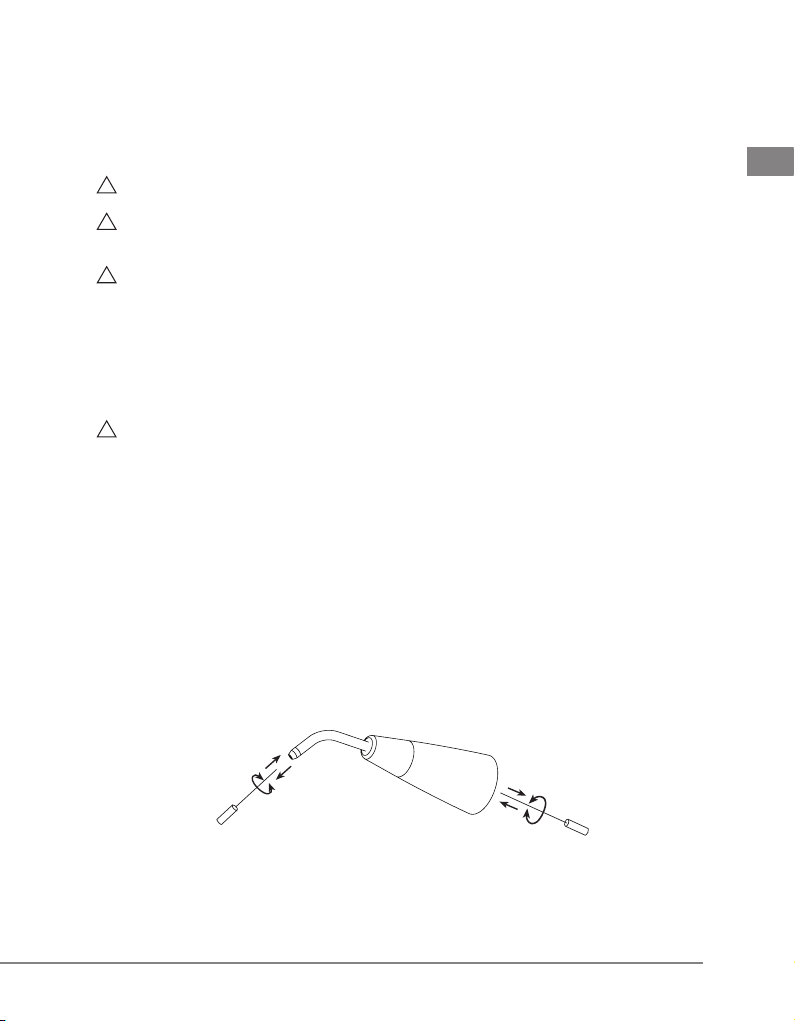
�
�
�
�
06.3 Sterilisation des vorderen Endteils des Poliergeräts im Autoclav
1 Trennen Sie das vordere Poliererendstück vom Easyjet pro-Körper (Bild 3 - Ref.C).
2 Befreien Sie den Kanal mit der Reinigungsnadel, die zum Zubehör gehört (Bild 2 - Ref.C), gemäß den
angegebenen Bewegungen (Bild 5) von etwaigen Pulverresten. Blasen Sie mit der Spritze Pressluft
von beiden Seiten in das mittlere Loch des Endteils.
ACHTUNG: Reinigen Sie den Kanal der Düse ausschließlich mit der Reinigungsnadel, die
als Zubehör zum Gerät gehört (Bild 2 - Ref.C).
3
ACHTUNG: Übermäßig kalkhaltiges Wasser kann zu einer unzulänglichen Wassersprühung
führen. Zur Beseitigung dieser Störung ist es empfehlenswert, das vordere Endteil des Poliergeräts
einige Minuten lang in Chlorwasserstoffsäure zu 2 % zu legen.
ACHTUNG: Spülen Sie das Endteil sorgfältig mit destilliertem Wasser, um jeden Rest der
Chlorwasserstoffsäure zu entfernen. Trocknen Sie es, indem Sie mit der Spritze von beiden Seiten
Pressluft in das mittlere Loch des Endteils blasen.
4 Desinfezieren Sie das Endteil mit einer nicht agressiven Desinfektionsüssigkeit mit neutralem PH.
Trocknen Sie es, indem Sie mit der Spritze von beiden Seiten Pressluft in das mittlere Loch des
Endteils blasen.
5 Fügen Sie die Reinigungsnadel in den Kanal des vorderen Poliererendstücks ein und verschließen
Sie das Ganze in einer Einweghülle.
6 Sterilisieren Sie die Hülle mit dem vorderen Poliererendstück und der Reinigungsnadel.
ACHTUNG: Bevor Sie das vordere Endstück wieder verwenden, blasen Sie mit der Spritze
Druckluft hindurch, damit innen keine Restfeuchtigkeit bleibt.
07.0 Regelmässige wartung
1 Ist der Luftkanal des vorderen Endstücks verstopft, so schalten Sie das Gerät einige Sekunden lang
mit den mitgelieferten Nadeln (Bild 5) ein, um den Kanal von den Pulverresten zu befreien.
2 Ist das vordere Endstück wegen zu großen Kalkgehalts des Wassers verstopft, so ist zu empfehlen,
es einige Minuten lang in eine Salzsäurelösung zu 2 % zu tauchen.
3 Bei jeder Abnahme des vorderen Endstücks blasen Sie mit der Spritze Druckluft sowohl durch den
Hohlraum des Handstückverbinders als auch durch das hintere Zentralloch des vorderen Endstücks,
um Pulverrestansammlungen zu vermeiden.
4 Es ist zu empfehlen, mindestens einmal pro Tag den Pulverbehälter des Easyjet pro zu leeren, um
Verstopfungen zu vermeiden.
DE
Bild 5
easyjet pro - Gebrauchs- und Wartungshandbuch
47
Page 47
08.0 Bedingungen und Vorsichtsmassnahmen für die
�
0476
Entsorgung
Die Bedingungen und Vorsichtsmaßnahmen für die Entsorgung des Geräts unterliegen den in Kraft
stehenden Gesetzesvorschriften wie für jeden anderen unbrauchbar gewordenen elektronischen Apparat.
09.0 Symbole
Achtung! Lesen Sie bitte die Gebrauchsanleitung! Gerät
entspricht der Norm CE 93/42 EG
Gemeldete Stelle CERMET
48
easyjet pro - Gebrauchs- und Wartungshandbuch
Page 48
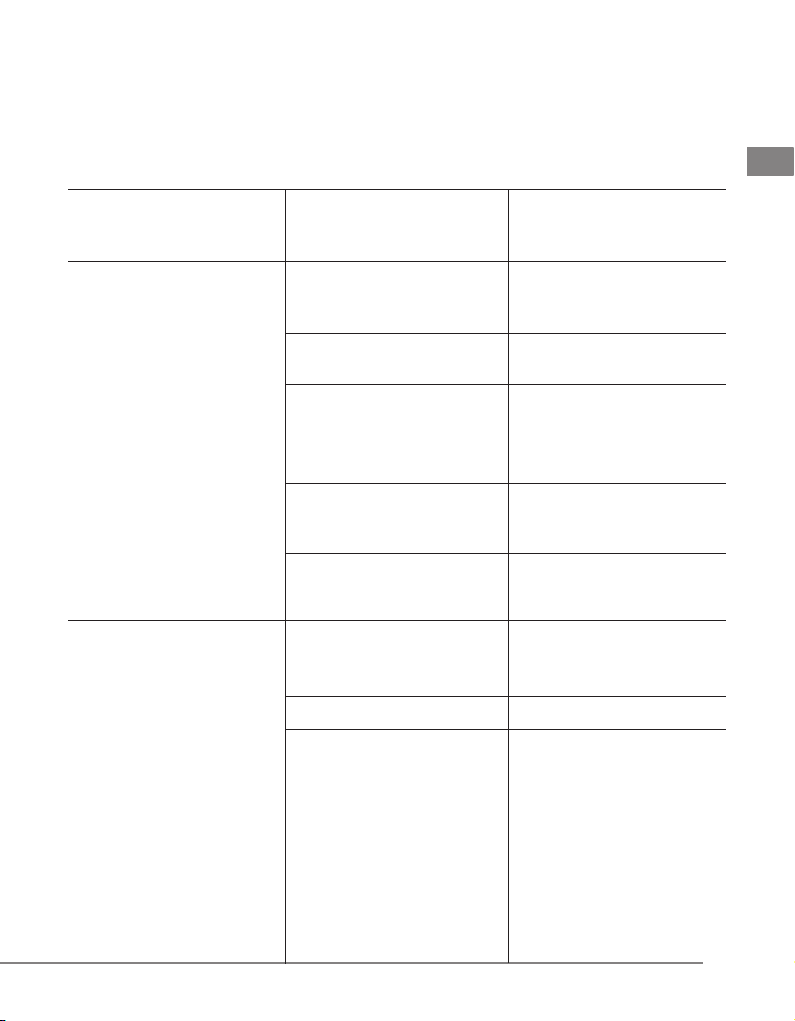
10.0 Behebung von störungen
Sollte der Betrieb des Geräts gestört sein, so lesen Sie erneut die Gebrauchsanleitung durch und
kontrollieren Sie die folgende Tabelle:
STÖRUNG MÖGLICHE URSACHE LÖSUNG
DE
Die Kappe des Pulverbehälters
lässt sich nicht abschrauben.
Während des Betriebs tritt kein
Pulver aus dem vorderen
Poliererendstücks.
Während des Betriebs tritt kein
Wasser aus dem vorderen
Poliererendstück.
Easyjet pro ist mit der Turbine
verbunden und der Pulverbehälter
steht unter Druck.
Die Dentaleinheit ist nicht mit dem
Luftkreislauf verbunden.
Der Behälter des Easyjet pro ist
leer.
Das vordere Endteil des
Poliergeräts ist wegen zu hoher
Feuchtigkeit im Pulver oder
unzureichender
Reinigung/Wartung verstopft.
Der Stand des Pulvers im
Behälter liegt über dem maximal
zulässigen Niveau.
Das Pulver ist ungeeignet.
Die Dentaleinheit ist nicht mit dem
Wasserkreislauf verbunden.
Zu viel Kalk im Wasser.
Wasserlter der Dentaleinheit
verstopft.
Trennen Sie Easyjet pro von der
Turbine, damit der Druck des
Innenkreislaufes fällt.
Kontrollieren Sie die Verbindung
der Dentaleinheit mit dem
Luftkreislauf.
Lesen Sie Kapitel “05.2”.
Lesen Sie das Kapitel “06.1 - 6.3”.
Nehmen Sie das Pulver aus dem
Behälter und reinigen Sie ihn mit
einem trockenen Tuch.
Lesen Sie das Kapitel “07.0”
Geben Sie das Pulver nur bis
zum korrekten Stand in den
Behälter (siehe Kapitel “05.2”).
Für den korrekten Betrieb des
Geräts benutzen Sie lediglich
Pulver von MECTRON.
Kontrollieren Sie, ob die
Dentaleinheit mit dem
Wasserkreislauf verbunden ist.
Lesen Sie Kapitel “06.3 - 07.0”.
Kontrollieren Sie die Verbindung
mit dem Wasserkreislauf der
Dentaleinheit.
easyjet pro - Gebrauchs- und Wartungshandbuch
49
Page 49
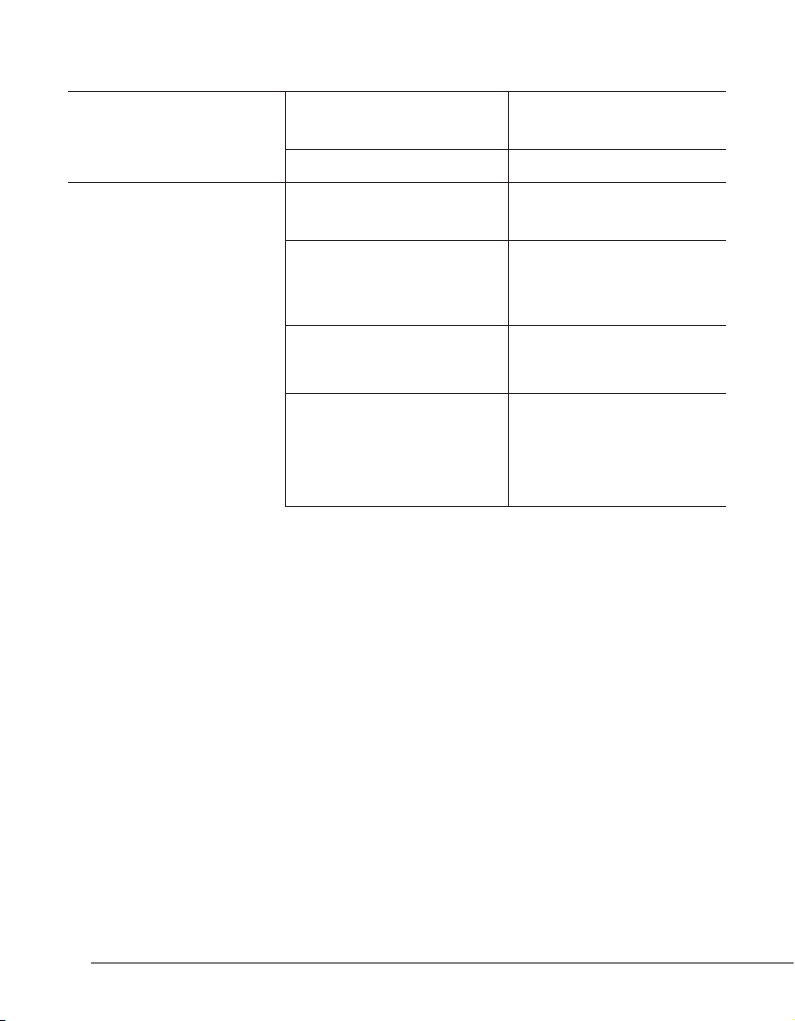
STÖRUNG MÖGLICHE URSACHE LÖSUNG
Pulveraustritt aus dem Deckel
des Pulverbehälters.
Die Therapie zeigt keine Wirkung. Unzureichender Druck des
Deckel nicht korrekt
zugeschraubt.
Pulverreste im Gewinde.
Luftversorgungskreislaufes.
Zu niedriger oder zu hoher Stand
des Pulvers im Behälter.
Ungeeignetes Pulver.
Das vordere Endteil des
Poliergeräts ist wegen zu hoher
Feuchtigkeit im Pulver oder
unzureichender
Reinigung/Wartung verstopft.
Deckel korrekt zuschrauben.
Lesen Sie das Kapitel “06.1”
Kontrollieren Sie den Druck des
Luftkreislaufes der Dentaleinheit.
Bringen Sie das Pulver im
Behälter auf den
vorgeschriebenen Stand (siehe
Kapitel “05.2”).
Für den korrekten Betrieb des
Geräts verwenden Sie lediglich
Pulver von MECTRON.
Lesen Sie das Kapitel “06.1 -
06.3”.
Nehmen Sie das Pulver aus dem
Behälter und reinigen Sie ihn mit
einem trockenen Tuch
Lesen Sie das Kapitel “07.0”.
11.0 Technische daten
Das Gerät entspricht der EG-Norm 93/42: Klasse II a.
Taktbetrieb Gerät: 60” ON 10” OFF.
Die von der Dentaleinheit für eine Turbine gelieferte Standard-Wasserversorgung:
von 0 bis 3 bar (von 0 hPa bis 3000 hPa) max
Die von der Dentaleinheit für eine Turbine gelieferte Standard-Luftversorgung:
2,3 - 3,2 bar (2300 hPa - 3200 hPa).
Raumverhältnisse für die Anwendung: von +10°C bis +40°C.
Relative Luftfeuchtigkeit von 30 % bis 75 %.
Transport- und Lagerbedingungen: von -10°C bis +70°C.
Relative Luftfeuchtigkeit von 10 % bis 90 %.
Luftdruck P: 500hPa/1060hPa.
Gewicht und Maße: 125 g.
40°C.
50
easyjet pro - Gebrauchs- und Wartungshandbuch
Page 50
12.0 Garantie
Jedes MECTRON-Gerät wird vor der Auslieferung einer strengen Prüfung und Endkontrolle unterzogen,
um einen einwandfreien Betrieb der Geräte zu gewährleisten.
MECTRON gewährt auf alle bei einem MECTRON-Wiederverkäufer oder -Importeur neu gekauften
MECTRON-Produkte eine Garantie von 1 (EIN) Jahr ab dem Kaufdatum für Material- und
Produktionsfehler. MECTRON verpichtet sich, während der Garantiezeit die seines Erachtens schadhaften Teile der Produkte kostenlos zu reparieren (oder nach freier Entscheidung zu ersetzen).
Ein Gesamtersatz der MECTRON-Produkte ist nicht vorgesehen.
MECTRON haftet auf keinen Fall für etwaige direkte oder indirekte Personen- und oder Sachschäden in
den folgenden Fällen:
- Das Gerät wurde nicht für seinen vorgesehenen Verwendungszweck eingesetzt.
- Das Gerät wurde nicht nach den in diesem Handbuch beschriebenen Anweisungen und Vorschriften
benutzt.
- Die Elektroanlage in den Räumen, in denen das Gerät betrieben wird, entspricht nicht den in Kraft
stehenden Gesetzen und den diesbezüglichen Vorschriften.
- Die Zusammensetzung, die Zusätze, Einstellung, Änderung und Reparatur wurde nicht von
Mectron-Fachpersonal vorgenommen.
- Die Raumverhältnisse zur Aufbewahrung und Lagerung des Geräts entsprechen nicht den im Kapitel
Technische Daten aufgeführten Vorschriften.
Von der Garantie ausgeschlossen sind Transportschäden, durch unsachgemäßen Gebrauch oder Nachlässigkeit verursachte Schäden, durch Anschluss an eine andere als die vorgesehene Stromspannung
entstandene Schäden sowie die Kontrollleuchten, Knöpfe und sämtliches Zubehör.
Die Garantie verfällt, wenn das Gerät von anderen Personen als dem Kundendienst verändert oder
repariert wird.
ACHTUNG
Die Garantie ist nur gültig, wenn der dem Gerät beigefügte Garantieschein vollständig ausgefüllt und
unserem Firmensitz oder gegebenenfalls dem MECTRON-Wiederverkäufer/Importeur innerhalb von 20
(ZWANZIG) Tagen ab dem Kaufdatum übermitttelt wird, das aus dem vom MECTRON-Verkäufer oder
Importeur ausgestellten Lieferschein/Kaufbeleg ersichtlich ist.
Zur Inanspruchnahme der Garantie stellt der Kunde das beschädigte Gerät dem Wiederverkäufer oder
dem MECTRON-Importeur, bei dem er das Gerät gekauft hat, auf seine Kosten zu.
Das Gerät einschließlich der Zubehörteile ist gut verpackt (möglichst in der Originalpackung)
einzusenden. Dem Gerät ist eine Karte mit folgenden Angaben beizufügen:
a) Name, Adresse und Telefonnummer des Besitzers
b) Name und Adresse des Wiederverkäufers/Importeurs
c) Fotokopie des Lieferscheins/Kaufbelegs des Geräts durch den Besitzer, auf dem außer dem Datum
die Bezeichnung des Geräts und die Seriennummer angegeben sind
d) Beschreibung der Betriebsstörung
Es besteht keine Haftung für den Transport und etwaige Transportschäden.
Im Falle von Schäden, die durch Unfälle oder unsachgemäßen Gebrauch verursacht werden oder nach
Ablauf der Garantie eintreten, werden die Reparaturen nach den effektiven Material- und Arbeitskosten
berechnet.
DE
Die in dieser Veröffentlichung enthaltenen Angaben sind unverbindlich und können jederzeit ohne
Vorankündigung geändert werden.
easyjet pro - Gebrauchs- und Wartungshandbuch
51
Page 51

Sommaire
00.0 Introduction ................................................................................................................................. .......53
00.1 Avant-propos ...................................................................................................................... .......53
00.2 Description de l’appareil .................................................................................................... .......53
00.3 Destination d’utilisation ...................................................................................................... .......54
00.4 Prescriptions de sécurité ................................................................................................... .......54
01.0 Données d’identication ............................................................................................................. .......56
01.1 Données spéciques ......................................................................................................... .......56
01.2 Plaque d’identication de l’appareil ................................................................................... .......56
02.0 Essai ........................................................................................................................................... .......56
02.1 Essai de l’appareil .............................................................................................................. .......56
03.0 Livraison ..................................................................................................................................... .......56
03.1 Livraison de l’appareil ........................................................................................................ .......56
03.2 Liste du matériel- fourniture Standard ............................................................................... .......57
04.0 Installation .................................................................................................................................. .......58
04.1 Prescriptions de sécurité dans la phase d’installation ....................................................... .......58
04.2 Branchement de l’appareil ................................................................................................. .......58
05.0 Utilisation .................................................................................................................................... .......59
05.1 Prescription de sécurité pendant l’utilisation ...................................................................... .......59
05.2 Instructions d’utilisation ...................................................................................................... .......61
06.0 Nettoyage, desinfection, sterilisation .......................................................................................... .......62
06.1 Nettoyage et désinfection du corps Easyjet pro ................................................................ .......62
06.2 Procédure de stérilisation ................................................................................................ .......62
06.3 Nettoyage et stérilisation en autoclave de la che antérieure nettoyeur ........................... .......63
07.0 Entretien périodique ................................................................................................................... .......63
08.0 Modalités et précautions pour l’écoulement ............................................................................... .......64
09.0 Symboles .................................................................................................................................... .......64
10.0 Solutions des inconvénients ....................................................................................................... .......65
11.0 Données techniques ................................................................................................................... .......66
12.0 Garantie ...................................................................................................................................... .......67
Unix® - Unix L® is a registered trademark of Bien-Air company
Multiex® - Multiex lux® is a registered trademark of KaVo company
Sirona® R - Sirona® B is a registered trademark of SIRONA company
Roto Quick® - Roto Quick Lux® is a registered trademark of W&H company
52
easyjet pro - notice d’utilisation et d’entretien
Page 52
00.0 Introduction
�
�
00.1 Avant-propos
Lire attentivement ce manuel avant d’effectuer toute opération d’installation, d’utilisation,
d’entretien ou autre intervention sur l’appareil.
Gardez toujours ce manuel sous la main.
Important: A n d’éviter tout endommagement de personnes ou d’objets, lire attentivement les
paragraphes signalés comme “Prescriptions de sécurité” contenus dans le manuel.
Selon le degré de gravité les prescriptions de sécurité sont à classer d’après les indications
suivantes:
DANGER (se rapporte toujours aux endommagements aux personnes)
ATTENTION (se rapporte aux endommagements éventuels aux objets)
Le but de ce manuel est de faire connaître à l’opérateur les prescriptions de sécurité, les procédures
d’installation, les instructions pour une utilisation correcte de l’appareil ainsi que pour un bon entretien.
L’usager n’est aucunement autorisé à modier ou réparer l’appareil.
Pour toute anomalie relevée, contacter un Centre Assistance Mectron.
Toute tentative de réparation ou de modication de la part de l’usager ou d’un personnel non agréé
invalidera la garantie et délivrera la Maison Constructrice de toute responsabilité pour les
endommagements éventuels au préjudice de tiers ou d’objets.
Les informations et les plans contenus dans ce manuel sont mis à jour à la date d’édition qui paraît à la
page 104.
MECTRON se réserve le droit de toute modication. Dans le cas où le contenu de l’appareil que vous
possédez ne correspond pas au manuel, demandez des renseignements à votre détaillant ou au Service
Après-vente de MECTRON.
Il est interdit d’utiliser ce manuel pour d’autres buts qui ne soient pas ceux qui sont strictement liés à
l’installation, l’utilisation et l’entretien de l’appareil.
00.2 Description de l’appareil
Easyjet pro est un blanchisseur compact à jet de poudre de bicarbonate à embrayage rapide sur la
turbine. Easyjet pro partage avec les appareils de table les plus connus tous les avantages essentiels:
- un jet de poudre constant et performant
- une utilisation simple et able
Le principe de fonctionnement de cet appareil se base sur l’action mécanique obtenue par un jet de
cristaux de bicarbonate de sodium accélérés par un ux d’air comprimé. L’énergie cinétique qui est
imprimée aux particules se dissipe presque complètement dans le choc contre la surface de l’émail en
produisant une action délicate mais efcace de nettoyage. L’action se complète par un jet d’eau qui, en
protant de la dépression créée autour de l’injecteur, se dispose en cloche autour du ux principal en
produisant un double effet: il empêche en bonne partie le rebondissement et la sortie du nuage de
bicarbonate et effectue un lavage continu de la zone traitée en transformant le bicarbonate en solution.
FR
easyjet pro - notice d’utilisation et d’entretien
53
Page 53
00.3 Destination d’utilisation
�
�
�
�
�
�
�
Nettoyeur à jet de bicarbonate. Indications.
- Enlèvement de la plaque bactérienne
- Enlèvement de taches de la surface dentale dues au tabac, au café, au thé et à la clorixidine;
- Prophylaxie sur des patients en thérapie ortodentale.
00.4 Prescriptions de sécurité
Mectron décline toute responsabilité pour tout endommagement direct ou indirect porté sur tiers ou sur
des objets, dans les cas suivants:
1 L’appareil n’est pas utilisé selon sa destination
2 L’appareil n’est pas utilisé conformément au mode d’emploi et aux prescriptions décrites dans ce
manuel
3 Le système électrique des lieux où l’appareil est utilisé n’est pas conforme aux normes en vigueur et
à ses prescriptions
4 Les opérations d’assemblages extension, réglage, modication ont été effectuées par un personnel
non agréé
5 Les conditions de conservation et de stockage de l’appareil ne sont pas conformes aux prescriptions
indiquées dans la section Données techniques.
DANGER: Personnel qualié et spécialisé.
L’appareil doit être utilisé exclusivement par un personnel spécialisé et formé à ce but spécique: le
dentiste et/ou l’hygiéniste. L’utilisation de l’appareil ne produit aucun effet collatéral si utilisé correctement.
DANGER: Destination d’utilisation.
Employer l’appareil uniquement pour l’utilisation pour laquelle il a été prévu (consulter paragraphe “00.3”).
La non-observation de cette prescription peut causer de graves lésions au patient, à l’opérateur ainsi que
des dommages/pannes au dispositif.
DANGER: Nettoyage, désinfection, stérilisation des produits neufs ou réparés.
Tous les produits neufs ou réparés sont délivrés non stériles. Avant le traitement, tous les produits neufs
ou réparés doivent être nettoyés, désinfectés et si possible passés en autoclave et soigneusement
stérilisés selon les instructions du chapitre “06.0”.
DANGER: Contrôle des infections.
Pour la sécurité maximum du patient et de l’opérateurutiliser uniquement des accessoires propres,
désinfectés et stérilisés. Suivre attentivement les instructions du chapitre “06.0”.
DANGER: Utiliser exclusivement des pièces de rechange et des accessoires originaux
Mectron.
ATTENTION: Utiliser exclusivement de la poudre de production Mectron (prophylaxis powder).
Ne pas utiliser de poudres produites par d’autre fabricants car elle pourraient endommager l’appareil ou
fournir des performances insufsantes et invalider la garantie de l’appareil.
DANGER: Contrôle de l’état du dispositif avant le traitement.
Avant tout traitement contrôler toujours le bon fonctionnement de l’appareil et l’efcacité des
accessoires. Si l’on devait repérer des anomalies de fonctionnement, ne pas effectuer le traitement.
S’adresser à l’Assistance technique agréé si les anomalies concernent l’appareil.
54
easyjet pro - notice d’utilisation et d’entretien
Page 54
�
DANGER: Contre-indications.
�
�
�
�
�
Ne pas utiliser le dispositif sur des patients qui présentent des pathologies à l’appareil respiratoire comme
bronchites chroniques, asthme, emphysème, etc.
DANGER: Contre-indications.
Les patients qui portent des lentilles de contact doivent les ôter avant de se soumettre au traitement du
nettoyeur à jet de bicarbonate.
DANGER: Contre-indications.
Ne pas diriger le jet air/bicarbonate/eau vers les yeux.
La non observation de cette prescription peut causer des lésions oculaires graves. Nous conseillons de
porter des lunettes de protection à toute personne intéressée (patient, hygiéniste, dentiste).
DANGER: Contre-indications.
Nous conseillons au dentiste et à l’hygiéniste d’utiliser un masque de protection an de limiter l’inhalation
de poudre.
DANGER: Contre-indications.
Ne pas diriger le jet air/bicarbonate/eau vers des composites, des obturations et des bridges. La non
observation de cette prescription peut les endommager.
DANGER: Contre-indications.
Ne pas diriger le jet d’air/bicarbonate/eau sur les tissus moux ou dans le sillon des tissus de le gencive.
La non observation de cette prescription peut causer un emphysème au tissu de la gencive (emphysème
des muqueuses et/ou sous-cutané).
FR
easyjet pro - notice d’utilisation et d’entretien
55
Page 55
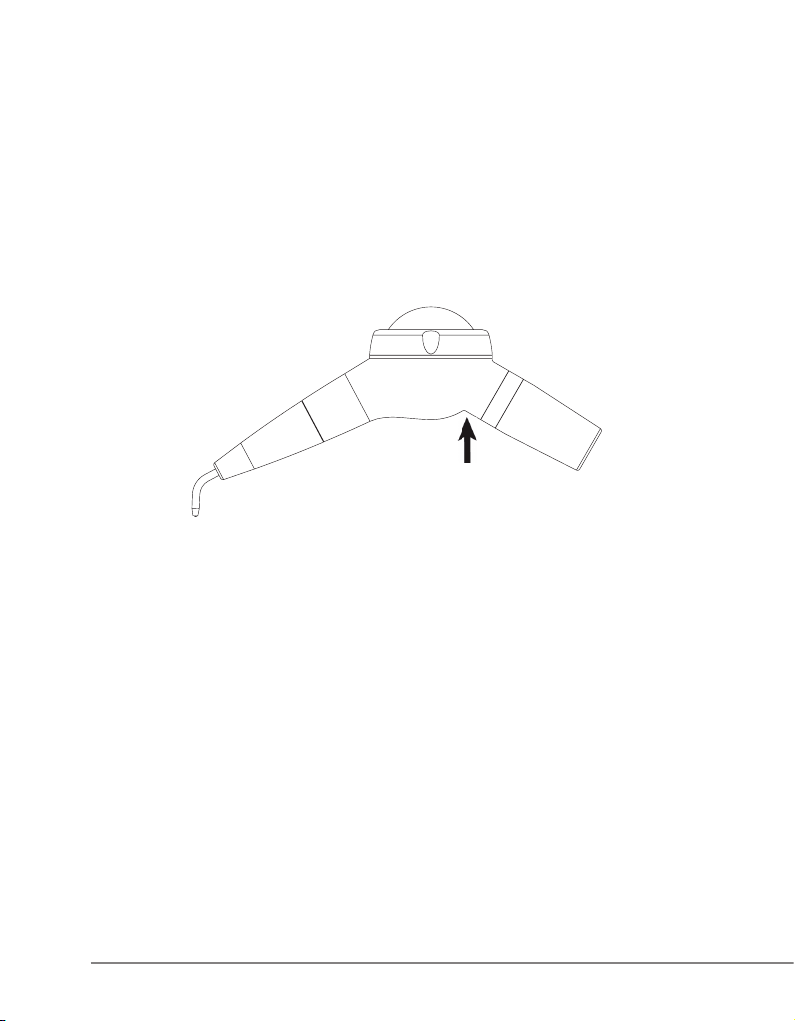
01.0 Données d’identication
01.1 Données spéciques
Une description détaillée du modèle et le numéro de série permettra à notre Service Après-vente de
répondre plus facilement avec des réponses rapides et efcaces.
Citer toujours ces données lorsque vous contactez un centre Assistence Technique Mectron.
01.2 Plaque d’identication de l’appareil
Chaque appareil est pourvu d’un numéro de série (Plan1 - Réf.A). Les données ultérieures sont
contenues dans ce manuel (voir section “11.0”).
A
Plan 1
02.0 Essai
02.1 Essai de l’appareil
Tous les appareils produits par MECTRON sont rigoureusement contrôlés et testés dans tous leurs
composants.
Pendant ce test les composants sont soumis à une série de cycles de travail.
Cette phase permet de repérer les mauvais fonctionnements éventuels qui seraient dus à des
composants imparfaits.
Cette procédure garantit un produit fonctionnant et able en tous ses composants.
03.0 Livraison
03.1 Livraison de l’appareil
L’emballage de l’appareil est sensible aux chocs car il contient des composants électroniques. Le transport et le stockage doivent donc être effectués avec la plus grande attention.
Ne pas superposer plusieurs cartons an que les emballages ne soient pas écrasés.
Tout le matériel expédié par MECTRON a été contrôlé au moment de l’envoi.
L’appareil est livré sous emballage et protégé de façon adéquate.
Au moment de la réception de l’appareil contrôler les endommagements éventuels qui seraient arrivés
durant le transport et en cas afrmatif, déposer une réclamation au transporteur.
56
easyjet pro - notice d’utilisation et d’entretien
Page 56
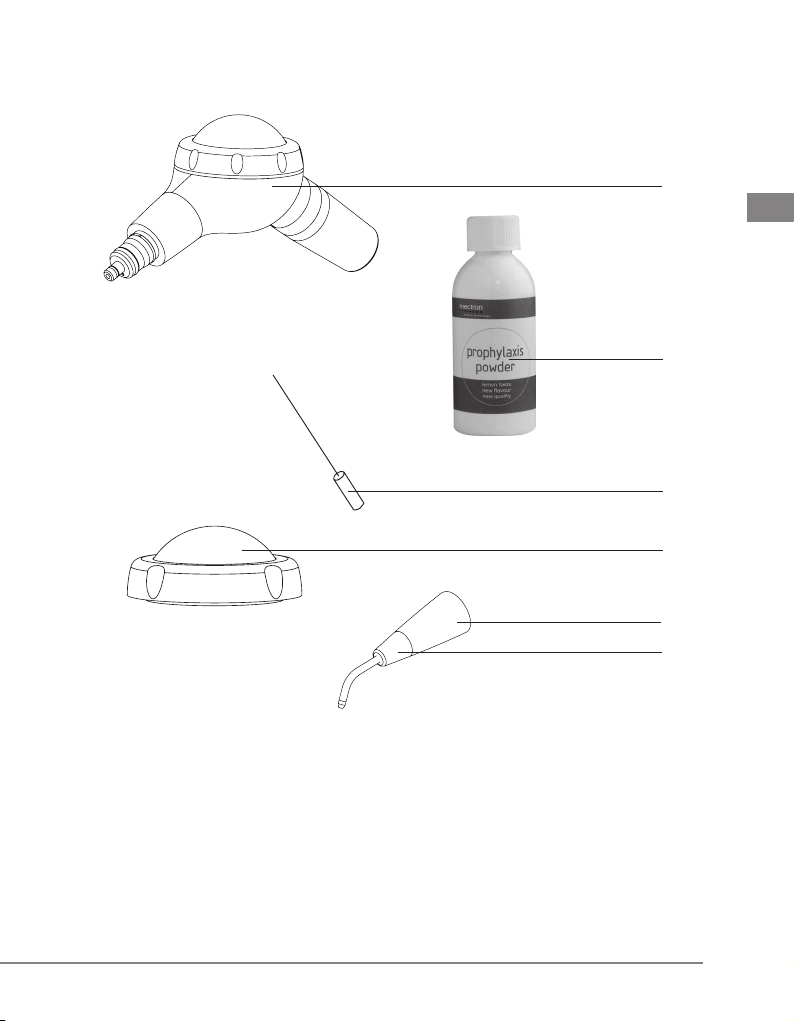
Plan 2
03.2 Liste du matériel- fourniture Standard
1 Corps de l’appareil (Plan 2 - Réf.A);
1 Boîte de poudre prophylaxis powder (Plan 2 - Réf.B);
1 Aiguillies pour le nettoyage de la boîte terminale antérieure nettoyage (Plan 2 - Réf.C);
1 Elément de rechange Easyjet pro (Plan 2 - Réf.D);
1 Terminal antérieur de nettoyage (Plan 2 - Réf.E);
1 Capuchon embout terminal antérieur (Plan 2 - Réf.F).
Cette fourniture peut varier en cas de campagnes promotionnelles.
A
FR
B
C
D
E
F
easyjet pro - notice d’utilisation et d’entretien
57
Page 57
04.0 Installation
�
�
�
�
�
�
�
�
04.1 Prescriptions de sécurité dans la phase d’installation
ATTENTION: Ne pas exposer l’appareil à la lumière directe du soleil ni à des sources de rayons UV.
ATTENTION: L’appareil est transportable mais il doit être manié avec attention lorsqu’on le déplace.
Placer la pédale par terre de façon qu’elle sera activée uniquement si l’opérateur en a l’intention.
1 Alimentation eau spray turbine;
2 Alimentation air turbine;
3 Présence poudre;
ATTENTION: Si l’alimentation de l’eau et de l’air est sufsante pour la turbine, Easyjet doit marcher
correctement.
Alimentation standard fournie avec l’unité pour une turbine:
- eau de 0 à 3 bar (de 0 hPa à 3000 hPa) max 40°C;
- air 2,3 - 3,2 bar (2300 hPa - 3200 hPa).
04.2 Branchement de l’appareil
ATTENTION: Contrôler que le connecteur de la turbine soit bon état.
ATTENTION: Ne pas relier Easyjet pro lorsque la turbine est sous pression.
ATTENTION: Ne pas appuyer sur la pédale de commande de la turbine pendant la connexion de
Easyjet pro.
ATTENTION: Si l’on dispose d’une turbine à lumière, éteignez-la.
ATTENTION: La borne antérieure de nettoyage et le raccord de la turbine doivent être parfaitement
secs. La présence d’humidité peut causer l’obturation des canaux de circulation air/poudre.
Easyjet pro est pourvu d’un adaptateur spécique qui correspond au raccord de la turbine qui se trouve
sur l’unité. Utiliser Easyjet pro uniquement pour le raccord de la turbine que l’on a à sa disposition. Relier
Easyjet pro à un autre connecteur pourrait l’endommager.
Pour mettre en marche l’appareil il faut d’abord contrôler:
58
easyjet pro - notice d’utilisation et d’entretien
Page 58
05.0 Utilisation
�
�
�
�
�
�
�
�
�
�
�
05.1 Prescription de sécurité pendant l’utilisation
DANGER: Contre-indications.
Ne pas utiliser le dispositif sur des patients qui présentent des pathologies à l’appareil respiratoire comme
bronchites chroniques, asthme, emphysème, etc.
DANGER: Contre-indications.
Les patients qui portent des lentilles de contact doivent les ôter avant de se soumettre au traitement du
nettoyeur à jet de bicarbonate.
DANGER: Contre-indications.
Ne pas diriger le jet air/bicarbonate/eau vers les yeux.
La non observation de cette prescription peut causer des lésions oculaires graves. Nous conseillons de
porter des lunettes de protection à toute personne intéressée (patient, hygiéniste, dentiste).
DANGER: Contre-indications.
Nous conseillons au dentiste et à l’hygiéniste d’utiliser un masque de protection an de limiter l’inhalation
de poudre.
DANGER: Contre-indications.
Ne pas diriger le jet air/bicarbonate/eau vers des composites, des obturations et des bridges. La non
observation de cette prescription peut les endommager.
DANGER: Contre-indications.
Ne jamais diriger le jet d’air/bicarbonate/eau sur les tissus moux ou dans le sillon de la gensive. La
non-observation de cette prescription peut causer un emphysème du tissu de la gensive (emphysème des
muqueuse et/ou sous-cutané).
DANGER: Contrôle de l’état du dispositif avant le traitement.
Avant tout traitement contrôler toujours le bon fonctionnement de l’appareil et l’efcacité des accessoires.
Si l’on devait repérer des anomalies de fonctionnement, ne pas effectuer le traitement. S’adresser à
l’Assistance technique agréé si les anomalies concernent l’appareil.
FR
DANGER: Contrôle des infections et nettoyage des circuits eau et air.
Pour la sécurité maximum du patient et de l’opérateur, après chaque traitement, suivre toutes les
prescriptions indiquées au chapitre “06.0”.
ATTENTION: Utiliser exclusivement la poudre de production Mectron (prophylaxis powder).
Ne pas utiliser de poudres produites par d’autres fabricants car elles pourraient endommager l’appareil,
fournir des performances insufsantes et invalider la garantie de l’appareil.
ATTENTION: Ne pas essayer de dévisser le couvercle du réservoir de poudre lorsqu’il est sous
pression.
ATTENTION: Vérier que le réservoir de poudre soit parfaitement sec.
La présence d’humidité peut causer l’obstruction des canaux.
easyjet pro - notice d’utilisation et d’entretien
59
Page 59
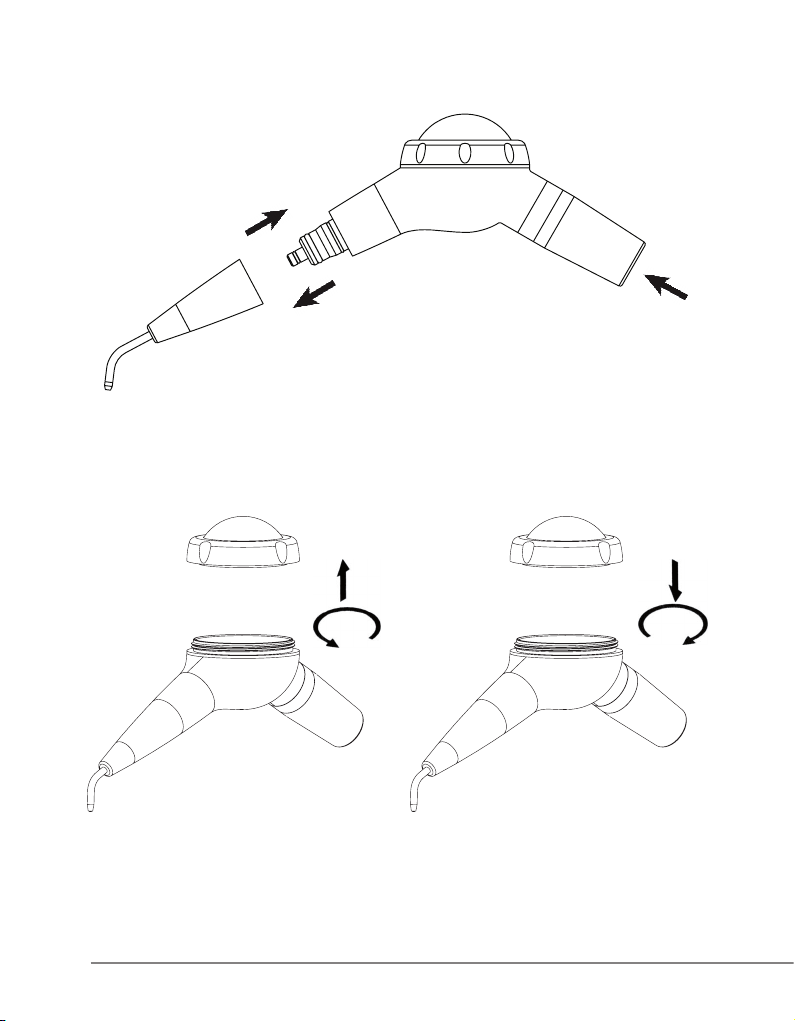
A
B
C
Plan 3
BA
60
Plan 4
easyjet pro - notice d’utilisation et d’entretien
Page 60
05.2 Instructions d’utilisation
�
�
�
�
�
�
1 Insérer la borne antérieure de nettoyage (stérile) (Plan 3 - Réf.A) jusqu’à fond;
2 Relier Easyjet pro à la turbine de l’unité (Plan 3 - Réf.B);
3 Régler le débit de l’eau à partir de l’unité pour obtenir un jet d’eau uniforme. Le réglage est plus facile
en absence de poudre;
4 Dévisser la partie supérieure du réservoir de poudre (Plan 4 - Réf.A);
5 Verser la poudre dans les réservoirs, en évitant que les niveaux atteigne les gicleurs placés à
l’intérieur;
ATTENTION: il est conseillable d’utiliser le bouchon doseur de la confection prophylaxis powder
et de le remplir jusqu’au niveau Easyjet pro.
ATTENTION: il est conseillable de ne pas agiter Easyjet pro après avoir inséré la poudre an
d’éviter l’obstruction des gicleurs.
6 Remettre en place la partie supérieure du réservoir de poudre sans la visser excessivement
(Plan 4 - Réf.B);
ATTENTION: Eliminer les résidus de poudre du letage de la partie supérieure du réservoir avant
de la visser.
7 Appuyer sur la pédale de la turbine pour effectuer le traitement;
ATTENTION: Utiliser la canule d’aspiration pour éliminer les mélanges air/bicarbonate/eau de la
bouche du patient.
8 Effectuer le traitement en effectuant de petits mouvements circulaires. Diriger le gicleur uniquement
vers l’émail dentaire, du sillon gingival vers le bord incisif de la dent en respectant une distance de 3
à 5 mm.
9 Polir à la n toutes les supercies dentaires en réglant le débit d’eau au maximum;
ATTENTION: Lorsque l’on soulève le pieds de la pédale le jet air/bicarbonate/eau continue
encore pendant quelques secondes. Terminer le traitement en considérant ces secondes
supplémentaires.
10 Après le traitement, les dents sont propres et la cuticule dentaire est totalement éliminée.
Sa reconstitution de la part des protéines de la salive nécessite de 2/ 3 heures, temps pendant lequel
les dents ne sont plus protégées naturellement contre les colorants. Informer le patient que pendant
cet intervalle on ne doit pas fumer, ni consommer d’aliments ou de boissons qui pourraient tacher
fortement la dent (thé, café, ...).
REMARQUE IMPORTANTE: Borne antérieure de nettoyage bouchée (la poudre ne sort pas)
1 Débrancher la borne antérieure de nettoyage du corps de Easyjet pro (Plan 3 - Réf.C).
2 Libérer le canal des résidus de poudre en utilisant l’aiguille spéciale de nettoyage fournie avec
l’appareil (Plan 2 - Réf.C) en suivant les mouvements indiqués (Plan 5). Soufer de l’air comprimé
avec la seringue dans le trou central de la borne, des deux côtés.
ATTENTION: Nettoyer le canal du gicleur en utilisant exclusivement l’aiguille pour le
nettoyage fournie avec l’appareil (Plan 2 - Réf.D).
3 Nettoyer aussi soigneusement la partie de connexion antérieure du corps de Easyjet pro.
Si nécessaire, ôter les résidus éventuels de poudre en y soufant de l’air comprimé avec la seringue.
4 Relier la borne de nettoyage antérieure au corps Easyjet pro (Plan 3 - Réf.A).
FR
easyjet pro - notice d’utilisation et d’entretien
61
Page 61
06.0 Nettoyage, desinfection, sterilisation
�
�
�
�
�
�
�
06.1 Nettoyage et désinfection du corps Easyjet pro
DANGER: Débrancher Easyjet pro de la turbine.
Toujours débrancher Easyjet pro de la turbine avant d’effectuer toute intervention de nettoyage,
désinfection et de stérilisation.
DANGER: Easyjet pro n’est pas protégé contre la pénétration de liquides. Ne pas l’immerger.
Ne pas gicler de liquides directement sur la surface extérieure de l’appareil.
DANGER: Easyjet pro ne peut pas être stérilisé.
Après chaque traitement, effectuer les opérations suivantes:
1 Débrancher la borne antérieure de nettoyage du corps de Easyjet pro (Plan 3 - Réf.C).
2 Oter les résidus de poudre éventuels du réservoir Easyjet pro.
3 Nettoyer et désinfecter les surfaces en utilisant un chiffon humide et du détergent/désinfectant non
agressifs à PH neutre (PH7), en faisant particulièrement attention au letage de la cavité antérieure.
Si nécessaire, ôter les résidus de poudre éventuels en y soufant de l’air comprimé avec la seringue.
ATTENTION: Suivre soigneusement les instructions fournies par le producteur de la solution
désinfectante.
REMARQUE: Des solutions désinfectantes à base d’eau, à PH neutre, sont fortement recommandées.
Certaines solutions désinfectantes à base alcoolique peuvent être nuisibles et décolorer ou endommager
les matériaux plastiques. Les détergents en poudre peuvent endommager l’extérieur de Easyjet pro.
06.2 Procédure de stérilisation
ATTENTION: Effectuer la stérilisation en utilisant exclusivement un autoclave à vapeur d’eau.
N’utiliser aucune autre procédure de stérilisation (chaleur sèche, irradiation, oxyde d’éthylène, gaz,
plasma à basse température etc.).
DANGER: Easyjet pro ne peut pas être stérilisé.
DANGER: Contrôle des infections - Composants qui peuvent être stérilisés - Oter
soigneusement tout résidu avant la stérilisation.
An d’éviter toute infection de bactéries ou de virus, nettoyer, désinfecter et stériliser toujours, après
chaque traitement, les composants suivants:
1 Borne antérieure d nettoyage (Plan 2 - Réf.E).
2 Aiguille pour le nettoyage de la borne antérieure de nettoyage (Plan 2 - Réf.C).
Ces composants sont construits avec des matériaux qui résistent à une température maximum de 135°C
pour un temps maximum de 20 minutes.
Le procès de stérilisation en autoclave à vapeur doit être effectué selon ces paramètres:
- Cycle à 121°C. pour 16 minutes;
- Cycle à 134°C. pour 4 minutes.
Toutes les phases de stérilisation doivent être effectuées par l’opérateur conformément aux normes
EN ISO 17665-1:2006 et EN 556-1:2001.
62
easyjet pro - notice d’utilisation et d’entretien
Page 62
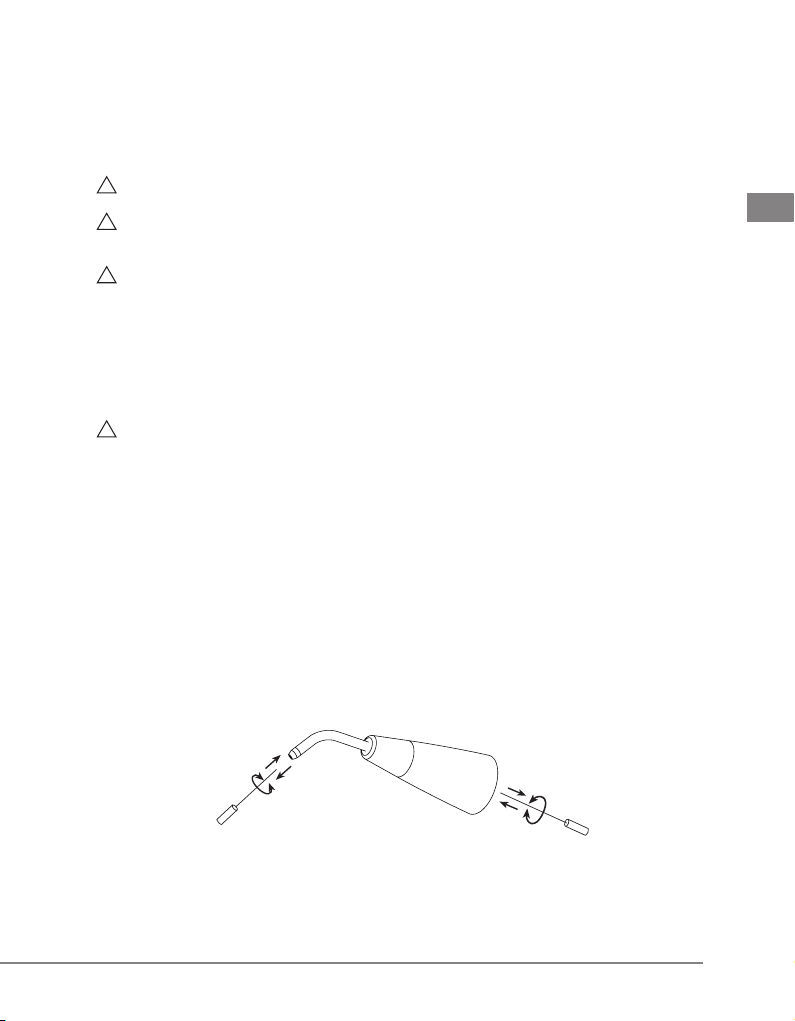
06.3 Nettoyage et stérilisation en autoclave de la che antérieure nettoyeur
�
�
�
�
1 Débrancher la borne antérieure de nettoyage du corps de Easyjet pro (Plan 3 - Réf.C).
2 Libérer le canal des résidus de poudre en utilisant l’aiguille de nettoyage fourni avec l’appareil (Plan
2 - Réf.C) en suivant les mouvements indiqués (Plan 5). Soufer de l’air comprimé avec la seringue
dans l’ouverture centrale de la che des deux côtés.
ATTENTION: Nettoyer le canal de la buse en utilisant exclusivement l’aiguille fournie
spécialement avec l’appareil (Plan 2 - Réf.C).
3
ATTENTION: La présence excessive de calcaire dans l’eau peut déterminer un spray d’eau
insufsant. Pour éliminer cet inconvénient, on conseille de plonger la che antérieure nettoyeur pour
quelques instants dans une solutions d’acide chlorhydrique à 2%.
ATTENTION: Rincer soigneusement la che avec de l’eau distillée de façon à éliminer tout résidu
de la solution d’acide chlorhydrique. Sécher en soufant de l’air comprimé avec la seringue dans
l’ouverture centrale de la che des deux côtés.
4 Désinfecter la che en utilisant une solution désinfectante non agressive à PH neutre. Sécher en
soufant de l’air comprimé en utilisant la seringue dans l’ouverture centrale de la che des deux
côtés.
5 Insérer l’aiguille dans le canal de la borne antérieure de nettoyage et sceller le tout dans des sachets
jetables.
6 Stériliser le sachet qui contient la borne de nettoyage et l’aiguille.
ATTENTION: Avant d’utiliser la borne antérieure, y soufer de l’air comprimé avec la seringue,
an d’éviter qu’à l’intérieur reste de l’humidité.
07.0 Entretien périodique
1 Si le passage d’air de la borne antérieure s’obstrue, il suft d’actionner l’appareil pendant quelques
secondes en utilisant les aiguilles fournies (Plan 5) pour libérer le canal des résidus de poudre.
2 Si la borne antérieure s’obstrue à cause d’une présence excessive de calcaire dans l’eau, on
conseille de le plonger pendant quelques secondes dans une solution d’acide chlorhydrique à 2 %.
3 Toutes les fois qu’on ôte la borne antérieure il faut y soufer de l’air comprimé avec la seringue, dans
la cavité du connecteur de la pièce à main aussi bien que dans le trou central postérieur de la borne
antérieure, an d’éviter toute accumulation de poudre résiduelle.
4 On conseille de vider au moins une fois par jour le réservoir de poudre de Easyjet pro an d’éviter
toute obturation.
FR
Plan 5
easyjet pro - notice d’utilisation et d’entretien
63
Page 63
08.0 Modalités et précautions pour l’écoulement
�
0476
Les modalités et les précautions à prendre pour l’écoulement du dispositif doivent suivre les procédures
prévues par la loi en vigueur comme pour tout autre appareil électronique qui ne fontionne plus.
09.0 Symboles
Attention: lire les instructions.
Appareil conforme à la dir. CE 93/42 CEE.
Organisme notié CERMET.
64
easyjet pro - notice d’utilisation et d’entretien
Page 64
10.0 Solutions des inconvénients
Si l’appareil semble ne pas fonctionner correctement, lire à nouveau les instructions et contrôler la table
ci-dessous:
SYMPTÔME CAUSE SOLUTION POSSIBLE
Le bouchon du réservoir de poudre ne se dévisse pas.
Pendant l’emploi, la poudre ne
sort pas du teminal antérieur de
nettoyage.
Pendant l’emploi, l’eau ne sort
pas du teminal antérieur de
nettoyage.
Easyjet pro est relié à la turbine
et le réservoir de poudre est sous
pression.
Unité non reliée au circuit d’air.
Le réservoir d’Easyjet pro est
vide.
Fiche antérieure abstruée à
cause d’une quantité excessive
d’humidité de la poudre ou à
cause du ettoyage/de l’entretien
insufsant.
Le niveau de la poudre dans
le récipient dépasse le niveau
maximum consenti.
Poudre non adéquate.
Unité non reliée au circuit de
l’eau.
Présence excessive de calcaire
dans l’eau.
Filtre de l’eau de l’unité obstrué.
Débrancher Easyjet pro de la
turbine de façon que le circuit
interne se dépressurise.
Contrôler la connexion de l’unité
au circuit de l’air.
Consulter le paragraphe “05.2”.
Consulter le paragraphe “06.1”
et “06.3”.
Oter la poudre du récipient et nettoyer en utilisant un chiffon sec.
Consulter le paragraphe “07.0”
Rétablir le niveau correct de la
poudre dans le récipient
(consulter le paragraphe “05.2”).
Pour un fonctionnement correct
de l’appareil utiliser uniquement la
poudre produite par MECTRON.
Contrôler la connexion de l’unité
au circuit de l’eau de l’unité.
Consulter le paragraphe
“06.3 - 07.0”.
Contrôler la connexion au circuit
de l’eau de l’unité.
FR
easyjet pro - notice d’utilisation et d’entretien
65
Page 65

SYMPTÔME CAUSE SOLUTION POSSIBLE
Perte de poudre à travers le
bouchon du récipient de la poudre
Thérapie non efcace. Pression insufsante du
Bouchon pas vissé correctement
Résidus de poudre dans le
letage.
circuit d’alimentation de l’air.
Niveau de la poudre dans le
récipient insufsant ou excessif.
Poudre pas adéquate.
Fiche antérieure nettoyeur
obstrué à cause d’une quantité
excessive d’humidité dans la
poudre ou à cause du nettoyage/
de l’entretien insufsant.
Visser le bouchon correctement
Lire le paragraphe “06.1”
Contrôler la pression circuit air
de l’unité.
Rétablir le niveau correct de la
poudre dans le récipient
(consulter paragraphe “05.2”).
Pour un fonctionnement correct
de l’appareil utiliser uniquement la
poudre produite par MECTRON.
Lire le paragraphe “06.5”.
Oter la poudre du récipient et le
nettoyer avec un chiffon sec.
Lire le paragraphe “07.0”.
11.0 Données techniques
Appareil conforme à la Dir. 93/42/CEE: Classe II a.
Appareil pour le fonctionnement intermittent: 60” ON 10” OFF.
Alimentation eau standard fournie avec l’unité pour une turbine:
de 0 à 3 bar (de 0 hPa à 3000 hPa) max 40°C.
Alimentation air standard fournie avec l’unité pour une turbine:
2,3 - 3,2 bar (2300 hPa - 3200 hPa).
Conditions du milieu d’utilisation: de +10°C à +40°C.
Humidité relative de 30% à 75%.
Conditions de transport et de stockage: de -10°C à +70°C.
Humidité relative de 10% à 90%.
Pression de l’air P: 500hPa/1060hPa.
Poids et dimensions: 125 g.
66
easyjet pro - notice d’utilisation et d’entretien
Page 66
12.0 Garantie
Tous les appareils MECTRON, avant leur commercialisation, sont soumis à un contôle nal soigneux qui
vérie leur parfaite fonctionnalité.
MECTRON Vous garantit ses produits, qui ont été achetés par un Revendeur ou un Importateur
MECTRON, contre tout défaut du matériel ou d’usinage, sur une période de 1 (UN) AN à partir de la date
de l’achat.
Pendant la période de validité de la garantie, MECTRON s’engage à réparer (ou, à son choix, à
remplacer) gratuitement les parties qu’elle réputerait imparfaites.
Le remplacement intégral des produits MECTRON est exclus.
MECTRON n’est pas responsable d’endommagements éventuels, directs ou indirects, de tout genre ou
sorte, que des personnes ou des objets pourraient subir pendant l’utilisation des produits MECTRON
causés si:
- l’appareil n’est pas utilisé selon les destinations pour lesquels il est prévu;
- l’appareil n’est pas utilisé selon les indications contenues dans ce manuel;
- le système électrique du milieu où l’appreil est utilisé n’est pas conforme aux normes en vigueur et à
ses prescriptions;
- les opérations d’assemblage, les extensions, réglages, modications et réparations sont effectués par
du personnel non agréé;
- Les conditions du milieu où le matériel est conservé et stocké ne se conforment pas aux prescriptions
indiquées dans la section Données techniques.
La garantie ne couvre pas les cassures accidentelles dues au transport ou à une utilisation incorrecte, à
la négligence, ou encore à cause du branchement à une tension différente de celle qui est prévue; sont
également exclus les voyants, les boutons et tous les accessoires.
La garantie déchoît lorsque l’appareil a été altéré ou réparé par un personnel non agréé.
ATTENTION
La garantie est valable uniquement si le coupon du Certicat de garantie livré avec le produit a été rempli
entièrement et réexpédit à notre siège, ou éventuellement au Revendeur ou à l’Importateur MECTRON
(qui prendra soin de nous faire avoir la garantie), dans un délai de 20 (VINGT) JOURS à partir de la
date d’achat. Le document d’accompagnement/la facture émis par le Revendeur/Importateur MECTRON
faisant foi de ce délai.
Pour bénécier du Service de garantie le client doit rendre l’appareil à réparer, à ses frais, au
Revendeur/Importateur MECTRON qui le lui a vendu.
L’appareil doit être rendu convenablement emballé (si possible dans l’emballage original),
accompagné de tous les accessoires et d’une che indiquant les renseignements suivants:
a) Données du propriétaire, y compris son numéro de téléphone;
b) Données du Revendeur/Importateur ;
c) Photocopie du document d’accompagnement/de la facture d’achat de l’appareil de la part du
propriétaire;
d) Description du mauvais fonctionnement.
Le transport et les endommagements causés par le transport ne sont pas pris sous garantie.
En cas de pannes dues à une utilisation impropre, ou en cas de garantie périmée les réparations des
produits MECTRON seront attribuées selon le coût effectif des matériaux et de la main d’oeuvre
employés.
FR
Les données et autres informations reportées dans la présente notice peuvent être modiées sans préavis.
easyjet pro - notice d’utilisation et d’entretien
67
Page 67

Sumario
00.0 Introducción ................................................................................................................................ .......69
00.1 Premisa .............................................................................................................................. .......69
00.2 Descripción del aparato ..................................................................................................... .......69
00.3 Destino de uso ................................................................................................................... .......70
00.4 Prescripciones de seguridad ............................................................................................. .......70
01.0 Datos de Identicación ............................................................................................................... .......72
01.1 Datos de Identicación ...................................................................................................... .......72
01.2 Placa de identicación del aparato .................................................................................... .......72
02.0 Ensayo........................................................................................................................................ .......72
02.1 Ensayo del aparato ........................................................................................................... .......72
03.0 Entrega ....................................................................................................................................... .......72
03.1 Entrega del aparato ........................................................................................................... .......72
03.2 Lista de materiales incluidos en la dotación Estándar ....................................................... .......73
04.0 Instalación .................................................................................................................................. .......74
04.1 Prescripciones de seguridad en la fase de instalación ...................................................... .......74
04.2 Conexión del aparato ......................................................................................................... .......74
05.0 Uso ............................................................................................................................................. .......75
05.1 Prescripciones de seguridad en fase de empleo ............................................................... .......75
05.2 Instrucciones de uso .......................................................................................................... .......77
06.0 Limpieza, desinfección, esterilización ........................................................................................ .......78
06.1 Limpieza y desinfección del cuerpo de “easyjet pro” ......................................................... .......78
06.2 Procedimientos de esterilización ....................................................................................... .......78
06.3 Esterilización en autoclave del terminal anterior del limpiador .......................................... .......79
07.0 Mantenimiento periódico ............................................................................................................ .......79
08.0 Modalidad y precauciones para la eliminación ........................................................................... .......80
09.0 Símbolos..................................................................................................................................... .......80
10.0 Solución de inconvenientes ........................................................................................................ .......81
11.0 Datos técnicos ............................................................................................................................ .......82
12.0 Garantía...................................................................................................................................... .......83
Unix® - Unix L® is a registered trademark of Bien-Air company
Multiex® - Multiex lux® is a registered trademark of KaVo company
Sirona® R - Sirona® B is a registered trademark of SIRONA company
Roto Quick® - Roto Quick Lux® is a registered trademark of W&H company
68
easyjet pro - manual de uso y mantenimiento
Page 68
00.0 Introducción
�
�
00.1 Premisa
Leer atentamente este manual antes de proceder a las operaciones de instalación, empleo,
mantenimiento u otras intervenciones en el aparato.
Tener siempre al alcance de la mano el presente manual.
Importante: Para evitar daños a personas o a cosas, leer con particular atención todos los párrafos
“Prescripciones de seguridad” presentes en el manual.
Según el grado de gravedad las prescripciones de seguridad han sido clasicadas con las siguientes
indicaciones:
PELIGRO (Referente siempre a daños las personas)
ATENCIÓN (Referente a posibles daños a cosas)
El objeto del presente manual es poner en conocimiento del operador las prescripciones de seguridad,
los procedimientos de instalación, las instrucciones para un uso correcto y un correcto mantenimiento del
aparato.
El usuario no está autorizado, por ningún motivo, a manipular el aparato.
Para cualquier anomalía, dirigirse a un Centro de Asistencia Mectron.
Cualquier intento de manipulación, modicación por parte del usuario o de personal no autorizado, anula
la garantía y exime a la Empresa Constructora de cualquier responsabilidad por daños a personas o
cosas.
Las informaciones e ilustraciones, del presente manual, están actualizadas a la fecha de edición que se
indica en la página 104.
La MECTRON está empeñada en una continua actualización de sus productos con posibles
modicaciones a los componentes del aparato. En el caso se hallen discordancias entre cuánto descrito
en el presente manual y la instrumentación en vuestro poder, les rogamos solicitar mayores detalles a su
representante de Ventas o al Servicio de Posventas de MECTRON.
Se prohibe el uso del presente manual, para objetivos diferentes de aquéllos estrictamente relacionados
con la instalación, el empleo y el mantenimiento del aparato.
00.2 Descripción del aparato
“easyjet pro” es un blanqueador compacto con chorro de polvo de bicarbonato, con acoplamiento rápido a
la turbina. “easyjet pro” comparte todas las ventajas esenciales con los más conocidos aparatos de mesa:
- Un chorro de polvo constante y eciente
- El uso simple y la abilidad.
El principio de funcionamiento de easyjet pro se basa en la acción mecánica obtenida por un chorro de
cristales de bicarbonato de sodio acelerados, por un ujo de aire comprimido, en la boquilla situada en
el extremo de la pieza de mano. La energía cinética impresa de esta manera a las partículas, se disipa
casi completamente en el impacto contra la supercie del esmalte produciendo una delicada pero ecaz
acción de limpieza. La acción es completada por un chorro de agua que, explotando la depresión creada
alrededor de la boquilla, se dispone en forma de campana alrededor del ujo principal produciendo un
doble efecto: impedir en buena parte el rebote y el derrame de la nube de bicarbonato y efectuar un
lavado continuo de la zona tratada convirtiendo en solución el bicarbonato.
ES
easyjet pro - manual de uso y mantenimiento
69
Page 69
00.3 Destino de uso
�
�
�
�
�
�
�
Limpiador con chorro de bicarbonato. Indicaciones.
- Eliminación de la placa bacteriana;
- Eliminación de manchas de la supercie dental debidas a tabaco, café, té y clorixidina;
- Prolaxis en pacientes en terapia ortodóntica.
00.4 Prescripciones de seguridad
La Mectron rechaza cualquier responsabilidad por daños directos o indirectos, a personas o a cosas, en
los siguientes casos:
1 El aparato no es empleado para el uso previsto.
2 El aparato no es utilizado conforme a las instrucciones y prescripciones descritas en el presente
manual.
3 La instalación eléctrica de los locales en que se utiliza el aparato no es conforme a las normas
vigentes y a las prescripciones correspondientes.
4 Las operaciones de ensamblaje, extensiones, regulaciones, modicaciones y reparaciones son
efectuadas por personal no autorizado por Mectron.
5 Las condiciones ambientales de conservación y almacenaje del aparato no son conformes a las
prescripciones indicadas en la sección datos técnicos.
PELIGRO: Personal calicado y especializado.
El aparato tiene que ser utilizado exclusivamente por personal especializado y adecuadamente
adiestrado. El empleo del aparato no produce efectos colaterales si se utiliza correctamente.
PELIGRO: Destino de uso.
Emplear el aparato exclusivamente para el uso al cual ha sido destinado (ver párrafo “00.3”). No cumplir
con esta prescripción puede provocar graves lesiones al paciente, al operador y daños/averías al aparato.
PELIGRO: Limpieza, desinfección, esterilización de los productos nuevos o reparados.
Todos los productos nuevos o reparados son entregados no estériles. Antes del tratamiento todos los
productos nuevos o reparados tienen que ser limpiados, desinfectados y esterilizados siguiendo
escrupulosamente las instrucciones indicadas en el capítulo “06.0.”
PELIGRO: Control de las infecciones.
Para la máxima seguridad del paciente y el operador, utilizar exclusivamente accesorios limpios,
desinfectado y esterilizados. Seguir escrupulosamente las instrucciones indicadas en el capítulo “06.0.”
PELIGRO: Utilizar exclusivamente accesorios y repuestos originales Mectron.
ATENCIÓN: Utilizar exclusivamente polvos producidos por Mectron, Prophylaxis powder.
No utilice polvos producidos por otros fabricantes en cuanto pueden perjudicar el aparato, realizar
prestaciones insucientes e invalidar la garantía del aparato.
PELIGRO: Control del estado del dispositivo antes del tratamiento.
Antes de cada tratamiento controlar siempre el perfecto funcionamiento del aparato y la eciencia de
los accesorios. En el caso que se produzcan anomalías de funcionamiento, no ejecutar el tratamiento.
Dirigirse a la asistencia técnica autorizada si las anomalías conciernen al aparato.
70
easyjet pro - manual de uso y mantenimiento
Page 70
�
PELIGRO: Contraindicaciones.
�
�
�
�
�
No utilice el aparato en el paciente que presenta patologías del aparato respiratorio como bronquitis
crónicas, asma, ensema, etc.
PELIGRO: Contraindicaciones.
Los pacientes que llevan lentillas tienen que quitárselas antes de someterse al tratamiento con el
limpiador con chorro de bicarbonato.
PELIGRO: Contraindicaciones.
No apuntar el chorro de aire/bicarbonato/agua hacia los ojos.
La falta de cumplimiento de esta prescripción puede causar lesiones oculares graves. Se aconseja usar
gafas protectoras a todas las personas interesadas (pacientes, higienista y dentista).
PELIGRO: Contraindicaciones.
Se aconseja al dentista y al higienista, utilizar una máscara protectora para limitar la inhalación de polvo.
PELIGRO: Contraindicaciones.
No apuntar el chorro de aire/bicarbonato/agua hacia compuestos, empastes y puentes. La falta de
cumplimento de esta prescripción puede causar daños.
PELIGRO: Contraindicaciones.
No dirigir el chorro de aire/bicarbonato/agua sobre los tejidos blandos o dentro del surco gingival. La
inobservancia de esta prescripción puede causar un ensema tisural gingival, (ensema de las mucosas
y/o subcutáneo).
ES
easyjet pro - manual de uso y mantenimiento
71
Page 71
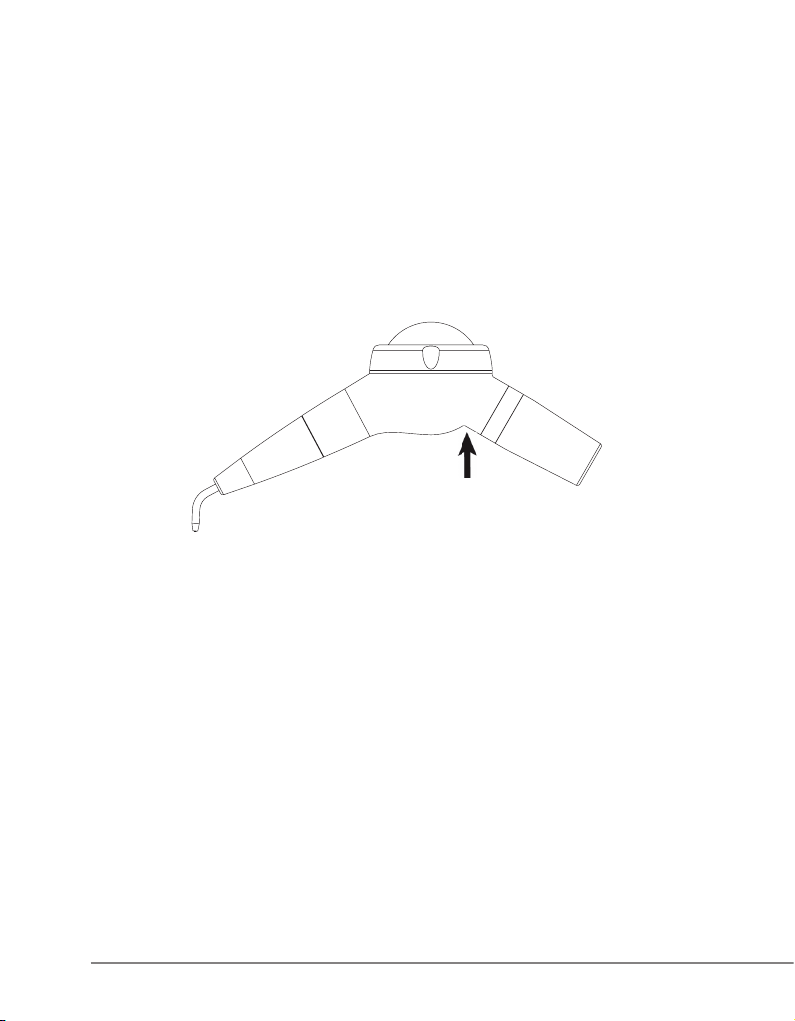
01.0 Datos de Identicación
01.1 Datos de Identicación
Una descripción exacta del modelo y del número de serie del aparato facilitará respuestas rápidas y
ecaces de parte de nuestro Servicio Posventa.
Comunique siempre estos datos cada vez que se pone en contacto con un centro de Asistencia técnico
Mectron.
01.2 Placa de identicación del aparato
Cada aparato está dotado de un número de serie, (Fig.1 - Ref.A), Los datos restantes se ilustran en el
presente manual (ver sección “11.0”).
A
Fig. 1
02.0 Ensayo
02.1 Ensayo del aparato
Todos los aparatos producidos por MECTRON son controlados rigurosamente y ensayados en cada uno
de sus componentes.
Durante dicho ensayo los componentes son sometidos a una serie de ciclos de trabajo.
En esta fase se identica cualquier funcionamiento defectuoso.
Este procedimiento garantiza un producto funcionante y able en todos sus componentes.
03.0 Entrega
03.1 Entrega del aparato
El embalaje del aparato teme los impactos fuertes porque contiene piezas electrónicas. Luego el
transporte y el almacenaje deben efectuarse con un cuidado particular.
No sobreponer varios cartones para no aplastar los embalajes que están debajo.
Todo el material despachado por MECTRON ha sido controlado al momento del envío.
El aparato se entrega adecuadamente protegido y empaquetado.
Al recibir el aparato controlar cualquier daño que éste haya sufrido durante el transporte y en caso
armativo, comunicar el reclamo al transportista.
72
easyjet pro - manual de uso y mantenimiento
Page 72
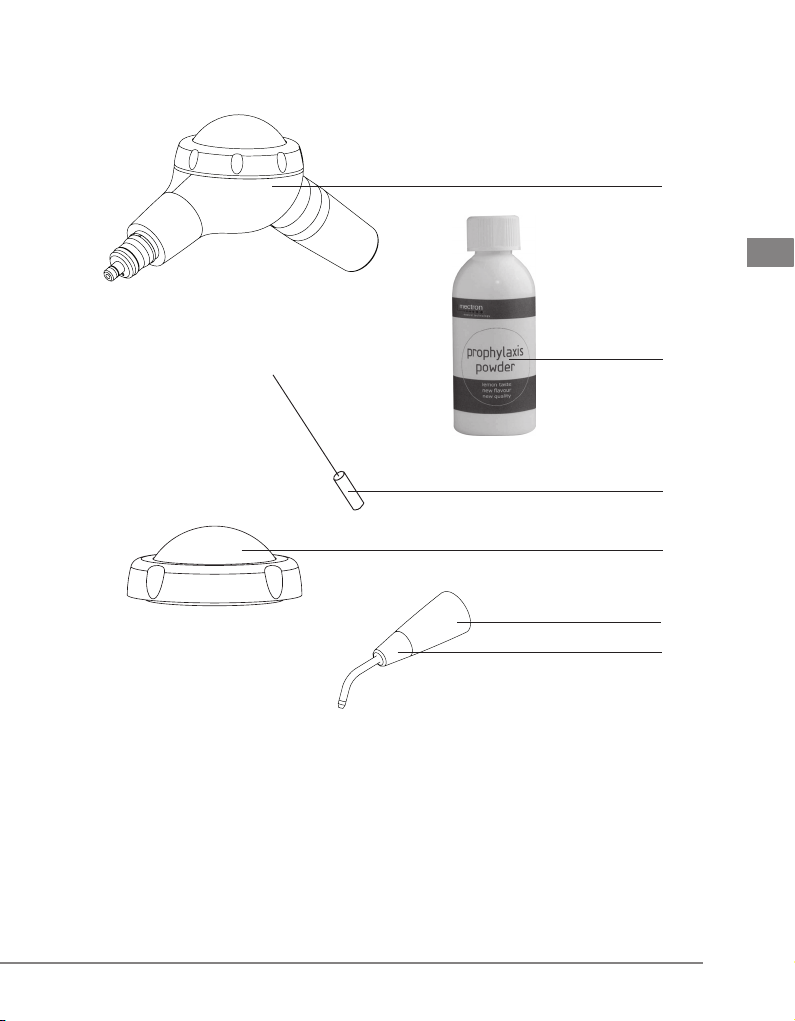
Fig. 2
03.2 Lista de materiales incluidos en la dotación Estándar
1 Cuerpo del aparato, (Fig.2 - Ref.A).
1 Bote para polvo prophylaxis powder, (Fig.2 - Ref.B).
1 Aguja para la limpieza del terminal anterior limpiador, (Fig.2 - Ref.C).
1 Cúpula de recambio “easyjet pro”, (Fig.2 - Ref.D).
1 Terminale anteriore del limpiador, (Fig.2 - Ref.E).
1 Capuchón del puntal terminal anteriore, (Fig.2 - Ref.F).
Dicha dotación puede variar en caso de campañas promocionales.
A
ES
B
C
D
E
F
easyjet pro - manual de uso y mantenimiento
73
Page 73
04.0 Instalación
�
�
�
�
�
�
�
�
04.1 Prescripciones de seguridad en la fase de instalación
ATENCIÓN: No exponga el aparato a la luz directa del sol o a fuentes de luz UV.
ATENCIÓN: El aparato es transportable pero tiene que ser manejado con cuidado cuando se
desplaza.
1 Alimentación de agua spray turbina.
2 Alimentación de aire turbina.
3 Presencia de polvo;
ATENCIÓN: Si la alimentación de agua y aire es suciente para la turbina, el “easyjet pro” debe
funcionar.
Alimentación estándar suministrada por la unidad dental para la una turbina:
- agua de 0 a 3 bar, de 0 hPa a 3000 hPa, máx 40°C;
- aire 2,3 - 3,2 bares, 2300 hPa - 3200 hPa,
04.2 Conexión del aparato
ATENCIÓN: Controlar que el conector de la turbina esté en buen estado.
ATENCIÓN: No conectar el “easyjet pro” cuando la turbina está bajo presión.
ATENCIÓN: No presionar el pedal de mando de la turbina durante la conexión del “easyjet pro”.
ATENCIÓN: Si se cuenta con una turbina con luz, apagarla.
ATENCIÓN: El terminal anterior limpiador y el racor de la turbina tienen que estar perfectamente
secos. La presencia de humedad puede provocar la obturación de los canales de circulación aire/polvo.
“easyjet pro” está dotado de un adaptador especíco que corresponde al empalme de la turbina presente
en la unidad dental. Usar el “easyjet pro” sólo para el racor de la turbina en dotación. Conectar el “easyjet
pro” a otro conector diferente podría dañarlo.
Para hacer funcionar el aparato es necesario controlar:
74
easyjet pro - manual de uso y mantenimiento
Page 74
05.0 Uso
�
�
�
�
�
�
�
�
�
�
�
05.1 Prescripciones de seguridad en fase de empleo
PELIGRO: Contraindicaciones.
No utilice el aparato en pacientes que presentan patologías al aparato respiratorio como bronquitis
crónicas, asma, ensema, etc.
PELIGRO: Contraindicaciones.
Los pacientes que llevan lentillas tienen que quitárselas antes de someterse al tratamiento con el
limpiador de chorro de bicarbonato.
PELIGRO: Contraindicaciones.
No apuntar el chorro de aire/bicarbonato/agua hacia los ojos.
La falta de cumplimiento de esta prescripción puede causar lesiones oculares graves. Se aconseja usar
gafas protectoras a todas las personas interesadas (pacientes, higienista y dentista).
PELIGRO: Contraindicaciones.
Se aconseja al dentista y al higienista, utilizar una máscara protectora para limitar la inhalación de polvo.
PELIGRO: Contraindicaciones.
No apuntar el chorro de aire/bicarbonato/agua hacia compuestos, empastes y puentes. La falta de
cumplimento de esta prescripción puede causar daños.
PELIGRO: Contraindicaciones.
No dirigir el chorro de aire/bicarbonato/agua sobre los tejidos blandos o dentro del surco gingival. La
inobservancia de esta prescripción puede causar un ensema tisural gingival, (ensema de las mucosas
y/o subcutáneo).
PELIGRO: Control del estado del dispositivo antes del tratamiento.
Antes de cada tratamiento controlar siempre el perfecto funcionamiento del aparato y la eciencia de
los accesorios. En el caso que se produzcan anomalías de funcionamiento, no ejecutar el tratamiento.
Dirigirse a la asistencia técnica autorizada si las anomalías conciernen al aparato.
ES
PELIGRO: Control de las infecciones y limpieza de los circuitos de agua y aire.
Para la máxima seguridad del paciente y el operador, después de cada tratamiento, seguir todas las
prescripciones indicadas en el capítulo “06.0”.
ATENCIÓN: Utilizar exclusivamente polvos producidos por Mectron, (Prophylaxis powder).
No utilice polvos producidos por otros fabricantes en cuanto pueden perjudicar el aparato, proveer presta-
ciones insucientes, e invalidar la garantía.
ATENCIÓN: No intentar destornillar el tapón del contenedor de polvo cuando está bajo
presión.
ATENCIÓN: Cerciorarse que el tanque del polvo esté perfectamente seco.
La presencia de humedad puede crear la obstrucción de los canales.
easyjet pro - manual de uso y mantenimiento
75
Page 75
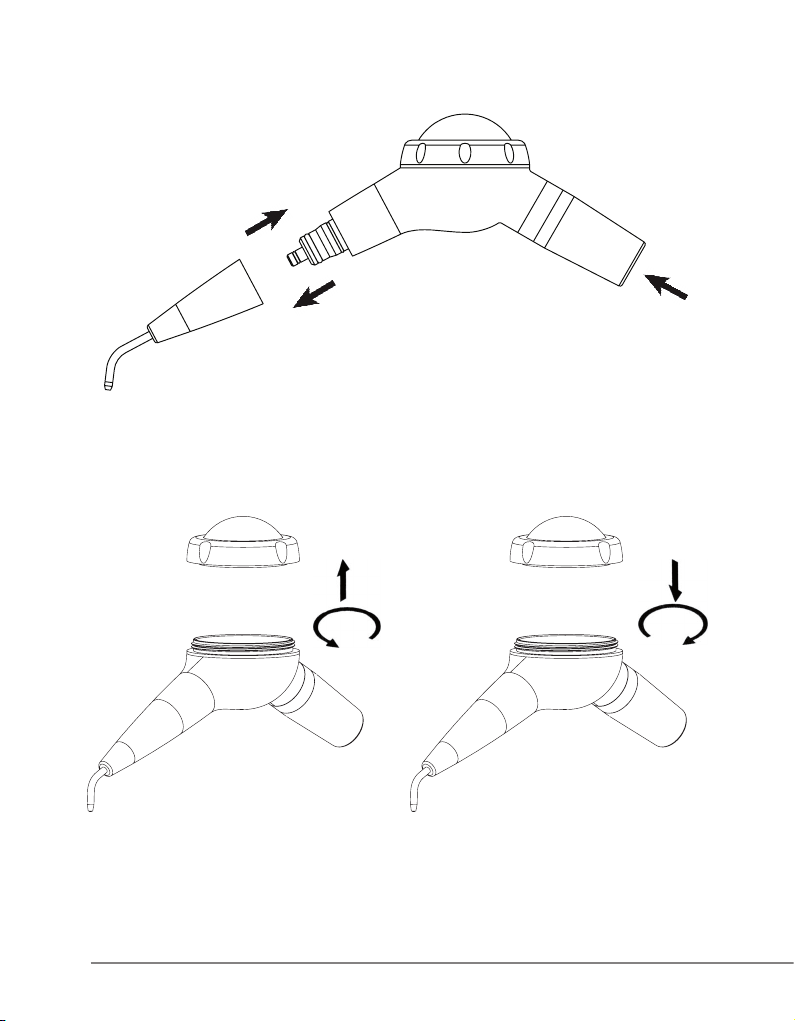
A
B
C
Fig. 3
BA
76
Fig. 4
easyjet pro - manual de uso y mantenimiento
Page 76
05.2 Instrucciones de uso
�
�
�
�
�
�
1 Introducir el terminal anterior limpiador, (estéril), (Fig.3 - Ref.A), llevándolo hasta el tope.
2 Conectar el “easyjet pro” a la turbina de la unidad dental, (Fig.3 - Ref.B).
3 Regular el caudal del agua a partir de la propia unidad dental para obtener un chorro de agua
uniforme. La regulación es más fácil cuando no hay polvo.
4 Destornillar la cúpula del contenedor de polvo, (Fig.4 - Ref.A).
5 Vaciar en el contenedor el polvo, evitando que el nivel alcance las toberas ubicadas en el interior;
ATENCIÓN: Se recomienda utilizar el tapón dosicador de la misma confección prophylaxis
powder llenándolo hasta el nivel de “easyjet pro”.
ATENCIÓN: Se aconseja no agitar el easyjet pro después de haber introducido el polvo para
evitar la obstrucción de las toberas.
6 Volver a atornillar la cúpula del contenedor de polvo sin cerrarla excesivamente, (Fig.4 - Ref.B).
ATENCIÓN: Eliminar los restos de polvo del roscado de la cúpula, antes de atornillarla.
7 Presionar el pedal de la turbina para efectuar el tratamiento.
ATENCIÓN: Utilizar la cánula de aspiración para eliminar la mezcla aire/bicarbonato/agua de la
boca del paciente.
8 Realizar el tratamiento efectuando pequeños movimientos circulares. Dirigir la tobera únicamente
hacia el esmalte dental, desde el surco gingival hacia el borde incisivo del diente respetando una
distancia de 3 a 5 mm.
9 Lustrar al nal todas las supercies dentales, regulando el caudal del agua al máximo;
ATENCIÓN: Cuando se levanta el pie del pedal de mando, el chorro aire/bicarbonato/agua
todavía sigue durante algunos segundos. Acabar el tratamiento teniendo en cuenta estos segundos
suplementarios.
10 Después del tratamiento, los dientes quedan limpios y la cutícula dentaría es completamente
eliminada. Su reconstitución por parte de las proteínas salivales necesita entre 2 y 3 horas, tiempo
en que los dientes ya no poseen la protección natural contra los colorantes. Informar al paciente
que en este lapso de tiempo, no se debe fumar, ni consumir alimentos o bebidas que pudieran teñir
fuertemente el diente (como es el caso del té, café,...).
NOTA IMPORTANTE: Terminal anterior limpiador obstruido, (no sale polvo).
1 Desconectar el terminal anterior del limpiador del cuerpo “easyjet pro”, (Fig.3 - Ref.C).
2 Liberar el canal de los restos de polvo, utilizando la aguja de limpieza especíca que se entrega en
dotación, (Fig.2 - Ref.C), siguiendo los movimientos indicados, (Fig. 5). Soplar aire comprimido con
la jeringa, en el oricio central del terminal por ambos lados.
ATENCIÓN: Limpiar el canal de la tobera utilizando exclusivamente la aguja destinada a la
limpieza, que se entrega en dotación con el aparato, (Fig.2 - Ref.D.)
3 Limpiar minuciosamente además, la parte de conexión anterior del cuerpo “easyjet pro”. Si es
necesario, eliminar eventuales restos de polvo, soplando aire comprimido con la jeringa.
4 Conectar el terminal limpiador anterior al cuerpo “easyjet pro”, (Fig.3 - Ref.A).
ES
easyjet pro - manual de uso y mantenimiento
77
Page 77
06.0 Limpieza, desinfección, esterilización
�
�
�
�
�
�
�
06.1 Limpieza y desinfección del cuerpo de “easyjet pro”
PELIGRO: Desconectar el “easyjet pro” de la turbina.
Desconectar siempre el “easyjet pro” de la turbina antes de efectuar intervenciones de limpieza,
desinfección y esterilización.
PELIGRO: El “easyjet pro” no está protegido contra la penetración de los líquidos.
No sumergirlo; no rociar líquidos directamente en la supercie del invólucro del aparato.
PELIGRO: “easyjet pro” no es esterilizable.
Después de cada tratamiento ejecutar las siguientes operaciones:
1 Desconectar el terminal anterior limpiador del cuerpo del “easyjet pro”, (Fig.3 - Ref.C).
2 Eliminar eventuales restos de polvo del contenedor de “easyjet pro”.
3 Limpiar y desinfectar las supercies, con un paño humedecido con una solución
detergente/desinfectante no agresiva con PH neutro, (PH7), poniendo un cuidado particular en la
parte roscada de la cavidad anterior. Si necesario, quitar eventuales restos de polvo soplando aire
comprimido con la jeringa.
ATENCIÓN: Seguir con atención las instrucciones proporcionadas por el productor de la solución
desinfectante.
NOTA: Se recomiendan encarecidamente las soluciones desinfectantes a base de agua, con PH neutro.
Algunas soluciones desinfectantes con base alcohólica pueden ser nocivas y descolorar y perjudicar los
materiales plásticos. Los detergentes en polvo pueden deteriorar las supercies del “easyjet pro”.
06.2 Procedimientos de esterilización
ATENCIÓN: Efectuar la esterilización, utilizando exclusivamente autoclave de vapor de agua.
No utilizar ningún otro procedimiento de esterilización (calor seco) irradiación, óxido de etileno, gas,
plasma a baja temperatura, etc...
PELIGRO: “easyjet pro” no es esterilizable.
PELIGRO: Control de las infecciones - Partes esterilizables - Eliminar cuidadosamente todo
residuo, antes de la esterilización.
Para evitar infecciones de bacterias o de virus, limpiar, desinfectar y esterilizar siempre después de cada
tratamiento los siguientes componentes:
1 Terminal anterior limpiador, (Fig.2 - Ref.E).
2 Aguja para la limpieza del terminal anterior limpiador, (Fig.2 - Ref.C).
Dichos componentes están construidos con materiales que resisten a una temperatura máxima de 135°C
por un tiempo máximo de 20 minutos.
Los procesos de esterilización en autoclave a vapor deben ser ejecutados con uno de los dos
parámetros:
- Ciclo de 121°C. por 16 minutos;
- Ciclo de 134°C. por 4 minutos.
Todas las fases de esterilización deben ser ejecutadas por los operadores conforme a las normas
EN ISO 17665-1:2006 y EN 556-1:2001.
78
easyjet pro - manual de uso y mantenimiento
Page 78
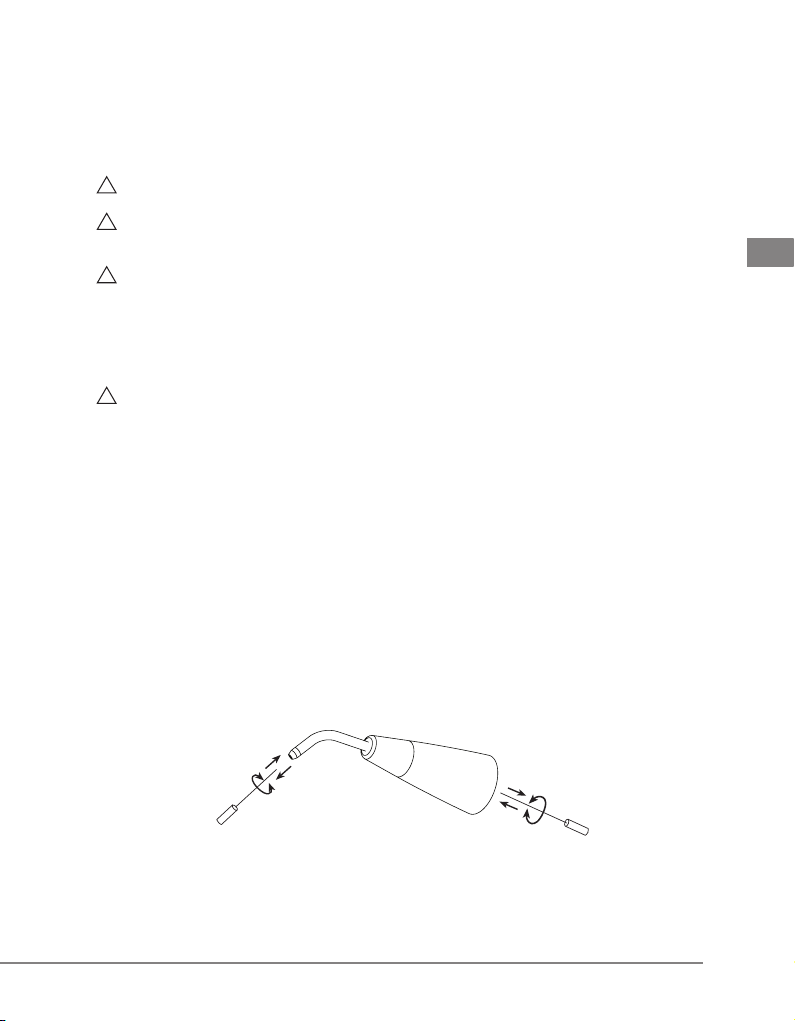
06.3 Esterilización en autoclave del terminal anterior del limpiador
�
�
�
�
1 Desconectar el terminal anterior limpiador del cuerpo “easyjet pro”, (Fig.3 - Ref.C).
2 Liberar el canal de los restos de polvo utilizando la aguja de limpieza adecuada suministrada en
dotación, (Fig.2 - Ref.C), siguiendo los movimientos indicados (Fig.5). Soplar aire comprimido con la
jeringa en el agujero central del terminal por ambas partes.
ATENCIÓN: Limpiar el canal de la boquilla usando exclusivamente la aguja para la limpieza
suministrada en dotación con el aparato, (Fig.2 - Ref.C).
3
ATENCIÓN: La excesiva presencia de caliza en el agua puede determinar un rociado de agua
insuciente. Para eliminar el inconveniente se aconseja sumergir el terminal anterior del limpiador
por algunos minutos en una solución de ácido clorhídrico al 2%.
ATENCIÓN: Aclarar esmeradamente el terminal con agua destilada de manera que se elimine
cualquier residuo restante de la solución de ácido clorhídrico. Secar, soplando aire comprimido con la
jeringa en el agujero central del terminal por ambas partes.
4 Desinfectar el terminal utilizando una solución antiséptica no agresiva de PH neutral. Secar, soplando
aire comprimido con la jeringa en el agujero central del terminal por ambas partes.
5 Introducir la aguja de limpieza en el canal del terminal anterior y sellar todo en sobres desechables.
6 Esterilizar el sobre que contiene el terminal anterior limpiador y la aguja de limpieza.
ATENCIÓN: Antes de utilizar la terminal anterior, soplar aire comprimido con la jeringa, para
evitar que en su interior queden residuos de humedad.
07.0 Mantenimiento periódico
1 Si el paso del aire del terminal anterior se obstruye, basta accionar el aparato por algunos instantes,
utilizando las agujas en dotación, (Fig.5), para liberar el canal de los residuos de polvo.
2 En el caso que el terminal anterior se obstruya, debido a una excesiva presencia de caliza en el
agua, se aconseja mantenerlo sumergido por algunos minutos en una solución de ácido clorhídrico al
2%.
3 Cada vez que se quita el terminal anterior, es necesario soplar aire comprimido con la jeringa, tanto
en la cavidad del conector de la pieza de mano, como en el oricio central posterior del terminal
anterior, para evitar la acumulación de residuos de polvo.
4 Se recomienda vaciar por lo menos una vez al día, el contenedor de polvo del “easyjet pro” para
evitar obturaciones.
ES
Fig. 5
easyjet pro - manual de uso y mantenimiento
79
Page 79
08.0 Modalidad y precauciones para la
�
0476
eliminación
Las modalidades y las precauciones a tomar para la eliminación del aparato, deben seguir los
procedimientos previstos por la Leyes vigentes para cualquier instrumental electrónico fuera de uso.
09.0 Símbolos
Atención leer las instrucciones para el uso.
Aparato conforme a la directiva 93/42 CEE.
Ente noticado CERMET.
80
easyjet pro - manual de uso y mantenimiento
Page 80
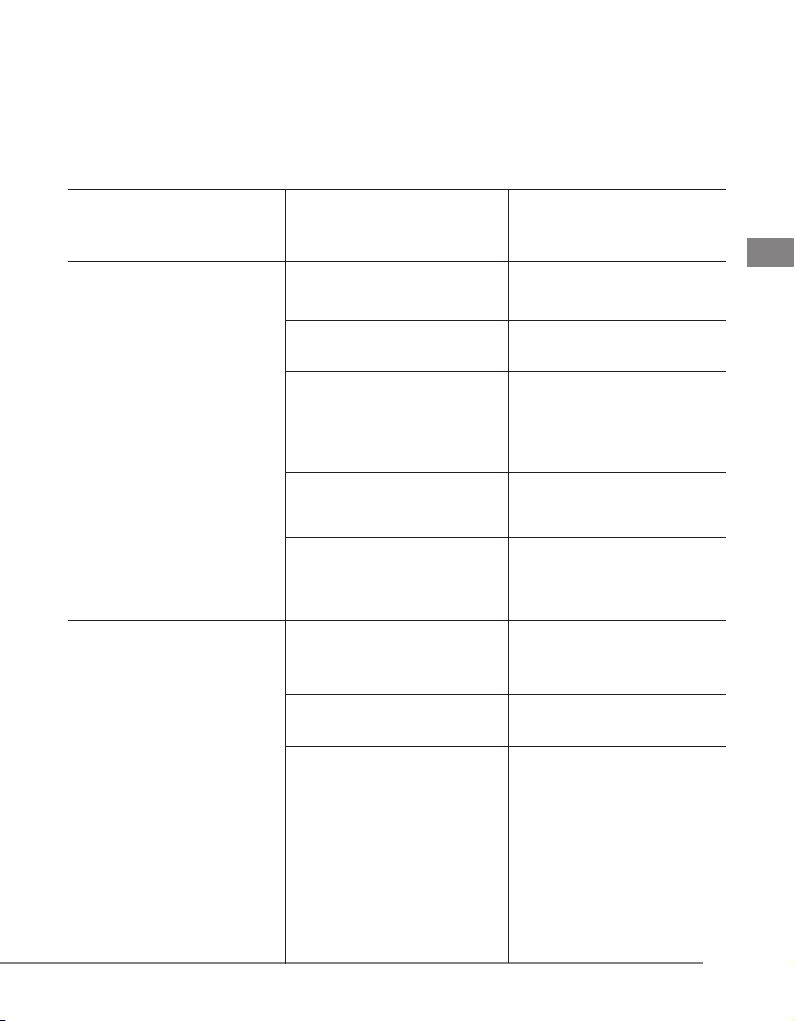
10.0 Solución de inconvenientes
Si el aparato parece no funcionar correctamente, leer de nuevo las instrucciones y luego controlar la tabla
que se indica a continuación.
SÍNTOMA CAUSA POSIBLE SOLUCIÓN
No se destornilla el tapón del
contenedor de polvo.
Durante el funcionamiento no
sale polvo del terminal anterior
del limpiador.
Durante el funcionamiento no
sale agua desde el terminal
anterior del limpiador.
El “easyjet pro” está conectado a
la turbina y el contenedor polvo,
está bajo presión.
Unidad dental no conectada al
circuito de aire.
El tanque del easyjet pro está
vacío.
Terminal anterior del limpiador
obstruido debido a una
excesiva cantidad de humedad
en el polvo o de una limpieza/
mantenimiento insuciente.
El nivel del polvo en el
contenedor supera el máximo
permitido.
Polvo no adecuado.
Unidad dental no conectada al
circuito de agua.
Excesiva presencia de caliza en
el agua.
Filtro de agua de la unidad dental
obstruido.
Desconectar el “easyjet pro” de
la turbina, de modo que pierda
presión el circuido interno.
Controlar la conexión de la
unidad dental al circuito de aire.
Leer el párrafo “05.2”.
Leer el párrafo “06.1 - 06.3”.
Sacar el polvo del contenedor y
limpiarlo con un paño seco.
Leer el párrafo “07.0”.
Restablecer el correcto nivel
del polvo en el contenedor (ver
párrafo “05.2”).
Para un correcto funcionamiento
del aparato utilizar solamente
polvo producido por MECTRON.
Controlar la conexión de la
unidad dental al circuito agua de
la unidad dental.
Leer el párrafo “06.3 - 07.0.”
Controlar la conexión al circuito
de agua de la unidad dental.
ES
easyjet pro - manual de uso y mantenimiento
81
Page 81
SÍNTOMA CAUSA POSIBLE SOLUCIÓN
Pérdida de polvo por el tapón
contenedor polvo.
Terapia no ecaz. Presión insuciente del circuito de
Tapón no atornillado
correctamente.
Restos de polvo en el roscado.
alimentación del aire.
Insuciente o excesivo nivel de
polvo en el contenedor.
Polvo no adecuado.
Terminal anterior del limpiador
obstruido debido a una excesiva
cantidad de humedad en el polvo
o de una limpieza/mantenimiento
insuciente.
Atornillar correctamente el tapón.
Leer el párrafo “06.1”.
Controlar la presión del circuito
de aire de la unidad dental.
Restablecer el correcto nivel
de polvo en el contenedor (ver
párrafo “05.2”).
Para un correcto funcionamiento
del aparato utilizar sólo polvo
producido por MECTRON.
Leer el párrafo “06.1 - 06.3”.
Sacar el polvo del contenedor y
limpiarlo con un paño seco.
Leer el párrafo “07.0”.
11.0 Datos técnicos
Aparato conforme a la Dir. 93/42/CEE: Clase II a.
Clasicación según lo establecido por la EN 60601-1: II
Tipo B
IP 20 (aparato)
Aparato para funcionamiento intermitente: 60” ON 10” OFF.
Alimentación de agua estándar suministrada por la unidad dental para una turbina:
de 0 a 3 bar, de 0 hPa a 3000 hPa, máx 40°C.
Alimentación de aire estándar suministrado por la unidad dental para una turbina:
2,3 - 3,2 bar, 2300 hPa - 3200 hP.
Condiciones ambientales de empleo: de +10°C a +40°C.
Humedad relativa de 30% a 75%.
Condiciones de transporte y almacén: de -10°C a +70°C.
Humedad relativa de 10% a 90%.
Presión del aire P: 500hPa/1060hPa.
Pesos y dimensiones: 125 g.
82
easyjet pro - manual de uso y mantenimiento
Page 82
12.0 Garantía
Todos los aparatos MECTRON, antes de ser comercializados, son sometidos a un esmerado control nal
que verica su plena funcionalidad.
MECTRON garantiza sus productos, adquiridos nuevos a un detallista o importador MECTRON, contra
defectos de material y fabricación por un período de 1 (UN) AÑO, a contar de la fecha de adquisición.
Durante el período de validez de la garantía, MECTRON se compromete a reparar, o a su libre elección,
reemplazar, gratuitamente aquéllas partes de los productos que se demostraran, a su juicio, defectuosas.
Queda excluida la substitución integral de los productos MECTRON.
Mectron no se hace responsable por daños directos o indirectos, a personas o cosas, en los siguientes
casos:
- El aparato que no es empleado según el destino de empleo previsto.
- El aparato que no es utilizado conforme a todas las instrucciones y prescripciones descritas en el
presente manual.
- La instalación eléctrica de los locales donde se usa el aparato no está conformes a las normas
vigentes y a las correspondientes prescripciones.
- Las operaciones de ensamblaje, extensiones, regulaciones, modicaciones y reparaciones han sido
efectuadas por personal no autorizado Mectron.
- Las condiciones ambientales de conservación y almacenaje del aparato no son conformes a las
prescripciones indicadas en la sección de datos técnicos.
Quedan excluidas de la garantía, las roturas accidentales por transporte, por empleo incorrecto o por
negligencia, por conexión a una tensión diferente a la prevista, las luces de aviso, las empuñaduras y
todos los accesorios.
La garantía caduca cuando el aparato ha sido forzado, manipulado, reparado por personal no autorizado.
ATENCIÓN
La garantía es válida sólo si el cupón de garantía que se anexa al producto ha sido rellenado en todas
sus partes y siempre que su envío a nuestra sede, o eventualmente al detallista o al importador
MECTRON, se efectúe dentro de los 20 (VEINTE) DÍAS a contar de la fecha de adquisición, da fe el
documento de transporte/factura de adquisición, emitida por el revendedor/importador.
Para utilizar el servicio de garantía el cliente debe enviar a su cargo, el aparato por componer al
revendedor/importador MECTRON de quien ha adquirido el producto.
El aparato debe ser devuelto adecuadamente embalado, posiblemente en el embalaje original,
acompañado de todos los accesorios y de una cha que incluya:
a, Datos del propietario con número de teléfono.
b, Datos del revendedor/importador
c, Fotocopia del documento de transporte/factura de adquisición del aparato de parte del propietario
donde estén indicados, además de la fecha, el nombre del aparato y el número de serie.
d, Descripción del funcionamiento defectuoso
El transporte y los daños causados por el transporte no están cubiertos por la garantía.
En el caso de averías debidas a accidente o empleo impropio o bien, en el caso de garantía vencida, las
reparaciones de los productos MECTRON serán debitadas en base al coste efectivo de los materiales y
de la mano de obra empleada.
ES
Las indicaciones que aparecen en el presente folleto no son vinculantes y pueden ser modicadas sin previo
aviso.
easyjet pro - manual de uso y mantenimiento
83
Page 83

Spis treści
00.0 Wprowadzenie ............................................................................................................................ .......85
00.1 Wstęp ................................................................................................................................. .......85
00.2 Opis urządzenia ................................................................................................................. .......85
00.3 Zastosowanie ..................................................................................................................... .......86
01.0 Dane identikacyjne ................................................................................................................... .......88
01.1 Dane identykacyjne ......................................................................................................... .......88
01.2 Płytka identykacyjna urządzenia ...................................................................................... .......88
02.0 Testy ........................................................................................................................................... .......88
02.1 Testowanie urządzenia ...................................................................................................... .......88
03.0 Transport .................................................................................................................................... .......88
03.1 Transport urządzenia ......................................................................................................... .......88
03.2 Lista elementów w standardowej przesyłce ....................................................................... .......89
04.0 Instalacja .................................................................................................................................... .......90
04.1 Wymogi bezpieczeństwa podczas instalacji ...................................................................... .......90
04.2 Podłączenie urządzenia ..................................................................................................... .......90
05.0 Użytkowanie ............................................................................................................................... .......91
05.1 Środki ostrożności podczas użytkowania .......................................................................... .......91
05.2 Instrukcje użytkowania ....................................................................................................... .......93
06.0 Czyszczenie, dezynfekcja i sterylizacja ...................................................................................... .......94
06.1 Czyszczenie i dezynfekcja obudowy Easyjet pro .............................................................. .......94
06.2 Procedury sterylizacji ......................................................................................................... .......94
06.3 Sterylizacja rękojeści w autoklawie .................................................................................... .......95
07.0 Konserwacja okresowa............................................................................................................... .......95
08.0 Procedury i środki ostrozności przy utylizacji urządzenia........................................................... .......96
09.0 Symbole...................................................................................................................................... .......96
10.0 Problemy i rozwiązania............................................................................................................... .......97
11.0 Dane techniczne ......................................................................................................................... .......98
12.0 Gwarancja .................................................................................................................................. .......99
Unix® - Unix L® is a registered trademark of Bien-Air company
Multiex® - Multiex lux® is a registered trademark of KaVo company
Sirona® R - Sirona® B is a registered trademark of SIRONA company
Roto Quick® - Roto Quick Lux® is a registered trademark of W&H company
84
easyjet pro - podręcznik użytkowania i konserwacji
Page 84
00.0 Wprowadzenie
�
�
00.1 Wstęp
Przed rozpoczęciem instalacji, użytkowania, konserwacji urządzenia czy jakichkolwiek innych
czynności należy dokładnie zapoznać się z niniejszą instrukcją.
Instrukcję należy przechowywać wraz z opakowaniem urządzenia.
Ważne: Aby uniknąć ryzyka spowodowania obrażeń ciała czy uszkodzenia urządzenia, należy ze
szczególną uwagą zapoznać się z wszystkimi punktami dotyczącymi zasad bezpieczeństwa zawartymi w
niniejszej instrukcji.
Zależnie od rodzaju potencjalnego ryzyka oznaczenia zasad bezpieczeństwa zostały podzielone na:
! OSTRZEŻENIE (oznacza ryzyko spowodowania uszkodzeń ciała)
! UWAGA (oznacza ryzyko uszkodzenia urządzenia)
Niniejsza instrukcja ma na celu zapewnienie użytkownikom informacji dotyczących zasad
bezpieczeństwa, procedur instalacyjnych oraz instrukcji właściwego użytkowania i konserwacji
urządzenia.
Urządzenie może być regulowane, modykowane lub naprawiane wyłącznie przez autoryzowany personel
serwisu rmy Mectron.
Użytkownik, niezależnie od okoliczności, nie jest uprawniony do przeprowadzania napraw, regulacji czy
modykacji.
Modykacje, niewłaściwe użytkowanie lub naprawa przez użytkownika lub nieautoryzowany serwis
powoduje utratę gwarancji i zwalnia producenta z odpowiedzialności za powstałe szkody.
Informacje i ilustracje zawarte w niniejszej instrukcji zostały zaktualizowane do dnia wydania
(data wydania - str. 104).
Firma MECTRON stale rozwija i modernizuje swoje produkty, co może powodować zmiany w
komponentach urządzenia. W przypadku jakichkolwiek rozbieżności pomiędzy opisami zawartymi w
niniejszej instrukcji a zakupionym urządzeniem, należy skontaktować się z dystrybutorem lub serwisem
posprzedażowym rmy MECTRON w celu uzyskania odpowiednich informacji.
Zabrania się wykorzystywania niniejszej instrukcji do celów innych niż instalacja, użytkowanie i konserwacja urządzenia.
00.2 Opis urządzenia
Easyjet pro to zwarta dwuwęglanowa polerka strumieniowa podłączana do rękawa turbinowego na
szybkozłączkę. Easyjet pro posiada takie same zalety, co stacjonarne wyższe modele:
- stały, silny strumień piasku,
- prostota użycia i wysoka niezawodność.
Zasada funkcjonowania Easyjet pro oparta jest na działaniu mechanicznym uzyskanym w efekcie
rozpędzenia strumieniem sprężonego powietrza cząstecz¬ek dwuwęglanu sodu do ogromnej prędkości.
Energia kinetyczna wywarta w ten sposób na cząsteczki zostaje prawie całkowicie rozproszona
przed zetknięciem się cząsteczek ze szkliwem zęba dając w rezultacie delikatny, lecz skuteczny efekt
czyszczący.
Działanie polerki uzupełnia strumień wody, który wykorzystuje zagłębienie wokół dyszy by uformować
kształt dzwonkowatego stożka wokół strumienia proszku i powietrza dając podwójny efekt: zapobiegając
rozpryskiwaniu się strumienia oraz tworzeniu się chmury proszku i równocześnie spłukując obszar
zabiegu usuwając zużyty dwuwęglan sodu.
PL
easyjet pro - podręcznik użytkowania i konserwacji
85
Page 85
00.3 Zastosowanie
�
�
�
�
�
�
Dwuwęglanowa polerka strumieniowa. Wskazania:
- Usuwanie kamienia i osadu nazębnego,
- Usuwanie przebarwień na powierzchni zębów spowodowanych przez nikotynę, kawę, herbatę i
chlorheksydynę,
- Prolaktyka u pacjentów pod opieką ortodontyczną.
00.4 Zasady bezpieczeństwa
Firma Mectron nie ponosi odpowiedzialności za bezpośrednie lub przypadkowe obrażenia ciała lub
uszkodzenie urządzenia, w przypadku zaistnienia któregokolwiek z poniższych zdarzeń:
1 Gdy urządzenie jest używane do innych celów niż te, do których jest przeznaczone.
2 Gdy urządzenie używane jest niezgodnie z instrukcjami i wymogami zapisanymi w niniejszej instrukcji
obsługi.
3 Gdy instalacja elektryczna, wodna lub sprężonego powietrza w pomieszczeniu, w którym używane
jest urządzenie nie spełniają odpowiednich standardów i wymagań.
4 Gdy montaż, rozbudowa, ustawianie, przeróbki czy naprawy były wykonywane przez inne osoby niż
autoryzowany serwis rmy Mectron.
5 Jeżeli warunki, w których przechowywane jest urządzenie są niezgodne z wymaganiami zapisanymi
w niniejszej instrukcji w rozdziale „11.0 Specykacje techniczne”.
! OSTRZEŻENIE: Wykwalikowany, specjalistyczny personel.
Urządzenie może być jedynie obsługiwane przez specjalistyczny personel taki jak dentysta czy asysta
stomatologiczna o odpowiednim przeszkoleniu. Przy właściwym użyciu urządzenie nie powoduje żadnych
efektów ubocznych.
! OSTRZEŻENIE: Użycie zgodne z przeznaczeniem.
Urządzenie powinno być używane wyłącznie zgodnie z jego przeznaczeniem (zobacz rozdział „00.3
Zastosowanie”). Użycie urządzenia niezgodnie z jego przeznaczeniem może spowodować poważne
obrażenia ciała pacjenta i/lub operatora i/lub uszkodzenie i/lub zniszczenie urządzenia.
! OSTRZEŻENIE: Czyszczenie, dezynfekcja i sterylizacja nowych i naprawianych produktów.
Nowe i naprawiane elementy urządzenia nie są dostarczane w sterylnych warunkach. Dlatego wszystkie
nowe produkty oraz elementy po naprawie należy przed użyciem wyczyścić, zdezynfekować oraz poddać
sterylizacji zgodnie z instrukcjami opisanymi w rozdziale „06.0 Czyszczenie, dezynfekcja i sterylizacja”.
! OSTRZEŻENIE: Ochrona przed infekcją.
W celu zapewnienia maksymalnego bezpieczeństwa zarówno pacjenta jak i operatora należy używać
tylko wyczyszczonych, zdezynfekowanych i wysterylizowanych akcesoriów. Należy ściśle przestrzegać
instrukcji zapisanych w rozdziale „06.0 Czyszczenie, dezynfekcja i sterylizacja”.
! OSTRZEŻENIE: Należy używać wyłącznie oryginalnych akcesoriów i części zamiennych rmy
Mectron.
! UWAGA: Należy stosować tylko proszek produkowany przez formie Mectron (prophylaxis
powder).
Użycie proszków innych producentów może spowodować uszkodzenie urządzenia, obniżyć efektywność
jego działania i spowodować utratę gwarancji.
86
easyjet pro - podręcznik użytkowania i konserwacji
Page 86
�
! OSTRZEŻENIE: Przed użyciem sprawdź stan techniczny urządzenia.
�
�
�
�
�
�
Przed każdym użyciem należy sprawdzić czy urządzenie działa właściwie i czy wszystkie akcesoria są
sprawne. W przypadku wystąpienia jakichkolwiek nieprawidłowości przy korzystaniu z urządzenia należy
zaniechać jego użycia. Jeżeli problemy wynikają z samego urządzenia, należy skontaktować się z
autoryzowanym serwisem.
! OSTRZEŻENIE: Przeciwwskazania.
Nie należy używać urządzenia przy zabiegach przeprowadzanych na pacjentach z chorobami układu
oddechowego takimi jak przewlekłe zapalenie oskrzeli, astma, rozedma płuc, etc.
! OSTRZEŻENIE: Przeciwwskazania.
Pacjenci używający szkieł kontaktowych powinni zdjąć szkła przed rozpoczęciem zabiegu
przeprowadzanego przy użyciu dwuwęglanowej polerki strumieniowej.
! OSTRZEŻENIE: Przeciwwskazania.
Nigdy nie należy kierować strumienia powietrza / dwuwęglanu / wody w stronę oczu. Nie przestrzeganie
tego zalecenia może spowodować poważne uszkodzenie oczu. Wszystkim osobom (pacjent, dentysta,
personel pomocniczy) znajdującym się w pobliżu urządzenia zaleca się stosowanie okularów ochronnych.
! OSTRZEŻENIE: Przeciwwskazania.
Dentystom oraz personelowi pomocniczemu zaleca się stosowanie masek ochronnych podczas zabiegu
w celu ograniczenia ilości wdychanego proszku.
! OSTRZEŻENIE: Przeciwwskazania.
Nigdy nie należy kierować strumienia powietrza / dwuwęglanu / wody na kompozyty, wypełnienia czy
mosty. Nie przestrzeganie tego zalecenia może spowodować ich uszkodzenie.
! OSTRZEŻENIE: Przeciwwskazania.
Nigdy nie należy kierować strumienia powietrza / dwuwęglanu / wody na miękkie tkanki czy kieszonkę
dziąsłową. Nie przestrzeganie tego zalecenia może spowodować odmę tkanek dziąsła (błony śluzowej i/
lub odmę podskórną).
PL
easyjet pro - podręcznik użytkowania i konserwacji
87
Page 87
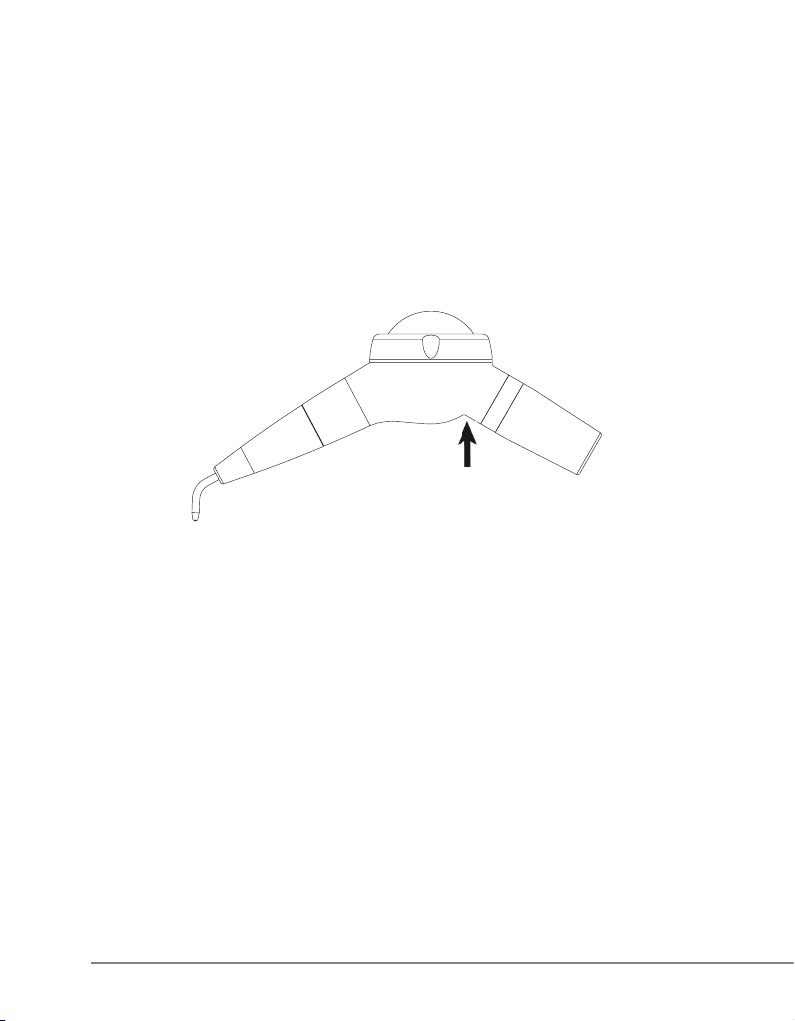
01.0 Dane identikacyjne
01.1 Dane identykacyjne
Podanie dokładnego opisu modelu zawierającego numer seryjny urządzenia umożliwia serwisowi
posprzedażowemu udzielenie szybkiej i wyczerpującej odpowiedzi na Państwa pytania.
W kontaktach z centrum serwisowym rmy Mectron zawsze należy podać model oraz numer seryjny
urządzenia.
01.2 Płytka identykacyjna urządzenia
Każde urządzenie posiada indywidualny numer seryjny (Rys.1 - Odn.A). Wszystkie pozostałe dane
zawarte są w niniejszej instrukcji (zobacz rozdział „11.0 Specykacje techniczne”).
A
Rys. 1
02.0 Testy
02.1 Testowanie urządzenia
Wszystkie urządzenia oraz wszystkie komponenty produkowane przez rmę Mectron są dokładnie
sprawdzane i testowane.
Podczas procedury testowej komponenty poddawane są konkretnej ilości cyklów pracy.
Testy te umożliwiają wychwycenie wadliwego działania spowodowanego niesprawnym komponentem.
Procedura ta zapewnia właściwe działanie oraz niezawodność komponentów.
03.0 Transport
03.1 Transport urządzenia
Urządzenie zawiera komponenty elektroniczne, które mogą ulec zniszczeniu na skutek uderzenia także,
gdy urządzenie znajduje się w opakowaniu. Dlatego podczas transportu i przechowywania zachowane
muszą być szczególne środki ostrożności.
Aby uniknąć zgniecenia nie należy ustawiać kartonów jednego na drugim.
Wszystkie materiały wysyłane przez rmę Mectron są kontrolowane przed wysyłką.
Całe wyposażenie jest dostarczane odpowiednio zabezpieczone i zapakowane.
Po otrzymaniu przesyłki prosimy o sprawdzenie urządzenia pod kątem ewentualnych zniszczeń
powstałych podczas transportu. W przypadku zauważenia jakichkolwiek zniszczeń, przewoźnikowi należy
zgłosić skargę.
88
easyjet pro - podręcznik użytkowania i konserwacji
Page 88
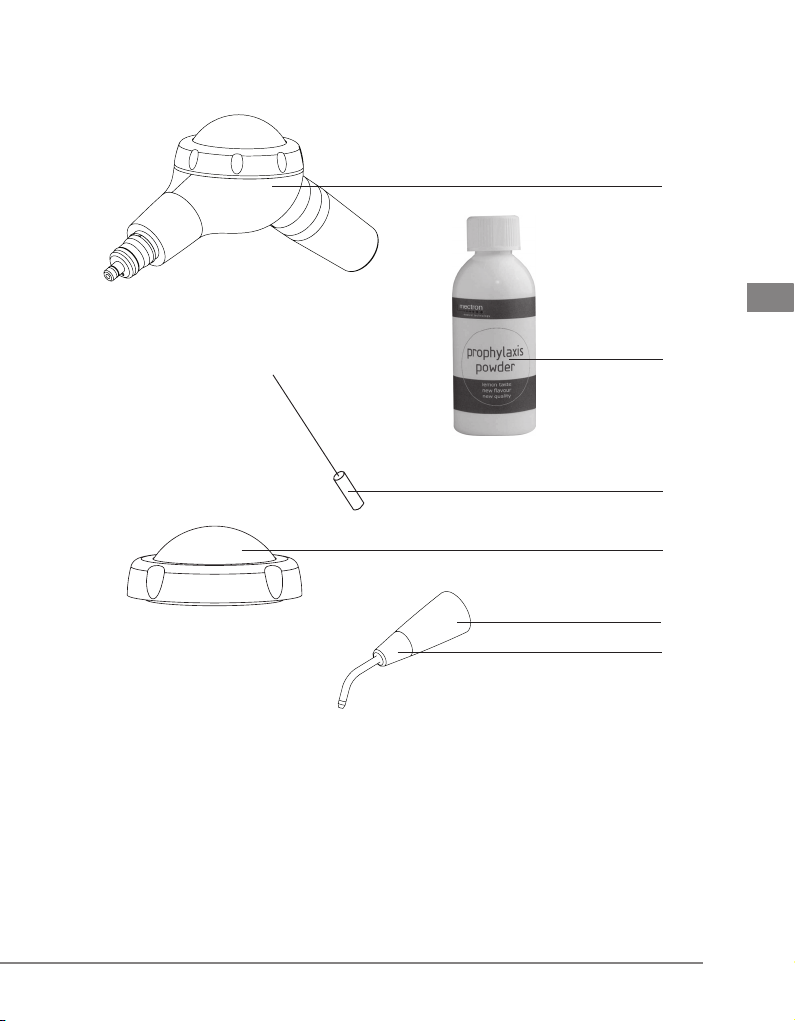
Rys. 2
03.2 Lista elementów w standardowej przesyłce
1 część główna urządzenia (Rys.2 - Odn.A)
1 opakowanie proszku (Rys.2 - Odn.B)
1 igła do czyszczenia dyszy (Rys.2 - Odn.C)
1 zapasowa pokrywa zbiornika (Rys.2 - Odn.D)
1 głowica rękojeści (Rys.2 - Odn.E)
1 osłona silikonowa (Rys.2 - Odn.F)
W okresie kampanii promocyjnych zawartość opakowania może różnić się od podanego wyżej.
A
PL
B
C
D
E
F
easyjet pro - podręcznik użytkowania i konserwacji
89
Page 89
04.0 Instalacja
�
�
�
�
�
�
�
�
04.1 Wymogi bezpieczeństwa podczas instalacji
! UWAGA: Nie wystawiać urządzenia na działanie promieni słonecznych czy innych źródeł
promieniowania UV.
! UWAGA: Easyjet pro jest urządzeniem przenośnym, jednakże w czasie jego transportu należy
zachować szczególne środki ostrożności.
1 Czy woda jest dostarczana do turbiny rozpylacza.
2 Czy powietrze jest dostarczane do turbiny.
3 Czy w zbiorniku jest proszek.
! UWAGA: Jeżeli do turbiny dostarczana jest wystarczająca ilość wody i powietrza, Easyjet powinien
działać właściwie.
Standardowo z unitu do turbiny dostarczana jest:
- woda pod ciśnieniem od 0 do 3 barów (0 hPa - 3000 hPa), o temperaturze max. 40°C,
- powietrze pod ciśnieniem 2,3 do 3,2 barów (2300 hPa - 3200 hPa).
04.2 Podłączenie urządzenia
! UWAGA: Należy sprawdzić czy złącze turbiny jest sprawne.
! UWAGA: Nie podłączać Easyjet pro, w trakcie pracy turbiny.
! UWAGA: W trakcie podłączania Easyjet pro nie wolno naciskać sterownika nożnego.
! UWAGA: Jeżeli turbina jest wyposażona w światło, na czas podłączania należy je wyłączyć.
! UWAGA: Głowica polerki oraz złącze muszą być idealnie suche. Wilgoć może powodować
zatykanie się dysz, którymi przesyłane jest powietrze i proszek.
Easyjet pro jest wyposażone w specjalne złącze odpowiednie do turbiny Państwa unitu
stomatologicznego. Easyjet pro należy montować tylko do jednego rodzaju turbiny. Podłączenie Easyjet
pro do innego rodzaju turbiny może spowodować jego uszkodzenie.
Aby upewnić się, że urządzenie jest gotowe do pracy należy sprawdzić:
90
easyjet pro - podręcznik użytkowania i konserwacji
Page 90
05.0 Użytkowanie
�
�
�
�
�
�
�
�
�
�
�
05.1 Środki ostrożności podczas użytkowania
! OSTRZEŻENIE: Przeciwwskazania.
Nie należy używać urządzenia przy zabiegach przeprowadzanych na pacjentach z chorobami układu
oddechowego takimi jak przewlekłe zapalenie oskrzeli, astma, rozedma płuc, etc.
! OSTRZEŻENIE: Przeciwwskazania.
Pacjenci używający szkieł kontaktowych powinni zdjąć szkła przed rozpoczęciem zabiegu przy użyciu
dwuwęglanowej polerki strumieniowej.
! OSTRZEŻENIE: Przeciwwskazania.
Nigdy nie należy kierować strumienia powietrza / dwuwęglanu / wody w stronę oczu. Nie przestrzeganie
tego zalecenia może spowodować poważne uszkodzenie oczu. Wszystkim osobom (pacjent, dentysta,
personel pomocniczy) znajdującym się w pobliżu urządzenia zaleca się stosowanie okularów ochronnych.
! OSTRZEŻENIE: Przeciwwskazania.
Dentystom oraz personelowi pomocniczemu zaleca się stosowanie masek ochronnych podczas zabiegu
w celu ograniczenia ilości wdychanego proszku.
! OSTRZEŻENIE: Przeciwwskazania.
Nigdy nie należy kierować strumienia powietrza / dwuwęglanu / wody na kompozyty, wypełnienia czy
mosty. Nie przestrzeganie tego zalecenia może spowodować ich uszkodzenie.
! OSTRZEŻENIE: Przeciwwskazania.
Nigdy nie należy kierować strumienia powietrza / dwuwęglanu / wody na miękkie tkanki czy kieszonkę
dziąsłową. Nie przestrzeganie tego zalecenia może spowodować odmę tkanek dziąsła (błony śluzowej i/
lub odmę podskórną).
! OSTRZEŻENIE: Przed użyciem sprawdź stan techniczny urządzenia.
Przed każdym użyciem należy sprawdzić czy urządzenie działa właściwie i czy wszystkie akcesoria są
sprawne. W przypadku wystąpienia jakichkolwiek nieprawidłowości przy korzystaniu z urządzenia należy
zaniechać jego użycia. Jeżeli problemy wynikają z samego urządzenia, należy skontaktować się z
autoryzowanym serwisem.
PL
! OSTRZEŻENIE: Ochrona przed infekcją oraz czyszczenie obiegów powietrza i wody.
W celu zapewnienia maksymalnego bezpieczeństwa zarówno pacjenta jak i operatora po każdym zabiegu
należy postępować zgodnie z instrukcjami zapisanymi w rozdziale „06.0 Czyszczenie, dezynfekcja i
sterylizacja”.
! UWAGA: Należy stosować tylko proszek produkowany przez rmę Metron (prophylaxis
powder).
Użycie proszków innych producentów może spowodować uszkodzenie urządzenia, obniżyć efektywność
jego działania i spowodować utratę gwarancji.
! UWAGA: Nie należy odkręcać pokrywy zbiornika w trakcie pracy urządzenia.
! UWAGA: Należy upewnić się, że zbiornik na proszek jest idealnie suchy.
Wilgoć może powodować zatykanie się dysz, którymi przesyłane jest powietrze i proszek.
easyjet pro - podręcznik użytkowania i konserwacji
91
Page 91
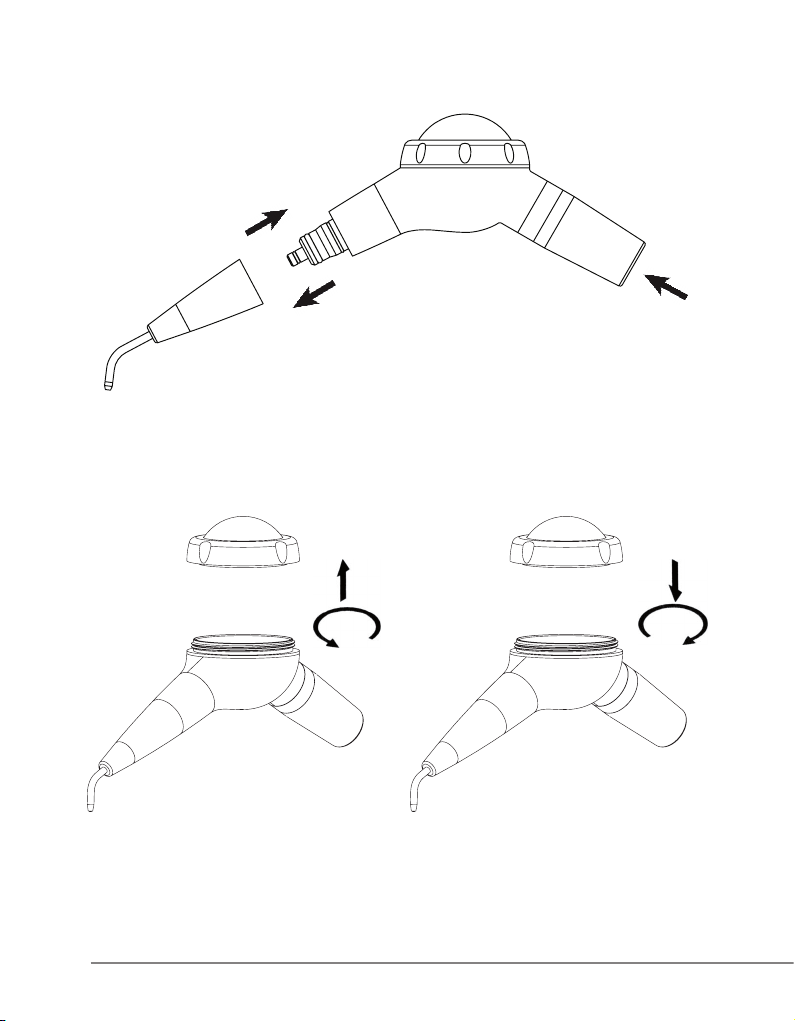
A
B
C
Rys. 3
BA
92
Rys. 4
easyjet pro - podręcznik użytkowania i konserwacji
Page 92
05.2 Instrukcje użytkowania
�
�
�
�
�
�
1 Dokładnie zamontuj wysterylizowana rękojeść (Rys.3 - Odn.A);
2 Podłącz Easyjet pro do turbiny unitu stomatologicznego (Rys.3 - Odn.B);
3 Ustaw ciśnienie przepływu wody na unicie stomatologicznym, tak, aby uzyskać równomierny strumień
wody. Łatwiej jest ustawić przepływ wody bez proszku;
4 Odkręć pokrywę zbiornika proszku (Rys.4 - Odn.A);
5 Wsyp proszek do zbiornika, upewniając się, że poziom proszku nie przekracza linii dysz wewnątrz
zbiornika;
! UWAGA: Aby wsypać odpowiednią dla urządzenia ilość proszku, zaleca się użycie miarki
dołączonej do opakowania proszku.
! UWAGA: Niewskazane jest potrząsanie urządzeniem po uzupełnieniu poziomu proszku, gdyż
może to spowodować zatkanie się dysz.
6 Zakręć pokrywę zbiornika proszku, bez nadmiernego jej dociskania (Rys.4 - Odn.B);
! UWAGA: Przed zakręceniem pokrywy należy usunąć wszelkie pozostałości proszku z gwintu
zbiornika.
7 Aby rozpocząć zabieg wciśnij pedał sterownika nożnego;
! UWAGA: Do usunięcia mieszanki wody, powietrza i proszku z ust pacjenta należy używać
ssaka.
8 Zabieg przeprowadzaj wykonując małe koliste ruchy. Dysze kieruj jedynie na szkliwo zębów, od
bruzdy dziąsłowej do krawędzi siecznej zęba zachowując odległość 3 - 5 mm;
9 Po zakończeniu wypoleruj powierzchnie zębów ustawiając maksymalny przepływ wody;
! UWAGA: Po zdjęciu nogi ze sterownika nożnego strumień mieszanki wody, powietrza i proszku
będzie płynął jeszcze przez kilka sekund. Planując zakończenie zabiegu zawsze należy uwzględnić
te dodatkowe kilka sekund .
10 Po zabiegu zęby będą czyste a oszkliwie zostanie całkowicie usunięte. Na jego ponowne utworzenie
proteiny zawarte w ślinie potrzebują około 2 - 3 godzin. W tym czasie zęby są pozbawione naturalnej
ochrony przeciw przebarwieniom. Należy ostrzec pacjenta, aby w tym czasie nie palił oraz aby nie
jadł ani nie pił niczego (np. kawa, herbata), co może spowodować przebarwienia na zębach.
WAŻNE: Zatkana dysza polerki (proszek nie wydobywa się z dyszy)
1 Odłącz rękojeść od urządzenia Easyjet pro (Rys.3 - Odn.C).
2 Przy pomocy załączonej igły do czyszczenia (Rys.2 - Odn.C) oczyść kanał z wszelkich pozostałości
proszku wykonując ruchy tak jak przedstawiono na (Rys. 5). Następnie używając strzykawki
przedmuchaj kanał dyszy z obu stron.
! UWAGA: Do czyszczenia kanału dyszy należy używać wyłącznie igły dołączonej do
urządzenia (Rys.2 - Odn.C).
3 Bardzo dokładnie oczyść także złączkę rękojeści. W razie potrzeby należy przy użyciu strzykawki
oczyść skompresowanym powietrzem złączkę ze wszelkich pozostałości proszku.
4 Podłącz rękojeść od urządzenia Easyjet pro (Rys.3 - Odn.A).
PL
easyjet pro - podręcznik użytkowania i konserwacji
93
Page 93
06.0 Czyszczenie, dezynfekcja i sterylizacja
�
�
�
�
�
�
�
06.1 Czyszczenie i dezynfekcja obudowy Easyjet pro
! OSTRZEŻENIE: Należy odłączyć Easyjet pro od turbiny.
Przed rozpoczęciem czyszczenia, dezynfekcji czy sterylizacji zawsze należy odłączyć urządzenie Easyjet
pro od turbiny.
! OSTRZEŻENIE: Easyjet pro nie jest wodoszczelne. Nie wolno zanurzać urządzenia ani
rozpylać żadnych płynów bezpośrednio na obudowę.
! OSTRZEŻENIE: Easyjet pro nie jest przystosowane do sterylizacji innej niż przy użyciu
sterylizatora parowego pod cisnieniem.
Po każdym zabiegu należy:
1 Odłączyć rękojeść od urządzenia Easyjet pro (Rys.3 - Odn.C).
2 Usunąć wszelkie pozostałości proszku ze zbiornika.
3 Powierzchnie należy czyścić i dezynfekować ściereczką zwilżoną delikatnym detergentem lub
środkiem dezynfekującym o naturalnym pH (pH7) zwracając szczególną uwagę na nagwintowany
otwór złączki. W razie potrzeby należy przy użyciu strzykawki oczyść skompresowanym powietrzem
złączkę ze wszelkich pozostałości proszku.
! UWAGA: Należy postępować zgodnie z instrukcjami producenta środka dezynfekującego.
WAŻNE: Zaleca się stosowanie roztworów dezynfekujących na bazie wody o neutralnym pH.
Niektóre środki na bazie alkoholu mogą spowodować odbarwienie lub uszkodzenie plastikowych części
urządzenia. Detergenty w proszku mogą spowodować zniszczenie powierzchni urządzenia.
06.2 Procedury sterylizacji
! UWAGA: Urządzenie należy sterylizować jedynie przy użyciu sterylizatora parowego pod
ciśnieniem.
Nie należy stosować innych procedur sterylizacyjnych (sterylizacja suchym gorącym powietrzem,
sterylizacja radiacyjna, sterylizacja tlenkiem etylenu, sterylizacja gazem, sterylizacja niskotemperaturową
plazmą, etc.).
! OSTRZEŻENIE: Easyjet pro nie jest przystosowane do sterylizacji innej niż przy użyciu
sterylizatora parowego pod cisnieniem.
! OSTRZEŻENIE: Ochrona przed infekcją - Elementy przystosowane do sterylizacji - Przed
rozpoczęciem sterylizacji należy dokładnie usunąć wszelkie osady.
Aby uniknąć infekcji wywołanej przez bakterie bądź wirusy, po każdym zabiegu należy wyczyścić,
zdezynfekować i wysterylizować następujące komponenty urządzenia:
1 Głowica rękojeści polerki strumieniowej (Rys.2 - Odn.E).
2 Igła do czyszczenia dyszy (Rys.2 - Odn.C).
Wyżej wymienione komponenty zostały wykonane z materiałów odpornych na temperaturę do 135 °C do
20 minut.
Wszystkie etapy sterylizacji musza być wykonywane zgodnie ze standardami EN ISO 17665-1:2006 i
EN 556-1:2001.
94
easyjet pro - podręcznik użytkowania i konserwacji
Page 94
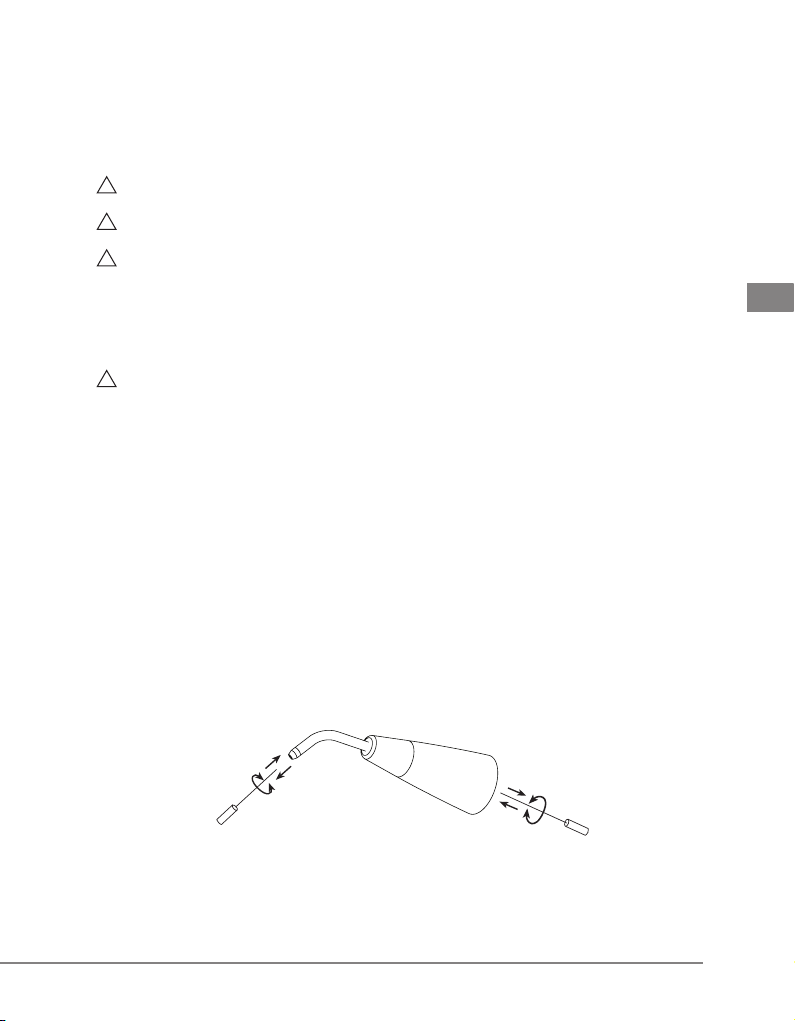
06.3 Sterylizacja rękojeści w autoklawie
�
�
�
�
1 Należy odłączyć rękojeść od urządzenia Easyjet pro (Rys.3 - Odn.C).
2 Przy pomocy igły (Rys.2 - Odn.C) należy oczyścić dyszę z wszelkich pozostałości wykonując ruchy
tak jak przedstawiono na (Rys. 5). Następnie używając strzykawki należy przedmuchać kanał dyszy z
obu stron.
! UWAGA: Do czyszczenia kanału dyszy należy używać wyłącznie igły dołączonej do
urządzenia (Rys.2 - Odn.C).
3
! UWAGA: Zbyt twarda woda może powodować zbyt słaby strumień wody. Aby usunąć ten
problem należy na kilka minut zanurzyć rękojeść w 2% roztworze kwasu chlorowodorowego.
! UWAGA: Aby usunąć wszelkie pozostałości roztworu kwasu chlorowodorowego należy rękojeść
dokładnie przepłukać wodą destylowaną. Następnie używając strzykawki należy osuszyć rękojeść
przedmuchując kanał dyszy z obu stron.
4 Rękojeść należy zdezynfekować delikatnym środkiem dezynfekującym o neutralnym pH.
Następnie używając strzykawki należy osuszyć rękojeść przedmuchując kanał dyszy z obu stron.
5 Należy włożyć igłę w dyszę rękojeści i oba elementy umieścić w jednorazowym opakowaniu.
6 Należy wysterylizować opakowanie zawierające igłę i rękojeść.
! UWAGA: Przed ponownym użyciem należy przy użyciu strzykawki przedmuchać rękojeść, aby
upewnić się, że żadne osady mieszanki nie pozostały wewnątrz rękojeści.
07.0 Konserwacja okresowa
1 Jeżeli kanał w rękojeści przesyłający powietrze zatka się, wystarczy włączyć urządzenie na kilka
sekund i przy pomocy igły dołączonej do urządzenia (Rys. 5) oczyścić kanał z wszelkich pozostałości
proszku.
2 Jeżeli dysza rękojeści ulegnie zatkaniu za względu na zbyt twardą wodę, zaleca się zanurzenie
rękojeści na kilka minut w 2% roztworze kwasu chlorowodorowego.
3 Każdorazowo przy zdejmowaniu rękojeści, w celu uniknięcia zbierania się pozostałości proszku,
zaleca się przy pomocy strzykawki oczyszczenie sprężonym powietrzem otworu złącza oraz tylnego
otworu centralnego.
4 Aby uniknąć zatykania się urządzenia zaleca się opróżnianie zbiornika proszku przynajmniej raz
dziennie.
PL
Rys. 5
easyjet pro - podręcznik użytkowania i konserwacji
95
Page 95
08.0 Procedury i środki ostrozności przy utylizacji
�
0476
urządzenia
Pozbywając się urządzenie należy przestrzegać wszelkich procedur i środków ostrożności zgodnie z
aktualnie obowiązującymi przepisami prawnymi.
09.0 Symbole
Proszę zapoznać się dokładnie z
instrukcjami użytkowania.
Urządzenie zgodne z Dyrektywą Rady 93/42/EWG z dnia 14 czerwca 1993 r. dotyczącą wyrobów medycznych.
Jednostka notykowana: CERMET
96
easyjet pro - podręcznik użytkowania i konserwacji
Page 96
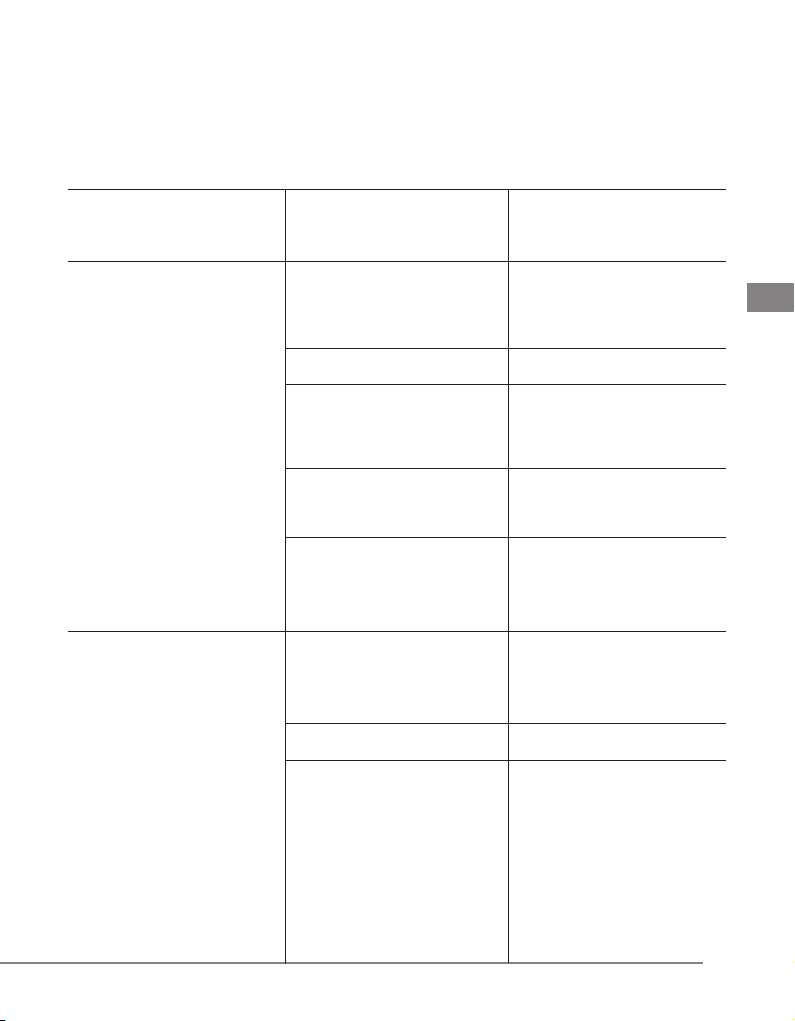
10.0 Problemy i rozwiązania
Jeżeli urządzenie nie działa właściwie, ponownie przeczytaj instrukcje a następnie zapoznaj się z
poniższą tabelą.
PROBLEM PRZYCZYNA ROZWIĄZANIE
Nie można odkręcić
przykrywy zbiornika proszku.
W trakcie użycia z rękojeści nie
wydobywa się proszek.
W trakcie użycia z rękojeści nie
wydobywa się woda.
Easyjet pro jest podłączone do
turbiny i w zbiorniku na proszek
utrzymywane jest ciśnienie.
Unit stomatologiczny nie został
podłączony do obwodu
doprowadzającego powietrze.
Zbiornik proszku jest pusty.
Dysza jest zatkana z powodu
nadmiernego zawilgocenia
proszku lub niedokładnego
oczyszczenia/konserwacji.
Poziom proszku w zbiorniku jest
wyższy niż dopuszczony.
Niewłaściwy proszek.
Unit stomatologiczny nie
został podłączony do obwodu
doprowadzającego wodę.
Zbyt twarda woda.
Filtr wody w unicie
stomatologicznym jest zatkany.
Należy odłączyć Easyjet pro od
turbiny, aby zmniejszyć ciśnienie
w obwodzie wewnętrznym.
Należy sprawdzić połączenie
pomiędzy unitem
stomatologicznym i obwodem
doprowadzającym powietrze.
Przeczytaj rozdział „05.2”
Przeczytaj rozdział „06.1” i „06.3”.
Usuń proszek ze zbiornika i
wyczyść zbiornik suchą szmatką.
Przeczytaj rozdział „07.0”.
Należy przywrócić właściwy
poziom proszku w zbiorniku.
(przeczytaj rozdział „05.2”).
Aby zapewnić właściwe działanie
urządzenia należy używać
wyłącznie proszku
produkowanego przez rmę
MECTRON.
Należy sprawdzić połączenie
pomiędzy unitem
stomatologicznym i obwodem
doprowadzającym wodę.
Przeczytaj rozdziały „06.3 - 07.0”.
Należy sprawdzić podłączenie do
unitu stomatologicznego obwodu
doprowadzającego wodę.
PL
easyjet pro - podręcznik użytkowania i konserwacji
97
Page 97

PROBLEM PRZYCZYNA ROZWIĄZANIE
Proszek wycieka spod pokrywy
zbiornika.
Zabieg jest nieskuteczny. Niewystarczające ciśnienie
Niedokładnie zakręcona pokrywa
zbiornika.
Resztki proszku pozostały na
gwincie
w obwodzie dostarczającym
powietrze.
Poziom proszku w zbiorniku jest
zbyt wysoki lub zbyt niski.
Niewłaściwy proszek
Dysza jest zatkana z powodu
nadmiernego zawilgocenia
proszku lub niedokładnego
oczyszczenia/konserwacji.
Należy dokładnie zakręcić
pokrywę zbiornika.
Przeczytaj rozdział „06.1”.
Należy sprawdzić ciśnienie w
obwodzie powietrza unitu
stomatologicznego.
Należy przywrócić właściwy
poziom proszku w zbiorniku.
(przeczytaj rozdział „05.2”).
Aby zapewnić właściwe działanie
urządzenia należy używać
wyłącznie proszku
produkowanego przez rmę
MECTRON.
Przeczytaj rozdział „06.1” i „06.3”.
Usuń proszek ze zbiornika i
wyczyść zbiornik suchą szmatką.
Przeczytaj rozdział „07.0”.
11.0 Dane techniczne
Urządzenie zgodne z Dyrektywą Rady 93/42/EWG: Klasa II a
Urządzenie do pracy przerywanej: 60 s. WŁĄCZONY 30 s. WYŁĄCZONY
Dopływ wody: Od 0 do 3 barów (od 0 hPa do 3000 hPa),
Max 40°C.
Sprężone powietrze: Od 2,3 do 3,2 barów (2300 hPa - 3200 hPa).
Środowisko pracy: Od +10°C do +40°C.
Wilgotność względna od 30% do 75%.
Warunki transportu i przechowywania: Od -10°C do +70°C.
Wilgotność względna od 10% do 90%.
Ciśnienie: 500hPa/1060 hPa
Waga: 125 g.
98
easyjet pro - podręcznik użytkowania i konserwacji
Page 98
12.0 Gwarancja
Przed dopuszczeniem do sprzedaży wszystkie urządzenia rmy MECTRON przechodzą dokładną
kontrolę końcową w celu zapewnienia ich właściwego działania.
MECTRON gwarantuje brak wad materiałowych jak również błędów produkcyjnych w nowych
urządzeniach zakupionych od autoryzowanych dystrybutorów rmy MECTRON lub importerów na okres
jednego roku od daty zakupu.
W czasie trwania gwarancji rma MECTRON zobowiązuje się dokonać bezpłatnych napraw (lub według
własnego uznania wymiany) części uznanych przez MECTRON za wadliwe.
Firma MECTRON nie dokonuje wymiany całych urządzeń.
Firma MECTRON nie ponosi odpowiedzialności za uszkodzenia ciała czy zniszczenie urządzenia w
poniższych przypadkach:
- Gdy urządzenie jest używane do innych celów niż te, do których jest przeznaczone,
- Gdy urządzenie używane jest niezgodnie z instrukcjami i wymogami zapisanymi w niniejszej
instrukcji,
- Gdy instalacja elektryczna, wodna lub sprężonego powietrza, w pomieszczeniu, w którym używane
jest urządzenie nie spełnia odpowiednich standardów i wymagań,
- Gdy montaż, rozbudowa, ustawianie, przeróbki czy naprawy były wykonywane przez inne osoby niż
autoryzowany serwis rmy Mectron.
- Gdy warunki, w których przechowywane jest urządzenie są niezgodne z wymaganiami zapisanymi w
niniejszej instrukcji w rozdziale „11.0 Specykacje techniczne”.
Z niniejszej gwarancji wyłączone są błędy i uszkodzenia wskutek nieprawidłowego użytkowania,
nieprawidłowego ustawienia albo instalacji, oddziaływań zewnętrznych, np. szkody powstałe w trakcie
transportu. Gwarancja nie obejmuje uszkodzeń lamp sygnalizacyjnych, rękojeści oraz wszelkich
akcesoriów.
Dokonywanie napraw czy modykacji urządzenia przez nieautoryzowany personel powoduje nieważnienie
gwarancji.
UWAGA
Gwarancja jest ważna tylko wtedy, gdy karta gwarancyjna zostanie dokładnie wypełniona i przesłana do
rmy MECTRON lub jednego z jej dystrybutorów lub importerów w przeciągu 20 (DWUDZIESTU) DNI od
daty zakupu zawartej na liście przewozowym lub fakturze wystawionej przez dystrybutora lub importera.
Aby skorzystać z naprawy gwarancyjnej klient musi na własny koszt dostarczyć urządzenie do dilera
lub importera, od którego zakupił urządzenie. Urządzenie powinno zostać dostarczone odpowiednio
zapakowane (w miarę możliwości w oryginalne opakowania) wraz z wszystkimi akcesoriami i informacją
zawierającą:
a) Dane właściciela, włączając numer telefonu,
b) Dane dystrybutora / importera,
c) Kopię listu przewozowego/faktury wystawionej na właściciela zawierającą oprócz daty zakupu także
nazwę i numer seryjny urządzenia,
d) Opis problemu.
Gwarancja nie obejmuje uszkodzeń powstałych w czasie transportu.
W przypadku wygaśnięcia gwarancji w skutek oddziaływań zewnętrznych lub niewłaściwego użycia
urządzenia, właściciel zostanie obciążony kosztami materiałów oraz pracy niezbędnych do dokonania
naprawy.
PL
easyjet pro - podręcznik użytkowania i konserwacji
99
Page 99

100
easyjet pro - podręcznik użytkowania i konserwacji
Page 100
PL
easyjet pro - podręcznik użytkowania i konserwacji
101
 Loading...