

Page 1
Limited Warranty
Every Meade telescope, spotting scope, and telescope accessory is warranted by
Meade Instruments Corporation (“Meade”) to be free of defects in materials and
workmanship for a period of ONE YEAR from the date of original purchase in the
U.S.A. Meade will repair or replace a product, or part thereof, found by Meade to be
defective, provided the defective part is returned to Meade, freight-prepaid, with proof
of purchase.
transferable. Meade products purchased outside North America are not
included in this warranty, but are covered under separate warranties issued by
Meade international distributors.
RGA Number Required:
Authorization (RGA) number
(949) 451-1450. Each returned part or product must include a written statement
detailing the nature of the claimed defect, as well as the owner’s name, address, and
phone number.
This warranty is not valid in cases where the product has been abused or
mishandled, where unauthorized repairs have been attempted or performed, or
where depreciation of the product is due to normal wear-and-tear. Meade specifically
disclaims special, indirect, or consequential damages or lost profit which may result
from a breach of this warranty. Any implied warranties which cannot be disclaimed
are hereby limited to a term of one year from the date of original retail purchase.
This warranty gives you specific rights. You may have other rights which vary from
state to state.
Meade reserves the right to change product specifications or to discontinue products
without notice.
This warranty supersedes all previous Meade product warranties.
This warranty applies to the original purchaser only and is non-
Prior to the return of any product or part, a Return Goods
must be obtained from Meade by writing, or by calling
Instruction Manual
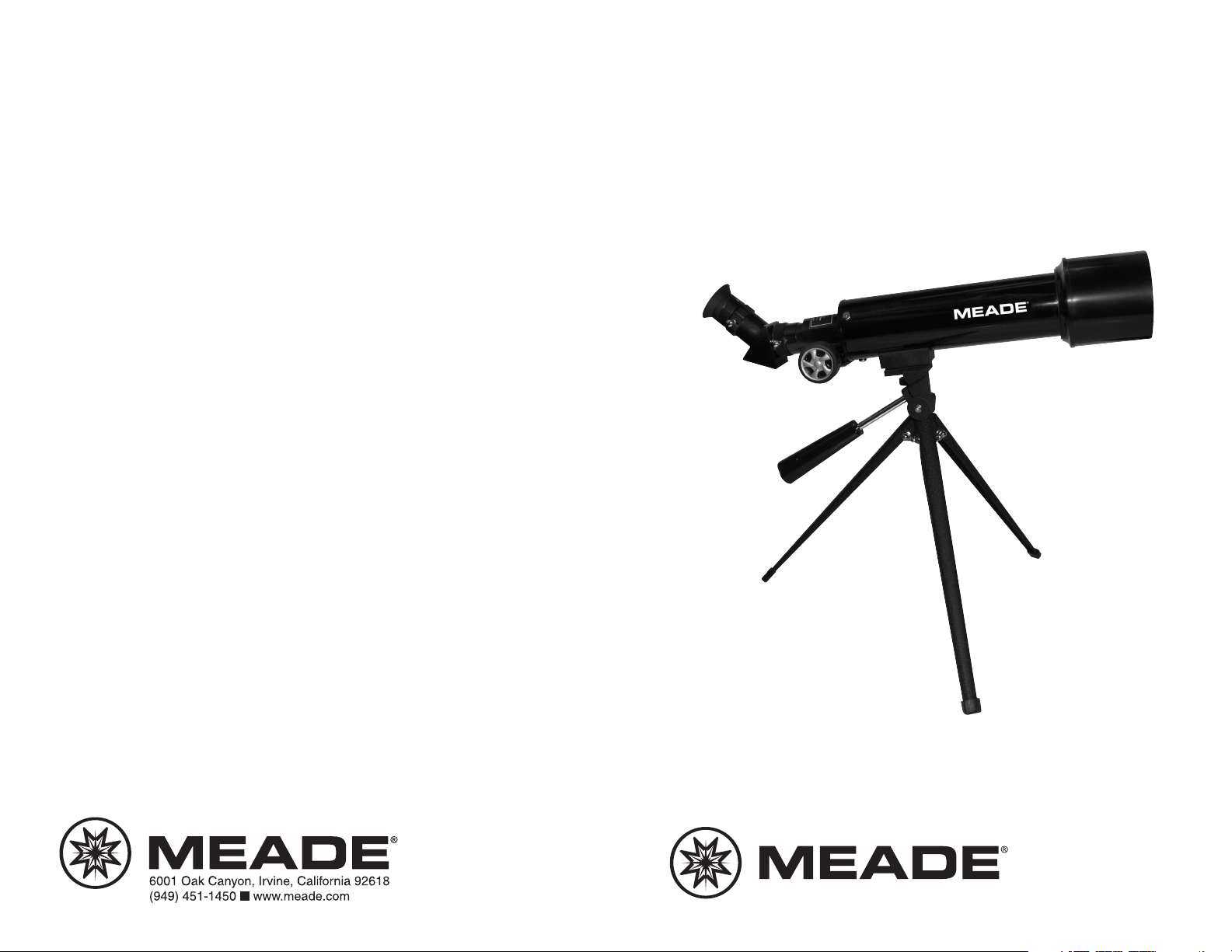
50AZ-T 50mm Compact Refractor Telescope
® The name “Meade,” and the Meade logo, are trademarks registered with the U.S. Patent Office and in principal
countries throughout the world. All rights reserved.
© 2003 Meade Instruments Corporation.
05/04
Page 2

The general rule regarding power: Only use as much magnification as
supports a steady, well-defined image. The stability of the air varies
and is one reason why having various eyepieces is highly desirable.
Higher powers are no guaranty of better images; in fact, the opposite is
often true. Keep in mind, that land viewing and wide-field, deep-space
observation generally operate best with low-powered eyepieces.
MAINTENANCE
The Meade 50mm Compact Refractor telescope should be stored in a
dry and dust-free location. It should not be stored in direct sunlight.
Avoid overcleaning the lens. A little dust on the the lens hardly affects
image quality.
SPECIFICATIONS
Objective (main) lens focal length . . . . . . . . . . . . . . .350mm
Objective lens diameter . . . . . . . . . . . . . . . . . . . . . . .50mm
Mounting type . . . . . . . . . . . . . . . . . . . . . . . . . . . . . . .Table-top
Altazimuth
Eyepieces . . . . . . . . . . . . . . . . . . . . . . . . . . . . . . . . . .K17.5mm,
K12mm,
K9mm
Barlow lens . . . . . . . . . . . . . . . . . . . . . . . . . . . . . . . . .3X
Roof Prism . . . . . . . . . . . . . . . . . . . . . . . . . . . . . . . . .Included
Soft carry case . . . . . . . . . . . . . . . . . . . . . . . . . . . . . .Included
Table top tripod . . . . . . . . . . . . . . . . . . . . . . . . . . . . . .Included
5
Page 3

41
in the upper atmosphere can cause the images to “shimmer” in the
eyepiece. Reduce power until the image steadies. Keep in mind
that a bright, clearly resolved, but smaller image will show far more
interesting detail than a larger, dimmer, fuzzy image.
7. A number of fascinating objects are visible through your Meade
50mm compact refractor:
Jupiter: Jupiter has cloud belts across its surface. It’s four major
•
moons change position around the planet each night. Jupiter has
cloud belts across its surface.
Saturn: Saturn’s ring system is an astronomical favorite.
•
• The Moon: Our Moon offers craters, mountain ranges and fault
lines. The Moon is best observed during its crescent or half phase
when sunlight strikes the Moon’s surface at an angle. Resulting
shadows add a sense of depth to the view. No shadows are visible
during a full Moon, causing the Moon’s surface to appear flat and
low contrast.
Deep-Space: These objects are best viewed at a dark site, away
•
from city and other lights. Such objects include nebulae, galaxies,
multiple star systems, and star clusters.
Terrestrial objects: Your telescope may also be used for high
•
resolution land viewing. Terrestrial observations should almost
always be made using a low power eyepiece (50X or less) for
bright, sharp images. Land objects offer limited applications at
higher powers because the telescope is being pointed through the
thickest part of the Earth’s atmosphere.
Meade 50mm Compact Refractor Telescope
e
f
cd
j
b
1)
1!
1@
g
h
i
POWER
The power, or magnification, of a telescope when used with a
particular eyepiece is determined by two factors: the focal length of the
telescope’s main (objective) lens and the focal length of the eyepiece
being used. The Barlow lens doubles the power of an eyepiece. To use
the 3X Barlow lens, place the Barlow into the telescope focuser tube,
followed by the eyepiece.
The magnification values available with your eyepieces are as follows:
Eyepiece Power With 3X Barlow Lens
K17.5mm 20X 60X
K12mm 30X 90X
K9mm 40X 120X
Fig. 1: Telescope Features
1. Optical Tube
2. Focus Knob
3. Eyepiece
4. Eyepiece Thumbscrew
5. Roof Prism
6. Diagonal Prism Thumbscrew
7. Altitude Control Handle
8. Tripod leg
9. Tripod Securing Screw
10. Tripod holder
11. Tripod Platform
12. Dew Shield
Page 4

23
USING THE TELESCOPE
WARNING:
RECOMMENDED FOR CHILDREN OVER THE AGE OF 5 WITH ADULT
SUPERVISION ONLY
NEVER USE THE 50AZ-T COMPACT REFRACTOR
TELESCOPE TO LOOK AT THE SUN!
THE SUN WILL CAUSE INSTANT AND IRREVERSIBLE
DAMAGE TO YOUR EYE. EYE DAMAGE IS OFTEN PAINLESS, SO
THERE IS NO WARNING TO THE OBSERVER THAT DAMAGE HAS
OCCURRED UNTIL IT IS TOO LATE. DO NOT POINT THE TELESCOPE
AT OR NEAR THE SUN. DO NOT LOOK THROUGH THE TELESCOPE
AS IT IS MOVING.
SUPERVISION WHILE OBSERVING.
CHILDREN SHOULD ALWAYS HAVE ADULT
INTRODUCTION
The 50AZ-T Compact Refractor is an easy to operate telescope,
designed for both astronomical and terrestrial observing. Please take
a few moments to read the instruction manual and familiarize
yourself with its features.
INSTALLATION:
1. To attach the optical tube to the tripod, first unfold the tripod legs
(8, Fig. 1). Place the tripod holder (10, Fig. 1) on the optical tube's
(1, Fig. 1) tripod platform (11, Fig. 1) and tighten the attachment
(9, Fig. 1) to a firm feel.
screw
2. Slide the diagonal prism (5, Fig. 1) into the tube at the back of the
optical tube and tighten the diagonal prism thumbscrew (6, Fig. 1) to
a firm feel.
4. Place an eyepiece
eyepiece thumbscrew (4, Fig. 1) to a firm feel.
(3, Fig. 1) into the diagonal prism and tighten the
TO ACHIEVE A CLEAR AND SHARP FOCUS:
1. Place the telescope on a stable surface.
2. View objects that are at least 30 feet away.
3. Rotate the altitude control handle
handle. Use the handle to adjust both the horizontal and vertical
position of the optical tube. When you have located an object you
wish to view, tighten the handle again to lock in place.
4. Look through the eyepiece
(2, Fig. 1). Turn the knob with a slow and gentle motion until the
object is in sharp focus.
(7, Fig. 1) to loosen the
(3, Fig. 1) and rotate the focus knob
LOOKING AT OR NEAR
When the telescope is assembled, you are ready to begin
observations.
1. Observing land objects during the daytime is a good way to
become accustomed to the functions and operations of the
telescope. At night, try observing the Moon first, if it is visible, or a
bright star.
2. Use the K17.5mm eyepiece and center an object in the
telescope’s field of view. The included K17.5mm eyepiece is the
best eyepiece to use for the initial finding and centering of an
object. The low power K17.5mm eyepiece presents a bright, wide
field of view, ideal for terrestrial and general astronomical
observing.
For lunar and planetary viewing, switch to a higher power eyepiece
such as the K9mm. Also consider using the provided 3X Barlow
lens. If the image starts to become fuzzy as magnification is
increased—back down to a lower power.
3. If you are observing an astronomical object (the Moon, a planet, a
star, etc.), you will immediately notice that the object moves in a
rather slow but continuous motion across the telescopic field of
view. This motion is caused by the rotation of the Earth which
results in the apparent motion of the object in the telescope’s field
of view.
To keep astronomical objects centered, simply move the telescope
on one or both of its axes (vertical and/or horizontal), using the
altitude control handle
powers, astronomical objects will seem to move through the field
more rapidly. Place the object on the edge of the field of view and
watch as it drifts to the opposite side, then reposition the telescope
so the object can drift through the field again.
4. Avoid touching the eyepiece while observing. Vibrations resulting
from such contact will cause the image to move. Viewing from the
upper floors of a building may also introduce image movement.
5. Allow a few minutes for your eyes to become “dark adapted”
before you begin any serious observations.
6. Some atmospheric conditions can distort an observed image.
Planets, in particular, viewed while low on the horizon, lack
sharpness. When observed higher in the sky, a planet will often
appear to be more steady and have greater contrast. Turbulent air
(7, Fig. 1) as appropriate. At higher
 Loading...