

Page 1
Lovibond® Colour Measurement
Tintometer® Group
Handbook of Methods
Analytical procedures for the measurement of edible oils and fats
5 ¼"
0.5gto1.0g
= / ± 1 mg
Page 2

Page 3

Title No. Page
How to use 4
Taking a Sample 5
Sample Preparation 6
Measurement Decisions 8
The Sample 13
Troubleshooting 14
Lovibond® RYBN Colour CM1 16
AOCS-Tintometer Colour CM2 22
Chlorophyll CM3 28
Red and Yellow Values to Indian Standard - Sesame Oil, Mustard
Oil, Mahua Oil
Red and Yellow Values to Indian Standard - Castor, Ground Nut,
Coconut Oil
Red and Yellow Values to Indian Standard - Castor, Ground Nut,
Coconut Oil
Red and Yellow Values to Indian Standard - Cottonseed Oil CM7 52
Beta Carotene CM8 58
CM4 34
CM5 40
CM6 46
ENHandbook of Methods 3
Page 4

How to use
How to use this guide
The Lovibond® guide to the measurement of colour in edible oils and fats has been designed to enable the accurate and repeatable communication of colour data throughout
the edible oil supply chain.
We recommended that, whether creating a new operating procedure or reviewing your
existing procedures, you work through the guide from the beginning.
The guide can also be used for troubleshooting any problems arising from dierences
in your product’s colour measurements.
Whilst we have taken every care to ensure that all aspects of edible oil measurement
are covered within this guide, we are always available to support our customers via our
website www.lovibond.com or directly by email at [email protected].
ENHandbook of Methods4
Page 5

Taking a Sample
Taking a Sample
Follow standards such as ISO 5555:2001 Animal and vegetable fats and oils — Sampling.
The key aspects of this standard include:
• Use of stainless-steel sampling containers as these are the most suitable
• Types of suitable sampling instrument:
- Weighted sample can
- Weighted cage for sample bottle
- Valve sampling cylinder (sinker sampler)
- Bottom sampler
- Sampling tubes and scoops
• The importance of clean or gloved hands
• Protection of the sample from contamination (rain or dust etc.)
• Heating of oils to facilitate sampling
• Homogenisation of the oil to be sampled
• The taking and preparation of inhomogeneous fats
It is most important to ensure that the sample has not been contaminated and is a
representative sample of the homogeneous bulk of oil concerned.
ENHandbook of Methods 5
Page 6
Sample Preparation
Sample Preparation
This is one of the most important steps to ensuring accurate and repeatable measurements not only in the single laboratory but also when comparing results across multiple
laboratories. Care taken here will reduce errors and provide better measurements.
Filtration
The sample should be clear and free of particles before it is measured.
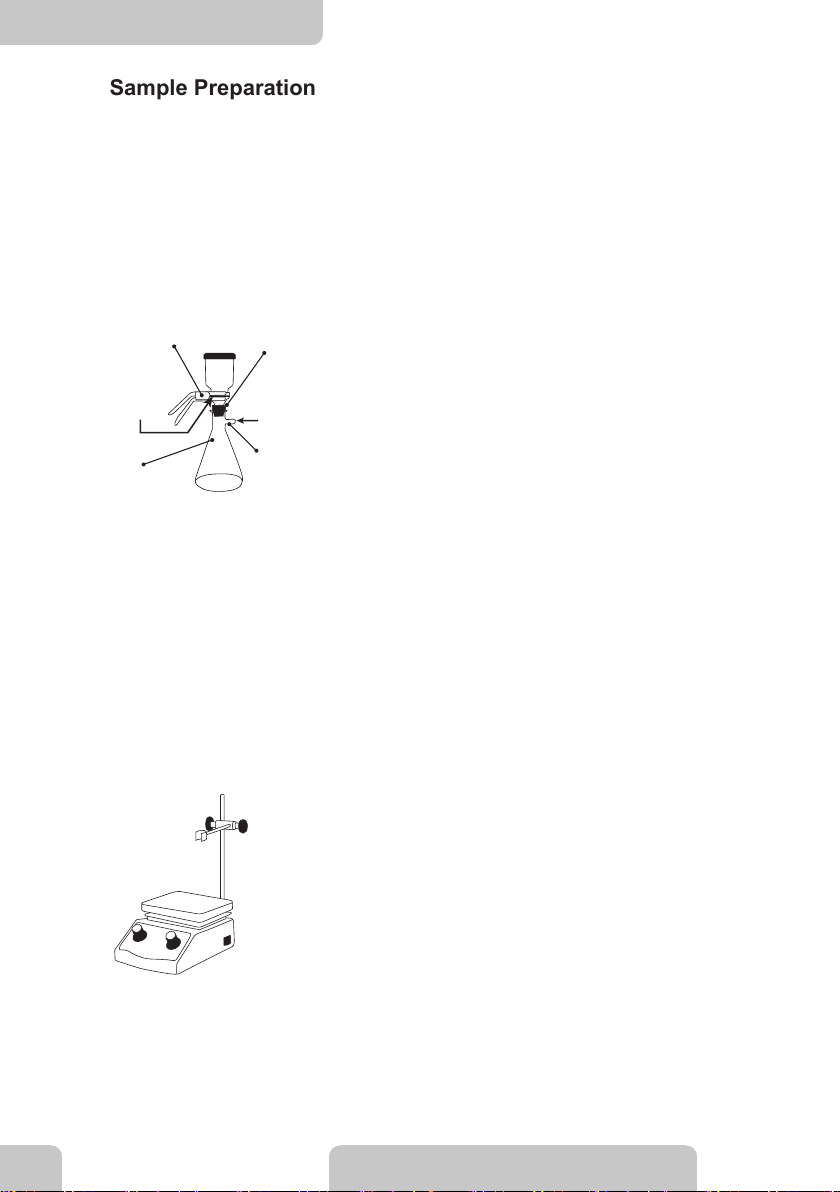
Filtration of oil samples can be achieved through a process of heating (for samples that
are highly viscous at room temperature) and gravity or vacuum ltration.
Strong Clamp
Particle
filter
Lab Quality
Borosilicate
Glass
Sealed
Vacuum
Add
Vacuum
Universal
Vacuum
Hose
Connection
Typical vacuum ltration equipment
The choice of lter pore size should be based upon the sample oil. Some experimentation will be required to obtain the optimum pore size which provides sample clarity in a
suitable timeframe.
Sample Cloud Point & Heating
If the oil is solid at room temperature then heating will be required so that it becomes
liquid and clear. This can be achieved by heating in an oven or stirrer hotplate. The
sample should be heated to 10 Degrees Celsius above its cloud point.
When placed into a cold measurement instrument, some samples may crystallise
quickly upon contact with the cooler surface of the sample cuvette.
To avoid this, warm the instrument (if applicable, see section on measuring equipment)
with the empty sample cuvette before use.
ENHandbook of Methods6
Page 7
a sample
Sample Preparation
Please note that some instruments provide heated sample chambers. These are not
intended for use in bringing the sample to a suitable temperature but to maintain temperature while the measurement is taken.
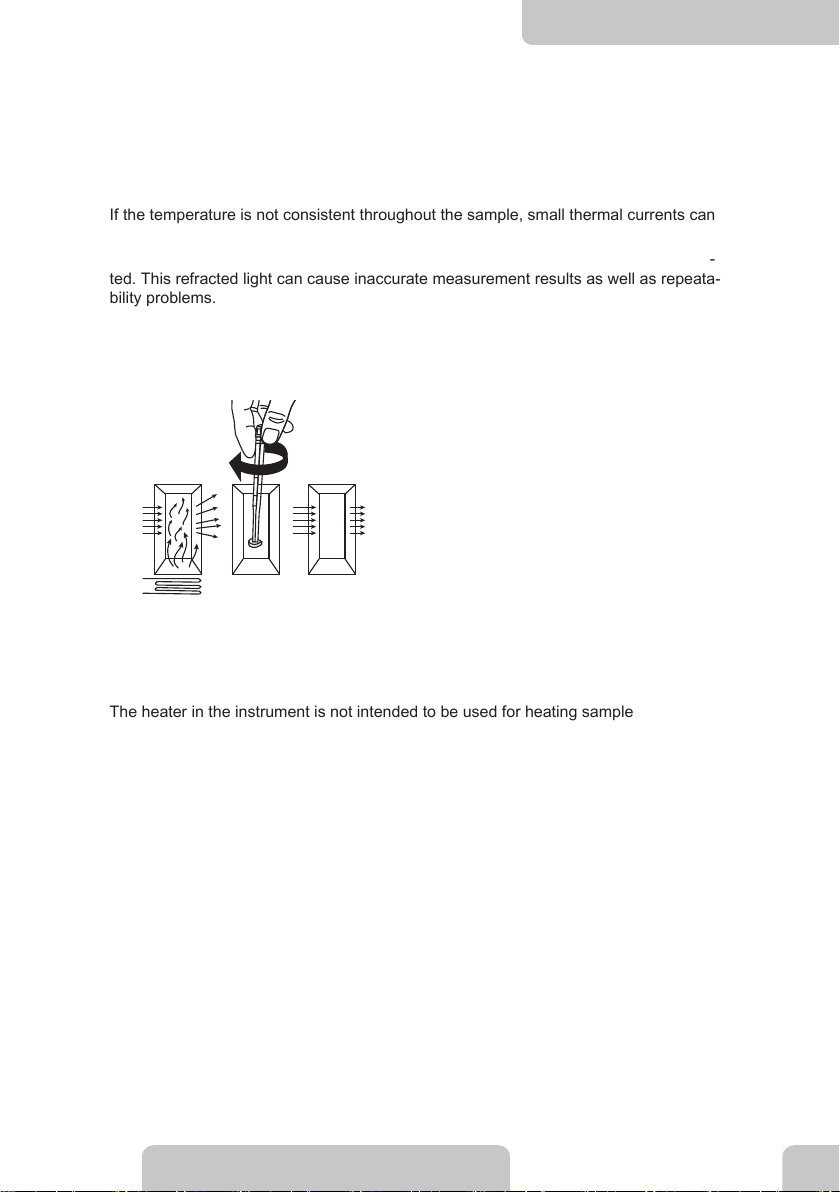
Sample Convection Currrents
If the temperature is not consistent throughout the sample, small thermal currents can
form within it.
These refract the light passing through the sample aecting the amount of light detec-
ted. This refracted light can cause inaccurate measurement results as well as repeata-
bility problems.
The sample should be gently stirred within the measurement cuvette using a clean
stirring rod just prior to measurement.
Thermal currents:
A B C
Thermal currents
forming within
The heater in the instrument is not intended to be used for heating samples up to tem-
perature as it will be quite slow. It is only intended to stop heat being taken away from
the sample during the measurement cycle.
ENHandbook of Methods 7
After stirring
the sample
Page 8
Measurement Decisions
Measurement Decisions
There are four key decisions that must be made prior to measuring colour in oil consistently:
1) The choice of colour scale to be used in communicating the colour data.
2) Visual versus automatic measurement.
3) The path length across which the colour will be measured.
4) Possible dilution of the sample
Choice of Scale
Colour scales are designed to replicate the range of colours specic to an application-
type or sample colour-type. There are a number of scales which are used for measuring edible oil colour. Your supplier or customer will be working to an existing scale and
it is important to try and maintain colour communication within a single scale.
Common Scales and Applicable Standards
Lovibond
®
RYBN
• AOCS Cc 13e, Color of Fats and Oil, Lovibond (ISO Method) – 13e92 Lovibond
Method Using Color Glasses Calibrated in Accordance with the Lovibond Tintometer Color Scale
• AOCS Cc 13j, Color of Fats and Oils, Automated Method
• ISO 15305, Animal and vegetable fats and oils - Determination of Lovibond colour
• ISO 27608, Animal and Vegetable Fats and Oils - Determination of Lovibond Colour - Automatic Method
• Department of Standards Malaysia MS 252: Part 16, ANIMAL AND VEGETABLE
FATS AND OILS: PART 16: DETERMINATION OF COLOUR
• Department of Standards Malaysia MS 817: PART 12, PALM OIL AND PALM
OIL PRODUCTS: PART 12: DETERMINATION OF LOVIBOND COLOUR (ISO
15305:1998, MOD)
The Lovibond
®
Scale is based on 84 calibrated glass colour standards of dierent
densities of magenta (red), yellow, blue and neutral, graduating from desaturated to
fully saturated. Sample colours are matched by a suitable combination of the three
primary colours together with neutral lters, resulting in a set of Lovibond® RYBN units
that dene the colour.
Since several million combinations are available, it is possible to match the colour of
almost any sample; it is particularly popular for measuring the colour of oils and fats.
Designed originally for visual colour assessment, this scale has been since digitised
and can now be expressed using automatic equipment.
Lovibond
®
RYBN utilises a combined numbering system to express a value represen-
ting:
• Red
• Yellow
• Blue
• Neutral
The neutral element of the scale performs the function of adjusting for “brightness”
overall light intensity in visual glass-based measurement systems. Care must be taken
ENHandbook of Methods8
Page 9
Measurement Decisions
if users of visual measurement systems employ neutral lters to dull a bright sample,
but omit to report this in their results.
A Neutral standard of a particular value is equivalent to a combination of Red, Yellow
and Blue standards, so if there is a match using all four colours, it can be simplied
by removing the smallest number from all the colours. For example, 1.5R, 7.8Y, 0.2B,
0.5N is equivalent to, and should only be reported as, 1.3R, 7.6Y, 0.3N.
®
Practical Aspects of Lovibond
The Lovibond
®
RYBN colour scale is the preferred colour scale when measuring Lovi-
RYBN Measured in Visual Systems
bond colour as it most closely correlates with the way in which visual instruments are
designed to be used.
There are two working practices which are sometimes used in visual systems, to simplify the comparison of samples with glass colour standards.
Lovibond® RY
Uses only the Red and Yellow glass standards when comparing two samples (or sample with a standard). This will often lead to lower values in the reported match due to the
brightness dierence in visual measurement systems. A higher variation between users
will be seen, as a more subjective decision on the match at dierent brightness levels is
being made. An RY result may be correct, but often a complete result requires Neutral
values as well.
Lovibond® RY 10:1
In some sample oils, there is a useful relationship between Yellow and Red colour values (where Yellow is approximately ten times the Red value). The 10:1 ratio is often a
useful point to start from when making a colour match, then improved to a more precise
match using the full gamut of Red, Yellow, Blue and Neutral. The RY 10:1 ratio is a
step in the process of achieving a good RYBN match, but it is not a nal result.
American Oil Chemists Society (AOCS) AOCS-Tintometer Scale.
• AOCS Cc 13b-45, Color of Fats and Oils, Lovibond (Wesson) Wesson Method
Using Color Glasses Calibrated in Accordance with the AOCS-Tintometer Color
Scale
• AOCS Cc 8d-55, Rened and Bleached Color in Tallow and Greases Intended for
Soap Production
• AOCS Cc 13j-97, Color of Fats and Oils, Automated Method
The AOCS-Tintometer colour scale is a scale of Red and Yellow colour values only.
The scale diers in its values from the Lovibond
®
RYBN scale so measurements bet-
ween the two scales are not comparable.
The AOCS-Tintometer scale also uses a dierent viewing system for visual measurement: in the Lovibond
®
RYBN method the sample and coloured glass are side by
side while in AOCS-Tintometer, the sample and coloured glass are shown in separate
circles of colour.
Chlorophyll
• AOCS Cc-13d-55, Chlorophyll Pigments in Rened and Bleached Oils
Whilst not a colour scale, the content of chlorophyll in a number of edible oils can be
determined by light absorbance. The relationship between absorbance (optical density)
at 670nm, 630nm and 710nm is dependent upon the chlorophyll content of the oil.
The sample pathlength is used in the calculation of chlorophyll content and should be
ENHandbook of Methods 9
Page 10
Measurement Decisions
chosen such that the optical density at 670nm is between 0.3 and 0.8.
Beta Carotene
• BS 684 (section 2.20) Determination of carotene in vegetable oils
Beta Carotene is seen in some oils (e.g. Palm Oil) as the orange/red hue. This can be
measured as light absorbance at 445nm. It should be noted that as a purely quantitative method, any sample that absorbs light at 445nm will give a result (which may not
necessarily be constituted of beta carotene).
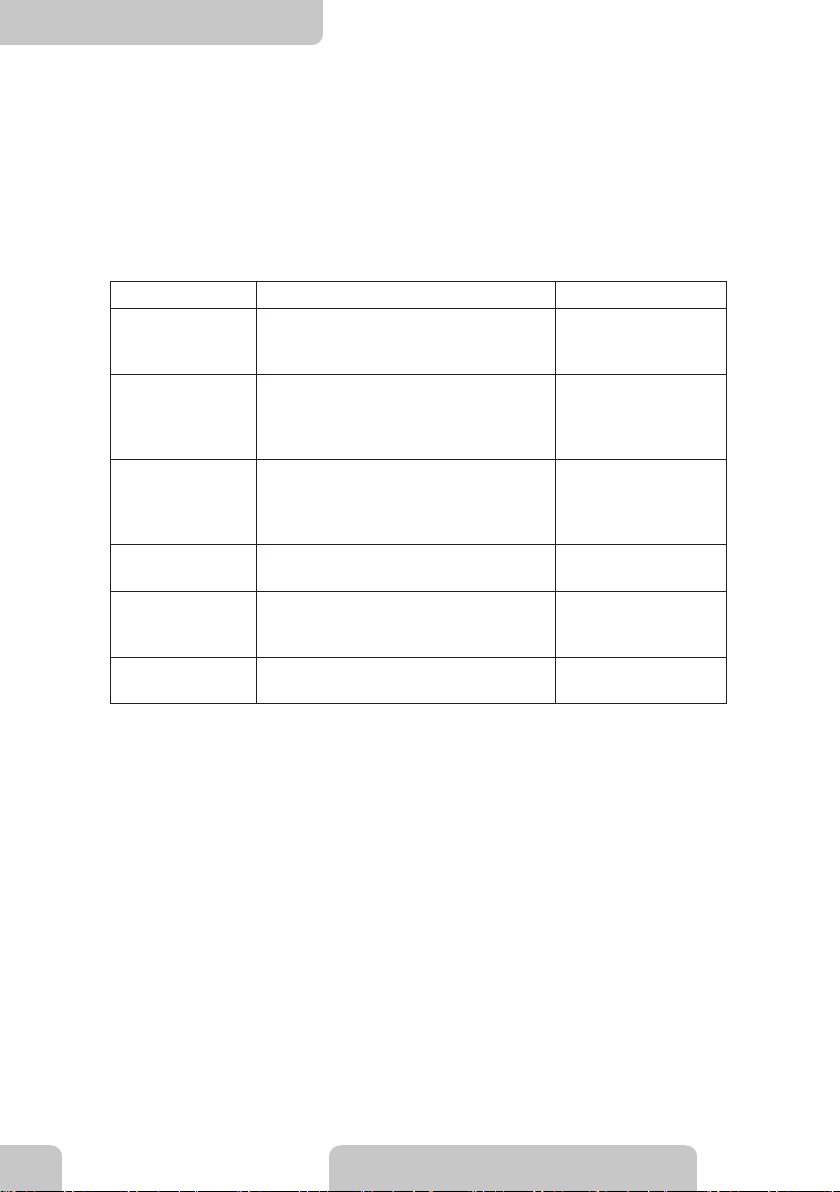
Scale Summary Reported Units
Lovibond
Lovibond
RYBN Red, Yellow, Blue and Neutral. Most
closely correlates with use of visual
instruments
®
RY Uses only Red and Yellow. Lack of
0.1 to 70 Red, Yellow
0.1 to 40 Blue
0.1 to 3 Neutral
0.1 to 70 Red, Yellow
®
brightness factor can lead to lower
reported values and higher variation
between users in visual systems
Lovibond
10:1
RY
Uses an approximation of the Red
value as being ten times that of yellow
0.1 to 20 Red
1.0 to 70 Yellow
®
in order to make visual measurement
easier.
AOCS Tintometer Red and Yellow only. Sample and ad-
justed match colour are separated
Chlorophyll Calculation made using absorbance
(optical density) at 670nm, 630nm and
0.1 to 20 Red
1 to 70 Yellow
Parts per million / mg
per kg
710nm
Beta Carotene Absorbance at 445nm in some oils Parts per million / mg
per kg
Visual vs Automatic Measurement Systems. Advantages and Disadvantages
Visual Measurement
• Human assessment is usually the nal arbiter of colour matching. Regardless of
what any instrument reports, a human consumer will make their own subjective
assessment of the suitability of colour to them.
• Measurements must be assessed by a number of people and aggregated to pro-
vide a result consistent with an “average viewer”. Two groups of “average viewers”
may present dierent results on the same sample due to biological variations in
colour perception and subjective variations (mood can aect colour perception).
• You must ensure that operators pass a colour vision test administered by a quali-
ed optician. They should be re-tested every ve years.
Automatic Measurement
• Consistent repeatability of results between instruments of the same principle and
design.
• Only requires a single operative to provide a result.
ENHandbook of Methods10
Page 11
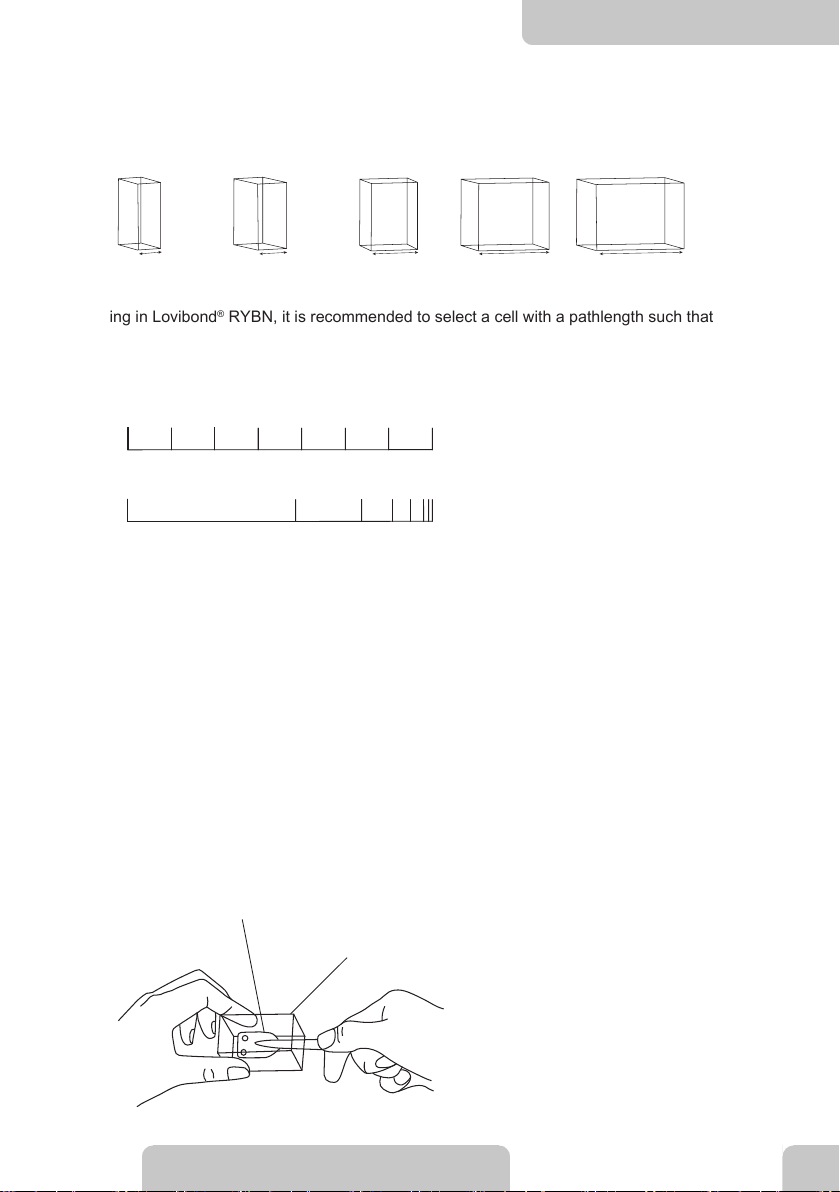
1” or 25.4 MM½” or 12.7 MM1/16” or 1.6 MM ¼” or 6.4 MM1/8” or 3.2 MM
Measurement Decisions
Path length selection
Selecting a suitable pathlength cuvette for your sample.
Many standards reference a 5 1/4 “ or 133.4mm cell but provision is made to use shorter pathlength cells.
Because of the logarithmic nature of the Lovibond® RYBN colour space, when measuring in Lovibond® RYBN, it is recommended to select a cell with a pathlength such that
the total of colour units required to match is not greater than 20 (R + Y + B or N <20).
Doing so will improve repeatability and reproducibility.
Linear Scale
0 10 20 30 40 50 60 70
0
Logarithmic Scale
7010 20 30 40
Sample dilution
Sample Dilution for Lovibond
®
RYBN, Lovibond® RY, Lovibond® RY 10:1 or
AOCS Tintometer
Sample dilution is not recommended. Selection of a suitable pathlength will ensure
repeatable and reproducible results.
Sample Dilution for Beta Carotene
Dilute your sample in analytical grade cyclohexane at a dilution of 1:100. The PFXi and
Model Fx rmware assumes that the dilution is correct, so one must weigh out precisely 1 g of oil, measured as accurately as possible (BS684 2:20 states one should use
scales accurate to 1mg) and dilute to 100 ml with cyclohexane.
Then measure in a 10mm pathlength cuvette.
One can avoid solvent dilution by using an undiluted sample and measuring in a
0.1 mm pathlength cuvette (part number 606700) with the measurement instrument
pathlength set at 10 mm.
0.1 mm detachable cuvette
(PIPS face downwards towards sample)
10 mm Cuvette
ENHandbook of Methods 11
Page 12

Measurement Decisions
Equipment Verification
As with any measurement device it is important that the instrument used for colour
measurement is checked to ensure that it is working within its specied parameters.
With colour measurement instruments this done by measuring standards with known
values against which the results can be compared.
Colour reference standards
Reference colour standards will come with a certicate that states the colour values
and the tolerances. It is often helpful to understand how the colour values are derived
and how the tolerances are determined.
With visual instrumentation we know that the measured result is subjective, so trying to
put an absolute value to that is problematic at the best of times. At the Tintometer Ltd.
the procedure adopted is to use 3 to 5 operators that have been tested for any colour
deciency and found to have normal colour vision. Visual measurements are made
independently. The results are reviewed with any outliers being removed. The average
of the results is taken. Tolerance levels for the visual system have been developed
using a larger population of users and samples. The data from this study is used for the
tolerance levels shown on a certicate.
Any instrument has repeatability and inter-instrument reproducibility tolerances. These
are calculated by repeating many measurements with many samples over a dened
period as well as measuring on several instruments. The tolerances then dened for
the repeatability and reproducibility of the instrument are added to the tolerance value
specied with the colour standard.
Types of verication standard
The Tintometer Ltd. produces two types of verication standard: solid glass and liquid
reference standards.
Glass Reference standards
Glass reference standards have the benet of not having a shelf life. They can however
become dirty and care should be taken to ensure they are kept clean. They are very
good for validating the instrument’s performance, many users check their instrument
each day or week using glass standards. It is recommended that they are recalibrated
periodically to ensure no damage has occurred that may aect the colour values.
Liquid Reference Standards
The liquid reference standards can be used in the same way as glass standards for
verifying that an instrument is working correctly. They do have certain benets over
the glass standards in that they better replicate the way in which normal samples are
measured. This can be useful for also detecting operator faults such as not cleaning
cuvettes correctly. Dirty cuvettes can lead to errors in measurements. The use of liquid
references can also detect the incorrect placement of the cuvette in the instrument.
When using liquid reference standards also be sure to use the cuvette pathlength
recorded on its certicate.
ENHandbook of Methods12
Page 13

The Sample
The Sample
All vegetable oils contain the same fatty acids, oleic acid, linoleic acid, palmitic acid
and stearic acid. However, other fatty acids can also occur in sometimes signicant
amounts and the matrix in which these fatty acids are contained are very dierent. This
leads to large practical dierences in the physical and optical properties of these oils.
Sample Types
Lovibond
oils covered in these methods are listed here:
• Soya bean oil
• Palm oil
• Rapeseed/Canola oil
• Sunower seed oil
• Groundnut (peanut) oil
• Cottonseed oil
• Coconut oil
• Palm kernel oil
• Olive oil
• Corn oil
• Sesame oil
• Linseed oil
®
products are designed to measure all types of edible oils. The most common
The viscosity, density and optical properties of these vary between each oil and with
temperature. This variance, along with the oil´s common visible spectral characteristics
inuences both the way it is prepared for measurement and the colour scale to which it
may be measured.
ENHandbook of Methods 13
Page 14
Troubleshooting
Troubleshooting
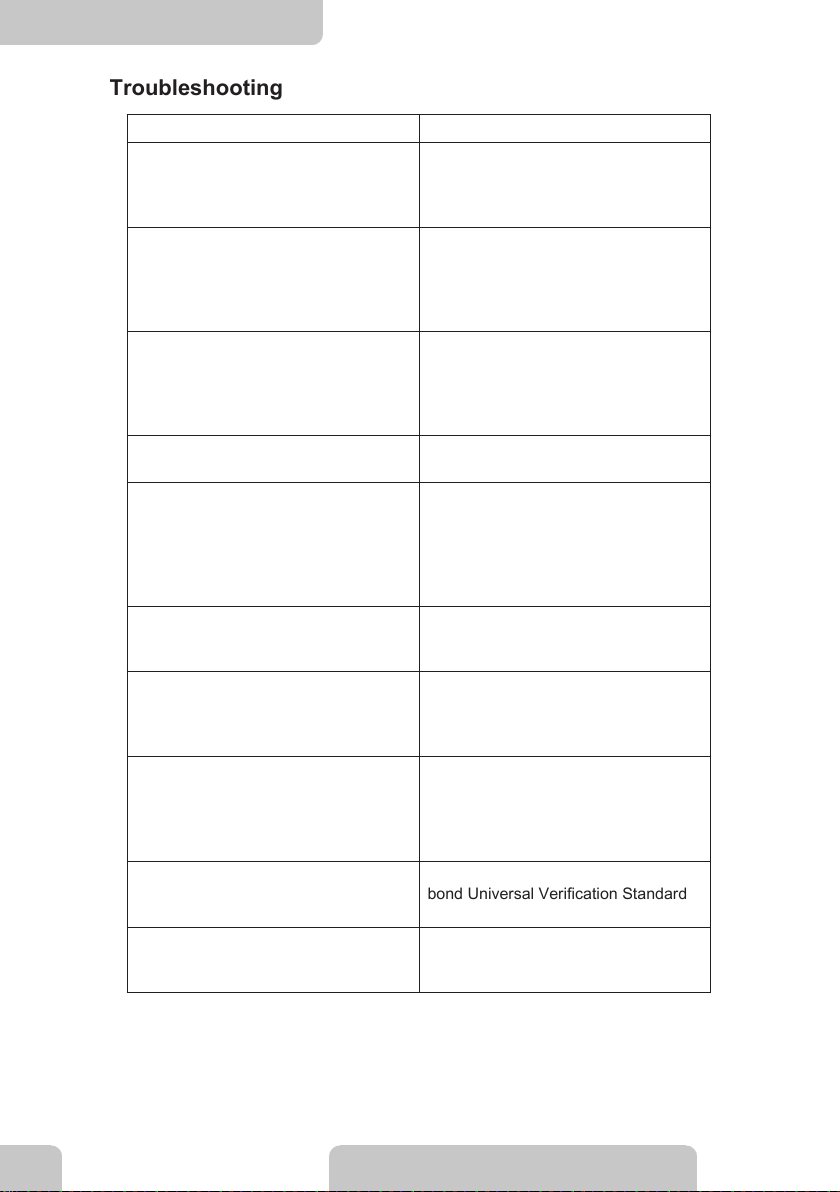
Common Issue Solution
Our Automatic Instrument (Lovibond
Model Fx or PFXi) is showing higher
Blue values when compared to our
Visual Tintometer Model F.
Our samples are heated and transparent, but we are experiencing dierences between our Automatic Instrument
(Lovibond Model Fx or PFXi) and
Visual Tintometer Model F.
Despite transparency, appropriate cell
path length and stirring we are still
experiencing dierences between our
Automatic Instrument (Lovibond Model
Fx or PFXi) and Visual Model F.
Where can I get my instrument serviced?
Despite transparency, appropriate cell
path length, stirring and cleanliness
we are still experiencing dierences
between our Automatic Instrument (Lovibond Model Fx or PFXi) and Visual
Model F.
We are getting dierent results from
another site.
Our Automatic Instrument (Lovibond
Model Fx or PFXi) is showing Neutral
values when compared to our Visual
Tintometer Model F.
Our Automatic Instrument (Lovibond
Model Fx or PFXi) is reporting Blue
and Neutral Values that we do not report on our Visual Tintometer Model F.
How can I check inter-instrument
agreement between a Lovibond Model
Fx, PFXi and/or Tintometer Model F.
When using our Visual Tintometer
Model F instrument we wish to round
down Y values to the nearest 10.
Your samples are not transparent,
they require ltering or heating.
Convection currents in your samples
could be causing issues. Please stir
them before measuring.
Your instruments and cells should be
clear and in a good state of repair.
Oil contamination and damage can
negatively impact results.
Please contact The Tintometer Ltd for
advice. We are happy to help.
Review the relevant standard (e.g.
AOCS 13e-92) for recommended
tolerances. Visual instruments are less
repeatable than automatic.
Check you are using the same colour
scale, cell path length, temperature
and sample preparation technique.
Are you correctly compensating for
brightness when using your Tintometer Model F?
Check you are applying the correct
colour scale. Lovibond RYBN reports
Red, Yellow, Neutral and Blue values.
AOCS Tintometer reports Red and
Yellow only.
We recommend checking with a Lovi-
bond Universal Verication Standard
set.
We strongly advise against this poor
practice.
ENHandbook of Methods14
Page 15
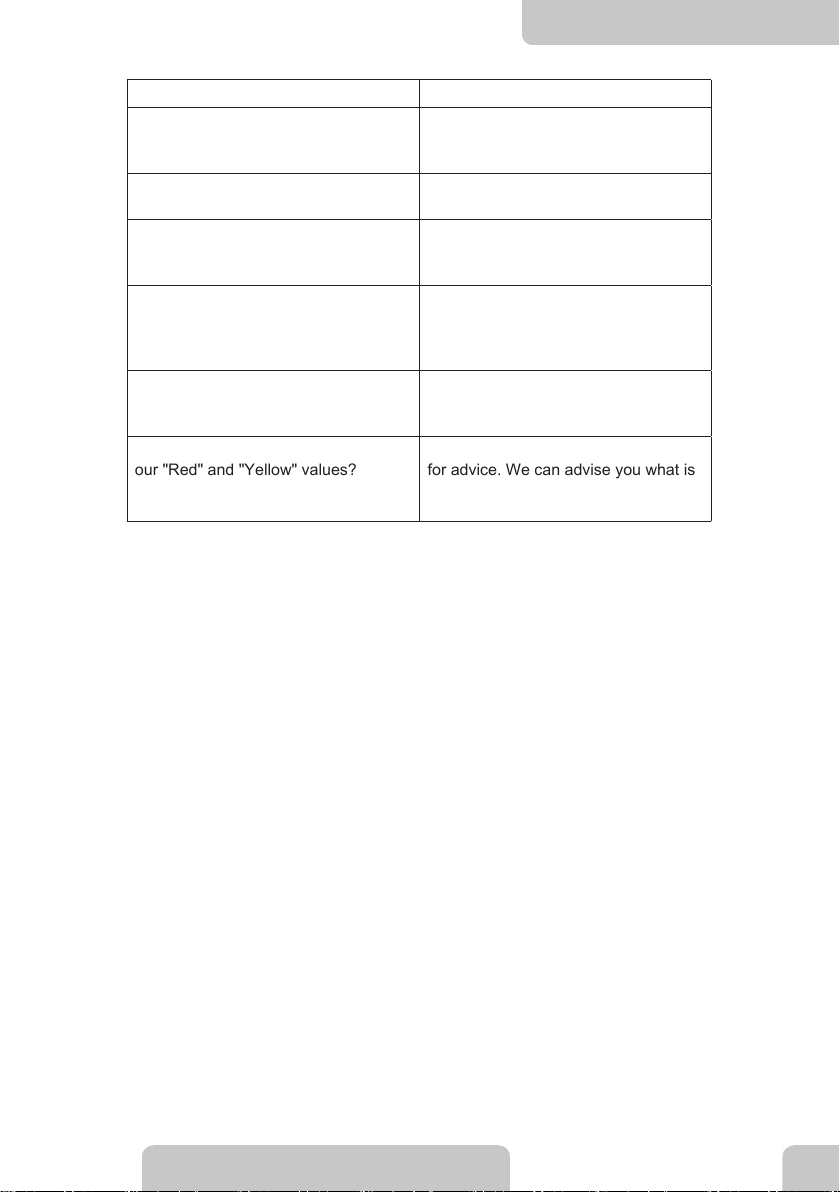
Common Issue Solution
When using our Visual Tintometer
Model F instrument we wish to round
down R values to the nearest 1.
We wish to x a R (Red) or Y(Yellow)
value, then colour match.
We are seeing a lot of variation in
readings between the operators of our
Visual Tintometer Model F.
We only have one operator using our
Visual Tintometer Model F.
We are unsure what International
Standard to apply for the oils we are
handling?
What tolerances should we apply to
our "Red" and "Yellow" values?
We strongly advise against this poor
practice.
We strongly advise against this poor
practice.
We recommend colour vision testing
for all operators at least every 5 years.
As per the standards, we recommend
at least two operators make independent visual assessments with a 3rd
available to adjudicate.
Please contact The Tintometer Ltd for
advice. We are happy to help.
Please contact The Tintometer Ltd
for advice. We can advise you what is
dictated in the applicable International
Standard.
Troubleshooting
ENHandbook of Methods 15
Page 16

Lovibond® RYBN Colour / CM1
Lovibond® RYBN Colour CM1
Instrument specific information
The test can be performed on the following devices. In addition, the requiredpath length
and the range of the colour scale are indicated.
Title Scale Path Length Scale Range
Model Fx, PFXi-880/IP17,
PFXi-880/IP
17 heated, PFXi-880/L,
PFXi-880/S, PFXi-880/S
heated, PFXi-880L
heated, PFXi-950,
PFXi-950 heated,
PFXi-995,
PFXi-995 heated,
PFXi-995/P, PFXi-995/P
heated
Model F, Model F (BS 684)
with Compensating slides
1/16" - 6" 0 - 70 R, 0 - 70 Y, 0 - 30 B,
0 - 3 N
1/16" - 6" 0 - 79.9 R, 0 - 79.9 Y, 0 -
39.9 B, 0 - 3.9 N
Application List
• Food and Beverage
• Household Products
• Petroleum Oils and Waxes
• Edible Oils and Fats
• Chemicals
Applicable Standard
• AOCS Cc 13j-97
• ISO 27608
• MS 252 : Part 16
• MS 817 : Part 12
• AOCS Cc 13e-92
• BS684
• ISO 15305
ENMethod Reference Book16
Page 17

Lovibond® RYBN Colour / CM1
Liquid Reference Standards
Title Packaging Unit Part Number
Lovibond® RYBN Colour 0.8R 2.0Y 0.1N (5¼) 500 ml 134080
Lovibond® RYBN Colour 2.0R 7.0Y 0.5N (5¼) 500 ml 134100
Lovibond® RYBN Colour 2.1R 11.0Y 0.5N
(5¼)
Lovibond® RYBN Colour 3.1R 22.0Y 0.8N
(5¼)
Lovibond® RYBN Colour 3.4R 30.0Y 0.9N
(5¼")
Lovibond® RYBN Colour 1.4R 4.0Y 0.5N (5¼) 500 ml 134090
Lovibond® RYBN Colour 2.5R 14.0Y 0.7N
(5¼)
500 ml 134110
500 ml 134130
500 ml 134230
500 ml 134120
Glass Standards
Title Packaging Unit Part Number
Lovibond Red, Yellow, Neutral Filter Set
(Model F, E, D)
Lovibond Red, Yellow, Blue (Model F, E, D) 1 pc. 186000
Lovibond Red, Yellow, Neutral (Model F, E,D)1 pc. 184000
1 pc. 185000
Lovibond Red, Yellow, Neutral Filter Set
(PFXi 995/950/880)
Lovibond Red, Yellow, Neutral Filter Set
(PFXi 995/950/880)
Lovibond Red, Yellow, Blue Filter Set (PFXi
995/950/880)
Lovibond Red, Yellow, Neutral (PFXi
995/950/880)
Lovibond Red, Yellow, Neutral (Fx) 1 pc. 169630
Lovibond Red, Yellow, Neutral Filter Set (Fx) 1 pc. 169610
Lovibond Red, Yellow, Blue Filter Set (Fx) 1 pc. 169620
Lovibond Red, Yellow, Neutral Filter Set (Fx) 1 pc. 169590
ENMethod Reference Book 17
1 pc. 139590
1 pc. 139610
1 pc. 139620
1 pc. 139630
Page 18
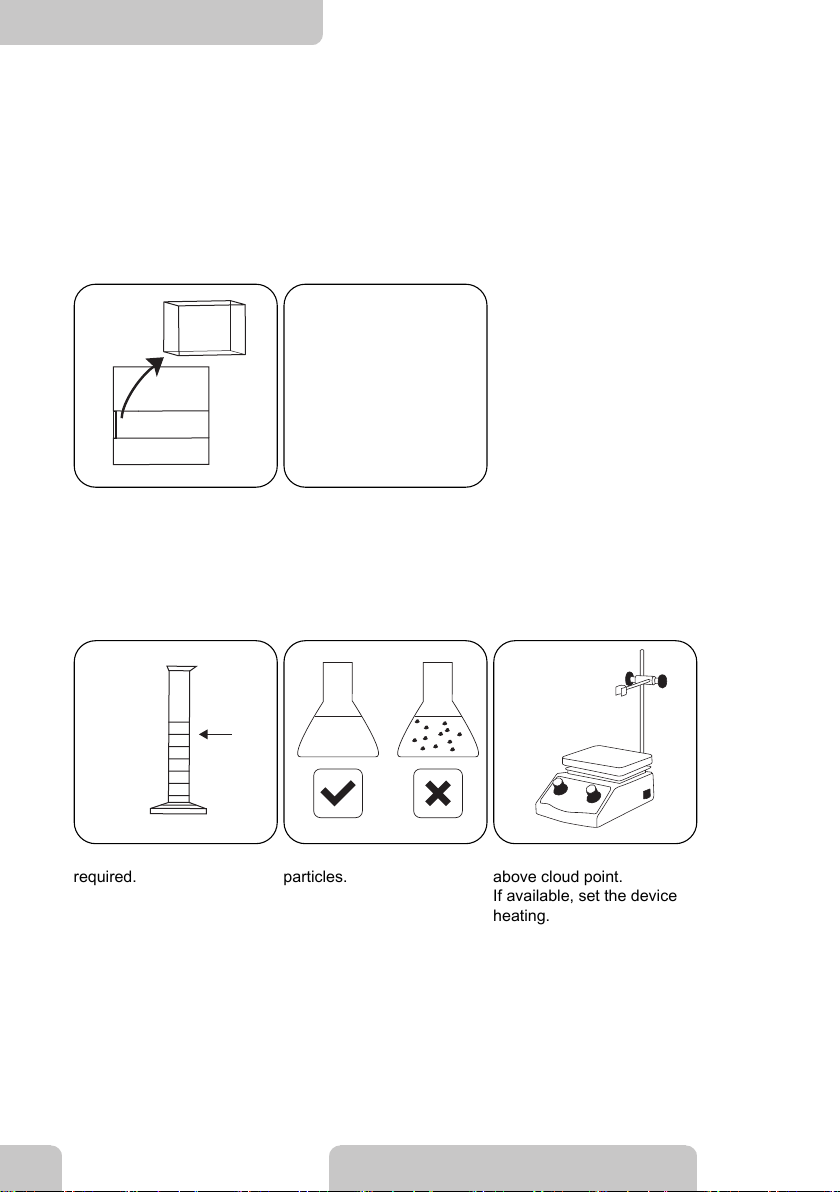
Lovibond® RYBN Colour / CM1
ZERO
Implementation of the provision Lovibond RYBN Colour
Using colorimeter: Model F, Model Fx, PFXi
Select the colour scale on the device: Model Fx, PFXi
For this colour scale, a baseline measurement must be carried out in the following
devices: Model Fx, PFXi
Perform Baseline Measurement (Automatic Instruments)
Ensure the measurement
chamber is empty and
close the lid.
Sample Preparation
100 ml
Sample volume of 100 ml
required.
Press the ZERO button
(Model Fx: Ø button) to
perform a baseline.
Vacuum filter to remove
particles.
Heat sample to 10 °C
above cloud point.
If available, set the device
heating.
ENMethod Reference Book18
Page 19
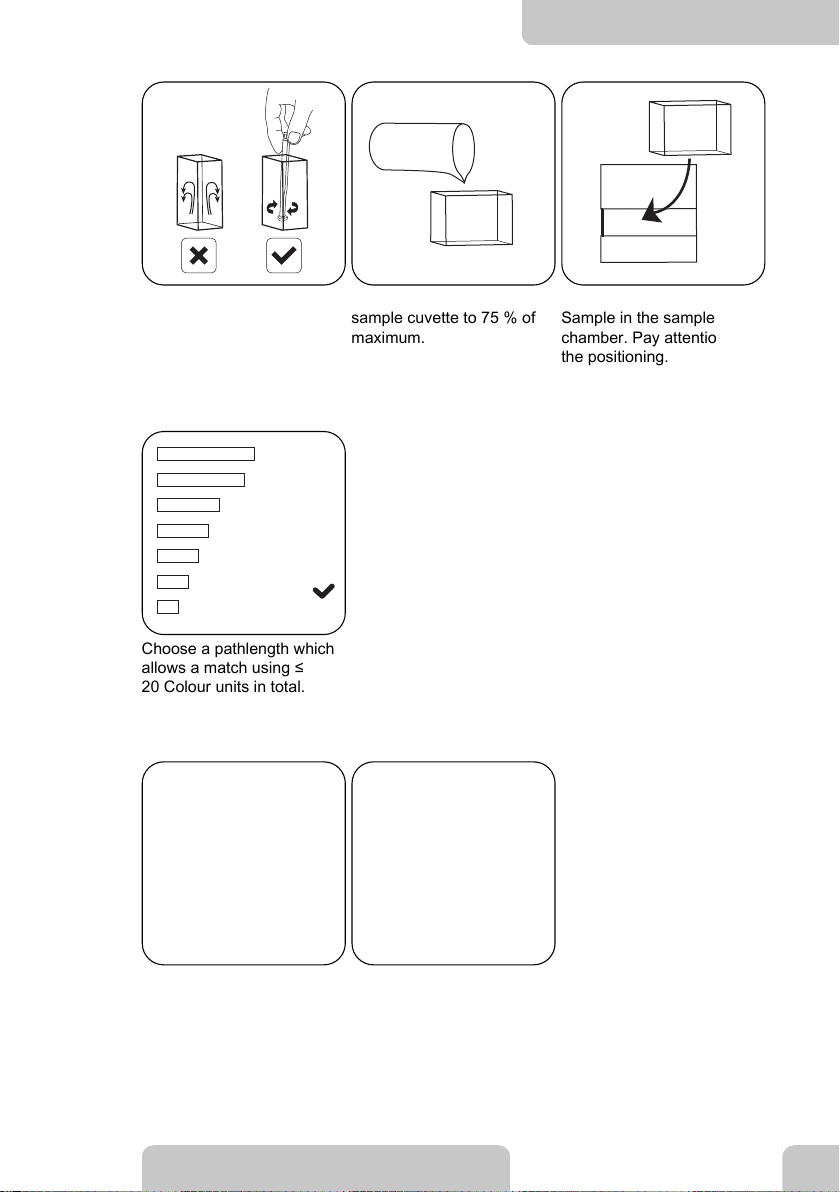
Lovibond® RYBN Colour / CM1
133.4 MM / 5 ¼“
76.2 MM / 3“
25.4 MM / 1“
12.7 MM / ½“
6.4 MM / ¼“
3.2 MM / ⅛“
1.6 MM / 1/16“
Total ≤ 20
READ
Red =
Yellow =
Blue =
Neutral =
Temperature =
Pathlength =
Stir sample to disturb
convection currents.
Fill prepared sample in the
sample cuvette to 75 % of
maximum.
Cuvette Pathlength Selection
Set the path length in the devices: Model Fx, PFXi
Choose a pathlength which
allows a match using ≤
20 Colour units in total.
Taking Measurement
Performing a Test: Model Fx, PFXi
Place cuvette containing
Sample in the sample
chamber. Pay attention to
the positioning.
Press the READ button
(Model Fx: √ button) to take
measurement.
ENMethod Reference Book 19
Record results.
Page 20
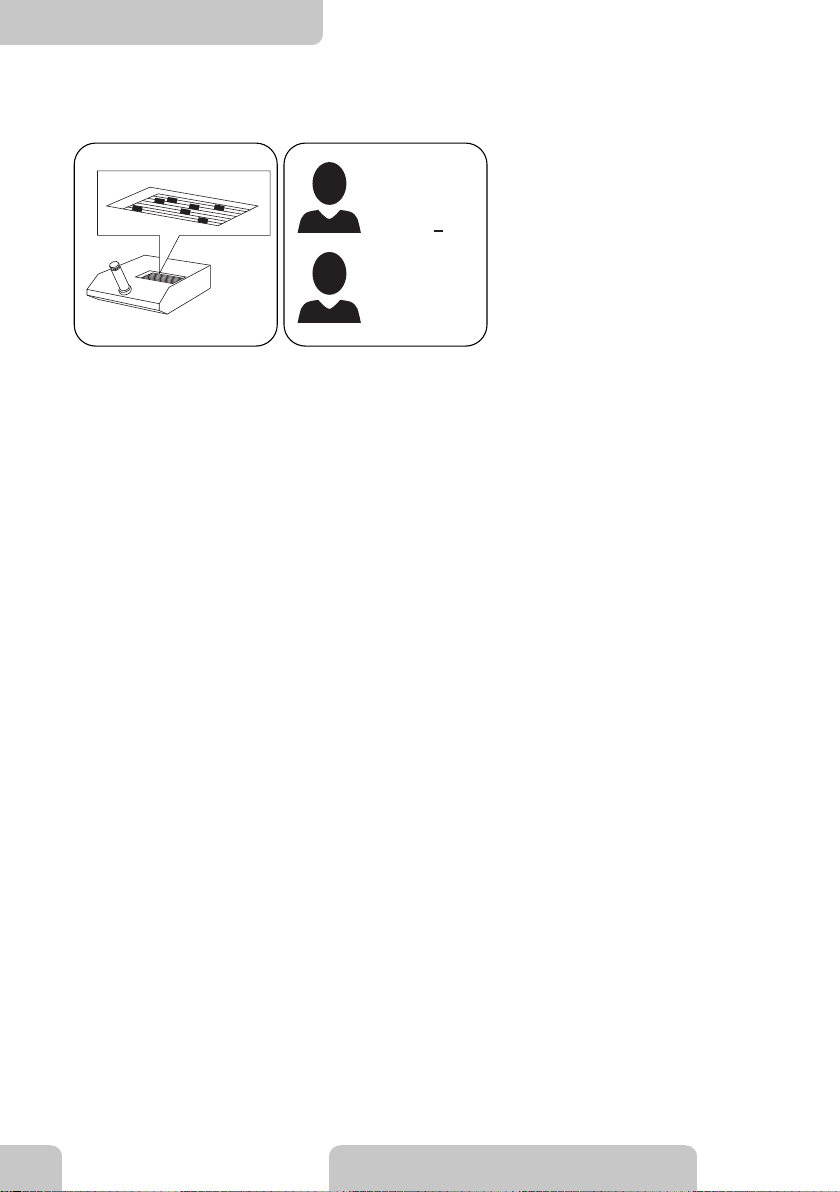
Lovibond® RYBN Colour / CM1
R = 8.4
R = 8.6
R = X = 8.5
Taking Measurement
Performing a Test: Model F
Using all of the glass standards, slide the standards
until the colour of the standards match the colour of
the sample.
With some lighter oils an
approximate initial match
can be achieved by sliding
the red values to match the
samples, then sliding the
yellow values by 10x that
value.
This estimation should
be adjusted to improve
the colour match by
adding neutral values and
changing the reds and
yellows to compensate.
It is recommended to take
at least two values from
two operators and use the
average of each value. This
helps to reduce the effect
of subjective colour assess-
ment.
ENMethod Reference Book20
Page 21

Troubleshooting
Common Issue Solution
We are measuring Lovibond RYBN
values of R+Y+B or N >20.
We wish to measure Lovibond RYBN, but
only report (R)Red and (Y)Yellow.
We wish to measure Lovibond RYBN, but
wish to fix the ratio at 1:10.
Shorten the cell path length used for
more precise results.
Select Lovibond RY on your Lovibond
Model Fx.
Select Lovibond 1:10 on your Lovibond
Model Fx.
Lovibond® RYBN Colour / CM1
ENMethod Reference Book 21
Page 22

AOCS Tintometer Colour / CM2
AOCS-Tintometer Colour CM2
Instrument specific information
The test can be performed on the following devices. In addition, the requiredpath length
and the range of the colour scale are indicated.
Title Scale Path Length Scale Range
AF 710-3, Model Fx,
PFXi-880 AT heated,
PFXi-880/AT, PFXi-950,
PFXi-950 heated,
PFXi-995,
PFXi-995 heated
Application List
• Food and Beverage
• Household Products
• Edible Oils and Fats
1/4", 1", 5 1/4" 0 - 20 R, 0 - 70 R
Applicable Standard
• AOCS Cc 13b-45
• AOCS Cc 8d-55
• AOCS Cc 13j-97
Liquid Reference Standards
Title Packaging Unit Part Number
AOCS-Tintometer Colour 0.4R 2.0Y (5¼") 500 ml 134240
AOCS-Tintometer Colour 1.6R 9.0Y (5¼") 500 ml 134250
AOCS-Tintometer Colour 1.9R 12.0Y (5¼") 500 ml 134260
AOCS-Tintometer Colour 2.5R 20.0Y (5¼") 500 ml 134270
AOCS-Tintometer Colour 3.0R 28.0Y (5¼") 500 ml 134280
ENMethod Reference Book22
Page 23

AOCS Tintometer Colour / CM2
Glass Standards
Title Packaging Unit Part Number
AOCS-Tintometer Filter Set (Fx) 1 pc. 166900
AOCS-Tintometer Filter Set (PFXi
995/950/880)
AOCS-Tintometer Colour (AF 710-3) 1 pc. 109720
1 pc. 136900
ENMethod Reference Book 23
Page 24
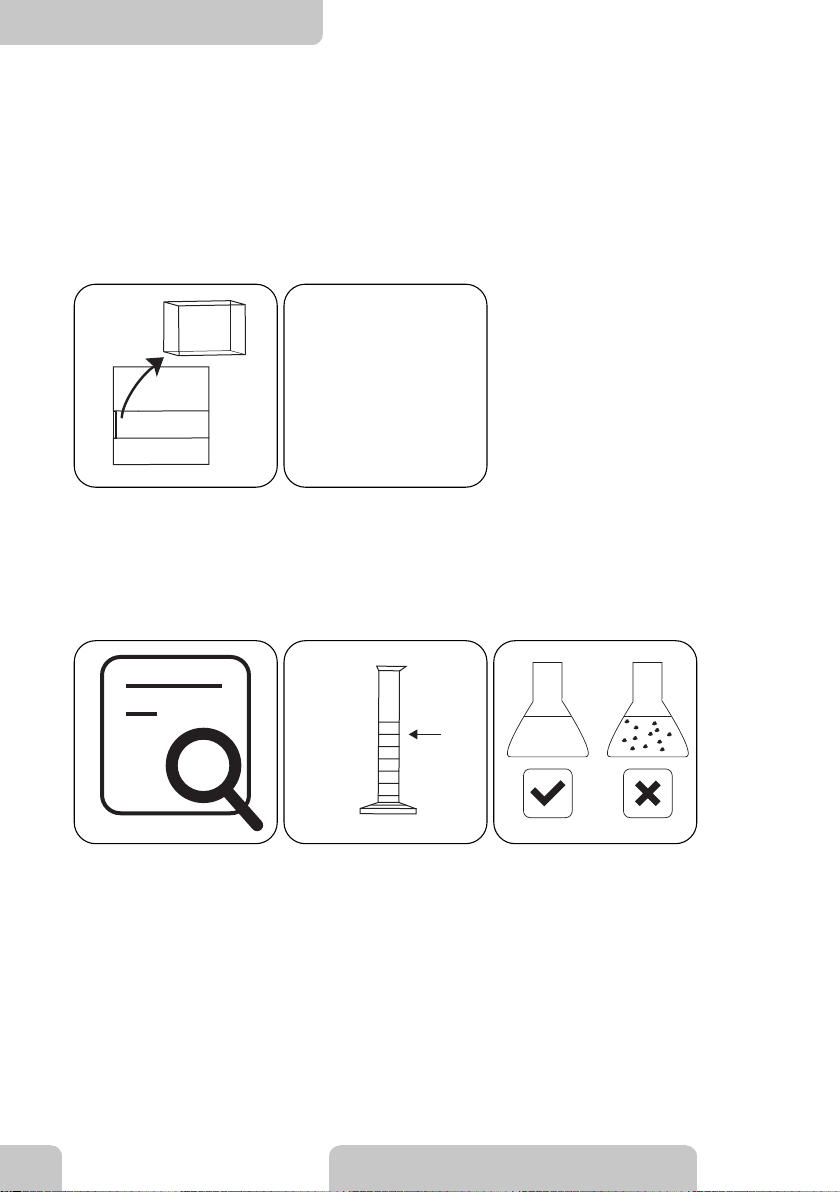
AOCS Tintometer Colour / CM2
ZERO
Implementation of the provision AOCS-Tintometer Colour
Using colorimeter: Model Fx, PFXi, AF710-3
Select the colour scale on the device: Model Fx, PFXi
For this colour scale, a baseline measurement must be carried out in the following
devices: Model Fx, PFXi
Perform Baseline Measurement (Automatic Instruments)
Ensure the measurement
chamber is empty and
close the lid.
Sample Preparation
Prepare sample according
to published standards.
Press the ZERO button
(Model Fx: Ø button) to
perform a baseline.
100 ml
Sample volume of 100 ml
required.
Vacuum filter to remove
particles.
ENMethod Reference Book24
Page 25
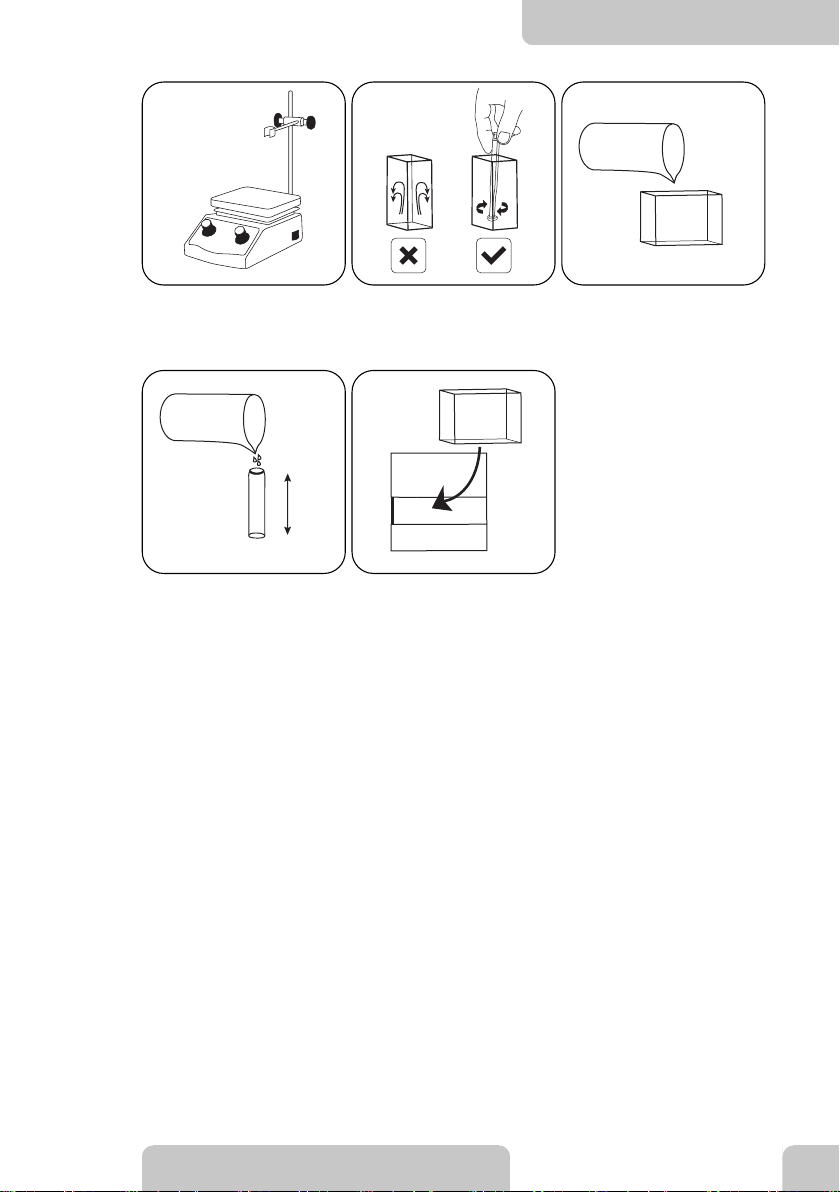
AOCS Tintometer Colour / CM2
5 ¼“
Heat sample to 10 °C
above cloud point.
If available, set the device
heating.
AF710-3: Fill one of the
tubes to 5 ¼” mark. Insert
into AF710-3.
Adjust focus of telescopic
viewing tube for comfort.
Stir sample to disturb
convection currents.
Place cuvette containing
Sample in the sample
chamber. Pay attention to
the positioning.
Fill prepared sample in the
sample cuvette to 75 % of
maximum.
ENMethod Reference Book 25
Page 26
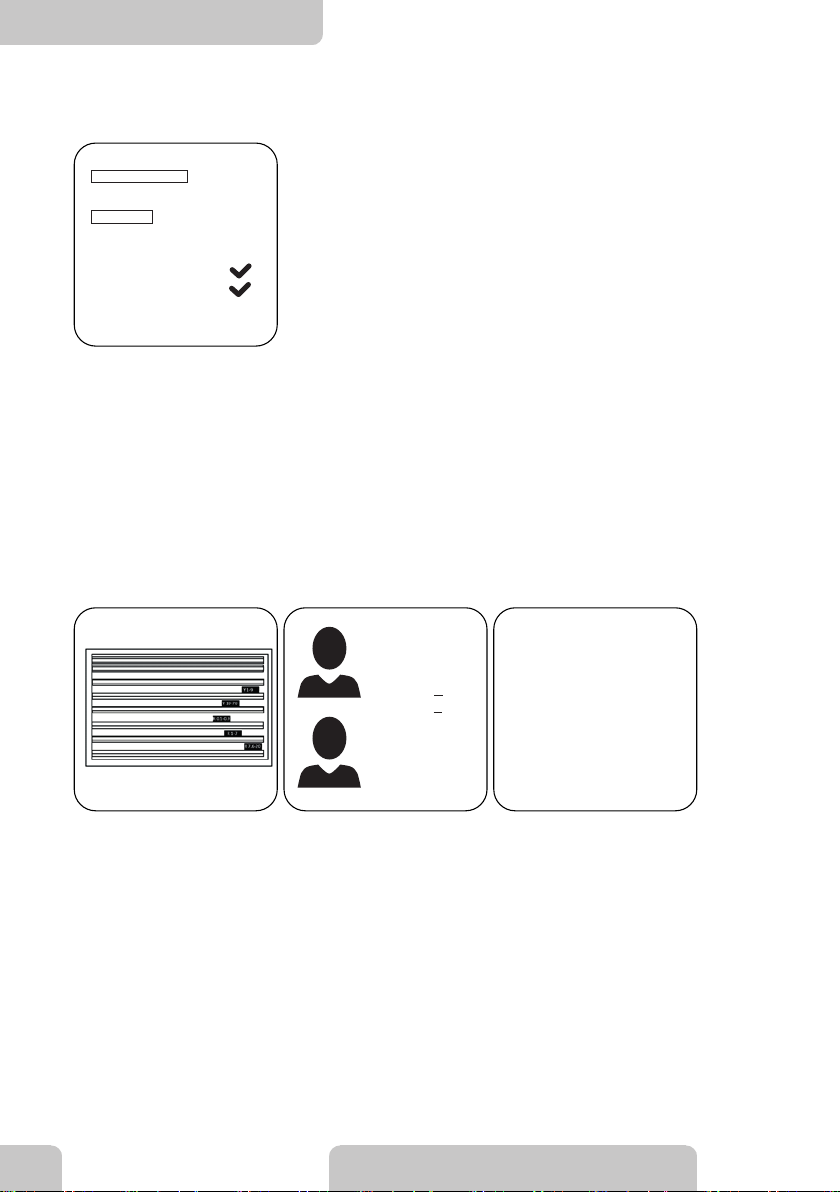
AOCS Tintometer Colour / CM2
133.4 MM / 5 ¼“
25.4 MM / 1“
R < 20
Y < /70
R = 8.4
Y = 16.0
R = 8.6
Y = 15.6
R = X = 8.5
Y = X = 15.8
Red =
Yellow =
Temperature =
Pathlength =
Cuvette Pathlength Selection
Set the path length in the devices: Model Fx, PFXi
AOCS Cc 13b-45 only
recommends reducing
the path length to 1” if R
>40. However, an oil that is
darker than the maximum
will appear on the screen
as 20R or 70Y, so it would
be advisable to reduce the
path length to get a better
idea of the true colour.
Taking Measurement
Performing a Test: AF710-3
Adjust Red and Yellow
glass standards using
highest values first by
sliding racks until a colour
match is achieved.
If a match is not possible
reduce volume of oil to 1"
mark on tube.
Record Red and Yellow
total values.
It is recommended to take
at least two values from
two operators and use the
average of each value. This
helps to reduce the effect
of subjective colour assess-
ment.
ENMethod Reference Book26
Record results.
Page 27

Taking Measurement
READ
Red =
Yellow =
Temperature =
Pathlength =
Performing a Test: Model Fx, PFXi
AOCS Tintometer Colour / CM2
Press the READ button
(Model Fx: √ button) to take
measurement.
Record results.
ENMethod Reference Book 27
Page 28

Chlorophyll / CM3
Chlorophyll CM3
Instrument specific information
The test can be performed on the following devices. In addition, the requiredpath length
and the range of the colour scale are indicated.
Title Scale Path Length Scale Range
Model Fx, PFXi-995,
PFXi-995 heated
Application List
• Food and Beverage
• Edible Oils and Fats
Applicable Standard
• AOCS Cc 13d-55
10 mm unlimited
Glass Standards
Title Packaging Unit Part Number
Chlorophyll A (PFXi 995/950/880) 1 pc. 139530
Chlorophyll A (Fx) 1 pc. 169530
ENMethod Reference Book28
Page 29

Chlorophyll / CM3
ENMethod Reference Book 29
Page 30
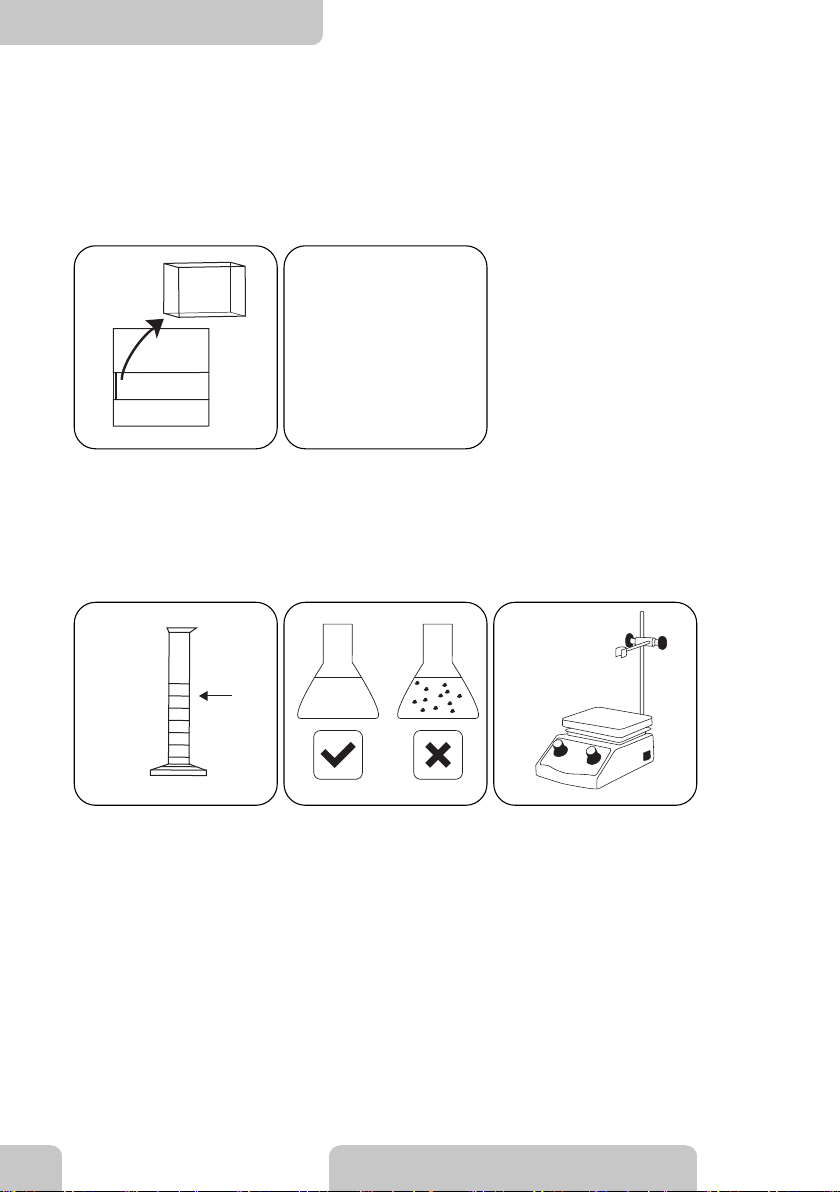
Chlorophyll / CM3
ZERO
Implementation of the provision Chlorophyll
Using colorimeter: Model Fx, PFXi
Select the colour scale on the device: Model Fx, PFXi
Perform Baseline Measurement (Automatic Instruments)
Ensure the measurement
chamber is empty and
close the lid.
Sample Preparation
100 ml
Sample volume of 100 ml
required.
Press the ZERO button
(Model Fx: Ø button) to
perform a baseline.
Vacuum filter to remove
particles.
Heat sample to 30 °C or
≤ 10 °C above sample
melting point.
If available, set the device
heating.
ENMethod Reference Book30
Page 31
Chlorophyll / CM3
READ
133.4 MM / 5 ¼“
10 MM / 0.4“
1 MM / 0.04“
0.3 < Abs <0.8
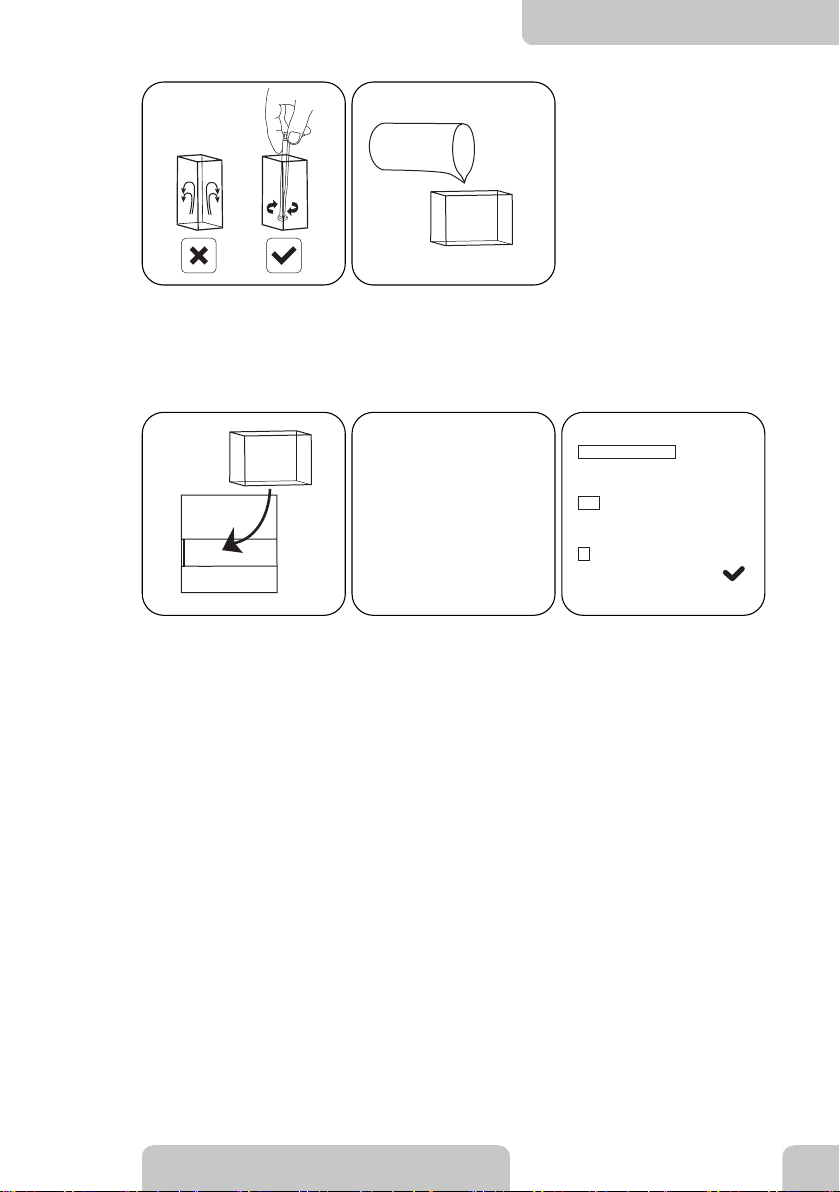
Stir sample to disturb
convection currents.
Cuvette Pathlength Selection
Set the path length in the devices: Model Fx, PFXi
Place cuvette containing
Sample in the sample
chamber. Pay attention to
the positioning.
Fill prepared sample in the
sample cuvette to 75 % of
maximum.
Press the READ button
(Model Fx: √ button) to take
measurement.
The method suggests
adjusting the cell path
length to ensure that
the absorbances at 630,
670 and 710 nm all fall
between 0.3 and 0.8 A. As
a rough guide, 0 – 10 ppm
can be measured at 1”
to 5 ¼”, 10 – 20 ppm at
10 mm and >20 ppm at
1 mm.
ENMethod Reference Book 31
Page 32

Chlorophyll / CM3
Path Length Settings
Cell Path Length: User
User Cell Path: 11.0
User Length Units: Metric
Sample Temp Target Temp
23.4 °C 25 °C
Help
Set Heater Temperature
Select Colour Scale
Instrument Settings
Set Cell / Cuvette Path Length
READ
Chlorophyll =
Temperature =
Pathlength =
Setting Path Length
Select chosen path length
in the PFXi menu and press
ESC. The path length is
used in the calculation of
the result. If the setting in
the instrument is different
from the cell, the result will
be incorrect.
Select chosen path length
in the Model Fx menu
and press Enter. The path
length is used in the calcu-
lation of the result. If the
setting in the instrument is
different from the cell, the
result will be incorrect.
Taking Measurement
Performing a Test: Model Fx, PFXi
Press the READ button
Record results.
(Model Fx: √ button) to take
measurement.
ENMethod Reference Book32
Page 33

Page 34

Sesame, Mustard, Mahua Oil / CM4
Red and Yellow Values to Indian Standard Sesame Oil, Mustard Oil, Mahua Oil
CM4
Instrument specific information
The test can be performed on the following devices. In addition, the requiredpath length
and the range of the colour scale are indicated.
Title Scale Path Length Scale Range
Model F, Model F (BS 684)
with Compensating slides,
Model Fx, PFXi-880/IP17,
PFXi-880/IP
17 heated, PFXi-880/L,
PFXi-880/S, PFXi-880/S
heated, PFXi-880L
heated, PFXi-950,
PFXi-950 heated,
PFXi-995,
PFXi-995 heated,
PFXi-995/P, PFXi-995/P
heated
1/4" 0 - 79.9 R, 0 - 79.9 Y, 0 -
49.9 B, 0 - 3.9 N
Application List
• Food and Beverage
• Household Products
• Petroleum Oils and Waxes
• Edible Oils and Fats
• Chemicals
Applicable Standard
• IS 548 (part 1)-2010
ENMethod Reference Book34
Page 35

Sesame, Mustard, Mahua Oil / CM4
ENMethod Reference Book 35
Page 36
Sesame, Mustard, Mahua Oil / CM4
ZERO
Implementation of the provision Red & Yellow Values to Indian
Standard - Sesame Oil, Mustard Oil & Mahua Oil
Using colorimeter: Model F, Model FX, PFXi
Select the colour scale on the device: Model Fx, PFXi
For this colour scale, a baseline measurement must be carried out in the following
devices: Model Fx, PFXi
Perform Baseline Measurement (Automatic Instruments)
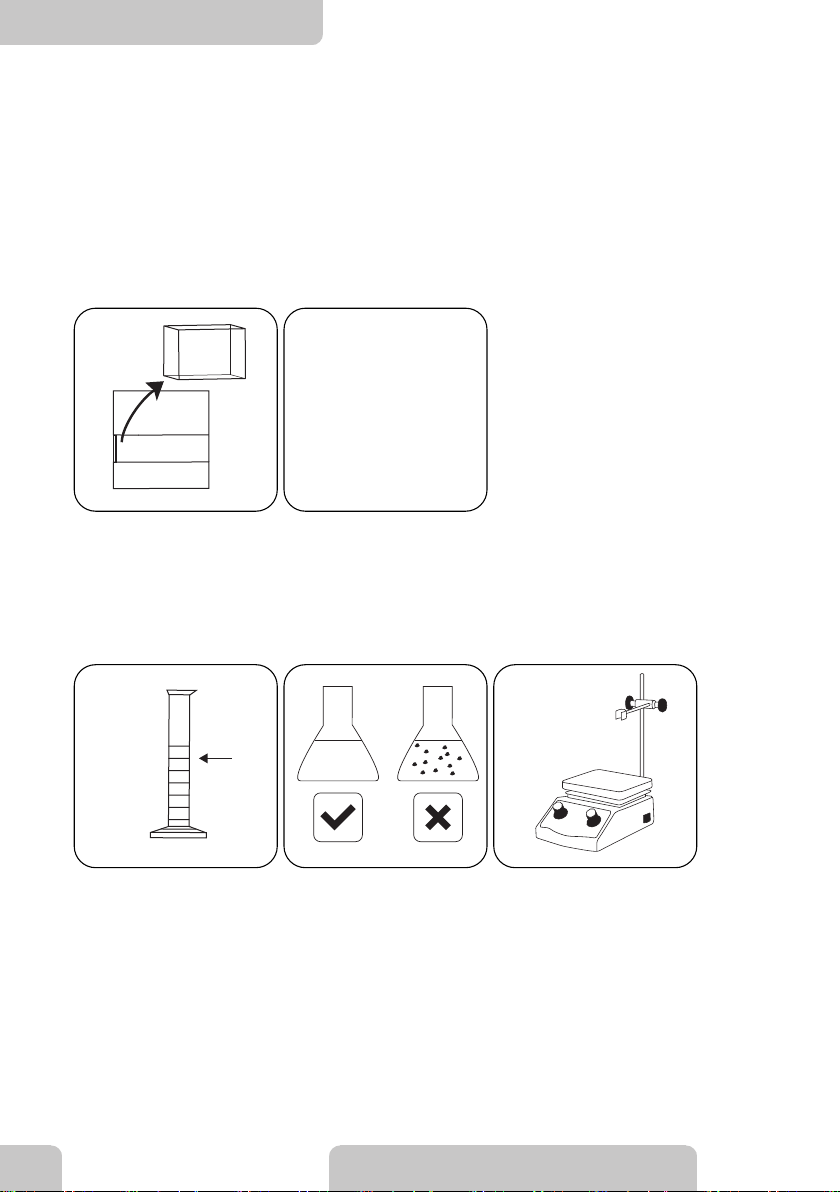
Ensure the measurement
chamber is empty and
close the lid.
Sample Preparation
Sample volume of 50 ml
required.
50 ml
Press the ZERO button
(Model Fx: Ø button) to
perform a baseline.
Vacuum filter to remove
particles.
Heat sample to 10 °C
above cloud point.
If available, set the device
heating.
ENMethod Reference Book36
Page 37
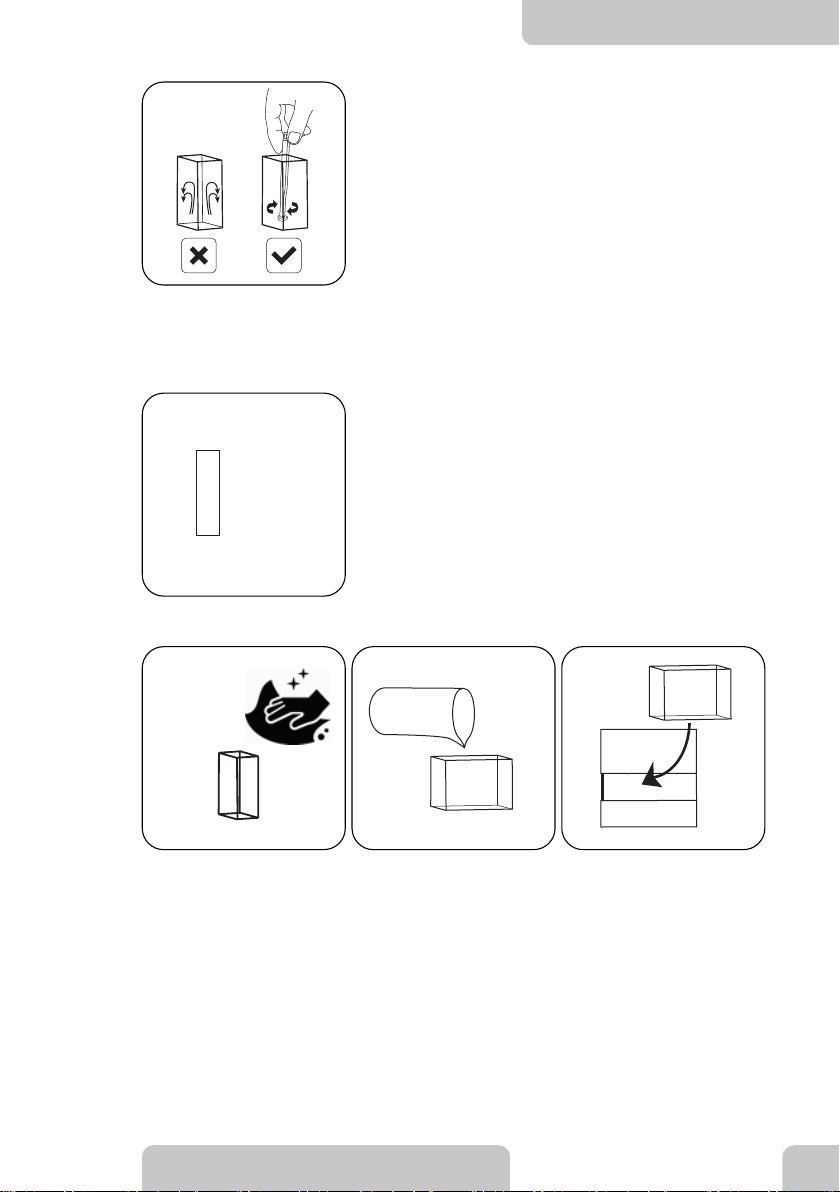
Stir sample to disturb
6.4 MM / ¼“
CCl4 +
convection currents.
Cuvette Pathlength Selection
Set the path length in the devices: Model F
Sesame, Mustard, Mahua Oil / CM4
Clean Cell
Clean the cuvette. Fill prepared sample in the
sample cuvette to 75 % of
maximum.
ENMethod Reference Book 37
Place cuvette containing
Sample in the sample
chamber. Pay attention to
the positioning.
Page 38
Sesame, Mustard, Mahua Oil / CM4
READ
Red =
Yellow =
Blue =
Neutral =
Temperature =
Pathlength =
∑ Y + 5 ∑R =
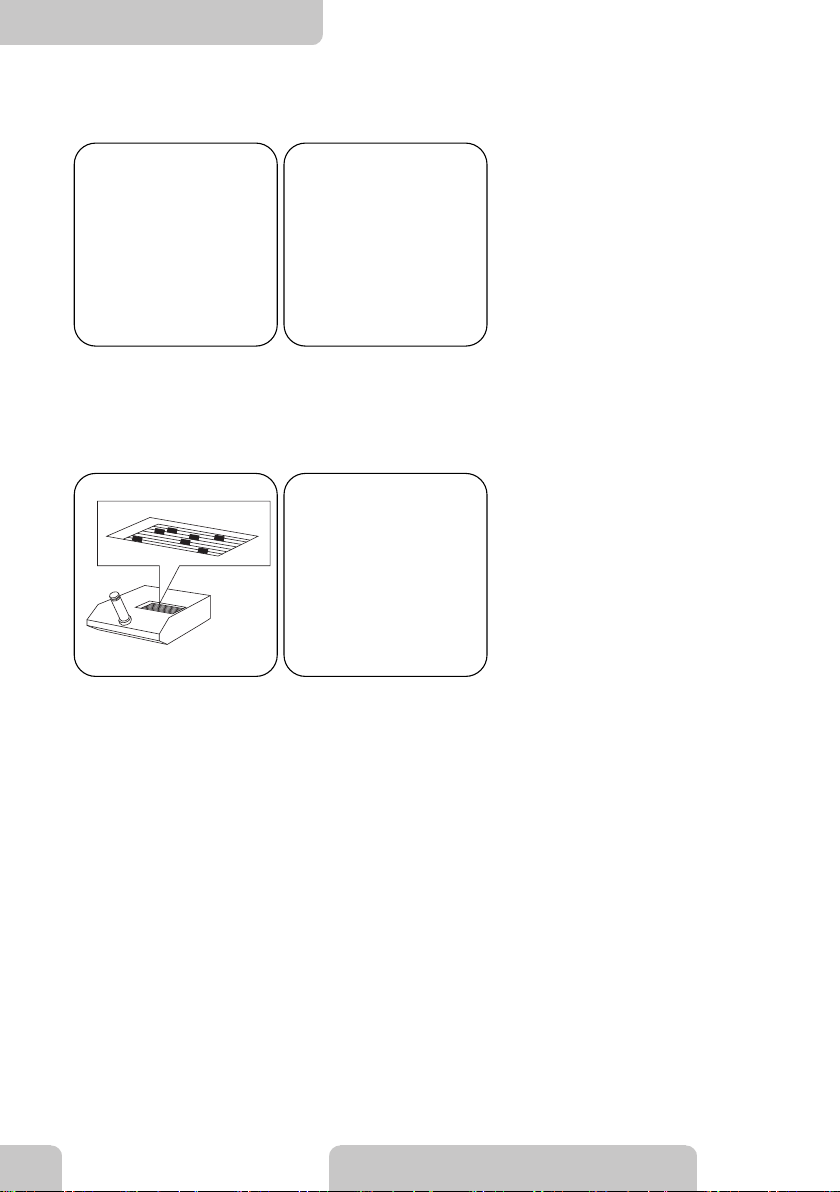
Taking Measurement
Performing a Test: Model Fx, PFXi
Press the READ button
(Model Fx: √ button) to take
measurement.
Taking Measurement
Performing a Test: Model F
Using all of the glass standards.
Slide the standards until
the colour of the standards
match the colour of the
sample.
Record results.
Total the values on the
Yellow sliding standards.
Total the values on the Red
sliding standards.
Multiply the total Red
values by five and add to
total Yellow values to give
result.
ENMethod Reference Book38
Page 39

Page 40

Castor, Ground Nut, Coconut Oil / CM5
Red and Yellow Values to Indian Standard Castor, Ground Nut, Coconut Oil
CM5
Instrument specific information
The test can be performed on the following devices. In addition, the requiredpath length
and the range of the colour scale are indicated.
Title Scale Path Length Scale Range
Model F, Model F (BS 684)
with Compensating slides,
Model Fx, PFXi-880/IP17,
PFXi-880/IP
17 heated, PFXi-880/L,
PFXi-880/S, PFXi-880/S
heated, PFXi-880L
heated, PFXi-950,
PFXi-950 heated,
PFXi-995,
PFXi-995 heated,
PFXi-995/P, PFXi-995/P
heated
1" 0 - 79.9 R, 0 - 79.9 Y, 0 -
49.9 B, 0 - 3.9 N
Application List
• Food and Beverage
• Household Products
• Petroleum Oils and Waxes
• Edible Oils and Fats
• Chemicals
Applicable Standard
• IS 548 (part 1)-2010
ENMethod Reference Book40
Page 41

Castor, Ground Nut, Coconut Oil / CM5
ENMethod Reference Book 41
Page 42
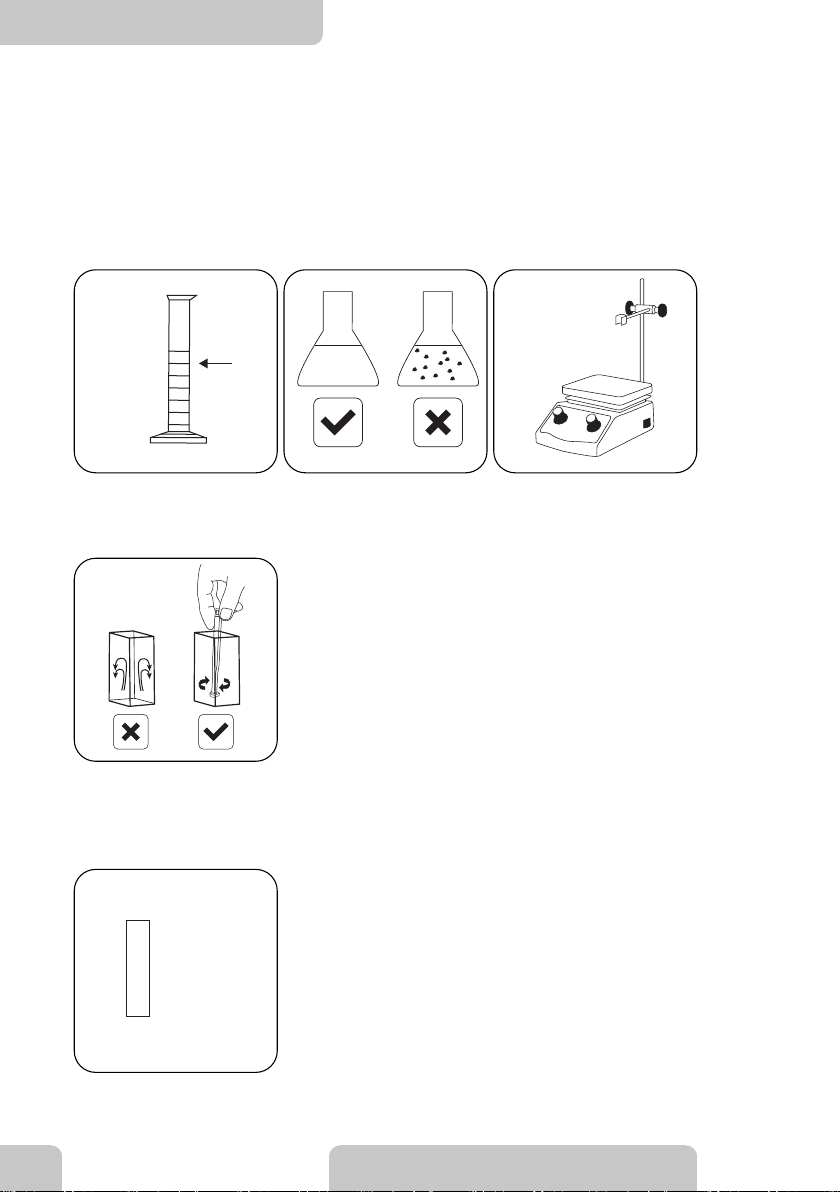
Castor, Ground Nut, Coconut Oil / CM5
25.4 MM / 1“
Implementation of the provision Red & Yellow Values to Indian
Standard - Castor Oil, Ground Nut Oil & Coconut Oil
Using colorimeter: Model F, Model Fx, PFXi
Select the colour scale on the device: Model Fx, PFXi
Sample Preparation
50 ml
Sample volume of 50 ml
required.
Stir sample to disturb
convection currents.
Cuvette Pathlength Selection
Set the path length in the devices: Model F, Model Fx, PFXi
Vacuum filter to remove
particles.
Heat sample to 10 °C
above cloud point.
If available, set the device
heating.
ENMethod Reference Book42
Page 43
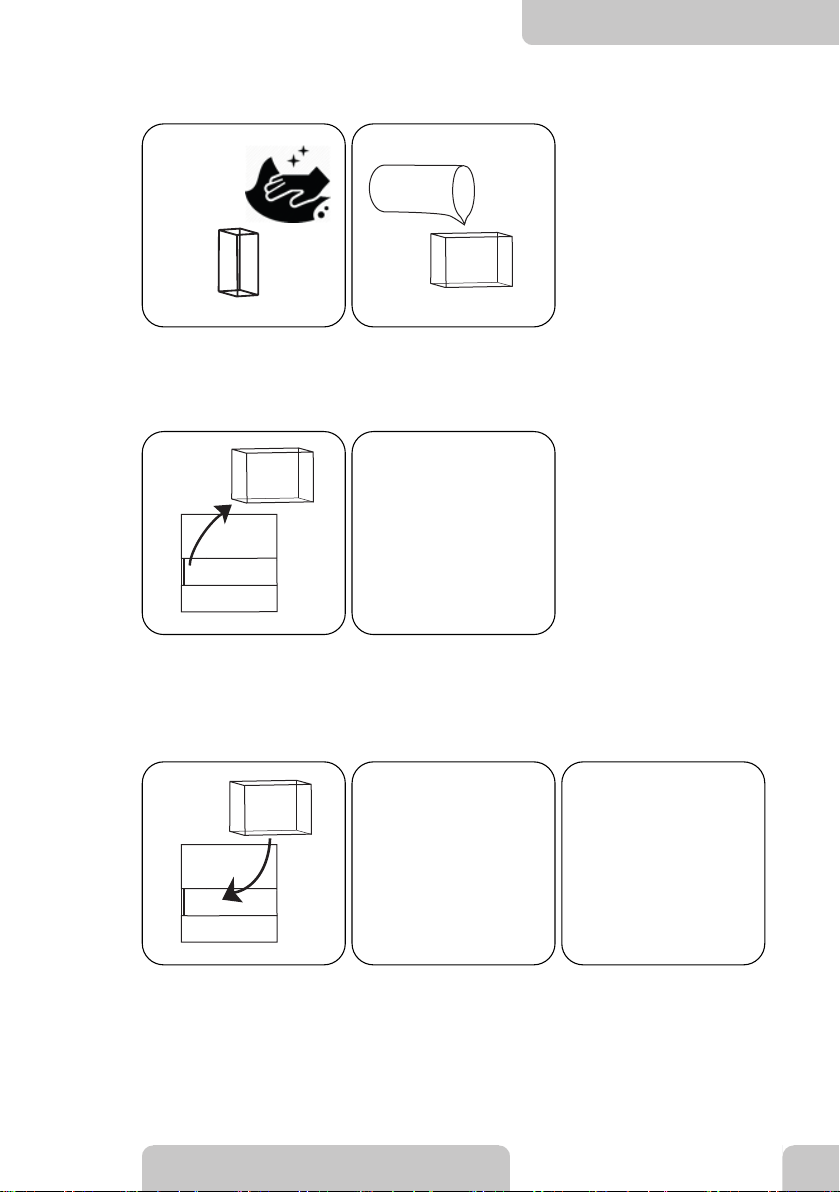
Clean Cell
CCl4 +
ZERO
READ
Y + 5 R =
Castor, Ground Nut, Coconut Oil / CM5
Clean the cuvette. Fill prepared sample in the
For this colour scale, a baseline measurement must be carried out in the following
devices: Model Fx, PFXi
Ensure the measurement
chamber is empty and
close the lid.
Taking Measurement
Performing a Test: Model Fx, PFXi
sample cuvette to 75 % of
maximum.
Press the ZERO button
(Model Fx: Ø button) to
perform a baseline.
Place cuvette containing
Sample in the sample
chamber. Pay attention to
the positioning.
ENMethod Reference Book 43
Press the READ button
(Model Fx: √ button) to take
measurement.
Multiply the total Red
values by five and add to
total Yellow values to give
result.
Page 44

Castor, Ground Nut, Coconut Oil / CM5
∑ Y + 5 ∑R =
Taking Measurement
Performing a Test: Model F
Using all of the glass standards.
Slide the standards until
the colour of the standards
match the colour of the
sample.
Total the values on the
Yellow sliding standards.
Total the values on the Red
sliding standards.
Multiply the total Red
values by five and add to
total Yellow values to give
result.
ENMethod Reference Book44
Page 45

Page 46

Castor, Ground Nut, Coconut Oil / CM6
Red and Yellow Values to Indian Standard Castor, Ground Nut, Coconut Oil
CM6
Instrument specific information
The test can be performed on the following devices. In addition, the requiredpath length
and the range of the colour scale are indicated.
Title Scale Path Length Scale Range
Model F, Model F (BS 684)
with Compensating slides,
Model Fx, PFXi-880/IP17,
PFXi-880/IP
17 heated, PFXi-880/L,
PFXi-880/S, PFXi-880/S
heated, PFXi-880L
heated, PFXi-950,
PFXi-950 heated,
PFXi-995,
PFXi-995 heated,
PFXi-995/P, PFXi-995/P
heated
1/4" 0 - 70 R, 0 - 70 Y, 0 - 40 B,
0 - 3.9 N
Application List
• Food and Beverage
• Household Products
• Petroleum Oils and Waxes
• Edible Oils and Fats
• Chemicals
Applicable Standard
• IS 548 (part 1)-2010
ENMethod Reference Book46
Page 47

Castor, Ground Nut, Coconut Oil / CM6
ENMethod Reference Book 47
Page 48
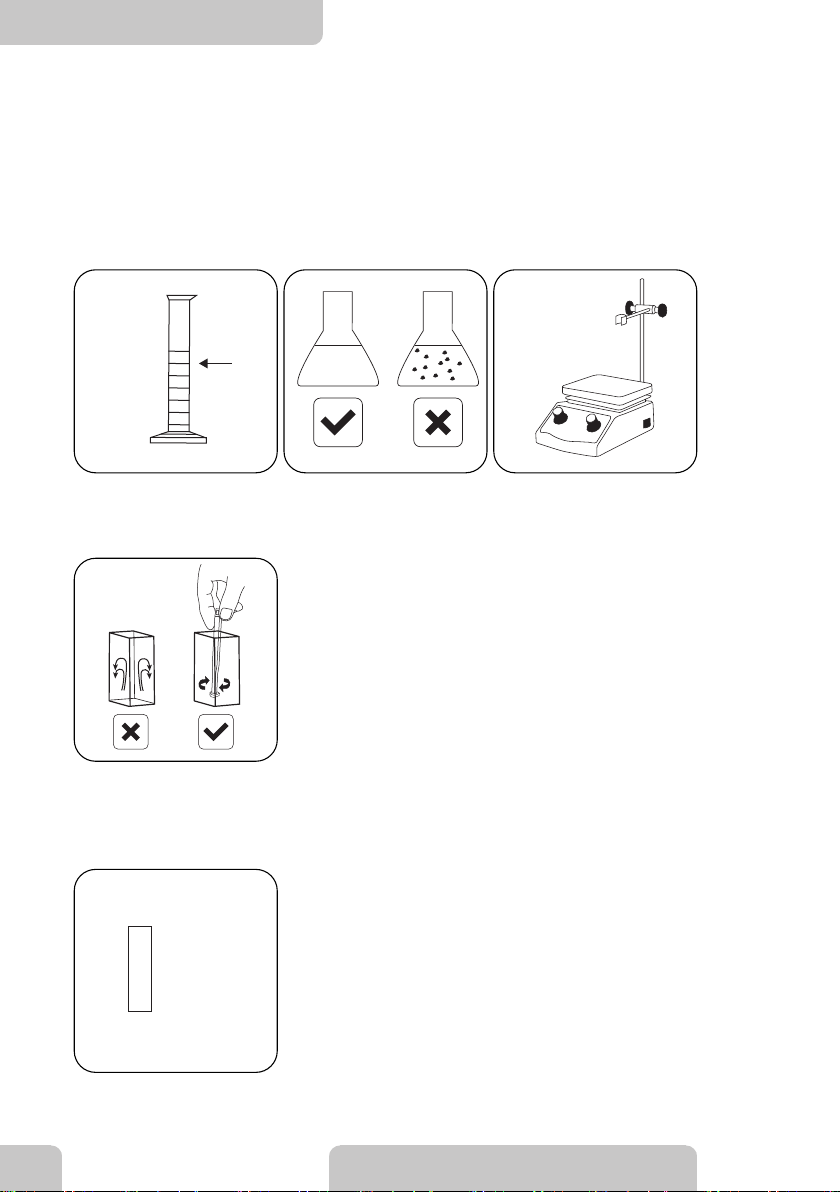
Castor, Ground Nut, Coconut Oil / CM6
6.4 MM / ¼“
Implementation of the provision Red & Yellow Values to Indian
Standard - Castor Oil, Ground Nut Oil & Coconut Oil
Using colorimeter: Model Fx, PFXi
Select the colour scale on the device: Model Fx, PFXi
Sample Preparation
50 ml
Sample volume of 50 ml
required.
Stir sample to disturb
convection currents.
Cuvette Pathlength Selection
Set the path length in the devices: Model Fx, PFXi
Vacuum filter to remove
particles.
Heat sample to 10 °C
above cloud point.
If available, set the device
heating.
ENMethod Reference Book48
Page 49
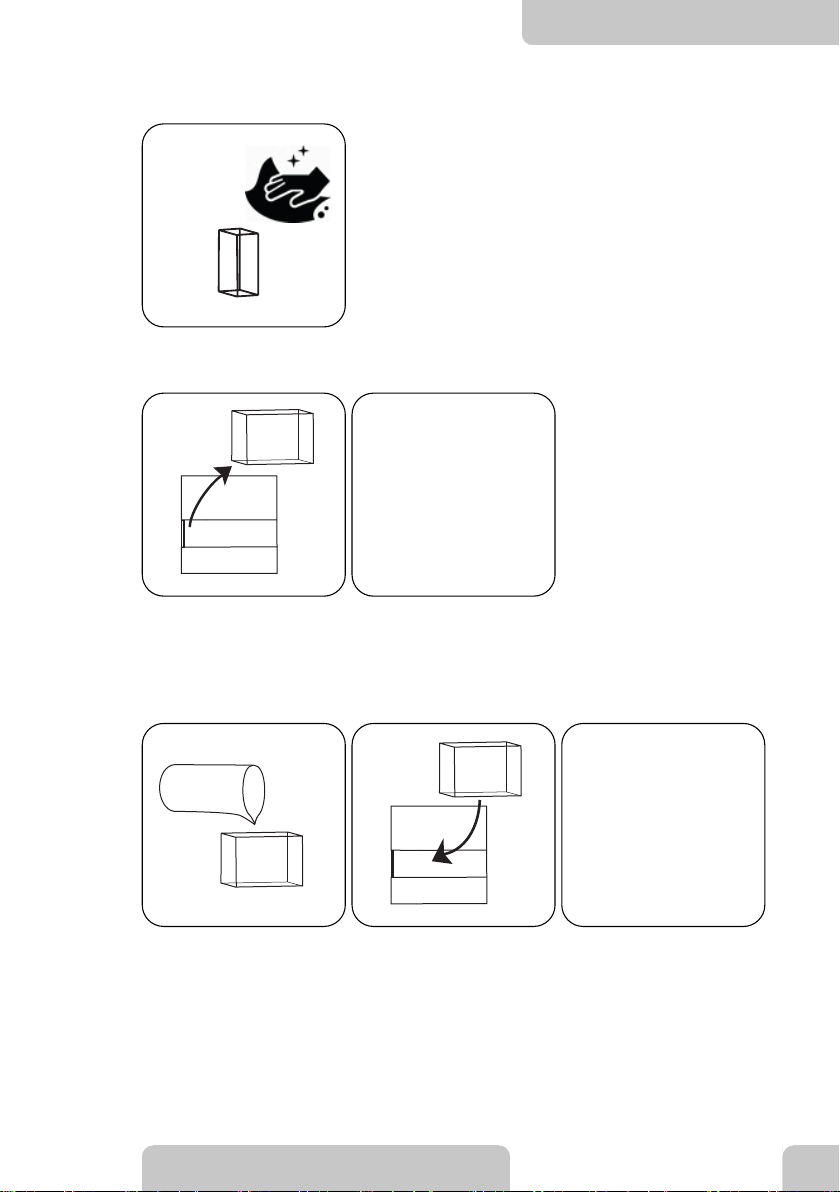
Castor, Ground Nut, Coconut Oil / CM6
CCl4 +
ZERO
READ
Clean Cell
Clean the cuvette.
For this colour scale, a baseline measurement must be carried out in the following
devices: Model Fx, PFXi
Ensure the measurement
chamber is empty and
close the lid.
Taking Measurement
Performing a Test: Model Fx, PFXi
Fill prepared sample in the
sample cuvette to 75 % of
maximum.
ENMethod Reference Book 49
Press the ZERO button
(Model Fx: Ø button) to
perform a baseline.
Place cuvette containing
Sample in the sample
chamber. Pay attention to
the positioning.
Press the READ button
(Model Fx: √ button) to take
measurement.
Page 50

Castor, Ground Nut, Coconut Oil / CM6
Y + 5 R =
Multiply the total Red
values by five and add to
total Yellow values to give
result.
ENMethod Reference Book50
Page 51

Page 52

Cottonseed Oil / CM7
Red and Yellow Values to Indian Standard Cottonseed Oil
CM7
Instrument specific information
The test can be performed on the following devices. In addition, the requiredpath length
and the range of the colour scale are indicated.
Title Scale Path Length Scale Range
Model F, Model F (BS 684)
with Compensating slides,
Model Fx, PFXi-880/IP17,
PFXi-880/IP
17 heated, PFXi-880/L,
PFXi-880/S, PFXi-880/S
heated, PFXi-880L
heated, PFXi-950,
PFXi-950 heated,
PFXi-995,
PFXi-995 heated,
PFXi-995/P, PFXi-995/P
heated
1/4" 0 - 79.9 R, 0 - 79.9 Y, 0 -
49.9 B, 0 - 3.9 N
Application List
• Food and Beverage
• Household Products
• Petroleum Oils and Waxes
• Edible Oils and Fats
• Chemicals
Applicable Standard
• IS 548 (part 1)-2010
ENMethod Reference Book52
Page 53

Cottonseed Oil / CM7
ENMethod Reference Book 53
Page 54
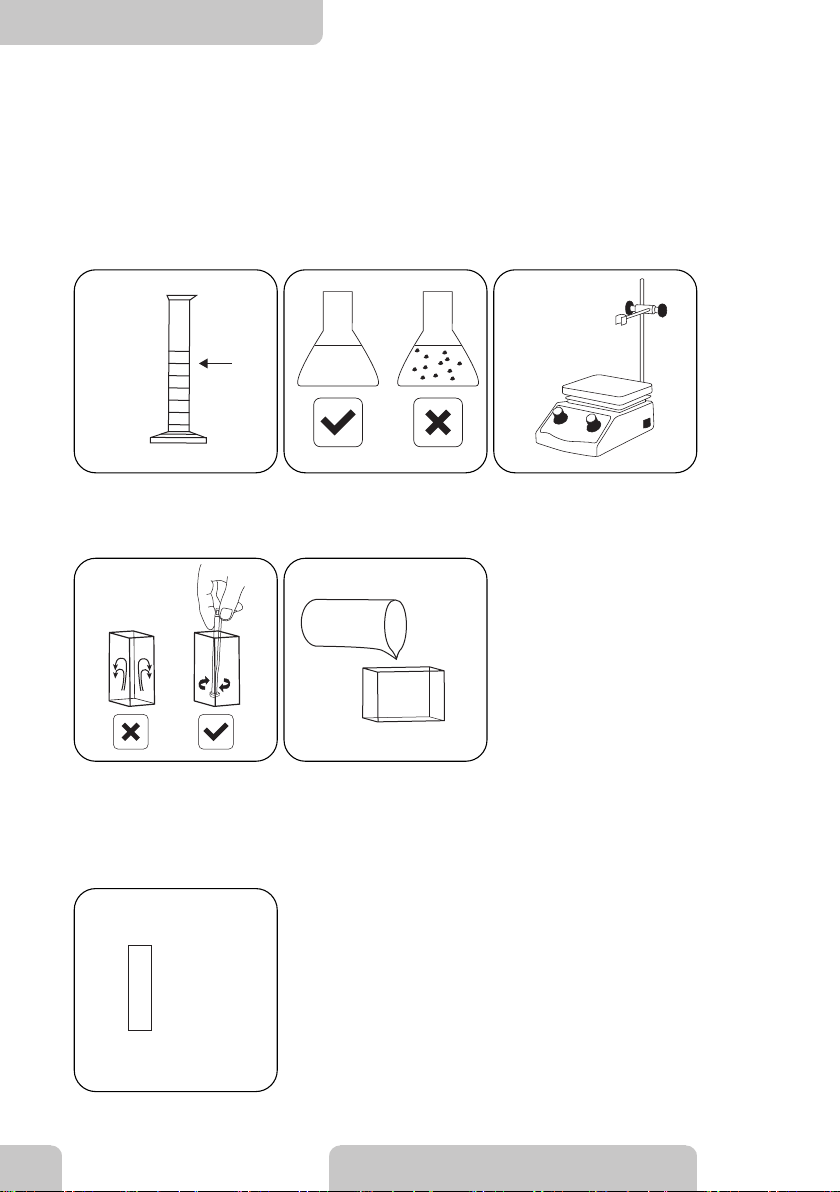
Cottonseed Oil / CM7
6.4 MM / ¼“
Implementation of the provision Red & Yellow Values to Indian Cottonseed Oil (washed & refined)
Using colorimeter: Model F, Model Fx, PFXi
Select the colour scale on the device: Model Fx, PFXi
Sample Preparation
50 ml
Sample volume of 50 ml
required.
Stir sample to disturb
convection currents.
Cuvette Pathlength Selection
Set the path length in the devices: Model F, Model Fx, PFXi
Vacuum filter to remove
particles.
Fill prepared sample in the
sample cuvette to 75 % of
maximum.
Heat sample to 10 °C
above cloud point.
If available, set the device
heating.
ENMethod Reference Book54
Page 55
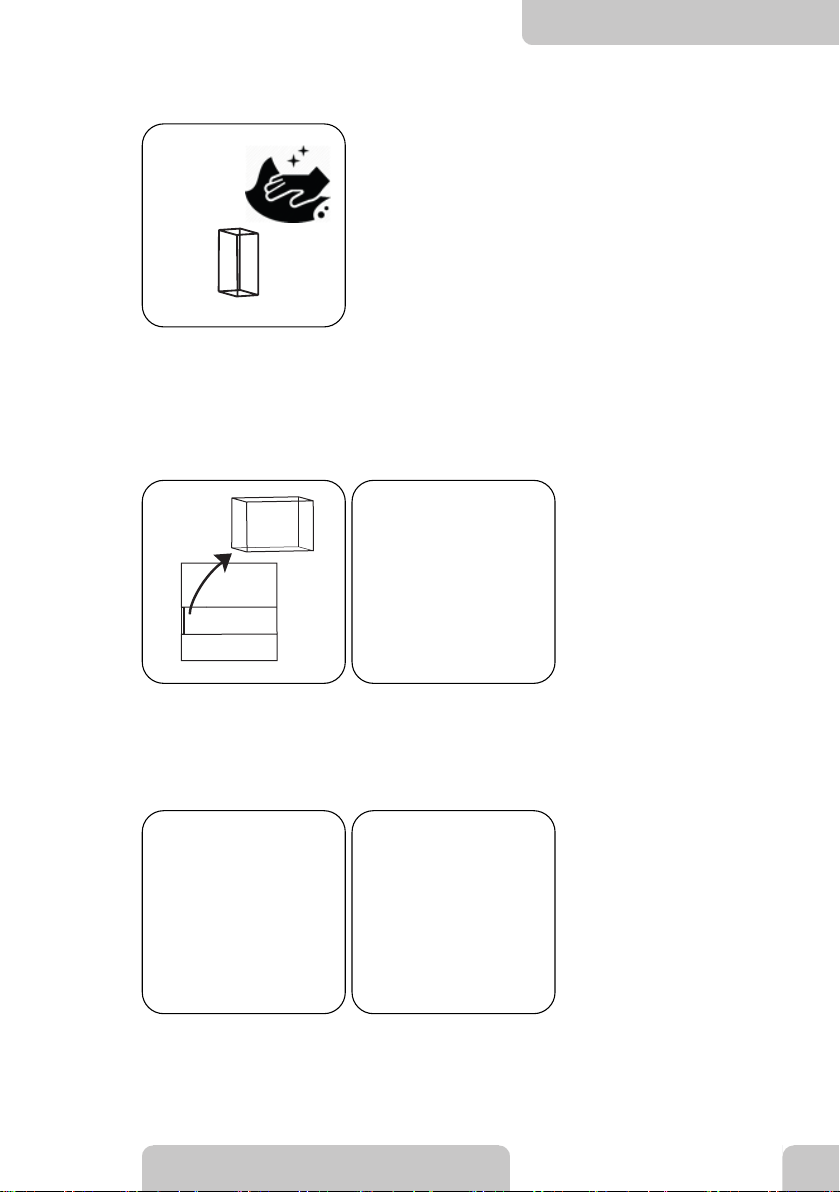
Cottonseed Oil / CM7
CCl4 +
ZERO
READ
Y + 10 R =
Clean Cell
Clean the cuvette.
Perform Baseline Measurement (Automatic Instruments)
For this colour scale, a baseline measurement must be carried out in the following
devices: Model Fx, PFXi
Ensure the measurement
chamber is empty and
close the lid.
Taking Measurement
Performing a Test: Model Fx, PFXi
Press the READ button
(Model Fx: √ button) to take
measurement.
ENMethod Reference Book 55
Press the ZERO button
(Model Fx: Ø button) to
perform a baseline.
Multiply the total Red
values by ten and add to
total Yellow values to give
result.
Page 56

Cottonseed Oil / CM7
∑ Y + 10 ∑R =
Taking Measurement
Performing a Test: Model F
Using all of the glass standards.
Slide the standards until
the colour of the standards
match the colour of the
sample.
Total the values on the
Yellow sliding standards.
Total the values on the Red
sliding standards.
Multiply the total Red
values by ten and add to
total Yellow values to give
result.
ENMethod Reference Book56
Page 57

Page 58

Beta Carotene / CM8
Beta Carotene CM8
Instrument specific information
The test can be performed on the following devices. In addition, the requiredpath length
and the range of the colour scale are indicated.
Title Scale Path Length Scale Range
Model Fx, PFXi-995,
PFXi-995 heated
Application List
• Food and Beverage
• Edible Oils and Fats
Applicable Standard
• BS684 Section 2.20
10 mm 0 - 1000 ppm
Glass Standards
Title Packaging Unit Part Number
Beta carotene (PFXi 995/950/880) 1 pc. 139520
Beta carotene (Fx) 1 pc. 169520
ENMethod Reference Book58
Page 59

Beta Carotene / CM8
ENMethod Reference Book 59
Page 60
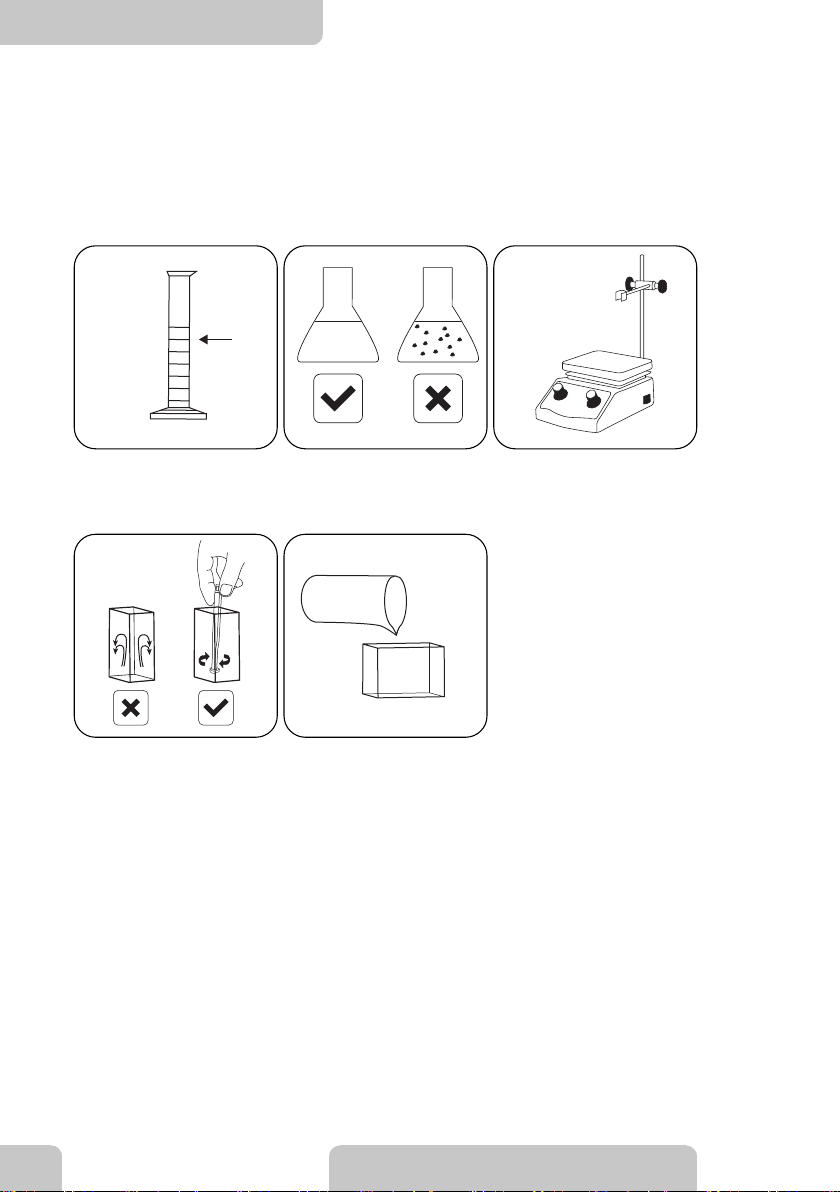
Beta Carotene / CM8
Implementation of the provision Beta Carotene
Using colorimeter: Model Fx, PFXi
Select the colour scale on the device: Model Fx, PFXi
Sample Preparation
50 ml
Sample volume of 50 ml
required.
Stir sample to disturb
convection currents.
Vacuum filter to remove
particles.
Fill prepared sample in the
sample cuvette to 75 % of
maximum.
Heat sample to 10 °C
above cloud point.
If available, set the device
heating.
ENMethod Reference Book60
Page 61
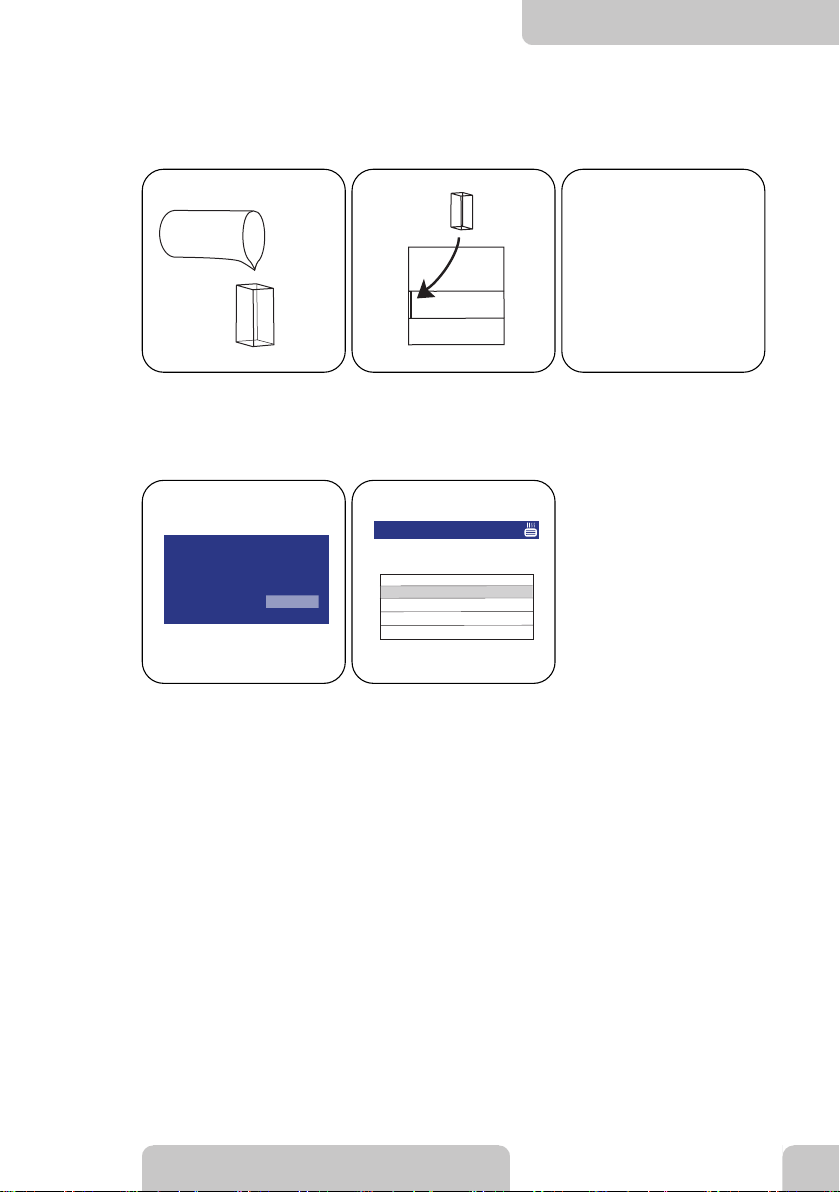
Beta Carotene / CM8
10 mm
ZERO
Path Length Settings
Cell Path Length: User
User Cell Path: 11.0
User Length Units: Metric
Sample Temp Target Temp
23.4 °C 25 °C
Help
Set Heater Temperature
Select Colour Scale
Instrument Settings
Set Cell / Cuvette Path Length
Perform Baseline Measurement (Automatic Instruments)
Fill 10 mm cuvette with
Cyclohexane
Setting Path Length
Select chosen path length
in the PFXi menu and press
ESC. The path length is
used in the calculation of
the result. If the setting in
the instrument is different
from the cell, the result will
be incorrect.
Place sample vial in the
sample chamber. • Pay
attention to the positioning.
Select chosen path length
in the Model Fx menu
and press Enter. The path
length is used in the calculation of the result. If the
setting in the instrument is
different from the cell, the
result will be incorrect.
Press the ZERO button
(Model Fx: Ø button) to
perform a baseline.
ENMethod Reference Book 61
Page 62
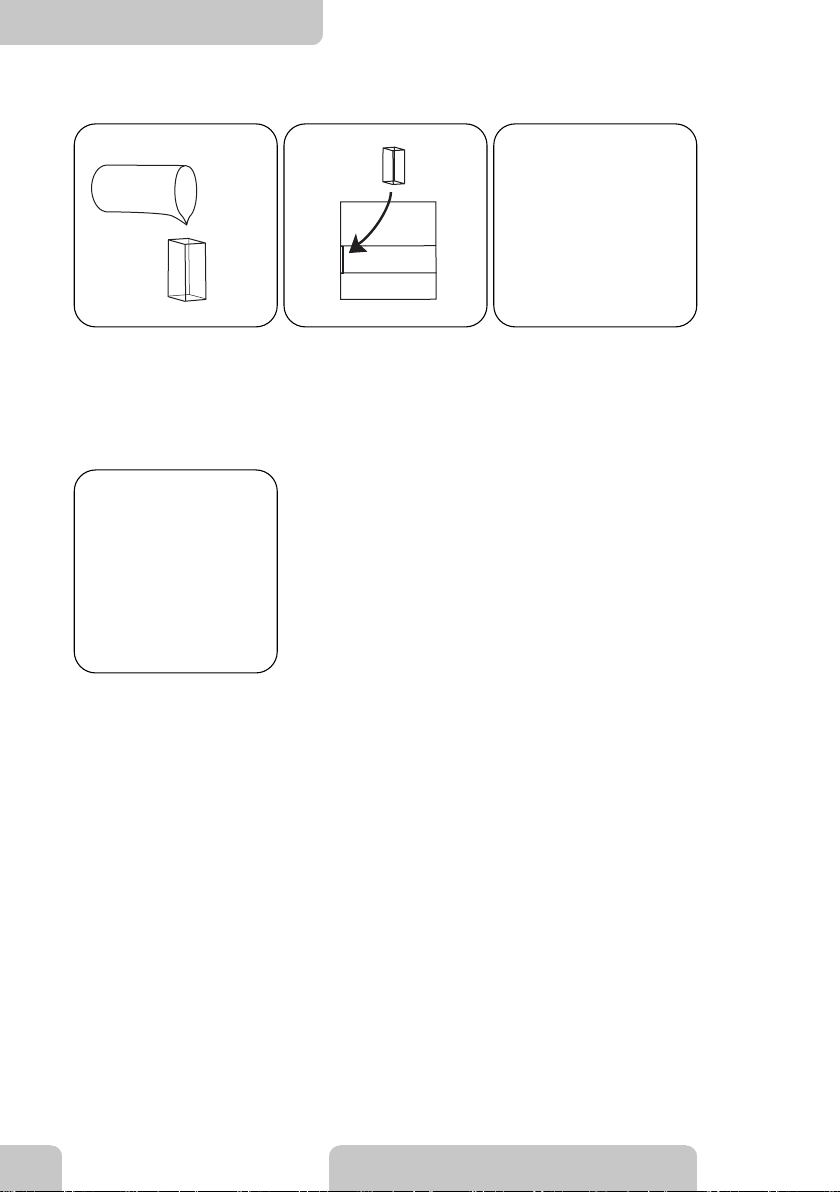
Beta Carotene / CM8
10 mm
READ
Beta Carotene =
Temperature =
Pathlength =
Taking Measurement
Fill cuvette with prepared
sample in solution with
cyclohexane. Please note
it is important for the oil
content to be as close to
1g in 100 ml as possible for
the best accuracy.
Record results.
Place sample vial in the
sample chamber. • Pay
attention to the positioning.
Press the READ button
(Model Fx: √ button) to take
measurement.
ENMethod Reference Book62
Page 63

Page 64

Tintometer GmbH
Lovibond® Water Testing
Schleefstraße 8-12
44287 Dortmund
Tel.: +49 (0)231/94510-0
Fax: +49 (0)231/94510-30
[email protected]
www.lovibond.com
Germany
Tintometer South East Asia
Unit B-3-12, BBT One Boulevard,
Lebuh Nilam 2, Bandar Bukit Tinggi,
Klang, 41200, Selangor D.E
Tel.: +60 (0)3 3325 2285/6
Fax: +60 (0)3 3325 2287
[email protected]
www.lovibond.com
Malaysia
Tintometer India Pvt. Ltd.
Door No: 7-2-C-14, 2nd, 3rd & 4th Floor
Sanathnagar Industrial Estate,
Hyderabad, 500018
Telangana
Tel: +91 (0) 40 23883300
Toll Free: 1 800 599 3891/ 3892
[email protected]
www.lovibondwater.in
India
The Tintometer Limited
Lovibond House
Sun Rise Way
Amesbury, SP4 7GR
Tel.: +44 (0)1980 664800
Fax: +44 (0)1980 625412
[email protected]
www.lovibond.com
UK
Tintometer Brazil
Caixa Postal: 271
CEP: 13201-970
Jundiaí – SP
Tel.: +55 (11) 3230-6410
[email protected]
www.lovibond.com.br
Brazil
Tintometer Spain
Postbox: 24047
08080 Barcelona
Tel.: +34 661 606 770
[email protected]
www.lovibond.com
Spain
Technical changes without notice
No.: 04/2021
Lovibond® and Tintometer® are Trademarks of the Tintometer Group of Companies
Tintometer China
Room 1001, China Life Tower
16 Chaoyangmenwai Avenue,
Beijing, 100020
Tel.: +86 10 85251111 App. 330
Fax: +86 10 85251001
[email protected]
www.lovibond.com
China
Tintometer Inc.
6456 Parkland Drive
Sarasota, FL 34243
Tel: 941.756.6410
Fax: 941.727.9654
[email protected]
www.lovibond.com
USA
 Loading...