

Page 1
NRFRS 12-97
ROTARY SLIDE RULE
■ CHARACTERISTICS
With this rotary bezel type slide rule, a wide
variety of computations required by pilots
are possible.
•Ordinary multiplication, division and ruleof-three calculation
•Calculation of time, speed and distance
•Conversion between nautical miles, statute
miles and kilometers
■ SCALES
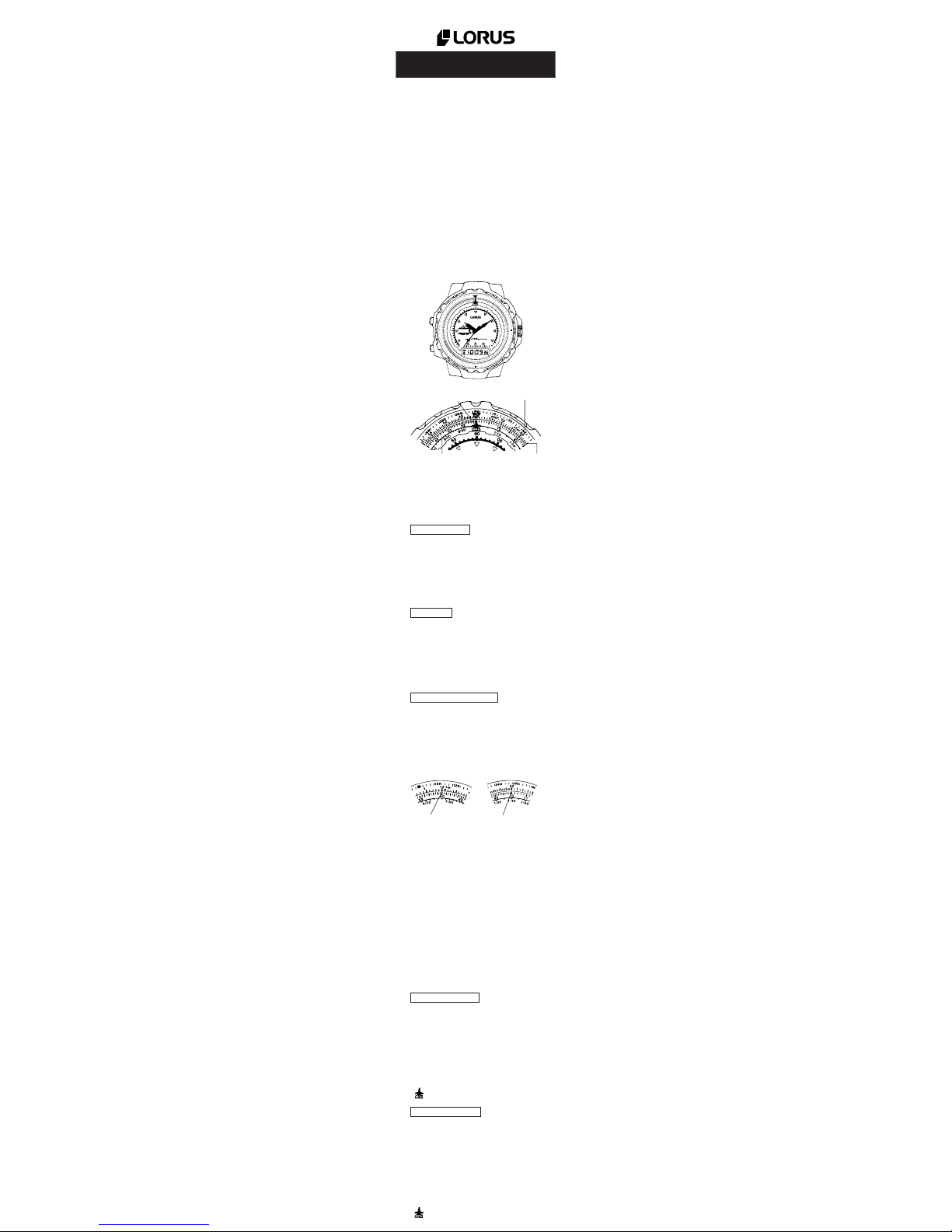
The rotary slide rule consists of
A) a dial ruler fixed on the dial and
B) a rotating external slide rule (rotary
bezel).
The outer circumference of the rotary bezel
is graduated at an interval of 3 deg. to form
a utility bearing compass, and the inner
circumference is provided with a logarithmic scale graduated from 10 to 100 and a
distance conversion scale (KM, 1000 FT,
NAUT, STAT).
The outer circumference of the fixed dial
ruler is marked with the same logarithmic
scale (10␣ –␣100) as the rotary bezel, and the
inner circumference is graduated with a time
scale.
■ ORDINARY COMPUTATION
[Multiplication, division and
the rule-of-three calculation]
*Any value on the logarithmic scale is rela-
tive, for example, “19” assumes any values
that are the n-th power of 10, multiplied by
itself ... 1.9, 190, 1900 ...
A Multiplication
B Division
[Problem] 30 x 40 = ?
[Solution]
1) Bring 30 on the rotary bezel in line
with 10 on the fixed scale.
2) Read the scale on the rotary bezel corresponding to 40 on the fixed scale.
It is 12 (= 1.2 x 10
1
).
3) Calculate the number of digits following the formula in “Hint for calculation
of exponents”.
[Answer] 1200
[Problem] 120 ÷ 40 = ?
[Solution]
1) Bring 12 on the rotary bezel in line
with 40 on the fixed scale.
2) Read the rotary bezel scale corresponding
to 10 on the fixed scale.
It is 30 (= 3 x 10
1
).
3) Calculate the number of digits following the formula in “Hint for calculation
of exponents”.
[Answer] 3
C Rule-of-three calculation
Hint for calculation of exponents
=
>
=
>
=
>
Any number can be given by an exponential
expression as follows.
Assume A = a x 10x, B = b x 10y, and
C = c x 10z. (10 > a, b, c ␣␣␣1)
Multiplication:
Then, the product of A and B is expressed
by C (= c x 10z).
z = x + y if c ␣␣␣ a, b
z = x + y + 1 if c < a, b
Division:
The quotient of A/B is expressed by
C (= c x 10z).
z = x – y if a ␣␣␣␣ b
z = x – y – 1 if a < b
[Problem] 30/10 = ?/40
[Solution]
1) Bring 30 on the rotary bezel in line
with 10 on the fixed scale.
2) Read the scale on the rotary bezel corresponding to 40 on the fixed scale.
The reading is 12 (= 1.2 x 10
1
).
3) Calculate the number of digits following the formula in “Hint for calculation
of exponents”.
[Answer] 120
■ COMPUTATION FOR NAVIGATION
All the examples here can be calculated according to the following formula:
SPEED = DISTANCE/TIME
[Calculation of time, speed and distance]
A Time calculation
[Problem]
Ground speed : 200 MPH
Distance to fly : 100 miles
Time to fly : ?
[Solution]
1) Adjust 20 on the rotary bezel to the
time index
★
on the fixed scale.
2) Read the fixed scale at a position corresponding to 10 on the rotary bezel.
The reading is 30.
3)
For the purpose of determining the number
of digits, the same rule as with the division
applies. Thus, the answer is 30.
[Answer] 30 (minutes)
★
mark at the 12 o’clock position
B Speed calculation
[Problem]
Ground speed : ?
Distance to fly : 100 miles
Time to fly : 30 minutes
[Solution]
1) Adjust 10 on the rotary bezel to 30 on
the fixed scale.
2) The value on the rotary bezel corresponding to the time index★ on the fixed
scale is read to be 20.
3) For the purpose of determining the number
of digits, the same rule as with the
division applies. Thus, the answer is
200.
[Answer] 200 MPH
★
mark at the 12 o’clock position
SPORTS
N
A
U
T
.
7
0
S
T
A
T
.
8
0
55
50
45
1:10
1:20
1:30
1:40
1:50
2:00
2:30
3:00
25
25
30
35
40
45
50
55
60
24
24
23
23
22
22
21
21
20
20
19
19
18
18
17
17
16
16
15
15
14
14
12
12
11
1
10
90
80
70
1
4:00
5:00
6:00
7:00
8:00
9:00
3:30
4:30
60
15
30
45
60
75
100
120
SE
150
165
195
210
SW
240
255
W
285
300
NW
330
345
N
05
10
15
20
40
45
50
55
90
10
Time index
(reference point for
time conversion)
Utility bearing
compass scale
Logarithmic scale
on fixed scale*
Logarithmic scale
on rotary bezel*
A -1)
B-2)
C-1)
A-2)
B-1)
C-2)
Page 2
Printed in Hong Kong
[Problem]
Ground speed : 200 MPH
Distance to fly : ?
Time to fly : 30 minutes
[Solution]
1) Adjust 20 on the rotary bezel to the
time index★ on the fixed scale.
2) The value on the rotary bezel that corresponds to 30 on the fixed scale is 10.
3) For the purpose of determining the number
of digits, the same rule as with the
division applies. Thus, the answer is
100.
[Answer] 100 miles
[Calculation of climbing altitude,
climbing rate, and climbing time]
A Calculation of climbing altitude
C Distance calculation
★
mark at the 12 o’clock position
[Problem]
Climbing rate : 430 FT/minute
Climbing time : 18.6 minutes
Altitude to reach : ?
[Solution]
1) Adjust 43 on the rotary bezel to 10 on
the fixed scale.
2) Find the value on the rotary bezel corresponding to 18.6 on the fixed scale.
The reading is 80.
3) For the purpose of determining the number
of digits, the same rule as with the
division applies. Thus, the answer is
8000.
[Answer] 8000 FT
B Calculation of climbing rate
[Problem]
Climbing rate : ?
Climbing time : 18.6 minutes
Altitude to reach : 8000 FT
[Solution]
1) Adjust 80 on the rotary bezel to 18.6 on
the fixed scale.
2) Find the value on the rotary bezel corresponding to 10 on the fixed scale.
The reading is 43.
3) For the purpose of determining the number
of digits, the same rule as with the
division applies. Thus, the answer is
430.
[Answer] 430 FT/minute
Distance unit can be converted among nautical miles, statute miles and kilometers.
■ UNIT CONVERSION
[conversion among nautical miles,
statute miles and kilometers]
A Nautical miles → Statute miles
Nautical miles → Kilometers
C Calculation of climbing time
[Problem]
Climbing rate : 430 FT/minute
Climbing time : ?
Altitude to reach : 8000 FT
[Solution]
1) Adjust 43 on the rotary bezel to 10 on
the fixed scale.
2) Find the value on the fixed scale corresponding to 80 on the rotary bezel.
The reading is 18.6.
[Answer] 18.6 minutes
[Problem]
35 nautical miles → ? statute miles
→ ? kilometers
[Solution]
1) Bring the NAUT index on the rotary
bezel in line with 35 on the fixed scale.
2) Find the value on the fixed scale corresponding to the STAT index of the rotary
bezel. The reading is 40.3.
3) Find the value on the fixed scale corresponding to the KM index of the rotary
bezel. The reading is 64.8.
[Answer] 40.3 statute miles
64.8 kilometers
B Statute miles → Nautical miles
Statute miles → Kilometers
[Problem]
40.3 statute miles → ? nautical miles
→ ? kilometers
[Solution]
1) Bring the STAT index on the rotary
bezel to 40.3 on the fixed scale.
2) Find the value on the fixed scale corresponding to the NAUT index of the rotary
bezel. The reading is 35.
3) Find the value on the fixed scale corresponding to the KM index of the rotary
bezel. The reading is 64.8.
[Answer] 35 nautical miles
64.8 kilometers
C Kilometers → Statute miles
Kilometers → Nautical miles
[Problem]
64.8 kilometers → ? statute miles
→ ? nautical miles
[Solution]
1) Adjust the KM index on the rotary bezel
to 64.8 on the fixed scale.
2) Find the value on the fixed scale corresponding to the STAT index of the rotary
bezel. The reading is 40.3.
3) Find the value on the fixed scale corresponding to the NAUT index of the rotary bezel. The reading is 35.
[Answer] 40.3 statute miles
35 nautical miles
A -2)
B-1)
C-2)
A-1)
B-2)
C-1)
A-1)
B-2)
C-1)
A-2)
B-1)
C-2)
A-1)
B-2)
C-3)
A-2)
B-1)
C-2)
A-3)
B-3)
C-1)
Markings on the rotary slide rule
STAT
Classifi-
cation
Marking Explanation
Distance Abbreviation of
nautical mile
1 NAUT = 1.852 km
NAUT
Abbreviation of
statute mile
1 STAT = 1.609 km
KM Abbreviation of
kilometer
1 KM = 3,280 feet
FT
Abbreviation of feet
MPHSpeed Abbreviation of miles
per hour
1 MPH = 1.609 km/h
* 1 knot = 1 NAUT/h = 1.852 km/h
 Loading...