

Page 1
GAS RANGE
Use &Care Guide
For questions about features, operation/performance, parts accessories or service, call: 1-800-422-1230
In Canada, call for assistance 1-800-461-5681, for installation and service, call: 1-800-807-6777 or visit our website at...
www.kitchenaid.com or www.KitchenAid.ca
Table of Contents............................................................................................................2
Models KGRC608 KGST300 KGST307 KGRT600 KGRT607 KGSC308
YKGST307 YKGRT607 YKGRC608 YKGSC308
9754288C
Page 2

TABLE OF CONTENTS
RANGE SAFETY .............................................................................3
PARTS AND FEATURES................................................................5
COOKTOP USE ..............................................................................6
Cooktop Controls.........................................................................6
Sealed Surface Burners ...............................................................6
Flame Height ................................................................................7
Ceramic Glass..............................................................................7
Home Canning .............................................................................8
Cookware .....................................................................................8
11-inch (28 cm) Square Griddle...................................................8
ELECTRONIC OVEN CONTROLS.................................................9
Electronic Control Pads .............................................................10
Displays......................................................................................10
Start............................................................................................10
Cancel Off...................................................................................10
Clock ..........................................................................................10
Tones..........................................................................................10
Fahrenheit and Celsius...............................................................10
Timer...........................................................................................10
Control Lock...............................................................................11
Oven Temperature Control ........................................................11
OVEN USE.....................................................................................11
Aluminum Foil.............................................................................11
Positioning Racks and Bakeware ..............................................11
Oven Half-Rack with Removable Insert.....................................12
Bakeware....................................................................................12
Meat Thermometer.....................................................................12
Oven Vent...................................................................................13
Oven Door Vent..........................................................................13
Bake............................................................................................13
Broil.............................................................................................13
Convection Cooking...................................................................15
Convection Bake........................................................................15
Convection Roast.......................................................................15
Convection Broil.........................................................................17
Convect Full Meal.......................................................................17
EASYCONVECT™ Conversion ..................................................18
Sabbath Mode............................................................................18
Dehydrating ................................................................................19
Proofing Bread ...........................................................................20
Temperature Probe ....................................................................20
Timed Cooking ...........................................................................21
RANGE CARE ...............................................................................21
Self-Cleaning Cycle....................................................................21
General Cleaning........................................................................23
Oven Light(s)...............................................................................24
Oven Door ..................................................................................24
Storage Drawer ..........................................................................25
TROUBLESHOOTING ..................................................................25
ASSISTANCE OR SERVICE.........................................................27
WARRANTY ..................................................................................28
2
Page 3
RANGE SAFETY
Your safety and the safety of others are very important.
We have provided many important safety messages in this manual and on your appliance. Always read and obey all
safety messages.
This is the safety alert symbol.
This symbol alerts you to potential hazards that can kill or hurt you and others.
All safety messages will follow the safety alert symbol and either the word “DANGER” or
“WARNING.” These words mean:
You can be killed or seriously injured if you don't
immediately follow instructions.
can be killed or seriously injured if you don't
You
follow instructions.
All safety messages will tell you what the potential hazard is, tell you how to reduce the chance of injury, and tell you
what can
happen if the instructions are not followed.
WARNING: If the information in this manual is not followed exactly, a fire or explosion
may result causing property damage, personal injury or death.
– Do not store or use gasoline or other flammable vapors and liquids in the vicinity of this
or any other appliance.
– WHAT TO DO IF YOU SMELL GAS:
Do not try to light any appliance.
•
Do not touch any electrical switch.
•
Do not use any phone in your building.
•
Immediately call your gas supplier from a neighbor's phone. Follow the gas supplier's
•
instructions.
If you cannot reach your gas supplier, call the fire department.
•
– Installation and service must be performed by a qualified installer, service agency or
the gas supplier.
The California Safe Drinking Water and Toxic Enforcement Act requires the Governor of California to publish a list
of substances known to the State of California to cause cancer, birth defects, or other reproductive harm, and
requires businesses to warn of potential exposure to such substances.
WARNING: This product contains a chemical known to the State of California to cause cancer, birth defects, or
other reproductive harm.
This appliance can cause low-level exposure to some of the substances listed, including benzene, formaldehyde,
carbon monoxide, toluene, and soot.
3
Page 4
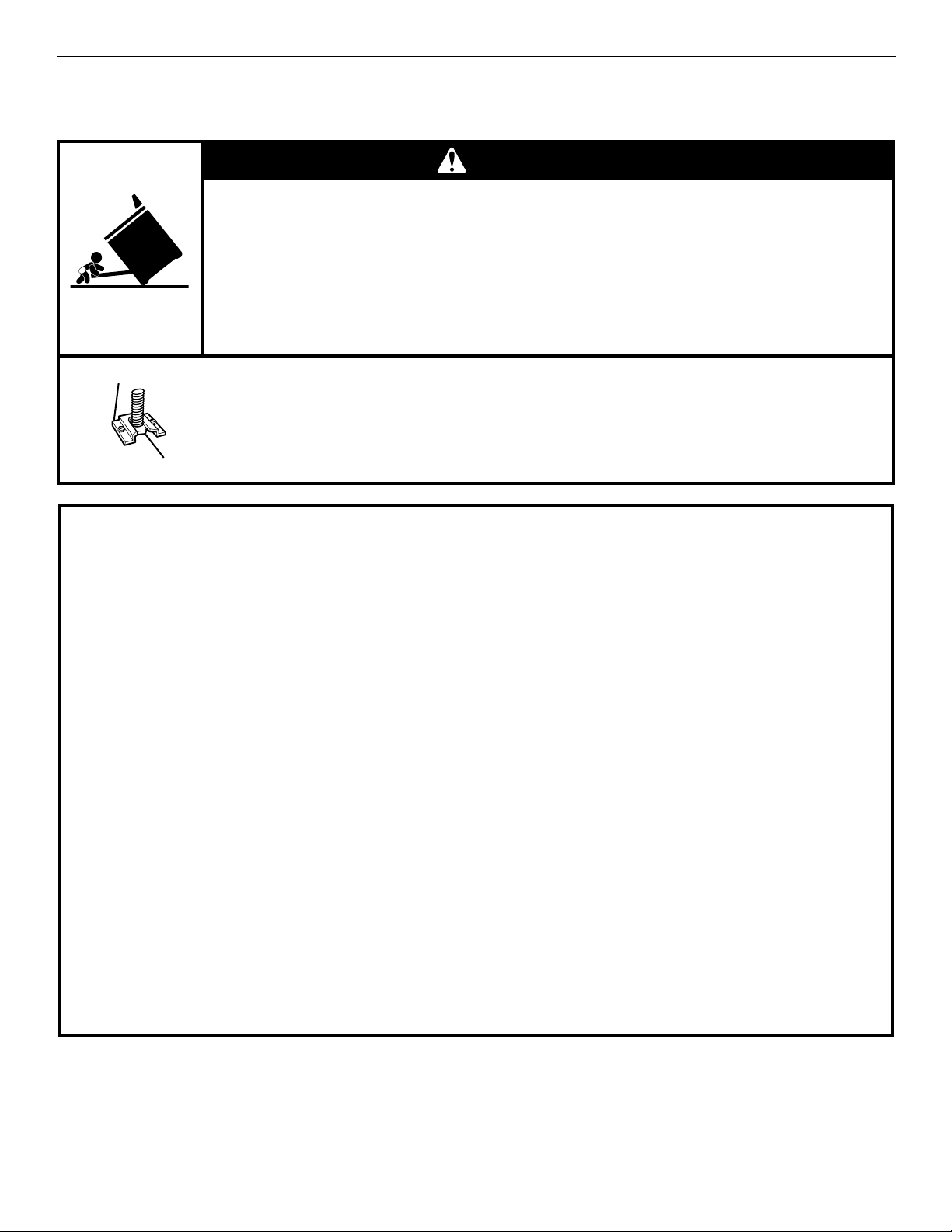
The Anti-TipBracket
The range will not tip during normal use. However, the range can tip if you apply too much force or weight to the open door without the
anti-tip bracket fastened down properly.
WARNING
Tip Over Hazard
A child or adult can tip the range and be killed.
Connect anti-tip bracket to rear range foot.
Reconnect the anti-tip bracket, if the range is moved.
See the installation instructions for details.
Failure to follow these instructions can result in death or serious burns to children
and adults.
Anti-Tip Bracket
Range Foot
Making sure the anti-tip bracket is installed:
• Slide range forward.
• Look for the anti-tip bracket securely attached to floor.
• Slide range back so rear range foot is under anti-tip bracket.
IMPORTANT SAFETY INSTRUCTIONS
WARNING: To reduce the risk of fire, electrical
shock, injury to persons, or damage when using the
range, follow basic precautions, including the
following:
WARNING: TO REDUCE THE RISK OF
■
TIPPING OF THE RANGE, THE RANGE MUST BE
SECURED BY PROPERLY INSTALLED ANTI-TIP
DEVICES. TO CHECK IF THE DEVICES ARE
INSTALLED PROPERLY, SLIDE RANGE FORWARD,
LOOK FOR ANTI-TIP BRACKET SECURELY
ATTACHED TO FLOOR, AND SLIDE RANGE BACK
SO REAR RANGE FOOT IS UNDER ANTI-TIP
BRACKET.
CAUTION: Do not store items of interest to
■
children in cabinets above a range or on the
backguard of a range – children climbing on the
range to reach items could be seriously injured.
■ Proper Installation – The range, when installed, must
be electrically grounded in accordance with local
codes or, in the absence of local codes, with the
National Electrical Code, ANSI/NFPA 70.
the range must be electrically grounded in accordance
with Canadian Electrical Code. Be sure the range is
properly installed and grounded by a qualified technician.
In Canada,
■ This range is equipped with a three-prong grounding
plug for your protection against shock hazard and
should be plugged directly into a properly grounded
receptacle. Do not cut or remove the grounding prong
from this plug.
■ Disconnect the electrical supply before servicing the
appliance.
■ Never Use the Range for Warming or Heating the
Room.
■ Injuries may result from the misuse of appliance doors
or drawers such as stepping, leaning, or sitting on the
doors or drawers.
■ Maintenance – Keep range area clear and free from
combustible materials, gasoline, and other flammable
vapors and liquids.
■ Storage in or on the Range – Flammable materials
should not be stored in an oven or near surface units.
■ Top burner flame size should be adjusted so it does
not extend beyond the edge of the cooking utensil.
For self-cleaning ranges –
■
Before Self-Cleaning the Oven – Remove broiler pan
and other utensils. Wipe off all excessive spillage
before initiating the cleaning cycle.
SAVE THESE INSTRUCTIONS
4
Page 5
PARTS AND FEATURES
REAR
FRONT
FRONT
REAR
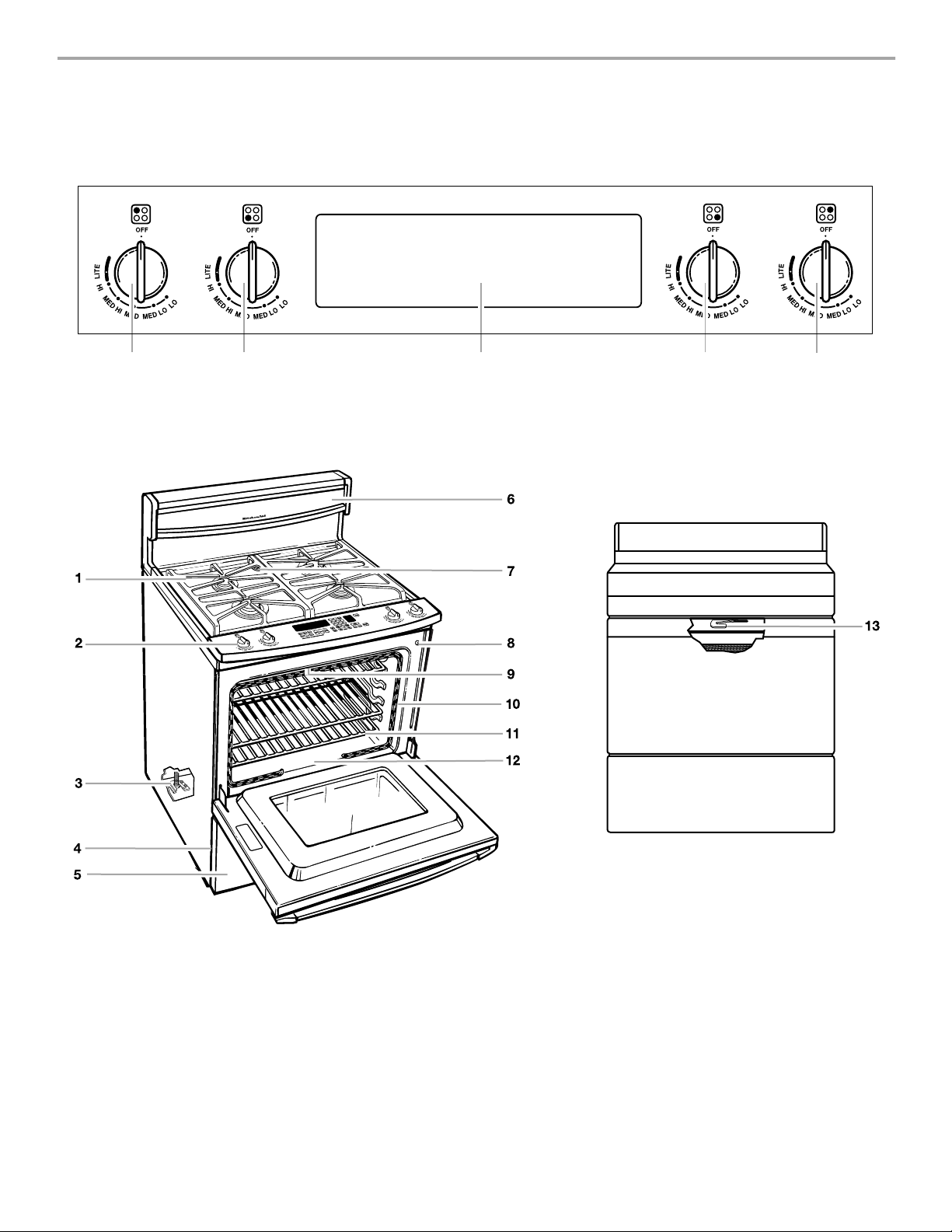
This manual covers several different models. The range you have purchased may have some or all of the items listed. The locations and
appearances of the features shown here may not match those of your model.
Control Panel
Range
REAR
FRONT
FRONT
REAR
12 3 45
1. Left Rear Control Knob
2. Left Front Control Knob
3. Electronic Oven Control 4. Right Front Control Knob
5. Right Rear Control Knob
1. Surface Burner Cooking Area
2. Control Panel
3. Anti-Tip Bracket
4. Model and Serial Number
(behind left side of drawer)
5. Storage Drawer
6. Backsplash (on some models)
7. Oven Vent
8. Automatic Oven Light Switch
9. Broil Burner (not shown)
10. Door Gasket
11. Oven Rack
12. Bake Burner (not shown)
13. Self-Clean Latch
Parts and Features not shown
Oven Door Window
Oven Light
Broiler Pan and Grid
Broiler Pan Support (on some models)
Roasting Rack
Temperature Probe (on some models)
5
Page 6
Cooktop Controls
WARNING
Fire Hazard
COOKTOP USE
Power failure
In case of prolonged power failure, the surface burners can be lit
manually. Hold a lit match near a burner and turn knob
counterclockwise to LITE. After burner lights, turn knob to setting.
REMEMBER: When range is in use or (on some
models) during the Self-Cleaning cycle, the entire
cooktop area may become hot.
Sealed Surface Burners
Do not let the burner flame extend beyond the
edge of the pan.
Turn off all controls when not cooking.
Failure to follow these instructions can result in
death or fire.
Electric igniters automatically light the surface burners when
control knobs are turned to LITE.
The left front and right rear burners provide the highest heat
setting. The left rear and right front burners allow more accurate
simmer control at the lowest setting.
Before setting a control knob, place filled cookware on the grate.
Do not operate a burner using empty cookware or while the grate
is unoccupied.
To Set :
1. Push in and turn knob counterclockwise to LITE.
All 4 surface burners will click. Only the burner with the control
knob turned to LITE will produce a flame.
2. Turn knob anywhere between HI and LO. Use the following
chart as a guide when setting heat levels.
SETTING RECOMMENDED USE
LITE
HI
MED to HI
MED
MED to LO ■ Cook soups, sauces and gravies.
■ Light the burner.
■ Start food cooking.
■ Bring liquid to a boil.
■ Hold a rapid boil.
■ Quickly brown or sear food.
■ Fry or sauté foods.
■ Hold a slow boil.
■ Stew or steam foods.
1
2
3
4
5
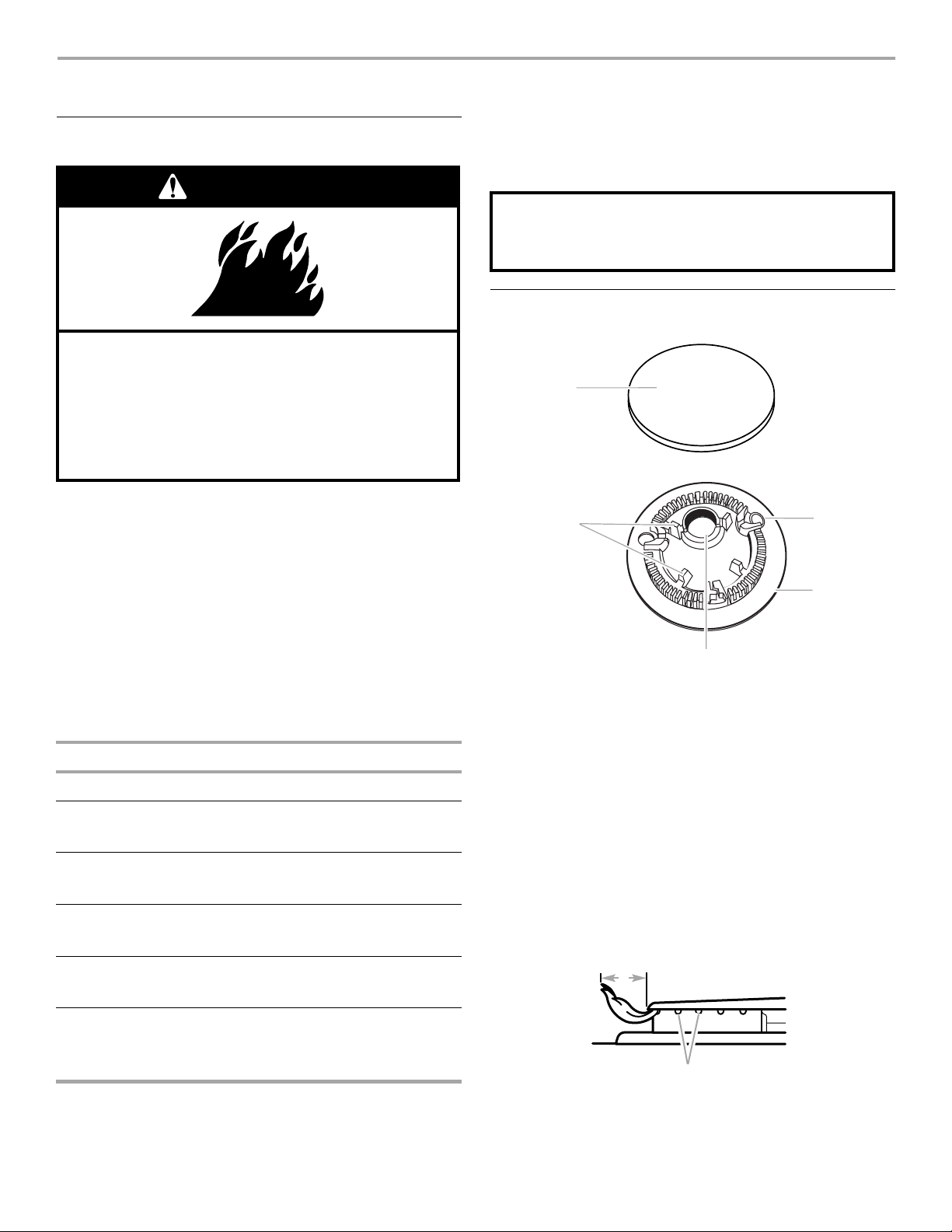
1. Burner cap
2. Alignment pins
3. Igniter
4. Burner
5. Gas tube opening
IMPORTANT: Do not obstruct the flow of combustion and
ventilation air around the burner grate edges.
Burner cap: Always keep the burner cap in place when using a
surface burner. A clean burner cap will help prevent poor ignition
and uneven flames. Always clean the burner cap after a spillover
and routinely remove and clean the caps according to the
“General Cleaning” section.
Gas tube opening: Gas must flow freely throughout the gas tube
opening for the burner to light properly. Keep this area free of soil
and do not allow spills, food, cleaning agents or any other material
to enter the gas tube opening. Protect it from spillovers by always
using a burner cap.
1
LO
(with Simmer Plate
on some models)
6
■ Keep food warm.
■ Melt chocolate or butter.
■ Simmer.
2
1. 1-1¹⁄₂" (25-38 mm)
2. Burner ports
Page 7
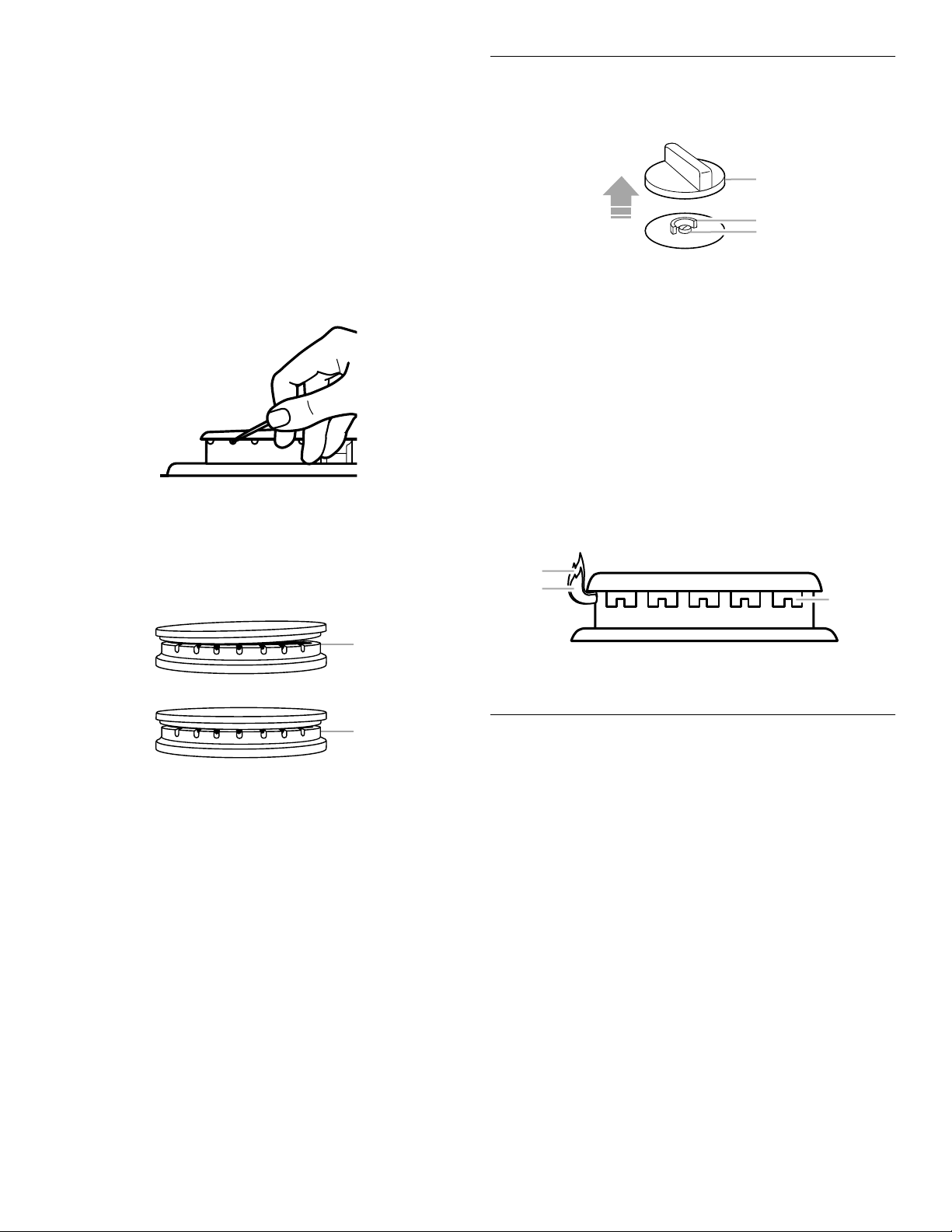
Burner ports: Check burner flames occasionally for proper size
and shape as shown above. A good flame is blue in color, not
yellow. Keep this area free of soil and do not allow spills, food,
cleaning agents or any other material to enter the burner ports.
To Cl ean :
IMPORTANT: Before cleaning, make sure all controls are off and
the oven and cooktop are cool. Do not use oven cleaners, bleach
or rust removers.
1. Remove the burner cap from the burner base and clean
according to “General Cleaning” section.
2. Clean the gas tube opening with a damp cloth.
3. Clean clogged burner ports with a straight pin as shown. Do
not enlarge or distort the port. Do not use a wooden toothpick.
If the burner needs to be adjusted, contact a trained repair
specialist.
4. Replace the correct size burner cap onto the correct size
burner base, making sure the alignment pins are properly
aligned with the burner cap.
On some models, each size burner cap and burner base has a
corresponding letter “A,” “B,” “C” and “D.” To ensure a proper
fit and that the burner will light, make sure that the burner cap
matches with its corresponding letter on the burner base.
Flame Height
Depending on your model, the LO or LOW setting flame height of
each of the surface burners can be adjusted.
1
2
3
1. Control knob
2. Valve stem
3. Adjustment screw
To Adjust:
1. Turn surface burner control knob to LITE position (or LIGHT on
some models).
2. When burner has lit, turn control knob to LO position (or LOW
on some models).
3. Remove control knob by pulling straight up.
4. Hold the valve stem with a pair of pliers.
5. Use a small flat-blade screwdriver to turn the adjustment
screw until the flame is steady blue and approximately ¹⁄₄ in.
(6 mm) high.
6. Test the flame by turning the control knob from LO (or LOW on
some models) to HI (or HIGH on some models), checking the
flame at each setting.
1
2
3
1
2
1. Incorrect
2. Correct
5. Turn on the burner. If the burner does not light, check cap
alignment. If the burner still does not light, do not service the
sealed burner yourself. Contact a trained repair specialist.
1. High flame
2. Low flame
3. Port
Ceramic Glass
Wiping off the cooktop before and after each use will help keep it
free from stains. For more information, see “General Cleaning”
section.
■ Do not store jars or cans above the cooktop. Dropping a
heavy or hard object onto the cooktop could crack it.
■ For foods containing sugar in any form, clean up all spills and
soils as soon as possible. Allow the cooktop to cool down
slightly. Then, while wearing oven mitts, remove the spills
while the surface is still warm. If sugary spills are allowed to
cool down, they can adhere to the cooktop and can cause
pitting and permanent marks.
■ Do not slide cookware or bakeware across the cooktop.
Aluminum or copper bottoms and rough finishes on cookware
or bakeware could leave scratches or marks on the cooktop.
■ Do not allow objects that could melt, such as plastic or
aluminum foil, to touch any part of the entire cooktop.
■ Do not use the cooktop as a cutting board.
7
Page 8

■ Use cookware about the same size as the surface cooking
area. Cookware should not extend more than 1 in. (2.5 cm)
outside the area.
Use the following chart as a guide for cookware material
characteristics.
COOKWARE CHARACTERISTICS
1. Surface Cooking Area
2. Cookware/Canner
3. 1 in. (2.5 cm) Maximum Overhang
■ Cookware designed with slightly indented bottoms or small
expansion channels can be used.
■ Make sure the bottoms of pots and pans are clean and dry
before using them. Residue and water can leave deposits
when heated.
Home Canning
When canning for long periods, alternate the use of surface
cooking areas, elements or surface burners between batches.
This allows time for the most recently used areas to cool.
■ Center the canner on the grate or largest surface cooking area
or element. Canners should not extend more than 1 in.
(2.5 cm) outside the cooking area.
■ Do not place canner on 2 surface cooking areas, elements or
surface burners at the same time.
■ On ceramic glass models, use only flat-bottomed canners.
■ On coil element models, the installation of a Canning Unit Kit
is recommended. If a kit is not installed, the life of the coil
element will be shortened. See “Assistance or Service” for
ordering instructions.
■ For more information, contact your local U.S. Government
Agricultural Department Extension Office. In Canada, contact
Agriculture Canada. Companies that manufacture home
canning products can also offer assistance.
Cookware
IMPORTANT: Never leave empty cookware on a hot surface
cooking area, element or surface burner.
Ideal cookware should have a flat bottom, straight sides, a wellfitting lid and the material should be of medium-to-heavy
thickness.
Rough finishes may scratch the cooktop. Aluminum and copper
may be used as a core or base in cookware. However, when used
as a base they can leave permanent marks on the cooktop or
grates.
Cookware material is a factor in how quickly and evenly heat is
transferred, which affects cooking results. A nonstick finish has
the same characteristics as its base material. For example,
aluminum cookware with a nonstick finish will take on the
properties of aluminum.
Griddles with nonstick surfaces should not be used under the
broiler.
Aluminum
■ Heats quickly and evenly.
■ Suitable for all types of cooking.
■ Medium or heavy thickness is best for
most cooking tasks.
Cast iron
Ceramic or
Ceramic glass
■ Heats slowly and evenly.
■ Good for browning and frying.
■ Maintains heat for slow cooking.
■ Follow manufacturer’s instructions.
■ Heats slowly, but unevenly.
■ Ideal results on low to medium heat
settings.
Copper
Earthenware
Porcelain
■ Heats very quickly and evenly.
■ Follow manufacturer’s instructions.
■ Use on low heat settings.
■ See stainless steel or cast iron.
enamel-onsteel or cast
iron
Stainless steel ■ Heats quickly, but unevenly.
■ A core or base of aluminum or copper
on stainless steel provides even
heating.
11-inch (28 cm) Square Griddle
The 11 in. (28 cm) griddle is a square pan with extra low sides and
one long handle. It has an uncoated hard-anodized interior and
exterior, and is perfect for the high heat needed for searing and
grilling.
The griddle may also be used in the oven when broiling. When
finished cooking, use an oven mitt to slide oven rack out to the
stop position and remove the griddle from the oven.
■ Do not use knives or metal utensils on the griddle surface. Use
only plastic or nylon cooking utensils.
■ Do not preheat on HI. Excessive heat will cause discoloration,
shorten the life of the surface, and may warp griddle and
cause damage to the cooktop.
■ Do not wash griddle in the dishwasher.
First Time Use:
1. Before cooking for the first time, wash the griddle in warm
soapy water with a sponge. Rinse with warm water and towel
dry.
2. Preheat griddle on medium setting for 5 minutes.
Allow griddle to cool completely.
3. Apply a light coating of vegetable oil or nonstick cooking
spray to griddle.
To Us e:
1. Place griddle over surface cooking grate, and push in and turn
the control knob to the MED setting. Preheat griddle for
5 minutes.
2. Place foods on griddle, and choose correct temperature
setting for foods according to your recipe.
8
Page 9
ELECTRONIC OVEN CONTROLS
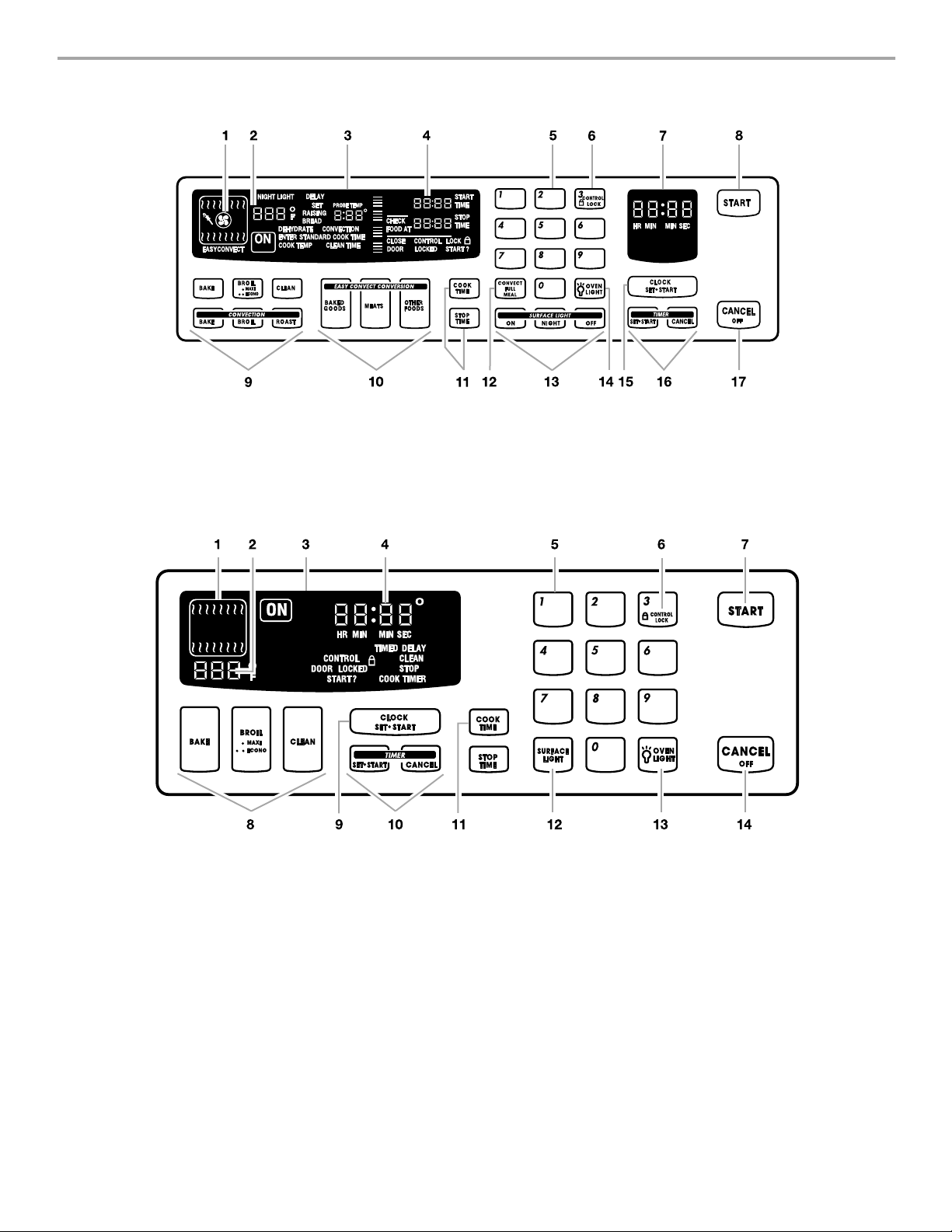
1. Oven Display Symbol
2. Heat Settings
3. Oven Display
4. Start/Stop Time
5. Number Pads
6. Control Lock
1. Oven Display Symbol
2. Heat Settings
3. Oven Display
4. Start/Stop Time
5. Number Pads
7. Time of Day/Timer Display
(on some models)
8. Start
9. Oven Settings
10. EASYCONVECT™ Conversion
(on some models)
11. Timed Cooking
6. Control Lock (on some models)
7. Start
8. Oven Settings
9. Clock
10. Minute Timer
12. Convect Full Meal
(Surface Light on some models)
13. Surface Light (on some models)
14. Oven Light
15. Clock
16. Minute Timer
17. Cancel Off
11. Timed Cooking
12. Surface Light
(Control Lock on some models)
13. Oven Light
14. Cancel Off
9
Page 10

Electronic Control Pads
When pressing any control pad function on the Electronic Oven
Control, use the pad of your finger to press the desired function.
Hold down the pad a few seconds, or until the desired function
appears on the display.
When entering multiple functions within one setting, pause briefly
between each control pad command. If a command pad is
pressed several times repeatedly, the pad may briefly stop
working. Wait a few seconds, and the pad should function again
as normal.
Displays
When power is first supplied to the appliance, everything on the
displays will light up for 5 seconds. Then, “PF” will appear. Press
CANCEL OFF to clear displays.
If “PF” appears at any other time, a power failure has occurred.
Press CANCEL OFF and reset the clock if needed.
Oven Display (on some models)
When the oven is in use, this display shows the oven temperature,
heat source(s) and start time.
During Timed Cooking, this display also shows a vertical bar and
minute time countdown and the stop time (if entered).
If “Err” appears on the display, an invalid pad was pressed.
Press CANCEL OFF and retry your entry.
When the oven is not in use, this display is blank.
Time of Day/Timer Display (on some models)
This display shows the time of day or Timer countdown.
Start
The START pad begins any oven function except the Timer,
Control Lock and Sabbath Mode. If not pressed within 5 seconds
after pressing a pad, “START?” will appear on the oven display as
a reminder. If not pressed within 4 minutes after pressing a pad,
the oven display will return to inactive mode (blank) and the
programmed function will be canceled.
Cancel Off
The CANCEL OFF pad stops any oven function except for the
Clock, Timer and Control Lock.
Clock
This is a 12-hour clock and does not show a.m. or p.m.
To Set :
1. Press CLOCK SET/START.
2. Press number pads to set time of day.
On some models, press the HR and MIN “up” or “down”
arrow pads (buttons) until the correct time shows on the
display.
3. Press START.
To n e s
Tones are audible signals, indicating the following:
One tone
■ Valid pad press
■ Oven is preheated
■ Function has been entered
Three tones
■ Invalid pad press
Four tones
■ End of cycle
■ Reminder, repeating each minute after the end-of-cycle tones
To Enable/Disable Tones:
1. Press CANCEL OFF.
2. Open oven door.
3. Press and hold STOP TIME for 5 seconds.
4. Display will show “SND ON” or “SND OFF.”
Fahrenheitand Celsius
To set oven to cook in Celsius instead of Fahrenheit, open oven
door, then press and hold BROIL for 5 seconds. Repeat to change
back into Fahrenheit.
Timer
The Timer can be set in minutes and seconds or hours and
minutes and counts down the set time.
NOTE: The Timer does not start or stop the oven.
To Set :
1. Press TIMER SET/START.
Press again to switch between MIN/SEC and HR/MIN.
If no action is taken after 4 minutes, the display will return to
the time of day mode.
2. Press the number pads to set length of time.
On some models, press the HR and MIN “up” or “down”
arrow pads (buttons) until the correct time shows on the
display.
3. Press TIMER SET/START.
If not pressed within 4 minutes, the display will return to the
time of day mode and the programmed function will be
canceled.
When the set time ends, if on, end-of-cycle tones will sound,
then reminder tones will sound every minute.
4. Press TIMER CANCEL anytime to cancel the Timer and/or
stop reminder tones.
Remember, if CANCEL OFF is pressed, the oven will turn off.
The time can be reset during the countdown by repeating the
above steps.
10
Page 11

ControlLock
The Control Lock shuts down the control panel pads to prevent
unintended use of the oven. The Control Lock is preset off;
however, it can be enabled.
When the control is locked, only the TIMER SET/START and
TIMER CANCEL pads will function.
The Control Lock is preset unlocked, but can be locked.
Before locking, make sure the oven, the Timer and Timed Cooking
are off.
To Lo ck:
1. Open the oven door.
2. Press and hold the number pad 3 CONTROL LOCK for
5 seconds.
A single tone will sound, and “START?” will appear on the
display.
3. Press START. “CONTROL LOCK” and a picture of a lock will
appear on the display.
To Un loc k:
1. Open the oven door.
2. Press and hold the number pad 3 CONTROL LOCK for
5 seconds.
A single tone will sound, and “CONTROL LOCK” and a picture
of a lock will disappear from the display.
Oven TemperatureControl
IMPORTANT: Do not use a thermometer to measure oven
temperature because opening the oven door during cycling may
give incorrect readings.
The oven provides accurate temperatures; however, it may cook
faster or slower than your previous oven, so the temperature
calibration can be adjusted. It can be changed in Fahrenheit or
Celsius.
A minus sign means the oven will be cooler by the displayed
amount. No sign means the oven will be warmer by the displayed
amount. Use the following chart as a guide.
OVEN USE
Odors and smoke are normal when the oven is used the first few
times, or when it is heavily soiled.
IMPORTANT: The health of some birds is extremely sensitive to
the fumes given off. Exposure to the fumes may result in death to
certain birds. Always move birds to another closed and well
ventilated room.
AluminumFoil
IMPORTANT: Do not line the oven bottom with any type of foil,
liners or cookware because permanent damage will occur to the
oven bottom finish.
■ On those models with bottom vents, do not block or cover the
oven bottom vents.
■ Do not cover entire rack with foil because air must be able to
move freely for best cooking results.
■ To catch spills, place foil on rack below dish. Make sure foil is
at least 1 in. (2.5 cm) larger than the dish and that it is turned
up at the edges.
Positioning Racks andBakeware
IMPORTANT: Never place food or bakeware directly on the oven
door or bottom. Permanent damage will occur to the porcelain
finish.
RACKS
NOTES:
■ Position racks before turning the oven on.
■ Do not move racks with bakeware on them.
■ Make sure racks are level.
To move a rack, pull it out to the stop position, raise the front
edge, then lift out. Use the following illustration and chart as a
guide.
ADJUSTMENT °F
(AUTOMATIC °C CHANGE)
5° to 10°F (3° to 6°C) ...a little more
15° to 20°F (8° to 11°C) ...moderately more
25° to 35°F (14° to 19°C) ...much more
-5° to -10°F (-3° to -6°C) ...a little less
-15° to -20°F (-8° to -11°C) ...moderately less
-25° to -35°F (-14° to -19°C) ...much less
COOKS FOOD
To Adjust Oven Temperature Calibration:
1. Open the oven door.
2. Press CANCEL OFF.
3. Press and hold BAKE for 5 seconds.
The oven display shows the current calibration, for example,
“0° CAL COOK TEMP.”
4. Press BAKE to increase and BROIL/MAXI//ECONO to
decrease the temperature in 5°F (3° C) amounts. The
adjustment can be set between 35°F (21° C) and
-35°F (-21°C).
5. Press START.
5
4
3
2
1
FOOD RACK POSITION
Frozen pies, large roasts, turkeys,
angel food cakes
Bundt cakes, most quick breads,
yeast breads, casseroles, meats
Cookies, biscuits, muffins, cakes,
nonfrozen pies
1 or 2
2
2 or 3
11
Page 12

BAKEWARE
To cook food evenly, hot air must be able to circulate. Allow 2 in.
(5 cm) of space around bakeware and oven walls. Use the
following chart as a guide.
NUMBER OF
PAN( S)
1 Center of rack.
POSITION ON RACK
Bakeware
The bakeware material affects cooking results. Follow
manufacturer’s recommendations and use the bakeware size
recommended in the recipe. Use the following chart as a guide.
BAKEWARE/
RESULTS
RECOMMENDATIONS
2 Side by side or slightly staggered.
3 or 4 Opposite corners on each rack. Make sure
that no bakeware piece is directly over
another.
Oven Half-Rack with Removable
Insert
1
2
1. Removable Insert
2. Oven Half-Rack
The Oven Half-Rack with Removable Insert maximizes space.
When the 2 racks are attached, they make a full rack. The insert
can also be removed to provide room for large items such as a
turkey or casseroles.
The insert can also be used on the counter for a cooling rack.
Do not place more than 25 lbs. (11.3 kg) on the oven half-rack or
on the removable insert piece
Before Self-Cleaning, remove the Oven Half-Rack with
Removable Insert to keep it shiny and easy to slide. See the
“General Cleaning” section in the Use and Care Guide for more
information.
To Use Oven Half-Rack with Removable Insert:
1
Light colored
aluminum
■ Light golden
crusts
■ Even browning
Dark aluminum
and other
bakeware with
dark, dull and/or
nonstick finish
■ Brown, crisp
crusts
Insulated cookie
sheets or baking
pans
■ Little or no
bottom
browning
Stainless steel
■ Light, golden
crusts
■ Uneven
browning
Stoneware
■ Crisp crusts
Ovenproof
glassware,
ceramic glass or
ceramic
■ Brown, crisp
crusts
■ Use temperature and time
recommended in recipe.
■ May need to reduce baking
temperatures 25°F (15°C).
■ Use suggested baking time.
■ For pies, breads and casseroles, use
temperature recommended in recipe.
■ Place rack in center of oven.
■ Place in the bottom third of oven.
■ May need to increase baking time.
■ May need to increase baking time.
■ Follow manufacturer’s instructions.
■ May need to reduce baking
temperatures 25°F (15°C).
2
1. Oven Half-Rack (Removable
Insert not shown)
2. Full Oven Rack
1. Place a full rack on position 1 or 2, and the half rack on
position 3 or 4.
2. Place large items on the right-hand side of the full rack.
3. Place deeper, covered dishes on the left side of the full rack.
4. Place shallow dishes on the half-rack.
5. When finished cooking, carefully remove items.
12
Meat Thermometer
On models without a temperature probe, always rely on a meat
thermometer to determine doneness of meat and poultry. The
internal temperature, not appearance, is what counts. A meat
thermometer is not supplied with this appliance.
■ Insert the thermometer into the center of the thickest portion
of the meat or inner thigh or breast of poultry. The tip of the
thermometer should not touch fat, bone or gristle.
■ After reading the thermometer once, push it into the meat
¹⁄₂ in. (1.25 cm) more and read again. If the temperature drops,
cook the meat or poultry longer.
■ Check all meat in 2 or 3 places.
Page 13

Oven Vent
1
2
1. Oven vent cap
2. Oven vent cover (on some models)
The oven vent should not be blocked or covered since it allows
the release of hot air and moisture from the oven. Doing so will
cause poor air circulation, affecting cooking and cleaning results.
Never set plastics, paper or other items that could melt or burn
near the oven vent.
Oven Door Vent
To Bake or Roast:
Before baking and roasting, position racks according to the
“Positioning Racks and Bakeware” section. When roasting, it is
not necessary to wait for the oven to preheat before putting food
in, unless recommended in the recipe.
1. Press BAKE.
Press the number pads to enter a temperature other than
350°F (177°C). The bake range can be set between 170°F and
500°F (77°C and 260°C).
On some models, press the TEMPERATURE “up” or “down”
arrow pads (buttons) to enter a temperature other than 350°F
(177°C).
2. Press START.
“Lo°” will appear on the display if the actual oven temperature
is under 170°F (77°C).
On some models, “PrE” will appear on the display if the oven
temperature is under 170°F (77°C).
On some models, when the actual oven temperature reaches
170°F (77°C), the oven display will show the temperature
increasing in 5° increments.
When the set temperature is reached, if on, one tone will
sound.
3. Press CANCEL OFF when finished cooking.
Broil
(Maxi/Econo on somemodels)
1
1. Oven door vent
Hot air and moisture escape from the door vent during certain
oven modes. Some condensation may occur; however, this will
not affect cooking performance.
Bake
1
2
1. Broil heat
2. Bake heat
The BAKE function is ideal for baking, roasting or heating
casseroles.
During baking or roasting, the bake and broil elements will cycle
on and off in intervals to maintain oven temperature.
If the oven door is opened during baking or roasting, the broil
element will turn off immediately and the bake element will turn off
in 2 minutes. They will come back on once the door is closed.
1
1. Broil Maxi
2. Broil Econo
■ Use only the broiler pan and grid provided with the range. It is
designed to drain juices and help prevent spatter and smoke.
■ For proper draining, do not cover the grid with foil. The bottom
of the pan may be lined with aluminum foil for easier cleaning.
■ Trim excess fat to reduce spattering. Slit the remaining fat on
the edges to prevent curling.
■ Pull out oven rack to stop position before turning or removing
food. Use tongs to turn food to avoid the loss of juices. Very
thin cuts of fish, poultry or meat may not need to be turned.
■ After broiling, remove the pan from the oven when removing
the food. Drippings will bake on the pan if left in the heated
oven, making cleaning more difficult.
Broiling uses direct radiant heat to cook food. Use MAXI/ECONO
(on some models) for broiling regular-sized and smaller cuts of
meat, poultry and fish. Broil MAXI uses both top elements for
maximum browning coverage of foods. Broil ECONO uses the
inner element for browning coverage only in the center of foods.
Before broiling, position rack according to Broiling chart. It is not
necessary to preheat the oven before putting food in unless
recommended in the recipe. Position food on grid in the broiler
pan, then place it in the center of the oven rack.
2
13
Page 14

To Broil:
1. Close oven door.
2. Press BROIL.
On some models, press once for Broil MAXI and twice for Broil
ECONO.
3. Press START.
4. Press CANCEL OFF when finished.
Variable Temperature Broiling (on some models)
Changing the temperature when Variable Temperature Broiling
allows more precise control when cooking. The lower the
temperature, the slower the cooking. Thicker cuts and unevenly
shaped pieces of meat, fish and poultry may cook better at lower
broiling temperatures.
To Vari Broil:
1. Close oven door.
2. Press BROIL.
On some models, press once for Broil MAXI and twice for Broil
ECONO.
3. Press the number pads to set a temperature between 170°F
and 325°F (77°C and 163°C).
On some models, press the TEMPERATURE “up” or “down”
arrow pads (buttons) to set a temperature between 300°F and
525°F (150°C and 275°C).
4. Press START.
The temperature can be changed after this step. START does
not need to be pressed again.
5. Press CANCEL OFF when finished.
BROILING CHART
For best results, place food 3 in. (7 cm) or more from the broil
element. Times are guidelines only and may need to be adjusted
for individual tastes. Recommended rack positions are numbered
from the bottom (1) to the top (5). For diagram, see the
“Positioning Racks and Bakeware” section.
TOTAL
FOOD
Steak
1 in. (2.5 cm) thick
medium rare
medium
well done
Steak
1¹⁄₂ in. (3.8 cm) thick
rare
medium
Ground meat patties*
³⁄₄ in. (2 cm) thick
well done 5
Pork chops
1 in. (2.5 cm) thick 4 450°F
Ham slice [precooked]
¹₂ in. (1.25 cm) thick
1 in. (2.5 cm) thick
RACK
POSITION TEMP.
4
4
4
4
4
4
4
500°F
(260°C)1621
500°F
(260°C)2328
500°F
(260°C) 8-12
(232°C)
500°F
(260°C)
TIME
MIN.
25
25-28
10-12
20-22
Frankfurters 4 500°F
Lamb chops
1 in. (2.5 cm) thick 4
Chicken
bone-in pieces 3
Fish
¹₂ in. (1.25 cm) thick
1 in. (2.5 cm) thick
*Place up to 9 patties, equally spaced, on broiler grid.
3
3
(260°C)
400°F
(204°C) 18-20
500°F
(260°C) 32
350°F
(177°C)2020-22
8
14
Page 15

Convection Cooking
(on some models)
In a convection oven, the fan-circulated hot air continually
distributes heat more evenly than the natural movement of air in a
standard thermal oven. This movement of hot air maintains a
consistent temperature throughout the oven, cooking foods more
evenly, crisping surfaces while sealing in moisture and yielding
crustier breads.
Most foods can be cooked by lowering cooking temperatures
25°F to 50°F (14°C to 28°C) and cooking time can be shortened
by as much as 30 percent, especially for large turkeys and roasts.
■ It is important not to cover foods so that surface areas remain
exposed to the circulating air, allowing browning and crisping.
■ Keep heat loss to a minimum by only opening the oven door
when necessary.
■ Choose cookie sheets without sides and roasting pans with
lower sides to allow air to move freely around the food.
■ Test baked goods for doneness a few minutes before the
minimum cooking time with an alternative method such as a
toothpick.
■ Use a meat thermometer or the temperature probe to
determine the doneness of meats and poultry. Check the
temperature of pork and poultry in 2 or 3 places.
To Convection Bake:
Before convection baking, position racks according to the
“Positioning Racks and Bakeware” section. When using two
racks, place on guides 2 and 4. When using 3 racks, place on
guides 1, 3 and 5.
1. Press CONVECTION BAKE.
Press the number pads to enter a temperature other than
325°F (163°C). The convection bake range can be set
between 170°F and 500°F (77°C and 260°C).
2. Press START.
“Lo°” will appear on the oven display if the actual oven
temperature is under 170°F (77°C).
When the actual oven temperature reaches 170°F (77°C), the
oven display will show the oven temperature increasing in 5°F
increments.
When the set temperature is reached, if on, 1 tone will sound.
3. Press CANCEL OFF when finished cooking.
Convection Roast
(on some models)
1
Convection Bake
(on some models)
1
1. Convection element heat and fan
Convection baking can be used for baking delicate cakes and
pastries, as well as foods on multiple racks. It is helpful to stagger
items on the racks to allow a more even flow of heat. If the oven is
full, extra cooking time may be needed.
When cooking an oven meal with several different types of foods,
be sure to select recipes that require similar temperatures.
Cookware should sit in the oven with at least 1 in. (2.5 cm) of
space between the cookware and the sides of the oven.
During convection baking preheat, the convection and broil
elements and the bake element all heat the oven cavity. After
preheat, the convection element and the bake element will cycle
on and off in intervals to maintain oven temperature, while the fan
constantly circulates the hot air.
If the oven door is opened during convection baking or
preheating, the broil and convection element and fan will turn off
immediately. They will come back on once the door is closed.
■ Reduce recipe temperature 25°F (14°C). The cook time may
need to be reduced also.
2
3
1. Broil heat
2. Convection fan
3. Bake heat
Convection roasting can be used for roasting meats and poultry,
or for baking yeast breads and loaf cakes using a single rack.
During convection roasting, the bake and broil elements will cycle
on and off in intervals to maintain oven temperature, while the fan
constantly circulates the hot air.
If the oven door is opened during convection roasting, the broil
element and fan will turn off immediately and the bake element
will turn off in 2 minutes. They will come back on once the door is
closed.
■ Reduce recipe temperature 25°F (14°C). The cook time may
need to be reduced also.
15
Page 16

To Convection Roast:
Before convection roasting, position racks according to the
“Positioning Racks and Bakeware” section. It is not necessary to
wait for the oven to preheat before putting food in, unless
recommended in the recipe.
Use the roasting rack on top of the broiler pan and grid. This holds
the food above the grid and allows air to circulate completely
around all surfaces.
Food/Rack
Position
Cook Time
(min. per
1 lb [454 g])
Veal, Rack Position 2
Loin, Rib,
Rump
Roast
medium
well done
25-35
30-40
Pork, Rack Position 2
Oven Temp. Internal
Food Temp.
325°F (163°C) 160°F (71°C)
170°F (77°C)
1. Roasting rack
2. Broiler grid
3. Broil pan
1. Press CONVECTION ROAST.
Press the number pads to enter a temperature other than
300°F (149°C). The convection roast range can be set
between 170°F and 500°F (77°C and 260°C).
2. Press START.
“Lo°” will appear on the oven display if the actual oven
temperature is under 170°F (77°C).
When the actual oven temperature reaches 170°F (77°C), the
oven display will show the oven temperature increasing in 5°F
increments.
When the set temperature is reached, if on, 1 tone will sound.
3. Press CANCEL OFF when finished cooking.
CONVECTION ROASTING CHART
Food/Rack
Position
Cook Time
(min. per
Oven Temp. Internal
Food Temp.
1 lb [454 g])
Beef, Rack Position 2
Rib Roast
rare
medium
well done
20-25
25-30
30-35
300°F (149°C)
140°F (60°C)
160°F (71°C)
170°F (77°C)
Rib Roast
(boneless)
rare
medium
well done
22-25
27-30
32-35
300°F (149°C)
140°F (60°C)
160°F (71°C)
170°F (77°C)
Rump,
Sirloin Tip
Roast
rare
medium
well done
Meat Loaf
20-25
25-30
30-35
20-25
300°F (149°C)
325°F (163°C)
140°F (60°C)
160°F (71°C)
170°F (77°C)
165°F (74°C)
Loin Roast
30-40
325°F (163°C)
(boneless)
Shoulder
35-40
325°F (163°C)
Roast
Ham, Rack Position 2
Fresh
25-35
300°F (149°C)
(uncooked)
Fully
15-20
300°F (149°C)
Cooked
Lamb, Rack Position 2
Leg,
Shoulder
Roast
medium
well done
25-30
30-35
300°F (149°C) 160°F (71°C)
Chicken*, Rack Position 2
Whole
3-5 lbs.
20-25
325°F (163°C)
(1.5-2.2 kg)
5-7 lbs.
15-20
325°F (163°C)
(2.2-3.1 kg)
Turkey*, Ra ck Po sitions 1 or 2
13 lbs. and
10-15
300°F (149°C)
under
(5.85 kg)
Over 13 lbs.
10-12
300°F (149°C)
(5.85 kg)
Cornish Game Hens*, Rack Position 2 or 3
1-1.5 lbs.
50-60 325°F (163°C) 180°F (82°C)
(0.5-0.7 kg)
*Do not stuff poultry when convection roasting.
160°F-170°F
(71°C-77°C)
160°F-170°F
(71°C-77°C)
160°F (71°C)
160°F (71°C)
170°F (77°C)
180°F (82°C)
180°F (82°C)
180°F (82°C)
180°F (82°C)
16
Page 17

Convection Broil
(on some models)
1
2
1. Broil heat
2. Convection fan
During convection broiling, the broil elements will cycle on and off
in intervals to maintain oven temperature, while the fan constantly
circulates the hot air.
The temperature is preset at 450°F (232°C), but can be changed
to a different temperature. Cooking times will vary depending on
the rack position and temperature and may need to be adjusted.
If the oven door is opened during convection broiling, the broil
elements and fan will turn off immediately. They will come back on
once the door is closed.
To Convection Broil:
Before convection broiling, see “Broil Maxi/Econo” section for
general broiling guidelines. Position rack.
Allow the oven to preheat for 5 minutes. Position food on the
unheated grid on the broiler pan, then place it in the center of the
oven rack with the longest side parallel to the door.
Close the door.
1. Press CONVECTION BROIL.
Press the number pads to enter a temperature other than
450°F (232°C). The convection broil range can be set between
170°F and 500°F (77°C and 260°C).
2. Press START.
The set oven temperature will appear on the oven display until
oven is turned off.
3. Press CANCEL OFF when finished cooking.
Convect Full Meal
(on some models)
Convect Full Meal lets you choose from 11 preset cooking cycles.
A single pad includes an oven setting, an oven temperature, and a
cook time or probe temperature. One pad is changeable to allow
you to set your own cycle and save it for future use. Use the
following chart as a guide.
■ All food should be at refrigerator or room temperature
before placing in the oven. These settings and times are
not for frozen foods.
■ Always check for doneness of meats and poultry with a
meat thermometer. Test other foods for doneness by
checking color and texture.
PAD/ OVEN
SETTING
1
Convection
Bake
2
Convection
Roast
3
Convection
Roast
4
Convection
Bake
5
Convection
Bake
6
Convection
Roast
OVEN
TEMP.
325°F
(163°C)
325°F
(163°C)
350°F
(177°C)
375°F
(191°C)
425°F
(218°C)
325°F
(163°C)
COOK
TIME or
PROBE
TEMP.
1 hr. Meat Loaf, Baked
1 hr. 30
min.
40 min. Stuffed Pork Chops,
45 min. Oven Fried Chicken
20 min. Baked Salmon Steaks,
140°F
(60°C)
FOOD or MEAL
Potatoes, Pineapple
Upside Down Cake
Turkey Breast, Stuffing
Casserole, Peach Crisp
Baked Winter Squash,
Bread Pudding
Pieces, Scalloped
Potatoes, Cherry Pie
Roasted Vegetable
Wedges, Biscuits
Beef, rare
7
Convection
Roast
8
Convection
Roast
9
Convection
Roast
0
Convection
Bake
325°F
(163°C)
325°F
(163°C)
300°F
(149°C)
325°F
(163°C)
155°F
(68°C)
165°F
(74°C)
135°F
(56°C)
160°F
(71°C)
Beef, medium
or Pork
Beef, well done
Pot Roast
(3 lbs [1.4 kg]) with
vegetables
Casseroles
17
Page 18

To Us e:
Before using Convect Full Meal, place food in oven. If temperature
probe is required, insert probe into food and plug probe into jack.
See “Temperature Probe” section for diagram.
1. Press CONVECT FULL MEAL.
2. Press pad from chart.
For example, number pads 1 to 0 or CONVECT FULL MEAL.
3. Press START.
The start time, stop time, vertical bar countdown and minute
time countdown will appear on the oven display. The stop time
will not appear if not set in the changeable cycle.
When the cycle ends, “End” will appear in the oven display. If
enabled, end-of-cycle tones will sound, then reminder tones
will sound every minute.
4. Press CANCEL OFF or open the oven door when finished
cooking to clear the display.
To Us e:
Before using convection temperature conversion for BAKED
GOODS and OTHER FOODS, allow the oven to preheat before
placing food in the oven.
1. Press BAKED GOODS, MEATS or OTHER FOODS.
2. Press number pads to enter standard cook temperature.
3. Press number pads to enter standard cook time.
4. Press START.
“CHECK FOOD AT” and the stop time will appear on the oven
display.
When the stop time is reached, end-of-cycle tones will sound
if enabled. Open the door and check food.
5. Press CANCEL OFF if food is done to taste
or
6. Close door to continue cooking.
To Set Cyc le:
Before setting a cycle, start with the meat or main dish
temperature and cook time. Choose baked goods with an oven
temperature similar to those of the meat or main dish.
Temperatures ranging from plus or minus 25°F to 50°F
(14°C to 28°C) and cook times ranging from plus or minus 10 to
15 minutes are acceptable. Choose vegetables and fruits last.
1. Press CONVECT FULL MEAL.
2. Press any oven setting pad, for example BAKE.
3. Press number pads to enter oven temperature.
4. Press COOK TIME.
5. Press number pads to enter length of time to cook in hours
and minutes
or
Press 0 to do untimed cooking.
6. Press CONVECT FULL MEAL to save
or
Press START to save and immediately begin cycle.
EASYCONVECT™ Conversion
(on some models)
Convection cooking temperatures and times differ from those of
standard cooking. Depending upon the selected category,
EASYCONVECT automatically may reduce the standard recipe
temperature and/or time you input for convection cooking.
Foods are grouped into three general categories. Choose the
category most appropriate for the food to be cooked. To ensure
optimal cooking results, the oven will prompt a food check at the
end of a non-delayed cook time. Use the following chart as a
guide.
Sabbath Mode
The Sabbath Mode sets the oven to remain on in a bake setting
until turned off. When the Sabbath Mode is set, only the number
and start pads will function, no tones will sound, and the displays
will not show messages or temperature changes. The heat
sources icons will appear lit on the oven display throughout the
Sabbath Mode.
When the oven door is opened or closed, the oven light will not
turn on or off and the heating elements will not turn on or off
immediately.
If a power failure occurs when the Sabbath Mode is set, the oven
will return to the Sabbath Mode at the temperature it was
operating at when the power failure occurred.
To Activate:
1. Open the oven door.
2. Press CANCEL OFF.
3. Press the number pads 7, 8, 9, 6, in this order.
4. Press START.
“SAb On” will appear on the display.
Press CANCEL OFF pad to clear the display.
5. Close the oven door.
To Deactivate:
The oven can be disabled of the ability to set the Sabbath Mode
by repeating the steps above. “SAb OFF” will appear on the
display. When disabled, the Sabbath Mode cannot be regularly
set until reactivated.
SETTING FOODS
BAKED
GOODS
MEATS Baked potatoes, Chicken: whole and pieces
OTHER
FOODS
Biscuits, Breads: quick and yeast
Cakes: layer and angel food
Casseroles: including frozen entrées and
soufflés, cookies, fish
Meat loaf, Roasts: pork, beef and ham
(Turkey and large poultry are not included
because their cook time varies.)
Convenience foods: french fries, nuggets, fish
sticks, pizza
Pies: fruit and custard
18
Page 19

To Set Range for Sabbath Mode:
To set range to meet “no work” requirements for the Sabbath, first
activate the Sabbath mode using the steps above, then follow the
steps below.
1. Turn oven light and/or surface light (if available) on or off.
These lights will stay on or off (whichever is set) while in the
Sabbath mode. Opening the door will not turn on the oven
light if it is programmed to be off.
2. Open the oven door.
3. Press BAKE.
4. Press the number pads to enter a temperature other than
350°F (177°C). The bake range can be set between 170°F and
500°F (77°C and 260°C).
5. Press START.
6. Press and hold number pad 6 for 5 seconds. “START?” will
appear on the display.
7. Press START. “SAb” will appear on the display.
8. Close the oven door.
To End the Sabbath Mode:
1. Open the oven door.
2. Press and hold number pad 6 for 5 seconds.
3. Close the oven door.
Temperature Change
The oven temperature can be changed when the oven is in the
Sabbath Mode. No tones will sound, and the display will not
change. The heating elements will not turn on or off for a random
time, anywhere from 16 to 24 seconds. It may take up to one-half
hour for the oven to change temperature.
Number pads 1 through 0 represent temperatures.
Use the following chart as a guide.
Dehydrating
(on some models)
Dehydrating dries food. For additional information, refer to a book
written specifically about dehydrating or preserving foods.
Dehydration racks and an oven door stop are required, but not
supplied with this oven. See “Assistance or Service” section to
order.
To De hyd rat e:
Before dehydrating, prepare food as recommended in the recipe
and arrange on dehydration rack(s). Position racks according to
the following chart. See “Positioning Racks and Bakeware”
section for diagram.
NUMBER OF RACKS RACK POSITION(S)
13
22 and 4
31, 3 and 5
Place the oven door stop over the automatic oven light switch.
12
NUMBER PAD OVEN TEMPERATURE
1170°F (77°C)
2200°F (95°C)
3250°F (120°C)
4275°F (135°C)
5300°F (150°C)
*6 325°F (163°C)
7350°F (177°C)
8375°F (191°C)
9400°F (204°C)
0450°F (232°C)
*Make sure when using the number pad 6 that it is only pressed
for one second because it can also turn off the Sabbath Mode.
To Change Temperature:
1. Press the number pad (from the chart) for 1 second.
2. Press START.
1. Oven door stop
2. Automatic oven light switch
1. Press and hold CONVECTION BAKE for 5 seconds.
Press the number pads to enter a temperature other than
140°F (60°C). The dehydrating range can be set between
100°F and 200°F (38°C and 95°C).
2. Press START.
3. Press CANCEL OFF when finished dehydrating.
19
Page 20

Proofing Bread
(on some models)
Proofing bread prepares the dough for baking by activating the
yeast. Follow the recipe directions as a guide.
To Pr oof:
Before first proofing, place the dough in a lightly greased bowl
and cover loosely with wax paper, coated with shortening. Place
on rack guide two, then place broiler pan on guide one. See
“Positioning Racks and Bakeware” for diagram. Put 2 cups
(500 mL) of boiling water in the broiler pan. Close the door.
1. Press and hold BAKED GOODS for 5 seconds.
The display will show 100°F (38°C).
2. Press START.
Let the dough rise until nearly doubled in size, checking after
20-25 minutes. Proofing time may vary depending on dough
type and quantity.
3. Press CANCEL OFF when finished proofing.
Before second proofing, shape the dough, place it in baking
pan(s) and cover loosely with plastic wrap, coated with cooking
spray. Follow the same placement, broiler pan and water and
control steps above. Before baking, remove the plastic wrap.
Temperature Probe
(on some models)
The temperature probe accurately measures the internal
temperature of meat, poultry and casseroles with liquid and
should be used in determining the doneness of meat and poultry.
It should not be used during maxi and econo broiling, convection
broiling, dehydrating or proofing bread.
Always unplug and remove the temperature probe from the oven
when removing food.
To Us e:
Before using, insert the probe into the center of the thickest
portion of meat or into the inner thigh or breast of poultry, away
from fat or bone. Place food in oven and connect the temperature
probe to the jack. Keep probe as far away from heat source as
possible. Close oven door.
2
1
1. Press the number pads to enter a probe temperature other
than 160°F (71°C). The probe range can be set between 130°F
and 190°F (54°C and 88°C).
2. Press BAKE, CONVECTION BAKE or CONVECTION ROAST.
Press number pads to enter a temperature other than the one
displayed.
3. Press START.
The set oven temperature will appear on the oven display
throughout cooking.
“Lo°” will appear as the probe temperature until the internal
temperature of the food reaches 130°F (54°C). Then the
display will show the temperature increasing in 5°F
increments.
When the set probe temperature is reached, the oven will shut
off automatically and “End” will appear on the oven display.
If enabled, end-of-cycle tones will sound, then reminder tones
will sound every minute.
4. Press CANCEL OFF or open the oven door to clear the display
and/or stop reminder tones.
To Change Probe Temperature, Oven Setting:
WARNING
Burn Hazard
Use an oven mitt to remove temperature probe.
Do not touch broil element.
Failure to follow these instructions can result
in burns.
Repeat previous steps.
If CANCEL OFF is pressed anytime when changing the probe
temperature, the set function will automatically be canceled and
the use of the temperature probe function will need to be reset.
To reset after CANCEL OFF has been pressed, unplug the probe
from the probe jack and plug back in. Close the oven door and
repeat previous steps.
After cooking, unplug the probe and remove food from oven. The
probe symbol will remain lit until the probe is unplugged from the
probe jack.
See “General Cleaning” section to clean probe.
20
1. Temperature probe jack
2. Temperature probe
Page 21

Timed Cooking
WARNING
Food Poisoning Hazard
Do not let food sit in oven more than one hour
before or after cooking.
Doing so can result in food poisoning or
sickness.
Timed Cooking allows the oven to be set to turn on at a certain
time of day, cook for a set length of time, and/or shut off
automatically. Delay start should not be used for food such as
breads and cakes because they may not bake properly.
6. Press START.
The start time is automatically calculated and displayed.
“DELAY” and the stop time will also appear on the oven
display.
When the start time is reached, the oven will automatically
turn on. On some models, the vertical bar countdown and
minute time countdown will appear on the oven display.
On some models, the set temperature and minute time
countdown will appear on the oven display.
When the stop time is reached, the oven will shut off
automatically and “End” will appear on the oven display.
If on, end-of-cycle tones will sound, then reminder tones will
sound every minute.
7. Press CANCEL OFF or open the oven door to clear the display
and/or stop reminder tones.
To S et a Cook Ti me:
1. Press BAKE, CONVECTION BAKE or CONVECTION ROAST.
On some models, press the number pads to enter a
temperature other than the one displayed.
On some models, press the TEMPERATURE “up” or “down”
arrow pads (buttons) to enter a temperature other than 350°F
(177°C).
2. Press COOK TIME.
3. Press number pads to enter the length of time to cook.
On some models, press the TEMPERATURE “up” or “down”
arrow pads (buttons) until the correct time shows on the
display.
4. Press START.
On some models, the start time, stop time, vertical bar
countdown and minute time countdown will appear on the
oven display.
When the stop time is reached, the oven will shut off
automatically and “End” will appear on the oven display.
If on, end-of-cycle tones will sound, then reminder tones will
sound every minute.
5. Press CANCEL OFF or open the oven door to clear the display
and/or stop reminder tones.
To Set a Cook Time and Stop Time:
Before setting, make sure the clock is set to the correct time of
day. See “Clock” section.
1. Press BAKE, CONVECTION BAKE or CONVECTION ROAST.
Press the number pads to enter a temperature other than the
one displayed.
On some models, press the TEMPERATURE “up” or “down”
arrow pads (buttons) to enter a temperature other than 350°F
(177°C).
2. Press COOK TIME.
3. Press number pads to enter the length of time to cook.
On some models, press the HR and MIN “up” or “down”
arrow pads (buttons) until the correct time shows on the
display.
4. Press STOP TIME.
5. Press the number pads to enter time of day to stop.
On some models, press the HR and MIN “up” or “down”
arrow pads (buttons) until the correct time shows on the
display.
RANGE CARE
Self-Cleaning Cycle
(on some models)
WARNING
Burn Hazard
Do not touch the oven during the
Self-Cleaning cycle.
Keep children away from oven during
Self-Cleaning cycle.
Failure to follow these instructions can result
in burns.
IMPORTANT: The health of some birds is extremely sensitive to
the fumes given off during the Self-Cleaning cycle. Exposure to
the fumes may result in death to certain birds. Always move birds
to another closed and well ventilated room.
Self-clean the oven before it becomes heavily soiled. Heavy soil
results in longer cleaning and more smoke.
Keep the kitchen well-ventilated during the Self-Cleaning cycle to
help get rid of heat, odors, and smoke.
Do not block the oven vent(s) during the Self-Cleaning cycle. Air
must be able to move freely. Depending on your model, see “Oven
Vent” or “Oven Vents” section.
Do not clean, rub, damage or move the oven door gasket. The
door gasket is essential for a good seal.
21
Page 22

Prepare Oven:
■ Remove the broiler pan, grid, cookware and bakeware and, on
some models, the temperature probe from the oven.
■ Remove any foil from the oven because it may burn or melt,
damaging the oven.
■ Remove oven racks to keep them shiny and easy to slide. See
“General Cleaning” section for more information.
■ Hand clean inside door edge and the 1½ in. (3.8 cm) area
around the inside oven cavity frame, being careful not to move
or bend the gasket. This area does not get hot enough during
self-cleaning to remove soil. Do not let water, cleaner, etc.
enter slots on door frame. Use a damp cloth to clean this area.
■ Wipe out any loose soil to reduce smoke and avoid damage.
At high temperatures, foods react with porcelain. Staining,
etching, pitting or faint white spots can result. This will not
affect cooking performance.
Prepare Cooktop and Storage Drawer:
■ Remove plastic items from the cooktop because they may
melt.
■ Remove all items from the storage drawer.
How the Cycle Works
IMPORTANT: The heating and cooling of porcelain on steel in the
oven may result in discoloring, loss of gloss, hairline cracks and
popping sounds.
The Self-Cleaning cycle uses very high temperatures, burning soil
to a powdery ash.
The oven is preset for a 3 hour 30 minute clean cycle, however the
time can be changed. Suggested clean times are 2 hours and
30 minutes for light soil and between 3 hours and 30 minutes to
4 hours and 30 minutes for average to heavy soil.
Once the oven has completely cooled, remove ash with a damp
cloth. Do not wipe down any of the inside surfaces until the oven
has completely cooled down. Applying a cool damp cloth to the
inner door glass before it has cooled completely could result in
the glass breaking.
The oven light will not work during the Self-Cleaning cycle.
On Canadian models, the rear surface elements will not work
during the Self-Cleaning cycle.
To Self-Clean:
Before self-cleaning, make sure the door is closed completely or it
will not lock and the cycle will not begin.
1. Press CLEAN.
Press the number pads to set a clean time other than 3 hours
and 30 minutes. The clean time can be set between 2 hours
30 minutes and 4 hours 30 minutes.
On some models, press the HR and MIN “up” or “down”
arrow pads (buttons) to set clean time.
2. Press START.
The oven door will automatically lock and “DOOR LOCKED”
or “LOCKED,” the start time and stop time will appear on the
oven display. On some models, the clean time will appear on
the oven display.
The door will not unlock until the oven cools.
When the cycle is complete and the oven cools, “End” will
appear on the oven display and “DOOR LOCKED” or
“LOCKED” will disappear from the display.
3. Press any pad or open the oven door to clear the oven display.
To Delay Start Self-Clean:
Before delay starting Self-Clean, make sure the clock is set to the
correct time of day. See “Clock” section. Also, make sure the door
is closed completely or it will not lock and the cycle will not begin.
1. Press CLEAN.
Press the number pads to set a clean time other than 3 hours
30 minutes. The clean time can be set between 2 hours
30 minutes and 4 hours 30 minutes.
On some models, press the HR and MIN “up” or “down”
arrow pads (buttons) to set clean time.
2. Press STOP TIME.
On some models, press DELAY START.
3. Press the number pads to enter the time of day to stop.
On some models, press the HR and MIN “up” or “down”
arrow pads (buttons) until the correct time shows on the
display.
4. Press START.
The start time is automatically calculated and displayed. The
door will automatically lock and “DOOR LOCKED” or
“LOCKED” and “DELAY” and the stop time will also appear on
the display (on some models). The door will not unlock until
the oven cools.
When the start time is reached, the oven will automatically
turn on.
When the cycle is complete and the oven cools, “End” will
appear on the oven display and “DOOR LOCKED” or
“LOCKED” will disappear from the display.
5. Press CANCEL OFF to clear the oven display.
To Stop Self-Clean any time:
Press CANCEL OFF. If the oven temperature is too high, the door
will remain locked. It will not unlock until the oven cools.
On some models, if the oven temperature is too high after selfcleaning, then “cln,” “TIMED,” “ON,” “cool” and “LOCKED” will
appear on the display until the oven completely cools.
22
Page 23

General Cleaning
IMPORTANT: Before cleaning, make sure all controls are off and
the oven and cooktop are cool. Always follow label instructions on
cleaning products.
Soap, water and a soft cloth or sponge are suggested first unless
otherwise noted.
EXTERIOR PORCELAIN ENAMEL SURFACES
(on some models)
Food spills containing acids, such as vinegar and tomato, should
be cleaned as soon as the entire appliance is cool. These spills
may affect the finish.
■ Glass cleaner, mild liquid cleaner or nonabrasive scrubbing
pad:
Gently clean around the model and serial number plate
because scrubbing may remove numbers.
STAINLESS STEEL (on some models)
Do not use soap-filled scouring pads, abrasive cleaners, Cooktop
Polishing Creme, steel-wool pads, gritty washcloths or some
paper towels. Damage may occur.
Rub in direction of grain to avoid damaging.
■ Stainless Steel Cleaner & Polish (not included):
See “Assistance or Service” section to order.
■ Liquid detergent or all-purpose cleaner:
Rinse with clean water and dry with soft, lint-free cloth.
■ Vinegar for hard water spots
CONTROL KNOBS
Do not use steel wool, abrasive cleansers or oven cleaner.
Do not soak knobs.
When replacing knobs, make sure knobs are in the Off position.
On some models, do not remove seals under knobs.
■ Soap and water or dishwasher:
■ Pull knobs straight away from control panel to remove.
PORCELAIN-COATED GRATES AND CAPS
Food spills containing acids, such as vinegar and tomato, should
be cleaned as soon as the cooktop, grates and caps are cool.
These spills may affect the finish.
To avoid chipping, do not bang grates and caps against each
other or hard surfaces such as cast iron cookware.
Do not reassemble caps on burners while wet.
Do not clean in the Self-Cleaning cycle.
■ Nonabrasive plastic scrubbing pad and mildly abrasive
cleanser:
Clean as soon as cooktop, grates and caps are cool.
■ Dishwasher (grates only, not caps):
Use the most aggressive cycle.
SURFACE BURNERS
Sealed Burner models
See “Sealed Surface Burners” section.
Open Burner models
See “Surface Burners” section.
CERAMIC GLASS (on some models)
Do not use steel wool, abrasive powder cleansers, chlorine
bleach, rust remover or ammonia because damage may occur.
Always wipe with a clean, wet cloth or sponge and dry thoroughly
to prevent streaking and staining.
Cooktop Polishing Creme is recommended for regular use to help
prevent scratches, pitting and abrasions, and to condition the
cooktop. It may be ordered as an accessory. See “Assistance or
Service” to order.
A Cooktop Scraper is also recommended for stubborn soils, and
can be ordered as an accessory. See “Assistance or Service” to
order. The Cooktop Scraper uses razor blades. Store razor
blades out of the reach of children.
Light to moderate soil
■ Paper towels or clean damp sponge:
Clean while the cooktop is still warm. You may want to wear
oven mitts while doing so.
Sugary spills (jellies, candy, syrup)
■ Cooktop Scraper:
Clean while the cooktop is still warm. You may want to wear
oven mitts while doing so.
■ Cooktop Polishing Creme and clean damp paper towel:
Clean as soon as cooktop has cooled down. Rub creme into
surface with a damp paper towel or soft cloth. Continue
rubbing until white film disappears.
Heavy soil, dark streaks, specks and discoloration
■ Cooktop Polishing Creme or nonabrasive cleanser:
Rub product into soil with a damp paper towel or soft cloth.
Continue rubbing until white film disappears.
Burned-on soil
■ Cooktop Polishing Creme and Cooktop Scraper:
Rub creme into soil with damp paper towel. Hold scraper as
flat as possible on surface and scrape. Repeat for stubborn
spots. Polish entire cooktop with creme and paper towel.
Metal marks from aluminum and copper
■ Cooktop Polishing Creme:
Clean as soon as cooktop has cooled down. Rub creme into
surface with a damp paper towel or soft cloth. Continue
rubbing until white film disappears. The marks will not totally
disappear but after many cleanings become less noticeable.
Tiny scratches and abrasions
■ Cooktop Polishing Creme:
Rub creme into surface with a damp paper towel or soft cloth.
Continue rubbing until white film disappears. Scratches and
abrasions do not affect cooking performance and after many
cleanings become less noticeable.
23
Page 24

CONTROL PANEL
Do not use steel wool or abrasive cleansers.
Do not spray cleaner directly on panel.
■ Sponge and warm, soapy water.
Paper towel and mild liquid soap.
OVEN DOOR EXTERIOR
■ Glass cleaner and paper towels or nonabrasive plastic
scrubbing pad:
Apply glass cleaner to soft cloth or sponge, not directly on
panel.
OVEN CAVITY
Do not use oven cleaners.
Food spills should be cleaned when oven cools. At high
temperatures, foods react with porcelain and staining, etching,
pitting or faint white spots can result.
■ Self-Cleaning cycle:
See “Self-Cleaning Cycle” first.
OVEN RACKS AND ROASTING RACKS
■ Self-Cleaning cycle:
See “Self-Cleaning Cycle” first. Remove racks or they will
discolor and become harder to slide. If this happens, a light
coating of vegetable oil applied to the rack guides will help
them slide.
■ Steel-wool pad
Oven Light(s)
The oven light(s) is a 40-watt appliance bulb. The light(s) will come
on when the oven door is opened. The light(s) will not work during
the Self-Cleaning cycle. When the oven door is closed, press
OVEN LIGHT to turn the light(s) on or off.
To Replace:
Before replacing, make sure the oven is off and cool.
1. Unplug range or disconnect power.
2. Turn the glass bulb cover in the back of the oven
counterclockwise to remove.
3. Turn bulb counterclockwise to remove from socket.
4. Replace bulb and bulb cover by turning clockwise.
5. Plug in range or reconnect power.
Oven Door
For normal range use, it is not suggested to remove the oven
door. However, if removal is necessary, make sure the oven is off
and cool. Then, follow these instructions. The oven door is heavy.
To Rem ove :
1. Fully open the oven door.
2. Unscrew clips with a #2 square or Phillips screwdriver.
BROILER PAN AND GRID
Do not clean in the Self-Cleaning cycle.
■ Mildly abrasive cleanser:
Scrub with wet scouring pad.
■ Solution of ¹₂ cup (125 mL) ammonia to 1 gal. (3.75 L) water:
Soak for 20 minutes, then scrub with scouring or steel-wool
pad.
■ Oven cleaner:
Follow product label instructions.
Porcelain enamel only, not chrome
■ Dishwasher
STORAGE DRAWER
Make sure drawer is cool and empty before cleaning.
For more information, see “Storage Drawer” section.
■ Mild detergent
TEMPERATURE PROBE
■ Plastic scouring pad
3. Close oven door to the stop position (open about 4 in.
[10 cm]).
4. Lift door slightly and pull out and back until hinges come out
to the catch position.
5. Push door down and pull straight out to remove door
completely.
4" (10 cm)
4"
24
Page 25

To Replace:
1. Hold oven door by the handle and place the top of the door
under the cooktop overhang.
2. Use front of leg to apply pressure to slide hinges into the slots
as far as possible.
3. Use side of leg to apply pressure to the bottom of the door
front.
4. Lift door slightly. Apply pressure and push until the hinges
have gone in fully.
5. Fully open the door.
6. Tighten clips with a #2 square or Phillips screwdriver.
Storage Drawer
The storage drawer can be removed. Before removing, make sure
drawer is cool and empty.
To Rem ove :
1. Pull drawer straight out to the first stop.
2. Lift up the back of the drawer and pull out.
To Replace:
1. Fit the ends of the drawer rails into the guides in the cavity.
2. Slide the drawer closed.
TROUBLESHOOTING
Try the solutions suggested here first in order to avoid the cost of
an unnecessary service call.
Nothing will operate
■ Is the power supply cord unplugged?
Plug into a properly grounded 3 prong outlet.
■ Has a household fuse blown or has the circuit breaker
tripped?
Replace the fuse or reset the circuit.
Surface burners will not operate
■ Is this the first time the surface burners have been used?
Turn on any one of the surface burner knobs to release air
from the gas lines.
■ Is the control knob set correctly?
Push in knob before turning to a setting.
■ Are the burner ports clogged?
On sealed burner models, see “Sealed Surface Burners”
section.
Surface burner flames are uneven, yellow and/or noisy
■ Are the burner ports clogged?
On sealed burner models, see “Sealed Surface Burners”
section.
■ On models with caps, are the burner caps positioned
properly?
See “Sealed Surface Burners” section.
■ Is the burner damaged?
On models with caps, look for a warped cap. If cap will not
spin freely on a flat surface, painted side down, the cap is
warped. Switch cap with a different surface burner to check
for further warping. Contact a trained repair specialist.
■ Is propane gas being used?
The appliance may have been converted improperly.
Contact a trained repair specialist.
Surface burner makes popping noises
■ Is the burner wet?
Let it dry.
Burner sparks but does not light
■ Is there continuous sparking, but the burner does not
light?
Discontinue use of the surface burner and contact a service
technician.
Excessive heat around cookware on cooktop
■ Is the cookware the proper size?
Use cookware about the same size as the surface cooking
area, element or surface burner. Cookware should not extend
more than 1 in. (2.5 cm) outside the cooking area.
25
Page 26

Cooktop cooking results not what expected
Self-Cleaning cycle will not operate
■ Is the proper cookware being used?
See “Cookware” section.
■ Is the control knob set to the proper heat level?
See “Cooktop Controls” section.
■ Is the appliance level?
Level the appliance. See the Installation Instructions.
Oven will not operate
■ Is the electronic oven control set correctly?
See “Electronic Oven Controls” section.
■ Has a delay start been set?
See “Timed Cooking” section.
■ On some models, is the Control Lock set?
See “Control Lock” section.
■ On some models, is the Sabbath Mode set?
See “Sabbath Mode” section.
Oven temperature too high or too low
■ Does the oven temperature calibration need adjustment?
See “Oven Temperature Control” section.
■ On some models, does the cooling fan run during BAKE,
BROIL or CLEAN?
It is normal for the fan to automatically run when the oven is in
use. These helps cool the electronic control.
Display shows messages
■ Is the display showing “PF”?
There has been a power failure. Clear the display. See
“Display(s)” section. On some models, reset the clock, if
needed. See “Clock” section.
■ Is the display showing a letter followed by a number?
Press CANCEL OFF to clear the display. See “Display(s)”
section. If it reappears, call for service. See “Assistance or
Service” section.
■ Is the display showing “F5” or “E3”?
The power cord is not properly grounded. See Installation
Instructions.
■ Is the display showing “CF”?
The oven is in the “Convect Full Meal” setting. See “Convect
Full Meal” section.
■ Is the oven door open?
Close the oven door all the way.
■ Has the function been entered?
See “Self-Cleaning Cycle” section.
■ On some models, has a delay start Self-Clean cycle been
set?
See “Self-Cleaning Cycle” section.
■ Has a delay start been set?
See “Timed Cooking” section.
Oven cooking results not what expected
■ Is the appliance level?
Level the appliance. See the Installation Instructions.
■ Is the proper temperature set?
Double-check the recipe in a reliable cookbook.
■ Is the proper oven temperature calibration set?
See “Oven Temperature Control” section.
■ Was the oven preheated?
See “Bake,” “Convection Bake,” or “Convection Roast”
section.
■ Is the proper bakeware being used?
See “Bakeware” section.
■ Are the racks positioned properly?
See “Positioning Racks and Bakeware” section.
■ Is there proper air circulation around bakeware?
See “Positioning Racks and Bakeware” section.
■ Is the batter evenly distributed in the pan?
Check to make sure batter is level in the pan.
■ Is the proper length of time being used?
Adjust cooking time.
■ Has the oven door been opened while cooking?
Oven peeking releases oven heat and can result in longer
cooking times.
■ Are baked items too brown on the bottom?
Move rack to higher position in the oven.
■ Are pie crust edges browning early?
Use aluminum foil to cover the edge of the crust and/or
reduce baking temperature.
On some models, convection fan does not operate
■ Does display show the fan turning, but the fan does not
operate?
There will be a brief delay of the fan operation after the start of
a convection function.
■ Is the convection broil funciton being used?
The fan will cycle on and off throughout convection broil
operation.
■ Is the oven door open?
Opening the oven door during a convection function will stop
the fan.
26
Page 27

ASSISTANCE OR SERVICE
Before calling for assistance or service, please check
“Troubleshooting.” It may save you the cost of a service call. If you
still need help, follow the instructions below.
When calling, please know the purchase date and the complete
model and serial number of your appliance. This information will
help us to better respond to your request.
If you need replacement parts
If you need to order replacement parts, we recommend that you
only use factory specified parts. These factory specified parts will
fit right and work right because they are made with the same
precision used to build every new KITCHENAID
To locate factory specified parts in your area, call our Customer
Interaction Center telephone number or your nearest KitchenAid
designated service center.
In the U.S.A.
Call the KitchenAid Customer Interaction Center toll free:
1-800-422-1230.
Our consultants provide assistance with:
■ Features and specifications on our full line of appliances.
■ Installation information.
■ Accessory and repair parts sales.
■ Specialized customer assistance (Spanish speaking, hearing
impaired, limited vision, etc.).
■ Referrals to local dealers, repair parts distributors, and service
companies. KitchenAid designated service technicians are
trained to fulfill the product warranty and provide afterwarranty service, anywhere in the United States.
To locate the KitchenAid designated service company in your
area, you can also look in your telephone directory Yellow
Pages.
For further assistance
If you need further assistance, you can write to KitchenAid with
any questions or concerns at:
KitchenAid Brand Home Appliances
Customer Interaction Center
553 Benson Road
Benton Harbor, MI 49022-2692
Please include a daytime phone number in your correspondence.
®
appliance.
Accessories U.S.A.
To order accessories, call the KitchenAid Customer Interaction
Center toll free at 1-800-442-9991 and follow the menu prompts.
Or visit our website at www.kitchenaid.com and click on “Shop-
Online,” then “Accessories.”
Cooktop Polishing Creme
(ceramic glass models)
Order Part #4392916
Cooktop Scraper
(ceramic glass models)
Order Part #3183488
Stainless Steel Cleaner & Polish
(stainless steel models)
Order Part #4396095
Dehydration Kit
(on some models)
Order Part #4395974A96
In Canada
For product related questions, please call the KitchenAid Canada
Customer Interaction Center toll free: 1-800-461-5681
Monday to Friday 8:00 a.m. - 6:00 p.m. (EST).
Saturday 8:30 a.m. - 4:30 p.m. (EST).
Our consultants provide assistance with:
■ Features and specifications on our full line of appliances.
■ Referrals to local dealers.
For parts, accessories and service in Canada
Call 1-800-807-6777. KitchenAid designated service technicians
are trained to fulfill the product warranty and provide afterwarranty service, anywhere in Canada.
For further assistance
If you need further assistance, you can write to KitchenAid
Canada with any questions or concerns at:
Customer Interaction Center
KitchenAid Canada
1901 Minnesota Court
Mississauga, Ontario L5N 3A7
Please include a daytime phone number in your correspondence.
27
Page 28

KITCHENAID®COOKTOP, BUILT-IN OVEN AND RANGE WARRANTY
ONE-YEAR FULL WARRANTY
For one year from the date of purchase, when this appliance is operated and maintained according to instructions attached to or
furnished with the product, KitchenAid will pay for factory specified parts and repair labor costs to correct defects in materials or
workmanship. Service must be provided by a KitchenAid designated service company.
SECOND THROUGH FIFTH YEAR LIMITED WARRANTY ON ELECTRIC ELEMENTS, CERAMIC GLASS COOKTOP,
GAS BURNERS, SOLID STATE TOUCH CONTROL SYSTEM, AND MAGNETRON TUBE
On electric ranges and electric cooktops, in the second through fifth years from the date of purchase, when this appliance is operated
and maintained according to instructions attached to or furnished with the product, KitchenAid will pay for factory specified parts for
any electric element to correct defects in materials or workmanship.
On ceramic glass ranges and ceramic glass cooktops, in the second through fifth years from the date of purchase, when this appliance
is operated and maintained according to instructions attached to or furnished with the product, KitchenAid will pay for factory specified
parts for the ceramic glass cooktop. KitchenAid warrants that the ceramic glass cooktop will not discolor, the cooktop pattern will not
wear off, the rubber seal between the ceramic glass cooktop and porcelain edge will not crack, the ceramic glass cooktop will not crack
due to thermal shock and the surface unit elements will not burn out.
On gas ranges and gas cooktops, in the second through fifth years from the date of purchase, when this appliance is operated and
maintained according to instructions attached to or furnished with the product, KitchenAid will pay for factory specified parts for any
gas burner to correct defects in materials or workmanship.
On ranges and built-in ovens, in the second through fifth years from the date of purchase, when this appliance is operated and
maintained according to instructions attached to or furnished with the product, KitchenAid will pay for factory specified parts for solid
state touch control system and Magnetron tube in combination ovens to correct defects in materials or workmanship.
SECOND THROUGH TENTH YEAR LIMITED WARRANTY ON RANGES AND BUILT-IN OVENS
PORCELAINOVENCAVITY/INNER DOOR
On ranges and built-in ovens only, in the second through tenth years from date of purchase, when this appliance is operated and
maintained according to instructions attached to or furnished with the product, KitchenAid will pay for factory specified parts for the
porcelain oven cavity/inner door if the part rusts through due to defects in materials or workmanship.
KitchenAid will not pay for:
1. Service calls to correct the installation of your appliance, to instruct you how to use your appliance, to replace house fuses or
correct house wiring, or to replace owner-accessible light bulbs.
2. Repairs when your appliance is used in other than normal, single-family household use.
3. Pickup and delivery. Your appliance is designed to be repaired in the home.
4. Damage resulting from accident, alteration, misuse, abuse, fire, flood, improper installation, acts of God or use of products not
approved by KitchenAid or KitchenAid Canada.
5. Repairs to parts or systems resulting from unauthorized modifications made to the appliance.
6. Replacement parts or repair labor costs for units operated outside the United States or Canada.
7. In Canada, travel or transportation expenses for customers who reside in remote areas.
8. Any labor costs during the limited warranty periods.
KITCHENAID AND KITCHENAID CANADA SHALL NOT BE LIABLE FOR INCIDENTAL OR CONSEQUENTIAL DAMAGES.
Some states or provinces do not allow the exclusion or limitation of incidental or consequential damages, so this exclusion or limitation
may not apply to you. This warranty gives you specific legal rights, and you may also have other rights which vary from state to state or
province to province.
Outside the 50 United States and Canada, this warranty does not apply. Contact your authorized KitchenAid dealer to
determine if another warranty applies.
If you need service, first see the “Troubleshooting” section of this book. After checking “Troubleshooting,” additional help can be found
by checking the “Assistance or Service” section or by calling the KitchenAid Customer Interaction Center, 1-800-422-1230 (toll-free),
from anywhere in the U.S.A. In Canada, contact your KitchenAid designated service company or call 1-800-807-6777.
Keep this book and your sales slip together for future
reference. You must provide proof of purchase or installation
date for in-warranty service.
Write down the following information about your appliance to
better help you obtain assistance or service if you ever need it.
You will need to know your complete model number and serial
number. You can find this information on the model and serial
number label/plate, located on your appliance as shown in the
“Parts and Features” section.
Dealer name____________________________________________________
Address ________________________________________________________
Phone number __________________________________________________
Model number __________________________________________________
Serial number __________________________________________________
Purchase date __________________________________________________
9754288C
© 2004. All rights reserved. ® Registered Trademark/TM Trademark of KitchenAid, U.S.A., KitchenAid Canada licensee in Canada
Printed in U.S.A.
4/01
3/04
 Loading...