

KitchenAid YKFED500ESS1, YKFED500ESS2, YKFED500ESS3, YKFED500EBS3, KFED500EWH03 Installation Guide
...Page 1
INSTALLATION INSTRUCTIONS 30" (76.2 CM)
IMPORTANT:
Sa
IMPOR
À conser
.
FREESTANDING ELECTRIC RANGE
WITH DOUBLE OVENS
INSTRUCTIONS D’INSTALLATION POUR
CUISINIÈRE ÉLECTRIQUE AUTOPORTANTE
AVEC FOURS DOUBLES DE 30" (76,2 CM)
Table of Contents/Table des matières
RANGE SAFETY .............................................................................1
INSTALLATION REQUIREMENTS .................................................2
Tools and Parts .............................................................................2
Location Requirements ................................................................2
Electrical Requirements - U.S.A. Only .........................................4
Electrical Requirements - Canada Only .......................................5
INSTALLATION INSTRUCTIONS ...................................................5
Unpack Range..............................................................................5
Adjust Leveling Legs ....................................................................5
Install Anti-Tip Bracket .................................................................6
Electrical Connection - U.S.A. Only .............................................7
Verify Anti-Tip Bracket Is Installed and Engaged ......................12
Level Range ................................................................................12
Complete Installation .................................................................13
Moving the Range ......................................................................13
SÉCURITÉ DE LA CUISINIÈRE ...................................................14
EXIGENCES D’INSTALLATION ...................................................15
Outils et pièces ...........................................................................15
Exigences d'emplacement .........................................................15
Spécifications électriques ..........................................................17
INSTRUCTIONS D'INSTALLATION .............................................17
Déballage de la cuisinière ..........................................................17
Réglage des pieds de nivellement .............................................17
Installation de la bride antibasculement ....................................18
Vérifier que la bride antibasculement
est bien installée et engagée .....................................................18
Réglage de l'aplomb de la cuisinière .........................................19
Achever l’installation ..................................................................20
Déplacement de la cuisinière .....................................................20
We have provided many important safety messages in this manual and on your appliance. Always read and obey all safety
messages.
All safety messages will tell you what the potential hazard is, tell you how to reduce the chance of injury, and tell you what can
happen if the instructions are not followed.
ve for local electrical inspector's use.
W10694065B
RANGE SAFETY
Your safety and the safety of others are very important.
This is the safety alert symbol.
This symbol alerts you to potential hazards that can kill or hurt you and others.
All safety messages will follow the safety alert symbol and either the word “DANGER” or “WARNING.”
These words mean:
You can be killed or seriously injured if you don't immediately
DANGER
WARNING
TANT :
ver pour consultation par l'inspecteur local des installations électriques
follow instructions.
You
can be killed or seriously injured if you don't
instructions.
follow
Page 2
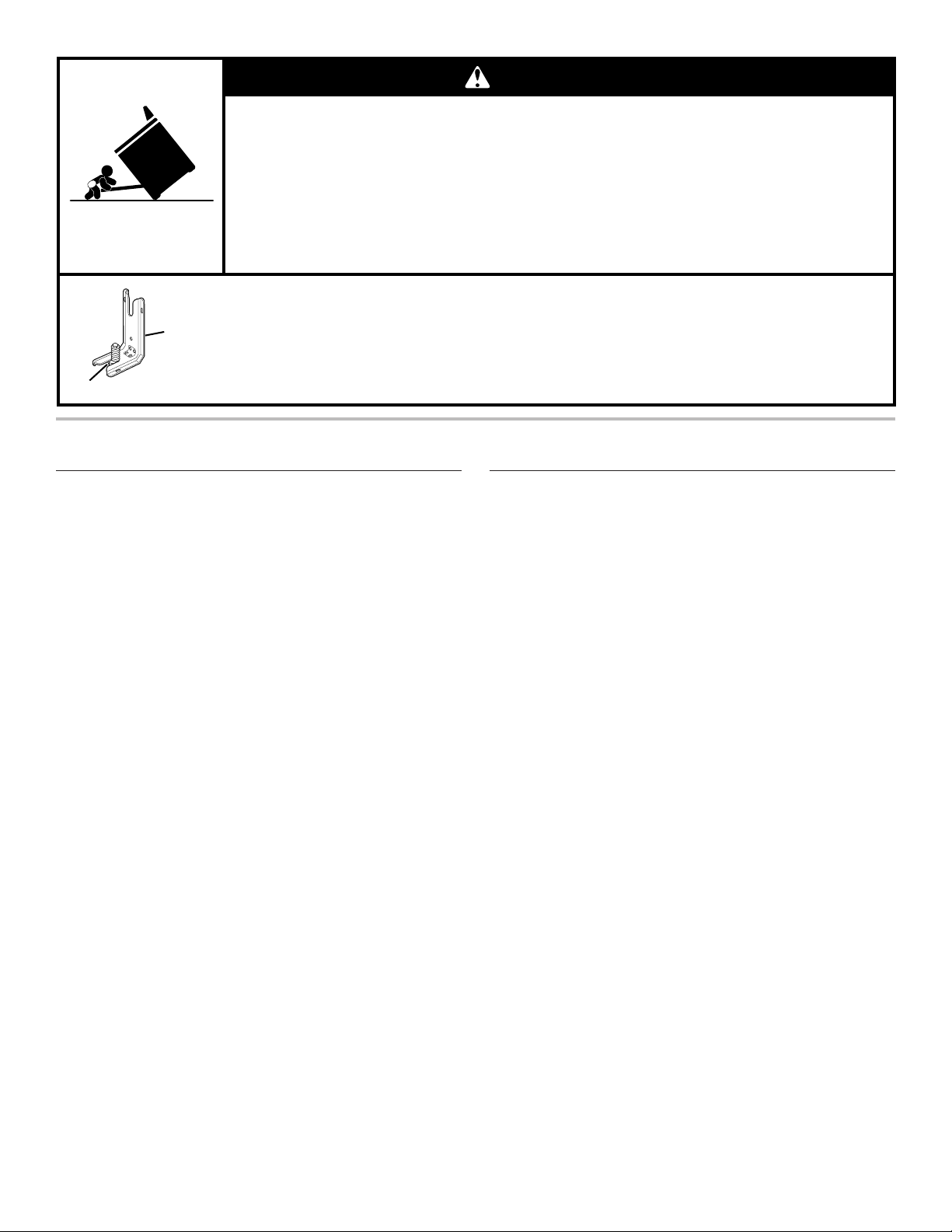
Range Foot
Anti-Tip
Bracket
WARNING
Tip Over Hazard
A child or adult can tip the range and be killed.
Install anti-tip bracket to floor or wall per installation instructions.
Slide range back so rear range foot is engaged in the slot of the anti-tip bracket.
Re-engage anti-tip bracket if range is moved.
Do not operate range without anti-tip bracket installed and engaged.
Failure to follow these instructions can result in death or serious burns to children and adults.
To verify the anti-tip bracket is installed and engaged:
• Slide range forward.
• Look for the anti-tip bracket securely attached to floor or wall.
• Slide range back so rear range foot is under anti-tip bracket.
• See installation instructions for details.
INSTALLATION REQUIREMENTS
Tools and Parts
Gather the required tools and parts before starting installation.
Read and follow the instructions provided with any tools listed here.
Tools Needed
■ Tape measure
■ Level
■ Phillips screwdriver
■ Flat-blade screwdriver
Parts supplied
Check that all parts are included.
■ 3 - 10-32 hex nuts (attached to terminal block)
■ 3 - Terminal lugs
■ Oven racks
■ 2 - #12 x 1
■ Anti-tip bracket (taped inside upper oven with package
5
/8" screws (for mounting anti-tip bracket)
containing literature)
Anti-tip bracket must be securely mounted to back wall or
floor. Thickness of floor may require longer screws to anchor
bracket to subfloor. Longer screws are available from your
local hardware store.
Parts needed
If using a power supply cord:
■ A UL Listed power supply cord kit marked for use with
ranges. The cord should be rated at 250 volts minimum,
40 amps or 50 amps that is marked for use with nominal
13/8" (3.5 cm) diameter connection opening and must end
in ring terminals or open-end spade terminals with
upturned ends.
■ A UL Listed strain relief.
Check local codes. Check existing electrical supply. See the
“Electrical Requirements” section.
It is recommended that all electrical connections be made by a
licensed, qualified electrical installer.
■ Wrench or pliers
3
■
/8" nut driver
■ Hand or electric drill
1
■
/8" (3.2 mm) drill bit
Location Requirements
IMPORTANT: Observe all governing codes and ordinances.
■ It is the installer’s responsibility to comply with installation
clearances specified on the model/serial/rating plate. The
model/serial/rating plate is located behind the control panel.
■ To eliminate the risk of burns or fire by reaching over heated
surface units, cabinet storage space located above the
surface units should be avoided. If cabinet storage is to be
provided, the risk can be reduced by installing a range hood
that projects horizontally a minimum of 5" (12.7 cm) beyond
the bottom of the cabinets.
■ Cabinet opening dimensions that are shown must be used.
Given dimensions are minimum clearances.
■ The floor anti-tip bracket must be installed. To install the
antitip bracket shipped with the range, see the “Install AntiTip Bracket” section.
■ Grounded electrical supply is required. See the “Electrical
Requirements” section.
IMPORTANT: To avoid damage to your cabinets, check with
your builder or cabinet supplier to make sure that the materials
used will not discolor, delaminate or sustain other damage. This
range has been designed in accordance with the requirements
of UL and CSA International and complies with the maximum
allowable wood cabinet temperatures of 194°F (90°C).
Mobile Home - Additional Installation Requirements
The installation of this range must conform to the Manufactured
Home Construction and Safety Standard, Title 24 CFR,
Part 3280 (formerly the Federal Standard for Mobile Home
Construction and Safety, Title 24, HUD Part 280). When such
standard is not applicable, the Standard for Manufactured Home
Installations, ANSI A225.1/NFPA 501A or with local codes.
Mobile home installations require:
■ When this range is installed in a mobile home, it must be
secured to the floor during transit. Any method of securing
the range is adequate as long as it conforms to the
standards listed above.
■ Four-wire power supply cord or cable must be used in a
mobile home installation. The appliance wiring will need to
be revised. See the “Electrical Connection” section.
2
Page 3
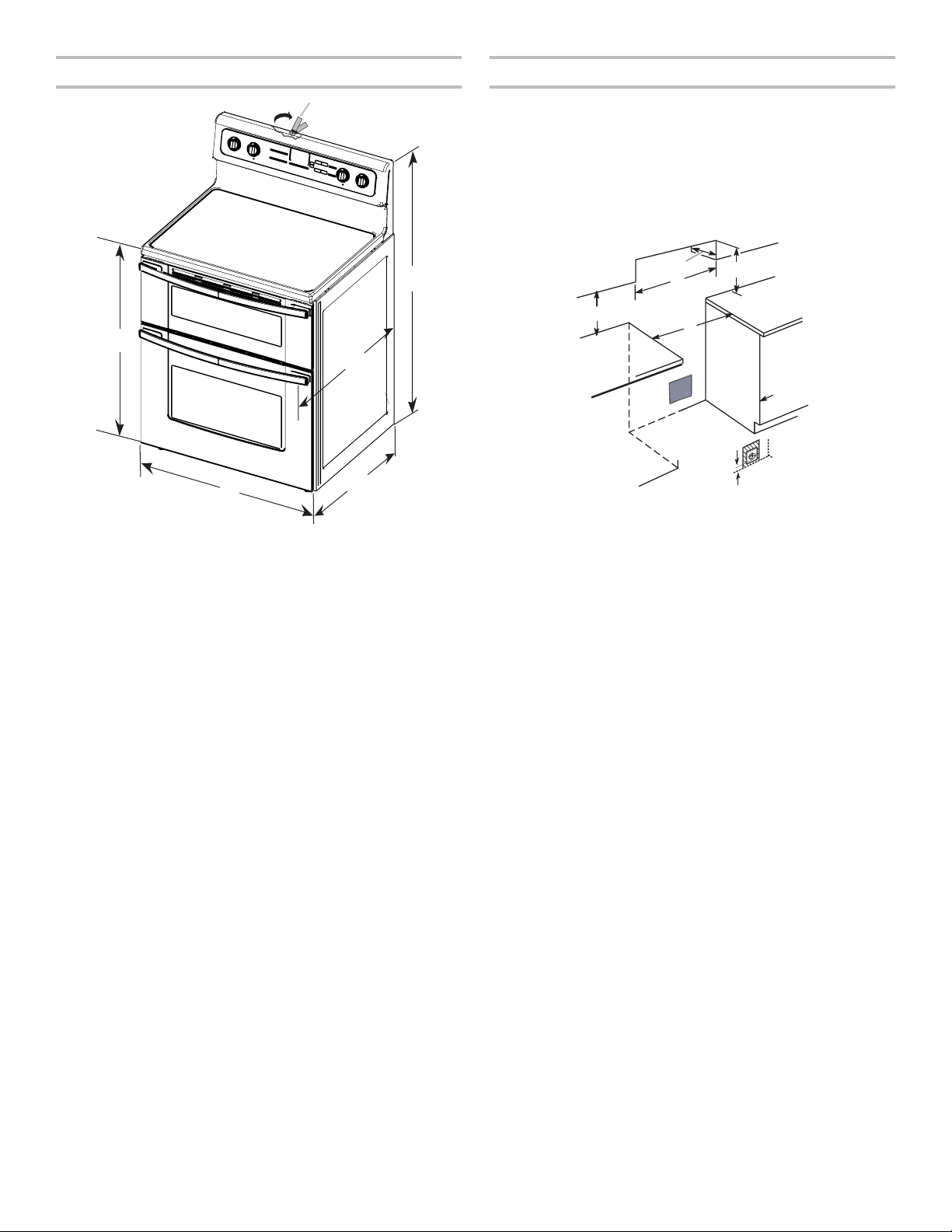
Product Dimensions
B**
C*
K
Cabinet Dimensions
Cabinet opening dimensions shown are for 25" (63.5 cm)
countertop depth, 24" (61.0 cm) base cabinet depth and
36" (91.4 cm) countertop height.
IMPORTANT: If installing a range hood or microwave hood
combination above the range, follow the range hood or
microwave hood combination installation instructions for
dimensional clearances above the cooktop surface.
A freestanding range may be installed next to combustible
walls with zero clearance.
A*
D
E***
/16" ± 1/16" (76.0 cm ±
A. 353/4" ± 1/8" (90.8 cm ±
0.3 cm) cooktop height
(minimum) with leveling legs
screwed all the way in*
B. Model/serial/rating plates
(located behind the control
panel)**
F
C. 473/8" ± 1/8" (120.3 cm
± 0.3 cm) overall height
(minimum) with leveling legs
screwed all the way in*
1
D. 28
/2" ± 1/4" (72.4 cm ±
0.6 cm) depth with handle
1
E. 26
/8" ± 1/8" (66.4 cm ±
0.3 cm)***
15
F. 29
0.2 cm) width
* Range can be raised approximately 1" (2.5 cm) by adjusting
the leveling legs.
** Model/serial/rating plates may be rotated up from behind the
control panel for viewing from the front of the range.
*** Excludes handle. Dimension given is from wall to front of
oven door and will vary based on electric outlet receptacle
installation.
B
C
D
A
E
J
I
A. 18" (45.7 cm) upper
cabinet to countertop
B. 13" (33.0 cm) upper
cabinet depth
C. 30" (76.2 cm) min.
opening width.
D. For minimum clearance
to the top of the cooktop,
see NOTE.
E. U.S.A.: 30" (76.2 cm) min.
opening width
Canada: 31" (78.7 cm)
min. opening width
G
H
F. Cabinet door or hinge
should not extend into
cutout*
G. 1
right side cabinet
H. 2" (5.1 cm) min. from floor
I. 7" (17.8 cm) height
J. 8" (20.3 cm) width
K. 3
floor
F
1
/2" (3.8 cm) min. from
1
/2" (8.9 cm) min. from
Proper positioning of outlet shown above.
* Nothing located in shaded areas can extend more than
11/2" (3.8 cm) from wall or range will not slide all the way back.
NOTE: 24" (61.0 cm) minimum when bottom of wood or metal
cabinet is covered by not less than 1/4" (0.64 cm) flame retardant
millboard covered with not less than No. 28 MSG sheet steel,
0.015" (0.4 mm) stainless steel, 0.024" (0.6 mm) aluminum or
0.020" (0.5 mm) copper.
30" (76.2 cm) minimum clearance between the top of the
cooking platform and the bottom of an uncovered wood or
metal cabinet.
3
Page 4
Electrical Requirements - U.S.A. Only
If codes permit and a separate ground wire is used, it is
recommended that a qualified electrical installer determine that
the ground path and wire gauge are in accordance with local
codes.
Do not use an extension cord.
Be sure that the electrical connection and wire size are adequate
and in conformance with the National Electrical Code, ANSI/
NFPA 70-latest edition and all local codes and ordinances.
A copy of the above code standards can be obtained from:
National Fire Protection Association
WARNING: Improper connection of the equipment-grounding
conductor can result in a risk of electric shock. Check with a
qualified electrician or service technician if you are in doubt as to
whether the appliance is properly grounded. Do not modify the
power supply cord plug. If it will not fit the outlet, have a proper
outlet installed by a qualified electrician.
Electrical Connection
To properly install your range, you must determine the type of
electrical connection you will be using and follow the instructions
provided for it here.
■ Range must be connected to the proper electrical voltage
and frequency as specified on the model/serial rating plate.
The model/serial rating plate is located behind the control
panel. Refer to the figures in “Product Dimensions” in the
“Location Requirements” section.
■ This range is manufactured with the neutral terminal
connected to the cabinet. Use a 3-wire, UL Listed, 40- or
50- amp power supply cord (pigtail) (see the following Range
Rating chart). If local codes do not permit ground through
the neutral, use a 4-wire power supply cord rated at 250
volts, 40- or 50-amps and investigated for use with ranges.
Range Rating* Specified Rating of
120/240 Volts 120/208 Volts Amps
8.8 - 16.5 KW
16.6 - 22.5 KW
* The NEC calculated load is less than the total connected load
listed on the model/serial rating plate.
** If connecting to a 50-amp circuit, use a 50-amp rated cord
with kit. For 50-amp rated cord kits, use kits that specify use
with a nominal 13/8" (34.9 mm) diameter connection opening.
■ A circuit breaker is recommended.
■ The range can be connected directly to the circuit breaker
box (or fused disconnect) through flexible or nonmetallic
sheathed, copper or aluminum cable. See the “Electrical
Connection - U.S.A. Only” section.
■ Allow 2 to 3 ft (61.0 cm to 91.4 cm) of slack in the line so that
the range can be moved if servicing is ever necessary.
■ A UL Listed conduit connector must be provided at each end
of the power supply cable (at the range and at the junction
box).
■ Wire sizes and connections must conform with the rating of
the range.
■ The wiring diagram is located on the Tech Sheet.
■ The Tech Sheet is located on the back of the range inside a
clear plastic bag.
1 Batterymarch Park
Quincy, MA 02169-7471
Power Supply Cord Kit
and Circuit Protection
7.8 - 12.5 KW
12.6 - 18.5 KW
40 or 50**
50
If connecting to a 4-wire system:
This range is manufactured with the ground connected to the
neutral by a link. The ground must be revised so the green
ground wire of the 4-wire power supply cord is connected to the
cabinet. See the “Electrical Connection - U.S.A. Only” section.
Grounding through the neutral conductor is prohibited for new
branch-circuit installations (1996 NEC); mobile homes; and
recreational vehicles, or an area where local codes prohibit
grounding through the neutral conductor.
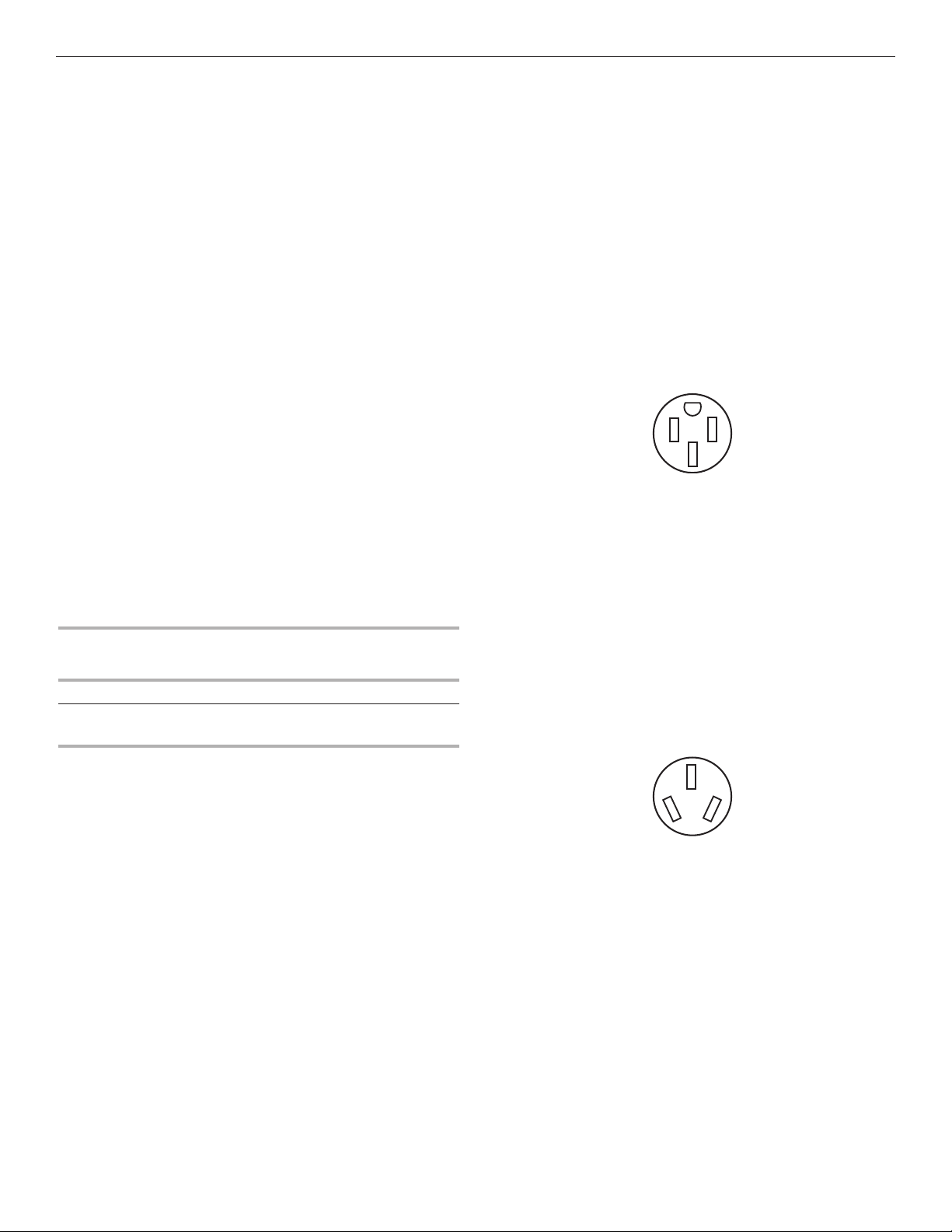
When a 4-wire receptacle of NEMA Type 14-50R is used, a
matching UL Listed, 4-wire, 250-volt, 40- or 50-amp, range
power supply cord (pigtail) must be used. This cord contains
4 copper conductors with ring terminals or open-end spade
terminals with upturned ends, terminating in a NEMA Type
14-50P plug on the supply end.
The fourth (grounding) conductor must be identified by a green
or green/yellow cover and the neutral conductor by a white
cover. Cord should be Type SRD or SRDT with a UL Listed strain
relief and be at least 4 ft (1.22 m) long.
4-wire receptacle (14-50R)
The minimum conductor sized for the copper 4-wire power cord
are:
40-amp circuit
2 No.-8 conductors
1 No.-10 white neutral
1 No.-10 green grounding
If connecting to a 3-wire system:
Local codes may permit the use of a UL Listed, 3-wire, 250-volt,
40- or 50-amp range power supply cord (pigtail). This cord
contains 3 copper conductors with ring terminals or open-end
spade terminals with upturned ends, terminating in a NEMA Type
10-50P plug on the supply end. Connectors on the appliance
end must be provided at the point the power supply cord enters
the appliance. This uses a 3-wire receptacle of NEMA Type
10-50R.
3-wire receptacle (10-50R)
4
Page 5

Electrical Requirements - Canada Only
WARNING
Electrical Shock Hazard
Electrically ground range.
Failure to do so can result in death, fire, or
electrical shock.
If codes permit and a separate ground wire is used, it is
recommended that a qualified electrical installer determine that
the ground path is adequate and wire gauge are in accordance
with local codes.
Be sure that the electrical connection and wire size are adequate
and in conformance with CSA Standard C22.1, Canadian
Electrical Code, Part 1 - latest edition, and all local codes and
ordinances.
A copy of the above code standards can be obtained from:
Canadian Standards Association
178 Rexdale Blvd.
Toronto, ON M9W 1R3 CANADA
■ Check with a qualified electrical installer if you are not sure
the range is properly grounded.
Range Rating* Specified Rating of
120/240 Volts 120/208 Volts Amps
8.8 - 16.5 KW
16.6 - 22.5 KW
* The NEC calculated load is less than the total connected load
listed on the model/serial/rating plate.
** If connecting to a 50-amp circuit, use a 50-amp rated cord
with kit. For 50-amp rated cord kits, use kits that specify use
with a nominal 13/8" (34.9 mm) diameter connection opening.
■ A time-delay fuse or circuit breaker is recommended.
■ This range is equipped with a CSA International Certified
Power Cord intended to be plugged into a standard 14-50R
wall receptacle. Be sure the wall receptacle is within reach of
range’s final location.
■ Do not use an extension cord.
7.8 - 12.5 KW
12.6 - 18.5 KW
Power Supply Cord Kit
and Circuit Protection
40 or 50**
50
INSTALLATION INSTRUCTIONS
Unpack Range
WARNING
Excessive Weight Hazard
Use two or more people to move and install range.
Failure to do so can result in back or other injury.
1. Remove shipping materials, tape and film from the range.
Keep cardboard bottom under range.
2. Remove oven racks and parts package from inside oven.
3. To place range on its back, take 4 cardboard corners from
the carton. Stack one cardboard corner on top of another.
Repeat with the other 2 corners. Place them lengthwise on
the floor behind the range to support the range when it is laid
on its back.
4. Using 2 or more people, firmly grasp the range and gently lay
it on its back on the cardboard corners.
5. Pull cardboard bottom firmly to remove.
6. Use an adjustable wrench to loosen the leveling legs.
7. Place cardboard or hardboard in front of range. Using 2
or more people, stand range back up onto cardboard or
hardboard.
Adjust Leveling Legs
1. If range height adjustment is necessary, use a wrench or
pliers to loosen the 4 leveling legs.
This may be done with the range on its back or with the
range supported on 2 legs after the range has been placed
back to a standing position.
NOTE: To place range back up into a standing position, put
a sheet of cardboard or hardboard in front of range. Using 2
or more people, stand range back up onto the cardboard or
hardboard.
2. Adjust the leveling legs to the correct height. Leveling legs
can be loosened to add up to a maximum of 1" (2.5 cm). A
minimum of 3/16" (5.0 mm) is needed to engage the anti-tip
bracket.
NOTE: If height adjustment is made when range is standing,
tilt the range back to adjust the front legs, then tilt forward to
adjust the rear legs.
3. When the range is at the correct height, check that there is
adequate clearance under the range for the anti-tip bracket.
Before sliding range into its final location, check that the
anti-tip bracket will slide under the range and onto the rear
leveling leg prior to anti-tip bracket installation.
5
Page 6

Install Anti-Tip Bracket
A
B
A
B
WARNING
Tip Over Hazard
A child or adult can tip the range and be killed.
Install anti-tip bracket to floor or wall per installation
instructions.
Slide range back so rear range foot is engaged in the
slot of the anti-tip bracket.
Re-engage anti-tip bracket if range is moved.
Do not operate range without anti-tip bracket installed
and engaged.
Failure to follow these instructions can result in death
or serious burns to children and adults.
1. Remove the anti-tip bracket that is taped inside the upper
oven with the package containing literature.
2. Determine which mounting method to use: floor or wall. If
you have a stone or masonry floor, you can use the wall
mounting method.
3. Determine and mark edge of range in the cutout space. The
mounting bracket can be installed on either the left side or
right side of the cutout. Position mounting bracket in cutout
so that right (or left) edge of the bracket is 15/16" (2.4 cm) from
the marked edge of the range, as shown.
C
A. Anti-tip bracket
B. Mark edge of
range.
15
C.
/16" (2.4 cm)
4. Drill two 1/8" (3.0 mm) holes that correspond to the bracket
holes of the determined mounting method. See the following
illustrations.
Floor Mounting Wall Mounting
B
A
A. #12 x 15/8" screws
B. Anti-tip bracket
5. Using a Phillips screwdriver, mount anti-tip bracket to the
wall or floor with the two #12 x 15/8" screws provided.
A. #12 x 15/8" screws
B. Anti-tip bracket
6
Page 7

Electrical Connection - U.S.A. Only
Power Supply Cord
WARNING
Electrical Shock Hazard
Disconnect power before servicing.
Use a new 40 amp power supply cord.
Plug into a grounded outlet.
Failure to follow these instructions can result in death,
fire, or electrical shock.
1. Disconnect power.
2. Use Phillips screwdriver to remove the terminal block cover
screw located on the back of the range. Pull cover down and
toward you to remove cover.
Direct Wire
WARNING
Electrical Shock Hazard
Disconnect power before servicing.
Use 8 gauge copper or 6 gauge aluminum wire.
Electrically ground range.
Failure to follow these instructions can result in death,
fire, or electrical shock.
Style 1: Power supply cord strain relief
■ Assemble a UL Listed strain relief in the opening.
3. Remove plastic tag holding three 10-32 hex nuts from the
middle post of the terminal block.
4. Add strain relief.
A
A. UL Listed strain relief
■ Feed the power supply cord through the strain relief in the
cord/conduit plate on bottom of range. Allow enough slack
to easily attach the wiring to the terminal block.
■ Tighten strain relief screw against the power supply cord.
7
Page 8

Style 2: Direct wire strain relief
(12.7 cm)
(7.6 cm)
1"
■ Use Phillips screwdriver to remove screws and slide cord/
conduit plate down and out.
■ Position cord/conduit plate as shown in the following
illustration.
■ Feed the flexible conduit through the strain relief,
allowing enough slack to easily attach wiring to the
terminal block.
■ Tighten strain relief screw against the flexible conduit.
5. Replace back panel and screws on rear of range.
6. Complete installation following instructions for your type of
electrical connection:
4-wire (recommended)
3-wire (if 4-wire is not available)
Electrical Connection Options
■ Replace cord/conduit plate and insert screws.
■ Assemble a UL Listed conduit connector in the opening.
If your home has: And you will be
connecting to:
4-wire receptacle
(NEMA type 14-50R)
A UL Listed,
250-volt
minimum,
40-amp, range
power supply
cord
4-wire direct A fused
disconnect or
circuit breaker
5"
3-wire receptacle
(NEMA type 10-50R)
box
A UL Listed,
250-volt
minimum,
40-amp, range
power supply
cord
3-wire direct A fused
disconnect or
(2.5 cm)
circuit breaker
box
Go to Section:
4-wire connection:
Power Supply Cord
4-wire Connection:
Direct Wire
3-wire connection:
Power Supply Cord
3-wire connection:
Direct Wire
8
3"
A
B
A. Removable retaining nut
B. Strain relief
Page 9

4-wire connection: Power Supply Cord
A
B
A
B
A
A
B
Use this method for:
■ New branch-circuit installations (1996 NEC)
■ Mobile homes
■ Recreational vehicles
■ In an area where local codes prohibit grounding
through the neutral
1. Part of metal ground strap must be cut out and removed.
5. Use 3/8" nut driver to connect the neutral (white) wire to the
center terminal block post with one of the 10-32 hex nuts.
F
B
C
A. Metal ground strap
B. Discard
C. Ground-link screw
2. Use Phillips screwdriver to remove the ground-link screw
from the back of the range. Save the ground-link screw and
the end of the ground link under the screw.
3. Feed the power supply cord through the strain relief in the
cord/conduit plate on bottom of range. Allow enough slack
to easily attach the wiring to the terminal block.
C
A. 10-32 hex nut
B. Ground-link screw
C. Line 1 (black)
E
D. Green ground wire
E. Neutral (center) wire
F. Line 2 (red)
6. Connect line 1 (black) and line 2 (red) wires to the outer
terminal block posts with 10-32 hex nuts.
7. Securely tighten hex nuts.
NOTE: For power supply cord replacement, only use a power
cord rated at 250 volts minimum, 40 amps or 50 amps that is
marked for use with nominal 13/8" (3.5 cm) diameter connection
opening, with ring terminals and marked for use with ranges.
8. Replace terminal block access cover.
9. Slide range back so rear range foot is under the anti-tip
bracket. See the “Verify Anti-Tip Bracket is Installed and
Engaged” section.
3-wire connection: Power Supply Cord
Use this method only if local codes permit connecting chassis
ground conductor to neutral wire of power supply cord.
1. Feed the power supply cord through the strain relief in the
cord/conduit plate on bottom of range. Allow enough slack
to easily attach the wiring to the terminal block.
C
D
A. Terminal block
B. Ground-link screw
C. Cord/conduit plate
D. Power supply cord wires
4. Use Phillips screwdriver to connect the green ground wire
from the power supply cord to the range with the ground-link
screw. The ground wire must be attached first.
C
D
A. Terminal block
B. Ground-link screw
C. Cord/conduit plate
D. Power supply cord wires
9
Page 10

2. Use 3/8" nut driver to connect the neutral (white) wire to the
A
C
(7.6 cm)
1"
A
B
A
C
center terminal block post with one of the 10-32 hex nuts.
E
B
D
4-wire Connection: Direct Wire
Use this method for:
■ New branch-circuit installations (1996 NEC)
■ Mobile homes
■ Recreational vehicles
■ In an area where local codes prohibit grounding
through the neutral
1. Part of metal ground strap must be cut out and removed.
A. 10-32 hex nut
B. Line 1 (black)
C. Ground-link screw
D. Neutral (white) wire
E. Line 2 (red)
3. Connect line 1 (black) and line 2 (red) wires to the outer
terminal block posts with 10-32 hex nuts.
4. Securely tighten hex nuts.
NOTE: For power supply cord replacement, only use a
power cord rated at 250 volts minimum, 40 amps or 50 amps
that is marked for use with nominal 13/8" (3.5 cm) diameter
connection opening, with ring terminals and marked for use
with ranges.
5. Replace terminal block access cover.
6. Slide range back so rear range foot is under the anti-tip
bracket. See the “Verify Anti-Tip Bracket is Installed and
Engaged” section.
Direct Wire Installation: Copper or Aluminum Wire
This range may be connected directly to the fuse disconnect or
circuit breaker box. Depending on your electrical supply, make
the required 3-wire or 4-wire connection.
1. Strip outer covering back 3" (7.6 cm) to expose wires. Strip
the insulation back 1" (2.5 cm) from the end of each wire.
(2.5 cm)
C
A. Metal ground strap
B. Discard
C. Ground-link screw
2. Use Phillips screwdriver to remove the ground-link screw
from the back of the range. Save the ground-link screw and
the end of the ground link under the screw.
3. Pull the conduit through the strain relief on cord/conduit
plate on bottom of range. Allow enough slack to easily attach
wiring to the terminal block.
B
3"
2. Allow enough slack in the wire to easily attach the wiring
G
F
E
D
terminal block.
3. Complete electrical connection according to your type of
electrical supply (4-wire or 3-wire connection).
A. Terminal block
B. Ground-link screw
C. Cord/conduit plate
D. Line 2 (red) wire
E. Neutral (white) wire
F. Line 1 (black) wire
G. Bare (green) ground wire
10
Page 11

4. Attach terminal lugs to line 1 (black), neutral (white), and line
A
B
C
B
G
C
A
C
E
A
B
C
2 (red) wires. Loosen (do not remove) the setscrew on the
front of the terminal lug and insert exposed wire end through
bottom of terminal lugs. Securely tighten setscrew to XX
lbs-in. torque. See Bare Wire Torque Specifications chart.
3-wire connection: Direct Wire
Use this method only if local codes permit connecting ground
conductor to neutral supply wire.
1. Pull the conduit through the hole and conduit plate on
bottom of range. Allow enough slack to easily attach the
wiring to the terminal block.
DE
A. Terminal lug
B. Setscrew
C. Line 1 (black) wire
D. Neutral (white) wire
E. Line 2 (red) wire
Bare Wire Torque Specifications
Attaching terminal lugs to the terminal block - 20 lbs-in. (2.3 N-m)
Wire Awg Torque
8 gauge copper 25 lbs-in. (2.8 N-m)
6 gauge aluminum 35 lbs-in. (4.0 N-m)
5. Use Phillips screwdriver to connect the bare (green) ground
wire to the range with the ground-link screw. The ground
wire must be attached first and must not contact any other
terminal.
6. Use 3/8" nut driver to connect the neutral (white) wire to the
center terminal block post with one of the 10-32 hex nuts.
A
B
D
F
A. Terminal block
B. Ground-link screw
C. Cord/conduit plate
D. Line 2 (red) wire
E. Bare (green) ground wire
F. Line 1 (black) wire
2. Attach terminal lugs to line 1 (black), bare (green) ground,
and line 2 (red) wires. Loosen (do not remove) the setscrew
on the front of the terminal lug and insert exposed wire end
through bottom of terminal lugs. Securely tighten setscrew to
XX lbs-in. torque. See Bare Wire Torque Specifications chart.
DE
F
A. 10-32 hex nut
B. Line 1 (black)
C. Bare (green) ground wire
D. Ground-link screw
D
E
E. Neutral (white) wire
F. Line 2 (red)
G. Terminal lug
A. Terminal lug
B. Setscrew
C. Line 1 (black) wire
D. Bare (green)
ground wire
E. Line 2 (red) wire
7. Connect line 1 (black) and line 2 (red) wires to the outer
terminal block posts with 10-32 hex nuts.
8. Securely tighten hex nuts.
9. Replace terminal block access cover.
10. Slide range back so rear range foot is under the anti-tip
bracket. See the “Verify Anti-Tip Bracket is Installed and
Engaged” section.
11
Page 12

Bare Wire Torque Specifications
Attaching terminal lugs to the terminal block - 20 lbs-in. (2.3 N-m)
Wire Awg Torque
8 gauge copper 25 lbs-in. (2.8 N-m)
6 gauge aluminum 35 lbs-in. (4.0 N-m)
3. Use 3/8" nut driver to connect the bare (green) ground wire
to the center terminal block post with one of the 10-32 hex
nuts.
A
B
D
C
A. 10-32 hex nut
B. Line 1 (black)
C. Ground-link screw
4. Connect line 1 (black) and line 2 (red) wires to the outer
terminal block posts with 10-32 hex nuts.
5. Securely tighten hex nuts.
6. Replace terminal block access cover.
7. Slide range back so rear range foot is under the anti-tip
bracket. See the “Verify Anti-Tip Bracket is Installed and
Engaged” section.
D. Bare (green) ground wire
E. Line 2 (red)
F. Terminal lug
F
E
2. Slowly attempt to tilt the range forward.
If you encounter immediate resistance, the range foot is
engaged in the anti-tip bracket.
3. If the rear of the range lifts more than 1/2" (1.3 cm) off the
floor without resistance, stop tilting the range and lower it
gently back to the floor. The range foot is not engaged in the
anti-tip bracket.
IMPORTANT: If there is a snapping or popping sound when
lifting the range, the range may not be fully engaged in the
bracket. Check to see if there are obstructions keeping the range
from sliding to the wall or keeping the range foot from sliding
into the bracket. Verify that the bracket is held securely in place
by the mounting screws.
4. Slide the range forward, and verify that the anti-tip bracket is
securely attached to the floor or wall.
5. Slide range back so the rear range foot is inserted into the
slot of the anti-tip bracket.
IMPORTANT: If the back of the range is more than 2" (5.1 cm)
from the mounting wall, the rear range foot may not engage
the bracket. Slide the range forward and determine if there
is an obstruction between the range and the mounting wall.
If you need assistance or service, refer to the “Assistance or
Service” section of the Use and Care Guide, or the cover or
the “Warranty” section of the User Instructions, for contact
information.
6. Repeat steps 1 and 2 to ensure that the range foot is
engaged in the anti-tip bracket.
If the rear of the range lifts more than 1/2" (1.3 cm) off the floor
without resistance, the anti-tip bracket may not be installed
correctly. Do not operate the range without anti-tip bracket
installed and engaged. Please reference the “Assistance or
Service” section of the Use and Care Guide, or the cover or the
“Warranty” section of the User Instructions, to contact service.
Level Range
1. Place a rack in oven.
2. Place level on rack and check levelness of range, first side to
side; then front to back.
Verify Anti-Tip Bracket Is Installed and
Engaged
1. Place the outside of your foot against the bottom front of
the oven door to keep the range from moving, and grasp the
lower right or left side of the control panel as shown.
NOTE: If your countertop is mounted with a backsplash, it
may be necessary to grasp the range higher than is shown in
the illustration.
3. If range is not level, pull range forward until rear leveling leg
is removed from the anti-tip bracket.
4. Use a wrench or pliers to adjust leveling legs up or down
until the range is level. Push range back into position.
5. Check that rear leveling leg is engaged in the anti-tip
bracket.
NOTE: Range must be level for satisfactory baking performance.
12
Page 13

Complete Installation
W10694065B
8/16
1. Check that all parts are now installed. If there is an extra
part, go back through the steps to see which step was
skipped.
2. Check that you have all of your tools.
3. Dispose of/recycle all packaging materials.
4. Check that the range is level. See the “Level Range” section.
5. Use a mild solution of liquid household cleaner and warm
water to remove waxy residue caused by shipping material.
Dry thoroughly with a soft cloth. For more information, read
the “Range Care” section of the Use and Care Guide.
6. Read the range Use and Care Guide.
7. Plug power cord into appropriate outlet. Slide range into its
final location. Check that the flexible conduit or power supply
cord are not bent.
8. Turn power on. Turn on surface elements and oven. See
the Use and Care Guide for specific instruction on range
operation.
If range does not operate, check the following:
■ Household fuse is intact and tight; or circuit breaker has not
tripped.
■ Range is plugged into a grounded outlet.
■ Electrical supply is connected.
■ See the “Troubleshooting” section in the Use and Care
Guide.
When the range has been on for 5 minutes, check for heat.
If range is cold, turn off the range and contact a qualified
technician.
Moving the Range
WARNING
If removing the range is necessary for cleaning or maintenance:
For power supply cord-connected ranges:
1. Slide range forward.
2. Unplug the power supply cord.
3. Complete cleaning or maintenance.
4. Plug power supply cord into a grounded outlet.
5. Slide range back so rear range foot is under anti-tip bracket.
6. Refer to the “Verify Anti-Tip Bracket Is Installed and
Engaged” section to verify engagement.
7. Check that range is level.
For direct-wired ranges:
WARNING
Electrical Shock Hazard
Disconnect power before servicing.
Replace all parts and panels before operating.
Failure to do so can result in death or electrical shock.
Tip Over Hazard
A child or adult can tip the range and be killed.
Install anti-tip bracket to floor or wall per installation
instructions.
Slide range back so rear range foot is engaged in the
slot of the anti-tip bracket.
Re-engage anti-tip bracket if range is moved.
Do not operate range without anti-tip bracket installed
and engaged.
Failure to follow these instructions can result in death
or serious burns to children and adults.
When moving range, slide range onto cardboard or hardboard to
avoid damaging the floor covering.
1. Disconnect power.
2. Slide range forward.
3. Complete cleaning or maintenance.
4. Slide range back so rear range foot is under anti-tip bracket.
5. Refer to the “Verify Anti-Tip Bracket Is Installed and
Engaged” section to verify engagement.
6. Check that range is level.
7. Reconnect power.
13
 Loading...