

Page 1
1
Matenance Manual
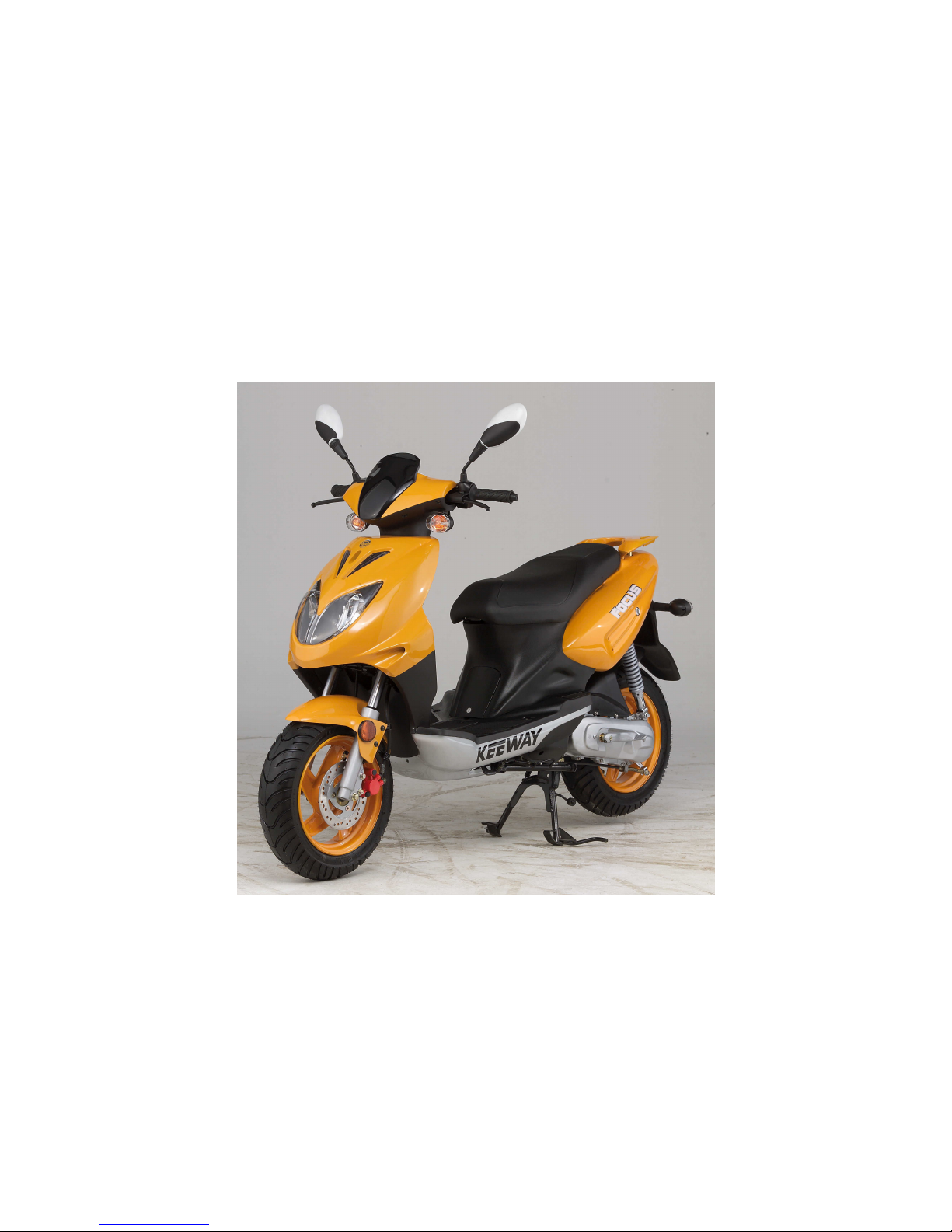
Model: Focus/Matrix
COPY RIGHT:
KEEWAY INTERNATIONAL DEVELOPMENT CO.,LTD.
FEB.2006
Page 2

2
If you have any problems can not fnd the solution in this manual, please
fell free to contact with:
KEEWAY INTERNATIONAL DEVELOPMENT CO.,LTD
2000 SZENTENDRE U.8 KOZUZO. HUNGARY
TEL:0036-26-500005
FAX:0036-26-312034
EMAI: info@keewaymotor.com
Our engineer are very glad to give you the necessary assistance
and help.
Page 3

3
Index
The service manual has been
specially prepared to provide all the
necessary information for the proper
maintenance and servicing of
FOCUS/MATRIX.
The FOCUS/MATRIX is a new type of
scooter that has many techinal features
such as:
V-belt drive automatic transmission
Forced air-cooling system
CDI ignition system
Electric starter system
The FOCUS/MATRIX fits the needs of
a wide variety of scooter user. Those who
will be servicing the scooter should
carefully review the manual before
performing any repair or services. Major
modifications and changes incorporated later
will be advised to QIANJIANG product
distributor in each market. Therefore, if
newest information is requested in the future,
please contact the local QIANJIANG
distributor.
The FOCUS/MATRIX scooters
distributed in your country mignt differ in
minor respects from the standard
specification and, if they do, it is because
some minor modifications had to be made to
comply with the statutory requirements of
your country.
前前前前
Page 4

4
Index
Termly maintenance and repair 2
Engine 3
Fuell and lubricate system 4
Electrical system 5
Frame 6
Maintenance information 7
General principles 1
Page 5

5
Page 6
6
GENERAL PRINCIPLES
TYPE IDENTIFICATION 1-1
FUEL AND ENGINE OIL 1-1
BREAK-IN PROCEDURE 1-1
PRECAUTIONS AND GENERAL INSTRUCTIONS 1-2
MAINTENANCE TOOLS 1-3
SPECIFICATIONS 1-4
CONTENTS
Page 7

7
1-1 GENERAL PRINCIPLES
TYPE IDENTIFICATION
①①①①
ENGINE NUMBER
ENGINE NUMBER① is carved on rear crankcase as
Shown in figure.
Both FRAME NUBER AND ENGINE NUMBER are
Designed specially for registering your scooter
and ordering spare parts.
FUEL AND ENGINE OIL
Be sure to use specified fuel and engine oil.
Some specifications are as follows:
FUEL
Unleaded, the minimum octane number is 90 or more.
ENGINE OIL
For QIANJIANG CCI SYSTEM, we recommend special engine oil, you can choose high quality two-stroke
engine oil (without being diluted) if without special oil.
GEAR OIL
Use high quality, all-purpose SAE90 engine oil for scooter.
BREAK-IN TIME
General requirements are as follows:
Limit break-in speed:
At the first 1000KMS(600 miles)mileage,play throttle less than 4/5 throttle;
After mileage exceeds 1000KMS(600 miles),play full throttle;
Don’t run engine too long during break-in time, and try to change throttle position.
Page 8

8
1-2 GENERAL PRINCIPLES
PRECAUTIONS AND GENERAL INSTRUCTIONS
Correctly abide by the following items when disassembling and assembling scooter:
□ Don’t run engine indoors with little or no ventilation;
□ Be sure to replace new bushings, circlips, O-rings and cotter pins with new ones;
CAUTION
It is forbidden to use the circlip removed from shaft, only use new one;
Be very carefull to install new circlip for fear that the end hatch of circlip exceeds required sliding surface for
shaft;
After installing circlip, inspect whether it has been completely clipped into the groove.
□ Fix bigger diameter bolt first when tightening cylinder head or cylinder, and tighten to specified torque
gradually from inside to outside at diagonal order.
□ Use special tools for some special requrements;
□ Use original components and recommended engine oil;
□ Keep each other’s safety when several persons do;
□ Inspect looseness and operating state of components after reassembling them.;
□ Take high care of gasoline, which is explosive, and never use gasoline as lotion.
The words like warning, notice, note may turn out incessantly in the manual, which means:
WARNING——The personal safety of the rider may be involved. Disregarding the information could
result in injury to the rider.
CAUTION—These instructions point out special service procedures or precautions that must be followed to
avoid damaging the machine.
NOTE——it provides some special information, which keeps maintanance easier and important instructions
clearer..
REPLACEMENT COMPONENTS
Be sure to use genuine QIANJIANG components or their equivalent.. Genuine QIANJIANG components are
high quality parts which are designed specially for QIANJIANG vehicle.
CAUTION
Damage to the scooter may result from use of replacement components which are not
Equivalent in quality to genuine QIANJIANG parts, and it can lead to performance problems.
Page 9

9
1-3 GENERAL PRINCIPLES
SPECIFICATIONS
DIMENSION AND NET WEIGHT
OVERALL LENGTH……1830mm
OVERALL LENGTH………695mm
OVERALL HEIGHT………1160 mm
WHEELBASE………………1295mm
NET WEIGHT………………92kg
CHASSIS
Front shock absorber……spring, without damp
Rear shock absorber……spring, oil damp
Turning angle … … … … … 48 º (toward the
left\toward the right)
Front wheel…………120/70-12
Rear wheel…………130/70-12
Front brake…………Discφ190
Rear brake…………Drumφ110
ENGINE
Type………two-stroke, forcible wind cooling
Intake system…………piston-reed valve
Cylinder QTY.…………1
Bore………………40.0mm
Stroke………………39.6mm
Discharge ………………49.8mL
Compression ratio……………6.9:1
Carburetor……………flat inhale stopper style
Air cleaner……………dry
Starting system…electricity start and kicking start
Lubricating system………pressure lubricating
ELECTRIC
Ignition mode…………CDI
Ignition timing…………150 at 1500RPM
Spark plug……………BP8HS
Storage battery…………YTX5L-BS
Generator……………AC magneto
Fuse……………8A
Headlight ……………12V—35/35W
Turning light……………12V/10W
Taillight ………………12V—21/5W
Meter light……………12V/1.7W
Oil level signal indicator light…12V/3W
Turning signal indicator light…12V/3W
CAPACITY
FUEL TANK……………5.2L
ENGINE OIL TANK……………1L
GEAR OIL……………0.1L
Transmission system
Clutch system .......dry auto acentric
Gearshift mechanism.....CVT stepless
Operating mode of gears shift mechanism...Automatic acentric
Stepless shift range.....0.86~2.64
*the above data may be modified without
any notification.
Page 10

10
TERMLY MAINTENANCE AND REPAIR
CONTENT
Periodic maintenance and service schedule……………………… 2-
1
Maintenance and service procedures…………………………… 2-2
Storage battery………………………………………………… 2-2
Spark plug………………………………………………………… 2-3
Cylinder head nut and exhaust pipe bolt……………………… 2-3
Cylinder head and cylinder…………………………………………2-4
Fuel level line………………………………………………………2-4
Air cleaner……………………………………………………………2-5
Throttle cable…………………………………………………………2-5
Engine idle speed……………………………………………………2-5
Oil pump………………………………………………………………2-6
Gear oil………………………………………………………………2-7
Braking…………………………………………………………2-7
Tire …………………………………………………………………2-10
Steering………………………………………………………………2-10
Front shock absorber…………………………………………………2-11
Rear shock absorber…………………………………………………2-11
Vehicle bolts and nuts…………………………………………………2-11
Page 11

11
Periodic maintenance and service schedule
The following table lists all required intervals for maintenance and service,following which, you are assred to
have your scooter perform in the best way.
Note
Do more frequent maintenance when often riding on bad road
Periodic maintenance table
Mile 600 4000 7500 11000 15000
Kilometer
1000 6000 12000 18000 24000
Interval
Months. 2 12 24 36 48
Storage battery I
I I I I
Cylinder head nut and
exhaust pipe bolt
T
T T T T
Cylinder head and
cylinder
—
C C C C
Spark plug —
R R R R
Air cleaner Clean every 3000KM(2000 miles)
Idle speed rpm
I I I I I
Throttle cable play
I I I I I
Oil pump
I I I I I
Gear oil I — I — I
I I I I
I
Fuel line
Replace every 4 years
Brake
I I I I I
I I I I I
Brake hose
Replace every 4 years
I I I I I
Brake fluid
Replace every 2 years
Steering
I I I I I
Front fork
I I I I I
Rear shock absorber
I I I I I
Tire
I I I I I
Vehicle body bot
andnut
T
T T T T
Note
I=inspect,clean,adjust,lubricate,or replace if necessary;
A=adjust; C=clean; R=replace; T=tighten
Page 12

12
Maintenance and adjustment procedures
The section describes the servicing procedures for each item of the Periodic Maintenance requirements.
Storage battery
Inspect at initially 1000KM(600 miles,2 months),
andevery 6000KM(4000 miles,12 months)thereafter
□ Uncover seat, and then remove the battery box cap in the
Middle of helmet barrel.
□ Disconnect negative pole line end, positive end, and then remove battery;
□ Measure the voltage between the two ends of battery with
voltage gauge,charge if the voltage is below 12V
Page 13

13
Cylinder head nuts and exhaust pipe bolts
Tighten at initially 1000 km(600 miles,2 moths),and
every 6000 km(4000 miles,12 months)
If cylinder head nuts are not tightened to the
specified torque, may result in leakage of
compressed fuel-air mixture and reduce output,
tighten the cylinder head nuts in the following
procedures::
1. Remove the frame lower covers.
2. Remove the cylinder head cover bolt.
3. Remove spark plug cap.
4. Tighten the nuts evenly one by one to the
their specified torque. Tighten the nuts in the
order indicated.
Tithtening torque::::
Cylinder head nut::::15-18N.m
Exhaust pipe bolt::::15-18N.m
Cylinder and cylinder head
Remove carbon every 6000 km( 4000
miles,12 months)
Carbon deposits in the combustion chamber and the
cylinder head will raise the compression ratio and may cause
preignition and overheating. Carbon deposited at the exhaust
port of the cylinder will prevent the flow of exhaust gases,
reducing the output. Remove carbon deposits periodically.
Page 14

14
SPARK PLUG
Neglecting the spark plug maintenance eventually leads to
difficult starting and poor performance. If the spark plug is used for a
long time, the electrode gradually burns away and carbon builds up
along the inside part. In accordance with the periodic table, the plug
should be removed for inspection, cleaning and to reset the gap.
Carbon deposits on the spark plug will prevent good sparking
and cause misfiring. Clean the deposits off periodically.
If the center electrode is fairly worn down, the plug should be
replaced and the plug gap set to the specified gap using a
thickness gauge.
Thickness gauge
Spark plug gap:0.6-0.7 mm (0.024-0.028 inch)
Check the spark plug for burnt condition. If abnormal replace the spark
plug as indicated in the chart.
NGK TROCH REMARKS
BPR7HS E8RTC
If the standard plug is apt to get wet,
replace with the plug.
BPR8HS E7RTC Standard
BPR9HS E6RTC
If the standard plug is apt to
overheat, replace with the plug.
Tighten the spark plug to the specified torque.
Spark plug
Tightening torque:15-18N.m
NOTE:
To check the spark plug, first make sure that the fuel used is
unleaded gasoline, and if plug is either sooty with carbon or
burnt white, replace it.
Confirm the thread size and reach when replacing the plug.
FUEL LINE
Inspect at initially 1000 km (600 miles,2 months) and every
6000 km (4000 miles,12 months), replace every 4 years.
Page 15

15
AIR CLEANER
Clean every 3000KM(2000 miles)
①①①①
If the air cleaner is clogged with dust, intake resistance will,
be increased with a resultant decrease in power output and an
increase in fuel consumption. Check and clean the element in the
following manner.
③③③③
Remove clamp ① and screw ②,take down air cleaner
Unscrew tapping screw③,remove air cleaner cap④。 ④ ②
Fill a washing pan of a proper size with
Non-flammable cleaning solvent. Immerse the air
Cleaner in the cleaning solvent and wash them clean.
Squeeze the cleaning solvent out of the washed element
By pressing it between the palms of both hands: do not twist
or wring the air cleaner filter core element or it will develop tears.,
Immerse cleaned filter core of air cleaner
in CCI or CCI SUPER oil, and squeeze the oil out of
the core,which may be slightly wet with oil.
Install air cleaner filter core in the reverse
order of removal.
CAUTION:
Before and during the cleaning operation, inspect the core for tears. A tore core must be
replaced
Be sure to position the filter core,so that no
incoming air will bypass it. remember, rapid wear
of piston rings and cylinder bore is ofter caused by
defective or poorly fitted filter core.
А Non-flammable cleaning solvent
БCCI or CCI SUPER oil
THROTTLE CABLE
Adjust at initially 1000KM(600 miles,2 months),
and every 6000 km(4000 miles,12 months)
Loosen locknut ①,and adjust throttle cable play by
turning adjuster ② in or out to obtain the
following cable play. After adjusting the calbe
play,tighten the locknut.
Cable play:0.5-1.0MM(0.02.-0.040 inch)
Engine idle speed
Adjust at initially 1000KM(600 miles,2 months)
and
every 6000 km(4000 miles,12 months)
thereafter.
② ①
Adjust the throttle cable play.
warm up the engine.
Note
NoteNote
Note::::
Warm up engine for 10 minutes.
Warm up engine for 10 minutes.Warm up engine for 10 minutes.
Warm up engine for 10 minutes.
Page 16
16
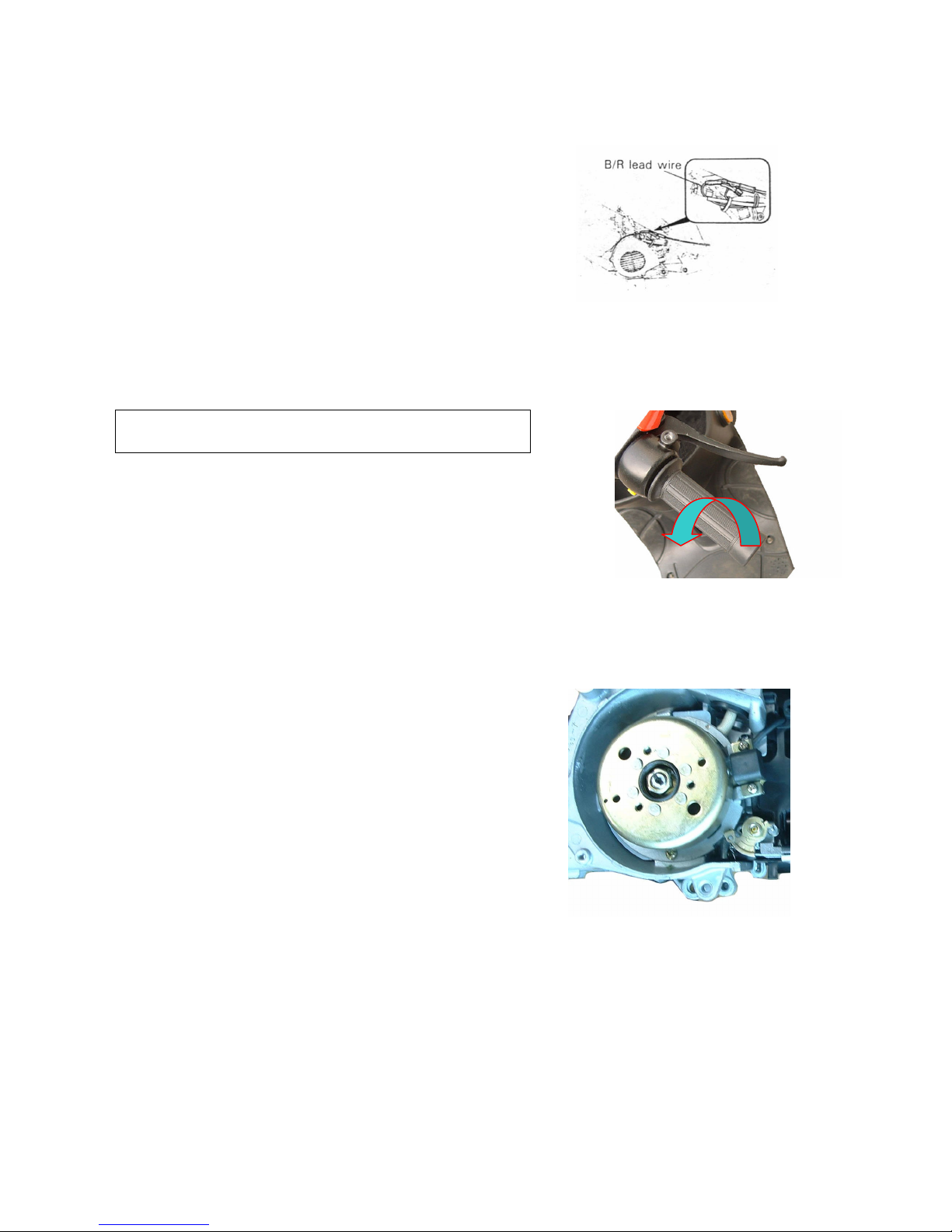
Connect an electric tachometer to the connecting protiion of the magneto lead wire as shown I nthe
illustration. Use the selector key “C’ position.
Tachometer
Adjust the throttle stop screw to obtain the idle r/min as follows:
Idle speed:1400±100r/min
Finally adjust the throttle cable play.
OIL PUMP
Inspect at initially 1000KM( 600 miles, 2 months)
andevery 6000 km(4000 miles,12 months)thereafter.
The engine oil is fed by the oil pump to the engine. The amount of oil fed to
it is regulated by engine speed and oil pump control lever which is controlled
by amount of throttle opening.
Check the oil pump in the following manner to confirm correct operation for
Throttle valve full opening position.
Turn the throttle grip full open.
Check whether the red mark ① on the oil pump control lever
Is aligned with the index mark ② when the throttle valve is positioned as above.
If the marks are not aligned, loosen lock nuts ③ and turn the adjuster ④ in or out to align the marks.
After align the marks, tighten the locknuts.
Caution:
Oil pump calbe adjustment must be done after throttle cable adjustment.
Page 17
17
GEAR OIL
Inspect at initially 1000 km((((600 miles,,,,2 months))))and every
6000 km((((4000 miles,,,,12 months))))thereafter.
Inspect gear oil periodically as follows:
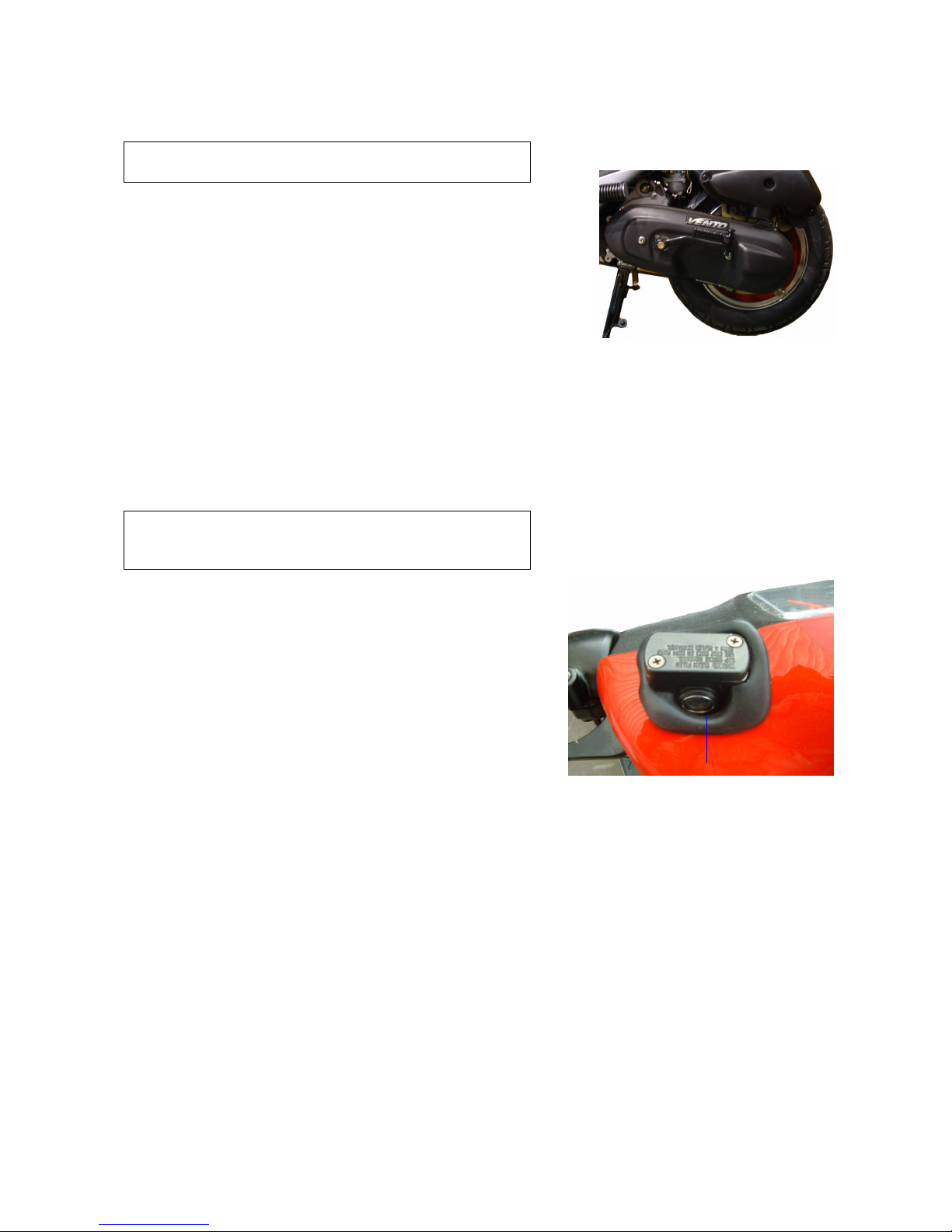
Remove the cover and hose
Remove the kicking starter lever
Remove clutch cover
Remove oil level bolt and inspect oil level, if oil level is below oil hole,
Add oil until oil flows from the level hole.
Tighten oil level bolt to the specified torque.
Tightening toque::::9-15N.m
((((0.9-1.5 kg-m ,,,,6.5-11.0 lb-ft))))
BRAKES
Inspect at initially 1000 km((((600 miles,,,,2 months)))) and
every 6000 km((((4000 miles,,,,12 months))))thereafter, replace
brake fluid every 2 years, replace brake hose every 4 years.
Front brake fluid level
Keep the scooter upright and place the handlebar staight.
Check brake fluid level by observing the lower limit line
on the brake fluid reservoir.
When the level is below the lower limit line, replenish with
Brake fluid that meets the following specification.
Specification and classification::::DOT4
QIANJIANG BRAKE FLUID
WARNING::::
The brake system of the scooter is filled with a glycol-based brake the lowest line
Fluid. Do not use or mix different types of fluid such as silicone-based and petroleum-based. Do not use any
brake fluid taken from old, used or unsealed containers. Never reuse the brake fluid left over from the
last servicing and stored for long periods.
Page 18

18
WARNING::::
Brake fluid, if it leaks, will interfere with safe running and immediately discolor painted surfaces.
Check the brake hoses for cracks and hose joints for leakage before riding.
Brake pads
Wearing condition of brake pads can be checked by observing the limit
Line ① marked on the pad. When the wear exceeds the limit mark, replace
The pads with new ones.
Bleeding air from the brake fluid circuit
Air trapped in the fluid circuit acts like a cushion to absorb a large
proportion of the pressure developed by the master cylinder and thus
interferes with the full braking performance of the brake caliper. The
presence of air is indicated by “sponginess” of the brake lever and
also by lack of braking force. Considering the danger to which such
trapped air exposes the machine and rider, it is essential that, after
remounting the brake and restoring the brake system to the normal
condition, the brake fluid circuit be purged of air in the following manner:
Fill up the master cyliner reservoir to the upper end of the inspection
window. Replace the reservoir cap to prevent entry of dirt.
Attach a pipe to the caliper bleeder valve, and insert the free end of
The pipe into a receptacle.
□ Bleed air from the bleeder valve.
Squeeze and release the brake level several times in rapid succession. And squeeze the lever fully without
releasing it. loosen the bleeder valve by turning it a quarter of a turn so that the brake fluid runs into the
receptacles: the will remove the tension of the brake lever causing it to touch the handlebar grip. Then, close the
valve, pump and squeeze the lever, and open the valve. Repeat the process until the fluid flowing into the
receptacle no longer contains air bubbles.
Page 19
19
NOTE::::when bleeding the brakign system, replenish the brake fluid reservoir if necessary.
Make sure that there is always some fluid visible in the reservoir.
Close the bleeder vavle, disconnect the pipe. Fill the reservoir with brake fluid to the upper end of the
inspection window.
BLEEDER VALVE
TIGHTENING TORQUE: 6-9N.m(0.6-0.9kg-m,4.5-6.5lb-ft)
CAUTION:
Handle brake fluid with care: the fluid reacts
chemically with paint, plastics, rubber materials, etc.
Rear brake
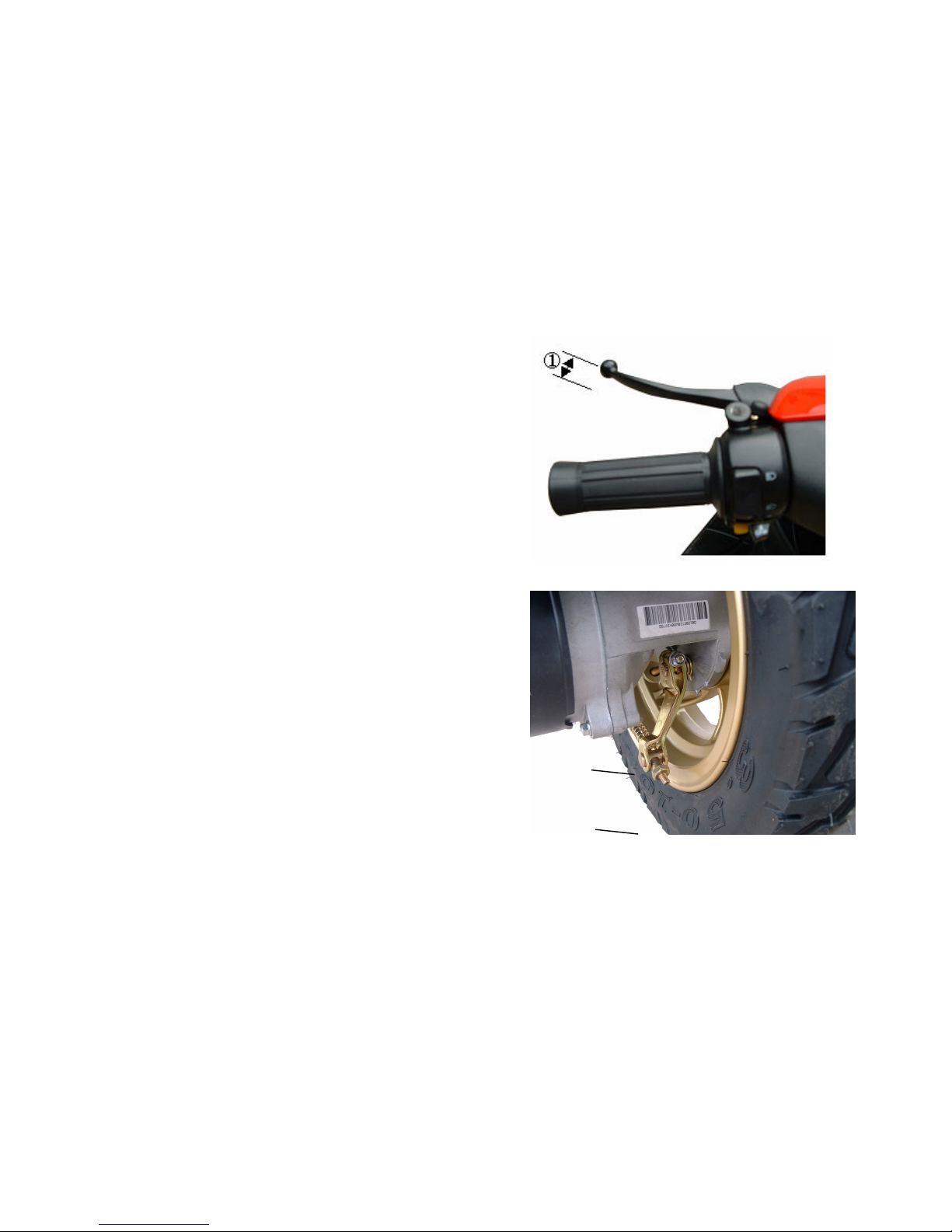
Turn adjusting nut ① so that the the play ② of
Brake lever is 15-25MM as shown in the illustration.
Brake shoe wear:
The vehicle is equipped with the brake lining limit
Indicator ③ on the rear brake.
Inspect brake lining limit as follows:
1. First check if the brake system is properly
Adjusted.
2. when operating the brake, check to see that
the tip of indicator ③ is within the range ④.
3. if the tip of indicator is beyond the range,
the brake shoe assembly should be raplaced with a ②
new set of shoe.
②
Page 20
20
Tire
Inspect at initially 1000KM(600 miles,2 months) and every
6000KM(4000 miles,12 months)thereafter
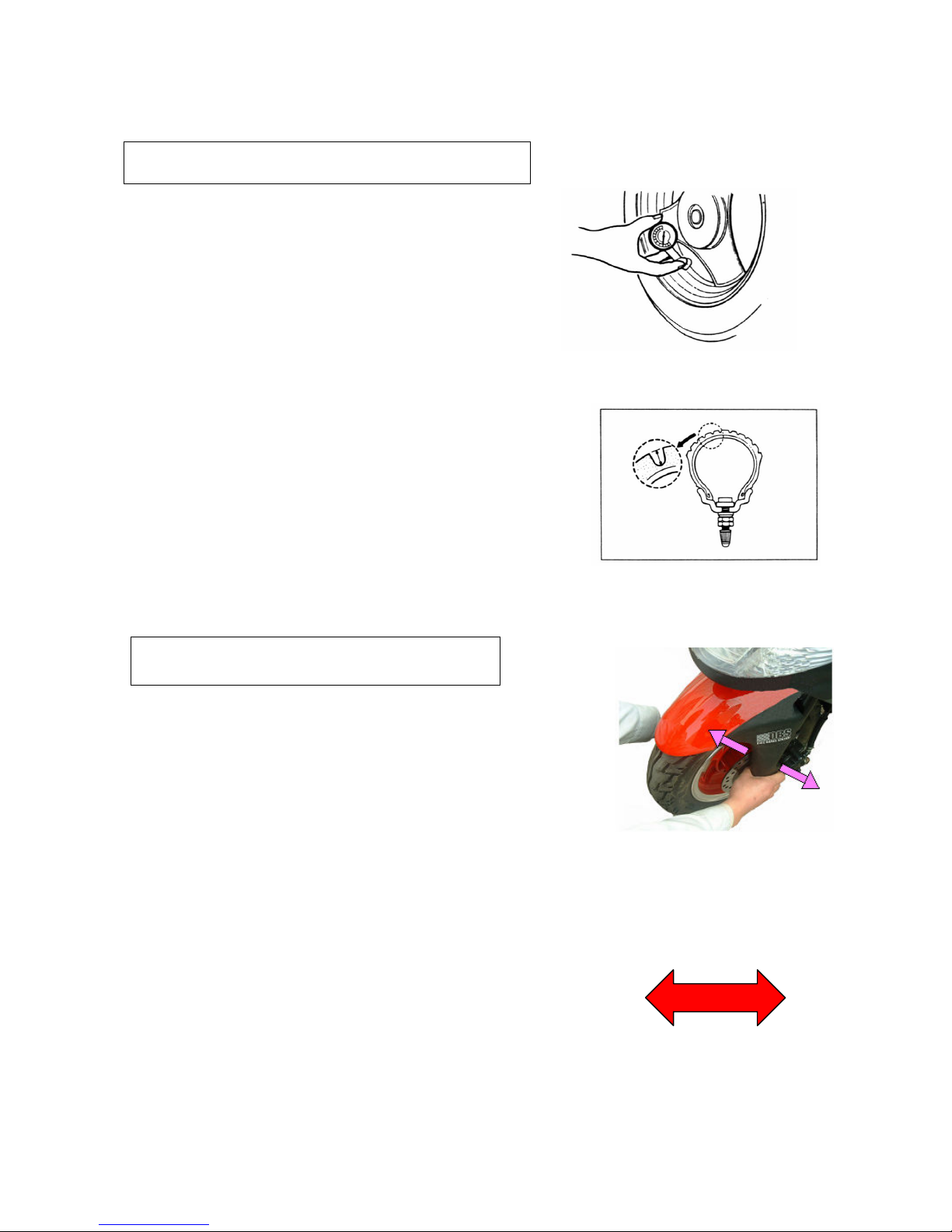
Tire pressure:
If the pressure is too high, the scooter will tend to rede stiffly
and have poor traction. Conversely, if tire pressure is too low,
stability will be adversely affected. Thereafter, maintain the
correct tire pressure for good roadability and to prolong tire life.
CAUTION:
Caution:
The standard air pressure of tires is 175/196Kpa, The use of other
Than standard may cause handling instability. It is highly
recommended to use a QIANJIANG genuine tire.
Tire tread condition:
Operating the scooter with the excessively worn tires will decrease
riding stability and consequently invite dangerous situation. It is highly
recommended to replace the tire when the remaining depth of tire tread
reaches the following specification.
Front and rear:1.6MM(0.064IN)
Tire depth gauge
Steering
inspect at initially 1000KM(600 miles,2 months)
and every 6000KM thereafter.
Steering should be adjusted properly for smooth turning of handlebars
and safe running. Too stiff steering prevents smooth turning of handlebars
and too loose steering will cause poor stability.
Check that there is no play in the front fork assembly by supporting the
machine so that the front wheel is off the ground, with wheel staight ahead,
grasp lower shock absorber near the axle and pull forward. If play is
found, perform steering bearing adjustment.
Page 21

21
Front shock absorber
Adjust at initially 1000KM(600 miles,2 months)
and
every 6000 km(4000 miles,12 months)thereafter.
Inspect the front shock absorber for oil leakage or other damage, and replace the defective parts, if necessary.
Rear shock absorber
Adjust at initially 1000KM(600 miles,2 months)and every
6000 km(4000 miles,12 months)thereafter.
Inspect front shock absorber for oil leakage and other damage, and replace the defective parts if necessary.
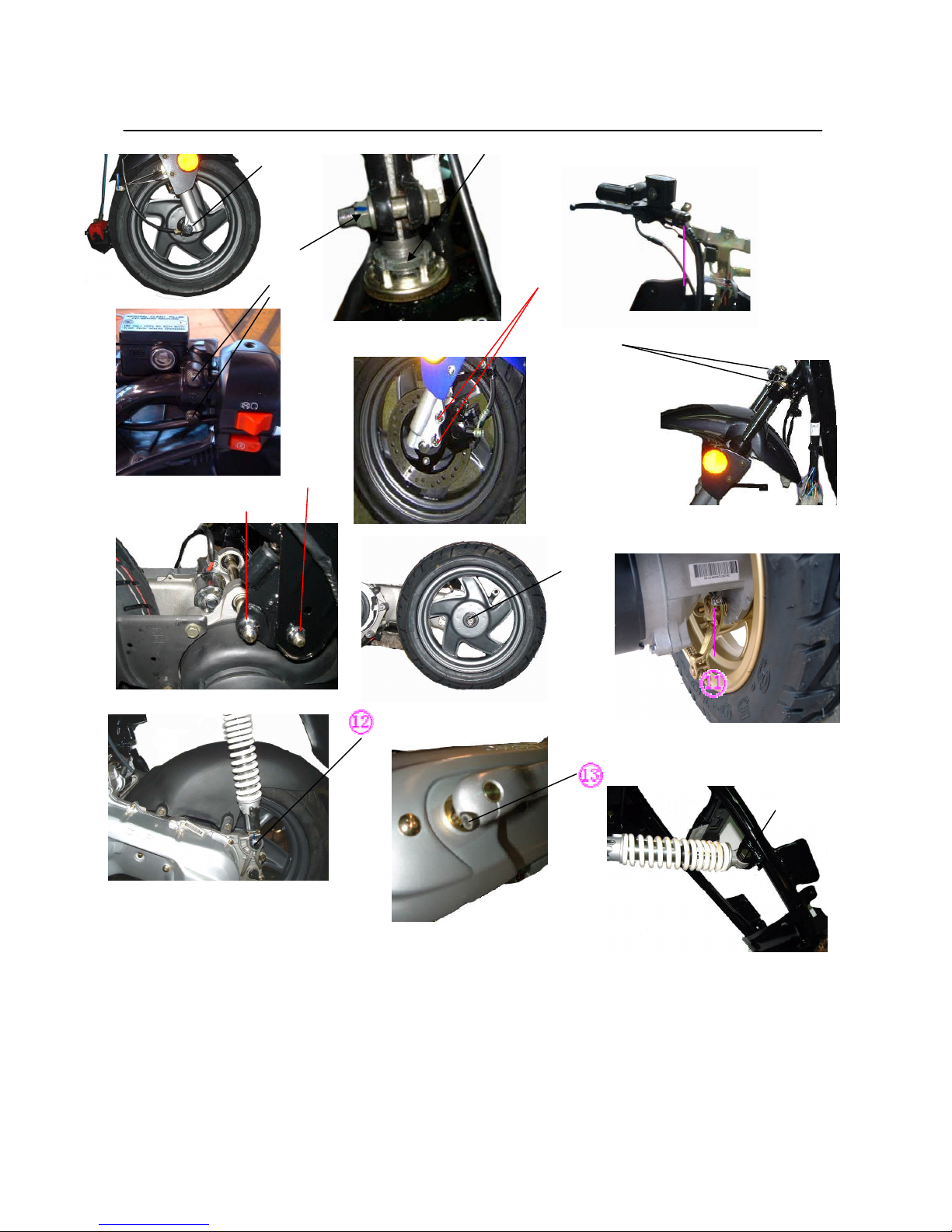
No. Item N•m Kg-m
1 Front axle nut 55-60 5.5-6
2 Handle tightenging nut 37-44 3.7-4.4
3 Steering sterm locknut 37-44 3.7-4.4
4 Disc brake caliper fixing bolt 22-29 2.2-2.9
5 Disc brake master cylinder hose fixing bolt 22-29 2.2-2.9
6 Disc brake fixing bolt 5-9 0.5-0.9
7 Front shock absorber fixing bolt 37-44 3.7-4.4
8 Engine pivot fixing nut 55-60 5.5-6
9 Engine bracket fixing nut 37-44 3.7-4.4
10 Rear wheel fixing nut 100-130 10-13
11 Rear brake rocker arm fixing bolt 5-9 0.5-0.9
12 Rear shock absorber under fixing bolt 22-29 2.2-2.9
13 Start pedal mounting screw 15-20 1.5-2
14 Rear shock absorber top fixing bolt 37-44 3.7-4.4
Page 22
22
③③③③
①①①①
②②②②
④④④④
⑤⑤⑤⑤
⑥⑥⑥⑥
⑦⑦⑦⑦
⑧⑧⑧⑧
⑨⑨⑨⑨
⑩⑩⑩⑩
14
Page 23

23
LUBRICATION
Proper lubrication is important for smooth operation and long life of each working part of the scooter. The
major lubrication points are indicated below:
NOTE:
1. Lubricate exposed parts which aare subject to ruse with engine oil.
2. Before lubricating each part, clean off any rusty spots and wipe off any grease, oil dirt of grime.
WARNING:Be careful not to apply too much grease to the rear brake camshaft, otherwise brake slippage will
result from the presence of grease in brake drum.
①steering stem bearing
②front wheel bearing
③engine bracket
④rear brake camshaft
⑤side stand
⑥rear brake shaft and rear brake calbe
⑦speedometer calbe and gear box
⑧main stand
Αlubrication
①A
②⑦A ④A
⑥A
⑤⑧A
③A
Page 24

24
ENGINE
CONTENS
Engine components removal with the engine in place
Engine removal and remounting
Engine removal
Engine remounting
Engine disassembly
Engine components inspection and servicing
Bearings
Oil seals
crankshaft
automatic clutch inspection
cylinder head
cylinder
piston
reed valve
engine remounting
oil seals
bearings
bushings
crankshaft
crankcase
rear axle shaft
transmission
starter pinion and starter gear
Movable driven and clutch
Movable drive
Kicking starter
Piston
Oil pump and oil pump driven gear
Intake pipe
Magneto
Page 25

25
Engine components removable with the engine in place
The parts listed below can be removed and reinstalled without removing the engine
from the frame.
Engine left side
Kicking starter lever
Clutch brake pad kit
Driver left face
V-belt
Driver belt right face
Electric starter gear
Super clutch
Driven face
Engine center
Carburetor
Intake pipe
Reed valve
Oil pump
Worm wheel
Cylinder head
Cylinder
Piston
engine right side
cooling fan
Magneto
Starter motor
Page 26

26
ENGINE ASSY.
Remove the muffler
Remove cooling fan cover
Remove cylinder cover
Remove cooling fan
Remove magneto nut with special tools.
remove magneto rotor and half circle key
with special tools.
remove magneto stator and paper gasket
remove oil pump
Page 27

27
Remove worm wheel and oil seal press board
remove cylinder head and
cylinder
Place a cloth stopper beneath the piston
and remove the circlip with a plier.
remove the piston pin and piston.
Remove the kick starter lever.
Remove side cover
Remove movable ratchet wheel and clip
Page 28

28
Remove starting driven ratchet wheel by removing the nuts.
Rmove fan⑤ and V-belt⑥.
Disassemble the movable drive
face⑦.
Remove electric gear press board, electric
gear And super clutch
Remove starter motor
Page 29
29
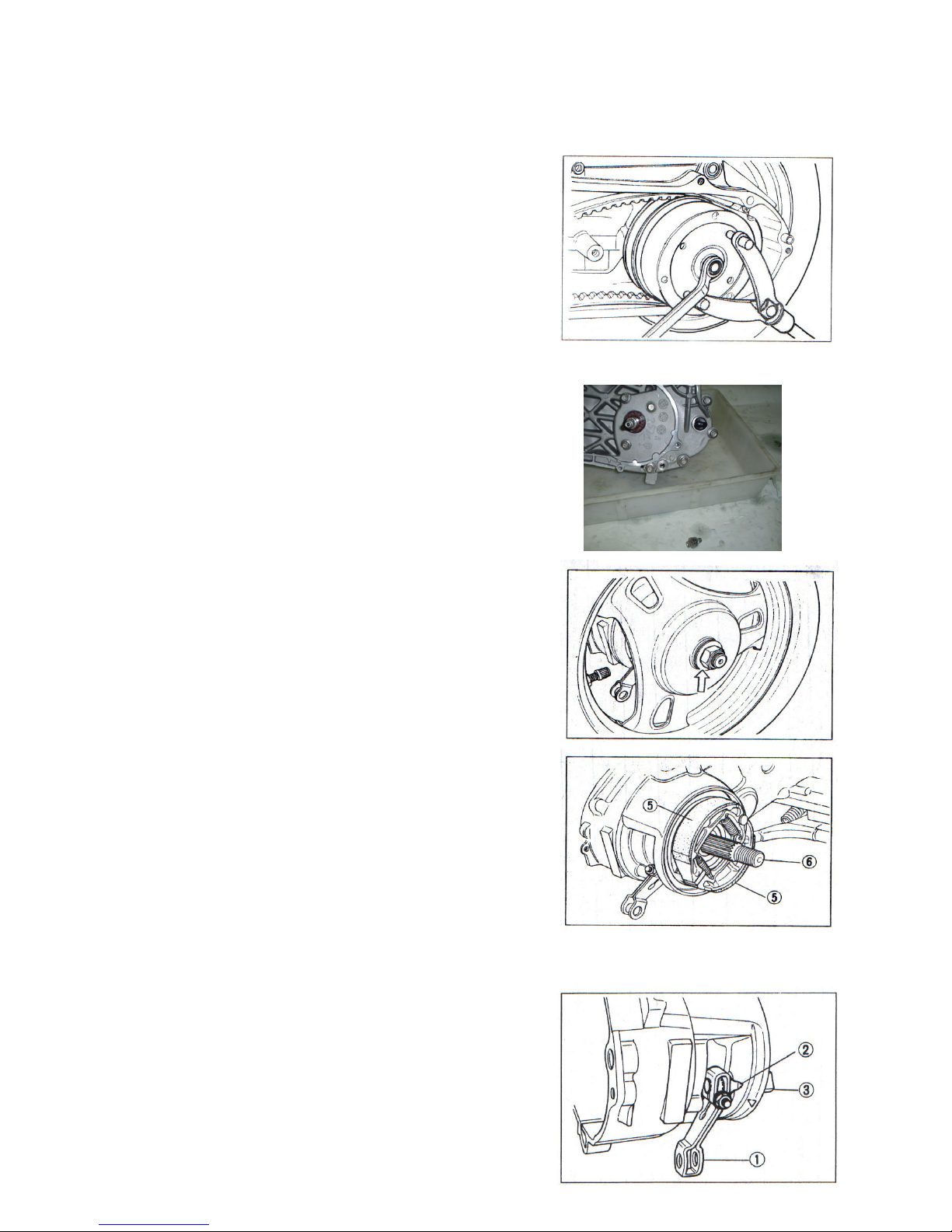
Remove the clutch housing with the
special tool.
drain gear oil
remove rear axle nut
remove rear wheel
remove brake shoe⑤ and rear axle⑥。
Remove the rear brake cam lever①,indicator
plate② and camshaft③.
Page 30

30
remove spring④
remove cotter pin⑤ and shaft⑥
remove main stand⑦
remove gearcase cover
Remove paper gasket① and middle gear assy.②,
Remove output gear assy.③
remove carburetor
remove intake pipe
remove reed valve and paper gasket.
Page 31

31
Remove crankcase fixing shaft
disassemble crankcase with special tools
Remove crankcase with special tools
Remove crankshaft bearing with special tools
Sliding shaft
Warning::::use a new sliding shaft.
Page 32

32
Unscrew clutch shoe nut with special tools.
Remove the nut while holding down clutch
shoe assy. by both hands as shown in the
illustration.
WARNING:Gradually back off the clutch shoe
assy. pressed down by hands to counter the clutch
sparing load. Releasing the hand suddenly may
cause the following parts to fly apart.
①nut
②clutch shoe
③spring
CAUTION::::
Do not attempt to disassemble the clutch
shoe assy. Otherwise the clutch shoe may be
damaged.
Using a screwdriver or the like, pry up the
movable driven face spring guide.
● Remove the pins④, movable driven face⑤ and
fixed driven face⑥.
Page 33

33
Remove circlip
Remove bearing with special tool.
CAUTION:Replace the removed bearing
with a new one.
Remove bearing with special tool.
CAUTION::::Replace the removed bearing
with a new one.
Remove the spacer
Remove the oil seal from the gearcase cover with the speical tool.
CAUTION::::Replace the removed oil seal with a new one.
。
Page 34

34
Remove gearcase cover bearing
with special tool
Remove left crankcase oil seal
do it with special tool
warning::::use a new oil seal
remove left crankcase bearing with special tool
warning::::use a new one
remove left crankcase shock absorber
bushing with special tool
warning::::use a new bushing
wrap the oil seal with two appropriate size of
sheet irons and clamp it, shown as fig.
Page 35

35
Remove right crankcase oil seal with special tool
Warning::::use a new oil seal
remove right crankcase bearing
sliding bearing
warning::::use a new bearing
Page 36

36
ENGINE COMPONENTS INSPECTION AND SERVICING
BEARINGS
Clear bears with solvent and lubricate with
engine oil before inspecting.
Turn the inner ring and check to see that the inner
rieng turns smoothly. If it does not turn lightly, quietly
and smoothly, or if noise is heard, the bearing is
defective and must be replaced with a new one.
Page 37

37
OIL SEAL
Damage to the lip of the oil seal may result in leakage of the fuel-air mixture or oil. Inspect for damage and be sure to replace the
damaged seal if found.
CRANKSHAFT
CRANKSHAFT RUNOUT
Support crankshaft by“V” block, with the dial gauge rigged
to read the runout as shown.
Service limit::::0.05mm(0.002in)
Excessive crankshaft runout is often responsible for
abnormal engine vibration. Such vibration shortens engine
life.
Condition of big end bearing
Turn the crankshaft with the connecting rod to feel the smoothness of
rotary motion in the big end. Move the rod up and down while holding
the crankshaft rigidly to be sure that there is no rattle in the big end.
Wear on the big end of the connecting rod can be estimated by
checking the movement of the small end of the rod. The method can
also check the extent of wear on the parts of the connecting rod ‘s big
end. If wear exceeds the limit, replace connecting rod, crank pin
and crank pin bearing.
Service limit::::3.0mm(0.12in)
Connecting rod small end inside diameter
Measure the connecting rod small end diameter with a
caliper gauge.
Service limit:14.040mm
Automatic clutch inspection
The scooter is equipped with an automatic clutch
and variable ratio belt drive transmission. The
engagement of the clutch is governed by engine RMPS
Page 38

38
and centrifugal mechanism located in the clutch.
To insure proper performance and long lifespan of the clutch, it is essentiall that the
clutch engages smoothly and gradually. Two inspection checks must be performed to
thoroughly check the operation of the drivetrain. Follow the procedures listed.
1.Inspect initial engagement
Warm up the scooter to normal operating
temperature.
Remove the right frame side cover.
Connect an electric tachmeter to the connecting portion
of the magneto lead wire (black with red tracer).
Seated on the scooter with the scooter on level ground,
increase the engine RPMs slowly and note the RPM at
which the scooter begins to move forward.
Tachometer
Standard 2900r/min
tolerance ±300r/min
2.Clutch “LOCK-UP” inspection
Perform the inspection to determine if the clutch is
engaging fully and not slipping.
Warm the engine to normal operating temperatures.
Connect the electric tachomter to the magneto lead
wire.
Apply the rer brake as firm as possible.
Briefly open the throttle fully and note the maximum
engine RPMs sustained during the test cycle.
CAUTION:
Do not apply full power for more than 10 seconds or
damage to the clutch or engine may occur.
LOCK-UP R/MIN
Standard 5800r/min
Tolerance
±±±±400r/min
Page 39

39
If the engine R/MIN doesn’t coincide with the specified r/min range, then disassemble the clutch.
Clutch shoe---inspect the shoes visually for chips, cracking, uneven wear and burning, and check the
thickness of the shoes with vernier calipers. If the thickness is less than the following service limit, replace them
as a set.
Clutch springs -----visually inspect the clutch springs for strectched coils or broken coils.
Service limit::2.0mm(0.08in)
CAUTION : clutch shoes or springs must
bechanged as a set and never individually.
Clutch wheel—inspect visually the condition of
the inner clutch wheel surface for scrolling, cracks, or
uneven wear. Measure inside diameter of the clutch wheel
with inside calipers. Measure the diameter at several
points to check for an out-of-round condition as well as
wear.
Service limit:110.50mm(4.350in)
DRIVE BELT
Remove the drive belt and check for cracks, wear and
separation. Measure the drive belt width with a vernier calipers.
Replace it if the belt width is less than the service limit or and defect
has been found.
Service limit:16.0mm(0.630in)
CAUTION;Always keep the drive belt away from any
geasy matter.
Drive face
Inspect the belt contact surface of the dirve faces for wear,
scratches or any abnormality . if there is something unusual,
replace the drive face with a new one.
Page 40

40
Roller and sliding surface
Inspect each roller and sliding surface for
wear or damage.
Driving face spring
Measure the free distance of the driven face
spring. If the length is shoter than the service
limit, replace the spring with a new one.
service limit: 104.5mm(4.11in)
Driven face pin and oil seal
Turn the driven face and check to see that the driven faces
turn smoothly. If any stickiness or hitches are found,
visually inspect the lip of oil seal, driven face sliding
surface and sliding pins for wear or damage.
Driven face
inspect the belt contacting surface of bothdriven
faces for any scratches, wear and damage.
Replace driven face with a new one if there are any
abnormality.
Cylinder head
Decarbon the combusion chamber.
Check the surface of the clinder head as shown in
the illustration for distortion with a straightedge and
thickness gauge, taking a clearance reading at several
places.
service limit::::0.05mm(0.002in)
Page 41

41
If the largest reading at any portion of the staightedge excees the limit, rework the surface by
rubbing it against emery paper laid flat on the surface plate in a lapping manner. The surface must
ge smooth and perfectly falt in order to secure a tight join: a
leaky joint can be the cause of reduced power output and
increased fuel consumption.
CYLINER
Decarbon exhaust port and upper part of the cylinder, taking care not to
damage the cylinder wall surface. The wear of the cylinder wall is determined from
diameter reading taken at 20mm from the top of the cylinder with a cylinder
gauge. If the wear thus determined exceeds the limit indicated below, rework the
bore to the next oversize by using a boring machine or replace the cylinder with a
new one. Oversize pistions are available in two sizes: 0.5mm and 1.0mm.
(cylinder gauge)
service limit::::40.075mm(1.5778in)
after reworking the bore to an oversize, be sure to chamfer the edges of
ports and smooth the chamfered edges with emery paper. To chamfer,
use a scraper, taking care not to nick the wall surface.
NOTE
NOTENOTE
NOTE::::
Minor surface flaws on the cylinder wall durto seizure or
similar abnormalities can be corrected by grinding the flaws
off with fine-grain emery paper. If the flaws are deep grooves
or otherwise persist, the cyliner must be reworked with a
boring machine to the next oversize.
PISTON
cylinder and piston clearance
cylinder –piston clearance is the difference between piston diameter and
cylinder bore diameter. Be sure to take the maked diameter at right angles to the
piston pin. The value of elevation ○A is prescribed to be 20mm from the skirt
end.
(micrometer)
service limit::::39.885mm(1.5703in)
As a result of the above measurement, if the piston-to-cylinder clearance
exceeds the following limit, overhaul the cylinder and use an oversize piston,
replace both cylinder and piston. The measurement for the bore diameter should
Page 42

42
be taken in the intake-to-exhaust port direction and at 20mm from the cylinder top
surface.
Unit:mm
Standard service limit
Cylinder 40.005-40.020 40.075
Piston 39.94-39.955 39.885
Cylinder to piston 0.06-0.07 0.120
Decarboning
Decarbon the piston and piston ring grooves, as illustration. After
cleaning the grooves, fit the rings and rotate them in their respective
grooves to be sure that they move smoothly. Carbon in groove is liable
to cause the piston ring to get stuck in the groove, and the condition
will lead to reduce engine power output.
A piston whose sliding surface is badly grooved ore scuffed
due to overheating must be replaced. Shallow grooves or minor scuff can be
removed by grinding with emery paper of about #400
Piston pin bore
Use a caliper gauge to measure the piston pin bore inside diameter,.
If reading exceeds the following service limit, replace it with a new one.
(Dial caliper)
Limit service: 12.30mm(0.4736in)
Piston pin outside diameter:
Use a micrometer to measure the piston outside diameter at three
positions.
(Micrometer(0-25mm))
service limit:11.980mm(0.4717in)
Piston rings
Check each ring for end gap, reading the gap with a thickness gauge shown in the
illustration. If the end gap is found to exceed the limit, indicated below, replace it
Grind pisto n surface evenly w ith em ery paper
Page 43

43
with a new one.
The end gap of each ring is to be measued with the ring fitted squarely into the cylidner bore and
held at the least worn part near the cylidner bottom, as shown in the illustration.
Service limit:0.75mm(0.030in)
As the piston ring wears, its end gap increases reducing
reducing engine power output becaust of the resultant blow
by through the enlarged gap. Here lies the importance of
using piston rings with end gaps with the limit. Measure the
piston ring free end gap to check the spring tension.
service limit:3.6mm(0.14in)
Fix the piston ring in the piston ring groove, measure
the ring side clearance with the thicknes gauge while matching
the sliding surface of piston and ring.
Standard clearance
1st::::0.04-0.06mm(0.0016-0.0024in)
2nd:0.02-0.04mm(0.0008-0.0016in)
Reed vakve
Check the clearance A between reed valve and its seat
and the dimension B. If the clearance A is noted to exceed
0.2mm, replace the reed valve assembly. The dimension B is at
least 1mm.
Page 44

44
ENGINE Reassembly
Reassembly is generally performed in the reverse
order of disassembly, but there are a number of
reassembling steps that demand or deserve detailed
explanation or emphasis. These steps will be taken up for
respective parts and components.
Oil seals
fit the oil seals to the crankcase following the
procedure below. Replace removed oil seals with new
ones.
Lubricate the edge of oil seal
Install oil seal into crankcase carefully with special tool.
Oil seal installation
Bearing
Install new bearing with special tool
Install bearing
Page 45

45
shock absorber bushing
positon
Install shock absorber bushing
Install crankshaft bearing
Press bearing into cankshaft
Install crankshaft
Page 46

46
Decide th length between the webs referring to the figure at
righ when rebuilding the crankshaft.
Standard width between webs:::::38±0.1mm(1.496±0.004in)
when mounting the crankshaft into crankcase, it is
necessaryto pull its left end into the crankcase with the
special tool.
CAUTION: Never fit the crankshaft into the the crankcase by driving it
with a plastic hammer. Always use the special tool, otherwise crankshaft
alignment accuracy will be affected.
Page 47

47
CRANKCASE
Wipe the crankcase mating surfaces with
clraning solvent.
Apply QIANJIANG NO.1215 evenly to the
mating surface of the right half of the
crankcase
Tighten the crankcase screws securely.
Check if crankshaft rotates smoothly.
Install gearcase bearing
Install new bearing and oil seal into gearcase cover with special tool, and tighten
anchor pin.
Page 48

48
install output axle
gearshift
install middle gear, position pin by installing middle gear
axle①, gasket② and thrust gasket③
install gearcase cover into crankcase and lock
bolt.
tighten each screw
screw oil drain nut○11
tightening torque::::4-7 N.m
(0.4-0.7kg-m,3.0-5.0 Ib-ft)
Page 49

49
install the bearing② in the fixed driven face①
with the special tool.
install sliding bearing ③。
Page 50

50
Install the bearing ① with special tool
install the spacer ② and circlip③.
install the new oil seals④ and ⑤ to the
movable driven face with the special tool.
apply grease to the lip of oil seals and groove
of inside of movable driven face.
QIANJIANG special super grease
NOTE:
When reinstalling the movable face to the fixed
face, make sure that the oil seal is positoned
properly.
install the pin ⑥ at three places on the driven
face hub.
Apply grease lightly to the cam part where the
pins are placed.
Install two O-RINGs⑦.
Page 51

51
Install the movable driven face seat①.
install the clutch shoe assembly② and nut
③.
tighten the nut③ to the specified torque
with the special tool.
tightening torque::::40-60 N.M
(4.0-6.0kg.m 29.0-43.5Ib-ft)
insert the V-belt between the driven faces as deep inside
possible while pulling the movable driven face all the way
outside to provide the maximum ble clearance.
CAUTION:
the belt should be positioned so that the arrows on the belt
periphery point the normal turning direction.
The V-belt contact face on the driven faces should be
thoroughly cleaned to be free from oil.
Thoroughly clean the clutch housing to be free from oil and
position it over the clutch shoe assembly.
tighten the clutch housing nut to the specified torque with
the special tool.
Torque::::40-60 N.M
(4.0-6.0kg.m 29.0-43.5Ib-ft)
Page 52

52
Apply grease to all the sliding and rolling
surfaces for six roller weights. For each weight,
approximately 1.5g of grease should be used.
QIANJIANG supre grease
Mount the three dampers① on the movable
drive plate② and install it on the movable
drive face.
Position the O-RING on the movable drive
face.
Install the movable drive face cover③.
NOTE:
1. Make sure that the movable drive plate is fully
positioned inside, or the weight roller may
come off.
Page 53

53
Insert the spacer④
Position the movable drive face subassembly
on the crankshaft as shown in illustration.
NOTE
::::
Thoroughly clean the belt contact to be free
from oil.
Install the fixed drive fan①.
tighten the nut to the specified torque with
special tool.
Connecting rod fixer
Tightening torque:40-60N.M
(4.0-6.0kg-m, 29.0-43.5Ib-ft)
fill grease in the groove provided inside
sliding surface of the kick driven gear and
install ② on the end of the crankshaft.
Wipe pff excess grease.
QIANJIANG super grease
Install washer③ and spring④.
NOTE:
When Installing washer
③,
face the resin
surface of washer to outside.
install the retainer⑤.
continue turning the fixed drive face⑥ by hand
until the belt is seated in and both the
drive and driven faces⑦ will move
together smoothly with slip.
Page 54

54
fill the final gear box with engine oil
up to the level hole.
Oil capacity: 90ml
tighten the oil level bolt to the
specified torque.
Tightening torque:9-15M.M
Starter assy.
Inject lubrication into start bearing and
lubrication in the end of starter shaft
QIANJIANG SPECIAL LUBRICATION
Tighten starter shaft gasket
Install starter ratchet wheel and circlip
Page 55

55
Install the dowel pins①
install the new gaskets(② and ③)
apply QIANJIANG bond no. 1215 to the
clutch cover as shown in the illustration.
QIANJIANG bond no. 1215
NOTE: INSTALL the kick starter lever as shown in the
illustration.
Tightening toque::::8-12N.M
(0.8-1.2kg-m, 6.0-8.5Ib-ft)
PISTON
install the piston rings on the piston.
The first and the second ring: keystone ring.
NOTE:
Position the ring so that the marking is on upside.
it is extremely important that, when the piston is fed into the
cylinder, each ring in place should be so positioned as to hug
the locating pin as shown in illustration.
Page 56

56
apply oil for the piston and install the piston to
the connecting rod.
NOTE
::::
The arrow mark ① on the piston head should point
the exhaust side.
The circlip should be mounted in such a
position that the mating ends of the circlip do
not coincide with the grovve portion of the
piston.
apply oil on the position and cyoinder wall
surfaces and install the cylinder over the piston
carefully.
tighten the cylinder head nut to the
specification.
tightening torque::::18-28N.m
install right crankcase oil seal press board
install worm, and lubricater it with QIANJIANG
special lubrication.
Oil pump
install oil pump into crankcase
torque::::3-5N.m
(0.3-0.5kg-m, 2.3-3.7Ib-ft)
OUTSIDE
Page 57

57
Reed valve
install reed valve paper gasket.
Install reed valve
Install oil hose
Instake pipe
install intake pipe
Magneto
clear crankshaft and magneto rotor
install half circle key
install paper gasket and stator coil, and then fix
them
tighten to specified torque with special tool
specified torque::::35-45N.m
(3.5-4.5kg.m,25.5-31.0Ib-ft)
Page 58

58
install cooling fan
install guiding cover
install fan guiding cover
install pipe screw ① and screw for
tightening muffler to their specified
torque.
①:8-12N.m(0.8-1.2kg.m,6.0-8.5Ib-ft)
②:18-28N.m(1.8-2.8kg.m,13.0-20.0Ib-ft)
lubricate brake cam shaft with QIJIANG SPECIAL grease.
Page 59

59
CHAPTER 4 FUEL AND LUBRICATION SYSTEM
CONTENTS
FUEL SWITCH
CARBURETOR
OIL PUMP
Page 60

60
FUEL SWITCH
When the engine has started, a negative pressure(vacuum) is generated at the
intake port. The negative pressure acts upon the diaphragm of the fuel switch and ti
pressed down the spring which supports the diaphragm so that the fuel passageway is
opened and fuel is fed to the carburetor.
When the engine has stopped, the spring presses the valve, the fuel
passagewayos closed, and no fuel flows to the engine.
Fuel switch
Page 61

61
CARBURETOR
CARBURETOR
Carburetor manufacturer/type
Identification code
Throat tube diameter
Main jet size
Idle needle jet size
Oil needle clamp position
Idle air adjusting screw
Float height
QIANJIANG-WENLING-CHINA,equal vacuum
PZ19JB
19mm
#80
#57.5
3rd groove
extrude 1
2
1
±
2
1
turnout
13±1mm
Page 62

62
CARBURETION
Proper carburetion is determined according to the results of various tests,
mainly concerning engine poer, fuel consumption and cooling effect of feul on
engine, and jet settings ard made so as to satisfy and balance all of these
conditions. Therefore, the jet should not be replaced with a size other than the
original. And the positions of adjustable parts should not be changed except when
compensation for the mixture ratio due to altitude differences or other climatic
conditions. When adjustment is necessary, refer to the following.
OIL PUMP
OIL LEAKAGE throughout
Whenever evidence is noted of some air having leaked into the oil pipe from the
oil tannk in a machine brought in for servicing, be sure to carry out an air bleeding
operation with the oil pump in place before returning the machine to the user. To
bleed air, hold the machine in standstill condition.
Page 63

63
CHAPTER 5 ELECTRICAL SYSTEM
CONTENS
IGNITION SYSTEM
CHARGING AND LIGHTING SYSTEM
STARTER SYSTEM
FUEL GAUGE
OIL LEVEL CHECK LIGHT AND TURN SIGNAL INDICATOR
SWITCHS
BARTERY
Page 64

64
IGNITION SYSTEM
The ignition system consists of a flywheel magneto, a CDI&Ignition coil unit and a spark plug.
①As the rotor tatates, an AC current is induced in the coil. Then current induced in the ○A
direction charges up the capacitor.
②As the rotor rotates further, the current is induced in the reverse direction (dirction○B). the
current causes a voltage applied through the ground to the gate of SCR.
③As the SCR conducts, the energy which has been charged in the capacitor is instantaneously
discharged through the primary winding of the ignition coil.
CDI UNIT AND IGNITION COIL INSPECTION
CHECKING WITH ELECTRO TESTER
Connect the CDI test lead to the coil”s primary
connector.
Connect the high tension leads, red○+ lead to the
spark plug cord and the black○— lead to the black
lead of the test lead.
Set the test selector knob to “P.E.I”.
Connect the power lead to the appropriate AC
source.
Switch the power on.
Switch
Black
red
CDI test lead
MAGNETO
CDI&Ignition coil unit
Spark plug
Page 65

65
●●●●Note the spark in the spark gap window. It should be
strong and continuous, not intermittent, acrossa preset
8mm(0.32in) gap. Allow the spark to jump the test gap for at
least five minutes continuously. To insure proper operation
under the temperature of actual riding.
Electronic tester
Ignition coil testing lead
Use portable tester to check it.
Test the resistance between igntion ground wire andspark
plug cap.
Ignition coil second resistance:12-18 KQ
MAGNETO EXCITING COIL
remove the right frame side cover
disconnect the exciting coil lead wire(black with red
tracer).
Using a pocket tester, measure the resistance between the
B/R lead wire and ground. If the resistance checked is
incorrect, replace the coil.
Exciting coil restance::::140-220
Page 66

66
CHARGING AND LIGHTING SYSTEM
The charging system uses the flywheel magnetoas shown in the
figure. The charging and lighting coils are mounted on the
magneto stator and generate AC as the flywheel rotor turns. AC
generated in the charging coil flows to the regulator/recifier which
changes AC to DC. The DC Then charges the battery.
Charging output check
start the engine and keep it running at 5000r/min
with lighting switch turned on.
NOTE:
When making the test, be sure that the
batteryis in fully charged condition.
Tachometer
Standard charging output::::13-16v at 5000r/min
Fuse
Battery
Page 67

67
NO-LOAD PERFORMANCE
Disconnect the magneto lead wire coupler.
Start the engine and keep it running at 5000r/min.
Using a pocket tester, measure the AC voltage between the white and red
tracer lead wire and ground. If the tester reading is as follows, magneto is in
good condition.
Standard no-load performance: more than 65v(AC)AT 5000R/MIN.
STATOR COILS
Inducing coils
Use procket tester to measure the resistance between the lead wire and
ground. If the resistance checked is not correct, replace the coil.
R
regulator/rectifier
Disconnect the lead wire couple.
Using the pocket tester(× 1KQ RANGE), measurethe resistance
between the terminals as shown in the following table. If the
resitance checked is incorrect, replace the regulator/rectifier.
UNIT: KQ
NOTES::::
Including the components such as transistor,capacitance,
regulator diode and so on, so tested resistance may be different
from actual resistance.
Standard
resistance
W/R-GROUND 0.6-1.1Q
W/R-GROUND 0.5-0.8 Q
Page 68

68
STARTER SYSTEM
DESCRIPTION
The starter system is shown in the diagram below: namely, the starter motor, relay, starter switch
and battery. depressing the starter button while squeezing the front or rear brake lever energizes the
relay, causing the contact points to close which connects the starter motor to the battery.
Starter motor removal and disassembly
Remove the starter motor
Disassemble the starter motor as shown in the illustration
Page 69

69
STARTER MOTOR INSPECITION
CARBON BRUSHES
When the brushes are worn, the motor will be unable to produce
sufficient torque, and the engine will be difficult to turn over. To
prevent the , periodically inspect the length of the brushes and replace
them when they are too short or chipping.
Service limit::::3.5mm(0.14in)
Commutator
If the commutator surface is dirty, starting performance will decrease.
Polish the commutator with #400 or similar fine emery paper when it
is dirty.
Service limit::::0.2mm(0.008in)
Armature coil
using the pocket tester, check the coil for open and ground by
plcing probe pins on each commutator segment and rotor core and on
any two segments at various places. With the brushes lifted off the
commutator surface. If the coil is found to be open-circuited or
grounded, replace the armatrue.
Starter relay inspection
Disconnect lead wire (R/W) of the starter motor. Turn on the
igniton switch and squeeze the front or rear brake lever, then
inspect the continuity between the Red and Red/White lead wires
at the starter relay when pushing the starter button.
If the starter relay is in sound condition, continuity is found.
● Disconnect the starter relay lead wire couple. Check the coil for
“open”, “ground” and ohic resistance. The coil is in good condition,
if the resistance is as follows:
STANDARD RESTANCE::80-150Q
Segment
Mica
Page 70

70
FUEL LEVEL METER/GAUGE
FUEL METER INSPECTION
To test the Fuel Meter two different checks may be used.
The first,and simplest test will tell if the mete is
operating but will not indicate the meters accuracy throughout
the range.To perform the test,lift the seat and remove the
right frame cover,then disconnect the B/W and Y/B lead
connector of the fuel gauge sending unit.Connect a jumper
wirebetween B/M and Y/B wiers coming from the main wiring
harness.With the ignition switch tuined ON,the fuel meter
should indicate“F”.
The second test will check the accuracy of the meter in
the full and empty positions.Connect a 90-ohm resistor
between the Y/B and B/W lead wires.The fuel meter is normal
if its pointer indicates the E(empty) position when the
specified voltage is applied to the circuit and if its
pointer indicates the F(full) position when the resistor is
changed to 10 ohms.If either one or both indications are
abnormal,replace the fuel meter with a new one.
FUEL GUAGE SENDING UNIT INSPECTION
Disconnect the lead wires coming out of the fuel gauge and check
resistance of eadn podition.
If the resistance measured is incorrect, erplace the fuel gaue assembly
with a new one.
The relation between the position of the fuel guage float and
resistance is shown in the following table.
FLOAT POSITION RESISTANCE
F(FULL) APPROX.33
1/2 APPROX.200
E(EMPTY) APPROX.566
CABLE ASSY.
CABLE ASSY.
Page 71

71
SIGNAL SYSTEM
SIGNAL SYSTEMSIGNAL SYSTEM
SIGNAL SYSTEM
The same bulb is used tor both oil level check light and turn signal indicator light.The circuitry
is shown below.When the oil level has fallen to a certain level (the remaining amount of oil
has become approximately 160 ml,the oil level check light turns on and remains lit.When the turn
signal switch is turned on and the turn signal light flashes,the turn signal indicator light
(oil level check light)also flashes,both being not concurrently but alternatively as one being
lit white the other unit.
油量表
前右转向灯
前左转向灯
后
刹
车
开
关
喇
叭
开
关
喇叭
磁电机 转向开关
机
油
开
关
油
位
传
感
器
后右转向灯
后左转向灯
刹车灯
电子钟
转向指示灯
机油报警指示灯
电源锁
刹
车
开
关
闪
光
蜂
鸣
器
蓄电池
整流/稳压器
防盗器
防盗器喇叭
Fig. 7
OIL LEVEL SWITCH INSPECTION
Check the oil level switch for continuity between the lead wire.If the tester does not show
the value of 0-1 ohm when the switch ring is in bottom position,file the contact surface or replace
the unit.
Page 72

72
SWITCH
SWITCHSWITCH
SWITCH
转向开关
绿/白
关
机油开关
红/白
开
棕/白
左转
右转
橙
绿/黑
黄
近光
远光
变光开关
黄/红
蓝 浅蓝
灯控开关
黄/红
大灯
会车灯
关
绿/红
黄
粉红
墨绿
喇叭开关
关
开
绿/黄
启动开关
开
关
红/白
关
开
刹车开关
红/白
红
开
锁定
关
电源锁
红/白
紫
棕
紫
黑
Page 73

73
BBBBATTERY
ATTERYATTERY
ATTERY
SPECIFICATIONS
SPECIFICATIONSSPECIFICATIONS
SPECIFICATIONS
Type designation YB4L-B
Capacity 12V 4Ah
Standard electrolyte 1.28(20℃)
INITIAL CHARGING
INITIAL CHARGINGINITIAL CHARGING
INITIAL CHARGING
FILLNG ELECTROLYTE
·Remove the aluminum tape ① sealing the battery electrolyte filler holes.
·Remove the caps ②.
NOTE:
*After filling the electrolyte completely,use the removed
cap ② as the sealed caps of battery-filler holes.
*Do not remove or pierce the sealed areas ③ of the electrolyte container.
·Insert the nozzles of the electrolyte container into the
battery`s electrolyte filler holes,holding the container
firmly so that it doer not fall.Take precaution not to allow
any of the fluid to spill.
·Make sure air bubbles are coming up each electrolyte container,and
leave in the positon for about more than 20 minutes.
Page 74

74
RECHARGEING OPERATION
RECHARGEING OPERATIONRECHARGEING OPERATION
RECHARGEING OPERATION
·Apply multimeter to measure the voltage of battery. If the reading is below 12.0V,it should be recharged.
NOTE:
When recharging, remove the battery form the vehicle.
NOTE:
When recharging, don’t remove the sealing cap off battery top.
Recharging time::::0.4A or for 5 hours or 4.0A for 1 hour.
NOTE:
The current should be not more than 4A at any time.
·After recharging, wait for more than 30 minutes and apply multimeter to measure the battery voltage.
·if the battery voltage is less than12.5V,please rechare the battery again.
·if battery voltage is still less than 12.5V,please replace the battery with a new one.
·when the battery is left for a long term without using, it is subject to discharge. When th scooter is not used for
more than 1 month (especially dring the winter season), recharge the battery once a month at least.
Page 75

75
CHAPTER 6 CHASSIS
CONTENTS
LEG SHIELD AND FRAME SIDE COVERS····················································
LEG SHIELD REMOVAL································································
LEG SHIELD REMOUNTING····························································
FARME SIDE COVER REMOVAL·························································
FARME SIDE COVER REMOUNTING·····················································
HANDLEBAR COVERS·····································································
REMOVAL············································································
REMORNTING········································································
FRONT WHEEL ···········································································
REMORAL··············································································
INSPECTION AND DISASSEMBLY························································
REASSEMBLY AND REMOUNTING·······················································
FRONT BRAKE············································································
BRAKE PAD REPLACEMENT···························································
CALIPER REMOVAL AND DISASSEMBLY················································
CALIPER AND DISC INSPECTION·······················································
CALIPER REASSEMBLY·······························································
MASTER CYLINDER REMOVAL AND DISASSEMBLY·····································
MASTER CYLINDER INSPECTION··················································
MASTER CYLINDER REASSEMBLY AND REMOUNTING································
STEERING STEM AND FRONT SUSPENSION··················································
REMOVAL AND DISASSEMBLY·························································
INSPECTION··········································································
REASSEMBLY AND REMOUNTING······················································
IGNITION SWITCH·································································
REAR WHEEL AND BRAKE································································
REMOVAL AND DISASSEMBLY·······················································
INSPECTION········································································
REASSEMBLY AND REMOUNTING····················································
Page 76

76
Side cover removal
1. remove seat and helmet barrel by opening seat and loosing
tightening screw①.
2. loose hexad screw③ and remove decorating cap②,rear
carrier and oil tank lock④,remove side cover ⑥
by loosing side cover screw⑤⑦;
3. unlock oil pump cap and remove it, two tapping screw are exposed,
remove them; remove tapping screw⑨;then remove side
cover⑩
side installation
4. the sequence of installation is the reverse of removal.
④
③
⑦
②
⑥
③
⑦
⑧ ⑩ ⑩
⑨
Page 77

77
under cover removal
1. unscrew screw② and bolt①
2. removing under cover by loosing the left and right tapping screws④;
.
under cover installation
3.The sequence if installation is ther reverse of removal.
.
front cover removal
1.Unscrew tapping screw①, and remove front cover③ by removing front cover screw②
②
①
①
②
① ④
③
①
② ②
②
④
① ② ③
Page 78

78
LEGSHIELD AND PEDAL REMOVAL
1. Remove power lock housing ② by unscrewing bolt①.
3. remove legshield and pedal by unscrewing
the four bolts③
Legshield and pedal installation
4. the sequence of legshield and pedal is the reverse of reomval;
②
③
①
Page 79

79
HANDLE COVER REMOVAL
1. Remove front handle cover ② by unscrewing the six
Tapping screws①
2. Remove master cylinder by removing the bolt③;
①③
①①
①①
①①
①②
Page 80

80
3.Disconnect throttle cable③ and oil pump cable④
4.Remove rear brake cable adjusting nut⑤
①③
①④
①⑤
Page 81

81
Handle cover removal
5. remove all cables;
6.Remove handle cover by unscrewing bolt⑥
Handle cover unstallation
7. The sequence of removal is the reverse of reomval
⑥
Page 82

82
Front wheel
1. front rim
2. middle bushing
3. oil seal
4. roller bearing GB6201-2RS
5. tire
6. valve mouth
7. nut GB6817
8. front shaft
9. front wheel left bushing
10. gearcase
11. valve mouth cap
remove
·Remove the front brake caliper① by removing the mounting
bolts.
NOTE:Do not operate the front brake lever while dismounting caliper
·remove mounting bolt③
·remove the left decorating cover④ and right one⑤.
·remove under front fender⑥
·support the scooter by jack or wood
shelf.
·Remove front wheel by removing
front axle shaft.
①①①①
②②②②
③③③③
⑤⑤⑤⑤
④④④④
⑥⑥⑥⑥
Page 83

83
INSPECTION AND DISASSEMBLY
WHEEL BEARING
Inspect the play of bearing inner ring by hand while mounted in the
wheel.
Rotate the inner ring by hand to inspect if any abnormal noise occurs
or rotating smoothly,
Replace the bearing if there is anything ucusual.
·Remove the dust seal.
CAUTION:
The removed dust seal and bearing should be replaced with new ones.
AXLE SHAFT
Check the axle shaft runout with a micrometer and replace it if
the runout exceeds the limit.
Service limit:0.25mm (0.010in)
WHEEL RIM
Make sure that the wheel rim runout does not exceed the service limit when
checked as shown.
An excessive runout is usually due to worn or loose wheel bearings and can
be reduced by replacing the bearings.If bearing replacement fails to reduce
the runout,replace the wheel.
Service Limit:2.0mm (0.08in))
Page 84

84
Reassembly and remounting
Reassemble and remount this front wheel in the reverse order of removal, and also carry out the following
steps:
.install this wheel bearing with the special tools as shown in this illustration.
CAUTION: Install this wheel bearing for left side..
Install the brake disc as shown in photo.
When installing this speedometer gear box, align the two driving pawls
with the two recesses of the wheel hub.
Tighten the nut with special tool.
Page 85

85
FRONT BRAKE SYSTEM
BRAKE PAD REPLACEMENT
Remove the calliper by removing the mounting bolts ① .
NOTE:
Do not operate the front brake lever while dismounting the calliper.
1. disc brake assy.
2.
disc brake handle
lever
3. tightening bolt
4. nut M6
5. master cylinder
6. tightening seat
7. bolt M6X23
8. brake hose assy.
9. brake caliper
10.
connecting board
tightening bolt
11.
hose mounting
bolt
12. seal gasket
13. front gasket
14. rear gasket
15. brake pad 1
16. brake pad 2
17.
master cylinder
rubber bushing
18. front brake switch
①①①①
Page 86

86
·Remove the brake pads.
CAUTION:
Replace the brake pads as a set,otherwise braking performance
Will be adversely affected.
Reassemble and remount the calliper.
CALIPER REMOVAL AND DISASSEMBLY
Remove the brake hose and catch the brake fluid in a suitable
receptacle.
CAUTION:
Nevere re-use the brake fluid left over from the last servicing
And stored for long periods.
·Remove the calliper.
·Remove the brake pads.
·Remove the spring and pad holder.
·Place a rag over the piston to prevent popping up.Froce out the
piston with a air gun.
CAUTION:
Do not use high pressure air to prevent piston damage.
·Remove the dust seal ① and piston seal ②.
Page 87

87
CALIPER AND DISC INSPECTION
Inspect the calipe cylinder bore wall or micks,scratches or other
damage.
Inspect piston for damage and wear.
Inspect each rubber part for damage and wear.
Check the disc for wear with a micrometer.Its thickness can be
checked with disc and wheel in place. Ralpace the dise if the
thickness exceeds the service limit.
Service Limit:3.5 mm (0.14 in)
With the disc mounted on the wheel, check the dids for face runout
with a dial gauge as shown.
Replace the disc if the runout exceeds the service limit.
Service Limit:0.3 mm(0.012 in)
Page 88

88
BRAKE CALIPER REASSEMBLY
Reassemble and remount the calliper in the reverse order of removal
and disassembly, and also carry out the following steps.
CAUTION:
Wash the calliper components with fresh brake fluid before reassembly. Never use cleaning solvent or gasoline to wash them.Apply brake fluid to the calliper bore and piston to be inserted into the bore.
Reassemble and remount the calliper. (refer to preceding bove pages)
WARNING:
Bleed air after remounting the calliper. (refer to above pages)
MASTER CYLINDER REMOVAL AND DISASSEMBLY
Remove the handlebar cover. (Refer to above page)
Disconnect the front brake light switch lead wires.
Place a cloth underneath the union bolt on the master cylinder
to catch spilled drops of brake fluid. Unscrew the union bolt and disconnect the brake hose master cylinder joint.
CAUTION:
Completely wipe off any brake fluid adhering to any part of motorcycle.
The fluid reacts chemically with paint, plastics, rubber materials, etc.
Remove the master cylinder.
Page 89

89
Remove the brake lever and brake switch.
Remove the dust boot.
Remove the circlip with the special tool.
Remove the piston/primary cup with return spring.
Remove the reservoir cap and diaphragn.
Drain brake fluid.
MASTER CYLINDER INSPECTION
Inspect the master cylinder bore for any scratches or other damage.
Page 90

90
Inspect the piston surface for scratches or other damage.
Inspect the primary cup and dust boot for wear or damage.
MASTER CYLINDER REASSEMBLY AND ERMOUNTING
Reassemble and remount the master cylinder in the reverse order of
Removal and disassembly,and also carry out the following steps.
CAUTION:
Wash the master cylinder components with fresh brake fluis before
reassembly. Never use cleaning solvent or gasoline to wash them.
Apply brake fluid to the cylinder bore and all the internals to be inserted into the bore.
Reassemble and remount the master cylinder,
When remounting the master cylinder on the handlebar,first tighten the
clamp bolt for upside.
CAUTION:
Bleed air after remounting the master cylinder.
Page 91

91
STEERING STEM AND FRONT SUSPENSION
REMOVAL AND DISASSEMBLY
(Refer to preceding page)
□ remove the handle cover(refer to preceding page)
□ remove under decorating cover(refer to the preceding page)
□ remove legshield(refer to preceding page)
□ remove front wheel(refer to preceding page)
□ disconnect the front and rear brake light switch lead
wires①.
□ Remove the rear brake cable②.
□ Remove throttle grip case③.
□ Remove throttle cable ④.
1. handle jointing assy.
2. bolt GB5789 M10X1.25X45
3. nut GB6187 M10X1.25
4. left handlebar
5. throttle grip assy.
6. screw GB818 M5X10
7. rear brake cable assy.
8. throttle cable assy.
9. left switch comp.
10. right switch comp.
11. anti-dust cover
12. steel ball ¢5
13. lower outer steel bowl
14. connecting steel bowl
15.
under connecting borad
assy.
16. lower inner steel bowl
17. bolt GB5789 M10X1.25X30
18. locknut
①
③ ④ ②
Page 92

92
□ remove disc brake system by unscrewing tightening bolt.
□ remove handle by removing tightening bolt
□ unscrew locknut with special tool
□ remove fornt fork assy. by removing upper outer steel bowl
NOTE:
Not drop the steering stem balls.
□ remove front fork
□ remove bearing lower race by chisel.
□ Remove steel balls.
Number of steel balls:
Upper:21
lower:21
□ remove the upper and lower bearing inner races with a
appropriate bar
Page 93

93
INSPECTION
□ inspect the removed parts for the following abnormalities.
bearing race wear and brinelling.
Worn and damaged steel balls
Distortion of steering stem or handlebar.
□ Inspect the suspension for damage
Page 94

94
Reassembly and remounting
reassemble and remount the steering stem, handlebar and front
fork in the reverse order of disassembly andremoval, and also
carry out the following steps.
Install the right left suspension arms.
Steel ball
Apply grease when installing the upper and lower steel balls.
QTY:upper :21
lower :21
Tighten the steering outer race with special tool, then extrude it
1/8-1/4round.
NOTE:adjustment will vary from scooter to scooter. Be sure that the steering turns smoothly and easily, left to
right.
□ install a locknut by installing locknut and anti-dust cover
□ screw locknut with special tool, and adjust front fork bearing to
get smooth turning.
Page 95

95
install handlebar and tighten the screw①①①① and bolt
to the specified torque:37-44N.M
①
NOTE:
After performing the adjustment and installing the handlebar,
Rock the front wheel forward and backward to ensure that there
Is not play and that the procuder is accomplished correctly. If
Play is noticeable, raadjust the steering outer race nut.
Page 96

96
REAR WHEEL AND BRAKE
1. Tire 130/70-12
2.rear rim assy.
3.
brake pad kit
assy.
4.
brake pad kit
spring
5.
rear brake
tension
6. rear indicator
7. anti-dust cover
8.
rear brake
camshaft
9. bolt M6Χ30
10.valve
11.nut M16Χ1.5
12. rear brake arm
13. valve cap
Page 97

97
REMOVE
□ Place the scooter on level ground.
□ Remove muffler.
□ Remove rear small fender.
□ Remove locknut and rear wheel.
□ Remove brake shoes.
INSPECTION
REAR RIM
Measure inner diameter of rear rim hub with micrometer, if measured
diameter exceeds 110.7, replace it with a new one.
Brake shoes
Check the brake shoe and decide whether it should be replaced or
not from the thickness of the brake shoe lining.
Service limit:2.5mm(0.09in)
Page 98

98
REASSEMBLY AND REMOUNTING
Reassemble and remount the rear wheel and brake in
the reverse of removal, and also carry out the following steps:
□ Turn the punched mark① on the camshaft to the
Rear axle shaft side.
□ Install the protrusion ② of indicator plate to the groove ③ of
Camshaft.
□ When installing the brake cam shaft, aligh the groove ④ of camshaft
With the slit ⑤ of on cam shaft.
□ When installing brake shoes, be sure to daub camshaft with
Adequate grease.
CAUTION:
Be careful not to daub the camshaft with too much grease.
If grease gets on the lining, brake effectiveness will be lost.
Page 99

99
SERVICING INFORAMTION
Troubleshooting
Batteru
Vehicle
Wiringd diagram
Wire, cable and brake hose routing
Special tools
Thread parts tightening torque
Service data
CONTENTS
Page 100

100
TROUBLESHOOTING
ENGINE
Complaint Symptom and possible causes Remedy
Engine does not start,
or is hard to start.
Compression too low
1. Excessively worn cylinder or piston rings.
2. Stiff piston ring in place.
3. Gas leaks from the joint in crankcase, cylinder or cylinder
head.
4. Damaged reed valve.
5. Spark plug too loose.
6. Broken, cracked or otherwise failed piston.
Plug not sparking
1. Damaged spark plug or spark plug cap.
2. Dirty or wet spark plug.
3. Defective CDI & ignition coil unit or stator coil.
4. Open or short n high-tension cord.
5. Defective ignition switch.
No fuel reaching the carburetor
1. Clogged hole in the fuel tank cap.
2. Clogged or defective fuel cock.
3. Defective carburetor float valve.
4. Clogged fuel hose or defective vacuum hose.
Replace.
Repair or replace.
Repair or replace.
Replace.
Tighten
Replace.
Replace.
Clean and dry.
Replace.
Replace.
Replace.
Clean.
Clean or replace.
Replace.
Clean or replace.
Engine stalls easily. 1. Carbon deposited on the spark plug.
2. Defective CDI & ignition coil unit.
3. Clogged fuel hose.
4. Clogged jets in carburetor.
5. Clogged exhaust pipe.
Clean.
Replace.
Clean.
Clean.
Clean.
Noisy engine. Noise appears to come from piston
1. Piston or cylinder worn down.
2. Combustion chamber fouled with carbon.
3. Piston pin, bearing or piston pin bore worn.
4. Piston rings or ring grooves worn.
Noise seems to come from crankshaft
1. Worn or burnt crankshaft bearings.
2. Worn or burnt conrod big-end bearings.
Noise seems to come from final gear box
1. Gears worn or rubbing.
2. Badly worn splines.
3. Worn or damaged bearing of drive shaft or rear axle shaft.
Replace.
Clean.
Replace.
Replace.
Replace.
Replace.
Replace.
Replace.
Replace.
Slipping clutch 1. Worn or damaged clutch shoes.
2. Worn clutch drum.
Replace.
Replace.
Engine idles poorly. 1. Excessively worn cylinder or piston rings.
2. Stiff piston ring in place.
3. Gas leaks from crankshaft oil seal.
4. Spark plug gaps too wide.
5. Defective CDI & ignition coil unit.
6. Defective magneto stator coil.
7. Float-chamber fuel level out of adjustment in carburetor.
8. Clogged jets in carburetor.
9. Broken or damaged reed valve.
Replace.
Replace.
Replace.
Adjust or replace.
Replace.
Replace.
Replace.
Clean or adjust.
Replace.
 Loading...