

Page 1
THE VALUE OF OPEN
BANKCARD PROCESSING
Introducing the merchant bankcard industry to the value of an
open bankcard processing environment.
Page 2
INTRODUCTION 2
THE MERCHANT BANKCARD INDUSTRY TODAY 3
MARKET TRENDS 3
TECHNOLOGY TRENDS 3
WHY AN OPEN BANKCARD PROCESSING ENVIRONMENT
IS NEEDED 4
COMPONENTS OF AN OPEN BANKCARD PROCESSING
ENVIRONMENT 5
PAYMENT AND WEB-ENABLED TERMINALS 5
IN-STORE TRANSACTION PAYMENT AND VALUE-ADDED
SERVICES 6
AN INDUSTRY STANDARD NETWORK USING PROTOCOLS
SUCH AS TCP/IP 6
THE NEED FOR HIGH SPEED COMMUNICATIONS 7
SUPPORTING THE HOST-LEVEL TRANSACTION AUTHORIZATION,
SETTLEMENT,VALUE-ADDED SERVICES AND FINANCIAL
SERVICES OF PROCESSORS AND FINANCIAL INSTITUTIONS 7
NETWORK SERVICES 8
TERMINAL ASSET MANAGEMENT 8
RECEIPT, SIGNATURE AND IMAGE MANAGEMENT 9
LOYALTY AND GIFT CARDS 9
TOUCH SCREEN AND WEB-BASED TECHNOLOGY 10
PAYMENT AND VALUE-ADDED CUSTOMER SERVICES 10
WHY TOUCH SCREEN TECHNOLOGY 11
AN INTUITIVE USER INTERFACE 11
REDUCES HELP DESK COSTS 11
REDUCES COST OF SALES 11
WEB-BASED THIN CLIENT TECHNOLOGY 12
WHY USE THIN CLIENT TECHNOLOGY 12
A DEVELOPMENT ENVIRONMENT TO SUPPORT AN OPEN
BANKCARD PROCESSING ENVIRONMENT 12
DEVELOPMENT ENVIRONMENT COMPONENTS 12
DEVELOPMENT ENVIRONMENT ATTRIBUTES 13
DEVELOPMENT ENVIRONMENT BENEFITS 13
EMV 13
WHY IS A SMART CARD STANDARD NEEDED? 14
INGENICO IS THE LEADER IN EMV APPROVALS 15
ABOUT INGENICO 16
THE INGENICO VALUE PROPOSITION 16
Page 3
THE VALUE OF OPEN BANKCARD PROCESSING
Introducing the merchant bankcard industry to the value of an open
bankcard processing environment
1.
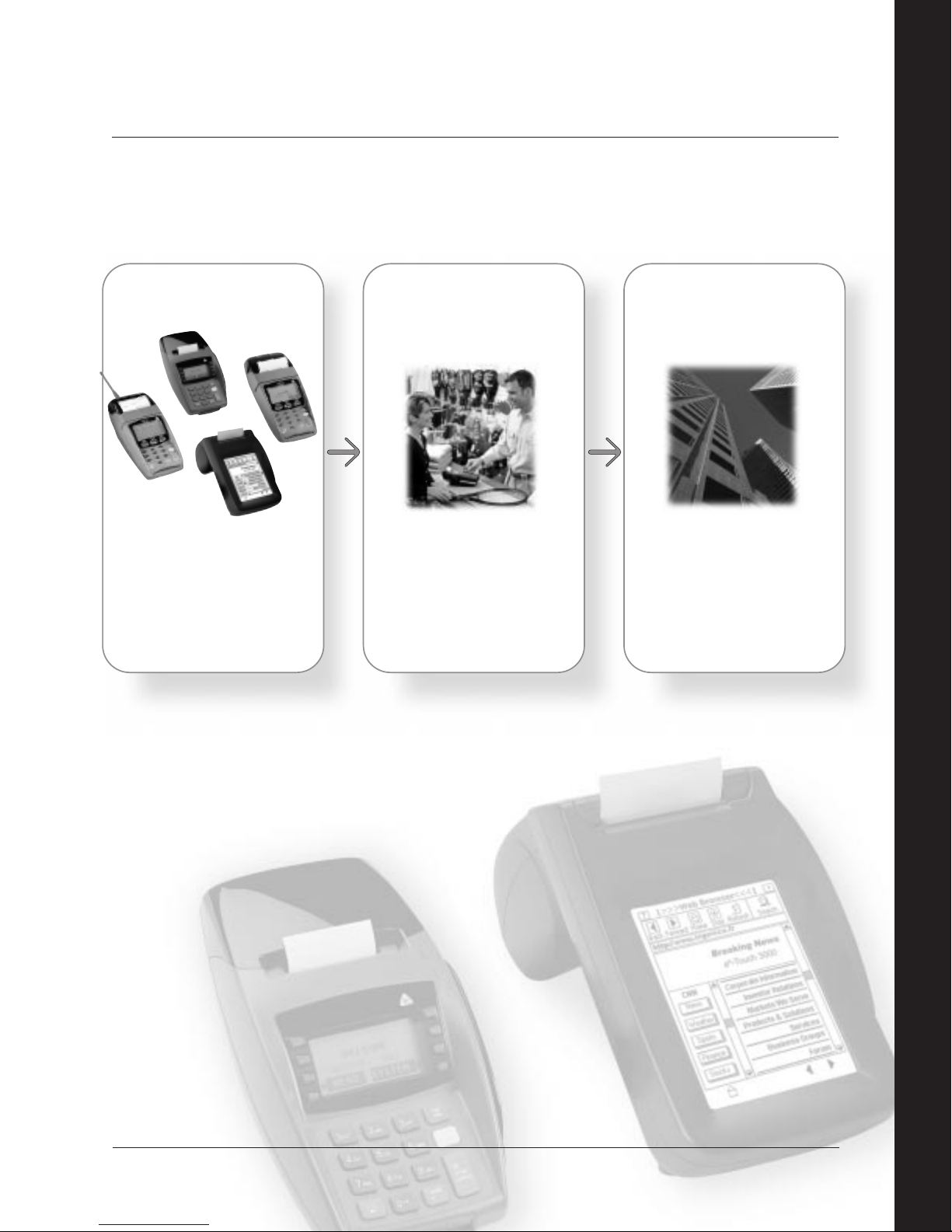
Payment & web-enabled
terminals and readers
In-store payment
transaction management
and value-added services
delivery
➥
Thin Client technology
➥
Application portability
➥
Core application
➥
Secure multi-application support
➥
Comprehensive development
environment
➥
Open platform
➥
Debit card conversion
➥
Check conversion
➥
Loyalty and gift cards
➥
Network services and tools
➥
Terminal asset management
➥
Loyalty and gift cards
➥
Receipt, signature and image
management
CREDIT
DEBIT
CHECK
EBT
ACH
INGENICO
We are applying our leadership in secure transaction technology, open
systems, connectivity, multi-application support, multi-lane payment technology
and value-added services to provide proven and robust solutions for the
merchant bankcard industry. We deliver the systems you need today while
positioning for tomorrow’s trends and technologies.
Supporting the transaction
authorization, settlement,
value-added service and
financial service offerings
of our customers
Page 4

INTRODUCTION
This paper introduces the merchant bankcard
industry to the attributes and value of an open
bankcard processing environment. An open
bankcard processing environment provides
significant benefits to financial institutions,
processors, ISOs and merchants:
• Lowers processor, financial institution and ISO
support and operational costs by standardizing
EFT POS terminal application support and
development.
• Provides the ability to seamlessly integrate new
payment types and terminal technologies into
your merchant terminal offerings.
• Provides the ability to leverage existing
solutions to open new market opportunities for
enterprising processors, financial institutions
and ISOs.
• Provides the ability to introduce and effectively
market value-added solutions to your merchant
base that drive incremental revenue and
customer loyalty for the merchant and recurring
revenue to you.
• Supports and enhances the payment function
at the point of service – faster customer
service, improved ease of use, security and
management of the terminal asset.
This paper presents the components of an
open bankcard processing environment while
also discussing how touch screen, TCP/IP and thin
client technologies can provide added benefit to
financial institutions, processors, ISOs and
merchants. It is brought to you by the leader in
secure transaction solutions, Ingenico.
INGENICO
2.
Page 5

3.
THE MERCHANT BANKCARD
INDUSTRY TODAY
Market Trends
• Small merchants have the same requirements as
large merchants – the need to operate efficiently,
the need to serve customers quickly, the need to
lower the cost of payment and the need to avoid
fraud.
• Small merchants need customer relationship
management tools to effectively compete against
other small merchants as well as the large
national retail chains.
• Merchant attrition is a tremendous issue for
financial institutions, processors and ISOs.
Retailers have been “conditioned” to look for
the best price and trouble free service. When a
provider fails to give trouble free service, the
retailer will switch networks very quickly. As a
result, financial institutions and processors lack
the ability to differentiate themselves with other
than price and “issue avoidance”.
• Price competition is the primary means of
winning new business, however, pricing is never
a sustainable competitive advantage.
• Processors, financial institutions and ISOs lack
the means to keep in frequent contact with their
merchant customers.
• The primary objective of an EFT POS terminal is
to support the payment process – anything that
delineates from serving the customer will not be
accepted by merchants or those whom directly
support the merchant. However, value-added
services such as messaging, frequency, electronic
gift certificates that complement the payment
processor are positioned for market success.
• Retailers are looking towards their payment
processing provider to update technology for
payment, settlement, and reporting. This includes
Internet access for transaction histories, chargeback requests and other information that a
retailer would like “on demand”.
• Retailers are beginning to request a single image,
regardless of whether the customer shops online
or in the store - integration of the store front and
web based commerce is key.
Technology Trends
• Retailers with integrated payment are slowly
migrating to open systems and industry
standard components such as are used by cell
phones, pagers, palm pilots, ECRs and PCs.
This will lead to adoption of open systems and
industry standards by smaller merchants with
dial payment.
• Proprietary programming languages and
development platforms are giving way to open
environments for EFT POS terminals.
• Smart cards are soon going to make an impact in
our industry – not for stored value as previously
marketed – but for credit and debit transactions
as well as value-added services such as electronic
gift certificate, loyalty and frequency.
• Terminal manufacturers will need to update their
EFT POS terminal offerings to include EMV
approvals if they are going to do business in the
next few years. The leading card associations
will require EMV level I and II approval.
• Terminal manufacturers are examining
technologies such as Bluetooth, USB, touch
screen and TCP/IP – these technologies will
enable processors to implement exciting new
and innovative solutions that help ISOs,
processors and financial institutions churn
the market.
• Processors are going to begin updating
their networks from 1200 and 2400 bps
communication speeds and move away from
outdated protocols to “PC like” speeds and
implement connectivity through DSL and
cable modems.
• Processors will update their communication’s
infrastructure to leverage the power and
capabilities of the Internet in a controlled and
orderly manner that adds value to their merchant
relationship and supports the payment function.
Page 6

INGENICO
4.
WHY AN OPEN BANKCARD
PROCESSING ENVIRONMENT
IS NEEDED
• An open bankcard processing environment
is built upon open systems and industry
standard components, allowing it to be
upgraded and enhanced without concern for
proprietary and legacy elements. This also
reduces the operational and investment costs
for those providing network services.
• An open bankcard processing environment
positions financial institutions and processors
for today’s and tomorrow’s payments, making
it much easier to implement emerging
tender types.
• An open bankcard processing environment
allows the user to quickly introduce new
services and products or to quickly enhance
existing ones with new features.
• An open bankcard processing environment
positions financial institutions and processors
to seamlessly support multiple vendor
terminals.
• An open bankcard processing environment
allows manufacturers to quickly adapt
technology that has been proven in other
industries.
• An open bankcard processing environment
is simpler to implement, operate and support
than a proprietary network.
• Industry standard technologies lower a
manufacturer’s cost of bringing product to
market while ensuring the ability to upgrade
their systems later as new features are made
available.
• Industry standard technologies and open
development platforms enable processors,
financial institutions and ISOs to apply EFT POS
solutions to other markets that have similar
needs, thus opening new markets and revenue
opportunities.
• An open bankcard processing environment
provides ISOs, processor and financial
institutions with the ability to differentiate
themselves by leveraging industry standard
development systems and tools to enhance
their systems and services.
Open Platforms
Open Platforms is a committee that is part of
GlobalPlatforms and STIP consortiums. The group’s charter is
to develop standards for applications that are interoperatable
between EFT POS terminals, cell phones, PDA, vending machine
card readers and any other device in which a transaction occurs.
Ingenico chairs this committee.
Page 7

COMPONENTS OF AN OPEN
BANKCARD PROCESSING
ENVIRONMENT
An open bankcard processing environment is
comprehensive, open and robust. It is a network
built upon open system standards with industry
standard products. There are four components to
an open bankcard processing environment.
Those are:
• Payment and web-enabled terminals
• In-store transaction payment and value-added
services
• An industry standard network using protocols
such as TCP/IP
• Host-level transaction authorization, settlement, value-added services and financial
services that support and enhance the
processor, financial institution and ISO
offerings
Payment and Web-Enabled Terminals
Attributes of payment and web-enabled terminals
that work in an open bankcard processing
environment include:
• Point of payment for credit, debit, check, EBT,
purchase card I and II
• A single application that can be used on a
range of EFT POS terminals – countertop,
portable, handheld and wireless
• Thin client technology that enables financial
institutions and processors to deliver valueadded services faster and at less cost
• Application portability from one terminal
platform to another, reducing certification time
and cost while reducing help desk complexity
and cost
• A base application and comprehensive
development environment that provide a
feature-rich application and the ability to
customize the base application while adding
functionality as your needs dedicate
• A secure multi-application development
and operations environment that maximizes
efficiency, integrity and security through
firewall protection
5.
Page 8

INGENICO
6.
In-Store Transaction Payment and
Value-added Services
In addition to payment, there is the need to deliver
and manage both transaction functions and valueadded services at the store level by leveraging
technologies to improve processor and merchant
communications that speed settlement, control
fraud and assist the merchant in building better
customer relations:
• Retailers with dial EFT terminals want to offer
the same tender types as larger retailers
• Software that enables merchants to convert
electronic payment types to the lowest possible
transaction cost during checkout
1
• Check conversion solutions that eliminate
check handling in the store while speeding
customer checkout, settlement and improving
NSF check collection
• Loyalty and Gift Cards solutions that eliminate
frequency program fraud, lower the cost of
implementing frequency programs, help better
merchant/customer relations and drive
incremental revenue
An Industry Standard Network Using
Protocols Such as TCP/IP
The foundation of an open bankcard processing
environment is TCP/IP
2
. TCP and IP were developed
to connect a number of different networks
designed by different vendors into a “network of
networks” (the Internet). These protocols deliver
services that everyone needs (file transfer,
electronic mail, remote logon) across a very large
number of client and server systems. TCP/IP is
designed to be robust. This design allows the
construction of very large networks with less
central management. TCP/IP is the protocol
on which the Internet and open network
communications are built.
Page 9

7.
For the processor, financial institution, ISO
and merchant, the value of TCP/IP is immense
3
:
• Saves the processor long distance charges by
“piggy-backing” onto local Internet traffic
• Using IP, permits direct access to third party
hosts - a merchant can address many hosts
versus only one host
• Enables ISOs to deliver value-added services
to their merchant base that build merchant
relations while driving recurring revenue,
via thin client
• Positions financial institutions and processors
to implement interactive asset management,
remote diagnostics and remote downloading
of applications, files and encryption keys
• TCP/IP can be leveraged to interactively train
and update merchants
• Positions financial institutions and processors
to implement and merge Intranets, secure
Intranets, and merchant communications
• TCP/IP is unhindered by past proprietary
network investments by providing an open
and secure network
What If
In addition to collecting the batch, a processor collects
the terminal’s error log that monitors the health of the terminal.
While analyzing the error log, the processor’s computer systems
note that the printer is beginning to send NAC’s. The processor
ships a new printer to the merchant without the merchant
knowing that there was an issue.
The Need for High Speed Communications
In order to deliver value-added customer
services and to perform asset management,
communications flexibility and speed are
paramount. In the e
N
-Touch 3000, an integrated
33.6 bps modem with TCP/IP provides fast
downloads of software enhancements and files as
well as “thin client” capabilities required to support
an open bankcard processing environment.
SUPPORTING THE HOST-LEVEL
TRANSACTION AUTHORIZATION,
SETTLEMENT, VALUE-ADDED
SERVICES AND FINANCIAL SERVICES
OF PROCESSORS AND FINANCIAL
INSTITUTIONS
In addition to transaction authorization and
settlement functions, processors and financial
institutions must be positioned to deliver custom
value-added customer services and financial
services to the retailer. Those include:
• Network services
• Terminal asset management
• Loyalty and gift cards
• Receipt, signature and image management
1
For additional information about Online Debit, please visit www.ingenico-us.com or www.ingenico-ca.com
2
Transport Communications Protocol/Internet Protocol
3
For additional information about TCP/IP and how it can benefit you, please visit www.ingenico-us.com or www.ingenico-ca.com
Page 10

INGENICO
8.
Network Services
As broadband and DSL networks emerge,
processors and financial institutions will need the
ability to convert proprietary message protocols
such as X.25, NAC, sync, and async to open
system-based protocols such as IP and Ethernet.
This will be true not only of dial and lease-line
communications but also of wireless. Wireless
protocols such as CDPD and Mobitex are giving
way to CDMA and GPRS while GSM has become
the standard in Europe.
Processors and financial institutions will
need the ability to perform file transfers of
messaging and applications to retailers, using
open communication standards. Retailers, in turn,
will need the means to access secure and
formatted web portals for value-added customer
services.
Processors and financial institutions will also
need the ability to perform secure file transfers
such as key injection, unique merchant information, firewalls, and asset management so
reprogramming is more difficult.
Gateway Services will also become important
as our telecommunications environment matures.
Front-end EMV management, thin client services,
and one-to-one marketing are possible through an
open bankcard processing environment.
Processors and financial institutions will need
the option of implementing network services as
we have discussed as a service or hosted within
their own data center.
Terminal Asset Management
Part of an open bankcard processing environment
is the ability for a processor or financial institution
to manage their installed base of EFT terminals
throughout the terminal’s life. The asset management application should provide the following in a
multiple vendor and terminal model mode:
• Configurations
• Installations
• Software downloads
• Remote key injections
• Inventory control
• Maintenance
• Remote diagnostics
There are significant benefits to automating
terminal asset management:
• Self installation removes the need to have a
sales person install a terminal or train the
retailer, presenting an immediate cost savings
from day one of the installation.
• Configuration downloads facilitate an easy
and low cost means of controlling and updating
a terminal's configuration and application
content.
• Software downloading provides an alternative
to the cost of swapping out terminals to
upgrade them with new or revised software
applications.
Page 11
9.
• Detailed understanding of the software level in
each terminal ensures that the correct software
modules are downloaded during the upgrade
process, thus minimizing communications costs.
• A stock control feature provides a highly
efficient means of managing terminal stock by
reducing the repair stock requirement and
increasing terminal availability.
• Additionally, further cost reductions are
achieved by deploying refurbished and
swapped stock before accessing new stock.
• The maintenance and diagnostics features of
an asset management system reduce the repair
diagnosis time and maximize the speed in
which terminals are re-deployed into the field.
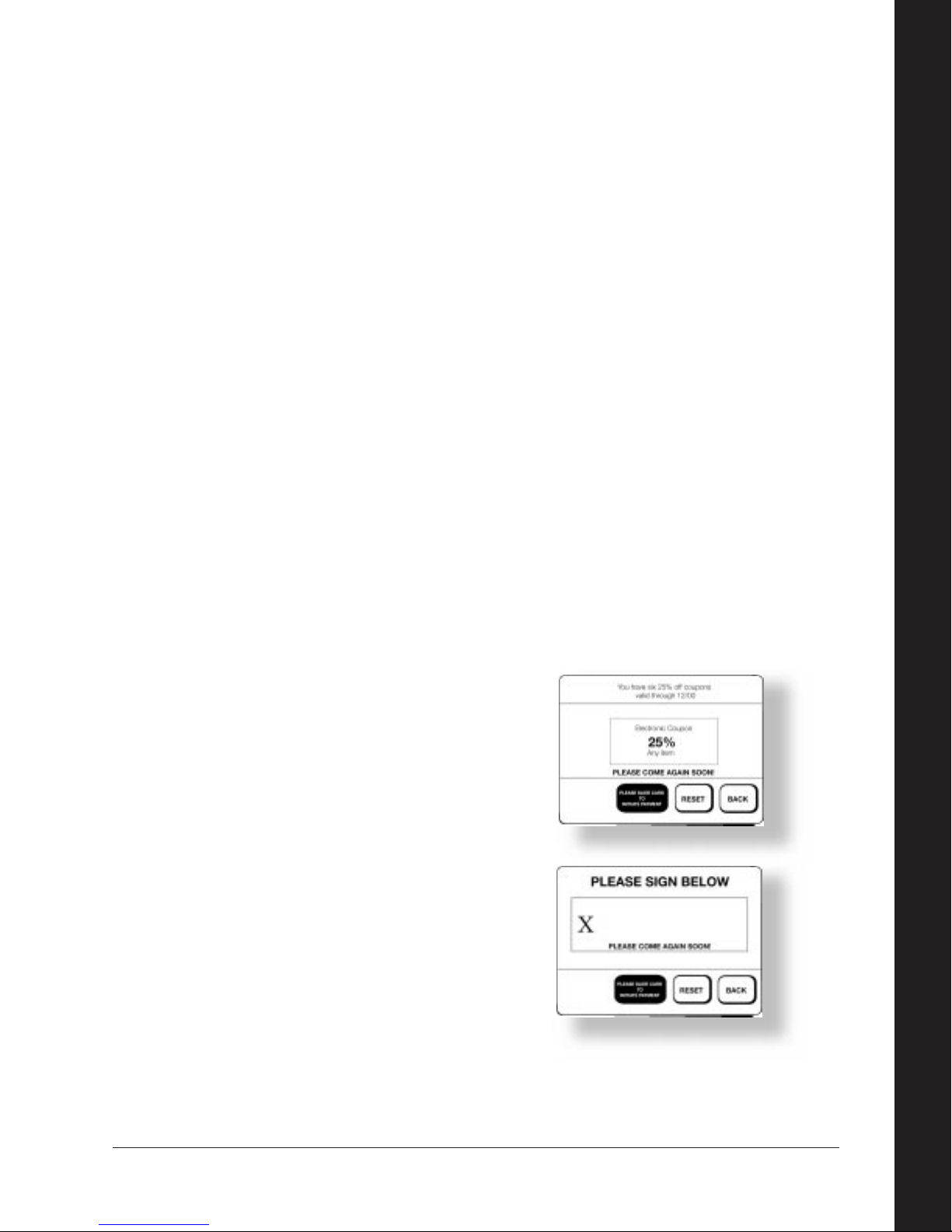
Receipt, Signature and Image Management
4
Receipt, signature and image management systems
automate the collection of credit card receipts,
credit card signature images, check images and
other documents that may be of value to the retailer
or customer such as credit applications, service
agreements and warranty statements. There are
five components of receipt, signature and image
management. Those are:
• Receipt, signature and image acquisition at
the store level
• Receipt, signature and image transmittal to
the host platform
• Receipt, signature and image storage at the
host level using open systems standards such
as ODBC and industry standard databases
• Signature and receipt image retrieval via a
secure browser interface through the Internet
or Intranet
• Automated Request for Copy by a financial
institution through Internet
Loyalty and Gift Cards
Smaller merchants want to provide value-added
services that drive incremental revenue and build
customer relationships just as nationally based
retailers. Merchants want the ability to work with
magnetic stripe cards, smart cards, or paper based
gift certificates. The system needs to be able to
issue cards or certificates, predetermine the value,
activate instantly, permit redemption and allow
balance inquiry.
4
For additional information about Issues and Elements of Credit Card Receipt and Signature Management, please visit
www.ingenico-us.com or www.ingenico-ca.com
Page 12

INGENICO
10.
TOUCH SCREEN AND WEB-BASED
TECHNOLOGY
Touch screen and web-based technology will
deliver payment and value-added customer
services to your merchants.
Touch screen technology offers a versatile,
efficient and robust platform from which to deliver
applications for retail payment, e-commerce,
Internet messaging and more. A touch screen
allows graphics to be easily displayed while
operating convenience is greatly enhanced.
A touch screen provides programming flexibility
and ease of use never before available in a keytype payment terminal such as:
• Intuitive operator lead through that eliminates
or greatly reduces training time and cost
• Engaging graphical based messages and
screens
• Messaging in an easy-to-read format
• Internet browser that can be displayed
on screen
• Context-sensitive help screens
CUSTOMER VALUE-ADDED ENHANCED TERMINAL
PAYMENT FUNCTIONALITY MANAGEMENT
• Credit
• Debit
• EBT
• Check
• Loyalty
• Electronic couponing
• Electronic gift certificates
• Gift certificates
• Marketing
• Cross selling
• Time card attendance
• Cash register functions
• Merchant and operator training
• Context sensitive help
• Internet gateway
• Remote diagnostics
• Trouble shooting
• Remote key loads
Payment and Value-Added Customer Services
The following are applications and services that are enhanced through a touch screen interface:
Page 13

11.
WHY TOUCH SCREEN TECHNOLOGY
5
An Intuitive User Interface
Touch screens can be designed to display
transactions in an easy-to-view manner that
enabled new or experienced operators to use the
terminal with no or minimal training. Touch
screens can also be programmed to display only
what is necessary to complete the particular step
of the transaction, eliminating operator confusion.
A touch screen application can be programmed
to feature short cuts and context-sensitive help,
which provides only that help information an
operator or manager needs to complete that
segment of the transaction. A franchisee of Taco
Bell that installed touch screen technology stated,
“Touch screens have transformed the way we
serve our customers. It was overwhelming how
quickly touch screens were accepted and
embraced by both our employees and customers.
Ninety-nine percent of our business is now
handled via touch screens”.
Reduces Help Desk Costs
When terminal operators and store manager/
owners use an intuitive user interface, the
frequency of calls to the supporting help desk
drops dramatically. The percentage of decrease is
dependent upon the touch screen layout and the
complexity of the transaction set. Ingenico’s
e
N
-Concert Consulting Services professionals can
assist in designing the user-friendliest screens
and transaction formatting possible.
Reduces Cost of Sales
When terminal operators and store manager/
owners are provided with an intuitive user
interface, the need for the merchant bankcard
salesperson to visit the retailer to resolve training
and operational issues is dramatically reduced.
This provides two advantages:
• The salesperson has more time to sell
• The merchant is happier and is more readily
open to new services
5
For additional information about Touch Screen Technology and how it can benefit you, please visit www.ingenico-us.com
or www.ingenico-ca.com
Page 14

INGENICO
12.
WEB-BASED THIN CLIENT
TECHNOLOGY
Thin Client is a simple user interface requiring
minimal memory that is resident in the EFT POS
terminal. The EFT POS terminal communicates
with a server located at the financial Institution,
processor or wherever the application is hosted.
The application that the merchant is running is
actually located at the host with only the interface
and the communication portal located in the
terminal.
Why Use Thin Client Technology?
By hosting the application on the processor or
financial institution’s server and only the user
interface on the EFT POS terminal, the processor
or financial institutions gain the following benefits:
• Decreased application and service delivery time
• Decreased certification time, re-certification
time and cost since applications are host-based
with only the operator interface located in the
terminal
• Decreased deployment time since applications
are based at the host
• Decreased amount of memory terminal
requires for value added services
• Increased merchant retention by providing
value-added services that increase your value
to the merchant
A DEVELOPMENT ENVIRONMENT
TO SUPPORT AN OPEN BANKCARD
PROCESSING ENVIRONMENT
A holistic development environment is needed
that supports every step of the programming and
application support process
Processors, financial institutions and ISOs
will need an EFT POS terminal application development environment that allow programmers
and developers to quickly and easily program
all members of their terminal offerings. From
design to deployment to ongoing support, the
development environment must provide the
architecture and tools necessary to develop
secure and feature-rich applications
6
.
Development Environment Components
• The development environment must provide
an Application Programming Library (APIs)
and sample applications with “ready-to-go”
application code modules that a programmer
can plug into their application, saving time in
the development process. This enables
programmers and developers to concentrate
on application functionality rather than
programming routine tasks over and over
again.
• A development environment should provide
an application source generator that allows
programmers to automate the application
development process.
Page 15

13.
• A development environment should provide
simulation tools to help a developer test
application code in single or multi-application
environment.
• A development environment should provide
testing and debugging utilities that allow
programmers to debug application code on the
development platform, without downloading
the application to the destination device.
• A development environment should provide
Windows
®
based download utilities that allow
the developer to download applications to the
target terminal.
Development Environment Attributes
• The architecture must be built to provide
optimum flexibility for programmers while
providing maximum security for applications
and data residing on the terminal.
• The development environment must support
multi-applications in a single terminal,
protecting your long-term investment.
• Applications written using a development
environment must be secure. Access to each
application resident on the terminal must be
controlled by a security module that allocates
shared resources.
• An application developed for one terminal
using the development environment should
be able to be used for another terminal with
modification to the destination user interface
and communications method through API’s,
saving considerable programming time.
Development Environment Benefits
• Applications written for a single terminal can
be leveraged across a broad range of terminals.
• The development environment can support
multiple applications that securely reside on a
single terminal – payment, loyalty, time &
attendance and others.
• Application program quality is improved.
• Application testing and debugging is simplified.
• Application certification and re-certification
is simplified.
• Help desks need to learn only one core
application, one core user manual and one
core user interface.
EMV
The EMV standards were created by a working
group founded in 1993 by the world’s three main
payment organizations: EUROPAY (EPI),
MasterCard (MCI) and VISA. The name EMV is
derived from the first letter of each organization’s
name. The group’s charter is to define a common
set of standards (EMV standards) for smart card
based payment applications. These standards
allow the card and the acceptance device (EFT
POS terminal) to work seamlessly and securely
together.
6
Ingenico’s UNICAPT architecture and development environment is a comprehensive suite of tools that EFT POS terminal developers can use
to develop multi-application solutions that are portable. For more information about UNICAPT, visit www.ingenico-us.com or
www.ingenico-ca.com
Page 16

INGENICO
14.
The EMV specifications were written with
the following goals in mind:
• The card and acceptance devices must
communicate together and indicate what
applications the card and acceptance devices
have in common
• The acceptance device can run common
applications and ensure that standards for risk
control and security are applied for debit/credit
applications
• The microprocessor-based payment card
provides worldwide acceptance and
interoperability
Ingenico’s Ingesys is a front end EMV server that allows
ISOs, processors and financial institutions to comply with
international EMV standards. For more information about
Ingesys please visit Ingenico’s web site at www.ingenico.com.
WHY IS A SMART CARD STANDARD
NEEDED?
Fraud Reduction
Fraud is not as prevalent in the U.S. as
internationally, but is expanding rapidly in
e-commerce. Increased cardholder security could
increase use of the Internet for online shopping.
Recent consumer surveys have found that the
e-commerce market could easily see double-digit
growth if cardholder security fears were alleviated.
Additionally, Internet merchants accepting smart
card enabled transactions could receive incentives,
such as a discounted rate.
Manage a Growing Number of Transactions
Global debit and credit transaction volumes have
increased dramatically over the last few years and
will continue to do so for the foreseeable future.
POS terminals that read magnetic stripe cards
require an ON LINE connection to obtain the bank’s
authorization. If smart cards are used for
debit/credit applications, the main part of the
transaction can be performed OFF LINE, saving
time and money. Additionally, the ability to perform
transactions offline expands the retailer’s ability to
reach a consumer anytime, anywhere without need
for network and telephone availability.
Ensure Interoperability of Different Debit/Credit
Applications
A prerequisite for the establishment of a global
payment card scheme is that a card is able to work
anywhere and that the associated transactions be
processed regardless of geographic boundaries.
This prerequisite is generally referred to as
interoperability.
Multiple Services on a Single Card
Financial institutions that are issuing smart card
and magnetic stripe based cards are doing so to
provide payment and value-added services such
as loyalty. Magnetic stripe cards alone cannot
provide multiple services.
Page 17

15.
INGENICO IS THE LEADER IN EMV APPROVALS
Elite Terminal Family Members that are EMV Level I and II Approved
Elite 510 Countertop EFT POS Terminal
The latest counter-top terminal from Ingenico is equipped with a 16-bit
processor, which provides power and performance. Its memory can be
extended up to 4 Mb.
Elite 730
Elite 730 is one complete terminal that handles credit, debit, electronic
benefits transfer, stored value, loyalty or any transaction that can be
carried out with a card. The portable design allows you to carry it to
the consumer, who can swipe or insert their card and enter their
PIN number.
Elite 770 Short Range Wireless POS Terminal
This new portable terminal from Ingenico has a 16-bit processor.
It is available in two versions:
• Infra-red allows payments to be made at the counter as well as
offering an extra level of service to the card holder
• Radio is for users such as restaurateurs for whom portability is
essential. Payment can be carried out at the table without the
customer losing sight of his card.
Elite 780 Long Range Wireless POS Terminal
The portable and wireless Elite 780 features a thermal printer, smart
card reader, magnetic stripe card reader, secure PIN pad, wireless
modem and rechargeable battery pack—all integrated into a lightweight
and ergonomic design. It supports up to four Secure Access Modules
(SAMs) and operates on the Mobitex or CDPD networks.
Ingenico is the only manufacturer with its entire range of products EMV levels I and II approved.
Page 18

INGENICO
16.
ABOUT INGENICO
Ingenico is a worldwide leader in the manufacture
and distribution of secured transaction technology.
Ingenico products and solutions serve the
transaction and information needs of customers
through superior innovation, standards leadership
and service excellence. See www.ingenico.com
for more information.
THE INGENICO VALUE PROPOSITION
We are applying our leadership in secure
transaction technology, open systems, connectivity, multi-application support, multi-lane payment
technology and value-added services to provide
proven and robust solutions for the merchant
bankcard industry. We deliver the systems you
need today while positioning for tomorrow’s
trends and technologies.
We are the worldwide leader in smart card
terminal technology and EMV approvals, providing
you with the opportunity to leverage our expertise
in smart card based commerce.
We offer proven, robust and open solutions that
help you...
• Retain your merchant base
• Grow your merchant relationship through
value-added services that generate revenue
for you
• Increase your opportunities by opening new
markets to you
• Lower your cost of business
Page 19

Page 20

Ingenico North America
1003 Mansell Road - Atlanta, GA 30076
Tel: (770)594-6000 - Fax: (770)594-6003
www.ingenico-us.com
79 Torbarrie Road - Toronto, Ontario
Canada M3L 1G5
Tel: (416)245-6700 - Fax: (416)245-6701
www.ingenico-ca.com
Groupe Ingenico
9, quai De Dion Bouton
92816 Puteaux Cedex - France
Tel : 33 (0)1 46 25 82 00 - Fax : 33 (0)1 47 72 56 95
www.ingenico.com
 Loading...