

Page 1

Operating Instructions
50cm Free Standing Gas Cooker
GB
English,1
KD3G2/G
KD3G2S/IR
KD3G2SL/IR
KD3G21/G
KD3G21S/IR
KD3G21SL/IR
Contents
GB
Introduction, 2
Installation, 3-7
Gas connection
Electrial connection
Adapting the cooker to different types of gas
Burner and Nozzle Specifications
Safety Information, 8
Features, 9
Control Panel, 10
Use of hotplates, 11
Grilling, 12
Oven, 13
Oven cooking charts, 14
Care and Cleaning, 15
Cooking Results Not Satisfactory?, 16
Something Wrong With Your Cooker?, 17
If it Still Wont Work..., 18
Technical Characteristics, 19
Key Contacts, 20
You must read these instructions prior to using
your appliance and retain them for future use.
Page 2

Introduction
GB
Your new appliance is guaranteed* and will give
lasting service. This guarantee is only applicable if
the appliance has been installed in accordance with
the installation instructions detailed in this booklet.
To help make best use of your cooking equipment,
please read this booklet carefully.
The cooker is designed specifically for domestic use
and responsibility will not be accepted for use in any
other installation.
When the cooker is first used an odour may be
emitted, this will cease after a period of use.
When first using the cooker ensure that the room is
well ventilated (e.g. open a window or use an
extractor fan) and that persons who may be
sensitive to the odour avoid any fumes. It is
suggested that any pets be removed from the room
until the smell has ceased. This odour is due to
temporary finish on oven liners and elements and
also any moisture absorbed by the insulation.
* The guarantee is subject to the provisions that
the appliance:
a. Has been used solely in accordance with the
Users Instruction Book.
b. Has been properly connected to a suitable supply
voltage as stated on the rating plate attached to
this equipment.
c. Has not been subjected to misuse or accident or
been modified or repaired by any person other
than the authorised employee or agent.
d. Has been correctly installed.
1. This appliance is intended for nonprofessional use
within the home.
2. These instructions are only for those countries
whose symbols appear in the booklet and on the
serial no. plate of the appliance.
3. This owners manual is for a class 1 appliance
(insulated) or class 2, subclass 1 appliances
(installed between two cabinets.
2
Page 3
150 mm
150 mm
650 mm
Installation
The appliance must$only be installed by a
competent person. In the UK, CORGI registered
installers undertake to work to safe and
satisfactory standards.
Before moving your cooker check that it is cool, and
switch off at the cooker control unit. Movement of
your cooker is most easily achieved by lifting the
front as follows:
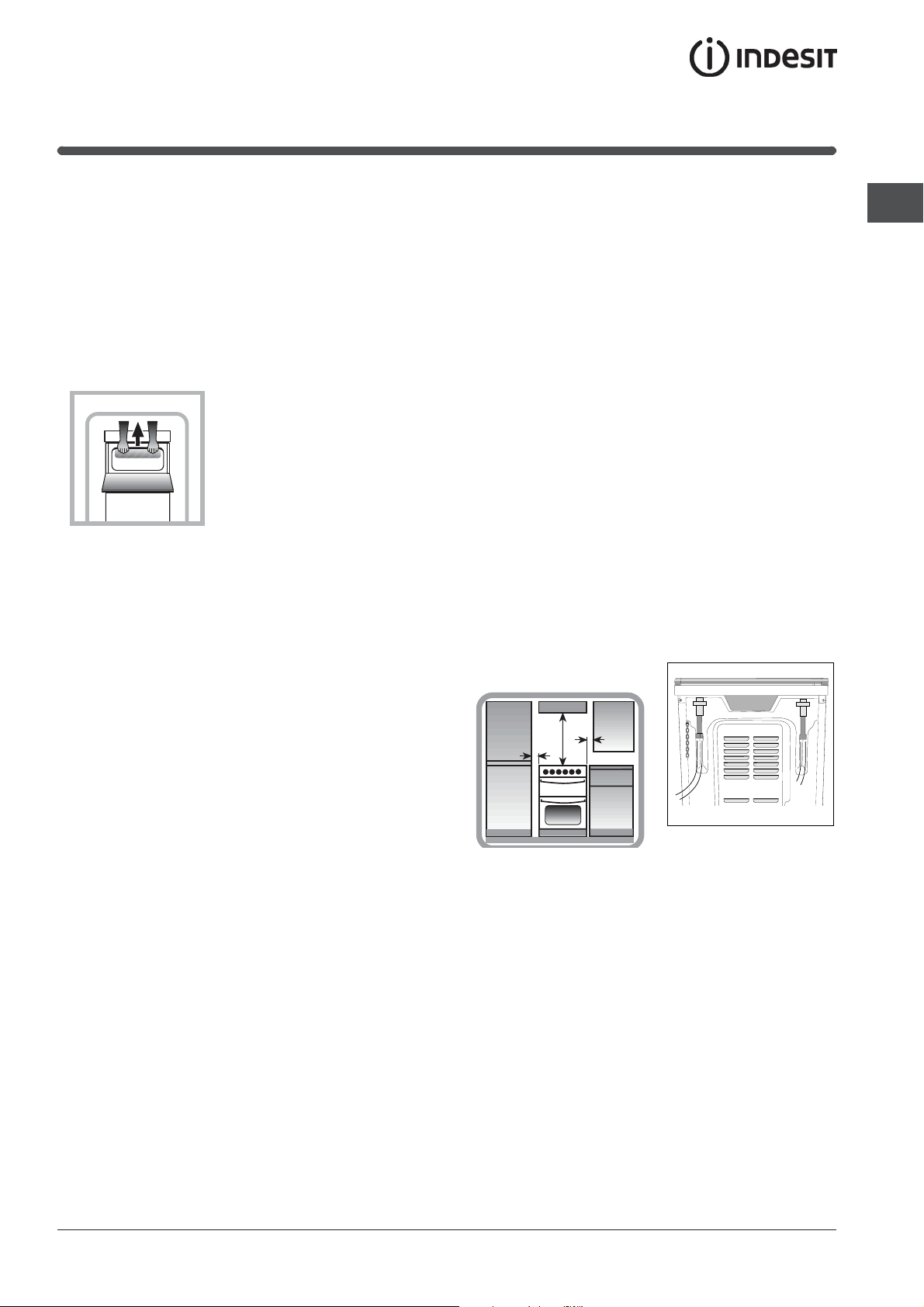
Open the grill door sufficiently to allow a comfortable
grip on the underside front edge of the oven roof,
avoiding any grill elements.
Moving the Cooker
Take care in moving the
cooker as it is heavy. Take
care to ensure that any floor
covering is not damaged. (see
figure)
Splashplate optional, apply to
Parts Department (see Back
Cover for contact number.)
The following instructions should be read by a
qualified technician to ensure that the appliance is
installed, regulated and technically serviced
correctly in compliance with current regulations.
remember to unplug the appliance from the
mains before regulating the appliance or carrying
out any maintenance work.
This appliance must not be fitted on a platform.
The cooker is designed to fit between kitchen
cabinets spaced 500mm apart. The space either
side need only be sufficient to allow withdrawal of
the cooker for servicing. It can be used with
cabinets one side or both as well as in a corner
setting. It can also be used free-standing.
Adjacent side walls which project above hob level,
must not be nearer to the cooker than 150mm and
should be protected by heat resistant material. Any
overhanging surface or cooker hood should not be
nearer than 650mm. (Fig.A)
a.The cooker may be located in a kitchen, a kitonen/
diner or bed sitting room, but not in a bathroom or
shower room.
b.The hoods must be installed according to the
requirements in the hood handbook.
c.The wall in contact with the back of the cooker
must be of flameproof material.
d.The cooker is fitted with a safety chain that must
be attached to a hook, secured to the wall behind
the appliance.
some models can have their gas connection
inverted. It is important to make sure the safety
chain is always situated on the side which
corresponds to the hose holder (Fig. B).
GB
Positioning
this unit may be installed and used only in
permanently ventilated rooms according to the
British Standards Codes Of Practice: B.S. 6172/B.S.
5440, Par. 2 and B.S. 6891 Current Editions. The
following requirements must be observed:
a. The cooker should not be installed in a bed sitting
room with a volume of less than 20m
installed in a room of volume less than 5m
2
vent of effective area of 110cm
is required, if it is
installed in a room of volume between 5m
3
a supplementary airvent area of 50cm2 is
10m
required, if the volume exceeds 11m
required. However, if the room has a door or a
window which opens directly to the outside no air
vent is required even when the volume is between
3
5m
and 11m3.
b. During prolonged use of the appliance you may
consider it necessary to open a window to the
outside to improve ventilation.
c. If there are other fuel burning appliances in the
same room, B.S.5440 Part 2 Current Edition,
should, be consulted to determine the requisite air
vent feet in the plinth (900mm - 915mm). Adjust
the feet by tilting the cooker from the side. Then
install the product into position.
3
. If it is
3
an air
3
and
3
no airvent is
Fig. A Fig. B
Gas connection
The cooker should be connected to the gas-supply
by a corgi registered installer. During installation of
this product it is essential to fit an approved gas tap
to isolate the supply from the appliance for the
convenience of any subsequent removal or
servicing. Connection of the appliance to the gas
mains or liquid gas must be carried out according to
the prescribed regulation in force, and only after it is
ascertained that it is adaptable to the type of gas to
be used. If not, follow the instructions indicated in
the paragraph headed Adaptation to different gas
types. On some models the gas supply can be
connected on the left or on the right, as necessary;
to change the connection, reverse the position of the
3
Page 4
GB
hose holder with that of the
HOT PARTS
cap and replace the gasket
(supplied with the appliance).
In the case of connection to
liquid gas, by tank, use
600 mm
pressure regulators that
conform to the regulation in
force. The gas supply must
be connected to the left of the
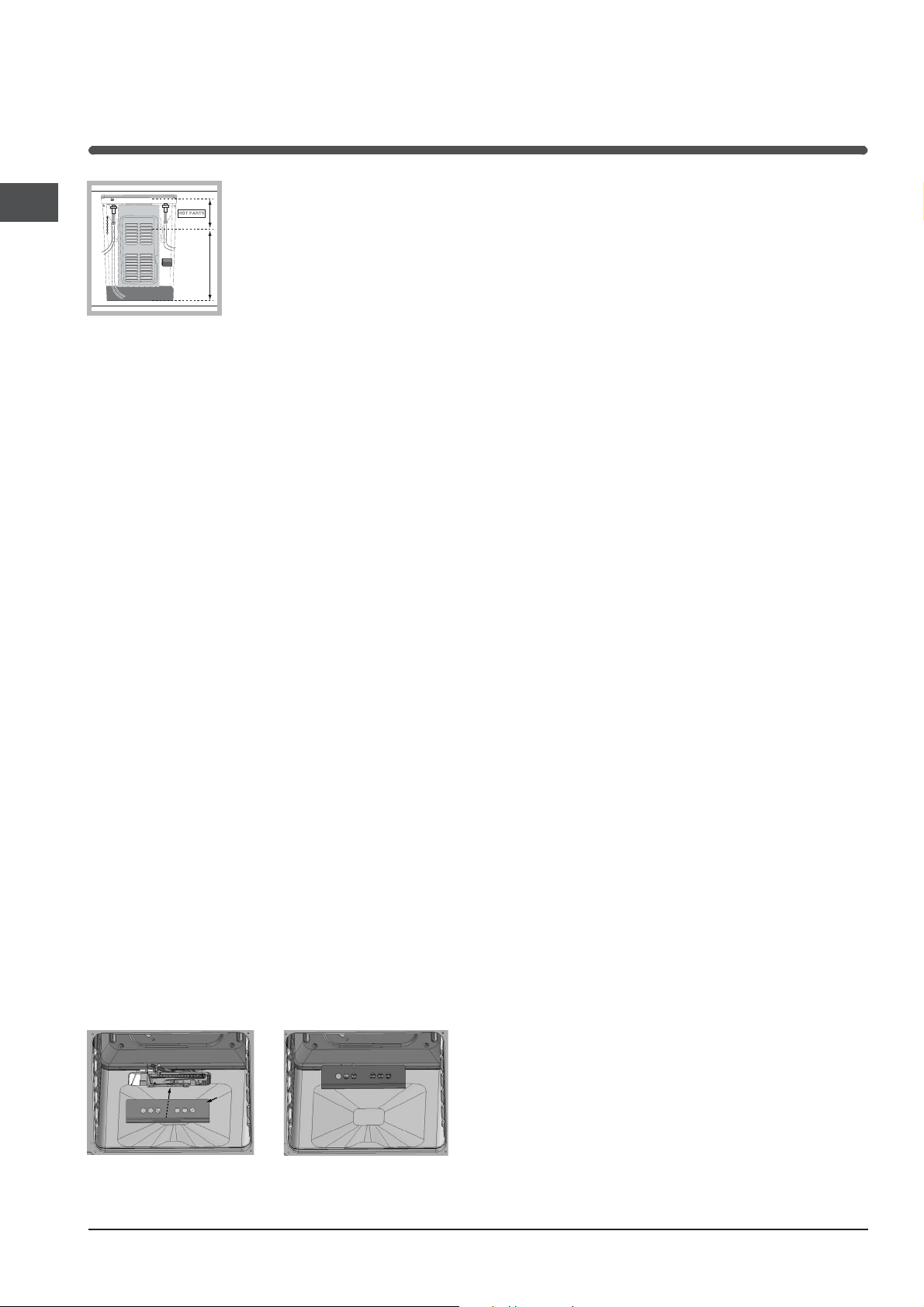
appliance. Be sure that the hose does not pass
through the rear of the cooker touching hot parts.
make sure the supply pressure conforms with
the values sho
wn in the table entitled
Caracteristics of the burners and nozzles.
When the cooker is installed between cabinets
(recessed), the gas connection must be effected
by an approved flexible hose with bayonet fitting
(BS669CurrentEdition). The gas inlet for the
cookers is a threaded G 1/2 gas female fitting.
Connecting the gas supply
To make the connection, a flexible hose should be
used corresponding to the current gas regulations
which are:
the hose must never be at any point in its lenght
in contact with the hot parts of the cooker;
the hose must never be longer than 1,5 metre;
the hose must not be subject to any tension or
torsional stress and it must not have any
excessively narrow curves or bottlenecks;
the hose must be easy to inspect along its entire
length to check its condition;
the hose must always be in good condition, never
attempt to repair.
the installation must comply with gas safety
(installation and use) regulations 1984. In all cases
for the above, by low, a qualified, corgi approved
engineer must be called for installation.
Before using the oven, position the oven burner
deflector "A" (provided with the appliance) in the
correct place by inserting the lower tab into the
support slot (see figure).
A
Electrial connection
Power supply voltage and frequency: 230-240V a.c.
50Hz.
the supply cable must be positioned so that it
never reaches at any point a temperature 50°C
higher than the room temperature. The cable must
be routed away from the rear vents. Should you
require it, you may use a longer cable, however, you
must ensure that the cable supplied with the
appliance is replaced by one of the same
specifications in accordance with current standards
and legislation.
Your appliance is supplied with a 13 amp fused plug
that can be plugged into a 13 amp socket for
immediate use. Before using the appliance please
read the instructions below.
WARNING - THIS APPLIANCE MUST BE
EARTHED.
THE FOLLOWING OPERATIONS SHOULD BE
CARRIED OUT BY A QUALIFIED ELECTRICIAN.
Replacing the fuse
When replacing a faulty fuse, a 13 amp ASTA
approved fuse to BS 1362 should always be used,
and the fuse cover re-fitted. If the fuse cover is lost,
the plug must not be used until a replacement is
obtained.
Re
placement fuse covers:
If a replacement fuse cover is fitted, it must be of
the correct colour as indicated by the coloured
marking or the colour that is embossed in words on
the base of the plug. Replacements can be obtained
directly from your nearest Service Depot.
Removing the plug:
If your appliance has a non-rewireable moulded plug
and you should wish to remove it to add a cable
extension or to re-route the mains cable through
partitions, units etc., please ensure that either:
the plug is replaced by a fused 13 amp re-
wireable plug bearing the BSI mark of approval.
or:
the mains cable is wired directly into a 13 amp
cable outlet, controlled by a switch, (in
compliance with BS 5733) which is accessible
without moving the appliance.
Please note: for appliances with a rating greater
than 13 amp (eg: electric hob, double ovens and
freestanding electric cookers etc.) the mains cable
must be wired into a cooker output point with a
4
Page 5
rating of 45 amp. In this case the cable is not
supplied.
Disposing of the plug:
Ensure that before disposing of the plug itself, you
make the pins unusable so that it cannot be
accidentally inserted into a socket. Instructions for
connecting cable to an alternative plug:
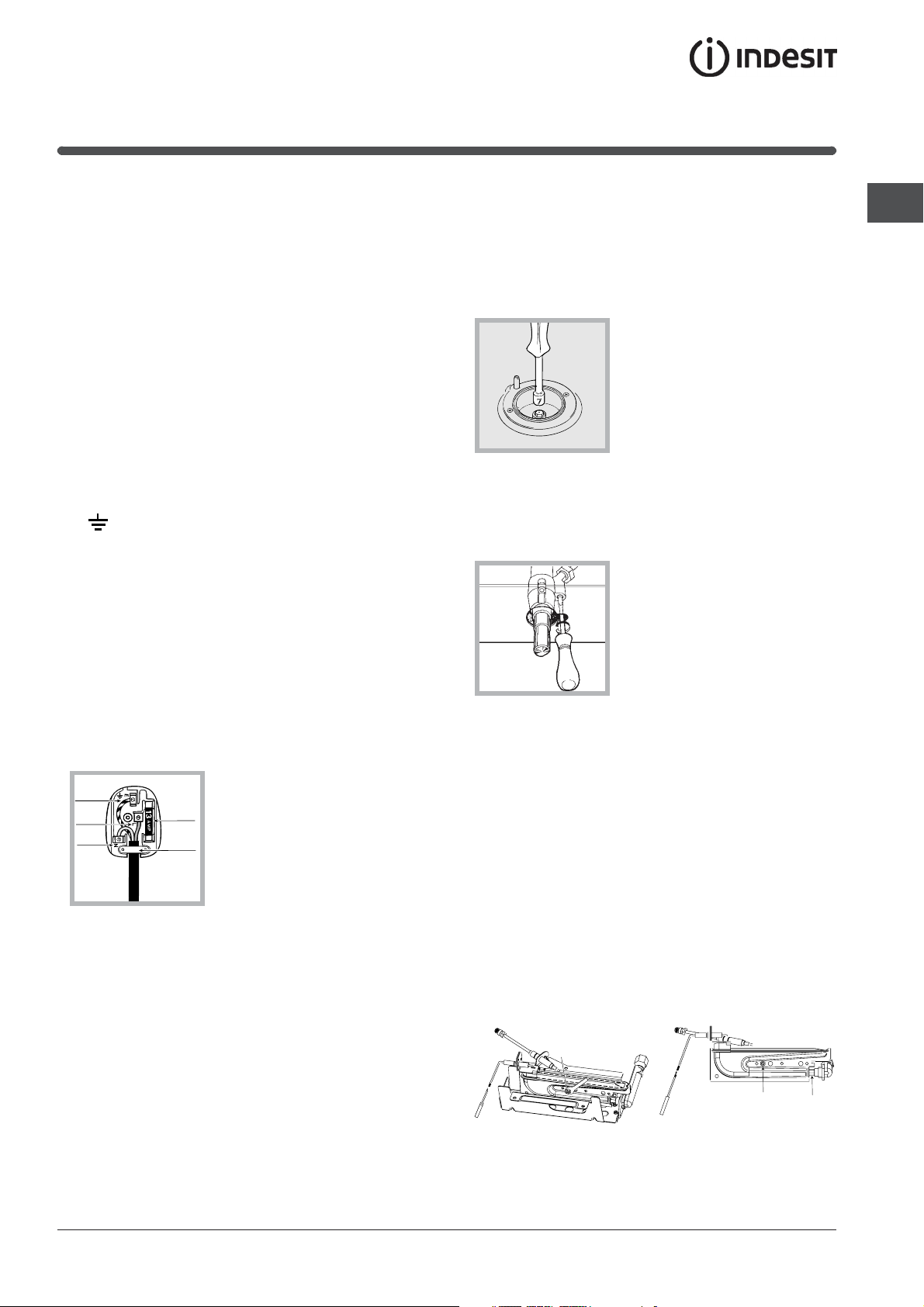
the wires in the mains lead are coloured in
accordance with the following code:
Green & Yellow - Earth
Blue - Neutral
Brown- Live
If the colours of the wires in the mains lead do not
correspond with the coloured markings identifying
the terminals in your plug, proceed as follows:
Connect Green & Yellow wire to terminal marked E
or
or coloured Green or Green & Yellow.
Connect Brown wire to terminal marked L or
coloured Red.
Connect Blue wire to terminal marked N or
coloured Black.
If a 13 amp plug (BS 1363) is used it must be fitted
with a 13 amp fuse. A 15 amp plug must be
protected by a 15 amp fuse, either in the plug or
adaptor or at the distribution board. If you are in any
doubt about the electrical supply to your machine,
consult a qualified electrician before use.
a)replace the hose holder mounted on the appliance
with that supplied in the bag of cooker
accessories.
b)Replacing the burner nozzles on the hob:
remove the grids and slide the burners from their
housings;
unscrew the nozzles using
a 7 mm socket spanner, and
replace them with nozzles for
the new type of gas (see table
1 Burner and nozzle
characteristics).
replace all the components
by repeating the steps in
reverse order.
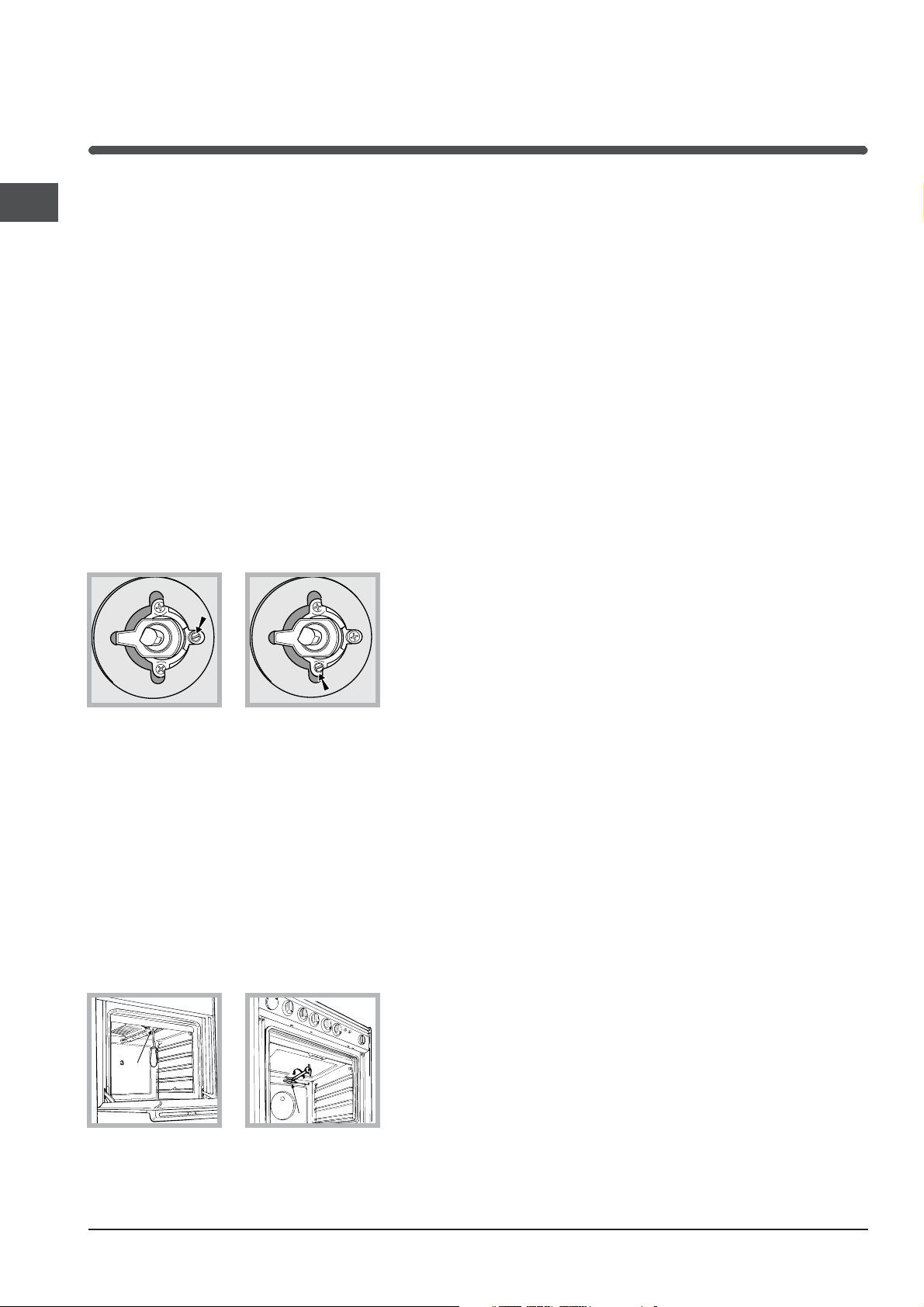
c)Minimum regulation of the hob burners:
turn the tap to minimum;
remove the knob and adjust the regulation screw,
which is positioned in or next
to the tap pin, until the flame
is small but steady.
in the case of liquid gas, the
regulation screw must be
screwed in to the bottom.
check that the flame does
not turn off when you turn the
tap quickly from high to low.
GB
How to connect an alternative plug:
GREEN &
YELLOW
BROWN
BLUE
13 amp fuse
CROSS-BAR
CORD GRIP
The wires in this mains lead
are coloured in accordance
with the following code:
BLUE NEUTRAL (N)
BROWNLIVE (L)
GREEN AND YELLOW
EARTH (E)
Disposing of the appliance
When disposing of the appliance please remove the
plug by cutting the mains cable as close as
possible to the plug body and dispose of it as
described above.
Adapting the cooker to different types of
gas
In order to adapt the cooker to a different type of
gas with respect to the gas for which it was
produced (indicated on the label attached to the lid),
follow these steps:
d)Regulating the primary air of the burners:
The primary air of the burners requires no regulation.
Adapting to different types of gas
In order to adapt the oven to a different type of gas
with respect to the gas for which it was
manufactured (indicated on the label), follow these
simple steps:
a) Replacing the oven burner nozzle
· open the oven door fully
· pull out the sliding oven bottom
· unscrew the burner fastening screws
V
V
Z
5
Page 6
GB
· remove screw V and then the oven burner;
· Unscrew the oven burner nozzle using the socket
spanner for the nozzles Z, or a 7 mm socket
spanner, and replace it with a nozzle suited to the
new type of gas (see Table 1).
Take particular care handling the spark
plug wires and the thermocouple pipes.
· Replace all the parts, following the steps
described above in the reverse order.
b)Minimum regulation of the gas oven burner with
thermostat:
light the burner as described in the paragraph
the oven knob of the instruction booklet.
turn the knob to Max for about 10 minutes and
then turn the knob to the Min setting;
remove the knob;
regulate the screw positioned outside the
thermostat pin until the flame is small but steady.
in the case of liquid gas, the regulation screw
must be screwed in to the bottom.
Important
On completion of the operation, replace the old
rating sticker with one indicating the new type of gas
used. This sticker is available from our Service
Centres.
Note
Should the pressure of the gas used be different (or
vary) from the recommended pressure, it is
necessary to fit a suitable pressure regulator onto
the inlet pipe in compliance with current National
Regulations relative to regulators for channelled
gas.
check that the burner does not turn off when you
turn the knob from Max to Min and and when
you open and close the oven door quickly.
Adapting the gas grill to different types of gas
Replacing the nozzle of the grill burner:
remove the screw and then slide out the grill
burner V (see Figure);
unscrew the grill burner nozzle using the special
socket spanner for the nozzles (see Figure) or
better still a 7mm socket spanner; replace the
nozzle with a nozzle for the new type of gas (see
table 1).
V
I
6
Page 7

Burner and Nozzle Specifications
Table 1 Liquid Gas Natural Gas
GB
Burner Diameter Thermal Power
kW (p.c.s.*)
By-Pass
1/100
Nozzle
1/100
Flow*
g/h
Nozzle
1/100
(mm ) Nominal Reduced (m m) (mm ) ** * ** (mm )
Fast
(Large)(R)
Semi Fast
(Medium)(S)
Auxiliary
(Small)(A)
100 94 3,00 0,7 41 87 218 214 128 286
75 69 1,90 0,4 30 70 138 136 104 181
51 46 1,00 0,4 30 52 73 71 76 95
Oven - 2,60 0,6 36 75 189 186 123 248
Grill - 2,50 1,3 63 80 182 179 122 238
Supply
Pressures
* At 15°C and 1013 mbar- dry gas
** Propane P.C.S. = 50,37 MJ/Kg
*** Butane P.C.S. = 49,47 MJ/Kg
Natural P.C.S. = 37,78 MJ/m
Nominal (mbar)
Minimum (mbar)
Maximum (mbar)
3
28-30
20
35
37
25
45
Flow*
l/h
20
17
25
S
A
KD3G2/G
KD3G2S/IR
KD3G2SL/IR
KD3G21/G
KD3G21S/IR
KD3G21SL/IR
S
R
7
Page 8

Safety Information
GB
When used properly your appliance is completely
safe but as with any electrical product there are
certain precautions that must be observed.
PLEASE READ THE PRECA
BEFORE USING YOUR APPLIANCE.
Always
Remove all packing from inside the oven and grill
compartments before switching on for the first time.
Understand the controls prior to using the appliance.
Keep children away from the appliance when grilling
as the surfaces will get extremely hot during and
after use.
Turn controls off when you have finished cooking
and when not in use.
Stand back when opening an oven door to allow any
build up of steam or heat to disperse.
Use dry good quality oven gloves when removing
items from the oven/grill.
Place pans centrally over the hotplate making sure
handles are kept away from the edge of the hob and
cannot become heated by other hotplate/pans.
Take care to avoid heat/steam burns when operating
the controls.
Turn off the electricity supply at the wall switch
before cleaning and allow the appliance to cool.
Make sure the shelves are in the correct position
before switching on the oven.
Keep the oven and grill doors closed when the
appliance is not in use.
Take care when removing items from the grill when
the lower oven is on as the contents will be hot.
Keep the appliance clean, as a build up of grease or
fat from cooking can cause a fire.
Follow the basic principles of food handling and
hygiene to prevent the possibility of bacterial
growth.
Keep ventilation slots clear of obstructions.
Refer servicing to a qualified appliance service
engineer.
Take care to avoid touching heating elements inside
the oven, as during use the oven becomes hot.
Never
Never line the interior of the oven with foil as this
may cause the appliance to overheat.
Never leave children unsupervised where a cooking
appliance is installed as all surfaces will be hot
during and after its use.
Do not allow children or persons who are not familiar
with the appliance to use it, without supervision.
Never allow anyone to sit or stand on any part of the
appliance.
Never store items above the appliance that children
may attempt to reach.
UTIONS BELOW
Never leave anything on the hob surface when
unattended and not in use.
Never remove the oven shelves whilst the oven is
hot.
Never heat up unopened food containers as
pressure can build up causing the container to
burst.
Never store chemicals/food stuffs, pressurised
container in or on the appliance, or in cabinets
immediately above or next to the appliance.
Never place flammable or plastic items on or near
the hob.
Never fill a deep fat frying pan more than 1/3 full of
oil, or use a lid. DO NOT LEAVE UNATTENDED
WHILE COOKING.
Never operate the grill with the grill door closed as
this will cause the appliance to overheat.
Never use the appliance as a room heater.
Never use the grill to warm plates.
Never dry any items on either the hob or oven doors.
Never install the appliance next to curtains or other
soft furnishings.
Never use steam cleaners.
The appliance should not be operated by people
(including children) with reduced physical, sensory
or mental capacities, by inexperienced individuals
or by anyone who is not familiar with the product.
These individuals should, at the very least, be
supervised by someone who assumes responsibility
for their safety or receive preliminary instructions
relating to the operation of the appliance.
Do not let children play with the appliance.
SAFETY ADVICE IN CASE OF A CHIP-PAN FIRE
In the event of a chip pan fire or any other pan fire.
1. TURN OFF THE COOKER APPLIANCE AT THE
WALL SWITCH.
2. COVER THE PAN WITH A FIRE BLANKET OR
DAMP CLOTH, this will smother the flames and
extinguish the fire.
3. LEAVE THE PAN TO COOL FOR AT LEAST 60
MINUTES BEFORE MOVING IT. Injuries are often
caused by picking up a hot pan and rushing outside
with it.
NEVER USE A FIRE EXTINGUISHER TO PUT OUT
A PAN FIRE as the force
of the extinguisher is
Never use water to extinguish oil or fat fires.
likely to tip the pan over.
8
Page 9

Features
1900W
HOB VENTILATION SLOTS
GB
1900W
GRILL/MEAT PAN
WITH REMOVABLE
HANDLE AND WIRE
FOOD SUPPORT
GRILL DOOR
REMOVABLE
INNER GLASS
DOOR
GRILL
1000W
3000W
CONTROL
PANEL
MAIN OVEN
WIREWORK
SHELF
SUPPORTS
MODEL & SERIAL
NUMBER
OVEN ROD
SHELVES
9
Page 10

Control Panel
GB
TIMER*
ELECTRONIC*
INIECTION
BUTTON
Control Knobs for the gas burners
The position of the gas burner controlled by each
one of the knobs is shown by a solid ring
one of the burners, hold a lighted match or lighter
near the burner and, at the same time, press down
and turn the corresponding knob counter clockwise
to the maximum
operated at its maximum, minimum or intermediate
power. Shown on the knob are the different symbols
for off
(the knob is on this setting when the symbol
corresponds with the reference mark on the control
panel), for maximum
these settings, turn the knob counter clockwise with
respect to the off position. To turn off the burner,
turn the knob clockwise until it stops (corresponding
again with the
- setting. Each burner can be
symbol).
MAIN
OVEN
- and minimum + . To obtain
GRILL
. To light
LEFT
FRONT
BURNER
Models w
Prevent Leaks *
These models can be identified by the presence of
the device itself.
Since the hob burners are equipped with a safety
device, you must hold the control knob in for about 3
seconds after the burner has been lighted to allow
the gas to pass until the safety thermocouple has
heated.
Timer *
To use the timer, the buzzer must be wound up by
turning the knob one full turn clockwise; then turn it
back to the desired time so that the number of
minutes on the knob matches the reference mark on
the panel.
LEFT
REAR
BURNER
ith Hob Gas Burner Safety Devices to
RIGHT
REAR
BURNER
RIGHT
FRONT
BURNER
Electronic Ignition for the Gas Hob*
This device operates when a slight pressure is
applied to the button marked with
light a specific burner just press the button
pushing the corresponding knob all the way in and
turning it counter-clockwise until it lights. For
immediate lighting, first press the button
and then turn the knob.
Should the burner flames accidentally go out,
turn off t he control knob and wait at least 1
minute before trying to relight.
10
symbol. To
while
* (only available on certain models)
Page 11

Use of Hotplates
Practical Advice on Using the Burners
To use the burners as efficiently as possible, some
basic guidelines should be followed:
Use cookware that is the right size for each burner
(see table) in order to prevent the flame from
spreading beyond the bottom of the cookware.
Only use cookware with flat bottoms.
As soon as the boiling point is reached, turn the
knob to the lowest setting.
Always use lids with pots and pans.
Burner ø Cookware diameter (cm)
Fast (R) 24 - 26
Semi Fast (S) 16 - 20
Auxiliary (A) 10 - 14
On models equipped with a reduction grid, the
grid should only be used with the auxiliary burner
when cookware with a diameter of less than 12 cm is
used.
1. Press the ignition button and then push in and
turn the control knob of the chosen burner anti-
clockwise to the large flame symbol. Continue to
press the ignition button until the sparks light the
gas.
2. Turn the control knob anti-clockwise to the desired
setting. Only turn the control knob between the
large flame symbol and the small flame symbol
for adjusting the setting.
3. To turn off, turn the control knob fully clockwise to
the symbol O.
Each burner is fitted with a spark ignitor for lighting
the gas. To ensure rapid lighting of the burners
every time they are used, the ignitors must be kept
clean and dry. Remove any food spillage or
cleaning materials from the electrode using a small
nylon brush such as a tooth brush. Access to the
electrode can be achieved by lifting off the loose
burner parts carefully when the burners are cool.
When the hotplate burner bodies and caps are
removed for cleaning, be careful not to drop any
food particles or cleaning materials into the burner
bases, to avoid the possibility of blocking the gas
jets.
If aluminium based pans are used, a silvery deposit
may appear on the top edge of the pan support
fingers. See 'Care and Cleaning' section for cleaning
information.
SAFETY REQUIREMENTS FOR DEEP FAT
FRYING
1. Never fill chip pans more than one third full with oil
or fat.
2. Never leave oil or fat unattended during the
heating or cooling period.
3. Never heat fat or fry with a lid on the pan.
4. Always dry food thoroughly before frying, and
lower it slowly into the hot oil or fat. Frozen foods
in particular will cause frothing and spitting if
added too quickly.
5. Always keep the outside of the pan clean and free
from streaks of oil or fat.
GB
DO NOT use the hotplate unless all pan supports
are in position.
DO NOT use mis-shapen pans which may be
unstable.
DO NOT use round base woks directly on the
pan supports.
DO NOT use the glass lid (if fitted) as a working
surface.
HOW TO DEAL WITH A FAT FIRE
1. Do not move the pan.
2. Turn off the hotplate burners.
3. Smother the flames with a fire blanket or damp
cloth to extinguish the fire. Do not use water or a
fire extinguisher as the force of it may spread the
burning fat or oil over the edge of the pan.
4. Leave the pan for at least 60 minutes before
moving it.
11
Page 12

Grilling
GB
GRILLING MUST BE DONE WITH THE GRILL
DOOR OPEN.
CONTROL KNOBS MAY BECOME HOT DURING
GRILLING.
CAUTION: ACCESSIBLE PARTS WILL BECOME
HOT WHEN THE GRILL
IS USED - CHILDREN SHOULD BE KEPT AWAY.
To operate the grill proceed as follows:
Open the grill door and remove the grill pan.
Press the ignition button and then push in and
turn the grill control knob anti-clockwise to the
large flame symbol. Continue to press the ignition
button until the spark lights the gas.
Grill Pan Handle
Turn the control knob anti-clockwise to the desired
setting. There is a delay of about six seconds
whilst the safety device operates before the
burner comes on full. Only turn the control knob
between the large flame symbol and the small
flame symbol when adjusting the setting.
To turn off, turn the control knob fully clockwise to
the symbol O
! (only on a few models):
A
B
when using the grill, the oven
door must be left open by
positioning the deflector B
between control panel and
deflector A to prevent the
cooker knobs from
overheating.
Slide the grill pan along the runner towards the rear
of the grill compartment until it stops. An odour may
be noticed when first using the grill - this schould
cease after a short period of use.
Grill can be started from cold but for the
best result preheat for approximately five
minutes. Most cooking is done with the heat on
full, but it may be necessary after sealing the food
to reduce the heat as required.
For au gratin dishes eg. Macaroni Cheese and
meringue toppings eg. Baked Alaska place the dish
on the floor of the grill compartment. The base of the
grill pan can be used for warming fruit garnishes on
the reduced setting.
Relighting the burner
In the event of the burner flames being accidentally
extinguished, turn off the burner control and do not
attempt to re-ignite the burner for at least one
minute.
Fixing the Grill Pan Handle
The grill pan handle is detachable from the pan, to
facilitate cleaning and storage. Fix the grill pan
handle securely in position before use.
The handle fits onto the grill pan edge with the small
recess, Fig.1.
Tilt the handle over the recess and slide it towards
the centre, Fig.2.
Ensure the handle is fully located. Insert the washer
and fixing screw and tighten fully to ensure handle is
secured, Fig.3.
Always hold the dripping pan handle in the
highlighted zone marked "OK" in figure 4.
OK
Recess
Fig. 1
Fig. 2
Always fit the screw prior to use.
Fig. 3
Fig. 4
NO
The food to be cooked should be placed on the grill
pan/grill pan food support.
Place the grill pan on the runners and push back to
the stop position when the grill pan is correctly
positioned beneath the grill element.
Plates and dishes placed on the floor of the grill
compartment will be heated when the oven is in use.
DO NOT cover the grill pan or grid with aluminium
foil as this can hold fat, intensify the heat and
create a fire hazard.
12
Page 13

Oven
The oven has different heat zones - the thermostat
settings refer to the temperature on the middle shelf;
above this shelf it is hotter and below it is cooler.
Two shelves enable full use of the temperatures
inside the oven.
Each shelf has a safety stop to prevent if from being
pulled out too far when attending to food. Shelves
are removed from the oven by pulling them out to
the stop and then lifting them at the front to
withdraw.
The grill pan without the handle can be used in the
oven. The maximum size of baking tray that should
be used is 300mm x 330mm (12" x 13").
TO USE THE OVEN
1. Place oven shelves in the chosen positions (refer
to cooking charts).
2. Press the ignition button and then push in and
turn the oven control knob fully anti-clockwise.
Continue to press the ignition button until the
spark lights the gas.
3. Turn the control knob clockwise to the required
setting (refer to cooking chart). There is a delay of
about six seconds whilst the safety device
operates before the burner comes on full.
4. To turn off, turn the control knob fully clockwise
the the symbol 0.
Never place dishes on the oven base over the
burner.
An odour may be noticed when first using the
oven - this should cease after a short period of
use.
5. The oven temperature control marking are gas
marked 0 to 9.
The equivalent degrees Celsius (sometimes called Centigrade) and degrees Fahrenheit are shown below as a guide.
MAIN OVEN
MAIN OVEN
Gas Mark
1 120 250
2 150 300
3 175 350
4 195 385
(Centre Oven Temperature)
Celisus
°C
Fahrenheit °F
Gas Mark
5 210 410
6 220 430
7 230 445
8 235 455
9 240 465
(Centre Oven Temperature)
Celisus
Fahrenheit °F
°C
RELIGHTING THE BURNER
In the event of the burner flames being accidentally
extinguished, turn off the burner control and do not
attempt to re-ignite the burner for at least one minute
COLD START COOKING
Anything requiring long slow cooking such as
casseroles and rich fruit cakes can be put into a
cold oven. Satisfactory results can also be obtained
with creamed mixture, rich pastries or yeast
mixtures, but for perfection we recommend
preheating the oven for about 15 minutes.
ROASTING OF LARGE POULTRY
The maximum weight of poultry that can be
accommodated is 8kg (18 Ibs) of suitable shape. It
is important to check that the bird DOES NOT
overhang the burner at the back of the oven.
STORAGE AND RE-HEATING OF FOOD
It is vitally important to strictly adhere to the basic
principles of food handling and hygiene to prevent
the possibility of bacterial growth.
1. If food is to be frozen or not served immediately,
cool it in a clean container as quickly as possible.
2. Completely thaw frozen food in the refrigerator
before reheating.
3. Re-heat food thoroughly and quickly either on the
hotplate or in a hot oven, Mk. 6, and then serve
immediately.
4. Only re-heat food once.
COOK CHILL DISHES
These should always be placed in a pre-heated oven
ideally on the first or second shelf position. Follow
the packet instructions for cooking time.
A
LUMINIUM FOIL
If using Aluminium Foil:
1. Remember that it is important to increase the
cooking time by one third.
2. Never allow the foil to touch the sides of the oven.
3. Never cover the oven interior with foil.
4. Never cover the oven shelves with foil.
GB
13
Page 14

Oven Cooking Chart
GB
The following times and setting are for guidance
only. You may wish to alter the setting to give a
result more to your satisfaction. When a different
setting to that shown below is given in a recipe, the
minutes preheat for best results. Always turn the
thermostat knob to Mark 9 before selecting the
appropriate gas Mark. Shelf position 1 is the
highest.
recipe instructions should be followed. Allow 15
Food Gas
Fish
Oily and white fish 3 or 4 4 25-60 mins. depending on recipe
Meat and Poultry
Beef 4 or 5 4 25-30 mins per 450g (1 Ib) + 25 mins. extra
Ham 5 4
Lamb 5 4 30 mins per 450g (1 Ib) + 30 mins extra
Pork 5 4 40 mins per 450g (1 Ib) + 40 mins extra
Chicken 5 4 25 mins per 450g (1 Ib) + 25 mins extra
Duckling & Goose 5 4 25 mins per 450g (1 Ib) + 25 mins extra
Turkey 4 or 5 4 or 5 15-20 mins per 450g (1 Ib) + 20 mins
Casseroles 3 3or4 2-6 hrs. depending on cut of m eat
Vegetables
Ba ked jacket p otatoes 4 or 5 3 1½ - 3 h rs. u ntil soft, depending on size
Puddings
Milk Puddings (500m l/1 pt) 3 4
Baked Custard (500ml/1 pt) 3 4 45-60 mins. bain-marie
Baked Sponge Puddings 4 3 40-50 mins
Baked Apples 3 3 30-45 mins depending on type and size of apples
Meringue Topped Puddings 1 3or4 15 mins or until "tinged" with brown
Apple Tart (1 x205mm/8//) 6 2 45-60 mins
Fruit Crumble 5 2 35 -45 mins
Cakes, Pastries & Biscuits
Small Cakes 2 trays 5 2 and 4 15-25 mins.
1 tray 5 2 15-22mins.
Victoria sandwich (2 x 7")
Swiss Roll (3 egg quantity) 5 2 15-20 mins.
Meringues 1 3 2-3 hrs
Christmas cake (1 x 205mm / 8") 2 3 Time depending on recipe
Madeira cake (1 x 180mm /
Rich Fruit cake (1 x 180mm /
Scones 7 1 and 3 10-20 mins.
Shortbread (1 x 180mm /
Biscuits 4 1 and 3 10-20 mins.
Shortcrust Pastry 6 2 15 - 60 mins depending on use.
Rich Short Crust 5 1 and 3 20-30 mins.
Flaky/Puff Pastry 7 2 10-30 mins.
Choux Pastry 6 2 20-30mins.
Yeast Mixtures
Bread - rolls 7 2 and 4 20-30 mins.
Miscellaneous
Yorkshire Pudding:- large 7 1 30-40 mins
individual 7 2 20-30mins
7")
7")
7")
Mark
4 2 and 4 20-30 mins
4 4 1¼-1½ hrs.
2 4 Time depending on recipe
2 3 55 -65 mins.
Shelf
Position
Approx. Cooking Time and Comments
40 mins per 450g (1 Ib) covered in foil plus 40 mins.
extra
1¾-2½ stand dish on baking tray and started with
warm milk
When baking with two trays or tins on two levels, the
top tray is removed first and the lower tray moved
up to the top position for a few minutes longer.
14
Soft Margarine -
Use the oven settings recommended by the
margarine manufacturer and not those indicated on
the cooking chart.
Page 15

Care and Cleaning
Grill
Remove the grill pan and the wire grid food support,
it is best to wash these items immediately after use
to prevent stains from being burnt on when used
again. Wipe out the Grill compartment, use a fine
steel wool soap pad to remove stubborn stains from
the grill runners and the floor of the compartment.
Wipe over the control panel with a damp cloth and
polish with a dry cloth.
Control Panel
Do not use cream cleaners, oven cleaners or
aerosols, scouring pads or abrasive powder for
cleaning the plastic knobs as damage will occur.
Decorative Trims
It is advisable to clean the decorative trims regularly
to prevent any build up of soiling. The
recommended method of cleaning is to wipe over
the trims with a soft cloth wrung out in warm water or
mild non-abrasive cleaner. (If in doubt try the cleaner
on a small area of trim which is not noticeable in
normal use). Then, after wiping with a cloth wrung
out in clear water, dry with a soft clean cloth.
Oven must not be operated with inner door
glass removed.
Take care during cleaning not to damage or distort
the door seals. Do not lift the door seal from the
oven chassis, if necessary remove the seal by
carefully unhooking the corner clips.
Take care that the rating label edges are not lifted
during cleaning, and furthermore that the lettering is
not blurred or removed.
Ovens
Remove the rod shelves and grill pan. Use a fine
steel wool soap pad to remove stubborn stains from
the rod shelves, grill pan and the floor of the oven.
Oven Shelf Supports
The shelf supports are removable and dishwasher
safe.
To remove hold the support at the front and pull
away from the oven side, this can then be cleaned in
a sink or a dishwasher. When removed it allows
access to the oven side, which can be cleaned with
warm soapy water.
To refit the support, insert the longer leg into the
rear fixing hole and push in the front leg.
GB
Doors
Wipe over the outer door glass panels with a cloth
wrung out in warm soapy water, then after wiping
with a cloth wrung out in clear water, dry with a soft
clean cloth. Ensure that glass doors are not
subjected to any sharp mechanical blows.
Glass Inner Door Panel (where fitted) open
the door fully and unscrew the two screws securing
the glass panel, taking care not to allow the glass to
fall. The glass panel may now be washed at the
sink. Stubborn stains can be removed by using a
fine steel wool soap pad. Ensure the glass panel
is not subjected to any sharp mechanical
blows. Take particular care not to damage the inner
surface which is coated with a heat reflective layer.
After cleaning, rinse and dry with a soft cloth. For
slight soiling the inner glass panel may be cleaned,
while still warm, without removing it from the door.
Oven Lamp Replacement
Open the oven door and remove the rod shelves.
Using a suitable cloth to protect the fingers grip the
light glass dome, unscrew anti-clockwise and lift.
Reach into the aperture with fingers, and unscrew
the lamp anticlockwise. Fit replacement lamp (15W
300°C rated SES), refit dome.
To avoid electric shocks - please ensure that the
electricity supply to the appliance is switched off
and the appliance is fully
the lamp lens.
cold, before removing
15
Page 16

Cooking Results
Not Satisfactory?
GB
Problem Check
Grilling
Uneven cooking front to
back
Fat splattering Ensure that the grill is not set to too high a
Oven Baking
Uneven rising of cake
Sinking of cakes The following may cause cakes to sink:
Over/Under cooking
Fast/Slow cooking
Uneven cooking of
cakes
Ensure that the grill pan is positioned centrally below
the grill element.
temperature.
Ensure that the oven shelves are level by using a
spirit level on the rod shelf and adjusting, using
suitable packing e.g. wood, under the feet of the
appliance. This should be checked both left to right
and front to back. Ensure that the food is positioned
centrally in the oven.
1. Cooking at too high a temperature.
2. Using normal creaming method with soft margarine.
Refer to the cooking times and temperatures given in
the oven temperature charts, however, it may be
necessary to increase or decrease temperatures by
10°C to suit personal taste.
Do not use utensils greater than 2¼ ins in height.
1. Too large baking sheet used. (See 'Cookery Notes')
2. Over loading of oven and always ensure even air
gaps around baking tins.
Uneven rising of cake Ensure that the shelf is level (see above) and that the
food is positioned centrally in the oven.
Food is taking too long
to cook
Only cook one item at a time to avoid overloading the
oven.
16
Page 17

Something Wrong with
your Cooker?
Before contacting your nearest Service Centre/Installer, check the problem guide below; there may be nothing
wrong with your cooker.
GB
Ignit ion does not wo rk
Problem Check
Oven Cavit y Oven Bur ner
Ignitor Burner Por ts
Top Cavity Gril l Burner
Burner Ports Ignitor
Hotplate Bur ner
Hob Top
If all bur ners fail to igni te:
Chec k that s parks appear at the bu rners ;
A c li cki ng nois e shoul d be heard.
If not
Chec k that t he plug is plugged i n to a
13am p El ectr ic s ocket and the sup ply
is swi tched on.
If all bur ners still fail to ignite
Chec k and re place if n ecessary the 13am p fuse
If only one burner fails to ign ite
Chec k that t he burner is d ry and t hat spi ll age of food or
cl eaning flu id rem ains are not a ffecting t he Igni tor or burner
port s.
Cl ean away any debr is with a dry nyl on brus h such a s an
ol d dry t oothbrus h.
If a wir e wool pad has been u sed fo r cl eaning a round t he
burn er ensur e the Ig nit or i s free fro m any s tray str ands.
Any water on the burner shoul d be dri ed wit h a cl oth or
kitchen towel.
On the hotplate make sure that all burner
part s are c orr ectl y sea ted
Oven or Grill will not stay lit
when the contr ol knob is released
Control Panel Control Knobs
Oven Temperat ure seems too
high or too low
Oven does n ot coo k evenly.
Hot plat es are sl ow to boil o r wil l
not simmer
Odour or smoke when using your new cooker
Con densat ion / Steam in th e Oven After Use
Con densat ion on the Wal l at t he Rear of th e Cooker
Burner Ports Ignitor
For cor rec t igni tion of ov en/gr ill burne rs press the igni tion button
and then push in and tu rn cont rol k nobs ant i-c lock wis e.
Continue to pres s the i gnition button unti l the s park l igh ts the gas .
Once al ight relea se the igni ti on button an d cont inue to h old th e
control knob in for a further 6 to 10 seconds.
Then r eleas e the co ntrol knob a nd set to the requ ired t emper ature.
The fl ame shoul d now stay ali ght.
If the fl ame does not hol d and goes out wai t 30 se conds an d try
agai n
Oven Control Grill Cont rol
Chec k that t he temper ature h as been s et in ac cor dance wi th
the temperature charts. It may be necessar y to increase or
decr ease t he recom mended t empera ture by 10 C to s uit y our
taste
Check the temperature and shelf posi tion are as recommended
in the temperature charts
Chec k that t he Utensi l be ing us ed in t he oven al low s uffi cient
ai r fl ow ar ound them.
Chec k that t he cook er is leve l.
Chec k that y our pans confor m to the rec ommendati ons i n
these instructions.
Thi s is norma l and s hould c ease aft er a sho rt per iod.
Condensati on and steam i s a by product of c ooki ng food
wi th a water c ontent.
To help minim ise always:
A) Try t o avoi d leav ing fo od in t he oven t o cool after being cooked
B) Use a c oved Utens il wherev er poss ibl e
St eam and /or c ondensat ion ma y appear from the vent a t the r ear of
the appli ance when using an oven, parti cul arly when cooki ng foods
with a high water content (Such as Oven Chips or Chi cken).
Thi s is norma l and any exce ss sh ould be wi ped off
17
Page 18

If It Still Wont Work...
GB
Contact the Service Office (0870
6070805)
If something is still wrong with your appliance after
you have been through the Something Wrong list:
1. Switch off and unplug the appliance from the
mains.
2. Call your nearest Service Office or local importer.
When you contact us we will want to know the
following:
1. Your name, address and postcode.
2. Your telephone number.
3. Clear and concise details of the fault.
4. The Model number and the Serial number of your
appliance.
5. The date of purchase (please keep the receipt as
evidence will be required when an engineer calls)
enter the date here:
.............................................................................
Please make sure you have all these details ready
when you call.
Spare Parts
Please remember your new appliance is a complex
piece of equipment.
DIY repairs or unqualified and untrained service
people may put you in danger, could damage the
appliance and might mean you lose cover under the
Parts Guarantee.
If you do experience a problem with the appliance
dont take risks, call in our Service Engineer. Our
Parts are designed exclusively to fit your appliance.
Do not use them for any other purpose as you may
create a safety hazard.
Disposal of your product
To minimise the risk of injury to children please
dispose of your product carefully and safely.
Remove all doors and lids. Remove the mains cable
(where fitted) by cutting off flush with the appliance
and always ensure that no plug is left in a condition
where it could be connected to the electricity
supply.
To help the environment, Local Authority instructions
should be followed for the disposal of your product.
18
Page 19

Technical Characteristics
The European Directive 2002/96/EC on Waste Electrical and Electronic Equipment (WEEE), requires that old
household electrical appliances must not be disposed of in the normal unsorted municipal waste stream. Old
appliances must be collected separately in order to optimise the recovery and recycling of the materials they
contain and reduce the impact on human health and the environment. The crossed out wheeled bin symbol on
the product reminds you of your obligation, that when you dispose of the appliance it must be separately
collected.
Consumers should contact their local authority or retailer for information concerning the correct disposal of their
old appliance.
Mains frequency and voltage of the electric section and characteristics of the gas section
Model Gas section Electric section
GB
Class
Rated power
kW (1)
KD3G2/G
KD3G2S/IR
KD3G21/G
II2H3+
12,90 (938 g/h - G30)
(921 g/h - G31)
KD3G21S/IR
(1) The values in g/h refer to the capacities with liquid gas (Butane, Propane).
TABLE OF CHARACT ERISTSICS
Main oven
dimensions
Main oven
Volume
Burners
Voltage and
frequency
This appliance conforms to the
width 39 cm
height 34 cm
depth 31 cm
41 l
Adaptable for use with all the types
of gas indicated on the data plate.
see data plate
following European Economic
Community directives: 2006/95/CEE
dated 12/12/06 (Low Voltage) and
subsequent amendments 89/336/EEC dated 03/05/89
(Electromagnetic Compatibility) and
subsequent amendments 90/396/EEC of 29/06/90 (Gas) and
subsequent modifications (only for
models which use gas) - 93/68/EEC
dated 22/07/93 and subsequent
amendments.
2002/96/EEC
Voltage
230-240V~ 50/60Hz
19
Page 20

GB
Key Contacts
02/2008 - 195048072.07
XEROX BUSINESS SERVICES
Repair Service and Information Desk
UK: 0870 6070805
(Open 8am to 5.30pm Mon - Fri
9am to 5pm Sat
and 10am to 4pm Sun
Closed Bank Holidays)
Note: Our operators will require the following information:-
Model Number:
Serial Number:
Extended Warranty
To join: UK 0870 442 7661
(Open 8 to 8 Mon-Sun)
Genuine Parts & Accessories
Mail Order Hotline
To join: UK 0870 558 5850
(Open 8.30 to 5 Mon-Fri and 8.30 to 12 Sat).
All Services are offered as an extra benefit and do not affect your statutory rights.
20
 Loading...