

Page 1
Quick Guide
1
2
3
THANK YOU FOR BUYING A INDESIT PRODUCT
In order to receive a more complete assistance,
please register your product on
www.indesit.com/register
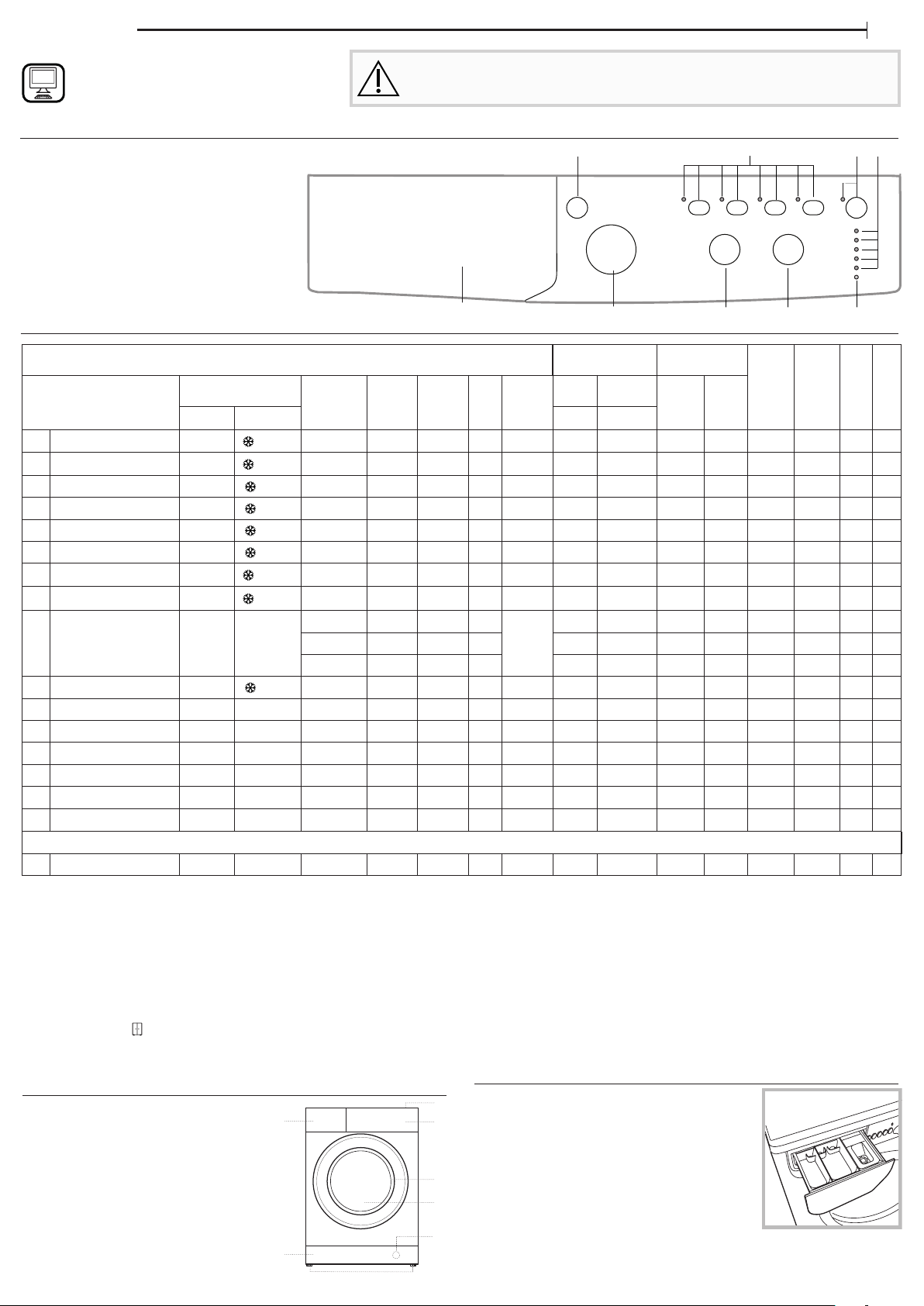
CONTROL PANEL
1. ON/OFF button
2. OPTION buttons and indicator lights
3. START/PAUSE button and indicator light
4. WASH CYCLE PHASE/ DELAY TIMER indicator lights
5. DOOR LOCKED indicator light
6. DRYING knob
7. TEMPERATURE knob
8. WASH CYCLE SELECTOR KNOB
9. Detergent dispenser drawer
WASH CYCLE TABLE
Before using the appliance carefully read the Safety Instruction.
Before using the machine, it is imperative that the transport bolts are removed.
For more detailed instructions on how to remove them, see the Installation Guide.
1
9
8
2
7
6
GB
4
3
5
Maximum load 6 kg
Power input in o mode 0.5 W / in left-on mode 8 W
Wash cycle
Temperature
Setting Range 2 3
1 White 60°C
2 Mix Colours 40°C
3 Synthetics (3) 40 °C
4 Cotton (2) 40 °C
5 Silk & Delicates 30 °C
6 Wool 40 °C
– 90°C 1200
– 40°C 1200
- 60 °C
- 60 °C
- 30 °C
- 40 °C
Max.
spin speed
(rpm)
1200 4.0 2:55
1200 6.0 3:55
0 2.0 0:55 – –
800 2.0 1:25
7 Jeans 40°C – 40°C 800
Sport Intensive
8
30°C – 30°C 600 3.5 1:25
Max.
load for
washing
(kg)
6.0 2:45
6.0 1:50
4.0 1:20
Duration
(h : m)
1151 6.0 3:15
9 Eco 40-60 (1) 40 °C 40°C
1151 3.0 2:35
1151 1.5 2:10
10 20°C 20 °C
- 20 °C
11 Cotton Dry – – 0 –
12 Synthetics Dry – – 0 –
1200 6.0 1:50
4:15
3:40
13 Express Wash&Dry 30 °C 30 °C 1200 0.5 0:30
14 Rinse – – 1200 6.0 0:55
15 Spin – – 1200 6.0 0:10
Max.
load for
drying
Drying
– –
(kg)
5.0
5.0
4.0
5.0
2.0
4.0
5.0
Detergents and
Additives
Wash
Fabric
softener
Recommended
detergent
Liquid
Powder
–
–
–
–
–
kWh
% (*)
Energy
Residual
dampness
Total water lt
consumption
49 0.90 90
– – – –
35 0.80 55 43
49 1.40 105 45
– – – –
– – – –
– – – –
– – – –
53 1.00 48 33
53 0.75 43 36
53 0.59 35 33
5.0
–
49 0.16 90 22
5.0 – – – – – – – –
4.0 – – – – – – – –
0.5
5.0 –
–
– – – –
– – – – – –
5.0 – – – – – – – –
16 Drain – – 0 6.0 0:03 – – – – – – – – – –
Required dosage Optional dosage
4 Eco Cotton (4) 60 °C 60 °C 1200 6.0 3:55
The cycle duration indicated on the display or instruction manual is an estimate based on
standard conditions. The actual duration may vary in relation to several factors, such as the
temperature and pressure of the incoming water, ambient temperature, amount of detergent,
load quantity and type, load balancing and any additional options selected. The values given
for programmes other than the Eco 40-60 programme are indicative only.
1) Eco 40-60 (Wash) - Test wash c ycle in compliance with EU Ecodesign r egulation
2019/2014. The most ecient programme in terms of energy and water consumption for
washing normally soiled cotton laundry.
Note: for the Eco 40- 60 program in the WASH CYCLE TABLE the value of the maximum
eective spin is shown.
Eco 40-60 (Dr ying)2019/2014
“Drying” option level to “
consumption for washing and drying normally soiled cotton laundry. (Cycle duration: full load
9h:50’ / half load 5h:40’).
Test drying cycle in compliance with EU Ecodesign regulation
. To access “wash and dry” cycle select “Eco 40-60” wash programme and set
”.
The most ecient programme in terms of energy and water
PRODUCT DESCRIPTION
1. Top
2. Detergent dispenser drawer
3. Control panel
4. Handle
5. Porthole door
6. Drain pump (behind the plinth)
7. Plinth (removable)
8. Adjustable feet (2)
2.
7.
8.
1.
3.
4.
5.
6.
5.0
For all testing institutes:
2) Long cotton cycle: set programme 4 at temperature 40°C.
3) Long synthetics cycle: set cycle 3 at a temperature of 40°C.
4) Eco Cotton -
at a temperature of 60°C to access this cycles.
* After programme end and spinning with maximum selectable spin speed, in default
programme setting.
Test wash cycle in compliance with regulations 1061/2010. Set “4” wash cycle
53 1.05 50 –
DETERGENT DISPENSER DRAWER
Compartment 1: Do not pour detergent into
the compartment 1.
Detergent should only be poured into the
compartment 2.
Compartment 2: Washing detergent (powder
or liquid)
Liquid detergent should only be poured in
immediately prior to the start of the wash cycle.
Compartment 3: Additives (fabric softener,
etc.)
The fabric softener should not overow the grid.
! Use powder detergent for white cotton garments, for pre-washing, and
for washing at temperatures over 60°C.
! Follow the instructions given on the detergent packaging.
Laundry
temperature °C
55
Page 2
WASH CYCLES
Follow the instructions on the symbols of the garment’s wash
care label. The value indicated in the symbol is the maximum
recommended temperature for washing the garment.
White
extremely soiled whites.
Mix Colours
A 40°C cycle that helps to preserve colours, suitable for cotton or
synthetic coloured garments. It allows for reducing electricity
consumption for heating the water while guaranteeing good washing
results. Suitable for lightly soiled garments.
Synthetics
Specic for synthetic items. If the dirt is dicult to remove, the
temperature can be increased up to 60° and powder detergent can be
used too.
Cotton
Suitable for washing towels, underwear, table cloths, etc. made of
resistant linen and cotton that are moderately to heavily soiled.
Silk & Delicates
To wash all silk and delicate garments. We recommend the use of special
detergent which has been designed to wash delicate clothes.
Wool
all wool garments can be washed using programme 6, even those
carrying the “hand-wash only” label. For best results, use special
detergents and do not exceed 2 kg of laundry.
Jeans
turn garments inside-out before washing and use a liquid detergent.
Sport Intensive
is for washing heavily soiled sports clothing fabrics (tracksuits, shorts,
etc.); for best results, we recommend not exceeding the maximum load
indicated in the “Wash Cycle Table”.
Eco 40-60
For washing normally soiled cotton garments declared to be washable at
40 °C or 60 °C, together in the same cycle. This is the standard cotton
programme and the most ecient in terms of water and energy
consumption.
20°C
For washing lightly soiled cotton garments, at a temperature of 20 °C.
Cotton Dry
designed for drying cotton fabrics.
Synthetics Dry
designed for drying Synthetics fabrics.
Express Wash&Dry
was designed to wash and dry lightly soiled garments quickly. This cycle
may be used to wash and dry a laundry load of up to 0.5 kg in just 30
minutes. To achieve optimum results, use liquid detergent and pre-treat
cus, collars and stains.
Rinse
designed for rinsing and spinning.
Spin
designed to spin and drain the water.
Drain
designed for draining the water.
INDICATOR LIGHTS
The indicator lights provide important information. This is what they can
tell you:
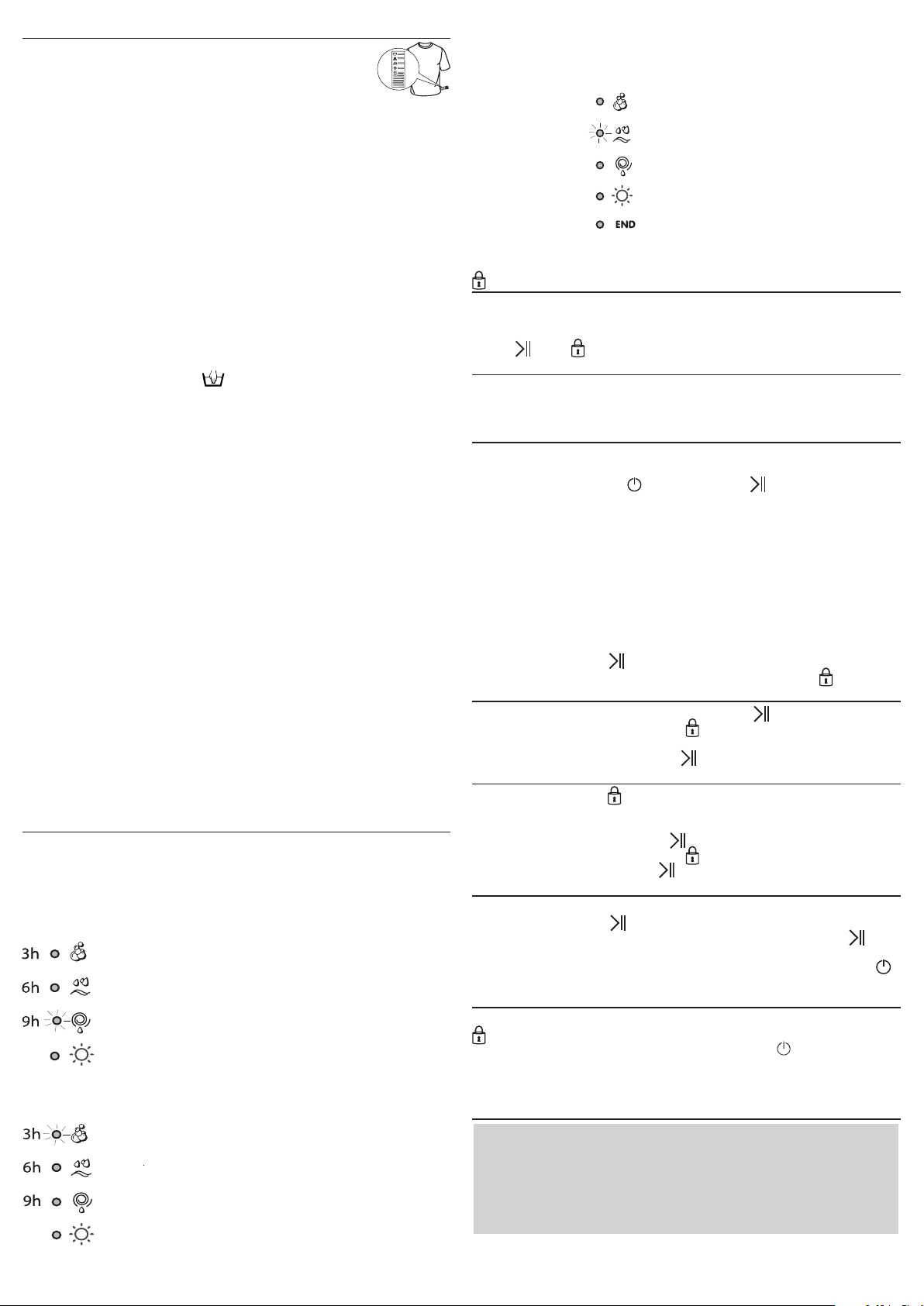
Delayed start
If the DELAY TIMER function has been activated, after the wash cycle has
been started the indicator light corresponding to the selected delay
period will begin to ash:
As time passes, the remaining delay will be displayed and the
corresponding indicator light will ash:
The set programme will start once the selected time delay has expired.
Wash cycle phase indicator lights
Once the desired wash cycle has been selected and has begun, the
indicator lights switch on one by one to indicate which phase of the cycle
is currently in progress.
Wash
Rinse
Spin/Drain
Drying
End of wash cycle
Note: when the drying cycle has nished, the DRYING knob should be
returned to the “0” position.
DOOR LOCKED INDICATOR
When lit, the symbol indicates that the door is locked. To prevent any
damage, wait until the symbol turns o before opening the door.
To open the door while a cycle is in progress, press the START/PAUSE
button ; if the symbol is o, the door can be opened.
FIRSTTIME USE
Once the appliance has been installed, and before it is used for the rst
time, run a wash cycle with detergent and no laundry, by setting the “1”
cycle.
DAILY USE
Prepare the laundry by following the suggestions appearing under the
“TIPS AND SUGGESTIONS” section.
- Press the ON/OFF button ; the START/PAUSE indicator light will
ash slowly green.
- Open the door. Load the laundry while making sure not to exceed the
maximum load quantity indicated in the Wash Cycle Table.
- Pull out the detergent dispenser drawer and pour the detergent into the
relevant compartments as described in “DETERGENT DISPENSER DRAWER”
section.
- Close the door.
- Select the desired wash cycle.
- Set the washing temperature.
- Set the drying cycle if necessary.
- Select the desired options.
- Press the START/PAUSE button to start the wash cycle; the relative
indicator light will light up steady green and the door will lock ( symbol on).
PAUSING A CYCLE
To pause the wash cycle, press the START/PAUSE button again; the
indicator light will ash amber. If the symbol is not lit, the door may be
opened. To start the wash cycle from the point at which it was
interrupted, press the START/PAUSE button again.
OPENING THE DOOR, IF NECESSARY
Once a cycle starts, the symbol turns on to signal that the door cannot
be opened. While a wash cycle is running, the door remains locked. To
open the door while a cycle is under way, for example, to add or remove
garments, press the START/PAUSE button to pause the cycle; the
indicator light will ash amber. If the symbol is not lit, the door may be
opened. Press the START/PAUSE button again to continue the cycle.
CHANGING A RUNNING WASH CYCLE
To change a wash cycle while it is in progress, pause the washer-dryer
using the START/PAUSE button (the relative indicator light will ash
amber), then select the desired cycle and press the START/PAUSE
button again.
! To cancel a cycle that has already begun, press and hold the ON/OFF
button. The cycle will be stopped and the machine will switch o.
END OF THE CYCLE
Once the cycle terminates the END indicator light will light up; when the
symbol switches o, the door may be opened. Open the door and
switch o the machine. If you do not press “ON/OFF” button, the
washer-dryer will switch o automatically after about a 10 minutes. Close
the water tap and unload the washer-dryer. Leave the door ajar to allow
the drum to dry.
OPTIONS
- If the selected option is not compatible with the programmed wash
cycle, the indicator light will ash and the option will not be activated.
- If the selected option is not compatible with another option which
has been selected previously, the indicator light corresponding to the
rst option selected will ash and only the second option will be
activated; the indicator light corresponding to the enabled option will
remain lit.
Time Saver
Selecting this option enables you to suitably adjust drum rotation,
temperature and water to a reduced load of lightly soiled cotton and
Page 3
synthetic fabrics. Time Saver enables you to wash in less time thereby
saving water and electricity. We suggest using a liquid detergent suitably
measured out to the load quantity.
1/2 Spin
Press this button to reduce the spin speed.
Intensive Wash
Because a greater quantity of water is used in the initial phase of the
cycle, and because of the increased cycle duration, this function oers a
high-performance wash.
Delay Timer
This timer delays the start time of the wash cycle by up to 9 hours.
Press the button repeatedly until the indicator light corresponding to the
desired delay time switches on. The fth time the button is pressed, the
function will be disabled.
N.B. Once the START/PAUSE button has been pressed, the delay time
can only be modied by decreasing it until launching the set programme.
Temperature
Turn the TEMPERATURE knob to set the wash temperature (see Wash
Cycle Table).
The temperature may be lowered, or even set to a cold wash .
The washer-dryer will automatically prevent you from selecting a
temperature which is higher than the maximum value set for each wash
cycle.
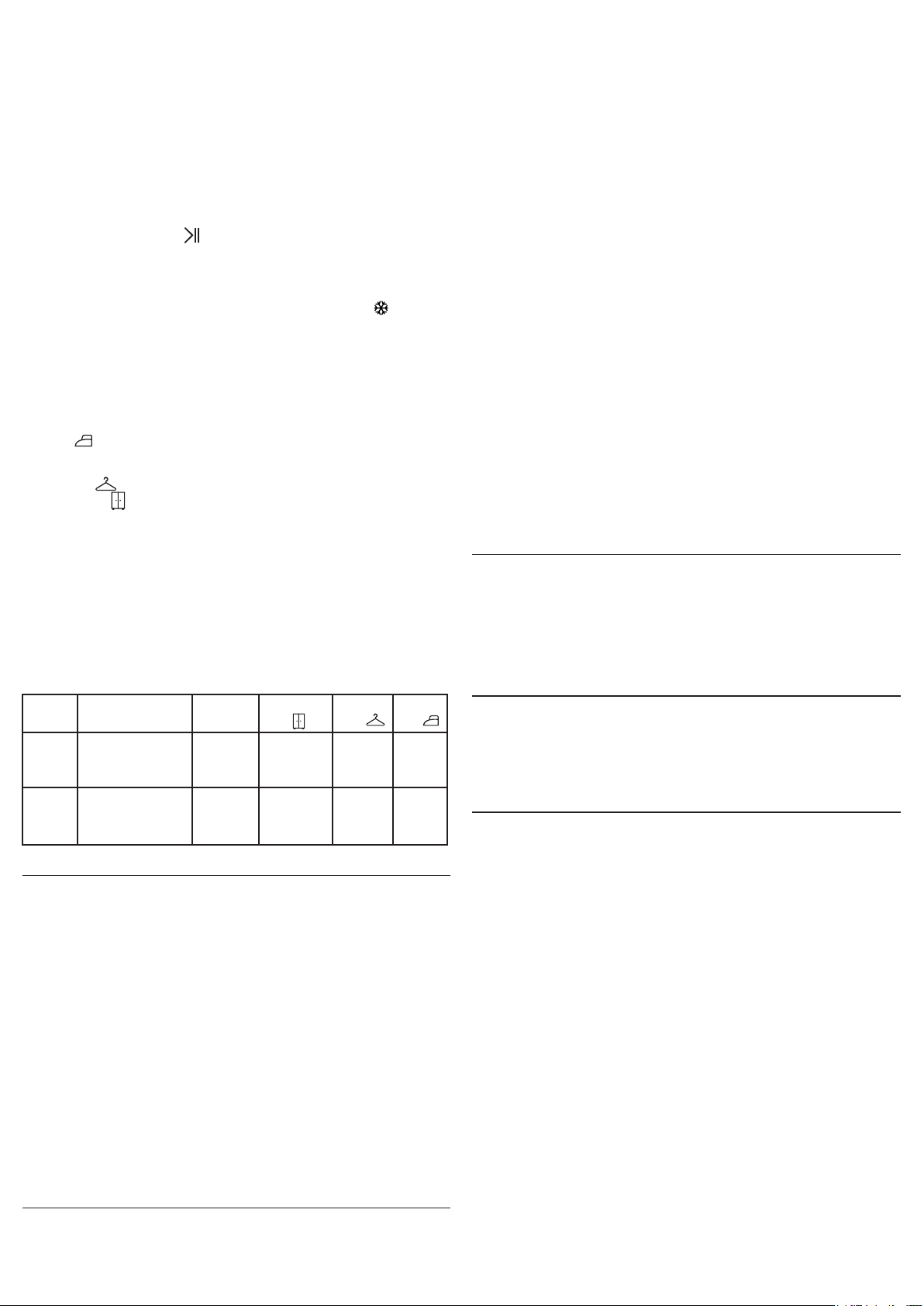
Drying cycle
Turn the DRYING knob to select the desired drying option. There are two
options:
A - Based on time: From 40 minutes to 180.
B - Based on the desired laundry dryness level:
Iron dry : suitable for clothes which will need ironing afterwards. the
remaining dampness softens creases,
making them easier to remove.
Hanger dry : ideal for clothes which do not need to be dried fully.
Cupboard dry : suitable for laundry which can be put back in a
cupboard without being ironed.
If your laundry load to be washed and dried is much greater than the
maximum stated load (see adjacent table), perform the wash cycle, and
when the cycle is complete, divide the garments into groups and put
some of them back in the drum. At this point, follow the instructions
provided for a “Drying only” cycle. Repeat this procedure for the
remainder of the load.
Drying only
Use the cycle selector knob to select a drying cycle (11-12) in accordance
with the type of fabric. The desired drying level or time may also be set
using the DRYING knob.
Table of Drying times (guideline values)
Fabric
type
Cotton
Synthe-
tics
Load type
Clothing of different sizes, Terry
towels
Sheets, Shirts, Pyjamas, socks, etc.
Max.
load (kg)
Cupboard
dry
5 4h:15’ 3h:50’ 3h:20’
4 3h:40’ 3h:20’ 3h:10’
Henger
dry
Iron
dry
TIPS AND SUGGESTIONS
Divide the laundry according to:
Type of fabric (cotton, mixed bres, synthetics, wool, garments to be
hand-washed). Colour (separate coloured garments from whites, wash new
coloured garments separately). Delicates (small garments – such as nylon
stockings – and items with hooks – such as bras: insert them in a fabric bag).
Empty the pockets:
Objects such as coins or lighters can damage the washer-dryer and the
drum. Check all buttons.
Follow the dosage recommendation / additives
It optimizes the cleaning result, it avoids irritating residues of surplus detergent
in your laundry and it saves money by avoiding waste of surplus detergent.
Use low temperature and longer duration
The most ecient programmes in terms of energy consumption are
generally those that perform at lower temperatures and longer duration.
Observe the load sizes
Load your washing machine up to the capacity indicated in the
“Wash Cycle Table” table to save water and energy.
Noise and remaining moisture content
They are inuenced by the spinning speed: the higher the spinning speed
in the spinning phase, the higher the noise and the lower the remaining
moisture content.
CARE AND MAINTENANCE
Before performing cleaning and maintenance, switch the washer-dryer o
and disconnect it from the mains power. Do not use ammable liquids to
clean the washer-dryer. Clean and maintain your washer-dryer periodically
(at least 4 times per year).
Disconnect the water and power supplies
Close the water tap after every wash. This will limit wear on the hydraulic
system inside the washer-dryer and help to prevent leaks.
Unplug the washer-dryer when cleaning it and during all maintenance
work.
Clean the washer-dryer
The outer parts and rubber components of the appliance can be cleaned
using a soft cloth soaked in lukewarm soapy water. Do not use solvents or
abrasives.
Clean the detergent dispenser drawer
Wash it under running water; this operation should be repeated
frequently.
Care for the door and drum
Always leave the porthole door ajar in order to prevent unpleasant odours
from forming.
Clean the pump
The washer-dryer is tted with a auto-cleaning pump that does not
require any maintenance. Small items (such as coins or buttons) may
sometimes fall into the protective pre-chamber situated at the base of the
pump.
! Make sure the wash cycle has ended and unplug the appliance.
To access the pre-chamber:
1. remove the cover panel on the front of the machine by rst pressing it
in the centre then pushing downwards on both sides to extract it;
2. loosen the drainage pump cover by turning it anti-clockwise: it is
normal for some water to leak out;
3. clean the inside thoroughly;
4. screw the cover back on;
5. put the panel back in place, making sure the hooks slot in place before
pushing the panel onto the appliance.
Check the water inlet hose
Check the water inlet hose at least once a year. If it is cracked or broken, it
must be replaced: during wash cycles, the high pressure of the water
could suddenly split the hose open.
! Never use hoses that have already been used.
LOAD BALANCING SYSTEM
Before every spin cycle, to avoid excessive vibrations before every
spin and to distribute the load in a uniform manner, the drum rotates
continuously at a speed which is slightly greater than the washing
rotation speed. If, after several attempts, the load is not balanced
correctly, the machine spins at a reduced spin speed. If the load is
excessively unbalanced, the washer-dryer performs the distribution
process instead of spinning. To encourage improved load distribution and
balance, we recommend small and large garments are mixed in the load.
ACCESSORIES
Contact our Technical Assistance Service to check whether the following
accessories are available for this washer-dryer model.
Stacking kit
With this accessory you can secure the tumble dryer to the upper part of
your washer-dryer to save space and facilitate loading and unloading of
the tumble dryer.
TRANSPORT AND HANDLING
Do not lift the washer-dryer by gripping it from the upper section.
Unplug the appliance and close the water tap. Check that the door and
detergent dispenser drawer are tightly closed. Detach the lling hose
from the water tap then detach the drain hose. Empty all the water
remaining in the hoses and secure the latter so that they do not get
damaged during transport. Apply the transport bolts back on. Repeat, in
reverse order, the transport bolt removal procedure described in the
“Health & Safety and Installation Guides”.
Page 4
TROUBLESHOOTING
The washer-dryer may occasionally fail to work. Before contacting the Technical Assistance Service, make sure that the problem cannot be easily solved
using the following list.
Anomalies Possible causes / Solution
The washer-dryer does not
start.
The wash cycle does not start.
The machine does not ll with
water or the indicator light
for the rst wash cycle stage
ashes rapidly.
The washer-dryer
continuously loads and
unloads water.
The washer-dryer does not
drain or spin.
The washer-dryer vibrates a
lot during the spin cycle.
The washer-dryer leaks.
The “Options” indicator lights
and the START/PAUSE
indicator light ash, while
one of the “phase in progress”
indicator lights and the “door
locked” indicator light will
remain lit in a xed manner.
There is too much foam.
The wash cycle does not start.
The appliance is not plugged into the socket, or not suciently to make contact.
There is no power in the house.
The washer-dryer door is not closed properly.
The ON/OFF button has not been pressed.
The START/PAUSE button has not been pressed.
The water tap has not been opened.
A delay has been set for the start time.
The water inlet hose is not connected to the tap.
The hose is bent.
The water tap has not been opened.
There is no water supply in the house.
The pressure is too low.
The START/PAUSE button has not been pressed.
The drain hose is not tted between 65 and 100 cm from the oor.
The free end of the hose is immersed in water.
The wall drainage system does not have a breather pipe.
If the problem persists even after these checks, turn o the water tap, switch the appliance o and contact the
Technical Assistance Service. If the home is on one of the upper oors of a building, there may be problems relating
to back-siphonage, causing the washer-dryer to ll with water and drain continuously. Special anti-siphon valves
are available in shops and help to prevent this inconvenience.
The cycle does not include drainage: with certain cycles it must be started manually.
The drain hose is bent.
The drainage duct is clogged.
The drum was not unlocked correctly during installation.
The washer-dryer is not level.
The washer-dryer is tucked between furniture cabinets and the wall.
The water inlet hose is not screwed on properly.
The detergent dispenser drawer is obstructed.
The drain hose is not properly attached.
Switch o the machine and unplug it, wait for approximately 1 minute and then switch it back on again.
If the problem persists, contact the Technical Assistance Service .
The detergent is not suitable for machine washing (it should be marked with “for washing machine use” or “hand
wash and machine wash” or similar).
Too much detergent was used.
The appliance is not plugged into the socket, or not suciently to make contact.
There is no power in the house.
The washer-dryer door is not closed properly.
The ON/OFF button has not been pressed.
The START/PAUSE button has not been pressed.
The water tap has not been opened.
A delay has been set for the start time.
The ‘DRYING’ selector knob is in the 0 position.
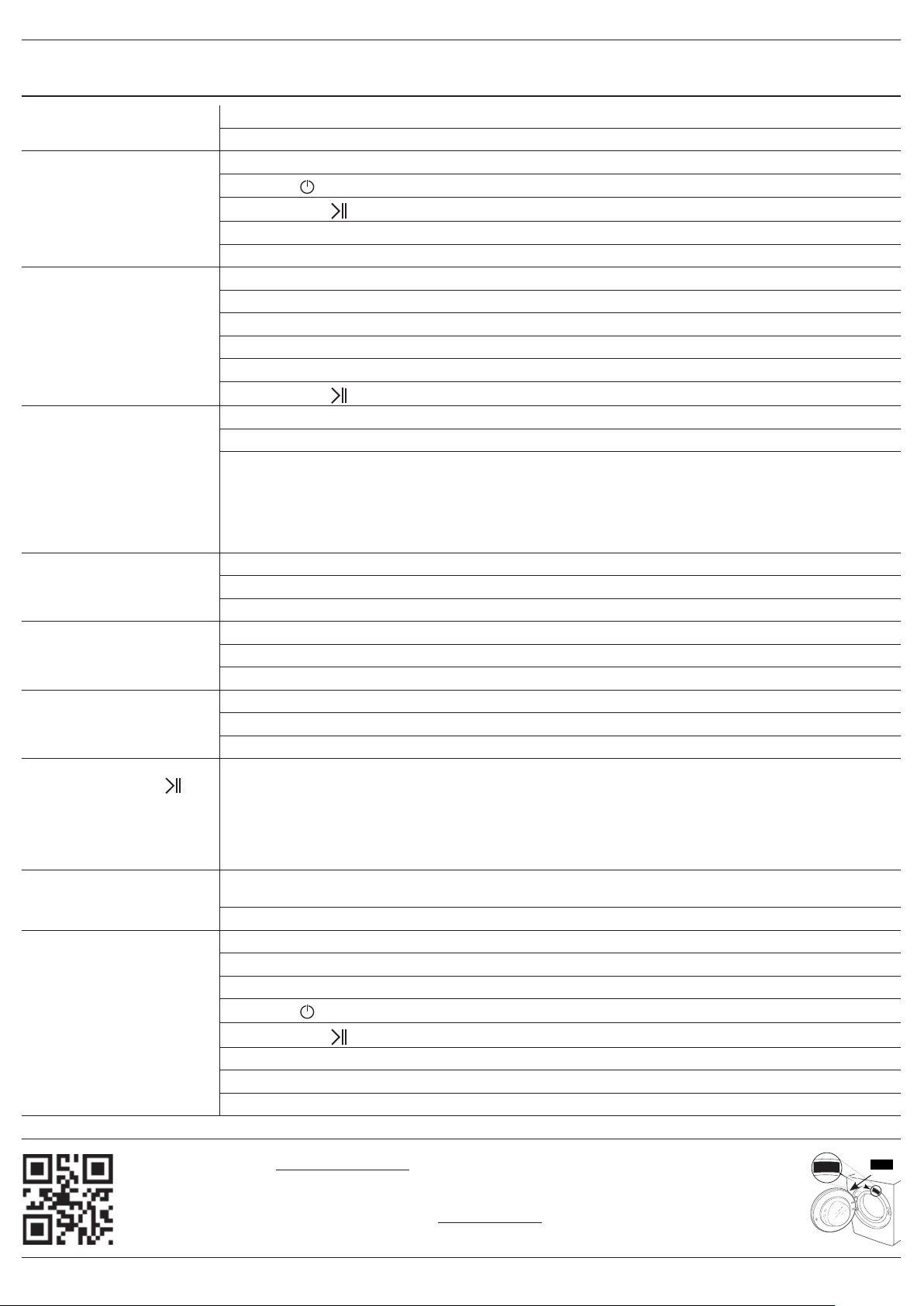
You can download the Safety Instructions, Product Fiche and Energy data by:
• Visiting our website - http://docs.indesit.eu
• Using QR Code
• Alternatively, contact our After-sales Service (See phone number in the warranty booklet). When
contacting our After-sales Service, please state the codes provided on your product’s identication plate.
• For User’s Repair & Maintenance Information visit www.indesit .com
The model information can be retrieved using the QR-Code reported in the energy label. The label also includes
the model identier that can be used to consult the portal of the registry at https://eprel.ec.europa.eu
xxxxxxxxxxxx
xxxx
11461150
 Loading...