

Page 1

Fridge-freezer
Combined
Instructions for installation and use
IN-C 3100 g.1 UK
Page 2

GB
Fridge-freezer combined
Instructions for installation and use
To maintain the EFFICIENCY and SAFETY of this appliance, we recommend:
- use only the MANUFACTURER Service
- use only ORIGINAL Spare Parts
Page 3
Safety - a good habit to get into.
ATTENTION
Read your manual carefully since it contains instructions
which will ensure safe installation, use and maintenance of
your appliance.
Your Refrigerator is built to International safety standards
(EN60) ans has been awarded the European approval mark
(IMQ) for compliance with UK electrical safety requirements.
It also meets the EC standards on the prevention and elimination of readio interference (EC directive 87/308 - 02.06.89).
1. This appliance must not be installed outdoors - not even
in an area protected by a roof. It is extremely dangerous to
leave it exposed to rain or storms.
2. It must only be used by adults and exclusively to refrigerate and freeze foodstuffs, following the instructions for use
contained in this manual.
3. Do not ever touch or handle the appliance with bare feet
or with wet hands or feet.
4. It is highly recommended that you do not use extension
cords or multiple socket adapters. If the refrigerator is installed between cabinets, make sure that the cord is not
bent or dangerously pinched or compressed.
5. Never pull on the cord or the refrigerator to remove the
plug from the wall socket - this is very dangerous.
6. Never touch the cooling components within the appliance, especially with wet hands because this could result in
injury. Never put ice cubes just removed from the freezer
into your mouth because they could stick to your mouth
and cause burns.
7. Never clean or perform maintenance on the appliance
without first removing the plug from the socket; in fact,
turning the knob for adjusting the temperature to the " "·
setting is not sufficient to eliminate all electrical contact with
the mains.
8. Before having your old refrigerator picked up for disposal,
remove or make inoperable any locking devices to prevent
children who might play in or around the appliance from
being locked inside.
9. Before calling for service/assistance in the case of malfunction, consult the chapter entitled “Is There a Problem?
to determine whether it is possible to eliminate the problem. do not try to repair the problem by trying to access the
internal components of the appliance.
10. If the power supply cord must be replaced, please contact one of our Customer Service Centers. In some cases,
the connections are made using special terminals and in others a special tool must be used to access the connections.
11. Do not use electric appliances inside the compartment
for food storage, if these are not those recommended by
the manufacturer.
12. At the end of the functional life of your appliance
containing cyclopentane gas in the insulation foam and
perhaps gas R600a (isobutane) in the refrigeration circuit
the latter should made safe before being sent to the dump.
For this operation, please contact your dealer or the Local
Organisation in charge of waste disposal.
Installation
To ensure that the appliance operates properly and to
reduce energy consumption, it is important that the
appliance is installed correctly.
Ventilation
The compressor and condenser generate heat and, therefore, need to be ventilated properly. Rooms with less than
perfect ventilation are not very suited for installation of the
appliance. Therefore, it should be installed in a room with
an opening (window or French window) that provide the
appropriate amount of air re-circulation. It is also important
that the room not be too humid.
During installation, make sure not to cover or obstruct the
grates that allow for proper ventilation of the appliance.
Away from Heat
Avoid positioning the appliance in a place where it is directly
exposed to sunlight or near an oven, cook top or the like.
Electrical Connection and Earthing
Before proceeding with the electrical connection, make sure
that the voltage indicated on the rating plate, located at the
bottom left near the vegetable crisper, corresponds to the
mains voltage in your home and that the socket is fitted
with a standard earthing wire in accordance with safety
standards for 46/90 systems. If the socket is not fitted with
an earthing wire, the manufacturer will not be held liability
for any damages and or injuries arising out of the use of the
appliance. Do not use multiple sockets or adapters.
Position the appliance in such a way that you can access
the socket where it is plugged in.
Insufficient power?
The electrical socket must be able to handle the maximum
power load of the appliance, which is indicated on the rating plate located at the bottom left next to the vegetable
crisper.
Before making the electrical connection ...
After the appliance has been delivered, place it in the vertical upright position and wait at least 3 hours before inserting the plug into the socket in order to ensure that it functions properly.
1
GB
Page 4
Electrical connection
Your appliance is now supplied with a 13 amp fused plug that
can be plugged into a 13 amp socket for immediate use. Before
using the appliance please read the instructions below.
WARNING - THIS APPLIANCE MUST BE EARTHED.
THE FOLLOWING OPERATIONS SHOULD BE CARRIED
OUT BY A QUALIFIED ELECTRICIAN.
Replacing the fuse:
When replacing a faulty fuse, a 13 amp ASTA approved fuse
to BS 1362 should always be used, and the fuse cover refitted. If the fuse cover is lost, the plug must not be used
until a replacement is obtained.
As the colours of the wires in the mains lead may not
correspond with the coloured markings identifying the
terminals in your plug, proceed as follows:
Connect Green & Yellow wire to terminal marked “E” or
or coloured Green or Green & Yellow.
Connect Brown wire to terminal marked “L” or coloured
Red.
Connect Blue wire to terminal marked “N” or coloured Black.
If a 13 amp plug (BS 1363) is used it must be fitted with a 13
amp fuse. A 15 amp plug must be protected by a 15 amp
fuse, either in the plug or adaptor or at the distribution board.
If you are in any doubt about the electrical supply to your
machine, consult a qualified electrician before use.
Replacement fuse covers:
If a replacement fuse cover is fitted, it must be of the correct
colour as indicated by the coloured marking or the colour that
is embossed in words on the base of the plug. Replacements
can be obtained directly from your nearest Service Depot.
Removing the plug:
If your appliance has a non-rewireable moulded plug and
you should wish to remove it to add a cable extension or to
re-route the mains cable through partitions, units etc., please
ensure that either:
- the plug is replaced by a fused 13 amp re-wireable plug
bearing the BSI mark of approval
or:
- the mains cable is wired directly into a 13 amp cable outlet,
controlled by a switch, (in compliance with BS 5733) which
is accessible without moving the appliance.
Disposing of the plug:
Ensure that before disposing of the plug itself, you make
the pins unusable so that it cannot be accidentally inserted
into a socket. Instructions for connecting cable to an
alternative plug:
Important: the wires in the mains lead are coloured in
accordance with the following code:
Green & Yellow - Earth
Blue - Neutral
Brown - Live
How to connect an alternative plug:
The wires in this mains lead are coloured in accordance with
the following code:
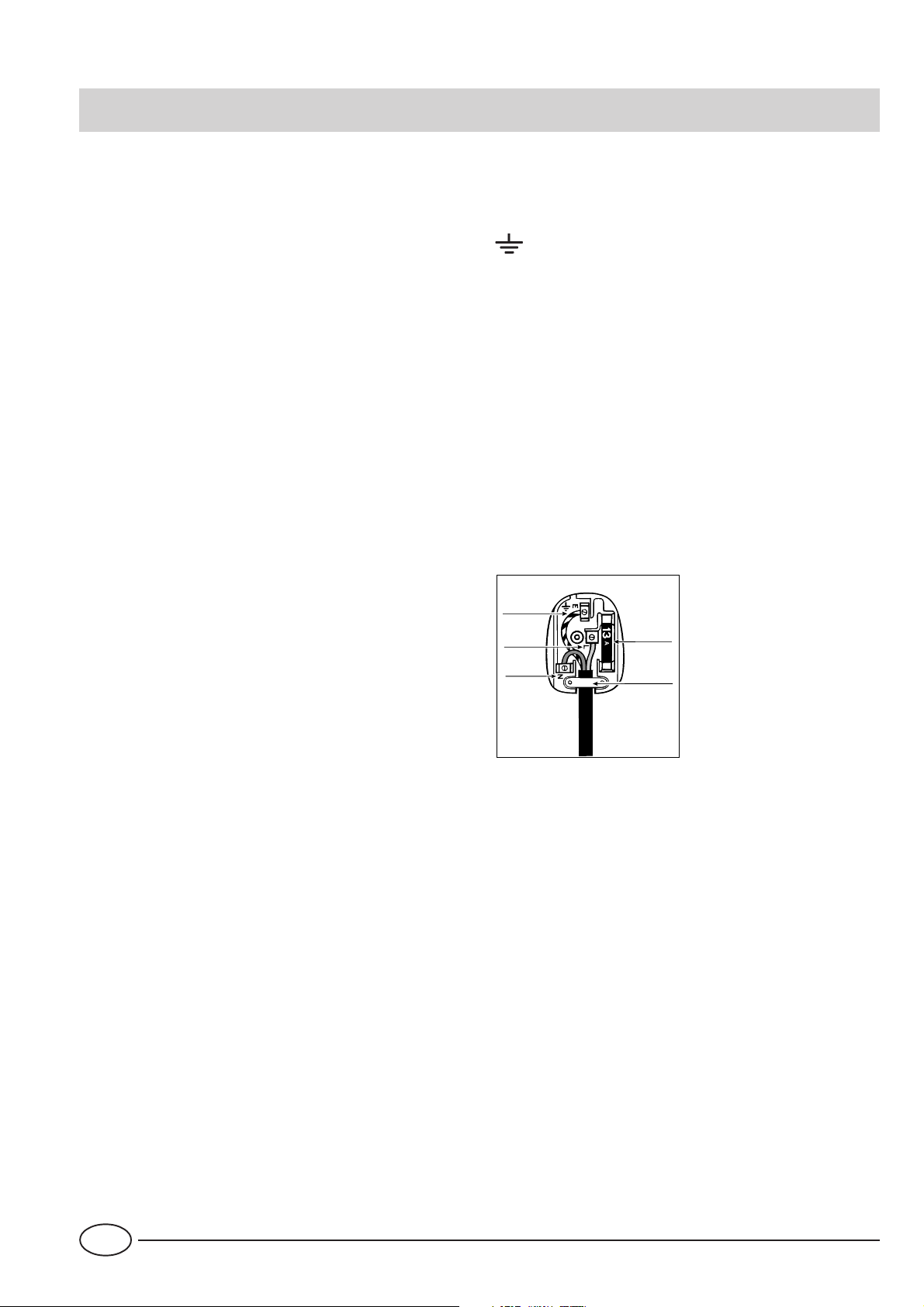
BLUE “NEUTRAL” (“N”)
BROWN “LIVE” (“L”)
GREEN AND YELLOW “EARTH” (“E”)
GREEN &
YELLOW
BROWN
BLUE
13 ampere fuse
CROSS-BAR
CORD GRIP
Disposing of the appliance:
When disposing of the appliance please remove the plug by
cutting the mains cable as close as possible to the plug body
and dispose of it as described above.
GB
2
Page 5
A Closer Look
I
F
H
E
K
G
B
C
J
D
A
D
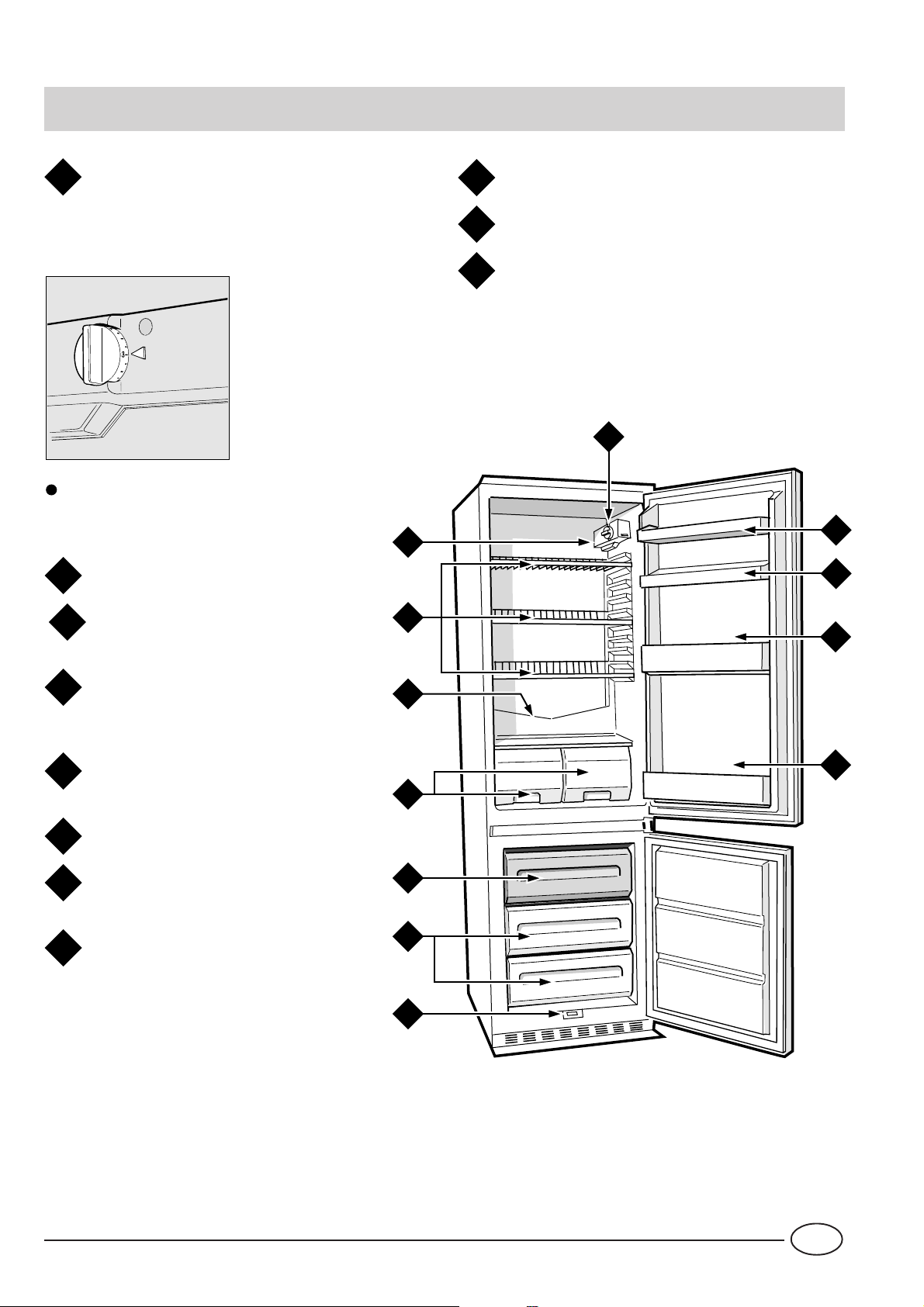
Thermostat knob for regulating the temperature
A
This knob is used to regulate the temperature in the two
compartments with the following settings:
The refrigerator is off;
1 less cold;
5 colder
Removable door shelf with egg
B
Removable door shelf for food
C
Defrost Water Drain
I
Removable/Adjustable Shelves
J
Refrigerator Light
K
products
Removable bottle shelf for average-
D
sized bottles, milk cartons, tinned
drinks etc.
Drain system for drawing off defrost
E
water from freezer compartment
Compartment for storing frozen foods
F
Compartment for freezing fresh foods
G
and storing frozen foods
Fruit and Vegetable Crispers
H
3
GB
Page 6
How to Start the Appliance
NOTICE
After the appliance has been delivered, stand it in the
upright position and wait approximately 3 hours before connecting it to the electrical outlet to guarantee
that it operates properly.
Before placing foodstuffs in the refrigerator or freezer, clean
the interior well with warm water and baking soda.
After putting the plug in the socket, make sure that the
light is on inside the appliance and then turn the thermostat
knob (A) to the “3” setting. After a few hours have passed,
you can place fresh food in the refrigerator compartment
and frozen foods into the freezer.
How to use the refrigerator compartment...
The thermostat automatically regulates the temperature inside the appliance
1 = less cold
5 = colder
It is recommended that a medium setting be used.
To increase the amount of space, optimize arrangement and
improve appearance, this appliance has a “cooling area”
located within the back panel of the refrigerator compartment. When the appliance is operating, this panel may be
covered with frost or droplets of water depending on
whether the compressor is operating or not at a given time.
Do not be concerned about this! The refrigerator is operating normally.
If the thermostat knob is positioned on higher settings while
the refrigerator is heavily filled and the ambient temperature high, the appliance may run continuously, resulting in
the formation of frost on the back cooling area. This will
lead to an increase in energy consumption.
To avoid this situation, just turn the thermostat knob
to a lower setting so that the appliance defrosts automatically.
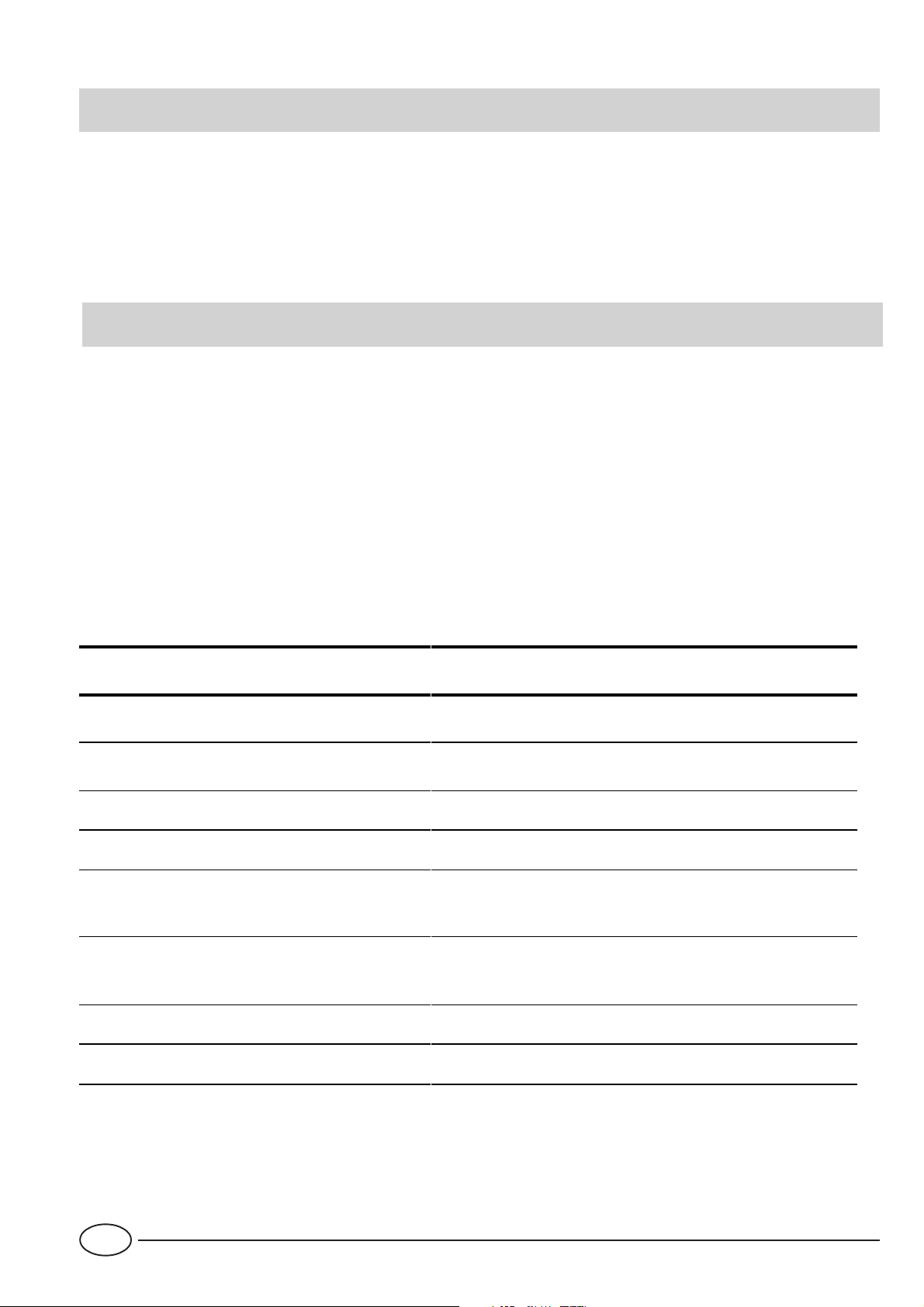
Storing Food in the Refrigerator Compartment
Food Storage Time Location in the Refrigerator
Wrapped meat and cleaned fish
(use plastic wrap or pack in plastic bags)
Fresh cheese 3 or 4 days
Eggs 1 month In special egg rack on door.
Butter, margarine On any shelf.
Cooked or precooked food
(placer in air-tight containers and when cool store
in refrigerator)
Sausages, salami, sandwich meats in general, fresh
pasta, custards,puddings, chocolates, cream
pastries, bread, dry pastries, red tomatoes
Bottled products, milk, drinks, yoghurt On special door shelves.
Fruits and legumes In vegetable crisper.
2 or 3 days
3 or 4 days On any shelf.
3 or 4 days On any shelf.
On the shelf above the vegetable crisper
(which is the coldest area).
On the shelf above the vegetable crisper
(which is the coldest area).
What Not to Store in the Refrigerator
Garlic (transmits odour), onions and leeks.
Bananas (they will turn black).
Citrus fruits.
Potatoes and root vegetables (store in dark, dry places).
GB
4
Page 7
- Within the refrigerator compartment, the air circulates
naturally, with the colder air falling because it is heavier. This
is the reason why meat and cheeses should be placed above
the vegetable crisper.
- Please follow our instructions carefully on maximum storage time: any food, even the freshest, will not remain edible
for any extended amount of time.
- Contrary to popular belief, cooked foods do not store any
longer than raw food.
- Do not place liquids in containers without covering them
because this will lead to an increase in the level of moisture
within the refrigerator, causing the formation of frost.
- Be careful not to place containers (plastic or glass), food or
other objects in direct contact with the cooling area of the
back wall of the refrigerator. This could harm the food, increase energy consumption and facilitate the formation of
condensate (on food, containers, etc.).
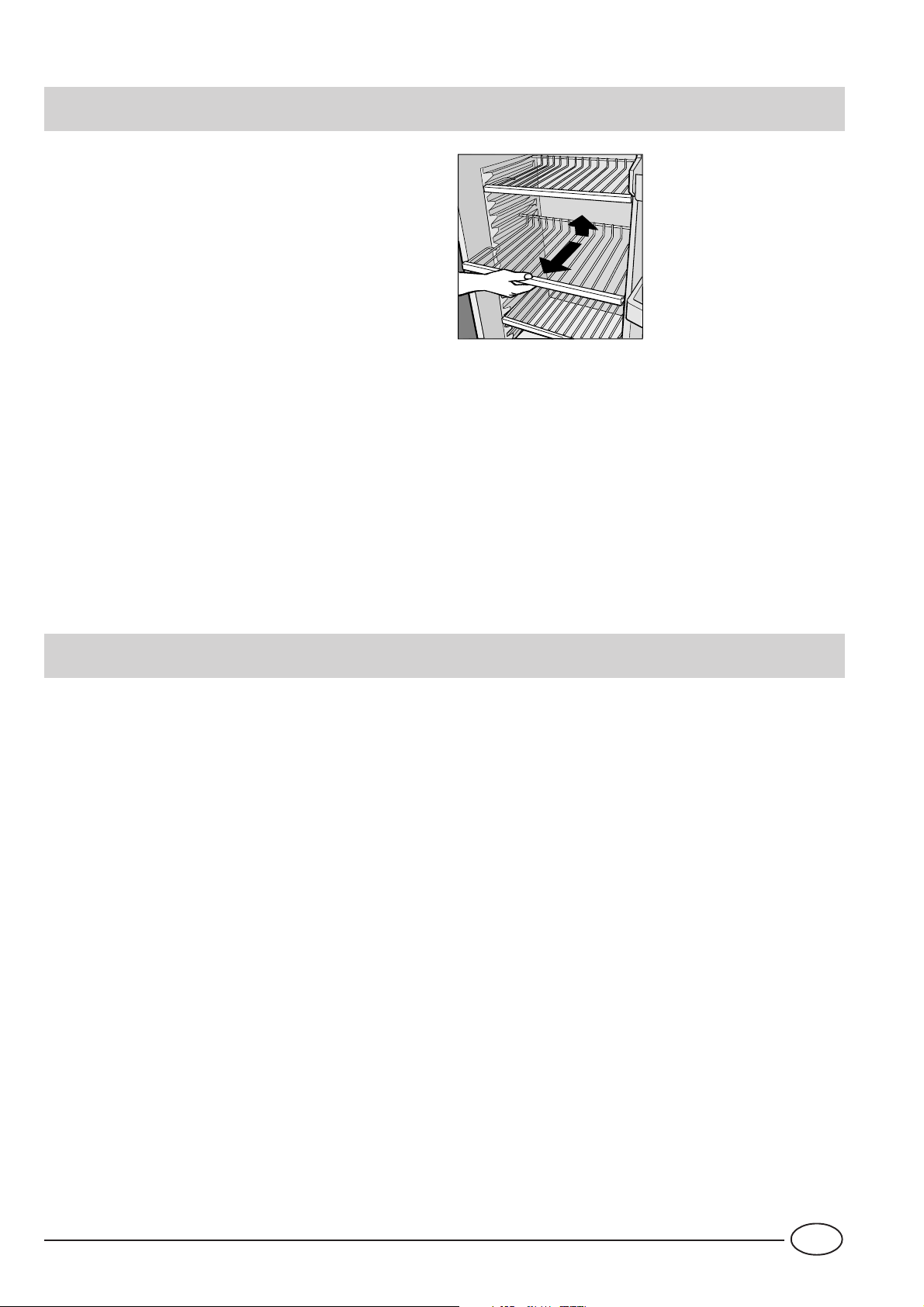
- The refrigerator compartment is equipped with convenient, removable shelves (Fig. 1) which can be adjusted for
height using the shelf guides. This allows you to place even
large containers and foodstuffs in the refrigerator.
Fig. 1
Freezing Foods Properly
- For the preparation of food to be frozen, please consult a specialized manual.
- Food that has be thawed, even partially, must not be refrozen: you must cook it in order to consume it (within 24
hours) or to freeze it once again.
- When freezing fresh foods, remember that they should
not touch other previously frozen or deep frozen foods. Place
the food that you wish to freeze in the top compartment
"I" where the temperature will fall below -18°C, which is
ideal for freezing food properly. Remember that proper conservation depends on the speed of freezing.
- During the freezing process, avoid opening the door of the
freezer.
- The maximum daily quantity of food that can be frozen is
indicated on the rating plate located to the left of the vegetable crisper.
- In order to freeze and then thaw foods optimally, it is recommended that you divide food into small portions so that
they freeze quickly and uniformly. The packages should be
clearly marked with the content and the date they were
frozen.
- In order to have a larger storage volume, the freezer compartment can be used without its drawers (except for the
first one from the bottom), placing food directly onto the
evaporator plates. After introducing the food to be stored,
make sure that the door shuts properly.
- Do not open the freezer door in the event of a power
failure or malfunction. This precaution will slow the rise in
temperature within the compartment. If the door is not
opened, frozen and fast-frozen foods will remain in their
current state for approximately 9-14 hours.
- Do not place full bottles in the freezer: they could easily
burst because all liquids increase in volume when they freeze.
- Fill the ice cube trays about 3/4 full.
- If the ambient temperature remains below 14°C for an
extended period of time, the temperature needed for extended storage of food in the freezer will not be reached,
resulting in reduced storage life of the food.
5
GB
Page 8
Tips on Saving Energy
- Install the Appliance Properly
In other words, away from sources of heat and direct sunlight, in a well ventilated room complying with the minimum distances indicated in the paragraph entitled, “ Installation/Ventilation.”
THE ACTUAL ENERGY CONSUMPTION OF THE
APPLIANCE DEPENDS ON THE WAY THE SAME IS USED
AND ON ITS LOCATION.
The consumption tests were performed in 560mm deep
column units, the most common installation setting for this
appliance.
- Use the Right Temperature Setting
A setting which is too cold increases energy consumption.
- Do not Overfill
To conserve food properly, the cold air must circulate freely
within the refrigerator. If it is overfilled, this will prevent proper
air circulation, forcing the compressor to work continuously.
- Close the Doors
Open your refrigerator as little as possible because each time
you do so you loose much of the cold air. To raise the temperature to the proper level again, the motor must work for
a long time, consuming energy.
- Keep an Eye on the Seals
Keep the seals clean and make sure that they adhere well to
the door. This alone will ensure that no cold air escapes.
- No Hot Foods
A hot pot or pan placed in the refrigerator immediately raises
the temperature several degrees. Let hot cookware and food
cool to ambient temperature before placing them in the refrigerator.
- Defrost the Freezer
Check the thickness of the frost on the walls of the freezer
and immediately defrost it if the layer of frost is too thick.
(see the section entitled, “Keeping your Appliance in Shape”).
Keeping Your Appliance in Shape
Before doing any cleaning, disconnect the appliance
from the electricity (by pulling out the plug or turning
off the general switch in your home).
Defrosting
WARNING: do not damage the refrigeration circuit.
Do not use mechanical devices or other tools to speed
up the defrosting process, unless they have been recommended by the manufacturer.
How to Defrost the Refrigerator
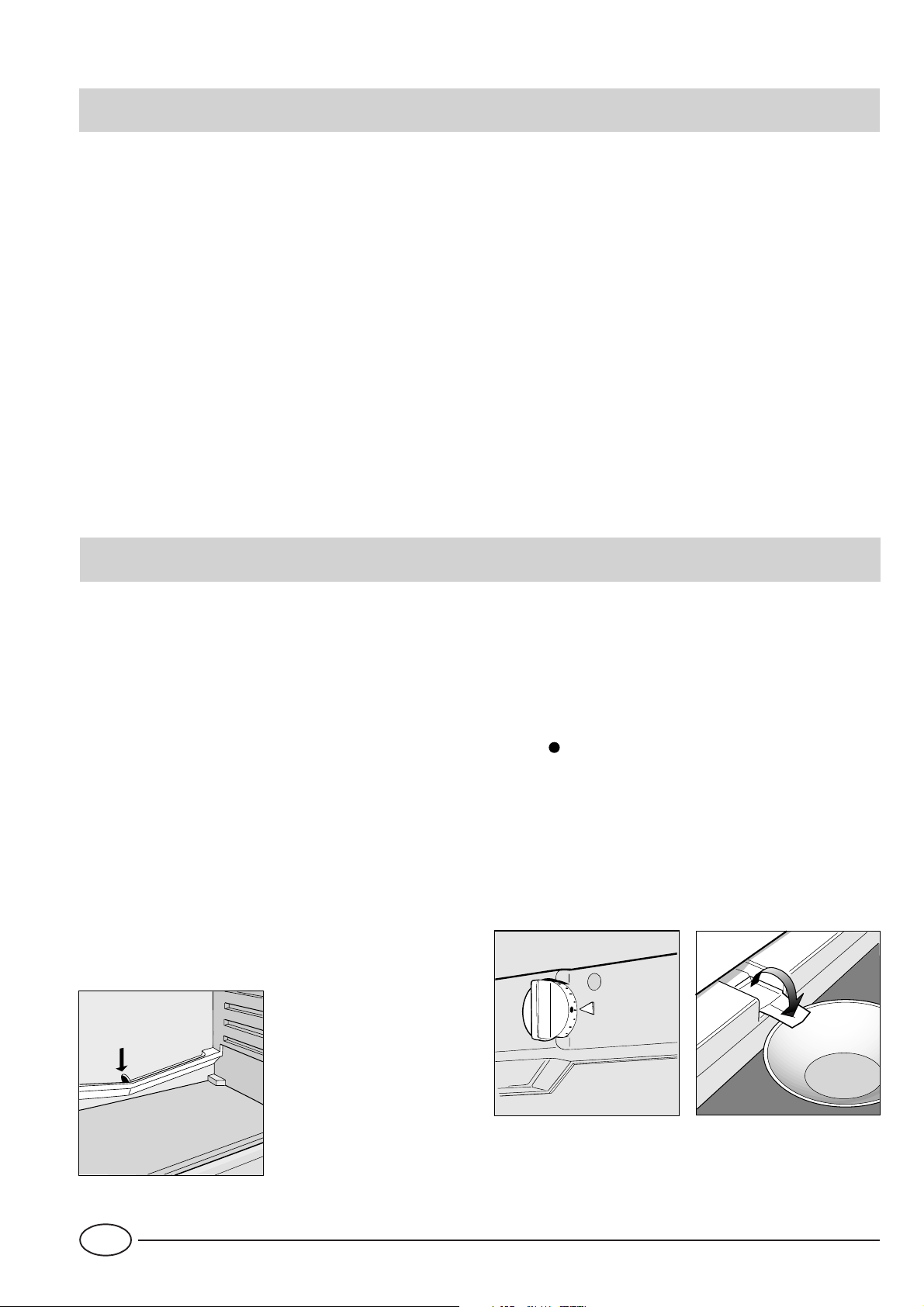
This appliance defrosts automatically and the water is
channeled to the back toward the drain installed for this
purpose (fig. 2). Here, the heat produced by the compressor
will make it evaporate. The only thing you must do is to
periodically check and clean the hole of the drain, which is
located behind the vegetable crispers, so that the water
drains properly.
How to Defrost the Freezer
- Every so often, remove the frost with the scraper provided
with the appliance (do not use knives or metal objects).
- If the frost is more than 15 mm thick, the freezer must be
defrosted.
Proceed as follows: turn the thermostat knob (A) to the ·
setting (Fig.3). Then wrap all the frozen and fast-frozen
food in newspaper, placing it either in the refrigerator or in
a cool place. Leave the freezer door open so that the frost
thaws completely. You can speed this process by placing containers of warm water in the compartment.
The unit is provided with a system which allows the defrost
water to be collected in a container to be placed beneath
the unit (proceed as illustrated in fig 4).
Fig. 2
GB
Fig. 3
6
Fig. 4
Page 9
Cleaning and Special Maintenance
Before cleaning the refrigerator, disconnect it from the
electrical mains (by removing the plug from the socket
or by turning off the main electricity switch for the
apartment or house).
- The materials used to build your appliance are hygienic
and do not transmit odors. However, to preserve this quality
of your appliance, the food stored in it must be well closed
and covered to prevent spills which could stain it and cause
unpleasant odors.
- Only water and baking soda. To clean both the interior and
exterior, use a sponge with warm water and baking soda,
which is, among other things, a good disinfectant. If you do
not have any in the house, you can use a neutral soap.
- What not to use. Never use abrasives, bleach or ammonia.
Solvents and similar products are strictly prohibited.
- All the removable part should be taken out and allowed to
soak in hot water and dishwashing soap. Rinse and dry them
well before putting them back in the refrigerator.
- And the back? This is where dust builds up, causing problems with the appliance. Use a long adapter on your vacuum,
at a medium power setting, to remove it. Be delicate!
- When the appliance is not used for a long time. If you
decide not to use the appliance (during the summer), it must
cleaned and the doors left open to prevent the formation of
mold and unpleasant odors.
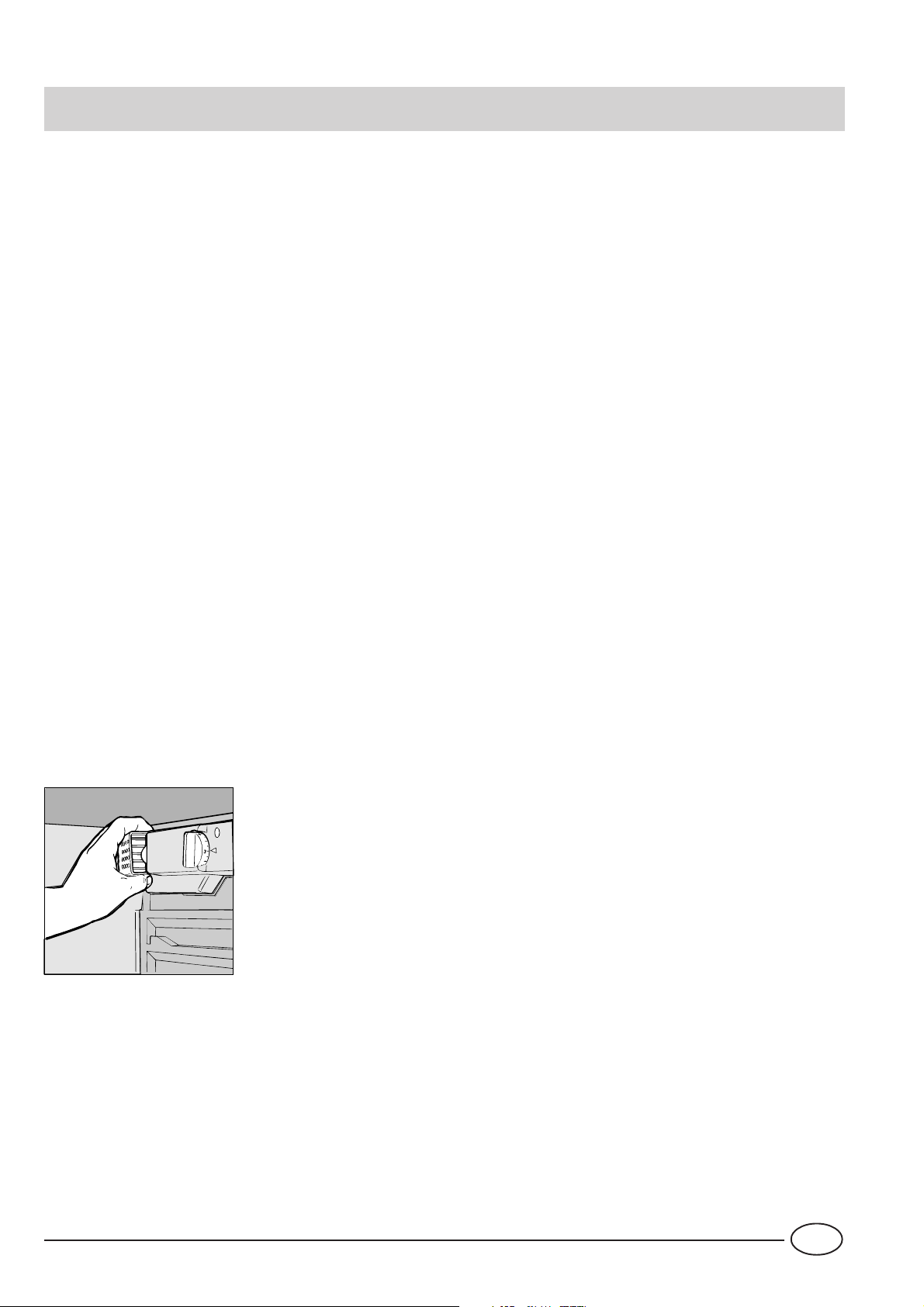
- How to replace the refrigerator lamp. The lamp is located
on the pack part of the thermostat knob box. When replacing the lamp, unplug the appliance from the electrical socket,
unscrew the burned out lamp and replace it with another
following the steps illustrated in figure 5. Make sure that
the wattage is not greater than 15W.
Fig. 5
7
GB
Page 10
Is There a Problem?
The refrigerator does not function.
Have you checked whether:
• The main switch for the electricity to the apartment or
home has been turned off;
• The plug is properly inserted in the outlet;
• The outlet is adequate; try inserting the plug into another
outlet in the room.
The refrigerator and the freezer do not cool
properly.
Have you checked whether:
• The doors do not close well or the seals are faulty;
• The doors are left open too long;
• The thermostat knob is not on the proper setting;
• The refrigerator or freezer is overfilled.
The food in the refrigerator becomes too cold.
Have you checked whether:
• The thermostat knob is on the proper setting;
• The food is in contact with the back wall - which is the
coldest part.
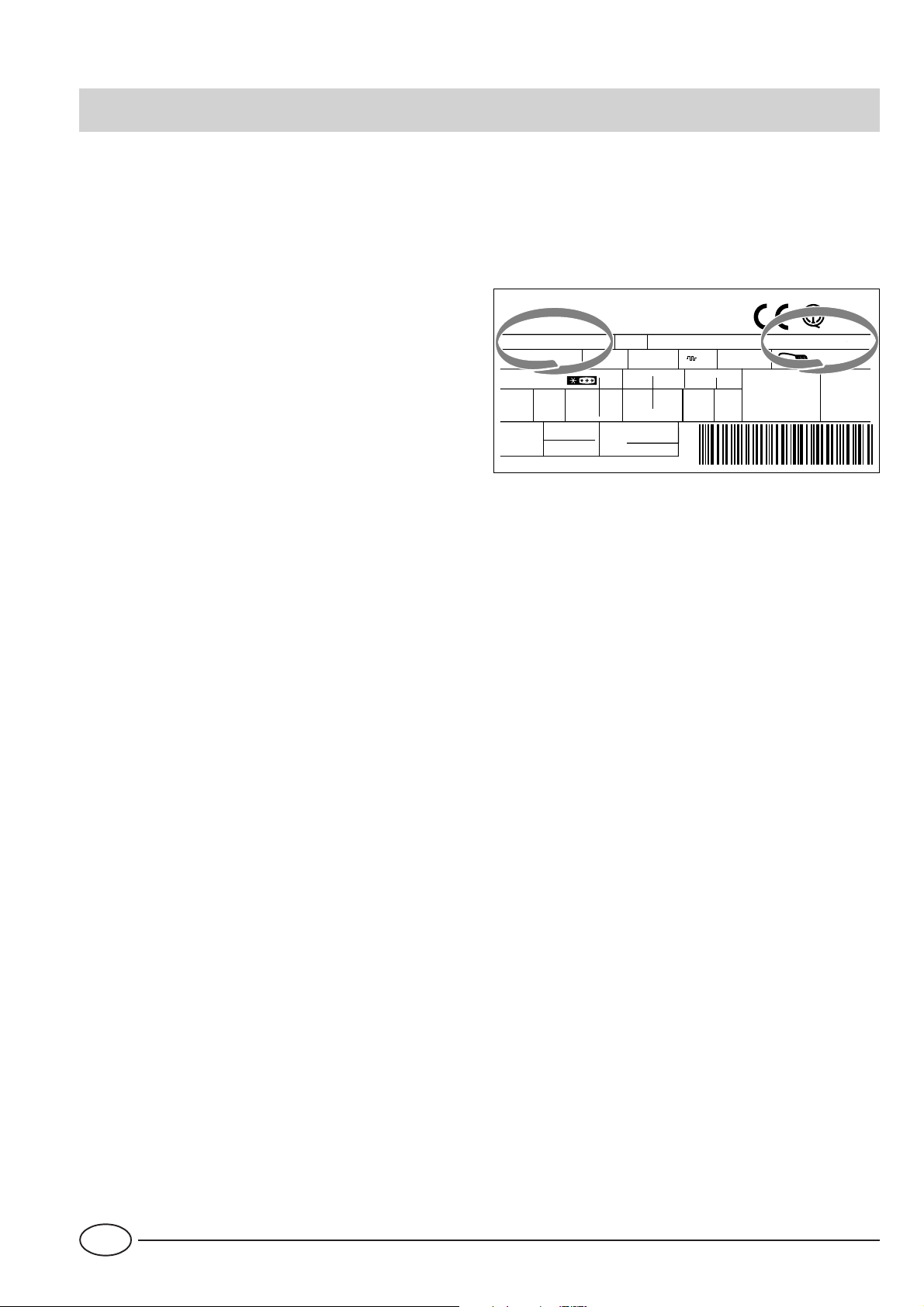
If after all the checks, the appliance still does not operate or
the problem persists, call the nearest Service Centre and
inform them of: the type of problem, the abbreviation of
the model name (Mod.) and the relative numbers (S/N) written on the rating plate located at the bottom left next to
the vegetable crisper (see examples in the figures below).
75
Test
P.S-I.
TI
Net
Util
Utile
Pressure
HIGH-235
LOW 140
RG 2330
Mod.
220 - 240 V- 50 Hz 150 W
340
Total
Gross
Bruto
Brut
Compr.
Syst.
Kompr.
Made in Italy 13918
Gross
Bruto
Brut
R 134 a
kg 0,090
93139180000 S/N 704211801
Cod.
Gross
Bruto
Brut
W
Fuse
A
Freez. Capac
Poder de Cong
kg/24 h
4,0
Max 15 w
Class
Clase
N
Classe
Never call on unauthorized technicians and always
refuse spare parts which are not originals.
The motor runs continuously.
Have you checked whether
• The doors are not closed well or have remained open too
long;
• The ambient temperature is too high;
• The thermostat knob is not on the proper setting.
The appliance makes too much noise.
The gas refrigerant produces a slight noise even when the
compressor is not running (this is not a defect).
Have you checked whether:
• The refrigerator is level.
• The appliance was installed between cabinets or objects
that vibrate and make noise.
There is water on the bottom of the refrigerator.
Have you checked whether:
• The hole for draining the water from the frost is clogged
(see fig. 2).
GB
8
Page 11

Page 12
Merloni Elettrodomestici
Viale Aristide Merloni 47
60044 Fabriano
Italy
Tel +39 0732 6611
Fax +39 0732 662501
www.merloni.com
06/2004 - 195031718 .03 - Xerox Business Services - DocuTech
 Loading...