

Page 1

™
Preliminary Draft 1/19/11
Dolphin
with Windows® Embedded Handheld 6.5
99EX Mobile Computer
User’s Guide
Page 2

Disclaimer
Preliminary Draft 1/19/11
Honeywell International Inc. (“HII”) reserves the right to make changes in specifications and other
information contained in this document without prior notice, and the reader should in all cases consult HII
to determine whether any such changes have been made. The information in this publication does not
represent a commitment on the part of HII.
HII shall not be liable for technical or editorial errors or omissions contained herein; nor for incidental or
consequential damages resulting from the furnishing, performance, or use of this material.
This document contains proprietary information that is protected by copyright. All rights are reserved. No
part of this document may be photocopied, reproduced, or translated into another language without the
prior written consent of HII.
Web Address: www.honeywellaidc.com
Trademarks
Dolphin, Dolphin RF, HomeBase, Mobile Base, and QuadCharger are trademarks or registered
trademarks of Hand Held Products, Inc. or Honeywell International Inc.
Microsoft, Windows, Windows Mobile, Windows Embedded Handheld, Windows CE, Windows 98
Second Edition, Windows NT, Windows 2000, Windows ME, Windows XP, ActiveSync, Outlook, and the
Windows logo are trademarks or registered trademarks of Microsoft Corporation.
Other product names mentioned in this manual may be trademarks or registered trademarks of their
respective companies and are the property of their respective owners.
Patents
For patent information, please refer to www.honeywellaidc.com/patents.
Other Trademarks
The Bluetooth trademarks are owned by Bluetooth SIG, Inc., U.S.A. and licensed to Honeywell.
©2011 Honeywell International Inc. All rights reserved.
Page 3

Table of Contents
Preliminary Draft 1/19/11
Chapter 1 - Agency Information
Laser Safety.........................................................................................................................1-1
Label Locations..............................................................................................................1-1
Laser Safety Label.........................................................................................................1-1
Laser Eye Safety Statement ..........................................................................................1-1
LED Safety...........................................................................................................................1-2
LED Safety Statement....................................................................................................1-2
Infrared LED Safety Statement......................................................................................1-2
UL and C-UL Statement.......................................................................................................1-2
Approvals by Country...........................................................................................................1-2
R&TTE Compliance Statement—802.11a/b/g/n, Bluetooth, and/or GSM............................1-2
Dolphin RF Terminal—802.11a/b/g/n, Bluetooth, and/or GSM............................................1-3
Canadian Compliance..........................................................................................................1-4
Conformité à la règlementation canadienne ........................................................................1-4
RF Exposure Information (SAR) ..........................................................................................1-4
For European Community Users .........................................................................................1-5
Waste Electrical and Electronic Equipment Information ......................................................1-5
Chapter 2 - Getting Started
Out of the Box......................................................................................................................2-1
Home Screen.......................................................................................................................2-4
Title Bar................................................................................................................................2-4
Icons in the Title Bar ............................................................................................................2-4
Horizontal Scroll...................................................................................................................2-7
Tile Bar.................................................................................................................................2-7
Pop-Up Menus.....................................................................................................................2-7
Selecting Programs..............................................................................................................2-8
File Explorer.........................................................................................................................2-8
Search..................................................................................................................................2-9
Chapter 3 - Hardware Overview
Standard Configurations for the 99EX .................................................................................3-1
Peripherals for the 99EX......................................................................................................3-2
Accessories for the 99EX.....................................................................................................3-3
Front Panel: 99EX................................................................................................................3-5
Front Panel Features for the 99EX ................................................................................3-5
Back Panel: 99EX ...............................................................................................................3-7
Back Panel Features for the 99EX.................................................................................3-7
Side Panels: 99EX...............................................................................................................3-9
Left Side ........................................................................................................................3-9
Right Side ......................................................................................................................3-9
Installing a Memory Card...................................................................................................3-10
Installing a SIM Card..........................................................................................................3-10
Bottom Panel: 99EX...........................................................................................................3-11
I/O Connector.....................................................................................................................3-11
iii
Page 4

Using the Touch Panel......................................................................................................3-12
Preliminary Draft 1/19/11
Installing a Screen Protector........................................................................................3-12
Healthcare Housing...........................................................................................................3-12
Batteries ............................................................................................................................3-13
Main Battery Pack........................................................................................................3-13
Internal Backup Battery ...............................................................................................3-14
Managing Battery Power .............................................................................................3-15
Checking Battery Power..............................................................................................3-16
Resetting the Terminal ......................................................................................................3-16
Soft Reset (Warm Boot)...............................................................................................3-16
Hard Reset (Cold Boot) ...............................................................................................3-17
Suspend Mode ..................................................................................................................3-17
Chapter 4 - Using the Scan Image Engine
Overview..............................................................................................................................4-1
Angled Imaging..............................................................................................................4-1
Laser Safety ........................................................................................................................4-1
LED Safety ..........................................................................................................................4-1
Image Engine Specifications...............................................................................................4-1
N5603 Beam Divergence Angle ....................................................................................4-1
Depth of Field ................................................................................................................4-2
Supported Bar Code Symbologies .....................................................................................4-3
Decoding .............................................................................................................................4-4
To Decode a Bar Code..................................................................................................4-4
Aiming Options ..............................................................................................................4-4
Capturing Images................................................................................................................4-6
Taking an Image............................................................................................................4-6
Uploading Images..........................................................................................................4-7
Chapter 5 - Using the Color Camera
Overview..............................................................................................................................5-1
Taking a picture using the Camera Demo tool....................................................................5-1
Options ..........................................................................................................................5-2
Taking a picture using the Windows Embedded Handheld 6.5 Camera tool ......................5-2
Menu..............................................................................................................................5-3
Options ..........................................................................................................................5-3
Recording Video..................................................................................................................5-3
Chapter 6 - Using the Keyboards
Available Keyboards............................................................................................................6-1
Keyboard Combinations ................................................................................................6-1
Common Buttons...........................................................................................................6-1
Using the Function Keys......................................................................................................6-2
Using the Modifier Keys ......................................................................................................6-3
Using the Navigation Keys ..................................................................................................6-3
iv
Page 5

34-Key Alpha/Numeric Keyboard........................................................................................6-5
Preliminary Draft 1/19/11
ALPHA Key....................................................................................................................6-5
34-Key Alpha/Numeric Keyboard Combinations ...........................................................6-6
34-Key Numeric (Calculator) Keyboard...............................................................................6-8
ALPHA Key....................................................................................................................6-8
34-Key Numeric (Calculator) Keyboard Combinations..................................................6-9
43-Key Alpha/Numeric Keyboard......................................................................................6-11
Number Lock (NUM) Key.............................................................................................6-11
43-Key Keyboard Combinations..................................................................................6-12
55-Key Full Alpha/Numeric Keyboard ...............................................................................6-14
55-Key Keyboard Combinations..................................................................................6-14
Chapter 7 - System Settings
Overview..............................................................................................................................7-1
Clock & Alarms....................................................................................................................7-2
Personal Menu ....................................................................................................................7-3
Buttons...........................................................................................................................7-3
System Menu.......................................................................................................................7-7
About .............................................................................................................................7-8
Backlight........................................................................................................................7-9
Battery .........................................................................................................................7-10
Certificates...................................................................................................................7-10
Customer Feedback ....................................................................................................7-10
Encryption....................................................................................................................7-11
Error Reporting............................................................................................................7-11
External GPS...............................................................................................................7-11
Five Volt Control..........................................................................................................7-12
HISS ............................................................................................................................7-12
Managed Programs.....................................................................................................7-14
Memory........................................................................................................................7-14
RIL...............................................................................................................................7-15
Power...........................................................................................................................7-16
Regional Settings.........................................................................................................7-16
Remove Programs.......................................................................................................7-17
Screen...............................................................................................................................7-18
Task Manager..............................................................................................................7-19
Chapter 8 - Communication
Connections Menu...............................................................................................................8-1
Using the IrDA Port..............................................................................................................8-2
IrDA Port Location .........................................................................................................8-2
Sending Data.................................................................................................................8-2
Receiving Data ..............................................................................................................8-3
Connections Manager .........................................................................................................8-4
To Access the Connections Manager............................................................................8-4
Tasks.............................................................................................................................8-4
Advanced....................................................................................................................... 8-5
v
Page 6

Dolphin Wireless Manager ..................................................................................................8-6
Preliminary Draft 1/19/11
Dolphin Wireless Manager Window...............................................................................8-6
Enabling the Radios.......................................................................................................8-6
Accessing Radio Configuration Utilities.........................................................................8-7
Communication....................................................................................................................8-8
Installing Additional Software ............................................................................................8-10
Adding Programs to the Terminal Using ActiveSync...................................................8-10
Adding Programs Directly from the Internet.................................................................8-11
99EX COM Port Assignment Table...................................................................................8-12
Chapter 9 - Working with Wireless Wide Area Networking (WWAN)
Overview..............................................................................................................................9-1
Penta Band Antenna......................................................................................................9-1
SIM Card Installation...........................................................................................................9-3
Installing a SIM Card...........................................................................................................9-4
Enabling the WWAN Radio .................................................................................................9-5
GSM/HSPA+ Global Radio Dolphin Models........................................................................9-5
Voice Communication....................................................................................................9-5
Audio Modes..................................................................................................................9-5
Volume Control..............................................................................................................9-6
Accessing the Dialer Window........................................................................................9-6
Dialing............................................................................................................................9-6
Sending Calls.................................................................................................................9-7
Ending Calls...................................................................................................................9-7
Accessing Voice Mail.....................................................................................................9-7
View Options..................................................................................................................9-7
Setup Options......................................................................................................................9-7
Data Communication...........................................................................................................9-9
Establishing Data Communication (GSM/HSPA+ Global Radio Dolphin Models)...............9-9
Ending the Data Connection........................................................................................9-11
Manual Network Selection.................................................................................................9-12
GSM/CDMA Dolphin Models.............................................................................................9-13
Gobi Manager..............................................................................................................9-13
Establishing Data Communication (GSM/CDMA Dolphin Models)..............................9-14
Chapter 10 - Working with the Bluetooth Radio
Enabling the Bluetooth Radio............................................................................................10-1
Connecting to Other Bluetooth Devices ............................................................................10-2
Pairing and Trusted Devices .............................................................................................10-4
Types of Devices and Services.........................................................................................10-5
Connecting to Bluetooth Printers.......................................................................................10-6
Connecting to Bluetooth Headsets....................................................................................10-6
Transferring Files...............................................................................................................10-7
Making the Terminal Discoverable....................................................................................10-8
Selecting COM Ports.........................................................................................................10-8
Chapter 11 - Working with GPS
Overview............................................................................................................................11-1
vi
Page 7

Assisted GPS Support.......................................................................................................11-1
Preliminary Draft 1/19/11
Powering the GPS Module................................................................................................11-1
Communication Ports........................................................................................................11-1
Selecting the Port ........................................................................................................11-1
COM7 ..........................................................................................................................11-2
GPS Intermediate Driver..............................................................................................11-2
GPS Demo ........................................................................................................................11-2
Chapter 12 - Dolphin 99EX HomeBase Device
Overview............................................................................................................................12-1
Parts and Functions...........................................................................................................12-2
Power ................................................................................................................................12-5
Serial Connector................................................................................................................12-5
Charging the Main Battery.................................................................................................12-6
To Power a Terminal and Charge its Main Battery......................................................12-6
Charging a Spare Battery in the Auxiliary Battery Well ...............................................12-6
Communication..................................................................................................................12-7
Connecting the Communication Cables ......................................................................12-7
Establishing Communication .......................................................................................12-7
Communicating with the Dolphin Terminal..................................................................12-7
Verifying Data Transfer................................................................................................12-8
RS232 Communications Cables........................................................................................12-8
RS232 Pin Configuration.............................................................................................12-8
Mounting............................................................................................................................12-9
Desk Mounting.............................................................................................................12-9
Chapter 13 - Dolphin 99EX eBase Device
Overview............................................................................................................................13-1
Unpacking the eBase...................................................................................................13-1
Parts and Functions...........................................................................................................13-2
Front Panel..................................................................................................................13-2
Back Panel ..................................................................................................................13-4
Bottom Panel...............................................................................................................13-5
Power ................................................................................................................................13-5
Connecting Power to the eBase..................................................................................13-5
Charging the Main Battery.................................................................................................13-6
To Power a Terminal and Charge its Main Battery......................................................13-6
Charging a Spare Battery in the Auxiliary Battery Well ...............................................13-6
Communication..................................................................................................................13-7
Software Requirements...............................................................................................13-7
Establishing Ethernet Communication.........................................................................13-7
Establishing USB Communication...............................................................................13-8
Mounting............................................................................................................................13-8
Using the DIN Rail.......................................................................................................13-8
Chapter 14 - Dolphin 99EX Mobile Base Device
Overview............................................................................................................................14-1
vii
Page 8

Front Panel........................................................................................................................14-2
Preliminary Draft 1/19/11
Bottom Panel.....................................................................................................................14-3
Back Panel and Mounting Brackets...................................................................................14-4
Mounting............................................................................................................................14-5
Safety Precautions.......................................................................................................14-5
Installation....................................................................................................................14-5
Powering the Dolphin Terminal .........................................................................................14-6
Charging the Dolphin Terminal..........................................................................................14-6
Establishing Communication.............................................................................................14-6
Connecting the Communication Cables ......................................................................14-6
Establishing ActiveSync or Windows Mobile Device Center Communication .............14-7
RS232 Communication Cables .........................................................................................14-7
Serial Connector..........................................................................................................14-8
Chapter 15 - Dolphin 99EX ChargeBase Device
Overview............................................................................................................................15-1
Parts and Functions...........................................................................................................15-2
Front Panel..................................................................................................................15-2
Back Panel...................................................................................................................15-3
Power ................................................................................................................................15-3
Connecting Power to the ChargeBase .............................................................................15-3
Charging the Main Battery.................................................................................................15-4
To Power a Terminal and Charge its Main Battery......................................................15-4
Mounting............................................................................................................................15-4
Chapter 16 - Dolphin 99EX Net Base Device
Overview............................................................................................................................16-1
Parts and Functions...........................................................................................................16-2
Front Panel..................................................................................................................16-2
Back Panel ..................................................................................................................16-3
Bottom Panel...............................................................................................................16-4
Power ................................................................................................................................16-4
Connecting Power to the Net Base..............................................................................16-4
Charging the Main Battery.................................................................................................16-5
To Power a Terminal and Charge its Main Battery......................................................16-5
Communication..................................................................................................................16-5
Software Requirements...............................................................................................16-5
Connecting the Dolphin Terminal to the Net Base ............................................................16-5
Mounting the Net Base......................................................................................................16-6
Using the DIN Rail.......................................................................................................16-6
Chapter 17 - Dolphin 99EX QuadCharger Device
Overview............................................................................................................................17-1
Parts and Functions...........................................................................................................17-2
Supplying Power................................................................................................................17-3
Inserting and Charging Batteries.......................................................................................17-3
viii
Page 9

Mounting............................................................................................................................17-4
Preliminary Draft 1/19/11
Desk Mounting.............................................................................................................17-4
Troubleshooting.................................................................................................................17-5
Chapter 18 - Dolphin 99EX Charge Rack and Net Rack Device
Overview............................................................................................................................18-1
Parts and Functions...........................................................................................................18-2
Front and Side Panel...................................................................................................18-2
Back Panel...................................................................................................................18-2
Power ................................................................................................................................18-2
Connecting Power to the Rack....................................................................................18-3
Charging the Main Battery.................................................................................................18-3
To Power a Terminal and Charge its Main Battery......................................................18-3
Communication (Net Rack Only).......................................................................................18-3
Software Requirements...............................................................................................18-3
Connecting the Dolphin Terminal to the Net Rack ............................................................18-4
Mounting the Rack.............................................................................................................18-4
Chapter 19 - Customer Support
Product Service and Repair...............................................................................................19-1
Online Product Service and Repair Assistance...........................................................19-1
Technical Assistance.........................................................................................................19-2
Online Technical Assistance........................................................................................19-2
Limited Warranty ...............................................................................................................19-3
How to Extend Your Warranty.....................................................................................19-4
ix
Page 10

x
Preliminary Draft 1/19/11
Page 11
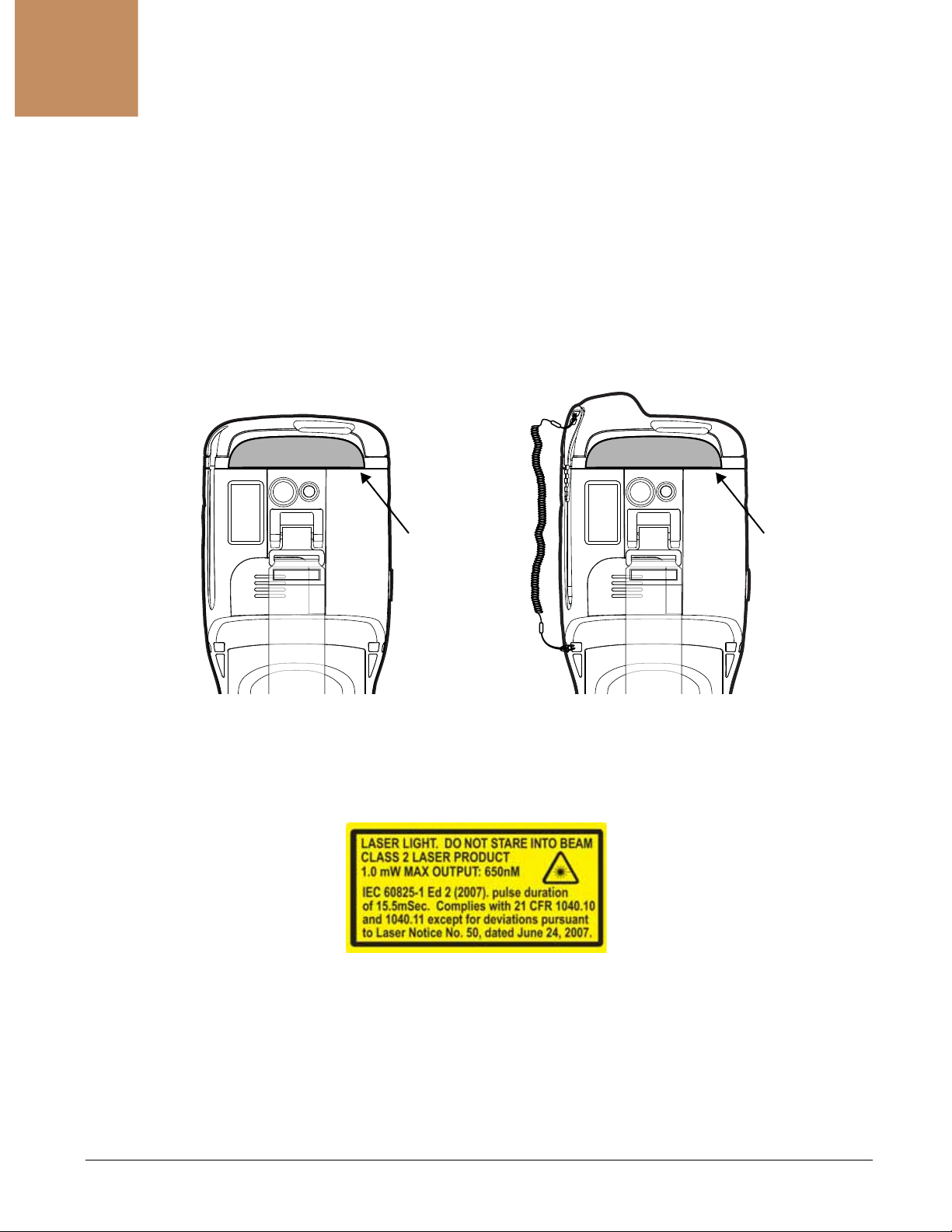
1
Compliance
Label
Dolphin 99EX with WWAN
Compliance
Label
Dolphin 99EX with WLAN
Image Engines with Integrated Laser Aimers
Preliminary Draft 1/19/11
Agency Information
Dolphin 99EX mobile computers meet or exceed the requirements of all applicable standards
organizations for safe operation. However, as with any electrical equipment, the best way to ensure safe
operation is to operate them according to the agency guidelines that follow. Read these guidelines
carefully before using your mobile computer.
Laser Safety
Label Locations
Laser Safety Label
If the following label is attached to your product, it indicates the product contains an engine with a laser
aimer:
Laser Eye Safety Statement
This device has been tested in accordance with and complies with IEC60825-1(Ed. 2.0), EN608251:2007. Complies with 21 CFR 1040.10 and 1040.11, except for deviations pursuant to Laser Notice No.
50, dated June 24, 2007. LASER LIGHT, DO NOT STARE INTO BEAM. CLASS 2 LASER PRODUCT,
1.0 mW MAX OUTPUT: 650nm, pulse duration of 15.5msec, and pulse repetition rate of 32.25 Hz.
Caution! Use of controls or adjustments or performance of procedures other than those specified herein
may result in hazardous radiation exposure.
1 - 1
Page 12

LED Safety
Preliminary Draft 1/19/11
LED Safety Statement
LEDs have been tested and classified as “EXEMPT RISK GROUP” to the Standard: IEC 62471:2006.
Infrared LED Safety Statement
Caution! Do not view directly with optical instruments.
UL and C-UL Statement
UL and C-UL listed: UL60950-1 2nd Edition, and CSA C22.2 No. 60950-1-07 2nd Edition, ISA
12.12.01:2007, CAN/CSA: C22.2 No. 213-M1987.
Approvals by Country
Country EMC, Radio, & SAR Safety
U.S.A. FCC Part 15, Subpart B
FCC Part 15, Subpart C, 15.247
FCC Part 15, Subpart E
FCC Part 22H
FCC Part 24E
FCC SAR OET 65 Supplement C
Canada ICES-003 (Class B)
RSS 132
RSS 133
RSS 210
European Community/CE EN300328, EN301893, EN55022, EN55024,
EN301489-1, EN301489-7/24, EN301489-17,
3GPPTS 51.010-1, EN301511, EN301908,
EN50360, EN50361, EN50371, EN50392,
IEC6220-1, IEC6220-2, EN300440, 301 38925 (CDMA 2000)
UL60950-1, 2nd Edition
CSA C22.2 No. 60950-1-07,
2nd Edition
EN60950-1, 2nd Edition
EN60825-1, 2nd Edition
R&TTE Compliance Statement—802.11a/b/g/n, Bluetooth, and/or GSM
Dolphin RF terminals are in conformity with all essential requirements of the R&TTE Directive (1999/5/
EC).
This product is marked with in accordance with the Class II product requirements specified in
the R&TTE Directive. In addition, this product complies to 2006/95/EC Low Voltage Directive when
supplied with the recommended power supply. Honeywell shall not be liable for use of our product with
equipment (i.e., power supplies, personal computers, etc.) that is not CE marked and does not comply
with the Low Voltage Directive.
1 - 2
Page 13

The equipment is intended for use throughout the European Community; PAN European Frequency
Preliminary Draft 1/19/11
Range: 2.402–2.480 GHz. Restrictions for use in France are as follows:
• Indoor use: Maximum power (EIRP*) of 100 mW for the entire 2.400–2.4835 GHz
• Outdoor use: Maximum power (EIRP*) of 100 mW for the 2.400–2.454 GHz band & maximum power
(EIRP*) of 10 mW for the 2.454–2.483 MGHz band.
• 5Ghz band: UNII (Unlicensed National Information Infrastructure) or band1 (5.150 to 5.250 GHz) is
restricted to indoor use only. Any other use will make the operation of the device illegal.
For further information, please contact:
Honeywell Scanning & Mobility Europe BV
Nijverheidsweg 9
5627 BT Eindhoven
The Netherlands
FCC Requirements
Dolphin RF Terminal—802.11a/b/g/n, Bluetooth, and/or GSM
This device complies with P art 15 of the FCC Rules. Operation is subject to the f ollowing tw o conditions:
(1) this device may not cause harmful interference, and (2) this device must accept any interference
received, including interference that may cause undesired operation.
This equipment has been tested and found to comply with the limits for a Class B digital device pursuant
to Part 15 of the FCC Rules. These limits are designed to provide reasonable protection against harmful
interference in a residential installation. This equipment generates, uses, and can radiate radio
frequency energy and, if not installed and used in accordance with the instructions, may cause harmful
interference to radio communications . Howe v er , there is no guarantee that interf erence will not occur in a
particular installation. If this equipment does cause harmful interference to radio or television reception,
which can be determined by turning the equipment off and on, the user is encouraged to try to correct
the interference by one or more of the following measures:
• Reorient or relocate the receiving antenna.
• Increase the separation between the equipment and receiver.
• Connect the equipment into an outlet on a circuit different from that to which the receiver is connected.
• Consult the dealer or an experienced radio/TV technician for help.
In accordance with FCC 15.21, changes or modifications not expressly approved by the party
responsible for compliance could void the user’s authority to operate the equipment.
The antenna(s) used for this transmitter must not be co-located or operating in conjunction with any
other antenna or transmitter.
If necessary, the user should consult the dealer or an experienced radio/television technician for
additional suggestions. The user may find the following booklet helpful: “Something About Interference.”
This is availab le at FCC local regional offices . Our company is not responsible for any radio or television
interference caused by unauthorized modifications of this equipment or the substitution or attachment of
connecting cables and equipment other than those specified by our company. The correction is the
responsibility of the user. Use only shielded data cables with this system.
1 - 3
Page 14

Canadian Compliance
Preliminary Draft 1/19/11
0.377
HD599EXL0
N/A
This Class B digital apparatus complies with Canadian ICES-003 and RSS210. Operation is subject to
the following two conditions:
1. This device may not cause harmful interference.
2. This device must accept any interference received, including interference that may cause undesired
operation.
Conformité à la règlementation canadienne
Cet appareil numérique de la Classe B est conforme à la norme NMB-003 et RSS210 du Canada. Son
fonctionnement est assujetti aux conditions suivantes:
1. Cet appareil ne doit pas causer de brouillage préjudiciable.
2. Cet appareil doit pouvoir accepter tout brouillage reçu, y compris le brouillage pouvant causer un
fonctionnement indésirable.
RF Exposure Information (SAR)
This mobile phone meets the government's requirements for exposure to radio waves. This phone is
designed and manufactured not to exceed the emission limits for exposure to radio frequency (RF)
energy set by the Federal Communications Commission of the U.S. Government.
The exposure standard for wireless mobile phones employs a unit of measurement known as the
Specific Absorption Rate, or SAR. The SAR limit set by the FCC is 1.6W/kg. *Tests for SAR are
conducted using standard operating positions accepted by the FCC with the phone transmitting at its
highest certified power level in all tested frequency bands. Although the SAR is determined at the
highest certified power level, the actual SAR level of the phone while operating can be well below the
maximum value. This is because the phone is designed to operate at multiple power levels so as to use
only the poser required to reach the network. In general, the closer you are to a wireless base station
antenna, the lower the power output.
The highest SAR value for the model phone as reported to the FCC when tested for use at the ear is
____W/kg and when worn on the body, as described in this user guide, is _____ W/kg (Body-worn
measurements differ among phone models, depending upon available accessories and FCC
requirements.)
While there may be differences betw een the SAR le vels of various phones and at various positions, they
all meet the government requirement.
The FCC has granted an Equipment Authorization for this model phone with all reported SAR levels
evaluated as in compliance with the FCC RF exposure guidelines. SAR information on this model phone
is on file with the FCC and can be found under the Display Grant section of www.fcc.gov/oet/ea/fccid
after searching on FCC ID: ________________.
For body worn operation, this phone has been tested and meets the FCC RF exposure guidelines for
use with an accessory that contains no metal and the positions the handset a minimum of 1.5 cm from
the body. Use of other accessories may not ensure compliance with FCC RF exposure guidelines . If y ou
do no t use a body-worn accessory and are not holding the phone at the ear, position the handset a
minimum of 1.5 cm from your body when the phone is switched on.
1 - 4
Page 15

For European Community Users
Preliminary Draft 1/19/11
Honeywell complies with Directive 2002/96/EC OF THE EUROPEAN PARLIAMENT AND OF THE
COUNCIL of 27 January 2003 on waste electrical and electronic equipment (WEEE).
Waste Electrical and Electronic Equipment Information
This product has required the extraction and use of natural resources for its production. It may contain
hazardous substances that could impact health and the environment, if not properly disposed.
In order to avoid the dissemination of those substances in our en vironment and to diminish the pressure
on the natural resources, we encourage you to use the appropriate take-back systems for product
disposal. Those systems will reuse or recycle most of the materials of the product you are disposing in a
sound way.
The crossed out wheeled bin symbol informs you that the product should not be disposed of along
with municipal waste and invites y ou to use the appropriate separate tak e-bac k systems for product
disposal.
If you need more information on the collection, reuse, and recycling systems, please contact your local
or regional waste administration.
You may also contact your supplier for more information on the environmental performances of this
product.
Pacemakers, Hearing Aids and Other Electrically Powered Devices
Most manufacturers of medical devices adhere to the IEC 601-1-2 standard. This standard requires
devices to operate properly in an EM Field with a strength of 3V/m over a frequency range of 26 to
1000MHz. The maximum allowab le field strength emitted b y the Dolphin terminal is 0.3V/m according to
Subpart B of Part 1 of the FCC rules. Therefore, the RF from the Dolphin terminal has no effect on
medical devices that meet the IEC specification.
Microwaves
The radio in the Dolphin RF terminal operates on the same frequency band as a microwave oven.
Therefore, if you use a microwave within range of the Dolphin RF terminal you may notice performance
degradation in your wireless network. However, both your microwave and your wireless network will
continue to function.
1 - 5
Page 16

1 - 6
Preliminary Draft 1/19/11
Page 17
2
2.
3.
!
Preliminary Draft 1/19/11
Getting Started
Out of the Box
Verify that the carton contains the following items:
• Dolphin 99EX mobile computer (the terminal)
• Main battery pack (i.e., standard 3.7V Li-poly or extended 3.7V Li-ion)
• Quick Start Guide
Note: If you ordered accessories for your terminals, verify that they are also included with the order.
Be sure to keep the original packaging in the event that the Dolphin terminal should need to be returned
for service. For details, see Product Service and Repair on page 19-1.
Step 1. Install the Main Battery Pack
The 99EX is shipped with the battery packaged separate from the unit. Follow the steps below to install
the main battery.
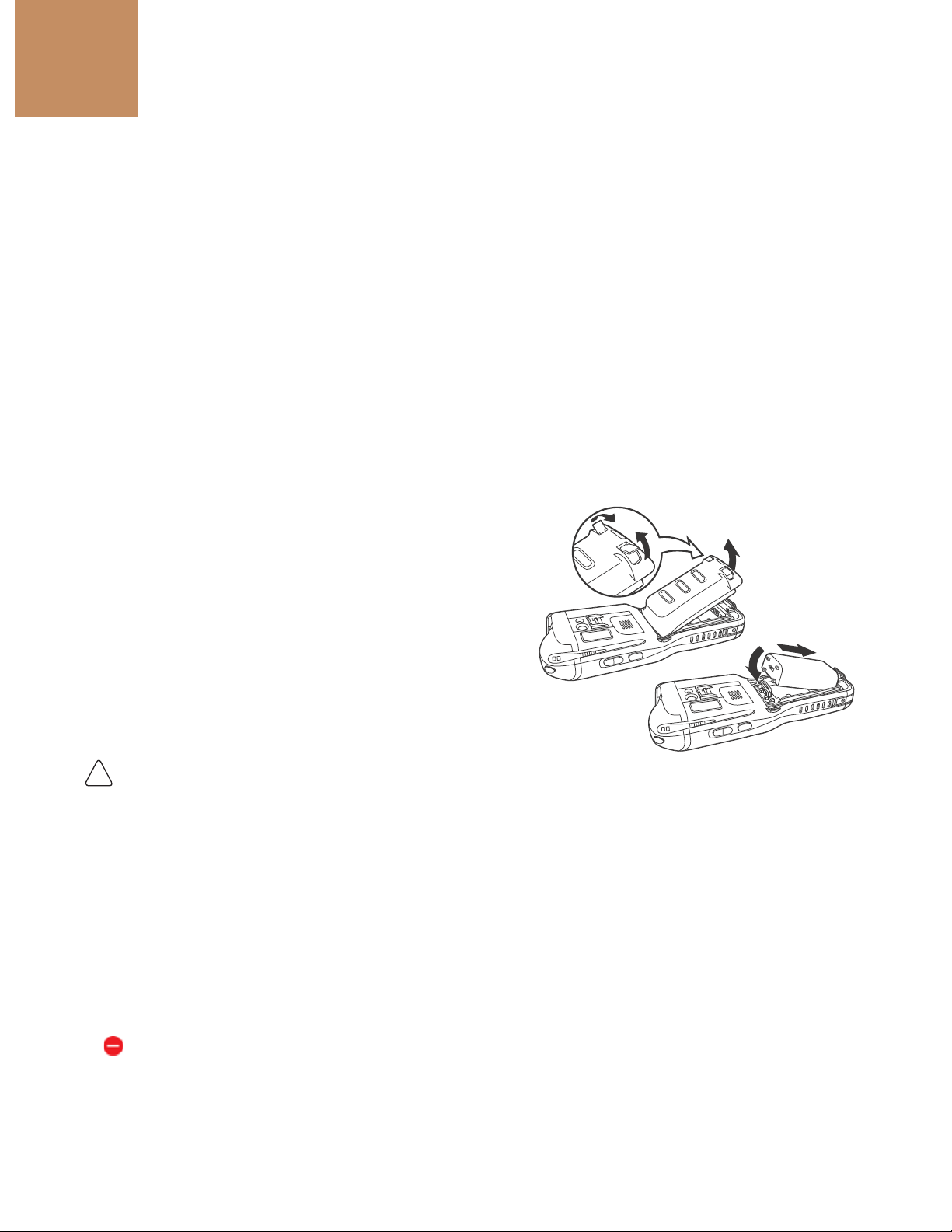
1. Release the hook securing the hand strap to the
back panel of the terminal near the speaker.
2. Remove the battery door by lifting up the latches
near the base of the battery door.
3. Insert the battery into the battery well.
4. Replace the battery door. Apply pressure to
engage the door latch.
Note: The battery door must be installed prior to
powering the unit.
5. Reattach the hand strap.
We recommend use of Honeywell Li-poly or Li-Ion
battery packs. Use of any non-Honeywell battery may result in damage not covered by the warranty.
Step 2. Charge the Main and Backup Batteries
The power supply for Dolphin terminals consists of two types of battery power: the main battery pack
that is accessible from the back panel, and the backup battery that resides inside the terminal.
The main battery powers the terminal. The internal backup battery charges off the main battery and
maintains the application data stored in RAM memory for up to 30 minutes when the terminal’s main battery pack is completely discharged or removed.
Battery Error Notification
If your terminal displays the following indicators, replace the main battery pack with a Honeywell Li-poly
or Li-ion battery pack.
• appears in the Title bar at the top of the touch screen
• The General Notification LED flashes red
• A Notification appears on the Tile bar at the bottom of the touch screen
2 - 1
Page 18
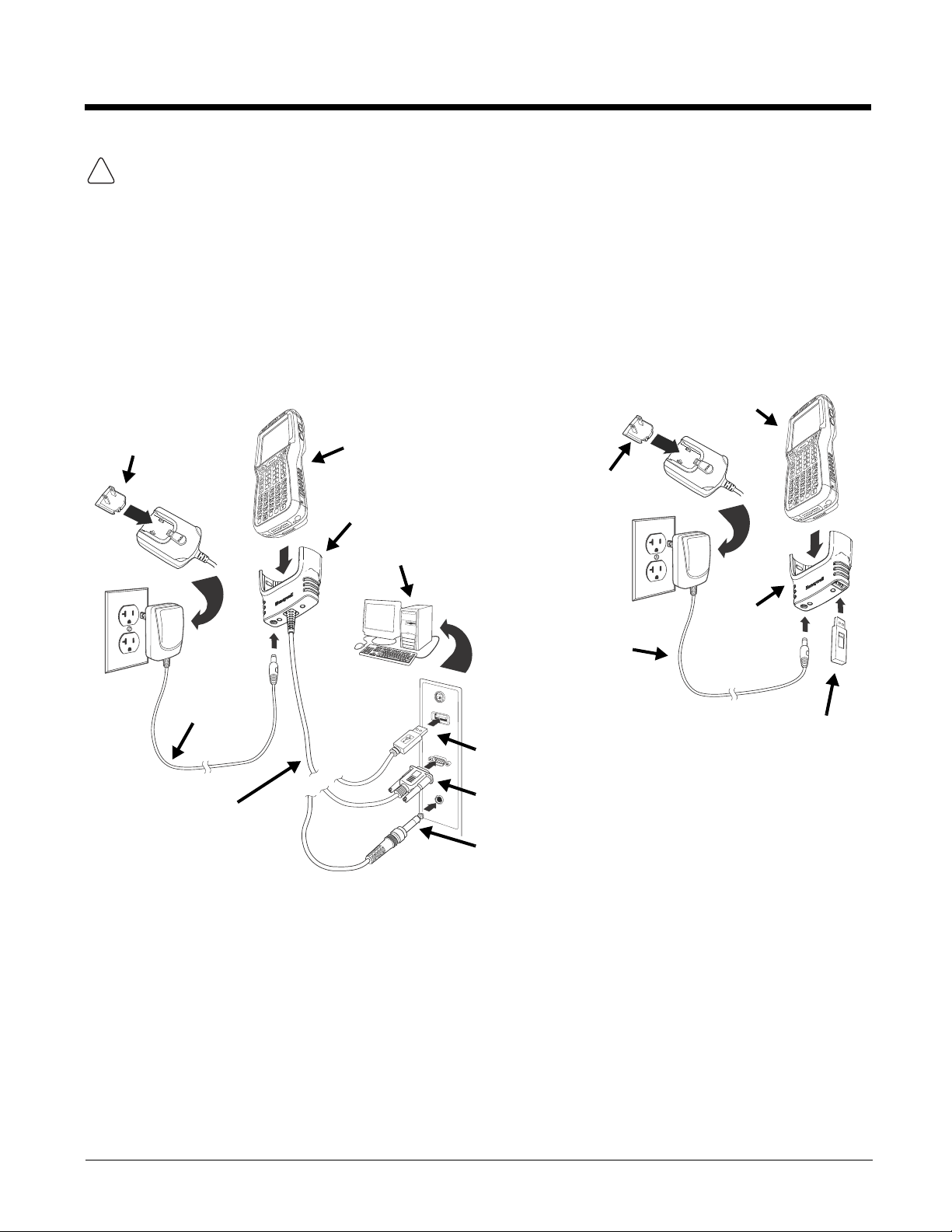
We recommend use of Honeywell peripherals, power cables, and power adapters. Use of any non-Honeywell
!
RS232 Connector
Host Device
Power
Cable
Or
USB Connector
COMM Cable
Plug
Adapter
Cable Cup
Or
RS232, DEX A/V Connector
Dolphin 99EX
Dolphin 99EX
Plug
Adapter
Power
Cable
Client Device
Charging
Cup
Preliminary Draft 1/19/11
peripherals, cables, or power adapters may cause damage not covered by the warranty.
Before Initial Use
Terminals are shipped with both batteries discharged of all power. The initial charging time for the main
battery pack is 4.5 hours for the standard 3.7V battery or 6 hours for the extended 3.7V battery. Connect
the terminal to one of the 99EX series charging peripherals to charge; see Peripherals for the 99EX on
page 3-2. Honeywell recommends charging the Dolphin terminal for at least 24 hours prior to initial use
to ensure the internal backup battery is fully charged.
Using the Charging/Communication Cables
Step 3. Boot the Terminal
The terminal begins booting as soon as power is applied. Do NOT press any keys or interrupt the boot
process. When the boot process is complete, the Home screen appears, and the terminal is ready for
use.
Note: The Home screen appears several times during the boot process. To ensure the boot process is complete,
wait several seconds before using the device.
2 - 2
Page 19
Step 4. Set the Time Zone, Time, and Date
Preliminary Draft 1/19/11
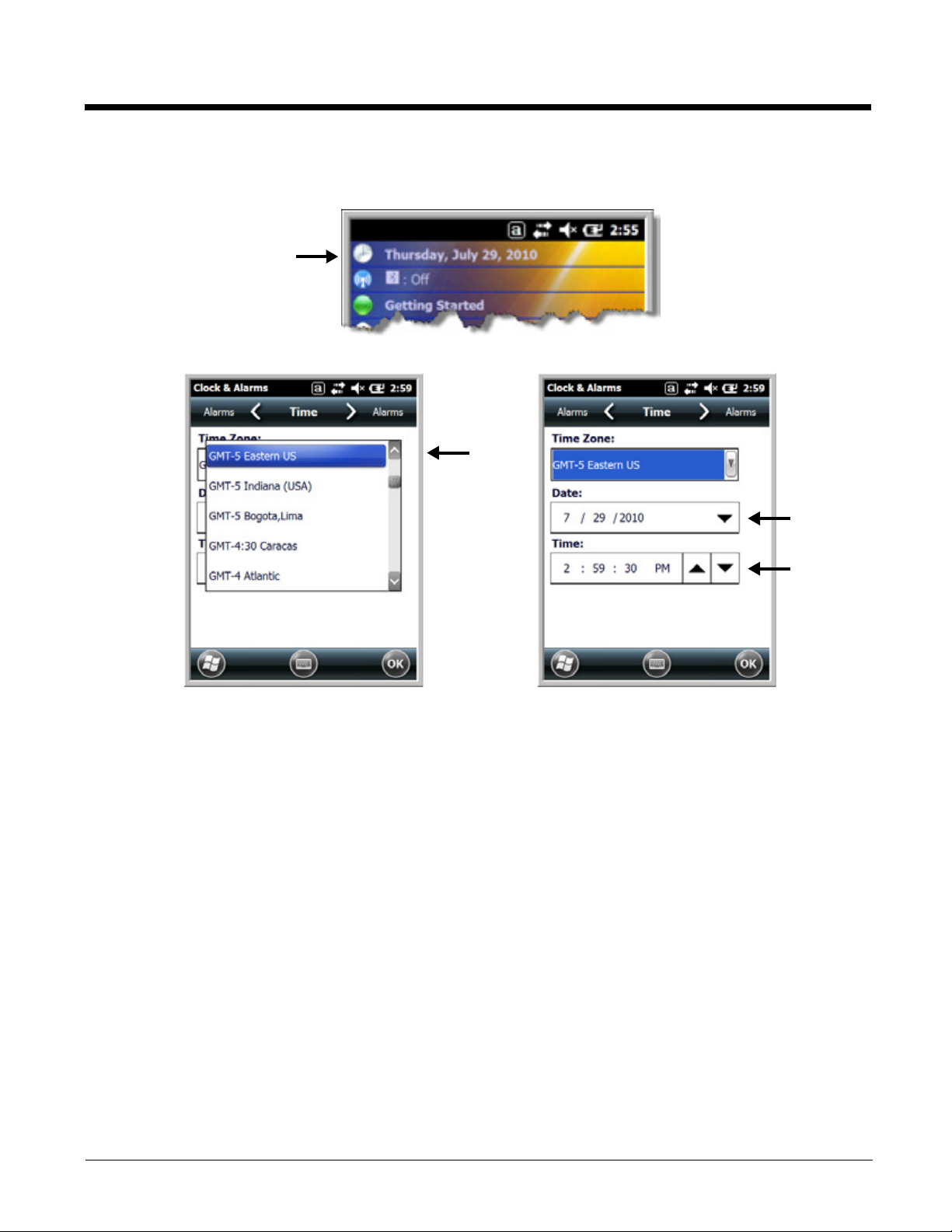
On the Home screen, tap the line that displays the time and date.
The Clock Settings screen appears.
Tap the arrow to the right of the time zone to open the drop down men u. Select the appropiate time zone
from the menu. Set the correct time and date in the remaining fields and tap OK to save.
2 - 3
Page 20
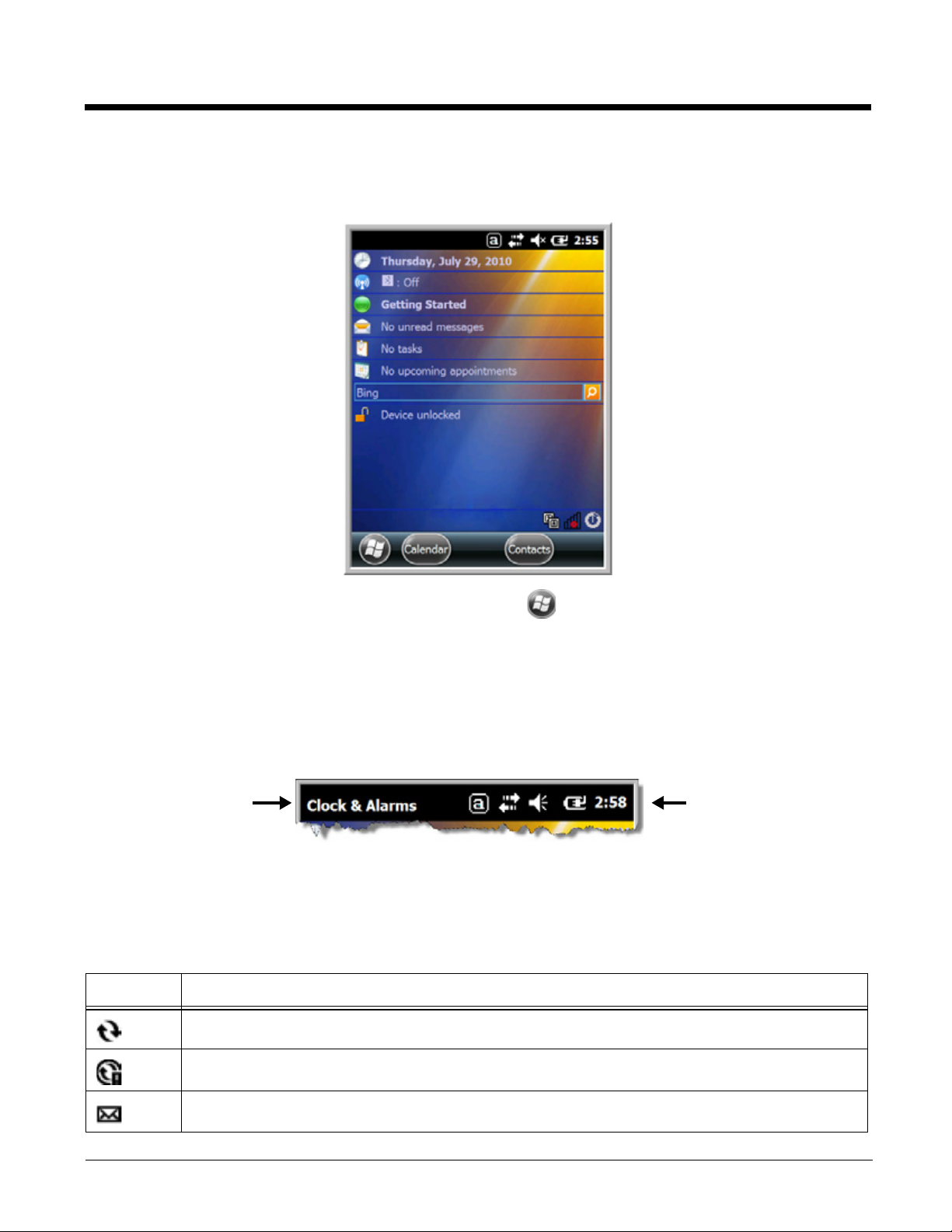
Home Screen
Text here indicates
the active program.
Icons here indicate the
status of various system
functions.
Preliminary Draft 1/19/11
After the Dolphin terminal initializes the first time, you see the Home screen.
You can also display the Home screen anytime by tapping .
Title Bar
The Title bar, located at the top of the screen, displays the active program, the status of various system
functions, and the current time. Tapping on the title bar provides access to the Horizontal Scroll. The
scroll provides access to additional programs and application screens. For additional information, see
Horizontal Scroll on page 2-7.
Note: Tapping the battery icon at the top of the screen does not open the Power applet with this version of Microsoft
Windows Embedded Handheld. Windows Embedded Handheld
Icons in the Title Bar
Indicator Meaning
Synchronizing data
The terminal could not synchronize data with the workstation via ActiveSync.
New e-mail
2 - 4
Page 21
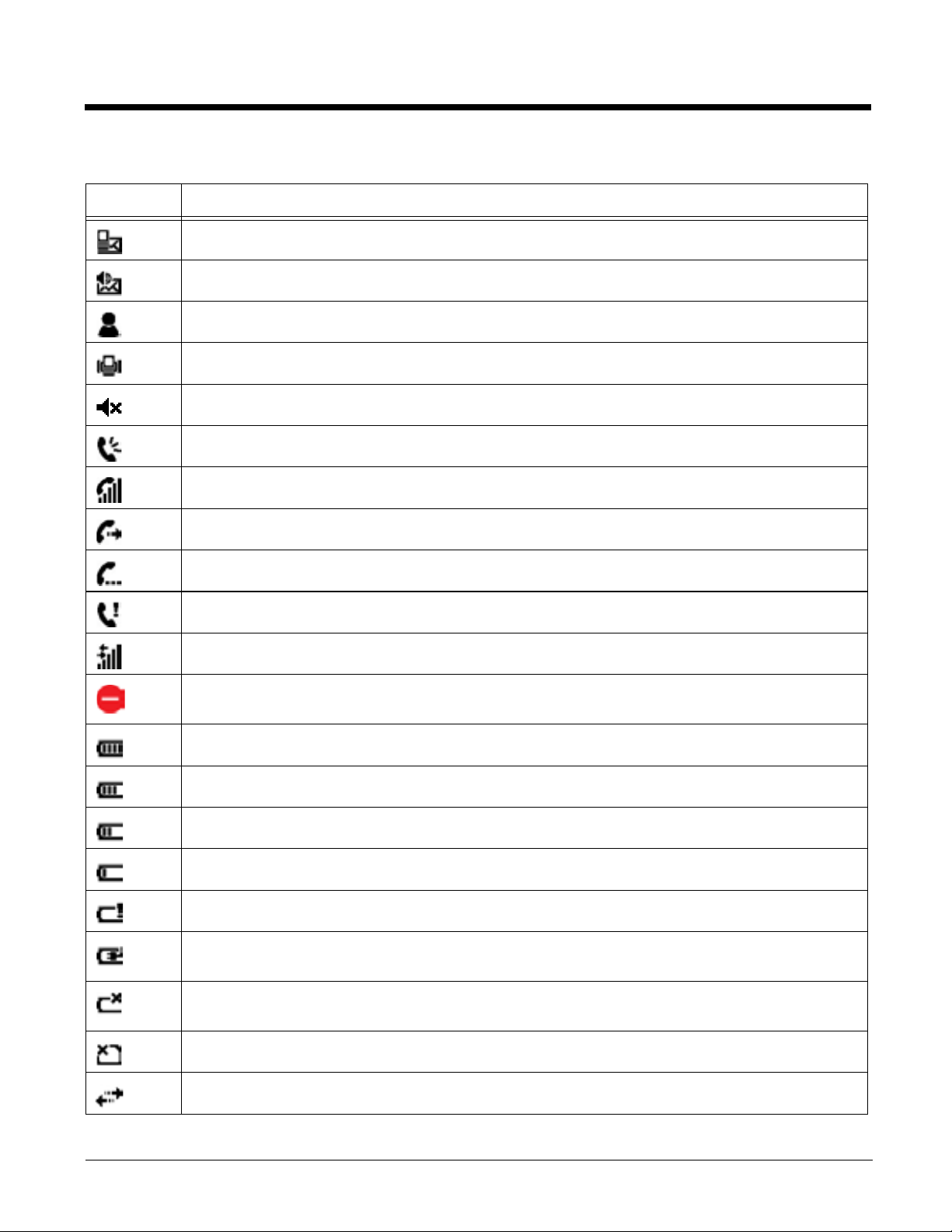
Icons in the Title Bar
Preliminary Draft 1/19/11
Indicator Meaning
New text message
New voicemail
New instant message
Vibrate on
Ringer off
Speakerphone on
Voice call in progress
Calls are forwarded
Call on hold
Missed call
Data call in progress
A battery error has occurred. Replace the main battery pack with a Honeywell Li-poly or Li-ion
battery pack.
Battery is has a full charge
Battery has a high charge
Battery has a medium charge
Battery has a low charge
Battery has a very low charge and requires charging
Terminal is running on external power. If a battery pack is installed, the battery is charging in the
background.
The terminal is not connected to external power. A battery is installed, but is def ectiv e; specifically,
its charge level cannot be measured.
No SIM card is installed
Active network connection
2 - 5
Page 22
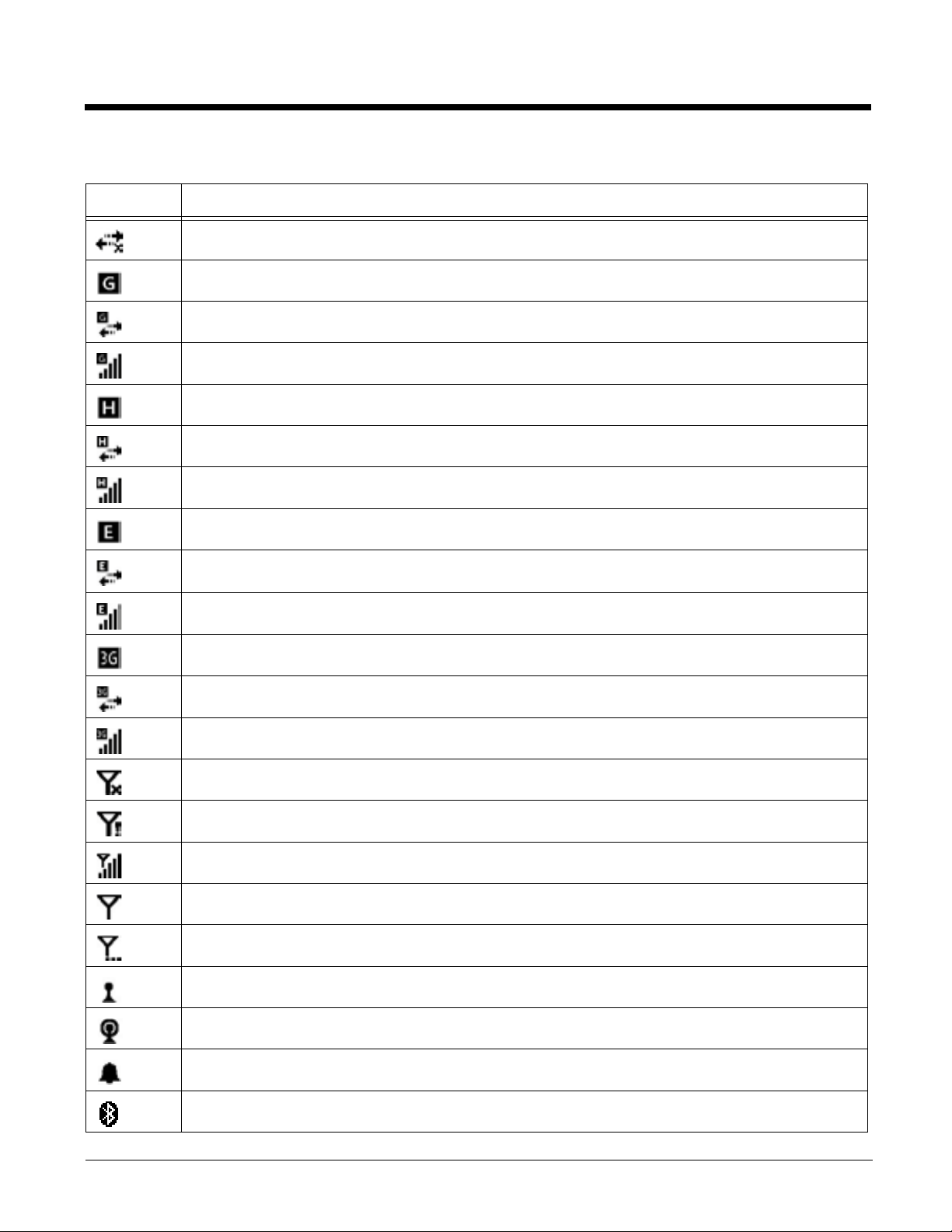
Icons in the Title Bar
Preliminary Draft 1/19/11
Indicator Meaning
No active network connection
GPRS available
GPRS connecting
GPRS in use
HSDPA available
HSDPA connecting
HSDPA in use
EDGE available
EDGE connecting
EDGE in use
UMTS available
UMTS connecting
UMTS in use
Radio is off
The radio is not connected to a network.
The radio is connected. The bars indicate the signal strength.
No radio signal
The terminal is searching for a signal.
Wi-Fi is on, but device is not connected
Wi-Fi data call
Pending alarm
Bluetooth
2 - 6
Page 23
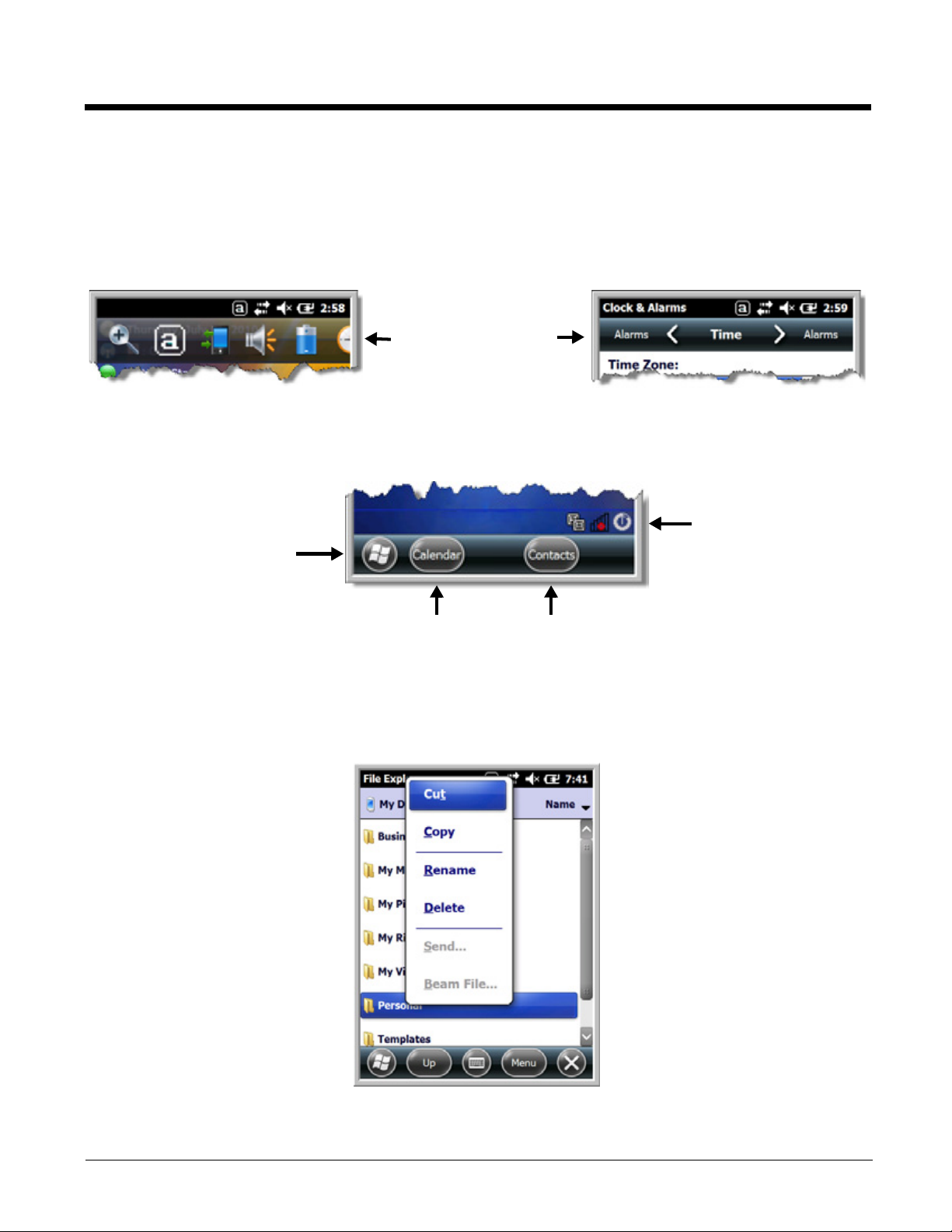
Horizontal Scroll
The content of the
Horizontal scroll
changes according to
the open application.
The icons change according to the open application.
The T ask tray displa ys icons
for programs running in the
background.
The Tile bar displays icons you
use to open and close screens,
menues, and features.
Preliminary Draft 1/19/11
The Horizontal Scroll, located at the top of most application windows, provides access to additional
application screens. You can flick left or right on the scroll or tap each label on the scroll, until you get to
the desired screen. Tapping a label to the left or right of the center item brings new labels into view.
Note: Tap the Title bar to access the horizontal scroll if it is not visible on the screen.
Tile Bar
The Tile bar is located at the bottom of application windows.
Pop-Up Men us
With pop-up menus, you can quic kly choose an action f or a selected item. To access a pop-up menu, tap
and hold the stylus on the item name of the action you want to perf orm. When the menu appears, lift the
stylus, and tap the action you want to perform.
Tap anywhere outside the menu to close the menu without performing an action.
2 - 7
Page 24
Selecting Programs
Preliminary Draft 1/19/11
To see the programs loaded on your terminal, tap to access the Start Menu. To open a
program, tap once on the program icon. To reposition an icon on the Start Menu, tap and hold the stylus
on the icon, and then drag the icon to the desired position.
File Explorer
You can also use the File Explorer to find files and organize these files into folders.
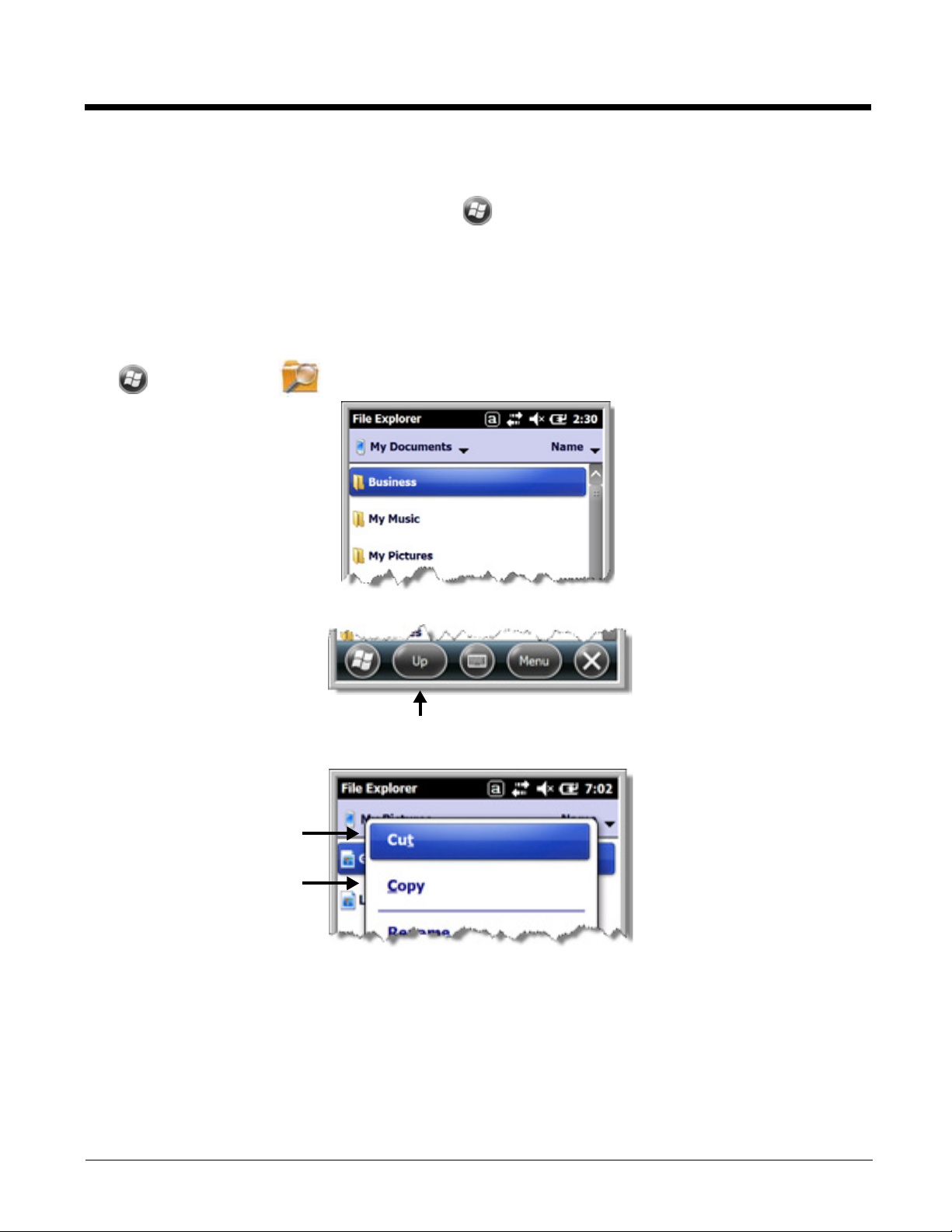
Tap > File Explorer .
Tap the Up button at the bottom of the screen to move up one level in the directory.
You can move files in File Explorer by tapping and holding on the item you want to move, and then tapping Cut or Copy on popup menu.
2 - 8
Page 25
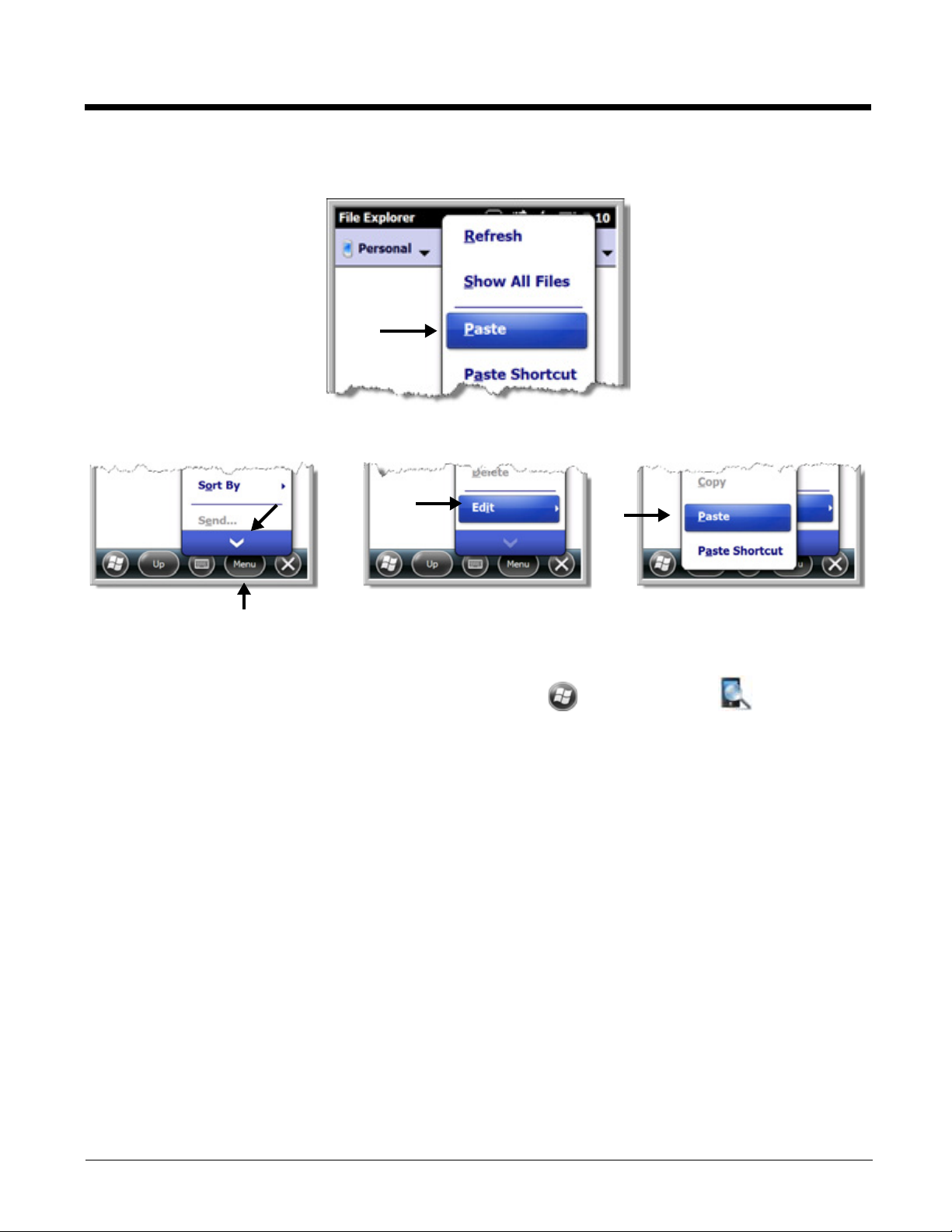
Navigate to the folder you want to move the file to, and then tap and hold a blank area of the window.
Preliminary Draft 1/19/11
Tap Paste on the pop-up menu.
Note: If there is no blank space available in the window, tap
menu using the down arrow, and then tap
Edit > Paste
Menu
on the command bar, navigate to the end of the
.
Search
The Search feature helps you quickly locate information. Tap > Search Phone .
Enter the text you want to find, select a data type, and then tap Go to start the search. Select Larger
than 64 KB in the Type drop-down field to quickly find information that is taking up storage space.
2 - 9
Page 26

2 - 10
Preliminary Draft 1/19/11
Page 27

3
Preliminary Draft 1/19/11
Hardware Overview
Standard Configurations for the 99EX
WLAN & WPAN
• Microsoft Windows Embedded Handheld
6.5 Classic
• OMAP3715 (1Ghz)
• 256MB RAM X 1GB Flash
• Four keyboard options
• 3.7V Li-poly or extended 3.7V Li-ion
rechargeable battery pack
• Adaptus Imaging Technology: N5603ER/
SR/HD or N5600ER/SR/HD image
engines
• 802.11a/b/g/n and Bluetooth
WLAN, WPAN, with GPS
• Microsoft Windows Embedded Handheld
6.5 Classic
• OMAP3715 (1Ghz)
• 256MB RAM X 1GB Flash
• Four keyboard options
• 3.7V Li-poly or extended 3.7V Li-ion
rechargeable battery pack
• Adaptus Imaging Technology: N5603ER/
SR/HD or N5600ER/SR/HD image
engines
• 802.11a/b/g/n and Bluetooth
•GPS
• 3.1 megapixel auto control color camera
WLAN, WPAN & Camera
• Microsoft Windows Embedded Handheld
6.5 Classic
• OMAP3715 (1Ghz)
• 256MB RAM X 1GB Flash
• Four keyboard options
• 3.7V Li-poly or extended 3.7V Li-ion
rechargeable battery pack
• Adaptus Imaging Technology: N5603ER/
SR/HD or N5600ER/SR/HD image
engines
• 802.11a/b/g/n and Bluetooth
• 3.1 megapixel auto control color camera
WLAN, WPAN, with GPS & Camera
• Microsoft Windows Embedded Handheld
6.5 Classic
• OMAP3715 (1Ghz)
• 256MB RAM X 1GB Flash
• Four keyboard options
• 3.7V Li-poly or extended 3.7V Li-ion
rechargeable battery pack
• Adaptus Imaging Technology: N5603ER/
SR/HD or N5600ER/SR/HD image
engines
• 802.11a/b/g/n and Bluetooth
•GPS
• 3.1 megapixel auto control color camera
WLAN, WPAN, & WWAN
• Microsoft Windows Embedded Handheld
6.5 Professional
• OMAP3715 (1Ghz)
• 256MB RAM X 1GB Flash
• Four keyboard options
• 3.7V Li-poly or extended 3.7V Li-ion
rechargeable battery pack
• Adaptus Imaging Technology: N5603ER/
SR/HD or N5600ER/SR/HD image
engines
• 802.11a/b/g/n, Bluetooth, and GSM/
HSPA+ or GSM/CDMA
WLAN, WPAN, & WWAN with GPS
• Microsoft Windows Embedded Handheld
6.5 Professional
• OMAP3715 (1Ghz)
• 256MB RAM X 1GB Flash
• Four keyboard options
• 3.7V Li-poly or extended 3.7V Li-ion
rechargeable battery pack
• Adaptus Imaging Technology: N5603ER/
SR/HD or N5600ER/SR/HD image
engines
• 802.11a/b/g/n, Bluetooth, and GSM/
HSPA+ or GSM/CDMA
•GPS
3 - 1
Page 28

WLAN, WPAN, WWAN with GPS & Camera
Preliminary Draft 1/19/11
• Microsoft Windows Embedded Handheld 6.5 Professional
• OMAP3715 (1Ghz)
• 256MB RAM X 1GB Flash
• Four keyboard options
• 3.7V Li-poly or extended 3.7V Li-ion rechargeable battery pack
• Adaptus Imaging Technology: N5603ER/SR/HD or N5600ER/SR/HD image engines
• 802.11a/b/g/n, Bluetooth, and GSM/HSPA+ or GSM/CDMA
•GPS
• 3.1 megapixel auto control color camera
Some configurations of the 99EX terminal are available with an external housing made of plastic that is
specifically designed for the healthcare industry. For more inf ormation, see Healthcare Housing on page
3-12.
Peripherals for the 99EX
Each of the following items is sold separately to enhance the capabilities of your Dolphin terminal.
Dolphin 99EX HomeBase™ Device
The Dolphin 99EX HomeBase device is a charging and communication cradle supporting both RS232
and USB communications, which enables the terminal to interface with the majority of PC-based enterprise systems. This device also contains an auxiliary battery well that charges a spare Honeywell Li-poly
or extended Li-ion battery.
For more information, see Dolphin 99EX HomeBase Device on page 12-1.
Dolphin 99EX Mobile Base™ Device
The Dolphin 99EX Mobile Base device is a charging and communication cradle designed specifically for
in-premise and in-transit data collection applications. It features a flexible mounting bracket and a cigarette lighter adapter to adapt it to your environment.
The serial connector supports RS232 communication and power out to peripheral devices, such as
handheld scanners. The USB connector is a high-speed 2.0v compliant host port. Using a USB cable,
you can connect the base to a peripheral device, such as a memory stick or printer.
For more information, see Dolphin 99EX Mobile Base Device on page 14-1.
Dolphin 99EX eBase™ Device
The Dolphin 99EX eBase device enables a single 99EX mobile computer to commuicate with a host
device over USB and Ethernet network. This device also contains an auxiliary battery well that charges a
spare Honeywell Li-poly or extended Li-ion battery.
For more information, see Dolphin 99EX eBase Device on page 13-1.
3 - 2
Page 29

Dolphin 99EX Net Base™ Device
Preliminary Draft 1/19/11
The Dolphin 99EX Net Base device enables up to four 99EX mobile computers to communicate with a
host device over an Ethernet network. In addition, the Net Base provides a second RJ45 Ethernet port for
connection to an additional device such as a printer, workstation, eBase, or another Net Base.
For more information, see Dolphin 99EX Net Base Device on page 16-1.
Dolphin 99EX Net Rack™ Device
The Dolphin 99EX Net Rack device enables up to thirty 99EX mobile computer to communicate with a
host device over an Ethernet network.
For more information, please consult the Dolphin 99EX Net Rack and Charge Rack User’s Guide.
Dolphin 99EX ChargeBase
The Dolphin 99EX ChargeBase is a 4-slot charging cradle that holds, powers, and charges terminals.
For more information, see Dolphin 99EX ChargeBase Device on page 15-1.
Dolphin 99EX ChargeRack™ Device
The Dolphin 99EX Charge Rack device is a 30-slot charging ra ck that holds, powers, and charges terminals.
For more information, please consult the Dolphin 99EX Net Rack and Charge Rack User’s Guide.
Dolphin 99EX QuadCharger™ Device
The Dolphin 99EX QuadCharger device is a 4-slot charging station for 99EX standard Li-poly or
extended Li-ion battery packs.
For more information, see Dolphin 99EX QuadCharger Device on page 17-1.
Accessories for the 99EX
Each of the following items is sold separately to enhance your terminal’s capabilities.
Note: When using accessories where the terminal is worn on the body, the terminal’s touch panel must face away
from the body.
Dolphin 99EX Mobile Charger
The Dolphin 99EX Mobile Charger is a charging cable that connects the terminal directly to a 12 V olt DC
power source, such as a cigarette lighter port inside a vehicle, eliminating the need for a cradle. Intelligent battery technology on-board the terminal ensures proper charging. The Dolphin 99EX Mobile Charger is an ideal low-cost charging solution for in-transit mobile applications.
3 - 3
Page 30

Dolphin 99EX Mobile Mount
Stylus for Dolphin 99EX with WWANStylus for Dolphin 99EX with WLAN
Preliminary Draft 1/19/11
The Dolphin 99EX Mobile Mount, which holds a Dolphin terminal securely in place inside a vehicle, is an
ideal, low-cost alternative to the Dolphin 99EX Mobile Base when communications is not required. When
used in conjunction with the Dolphin 99EX Mobile Charger, the Dolphin 99EX Mobile Mount creates a
complete mounting and charging solution for in-transit applications. The entire kit includes an adjustable
vehicle mounting bracket.
Communication/Charging Cables
Dolphin communication/charging cable kits are an all-in-one solution fo r mobile applications. Each cab le
kit powers the terminal, charges its main battery , and communicates with host or peripheral devices without the need for a cradle. Cable kits can support RS232 or USB communications and are available with
U.K. or European power cords.
Protective Holster
Holsters provide convenient storage for terminals and protect them from damage in mobile environments. The holster features a front pocket that holds an extra battery, a side pocket to hold an extra sty-
lus, and a belt loop to secure the holster to a belt.
Protective Enclosure
Protective enclosures help seal and protect terminals from damage while providing full access to all terminal parts and features. These enclosures feature a swivel clip on the back that enables you to secure
the enclosure to a belt. Enclosures also come with an adjustable shoulder strap for added convenience.
Stylus Kits
There are two stylus kits for each terminal type: one contains three styli and the other includes additional
coiled tethers to secure the stylus to the terminal, which helps prevent loss.
Battery Pack
The rechargable battery pack (i.e., standard 3.7V, 3060mA Li-poly or extended 3.7V, 5000mA Li-ion)
provides the main power for the terminal. For more information, see Batteries on page 3-13.
3 - 4
Page 31

Front Panel: 99EX
Power Key
Touch Panel Display
Navigation Keys
SCAN Key
Recessed Keyboard
Front Speaker
I/O Connector
General Notification LED
Power Key
Touch Panel Display
Navigation Keys
SCAN Key
Recessed Keyboard
Front Speaker
I/O Connector
General Notification LED
Dolphin 99EX with WWANDolphin 99EX with WLAN
Red Modifier Key Blue Modifier Key
Blue Modifier Key
Red Modifier Key
Microphone
Microphone
Charge Indicator LED
Charge Indicator LED
Preliminary Draft 1/19/11
Note: The illustrations above show the 55-Key Full Alpha/Numberic Keyboard option. For a complete overview of
For a description of each callout, see Front Panel Features for the 99EX on page 3-5.
Front Panel Features for the 99EX
Blue Modifier Key
the optional keyboards available for the 99EX, see Using the Keyboards on page 6-1.
See Using the Modifier Keys on page 6-3.
Front Speaker
The front speaker is the receiver for handset voice calls. See GSM/HSPA+ Global Radio
Dolphin Models on page 9-5.
3 - 5
Page 32

General Notification LED
Preliminary Draft 1/19/11
The light emitting diode (LED) located above the top right corner of the LCD display flashes
and illuminates during resets, scanning/imaging, and taking a picture. This LED can be
programmed by various software applications.
Charge Indicator LED
The light emitting diode (LED) located above the top left corner of the LCD display illuminates
when the Power Tools BattMon application is enabled and the device is on AC charge. For
more information, consult the Dolphin Power Tools User’s Guide for Windows Embedded
Handheld 6.5.
Microphone
The integrated microphone that provides audio input for handset and speakerphone voice
calls. See Voice Communication on page 9-5.
Navigation Keys
The centrally located navigation keys enable you to move and position the cursor through
software programs. The up and down arrows are programmed to perform specific functions
when pressed in combination with the Blue and Red modifier keys. For more details, see Using
the Navigation Keys on page 6-3.
Power Key
The power key located at the lower left corner of the keypad puts the terminal in Suspend
Mode or wakes the terminal from Suspend Mode. See Software/Operating System Upgrades
on page 3-17.
Recessed Keyboard
There are three keyboard options: a 34-key alpha/numeric keyboard, a 43-key alpha/numeric
keyboard or a 55-key full alpha/numberic keyboard. For a complete overview of each
keyboard, see Using the Keyboards on page 6-1.
Red Modifier Key
See Using the Modifier Keys on page 6-3.
SCAN Key
The SCAN key is centrally located for easy access with the right or left hand. When pressed,
the SCAN key activates the scanner/imager. The SCAN key also functions as a system wakeup control for the terminal.
Touch Panel Display
The color 3.7 inch liquid crystal display (LCD) touch panel is covered with an industrial,
protective lens for greater durability. The video graphic array (VGA) display resolution is
480 X 640.
The 262K color (18 bit RGB) LCD uses thin film transistor (TFT) technology. The touch panel
backlight illuminates when the screen is touched, but not when the Backlight key is pressed.
For more information, see Backlight on page 7-9.
The touch panel can be activated by the stylus (included with the terminal) or a finger. For more
information, see Using the Touch Panel on page 3-12.
3 - 6
Page 33

Back Panel: 99EX
Image/Scan Engine Window
Rear Speaker
IrDA Port
Stylus Slot
Battery Door
Fastener for the
Stylus Tether
Flashlight/
Camera Flash
Color Camera
Hand Strap
Dolphin 99EX with WWANDolphin 99EX with WLAN
Image/Scan Engine Window
Stylus Slot
Battery Door Release
Rear Speaker
IrDA Port
Battery Door
Flashlight/
Camera Flash
Color Camera
Hand Strap
Battery Door Release
Fastener for the
Stylus Tether
Fastener for the
Stylus Tether
Hand Strap Hook
Hand Strap Hook
Preliminary Draft 1/19/11
For a description of each callout, see Back Panel Features for the 99EX below.
Back Panel Features for the 99EX
Battery Door
Color Camera
The battery door secures the Li-ion or Li-poly battery pack in the terminal’s battery well. For
more information, see Batteries on page 3-13.
The 3.1-Megapixels Resolution (QXGA 2048H x 1536V) color camera provides easy piture
capture with Automated Camera Control (ACC). Additional features include automated picture
profiles and an Application Programming Interface (API).
3 - 7
Page 34

Fastener for the Stylus Tether
Stylus for Dolphin 99EX with WWANStylus for Dolphin 99EX with WLAN
Preliminary Draft 1/19/11
Stylus tethers can be purchased separately to help prevent accidental loss when the stylus is
not stored in the stylus slot. A stylus tether is a coiled, elastic cord that tethers the stylus to
the terminal. Secure one end of the cord to the back panel of the terminal and the other end
to the stylus.
Flashlight/Camera Flash
The flashlight/camera flash is located on the back panel of the terminal. When used as a
Flashlight, press the Blue key + key to turn the flashlight on or off. When used as a
Camera Flash with the terminal’s color camera, the flash is controlled by the camera
application.
Hand Strap
The 99EX comes with a removable, elastic hand strap.
Image/Scan Engine Window
The available image engines read and decode linear, stacked linear (e.g., PDF417), and 2D
matrix bar code symbologies. The available image engines contain a laser aimer for greater
accuracy. The laser apertures for the imaging engines’ laser aimers are contained behind this
window. For more details, see Using the Scan Image Engine on page 4-1.
Memory Card Socket and SIM Card Socket
The memory card socket provides the user with the option to expand the terminal’s memory
capacity using industry-standard microSD or microSDHC memory interfaces. The expansion
socket is located under the main battery in the battery well.
When the protective SIM/memory card door, battery pack, and the battery door are properly
installed, the memory card is sealed against moisture and particle intrusion, read/write data is
stored securely, and the terminal’s environmental rating is preserved; see Installing a Memory
Card on page 3-10.
The card socket for the Subscriber Identity Module (SIM) is also located under the main battery
in the battery well. See SIM Card Installation and SIM Card Requirements, on page 9-3 for
additional information.
Rear Speaker
The integrated rear speaker sounds audio signals as you scan bar code labels and enter data.
The integrated speaker also supports playback of wave and MP3 files, software mixer, and
Speakerphone for WWAN/GSM audio. The operating frequency range is 600-3000Hz at
>90dB.
Stylus Slot
The stylus is used to operate the touch panel. The back panel of the terminal features a storage
slot to hold the stylus when not in use. The stylus features a special tip for added accuracy and
ease of use.
3 - 8
Page 35

Side Panels: 99EX
Left Button IrDA Port
Extended Li-ion Battery Door
Standard Li-poly Battery Door
Right Button
Volume Control Button
Lower Volume | Raise Volume
Extended Li-ion Battery Door
Standard Li-poly Battery Door
Preliminary Draft 1/19/11
The left and the right side panels of the Dolphin contain different features.
Left Side
Left Button
By default, the Left Button triggers the scanner/imager. You can reassign the button to launch
applications or execute commands. For additional information, see Changing Button
Assignments on page 7-4.
IrDA Port
The IrDA port enables infrared communication. The maximum data transfer speed is 115 kbps.
For more information about using this port, see Using the IrDA Port on page 8-2.
Note: The infrared LED aperture is located behind the IrDA Port window.
Right Side
Right Button
By default, the Right Button triggers the scanner/imager. You can reassign the button to launch
applications or execute commands. For additional information, see Changing Button
Assignments on page 7-4.
Volume Control Button
Press the top or bottom of the volume button to raise or lower the volume of the active speaker.
3 - 9
Page 36

Installing a Memory Card
Step 4
Step 6
Step 7
Step 8
Step 5
Step 9
Preliminary Draft 1/19/11
1. Press the Power key to put the terminal in Suspend Mode.
2. Release the hand strap hook near the speaker on the back panel of
the terminal.
3. Remove the battery door and the battery.
4. Remove the T6 torque screw securing the protective door closed.
5. Lift up the lower left corner of the door to access the memory
socket.
6. Unlock the access door to the memory socket by sliding the door
toward the IrDA port side of the terminal.
7. Lift the door up to expose the socket.
8. Slide the microSD or microSDHC card into the door of the socket.
Note: Make sure the interface on the memory card is connected to the interface
in the socket; align the notch on the card with the notch of the socket.
9. Close and lock the access door.
10. Close the protective door over the memory socket. Install and
tighten the T6 torque screw to secure the door closed.
11. Install the battery and the battery door. Reattach the hand strap to
the terminal.
12. Press the Power key or SCAN key to wake the terminal.
Installing a SIM Card
See Installing a SIM Card on page 9-4.
3 - 10
Page 37

Bottom Panel: 99EX
2468 10 12 14 16 18
1 3 579 11 13 15 17
Preliminary Draft 1/19/11
Pin Description
1GND
2GND
3 USBC_DET
4 USBC_D5RTS
6 USBC_D+
7DTR
8SPK
9 Audio_GND
10 MIC
11 CTS
12 USBH_D13 5V_OUT
14 USBH_D15 TXD
16 RXD
17 VCC
18 VCC
Note: Signals referenced are for a DTE device.
I/O Connector
The I/O connector powers the terminal, charges the main battery, and facilitates communication. All Dolphin peripherals are designed to work exclusively with this connector.
The I/O connector supports RS232 and high speed USB v2.0 communication. For RS232, the maximum communication speed is 115.2 Kbps with seven baud rate settings. For USB, the communication
speed is up to 480 Mbps.
I/O Power Out
The I/O connector also provides power out (to peripheral devices) +5V at 500mA. This means that,
with the proper cable, the terminal can power another device. By default, power out is disabled, but the
5V output may be enabled, see Five Volt Control on page 7-12.
3 - 11
Page 38

Using the Touch Panel
Preliminary Draft 1/19/11
Honeywell defines proper use of the terminal touch panel as using a screen protector and proper stylus.
Screen protectors maintain the ongoing integrity (i.e., prevent scratching) of the touch panel, which is
why their use is recommended for applications that require a high to medium level of interface with the
touch panel, such as signature capture for proof of delivery.
Honeywell advocates the use of screen protectors on all Dolphin devices. We recommend implementing
a screen protector replacement program to ensure that screen protectors are replaced periodically when
signs of damage/wear are noticeable. For general use, we recommend replacing the screen protector
every thirty (30) days. However, replacement cycles vary according to the average level of touch panel
use in your application.
Replacement screen protectors can be purchased directly from Honeywell. Please contact a Honeywell
sales associate for details.
Honeywell also mandates use of a proper stylus, which is one that has a stylus tip radius of no less than
0.8 mm. Use of the Honeywell stylus included with the terminal is recommended at all times.
Honeywell warranty policy co v ers w ear on the touch panel f or the first twelve (12) months if a screen protector is applied and an approved stylus is used for the 12 month duration covered by the warranty.
Installing a Screen Protector
Dolphin terminals ship with a screen protector already installed. You will need to replace the screen protector at regular intervals.
1. After the current screen protector has been removed from the touch panel, clean the touch panel
thoroughly with a clean, non-abrasive, lint-free cloth. Make sure there is no debris on the touch
panel.
2. Align the exposed section of the protector with the bottom edge of the touch panel. Make sure that
the screen protector is flush with each side of the touch panel. To reposition, lift up gently and
reapply.
3. Press the screen protector firmly and carefully across the surface of the touch panel as you peel
away the backing.
4. If necessary, smooth out any air pockets or bumps.
Healthcare Housing
Some configurations of the 99EX terminal are available with an external plastic housing that is designed
to resist the effects of harsh chemicals in a healthcare environment. The plastic is crystalline in nature,
which helps prevent chemicals from seeping through the housing.
Important! The following cleaning solutions have been tested to assure safe cleaning of your terminal’s
disinfectant-ready housing. They are the only solutions approved for use with these
terminals. Damage caused by the use of cleaners other than those listed below may not be
covered by the warranty.
®
• Sani-Cloth
• Sani-Cloth
• Sani-Cloth
• Super Sani-Cloth
HB wipes
®
Plus wipes
®
Bleach wipes
®
wipes
3 - 12
Page 39

• Isopropyl Alcohol wipes (70%)
!
Preliminary Draft 1/19/11
• CaviWipes
•Virex® 256
•409
•Windex
• Gentle dish soap and water
®
™
Glass and Surface Cleaner
®
Blue
Batteries
There are three types of battery power: the main battery pack installed in the back panel, the backup
battery located inside the terminal and the Real Time Clock (RTC) battery located inside the terminal.
They are designed to work together to prevent data loss when the terminal is in use over long periods.
All batteries must be completely charged before using a Dolphin terminal for the first time!
Note: The RTC battery will preserve the Real Time Clock 60 days after the main battery and internal backup battery
are fully depleted.
Main Battery Pack
We recommend use of Honeywell Li-ion or Li-poly battery packs. Use of any non-Honeywell battery may result
in damage not covered by the warranty.
The standard 3.7 V, 11.3 watt hour Li-poly or e xtended 3.7 V, 18.5 watt hour Li-ion battery pack is the primary power source for the terminal. The Li-poly and Li-ion battery packs are designed to operate in a
temperature range of -10° to 50°C (14° to 122°F).
Note: Honeywell recommends placing the terminal in Software/Operating System Upgrades (see page 3-17) before
removing the battery cover.
Charging Options
When the main battery pack is installed in the terminal, use one of the following peripherals:
• Dolphin 99EX HomeBase Device (see page 12-1)
• Dolphin 99EX eBase Device (see page 13-1)
• Dolphin 99EX Mobile Base Device (see page 14-1)
• Dolphin 99EX ChargeBase Device (see page 15-1)
• Dolphin 99EX Net Base Device (see page 16-1)
When the main battery pack is not installed in the terminal:
• Place the battery pack in the Dolphin 99EX QuadCharger Device (see page 17-1)
• Place the battery pack in the Auxiliary Battery Well of the Dolphin 99EX HomeBase Device (see page
12-2) or Dolphin 99EX eBase Device (see page 13-1).
Charging Time
The standard 3.7V Li-poly battery pack requires 4.5 hours to charge completely before initial use.
The extended 3.7V Li-ion battery pack requires 6 hours to charge completely before initial use.
Honeywell recommends charging the Dolphin terminal for at least 24 hours prior to initial use to ensure
the internal backup battery is fully charged.
3 - 13
Page 40

Battery Error Notification
Preliminary Draft 1/19/11
If your terminal displays the following indicators, replace the main battery pack with a Honeywell Li-poly
or Li-ion battery pack.
• appears in the Title bar at the top of the touch screen.
• The General Notification LED flashes red.
• A Notification appears on the Tile bar at the bottom of the touch screen.
Storing Batteries
To maintain top performance from batteries, avoid storing batteries outside of the following temperature
ranges:
• 14°F to 113°F (-10°C to +45°C) for short term storage of less than one month
• 32°F to 86°F (-0°C to +30°C) for long term storage
Do not store batteries in extremely high humidity. For prolonged storage, do not keep batteries stored in
a charger that is connected to a power source.
Guidelines for Battery Pack Use and Disposal
The following are general guidelines for the safe use and disposal of batteries:
• We recommend use of Honeywell Li-ion or Li-poly battery packs. Use of any non-Honeywell battery
may pose a personal hazard to the user.
• Replace defective batteries immediately; using a defective battery could damage the Dolphin terminal.
• Never throw a used battery in the trash. A battery contains heavy metals and should be recycled
according to local guidelines.
• Do not use a battery in any other manner outside its intended use in Dolphin terminals and peripherals.
• Do not short-circuit a battery or throw it into a fire; it can explode and cause severe personal injury.
• Excessive discharge damages a battery. Recharge the battery when your terminal indicates low battery
power.
• If you observe that the Honeywell battery supplied is physically damaged, please send it to Honeywell
International Inc. or an authorized service center for inspection. Refer to the Product Service and
Repair section of this guide.
• Although your battery can be recharged many times, the battery life is limited. Replace it after the
battery is unable to hold an adequate charge.
• If you are not sure the battery or charger is working properly, send it to Honeywell International or an
authorized service center for inspection.
Internal Backup Battery
Located inside the terminal, the backup battery is a 3.6 Volt nickel metal hydride (NiMH) battery.
The internal backup battery prevents the terminal from being reset if you need to remove and replace the
main battery pack. It retains RAM data. If the terminal is left without the main battery pack for more than
30 minutes, the internal backup battery needs to be recharged to function according to its specifications.
Note: Data and programs stored in Flash memory are not lost even if the internal backup battery fails.
3 - 14
Page 41

Charging
Preliminary Draft 1/19/11
The internal backup batteries are powered by the main battery pack. Therefore, charging the internal
backup batteries require that the main battery pack be installed in the terminal and the terminal be connected to a charging device.
Note: Honeywell recommends placing the terminal in Software/Operating System Upgrades (see page 3-17) before
removing the battery cover.
The internal backup battery must be fully charged before using the terminal for the first time. Honeywell
recommends charging the Dolphin terminal for at least 24 hours prior to initial use to ensure the internal
backup battery is fully charged. After that, if the internal backup battery becomes fully discharged of
power, it requires a minimum of 30 hours of charging time to function normally.
Guidelines for Use
Follow these guidelines to maximize the life of the internal backup battery:
• Keep a charged Li-ion or Li-poly battery pack in the terminal; the backup battery prematurely
discharges if there is not at least a partially charged battery in the terminal.
• Keep the terminal connected to power when the terminal is not in use.
Managing Battery Power
Letting the backup battery become fully discharged causes the terminal to lose all data in RAM. Honeywell recommends, you k eep a charged battery pack in the terminal at all times to help prevent data loss.
The internal battery discharges prematurely if there is not at least a partially charged battery in the terminal. When you remove a battery pack, insert another charged battery pack in the terminal immediately.
Default Critical and Low Battery Points
When the terminal is running on battery power (as opposed to external power), warnings are displayed
when the battery reaches critical and low battery points. The warning points are determined by the following registry entry:
[HKEY_LOCAL_MACHINE\ControlPanel\Power]
There are two DWORD values in this registry entry: MedState and LowState.
The default values for these entries are as follows:
MedState=25%
This sets the Low Battery point to 25%. When the battery hits the percentage charge specified
here, the user is notified.
LowState=10%
This sets the Critical Battery point to 10%. When the battery hits the percentage charge
specified here, the user is notified.
Note: Warnings do not appear when the terminal is on external power.
3 - 15
Page 42

Setting Critical and Low Battery Points
Preliminary Draft 1/19/11
Developers can reset the battery parameters in the registry from 0 (no warning) to 99 (would nearly
always warn). You can review and set these battery points in the RegEdit Power Tool.
1. Tap > Power Tools > RegEdit.
2. Drill down to HKEY_LOCAL_MACHINE > ControlPanel > Power.
3. Tap the Value Name to change the Value Data.
You can reset the Value Data from 0 (no warning) to 99 (would nearly always warn).
4. Tap OK to save changes.
For more inf ormation about the RegEdit Power Tool, refer to the Dolphin Power Tools User’s Guide available for download at www.honeywellaidc.com.
Checking Battery Power
Tap > Settings > System > Power.
For more information, see Power on page 7-16.
Note: Tapping the battery icon at the top of the screen does not open the Power applet with this version of Microsoft
Windows Embedded Handheld.
Resetting the Terminal
There are three types of system resets: a soft reset, a hard reset and a factory reset. The soft and hard
resets preserve all data stored in the file system. See Honeywell support for more information on how to
perform a factory reset.
Soft Reset (Warm Boot)
A soft reset re-boots the device and preserves any objects created in RAM. You would perform a soft
reset when:
• the terminal fails to respond.
3 - 16
Page 43

• after installing some software applications.
ALT
CTRL
ENT
!
ALT
CTRL
ESC
SCAN
Preliminary Draft 1/19/11
• after making changes to certain system settings, such as network cards.
1. Press and hold the CTRL + ENTER keys for approximately 5 seconds.
2. The decode and scan LEDs flash for approximately three seconds as the terminal resets.
3. When the reset is complete, the Home screen displays.
Hard Reset (Cold Boot)
A hard reset re-boots the device and clears RAM data. Files in the user store are not affected unless y ou
are performing a software upgrade.
A hard reset erases all of the data stored in RAM memory!
1. Press and hold the CTRL + ESC keys for approximately 5 seconds.
2. The decode and scan LEDs light for approximately 3 seconds.
3. The terminal re-initializes; see Initialize the Mobile Computer on page 2-8.
Software/Operating System Upgrades
Software upgrades reset the device back to a factory state. Back up all user files to a storage card or
external memory prior to performing a software upgrade. All files in the user store will be erased during
an operating system upgrade. Data stored in the IPSM directory is preserved during an operating system upgrade.
Suspend Mode
The terminal goes into Suspend Mode automatically when the terminal is inactive for a programmed
period of time. You can program this time on the Advance tab of the Power System Setting; see Power
on page 7-16.
To put the terminal into Suspend Mode manually, press the Power key and the screen goes blank.
To wake the terminal from Suspend Mode, press the Power key or SCAN key .
Hardware Maintenance
When needed, clean the image engine window and the LCD display with a clean, non-abrasive, lint-free
cloth. The terminal can be cleaned with a damp cloth.
For additional information on hardware maintenance specific to the Dolphin Healthcare Housings, see
page 3-12.
3 - 17
Page 44

3 - 18
Preliminary Draft 1/19/11
Page 45

4
Preliminary Draft 1/19/11
Using the Scan Image Engine
Overview
The Dolphin terminal houses a compact image engine that instantly reads popular 1D and 2D bar codes
and supports omni-directional aiming and decoding for greater flexibility in real-world settings. The
image engine can also capture black and white digital images, such as signatures and pictures of damaged inventory.
With the latest CMOS-based technology, the engine works like a digital camera and enables black and
white digital image capture, signature capture, and reading of OCR characters.
Angled Imaging
All imagers are installed at a 25 degree downward-facing angle for enhanced comfort and maneuverability while scanning.
Laser Safety
See Laser Safety on page 1-1.
LED Safety
See LED Safety on page 1-2.
Image Engine Specifications
Engines 1D 2D Image Capture Aiming Pattern Omni-Directional Aiming
N5603SR/ER/HD
N5600SR/ER/HD
YYY N5603 Red High-Vis
YYY Capturing Images (page
N5603 Beam Divergence Angle
Engines Horizontal Beam Divergence Angle
(degrees)
Aiming Pattern (page 4-5)
See Laser Safety on
page 1-1.
4-6)
Vertical Beam Divergence Angle
(degrees)
Y
Y
N5603SR/HD
N5603ER
18.1 14.3
13.1 9.9
4 - 1
Page 46

Depth of Field
Preliminary Draft 1/19/11
The depth of field measurements used the following parameters:
• Distances are measured from the front of the engine.
• +23°C (+73°F), 0 lux
• Photographic quality codes
Focus N5603/N5600
High Density (HD)
Symbology Distance (in/cm) Delta
(in/cm)
Near Far Near Far Near Far
3 mil
C39/128
5 mil
C39/128
7.5 mil
C39/128
10 mil
C39/128
15 mil
C39/128
20 mil
C39/128
100% UPC
5 mil
PDF417
2.1
(5.3)
1.3
(3.3)
1.3
(3.3)
1.3
(3.3)
1.3
(3.3)
2.1
(5.3)
1.9
(4.8)
1.3
(3.3)
3.4
(8.6)
4.8
(12.2)
5.7
(14.5)
5.6
(14.2)
7.8
(19.8)
9.4
(23.9)
7.1
(18)
4.9
(12.4)
1.3
(3.3)
3.5
(8.9)
4.4
(11.2)
4.3
(10.9)
6.5
(16.5)
7.3
(18.5)
5.2
(13.2)
3.6
(9.1)
N5603/N5600
Standard Range (SR)
Distance (in/cm) Delta
(in/cm)
---- - -
2.7
(6.9)
2.3
(5.8)
1.3
(3.3)
1.3
(3.3)
2.0
(5.1)
1.8
(4.6)
2.2
(5.6)
6.2
(15.7)
9.4
(23.9)
13.5
(34.3)
19.5
(49.5)
20.1
(51.1)
17.0
(43.2)
5.8
(14.7)
3.5
(8.9)
7.1 (18) 4.0
12.2
(31)
18.2
(46.2)
18.1
(46)
15.2
(38.6)
3.6
(9.1)
N5603/N5600
Extended Range (ER)
Distance (in/cm) Delta
(in/cm)
5.8
(14.7)
(10.2)
2.7
(6.9)
1.9
(4.8)
2.8
(7.1)
2.7
(6.9)
6.1
(15.5)
9.0
(22.9)
12.8
(32.5)
17.6
(44.7)
21.4
(54.4)
26.5
(67.3)
20.9
(53.1)
7.9
(20.1)
3.2
(8.1)
8.8
(22.4)
14.9
(37.8)
19.5
(49.5)
23.7
(60.2)
18.2
(46.2)
1.8
(4.6)
6.7 mil
PDF417
10 mil
PDF417
5 mil
MicroPDF
5 mil
Data Matrix
10 mil Data
Matrix/Aztec
20 mil
Data Matrix
1.3
(3.3)
1.6
(4.1)
1.7
(4.3)
1.6
(4.1)
1.3
(3.3)
1.9
(4.8)
4.9
(12.4)
6.3
(16)
3.3
(8.4)
3.0
(7.6)
5.3
(13.5)
8.0
(20.3)
3.6
(9.1)
4.7
(11.9)
1.6
(4.1)
1.4
(3.6)
4.0
(10.2)
6.1
(15.5)
1.9
(4.8)
1.9
(4.8)
--
---- - -
1.9
(4.8)
1.9
(4.8)
4 - 2
6.6
(16.8)
11.3
(28.7)
8.2
(20.8)
16.0
(40.6)
4.7
(11.9)
9.4
(23.9)
-- -
6.3 (16) 5.4
14.1
(35.8)
4.6
(11.7)
2.4
(6.1)
(13.7)
2.4
(6.1)
9.9
(25.1)
16.0
(40.6)
11.3
(28.7)
19.9
(50.5)
5.3
(13.5)
13.6
(34.5)
-
5.9
(15)
17.5
(44.5)
Page 47

10 mil QR 3.3
Preliminary Draft 1/19/11
(8.4)
5.0
(12.7)
3.5
(8.9)
2.1
(5.3)
7.2
(18.3)
5.1 (13) 4.1
(10.4)
10.6
(26.9)
6.5
(16.5)
20 mil QR 2.0
(5.1)
32 mil
Maxicode
2.2
(5.6)
8.0
(20.3)
8.8
(22.4)
6.0
(15.2)
6.6
(16.8)
Supported Bar Code Symbologies
Symbology Type Symbology Name
1D Symbologies Codabar
Code 3 of 9
Code 11
Code 32 Pharmaceutical (PARAF)
Code 93
Code 128
EAN with Add-On
EAN with Extended Coupon Code
EAN-8
EAN-13
GS1-128
GS1 Databar
Interleaved 2 or 5
2D Symbologies Aztec
Codablock
Code 16K
Code 49
Composite
Data Matrix
1.9
(4.8)
2.1
(5.3)
15.8
(40.1)
19.3
(49)
13.9
(35.3)
17.1
(43.4)
ISBT 128
Matrix 2 of 5
MSI
Plessey
PosiCode
Straight 2 of 5 IATA
Straight 2 of 5 Industrial
Telepen
Trioptic Code
UPC
UPC-A
UPC-E
GS1 Databar
MaxiCode
Micro PDF
OCR
PDF417
QR Code
2.0
(5.1)
3.7
(9.4)
19.6
(49.8)
23.2
(58.9)
17.6
(44.7)
19.5
(49.5)
Composite Codes Aztec Mesa
Codablock F
EAN·UCC
GS1 Databar-14
OCR OCR US Money Font
MICR (E 13 B) and SEMI Font
OCR-A
OCR-B
Postal Codes Postnet and most international 4-state codes
Australian Post
British Post
Canadian Post
China Post
Japanese Post
KIX (Netherlands) Post
Korea Post
Planet Code
4 - 3
Page 48

Decoding
SCAN
Preliminary Draft 1/19/11
The terminal supports two types of image decoding for use in various bar code reading and imaging
applications: full-area imaging and Advanced Linear Decoding (ALD).
Full-Area Imaging
Full-area imaging provides omni-directional reading of linear and non-linear 1D and 2D bar codes, OCR,
signature capture, and picture taking. When reading all bar code types using full-area imaging, a positive
read can be obtained from many positions; see Aiming Options on page 4-4. To achieve the best read,
the aiming beam should be centered horizontally across the bar code.
ALD
ALD provides fast reading of linear and stacked linear bar codes. To achieve a positive read when reading linear 1D and PDF417 bar codes, the green aiming beam should be centered horizontally across the
bar code. When ALD is enabled, the reader does not read matrix or postal codes.
To Decode a Bar Code
The aiming beam should be oriented in line with the bar code to achieve optimal decoding. A range
of 4-10 inches (10-25 cm) from the bar code is recommended.
1. Tap > Demos > Scan Demo .
2. Point the Dolphin terminal at the bar code.
3. Project the aiming beam or pattern by pressing and holding the SCAN key .
4. The scan LED lights red.
5. Center the aiming beam over the bar code; see Aiming Options on page 4-4.
6. When the bar code is successfully decoded, the decode LED lights green and the terminal beeps.
7. The bar code information is entered into the application in use.
Aiming Options
The aiming beams are smaller when the terminal is held closer to the code and larger when it is farther
from the code. Symbologies with smaller bars or elements (mil size) should be read closer to the unit
whereas symbologies with larger bars or elements (mil size) should be read farther from the unit.
4 - 4
Page 49

N5603 Red High-Vis Aiming Pattern
Preliminary Draft 1/19/11
If your Dolphin terminal is configured with a 5603 imager, high-vis aimers frame the bar code for more
intuitive aiming. See Laser Safety on page 1-1.
N5600 Green Aiming Beam
Linear Bar Code
2D Matrix Symbol
4 - 5
Page 50

Capturing Images
SCAN
Preliminary Draft 1/19/11
The image-capture process is an intuitive, split-second operation f o r e xperienced users. By f ollo wing the
basic guidelines, new users can easily develop their own technique and, with practice, quickly learn to
adapt it to different application environments.
Image Preview
When the imaging process is initiated, the touch screen displays a preview of the object. This is a live
video image of what the imager is currently viewing. The live video image has a slightly degraded
appearance compared to the captured image. This is normal.
Scan Key
On all 99EX terminals, the SCAN key captures images.
File Formats
File formats supported for image storage include Bitmap (BMP), JPEG (JPG) and Portable Network
Graphics (PNG). The default file format for images is a grayscale JPG.
Compression
Digital images have a maximum image size of 640 x 480 pixels and may have up to a 256 grayscale
image definition.
The image quality and related file size are determined by the data compression method used by the software application used to take images. The average size of the image file is approximately 4–8K. However, the size of the image depends on the content of the image - the more complex the content, the
larger the file size.
Taking an Image
The following steps are basic guidelines for taking images:
1. Tap > Demos > Imaging Demo .
2. Point the Dolphin terminal at the object.
3. To preview the image, press and hold the SCAN key .
4. The touch screen displays a preview of the object, and the decode and scan LEDs light red.
5. Adjust the terminal’s position until the object appears on the screen the way you want it to appear in
the image.
6. Hold the terminal still and release the SCAN key. The scan and decode LEDs flash red, the screen
flashes, and the captured image appears on the screen.
4 - 6
Page 51

7. Unless otherwise specified by the application in use, the image is saved to the \My Device\My
!
Preliminary Draft 1/19/11
Documents folder.
Enabling the Aimer
If your Dolphin terminal is configured with the 5300 imager, you can enable the aiming pattern for imaging in the Imaging Demo. For details about the aimer, see Capturing Images on page 4-6.
1. Tap > Demos > Imaging Demo > Setup menu > Aimer.
2. The aiming pattern is now enabled for imaging.
Uploading Images
Image files can be uploaded to a host workstation via Microsoft ActiveSync and a Dolphin communication peripheral or your wireless radio connection.
Note: You can download the most current version of ActiveSync from www.microsoft.com.
Note: Visit the Microsoft Windows 7 website for information on how to sync your music, pictures, contacts and
calendars using Device Stage.
Note: Visit the Microsoft Windows Vista website for information on how to sync your music, pictures, contacts and
calendars using Windows Mobile Device Center.
We recommend use of Honeywell peripherals, power cables, and power adapters. Use of any non-Honeywell
peripherals, cables, or power adapters may cause damage not covered by the warranty.
4 - 7
Page 52

4 - 8
Preliminary Draft 1/19/11
Page 53

5
Camera Lens
Flashlight/
Camera Flash
ENT
Preliminary Draft 1/19/11
Using the Color Camera
Overview
Dolphin 99EX terminals equipped with a 3.1-Megapixels Resolution color camera with Automated Camera Control (ACC), and an Application Progr amming Interface (API) provide easy integration of color picture and video capture into business applications. The camera lens and camera flash are located on the
back panel of the terminal.
Taking a picture using the Camera Demo tool
1. Tap > Demos > Camera Demo .
2. Adjust the camera settings using the icon menu at the top of the display screen.
3. Point the terminal's camera lens at the object you
want to capture. The camera lens is located on the
back panel of the terminal.
4. Center the object in the touch screen display.
5. Press the ENT key or tap Snap . The
terminal’s red LED illuminates during picture
capture.
Note: Tap the green arrow to review or edit your pictures.
Tap the green box to exit the picture review/edit
screen.
5 - 1
Page 54

Options
Profile Tab
Display Tab
The profile tab allows you to customize your
camera settings, or chose from several
predefined profiles designed to provide the
best picture quality for common tasks.
ENT
Preliminary Draft 1/19/11
Tap Options > Camera.
The Camera Options menu appears. There are five tabs of configurable options accessible from the
Camera Options menu.
Taking a picture using the Windows Embedded Handheld 6.5 Camera tool
1. Tap > Pictures & Videos > Camera
2. Point the terminal's camera lens at the object you want to capture. The camera lens is located on the
back panel of the terminal.
3. Center the object in the touch screen display.
4. Press the ENT key .
5. The touch screen displays the captured photo.
5 - 2
Page 55

Menu
General Tab Slide Show Tab Camera Tab Video Tab
ENT
Preliminary Draft 1/19/11
Tap Menu on the Command Bar to adjust the camera settings, switch to video mode, and access additional camera options.
Item Descriptions
Video Activate Video Mode
Mode Normal Mode, Burst Mode, Timer Mode
Resolution Set picture resolution (i.e., 320 x 240, 640 x 480, 800 x 600, 1600 x 1200)
Zoom Set zoom (i.e., x1, x2, x3, and x4)
Flash Camera Flash On or Camera Flash Off
Focus Focus On, Focus Off, Focus on Trigger, or Fixed-Focus
Brightness Set the brightness setting from +2.0 EV to -2.0 EV in .5 EV increments
Full Screen Switch to full screen mode
Options Set General, Slide Show, Camera, and Video options
Focus Manual focus adjustment
Options
Tap Menu > Options. The Options menu contains four screens:
Recording Video
1. Tap > Pictures & Videos > Camera > Menu > Video
2. Point the terminal's camera lens at the object you want to capture.
3. Press the ENT key to start recording.
4. Tap Stop or press ENT to stop recording.
5 - 3
Page 56

5 - 4
Preliminary Draft 1/19/11
Page 57

6
ALT
CTRL
NUM
A B C D E
F G H I J
K L M N O
P Q R S
T
UVWX Y
Z
1
+
@
#
*
F1 F2 F3 F4 F5
F6 F7 F8 F9 F10
F15F14F13F12F11
F17 F18 F19 F20F16
F21 F22 F23 F24 F25
23
456
789
.
0
SFT SP
BKSP
,
SCAN
VOL
PG
TAB
ESC
SEND
END
ENT
☼
ALT
CTRL
A
123
456
789
0
BCDE
FGHIJ
KL MNO
PQRST
UVWXY
Z
SFT
#
!
?
;
@
$&
—
~
`
.
,
*
F6 F7 F8 F9 F10
F15F14F13F12F11
F17 F18 F19 F20F16
F21 F22 F23 F24 F25
BKSP
SP
DEL
+
-
()
=
:
‘
SCAN
VOL
PG
TAB
ESC
ENT
☼
F1 F2 F3 F4 F5
1
SCAN
VOL
PG
TAB
ESC
SEND
END
ENT
☼
3
456
7
.
+
-
/
\
;
—
:
0
,
#
*
@
89
DEF
GHI JKL MNO
PQRS TU V WXYZ
F1F5F2
F6
F3F7F4
F8
SFT SP
BKSP
DEL
ALT
CTRL
ALPHA
2
ABC
34-Key Alpha/Numeric
Keyboard
34-Key Numeric
(Calculator) Keyboard
43-Key Alpha/Numeric
Keyboard
55-Key Full Alpha/
Numeric Keyboard
7
SCAN
VOL
PG
TAB
ESC
SEND
END
ENT
☼
9
456
1
.
+
-
/
\
;
:
—
0
,
#
@
*
23
F1F5F2
F6
F3F7F4
F8
SFT SP
BKSP
DEL
ALT
CTRL
ALPHA
8
DEF
GHI JKL MNO
PQRS TU V WXYZ
ABC
Preliminary Draft 1/19/11
Using the Keyboards
Available Keyboards
There are four keyboard options in the 99EX series:
All Keyboards Contain the Following:
• Backlit for easy viewing in various lighting conditions.
• Centrally located Scan key for both right- and left-hand operation.
• Color-coding so you can clearly see the most common keyboard combinations.
• Function, navigation, and modifier keys.
Keyboard Combinations
See 34-Key Alpha/Numeric Keyboard Combinations on page 6-6.
See 34-Key Numeric (Calculator) Keyboard Combinations on page 6-9.
See 43-Key Keyboard Combinations on page 6-12.
See 55-Key Keyboard Combinations on page 6-14.
Common Buttons
See Using the Function Keys on page 6-2.
See Using the Modifier Keys on page 6-3.
See Using the Navigation Keys on page 6-3.
6 - 1
Page 58

Using the Function Keys
☼
Blue
☼
BKSP
:
BKSP
BKSP
34-Key
43-Key
55-Key
—
DEL
DEL
34-Key
55-Key
ENT
ESC
SCAN
;
SP
SP
SP
34-Key
43-Key
55-Key
TAB
Preliminary Draft 1/19/11
Name Key Function
Backlight Turns the keyboard backlight on and off.
Flashlight
&
Backspace
(BKSP)
Delete
(DEL)
Turns the flashlight on and off. The flashlight is located on the back panel
of the terminal.
Moves the cursor back one space each time the key is pressed. If you
are typing text, it deletes the previous character each time it is pressed.
Deletes the next character each time the key is pressed. This key only
appears on the 34-key and 55-key kepad options.
Enter (ENT) Confirms data entry.
Escape
Cancels the current action.
(ESC)
Power Key Puts the terminal in and wakes the terminal from Suspend Mode; see
Software/Operating System Upgrades on page 3-17.
SCAN Key Activates the scan and “wakes” the terminal from Sleep Mode.
Its position allows convenient one-handed image-taking and/or bar code
decoding.
Space (SP) Moves the cursor one space.
Tab Moves the cursor to the next tab stop or the next control (on a form).
6 - 2
Page 59

Using the Modifier Keys
ALPHA
34-Key
Blue
Red
NUM
43-Key
SFT
SFT
SFT
SFT
34-Key
43-Key
55-Key
VOL
PG
Blue
VOL
Blue
PG
Red
PG
VOL
Preliminary Draft 1/19/11
Name Key Function
ALPHA The ALPHA key enables you to toggle between the alpha and numeric
modes. See ALPHA Key on page 6-5.
Blue
Red
and
The blue and red keys are used in combination with other keys to type
special characters and perform system functions. Each ke y modifies only
the next key pressed.
Each keyboard is color-coded to indicate the character typed or function
performed when specific keys are pressed immediately after the blue or
red modifier key.
Number
Lock (NUM)
The Number Lock key enables you to toggle between the alpha and
numeric modes. See Number Lock (NUM) Key on page 6-11.
Shift (SFT) The shift key modifies only the next key pressed; it must be pressed
before each key you wish to modify. Shift toggles the keyboard between
uppercase alphabet mode and lowercase alphabet mode.
Press the shift key twice to toggle Caps Lock on and off. When Caps
Lock is toggled on, characters are uppercase; when toggled off,
characters are lowercase.
Using the Navigation Keys
Located in the center of each keyboard for easy access with either hand, the navigation keys navigate
the cursor through application screens.
Key Function
Moves the cursor up one row or line.
Moves the cursor down one row or line.
Raises the volume.
&
Lowers the volume.
&
&
Moves the cursor up one page.
6 - 3
Page 60

Key Function
Red
PG
Preliminary Draft 1/19/11
&
Note: Additional functionality varies according to the application in use.
Moves the cursor down one page.
Moves the cursor one character to the right.
Moves the cursor one character to the left.
6 - 4
Page 61

34-Key Alpha/Numeric Keyboard
1
SCAN
VOL
PG
TAB
ESC
SEND
END
ENT
☼
3
456
7
.
+
-
/
\
;:
—
0
,
#
*
@
89
DEF
GHI JKL MNO
PQRS TU V WXYZ
F1
F5
F2
F6
F3
F7
F4
F8
SFT SP
BKSP
DEL
ALT
CTRL
ALPHA
2
ABC
Backlight\Flashlight key
SCAN key
ALPHA Mode keys
Enter key
Tab key
Escape key
Power key
ALPHA key
Left Navigation\SEND key Right Navigation\END key
Red key Blue key
CTRL\ALT key
Delete key
Backspace key
Space key
Shift key
Down Navigation key
Up Navigation key
Preliminary Draft 1/19/11
ALPHA Key
The ALPHA lock ke y enables you to toggle between the alpha and numeric keyboard modes . On the 34Key Keyboard, numeric mode is the default. Press the ALPHA key once to switch to ALPHA lock mode.
Press the ALPHA key again to exit the ALPHA lock mode.
6 - 5
Page 62

34-Key Alpha/Numeric Keyboard Combinations
Preliminary Draft 1/19/11
Key NUM
(Default)
ESC Escape
Left Left Left Left Left Send
Scan Scan
Right Right Right Right Right End (Phone) Right
Backlight Toggles Keyboard Backlight On/Off Toggles
TAB Tab Tab Tab Tab Tab Tab
Up Up Up Up Up Volume Up Prior
Down Down Down Down Down Volume
Enter Return
Shift-NUM ALPHA Shift-
ALPHA
Blue Red
Left
(Phone)
Toggles
Flashlight
On/Off
Down
Keyboard
Backlight On/
Off
Next
1 1!
2 2@a,b,cA,B,C
3 3 # d,e,f D,E,F
4 4 $ g,h,i G,H,I
5 5 % j,k,l J,K,L
6 6^m,n,oM,N,O
7 7&
(ampersand)
8 8 * (multiply) t,u,v T,U,V
9 9 ( w,x,y,z W,X,Y,Z
Period . (period) > . (period) > * (multiply)
0 0) @
Comma , (comma) < , (comma) < #
p,q,r,s P,Q,R,S
6 - 6
Page 63

Key NUM
Preliminary Draft 1/19/11
(Default)
F1 F1 F1 F1 F1 + F5
F2 F2 F2 F2 F2 - F6
F3 F3 F3 F3 F3 / F7
F4 F4 F4 F4 F4 \ F8
SFT Shift Shift Shift Shift
SP Space Space Space Space ; Space
BKSP Backspace Backspace Backspace Backspace : Backspace
DEL Delete Delete Delete Delete Underscore Delete
Power Off/On
CTRL Control Control Menu
Blue Blue Blue Blue
Shift-NUM ALPHA Shift-
ALPHA
Blue Red
Red Red Red Red
ALPHA Toggles between ALPHA mode and NUM Lock mode
6 - 7
Page 64

34-Key Numeric (Calculator) Keyboard
7
SCAN
VOL
PG
TAB
ESC
SEND
END
ENT
☼
9
456
1
.
+
-
/
\
;
:
—
0
,
#
@
*
23
F1
F5
F2
F6
F3
F7
F4
F8
SFT SP
BKSP
DEL
ALT
CTRL
ALPHA
8
DEF
GHI JKL MNO
PQRS TU V WXYZ
ABC
Backlight\Flashlight key
SCAN key
Enter key
Tab key
Escape key
Power key
ALPHA key
Left Navigation\SEND key Right Navigation\END key
Red key Blue key
CTRL\ALT key
Delete key
Backspace key
Space key
Shift key
Down Navigation key
Up Navigation key
Preliminary Draft 1/19/11
ALPHA Key
The ALPHA lock ke y enables you to toggle between the alpha and numeric keyboard modes . On the 34Key Keyboard, numeric mode is the default. Press the ALPHA key once to switch to ALPHA lock mode.
Press the ALPHA key again to exit the ALPHA lock mode.
6 - 8
Page 65

34-Key Numeric (Calculator) Keyboard Combinations
Preliminary Draft 1/19/11
Key NUM
(Default)
ESC Escape
Left Left Left Left Left Send
Scan Scan
Right Right Right Right Right End (Phone) Right
Backlight Toggles Keyboard Backlight On/Off Toggles
TAB Tab Tab Tab Tab Tab Tab
Up Up Up Up Up Volume Up Prior
Down Down Down Down Down Volume
Enter Return
Shift-NUM ALPHA Shift-
ALPHA
Blue Red
Left
(Phone)
Toggles
Flashlight
On/Off
Down
Keyboard
Backlight On/
Off
Next
1 1!
2 2@a,b,cA,B,C
3 3 # d,e,f D,E,F
4 4 $ g,h,i G,H,I
5 5 % j,k,l J,K,L
6 6^m,n,oM,N,O
7 7&
(ampersand)
8 8 * (multiply) t,u,v T,U,V
9 9 ( w,x,y,z W,X,Y,Z
Period . (period) > . (period) > * (multiply)
0 0) @
Comma , (comma) < , (comma) < #
p,q,r,s P,Q,R,S
6 - 9
Page 66

Key NUM
Preliminary Draft 1/19/11
(Default)
F1 F1 F1 F1 F1 + F5
F2 F2 F2 F2 F2 - F6
F3 F3 F3 F3 F3 / F7
F4 F4 F4 F4 F4 \ F8
SFT Shift Shift Shift Shift
SP Space Space Space Space ; Space
BKSP Backspace Backspace Backspace Backspace : Backspace
DEL Delete Delete Delete Delete Underscore Delete
Power Off/On
CTRL Control Control Menu
Blue Blue Blue Blue
Shift-NUM ALPHA Shift-
ALPHA
Blue Red
Red Red Red Red
ALPHA Toggles between ALPHA mode and NUM Lock mode
6 - 10
Page 67

43-Key Alpha/Numeric Keyboard
ALT
CTRL
NUM
A B C D E
F G H I J
K L M N O
P Q R S
T
UVWX Y
Z
1
+
@
#
*
F1 F2 F3 F4 F5
F6 F7 F8 F9 F10
F15F14F13F12F11
F17 F18 F19 F20F16
F21 F22 F23 F24 F25
23
456
789
.
0
SFT SP
BKSP
,
SCAN
VOL
PG
TAB
ESC
SEND
END
ENT
☼
Backlight\Flashlight key
SCAN key
Number (NUM) Mode keys
Enter key
Tab key
Escape key
Power key
Number (NUM) Lock key
Left Navigation\SEND key Right Navigation\END key
Red key
CTRL\ALT key
Backspace keySpace key
Shift key
Down Navigation key
Up Navigation key
Blue key
Preliminary Draft 1/19/11
Number Lock (NUM) Key
The Number Lock ke y enables you to toggle between the alpha and numeric keyboard modes. On the
43-key ke yboard, alpha mode is the def ault. Press the NUM ke y once to s witch to NUM lock mode . Press
the NUM key again to exit the NUM lock mode.
6 - 11
Page 68

43
Preliminary Draft 1/19/11
-Key Keyboard Combinations
Key ALPHA
(Default)
ESC Escape
Left Left Left Left Left Send
Scan Scan
Right Right Right Right Right End
Backlight Toggles Keyboard Backlight On/Off Toggles
TAB Tab
Up Up Up Up Up Volume Up
Down Down Down Down Down Volume
Shift-ALPHA NUM Shift-NUM Blue Red
(Phone)
(Phone)
Flashlight
On/Off
(Phone)
Down
(Phone)
Left
Right
Toggles
Keyboard
Backlight On/
Off
Prior
Next
Enter Return
A a A + (add) F1
B b B 1! F2
C c C 2@ F3
D d D 3# F4
E e E F5
F f F - (subtract) F6
G g G 4$ F7
H h H 5% F8
I i I 6^ F9
J j J F10
K k K @@F11
6 - 12
Page 69

Key ALPHA
Preliminary Draft 1/19/11
(Default)
L l L 7& F12
M m M 8 * (multiply) F13
N n N 9( F14
O o O F15
P p P =F16
Q q Q . (period) > * (multiply) F17
R r R 0) F18
S s S , (comma) < # F19
T t T F20
U u U ;F21
V v V :F22
Shift-ALPHA NUM Shift-NUM Blue Red
W w W _
(underscore)
X x X /F24
Y y Y \F25
SFT Shift Shift
SP Space
BKSP Backspace
Z z Z
Power Off/On
CTRL Control Control Menu
Blue Blue Blue Blue
Red Red Red Red
NUM Toggles between NUM lock mode and ALPHA mode
F23
6 - 13
Page 70

55-Key Full Alpha/Numeric Keyboard
ALT
CTRL
A
123
456
789
0
BCDE
FGH
I
J
KL MNO
PQRST
UVWX Y
Z
SFT
#
!
?
;
@
$&
—
~
`
.
,
*
F6 F7 F8 F9 F10
F15F14F13F12F11
F17 F18 F19 F20F16
F21 F22 F23 F24 F25
BKSP
SP
DEL
+
-
()
=
:
‘
SCAN
VOL
PG
TAB
ESC
ENT
☼
F1 F2 F3 F4 F5
Backlight\Flashlight key
SCAN key
Enter key
Tab key
Escape key
Power key
Down Navigation key
Up Navigation key
Left Navigation\SEND key
Right Navigation\END key
Red key Blue key
CTRL\ALT key
Delete key
Backspace key
Space key
Shift key
Preliminary Draft 1/19/11
55
-Key Keyboard Combinations
Key Normal Shift Blue Red
ESC Escape
Left Left Left Send
Scan Scan
Right Right Right End
6 - 14
Left
(Phone)
Right
(Phone)
Page 71

Key Normal Shift Blue Red
Preliminary Draft 1/19/11
Backlight Toggle Keyboard Backlight On/Off Toggle
Flashlight On/
Off
TAB Tab
Up Up Up Volume Up Prior
Down Down Down Volume Down Next
Enter Return
SP Space
1 1 ! 11
2 2 @ 22
3#33
BKSP Backspace
4 4 $ 44
Toggle
Keyboard
Backlight On/
Off
5 5 % 55
6 6 ^ 66
DEL Delete
7 7 & 77
8 8 * 88
9 9 ( 99
SHIFT Shift
Period . (period) > * (multiply) . (period)
0 0 ) 00
Comma , (comma) < _ (underscore) , (comma)
A a A + (add) F1
B b B - (subtract) F2
C c C (F3
6 - 15
Page 72

Key Normal Shift Blue Red
Preliminary Draft 1/19/11
D d D )F4
E e E =F5
F f F !F6
G g G @F7
H h H $F8
I i I &F9
J j J _ (underscore) F10
K k K ?F11
L l L \F12
M m M /F13
N n N ~F14
O o O 'F15
P p P
Q q Q : F17
R r R ‘ (back quote) F18
S s S “ (quotes) F19
T t T " (back quotes) F20
U u U u or U F21
V v V v or V F22
W w W w or W F23
X x X x or X F24
Y y Y y or Y F25
Power Off/On
CTRL Control Menu
;
F16
Blue Blue
6 - 16
Page 73

Key Normal Shift Blue Red
Preliminary Draft 1/19/11
Red Red
Z z Z z or Z z or Z
6 - 17
Page 74

6 - 18
Preliminary Draft 1/19/11
Page 75

7
Preliminary Draft 1/19/11
System Settings
Overview
Customized settings are av ailable on the System Settings menu. Tap > Settings and the settings
screen opens.
Icon Description
Bluetooth Configures the Bluetooth radio. See Working with the Bluetooth Radio on page 10-
1.
Clock &
Alarms
Lock Password protect the terminal to limit access to the terminal.
Sounds &
Notifications
Home Customize the look and the information displayed on the Home screen.
Connections Establishes network connections settings. See Connections Menu on page 8-1.
Personal Customizes buttons, and set SIP options. See Personal Menu on page 7-3.
Set the system clock, date, time and schedule alarms. See Clock & Alarms on page
7-2.
Set the sound volume, enable or disable sounds for specific actions, set sound
parameters for system notifications and enable or disable vibrator notification.
7 - 1
Page 76

Icon Description
Preliminary Draft 1/19/11
System Adjusts system settings. See System Menu on page 7-7.
Microsoft My
Phone
Synchronizes your phone’ s contacts, calendar, tasks, text messages , music, photos ,
videos, and other documents with your My Phone account at
http:\\myphone.microsoft.com.
Clock & Alarms
The Clock & Alarms settings can be accessed from the Home screen or the Settings Menu.
1. On the Home screen, tap the line that displays the time and date
OR
Tap > Settings > Clock & Alarms,
2. The Clock Settings screen appears. This setting sets the system clock. All scheduled items run
according to this setting.
Tap the arrow to the right of the time zone to open the drop down menu. Select the appropiate time
zone from the menu. Set the correct time and date in the remaining fields and tap OK to save.
7 - 2
Page 77

Personal Menu
Preliminary Draft 1/19/11
To access the Personal Menu, tap > Settings > Personal. The screen opens displaying the Personal Menu.
Icon Description
Buttons Program the side buttons to perform specific tasks. See Buttons on page 7-3.
Owner
Information
Phone When the GSM radio is enabled, tap this icon to set up user parameters. See Setup
Enter your contact information.
This information will appear on the Home screen.
Options on page 9-7.
Buttons
The Buttons setting programs certain keyboard buttons to launch applications or execute commands.
Enable HotKeys
Default Buttons setting assignments are inactive until you enable the HotKeys Power Tool.
Tap > Power Tools and tap the HotKeys icon once. HotKeys is enabled, and the button
assignments in the Buttons setting are active.
For more information about the HotKeys Power Tool, refer to the Dolphin Power Tools User’s Guide,
which is available for download from the web at www.honeywellaidc.com.
7 - 3
Page 78

Changing Button Assignments
Preliminary Draft 1/19/11
1. After HotKeys is enabled, tap > Settings > Personal > Buttons .
Note: The buttons that appear on this window are the only buttons that can be programmed via the Buttons setting.
You cannot add buttons to this window.
2. To change button assignment, tap on the name of the button in the Button column, and then select
a program or command in the Assign a program drop down list.
3. Tap OK to save.
4. Press the button to verify that the program is launched or action performed.
Available Applications
The Assign a program list contains the applications installed on the terminal. If there is a program
installed that you would like to see in this list, paste a Shortcut to the program in the \\Windows\Start
Menu\Programs folder. For instructions about creating shortcuts, see Using File Explorer on page 7-5.
Additional Functions
The Assign a program list also contains the following commands:
Command Description
<Context Menu> Performs the same function as tap-and-hold to open the context menu for the control.
<Input Panel> Opens the soft input panel.
<Left Softkey> Opens the menu or performs the action displayed on the left side of the Command bar.
<Left Trigger> Activates the scanner/imager.
<None> Nothing happens when the button is pressed.
<OK/Close> Performs the same function as tapping OK on the screen.
7 - 4
Page 79

Command Description
Preliminary Draft 1/19/11
<Right Softkey> Opens the menu or performs the action displayed on the right side of the Command bar.
<Right Trigger> Activates the scanner/imager.
<Rotate Screen> Changes the screen orientation from portrait to landscape.
<Scroll Down> Scrolls down in the open application.
<Scroll Left> Scrolls left in the open application.
<Scroll Right> Scrolls right in the open application.
<Scroll Up> Scrolls up in the open application.
<Start Menu> Opens the Start menu.
Using File Explorer
If you do not see the program listed, you can either use File Explorer to mo v e the prog ram or Activ eSync
on the workstation to create a shortcut to the program and place the shortcut in the Start Menu folder.
Note: We recommend that you Copy and Paste Shortcut so that you do not alter your program configurations by
accident. Using Copy and Paste Shortcut (as opposed to Cut and Paste) ensures that the program files
remain where they need to be for the system to find them to perform system functions.
1. Tap > File Explorer , and navigate to the program (My Device > Program Files).
2. Tap and hold on the program, then tap Copy on the pop-up menu.
7 - 5
Page 80

3. Navigate to the Windows folder and open the Start Menu (My Device > Windows > Start Menu >
Preliminary Draft 1/19/11
Programs), tap and hold a blank area of the window, and tap Paste Shortcut on the pop-up menu.
Note: If there is no blank space available in the window, tap on
4. Tap to verify that the program now appears on the Start menu.
Menu > Edit > Paste Shortcut
.
Using ActiveSync on the Workstation
Here, you are performing the same basic process as on the terminal, except that you are using the
Explore utility (Windows Explorer) to copy and paste the shortcut.
1. Open ActiveSync > Explore and navigate to the program.
2. Right-click on the program and select Create Shortcut.
3. Select the shortcut, right-click, and select Cut.
4. Navigate to the Start Menu folder (Windows > Start Menu > Programs).
5. Right-click on an empty area and select Paste Shortcut.
6. On the terminal, tap the Start menu.
7. Verify that program appears.
7 - 6
Page 81

System Menu
Preliminary Draft 1/19/11
The System menu enables you to v erify and sometimes alter system parameters . To access the System
menu, go to Start > Settings > System. Tap the appropriate icon to open that system setting.
Icon See Page
About See About on page 7-8.
Backlight See Backlight on page 7-9.
Battery See Battery on page 7-10.
Certificates See Certificates on page 7-10.
Customer
Feedback
Encryption See Encryption on page 7-11.
Error
Reporting
See Customer Feedback on page 7-10.
See Error Reporting on page 7-11.
7 - 7
Page 82

Icon See Page
Preliminary Draft 1/19/11
External
GPS
Five Volt
Control
HISS See HISS on page 7-12.
Managed
Programs
Memory See Memory on page 7-14.
Power See Power on page 7-16.
RIL See RIL on page 7-15.
See External GPS on page 7-11.
See Five Volt Control on page 7-12.
See Managed Programs on page 7-14.
Regional
Settings
Remove
Programs
Screen See Screen on page 7-18.
Task
Manager
See Regional Settings on page 7-16.
See Remove Programs on page 7-17.
See Task Manager on page 7-19.
About
The About system setting displays specific information about the terminal. It contains three screens:
Version Screen Displays the information about the software, operating system, and processor.
Device ID Screen Displays the information the terminal uses to identify itself to other devices. It can be important
to know this information if the Dolphin terminal is going to be part of a networked system of
devices.
Device name: Displays the system’s default name. (This is the name used by ActiveSync.)
Description: Displays the description of the device ID.
7 - 8
Page 83

Copyrights Screen Displays important copyright information.
Battery Power Tab External Power Tab Brightness Tab
Preliminary Draft 1/19/11
Backlight
The Backlight system setting enables you to customize backlight functionality for the display. The backlight for the color display is user-defined. The Backlight system setting screen contains three tabs: Battery Power, External Power, and Brightness.
Tap > Settings > System > Backlight.
The Battery Power tab determines the backlight timeout when the terminal is running on battery power.
The External Power tab determines the backlight timeout when the terminal is running on external
power.
The options on the power tabs are the same.
Turn off backlight: Select how many minutes you want to elapse before the backlight
automatically turns off.
Turn on backlight: Select this option if you want the backlight to turn on when the button is
pressed or the touch screen is tapped.
The Brightness tab determines the backlight intensity. Move the slider to set the intensity of the backlight. The default is 8.
7 - 9
Page 84

Battery
Battery Status Tab Log Config Tab
Intermediate Screen Personal Screen Root Screen
Preliminary Draft 1/19/11
The Battery system settings menu contains two tabs: Battery Status and Log Config. The Battery Status tab provides the status of the main battery pack (e.g., Battery Life Percentage, Voltage, Current,
Temperature, Type, and Serial Number). The Log Config Tab allows you to enable and customize a
time-event log.
Tap > Settings > System > Battery
Certificates
Certificates shows you the certificates that are recognized by the operating system. It contains three
screens.
Customer Feedback
Customer Feedback gives you the option to participate in the Microsoft Customer Experience Improvement Program.
7 - 10
Page 85

Encryption
Battery Power Tab External Power Tab Brightness Tab
Preliminary Draft 1/19/11
Encryption gives you the option of encrypting files placed on storage cards so that those files cannot be
read by any other device.
Error Reporting
Error Reporting gives you the option of enabling or disabling the error reporting function of Windows
Embedded Handheld 6.5.
External GPS
External GPS determines which port a third-party GPS software application can use to access the GPS
receiver.
Note: You need the installation parameters from the GPS manufacturer to configure the connection.
7 - 11
Page 86

Five Volt Control
Preliminary Draft 1/19/11
Five Volt Control gives yo u the option to enable 5V output.
Note: Do not leave the USB Host enabled at all times.
HISS
The Honeywell Integrated Smart Sensor (HISS) configuration utility enables you to configure the Dolphin’s integrated accelerometer, light, and proximity sensors.
Tap > Settings > System > HISS.
Motion Settings
Motion Settings enable you to customize how the terminal responds to motion and object proximity for advanced
power management.
Display Settings enables or disables Auto Display
Orientation. When enabled, the Dolphin's display
automatically switches between portrait and landscape
depending on how you hold the terminal.
7 - 12
Power Management Settings customize how the terminal
responds to object proximity and motion.
• Save power by turning off the display or suspending the
terminal when it is placed face down.
• Modify the Motion Detection settings to wake the terminal
from suspend mode or prevent the terminal from entering
suspend mode when motion is detected.
Page 87

Light Settings
Preliminary Draft 1/19/11
Event Track displays an event log summary of detected free
fall ev ents e xceeding 2 ft. o ver 250 ms . The summary includes
the time, date, and duration of the most recent 50 events.
Several options are provided for audible notification of free fall
events.
Light Sensor Settings customize how the terminal responds
to the environmental lighting conditions in which the terminal is
being used.
• Enable Display Backlight Adjustment automatically
adjusts the brightness of the display screen depending on
the environmental lighting conditions.
• Enable Automatic Keypad Backlight automatically turns
the keypad backlight on or off depending on the
environmental lighting conditions.
Proximity Settings
Proximity Sensor Settings customize how the terminal
responds to objects detected close to the touch screen display
(e.g., a person's face, carrying holster, or tabletop). When
enabled, the terminal automatically turns the display off when
it detects an object in close proximity to the entire touch panel
display. The display turns back on when the sensor detects the
removal of the object. Sensor sensitivity is adjusted using the
slider bar.
7 - 13
Page 88

Accelerometer Calibration
Preliminary Draft 1/19/11
Tap Start to calibrate the integrated accelerometer sensor
used for motion detection. When calibration is complete, the
"Accelerometer Calibration Finished!" message window
appears.
Managed Programs
Managed Programs are a list of programs that are managed if enrolled to enterprise domain. Managed
Programs is the client-side that works with the server product System Center Mobile Device Manager
(MDM). MDM consists of MDM Gateway Server and one or more computers that run MDM Device Management Server; MDM Enrollment Server; and Microsoft SQL Server® 2005 databases.
It lets system administrators:
• provide an authenticated connection to LOB applications, managed Group Policy, and application
packages.
• use Group Policy and software packages to manage the enrolled Windows phones (enforce policy,
wipe devices, etc.).
• manage the requests for and retrieving of certificates for devices and for creating the Active Directory®
Domain Service objects that represent these devices. By using these objects, you can manage the
devices as if they were members of a domain.
Memory
The Memory system setting displays capacity and usage statistics for both RAM (volatile) and IPSM/
Storage Card (non-volatile) memory. Access this setting whenever you receive system messages about
memory.
You cannot change the terminal’ s memory allocation in the Memory system setting. To change the memory allocation, you need to use the SetRAM Power Tool (Start > Power Tools > SetRAM). For more
details, please refer to the Honeywell Power Tools User’s Guide, which is available for download from
www.honeywellaidc.com.
7 - 14
Page 89

There are two screens: Main and Storage Card.
Preliminary Draft 1/19/11
Main Screen
This screen displays the usage statistics of the on-board,
volatile RAM memory.
Columns:
Storage =
Program = RAM memory used to run programs.
Rows:
Total = Displays the current MB of memory allocated for use.
In use
Free = Displays the total MB of memory available.
Storage Card Screen
This screen displays the current capacity and usage statistics of the selected memory type: IPSM or Storage
Card.
Select the memory type from the drop-down list. IPSM is
selected by default.
Total storage card memory=
The total MB of memory capacity of IPSM or Storage Card.
In use = The MB currently being used.
Free = The MB that is still available for use.
RAM memory used to store programs and program data.
= Displays the total MB of that allocated memory being used.
Note: The IPSM partition is fixed at 128MB and cannot be
increased in size.
IPSM—Short for Internal Persistent Storage Manager, this is the on-board Flash
memory that is non-volatile. This memory is non-volatile, data or programs stored in
IPSM are not affected when power is removed or the operating system is upgraded.
Autoinstall programs, for example, are stored in \\IPSM\Honeywell\Autoinstall so that
they are always installed after a operating system upgrade or factory reset. See Honeywell support for more information on how to perform a factory reset.
Storage Card—You can install one memory card in Dolphin terminals (see Installing
a Memory Card on page 3-10). If a storage card is installed in the terminal, you can
select it in the drop-down list and see capacity and usage statistics for the card.
RIL
The RIL Information screen displays useful statistics for the GSM WAN Voice module (PH8).
To verify whether or not the GSM radio is enabled, check the Dolphin Wireless Manager (see page 8-6).
7 - 15
Page 90

Power
Preliminary Draft 1/19/11
Power system settings contains two tabs: Battery and Advanced.
Battery Tab
For more information, see Batteries on page 3-13.
Advanced Tab
Determines power time-outs.
For On battery power, select from the drop-down list, the
number of minutes of inactivity you want to pass before the
terminal powers off when running on battery power.
For On external power, select from the drop-down list, the
number of minutes of inactivity you want to pass before the
terminal powers off when running on external power.
Note: You can also set automatic turn-off times for the terminal to conserve power. When the terminal is “turned
off,” that means that it goes into Suspend Mode, see Software/Operating System Upgrades on page 3-17.
Regional Settings
Regional Settings enables you to customize the appearance and formatting to your geographic region.
Specifically, you can customize numbers (i.e., number of decimal places allowed), currency (i.e.,using
the $ or €€ symbol), time, and date. These specifications apply to all screens , including the Home screen.
The Region tab displays an overview of the region selected in the drop-down list at the top.
The terminal is loaded with a number of pre-programmed regional settings. Select one from the list and
the results appear on the screen. To see specific settings or to change a specific setting, tap on one of
the tabs, make the change, and tap OK to save it.
7 - 16
Page 91

Remove Programs
Preliminary Draft 1/19/11
Remove Progra ms enab les y ou to remo ve programs installed on the terminal. Use this setting to troubleshoot when you receive messages that the terminal is out of memory. The programs removed are
removed from RAM memory. Any program (usually CAB or DLL files) stored in the Autoinstall folder (My
Device > IPSM > Honeywell > Autoinstall) will re-install after the next hard reset, operating system
upgrade or a factory reset.
For inf ormation about the hard reset process, see Hard Reset (Cold Boot) on page 3-17. See Honeywell
support for more information on how to perform a factory reset.
1. Tap Remove Programs. In the list, select the program you want to remove.
2. Tap Remove. The following message appears:
3. Tap Yes. Wait while the program is removed.
4. Verify that the program no longer appears in the list.
7 - 17
Page 92

Screen
Preliminary Draft 1/19/11
The Screen system setting contains three screens: General, Clear Type, and Text Size.
General Screen
Orientation
The General screen enables you to set the dynamic screen
rotation. Three choices of screen orientation are supported:
Portrait, Landscape (right-handed), and Landscape (lefthanded).
Align Screen
The General Tab also allows you to re-align the screen.
You need to re-align the screen if tapping buttons or icons with
the stylus no longer seems to work appropriately.
Tapping Align Screen brings up the align screen window
where you are guided to tap a target several times. This recalibrates how the touch screen receives input.
• Alignment should always be performed with a stylus
designed for touch panel applications. The small point is
required for accurate calibration.
• Press the stylus firmly into the center of the cross-hair target
once and release. Do not “double-tap” the target.
ClearType Screen
The display supports ClearType font rendering, which is a
Microsoft technology that dramatically increases the readability
of text on LCD displays.
To enable ClearType font rendering, select Enable ClearType
and tap OK.
For more information about ClearType font rendering, visit:
www.microsoft.com/typography/WhatIsClearType.mspx.
7 - 18
Page 93

Text Size Screen
Preliminary Draft 1/19/11
The Text Size screen enab les y ou to perform f ont scaling within
certain views of the:
• Home screen,
• Contacts,
• Calendar,
• Messaging, and
•Tasks.
Font scaling means that you can increase or decrease the
point size of the font on application windows.
To change the font size, move the slider toward Smallest or
Largest. The Example text changes to reflect the font change.
Tap OK to save the new font size setting.
Task Manager
The Task Manager provides information about applications and processes running on your mobile computer. You can use the T ask Manager to monitor the memory and CPU usage of specific applications and
processes. Check the Task Manager when you are receiving out of memory errors or when the mobile
computer is running slowly.
7 - 19
Page 94

Using the Task Manager
Preliminary Draft 1/19/11
Applications To view the status of the programs running on your
mobile computer, tap the Menu button at the bottom of
the screen, then tap View > Applications.
From the application list, you can:
• Tap and hold on an application, then tap Switch To on
the pop-up menu.
• Tap and hold on an application, then tap End Task or
End All Tasks on the pop-up menu.
Note: Anytime you stop a running program, it frees up RAM memory. Be advised that, when you stop a
program here, any unsaved data in that program is lost. To free up memory without risking data loss,
return to the running program, save your data, and close the application.
Processes To view information about the processes running on the
mobile computer, tap the Menu button at the bottom of
the screen, then tap View > Processes.
7 - 20
Page 95

8
Preliminary Draft 1/19/11
Communication
Connections Menu
The Connections system setting provides access to the terminal’s various wireless communication
options.
Icon Tapping this icon…
Beam Enables infrared communication.
Connections Opens Microsoft’s connections manager.
Domain
Enroll
USB to PC Enables advanced wired USB to PC communication via sync sofware. See
Wi-Fi Enables you to configure Wireless Zero Config (WZC).
Note: All server-assigned IP addresses use Dynamic Host Configuration Protocol (DHCP).
Opens the Enrollment screen for connecting your phone with compan y resources.
Note: System administrator password is required for domain enrollment.
Communication on page 8-8.
This icon appears only if the 802.11a/b/g driver is loaded on the terminal and the
Honeywell WLAN Security Supplicant is not loaded.
By default, the Wireless Zero Config is disabled and the supplicant is loaded. This
icon appears only if you removed the supplicant and cold booted the terminal.
See Receiving Data on page 8-3.
See Connections Manager on page 8-4.
Note: The Dolphin Wireless Manager controls the wireless radios installed in the terminal, see Dolphin Wireless
Manager Window on page 8-6. for additional information.
8 - 1
Page 96

Using the IrDA Port
IrDA Port
Preliminary Draft 1/19/11
Using the IrDA port, you can send and receive data between the terminal and other devices equipped
with infrared. This can include, but is not limited to, Windows Embedded Handheld information such as
Contacts and Tasks, as well as software upgrades.
IrDA Port Location
To send or receive, the IrDA ports of both devices - whether it is two terminals, or a terminal and a host
device - must be aligned with each other and within a close range. The maximum data transfer speed is
115 Kbps.
Sending Data
1. Align the IrDA ports.
2. Open the program where you created the item you want to send and locate the item in the list.
You can also beam files, but not folders, from File Explorer.
3. Tap and hold the item and select Beam File.
4. The IrDA port searches for a receiving IrDA port in the vicinity. The selected device reads “Pending.”
8 - 2
 Loading...