

Page 1
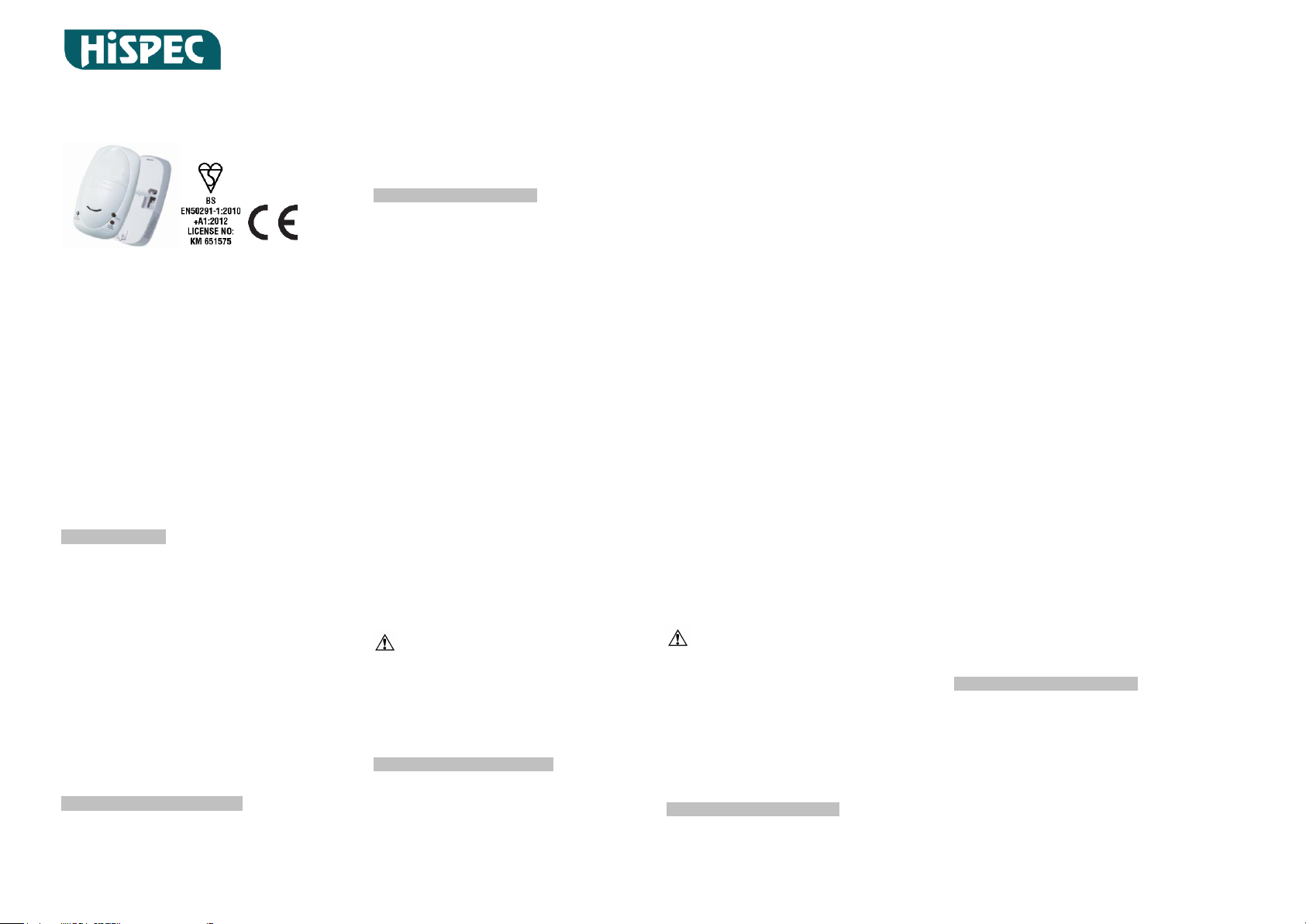
220~240V AC OPERATED
INTERCONNECTABLE
CARBON MONOXIDE ALARM
MODEL: HSA/CA
Main Features:
Electrochemical Sensor Life Operates for 5 Years
Alkaline Battery Back-up Easy Installation,
Portable, Ideal for Travelling
Test / Reset Button
Low Battery Warning
Self Test Function
Supplied with Wall Plugs & Screws
Cannot Be Fitted with Battery Missing
Approved to EN50291-1:2010+A1:2012
Fault Signal
Hard-Wired Interconnectable (max 40. Detectors,
including smoke, heat and CO alarms)
This instruction leaflet contains important information on
the correct installation and operation of your Carbon
Monoxide (CO) alarm. Read this leaflet fully before
attempting installation and retain for future reference.
SPECIFICATIONS
Power Source : 220-240Vac~ 50-60Hz, 9.6 Watts, with
9V battery back-up (battery included)
Battery : 9V Alkaline battery PP3 (Gold Peak 1604A,
Duracell MN1604, Energizer 522, IEC
6LR61, IEC6LF22)
Battery Life : In the event of a break in the mains supply
the battery will give detector operation for
1-month minimum
Operation Current : <35mA operation (In Alarm)
Type of Gas sensed : Carbon Monoxide
Sensor Life : 5 Years
Alarm Response Time : 50 PPM (Between 60 to 90 min.)
100 PPM (Between10 to 40 min.)
300 PPM (Less than 3 min.)
Operation Temperature : -10oC ~ 40oC
Ambient Humidity : 10%-90%
Horn Level : 85 Decibels at 1 m
Interconnect facility : 40 detectors over 150
metres maximum,
WHAT IS CARBON MONOXIDE
Carbon Monoxide (CO) is an insidious poison that is released when fuels
are burnt. It is a colorless, odorless, tasteless gas and therefore very
difficult to detect with the human senses. CO kills hundreds of people
each year and injures many more. It binds to the hemoglobin in the blood
and reduces the amount of oxygen being circulated in the body. In high
concentrations, CO can kill in minutes.
CO is produced by the incomplete combustion of fuels such as
wood, charcoal, coal, heating oil, paraffin, petrol, natural gas,
propane, butane etc.
Common Sources of CO:
Attached garages
Oil and Gas furnaces
Wood stoves
Barbecues
Wood and gas fireplaces
Gas appliances
Portable generators
Gas or kerosene heaters
Clogged chimneys
Cigarette smoke
LOCATING THE CO ALARM
HSA/CA Carbon Monoxide alarm is designed to detect the toxic
CO fumes that result from incomplete combustion, such as those
emitted from appliances, furnaces, fireplace and auto exhaust. It
has an interconnect feature that allows it to connect with up to
40 alarms together over 150 metres maximum, using the
single white wire, and thus allowing all alarms to sound when
any one is activated.
Ideally, a CO alarm should be installed in every room containing a
fuel burning appliance. Additional apparatus may be installed to
ensure that adequate warning is given for occupants in other
rooms, by locating apparatus in:
remote rooms in which the occupant spend considerable time
whilst awake and from which they may not be able to hear an
alarm from apparatus in another part of the premises, and
every sleeping room.
However, if there is a fuel burning appliance in more than one
room and the number of CO alarm is limited, the following points
should be taken into consideration when deciding on the best
location:
An apparatus should be located in a room containing a flueless
or open-flued appliance.
If there is an appliance in a room where people spend most
time, an apparatus should be placed in that room.
If there is an appliance in a room where people sleep, an
apparatus should be placed in that room.
In a bedsit, the apparatus should be placed as far from the
cooking appliances as possible but near to where the person
sleeps.
If the appliance is in a room not normally used, such as boiler
room, the apparatus should be placed just outside the room so
that the alarm will be heard more easily.
CAUTION
This alarm will only indicate the presence of carbon monoxide
gas at the sensor. Carbon Monoxide gas may be present in
other areas.
This carbon monoxide alarm is designed to detect carbon
monoxide gas from ANY source of combustion. It is NOT
designed to detect smoke, fire or any other gas.
POSITIONING THE CO ALARM
Carbon Monoxide has a similar density to warm air and can be
fitted in various locations.
Apparatus located in the same room as a fuel-burning
appliance:
If the apparatus is located on a wall, it should be located at a
height greater than the height of any door or window but at least
150 mm from the ceiling. If the apparatus is mounted on a
ceiling, it should be at least 300 mm from any wall.
The apparatus should be at a horizontal distance of between 1
m and 3 m from the potential source.
If there is partition in a room, the apparatus should be located
on the same side of the partition as the potential source.
In rooms with sloped ceilings, the apparatus should be located
at the high side of the room.
Apparatus located in sleeping rooms and in rooms remote
from a fuel burning appliance:
The apparatus should be located relatively close to the
breathing zone of the occupants.
Areas to be avoided include the following:
Situations where the temperature may drop below -10
o
C or
exceed 40oC
In a damp or humid area
Any area where high levels of dusty, dirty or greasy emissions
could contaminate or clog the sensor.
Where the air flow to the apparatus would be obstructed by
curtains or furniture.
Next to a door or window or in the path of air discharged from a
furnace / air conditioning vent or ceiling fan.
Outside the building
Directly above a sink or cooker
In or below cupboard
The following conditions can result in transient CO situations
in the home:
Excessive spillage or reverse venting of fuel burning appliances
caused by:
1. Outdoor ambient conditions such as wind direction
and/or velocity, including high gusts of wind; heavy
air in the vent pipes (cold/humid air with extended
periods between cycles).
2. Negative pressure differential resulting from the use
of exhaust fans.
3. Simultaneous operation of several fuel burning
appliances competing for limited internal air.
4. Vent pipe connection vibrating loose from clothes
dryers, furnaces, or water heaters.
5. Obstructions in or unconventional vent pipe designs
which amplify the above situations.
Extended operation of unvented fuel burning devices (range,
oven, fireplace, etc.).
Temperature inversions which can trap exhaust gases near the
ground.
Car idling in an open or closed attached garage, or near a
home.
WARNING
This carbon monoxide alarm is designed for indoor use only.
Do not expose to rain or moisture. It will not protect against
the risk of carbon monoxide poisoning when the battery has
drained.
Do not open or tamper with the alarm as this could cause
malfunction.
Installation of the apparatus should not be used as a
substitute for proper installation, use and maintain of fuel
burning appliances including appropriate ventilation and
exhaust systems.
INSTALLING THE CO ALARM
WARNING – This apparatus is mains powered and requires
wiring by a qualified electrician in accordance with the
current IEE Regulations for Electrical Installations (BS7671).
The circuit used to power the apparatus must be a dedicated
permanent supply that cannot be switched off accidentally by
the normal user. Before installing ensure the electrical supply is
isolated.
WARNING: To prevent injury, this apparatus must be securely
attached to the wall / ceiling in accordance with the installation
instructions.
The CO Alarm will function correctly either as a stand-alone alarm
or inter-connected.
All inter-connected CO Alarms must be supplied from a single
power circuit.
A common neutral must be used for the interconnection to function.
Do not connect the Inter-connect wire to Active or Neutral.
Wall mount installation:
Disconnect the AC main power from the circuit that is going to be
used.
Having established the mounting location ensure that there is no
electrical wiring or pipe work in the area adjacent to the mounting
surface.
Mark the two mounting hole locations.
Drill holes in the positions marked.
Insert wall plugs into the drilled holes.
Screw mounting bracket to mounting surface. DO NOT OVER
TIGHTEN.
Unlock the apparatus unit from the base by pushing up the temporary
latch with a screw driver
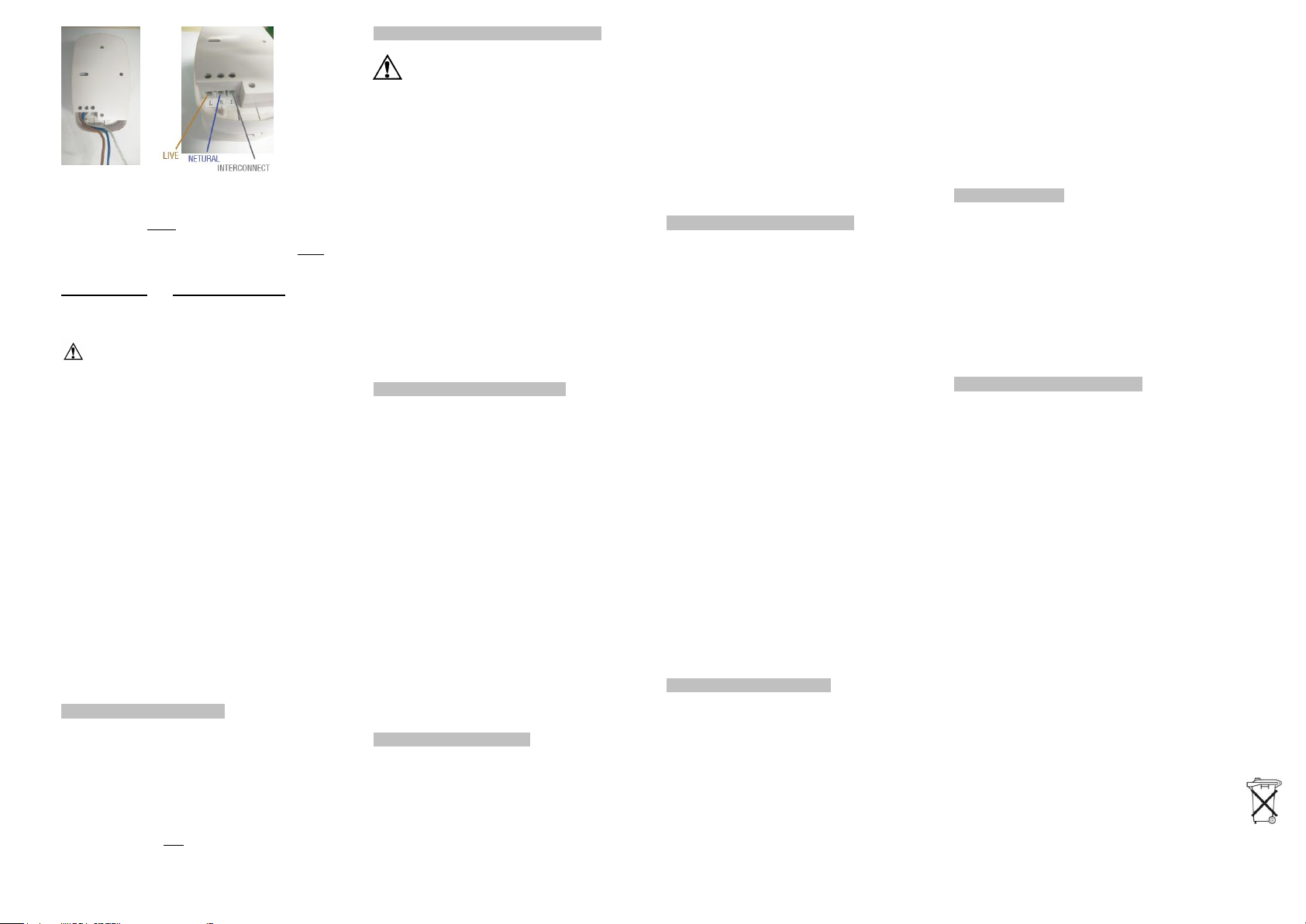
Strip the Active/Neutral and Inter-connect (if used) wires.
Connect the wires to the correct terminals (on the mounting plate)
to incoming supply. If the smoke alarms are to be interconnected,
link out the interconnection terminals. Ensure the screws are fully
tightened.
The alarm must be wired in accordance with National wiring codes.
LIVE: connect to house wires coloured Brown, Red or
marked with L.
NEUTRAL: connect to house wires coloured Blue, Black or
marked with N.
INTERCONNECT: connect to the third wire. If you are not
interconnecting to other units, do not connect any wire to this
terminal. Never use an EARTH wire for interconnect wire.
Insert a 9V battery firmly into battery compartment on the rear of the
apparatus. NOTE POLARITY OF CONNECTIONS.
NOTE – For the safety of the end user the CO alarm cannot be fitted
without its battery.
Assemble the alarm onto the mounting plate
OPERATING YOUR CO ALARM
Normal Operation
After battery installation, the green LED will flash five times. Then the
unit will enter into the normal operation mode. When no carbon
monoxide is present, the green light will flash approximately once per
minute and is an indication that your alarm is powered and functional.
During normal operation the CO alarm perform a self-check test every
minute.
IMPORTANT: After installation, test your alarm (see the paragraph
“Test your CO alarm”
Page 2
Alarm Condition
When the apparatus detects dangerous levels of CO gas, it will give an
alarm signal. The red LED will flash and the buzzer will chirp 6 times
simultaneously every second.
After 30 minutes, when the apparatus remains alarming, the red LED will
flash and the buzzer will chirp 6 times simultaneously every minute.
During alarming, the green LED will flash once every 10 seconds.
CO LEVEL (PPM) RESPONSE TIME (MIN)
50 60-90
100 10-40
300 < 3
WARNING
This product may not alarm at low carbon monoxide levels.
Individuals with medical problems may consider using warning
devices which provide audible signals for carbon monoxide
concentrations under 30 PPM.
Low Battery Signal
A fresh battery should last for one year. In case the battery is at the end
of its life, the apparatus will sound a short chirp with a yellow LED flash
simultaneously in every minute. The battery should be replaced
immediately. This low voltage warning will be given for at least 30 days.
Note: Constant exposure to high or low humidity may reduce
battery efficiency.
Unit Malfunction
Your CO alarm performs an internal self-diagnosis every minute to make
sure that it is functioning properly. In the rare event that your alarm
malfunctions, the apparatus will sound a double short chirp and the
yellow LED flash simultaneously in every minute. In this case the alarm
must be replaced.
Never ignore a CO unit’s alarm. A true alarm is an indication of potentially
dangerous levels of carbon monoxide. CO alarms are designed to alert
you to the presence of carbon monoxide before an emergency, before
most people would experience symptoms of carbon monoxide poisoning,
giving you time to resolve the problem calmly.
TESTING YOUR CO ALARM
It is recommended that you test your CO alarm once a month to ensure
the alarm is working correctly.
Test the unit by depressing the Test/Reset button. The red LED will flash
and the buzzer will chirp 6 times simultaneously. Then the unit will enter
into the normal operation mode and the green light should flash once a
minute. For multiple interconnected CO alarms, only the RED
indicator light (LED) of the originating unit will flash rapidly. All other
units in the interconnect system will sound an alarm but their RED
indicator light (LED) will NOT flash. Test each alarm checking that
the alarm is triggered on all other alarms installed.
WHAT TO DO IF THE ALARM SOUNDS
WARNING
Actuation of your CO alarm indicates the presence of carbon
Monoxide (CO), which can KILL YOU.
If alarm signal sounds:
1. Immediately move to fresh air – outdoors or by an open
door/window. Do a head count to check that all persons are
accounted for.
2. Where possible turn off all fuelled appliances and stop using
them.
3. Call your emergency services
4. Do not re-enter the premises nor move away from the open
door/window until emergency services responders have arrived,
the premises have been aired out, and your alarm remains in its
normal condition.
5. Call a qualified appliance technician to investigate for sources
of CO from fuel burning equipment and appliances, and inspect
for proper operation of this equipment. If problems are identified
during this inspection have the equipment serviced immediately.
Note any combustion equipment not inspected by the technician
and consult the manufacturers’ instructions, or contact the
manufacturers directly, for more information about CO safety
and this equipment. Make sure that motor vehicles are not, and
have not been, operating in an attached garage or adjacent to
the residence.
MAINTAINING YOUR CO ALARM
Your alarm will alert you to potentially hazardous CO
concentrations in your home when maintained properly. To
maintain your alarm in proper working order, it is recommended
that you:
Test your alarm at least once a month.
Clean the outside case regularly to prevent dust or dirt build up
in the slots. DO NOT USE CLEANING AGENTS, BLEACH,
POLISH OR ANY CHEMICALS. Chemicals can permanently
damage or temporarily contaminate the sensor. Simply wipe
with a damp cloth OR a clean tissue.
Do not paint the CO alarm
NOTE - If you will be staining or stripping wood floors or furniture,
painting, wall-papering, or using aerosols or adhesives, remove
the CO alarm to a remote location before in order to prevent
possible damage to or contamination of the sensor.
The following is a list of substances which, at high levels, can
affect the sensor and may cause a nuisance alarm that is not a
carbon monoxide alarm: Methane, propane, iso-butane, ethylene,
ethanol, alcohol, iso-propanol, benzene, toluene, ethyl acetate,
hydrogen, hydrogen sulfide, sulfur dioxides.
Also most aerosol sprays, alcohol based products, paints, solvents,
adhesives, hair sprays, after shaves, perfumes and some cleaning
agents.
BATTERY REPLACEMENT
If the CO Alarm emits a short ‘beep’ once a minute the battery is at
the end of its life and should be replaced immediately. This low
voltage warning will be given for at least 30 days.
Always TURN OFF the A.C. supply to the apparatus before
replacing the battery.
Each time after replacing with a new battery, the user has to test
the alarm by pressing the test button to ensure the detector is
working correctly
Unlock the apparatus unit from the base by pushing up the
temporary latch with a screw driver
Remove the old battery from the compartment.
Insert a new, healthy 9V battery. NOTE POLARITY OF
CONNECTIONS.
Using the Push-to-Test button to test the CO Alarm. See
“TESTING YOUR CO ALARM”
Reattach the CO alarm to the mounting plate.
Each time after replacing with a new battery, the user has to
test the alarm by pressing the test button to ensure the
detector is working correctly.
WARNING: DANGER OF EXPLOSION IF BATTERY IS
INCORRECTLY REPLACED. THE USE OF BATTERIES
OTHER THAN THOSE RECOMMENDED ON THE BACK OF
THE CO ALARM MAY BE DETRIMENTAL TO ITS OPERATION
SYMPTOMS OF CO POISONING
The following symptoms may be related to CO poisoning:
35 ppm The maximum allowable concentration for
continuous exposure for healthy adults in any
8-hour period.
200 ppm Slight headaches, fatigue, dizziness, nausea
after 2-3 hours
400 ppm Frontal headaches within 1-2 hours, life
threatening after 3 hours.
800 ppm Dizziness, nausea and convulsions within 45
minutes. Unconsciousness within 2 hours. Death
within 3 hours.
1600 ppm Headache, dizziness and nausea within 20
minutes. Death within 1 hour
6400 ppm Headache, dizziness and nausea within 1-2
minutes
The following symptoms are related to CARBON MONOXIDE
POISONING and are to be discussed with ALL members of the
household:
Mild Exposure: Slight headache, nausea, vomiting, fatigue (often
described as “flu-like” symptoms).
Medium Exposure: Severe throbbing headache, drowsiness,
confusion, fast heart rate.
Extreme Exposure: Unconsciousness, convulsions, cardiorespiratory failure, death.
Many cases of reported CARBON MONOXIDE POISONING
indicate that while victims are aware they are not well. They
become so disoriented they are unable to save themselves by
either exiting the building or calling for assistance. Young children
and household pets are typically the first affected.
The apparatus may not prevent the chronic effects of carbon
dioxide exposure and that the apparatus will not fully
safeguard individuals at special risk.
IMPORTANT SAFEGUARDS
Installation of your CO alarm is only one step in your safety plan.
Educate yourself and family to the sources and symptoms of CO
poisoning and how to use your carbon monoxide alarm: -
Replace the battery immediately once depleted
Buy appliances accepted by a recognized testing laboratory.
Install the appliances properly, following the manufacturers’
instructions.
Have installations done by professionals.
Have your appliances checked regularly by a qualified
serviceman.
Clean chimneys and flues yearly.
Make regular visual inspections of all-fuel-burning appliances.
Check appliances for excessive rust and scaling.
Do not barbecue indoors, or in attached garage.
Open windows when a fireplace or wood burning stove is in
use.
Be aware of CO poisoning symptoms.
DO NOT:
Burn charcoal inside your home, RV, camper, tent or cabin
Install, convert or service fuel burning appliances without proper
knowledge, skill and expertise
Use a gas range, oven or clothes dryer for heating
Operate unvented gas burning appliances using kerosene or natural
gas in closed room
Operate gasoline powered engines indoors or in confined areas
Ignore a safety device when it shuts an appliance off
Ignore any warning from your CO alarm
END OF UNIT LIFE
The apparatus will operate up to 5 years under normal use. When the
CO sensor comes to the end of life, the red LED light will flash and
buzzer will chirp 6 times simultaneously every minute. In this case the
alarm must be replaced.
NOTE: With normal use the battery will last at least 1 year. However,
battery life will be reduced if either a fault occurs with the battery or
the apparatus remains in alarm for long periods of time.
THIS PRODUCT CANNOT BE REPAIRED – IF THE UNIT IS
TAMPERED WITH IT WILL INVALIDATE THE GUARANTEE. IF THE
UNIT IS FAULTY PLEASE RETURN IT TO YOUR ORIGINAL
SUPPLIER WITH YOUR PROOF OF PURCHASE.
YOUR CO ALARM GUARANTEE
This CO Alarm, excluding battery, is guaranteed to be free from defects
in materials and workmanships under normal residential use and service
for a period of five (5) years from the date of purchase. The company
will not be obligated to repair or replace parts that are found to be in
need of repair because of misuse, damage or alterations occur after the
date of purchase. Send the CO Alarm with proof of purchase, postage
and return postage prepaid, to local distributor. The liability of the
company arising from the sale of this CO Alarm shall not in any case
exceed the cost of replacement of the product and in no case shall the
company be liable for consequential loss or damages resulting from the
failure of the product.
HISPEC ELECTRICAL PRODUCTS LTD. SHALL HAVE NO LIABILITY
FOR ANY PERSONAL INJURY OR PROPERTY DAMAGE, OR ANY
SPECIAL INCIDENTAL, CONTINGENT OR CONSEQUENTIAL
DAMAGE. THE EXCLUSIVE REMEDY FOR BREACH OF THE
LIMITED WARRANTY CONTAINED HEREIN IS THE REPAIR OR
REPLACEMENT OF THE DEFECTIVE PRODUCT. IN NO CASE
SHALL HISPEC ELECTRICAL PRODUCTS LTD BE LIABILITY UNDER
ANY OTHER REMEDY PRESCRIBED BY LAW WHICH EXCEED THE
PURCHASE PRICE. YOUR CARBON ALARM IS NOT A SUBSTITUTE
FOR PROPERTY, DISABILITY, LIFE OR OTHER INSURANCE OF ANY
KIND. APPROPRIATE COVERAGE IS YOUR RESPONSIBILITY.
CONSULT YOUR INSURANCE AGENT
This does not affect your statutory rights.
This alarm is only suitable for single occupancy private dwellings only
and not intended for multi occupancy private dwellings or commercial or
industrial dwellings.
Waste electrical products should not be disposed of with normal
household waste. Please recycle where facilities exist. Check with your
Local Authority or retailer for recycling advice. New regulation will
encourage the recycling of Waste from Electrical and Electronic
Equipment (European "WEEE Directive" effective August 2005).
Importer: Hispec Electrical Ltd.
www.hispec.co.uk
 Loading...