

Page 1
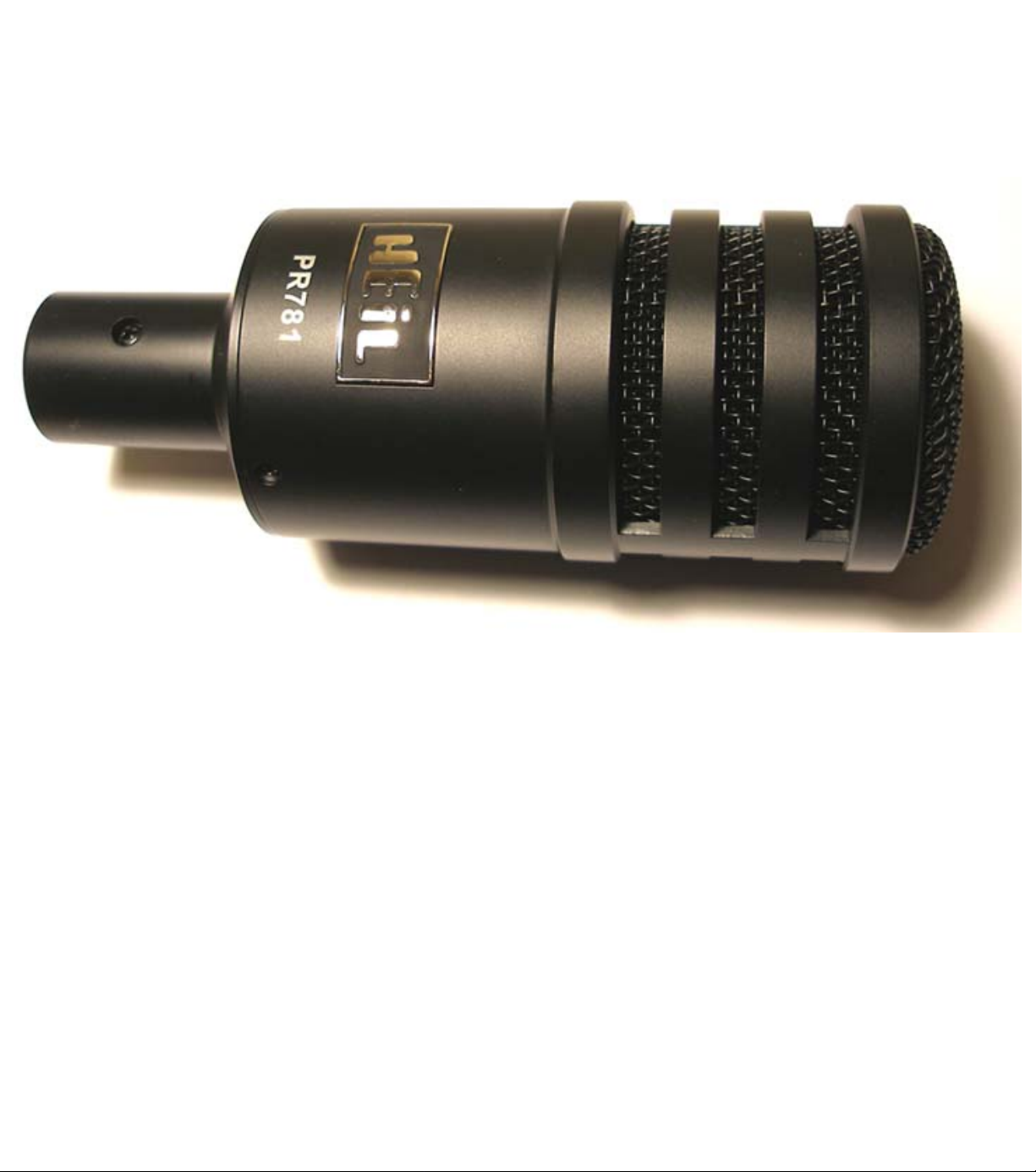
The Heil PR-781
By Matt Erickson, KK5DR.
Purchased at Dayton ’07 directly from Heil sound Inc.
This is my first microphone purchase in about ten years. I have owned a Heil GM-5 Gold-line mic
during that time, and was pretty pleased with it, however I did notice that the mic had a little bit of
“proximity effect” bassyness. Proximity effect happens when the sound source changes in distance
from the mic, which causes a change in bass response in the mic. Typically, when the source gets
closer to the mic the bass response increases, and decreases as the source get farther away from the
mic.
I tend to work a mic very close in, with my lips often touching the grill or windscreen. This has
lead to the bass sometimes overwhelming the Gold-line mic response.
I wanted to find a microphone that was less prone to the bass proximity effect than my Gold-line
has been. Don’t get me wrong, the Gold-line is a great mic, but care must be used to keep the
distance from it constant, so the audio it produces will be consistent. This distance is usually about
6 to 12 inches away. My preferred way of working the mic is in conflict with this parameter. A
new microphone that can handle my requirements was in order.
At Dayton hamvention ’07, I talked to Bob Heil K9EID, about this issue, and he told me to try his
“microphone demo machine”. This machine has all the Heil mics set up and a set of headphones to
Page 2

listen to them on. Press a button and that mic associated with it becomes live and you can hear it in
the headphones. This unit allows very fast changes in mic source so a comparison can be done.
Over the entire weekend of the hamfest I spent about an hour total using this machine to test
various mics against the Gold-line. What I found is that the PR-781 did not have as much
proximity effect as the Gold-line, so, I bought one.
The PR-781 specs are:
Element: Heil PR Dynamic
Frequency response: 50Hz to 16,000Hz
Impedance: Balanced 600 ohms output, 3 pin XLR type.
Polar pattern: Super cardiod
Output level: -55dB
Diaphragm: Low-mass aluminum
Finish: Black satin epoxy
Net weight: 14oz.
Cost: (at the hamfest) $192
The next test was: Does it have enough audio output to drive my ICOM radios? In a word, yes. It
has plenty of drive for my 7800, Pro III, and even my old IC-781.
How does it sound on the air? All reports are very good. It only took a minor amount of
adjustments in mic gain level, and bass and treble adjustments to get it to sound very natural on the
air. I run a small amount of compression on transmit to give a bit more punch to my soft voice.
Care should be exercised in the use of compression, too much can make for a very bad sounding
signal on the air. Somewhere between 3-6dB is the expectable level and usually does not advertise
it self to listeners. It also helps to drive the radio power output a bit better too.
Sorry, the PR-781 only has a single element in it, so if you require a different transmitted audio
profile for various on-air conditions you will need to get it some other way. I do this on my 7800 &
Pro III by setting up three profiles in the three TBW settings, Transmit-Band-Width settings of
Wide, Mid, and Narrow allow quick changes for changing band conditions. “Wide” is typically
used for good signal strength levels on relatively quiet bands. “Mid” is typically used when the
bands become noisy, and signals are a little QSB. “Narrow” is typically used when the bands are
in very bad condition, or when you are attempting to break a “pile-up”. My TBW profiles are 1002900Hz Wide, 200-2800 Mid, & 300-2700 Narrow. A note about the Narrow profile; this is the
required TBW for most ITU compliant SSB transmitters. Amateur SSB transmitters are not ITU
compliant currently.
Reports I have received typically say that my audio sounds clear and natural with the PR-781.
I don’t use any outboard audio processing gear of any kind, so the microphone and radio produce
all the transmit audio. The PR-781 is connected directly to the front panel mic socket. My 7800
and Pro III have built-in transmit EQ adjustments, which I changed by only one increment to get
the audio where I wanted it to be. All adjustments were made while listening to my transmitted
Page 3

signal on another radio. On-air reports confirmed that the settings are good. The mic gain control
was adjusted a small amount to get the proper ALC action for ICOM radios, which is 2/3rds to ¾
of the ALC scale at full rated output, (typical for nearly all ICOM HF radios).
In conclusion:
The PR-781 has very good clarity (articulation in the mid-range), excellent proximity effect bass
response control, and very good output levels. I am well pleased with the results of my purchase
and how well it works with all my ICOM radios.
If you like the old Gold-line GM-5 mic, you will LOVE the PR-781.
“This microphone is SWEET!”
Addendum:
I tested the PR-781 on my IC-7000, using the OPC-589 microphone cable adaptor. The 781 drives
the 7000 very well, and it only took a small adjustment to the lower end of the TBW (Transmit
Band Width), to get the mic to sound natural as one other station reported. I spoke with a few
stations that know me personally and so they know what my voice sounds like in person, and these
fellows reported that I sounded like I should on the PR-781. The 7000 is not an easy radio to get to
sound good with the stock hand mic, but the 781 did it with little effort. For those who plan to run
their 7000 in a base type configuration, the PR-781 is a super microphone for that purpose. Mount
the mic on a nice boom or stand and your ready. The little radio will make good clean, natural
sounding transmit audio with the 781 on it.
Copyright © 2007 M.A. Erickson, KK5DR. All rights reserved.
 Loading...