

Page 1
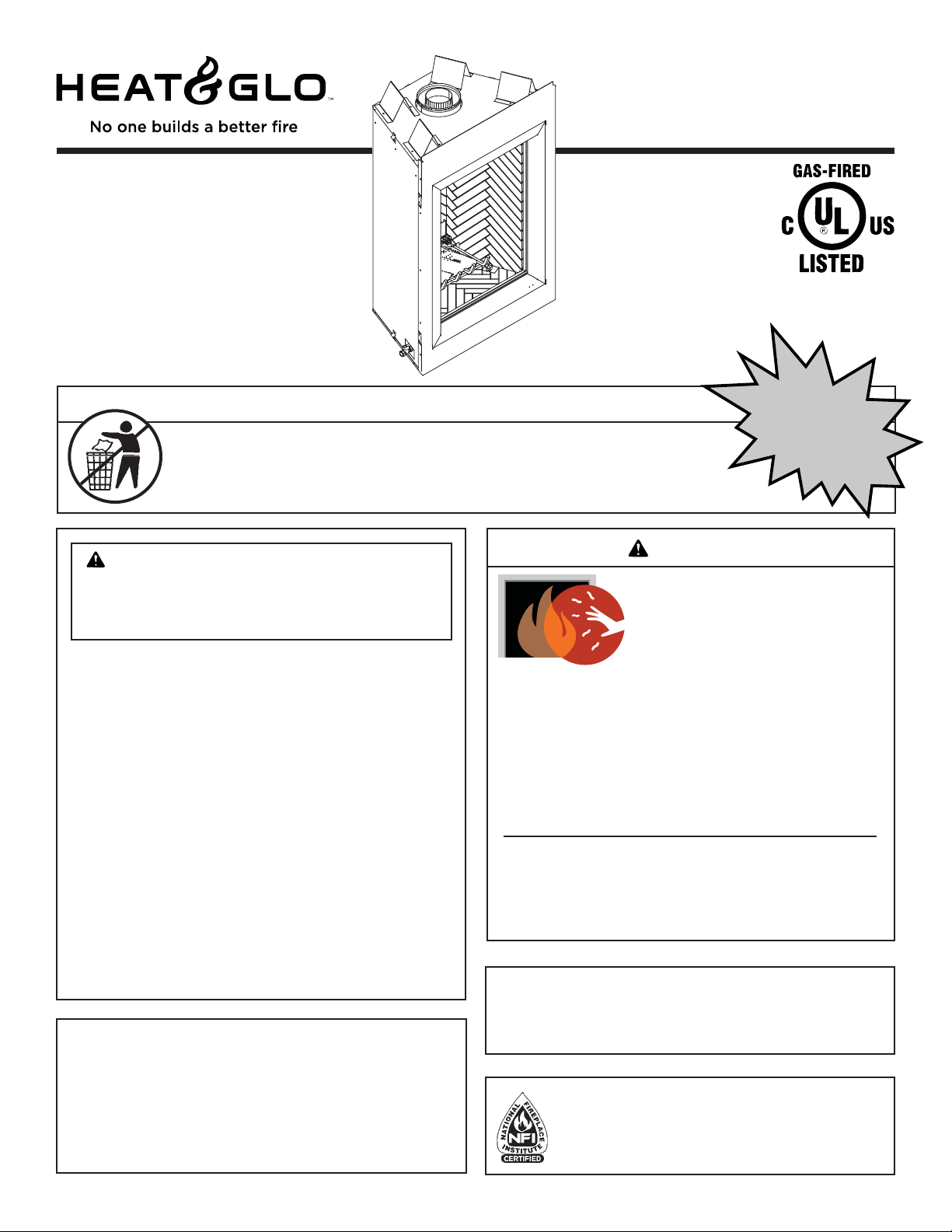
Model:
Everest
Owner’s Manual
Installation and Operation
NOTICE
DO NOT DISCARD THIS MANUAL
• Important operating
and maintenance
instructions included.
WARNING: If the information in these
instructions is not followed exactly, a fi re
or explosion may result causing property
damage, personal injury, or death.
• DO NOT store or use gasoline or other fl am-
mable vapors and liquids in the vicinity of this
or any other appliance.
• What to do if you smell gas
- DO NOT try to light any appliance.
- DO NOT touch any electrical switch. DO
NOT use any phone in your building.
- Immediately call your gas supplier from a
neighbor’s phone. Follow the gas supplier’s instructions.
- If you cannot reach your gas supplier, call
the fi re department.
• Installation and service must be performed
by a qualifi ed installer, service agency , or the
gas supplier.
This appliance may be installed as an OEM installation in
manufactured home (USA only) or mobile home and must be
installed in accordance with the manufacturer’s instructions
and the manufactured home construction and safety standard,
Title 24 CFR, Part 3280 or Standard for Installation in Mobile
Homes, CAN/CSA Z240MH, in Canada.
This appliance is only for use with the type(s) of gas indicated
on the rating plate.
• Read, understand and follow
these instructions for safe
installation and operation.
DO NOT
DISCARD
• Leave this manual with
party responsible for use
and operation.
WARNING
HOT SURFACES!
Glass and other surfaces are hot during
operation AND cool down.
Hot glass will cause burns.
• DO NOT touch glass until it is cooled
• NEVER allow children to touch glass
• Keep children away
• CAREFULLY SUPERVISE children in same room as fi re-
place.
• Alert children and adults to hazards of high temperatures.
High temperatures may ignite clothing or other fl ammable
materials.
• Keep clothing, furniture, draperies and other fl ammable
materials away.
This appliance has been supplied with an integral barrier
to prevent direct contact with the fi xed glass panel. DO
NOT operate the appliance with the barrier removed.
Contact your dealer or Hearth & Home Technologies if the
barrier is not present or help is needed to properly install one.
In the Commonwealth of Massachusetts installation must be
performed by a licensed plumber or gas fi tter.
See Table of Contents for location of additional Commonwealth
of Massachusetts requirements.
Installation and service of this appliance should be
performed by qualifi ed personnel. Hearth & Home
Technologies suggests NFI certifi ed or factory trained
professionals, or technicians supervised by an NFI
certifi ed professional.
Heat & Glo • Everest • 750-900 Rev. o • 10/08
1
Page 2

Safety and Warning Information
READ and UNDERSTAND all instructions carefully
!
before starting the installation. FAILURE TO FOLLOW
these installation instructions may result in a possible
fi re hazard and will void the warranty.
Prior to the fi rst fi ring of the fi replace, READ the Using
!
Your Fireplace section of the Owners Guide.
DO NOT USE this appliance if any part has been
under water. Immediately CALL a qualifi ed service
!
technician to inspect the unit and to replace any part
of the control system and any gas control which has
been under water.
THIS UNIT IS NOT FOR USE WITH SOLID FUEL.
!
Installation and repair should be PERFORMED by a
qualifi ed service person. The appliance and venting
!
system should be INSPECTED before initial use and at
least annually by a professional service person. More
frequent cleaning may be required due to excessive lint
from carpeting, bedding material, etc. It is IMPERATIVE
that the unit’s control compartment, burners, and
circulating air passageways BE KEPT CLEAN to
provide for adequate combustion and ventilation air.
Always KEEP the appliance clear and free from
!
combustible materials, gasoline, and other fl ammable
vapors and liquids.
NEVER OBSTRUCT the flow of combustion and
!
ventilation air. Keep the front of the appliance
of all obstacles and materials for servicing and proper
operations.
CLEAR
These units MUST use one of the vent systems
!
described in the Installing the Fireplace section of
the Installers Guide. NO OTHER vent systems or
components MAY BE USED.
This gas fi replace and vent assembly MUST be vented
!
directly to the outside and MUST NEVER be attached to a
chimney serving a separate solid fuel burning appliance.
Each gas appliance MUST USE a separate vent system.
Common vent systems are PROHIBITED.
INSPECT the external vent cap on a regular basis to
!
make sure that no debris is interfering with the air fl ow.
The glass door assembly MUST be in place and
!
sealed, and the trim door assembly MUST be in place
on the fi replace before the unit can be placed into safe
operation.
DO NOT OPERATE this appliance with the glass
door removed, cracked, or broken. Broken glass may
!
be sharp to the touch, use caution when removing.
Replacement of the glass door should be performed by
a licensed or qualifi ed service person. DO NOT strike
or slam the glass door.
The glass door assembly SHALL ONLY be replaced
!
as a complete unit, as supplied by the gas fi replace
manufacturer. NO SUBSTITUTE material may be
used.
DO NOT USE abrasive cleaners on the glass door
!
assembly. DO NOT ATTEMPT to clean the glass door
when it is hot.
Due to the high temperature, the appliance should be
!
LOCATED out of traffi c areas and away from furniture
and draperies. Clothing or fl ammable material SHOULD
NOT BE PLACED on or near the appliance.
Children and adults should be ALERTED to the hazards
!
of high surface temperature and should STAY AWAY to
avoid burns or clothing ignition. Young children should
be CAREFULLY SUPERVISED when they are in the
same room as the appliance.
Turn off the gas before servicing this appliance. It
!
is recommended that a qualifi ed service technician
perform an appliance check-up at the beginning of
each heating season.
Any safety screen or guard removed for servicing must
!
be replaced before operating this appliance.
DO NOT place furniture or any other combustible
!
household objects within 36 inches of the fi replace
front.
Heat & Glo • Everest • 750-900 Rev. o • 10/08 2
Page 3

Table of Contents
Safety and Warning Information. ....................................2
Service Parts Lists. ..........................................................4
Section 1: Approvals and Codes. ...................................7
Appliance Certifi cation ........................................................7
Installation Codes ...............................................................7
High Altitude Installations ...................................................7
Section 2: Getting Started ...............................................8
Introducing the Heat & Glo Gas Fireplaces ........................8
Pre-installation Preparation ................................................8
Section 3: Installing the Fireplace. ...............................10
Step 1 Locating the Fireplace .......................................10
Step 2 Framing the Fireplace ........................................10
Step 3 Installing the Vent System .................................11
A. Vent System Approvals ................................11
B. Installing Vent Components ..........................16
C. Vent Termination ..........................................19
Step 4 Positioning, Leveling, and
Securing the Fireplace .......................................22
Step 5 The Gas Control Systems ..................................22
Step 6 The Gas Supply Line .........................................23
Step 7 Gas Pressure Requirements .............................23
Step 8 Wiring the Fireplace ...........................................24
Step 9 Finishing ............................................................25
Step 10 Installing Trim, Logs, and Ember Material .........26
Installing the Trim ...............................................26
Positioning the Logs ..........................................26
Placing the Ember Material ................................26
Step 11 Before Lighting the Fireplace .............................27
Step 12 Lighting the Fireplace ........................................27
After the Installation .........................................................27
Battery Backup .................................................................27
Section 4: Maintaining and Servicing
Your Fireplace. .............................................28
Contact Information ........................................29
Î = Contains updated information.
Heat & Glo • Everest • 750-900 Rev. o • 10/08
3
Page 4
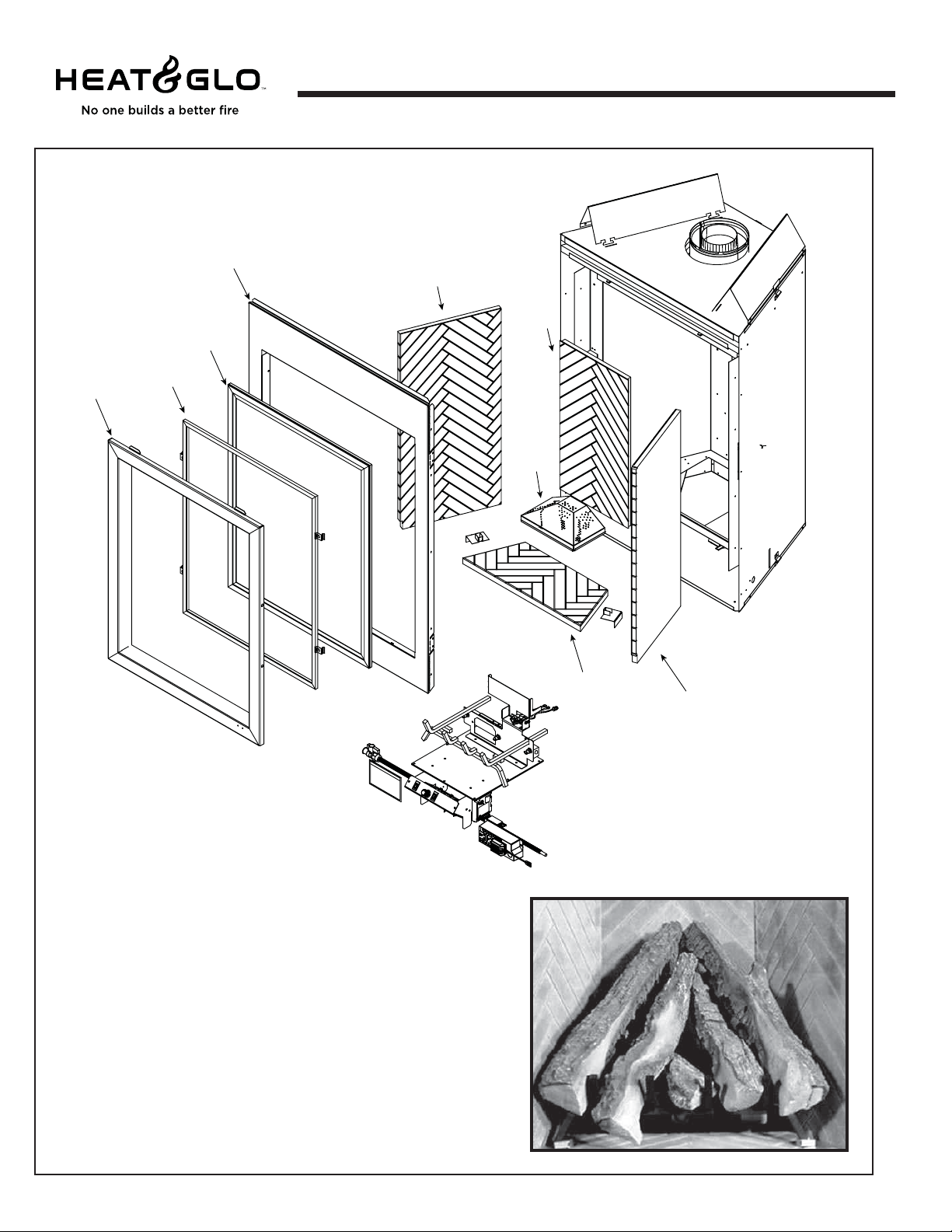
Service Parts
EVEREST
13
12
11
10
Service Parts Diagram
9
Beginning Manufacturing Date: Aug. 2000
Ending Manufacturing Date: ______
8
7
Part number list on following page.
14
15
Log Set Assembly
2
6
5
3
4
Heat & Glo • Everest • 750-900 Rev. o • 10/08 4
Page 5
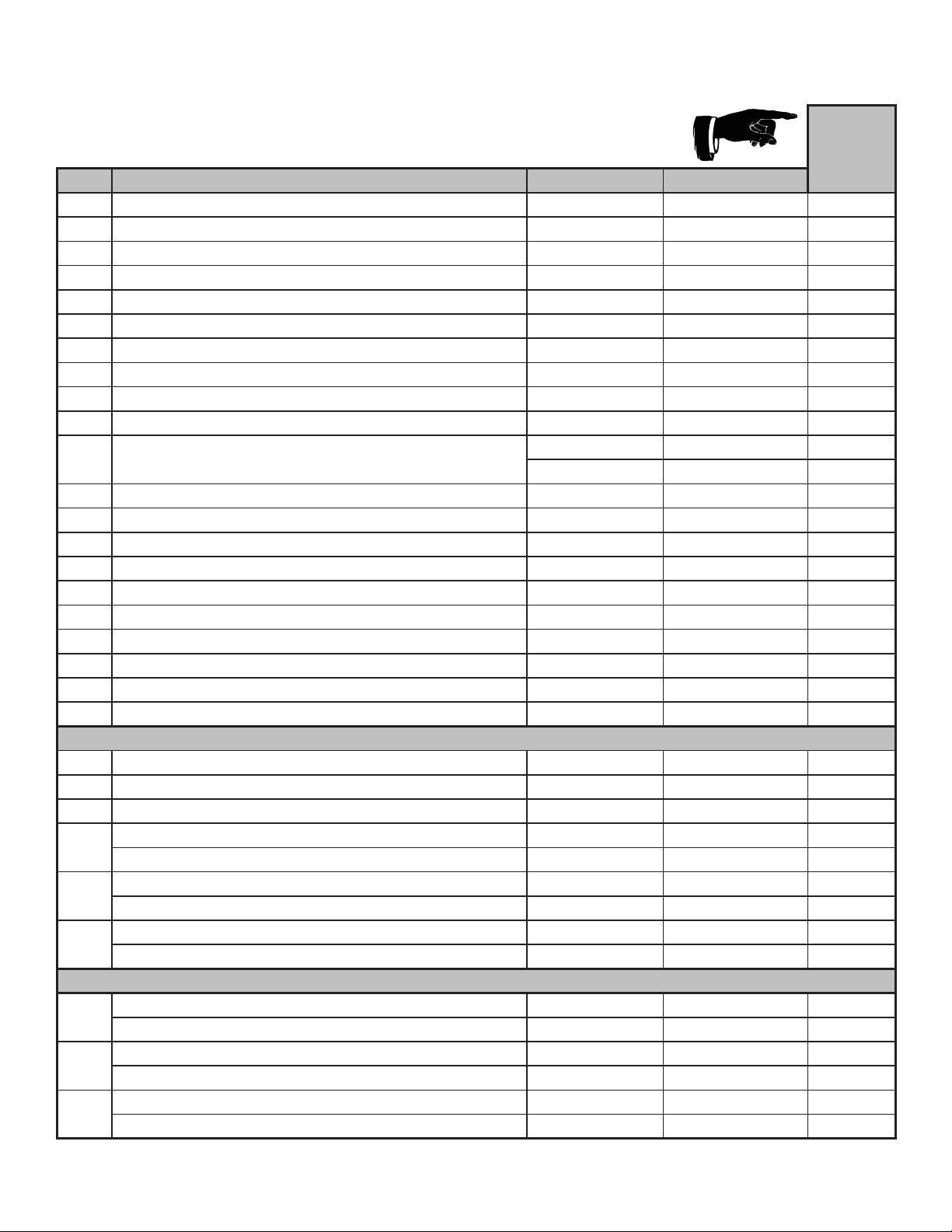
Service Parts List
IMPORTANT: THIS IS DATED INFORMATION. When requesting service or replacement
parts for your appliance please provide model number and serial number. All parts listed
in this manual may be ordered from an authorized dealer.
ITEM DESCRIPTION COMMENTS PART NUMBER
Log Set Assembly
1 Log 1 (Back Log Not Shown)
2 Log 2
3 Log 3
4 Log 4
5 Log 5
6 Log 6
7 Burner NG, LP 750-175A
8 Refractory, Back
9 Refractory, Left Side
10 Surround
11 Trim Door Mesh
12 Glass Door Assembly
13 Decorative Front
14 Refractory, Base
15 Refractory, Right Side
Exhaust Baffl e
Glass Latch Assembly
Lava Rock
Mineral Wool
Touch Up Paint
STANDING PILOT CONVERSION KITS Pre 5000
Thermocouple 446-511
Î
Additional service part numbers appear on following page.
Thermopile 2103-512
Pilot Tube SRV485-301
Conversion Kit NG NGK-EVEREST
Conversion Kit LP LPK-EVEREST
Pilot Orifi ce NG 446-505
Pilot Orifi ce LP 446-517
Regulator NG 060-518
Regulator LP 060-519
IPI CONVERSION KITS Post 5000
Conversion Kit NG
Conversion Kit LP
Pilot Orifi ce NG 593-528
Pilot Orifi ce LP 593-527
Regulator NG NGK-DXV
Regulator LP LPK-DXV
Pre July 2003
Post July 2003
LOGS-EVEREST
SRV750-703
SRV750-701A
SRV750-702A
SRV750-705
SRV750-706
SRV750-704
SRV750-732
SRV750-730
750-130
750-132
MESH-EVEREST
GLA-EVEREST
DF-EVEREST
SRV750-733
SRV750-731
750-153
386-122A
705-420
050-721
TUP-GBK-12
NGKP-EVEREST
LPKP-EVEREST
EVEREST
Stocked
at Depot
Y
Y
Y
Y
Y
Y
Y
Y
Y
Y
Y
Y
Y
Y
Y
Y
Y
Y
Y
Y
Heat & Glo • Everest • 750-900 Rev. o • 10/08
5
Page 6
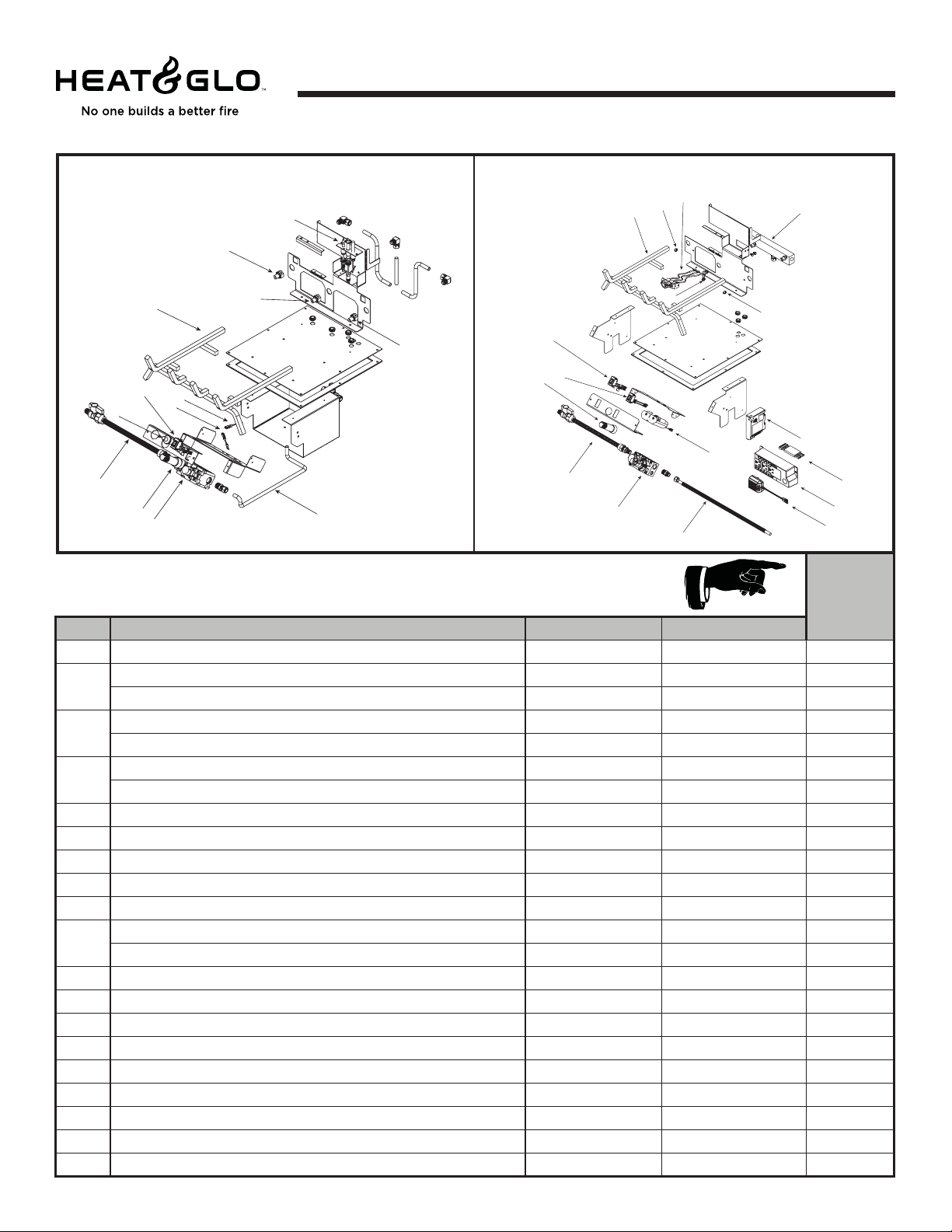
Service Parts
EVEREST
Standing Pilot Valve Assembly
Pre Serial #5000
3
5
6
17
19
9
18
8
10
4
Valve Assembly Parts List
2
3
11
IPI Valve Assembly
Post Serial #5000
6
7
8
9
Beginning Manufacturing Date: Aug. 2000
Ending Manufacturing Date: ______
2
3
5
4
12
10
11
1
3
16
15
14
13
IMPORTANT: THIS IS DATED INFORMATION. When requesting service or replacement
parts for your appliance please provide model number and serial number. All parts listed
in this manual may be ordered from an authorized dealer.
ITEM DESCRIPTION (SP) Pre 5000 (IPI) Post 5000
1 Manifold Assembly
Pilot Assembly NG 485-510A
2
Pilot Assembly LP 485-51 1A
Log Orifi ce NG (#53A) 060-801
3
Log Orifi ce LP (#64A) 750-800
Orifi ce NG (#45A) 062-801
4
Orifi ce LP (#56) 045-802
5 Grate Assembly
6 On/Off Rocker Switch
7 Rocker Switch Assembly N/A
8 Flame Control Knob 571-531
9 Flex Ball Valve Assembly
10
Valve NG
Valve LP
11 Flexible Gas Connector
12 Battery Pack
14 Junction Box 100-250A
13 3 Volt Transformer
15 Module Wire Assembly
16 Module
17 Wire Harness
18 Wire Harness
19 Piezo Ignitor
N/A
750-310A Y
593-512A Y
593-513A Y
582-853 Y
582-864 Y
582-545 Y
582-856 Y
750-360A 750-360A
060-521A 060-521A
750-556A
571-531
302-320A
060-522
060-523
567-301A
N/A
302-320A Y
750-500 Y
750-501 Y
567-301A Y
593-594A Y
4021-013
N/A
N/A
N/A
049-552A
049-551A
219-513
593-593A Y
593-590A Y
593-592 Y
N/A Y
N/A Y
N/A Y
Stocked
at Depot
Y
Y
Y
Y
Heat & Glo • Everest • 750-900 Rev. o • 10/08 6
Page 7

1
Approvals and Codes
Appliance Certifi cation
The Heat & Glo fi replace model discussed in this Installers
Guide have been tested to certifi cation standards and listed
by the applicable laboratories.
Certifi cation
MODEL: EVEREST
LABORATORY: Underwriters Laboratories
TYPE: Direct Vent Gas Fireplace Heater
STANDARD: ANSIZ21.88-1998/CSA2.33 M98 • UL307B
Installation Codes
The fi replace installation must conform to local codes.
Before installing the fi replace, consult the local building
code agency to ensure that you are in compliance with all
applicable codes, including permits and inspections.
In the absence of local codes, the fi replace installation must
conform to the National Fuel Gas Code ANSI Z223.1 (in the
United States) or the CAN/CGA-B149 Installation Codes
(in Canada). The appliance must be electrically grounded
in accordance with local codes or, in the absence of local
codes with the National Electric Code ANSI/NFPA No.
70 (in the United States), or to the CSA C22.1Canadian
Electric Code (in Canada).
These models may be installed in a bedroom or bed-sitting
room in the U.S.A. and Canada.
High Altitude Installations
U.L. Listed gas appliances are tested and approved without
requiring changes for elevations from 0 to 2,000 feet in the
U. S. A. and in Canada.
When installing this appliance at an elevation above 2,000
feet, it may be necessary to decrease the input rating by
changing the existing burner orifi ce to a smaller size. Input
rate should be reduced by 4% for each 1000 feet above
a 2000 foot elevation in the U.S.A. or 10% for elevations
between 2000 and 4500 feet in Canada. If the heating
value of the gas has been reduced, these rules do not
apply. To identify the proper orifi ce size, check with the
local gas utility.
If installing this appliance at an elevation above 4,500 feet
(in Canada), check with local authorities.
Heat & Glo • Everest • 750-900 Rev. o • 10/08
7
Page 8

2
Getting Started
Introducing the Heat & Glo Gas Fireplaces
Heat & Glo direct vent gas fi replaces are designed to op-
erate with all combustion air siphoned from outside of the
building and all exhaust gases expelled to the outside.
The information contained in this Installers Guide, unless
noted otherwise, applies to all models and gas control
systems. Gas fi replace diagrams, including the dimensions,
are shown in this section.
Pre-install Preparation
This gas fi replace and its components are tested and safe
when installed in accordance with this Installers Guide.
Report to your dealer any parts damaged in shipment,
particularly the condition of the glass. Do not install any
unit with damaged, incomplete, or substitute parts.
The vent system components and trim doors are shipped
in separate packages. The gas logs may be packaged
separately and must be fi eld installed.
Read all of the instructions before starting the
installation. Follow these instructions carefully during
the installation to ensure maximum safety and benefi t.
Failure to follow these instructions will void the owner’s
warranty and may present a fi re hazard.
When planning a fi replace installation, it’s necessary to
determine:
• Where the unit is to be installed.
• The vent system confi guration to be used.
• Gas supply piping.
• Electrical wiring.
• Framing and fi nishing details.
• Whether optional accessories devices such as a fan, wall
switch, or remote control are desired.
If the fi replace is to be installed on carpeting or tile, or on
any combustible material other than wood fl ooring, the
fi replace should be installed on a metal or wood panel that
extends the full width and depth of the fi replace.
Warranty
The Heat & Glo Warranty will be voided by , and Heat & Glo
disclaims any responsibility for, the following actions:
• Installation of any damaged fi replace or vent system
component.
• Modifi cation of the fi replace or direct vent system.
• Installation other than as instructed by Heat & Glo.
• Improper positioning of the gas logs or the glass door.
• Installation and/or use of any component part not manufactured and approved by Heat & Glo, not withstanding
any independent testing laboratory or other party approval of such component part or accessory.
ANY SUCH ACTION MAY POSSIBLY CAUSE A FIRE
HAZARD.
Heat & Glo • Everest • 750-900 Rev. o • 10/08 8
Page 9
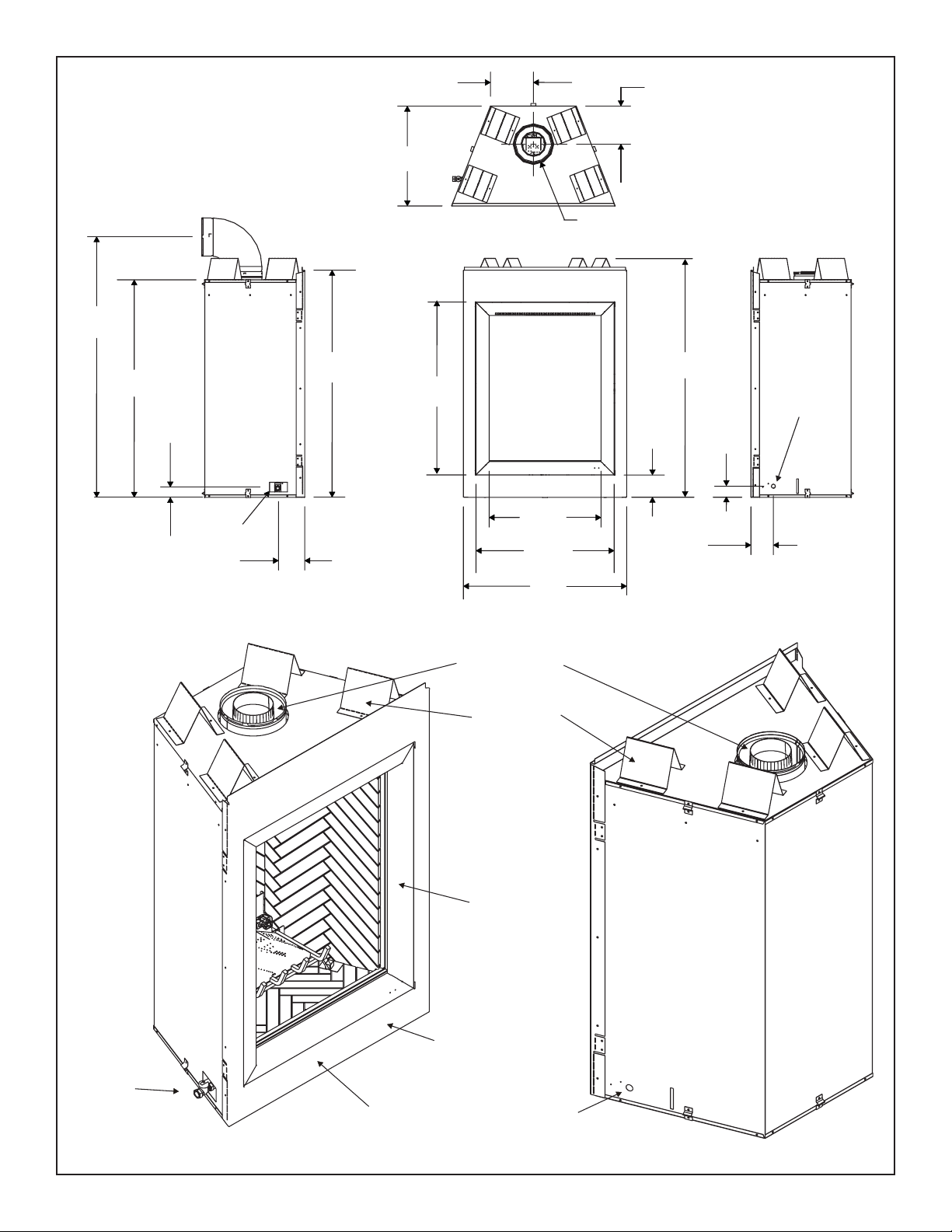
54-1/2
(1384 mm)
8-15/16
(227 mm)
20-7/8
(531 mm)
Ø8
(203.1)
8
(203 mm)
45-7/16
(1154 mm)
(55 mm)
2-18
GAS LINE
ACCESS
47-7/16
(1205 mm)
(139 mm)
5-12
36-1/8
(918 mm)
23-3/8
(593 mm)
28-13/16
(732 mm)
34-1/8
(866 mm)
TOP VENT COLLARS
TOP STANDOFFS
(1266 mm)
4-11/16
(118 mm)
49-7/8
2-5/16
(59 mm)
ELECTRICAL
ACCESS
4-11/16
(119 mm)
GAS LINE
ACCESS
Figure 1. Diagram of the Everest
TRIM DOOR
RATING PLATE
AND LABELS
GAS CONTROLS
ELECTRICAL
ACCESS
Heat & Glo • Everest • 750-900 Rev. o • 10/08
9
Page 10

3
Installing the Fireplace
Step 1. Locating the Fireplace
The diagram below shows space and clearance requirements for locating a fi replace within a room.
4” (102 mm)
B
A
E
1/2” (13 mm)
A B C D E
35 1/2” 21 3/4” 30 1/2” 43 1/4” 61 3/16”
(902 mm) (552 mm) (775 mm) (1099 mm) (1554 mm)
Figure 2. Fireplace Dimensions, Locations, and
Space Requirements
D
C
Minimum Clearances
from the Vent Pipe to Combustible Materials
Inches mm
Vertical Sections. ..............1 ................25
Horizontal Sections
Top ......................................3 .................75
Bottom ................................1 .................25
Sides...................................1 .................25
At Wall Firestops
Top ......................................3 .................76
Bottom ................................1 .................25
Sides...................................1 .................25
For minimum clearances, see the direct vent termination
clearance diagrams on pages 20 and 21 in this manual.
The distance from the unit to combustible construction is
to be measured from the unit outer wrap surface to the
combustible construction, NOT from the screw heads
that secure the unit together.
Step 2. Framing the Fireplace
Fireplace framing can be built before or after the fi replace is
set in place. Framing should be positioned to accommodate
wall coverings and fi replace facing material. The diagram
below shows framing reference dimensions.
CAUTION: MEASURE FIREPLACE DIMENSIONS, AND
VERIFY FRAMING METHODS AND WALL COVERING
DETAILS, BEFORE FRAMING.
Shows center of
10” x 12” vent framing
holes for venting.
Clearance Requirements
The top, back, and sides of the fi replace are defi ned by
stand-offs. The minimum clearance to a perpendicular wall
extending past the face of the fi replace is 4 inches (102
mm). The back of the fi replace may be recessed 23 (584
mm) inches (546 mm) into combustible construction.
Minimum Clearances
from the Fireplace to Combustible Materials
Inches mm
Glass Front .........................36 ..............914
Floor .............................0 ..................0
Rear ...........................1/2 ................13
Sides ........................... 1/2 ................13
Top ..........................4 1/2 .............114
Ceiling* ............................31 ...............787
* The clearance to the ceiling is measured from the
top of the unit, excluding the stand-offs and collar.
See Figure 24 for further details.
Heat & Glo • Everest • 750-900 Rev. o • 10/08 10
D
Framing should be
constructed of 2 X 4
lumber or heavier.
A. ..... 35-1/8” (892 mm)
B. ..... 50-1/2” (1283 mm)
C. ..... 21-3/8” (542 mm)
D. ..... 55-1/2” (1372 mm)
(Center of 12 x 10)
Figure 3. Framing Dimensions
B
A
C
Page 11

Step 3. Installing the Vent System
A. Vent System Approvals
These models are approved to use DVP-series direct
vent pipe components and terminations. Approved
vent system components are labeled for identifi ca-
tion. This pipe is tested and listed as an approved
component of the fi replace. The pipe is tested to
be run inside an enclosed wall. There is no requirement for inspection openings at each joint within
the wall. There is no required pitch for horizontal
vent runs. NO OTHER VENTING SYSTEMS OR
COMPONENTS MAY BE USED.
Detailed installation instructions are included with
each vent termination kit and should be used in
conjunction with this Installers Guide. The draw-
ing below shows vent system components and
terminations.
The fl ame and ember appearance may vary based
on the type of fuel burned and the venting confi gu-
ration used.
Identifying Vent Components
The vent systems installed on this gas fi replace may
include one, two, or three 90° elbow assemblies.
The relationships of vertical rise to horizontal run
in vent confi gurations using 90° elbows MUST BE
strictly adhered to. The rise to run relationships are
shown in the venting drawings and tables. Refer to
the diagrams on the next several pages.
NOTE: Two 45° elbows may be used in place of
one 90° elbow. rise to run ratios in the vent system
must be followed if 45° elbows are used.
4
DVP48
12-3/16
MAX.
9-7/8
DVP12
DVP12A
10-1/4
DVP45
MIN.
12
2
14-1/4
45.0º
12-9/16
D
P
V
9
8-9/16
0
S
6
DVP6
24
DVP24
DVP36
11-1/4
7-1/4
1-1/4 TYP
1/2 TYP
T
NOTE: PIPES OVERLAP 1-1/4
INCHES (31.8 mm) AT EACH JOINT.
DVP4
36
Figure 4. DVP-Series Direct Vent Component Specifi cations
(5-inch inner pipe / 8-inch outer pipe)
48
VERTICAL
TERMINATION
Vent system
termination kits
DVP-TRAP
DVP-TV
DVP-TVHW
HORIZONTAL
TERMINATION
WALL FIRESTOP
Figure 5. Vent Components and Terminations
Heat & Glo • Everest • 750-900 Rev. o • 10/08
90 DEGREE
ELBOW
CEILING
FIRESTOP
Vent system components
STORM COLLAR
ROOF FLASHING
PIPE LENGTH
To Unit
11
Page 12

CAP
STRAIGHT UP
VERTICAL VENTING
V
V (FT.)
40’ MAX. (12.4 M)
Figure 6. Straight Up Vertical Venting
Heat & Glo • Everest • 750-900 Rev. o • 10/08 12
Page 13

VENTING WITH ONE (1) 90° ELBOW
V H
1’ MIN. (305 mm) 10’ MAX. (3.1 m)
2’ MIN. (610 mm) 15’ MAX. (4.65 m)
4’ MIN. (1.22 m) 20’ MAX. (6.2 m)
V+H= 40’ MAX. (12.4 mm) H = 20’ MAX. (6.2 m)
H
V
NOTE: If a 90º elbow is fi rst attached to the unit,
the maximum horizontal run is 3 feet (914 mm).
H
V
NOTE: For corner installations: A 6 inch (152 mm) section of
straight pipe may need to be attached to the fi replace before a
90º elbow, to allow the vent pipe to clear the top standoffs.
Figure 7. Venting with One 90° Elbow
Heat & Glo • Everest • 750-900 Rev. o • 10/08
13
Page 14

VENTING WITH TWO (2) 90° ELBOWS
H
1
H
V
1
V
H
Figure 8. Venting with Two 90° Elbows
Heat & Glo • Everest • 750-900 Rev. o • 10/08 14
V
V H + H1
1’ MIN. (305 mm) 10’ MAX. (3.1 m)
2’ MIN. (610 mm) 15’ MAX. (4.65 m)
4’ MIN. (1.22 m) 20’ MAX. (6.2 m)
V+H+H1= 40’ MAX. (12.4 m)
H+H1 = 20´ MAX. (6.2 m)
V+V1+H = 40’ MAX. (12.4 m)
Page 15

VENTING WITH THREE (3) 90° ELBOWS
H
1
V
1
V
H
V + V1 H + H
1
1’ MIN. (305 mm) 10’ MAX. (3.1 m)
2’ MIN. (610 mm) 15’ MAX. (4.65 m)
4’ MIN. (1.22 m) 20’ MAX. (6.2 m)
NOTE: H + H1 = 20’ MAX. (6.2 m)
V
1
H
1
V + V1 + H + H1= 40’ MAX. (12.4 m)
H
V
Figure 9. Venting with three 90° elbows
Heat & Glo • Everest • 750-900 Rev. o • 10/08
15
Page 16

B. Installing Vent Components
If your vertical vent component is over 10 feet, you may
want to install the included vertical baffl e to improve fl ame
appearance. Vertical baffl e is located in the bag containing
the instruction manual. Center the vertical baffl e on the fi ve
inch vent being used, and with self tapping screws secure
the baffl e to the inside of the fi rebox (see Figure 10).
With vent runs of 30 feet or more without elbows, an
additional baffl e (SRV750-152) is to be used with the
supplied baffl e. This is a service part and is to be purchased
separately.
VERTICAL
BAFFLE
5” EXHAUST
PIPE
1. Attach the First Vent Component to the
Starting Collars
To attach the fi rst vent component to the starting collars
of the fi replace:
• Make sure that the fi replace gasket supplied with the
fi replace seals between the fi rst component and the outer
fi replace wrap.
• Refer to Cinch Pipe and Termination Cap installation
instructions.
2. Assembling Vent Sections
Refer to Cinch Pipe and Termination Cap installation instructions.
WARNING: ENSURE THAT THE FIBERGLASS
!
GASKET SUPPLIED WITH THE FIREPLACE
SEALS BETWEEN THE FIRST VENT COMPONENT AND THE OUTER FIREPLACE WRAP.
If the installation is for a termination cap attached directly
to the fi replace, skip to the sections, Install Firestops and
Vent Termination.
Figure 10. Vertical Baffl e
Heat & Glo • Everest • 750-900 Rev. o • 10/08 16
Page 17

WARNING: INSTALLATION OF THIS FIRE-
!
PLACE REQUIRES THE USE OF HEA T SHIELD
570-290 ABOVE THE FIRST 90º ELBOW IN THE
VENTING SYSTEM.
• 90° elbows may be installed and rotated to any point around
the preceding component’s vertical axis. For elbows that
are changing the vent direction, one screw minimum
should be put in the outer vent at the joint to prevent the
elbow from rotating.
To Install the Heat Shield:
1. Determine if the heat shield is required. Do so by measuring
the vertical distance between the top horizontal surface of
the elbow to any combustible surface above. If the distance
is more than 4 inches, the heat shield is NOT required. If it
is 4 inches or less, the heat shield IS REQUIRED. Install
per the following steps. See Figure 11.
2. Fasten the shield in place using the four pilot holes
provided in the part. The shield should be oriented such
that the 13 1/8 inch dimension (longest dimension) is
running in the same direction the elbow is pointing. The
shield should be centered directly above the elbow, and
positioned so that it creates a 1/2 inch airspace between
the shield and the combustible surface. See Figure 12.
Refer to Cinch Pipe and Termination Cap installation instructions.
• Continue adding vent components, locking each suc-
ceeding component into place.
• Ensure that each succeeding vent component is securely
fi tted and locked into the preceding component in the
vent system.
COMBUSTIBLE
SURFACE
3“ MIN.
(76 MM)
HEAT
SHIELD
Figure 11
3. Install Support Brackets
Refer to Cinch Pipe and Termination Cap installation instructions.
Figure 12
CORRECT INCORRECT
COMBUSTIBLE SURFACE
DIRECTION
UP
HEAT SHIELD
0
90 ELBO W
4. Install Firestops
For Horizontal Runs - Firestops are REQUIRED on
both sides of a combustible wall through which the vent
passes.
NOTE: Model DVP-TRAP does not need an exterior
fi restop on an exterior combustible wall.
Heat & Glo • Everest • 750-900 Rev. o • 10/08
17
Page 18

To install fi restops for horizontal runs that pass through
either interior or exterior walls:
• Cut a 12 inch by 10 inch (305 mm X 254 mm) hole
through the wall. The center of the hole is one (1) inch
(25.4 mm) above the center of the horizontal vent
pipe.
• Position the fi restops on both sides of the hole previously
cut and secure the fi restops with nails or screws.
• The pipe opening of the fi restops MUST be placed
towards the bottom of the fi replace.
NOTE: There must be NO INSULATION or other
combustibles inside the framed fi restop opening.
10" (25.4 cm)
CEILING
NEW
FRAMING
MEMBERS
EXISTING CEILING
JOISTS
CHIMNEY
HOLE
)mc4.52(”01
Figure 14. 10” x 10” Hole & New Framing Members
10" (25.4 cm)
INTERIOR
WALL SHIELD
12" (30.5 cm)
Figure 13. 10” x 12” Hole and Vent Pipe
For Vertical Runs - One ceiling fi restop is REQUIRED
at the hole in each ceiling through which the vent
passes.
To install fi restops for vertical runs that pass through
ceilings:
• Position a plumb bob directly over the center of the verti-
cal vent component.
• Mark the ceiling to establish the centerpoint of the
vent.
• Drill a hole or drive a nail through this centerpoint.
• Check the fl oor above for any obstructions, such as wir-
ing or plumbing runs.
• Reposition the fi replace and vent system, if necessary,
to accommodate the ceiling joists and/or obstructions.
• Cut a 10 inch x 10 inch (254 mm x 254 mm) hole through
the ceiling, using the centerpoint previously marked.
• Frame the hole with framing lumber the same size as
the ceiling joists.
If the area above the ceiling is NOT an attic, position
and secure the ceiling fi restop on the ceiling side of the
previously cut and framed hole.
This shows a ceiling installation.
JOIST
CEILING
NAILS (4 REQUIRED)
CEILING FIRESTOP
Figure 15. Ceiling Firestop (Ceiling Side)
If the area above the ceiling IS an attic, position and secure
the fi restop on top of the previously framed hole.
This shows an attic installation. Keep insulation away from
the vent pipe at least 1 inch (25 mm).
JOIST
NOTE: There must be NO INSULATION or other
combustibles inside the framed fi restop opening.
Heat & Glo • Everest • 750-900 Rev. o • 10/08 18
CEILING
NAILS (4 REQUIRED)
CEILING FIRESTOP
Figure 16. Attic Firestop
Page 19

C. Vent Termination
Refer to Cinch Pipe and Termination Cap installation instructions.
WARNING: THE TERMINATION CAP MUST
BE POSITIONED SO THAT THE ARROW IS
!
POINTING UP.
WARNING: VENTING TERMINALS SHALL
NOT BE RECESSED INTO A WALL OR SIDING.
!
VENT TERMINATION CLEARANCES MUST BE
FOLLOWED TO AVOID FIRE DANGER. SEE
VENT TERMINATION MINIMUM CLEARANCES
DIAGRAM ON FOLLOWING PAGE.
7-1/4 in.
(184 mm)
Figure 17. Trapezoid Termination Cap
Heat & Glo • Everest • 750-900 Rev. o • 10/08
19
Page 20

V
R
M
N
P
Q
(See Note 2)
T
S
Electrical
V
Service
V
S
V
D*
= VENT TERMINAL
V
A = 12 inches.................clearances above grade, veranda,
(See Note 1)
X
= AIR SUPPLY INLET
porch, deck or balcony
B = 12 inches.................clearances to window or door
that may be opened, or to permanently closed window. (Glass)
D* = 18 inches.................vertical clearance to unventilated
soffi t or to ventilated soffi t located
above the terminal
*30 inches ................for vinyl clad soffi ts and below
electrical service
F = 9 inches..................clearance to outside corner
G = 6 inches...................clearance to inside corner
H = 3 ft. (Canada) ..........not to be installed above a gas
meter/regulator assembly within 3
feet (90 cm) horizontally from the
center-line of the regulator
I = 3 ft ...........................clearance to gas service regulator
vent outlet
J = 9 inches (U.S.A.)
12 inches (Canada) clearance to non-mechanical
air supply inlet to building or the
combustion air inlet to any other
appliance
K = 3 ft. (U.S.A.)
6 ft. (Canada) ...........clearance to a mechanical (pow-
ered) air supply inlet
= AREA WHERE TERMINAL IS NOT PERMITTED
L** = 7 ft. ......................... clearance above paved
(See Note 1)
sidewalk or a paved driveway
located on public property
M*** = 18 inches................ cl earance under veranda, porch,
deck, balcony or overhang
42 inches ............... vinyl
S = 6 inches................. clearance from sides of electri-
(See Note 5)
cal service
T = 12 inches................ clearance above electrical
(See Note 5)
service
Alcove Applications
N = 6 inches ..................non-vinyl sidewalls
12 inches ................vinyl sidewalls
P = 8 ft.
Q
MIN
1 cap 3 feet 2 x Q
2 caps 6 feet 1 x Q
3 caps 9 feet 2/3 x Q
4 caps 12 feet 1/2 x Q
Q
= # termination caps x 3 R
MIN
= (2 / # termination caps) x Q
MAX
R
MAX
ACTUAL
ACTUAL
ACTUAL
ACTUAL
ACTUAL
** a vent shall not terminate directly above a sidewalk or paved driveway
which is located between two single family dwellings and serves both
dwellings.
*** only permitted if veranda, porch, deck or balcony is fully open on a
minimum of 2 sides beneath the fl oor, or meets Note 2.
Note 1: On private property where termination is less than 7 feet above a
sidewalk, driveway, deck, porch, veranda or balcony, use of a listed cap
shield is suggested. (See vents components page)
Note 2: Termination in an alcove space (spaces open only on one side
and with an overhang) are permitted with the dimensions specifi ed for
vinyl or non-vinyl siding and soffi ts. 1. There must be 3 feet minimum
between termination caps. 2. All mechanical air intakes within 10 feet
of a termination cap must be a minimum of 3 feet below the termination
cap. 3. All gravity air intakes within 3 feet of a termination cap must be a
minimum of 1 foot below the termination cap.
Note 3: Local codes or regulations may require different
clearances.
Note 4: Termination caps may be hot. Consider their proximity to
doors or other traffi c areas.
Note 5: Location of the vent termination must not interfere with
access to the electrical service.
WARNING: In the U.S: V ent system termination is NOT permitted in
screened porches. Y ou must follow side wall, overhang and ground
clearances as stated in the instructions.
In Canada: Vent system termination is NOT permitted in screened
porches. Vent system termination is permitted in porch areas with
two or more sides open. You must follow all side walls, overhang
and ground clearances as stated in the instructions.
Heat & Glo assumes no responsibility for the improper performance
of the appliance when the venting system does not meet these
Figure 18. Minimum Clearances for Termination
requirements.
CAUTION: IF EXTERIOR WALLS ARE FINISHED WITH VINYL SIDING, IT IS SUGGESTED THAT A VINYL PROTECTOR KIT BE INSTALLED.
Heat & Glo • Everest • 750-900 Rev. o • 10/08 20
Page 21

For Vertical Terminations - To locate the vent and
install the vent sections:
• Locate and mark the vent centerpoint on the underside
of the roof, and drive a nail through the centerpoint.
• Make the outline of the roof hole around the centerpoint
nail.
• The size of the roof hole framing dimensions depend on
the pitch of the roof. There MUST BE a 1-inch (25.4mm)
clearance from the vertical vent pipe to combustible
materials.
• Mark the roof hole accordingly.
• Cover the opening of the installed vent pipes.
• Cut and frame the roof hole.
• Use framing lumber the same size as the roof rafters
and install the frame securely . Flashing anchored to the
frame must withstand heavy winds.
• Continue to install concentric vent sections up through
the roof hole (for inside vent installations) or up past the
roof line until you reach the appropriate distance above
the roof (for outside terminations).
To seal the roof hole, and to divert rain and snow from the
vent system:
• Attach a fl ashing to the roof using nails, and use a non-
hardening mastic around the edges of the fl ashing base
where it meets the roof.
• Attach a storm collar over the fl ashing joint to form a
water-tight seal. Place non-hardening mastic around the
joint, between the storm collar and the vertical pipe.
• Slide the termination cap over the end of the vent pipe
and snap into place.
HORIZONTAL
OVERHANG
2 FT.
MIN.
GAS DIRECT VENT
TERMINATION CAP
20 INCHES MIN.
LOWEST
DISCHARGE
OPENING
12
VERTICAL
X
WALL
WARNING: MAJOR U.S. BUILDING CODES
!
SPECIFY MINIMUM CHIMNEY AND/OR VENT
HEIGHT ABOVE THE ROOF TOP. THESE
MINIMUM HEIGHTS ARE NECESSARY IN
THE INTEREST OF SAFETY. SEE THE FOLLOWING DIAGRAM FOR MINIMUM HEIGHTS,
PROVIDED THE TERMINATION CAP IS AT
LEAST TWENTY INCHES FROM A VERTICAL
WALL AND 2-FEET BELOW A HORIZONTAL
OVERHANG.
NOTE: This also pertains to vertical vent systems
installed on the outside of the building.
ROOF PITCH
IS X/ 12
H (MIN.) - MINIMUM HEIGHT FROM ROOF
TO LOWEST DISCHARGE OPENING
Roof Pitch H (Min.) Ft.
Flat to 6/12...........................................1.0
Over 6/12 to 7/12 .................................1.25
Over 7/12 to 8/12 .................................1.5*
Over 8/12 to 9/12 .................................2.0*
Over 9/12 to 10/12 ...............................2.5
Over 10/12 to 11/12 .............................3.25
Over 11/12 to 12/12 .............................4.0
Over 12/12 to 14/12 .............................5.0
Over 14/12 to 16/12 .............................6.0
Over 16/12 to 18/12 .............................7.0
Over 18/12 to 20/12 .............................7.5
Over 20/12 to 21/12 .............................8.0
Figure 19. Minimum Height from Roof to Lowest
Discharge Opening
Heat & Glo • Everest • 750-900 Rev. o • 10/08
21
Page 22

Step 4. Positioning, Leveling, and
Securing the Fireplace
The diagram below shows how to properly position, level,
and secure the fi replace.
Step 5. The Gas Control Systems
WARNING: THIS UNIT IS NOT FOR USE WITH
!
SOLID FUEL.
Intermittent Pilot Ignition (IPI) System
The gas control system used with this model is Intermittent
Pilot Ignition (IPI). This system includes a 3V control valve,
electronic module, and intermittent pilot.
WARNING: CONTINUOUS 110-120 VAC SER-
!
VICE MUST BE WIRED TO THE FIREPLACE
JUNCTION BOX.
WARNING: DIRECT VENT PROP ANE MODELS
!
WITH IPI CONTROL SYSTEMS CANNOT BE
USED IN CANADA.
NAILING TABS
(BOTH SIDES)
Figure 20. Proper Positioning, Leveling, and Securing
of a Fireplace
1. Place the fi replace into position.
2. Level the fi replace from side to side and from front to
back.
3. Shim the fi replace with non-combustible material, such
as sheet metal, as necessary.
4. Secure the fi replace to the framing by nailing or screw-
ing.
Figure 21. Intermittent Pilot Ignition
Heat & Glo • Everest • 750-900 Rev. o • 10/08 22
Page 23

Step 6. The Gas Supply Line
NOTE: Have the gas supply line installed in accordance
with local building codes by a qualified installer
approved and/or licensed as required by the locality.
(In the Commonwealth of Massachusetts installation
must be performed by a licensed plumber or gas
fi tter).
NOTE: Before the fi rst fi ring of the fi replace, the gas
supply line should be purged of any trapped air.
NOTE: Consult local building codes to properly
size the gas supply line leading to the 1/2 inch
(13 mm) hook-up at the unit.
This gas fireplace is designed to accept a 1/2 inch
(13 mm) gas supply line.
To install the gas supply line:
• A listed (and Commonwealth of Massachusetts ap-
proved) 1/2 inch (13mm) tee-handle manual shut-off
valve and a listed fl exible gas connector are connected
to the 1/2 inch (13mm) inlet of the control valve. NOTE:
If substituting for these components, please consult local
codes for compliance.
• Locate the gas line access hole in the outer casing of
the fi replace.
• The gas line may be run from either side of the fi replace
provided the hole in the outer wrap does not exceed 2 1/2”
in diameter and it does not penetrate the actual fi rebox.
• The gap between the supply piping and gas access
hole can be plugged with non-combustible insulation to
prevent cold air infi ltration.
• Open the fi replace lower grille, insert the gas supply line
through the gas line hole, and connect it to the shut-off
valve.
• When attaching the pipe, support the control so that the
lines are not bent or torn.
• After the gas line installation is complete, use a soap so-
lution to carefully check all gas connections for leaks.
WARNING: DO NOT USE AN OPEN FLAME TO
!
CHECK FOR GAS LEAKS.
• At the gas line access hole, use insulation to re-pack the
space around the gas pipe.
• Insert insulation from the outside of the fi replace and pack
the insulation tightly to totally seal between the pipe and
the outer casing.
USE A WRENCH
ON SHUT-OFF
VALVE WHEN
TIGHTENING
GAS LINE
GAS
VALVE
FLEX
CONNECTOR
GAS LINE
ACCESS
HOLE
CONTROL
VALVE
MANUAL
SHUT-OFF VALVE
Figure 22. Gas Supply Line
Step 7. Gas Pressure Requirements
Pressure requirements for Heat & Glo gas fi replaces are
shown in the table below.
Pressure Natural Gas Propane
Minimum inlet pressure
Maximum inlet gas
pressure
Manifold pressure
5.0 inches
w.c.
14.0 inches
w.c.
3.5 inches
w.c.
A one-eighth (1/8) inch (3 mm) N.P.T. plugged tapping is
provided on the inlet and outlet side of the gas control for
a test gauge connection to measure the manifold pressure.
Use a small fl at blade screwdriver to crack open the screw
in the center of the tap. Position a rubber hose over the tap
to obtain the pressure reading.
The fi replace and its individual shut-off valve must be
disconnected from the gas supply piping system during any
pressure testing of the system at test pressures in excess
of one-half (1/2) psig (3.5 kPa).
The fi replace must be isolated from the gas supply piping
system by closing its individual shut-off valve during any
pressure testing of the gas supply piping system at test
pressures equal to or less than one-half (1/2) psig (3.5
kPa).
11.0 inches
w.c.
14.0 inches
w.c.
10.0 inches
w.c.
Heat & Glo • Everest • 750-900 Rev. o • 10/08
23
Page 24

PLUG-IN
3V TRANSFORMER
ON/OFF
WALL
SWITCH
VALVE
NEUTRAL
BLACK WIRE CAN BE
PLUGGED INTO ANY OF
#1 - #5 LOCATIONS
ON THE HOT SIDE
IGNITION
MODULE
(3V)
LOW VOLTAGE
GROUND
FLAME SPARKER/
SENSOR
SEE NOTE 1
REMOTE
CONTROL
WHITE WIRE
CAN BE
PLUGGED
INTO ANY
OF #1-#5
LOCATIONS
ON THE
NEUTRAL SIDE
HOT
IGNITION MODULE
3 VAC
REMOVE BATTERIES
WHEN 3V
TRANFORMER
IS USED
BATTERY
PACK
TRANSFORMER
3 VAC
BLACK -
RED +
UP SWITCH
BATTERY BACK
I
S
WHT
ORG
GROUND TO
FIREPLACE
CHASSIS
BRN
PIGGYBACK
ON/OFF SWITCH
BRN
INTERMITTENT
ORG
PILOT
IGNITOR
GRN
PLUG IN
Figure 23. Intermittent Pilot Ignition (IPI) Wiring Diagram
Step 8. Wiring the Fireplace
NOTE: Electrical wiring must be installed by a licensed
electrician.
CAUTION: DISCONNECT REMOTE CONTROLS IF
YOU ARE ABSENT FOR EXTENDED TIME PERIODS.
THIS WILL PREVENT ACCIDENTAL FIREPLACE
OPERATION.
Intermittent Pilot Ignition (IPI) Wiring
Appliance Requirements
This appliance requires that 110-120 VAC be wired to the
factory installed junction box. Maintain correct polarity when
wiring the junction box.
WARNING: DO NOT CONNECT 110-120 VAC
!
TO THE GAS CONTROL VALVE OR THE APPLIANCE WILL MALFUNCTION AND THE
VALVE WILL BE DESTROYED
Batteries should not be placed in the battery pack while
using the 3 volt AC transformer. The transformer must be
unplugged if the battery pack is used or battery life will be
reduced.
VALVE
Optional Accessories
Optional remote control kits require that 110-120 VAC be
wired to the factory installed junction box before the fi re-
place is permanently installed.
Wall Switch
Position the wall switch in the desired position on the wall.
An assembly of 18 ft of 20 AWG is provided with the fi re-
place to connect the wall switch to the appliance. Instead
of the supplied assembly , wire with a length of 25 ft or less
and a gauge of 20 AWG through 14 AWG is acceptable.
The wire needs a jacket with a temperature rating of 140º
F (60º C) or higher. At the appliance connect the wire to
the ON/OFF switch pigtails.
WARNING: DO NOT CONNECT 110-120 VAC
!
TO THE WALL SWITCH OR THE CONTROL
VALVE WILL BE DESTROYED.
CAUTION: LABEL ALL WIRES PRIOR TO DISCONNECTION WHEN SERVICING CONTROLS. WIRING
ERRORS CAN CAUSE IMPROPER AND DANGEROUS
OPERATION. VERIFY PROPER OPERATION AFTER
SERVICING.
Heat & Glo • Everest • 750-900 Rev. o • 10/08 24
Page 25

Step 9. Finishing
The following diagram shows the minimum vertical and
corresponding maximum horizontal dimensions of fi replace
mantels or other combustible projections above the top
front edge of the fi replace. See Figures 2 and 3 for other
fi replace clearances.
Only non-combustible materials may be used to cover the
black fi replace front.
CAUTION: IF JOINTS BETWEEN THE FINISHED WALLS
AND THE FIREPLACE SURROUND (TOP AND SIDES)
ARE SEALED, A 300° F. MINIMUM SEALANT MATERIAL MUST BE USED. THESE JOINTS ARE NOT REQUIRED TO BE SEALED. ONLY NON-COMBUSTIBLE
MATERIAL (USING 300° F. MINIMUM ADHESIVE, IF
NEEDED) CAN BE APPLIED AS FACING TO THE
FIREPLACE SURROUND. SEE THE DIAGRAM BELOW .
WARNING: WHEN FINISHING THE FIREPLACE,
!
NEVER OBSTRUCT OR MODIFY THE AIR
INLET/OUTLET GRILLES IN ANY MANNER.
CEILING
12"
11"
10"
9"
8"
7"
6"
5"
4"
3"
2"
3”
2”
TOP FRONT EDGE
OF FIREPLACE
5”
4"
8”
7”
6”
11”
10”
9”
Figure 24. Minimum Vertical and Maximum
Horizontal Dimensions of
Combustibles above Fireplace
12”
FINISH WALL MATERIAL MAY BE COMBUSTIBLE
- TOP AND SIDES
0”
31”
HIGH TEMPERATURE
(300º F. / 149º C. MIN.)
TOP & SIDE
SEAL JOINT
1/2”1/2”
Figure 25. Sealant Material
ATLAS Surround Requirements
When installing this fi replace for use with the Atlas surround,
the fi replace must be raised from the fl oor a minimum of
5.75 inches for proper fi t of the surround.
Hearth Extensions
A hearth extension may be desirable for aesthetic reasons.
However, ANSI or CAN/CGA testing standards do not
require hearth extensions for gas fi replace appliances.
Heat & Glo • Everest • 750-900 Rev. o • 10/08
25
Page 26

Step 10. Installing Trim, Logs and Ember
Material
Installing the Trim
Combustible materials may be brought up to the specifi ed
clearances on the side and top front edges of the fi replace,
but MUST NEVER overlap onto the front face. The joints
between the fi nished wall and the fi replace top and sides
can only be sealed with a 300° F. (149° C) minimum
sealant.
Install optional marble and brass trim surround kits as
desired. Marble, brass, brick, tile, or other non-combustible
materials can be used to cover up the gap between the
sheet rock and the fi replace.
Positioning the Logs
If the gas logs have been factory installed they should not
need to be positioned. If the logs have been packaged
separately, refer to the instructions that accompany the
logs. Save the log instructions with this manual.
If sooting occurs, the logs might need to be repositioned
slightly to avoid excessive fl ame impingement.
LATCHES
GLASS
ASSEMBLY
Figure 26. Glass Assembly
Glass Specifi cations: CERAMIC
Placing the Rock
A bag of rock is shipped with this fi replace. Refer to the
placement instructions on the back of the log placement
instructions.
Placing the Ember Material
Ember material is shipped with this gas fi replace. The bag
labeled Glowing Ember (050-721) is standard glowing
ember material. To place the ember material:
• Pull the six glass latches out of the groove on the glass
frame. Remove the front trim door and the glass door
from the unit.
• Cover the top of the burner with a single layer of ember
material. For best performance do not place embers directly on the ports. Save the remaining ember materials
for use during fi replace servicing.
• Replace the glass door and a front trim door on the unit
(see Service Parts List of this manual.)
• Pull out and latch the glass clips into the groove on the
glass frame.
EMBER
MATERIAL
Figure 27. Placement of the Ember Material
Heat & Glo • Everest • 750-900 Rev. o • 10/08 26
Page 27

Step 11. Before Lighting the Fireplace
Before lighting the fi replace, be sure to do the following:
Remove all paperwork from underneath the fi replace.
Review safety warnings and cautions
• Read the Safety and Warning Information section at
the beginning of this Installers Guide.
Double-check for gas leaks
• Before lighting the fi replace, double-check the unit for
possible gas leaks.
Double-check vent terminations and front grilles for
obstructions.
• Before lighting the fi replace, double-check the unit for
possible obstructions that could be blocking the vent
terminations or the front grilles.
Double-check for faulty components
• Any component that is found to be faulty MUST BE
replaced with an approved component. Tampering with
the fi replace components is DANGEROUS and voids all
warranties.
A small amount of air will be in the gas supply lines.
When fi rst lighting the fi replace, it will take a few minutes
for the lines to purge themselves of this air. Once the
purging is complete, the fi replace will light and will operate
normally.
Subsequent lightings of the fi replace will not require this
purging of air from the gas supply lines, unless the gas
valve has been turned to the OFF position, in which
case the air would have to be purged.
NOTE: The fi replace should be run 3 to 4 hours on the initial
start-up. Turn it of f and let it cool completely. Remove and
clean the glass. Replace the glass and run the fi replace for
an additional 8 hours. This will help to cure the products
used in the paint and logs.
Step 12. Lighting the Fireplace
You’ve reviewed all safety warnings, you’ve checked
the fi replace for gas leaks, you know the vent system is
unobstructed, and you’ve checked for faulty components.
Now you’re ready to light the fi replace.
WARNING: PLEASE REFER TO THE USER’S
!
MANUAL FOR ALL CAUTIONS, SAFETY, AND
WARNING INFORMATION PERTAINING TO
THE LIGHTING AND OPERATION OF THE
FIREPLACE.
After the Installation
LEAVE THIS INSTALLATION MANUAL WITH
!
THE APPLIANCE FOR FUTURE REFERENCE.
Battery Backup
This appliance may be operated on battery power in the
case of power outage. To operate the appliance turn
both the battery backup switch (right) and the main
on/off switch (left) to “on”. T o conserve battery life, turn
the battery backup switch “off” when not in use.
To replace the batteries, remove the screws holding
the control panel in place and pull it out. Be careful not
to disconnect any wires in the process.
NOTE: Remotes or other powered options will not
function during a power outage.
During this break-in period it is recommended that some
windows in the house be opened for air circulation. This will
help avoid setting off smoke detectors, and help eliminate
any odors associated with the fi replace’s initial burning.
Heat & Glo • Everest • 750-900 Rev. o • 10/08
27
Page 28

Maintaining and Servicing
Your Fireplace
4
Fireplace Maintenance
Although the frequency of your fi replace servicing and
maintenance will depend on use and the type of installation,
you should have a qualifi ed service technician perform an
appliance check-up at the beginning of each heating season. See the table below for specifi c guidelines regarding
each fi replace maintenance task.
IMPORT ANT : TURN OFF THE GAS BEFORE SERVICING
YOUR FIREPLACE.
Replacing old ember material
Frequency: Once annually, during the checkup.
By: Qualifi ed service technician.
Task: Brush away loose ember material near the burner.
Replace old ember material with new dime-size and shape
pieces of Golden Ember (DE-93) and Glowing Ember (050-
721). New ember material should be placed alternately
on top of the burner - a layer of Golden Ember, a layer
of Glowing Ember, and so on. Save the remaining ember
material and repeat this procedure at your next servicing.
For more information, see Placing Ember Material.
Cleaning Burner and Controls
Frequency: Once annually.
By: Qualifi ed service technician.
Task: Brush or vacuum the control compartment, fi replace
logs and burner areas surrounding the logs.
Cleaning Flame Sensor Rod (IPI Systems)
Frequency: Periodically.
By: Qualifi ed service technician.
Task: Make a visual check of the straight fl ame sensor
rod. Use emery cloth to carefully remove any existing
white deposits.
Figure 28.
Burner Flame Patterns
Checking Flame Patterns, Flame Height
Frequency: Periodically.
By: Qualifi ed service technician/Home owner.
Task: Make a visual check of your fireplace’s flame
patterns. Make sure the fl ames are steady - not lifting or
fl oating. See Figure 28.
Checking Vent System
Frequency: Before initial use and at least annually
thereafter, more frequently if possible.
By: Qualifi ed service technician/Home owner.
Task: Inspect the external vent cap on a regular basis
to ensure that no debris is interfering with the fl ow of air.
Inspect entire vent system for proper function.
Cleaning Glass Door
Frequency: After the fi rst 3 to 4 hours of use. As necessary
after initial cleaning.
By: Home owner.
Task: Clean as necessary, particularly after adding new
ember (fl ame colorant) material. Film deposits on the inside
of the glass door should be cleaned off using a household
glass cleaner. NOTE: DO NOT handle or attempt to
clean the door when it is hot and DO NOT use abrasive
cleaners.
Heat & Glo • Everest • 750-900 Rev. o • 10/08 28
Page 29

Contact Information
Heat & Glo, a brand of Hearth & Home Technologies Inc.
20802 Kensington Boulevard, Lakeville, MN 55044
www.heatnglo.com
Please contact your Heat & Glo dealer with any questions or concerns.
For the location of your nearest Heat & Glo dealer,
please visit www.heatnglo.com.
- NOTES -
________________________________________________________________________________
________________________________________________________________________________
________________________________________________________________________________
________________________________________________________________________________
________________________________________________________________________________
________________________________________________________________________________
________________________________________________________________________________
________________________________________________________________________________
________________________________________________________________________________
CAUTION
DO NOT DISCARD THIS MANUAL
• Important operating
and maintenance
instructions included.
• Read, understand and follow
these instructions for safe
installation and operation.
• Leave this manual with
party responsible for use
and operation.
This product may be covered by one or more of the following patents: (United States) 4593510, 4686807, 4766876, 4793322, 4811534, 5000162,
5016609, 5076254, 5113843, 5191877, 5218953, 5263471, 5328356, 5341794, 5347983, 5429495, 5452708, 5542407, 5601073, 5613487, 5647340,
5688568, 5762062, 5775408, 5890485, 5931661, 5941237, 5947112, 5996575, 6006743, 6019099, 6048195, 6053165, 6145502, 6170481, 6237588,
6296474, 6374822, 6413079, 6439226, 6484712, 6543698, 6550687, 6601579, 6672860, 6688302B2, 6715724B2, 6729551, 6736133, 6748940,
6748942, 6769426, 6774802, 6796302, 6840261, 6848441, 6863064, 6866205, 6869278, 6875012, 6880275, 6908039, 6919884, D320652, D445174,
D462436; (Canada) 1297749, 2195264, 2225408, 2313972; (Australia) 780250, 780403, 1418504 or other U.S. and foreign patents pending.
Printed in U.S.A. - Copyright 2008
Heat & Glo • Everest • 750-900 Rev. o • 10/08
29
 Loading...