

Page 1
Rev. 11.2014
1
GLOBUS
ELECTROSTIMULATION
User guide
Page 2

Rev. 11.2014
2
Page 3

Rev. 11.2014
3
THE ELECTROSTIMULATION...................................................................................................................................5
Types of muscle .............................................................................................................................................................5
The mechanism of the muscle contraction .....................................................................................................................5
Isotonic and isometric contractions................................................................................................................................6
CLASSIFICATION OF THE DIFFERENT TYPES OF MUSCLE FIBERS....................................................... 6
The distribution of the different types of fibers in the muscle........................................................................................ 7
Chronaxy and reobase ....................................................................................................................................................8
Impulse parameters ........................................................................................................................................................9
Stimulation intensity ....................................................................................................................................................10
Stimulation type ........................................................................................................................................................... 12
PROGRAMMING............................................................................................................................................ 14
Diagram of the programming of the EMS currents......................................................................................................15
Diagram of the programming of the TENS currents....................................................................................................15
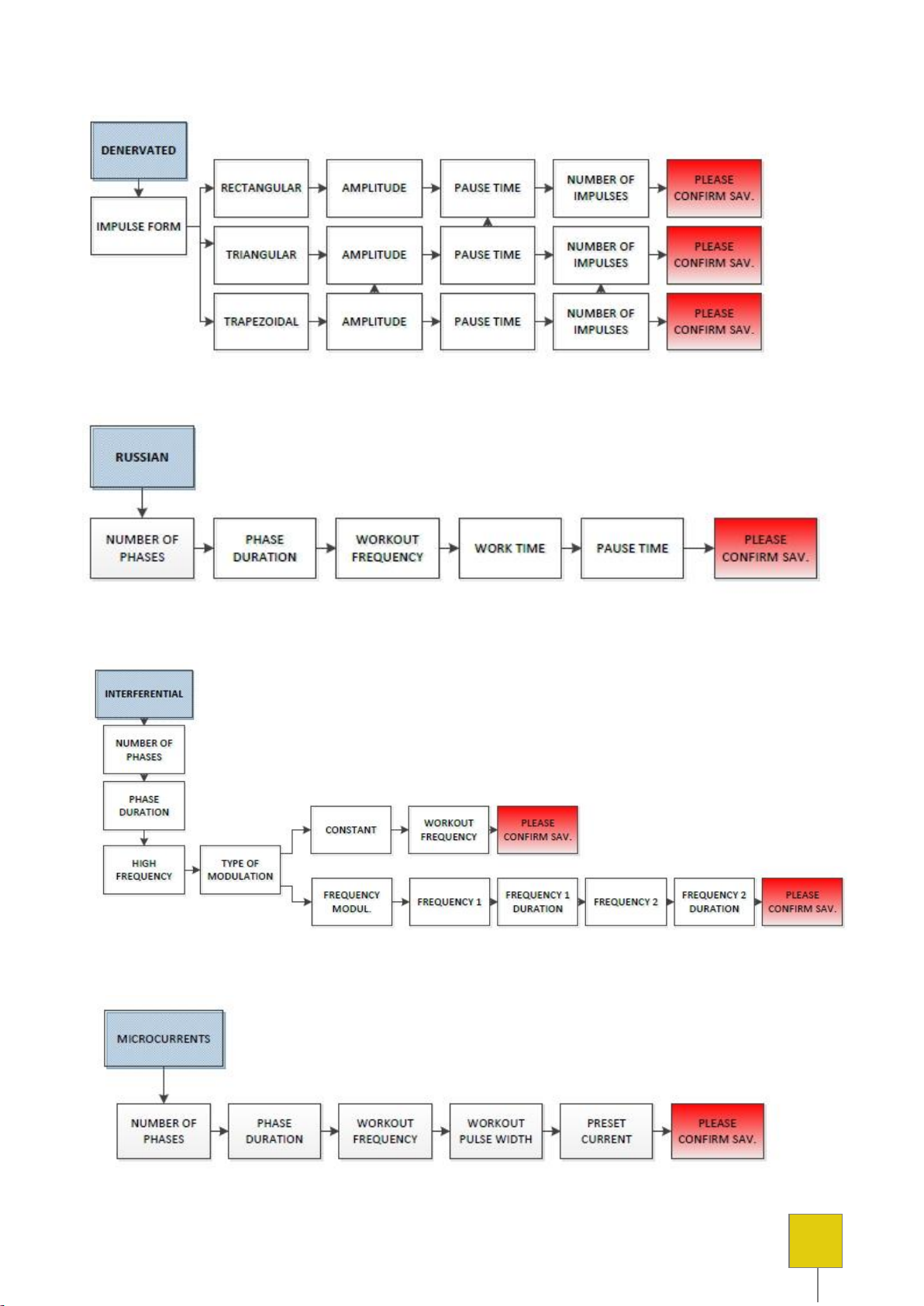
Diagram of the programming of the DENERVATED currents ...................................................................................16
Diagram of the programming of the KOTZ currents....................................................................................................16
Diagram of the programming of the INTERFERENTIAL currents.............................................................................16
Diagram of the programming of the MICROCURRENT currents............................................................................... 16
PRACTICAL APPLICATIONS ....................................................................................................................... 17
Use in sport field .......................................................................................................................................................... 17
Use in beauty field........................................................................................................................................................17
Localized loss of weight...................................................................................................................... 17
Anti-cellulite treatment ....................................................................................................................... 18
The lymphatic drainage....................................................................................................................... 19
Firming/Toning.................................................................................................................................. 19
Specific breast cleavage and arm firming treatment ....................................................................................... 19
Specific face treatment........................................................................................................................ 20
Applications in rehabilitation........................................................................................................................... 20
The TENS ......................................................................................................................................... 20
The MENS Microcurrents............................................................................................................................... 21
IONOPHORESIS............................................................................................................................... 23
Currents for denervated or partially denervated muscles................................................................................23
Interferential currents.......................................................................................................................... 25
Russian currents (kotz) ....................................................................................................................... 25
PROGRAM LIST“SPORT”......................................................................................................................................... 27
PROGRAM LIST ”MICROCURRENTS” ..................................................................................................................38
PROGRAM LIST REHAB .......................................................................................................................................... 41
PROGRAM LIST PREVENTION (available on Genesy SII-Elite SII) ...................................................................... 45
PROGRAM LIST SPECIAL SPORTS ........................................................................................................................46
Page 4

Rev. 11.2014
4
G-PULSE TREATMENTS (only in Activa, Fit&Beauty and Swing) .........................................................................51
Operating mode:...........................................................................................................................................................52
The recommended accessories to carry out the 3S sequential drainage programs ....................................................... 53
Conductive bands................................................................................................................................... 53
“Fast band”............................................................................................................................................ 54
“Fast pad”.............................................................................................................................................. 54
Splitted cables........................................................................................................................................ 54
Electrode placement for the sequential drainage..........................................................................................................54
THE ACTION NOW PROGRAMS..................................................................................................................... 56
PERSONAL TRAINER...................................................................................................................................... 58
Use suggestions for the main programs........................................................................................................................ 58
ELECTRODE PLACEMENT ............................................................................................................................. 71
The body position during the stimulation.....................................................................................................................71
Electrode placement for Tens and Microcurrent programs .......................................................................................... 71
Bibliography...................................................................................................................................................... 84
Page 5

Rev. 11.2014
5
THE ELECTROSTIMULATION
The electrostimulation does not want to replace physical activity but it must be considered as an
additional treatment to it.
According to the aims, it will be useful:
- To sportspeople, in order to complete the normal training and to increase performances
- To those who want to treat some imperfections
- To those who suffer from some pathologies
- To those who have suffered from a trauma or in the rehabilitation.
The electrostimulation is a technique that provokes a muscle contraction completely similar to the
voluntary one, by using electrical impulses that act on motor points (motoneurons) or on nerve
endings (TENS impulses).
There are two different ways of use:
- muscle stimulation (ideal for strength development and for aesthetic treatments)
- stimulation to nerve endings (ideal for the treatments against pain)
Types of muscle
The muscle can be divided in three different types: streaked or voluntary muscle; cardiac muscle
and smooth or involuntary muscle.
The voluntary muscle (streaked) includes the skeletal muscles and the musculature of organs such
as the eyeball and the tongue. It permits the movement and the maintenance of the posture and
contributes to shape the body. It responds very quickly to nerve impulses, by contracting in a rapid
and intense way. The voluntary muscle cannot be contracted for long time with high intensity
because it is subject to fatigue. Generally, streaked muscles are connected to the skeleton by means
of tendons.
The involuntary muscle (smooth) covers the internal walls of our organs, it is in the wall of the
blood vessels, in the wall of the hollow organs (stomach, intestine), inside the eyeball, in the erector
muscles of the hairs. Its main function is to push materials inside and outside the body. Smooth
muscles have very slow, but prolonged and more effective contractions (requiring less ATP). They
are not easy to fatigue and are often intrinsic and, therefore, they do not adhere to skeletal
structures.
The cardiac muscle is responsible for the continuous and rhythmic contractility of the heart and it
has some functional and structural features of the other two types of muscle tissues.
The cardiac and the smooth muscle are not voluntarily controlled.
The most part of the human body muscles belongs to the category of streaked or voluntary muscles,
with approximately 200 muscles for each side of the body (approximately 400 totally). Skeletal
muscles are the target of the EMS (Electrical muscle stimulation).
The mechanism of the muscle contraction
The skeletal muscle exercises its functions through the mechanism of the contraction.
When the muscle contraction happens, the movement of the articulations is produced and,
consequently, the movement of the skeleton, too.
Page 6

Rev. 11.2014
6
The muscle contracts in the following way: when a person decides to make a movement, his/her
brain automatically elaborates the information needed and it creates a signal that, through the
nervous system, transmits an electric impulse to the muscle that has to move.
After the reception of the impulse, the anatomic structures of the muscle contract causing the
desired movement.
The energy demanded for the contraction is provided by the supply of sugars and fats stored in the
human body. In other words, the electrical stimulation is not a direct energy resource but it works as
an instrument that triggers the muscle contraction.
The same type of mechanism is activated when the muscle contraction is produced by the
electrostimulator. EMS (the electrostimulation produced by the electrostimulator) assume, in other
words, the same role of a natural impulse transmitted by the motor nervous system. Normally the
muscle relaxes and returns to its original state at the end of the contraction.
Isotonic and isometric contractions
The isotonic contraction occurs when the interested muscles produce a state of constant tension
producing the displacement of the joint heads and therefore the movement. Instead, when the
musculature produces a tension and the joint heads of a physical segment are blocked (without
moving), we talk about an isometric contraction.
In the event of the electrostimulation, an isometric contraction is preferred because it fosters to
obtain an even maximum contraction without creating sudden and uncontrolled movements of the
joint heads. Despite this, for specific applications, especially in sport field, the electrostimulation
can be used together with an isotonic contraction (with overloads, too).
CLASSIFICATION OF THE DIFFERENT TYPES OF MUSCLE FIBERS
The skeletal muscles are composed by a combination of muscle fibers that have different shapes
according to the mechanical functions they have to carry out.
I type FIBERS
This type of fibers are also called ST fibers (slow contraction fibers) or SO fibers (oxidative
metabolism slow fibers).
The motoneuron that innervates them is tonic and with slow conduction speed.
They are red fibers (the color is due to the presence of the myoglobin molecule) that have a slow
contraction speed and a mainly oxidative energetic metabolism (oxygen consumption).
I type muscle fiber is very resistant to fatigue as it is responsible for every kind of activity with a
tonic, slow nature, that is connected to the maintenance of the posture.
These fibers are surrounded by a thick capillary net that enables the optimal execution of the
aerobic metabolism in a prolonged activity that has moderate strength expressions.
I type fibers are very important in all endurance sports: running, cycling, swimming, cross-country
skiing, etc.
IIa type FIBERS
They are also called FTa fibers (rapid contraction fibers) o FOG fibers (oxidative-glycolytic
metabolism rapid fibers).
Page 7

Rev. 11.2014
7
These fibers are to be considered intermediate between the I type fibers and the IIb type fibers; they
are innervated by a phasic motoneuron that has a faster speed than the one of the tonic motoneuron.
Thanks to their features, they can specialize by addressing them towards more aerobic or anaerobic
metabolic properties.
Therefore, the IIa type fiber is able to carry out rapid contractions with a modest strength
development, that are extended during the time due to their relative endurance to fatigue.
IIb type fibers
They are also called FTb fibers (rapid contraction fibers) or FG (glycolytic metabolism rapid
fibers).
This kind of fiber is innervated by a phasic motoneuron that transmits the impulses to the muscle at
a very high speed.
These fibers are white and have a high content in glycogen and glycolytic enzymes to develop a
powerful energetic anaerobic activity.
The contraction is very rapid and develops high strength values; the almost complete lack of
mitochondria makes these fibers not able to support an extended activity and, thus, easy to fatigue.
IIb type fibers are very important in all human activities that have explosive strength expressions
and, naturally, in all power sports: sprints, throws, jumps, etc.
The limits of the actual classifications
The actual classification of muscle fibers is due more to the need of establishing a series of
categories to use for practical aims than to the biological-functional reality of the human muscular
system.
It is certain that the fibers are in a continuous range of different metabolic organization levels that
correspond to the different types of human activity, generally, and sport performance, specifically.
The distribution of the different types of fibers in the muscle
The relation between the two main categories (type I and the type II) can vary in a sensitive way.
There are muscular groups that are typically constituted by fibers of I type, like the soleus, and there
are muscles that have only fibers of II type like the orbicular muscle. However, in the most of the
cases we have a simultaneous presence of various types of fibers.
The studies lead on the distribution of fibers in the muscle have put in evidence the strait
relationship that exists between the motoneuron (tonic or phasic) and the functional features of
fibers from it innervate. They have also shown as a specific motor activity (and sports in particular)
can determine a functional adaptation of the fibers and a modification of their metabolic features. In
the same way, also the training with the electrostimulation enables the training to focus on some
types of fibers rather than on other types, by modifying the parameters of frequency and duration of
the impulse, according to the results achieved.
Motor unit type
Contraction type
Contraction frequencies
I type fibers
Slow contraction I
0 - 50 Hz
II a type fibers
Fast contraction II
50 - 70 Hz
II b type fibers
Fast contraction II b
80 - 120 Hz
Page 8
Rev. 11.2014
8
In order to make a tissue pass from the phase of rest to the one of excitation by means of an induced
electrical stimulus (impulse of the electrostimulator), some factors have to be considered:
- the stimulation intensity
- the duration of the stimulation that must be adapted to the body district that is wanted to be
stimulated.
Indeed, to excite a tissue, not only the pick intensity value is particularly important, but also the
relationship between the duration and the intensity of the stimulus.
This relationship varies according to the muscular districts.
Chronaxy and reobase
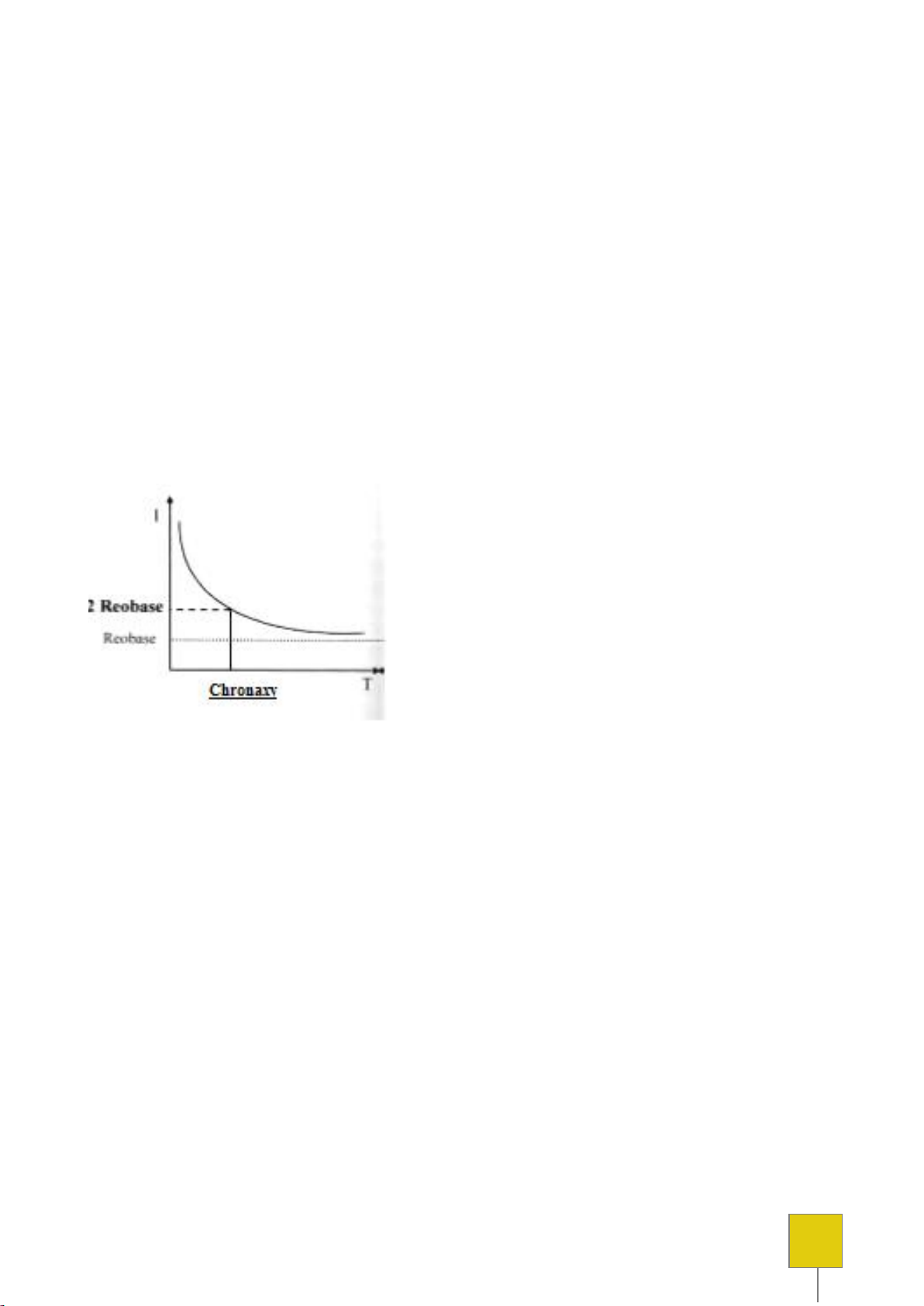
The graphical course that represents the relationship between the intensity of a stimulus (l) and its
duration (t) is not linear, as the studies carried out by Lapique demonstrate. Observing img. 1,
which shows the relationship between intensity and duration of an electrical stimulus provoked to
excite a target tissue, it turns out to be obvious that, an increase in the duration of the stimulus
corresponds to a decrease in its intensity.
Image 1
However, it does not spoil its effectiveness. On the other hand, when a stimulus of short duration is
wanted to be used, its intensity will have to increase for being able to reach the excitation threshold.
Lapique's important discover consists in having understood that for being able to obtain an
electrical stimulus, qualitatively valid, it is not sufficient to establish a parameter and consequently
derive the other. That depends on the intrinsic features of the organic tissues, which try to get
accustomed to a constantly repeated stimulus. This phenomenon, called "tissue accommodation",
involves the realization of a stimulus that does not depend on it.
The two parameters individuated by Lapique, necessary in order to obviate the problem, are:
REOBASE and CHRONAXY.
REOBASE: it is the value of minimum intensity in order to excite the tissue independently from its
duration.
CHRONAXY: it is the duration of the stimulus, with a double intensity compared to the reobase, it
is necessary in order to excite correctly the target tissue.
Once the chronaxy has been identified, a suitable stimulus is automatically produced to excite
correctly the target muscle group. In this way it is also possible to avoid all those typical
annoyances of an extended electrical stimulation such as a burning sensation and formication.
During the researches to define the electrostimulation programs, therefore, it is indispensable to
consider the chronaxy, which varies according to the muscular group that you want to stimulate.
Page 9
Rev. 11.2014
9
Body Part
Chronaxy
Leg
400 μs
Thigh
350 μs
Lower trunk
300 μs
Upper trunk
250 μs
Arm
150 μs
Forearm
200 μs
Table of the values of chronaxy of the different body parts
Impulse parameters
Recent researches have explained that the muscle contracts in various ways according to the type of
stimulation it has received and according to the parameters that characterize it: intensity, frequency,
amplitude of the impulse, duration and recovery time.
The parameters that characterizes an electrical impulse are:
- frequency
- amplitude
- intensity
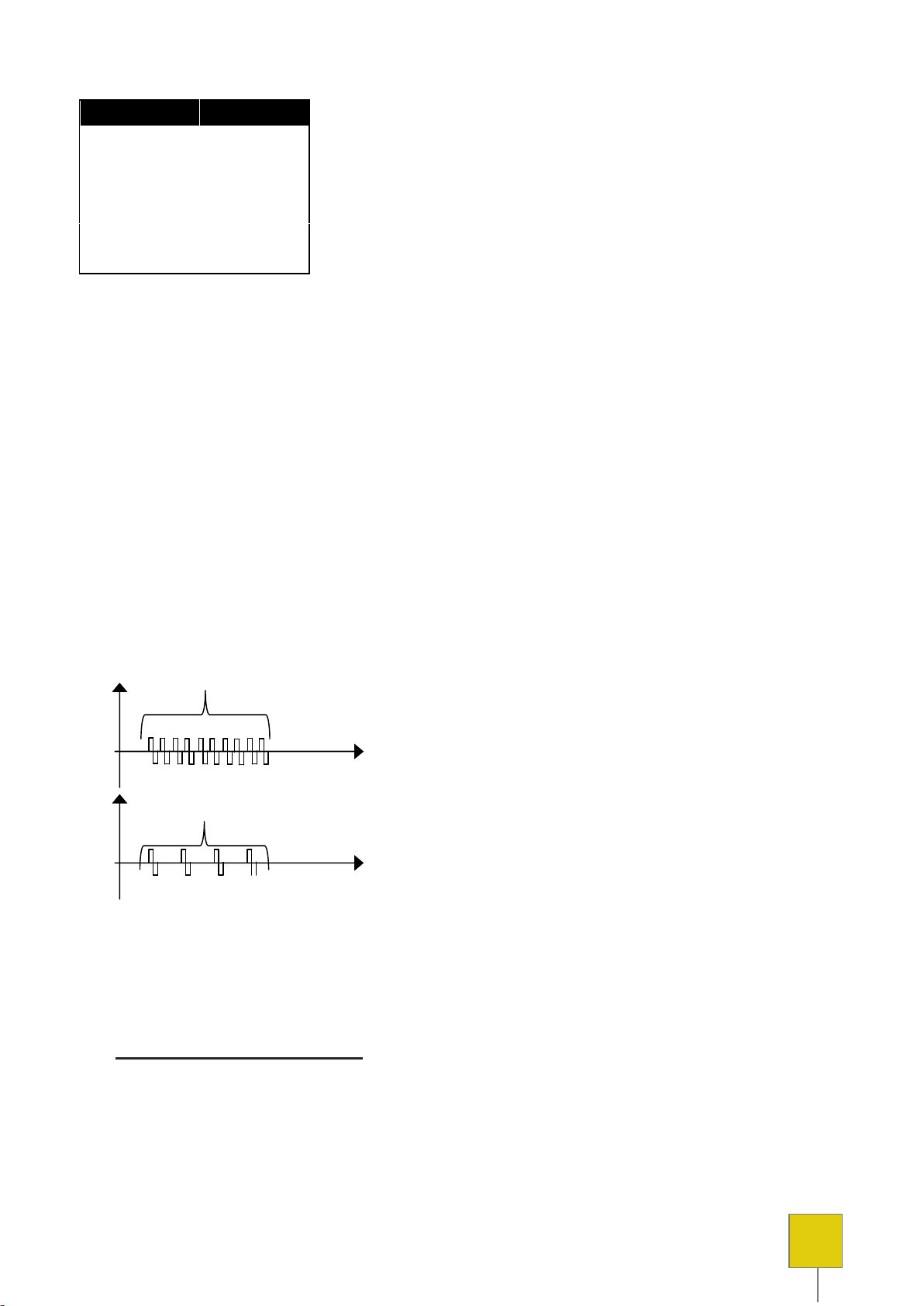
The frequency suggests how many impulse cycles occur in a second. It is expressed in Hertz. This
value affects the fibers that will be stimulated: the higher the frequency is, the more the stimulation
aims to fast fibers. At low frequencies, slow fibers are stimulated.
Image 2. In the first graphic the frequency is 10 Hz, in the second one it is 4 Hz.
EXAMPLE:
frequency fiber type (work)
10/50 Hz Slow fibers – Endurance
50/70 Hz Intermediate fibers
70/100 Hz Fast fibers - Strength
100/120 Hz Fast fibers
Impulse cycles in 1”
Impulse cycles in 1”
Page 10
Rev. 11.2014
10
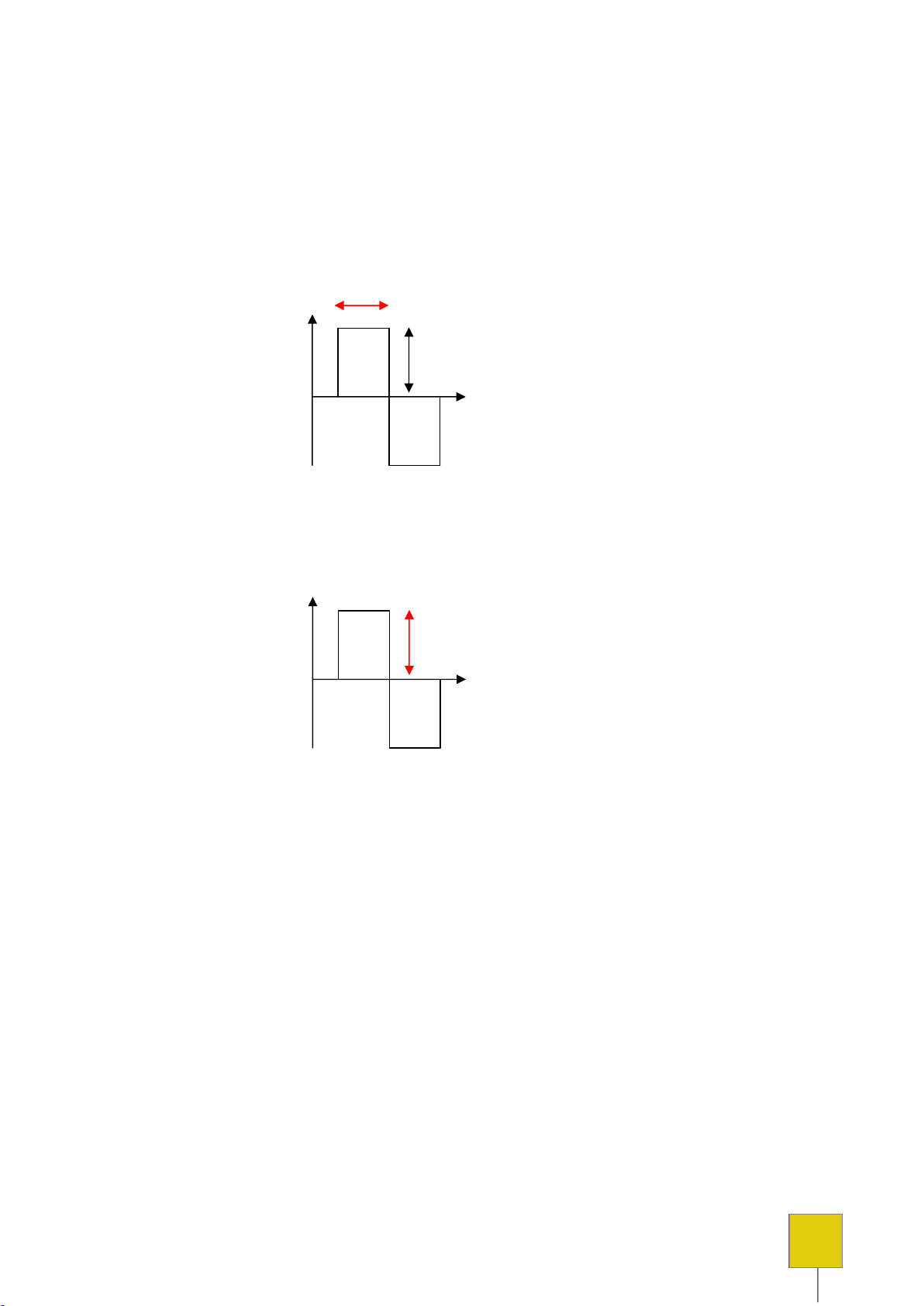
The amplitude is the duration value of the impulse. It is measured in microseconds and represents
the chronaxy value of the motor nerve that innervates the muscle to be treated.
EXAMPLE:
150-250 ms Upper limbs
350-450 ms Lower limbs
250-350 ms Trunk
The intensity is the value of the electrical current that can be set by the user and it is measured in
mA (microampere). Higher the intensity, greater the number of the fibers recruited.
Stimulation intensity
The intensity of current necessary to obtain muscular contraction is personal and depends on the
position of the electrodes, the underlying adipose tissue, sweating, the presence of hair on the area
to be treated, etc.. For these reasons, the same intensity of current can generate different feelings
from person to person, from day to day, and from the right side to the left side of the body. During
the same working session, it will be necessary to regulate the intensity in order to obtain the same
level of contraction because of the accommodation phenomena. The intensities of current
recommended in the different phases are proposed as indicative values, and each person should
modify these levels according to his/her personal needs.
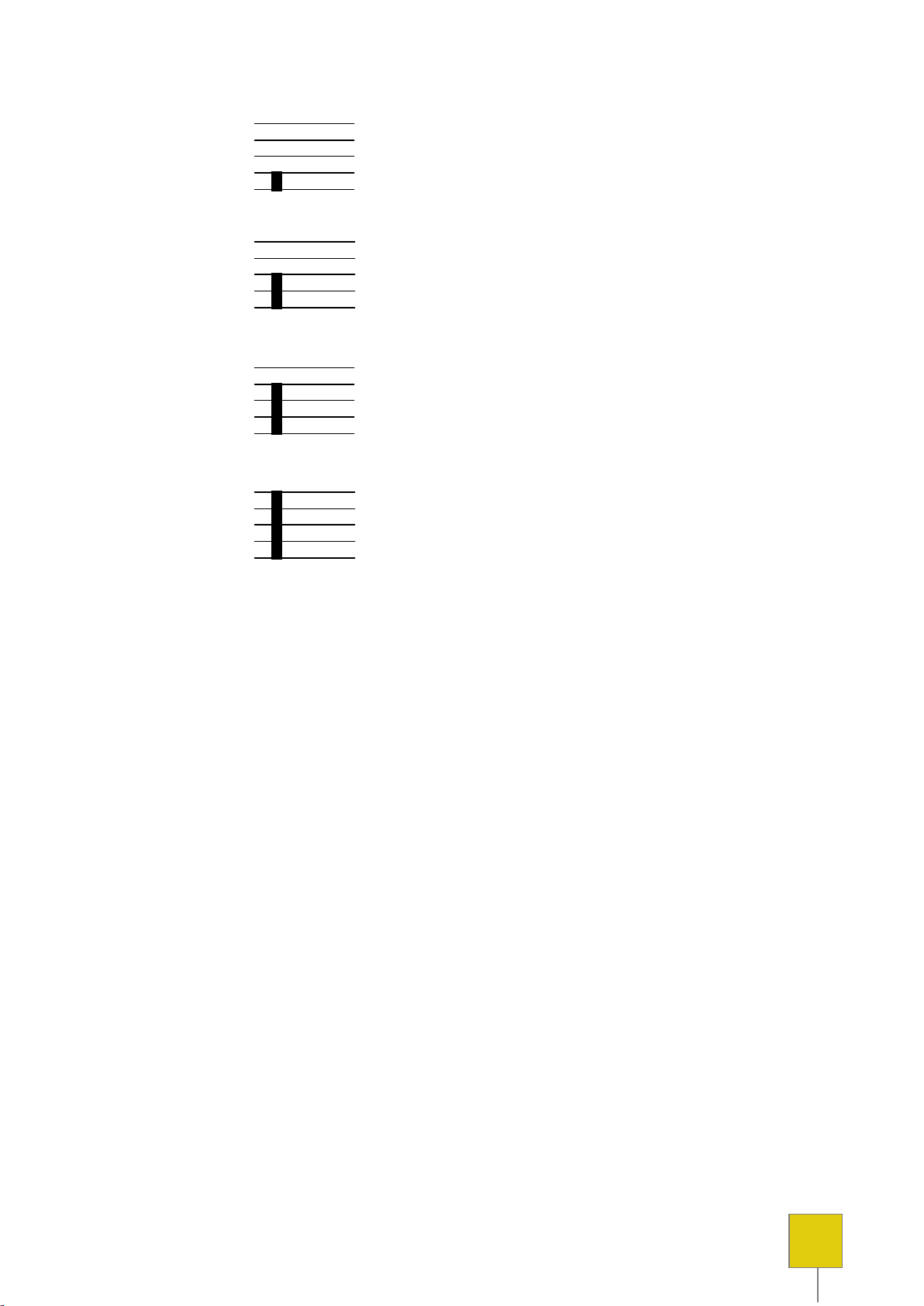
- Moderate intensity. The muscle does not tire, not even during prolonged treatments. The
contraction induced is tolerable and pleasant. This is the first level on the graphic representation of
intensity.
- Intermediate intensity. The muscle is visibly contracted but the stimulation does not cause the
joints to move. This is the second level on the graphic representation of intensity.
- Elevated intensity. The muscle is contracted substantially. The muscular contraction will cause the
extension or bending of the limb if this is not blocked. This is the third level on the graphic
representation of intensity.
- Maximum intensity. The muscle is contracted maximally. This is an intense treatment that should
be performed only after having executed different applications at lower intensity.
I
T
I
T
Page 11
Rev. 11.2014
11
In the descriptions of the treatments, the best levels of intensities are recommended.
NOTE: The recommended levels of current are only indicative.
NOTE: For Microcurrents programs, it is not necessary to set an intensity value (in mA) because
this is preset and automatically activated for all phases.
Moderate
Maximum
Elevated
Intermediate
From 10 mA to 20 mA
At the maximum level of tolerance, but below the pain
threshold
From 30 mA to 40 mA
Above 30 mA
Page 12
Rev. 11.2014
12
Stimulation type
Globus electrostimulators offer different stimulation modes: continuous, intermittent, frequency
modulation, amplitude modulation and BIO-PULSE®.
Continuous stimulation
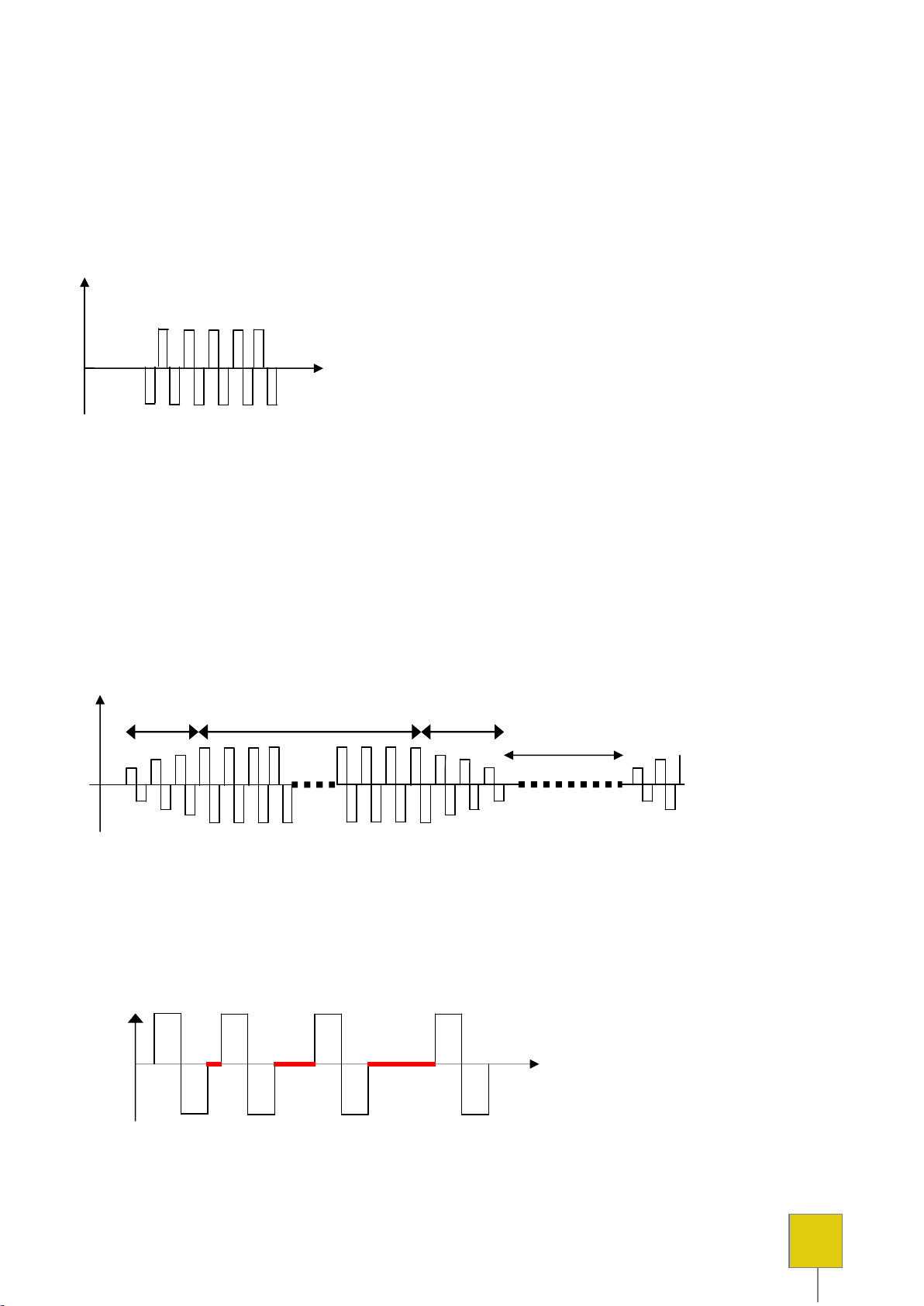
It consists in a continuous stimulation without times of recovery all the phase long.
This type of stimulation is generally used, in order to execute treatments of warm up and cool-down
at low frequency (with TENS currents) or for antalgic treatments.
Intermittent stimulation
During this type of stimulation there is an alternation between working time and rest time (active
and passive); there can be, for example, 6 seconds of contraction and 10 of recovery, after that the
contraction starts up again for 6 seconds and so on for all the duration of the phase.
During the time of recovery, there is also the possibility to raise the intensity of current in order to
execute a cool-down active recovery during the rest.
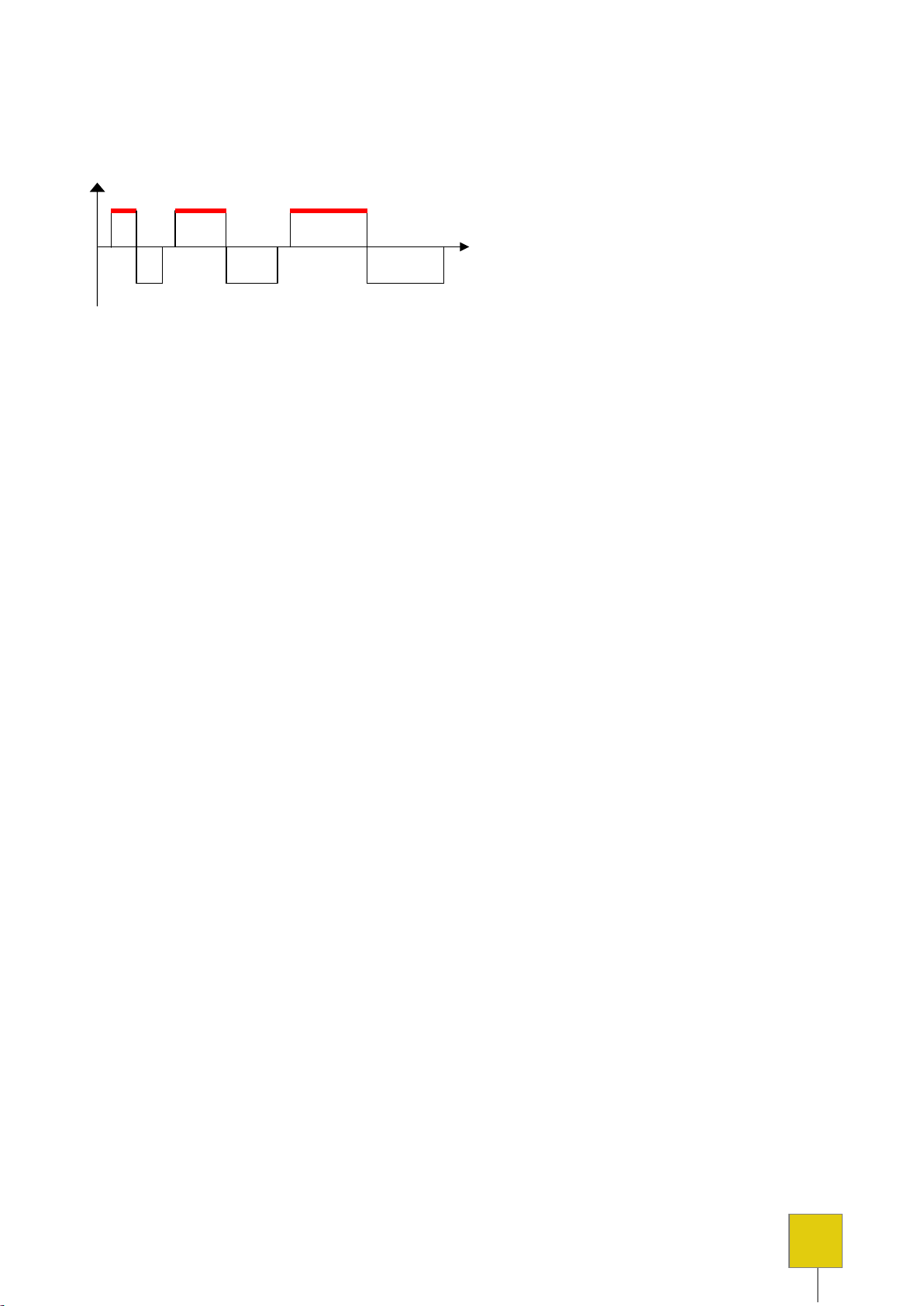
Frequency modulation stimulation
In this type of stimulation, during the working phase, the frequency of the stimulus varies between
the predefined values in order to involve the greater number of muscular fibers. They are used for
aesthetic treatments and also for specific programs, such as programs of explosive strength.
Amplitude modulation stimulation
Ramp-Down
Rest
Ramp-Up
Stimulation
I
T
I
T
Page 13
Rev. 11.2014
13
In this type of stimulation the frequency remains constant while the amplitude of the impulse varies
progressively between the predefined values. It is indicated mainly for aesthetic and fitness
treatments.
BIO PULSE stimulation
It must be considered a true and proper Globus innovation (studied in collaboration with some
Italian and foreign Universities). It consists in a particular type of modulation of the amplitude of
the impulse and of the stimulation frequency, too.
The Bio Pulse stimulation is particularly indicated for beauty and wellness programs such as some
kinds of lipolysis and drainage and, above all, programs of relaxing, deep and anti-stress massage.
I
T
Page 14

Rev. 11.2014
14
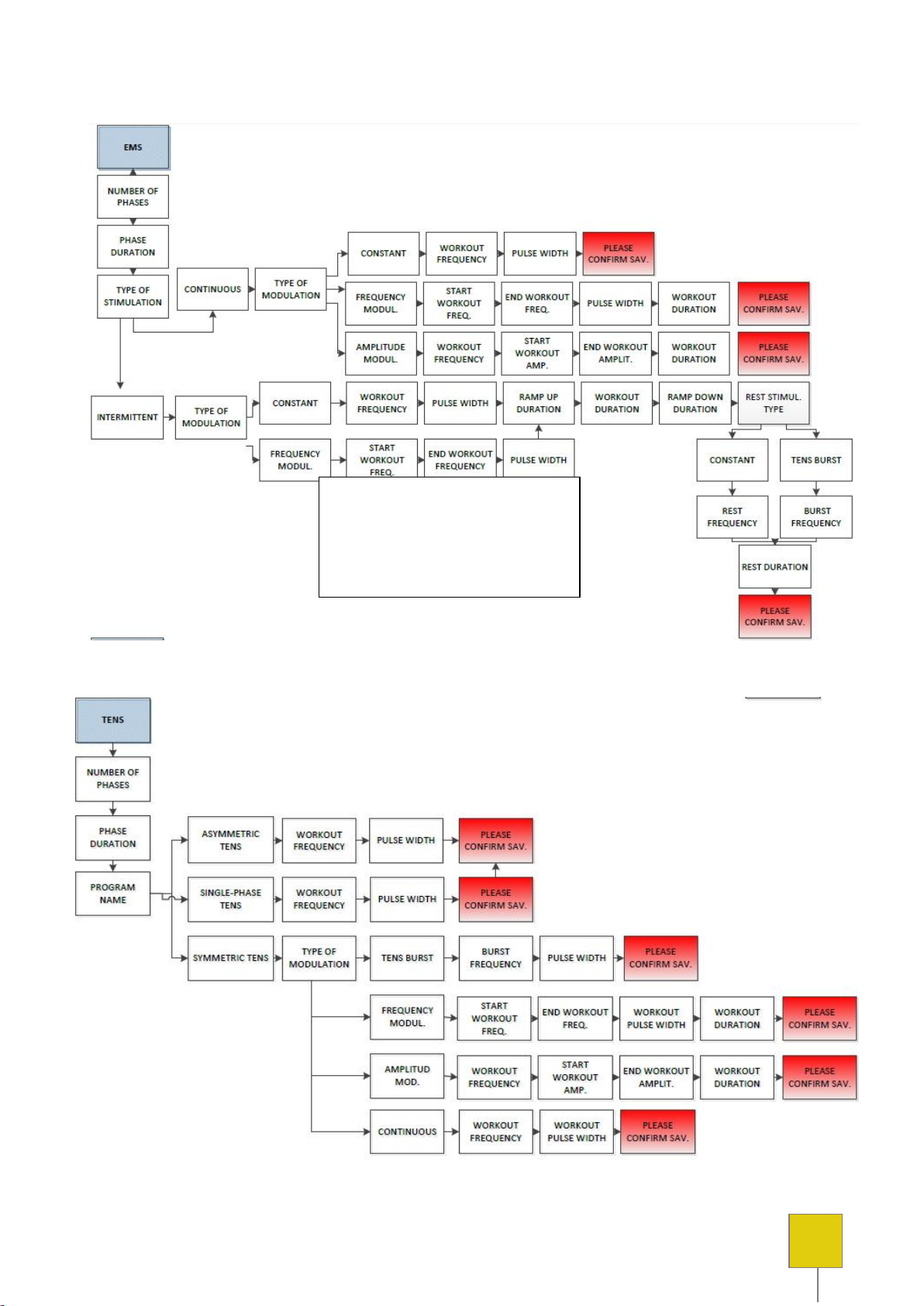
PROGRAMMING
In the most of Globus electrostimulators there is a function that enables the user to set the programs
in a very specific way and according to the current needs. The personalized work can create a very
specific training and a rapid achievement of the proposed results inn sport field and rehabilitation,
fitness and in beauty field.
It is clear that the use of this special function of the principal Globus electrostimulators needs a
deep knowledge of the electrostimulation field and especially an optimal experience in the field,
firstly made with the preset programs to be personalized further.
The currents that can be programmed vary from device to device and are:
- EMS;
- TENS;
- Interferential;
- Microcurrents;
- Denervated;
- Kotz.
Here we just want to offer some general notions on the parameters that can be set to create a new
program.
To program the electrostimulator correctly it is important to consider three different factors that
characterize the impulse: the ramp up, the stimulation time and the ramp down.
With the term “Ramp-up” we mean the time that the stimulation intensity needs to pass from the
value of 0 to the preset value during the working phase. Therefore, it represents the time that the
muscle needs to reach the maximum contraction set. The ramp up varies according to the features of
the program chosen. The choice of the ramp up is in a strait relationship with the physical and
muscular features of the athlete, of the sport practiced and of the goal you want to reach. It is
important to consider that too brief ramps reduce considerably the comfort of the stimulation and
they are difficult to manage by the person that is carrying out the treatment, as he has not enough
time to prepare to the contraction. In the same way, too long ramp time can fatigue the muscle even
before the contraction ends.
With the term “Ramp-down” we mean the time needed for the intensity to return to 0 after the end
of the contraction. Even in this case it should be considered that too rapid ramp down times can be
less comfortable because the subject does not have the time needed to support the voltage drop,
while too long ramp down times can anticipate the feeling of localized fatigue.
With the term “stimulation time” we mean the time the musculature keeps the maximum
contraction reached. The duration of the working phase does not have a fix value but is has to be
established according to the muscle qualities you want to train.
Page 15
Rev. 11.2014
15
Diagram of the programming of the EMS currents
Diagram of the programming of the TENS currents
* With the term “Tens burst” in the
stimulation during the rest, we mean a
burst constant, that is a constant
current in the form of brief impulse
packages.
Page 16
Rev. 11.2014
16
Diagram of the programming of the DENERVATED currents
Diagram of the programming of the KOTZ currents
Diagram of the programming of the INTERFERENTIAL currents
Diagram of the programming of the MICROCURRENT currents
Page 17

Rev. 11.2014
17
PRACTICAL APPLICATIONS
Use in sport field
Different kinds of strength exist and they are measured in different ways. The maximum
development of strength is the absolute strength, without considering the body
weight; instead when the body weight is considered, we are talking about the
relative strength.
Here’s an example. We know that an ant is able to move an object that weights six
times more than it does, therefore it has a relative strength greater than any other
weight lifter, even if its absolute strength can be considered paltry.
Another element to be considered is the kind of effort made. For example, the running of a one
hundred meters runner is a performance very different from the one of a marathon runner and it
develops different strengths.
When the stimulation that our muscle bear is brief, intense and immediate, then we are measuring
the rapid strength. When it is extended during the time (and it requires the organism countering
certain fatigue), we are measuring the endurance strength.
Obviously, every kind of strength will have a training and a specific load to increase it.
Use in beauty field
The electrostimulation treatments in beauty field can be distinguished in two big
areas:
- specific programs to treat skin flaws: improvement of the capillary
microcirculation, toning and tissue firming, liquid drainage, increase in metabolism
and cellular activities, reduction and mobilization of the fat in the localized
deposits (e.g. cellulite, water retention, localized fat, …);
- toning or firming programs: for those who want to firm and tone their muscles but do not have
enough time to practice motor activity.
For long-lasting results, it should be used together with motor activities, as soon as possible. As you
will see, these programs contribute to reduce skin flaws through the general and localized increase
in the metabolism.
Among the innumerable applications in beauty field, we briefly summarize some of the main aims.
- Loss of weight/ Localized lipolysis
- Anti-cellulite treatment
- Lymphatic drainage
- Firming/Toning
Localized loss of weight
It is known that, when a person goes on diet, he/she loses fat more quickly in the areas where he/she
is already slim. For instance, when going on a diet, a woman, who does not have a voluminous
breast and wants to lose weight because of her large hips, is going to lose weight in the breast and
not in the hips.
To obviate the problem, it is necessary to resort to the so-called “localized loss of weight”, that is
the losing weight process that, through the increase in the muscle activity, enhances the
mobilization of the fat from the adipose tissue (lipolysis) in the areas next to the activated muscles.
Love handles
Page 18

Rev. 11.2014
18
If the cellulite on hips is a feminine problem, love handles are instead almost exclusively a man
problem. Both are difficult to tackle; gym, diet, aerobic work, and more, often permit to obtain only
mediocre results.
Electrostimulation can contribute in an effective way to treat this skin flaw because, being a
localized treatment, it acts directly on the problem.
In this case it is necessary to have the maximum perseverance and especially the possibility to act
more times per day, or at least every day, with specific electrostimulation programs localized on the
areas to be treated.
Anti-cellulite treatment
The cellulite is a sworn enemy of woman body. Its elimination is not only an aesthetic caprice, as it
is a real “ILLNESS” to tackle and treat from its first symptoms.
The causes that can lead to the appearance of cellulite are different (they often act together to make
it difficult to treat): bad alimentation behaviors, lack of exercise, changes in body weight, bad
circulation, ineffective lymphatic drainage, deposit of excess fat, water retention, family genetic
predisposition, teen-age overweight, little elastic skin or not healthy skin, stress.
The cellulite, which usually appears on feminine body rather than on masculine body, can be of
different types:
EDEMATOUS cellulite: it is the first the stage of the cellulite and it is possible to recognize it
because the skin, in the critical points, is doughy and when pinching, it presents bumps and it
presents the orange peel skin effect. The edematous cellulite is caused by a loss of elasticity of the
blood vessels that supply blood to the adipose tissue by causing the liquid stagnation. The cells, that
are inflamed, strain blood circulation, by causing firstly swallowing and secondly anti-aesthetic
tires.
FIBROUS cellulite: it is the second stage of cellulite. The continuous liquid stagnation makes the
adipose tissue suffer and it becomes fibrotic. The skin begins to harden and to become dull. The
orange peel effect is evident even without pinching the skin.
SCLEROTIC cellulite: it is the final result of the process of tissue degeneration. At this stage, the
hardened nodules are very evident so that the skin looks like a “mattress”. In this third stage, the
cellulite cause a considerable suffering to the tissues and the adipose cells increase in number and
volume and the fibrous septa that separate them tend to stiffen and to shrink. This makes the nerve
endings compress and even just touching the critical points causes pain.
To tackle cellulite it is important the use of electrostimulation; indeed, like in an aerobic training, it
produces an improvement in the lymphatic drainage and in blood microcirculation, that
physiologically are the mechanisms intended to eliminate the excess fat. With the electrostimulation
the treatment can be aimed at delimited areas and therefore it has a greater possibility of success.
The treatment must be always used together with other means that we have at our disposal today.
Firstly, it is necessary to try to improve the skin health, at least because with healthy skin, cellulite
is less evident. Then it is better to eliminate or at least to limit smoke, alcohol and fat assumptions
(especially saturated fats of animal origin). Moreover, it will be useful to drink a lot of water poor
of sodium, to eat a lot of vegetables and fresh fruits (especially fruits with more water and
antioxidants, or with A, C, E vitamins and zinc and selenium).and to massage the areas in order to
improve the circulation and the lymphatic drainage and to limit stress.
To sum up: the anti-cellulite strategy must base on five main factors that are diet, exercises,
massages, natural integration and electrostimulation.
Page 19

Rev. 11.2014
19
The lymphatic drainage
Together with the blood, the lymph represents the means by which the interstitial liquid give and
receive nutrients, refusal and regulation substances (hormones) that are needed to maintain the
integrity and the cell functionality. Compared with blood, lymph is not pushed by the cardiac
activity, but it flows in the vessels because of the muscle action. These tissues, by contracting and
relaxing, act like a real pump. When this action does not occur, for example due to immobilization,
the lymph tends to stagnate, amassing in the tissues. This is the reason why feet and ankles swallow
when standing for a long time in a static position.
The “drainage” concept refers to the starting of the liquid from the area where it has been amassed
towards an outfall point.
The lymph drainage supports not only this flow, by moving the liquids in the body, but it also acts
to unblock the obstructed channels.
It is an effective technique also to prevent and reduce the unaesthetic orange-peel aspect of cellulite.
It is indicated in the treatment of pathologies (post-surgical edema, scars), but in this case we
suggest that the medical prescription must be specific and personalized.
The programs of drainage and lymphatic massage, carried out with the electrostimulator, can be
used daily and are indicated especially for those who suffer from limb swelling or show, at the end
of the day, a sense of muscle fatigue.
Thanks to the rhythmic contractions induced by the electrostimulator (programs that link the
stimulation in frequency modulation to the amplitude modulation), the so-called “pump effect” is
obtained and it permits a reabsorption both of the water component and of the protein component
inside the lymphatic ducts.
Firming/Toning
Some factors, such as sudden loss of weight, pre- and post-cellulite status or pregnancy, often affect
in a negative way elasticity and the tone of skin and muscle tissue, making some body parts flabby
and less tonic.
The “Firming” programs of our electrostimulators are specific and indicated for this kind of
problem, as they permit to act locally on the muscle tone involved.
Muscle tone activities are instead intended to increase the percentage of lean mass and therefore to
give more consistence and shape to the muscle tone.
Specific breast cleavage and arm firming treatment
Breast, cleavage and arms are the first areas in the feminine body that show symptoms of muscle
relaxation. As for the breast, among the factors that determine its relaxation, reduction and the
appearance of stretch marks, it is to mention especially pregnancy and lactation and too drastic and
rapid loss of weight and hormone disorders. The only support musculature of the breast consists in
the pectoral muscles situated in the area above.
The mammary area, therefore, is one of the parts of the feminine body more exposed to the problem
of muscle-skin relaxation. The cleavage is instead one of the areas more exposed to the damages of
sun exposure; the consequent skin degeneration prematurely arises with the appearance of spots,
keratosis and dehydration. As for the internal part of the arms, we can notice how the skin flaws
most spread are cellulite, loss of volume, skin relaxation and stretch marks.
The electrostimulation can be useful in tackling these problems by using specific firming programs
for women daily.
Page 20
Rev. 11.2014
20
Specific face treatment
The electrostimulation is effective to recover and maintain the skin elasticity as it reactivates the
local circulation bringing new nourishments to the tissues.
The microlifting programs, specific for face, need specific electrodes of reduced dimensions in
order to involve only the interested musculature
Applications in rehabilitation
After a force immobilization due to a musculoskeletal trauma, it is very important to recover the
tone and the muscle trophism. Electrostimulation permits to recover the muscle tone quickly and to
drain the liquids stored because of the immobility.
Please, bear in mind that the electrostimulation should not completely replace the reeducation
sessions made by a physiotherapist, who could decide to carry out also proprioceptive and mobility
exercises.
The presence of ostheosynthesis devices, such as screws and plates, is not a contraindication in the
use of the electrostimulator as it has been conceived not to damage that devices.
Before starting any rehabilitation cycle, we suggest seeking your physician’s
advice.
The TENS
The transcutaneous electrostimulation (TENS) is widely used to reduce most of
the articular or muscle pains but also to treat pain of endogenous origin as they have little side
effects compared with traditional pharmacotherapy and therefore they are considered an important
alternative therapy.
The TENS consist in the selective stimulation of big fibers of peripheral nerves favoring the closing
of the gate for pain receptors and increasing the release of endorphin substances with a consequent
considerable reduction of the intensity of different kinds of pain. With the TENS programs of our
electrostimulators, therefore, we intend to treat acute and chronic pain due to the main
musculoskeletal disorders.
The pain decrease following the TENS currents application is connected to these factors:
a. Gate control theory
b. Endorphin secretion
c. Different sedative effects in relation to the frequency
Gate theory
If the electric signals that lead to the brain information about pain are stopped, also the pain
perception is eliminated. If, for instance, we hit our head into an object the first thing we do is
massaging the area affected by the trauma. In this way, we stimulate the receptors relative to touch
and pressure. TENS in continuous mode and in frequency modulation can be used to generate
signals similar to the ones of touch and pressure. If their intensity is enough, their priority is so high
that it prevails on the pain signals. Once the priority is gained, the gate related to the sensory signals
is opened and the pain one is closed, impeding in this way the passage of these signals to the brain.
Endorphin secretion
When a nervous signal proceeds from the pain area to the brain, it spreads through a chain of
connections joined together called synapse. The synapse can be seen as the space between the end
Page 21

Rev. 11.2014
21
of a nerve and the start of another. When an electric signal reaches the end of a nerve, it produces
some substances called neurotransmitters that pass through the synapse and activate the start of the
next nerve. This process repeats for all the way needed to the signal to reach the brain. The drugs
(opioids) involved in the pain reduction have the task to insinuate in the synapse space and to
impede the neurotransmitter propagation. In this way a chemical block of the pain signals occurs.
The endorphins are opioids naturally produced by the body to tackle the pain and they can act both
on the marrow and on the brain, in this way they are effective analgesics. The Tens can increase the
natural production of endorphins and, thereby, they act decreasing the pain perception.
Different effects in relation with the frequency
Depending on the frequency used, it can occur antalgic effects of immediate effect but with no long
duration (higher frequencies), or more progressive effects but also longer in time (low frequencies).
The MENS Microcurrents
The microcurrent stimulation is being increasingly used. In USA and other countries such as Japan,
Canada etc., the MCR also called MENS is considered one of the more used current in
physiotherapy and clinical applications (differing from TENS which, as well known, is particularly
indicated for pain relief). A number of studies have demonstrated excellent results in therapy and
various protocols and parameters have been defined (protocols and parameters that we have
included in our stimulators). For particular pathologies and situations, we suggest referring to your
physician.
Compared with conventional electrostimulation therapy, which utilizes electrical current at the
milliampere (mA) level, microcurrent utilizes a less intense microampere current for therapy
(microampere μA). This slight electrical current is below the human threshold of perception and it
is not therefore felt by the patient.
MENS therapy offers patient the following advantages:
-Safe
-Comfort
-Acute and chronic pain relief
-Accelerated regeneration of damaged tissues and rapid healing of wound, cicatrix, and bone
fractures.
-Collagen fiber production, promoting elasticity of the skin
-Total absence of side effects and complications.
Brief history of MENS electrostimulation therapy
The neuromuscular electrostimulation therapy with microcurrent (MENS) was developed
approximately 20 years ago.
Lynn Wallace treated more than 600 patients with MENS and examined its clinical effects on pain
caused by various disorders of the feet, lower limbs, femur, lumbar area, shoulders, elbows, and
neck, and found a remarkable sedative effect.
According to Wallace, the initial treatment of 15-20 minutes provided some element of pain relief
in more than 95% of patients. The extent of pain reduction was an average 55% after the first
treatment, 61% after the second treatment, and 77% after the third treatment. The pain was
completely disappeared in 82% of patients after less than 10 treatments (four treatments on
average).
Page 22
Rev. 11.2014
22
Many studies are possible with MENS as its stimulation is not discernible by the patient. Lerner and
Kirsch conducted experiments on 40 patients with chronic low back pain in which patients were
randomly allocated to a MENS treatment group and a placebo group that was hooked up to dummy
MENS units that provided no electrostimulation.
Stimulation was conducted three times a week for eight weeks. Results showed pain reduction of an
average 75% in the MENS treatment group and only 6% in the placebo group. A number of studies
have also found that MENS promotes the healing of wounds and ulcers.
Gault and Gatens reported a positive effect of MENS in 106 patients with ischemia skin ulcers. In
their study, the group treated with MENS using an intensity of 200 μA - 800 μA current recovered
approximately twice as fast as the non-treated control group. It has also been reported by a number
of clinicians that the healing of bone fractures is greatly facilitated by low-level electrical current.
The above-mentioned results demonstrate that MENS is markedly effective in treating acute and
chronic pain, promotes regeneration of damaged tissues, and heals wounds, cicatrix, and bone
fractures. (Gault WR, Gatens PF Jr : Use of low intensity direct current in management of ischemic
skin ulcers. Phys Ther 56~265, 1976.)
Functional mechanism of the MENS currents, “Injury current” and the MENS functions
The functional mechanism of MENS is complicated and has to be fully analyzed yet. Although a
variety of conflicting theories exists, sufficient research findings have been accumulated that the
following conclusion seem justified.
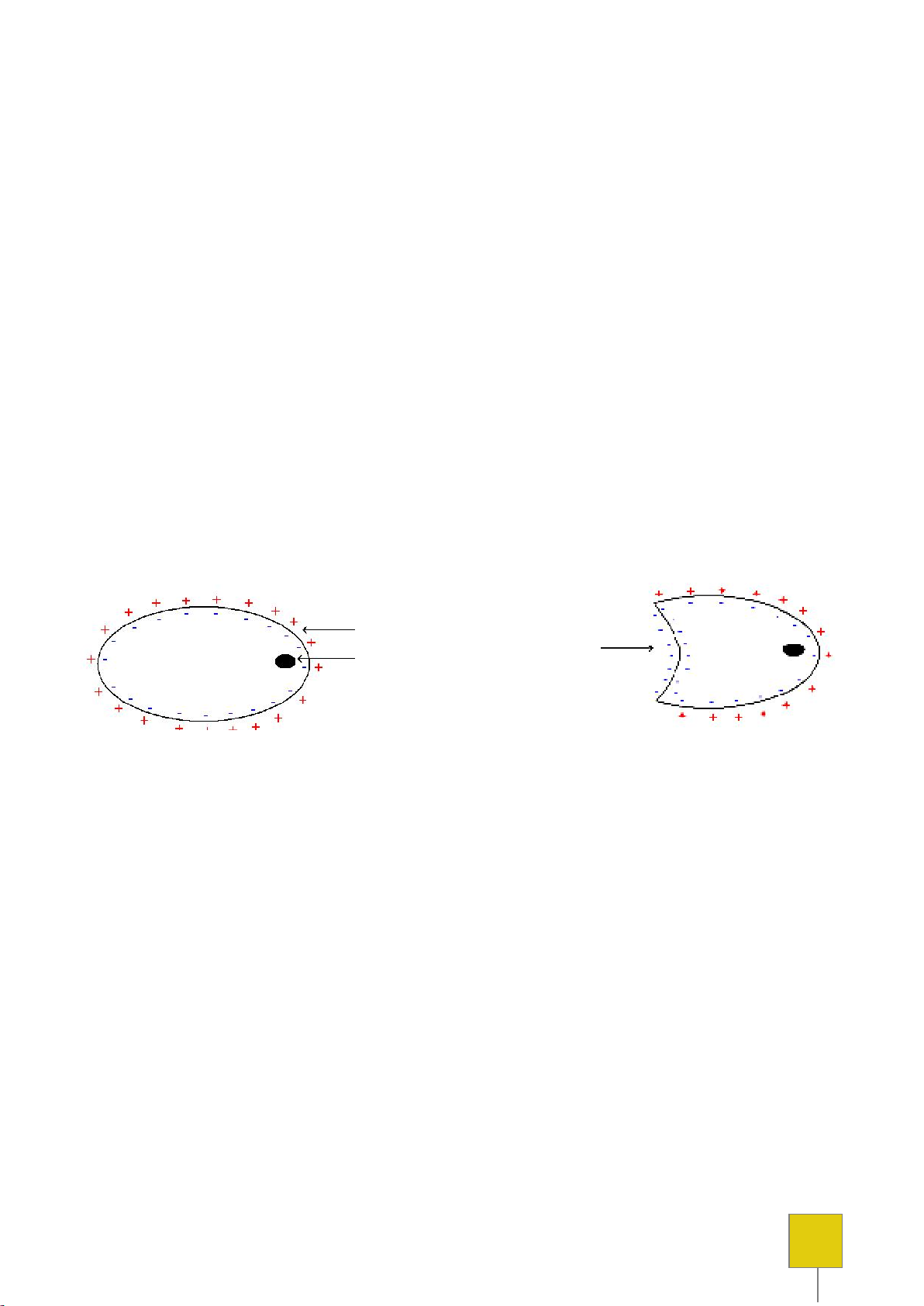
Image 3
It has been clear for over a century that an electrical potential of about -5OmV is present in the cell
membrane. This potential is known as the resting membrane potential.
The outer surface carries a positive charge, while the inner surface has a negative charge [Img.3].
When a cell is damaged, the potential of the injured part becomes negative, and the electric current
flows from the normal area to the injured area
This phenomenon was accurately measured by Matteucci (1938) and Bois-Reymond (1843), this
current is commonly known as "injury current”. Injury current is generated not only when
individual cells are injured but also when the tissue is damaged. The intensity of the injury current
ranges from 10 μA to 30 μA, as demonstrated by experiments. In other words, injury current is a
microcurrent. Injury current is considered to promote the recovery of damaged cells and tissues in
the living body. Stimulation by this current is thought to generate ATP and to synthesize protein for
the restoration of damaged tissue. Therefore, it can be affirmed that artificially generated
microcurrent would complement and further promote the natural functions of the injury current.
Phases and duration of Mens therapy
MENS therapy is ordinarily executed in the following two phases. Phase 1 is mainly intended to
reduce pain, while phase 2 is designed to solve the trauma and to repair the damaged tissue.
Membrane
Nucleus
Damaged part
Page 23

Rev. 11.2014
23
Whereas phase 1 offers rapid pain relief, phase 2 promotes ATP production and protein synthesis to
accelerate tissue recovery, providing basic healing. These two phases are executed in succession
with phase 2 following immediately after phase 1.
Treatment duration ranges from 15 to 30 minutes in phase 1 and from 5 to 10 minutes in phase 2 (5
minutes standard).
Treatment sessions vary according to the condition being treated. Generally, once a day or once
every other day is sufficient. To achieve satisfactory results, the therapy period can vary from 10 to
45 days. Five to ten follow-up sessions are recommended after satisfactory results have been
achieved.
Combined use with TENS
MENS and TENS may be combined for therapy.
This combination can produce great effects in cases of acute pain or symptoms of muscle stiffness.
IONOPHORESIS
The ionophoresis is a therapeutic technique that uses the continuous electric current that permits the
displacement of charged particles through the tissues. If the charged particles are medicines, then
the continuous current acts as a vector permitting the introduction and the penetration of medical
substances. It has been shown that by means of the continuous current, there can be a ion migration
that, according to the polarity law (negative ions that migrate towards the positive pole and vice
versa), enter in the flow of current by penetrating the organism through the sebaceous ad sweat
ducts and the hair channels.
The application fields of ionophoresis are all the treatments that act positively on local
inflammatory states.
IONOPHORESIS medications
Before performing ionophoresis, always consult your physician.
Read the instructions provided with the medications prior to use.
Before carrying out any treatment, consult with your physician or physical therapist to choice an
appropriate medication and identify the correct polarity.
DO NOT APPLY THE MEDICATION DIRECTLY TO THE SKIN. Apply the medication to the
absorbent surface of the electrode corresponding to the medication's polarity; the absorbent surface
of the other electrode should be dampened with slightly salted water, to promote circulation.
Preventive measures
If the treatment is not performed correctly or the intensity is too high, ionophoresis may cause skin
irritation and burns. The recommended current density for an electrode is 0.2 mA/cm2. The skin
must be free of lesions and injuries; do not shave the skin before treatment because razors may
cause microcuts.
Ionophoresis should not be used on persons with metallic implants or in contact with metallic items,
e.g. tables and chairs.
Currents for denervated or partially denervated muscles
The stimulation of a denervated muscle differs from the one of a healthy muscle for the fact that the
activation of muscular fibers needs particular currents.
Page 24
Rev. 11.2014
24
In presence of a traumatic lesion of the peripheral nerves, the measure of the chronaxy fosters to
establish whether the denervation is insufficient, partial or total. The aim of an excitomotor
treatment is the preservation of the trophism and the limitation of the muscular sclerosis in order to
foster the muscle to be as functional as possible by the end of the reinnervation process that can
sometimes last some months. The effectiveness of this type of treatment depends on the correct
setting of the stimulation parameters; these must be defined in a specific way for every patient and
must evolve with time.
In the programs for denervated muscles three types of currents are mainly used.
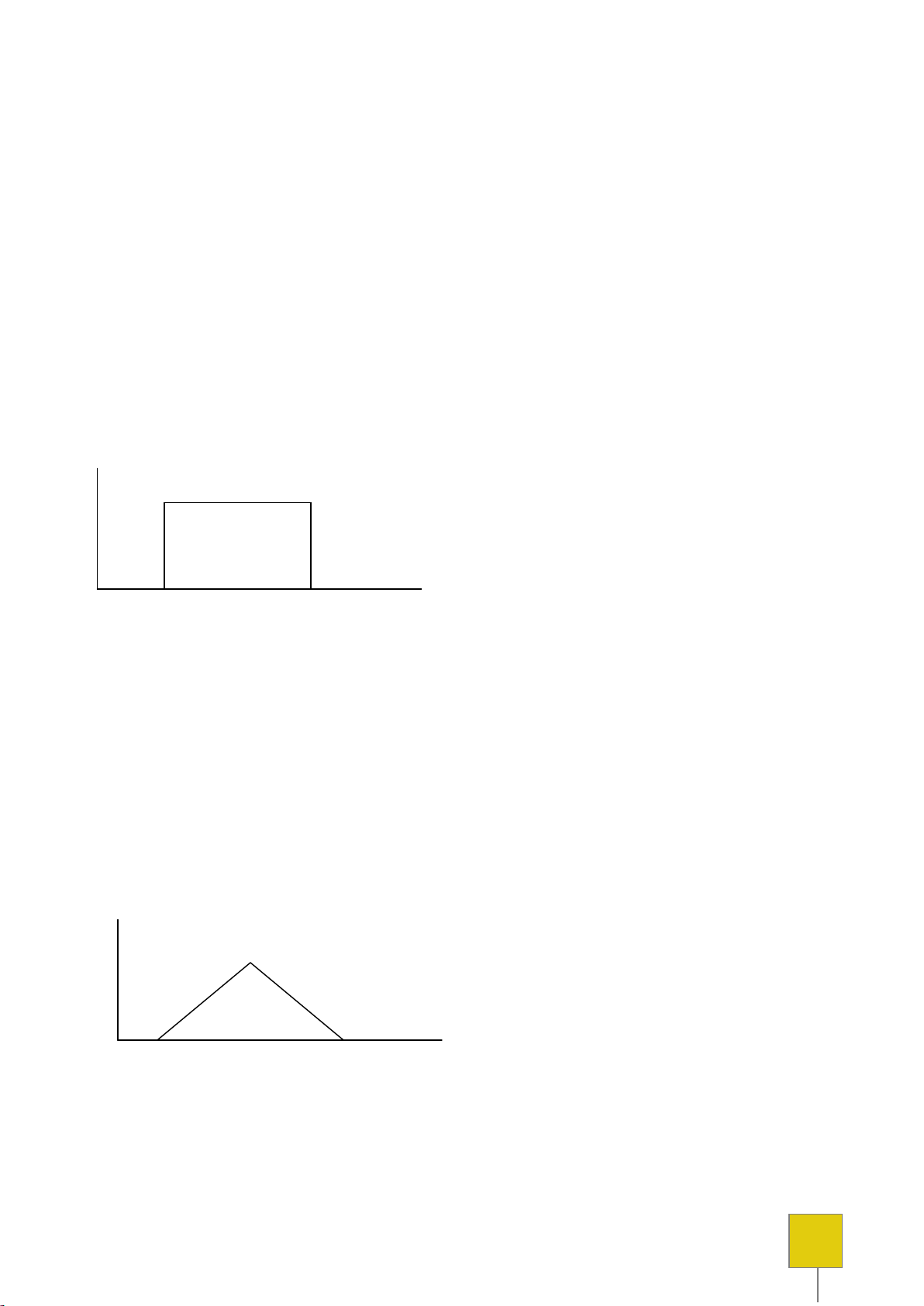
Rectangular currents
The rectangular current is characterized by single rectangular impulses, than varies quickly from the
null value to the maximum value of the set up intensity. The duration of the impulse causes a
selective contraction of the denervated fibers and the null medium value of the impulses (alternated
polarity) avoids whichever phenomenon of ionization of the dermis. The rectangular impulses are
mainly use on totally denervated muscles.
Triangular currents
The triangular current reaches the maximum value of the set intensity through a linear ramp up,
bound together to impulses of pretty long duration, it determines a valid contractile answer of
denervated fibers (controlled by damaged nerves) without stimulating the adjacent and normally
innervate ones (healthy ones). Naturally, being this stimulating current (the triangular impulse) in
charge of the contraction of denervated fibers, it will be followed by a period of pause in which the
current has a null value. The polarity of the impulses is alternated in order to avoid the phenomenon
of ionization of the dermis. Because of the adaptation ability of the nervous fibers to the slow
increase of intensity of the stimulus and the absence of annoyances to the patient, the triangular
current is used to stimulate totally and partially denervated muscles. The selective stimulation of
fibers happens without involving the already normal innervated fibers, a problematic sometimes
found with the alternated rectangular one because of the fast rise of the impulse.
Trapezoidal current
Trapezoidal impulses are mainly used on partially denervated muscles.
I
T
I
T
Stimulation time
Page 25

Rev. 11.2014
25
Interferential currents
The interferential current is a sinusoidal current alternated to medium frequencies (2500 Hz, 4000
Hz, or 10000 Hz), modulated in amplitude, characterized by a high ability to penetrate tissues and
by an optimal tolerability, even in particularly sensitive patients. The analgesic action of bipolar
interferential currents, with frequency of modulation included between 0 and 200 Hz, is connected
to the mechanism of the gate control (peripheral block of the pain transmission) and to the
stimulation of the inhibitory mechanism. Furthermore, also the removal of the substances that cause
pain of the affected region is involved, as it happens for TENS current. By varying the frequency of
employed modulation, also an effect of motor stimulation can be exploited, that contributes to the
return of the venous flow activating the “muscle pump”. They are called interferential currents
because they originate and interfere with the tissues in points in which two intermediate frequency
currents meet.
Clinical Applications
The interferential current is particularly indicated for arthrosis of the deep articulations (hip, lumbar
rachides), deep tendinopathies and for the muscular hypotrophy of normally innervated and deep
muscles. The interferential current is basically used in physiotherapy for antalgic and excitomotor
aims.
Therapeutic effects
Excitomotor effect: it may provokes the contraction of normally innervated and deep muscles.
Analgesia: it could provoke vasodilatation, which, through the increase of the local blood flow,
would remove the algogenic substances from the tissues.
The guide lines for the applications of the electrodes are identical to those supplied for the TENS.
Russian currents (kotz)
Russian currents consist of a sine wave of intermediate frequency (2500 Hz), modulated in
packages of work and rest each of 10 ms duration. To avoid early muscle fatigue, occurring after
about 12/15 s of continuous stimulation, Kotz established that the maximum duration of the
working phase should be of 10 seconds (with a duty cycle of 1:5). Like other currents of
intermediate frequency, Russian currents programs facilitate penetration into deeper muscles and
may be preferred to low frequency currents (e.g. rectangular biphasic and faradic).
Electrode application and placement
Electrodes for Russian currents are applied in the same manner as for EMS and TENS treatments.
The current should be increased gradually until it provokes muscle contraction.
I
T
Stimulation time
Page 26

Rev. 11.2014
26
Clinical applications
Muscular electrostimulation with Russian currents is mainly indicated for treatment of muscular
hypertrophy, for increasing muscle mass programs and to treat idiopathic scoliosis. Compared to
other low frequency excitomotor programs (e.g. rectangular biphasic and faradic), Russian currents
programs offer better muscle recruitment and a deep action, since the skin offers less resistance to
these frequencies. The disadvantage of these programs is that it is difficult to stimulate selected
muscle fibers with the biphasic rectangular current, instead this is possible with lower frequencies.
Page 27

Rev. 11.2014
27
PROGRAM DESCRIPTION
In this chapter we offer a brief description of the main programs in our electrostimulators.
NOTE. The program list is different for every model. To verify the programs in your
electrostimulators please refer to the user manual or to the device.
PROGRAM LIST“SPORT”
Capillarization
Program effects
Indications for use
Time and intensity
It increases the blood flow to the
muscle and improves endurance
and recovery abilities. This
increase allows the primary and
secondary capillary network to
be active in order to improve the
oxygenation system of the
tissues, reducing fatigue during a
quite intense work.
Capillarization programs are
especially recommended
during the first weeks of
physical preparation. For
sports requiring resistance
and endurance strength, the
program can be used during
the whole season.
1 PHASE: 20'
Recommended intensity:
intermediate
Electrode placement: 1-2-3-45-6-7-9-10-11-12-21-22-2324-25-26-45-46
Warm-up
Program effects
Indications for use
Time and intensity
It increases muscle temperature
to best prepare for training. It
increases the blood flow and the
muscle metabolism by producing
the best physiological conditions
to face the effort.
Recommended before a
physical training. Use before
executing SPECIAL
SPORTS.
1 PHASE: 10'
Recommended intensity:
intermediate
Electrode placement: 1-2-3-45-6-7-9-10-11-21-23-28-31
Pre-competition warm-up
Program effects
Indications for use
Time and intensity
It increases muscle temperature
to best prepare for competition.
It increases the blood flow and
the muscle metabolism.
Use some minutes before
competition on the muscles
most involved in the sport
activity. Especially useful in
all sports that need an intense
effort already from the first
minutes. It does not replace
the usual active warm-up of
the athlete.
1 PHASE: 20'
Recommended intensity:
intermediate
Electrode placement: 1-2-3-45-6-7-9-10-11-21-23-28-31
Page 28

Rev. 11.2014
28
Active recovery
Program effects
Indications for use
Time and intensity
It favors the recovery from
muscle fatigue after a training or
competition, in order to face the
next training in better conditions.
The stimulation alternates
muscle vibrations and soft
contractions. This produces more
vascularization and favors a
rapid recovery from the
accumulated fatigue.
This program is
recommended for all sports.
Use immediately after a
training session or a
competition. Especially
recommended for more daily
training sessions or in case of
tournaments with close
competitions (e.g. beach
volley, soccer, tennis
tournaments…)
1 PHASE: 20'
Recommended intensity:
intermediate
Electrode placement: 1-2-34-5-28-31-32
Maximum strength
Program effects
Indications for use
Time and intensity
It improves the maximum
strength ability and increases
muscle mass. It allows you to
train with a maximum load by
reducing the risk of traumas,
compared with the traditional
training.
Recommended for those who
practice activities requiring
great strength, to integrate the
usual training. Useful also in
the first preparation stage to
prepare musculature to
receive important
stimulations.
1 PHASE: 5'
2 PHASE: 15'
Recommended intensity:
maximum
Electrode placement: from 1
to 28
Endurance strength
Program effects
Indications for use
Time and intensity
It improves the ability to exert a
high level of strength for a
prolonged period of time; it
increases the ability to resist
toxin buildup, therefore reducing
muscle fatigue. The program
produces a high number of long
contractions, alternated with a
brief active recovery.
Recommended for sports
requiring an intense muscle
work for a prolonged period
of time. Use two-three times
per week during the season,
to integrate the usual training
program. At the season start,
during the preparation stage,
it can be used every other
day.
1 PHASE: 5'
2 PHASE: 20
Recommended intensity:
maximum
Electrode placement: from 1
to 28
Page 29

Rev. 11.2014
29
Explosive strength
Program effects
Indications for use
Time and intensity
It increases the ability to quickly
exert the required strength level.
The aim is to use the maximum
quantity of muscle fibers in the
shortest time possible. For this
reason, the program has brief but
intense contractions followed by
a long period of active recovery.
Use after completing a work
cycle for maximum strength.
Recommended in all sports
requiring explosive strength,
such as, for example, running,
sports with the ball, jump
sports…
1 PHASE: 5'
2 PHASE: 10
Recommended intensity:
maximum
Electrode placement: 1-2-34-5-6-7-10-11-12-21-22-2324-25-26
Aerobic endurance
Program effects
Indications for use
Time and intensity
It improves the ability to
maintain an effort for a
prolonged period of time. The
endurance training program are
long training sessions with
stimulations adapted to slow
fibers to improve aerobic ability.
Recommended for those who
practice sports requiring a
prolonged intense work
during the time, such as, for
example, cycling, running or
cross-country skiing. Use
two-three times per week
during the season, to integrate
the usual training program. At
the season start, during the
preparation stage, it can be
used every other day.
1 PHASE: 5' warm-up
2 PHASE : 25'
Recommended intensity:
maximum
Electrode placement: 1-2-34-5-6-7-10-11-12-21-22-2324-25-26
Reactivity
Program effects
Indications for use
Time and intensity
It favors the increase in speed
contraction. The muscle
stimulations are brief, very
intense and extremely fast. The
improvement of reactivity is
obtained in two ways: by
increasing the speed contraction
in fast fibers and by boosting the
receptive activity in the nervous
myotactic fibers.
For all sports requiring fast
acceleration and reacting
ability, such as for example,
sports with the ball, fighting
sports and running. Combine
this treatment with plyometric
and proprioceptive activities
to complete the reactivity
training.
1 PHASE: 5' (warm-up)
2 PHASE: 10'
Recommended intensity:
maximum
Electrode placement: 1-2-3-45-6-7-8-10-11-12-21-22-2324
Page 30

Rev. 11.2014
30
Post-competition recovery
Program effects
Indications for use
Time and intensity
It favors the recovery from
muscle fatigue after a
competition, allowing you to
face the next training in better
conditions. The program has
softer muscle vibrations and
contractions, compared with the
active recovery program. This
produces a greater muscle
relaxation and a fast recovery of
the typical post-competition
pains.
Recommended for all sports,
as it improves the ability to
quickly recover after a
competition. Use this
program within the first 3-4
hours after a competition.
1 PHASE: 20'
Recommended intensity:
intermediate
Electrode placement: 1-2-34-5-6-7-9-10-11-12-21-2223-24-25-26-28-31
Decontracting
Program effects
Indications for use
Time and intensity
It allows a complete and deep
muscle relaxation, thanks to the
comfortable contractions
favoring blood flow.
It can be used every time
there is the need to relax the
contracted musculature.
1 PHASE: 20'
Recommended intensity:
intermediate
Electrode placement: 1-2-3-45-6-7-9-10-11-12-21-22-2324-25-26-27-28-31
Hypertrophy
Program effects
Indications for use
Time and intensity
The high pulse frequency
produces an intense muscle work
in order to boost hyperthrophy in
the muscle fibers.
Especially ideal for those who
practice body building; if
used on the muscles you want
to develop, it will produce
optimal results already after a
month of use.
1 PHASE: 15'
Recommended intensity:
maximum
Electrode placement: from 1
to 31
Page 31

Rev. 11.2014
31
PROGRAM LIST “FITNESS-PHYSICAL SHAPE”
Firming
Program effects
Indications for use
Time and intensity
The program firms the
musculature of sedentary people
and it prepares muscles for more
intense stimulations.
The starting program for those
who decide to improve their
aspect and physical shape.
Indicated for sedentary
subjects with flaccid
musculature requiring the
activation of the tone. It can be
used every day on big muscle
groups: thighs, abdominals and
dorsal muscles.
1 PHASE: 20'
Recommended intensity:
Intermediate
Electrode placement: 1-2-3-45-6-7-9-10-11-12-21-22-2324-25-26
Bio Pulse firming
Program effects
Indications for use
Time and intensity
It firms the musculature of
sedentary people, with softer and
more comfortable stimulations,
compared with the firming
program.
Indicated for sedentary
subjects with flaccid
musculature requiring the
reactivation of the tone. It is
recommended for people
especially sensitive to
stimulation and/or when the
firming program makes you
feel uncomfortable. It can be
used every day.
1 PHASE: 20
Recommended intensity:
low-intermediate
Electrode placement: 1-2-3-45-6-7-9-10-11-12-21-22-2324-25-26
Sculpting
Program effects
Indications for use
Time and intensity
It shapes single muscles in a
specific way to highlight their
shape.
Ideal for those who want to
define better their already
toned muscles. Combine with
usual muscle development
exercises.
1 PHASE: 20'
Recommended intensity:
Intermediate
Electrode placement: 1-2-3-45-6-7-9-10-11-12-21-22-2324-25-26
Bio Pulse sculpting
Program effects
Indications for use
Time and intensity
It shapes single muscles in a
specific way to highlight their
shape.
Ideal for people who want to
shape their musculature but
prefer a softer and more
superficial stimulation.
1 PHASE: 20'
Recommended intensity:
Intermediate
Electrode placement: 1-2-3-45-6-7-9-10-11-12-21-22-2324-25-26
Page 32

Rev. 11.2014
32
Toning
Program effects
Indications for use
Time and intensity
It improves the quality of
muscular tone favoring the
atrophy of different muscle
districts.
Indicated for subjects who
already have good muscle
mass. The recommended
frequency is three sessions per
week.
For those who have not so
toned muscles, we suggest
preparing the muscles, before
starting the toning cycle, with
at least 10/15 sessions of the
firming program
1 PHASE: 15'
Recommended intensity:
High
Electrode placement: 1-2-3-45-6-7-9-10-11-12-21-22-2324-25-26
Mass building
Program effects
Indications for use
Time and intensity
It increases the muscle volume
with very intense contractions,
followed by a brief recovery.
Indicated for those who
practice fitness and want to
increase the volume of some
muscles. Use it every other
day, and when possible,
combine it with the sessions in
the weight room.
1 PHASE: 15'
Recommended intensity:
High
Electrode placement: 1-2-3-45-6-7-9-10-11-12-21-22-2324-25-26
Body Sculpting
Program effects
Indications for use
Time and intensity
The contraction parameters set for
this program enhance the
trophism of the muscle districts
you want to highlight at most (for
example, pectorals or biceps in
men or glutei in women).
Indicated for those who want
to boost the effects of training
in the weight room, to obtain a
considerable increase in the
muscle volume. Being a very
intensive work, the
musculature involved should
be already prepared and
trained.
1 PHASE: 15'
Recommended intensity:
High
Electrode placement: from 1 to
31
Definition
Program effects
Indications for use
Time and intensity
It strengthens the muscular tone
without important volume
increases.
Indicated for those who want
to define even more their
already toned and firm
muscles, without increasing
their volume. Used after toning
or sculpting programs, it
increases their effects.
1 PHASE: 15'
Recommended intensity:
High
Electrode placement: from 1 to
31
Page 33

Rev. 11.2014
33
Jogging
Program effects
Indications for use
Time and intensity
It improves microcirculation and
the oxygen supply to the blood.
Therefore, muscle endurance and
aerobic capacity will increase.
Ideal to replace jogging
activity when it is not possible
to train, for example, due to an
injury or in case of bad
weather.
1 PHASE: 15'
2 PHASE: 15'
Recommended intensity:
High
Electrode placement: 1-2-3-45-6-7-8
Anaerobic fitness
Program effects
Indications for use
Time and intensity
It accustoms muscles to bear
prolonged efforts thanks to an
intense and long stimulation.
Therefore, the lactic acid
production is reduced and it
occurs after a longer working
time.
Indicated for those who want
to start endurance activities
(running, cross-country skiing,
walking…) with the
musculature trained in a
specific way.
1 PHASE: 10'
2 PHASE: 15'
Recommended intensity:
High
Electrode placement: 1-2-3-45-6-7-9-10-11-12-21-22-2324-25-26
Cramp prevention
Program effects
Indications for use
Time and intensity
It reduces the appearance of
cramps on lower limbs thanks to
the specific frequencies that relax
and vascularize the muscle.
It can be used also every day
when cramps are frequent.
1 PHASE: 5
Recommended intensity:
Low
Electrode placement: 1-2-3-4-5
Aerobic fitness
Program effects
Indications for use
Time and intensity
The aerobic program improves
the muscle ability to consume
oxygen.
Especially recommended for
those who practice fitness
regularly. Therefore, the
aerobic exercises could be
even longer and more intense.
1 PHASE: 30'
Recommended intensity:
intermediate
Electrode placement: 1-2-3-45-6-7-9-10-11-12-21-22-2324-25-26
Page 34

Rev. 11.2014
34
PROGRAM LIST “BEAUTY-AESTHETIC”
Drainage
Program effects
Indications for use
Time and intensity
It carries out a deep
micromassage that activates
venous and lymphatic systems by
favoring liquid drainage, toxin
elimination and lymphatic
circulation.
Indicated in case of swollen
limbs, or water retention. It
can be used also every day,
until obtaining the desired
effect.
1 PHASE: 20
Recommended intensity:
low-intermediate
Electrode placement: 4-5-6-723-45-46
Bio Pulse drainage
Program effects
Indications for use
Time and intensity
It carries out a deep
micromassage that activates
venous and lymphatic systems by
favoring liquid drainage, toxin
elimination and lymphatic
circulation.
Indicated in case of swollen
limbs, or water retention. It
can be used also every day,
until obtaining the desired
effect. The Bio Pulse drainage
is very pleasant and welltolerated also by subjects
sensitive to stimulation.
1 PHASE: 20'
Recommended intensity:
low-intermediate
Electrode placement: 4-5-6-723-45-46
Lipolysis
Program effects
Indications for use
Time and intensity
It positively affects the
metabolism thanks to the low
frequency of the stimulation. For
this reason, it is indicated in areas
with fat depots.
Indicated as basic program for
aesthetic cycle with the aim of
losing weight. The lipolysis
cycle effect can be boosted by
executing the drainage
program after it. The
recommended frequency is
three/four sessions per week.
1 PHASE: 20'
2 PHASE: 20'
Recommended intensity:
low-intermediate
Electrode placement: 6-7-923-45-46-51
Bio Pulse relaxing massage
Program effects
Indications for use
Time and intensity
It relaxes musculature by
reactivating blood flow and
relaxing small contractures that
produce stiffness and weariness.
Bio Pulse stimulation makes this
program very pleasant also for
people who are particularly
sensitive to stimulation.
Indicated when you want to
relax muscles after a physical
effort (or after a
firming/toning program).
There are no contraindications
in the use of this program, so
it can be carried out daily.
1 PHASE 20'
Recommended intensity:
Low-intermediate
Electrode placement: 1-2-3-45-6-7-9-23-27-28-32-45-46
Page 35

Rev. 11.2014
35
Toning massage
Program effects
Indications for use
Time and intensity
It stimulates vasodilation by
reactivating cellular processes,
accelerating tissue regeneration
and favoring a good muscle
circulation.
Indicated for those who desire
a smooth and compact skin.
Perfect for preventing stretch
marks.
1 PHASE 20',
Recommended intensity:
low-intermediate
Electrode placement: 1-2-3-45-6-7-9-10-11-12-21-23-2845-46
Energizing massage
Program effects
Indications for use
Time and intensity
It restores elasticity and firmness
to musculature, by relaxing
tensions, relieving stress and
recharging energy.
Indicated in case of high
weariness and fatigue.
1 PHASE: 20'
Recommended intensity:
low-intermediate
Electrode placement: 1-2-3-45-6-7-9-10-11-12-22-23-2728-32
Connective massage
Program effects
Indications for use
Time and intensity
It causes a stimulating and
reflecting interaction on
connective, subcutaneous and
interstitial tissue. By producing
more muscular-articular
smoothness and flexibility, it
makes the posture less stiff and
the shape more graceful.
Indicated for people with a
quite tense and stiff
musculature. This leads to
postures that make the shape
little graceful. Use daily on
muscle districts which present
tensions.
1 PHASE: 20'
Recommended intensity:
low-intermediate
Electrode placement: 27-2829-31-32
Post-pregnancy programs
Program effects
Indications for use
Time and intensity
Programs with specific
parameters for women who gave
birth and need to tone and
strengthen abdomen muscles.
Use these programs at least
three months after delivery.
1 PHASE: 20'
Recommended intensity:
low
Electrode placement: 23
Face programs
Program effects
Indications for use
Time and intensity
Programs to tone and improve
face microcirculation.
Use the programs with low
intensities and use only face
electrodes (that can be
purchased separately). If
headache occurs, suspend the
treatment for some days.
1 PHASE: 15'
Recommended intensity:
Low
Electrode placement: 52
Page 36

Rev. 11.2014
36
Breast programs
Program effects
Indications for use
Time and intensity
It improves and tones muscles
that support breast.
Indicated for women who
want to lift up the breast. Start
with the breast firming
program for the first 15/20
sessions and then, if desired,
use the breast toning program
for other 15 sessions.
1 PHASE : 20'
Recommended intensity:
Intermediate
Electrode placement: 50
Skin tone improvement
Program effects
Indications for use
Time and intensity
It tones and improves skin
microcirculation to make the skin
more bright and smooth.
Use this program in body
areas where you want to
strengthen skin tissue. E.g.
Especially indicated for a
sudden loss of weight.
1 PHASE: 20'
Recommended intensity:
Low-intermediate
Electrode placement: 23-4551
Swollen arms
Program effects
Indications for use
Time and intensity
It accelerates the venous return
and obtains a considerable
drainage effect of the arms.
To eliminate the feeling of
swollen arms due to particular
conditions (menopause,
hormone disorders connected
to menstrual cycle, etc..)
1 PHASE: 20’
Recommended intensity:
Low-intermediate
Electrode placement: place at
the same time the electrodes
of the images 12-13-14-22
Page 37

Rev. 11.2014
37
PROGRAM LIST “PAIN ANTALGIC – TENS”
Attention! The TENS programs reduce the pain but they do not eliminate the cause. If the pain continues,
please consult the doctor.
Conventional antalgic tens
Program effects
Indications for use
Time and intensity
It uses the mechanisms of the
nervous system to reduce both the
acute and chronic pain. The
impulses to obstruct the ways of
pain propagation are sent through
the nerves. It acts on pain
symptoms with immediate effect.
It can be used every time you
need to reduce the pain.
Time: 30'
Intensity: a not painful
formication
Electrode placement: 21-2728-29-30-32-34-37-40-41-4243-47-48
Modulated antalgic Tens
Program effects
Indications for use
Time and intensity
It uses the mechanisms of the
nervous system to reduce both the
acute and chronic pain. The
impulses to obstruct the ways of
pain propagation are sent through
the nerves.
It is indicated for longer
treatment cycles as, thanks to
the continuous variation of the
impulse frequency, this
program avoids that the
excitable fibers accustom to
the stimulation.
Time: 30'
Intensity: a not painful
formication
Electrode placement: 21-2728-29-30-32-34-37-40-41-4243-47-48
Endorphinic Tens
Program effects
Indications for use
Time and intensity
It has an analgesic action thanks
to the release of endorphins. In
this case, the analgesic effect is
delayed, after the end of the
treatment.
It is ideal to treat chronic pains
as it increases the pain
threshold.
Time: two phases, 20’+ 20’
Intensity: a not painful
formication
Electrode placement: 21-2728-29-30-32-34-37-40-41-4243-47-48
Low frequency antalgic Tens
Program effects
Indications for use
Time and intensity
The low frequencies of this
program permit to obtain an
antalgic effect together with a
muscle relaxation.
Ideal for acute and chronic
pains, which lead to
contractures and muscle
stiffness.
Time: 30'
Intensity: a not painful
formication
Electrode placement: 21-2728-29-30-32-34-37-40-41-4243-47-48
Page 38

Rev. 11.2014
38
Pad placement for Tens treatments
Here you find the Tens programs of our Globus electrostimulators with their respective pad
placement. If you want to know the programs of your model please see the manual of the product.
Program name Electrode placement
Muscle injuries
on the painful area
Sciatica
37
Cervical pain
32, 34
Epicondylitis
40
Carpal tunnel
44
Hip osteoarthritis
43
Knee pain
41, 42
Menstrual pain
38, 39
Nerve compression
27, 28, 29
Muscle pain
on the painful area
Chronic pain
on the painful area
Post-surgical pain
on the surgery area
Scapulohumeral syndrome
21
Spinal osteoarthritis
27, 28,29, 30
Spinal osteoporosis
27, 28,29, 30 and/or with B-Mat
Ankle osteoarthritis
43
Muscle tendon injury pain
on the painful area
Knee osteoarthritis
41, 42
Chronic lumbago
38, 27, 28
Trapezius pain
32
Fracture pain
on the painful area
Acute pain post inguinal hernia
35
Whiplash
32, 34
Osteoarthritis
see the placement in the various joints
Rotator cuff tendinitis
21, 33
Bursitis-tendinitis
on the painful area
Page 39

Rev. 11.2014
39
PROGRAM LIST ”MICROCURRENTS”
Energetic muscle restoration
Program effects
Indications for use
Time and intensity
This program offers a rapid APT
integration at muscular level that
favors the recovery in a short
time.
Ideal for all sportspeople, it
can be used at the end of the
training sessions, in order to
obtain a rapid and optimal
muscle recovery.
Time: two phases 10’ + 10’
Electrode placement: 61, 62,
69
Hematoma, generic trauma
Program effects
Indications for use
Time and intensity
Thanks to the regeneration
process at cellular level induced
by the microcurrents, these
programs permit to restore the
damaged cell to normal
physiological conditions.
Ideal to treat traumas and
contusions. The treatment can
be used together with Tens
and it should be carried out
daily.
Time: two phases 10’ + 10’
Electrode placement:
crosswise on the trauma or on
the hematoma
Shoulder, knee and ankle sprain
Program effects
Indications for use
Time and intensity
These programs are studied to
reduce the recovery times of the
injured articulations.
It should be used every day
until eliminating the pain.
The treatment can be used
together with Tens.
Time: two phases 10’ + 10’
Electrode placement: 56, 59,
67, 70
Tendon inflammation
Program effects
Indications for use
Time and intensity
These programs are studied to
eliminate the inflammation in the
tendons.
Ideal in case of inflammations
due both to overload and to
trauma.
It should be used every day
until eliminating the pain.
Time: two phases 10’ + 10’
Electrode placement:
crosswise on the painful area
Page 40

Rev. 11.2014
40
Sciatica, lumbago
Program effects
Indications for use
Time and intensity
The program is ideal for those
who suffer from lumbar pain and
sciatica.
It should be carried out every
day until eliminating the pain.
We suggest using it together
with the treatments to
strengthen the dorsal, lumbar
and abdominal muscles. The
specific treatments for lumbar
pain and sciatica can be used
together with Tens.
Time: two phases 10’ + 10’
Electrode placement: 57, 69,
71
Stiff neck, whiplash
Program effects
Indications for use
Time and intensity
This is the ideal program to
reduce the spinal pain due to
whiplash, blasts of wind or wrong
postures.
It has an anti-inflammatory
effect. It should be carried out
daily and it can be used
together with Tens treatments.
Time: two phases 10’ + 10’
Electrode placement: 58,64,
72
Tunnel carpal syndrome
Program effects
Indications for use
Time and intensity
The crushing of the median nerve
of the wrist produces pain that
can be reduced through the
application of this program
leading to a beneficial effect in a
short time.
It should be carried out daily
until eliminating the pain.
Time: two phases 10’ + 10’
Electrode placement: 63
Page 41

Rev. 11.2014
41
PROGRAM LIST REHAB
NOTE: The indications for use of Rehab programs have been taken from the scientific literature of
electrotherapy in rehabilitation field. For personalized indications and protocols, please follow the
advice of your physician or physiotherapist.
Vastus medialis and quadriceps reinforcement
Program effects
Indications for use
Time and intensity
It strengthens in a specific way
the quadriceps muscle with
special attention to the vastus
medialis. In case of
femoropatellar pathologies, a
good reinforcement of the thigh
muscles, and especially the vastus
medialis reinforcement, allows
the knee articulation to work
better, thanks to a more correct
biomechanical patellar position
(aligned).
Indicated for femoropatellar
pathologies that often appear
in sports such as jump sports,
cycling and running. We
suggest carrying out the
treatment after the warm-up
program (in the “Sport” area).
It should be used 3 times per
week for at least 6 weeks.
1 PHASE: 30'
Recommended intensity:
maximum
Electrode placement: 1
In order to emphasize the
work on the vastus medialis
place only the two pads in the
medial position.
Swollen ankles
Program effects
Indications for use
Time and intensity
This program has been studied
for those who have swelling
problems to feet and ankles. It
improves the liquid drainage.
We suggest using the
programs also twice per day,
placing two electrodes on the
gastrocnemius muscle (calf)
and other two in the anterior
tibial muscle.
1 PHASE: 30'
Recommended intensity:
low –intermediate
Electrode placement: 5+8
Quadriceps atrophy (also with prosthesis)
Program effects
Indications for use
Time and intensity
It improves the recovery of
quadriceps strength and it speeds
up the recovery and the return to
normal activities in the patients
who had a knee prosthesis
operation.
Carry out the program while
sitting, with the knees at an
angle of 120 degrees and the
feet leaning on the floor
without extending the legs
during the contraction. We
suggest using it every other
day for the first two weeks,
then for the 6 following weeks
it must be used in 5 sessions
per week
2 PHASES: 5’ + 15’
Recommended intensity:
try to work at the maximum
tolerated intensity.
Electrode placement: 1
Page 42

Rev. 11.2014
42
Post ACL recovery
Program effects
Indications for use
Time and intensity
It favors the muscle tone recovery
of thighs and legs, according to
specific parameters that, even not
overcharging the muscle
structure, stimulate it physically
to recover the usual pre-trauma
trophism.
Indicated during the
reeducation after a knee
ligament reconstruction. The
program must be carried out
under the physiotherapist’s
control. We suggest using it 45 times per week for at least
six weeks.
1 PHASE: 15’
Recommended Intensity:
try to work at the maximum
tolerated intensity.
Electrode placement: 1,2,4
Hemiplegia-Upper limbs
Program effects
Indications for use
Time and intensity
The effects of this stimulation,
called also FES (Functional
electrical stimulation), are
intended to improve the voluntary
movement by strengthening the
muscles, increasing the motor
control and the ability to move
the limbs in subjects suffering
from hemiplegia and decreasing
pain.
The electrodes can be placed
on the muscles you want to
stimulate, in this case the
subject should intentionally
follow through the movement.
Otherwise, the muscles
involved should be voluntary
contracted, when possible.
The electrodes can be placed
on deltoid, supraspinatus and
forearm muscles.
Our 30' program is indicated
for those who recently had a
neurological damage (in the
last three months) and we
suggest using it 5 times per
week, for 3 weeks. Moreover,
we suggest repeating the cycle
every 6 months. For the
subjects who show
consolidated hemiparesis, we
suggest repeating a treatment
of 10 minutes twice per day
for at least 3-6 months.
1 Phase: 30’ for upper limbs
Recommended intensity:
intermediate and in any case
according to the tolerated
intensity.
Electrode placement:
deltoid 21, 17, 18
scapular fixators 15, 16
humeral external rotators19,
20
biceps-triceps 12-22
forearm 13,14
Page 43

Rev. 11.2014
43
Hemiplegia-Lower limbs
Program effects
Indications for use
Time and intensity
The effects of this stimulation,
called also FES (Functional
electrical stimulation), have the
aim to improve the voluntary
movement by strengthening the
muscles, increasing the motor
control and the ability to move
and decreasing spasticity and
pain.
To improve the flexorextensor movement of the
foot, place the electrodes on
the anterior tibial muscle. We
suggest using the program
twice per day for 3 months.
1 Phase: 10’ for lower limbs
(feet)
Recommended intensity:
intermediate and in any case
according to the tolerated
intensity.
Electrode placement: 8
Post ictus functional recovery lower limbs
Program effects
Indications for use
Time and intensity
The effect of the FES (Functional
electrical stimulation), used
together with reeducation work,
is a real help for the subjects who
had an ictus because it favors the
recovery of the lower limbs and
the ability of walking.
We suggest starting the
treatment cycle as soon as the
rehabilitation can start. The
protocol suggest using the
program once per day, 5 times
per week for 3weeks.
1 PHASE: 30'
Recommended intensity
intermediate, to be increased
gradually during the sessions
Electrode placement: 1,5,8
Shoulder subluxation prevention
Program effects
Indications for use
Time and intensity
The effect of the FES (Functional
electrical stimulation), used
together with reeducation work,
is a real help for the subjects who
have frequent humerus
subluxations because of an
hypotonicity in the posterior
region of the shoulder.
We suggest placing an
electrode in the fossa of the
supraspinatus muscle and the
other one on the posterior
deltoid muscle. The program
can be used twice per day for
4 weeks. After the first two
weeks the treatment time can
be increased until reaching 45
minutes per session.
1 PHASE: 30'
Recommended intensity:
intermediate, to be increased
gradually during the sessions
Electrode placement: 19,20
Multiple sclerosis
Program effects
Indications for use
Time and intensity
The FES (Functional electrical
stimulation), used in a treatment
protocol for patients suffering
from multiple sclerosis, are useful
to recover muscle tone, sense of
fatigue, balance and the ability to
walk.
The programs of multiple
sclerosis are divided into three
groups: one to strengthen
small muscle groups
(especially suitable for foot
and ankle muscle), one for big
muscle groups (quadriceps,
femoral biceps...) and one for
1 PHASE: 45’
Recommended intensity:
intermediate for muscle
strengthening, low for muscle
spasms.
Electrode placement: 1,3,8
Page 44

Rev. 11.2014
44
muscle spasms. It is important
to carry out these programs
under the physiotherapist or
physician’s control.
Stress incontinence
Program effects
Indications for use
Time and intensity
The stress incontinence consists
in urine leakages when sneezing,
or coughing and also during an
intense physical effort or during
the sexual activity.
This happens when the pelvic
floor muscles are not toned
enough.
This program favors their
strengthening.
The program must be used
with the specific vaginal
probes to treat woman
incontinence or with the anal
probes to treat man
incontinence.
We suggest carrying out the
program twice per week, for
six weeks.
1 PHASE: 20’
Recommended intensity:
to be increased gradually
during the sessions.
We also suggest using the
probe with the specific
lubricating gel for intimate
parts.
Urge incontinence
Program effects
Indications for use
Time and intensity
The urge incontinence consist in
an involuntary contraction of the
bladder that causes its partial or
complete evacuation. The
subjects affected need to urinate
very frequently, but are able to
expel just a few drops of urine.
The program must be used
with the specific vaginal
probes for woman
incontinence or with the anal
probes to treat man
incontinence. We suggest
carrying out the program twice
per day, for 12 weeks.
1 PHASE: 20’
Recommended intensity:
to be increased gradually
during the sessions.
We also suggest using the
probe with the specific
lubricating gel for intimate
parts.
Mixed incontinence
Program effects
Indications for use
Time and intensity
The mixed incontinence occurs
when the symptoms of urge and
stress incontinence show
together.
For a complete treatment, it is
important to describe all the
symptoms in details to your
physician.
The program must be used
with the specific vaginal
probes for woman
incontinence or with the anal
probes to treat man
incontinence. We suggest
carrying out the program twice
per day, for 12 weeks.
1 PHASE: 20’
Recommended intensity:
To be increased gradually
during the sessions.
We also suggest using the
probe with the specific
lubricating gel for intimate
parts.
Page 45
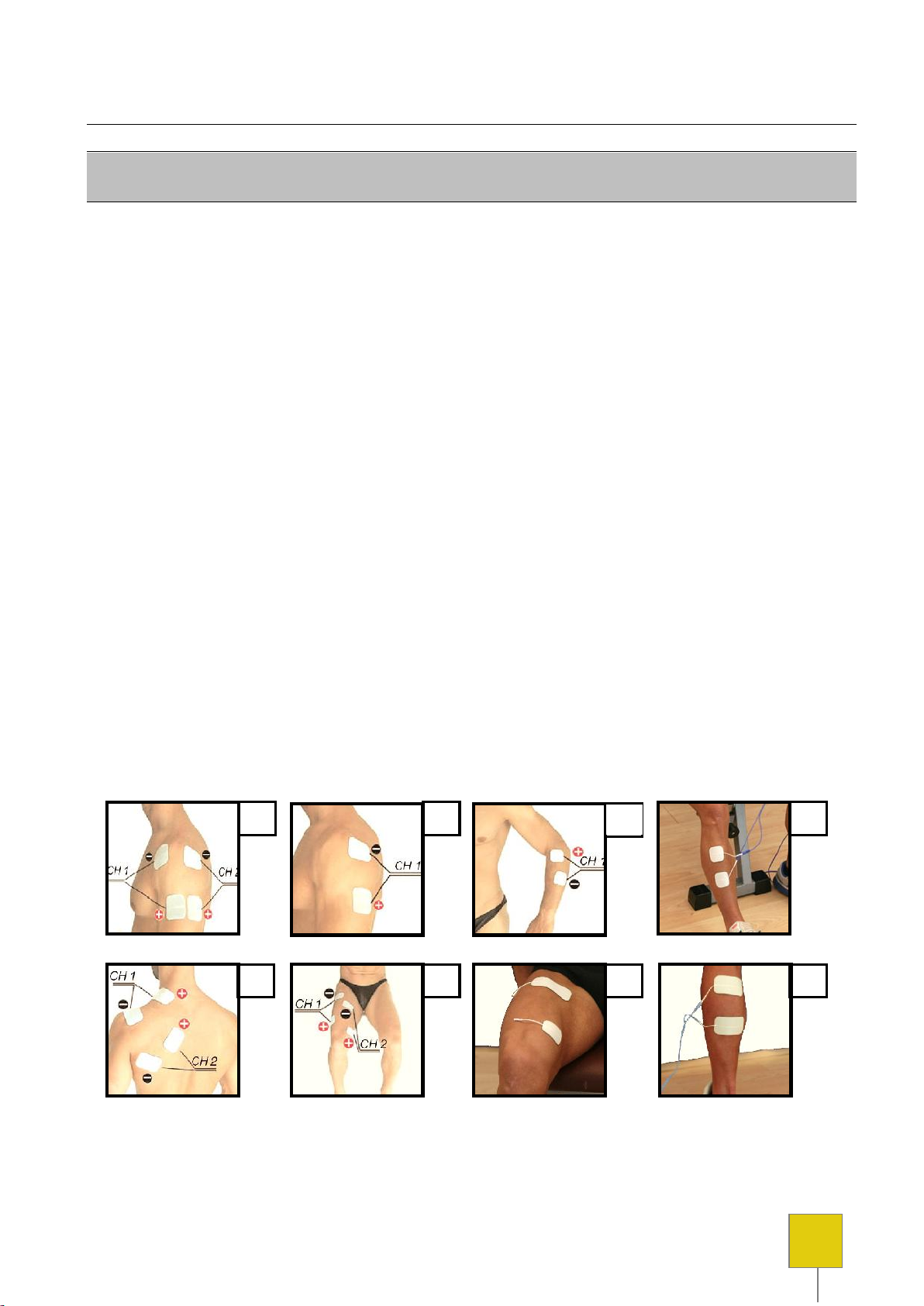
Rev. 11.2014
45
PROGRAM LIST PREVENTION (available on Genesy SII-Elite SII)
Prevention programs
Program effects
Indications for use
Programs and electrode placement
(see the pictures)
The prevention programs intend
to support the preparation
physical conditioning for the
development of the specific
activity. They prepare
articulations and muscle tone in
order to reduce the risk of
contractures, partial and total
injuries, tendon inflammations.
These programs are
recommended both during the
activity recovery stage and as
integration to the usual physical
work (especially for the athletes
who usually suffer from specific
pathologies connected to the
technical movements).
The programs are divided into
reathletization, muscle tone
recovery and prevention.
The reathletization programs
are indicated for muscle
recovery and strengthening
of articulations that suffered
a trauma or that are
especially weak.
The prevention programs can
be used together with the
traditional rest exercises that
are carried out to maintain
strength and solid the
articulations that suffered a
trauma or that have acute and
chronic problems. They
favor the rebalancing of the
proprioceptive control. The
muscle tone recovery
programs for the ankle are
intended to strengthen in a
specific way the perineal and
anterior tibial muscles.
- Ankle prevention (4-8)
- Knee prevention (6-7)
- Quadriceps muscle prevention (6-
7)
- Lower limbs reathletization (6-4-7-
8)
- Shoulder reathletization (1-2-5)
- Shoulder prevention (1-2-5)
- Elbow prevention (3)
- Upper limbs reathletization (1-2-5)
- Ankle muscle tone recovery (4-8)
1
2
6
5
4
3
8
7
3
Page 46

Rev. 11.2014
46
PROGRAM LIST SPECIAL SPORTS
Soccer
Program effects
Indications for use
Time and intensity
These programs are especially
intended to improve the specific
conditional abilities of soccer and
especially strength and speed
endurance. The program effects
are to increase the strength and the
contraction speed of the muscles of
the lower limbs and the endurance
in carrying out sprints and goal
kicks.
Indicated for soccer players
who want to improve their
specific conditional abilities
and especially strength and
speed endurance. We suggest
using the special strength 1
program during the first
preparation weeks, then moving
progressively to special
strength 2, and finally using
special strength 3. The
endurance programs should be
used during an already
advanced preparation stage,
after carrying out different
strength sessions.
Time and intensity vary
according to the program you
are using. Generally, as for the
strength programs, you should
use the maximum possible
intensity. As for capillarization
and decontracting programs,
the intensity must be lowintermediate.
Cross-country skiing
Program effects
Indications for use
Time and intensity
They improve the muscle aerobic
endurance and therefore the ability
to bear an extended physical effort.
The programs are divided into
endurance strength and
endurance, each of them are
also divided in three periods:
- pre-competition (or before the
season, to combine with the
skiing preparation);
- competition (or during the
periods when skiing at least
once or twice per week);
- rest period (in summer and
spring).
Time and intensity vary
according to the program you
are using. Generally, as for the
strength programs you should
use the maximum possible
intensity. As for capillarization
and decontracting programs,
the intensity must be lowintermediate.
Running
Program effects
Indications for use
Time and intensity
It improves the ability to maintain
the effort for an extended period of
time.
The training programs for running
are intended to stimulate slow
fibers with very long contraction
periods.
These programs are indicated
for the different periods of the
preparation of the runner, both
during the first phase and
during the competition periods,
but also to maintain active the
musculature during the rest
period.
Time and intensity vary
according to the program you
are using. Generally, as for the
strength programs you should
use the maximum possible
intensity. As for capillarization
and decontracting programs,
the intensity must be lowintermediate.
Page 47

Rev. 11.2014
47
Cycling
Program effects
Indications for use
Time and intensity
It improves the ability to maintain
the effort for an extended period of
time. The training programs for the
biker are intended to stimulate
slow fibers with very long
contraction periods.
These programs are indicated to
train strength and strength
endurance for those who
practice cycling.
The programs are divided into
three levels to permit both to
beginners and to more trained
bikers to receive a stimulation
according to their preparation
level.
We suggest starting with the
aerobic workout 1 and to
increase the level after about
15-20 sessions.
Time and intensity vary
according to the program you
are using. Generally, as for the
strength programs you should
use the maximum possible
intensity. As for capillarization
and decontracting programs,
the intensity must be lowintermediate.
Tennis
Program effects
Indications for use
Time and intensity
It permits to train in a specific way
the musculature of the tennis
player, who should be able to
execute rapid movements with a
lot of decelerations and direction
changes.
They are indicated for those
who practice tennis and want to
train the musculature in a
specific way to best prepare for
training sessions and possible
tournaments.
The special strength programs
are progressive and we suggest
starting from program 1 and
then carrying out special
strength 2 and 3.
It is very useful to train in a
specific way the muscle
districts that can be subject to
overload (for example the
forearm muscles to avoid the
appearance of epicondylitis).
Time and intensity vary
according to the program you
are using. Generally, as for the
strength programs you should
use the maximum possible
intensity. As for capillarization
and decontracting programs,
the intensity must be lowintermediate.
Golf
Program effects
Indications for use
Time and intensity
It permits to isolate and train in a
specific way the muscles most
used during the execution of the
technical movements of the golf
player. A well-synchronized
recruitment of the muscle fibers
permits to obtain a fluid,
The special strength programs
can be carried out on
abdominals (especially on
oblique abdominals), on lumbar
and dorsal muscles, on lower
limb muscles and forearm
muscles.
Time and intensity vary
according to the program you
are using. Generally, as for the
strength programs you should
use the maximum possible
intensity. As for capillarization
and decontracting programs,
Page 48

Rev. 11.2014
48
harmonious and more precise
movement.
A special attention has been
paid to strengthen the deltoid
muscle, with a three-stage
progression according to the
preparation level.
the intensity must be lowintermediate.
Swimming
Program effects
Indications for use
Time and intensity
It permits to train the swimmer’s
musculature with the aim to
improve the effort endurance.
Therefore, the athlete’s
musculature could become
accustomed to the training sessions
with extended stimulations,
obtaining a lot of benefits during
the trainings in water.
Indicated for swimmers who
want to combine a specific
work of athletic preparation to
the normal sessions in the
swimming pool. The two
programs are intended to
improve the endurance strength
(the ability to produce an
intense muscle work for an
extended period of time) and
the aerobic workout (improving
the abilities of the muscles to
consume oxygen). The choice
of the body part on which you
want to work depends on the
single needs and on the
swimming style you want to
train.
Time and intensity vary
according to the program you
are using. Generally, as for the
strength programs you should
use the maximum possible
intensity. As for capillarization
and decontracting programs,
the intensity must be lowintermediate.
Sailing
Program effects
Indications for use
Time and intensity
The sailor must face different
efforts according to the role he has
on the boat, to the time and the
weather conditions. For this
reason, the physical training must
be oriented to prepare the
musculature to have the best
reaction during the sailing.
Indicated for the sailors who
want to prepare their
musculature to be ready and
trained to face the sailing. We
suggest carrying out with
perseverance the endurance
strength program on
abdominals, as a good
abdominal musculature permits
to protect the lumbar area of the
spinal column that is
particularly strained in this
sport.
Time and intensity vary
according to the program you
are using. Generally, as for the
strength programs you should
use the maximum possible
intensity. As for capillarization
and decontracting programs,
the intensity must be lowintermediate.
Page 49

Rev. 11.2014
49
Volleyball
Program effects
Indications for use
Time and intensity
The specific volleyball programs
intend to improve the strength
expressions used in this sport, that
is, first the maximum strength and
second the explosive strength.
Other two programs have been
provided, one program intends to
improve the reaction ability
(reactivity) of muscle fibers and
the other one intends to strengthen
the musculature of the articulation
and the shoulder of the volleyball
player that suffers a lot of pressure.
We suggest carrying out the
maximum strength program at
the beginning of the athletic
preparation for at least two
sessions per week.
After 12-15 sessions it is
possible to execute the
explosive strength program, by
replacing the second session of
maximum strength with a
session of explosive strength.
The reactivity program is
indicated when you want to
speed up the legs in order to be
quicker during small
displacements and in the
direction changes, or when you
want to speed up the arm that is
serving.
The shoulder prevention
exercises, instead, have been
thought to favor the prevention
work on stabilizing muscles of
the shoulder and the scapula.
Time and intensity vary
according to the program you
are using. Generally, as for the
strength programs you should
use the maximum possible
intensity. As for capillarization
and decontracting programs,
the intensity must be lowintermediate.
Rugby
Program effects
Indications for use
Time and intensity
The rugby specific programs
intend to improve the strength
expressions used in this sport, that
is, first the maximum strength and
second the explosive strength.
Other two programs have been
provided to improve the speed
endurance.
We suggest executing the
maximum strength program at
the start of the athletic
preparation for at least two
sessions per week.
After 12-15 sessions the
explosive strength program can
be used, by replacing the
second session of the explosive
strength program with a session
of explosive strength.
After about two months of
work it is possible to introduce
a cycle of approximately 10
sessions with the speed
endurance 1 program.
Repeat the cycle, if necessary,
in the middle of the season by
Time and intensity vary
according to the program you
are using. Generally, as for the
strength programs you should
use the maximum possible
intensity. As for capillarization
and decontracting programs,
the intensity must be lowintermediate.
Page 50

Rev. 11.2014
50
using the speed endurance 2
program.
Triathlon
Program effects
Indications for use
Time and intensity
These programs permit to train the
musculature to bear at best the
prolonged and intense efforts, by
improving the ability of the
muscles to consume oxygen.
We suggest using these
programs progressively,
starting with an aerobic
workout 1 and then after 15-20
sessions move to the 2 and 3
programs. The endurance
programs have been divided
according to the training, that
is, during preparation,
competition or rest.
Time and intensity vary
according to the program you
are using. Generally, as for the
strength programs you should
use the maximum possible
intensity. As for capillarization
and decontracting programs,
the intensity must be lowintermediate.
Martial arts
Program effects
Indications for use
Time and intensity
These programs improve the
muscle contraction speed by
training the musculature to carry
out rapid and explosive
movements, as required in martial
arts.
Indicated as integration to the
traditional athletic preparation.
We suggest carrying out the
explosive strength program
alternated with the reactivity
program.
Time and intensity vary
according to the program you
are using. Generally, as for the
strength programs you should
use the maximum possible
intensity. As for capillarization
and decontracting programs,
the intensity must be lowintermediate.
Page 51

Rev. 11.2014
51
G-PULSE TREATMENTS (only in Activa, Fit&Beauty, Triathlon and Swing)
These are treatments using microcurrents to treat wrinkles, stretch marks and skin flaws.
Starting from the age of thirty, the metabolism starts to slow and progressively alter the natural
renewal process of skin cellular tissues.
The even more minor metabolic activity leads to a decrease in
the skin thickness, to a thickening of the elastic fibers and to an
alteration of the collagen, with an increase in the fibrotic
element of the dermis.
Especially the dermis appears less turgid, elastic and bright,
meanwhile other skin flaws, such as skin wrinkles, dryness,
fragility and chromatic alteration emerge.
The G Pulse treatments (that are carried out with the special G-
Trode handpiece) are based on microstimulation applications,
directly on wrinkles, stretch marks, etc.
Already from the first applications the wrinkles and the skin flaws tend to reduce, up to disappear.
Through the physiological contribution of the new collagen that fills up the furrows, the skin looks
immediately more smooth and tonic.
The G- Pulse regenerative mechanism consist in two phases:
1. The passage of the microstimulation in the tissues produces an increase in the
microcirculation and the increase in the local temperature. In this way the nutritional uptake
is improved and fibro-blastic cells are called to produce the collagen that the skin needs to
recovery tone and elasticity.
2. The G-Pulse microstimulation offers also the energy (ATP) needed to support the cellular
metabolism and the protein synthesis. As a lot of scientific research has shown, the
application of microstimulation regenerates cells and restores vitality to the tissues.
Some G Pulse programs:
Breast microlifting BioSkin collagen
Wrinkles Eye wrinkles
Expression wrinkles Stretch marks
Nail strengthening Bio peeling
Hematoma Cleavage micro-lifting
Face microlifting Skin elasticity
Cellulite
Page 52

Rev. 11.2014
52
“3S” SEQUENTIAL DRAINAGE
The “3S” programs simulate a real sequential drainage.
The “3S” programs are characterized by an activation delay of the channels 3 and 4 compared with
the channels 1 and 2.
The Serial Sequential Stimulation permits to stimulate the musculature in kinetic chain thanks to the
differentiated activation times of the muscular groups involved.
In aesthetic field, the 3S programs allow to create a real sequential drainage: the sequential
contraction of the different musculature of legs and arms produces a deep drainage of the interstitial
fluid through the lymphatic vessels and it favors the return of the venous blood to the heart.
This means that the 4 channels of the electrostimulator act in pair and not all at the same time. This
means that the channels 3 and 4, even working with the same contraction and rest times of the
channels 1 and 2, start the stimulation with a delay time compared with the channels 1 and 2. The
stimulation delay of the second pair of channels can vary between 0,1 seconds up to 11 seconds
according to the electrostimulator model. Very small delays, below 1 second, are especially useful
for medical and rehabilitation field, while delays of 2, 3, 4, 11 seconds are perfect for beauty and
sport field. The rhythmic stimulation of the musculature causes an increase in the speed of the
venous circulation (hematic flow) and lymphatic circulation (lymphatic flow). The peripheral
circulation and, therefore, the tissue oxygenation and metabolism are improved by the increase in
the blood flow. In beauty field the serial sequential stimulations can be used to improve the cellulite
skin flaws, to reduce fat depots, to reactivate the blood flow that is slowed down because of wrong
postures, to reduce the heaviness due to a long standing or also after very intense training sessions.
Operating mode:
The operation of these programs is exactly the same as any other EMS programs, with the only
difference that a delay in the contraction start between the channels will be noticed.
The table below shows the functioning of “3S”.
Channels 1-2
contraction 8"
del. 3"
active rest 5"
del. 3"
contraction 8"
del. 3"
active rest 5"
del. 3"
Channels 3-4
del. 3"
contraction
8"
del. 3"
active rest
5"
del. 3"
contraction
8"
del. 3"
active rest
5"
Example of a “3S” program with 3”delay. The stimulations of the channels 3 and 4 start with a 3’’
delay compared with the one of channel 1 and 2.
Thus, if the electrodes of the channels 1 and 2 are placed on calves and the ones of channels 3 and 4
are placed on thighs, the effect will be the same as a massage moving from the extremities of the
limbs towards their base, really like a real manual drainage massage. It is normal to feel a slight itch
during the treatment, sign of an increase in the circulatory activity.
Page 53
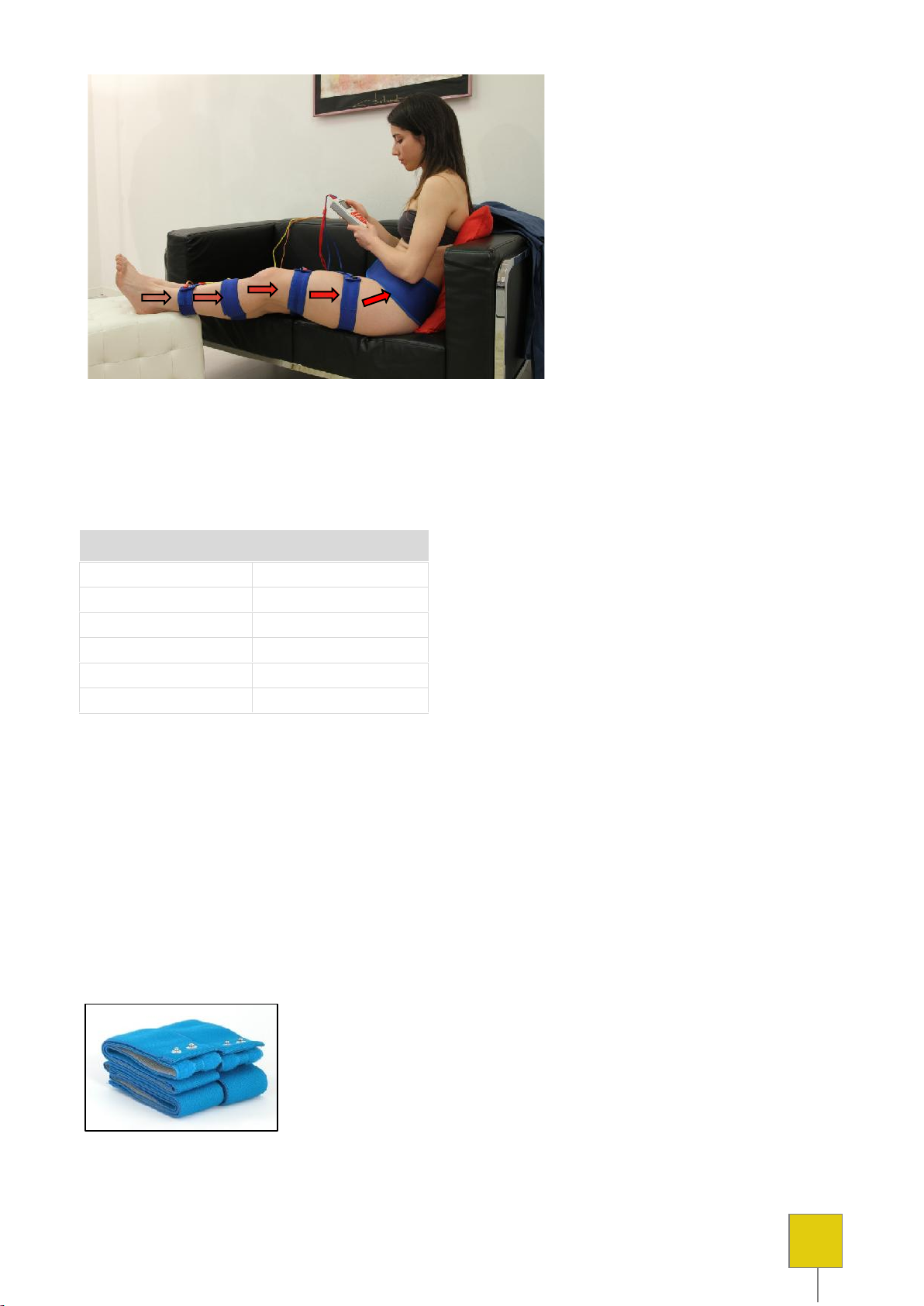
Rev. 11.2014
53
After selecting the 3S Serial Sequential Stimulation program list, you will find a list of programs
indicating the delay time of the channels 3 and 4 compared with channels 1 and 2. In some
stimulators you will have the possibility to choose also the area to be treated and the frequency (
Hertz). For beauty and drainage treatments it is better to choose the lowest frequency.
Name
Delay time
SerSeqStim 0,5 sec
0,5
SerSeqStim 1 sec
1
SerSeqStim 2 sec
2
SerSeqStim 3 sec
3
SerSeqStim 4 sec
4
SerSeqStim serial
11
NOTE – The only warning you should follow in order to use the 3S for beauty purposes is to place
the electrodes corresponding to the channels 1 and 2 in the body part you want to stimulate first,
that is in the most distant body part to the heart.
The recommended accessories to carry out the 3S sequential drainage programs
The sequential drainages can be carried out using the normal electrodes supplied. The use of some
accessories that can be bought separately is very useful and comfortable. All these accessories have
a more extended stimulation surface compared with the one of an electrode and as they are made of
fabric they can be used many times and they are particularly fast and easy to use.
Conductive bands
The conductive bands are ideal for beauty treatments of lower and upper
limbs as the stimulation affects all the body surface with the band.
In the thigh this is particularly useful as it makes possible to stimulate
both the anterior and the posterior part. This feature represents a great
advantage when using beauty programs. The bands can be used also for
firming and toning programs, while they are not indicated for specific
strength programs, as they do not offer the possibility to act with the stimulation directly on the
motor point.
Before using them, the bands must be completely immersed in a bowl of water and then squeezed.
Page 54
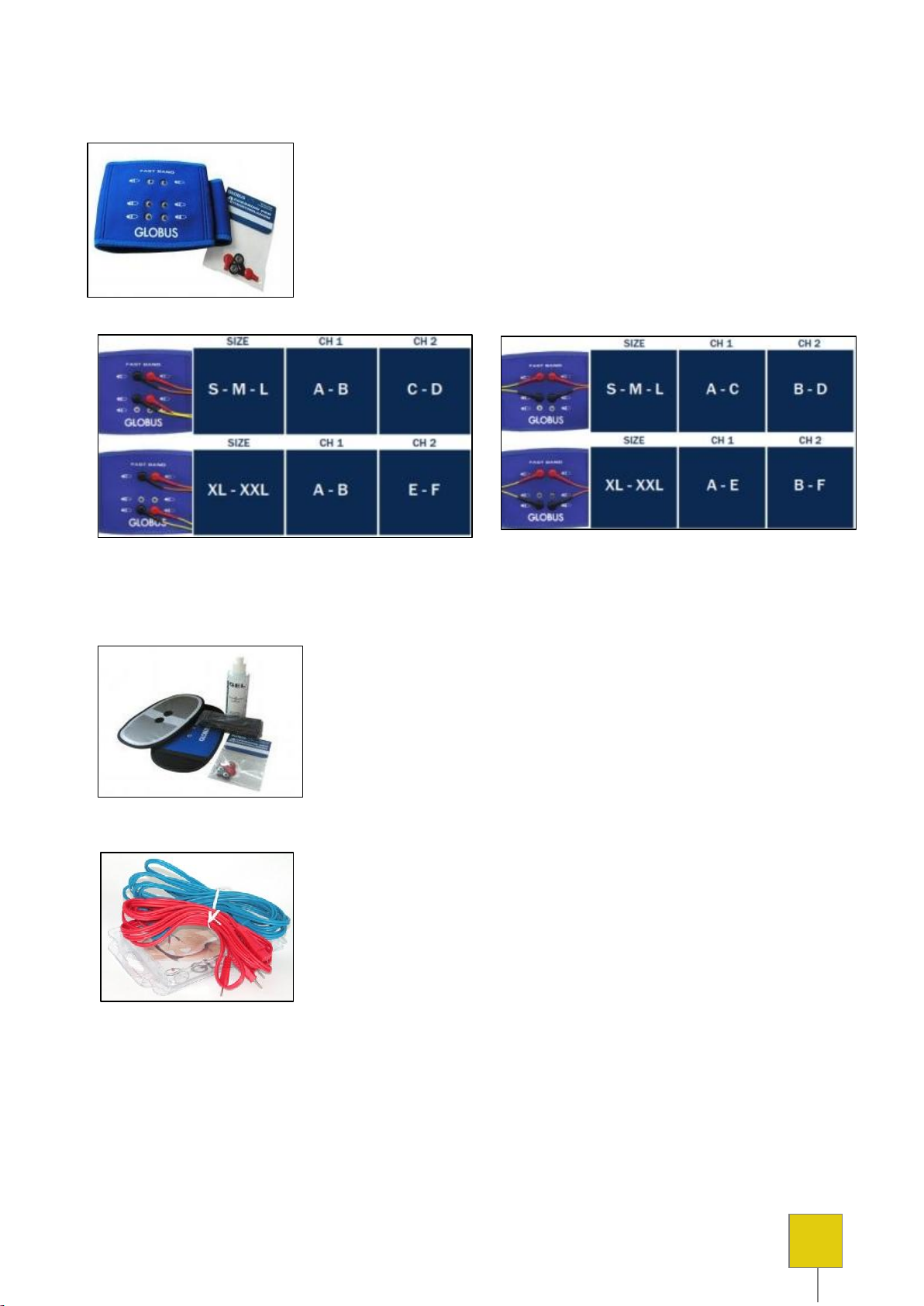
Rev. 11.2014
54
“Fast band”
The “Fast band” is a special band intended to easily stimulate the muscles of the abdomen and
glutei. Used together with the beauty programs, it permits to carry out
massages and drainage with the maximum comfort. The band should
be always used by covering the conductive parts with the specific gel
(or by dampening it in water).
How to connect the electrodes to the ”Fast band”
Hips
“Fast pad”
The “Fast pads” are special bands that have the same function of the
electrodes including gel, they are suitable for thighs and glutei. You
should apply a thick layer of gel on the electrode surface (or dampen
it in water) and then you must fix the "Fast pad" using the specific
black strips with velcro.
Splitted cables
The splitted cables are special cables that double the number of
electrodes per channel. This permits to stimulate different body parts
at the same time.
Attention: When using the splitted cables, also the channel intensity is
split among more electrodes, therefore it is likely that you have to use
a greater intensity compared with the traditional cable in order to
perceive the stimulation.
Electrode placement for the sequential drainage
We are going to give some examples of the placement of the conductive bands in order to carry out
the drainage treatments. Please, place the bands according to the order described below. The
treatments can be carried out also by using the electrodes including gel.
Abdomen
Page 55
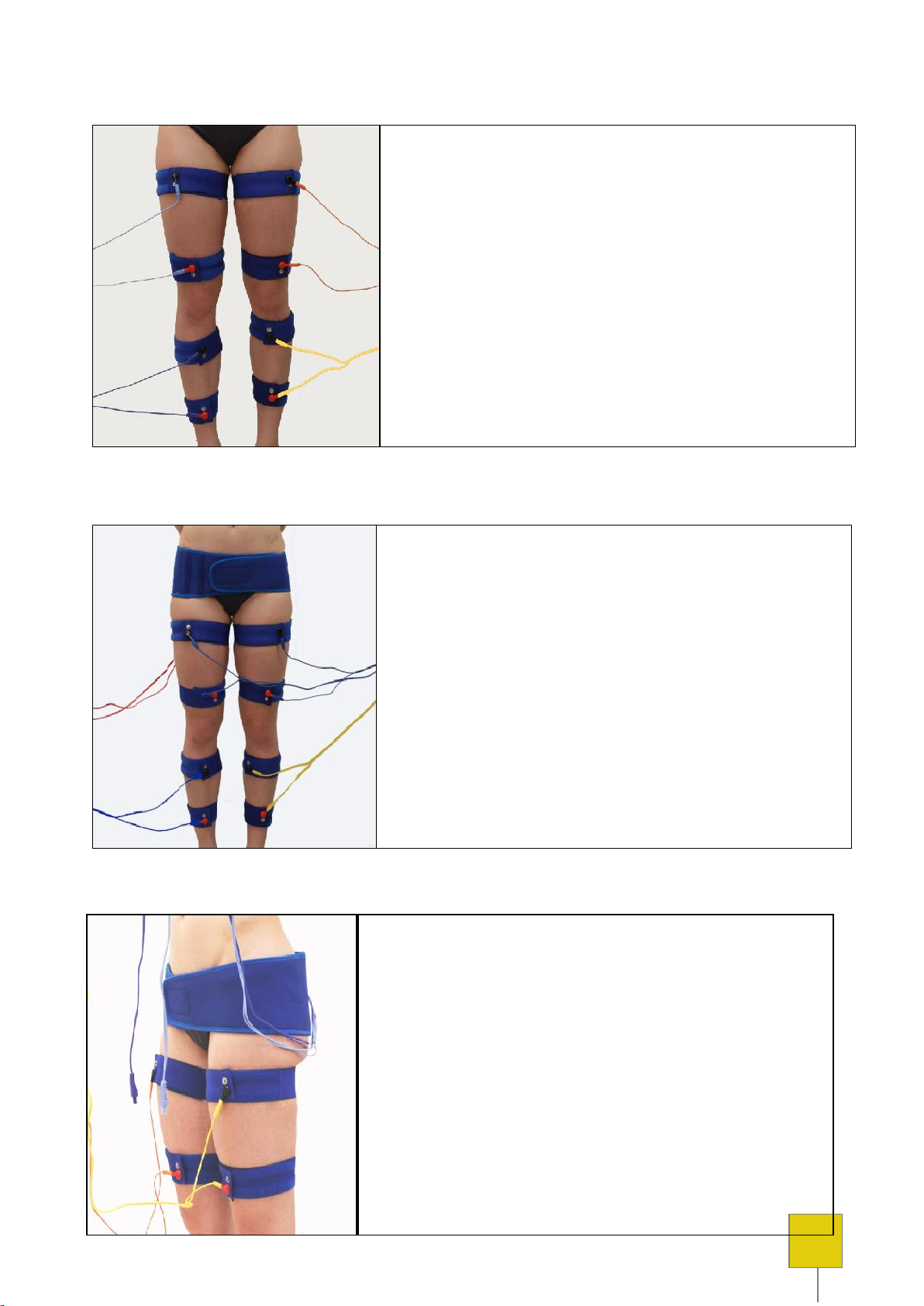
Rev. 11.2014
55
CALFS - THIGHS
It is necessary a “Fitness Top” kit of 8 conductive elastic bands
CALFS - THIGHS- GLUTEI
It is necessary a “Fitness Top” and a “Fast band” kit of 8 conductive elastic bands.
THIGHS - GLUTEI
It is necessary a “Fitness Top” and a “Fast band” kit of 4 conductive elastic bands.
Instructions:
- Immerse the conductive bands in water and wrap up them
around thighs and calves as indicated in the picture.
Connect the electrodes as shown in the picture.
Channel 1- calf
Channel 2 - calf
Channel 3- thigh
Channel 4- thigh
- Choose the desired sequential drainage program and start
the treatment by setting the intensity both of the
contraction and of the active rest time.
Instructions:
- Immerse the conductive bands in water and wrap up
them around thighs and calves as indicated in the
picture. Place the gel on the fast band and wear it.
- Connect the electrodes as shown in the picture.
Channel 1 - Calf
Channel 2 - Calf
Channel 3 – thighs by using the splitting cable
Channel 4 – Fast band by using the splitting cable
- Choose the desired sequential drainage program and
start the treatment by setting the intensity both of the
contraction and of the active rest time.
Instructions:
- Immerse the conductive bands in water and wrap up
them around thighs as indicated in the picture.
- Place the gel on the fast band and wear it.
- Connect the electrodes as shown in the picture.
Channel 1 - thigh
Channel 2- thigh
Channel 3 – glutei by using the Fast band
Channel 4 – glutei by using the Fast band
- Choose the desired sequential drainage program and
start the treatment by setting the intensity both of the
contraction and of the active rest time.
CH 1
CH 2
CH 3
CH 4
CH 4
CH 3
CH 2
CH 1
CH 3
CH 4
CH 2
CH 1
Page 56
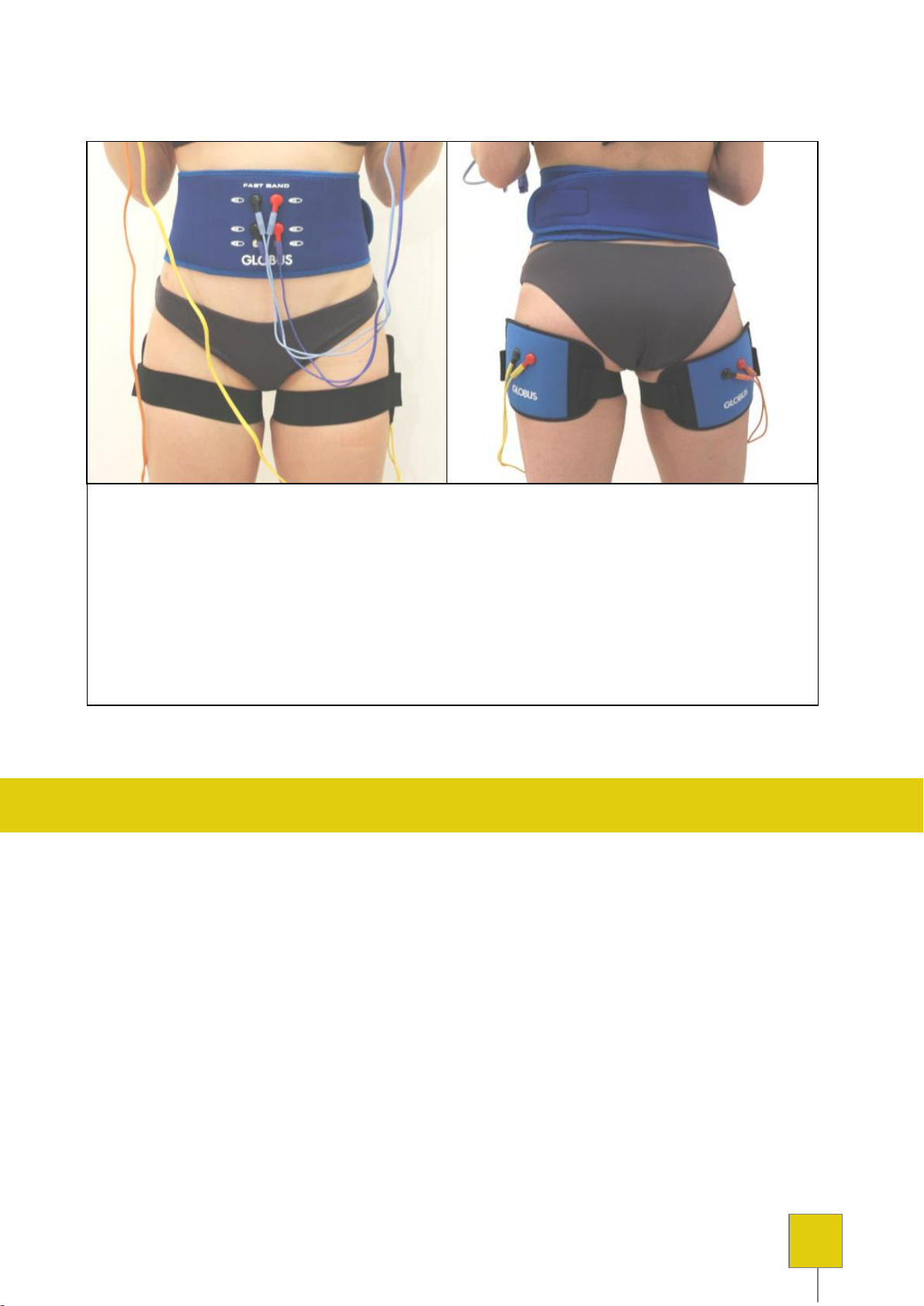
Rev. 11.2014
56
GLUTEI – ABDOMEN
It is necessary a “Fast pad” kit and a “Fast band” kit.
THE ACTION NOW PROGRAMS
The Action Now programs are normal EMS programs with the only difference that the contraction
starts only after that the user press the * button. The Action Now programs are especially useful to
link and synchronize the electrical stimulation to a voluntary action.
This mode is especially useful in sport field for athletic preparation when you want to add the
muscular contraction induced by a stimulator to a work carried out with overloads both in dynamic
and isometric mode.
Operating mode: after starting the program and setting the intensity, the device goes on pause and at
the start of the stimulation ramp shows the message READY by pressing the * button. By pressing
another time the * button, the stimulation starts immediately followed by the expected recovery
time, after that the device will goes back to the READY mode. To stop the contraction or the pause
before the end of the program, press again the * button.
Let's say, for example, that you want to work on leg extension, thus you can link to the quadriceps
voluntary contraction phase also a contraction with the stimulator, in order to emphasize the work
on the vastus medialis. After placing the electrodes on quadriceps and choosing an Action Now
Instructions:
- Place the gel on the Fast band and on the Fast pad and wear them as shown in the picture.
- Connect the electrodes as shown in the picture.
Channel 1- gluteus with a Fast pad
Channel 2 – gluteus with a Fast pad
Channel 3-4 abdomen by using the Fast band
- Choose the desired sequential drainage and start the treatment by setting the intensity both
of the contraction and of the active rest time.
CH 1
CH 2
CH 3
CH 4
Page 57

Rev. 11.2014
57
program, you can combine the leg extension phase by pressing the * button and stop it or not until
the contraction ends and the rest starts.
The Action Now program list can vary from a stimulator to another. The most complete list is
shown below:
Program name
Ramp-Up time in seconds
Contraction time in seconds
Action 0,2 - 1 s
0,2
1
Action 0,5- 1s
0,5
1
Action 1 - 1 s11
Action 2 - 1 s21
Action 3 - 2 s32
Action 4 - 2 s42
Action 2 - 6 s26
The programs vary from very rapid and brief contractions, typical when the explosive movement is
wanted, to slower and longer contractions when carrying out hypertrophy work.
Page 58

Rev. 11.2014
58
PERSONAL TRAINER
Use suggestions for the main programs
Below we report a brief guide organized in sectors (sport, beauty and fitness). Each sector contains
information and advice on the working cycle and the electrode placement for each objective. This
guide is an useful tool for those who desire to reach high level results, even not being able to
consult a personal trainer or a sport trainer.
Important principles for the optimal use of this guide:
1) The stimulation programs for strength (maximum, endurance and explosive strength etc..)
should not be carried out in the days following the sessions of very intense physical
preparation and technical training. Instead, we suggest using cool down and active rest
programs.
2) When the musculature is contracted or painful it is best to carry out decontracting programs.
Instead, when the musculature is stressed because of an excessive work, we suggest using
the cool down and active recovery programs.
3) The Tens programs can be repeated even twice per day, but with an interval of at least 4
hours between them.
4) The Personal Trainer (at the end of this guide) suggest some physical exercises to carry out
in addition to the electrostimulation (especially “aerobic” and “cardiovascular”) in order to
obtain a better result in the whole preparation.
5) In the program tables, the main indications are in red while the secondary ones are in black.
The difference between the main and the secondary sessions has been made to give a work
priority according to the available time of each user.
Page 59
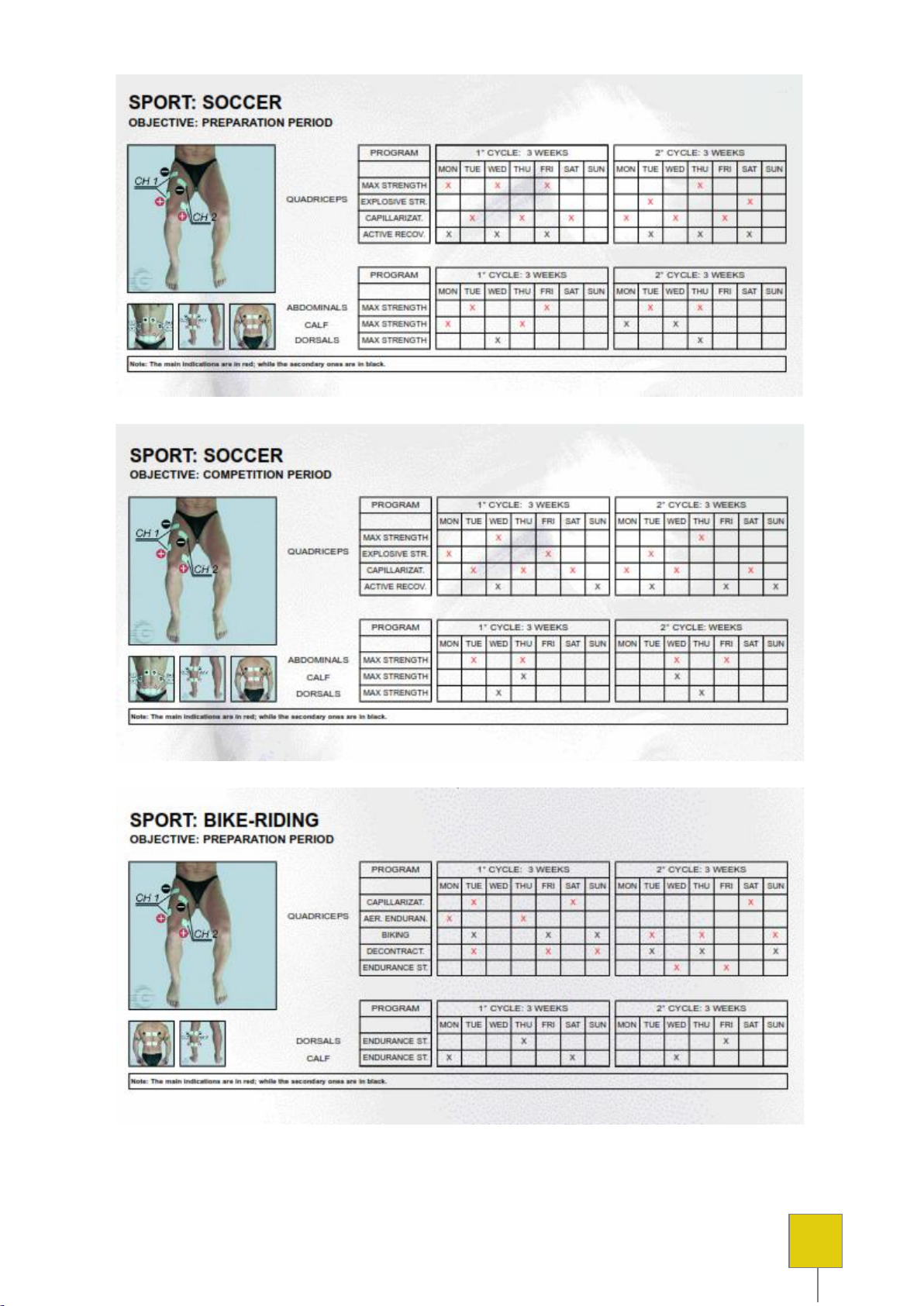
Rev. 11.2014
59
Page 60
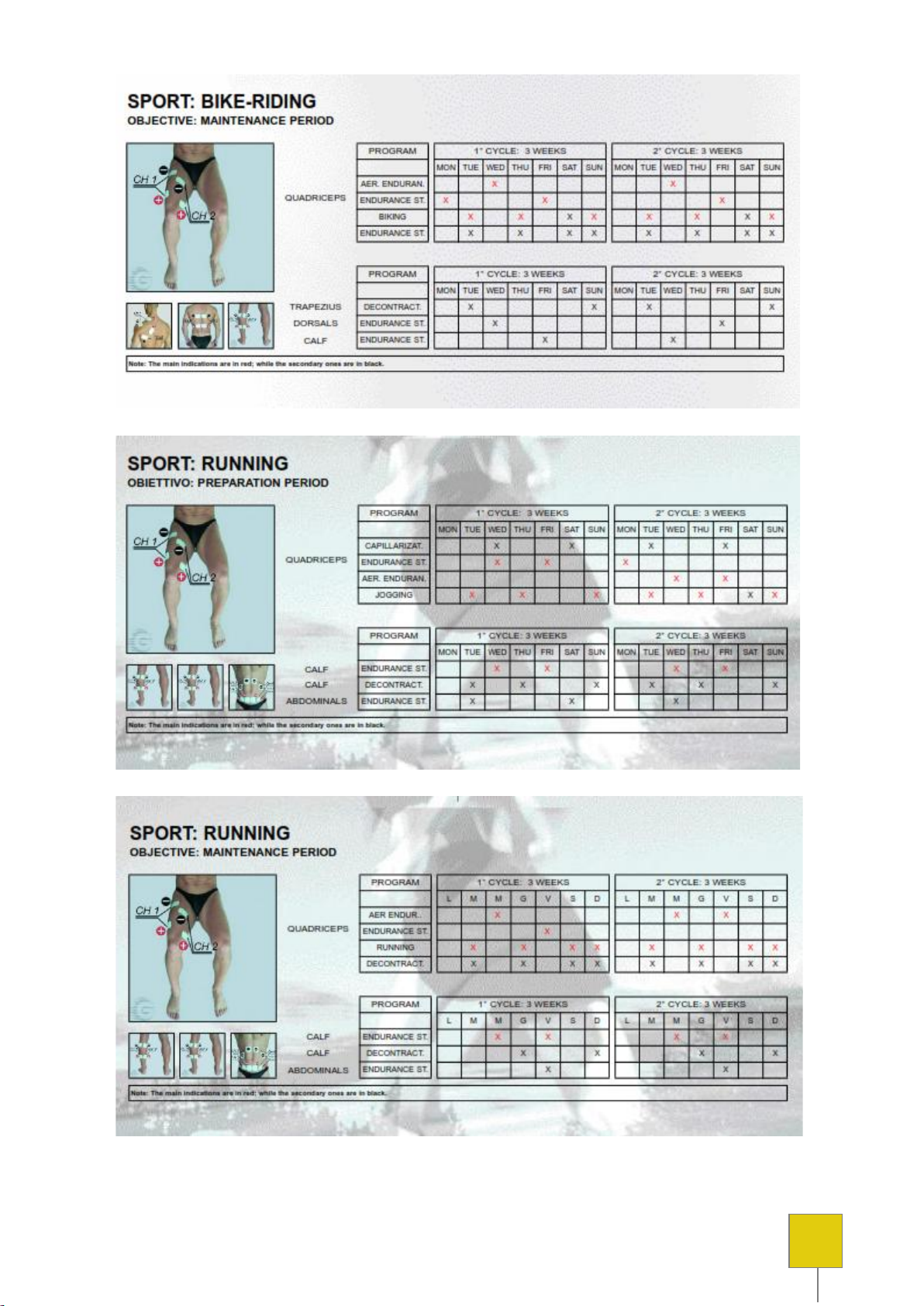
Rev. 11.2014
60
Page 61
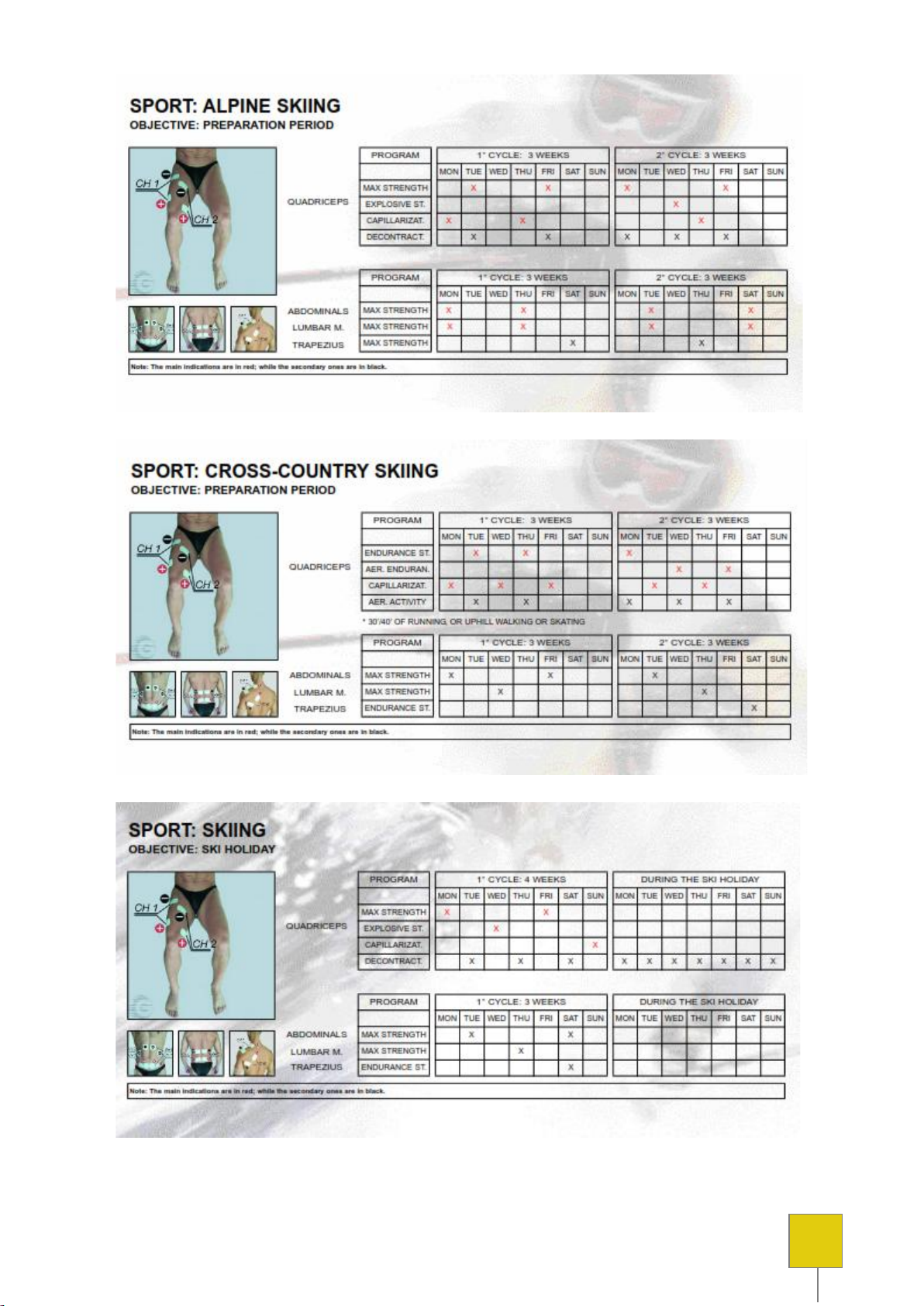
Rev. 11.2014
61
Page 62
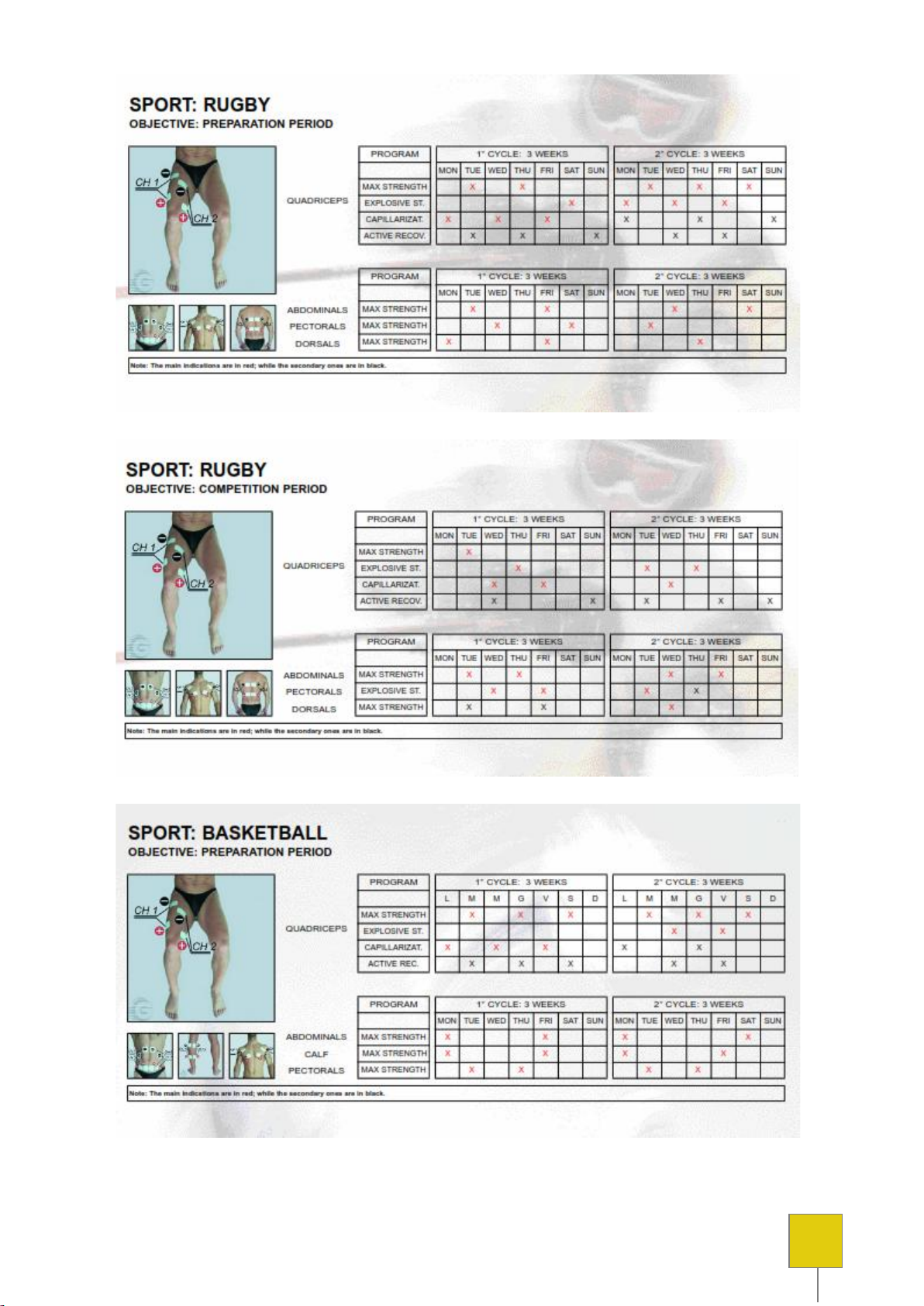
Rev. 11.2014
62
Page 63
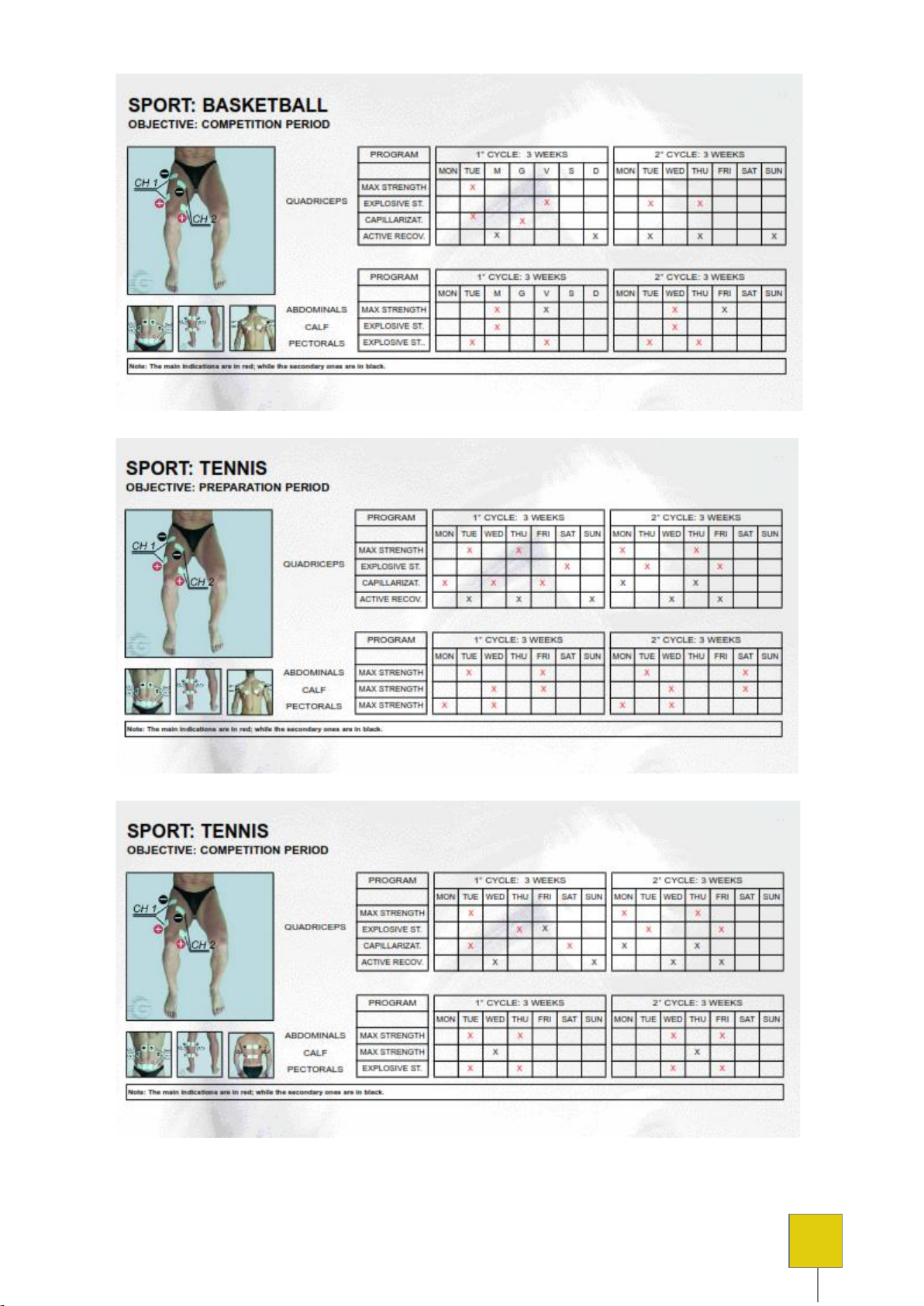
Rev. 11.2014
63
Page 64
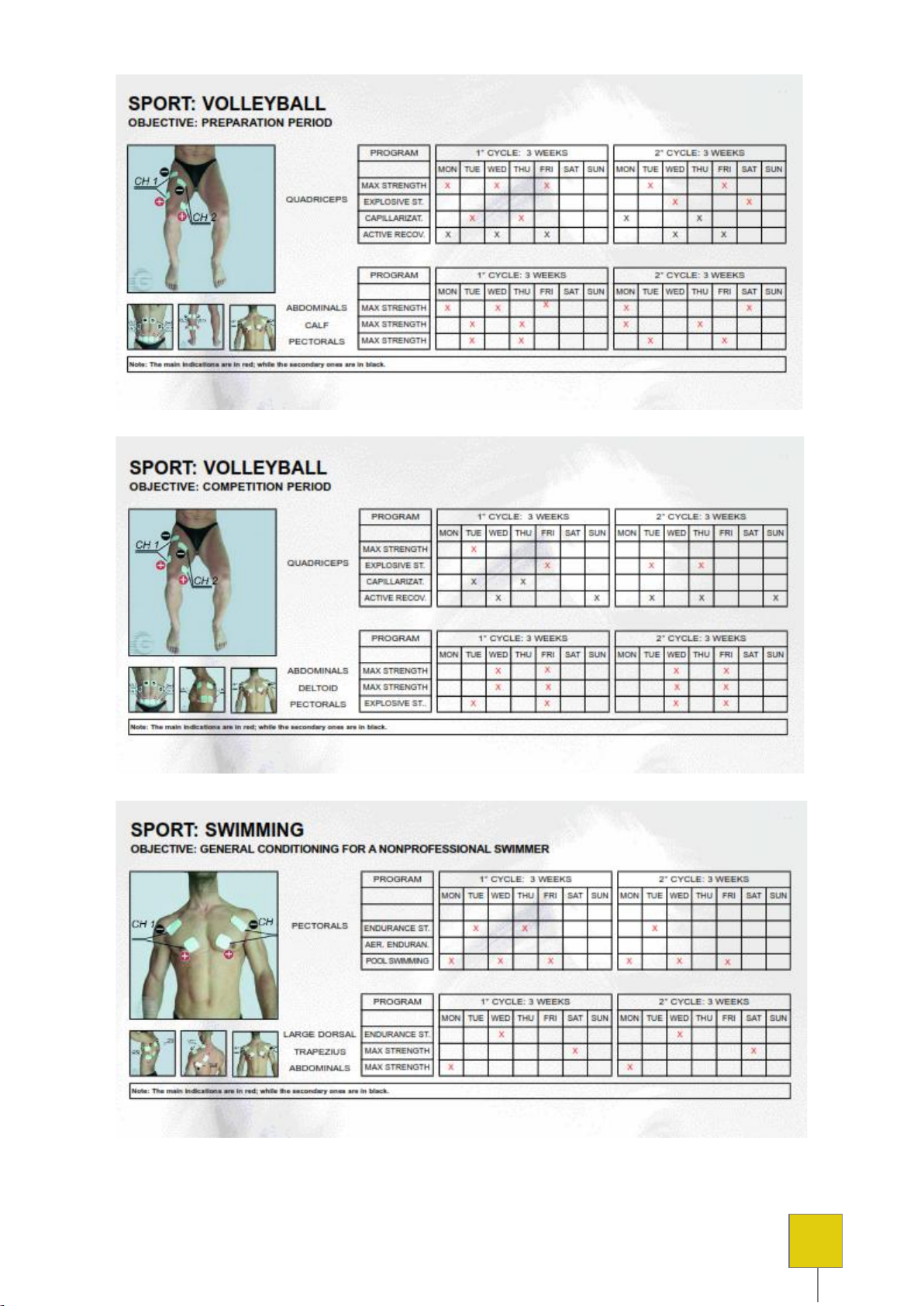
Rev. 11.2014
64
Page 65
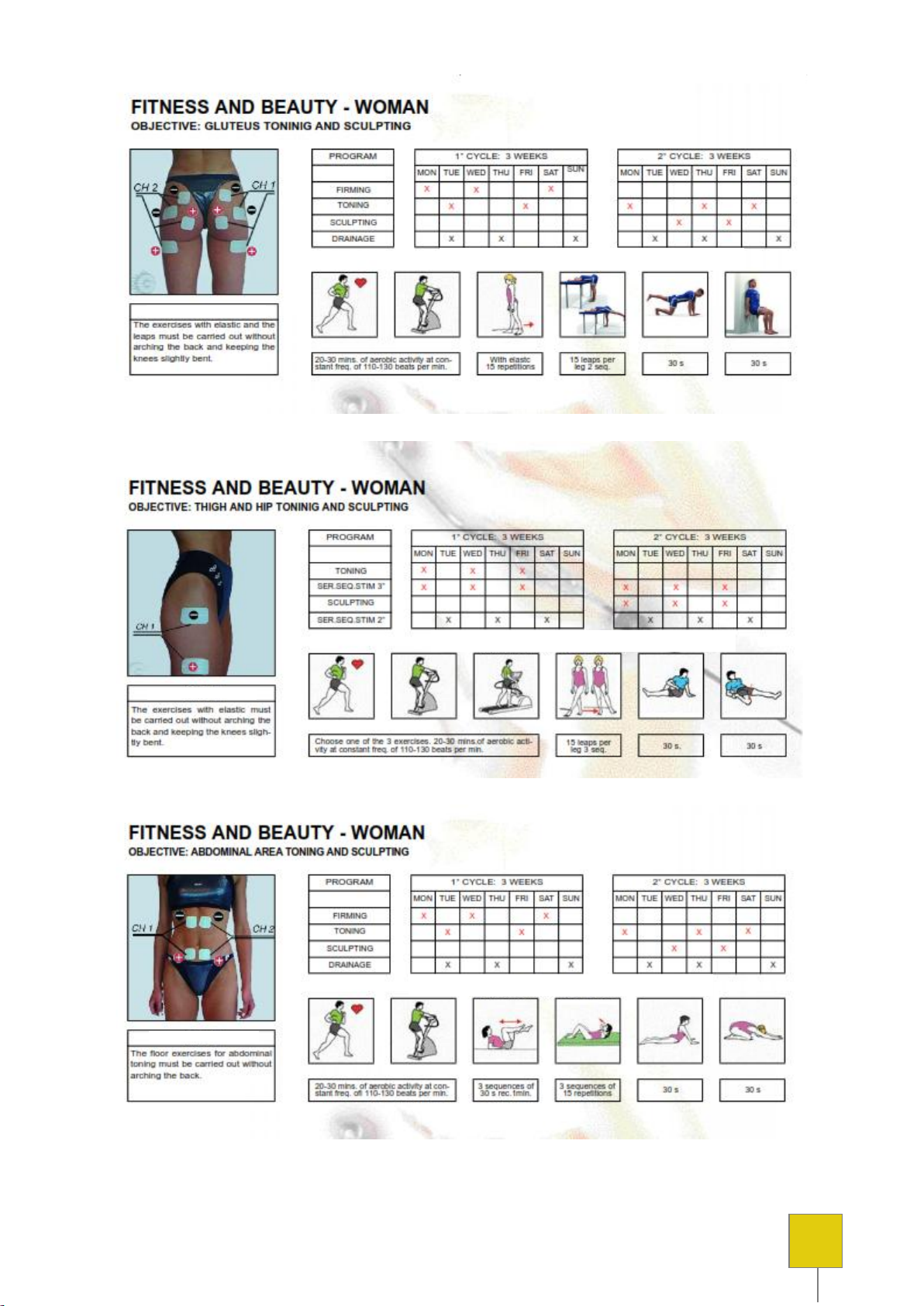
Rev. 11.2014
65
SUGGESTIONS
EXERCISES TO BE COMBINED WITH THE STIMULATION
EXERCISES TO BE COMBINED WITH THE STIMULATION
EXERCISES TO BE COMBINED WITH THE STIMULATION
SUGGESTIONS
SUGGESTIONS
Page 66
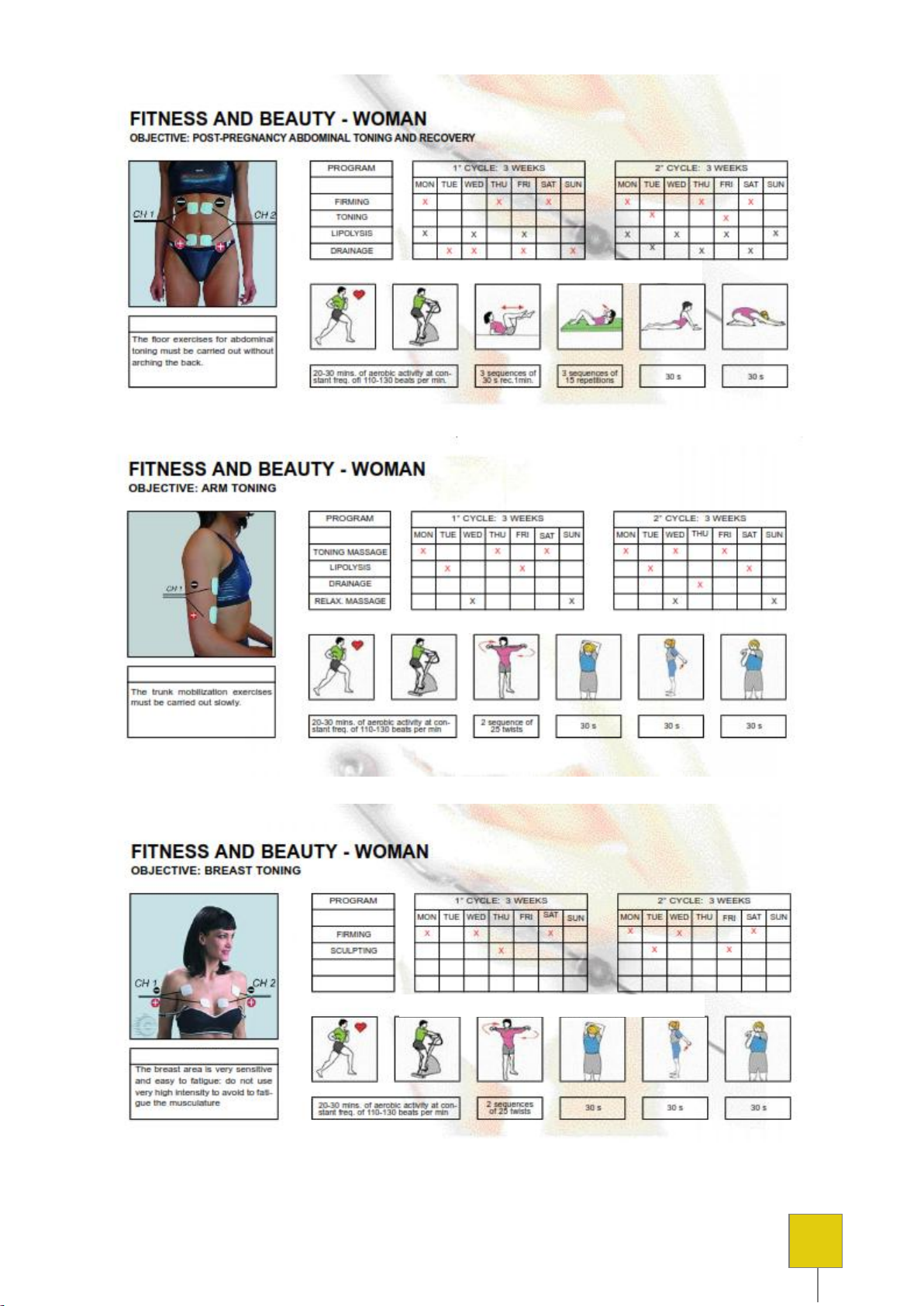
Rev. 11.2014
66
EXERCISES TO BE COMBINED WITH THE STIMULATION
EXERCISES TO BE COMBINED WITH THE STIMULATION
EXERCISES TO BE COMBINED WITH THEST IMULATION
SUGGESTIONS
SUGGESTIONS
SUGGESTIONS
Page 67
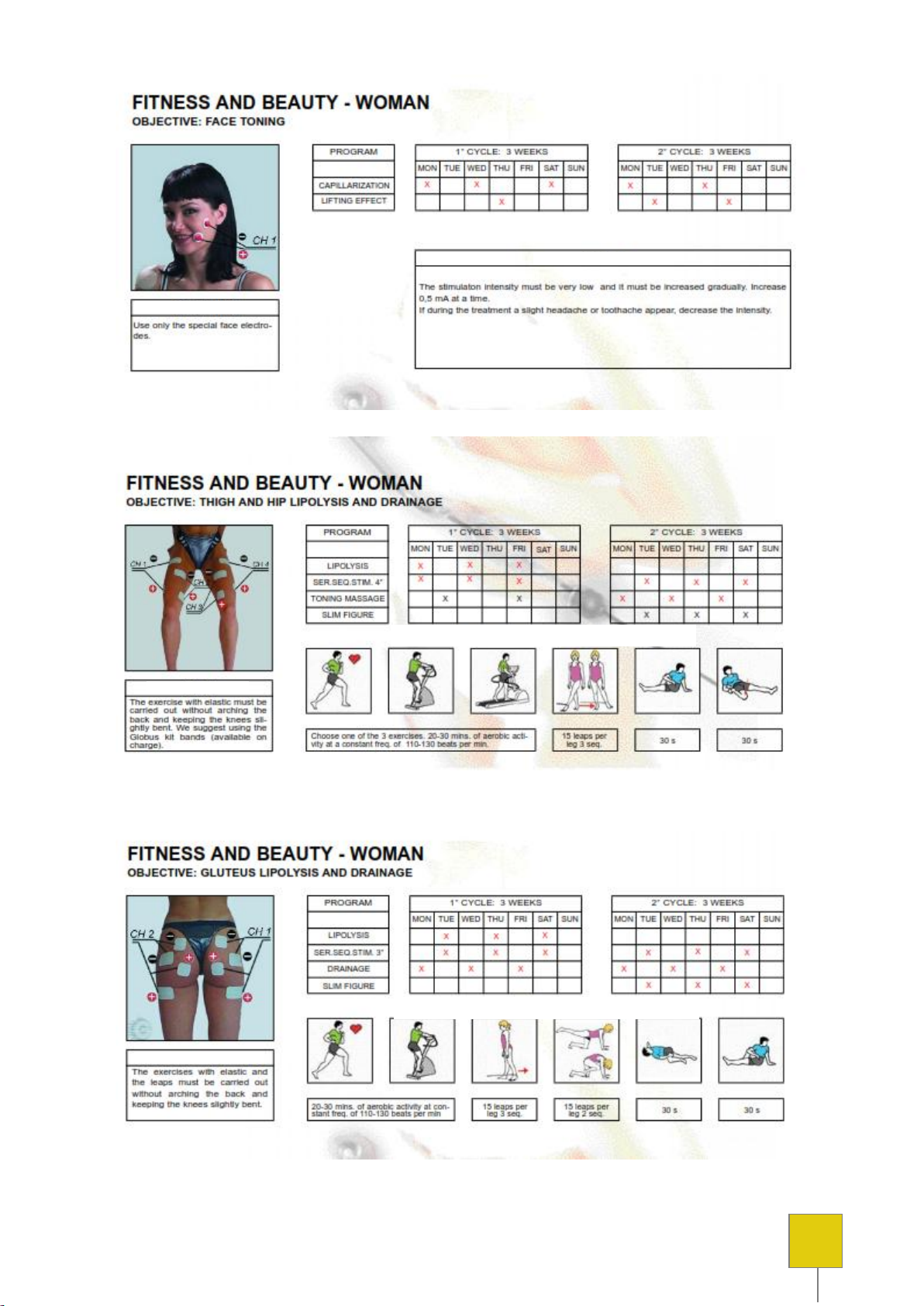
Rev. 11.2014
67
EXERCISES TO BE COMBINED WITH THE STIMULATION
EXERCISES TO BE COMBINED WITH THE STIMULATION
SUGGESTIONS
ELECTRODE PLACEM.
SUGGESTIONS
SUGGESTIONS
Page 68
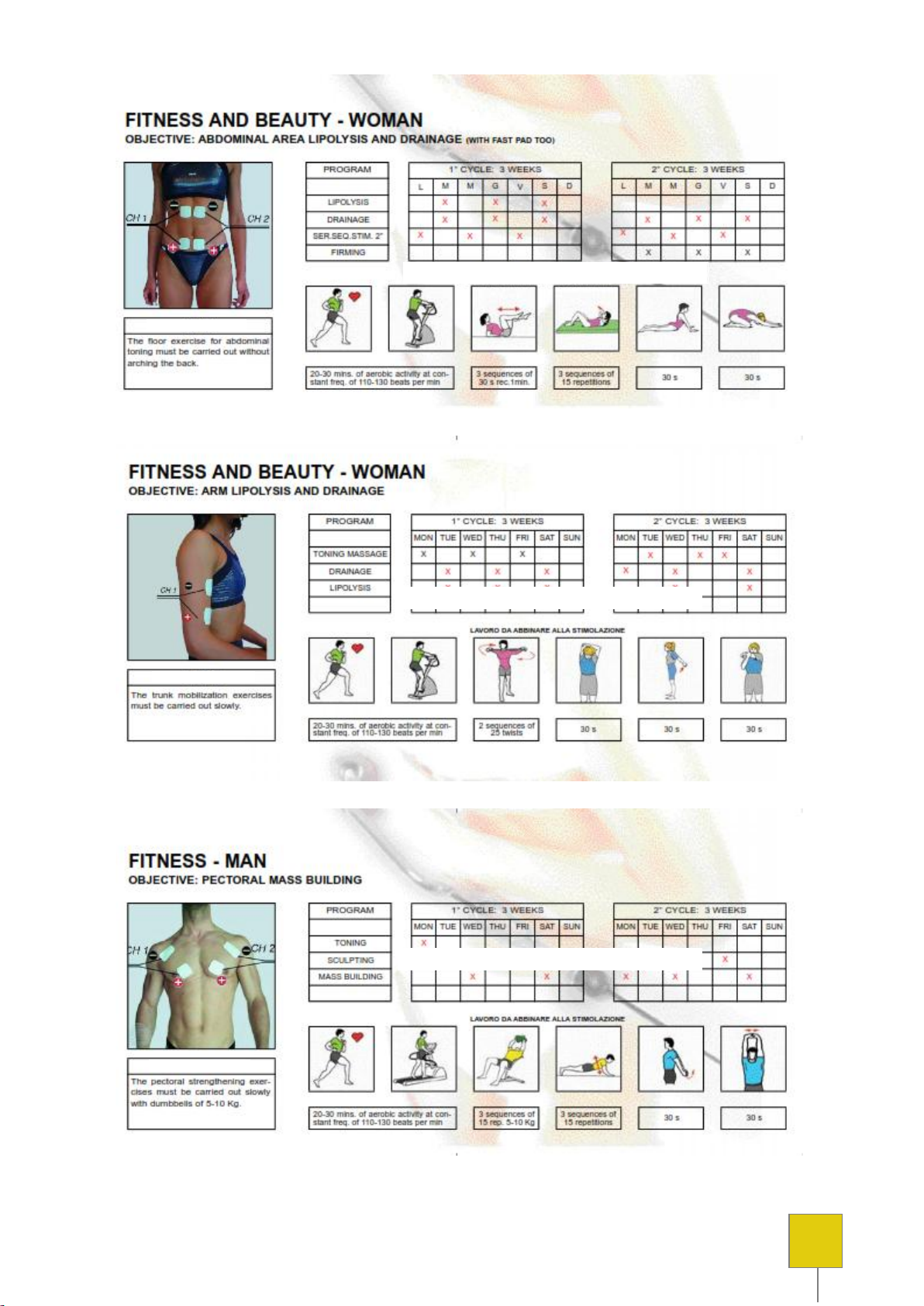
Rev. 11.2014
68
EXERCISES TO BE COMBINED WITH THE STIMULATION
EXERCISES TO BE COMBINED WITH THE STIMULATION
EXERCISES TO BE COMBINED WITH THE STIMULATION
SUGGESTIONS
SUGGESTIONS
SUGGESTIONS
Page 69
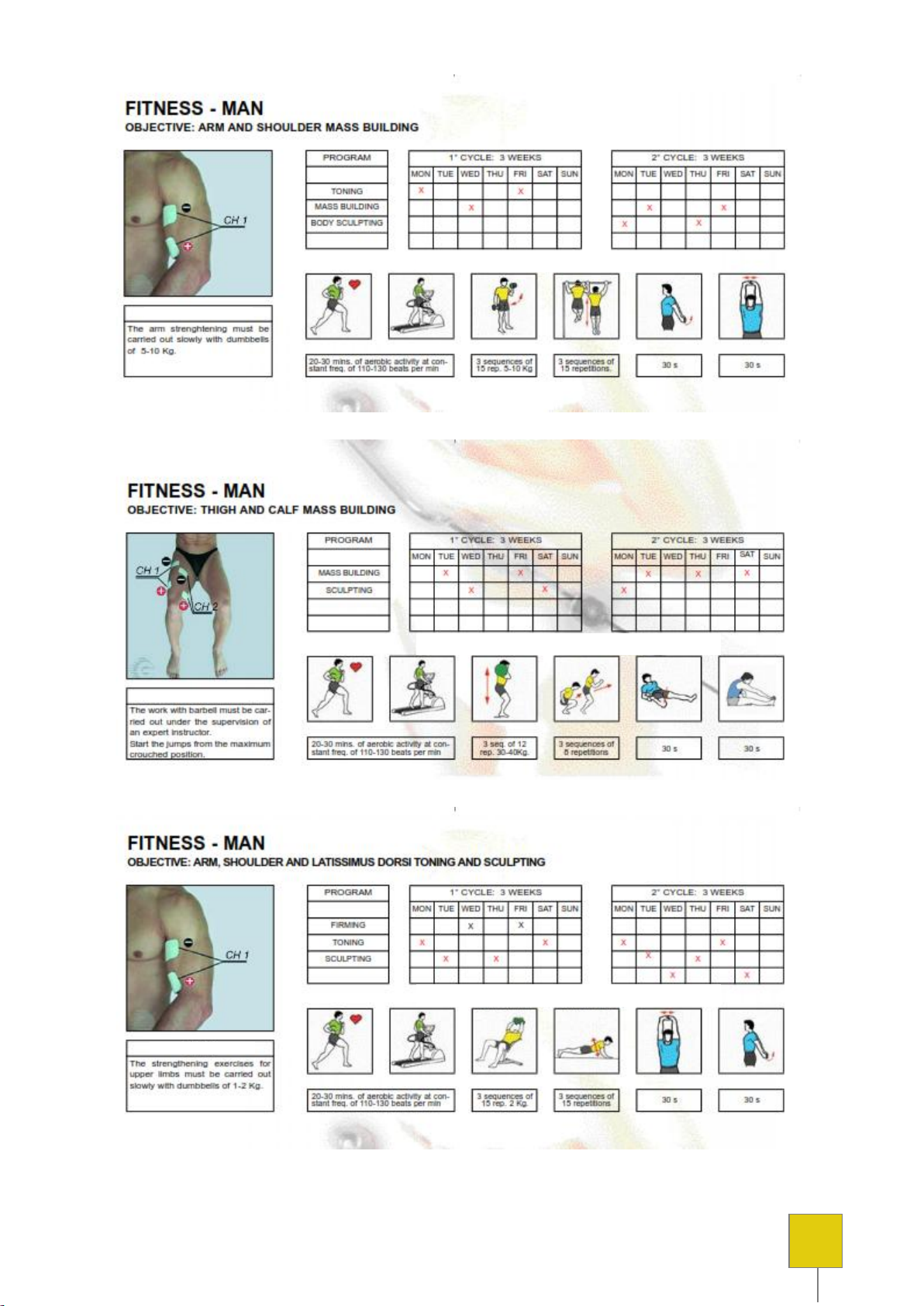
Rev. 11.2014
69
EXERCISES TO BE COMBINED WITH THE STIMULATION
EXERCISES TO BE COMBINED WITH THEST IMULATION
EXERCISES TO BE COMBINED WITH THE STIMULATION
SUGGESTIONS
SUGGESTIONS
SUGGESTIONS
Page 70
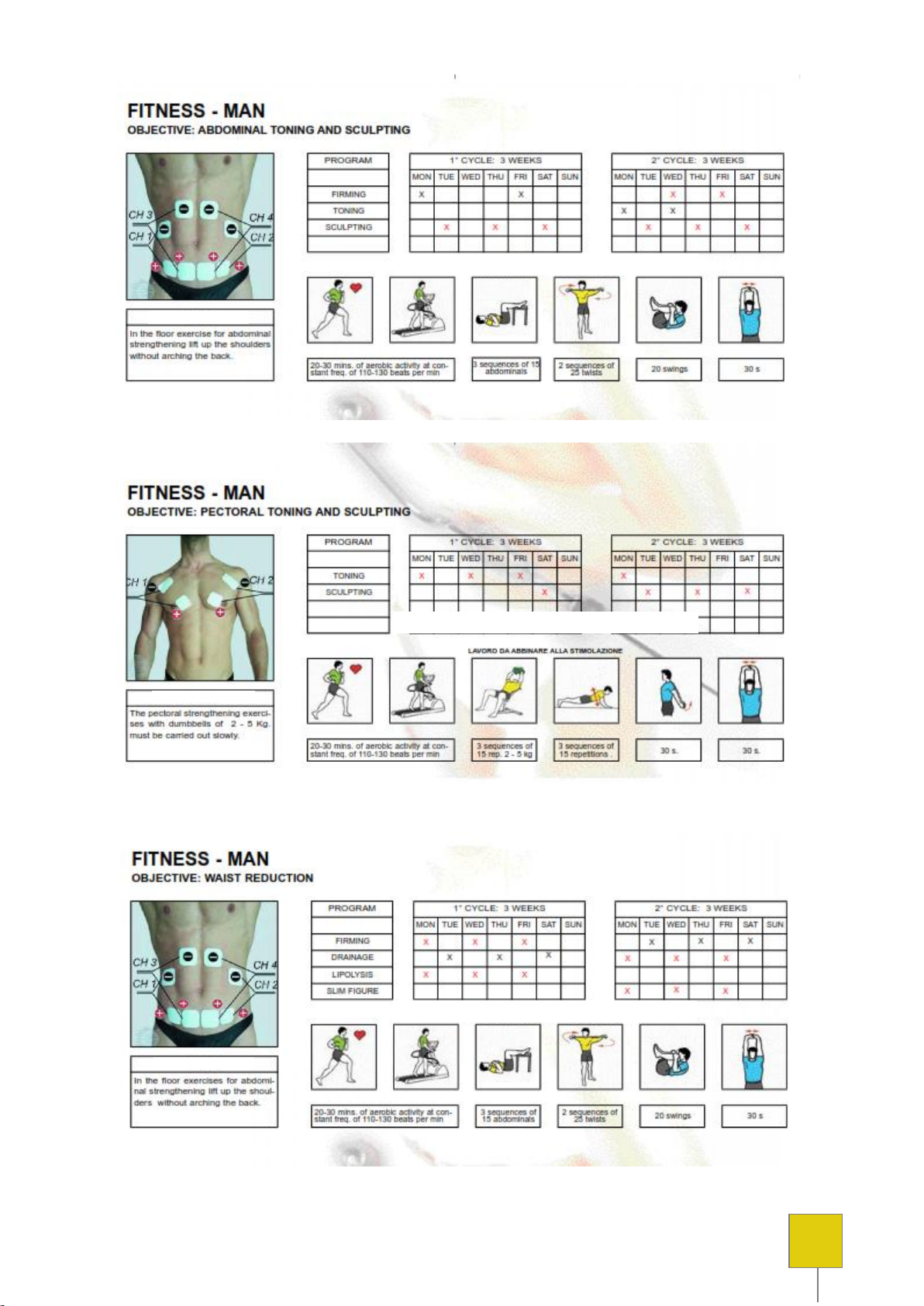
Rev. 11.2014
70
EXERCISES TO BE COMBINED WITH THE STIMULATION
SUGGESTIONS
EXERCISES TO BE COMBINED WITH THE STIMULATION
SUGGESTIONS
EXERCISES TO BE COMBINED WITH THE STIMULATION
SUGGESTIONS
Page 71
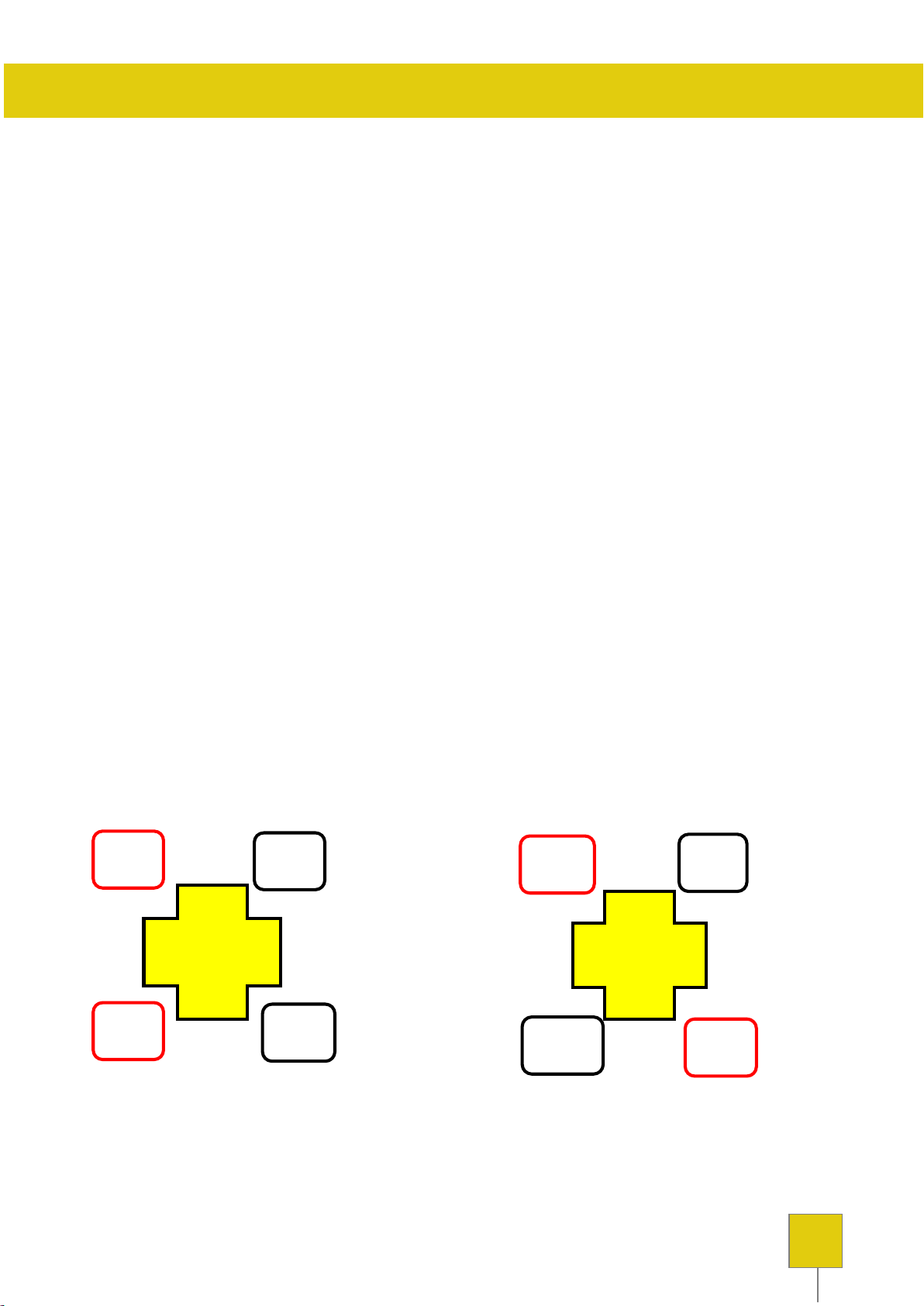
Rev. 11.2014
71
ELECTRODE PLACEMENT
The correct electrode placement and the correct choice of their size are critical aspects for the
electrostimulation to be effective.
To choose the size of the electrodes and as for their placement it is necessary to refer to the images
at the end of this guide. For any further information visit our website www.globuscorporation.com
where you can find a wide range of images and videos on the electrode placement.
NOTE For all the programs that cause an important muscle contraction (such as, for example,
strength, hyperthrophy, toning and firming programs...) it is important to place the electrode on the
muscle motor point, that is the point most sensitive to stimulation.
If the electrode is not placed exactly on the motor point, the contraction could be small and/or
annoying. In this case it is necessary for the positive electrode to be moved a few millimeters up to
feel an effective and comfortable contraction.
The body position during the stimulation
The body position during the electrostimulation session depends on the body part involved and on
the program type that is being carried out.
During the treatment execution with high intensities, we suggest blocking the limbs in order to
work in isometry. For instance, if you want to treat the quadriceps with a strength program, we
suggest carrying out the treatment while sitting with the foot blocked, in order to avoid an
involuntary leg extension during the contraction phase.
For all the programs that do not imply high intensity (massages, decontracting, drainage programs)
the body position is not important, as long as it is comfortable.
Electrode placement for Tens and Microcurrent programs
In the following pages you can find the images with the correct electrode placement for tens and
microcurrent treatments. If the localization of your pain is not included in the images represented,
you can position the electrodes by forming a "square" on the painful area. Here's an example.
PAIN
TENS (use colored
cables)
MICROCURRENTS
(use gray cables)
PAIN
CH 1
CH 2
CH 2
CH 1
PAIN
CH 1
CH 2
CH 2
CH 1
Page 72
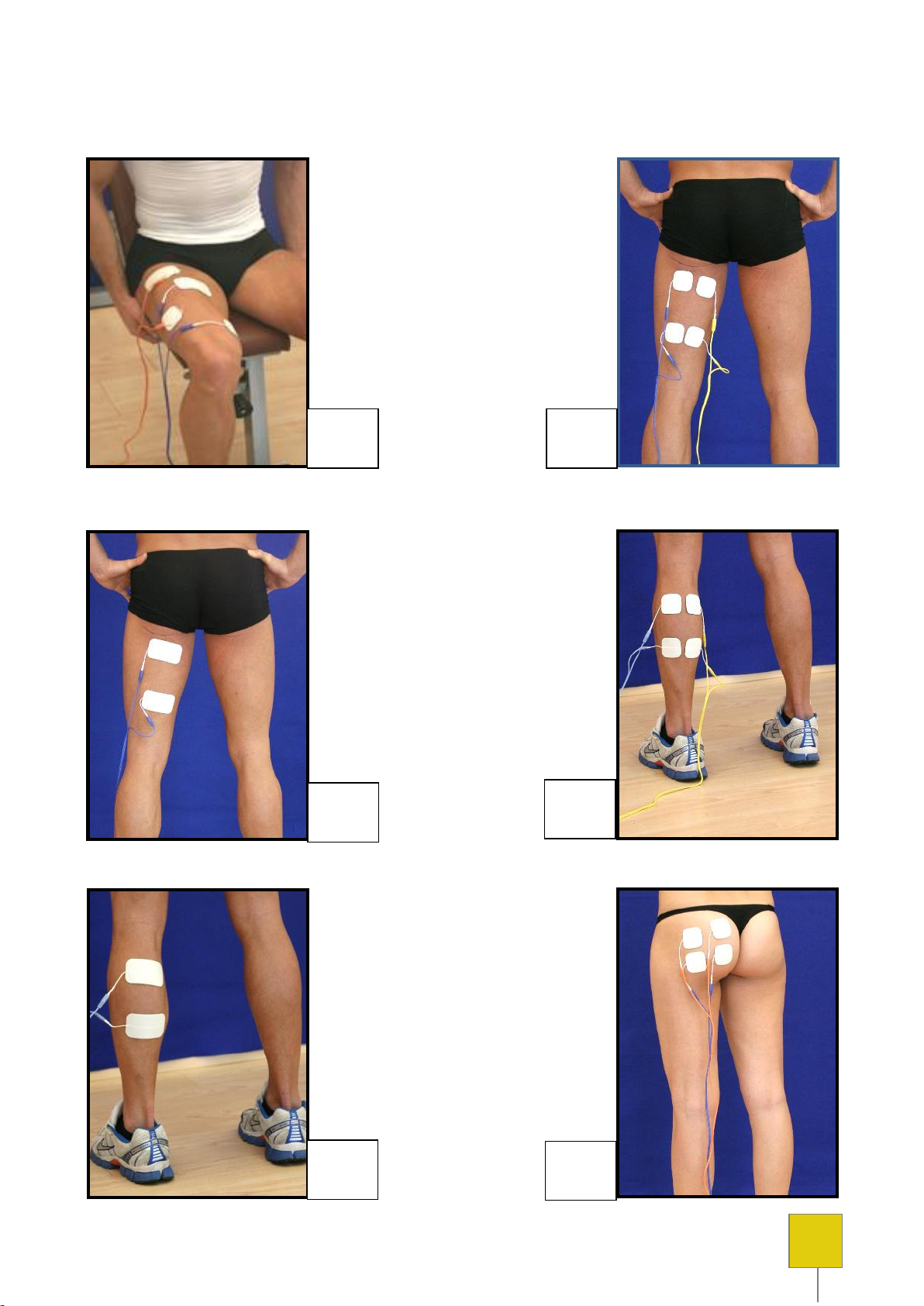
Rev. 11.2014
72
ELECTRODE PLACEMENT
1
6
5
4
2
3
Page 73
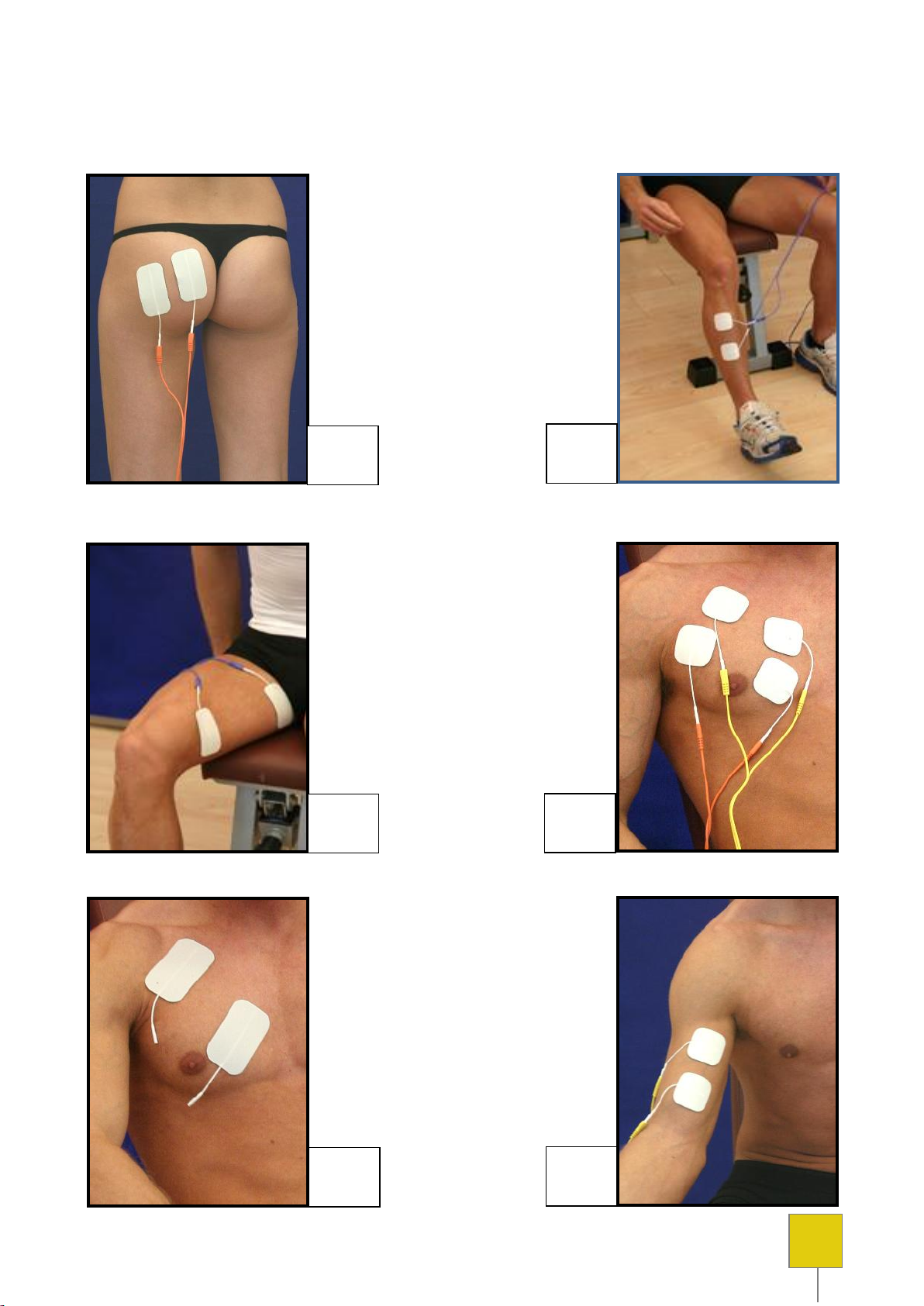
Rev. 11.2014
73
7
12
11
10
8
9
Page 74
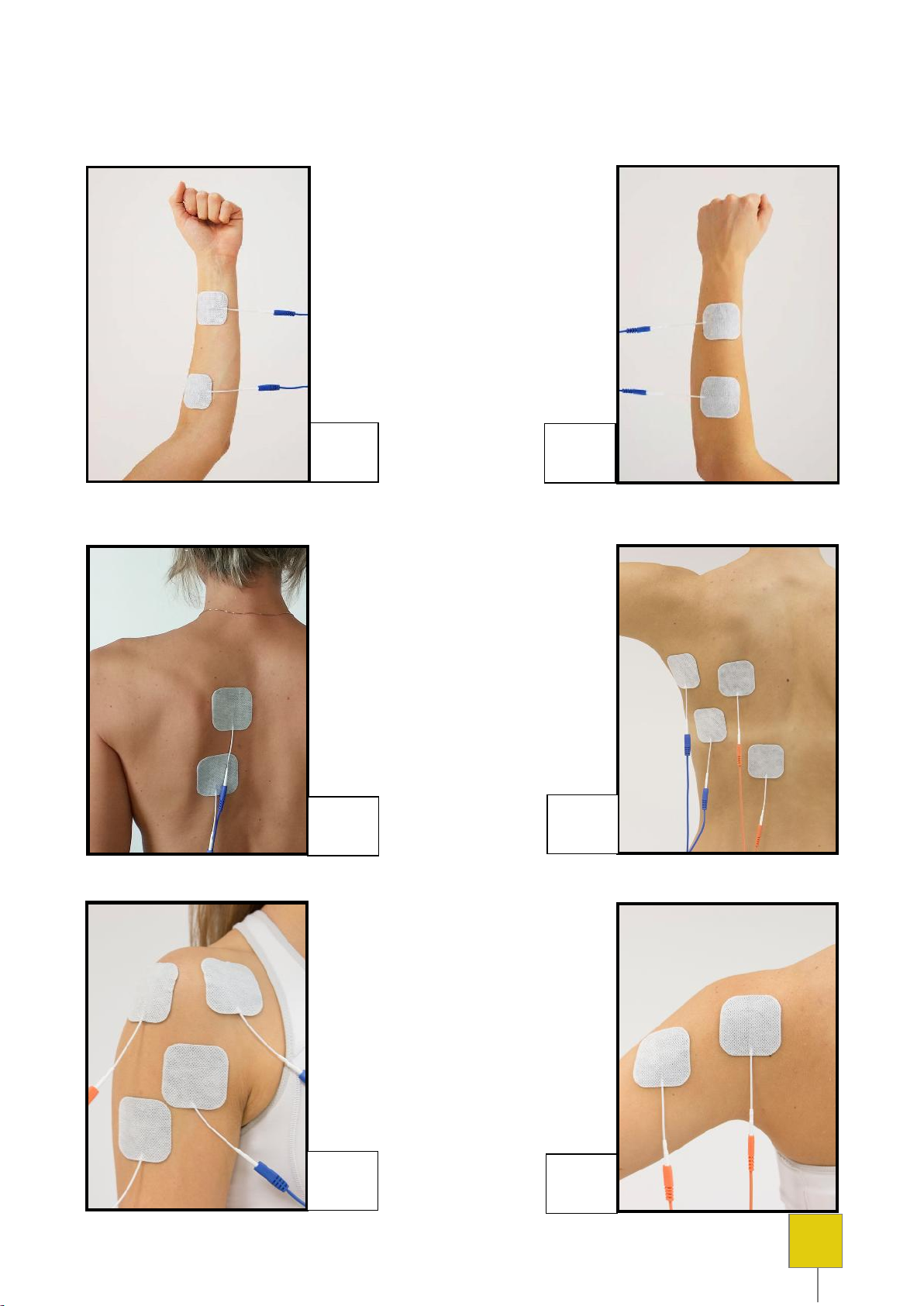
Rev. 11.2014
74
13
18
17
16
14
15
Page 75
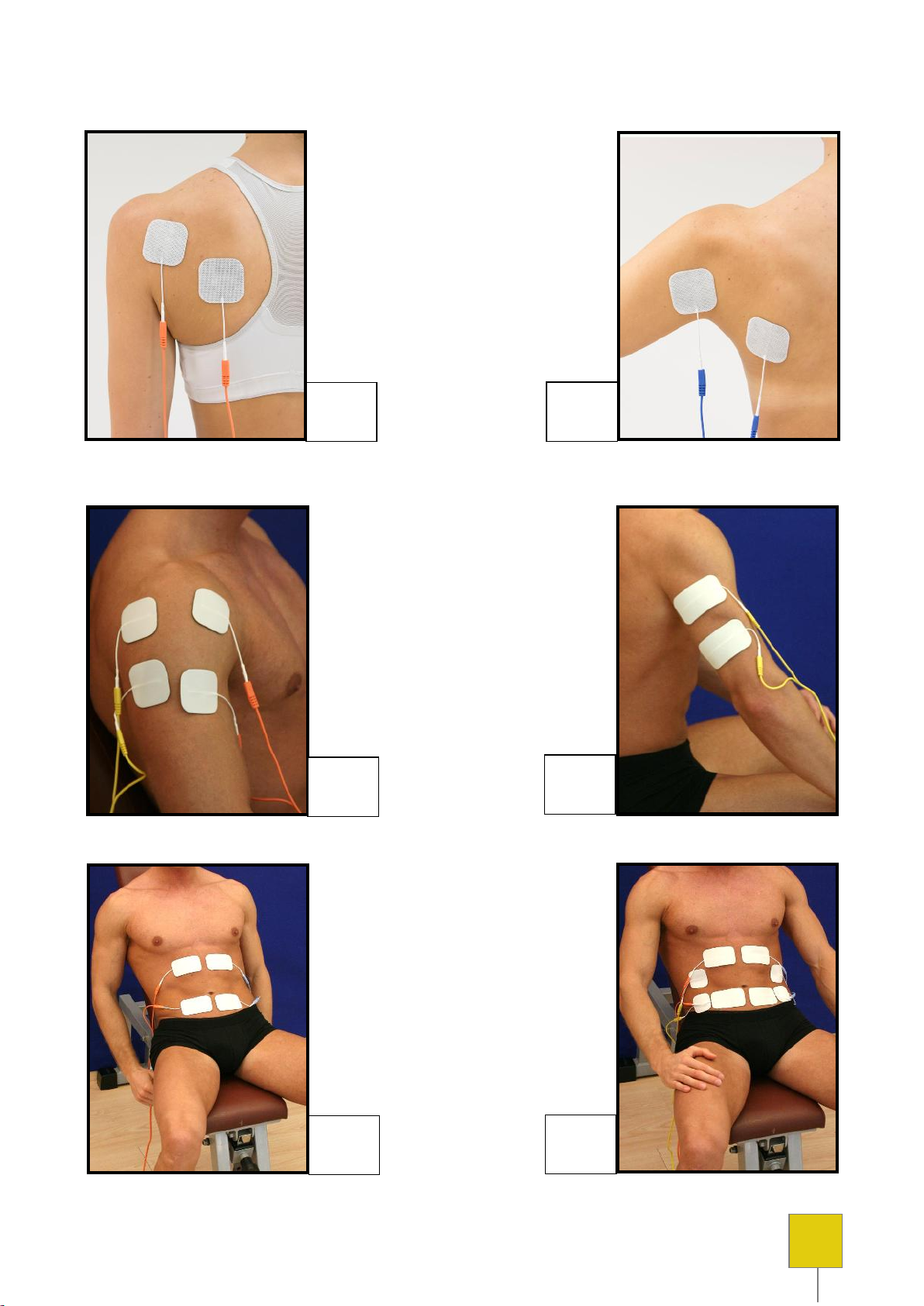
Rev. 11.2014
75
19
24
23
22
20
21
Page 76
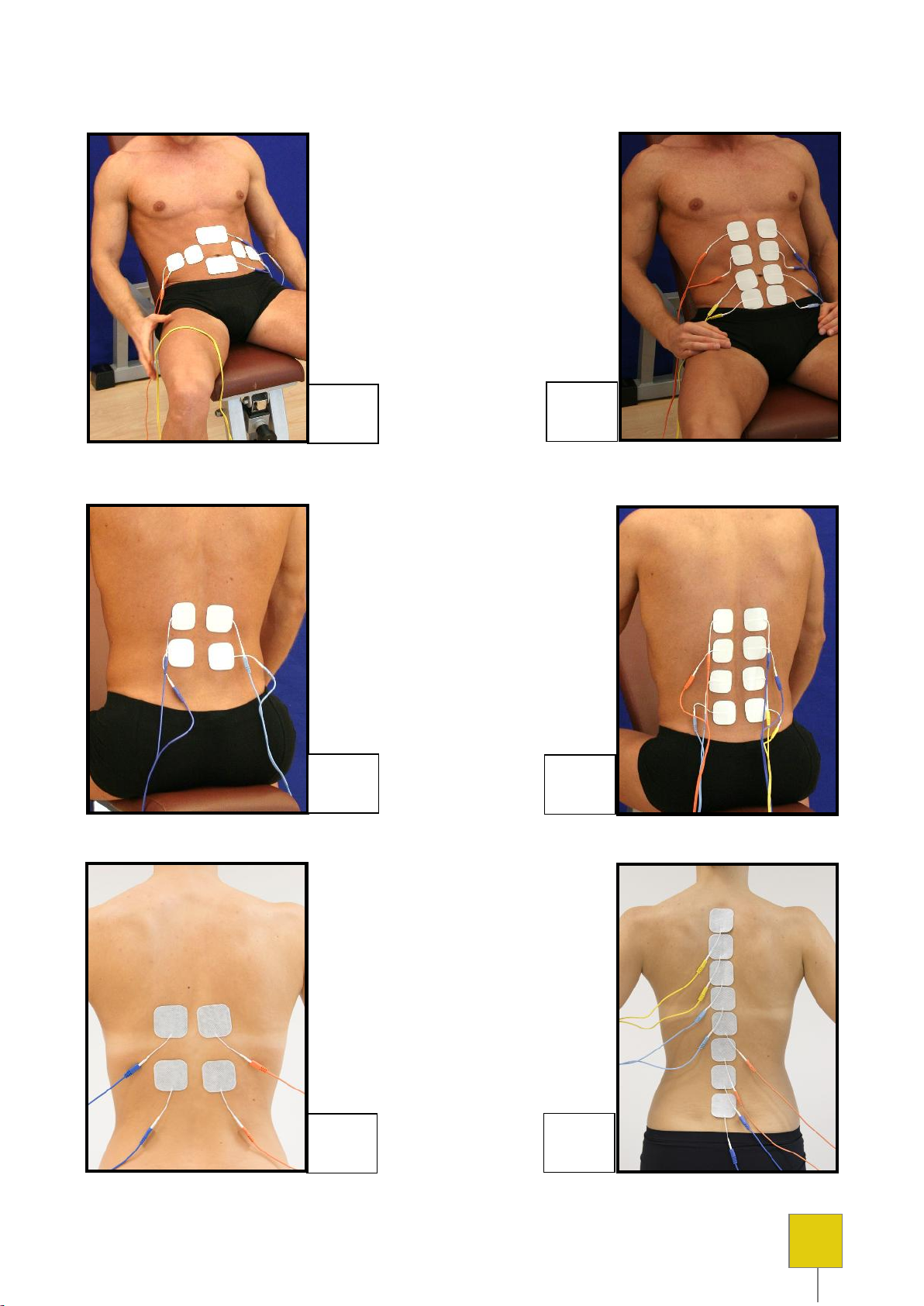
Rev. 11.2014
76
25
30
29
28
26
27
Page 77
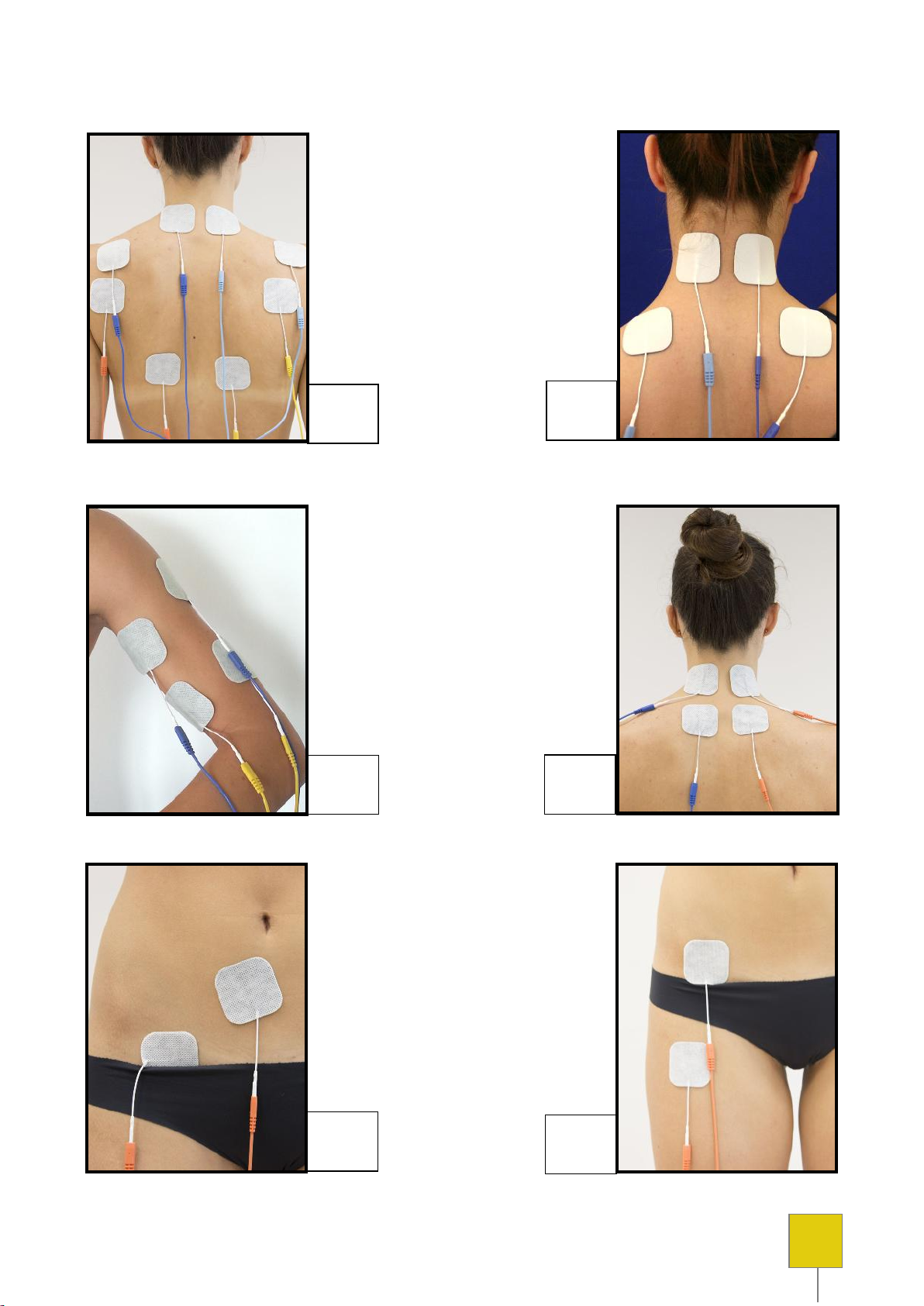
Rev. 11.2014
77
31
36
35
34
32
33
Page 78
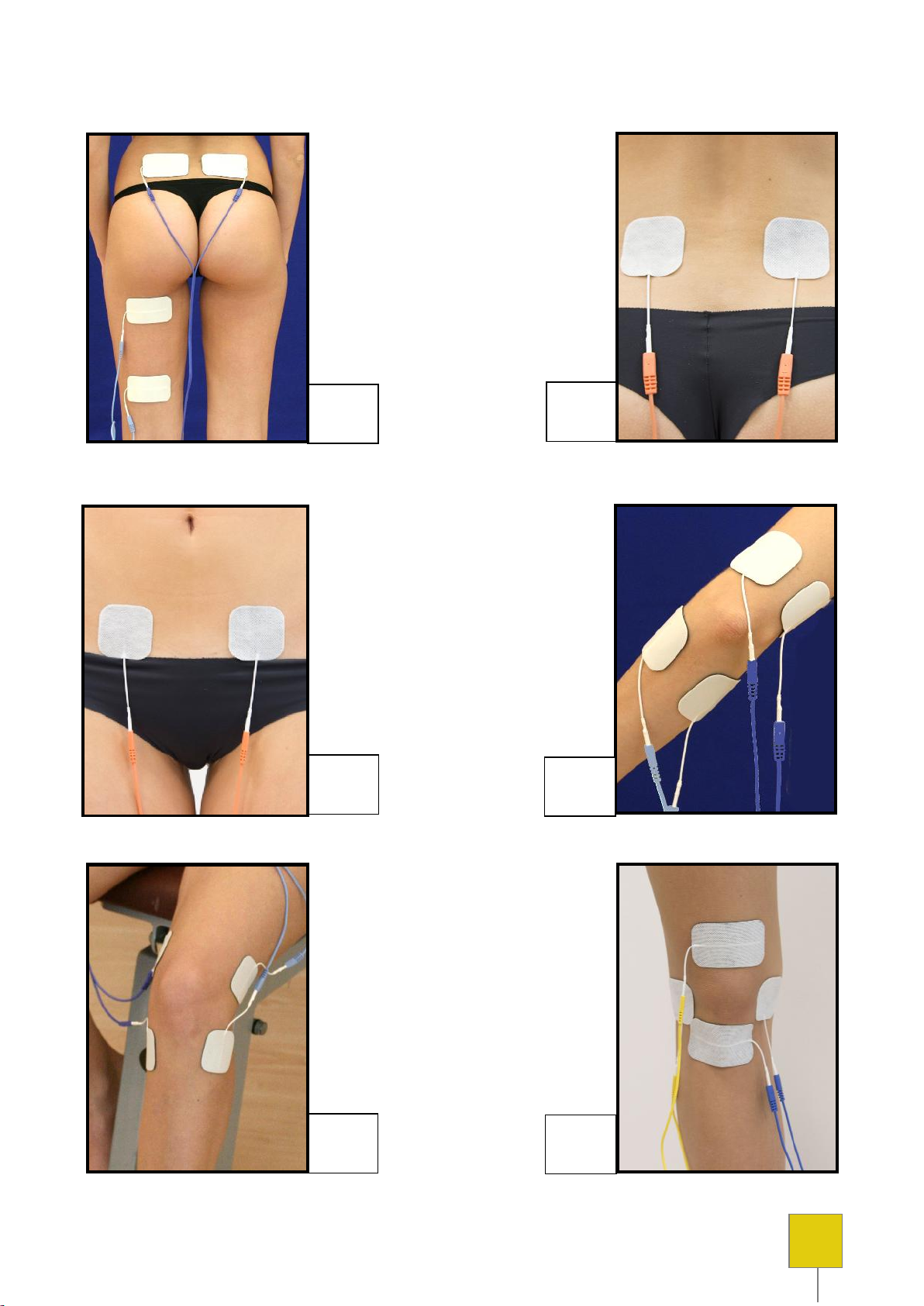
Rev. 11.2014
78
37
42
41
40
38
39
Page 79
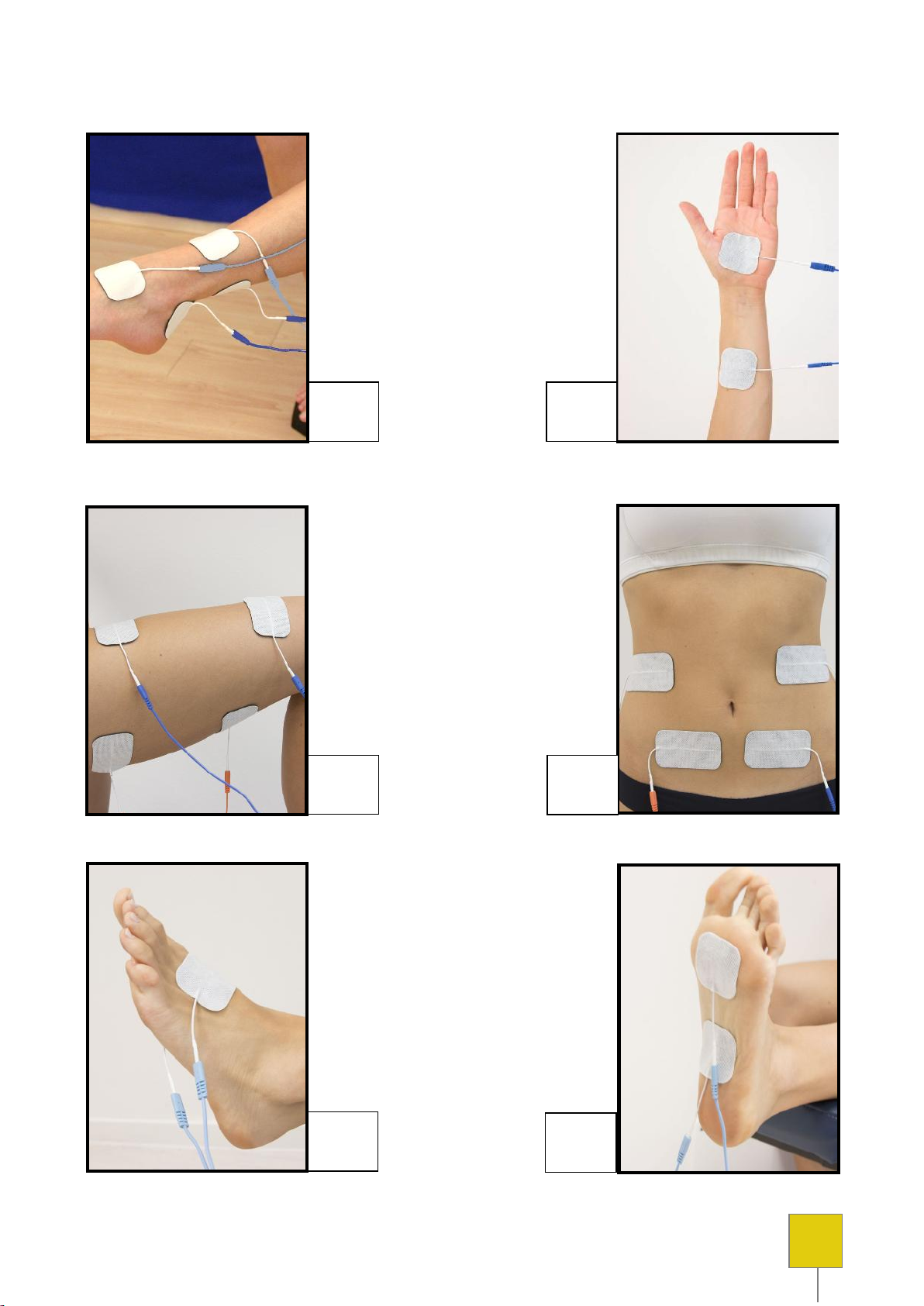
Rev. 11.2014
79
43
48
47
46
44
45
Page 80
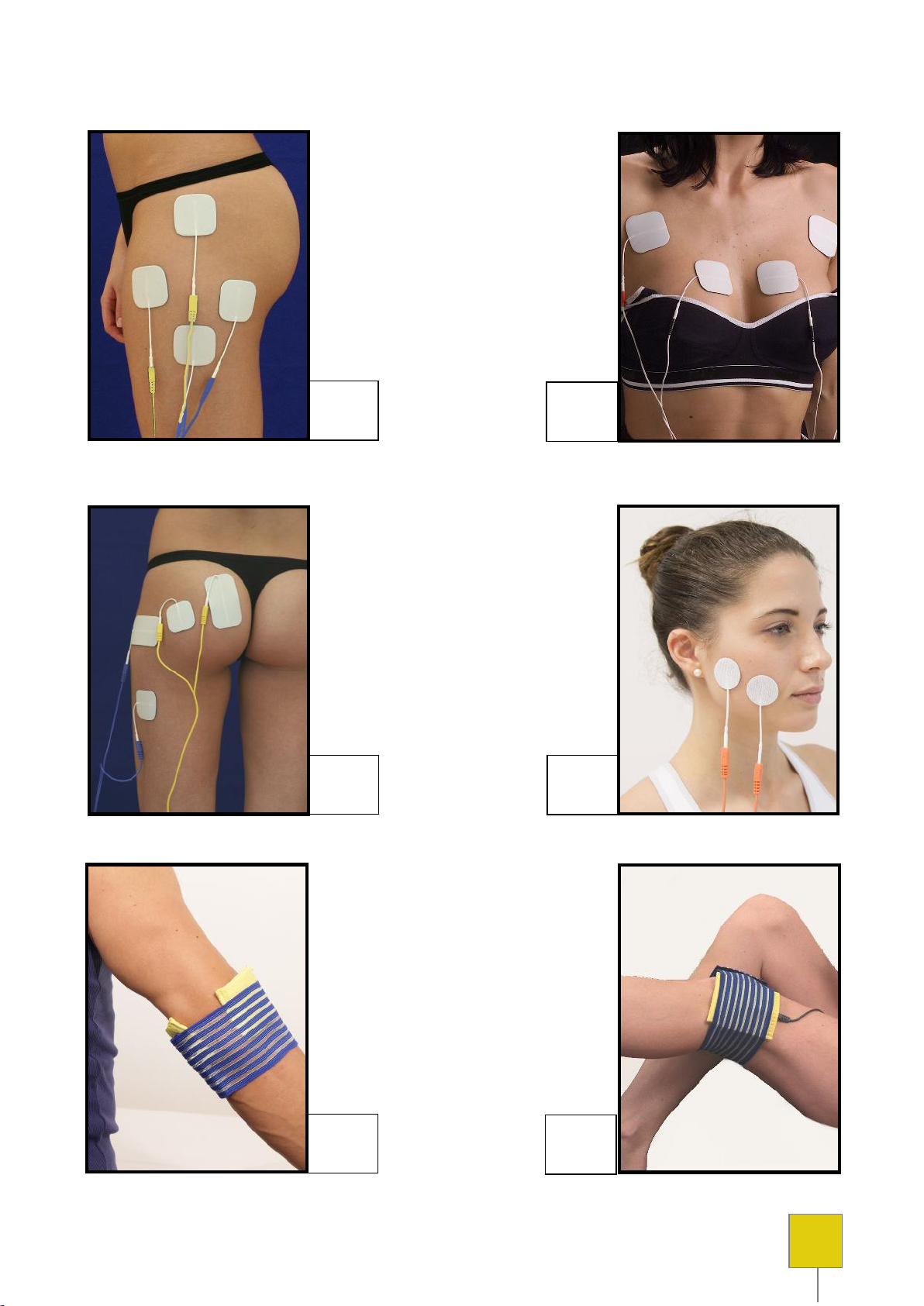
Rev. 11.2014
80
49
54
53
52
50
51
Page 81
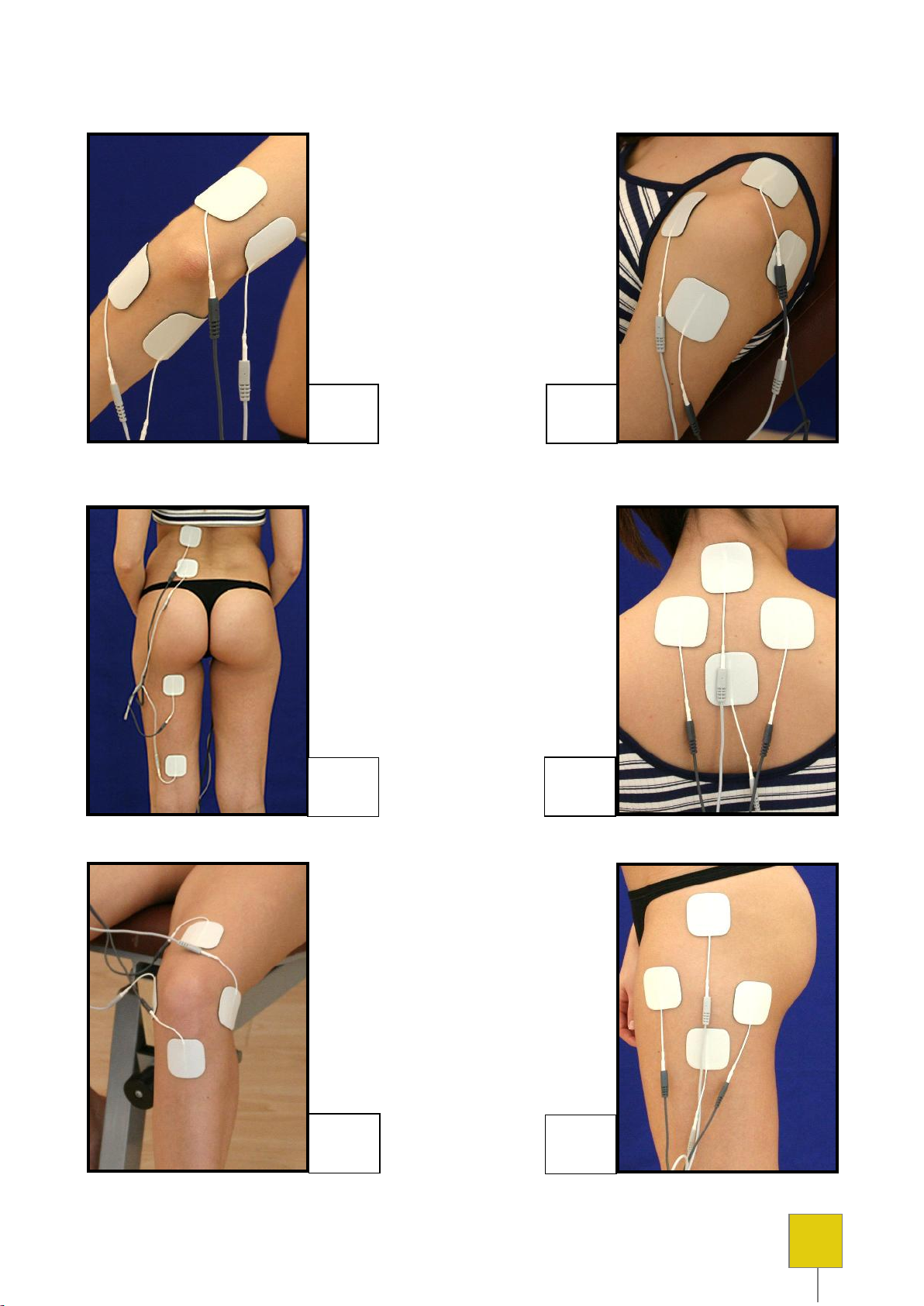
Rev. 11.2014
81
55
60
59
58
56
57
Page 82
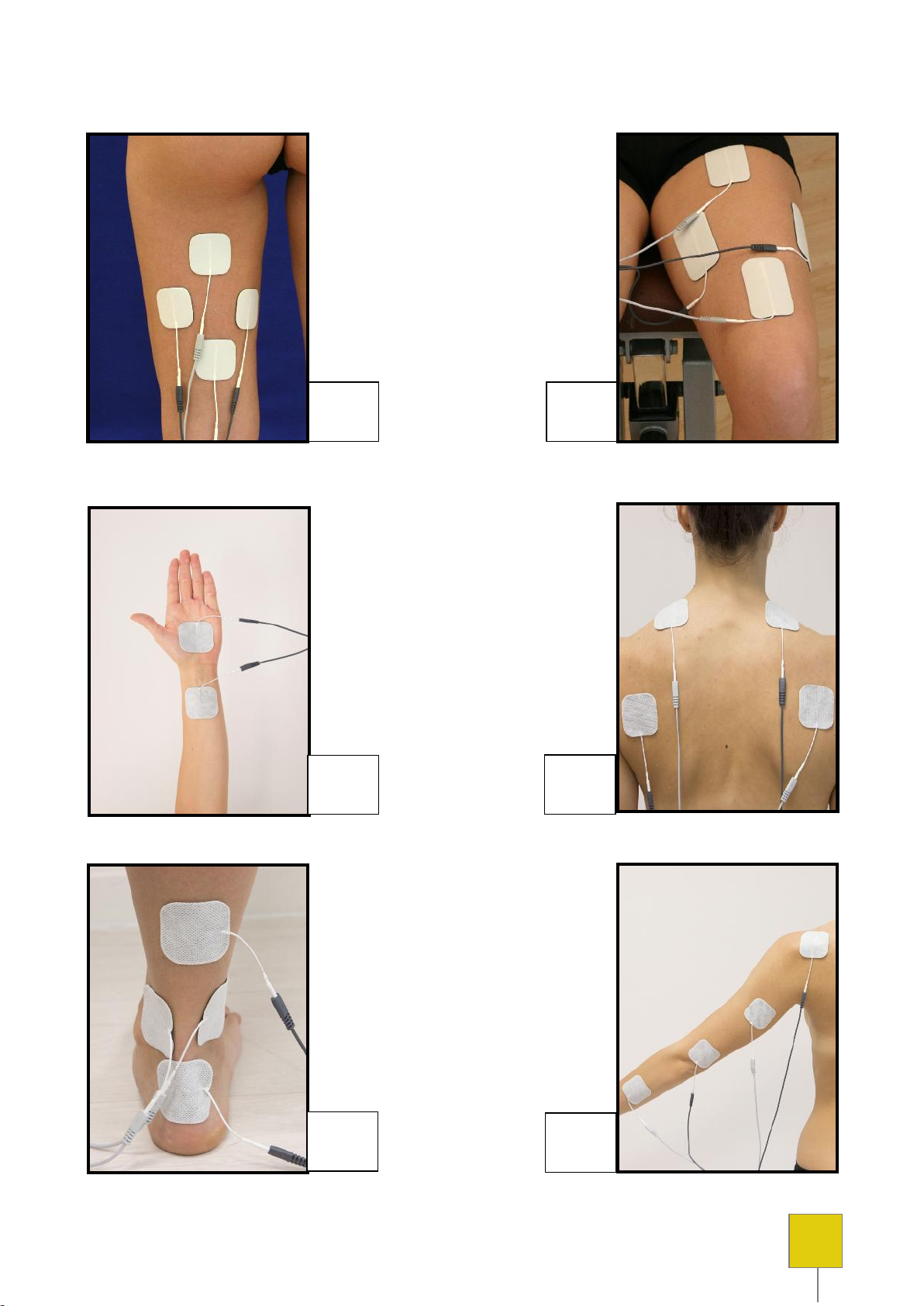
Rev. 11.2014
82
61
66
65
64
62
63
Page 83
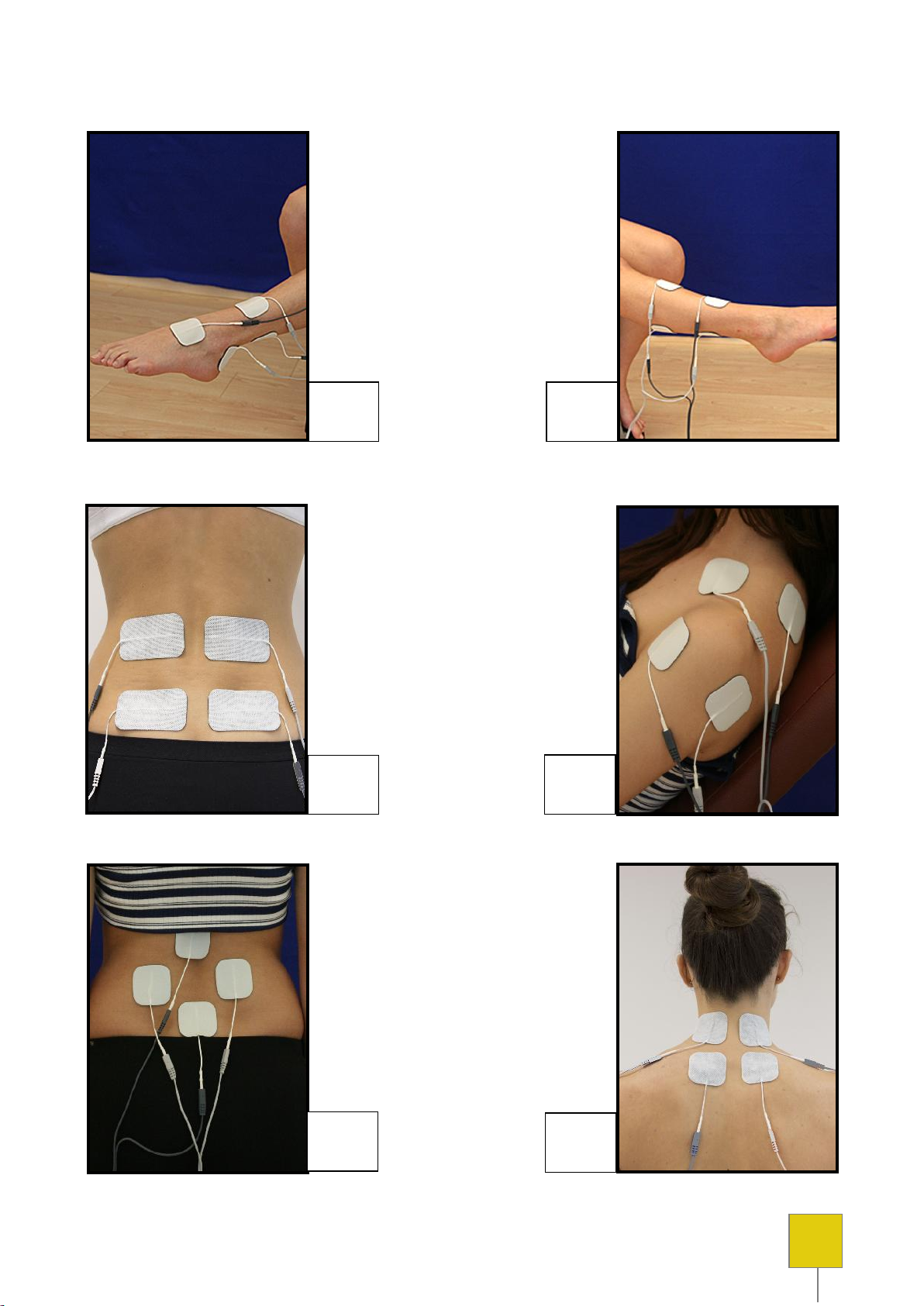
Rev. 11.2014
83
67
72
71
70
68
69
Page 84

Rev. 11.2014
84
Bibliography
- Albright B., Yugo D. (1985) Quadriceps muscle strength gains utilising electrical stimulation.
Phys Ther 65 : 696.
- Alon G., Mc Combe S.A., Koustantonio S., Stumphauser L.J., Burgwin K.C. Parent M.M.,
- Boswoth R.A. (1987) Comparison of the effect of electrical stimulation and exercise on
abdominal musculature. J Orthop Sports Phys Ther 8: 567-573.
- Bisciotti G.N., Greco S. Gli indici di forza isometrica possono costituire un fattore predittivo
della performance dinamica ? Sport & Coach Science Journal.
- Blair E.; Erlanger J. A comparison of the characteristics of axon through their individual
electrical reponses. Am J. Physiol., 1933, 106: 524-564.
- Boutedelle D., Smith B., Malone T.A. (1985) Strength study utilising the electo-stim. 180 J
Orthop Sports Physic Ther 7: 50-53.
- Cabric M., Appel H. J., Resic A. (1987) Effects of electrical stimulation of different
frequencies on the myonuclei and fiber size in human muscle. Int J Sports Med.8: 323-326.
- Cabric M., Appel H. J., Resic A. (1988) Fine structural changes in electrostimulated human
squeletal muscle. Eur J Appl Physiol 57: 1-5.
- Cannon R.J., Caffarelli E (1987) Neuromuscular adaptation to training. J Appl. Physiol. 63:
2396-2402.
- Chen CC1, Johnson MI. An investigation into the effects of frequency-modulated
transcutaneous electrical nerve stimulation (TENS) on experimentally-induced pressure pain
in healthy human participants.
- Chemirisin A. P., KosinskY V. I., Rozman A. M. (1983) Use of imitational electrostimulation in
the training of high level swimmers. Traduzione Inglese, Soviet Sport J 1:56.
- Cometti G. (1988) L’electrostimulation. In G Cometti, Les méthodes modernes de
musculation. Tome 1: Données Théoriques. Université de Bourgogne: 253:341.
- Currier D., Mann R. (1983) Muscular strength development by electrical stimulation healthy
individuals. Phys Ther. 63: 915-921.
- Davies C. T. M., Mc Grath K. (1982) Effects of training and chronic tetanic stimulation on
voluntary electrically evoked contractions of the triceps sural in a human subject. J Physiol
(London). 329: 48-49.
- Delitto A., Brown M., Strube R., Lehman R. C. (1989) Electrical stimulation of quadriceps in
elite weigh lifter; a single subject experimented. Int J Sport Med. 10: 187-191.
- Desmet J.E., Godaux E. Ballistic contraction in man: Characteristics recruitment pattern of
single motor units of the tibialis anterior muscle. J. Physiol. (London), 1977, 264: 673-694
- Duchateau J., Hainaut K. (1988) Training effects of sub-maximal electrostimulation in
human muscle. Med Sci Sports Exerc. 20 (1): 99-104.
- Eriksson E., Häggmank T., Kiessling K. H., Karlson J. (1981) Effect of electrical stimulation on
human squeletal muscle. Int J Sports Med. 2: 18-22.
- Fahey T. D., Harvey M., Schroeder R. V., Fergunson F. (1985) Influence of sex differences
and knee joint position on electrical stimulation modulated strength increase: Med Sci
Sports Exerc. 17 (1): 144-147.
Page 85

Rev. 11.2014
85
- Garnett R.; Stephens J.A. Changes in the recruitment threshold of motor units produced by
cutaneous stimulation in man. J Physiol. (London), 1981, 311: 463-473.
- Häkkinen K., Komi P. V. (1983) Alterations of mechanical characteristics of human skeletal
muscles during strength training. Eur J Appl Physiol. 50: 161-172.
- Hartsel H. D.(1986) Electrical muscle stimulation and isometric exercise effects on selected
quadriceps parameters. J Orthop Sports Phys Ther 8 (4): 203-208.
- Hennemann E., Somjen G., Carpenter D.O. Functional significance of cell size in spinal
motoneurons. J. Neurophysiol. 28: 555-560, 1965.
- Iehl R., Danielson A., Hoegh J. E., Barr J. O., Cook T. M. (1984) Training effects of electrical
stimulation on abdominal muscles. Phys Ther. 64: 751.
- Knaflitz M., Merletti R., De Luca C.J. Inference of motor unit recruitment order in voluntary
and electrically elicited contractions. J. Appl. Physiol., 1990, 68: 1657-1667.
- Komi P. V., Viitasalo V., Ramura R., Vihko V. (1978) Effect of isometric strength training on
mechanical, electrical and metabolic aspects of muscle function. Eur J. Appl. Physiol. 40: 45-
55.
- Kubiak R. J., Whitman K. M., Johnston R. M. (1987) Changes in the quadriceps femoris
muscle strength using isometric exercise versus electrical stimulation. J Orthop Sports Phys
Ther 8: 573-541.
- Lai H. S. De Domenico G. Stauss G. (1988) The effect of different electro-motor stimulation
training intensities and strength improvement. Austral J Physioter. 34: 151-164.
- Laughman R K., Youdas J. W., Garrett T. R. (1983) Strength changes in normal quadriceps
femoris muscle as a result of electrical stimulation. Phys Ther. 63: 294-299.
- Lewis S. j., Nygaard E., Sanchez J., Egelblad H., Soltin B. (1984) Static contraction of the
quadriceps muscle in man. Cardiovascular control and reponses to one-legged strength
training. Acta Physiol Scand. 122: 341-353.
- Lexell J; Henriksson-Larsen K.; Sjostrom M. Distribution of different fibre types in human
skeletal muscles A study of cross-sections of whole m. vastus lateralis. Acta Physiol. Scand,
19834, 117: 115-122.
- Mc Micken D. F., Todd-Smith M., Thomson C. (1983) Strenghening of human quadriceps
muscles by cutaneous electrical stimulation. Scand J Rehab med. 15: 25-28.
- Nobbs L. A., Rhodes E. C. (1986) The effects of electrical stimulation and isokinetic exercise
on muscular power of the quadriceps femoris. J Orthop Sports Phys. (: 260-268.4
- Oosterhof J1, Samwel HJ, de Boo TM, Wilder-Smith OH, Oostendorp RA, Crul BJ.
Predicting outcome of TENS in chronic pain: a prospective, randomized, placebo controlled
trial.
- Parker R. H. (1985) The effect of mild one leg isometric and dynamic training. Eur J Appl
Physiol. 54: 262-268.
- Roméro J. A., Stanford T. L., Schroeder R. V., Fahey T. D. (1982) The effects of electrical
stimulation on normal quadriceps on strength and girth. Med Sci Sports Exerc. 3: 194-197.
- Rutherford J (1981) Electrostimulation training for volley ball players. Volley ball Technic J.
1: 35-38.
- Singer K. P., Gow P., Otway W. F., Williams M. (1982) A Comparaison of electrical muscle
stimulation, isometric, isokinetic strength training programs: NZL Sports Med. 11: 61-63.
Page 86

Rev. 11.2014
86
- Solomonow M. External control of the neuromuscular system. IEEE Trans. Biomed. Eng,
1984, 31: 752-763.
- Soo C. L., Currier P., Threlded A. J. (1988) Augmenting voluntary torque of healthy muscle
by optimisation of electrical stimulation: Phys Ther. 3: 333-337.
- Willoughby D. S., Simpson S (1996) The effects of combined electrostimulation and dynamic
muscular contractions on the strength of college basket Ball players. J Strength and Cond
Res. 10 (1): 40-44.
Page 87

Rev. 11.2014
87
Page 88

Rev. 11.2014
88
 Loading...