

Page 1
StarSign
USB Token
Reference Manual
Edition 07.2007
®
Bio Token 3.1 M
Page 2

ID No. 30023721
© Copyright 2007 by
Giesecke & Devrient GmbH
Prinzregentenstr. 159
Postfach 80 07 29
D-81607 München
This document as well as the information or material contained is copyrighted. Any use not explicitly permitted by copyright law requires prior consent of Giesecke & Devrient GmbH. This applies to any reproduction, revision, translation, storage on microfilm as well as its import and processing in electronical
systems, in particular.
Subject to technical changes.
StarSign
®
Bio Token is a registered trademark of Giesecke & Devrient GmbH.
Page 3

© Copyright 2007 by Giesecke & Devrient GmbH - Germany – Prinzregentenstr. 159, P.O. Box 80 07
NOTE: This equipment has been tested and found to comply with the limits for a Class B digital device,
provide reasonable protection against
frequency energy and, if not installed and used in accordance with the instructions, may cause harmful
ce to radio communications. However, there is no guarantee that interference will not occur in a
which can be determined by turning the equipment o
ff and on, the user is encouraged to try to correct the
Caution: changes or modifications not expressly approved by the party responsible for compliance could
29, D-81607 München © 2007 Giesecke & Devrient GmbH. All rights reserved The names of the other
products mentioned are trademarks of their respective owners.
This hardware key is in compliance with the following test specification: CEI EN 61000-4-2;
CEI EN 61000-4-3; CISPR22 as required by: CEI EN 61000-6-1, CEI EN 61000-6-2, CEI EN
61000-6-3, CEI EN 61000-6-4 which are specified for the following test:
• “ESD Immunity test”
• “Radiated radio-frequency and electromagnetic field immunity test”
• “Radiated Emission Verification”
In compliance with the “Essential Requisites” for the EMC Directives 89/336/EEC & 2004/108/EEC.
FCC ID: TIJ-BTM31
Giesecke & Devrient
GmbH StarSign® Bio
Token 3.1 Supply: 5V DC
Absorption: 250 mA
This device complies with Part 15 of the FCC Rules. Operation is subject to the following two conditions:
(1) this device may not cause harmful interference, and (2) this device must accept any interference
received, including interference that may cause undesired operation.
pursuant to Part 15 of the FCC Rules. These limits are designed to
harmful interference in a residential installation. This equipment generates, uses and can radiate radio
interferen
particular installation. If this equipment does cause harmful interference to radio or television reception,
interference by one or more of the following measures:
- Reorient or relocate the receiving antenna.
- Increase the separation between the equipment and receiver.
- Connect the equipment into an outlet on a circuit different from that to which the receiver is connected.
- Consult the dealer or an experienced radio/TV technician for help.
void the user's authority to operate the equipment.
IMPORTANT REMARKS
Due to the limited space o n the product shell, all FCC certification references are on this technical manual
Changes or modifications not expressly approved by the party responsible for compliance could void the
user’s authority to operate the equipment.
Page 4

Contents
About StarSign Bio Token 3.1 M .......................................................................................... 1
About the Document ........................................................................................................... 2
1Basics 3
1.1 General Introduction to Biometrics............................................................................. 4
1.2 Biometrics, Smart Cards and Tokens .......................................................................... 5
1.3 LED Status ................................................................................................................. 6
2 Commands 9
2.1 ENROLL FINGERPRINT............................................................................................... 10
2.2 VERIFY FINGERPRINT ................................................................................................ 12
2.3 VERSION INFO.......................................................................................................... 14
Appendix 15
A Overview of Status Bytes.......................................................................................... 16
B Technical Specifications............................................................................................ 18
C Reference Literature................................................................................................. 19
D Glossary................................................................................................................... 20
Contents
Index ............................................................................................................................... 23
Reference Manual StarSign Bio Token 3.1 M/Edition 07.2007
ID No. 30023721
Page 5

Contents
Reference Manual StarSign Bio Token 3.1 M/Edition 07.2007
ID No. 30023721
Page 6

About StarSign Bio Token 3.1 M
About StarSign Bio Token 3.1 M
Characteristics
Features
StarSign Bio Token 3.1 M is a USB-PKI token based on the STARCOS 3.0
operating system. The token comprises a fingerprint sensor and on-token fingerprint verification functionality. The biometric data never leaves
the token.
StarSign Bio Token 3.1 M is supported by StarSign middleware and can
therefore be used for all public key applications supporting MS CAPI
(CSP) or PKCS#11.
Fingerprint verification can be used instead of – or in addition to – PIN
verification, granting a higher user convenience and a real tie between
user and token. This is particularly of interest in applications that require
non-repudiation.
StarSign Bio Token 3.1 M also comprises an independent flash drive.
StarSign Bio Token 3.1 M features:
– Based on STARCOS 3.0 operating system
– On-token sensor, image processing and biometric verification (on-
card matching)
– Supported by StarSign middleware; use with all public key applica-
tions supporting MS CAPI (CSP) or PKCS#11
– Security system according to 7816-4; secure writing and messaging
– Cryptographic authentication and key management
– Encryption
– Symmetric encryption: DES, 3DES
– Asymmetric encryption: RSA-CRT with up to 2048 bits
– Support of up to 4 logical channels
– Biometric enrollment and verification functionality
– G&D match-on-card
– LED status indication
– additional flash memory drive
Related Standards
Reference Manual StarSign Bio Token 3.1 M/Edition 07.2007
ID No. 30023721
StarSign Bio Token 3.1 M adheres to the following standards:
– ISO/IEC 7816-3
– ISO/IEC 7816-4
– ISO/IEC 7816-11
– ISO/IEC 19794-2
More information on the relevant standards may be found in the appendix (see ’C Reference Literature’ on page 19).
1 of 23
Page 7
About the Document
About the Document
Target Group
Required Knowledge
Notation
This manual addresses developers and specialists of smart card applications.
In order to use StarSign Bio Token 3.1 M, you should be familiar with:
– Smart card hardware/software
– Related ISO/IEC standards
– Experience in biometric user authentication and cryptographic serv-
ices
This document assumes that you have a basic understanding of Microsoft Windows terminology and actions. Should you feel that this is not
the case, it is suggested that you refer to your Windows manuals first.
In order to facilitate access to required information and to provide quick
orientation, the following graphical aids and notations have been used:
This convention Indicates
Italic Operating system command or
mode
Notes comprise hints and recommendations useful when working with
StarSign Bio Token 3.1 M.
Please read warnings carefully - they are specified to prevent severe malfunctions and loss of data!
The header page of each chapter features an overview of the topics covered in the chapter. All technical terms and abbreviations used are explained in a glossary at the end of the manual.
2 of 23 Reference Manual StarSign Bio Token 3.1 M/Edition 07.2007
ID No. 30023721
Page 8

1Basics
This chapter provides you with background information on StarSign Bio
Token 3.1 M.
Basics
Contents
1.1 General Introduction to Biometrics ............................................ 4
1.2 Biometrics, Smart Cards and Tokens.......................................... 5
1.3 LED Status................................................................................. 6
Reference Manual StarSign Bio Token 3.1 M/Edition 07.2007 3 of 23
ID No. 30023721
Page 9

Basics
General Introduction to Biometrics
1.1 General Introduction to Biometrics
Scope
Biometrics and other
Types of User
Authentication
Enrollment and
Verification
Biometrics is the science of measuring physical or behavioral characteristics unique to an individual such as face, voice or fingerprint to verify a
person's identity. Biometric characteristics can be described as something we are.
Unlike user authentication based on something the user knows, such as
a PIN or password, or something he or she has, e.g. a smart card or other
token, biometric systems work by relying on a biometric characteristic something that is both unique and inseparably tied to the person. While
PINs, passwords and keys can be forgotten, lost, lent or stolen, biometrics cannot. The user himself becomes the means of identification, the biological password.
Biometric user authentication can elevate overall system security and enhance ease of use, as users no longer have to remember PINs and passwords.
Before biometric authentication can be used to verify the identity of a
user, a biometric enrollment has to be performed beforehand. This
means that the characteristic data of the biometric trait has to be captured and saved as a reference in a separate process in advance to verification. During verification, the characteristic data of the biometric trait is
captured again and compared to the previously stored reference data. If
both data sets coincide to a sufficient level, access is granted.
Biometric Error Rates
Fingerprint
Verification
In contrast to a PIN or password comparison, two different photos or
characteristic data sets captured of the same biometric trait will always
differ a bit due to positioning, background lighting, etc. Thus, biometric
comparison returns a figure which represents a level of coincidence, i.e.
the probability that two presented data sets belong to the same person.
Depending on a threshold value, access is granted or denied. As a consequence, a slight possibility remains that an unauthorized user be
granted access to a protected system or that a legitimate user will be denied access. The threshold value responsible for the error rates can be set
by the system administrator. These error rates are characteristic for all biometric systems and are called false acceptance rates (FAR) and false rejection rates (FRR).
Fingerprint verification is not only the most prominent but also one of
the most secure and well-understood biometric measures. Software converts the image of a fingerprint into digital form and extracts a set of
characteristics, i.e. a template, unique to the user's fingerprint. The characteristic information from one fingerprint contains up to 60 key points.
Crucial key points where finger-ridges end or split up are local features
called minutiae. They provide unique, identifiable information.
4 of 23 Reference Manual StarSign Bio Token 3.1 M/Edition 07.2007
ID No. 30023721
Page 10

Biometrics, Smart Cards and Tokens
1.2 Biometrics, Smart Cards and Tokens
Basics
On-Card Matching
Access Rules
Applications
In on-card matching biometric templates, i.e. data sets, are compared
with a previously stored biometric reference template in the smart card
processor itself. This happens in full analogy to the PIN verification where
the entered PIN is sent to the smart card processor and compared oncard with a previously stored PIN. The advantage of this method is that
the reference template is stored exclusively in the secure smart card processor environment, reliably protecting sensitive personal data against unauthorized access.
An individual access rule is assigned to each elementary file on the smart
card processor. As a consequence, elementary files can be accessed
(read/write/update) by cryptographic authentication, PIN verification, biometric authentication or a combination of all three.
The paramount application for biometrics in combination with cards and
tokens is the use in public key infrastructures, where biometric user authentication can be used to enable the cryptographic functions or services offered by the smart card processor. Thus, for example, StarSign Bio
Token can be used as a secure signature creating device, that can be legally tied to the token holder with on-card fingerprint verification.
Reference Manual StarSign Bio Token 3.1 M/Edition 07.2007 5 of 23
ID No. 30023721
Page 11
Basics
LED Status
1.3 LED Status
LED Arrangement
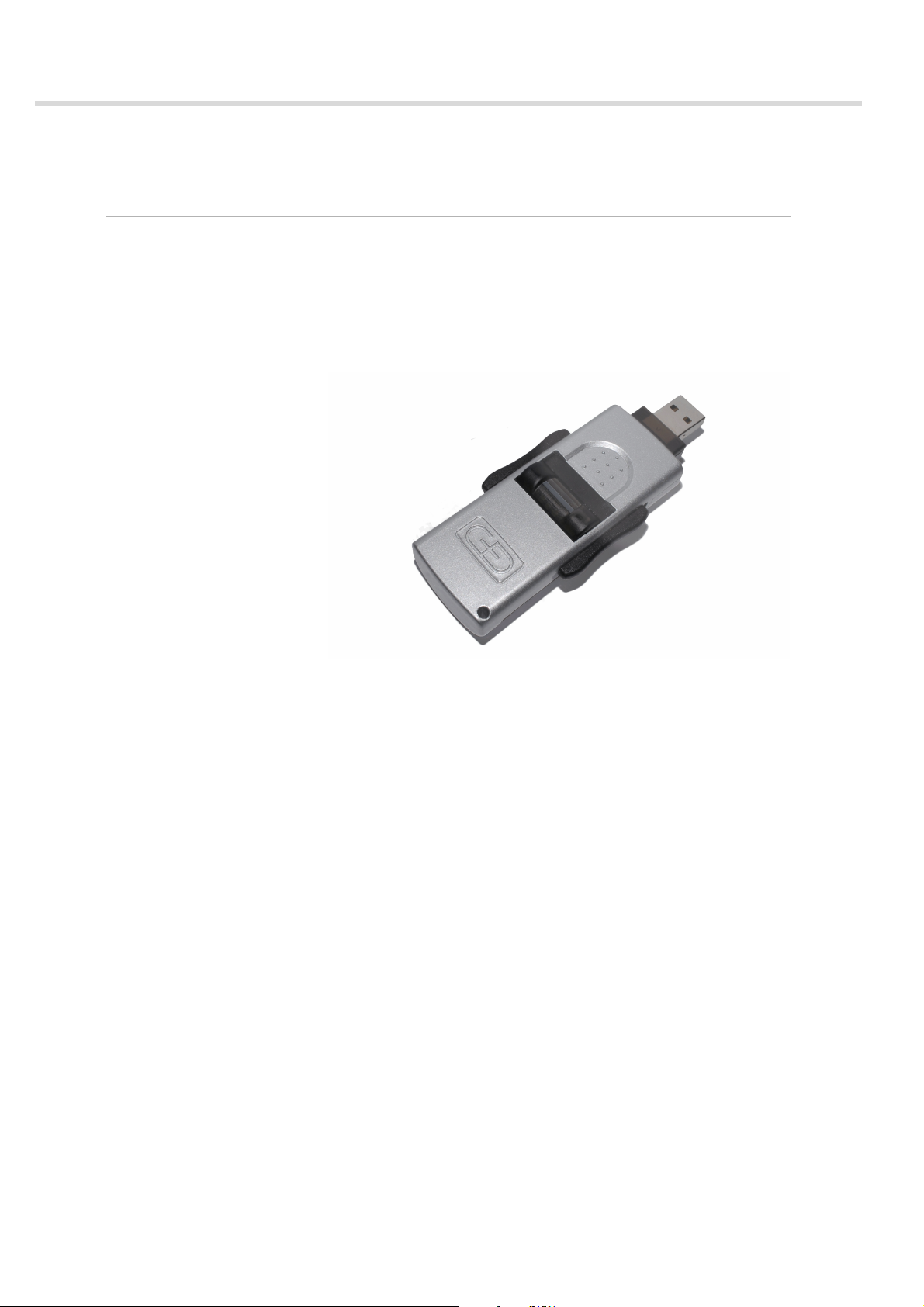
StarSign Bio Token 3.1 M has two bicolor LEDs at the base of the USB
plug to signalize its current status and operation to the user:
– Left LED
Illuminates in either green or yellow
– Right LED
Illuminates in either red or yellow
Fig. 1 StarSign Bio Token
6 of 23 Reference Manual StarSign Bio Token 3.1 M/Edition 07.2007
ID No. 30023721
Page 12

Basics
LED Status
LED Status/Mode
The LED states listed in the table signalize the current status and operation to the user:
Status/Mode LED indication Description
Idle Green and red LEDs flash Waiting for command
Place finger Left yellow LED blinks Wait for finger
Busy Red LED blinks quickly StarSign Bio Token is busy
Success Green LED illuminated Enrollment/verification suc-
cessful
Reject Red LED illuminated Enrollment/verification
failed
Boot Green and red LED illumi-
Booting device
nated
TEST mode Both yellow LEDs flash Allow diagnostic com-
mands
ADMIN mode Left yellow LED flashes,
red LED illuminated
Firmware update
Fig. 2 LED status/mode
Both yellow LEDs illuminated
Allows parameter configuration and firmware update
Signal firmware update status
Reference Manual StarSign Bio Token 3.1 M/Edition 07.2007 7 of 23
ID No. 30023721
Page 13

Basics
LED Status
8 of 23 Reference Manual StarSign Bio Token 3.1 M/Edition 07.2007
ID No. 30023721
Page 14

2Commands
This chapter describes StarSign Bio Token 3.1 M commands listed in alphabetical order.
Commands
Contents
2.1 ENROLL FINGERPRINT.............................................................. 10
2.2 VERIFY FINGERPRINT ............................................................... 12
2.3 VERSION INFO......................................................................... 14
Reference Manual StarSign Bio Token 3.1 M/Edition 07.2007 9 of 23
ID No. 30023721
Page 15
Commands
ENROLL FINGERPRINT
2.1 ENROLL FINGERPRINT
Scope
Command
ENROLL FINGERPRINT is used to collect a reference data set from the user
and store it on the smart card processor.
This command can only be carried out after a file for the reference data
has been created on the smart card operating system. For details see
STARCOS 3.0 reference manual edition 06/2005 or later.
In addition, a template file must be selected before carrying out this
command.
The command performs the following:
– Scans an image
– Generates a template
– Transmits the template to the smart card processor, where it is stored
via the UPDATE BINARY command
In order to enhance the quality of the reference template, two or more
templates can be merged to one large template.
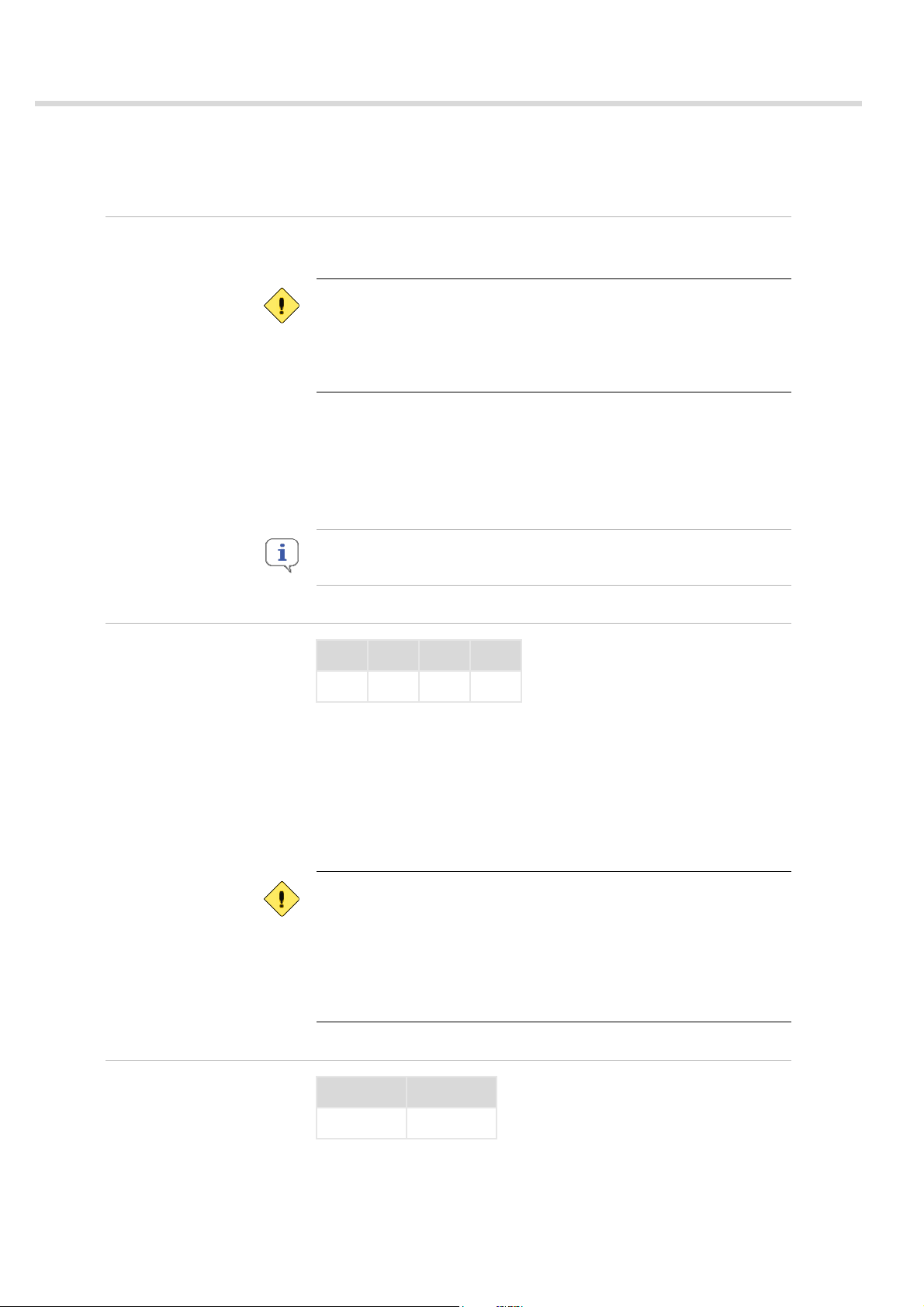
CLA INS P1 P2
Response
’A0’ '10' ’00’
P2 Specifies the merge parameter. Several templates can be merged into
one large template before sending the master template to the smart card
processor.
’00’
Final enroll command
’01’
Non-final enroll command
Non-final enroll commands grab images, but extracted characteristic features are stored in the internal RAM of StarSign Bio Token 3.1 M and not
on the smart card processor.
The final enroll command grabs a final image, extracts features, assembles or merges these features with the features in the internal RAM of
StarSign Bio Token 3.1 M and finally stores them on the smart card processor.
SW1 SW2
'90' '00'
10 of 23 Reference Manual StarSign Bio Token 3.1 M/Edition 07.2007
ID No. 30023721
Page 16

Commands
ENROLL FINGERPRINT
Status Bytes
This command may return one of the following status bytes.
Code Description
'65 81' Memory failure
'69 82' Security status not satisfied
'69 86' Command not allowed (no current EF)
'6A 84' Not enough memory space
'90 00' Successful operation
'A7 00' General ARM7 error
'A7 01' Unknown instruction
'A7 02' Length error
'A7 11' Timeout error
'A7 12' Sweep too slow
'A7 13' Sweep too fast
'A7 14' Sweep not straight
'A7 15' Sweep too short
'A7 16' Too many defect lines on sensor
'A7 17' Image quality too bad
'A7 18' Too few features
'A7 19' Merge failed
'A7 1A' Try again error
'A7 1B' Resync error
'A7 1C' Maximum number of merges exceeded
'A7 1D' Sweep not smooth
'A7 81' Invalid parameter
Reference Manual StarSign Bio Token 3.1 M/Edition 07.2007 11 of 23
ID No. 30023721
Page 17
Commands
VERIFY FINGERPRINT
2.2 VERIFY FINGERPRINT
Scope
Command
VERIFY FINGERPRINT is used to verify a user’s fingerprint. It initiates fingerprint image acquisition, processing and feature extraction.
The features are sent to the smart card processor for on-card verification
and the outcome is reported in the response APDU to the host.
The command performs the following:
– Scans an image
– Generates a template and transmits it to the smart card processor,
where it is compared with the reference template via the VERIFY
command (see ’2.1 ENROLL FINGERPRINT’ on page 10).
Biometric threshold, retry counter and access rules have to be configured
in the file system of STARCOS. For details see STARCOS 3.0 reference
manual edition 06/2005 or later.
CLA INS P1 P2
’A0’ '20' ’00’
P2 Specifies the Key Identifier (KID) used to reference the biometric data
stored in the smart card processor during the enrollment phase (see ’2.1
ENROLL FINGERPRINT’ on page 10).
Response
Status Bytes
SW1 SW2
’90’ ’00’
This command may return one of the following status bytes.
Code Description
'63 Cx' Verification failed (x represents the number of remaining
retries)
'64 00' File or data missing; enrollment file corrupt
'69 82' Security status not satisfied
'69 83' Authentication method blocked
'69 85' Conditions of use not satisfied
'6A 82' File not found
'6A 88' Referenced data not found
'90 00' Successful operation
'A7 00' General ARM7 error
'A7 01' Unknown instruction
12 of 23 Reference Manual StarSign Bio Token 3.1 M/Edition 07.2007
ID No. 30023721
Page 18

Code Description
'A7 02' Length error
'A7 11' Timeout error
'A7 12' Sweep too slow
'A7 13' Sweep too fast
'A7 14' Sweep not straight
'A7 15' Sweep too short
'A7 16' Too many defect lines on sensor
'A7 17' Image quality too bad
'A7 18' Too few features
'A7 19' Merge failed
'A7 1A' Try again error
'A7 1B' Resync error
'A7 1D' Sweep not smooth
'A7 20' General verify fingerprint error
'A7 81' Invalid parameter
Commands
VERIFY FINGERPRINT
Reference Manual StarSign Bio Token 3.1 M/Edition 07.2007 13 of 23
ID No. 30023721
Page 19

Commands
VERSION INFO
2.3 VERSION INFO
Scope
Command
Response
VERSION INFO is used to request public information on StarSign Bio Token 3.1 M from the host.
Parameter P2 of the command APDU specifies the item tag of the version
information to be retrieved. The response data returns the requested version information.
CLA INS P1 P2 L
’A0’ '8A' ’00’
P2 Specifies the item tag of the version information
’01’
StarSign Bio Token 3.1 M firmware version, build date and time
’02’
Key info: CRC of currently valid authentication key
L
Specifies the expected length: ’00’ ≤ length ≤ ’80’
e
’00’
Returns the maximum available data
DATA SW1 SW2
e
Status Bytes
Response
string
This command may return one of the following status bytes.
Code Description
'90 00' Successful operation
'A7 00' General ARM7 error
'A7 01' Unknown instruction
'A7 02' Length error
'A7 81' Invalid parameter
'A7 8A' General version info error
’90’ ’00’
14 of 23 Reference Manual StarSign Bio Token 3.1 M/Edition 07.2007
ID No. 30023721
Page 20

Appendix
The appendix contains additional information on StarSign Bio Token 3.1
M.
Appendix
Contents
A Overview of Status Bytes ......................................................... 16
B Technical Specifications........................................................... 18
C Reference Literature ................................................................ 19
D Glossary .................................................................................. 20
Index ............................................................................................... 23
Reference Manual StarSign Bio Token 3.1 M/Edition 07.2007 15 of 23
ID No. 30023721
Page 21

Appendix
Overview of Status Bytes
A Overview of Status Bytes
Return Codes
For error codes not defined in the following see the STARCOS 3.0 reference manual.
The following error codes are defined.
Status
Bytes
’63 Cx’ Counter provided by ’X’
’64 00’ State of non-volatile
’65 81’ Memory failure
’69 82’ Security status not satis-
’69 85’ Conditions of use not sat-
’69 86’ Command not allowed
’6A 84’ Not enough memory
’A7 00’ SW_ARM7 General error
’A7 01’ SW_UNKNOWN_INSTRUCTION Unknown instruction
’A7 02’ SW_LENGTH_ERROR Length error
’A7 11’ SW_TIMEOUT Timeout error
’A7 12’ SW_SWEEP_TOO_SLOW Sweep too slow
’A7 13’ SW_SWEEP_TOO_FAST Sweep too fast
’A7 14’ SW_SWEEP_NOT_STRAIGHT Sweep not straight
’A7 15’ SW_SWEEP_TOO_SHORT Sweep too short
’A7 16’ SW_SENSOR_DEFECT Too many defect lines on
’A7 17’ SW_IMG_QUALITY_TOO_BAD Image quality too bad
’A7 18’ SW_TOO_FEW_FEATURES Too few features
’A7 19’ SW_MERGE_FAILED Merge failed
’A7 1A’ SW_TRY_AGAIN Try again error
Error code Description
(valued from 0 to 15); exact meaning depending
on the command
memory unchanged
(SW2 = ’00’, other values
are RFU)
fied
isfied
(no current EF)
space in the file
sensor
16 of 23 Reference Manual StarSign Bio Token 3.1 M/Edition 07.2007
ID No. 30023721
Page 22

Appendix
Overview of Status Bytes
Status
Error code Description
Bytes
’A7 1B’ SW_IO_ERROR Resync error
’A7 1C’ SW_MAX_MERGE Maximum number of
merges exceeded
’A7 20’ SW_VERIFY_FP General verify fingerprint
error
’A7 81’ SW_INVALID_PARAMETER Invalid parameter
’A7 84’ SW_GET_CHALLENGE_FAILED General get challenge er-
ror
Reference Manual StarSign Bio Token 3.1 M/Edition 07.2007 17 of 23
ID No. 30023721
Page 23

Appendix
Technical Specifications
B Technical Specifications
Scope
Token Housing
Power Consumption
Interfaces
Sensor
This section lists the technical specifications of StarSign Bio Token 3.1 M
StarSign Bio Token 3.1 M housing has the following characteristics.
– dimensions closed: 80 x 17 mm
– dimensions open: 107 x 17 mm
– mechanism to protect sensor and USB interface from wear
250 mA
StarSign Bio Token 3.1 M supports the following interfaces:
– USB 1.1
– PKCS#11 (with middleware)
– MS CAPI 1.0 (CSP) (with middleware)
– CCID
Atmel swipe sensor
Operating System
System Requirements
StarSign Bio Token 3.1 M uses the following operating system with listed
characteristics.
– STARCOS 3.0
– 72 kB EEPROM
– symmetric encryption: DES, 3DES
– asymmetric encryption: RSA-CRT with up to 2048 bits
– security system in accordance with ISO 7816-4
– up to 8 DF levels
– up to 4 logical channels
– secure write
– secure messaging
– memory management
– several authentication options
StarSign Bio Token 3.1 M has the following system requirements.
– IBM PC with Pentium 90 MHz processor or higher
– 32 MB RAM for Windows 2000, 2003 and XP
– free USB port
18 of 23 Reference Manual StarSign Bio Token 3.1 M/Edition 07.2007
ID No. 30023721
Page 24

C Reference Literature
Appendix
Reference Literature
ISO
Other
ISO/IEC 7816-3
Information technology -- Identification cards -- Integrated circuit(s)
cards with contacts -- Part 3: Electronic signals and transmission pro-
tocols
ISO/IEC, 1997 (
ISO/IEC 7816-4
Information technology -- Identification cards -- Integrated circuit(s)
cards with contacts -- Part 4: Interindustry commands for interchange
ISO/IEC, 1995 (
ISO/IEC 7816-11
Identification cards - Integrated circuit cards - Part 11: Personal verifi-
cation through biometric methods
ISO/IEC, 2004 (
ISO/IEC FDIS 19794-2
Information technology - Biometric data interchange formats - Part 2:
Finger minutiae data
ISO/IEC, 2005 (
STARCOS 3.0 Reference Manual
Smart Card Operating System
G&D, ID No. 30017784, 11/2005
http://www.iso.org)
http://www.iso.org)
http://www.iso.org)
http://www.iso.org)
Reference Manual StarSign Bio Token 3.1 M/Edition 07.2007 19 of 23
ID No. 30023721
Page 25

Appendix
Glossary
DGlossary
3DES
The triple-DES algorithm is a modified DES encryption. It consists of
calling the DES algorithm three times in succession, with alternating
encryption and decryption. If the same key is used for all three DES
calls, triple-DES encryption corresponds to a normal DES encryption.
However, if two or three different keys are used, triple-DES encryption is significantly stronger than a single DES encryption.
CAPI
Cryptographic Application Programming Inteface
CRC
Cyclic Redundancy Check
A simple and widely used form of EDC (Error Detection Code) for the
protection of data. The CRC must be computed using an initial value
and a divider polynomial before it can be used.
CSP
Cryptographic Service Provider
Cryptographic support for Microsoft and other CryptoAPI products.
DES
Data Encryption Standard
A standard cryptographic algorithm specified as DEA in ISO 873-1.
An algorithm for symmetric cryptography. Now used as triple DES
(see 3DES) in EMV operations, e.g., ARQC generation, where data is
encrypted using the first half of a double length key, is decrypted using the second half, then re-encrypted using the first half again.
EF
Elementary File
EFs represent the actual data storage in the file tree of a smart card.
EFs contain one of the following internal file structures: Transparent,
Linear Fixed, Linear Variable or Cyclic.
FAR
False Acceptance Rate
Due to the nature of biometrics there is a slight possibility that an unauthorized user is granted access to a system protected by biometrics.
FRR
False Rejection Rate
Due to the nature of biometrics there is a slight possibility that a legitimate user is denied access to a system protected by biometrics.
KID
Key and algorithm identifier for authentication (C/CC/DS).
PKCS
Public Key Cryptography Standards
Key component in public key cryptosystems; used to verify digital signatures.
PKI
Public Key Infrastructure
A series of procedures established by a Certification Authority for the
generation, signing, distribution and revocation of the keys used in
an asymmetric cryptography scheme.
20 of 23 Reference Manual StarSign Bio Token 3.1 M/Edition 07.2007
ID No. 30023721
Page 26

RFU
Reserved for Future Use
RSA-CRT
RSA - Chinese Remainder Theorem
Special parameter setting for asymmetric cryptographic algorithm.
STARCOS
Smart Card Chip Card Operating System
Forms the basis of multifunctional smart card applications. STARCOS
enables the implementation of various applications (e.g., electronic
purse, access control to data networks, and digital signatures).Smart
card operating systems control the data transfer, the storage areas,
and process information; they manage the resources and supply all
necessary functions for the operation and administration of a random
number of applications.
USB
Universal Serial Bus
Port not only for connecting external peripheral devices such as key-
board, mouse, scanner, etc., but also USB hubs. These devices can be
added during active operation.
Appendix
Glossary
Reference Manual StarSign Bio Token 3.1 M/Edition 07.2007 21 of 23
ID No. 30023721
Page 27

Appendix
Glossary
22 of 23 Reference Manual StarSign Bio Token 3.1 M/Edition 07.2007
ID No. 30023721
Page 28

Index
Index
A
access rules 5
B
biometrics
introduction 4
C
characteristics 1
conventions 2
E
ENROLL FINGERPRINT 10
enrollment 4
error rates 4
F
features 1
fingerprint verification 4
L
LED status 6
V
verification 4
VERIFY FINGERPRINT 12
VERSION INFO 14
N
notational conventions 2
O
on-card matching 5
operating system 18
R
required knowledge 2
return codes 16
S
standards 1
status bytes 16
system requirements 18
T
target group 2
Reference Manual StarSign Bio Token 3.1 M/Edition 07.2007 23 of 23
ID No. 30023721
 Loading...