

Page 1
Application HYDROTHERM
B.1.1. Total Fat in Milk and Dairy Products
C. Gerhardt GmbH & Co. KG
Cäsariusstraße 97
53639 Königswinter, Germany
@ www.gerhardt.de
© 2022
Page 2

B.1.1. HYDROTHERM Total Fat in Milk and Dairy Products
Application B.1.1.HT HYDROTHERM Total Fat in Milk and Dairy Products
23.08.2020 • Rev.: A • Page 2 of 8
1 Principle and Introduction
The sample is heated up with hydrochloric acid to digest protein and free bound lipids.
The digestion solution is filtered. After the drying process, the fat remaining in the filter is
extracted with petroleum ether. The solvent is distilled and the dried residue is weighed.
The fat content is calculated from the difference between initial sample weight and the
extract.
2 Methods
This application note is meant to be a guideline for the operation of your C. Gerhardt
analysis system and has to be adapted to your sample matrix and the local peculiarities
in your laboratory.
This document is based on the following official methods:
• Amtliche Sammlung von Untersuchungsverfahren nach § 64 LFGB (vormals
§ 35 LMBG), L 01.00- 20 Bestimmung des Fettgehaltes von Milch und
Milchprodukten, Verfahren nach Weibull, Mai 1988
• AOAC 989.04: Fat in raw milk
• AOAC 989.05: Fat in milk
3 Chemicals and material
Quality p. a.
• Water: demineralized or distilled
• Hydrochloric acid HCl, 15 %
• Petroleum ether, boiling range 40 to 60 °C
• pH indicator paper
• Silica order number Nr. 14-0022, 25 g absorbent for liquid
samples, alt. Silica Supelco 18514 (Sigma- Aldrich)
• Disposable syringe, 5 ml
• HT Weighing Paper for HYDROTHERM, cat. no. 1004939
• Folded filter FF240, order number 1004092
• Extraction thimbles 33 x 80 mm, order number 13-0054
• Extraction thimbles 33 x 94 mm, order number 13-0057
• Cotton wool, chemically pure and defatted
4 Instruments
• Analytical balance, precision 0.1 mg
• Water bath
• Desiccator with drying agent, e.g. silica gel blue
• HYDROTHERM HT 6 hydrolysis system
• SOXTHERM extraction system micro/macro with control unit MULTISTAT order
• Drying oven, heated electrically, with natural aeration and automatic temperature
number 13-0011 or SOXTHERM-Manager order number 13-0012
control
Page 3

B.1.1. HYDROTHERM Total Fat in Milk and Dairy Products
Application B.1.1.HT HYDROTHERM Total Fat in Milk and Dairy Products
23.08.2020 • Rev.: A • Page 3 of 8
5 Procedure
5.1. Sample preparation
Fill 3-5 boiling stones into each extraction beaker and leave the beakers in the drying
oven at 100 ± 2 °C for 1 hour. After that, allow the beakers to cool down to room
temperature in the desiccator and weigh them with an accuracy of 1 mg.
Store the sample closed at 2 - 6 °C to prevent any spoilage or alteration of its
composition. Before weighing, stir the sample thoroughly with the help of a spoon to
achieve an even fat distribution. Place the sample in a beaker glass and warm it in a
35 °C water bath to approx. 30 °C. Keep the sample at this temperature for a few
minutes and carefully stir from time to time. Allow cooling down to room temperature and
weigh with samples using a disposable syringe. Solid samples like cheese should be
mixed with the universal mixer (“Moulinette”) and weighted in with the HYDROTHERM
weighing paper.
5.2. Hydrolysis
The sample size depends on the expected fat content. The amount of extracted fat should
be around 0.5 – 1.5 g (see product table Point 10.)
Thus, up to 10 g sample is weighed into a weighing paper (3.7.) and put into the hydrolysis
beaker (± 0.1 mg precision). Liquid samples are weighted into the beaker directly.
The beaker containing the sample is inserted in the HYDROTHERM and is locked.
Start use of the HYDROTHERM unit following the instruction manual.
A dry folded filter (3.8.) is placed into the instrument. Then the apparatus is closed and the
method can be started.
The hydrochloric acid (3.2.) is added automatically. The liquid is quickly brought to boil and
simmered with reduced heating capacity for about 1 h. At the end of the hydrolysis the
digestion mixture is diluted with hot water and is then immediately filtered through a folded
filter, which has been moistened automatically by the system with hot water. The beaker,
the condenser and the filtration components are rinsed several times with hot water. The
filter is rinsed with hot water till the backwash water has a neutral reaction.
HYDROTHERM performs all these steps automatically.
Page 4
B.1.1. HYDROTHERM Total Fat in Milk and Dairy Products
Application B.1.1.HT HYDROTHERM Total Fat in Milk and Dairy Products
23.08.2020 • Rev.: A • Page 4 of 8
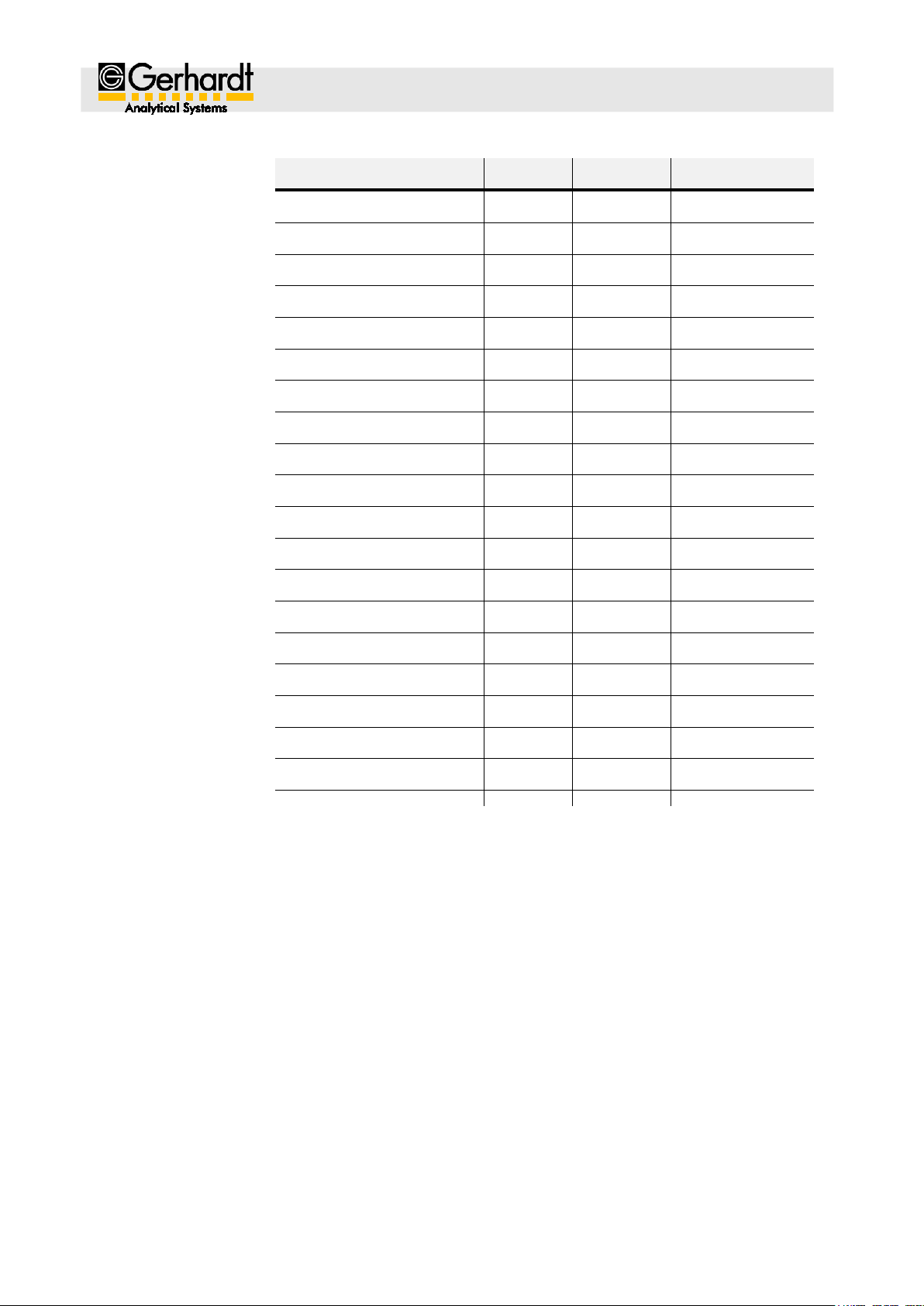
Table 1: Recommended parameters and settings: HYDROTHERM Best Practice
Parameter Setting Scale unit Note
Filling levels
HCl amount 100 ml
H2O amount / dilution
50 ml
Heating / cooling phases
Heat-up phase 12 min
Boiling phase 1 20 min Power 50%
Boiling phase 2 30 min Power 70%
Cooling down phase - duration 15 min
Filter moisture
Number of moisture cycles 3
Moisture amount per cycle 30 ml
Filter phase
Filter wait time 5 s
Rinsing cycles 20
Pipe opening time 200 ms
Sample rinse time 10 s
Sample shower - amount 30 ml
Condenser shower - amount 30 ml
Filter shower - amount 50 ml
After the program is completed, place the wet filters on a watch glass and leave them to
dry at room temperature overnight. Alternatively dry the filters approximately 1.5 h at
103 ± 2°C in a drying oven. A higher temperature could lead to a loss of easy volatile
fatty acids. Extract the folded filters immediately after drying or store them in a desiccator
before the extraction. As moisture could eventually affect the result, add sodium sulphate
(approx. a half tea spoon) to the sample into the extraction thimble.
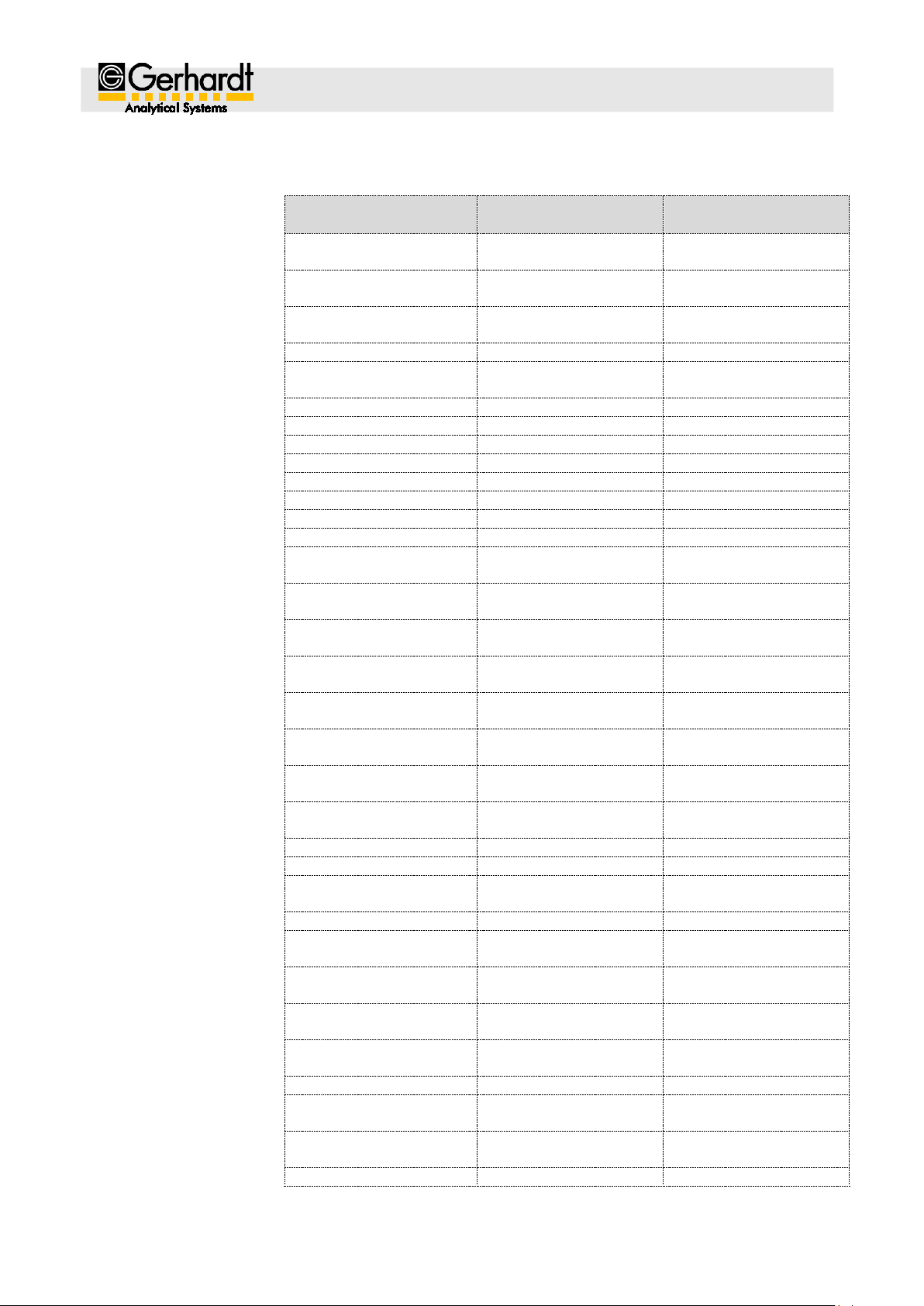
The values given in the attachment can be used as orientation for the sample weight.
Page 5
B.1.1. HYDROTHERM Total Fat in Milk and Dairy Products
Application B.1.1.HT HYDROTHERM Total Fat in Milk and Dairy Products
23.08.2020 • Rev.: A • Page 5 of 8
33 x 94 mm /13-0057
Parameter
completely
After phase A the solvent level
the thimble
extraction agent.
5.3. Extraction
After cooling, place the filter in the extraction thimble and cover him with cotton wool. In
case any fat traces remain on the watch glass, moisten cotton wool with the extraction
solvent to absorb the fat and place the wet cotton wool inside the thimble.
Add 150 ml solvent (SOXTHERM macro) or 100 ml solvent (SOXTHERM micro) and
extract samples with the following program:
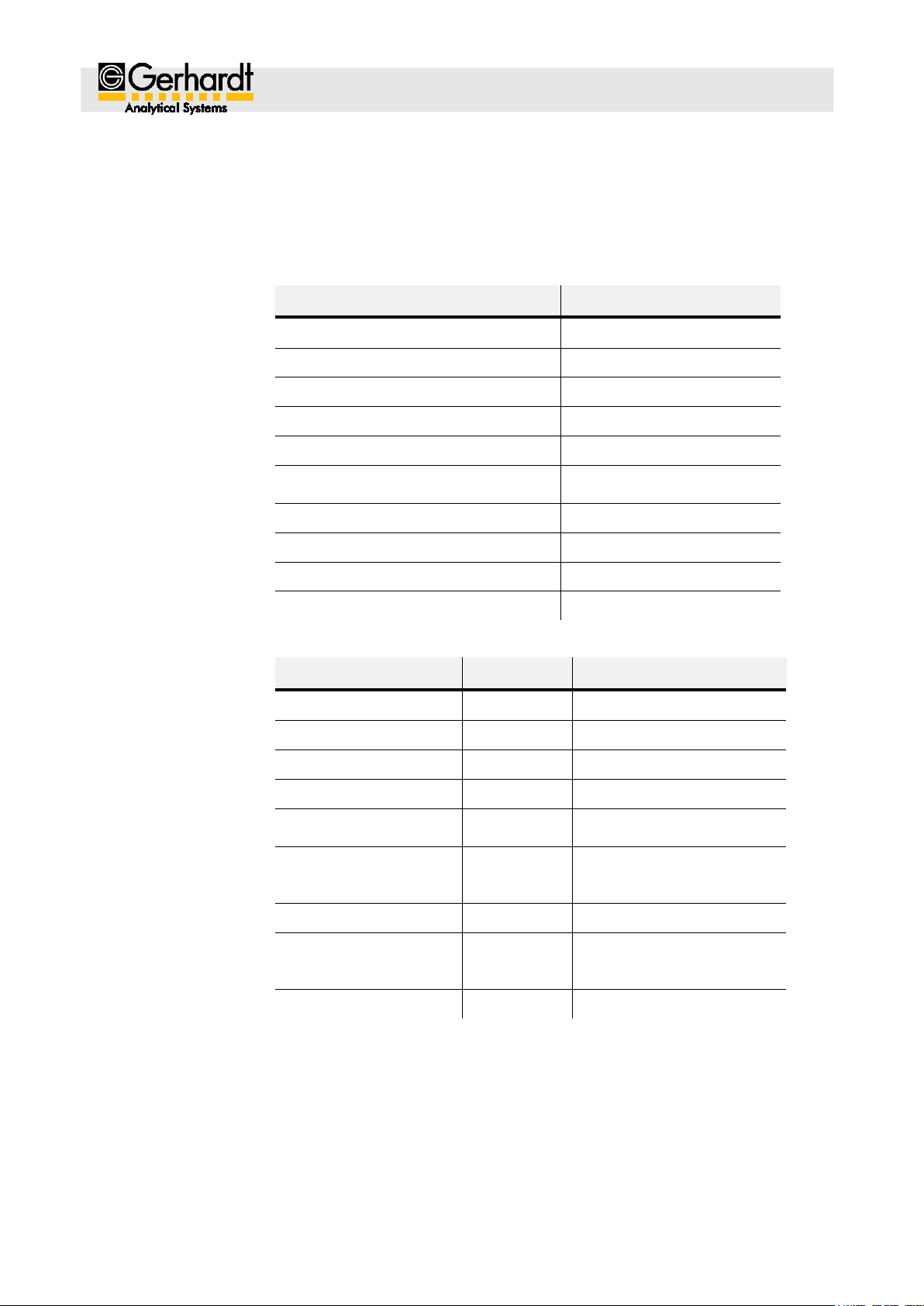
Table 2: Instrument configuration SOXTHERM
Parameter Note / Order number
Solvent Petroleum ether
Boiling point/range 40-60 °C
Solvent amount 100 ml SOXTHERM micro
150 ml SOXTHERM macro
Sealing type Viton / 1000578
Extraction thimbles
Thimble holders SHK2 /13-0062
Boiling stones 13-0047
33 x 80 mm /13-0054
Compressor / Connection compressed air 13-0010, minimum 4.5 bar
Water connection / Chiller minimum 0.5 bar
Table 3: SOXTHERM Program
Program step
T-classification 200 °C
Extraction temperature 150 °C
Reduction interval 4 min.
Reduction pulse 2 s
Hot extraction 30 min
Evaporation A
Rinsing time 60 min.
Evaporation B
Evaporation C 4 min.
4-5 x interval
3-4 x Intervall
Note
Sample must be immersed
should be at least 10 mm below
After B the extraction beaker
should be widely free of
Page 6

B.1.1. HYDROTHERM Total Fat in Milk and Dairy Products
Application B.1.1.HT HYDROTHERM Total Fat in Milk and Dairy Products
23.08.2020 • Rev.: A • Page 6 of 8
After the extraction program is finished, leave extraction beakers in the drying oven for
30 minutes at a temperature of 103 ± 2 °C. After that place the extraction beakers in the
desiccator, allow cooling down to room temperature and weigh them out with an
accuracy of 1 mg.
In order to check the weight consistency, dry the samples for another 30 minutes and
weigh again after cooling down. Repeat this procedure until the difference between two
successive weighings does not exceed 1 mg of the final extract weight. Should the
weight increase, take the previous lower value.
Extraction, drying and weighing should be performed consecutively, without interruption.
6 Evaluation
6.1. Calculation
The total fat content w in g/100 g (corresponds to %) of the sample is calculated using
the following equation:
m1: mass of the empty extraction beaker with boiling stones [g]
m2: mass of the extraction beaker with fat after drying [g]
=
(
m2 – 1) ∗ 100
M0
The result is rounded to one decimal place.
6.2. Reproducibility (strawberry yoghurt, 3,3 % fat content)
r = 0.10 g/100 g s(r) = ± 0.035
6.3. Comparability
R = 0.20 g/100 g s(R) = ± 0.071 %
mo: initial sample weight [g]
Page 7
B.1.1. HYDROTHERM Total Fat in Milk and Dairy Products
Application B.1.1.HT HYDROTHERM Total Fat in Milk and Dairy Products
23.08.2020 • Rev.: A • Page 7 of 8
Sample Type
Amount of Sample
[g] +/- 5 %
Theoretical Fat Content
Cow’s milk, Whole milk
(Raw milk)
10.000
3.60 – 3.88
Cow’s milk, Consumer
milk min. 3.5 % fat content
10.000
3.50 – 3.62
Cow’s milk, reduced fat
>1.5 % <1.8 % fat content
10.000
1.50 – 1.80
Cow’s milk, Skimmed milk
10.000
0.02 – 0.12
Cow’s milk, UHT (ultra
high temperature heated)
10.000
3.60 – 3.88
Cow’s milk, boiled
10.000
2.95
Cow’s milk, sterilized
10.000
3.60 – 3.88
Buffalo milk
5.000
6.37 –13.70
Donkey milk (Asses milk)
10.000
0.54 – 1.50
Camel milk
10.000
3.90 – 4.30
Ewe’s milk (Sheep milk)
5.000
2.00 – 13.00
Mare’s milk (Horse milk)
5.000
1.30 – 2.00
Goat’s milk
5.000
3.40 – 5.10
Condensed milk, min. 7.5
% fat content
5.000
7.50 – 7.76
Condensed milk, min. 10
% fat content
5.000
10.00 – 10.30
Condensed milk,
sweetened
5.000
8.40 – 9.00
Condensed skimmed milk,
sweetened
10.000
0.10 – 0.30
Dried whole milk (Milk
powder)
3.000
24.60 – 26.80
Dried skimmed milk
(Skimmed milk powder)
10.000
0.50 – 1.50
Cream min. 10 % fat
content (Single cream)
5.000
10.10 – 11.20
Cream min. 30 % fat
content (Whipping cream)
2.500
30.00 – 33.00
Sour cream
5.000
18.00
Buttermilk
10.000
0.28 – 0.74
Dried butter milk
(Buttermilk powder)
10.000
1.55 – 3.00
Whey, sweet
10.000
0.06 – 0.80
Dried whey (Whey
powder)
10.000
1.20
Yogurt, min. 3.5 % fat
content
10.000
3.50 – 4.12
Yogurt, reduced fat, >1.5
%<1.8 % fat content
10.000
1.50 – 1.80
Yogurt, low fat, max. 0.3
% fat content
10.000
0.04 – 0.30
Yogurt with fruits, full fat
10.000
2.62
Yogurt with fruits, reduced
fat
10.000
1.33
Yogurt with fruits,
skimmed
10.000
0.11
Kefir
10.000
3.50
7. Product Tables
7.1. Product Table Milk
[%]
Page 8
B.1.1. HYDROTHERM Total Fat in Milk and Dairy Products
Application B.1.1.HT HYDROTHERM Total Fat in Milk and Dairy Products
23.08.2020 • Rev.: A • Page 8 of 8
Sample Type
Amount of Sample
[g] +/- 5 %
Theoretical Fat Content
Bel Paese cheese
2.000
30.20
Brie cheese (Cream
dry matter
2.000
23.00 – 32.00
„Butterkaese“, 50 % fat
content in dry matter
2.000
25.00 – 29.70
Camembert Cheese, 30
matter
5.000
11.40 – 14.00
Camembert Cheese, 40
matter
3.000
16.80 – 21.60
Camembert Cheese, 45
matter
3.000
19.80 – 23.30
Camembert Cheese, 50
matter
3.000
23.00 – 27.10
Camembert Cheese, 60
matter
2.000
31.20 – 35.30
Cheddar cheese
fat content in dry matter
2.000
31.00 – 34.50
Cottage cheese
10.000
4.30
Edam cheese, 30 % fat
content in dry matter
3.000
14.70 – 18.70
Edam cheese, 40 % fat
content in dry matter
2.000
21.20 – 25.40
Edam cheese, 45 % fat
content in dry matter
2.000
24.80 – 28.80
Blue cheese, 50 % fat
content in dry matter
2.000
25.50 – 32.00
Emmental cheese, 45 %
fat content in dry matter
2.000
27.90 – 32.00
Feta cheese, 45 % fat
content in dry matter
3.000
18.10
Fresh cheese, 50 % fat
content in dry matter
3.000
22.50 – 24.60
Fresh cheese, min. 60 %,
dry matter
2.000
27.40 – 35.20
Gorgonzola cheese
2.000
31.20
Gouda cheese, 45 % fat
content in dry matter
2.000
28.60 – 30.40
Gruyère cheese
2.000
32.30
Limburger cheese, 20 %
fat content in dry matter
5.000
7.00 – 9.32
Limburger cheese, 40 %
fat content in dry matter
3.000
16.80 – 20.80
Mozzarella cheese
4.000
16.10
Münster cheese, 45 % fat
content in dry matter
3.000
22.00 – 23.50
7.2. Product Table Cheese
brie), 50 % fat content in
% fat content in dry
% fat content in dry
% fat content in dry
% fat content in dry
[%]
% fat content in dry
(Chester cheese) 50 %
max 85 % fat content in
Page 9
B.1.1. HYDROTHERM Total Fat in Milk and Dairy Products
Application B.1.1.HT HYDROTHERM Total Fat in Milk and Dairy Products
23.08.2020 • Rev.: A • Page 9 of 8
Münster cheese, 50 % fat
content in dry matter
3.000
24.40 – 27.30
Parmesan cheese
2.000
22.00 – 29.70
Provolone cheese
2.000
28.90
Ricotta cheese
3.000
15.00
Romadur cheese, 20 %
fat content in dry matter
6.000
7.00 – 11.40
Romadur cheese, 30 %
fat content in dry matter
5.000
11.40 – 14.30
Romadur cheese, 40 %
fat content in dry matter
3.000
16.80 – 20.60
Romadur cheese, 45 %
fat content in dry matter
3.000
19.80 – 23.90
Romadur cheese, 50 %
fat content in dry matter
3.000
23.00 – 26.20
Roquefort cheese
2.000
30.60
Acid curd cheese, max
matter
10.000
0.35 – 1.30
Layered cheese, 10 % fat
content in dry matter
10.000
2.25 – 2.62
Layered cheese, 20 % fat
content in dry matter
5.000
4.33 - 5.46
Layered cheese, 40 % fat
content in dry matter
5.000
10.50 – 12.10
Processed cheese, 45 %
fat content in dry matter
3.000
22.60 – 24.70
Processed cheese, 60 %
fat content in dry matter
2.000
28.20 – 33.60
Quark, fresh cheese,
from skim milk
10.000
0.15 – 0.50
Quark, fresh cheese, 20
matter
10.000
4.70 – 5.50
Quark, fresh cheese, 40
matter
5.000
10.30 – 12.50
Tilsit cheese, 30 % fat
content in dry matter
3.000
14.70 – 17.50
Tilsit cheese, 45 % fat
content in dry matter
2.000
24.80 – 29.40
10 % fat content in dry
% fat content in dry
% fat content in dry
Page 10
B.1.1. HYDROTHERM Total Fat in Milk and Dairy Products
Application B.1.1.HT HYDROTHERM Total Fat in Milk and Dairy Products
23.08.2020 • Rev.: A • Page 10 of 8
→recovery too low
hotplate
No boiling bubbles ascending at the end of
boiling →recovery too low
The screw connect (screw cap GL 18) is
hydrolysis beaker plane on the hotplate
Due to delays in boiling fat is sticking to the lid
low
Fat is remaining in the hydrolysis beaker→
Increase rinsing cycles; add 0,2g +/-
get it clean after filtration
necessary to set it again to 15 minutes.
Fat is lost to the waste tank → recovery is too
During the filtration the whole fat isn´t
double folded filter
Clean hydrolysis beaker before starting
clean before starting hydrolysis
the usual drying time
oxygenized and mass increases
Drying time too long, fat is oxygenized and
mass increases
weighing and cooling off process
Solvent is used several times; it has taken up
fat which is detected, too.
Check blank value of the solvent
Check whether the fat film is clear
spills over
8. Troubleshooting Hydrolysis
Cause Remedy
Sample with hydrochloric acid is not boiling
well, sample won´t be hydrolyzed completely
the hydrolysis beaker overflow, no continuous
which won´t be transferred → recovery too
Recovery is too low during the fat extraction
Fat is burnt in the hydrolysis beaker Reduce boiling power. If the cool down
low during the fat extraction
Hydrolysis beaker is dirty → recovery too high
Increase boiling power; be sure that the
hydrolysis beaker is well placed at the
not tight; screw it tight, place the
Reduce boiling power and/or sample
weight
0,05 of Silica to the hydrolysis beaker to
duration was reduced it´s absolutely
collected completely in the folded filter;
reduce sample weight and/or take a
hydrolysis; control the beaker if it is
9 Troubleshooting Extraction
9.1 Results too high
Cause Remedy
Water in the sample, water drops swim on the
fat surface, fat can’t be concentrated within
Too high temperature in the drying oven, fat is
Extraction beaker is dirty
Parts of the thimble or sample residue are left
in the extraction beaker
Filter or sample must be dry when they
are put in
Check temperature of the drying oven
Observe needed drying time
Work as clean as possible in drying,
Check whether the thimble is porous
Check whether the grinding of the
sample is too fine. Use a second filter
Thimble is too impermeable, sample
Page 11
B.1.1. HYDROTHERM Total Fat in Milk and Dairy Products
Application B.1.1.HT HYDROTHERM Total Fat in Milk and Dairy Products
23.08.2020 • Rev.: A • Page 11 of 8
Incomplete extraction
Extract thimble again
Change thimble
surface e.g. by using sodium sulphate
Wrong or missing boiling stones, glass
extraction temperature
Check for leakages in the apparatus at
O-rings and connectors
Delayed boiling during extraction, sample
residues may stick to the teflon connector
Delayed boiling because of usage of glass
beads
Filtration problems, paper filter was not evenly
washing solution
9.2 Results too low
Cause Remedy
Incomplete extraction
Incomplete extraction
Cooling off time too short Follow correct weighing procedure
Boiling delay during concentration process, fat
splashes can be found in the thimble
Flowrate cannot be achieved because of
too low permeability of the thimble.
Sample sticks together, enlarge the
beads cannot be used.
Heating power too high, reduce the
9.3 Varying Results
Cause Remedy
Uneven extraction due to solvent losses
Use boiling stones
Use standard boiling stones
wetted, fat losses because of fat running
through. Can be seen from fat residues in the
Make sure filter in HYDROTHERM is
wetted evenly
Page 12
B.1.1. HYDROTHERM Total Fat in Milk and Dairy Products
Application B.1.1.HT HYDROTHERM Total Fat in Milk and Dairy Products
23.08.2020 • Rev.: A • Page 12 of 8
COMPREHENSIVE APPLICATION DATA BASE
C. Gerhardt offers a wide range of application notes for many methods and procedures.
Please contact our application lab team via [email protected] for deeper
information on:
•
Nitrogen in food and feed samples according to Kjeldahl and Dumas
•
Crude fibre, ADF and NDF in feed
•
Fat in food and feed
•
Alcohol determination
•
Total cyanide in water
•
Trace metal in soil and sludge
•
COD determination in water
•
Total nitrogen determination in water, soil and plants
•
Many more application notes on request.
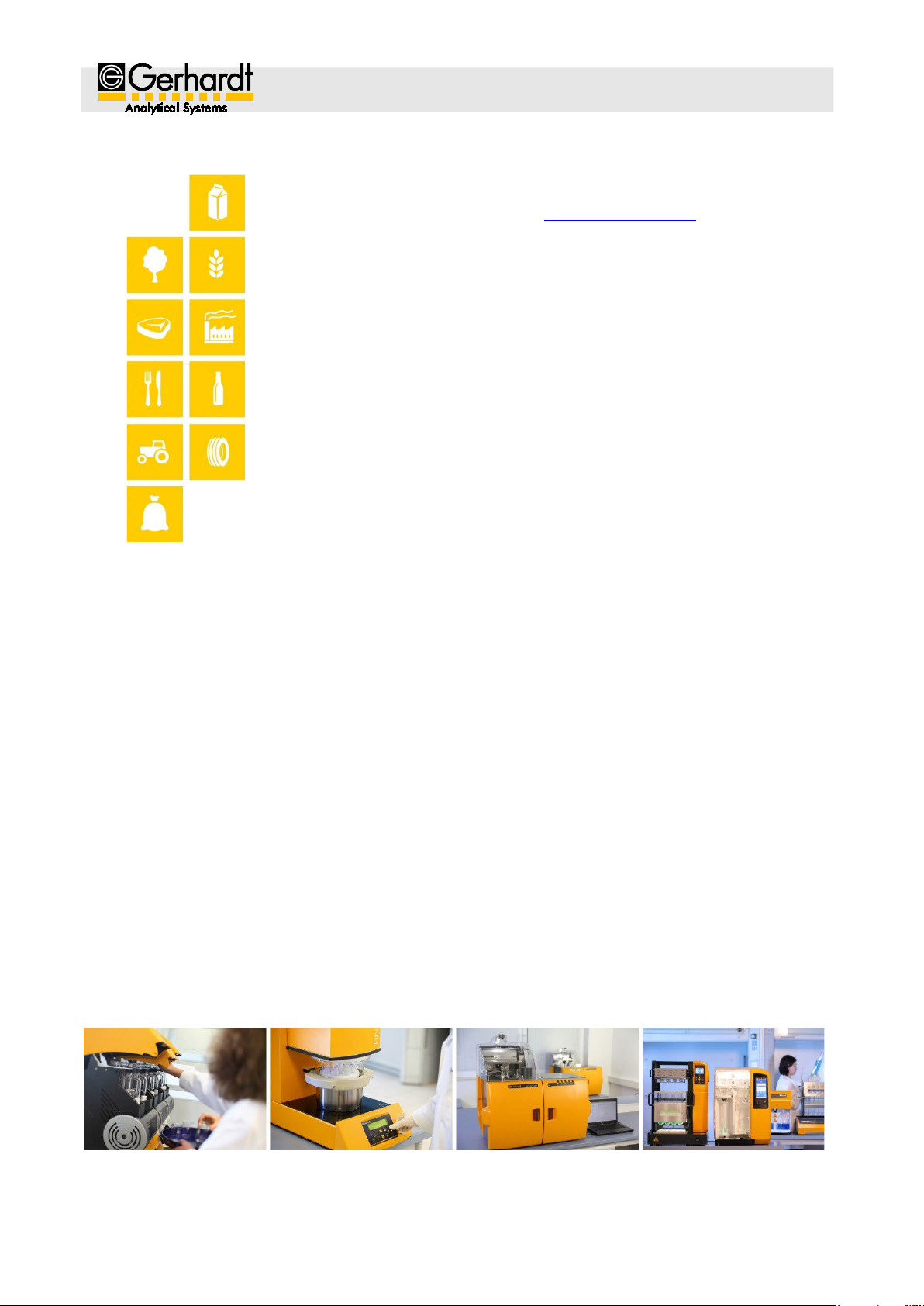
An excerpt from our product portfolio
Fully AUTOMATIC HYDROLYSIS
HYDROTHERM – automatic acid hydrolysis system for fat determination according to
Weibull-Stoldt. When combined with SOXTHERM, HYDROTHERM is an ideal system
solution for total fat determination.
Fully AUTOMATIC FAT EXTRACTION
SOXTHERM– automatic fast extraction system for fat determination.
Fully AUTOMATIC WATER STEAM DISTILLATION
VAPODEST – fast distillation system for Kjeldahl nitrogen/ protein
determination and steam distillation as sample preparation for
further analysis.
COMPLETELY AUTOMATIC NITROGEN ANALYSIS
DUMATHERM – nitrogen/protein determination of solid and
liquid samples according to the Dumas combustion method.
A fast and convenient alternative to the classic Kjeldahl method
for almost all sample matrices.
AUTOMATED CRUDE FIBRE DETERMINATION
FIBRETHERM – completely automated processing of the boiling and filtration
processes for determining crude fibre, ADF and NDF.
www.gerhardt.de
 Loading...