

Page 1

Epiphone Guitar Co.
A part of the Gibson family of brands
1510 Elm Hill Pike, Suite 212
Nashville, Tennessee
37210 USA
www.epiphone.com
In order to continually improve the quality and/or performance of our instruments
and/or to make use of the best available components, Epiphone reserves the right
to change prices and specifications without notice.
E-CAT13
All Epiphone products are guaranteed and backed by
Gibson Musical Instruments 24/7 Customer Service
at 1-800-444-2766 - Toll-Free USA only.
In Europe at 00+800-444-2766-1.
In China at 1-800-820-8841.
IM Gibson Customer Service at
See warranty card for details or visit www.epiphone.com.
Guarantee varies country to country.
Check your authorized Epiphone retailer for details.
Page 2

CATALOG 2013
Page 3

The Epiphone Story
Epiphone is one of America's oldest and most revered instrument makers. Since 1873,
Epiphone has made instruments for every style of popular music and in 2013 will celebrate its
140th anniversary.
The name Epiphone evokes both history and the spirit of invention. The “House of
Stathopoulo” has played a central role in every great musical era from the mandolin craze of the
early 1900s to jazz age guitars of the 1920s; from swing era archtops through post-war pop,
jazz, r&b, and early rock n' roll; and from the "British Invasion" to heavy metal, punk, grunge, and
thrash. And now, in the 21st century, new Epiphone technical breakthroughs such as the
ProBucker™ pickup, series parallel switching, built-in KillSwitch™ pots, the Shadow NanoFlex™
and NanoMag™ pickup systems, and premier acoustic/electric guitars with the eSonic™ preamp have brought Epiphone to a new generation.
The story behind Epiphone's improbable rise from a small family repair shop to a worldwide
leader in the manufacture of quality instruments could easily be transformed into the great
American novel. But this story is true.
The story of Epiphone begins in the mountains of Greece and threads its way to Turkey,
across the Atlantic to the immigrant gateway of Ellis Island, and into the nightclubs, recording
studios, and coast-to-coast radio broadcasts of Manhattan in the 1920s and 30s. It's the story
of both hard earned craftsmanship passed from father to son and the ceaseless American
drive for innovation.
The variety of musicians that walk through Epiphone's history is remarkable. Jazz greats like
George Van Eps, country pioneers like Hank Garland, bluesman John Lee Hooker, and scores of
mandolin, archtop and steel guitar players used Epiphone instruments daily over nationwide
broadcasts. There are unlikely heroes and tinkerers in the Epiphone story too, like guitar pioneer
Les Paul, who worked nights in the Epiphone factory in New York City to create "the Log", his primordial version of what would eventually be called the "Les Paul." The Beatles' bassist extraordi-
THE BEGINNING
The opening chapter of the Epiphone story begins about 140 years ago in Kastania in the mountains overlooking the ancient city of Sparta, Greece. Family legend tells that in 1865,
Kostantinos Stathopoulo left Kastania and journeyed to Magoula in the Eurotas valley to register
the birth of his son, Anastasios. Little else is known of the family until 1873, around the time of
Anastasios's 12th birthday, when the Stathopoulo family left Greece for the coast of Turkey
where they settled in Smyrna, a bustling seaport with a strong Greek immigrant population of
merchants and craftsmen. There, Kostantinos established himself as a lumber merchant.
Kostantinos would often take Anastasios with him on work trips throughout Europe, where the
boy observed his father's trade and learned about tonewoods. During this time, the family established a store in Smyrna selling and repairing lutes, violins and
bouzoukis. By 1890, Anastasio's local reputation as a talented
luthier was providing enough business that he opened his own
instrument factory. He married and started a family. His first
son, Epaminondas, was born in 1893, followed by Alex,
Minnie, Orpheu and Frixo.
High taxes imposed on Greek immigrants under the
Ottoman Empire made life difficult for the Stathopoulo family
and at the age of 40, Anastasios boarded a ship to the United
States. Public records from 1904 list A. Stathopoulo living at
56 Roosevelt on Manhattan's Lower East Side, home to many
other Greek and Italian immigrants. Once in America,
Anastasios continued his instrument trade. He quickly assimilated the pace of American business practices. He filed his
first and only patent March 25, 1909 for an Italian style bowl
back mandolin. Anastasios's instruments now carried labels in
English: A. Stathopoulo
Epi, as the oldest child was known, easily merged into American life, attended Columbia
Manufacturer, repairer
of all kinds
of musical instrument
Patentee of the Orpheum Lyra
New York, 1911 U.S.A.
naire Paul McCartney chose an Epiphone Casino as his first
American made guitar and John Lennon and George
Harrison quickly followed. The Casino appeared on every
Beatles album from Help! through Abbey Road. And today,
Epiphone can be heard on albums by Gary Clark Jr.,
Alabama Shakes, My Chemical Romance, Joe Bonamassa,
Nirvana, Johnny Winter, Zakk Wylde, Machine Head, Dwight
Yoakam, The Strokes, Slash, Jeff Waters, Paul Simon,
Radiohead, The Waco Brothers, Lenny Kravitz, and Paul
Weller.
If a time machine could transport today's Epiphone players to Epi Stathopoulo’s Manhattan showroom of 60 years
ago, when it was a gathering place for all the Big Apple's
best players, generations of musicians would agree that
Epiphone has always been the “House of Stathopoulo.” And
today, Epiphone is still innovating, still delighting musicians,
and still frustrating competitors with daring designs and
superb quality.
"Epiphone always made a good guitar," Les Paul once
said. And that, after all, is what all musicians are looking for.
University, and graduated with honors. With Anastasios crafting
and selling his instruments on the ground floor and family living
upstairs, the line between work and home life became increasingly
blurred. Epi and Orpheus ('Orphie') were soon helping out in the
shop, now located at 247 West 42nd Street.
Epi was only 22 when his father Anastasios died. As the oldest
son, Epi was charged with keeping the business going. Already a
keen student of his father's work and eager to establish himself in
the marketplace, Epi replaced the old instrument label of his
father's with a new one: "The House of Stathopoulo, Quality
Instruments Since 1873." Already an amateur designer and inventor during his apprenticeship, Epi now took a lead role in the company and was granted his first patent for a banjo tone ring and rim
construction - 1,248,196 given to E. A. Stathopoulo.
At his mother's death in 1923, Epi assumed ownership of the controlling shares of the business and phased out most of the old
world style mandolins. Instead, he introduced the Recording line of
banjos, then the most popular instrument in post-World War I
America.
The Recording line was listed in advertisements alphabetically:
Recording (A) at $125, the Bandmaster at $200, the Concert at
$275, and the De Luxe, which sold for $350. Epi continued to
expand as his business and reputation for quality work grew. The
family acquired the "stock, goodwill, and modern machinery" of the
Farovan Company instrument plant in Long Island and incorporated. Epi gave the now growing business a new name--Epiphone.
“Epiphone” referenced not only his own name, but the Greek word
for sound--phone. It was also an echo of the Greek word epiphonous, meaning one sound on another, the son building on the
dreams of the father.
Epi took the title of president and general manager and
announced in trade publications and advertisements that "the
new policy of business and all interest will be devoted to the production of banjos, tenor banjos, banjo mandolins, banjo guitars,
and banjo ukuleles under the registered trademark name of
'Epiphone.'"
Epi retained most of the Long Island factory's skilled workers.
Production increased. Quality improved. Ornate banjo models
were introduced in 1927 including the Emperor tenor banjo
($500), the Dansant ($450), the Concert Special ($300) and the
Alhambra ($200). Business was good and the Stathopoulo brothers, with Orphie now serving as Vice President, moved the company to 235-237 West 47th Street.
By 1928, The Epiphone Banjo Company were making banjos
for Selmer/Conn and the Continental Music line of stores, a
major distributor of instruments. In 1928, Epiphone also intro-
pany that Epi determined was Epiphone's greatest rival, Gibson.
The Recording series of acoustic guitars, like the banjo line, were each identified by a letter
('A' through 'E') and were notable for their unusual body shape. The instruments combined
spruce and laminated maple and were available as an archtop or flattop.
The Recording guitars were not initially a success. One problem was a lack of celebrity
endorsement. The other was a lack of volume. The Recording guitars were too small and
arguably too ornate, particularly in comparison to the size and volume of Gibson's popular L-5,
which was introduced in 1922 and had quickly become popular among new jazz players. The L5 had projection, tone, and complimented rhythm sections with a tuneful timbre and snare drum like attack.
Though banjo sales remained steady immediately
after the stock market crash of 1929, Epi was keenly
aware that archtop guitars were becoming more popular and that his main competitor in quality and design
was Gibson. In 1931, the Epiphone Banjo Company
announced the introduction of the Masterbilt line of
guitars featuring seven carved top, f-hole style archtops ranging in price from $35 to $275.
It wasn't hard to see the L-5's influence on the new
Epiphone line. Epi's guitars had similar f-holes, tuning
machines, and even a name that was similar to the
Gibson Master Model range. Epi did continue to distinguish his company with model names that musicians
could easily remember and be proud to own.
The Epiphone Masterbilt line included the De Luxe
ing the patronage of the most respected players on the scene. Epiphone went inter-continental
with a distribution deal with Handcraft Ltd. of London, and a new showroom opened at 142
West 14th Street in a beaux-arts style building near Little Italy.
The new building included an advertised "state-of-the-art" research and development laboratory. The Epiphone showroom on the first floor was both the company's headquarters and a
hangout for musicians. On Saturday afternoons, Epi would open display cases and let the leading guitarists of the time, artists like Al Caiola, Harry Volpe, and Les Paul, jam as people listened from the sidewalk.
Epi was also aware of the success of Rickenbacker's electric steel guitar models. In 1935,
Epi made his move with the introduction of the Electar Series (originally known as
Electraphone). One of Epi's unique design features was individually adjustable pole pieces on the
Master Pickup. The Electar line furthered the reputation of Epiphone as an innovative brand. By
the late '30s, sales had doubled. Collaborations between Epi and other companies became
more frequent. In July 1936, Epiphone showed off
several new models at the National Association of
Music Merchants (NAMM) show at the Stevens Hotel
in Chicago, including an electrified piano created with
the Meissner Inventions Company in Milburn, New
Jersey. Epiphone also began selling amplifiers after
meeting electronics enthusiast Nat Daniel, a friend of
Les Paul's. Daniel perfected an innovative push/pull
wiring design, which today is a fixture in many guitar
amplifiers. Epiphone reps heard Daniel's amps and
hired him to build chassis as well as new designs.
Daniel would go on to start the Danelectro line of guitars and amps in the ‘50s.
By the end of the '30s, just prior to America's
entry into World War II, the rivalry between Epiphone
and Gibson showed little sign of abating. In 1939, the
two firms introduced similar 'pitch-changing' Hawaiian
guitar designs, a precursor to the pedal steel. When
Gibson introduced a line of violins, Epiphone struck
duced their first line of acoustic guitars to compete with the com-
($275), Broadway ($175), and the Triumph ($125). The
De Luxe, according to advertisements, featured a "carved
spruce top, flame curly maple back, violin construction
throughout, large "f" holes, black and white binding and
sweet resonant tone."
Throughout the 1930s, the rivalry between Epiphone
and Gibson would veer from friendly sparring to all-out guitar warfare. Gibson retaliated with a new archtop design in
1934, increasing the body width of its existing models and
introducing the king-sized Super 400 (named after its
$400 price tag). Not to be outdone, Epi replied the following year with the top-of-the-line Emperor, which raised the
stakes with a slightly wider body and a provocative advertising campaign featuring a nude woman holding an Epiphone
archtop. In 1936, Epiphone struck again, increasing the
size of its De Luxe, Broadway and Triumph models by an
inch making them 3/8" wider than Gibson's archtops and
one of the most distinctive instruments on the market.
By the mid-'30s, Epiphone guitars were considered to
be among the best in the world, and Epi himself was enjoy-
Page 4
back with a line of upright basses. It took the outbreak of the
World War II, the scarcity of key materials, and the virtual
shut down of guitar production around the world to ring the
bell on the rivalry.
HARD TIMES
The war changed everything. Before the bombing of
Pearl Harbor in 1941, Epiphone was a consumer favorite
and industry leader. By the end of the war in 1945, the
company had lost its greatest asset when Epi died of
leukemia. Epiphone shares and control went to younger
brothers Orphie and Frixo.
Problems emerged slowly at first. Epiphone continued to
clash with Gibson, each introducing electric cutaway versions of their top archtops. Pickups continued to be refined
and players continued to appear onstage with Epiphone guitars. From the outside, it seemed to be business as usual.
But cracks soon appeared both on the production line
and in the boardroom. The Stathopoulo brothers argued
over the future of the company and in 1948, Frixo sold his shares to Orphie. The company's reputation for craftsmanship and innovation that Epi had built in the '20s and '30s did not survive
the war years. Tastes were changing and Epiphone's products seemed traditional and out of
step. The Epiphone factory moved from Manhattan to Philadelphia in 1953 to avoid a union
clash, but many of the company's craftsmen refused to leave New York.
EPIPHONE AND GIBSON
In the early '50s, Epiphone's former champion and favorite late night tinkerer Les Paul
became a household name with a television show, a radio program, and chart-topping hits, all
played with his name-brand Gibson Les Paul. Les had been perfecting his solid body guitar
design in the Epiphone factory, and Gibson President Ted McCarty made Les Gibson's first solid
body electric guitar endorser. As Epiphone's fortunes continued to decline, Les suggested
the Gibson line. The entire Epiphone operation was relocated to Kalamazoo, Michigan. Epiphone
was back in business.
A NEW BEGINNING
Epiphone wouldn't stay in the shadow of Gibson for
long. When a new line of instruments started filtering
through to dealers in 1958, it became clear that the
two brands had separate identities. On one hand,
Epiphone now listed budget-conscious versions of existing Gibson models. Alongside these models, however,
were also recreations of classic Epiphone designs such
as the Emperor, Deluxe and Triumph along with a selection of new designs like the semi-hollow Sheraton, the
solid body Moderne Black, and flat-top acoustics like the
Frontier, whose square-shouldered body style was a
first for any instrument from the Gibson Kalamazoo factory. Combined with a new line of amplifiers, Epiphone
designers established their independence.
The grand unveiling of the Epiphone line took place at
the NAMM trade show in July 1958 with the electric
Emperor as the flagship model. The show itself would generate orders of 226 guitars and 63
amps, a modest return. But over the next few years, Epiphone would sell 3,798 instruments in
1961 and by 1965 would account for 20% of the total instruments shipped out of Kalamazoo.
Even more impressive was the prestige of the guitars themselves. In the early 1960s, the
Epiphone Emperor cost significantly more than the top-of-the-range Gibson Byrdland, while
McCarty reach out to Epiphone. McCarty took the advice
and called Orphie, expressing Gibson's interest in
Epiphone's critically acclaimed upright bass division,
which Gibson had not picked up again after World War II.
When Orphie replied in 1957, McCarty was instead
offered the entire Epiphone company, including the
remaining inventory of the Philadelphia factory, for
$20,000. McCarty accepted on behalf of Gibson. The
Stathopoulo family was out of the instrument business.
Though McCarty's original intention was to bring the
Epiphone bass models into the Gibson catalogue, by
1957, he changed his mind and instead directed that
the Epiphone brand would be revived with a new line of
instruments.
McCarty's marketing plan was to offer Gibson-made
Epiphones to dealers who were keen to win a Gibson contract, but had not yet proven themselves as profitable
dealers. (The right to sell Gibson models was hotly contested between dealerships at this time). It was the perfect solution: dealers would get a Gibson-quality product
without treading on the toes of dealers who already sold
1963's deluxe flat-top Excellente, was $100
more than the J-200, and made of rarer tone
woods.
The early ‘60s brought the arrival of “folk
music” into the mainstream, and Epiphone was
ready, introducing the Seville classical guitar (with
and without pickups) in 1961, as well as the
Madrid, Espana and Entrada models. In 1962,
Epiphone listed a twelve-string, the Bard (on which
Roy Orbison composed "Oh, Pretty Woman" and
"Only The Lonely") along with a smaller version,
the Serenader. In 1963, the Troubadour, a steel
string flat-top guitar, was introduced.
The strength of the Epiphone acoustic range
was matched by the electric line, including the legendary double-cutaway Casino, first issued in
1961. When the Beatles appeared playing
Casinos around 1966, it appeared that
Epiphone's recovery was assured with a new identity and the world's biggest pop act as their
biggest fans. The catalog now listed 14 electric
archtops, six solid-bodied electrics, three basses,
seven steel-string flat-tops, six classical, four
acoustic archtops, three banjos and a mandolin.
The early to mid-1960s were a boom time
for Epiphone, with unit sales increasing fivefold between 1961 and 1965. But the rise of foreign-made copies in the late '60s took over 40% of the Epiphone/Gibson market share and
closed many other manufacturers down entirely.
There were other problems. Gibson's Ted McCarty had retired. Budgets were cut. Gibson's
parent company, CMI, was bought in 1969 by the Ecuadorian ECL Corporation, a beer company, and Epiphone found itself in a predicament. It was now perceived to be secondary to Gibson
but could not sell instruments cheap enough to compete with inferior imitations.
Before the sale to ECL, the possibility of producing Epiphone product in Japan had been
taken under consideration, and by 1970, Epiphone production in the United States shut down
and moved to Matsumoto, Japan. However, for the first few years of production, Epiphone guitars made in Japan were actually rebranded designs already produced by the Matsumoku
Company. The Epiphone line was now a virtual orphan in the guitar world.
But models gradually improved. In 1976, Epiphone introduced the Monticello, a series of
scroll-body electrics, the Presentation, a new range of flat-tops, and the Nova series of flat-tops
along with the Genesis solid body line. By 1979, the Epiphone product list was gathering speed,
with over 20 steel-string flat-tops and electrics.
A NEW OWNERSHIP
In 1986, Henry Juszkiewicz and David Berryman bought Gibson/Epiphone from its current
owner ECL/Norlin. Reviving Gibson was the first priority for the new owners, and with Epiphone
making less than $1 million revenue in 1985, the 100-year-old company was once again set
aside.
But the new owners soon identified Epiphone as a sleeping giant and travelled to Korea,
where Epiphone instruments were being manufactured in collaboration with the Samick
Company. As Juszkiewicz and Berryman absorbed Epiphone's history, they revived key models
and introduced new production techniques. They soon started to see results as sales improved.
By 1988, the “new” Epiphone launched the PR Series of square-shouldered acoustics along
with an interpretation of Gibson's J-180, several classical guitars, a banjo, and a mandolin.
There was also a solid selection of Gibson-inspired models like the Les Paul and SG, new archtops like the Howard Roberts Fusion, and a revival of the Sheraton.
TAKING BACK THE WORLD
By the ‘90s, the Epiphone line offered 43 different models across a range of styles and
budgets. Gibson President David
Berryman opened an Epiphone
office in Seoul, appointed Jim
Rosenberg as product manager,
and set about re-introducing
Epiphone to the world as an innovative guitar maker.
The creation of an office in
Seoul turned out to be a major
turning point for Epiphone as
engineers and luthiers collaborated to re-make the company.
During this intense re-organization, Epiphone product changed
beyond all recognition. Factory
processes were assessed and
refined, and Epiphone's own engineers for the first time since the late ‘50s took a hands-on role in the development of pickups,
bridges, toggle switches, and fret inlays, as well as unique features like the metal E logo and frequensator tailpiece. Financially and emotionally, Epiphone invested everything into these new
models. And the marketplace responded.
By the time of the 1993 NAMM show, a new range of acoustic and electric instruments
debuted to great reviews and great customer response.
In 1993, a limited run of Rivieras and Sheratons were produced in Gibson's Nashville factory, with the company's Montana plant also building 250 Excellente, Texan and Frontier flat-tops.
These Epiphones were only intended as a special event, but the public reaction prompted the
team to reissue more classic designs.
Those who attended the 1994 NAMM witnessed the re-introduction of Epiphone legends
like the Casino, Riviera, Sorrento, and Rivoli bass. In the months that followed, word about
Epiphone spread, and a diverse range of artists, from Chet Atkins to Oasis' Noel Gallagher,
signed up to be part of Epiphone.
Epiphone was arguably just as successful in the late '90s as any point in its history. The
Advanced Jumbo Series and several important signature models were released, including the
John Lee Hooker Sheratons and the Noel Gallagher Supernovas, both a critical and popular
success. The John Lennon 1965 and Revolution Casinos matched unbeatable authenticity and
quality and reunited Epi with one of its greatest artists.
In 2000, Epiphone introduced the Elitist range and strengthened its position in the acoustic
market with the reintroduction of the Masterbilt range along with the 2005 re-issue of the Paul
McCartney 1964 USA Texan.
International demand for Epiphones was so high that the company opened a new factory in
China in 2004, the first time that Epiphone had its own dedicated factory since the merging
with Gibson in 1957.
Today, Epiphone has something for every player in every genre. Working musicians prize
Epiphone for its affordable versions of Kalamazoo factory favorites and new models like the
Wilshire Phant-o-matic and the Ultra III. Collectors
of vintage guitars snap up the authentic Elitist reissues of the Emperor, Casino and Excellente.
Epiphone quality rivals that of any guitar manufacturer in the world, while rock 'n' roll fans delight in
the company's signature models like the Zakk
Wylde ZV Custom and the Joe Bonamassa Goldtop.
In 2013, as Epiphone celebrates 140 years as
the working musician’s favorite instrument maker,
Epiphone still has the pioneering spirit of Epi
Stathopoulo. And now, from its new headquarters in
Nashville, TN, Epiphone will continue to set the standard for affordable quality and innovation. Epiphone
thrives on risk while always delivering a great instrument.
In the words Epiphone President Jim Rosenberg:
"Epiphone is still the House of Stathopoulo. We're
designers. We're players. We're mavericks. And,
we're passionate about everything we do."
1
Page 5
2
Page 6

The ELECTRICS
A
t Epiphone, we know that designing and building great looking guitars is
only half the job. Epiphone’s advanced electronics and hardware are a fundamental part of our worldwide reputation among players. We’re constantly improving
both our modern and classic designs. No other instrument company offers musicians greater variety and value over so many different products. At Epiphone, we
understand your need for a performance instrument. Here are some of the features you’ll find on our instruments:
ProBucker™ and Alnico Classic Pro™ Pickups: A great pickup is
more than the sum of its parts. The interactions and specifications of each part
play a vital role in the overall tonal response of the pickup. To ensure that the
magic of early Gibson humbuckers was captured, every part used in building these
pickups was carefully considered and new tooling created. New injection molds
were created to Gibson specifications to produce the coil forms. The coils are
wound with the highest quality magnet wire available from Elektrisola. High quality
18% Nickel Silver is used for the newly tooled base plates and covers. The pole
screws, slugs, Alnico magnet and pole shoes are also manufactured to Gibson
specifications using the exact materials used on the great humbuckers of the
past. Even the screws used to secure the coils to the base plate were carefully
considered and brass screws chosen to prevent any interference with the pickups
magnetic field.
The Probucker™ pickups use unmatched coils to capture the nuance of the
early PAF™ pickups manufactured by Gibson in the late ‘50s. The bite created by
the uneven coils is evened out by the use of an Alnico II magnet to add just the right
amount of smooth vintage creaminess that has defined rock and roll for decades.
The Alnico Classic Pro uses matched coils wound to vintage specifications to
produce a truly outstanding pickup with rich, vintage tone. Plenty of clarity and top
end response with just the right amount of humbucker muscle when you need it.
Locking Tune-o-matic™/Locking Stopbar™ System: Fully adjustable,
the Tune-o-matic remains a classic after over 50 years. And now, our updated
patent pending design AUTO LOCKS the bridge and tailpiece in place with no tools
needed. Unlike guitars fitted with tremolos, there are no tuning or restringing difficulties. Plus, tone and sustain are improved because all string vibrations are
transferred directly to the guitar. Since their invention in 1954, the original stopbar and tune-o-matic have changed very little, which is a testament to their design
quality and timeless functionality. Looking closely at this classic bridge/tailpiece
combination that graces such legendary instruments as the Les Paul and the SG,
it’s easy to see why. Despite the success and integrity of the tune-o-matic/stopbar system, Epiphone conducted tests and experiments to see if and how this classic combination might be improved upon.
During string changes when all the strings are removed, both the tune-omatic bridge and the stopbar tailpiece can and often fall off of their anchor bolts.
Without adversely affecting their classic appearance, our new Locking Tune-omatic/Locking Stopbar System locks the stopbar and bridge onto the post without the need for tools. This system helps maintain intonation after string changes
and the tighter contact with the anchor posts transfers greater string vibration to
the wood body. Better sustain and better tone!
Full Size Potentiometers: We’re passionate about performance. That’s
why our instruments use 1” diameter potentiometers for better throw, longer life,
and reliable service.
Angled Headstock: Unlike less costly designs, most Epiphone instruments
feature a 14 degree headstock that gives you more pressure at the nut so you
can get more sustain with less tuning hangups caused by string tree gadgets.
The Tremotone™ Vibrato: Based on the classic Tremotone design of the
‘60s, the new and improved Tremotone takes all the great looks and features of
the original and improves the design for better functionality and durability. The
original design featured a pin used for the string bar and cylinder to flex on and
provide variations in pitch. The original part, as found on the original 1961 Casino
for instance, in some cases broke, leaving the tremolo completely non-functional.
Epiphone has upgraded the design to a spring method which provides solid tuning
stability without changing the looks. Still cool. Still all Epiphone.
Quick Connector: For unequalled reliability as well as ease of service,
Epiphone wiring harnesses feature quick connectors.
All Metal Toggle Switch: Proven for years to be the most reliable, our allmetal toggle switches use rugged spring-steel contacts to ensure years of reliable
service and performance.
“No Spin” Output Jack: To increase reliability and ensure consistent performance, our proprietary output jacks feature an improved contact shape and
heavy-duty spring steel. Also the “no spin” design used on many of our instruments
prevents problems created when output jacks become loose and spin in the output jack plate. Many times this common occurrence can compromise solder connections to the jack.
Grover™ Machine Heads: Most Epiphone guitars and basses feature
premium, precision tuners for ease of use, excellent tuning stability, and long life.
“Good musical instruments do not just happen,”
Epi Stathopoulo once said. And he was right.
epiphone.com 3
Page 7

Storied Roots Archtops
B.B. King Lucille
™
B.B. King’s singular tone has everything—
a bell-like ring with a hint of overdrive,
soaring highs and gritty lows, and it’s all
driven home by King’s mighty left hand
tremolo. The Epiphone Lucille was
designed by B. B. King himself and puts
all the tone and nuance of King’s own
favorite guitar in your hands. Featuring
VariTone™ control and Alnico Classic™
humbuckers.
Hardware: Gold
Scale: 24.75”
Nut Width: 1.68”
Neck Joint: Mortise and tenon
Neck Material: Hard maple
Body Wood: Maple
Fingerboard: Rosewood
Neck Pickup: Alnico Classic™ humbucker
Bridge Pickup: Alnico Classic™ humbucker
Controls: 2-Volume; 2-Tone
Tone Control: 6-position VariTone™
Machine Heads: Grover® Rotomatic™,
Colors: Ebony
18:1 ratio
Casinos
Sheraton-II
™
The Epiphone
Sheraton-II, once hailed by blues legend
John Lee Hooker as "an out-did 335,"
combines perfect semi-hollowbody tone
with impeccable looks. The Sheraton-II
features two Alnico™ Classic humbuckers, a hard maple SlimTaper™ “C” neck,
gold hardware, pearloid and abalone
inlays, and gold Grover® Rotomatic™,
18:1 ratio machine heads.
Hardware: Gold
Scale: 24.75”
Nut Width: 1.68”
Neck Joint: Mortise and tenon
Neck Material: 3 pc hard maple
Body Wood: Laminated maple
Top Wood: Laminated maple
Fingerboard: Rosewood
Neck Pickup: Alnico™ Classic humbucker
Bridge Pickup: Alnico™ Classic humbucker
Controls: 2-Volume; 2-Tone
Machine Heads: Grover® Rotomatic™,
Colors: Vintage Sunburst,
18:1 ratio
Ebony, Natural
Casino
™
The Casino was first introduced in 1961 and today is Epiphone’s
#1 electric archtop. Featuring a completely hollowbody ES-style profile made
of 5-ply maple with a mahogany neck and
two P-90 dogear pickups. The Casino
has been making rock and roll history for
over 50 years and shows no sign of
slowing down.
Hardware: Nickel
Scale: 24.75”
Nut Width: 1.68”
Neck Joint: Mortise and tenon
Neck Material: Mahogany
Body Wood: 5-ply maple with
Top Wood: 5-ply maple with
Fingerboard: Rosewood
Neck Pickup: Epiphone P-90R
Bridge Pickup: Epiphone P-90T
Controls: 2-Volume; 2-Tone
Tailpiece: Trapeze
Machine Heads: Epiphone Vintage Deluxe,
basswood bracing
basswood bracing
14:1 ratio
Colors: Vintage Sunburst,
Cherry, Natural
Sheratons
4
Page 8

THE HISTORICAL AND THE SOUGHT AFTER.
Broadway
™
The Broadway is a
direct descendant of Epiphone’s storied
past that began with founder Epi
Stathopoulo. Originally released in 1931,
the Broadway now features Alnico
Classic™ humbuckers, a Frequensator™
tailpiece, gold Grover® machine heads,
and the iconic “tree of life” pearloid and
abalone inlay on the headstock.
Hardware: Nickel (Gold)
Scale: 24.75”
Nut Width: 1.68”
Neck Joint: Mortise and tenon
Neck Material: Maple
Body Wood: Maple
Top Wood: Spruce
Fingerboard: Rosewood
Neck Pickup: Alnico Classic™ Humbucker
Bridge Pickup: Alnico Classic™ Humbucker
Controls: 2-Volume; 2-Tone
Machine Heads: Grover® Rotomatic™,
Colors: Natural
18:1 ratio
epiphone.com 5
Page 9

Joe Pass Emperor II
™
Joe Pass was known among his peers
as the “President of Bebop guitar.” As a
teenager, Joe took the New York City
jazz world by storm with his advanced
harmonic style. The Emperor II was
designed by Joe as the ultimate jazz box.
Featuring a maple body, gold Grover®
machine heads, Alnico Classic™ humbuckers, and Joe’s signature on the
truss rod cover.
Hardware: Gold
Scale: 24.75”
Nut Width: 1.68”
Neck Joint: Mortise and tenon
Neck Material: 3 pc hard maple
Body Wood: Maple
Top Wood: Select spruce
Fingerboard: Rosewood
Neck Pickup: Alnico™ Classic Humbucker
Bridge Pickup: Alnico™ Classic Humbucker
Controls: 2-Volume; 2-Tone
Machine Heads: Grover® Rotomatic™,
Colors: Vintage Sunburst, Natural
18:1 ratio
HOLLOWBODYS WITH STYLE AND PANACHE
Emperor Swingster
™
& Swingster
White Royale The dazzling go-to rockabilly, jazz and rock
hollowbody classic. Featuring Epiphone SwingBucker™ pickups with
parallel series wiring and Alnico-V magnets, Grover™ machine
heads, a pinned Tune-o-matic bridge. Best of all, it has a licensed
B30 Bigsby™ with original style "wire" handle as preferred by
"Certified Guitar Player" and legend Chet Atkins.
™
Model: Emperor Swingster
Hardware: Nickel
Scale: 24.75”
Nut Width: 1.68”
Neck Joint: Mortise and tenon
Neck Material: Hard maple
Body Wood: Maple
Top Wood: Select spruce
Fingrboard: Rosewood
Neck Pickup: Swingbucker™ with
Alnico V magnets
Bridge Pickup: Swingbucker™ Plus with
Alnico V magnets
Controls: 2-Volume; 2-Tone with
series/parallel
Machine Heads: Grover® Rotomatic™,
18:1 ratio
Tailpiece: Bigsby™ vibrato
Colors: Wine Red, Sunrise Orange
Model: Emperor Swingster
White Royale
Hardware: Gold
Scale: 24.75”
Nut Width: 1.68”
Neck Joint: Mortise and tenon
Neck Material: Hard maple
Body Wood: Maple with outer veneer
Top Wood: Select spruce
Fingerboard: Rosewood
Neck Pickup: Swingbucker™ with
Alnico V magnets
Bridge Pickup: Swingbucker™ with
Alnico V magnets
Controls: 2-Volume; 2-Tone with
series/parallel
Machine Heads: Grover® Rotomatic™,
18:1 ratio
Tailpiece: Bigsby™ vibrato
Colors: Pearl White
6
Page 10

Next Generation Archtops
Epiphone ProBucker™ pickups
Three different outputs Pickup ring-mounted Chromatic tuner NanoMag™ controls
Ultra-339s
ES-339 PROs
Ultra™-339 For guitarists seeking the
power of the Ultra-III’s breakthrough electronics in an ES-style guitar, Epiphone is proud to
announce the new Ultra-339. The new
reduced-size Ultra-339 will take your guitar
playing to the Ultra-level! The Ultra-339
includes Epiphone ProBucker™ pickups along
with the Shadow NanoMag™ fingerboard
pickup, NanoMag™ Gain and EQ controls, a
3-way pickup selector, a chromatic tuner,
mono, stereo, and USB outputs. Includes
Native Instruments™ GuitarRig™ download.
Hardware: Nickel
Scale: 24.75”
Nut Width: 1.68”
Neck Joint: Mortise and tenon
Neck Material: Mahogany
Body Wood: Laminated maple
Fingerboard: Rosewood
Fngrbrd Pickup: Shadow™ NanoMag™
Neck Pickup: Epiphone ProBucker™-2,
Bridge Pickup: Epiphone ProBucker™-3
Machine Heads: Grover® Deluxe, 14:1 ratio
Front Controls: 3-way selector, neck volume,
Bridge volume, NanoMag™ Volume with push-
Back Controls: NanoMag gain, Nanomag
Chromatic Tuner: On/Off switch, A-G indictors,
Outputs: 1/4 mono (blended)
Colors: Vintage Sunburst, Cherry, Natural
Includes: GuitarRig™ download,
push A/B switch, Master Tone,
A/B LED indicators
Treble, NanoMag Bass
high, low, and in-tune LED
1/4 stereo, USB
9 volt battery, USB cable
ES-339 PRO The Epiphone ES-
339 PRO™ is the next generation of ESstyle archtops and a perfect remedy for
players seeking a smaller sized ES-style
Epiphone that still has that legendary tone.
Featuring a reduced size ES-profile with
Alnico Classic PRO™ humbuckers, a
mahogany neck, a push/pull coil-tap and
Grover™ machine heads.
Hardware: Nickel
Scale: 24.75”
Nut Width: 1.68”
Neck Joint: Mortise and tenon
Neck Material: Mahogany
Body Wood: Laminated maple
Top Wood: laminated maple
Fingerboard: Rosewood
Bridge Pickup: Alnico Classic PRO™
Neck Pickup: Alnico Classic PRO™
Controls: 2-Volume with coil-tapping;
2-Tone
Machine Heads: Grover® Deluxe,
14:1 ratio
Colors: Cherry, Ebony, Natural,
Vintage Sunburst
epiphone.com 7
Page 11
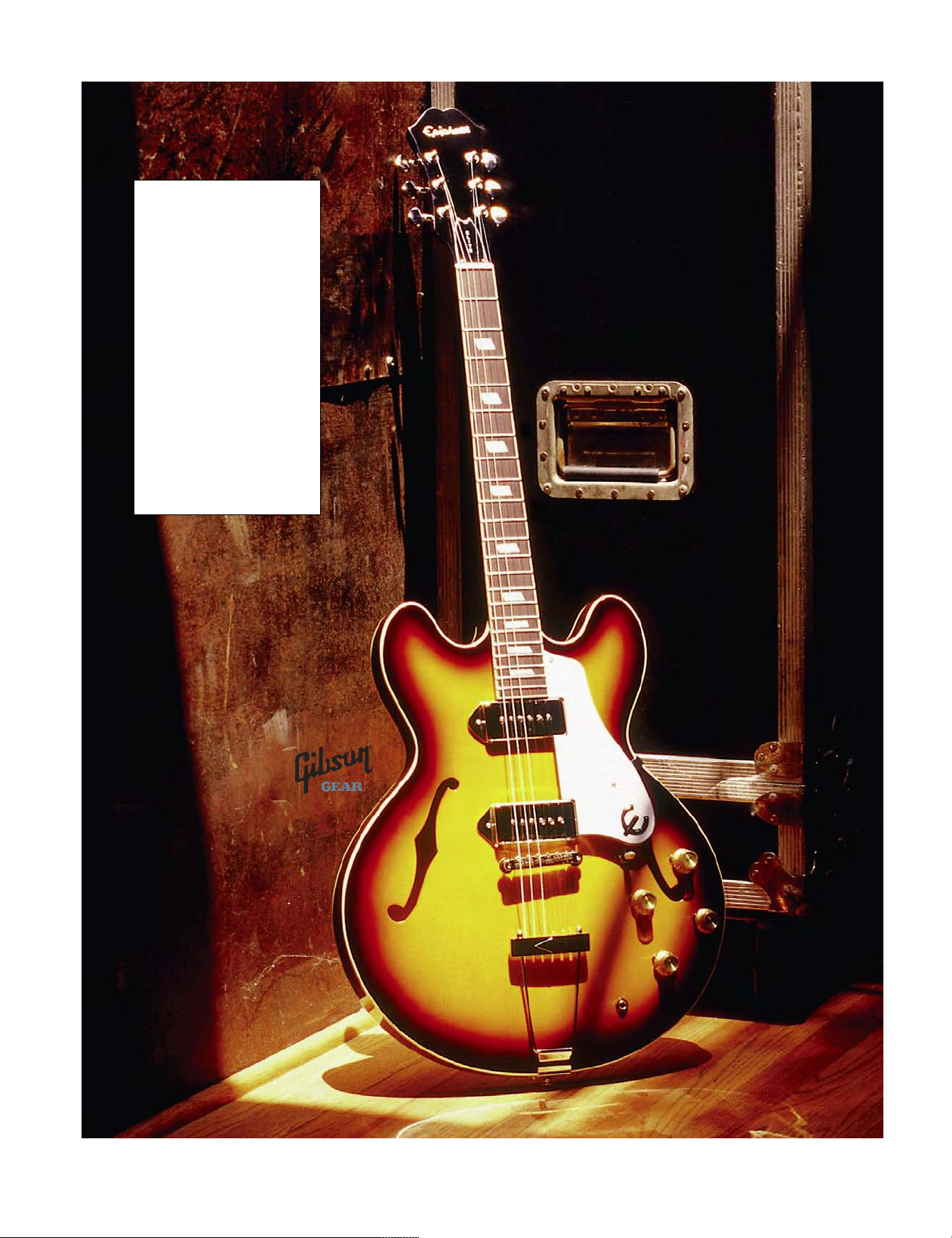
Elitist 1965 Casino
™
Outfit (Made in Japan)
A stunning recreation of a vintage 1965
Casino. Featuring a 5-ply maple body with
a spruce top cut to the exact profile of
period Casinos made at the Gibson/
Epiphone factory in Kalamazoo, Michigan.
The Elitist Casino includes a mahogany
neck, Gibson USA P-90 pickups, a bone
nut, a neck joint glued at the 16th fret, an
ABR bridge, Switchcraft™ toggle switch,
and Grover® machine heads. Includes
hardshell case.
Hardware: Nickel
Scale: 24.75”
Nut Width: 1.625” (bone)
Neck Joint: Mortise and tenon
Neck Material: Mahogany
Body Wood: 5-ply maple
Top Wood: 5-ply maple
Fingerboard: Rosewood
Neck Pickup: Gibson USA P-90R
Bridge Pickup: Gibson USA P-90T
Controls: 2-Volume; 2-Tone
Electronics: Switchcraft™ input jack and
Machine Heads: Grover® Vintage, 15:1 ratio
Colors: Vintage Sunburst, Natural
Includes: Elitist hard case
toggle; CTS™ potentiometers
P-90s
8
Page 12

Wildkat™& Wildkat White
Royale This ‘cool Kat’ brought the arch-
top look and sound to a whole new generation
and showed the world that Epiphone was back
to stay. Featuring the same classic mahogany
body, maple top, and mahogany neck along
with P-90 dogear classic pickups, a Bigsby™
B70 Vibrato, and Grover® machine heads.
Hardware: Nickel (Gold)
Scale: 24.75”
Nut Width: 1.68”
Neck Joint: Mortise and tenon
Neck Material: Mahogany
Body Wood: Mahogany
Top Wood: Maple
Fingerboard: Rosewood
Neck Pickup: P-90R Dogear Classics
Bridge Pickup: P-90T Dogear Classics
Controls: 1-Master Volume;
2-Volume; 1-Tone
Tailpiece: Bigsby™ B70
Machine Heads: Grover® Rotomatic™,
18:1 ratio
Colors: Pearl White, Antique Natural
Daringly Classic Archtops
Wildkat White Royale
Wildkat
THE BEST OF THE PAST, THE BEST OF THE PRESENT.
Riviera Custom P93
Tom Delonge Riviera
ES-333
Signature ES-333 is built to the exact specifications of Blink 182's Tom Delonge and
combines historic semi-hollowbody design
with the raw power of a Gibson USA Dirty
Fingers™ humbucker pickup. Featuring
Delonge’s custom color with racing strip.
Hardware: Nickel
Scale: 24.75”
Nut Width: 1.68”
Neck Joint: Mortise and tenon
Neck Material: Mahogany
Body Wood: Laminated maple
Top Wood: Laminated maple
Fingerboard: Mahogany
Pickup: Gibson USA Dirty Fingers™
Controls: 1-Volume
Machine Heads: Grover® Rotomatic™,
Colors: Brown
™
The Epiphone Tom Delonge
humbucker
18:1 ratio
™
Dirty Fingers™
Humbucker
Tom Delonge Riviera ES-333
Riviera™Custom P93
The Riviera Custom P93 has its roots
in Epiphone’s Riviera, now a vintage classic.
For today’s player, the Riviera Custom P93
goes one better with three P-90 dogear pickups, and a gold Bigsby™ B70 tremelo.
Hardware: Gold
Scale: 24.75”
Nut Width: 1.68”
Neck Joint: Mortise and tenon
Neck Material: Mahogany
Body Wood: Maple
Top Wood: Maple
Fingerboard: Rosewood
Bridge Pickup: P-90
Middle Pickup: P-90 (reverse polarity)
Neck Pickup: P-90
Controls: 3-Volume; 1-Tone
Tailpiece: Bigsby™ B70
Machine Heads: Wilkinson™ Deluxe, 15:1ratio
Colors: Wine Red
epiphone.com 9
™
Page 13

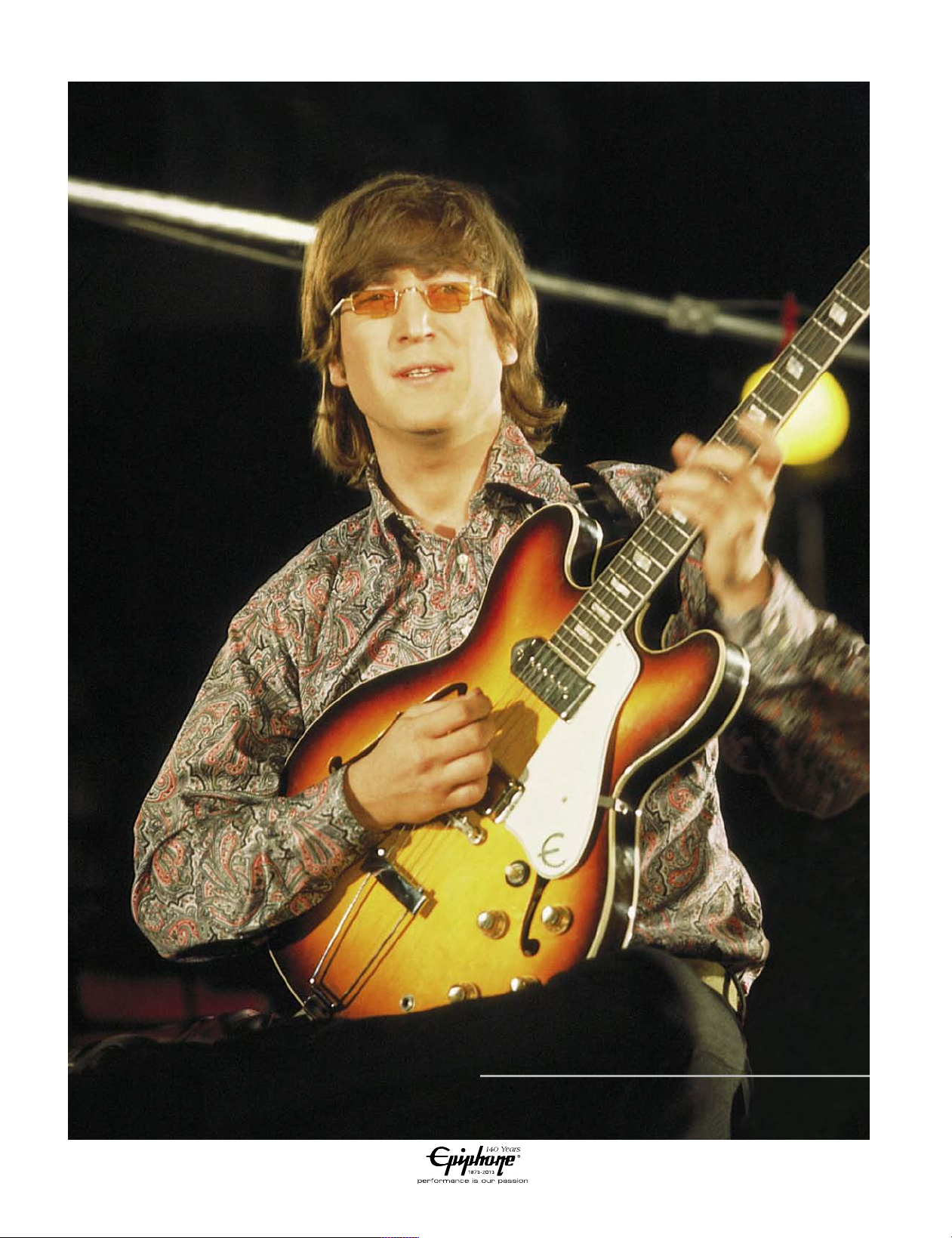
Inspired by John Lennon Casino™Outfit The "Inspired by" John Lennon “1965” Casino
and the “Revolution” Casino offer musicians the same key features found on John Lennon’s personal Epiphone Casino
he purchased in London in 1965. The Inspired by John Lennon Casinos cover both incarnations of John’s iconic
Casino, the Vintage Sunburst (“1965”) used on classic Beatles albums Revolver and Sgt. Pepper’s Lonely
Hearts Club Band and the stripped down (“Revolution”) version John used for The Beatles White Album, Abbey
Road, Let It Be, and the Plastic Ono Band. Loaded with Gibson USA P-90 pickups and Swithcraft™ controls.
P-90s
Hardware: Nickel “1965”
Scale: 24.75”
Nut Width: 1.68”
Neck Joint: Mortise and tenon
Neck Material: Mahogany
Body Wood: 5-ply maple
Top Wood: 5-ply maple
Fingerboard: Rosewood
Neck Pickup: Gibson USA P-90R
Bridge Pickup: Gibson USA P-90T
Controls: 2-Volume; 2-Tone
Electronics: Switchcraft™ output jack
Machine Heads: “1965” Vintage-style, 14:1
Colors: “1965” Vintage Sunburst
Includes: Hard Case
Gold “Revolution”
and toggle; CTS™
potentiometers
with small metal buttons
“Revolution” Grover®
Rotomatic™, 18:1 ratio (gold)
“Revolution” Lennon Natural
Dot™Studio The Epiphone
Dot™ Studio is a stripped-down version
of the historic Epiphone Dot™ Featuring
a mahogany body, a mahogany neck,
two black, open-coil Alnico classic
humbuckers, master tone and volume
controls, and a ‘60s-era sloped
dovewing headstock.
Hardware: Nickel
Scale: 24.75
Nut Width: 1.68
Neck Joint: Mortise and tenon
Neck Material: Mahogany
Body Wood: Mahogany
Fingerboard: Rosewood
Machine Heads: Grover® RotomaticTM,
18:1 ratio
Bridge Pickup: Open coil Alnico Classic™
humbucker
Neck Pickup: Open coil Alnico Classic™
humbucker
Controls: 1-Volume; 1-Tone
Colors: Cherry
1965 Casino
Revolution Casino
The Dot
™
Epiphone's version of
the venerable ES-335, the Dot™, is still
the best way to get the classic sound of
an ES-335 at an affordable price. The
Dot™ features the same stunning profile
and classic f-holes of the vintage original
with a maple top and body, a mahogany
neck, plus Alnico Classic™ humbucker
pickups and Grover® machine heads.
Hardware: Nickel
Scale: 24.75
Nut Width: 1.68
Neck Joint: Mortise and tenon
Neck Material: Mahogany
Body Wood: Maple
Top Wood: Maple
Fingerboard: Rosewood
Bridge Pickup: Alnico Classic
Neck Pickup: Alnico Classic Plus
Controls: 2-Volume; 2-Tone
Machine Heads: Grover® Rotomatic™,
Colors: Cherry, Ebony, Natural,
humbucker™
humbucker™
18:1 ratio
Vintage Sunburst
10
The Dots
Page 14
Legendary Archtops
JOHN LENNON
© 2013 Apple Corps ltd.
epiphone.com 11
Page 15

The Elegance of Les Paul
Les Paul®Tribute™Plus
Les Paul
®
Black Beauty 3 The world famous tuxedo
Les Paul, now with a new twist featuring beautiful gold hardware, 3 Alnico
Classic™ humbuckers, gold Grover® machine heads, and a breathtaking
Ebony finish. One of Les’ favorites and the first electric guitar seen
regularly on television thanks to the Les Paul and Mary Ford show.
Les Paul
®
Black Beauty 3
Les Paul
®
Custom PRO
Available Left-Handed/Ebony
‘57 Classic
Humbuckers
Hardware: Gold
Scale: 24.75”
Nut Width: 1.68
Neck Joint: Mortise and tenon
Neck Material: Mahogany
Body Wood: Mahogany
Top Wood: Mahogany
Fingerboard: Rosewood
Neck Pickup: Alnico Classic™ humbucker
Middle: Alnico Classic™ humbucker
Bridge Pickup: Alnico Classic™ humbucker
Controls: 2-Volume; 2-Tone
Machine Heads: Grover® Rotomatic™,
Colors: Ebony
18:1 ratio
Les Paul®Custom PRO
The “tuxedo” Les Paul is the modern
version of one of Les Paul’s own favorite
guitars. Featuring ProBucker™ humbucker pickups, coil-tapping, Grover® machine
heads, and gold hardware in either an
Ebony or Alpine White finish.
Hardware: Gold
Scale: 24.75”
Nut Width: 1.68”
Neck Joint: Mortise and tenon
Neck Material: Mahogany
Body Wood: Mahogany
Top Wood: Maple veneer
Fingerboard : R osewood
Neck Pickup: Epiphone ProBucker-2™
Bridge Pickup: Epiphone ProBucker-3™
Machine Heads: Grover® Rotomatic™,
Controls: 2-Volume with coil-tapping;
Colors: Ebony, Alpine White
18:1 ratio
2-Tone
Les Paul® Tribute™Plus
Outfit The Les Paul “Tribute” Plus
honors Epiphone’s friendship with
innovator Les Paul by combining his
classic design features with legendary
Epiphone quality and value with the added
feature of Gibson® USA ’57 classic
humbuckers, series parallel switching, a
1960s Slim-Taper™ neck profile, a
LockTone™ Tune-o-matic bridge and
tailpiece, and Les Paul case.
Hardware: Nickel
Scale: 24.75”
Nut Width: 1.68
Neck Joint: Deep-set mortise and tenon
Neck Material: Mahogany
Body Wood: Mahogany
Top Wood: Carved hard maple
Fingerboard : Rosewood
Neck Pickup: Gibson USA ’57 Classic
Bridge Pickup: Gibson USA ’57 Classic Plus
Controls: 2-Volume; 2-Tone with
Electronics: Switchcraft™ input jack
Colors: Black Cherry, Faded Cherry,
Machine Heads: Grover® Rotomatic™,
Includes: Hard case; StrapLocks
series/parallel push/pull
and toggle; CTS™
potentiometers
Midnight Ebony, Midnight
Sapphire, Vintage Sunburst
18:1 ratio
12
Page 16

BEAUTY AND BEAST IN ONE PACKAGE.
Les Paul®Tribute™Plus
epiphone.com 13
Page 17

The Innovative Les Paul
Three different outputs
Pickup ring-mounted Chromatic tuner
WHERE TRADITION MEETS TECHNOLOGY.
Les Paul® Ultra-III Tradition
meets technology in the Les Paul Ultra-III,
a stunning Les Paul with classic tone
that’s ready for the future. Featuring
ProBucker™ pickups, Shadow NanoMag™
pickup, Native Instruments GuitarRig™ download, USB, mono, and stereo outputs, and a
stunning AAA flame maple veneer top.
Hardware: Nickel
Scale: 24.75”
Nut Width: 1.68”
Neck Joint: Mortise and tenon
Neck Material: Mahogany
Body Wood: Chambered mahogany
Top Wood: AAA flame maple veneer
Fingerboard : Rosewood
Neck Pickup: Epiphone ProBucker™-2,
Bridge Pickup: Epiphone ProBucker™-3
Front Controls: 3-way selector, neck volume,
Back Controls: NanoMag gain, Nanomag
Chromatic Tuner:On/Off switch, A-G indictors,
Outputs: 1/4 mono (blended)
Machine Heads: Grover® Rotomatic™,
Colors: Midnight Ebony, Midnight
Includes: Native Instruments
Shadow NanoMag™ pickup
bridge volume, NanoMag™
volume with push-push A/B
switch, Master Tone, A/B
LED indicators
Treble, NanoMag Bass
high, low, and in-tune LED
1/4 stereo, USB
18:1 ratio
Sapphire, Vintage Sunburst,
Faded Cherry
GuitarRig™ download, 9 volt
battery, USB cable
14
Les Paul®Standard Ultra-III’s
tone
Epiphone ProBucker™ pickups
NanoMag™ controlsComputer designed body cavities for a more "acoustic”
Page 18

Les Paul® Standard
PlusTop PRO The Epiphone
Les Paul Standard PlusTop PRO gives
this legendary guitar a fresh start with
ProBucker-2™ and ProBucker-3™
humbucker pickups with coil-tapping, a
AAA flame maple veneer top, Grover®
machine heads and a hand-set
mahogany neck.
Hardware: Nickel
Scale: 24.75”
Nut Width: 1.68”
Neck Joint: Mortise and tenon
Neck Material: Mahogany
Body Wood: Mahogany
Top Wood: AAA flame maple veneer
Fingerboard: Rosewood
Neck Pickup: ProBucker-2™ with
coil-tapping
Bridge Pickup: ProBucker-3™ with
coil-tapping
Controls: 2-Volume with
coil-tapping; 2-Tone
Machine Heads: Grover® Rotomatic™,
18:1 ratio
Colors: Wine Red, Honeyburst,
Trans Blue, Vintage
Sunburst, Heritage
Cherry Sunburst
Left-Handed: Heritage Cherry
Sunburst
Available Left-Handed/Heritage
Cherry Sunburst
THE FLAME STILL BURNS WITH THESE LEGENDARY LES PAULS.
Les Paul®Standard PlusTop PROs
epiphone.com 15
Page 19
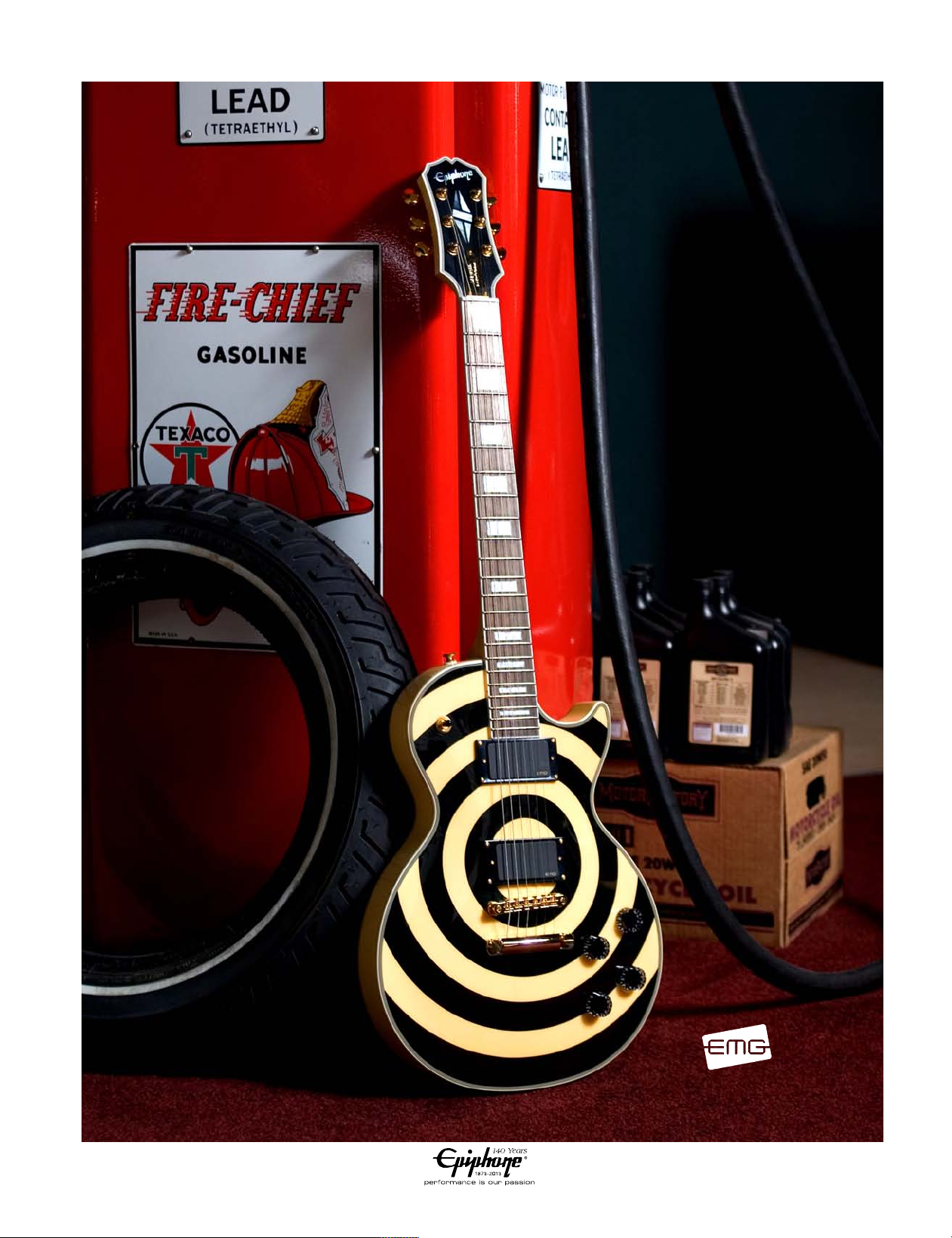
Zakk Wylde “Bullseye”
Les Paul® Custom Plus
Epiphone's Zakk Wylde Bullseye Les
Paul Custom has been the choice of
shredders for years. And now,
Epiphone and Zakk step it up a notch
with the addition of Zakk Wylde EMG81/85 active humbucker pickups.
Powered by a 9-volt battery, these
active pickups set the standard for
high-output, hard rock/metal tone. So
plug one in and crank it up!
Hardware: Gold
Scale: 24.75”
Nut Width: 1.68”
Neck Joint: Mortise and tenon
Neck Material: Hard maple
Body Wood: Mahogany
Top Wood: Maple veneer
Fingerboard: Rosewood
Bridge Pickup: EMG-81 humbucker
Neck Pickup: EMG-85 humbucker
Machine Heads: Grover® Rotomatic™,
Controls: 2-Volume; 2-Tone
Color: Antique Ivory
18:1 ratio
16
81/85 Actives
Page 20

Power of Performance Les Paul
Goth Les Paul®Studio
Prophecy Les Paul
®
Custom Plus EX Outfit
Hailed by metal players the world over
as the ultimate for serious shredding,
the Prophecy Les Paul Custom Plus EX
Outfit delivers with a quilt maple top,
EMG humbuckers, Grover® machine
heads, and Prophecy case.
Hardware: Black
Scale: 24.75”; 24-Fret
Nut Width: 1.68”
Neck Joint: Mortise and tenon
Neck Material: Mahogany
Top Wood: Quilt maple top
Fingerboard: Rosewood
Bridge Pickup: EMG-81 humbucker
Neck Pickup: EMG-85 humbucker
Controls: 2-Volume, 2-Tone
Machine Heads: Grover® Rotomatic™,
Colors: Midnight Sapphire,
Includes: Hard case; StrapLocks
18:1 ratio
Midnight Ebony
Prophecy
Les Paul
Custom EX
81/85 Actives
Hardware: Black
Scale: 24.75”
Nut Width: 1.68”
Neck Joint: Mortise and tenon
Neck Material: Mahogany
Body Wood: Mahogany
Goth Les Paul® Studio The ultimate slab of dark magic,
featuring the classic Les Paul® profile with a hand-set mahogany neck and
mahogany body, a LockTone™ Tune-o-matic bridge and Stopbar tailpiece,
and open-coil Alnico Classic™ humbuckers in a Pitch Black finish.
Top Wood: Mahogany
Fingerboard: Rosewood
Neck Pickup: Open-coil Alnico Classic™
humbucker
Bridge Pickup: Open-coil Alnico Classic™
humbucker
Controls: 2-Volume; 2-Tone;
Killpot on tone knob
Machine Heads: Grover® Rotomatic™,
18:1 ratio
Colors: Pitch Black
Prophecy Les Paul Customs
include Hardshell Case
Prophecy Les Paul
®
Custom Plus GX Outfit
The Prophecy Les Paul Custom Plus
GX Outfit is the supreme Les Paul for
those who dare to break new ground in
speed, sound, and technique. Featuring
Gibson USA humbuckers with
push/pull coil-tapping, a quilt maple
®
Prophecy
Les Paul
®
Custom GX
490R & 498T
top, graphite nut, and a Speed Taper™
D-profile satin finish neck. Comes with
Prophecy case.
Hardware: Gold
Scale: 24.75”; 24-Fret
Nut Width: 1.68”
Neck Joint: Mortise and tenon
Neck Material: Mahogany
Body Wood: Mahogany
Top Wood: Quilt maple
Fingerboard: Rosewood
Neck Pickup: Gibson USA 490R
humbucker
Bridge Pickup: Gibson USA 498T
humbucker
Controls: 2-Volume with
coil-tapping; 2-Tone
Machine Heads: Grover® Rotomatic™,
18:1 ratio
Colors: Black Cherry, Heritage
Cherry Sunburst
Includes: Hard case; StrapLocks
YOU CAN RUN, BUT YOU CAN’T HIDE.
epiphone.com 17
Page 21

Les Paul® Standard The Les Paul Standard is the world’s #1 electric guitar. With vintage models out of
reach for most guitarists. Epiphone’s Les Paul Standard is the real thing, made with Mr. Les Paul’s input plus over 50
years of experience. Featuring Alnico Classic™ humbuckers and Grover® machine heads.
Hardware: Nickel
Scale: 24.75”
Nut Width: 1.68”
Neck Joint: Mortise and tenon
Neck Material: Mahogany
Body Wood: Mahogany
Top Wood: Maple veneer
Fingerboard: Rosewood
Neck Pickup: Alnico Classic™
Bridge Pickup: Alnico Classic™
Controls: 2-Volume; 2-Tone
Machine Heads: Grover® Rotomatic™,
Colors: Metallic Gold, Ebony,
humbuckers
humbuckers
18:1 ratio
Cardinal Red,
Pelham Blue
Left-Handed: Ebony
Les Paul®Standards
Available Left-Handed/Ebony
Les Paul® -100 The classic look and feel of the world’s #1 electric guitar. A superb instrument for beginners
that has everything you could want from a Les Paul including a mahogany body, maple neck and Epiphone humbuckers.
Hardware: Nickel
Scale: 24.75”
Nut Width: 1.68”
Neck Joint: Bolt on
Neck Material: Mahogany
Body Wood: Mahogany
Top Wood: Maple veneer
Fingerboard: Rosewood
Neck Pickup: 650R humbucker
Bridge Pickup: 700T humbucker
Controls: 2-Volume; 2-Tone
Machine Heads: Epiphone premium
Colors: Heritage Cherry
diecast, 15:1 ratio
Sunburst, Ebony,
Vintage Sunburst
18
Les Paul®-100s
Page 22

The Timeless Les Paul
Les Paul® Studio The Les Paul Studio was intended for studio musicians who desired a basic,
unadorned Les Paul that weighed less than standard models. It quickly became a favorite for all Les Paul
lovers. Featuring a light-weight mahogany body and open coil Alnico Classic™ humbuckers.
Hardware: Nickel
Scale: 24.75”
Nut Width: 1.68”
Neck Joint: Mortise and tenon
Neck Material: Mahogany
Body Wood: Mahogany
Top Wood: Maple veneer
Fingerboard: Rosewood
Neck Pickup: Alnico Classic™
Bridge Pickup: Alnico Classic™
Controls: 2-Volume; 2-Tone
Machine Heads: Grover® Rotomatic™,
Colors: Alpine White, Ebony,
Les Paul®Studios
Les Paul® Special-II Epiphone's #1 selling model, the LP Special-II is a great way for
beginners to get started on guitar with a real Les Paul. Featuring a mahogany body, a 1960s SlimTaper™
“D” profile mahogany neck, Epiphone humbuckers, and a LockTone™ Tune-o-matic bridge and
Stopbar tailpiece.
®
Les Paul
Special-IIs
humbuckers
humbuckers
18:1 ratio
Worn Cherry
Hardware: Nickel
Scale: 24.75”
Nut Width: 1.68”
Neck Joint: Bolt-on
Neck Material: Mahogany
Body Wood: Mahogany
Top Wood: Maple veneer
Fingerboard: Rosewood
Neck Pickup: Epiphone 650R
humbucker
Bridge Pickup: Epiphone 700T
humbucker
Controls: 2-Volume; 2-Tone
Machine Heads: Epiphone precision
covered, 15:1 ratio
Colors: Vintage Sunburst,
Heritage Cherry
Sunburst, Ebony,
epiphone.com 19
Page 23

G-400 PRO
G-400 PRO The G-400 PRO honors the historic SG, one of the most iconic designs in
rock, and features Alnico Classic PRO™ pickups and push/pull coil-tapping. The G-400 PRO
gives you the sound and look of a classic SG without the vintage price tag but with the added
tonal variety that you've come to expect from Epiphone.
Available Left-Handed/Cherry
Hardware: Nickel
Scale: 24.75”
Neck Joint: Mortise and tenon
Nut Width: 1.68”
Neck Material: Mahogany
Body Wood: Mahogany
Fingerboard: Rosewood
Neck Pickup: Epiphone Alnico
Bridge Pickup: Epiphone Alnico
Controls: 2-Volume with
Machine Heads: Wilkinson™ Deluxe,
Colors: Cherry, Ebony
Classic PRO™
Classic PRO™
coil-tapping; 2-Tone
14:1 ratio
G-310 Every serious player wants
an SG™, and here's the real thing that
sounds as good as it looks. Hard rock,
metal, and rock and roll artists embraced
the original SG™ and made it a classic.
Now, the G-310, based on the classic 1967
Gibson SG™ gives you the sound and look of
a real SG™ without the vintage price tag.
Featuring Epiphone humbuckers and an
Epiphone’s LockTone™ Tune-o-matic bridge
and Stopbar tailpiece.
20
Model: G-310
Hardware: Nickel
Scale: 24.75”
Neck Joint: Bolt-on
Nut Width: 1.68”
Neck Material: Mahogany
Body Wood: Mahogany
Fingerboard: Rosewood
Neck Pickup: 650R humbucker
Bridge Pickup: 700T humbucker
Controls: 2-Volume; 2-Tone
Machine Heads: Diecast; 14:1 ratio
Colors: Ebony
,
Page 24

Worn G-400
Solid Guitar SG
Worn G-400 Truly one of the best guitar
values today, the Worn G-400 tributes the classic
look of a well worn and well played 1962 SG™.
Featuring Alnico Classic™ humbuckers, Grover®
machine heads, and Epiphone’s LockTone™ Tune-omatic bridge and LockTone™ Stopbar tailpiece in
Worn Cherry or Worn Brown.
Hardware: Nickel
Scale: 24.75”
Nut Width: 1.68”
Neck Joint: Mortise and tenon
Neck Material: Mahogany
Body Wood: Mahogany
Fingerboard: Rosewood
Neck Pickup: Alnico Classic™ humbucker
Bridge Pickup: Alnico Classic Plus™ humbucker
Controls: 2-Volume; 2-Tone
Machine Heads: Grover® 14:1 ratio
Colors: Worn Brown, Worn Cherry
SG™ Special The Epiphone SG™ Special is an incredible way to get real SG™
tone and styling without breaking the bank. Featuring the same classic profile of vintage
SG’s, the SG™ Special features a mahogany body, a hard maple neck, a SlimTaper™ “D”
neck, Epiphone humbuckers, a KillPot™, and Epiphone’s LockTone™ Tune-o-matic bridge
and LockTone™ Stopbar tailpiece.
Hardware: Nickel
Scale: 24.75”
Neck Joint: Bolt-on
Nut Width: 1.68”
Neck Material: Hard maple
Body Wood: Mahogany
Fingerboard: Rosewood
Neck Pickup: 650R humbucker
Bridge Pickup: 700T humbucker
G-310
Controls: 1-Volume; 1-Tone;
Machine Heads: Covered; 14:1 ratio
Colors: Cherry, Ebony
KillPot on tone knob
IT’S ALWAYS A ROCK SOLID PERFORMER.
SG™ Special
epiphone.com 21
Page 25

Designer
Wilshire™ Phant-o-matic Outfit Designed with Frank Iero of My Chemical
Romance, the “Phant-o-matic” combines an incredible array of features that only Epiphone would
dare put in one guitar. Made using the classic ‘60s Wilshire profile and a mahogany body and
neck with a vintage style VariTone™ control, KillSwitch™, and Alnico Classic™ humbuckers.
Hardware: Nickel
Scale: 24.75”
Neck Joint: Mortise and tenon
Nut Width: 1.68”
Neck Material: Mahogany
Body Wood: Mahogany
Fingerboard : Rosewood
Neck Pickup: Alnico Classic™ humbucker
Bridge Pickup: Alnico Classic Plus™ humbucker
Controls: Master Volume; 6-position
VariTone™, KillSwitch™
Machine Heads: Wilkinson™ vintage style
with green keys, 14:1 ratio
Colors: Antique Ivory
Includes: Premium Gigbag
Nighthawk™ Custom Reissue The Nighthawk™
was first introduced in 1993, and its recent return has turned on a
whole new generation thanks to its great tonewoods, premium construction, NSK™ single coil, Slant NHT™ humbucker, and NHR™ mini
humbucker guitar pickups with coil tapping.
Hardware: Nickel
Scale: 25.5”
Nut Width: 1.68”
Neck Material: Mahogany
Neck Joint: Mortise and tenon
Fingerboard : Rosewood
Body Wood: Mahogany
Top Wood: AAA flame maple veneer
Neck Pickup: NHR™ mini-humbucker
Middle Pickup: NSX™ single coil
Bridge Pickup: Slant NHT™ humbucker
Controls: 1-Volume; 1-Tone with coil-tapping;
Machine Heads: Grover™ 14:1 ratio
Colors: Honey Burst, Trans Amber, Fireburst
5-way pickup selector
22
Nighthawk™ Custom Reissues
Page 26

Hardware: Nickel
Scale: 27” (baritone)
Neck Joint: Mortise and tenon
Nut Width: 1.68” (graphite)
Neck Material: Mahogany
Body Wood: Mahogany
Fingerboard: Ebony
Machine Heads: Grover® locking
Neck Pickup: EMG HA
Bridge Pickup: EMG-81
Controls: Master Volume
Strings: 58,42,32,
unwound 18, 13,10
Colors: Ebony
Includes: Custom hard case
81/HA
Hardware: Black
Scale: 24.75”
Nut Width: 1.68”
Neck Joint: Mortise and tenon
Neck Material: Mahogany
Body Wood: Mahogany
Top Wood: Mahogany
Fingerboard: Rosewood
Neck Pickup: Alnico Classic™ humbucker
Bridge Pickup: Alnico Classic™ humbucker
Controls: 2-Volume; 1-Tone; Killpot on
tone knob
Machine Heads: Grover® Mini-Rotomatic,
14:1 ratio
Colors: Pitch Black
Robb Flynn “Love/Death”
Baritone-V Outfit Epiphone
has been a favorite of heavy metal artists
for more than a decade. Now, Epiphone
does it again with the Epiphone Robb Flynn
Love/Death Baritone Flying V, designed in
cooperation with Robb to be Epiphone’s
lowest guitar ever. Featuring a graphite
nut, EMG pickups and a custom hard case.
Goth “1958” Explorer™ Explore your dark side with a classic Explorer body in a unique Pitch
Black finish. Featuring Alnico Classic™ humbuckers, a SlimTaper™ “D” profile neck, a mahogany body and neck,
and premium die-cast machine heads.
EMBRACE THE
SHAPE. FEEL THE
POWER.
81/85 Actives
“1984” Explorer EX™ The futurist 1984 Explorer™ EX is “1984” come to life with a classic form
that stands out on stage. Originally introduced in 1958, the Explorer’s radical and futuristic body shape soon
became the #1 choice for hard rock and metal players. With a sleek new update of the classic design combined
with high output active EMG pickups, a mahogany body and neck, and Grover™ machine heads.
Hardware: Black
Scale: 24.75”
Nut Width: 1.68”
Neck Material: Mahogany
Neck Joint: Mortise and tenon
Body Wood: Mahogany
Top Wood: Mahogany
Fingerboard: Rosewood
Neck Pickup: Active EMG-85
Bridge Pickup: Active EMG-81
Controls: 1-Volume; 1-Tone
Machine Heads: Grover® with small metal
Colors: Ebony, Alpine White
buttons
epiphone.com 23
Page 27

Limited Editions
“1962” 50th anniversary collection
“1962” 50th anniversary collection
Crestwood Custom Sorrento Sheraton
“1962” 50th Anniversary Collection A fresh look at three historic Epiphone classics made new!
In 1962, Epiphone had been part of the Gibson family of instruments for 5 years. The swing era was in the past and rock and roll—for a brief time—seemed like the past,
too. Epiphone had already released great original instruments in those short 5 years including (future) Beatle favorites the Casino and Texan. But 1962 was the year that
Epiphone truly distinguished itself with a line of unique instruments that firmly established its independence. Old models were improved and new models were more distinctive
than ever. Visitors to the 1962 NAMM show saw an Epiphone line that was fully revitalized with an eye to the future. In two short years, the British Invasion would bring back
rock and roll in a big way and would also introduce electric blues to new audiences in the U.S. and Europe. Epiphone’s 1962 releases kicked off an era during which Epiphone
would become a favorite for a wide range of artists including Johnny Winter, Jimi Hendrix, John Lee Hooker, and The Hollies. Add The Beatles and The Rolling Stones to that
mix and you can see why the ‘60s became Epiphone’s second great era. Just like today, artists loved Epiphone’s unique designs, great sound, and long history of affordable
quality. The 1962 Collection is a long overdue look back at those instruments that put Epiphone back on the guitar map to stay.
The 1962 Collection features three of Epiphone’s most sought-after vintage models, now together again for the first time in 50 years. Featuring Gibson USA and
Epiphone Alnico Classic Pickups, CTS potentiometers, and a 1962 reissue hard case with collection certificate of authenticity and presentation binder with
collector’s photo. Only 1,962 will be made!
Model: ‘62 Crestwood Custom Outfit
Hardware: Nickel
Scale: 24.75”
Nut Width: 1.68”
Neck Joint: Mortise and tenon
Neck Material: Mahogany
Body Wood: Mahogany
Top Wood: Mahogany
Fingerboard: Rosewood
Neck Pickup: Epiphone Alnico Classic Mini-Humbuckers
Bridge Pickup: Epiphone Alnico Classic Mini-Humbuckers
Controls: 2-Volume; 2-Tone
Tailpiece: Tremotone™ vibrato
Machine Heads: Wilkinson™ Deluxe tuners with
tulip buttons,14:1 ratio
Color: Cherry
Includes: Reissue Hard Case
24
Model: ‘62 Sorrento Outfit
Hardware: Nickel
Scale: 24.75”
Nut Width: 1.68”
Neck Joint: Mortise and tenon
Neck Material: Mahogany
Body Wood: Laminated Maple
Top Wood: Laminated Maple
Fingerboard: Rosewood
Neck Pickup: Gibson USA Mini-Humbucker
Bridge Pickup: Gibson USA Mini-Humbucker
Controls: 2-Volume; 2-Tone
Machine Heads: Wilkinson™ Deluxe with Small Plastic
Buttons, 15:1 ratio
Colors: Royal Olive, Natural,
Includes: Reissue Hard Case
Model: ‘62 Sheraton Outfit
Hardware: Nickel
Scale: 24.75”
Nut Width: 1.68”
Neck Joint: Mortise and tenon
Neck Material: Mahogany
Body Wood: Laminated Maple
Top Wood: Laminated Maple
Fingerboard: Rosewood
Neck Pickup: Gibson USA Mini-Humbucker
Bridge Pickup: Gibson USA Mini-Humbucker
Controls: 2-Volume; 2-Tone
Tailpiece: Tremotone™ (E212TV in Cherry only),
Frequensator™ (E212)
Machine Heads: Grover® Vintage, 14:1 ratio
Colors: Natural, Vintage Sunburst, Cherry
Includes: Reissue Hard Case
Page 28

COLLECTIONS
Black Royale Collection
A stunning new look for six
Epiphone classics!
The Epiphone Black
Royale Collection brings together some of Epiphone’s most
iconic electric guitars in a
beautiful new Black Pearl fine
metallic color finish with Silver
Sparkle binding. Each model in
the Black Royale Collection
features full-size 500K Ω
potentiometers, Alnico pickups,
Epiphone’s 1/4” non-rotating
output jack, and Epiphone’s
Lifetime Warranty. Only 1,000
of each Black Royale model
will be manufactured.
black royale collectionblack royale collection
Les Paul Standard • Wildkat • ES-339 PRO • Riviera Custom P93 • Dot • Swingster
Model: LP Standard Black Royale
Hardware: Nickel
Scale: 24.75
Nut Width: 1.68”
Neck Joint: Mortise and tenon
Neck Material: Mahogany
Body Wood: Mahogany
Top Wood: Plain maple veneer
Fingerboard: Rosewood
Neck Pickup: Alnico Classic™ humbucker
Bridge Pickup: Alnico Classic Plus™ humbucker
Controls: 2-Volume; 2-Tone
Machine Heads: Grover® Rotomatic™, 18:1 ratio
Colors: Black Pearl
Model: Riviera Custom P93 Black Royale
Hardware: Nickel
Scale: 24.75”
Nut Width: 1.68”
Neck Joint: Mortise and tenon
Neck Material: Mahogany
Body Wood: Maple
Top Wood: Maple
Fingerboard: Rosewood
Bridge Pickup: P-90
Middle Pickup: P-90 (reverse polarity)
Neck Pickup: P-90
Controls: 3-Volume; 1-Tone
Tailpiece: Bigsby™ vibrato
Machine Heads: Wilkinson™ Deluxe, 14:1ratio
Colors: Black Pearl
Model: Wildkat Black Royale
Hardware: Nickel
Scale: 24.75
Nut Width: 1.68”
Neck Joint: Mortise and tenon
Neck Material: Mahogany
Body Wood: Mahogany
Top Wood: Laminated maple
Fingerboard: Rosewood
Neck Pickup: P-90R
Bridge Pickup: P-90T
Controls: 1-Master Volume; 2-Volume; 1-Tone
Machine Heads: Grover® Rotomatic™, 18:1 ratio
Tailpiece: Bigsby™ vibrato
Colors: Black Pearl
Model: Dot Black Royale
Hardware: Nickel
Scale: 24.75
Nut Width: 1.68”
Neck Joint: Mortise and tenon
Neck Material: Mahogany
Body Wood: Laminated Maple
Fingerboard: Rosewood
Neck Pickup: Alnico Classic™ humbucker
Bridge Pickup: Alnico Classic™ Plus humbucker
Controls: 2-Volume; 2-Tone
Machine Heads: Grover® Rotomatic™, 18:1 ratio
Colors: Black Pearl
Model: ES-339 PRO Black Royale
Hardware: Nickel
Scale: 24.75
Neck Joint: Mortise and tenon
Nut Width: 1.68”
Neck Material: Mahogany
Body Wood: Laminated Maple
Fingerboard: Rosewood
Neck Pickup: Alnico Classic PRO™ humbucker
Bridge Pickup: Alnico Classic PRO™ humbucker
Controls: 2-Volume with coil-tapping; 2-Tone
Machine Heads: Grover® Rotomatic™, 18:1 ratio
Colors: Black Pearl
Model: Emperor Swingster Black Royale
Hardware: Nickel
Scale: 24.75
Neck Joint: Mortise and tenon
Nut Width: 1.68”
Neck Material: Mahogany
Body Wood: Laminated flame maple
Top Wood: Select spruce
Fingerboard: Rosewood
Neck Pickup: SwingBucker™ Humbucker
Bridge Pickup: SwingBucker™ Humbucker
Controls: 2-Volume; 2-Tone with series/parallel
Machine Heads: Grover® Rotomatic™, 18:1 ratio
Tailpiece: Bigsby™ vibrato
Colors: Black Pearl
epiphone.com 25
Page 29

Limited Editions
TV Silver Collection
Limited Run –
While Supplies Last
Epiphone gives six of its
historic classics a one-of-a-kind
limited edition TV Silver color
finish. Featuring the Wilshire
PRO, the Les Paul Standard
PRO, the Les Paul Custom
PRO, the G-400 PRO, the
Explorer PRO and the
Thunderbird IV bass—all with
their original classic pickups,
hardware, and iconic specs
intact!
TV silver collection
TV silver collection
G-400 PRO • Wilshire PRO • Les Paul Standard • Les Paul Custom PRO • Explorer PRO • Thunderbird-IV
Model: TV Silver 1966 G-400 PRO
Hardware: Nickel
Scale: 24.75”
Nut Width: 1.68”
Neck Joint: Mortise and tenon
Neck Material: Mahogany
Body Wood: Mahogany
Top Wood: Mahogany
Fingerboard: Rosewood
Neck Pickup: Alnico Classic PRO™ Humbucker
Bridge Pickup: Alnico Classic PRO™ Humbucker
Controls: 2-Volume with coil-tapping; 2-Tone
Machine Heads: Grover® Rotomatic™, 18:1 ratio
Color: TV Silver
Model: TV Silver Les Paul Custom PRO
Hardware: Nickel
Scale: 24.75”
Nut Width: 1.68”
Neck Joint: Mortise and tenon
Neck Material: Mahogany
Body Wood: Mahogany
Top Wood: Mahogany veneer
Fingerboard: Rosewood
Neck Pickup: Epiphone ProBucker-2™
Bridge Pickup: Epiphone ProBucker-3™
Controls: 2-Volume with coil-tapping; 2-Tone
Machine Heads: Grover® Rotomatic™, 18:1 ratio
Color: TV Silver
26
Model: TV Silver Wilshire PRO
Hardware: Nickel
Scale: 24.75”
Nut Width: 1.68”
Neck Joint: Mortise and tenon
Neck Material: Mahogany
Body Wood: Mahogany
Top Wood: Mahogany
Fingerboard: Rosewood
Neck Pickup: Alnico Classic PRO™ Humbucker
with coil-tapping
Bridge Pickup: Alnico Classic PRO™ Humbucker
with coil-tapping
Controls: 2-Volume with coil-tapping; 2-Tone
Machine Heads: Epiphone Premium Diecast 17:1 ratio
Color: TV Silver
Model: TV Silver Explorer PRO
Hardware: Nickel
Scale: 24.75”
Nut Width: 1.68”
Neck Joint: Mortise and tenon
Neck Material: Mahogany
Body Wood: Mahogany
Top Wood: Mahogany
Fingerboard: Rosewood
Neck Pickup: Alnico Classic PRO™ Humbucker
with coil-tapping
Bridge Pickup: Alnico Classic PRO™ Humbucker
with coil-tapping
Controls: 2-Volume with coil-tapping; 1-Tone
Machine Heads: Grover® Mini Rotomatic™, 14:1 ratio
Color: TV Silver
Model: TV Silver Les Paul Standard
Hardware: Nickel
Scale: 24.75”
Nut Width: 1.68”
Neck Joint: Mortise and tenon
Neck Material: Mahogany
Body Wood: Mahogany
Top Wood: Maple veneer
Fingerboard: Rosewood
Neck Pickup: Epiphone Alnico Classic™
Bridge Pickup: Epiphone Alnico Classic Plus™
Controls: 2-Volume; 2-Tone
Machine Heads: Grover® Rotomatic™, 18:1 ratio
Color: TV Silver
Model: TV Silver Thunderbird-IV Bass
Hardware: Nickel
Scale: 34”
Nut Width: 1.5”
Neck Joint: Bolt-on
Neck Material: Mahogany
Body Wood: Mahogany
Top Wood: Mahogany
Fingerboard: Rosewood
Middle Pickup: Epiphone TB-Plus™ Humbucker
Bridge Pickup: Epiphone TB-Plus™ Humbucker
Controls: 2-Volume; 1-Tone
Machine Heads: Premium Diecast Bass Tuners,
17:1 ratio
Color: TV Silver
Page 30

COLLECTIONS
TV Pelham Blue Collection
Limited Run –
While Supplies Last
The TV Pelham Blue
Collection puts the blue spotlight on six Epiphone classics
including the Firebird Studio,
the Les Paul Custom PRO, the
SG Custom with Maestro
tremolo, The ES-355, the ES339 PRO, and the EB-3 bass,
all with a custom TV Pelham
Blue color finish along with all
of their classic appointments
and pickups.
TV pelham blue collection
TV pelham blue collection
ES-339 PRO • SG Custom • Les Paul Custom PRO • Firebird Studio • ES-355 • EB-3 Bass
Model: TV Pelham Blue ES-339 PRO
Hardware: Nickel
Scale: 24.75”
Nut Width: 1.68”
Neck Joint: Mortise and tenon
Neck Material: Mahogany
Body Wood: Laminated Maple
Top Wood: Laminated Maple
Fingerboard: Rosewood
Neck Pickup: Alnico Classic PRO™ Humbucker
Bridge Pickup: Alnico Classic PRO™ Humbucker
Controls: 2-Volume with coil-tapping; 2-Tone
Machine Heads: Grover® Deluxe, 14:1 ratio
Colors: TV Pelham Blue
Model: TV Pelham Blue Firebird Studio
Hardware: Nickel
Scale: 24.75”
Nut Width: 1.68”
Neck Joint: Mortise and tenon
Neck Material: Mahogany
Body Wood: Mahogany
Top Wood: Mahogany
Fingerboard: Rosewood
Neck Pickup: Alnico Classic™ Humbucker
Bridge Pickup: Alnico Classic™ Plus Humbucker
Controls: 2-Volume; 2-Tone
Machine Heads: Steinberger™ Gearless, 40:1 ratio
Colors: TV Pelham Blue
w/coil-tapping
w/coil-tapping
Model: TV Pelham Blue SG Custom w/Maestro
Hardware: Nickel
Scale: 24.75”
Nut Width: 1.68”
Neck Joint: Mortise and tenon
Neck Material: Mahogany
Body Wood: Mahogany
Top Wood: Mahogany
Fingerboard: Rosewood
Neck Pickup: Epiphone ProBucker-2™
Bridge Pickup: Epiphone ProBucker-3™
Controls: 2-Volume; 2-Tone
Machine Heads: Grover® Rotomatic™, 18:1 ratio
Tailpiece: Maestro™ vibrato
Colors: TV Pelham Blue
Model: TV Pelham Blue ES-355
Hardware: Nickel
Scale: 24.75”
Nut Width: 1.68”
Neck Joint: Mortise and tenon
Neck Material: Mahogany
Body Wood: Laminated Maple
Top Wood: Laminated Maple
Fingerboard: Rosewood
Neck Pickup: Alnico Classic™ Humbucker
Bridge Pickup: Alnico Classic™ Humbucker
Controls: 2-Volume; 2-Tone
Machine Heads: Grover® Rotomatic™, 18:1 ratio
Tailpiece: Bigsby™ B70
Colors: TV Pelham Blue
Model: TV Pelham Blue Les Paul Custom PRO
Hardware: Nickel
Scale: 24.75”
Nut Width: 1.68”
Neck Joint: Mortise and tenon
Neck Material: Mahogany
Body Wood: Mahogany
Top Wood: Mahogany veneer
Fingerboard: Rosewood
Neck Pickup: Epiphone ProBucker-2™
Bridge Pickup: Epiphone ProBucker-3™
Controls: 2-Volume with coil-tapping; 2-Tone
Machine Heads: Grover® Rotomatic™, 18:1 ratio
Colors: TV Pelham Blue
Model: TV Pelham Blue EB-3 Bass
Hardware: Nickel
Scale: 34”
Nut Width: 1.5”
Neck Joint: Mortise and tenon
Neck Material: Mahogany
Body Wood: Mahogany
Top Wood: Mahogany
Fingerboard: Rosewood
Neck Pickup: Epiphone Sidewinder™ Bass Humbucker
Bridge Pickup: Epiphone Mini Bass Humbucker™
Controls: 2-Volume; 2-Tone; 3-way rotary
Machine Heads: Premium Open Bass Tuners
Colors: TV Pelham Blue
pickup selector
with Clover Leaf Buttons 19:1 ratio
epiphone.com 27
Page 31

Genesis™Deluxe PRO It’s BACK and Now with Coil-Tapping and Epiphone ProBucker™ Pickups!
The classic Epiphone Genesis was one of Epiphone’s most original and modern designs when it was first published in the
Epiphone catalog in late 1979. It was intended as a new beginning for Epiphone - a truly original solid body design that
could hold its ground with a Les Paul, giving players the added advantage of an eye-catching double cutaway.
Hardware: Gold
Scale: 24.75”
Nut Width: 1.68”
NEW
NEW
2013
Neck Joint: Mortise and tenon
Neck Material: Mahogany
Body Wood: Mahogany
Top Wood: AAA flame maple veneer
Fingerboard: Rosewood
Neck Pickup: Epiphone ProBucker-2™
Bridge Pickup: Epiphone ProBucker3™
Controls: 2-Volume with coil-tapping;
Machine Heads: Grover® Rotomatic™,
Colors: Black Cherry,
Genesis™Deluxe PROs
Ltd. Ed. Joe Bonamassa Les Paul®Goldtop Outfit Limited Edition.
Available while supplies last. Designed in close cooperation with Joe Bonamassa, the Ltd. Ed. Joe
Bonamassa Goldtop captures the essence of Bonamassa's own vintage Goldtops by blending several
vintage features from the legendary Les Pauls of the 1950s including a traditional 1959 neck profile
and Gibson BurstBucker™ pickups.
Hardware: Nickel
Scale: 24.75”
Nut Width: 1.68”
Neck Joint: Deep-set mortise and tenon
Neck Material: Mahogany
Body Wood: Mahogany
Top Wood: Carved hard maple cap
Fingerboard: Rosewood
Neck Pickup: Gibson USA BurstBucker™ 2
Bridge Pickup: Gibson USA Burstbucker™ 3
Machine Heads: Grover® Rotomatic™, 18:1 ratio
Colors: Metallic Gold
Includes: Hard Case; StrapLocks, Certificate
2-Tone
14:1 ratio
Midnight Ebony,
Midnight Sapphire,
Vintage Sunburst
Burstbuckers
Ltd. Ed. Wilshire™ Phant-o-matic Outfit Designed with Frank Iero of My Chemical
Romance, the “Phant-o-matic” combines an incredible array of features that only Epiphone would dare put in one guitar.
Made using the classic ‘60s Wilshire profile and a mahogany body and neck with a vintage style VariTone™ control,
KillSwitch™, and Alnico Classic™ humbuckers.
Ltd. Ed.Jack Casady
Signature Bass Jack Casady, a member
of the Rock and Roll Hall of Fame and co-founder of
both Jefferson Airplane and Hot Tuna, designed his
Hardware: Nickel
Scale: 34”
Neck Joint: Set
Nut Width: 1.65”
Neck Material: Mahogany
Body Wood: Maple
Machine Heads: Epiphone premium diecast,
19:1 ratio
Fingerboard: Rosewood
Pickup: JCB-1 Low-Impedance humbucker
3-position VariGain™
Colors: Silverburst
signature bass to be his ‘dream’ instrument. Today,
pro’s around the world refer to the Jack Casady
Signature Bass as the “Holy Grail” of bass tone.
Featuring a classic profiled maple body with a
special JCB-1 low impedance pickup and a solid
3-point adjustable bridge.
Limited Editions
Hardware: Nickel
Scale: 24.75”
Neck Joint: Mortise and tenon
Nut Width: 1.68”
Neck Material: Mahogany
Body Wood: Mahogany
Fingerboard : Rosewood
Neck Pickup: Alnico Classic™ humbucker
Bridge Pickup: Alnico Classic Plus™ humbucker
Controls: Master Volume; 6-position
VariTone™, KillSwitch™
Machine Heads: Wilkinson™ vintage style
with green keys
Colors: Emerald Green
Includes: Deluxe Gigbag
28
Page 32

Ltd. Ed. Matt Heafy Les Paul®Custom & Custom-7 Matt Heafy joins an illustrious group of Epiphone
artists with the introduction of two signature models the Epiphone Ltd. Ed. Matt Heafy Les Paul Custom and the Ltd. Ed. Matt Heafy Les Paul
81/85 Actives
Custom-7 string. Featuring EMG pickups, a deep-set neck joint with “Axcess” heel,
and an ebony fretboard.
Matt Heafy Les Paul
®
Custom
NEW
NEW
Matt Heafy Les Paul
Custom-7
498T
Hardware: Nickel
Scale: 24.75”
Nut Width: 1.68”, (1.875” - 7-string)
Neck Joint: Mortise and tenon; Axcess heel
Neck Material: Mahogany
Body Wood: Mahogany
Top Wood: Plain maple veneer
Fingerboard: Ebony
Neck Pickup: EMG-85 (EMG-707 - 7-string)
Bridge Pickup: EMG-81 (EMG-81-7 - 7-string)
Controls: 2-Volume; 2-Tone
Machine Heads: Epiphone premium diecast
Colors: Ebony
®
with metal tulip buttons, 15:1 ratio
2013
NEW
NEW
2013
Ltd. Ed. Tommy Thayer ‘Spaceman’ Les Paul
®
Standard Outfit In 2002, Tommy Thayer became a full-fledged member of
KISS, taking the part of the iconic “Spaceman” and giving the rock legends an explosive
new sound and attitude. And now, the 21st century “Spaceman” has his own Les Paul
Standard with Gibson 498T™ Humbuckers, Grover™ Deluxe Vintage tuners, a custom
strap, and a custom silver hard case with a signed certificate of authenticity. And like
Tommy himself, this Les Paul Standard “Spaceman” is one-of-a-kind, with a limited run
of only 1,000.
NEW
NEW
2013
Ltd. Ed. Brendon Small
“Thunderhorse” Explorer™ Outfit
Billions of Dethklok fans have chosen the Epiphone
“Thunderhorse” as the ultimate Brendon Small Signature
Explorer and declared it, totally metal - times infinity!
The "Thunderhorse" is powered by seriously cool Gibson
USA BurstBucker™ pickups with push/pull coil-tapping
controls on the Neck Volume and Bridge Volume knobs.
The “Thunderhorse” outfit includes a premium-fitted
custom gigbag with three “Dethklok” stickers.
Hardware: Nickel
Scale: 24.75”
Nut Width: 1.68”
Neck Joint: Mortise and tenon
Neck Material: Rosewood
Body Wood: Chambered mahogany
Top Wood: Maple veneer
Fingerboard: Rosewood
Neck Pickup: Gibson 498T™ humbucker, covered
Bridge Pickup: Gibson 498T™ humbucker, open-coil
Controls: 2-Volume; 2-Tone
Machine Heads: Grover® Deluxe, 14:1 ratio
Colors: Silver Flake on Top, Black (gloss)
Includes: Hard case, Certificate and
back, sides and neck
Custom strap
Burstbuckers
Hardware: Nickel
Scale: 24.75”
Nut Width: 1.68”,
Neck Joint: Glued in, Set
Neck Material: Mahogany
Body Wood: Mahogany
Fingerboard: Phenolic
Neck Pickup: Gibson USA BurstBucker™ 1
Bridge Pickup: Gibson USA Burstbucker™ 2
Controls: 2-Volume; 1-Tone
Machine Heads: Epiphone premium diecast
Colors: Silverburst
Includes: Custom Gigbag
with metal tulip buttons,
15:1 ratio
and 3 Stickers
epiphone.com 29
Page 33

NEW
NEW
2013
Thunderbird™ Classic-IV PROs
30
TB Plus™
Humbuckers
Thunderbird™ Classic IV-PRO The Thunderbird Classic IV PRO puts a new spin
on this early ‘60s classic created by automotive designer Ray Dietrich. Now featuring Gibson TB-Plus™
humbuckers with ceramic magnets, a classic 3-point adjustable bridge, and a period-correct ‘60s era
Thunderbird mahogany body.
Hardware: Black
Scale: 34”
Neck Joint: Neck-thru
Nut Width: 1.50”
Neck Material: 7-ply Mahogany/Walnut
Body Wood: Mahogany body wings
Machine Heads: Epiphone Premium Diecast, 17:1 ratio
Fingerboard: Rosewood
Neck Pickup: Gibson TB Plus™ humbucker
Bridge Pickup: Gibson TB Plus™ humbucker
Controls: 2-Volume; 1-Tone
Colors: Vintage Sunburst, Alpine White
Page 34

Bass Stay in the Groove
Thunderbird™ PRO-IV The classic Thunderbird bass has become a virtual institution in pop music.
The Thunderbird PRO-IV is the ultimate rock and roll bass with the world-famous distinctive shape. First released in
1963, the Thunderbird PRO-IV combines traditional design elements with cutting edge technology and all for a price
that every working bassist can afford.
Hardware: Black
Scale: 34”
Neck Joint: Neck-thru
Nut Width: 1.50”
Neck Material: 7-ply Maple/Walnut
Body Wood: Mahogany body wings
Machine Heads: Epiphone Premium Diecast, 17:1 ratio
Fingerboard: Rosewood
Neck Pickup: Epiphone T-PRO humbucker
Bridge Pickup: Epiphone T-PRO humbucker
Controls: Master Volume, Blend, High EQ,
Low EQ (active)
Colors: Vintage Sunburst, Natural Oil
Thunderbird™ PRO-IVs
Thunderbird™-IV When the Thunderbird Bass was first produced at the legendary Kalamazoo factory in
1963, it was the only bass available from Gibson or Epiphone. But really, what else could you need? The
Thunderbird’s unique zig-zag body design and equally distinct “reverse” headstock was the brainchild of legendary
automotive designer and visionary Ray Dietrich. The Epiphone Thunderbird-IV includes all the classic features plus
Epiphone TB™-Plus bass humbuckers.
Hardware: Black
Scale: 34”
Neck Joint: Bolt-on
Nut Width: 1.50”
Neck Material: Hard maple
Body Wood: Mahogany
Machine Heads: Epiphone Premium Diecast,
17:1 ratio
Fingerboard: Rosewood
Neck Pickup: Epiphone TB Plus™ bass humbucker
Bridge Pickup: Epiphone TB Plus™ bass humbucker
Controls: 2-Volume; 1-Tone
Colors: Vintage Sunburst
Goth Thunderbird™-IV Bass A rock and roll classic goes Pitch Black. The Thunderbird IV Goth Bass
features the legendary Thunderbird bass profile plus TB-Plus™ bass humbuckers, black hardware, a SlimTaper™ hard
maple neck, and premium die-cast machine heads.
Hardware: Black
Scale: 34”
Nut Width: 1.50”
Neck Joint: Bolt-on
Neck Material: Hard maple
Body Wood: Mahogany
Top Wood: Mahogany
Fingerboard: Rosewood
Neck Pickup: TB-Plus™ bass humbucker
Bridge Pickup: TB-Plus™ bass humbucker
Controls: 2-Volume; 1-Tone
Machine Heads: Epiphone premium diecast, 17:1 ratio
Colors: Pitch Black
epiphone.com 31
Page 35

Bass Play It Like You Mean It
Jack Casady Signature Bass
Jack Casady, a member of the Rock and Roll Hall of
Fame and co-founder of both Jefferson Airplane and
Hot Tuna, designed his signature bass to be his
‘dream’ instrument. Today, pros around the world
refer to the Jack Casady Signature Bass as the
“Holy Grail” of bass tone. Featuring a classic profiled
maple body with a special JCB-1 low impedance pickup
and a solid 3-point adjustable bridge.
Hardware: Nickel
Scale: 34”
Neck Joint: Set
Nut Width: 1.65”
Neck Material: Mahogany
Body Wood: Maple
Machine Heads: Epiphone premium diecast, 19:1 ratio
Fingerboard: Rosewood
Pickup: JCB-1 Low-Impedance humbucker
Controls: 1-Volume; 1-Tone; 3-position VariGain™
Colors: Metallic Gold, Ebony
EB-0 One of the great rock basses of the ‘60s and beyond, the EB-0 has
classic SG™ styling matched with an unbeatable Sidewinder™ humbucker pickup along with a mahogany body and a 30.5” SlimTaper™ “D” mahogany neck.
EB-3 The breakthrough “SG™” design of the early ‘60s extended to basses
as well and the EB-3 quickly became one of the most popular basses in rock.
Featuring a classic Sidewinder™ humbucker, mahogany neck, and 34” scale.
EB-3 Basses
Viola™ Bass The Viola is one of the most recognized basses
in the world. A popular bass for British Invasion bands, today, vintage
models are often plagued by vintage problems along with their vintage
price tag. Check out the the Epiphone Viola which features a unique
maple neck and a woody tone thanks to NYR and NYT mini humbuckers.
The classic look and sound of an era.
Hardware: Nickel
Scale: 30.5”
Nut Width: 1.50”
Neck Joint: Bolt-on
Neck Material: Mahogany
Body Wood: Mahogany
Top Wood: Mahogany
Machine Heads: Epiphone precision
clover-leaf open, 19:1 ratio
Fingerboard: Rosewood
Neck Pickup: Sidewinder™ humbucker
Controls: 1-Volume; 1-Tone
Colors: Cherry
Hardware: Nickel
Scale: 34”
Nut Width: 1.68”
Neck Joint: Set
Neck Material: Mahogany
Body Wood: Mahogany
Machine Heads: Epiphone precision
clover-leaf open, 19:1 ratio
Fingerboard: Rosewood
Neck Pickup: Sidewinder™ humbucker
Bridge Pickup: NYT Bass mini humbucker
Controls: 2-Volume; 2-Tone
Colors: Ebony, Cherry
Model: Viola™ Bass
Hardware: Nickel
Scale: 30.5”
Neck Joint: Set
Nut Width: 1.65”
Neck Material: Maple
Body Wood: Maple
Machine Heads: Epiphone
Premium Diecast,
17:1 ratio
Fingerboard: Rosewood
Neck Pickup: NYR™ mini
humbucker
Bridge Pickup: NYT™ mini
humbucker
Controls: 2-Volume;
1-Tone
Colors: Vintage
Sunburst
Allen Woody Ltd. Ed.
Rumblekat™ Designed with input from
the late, great bassist with the Allman Brothers
and Gov’t Mule, the Allen Woody Rumblekat
combines a unique 30” scale with a chambered
mahogany body, NYT™ mini humbuckers, and
gold hardware in a stunning Wine Red finish.
Hardware: Gold
Scale: 30”
Nut Width: 1.68”
Neck Joint: Set
Neck Material: Mahogany
Body Wood: Mahogany
Machine Heads: Epiphone Premium
Fingerboard: Rosewood
Neck Pickup: NYR™ mini humbucker
Bridge Pickup: NYT™ mini humbucker
Controls: 2-Volume; 1-Tone
Colors: Wine Red
32
Diecast,17:1 ratio
Jack Casady
Signature Basses
Allen Woody
Ltd. Ed. Rumblekat™
Viola™ Bass
Page 36

epiphone.com 33
Page 37

34
PROFESSIONAL FEATURES AT AN AFFORDABLE PRICE.
Page 38

Toby™ Deluxe-IVs
Toby™ Deluxe-IV The Toby Deluxe-IV puts
a new twist on the futuristic Toby design. Featuring
Tobias Dual Rail Humbuckers, an Active Tonexpressor™
Bass Enhancement Control, knurled all-metal knobs, a
radiata body, and a 34” scale hard maple neck.
Hardware: Black
Scale: 34”; 24-frets
Neck Joint: Bolt-on
Nut Width: 1.68”
Neck Material: Hard maple
Body Wood: Radiata
Top Wood: Radiata
Machine Heads: Epiphone premium diecast, 17:1 ratio
Fingerboard: Rosewood
Neck Pickup: Tobias dual rail humbucker
Bridge pickup: Tobias dual rail humbucker
Controls: Master Volume; Blend; Master Tone;
Active Tonexpressor™ Bass Enhancement
Colors: Trans Red, Trans Amber,
Trans Black, Walnut
Toby™ Deluxe-Vs Toby™ Standard-IVs
NEW
NEW
2013
Toby™ Deluxe-V Go for five with the Toby
Deluxe-V, featuring Tobias Dual Rail Humbuckers, a 34”
hard maple neck, an Active Tonexpressor™ Bass
Enhancement Control, and a 1.90” nut to accommodate
the low B 5th string.
Hardware: Black
Scale: 34”
Neck Joint: Bolt-on
Nut Width: 1.90” (5-string)
Neck Material: Hard maple
Body Wood: Radiata
Top Wood: Radiata
Machine Heads: Epiphone premium diecast, 17:1 ratio
Fingerboard: Rosewood
Neck Pickup: Tobias dual rail humbucker
Bridge pickup: Tobias dual rail humbucker
Controls: Master Volume; Blend; Master Tone;
Colors: Trans Red, Ebony, Vintage Sunburst
Active Tonexpressor™ Bass Enhancement
Toby™ Standard-IV Tobias® is proud to
reintroduce the classic bass that players have been
asking for, the Toby Standard-IV. With its roots in the
original designs Michael Tobias introduced over 10
years ago, the Toby Standard-IV puts cutting edge
sounds in the hands of all musicians. Featuring the
classic Tobias ergonomic body profile, Tobias Dual Rail
Humbuckers, and a pickup blend control
Hardware: Black
Scale: 34”; 24 -frets
Nut Width: 1.68”
Neck Material: Hard maple
Neck Joint: Bolt-on
Body Wood: Radiata
Top Wood: Radiata
Machine Heads: Epiphone premium diecast, 17:1 ratio
Fingerboard: Rosewood
Neck Pickup: Tobias dual rail humbucker
Bridge Pickup: Tobias dual rail humbucker
Controls: Master Volume; Blend; Treble Cut; Bass Cut
Colors: Alpine White, Ebony,
Deluxe
by
Standard
epiphone.com 35
Page 39

Pack Collection
NEW
NEW
2013
guitars! The best-selling Les Paul Special II, exclusively from Epiphone,
features an angled headstock, Tune-o-matic™ bridge and Stopbar tail-
piece combo for that trademark sustain and twin open-coil Humbucking
pickups for big, fat sound. Bundled with everything you need to start play-
ing, it includes the Electar™ 10 guitar amp, gigbag, strap, cord, picks,
clip-on tuner and free, award winning, eMedia on-line lessons! Available in
Start out right with the king of solid body
Ebony or Vintage Sunburst. Get ready to rock!
Les Paul® Player Pack
Les Paul® Performance Pack
We’ve made the best electric pack even better.
The famous Les Paul Special II is available in a
Performance Pack. This new combo includes our
new Electar™ 15R guitar amp, with more power,
(15 watts) an 8” inch speaker and built-in Reverb.
Also included with this Humbucker-equipped
electric guitar is a gigbag, strap, cord, picks,
clip-on headstock chromatic tuner and free, award
winning, eMedia on-line lessons! Available in Ebony
or Vintage Sunburst.
NEW
NEW
2013
GUITAR SPECIFICATIONS
Model: Les Paul Special II Ltd
Hardware: Nickel
Scale: 24.75”
Nut Width: 1.68”
Neck Joint: Bolt-on
Neck Material: Hard maple
Body Wood: Solid wood
Fingerboard: Rosewood
Neck Pickup: Epiphone 650R
humbucker
Bridge Pickup: Epiphone 700T
humbucker
Controls: Master volume,
Master Tone
Machine Heads: Epiphone precision
tuners,14:1 ratio
Colors: Ebony, Vintage Sunburst,
NEW
NEW
2013
Goth SG™Performance Pack
Epiphone’s “Goth” SG Performance Pack has
everything you need to take on the guitar world
in a serious way, including a genuine Epiphone
“Goth” SG-Special Ltd electric guitar featuring
two classic humbucker pickups with a Killpot™
control and a full-on, equally menacing 15-watt
Epiphone Electar guitar amp with reverb.
Epiphone also includes a guitar cable, a clip-on
headstock chromatic tuner, an Epiphone guitar
strap, medium picks and an easy-to-carry gigbag. And best of all for new players, the
Epiphone “Goth” SG Performance Pack comes
with free downloadable guitar lessons from
eMedia.
36
GUITAR SPECIFICATIONS
Model: Goth SG Ltd
Hardware: Black
Scale: 24.75”
Nut Width: 1.68”
Neck Joint: Bolt-on
Neck Material: Hard maple
Body Wood: Solid wood
Fingerboard: Rosewood
Neck Pickup: Epiphone 650R
Bridge Pickup: Epiphone 700T
Controls: Master volume,
Machine Heads: Epiphone precision
Colors: Pitch Black
humbucker
humbucker
Master tone/KillPot™
combination
tuners, 14:1 ratio
PR4-E Acoustic/Electric Player Pack This fantastic all-
inclusive player's pack features an Epiphone PR4-E, an easy-to-play and attractive
acoustic/electric guitar with a Select Spruce top and mahogany back and sides.
The pack includes an Acoustic-15 amplifier that has a whopping 15 watts of power,
3-band EQ, and chorus. The PR-4E pack also includes all the necessary accessories,
such as a gig bag, pitch pipe, a guitar lesson DVD, strap, picks, and cable. A very
attractively priced acoustic-electric package!
GUITAR SPECIFICATIONS
Model: PR4-E
Hardware: Nickel
Scale: 25.5”
Nut Width: 1.68”
Neck Joint: Glued In
Neck Material: Mahogany
Body Wood: Mahogany
Top Wood: Select spruce
Fingerboard: Rosewood
Electronics: Rim-mounted preamp
with 3-band EQ and
volume control
Machine Heads: Epiphone premium
covered, 15:1 ratio
Colors: Natural
Page 40

WHAT YOU’VE ALWAYS WANTED.
epiphone.com 37
Page 41
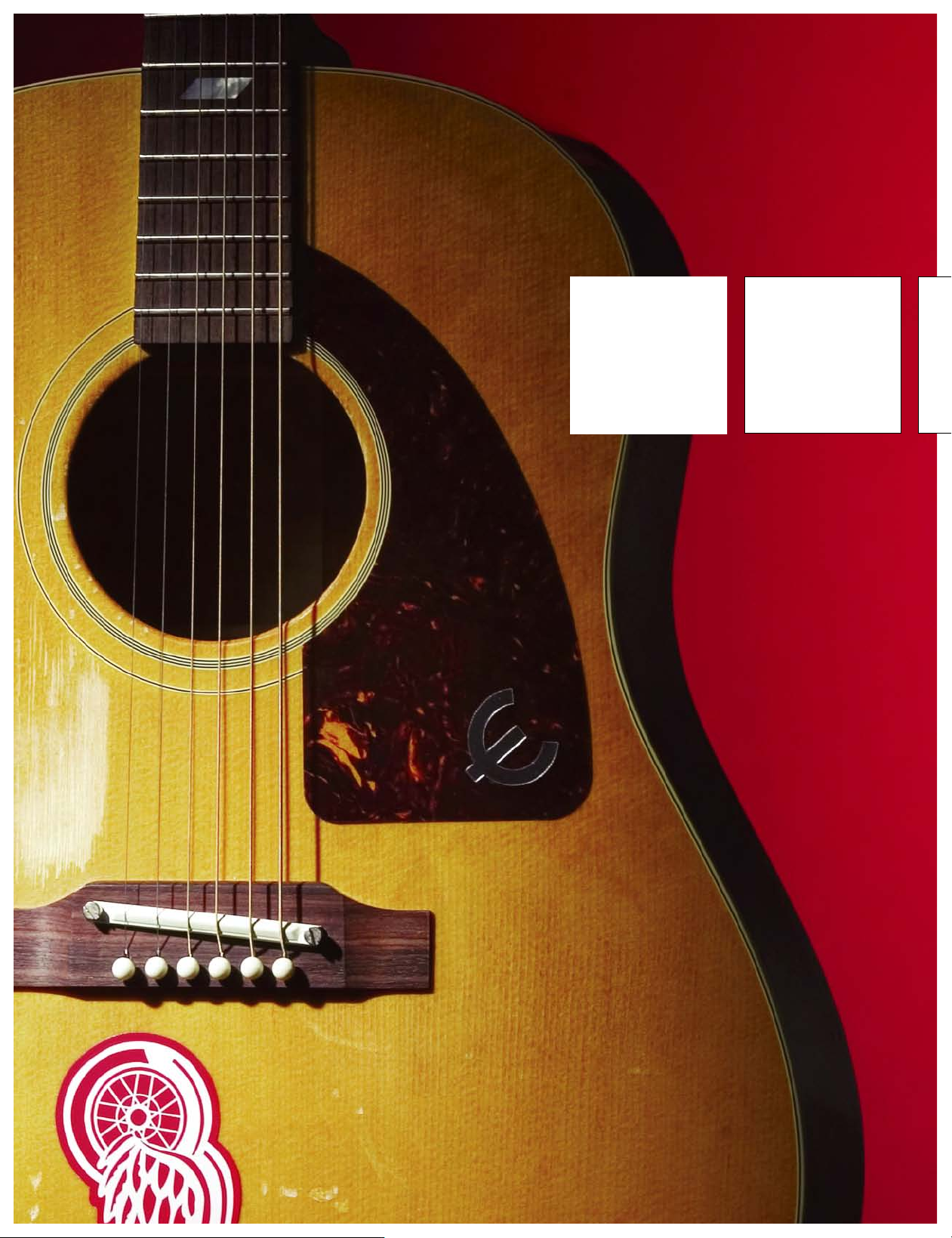
38
Page 42

The ACOUSTICS
E
ver since Epiphone’s founding in 1873, the production of high quality
acoustic musical instruments has been a constant throughout. The dawning of a
new millennium has done little to change this fact. Through the years, the designers at Epiphone have strived to provide the best tools possible to our musicians,
meeting the ever changing requirements of style, features and value.
Every acoustic instrument has specific requirements and properties that
must be met in order to ensure the player the musical experience they desire.
Epiphone engineers have sought to identify and qualify these attributes in order to
incorporate them into our product.
Of course, offering the public a selection of instruments that accommodates
all of the various musical styles is only part of the equation. Each instrument must
have correct geometry that allows for easy playability and good tone…regardless
of the price point. The diligent work of our engineers and quality teams has
ensured that we are able to maintain consistent quality of materials, construction,
fit and finish and tone throughout our product line.
Masterbilt™ Acoustics
For the more discerning musician, we have developed our Masterbilt line. This
line harkens back to the Golden Age of Epiphone Guitars, when they were offering
the best instruments available for the working professionals of the day. Great
attention to detail is paid to every aspect of these instruments. They all offer solid
wood construction throughout. Solid Sitka Spruce or Solid Cedar is used for the
tops for each Masterbilt. These solid tops sound good today and will continue to
improve as they are played. Braces are made from tight grained, quarter sawn
spruce, glued in with hide glue and are shaped and scalloped to established standards, in order to produce a rich, balanced tone. Back and sides are book
matched sets in Mahogany, Rosewood or Maple depending on model. Mahogany
kerfed lining is used on all models
The necks are solid mahogany with rosewood fingerboards. They are
attached to the body using a tapered dovetail neck joint and “Hot Hide Glue”. The
Hide Glue transfers vibrations exceptionally well, and allows for easier repairs later
in its life… just in case your grandson finally needs to reset the neck on your
favorite guitar.
NanoFlex™ Pickup – The invention of the Nanoflex pickup technology is
the latest and by far the most important step in pickup technology since the first
guy wrapped wire around a magnet to produce an electromagnetic field. The term
“Nanoflex” refers to its ultra thin (nano-like) profile and its flexibility that allows it to
conform to any surface shape. This assures complete guitar-to-pickup-to-saddle
contact.
Unlike other under-saddle pickups, the Nanoflex design utilizes 7 highly sensitive and ultra-responsive layers of sensor material to not only sense the vibrations
of the strings but the vibrations of the guitar body as well. This produces results
equivalent to a condenser microphone mixed with an under-saddle pickup.
The Nanoflex is the first pickup to incorporate active amplification directly at
the pickup. As a result, the signal does not pass through even a single millimeter
of the wire, and therefore, the signal quality is uncompromised. Combined with its
100% shielding, the Nanoflex is absolutely and completely noise free. This is different from all other acoustic pickup technology.
NanoMag™ Pickup – Ordinary magnetic pickups have been used successfully to amplify electric guitars for years but when used to amplify acoustic guitars, they fail to deliver desirable acoustic response. That’s because magnetic
pickups have a very narrow bandwidth with an over-emphasis on mid-range frequencies.
The NanoMag, referring to its small size and its composition, is a completely
new kind of magnetic pickup that combines 3 Samarium-Cobalt magnets with onboard, active electronics to produce a low-impedance pickup with absolute linear
response and an uncharacteristically wide frequency range.
Because ordinary under-saddle or transducer pickups fail to capture the very
high and very low harmonic content, the true acoustic character of the instrument
is lost. The NanoMag is able to capture all the harmonics - from the lowest to the
highest - with incredible accuracy. All with ZERO noise or artificial coloration. This
again is different from all other acoustic pickup technology.
Nanoflex/NanoMag Combination – While each pickup individually outperforms all others, the combination of the two is extraordinary. The Nanoflex
captures string and body vibrations while the NanoMag, mounted at the harmonic-rich end of the fingerboard, captures all the string energy and lush harmonic
content. Now, the acoustic guitar has never sounded so real and alive with all its
subtle nuances and distinct characteristics.
eSonic and eSonic2 Preamp Controls and Functions – Both
eSonic and eSonic2 preamps are equipped with a Master Volume control, used to
control the output level or “loudness” of our Nanoflex or NanoMag/Nanoflex
combo equipped acoustic/electrics. The eSonic is equipped with 3 EQ controls,
(Treble, Bass & Dynamics slider) that work together with each other to shape the
overall “tone” of the instrument.
The Dynamics slider reduces or increases the range of the treble and bass
controls. The dynamic control also alters the EQ shape allowing you to best tailor
the sound of your guitar to fit your style of playing, the volume level and the venue.
The eSonic2 is equipped with individual EQ controls for each pickup. They are:
Mag EQ (NanoMag) and Flex EQ (Nanoflex). Each control operates in the same
way by increasing treble up to 9bB or increasing bass up to 9dB. However, these
controls are not linear in that other frequencies (in particular mid-ranges) are
adjusted as well. This “variable” EQ control allows you to better “shape” the soun
The Blend control on the eSonic2 is your “mixer” between the Nanoflex and
the NanoMag pickups. Use it to control the
as contro l the sign als c omi ng ou t of the Stereo outputs. By using it in combination w ith the EQ contr ols , you can really t ail or the sound of th e gui tar to fit your
play ing style, ven ue and v olu me level.
Both eSonic preamps also feature a Phase button and Chromatic Tuner.
The Phase button inverts the output signal allowing the eSonic to c ompensate
for acoustic phase di fferences that occur between instrument and spe aker. This
is very usefu l if you experience any “feedback. ” If you sta rt to hear feedback,
depr ess the ph ase button to immedi ate ly “cancel ” the s ign als. The v ery accura te
and stable Tuner wil l take care that you will never play ou t of tune as it shows
note and tune status. W hen you turn the tuner on it als o mutes the output.
Grover Machine Heads: Most Epiphone guitars and basses feature premium, precision tuners for ease of use, excellent tuning stability, and long life.
“Good musical instruments do not just happen,”
over all tone of the instrument as well
Epi Stathopoulo once said. And he was right.
epiphone.com 39
Page 43

Masterbilt®DR-500MCE Acoustic/Electric The Masterbilt
DR-500MCE is inspired by the original 1931 classic and is a tribute to Epiphone’s long
history of fine acoustic instruments. The DR-500MCE features a solid sitka spruce top,
solid mahogany back and sides, a mahogany neck and a modern cut-
away for extra reach. And thanks to the eSonic-2™ stereo preamp with built-in tuner, stereo outputs, and NanoMag™ EQ, this
Masterbilt can go anywhere.
E
piphone revives the prestige
of i ts 1930s guitars with the
Masterbil t
®
A cousti c Series.
These flat- top guitars feature
solid- wood constructi on and a
disti nctive 1930s- s tyl e“offset
notch” peghead shape with hi s toric
Epi phone scri pt l ogo and mother-
Masterbilt™ DR-500MCEs
Masterbilt®EF-500RCCE Acoustic/Electric The Masterbilt
EF-500RCCE is one of the most unique and beautiful guitars in Epiphone’s Masterbilt
Collection. Featuring a classic "orchestra" body shape with a generous cutaway, a solid
cedar top, bone nut and saddle, and a mahogany "C" style neck
Hardware: Nickel
Scale: 25.5”
Neck Joint: Tapered dovetail
Fingerboard: Rosewood
Nut Width: 1.68” (bone)
Neck Material: Mahogany
Body Wood: Solid mahogany
Top Wood: Solid sitka spruce
Machine Heads: Grover® Sta-Tite™, 18:1 ratio
Neck Pickup: Shadow NanoMag™
Bridge pickup: Shadow NanoFlex™
Electronics: eSonic-2™ Stereo Preamp;
Colors: Vintage Sunburst,
perfect for fingerpicking. And now, the EF500RCCE
includes the eSonic2™ pickup system, perfect
for stage work.
Hardware: Gold
Scale: 25.5”
Neck Joint: Tapered dovetail
Fingerboard: Rosewood
Nut Width: 1.75” (bone)
Neck Material: Mahogany
Body Wood: Solid rosewood
Top Wood: Solid cedar top
Machine Heads: Grover® Sta-Tite™, 18:1 ratio
Neck Pickup: Shadow NanoMag™
Bridge pickup: Shadow NanoFlex™
Electronics: eSonic-2™ Stereo Preamp;
Colors: Natural Satin
stereo outputs
Natural
stereo outputs
of- pearl “sti ckpin” i nlay.
The coll ection incl udes s teel-
string fi ngers tyl e models, and
square- shouldered dreadnoughts,
all made with hand- selected woods
including Sitka s pruce, rosewood,
mahoagny and cedar.
“With the original Masterbil t
li ne of 1931, Epiphone chall enged
Gibson for s upremacy i n the guitar
worl d, and the ensuing battle
brought out the best i n both
companies,” says Henry
Juszki ewicz, chairman and CEO of
Gibson, Epi phone’s parent company.
“The Masterbi lt li ne symboli zes
the quest for perfecti on that s ti l l
dri ves Epiphone today.”
1930s wide-X bracing and deep
scarfing on solid-top tone woods
are the beginning of these
exquisite guitars.
All Masterbilt®necks are
hand-fitted to the body using
traditional tapered dovetail joints
with hot hide glue.
Quality continues with individually
fitted trim and solid tops, backs
and sides. Finished in natural or
vintage satin to allow the guitars
to breathe.
Solid rosewood bridges with real
bone, compensated saddles are
featured on all Masterbilts.
Masterbilt Acoustic/Electrics
40
Old-style, tapered headstock and
vintage-style open end
tuning keys make for tuning
precision and a fantastic look.
Page 44
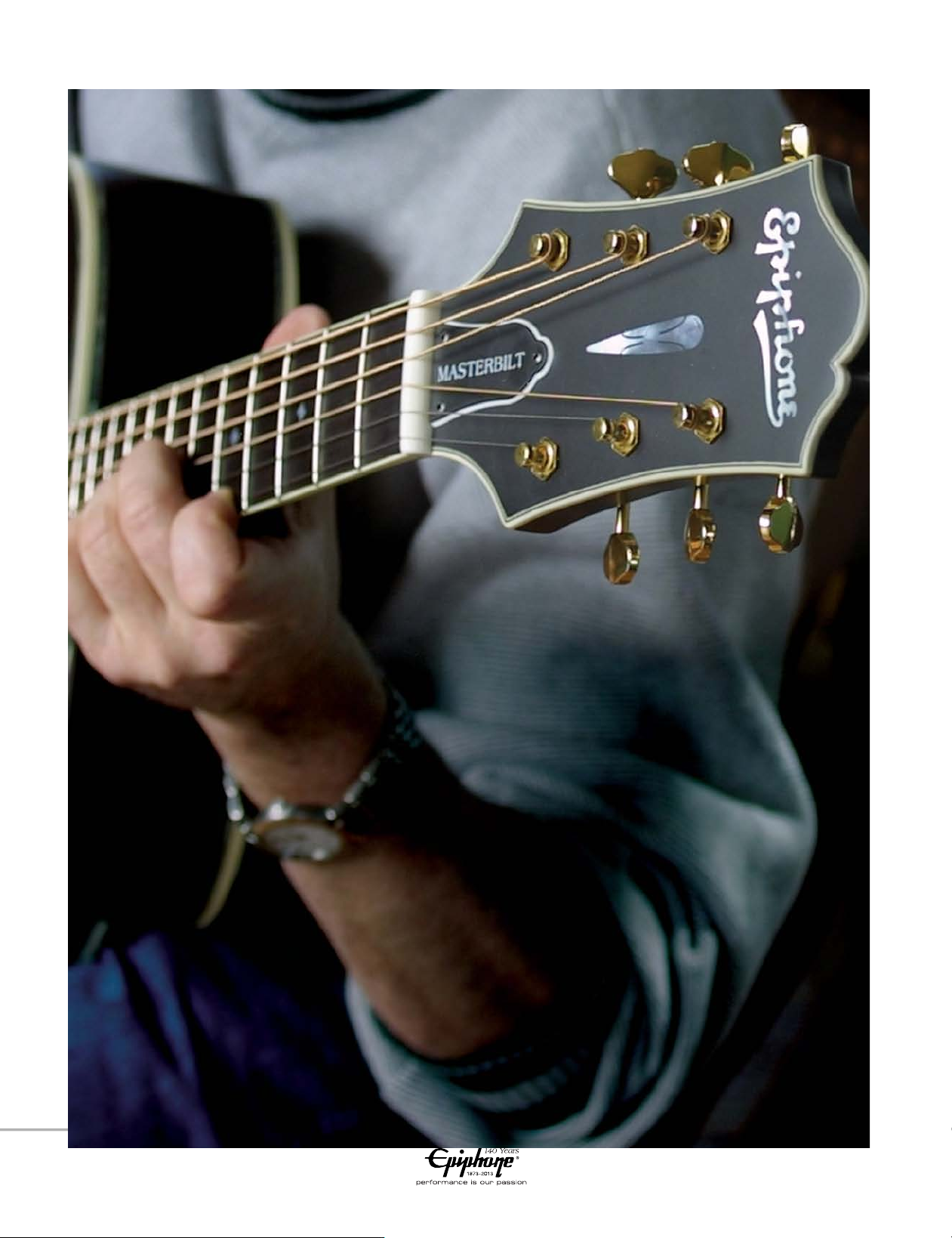
OUR FINEST SOLID-WOOD ACOUSTICS.
epiphone.com 41
Page 45

The Fishman™ Sonitone™
soundhole preamp and Fishman™
Sonicore™ pickup system
The Shadow™ ePerformer™
preamp and Shadow™ NanoFlex™
pickup system
The eSonic-2™ stereo preamp
with built-in tuner, stereo outputs,
and NanoMag™ EQ
The revolutionary NanoMag™
pickup mounted at the harmonic-
rich end of the fingerboard
®
Rotomatic™,
Grover
18:1 ratio tuning machine heads
42
Page 46

Alive on any Stage. Acoustic/Electrics
Hummingbird™ PRO First introduced in 1960, the square-shouldered Hummingbird quickly became a
classic on both sides of the Atlantic. Now, the Epiphone Hummingbird PRO Acoustic/Electric guitar brings the legendary songwriter’s axe into the 21st century with the new Shadow™ ePerformer™ preamp and Shadow™ NanoFlex™
pickup system.
Dove™ PRO The classic Dove acoustic was first introduced at the legendary Gibson & Epiphone fac-
tory in Kalamazoo in 1962 and quickly became a rock and roll icon. Now, both beginners and professionals
can enjoy the classic sound of The Dove™ plugged in with the Fishman™ Sonitone™ soundhole preamp and
Fishman™ Sonicore™ pickup system.
NEW
NEW
2013
NEW
NEW
2013
Hardware: Nickel
Scale: 25.5”
Nut Width: 1.68”
Neck Joint: Glued In
Neck Material: Mahogany
Body Wood: Mahogany
Top Wood: Solid spruce
Fingerboard: Rosewood
Electronics: ePerformer™ Preamp with
NanoFlex™ pickup
Machine Heads: Grover® Rotomatic™, 18:1 ratio
Colors: Faded Cherry Sunburst
Hardware: Nickel
Scale: 25.5”
Nut Width: 1.68”
Neck Joint: Glued In
Neck Material: Hard maple
Body Wood: Select maple
Top Wood: Solid spruce
Fingerboard: Rosewood
Electronics: Fishman™ Sonitone™ soundhole preamp
and Fishman™ Sonicore™ pickup
(under saddle)
Machine Heads: Grover® Rotomatic™, 18:1 ratio
Colors: Vintage Burst
EL-00 PRO The Epiphone EL-00 PRO Acoustic/Electric guitar descends from Epiphone’s original line of flat-tops going back
to the golden age of the 1930s. The EL-00 PRO is a player’s favorite for its woody tonal quality, short scale, and comfortable weight.
Now featuring the Fishman™ Sonitone™ soundhole preamp and Fishman™ Sonicore™ pickup, the EL-00 PRO Acoustic/Electric can
plug-in and be heard on any size stage with first class sound.
NEW
NEW
2013
Hardware: Nickel
Scale: 24.75”
Nut Width: 1.68”
Neck Joint: Glued In
Neck Material: Mahogany
Body Wood: Mahogany
Top Wood: Solid spruce
Fingerboard: Rosewood
Electronics: Fishman™ Sonitone™ soundhole preamp and Fishman™
Sonicore™ pickup (under saddle)
Machine Heads: Grover® Mini-Rotomatic™,
14:1 ratio
Colors: Vintage Sunburst
EJ-200SCE The Epiphone EJ-200CE pushes the “King of the Flat-Tops,” into the future with a spectacular cut-
away for total upper fret access plus the eSonic2™ pickup system. Originally introduced in 1937, the J-200 style set a
standard for guitar excellence that others have been trying to match ever since. Today—over 70 years later—the legacy
of the “King of the Flat-Tops” lives on in the Epiphone EJ 200CE.
Hardware: Gold
Scale: 25.5”
Nut Width: 1.68”
Neck Material: Maple
Neck Joint: Glued In
Body Wood: Select maple
Top Wood: Solid spruce
Fingerboard: Rosewood
Neck Pickup: Shadow NanoMag™
Bridge pickup: Shadow NanoFlex™
Electronics: eSonic-2™ Stereo Preamp;
stereo outputs
Machine Heads: Grover® Rotomatic™, 18:1 ratio
Colors: Black, Natural, Vintage Sunburst
EJ-200SCEs
epiphone.com 43
Page 47

Acoustic/Electrics Inspired Creations
Dave Navarro and his “Jane”
acoustic/electric
The eSonic™ preamp
with built-in tuner, EQ and
phase controls
John Lennon and his vintage
J-160 performing in a live
televised broadcast
The Shadow™ Sonic NanoFlex™
soundhole preamp
Paul MaCartney singing“Yesterday”
with his 1964 Epiphone Texan
Dave Navarro “Jane” Acoustic/Electric Dave Navarro has made his eclectic style a
trademark with Jane’s Addiction and many others. Now, Dave teams up with Epiphone to create a versatile
acoustic/electric guitar with exceptional stage sound and great playability. Featuring the eSonic™ preamp and
NanoFlex™ pickup system, ebony fretboard, and mahogany body and neck.
Hardware: Nickel
Scale: 25.5”
Nut Width: 1.725” (bone)
Neck Joint: Glued In
Neck Material: Mahogany
Back Wood: Solid mahogany
Side Wood: Select mahogany
Top Wood: Solid Sitka spruce
Fingerboard: Ebony
Electronics: eSonic™ Preamp with NanoFlex™
Machine Heads: Grover® Rotomatic™, 18:1 ratio
Colors: Ebony
pickup, tuner, and eq
“John Lennon” EJ-160E Discover the joys of playing one of John Lennon’s favorite guitars and
the backbone of dozens of Beatle classics. John used his vintage J-160 to compose and record “Give Peace A
Chance” and dozens of other hits for The Beatles. Now, Epiphone is proud to offer a re-issue of John Lennon's
favorite composing guitar with our Epiphone EJ-160E, with a portion of the proceeds of each guitar being donated
to the BMI Foundation, Inc. for the John Lennon Scholarship Fund.
Hardware: Nickel
Scale: 25.5”
Nut Width: 1.68”
Neck Joint: Glued In
Neck Material: Mahogany
Body Wood: Select mahogany
Top Wood: Solid spruce
Fingerboard: Rosewood
Pickup: Mini acoustic humbucker
Machine Heads: Wilkinson™ Deluxe, 15:1 ratio
Colors: Vintage Cherry Sunburst
44
Inspired by “1964” Texan Acoustic/Electric Since it's introduction in 1958, the
Epiphone Texan has been the choice of countless artists. In fact, McCartney wrote and recorded "Yesterday," one
of the most recorded and popular songs ever, on his 1964 Texan. Now, Epiphone introduces the Texan to a whole
new generation with all the great features of the original plus modern updates for today's musician. Bring your
Texan on stage with the Shadow NanoFlex™ pickup and Shadow Sonic™ soundhole mounted system
Hardware: Nickel
Scale: 25.5”
Nut Width: 1.68”
Neck Joint: Glued In
Neck Material: Mahogany
Back Wood: Solid mahogany
Side Wood: Mahogany
Top Wood: Solid spruce
Fingerboard: Rosewood
Bridge Pickup: Shadow NanoFlex™
Electronics: Shadow Sonic™ soundhole
mounted system
Machine Heads: Wilkinson™ Deluxe, 15:1 ratio
with small cream buttons
Colors: Antique Natural, Vintage Cherryburst
Page 48

epiphone.com 45
Page 49

AJ-220SCE The AJ-220SCE is Epiphone’s best selling acoustic guitar with the look, sound, and
build quality that first time players and professionals expect when they choose an Epiphone. It features a
Solid spruce top for great acoustic tone that only gets better with age. Now with a killer cutaway and
Shadow's new NanoFlex™ pickup and Performer Tuner™ preamp system.
Hardware: Nickel
Scale: 25.5”
Neck Joint: Glued In
Nut Width: 1.68”
Neck Material: Mahogany (Satin)
Body Wood: Mahogany
Top Wood: Solid Sitka spruce
Fingerboard: Rosewood
Bridge Pickup: NanoFlex™
Controls: Shadow Performer Tuner™
Machine Heads: Epiphone premium die-cast,
Colors: Natural, Ebony, Vintage Sunburst
Preamp
15:1 ratio
AJ-100CE The Epiphone AJ-100CE is the perfect first guitar for future pros and pros at heart.
The AJ-100CE features the renowned NanoFlex™ pickup and a beautiful cutaway for great upper fret
access and all built with a century of Epiphone experience.
Hardware: Nickel
Scale: 25.5”
Nut Width: 1.68”
Neck Joint: Glued In
Neck Material: Mahogany
Body Wood: Mahogany
Top Wood: Select spruce
Fingerboard: Rosewood
Pickup: NanoFlex™
Machine Heads: Epiphone premium die-cast,
Colors: Natural
15:1 ratio
Acoustic/Electrics Performance and Value
46
Page 50

PR-5E The Epiphone PR-5E has been an industry standard for over 20 years, heard on stages all over the
world. Its distinctive body shape was patterned after Epiphone's classic ES-style archtops such as the Sheraton
and Casino. But instead of a double-cutaway, the PR-5E features a unique, single "Florentine" or sharp cutaway.
The large lower bout provides excellent lows and a solid mid-range with easy access to the upper frets on the
neck. Featuring the eSonic ™ preamp system with NanoFlex™ pickup, tuner, and eq.
Les Paul®Ukulele Outfit Epiphone presents the Les Paul Acoustic/Electric
Ukulele Outfit. Like a traditional Les Paul Standard, the Les Paul Ukulele features a solid
mahogany body combined with a AAA grade flame maple top for great tone and great looks.
And, the Les Paul Ukulele now features a Piezo pickup so you can take your Les Paul Ukulele
to any stage in style! Includes gigbag.
Hardware: Nickel
Scale: 15”
Neck Joint: Bolt-on; recessed
Nut Width: 1.31
Neck Material: Mahogany
Body Wood: Mahogany
Top Wood: AAA flame maple veneer
Fingerboard: Rosewood
Bridge Pickup: Under-saddle -
Piezo Film
Machine Heads: Epiphone, 14:1 ratio
Colors: Heritage Cherry
Sunburst;
Vintage Sunburst
Includes: Gigbag
Hardware: Gold
Scale: 25.5”
Nut Width: 1.68”
Neck Joint: Glued In
Neck Material: Mahogany
Body Wood: Mahogany
Top Wood: Select spruce
Fingerboard: Rosewood
Electronics: eSonic™ Preamp with NanoFlex™
pickup, tuner, and eq
Machine Heads: Grover® Rotomatic™, 18:1 ratio
Colors: Natural
epiphone.com 47
Page 51
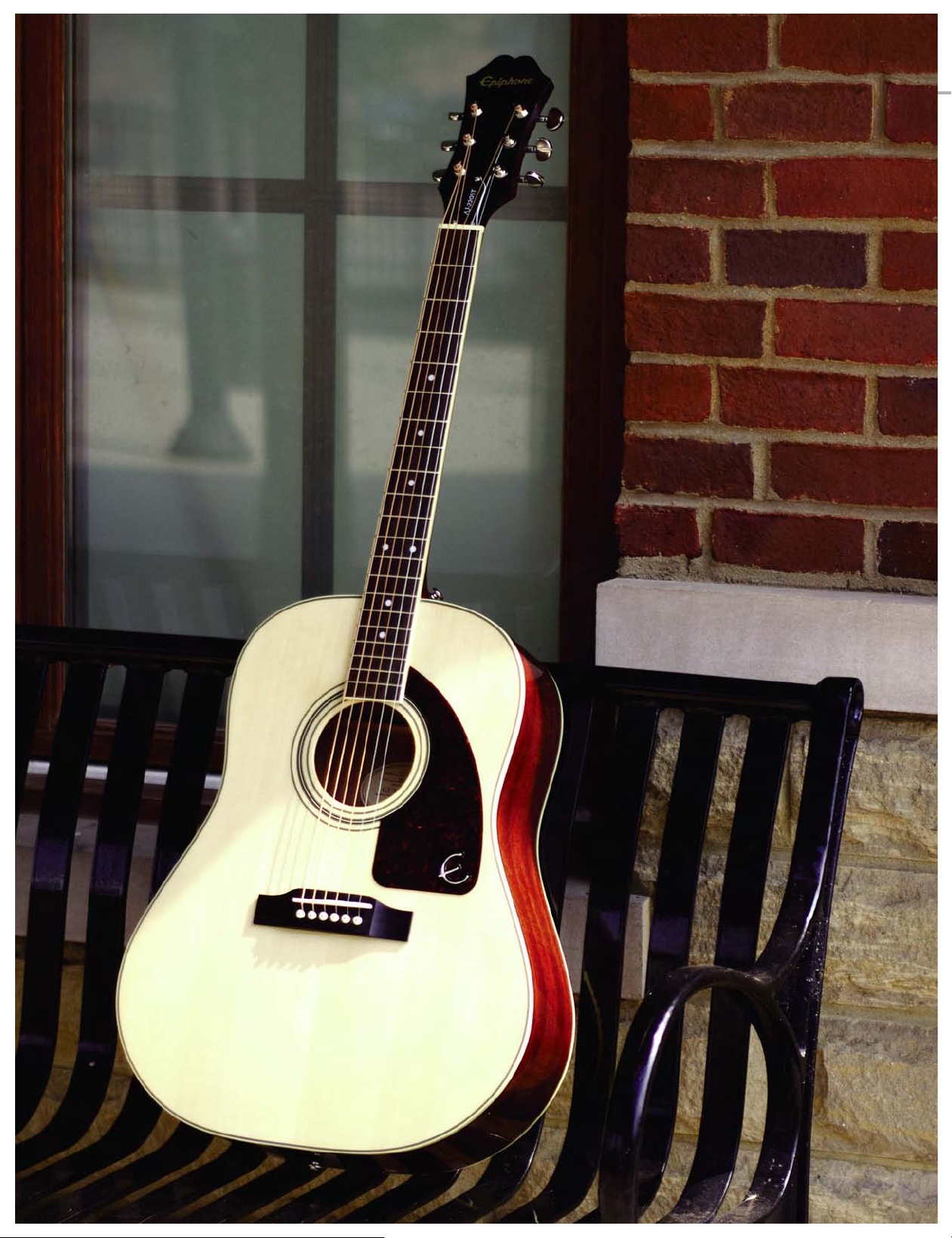
TIMELESS TONE, TIMELESS LOOKS
48
Page 52

Epiphone Acoustics
DR-100 The DR-100 has long been Epiphone’s most popular acoustic
guitar with the look, sound, and build quality that first-time players and professionals expect when they pick up an Epiphone. Featuring a select spruce top,
mahogany back and neck, and premium tuners.
Hardware: Nickel
Scale: 25.5”
Neck Joint: Set
Nut Width: 1.68”
Neck Material: Mahogany
Body Wood: Mahogany
Top Wood: Select spruce
Fingerboard: Rosewood
Machine Heads: Epiphone premium covered, 15:1 ratio
Colors: Natural, Vintage Sunburst, Ebony
AJ-220S The AJ-220S has a unique bell-like shape, a large
lower bout, and a small round upper bout, which gives this new addition
to the Advanced Jumbo family of Epiphone acoustic guitars a unique
voice. Made with a century’s worth of Epiphone expertise, it features a
Solid sitka spruce top, a Select mahogany body, and mahogany neck.
Hardware: Nickel
Scale: 25.5”
Neck Joint: Set
Nut Width: 1.68”
Neck Material: Mahogany (Satin)
Body Wood: Mahogany
Top Wood: Solid sitka spruce
Fingerboard: Rosewood
Machine Heads: Epiphone premium diecast,
15:1 ratio
Colors: Vintage Sunburst, Natural
DR-212 The DR-212 is a big-toned 12-string acoustic designed to provide proper bracing
support so you hear a balanced, forceful, and attention-getting tone. Featuring a mahogany body, a
Select spruce top, and a mahogany neck.
Hardware: Nickel
Scale: 25.5”
Neck Joint: Set
Nut Width: 1.75”
Neck Material: Mahogany
Body Wood: Mahogany
Top Wood: Select spruce
Fingerboard: Rosewood
Machine Heads: Epiphone premium
Colors: Natural
diecast; 15:1 ratio
epiphone.com 49
Page 53

MM-50E Professional Electric Mandolin The Epiphone MM-50E Professional “F”-style Mandolin
combines innovation and classic design that players have come to expect from Epiphone. The MM-50E is the first mandolin that
allows you to adjust the output level of each individual string pair. These features, combined with the classic Lloyd Loar era FStyle body shape and neck, make the MM-50E a one-of-a kind instrument.
On the pickguard are master
volume, treble and bass rotary
controls as well as an easy-access
battery compartment.
The NanoMag can slide back towards
the bridge for a brighter tone or forward towards the neck for a warmer
tone and anywhere in between.
MM-30S “A”-Style Mandolin The A-style mandolin was a
revolutionary instrument in its time with a radical new design that broke from
traditional bowl-back instruments like Epi Stathopoulo’s father had made in
Greece. Today, Epiphone’s MM-30S carries on that tradition offering players
a century of heritage with the added touch of gold hardware.
Hardware: Gold
Scale: 14”
Neck Joint: Glued In
Nut Width: 1.06”
Neck Material: Mahogany
Body Wood: Mahogany
Top Wood: Solid spruce
Fingerboard: Rosewood
Colors: Antique Sunburst
MB-200 Banjo The Epiphone MB-200 is a terrific 5-string banjo for beginners that includes all the key features of
a professional 5-string banjo but lighter weight. The MB-200 reflects Epiphone’s 80-year history as a leader in banjo design.
Hardware: Nickel
Scale: 14”
Neck Joint: Glued In
Nut Width: 1.06”
Neck Material: Maple
Body Wood: Flame maple
Top Wood: Solid Sitka spruce
Fingerboard: Rosewood
Machine Heads: Epiphone vintage in-line
tuners, 14:1 ratio
Pickup: Quad NanoMag™ adjustable
Controls: Volume, treble, bass, individual
string output trimpots
Colors: Vintage Natural
Hardware: Nickel
Scale: 26.25”
Neck Joint: Traditional
Nut Width: 1.25”
Neck Material: Mahogany
Body Wood: Mahogany
Fingerboard: Rosewood
Machine Heads: Geared, straight banjo tuners
Banjo Head: Remo™
50
MB-100 Banjo The MB-100 open back 5-string banjo is the perfect travel-
ing banjo and an ideal first instrument for players interested in bluegrass and string
band music. Open back banjos are appreciated for being lightweight (easy on the shoulder!) and for their unique, mellow tone. And Epiphone knows banjos. The company
founder, Epi Stathopoulo, was granted his first of many patents for a banjo design.
Hardware: Nickel
Scale: 26.25”
Neck Joint: Traditional
Nut Width: 1.25”
Neck Material: Mahogany
Body Wood: Mahogany
Fingerboard: Rosewood
Machine Heads: Covered tuners
Banjo Head: Remo™
Page 54

Dobro™ Hound Dog
Deluxe Square Neck
The Dobro® resonatorguitar has
been an American classic since
its arrival in the early 1920s.
Now Epiphone and Dobro keep
that tradition alive with the
Dobro™ Hound Dog Deluxe
Square Neck, an American icon
ready for the 21st century with a
Fishman™ Resonator Pickup.
Dobro™ Hound Dog
Round Neck
An American classic, the Dobro®
resonator guitar has been part
country, blues, and bluegrass
since its arrival in the early
1920s. The wood resonator or
resophonic style guitar became
a national phenomenon thanks
shows like WLS Barndance,
the Grand Ole Opry, and countless other coast-to-coast broadcasts. The Dobro™ Hound Dog
Round Neck is perfect for players
who want that sound with
regular action.
Epiphone Bluegrass
Dobro™ Hound Dog
Deluxe Round Neck
The American classic Dobro®
goes ‘modern’ with a Fishman™
Resonator pickup. The Dobro®
Hound Dog Deluxe Round Neck
resonator guitar has been part of
country, blues, and bluegrass
since its arrival in the early
1920s. The Dobro™ Hound Dog
Round Neck is perfect for players
who want that sound with regular
action.
Model: Dobro™ Hound Dog
Deluxe Square Neck
Hardware: Nickel
Scale: 25”
Neck Joint: Glued In
Nut Width: 2” raised
Neck Material: Mahogany square neck
Top Wood: Laminated flame maple
with black binding
Body Wood: Laminated flame maple
with black binding
Fingerboard: Rosewood
Machine Heads: Grover® Rotomatic™,
18:1 ratio
Pickup: Fishman™ Resonator Pickup
Color: Vintage Brown
Model: Dobro™ Hound Dog
Round Neck
Hardware: Nickel
Scale: 25”
Neck Joint: Glued In
Nut Width: 1.75”
Neck Material: Mahogany round neck
Top Wood: Laminated maple
Body Wood: Laminated maple
Fingerboard: Rosewood
Machine Heads: Grover® Rotomatic™,
18:1 ratio
Color: Vintage Brown
Model: Dobro™ Hound Dog
Deluxe Round Neck
Hardware: Nickel
Scale: 25”
Neck Joint: Tapered dovetail
Nut Width: 1.75”
Neck Material: Mahogany round neck
Top Wood: Laminated flame maple
with black binding
Body Wood: Laminated flame maple
with black binding
Fingerboard: Rosewood
Machine Heads: Grover® Rotomatic™,
18:1 ratio
Pickup: Fishman™ Resonator Pickup
Color: Vintage Brown
epiphone.com 51
Page 55

Cases and Gigbags
Jumbo Hard Case ES Style Hard Case Les Paul Hard Case
SG Hard Case Explorer Hard Case Flying-V Hard Case
Dreadnought Hard Case Banjo Hard Case F-Style Mandolin Hard Case
A-Style Mandolin Hard Case
Notice: In order to continually improve the quality and/or performance of our instruments and cases and/or to make use of the best
52
available components, Epiphone reserves the right to change prices and specifications without notice.
Premium Gigbag Standard Gigbag
Page 56

“Good musical instruments
do not just happen.”
Epaminondas “Epi” Stathopoulo
F
rom Epiphone’s modest beginnings
in Greece back in the 19th century to its
heyday in New York to the classic 1960s
Kalamazoo, Michigan days, our
instruments have always been crafted with
pride and a passion for excellence. Today
that passion lives on at our Epiphone
manufacturing facility located in China.
Opened in 2004 under the direct
supervision and instruction of Epiphone
and Gibson USA engineers, luthiers and
managers, our state-of-the-art
factory combines over 250 years
of guitar manufacturing experience and
USA expertise with the latest
production methods and quality
innovations. This, along with new
headquarters in Nashville, Tennessee,
gives Epiphone the ability to produce
musical instruments of unsurpassed
quality and value. Since 1873, you can be
assured that every guitar we make is still
Kurfing is attached to the body rim ny hand.
CNC machines make for precision
routing of this Kat body.
Hand-sanding and inspection of bodies ensure that each guitar is perfect.
Solid Mahogany SG bodies await
finishing.
Skilled hand work shapes acoustic
guitar bracing.
Completed acoustic bodies await the finishing process.
Hydraulic presses hold back bracing
and body rims in place.
Finished acoustic bodies move through an air-filtered
drying room.
crafted with the passion that has made
Epiphone a leader for 140 years. We are
pleased to offer you our instruments
and thank you for choosing Epiphone.
These highly flamed Les paul Standards make their way through
the drying room.
“Gang” drill presses with multiple heads ensure proper placement
of holes. In this case, LP control holes.
Skilled taping over the binding before
painting provides for a clean finish.
Finishing the old fashioned way; compound, wheel and patience.
A precision press applies perfect pressure for consistent
fret seating.
Precision presses assure a securely attached
bridge.
Laser cutting of inlays makes for
a perfect “snap-in” fit.
To avoid fretboard damage, this innovative jig
provides protection during fret dressing.
epiphone.com 53
 Loading...