

Page 1
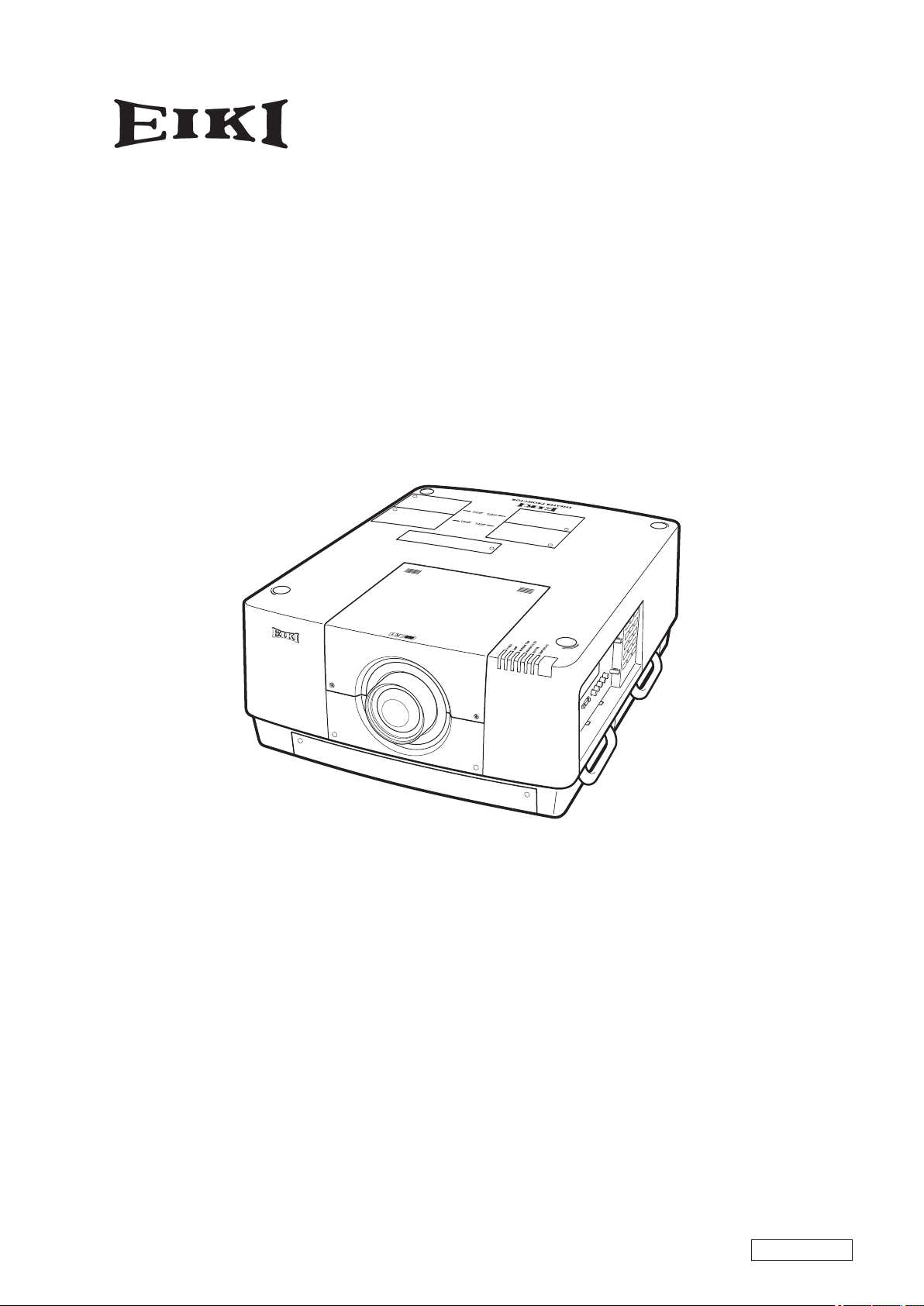
LCD PROJECTOR
MODEL LC-XT6
✽ Projection lens not included.
Owner’s Manual
Projector Operations
ENGLISH
TQBJ0489
Page 2
Information
Read this rst!
Read this rst!
Information
Important
WARNING: THIS APPARATUS MUST BE EARTHED.
WARNING: To prevent damage which may result in re or shock hazard, do not expose this appliance to rain
Machine Noise Information Ordinance 3. GSGV, January 18, 1991: The sound pressure level at the operator
position is equal or less than 70 dB (A) according to ISO 7779.
WARNING:
1. Remove the plug from the mains socket when this unit is not in use for a prolonged period of time.
2. To prevent electric shock, do not remove cover. No user serviceable parts inside. Refer servicing to qualied
3. Do not remove the earthing pin on the mains plug. This apparatus is equipped with a three prong
WARNING:
This is a class A product. In a domestic environment this product may cause radio interference in which case
the user may be required to take adequate measures.
CAUTION: To assure continued compliance, follow the attached installation instructions, which include using
or moisture.
service personnel.
earthingtype mains plug. This plug will only t an earthing-type mains socket. This is a safety feature. If you
are unable to insert the plug into the mains socket, contact an electrician. Do not defeat the purpose of the
earthing plug.
the provided power cord and shielded interface cables when connecting to computer or peripheral
device. If you use serial port to connect PC for external control of projector, you must use optional
RS-232C serial interface cable with ferrite core. Any unauthorized changes or modications to
this equipment will void the user’s authority to operate.
EEE Yönetmeliğine Uygundur.
EEE Complies with Directive of Turkey.
WARNING:
TURN OFF THE UV LAMP BEFORE OPENING THE LAMP COVER
WARNING: TO REDUCE THE RISK OF FIRE OR ELECTRIC SHOCK, DONOT EXPOSE THIS PRODUCT
TO RAIN OR MOISTURE.
WARNING: RISK OF ELECTRIC SHOCK, DO NOT OPEN.
The lightning ash with arrowhead symbol, within an equilateral triangle, is intended to alert the
user to the presence of uninsulated “dangerous voltage” within the product’s enclosure that may
be of sufcient magnitude to constitute a risk of electric shock to persons.
The exclamation point within an equilateral triangle is intended to alert the user to the presence of
important operating and maintenance (servicing) instructions in the literature accompanying the
product.
CAUTION (USA and Canada)
CAUTION: This equipment is equipped with a three-pin grounding-type power
plug. Do not remove the grounding pin on the power plug. This plug
will only t a grounding-type power outlet. This is a safety feature. If
you are unable to insert the plug into the outlet, contact an electrician.
Do not defeat the purpose of the grounding plug.
Do not remove
2 - ENGLISH
Page 3
Read this rst!
IMPORTANT: THE MOULDED PLUG (U.K. only)
FOR YOUR SAFETY, PLEASE READ THE FOLLOWING TEXT CAREFULLY.
This appliance is supplied with a moulded three pin mains plug for your safety and convenience. A 13 amp fuse
is tted in this plug. Should the fuse need to be replaced, please ensure that the replacement fuse has a rating
of 13 amps and that it is approved by ASTA or BSI to BS1362.
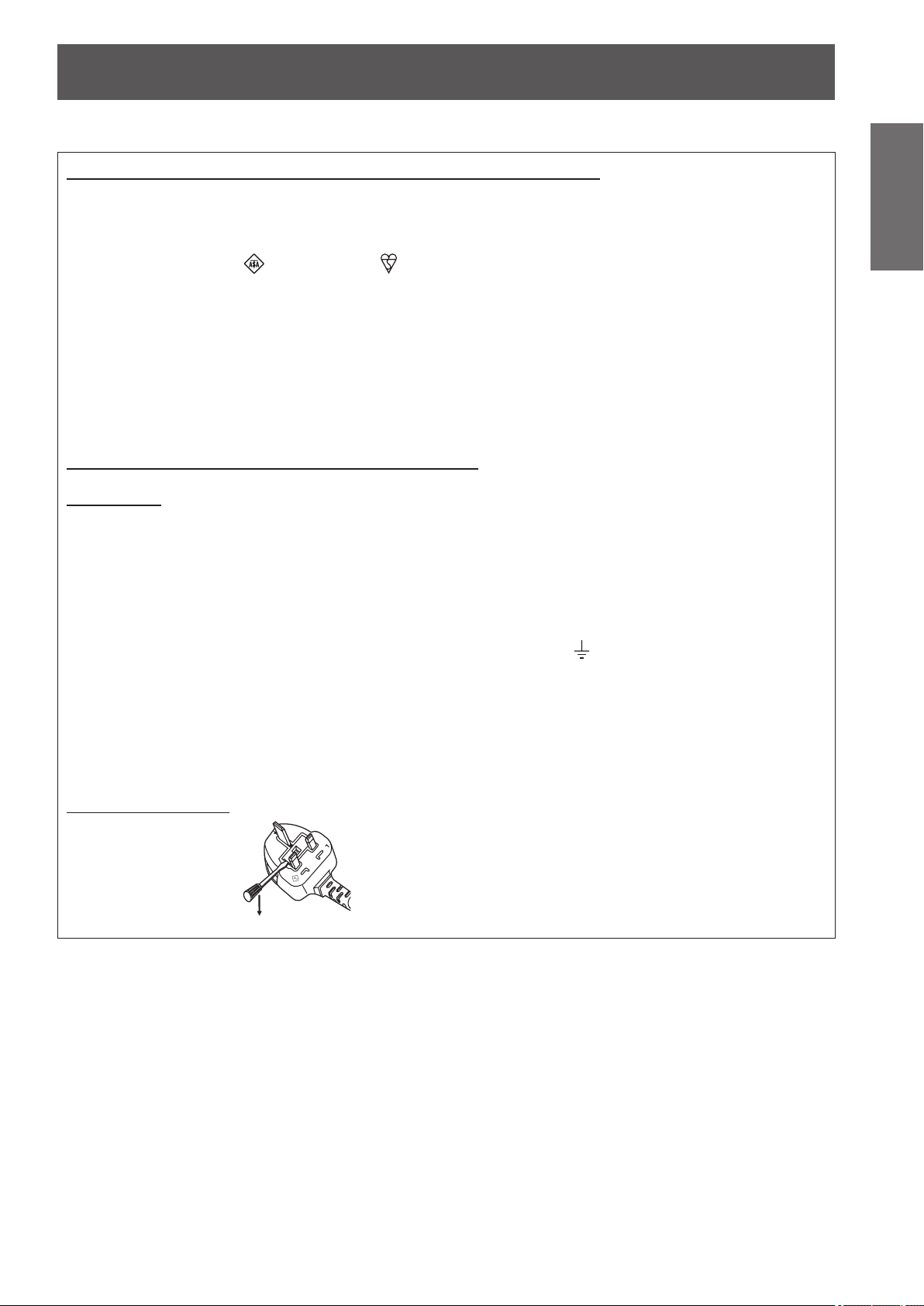
Check for the ASTA mark
If the plug contains a removable fuse cover, you must ensure that it is retted when the fuse is replaced. If you
lose the fuse cover, the plug must not be used until a replacement cover is obtained. A replacement fuse cover
can be purchased from an Authorised Service Center.
If the tted moulded plug is unsuitable for the mains socket in your home, then the fuse should be
removed and the plug cut off and disposed of safely. There is a danger of severe electrical shock if the
cut off plug is inserted into any 13 amp socket.
If a new plug is to be tted, please observe the wiring code as shown below.
If in any doubt, please consult a qualied electrician.
WARNING: THIS APPLIANCE MUST BE EARTHED.
IMPORTANT: The wires in this mains lead are coloured in accordance with the following code:
or the BSI mark on the body of the fuse.
Green - and - Yellow: Earth
Blue: Neutral
Brown: Live
Important
Information
As the colours of the wire in the mains lead of this appliance may not correspond with the coloured markings
identifying the terminals in your plug, proceed as follows.
The wire which is coloured GREEN - AND - YELLOW must be connected to the terminal in the
plug which is marked with the letter E or by the Earth symbol
or coloured GREEN or GREEN -
AND - YELLOW.
The wire which is coloured BLUE must be connected to the terminal in the plug which is marked
with the letter N or coloured BLACK.
The wire which is coloured BROWN must be connected to the terminal in the plug which is
marked with the letter L or coloured RED.
How to replace the fuse: Open the fuse compartment with a screwdriver and replace the fuse.
BS1363/A
N
13A250V
HE-8
L
ASA
ENGLISH - 3
Page 4
Read this rst!
Information
Important
FCC NOTICE (USA)
Declaration of Conformity
This device complies with Part 15 of the FCC Rules.
Operation is subject to the following two conditions:
(1) This device may not cause harmful interference, and (2) this device must accept any interference received,
including interference that may cause undesired operation.
To assure continued compliance, follow the attached installation instructions and do not make any unauthorized
modications.
CAUTION:
This equipment has been tested and found to comply with the limits for a Class A digital device, pursuant
to part 15 of the FCC Rules. These limits are designed to provide reasonable protection against harmful
interference when the equipment is operated in a commercial environment. This equipment generates, uses,
and can radiate radio frequency energy and, if not installed and used in accordance with the instruction
manual, may cause harmful interference to radio communications. Operation of this equipment in a residential
area is likely to cause harmful interference in which case the user will be required to correct the interference at
his own expense.
Model Number: LC-XT6
Trade Name: EIKI
Responsible Party: EIKI International, Inc.
Address: 30251 Esperanza Rancho Santa Margarita CA 92688-2132
Telephone number: 800-242-3454 (949)-457-0200
NOTIFICATION (Canada)
This class A digital apparatus complies with Canadian ICES-003.
WARNING (USA and Canada)
Not for use in a computer room as dened in the Standard for the Protection of Electronic Computer/Data
z
z
Processing Equipment, ANSI/NFPA 75.
For permanently connected equipment, a readily accessible disconnect device shall be incorporated in the
z
z
building installation wiring.
For pluggable equipment, the socket-outlet shall be installed near the equipment and shall be easily
z
z
accessible.
NOTICE U.S.A. only:
This product has a High Intensity Discharge (HID) lamp that contains mercury. Dispose may be regulated in
z
z
your community due to environmental considerations. For disposal or recycling information, please visit
EIKI website: http://www.eiki.com/
4 - ENGLISH
Page 5

Read this rst!
WARNING:
POWER
z
The wall outlet or the circuit breaker shall be installed near the equipment and shall be easily
accessible when problems occur. If the following problems occur, cut off the power supply
immediately.
Continued use of the projector in these conditions will result in re or electric shock.
If foreign objects or water get inside the projector, cut off the power supply.
z
z
If the projector is dropped or the cabinet is broken, cut off the power supply.
z
z
If you notice smoke, strange smells or noise coming from the projector, cut off the power supply.
z
z
Please contact an Authorized Service Center for repairs, and do not attempt to repair the projector yourself.
During a thunderstorm, do not touch the projector or the cable.
Electric shocks can result.
Do not do anything that might damage the power cord or the power plug.
If the power cord is used while damaged, electric shocks, short-circuits or re will result.
Do not damage the power cord, make any modications to it, place it near any hot objects, bend it
z
z
excessively, twist it, pull it, place heavy objects on top of it or wrap it into a bundle.
Ask an Authorized Service Center to carry out any repairs to the power cord that might be necessary.
Completely insert the power plug into the wall outlet and the power connector into the projector terminal.
If the plug is not inserted correctly, electric shocks or overheating will result.
Do not use plugs which are damaged or wall outlets which are coming loose from the wall.
z
z
Do not use anything other than the provided power cord.
Failure to observe this will result in re or electric shocks.
Clean the power plug regularly to prevent it from becoming covered in dust.
Failure to observe this will cause a re.
If dust builds up on the power plug, the resulting humidity can damage the insulation.
z
z
If not using the projector for an extended period of time, pull the power plug out from the wall outlet.
z
z
Pull the power plug out from the wall outlet and wipe it with a dry cloth regularly.
Do not handle the power plug with wet hands.
Failure to observe this will result in electric shocks.
Do not overload the wall outlet.
If the power supply is overloaded (ex., by using too many adapters), overheating may occur and re will result.
Important
Information
ON USE/INSTALLATION
z
Do not place the projector on soft materials such as carpets or sponge mats.
Doing so will cause the projector to overheat, which can cause burns, re or damage to the projector.
Do not set up the projector in humid or dusty places or in places where the projector may come into
contact with oily smoke or steam, ex. a bathroom.
Using the projector under such conditions will result in re, electric shocks or deterioration of components.
Deterioration of components (such as ceiling mount brackets) may cause the projector which is mounted on
the ceiling to fall down.
Do not install this projector in a place which is not strong enough to take the full weight of the
projector or on top of a surface which is sloped or unstable.
Failure to observe this will cause projector to fall down or tip over the projector, and severe injury or damage
could result.
ENGLISH - 5
Page 6

Read this rst!
Information
Important
WARNING:
Do not cover the air intake/exhaust ports or place anything within 1 m (39”) of them.
Doing so will cause the projector to overheat, which can cause re or damage to the projector.
Do not place your hands or other objects close to the air exhaust port.
Doing so will cause burns or damage your hands or other objects.
Do not look and place your skin into the lights emitted from the lens while the projector is being used.
Doing so can cause burns or loss of sight.
Never attempt to remodel or disassemble the projector.
High voltages can cause re or electric shocks.
Do not project an image with the lens cover attached.
Doing so can cause re.
Do not allow metal objects, ammable objects, or liquids to enter inside of the projector. Do not allow
the projector to get wet.
Doing so may cause short circuits or overheating, and result in re, electric shock, or malfunction of the
projector.
Do not touch other than the specied portion or remove the components.
Doing so may impair the performance or safety.
Use the ceiling mount bracket specied by EIKI.
Using the ceiling mount bracket other than the specied one will result in falling accidents.
Installation work (such as ceiling mount bracket) should only be carried out by a qualied technician.
If installation is not carried out and secured correctly it can cause injury or accidents, such as electric shocks.
When attaching or replacing a lens, consult the technical staff or service personnel at a specialist
dealer.
Replacing a lens in the wrong way might damage the product.
When attaching or replacing a lens, observe related procedures in order to perform this properly.
Do not place the projector in narrow, badly ventilated places.
z
z
Do not place the projector on cloth or papers, as these materials could be drawn into the air intake port.
z
z
Heated air comes out of the air exhaust port. Do not place your hands or face, or objects which cannot
z
z
withstand heat close to this port.
Strong light is emitted from the projector’s lens. Do not look or place your hands directly into this light.
z
z
Be especially careful not to let young children look into the lens. In addition, turn off the power and
z
z
disconnect the power plug when you are away from the projector.
For any inspection, adjustment and repair work, please contact an Authorized Service Center.
z
z
Do not place containers of liquid or metal objects near the projector.
z
z
If liquid enters inside of the projector, consult your dealer.
z
z
Particular attention must be paid to children.
z
z
Attach the supplied safety cable to the ceiling mount bracket to prevent the projector from falling down.
z
z
Do not use anything other than an authorized ceiling mount bracket.
z
z
Be sure to use the provided accessory wire with an eye bolt as an extra safety measure to prevent the
z
z
projector from falling down. (Install in a different location to the ceiling mount bracket.)
6 - ENGLISH
Page 7

Read this rst!
WARNING:
ACCESSORIES
z
Do not use or handle the batteries improperly, and refer to the following.
Failure to observe this will cause burns, batteries to leak, overheat, explode or catch re.
Do not use unspecied batteries.
z
z
Use manganese or alkaline batteries but not rechargeable batteries.
z
z
Do not disassemble dry cell batteries.
z
z
Do not heat the batteries or place them into water or re.
z
z
Do not allow the + and - terminals of the batteries to come into contact with metallic objects such as
z
z
necklaces or hairpins.
Do not store batteries together with metallic objects.
z
z
Store the batteries in a plastic bag and keep them away from metallic objects.
z
z
Make sure the polarities (+ and -) are correct when inserting the batteries.
z
z
Do not use a new battery together with an old battery or mix different types of batteries.
z
z
Do not use batteries with the outer cover peeling away or removed.
z
z
Do not allow children to reach the batteries (AAA/R03/LR03).
The battery can cause personal injury if swallowed.
z
z
If swallowed, seek medical advice immediately.
z
z
If the battery uid leaks, do not touch it with bare hands, and take the following measures if necessary.
Battery uid on your skin or clothing could result in skin inammation or injury.
z
z
Rinse with clean water and seek medical advice immediately.
Battery uid coming in contact with your eyes could result in loss of sight.
z
z
In this case, do not rub your eyes. Rinse with clean water and seek medical advice immediately.
Do not disassemble the lamp unit.
If the lamp breaks, it could cause injury.
Lamp replacement
The lamp has high internal pressure. If improperly handled, an explosion and severe injury or accidents will result.
The lamp can easily explode if struck against hard objects or dropped.
z
z
Before replacing the lamp, be sure to disconnect the power plug from the wall outlet.
z
z
Electric shocks or explosions can result if this is not done.
When replacing the lamp, turn the power off and allow it to cool for at least 60 minutes before handling it
z
z
otherwise it can cause burns.
Do not allow infants or pets to touch the remote control unit.
Keep the remote control unit out of the reach of infants and pets after using it.
z
z
Do not use the supplied power cord with devices other than this projector.
Using the supplied power cord with devices other than this projector may cause short circuits or
z
z
overheating, and result in electric shock or re.
Remove the depleted batteries from the remote control promptly.
Leaving them in the unit may result in uid leakage, overheating, or explosion of the batteries.
z
z
Important
Information
ENGLISH - 7
Page 8

Read this rst!
Information
Important
CAUTION:
When disconnecting the power cord, be sure to hold the power plug and power connector.
If the power cord itself is pulled, the lead will become damaged, and re, short-circuits or serious electric
shocks will result.
When not using the projector for an extended period of time, disconnect the power plug from the wall
outlet and remove the batteries from the remote control.
Disconnect the power plug from the wall outlet before carrying out any cleaning and replacing the unit.
Electric shocks can result if this is not done.
Do not place heavy objects on top of the projector.
Failure to observe this will cause the projector to become unbalanced and fall, which could result in damage or
injury. The projector will be damaged or deformed.
Do not put your weight on this projector.
You could fall or the projector could break, and injury will result.
Do not place the projector in extremely hot locations.
Doing so will cause the outer casing or internal components to deteriorate, or result in re.
Do not place your hands in the openings beside the optical lens, while shifting the lens.
Failure to observe this could cause injury.
When lifting or carrying the projector, do not hold the lens hood and lens.
Doing so may damage the projector.
Always disconnect all cables before moving the projector.
Moving the projector with cables still attached can damage the cables, which will cause re or electric shocks
to occur.
Use the lens specied by EIKI.
Using the lens other than the specied one will result in malfunctions.
POWER
z
ON USE/INSTALLATION
z
Be especially careful not to let young children stand or sit on the projector.
z
z
Take particular care in locations exposed to direct sunlight or near stoves.
z
z
Before attaching the lens, check the projector model no. and optional lens model no. and use the lens
z
z
suitable for the projector.
For details, consult your dealer.
z
z
ACCESSORIES
z
Do not use the old lamp unit.
If used it could cause lamp explosion.
If the lamp has broken, ventilate the room immediately. Do not touch or bring your face close to the
broken pieces.
Failure to observe this will cause the user to absorb the gas which was released when the lamp broke and
which contains nearly the same amount of mercury as uorescent lamps, and the broken pieces will cause
injury.
If you believe that you have absorbed the gas or that the gas has got into your eyes or mouth, seek
z
z
medical advice immediately.
Ask your dealer about replacing the lamp unit and check the inside of the projector.
z
z
Do not reuse the air lter unit.
Doing so may result in malfunctions.
Do not clean the air lter unit with water.
Doing so may result in malfunctions.
Be careful not to wet the air lter unit.
z
z
Ask your dealer about cleaning the inside the projector once a year.
Continuous use while dust is accumulated inside the projector may result in re.
For cleaning fee, ask your dealer.
z
z
8 - ENGLISH
Page 9
Read this rst!
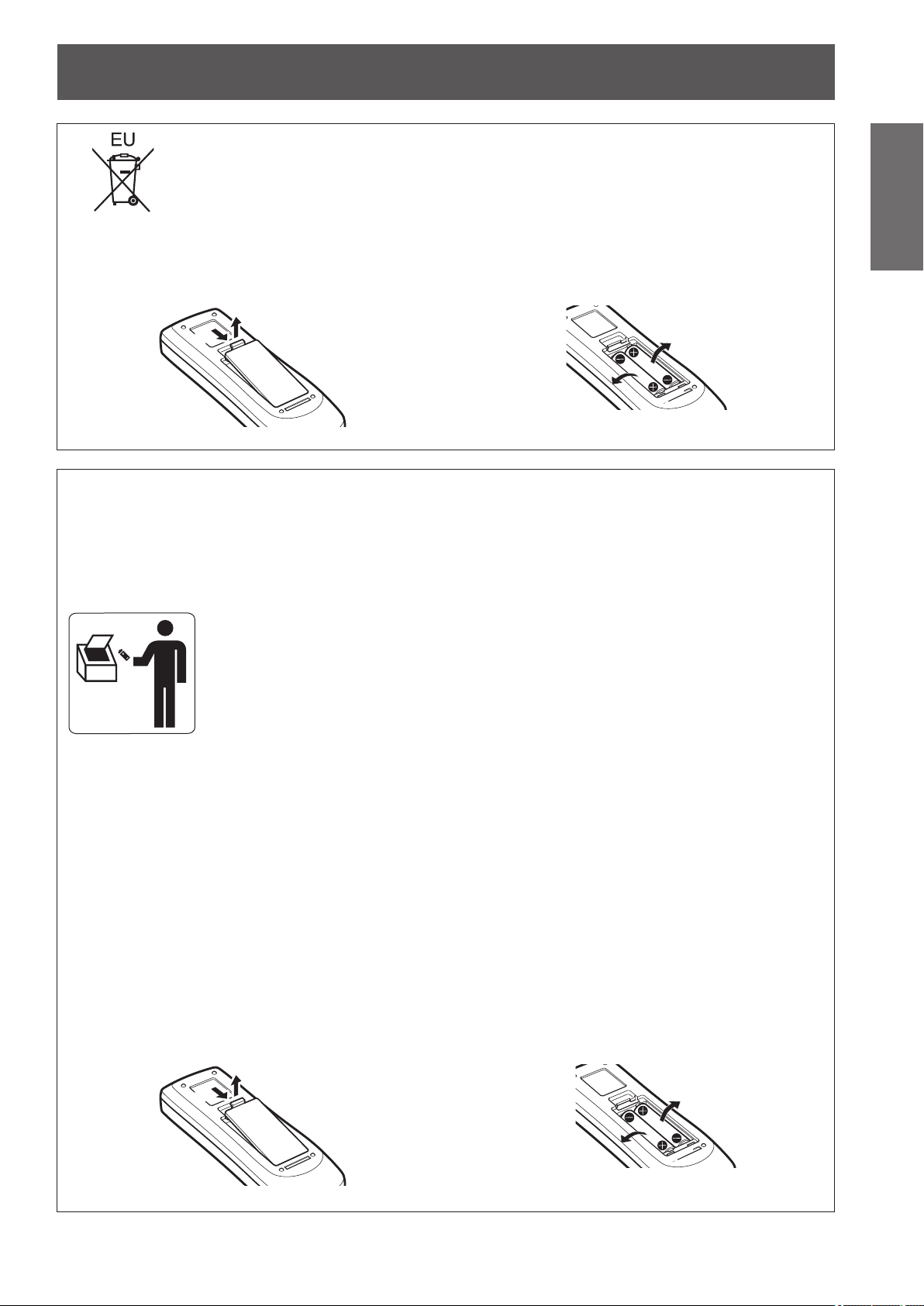
To remove the battery
Remote Control Battery
1. Press the guide and lift the cover.
(i)
(ii)
Brazil Only
Brasil Apenas
Manuseio de baterias usadas
z
BRASIL
Após o uso, as pilhas e /ou baterias poderão
ser entregues ao estabelecimento comercial
ou rede de assistência técnica autorizada.
2. Remove the batteries.
Important
Information
Cobrir os terminais positivo (+) e negativo (-) com uma ta isolante adesiva, antes de depositar numa caixa
destinada para o recolhimento. O contato entre partes metálicas pode causar vazamentos, gerar calor, romper
a blindagem e produzir fogo.
Não desmonte, não remova o invólucro, nem amasse a bateria. O gás liberado pela bateria pode irritar a
garganta, danicar o lacre do invólucro ou o vazamento provocar calor, ruptura da blindagem e produzir fogo
devido ao curto circuito dos terminais.
Não incinere nem aqueça as baterias, elas não podem car expostas a temperaturas superiores a 100 °C
(212 °F). O gás liberado pela bateria pode irritar a garganta,
danicar o lacre do invólucro ou o vazamento provocar calor, ruptura da blindagem e produzir fogo devido ao
curto circuito dos terminais provocado internamente.
Evite o contato com o liquido que vazar das baterias. Caso isto ocorra, lave bem a parte afetada com bastante
água. Caso haja irritação, consulte um médico.
Remoção das baterias
z
1. Pressione a guia e levante a tampa.
(ii)
(i)
2. Remova as baterias.
ENGLISH - 9
Page 10

Read this rst!
Information
Important
Trademarks
HDMI, the HDMI logo and High-Denition Multimedia Interface are trademarks or registered trademarks of HDMI Licensing LLC.
•z
Other names, company names or product names used in these owner's manual are the trademarks or registered trademarks of
•z
their respective holders.
Please note that the owner's manual do not include the ® and TM symbols
Illustrations in these owner's manual
Note that illustrations of the projector and screens may differ from the ones you actually see.
•z
Page references
In these instructions, references to pages are indicated as: (
•z
Term
In these instructions, the “Wireless/wired remote control unit” accessories are referred to as the “Remote control”.
•z
10 - ENGLISH
page 00).
Page 11
Features of the projectorFeatures of the projector
High clarity and high
Quick stepsQuick steps
For details, see the corresponding pages.
contrast image
Image quality of high clarity with
16 000 lumens and high contrast
with 2 500:1.
More exible setup
Allows installation of vertically 360°
direction. Equipped with the electric
lens shift function that enables
vertical and horizontal positioning
adjustment as well as test patterns.
Also, you can use lights for the
control panel and connection
terminals. In addition, you can
choose one from nine types of
optional lenses.
High reliability and
maintainability
1. Set up your projector.
( page 24)
2. Connect with external
devices. (
page 26)
3. Connect the power cord.
( page 31)
4. Power on.
( page 33)
Equipped with auto-switchable
four lamps that enable continuous
projecting when a lamp has been
worn out. The air lter and smoke
resistant lter (optional) block dust
and smoke and keep clear images
and long life of the projector.
5. Select the input signal.
( page 35)
6. Adjust the image.
( page 35)
ENGLISH - 11
Page 12

Contents
Contents
Be sure to read “Read this rst!”. (
pages
2 to 10)
Information
Important
Important Information
Read this rst! ................................................. 2
Precautions for use ...................................... 14
Preparation Getting Started Basic Operation Settings Maintenance Appendix
Preparation
About your projector .................................... 19
Using the remote control ............................ 23
Getting Started
Setting up ....................................................... 24
Connections ................................................... 26
Installing an input module (optional) ........29
Cautions when transporting .......................................14
Cautions when installing ............................................14
Security .......................................................................15
Disposal ......................................................................15
Cautions on use ......................................................... 15
Accessories ................................................................17
Optional accessories ..................................................18
Remote control ...........................................................19
Projector body ............................................................ 20
Inserting and removing the batteries .........................23
Setting remote control numbers ................................23
Using the remote control as a wired remote control . 23
Attaching the lens .......................................................24
Projection method ...................................................... 24
Installation options (optional) .....................................25
Adjustable feet ............................................................25
Before connecting to the projector ............................26
Connecting example: Computers ..............................26
Connecting example: AV equipment .........................27
Tying up the cables using cable ties .......................... 28
Installing an input module .........................................29
List of compatible signals ........................................... 30
Connection of signal to input module ........................30
Power management function .....................................34
Projecting ....................................................... 35
Selecting the input signal ...........................................35
Adjusting the image ....................................................35
Using the remote control ............................. 37
Using the shutter function ..........................................37
Using the freeze function ...........................................37
Switching the input signal ..........................................37
Correcting the keystone effect ...................................38
Selecting picture quality mode ................................... 38
Adjusting picture quality ............................................. 39
Screen button .............................................................39
Displaying a timer for presentations ..........................39
Checking the settings .................................................39
Settings
Menu navigation ............................................ 40
Navigating through menu ...........................................40
Main menu ..................................................................41
Sub menu ...................................................................41
[Input] menu ...................................................44
[Input 1] .......................................................................44
[Input 2] .......................................................................44
[System] ......................................................................45
[PC adjust] menu ........................................... 46
[Auto PC adj.] ............................................................. 46
[Fine sync] ..................................................................46
[Total dots] ...................................................................46
[Position H] .................................................................46
[Position V] ..................................................................47
[Current mode] ...........................................................47
[Clamp] ........................................................................ 47
[Display area H] ..........................................................47
[Display area V] ..........................................................47
[Reset] ......................................................................... 48
[Mode free] ..................................................................48
[Store]..........................................................................48
Basic Operation
Powering on/off ............................................. 31
Connecting the power cord ........................................31
Power indicator ..........................................................32
Powering on the projector ..........................................33
Making adjustments and selections ..........................33
Powering off the projector ..........................................34
Direct power off function ............................................34
12 - ENGLISH
[Image select] menu ..................................... 49
Adjusting the picture quality ...................................... 49
[Image adjust] menu ..................................... 50
[Contrast] ....................................................................50
[Brightness] .................................................................50
[Color]..........................................................................50
[Tint] ............................................................................50
[Color management] ..................................................51
Page 13

Contents
[Color temp.] ...............................................................52
White balance ([Red]/[Green]/[Blue]) ........................52
[Offset] .........................................................................52
[Auto picture control] .................................................. 52
[Advanced color] .........................................................52
[Sharpness] ................................................................ 53
[Gamma] .....................................................................53
[Noise reduction] ........................................................53
[Progressive] ...............................................................53
[Reset] ......................................................................... 53
[Store]..........................................................................54
[Screen] menu ............................................... 55
[Normal] ......................................................................55
[Full].............................................................................55
[Wide(16:9)] ................................................................55
[Zoom] .........................................................................55
[True] ...........................................................................55
[Custom] .....................................................................56
[Custom adj.] .............................................................. 56
[Digital zoom +] ...........................................................56
[Digital zoom -] ............................................................57
[Keystone] ...................................................................57
[Ceiling] .......................................................................58
[Rear] ..........................................................................58
[Reset] ......................................................................... 58
[Setting] menu ...............................................59
[Language] .................................................................. 59
[Menu position] ...........................................................59
[Display] ......................................................................59
[Background] .............................................................. 60
[Lamp select] ..............................................................60
[Lamp power] ..............................................................60
[Lamp interval] ............................................................61
[Edge blending] .......................................................... 61
[Color matching] ......................................................... 62
[Advanced color matching] ........................................63
[HDMI setup] ...............................................................65
[Logo] ..........................................................................65
[Fan control] ................................................................67
[Remote control] .........................................................67
[RC sensor] .................................................................67
[Power management] .................................................68
[Direct on] ....................................................................68
[Security] .....................................................................69
[Projector ID] ...............................................................70
[Shutter] ......................................................................70
[Video delay control] ...................................................71
[Closed caption] ..........................................................72
[Filter counter] .............................................................72
[P-timer] ......................................................................73
[Test pattern] ...............................................................74
[Factory default] ..........................................................74
[Information] menu .......................................75
Conrming the settings and usage state ...................75
[Network] menu ............................................. 76
Maintenance
About indicator status .................................. 77
If an indicator turns on ................................................77
Maintenance/replacement ...........................83
Before maintaining/replacing the unit ........................83
Maintenance ...............................................................83
Replacing the parts .................................................... 83
Troubleshooting ............................................88
Appendix
Technical Information ................................... 90
Adjusting screens of multiple screen images ............90
Label notifying registration of password ....................93
PJLink .........................................................................93
Serial terminal .............................................................94
Serial Control Interface ..............................................95
Other terminals ...........................................................97
List of compatible signals .......................................... 99
Specications ..............................................102
Dimensions ..................................................104
Ceiling mount bracket safeguards ........... 105
Notes on attaching the lens ....................... 106
Lens specications ...................................................106
Important
Information
PreparationGetting StartedBasic OperationSettingsMaintenanceAppendix
ENGLISH - 13
Page 14
Precautions for use
Precautions for use
Information
Important
Cautions when transporting
Cautions when installing
zWhen transporting the projector, hold it securely by its carry handle and avoid excessive vibration and impacts
by such handling as dragging it on the oor. Failure to do so may damage the internal parts and result in
malfunctions.
zDo not transport the projector with the adjustable feet extended. Doing so may damage the adjustable feet.
Do not set up the projector outdoors.
z■
The projector is designed for indoor use only.
Do not use in the following places.
z■
Places where vibration and impacts occur such as in a vehicle or vessel: Doing so may damage the
z
z
internal parts and result in malfunctions.
Near the exhaust of an air conditioner or near lights (studio lamps, etc.) where there are large swings in
z
z
temperature (“Operating environment” (
deformation of the outer case, which may in turn cause malfunctions.
Near high-voltage power lines or near motors: Interference may occur.
z
z
Be sure to ask a qualied technician or your dealer before installing the
z■
page 103)): Doing so may shorten the life of the lamp or result in
product on a ceiling.
If the product is to be installed hanging from the ceiling, purchase the optional ceiling mount bracket.
Do not install the projector at elevations of 2 700 m (8 858 ft) or higher
z■
above sea level.
Failure to do so may shorten the life of the internal parts and result in malfunctions.
Do not use the projector while it is tilted (
z■
Using the projector while tilted may shorten the life of the internal parts.
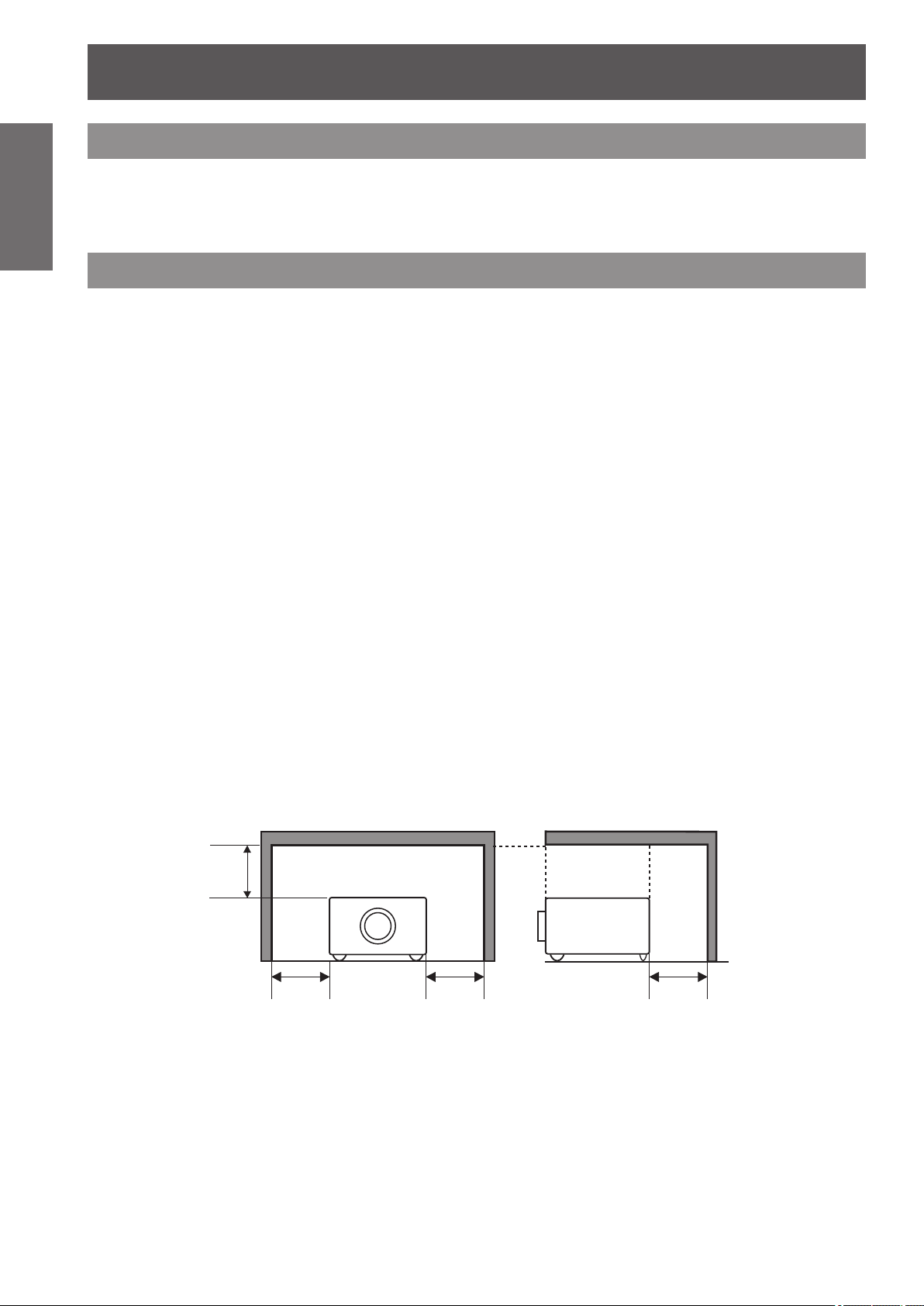
Cautions when setting up the projectors
z■
Do not block the ventilation ports (intake and exhaust) of the projector.
z
z
Avoid heated and cooled air from the air conditioning system directly blow to the ventilation ports (intake
z
z
and exhaust) of the projector.
Avoid setting up the projector in a humid or dusty location.
z
z
1 m (39")
1 m (39")
1 m (39") 1 m (39")
(over 1 m (39") for each top and side)
page 24).
Do not install the projector in a conned space.
z
z
When it is necessary to install in a conned space, install an air conditioning or ventilation system for the
space. If ventilation is insufcient, exhaust heat may accumulate and trigger the protection circuit of the
projector.
14 - ENGLISH
Page 15

Precautions for use
Security
When using this product, implement appropriate security measures to prevent the following:
Personal information being leaked via this product
z
z
Unauthorized operation of this product by a malicious third party
z
z
Interference or stopping of this product by a malicious third party
z
z
Take sufcient security measures. ( page 69)
Make your PIN code as difcult to guess as possible.
z
z
Change your PIN code periodically.
z
z
EIKI Industrial and its afliate companies will never ask you directly for your PIN code. If you are asked
z
z
directly, do not give your PIN code.
Be sure to use a secure network with a rewall etc.
z
z
Set a PIN code and set restrictions on the users who can log in.
z
z
Disposal
When disposing of the product, ask your local authority or dealer about the correct methods of disposal.
The lamp contains mercury. When disposing of the used lamp unit, ask your nearest local authorities or dealer
about proper disposal of the unit.
Dispose of used batteries according to the instructions or your local disposal rule or guidelines.
Cautions on use
Important
Information
To achieve a high picture quality
z■
You achieve a high picture quality by drawing curtains or blinds over windows and turning off any lights
z
z
near the screen to prevent outside light or light from indoor lamps from shining onto the screen.
Depending on the conditions, the picture may wobble due to the heated air from the air exhaust port or
z
z
heated or cooled air from the air conditioner.
Take care to ensure that neither the exhaust from the projector or other equipment, nor air from any air
conditioner blows on the front of the projector.
The projection lens is heated by the light from the luminous source, making the focus unstable in the period
z
z
just after switching on. The focus will stabilize after 30 minutes elapsed with the image being projected.
Do not touch the surface of the projection lens with your bare hands.
z■
If the surface of the lens is contaminated by ngerprints or dirt, this will be magnied and projected onto the
screen, degrading the picture.
LCD panel
z■
The LCD panel is precision-made. Note that in rare cases, pixels of high precision could be missing or always
lit. This is not a malfunction.
When a still image is projected for a long period, the image may burn in to the LCD panel. In this case, project
the white screen from the test patterns ( page 74) for at least one hour. Note, however, that it may not always
be possible to fully eradicate the burned-in image.
ENGLISH - 15
Page 16

Precautions for use
Information
Important
Optical components
z■
If you are using the projecting a high-temperature environment or an environment which is dusty or full of
cigarette smoke etc., the replacement cycle for optical components such as the the LCD panel and polarizer
may reduce to as little as a year. For more information, please consult your dealer.
Lamp
z■
The projector luminous source is a mercury lamp with high internal pressure.
A high-pressure mercury lamp has the following characteristics.
The brightness of the lamp will decrease with usage time.
z
z
An impact, scratch, or deterioration with usage may cause the bulb burst loudly or reduce the service life.
z
z
The service life of the lamp varies greatly depending on the individual lamp and usage conditions. In
z
z
particular, continuous use for periods of 24 hours or longer and frequent on/off switching of the power
accelerate deterioration in the lamp and affect the lamp life.
In rare cases, the lamp burst shortly after starting the projection.
z
z
The risk of bursting increases when the lamp is used beyond its replacement cycle. Make sure to replace
z
z
the lamp unit consistently. “When to replace the lamp unit” ( page 85)
If the lamp bursts, gas contained in the lamp is released in a form of smoke.
z
z
It is recommend that you store replacement lamp units for contingency.
z
z
It is recommended that you request a qualied technician to replace the lamp unit. Consult your dealer.
z
z
16 - ENGLISH
Page 17
Accessories
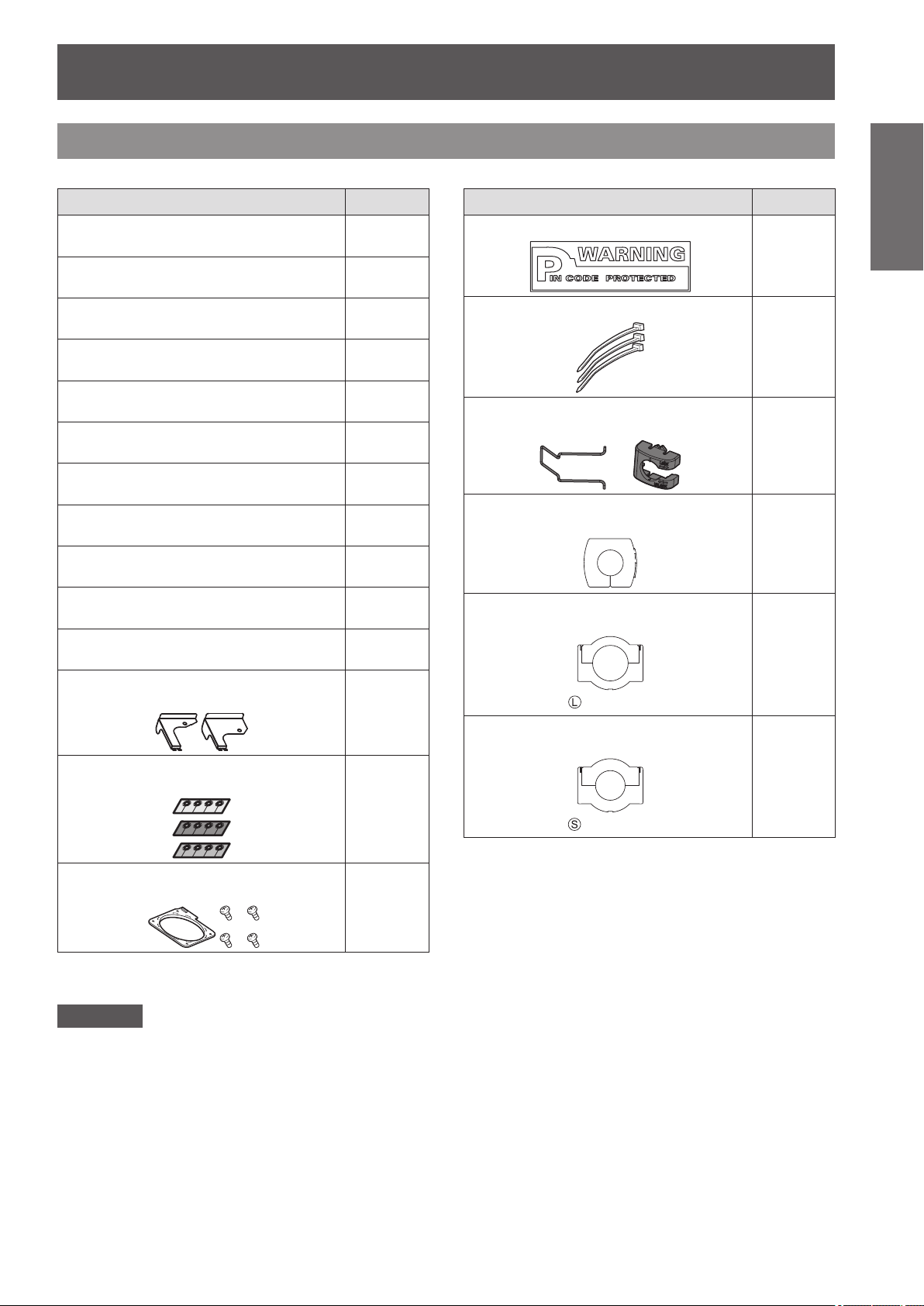
Make sure that the following accessories are provided with your projector.
Precautions for use
Accessory (product name) Number
Wireless/wired remote control unit
(N2QAYA000058)
Wired remote control cable
(K2KYYY00177)
AAA/R03/LR03 battery (for remote
control unit)
Power cord for LC-XT6 (E)
(T0K3K0003--1)
Power cord for LC-XT6 (U)
(T0K3K0001--1)
Computer cable (for D-sub)
(T0K3K0013--1)
CD-ROM Owner's Manual
(TXFQB03ZGM3)
CD-ROM PJ Network Manager
(T1U13B14102)
CD-ROM Real Color Manager Pro
(T1U13B58100)
Owner's Manual–Basic Guide
(TQBJ0487)
Color Management Manual
(TQBJ0270-1)
Lens lock lever xing bracket
*1
(T0STF0039--1)
Spacer
*1
(T0SAS0001--)
1
1
2
1
1
1
1
1
1
1
1
1
(set)
1
(set)
Accessory (product name) Number
PIN code label
Cable tie
Power cord holder, power cord cover
(T0STF0037--1)
Light-shielding plate-1
*1
(T0CRS0008--1)
Light-shielding plate-2
*1
(T0CRM0014--1)
is inscribed
Light-shielding plate-3
*1
(T0CRM0013--1)
is inscribed
1
3
1
(set)
1
(set)
1
(set)
1
(set)
Important
Information
Lens attachment
(T0HLA0045--)
*1: Used when attaching the lens (optional). ( page 106)
*1
1
(set)
Attention
zAfter unpacking the projector, dispose of the power cord cap and packaging material in an appropriate manner.
zIf you lose any of the accessories, consult your dealer.
zThe product numbers of accessories and separately sold components are subject to change without notice.
zStore small parts in an appropriate manner, and keep them away from young children.
ENGLISH - 17
Page 18
Precautions for use
Information
Important
The following contents are stored on the supplied CD-ROM.
Optional accessories
Contents of CD-ROM
z■
Manual/Index (PDF) Software
Owner's Manual–Projector Operations
z
z
Owner's Manual–Network Operations
z
z
Owner's Manual–PJ Network Manager
z
z
Operations
Real Color Manager Pro Software Operation
z
z
Manual
Real Color Manager Pro
z
z
PJ Network Manager
z
z
Optional accessories
(product name)
Replacement lamp unit POA-LMP147
Replacement lter Part No.: T1FTX0069--
Smoke resistant lter
Input module AH-72217
Lens
Unit: Part No. AH-38561 / Ref No. NOP-FTU-61EFS
Filter: Part No. AH-38323 / Ref No. POA-FIL-160
AH-21202, AH-32022, AH-32401, AH-32601, AH-21102, AH-22051,
AH-21023, AH-21092, AH-32581
Product No.
18 - ENGLISH
Page 19
About your projector
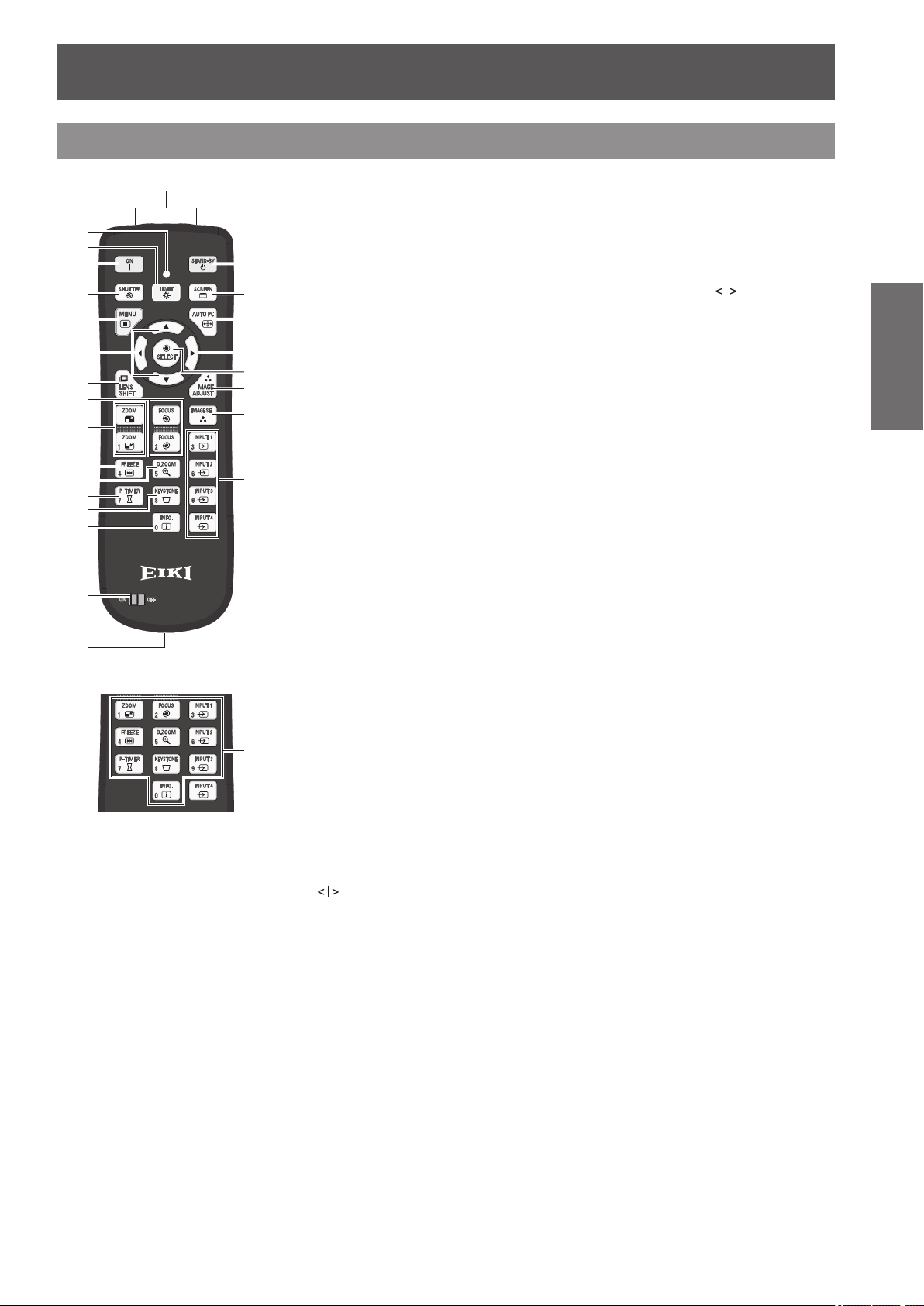
(1)
Remote control
(1) Remote control signal emitters
(2) Remote control indicator
(2)
(3)
(4)
(5)
(6)
(7)
(8)
(9)
(10)
(11)
(12)
(13)
(14)
(15)
(16)
(17)
(18)
(19)
(20)
(7)
(21)
(22)
(23)
(24)
(25)
Flashes by pressing any buttons.
(3) <LIGHT> button
Press once to light the control buttons for ten seconds.
(4) Power <ON> button
Starts projection when the main power switch on the projector is set to
standby mode.
(5) <SHUTTER> button
Opens and closes the shutter. (
(6) <MENU> button
Displays the menu screen. (
(7)
▲▼◀▶
Move the cursor on the on-screen menu and control menus.
Also move the image vertically and horizontally in the digital zoom mode or the real mode.
(8) <LENS SHIFT> button
Slides the lens vertically and horizontally to move the position of the projective image
vertically and horizontally. (
(9) <FOCUS> button
Adjusts the focus. (
(10) <ZOOM> button
Adjusts the zoom of the lens. (
(11) <FREEZE> button
Temporally freezes the projected image. (
(12) <D.ZOOM> button
Turns on the digital zoom mode.
(13) <P-TIMER> button
Press the <P-TIMER> button to count the time elapsed from the press of the button or
perform a countdown from the set time. (
(14) <KEYSTONE> button
Corrects the keystone effect. (
(15) <INFO.> button
Displays state of signals during projection and current settings. (
(16) <ON>/<OFF> switch
Set to <ON> when using the remote control.
Set to <OFF> when not using the remote control for a long period.
(17) Wired remote control terminal
When the remote control is used as a wired remote control, connect this terminal on the
remote control to the <R/C JACK> terminal on the projector.
The remote control requires batteries. (
(18) Power <STAND-BY> button
Sets the projector to the standby mode when the main power switch on the projector is set
to
(19) <SCREEN> button
Selects the size of the projected image.
If you press the button for at least ve seconds, the settings of the [Screen] menu return to
the factory default settings. (
(20) <AUTO PC> button
Automatically adjusts synchronization, total number of dots, horizontal shift, and vertical
shift. (
(21) <SELECT> button
Selects item indicated by the cursor on the on-screen menu.
Also used to expand and contract the image in the digital zoom mode. (
(22) <IMAGE ADJUST> button
Displays the [Image adjust] menu to adjust the image. (
(23) <IMAGE SEL.> button
Selects the mode from [Image select]. (
(24) <INPUT 1> - <INPUT 4> buttons
Selects the input signal to project. (
(25) Number (<0> - <9>) buttons
Used to enter PIN codes and remote control numbers.
button
and in the projecting mode.
page 46)
page 36)
page 37)
page 40)
page 35)
page 36)
page 38)
page 39)
page 37)
page 39)
page 23)
page 38)
page 37)
About your projector
and in the
page 39)
page 40)
page 34)
Preparation
ENGLISH - 19
Page 20
About your projector
(1) (10) (11) (15) (16) (15) (15)
Attention
zDo not drop the remote control.
zAvoid contact with liquids or moisture.
zDo not attempt to modify or disassemble the remote control.
Note
zThe remote control can be used from any distance within about 5 m if pointed directly at the remote control
sensor. The remote control is effective from angles of up to ±30° vertically and horizontally, but its range may
be reduced.
Preparation
zIf there are any obstacles between the remote control and the remote control sensor, the remote control may
not operate properly.
zYou can control the projector by reecting the signal off the screen, but the effective operating range will
depend on the characteristics of the screen.
zIf the remote control sensor receives strong light such as uorescent light, the remote control may not operate
properly. Place the projector as far as possible from other light sources.
Projector body
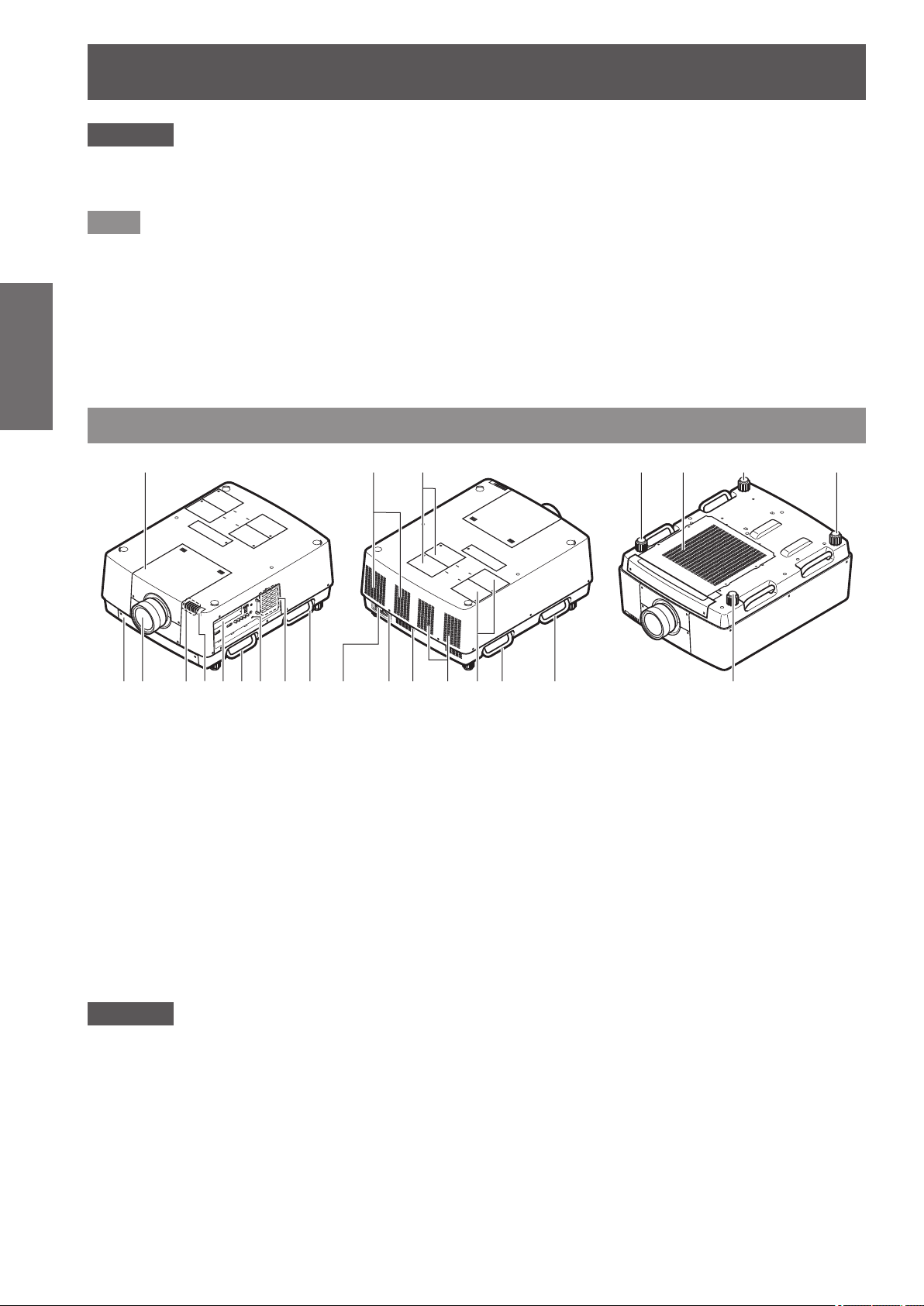
(2) (3) (4) (5) (6) (7) (8) (9) (7) (12) (13)(14) (10) (11) (7) (7) (15)
(1) Lens attachment cover
(2) Air lter unit
(3) Lens (optional)
(4) Indicator (
(5) Remote control sensor (top and front)
(6) Connection terminals (
(7) Carry handle
(8) Security slot
This security slot is compatible with the Kensington
security cables.
(9) Control panel (
(10) Air exhaust port
page 77)
page 21)
page 22)
(11) Lamp cover
Houses the lamp unit. (
(12) AC input terminal
Connect the supplied power cord. (
(13) Main power switch
Turns off/on the main power.
(14) Remote control sensor (rear)
(15) Adjustable feet
Adjust the projection angle. (
(16) Air intake port
page 86)
page 25)
Attention
zKeep your hands and other objects away from the air exhaust port
Keep your hands and face away.
–z
Do not insert your ngers.
–z
Keep away heat-sensitive articles.
–z
Heated air from the air outlet port can cause burns, injuries, or deformations.
page 31)
20 - ENGLISH
Page 21

Control panel
z■
About your projector
(1)
(2)
(3)
(4)
(5)
(6)
(7)
(1) Power <ON/STAND-BY> button
Turns off/on the power when the main power switch on the
projector is set to
(2) <SHUTTER> button
Opens and closes the shutter. Adjusts the shielding of the
projection light. (
(3) <ZOOM> button
Adjusts the zoom of the lens. (
(4) <FOCUS> button
Adjusts focus. (
(5) <MENU> button
Displays the menu screen. (
(6)
▲▼◀▶
Move the cursor on the on-screen menu and control
menus.
Also move the image vertically and horizontally in the
digital zoom mode and the real mode.
buttons
page 37)
page 36)
.
page 36)
page 40)
(8)
(9)
(10)
(11)
(6)
(12)
(7) <AUTO PC ADJ.> button
Automatically adjusts synchronization, total number of
dots, horizontal shift, and vertical shift.
(8) <LIGHT> button
Switches on/off the control panel and connection terminals
by each press of this button.
(9) <LENS SHIFT> button
Slides the lens vertically and horizontally to move the
position of the projective image vertically and horizontally.
page 35)
(
(10) <INPUT> button
Selects the input signal to project. (
(11) <SELECT> button
Selects item indicated by the cursor on the on-screen
menu.
Also used to expand and contract the image in the digital
zoom mode. (
(12) <INFORMATION> button
Displays state of signals during projection and current
settings. (
page 39)
page 40)
page 37)
Preparation
ENGLISH - 21
Page 22
About your projector
Preparation
Connection terminals
z■
(1) (2) (3) (4)
(5)
(6)
(7)
(8)
(9)
(10)
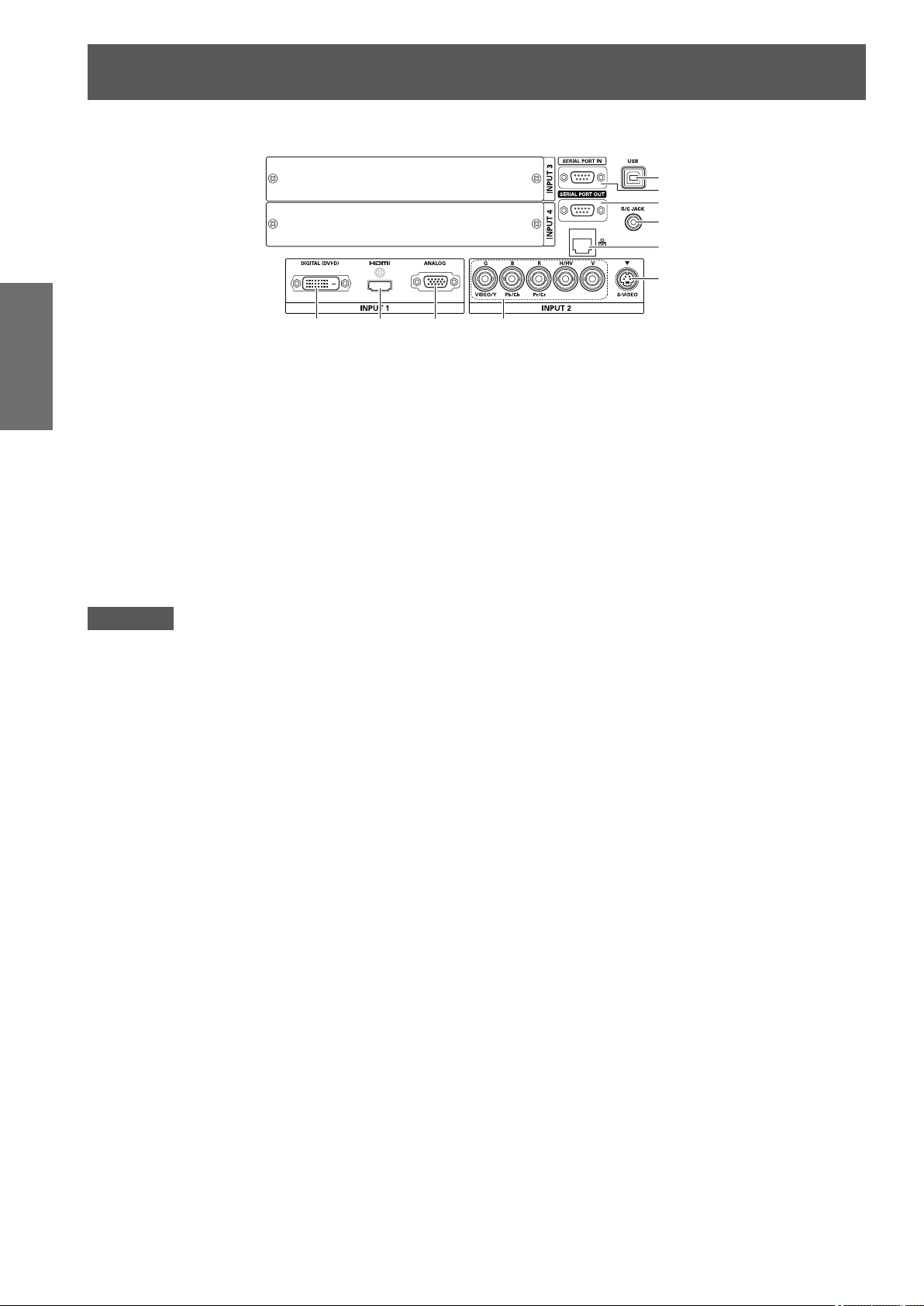
(1) DVI-D input terminal <DIGITAL (DVI-D) IN>
This terminal is for inputting the DVI-D signal.
(2) HDMI input terminal <HDMI IN>
This terminal is for inputting the HDMI signal.
(3) Computer input terminal <ANALOG IN>
This terminal is for inputting an RGB signal.
(4) RGB 5BNC input terminal <R,G,B,H/V,V IN>/<VIDEO
IN>/<Y,Pb/Cb,Pr/Cr IN>
This terminal is for inputting the G,B,R,H/HV,V signal,
video signal, and Y,Pb/Cb,Pr/Cr signal.
(5) USB terminal <USB>
This terminal is for use by service personnel.
(10) S-VIDEO input terminal <S-VIDEO IN>
Attention
zMake sure to connect the LAN cable to the indoor equipment.
(6) Serial input terminal <SERIAL PORT IN>
This input terminal is compatible with RS-232C and for
externally controlling the projector by connecting the
projector.
(7) Serial Output terminal <SERIAL PORT OUT>
This terminal is for the signal connected to the serial input
terminal.
(8) Remote control terminal <R/C JACK>
This terminal is for connecting the remote control when
using it as a wired remote control.
(9) LAN terminal <LAN>
This terminal is for connecting the projector to the network.
This terminal is for inputting S-VIDEO signals.
22 - ENGLISH
Page 23
Using the remote control
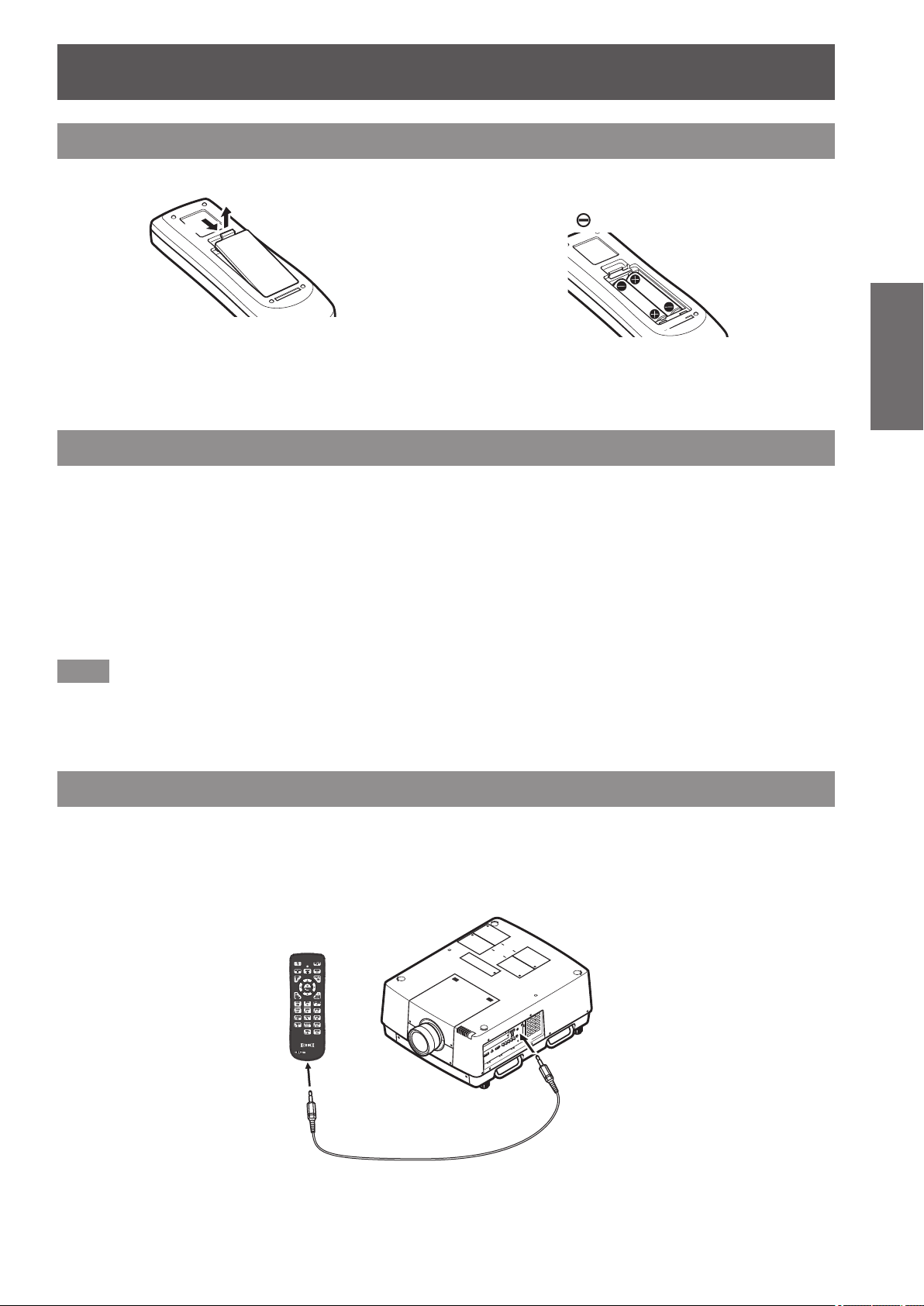
Inserting and removing the batteries
Using the remote control
1) Open the cover.
(ii)
(i)
2) Insert the batteries and close the
cover.
Insert the
z
z
To remove the batteries, follow the above
z
z
procedure in reverse.
side rst.
Setting remote control numbers
When you are using multiple projectors, you can set a remote control number to each projector to allow
simultaneous control with a single remote control.
After setting a remote control number of a given projector, specify that projector using the remote control number.
Setting method
z■
1) While holding the <MENU> button, press the number (<0> - <9>) buttons (2 digits) to
enter the desired remote control number.
When you release the button, the remote control number will change to the new number.
z
z
To set the remote control number to 09, press <0>, <9> while holding down the <MENU> button.
z
z
Preparation
Note
zThe factory default setting is [All]. [All] supports all remote control numbers.
zSet the remote control number of the projector using [Remote control] from the [Setting] menu (
zTo reset the remote control number (to set to [All]), simultaneously hold down the <MENU> button and the
<0> button for at least ve seconds.
page 67).
Using the remote control as a wired remote control
Connect the <R/C JACK> terminal on the projector body to the wired remote control terminal on the remote
control using the remote control cable (commercially available).
zMake sure that the batteries are inserted in the remote control.
zTo use the remote control wirelessly, disconnect the remote control cable from the projector and the remote
control. When the remote control cable is connected, you cannot use the remote control wirelessly.
ENGLISH - 23
Page 24
Setting up
Setting up
Attaching the lens
Before putting the projector in position, attach the lens to the projector body.
First, determine the correct lens for the environment in which you are going to use the projector.
For lens product numbers and lens specications suitable for the projector, consult your dealer. When attaching
or replacing a lens, consult the technical staff or service personnel at a specialist dealer for safety. Do not attempt
to attach or replace the lens by yourself. For details, refer to “Notes on attaching the lens” ( page 106).
Caution
When setting up the projector after installing a lens, always t the lens cover to the lens. When carrying or
holding the projector body, never hold the lens. Doing so may damage the projector.
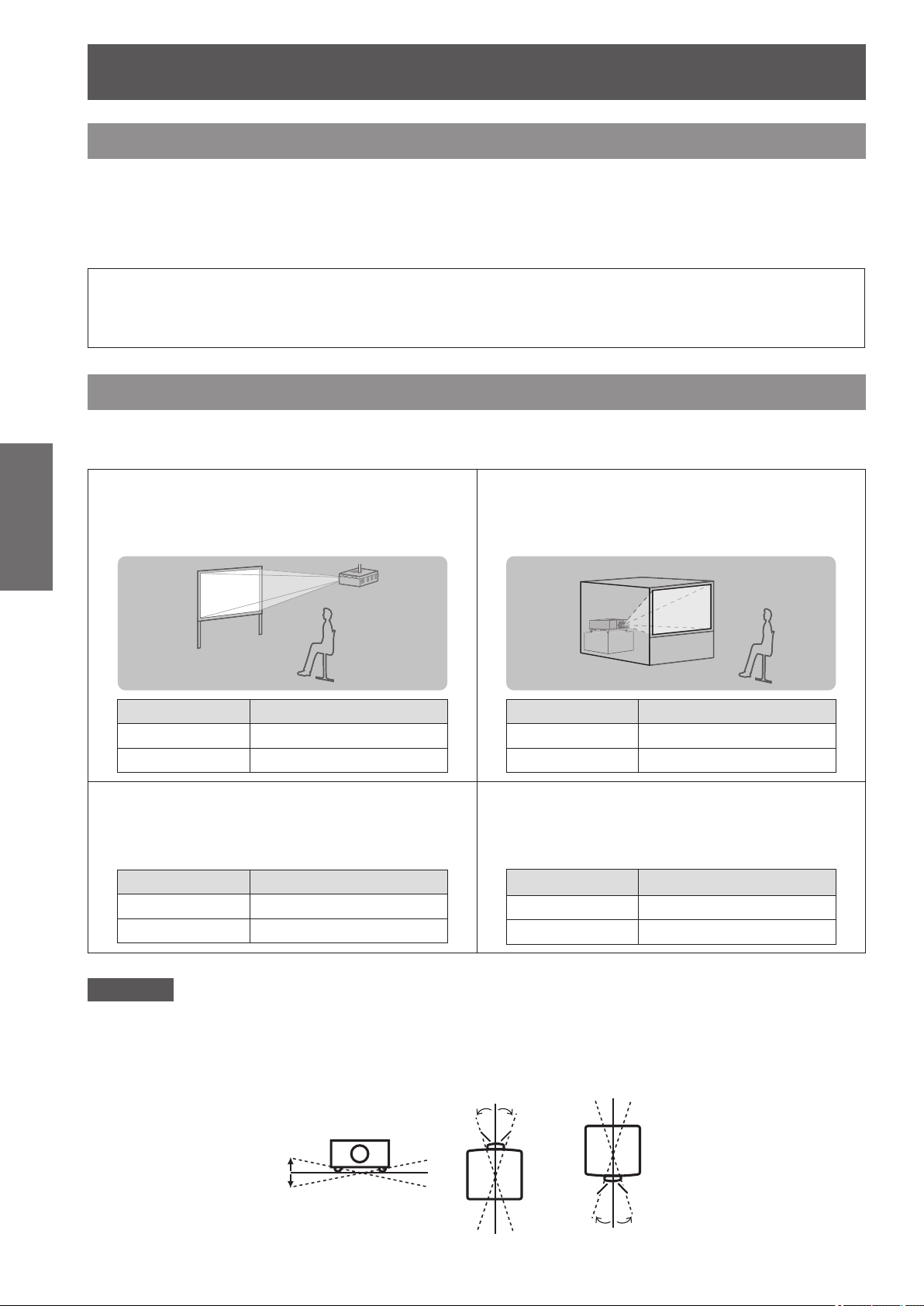
Projection method
You can project images vertically and diagonally. You can select rear ( page 58) and ceiling ( page 58) from the
Getting Started
menu. Select the projection method appropriate to the environment.
Mounting on the ceiling and
z■
projecting forward
Menu item Setting
[Ceiling] [On]
[Rear] [Off]
Mounting on the ceiling and
z■
projecting from rear
(Using the translucent screen)
Menu item Setting
[Ceiling] [On]
[Rear] [On]
Setting on a desk/oor and
z■
projecting from rear
(Using the translucent screen)
Menu item Setting
[Ceiling] [Off]
[Rear] [On]
Setting on a desk/oor and
z■
projecting forward
Menu item Setting
[Ceiling] [Off]
[Rear] [Off]
Attention
zTo get a high picture quality, set up the screen in a location that is, as far as possible, not directly affected by
natural light or electric light. Draw the curtains or blinds and turn off the lights.
zWhen setting up the projector with tilt, do not use the projector at an inclination angle that exceeds ±10°
vertically to the horizontal plane. Installing the projector at an inclination angle that exceeds this value may
reduce the component life and result in malfunctions.
24 - ENGLISH
10° 10°
10°
10°
10° 10°
Page 25
Setting up
Installation options (optional)
You can install the projector on the ceiling using the optional ceiling mount bracket.
zUse only ceiling mount brackets specied for this projector.
zFor details on installation of the projector with the bracket, refer to the installation manual for the ceiling mount
bracket.
Attention
zTo ensure the projector performance and security, installation of the ceiling mount bracket must be carried out
by your dealer or a qualied technician.
Adjustable feet
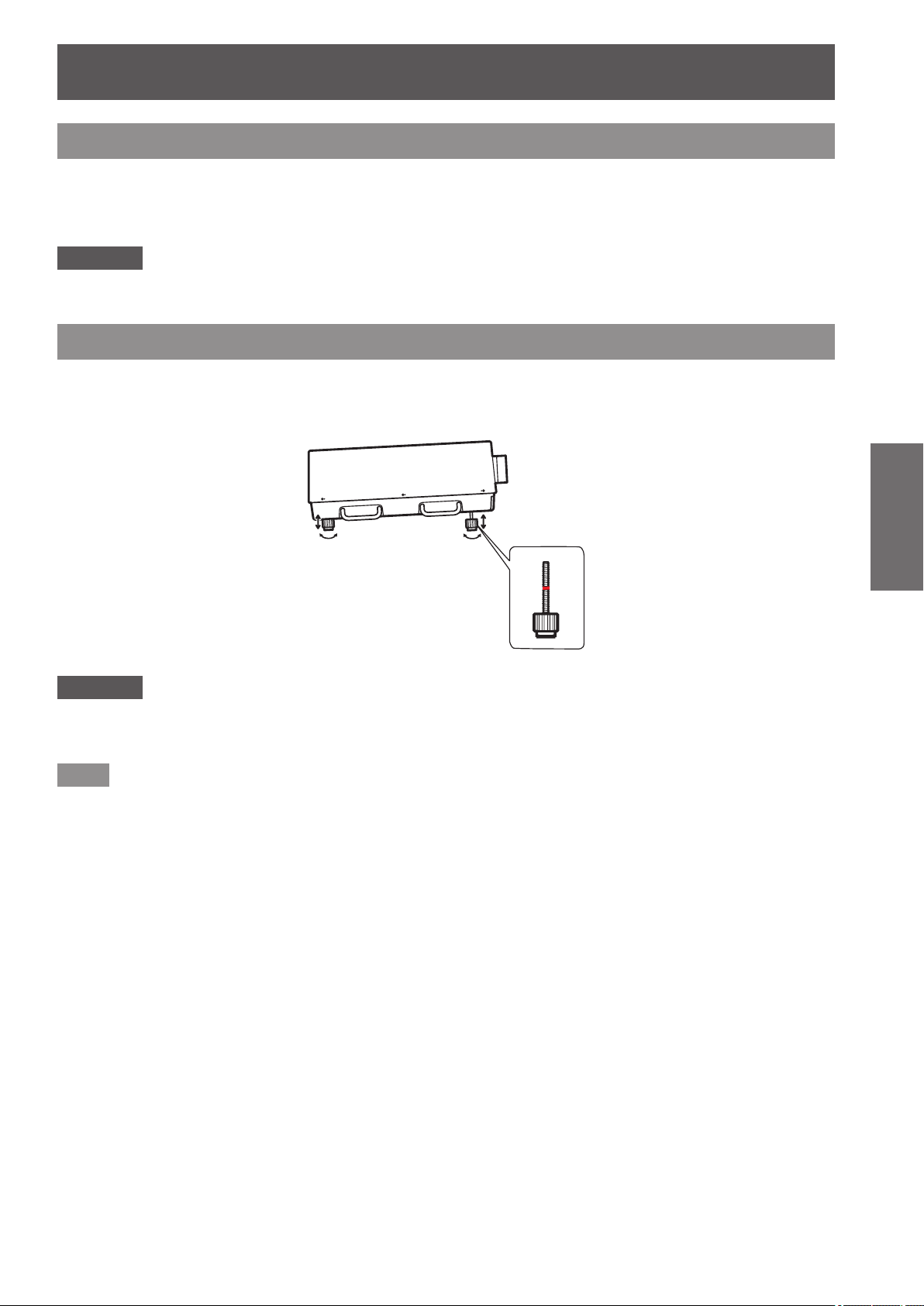
The adjustable feet can be extended by turning it as shown in the gure. It is retracted by turning it in the opposite
direction. This nely adjusts the height and tilt of the projected image.
When the adjustable feet is extended, the projector can be tilted to a maximum of 3°.
(The projection angle can be adjusted vertically.)
Attention
zHeated air is blowing out from the air exhaust port while the lamp is on. Do not touch the air exhaust port
directly when adjusting the adjustable feet.
zIf the keystone effect occurs in the projected image, perform [Keystone] (
Note
zDo not extend the adjustable feet beyond the red line. Doing so may damage them.
zThe vertical and horizontal position of the image can be adjusted using the lens shift function.
page 57) from the [Screen] menu.
Getting Started
ENGLISH - 25
Page 26
Connections
Computer
Connections
Before connecting to the projector
zRead carefully the instruction manual of the device you intend to connect.
zTurn off the power switch of the device before connecting the cable.
zIf a connection cable is not supplied with the device and the optional cable is not available, prepare a
connection cable to suit the device.
zVideo signals containing too much jitter may cause the images on the screen to randomly wobble. In this case,
a time base corrector (TBC) must be connected.
zThe projector accepts the following signals: video signals, S-video signals, analog RGB signals (synchronous
signals are TTL level), and digital signals.
zSome computer models are not compatible with the projector.
zWhen connecting a device to the projector using a long cable, it may not be possible to achieve a normal
picture without a compensator.
zFor details of the video signals supported by the projector, refer to “List of compatible signals” ( page 99).
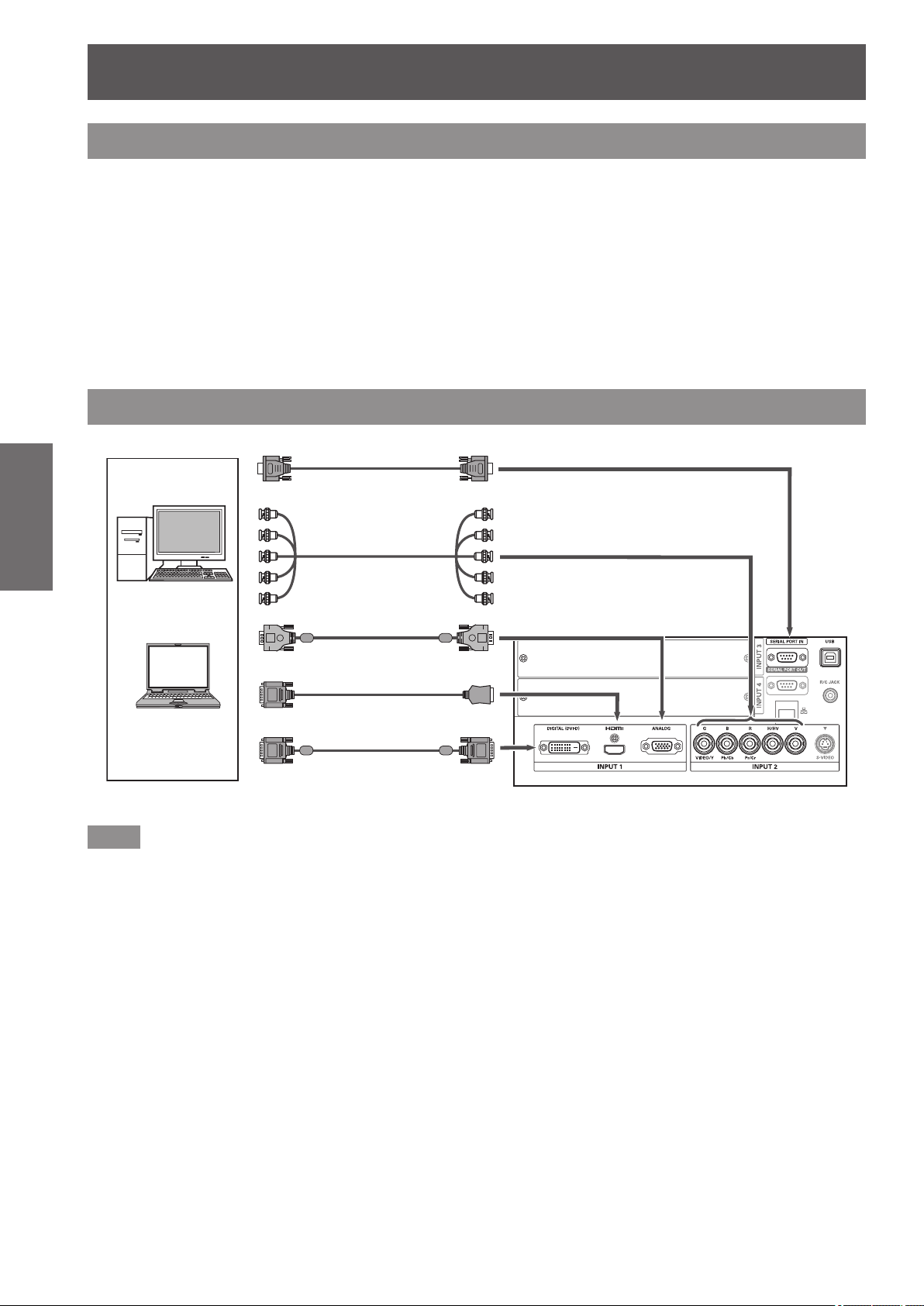
Connecting example: Computers
Getting Started
Note
zUse an HDMI High Speed cable that adheres to the HDMI standard. Use of a cable that does not adhere to the
HDMI standard, may result in abnormal operation such as cut-out of the image, failure to project, etc.
zThe <HDMI IN> terminal can be connected with an external device with a DVI terminal using an HDMI/DVI
conversion cable. With some devices, however, the image may not appear. (
zWhen the <DIGITAL (DVI-D) IN> terminal is used, normal operation may not be possible with certain devices
and the image may not appear.
zThe <DIGITAL (DVI-D) IN> terminal (in the digital signal input mode) is compatible only with single link signals.
zFor details of RGB signals from computers that the projector supports, refer to “List of compatible signals”
( page 99).
zIf you operate the projector using the computer with the resume feature (last memory), it may be required to
reset the resume feature to operate the projector.
zThe <DIGITAL (DVI-D) IN> terminal (in the digital signal input mode) may require the EDID setting depending
on the connected device.
zTo connect the projector with a computer over a wired LAN, refer to the “Owner's Manual–Network Operations”
on the supplied CD-ROM.
Serial cable (crossed)
To serial port output
BNC cable
To monitor output
D-sub cable
To monitor output
DVI/HDMI cable
To monitor output
DVI-D cable
To monitor output
To <ANALOG IN> terminal
To <HDMI IN> terminal
To <DIGITAL (DVI-D) IN>
terminal
To <SERIAL PORT IN> terminal
To <G,B,R,H/V,V IN> terminal
page 65)
26 - ENGLISH
Page 27

Connecting example: AV equipment
Video, S-video, DVD
player, and HDMI video
output devices
S-video cable
To S-video output
To component
video output
BNC cable
BNC cable
To <S-VIDEO IN> terminal
To <Y,Pb/Cb,Pr/Cr IN> terminal
Connections
To composite
video output
To HDMI output
To AV HDCP
DVI video output
To <VIDEO IN> terminal
HDMI cable
To <HDMI IN> terminal
DVI-D cable
To <DIGITAL (DVI-D) IN>
terminal
Attention
zAlways use one of the following when connecting a VCR.
A VCR with built-in time base corrector (TBC)
–z
A time base corrector (TBC) between the projector and the VCR
–z
zIf burst signals are connected to nonstandard signals, the image may be distorted. In such a case, connect a
time base corrector (TBC) between the projector and the device.
Note
zUse an HDMI High Speed cable that adheres to the HDMI standard. Use of a cable that does not adhere to the
HDMI standard, may result in abnormal operation such as cut-out of the image, failure to project, etc.
zThe <HDMI IN> terminal can be connected with an external device with a DVI terminal using an HDMI/DVI
conversion cable. With some devices, however, the image may not appear. (
page 65)
zThe <DIGITAL (DVI-D) IN> terminal can be connected to HDMI and DVI-D compatible devices, but normal
operation may not be possible with certain devices and the image may not appear.
zThe <DIGITAL (DVI-D) IN> terminal (in the digital signal input mode) is compatible only with single link signals.
Getting Started
ENGLISH - 27
Page 28
Connections
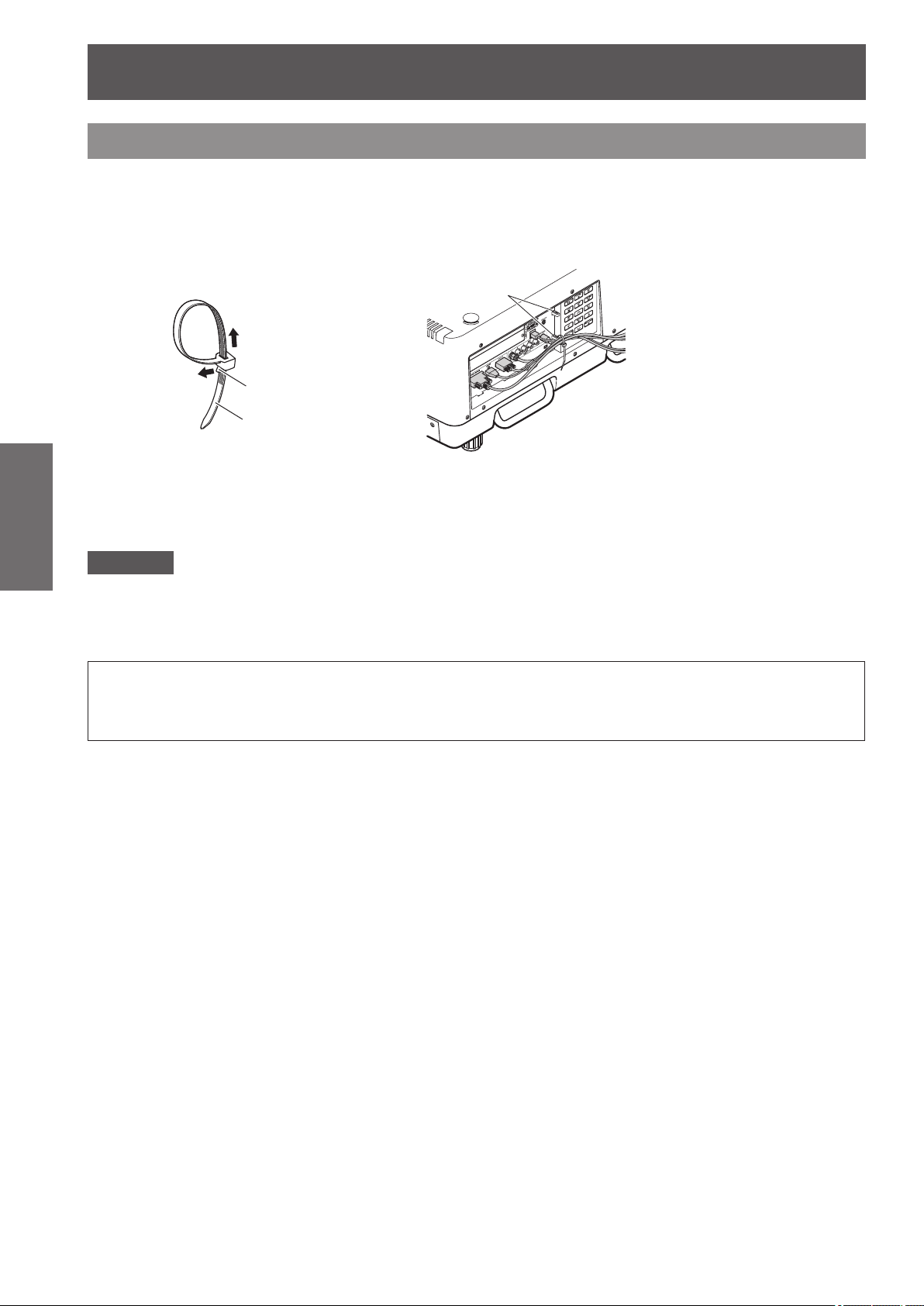
Tying up the cables using cable ties
Keep the cables tidy by xing the cables connected to the terminals into the cable holders on the projector body.
zThe cable ties can be reused. (The tab can be loosened and released.)
Loosening the cable ties
z■
Cable holders
(ii)
Getting Started
1) Pull the tab in the direction of arrow (i).
2) Pull the tab in the direction of arrow (ii).
The loop of the cable tie will widen.
z
z
Attention
zThe following items are cautions when you use the cable tie.
Noises may occur for rare occasions.
–z
Do not pull the cable forcibly. Doing so may cause disconnection.
–z
It is recommended that you allow some slack when the cables are tied.
–z
Caution
When connecting the projector to a computer or an external device, use the power cord supplied with the
device and commercially available shielded cables.
(i)
Tab
Cable tie
28 - ENGLISH
Page 29
Installing an input module (optional)
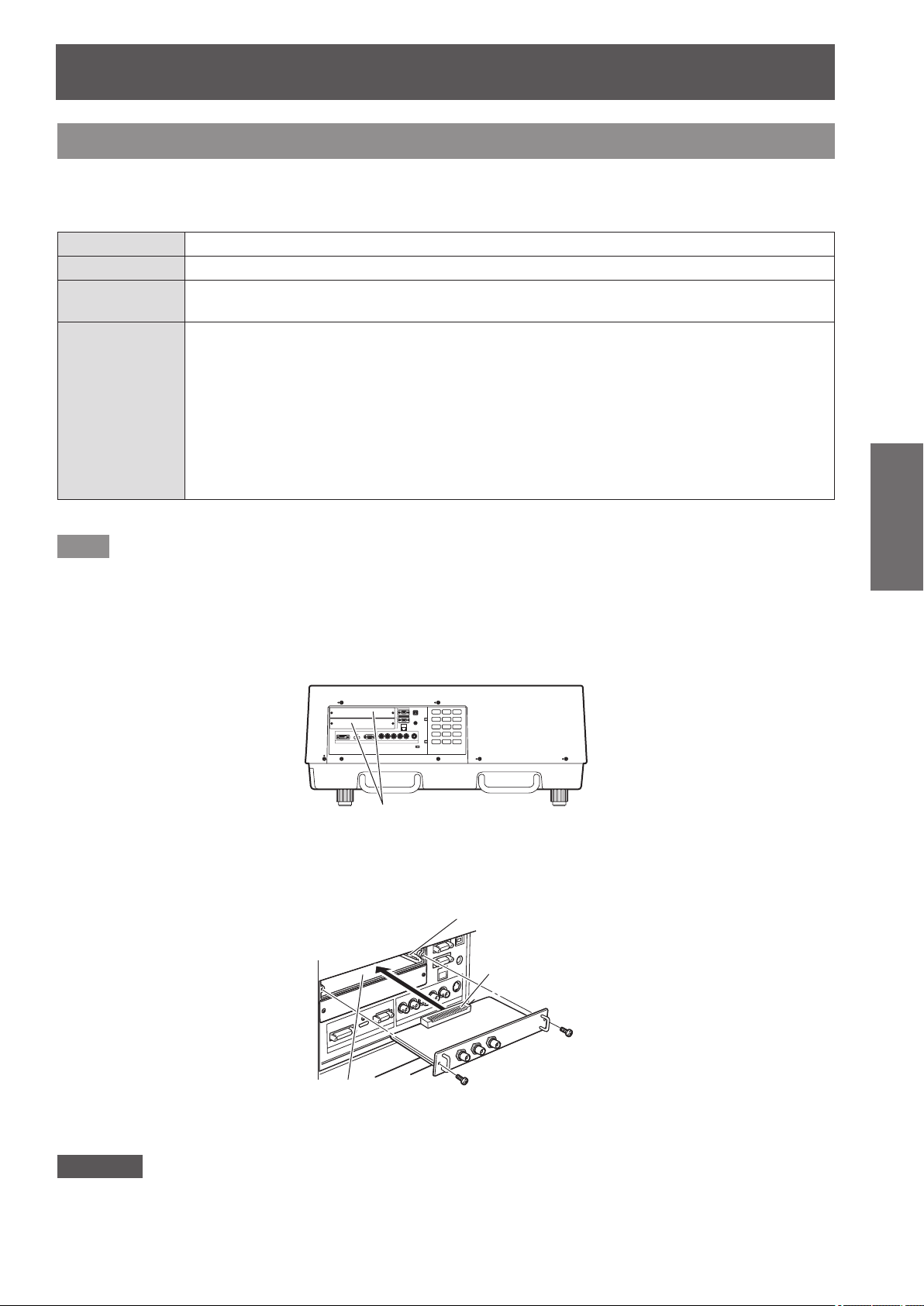
Guide
Installing an input module (optional)
Installing an input module
Types of input module
z■
Purchase an input module (optional) matching the input signals of the system.
Module name SD/HD-SDI input module
Module number AH-72217
Input/output
terminal
Compatible
signal format
*1: V-sync frequency 60/59.94 Hz, 48/47.95 Hz, 24/23.98 Hz are automatically distinguished.
BNC 2 Input system, BNC 1 Output system
SMPTE259M-C standard:
480-60i (59.94 Hz
SMPTE260M standard:
1035-60i (60/59.94 Hz*1)
SMPTE274M standard:
1080-24psf (48/47.95 Hz*1), 1080-24p (24/23.98 Hz*1), 1080-25psf (50 Hz),
1080-25p (25 Hz), 1080-30psf (60/59.94 Hz*1), 1080-30p (30/29.97 Hz*1),
1080-50i (50 Hz), 1080-60i (60/59.94 Hz*1)
SMPTE296M standard:
720-60p (60/59.94 Hz*1), 720-50p (50 Hz)
*1
), 576-50i (50 Hz)
Note
zThe preceding list shows the signal formats supported by the input modules. The signal formats supported by
the projector differ depending on the model. For more information, please consult your dealer.
Installation procedure
z■
Disconnect the power before installing the input module.
1) Remove the slot cover.
Slot cover
2) Insert the input module.
Firmly insert the input module into the slot, ensuring that the socket of the connection terminal engages
z
z
correctly with the plug within the projector body.
Socket
Getting Started
Plug
3) Fix the input module in place using two screws.
Attention
zBe sure to tighten the screws. Otherwise, the input module may fall off.
zAn improper installation may result in damage to the input module.
ENGLISH - 29
Page 30
Installing an input module (optional)
Using the input module
z■
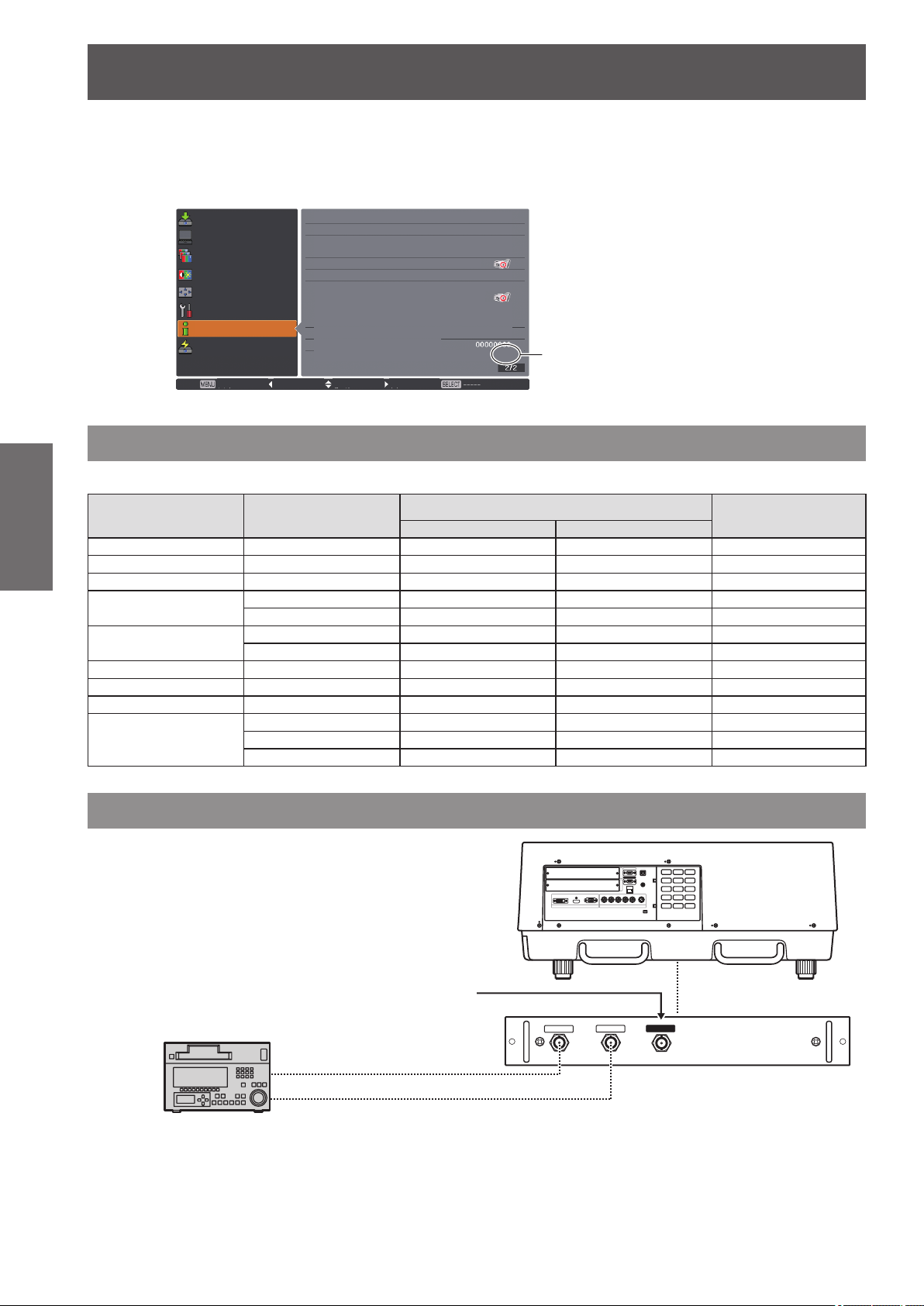
Consult your dealer before using any of the optional input modules.
When consulting your dealer, be sure to inform them of [Option control No.] of the projector.
[Option control No.] is displayed in the [Information] menu.
Input
PC adjust
Image select
Image adjust
Screen
Setting
Information
Network
Exit NextMoveBack
Language English
Filter counter
Power management
Key lock
PIN code lock
Shutter management
Protection
Effect
Release key
Remote control
Serial number
Option control No.
16H
Ready
5Min
180Min
Code 08
Off
Off
All
13
Inform your dealer of this number.
Getting Started
List of compatible signals
The following table species the types of signal compatible with the projector.
Screen display Resolution Scanning frequency Dot clock
D-1080psf/24 1 920 x 1 080 27.000 48.000 74.250
D-1080psf/25 1 920 x 1 080 28.125 50.000 74.250
D-1080psf/30 1 920 x 1 080 33.750 60.000 74.250
Connection of signal to input module
mode (dots) Horizontal (kHz) Vertical (Hz) frequency (MHz)
D-480i 720 (1 440) x 480 15.734 59.940 27.000
D-576i 720 (1 440) x 576 15.625 50.000 27.000
D-1035i 1 920 x 1 035 33.750 60.000 74.250
D-1080i
D-720p
1 920 x 1 080 33.750 60.000 74.250
1 920 x 1 080 28.125 50.000 74.250
1 280 x 720 37.500 50.000 74.250
1 280 x 720 45.000 60.000 74.250
1 920 x 1 080 27.000 24.000 74.250
D-1080p
1 920 x 1 080 28.125 25.000 74.250
1 920 x 1 080 33.750 30.000 74.250
Digital VCR for commercial use
30 - ENGLISH
To monitor or projector
compatible with HD-SDI
or SD-SDI signals
HD-SDI or SD-SDI signal
SDI IN 1
SDI IN 2
SDI OUT
Page 31

Powering on/off
Connecting the power cord
Powering on/off
Installation
z■
1) Insert the power cord holder in the
holes provided above and below the
AC input terminal.
Push the power cord holder to the left to allow
z
z
insertion of the power cord.
2) Attach the power cord cover to the
cord in the direction of (i) and press it
rmly in the direction of (ii).
(i)
Removal
z■
1) Push the power cord holder to the left.
2) Remove the power cord from the AC
input terminal.
(ii)
3) Connect the power cord to the AC
input terminal.
4) Move the power cord holder to secure
the power cord.
3) Remove the power cord holder.
Basic Operation
ENGLISH - 31
Page 32

Powering on/off
Power indicator
The power indicator informs you of the power status. Check the status of the power indicator <POWER> and the
standby indicator <STAND-BY> before operating the projector.
Power indicator
<POWER> (green)
Basic Operation
Note
zWhen the projector is preparing to turn off the power (the power indicator <POWER> is off and the standby
indicator <STAND-BY> is ashing), the internal fan switches on to cool the projector.
zWhen the projector is preparing to turn off the power, you cannot switch on the power by pressing the power
<ON/STAND-BY> button on the control panel or the power <ON> button on the remote control. If the standby
indicator <STAND-BY> is on, you can switch on the power.
zThe projector consumes electricity even in the standby mode (the standby indicator <STAND-BY> is on).
Power indicator <POWER>
Standby indicator <STAND-BY>
Indicator status
Standby indicator
<STAND-BY> (red)
Off The main power is off.
Off On The power is off (standby mode).
On Off The projector is in the projection mode.
Off Flashing
The projector is preparing to turn off the power.
After a short time, the power will turn off (in standby mode).
Projector status
32 - ENGLISH
Page 33

Powering on/off
< >
< >
Powering on the projector
Control panel Remote control
Power <ON/STAND-BY>
button
Before turning on the power, remove the lens cover.
1) Connect the power plug to the outlet.
(AC 200 V - 240 V 50 Hz/60 Hz)
2) Press the
side of the main power
switch to turn on the power.
After a moment, the standby indicator <STAND-
z
z
BY> will go on and the projector will enter the
standby mode.
3) Press the <ON/STAND-BY> button on
the control panel or the <ON> button
on the remote control.
After a moment, an image will be projected
z
z
and the currently selected input signal and
lamp status (
approximately four seconds.
Note
zWhen [PIN code lock] (
[On] using [Security] in the [Setting] menu, enter
your PIN code.
zThe projector will make a noise when the lamp
comes on, but this is not a malfunction.
zDuring projection, the fan rotates, making a sound.
The sound may change depending on the ambient
temperature, and when the lamp is on, the sound
may become loud.
zIf the lamp is switched off and immediately on
again, the newly projected image may wobble
for a few moments. This is due to the lamp
characteristics and is not a malfunction.
zWhen [Direct on] (
is set to [On], the power will come on as soon as
you insert the power plug into the outlet or set the
main power switch to the
zWhen [Display] ( page 59) of the [Setting] menu
is set to [On] and [Logo] ( page 65) is set to [Off],
the countdown will be displayed but the opening
display will not be displayed.
page 85) will be displayed for
Power <ON> button
page 69) has been set to
page 68) of the [Setting] menu
side.
zWhen [Display] ( page 59) of the [Setting] menu is
set to [Off] or [Countdown off], projection will start
as soon as the lamp comes on, regardless of [Logo
select] ( page 65) setting.
zAfter turning on the power, notes on [Filter warning]
and [Lamp replacement] may be displayed
depending on the status of the projector. ( page 86)
Making adjustments and selections
It is recommended that the images are projected
continuously for at least 30 minutes before the focus
is adjusted.
4) Press the <FOCUS> button to adjust
the focus of the image roughly.
(
page 36)
5) Press the <INPUT 1> to <INPUT 4>
buttons on the remote control or the
<INPUT> button on the control panel
to select the input terminal. (
6) Adjust the projection angle. (
Extend the adjustable feet to adjust the
z
z
projection angle.
7) Press the <LENS SHIFT> button to
adjust the position of the image.
(
page 35)
8) Press the <ZOOM> button to adjust
the size of the image to t the screen.
(
page 36)
9) Press the <FOCUS> button again to
adjust the focus.
10) Press the <ZOOM> button again to
adjust the zoom and the size of the
image to t the screen.
page 37)
page 25)
Basic Operation
ENGLISH - 33
Page 34

Powering on/off
< >
Powering off the projector
Control panel Remote control
Power <ON/STAND-BY>
button
1) Press the power <ON/STAND-BY>
button on the control panel or the
power <STAND-BY> button on the
remote control.
[Power off ?] is displayed on the screen.
z
z
The screen display will disappear when any button
z
z
other than the power <ON/STAND-BY> button on
the control panel and the power <STAND-BY>
button on the remote control is pressed or when
Basic Operation
approximately four seconds elapse.
2) Press again the power <ON/STANDBY> button on the control panel or
the power <STAND-BY> button on the
remote control.
The lamp goes off and the projection stops.
z
z
The power indicator <POWER> goes off while
z
z
the cooling fan continues to rotate, and the
standby indicator <STAND-BY> ashes.
Power <STAND-BY>
button
Direct power off function
You can disconnect the power cord, turn off the power
by the power breaker switch, etc. without pressing the
power <STAND-BY> button on the remote control or
the main power switch on the projector.
This is useful in cases where the switch is not easily
accessible, such as when the projector is ceiling
mounted. This function also provides safety if a power
outage occurs or if the power cord is accidentally
disconnected from the outlet immediately after turning
off the power.
Note
zWhen the lamp has been cooled by the direct
power off function, it sometimes takes longer than
usual for the lamp to light up again.
Power management function
The projector has a power management function. If no
signal is detected for 30 seconds and no operation is
performed on the projector, [No signal] and the timer
appear on the screen and a countdown starts.
If the countdown is completed without a signal being
input or an operation on the projector, this function
works to save power and extend the service life of the
lamp.
Note
zThe factory default setting is [Off]. For details, refer
to [Power management] (
page 68).
3) When the standby indicator <STANDBY> comes on, press the
side of the
main power switch to turn off the power.
Note
zDo not turn on the power immediately after turning it off.
In the cooling state of the luminous lamp after the
power is turned off, the lamp may not light up even
when the power is turned on. In this case, wait for
the standby indicator <STAND-BY> to turn red, and
then turn on the power again. Turning on the power
while the lamp is still hot may shorten the lamp life.
zWhen you turn off the power using the power <ON/
STAND-BY> button on the control panel or the
power <STAND-BY> button on the remote control
with the main power switch on the projector body
turned on, the projector continues to consume
electricity. For details on power consumption, refer
to “Power consumption” ( page 102).
zCheck that key lock is off in the [Security] menu.
( page 69)
zIf you use the projector for longer than 24 hours,
turn off the power every 24 hours and wait for one
hour. This will increase the lamp life.
34 - ENGLISH
Page 35

Projecting
Moves the image up
Check the external device connections ( page 26) and power cord connections ( page 31) and then turn on the
power ( page 33) to start projection. Select the input signal and adjust the image.
Projecting
Selecting the input signal
Select an input signal.
The images selected using the <INPUT> button on the control panel or the <INPUT 1> to <INPUT 4> buttons on
the remote control are projected. ( page 37)
Attention
zImages may not be projected properly depending on the connected device, DVD, video tape, etc. to be played.
zThe <INPUT> button on the control panel cannot be used to select input signals. The input signal for each
input terminal must be selected in advance using the [Input] menu. If you press the <INPUT> button without
having correctly selected the input signal, the projector will not project the image correctly.
Adjusting the image
Adjusting the position of the lens
z■
1) Press the <LENS SHIFT> button on the remote control or the control panel.
[Lens shift] is displayed on the screen for four seconds.
z
z
Lens shift
2) While the display appears, press
▲▼◀▶
to move the image horizontally and
vertically.
As you move the image, there is a certain position at which the arrows pointing up, down, left and right turn
z
z
red. This position is the center for the lens.
At positions of maximum shift, the arrows disappear.
z
z
The projector stores the setting made using the lens shift function when the power is turned off.
z
z
When the position of the image is shifted, the image may become a little darker.
z
z
* The gure below shows an example of when the standard lens is attached.
approximately 50% of
its height.
90°
Moves the image
right approximately
10% of its width.
Moves the image
left approximately
10% of its width.
90° 90°
With the lens moved completely up
Basic Operation
With the lens moved completely to
the left
Moves the image
down approximately
50% of its height.
With the lens moved completely down
90°
With the lens moved completely to
the right
ENGLISH - 35
Page 36

Projecting
Adjusting the focus and zoom
z■
1) Press the <FOCUS> button and the <ZOOM> button on the remote control or the
control panel.
[Focus] and [Zoom] are displayed on the screen for four seconds.
z
z
2) While the display appears, press
Note
zWhen [Display] is set to [Off], the adjustment screen will not appear.
zIt is recommended that the images are projected continuously for at least 30 minutes before the focus is
adjusted.
zIf the keystone effect occurs, refer to “Correcting the keystone effect” (
Basic Operation
to adjust the focus and zoom.
▲▼
page 38) for details.
36 - ENGLISH
Page 37

Using the remote control
Using the freeze function
You can temporarily freeze the projected image
regardless of the state of playback in an external
device.
1) Press the <FREEZE> button on the
remote control.
z
2) Press the button on the remote control
or the control panel.
z
Switching the input signal
You can switch the input signal for projection.
Using the remote control
button
This freezes the image.
z
Releases the frozen image.
z
Using the shutter function
You can fully block the projection light.
button
1) Press the <SHUTTER> button on the
remote control.
This blocks the projection light. The shutter
z
z
indicator <SHUTTER> lights up in blue.
2) Press the <SHUTTER> button again.
This opens the shutter and restarts projection.
z
z
The shutter indicator <SHUTTER> goes off.
Note
zThe operations of the shutter differ depending on
the settings. Perform the settings using [Shutter] in
the [Setting] menu.
zThe <SHUTTER> button is also on the control
panel.
zIf an error message appears when you press the
<SHUTTER> button, the button lock is enabled.
Check the [Shutter] setting from the [Setting] menu.
buttons
1) Press the <INPUT 1> - <INPUT 4>
buttons on the remote control.
Each press of the button changes input signal.
z
z
The <INPUT 3> button and the <INPUT 4>
z
z
button are only enabled when an input module
is inserted.
<INPUT 1> button <INPUT 2> button
[RGB(PC analog)]
[RGB(Scart)] [Y,Pb/Cb,Pr/Cr]
[RGB(PC digital)] [Video]
[RGB(AV HDCP)] [S-video]
[RGB]
Basic Operation
[HDMI]
ENGLISH - 37
Page 38

Using the remote control
Note
zThe signal displayed for the <INPUT 3> button and
the <INPUT 4> button changes depending on the
type of input module inserted.
zPressing the <INPUT> button on the control panel
changes the signal in the order of [Input 1], [Input 2],
[Input 3], and [Input 4].
Correcting the keystone effect
You can correct the keystone effect that occurs when
the projector is installed with tilt or when the screen is
tilted.
zThe amount and range of the correction differ
depending on the input signal.
zWith certain settings, the image may distort for a
moment.
zTo achieve the corrected image, the signal
undergoes digital compression before projection
and lines and text may be altered slightly from
those of the original image.
zFor details on the correction, refer to [Keystone] in
the [Screen] menu.
Basic Operation
1) Press the <KEYSTONE> button on the
remote control.
Each press of the button switches the display
z
z
between the standard keystone effect correction
display and the corner correction display.
button
Corner correction
z■
Corrects distortion at the corners of the image.
1) While [Keystone] is displayed, press
the <SELECT> button and select the
corner to correct.
Each press of the button moves the selected
z
z
corner clockwise.
2) Press
Note
zPressing the <KEYSTONE> button on the remote
control for at least three seconds while [Keystone] is
displayed returns the image to the uncorrected state.
▲▼◀▶
to correct the distortion.
Selecting picture quality mode
Pressing the <IMAGE SEL.> button on the remote
control displays the menu for the currently selected
[Image select], then each subsequent press of the
button changes the mode.
button
<For computer input> <For video input>
[Standard]
[Real] [Cinema]
[Standard]
Standard keystone effect
z■
correction
Corrects the keystone effect vertically and horizontally.
1) While [Keystone] is displayed, press
▲▼◀▶
want to make the correction.
Note
zPressing the <KEYSTONE> button on the remote
control for at least three seconds while [Keystone]
is displayed returns the image to the uncorrected
state.
of the direction in which you
[Dynamic] [Dynamic]
[Image 1] [Image 10]
Note
zFor details, refer to “[Image select] menu”
page 49).
(
[Image 1] [Image 10]
38 - ENGLISH
Page 39

Using the remote control
Adjusting picture quality
Pressing the <IMAGE ADJUST> button on the remote
control displays the [Image adjust] menu.
button
1) Press the <IMAGE ADJUST> button on
the remote control.
2) Press
the <SELECT> button.
The adjustment menu is displayed.
z
z
3) Press
and then press
setting.
Note
zFor details, refer to “[Image adjust] menu”
page 50).
(
to select an item, and press
▲▼
to select the item to adjust,
▲▼
to change the
◀▶
Screen button
You can change the setting of the [Screen] menu.
Displaying a timer for presentations
When you press the <P-TIMER> button on the
remote control, the projector displays either a count
of the time elapsed from the press of the button or a
countdown.
Pressing the <P-TIMER> button again stops the count
and displays the elapsed time up to that point.
Pressing the <P-TIMER> button again restarts the
count.
button
Note
zFor details, refer to [P-timer] (
zPressing the button for at least three seconds
resets the time. The count up is returned to “000:00”
and the countdown is returned to the time set on
the timer.
page 73).
Checking the settings
You can check the status of signals and the lamp on
the screen during projection.
button
Pressing the <SCREEN> button on the remote control
displays the currently selected [Screen] menu, then
each subsequent press of the button changes the
mode.
<For computer input>
[Normal]
[Full] [Full]
[Wide(16:9)] [Wide(16:9)]
[Zoom] [Zoom]
[True] [Custom]
[Custom]
Note
zFor details, refer to “[Screen] menu” (
zIf you press and hold the button for at least ve
seconds, the settings of the [Screen] menu will
return to the factory default settings.
<For video input>
[Normal]
page 55).
button
Pressing the <INFO.> button on the remote control
displays the rst page of the information.
Pressing the <INFO.> button again displays the
second page of the information.
Pressing the <INFO.> button closes the information.
Note
zFor details, refer to “[Information] menu” (
zTo move from the information to another menu,
press
zThere is also the <INFORMATION> button on the
control panel.
▲▼
.
page 75).
Basic Operation
ENGLISH - 39
Page 40

Menu navigation
Menu navigation
Navigating through menu
Operating procedure
z■
1) Press the <MENU> button.
The menu is displayed.
z
z
Input
PC adjust
Image select
Image adjust
Screen
Setting
Information
Network
Exit Next NextMove
2) Press
▲▼
item.
Select the item to adjust from [Input], [PC
z
z
adjust], [Image select], [Image adjust], [Screen],
[Setting], [Information], and [Network]. The
currently selected item appears with an an
orange cursor, and the sub menu of the
selected item is displayed to the right-hand
side.
Language English
Menu position
Display
Background
Lamp select
Lamp power
Lamp interval
Edge blending
Color matching
HDMI setup
Logo
Fancontrol
Remote control
to select the main menu
Black
Auto
Normal
Normal
Code 01
Note
zFor certain formats of signal input to the projector,
it will not be possible to adjust some items or use
some functions. The menu items that cannot be
adjusted or used are grayed out, and cannot be
selected.
zSome items can be adjusted without a signal input.
zIf no operation is performed for approximately four
On
seconds or ten seconds, the adjustment screen is
cleared automatically. The time until the adjustment
screen is cleared varies depending on the screen.
Off
zFor details on the sub menu items, refer to “Sub
menu” (
pages 41 to 43).
zA guide menu is displayed below the menu. Buttons
to be selected and executed are displayed.
(The guide menu of the sub menu is shown below.)
Exit Back Next NextMove
(1) (2) (3) (4) (5)
(1) Press the <MENU> button to close the menu.
(2) Press ◀ to return to the main menu.
(3) Press ▲▼ to navigate among the items.
(4) Press ▶ to adjust or select an item.
(5) Press the <SELECT> button to execute an item.
Settings
3) Press the <SELECT> button.
The sub menu is displayed, and the items on
z
z
the sub menu can be selected.
Alternatively, press ▶ to access the sub menu.
z
z
Input
PC adjust
Image select
Image adjust
Screen
Setting
Information
Network
Exit Next NextMove
4) Press
▲▼
Language English
Menu position
Display
Background
Lamp select
Lamp power
Lamp interval
Edge blending
Color matching
HDMI setup
Logo
Fan control
Remote control
to select the sub menu item
to change, then press the <SELECT>
button and
to change the settings
◀▶
or adjust the parameter values.
For some sub menus, a further menu (sub
z
z
menu 2) containing advanced settings will be
displayed.
For items where the setting can be changed
z
z
or there is a bar scale, the menu screen
disappears and, as illustrated below, an
adjustment screen for the selected setting
(individual adjustment screen) is displayed.
Fine sync
Exit Adjust BackScroll
Black
Auto
Normal
Normal
Code 01
On
Off
40 - ENGLISH
Page 41

Menu navigation
Main menu
The main menu contains the following eight items.
When a main menu item is selected, the screen
changes to a sub menu selection screen.
[Input]
[PC adjust]
[Image select]
[Image adjust]
[Screen]
[Setting]
[Information]
[Network]
Sub menu
The sub menu screen of the item selected from main
menu is displayed, and you can set and adjust the
various items in the sub menu.
[Input]
z■
Sub menu item
[Input 1]
[Input 2] [RGB] 44
[Input 3] —*
[Input 4] —*
*1: Differs depending on the input signal.
Note
zThe signal displayed for [Input 3] and [Input 4]
changes depending on the type of input module
inserted.
[PC adjust]
z■
Sub menu item
[Auto PC adj.] — 46
[Fine sync] —*
[Total dots] —*
[Position H] —*
[Position V] —*
[Current mode] —*
[Clamp] —*
[Display area H] —*
[Display area V] —*
[Reset] — 48
[Mode free] — 48
[Store] — 48
*1: Differs depending on the input signal.
Factory
default
[RGB(PC
analog)]
1
1
Factory
default
1
1
1
1
1
1
1
1
Page
44
—
—
Page
46
46
46
47
47
47
47
47
Settings
[Image select]
z■
Details ( page 49)
ENGLISH - 41
Page 42

Menu navigation
[Image adjust]
z■
Sub menu item Factory default Page
[Contrast] 32 50
[Brightness] 32 50
[Color]*
[Tint]*
[Color management] — 51
[Color temp.] [Mid] 52
White balance ([Red]/
[Green]/[Blue])
[Offset] 32 52
[Auto picture control] [L 1] 52
[Advanced color] [Auto] 52
[Sharpness]
[Gamma] 8 53
[Noise reduction]*
[Progressive]*
[Reset] — 53
[Store] — 54
*1: Only displayed and selectable when video input is used.
1
1
For video input: 15
1
1
32 50
32 50
32 52
For computer
input: 0
[On] 53
[On] 53
53
[Screen]
z■
Sub menu item Factory default Page
[Normal] — 55
[Full] — 55
[Wide(16:9)] — 55
[Zoom] — 55
1
[True]*
[Custom] — 56
[Custom adj.] — 56
[Digital zoom +]*
[Digital zoom -]*
[Keystone] — 57
[Ceiling] [Off] 58
[Rear] [Off] 58
[Reset] — 58
*1: Only displayed and selectable when computer input is
used.
1
1
— 55
— 56
— 57
Settings
42 - ENGLISH
Page 43

Menu navigation
[Setting]
z■
Sub menu item Factory default Page
[Language] [English] 59
[Menu position] — 59
[Display] [On] 59
[Background] [Blue] 60
[Lamp select] [4-Lamps] 60
[Lamp power]
[Lamp interval] [Off] 61
[Edge blending] [Off] 61
[Color matching] [Off] 62
[HDMI setup] [Normal] 65
[Logo] — 65
[Fan control] [Normal] 67
[Remote control] [All] 67
[RC sensor] [Front & Back] 67
[Power management]
[Direct on] [Off] 68
[Security] — 69
[Projector ID] [All] 70
[Shutter] — 70
[Video delay control] [Off] 71
[Closed caption] [Off] 72
[Filter counter] — 72
[P-timer] [Count up] 73
[Test pattern] — 74
[Factory default] — 74
(Auto)
[Off], [Timer]
30 minutes
60
68
[Information]
z■
Details ( page 75)
[Network]
z■
Refer to “Owner's Manual–Network Operations”.
Details ( page 76)
ENGLISH - 43
Settings
Page 44

Control panelRemote control
[Input] menu
[Input] menu
Settings
Select [Input] from the main menu on the menu
screen, and select the item from the sub menu.
For operation of the menu screen, refer to
“Navigating through menu” ( page 40).
zAfter selecting the item, press
the setting.
▲▼◀▶
to make
[Input 1]
1) Press
press the <SELECT> button.
The sub menu 2 is displayed.
z
z
2) Press
the <SELECT> button.
[RGB(PC
analog)]
[RGB(Scart)]
[RGB(PC
digital)]
[RGB(AV
HDCP)]
[HDMI]
to select [Input 1], and
▲▼
to select an item, and press
▲▼
Select when inputting an analog
signal from a computer to the
<ANALOG IN> terminal.
Select when inputting SCART
signal to the <ANALOG IN>
terminal.
Select when inputting a digital
signal from a computer to the
<DIGITAL (DVI-D) IN> terminal.
Select when inputting an HDCPcompatible digital signal to the
<DIGITAL (DVI-D) IN> terminal.
Select when inputting an HDMIcompatible digital signal to the
<HDMI IN> terminal.
[Input 2]
1) Press
press the <SELECT> button.
The sub menu 2 is displayed.
z
z
2) Press
the <SELECT> button.
[RGB]
[Y,Pb/Cb,Pr/
Cr]
[Video]
[S-video]
Note
zWhile some RGB signals are automatically
recognized, unrecognized RGB signals are
detected as “Y,Pb/Cb,Pr/Cr” and it is necessary to
select [RGB] from the menu.
to select [Input 2], and
▲▼
to select an item, and press
▲▼
Select when inputting an analog
signal from a computer to the
<G,B,R,H/V,V IN> terminal.
Select when inputting a composite
video signal to the <Y,Pb/Cb,Pr/Cr
IN> terminal.
Select when inputting a composite
video signal to the <VIDEO IN>
terminal.
Select when inputting an S-video
signal to the <S-VIDEO IN>
terminal.
Note
zThe SCART21 pin terminal is a video output
terminal provided in video players sold mainly in
Europe. To view RGB output from this terminal on
the projector, connect the SCART21 pin terminal
of the video player to the <ANALOG IN> terminal
of the projector using a dedicated cable. The RGB
SCART signals to be played via the <ANALOG IN>
terminal are limited to 480i and 576i RGB signals.
Composite video signals cannot be played back.
44 - ENGLISH
Page 45

[System]
[System] is displayed below the sub menu.
1) Press
the sub menu and press the <SELECT>
button.
The sub menu 2 is displayed.
z
z
2) Press
the <SELECT> button.
Press the <SELECT> button or ◀ to return to
z
z
the sub menu.
For computer input
z■
[Auto]
—
[Mode 1] [Mode 10]
to select [System] below
▲▼
to select an item and press
▲▼
When there is no input signal
compatible with the signal from
a connected computer on the
projector, the automatic PC
adjustment function works and
[Auto] is displayed on the system.
If images are not being correctly
projected, manually adjust the
settings to suit your computer and
register in [Store].
There is no input signal from the
computer.
Check the connections.
Select when inputting a digital
signal from a computer to the
<DIGITAL (DVI-D) IN> terminal.
For component input
z■
The projector automatically selects
[Auto]
Component
video scanning
methods
([480p], [576p],
[720p], [480i],
[576i], [1035i],
[1080i], [1080p])
the scanning method of the input
signal.
When video is not being played
back correctly, select the correct
scanning method from the menu.
[Input] menu
For video and S-video input
z■
[Auto]
[PAL]/
[SECAM]/
[NTSC]/
[NTSC4.43]/
[PAL-M]/
[PAL-N]
The projector automatically selects
the color system of the input signal.
This is a list of supported color
systems. The Japanese color
system is NTSC. When the quality
of the input signal is poor (irregular
color, absence of color etc.), and
the color system is not selected
even when [Auto] is set, select
[NTSC].
Settings
ENGLISH - 45
Page 46

[PC adjust] menu
Control panelRemote control
[PC adjust] menu
Settings
Select [PC adjust] from the main menu on the
menu screen, and select the item from the sub
menu.
For operation of the menu screen, refer to
“Navigating through menu” ( page 40).
zAfter selecting the item, press
the setting.
▲▼◀▶
to make
[Auto PC adj.]
Automatically adjusts synchronization, total number of
dots, horizontal shift, and vertical shift.
1) Press
2) Press the <SELECT> button.
This executes automatic adjustment.
z
z
Note
zYou can also use [Auto PC adj.] by pressing the
<AUTO PC> button on the remote control.
zSome computers will be unable to adjust any of
[Fine sync], [Total dots], [Position H] or [Position V].
In this case, adjust manually and register in [Store].
zAfter registering the automatically adjusted settings,
you can select that mode using [System] in the
[Input] menu.
zThe automatic PC adjustment function does not
work when any of [480p], [576p], [720p], [480i],
[576i], [1035i], [1080i], or [1080p] have been
selected using [System] in the [Input] menu.
zWith some computers and types of signal, it may
not be possible to project the images correctly.
to select [Auto PC adj.].
▲▼
[Fine sync]
Adjusts the projector when there is icker due to a
tracking (synchronization) mismatch.
1) Press
to select [Fine sync].
▲▼
2) Press the <SELECT> button.
The advanced menu is displayed.
z
z
While the advanced menu is displayed, press
z
z
to move backwards and forwards between
▲▼
menus.
3) While looking at the screen, press
◀▶
to adjust the setting.
Press the <SELECT> button to return to the
z
z
sub menu.
Note
zThe adjustment value can be set from 0 to 31.
zFor some computers, it may not be possible to
completely eliminate the screen icker.
[Total dots]
Adjusts total number of dots in the horizontal interval.
1) Press
to select [Total dots].
▲▼
2) Press the <SELECT> button.
The advanced menu is displayed.
z
z
While the advanced menu is displayed, press
z
z
to move backwards and forwards between
▲▼
menus.
3) While looking at the screen, press
◀▶
to adjust the setting.
Press the <SELECT> button to return to the
z
z
sub menu.
[Position H]
Adjusts the horizontal position of the screen.
1) Press
to select [Position H].
▲▼
46 - ENGLISH
2) Press the <SELECT> button.
The advanced menu is displayed.
z
z
While the advanced menu is displayed, press
z
z
to move backwards and forwards between
▲▼
menus.
3) While looking at the screen, press
to adjust the setting.
Press the <SELECT> button to return to the
z
z
sub menu.
◀▶
Page 47

[PC adjust] menu
[Position V]
Adjusts the vertical position of the screen.
1) Press
to select [Position V].
▲▼
2) Press the <SELECT> button.
The advanced menu is displayed.
z
z
While the advanced menu is displayed, press
z
z
to move backwards and forwards between
▲▼
menus.
3) While looking at the screen, press
◀▶
to adjust the setting.
Press the <SELECT> button to return to the
z
z
sub menu.
[Current mode]
Displays the current values of H-sync frequency
and V-sync frequency for the currently connected
computer.
1) Press
to select [Current mode].
▲▼
2) Press the <SELECT> button or ▶.
The advanced menu is displayed.
z
z
Press the <SELECT> button or ◀ to return to
z
z
the sub menu.
[Clamp]
Adjusts the clamp position.
Use this when a black line is visible in the projected
image.
1) Press
2) Press the <SELECT> button.
The advanced menu is displayed.
z
z
While the advanced menu is displayed, press
z
z
▲▼
menus.
3) While looking at the screen, press
to adjust the setting.
Press the <SELECT> button to return to the
z
z
sub menu.
to select [Clamp].
▲▼
to move backwards and forwards between
◀▶
[Display area H]
Adjusts the horizontal resolution.
1) Press
to select [Display area H].
▲▼
2) Press the <SELECT> button.
The advanced menu is displayed.
z
z
While the advanced menu is displayed, press
z
z
to move backwards and forwards between
▲▼
menus.
3) While looking at the screen, press
to adjust the setting.
Press the <SELECT> button to return to the
z
z
sub menu.
Note
zYou cannot adjust [Display area H] when any of
[480p], [576p], [720p], [480i], [576i], [1035i], [1080i],
or [1080p] have been selected using [System] in
the [Input] menu.
[Display area V]
Adjusts vertical resolution.
1) Press
2) Press the <SELECT> button.
The advanced menu is displayed.
z
z
While the advanced menu is displayed, press
z
z
▲▼
menus.
3) While looking at the screen, press
to adjust the setting.
Press the <SELECT> button to return to the
z
z
sub menu.
Note
zYou cannot adjust [Display area V] when any of
[480p], [576p], [720p], [480i], [576i], [1035i], [1080i],
or [1080p] have been selected using [System] in
the [Input] menu.
to select [Display area V].
▲▼
to move backwards and forwards between
◀▶
◀▶
Settings
ENGLISH - 47
Page 48

[PC adjust] menu
[Reset]
The setting returns to its value before adjustment .
1) Press
to select [Reset].
▲▼
2) Press the <SELECT> button.
3) Select [Yes], and press the <SELECT>
button.
The setting returns to the value before
z
z
adjustment.
Select [No] and press the <SELECT> button to
z
z
return to the sub menu.
[Mode free]
Deletes the values registered in [Store].
1) Press
2) Press the <SELECT> button or ▶.
The registered content of each mode is
z
z
displayed in the sub menu 2.
3) Press
delete.
4) Press the <SELECT> button.
5) Select [Yes], and press the <SELECT>
button.
The selected mode is deleted and the projector
z
z
returns to the sub menu 2.
Select [No] and press the <SELECT> button to
z
z
return to the sub menu 2.
to select [Mode free].
▲▼
to select the mode to
▲▼
Settings
[Store]
Registers the adjusted values in [Store].
1) Press
2) Press the <SELECT> button or ▶.
The registered content of each mode is
z
z
displayed in the sub menu 2.
3) Press
register.
4) Press the <SELECT> button.
5) Select [Yes], and press the <SELECT>
button.
The selected mode is registered and the
z
z
projector returns to the sub menu 2.
Select [No] and press the <SELECT> button to
z
z
return to the sub menu 2.
to select [Store].
▲▼
to select the mode to
▲▼
48 - ENGLISH
Page 49

[Image select] menu
Control panelRemote control
Select [Image select] from the main menu on
the menu screen, and select the item from the
sub menu.
For operation of the menu screen, refer to
“Navigating through menu” ( page 40).
zAfter selecting the item, press
the setting.
zYou can also display sub menus using the
<IMAGE SEL.> button on the remote control.
▲▼◀▶
Adjusting the picture quality
to make
[Image select] menu
Adjusts the picture quality of the projected image to suit
the environment in which you are using the projector.
[Standard]
z■
Resets the [Image adjust] menu items to the
factory default settings.
[Real]
z■
In this mode, intermediate settings are adjusted to
be brighter, improving the view in bright locations.
This mode can only be selected for computer
z
z
inputs.
[Cinema]
z■
Emphasizes gradation, making this mode suitable
for viewing movies.
This mode can only be selected for video or
z
z
component inputs.
[Dynamic]
z■
Gives picture with stronger contrast than
[Standard].
[Image 1] - [Image 10]
z■
Calls up picture quality settings set manually using
the [Image adjust] menu.
Images can be registered with both computer
z
z
inputs and video inputs.
Settings
ENGLISH - 49
Page 50

Control panelRemote control
[Image adjust] menu
[Image adjust] menu
Settings
Select [Image adjust] from the main menu on
the menu screen, and select the item from the
sub menu.
For operation of the menu screen, refer to
“Navigating through menu” ( page 40).
zAfter selecting the item, press
the setting.
zYou can also display sub menus using the
<IMAGE ADJUST> button on the remote control.
▲▼◀▶
to make
[Contrast]
1) Press
2) Press the <SELECT> button.
The advanced menu is displayed.
z
z
While the advanced menu is displayed, press
z
z
▲▼
menus.
3) While looking at the screen, press
to adjust the setting.
Operation Adjustment Range
Press ▶.
Press ◀.
to select [Contrast].
▲▼
to move backwards and forwards between
Makes the contrast
stronger.
Makes the contrast
weaker.
Maximum
value 63
Minimum
value 0
[Brightness]
◀▶
[Color]
This setting can only be adjusted for video or
component inputs.
1) Press
to select [Color].
▲▼
2) Press the <SELECT> button.
The advanced menu is displayed.
z
z
While the advanced menu is displayed, press
z
z
to move backwards and forwards between
▲▼
menus.
3) While looking at the screen, press
to adjust the setting.
Operation Adjustment Range
Press ▶.
Press ◀.
Makes the image
darker.
Makes the image
lighter.
[Tint]
This setting can only be adjusted for video or
component inputs.
1) Press
2) Press the <SELECT> button.
The advanced menu is displayed.
z
z
While the advanced menu is displayed, press
z
z
▲▼
menus.
3) While looking at the screen, press
to adjust the setting.
Operation Adjustment Range
Press ▶. Emphasizes green.
Press ◀. Emphasizes purple.
to select [Tint].
▲▼
to move backwards and forwards between
◀▶
Maximum
value 63
Minimum
value 0
◀▶
Maximum
value 63
Minimum
value 0
1) Press
to select [Brightness].
▲▼
2) Press the <SELECT> button.
The advanced menu is displayed.
z
z
While the advanced menu is displayed, press
z
z
to move backwards and forwards between
▲▼
menus.
3) While looking at the screen, press
to adjust the setting.
Operation Adjustment Range
Press ▶.
Press ◀.
The brightness
increases.
The brightness
decreases.
50 - ENGLISH
◀▶
Maximum
value 63
Minimum
value 0
Page 51

[Color management]
Adjusts the color of the projected image as desired.
1) Press
management].
2) Press the <SELECT> button.
Displaying the [COLOR
z■
SELECTION] menu
1) Press the <SELECT> button.
The image is paused and a colorless cursor
z
z
appears in the center of the screen.
2) Press
over the color to adjust, and press the
<SELECT> button.
to select [Color
▲▼
▲▼◀▶
to move the cursor
[Image adjust] menu
[COLOR MANAGEMENT LIST]
z■
operations
Re-adjusting stored colors
z
z
1) Press
adjust.
2) Press the <SELECT> button to return
to the [COLOR SELECTION] menu.
You can re-adjust the color.
z
z
Deleting stored colors
z
z
1) Press
2) Press
[DEL] checkbox.
3) Press the <SELECT> button.
to select the color to re-
▲▼
to select the color to delete.
▲▼
to move the cursor onto the
◀▶
3) The cursor becomes that color
and [COLOR SELECTION] menu is
displayed.
Adjusting the color of the [COLOR
z■
SELECTION] menu
1) Press
▲▼◀▶
the center of [COLOR], and press the
<SELECT> button.
2) Press
▲▼◀▶
over the color to adjust.
3) After adjusting to the desired color,
press the <SELECT> button.
The screen moves to [GAMMA] adjustment.
z
z
4) Press
▲▼◀▶
display after adjustment, then press
the <SELECT> button.
The cursor moves to [LIST].
z
z
5) Press the <SELECT> button with the
cursor on [LIST].
This registers the adjusted color.
z
z
to move the cursor to
to move the cursor
to select the color to
4) Select [Yes], and press the <SELECT>
button.
The registered color will be deleted.
z
z
[ALL DEL] Deletes all stored items on the list.
Ends the display of [COLOR
[MENU]
[COLOR M.]
MANAGEMENT LIST], and returns
to the [Image adjust] menu.
Stores the adjustment. A new
colorless cursor is displayed and you
can continue to make adjustments.
Settings
[LIST]
[COLOR M.]
[MENU]
Displays [COLOR MANAGEMENT
LIST].
Cancels the adjustment and returns
the cursor to the colorless state.
Ends the display of [COLOR
MANAGEMENT LIST].
6) [COLOR MANAGEMENT LIST] is
displayed.
You can check whether the registered color has
z
z
been stored.
ENGLISH - 51
Page 52

[Image adjust] menu
[Color temp.]
1) Press
2) Press the <SELECT> button.
The advanced menu is displayed.
z
z
While the advanced menu is displayed, press
z
z
▲▼
menus.
3) While looking at the screen, press
to adjust the setting.
Operation Adjustment Range
Press ▶.
Press ◀.
Note
z[XLow] (emphasize red) - [High] (emphasize blue)
zNote that adjusting this item will also change the
white balance setting.
z[Adj.] is displayed when you adjust the white
balance (any of [Red], [Green], and [Blue]).
to select [Color temp.].
▲▼
to move backwards and forwards between
Makes the color
temperature
higher.
Makes the color
temperature
very low.
[XLow]-[Low][Mid]-[High]
White balance ([Red]/[Green]/ [Blue])
◀▶
[Offset]
1) Press
2) Press the <SELECT> button or ▶.
The sub menu 2 is displayed.
z
z
3) Press
or [Blue]).
4) Press the <SELECT> button.
5) While looking at the screen, press
to adjust the setting.
[Red] Minimum value 0 - maximum value 63
[Green] Minimum value 0 - maximum value 63
[Blue] Minimum value 0 - maximum value 63
to select [Offset].
▲▼
to select [Red] (or [Green]
▲▼
[Auto picture control]
Emphasizes the dark parts of the projected image.
1) Press
control].
2) Press the <SELECT> button.
3) Press
The setting will change as follows each time
z
z
you press the button.
[Off] [L 1] [L 2]
to select [Auto picture
▲▼
to switch the setting.
◀▶
◀▶
Settings
1) Press
to select [Red] (or [Green]
▲▼
or [Blue]).
2) Press the <SELECT> button.
The advanced menu is displayed.
z
z
While the advanced menu is displayed, press
z
z
to move backwards and forwards between
▲▼
menus.
3) While looking at the screen, press
to adjust the setting.
Operation Adjustment Range
Press ▶. Weakens the color.
Press ◀. Deepens the color.
Maximum
value 63
Minimum
value 0
◀▶
The effect is strongest with [L 2].
z
z
[Advanced color]
Sets the operation of the color control device that
independently controls the quantity of yellow light.
1) Press
2) Press the <SELECT> button.
3) Press
The setting will change as follows each time
z
z
you press the button.
[Off] [Auto]
The white balance may change depending on
z
z
the image.
to select [Advanced color].
▲▼
to switch the setting.
◀▶
52 - ENGLISH
Page 53

[Image adjust] menu
[Sharpness]
1) Press
2) Press the <SELECT> button.
The advanced menu is displayed.
z
z
While the advanced menu is displayed, press
z
z
▲▼
menus.
3) While looking at the screen, press
to adjust the setting.
Operation Adjustment Range
Press ▶.
Press ◀.
to select [Sharpness].
▲▼
to move backwards and forwards between
The sharpness
increases.
The sharpness
decreases.
Maximum
value 31
Minimum
value 0
[Gamma]
1) Press
2) Press the <SELECT> button.
The advanced menu is displayed.
z
z
While the advanced menu is displayed, press
z
z
▲▼
menus.
3) While looking at the screen, press
to adjust the setting.
Operation Adjustment Range
Press ▶.
Press ◀.
to select [Gamma].
▲▼
to move backwards and forwards between
Brightens the
intermediate
gradations.
Darkens the
intermediate
gradations.
Maximum
value 15
Minimum
value 0
◀▶
◀▶
[Noise reduction]
Reduces noise when viewing old video or other
images affected by noise.
1) Press
to select [Noise reduction].
▲▼
2) Press the <SELECT> button.
3) Press
The setting will change as follows each time
z
z
you press the button.
[Off] [On]
to switch the setting.
◀▶
[Progressive]
Can be set for video input signals of 480i, 576i, 1035i,
and 1080i.
1) Press
to select [Progressive].
▲▼
2) Press the <SELECT> button.
3) Press
The setting will change as follows each time
z
z
you press the button.
[Off] [On] [Film]
Set to [Off] when video with a lot of movement
z
z
is affected by ickers or horizontal lines.
[Film] enables playback of 3-2 pull down/2-2
z
z
pull down images on the projector without loss
of picture quality in the images.
When switching, the image will distort for a
z
z
moment.
to switch the setting.
◀▶
[Reset]
The setting returns to its value before adjustment.
1) Press
2) Press the <SELECT> button or ▶.
to select [Reset].
▲▼
Settings
3) Select [Yes], and press the <SELECT>
button.
The setting returns to its value before
z
z
adjustment.
Select [No] and press the <SELECT> button to
z
z
return to the sub menu.
ENGLISH - 53
Page 54

[Image adjust] menu
[Store]
1) Press
to select [Store].
▲▼
2) Press the <SELECT> button or ▶.
The registered content of each mode is
z
z
displayed in the sub menu 2.
3) Press
to select the mode to
▲▼
register.
[Image 1] - [Image 10]
z
z
4) Press the <SELECT> button.
5) Select [Yes], and press the <SELECT>
button.
The selected mode is registered and the
z
z
projector returns to the sub menu 2.
Select [No] and press the <SELECT> button to
z
z
return to the sub menu 2.
Note
zThe adjusted item is registered and stored in [Store].
zWith [Store], you can store both computer inputs
and video inputs.
Settings
54 - ENGLISH
Page 55

Control panelRemote control
[Screen] menu
[Screen] menu
Select [Screen] from the main menu on the
menu screen, and select the item from the sub
menu.
For operation of the menu screen, refer to
“Navigating through menu” ( page 40).
zAfter selecting the item, press
the setting.
zYou can also display sub menus using the
<SCREEN> button on the remote control.
▲▼◀▶
to make
[Normal]
Displays the maximum allowable size while retaining
the aspect ratio of the input signal.
1) Press
to select [Normal].
▲▼
2) Press the <SELECT> button.
[Full]
Displays the full screen size.
zWhen there is no input signal, this item is grayed
out and cannot be selected.
1) Press
2) Press the <SELECT> button.
to select [Full].
▲▼
[Zoom]
Stores the aspect ratio and projects at full panel size.
zWhen there is no input signal, this item is grayed
out and cannot be selected.
zIf the image is horizontally wider than the panel
the right and left edges will be cropped. If vertically
longer than the panel, the top and bottom edges
will be cropped.
1) Press
to select [Zoom].
▲▼
2) Press the <SELECT> button.
[True]
Projects the image at the original size.
zThis mode can only be adjusted for computer
inputs.
zWhen there is no input signal, this item is grayed
out and cannot be selected.
1) Press
2) Press the <SELECT> button.
When the image size is less than
z■
the panel resolution
The image is projected in the center of the screen,
and [True] is displayed at the top left of the
screen.
When the image size is same as
z■
the panel resolution
[True] is displayed at the top left of the screen, but
the image is subsequently projected in [Normal]
mode.
to select [True].
▲▼
*1
*1
[Wide(16:9)]
Displays in widescreen with aspect ratio of 16:9.
zWhen there is no input signal this item is grayed
out and cannot be selected.
1) Press
2) Press the <SELECT> button.
to select [Wide(16:9)].
▲▼
When the image size is larger
z■
*1
than the panel resolution
[True] is displayed at the top left of the screen,
and
bottom, left, and right of the screen.
Press
*1: The panel resolution of the projector is 1 024 x 768 dots.
( ) are displayed at the top,
▲▼◀▶
The arrow in the direction of movement is
z
z
displayed in red.
At positions of maximum shift the arrows
z
z
disappear.
to move the image.
Settings
ENGLISH - 55
Page 56

[Screen] menu
[Custom]
The image is projected using the values registered as
[Store] in the [PC adjust] menu.
zWhen there is no input signal, [Custom] can be
selected but the image will be projected in [Normal]
mode.
1) Press
to select [Custom].
▲▼
2) Press the <SELECT> button.
[Custom adj.]
Adjusts the horizontal and vertical scale and position.
zWhen there is no input signal, this item is grayed
out and cannot be selected.
zIf the input signal is lost during adjustment, the
adjustment value is stored and the [Aspect]
adjustment screen is cleared.
1) Press
press ▶.
The adjustment screen of the sub menu 2 is
z
z
displayed.
2) Press
the <SELECT> button.
to select [Custom adj.], and
▲▼
to select an item, and press
▲▼
[Digital zoom +]
1) Press
2) Press the <SELECT> button or ▶.
The menu screen is cleared and [Digital zoom +]
z
z
is displayed.
3) Press the <SELECT> button.
Each press of the button enlarges the image.
z
z
Press
z
z
The image move function only works when the
z
z
image size is larger than the panel resolution
*1: The panel resolution of the projector is 1 024 x 768 dots.
Note
zWhen there is no input signal, [Digital zoom +] is
grayed out and cannot be selected.
zWhen [True] is selected, [Digital zoom +] cannot be
selected.
zTo end the [Digital zoom +] operation, press any
button other than the <D.ZOOM>, <SELECT>, and
▲▼◀▶
to select [Digital zoom +].
▲▼
▲▼◀▶
buttons.
to move the image.
*1
Settings
3) The advanced menu is displayed.
To adjust [H&V], press the <SELECT> button
z
z
and adjust on the sub menu 2 screen.
Press the <SELECT> button for [Common] and
z
z
[Reset]. Select [Yes] and press the <SELECT>
button.
While the advanced menu is displayed, press
z
z
to display menus other than [H&V],
▲▼
[Common] and [Reset] in order.
4) Press
Press the <SELECT> button to return to the
z
z
sub menu.
[Scale H] Adjusts the horizontal scale.
[Scale V] Adjusts the vertical scale.
[H&V]
[Position H] Adjusts the horizontal shift.
[Position V] Adjusts the vertical shift.
[Common]
[Reset] Resets all the adjusted content.
to adjust the setting.
◀▶
When adjusting the vertical and
horizontal scale, select [On] to link
the vertical and horizontal scales
and preserve the aspect ratio of the
image.
zAs you adjust the numerical value
of [Scale H], the numerical value
of [Scale V] changes accordingly.
Applies the adjusted content to all
inputs.
56 - ENGLISH
Page 57

[Screen] menu
[Digital zoom -]
1) Press
2) Press the <SELECT> button or ▶.
The menu screen is cleared and [Digital zoom -]
z
z
is displayed.
3) Press the <SELECT> button.
Each press of the button reduces the image.
z
z
Press
z
z
The image move function only works when the
z
z
image size is larger than the panel resolution
*1: The panel resolution of the projector is 1 024 x 768 dots.
Note
zWhen there is no input signal, [Digital zoom -] is
grayed out and cannot be selected.
zWhen [True] is selected, [Digital zoom -] cannot be
selected.
zWhen [Custom] is selected, you cannot set [Digital
zoom -] to [Normal] or smaller.
zWhen [Store] registered in the [PC adjust] menu is
selected in [System] of the [Input] menu, the image
move function of [Digital zoom -] may not work
correctly.
zWhen VGA, SVGA, SXGA, WXGA, or UXGA is
selected in [System] of the [Input] menu and the
upward [Keystone] adjustment is at the maximum
value, [Digital zoom -] may not work correctly.
zTo end the [Digital zoom -] operation, press any
button other than the <D.ZOOM>, <SELECT>, and
▲▼◀▶
to select [Digital zoom -].
▲▼
▲▼◀▶
buttons.
to move the image.
[Keystone]
1) Press
2) Press the <SELECT> button or ▶.
The adjustment screen of the sub menu 2 is
z
z
displayed.
3) Press
[Standard]
z■
*1
Corrects the keystone effect vertically and
horizontally.
1) Select [Standard], and press the
<SELECT> button.
The menu screen is cleared and [Keystone] is
z
z
displayed.
Press
z
z
[Corner correction]
z■
Corrects distortion at the corners of the image.
1) Select [Corner correction], and press
the <SELECT> button.
The screen to select the corner to correct is
z
z
displayed.
2) Press the <SELECT> button to select
the corner to correct.
to select [Digital zoom -].
▲▼
to select an item.
▲▼
Keystone
▲▼◀▶
to correct.
3) Press
Keystone
Keystone
▲▼◀▶
Keystone
<SELECT>
button
Settings
Keystone
to correct the corner.
ENGLISH - 57
Page 58

[Screen] menu
[Corner pattern]
z■
Selects the corner pattern mode displayed during
corner correction.
1) Select [Corner pattern], and press the
<SELECT> button.
The setting screen is displayed.
z
z
2) Press
[Red] Displays the corner pattern in red.
[White] Displays the corner pattern in white.
[Blue] Displays the corner pattern in blue.
[Off] Clears display of corner pattern.
to select an item.
▲▼
[Rear]
Sets the projection method in accordance with the
installation status of the projector.
If the screen display has ipped, select [On].
1) Press
to select [Rear].
▲▼
2) Press the <SELECT> button.
3) Press
[Off] [On]
to select an item.
▲▼
[Reset]
Settings
[Store]
z■
Stores the correction state.
1) Select [Store], and press the
<SELECT> button.
2) Press
to select an item, and press
▲▼
the <SELECT> button.
The adjustment state remains in
[Store]
[Reset]
You can register only one of [Standard] and
z
z
[Corner correction].
memory even after removing the
power cord.
The adjustment state is reset when
the power cord is removed.
[Ceiling]
Sets the projection method in accordance with the
installation status of the projector.
If the screen display is upside down, select [On].
zThis setting is used when the projector is
installed using the ceiling mount bracket (optional
accessory).
The setting returns to its value before adjustment .
1) Press
to select [Reset].
▲▼
2) Press the <SELECT> button.
3) Select [Yes], and press the <SELECT>
button.
The setting returns to its value before
z
z
adjustment.
Select [No] and press the <SELECT> button to
z
z
return to the sub menu.
1) Press
to select [Ceiling].
▲▼
2) Press the <SELECT> button.
3) Press
[Off] [On]
to select an item.
▲▼
58 - ENGLISH
Page 59

[Setting] menu
Control panelRemote control
[Setting] menu
Select [Setting] from the main menu on the
menu screen, and select the item from the sub
menu.
For operation of the menu screen, refer to
“Navigating through menu” ( page 40).
zAfter selecting the item, press
the setting.
▲▼◀▶
to make
[Language]
Switches the display language.
1) Press
to select [Language].
▲▼
2) Press the <SELECT> button or ▶.
The sub menu 2 is displayed.
z
z
Ten languages are available (English, German,
z
z
French, Italian, Spanish, Portuguese, Russian,
Chinese, Korean, and Japanese).
3) Press
to select an item.
▲▼
[Menu position]
Adjusts the display position of the on-screen menu.
1) Press
2) Press the <SELECT> button.
Arrows are displayed on the sub menu 2. Press
z
z
▲▼◀▶
At positions of maximum shift the arrows
z
z
disappear.
to select [Menu position].
▲▼
to adjust the position.
[Display]
Sets the display of the on-screen menu.
1) Press
2) Press the <SELECT> button.
3) Press
[Off]
[Countdown
off]
[On]
to select [Display].
▲▼
to select an item.
▲▼
The following screen displays
appear.
zMenu display
zDisplay of [Power off ?] when
turning off the power
zTimer display when using the
presentation timer
zDisplay of [Please wait ...] in [Auto
PC adj.]
zTimer display when using power
management
zArrows displayed when [Menu
position] in [Setting] is selected
zError message displayed when a
button is pressed that is not used
for the current settings
z arrows displayed when the
image size is larger than the panel
resolution (1 024 x 768 dots)
zDisplay of [Corner pattern]
Makes the projector project
immediately after the lamp comes on
without displaying the countdown for
approximately 20 seconds.
zSelect when you want to project
the image quickly and it is not
important that the projected image
is a little dark.
Shows all screen displays.
zSelect when you want to project
the image after the projection
screen has reached certain level
of brightness.
Settings
ENGLISH - 59
Page 60

[Setting] menu
Settings
[Background]
Selects the background screen when there is no input
signal.
1) Press
to select [Background].
▲▼
2) Press the <SELECT> button.
are displayed over the sub menu 2.
zz▲▼
3) Press
The setting will change as follows each time
z
z
you press the button.
[Blue] [User] [Black]
to select an item.
▲▼
[Lamp select]
Selects the lamp used for projection.
1) Press
2) Press the <SELECT> button or ▶.
The sub menu 2 is displayed.
z
z
3) Press
Press ◀ to return to the sub menu.
z
z
[4-Lamps]
z■
Turns on four lamps.
1) Select [4-Lamps], and press the
<SELECT> button.
2) Select [Yes], and press the <SELECT>
button.
The setting ends and the projector returns to
z
z
the sub menu 2 screen.
Select [No] and press the <SELECT> button to
z
z
return to the sub menu 2.
to select [Lamp select].
▲▼
to select.
▲▼
Note
zIf a lamp fails as a result of a fault or reaching the
end of its service life, the lamp indicator <LAMP
REPLACE> on the front of the projector body and
the lamp indicator (<LAMP 1 REPLACE> - <LAMP
4 REPLACE>) on the projector body above the
failed lamp will ash. An X mark will also appear as
the lamp status at the top of the screen.
zWhen [4-Lamps] is selected and one lamp fails, two
diagonally opposed lamps (not including the failed
lamp) perform the projection.
If a further lamp fails, the projection will continue
with one lamp.
zWhen [2-Lamps] is selected and one lamp fails, two
diagonally opposed lamps (not including the failed
lamp) perform the projection.
If a further lamp fails, the projection will continue
with one lamp.
zIf all the lamps fail, the power will switch off. If the
power is turned on without replacing the lamps
after the duration exceeds 2 200 hours of usage
for all lamps, the power automatically turns off
after approximately ten minutes to prevent the
malfunction of the projector.
[Lamp power]
Sets switching of lamp brightness.
Using the eco mode is recommended if you want to
reduce power consumption.
1) Press
2) Press the <SELECT> button.
3) Press
The setting will change as follows each time
z
z
you press the button.
to select [Lamp power].
▲▼
to select an item.
▲▼
[2-Lamps]
z■
Turns on two lamps.
1) Select [2-Lamps], and press the
<SELECT> button.
2) Select [Yes], and press the <SELECT>
button.
The setting ends and the projector returns to
z
z
the sub menu 2 screen.
Select [No] and press the <SELECT> button to
z
z
return to the sub menu 2.
Automatically detects the lamp with
[Auto]
the shortest total time, and prioritizes
to turn it on.
Turns on lamp 2 and lamp 3.
Turns on lamp 1 and lamp 4.
60 - ENGLISH
(Auto)
(Standard)
(Eco mode 1)
(Eco mode 2)
Sets the brightness automatically
using a light-metering circuit.
Operates in certain brightness.
The air intake/exhaust decreases
compared to
the fan becomes lower.
The air intake/exhaust increases
in comparison to , and the fan
becomes louder.
, and the sound of
Page 61

[Lamp interval]
Sets the replacement cycle when [Lamp select] is set
to [2-Lamps]. After the replacement cycle, the lamp for
use is automatically changed.
zThe set time here is a guideline time.
1) Press
to select [Lamp interval].
▲▼
2) Press the <SELECT> button.
3) Press
[Off] Does not change lamps.
[24 H]/
[200 H]/
[500 H]/
[1000 H]/
[2000 H]
to select an item.
▲▼
Changes lamps in the set intervals.
zWhen the set time is reached,
the projector lights a lamp, giving
priority to the lamp with the
shortest total usage time.
[Edge blending]
Makes it less easy to see the join between screens
when multiple screens are used.
1) Press
2) Press the <SELECT> button.
Displays [Edge blending] setting screen.
z
z
3) Press
4) Press the <SELECT> button.
5) Press
When not performing [Edge blending], select
z
z
[Off]. Items other than [Back] will be grayed out
and cannot be selected.
6) Press the <SELECT> button.
The panel edge is displayed in green, changing
z
z
to red when the setting value for the edge
blending width is 1 or larger.
Note
zEven when the [Edge blending] setting screen is
displayed, if you press the <ZOOM> button, the
<FOCUS> button, the <LENS SHIFT> button,
or the <SHUTTER> button, the setting screen is
cleared and the selected function is given priority.
On completion of the function, the projector returns
to the setting screen.
zThe join between screens may stand out with
certain types of image. Reducing the value of
[Contrast] in the [Image adjust] menu may make
the join look more natural.
to select [Edge blending].
▲▼
to select [Edge blending].
▲▼
to select [On].
▲▼
[Setting] menu
To adjust the blending start
z■
position and blending width
1) Press
([Start]/[Width] of [Left]/[Right]/[Top]/
[Bottom]) to be corrected.
[Start]
[Width]
2) Press the <SELECT> button.
3) Press
press
The numerical values can also be entered using
z
z
the number (<0>-<9>) buttons of the remote
control.
Press the <SELECT> button to end the edit
z
z
mode.
4) Press the <SELECT> button.
Note
z[Left] and [Right] adjustable value: 0 - 512
z[Top] and [Bottom] adjustable value: 0 - 384
To adjust the black level
z■
Adjusts the black level in the image.
1) Press
2) Press the <SELECT> button.
3) Press
[All] Changes with R/G/B.
[R]/[G]/[B]
to select the location
▲▼
Sets the blending start position.
zThe frame (green) moves as you
change the numerical value.
Adjusts the blending width.
zThe red line moves as you
change the numerical value.
to change the value, and
▲▼
to move between digits.
◀▶
to select [Black level].
▲▼
to select an item.
▲▼
Adjusts each color.
zAdjustment value: ±127
Settings
ENGLISH - 61
Page 62

[Setting] menu
To display the test pattern
z■
[Color matching]
Settings
1) Press
to select [Test pattern].
▲▼
2) Press the <SELECT> button.
3) Press
Press the <SELECT> button to end the edit
z
z
mode.
[Off] Clears display of test pattern.
[On] Displays the test pattern.
Not to display the menus
z■
The settings screen and lines are cleared
temporarily.
1) Press
to switch the setting.
▲▼
to select [Menu off].
▲▼
2) Press the <SELECT> button.
Press any button to return to the setting screen.
z
z
To reset a value during
z■
adjustment
The setting returns to its value before adjustment .
1) Press
2) Press the <SELECT> button.
A screen for conrming whether to reset is
z
z
displayed.
3) Select [Yes], and press the <SELECT>
button.
The conrmation screen is displayed.
z
z
4) Select [Yes], and press the <SELECT>
button.
To return to the sub menu
z■
Returns projector to the sub menu.
to select [Reset].
▲▼
Makes it less easy to see different projector coloring
when multiple screens are used.
1) Press
to select [Color matching].
▲▼
2) Press the <SELECT> button.
Displays [Color matching] setting screen.
z
z
3) Press
to select [Color matching].
▲▼
4) Press the <SELECT> button.
5) Press
When not performing [Color matching],
z
z
select [Off]. Items other than [Advanced color
matching] will be grayed out and cannot be
selected.
to select [On].
▲▼
6) Press the <SELECT> button.
To adjust the color
z■
1) Press
to select the color to adjust.
▲▼
2) Press the <SELECT> button.
3) Press
press
The numerical values can also be entered using
z
z
the number (<0>-<9>) buttons of the remote
control.
The numerical value changes according to
z
z
the value of [Color temp.] in the [Image adjust]
menu.
Color x y
[Red] 0.000 - 1.000 0.000 - 1.000
[Green] 0.000 - 1.000 0.000 - 1.000
[Blue] 0.000 - 1.000 0.000 - 1.000
[White] 0.000 - 1.000 0.000 - 1.000
to change the value, and
▲▼
to move between digits.
◀▶
1) Press
to select [Back].
▲▼
2) Press the <SELECT> button.
62 - ENGLISH
Page 63

To display the test pattern
z■
[Setting] menu
[Advanced color matching]
1) Press
to select [Auto test pattern].
▲▼
2) Press the <SELECT> button.
3) Press
Press the <SELECT> button to end the edit
z
z
mode.
[Off] Clears display of test pattern.
[On] Displays the test pattern.
To reset a value during
z■
to switch the setting.
▲▼
adjustment
The setting returns to its value before adjustment.
The value returns to the standard value stored in
[Store].
1) Press
to select [Reset].
▲▼
2) Press the <SELECT> button.
A screen for conrming whether to reset is
z
z
displayed.
3) Select [Yes], and press the <SELECT>
button.
The conrmation screen is displayed.
z
z
4) Select [Yes], and press the <SELECT>
button.
To register adjusted content you
z■
have changed
Registers values after adjustment.
1) Press
to select [Store].
▲▼
More advanced settings than [Color matching] are
possible.
1) Press
to select [Color matching].
▲▼
2) Press the <SELECT> button.
Displays [Color matching] setting screen.
z
z
3) Press
to select [Advanced color
▲▼
matching].
4) Press the <SELECT> button.
Displays [Advanced color matching] setting
z
z
screen.
5) Press
[Off] [On]
[Off]
[On] Sets advanced color matching.
To check the settings
z■
Displays the setting status of [Image adjust].
1) Press
to switch the setting.
▲▼
When not in [Test pattern] or [Back]
mode, this item is grayed out and
cannot be selected.
to select [Measured
▲▼
information].
2) Press the <SELECT> button.
The measured information can be exited by
z
z
pressing any button.
The selected item is displayed as normal. Other
z
z
items are grayed out.
For the item being adjusted, [Adj.] is displayed.
z
z
2) Press the <SELECT> button.
3) Select [Yes], and press the <SELECT>
button.
To return to the sub menu
z■
Returns projector to the sub menu.
1) Press
to select [Back].
▲▼
2) Press the <SELECT> button.
[Dynamic]
[Standard]
[Real/Cinema]
Settings
ENGLISH - 63
Page 64

[Setting] menu
Settings
To check [Measured]
z■
Displays data for R/G/B.
1) Press
to select the color ([Red]/
▲▼
[Green]/[Blue] in [Measured]) to be
measured.
2) Press the <SELECT> button.
3) Press
press
The numerical values can also be entered using
z
z
the number (<0>-<9>) buttons of the remote
control.
Color x y L
[Red]
[Green]
[Blue]
To check [Target]
z■
1) Press
to change the value, and
▲▼
to move between digits.
◀▶
0.000 - 1.000 0.000 - 1.000 0.000 - 1.000
0.000 - 1.000 0.000 - 1.000 0.000 - 1.000
0.000 - 1.000 0.000 - 1.000 0.000 - 1.000
to select the color ([Red]/
▲▼
[Green]/[Blue]/[Cyan]/[Magenta]/
[Yellow]/[White] in [Target]) to be
adjusted.
2) Press the <SELECT> button.
3) Press
press
The numerical values can also be entered using
z
z
the number (<0>-<9>) buttons of the remote
control.
The numerical value changes according to
z
z
the value of [Color temp.] in the [Image adjust]
menu.
Color x y g
[Red]
[Green]
[Blue]
[Cyan]
[Magenta]
[Yellow]
[White]
to change the value, and
▲▼
to move between digits.
◀▶
0.000 - 1.000 0.000 - 1.000 0.000 - 1.000
0.000 - 1.000 0.000 - 1.000 0.000 - 1.000
0.000 - 1.000 0.000 - 1.000 0.000 - 1.000
0.000 - 1.000 0.000 - 1.000 0.000 - 1.000
0.000 - 1.000 0.000 - 1.000 0.000 - 1.000
0.000 - 1.000 0.000 - 1.000 0.000 - 1.000
0.000 - 1.000 0.000 - 1.000 0.000 - 1.000
To display the test pattern
z■
1) Press
to select [Auto test pattern].
▲▼
2) Press the <SELECT> button.
3) Press
Press the <SELECT> button to end the edit
z
z
mode.
[Off] Clears display of test pattern.
[On] Displays the test pattern.
To temporarily clear the setting
z■
to switch the setting.
▲▼
screen
1) Press
2) Press the <SELECT> button.
Press any button to return to the setting screen.
z
z
To perform [Factory default]
z■
to select [Menu off].
▲▼
setting
When the currently selected [Measured] and
[Target] are reset, the values are returned to the
factory default settings.
1) Press
to select [Factory default].
▲▼
2) Press the <SELECT> button.
A screen for conrming whether to restore the
z
z
default setting is displayed.
3) Select [Yes], and press the <SELECT>
button.
The conrmation screen is displayed.
z
z
4) Select [Yes], and press the <SELECT>
button.
To reset a value during
z■
adjustment
The setting returns to its value before adjustment.
1) Press
2) Press the <SELECT> button.
3) Select [Yes], and press the <SELECT>
button.
to select [Reset].
▲▼
64 - ENGLISH
Page 65

To register adjusted content you
z■
have changed
Registers values after adjustment.
1) Press
2) Press the <SELECT> button.
3) Select [Yes], and press the <SELECT>
button.
To display the test pattern
z■
1) Press
2) Press the <SELECT> button.
Displays the test pattern selection screen.
z
z
3) Press
be displayed, and press the <SELECT>
button.
The selection screen is cleared and the test
z
z
pattern is displayed.
Press any button to return to the setting screen.
z
z
Press
z
z
<SELECT> button to return to the setting
screen of [Advanced color matching].
[Measured] [Red]/[Green]/[Blue]
[Target]
To return to the sub menu
z■
Returns the projector to the sub menu.
1) Press
2) Press the <SELECT> button.
to select [Store].
▲▼
to select [Test pattern].
▲▼
to select the test pattern to
▲▼
to select [Back], and press the
▲▼
[Red]/[Green]/[Blue]/[Cyan]/
[Magenta]/[Yellow]/[White]
to select [Back].
▲▼
[Setting] menu
[HDMI setup]
If the image cannot be correctly displayed when an
external device is connected to the projector using
HDMI, change the settings.
1) Press
to select [HDMI setup].
▲▼
2) Press the <SELECT> button.
are displayed over the sub menu.
zz▲▼
3) Press
[Normal] [Enhanced]
[Normal]
[Enhanced]
*1: The titles of the output settings differ depending on the
device. For details, refer to the owner's manual of the
external device.
to switch the setting.
▲▼
Select when the output from the
external device is “NORMAL*1”.
Select when the output from the
external device is “ENHANCED
*1
”.
[Logo]
Sets logo selection and the PIN code for logo selection.
1) Press
2) Press the <SELECT> button.
The sub menu 2 is displayed.
z
z
3) Press
[Logo select]
z■
1) Select [Logo select], and press the
<SELECT> button.
2) Press
The setting will change as follows each time
z
z
you press the button.
to select [Logo].
▲▼
to switch the setting.
▲▼
to switch the setting.
▲▼
[Off] [User] [Default]
[Off] Clears logo from screen.
[User]
[Default]
Displays the image you have
captured.
Displays in the factory default
settings.
ENGLISH - 65
Settings
Page 66

[Setting] menu
Settings
[Capture]
z■
This function enables you to capture an image
being projected to use it for a starting-up display
or background screen.
1) Select [Capture], and press the
<SELECT> button.
The conrmation screen is displayed.
z
z
2) Press
The projected image is captured.
z
z
By selecting [User] in [Logo select], the
z
z
captured image will be displayed the next time
you turn on the projector.
Note
zThe capture function is canceled when you select
[Yes] in the [Quit?] screen.
zBefore capturing an image, select [Standard] in
the [Image select] menu to capture a proper image
page 49).
(
zWhen capturing the image that has been adjusted
by the keystone function, the adjusted data is
automatically reset and the projector captures an
image without keystone correction.
zWhen [Logo PIN code lock] is set to [On], [Capture]
cannot be selected.
zWhen starting to capture a new image, the
previously stored image is cleared even if you
cancel the capturing.
zWhen there is no captured image or it is interrupted
while capturing an image, [User] can not be
selected, you can only switch between [Default]
and [Off].
[Logo PIN code lock]
z■
Sets the system to make the setting and changing
of the “logo” only by the administrator.
to select [Yes].
▲▼
1) Select [Logo PIN code lock], and press
the <SELECT> button.
The PIN code input screen is displayed.
z
z
2) Press
▲▼◀▶
or the number (<0> -
<9>) buttons to enter your pin code.
Note
zThe entered PIN code is displayed with * mark on
the screen.
zThe factory default setting for the logo PIN code is
“4321”.
zTo re-enter a number, press
to re-enter, then use the
<9>) buttons to re-select the number.
zMove the cursor to [Cancel] and press the
<SELECT> button to return to the sub menu 2.
zIf [Logo PIN code] and the number are displayed in
red, an error has occurred. Re-enter the number.
[Logo PIN code change]
z■
Changes the logo PIN code.
▲▼
to select the digit
◀▶
or number (<0> -
1) Select [Logo PIN code change], and
press the <SELECT> button.
The PIN code input screen is displayed.
z
z
2) Press
▲▼◀▶
or the number (<0> -
<9>) buttons to enter your pin code.
3) Press
▲▼◀▶
to select [Set].
4) Press the <SELECT> button.
If the PIN code is accepted, the new logo PIN
z
z
code is displayed on the screen.
5) Press
▲▼◀▶
or the number (<0> -
<9>) buttons to set your new PIN code.
6) Press the <SELECT> button.
7) Select [Yes], and press the <SELECT>
button.
If the PIN code is accepted, the projector
z
z
returns to the sub menu 2.
Note
zTo re-enter a number, press
to re-enter, then press
<9>) buttons to re-select the number.
zMove the cursor to [Cancel] and press the
<SELECT> button to return to the sub menu 2.
▲▼
to select the digit
◀▶
or the number (<0> -
3) Press
▲▼◀▶
to select [Set].
4) Press the <SELECT> button.
If the PIN code is accepted, the projector
z
z
returns to the sub menu 2.
5) Press
[Off] [On]
[Off]
[On]
to switch the setting.
▲▼
The logo selection can be changed
without the PIN code.
The PIN code is required to change
the logo selection.
66 - ENGLISH
Page 67

[Setting] menu
[Fan control]
The projector controls the rotation of the fan
automatically. You can make the rotation of the fan
stronger depending on the ambient temperature or
where the projector is installed (for example, when it
is to be used at a high altitude).
1) Press
to select [Fan control].
▲▼
2) Press the <SELECT> button.
are displayed over the sub menu 2.
zz▲▼
3) Press
[Normal] [Max]
[Normal]
[Max]
to switch the setting.
▲▼
Controls the fan operation
automatically.
Forces the fan to work at maximum
capacity. Then sound of the fan
rotating will be louder than with
[Normal].
[Remote control]
Allows simultaneous control or individual control with
a single remote control when multiple projectors are
used side by side.
1) Press
to select [Remote control].
▲▼
[RC sensor]
Enables and disables the remote control sensor on
the projector body.
1) Press
2) Press the <SELECT> button.
The sub menu 2 is displayed.
z
z
3) Press
[All]
[Front & Top]
[Top & Back]
[Front &
Back]
[Front]
[Top]
[Back]
to select [RC sensor].
▲▼
to switch the setting.
▲▼
Enables remote control sensors in
three locations.
Enables only remote control sensors
on front and top of the projector
body.
Enables only remote control sensors
on top and rear of the projector
body.
Enables only remote control sensors
on front and rear of the projector
body.
Enables only remote control sensor
on front of the projector body.
Enables only remote control sensor
on top of the projector body.
Enables only remote control sensor
on rear of the projector body.
2) Press the <SELECT> button.
are displayed over the sub menu.
zz▲▼
3) Press
The factory default setting is [All].
z
z
[All]
[Code 01] -
[Code 64]
to select an item.
▲▼
Makes projector accept input from
remote control of any ID number.
Sets ID numbers from 1 - 64.
4) Press the <SELECT> button.
5) Select [Yes], and press the <SELECT>
button.
[Remote control] will change.
z
z
Returns projector to the sub menu.
z
z
Note
zWhen the ID number of the projector is changed,
the ID number of remote control must be matched
to the ID number of the projector.
zIf a projector is set to [All] with multiple projectors in
use, the projector cannot be controlled separately
from the projectors with other ID numbers.
Note
zIf the projector is installed in an upright position
rather than on a ceiling bracket, uorescent lighting
may adversely affect the operation of the remote
control when the remote control sensor on the top
of the projector body is enabled. It is recommended
that you disable the top remote control sensor
(select any of [Front & Back], [Front], [Back]) when
the projector is installed in the upright position.
Settings
ENGLISH - 67
Page 68

[Setting] menu
Settings
[Power management]
1) Press
management].
2) Press the <SELECT> button.
The sub menu 2 is displayed.
z
z
3) Press
[Off]
[Ready]
[Shut down]
[Timer] Sets times from 1 - 30 minutes.
to select [Power
▲▼
to switch the setting.
▲▼
Cancels power management
function.
Turns off the lamps and starts
cooling when the time set using
[Timer] has elapsed. While lamp is
being cooled, the standby indicator
<STAND-BY>, and the power
indicator <POWER> are ashing,
you cannot operate the projector.
When lamp cooling has nished,
the power indicator <POWER>
continues ashing and the standby
indicator <STAND-BY> lights up
instead of ashing, indicating that
the projector is now in the power
management mode.
From this point, if a signal is input
or operations are performed on the
projector, the lamps will turn on and
the projection will start.
Turns off the lamps and starts
cooling when the time set using
[Timer] has elapsed. During lamp
cooling, you cannot operate the
projector.
When lamp cooling has nished,
the power will turn off.
[Direct on]
This is a function for automatically switching on
the power of the projector when the power cord is
connected, without requiring operations on the power
<ON> button on the remote control or the power <ON/
STAND-BY> button on the control panel.
1) Press
2) Press the <SELECT> button.
zz▲▼
3) Press
[Off] [On]
[Off]
[On]
Note
zBe sure to turn on/off the power using the correct
operations.
zPressing the power <ON> button on the remote
control or the power <ON/STAND-BY> button on
the projector will not turn on the power until the
lamp cooling has nished and the lamps are ready
to be turned on again.
to select [Direct on].
▲▼
are displayed over the sub menu 2.
to switch the setting.
▲▼
Enables normal operations to turn
on/off the power.
Allows power to be turned on
directly.
Note
zThe factory default setting is [Off].
zThe power management function cannot be used
when the freeze function (
function ( page 37) is in use.
zWhen the power management function is started,
[P-timer] is reset.
68 - ENGLISH
page 37) or shutter
Page 69

[Security]
Locks projector operations using button locking and
the PIN code.
1) Press
2) Press the <SELECT> button.
The sub menu 2 is displayed.
z
z
3) Press
[Key lock]
z■
Locks the control buttons to prevent mistaken
operations of the projector.
1) Select [Key lock], and press the
<SELECT> button.
zz▲▼
2) Press
The setting will change as follows each time
z
z
you press the button.
3) Press the <SELECT> button.
4) Select [Yes], and press the <SELECT>
button.
Note
zThe factory default setting is off.
zIf you are unable to unlock, please consult your
dealer.
to select [Security].
▲▼
to select an item.
▲▼
are displayed over the sub menu 2.
to switch the setting.
▲▼
Key lock is off.
Locks operations from the control
panel.
Locks operations from the remote
control.
[Setting] menu
[PIN code lock]
z■
Sets the PIN code to restrict projector operations
to the administrator.
1) Select [PIN code lock], and press the
<SELECT> button.
The PIN code input screen is displayed.
z
z
2) Press
▲▼◀▶
<9>) buttons to enter the PIN code.
3) Press
▲▼◀▶
4) Press the <SELECT> button.
If the PIN code is accepted, the projector
z
z
returns to the sub menu 2.
5) Press
[Off] [On 1] [On 2]
[On 1]
[On 2]
Note
zThe entered PIN code is displayed with * mark on
the screen.
zThe factory default setting for the PIN code is
“1234”.
zTo re-enter a number, press
to re-enter, then press
<9>) buttons to re-select the number.
zMove the cursor to [Cancel] and press the
<SELECT> button to return to the sub menu 2.
zIf “PIN code” and the numbers are displayed in red,
an error has occurred. Re-enter the number.
▲▼
[Off]
or the number (<0> -
to select [Set].
to switch the setting.
Allows normal operation without the
PIN code.
The PIN code is required to turn on
the power of the projector.
The PIN code is requested the next
time you turn on the power after a
disconnection of the power cord.
zWhen the power is turned on/off
using the button on the remote
control or the control panel but
without disconnecting the power
cord, the projector operates
normally without requesting the
PIN code.
to select the digit
◀▶
or the number (<0> -
▲▼
Settings
ENGLISH - 69
Page 70

[Setting] menu
[PIN code change]
z■
Changes the logo PIN code.
1) Select [PIN code change], and press
the <SELECT> button.
The PIN code input screen is displayed.
z
z
2) Press
▲▼◀▶
<9>) buttons to enter the PIN code.
3) Press
▲▼◀▶
4) Press the <SELECT> button.
If the PIN code is accepted, the new logo PIN
z
z
code is displayed on the screen.
5) Press
▲▼◀▶
<9>) buttons to set your new PIN code.
6) Press the <SELECT> button.
7) Select [Yes], and press the <SELECT>
button.
If the PIN code is accepted, the projector
z
z
returns to the sub menu 2.
or the number (<0> -
to select [Set].
or the number (<0> -
[Shutter]
Sets the shutter function.
1) Press
2) Press the <SELECT> button.
The sub menu 2 is displayed.
z
z
3) Press
[Protection]
z■
Locks the button to prevent shutter operations.
1) Select [Protection], and press the
<SELECT> button.
zz▲▼
2) Press
The setting will change as follows each time
z
z
you press the button.
to select [Shutter].
▲▼
to select an item.
▲▼
are displayed over the sub menu 2.
to select an item.
▲▼
Settings
Note
zTo re-enter a number, press
to re-enter, then press
<9>) buttons to re-select the number.
zMove the cursor to [Cancel] and press the
<SELECT> button to return to the sub menu 2.
▲▼
to select the digit
◀▶
or the number (<0> -
[Projector ID]
Sets the projector ID (1 to 64) for the RS-232C serial
communication.
1) Press
2) Press the <SELECT> button.
3) Press
The factory default setting is [ALL].
z
z
[ALL]
1 - 64
to select [Projector ID].
▲▼
to select an item.
▲▼
Makes projector accept operations
regardless of any ID number
specied by the remote control or
PC.
Sets ID numbers from 1 - 64 to the
projector.
Protection is off.
Operation can be made from both
remote control and projector.
Locks operations from the remote
control.
Locks operations from the control
panel.
Locks operations from both the
remote control and the control panel.
70 - ENGLISH
Page 71

[Setting] menu
[Effect]
z■
Sets special effects when shutter is opened and
closed.
1) Select [Effect], and press the
<SELECT> button.
are displayed over the sub menu 2.
zz▲▼
2) Press
[Off] [L 1] [L 2]
[Off]
[L 1]
[L 2]
[Release key]
z■
Sets the release button when shutter is closed.
to select an item.
▲▼
Turns off special effect.
zFactory default setting
Sets fade in and fade out when the
shutter is opened and closed.
Sets slower fade in and fade out
than L1.
1) Select [Release key], and press the
<SELECT> button.
are displayed over the sub menu 2.
zz▲▼
2) Press
[Any] [SHUTTER]
to select an item.
▲▼
Note
zWhen the management function is active, the lamp
is turned off and the projector will begin a cooling
operation.
zWhen cooling has nished, the power of the
projector body is turned off and the standby
indicator <STAND-BY> turns on.
zThe shutter indicator <SHUTTER> begins ashing
in blue as the cooling operation begins.
zThe ashing continues after the cooling has
nished and the standby indicator <STAND-BY>
has turned on.
zThe ashing stops when the projector power is
turned on again.
zThe power management function does not work
when the image is blocked by the [Shutter].
zThe factory default setting is “180 minutes”.
zYou cannot set the time while the function is off.
[Video delay control]
Sets when you want to speed up digital processing of
the images being projected.
1) Press
control].
2) Press the <SELECT> button.
3) Press
[Off] [Low]
to select [Video delay
▲▼
to select an item.
▲▼
The shutter function is canceled
by pressing any button except the
[Any]
[SHUTTER]
Note
zIf the power is turned on again after the power is
turned off during the setting or the lamp is turned off
with the [Management] setting, the shutter function
is canceled.
zThe setting of the selected item is enabled.
[Management]
z■
Sets a time between closing of the shutter and the
lamps turning off.
<MUTE> button on the remote
control, and the function of the
pressed button is executed.
Only the <SHUTTER> button on the
remote control or the control panel
can be canceled.
1) Select [Management], and press the
<SELECT> button.
are displayed over the sub menu 2.
zz▲▼
2) Press
You can set times from 5 - 480 minutes.
z
z
to select an item.
▲▼
[High] [Mid]
Note
zThe speed of digital processing increases through
[Low], [Mid], and [High].
zWhen each item is selected, the following items are
grayed out and cannot be selected.
[Low] z[Keystone] of the [Screen] menu
z[Progressive] and [Noise
[Mid]
[High]
reduction] of the [Image adjust]
menu
z[Keystone] of the [Screen] menu
z[Progressive] and [Noise
reduction] of the [Image adjust]
menu
Settings
ENGLISH - 71
Page 72

[Setting] menu
[Closed caption]
Sets the color of the closed captions and selections.
1) Press
2) Press the <SELECT> button.
The sub menu 2 is displayed.
z
z
3) Press
[Closed
caption]
[Color]
Note
zThis function can only be used when the input
signal is composite video or S-video.
zThe closed caption is not displayed when the menu
screen is displayed.
to select [Closed caption].
▲▼
to select an item.
▲▼
[Off], [CC1], [CC2], [CC3], [CC4]
[Color]/[White]
zDisplays in original colors.
[Filter type]
z■
Selects the type of lter to be used.
1) Select [Filter type], and press the
<SELECT> button.
are displayed over the sub menu 2.
zz▲▼
2) Press
[Normal] When a normal lter is used
[Special]
to select an item.
▲▼
When a smoke resistant lter
(optional) is used
3) Press the <SELECT> button.
4) Select [Yes], and press the <SELECT>
button.
Attention
zAlways use the projector with lter installed.
zSelect the lter type to be the same as the one you
are using.
Settings
[Filter counter]
1) Press
2) Press the <SELECT> button.
The sub menu 2 is displayed.
z
z
3) Press
[Filter counter]
z■
Displays usage time.
This is displayed in red if a blockage is detected
z
z
or if the usage time exceeds the time set in
[Filter counter timer].
[Filter counter remaining]
z■
The remaining time for the lter counter is
displayed in units of 10%.
This is displayed in red when the remaining
z
z
time is 10%.
Note
zWhen the remaining time drops to 10% or below,
is displayed, and when it reaches 0%, is
displayed.
to select [Filter counter].
▲▼
to select an item.
▲▼
[Filter counter timer]
z■
Sets a time to display a notication that the lter
has reached the end of its replacement cycle.
1) Select [Filter counter timer], and press
the <SELECT> button.
are displayed over the sub menu 2.
zz▲▼
2) Press
to select an item.
▲▼
3) Press the <SELECT> button.
[Off] [1000 H] [2000 H]
[5000 H] [4000 H] [3000 H]
Note
zWhen [Off] is selected, blockages are detected
automatically.
zWhen the smoke resistant lter (optional) is used,
the set time is selected from among [Off], [10 H],
[15 H], and [20 H].
zWhen the set time is exceeded,
is displayed.
72 - ENGLISH
Page 73

[Setting] menu
[Filter counter reset]
z■
Resets the value of [Filter counter].
After replacing the lter, be sure to reset the
counter.
1) Select [Filter counter reset], and press
the <SELECT> button.
A screen for conrming whether to reset is
z
z
displayed.
2) Select [Yes], and press the <SELECT>
button.
The conrmation screen is displayed.
z
z
3) Select [Yes], and press the <SELECT>
button.
Note
zReset only after replacing the lter.
zWhen reset, the display of [Filter warning]
disappears.
[P-timer]
1) Press
2) Press the <SELECT> button.
The sub menu 2 is displayed.
z
z
to select [P-timer].
▲▼
[Start]
z■
Starts the count-up or countdown.
1) Select [Start], and press the <SELECT>
button.
The menu screen is cleared and the timer is
z
z
displayed.
[Stop]
z■
Pauses the count-up or countdown.
1) Select [Stop], and press the <SELECT>
button.
The stopped state of the timer is displayed for
z
z
approximately three seconds, then the display
returns to the menu screen.
[Restart]
z■
Restarts the count up or countdown that was
paused using [Stop].
1) Select [Restart], and press the
<SELECT> button.
The menu screen is cleared and the timer is
z
z
displayed.
[Reset]
z■
Resets the counted time during operation.
3) Press
[Count up]
z■
Elapsed time is counted from 00 min 00 sec.
Elapsed time from 00 min 00 sec to 180 min
00 sec is displayed.
[Count down]
z■
Elapsed time is counted down from the set time.
Set the time using [Timer].
[Timer]
z■
Sets the [Count down] time.
to select an item.
▲▼
1) Select [Timer], and press the
<SELECT> button.
are displayed over the sub menu 2.
zz▲▼
2) Press
Note
zThe factory default setting is “10 minutes”.
zWhen [Count up] is selected, this item is grayed out
and cannot be selected.
to select an item.
▲▼
1) Select [Reset], and press the
<SELECT> button.
The count up is returned to “000:00” and the
z
z
countdown is returned to the time set on the
timer.
[Exit]
z■
Exits the presentation timer during operation.
1) Select [Exit], and press the <SELECT>
button.
The timer ends, and the screen display returns
z
z
to the sub menu.
Note
zYou can also use [P-timer] by pressing the
<P-TIMER> button on the remote control.
Settings
ENGLISH - 73
Page 74

[Setting] menu
[Test pattern]
1) Press
2) Press the <SELECT> button.
The sub menu 2 is displayed.
z
z
3) Press
4) Press the <SELECT> button.
The test pattern and the test pattern name are
z
z
displayed.
While the test pattern name is displayed, press
z
z
▲▼
test patterns.
Note
zWhile the test pattern is displayed, press the
<SELECT> button or the <MENU> button to return
to the menu screen.
zEven while the test pattern is displayed, the zoom,
focus, lens shift, shutter, and power off functions
take priority.
zWhen the zoom, focus, or lens shift operation has
nished, the projector returns to the test pattern.
to select [Test pattern].
▲▼
to select an item.
▲▼
to go backwards and forwards between
[Color]
[Gradation 1], [Gradation 2],
[Gradation 3], [Gradation 4]
[All white]
[All black]
[Cross]
[Factory default]
Returns settings other than the following to the factory
default settings.
[Logo PIN code lock]
[PIN code lock]
[Filter counter] (All items)
[Logo]
[Network] (excluding AMX D.D.)
1) Press
2) Press the <SELECT> button.
A screen for conrming whether to restore the
z
z
default setting is displayed.
3) Select [Yes], and press the <SELECT>
button.
The conrmation screen is displayed.
z
z
4) Select [Yes], and press the <SELECT>
button.
Note
zWhen you initialize the settings, all settings you
have made are lost, and settings are restored to
the factory default settings.
to select [Factory default].
▲▼
Settings
74 - ENGLISH
Page 75

[Information] menu
Control panelRemote control
Select [Information] from the main menu on the
menu screen.
For operation of the menu screen, refer to
“Navigating through menu” ( page 40).
zPress
zYou can also display sub menus using the
<INFO.> button on the remote control.
Conrming the settings and
usage state
Displays state of signals during projection, and current
settings.
[Input]
z■
Displays type of inputs and signals during
projection.
[System]
z■
Displays the status of the input signal during
projection.
[H-sync freq.]
z■
Displays H-sync frequency.
[V-sync freq.]
z■
Displays V-sync frequency.
to switch the items.
◀▶
[Information] menu
[Lamp 3]
z■
Displays the usage time and status of the lamp 3.
[Lamp 4]
z■
Displays the usage time and status of the lamp 4.
[Language]
z■
Displays the current language.
[Filter counter]
z■
Displays the actual usage time of the lter.
[Power management]
z■
Displays the current [Power management] setting
status.
[Key lock]
z■
Displays the current [Key lock] setting status.
[PIN code lock]
z■
Displays the current [PIN code lock] setting status.
[Shutter management]
z■
Displays the current [Shutter management] setting
status.
[Remote control]
z■
Displays the current [Remote control] setting
status.
[Serial number]
z■
Displays the serial number of the projector.
[Option control No.]
z■
For details, refer to “Using the input module”
( page 30).
[Screen]
z■
Displays the setting status of [Screen].
[Lamp select]
z■
Displays the current [Lamp select] setting status.
[Lamp power]
z■
Displays the current [Lamp power] setting status.
[Lamp interval]
z■
Displays the setting value of the automatic
replacement cycle of the lamp which is being
used.
[Lamp 1]
z■
Displays the usage time and status of the lamp 1.
[Lamp 2]
z■
Displays the usage time and status of the lamp 2.
Settings
ENGLISH - 75
Page 76

[Network] menu
Control panelRemote control
[Network] menu
Select [Network] from the main menu on the
menu screen, and select the item from the sub
menu.
For operation of the menu screen, refer to
“Navigating through menu” ( page 40).
zAfter selecting the item, press
the setting.
Note
zSet when connecting the projector to a computer
over a network. For details of PJLink and networks,
refer to “Owner's Manual–Network Operations”.
◀▶▲▼
to make
Settings
Network
z■
Switches on/off the network setting.
Network setting
z■
Sets the network environment.
Network PIN code
z■
Sets up the password of the network.
Network Information
z■
Displays the network status of the projector.
AMX D.D.
z■
Allows the projector to be detected by AMX Device
Discovery.
For more details about AMX D.D., visit
http://www.amx.com/.
Network factory default
z■
Returns the network settings to the factory default
settings.
76 - ENGLISH
Page 77

About indicator status
About indicator status
If an indicator turns on
If a problem occurs within the projector, it will be notied with the temperature indicator <WARNING TEMP.>,
the lter indicator <WARNING FILTER>, the shutter indicator <SHUTTER>, and the lamp indicator <LAMP
REPLACE>.
Check the status of the indicators and take the following action.
Attention
zMake sure to follow the procedures in “Powering off the projector” (
implementing measures.
zIf multiple indicators have turned on or are ashing, check the status of each indicator and take the appropriate
action.
Note
zCheck the power status with the power indicator <POWER>. (
Power indicator <POWER>
Standby indicator <STAND-BY>
Temperature indicator <WARNING TEMP.>
Filter indicator <WARNING FILTER>
page 34) to control the power when
page 32)
Shutter indicator <SHUTTER>
Lamp indicator <LAMP REPLACE>
ENGLISH - 77
Maintenance
Page 78

About indicator status
When operating correctly
z■
The status of the indicator is displayed with the following symbols.
: Off, l: On, H: Flashing, ■: On or Flashing
s
Indicator
<POWER>
Green
<STAND-
BY>
Red
<WARNING
TEMP.>
Red
<WARNING
FILTER>
Orange
<SHUTTER>
Blue
<LAMP
REPLACE>
Orange
Status of the projector
s s s s s s
s
s
*1
*1
*1
*1
*1
*1
s l s
l s s
s H
*2
H
*2
H
*2
l s
*2
H
l s s
s l s ■
*1
■
*1
■
*1
■
*1
■
*1
■
*1
■
*1
*1
■
s ■
*1
■
s ■
s ■
l ■
*2
H
The power plug has been removed from the outlet.
The projector is in the standby mode.
■
the remote control or the power <ON/STAND-BY>
Turns on when pressing the power <ON> button on
*1
button on the control panel.
*1
The projector is operating normally.
The lamp is cooling down.
The projector does not turn on when pressing the
■
power <ON/STAND-BY> button on the control panel
power <ON> button on the remote control or the
*1
until the standby indicator <STAND-BY> changes to
on.
The projector is in the power management mode.
*1
The lamp will turn on when controlling the projector,
allowing the user to start operating it.
Power management mode is ON and the lamp is
*1
cooling down.
The shutter function has been turned on.
*1
Press any button on the remote control or the control
panel to cancel the function.
The projector is in the shutter management mode.
*1
■
The lamp will turn on when controlling the projector,
allowing the user to start operating it.
s H
*1: The indicator will change according to different conditions, regardless of the status of other indicators.
*2: The indicator will ash in approximately 1-second intervals.
Maintenance
*2
s ■
*1
H
*2
■
Shutter management mode is on and the lamp is
*1
cooling down.
78 - ENGLISH
Page 79

When there is a problem with internal temperature
z■
The status of the indicator is displayed with the following symbols.
: Off, l: On, H: Flashing, ■: On or Flashing
s
Indicator
<POWER>
Green
<STAND-
BY>
Red
<WARNING
TEMP.>
Red
<WARNING
FILTER>
Orange
<SHUTTER>
Blue
<LAMP
REPLACE>
Orange
If the temperature within the projector becomes too
l s H
*1
*2
■
*2
■
*2
■
high, the temperature indicator <WARNING TEMP.>
will start to ash slowly.
If the temperature within the projector becomes even
higher, the temperature indicator <WARNING TEMP.>
will ash faster, the power indicator <POWER> will
turn off, and the projector will turn off automatically.
The projector will not turn back on even when pressing
the power <ON> button on the remote control or the
s H
*3
H
*4
*2
■
*2
■
■
power <ON/STAND-BY> button on the control panel.
*2
When the projector returns to the normal operating
temperature, the standby indicator <STAND-BY> will
change to on. The projector will turn back on when
pressing the power <ON> button on the remote
control or the power <ON/STAND-BY> button on the
control panel. (The temperature indicator <WARNING
TEMP.> will remain ashing.) Check the air lter.
About indicator status
Status of the projector
The projector has cooled inside, and returned to
operating temperature. Pressing the power <ON>
s l H
*4
*2
■
*2
■
■
button on the remote control or the power <ON/
*2
STAND-BY> button on the control panel will make
the temperature indicator <WARNING TEMP.> stop
ashing and operate the projector. Check the air lter.
*1: The indicator will change according to different conditions, regardless of the status of other indicators.
*2: The indicator will turn on or ash under certain conditions, regardless of the status of other indicators.
*3: The indicator will ash in approximately 1-second intervals.
*4: The indicator will ash in approximately 0.5-second intervals.
ENGLISH - 79
Maintenance
Page 80

About indicator status
When there is a problem with internal power
z■
The status of the indicator is displayed with the following symbols.
: Off, l: On, H: Flashing, ■: On or Flashing
s
Indicator
<POWER>
Green
H
*1: The indicator will change according to different conditions, regardless of the status of other indicators.
<STAND-
BY>
Red
*1
<WARNING
TEMP.>
Red
l H
*1
<WARNING
FILTER>
Orange
*1
H
<SHUTTER>
Blue
*1
H
<LAMP
REPLACE>
Orange
*1
H
Status of the projector
A problem has been detected within the projector.
The projector will not turn back on even when pressing
the power <ON> button on the remote control or the
power <ON/STAND-BY> button on the control panel.
Remove the power plug from the outlet, and plug it
back in again.
If the power turns off, or the indicator turns on or
ashes again, remove the power plug from the outlet
and contact your dealer to request an inspection and
repair. Do not leave the projector plugged in with the
indicator on or ashing. Doing so may cause a re or
electric shock.
When there is a problem with the air lter
z■
The status of the indicator is displayed with the following symbols.
: Off, l: On, H: Flashing, ■: On or Flashing
s
<POWER>
Green
■
*1: The indicator will change according to different conditions, regardless of the status of other indicators.
*2: When [Display] (
the screen during operation.
Maintenance
*1
<STAND-
BY>
Red
*1
■
Indicator
<WARNING
TEMP.>
Red
<WARNING
FILTER>
Orange
<SHUTTER>
Blue
<LAMP
REPLACE>
Orange
Status of the projector
The indicator noties you when the time set with “[Filter
counter timer]” ( page 72) has been reached. Replace
the air lter. ( will be shown at the top right of the
*1
■
l ■
*1
■
screen simultaneously.)
*1
Alternatively, the indicator noties you when [Filter
counter remaining] becomes 0%. Replace the air
lter. ( will be shown at the top right of the screen
simultaneously.*2)
page 59) is set to [On], the freeze function ( page 37) or shutter function ( page 37) will not be displayed on
80 - ENGLISH
Page 81

When there is a problem with the lamp
z■
The status of the indicator is displayed with the following symbols.
: Off, l: On, H: Flashing, ■: On or Flashing
s
Indicator
<POWER>
Green
<STAND-
BY>
Red
<WARNING
TEMP.>
Red
<WARNING
FILTER>
Orange
<SHUTTER>
Blue
<LAMP
REPLACE>
Orange
Either of the lamps do not turn on. (The lamp is cooling
down. After the standby indicator <STAND-BY> turns
*1
■
*1
■
*1
■
*1
■
*1
■
H
*2
on again, press the power <ON> button on the remote
control or the power<ON/STAND-BY> button on the
control panel.)
Either of the lamps do not turn on. (The lamp has
cooled, and returned to operating temperature.
*1
■
*1
■
*1
■
*1
■
*1
■
H
Pressing the power <ON> button on the remote
*3
control or the power <ON/STAND-BY> button on the
control panel will make the indicator stop ashing and
operate the projector.)
The recommended time to replace the lamp has been
reached.
*1
■
*1
■
*1
■
*1
■
*1
■
The
to notify the user of replacement.
l
Replace the lamp unit as soon as possible. Replacing
the lamp will cause the lamp indicator <LAMP
REPLACE> to turn off.
About indicator status
Status of the projector
will be displayed at the top right of the screen
*1: The indicator will change according to different conditions, regardless of the status of other indicators.
*2: The indicator will ash in approximately 0.5-second intervals.
*3: The indicator will ash in approximately 2-second intervals.
Note
zThe status of each lamp can be checked as the lamp indicators (<LAMP 1 REPLACE> to <LAMP 4
REPLACE>) at the top of the projector turn on or ash. (
page 85)
Maintenance
ENGLISH - 81
Page 82

About indicator status
When there is a problem with the shutter
z■
The status of the indicator is displayed with the following symbols.
: Off, l: On, H: Flashing, ■: On or Flashing
s
Indicator
<POWER>
Green
*1
■
<STAND-
BY>
Red
■
*1
<WARNING
TEMP.>
Red
*1
■
<WARNING
FILTER>
Orange
*1
■
<SHUTTER>
Blue
*2
H
<LAMP
REPLACE>
Orange
*1
■
The shutter cannot be opened or closed. The lamp will
turn off, cooling will begin and the projector will switch
to the standby mode. The power will turn on and the
projector will attempt to open the shutter automatically
up to three times. After three failed attempts, the
projector will switch to the standby mode after the
lamp has cooled.
Status of the projector
s H
*3
s s H
*2
■
There is a problem with opening or closing the shutter,
*1
and the lamp has turned off and is cooling down.
There is a problem with opening or closing the shutter,
s l s ■
*1
H
*2
*1
■
and projector will switch to the standby mode after the
lamp has turned off and cooled down.
*1: The indicator will change according to different conditions, regardless of the status of other indicators.
*2: The indicator will ash in approximately 0.5-second intervals.
*3: The indicator will ash in approximately 1-second intervals.
Note
zThe status of each lamp can be checked as the lamp indicators (<LAMP 1 REPLACE> to <LAMP 4
REPLACE>) at the top of the projector turn on or ash. (
page 85)
Maintenance
82 - ENGLISH
Page 83

Maintenance/replacement
Maintenance/replacement
Before maintaining/replacing the unit
zWhen maintaining or replacing the unit, always turn off the power and remove the power plug from the outlet.
( pages 31, 34)
zWhen turning off the power, make sure to follow the procedures in “Powering off the projector” ( page 34).
Maintenance
Outer case
z■
Wipe off dirt and dust with a soft, dry cloth.
If the dirt is persistent, soak the cloth with water and wring it thoroughly before wiping. Dry off the projector
z
z
with a dry cloth.
Do not use solvents such as benzene, thinner, rubbing alcohol, household cleaners, or chemical wipes.
z
z
Using them may cause deterioration of the outer case.
Front surface of the lens
z■
Wipe off dirt and dust off the front surface of the lens with a soft, dry, and clean cloth.
Do not use a cloth that is uffy, dusty, or soaked with oil/water.
z
z
Do not use excessive force when wiping the lens as it is fragile.
z
z
Attention
zLenses are made of glass. Impacts or excessive force when wiping may scratch its surface. Please handle with
care.
zNever use ammable solvents or air sprays on or around the projector. The temperature within the projector
may be extremely hot due to the projection lamp operation. An explosion or re may still occur even after
turning off the projector. Other than ammable air spray, the internal parts may also become damaged due to
cold air.
Replacing the parts
Air lter
z■
The replacement lter (Part No.: T1FTX0069--) is optional. To purchase the product, consult your dealer.
Replacement of the air lter
z■
1) Pull out the air lter unit.
Use a Phillips screwdriver to turn the screws counterclockwise until they turn freely, and then remove the
z
z
air lter unit.
Screw
Maintenance
ENGLISH - 83
Page 84

Maintenance/replacement
Holder B
2) Remove the holder.
Loosen the three screws on the holder (A, B), slide the holder in the direction shown by the arrow in the
z
z
image, and lift up to remove the holder.
Screw
Holder A
3) Remove the air lter.
Hook your ngers in the slot to lift up and remove the air lter.
z
z
4) Attach the new air lter.
Inserting the new air lter by slowly sliding it will make it easier to attach.
z
z
The side with the sponge must be the top. Attaching it with the wrong side up or forcing it to attach will
z
z
cause the air to leak in. The air lter does not work fully and as a result, dust will get into the projector.
5) Attach the holder.
Place the holder (A, B) on top of the lter.
z
z
Slide the holder so that its arrows line up with the arrows on the unit, and attach the holder.
z
z
Tighten the three holder screws.
z
z
6) Attach the air lter unit to the projector.
7) Reset the lter counter.
Attention
zMake sure to turn off the power before replacing the air lter.
zBefore attaching a new air lter, be sure to remove the packing material of the air lter.
Maintenance
zWhen attaching the unit, make sure that the projector is stable. Perform the replacement in a safe place where
the projector will not be damaged even if you drop the air lter unit.
zWhen turning the projector on, make sure that the air lter unit is installed before using the projector. Failure to
do so may cause damage.
zAir lters cannot be reused.
zThe air lter and unit cannot be washed in water. Make sure not to wet the air lter with water or any other
liquid. Doing so may cause damage.
zAfter replacing the air lter, reset the lter counter. Otherwise, the power of the projector may be turned off for
safety.
zAfter attaching the air lter unit, be sure to tighten the screws. If not, the air lter unit may drop off while
projecting.
Perform step 1) in the reverse order.
z
z
Turn on the power and perform [Filter counter reset] in the [Setting] menu.
z
z
84 - ENGLISH
Page 85

Maintenance/replacement
Lamp unit
z■
The lamp unit is a consumable component. Check the lamp usage duration with “[Information] menu”
( page 75) and perform regular replacement.
If the replacement message is displayed on the screen and the lamp indicators <LAMP 1 REPLACE> to
<LAMP 4 REPLACE> turn on, replace the lamp units.
It is recommended that you request a qualied technician to replace the lamp unit. Consult your dealer.
Consult your dealer to purchase the part POA-LMP147 (serviceable part).
Attention
zDo not replace the lamp unit until it has cooled down sufciently. (Wait at least 60 minutes after use.)
The inside of the cover is very hot and may cause burns.
Notes on the replacement of the lamp unit
z■
Since the luminous lamp is made of glass, it may burst if dropped or hit with a hard object. Please handle
z
z
with care.
A Phillips screwdriver is necessary when replacing the lamp unit.
z
z
When replacing the lamp unit, be sure to hold it by the handle.
z
z
The lamp contains mercury. When disposing of the used lamp unit, ask your nearest local authorities or
z
z
dealer about proper disposal of the unit.
Attention
zUse only specied lamp units.
zThe product numbers of accessories and separately sold components are subject to change without notice.
zReplacement of all four lamps simultaneously is recommended to ensure a balance brightness and tint.
When to replace the lamp unit
z■
The lamp unit is a consumable component. Replace the lamp unit regularly, as its brightness gradually
decreases over time. The estimated duration before replacement is 2 000 hours (when [Lamp power] is set to
standard). However, this may be shortened depending on individual lamp characteristics, usage conditions,
and the installation environment. Earlier replacement of lamp units is recommended for this reason.
The duration exceeds 2 200 hours of usage for two lamps, the lamps will be switched to the other two lamps if
they are available. After switching, if the duration exceeds 2 200 hours of usage for one of the two lamps and
the lamp fails, only the other lamp will light.
If the power is turned on without replacing the lamps after the duration exceeds 2 200 hours of usage for all
lamps, the power automatically turns off after approximately ten minutes to prevent the malfunction of the
projector.
On-screen display Lamp indicator
The lamp replacement instructions
notify the replacement time, and the
lamp status noties which lamp to
replace.
<LAMP REPLACE>
Turns orange.
Turns orange to notify which
lamp to replace.
Lamp indicators
<LAMP 1 REPLACE> to
<LAMP 4 REPLACE>
ENGLISH - 85
Maintenance
Page 86

Maintenance/replacement
Lamp cover
Replacing the lamp unit
z■
Attention
zTurn off the UV lamp before opening the lamp cover.
zWhen the projector is mounted on the ceiling, do not put your face near the lamp unit.
zAttach the lamp unit securely.
zIf the lamp unit is not attached properly, remove it and then attach it again. Forcing the lamp unit in may break
the connector.
zThe glass surface may be hot. When replacing the lamp unit, be sure to hold it by the handle.
1) Check which lamp to replace with the lamp status displayed on the screen, or the
lamp indicators <LAMP 1 REPLACE> to <LAMP 4 REPLACE>.
2) After following the procedures described in “Powering off the projector” ( page 34)
and press the
the power plug from the power outlet, and wait at least 60 minutes, and then check if
the lamp unit has cooled down.
3) Use a Phillips screwdriver to turn the lamp cover xing screw on top of the projector
body until they turn freely, and then open the lamp cover.
Maintenance
Lamp status
side of the main power switch to turn off the power, disconnect
Open the cover until it is at 90° to the projector.
z
z
Screw
Lamp indicators <LAMP 1 REPLACE> to
<LAMP 4 REPLACE>
86 - ENGLISH
Page 87

Maintenance/replacement
Lamp unit
4) Use a Phillips screwdriver to turn the lamp unit xing screws (two screws) until
they turn freely, and then holding the handle, slowly pull out the lamp unit from the
projector.
Screw
5) Insert the new lamp unit taking note of its direction, and use a Phillips screwdriver to
rmly tighten the lamp unit xing screws (two screws).
Do not smear the glass surface by touching it with your hand.
z
z
6) Close the lamp cover, and use a Phillips screwdriver to rmly tighten the lamp cover
xing screw.
Note
zWhen replacing with the new lamp unit (Product No.: POA-LMP147), the projector resets the total usage time
of the lamp unit automatically.
zAfter replacing the lamp unit, be sure to tighten the lamp cover xing screw. If not, the lamp unit may drop off
while projecting.
TURN OFF THE UV LAMP BEFORE OPENING THE LAMP COVER
To prevent glass fragments from scattering, hold the lamp unit vertically when replacing it. When the
projector is attached to the ceiling, do not work directly under the lamp cover or put your face near it.
Remove the lamp cover slowly.
LAMP NO. : POA-LMP147
Maintenance
ENGLISH - 87
Page 88

Troubleshooting
Troubleshooting
Review the following points. For details, see the corresponding pages.
Power does not turn
on.
No picture appears.
The picture is fuzzy.
The color is pale/
The tint is grayish.
The picture is dark.
Maintenance
The remote control
does not work.
Problem Points to be checked page
zIs the power plug rmly inserted into the outlet? —
zIs the main power switch turned to
zIs the power supplied from the outlet? —
zHave the circuit breakers tripped? —
zIs the power indicator <POWER> turned off? 32
zIs the temperature indicator <WARNING TEMP.> ashing? 77
zIs the picture (output) device connected correctly? 26
zIs the input selection set correctly? 37
zIs the external device that is connected to the projector working
properly?
zIs the projector being used within the operating temperature range (5˚C
(41˚F) to 40˚C (104˚F))?
zIs the shutter closed? 37
zIs the lens focus set correctly? 36
zIs the projection distance appropriate? 106
zIs the lens dirty? 83
zIs the projector installed perpendicular to the screen? —
zIs there condensation on the lens? —
zAre [Color] and [Tint] adjusted correctly? 50
zIs the device that is connected to the projector adjusted correctly? —
zIs the RGB cable damaged? —
zAre [Contrast] and [Brightness] adjusted correctly? 50
zIs [Image select] adjusted correctly? 49
zIs [Lamp select] set to [2-Lamps]? 60
zIs [Lamp power] set to eco-mode? 60
zIs it time for the lamp to be replaced? 85
zAre the batteries at? —
zAre the batteries inserted in the correct direction? 23
zIs the remote control <ON>/<OFF> switch set to <ON>? 19
zAre there any obstructions between the remote control and the
projector's remote control sensor?
zIs the remote control being used beyond its effective operating range? 19
zAre other forms of light, such as uorescent lights, affecting the
projection?
zIs the remote control cable connected to the projector or the remote
control?
zIs the remote control operation locked with [Key lock] in the [Setting]
menu?
zIs [RC sensor] set correctly in the [Setting] menu? 67
zHas the remote control number been changed? 23, 67
? 34
—
103
19
19
23
69
88 - ENGLISH
Page 89

Troubleshooting
Problem Points to be checked page
The control buttons
of the projector do
not work.
The correct picture
is not displayed.
The picture from
the computer is not
displayed.
[Auto PC adj.] does
not work.
There is no
picture from HDMI
compatible devices,
or the picture is
distorted.
The power turns off
by itself.
zIs the projector operation locked with [Key lock] in the [Setting] menu? 69
zIs [Input] selected correctly? 44
zIs [Image adjust] adjusted correctly? 50
zIs [Screen] selected correctly? 55
zIs the lens shift in its maximum position? 35
zIs there a problem with the video tape or other picture sources? —
zIs the projector receiving incompatible signals? 99
zIs the cable too long? (Use a cable that is 10 m or shorter.) —
zIs [Input] selected correctly? 44
zIs [PC adjust] adjusted correctly? 46
zIs the external video output of the laptop computer set correctly?
(Example: The external output settings may switch by pressing the Fn +
F3 or Fn + F10 keys simultaneously. Refer to the user manual provided
with your computer, as the method varies depending on the type of
computer.)
zIs the projector receiving incompatible signals? 99
zIs an incompatible signal selected with [System]? 45
zIs the HDMI cable rmly connected? 26, 27
zTurn off/on the power of the projector and connected devices. —
zIs an incompatible signal connected? 101
zIs [Shut down] set with [Power management] in the [Setting] menu? 68
zIs the projector being used without replacing the air lter or performing
[Filter counter reset] after
is displayed in the top right of the screen?
—
73
The shutter function
does not work.
Attention
zIf problems persist even after checking the preceding points, consult your dealer.
zConsult your dealer if you have forgotten the logo password or password.
zIs [Protection] in [Shutter] set correctly in the [Setting] menu? 70
Maintenance
ENGLISH - 89
Page 90

Technical Information
Technical Information
Adjusting screens of multiple screen images
[Edge blending] and [Color matching] allow images from multiple projectors to be overlapped seamlessly.
[Edge blending]
z■
1) Check that the settings of [Screen] and [Image adjust] of each projector are the
same.
2) Project images from each projector that you want to overlap.
The following is an example of how to overlap images from projector A and B.
z
z
Image A
Screen
Image B
Projector A Projector B
3) Select [Edge blending] in the [Setting] menu and display the setting screen.
4) Select [Edge blending] to turn it [On], and then press [Start] and [Width] to adjust
the overlapping position and the amount of overlap (blending width) of images from
projectors A and B respectively.
The following values are an example.
z
z
Set [Width] to the same value for all projectors to be overlapped.
z
z
Appendix
5) Where required, adjust [Focus] and [Zoom] for the image position from each
Projector A: Set [Right] in [Width] to 100
Edge blending On
Left
Right
Top
Bottom
Black level
Test pattern
Menu off
Exit
Frame (green): Projected image
Start
Width
Start
Width
Start
Width
Start
Width
All
Reset Back
NextMoveBack
Overlapping areas
(shown with shadow)
projector.
Line (red): Moves with the
[Width] value
All
On
Edge blending On
Left
Right
Top
Bottom
Black level
Test pattern
Menu off
Exit
Frame (green): Projected image
Start
Width
Start
Width
Start
Width
Start
Width
All
Reset Back
All
On
NextMoveBack
Projector B: Set [Left] in [Width] to 100
90 - ENGLISH
Page 91

6) Then use [Lens shift] to overlap the shaded areas.
The red line will turn yellow if it is overlapped correctly.
z
z
Technical Information
Edge blending On
Left
Right
Top
Bottom
Black level
Test pattern
Menu off
Exit
Start
Width
Start
Width
Start
Width
Start
Width
All
Reset Back
NextMoveBack Exit
All
On
Line (yellow)
Edge blending On
Left
Right
Top
Bottom
Black level
Test pattern
Menu off
Start
Width
Start
Width
Start
Width
Start
Width
All
Reset Back
NextMoveBack
Frame (green): Projected image
All
On
7) Turn [Test pattern] to [On] to display a 50% white test pattern.
The overlapping areas will be displayed brighter than other areas.
z
z
8) Adjust [Black level] so that there is no difference between the overlapping areas and
other areas.
To adjust the overlapping areas, setting the [Contrast] value in the [Image adjust] menu is recommended.
z
z
If the left and right colors do not match,
proceed to the following step.
[Color matching]
z■
9) Select [Color matching] in the [Setting] menu and display the setting screen.
10) Turn on color matching with [On] and adjust [Red]/[Green]/[Blue]/[White].
11) Select [Advanced color matching] if more detailed settings are required, and display
the setting screen.
12) Turn on advanced color matching with [On] and adjust each color with [Target].
Set the [Target] value to within the [Measured] value range.
z
z
Advanced color matching
Measured
Red
Green
Blue
White
Red
Target
Green
Blue
Cyan
Magenta
Yellow
White
Auto test pattern
Menu off
Default
Exit Back NextMove
Test pattern
Store Reset Back
Information
On
Example) Value for “[Red], x”
“[Measured]=0.674”, so [Target] is set to a smaller value of
“0.650”.
Off
13) If the colors do not match even after adjusting [Target], use a colorimeter to
measure the chromaticity coordinates and luminance to make further adjustments.
ENGLISH - 91
Appendix
Page 92

Technical Information
Adjusting colors with a colorimeter
z
z
1) Turn [Advanced color matching] to [On].
2) Select [Test pattern] and press the <SELECT> button.
Displays the test pattern selection screen.
z
z
3) Select [Red] (or [Green], [Blue]) from [Measured] and press the <SELECT> button.
The test pattern is displayed.
z
z
Measured
Target
4) Measure the chromaticity coordinates (x, y) and luminance (Lx) using the
colorimeter.
Test pattern
Red
Green
Blue
Red
Green
Blue
Cyan
Magenta
Yellow
White
Exit
5) Select [Exit] and press the <SELECT> button.
Return to the advanced color matching setting screen.
z
z
6) Enter the value obtained in step 4).
7) Calculate the “L” value from the following formula and enter the value.
Example) Calculate “L” for the measured red value.
Luminance (Lx) of red
Luminance of red + luminance of green + luminance of blue (Lx)
8) Adjust the [Target] value again.
9) Select [Store] to register the adjusted value.
Where required, adjust other projectors in the same way.
z
z
Appendix
92 - ENGLISH
Page 93

Technical Information
Label notifying registration of password
Apply the supplied label to the projector in a visible location when the password is registered and valid.
PJLink
This projector complies with Class1 as dened by JBMIA (Japan Business Machine and Information System
Industries Association) PJLink standards. This projector is compatible with all commands dened by PJLink
Class1, and veries that it complies with Class1 standards dened by PJLink.
Projector input name
INPUT 1 RGB (PC Analog) RGB 1 11
RGB (Scart) RGB 2 12
RGB (PC Digital) DIGITAL 1 31
RGB (AV HDCP) DIGITAL 2 32
HDMI DIGITAL 3 33
INPUT 1 AUX 1 46
INPUT 2 Video VIDEO 1 21
Y,Pb/Cb,Pr/Cr VIDEO 2 22
RGB RGB 3 13
S-video VIDEO 5 25
INPUT 2 AUX 2 47
INPUT 3 INPUT 3 AUX 3 48
INPUT 4 INPUT 4 AUX 4 49
Input name Parameters
PJLink
ENGLISH - 93
Appendix
Page 94

Technical Information
(1) (5)
PJLink
z■
The PJLink subcommittee was established within the Data Projector Group in September 2003. The new PJLink
interface specication for projectors was stipulated by the PJLink subcommittee as part of its rst year of activities.
PJLink is a unied standard for the control and management of projectors.
The standard allows centralized management of projectors and operation with a controller, regardless of manufacturer.
JBMIA aims to provide early systemization of monitoring and control of network projectors, which will become
mainstream in the future, delivering greater convenience to the user and making projectors more widely used.
Class1: standardization of the projector's basic control and monitoring functions.
Basic projector control: power control, input selection, etc.
Acquisition of each type of projector information and status: power status, input selection status, error status,
lamp cumulative operating time, etc.
JBMIA: Japan Business Machine and Information System Industries Association.
Association that changed its name on April 1, 2002, from Japan Business Machine Makers
Association (JBMA), which was established in 1960.
PJLink is a registered trademark of JBMIA and pending trademark in some countries.
PJLink URL: http://pjlink.jbmia.or.jp/english/
Serial terminal
The projector <SERIAL PORT IN>/<SERIAL PORT OUT> connection terminals conform with RS-232C so that
the projector can be connected to and controlled from a computer.
Appendix
Connection
z■
<Connecting terminals on projector>
D-Sub 9-pin (male)
D-Sub 9-pin (female)
Pin assignments and signal names
z■
D-Sub 9-pin (male)
Outside view
(6) (9)
Pin No. Signal name Details
(1)
(2)
(3)
(4)
(5)
(6)
(7)
(8)
(9)
Transmission cable
— NC
RXD Received data
TXD Transmitted data
— NC
GND Ground
—
—
—
—
Computer
NC
94 - ENGLISH
Page 95

Technical Information
Serial Control Interface
This projector provides a function to control and monitor the projector's operations by using the RS-232C serial
port.
Operation
z■
1) Connect a RS-232C serial cross cable to <SERIAL PORT IN> on the projector and
serial port on the PC (
2) Check the communication specications shown below.
page 26).
Baud rate : 9600 / 19200 bps
Parity check : none
Stop bit : 1
Flow control : none
Data bit : 8
3) Type a functional execution command and press the Enter key.
Example) To select INPUT 2 port, type “C06” [CR].
Note
zThe default of the baud rate is set to 19200 bps. If an error occurs in the communication, change the serial port
and the communication speed (baud rate).
zEnter with ASCII 64-byte capital characters and one-byte characters.
Functional Execution Commands
z■
Format
The command is sent from PC to the projector with the format below;
“C” [Command] [CR]
Command: two characters (refer to the command table below.)
The projector decodes the command and returns the “ACK” with the format below;
–z
[ACK] [CR]
When the projector cannot decode the command, it returns with format below.
–z
“?” [CR]
Command Function Command Function
C00 Turn the projector ON C3D Pointer DOWN
C01
C05 Select Input 1 C46 Zoom DOWN
Turn the projector OFF
(immediately OFF)
C3F Enter
C06 Select Input 2 C47 Zoom UP
C07 Select Input 3 C4A Focus DOWN
C08 Select Input 4 C4B Focus UP
C0D Video mute ON C5D Lens shift UP
C0E Video mute OFF C5E Lens shift DOWN
C0F Screen Normal Size C5F Lens shift LEFT
C10 Screen Full Size C60 Lens shift RIGHT
C1C Menu ON C89 Auto PC Adj.
C1D Menu OFF C8E Keystone UP
C3A Pointer RIGHT C8F Keystone DOWN
C3B Pointer LEFT C90 Keystone RIGHT
C3C Pointer UP C91 Keystone LEFT
ENGLISH - 95
Appendix
Page 96

Technical Information
Status Read Commands
z■
Format
The command is sent from PC to the projector with the format below;
“CR” [Command] [CR]
Command: one character (refer to the command table below.)
The projector decodes the command and returns the 'Character string' with the format below;
Command Function
CR0 Status Read
CR6 Temperature Read %1 %2
Return
value
00 Power On
80 Stand-by mode
40 Countdown
20 Cooling down
10 Power Malfunction
28 Cooling down at the temperature anomaly
24 Cooling down at Power Management mode
04 Power Management mode after Cooling down
21
81 Stand-by mode after Cooling down when the lamps are out.
88
2C
8C
? Communication failure
Cooling down after the projector is turned off when the
lamps are out.
Stand-by mode after Cooling down at the temperature
anomaly.
Cooling down when the projector is turned off by the shutter
management function.
Stand-by mode after Cooling down by the shutter
management function.
%1 = Temperature at Sensor 1 (˚C)
%2 = Temperature at Sensor 2 (˚C)
(ex.) %1 = 12.3 (˚C), %2 = 23.4 (˚C)
The projector returns “ 12.3 23.4”.
g
(For each sensor, two digit and the tenth place numbers
are displayed with a space between each temperature.)
Projector status
The tables on page 95 show the typical command lists for controlling the projector. Please consult your local dealer
for further information of other commands.
Appendix
96 - ENGLISH
Page 97

Technical Information
(3)(4)
(1)(5)
(1)(19)
Other terminals
<S-VIDEO IN> terminal pin assignments and signal names
z■
Outside view
(1)(2)
<ANALOG IN> terminal pin assignments and signal names
z■
Outside view
(10)
<HDMI IN> terminal pin assignments and signal names
z■
Outside view
Odd number pins from (1) to (19)
Even number pins from (2) to (18)
(6)
(11)(15)
(2)(18)
Pin No. Signal name
(1)
(2)
(3)
(4)
Pin No. Signal name
(1)
(2)
(3)
(9)
(12) DDC data
(13) HD/SYNC
(14) VD
(15) DDC clock
Pin No. Signal name Pin No. Signal name
(1)
(2)
(3)
(4)
(5)
(6)
(7)
(8)
(9)
(10) T.M.D.S clock +
GND (luminance signal)
GND (color signal)
Luminance signal
Color signal
R
G
B
+5 V
(4) is not used.
(5) to (8), (10), and (11) are GND
terminals.
T.M.D.S data 2 + (11)
T.M.D.S data 2
shield
T.M.D.S data 2 - (13) CEC
T.M.D.S data 1 + (14) —
T.M.D.S data 1
shield
T.M.D.S data 1 - (16) SDA
T.M.D.S data 0 + (17)
T.M.D.S data 0
shield
T.M.D.S data 0 - (19) Hot plug detection
(12) T.M.D.S clock -
(15) SCL
(18) +5 V
T.M.D.S clock
shield
DDC/CEC
GND
ENGLISH - 97
Appendix
Page 98

Technical Information
(8)(1)
<DIGITAL (DVI-D) IN> terminal pin assignments and signal names
z■
(9)
Outside view
(24)(17)
(16)
Pin No. Signal name Pin No. Signal name
(1)
(2)
(3)
(4)
(5)
(6)
(7)
(8)
(9)
(10) T.M.D.S data 1 + (22)
(11)
(12) – (24) T.M.D.S clock -
T.M.D.S data 2 - (13) –
T.M.D.S data 2 + (14) +5 V
T.M.D.S data 2/4
shield
– (16) Hot plug detection
– (17) T.M.D.S data 0 -
DDC clock (18) T.M.D.S data 0 +
DDC data (19)
– (20) –
T.M.D.S data 1 - (21) –
T.M.D.S data 1/3
shield
(15) GND
T.M.D.S data 0/5
shield
T.M.D.S clock
shield
(23) T.M.D.S clock +
Appendix
98 - ENGLISH
Page 99

Technical Information
List of compatible signals
The following table species the types of signal compatible with the projector.
When the signal is analog
z■
Screen display Resolution
mode (dots) Horizontal (kHz) Vertical (Hz) frequency (MHz)
VGA 1 640 x 480 31.470 59.880 25.149
VGA 2 720 x 400 31.470 70.090 28.322
VGA 3 640 x 400 31.470 70.090 25.175
VGA 4 640 x 480 37.860 74.380 31.500
VGA 5 640 x 480 37.860 72.810 31.500
VGA 6 640 x 480 37.500 75.000 31.500
VGA 7 640 x 480 43.269 85.000 36.000
MAC LC13 640 x 480 34.970 66.600 31.330
MAC 13 640 x 480 35.000 66.670 30.240
480p 640 x 480 31.470 59.880 25.200
576p 768 x 576 31.250 50.000 29.500
576i 768 x 576i 15.625 50.000 14.750
480i 640 x 480i 15.734 60.000 12.273
SVGA 1 800 x 600 35.156 56.250 36.000
SVGA 2 800 x 600 37.880 60.320 40.000
SVGA 3 800 x 600 46.875 75.000 49.500
SVGA 4 800 x 600 53.674 85.060 56.250
SVGA 5 800 x 600 48.080 72.190 50.000
SVGA 6 800 x 600 37.900 61.030 40.020
SVGA 7 800 x 600 34.500 55.380 36.432
SVGA 8 800 x 600 38.000 60.510 40.128
SVGA 9 800 x 600 38.600 60.310 38.600
SVGA 10 800 x 600 32.700 51.090 32.700
SVGA 11 800 x 600 38.000 60.510 40.128
MAC 16 832 x 624 49.720 74.550 57.283
XGA 1 1 024 x 768 48.360 60.000 65.000
XGA 2 1 024 x 768 68.677 84.997 94.504
XGA 3 1 024 x 768 60.023 75.030 78.750
XGA 4 1 024 x 768 56.476 70.070 75.000
XGA 5 1 024 x 768 60.310 74.920 79.252
XGA 6 1 024 x 768 48.500 60.020 65.179
XGA 7 1 024 x 768 44.000 54.580 59.129
XGA 8 1 024 x 768 63.480 79.350 83.410
XGA 9 1 024 x 768i 36.000 87.170 47.300
XGA 10 1 024 x 768 62.040 77.070 84.375
XGA 11 1 024 x 768 61.000 75.700 81.000
XGA 12 1 024 x 768i 35.522 86.960 44.900
XGA 13 1 024 x 768 46.900 58.200 63.030
XGA 14 1 024 x 768 47.000 58.300 61.664
XGA 15 1 024 x 768 58.030 72.000 74.745
MAC 19 1 024 x 768 60.240 75.080 80.010
SXGA 1 1 152 x 864 64.200 70.400 94.560
SXGA 2 1 280 x 1 024 62.500 58.600 108.000
SXGA 3 1 280 x 1 024 63.900 60.000 107.350
SXGA 4 1 280 x 1 024 63.340 59.980 108.180
SXGA 5 1 280 x 1 024 63.740 60.010 109.497
SXGA 6 1 280 x 1 024 71.690 67.190 117.004
SXGA 7 1 280 x 1 024 81.130 76.107 135.008
SXGA 8 1 280 x 1 024 63.980 60.020 108.000
SXGA 9 1 280 x 1 024 79.976 75.025 135.000
SXGA 10 1 280 x 960 60.000 60.000 108.000
SXGA 11 1 152 x 900 61.200 65.200 92.000
SXGA 12 1 152 x 900 71.400 75.600 105.100
SXGA 13 1 280 x 1 024i 50.000 86.000 80.000
SXGA 14 1 280 x 1 024i 50.000 94.000 80.000
SXGA 15 1 280 x 1 024 63.370 60.010 111.520
SXGA 16 1 280 x 1 024 76.970 72.000 130.080
*1
Scanning frequency Dot clock
Appendix
ENGLISH - 99
Page 100

Technical Information
*1: The “i” after the resolution indicates an interlaced signal.
*2: Not compatible with [True] in [Screen].
Appendix
Screen display Resolution
*1
Scanning frequency Dot clock
mode (dots) Horizontal (kHz) Vertical (Hz) frequency (MHz)
SXGA 17 1 152 x 900 61.850 66.000 94.500
SXGA 18 1 280 x 1 024i 46.430 86.700 78.745
SXGA 19 1 280 x 1 024 63.790 60.180 108.190
SXGA 20 1 280 x 1 024 91.146 85.024 157.500
SXGA+ 1 1 400 x 1 050 63.970 60.190 107.990
SXGA+ 2 1 400 x 1 050 65.350 60.120 122.850
SXGA+ 3 1 400 x 1 050 65.120 59.900 122.430
SXGA+ 4 1 400 x 1 050 64.030 60.010 108.160
SXGA+ 5 1 400 x 1 050 62.500 58.600 108.000
SXGA+ 6 1 400 x 1 050 64.744 59.948 101.000
SXGA+ 7 1 400 x 1 050 65.317 59.978 121.750
MAC 21 1 152 x 870 68.680 75.060 100.000
MAC 1 280 x 960 75.000 75.080 126.000
MAC 1 280 x 1 024 80.000 75.080 135.200
WXGA 1 1 366 x 768 48.360 60.000 86.670
WXGA 2 1 360 x 768 47.700 60.000 86.670
WXGA 3 1 376 x 768 48.360 60.000 86.670
WXGA 4 1 360 x 768 56.160 72.000 100.190
WXGA 6 1 280 x 768 47.776 59.870 79.500
WXGA 7 1 280 x 768 60.289 74.893 102.250
WXGA 8 1 280 x 768 68.633 84.837 117.500
WXGA 9 1 280 x 800 49.600 60.050 79.360
WXGA 10 1 280 x 800 41.200 50.000 68.557
WXGA 11 1 280 x 800 49.702 59.810 83.500
WXGA 12 1 280 x 800 63.980 60.020 108.000
WXGA 17 1 280 x 800 58.289 69.975 98.858
WXGA 18 1 280 x 800 60.044 71.995 102.795
WXGA 19 1 280 x 800 62.790 74.928 106.492
WXGA 20 1 280 x 800 71.553 84.879 122.498
WXGA 21 1 280 x 800 55.993 69.991 94.964
WXGA 22 1 280 x 800 57.675 72.004 97.817
WUXGA 1
WUXGA 2 1 920 x 1 200 74.038 59.950 154.000
WSXGA+ 1 1 680 x 1 050 65.290 59.954 146.250
WXGA+ 1 1 440 x 900 55.935 59.887 106.500
WXGA+ 2 1 440 x 900 74.918 60.000 161.850
UXGA 1 1 600 x 1 200 75.000 60.000 162.000
UXGA 2
UXGA 3
UXGA 4
UXGA 5
1080psf/30 1 920 x 1 080 33.750 60.000 74.250
1080psf/25 1 920 x 1 080 28.125 50.000 74.250
1080psf/24 1 920 x 1 080 27.000 48.000 74.250
*2
*2
*2
*2
*2
720p 1 280 x 720 45.000 60.000 74.250
720p 1 280 x 720 37.500 50.000 74.250
1035i 1 920 x 1 035i 33.750 60.000 74.250
1080i
1080p
1 920 x 1 200 74.556 59.885 193.250
1 600 x 1 200 81.250 65.000 175.500
1 600 x 1 200 87.500 70.000 189.000
1 600 x 1 200 93.750 75.000 202.500
1 600 x 1 200 106.250 85.000 229.500
1 920 x 1 080i 33.750 60.000 74.250
1 920 x 1 080i 28.125 50.000 74.250
1 920 x 1 080 33.750 30.000 74.250
1 920 x 1 080 28.125 25.000 74.250
1 920 x 1 080 27.000 24.000 74.250
1 920 x 1 080 67.500 60.000 148.500
1 920 x 1 080 56.250 50.000 148.500
100 - ENGLISH
 Loading...