

Page 1

Horizon COMPACT Plus
TM
Wireless Ethernet
Release 1.0.1
Product Manual - Volume 1
Installation, Basic Configuration and Alignment
Version 1.2
Page 2

Page 3

NOTICE
This document contains confidential information, which is proprietary to DragonWave. No part of its
contents can be used, copied, disclosed, or conveyed to any party in any manner whatsoever without
prior written permission from DragonWave Inc.
Copyright © 2000 - 2012 DragonWave Inc.
Horizon Compact Plus Release 1.0.1 Wireless Ethernet Product User Manual – Volume 1
Page 4

Table of Contents
1.0 USER MANUAL STRUCTURE ..................................................................................... 1
2.0 INTRODUCTION TO HORIZON COMPACT PLUS ............................................................ 3
2.1 APPLICATIONS .................................................................................................................................... 4
2.1.1 4G ............................................................................................................................................ 4
2.1.2 3G CELLULAR BACKHAUL / ETHERNET EVOLUTION ...................................................................... 4
2.1.3 LEASED LINE REPLACEMENT ...................................................................................................... 4
2.1.4 LAST MILE FIBRE EXTENSION ..................................................................................................... 4
2.2 TECHNICAL SPECIFICATIONS ............................................................................................................... 5
3.0 PHYSICAL DESCRIPTION .......................................................................................... 7
3.1 ETHERNET AND POWER CABLING ........................................................................................................ 9
3.1.1 COPPER INTERFACE .................................................................................................................. 9
3.1.2 OPTICAL INTERFACE .................................................................................................................. 9
3.2 LIGHTNING PROTECTION ................................................................................................................... 10
3.3 DUAL POLARIZATION RADIO MOUNT (DPRM) .................................................................................... 11
3.4 POWER SPLIT RADIO MOUNT (PSRM) .............................................................................................. 11
4.0 INSTALLATION REQUIREMENTS .............................................................................. 13
4.1 LIGHTNING ARRESTOR UNITS ............................................................................................................ 16
4.1.1 OUTDOOR LIGHTNING ARRESTOR UNITS ................................................................................... 16
4.1.2 INDOOR LIGHTNING ARRESTOR UNITS ...................................................................................... 16
4.2 GROUNDED POWER FEEDS ............................................................................................................... 19
4.3 ETHERNET CABLING – COPPER INTERFACE ....................................................................................... 20
4.3.1 USING OUTDOOR PONE UNIT ................................................................................................... 20
4.3.2 OUTDOOR PONE UNIT WEATHERPROOF GROMMET SEALS ........................................................ 21
4.3.3 USING INDOOR PONE UNIT ...................................................................................................... 21
4.3.4 ASSEMBLING THE RJ45 CONNECTOR........................................................................................ 22
4.3.5 USING OUTDOOR LIGHTNING ARRESTOR UNIT ........................................................................... 24
4.3.6 USING INDOOR LIGHTNING ARRESTOR UNIT .............................................................................. 24
5.0 POWERING THE HORIZON COMPACT PLUS .............................................................. 26
5.1 COPPER INTERFACE ......................................................................................................................... 26
5.1.1 USING THE OUTDOOR PONE UNIT ............................................................................................ 26
5.1.2 USING THE INDOOR PONE UNIT ................................................................................................ 27
5.1.3 STEPS TO CONNECTING POWER ............................................................................................... 27
5.1.4 PONE STATUS LED ................................................................................................................. 28
5.2 OPTICAL INTERFACE ......................................................................................................................... 29
5.2.1 USING THE COMPOSITE CABLE ................................................................................................. 29
5.2.2 ALTERNATE POWER FEED OPTION - “Y” FEED ADAPTER CABLE ................................................. 30
6.0 INITIAL CONFIGURATION ........................................................................................ 32
6.1 SECURE MANAGEMENT ACCESS. ...................................................................................................... 32
6.2 USING TELNET ................................................................................................................................. 32
6.2.1 LOGGING ON ............................................................................................................................ 32
Horizon Compact Plus Release 1.0.1 Wireless Ethernet Product User Manual – Volume 1
Page 5

Table of Contents
iii
6.2.2 CONTEXT SENSITIVE HELP ....................................................................................................... 32
6.2.3 CONFIGURING RADIO BAND AND FREQUENCY CHANNELS .......................................................... 33
6.2.4 CONFIGURING IP ADDRESS VALUES ......................................................................................... 35
6.2.5 USER ACCOUNTS ..................................................................................................................... 36
6.2.6 CHANGING THE SUPER USER NAME AND PASSWORD ................................................................ 36
6.2.7 ADDING OR CHANGING NOC USER ACCOUNTS ........................................................................... 37
6.2.8 ADDING OR CHANGING ADMIN USER ACCOUNTS ....................................................................... 39
6.2.9 CHANGING NOC AND ADMIN USER PASSWORDS ....................................................................... 41
6.2.10 LOGGING OUT ......................................................................................................................... 41
6.2.11 SESSION TIME OUT .................................................................................................................. 41
6.2.12 RECOVERY OF IP ADDRESS AND SERIAL NUMBERS ................................................................... 41
6.3 USING THE WEB INTERFACE .............................................................................................................. 41
7.0 ANTENNA MOUNTING AND TOWER SPECIFICATIONS................................................. 42
7.1 POLARIZATION .................................................................................................................................. 43
7.1.1 POINT-TO-POINT LICENSED RADIO BANDS ................................................................................. 43
7.1.2 LMDS AND UNLICENSED RADIO BANDS (UL24) ........................................................................ 44
7.2 POLE AND TOWER SPECIFICATIONS ................................................................................................... 45
8.0 GROUNDING, POWER AND LIGHTNING ARRESTORS ................................................. 46
8.1 POWER ON ETHERNET (PONE).......................................................................................................... 47
9.0 LOCATING HORIZON COMPACT PLUS SYSTEMS ....................................................... 50
9.1 NEAR FIELD EFFECTS ....................................................................................................................... 50
9.2 CLEAR LINE OF SIGHT (LOS) ............................................................................................................. 52
10.0 PREPARING FOR ALIGNMENT ................................................................................. 54
10.1 RECEIVED SIGNAL LEVEL (RSL) MEASUREMENTS ......................................................................... 54
10.2 IMPORTANT FACTORS ................................................................................................................... 56
10.2.1 ANTENNA RADIATION PATTERNS .............................................................................................. 56
10.2.2 CLEAR LINE OF SIGHT .............................................................................................................. 58
10.2.3 SENSITIVITY OF THE ALIGNMENT ADJUSTMENT .......................................................................... 58
11.0 ALIGNING THE ANTENNAS...................................................................................... 60
11.1 VISUAL ALIGNMENT OF THE ANTENNAS.......................................................................................... 60
11.2 RADIO FREQUENCY (RF) ALIGNMENT OF THE ANTENNAS ............................................................... 62
11.3 SIGNS OF A HEALTHY LINK ............................................................................................................ 64
12.0 ADVANCED CONFIGURATION FEATURES ................................................................. 66
13.0 HORIZON COMPACT PLUS MANAGEMENT ............................................................... 68
13.1 ALARMS LIST ............................................................................................................................... 68
14.0 CONFIGURATION BACKUP AND RESTORE ................................................................ 70
14.1 SYSTEM CONFIGURATION BACKUP ................................................................................................ 70
14.2 SYSTEM CONFIGURATION RESTORE .............................................................................................. 70
14.3 USER ACCOUNTS BACKUP ............................................................................................................ 71
14.4 USER ACCOUNTS RESTORE .......................................................................................................... 71
Horizon Compact Plus Release 1.0.1 Wireless Ethernet Product User Manual – Volume 1
Page 6

DragonWave Inc.
iv
15.0 SOFTWARE UPGRADES ......................................................................................... 72
15.1 UPGRADE PATH ........................................................................................................................... 72
15.2 SINGLE SYSTEM ........................................................................................................................... 72
15.3 MULTIPLE SYSTEMS ..................................................................................................................... 73
APPENDIX A – CLI COMMAND LIST ................................................................................... 74
APPENDIX B – SAFETY INFORMATION ................................................................................ 80
APPENDIX C - REGULATORY COMPLIANCE INFORMATION ................................................... 84
Horizon Compact Plus Release 1.0.1 Wireless Ethernet Product User Manual – Volume 1
Page 7

Table of Contents
List of Figures
FIGURE 3-1 HORIZON COMPACT PLUS - COPPER INTERFACE VARIANT .............................................................. 7
FIGURE 3-2 HORIZON COMPACT PLUS LED INDICATORS .................................................................................. 7
FIGURE 3-3 OUTDOOR POWER INJECTOR/LIGHTNING ARRESTOR .................................................................... 10
FIGURE 3-4 INDOOR POWER INJECTOR/LIGHTNING ARRESTOR ........................................................................ 10
FIGURE 3-5 DUAL POLARIZATION RADIO MOUNT ............................................................................................ 11
FIGURE 4-1 OUTDOOR LIGHTNING ARRESTOR UNIT WITH INTEGRATED PONE SUPPLY FEED ............................ 16
FIGURE 4-2 INDOOR LIGHTNING ARRESTOR UNIT WITH INTEGRATED PONE SUPPLY FEED ................................ 16
FIGURE 4-3 TWO INDOOR UNITS IN RACK MOUNT ADAPTER ............................................................................ 17
FIGURE 4-4 INDOOR UNIT WITH WALL MOUNT BRACKETS ............................................................................... 17
FIGURE 4-5 HORIZON COMPACT PLUS INSTALLATION ..................................................................................... 18
FIGURE 4-6 GROUNDED POWER RETURN LINK ............................................................................................... 19
FIGURE 4-7 GROUNDED POWER RETURN SHORTING WIRE ............................................................................. 19
FIGURE 4-8 OUTDOOR UNIT PONE AND RJ45 CONNECTIONS ......................................................................... 20
FIGURE 4-9 WEATHERPROOF GROMMET SEALS ............................................................................................. 21
v
FIGURE 4-10 INDOOR UNIT PONE AND RJ45 CONNECTIONS ........................................................................... 21
FIGURE 4-11 RJ45 CABLE CONNECTOR “SNAP FIT” STYLE ............................................................................ 22
FIGURE 4-12 RJ45 CABLE CONNECTOR “PUSH FIT” STYLE ............................................................................ 23
FIGURE 4-13 OUTDOOR LIGHTNING ARRESTOR UNIT ETHERNET CABLING – COPPER INTERFACE .................... 24
FIGURE 4-14 INDOOR LIGHTNING ARRESTOR UNIT ETHERNET CABLING – COPPER INTERFACE ........................ 24
FIGURE 5-1 CONNECTING POWER USING OUTDOOR PONE UNIT – COPPER INTERFACE ................................... 26
FIGURE 5-2 CONNECTING POWER USING INDOOR PONE UNIT – COPPER INTERFACE ....................................... 27
FIGURE 5-3 PONE STATUS LED AND ALARM RESET BUTTON ......................................................................... 28
FIGURE 5-4 CONNECTING POWER – OPTICAL INTERFACE - INDOOR LIGHTNING ARRESTOR UNIT ...................... 29
FIGURE 5-5 OPTIONAL EXTERNAL POWER FEED - OUTDOOR LIGHTNING ARRESTOR UNIT ............................... 30
FIGURE 5-6 RJ45 CONNECTOR PINOUT – PORT 2 MANAGEMENT ..................................................................... 31
FIGURE 7-1 HORIZON COMPACT PLUS SHOWING CLIP MOUNT FEATURES ......................................................... 42
FIGURE 7-2 HORIZON COMPACT PLUS POLARIZATION MARKER ....................................................................... 43
FIGURE 8-1 HORIZON COMPACT PLUS CASE GROUNDING POINT ...................................................................... 46
FIGURE 8-2 OUTDOOR LIGHTNING ARRESTOR AND POWER INJECTOR ............................................................. 48
FIGURE 8-3 INDOOR LIGHTNING ARRESTOR AND POWER INJECTOR ................................................................. 48
FIGURE 9-1 CORRECT & INCORRECT SYSTEM LOCATION ................................................................................ 51
FIGURE 9-2 OBSTRUCTION OF THE FRESNEL ZONE ......................................................................................... 52
FIGURE 9-3 TREES WITHIN THE FRESNEL ZONE OBSTRUCT THE SIGNAL .......................................................... 52
FIGURE 10-1 MOUNTING BRACKET WITH FINE ADJUSTMENT BOLTS .................................................................. 54
FIGURE 10-2 VOLTMETER CONNECTIONS TO BNC FIELD STRENGTH MONITORING CONNECTOR ......................... 55
FIGURE 10-3 MAIN AND SIDE LOBES .............................................................................................................. 57
Horizon Compact Plus Release 1.0.1 Wireless Ethernet Product User Manual – Volume 1
Page 8

DragonWave Inc.
vi
FIGURE 10-4 TYPICAL MAIN LOBE COVERAGE USING 23 GHZ RADIO WITH 24” DISH ANTENNA .......................... 57
FIGURE 10-5 MAIN LOBE AND SIDE LOBES (DISTANCE OF APPROXIMATELY 4 KM) ............................................. 58
FIGURE 11-1 ALIGNING SYSTEMS USING LOCAL LANDMARKS ......................................................................... 61
FIGURE 11-2 USING GPS AND COMPASS BEARINGS TO ALIGN SYSTEMS ........................................................ 61
Horizon Compact Plus Release 1.0.1 Wireless Ethernet Product User Manual – Volume 1
Page 9

Table of Contents
vii
List of Tables
TABLE 2-1 EXAMPLE OF SYSTEM PERFORMANCE 18 GHZ 55 MHZ CHANNEL ETSI/ITU OPERATING MODES ..... 5
TABLE 3-1 HORIZON PLUS LED OPERATION .................................................................................................... 8
TABLE 3-2 PORT 2 POWER CABLE WIRE GAUGE............................................................................................ 10
TABLE 4-1 PARTS REQUIRED ......................................................................................................................... 13
TABLE 5-1 PONE STATUS LED FUNCTION KEY .............................................................................................. 28
TABLE 6-1 USER ACCOUNT LEVELS ............................................................................................................... 36
TABLE 7-1 ALLOWABLE DISH/REFLECTORS – UNLICENSED SYSTEMS ............................................................. 44
TABLE 7-2 TWIST AND SWAY SPECIFICATIONS – SELECTED FREQUENCIES ...................................................... 45
TABLE 7-3 MOUNTING POLE SPECIFICATIONS ................................................................................................. 45
TABLE 9-1 SYSTEM HEIGHT VS OBSTACLE DISTANCE FOR 24 GHZ UNLICENSED ............................................. 50
TABLE 10-1 ANTENNA GAINS AND BEAM WIDTHS – SELECTED FREQUENCIES ................................................. 56
TABLE 10-2 APPROXIMATE SIZE OF BEAM AT DESTINATION ............................................................................. 57
TABLE 10-3 DEGREES PER REVOLUTION OF ADJUSTMENT .............................................................................. 58
TABLE 11-1 TORQUE SPECIFICATIONS FOR ANTENNAS ................................................................................... 60
TABLE 15-1 SOFTWARE UPGRADE PATH ....................................................................................................... 72
Horizon Compact Plus Release 1.0.1 Wireless Ethernet Product User Manual – Volume 1
Page 10

Page 11

Volume 1 (this volume) – Contains an overview of the product, basic configuration, installation
and the alignment procedures that are sufficient to set up a link and have it passing traffic. Also, a
list of the advanced configuration features.
Volume 2 – includes step-by-step configuration details for the advanced configuration features
that are listed in Volume 1
Volume 3 – contains a complete list of the frequency tables associated with the radio bands
supported, and soon to be supported, by the Horizon Compact Plus
Volume 4 - contains configuration details relating to industry standard networking features.
1.0 User Manual Structure
This user manual is divided into four volumes:
Horizon Compact Plus Release 1.0.1 Wireless Ethernet Product User Manual – Volume 1
Page 12

DragonWave Inc.
2
This page is left blank intentionally
Horizon Compact Plus Release 1.0.1 Wireless Ethernet Product User Manual – Volume 1
Page 13

6 -60 GHz Frequency Support
Zero footprint, fully integrated all-outdoor unit
Service aware Hitless Automatic Adaptive Modulation
(HAAM)
SyncE support and optimized transport of 1588v2
Pay-as-you-grow with automatic remote scalability
Comprehensive Ethernet OAM support (802.3ah, 802.1ag,
Y.1731)
Advanced QoS support with 8 levels of prioritization
Lowest total cost of ownership solution
Comprehensive management and provisioning with
DragonVision NMS
2.0 Introduction to Horizon Compact Plus
DragonWave’s Horizon Compact Plus is a next-generation, high capacity, native Ethernet, microwave
system offering improved economics and simplified operations. Featuring zero-footprint, the radio and the
modem are integrated into one, single, compact, out-door-unit. Increased capacity (800Mbps); simplified
installation and operation; and improved troubleshooting mean lower lifecycle costs. This highly
integrated, carrier grade solution for Ethernet backhaul uses licensed or unlicensed spectrum.
Build your own network, easily and cost effectively. Connect fixed and mobile services to your network
fast. Extend the reach of your network for Ethernet services and add on the additional capacity as you
need it. Or, bring new Ethernet services to your high-capacity customers easily and cost effectively while
optimizing your investment in legacy technology and facilities.
High Capacity Native Ethernet Wireless Gigabit Ethernet
Designed as an Ethernet platform from the ground up, the DragonWave Horizon Compact Plus meets the
critical needs demanded by carrier class customers delivering a wireless GigE/100bT connection of up to
800 Mbps full duplex over licensed or unlicensed frequency allocations. With a native Ethernet design
and ultra-low latency, the Horizon Compact Plus is optimized for next generation services.
Fixed and Scalable Bandwidth Operations
The Horizon Compact Plus is a flexible bandwidth radio platform designed specifically for customers with
rapid scalability requirements. The DragonWave Horizon Compact Plus scales from 10 to 400 Mbps via a
simple software configuration. For higher bandwidth needs, two radios can be polarization multiplexed on
a single antenna using a Dual Polarization Radio Mount (DPRM) to provide up to 800 Mbps of capacity in
a single link.
Zero-Footprint Option
The Horizon Compact Plus is a single, outdoor, compact, weatherproof unit requiring no indoor space and
is available with optical and electrical GigE interface options.
Enhanced Network Management
Horizon Compact Plus fully supports remote management via in-band or out-of-band management, using
SNMP (v3, V2c or V1), CLI and Web GUI. Security is a critical feature with SSH, SSL, and Radius.
Improved Reach
Horizon Compact Plus enables bandwidth extensions over extended distances by providing up to 112 dB
system gain. Antennas sized up to six feet are also supported. This feature combination enables link
lengths beyond 50 km/30 mi. In addition, DragonWave’s dynamic modulation allows a link to be
engineered to the highest availability, while maximizing throughput in good weather conditions.
Network Protection
Using DragonWave’s Rapid Link Shutdown (RLS), Horizon Compact Plus supports mesh and ring
configurations with ~50 ms switching time, enabling 99.999% available carrier class services.
Product Features
Horizon Compact Plus Release 1.0.1 Wireless Ethernet Product User Manual – Volume 1
Page 14

DragonWave Inc.
4
2.1 Applications
2.1.1 4G
DragonWave offers a high-capacity, carrier-grade, integrated solution for Ethernet backhaul using
interference-free licensed spectrum. Horizon Compact Plus enables rapid network expansion with remote
scalability from 10 Mbps to 800 Mbps. With Horizon Compact Plus the radio and modem are integrated
into a single all-outdoor element attached directly to the antenna, allowing simple integration and
eliminating any impact on the 4G base station footprint. Management integration into the base station
EMS provides a single point of control for operations personal.
2.1.2 3G Cellular Backhaul / Ethernet Evolution
Meet the growing demand for increased capacity and data transport resulting from 3G cellular
deployments. Horizon Compact Plus provides Cost-effective, low capacity TDM services for base stations
today. The DragonWave portfolio of products offers software controlled upgradeability to high-capacity
native Ethernet and TDM services with ultra-low latency to enable 3G evolution with the minimum of
network churn.
2.1.3 Leased Line Replacement
For many businesses, the only option for last mile access is the ILEC, provided on an aging copper
infrastructure with long MTTR. Horizon Compact Plus can replace leased services and eliminate recurring
and expensive telecom Costs while at the same time improving service availability and enabling future
growth and options for services with a scalable Ethernet network.
2.1.4 Last Mile Fibre Extension
The greatest demand for broadband services is within the core metro markets. Horizon Compact Plus
provides a superior complementary networking solution to rapidly extend high speed IP services from
locations already attached to the service provider’s network. The DragonWave portfolio of products is
ideal for network hardening, disaster recovery and applications that require legacy TDM services and
carrier-grade, high capacity native Ethernet systems.
Horizon Compact Plus Release 1.0.1 Wireless Ethernet Product User Manual – Volume 1
Page 15

Frequencies
6 GHz FCC/IC/ETSI/ITU
7 GHz ETSI/ITU/MX
8 GHz ETSI/ITU
11 GHz FCC/IC/ETSI/ITU
13 GHz ETSI/AUS/NZ/ITU
15 GHz IC/ETSI/AUS/NZ/MX/ITU
18 GHz FCC/IC /ETSI/AUS/NZ/ITU
23 GHz FCC/IC/ETSI/AUS/NZ/ITU/MX
24 GHz (UL) FCC/IC/ETSI
24 GHz DEMS FCC/IC
26 GHz ETSI
28 GHz FCC/ETSI
32 GHz ETSI
38 GHz FCC/ETSI/AUS/NZ/MX
60 GHz ETSI/ITU/FCC
Mechanical
Radio/Modem (w/o antenna) 10.2 cm x 24.3 cm x 22.1 cm; 3.4kg
(4 in x 9.6 in x 8.7 in; 7.5 lbs)
Antenna Wind Loading 112 kph (70 mph) Operational
200 kph (125 mph) Survival
Antenna Mount Adjustment ± 45° Az; ± 22° El
Payloads
Interface 1000/100/10 BaseT
Latency 100 BT < 400μs, Typical < 200μs FastE
Latency GigE < 200μs, Typical 120μs GigE
Frame Size 64 to 1600 Bytes, up to 9600 (GigE Mode)
Flow Control Yes
802.1p Yes – 8 levels served by 8 queues
802.1q Yes
Modulation Shifting Yes, hitless
Loopback Yes, Microwave (Radio), Network
Power
Input -40.5 VDC to -56 VDC, isolated
Optional Adapter 110/240 VAC
Consumption (GHz/Watts)
6/55, 7/80, 8/80, 13/47,15/47, 18/49, 23/48, 38/43, 60/37
(with 48V DC at PonE input & 30 M of CAT5 cable to HC Plus)
Connections
Power -48V DC Nominal, PonE
Payload (+ Inband NMS) Shielded RJ45 or optical LC
NMS (when out-of-band) Shielded RJ45
Network Management (NMS)
Alarm Management SNMP Traps, Enterprise MIB
NMS Compatibility Any SNMP based network
manager SNMP v1, v2 and v3
Security 3 Level Authentication
EMS Web Based Management System,
SSL HTTP,SSH, Radius, Telnet
Standard EOAM 802.1ag, 802.3ah, 802.1AB
Environmental
Operating Temperature -40°C to + 50°C (-40°F to +122° F)
With heat shield:
-40°C to + 60°C (-40°F to +140° F)
Humidity 100 % Condensing
Altitude 4500 m (14,760 ft)
Water Tightness: Nema4X, IP56 (directed hose test)
Operational Shock: ETSI 300-019-1-4; 5g 11ms
Operational Vibration: ETSI 300-019-1-4 Class 4m5,
NEBS GR-63
Earthquake: NEBS GR-63
Operating
Mode
Modem Mode
Average Packet
Throughput
*(Mbps)
Max Tx
Power
(dBm)
Threshold
(dBm)
BER 10-6
Saturation
(dBm)
BER 10-6
HY56_71
QPSK PTCM2
71
23.7
-82.9
-13.1
HY56_166
16QAM PTCM2
166
21.1
-75.5
-16.8
HY56_214
32QAM PTCM2
214
21.4
-72.2
-18.5
HY56_261
64QAM PTCM2
261
20.0
-69.1
-20.0
HY56_308
128QAM PTCM2
308
19.4
-66.0
-21.6
HY56_356
256QAM PTCM2
356
19.5
-63.1
-23.0
HY56_380
256QAM 1
380
19.5
-60.6
-24.3
2.2 Technical Specifications
Introduction to Horizon Compact Plus
5
Table 2-1 Example of System Performance 18 GHz 55 MHz Channel ETSI/ITU Operating Modes
Note that system performance is a function of frequency and channel bandwidth.
*Average packet throughput is calculated using 64, 128, 256, 512, 1024, 1280, and 1518 bytes Ethernet
frames.
Horizon Compact Plus Release 1.0.1 Wireless Ethernet Product User Manual – Volume 1
Page 16

DragonWave Inc.
6
This page left blank intentionally
Horizon Compact Plus Release 1.0.1 Wireless Ethernet Product User Manual – Volume 1
Page 17

3.0 Physical Description
Horizon Compact Plus is an integrated Ethernet modem and microwave radio transceiver, housed in a
rugged weatherproof housing. It is provided with two weatherproof port connectors, Port 1 and Port 2.
Port 1 can be configured as a single copper 10/100/1000 Base-t data port (GigE), or as two 10/100 Baset data ports (port 1 and port 4). Port 1 may also be supplied with an optional optical interface. Port 2 can
also be configured as a single copper 10/100/1000 Base-t data port (GigE), or as two 10/100 Base-t data
ports (port 2 and port 3). All ports can be configured to carry either in-band or out-of-band management.
A BNC style connector, with protective cap, is provided for measuring field strength during the antenna
alignment process. The output voltage is linear, giving 1 mV per dB values e.g. -30 mV = -30 dB. It is also
used for providing a radio muting signal in system redundancy applications (not supported in this
release).
A sun shield is available to increase the high temperature tolerance of the unit..
Figure 3-1 Horizon Compact Plus - Copper Interface Variant
Figure 3-2 Horizon Compact Plus LED indicators
Horizon Compact Plus Release 1.0.1 Wireless Ethernet Product User Manual – Volume 1
Page 18

DragonWave Inc.
Ethernet LED
Copper
Fibre
P1/P4
P2
P3
P1 Tx
P1
P2
P3
OFF
Down
Down
Down
Off
Down
Down
Down
Steady RED
X X X
On
Down
Down
Down
Slow RED Blink
2
Down
Up
Down
On
Down
Up
Down
Fast RED Blink
1
Down
Down
Up
On
Down
Down
Up
Steady GREEN
Up
Down
Down
On
Up
Down
Down
Fast GREEN Blink
1
Up
Up
Down
On
Up
Any one is up
Slow GREEN Blink
2
Up
Down
Up
Off
Down
Any one is up
Slow Alternate RED/GREEN
4
Down
Up
Up
On
Down
Up
Up
Fast Alternate RED/GREEN
3
Up
Up
Up
Up
Up
Up
Up
LED Status
Description
Power LED
OFF
No Power Applied
Steady RED
Power applied, Not fully powered up, or internal power rail failure
Steady GREEN
Power applied, all rails OK
Link LED
OFF
System Boot Up
Steady RED
RF Transmitter and Modem Not Ready
Slow RED Blink
2
RF Transmitter off, Modem LOS
Steady Green
RF Transmitter ON, Modem OK
Slow Alternate RED/GREEN
4
RF Transmitter ON, Modem LOS
8
Table 3-1
Horizon Plus LED Operation
X : Not applicable.
1) Blink Fast: ON for 0.5sec, OFF for 0.5sec.
2) Blink Slow: ON for 2sec, OFF for 2sec
3) Alternate Fast: RED ON for 0.5sec, OFF for 0.5sec, GREEN ON for 0.5sec, OFF for 0.5sec.
4) Alternate Slow: RED ON for 2sec, OFF for 2sec, GREEN ON for 2sec, OFF for 2sec.
Horizon Compact Plus Release 1.0.1 Wireless Ethernet Product User Manual – Volume 1
Page 19

Physical Description
DO NOT coil excess Ethernet cable, but fold in a zig-zag fashion whilst
observing a minimum bend radius of 2 inches. The affect of lightning induced
current surges in the tower or conductors adjacent to the Ethernet cable will be
minimized when the Ethernet cable is folded in this way.
3.1 Ethernet and Power Cabling
Note: For more information on installation and cabling, refer to DragonWave Technical Note:
HC-TN-001.4 Horizon Compact Plus PonE.
Two options of copper interface cabling are supported along with an optical interface.
3.1.1 Copper Interface
Two, weatherproof, RJ45 Ethernet connectors provide data and management connections to the unit over
CAT5E cabling. Power is provided to the unit via Port 1 using a DWI proprietary power feed over the
Ethernet data cable - PonE (see Section 4.0). Ethernet cables must be wired for a straight through
connection.
3.1.2 Optical Interface
9
A weatherproof, MIL specification, multi-pin, connector is provided for Port 2, which includes the power
feed. Port 1 has a weatherproof optical fibre connector. Single mode and multimode fibre options are
available. As with the copper variant, Port 1 supports data traffic and optional management traffic and
Port 2 is for power input plus data traffic and optional management, or single wire 1+1 redundancy
applications (redundancy is not supported in this release).
A composite power and Ethernet cable assembly is available, which is compatible with the Horizon Port 2
connector, which feeds power, data and optional management to the Horizon.
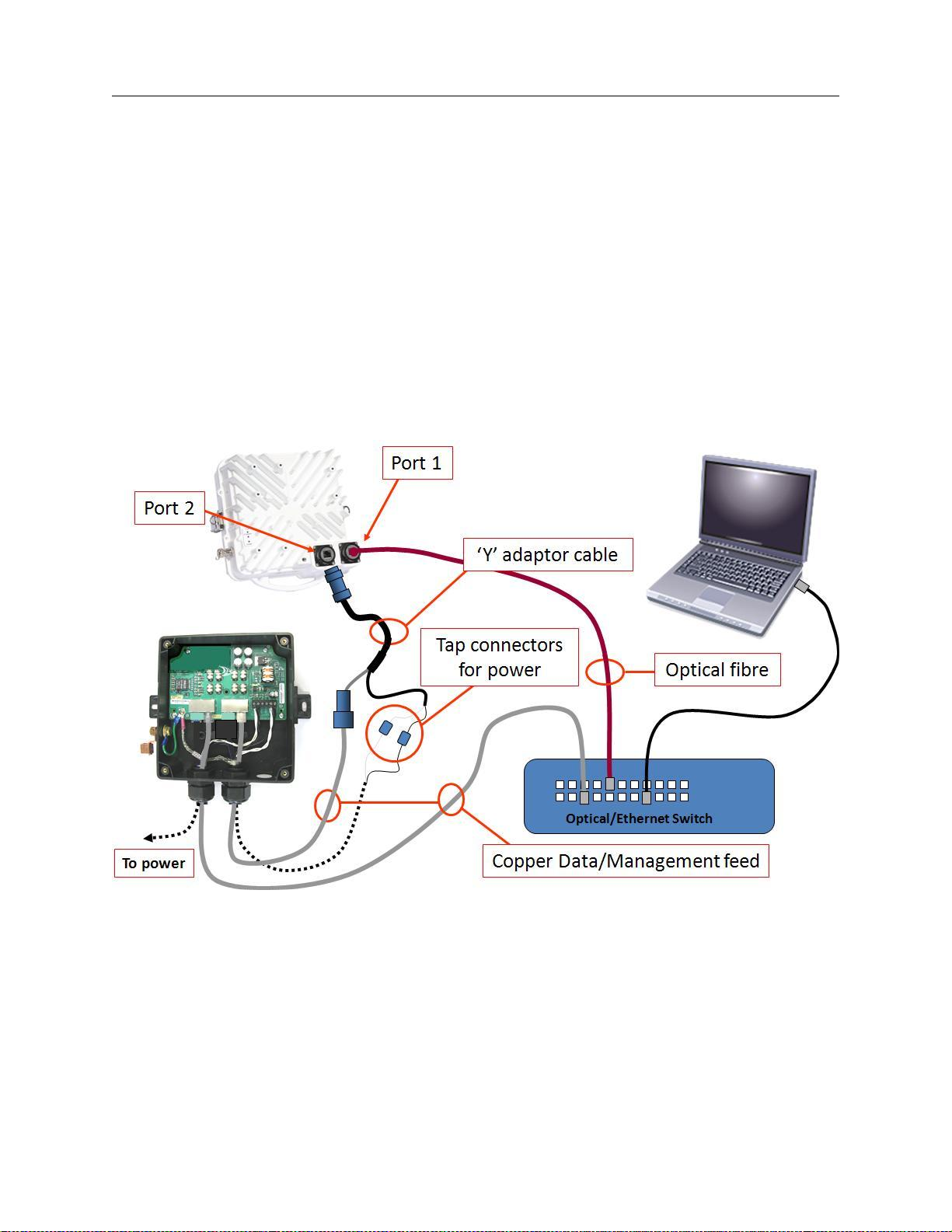
Where distances prevent the use of the composite cable due to power feed loss, a special “Y” feed
adaptor cable is available that allows customer provided, heavier duty, wires to be spliced into the power
feed connection. The power feed wires (see Table 3-2 for recommended gauge) are spliced into the
adapter cable using weatherproof tap connectors. The power feed and Port 2 Ethernet cables (maximum
length 100 m) are fed through a DragonWave Lightning Arrestor unit designed to protect power and
network circuits from transients.
Horizon Compact Plus Release 1.0.1 Wireless Ethernet Product User Manual – Volume 1
Page 20

DragonWave Inc.
Distance from Power Supply to Horizon Unit
50 m
100 m
200 m
300 m
Minimum wire gauge required (AWG)
20
16
14
12
Figure 3-3 Outdoor Power injector/Lightning
Arrestor
Figure 3-4 Indoor Power injector/Lightning
Arrestor
10
Table 3-2 Port 2 Power Cable Wire Gauge
These values are true for all radio variants and based on a minimum voltage of 35 V DC at the Horizon.
Note that the power wires in the composite cable are comprised of two pairs of 20 AWG wire, which
supports the maximum length (100 m) when out-of-band management is employed using the combined
CAT5 cable.
3.2 Lightning Protection
Note: For effective protection against lightning-induced surges, proper grounding and shielding
practices MUST be followed for the ENTIRE installation. Consult DragonWave Inc. Technical Note:
HC-TN-001.4 Horizon Compact Plus PonE and Quick Reference Guide before installation!
The Horizon Compact Plus is protected from cable transients and power surges caused by lightning, or
other sources, by means of internal lightning arrestor components and external housing grounding points
(See Section 8.0).
For the Horizon Compact Plus, copper interface variant, protection of the connected network and power
supply is provided by a proprietary DragonWave PonE power injector/Lightning Arrestor unit, into which
the Ethernet cables and power feed are connected. There are two variants of the copper power
injector/Lightning Arrestor unit.
• Copper interface, outdoor use (see Figure 3-3)
o may be mounted on the outside wall of the network equipment building
• Copper interface, indoor use, wall or rack mountable (see Figure 3-4)
o must be mounted inside the network equipment building
For the Horizon Compact Plus, optical interface variant, or where PonE is not used to power the Horizon,
protection of the power feed and the Ethernet connections is provided by a Lightning Arrestor unit of
similar physical design to those described above. For correct installation procedures see Section 4.0.
Horizon Compact Plus Release 1.0.1 Wireless Ethernet Product User Manual – Volume 1
Page 21

Physical Description
11
3.3 Dual Polarization Radio Mount (DPRM)
The DPRM system allows two Horizon Compact Plus units to be assembled to a single antenna. The
antenna used is no different to that used for a single unit. One Horizon Compact Plus unit is mounted for
horizontal polarization and the other for vertical polarization. Both units can transmit and receive
simultaneously. This allows a link to carry up to 800 Mbps of Ethernet traffic. Although both units can
operate on the same frequency channels, with 30 dB isolation, it is recommended that different frequency
channels be used for each unit.
Figure 3-5 Dual Polarization Radio Mount
3.4 Power Split Radio Mount (PSRM)
For redundancy purposes, the PSRM allows two Horizon units to be mounted to a single antenna. Both
units must be oriented for the same polarization and only one unit can transmit/receive at any one time.
The PSRM looks similar to the DPRM shown in Figure 3-5, but has internal components that only allow
one unit to transmit/receive at a time.
Note that redundant systems do not have to use the PSRM. Each may be separately mounted to their
own antennas if desired.
The benefits of the PSRM are that only one antenna is required, reducing tower real estate requirements,
reducing weight and minimizing wind loading.
Disadvantages include a 4 dB loss in signal when operating on the primary systems at each end of the
link and an 8.5 dB loss in signal when a secondary radio is activated (one end running on Primary and
other end operating on secondary).
Note that redundancy is not supported in this release.
Horizon Compact Plus Release 1.0.1 Wireless Ethernet Product User Manual – Volume 1
Page 22

DragonWave Inc.
12
This page left blank intentionally
Horizon Compact Plus Release 1.0.1 Wireless Ethernet Product User Manual – Volume 1
Page 23

CODE
DESCRIPTION
INK
Installation Kit
R1
Horizon Compact Plus Release 1
CONNECTOR OPTIONS
HCN
No Connectors or Cables
HCC
Copper Connectors, Out-of-Band Mgmt
HCI
Copper Connectors, In-band Mgmt
HCM
Military connector, Copper cables
HCF
Optical Fibre Interface
POWER OPTIONS
AC
Alternating Current
DC
Direct Current ***
AD
½AC ½DC
LOCATION OPTIONS
NA
North America
EU
Europe
GL
Global
Kit Description
Part Number
Horizon Compact Plus, No connectors AC Install Kit (N. America)
A-INK-CPN-AC-NA-R1
Horizon Compact Plus, No Connectors AC Install Kit (Europe )
A-INK-CPN-AC-EU-R1
Horizon Compact Plus, No Connectors Half AC, Half DC Install Kit (N. America)
A-INK-CPN-AD-NA-R1
Horizon Compact Plus, No Connectors Half AC, Half DC Install Kit (Europe )
A-INK-CPN-AD-EU-R1
Horizon Compact Plus, No Connectors DC Install Kit (Global)
A-INK-CPN-DC-GL-R1
Horizon Compact Plus, Rugged No connectors AC Install Kit (N. America)
A-INK-CPNA-AC-NA-R1
Horizon Compact Plus, Rugged No Connectors AC Install Kit (Europe )
A-INK-CPNA-AC-EU-R1
Horizon Compact Plus, Rugged No Connectors Half AC, Half DC Install Kit (N. America)
A-INK-CPNA-AD-NA-R1
Horizon Compact Plus, Rugged No Connectors Half AC, Half DC Install Kit (Europe )
A-INK-CPNA-AD-EU-R1
Horizon Compact Plus, Rugged No Connectors DC Install Kit (Global)
A-INK-CPNA-DC-GL-R1
HC+, Indoor PonE, No connectors AC Install Kit (N. America)
A-INK-CPNI-AC-NA-R1
HC+, Indoor PonE, No connectors AC Install Kit (Europe )
A-INK-CPNI-AC-EU-R1
HC+, Indoor PonE, No onnectors DC Install Kit (Global)
A-INK-CPNI-DC-GL-R1
HC+, Indoor PonE, Rugged No connectors AC Install Kit (N. America)
A-INK-HNIA-AC-NA-R1
HC+, Indoor PonE, Rugged No connectors AC Install Kit (Europe )
A-INK-HNIA-AC-EU-R1
HC+, Indoor PonE, Rugged No onnectors DC Install Kit (Global)
A-INK-HNIA-DC-GL-R1
4.0 Installation Requirements
Note: For more information on installation and cabling, refer to DragonWave Technical Note:
HC-TN-001.4 Horizon Compact Plus PonE.
Various installation kits are available. Use the following key to build the desired kit part number:
*** Use ECO #1407 green jumper wire to connect 48V RTN to PonE ground internally when site has
grounded 48 VDC return (positive)
Table 4-1 lists all the current ordering configurations, for various parts of the world.
Table 4-1 Parts Required
Horizon Compact Plus Release 1.0.1 Wireless Ethernet Product User Manual – Volume 1
Page 24

DragonWave Inc.
Horizon Compact Plus, Copper Connectors AC Install Kit (N. America) - Includes 4 Glands and 12
Connectors
A-INK-CPC-AC-NA-R1
Horizon Compact Plus, Copper Connectors AC Install Kit (Europe ) - Includes 4 Glands and 12
Connectors
A-INK-CPC-AC-EU-R1
Horizon Compact Plus, Copper Connectors Half AC, Half DC Install Kit (N. America) - Includes 4
Glands and 12 Connectors
A-INK-CPC-AD-NA-R1
Horizon Compact Plus, Copper Connectors Half AC, Half DC Install Kit (Europe ) - Includes 4
Glands and 12 Connectors
A-INK-CPC-AD-EU-R1
Horizon Compact Plus, Copper Connectors DC Install Kit (Global) - Includes 4 Glands and 12
Connectors
A-INK-CPC-DC-GL-R1
Horizon Compact Plus, Copper Connectors, Rugged AC Install Kit (N. America) - Includes 4 Glands
and 16 Connectors
A-INK-CPCA-AC-NA-R1
Horizon Compact Plus, Copper Connectors, Rugged AC Install Kit (Europe ) - Includes 4 Glands
and 16 Connectors
A-INK-CPCA-AC-EU-R1
Horizon Compact Plus, Copper Connectors, Rugged Half AC, Half DC Install Kit (N. America) Includes 4 Glands and 16 Connectors
A-INK-CPCA-AD-NA-R1
Horizon Compact Plus, Copper Connectors, Rugged Half AC, Half DC Install Kit (Europe ) Includes 4 Glands and 16 Connectors
A-INK-CPCA-AD-EU-R1
Horizon Compact Plus, Copper Connectors, Rugged DC Install Kit (Global) - Includes 4 Glands and
16 Connectors
A-INK-CPCA-DC-GL-R1
HC+, Indoor PonE, Copper Connectors AC Install Kit (N. America) - Includes 4 Glands and 4
Connectors
A-INK-CPIC-AC-NA-R1
HC+, Indoor PonE, Copper Connectors AC Install Kit (Europe ) - Includes 4 Glands and 4
Connectors
A-INK-CPIC-AC-EU-R1
HC+, Indoor PonE, Copper Connectors DC Install Kit (Global) - Includes 4 Glands and 4
Connectors
A-INK-CPIC-DC-GL-R1
HC+, Indoor PonE, Copper Connectors, Rugged AC Install Kit (N. America) - Includes 4 Glands and
8 Connectors
A-INK-HICA-AC-NA-R1
HC+, Indoor PonE, Copper Connectors, Rugged AC Install Kit (Europe ) - Includes 4 Glands and 8
Connectors
A-INK-HICA-AC-EU-R1
HC+, Indoor PonE, Copper Connectors, Rugged DC Install Kit (Global) - Includes 4 Glands and 8
Connectors
A-INK-HICA-DC-GL-R1
Horizon Compact Plus, Inband MGMT Copper Connectors AC Install Kit (N. America) - Includes 2
Glands and 6 Connectors
A-INK-CPI-AC-NA-R1
Horizon Compact Plus, Inband MGMT Copper Connectors AC Install Kit (Europe )- Includes 2
Glands and 6 Connectors
A-INK-CPI-AC-EU-R1
Horizon Compact Plus, Inband MGMT Copper Connectors Half AC, Half DC Install Kit (N. America)
- Includes 2 Glands and 6 Connectors
A-INK-CPI-AD-NA-R1
Horizon Compact Plus, Inband MGMT Copper Connectors Half AC, Half DC Install Kit (Europe ) Includes 2 Glands and 6 Connectors
A-INK-CPI-AD-EU-R1
Horizon Compact Plus, Inband MGMT, Copper Connectors DC Install Kit (Global) - Includes 2
Glands and 6 Connectors
A-INK-CPI-DC-GL-R1
Horizon COMPACT PLUS, Inband MGMT Copper Connectors Rugged AC Install Kit (N. America) Includes 2 Glands and 4 Connectors
A-INK-CPIA-AC-NA-R1
Horizon Compact Plus, Inband MGMT Copper Connectors Rugged AC Install Kit (Europe )Includes 2 Glands and 4 Connectors
A-INK-CPIA-AC-EU-R1
Horizon COMPACT PLUS, Inband MGMT Copper Connectors Rugged Half AC, Half DC Install Kit
(N. America) - Includes 2 Glands and 4 Connectors
A-INK-CPIA-AD-NA-R1
Horizon COMPACT PLUS, Inband MGMT Copper Connectors Rugged Half AC, Half DC Install Kit
(Europe ) - Includes 2 Glands and 4 Connectors
A-INK-CPIA-AD-EU-R1
Horizon COMPACT PLUS, Inband MGMT, Copper Connectors Rugged DC Install Kit (Global) Includes 2 Glands and 4 Connectors
A-INK-CPIA-DC-GL-R1
HC+, Indoor PonE, Inband MGMT Copper Connectors AC Install Kit (N. America) - Includes 2
Glands and 2 Connectors
A-INK-CPII-AC-NA-R1
HC+, Indoor PonE, Inband MGMT Copper Connectors AC Install Kit (Europe )- Includes 2 Glands
and 2 Connectors
A-INK-CPII-AC-EU-R1
HC+, Indoor PonE, Inband MGMT, Copper Connectors DC Install Kit (Global) - Includes 2 Glands
and 2 Connectors
A-INK-CPII-DC-GL-R1
14
Horizon Compact Plus Release 1.0.1 Wireless Ethernet Product User Manual – Volume 1
Page 25

Installation Requirements
HC+, Indoor PonE, Inband MGMT Copper Connectors Rugged AC Install Kit (N. America) - Includes
2 Glands and 4 Connectors
A-INK-HIIA-AC-NA-R1
HC+, Indoor PonE, Inband MGMT Copper Connectors Rugged AC Install Kit (Europe )- Includes 2
Glands and 4 Connectors
A-INK-HIIA-AC-EU-R1
HC+, Indoor PonE, Inband MGMT, Copper Connectors Rugged DC Install Kit (Global) - Includes 2
Glands and 4 Connectors
A-INK-HIIA-DC-GL-R1
Horizon Compact Plus, Mil Connectors AC Install Kit (N. America)
A-INK-CPM-AC-NA-R1
Horizon Compact Plus, Mil Connectors AC Install Kit (Europe )
A-INK-CPM-AC-EU-R1
Horizon Compact Plus, Mil Connectors Half AC, Half DC Install Kit (N. America)
A-INK-CPM-AD-NA-R1
Horizon Compact Plus, Mil Connectors Half AC, Half DC Install Kit (Europe )
A-INK-CPM-AD-EU-R1
Horizon Compact Plus, Mil Connectors DC Install Kit (Global)
A-INK-CPM-DC-GL-R1
HC+, Indoor PonE, Mil Connectors AC Install Kit (N. America)
A-INK-CIM-AC-NA-R1
HC+, Indoor PonE, Mil Connectors AC Install Kit (Europe )
A-INK-CIM-AC-EU-R1
HC+, Indoor PonE, Mil Connectors DC Install Kit (Global)
A-INK-CIM-DC-GL-R1
Horizon Compact Plus, Fiber AC Install Kit (N. America)
A-INK-CPF-AC-NA-R1
Horizon Compact Plus, Fiber AC Install Kit (Europe )
A-INK-CPF-AC-EU-R1
Horizon Compact Plus, Fiber Half AC, Half DC Install Kit (N. America)
A-INK-CPF-AD-NA-R1
Horizon Compact Plus, Fiber Half AC, Half DC Install Kit (Europe )
A-INK-CPF-AD-EU-R1
Horizon Compact Plus, Fiber DC Install Kit (Global)
A-INK-CPF-DC-GL-R1
HC+, Indoor PonE, Fiber AC Install Kit (N. America)
A-INK-CIF-AC-NA-R1
HC+, Indoor PonE, Fiber AC Install Kit (Europe )
A-INK-CIF-AC-EU-R1
HC+, Indoor PonE, Fiber DC Install Kit (Global)
A-INK-CIF-DC-GL-R1
INST KIT,HALF LINK,Horizon Compact Plus,NO CONN,AC,N.A.,R1
AH-INK-CPN-AC-NA-R1
INST KIT,HALF LINK,Horizon Compact Plus,NO CONN,DC,GLOBAL,R1
AH-INK-CPN-DC-GL-R1
INST KIT,HALF LINK,Horizon Compact Plus,Rugged NO CONN,AC,N.A.,R1
AH-INK-CPNA-AC-NA-R1
INST KIT,HALF LINK,Horizon Compact Plus,Rugged NO CONN,DC,GLOBAL,R1
AH-INK-CPNA-DC-GL-R1
INST KIT,HALF LINK,Horizon Compact Plus,COPPER CONN,AC,N.A.,R1
AH-INK-CPC-AC-NA-R1
INST KIT,HALF LINK,Horizon Compact Plus,COPPER CONN,DC,GLOBAL,R1
AH-INK-CPC-DC-GL-R1
INST KIT,HALF LINK,HC+ INDOOR PonE,COPPER CONN,DC,GLOBAL,R1
AH-INK-CIC-DC-GL-R1
INST KIT,HALF LINK,HC+ INDOOR PonE,FIBER,AC,N.A.,R1)
AH-INK-CIF-AC-NA-R1
INST KIT,HALF LINK,HC+ INDOOR PonE,FIBER,AC,EU,R1
AH-INK-CIF-AC-EU-R1
INST KIT,HALF LINK,HC+ INDOOR PonE,FIBER,DC,GLOBAL,R1
AH-INK-CIF-DC-GL-R1
INST KIT,HALF LINK,HC+,MIL CONN,AC,N.A.,R1
AH-INK-CPM-AC-NA-R1
INST KIT,HALF LINK,HC+,MIL CONN,DC,GLOBAL,R1
AH-INK-CPM-DC-GL-R1
INST KIT,HALF LINK,HC+,FIBER,AC,N.A.,R1
AH-INK-CPF-AC-NA-R1
INST KIT,HALF LINK,HC+,FIBER,DC,GLOBAL,R1
AH-INK-CPF-DC-GL-R1
INST KIT,HALF LINK,HC+, Indoor PonE, Mil Connectors AC Install Kit (N. America)
AH-INK-CIM-AC-NA-R1
INST KIT,HALF LINK,HC+, Indoor PonE, Mil Connectors AC Install Kit (Europe )
AH-INK-CIM-AC-EU-R1
INST KIT,HALF LINK,HC+, Indoor PonE, Mil Connectors DC Install Kit (Global)
AH-INK-CIM-DC-GL-R1
15
Horizon Compact Plus Release 1.0.1 Wireless Ethernet Product User Manual – Volume 1
Page 26

DragonWave Inc.
16
4.1 Lightning Arrestor Units
The importance of protecting network and power systems from damaging voltage transients, induced by
lightning and other sources, cannot be over emphasized.
DragonWave supplies four types of Lightning Arrestor Units.
• Outdoor rated Lightning Arrestor with integrated power on Ethernet (PonE)
• Indoor rated Lightning Arrestor with integrated power on Ethernet (PonE)
• Outdoor rated Lightning Arrestor only
• Indoor rated Lightning Arrestor only
All four provide protection for up to two Ethernet network cables plus redundant power feeds.
4.1.1 Outdoor Lightning Arrestor Units
The Outdoor units are housed in a weatherproof plastic enclosure employing gland nut seals for cable
entry. Access to network and power terminals is via a gasket sealed lid, which is secured by four retaining
screws. Figure 4-1 shows the Lightning Arrestor unit with integrated PonE, with lid removed.
Figure 4-1 Outdoor Lightning Arrestor Unit with Integrated PonE Supply Feed
4.1.2 Indoor Lightning Arrestor Units
The Indoor units are housed in a metal enclosure with an integral grounding lug and with direct access to
network and power connection terminations.
Figure 4-2 Indoor Lightning Arrestor Unit with Integrated PonE Supply Feed
Horizon Compact Plus Release 1.0.1 Wireless Ethernet Product User Manual – Volume 1
Page 27

Installation Requirements
Rack/cabinet in which Indoor units are installed must only be used for the
purposes of housing lightning suppression equipment.
Rack/cabinet must be equipped, grounded and bonded for lightning suppression
purposes.
Rack/cabinet must meet all local electrical and safety codes
Rack/cabinet must be certified by a qualified safety/lightning engineer.
DO NOT connect the grounding lug to AC power supply wiring ground!
DO NOT mix AC power supply option with site-supplied 48 VDC!
DO NOT connect the network to the RJ45 connectors marked
“TO HORIZON UNPROTECTED”. Damage to switches or routers may result
Wall mounting
removable
Mounting systems for the indoor units include a 19” rack mounting adapter, which accommodates up to
two units within a 1U rack space, and wall mount brackets, allowing a single unit to be wall, or shelf,
mounted as required (screw slots will accommodate 6mm (1/4”) diameter screws on 7.2” centres,
horizontally).
Figure 4-3 Two Indoor Units in Rack Mount Adapter
brackets are
17
Figure 4-4 Indoor Unit with Wall Mount Brackets
Horizon Compact Plus Release 1.0.1 Wireless Ethernet Product User Manual – Volume 1
Page 28

DragonWave Inc.
DO NOT mount the PonE unit to the tower!
The Outdoor rated PonE Injector/Lightning Arrestor MUST be mounted as close
as possible to, and above, the building entry point (BEP) and its external
grounding lug must be connected to the nearest lightning (LPS) ground with #6
AWG (minimum) grounding wire, avoiding loops and sharp bends.
DO NOT connect the grounding lug to AC power supply wiring ground!
DO NOT mix AC power supply option with site-supplied 48 VDC!
DO NOT connect the network to the RJ45 connectors marked
“TO HORIZON UNPROTECTED”. Damage to switches or routers may result
Power feed
BEP- connect
Horizon
Plus
18
tower ground to
Figure 4-5 Horizon Compact Plus Installation
Compact
shack ground
to shack
Horizon Compact Plus Release 1.0.1 Wireless Ethernet Product User Manual – Volume 1
Page 29

Installation Requirements
Shorting link is stored on J4 and transferred to J5, as shown, when grounding is required
19
4.2 Grounded Power Feeds
Where the return side of a site-supplied power feed is grounded, provision is made on all versions of the
lightning arrestor units to link the return feed to the integral grounding lug on the unit. A shorting link is
stored on J4. When grounding is required, this is transferred to J5 (see Figure 4-6).
Figure 4-6 Grounded Power Return Link
On earlier models of both the indoor and outdoor lightning arrestors, the shorting link feature is not
present. To ground the return side of the power supply for the earlier models, connect a shorting wire
between the “RTN” connection on the power connection block and the grounding point on the PCB as
shown in Figure 4-7.
Figure 4-7 Grounded Power Return Shorting Wire
Horizon Compact Plus Release 1.0.1 Wireless Ethernet Product User Manual – Volume 1
Page 30

DragonWave Inc.
DO NOT coil excess Ethernet cable, but fold in a zig-zag fashion whilst
observing a minimum bend radius of 2 inches. The effect of lightning induced
current surges in the tower or conductors adjacent to the Ethernet cable will be
minimized when the Ethernet cable is folded in this way.
20
4.3 Ethernet Cabling – Copper Interface
For the copper interface, data cabling from the Horizon Compact Plus unit to the PonE Power
Injector/Lightning Arrestor consists of outdoor rated, shielded, CAT5E cables equivalent to Belden 7919A.
The shielded cables require shielded RJ45 connectors. Use of standard indoor unshielded RJ45
connectors may result in a lack of lightning protection, poorly constructed cables, intermittent connections
and data loss. Depending on the system configuration ordered and fielded, up to four shielded RJ45 and
two unshielded RJ45 connectors are provided.
The cables terminate in a DWI Power on Ethernet (PonE) Power Injector/Lightning Arrestor unit located
either outside of the building cable entry point (using the outdoor PonE unit) or inside the network
equipment building (using the indoor PonE unit).
DO NOT CONNECT SHIELDED RJ45 CONNECTORS TO ETHERNET CABLES CONNECTING THE
LIGHTNING ARRESTOR TO THE NETWORK SWITCH.
Note: Straight through Ethernet cables must be used between the PonE power injector and the
Horizon Compact Plus. The use of a cross-over type, or incorrectly wired CAT5E cables, will
cause the PonE power injector to go into an alarm condition and not power up the Horizon
Compact Plus. A Status LED indicates the status of the PonE power injector (see Section 5.1.4)
The PonE unit contains Lightning Arrestors and must be grounded according to local or regional Electrical
Codes. Unshielded Ethernet cables are connected between the PonE unit and the Ethernet switch or
router. Power for the PonE unit is supplied by 2-wire 16 AWG electrical wiring, carrying 48 V DC (-48 V
or +48 V) with a maximum current draw of 2 amperes.
If Port 2 is not being used, ensure that a protective weatherproof cap is fitted to the port receptacle.
4.3.1 Using Outdoor PonE Unit
Figure 4-8 Outdoor Unit PonE and RJ45 Connections
Horizon Compact Plus Release 1.0.1 Wireless Ethernet Product User Manual – Volume 1
Page 31
Installation Requirements
Hole
Plugs
21
4.3.2 Outdoor PonE Unit Weatherproof Grommet Seals
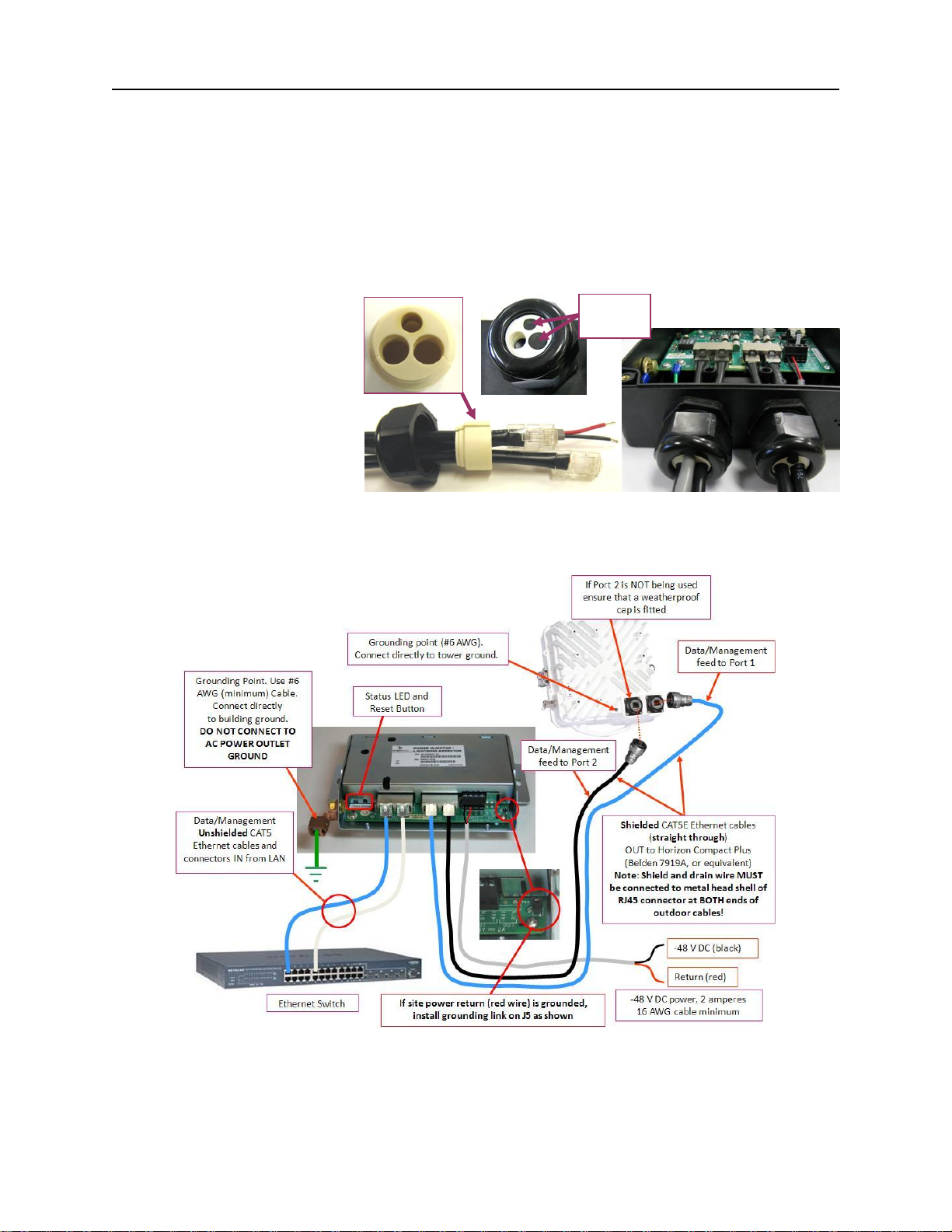
The cable entry points into the outdoor PonE unit are protected from moisture ingress by special rubber
grommet seals. Each grommet has three holes to accommodate up to three cables (two CAT5 and one
power). Rubber plugs are provided for holes that are not being used. Two holes, for CAT5, have a split
side to allow pre-terminated cables to be easily inserted. The third hole, which is smaller, is not split but
allows un-terminated power cables to be pushed through. A gland nut is used to secure the cables and
create the seal. Ensure that the rubber plugs are in place for all holes not occupied by cables and that the
grommet sits squarely in its receptacle before tightening the gland nut to secure the seal.
Note that any pre-terminated
cables will need to have the
connectors staggered, as shown,
lower left, in Figure 4-9, in order
for them to pass through the hole
in the PonE unit housing
Figure 4-9 Weatherproof
Grommet Seals
4.3.3 Using Indoor PonE Unit
Figure 4-10 Indoor Unit PonE and RJ45 Connections
Horizon Compact Plus Release 1.0.1 Wireless Ethernet Product User Manual – Volume 1
Page 32
DragonWave Inc.
22
4.3.4 Assembling the RJ45 Connector
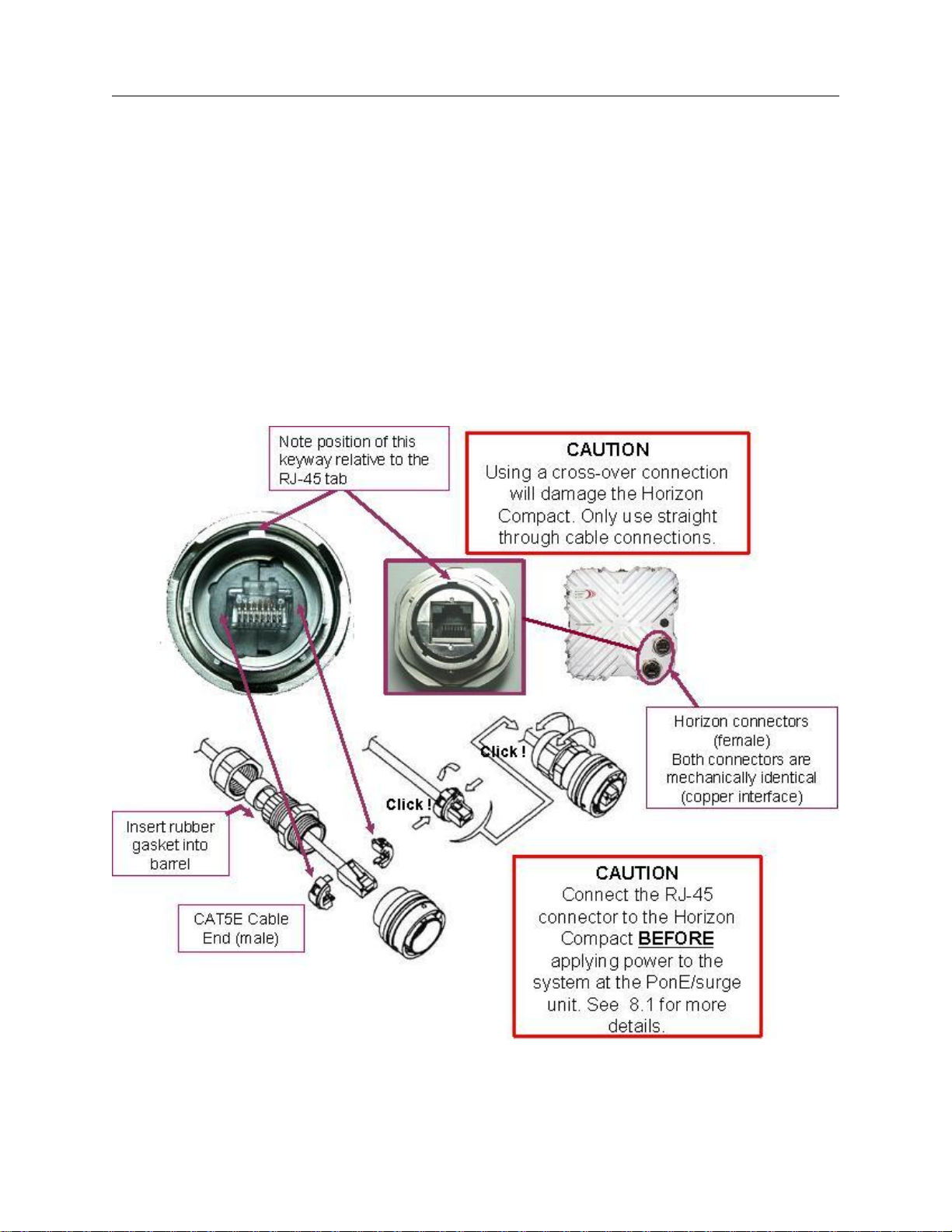
Shielded, weatherproof RJ45 connector shells are used for connecting the CAT5E cable, leading from the
power-on-Ethernet power supply and network connections, to the Horizon Compact Plus.
Note: Shield and drain wire MUST be connected to metal head shell of RJ45 connector at BOTH
ends of outdoor cable!
Two different styles of connector have been used in production. For Horizon serial numbers ending in
“999” or less, an RJ45 “snap in” type in-line housing is used. For serial numbers ending in “1000” or
higher a “push fit” style is used. Both styles are not compatible and do not mate with the respective
female connector on the horizon chassis.
“Snap fit” Style
The connector shell must be assembled in a specific manner for it to correctly connect to the Horizon
Compact Plus unit. The CAT5E cable is terminated as a straight through connection with a shielded
RJ45 connector. This RJ45 connector has to be assembled into the weatherproof connector shell
oriented as shown in Figure 4-11.
Figure 4-11 RJ45 Cable connector “Snap fit” Style
Horizon Compact Plus Release 1.0.1 Wireless Ethernet Product User Manual – Volume 1
Page 33
Installation Requirements
Compression Seal
Ferrule with ‘O’ ring seal
Connector housing
Shielded RJ45
connector
Securing ring
Slide RJ45
housing
Screw ferrule
into housing
Tighten gland
nut to secure assembly
CAUTION
Using a cross-over connection
straight through cable
CAUTION
connectors at BOTH ends of the cable!
CAUTION
PonE/surge unit. This does not apply
to Release 1.2 of the PonE adapter.
23
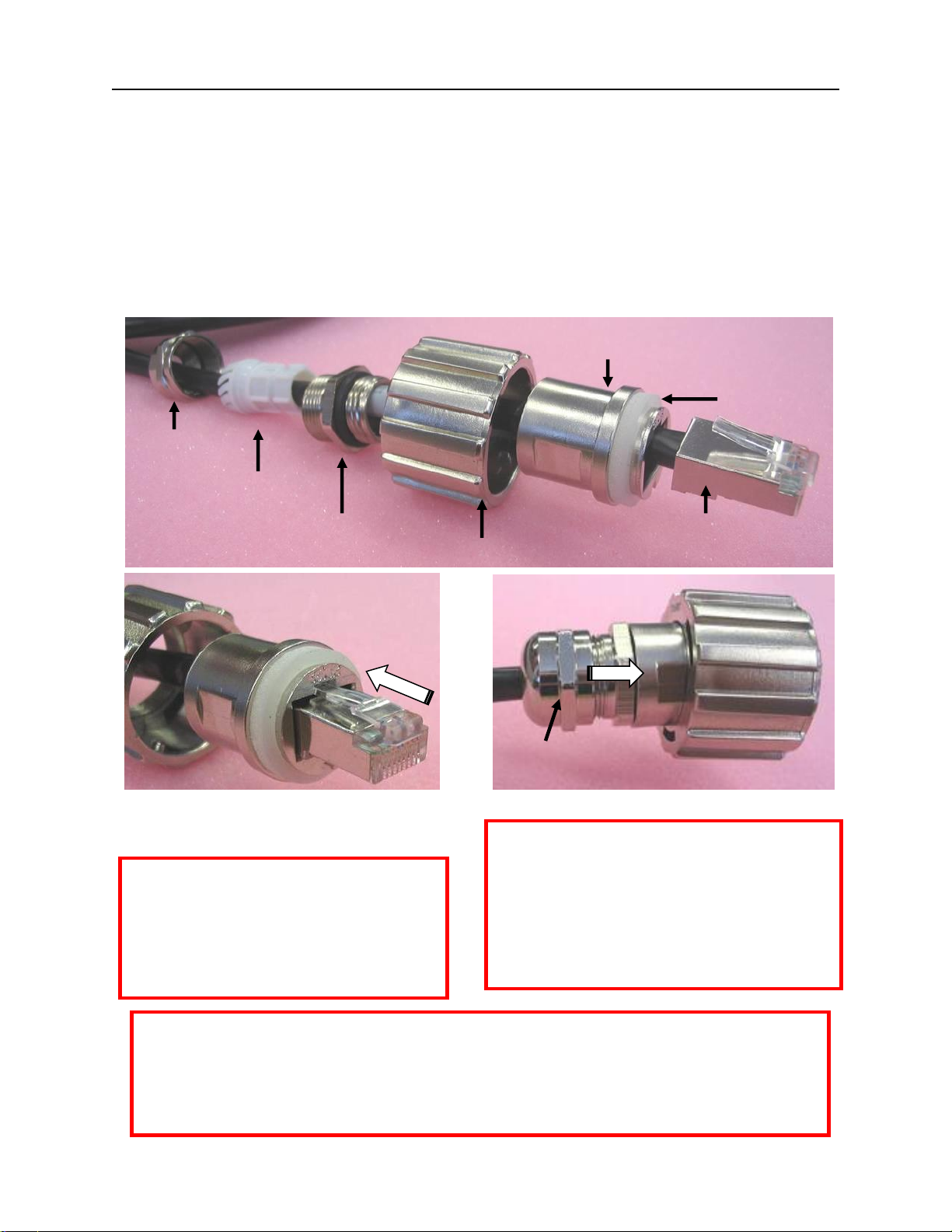
“Push fit” Style
This connector relies on a gland nut to hold the assembly firmly together. The CAT5E cable is threaded
through all the components of the connector housing (see Figure 4-12) before the cable is terminated as
a straight through connection with a shielded RJ45 connector. Once terminated, the RJ45 connector
slides back into the connector housing which accepts the tab on the RJ45 connector. Screw the ferrule
into the connector housing as far as it will go, ensuring that the ‘O’ ring creates a tight seal with the
connector housing. Slide the compression seal into the ferrule, noting that the keyways have to mate with
channels in the ferrule. While ensuring that the RJ45 connector is firmly seated in the connector housing,
tighten up the gland nut to secure the complete connector assembly.
back into
Figure 4-12 RJ45 Cable connector “Push fit” Style
will damage the Horizon
Compact Plus. Only use
Ensure that shield foil and drain wire of CAT5E outdoor cables
are positively connected to the metal head shells of the RJ45
Horizon Compact Plus Release 1.0.1 Wireless Ethernet Product User Manual – Volume 1
For Release 1.1 and earlier, connect
the RJ45 connector to the Horizon
Compact Plus BEFORE applying
power to the system at the
Page 34
DragonWave Inc.
24
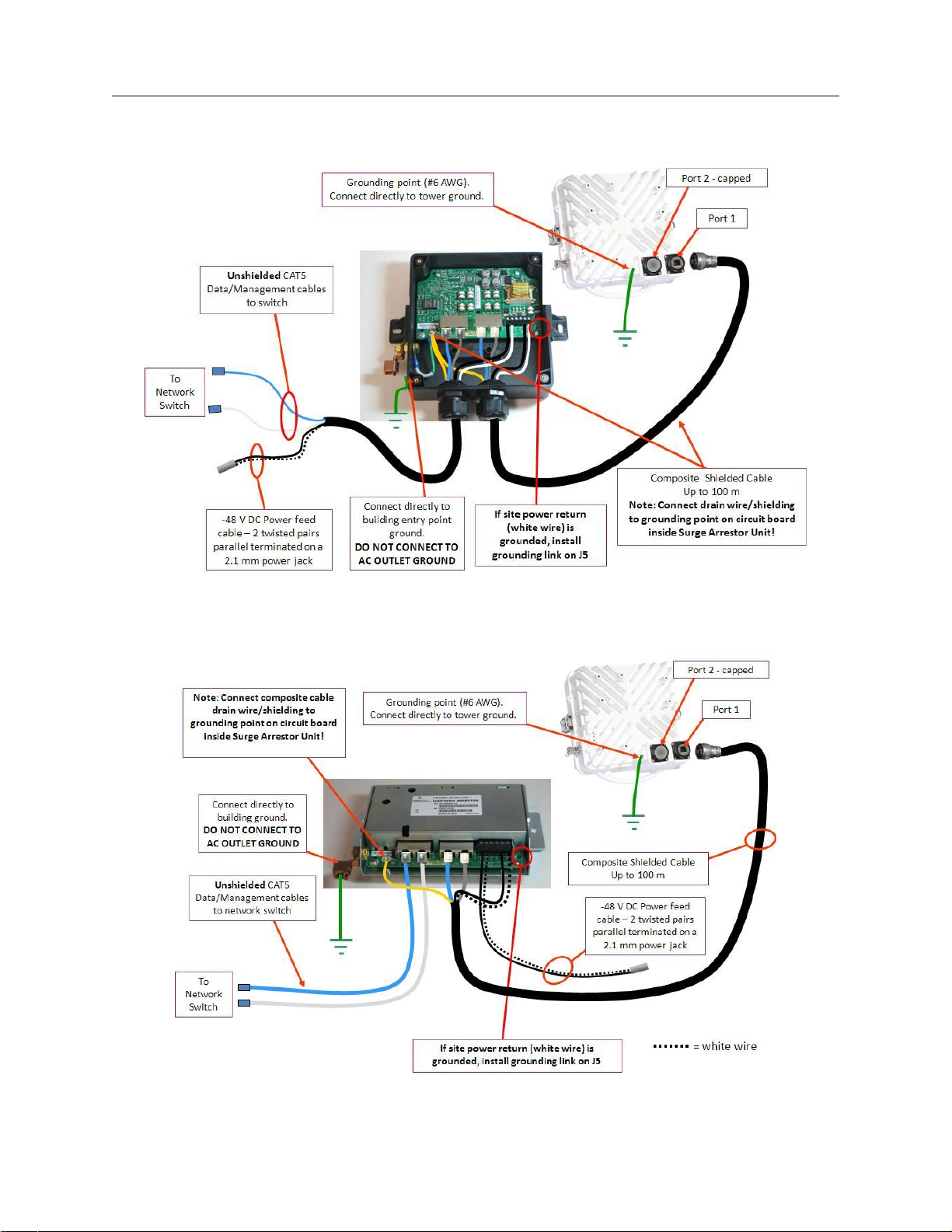
4.3.5 Using Outdoor Lightning Arrestor unit
Figure 4-13 Outdoor Lightning Arrestor Unit Ethernet Cabling – Copper Interface
4.3.6 Using Indoor Lightning Arrestor Unit
Figure 4-14 Indoor Lightning Arrestor Unit Ethernet Cabling – Copper Interface
Horizon Compact Plus Release 1.0.1 Wireless Ethernet Product User Manual – Volume 1
Page 35

Installation Requirements
25
This page is left blank intentionally
Horizon Compact Plus Release 1.0.1 Wireless Ethernet Product User Manual – Volume 1
Page 36
Caution : Ensure correct voltage polarity before connecting external DC supply to
Horizon Compact Plus Unit.
The DC feed into the equipment shall be protected by a 3A rated over protection
device provided as part of the building installation.
Do not mix AC/DC adapter and site 48 V DC supplies.
It is recommended to use an isolated ±48VDC supply where both inputs are
floating (neither side grounded), or the isolated AC/DC adapter option. In cases
where the site supplied ±48VDC is not isolated and has the +ve (return) side
grounded, apply the shorting link to J5 (see Figure 4-6), or the green jumper wire
provided, to connect the 48V “RTN” to the ground lug connection inside the PonE
box (see Figure 4-7).
5.0 Powering the Horizon Compact Plus
Before an active management session can be started on the Horizon Compact Plus, power needs to be
provided to the unit. Read this section completely before applying power to the Horizon Compact
Plus.
5.1 Copper Interface
The Horizon Compact Plus with copper interface receives its power over the Ethernet connection to Port
1 using a DragonWave proprietary technique. To integrate the power onto the Ethernet cable requires the
use of a DragonWave Power on Ethernet (PonE) power injector/Lightning Arrestor. There are two
versions of this unit – an outdoor rated unit and an indoor rated unit. Both DragonWave PonE units also
include transient and surge suppression components to protect the power supply and network from
lightning induced surges and transients.
Note: The Horizon PonE implementation is proprietary and does not follow IEEE standards.
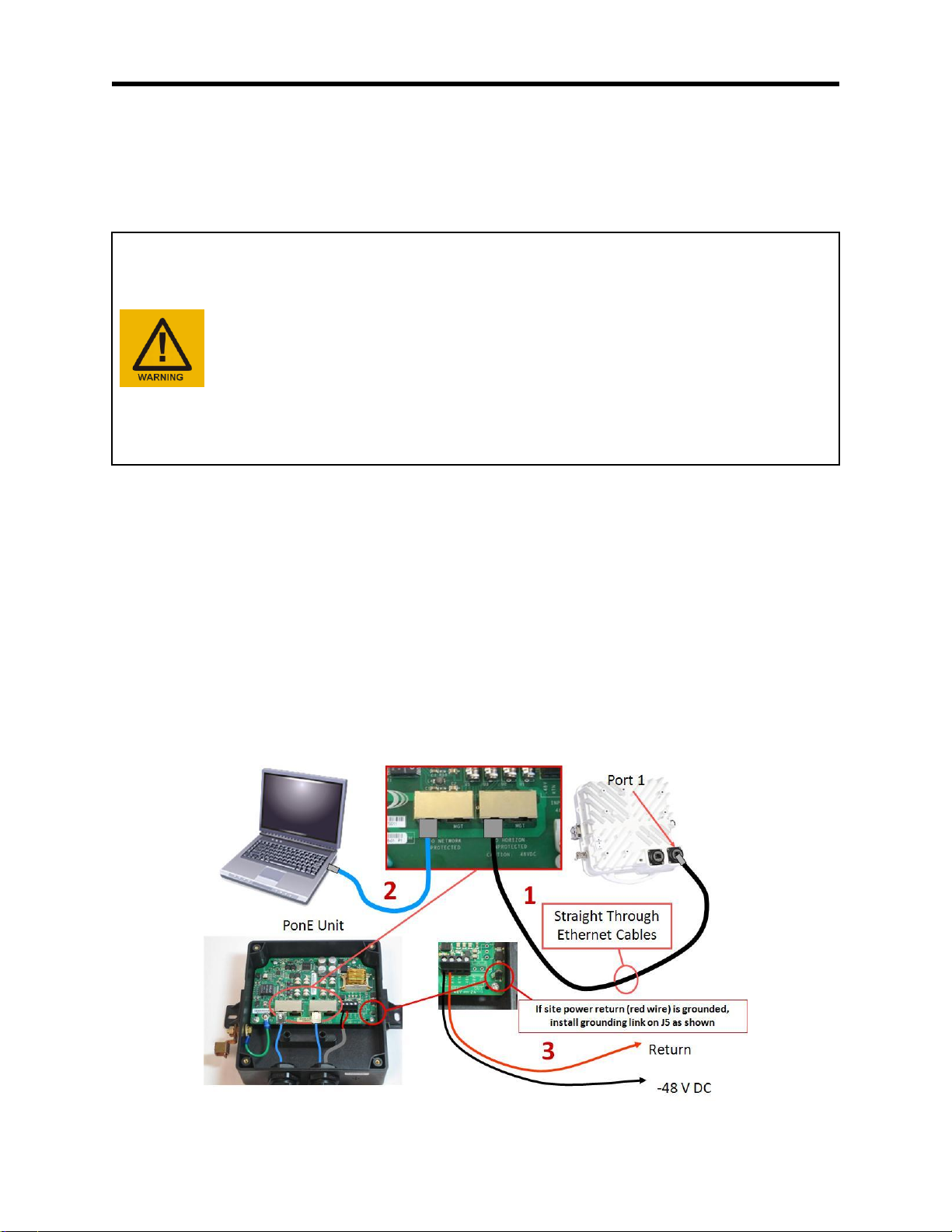
CAUTION: Only use a straight-through Ethernet cable to connect the Horizon to the PonE/surge
unit. Incorrectly wired cables will cause an alarm condition on the PonE adapter and the Horizon
Compact Plus will not power up.
5.1.1 Using the Outdoor PonE Unit
Figure 5-1 Connecting Power Using Outdoor PonE Unit – Copper Interface
Horizon Compact Plus Release 1.0.1 Wireless Ethernet Product User Manual – Volume 1
Page 37
CAUTION
Do not mix AC/DC converter and site 48 V DC supplies for power redundancy.
Use of ISOLATED 48 VDC supplies is recommended. For non-isolated site-
supplied 48VDC where the “Return” (positive) side is grounded, transfer the
shorting link from P4 to P5 (see Section 4.2).
For Release 1.1 and earlier, do not connect a PC or other network device (e.g.
network switch) to the right hand RJ45 sockets on the PonE adapter. -48 V DC is
present on these connectors which may destroy the connected device. Connect
only a Horizon Compact Plus unit to the right hand RJ45 connectors.
5.1.2 Using the Indoor PonE Unit
Powering the Horizon Compact Plus
27
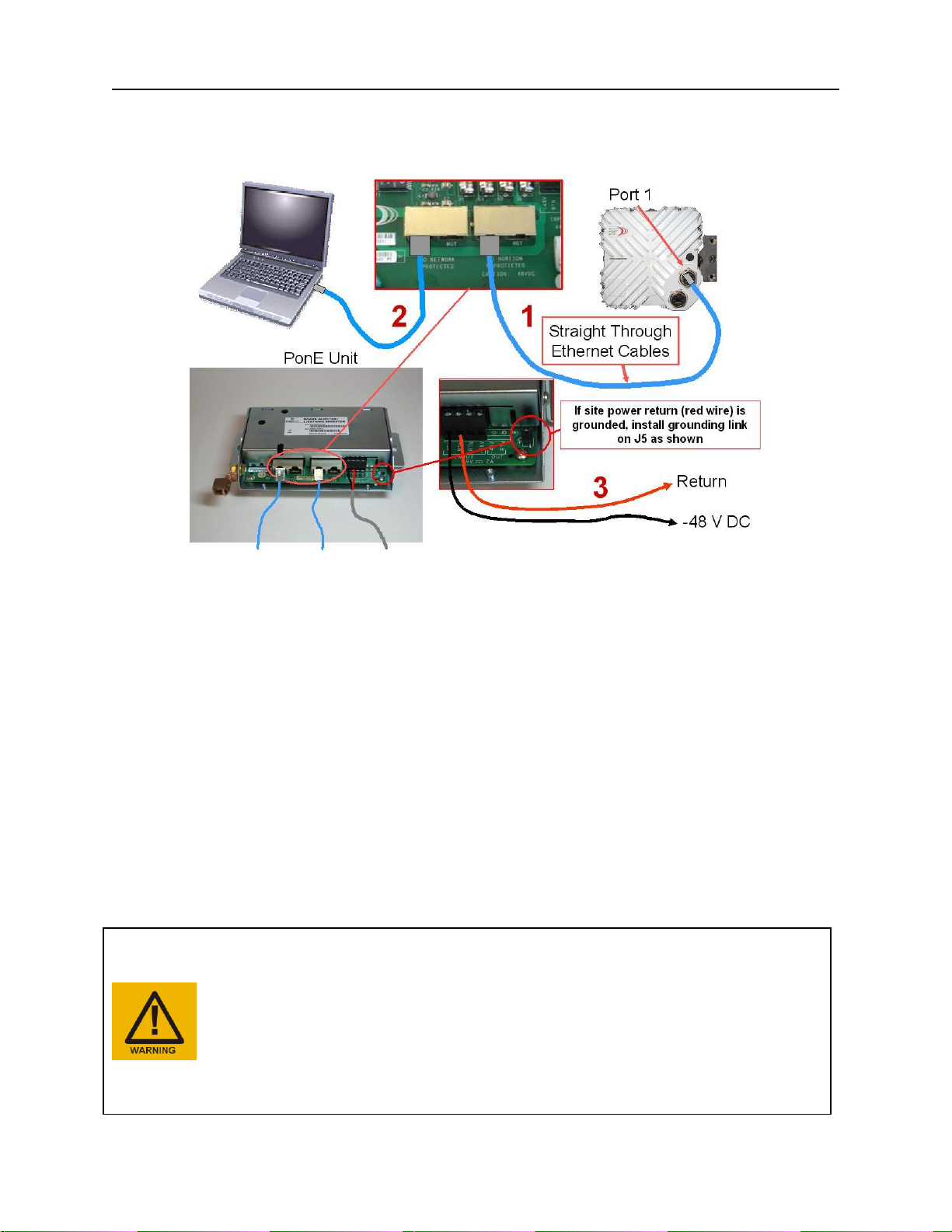
Figure 5-2 Connecting Power Using Indoor PonE Unit – Copper Interface
5.1.3 Steps to Connecting Power
1. Connect Port 1 of the Horizon Compact Plus to the correct socket on the PonE/lightning arrestor
using a straight through, shielded, Ethernet cable (see caution above).
2. Connect the Ethernet port on the PC to the network input socket on the PonE/lightning arrestor,
using a straight through Ethernet cable, with an unshielded RJ45 connector.
Ensure that you have connected the PC and Horizon to the correct RJ45 sockets on the PonE/lightning
arrestor.
3. Once the PC and Horizon Compact Plus are connected to the PonE/lightning arrestor, you may
connect power to the PonE/lightning arrestor. This will supply power to the Horizon Compact Plus
unit. An incorrectly wired system will cause the PonE/lightning arrestor to prevent the Horizon
Compact Plus from powering up. This protects the Horizon Compact Plus from incorrectly
terminated power feeds.
Note that the PonE adapter supports redundant power supplies.
Horizon Compact Plus Release 1.0.1 Wireless Ethernet Product User Manual – Volume 1
Page 38
DragonWave Inc.
LED
DESCRIPTION
OFF
No power or hardware fault.
1 sec. flash
DISCOVERY: 0.5 sec off and 0.5 sec on means: 48VDC input voltage is within specifications. Unit is in
discovery mode waiting for a HC radio to be connected. 4-9V present on NTWK port.
ON
POWER ON:
48VDC input voltage is within specifications. Unit has detected and powered up the HC Radio.
0.5 sec. OFF/
Rapid/blink
DISCOVERY (ALARM history): 0.5 sec off and 0.5 sec rapid blink: 48VDC input voltage is within
specifications. Unit is in discovery mode waiting for a HC radio to be connected following an alarm condition
4-9V present on NTWK port. The POnE unit will stay in ALARM (Rapid Blink) mode until either the 48VDC
power is removed for at least 2 sec. or the Alarm Reset button has been pressed.
Rapid Blink.
POWER ON (ALARM history):
The rapid blink (about 10 flashes/sec) indicated that an over current situation has occurred. The 48VDC
input voltage is within specifications. Unit has detected and successfully re-powered up the HC Radio
following an alarm condition. The POnE unit will stay in ALARM (Rapid Blink) mode until either the 48VDC
power is removed for at least 2 sec. or the NTWK to Horizon port connector is removed for at least 1 sec. or
the Alarm Reset button has been pressed.
28
5.1.4 PonE Status LED
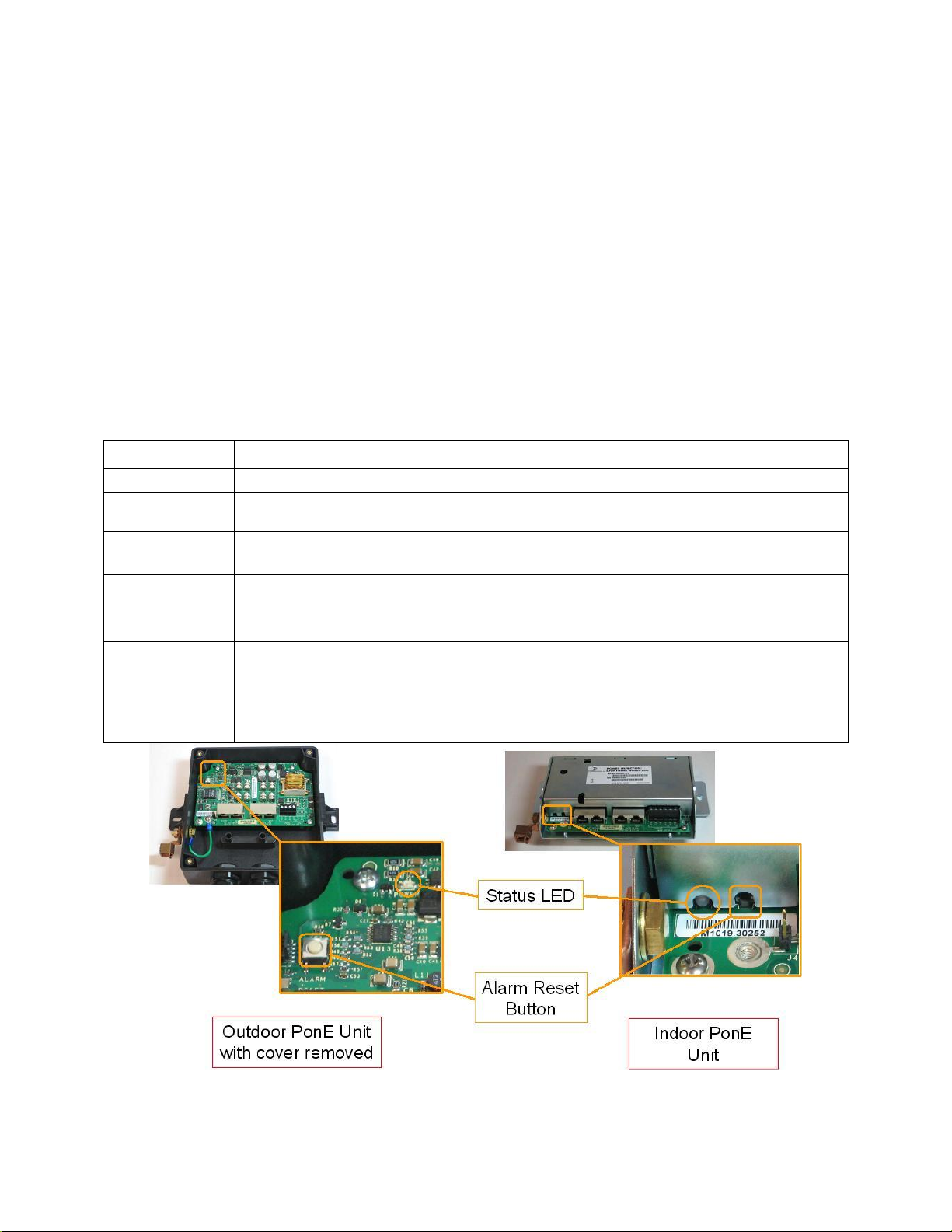
Both the Outdoor and Indoor rated PonE units have a green status LED (see Figure 5-3) which indicates
the status of the power-up cycle. When power is applied to the PonE adapter, prior to it attempting to
apply power to the Horizon Compact Plus, the PonE management system checks for under/over-voltage
and open or short circuit conditions. If any such condition exists, then the PonE adapter will not apply
power to the Horizon Compact Plus. The status LED signals the condition of the PonE system if this
should occur (see Table 5-1). If the fault condition clears, the system will then attempt to provide power to
the Horizon Compact Plus unit, but the LED will continue to indicate that a current/voltage problem had
occurred (Alarm history). The LED may be reset by pressing the Alarm Reset button or recycling the
power feed to the PonE adapter. See Figure 5-3 for the locations of the LED and Alarm Reset Button.
Incorrectly wired CAT5E cables can cause open or short circuit conditions, so this feature protects the
Horizon Compact Plus from incorrectly applied power. The PonE power unit will also shut-down when the
Horizon Compact Plus is disconnected from the PonE adapter (NTWK to Horizon port cable
disconnected).
Table 5-1 PonE Status LED Function Key
Figure 5-3 PonE Status LED and Alarm Reset Button
Horizon Compact Plus Release 1.0.1 Wireless Ethernet Product User Manual – Volume 1
Page 39
Powering the Horizon Compact Plus
29
5.2 Optical Interface
In the copper interface version, power is fed to the Horizon using PonE techniques via the Ethernet
connection to Port 1. In the optical version, this is not possible, so power is fed via the connection to Port
2. Port 2, on the optical interface variant, is equipped with a weatherproof MIL style multi-pin connector,
which incorporates an Ethernet connection and a power feed (NOT PonE) connection.
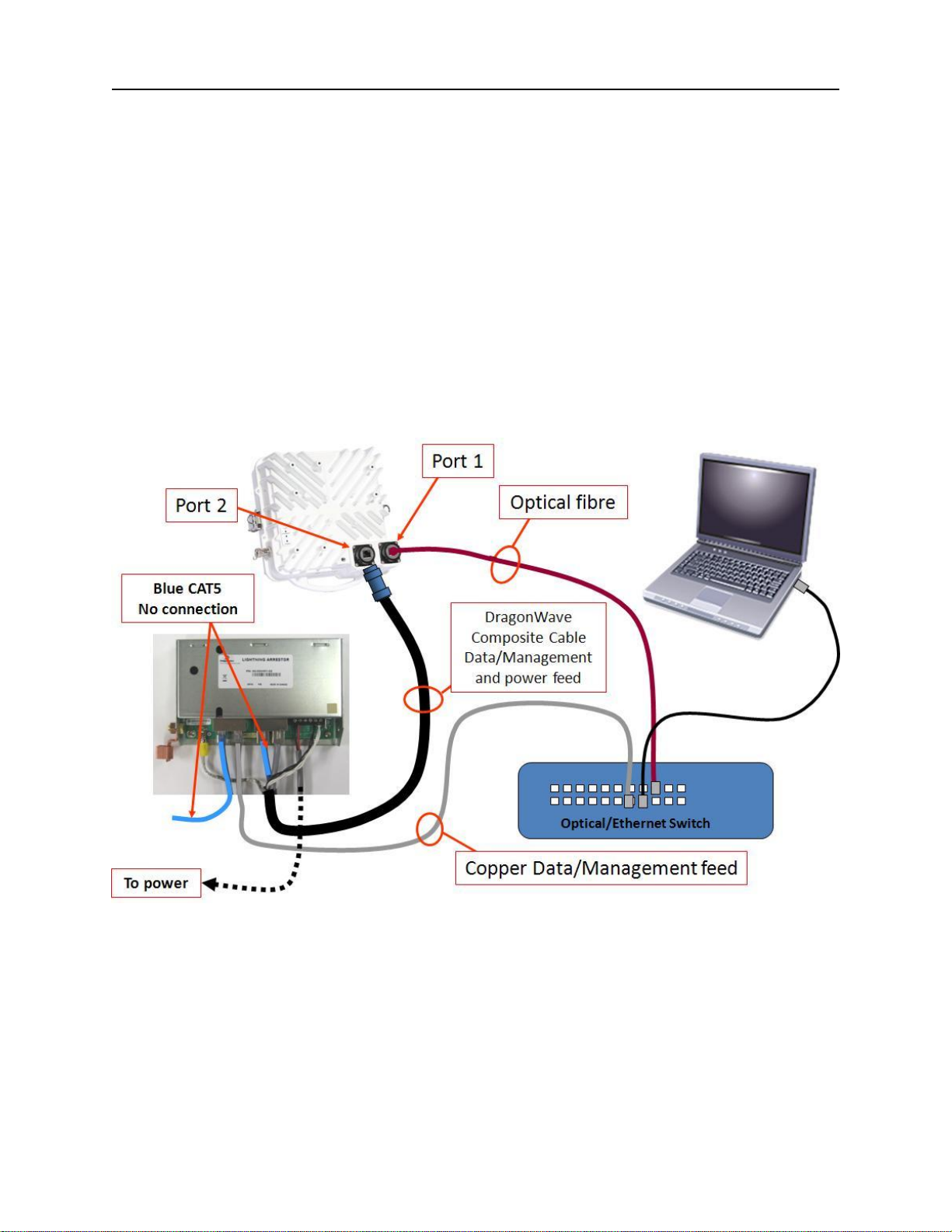
5.2.1 Using the Composite Cable
A composite cable is available that includes two CAT5E cables and power feed wires and is terminated at
the Horizon end with the MIL style connector compatible with the Port 2 connection. One of the CAT5E
cables (grey) provides an Ethernet connection to Port 2. The remaining CAT5E cable (blue) does not
need to be terminated.
Note that the Ethernet connection (where used) and power feed to Port 2 must be fed via a DragonWave
Lightning Arrestor Unit to protect the network and power systems from transients. Either the Indoor or
Outdoor Lightning Arrestor unit may be used depending on the installation.
Figure 5-4 Connecting Power – Optical Interface - Indoor Lightning Arrestor Unit
Horizon Compact Plus Release 1.0.1 Wireless Ethernet Product User Manual – Volume 1
Page 40
DragonWave Inc.
30
5.2.2 Alternate Power Feed Option - “Y” Feed Adapter Cable
Where distances prevent the use of the composite cable due to power feed loss, a special “Y” feed
adaptor cable is available that allows customer provided, heavier duty, wires to be spliced into the power
feed connection. The gland fitting on the DragonWave Lightning Arrestor unit accepts and seals a round
cable with a jacket diameter between 0.35 and 0.62 inches. The power terminal block will accept up to a
maximum of 14 AWG wires. An RJ45 Ethernet port connection is also available on this “Y” adapter cable.
Note that the OOB management connection (where used) and power feed to Port 2 must be fed via a
DragonWave Lightning Arrestor Unit to protect the network and power systems from transients. Either the
Indoor or Outdoor Lightning Arrestor unit may be used depending on the installation.
Figure 5-5 shows this arrangement showing how network and power circuits are protected by using the
DragonWave Outdoor Lightning Arrestor Unit. If the suppression unit is installed indoors, then the
DragonWave Indoor Lightning Arrestor Unit may be substituted using the same connections.
Figure 5-5 Optional External Power Feed - Outdoor Lightning Arrestor Unit
Horizon Compact Plus Release 1.0.1 Wireless Ethernet Product User Manual – Volume 1
Page 41
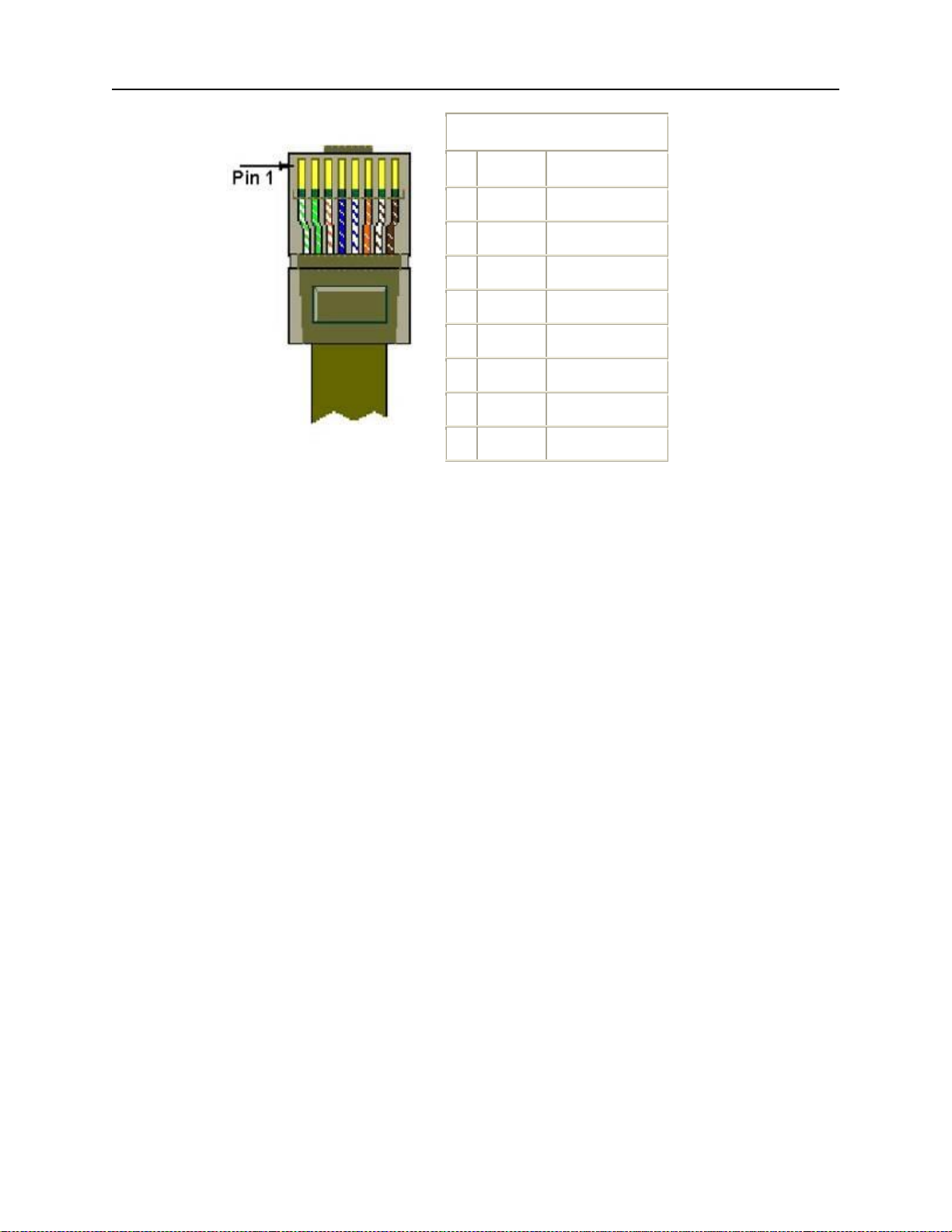
1000BaseTx – RJ45 pinout
Pin
Signal
Color
1
TP0+
White/Green
2
TP0-
Green
3
TP1+
White/Orange
4
TP2+
Blue
5
TP2-
White/ Blue
6
TP1-
Orange
7
TP3+
White/Brown
8
TP3-
Brown
Figure 5-6 RJ45 connector pinout – Port 2 management
Powering the Horizon Compact Plus
31
Horizon Compact Plus Release 1.0.1 Wireless Ethernet Product User Manual – Volume 1
Page 42

radio bands
IP address information
frequency channels
management interface
6.0 Initial Configuration
There are a number of configuration steps that need to be carried out before the Horizon Compact Plus
can become operational. It is recommended that these steps be performed prior to mounting the system
on the tower. These steps relate to:
Once this information has been correctly entered, the Horizon Compact Plus system is ready for
installation and system alignment.
The Horizon Compact Plus can be configured using Telnet or the Web interface.
Before attempting to log on you must configure the network parameters of your laptop, or PC, so that they
are in the same domain as the Horizon Compact Plus default IP address and subnet mask values.
By default, the IP address of a Horizon Compact Plus system is 192.168.10.100 and the subnet mask is
set to 255.255.0.0. Use this IP address to communicate with the unit, using either Telnet or the Web
browser. A complete set of CLI commands is available for use with Telnet (See Appendix A).
For the copper interface, connect your laptop or PC Ethernet port to physical Port 2 (GigE port) on the
Horizon Compact Plus using a straight through Ethernet cable. By default the management option is set
to “out-of-band”, which will allow management via p2. Note that ports p3 and p4 are disabled by default.
6.1 Secure Management Access.
Secure management access is controlled by a user name and password. The default Super User name is
“energetic” and the default password is “wireless”. The system allows any format for user passwords
(except the use of special characters), but does not allow a duplicate name or password. Also, an existing
user name cannot be used as a password. The same rules apply for both Telnet and Web access.
The default the system allows DragonWave personnel unhindered access to the system using a
proprietary access code. This may be necessary if default Super User parameters have been changed
and have been forgotten, or remote access is required to troubleshoot the system.
6.2 Using Telnet
6.2.1 Logging on
On your laptop or PC, open the DOS Command Prompt, or open the Windows Run option. In either case
type:
telnet 192.168.10.100 and press Enter.
When the Telnet window appears you may have to press Enter again to reveal the logon prompt.
When prompted, enter the Super User name and password. For the DragonWave default access option
the Super User name is “energetic” and the password is “wireless”.
Successful logging on is indicated by the CLI cursor (->) being displayed.
Note that after 10 minutes of inactivity, you will be automatically logged off the system.
6.2.2 Context Sensitive Help
Full context sensitive help is available for all CLI commands. Type ? followed by a partial command to
return a list of all commands that match the entry, with an explanation as to how each command is used.
Type a command followed by ? to return a list of all variants of that command. See Appendix A – CLI
Command List for an alphabetical list of CLI commands.
Horizon Compact Plus Release 1.0.1 Wireless Ethernet Product User Manual – Volume 1
Page 43
Initial Configuration
WARNING:
These same commands may be used to change the radio configuration of an
existing working link. If management of the far end Horizon Compact Plus is only
via the radio link, then configure the far end radio first. Otherwise, if you configure
the near end radio first, you will lose the link to the far end radio and be unable to
configure it.
Required Action
Steps
Login as the Super User
Connect your PC/laptop to the default management port.
On connecting to the management port you may have to press Enter to “wake
up” the system. The system prompt for the user name will appear. Enter the
default Super User name (energetic) and press Enter. You will then be
prompted for a password. Use the default password (wireless). If the name
and password are accepted you will see the system prompt (->).
Sequence:
Horizon Compact+, Release 1.0.0e (3496)
Copyright 2002-2011 DragonWave Inc.
All rights reserved.
Username :energetic
Password :
->
You are now logged onto the system.
33
6.2.3 Configuring Radio Band and Frequency Channels
Both Horizon Compact Plus units in a system (near and far end) have to be configured with the same
radio band. Volume 3 of this manual lists all the radio bands supported by the Horizon Compact Plus
system. The radio band selected must match that for which the Horizon Compact Plus units have been
manufactured. Only those radio bands for which the radio can be configured are available for selection.
The radio band will also be dictated in the wireless licensing documents.
Typical radio band configuration selections have the format “fcc23_3_50”, “etsi23_3_14” ,
“ul_fcc24_1_40” etc.
For licensed radio bands, the Horizon Compact Plus units at each end of the link have different frequency
banks allocated to them. One unit will be allocated the “LOW” bank and the other the “HIGH” bank. This is
indicated on the label attached to each unit (LOW or HIGH). Wireless licensing documents will indicate at
which end of the link each should be located. The radio part number, that is stored in the system,
determines if it is a LOW or HIGH unit and automatically configures the correct frequency bank for each
unit.
For unlicensed radio bands Horizon Compact Plus units have the same type of radio at each end of the
link and do not have a LOW or HIGH indication on their labels.
Each bank contains a number of frequency channels, of which only one will be selected. Once again the
actual frequency channel will be dictated in the wireless licensing documents. Note that when using 2
Horizon Compact Plus systems on the same data path, non-overlapping channels are required when
operating above 16QAM. If, however, you must use co-channel operation, then consult DragonWave for
installation guidance and installation mount enhancements that are required.
You also need to configure the system mode (determines modulation, bandwidth and throughput
parameters).
Use Telnet access and the following procedure to configure the radio parameters:
Horizon Compact Plus Release 1.0.1 Wireless Ethernet Product User Manual – Volume 1
Page 44

DragonWave Inc.
Required Action
Steps
Configure the radio parameters
This command leads you through the steps to configure the radio band, system
mode and frequency channel.
Sequence:
set radio config press Enter
The system responds:
#Press 'Ctrl-X' to exit config process
#Press 'Enter' to retain previous value
Radio Bands Available in the system :
freqNone fcc18_1_10_R5
fcc18_1_20_R5 fcc18_1_30_R5
fcc18_1_40_R5 fcc18_1_50_R5
test18_1_7_R5 braz18_1_14_R5
braz18_1_28_R5 braz18_1_56_R5
Enter new radio band [fcc18_1_50_R5]:
System modes available in the system :
cw_test hy50_66_qpsk hy50_154_16qam
hy50_198_32qam hy50_241_64qam hy50_285_128qam
hy50_329_256qam hy50_351_256qam
Enter new system mode [hy50_285_128qam]:
Available frequencies for the radio band:
Index TX RF RX RF
1 17765000 19325000
2 17815000 19375000
3 17865000 19425000
4 17915000 19475000
5 17965000 19525000
6 18015000 19575000
7 18065000 19625000
8 18115000 19675000
All Frequency in kHz
Enter programmed frequency [2]:
Would you like to save MIB ? Enter Y(Yes) or N(No):y
Apply the setting to system immediately. This operation may cause the
loss of current connection!
Continue? Enter Y(Yes) or N(No)n
Note: Answering “Yes” (y) to the above request will cause any
changes to take effect immediately and you will not get the prompt
to save mib and reset system.
Save MIB and reset system for changes to take effect.
Radio Band selected :fcc18_1_50_R5
System mode set to :hy50_285_128qam
Save MIB and reset system for changes to take effect.
Programmed frequency selected:
Index TX RF RX RF
2 17815000 19375000
All Frequencies in kHz
Save MIB and reset system for changes to take effect.
34
Horizon Compact Plus Release 1.0.1 Wireless Ethernet Product User Manual – Volume 1
Page 45

Initial Configuration
Required Action
Steps
Configure the IP parameters
The IP parameters include the IP address, the subnet mask and default
gateway. The example below shows how to change the IP address, subnet
mask and default gateway.
Sequence:
set ip config press Enter
The system responds:
#Press 'Ctrl-X' to exit config process
#Press 'Enter' to retain previous value
Ip Address (192.168.10.100) ? 172.16.18.100
Subnet Mask (255.255.0.0) ? 255.255.252.0
Default Gateway (0.0.0.0) ? 172.16.19.254
Would you like to save MIB ? Enter Y(Yes) or N(No):y
Apply the setting to system immediately. This operation may cause the
loss of current connection!
Continue? Enter Y(Yes) or N(No)y
Mib saved successfully.
Config Name User Config Running Config
--------------- ------------- -------------Ip Address : 172.16.18.100 172.16.18.100
Subnet Mask : 255.255.252.0 255.255.252.0
Default Gateway : 172.16.19.254 172.16.19.254
If you choose n (No) to the “Continue ?” prompt the response will be as
follows:
Continue? Enter Y(Yes) or N(No)n
Reset system for changes to take effect.
Mib saved successfully.
Config Name User Config Running Config
--------------- ------------- -------------Ip Address : 172.16.18.100 192.168.10.100
Subnet Mask : 255.255.252.0 255.255.0.0
Default Gateway : 172.16.19.254 0.0.0.0
The next time the system is reset the changes will be applied to the
system.
35
6.2.4 Configuring IP Address Values
When shipped from DragonWave, the Horizon Compact Plus is configured with a default IP address
(192.168.10.100) and subnet mask (255.255.0.0). The default address is used to communicate with the
Horizon Compact Plus for initial configuration purposes, such as entering the IP address that the unit will
have in the network to which it is to be connected. IP address information is entered in the following
manner:
Once the system has reset, you may not be able to communicate with it without changing your laptop or
PC networking parameters to match the new IP address values programmed into the Horizon Compact
Plus.
Note that the reset system command is not always required when making configuration changes, but the
save mib command is always required. Commands that require a reset system will be indicated on the
screen.
Horizon Compact Plus Release 1.0.1 Wireless Ethernet Product User Manual – Volume 1
Page 46

DragonWave Inc.
Account
Level
Number of
Accounts
Available
Functionality
Super User
1
Super User account has control over the usernames and
passwords for both the NOC and Admin accounts. Can
create backup file of NOC and Admin accounts onto an FTP
server, restore system settings and load new software
noc 5 Network Operations Centre (NOC) accounts allow full
control over the configuration of the Horizon Compact Plus
system, including setting the frequency and IP address.
NOC accounts may also backup the Horizon Compact Plus
system settings to an FTP server and restore the system
settings from an FTP server. NOC accounts cannot create
or change user accounts, or issue any security related
commands (ex: set http secure access)
admin
50
Admin accounts allow operational management of the
Horizon Compact Plus system but have some restrictions
for changes to configuration
36
6.2.5 User Accounts
User account names and passwords can only be configured using a Telnet session. Only the Super User
can change or add user account names or passwords. There are three user account levels as shown in
Table 6-1
Table 6-1 User Account Levels
No default noc or admin user accounts are configured when the Horizon Compact Plus leaves the factory.
Account names and passwords are case sensitive. There can be no duplication of names or passwords
across all user levels. A password cannot be the same as a user name.
6.2.6 Changing the Super User Name and Password
It is recommended that the default, or supplied, Super User name and password be changed as soon as
the Horizon Compact Plus system is aligned and operational.
Note: When you change the Super User name and/or password, record the new values in a safe place. If
you forget the new values, there is no way of retrieving them from the system. If the Horizon Compact
Plus is supplied with the DragonWave default access option, you will have to contact DragonWave to
arrange a Super User reset (24 hour support number 613-271-7010, or [email protected]).
DragonWave Default Access
To change the Super User name and password use the CLI command set super user and press Enter.
Follow the prompts.
When the new name and password have been accepted enter the CLI command save mib and press
Enter. This will save the changes in non volatile memory. Failing to save the mib will result in changes
being lost in the event of a power failure, or system reset.
Horizon Compact Plus Release 1.0.1 Wireless Ethernet Product User Manual – Volume 1
Page 47

Required Action
Steps
View user Login Accounts
Five noc (network operations center) accounts are available. The
username and password cannot be the same value.
Log in as the super user.
View current account settings.
Sequence:
get user accounts press Enter
The system responds:
******************************************************************
ADMIN ACCOUNTS
******************************************************************
Index UserName Password
1 Admin 1 pwrd1
2 Admin 2 pwrd2
3 Admin 3 pwrd3
‘
‘
48 Admin 48 pwrd4
49 Admin 49 pwrd5
50 Admin 50 pwrd6
******************************************************************
NOC ACCOUNTS
******************************************************************
Index UserName Password
1 noc1 nocpwd1
2 noc2 nocpwd2
3 noc3 nocpwd3
4 noc4 nocpwd4
5 noc5 nocpwd5
->
6.2.7 Adding or Changing noc User Accounts
Up to five noc user accounts can be configured..
Initial Configuration
37
Horizon Compact Plus Release 1.0.1 Wireless Ethernet Product User Manual – Volume 1
Page 48

DragonWave Inc.
Required Action
Steps
Create a new noc account:
Sequence:
set noc user press Enter
The system responds:
Index:
Enter the <index #> where <index #> is from 1 to 5 and represents one
of the 5 available accounts.
The system responds:
UserName:
Enter the desired username for this account.
The system responds:
Verify UserName:
Re-enter the desired username for this account.
The system responds:
Password:
Enter the desired password for this account.
The system responds:
Verify Password:
Re-enter the desired password for this account.
The system responds:
User Accepted:
If the usernames or passwords do not match the system will
respond:
nak
Repeat for as many noc accounts as required (5 max).
Save the settings
save mib press Enter
The system responds:
MIB saved.
Note: the new account settings must be saved, otherwise they will be
lost after the next system reset. The user must perform the save mib
command in order to save the changes.
38
Horizon Compact Plus Release 1.0.1 Wireless Ethernet Product User Manual – Volume 1
Page 49

Required Action
Steps
Log in as the Super User
View user accounts
50 Administrator accounts are available. The username and password
cannot be the same value.
Sequence:
get user accounts press Enter
The system responds:
******************************************************************
ADMIN ACCOUNTS
******************************************************************
1 Admin 1 pwrd1
2 Admin 2 pwrd2
3 Admin 3 pwrd3
‘
‘
48 Admin 48 pwrd4
49 Admin 49 pwrd5
50 Admin 50 pwrd6
******************************************************************
NOC ACCOUNTS
******************************************************************
Index UserName Password
1 noc1 nocpwd1
2 noc2 nocpwd2
3 noc3 nocpwd3
4 noc4 nocpwd4
5 noc5 nocpwd5
->
6.2.8 Adding or Changing Admin User Accounts
Up to 50 admin accounts can be configured.
Initial Configuration
39
Horizon Compact Plus Release 1.0.1 Wireless Ethernet Product User Manual – Volume 1
Page 50

DragonWave Inc.
Required Action
Steps
Create a new Administrator
account
Sequence:
set admin user press Enter
The system responds:
Index:
Enter the <index #> where <index #> is from 1 to 50 and represents
one of the 50 available accounts.
The system responds:
UserName:
Enter the desired username for this account.
The system responds:
Verify UserName:
Re-enter the desired username for this account.
The system responds:
Password:
Enter the desired password for this account.
The system responds:
Verify Password:
Re-enter the desired password for this account.
The system responds:
User Accepted:
If the usernames or passwords do not match the system will
respond:
nak
Repeat for as many admin accounts as required.
Save the settings
save mib press Enter
The system responds:
MIB saved.
Note: the new account settings must be saved, otherwise they will be
lost after the next system reset. The user must perform the save mib
command in order to save the changes.
40
Horizon Compact Plus Release 1.0.1 Wireless Ethernet Product User Manual – Volume 1
Page 51

Initial Configuration
41
6.2.9 Changing NOC and Admin User Passwords
The Super User may change a noc or admin user’s password, by over-writing or re-entering the user’s
name and password using the same process for adding a new user.
6.2.10 Logging Out
When accessing the system via Telnet, log out of the system by using the CLI command lo.
When accessing using the Web browser, closing the browser will log you out of the system.
6.2.11 Session Time Out
After 10 minutes of inactivity, Horizon Compact Plus units will automatically terminate the login session.
6.2.12 Recovery of IP Address and Serial Numbers
In the event that the Horizon Super User name and password, or IP address has been lost, forgotten, or
misconfigured, you will need to contact DragonWave ([email protected]). DragonWave
Technical Support will provide the Merlin recovery utility that, using a proprietary protocol, can recover the
configured IP address parameters and/or reset the Super User name, Super User password and IP
address parameters to the factory default values (energetic, wireless; 192.168.10.100, 255.255.0.0). In
addition it reports the system serial number.
The Merlin utility runs on a PC running the Windows operating system and requires a one-time-use
recovery key provided by DragonWave. Proof of ownership and proof of authority must be provided
before the key will be issued. When Merlin is invoked, the Horizon unit responds with the required
information, which is saved in a text file, located in the same directory as the Merlin application.
6.3 Using the Web interface
The Horizon Compact Plus Web interface is enabled by default.
Open a Web browser and, in the “Address” or URL field at the top of the page, enter the IP address of the
Horizon Compact Plus unit (default is 192.168.10.100) and press Enter. If your laptop or PC has been
correctly set up, you will be prompted for the user name and password. Type in the Super User name and
password. The same security access option selected when you purchased the system is also applied to
the Web interface. For the DragonWave default option the Super User name is “energetic” and the
password is “wireless”.
The web page interface is intuitive and can be used to configure most of the basic configuration
requirements and also some advanced features. However, it cannot be used to configure all features (e.g.
system user accounts). Its best use is for monitoring the status of systems that are already configured
and for making changes to the existing configuration. See Volume 2 of this manual to see a detailed
description of the web interface.
Horizon Compact Plus Release 1.0.1 Wireless Ethernet Product User Manual – Volume 1
Page 52
Caution
The interface between the antenna port and the waveguide adaptor is
very tight and care must be taken both when mounting and removing the
Horizon Compact plus to/from its antenna.
7.0 Antenna Mounting and Tower Specifications
The Horizon Compact Plus unit clip mounts onto a range of antennas, providing a variety of gain and
range options. The same mounting system is used for all sizes of antenna. Where multiple Dragonwave
radio systems are located on the same pole/tower, it is recommended that all radios be either TxHigh or
TxLow.
Figure 7-1 Horizon Compact Plus showing clip mount features
The Horizon Compact Plus unit has two, integral, spring loaded, mounting clips. DragonWave antennas
have matching mounting lugs, to which the mounting clips attach. The antenna port and the waveguide
adaptor of the Horizon Compact Plus unit, fit together, and are weather-sealed with a lubricated ‘O’ ring
located on the outside surface of the antenna port. See the step by step mounting instructions below:
1. Ensure O-Lube supplied with the product is applied to the O-ring prior to mating the Horizon
Compact Plus to the Waveguide adaptor.
2. With the Horizon Compact Plus unit (waveguide side uppermost) resting on a firm, flat surface,
carefully place the Antenna on the Horizon Compact Plus and loosely engage the two clips into the
mounting lugs. DO NOT try to force the antenna onto the Horizon Compact Plus manually. The
concentric alignment of the Horizon Compact Plus to the adaptor is critical during
engagement to prevent damage and metal galling.
3. Ensure that the drain holes in the antenna are positioned such that with the Horizon Compact Plus
in the vertical orientation, one drain hole points down.
4. Push down both clips on the Horizon Plus, at the same time, drawing the Horizon Compact Plus
and adaptor together until they are fully seated.
Note: The waveguide interface to the antenna is circular. The antenna is not polarization specific. The
polarization is determined by orientation of the Horizon Compact Plus Unit. A visual polarization indicator
(an “arrow”) can be found on the Horizon Compact Plus housing. If the Horizon Compact Plus is installed
with the polarization indicator in the vertical plane then the unit is in vertical polarization. Similarly, if the
polarization indicator is in the horizontal plane then the unit is in horizontal polarization.
Horizon Compact Plus Release 1.0.1 Wireless Ethernet Product User Manual – Volume 1
Page 53
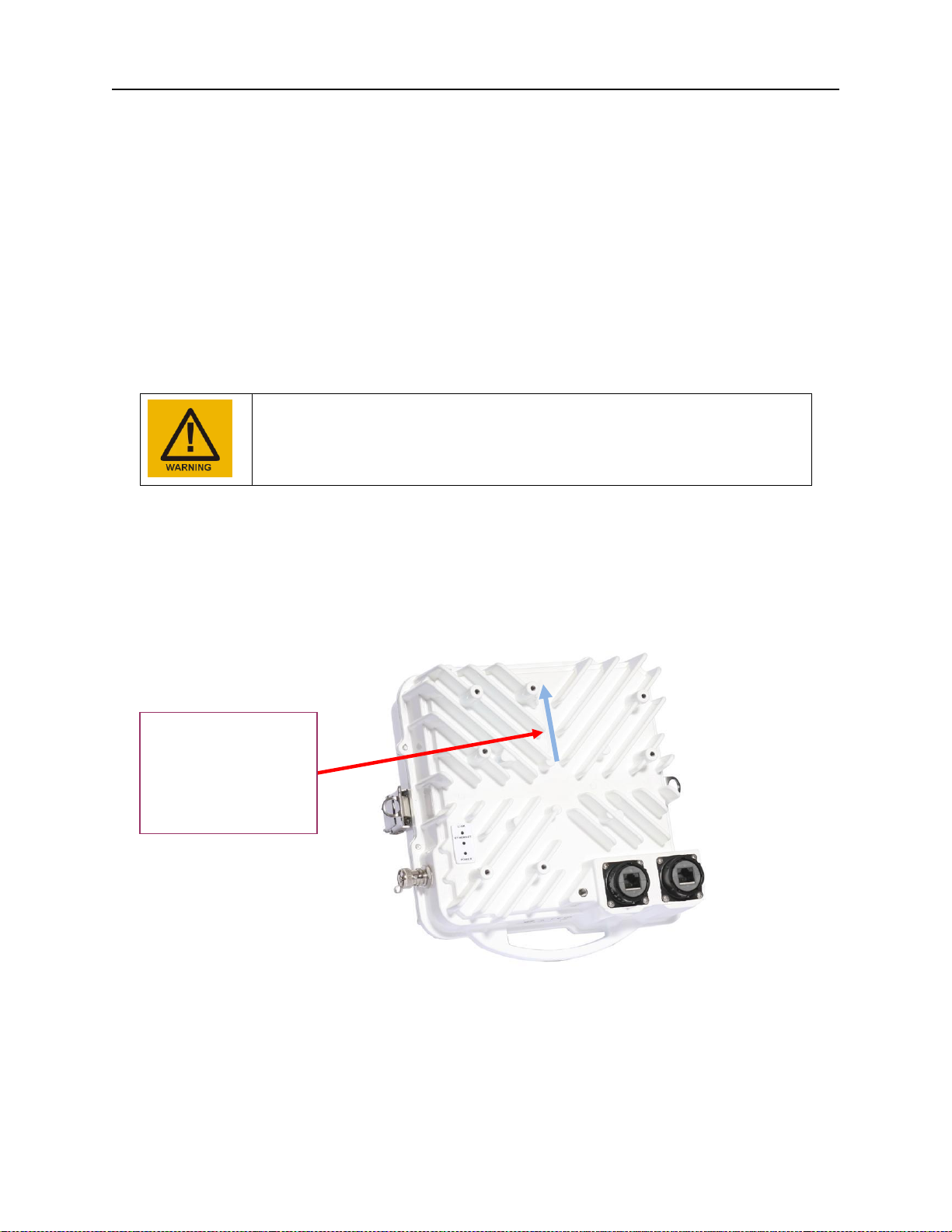
Antenna Mounting and Tower Specifications
Caution
Cross-polarized radios or antennas result in the signal strength being 20-
30 dB below expected RSL levels! Ensure both radios have the same
orientation (vertical or horizontal).
Polarization Marker
(arrow vertical)
43
7.1 Polarization
Point-to-point Horizon Compact Plus units that operate on licensed radio bands use a diplexer system to
simultaneously handle transmitted and received signals to/from the dish/reflector. In this case, both
transmit and receive radios must have the same signal polarization.
Horizon Compact Plus units that operate in the licensed Local Multi-point Distribution Service (LMDS)
radio band (31 GHz) and Horizon Compact Plus units that operate in the 24 GHz unlicensed radio band,
use an orthogonal mode transducer (OMT) to allow the radios to simultaneously transmit on one
polarization and receive on the opposite polarization.
7.1.1 Point-to-point Licensed Radio Bands
Both Horizon Compact Plus units must be mounted on the pole/tower oriented for the same polarization.
i.e. both vertical polarization, or both horizontal polarization.
The radio frequency polarization is indicated by an arrow molded into the Horizon Compact Plus housing.
Attach the Horizon Compact Plus to the dish/reflector so that the arrow points either vertically or
horizontally, as required, when the assembly is attached to the mounting post or tower. With the arrow
horizontal (pointing to the left) – horizontal polarization; with the arrow vertical (pointing upwards) –
vertical polarization. For licensed frequencies, the required radio polarization is defined in your licensing
documentation.
This Horizon
Compact Plus unit is
shown positioned for
vertical polarization
Figure 7-2 Horizon Compact Plus polarization marker
Horizon Compact Plus Release 1.0.1 Wireless Ethernet Product User Manual – Volume 1
Page 54
DragonWave Inc.
24UL Dish/Reflector Data
30 cm (1 foot)
Andrews VHLP1-26DW
36.2dBi
60 cm (2 foot)
Andrews VHLP2-26DW
40.8dBi
75 cm (2.5 foot)
Andrews VHLP2.5-26DW
43.7dBi
Caution
For 31 GHz LMDS and 24 GHz Unlicensed Band, radios MUST be cross-
polarized. i.e. Vertical polarization at one end and horizontal polarization at
the other. For 24 GHz unlicensed band It does not matter at which end
either radio is installed.
44
7.1.2 LMDS and Unlicensed Radio Bands (UL24)
For 31 GHz licensed LMDS radio bands and the 24 GHz unlicensed radio bands, regulatory bodies
require that radios in a system have to be cross-polarized. This means that the polarization of the
transmitter signal at one end of the link, or distribution system, is vertical and the transmitter signal
polarization at the other end is horizontal.
The radio at one end transmits with vertical polarization and receives with horizontal polarization, while
the other end transmits with horizontal polarization and receives with vertical polarization.
The radio frequency polarization is indicated by an arrow molded into the Horizon Compact Plus housing.
Attach the Horizon Compact Plus to the dish/reflector mount so that the arrow points either vertically or
horizontally, as required, when the assembly is attached to the mounting post or tower. With the arrow
horizontal (pointing to the left) – horizontal polarization; with the arrow vertical (pointing upwards) –
vertical polarization. For LMDS and unlicensed frequencies, one end of the link has to have vertical
polarization and the other horizontally polarization (cross-polarized). For unlicensed frequencies (24 GHz)
it does not matter which end of the link has a specific polarization.
7.1.2.1 Unlicensed (UL24) Dish/Reflector Information
The 24 GHz unlicensed Horizon Compact Plus has been designed to operate with the dish/reflector types
listed in Table 7-1, and having a maximum gain of 43.7 dBi. Dish/reflectors not included in this list or
having a gain greater than 43.7dBi are strictly prohibited for use with this device.
Table 7-1 Allowable Dish/Reflectors – Unlicensed Systems
Horizon Compact Plus Release 1.0.1 Wireless Ethernet Product User Manual – Volume 1
Page 55
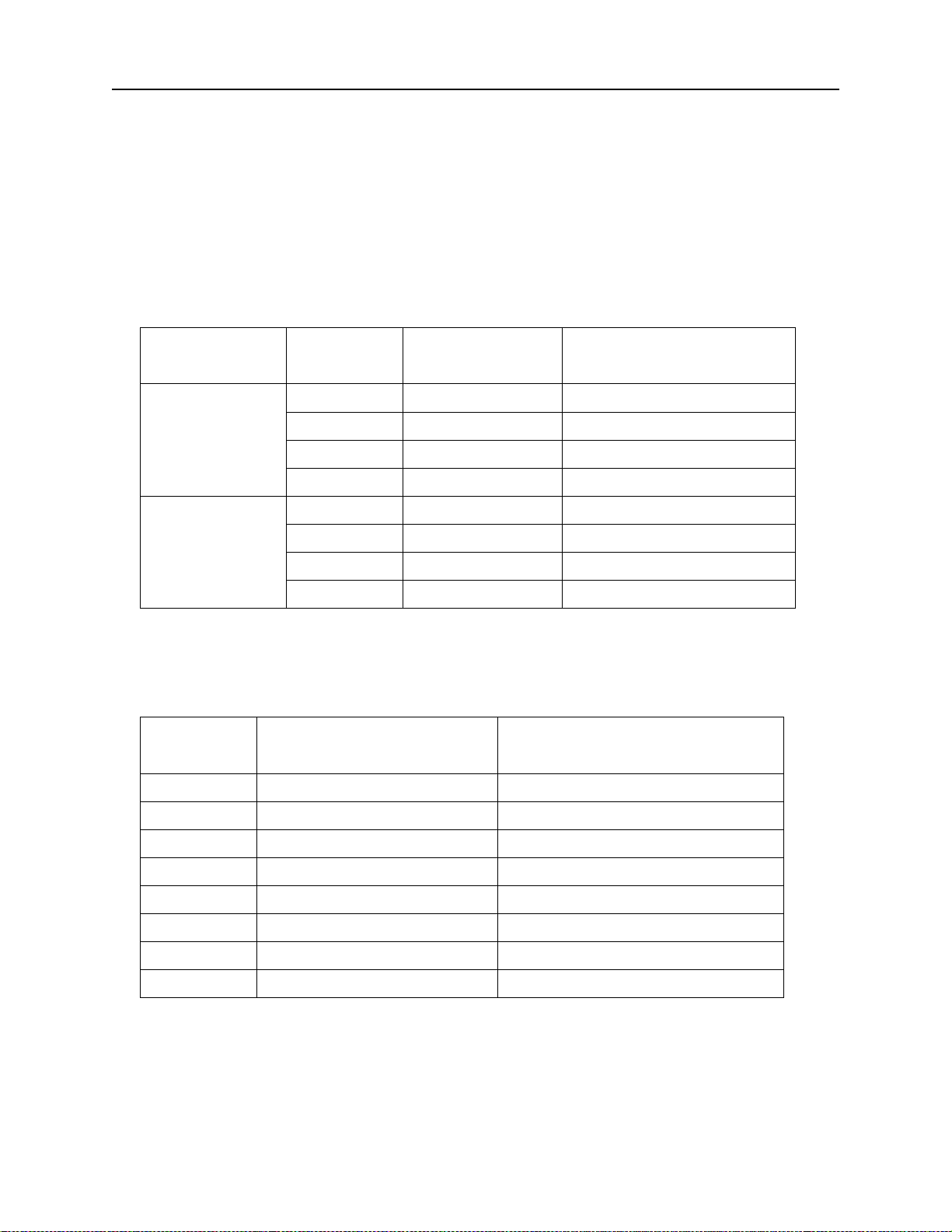
Antenna Mounting and Tower Specifications
Frequency
Antenna
Diameter
3 dB Beamwidth
(degrees)
Maximum Twist and Sway
(degrees)
18 GHz
30 cm/12”
3
+/- 1.5
60 cm/24” 2 +/-1
90 cm/36”
1.3
+/- 0.65
120 cm/48” 1 +/- 0.5
23 GHz
30 cm/12”
2.7
+/- 1.35
60 cm/24”
1.7
+/- 0.85
90 cm/36”
1.1
+/- 0.55
120 cm/48”
0.8
+/- 0.4
Antenna
Diameter
Steel Pipe
Nominal Outside Diameter
Max. Distance Above Last Rigid
Attachment Point
30 cm/12”
7.5 cm/3 “
90 cm/36”
30 cm/12”
10 cm/4”
120 cm/48”
60 cm/24”
7.5 cm/3”
75 cm/30”
60 cm/24”
10 cm/4”
90 cm/36”
75 cm/30”
10 cm/4”
75 cm/30”
90 cm/36”
10 cm/4”
(tower mount recommended)
120 cm/48”
10 cm/4”
(tower mount recommended)
180 cm/72”
11.5 cm/4.5”
(tower mount recommended)
45
7.2 Pole and Tower Specifications
It is important that mounting posts or towers used meet the DragonWave specifications for rigidity to
minimize the effects of twist and sway on the alignment of the link. Note that the maximum twist and sway
angle allowable is equal to half of the antenna beam width.
Table 7-2
Twist and Sway Specifications – Selected Frequencies
Table 7-3
Mounting pole specifications
Twist and sway caused by wind or human activity can cause a link to fail. Using poles with specifications
shown in Table 7-3 will result in a stable mounting system. Systems with antenna sizes of 90 cm/36” in
diameter and greater, are recommended to be mounted on towers.
Horizon Compact Plus Release 1.0.1 Wireless Ethernet Product User Manual – Volume 1
Page 56
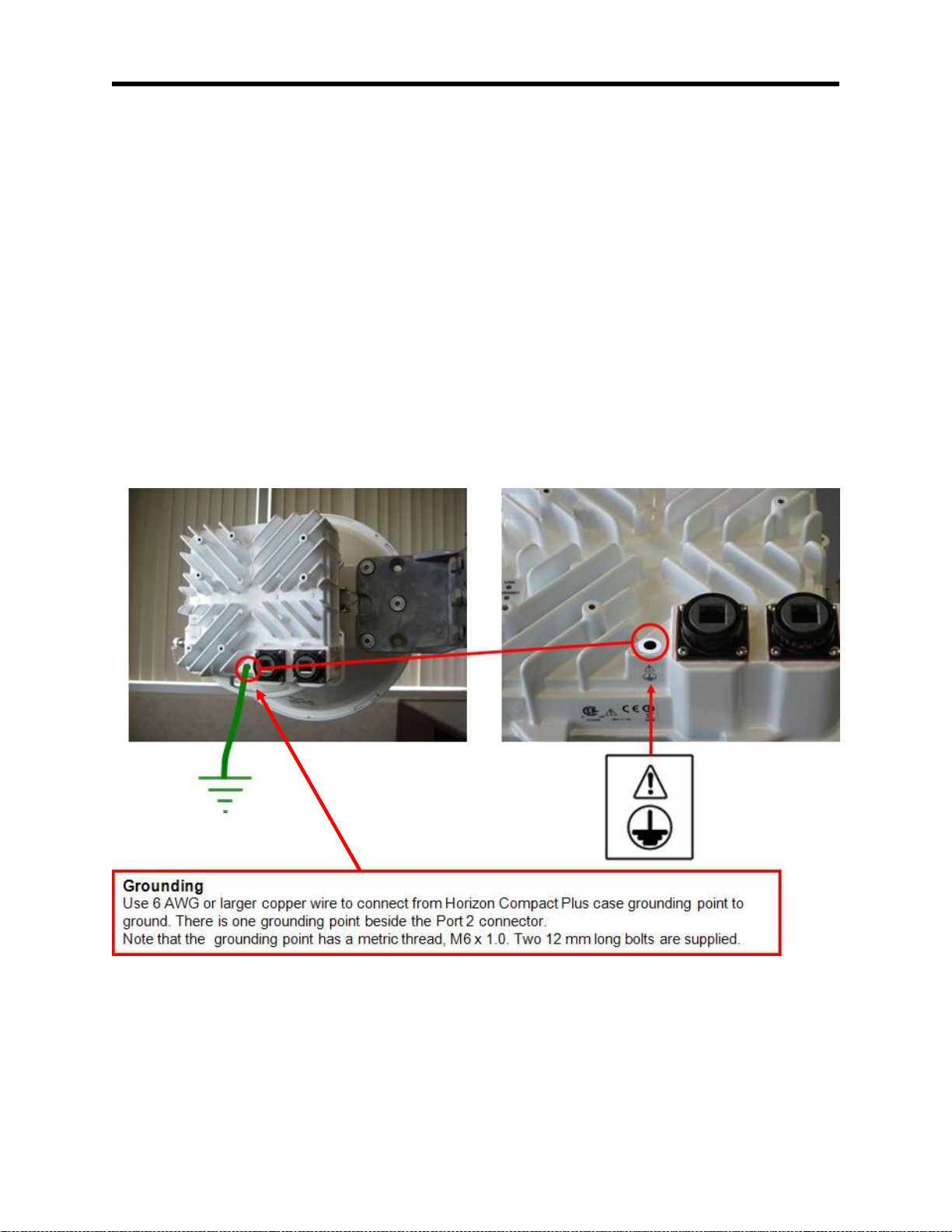
8.0 Grounding, Power and Lightning Arrestors
Note: For effective protection against lightning-induced surges, proper grounding and shielding
practices MUST be followed for the ENTIRE installation. Consult DragonWave Inc. Technical Note:
HC-TN-001 Horizon Compact Plus PonE and Quick Reference Guide before installation!
The Horizon Compact Plus unit must be grounded using a minimum of 6 AWG copper wire attached to
the metric thread (M6 x 1.0), grounding point as shown in Figure 8-1. Two 12 mm long bolts are supplied.
Lightning Arresters and lightning protection is built into the Horizon unit.
The Ethernet and PonE cables must be properly protected at the end of their run as they enter the
building. Before Ethernet cables enter buildings, voltages shall be clamped down to SELV by approved
type primary protectors.
For the copper interface option, proper use of the DragonWave Horizon PonE unit provides lightning and
surge protection for the connected network. The PonE unit shall be installed according to local Electrical
Safety Codes.
For the optical interface, proper use of the DragonWave Lightning Arrestor unit protects the optional
management Ethernet connection (if used) and the power supply.
Figure 8-1 Horizon Compact Plus case grounding point
Horizon Compact Plus Release 1.0.1 Wireless Ethernet Product User Manual – Volume 1
Page 57
Preparing for Alignment
CAUTION
For Release 1.1 and earlier, serious damage to network switches
or routers can occur if the network is plugged into the connectors
marked “TO HORIZON UNPROTECTED”. Power is fed to the
Horizon unit along the same wires that carry Ethernet traffic to the
Horizon unit. Unless you have the Release 1.2 PonE adapter, do
not, under any circumstances, plug cables connected to the
network into the RJ45 connectors marked “TO HORIZON
UNPROTECTED”.
CAUTION
Only use straight through Ethernet cables to connect the PonE
adapter to the Horizon Compact Plus. Using cross-over cables will
result in damage to the Horizon Compact Plus unit.
CAUTION
Use shielded CAT5E cables with shields and drain wires
connected to metal head shells of RJ45 connectors, at BOTH ends
of cable for all unprotected, outdoor cable runs to Horizon Unit!
Use unshielded CAT5 cables and/or RJ45 connectors for
protected-side cable runs to network equipment.
47
8.1 Power on Ethernet (PonE)
The copper interface variant of Horizon operates on -48 VDC and employs a proprietary Power on
Ethernet solution. The Horizon Outdoor and Indoor Power on Ethernet Lightning Arrestor units provide
integration of -48 VDC and data signals on the straight through Ethernet data cable. Power is not
integrated onto the optional out-of-band management Ethernet cable.
Note: The Horizon PonE implementation is proprietary and does not follow IEEE standards.
The Lightning Arrestor uses RJ45 connectors for the Ethernet cables and screw-terminals for the -48
VDC power connections. Dual -48 VDC power connectors are provided, allowing for the connection of
redundant power supplies.
The Lightning Arrestor unit contains protection against cable transients and power surges caused by
lightning or other sources. The Lightning Arrestor is installed at the opposite end of the CAT5E/PonE
cables to that of the Horizon unit and protects the network.
To ensure adequate lightning protection, the PonE Lightning Arrestor unit must be properly
grounded.
Horizon consumes a nominal 20 Watts (standard power), or 40 Watts (high power variant) from the -48
VDC supply. All eight of the wires in the Ethernet cable are used to carry power to the Horizon Compact
Plus unit. The Power on Ethernet Lightning Arrestor unit is rated at 2 amps.
The PonE unit has a protection feature that prevents power from being supplied to the Horizon Compact
Plus if it detects any under or over voltage/current conditions (see Section 5.1.4). Over or under
voltage/current conditions can occur if cables are incorrectly terminated.
Horizon Compact Plus Release 1.0.1 Wireless Ethernet Product User Manual – Volume 1
Page 58
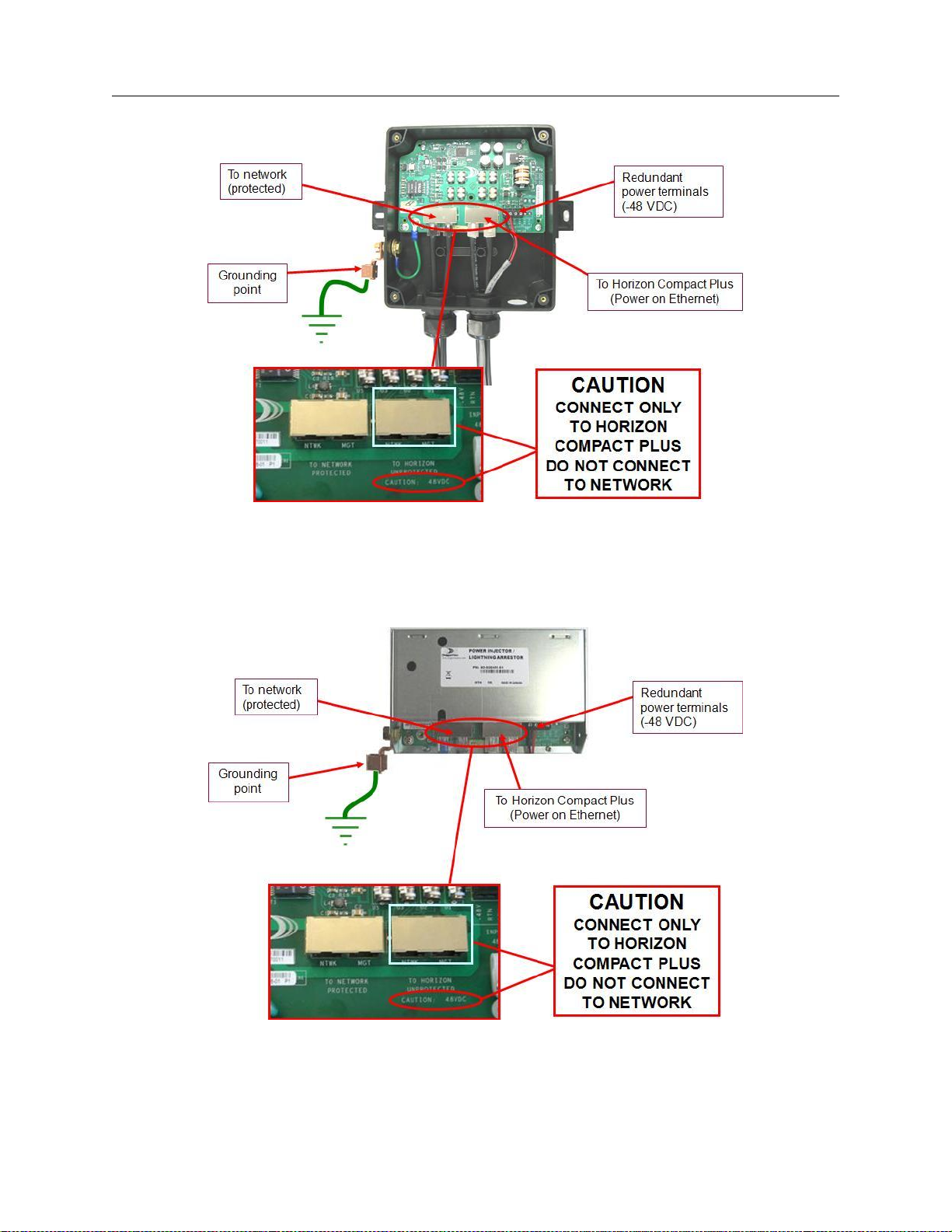
DragonWave Inc.
48
Figure 8-2 Outdoor Lightning Arrestor and Power injector
Cables are secured in the Outdoor PonE unit by means of the cable entry gland nuts. A special threehole, rubber, grommet is provided to accommodate two CAT5 cables, plus a power feed cable (See
Section 4.3.2). Cables with sheath diameters of between 0.35” and 0.62” can be accommodated when
the special grommet is removed.
Figure 8-3 Indoor Lightning Arrestor and Power injector
Horizon Compact Plus Release 1.0.1 Wireless Ethernet Product User Manual – Volume 1
Page 59

Preparing for Alignment
49
This page left blank intentionally
Horizon Compact Plus Release 1.0.1 Wireless Ethernet Product User Manual – Volume 1
Page 60

Distance from
Obstacle in cm (ft)
0
(0)
30
(1)
60
(2)
90
(3)
120
(4)
150
(5)
180
(6)
210
(7)
240
(8)
270
(9)
300
(10)
600
(20)
900
(30)
1200
(40)
>1200
(>40)
Minimum System
Height above
Obstacle in cm (ft)
30
(1)
60
(2)
90
(3)
120
(4)
131
(4.36)
134
(4.46)
137
(4.55)
139
(4.64)
142
(4.73)
145
(4.82)
147
(4.91)
175
(5.82)
202
(6.73)
229
(7.64)
240
(8)
9.0 Locating Horizon Compact Plus Systems
For both licensed and unlicensed systems, their location, relative to nearby obstacles, is an important
factor to consider when planning an installation. For systems mounted on buildings, roof edges and
parapets, the roof surface itself, air conditioning plant, other antenna systems, walls and overhead objects
are all considered potential obstacles. On tower mounted systems you must consider the proximity of
other antenna systems and mounting hardware.
You must also ensure that there is a clear line of sight (LOS) between the antennas of a Horizon
Compact Plus system link.
9.1 Near Field Effects
Near field effects, resulting from a number of minor radiation lobes normally found around antenna
systems, can reflect off nearby objects and interfere with the normal reception of the radio. Reflected
waves can also change their polarization. This is especially important for cross polarized LMDS and
unlicensed systems.
Consider an LMDS system or an unlicensed installation that transmits with vertical polarization and
receives with horizontal polarization. If the near field vertically polarized transmitted signal reflects off an
obstacle located too close to the antenna system, then the reflected signal changes its polarization to
horizontal, which is the same polarization as the receiver. This causes the receiver to “swallow” the
transmitted signal, resulting in receiver “swamping”, excessive noise and the inability to receive the signal
from the far end of the link. Ensuring that obstacles and objects are not too close to the antenna system
will avoid this problem.
As a “rule of thumb”, for both co-polarized and cross-polarized installations, ensure that you maintain an
angle of 45 degrees, or greater, between the far side of the highest part of an obstacle and the underside
of the dish/reflector. The diagrams in Figure 9-1 illustrate this approach. Also, remember to apply this rule
in all directions around the radio, above, below and to each side. An exception to this rule can be applied
when the system is positioned 12.5 m (40 ft) or more from the edge of a roof clear of obstacles (a roof
edge is considered an obstacle). In this case the system need not be higher than 2.5 m (8 ft) above the
roof surface.
Table 9-1 shows the minimum antenna height requirements above obstacles for the 24 GHz Unlicensed
frequency band.
Table 9-1 System Height vs Obstacle Distance for 24 GHz Unlicensed
Horizon Compact Plus Release 1.0.1 Wireless Ethernet Product User Manual – Volume 1
Page 61
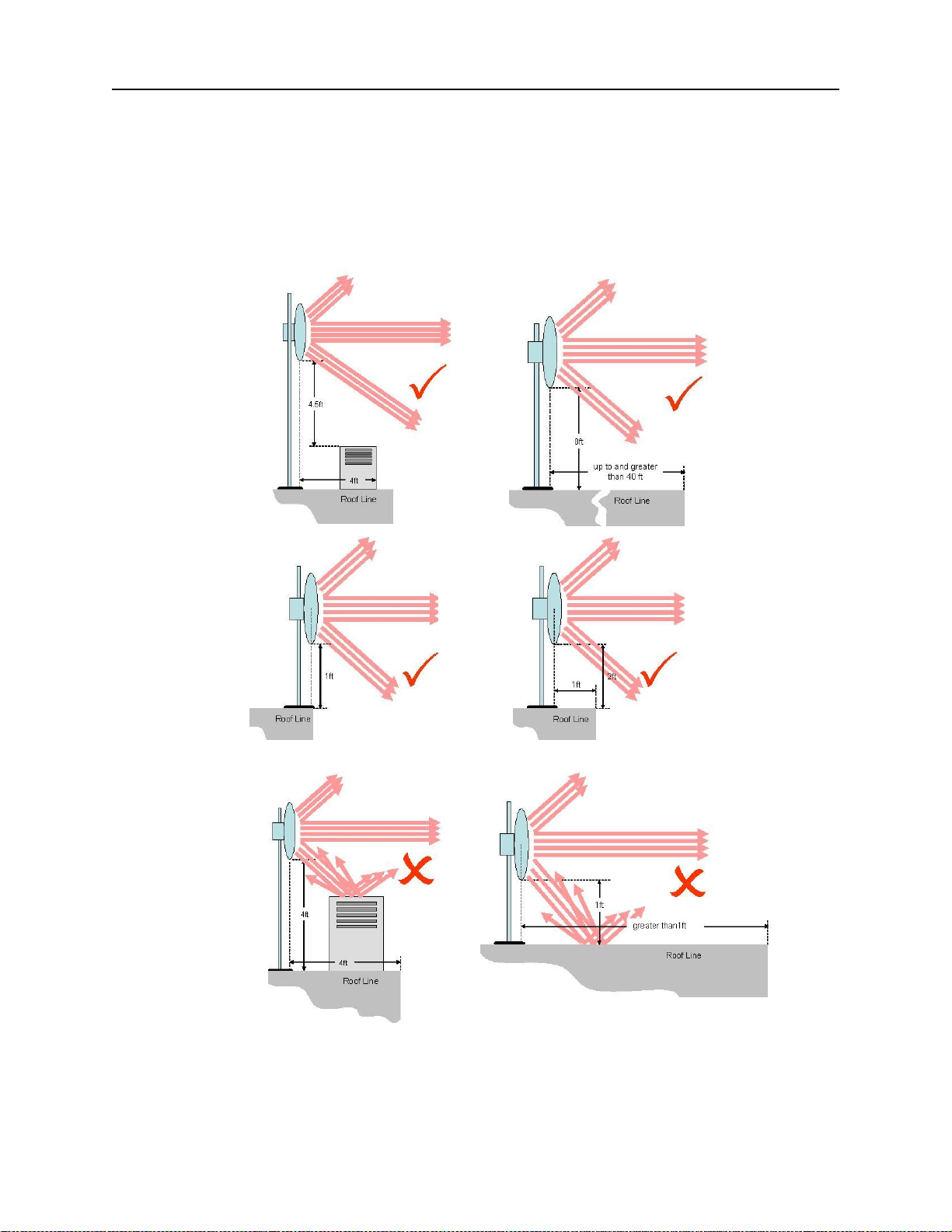
The following figures illustrate examples of correct and incorrect system location.
Figure 9-1 Correct & Incorrect System Location
Preparing for Alignment
51
Near field effects are also experienced above and on each side of the front of a system. Ensure that
these areas are also free of obstructions.
Horizon Compact Plus Release 1.0.1 Wireless Ethernet Product User Manual – Volume 1
Page 62
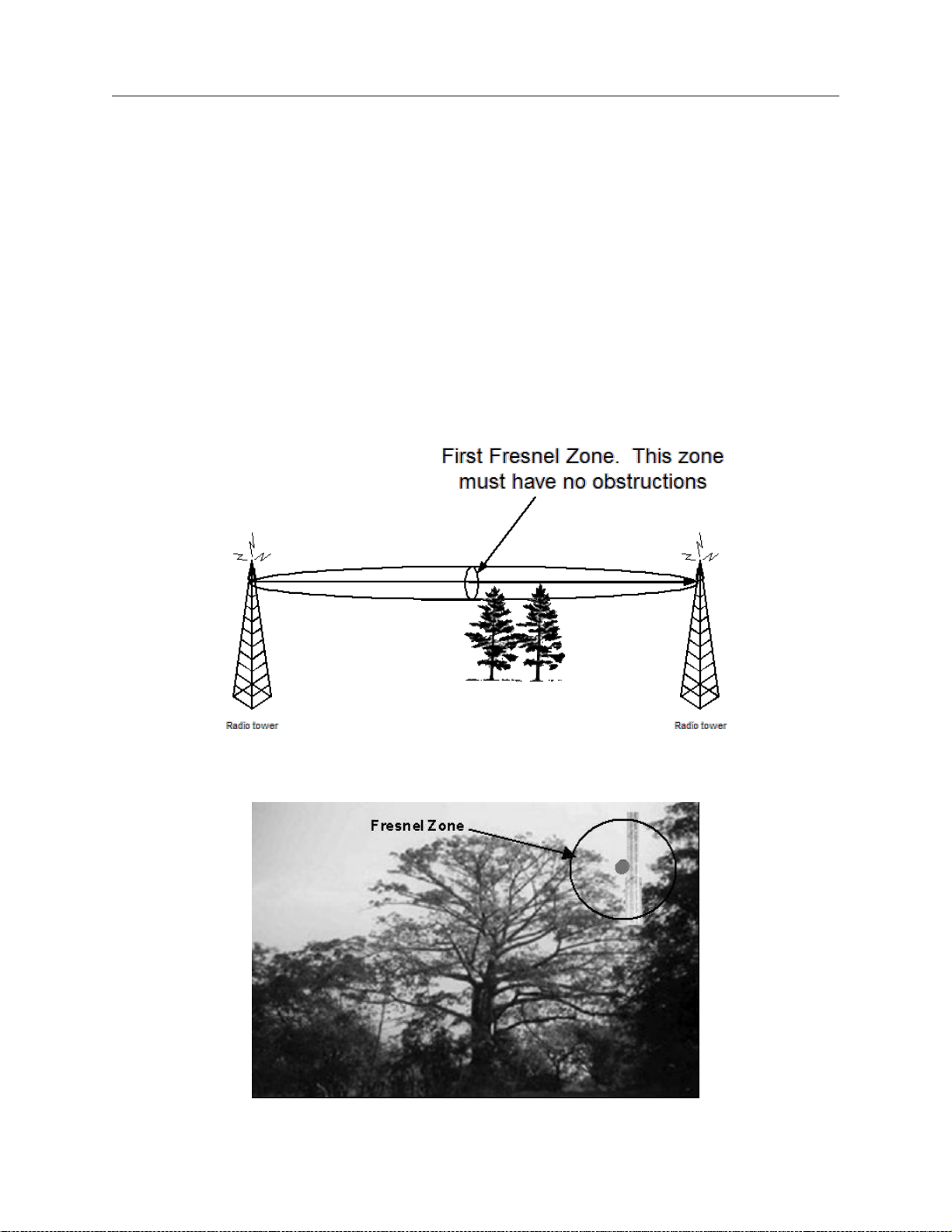
DragonWave Inc.
52
9.2 Clear Line of Sight (LoS)
The DragonWave Horizon Compact Plus requires a clear LoS between the units at each end of the link.
You must be able to see an unobstructed view of the antennas from each end. Avoid obstacles that are
close to the LoS mid-way between antennas, but not blocking it, as this can have a negative impact on
signal quality (Fresnel zone clearance).
The Fresnel zone is an area of the antenna radiation pattern that lies mid way between the two system
antennas. The size of this area is dependant upon the frequency being used and the distance between
antennas. You should avoid having any obstructions within the Fresnel zone. Note that you may be able
to see the far end antenna without obstruction, but still have obstacles in the Fresnel Zone. Signal quality
will deteriorate if obstacles encroach too deeply into the Fresnel zone. Encroaching up to the 60% mark is
acceptable.
Also, ensure that antennas are mounted with adequate clearance from roof tops, roof edges, walls and
other obstacles (e.g. air conditioning plant) to avoid problematic near field effects.
Figure 9-2 Obstruction of the Fresnel Zone
Figure 9-3 Trees within the Fresnel Zone Obstruct the Signal
Horizon Compact Plus Release 1.0.1 Wireless Ethernet Product User Manual – Volume 1
Page 63

Preparing for Alignment
53
This page is left blank intentionally
Horizon Compact Plus Release 1.0.1 Wireless Ethernet Product User Manual – Volume 1
Page 64
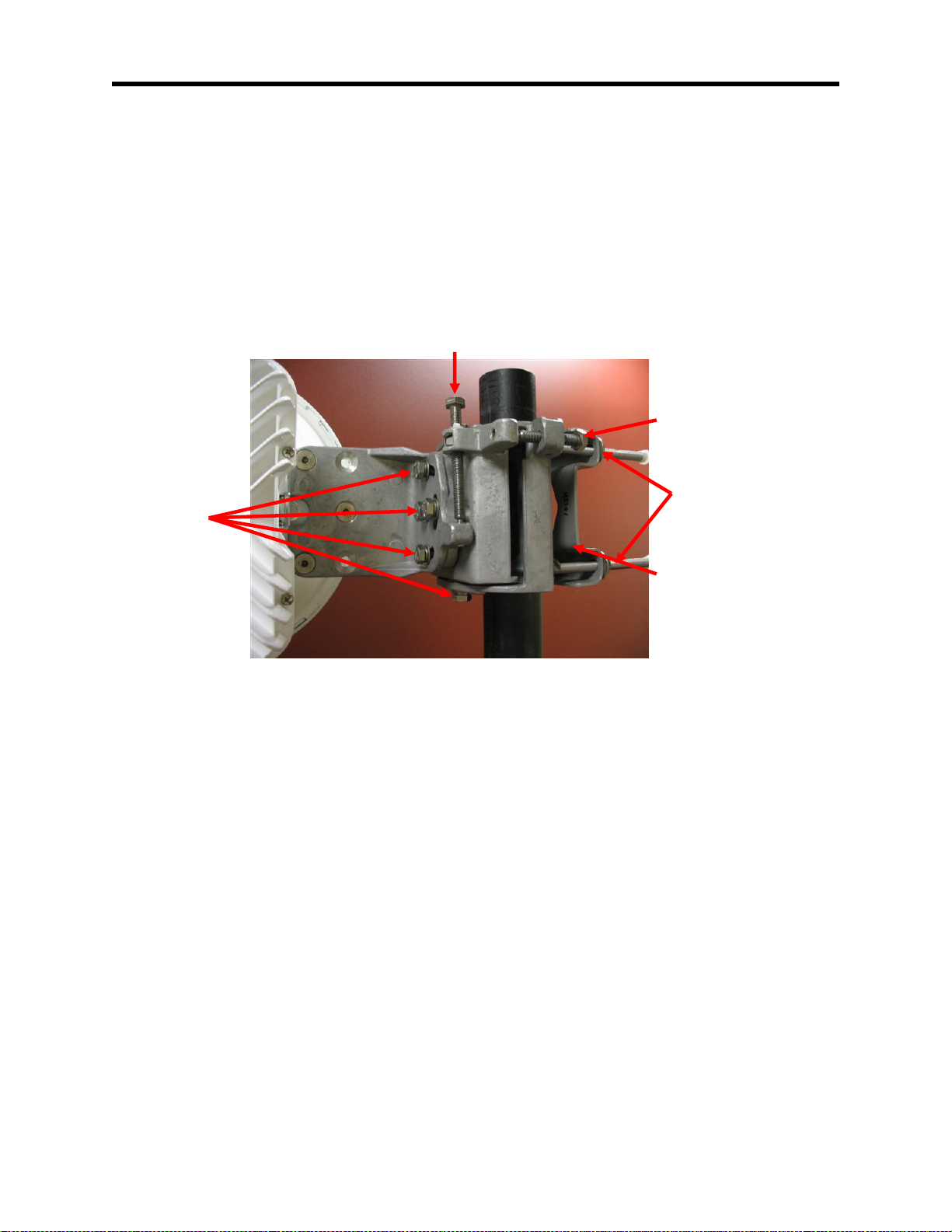
Mounting clamp
Azimuth adjustment
Elevation adjustment
Lock nuts
Mounting clamp nuts
10.0 Preparing for Alignment
The Horizon Compact Plus and antenna assembly is attached to the mounting post, or tower, with a
specialized mounting bracket that allows fine orientation adjustment of the Horizon/antenna assembly.
The same mounting bracket is used for all antenna sizes.
Visual alignment is achieved by rotating the assembly on the post, or tower, and positioning the assembly
so that the antenna is visually aligned with the target system before tightening the mounting bracket
clamp. Final alignment is achieved using the azimuth and elevation adjustment bolts. Once alignment is
achieved, the adjustment mechanisms are locked in place with lock nuts.
Figure 10-1 Mounting bracket with fine adjustment bolts
Final alignment is achieved by monitoring the received signal level (RSL) values as the system is
adjusted for azimuth and elevation. The BNC Field Strength Monitor connection is used in conjunction
with a voltmeter for RSL monitoring. See Section 10.1. Adjustments are made until the RSL value is at a
maximum, which should be within ± 3 dB of the expected value (link budget figure).
10.1 Received Signal Level (RSL) Measurements
To accurately align the Horizon Compact Plus to its far end peer, you need to monitor the received signal
level (RSL). There are two recommended methods for monitoring RSL. These are:
1. Use the CLI command set alignment on to activate the alignment feature at the BNC
connector located on the side of the unit. Connect a voltmeter to the BNC connector. The
voltage at this connector is linearly related to RSL and is 1 mV per dB e.g. -45 mV = -45 dB.
Note that the centre connection on the BNC connector is positive, so to read negative values
(to correlate with the negative RSL values) connect the negative pole of the voltmeter to the
centre connection.
Horizon Compact Plus Release 1.0.1 Wireless Ethernet Product User Manual – Volume 1
Page 65
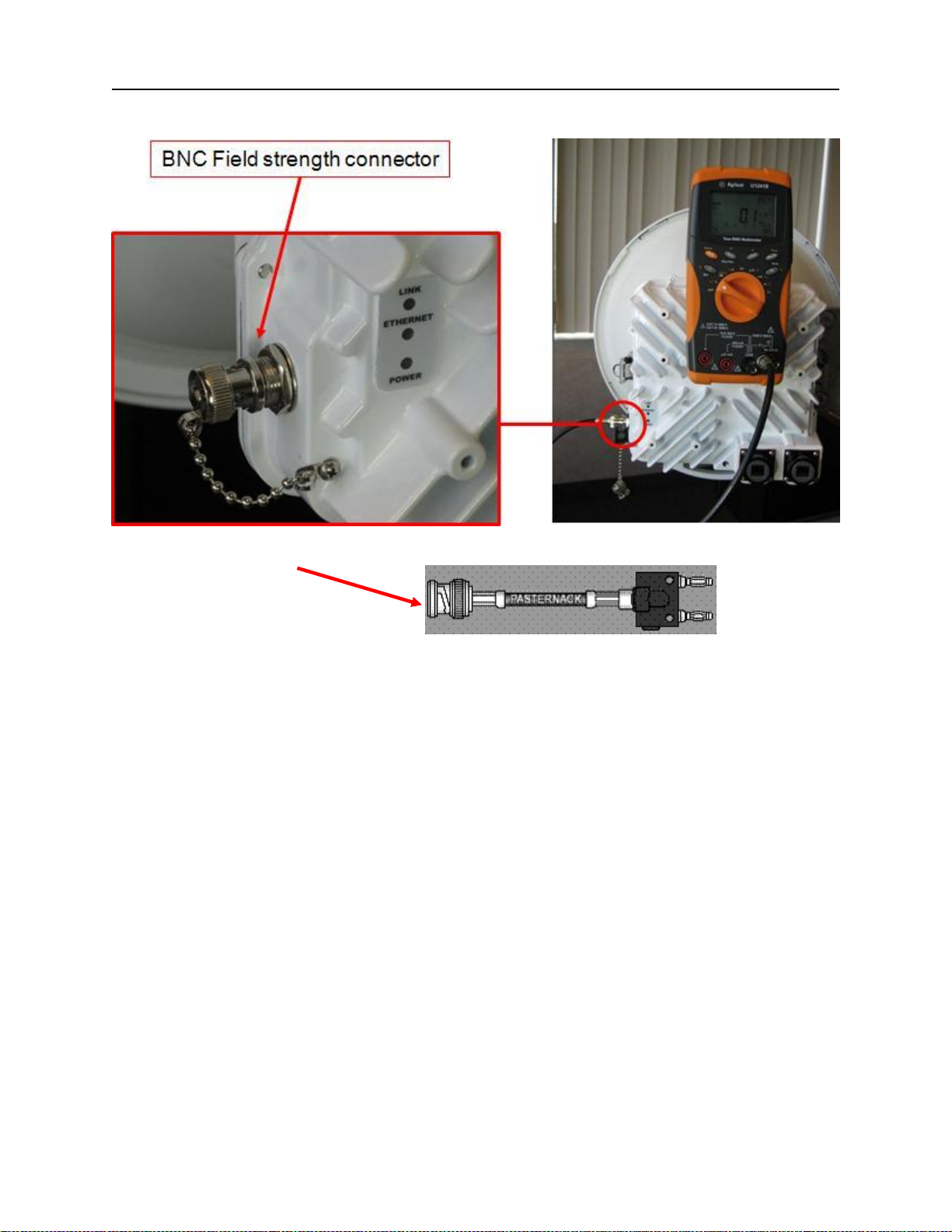
Preparing for Alignment
BNC to banana
55
jacks cables are
available from
DragonWave
Figure 10-2 Voltmeter connections to BNC field strength monitoring connector
2. Alternatively, readings can be made remotely via the Web interface, using the Tools – Link
Alignment menu option. An operator would then have to continually relay RSL readings, via a
radio or cell telephone, to the rigger adjusting the positioning of the system.
Horizon Compact Plus Release 1.0.1 Wireless Ethernet Product User Manual – Volume 1
Page 66
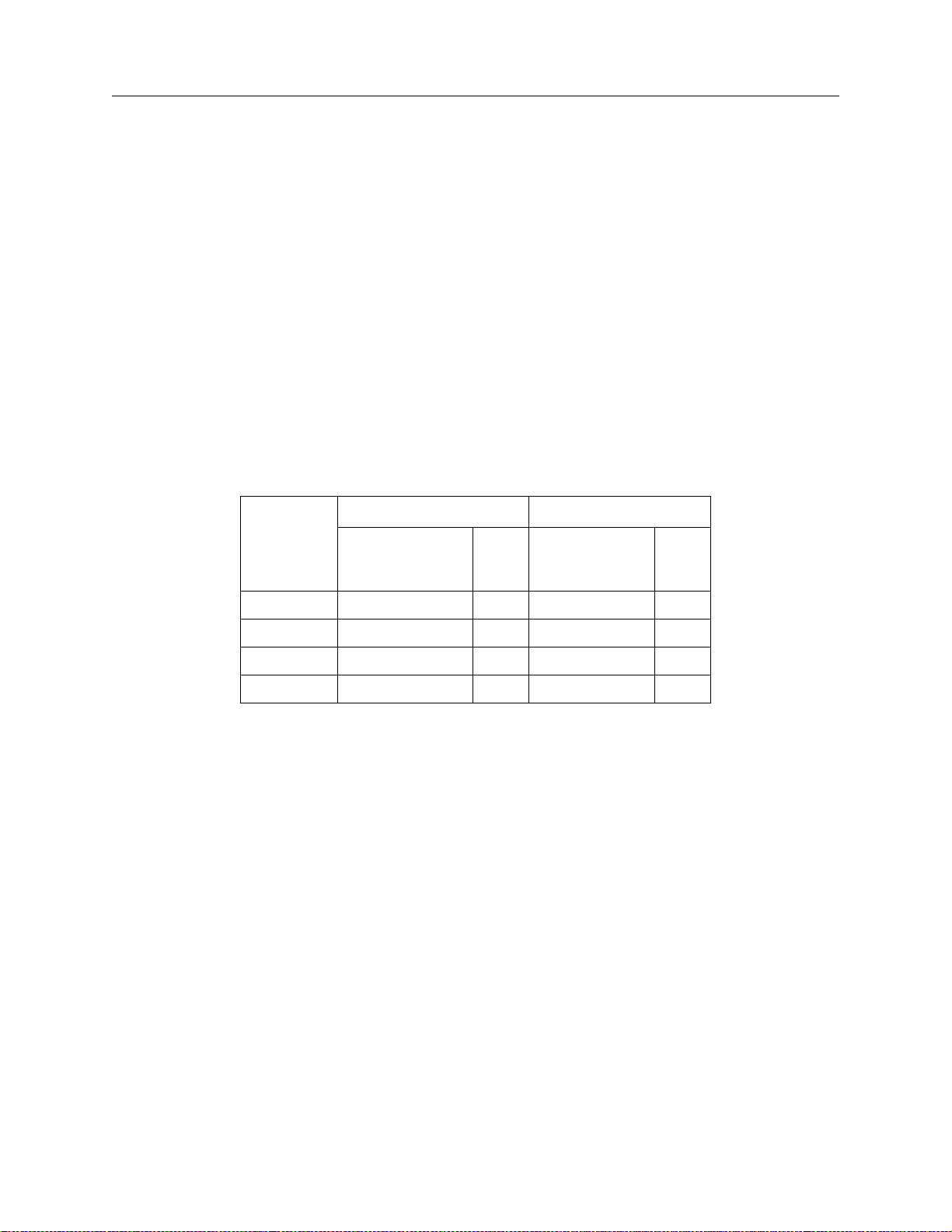
DragonWave Inc.
Antenna
Size
18 GHz Horizon
23 GHz Horizon
Beamwidth of
main lobe
(degrees, 3 dB)
Gain
dBi
Beamwidth of
main lobe
(degrees, 3 dB)
Gain
dBi
30 cm/12”
3.0 degrees
34
2.7 degrees
35.1
60 cm/24”
2.0 degrees
38.6
1.7 degrees
40.2
90 cm/36"
1.3 degrees
42.0
1.1 degrees
43.7
120 cm/48”
1.0 degrees
44.5
0.8 degrees
46.2
56
10.2 Important Factors
When you prepare to align the radio antennas, you must consider three important factors:
1. the radiation patterns of dish antennas (main lobe and side lobes)
2. the need for a Clear Line of Sight (LoS) (see Section 0)
3. the sensitivity of the alignment adjustment
10.2.1 Antenna Radiation Patterns
Dish antennas radiate a primary signal (main lobe) and a number of secondary signals (side lobes). The
main lobe is the strongest. When you align the radios, you must make sure to align to the main lobe of the
signal. If you mistake the first side side lobe for the main lobe during installation, there can be a 20-30 dB
loss of signal strength. For example, if the Calculated RSL = -42 dB then the side lobe would be at
approximately -62 dB, or 20 dB lower than the calculated level.
Table 10-1 Antenna Gains and Beam Widths – Selected Frequencies
Although in most cases only the first two side lobes are detected, depending on dish antenna size and the
distance between sites, it may be possible to “see” several side lobes (see Figure 10-3).
It is wise to pan the full 35 degrees available with the antenna alignment adjustment to locate all the lobes
that may be present, so that the main lobe can be positively identified. As you pan through the signal, the
side lobes will show up as peaks in the receive signal level (RSL), each peak getting stronger as you
approach the main lobe. The main lobe will always be the strongest.
The size of the beamwidth for the Horizon Compact Plus systems is approximately 2 degrees. Two
degrees is approximately equivalent to a thumb's width when one’s arm is fully extended. Align as closely
to the centre of the 2-degree beamwidth as possible. It takes very little adjustment to swing past the main
lobe, as can be seen in Figure 10-5. A beamwidth of 2 degrees is very narrow and alignment errors can
occur when you lock onto a side lobe instead of onto the main lobe. If you align to one of the side lobes,
your signal strength will be reduced. Make sure you align the system to the main lobe.
Note: Verify the RSL is within 2 – 4 dB of the calculated value.
Horizon Compact Plus Release 1.0.1 Wireless Ethernet Product User Manual – Volume 1
Page 67
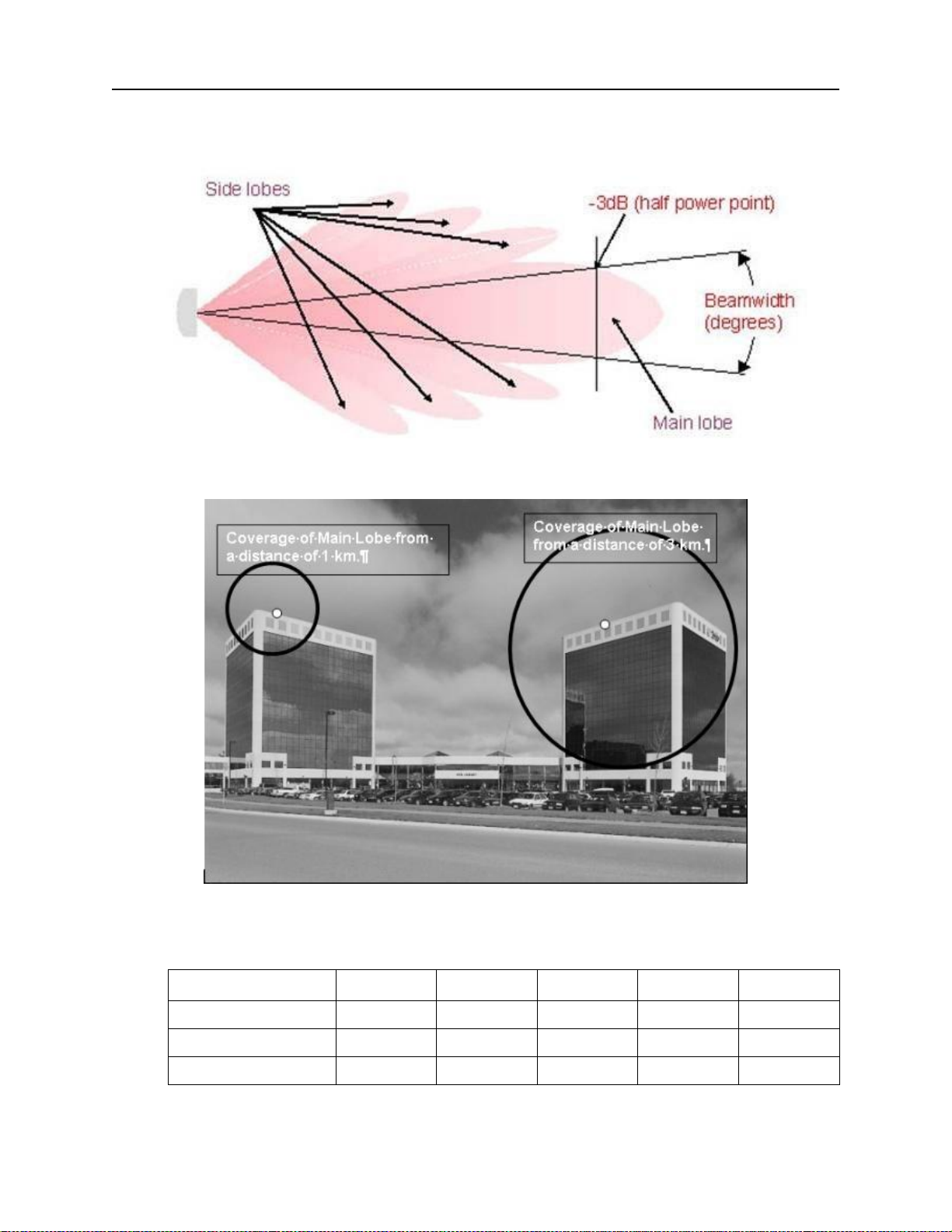
Preparing for Alignment
Beamwidth
1 km
3 km
5 km
8 km
10 km
2˚
(18/24” antenna)
35m
105m
175m
280m
350m
1.3˚ (36” antenna)
23m
68m
114m
182m
227m
1˚ (48” antenna)
18m
54m
90m
144m
175m
Figure 10-3 Main and Side Lobes
Figure 10-4 Typical main lobe coverage using 23 GHz Radio with 24” dish antenna
57
Table 10-2 Approximate size of beam at destination
Horizon Compact Plus Release 1.0.1 Wireless Ethernet Product User Manual – Volume 1
Page 68

DragonWave Inc.
Antenna Size
Change in Elevation (Tilt)
Change in Azimuth (Pan)
30 cm/12” and
60 cm/24”
2.2 º per full turn of adjustment
1.6 º per full turn of adjustment
90 cm/36” and
120 cm/48”
1.3 º per full turn of adjustment
1.1 º per full turn of adjustment
58
Figure 10-5
Main lobe and side lobes (distance of approximately 4 km)
10.2.2 Clear Line of Sight
See Section 9.2 for more details.
10.2.3 Sensitivity of the Alignment Adjustment
When performing the RF alignment of the antennas it cannot be over emphasized that you must
rotate the adjustment nut(s) 1/10th of a turn at a time between taking RSL readings (allow time for
the RSL reading to update). Table 10-3 shows how many degrees the antenna will move when the
adjustment nut(s) is rotated through one full turn. Error! Reference source not found.Table 10-1
shows that the beam width of the typical antenna is often less than the amount of movement available
with one full turn of the aiming adjustment.
Table 10-3 Degrees per Revolution of Adjustment
Horizon Compact Plus Release 1.0.1 Wireless Ethernet Product User Manual – Volume 1
Page 69

Preparing for Alignment
59
This page is left blank intentionally
Horizon Compact Plus Release 1.0.1 Wireless Ethernet Product User Manual – Volume 1
Page 70

Bolt size (in inches)
Nut torque
¼
50 in-lb
5/16
102 in-lb
3/8
15 ft-lb
7/16
24 ft-lb
½
37 ft-lb
9/16
37 ft-lb
11.0 Aligning the Antennas
Follow the steps of the alignment procedure shown below. Note: ensure that the CLI command set
alignment on has been entered at both ends of the link if you are using the BNC connector to measure
field strength.
The alignment process is carried out in two stages.
1. Visual alignment of the antennas
2. Radio frequency alignment of the antennas
11.1 Visual Alignment of the Antennas
This section details how to align the Horizon Compact Plus antennas visually.
Procedure 11-1
Align the antennas visually
Before attempting to visually align the Horizon Compact Plus systems, make sure that the aiming
adjustment mechanisms (pan and tilt) on the mounting assembly are set to their mid positions. This
ensures that there is adequate to and fro movement available from the adjustment mechanism for fine
adjustment later. To visually align, loosen the clamping nuts and rotate the mounting assembly clamp on
the mounting pole, then, securely tighten the clamp.
There are three methods that are recommended for visually aligning the systems. In each case the use of
signaling mirrors, on a sunny day, or a powerful flashlight for dull days, may greatly assist in locating the
other end of a link.
1. If the far end site is visible, aim the near end dish/reflector towards the far end site as
accurately as possible. The beamwidth of the signal is approximately 2 degrees (or less), which is
approximately equivalent to a thumb's width when the arm is fully extended. Align as closely to
the centre of the 2-degree beamwidth as possible. Clamp the radio/antenna mounting brackets in
place on the pole/tower torquing the nuts to specification. See Table 11-1 for torque values.
Repeat this for the far end site. This should provide you with a signal strong enough to perform an
accurate alignment later.
2. If the far end site is NOT visible (due to poor visibility), and the site locations appear on a
map, use a large scale map of the area and mark the positions of each end of the link. Draw a
line on the map between each of the ends of the link. Locate a landmark which falls on the line
that is visible from the near end and point the dish/reflector to the landmark. Clamp the
radio/antenna mounting brackets in place on the pole/tower torquing the nuts to specification. See
Table 11-1 for torque values. At the far end of the link locate a second landmark, visible from the
far end, that falls on the line and align the far end dish/reflector to that landmark. Clamp the
mounting bracket as before. The systems should be aligned sufficiently to obtain a signal strong
enough to perform an accurate alignment later.
Table 11-1
Torque Specifications for Antennas
Horizon Compact Plus Release 1.0.1 Wireless Ethernet Product User Manual – Volume 1
Page 71
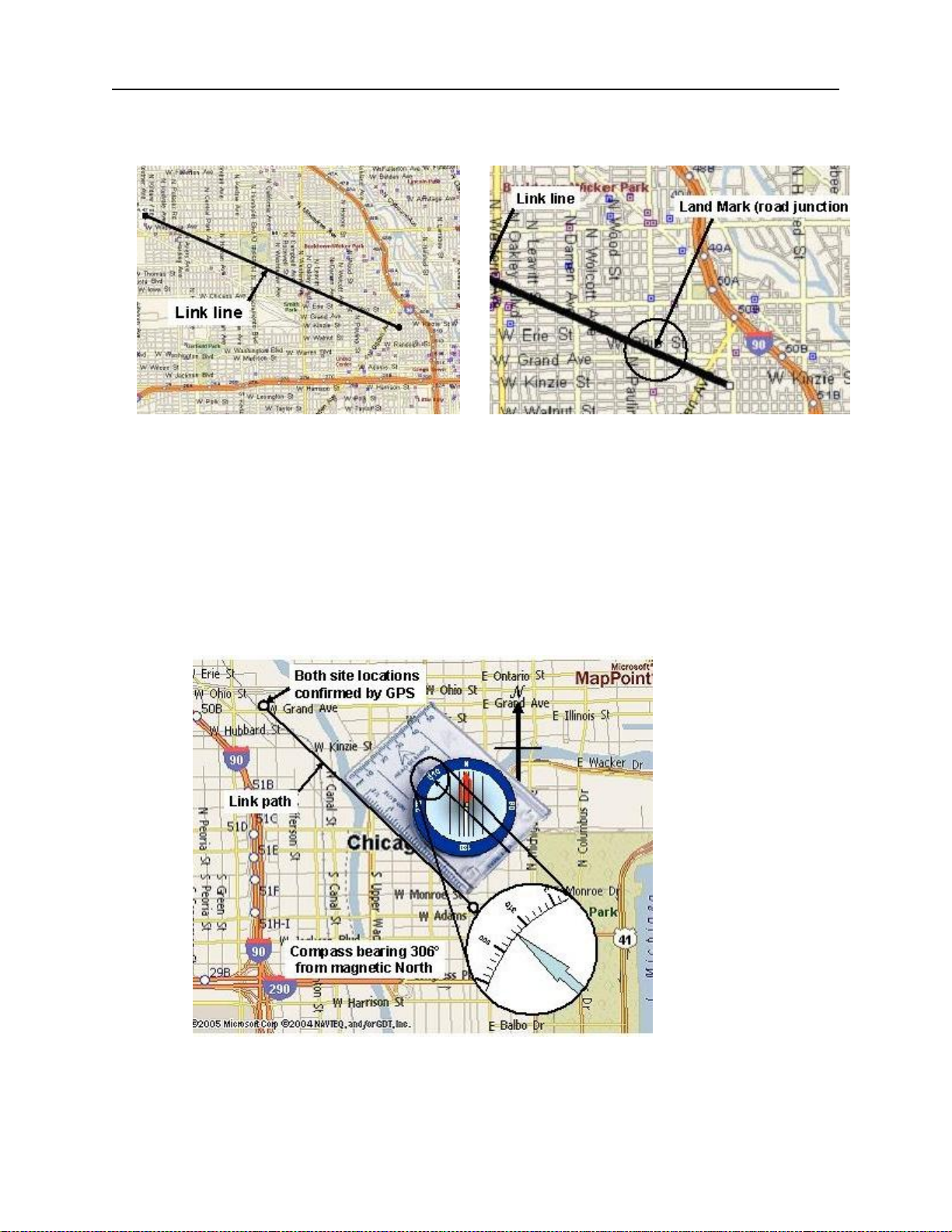
Preparing for Alignment
Figure 11-1
Aligning Systems Using Local Landmarks
3. If the far end site is NOT visible (due to poor visibility), and there are no visible land marks,
use a GPS unit to obtain accurate coordinates for each end of the link. Plot these on a map of the
area and draw a line between each site. Using a compass, physically align the map so that the
magnetic North compass bearing marked on the map coincides with actual magnetic North
shown on the compass. Use the compass to measure the bearing of the line drawn between each
site relative to magnetic North. At each end of the ink, use this compass bearing to aim your
systems. Clamp the radio/antenna mounting brackets in place on the pole/tower torquing the nuts
to specification. See Table 11-1 for torque values. The systems should be aligned sufficiently to
obtain a signal strong enough to perform an accurate alignment later.
61
Figure 11-2
Using GPS and Compass Bearings to Align Systems
This concludes the steps to align the radios visually.
Horizon Compact Plus Release 1.0.1 Wireless Ethernet Product User Manual – Volume 1
Page 72
DragonWave Inc.
Caution
Alignment of the Horizon Compact Plus requires power to be supplied to
the PonE and surge protector unit.
Caution
Proper alignment results in increased signal quality! Once the Horizon
Compact Plus units have been visually aligned, detailed alignment can
begin. Pan across the entire beamwidth to ensure the alignment
corresponds to the main lobe and not to a Side Lobe.
Caution
Transmission of radio signals results in a primary signal (main lobe) and
secondary signals (side lobes) being sent towards the destination.
During installation the side lobes can be mistaken for the main lobe,
resulting in a 20-30 dB loss of signal strength. On a 12” / 30 cm
dish/reflector, the entire beamwidth typically lies within a 5–degree span
so it is critical to ensure alignment targets the main lobe and not the side
lobes. Larger dish/reflectors have a narrower beam. For a 24”/60 cm
dish/reflector, the entire beamwidth lies within a 3–degree span.
Caution
It is possible to get a “peak” reading during the system alignment
process if one or both of the systems is aligned to a side lobe. In such a
case, the measured receive level may be 20 dB or more lower than the
callculated value. Be aware that the link may still function under these
circumstances. If the readings are within 2 - 4 dB of the calculated levels,
then the systems are most likely to be properly aligned.
62
11.2 Radio Frequency (RF) Alignment of the Antennas
This section describes how to perform the RF alignment of the Horizon Compact Plus systems antennas.
Note: The Horizon Compact Plus BNC Field Strength connector serves two purposes. It is used for RF
alignment and for system redundancy purposes. When used for RF alignment it provides an output
voltage of 1 mV DC per dB of signal strength. Connecting a digital voltmeter to this connector will provide
you with a convenient way of measuring field strength and confirming system RF alignment. Use the CLI
command set alignment on press Enter, to enable the field strength measuring option. When used for
redundancy purposes (not supported in this release) ensure that the CLI command set alignment off is
used.
The DragonWave Horizon Compact Plus Web Interface may also be used for RF alignment. From the
Home page, select Tools, then Link Alignment. The RSL readings displayed are continuously updated
and the highest value reached is retained to facilitate the alignment procedure.
When you prepare to align the systems, you must consider the three important factors noted in Section
10.2 and repeated below:
1. The radiation pattern of the Horizon Compact Plus antennas (main lobe and side lobes)
2. The need for a Clear Line of Sight (LOS) and avoiding the Fresnel zone
3. The sensitivity of the alignment adjustment – one tenth of a turn at a time
Horizon Compact Plus Release 1.0.1 Wireless Ethernet Product User Manual – Volume 1
Page 73

Preparing for Alignment
incorrect antenna alignment - aligned to a side lobe and not main lobe
improper polarization of antennas – one end horizontal and the other vertical
path issues - obstructions such as trees, hills, or buildings within the beamwidth
path clearance issues such as diffraction, partial obstruction, Fresnel zone issues
63
Follow the steps of the alignment procedure shown below:
Note: When loosening pan and tilt lock nuts, loosen only enough to allow the mechanism to move freely.
If lock nuts are too loose the antenna will move out of alignment when the lock nuts are re-tightened.
At the first end:
1. Loosen the pan mechanism lock nuts
2. Pan or move the antenna horizontally across the entire range of adjustment to identify
the main lobe and the side lobes. The main lobe is approximately 2 degrees in width
(depends on frequency and antenna size). The two major side lobes are approximately 5
degrees apart. Adjust the antenna to the main lobe (approximately).
3. Tighten the pan mechanism lock nuts and loosen the tilt mechanism lock nuts.
4. Tilt or move the antenna vertically until you receive the strongest RSL reading.
5. Tighten the tilt mechanism lock nuts and loosen the pan mechanism lock nuts.
6. Pan or move the antenna horizontally to locate each of the lobes. Record the RSL
values of each. Select the strongest RSL recorded and readjust the antenna to this
strongest RSL reading.
7. Re-tighten the pan/tilt mechanism lock nuts to lock the antenna in place.
At the other end:
8. Repeat steps 1 through 7
Return to the first end:
9. Loosen the pan mechanism lock nuts.
10. Pan or move the antenna horizontally across the entire range of adjustment to identify
the main lobe and the two major side lobes. Adjust the antenna to the main lobe
(approximately).
11. Tighten the pan mechanism lock nuts and loosen the tilt mechanism lock nuts.
12. Tilt or move the antenna vertically until you receive the strongest RSL reading.
13. Tighten the tilt mechanism lock nuts and loosen the pan mechanism lock nuts.
14. Pan or move the antenna horizontally and locate the strongest RSL reading.
15. Re-tighten the pan/tilt mechanism lock nuts to lock the antenna in place.
16. Repeat steps 1 through 15 as necessary to obtain maximum RSL reading.
The RSL level should be within ±3 dB of predicted levels. Factors that contribute to low RSL levels are:
Horizon Compact Plus Release 1.0.1 Wireless Ethernet Product User Manual – Volume 1
Page 74

DragonWave Inc.
No alarms – use the CLI command get alarms and press Enter to return a list of current alarms –
should be none that cannot be explained by network status
Received signal level (RSL) within ±3 dB of link budget figure in clear weather. Use the CLI
command get modem statistics and press Enter to obtain the RSL reading. The Unchannelized
power reading should be within 6 dB of the RSL reading. If the Unchannelized power drops
below -75 dB, then it is likely that there is no signal being presented at the radio portion of
Horizon Compact Plus. Check alarms.
Eb/No of 19 dB or higher – use the CLI command get modem statistics and press Enter to
display the Eb/No value
Signal to Noise Ratio (SNR) of 24 dB or higher – use the CLI command get modem statistics
and press Enter to display the SNR value
Equalizer Stress typically between 20 and 30, but never more than 150 - use the CLI command
get modem statistics and press Enter to display the Equalizer stress value
Rx Block Error Rate 0.00e+00 – use the CLI command get traffic statistics and press Enter to
display the Rx Block Error Rate. Rx Block errors are an indication of loss of data frames. Note
that there are residual Rx Block errors as a result of the alignment process.
Transmit power typically set at the maximum for the radio band used – use the CLI command get
transmit power and press Enter to return the configured transmit power and the actual transmit
power
All sections operational – use the CLI command get health and press Enter to return the health
status of all three sections of the system
64
11.3 Signs of a Healthy Link
You can be confident that a link is properly aligned and free of problems if the following readings are
obtained during a Telnet or Web interface session with each end of the link :
The readings obtained using the CLI commands during a Telnet session can also be retrieved using the
Web interface. All items listed here are available on the left-hand pane of the Web interface and appear
on each Horizon web page.
Horizon Compact Plus Release 1.0.1 Wireless Ethernet Product User Manual – Volume 1
Page 75

Preparing for Alignment
65
This page is left blank intentionally
Horizon Compact Plus Release 1.0.1 Wireless Ethernet Product User Manual – Volume 1
Page 76

Upgrade/Downgrade Licensed Features*
Rapid Link Shutdown (RLS) *
Configuring Ethernet Ports 1 and 2 *
Configuring the Time Source (SNTP) *
RADIUS Server User Authentication *
Adaptive Modulation *
Management VLAN Tagging *
System Management*
Quality of Service (QoS) *
Event and Performance Logging*
Pause Frames *
Radio and Network Loopback*
Bandwidth Management *
Network Management*
Adaptive Transmit Power Control (ATPC) *
Editing System Configuration Files*
Authentication *
EOAM **
Threshold Alarms *
LLDP **
ECFM **
12.0 Advanced Configuration Features
DragonWave Horizon Compact Plus has a number of optional advanced configuration features that may
be applied if desired. It is recommended that they only be applied once the Horizon Compact Plus is
satisfactorily aligned and successfully carrying traffic. The following lists the available configurable
features:
Detailed configuration information for each can be found in the Horizon Compact Plus Product Manual
* Volume 2 - Advanced Features
** Volume 4 - Networking Features
Horizon Compact Plus Release 1.0.1 Wireless Ethernet Product User Manual – Volume 1
Page 77

Advanced Configuration Procedures
67
This page is left blank intentionally
Horizon Compact Plus Release 1.0.1 Wireless Ethernet Product User Manual – Volume 1
Page 78

Explicit Authentication Failed
Ethernet Port1 Link Down
Ethernet Port2 Link Down
Ethernet Speed Alarm
Dropped Ethernet Frame Threshold Exceeded
Bandwidth Utilization Threshold Exceeded
Modem hardware fault
Modem receiver loss of signal
Modem SNR below threshold
Modem programming error
Modem transmitter loss of sync
Modem equalizer stress above threshold
Radio RSL Below Threshold
SNTP Servers Unreachable
RLS Shutdown Activated
Tx power detector below threshold
Radio current out of limits
TempComp cal table not available
Radio temperature out of limits
ATPC Config Mismatch
ATPC auto-disabled (coordinated power exceeded)
RLS Mismatch
Frequency File invalid
AAM Config mismatch
AAM running on lowest modulation
Synthesizer Unlock
Partner Redundancy Mode Mismatch
Partner Configuration Mismatch
HSB Active on Secondary
HSB Override by User
HSB Cross Link Active
Hitless AAM Config Mismatch
Hitless AAM running on lowest modulation
Hitless AAM event
13.0 Horizon Compact Plus Management
The Horizon Compact Plus system can be fully managed locally or remotely. Horizon Compact Plus
supports Telnet access, SNMP management and a Web interface accessible through the IP network.
The entire Command Line Interface (CLI) command set is available through Telnet. The entire list of
system parameters is available through SNMP access. The Web interface provides access to system
configuration and performance parameters. In-band and out-of-band management options are available.
Refer to Volume 2 for detailed system management procedures.
13.1 Alarms List
Use the CLI command get alarms to display a list of active alarms. Alternatively, alarms are listed on the
Alarms page of the Web interface. Active alarms are clearly indicated.
The following list shows the various alarms available:
Horizon Compact Plus Release 1.0.1 Wireless Ethernet Product User Manual – Volume 1
Page 79

Horizon Management
69
This page left blank intentionally
Horizon Compact Plus Release 1.0.1 Wireless Ethernet Product User Manual – Volume 1
Page 80

14.0 Configuration Backup and Restore
Horizon Compact Plus provides a backup and restore facility for system configuration data and user
account data. The backup and restore uses an FTP server to transfer files. It is recommended to have
an FTP server at your network management site for use with the Horizon Compact Plus backup and
restore facilities. Note that the Super User or a noc user level can perform backup and restore functions.
14.1 System Configuration Backup
The Horizon Compact Plus system configuration can be saved to an FTP server as a text file. All system
configuration parameters are backed up, allowing the exact configuration to be replicated.
Log in as the Super User and use the CLI command:
config upload ftp://<ftpUserName>:<ftpPassword>@<ftpServerIp/<hcpConfigFileName>
press Enter.
Where <ftpUserName> is the user name for the ftp server
<ftpPassword> is the ipassword for the ftp server
<ftpServerIp> is the IP address of the ftp server
<hcpConfigFileName> is the name of the configuration file, which can be any name
Note that the above command will save the file in the root directory of the ftp server. Adding the path
information to the file name will allow you to save it in a specific directory on the ftp server.
14.2 System Configuration Restore
The Horizon Compact Plus system configuration can be retrieved from the FTP server on which it was
backed up. All system configuration parameters are restored, allowing the exact configuration to be
replicated.
Log in as the Super User and use the CLI command:
config download ftp://<ftpUserName>:<ftpPassword>@<ftpServerIp>/<hcpConfigFileName>
press Enter
Note that the command shown will retrieve the file from the root directory of the ftp server. Adding the
path information to the file name will allow you to retrieve it from a specific directory on the ftp server.
Configuration files can be edited (see Volume 2 of this manual). If the file is not in its proper format it will
be rejected. If the original file has been modified, the process will prompt for the user to confirm the
change and the user has the option to proceed or cancel the operation. If one of the configuration items
fails to load, the process will try to undo the previous changes. The last failed configured item and the last
failed undo item (if any) will be listed at the end of the process.
After a successful restore, finish with CLI commands save mib and reset system to reboot the system
and activate the restored configuration. Note that reset system is traffic affecting.
Horizon Compact Plus Release 1.0.1 Wireless Ethernet Product User Manual – Volume 1
Page 81

Configuration, Backup and Restore
71
14.3 User Accounts Backup
The Horizon Compact Plus system user accounts can be saved to an FTP server. All user account
parameters are backed up, allowing the exact configuration to be replicated.
Use the CLI command: save users ftp:<filename> press Enter
where <filename> is the name of the file to be created on the FTP server. Follow the prompts.
Note that the above command will save the file in the root directory of the ftp server. Adding the path
information to the file name will allow you to save it in a specific directory on the ftp server.
14.4 User Accounts Restore
The Horizon Compact Plus system user accounts can be retrieved from an FTP server. All user account
configuration parameters are restored, allowing the exact configuration to be replicated.
Use the CLI command: copy ftp: <filename> press Enter
where <filename> is the name of the file to restore to the Horizon Compact Plus.
Note that the above command will retrieve the file from the root directory of the ftp server. Adding the path
information to the file name will allow you to retrieve it from a specific directory on the ftp server.
Horizon Compact Plus Release 1.0.1 Wireless Ethernet Product User Manual – Volume 1
Page 82
STEP
PROCEDURE
1
download HorizonCompactPlus_1.0.0.
2
download frequencyfileHCP_x.xx.xx.txt
3
reset system
4
repeat steps at other end of link
15.0 Software Upgrades
From time to time new software loads are made available that may add new features to the Horizon
Compact Plus system. You can download new software remotely using File Transfer Protocol (FTP). New
modem software and frequency files may also be released. Note that whereas a new software upgrade
may function with an existing frequency file, an upgraded frequency file may not function with an older
software release. Because of this, it is wise to always upgrade software before upgrading to a new
frequency file.
Use the Command Line Interface (CLI) via Telnet and invoke the FTP with either a local FTP server that
is on the same network as the Horizon Compact Plus system, or use the DragonWave FTP server site
available through the Internet. The Horizon Compact Plus can interact with the most popular FTP servers
on a variety of operating systems. Anonymous FTP, as well as a user–supplied username and password
are supported. As an alternative, DragonWave Merlin may be used.
15.1 Upgrade Path
Depending on the software load currently running in the system, there may be a requirement to load more
recent versions before being able to load the latest software version successfully. Frequency file
downloads will also be required to enable all new features. Certain existing features may also need to be
disabled before software downloads are performed in order for them to be successfully upgraded.
Use FTP protocol to download all files (see Section 15.2). If using Merlin, use the FTP Software Upgrade
option. Do NOT use the MAC (layer 2) Protocol option.
Referring to the steps shown in Table 15-1, use the following procedure:
Table 15-1 Software Upgrade Path
15.2 Single System
Log into the system via Telnet and use the CLI command copy ftp: <filename> and press Enter. Where
<filename> is the name of the software load file in the format HorizonCompactPlus_x.y.z. and includes
any path information.
You will be prompted for the IP address of the FTP server. The FTP server will then prompt you for user
name and password.
1. Once the download is complete you will need to use the CLI command save mib and press
Enter. The new software is now saved in non volatile memory, but not yet in use.
2. Note that traffic is not affected during the software download process.
3. To make the new software load active requires the system to be reset. This is traffic
affecting.
4. To activate the new software load use the CLI command reset system and press Enter.
Then press Y. The system will reset and load the new software.
Horizon Compact Plus Release 1.0.1 Wireless Ethernet Product User Manual – Volume 1
Page 83

Software Upgrades
73
15.3 Multiple Systems
DragonWave Merlin software can be used to upgrade several systems in a network simultaneously using
FTP..
The number of systems capable of being upgraded simultaneously is limited only by the number of active
FTP sessions allowed by the on-net FTP server.
Horizon Compact Plus Release 1.0.1 Wireless Ethernet Product User Manual – Volume 1
Page 84

Appendix A – CLI Command List
?
change password
clear atpc log
clear ecfm errors [domain <domain-name(1..20)>
| levelid <level-id(0-7)>][switchname
<context_name>]
clear ecfm frame delay buffer [switchname
<context_name>]
clear ecfm loopback cache [switchname
<context_name>]
clear ecfm maintenance-points remote [ {domain
<domain-name(1..20)> | levelid <level-id
(0-7)>}][switchname <context_name>]
clear ecfm mip-ccm-database [switchname
<context_name>]
clear ecfm statistics [port <num<1-1>] [level<level id(0-7)>] [vlan <vlan-id(1-4094)>]]
[switchname <context_name>]
clear ecfm traceroute-cache [switchname
<context_name>]
clear port eoam config [port <num(1-2)>]
clear port eoam event-log [port <num(1-2)>]
clear port eoam fault-management mib-variable
response [port <num(1-2)>]
clear port eoam statistics [port <num(1-2)>]
copy [ftp:fileName]
create ssl certificate
delete ecfmmib [newest|both]
delete mib [newest|both]
delete radius server [index]
delete user
diagnose aam
diagnose haam [up/down]
downgrade system licensed speed
ecfm frame delay [start | stop] type {one-way | two way }level <level-id(0-7)> [vlan <vlan-id(0-7)>]
[port <port-num>] [direction {inward |
outward}]{mepid <mpid(1-8191)> | mac
<aa:aa:aa:aa:aa:aa>}
[count<num_of_observations(1-8192)>]
[interval <milliseconds(10-10000)>] [deadline
<seconds(1-172800)>] [switchname
<context_name>]]
ecfm ping ethernet mac {<aa:bb:bb:bb:bb:bb> |
multicast } {domain <domain-name(1..20)> |
level <level-id(0-7)>} [vlan <vlan-id(1-4094)>]
[interface <interface-number>] [direction
{inward | outward}] [data-pattern <string> | test pattern null-signal-without-crc | null-signal-with crc | prbs-without-crc | prbs-with-crc] [size
<pdu-size(64-1400)> | variable-bytes][interval
<milliseconds(1-600000)>] [count
<num_of_msgs(1-8192)>] [deadline
<seconds(1-172800)>] [switch <string(32)>]
ecfm ping ethernet mpid <id> {domain <domain name(1..20)> | level <level-id(0-7)>} [vlan
<vlan-id(1-4094)>] [interface <interface number>] [direction {inward | outward}] [data pattern <string> | test-pattern null-signal without-crc | null-signal-with-crc | prbs-without crc | prbs-with-crc] [size <pdu-size(64-1400)>
| variable-bytes][interval <milliseconds(1-
600000)>] [count <num_of_msgs(1-8192)>]
[deadline <seconds(1-172800)>] [switch
<string(32)>]
ecfm traceroute ethernet mac <aa:aa:aa:aa:aa:aa>
{domain <domain-name(1..20)> | level <level id(0-7)>} [vlan <vlan-id(1-4094)>] [time-to-live
<ttl-value(1-255)>]
ecfm traceroute ethernet mpid <id> {domain <domain name(1..20)> | level <level-id(0-7)>} [vlan
<vlan-id(1-4094)>] [time-to-live <ttl-value(1-
255)>]
erase log
erase performance log
exit
get aam eoam option
get aam link monitor parameters
get aam status
get alarms
get alarms counter
get alignment
get antenna diameter
get atpc config
get atpc log
get atpc status
get authenticated peer
get backup ipconfig
get bandwidth record admin
get bandwidth record average period
get bandwidth record brief
get bandwidth record current
get bandwidth record instance[0-59]
get bandwidth record logging
get bandwidth record reporting period
get bandwidth record thresholds
get bandwidth record verbose
get bandwidth utilization status
get bandwidth utilization threshold
get config commands
get cos default value
get cos ecfm flow mapping
get cos expedite queue
get cos qinq itag
get cos qinq otag
get cos queue cbs
get cos queue cir
get cos queue mapping
get cos type
get cos wfq weight
get date time
get default gateway
Horizon Compact Plus Release 1.0.1 Wireless Ethernet Product User Manual – Volume 1
Page 85

Appendix A – CLI Command List
75
get default ipconfig
get dropped frames threshold
get dw access
get ecfm configuration-errors [vlan <vlan-id(1-4094)>]
[interface <interface-id>] [switchname
<context_name>]
get ecfm default-domain [switchname
<context_name>]
get ecfm domain [brief | domain-number(1-32)]
[switchname <context_name>]
get ecfm error-log [domain <domain-name(1..20)> |
levelid<level-id(0-7)>] [unaware | vlan <vlan id(1-4094)>] [switchname <context_name>]
get ecfm errors [domain <domain-name(1..20)> |
levelid <level-id(0-7)>] [switchname
<context_name>]
get ecfm frame delay buffer [brief] [one-way | two way] [level <level-id(0-7)>][unaware | vlan
<vlan-id(1-4094)>] [interface <interface number>][mac <peer-mac-address>]
get ecfm global information[switchname
<context_name>]
get ecfm loopback cache [brief] [level <level-id(0-
7)>][unaware | vlan <vlan-id(1-4094)>]
get ecfm maintenance-point local [mep | mip]
[interface [<interface-number>] | domain
<domain_name> | level<id(0-7)>]
get ecfm maintenance-points local detail
{mpid<mepid(1-8092)> | mac
<aa:aa:aa:aa:aa:aa>} [domain <domain_name>
| level<level-id(0-7)>] [unaware | vlan
<integer(1-4094)>]
get ecfm maintenance-points remote [domain
<domain-name(1..20)> | levelid <level-id(0-7)>]
get ecfm maintenance-points remote crosscheck
[mpid <id>] [domain <domain-name(1..20)> |
level <level-id(0-7)>] [unaware | vlan<integer(1-
8191)>][{domain <string(20)> | level <integer(0-
7)>}][{unaware | vlan<integer(1-4094)>}] [switch
<string (32)>]
get ecfm maintenance-points remote detail {mpid id |
mac <aa:aa:aa:aa:aa:aa> }[domain <domain name(1..20)> | level <level-id(0-7)> [unaware |
vlan<vlan-id(1-4094)>]] [switchname
<context_name>]
get ecfm mip-ccm-database [vlanid <vlan-id(1-4094)>]
[macaddress <aa:aa:aa:aa:aa:aa>] [port <port id>]
get ecfm port [{port <port-number>}] [switchname
<context_name>]
get ecfm service [brief | service-number(1-32) ]
[switchname <context_name>]
get ecfm statistics [port <port-number> [level <level id(0-7)>][<vlan-id(1-4094)>]] [switchname
<context_name>]
get ecfm traceroute-cache
get enet address
get enet config
get enet speed alarm enable port1 | port2
get enet speed
get enet status
get eoam dwi-msg mode
get eoam fault-management global information
get eoam global information
get frequency bank
get frequency file status
get haam
get haam eoam option
get haam status
get haam system modes
get haam wtr
get health
get http secure access [Admin|Noc|Super]
get hw inventory
get install type
get ip address
get leds
get licensed speed count
get licensed speed downgrade information
get log entries
get logging
get maximum frame size
get modem modulation
get modem statistics
get network loopback
get network management interface
get network protocol strict
get omni file crc
get optical transmitter state
get pause state
get peer authentication failure action
get peer authentication group key
get peer authentication status
get peer authentication type
get peer authentication unique key
get performance log
get performance log interval
get performance logging
get port eoam event-log [port <1-2>]
get port eoam event-notifications [port <1-2>]
get port eoam fault-management config port <1-2>
get port eoam fault-management mib-variable
response port <1-2>
get port eoam fault-management remote-loopback
[port <1-2>] [current-session | last-session]
[detail]
get port eoam local information [port <1- 2>]
get port eoam loopback capability[port <1-2>]
get port eoam neighbour information [port <1-2>]
get port eoam statistics [port <1-2>]
get programmed frequency
get qos
get qos policy
get queue utilization threshold
get radio band
get radio loopback
get radio statistics
get radio status
get radio transmitter state
get radius server deadtime
get radius server retransmit
get radius server timeout
get radius servers
get radius super user authentication
Horizon Compact Plus Release 1.0.1 Wireless Ethernet Product User Manual – Volume 1
Page 86

DragonWave Inc.
76
get redundancy link monitor parameters
get redundancy link switch parameters
get redundancy mode
get redundancy override
get redundancy partner information
get redundancy standby enet state
get redundancy status
get rls
get rls link control
get rls link enable
get rls link monitor parameters
get rls make rsl
get rls port groups
get rls shutdown policy
get rls signal fault parameters
get rls status
get rsl threshold
get sessions
get snmp access mode
get snmp managers
get snmp set request
get snmp trap hosts
get snmp traps
get snmpv3 managers
get snmpv3 trap hosts
get snr threshold
get sntp
get sntp offset
get ssh server
get ssh server fingerprint
get ssl certificate status
get subnet mask
get super user
get sw inventory
get sw version
get synce config
get synce status
get syslog forwarding host
get syslog forwarding status
get system mode
get system speed
get system summary
get telnet access
get traffic statistics
get transmit power
get user accounts
get user session
get vlan tag
get vlan tagging
get web server
kill ssh sessions
list [ftp:file/directory/empty]
lo
ping [-w timeout][-n count][-t] abc.def.ghi.jkl
remove frequency indextable
reset [resource id]
save config [ftp:fileName]
save ecfmmib
save log [ftp:fileName]
save mib
save performance log [ftp:fileName]
save users [ftp:fileName]
set aam [state <on/off>][inter mode <on/off>][max Tx Pwr <on/off>]
set aam eoam option [state <on/off>]
set aam link monitor parameters
set aam mode [system mode name/default]
set aam time [time in mseconds]
set admin user
set alarms counter [0]
set alignment [On | Off]
set antenna diameter [index of diameter]
set atpc config [on|off] [on|off] [0-10]
set bandwidth record logging[on | off]
set bandwidth record thresholds[thresh] [thresh]
[thresh] [thresh] [thresh] [thresh] [thresh]
[thresh] [thresh] [thresh]
set bandwidth utilization threshold [threshold] [time
limit]
set cos default value [0 - 7]
set cos ecfm flow mapping [off|{on
QC|Q1|Q2|Q3|Q4|Q5}]
set cos expedite queue [on | off]
set cos qinq itag [protocol id]
set cos qinq otag [protocol id]
set cos queue cbs [committed burst size]
set cos queue cir [0 - 100, 0 - 100, 0 - 100, 0 - 100]
set cos queue mapping [1/2], ...
set cos type [cos_vlan | cos_qinq_itag |
cos_qinq_otag | cos_dscp | cos_mplsexp]
set cos wfq weight [weight]
set date time [dd/mm/yyyy hh:mm:ss:ms]
set default gateway [aaa.bbb.ccc.ddd]
set dropped frames threshold [threshold] [time limit]
set dw access[on | off]
set dynamic config change [on|off]
set ecfm [on | off | start]
set ecfm associate vlan-id {vlan-id | vlan-list} primary vlan-id <vlan-id(1-4094)>
set ecfm cc enable level [disable] {levelid | level-list}
[vlan {vlanid | vlan-list}]
set ecfm cc level {<level-id(0-7)> | level-list} {<default
[interval] [role]> | [vlan {<vlan-id(1-4094)> |
vlan-list}] [interval {ten-sec | one-min | ten min}]}
set ecfm ccm-unicast-mac <aa:aa:aa:aa:aa:aa>
set ecfm default-domain global levelid <(0-7)>
set ecfm default-domain vlan <integer(1-4094)>
([level<integer(0-7)>][mip-creation-criteria
{none | explicit | defer | default}][sender-id permission {none |chassis | manage | chassis mgt-address | defer }])
set ecfm disassociate vlan-id {vlan-id | vlan-list}
primary-vlan-id <vlan-id(1-4094)>
set ecfm domain <domain-name(1..20)> level <level id(0-7)> [delete]
set ecfm error-log [on | off] [size <entries(1-4096)>]
set ecfm mep archive-hold-time { <minutes(100-
65535) | default }
set ecfm mep crosscheck {on | off} levelid <level-id |
levellist> [vlan <vlan-id | vlanlist>] [switchname
<context_name>]
set ecfm mep crosscheck mpid <integer(1-8191)>
[delete|define] [vlan <integer(1-4094)>]
Horizon Compact Plus Release 1.0.1 Wireless Ethernet Product User Manual – Volume 1
Page 87

Appendix A – CLI Command List
77
set ecfm mep crosscheck start-delay {default}|{start delay<3-100>}
set ecfm mep level [<0-7> [delete] [inward] mpid
<id(1-8191)> [vlan<vlan-id(1-4094)>] [active]
set ecfm mep-capability level {<level-id(0-7)> | level list} [on|off] [vlan {<vlan-id(1-4094)> | vlan list}]([ping] [muliticast-ping] [one-way-frame delay] [multicast-test] [turnaround-delay][ais]
[rdi])
set ecfm mip ccm-database caching {enable | disable}
set ecfm mip ccm-database hold-time [<hours>(24-
48)]
set ecfm mip ccm-database size [<entries(1000-
10000)>]
set ecfm mip dynamic evaluation {enable|disable}
set ecfm mip level [delete] <level-id(0-7)> vlan <vlan id(1-4094)> [active]
set ecfm mip-creation-criteria {none | default | explicit}
set ecfm oui {<aa:aa:aa> | default}
set ecfm port port<1-1> {on|off}
set ecfm service <{[config] <service_name> [{icc
<icc_code> umc <umc_code>] [vlan <vlan-id(1-
4094)>] [mip-creation-criteria {none | default |
explicit | defer}] [sender-id-permission {none |
chassis | manage | chassis-mgt-address |
defer}]}>| <{delete <service_name>
set ecfm traceroute cache [ on|off | { holdtime { default
| <integer(1-65535)} }
set ecfm y1731 [on | off ]
set enet config
set enet speed alarm enable port1 | port2 on|off
set eoam [on | off]
set eoam dwi-msg mode [eoam | bypass-eoam]
set eoam fault-management [on | off | start]
set eoam link-monitor event-resend [count(1-10)]
set eoam oui [<aa:aa:aa> | default]
set haam[on/off]
set haam eoam option
set haam manual mode[on|off]
set haam wtr[duration]
set http secure access [Admin|Noc|Super] [on/off]
set ip address [aaa.bbb.ccc.ddd]
set ip config
set lo nulling [on/off]
set logging [on/off]
set network loopback [nearend | farend | off] macaddress <queue N> <timeout>
set network management interface
[p1–p4 or dp1–dp4]
set network protocol strict [on/off]
set noc user
set optical transmitter state [on/off]
set pause state [on/off]
set peer authentication failure [action]
set peer authentication group key [key]
set peer authentication type [authentication
type]
set peer authentication unique key [key]
set performance log interval [hr:min:sec]
set performance logging
set port eoam [port <1-2>] [on | off]
set port eoam fault indication [port <1-2>] [critical event | dying-gasp] [on | off]
set port eoam fault-management action [port <1-2>]
[critical-event | dying-gasp | link-fault] [none |
warning]
set port eoam fault-management link-monitor action
[port <1-2>] [frame | frame-period | frame-sec summary] [none | warning]
set port eoam fault-management mib-request [port
<1-2>] <branchleaf:branchleaf:...>
set port eoam fault-management mib-variable count
[port <1-2>] <count(1-100)>
set port eoam fault-management remote-loopback
[port <1-2>] [test] [count <no of packets(1-
1000)>] [packet <size(64-1500)>] [pattern
<hex_string(8)>] [wait-time <integer(1-10)>]
set port eoam link-monitor [port <1-2>] [frame |
frame-period | frame-sec-summary] [on | off]
set port eoam link-monitor default [port <1-2>] [frame |
frame-period | frame-sec-summary] [threshold
| window]
set port eoam link-monitor frame-sec-summary
threshold [port <1-2>] [<count(0-900)>]
set port eoam link-monitor frame-sec-summary
window [port <1-2>] [<size(100 - 9000)>]
set port eoam link-monitor threshold [port <1-2>]
[frame |frame-period] [<count(1234..)>]
set port eoam link-monitor window [port <1-2>]
[frame <size(10 - 600)> | frame-period
<size(1100000 - 89000000)> ]
set port eoam mode [port <1-2>] [active | passive]
set port eoam remote-loopback [port <1-2>] [on | off |
deny | permit]
set programmed frequency [IndexID]
set qos [on/off]
set qos policy [strict priority / wfq]
set queue utilization threshold [qid] [depth] [time]
set radio band [radioBandName]
set radio config
set radio loopback [on | off] <timeout> <network>
set radio transmitter state [on | off] [mute time
(seconds)]
set radius server host [index] [server addr]
set radius server key [index] [key]
set radius super user authentication [On|Off]
set redundancy link monitor parameters
set redundancy link switch parameters
set redundancy mode
set redundancy override [primary | secondary |
manual | auto ]
set redundancy standby enet state
set redundancy state switch
set rls [on/off] | [basic|advanced]
set rls link control [on/off]
set rls link enable [on/off]
set rls link monitor parameters [mk erred blks] [brk
erred blks] [mk samples] [brk samples] [mk
sample time] [brk sample time] [brk sample rst
time]
set rls make rsl [make rsl threshold] [rsl mk sample
time sec]
set rls port groups
Horizon Compact Plus Release 1.0.1 Wireless Ethernet Product User Manual – Volume 1
Page 88

DragonWave Inc.
78
set rls shutdown policy [port-down/eoam-msg]
set rls signal fault parameters [fault period msec] [fault
threshold]
set rsl threshold [threshold] [time limit]
set snmp access mode [v1|v2c|off]
set snmp manager [Mgr Index] [ipAddress]
[enable|disable] [communityString]
set snmp set request [on|off]
set snmp trap [trap#] [enable|disable]
set snmp trap host [host#] [ipAddress]
[enable|disable] [communityString]
set snmpv3 manager
set snmpv3 trap host authentication [index]
[none|md5|sha] [passwd]
set snmpv3 trap host disable [index]
set snmpv3 trap host enable [index]
set snmpv3 trap host ip [index] [ipAddress]
set snmpv3 trap host privacy [index] [none|des]
set snmpv3 trap host user [index] [userName]
set sntp [on|off]
set sntp default
set sntp offset
set sntp server
set ssh server
set snr threshold [SnrThreshold]
set subnet mask [aaa.bbb.ccc.ddd]
set super user
set synce forced holdover [on|off][time]
set synce member port [p1–p4|wp1|freerun]
set synce mode [off|manual|auto]
set synce primary source [p1–p4|wp1|freerun]
set synce revertive [on|off][time]
set synce secondary source [p1–p4|wp1|freerun]
set synce wander filter [option1|option2]
set syslog forwarding [on|off]
set syslog forwarding host [ipAddress]
set system current speed [speed]
set system mode [system mode name]
set telnet [on|off]
set traffic statistics [0]
set transmit power [powerLevel]
set vlan tag
set vlan tagging [on|off]
set web server [on|off]
upgrade system licensed speed [speed increment]
[key]
Horizon Compact Plus Release 1.0.1 Wireless Ethernet Product User Manual – Volume 1
Page 89

Appendix A – CLI Command List
79
This page left blank intentionally
Horizon Compact Plus Release 1.0.1 Wireless Ethernet Product User Manual – Volume 1
Page 90

Appendix B – Safety Information
Safety Information for Radio Equipment
The Federal Communications Commission (FCC), with its action in ET Docket 96-8, has adopted a safety
standard for human exposure to radio frequency (RF) electromagnetic energy emitted by FCC-certified
equipment. DragonWave Horizon Compact Plus meets the uncontrolled environmental limits found in
OET-65, ANSI C95.1, 1991 and Health Canada Safety Code 6. Proper operation of this radio according
to the instructions found in this manual or any other product manuals or user guides for the DragonWave
family of products or equipment will result in user exposure that is substantially below the FCC/IC
recommended limits.
1. Do not touch or move antenna(s) while the unit is transmitting or receiving.
2. Do not hold any component containing the radio in such a way that the antenna is very
close to or touching any exposed parts of the body, especially the face or eyes, while the
unit is transmitting.
3. Do not operate a portable transmitter near unshielded blasting caps or in an explosive
environment unless it is a type especially qualified for such use.
The design of the high-gain mast mount antennas is such that professional installation is required.
Information sur la sécurité de l’appareil radio
En vertu de l’ET Docket 96-8, la FCC a adopté une norme de sécurité sur l’exposition humaine à l’énergie
électromagnétique de radiofréquence (RF) émise par le matériel homologué par la FCC. L’appareil
Horizon Compact Plus de DragonWave respecte les limites environnementales non contrôlées décrites
dans le bulletin OET-65, dans la norme ANSI C95.1 de 1991 et Santé Canada – Code de Sécurité 6.
Si l’appareil radio est utilisé selon les instructions décrites dans le présent manuel ou tout autre manuel
de nos produits ou dans le guide de l’utilisateur relatif à la ligne de produits ou équipement de
DragonWave, résultera à des expositions aux champs électromagnétiques sensiblement moins élevés
que les limites recommandées par la FCC/IC.
1. Ne jamais toucher ou déplacer la ou les antennes lorsque l’appareil fonctionne en mode
de transmission ou de réception.
2. Lorsque l’appareil fonctionne en mode de transmission, tenir les éléments contenant la
radio de manière que l’antenne ne soit pas trop proche des parties du corps exposées
(surtout le visage ou les yeux) ou n’y touche pas.
3. Ne pas faire fonctionner un émetteur transportable à proximité de détonateurs non
protégés ou dans un milieu explosif, à moins qu’il s’agisse d’un émetteur autorisé.
Les antennes à gain élevé montées sur mât sont conçues pour être installées par des professionnels.
Horizon Compact Plus Release 1.0.1 Wireless Ethernet Product User Manual – Volume 1
Page 91

Appendix B
81
Professional Installation
DragonWave Horizon Compact Plus devices require professional installation. It is the responsibility of the
installer to be sure that all building and safety codes are met and that the installation is complete and
secure.
The Horizon Compact Plus shall be installed according to local Electrical Safety Codes.
For Canadian installations, the entire equipment installation must comply with Canadian Standard CSA
22.2, No. 60950, Safety of Information Technology Equipment. For installations in the United States, the
entire equipment installation must be in accordance with Article 810 of the United States National
Electrical Code.
Installations Professionel
Les appareils Horizon Compact Plus de DragonWave doivent être installés par un personnel
professionnel. Le personnel responsable doit s’assurer que l’installation est bien achevée, et qu’elle
répond aux exigences de tous les codes de sécurité.
Une installation faite au Canada doit observer les normes 22.2, numéro 60950 du CSA, Sécurité des
matériels de traitement de l'information. Une installation faite aux États-Unis doit être faite selon les
stipulations de l’Article 810 du United States National Electrical Code.
Lightning Protection
When installed, this equipment is to be connected to a Lightning/Surge Protection Device that meets all
applicable national safety requirements.
Before Ethernet cables enter buildings, voltages shall be clamped down to SELV by Approved type
primary protectors.
Protection contre la foudre
L’installation exige aussi que l’appareil soit branché à un parafoudre qui répond à toutes les normes
nationales de sécurité.
Horizon Compact Plus Release 1.0.1 Wireless Ethernet Product User Manual – Volume 1
Page 92
DragonWave Inc.
Warning
Electrocution Hazard
Avertissement
Risque d’électrocution
82
Electrocution Hazard
This product is intended to be connected to a –36 to -60V DC power source (power adapter supplied by
DragonWave Inc.), which must be electrically isolated from any ac sources and reliably connected to
Earth ground. Do not install DragonWave products near any type of power line. Should your antenna or
related hardware come in contact with power lines, severe bodily harm or death could result!
Risque d’électrocution
Cet appareil est raccordée à une source de tension de –36 a -60V CD (adapteur fourni par DragonWave),
qui doit être isolée de toute autre source de tension et raccordée à une mise à terre isolée. Les produits
de DragonWave ne doivent pas être installés près de ligne à haute tension. Des dommages corporels
sévères et même la mort peuvent survenir si l’antenne ou toute autre pièce viennent en contact avec des
lignes de haute tension Dommage corporel.
Radio Frequency Safety
The installer of this radio equipment must ensure that the antenna is located or pointed
such that it does not emit RF fields in excess of the general population limits as defined by FCC CFR 47,
Part 2.1091, Radiofrequency radiation exposure evaluation for fixed devices & Health Canada limits for
the general population; consult Safety Code 6, obtainable from Health Canada’s website
www.hc-sc.gc.ca/rpb.
RF Radiation Safety Information
The antenna must be located such that humans will not approach within 10m of the forward transmitting
direction of the antenna and 0.46m in all other directions. This distance provides additional safety margin
for the product, as well as minimizing exposure to microwaves.
These calculations were done in accordance with:
1. FCC Radio Frequency Exposure Limits 1.1310
2. Health Canada Safety Code 6 / Industry Canada RSS 102
3. EMF Exposure Directive (99/519/EC)
Information sur la Securité des Radiations des FR
L'antenne doit être localisée de façon à ce que les humains ne puissent pas s'en approcher à moins de
10m dans l'axe de transmission à l'avant de l'antenne et de 0.46m dans toutes autres axes. Ceci la
distance fournit une marge de sûreté additionnelle pour ce produit en minimisant l'exposition aux microondes.
Ces calculs ont été faits selon :
1. L'Exposition De Fréquence Par radio de FCC Limite 1.1310
Horizon Compact Plus Release 1.0.1 Wireless Ethernet Product User Manual – Volume 1
2. Industrie Canada RSS 102 / De l'Indicatif 6 De Sûreté Du Santé Canada
3. Le Directif d’Exposition De EMF (99/519/EC)
Page 93

This page left blank intentionally
Appendix B
83
Horizon Compact Plus Release 1.0.1 Wireless Ethernet Product User Manual – Volume 1
Page 94
Warning
The Part 15 radio device operates on a non-interference basis
with the other devices operating at this frequency. Any changes
or modification to said product not expressly approved by
DragonWave Inc. could void the user’s authority to operate this
device.
Appendix C - Regulatory Compliance Information
This section contains information regarding regulatory compliance with the Federal Communication
Commission, Department of Communications and the European Telecommunications Standards Institute
applies to the Horizon Compact Plus radio link.
Federal Communication Commission Declaration of Conformity Statement
This device complies with Part 15 of FCC Rules. Operation is subject to the following two conditions:
1. This device may not cause harmful interference, and
2. This device must accept any interference received, including interference that may
cause undesired operation.
This equipment has been tested and found to comply with the limits of a Class B digital device, pursuant
to Part 15 of FCC Rules. These limits are designed to provide reasonable protection against harmful
interference when the equipment is operated in a residential environment. This equipment generates,
uses and radiates radio-frequency energy, and if not installed and used in accordance with the
instructions, can cause harmful interference. However, there is no guarantee that interference will not
occur. If this equipment does cause interference to radio or television reception, which can be determined
by turning the equipment on and off, the user is encouraged to correct the interference by one of the
following measures:
1. Reorient or relocate the receiving antenna;
2. Increase separation between the equipment and receiver; or
3. Connect the equipment into an outlet on a circuit different from that which the receiver is
connected.
Horizon Compact Plus Release 1.0.1 Wireless Ethernet Product User Manual – Volume 1
Page 95

Appendix C
85
Department of Communications – Canada - Compliance Statement
This class B Digital apparatus meets all the requirements of the Canadian Interference-Causing
Equipment Regulations.
This device complies with RSS-210 of Industry Canada. Operation is subject to the following two
conditions:
1. this device can not cause harmful interference; and
2. this device must accept any interference received, including interference that can
cause undesired operation.
The use of this device in a system operating either partially or completely outdoors can require the user to
obtain a license for the system according to Canadian regulations. For further information, contact your
local Industry Canada office.
Ministère des Communications – Canada
Déclaration de conformité aux normes canadiennes
Cet appareil numérique de la classe B respecte toutes les exigences du Règlement sur le matériel
brouilleur du Canada.
Cet appareil est conforme à la norme RSS-210 d'Industrie Canada. Son exploitation est soumise aux
deux conditions suivantes :
1. il ne doit pas provoquer de brouillage préjudiciable et
2. il doit tolérer le brouillage reçu, notamment le brouillage susceptible de perturber son
fonctionnement.
Si l'appareil doit être utilisé dans un système qui fonctionne partiellement ou complètement à l'extérieur,
l'utilisateur devra obtenir une licence à cet effet, conformément aux règlements canadiens. Pour de plus
amples renseignements, communiquer avec le bureau local d'Industrie Canada.
Certification Note From Industry Canada for 24 GHz DEMS
CERTIFICATION NOTE FROM INDUSTRY CANADA: While this equipment meets the technical
requirements for its operation in its rated paired block arrangement, this block arrangement is different
than the 40+40 MHz block arrangement prescribed in documents RSS-191 and SRSP-324.25. The
operation of this equipment IS NOT permitted if the out-of-band and spurious emission limits are not met
at the edge of any contiguous licensed spectrum. It should be noted that all current relevant spectrum
policies, licensing procedures and technical requirements are still applicable. For additional information,
please contact the local Industry Canada office.
European Telecommunications Standards Institute Statement of Compliance
This equipment has been tested and found to comply with the European Telecommunications Standard
ETS 300.328. This standard covers Wideband Data Transmission Systems referred to in CEPT
Recommendation T/R 10.01.
This type of accepted equipment is designed to provide reasonable protection against harmful
interference when the equipment is operated in a residential environment. This equipment generates,
uses, and can radiate radio frequency energy. If the equipment is not installed and used in accordance
with the instruction manual, it can cause harmful interference to radio communications.
Horizon Compact Plus Release 1.0.1 Wireless Ethernet Product User Manual – Volume 1
Page 96

DragonWave Inc.
86
This page left blank intentionally
Horizon Compact Plus Release 1.0.1 Wireless Ethernet Product User Manual – Volume 1
Page 97

Copyright © 2000-2012 DragonWave Inc. Printed in Canada. All rights reserved.
Horizon Compact Plus™ Product Manual, 83-000094-01-01-02
Visit us on the Internet at:
http://www.dragonwaveinc.com/
Appendix C
87
Horizon Compact Plus Release 1.0.1 Wireless Ethernet Product User Manual – Volume 1
 Loading...