

Page 1
DATA SHEET
Bipolar Analog Integrated Circuit
µ
PC1892
MATRIX SURROUND SOUND PROCESSOR
WITH SOUND PROCESSOR
The µPC1892 is a specific IC to reproduce surround sound by using phase shifters and a signal matrix.
µ
PC1892 provides wide sound with two speakers, and rich stereophonic sound with three speakers.
The
µ
In case of stereo signal, the
to emphasize vocal sound (for music), and it has the simulated mode to make monaural signal into wide deep sound. The modes
can be selected freely by using 2-bit parallel control pins.
In addition to this function reproducing surround sound, the
bass and treble control. So it is capable of reducing installation area.
All functions for processing signals of base band sound are provided on one chip.
PC1892 has the movie mode to reproduce sense of immediacy (for movie) and the music mode
µ
PC1892 has a general sound processor that has volume, balance,
FEATURES
• Three surround modes are available: movie, music and simulated
• Built in volume and balance control (All control voltage: 0 V to 5 V)
• Built in tone control (bass, treble) (All control voltage: 0 V to 5 V)
• Built in L+R output for woofer SP
•
µ
PC1892CT-02: The volume and balance attenuation are bigger than µPC1892CT.
APPLICATION
•TV
ORDERING INFORMATION
Part Number Package
µ
PC1892CT 30-pin plastic shrink DIP (400 mil)
µ
PC1892CT-02 30-pin plastic shrink DIP (400 mil)
The information in this document is subject to change without notice.
Document No. S10650EJ3V0DS00 (3rd edition)
(Previous No. ID-2902)
Date Published October 1995 P
Printed in Japan
©
1991, 1992, 1995
Page 2
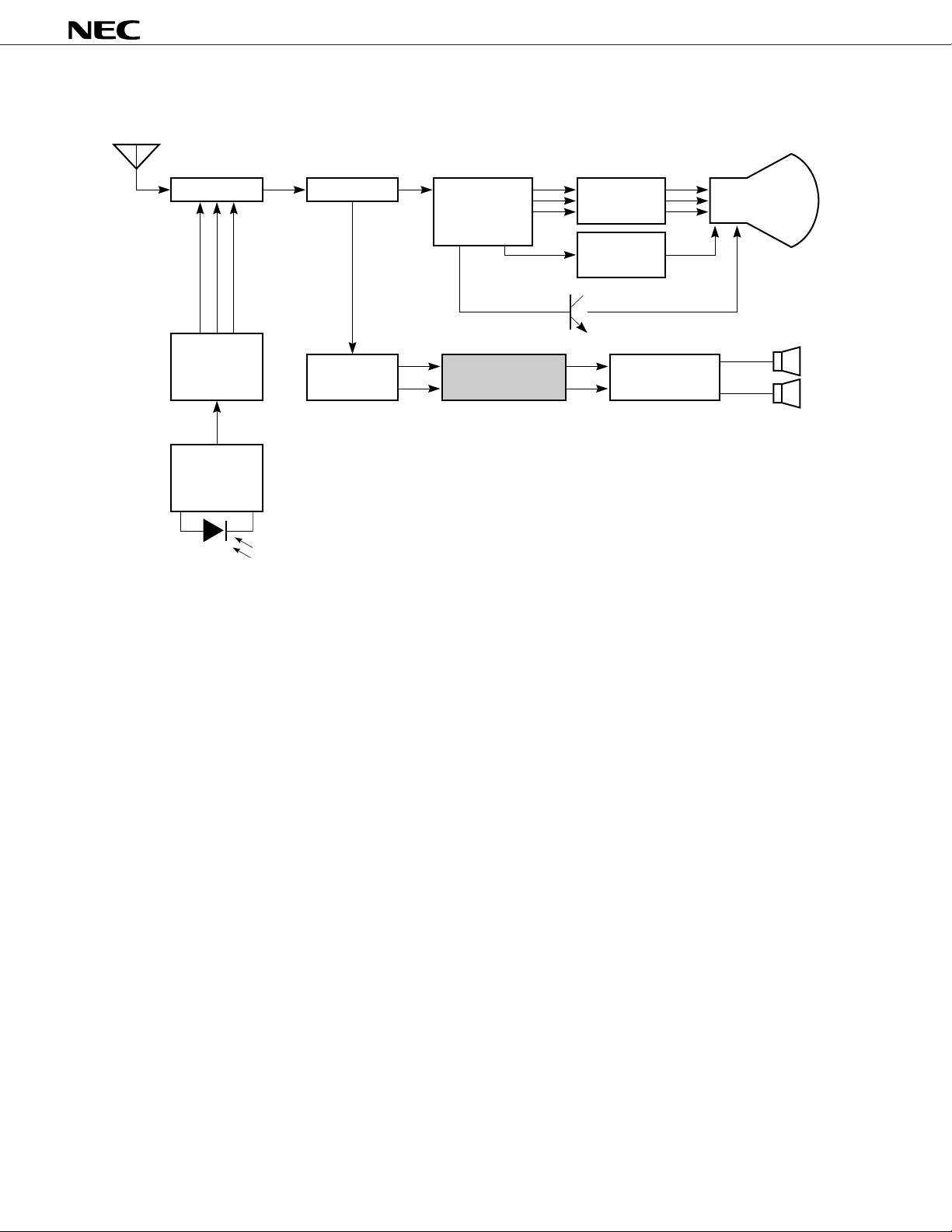
SYSTEM BLOCK DIAGRAM (TV)
µ
PC1892
PD17002
µ
PD17052
µ
PD17053
µ
PC2800A
µ
PC2801A
µ
Tuner PIF&SIF
Digital tuning
controller
PC1852
µ
Remote
control
reception
amplifier
PIN photo diode
US MTS
Color, intensity
and defrecting
signal processor
µ
L
R
PC1892
Matrix surround
sound processor
Color
output
Vertical
output
Power amplifier
PC1310
µ
PC1316C
µ
CRT
CRT
2
Page 3
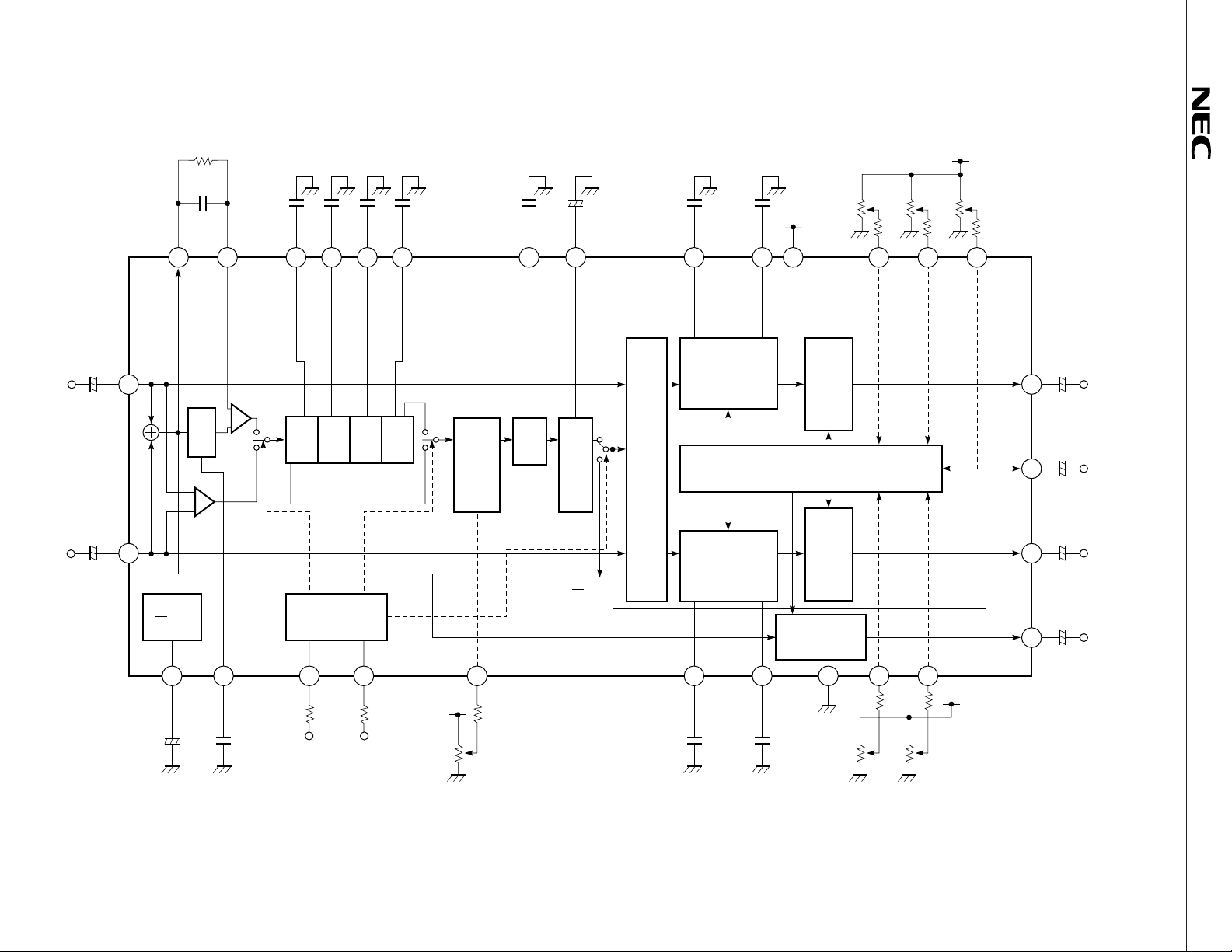
BLOCK DIAGRAM
L
R
IN
22 F
IN
22 F
HPF
820 kΩ
0.1 F
0.082 F
µ
28 29 2 3 4 5 30 22 21 1 20 19 18
+
25
µ
LPF
+
26
1
–
+
–
+
Movie/
Music
L–R
Simulated
2200 pF
µ
FC1 FC2 FC3 FC4
PS1
PHASE SHIFTER
µ
1
CC
V
2
+
µ
Note Recommended Precision: ±1 %
680 pF22 F
MODE
CONTROL
1 kΩ
0.022 F
PS2 PS3 PS4
Music
1 kΩ
MS2MS1
µ
0.022 F 1000 pF
µ
Simulated/Movie
10 kΩ
(L–R)
ϕ
+5 V
EFFECT
LPF
2
CONTROL
510 Ω
EFFECT
CONTROL
1 F
µ
+
6
Surround
OFFSET
ABSORPTION
OFF
1
V
CC
2
Note Note
6800 pF
MATRIX
Note Note
0.15 F V
TONE
(BASS, TREBLE)
CONTROL
TONE
(BASS, TREBLE)
CONTROL
0.15 F6800 pF
µ
DC CONTROL
µ
BALANCE
CONTROL
CC
10 kΩ
VOLUME
VOLUME
VOLUME
CONTROL
GND
10 kΩ
VOLUME
CONTROL
10 kΩ
510 Ω 510 Ω
BALANCE
CONTROL
BALANCE
CONTROL
1715111023872724
510 Ω
BASS
CONTROL
+5 V
10 kΩ
16
510 Ω
TREBLE
CONTROL
10 kΩ
L + R
VOLUME
CONTROL
510 Ω
+5 V
L OUTPUT
ϕ
L+ (L–R)
+
14
µ
4.7 F
REAR OUTPUT
ϕ
(L–R)
+
9
4.7 F
µ
R OUTPUT
ϕ
R– (L–R)
+
12
µ
4.7 F
L+R OUTPUT
L+R
+
13
4.7 F
µ
µ
PC1892
3
Page 4
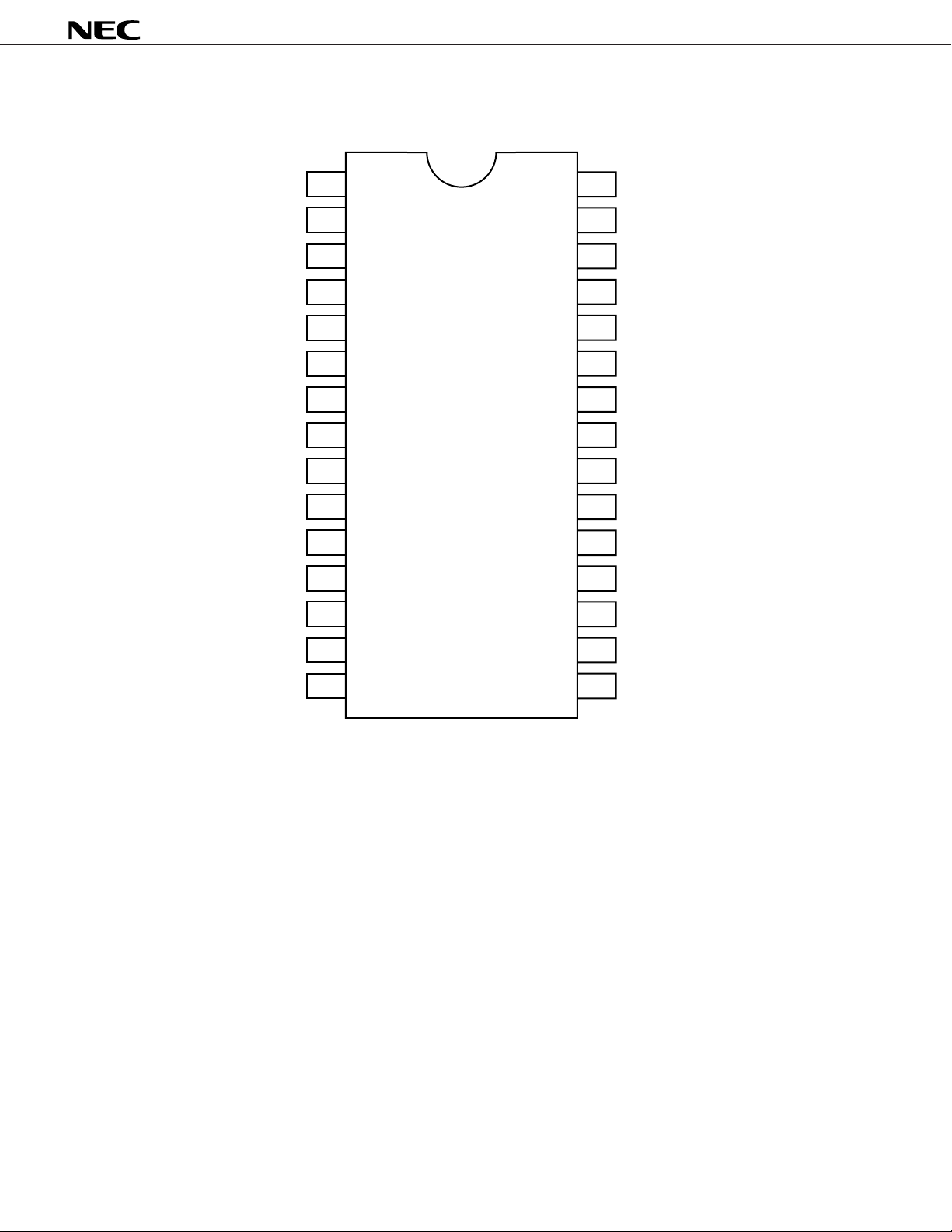
PIN CONFIGURATIONS (Top View)
µ
PC1892
30 Low Pass Filter2
1VCCSupply Voltage
LF2
2 FC1Phase Shift Filter1
3 FC2Phase Shift Filter2
4 FC3Phase Shift Filter3
5 FC4Phase Shift Filter4
6OFOffset Filter
µ
µ
PC1892CT
7 MS1Mode Select1
8 MS2Mode Select2
9 REARoutRear Output
10 RTCR-ch Treble Capacitor
11 RBCR-ch Bass Capacitor
12 RoutR-ch Signal Output
13 L + RoutL+R-ch Signal Output
14 LoutL-ch Signal Output
PC1892CT-02
29 Monaural Filter InputMFI
28 Monaural Filter OutputMFO
27 Low Pass Filter1LF1
IN
26 R-ch Signal InputR
25 L-ch Signal InputLIN
24 Reference VoltageRF
23 Effect ControlEFF
22 L-ch Treble CapacitorLTC
21 L-ch Bass CapacitorLBC
20 Balance ControlBAL
19 Volume ControlVOL
18 L+R-ch Volume ControlL + R
17 Bass ControlBAS
15 GNDGround
16 Treble ControlTBL
4
Page 5
µ
PC1892
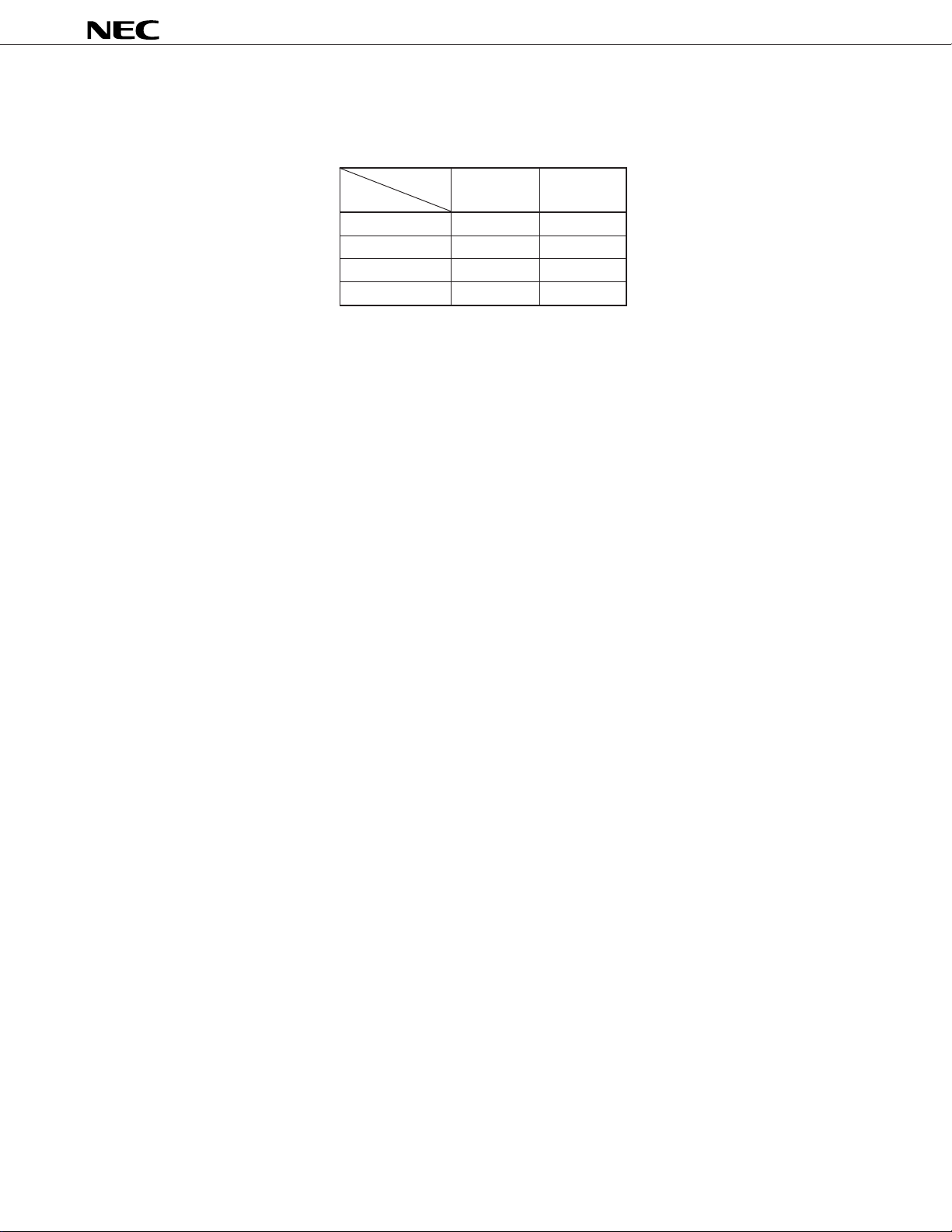
MODE SELECT CODE
Select among OFF, Movie, Music and Simulated mode by MS1 and MS2 (Pins 7 and 8).
Code MS1 MS2
Mode (Pin 7) (Pin 8)
OFF L L
Music H L
Movie L H
Simulated H H
Cautions 1. In the case of changing surround mode and power ON/OFF, mute (approx. 200 ms) must be used for pop
noise reduction.
2. Insert resistors between mode select pins (pin 7, 8) and GND, between control pins (pin 16, 17, 18, 19, 20,
23) and GND.
3. Connect a electrolytic capacitor for power supply as close as possible to V
Remark About "H" and "L", refer to RECOMMENDED OPERATING CONDITIONS.
CC (pin 1).
5
Page 6
µ
PC1892
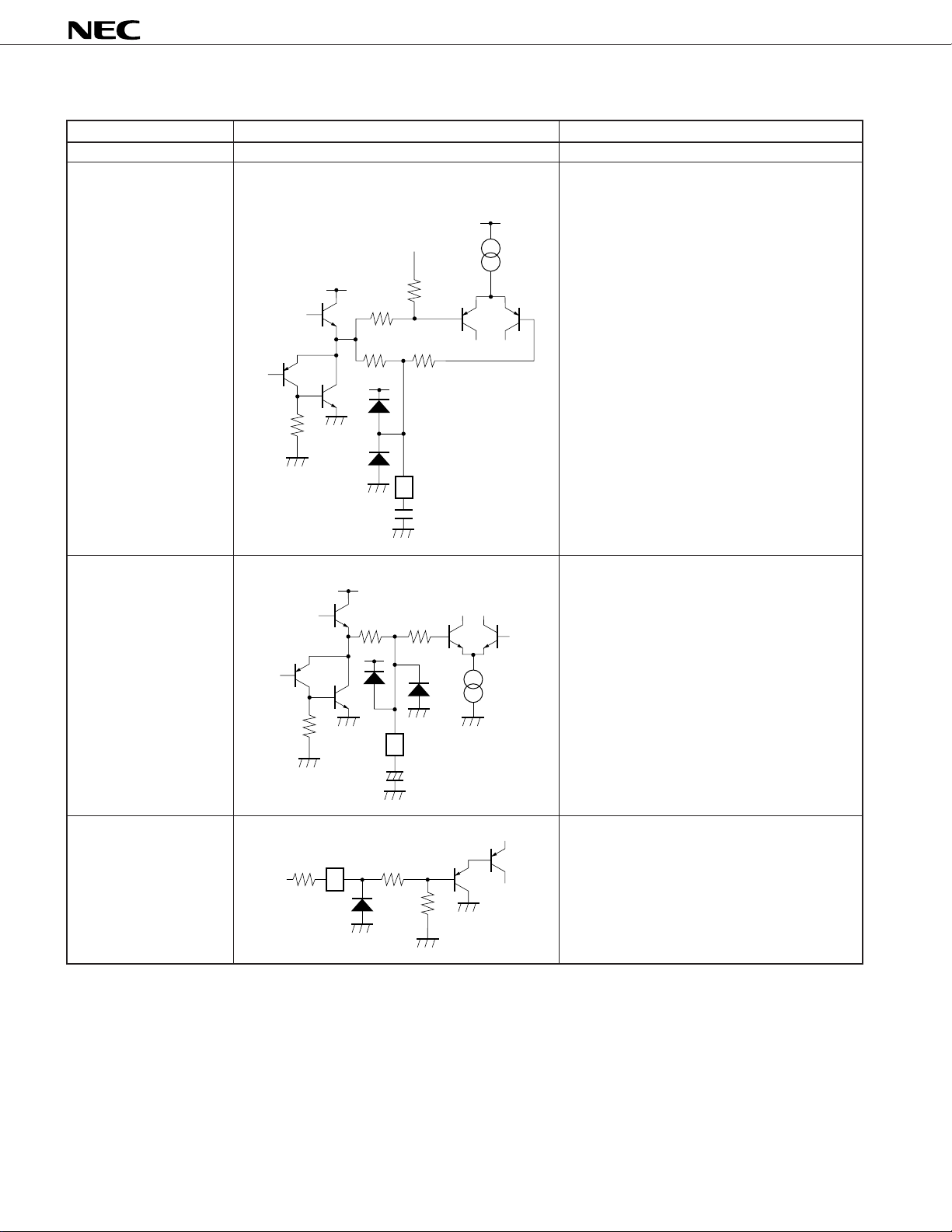
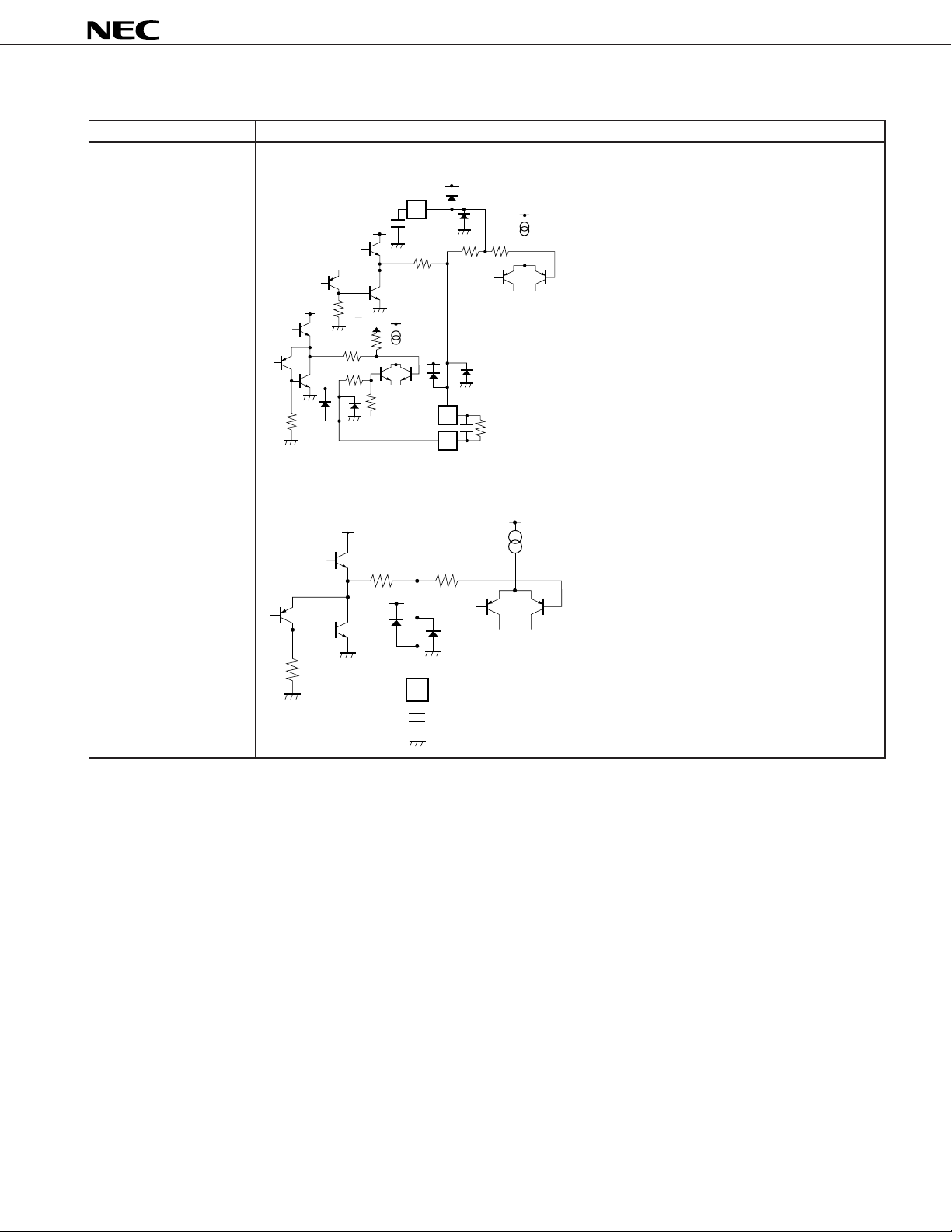
Explanation of Pins (1/4)
Pin number/name Equivalent circuit Description
1 Power supply VCC Power supply pin.
2 Phase shift filter1 (Pins 3, 4 and 5 are same as pin 2.) Capacitor connection pin which determines time
3 Phase shift filter2 constant of phase shifter.
V
4 Phase shift filter3 Pin 2 is used for movie, music, simulated mode.
5 Phase shift filter4 Pins 2, 3, 4, 5 is used for movie, simulated mode.
V
10 kΩ
CC
21 kΩ
18 kΩ 3 kΩ
V
CC
21 kΩ
CC
5 A
µ
Recommended value of capacitor is as follows.
Pin 2: 0.1 µF
Pin 3: 2200 pF
Pin 4, 5: 0.022 µF
2
6 Offset filter Capacitor connection pin which absorbs offset
10 kΩ
7 Mode select1 (Pin 8 is same as pin 7.) Surround mode switch pin.
8 Mode select2 Control by pin 7, 8 (2 bit parallel).
1 kΩ
V
CC
50 kΩ 3 kΩ
V
7
CC
50 kΩ
voltage generated by phase shifter.
µ
25 A
6
+
1 F
µ
–
Input impedance:approx. 100 kΩ.
50 kΩ
6
Page 7
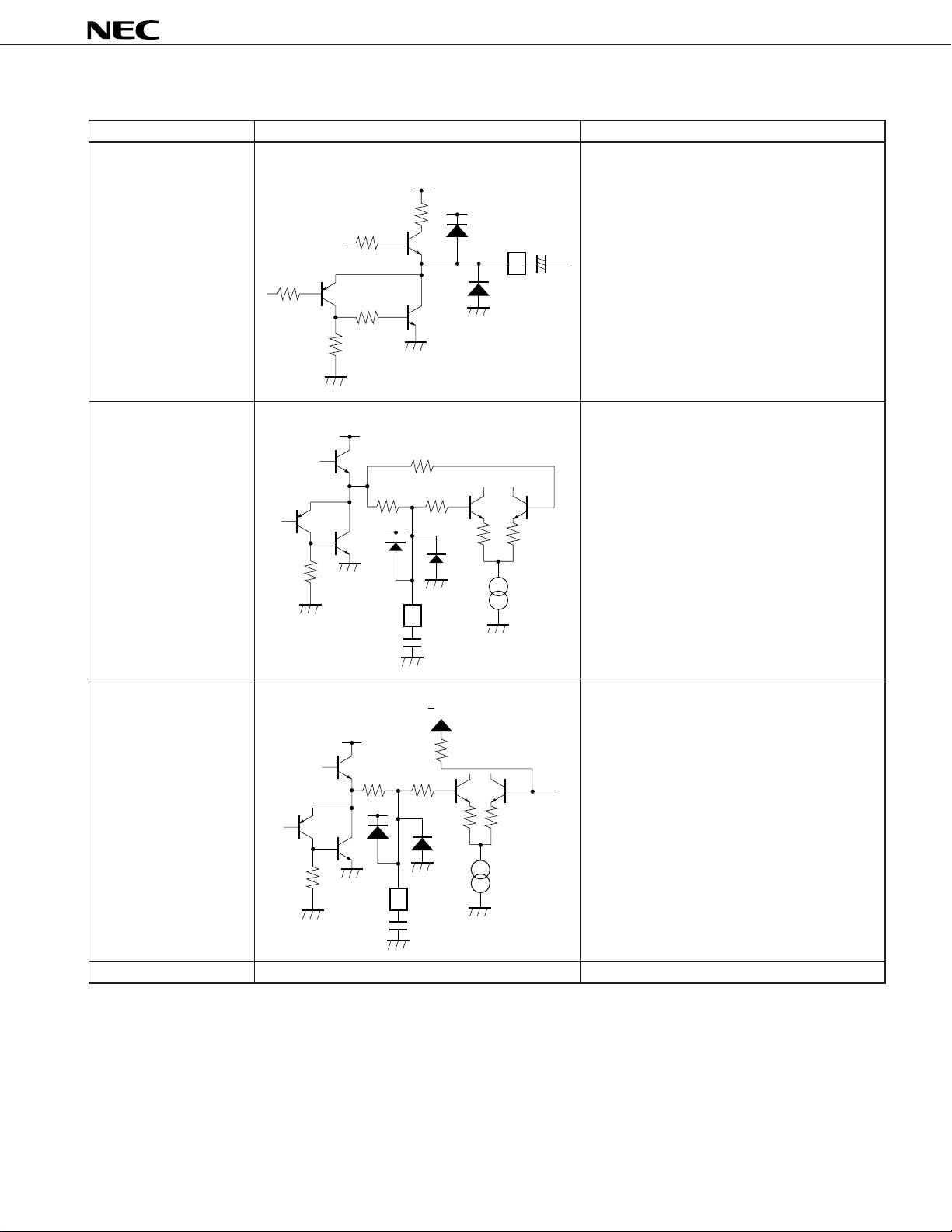
Explanation of Pins (2/4)
Pin number/name Equivalent circuit Description
9 Rear output (Pins 12, 13 and 14 are same as pin 9.)
12 R-ch signal output
13 L+R-ch signal output
14 L-ch signal output
5 kΩ
1 kΩ
V
CC
V
CC
4.7 F
µ
+
9
µ
PC1892
5 kΩ
5 kΩ
10 kΩ
10 R-ch treble capacitor (Pin 22 is same as pin 10.)
22 L-ch treble capacitor
V
CC
7.5 kΩ
5.8 kΩ 3 kΩ
V
CC
3 kΩ
3 kΩ
10 kΩ
25 A
µ
10
6800 pF
(±1 %)
11 R-ch bass capacitor (Pin 21 is same as pin 1.)
21 L-ch bass capacitor
V
CC
1
V
CC
2
7.5 kΩ
5.3 kΩ 3 kΩ
V
CC
3 kΩ
10 kΩ
3 kΩ
25 A
µ
11
0.15 F
µ
(±1 %)
15 GND GND GND pin.
7
Page 8
Explanation of Pins (3/4)
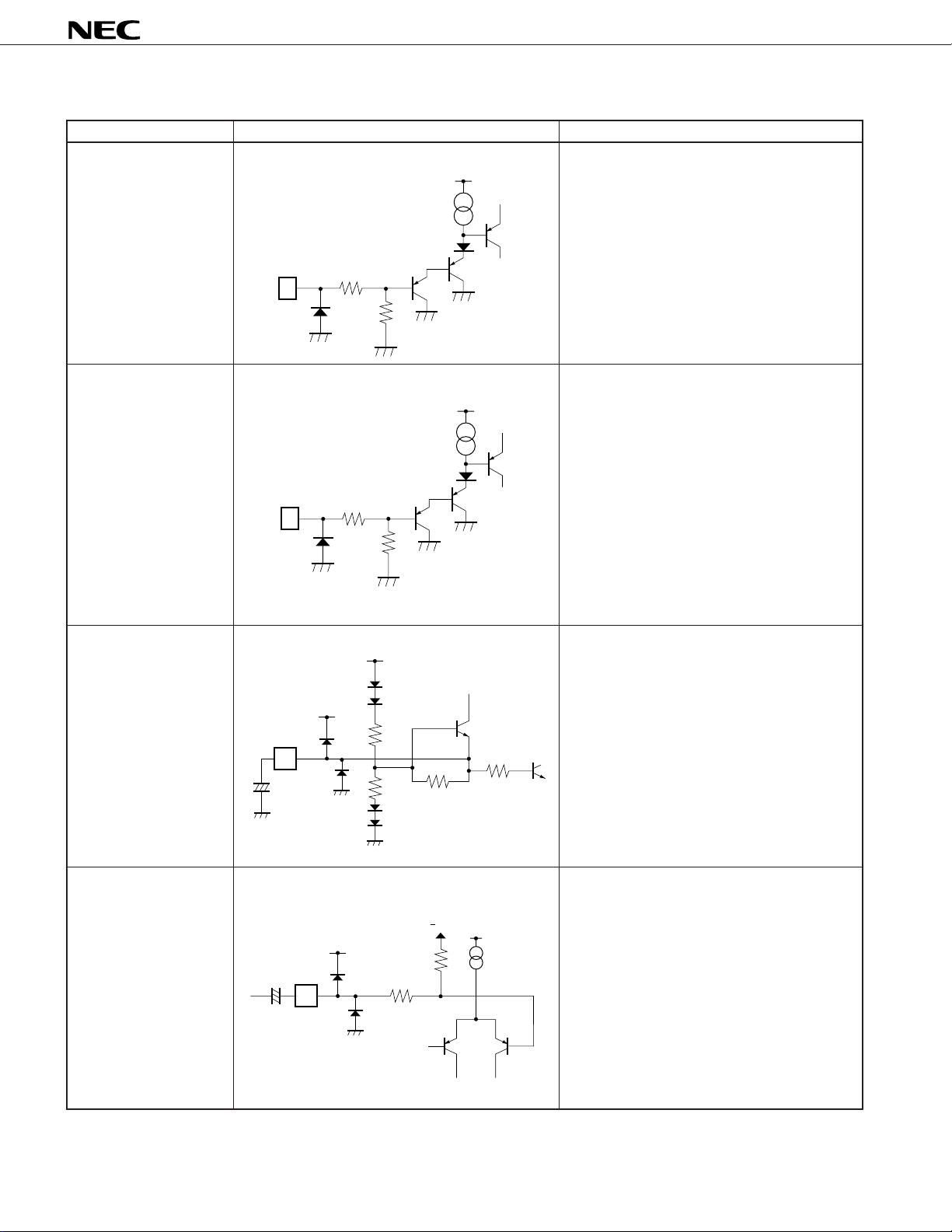
Pin number/name Equivalent circuit Description
16 Treble control (Pins 17, 18, 19 and 20 are same as pin 16.) Sound control pin.
17 Bass control
18 L+R-ch volume control
19 Volume control
20 Balance control
16
75 kΩ
75 kΩ
23 Effect control Surround effect control pin.
40 A
µ
40 A
µ
V
CC
V
CC
Input impedance: approx. 100 kΩ.
µ
PC1892
23
50 kΩ
50 kΩ
24 Reference voltage
V
CC
CC
V
20 kΩ
24
+
22 F
–
µ
20 kΩ
10 kΩ
3 kΩ
25 L-ch signal input (Pin 26 is same as pin 25.) Input impedance: approx. 40 kΩ.
26 R-ch signal input
1
VCC
2
CC
V
18.3 k
VCC
µ
Ω
5 A
+–
25
18.3 k
µ
22 F
Ω
8
Page 9
µ
PC1892
Explanation of Pins (4/4)
Pin number/name Equivalent circuit Description
27 Low pass filter1 Pins 28, 29 are for HPF at simulated mode.
28 Monaural filter output Connect capacitor and resistor between pin 28
29 Monaural filter input and 29.
V
CC
10
V
CC
1
Ω
k
V
V
CC
2
47
15 k
Ω
k
Ω
15 k
Ω
V
CC
47 k
10 k
Ω
1 k
CC
5 A
Ω
27
680 pF
Ω
µ
V
CC
V
28
29
CC
18 k
3 k
Ω
Ω
µ
0.082 F
820 k
V
CC
µ
5 A
Ω
30 Low pass filter2
10 k
V
V
CC
3 k
17.7 k
Ω
V
CC
Ω
CC
µ
5 A
Ω
30
1000 pF
9
Page 10
µ
PC1892
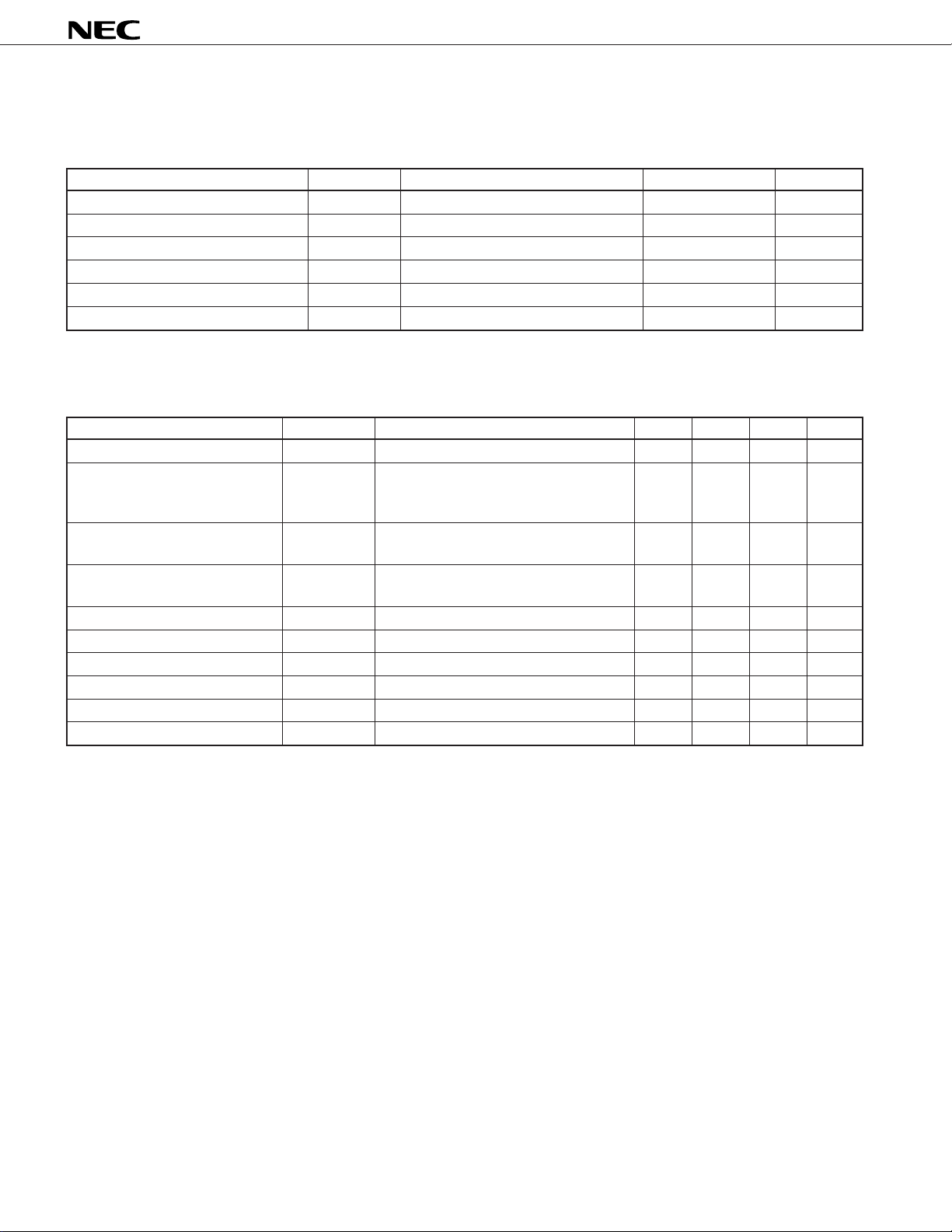
ELECTRICAL CHARACTERISTICS
Absolute Maximum Ratings (at TA = 25 °C)
Parameter Symbol Conditions Ratings Unit
Supply voltage VCC No signal, OFF mode 14.0 V
Input signal level VIN Pin 25, 26 Input voltage VCC V
Control pin voltage VCONT Pin 16, 17, 18, 19, 20, 23 Apply voltage VCC + 0.2 V
Package power dissipation PD TA = 75 °C 640 mW
Operating temperature TA VCC = 12 V –20 to +75 °C
Storage temperature Tstg –40 to +125 °C
Recommended Operating Conditions
Parameter Symbol Conditions MIN. TYP. MAX. Unit
Supply voltage VCC No signal, OFF mode 10.8 12.0 13.2 V
VCC = 12 V, OFF mode, T.H.D = 1 %
Input signal level 1 VIN1 Volume control voltage = 5.0 V – 1.4 8.5 Vp-p
Balance, bass, treble control voltage = 2.5 V
Input signal level 2 VIN2 – 1.4 8.5 Vp-p
Output load impedance PL 10 kΩ
Mode select pin voltage (H) VMSH Pin 7, 8 Apply voltage 3.5 5.0 VCC V
Mode select pin voltage (L) VMSL Pin 7, 8 Apply voltage 0 0 2.0 V
Effect pin voltage (H) VEFFH Pin 23 Upper limit voltage – 5.0 VCC V
Effect pin voltage (L) VEFFL Pin 23 Lower limit voltage 0 0 – V
Control pin voltage (H) VCONTH Pin 16, 17, 18, 19, 20 Apply voltage – 5.0 VCC V
Control pin voltage (L) V CONTL Pin 16, 17, 18, 19, 20 Apply voltage 0 0 – V
VCC = 12 V, T.H.D = 1 %
L+R volume control voltage = 5.0 V
AC load impedance which can be driven
by output of pin 9, 12, 13, 14
10
Page 11
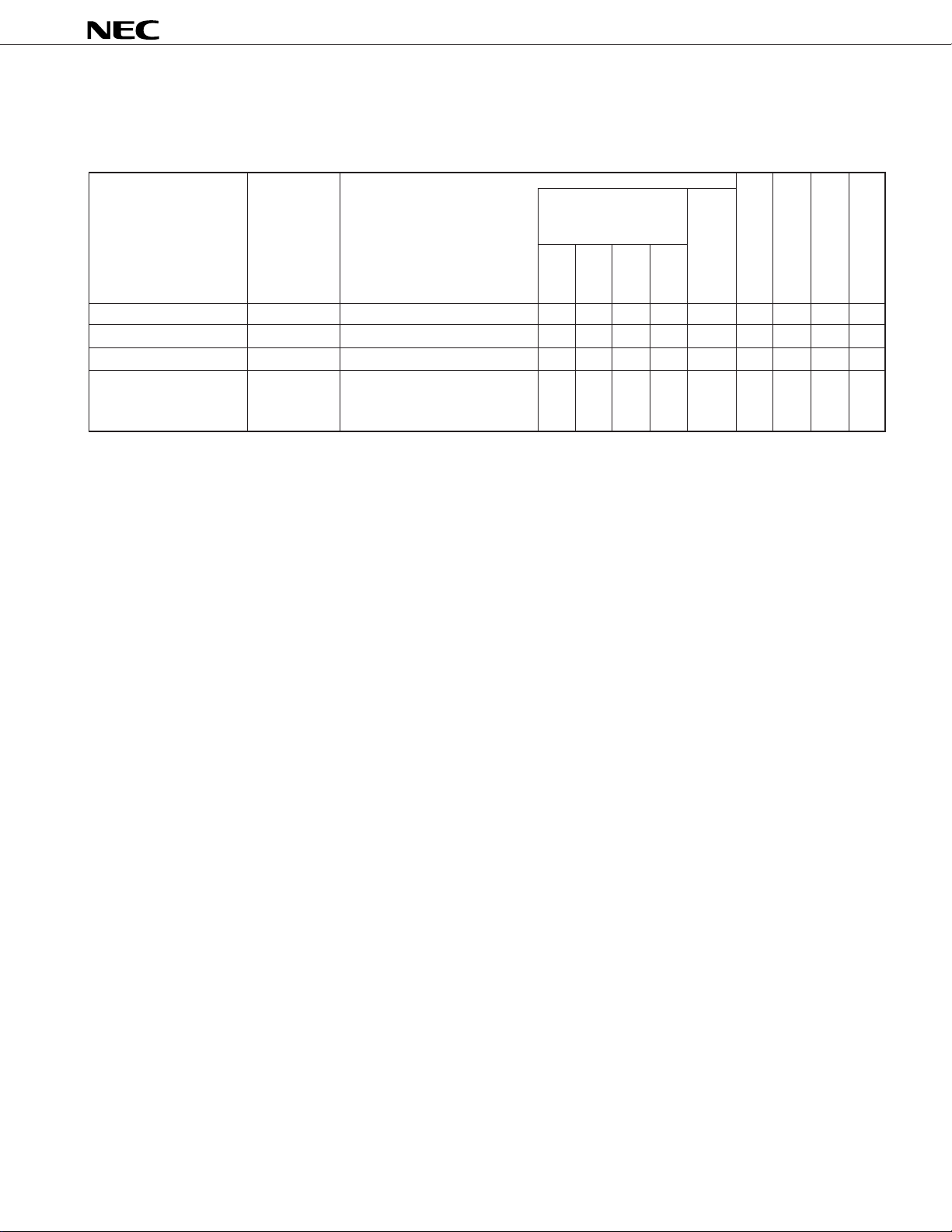
Electrical characteristics (TA = 25 °C, RH ≤ 70 %, VCC = 12 V)
General
µ
PC1892
Parameter Symbol Test conditions
Supply current ICC No signal – – – – OFF 23 29 37 mA
Maximum output voltage VOM VCC = 12 V, T.H.D. = 1 % H M M M OFF 8.5 9.9 Vp-p
Distortion factor T.H.D. VIN = 0.5 Vr.m.s., f = 1 kHz H M M M OFF – 0.1 0.5 %
L+R distortion factor T.H.D. (L+R) VIN = 0.5 Vr.m.s., f = 1 kHz, – – – – – – 0.1 0.5 %
L+R volume control voltage:
5.0 V
Note 1
Control pin voltage
(V)
Balance
Treble
Volume
Note 1
Bass
MIN. TYP. MAX. Unit
Note 2
Surround mode
Note 1. H: 5.0 V, M: 2.5 V, L: 0 V, –: Undefined
2. OFF: OFF mode, –: Undefined
11
Page 12
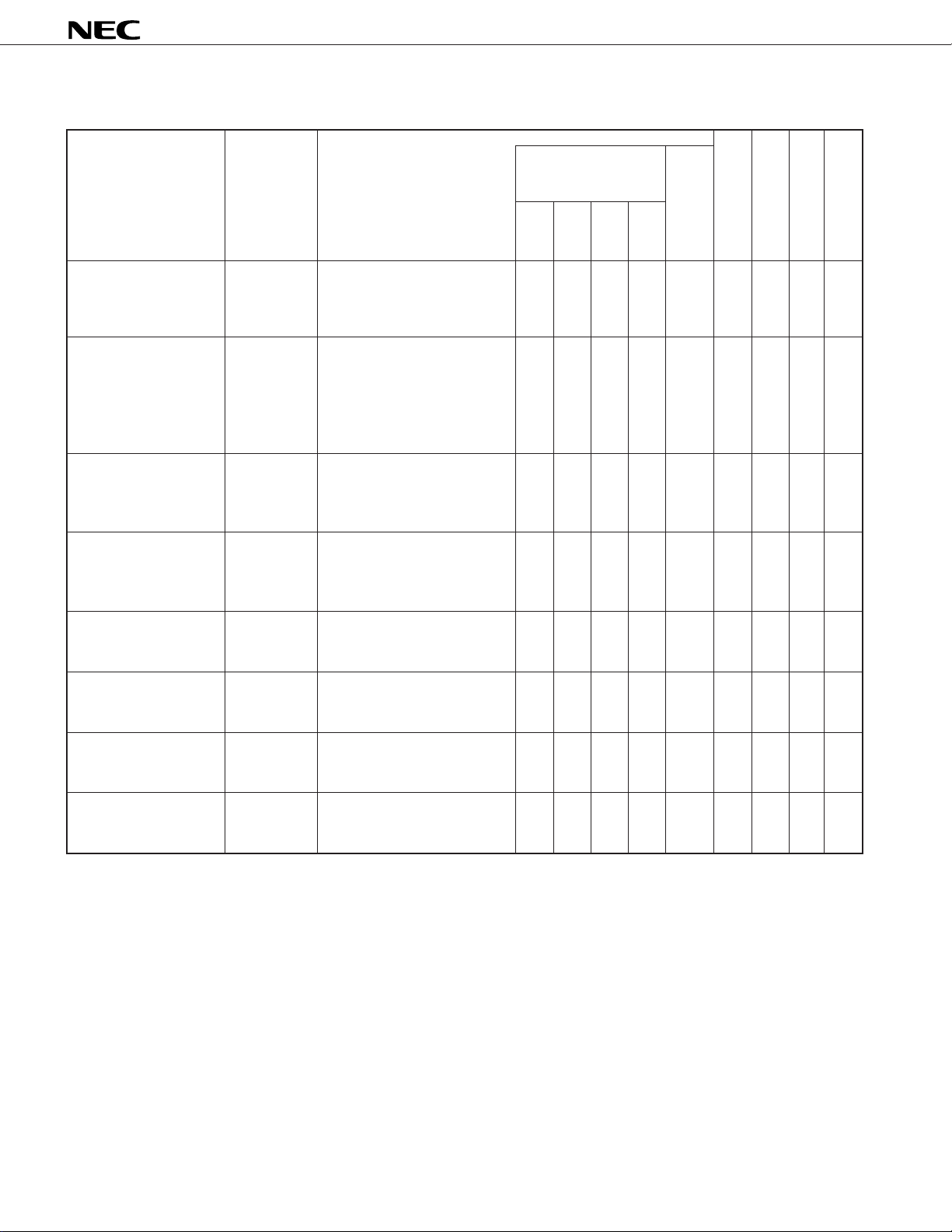
µ
PC1892CT Volume control, tone control block (1/1)
µ
PC1892
Parameter Symbol Test conditions
Volume attenuation ATTVOL VIN = 0.5 Vr.m.s., f = 1 kHz, H M M M OFF – –80 –72 dB
Volume control voltage: 0.2 V ↓
0 dB: Volume control voltage = H 0.2
Filter: JIS-A
L+R volume attenuation ATTL+RVOL VIN = 0.5 Vr.m.s., f = 1 kHz, – – – – – – –85 –75 dB
L+R volume control voltage:
0.2 V
0 dB: L+R volume control
voltage = H
Filter: JIS-A
Balance attenuation L-ch ATTBALL V IN = 0.5 Vr.m.s., f = 1 kHz, H M M M OFF –22 –18 –12 dB
Balance control voltage: 4.5 V ↓
0 dB: Balance control voltage = M 4. 5
Filter: JIS-A
Balance attenuation R-ch ATTBALR VIN = 0.5 Vr.m.s., f = 1 kHz, H M M M OFF –22 –18 –12 dB
Balance control voltage: 0.5 V ↓
0 dB: Balance control voltage = M 0. 5
Filter: JIS-A
Low-band boost control VBB VIN = 0.5 Vr.m.s., f = 100 Hz, H M M M OFF 7 10 13 dB
Bass control voltage: 4.5 V ↓
0 dB: Bass control voltage = M 4.5
Low-band cut control VBC VIN = 0.5 Vr.m.s., f = 100 Hz, H M M M OFF –13 –10 –7 dB
Bass control voltage: 0.5 V ↓
0 dB: Bass control voltage = M 0.5
High-band boost control VTB VIN = 0.5 Vr.m.s., f = 10 kHz, H M M M OFF 7 10 13 dB
Treble control voltage: 4.5 V ↓
0 dB: Treble control voltage = M 4.5
High-band cut control VTC VIN = 0.5 Vr.m.s., f = 10 kHz, H M M M OFF –13 –10 –7 dB
Treble control voltage: 0.5 V ↓
0 dB: Treble control voltage = M 0.5
Note 1
Control pin voltage
(V)
Volume
Balance
Note 1
Treble
Note 2
Bass
MIN. TYP. MAX. Unit
Surround mode
Note 1. H: 5.0 V, M: 2.5 V, L: 0 V, –: Undefined, The alphanumeric numbers in this table represent the level (V).
2. OFF: OFF mode, –: Undefined
12
Page 13
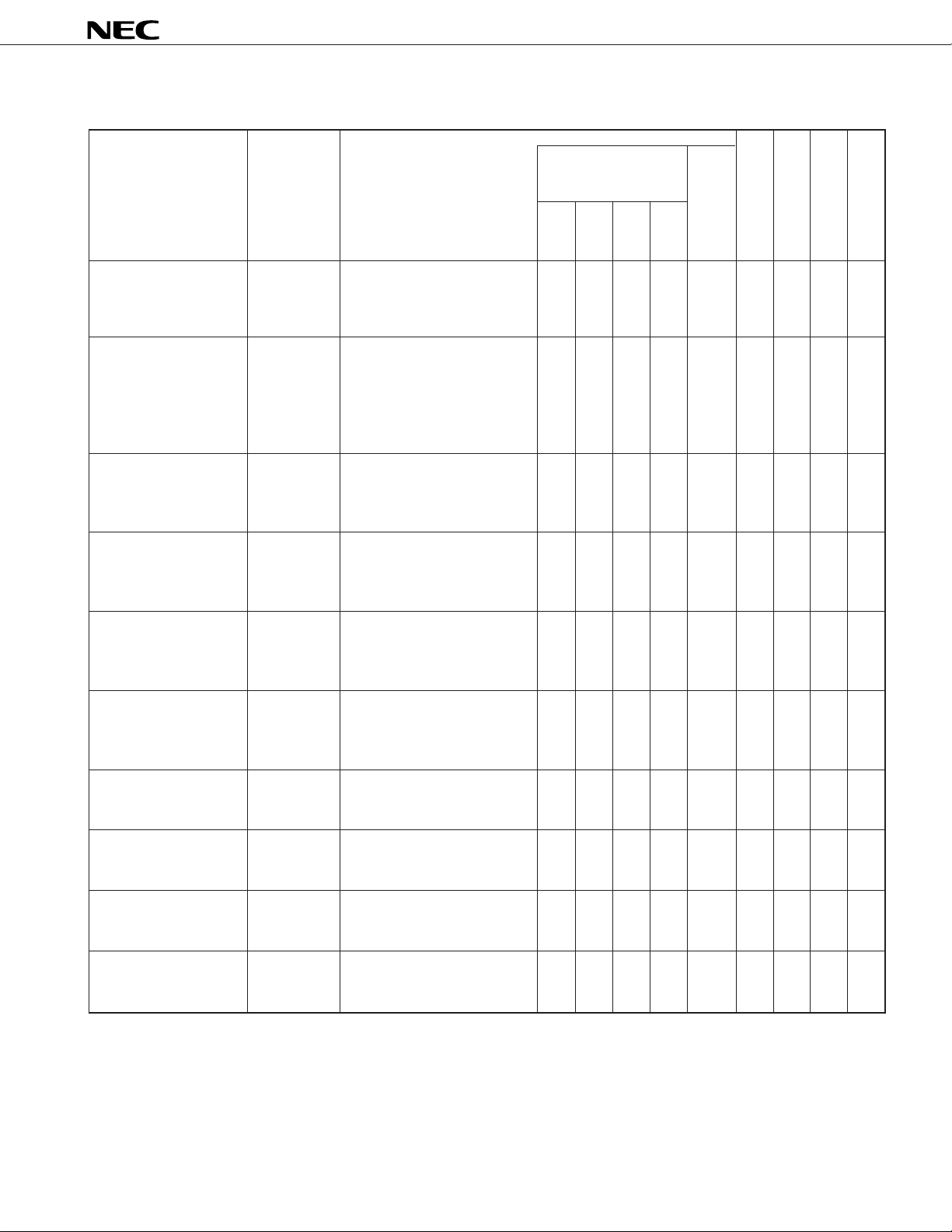
µ
PC1892CT-02 Volume control, tone control block (1/1)
µ
PC1892
Parameter Symbol Test conditions
Volume attenuation ATTVOL VIN = 0.5 Vr.m.s., f = 1 kHz, H M M M OFF – – –90 dB
Volume control voltage: 0.2 V ↓
0 dB: Volume control voltage = H 0.2
Filter: JIS-A
L+R volume attenuation ATTL+RVOL VIN = 0.5 Vr.m.s., f = 1 kHz, – – – – – – –85 –75 dB
L+R volume control voltage:
0.2 V
0 dB: L+R volume control
voltage = H
Filter: JIS-A
Balance attenuation 1 ATTBALL1 VIN = 0.5 Vr.m.s., f = 1 kHz, H M M M OFF –19 –16 –10 dB
L-ch Balance control voltage: 4.3 V ↓
0 dB: Balance control voltage = M 4. 3
Filter: JIS-A
Balance attenuation 2 ATTBALL2 VIN = 0.5 Vr.m.s., f = 1 kHz, H M M M OFF – – –90 dB
L-ch Balance control voltage: 5 V ↓
0 dB: Balance control voltage = M 5. 0
Filter: JIS-A
Balance attenuation 1 ATTBALR1 VIN = 0.5 Vr.m.s., f = 1 kHz, H M M M OFF –19 –16 –10 dB
R-ch Balance control voltage: 0.7 V ↓
0 dB: Balance control voltage = M 0. 7
Filter: JIS-A
Balance attenuation 2 ATTBALR2 VIN = 0.5 Vr.m.s., f = 1 kHz, H M M M OFF – – –90 dB
R-ch Balance control voltage: 0 V ↓
0 dB: Balance control voltage = M 0. 0
Filter: JIS-A
Low-band boost control VBB VIN = 0.5 Vr.m.s., f = 100 Hz, H M M M OFF 7 10 13 dB
Bass control voltage: 4.5 V ↓
0 dB: Bass control voltage = M 4.5
Low-band cut control VBC VIN = 0.5 V r.m.s., f = 100 Hz, H M M M OFF –13 –10 –7 dB
Bass control voltage: 0.5 V ↓
0 dB: Bass control voltage = M 0.5
High-band boost control VTB VIN = 0.5 Vr.m.s., f = 10 kHz, H M M M OFF 7 10 13 dB
Treble control voltage: 4.5 V ↓
0 dB: Treble control voltage = M 4.5
High-band cut control VTC VIN = 0.5 Vr.m.s., f = 10 kHz, H M M M OFF –13 –10 –7 dB
Treble control voltage: 0.5 V ↓
0 dB: Treble control voltage = M 0.5
Note 1
Control pin voltage
(V)
Balance
Treble
Volume
Note 1
Bass
MIN. TYP. MAX. Unit
Note 2
Surround mode
Note 1. H: 5.0 V, M: 2.5 V, L: 0 V, –: Undefined, The alphanumeric numbers in this table represent the level (V).
2. OFF: OFF mode, –: Undefined
13
Page 14

Matrix surround block (1/3)
µ
PC1892
Parameter Symbol Test conditions
In-phase gain GL+R VIN = 0.5 Vr.m.s., f = 1 kHz, – – – – – –1 0 +1 dB
L+Rout L+R volume control voltage = H
0 dB: Input level
In-phase gain GOFF V IN = 0.5 Vr.m.s., f = 1 kHz, H M M M OFF –1.5 –0.5 +0.5 dB
OFF mode 0 dB: Input level
In-phase gain GMOV1 VIN = 0.5 Vr.m.s., f = 1 kHz, H M M M MOV +4.0 +8.6 +11.0 dB
Movie mode 1 Effect control voltage = M
0 dB: Input level
In-phase gain GMOV2 VIN = 0.5 Vr.m.s., f = 1 kHz, H M M M MOV +6.0 +10.0 +12.5 dB
Movie mode 2 Effect control voltage = H
0 dB: Input level
In-phase gain GMUS1 VIN = 0.5 Vr.m.s., f = 1 kHz, H M M M MUS +4.9 +7.0 +8.9 dB
Music mode 1 Effect control voltage = M
0 dB: Input level
In-phase gain GMUS2 VIN = 0.5 Vr.m.s., f = 1 kHz, H M M M MUS +5.9 +8.1 +10.1 dB
Music mode 2 Effect control voltage = H
0 dB: Input level
In-phase gain GSIML1 VIN = 0.5 Vr.m.s., f = 250 Hz, H M M M SIM +1.7 +4.2 +6.1 dB
Simulated mode 1 L-ch Effect control voltage = M
0 dB: Input level
In-phase gain GSIML2 VIN = 0.5 Vr.m.s., f = 1 kHz, H M M M SIM – –5.2 –1.2 dB
Simulated mode 2 L-ch Effect control voltage = M
0 dB: Input level
In-phase gain GSIML3 VIN = 0.5 Vr.m.s., f = 3.6 kHz, H M M M SIM +4.5 +7.3 +9.4 dB
Simulated mode 3 L-ch Effect control voltage = M
0 dB: Input level
In-phase gain GSIMR1 VIN = 0.5 Vr.m.s., f = 250 Hz, H M M M SIM – –7.0 –1.0 dB
Simulated mode 1 R-ch Effect control voltage = M
0 dB: Input level
In-phase gain GSIMR2 VIN = 0.5 Vr.m.s., f = 1 kHz, H M M M SIM +1.7 +3.6 +5.2 dB
Simulated mode 2 R-ch Effect control voltage = M
0 dB: Input level
In-phase gain GSIMR3 VIN = 0.5 Vr.m.s., f = 3.6 kHz, H M M M SIM – –7.6 +0.9 dB
Simulated mode 3 R-ch Effect control voltage = M
0 dB: Input level
L, R in-phase gain DGOFF V IN = 0.5 Vr.m.s., f = 1 kHz, H M M M OFF –1 0 +1 dB
difference DGOFF = (RIN→ROUT) –
OFF mode (LIN→LOUT)
L, R in-phase gain DGMOV VIN = 0.5 Vr.m.s., f = 1 kHz, H M M M MOV –2 0 +2 dB
difference Effect control voltage = M
Movie mode DGMOV = (RIN→ROUT) –
(LIN→LOUT)
Note 1
Control pin voltage
(V)
Volume
Balance
Note 1
Treble
Note 2
Bass
MIN. TYP. MAX. Unit
Surround mode
Note 1. H: 5 V, M: 2.5 V, L: 0 V, –: Undefined
2. OFF: OFF mode, MOV: Movie mode, MUS: Music mode, SIM: Simulated mode, –: Undefined
14
Page 15

Matrix surround block (2/3)
µ
PC1892
Parameter Symbol Test conditions
L, R in-phase gain DGMUS VIN = 0.5 Vr.m.s., f = 1 kHz, H M M M MUS –2 0 +2 dB
difference Effect control voltage = M
Music mode DGMUS = (RIN→ROUT) –
(LIN→LOUT)
Rear output gain 1 GREAR1 VIN = 0.5 Vr.m.s., f = 1 kHz, – – – – MUS –5.0 –3.0 –1.1 dB
Effect control voltage = M
GREAR1 = RIN (LIN)→REARout
Rear output gain 2 GREAR2 VIN = 0.5 Vr.m.s., f = 1 kHz, – – – – MUS –3.0 –1.2 +0.5 dB
Effect control voltage = H
GREAR2 = RIN (LIN)→REARout
Rear output gain 3 GREAR3 VIN = 0.5 Vr.m.s., f = 1 kHz, – – – – MOV –0.4 +1.6 +3.5 dB
Effect control voltage = M
GREAR3 = RIN (LIN)→REARout
Rear output gain 4 GREAR4 VIN = 0.5 Vr.m.s., f = 1 kHz, – – – – MOV +1.4 +3.2 +4.9 dB
Effect control voltage = H
GREAR4 = RIN (LIN)→REARout
Output noise NOL+R DIN/AUDIO filter used. – – – – – – 25 80µVr.m.s.
L+Rout Input terminal resistor (600 Ω)
L+R volume control voltage = H
Output noise NOOFF DIN/AUDIO filter used. H M M M OFF – 25 80µVr.m.s.
OFF mode Input terminal resistor (600 Ω)
Output noise NOMOV DIN/AUDIO filter used. H M M M MOV – 0.1 0.3
Movie mode Input terminal resistor (600 Ω)
Output noise NOMUS DIN/AUDIO filter used. H M M M MUS – 0.1 0.3
Music mode Input terminal resistor (600 Ω)
Output noise NOSIM DIN/AUDIO filter used. H M M M SIM – 0.1 0.3
Simulated mode Input terminal resistor (600 Ω)
Crosstalk CT VIN = 0.5 Vr.m.s., f = 1 kHz, H M M M OFF – –80 –70 dB
BPF (1 kHz) used.
CT = LIN→ROUT, RIN→LOUT
Input terminal resistor (600 Ω)
Inter-mode offset VOSM No signal H M M M Note 3 –75 0.0 +75 mV
OFF mode → Music mode
OFF mode → Movie mode
OFF mode → Simulated mode
Simulated mode → Music mode
Simulated mode → Movie mode
Music mode → Movie mode
Note 1
Control pin voltage
(V)
Balance
Treble
Volume
Note 1
Bass
MIN. TYP. MAX. Unit
Note 2
Surround mode
mVr.m.s.
mVr.m.s.
mVr.m.s.
Note 1. H: 5 V, M: 2.5 V, L: 0 V, –: Undefined
2. OFF: OFF mode, MOV: Movie mode, MUS: Music mode, SIM: Simulated mode, –: Undefined
3. Refer to test conditions.
15
Page 16

Matrix surround block (3/3)
µ
PC1892
Parameter Symbol Test conditions
DC offset 1 VDCOS1 No signal H M M M OFF –100 0.0 +100 mV
DC offset 2 VDCOS2 No signal – – – – – –100 0.0 +100 mV
L+R volume control voltage
= H → L
DC offset 3 VDCOS3 No signal H M M M OFF –100 0.0 +100 mV
DC offset 4 VDCOS4 No signal H M M M OFF –100 0.0 +100 mV
DC offset 5 VDCOS5 No signal H M M M OFF –100 0.0 +100 mV
Note 1
Control pin voltage
(V)
Balance
↓
L
H
Treble
↓
L
or
H
Volume
↓
L
or
Note 1
Bass
↓
L
or
H
MIN. TYP. MAX. Unit
Note 2
Surround mode
Note 1. H: 5 V, M: 2.5 V, L: 0 V.
2. OFF: OFF mode, MOV: Movie mode, MUS: Music mode, SIM: Simulated mode.
16
Page 17

Electrical Characteristics Measurement List (Supplement) (at TA = 25 °C, RH ≤ 70 %, VCC = 12 V)
Recommended Operating Conditions
µ
PC1892
Note 1
Parameter Symbol Conditions Surround
mode VOL BAL TRE BAS L+R EFF
Input signal level 1 VIN1 Input level when distortion factor of OFF 5.0 2.5 2.5 2.5 – –
LOUT (Pin 14) is 1 %,
LIN (Pin 25) : f = 1 kHz
Input level when distortion factor of
ROUT (Pin 12) is 1 %,
RIN (Pin 26) : f = 1 kHz
Input signal level 2 VIN2 Input level when distortion factor of OFF ––––5.0–
L+ROUT (Pin 13) is 1 %,
LIN, RIN (Pin 25, 26) : f = 1 kHz
Control pin voltage (V)
Note 2
Note 1. OFF: OFF mode
2. VOL: Volume control voltage, BAL: Balance control voltage, TRE: Treble control voltage, BAS: Bass control voltage,
L+R: L+R volume control voltage, EFF: Effect control voltage, –: Undefined
Electrical characteristics measurement: General
Note 1
Parameter Symbol Test conditions Surround
mode VOL BAL TRE BAS L+R EFF
Supply current ICC Current flowing to VCC (Pin 1) OFF 5.0 2.5 2.5 2.5 5.0 2.5
No signal
Distortion factor T.H.D. L-channel OFF 5.0 2.5 2.5 2.5 – –
Distortion factor of LOUT (Pin 14)
LIN (Pin 25) : f = 1 kHz, VIN = 0.5 Vr.m.s.
R-channel
Distortion factor of ROUT (Pin 12)
RIN (Pin 26) : f = 1 kHz, VIN = 0.5 Vr.m.s.
L+R distortion factor T.H.D. L+R-channel OFF ––––5.0–
(L+R) Distortion factor of L+ROUT (Pin 13)
LIN (Pin 25), RIN (Pin 26) :
f = 1 kHz, VIN = 0.5 Vr.m.s.
Control pin voltage (V)
Note 2
Note 1. OFF: OFF mode
2. VOL: Volume control voltage, BAL: Balance control voltage, TRE: Treble control voltage, BAS: Bass control voltage,
L+R: L+R volume control voltage, EFF: Effect control voltage, –: Undefined
17
Page 18

Electrical characteristics measurement: µPC1892CT Volume control, tone control block (1/3)
µ
PC1892
Note 1
Parameter Symbol Test conditions Surround
mode VOL BAL TRE BAS L+R EFF
Volume attenuation ATTVOL OFF 5.0 2.5 2.5 2.5 – –
L+R volume ATTL+R OFF––––5.0–
attenuation ↓
Balance attenuation ATTBALL OFF
Lch/Rch
ATTBALR R-channel 5.0 2.5 2.5 2.5 – –
ATTVOL = 20 log
L-channel 0.2
LIN (Pin 25) : f = 1 kHz, VIN = 0.5 Vr.m.s.
VREF : LOUT (Pin 14) (Volume control
voltage : 5.0 V)
VATT : LOUT (Pin 14) (Volume control
voltage : 0.2 V)
JIS-A filter used.
R-channel
RIN (Pin 26) : f = 1 kHz, VIN = 0.5 Vr.m.s.
VREF : ROUT (Pin 12) (Volume control
voltage : 5.0 V)
VATT : ROUT (Pin 12) (Volume control
voltage : 0.2 V)
JIS-A filter used.
ATTL+R = 20 log
LIN, RIN (Pin 25, 26) : f = 1 kHz, 0.2
VIN = 0.5 Vr.m.s.
VL+RREF : L+ROUT (Pin 13)
(L+R volume control voltage : 5.0 V)
VL+RATT : L+ROUT (Pin 13)
(L+R volume control voltage : 0.2 V)
JIS-A filter used.
ATTBAL = 20 log
L-channel 5.0 2.5 2.5 2.5 – –
LIN (Pin 25) : f = 1 kHz, VIN = 0.5 Vr.m.s. ↓
VREF : LOUT (Pin 14) (Balance control 4.5
voltage : 2.5 V)
VATT : LOUT (Pin 14) (Balance control
voltage : 4.5 V)
JIS-A filter used.
RIN (Pin 26) : f = 1 kHz, VIN = 0.5 Vr.m.s. ↓
VREF : ROUT (Pin 12) (Balance control 0.5
voltage : 2.5 V)
VATT : ROUT (Pin 12) (Balance control
voltage : 0.5 V)
JIS-A filter used.
VATT
VREF
VL+RATT
VL+RREF
VATT
VREF
Control pin voltage (V)
↓
Note 2
Note 1. OFF: OFF mode
2. VOL: Volume control voltage, BAL: Balance control voltage, TRE: Treble control voltage, BAS: Bass control voltage,
L+R: L+R volume control voltage, EFF: Effect control voltage, –: Undefined
18
Page 19

Electrical characteristics measurement: µPC1892CT Volume control, tone control block (2/3)
µ
PC1892
Note 1
Parameter Symbol Test conditions Surround
mode VOL BAL TRE BAS L+R EFF
Low-band boost VBB OFF 5.0 2.5 2.5 2.5 – –
control ↓
Low-band cut control VBC OFF 5.0 2.5 2.5 2.5 – –
High-band boost VTB OFF 5.0 2.5 2.5 2.5 – –
control ↓
VBB = 20 log
L-channel 4.5
LIN (Pin 25) : f = 100 Hz, VIN = 0.5 Vr.m.s.
VREF : LOUT (Pin 14) (Bass control
VBST : LOUT (Pin 14) (Bass control
R-channel
RIN (Pin 26) : f = 100 Hz, VIN = 0.5 Vr.m.s.
VREF : ROUT (Pin 12) (Bass control
VBST : ROUT (Pin 12) (Bass control
VBC = 20 log
L-channel 0.5
LIN (Pin 25) : f = 100 Hz, VIN = 0.5 Vr.m.s.
VREF : LOUT (Pin 14) (Bass control
VATT : LOUT (Pin 14) (Bass control
R-channel
RIN (Pin 26) : f = 100 Hz, VIN = 0.5 Vr.m.s.
VREF : ROUT (Pin 12) (Bass control
VATT : ROUT (Pin 12) (Bass control
VTB = 20 log
L-channel 4.5
LIN (Pin 25) : f = 10 kHz, VIN = 0.5 Vr.m.s.
VREF : LOUT (Pin 14) (Treble control
VBST : LOUT (Pin 14) (Treble control
R-channel
RIN (Pin 26) : f = 10 kHz, VIN = 0.5 Vr.m.s.
VREF : ROUT (Pin 12) (Treble control
VBST : ROUT (Pin 12) (Treble control
VBST
VREF
voltage : 2.5 V)
voltage : 4.5 V)
voltage : 2.5 V)
voltage : 4.5 V)
VATT
VREF
voltage : 2.5 V)
voltage : 0.5 V)
voltage : 2.5 V)
voltage : 0.5 V)
VBST
VREF
voltage : 2.5 V)
voltage : 4.5 V)
voltage : 2.5 V)
voltage : 4.5 V)
Control pin voltage (V)
Note 2
↓
Note 1. OFF: OFF mode
2. VOL: Volume control voltage, BAL: Balance control voltage, TRE: Treble control voltage, BAS: Bass control voltage,
L+R: L+R volume control voltage, EFF: Effect control voltage, –: Undefined
19
Page 20

Electrical characteristics measurement: µPC1892CT Volume control, tone control block (3/3)
µ
PC1892
Note 1
Parameter Symbol Test conditions Surround
mode VOL BAL TRE BAS L+R EFF
High-band cut VTC OFF 5.0 2.5 2.5 2.5 – –
control ↓
VTC = 20 log
L-channel 0.5
LIN (Pin 25) : f = 10 kHz, VIN = 0.5 Vr.m.s.
VREF : LOUT (Pin 14) (Treble control
VATT : LOUT (Pin 14) (Treble control
R-channel
RIN (Pin 26) : f = 10 kHz, VIN = 0.5 Vr.m.s.
VREF : ROUT (Pin 12) (Treble control
VATT : ROUT (Pin 12) (Treble control
VATT
VREF
voltage : 2.5 V)
voltage : 0.5 V)
voltage : 2.5 V)
voltage : 0.5 V)
Control pin voltage (V)
Note 2
Note 1. OFF: OFF mode
2. VOL: Volume control voltage, BAL: Balance control voltage, TRE: Treble control voltage, BAS: Bass control voltage,
L+R: L+R volume control voltage, EFF: Effect control voltage, –: Undefined
20
Page 21

Electrical characteristics measurement: µPC1892CT-02 Volume control, tone control block (1/3)
µ
PC1892
Note 1
Parameter Symbol Test conditions Surround
mode VOL BAL TRE BAS L+R EFF
Volume attenuation ATTVOL OFF 5.0 2.5 2.5 2.5 – –
L+R volume ATTL+R OFF––––5.0–
attenuation ↓
Note 1. OFF: OFF mode
ATTVOL = 20 log
L-channel 0.2
LIN (Pin 25) : f = 1 kHz, VIN = 0.5 Vr.m.s.
VREF : LOUT (Pin 14) (Volume control
voltage : 5.0 V)
VATT : LOUT (Pin 14) (Volume control
voltage : 0.2 V)
JIS-A filter used.
R-channel
RIN (Pin 26) : f = 1 kHz, VIN = 0.5 Vr.m.s.
VREF : ROUT (Pin 12) (Volume control
voltage : 5.0 V)
VATT : ROUT (Pin 12) (Volume control
voltage : 0.2 V)
JIS-A filter used.
ATTL+R = 20 log
LIN, RIN (Pin 25, 26) : f = 1 kHz, 0.2
VIN = 0.5 Vr.m.s.
VL+RREF : L+ROUT (Pin 13)
(L+R volume control voltage : 5.0 V)
VL+RATT : L+ROUT (Pin 13)
(L+R volume control voltage : 0.2 V)
JIS-A filter used.
VATT
VREF
VL+RATT
VL+RREF
Control pin voltage (V)
↓
Note 2
2. VOL: Volume control voltage, BAL: Balance control voltage, TRE: Treble control voltage, BAS: Bass control voltage,
L+R: L+R volume control voltage, EFF: Effect control voltage, –: Undefined
21
Page 22

Electrical characteristics measurement: µPC1892CT-02 Volume control, tone control block (2/3)
µ
PC1892
Note 1
Parameter Symbol Test conditions Surround
mode VOL BAL TRE BAS L+R EFF
Balance attenuation OFF
Lch/Rch
ATTBALL1 L-channel 1 5.0 2.5 2.5 2.5 – –
ATTBALL2 L-channel 2 5.0 2.5 2.5 2.5 – –
ATTBALR1 R-channel 1 5.0 2.5 2.5 2.5 – –
ATTBALR2 R-channel 2 5.0 2.5 2.5 2.5 – –
Low-band boost VBB OFF 5.0 2.5 2.5 2.5 – –
control ↓
Note 1. OFF: OFF mode
ATTBAL = 20 log
LIN (Pin 25) : f = 1 kHz, VIN = 0.5 Vr.m.s. ↓
VREF : LOUT (Pin 14) (Balance control 4.3
voltage : 2.5 V)
VATT : LOUT (Pin 14) (Balance control
voltage : 4.3 V)
JIS-A filter used.
LIN (Pin 25) : f = 1 kHz, VIN = 0.5 Vr.m.s. ↓
VREF : LOUT (Pin 14) (Balance control 5.0
voltage : 2.5 V)
VATT : LOUT (Pin 14) (Balance control
voltage : 5.0 V)
JIS-A filter used.
RIN (Pin 26) : f = 1 kHz, VIN = 0.5 Vr.m.s. ↓
VREF : ROUT (Pin 12) (Balance control 0.7
voltage : 2.5 V)
VATT : ROUT (Pin 12) (Balance control
voltage : 0.7 V)
JIS-A filter used.
RIN (Pin 26) : f = 1 kHz, VIN = 0.5 Vr.m.s. ↓
VREF : ROUT (Pin 12) (Balance control 0.0
voltage : 2.5 V)
VATT : ROUT (Pin 12) (Balance control
voltage : 0.0 V)
JIS-A filter used.
VBB = 20 log
L-channel 4.5
LIN (Pin 25) : f = 100 Hz, VIN = 0.5 Vr.m.s.
VREF : LOUT (Pin 14) (Bass control
voltage : 2.5 V)
VBST : LOUT (Pin 14) (Bass control
voltage : 4.5 V)
R-channel
RIN (Pin 26) : f = 100 Hz, VIN = 0.5 Vr.m.s.
VREF : ROUT (Pin 12) (Bass control
voltage : 2.5 V)
VBST : ROUT (Pin 12) (Bass control
voltage : 4.5 V)
VATT
VREF
VBST
VREF
Control pin voltage (V)
Note 2
2. VOL: Volume control voltage, BAL: Balance control voltage, TRE: Treble control voltage, BAS: Bass control voltage,
L+R: L+R volume control voltage, EFF: Effect control voltage, –: Undefined
22
Page 23

Electrical characteristics measurement: µPC1892CT-02 Volume control, tone control block (3/3)
µ
PC1892
Note 1
Parameter Symbol Test conditions Surround
mode VOL BAL TRE BAS L+R EFF
Low-band cut control VBC OFF 5.0 2.5 2.5 2.5 – –
High-band boost VTB OFF 5.0 2.5 2.5 2.5 – –
control ↓
High-band cut VTC OFF 5.0 2.5 2.5 2.5 – –
control ↓
VBC = 20 log
L-channel 0.5
LIN (Pin 25) : f = 100 Hz, VIN = 0.5 Vr.m.s.
VREF : LOUT (Pin 14) (Bass control
VATT : LOUT (Pin 14) (Bass control
R-channel
RIN (Pin 26) : f = 100 Hz, VIN = 0.5 Vr.m.s.
VREF : ROUT (Pin 12) (Bass control
VATT : ROUT (Pin 12) (Bass control
VTB = 20 log
L-channel 4.5
LIN (Pin 25) : f = 10 kHz, VIN = 0.5 Vr.m.s.
VREF : LOUT (Pin 14) (Treble control
VBST : LOUT (Pin 14) (Treble control
R-channel
RIN (Pin 26) : f = 10 kHz, VIN = 0.5 Vr.m.s.
VREF : ROUT (Pin 12) (Treble control
VBST : ROUT (Pin 12) (Treble control
VTC = 20 log
L-channel 0.5
LIN (Pin 25) : f = 10 kHz, VIN = 0.5 Vr.m.s.
VREF : LOUT (Pin 14) (Treble control
VATT : LOUT (Pin 14) (Treble control
R-channel
RIN (Pin 26) : f = 10 kHz, VIN = 0.5 Vr.m.s.
VREF : ROUT (Pin 12) (Treble control
VATT : ROUT (Pin 12) (Treble control
VATT
VREF
voltage : 2.5 V)
voltage : 0.5 V)
voltage : 2.5 V)
voltage : 0.5 V)
VBST
VREF
voltage : 2.5 V)
voltage : 4.5 V)
voltage : 2.5 V)
voltage : 4.5 V)
VATT
VREF
voltage : 2.5 V)
voltage : 0.5 V)
voltage : 2.5 V)
voltage : 0.5 V)
Control pin voltage (V)
Note 2
↓
Note 1. OFF: OFF mode
2. VOL: Volume control voltage, BAL: Balance control voltage, TRE: Treble control voltage, BAS: Bass control voltage,
L+R: L+R volume control voltage, EFF: Effect control voltage, –: Undefined
23
Page 24

Electrical characteristics measurement: Matrix block (1/5)
µ
PC1892
Note 1
Parameter Symbol Test conditions Surround
mode VOL BAL TRE BAS L+R EFF
In-phase gain GL+R GL+R : Output level of L+ROUT (Pin 13) OFF ––––5.0–
L+ROUT LIN (Pin 25), RIN(Pin 26) : f = 1 kHz
VIN = 0.5 Vr.m.s.
0 dB : Input level LIN (Pin 25),
RIN (Pin 26)
In-phase gain GOFF L -channel OFF 5.0 2.5 2.5 2.5 – –
OFF mode GOFF : Output level of LOUT (Pin 14)
LIN (Pin 25) : f = 1 kHz, VIN = 0.5 Vr.m.s.
0 dB : Input level of LIN (Pin 25)
R -channel
GOFF : Outpt level of ROUT (Pin 12)
RIN (Pin 26) : f = 1 kHz, VIN = 0.5 Vr.m.s.
0 dB : Input level of RIN (Pin 26)
In-phase gain GMOV1 L -channel MOV 5.0 2.5 2.5 2.5 – 2.5
Movie mode 1/2 GMOV2 GMOV : Output level of LOUT (Pin 14) or
LIN (Pin 25) : f = 1 kHz, VIN = 0.5 Vr.m.s. 5.0
0 dB : Input level of LIN (Pin 25)
R -channel
GMOV : Output level of ROUT (Pin 12)
RIN (Pin 26) : f = 1 kHz, VIN = 0.5 Vr.m.s.
0 dB : Input level of RIN (Pin 26)
In-phase gain GMus1 L -channel MUS 5.0 2.5 2.5 2.5 – 2.5
Music mode 1/2 GMus2 GMUS : Output level of LOUT (Pin 14) or
LIN (Pin 25) : f = 1 kHz, VIN = 0.5 Vr.m.s. 5.0
0 dB : Input level of LIN (Pin 25)
R -channel
GMUS : Output level of ROUT (Pin 12)
RIN (Pin 26) : f = 1 kHz, VIN = 0.5 Vr.m.s.
0 dB : Input level of RIN (Pin 26)
In-phase gain GSIML1 L -channel SIM 5.0 2.5 2.5 2.5 – 2.5
Simulated mode GSIML2 GSIM : Output level of LOUT (Pin 14)
L-ch 1/2/3 GSIML3 LIN (Pin 25) : f = 250 Hz/1 kHz/3.6 kHz
VIN = 0.5 Vr.m.s.
0 dB : Input level of LIN (Pin 25)
In-phase gain GSIMR1 R -channel SIM 5.0 2.5 2.5 2.5 – 2.5
Simulated mode GSIMR2 GSIM : Output level of ROUT (Pin 12)
R-ch 1/2/3 GSIMR3 RIN (Pin 26) : f = 250 Hz/1 kHz/3.6 kHz
VIN = 0.5 Vr.m.s.
0 dB : Input level of RIN (Pin 26)
Control pin voltage (V)
Note 2
Note 1. OFF: OFF mode, MOV: Movie mode, MUS: Music mode, SIM: Simulated mode
2. VOL: Volume control voltage, BAL: Balance control voltage, TRE: Treble control voltage, BAS: Bass control voltage,
L+R: L+R volume control voltage, EFF: Effect control voltage, –: Undefined
24
Page 25

Electrical characteristics measurement: Matrix block (2/5)
µ
PC1892
Note 1
Parameter Symbol Test conditions Surround
mode VOL BAL TRE BAS L+R EFF
L, R in-phase gain DGOFF OFF 5.0 2.5 2.5 2.5 – 2.5
difference DGMOV MOV
OFF mode DGMUS VROUT : Voltage of ROUT (Pin 12) MUS
Movie mode VRIN :Voltage of RIN (Pin 26) (0.5 Vr.m.s.,
Music mode f = 1 kHz)
Rear output gain GREAR1 MUS 5.0 2.5 2.5 2.5 – 2.5
1/2/3/4 GREAR2 MOV or
GREAR3 L-channel 5.0
GREAR4 VIN : Voltage of LIN (Pin 25) (0.5 Vr.m.s.,
Output noise NOOFF NOOFF : Voltage of LOUT (Pin 14), ROUT OFF 5.0 2.5 2.5 2.5 5.0 –
OFF mode NOL+R (PIn 12) through DIN/AUDIO filter.
L+ROUT NOL+R : Voltage of L+ROUT (Pin 13)
Output noise NOMOV NOMOV : Voltage of LOUT (Pin 14), ROUT MOV 5.0 2.5 2.5 2.5 – 2.5
Movie mode (Pin 12) through DIN/AUDIO filter.
Output noise NOMUS NOMUS : Voltage of LOUT (Pin 14), ROUT MUS 5.0 2.5 2.5 2.5 – 2.5
Music mode (Pin 12) through DIN/AUDIO filter.
Output noise NOSIM NOSIM : Voltage of LOUT (Pin 14), ROUT SIM 5.0 2.5 2.5 2.5 – 2.5
Simulated mode (Pin 12) through DIN/AUDIO filter.
DG = 20 log – 20 log
VLOUT : Voltage of LOUT (Pin 14)
VLIN : Voltage of LIN (Pin 25) (0.5 Vr.m.s.,
GREAR = 20 log
REAROUT : Voltage of REAROUT (Pin 9)
R-channel
VIN :Voltage of RIN (Pin 26) (0.5 Vr.m.s.,
REAROUT : Voltage of REAROUT (Pin 9)
LIN (Pin 25), RIN (Pin 26) : Connect to the
LIN (Pin 25), RIN (Pin 26) : Connect to the
LIN (Pin 25), RIN (Pin 26) : Connect to the
LIN (Pin 25), RIN (Pin 26) : Connect to the
VROUT VLOUT
VRIN VLIN
f = 1 kHz)
REAROUT
VIN
f = 1 kHz)
f = 1 kHz)
through DIN/AUDIO filter.
GND with electrolytic capacitor (22 µF)
and resistor (600 Ω).
GND with electrolytic capacitor (22 µF)
and resistor (600 Ω).
GND with electrolytic capacitor (22 µF)
and resistor (600 Ω).
GND with electrolytic capacitor (22 µF)
and resistor (600 Ω).
Control pin voltage (V)
Note 2
Note 1. OFF: OFF mode, MOV: Movie mode, MUS: Music mode, SIM: Simulated mode
2. VOL: Volume control voltage, BAL: Balance control voltage, TRE: Treble control voltage, BAS: Bass control voltage,
L+R: L+R volume control voltage, EFF: Effect control voltage, –: Undefined
25
Page 26

Electrical characteristics measurement: Matrix block (3/5)
µ
PC1892
Note 1
Parameter Symbol Test conditions Surround
mode VOL BAL TRE BAS L+R EFF
Crosstalk CT OFF 5.0 2.5 2.5 2.5 – –
CT = 20 log
L-channel
VLIN : Voltage of LOUT (Pin 14)
VRIN : Voltage of ROUT (Pin 12)
LIN (Pin 25) : f = 1 kHz, VIN = 0.5 Vr.m.s.,
RIN (Pin 26) : Connect to the GND with
R-channel
VLIN : Voltage of LOUT (Pin 14)
VRIN : Voltage of ROUT (Pin 12)
RIN (Pin 26) : f = 1 kHz, VIN = 0.5 Vr.m.s.,
LIN (Pin 25) : Connect to the GND with
VLIN
VRIN
BPF (f = 1 kHz) used
electrolytic capacitor (22 µF) and
resistor (600 Ω).
BPF (f = 1 kHz) used
electrolytic capacitor (22 µF) and
resistor (600 Ω).
Control pin voltage (V)
Note 2
Note 1. OFF: OFF mode
2. VOL: Volume control voltage, BAL: Balance control voltage, TRE: Treble control voltage, BAS: Bass control voltage,
L+R: L+R volume control voltage, EFF: Effect control voltage, –: Undefined
26
Page 27

Electrical characteristics measurement: Matrix block (4/5)
Parameter Symbol Test conditions
Inter-mode offset VOSM (OFF : OFF mode, MUS : Music mode, MOV : Movie mode, SIM : Simulated mode)
VOSM (OFF→MUS) : Difference between VDC (OFF) and VDC (MUS).
VDC (OFF) : DC voltage of LOUT (Pin 14). (OFF)
VDC (MUS) : DC voltage of LOUT (Pin 14). (MUS)
VOSM (OFF→MOV) : Difference between VDC (OFF) and VDC (MOV).
VDC (OFF) : DC voltage of LOUT (Pin 14). (OFF)
VDC (MOV) : DC voltage of LOUT (Pin 14). (MOV)
VOSM (OFF→SIM) : Difference between VDC (OFF) and VDC (SIM).
VDC (OFF) : DC voltage of LOUT (Pin 14). (OFF)
VDC (SIM) : DC voltage of LOUT (Pin 14). (SIM)
VOSM (SIM→MUS) : Difference between VDC (SIM) and VDC (MUS).
VDC (SIM) : DC voltage of LOUT (Pin 14). (SIM)
VDC (MUS) : DC voltage of LOUT (Pin 14). (MUS)
µ
PC1892
VOSM (SIM→MOV) : Difference between VDC (SIM) and VDC (MOV).
VDC (SIM) : DC voltage of LOUT (Pin 14). (SIM)
VDC (MOV) : DC voltage of LOUT (Pin 14). (MOV)
VOSM (MUS→MOV) : Difference between VDC (MUS) and VDC (MOV).
VDC (MUS) : DC voltage of LOUT (Pin 14). (MUS)
VDC (MOV) : DC voltage of LOUT (Pin 14). (MOV)
Execute the same operation for Rout (Pin 12).
27
Page 28

Electrical characteristics measurement: Matrix block (5/5)
µ
PC1892
Parameter Symbol Test conditions
DC offset 1 VDCOS1 VDCOS1 = VVOLH – VVOLL OFF
VVOLH: Voltage of Lout (Pin 14), Rout (Pin 12)
(Volume control voltage = 5 V)
VVOLL: Voltage of Lout (Pin 14), Rout (Pin 12)
(Volume control voltage = 0 V)
DC offset 2 VDCOS2 VDCOS2 = VL+RH – VL+RL OFF
VL+RH: Voltage of L+Rout (Pin 13). (L+R volume control voltage = 5 V)
VL+RL: Voltage of L+Rout (Pin 13). (L+R volume control voltage = 0 V)
DC offset 3 VDCOS3 VDCOS3 = VBALM – VBALL OFF
VBALM: Voltage of Lout (Pin 14), Rout (Pin 12)
(Balance control voltage = 2.5 V)
VBALL: Voltage of Lout (Pin 14), Rout (Pin 12)
(Balance control voltage = 0 V)
VDCOS3 = VBALM – VBALH
VBALM: Voltage of Lout (Pin 14), Rout (Pin 12)
(Balance control voltage = 2.5 V)
VBALH: Voltage of Lout (Pin 14), Rout (Pin 12)
(Balance control voltage = 5 V)
DC offset 4 VDCOS4 VDCOS4 = VBASM – VBASL OFF
VBASM: Voltage of Lout (Pin 14), Rout (Pin 12)
(Bass control voltage = 2.5 V)
VBASL: Voltage of Lout (Pin 14), Rout (Pin 12)
(Bass control voltage = 0 V)
Surround
mode
VDCOS4 = VBASM – VBASH
VBASM: Voltage of Lout (Pin 14), Rout (Pin 12)
(Bass control voltage = 2.5 V)
VBASH: Voltage of Lout (Pin 14), Rout (Pin 12)
(Bass control voltage = 5 V)
DC offset 5 VDCOS5 VDCOS5 = VTREM – VTREL OFF
VTREM: Voltage of Lout (Pin 14), Rout (Pin 12)
(Treble control voltage = 2.5 V)
VTREL: Voltage of Lout (Pin 14), Rout (Pin 12)
(Treble control voltage = 0 V)
VDCOS5 = VTREM – VTREH
VTREM: Voltage of Lout (Pin 14), Rout (Pin 12)
(Treble control voltage = 2.5 V)
VTREH: Voltage of Lout (Pin 14), Rout (Pin 12)
(Treble control voltage = 5 V)
Note OFF: OFF mode
28
Page 29

FREQUENCY RESPONSE CHARACTERISTICS IN EACH MODE (at TA = 25 °C)
1. OFF Mode (L-ch, R-ch)
8
6
4
2
0
Gain G (dB)
–2
V
CC = 12 V
V
IN = 1.4 VP-P
µ
PC1892
–4
–6
100 1 k
Frequency f (Hz)
10 k
29
Page 30

2. Movie Mode
µ
PC1892
12
8
4
0
-
4
Gain G (dB)
-
8
-
12
-
16
-
20
100 1 k
Frequency f (Hz)
10 k
V
CC
= 12 V
V
IN
= 1.4 V
V
VOL
= 5.0 V
V
L+R
= 5.0 V
BAL
= 2.5 V
V
V
BAS
= 2.5 V
V
TRE
= 2.5 V
C
FC1
= 0.1 F
C
FC2
= 2200 pF
C
FC3
= 0.022 F
C
FC4
= 0.022 F
V
V
EFF
= 5.0 V
EFF
= 2.5 V
P-P
(=0 dB)
µ
µ
µ
3. Music Mode
12
8
4
0
-
4
Gain G (dB)
-
8
-
12
-
16
-
20
100 1 k
Frequency f (Hz)
10 k
CC
= 12 V
V
V
IN
= 1.4 V
V
VOL
= 5.0 V
V
L+R
= 5.0 V
BAL
= 2.5 V
V
V
BAS
= 2.5 V
V
TRE
= 2.5 V
C
FC1
= 0.1 F
V
V
EFF
= 5.0 V
EFF
= 2.5 V
P-P
(=0 dB)
µ
Remark V
30
VOL: Volume control voltage, VBAL: Balance control voltage, VBAS: Bass control voltage, VTRE: Treble control
voltage, VEFF: Effect control voltage, VL+R: L+R volume control voltage, CFC1, CFC2, CFC3, CFC4: External
capacitance connected to FC1 to FC4 (Pin 2 to 5).
Page 31

4. Simulated Mode (L-ch)
µ
PC1892
12
8
4
0
-
4
Gain G (dB)
-
8
-
12
-
16
-
20
100 1 k
Frequency f (Hz)
10 k
CC
= 12 V
V
V
IN
= 1.4 V
V
VOL
= 5.0 V
L+R
= 5.0 V
V
V
BAL
= 2.5 V
V
BAS
= 2.5 V
V
TRE
= 2.5 V
FC1
= 0.1 F
C
C
FC2
= 2200 pF
C
FC3
= 0.022 F
C
FC4
= 0.022 F
V
V
EFF
= 5.0 V
EFF
= 2.5 V
P-P
(=0 dB)
µ
µ
µ
5. Simulated Mode (R-ch)
12
8
4
0
-
4
Gain G (dB)
-
8
-
12
-
16
-
20
100 1 k
Frequency f (Hz)
10 k
CC
= 12 V
V
V
IN
= 1.4 V
V
VOL
= 5.0 V
V
L+R
= 5.0 V
V
BAL
= 2.5 V
V
BAS
= 2.5 V
V
TRE
= 2.5 V
C
FC1
= 0.1 F
C
FC2
= 2200 pF
C
FC3
= 0.022 F
C
FC4
= 0.022 F
V
V
EFF
= 5.0 V
EFF
= 2.5 V
P-P
(=0 dB)
µ
µ
µ
Remark V
VOL: Volume control voltage, VBAL: Balance control voltage, VBAS: Bass control voltage, VTRE: Treble control
voltage, VEFF: Effect control voltage, VL+R: L+R volume control voltage, CFC1, CFC2, CFC3, CFC4: External
capacitance connected to FC1 to FC4 (Pin 2 to 5).
31
Page 32

CHARACTERISTICS OF PHASE SHIFTER AND REAR OUTPUT (at TA = 25 °C)
2. Movie Mode
µ
PC1892
LL
RR
R
-
10
Gain G (dB)
L
-
20
10 30 50 70 100 300 5007001 k 3 k 5 k 7 k10 k 20 k
Frequency f (Hz)
Phase
Rear output
Phase
+1000
0
-
100
VCC = 12 V
V
VOL
= 5.0 V
V
L+R
= 5.0 V
V
BAS
= 2.5 V
V
TRE
= 2.5 V
V
BAL
= 2.5 V
V
EFF
= 2.5 V
V
IN
= 1.4 V
C
FC1
= 0.1 F
C
FC2
= 2200 pF
C
FC3
= 0.022 F
C
FC4
= 0.022 F
φ
REARout (Pin9)
Phase (deg)
P-P
µ
(=0 dB)
µ
µ
3. Music Mode
-
10
Gain G (dB)
-
20
10 30 50 70 100 300 500700 1 k 3 k 5 k 7 k10 k 20 k
LR
Phase
+1000
VCC = 12 V
V
VOL
= 5.0 V
L+R
= 5.0 V
V
V
BAS
= 2.5 V
TRE
= 2.5 V
V
V
BAL
= 2.5 V
V
EFF
= 2.5 V
V
IN
= 1.4 V
C
FC1
= 0.1 F
P-P
µ
(=0 dB)
REARout (Pin9)
Rear output
φ
0
-
100
Phase (deg)
L
Phase
Frequency f (Hz)
Remark VVOL: Volume control voltage, VL+R: L+R volume control voltage, VBAS: Bass control voltage, VTRE: Treble control
voltage, VBAL: Balance control voltage, VEFF: Effect control voltage, CFC1, CFC2, CFC3, CFC4: External capacitance
connected to FC1 to FC4 (Pin 2 to 5).
32
Page 33

3. Simulated Mode
-
10
Gain G (dB)
-
20
Rear output
Phase
+1000
0
-
100
µ
PC1892
VCC = 12 V
V
VOL
= 5.0 V
V
L+R
= 5.0 V
V
BAS
= 2.5 V
V
TRE
= 2.5 V
V
BAL
= 2.5 V
V
EFF
= 2.5 V
V
IN
= 1.4 V
C
FC1
= 0.1 F
FC2
= 2200 pF
C
C
FC3
= 0.022 F
C
FC4
= 0.022 F
φ
REARout (Pin9)
Phase (deg)
P-P
µ
µ
µ
(=0 dB)
10 30 50 70 100 300 500700 1 k 3 k 5 k 7 k10 k 20 k
Frequency f (Hz)
Remark V
VOL: Volume control voltage, VL+R: L+R volume control voltage, VBAS: Bass control voltage, VTRE: Treble control
voltage, VBAL: Balance control voltage, VEFF: Effect control voltage, CFC1, CFC2, CFC3, CFC4: External capacitance
connected to FC1 to FC4 (Pin 2 to 5).
33
Page 34

CONTROL CHARACTERISTICS
1. Volume Control Characteristics (Lch, Rch)
(1) µPC1892CT
-
0
-
20
-
40
-
60
Attenuation (dB)
-
80
-
100
µ
PC1892
OFF mode
f = 1 kHz
V
IN = 1.4 VP-P (=0 dB)
V
BAS = 2.5 V
V
TRE = 2.5 V
V
EFF = 2.5 V
V
BAL = 2.5 V
V
T = 2.5 V
JIS-A filter used
µ
PC1892CT-02
(2)
Attenuation (dB)
012345
Volume Control Voltage (V)
-
0
-
20
-
40
-
60
-
80
-
100
012345
OFF mode
f = 1 kHz
V
IN
= 1.4 V
P-P
(=0 dB)
BAS
= 2.5 V
V
V
TRE
= 2.5 V
V
EFF
= 2.5 V
V
BAL
= 2.5 V
T
= 2.5 V
V
JIS-A filter used
Remark L
34
Volume Control Voltage (V)
L+R: L+R volume control voltage, VBAS: Bass control voltage,
VTRE: Treble control voltage, VEFF: Effect control voltage,
VBAL: Balance control voltage, VVOL: Volume control voltage,
T: Tone control voltage.
V
Page 35

2. Balance Control Characteristics
(1) µPC1892CT
-
0
-
20
-
40
-
60
Attenuation (dB)
-
80
-
100
Lch→flat
Rch→ATT
Lch→ATT
Rch→flat
µ
OFF mode
f = 1 kHz
V
IN
= 1.4 V
P-P
(=0 dB)
V
VOL
= 5.0 V
V
BAS
= 2.5 V
V
TRE
= 2.5 V
V
EFF
= 2.5 V
V
T
= 2.5 V
JIS-A filter used
PC1892
µ
PC1892CT-02
(2)
Attenuation (dB)
012
345
Balance Control Voltage (V)
Caution If the control voltage is set to over 5 V, L-channel output level becomes lower.
-
0
-
20
-
40
-
60
-
80
-
100
Lch→flat
Rch→ATT
Lch→ATT
Rch→flat
OFF mode
f = 1 kHz
V
IN
= 1.4 V
V
VOL
= 5.0 V
BAS
= 2.5 V
V
V
TRE
= 2.5 V
EFF
= 2.5 V
V
V
T
= 2.5 V
JIS-A filter used
P-P
(=0 dB)
Remark V
012
345
Balance Control Voltage (V)
L+R: L+R volume control voltage, VBAS: Bass control voltage, VTRE: Treble control voltage, VEFF: Effect control
voltage, VBAL: Balance control voltage, VVOL: Volume control voltage, VT: Tone control voltage.
35
Page 36

3. Tone Control Characteristics
µ
PC1892
10
5
-
0
Gain G (dB)
-
5
-
10
-
15
01 2 3 4 5
4. Tone Frequency Characteristics
15
10
5
Bass, Treble Control Voltage (V)
C = 4.5 V
V
C = 4.0 V
V
V
C = 3.5 V
V
C = 3.0 V
OFF mode
Bass : f = 100 Hz
Treble : f = 10 kHz
V
IN
= 1.4 V
P-P
(=0 dB)
VOL
= 5.0 V
V
V
BAL
= 2.5 V
OFF mode
V
IN = 1.4 VP-P (=0 dB)
V
VOL = 5.0 V
V
BAL = 2.5 V
Remark V
36
0
Gain G (dB)
-
5
-
10
-
15
BAL: Balance control voltage, VVOL: Volume control voltage, VC: Bass, Treble control voltage.
100
1.00 k 10.0 k
Frequency f (Hz)
VC = 2.5 V
C = 2.0 V
V
C = 1.5 V
V
V
C = 1.0 V
VC = 0.5 V
Page 37

5. Effect Control Voltage
µ
PC1892
10
0
-
10
-
20
-
30
Level attenuation (dB)
-
40
012345
Remark V
VOL: Volume control voltage, VL+R: L+R volume control voltage, VBAS: Bass control voltage, VTRE: Treble control
voltage, VBAL: Balance control voltage.
Movie mode
Music mode
Simulated mode
Effect control voltage (V)
f = 1 kHz
IN = 1.4 VP-P (=0 dB)
V
V
VOL = 5.0 V
V
L+R = 5.0 V
V
BAS = 2.5 V
V
TRE = 2.5 V
V
BAL = 2.5 V
INPUT/OUTPUT CHARACTERISTICS, DISTORTION FACTOR
0.3
0.2
Distortion factor (%)
0.1
0 0.5 1.0 1.5 2.0
Input signal (Vrms)
2.5 3.0 3.5
Output voltage
Distortion factor
f = 1 kHz
V
VOL
V
BAL
V
BAS
TRE
V
3.0
2.0
Output Voltage (Vrms)
1.0
= 5.0 V
= 2.5 V
= 2.5 V
= 2.5 V
Remark VVOL: Volume control voltage, VBAL: Balance control voltage, VBAS: Bass control voltage, VTRE: Treble control
voltage.
37
Page 38

38
CIRCUIT OF EVALUATION BOARD
R
INLIN
0.15 F
C15
µ
(±1 %)
C14
510Ω510Ω510
22 F
µ
C16
PC1892CT
µ
6800 pF
(±1 %)
510
Ω
820 kΩ
R2
1000 pF
C21
30 29 28 27 26 25 24 23 22 21 20 19 18 17 16
C20
0.082
µ
F
680
pF
C19
22 F
+
C18
µ
µ
22 F
++
C17
Effect control
Balance control
10 kΩ
Volume control
L+R volume control
Bass control
Treble control
Ω
510
Ω 510 Ω
10 kΩ
10
kΩ
10 kΩ
µ
PC75L05J
C13
0.1 F
µ
10
kΩ
10
kΩ
C12
0.33 F
+5 V
µ
V
CC
CC
LED
V
1 kΩ
Mode Select Code
OFF
Music
Movie
Simulated
1 2 3 4 5 6 7 8 9 10 11 12 13 14 15
R1
MS1 (Pin 7)
L
H
L
H
1 kΩ1 kΩ
C8
C1
µ
0.1 F
CC
V
0.022
2200
pF
µ
MS2 (Pin 8)
L
L
H
H
+
µ
1 F0.022
F
F
µ
L
H
L
H
C4
C3
C2
C7C5
6800 pF
(±1 %)
µ
0.15 F
(±1 %)
+
C10
4.7 F
µ
+
C11
µ
4.7 F
+
C9
µ
4.7 F
+
C6
µ
4.7 F
+5 VMS2MS1
Lout
L+Rout
Rout
REARout
µ
PC1892
Page 39

PACKAGE DIMENSIONS
30PIN PLASTIC SHRINK DIP (400 mil)
30 16
115
µ
PC1892
A
I
J
H
G
NOTES
1) Each lead centerline is located within 0.17 mm (0.007 inch) of
its true position (T.P.) at maximum material condition.
2) ltem "K" to center of leads when formed parallel.
F
DN
M
C
B
K
L
M
ITEM MILLIMETERS INCHES
A 28.46 MAX. 1.121 MAX.
B 1.78 MAX. 0.070 MAX.
C 1.778 (T.P.) 0.070 (T.P.)
D 0.50±0.10 0.020
F 0.85 MIN. 0.033 MIN.
G 3.2±0.3 0.126±0.012
H 0.51 MIN. 0.020 MIN.
I 4.31 MAX. 0.170 MAX.
J 5.08 MAX. 0.200 MAX.
K 10.16 (T.P.) 0.400 (T.P.)
L 8.6 0.339
M 0.25 0.010
N 0.17 0.007
R 0~15° 0~15°
+0.10
–0.05
R
+0.004
–0.005
+0.004
–0.003
S30C-70-400B-1
39
Page 40

µ
PC1892
RECOMMENDED SOLDERING CONDITIONS
The following conditions (see table below) must be met when soldering this product.
For more details, refer to our document "SEMICONDUCTOR DEVICE MOUNTING TECHNOLOGY MANUAL" (IEI-1207).
Please consult with our sales offices in case other soldering process is used, or in case soldering is done under different
conditions.
Type of Through Hole Device
µ
PC1892CT : 30-pin plastic shrink DIP (400 mil)
µ
PC1892CT-02 : 30-pin plastic shrink DIP (400 mil)
Soldering Process Soldering Conditions
Wave Soldering (For leads only)
Partial Heating Method
Caution Do not jet molten solder on the surface of package.
Solder temperature: 260 °C or lower.
Flow time: 10 seconds or less.
Pin temperature: 260 °C or lower.
Time: 10 seconds or less.
40
Page 41

[MEMO]
µ
PC1892
41
Page 42

µ
[MEMO]
The application circuits and their parameters are for references only and are not intended for use in actual design-in's.
No part of this document may be copied or reproduced in any form or by any means without the prior written
consent of NEC Corporation. NEC Corporation assumes no responsibility for any errors which may appear in this
document.
NEC Corporation does not assume any liability for infringement of patents, copyrights or other intellectual
property rights of third parties by or arising from use of a device described herein or any other liability arising
from use of such device. No license, either express, implied or otherwise, is granted under any patents,
copyrights or other intellectual property rights of NEC Corporation or others.
While NEC Corporation has been making continuous effort to enhance the reliability of its semiconductor devices,
the possibility of defects cannot be eliminated entirely. To minimize risks of damage or injury to persons or
property arising from a defect in an NEC semiconductor device, customer must incorporate sufficient safety
measures in its design, such as redundancy, fire-containment, and anti-failure features.
NEC devices are classified into the following three quality grades:
“Standard“, “Special“, and “Specific“. The Specific quality grade applies only to devices developed based on
a customer designated “quality assurance program“ for a specific application. The recommended applications
of a device depend on its quality grade, as indicated below. Customers must check the quality grade of each
device before using it in a particular application.
Standard: Computers, office equipment, communications equipment, test and measurement equipment,
audio and visual equipment, home electronic appliances, machine tools, personal electronic
equipment and industrial robots
Special: Transportation equipment (automobiles, trains, ships, etc.), traffic control systems, anti-disaster
systems, anti-crime systems, safety equipment and medical equipment (not specifically designed
for life support)
Specific: Aircrafts, aerospace equipment, submersible repeaters, nuclear reactor control systems, life
support systems or medical equipment for life support, etc.
The quality grade of NEC devices in “Standard“ unless otherwise specified in NEC's Data Sheets or Data Books.
If customers intend to use NEC devices for applications other than those specified for Standard quality grade,
they should contact NEC Sales Representative in advance.
Anti-radioactive design is not implemented in this product.
PC1892
M4 94.11
2
 Loading...