

Page 1

TriMedia TM-1300
Programmable Media Processor
Continuing a tradition of high-performance, low-cost
media processors, the TriMedia™ TM-1300 delivers up
to 66% more processing power1to multimedia applica-
tions at a lower unit cost. By combining a 166-MHz
CPU and a full complement of enhanced on-chip I/O
and coprocessing units,TM-1300 achieves up to 6.5 bil-
lion operations per second—ideal for applications
requiring real-time processing of video, audio, graphics,
and communications datastreams.
TM-1300 boosts performance through a faster clock
speed and a faster main memory interface than previ-
ous TriMedia processors. Datastream I/O is enhanced
with a new on-chip unit for handling audio output in
Sony/Philips digital format (SPDIF). Lower power con-
sumption and a smaller footprint contribute to making
the TM-1300 a more efficient and compact processing
solution for new multimedia designs.
TM-1300 is an ideal building block for applications requiring
simultaneous processing of several types of multimedia data-
streams. With ample computational power available to capture,
compress and decompress many video and audio data formats in
real time, TM-1300 is well suited for a broad range of video-
centric applications such as videoconferencing, video editing,
video-based security, surveillance, or industrial inspection systems,
and multifunctional devices such as digital TV sets and set-top
boxes. It also supports applications in a Java
™
virtual machine
environment.
With its comprehensive software development environment, the
TriMedia SDE, TM-1300 is comparable in ease of programmabil-
ity to general-purpose processors. The SDE enables multimedia
application development entirely in the C and C++ languages
improving time-to-market and lowering product development and
maintenance costs.
1
compared to TM-1000 processors
FEATURES
+
Processes audio, video, graphics and communications
datastreams on a single chip
+ Ideal for video-centric multimedia applications
+ Powerful, fine-grain parallel, 143- or 166-MHz VLIW CPU
achieving up to 6.5 BOPS
+ Versatile instruction set includes traditional microprocessor,
special multimedia SIMD, and IEEE floating-point operations
+ Comprehensive software development tools enable multi-
media application development entirely in the C/C++ programming languages
+ On-chip, independent, DMA-driven multimedia I/O and
coprocessing units offload the CPU
+ PCI/XIO host bus interface supports glueless interface to
PCI and eight-bit microcomputer peripherals, including
ROM/Flash, EEPROM, 68K, and x86 devices
+ 16- and 64-Mbit SDRAM support up to 143 MHz
+ On-chip DVD playback authentication/descrambling
+ TriMedia application libraries available from Philips and third-
party suppliers provide solutions for MPEG-2 decode, Dolby
Digital (AC-3)
®
decode, and more
Page 2

TRIMEDIA TM-1300 ARCHITECTURE
On a single chip, the TM-1300 incorporates a powerful CPU and
peripherals to accelerate processing of audio, video, graphics, control,
and communications datastreams.
TriMedia TM-1300
System-on-a-chip
multimedia
engine
The TriMedia TM-1300 strikes a perfect balance between
cost and performance. A powerful C/C++-programmable
VLIW CPU coordinates on-chip activities. To reap the full
benefit of the CPU, independent, on-chip, bus-mastering
DMA peripheral units manage and format datastream I/O
and accelerate processing of multimedia algorithms. A
sophisticated memory hierarchy manages internal I/O and
streamlines access to external memory.The result—a single,
low-cost, programmable system-on-a-chip uniquely suited
for both standalone and hosted multimedia products.
PROGRAMMABLE VLIW CPU
A powerful DSP-like CPU delivers top performance through an ele-
gant implementation of a fine-grain parallel, very-long instruction
word (VLIW) architecture. Its five issue-slot instruction length enables
up to five simultaneous operations to be scheduled into a single VLIW
instruction. These operations can simultaneously target any five of the
CPU’s 27 pipelined functional units within one clock cycle. Most
common operations have their results available in one clock cycle;
more complex operations may have multicycle latencies.
Unique to the TriMedia VLIW implementation, parallelism is opti-
mized at compile time by an innovative compilation system. No spe-
cialized scheduling hardware is required to parallelize code during exe-
cution. Hardware saved by eliminating complex scheduling logic
reduces cost and allows the integration of multimedia-specific features
that enhance the power of the CPU.
The TM-1300 CPU implements a 32-bit linear address space and 128
fully general-purpose 32-bit registers. Registers are not separated into
banks enabling any operation to use any register for any operand.
High-powered, DSP-like, C/C++-callable special operations—In
addition to traditional microprocessor operations and a full comple-
ment of 32-bit, IEEE-compliant, floating point operations, the TM-
1300 instruction set includes special multimedia and DSP operations
(ops) to accelerate the performance of SIMD (single instruction, mul-
tiple data) computations common in multimedia applications. These
special ops combine multiple simple operations into a single VLIW
instruction that can implement up to 12 traditional microprocessor
operations in a single clock cycle. When incorporated into application
source code, special ops dramatically improve performance and
increase the efficiency of the TM-1300 parallel architecture.
Special multimedia ops are invoked with familiar function-call syntax
consistent with the C/C++ programming languages. They are auto-
matically scheduled to take full advantage of the TriMedia processor’s
highly parallel VLIW implementation. As with all other operations
generated by the TriMedia VLIW compilation system, the scheduler
takes care of register allocation, operation packing, and flow analysis.
Page 3

ON-CHIP I/O AND COPROCESSING UNITS
Video input—The video input (VI) unit reads digital video datas-
treams from an off-chip source into main memory. It accepts signals
from any CCIR656-compliant device that outputs eight-bit parallel,
4:2:2 YUV time-multiplexed video data, such as a digital video cam-
era, digital video decoder, or devices connected through ECL-level
converters to the standard D1 parallel interface. After input, YUV
data is demultiplexed, subsampled as needed, and written to SDRAM.
The VI unit can also be programmed to perform on-the-fly 2X hori-
zontal resolution subsampling enabling high-resolution images (720
pixels/line) to be converted to 360 pixels/line without loading the
CPU. When low resolution video is desirable, subsampling during
data capture reduces initial storage and bus bandwidth requirements.
The VI unit can also receive raw data and unidirectional messages
from another TM-1300 video out port.
Video output—The video out (VO) unit outputs a digital YUV
datastream to off-chip video subsystems such as a digital video
encoder chip, digital video recorder, or other CCIR656-compatible
device. The output signal is generated by gathering bytes from the
separate Y, U, and V planes stored in SDRAM.
While generating the multiplexed stream, the VO unit can perform
programmed processing tasks, including horizontal 2X upscaling to
convert from CIF/SIF to CCIR 601 resolution. For simultaneous dis-
play of graphics and live video, the VO unit can perform 129-level
alpha blending to generate sophisticated graphics overlays of arbitrary
size and position within the output image. Chroma keying, genlock
frame synchronization, programmable YUV output clipping are also
supported. The VO unit can also be used to pass raw data and unidi-
rectional messages between TriMedia processors.
The VO unit can either supply or receive video clock and/or synchro-
nizing signals from the external interface. Clock and timing registers
can be precisely controlled through programmable registers. Program-
mable interrupts and dual buffers facilitate continuous data streaming
by allowing the CPU to set up a buffer while another is being emptied
by the VO unit.
Audio input and output—The audio input (AI) and audio output
(AO) units provide all signals needed to read and write digital audio
datastreams to/from most high-quality, low-cost serial audio oversam-
pling A/D and D/A converters and codecs. Both units connect to off-
chip stereo converters through flexible bit-serial interfaces.
The AI and AO units are highly programmable providing tremendous
flexibility in handling custom datastreams, adapting to custom proto-
cols, and upgrading to future audio standards. Driven by TM-1300,
the programmable audio sampling clock system supports a variety of
sample rates with fine-grain resolution enabling audio and video syn-
chronization in even the most complex multimedia applications.
SPECIAL MULTIMEDIA OPERATIONS
The ume8uu operation, commonly used for motion estimation in
video compression, implements 11 simple operations in one
TriMedia special op.
RESULT
SOURCE REGISTER 1 SOURCE REGISTER 2
A B C D
|A-E| + |B-F| + |C-G| + |D-H|
E F G H
31 0
31 0
31 0
UME8UU: SUM OF ABSOLUTE VALUES
OF UNSIGNED 8-BIT DIFFERENCES
DSPALU
FUNCTIONAL
UNIT
DESTINATION
REGISTER
Page 4
The AI unit supports up to two channels of audio input. Mono and
16-bit stereo formats are supported. The AO unit delivers up to eight
channels of output using one external pin per channel. Output of 16-
bit and 32-bit stereo and mono formats are supported. The AO unit
can also be used to control highly integrated PC codecs. Software sup-
port for decode and output of Dolby ProLogic
®
and Dolby Digital
(AC-3)
®
multichannel audio is provided through optional TriMedia
application library modules.
SPDIF output—The SPDIF out unit allows output of a one-bit
high-speed serial datastream. The primary application is output of dig-
ital audio data in SPDIF format to external audio equipment. Since
datastream content is entirely software controlled, the SPDIF out unit
can also be used as a general purpose high-speed datastream output
device such as a UART.
The SPDIF out unit supports two-channel linear PCM audio, one or
more Dolby Digital six-channel datastreams (embedded per Project
1937), or one or more MPEG-1 or MPEG-2 audio streams (embed-
ded per Project 1937). It supports arbitrary, programmable sample
rates independent of and asynchronous to the AO unit sample rate.
Image coprocessor—The image coprocessor (ICP) unit off-loads the
CPU of cycle-consuming image processing tasks such as copying an
image from SDRAM to a host video frame buffer. The ICP unit can
operate as either a memory-to-memory or memory-to-PCI coproces-
sor device. In both modes, it can perform horizontal or vertical image
filtering and scaling and can optionally perform YUV to RGB color-
space conversion for screen display (in memory-to-PCI mode).
The ICP also provides display support for live video in occluded win-
dows. The number and sizes of windows processed are limited only by
available bandwidth. The final resampled and converted images are
transmitted over the PCI bus to an optional off-chip graphics
card/frame buffer.
Variable length decoder—A variable length decoder (VLD) unit
operates as a memory-to-memory coprocessor to decode Huffman-
encoded MPEG-1 and MPEG-2 video datastreams. After processing,
the VLD unit outputs a decoded stream optimized for MPEG-2
decompression software. This minimizes communications with the
CPU where other steps of MPEG processing are performed.
DVD descrambler—The on-chip digital versatile disc (DVD)
descrambler unit provides DVD authentication and descrambling.
This enables developers to add low-cost, flexible DVD video playback
functions into multimedia products with minimal effort.
I2C interface—An I2C interface provides an external I2C (or compat-
ible interface) for use in hardware or software operation modes. In
hardware mode, it can connect to and control a variety of different
I
2
C multimedia devices allowing configuration and status inspection
of off-chip peripheral video devices such as digital encoders and
decoders, digital cameras, parallel I/O expanders, and more. I
2
C soft-
ware mode enables full software control of the I
2
C interface. The
interface can also be used to read the boot program from an off-chip
EEPROM.
Synchronous serial interface—A synchronous serial interface (SSI)
unit provides serial access for a variety of multimedia and data com-
munications applications. It contains the buffers and logic necessary to
interface with simple analog modem front ends. When used with a
TriMedia V.34 application, the SSI unit can provide fully V.34-com-
pliant modem capability. Alternatively, it can be connected to an
ISDN interface chip to provide advanced digital modem capabilities.
Timers—TM-1300 provides four general purpose timers useful in
counting/timing events such as CPU clock cycles, data/instruction
breakpoints, cache tracing, audio/video clocks, and more. Three timers
are available to programmers, the fourth is reserved for use by system
software.
PCI/XIO bus interface—A PCI/XIO interface connects the CPU
and on-chip peripheral units to a PCI/XIO bus. In embedded appli-
cations where TM-1300 is the main processor, this interface enables
TM-1300 to access off-chip devices implementing functions not pro-
vided on-chip. In host-based applications, the interface connects TM-
1300 to a standard PCI bus, allowing placement directly on the host
mainboard or a plug-in card. For low-cost standalone systems, XIO
support allows glueless connection of eight-bit x86 or 68K devices
such as ROM, Flash, EEPROM, UARTs, and more.
Page 5
MEMORY SYSTEM OVERVIEW
To meet the performance requirements of its target appli-
cations while maintaining low cost, the TM-1300 memory
subsystem couples substantial on-chip caches with a glue-
less memory interface through a unique internal bus or
data highway.
Dedicated instruction and data cache—The TM-1300 CPU is sup-
ported by separate, dedicated on-chip data and instruction caches that
employ a variety of techniques to improve cache hit ratios and thus
CPU performance.
The dual-ported data cache allows two simultaneous accesses. It is
non-blocking thus cache misses and CPU cache accesses can be han-
dled simultaneously. Early restart techniques reduce read-miss latency.
Background copyback reduces CPU stalls.
To reduce internal bus bandwidth requirements, instructions in main
memory and cache use a compressed format. Instructions are decom-
pressed in the instruction cache decompression unit before being
processed by the CPU.
To improve cache behavior and thus performance, both caches have a
locking mechanism. Cache coherency is maintained by software.
Glueless memory system interface—The TM-1300 couples main
memory to substantial on-chip caches through a glueless main memo-
ry interface (MMI). The MMI acts as the main memory controller
and programmable central arbiter that allocates memory bandwidth
for on-chip peripheral unit activities.
Support for a variety of memory configurations enables a wide variety
of TM-1300-based systems to be built. The MMI supports 16-Mbit
and 64-Mbit SDRAMs and provides sufficient drive capacity for an
up to 143-MHz memory system comprising 8-MB (one 2Mx32), 16-
MB (two 4Mx16 or two 2Mx32), or 32-MB (four 4Mx16 or four
2Mx32) memories. Larger memories (up to 64 MB) can be imple-
mented using lower memory system clock frequencies or external
buffers. Higher bandwidth SDRAM permits TM-1300 to use a nar-
rower and simpler interface than is required to achieve similar perfor-
mance with standard DRAM. Programmable speed ratios allow
SDRAM to have a different clock speed than the TM-1300 CPU.
HIGH-SPEED INTERNAL BUS (DATA HIGHWAY)
The TM-1300 CPU and processing units access external SDRAM
through the on-chip internal bus or data highway comprising separate
32-bit address and data buses. Handled by the MMI, programmable
bus arbitration enables the data highway to maintain real-time respon-
siveness in a variety of applications.
ROBUST SOFTWARE DEVELOPMENT ENVIRONMENT
The TriMedia SDE includes a full suite of system software tools to com-
pile and debug code, analyze and optimize performance, and simulate
execution for the TM-1300 processor. The SDE dramatically lowers
development costs, reduces time-to-market, and ensures code portability
to next generation architecture by enabling development of multimedia
applications entirely in the C and C++ programming languages.
The TriMedia SDE Version 2.0 also supports Metrowerks
®
CodeWarrior®plug-ins. These plug-ins enable programmers to
develop C code for TriMedia processors using the popular Code-
Warrior Integrated Professional Development Environment (IDE).
TRIMEDIA APPLICATION LIBRARIES
Many TriMedia application libraries are available to accelerate product
development of common standard-compliant software algorithms used
in processing multimedia datastreams. These C-callable routines are
optimized for top performance on the TriMedia architecture.
Application libraries are available from Philips and third-party suppli-
ers and include functions such as MPEG-1 encode or decode, MPEG-
2 MP@ML decode, MPEG-2 1/2D1 MP@ML encode, H.320,
H.324, Dolby ProLogic or Dolby Digital (AC-3) decode, communica-
tions protocols, and many more. The TM-1300 can also support Java
applications with third-party Java virtual machine environments.
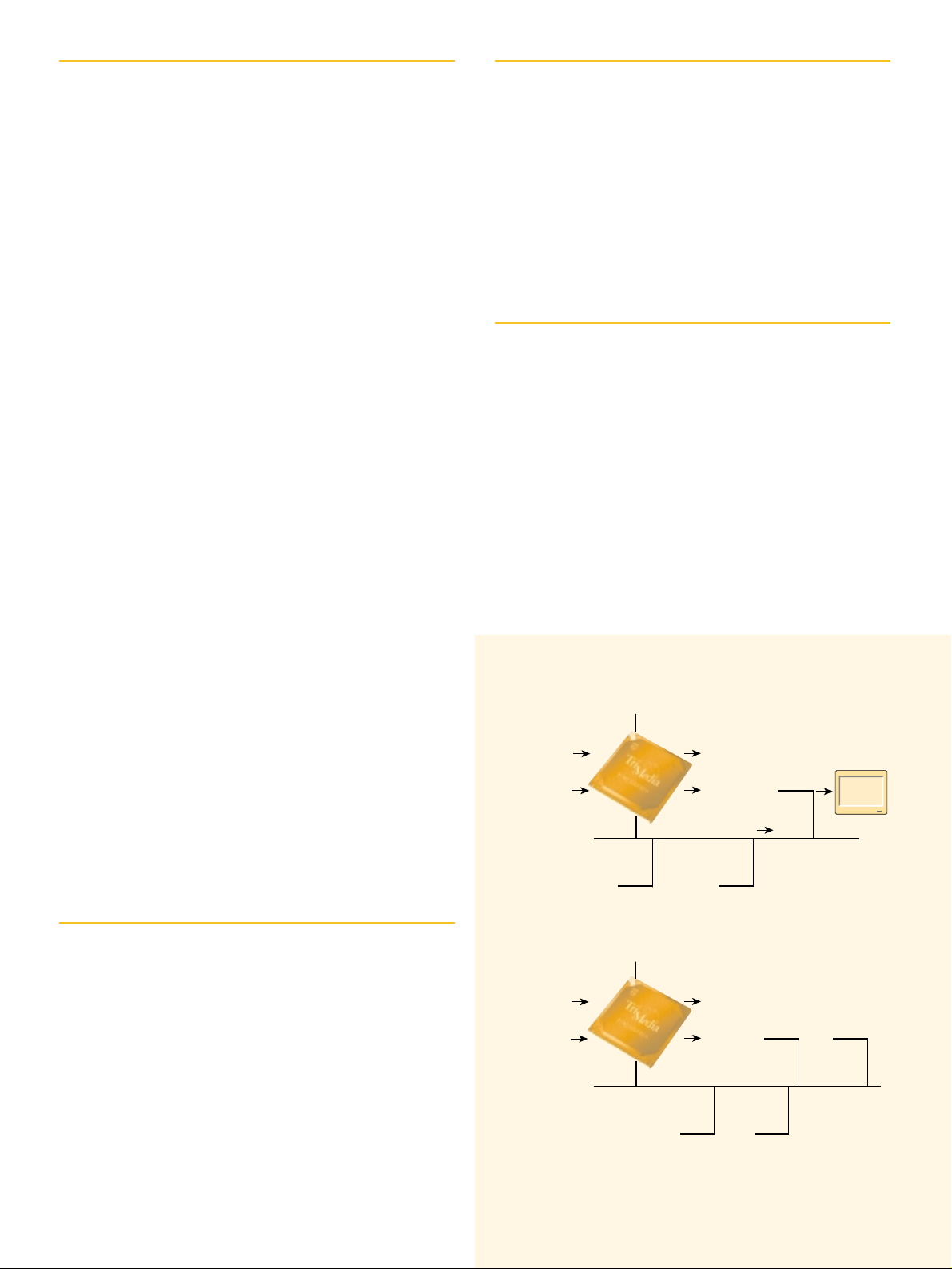
TM-1300 is designed for use as the sole CPU in standalone systems
and as a coprocessor in a hosted or multiprocessor environment.
HOST-ASSISTED COPROCESSOR
STANDALONE
SDRAM
CAMERA
AUDIO
PCI/XIO BUS
HOST CPU MEMORY
SDRAM
CAMERA
AUDIO
PCI/XIO BUS
ROM/FLASH
VCR
TV MONITOR
AUDIO
RGB IMAGE SEQUENCES
VCR
TV MONITOR
AUDIO
GRAPHICS
BUS
ARBITER
CARD
PERIPHERALPERIPHERAL
Page 6
REAL-TIME OPERATION SYSTEM SUPPORT
For multimedia applications requiring system resource and task man-
agement, the TM-1300 media processor supports the pSOS+™
embedded real-time operating system kernels. Developed by
Integrated Systems, Inc., the pSOS+ kernels are based on open system
standards and are optimized for deterministic response essential for
multimedia applications.
UPWARD COMPATIBILITY
TriMedia processors preserve investments in software development
through software compatibility between family members at the source
code level. Powerful, optimizing compilers ensure that programmers
never need to resort to non-portable assembler programming.
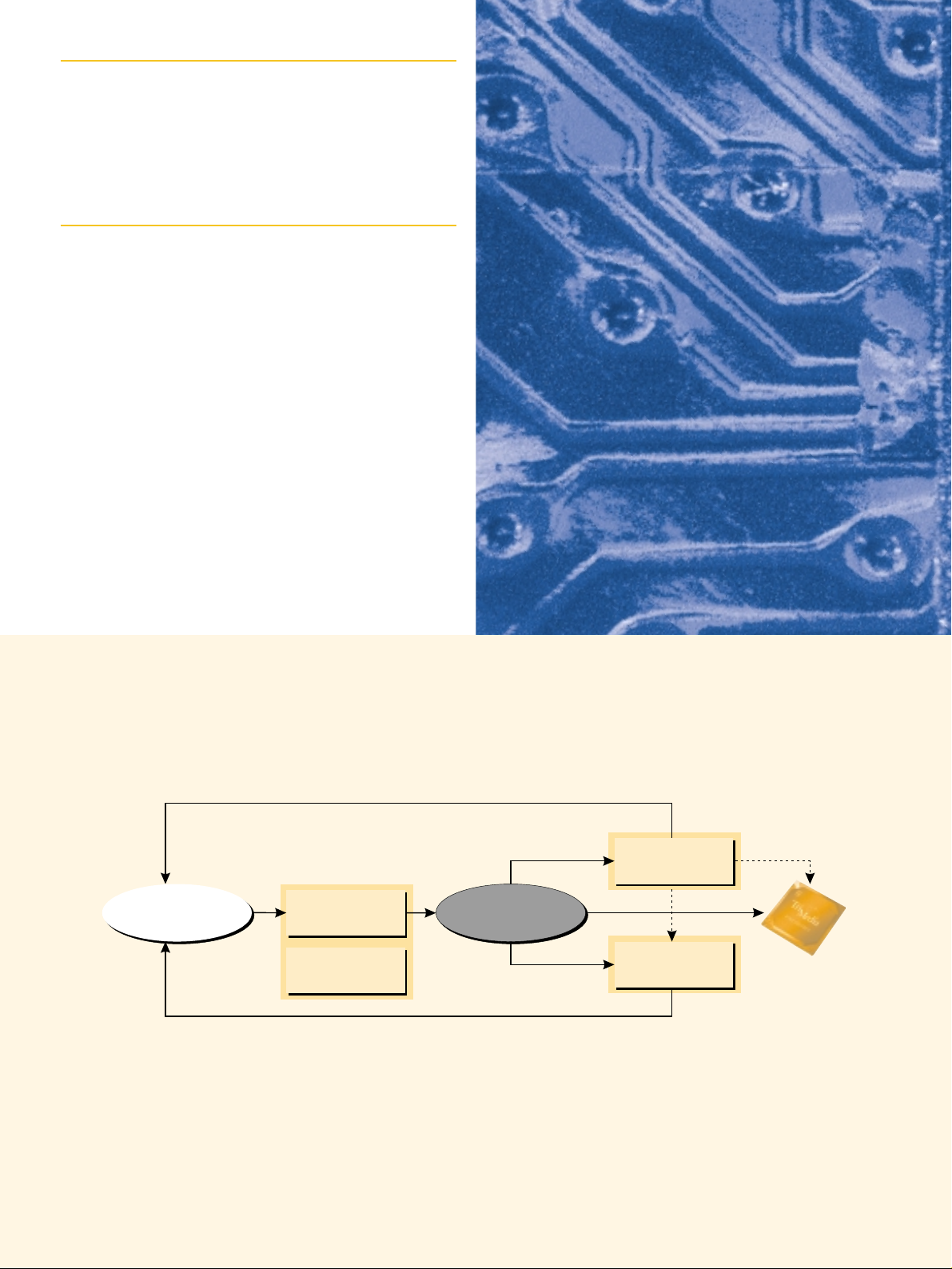
The TriMedia Software Development Environment includes a full suite of system software tools to compile and debug
code, analyze and optimize performance, and simulate execution on TriMedia processors.
ANSI C/C++ APPLICATION
APPLICATION & DEVICE LIBS
SPECIAL OPS
TRIMEDIA
COMPILATION SYSTEM
PERFORMANCE
OPTIMIZATIONTOOLS
OPTIMIZED EXECUTABLE
APPLICATION
DEBUGGER
CYCLE-ACCURATE
SIMULATOR
Page 7

PHYSICAL
Process 0.25-micron CMOS
Packaging 292 T2BGA (169 functional)
Power supply core: 2.5 V; I/O: 3.3 V (5 V tol.)
consumption 1300 mA; 3.5 W
powerdown 300 mA
Case Temperature 0 to 85 oC
CENTRAL PROCESSING UNIT
Clock Speed 143 or 166 MHz
Instruction Length variable (2 to 23 bytes); compressed
Instruction Set arithmetic and logical ops, load/store ops.,
special multimedia and DSP ops., IEEEcompliant floating point ops.
Issue Slots 5
Functional Units 27, pipelined
integer and floating-point arithmetic units,
data-parallel DSP-like units
name qty latency recovery
constant 5 1 1
integer ALU 5 1 1
memory load/store 2 3 1
shift 2 1 1
DSPALU 2 2 1
DSP multiply 2 3 1
branch 3 3 1
float ALU 2 3 1
integer/float mul 2 3 1
float compare 1 1 1
float sqrt./divide 1 17 16
Registers 128 (32-bit width)
Special/SIMD Ops 32
MEMORY SYSTEM
Speed 143 MHz
CPU/Memory programmable; 1:1, 5:4, 4:3, 3:2, and 2:1
Speed Ratios
Memory Size
512 KB to 64 MB (up to four ranks)
Supported Types SDRAM (x4, x8, x16); SGRAM (x32);
64-Mbit SDRAM (x8, x16, x32)
128-Mbit SDRAM (x16)
Recommended 8 MB: 1 2Mx32
Configurations 16 MB: 2 4Mx16 or 2 2Mx32
32 MB: 4 2Mx32 or 4 4Mx16
Width 32-bit bus
Max. Bandwidth 572 MB/sec (at 143 MHz)
Interface glueless up to 4 chips (at 143 MHz); more
chips will require slower clock
Signal Levels 3.3 V LVTTL
CACHES
Access data 8-, 16-, 32-bit word
instruction 64 bytes
Associativity 8-way set-associative with hierarchical LRU
replacement
Block Size 64 bytes
Size data 16 KB
instruction 32 KB
INTERNAL DATA HIGHWAY
Protocol 64-byte block-transfer
separate 32-bit data and 32-bit address buses
VIDEO IN
Supported Signals CCIR 601/656: 8-bit video (up to 40 Mpix/
sec; raw 8-10-bit data up to 80 MB/sec
Image Sizes all sizes, subject to sample rate
Functions programmable on-the-fly 2X horizontal
resolution subsampling
VIDEO OUT
Image Sizes flexible, including CCIR601; max. 4K x 4K
pixels (subject to 80 MB/sec data rate)
Input Formats YUV 4:2:2, YUV 4:2:0
Output Format CCIR601/656 8-bit video, PAL or NTSC
Clock Rates programmable (4-80 MHz), typ. 27 MB/sec
(13.5 Mpixels/sec for NTSC, PAL)
Transfer Speeds up to 80 MB/sec in data-streaming and mes-
sage passing modes; 40 Mpix/sec in YUV
4:2:2 mode
Functions full 129-level alpha blending, genlock mode,
frame synchronization, chroma key, programmable YUV color clipping
AUDIO IN
No. of Channels 2
Sample Size 8- or 16-bit samples per channel
Sample Rates programmable with 0.001 Hz resolution;
maximum is application dependent
Data Formats 8-bit or 16-bit mono and stereo; PC stan-
dard memory data format
External Interface 4 pins; 1 programmable clock; 3 flexible ser-
ial input
Clock Source internal or external
Native Protocol I2S and other serial 3-wire protocols
AUDIO OUT
No. of Channels 8
Sample Size 16- or 32-bit samples per channel
Sample Rates programmable with 0.001 Hz resolution;
maximum is application dependent
Data Formats 16-bit (mono and stereo); 32-bit (mono and
stereo; PC standard memory data format
External Interface 4 pins each; 1 programmable clock;
3 flexible serial output
Clock Source internal or external
Native Protocol I2S and other serial 3-wire protocols
SPDIF OUT
No. of Channels up to 6
Sample Size 16 or 24 bits per channel
Bit Rate up to 40 Mbits/sec
External Interface 1 pin, self clocking interface per IEC-958
Clock Source internal
Native Protocol IEC-958, 1 wire
TM-1300 Specifications
Page 8

IMAGE COPROCESSOR
Functions horizontal or vertical scaling and filtering of
individual Y, U, or V
horizontal scaling and filtering with color conversion and overlay: YUV to RGB, RGB overlay and alpha blending, bit mask blanking
Scaling programmable scale factor (0.2X to 10X)
Filtering 32-polyphase, each instance 5-tap, fully pro-
grammable filter coefficients
Performance horizontal scaling and filtering: 110 MB/sec
vertical scaling and filtering: 40 MB/sec
VLD
Function parses MPEG-1 and MPEG-2 elementary
bitstreams generating run-level pairs and filling macroblock headers
External Interface none
DVD DESCRAMBLER
Functions authentication; descrambling
External Interface none
I2C INTERFACE
Supported Modes single master only
Addressing 7-bit
Rates up to 400 kbps
External Interface 2 pins: 1 serial data, 1 clock
SYNCHRONOUS SERIAL INTERFACE
Data Formats variable slots/frame
Frame Sync external or internal
Clock Source separate transmit, receive, frame sync;
transmit/receive clocks external source; automatic frame sync error detection; settable
edge polarity for transmit, receive, and frame
sync
External Interface 6 pins (2 usable for tip and ring for phone
connections); compatible with most telecom
devices; can be configured with multiple
chips
PCI/XIO INTERFACE
Speed 33 MHz
Bus Width 32 bits
Address Space 32 bits (4 GB)
Voltage drive and receive at 3.3 V or 5 V
Standard Compliance PCI Local Bus Specification 2.1
TIMERS
Number 4
Width 32-bits
Sources external clock, (prescaled) CPU clock, data
or instruction breakpoints, cache events,
video in/out clocks, audio in/out word
strobe, SSI receive/transmit frame sync
Philips Semiconductors - a worldwide company
Internet: http://www.semiconductors.philips.com
For all other countries apply to:
Marketing & Sales Communications, Building BE-p, P.O. Box 218,
5600 MD EINDHOVEN, The Netherlands, Fax. +31 40 27 24825
FOR MORE INFORMATION CONTACT:
PHILIPS SEMICONDUCTORS TRIMEDIA BUSINESS LINE
811 EAST ARQUES AVENUE, M/S 71, SUNNYVALE CA 94088-3409
PH 800-914-9239 (NORTH AMERICA), 408-991-3838 (WORLDWIDE)
FX 408-991-3300, E-MAIL [email protected]
WEBSITE www.trimedia.philips.com
© 1999 Philips Electronics North America Corporation. All rights are reser ved.
Reproduction in whole or in part is prohibited without the prior written consent of the
copyright owner.
The Philips wordmark and shield emblem are trademarks of Philips Electronics, NV.
TriMedia and the TriMedia design are trademarks of Philips Electronics Nor th America
Corporation. pSOS+ is a trademark of Integrated Systems, Inc. Dolby, Dolby Digital,
Dolby AC-3, and Dolby Pro Logic are registered trademarks of Dolby Laboratories.
Other brands and product names are trademarks or registered tr ademarks of their
respective owners.
The information presented in this document does not form part of any quotation of
contract, is believed to be accurate and reliable and may be changed without notice.
No liability will be accepted by the publisher for any consequences of its use. Publication
thereof does not convey or imply any license under patent or other industrial or
intellectual property rights.
Printed in the Netherlands. Sept 1999 9397-750-06379
Argentina: see South America
Australia: Tel. +61 2 9704 8141, Fax. +61 2 9704 8139
Austria: Tel. +43 1 60 101 1248, Fax. +43 1 60 101 1210
Belarus: Tel. +375 172 20 0733, Fax. +375 172 20 0773
Belgium: see The Netherlands
Brazil: see South America
Bulgaria: Tel. +359 2 68 9211, Fax. +359 2 68 9102
Canada: Tel. +1 800 234 7381, Fax. +1 800 943 0087
China/Hong Kong: Tel. +852 2319 7888, Fax. +852 2319 7700
Colombia: see South America
Czech Republic: see Austria
Denmark: Tel. +45 33 29 3333, Fax. +45 33 29 3905
Finland: Tel. +358 9 615 800, Fax. +358 9 6158 0920
France: Tel. +33 1 4099 6161, Fax. +33 1 4099 6427
Germany: Tel. +49 40 2353 60, Fax. +49 40 2353 6300
Hungary: see Austria
India: Tel. +91 22 493 8541, Fax. +91 22 493 0966
Indonesia: Tel. +62 21 794 0040 ext. 2501, Fax. +62 21 794 0080
Ireland: Tel. +353 1 7640 000, Fax. +353 1 7640 200
Israel: Tel. +972 3 645 0444, Fax. +972 3 649 1007
Italy: Tel. +39 039 203 6838, Fax +39 039 203 6800
Japan: Tel. +81 3 3740 5130, Fax. +81 3 3740 5057
Korea: Tel. +82 2 709 1412, Fax. +82 2 709 1415
Malaysia: Tel. +60 3 750 5214, Fax. +60 3 757 4880
Mexico: Tel. +9-5 800 234 7381, Fax. +9-5 800 943 0087
Middle East: see Italy
Netherlands: Tel. +31 40 27 82785, Fax. +31 40 27 88399
New Zealand: Tel. +64 9 849 4160, Fax. +64 9 849 7811
Norway: Tel. +47 22 74 8000, Fax. +47 22 74 8341
Pakistan: see Singapore
Philippines: Tel. +63 2 816 6380, Fax. +63 2 817 3474
Poland: Tel. +48 22 612 2831, Fax. +48 22 612 2327
Portugal: see Spain
Romania: see Italy
Russia: Tel. +7 095 755 6918, Fax. +7 095 755 6919
Singapore: Tel. +65 350 2538, Fax. +65 251 6500
Slovakia: see Austria
Slovenia: see Italy
South Africa: Tel. +27 11 471 5401, Fax. +27 11 471 5398
South America: Tel. +55 11 821 2333, Fax. +55 11 821 2382
Spain: Tel. +34 93 301 6312, Fax. +34 93 301 4107
Sweden: Tel. +46 8 5985 2000, Fax. +46 8 5985 2745
Switzerland: Tel. +41 1 488 2741, Fax. +41 1 488 3263
Taiwan: Tel. +886 2 2134 2886, Fax. +886 2 2134 2874
Thailand: Tel. +66 2 745 4090, Fax. +66 2 398 0793
Turkey: Tel. +90 216 522 1500, Fax. +90 216 522 1813
Ukraine: Tel. +380 44 264 2776, Fax. +380 44 268 0461
United Kingdom: Tel. +44 208 730 5000, Fax. +44 208 754 8421
United States: Tel. +1 800 234 7381, Fax. +1 800 943 0087
Uruguay: see South America
Vietnam: see Singapore
Yugoslavia: Tel. +381 11 62 5344, Fax. +381 11 63 5777
 Loading...