

Page 1

INTEGRATED CIRCUITS
DATA SH EET
TDA7052
1 W BTL mono audio amplifier
Product specification
File under Integrated Circuits, IC01
July 1994
Page 2

Philips Semiconductors Product specification
1 W BTL mono audio amplifier TDA7052
GENERAL DESCRIPTION
The TDA7052 is a mono output amplifier in a 8-lead dual-in-line (DIL) plastic package. The device is designed for
battery-fed portable audio applications.
Features:
• No external components
• No switch-on or switch-off clicks
• Good overall stability
• Low power consumption
• No external heatsink required
• Short-circuit proof
QUICK REFERENCE DATA
SYMBOL PARAMETER CONDITIONS MIN. TYP. MAX. UNIT
V
P
I
tot
G
v
P
o
THD Total harmonic distortion P
Supply voltage range 3 6 18 V
Total quiescent current RL = ∞−48mA
Voltage gain 38 39 40 dB
Output power THD = 10%; 8 Ω− 1,2 − W
= 0,1 W − 0,2 1,0 %
o
PACKAGE OUTLINE
8-lead DIL; plastic (SOT97); SOT97-1; 1996 August 21.
July 1994 2
Page 3
Philips Semiconductors Product specification
1 W BTL mono audio amplifier TDA7052
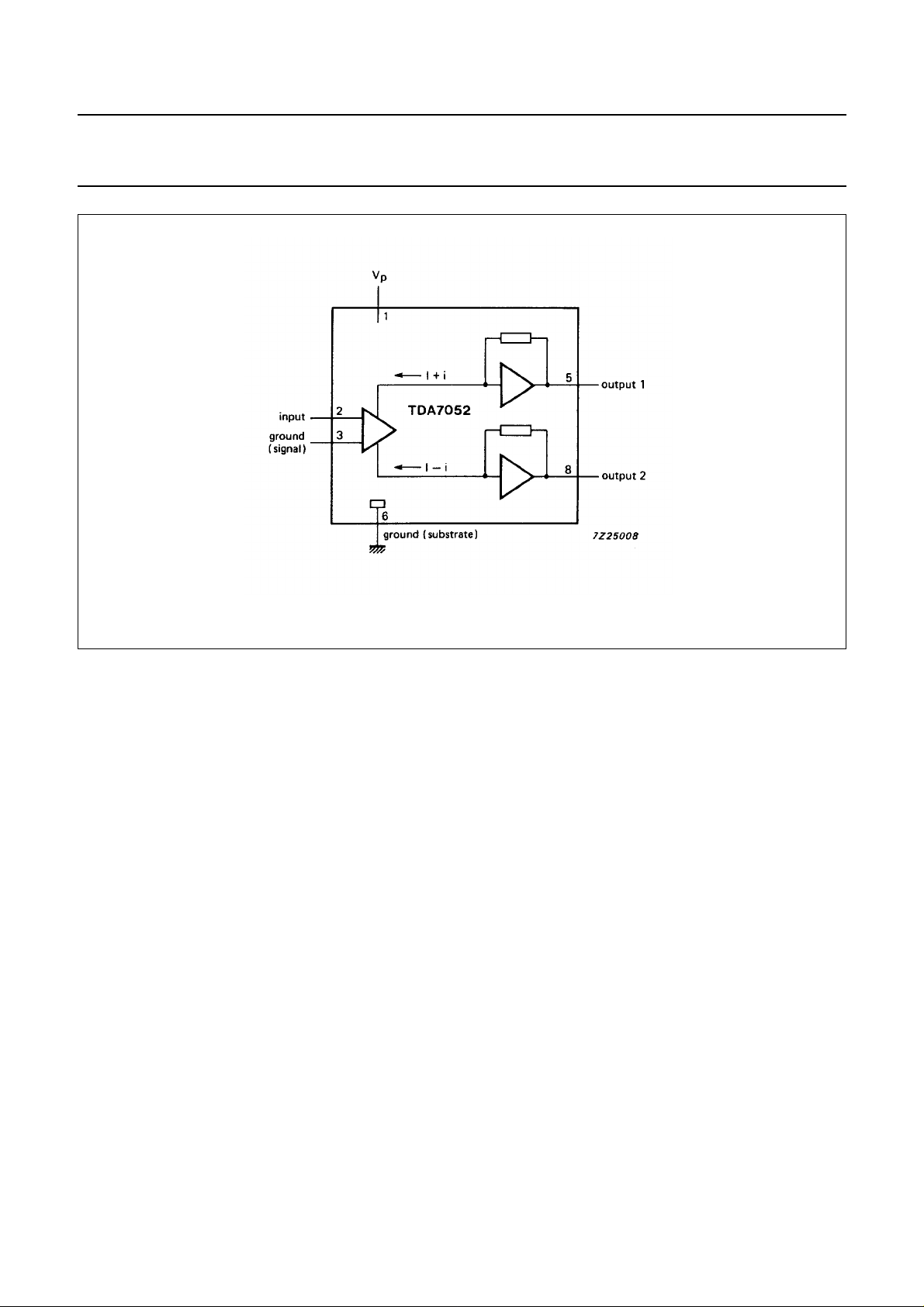
Fig.1 Block diagram.
PINNING
1V
2 IN input 6 GND2 ground (substrate)
3 GND1 ground (signal) 7 n.c. not connected
4 n.c. not connected 8 OUT2 output2
P
supply voltage 5 OUT1 output1
July 1994 3
Page 4

Philips Semiconductors Product specification
1 W BTL mono audio amplifier TDA7052
FUNCTIONAL DESCRIPTION
The TDA7052 is a mono output amplifier designed for battery-fed portable audio applications, such as tape recorders
and radios.
The gain is fixed internally at 40 dB. A large number of tape recorders and radios are still designed for mono sound, plus
a space-saving trend by reduction of the number of battery cells. This means a decrease in supply voltage which results
in an reduction of output power. To compensate for this reduction, the TDA7052 uses the Bridge-Tied-Load principle
(BTL) which can deliver an output power of 1,2 W (THD = 10%) into an 8 Ω load with a power supply of 6 V. The load
can be short-circuited at each signal excursion.
RATINGS
Limiting values in accordance with the Absolute Maximum System (IEC 134)
SYMBOL PARAMETER MIN. MAX. UNIT
V
I
OSM
P
T
T
P
tot
c
stg
Supply voltage − 18 V
Non-repetitive peak output current − 1,5 A
Total power dissipation see Fig. 2
Crystal temperature − 150 °C
Storage temperature range −55 +150 °C
Fig.2 Power derating curve.
POWER DISSIPATION
Assume V
= 6 V; RL = 8 Ω; T
P
= 50 °C maximum.
amb
The maximum sinewave dissipation is 0,9 W.
R
th j-a
Where R
150 50–
---------------------09,
of the package is 110 K/W, so no external heatsink is required.
th j-a
110 K/W.≈=
July 1994 4
Page 5

Philips Semiconductors Product specification
1 W BTL mono audio amplifier TDA7052
CHARACTERISTICS
V
= 6 V; RL = 8 Ω; f = 1 kHz; T
P
SYMBOL PARAMETER CONDITIONS MIN. TYP. MAX. UNIT
Supply
V
P
I
tot
G
v
P
o
Supply voltage range 3 6 18 V
Total quiscent current RL = ∞−48mA
Voltage gain 38 39 40 dB
Output power THD = 10% − 1,2 − W
Noise output voltage
(RMS value)
V
no(rms)
V
no(rms)
f
r
Frequency response − 20 Hz to − Hz
SVRR Supply voltage ripple rejection note 3 40 50 − dB
DC output offset voltage
∆V
5-8
pin 5 to 8 RS = 5 k Ω− − 100 mV
THD Total harmonic distortion P
Input impedance − 100 − kΩ
Z
I
I
bias
Input bias current − 100 300 nA
= 25 °C; unless otherwise specified.
amb
note 1 − 150 300 µV
note 2 − 60 −µV
= 0,1 W − 0,2 1,0 %
O
20 kHz
Notes to the characteristics
1. The unweighted RMS noise output voltage is measured at a bandwidth of 60 Hz to 15 kHz with a source impedance
) of 5 kΩ.
(R
S
2. The RMS noise output voltage is measured at a bandwidth of 5 kHz with a source impedance of 0 Ω and a frequency
of 500 kHz. With a practical load (R = 8 Ω; L = 200 µH) the noise output current is only 100 nA.
3. Ripple rejection is measured at the output with a source impedance of 0 Ω and a frequency between 100 Hz and
10 kHz. The ripple voltage = 200 mV (RMS value) is applied to the positive supply rail.
July 1994 5
Page 6

Philips Semiconductors Product specification
1 W BTL mono audio amplifier TDA7052
Fig.3 Application diagram.
July 1994 6
Page 7

Philips Semiconductors Product specification
1 W BTL mono audio amplifier TDA7052
PACKAGE OUTLINE
DIP8: plastic dual in-line package; 8 leads (300 mil)
D
seating plane
A
L
Z
e
b
8
pin 1 index
1
w M
b
1
b
2
5
SOT97-1
M
E
A
2
A
c
(e )
1
M
H
E
1
DIMENSIONS (inch dimensions are derived from the original mm dimensions)
A
A
A
UNIT
max.
mm
inches
Note
1. Plastic or metal protrusions of 0.25 mm maximum per side are not included.
OUTLINE
VERSION
SOT97-1
12
min.
max.
050G01 MO-001AN
b
1.73
1.14
0.068
0.045
IEC JEDEC EIAJ
0.021
0.015
b
1
0.53
0.38
4
0 5 10 mm
scale
b
cD E e M
2
0.36
1.07
0.23
0.89
0.014
0.042
0.009
0.035
REFERENCES
0.39
0.36
July 1994 7
(1) (1)
9.8
9.2
6.48
6.20
0.26
0.24
L
e
1
M
3.60
8.25
3.05
7.80
0.14
0.32
0.12
0.31
EUROPEAN
PROJECTION
E
10.0
0.39
0.33
H
8.3
w
max.
0.2542.54 7.62
1.154.2 0.51 3.2
0.010.10 0.30
0.0450.17 0.020 0.13
ISSUE DATE
92-11-17
95-02-04
(1)
Z
Page 8

Philips Semiconductors Product specification
1 W BTL mono audio amplifier TDA7052
SOLDERING
Introduction
There is no soldering method that is ideal for all IC
packages. Wave soldering is often preferred when
through-hole and surface mounted components are mixed
on one printed-circuit board. However, wave soldering is
not always suitable for surface mounted ICs, or for
printed-circuits with high population densities. In these
situations reflow soldering is often used.
This text gives a very brief insight to a complex technology.
A more in-depth account of soldering ICs can be found in
our
“IC Package Databook”
Soldering by dipping or by wave
The maximum permissible temperature of the solder is
260 °C; solder at this temperature must not be in contact
with the joint for more than 5 seconds. The total contact
time of successive solder waves must not exceed
5 seconds.
DEFINITIONS
(order code 9398 652 90011).
The device may be mounted up to the seating plane, but
the temperature of the plastic body must not exceed the
specified maximum storage temperature (T
printed-circuit board has been pre-heated, forced cooling
may be necessary immediately after soldering to keep the
temperature within the permissible limit.
Repairing soldered joints
Apply a low voltage soldering iron (less than 24 V) to the
lead(s) of the package, below the seating plane or not
more than 2 mm above it. If the temperature of the
soldering iron bit is less than 300 °C it may remain in
contact for up to 10 seconds. If the bit temperature is
between 300 and 400 °C, contact may be up to 5 seconds.
stg max
). If the
Data sheet status
Objective specification This data sheet contains target or goal specifications for product development.
Preliminary specification This data sheet contains preliminary data; supplementary data may be published later.
Product specification This data sheet contains final product specifications.
Limiting values
Limiting values given are in accordance with the Absolute Maximum Rating System (IEC 134). Stress above one or
more of the limiting values may cause permanent damage to the device. These are stress ratings only and operation
of the device at these or at any other conditions above those given in the Characteristics sections of the specification
is not implied. Exposure to limiting values for extended periods may affect device reliability.
Application information
Where application information is given, it is advisory and does not form part of the specification.
LIFE SUPPORT APPLICATIONS
These products are not designed for use in life support appliances, devices, or systems where malfunction of these
products can reasonably be expected to result in personal injury. Philips customers using or selling these products for
use in such applications do so at their own risk and agree to fully indemnify Philips for any damages resulting from such
improper use or sale.
July 1994 8
 Loading...