

Datasheet SAB-C515-1R24M, SAB-C515-1RM, SAB-C515-L24M, SAB-C515-LM, SAF-C515-1R24M Datasheet (Siemens)
...Page 1

Microcomputer Components
8-Bit CMOS Microcontroller
C515
Data Sheet 08.97
Page 2

C515 Data Sheet
Revision History: Current Version: 1997-08-01
Previous Version: none (Original Version)
Page
(in previous
Version)
Page
(in current
Version)
Subjects (major changes since last revision)
Edition 1997-08-01
Published by Siemens AG,
Bereich Halbleiter, MarketingKommunikation, Balanstraße 73,
81541 München
©
Siemens AG 1997.
All Rights Reserved.
Attention please!
As far as patents or other rights of third parties are concerned, liability is only assumed for components, not for applications, processes
and circuits implemented within components or assemblies.
The information describes the type of component and shall not be considered as assured characteristics.
Terms of delivery and rights to change design reserved.
For questions on technology, delivery and prices please contact the Semiconductor Group Offices in Germany or the Siemens Companies
and Representatives worldwide (see address list).
Due to technical requirements components may contain dangerous substances. For information on the types in question please contact
your nearest Siemens Office, Semiconductor Group.
Siemens AG is an approved CECC manufacturer.
Packing
Please use the recycling operators known to you. We can also help you – get in touch with your nearest sales office. By agreement we
will take packing material back, if it is sorted. You must bear the costs of transport.
For packing material that is returned to us unsorted or which we are not obliged to accept, we shall have to invoice you for any costs incurred.
Components used in life-support devices or systems must be expressly authorized for such purpose!
Critical components
written approval of the Semiconductor Group of Siemens AG.
1 A critical component is a component used in a life-support device or system whose failure can reasonably be expected to cause the
failure of that life-support device or system, or to affect its safety or effectiveness of that device or system.
2 Life support devices or systems are intended (a) to be implanted in the human body, or (b) to support and/or maintain and sustain hu-
man life. If they fail, it is reasonable to assume that the health of the user may be endangered.
1
of the Semiconductor Group of Siemens AG, may only be used in life-support devices or systems
2
with the express
Page 3
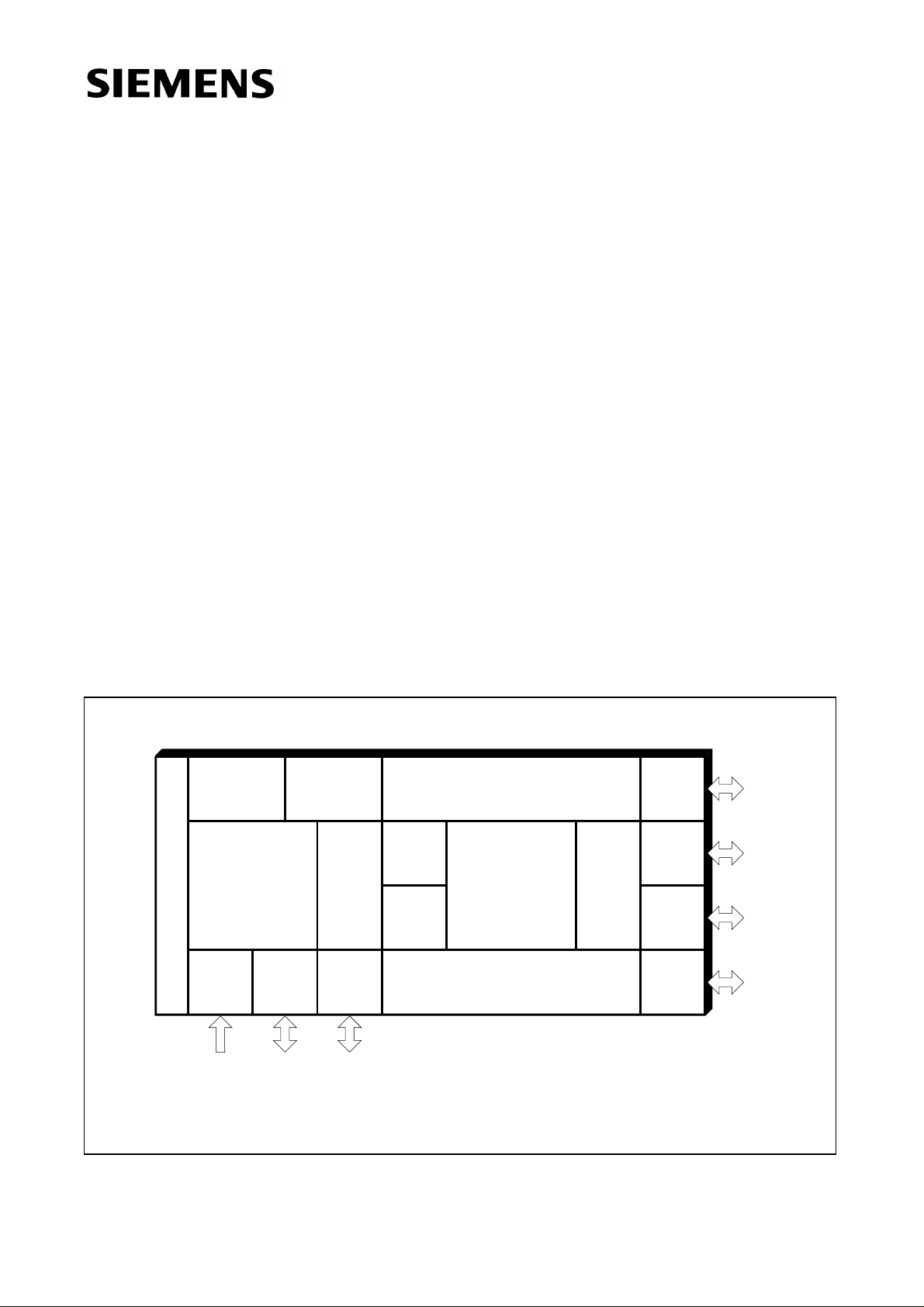
8-Bit CMOS Microcontroller
Advance Information
Data Sheet
Full upward compatibility with SAB 80C515
•
Up to 24 MHz external operating frequency
•
– 500ns instruction cycle at 24 MHz operation
8K byte on-chip ROM (with optional ROM protection)
•
– alternatively up to 64K byte external program memory
Up to 64K byte external data memory
•
256 byte on-chip RAM
•
Six 8-bit parallel I/O ports
•
One input port for analog/digital input
•
Full duplex serial interface (USART)
•
– 4 operating modes, fixed or variable baud rates
Three 16-bit timer/counters
•
– Timer 0 / 1 (C501 compatible)
– Timer 2 for 16-bit reload, compare, or capture functions
C515
(more features on next page)
Power
Saving
Modes
8-Bit
A/D
Converter
On-Chip Emulation Support Module
Digital
Input
Watchdog
Port6Port 5 Port 4
I/O I/OAnalog/
Timer
T2
T0
T1
RAM
256 x 8
CPU
ROM
K8x8
USART
Port 0
Port 1
Port 2
Port 3
I/O
I/O
I/O
I/O
MCA03198
Figure 1
C515 Functional Units
Semiconductor Group 3 1997-08-01
Page 4

Features (cont’d):
•
8-bit A/D converter
– 8 multiplexed analog inputs
– Programmable reference voltages
•
16-bit watchdog timer
•
Power saving modes
– Idle mode
– Slow down mode (can be combined with idle mode)
– Software power-down mode
•
12 interrupt sources (7 external, 5 internal) selectable at four priority levels
•
On-chip emulation support logic (Enhanced Hooks Technology
•
ALE switch-off capability
•
P-MQFP-80-1 package
•
Temperature Ranges : SAB-C515
SAF-C515
SAH-C515
T
= 0 to 70 ° C
A
T
= -40 to 85 ° C
A
T
= -40 to 110 ° C (max. operating frequency: 16 MHz)
A
TM
)
C515
The C515 is an upward compatible version of the SAB 80C515A 8-bit microcontroller which
additionally provides ALE switch-off capability, on-chip emulation support, ROM protection, and
slow down mode capability. With a maximum external clock rate of 24 MHz it achieves a 500 ns
instruction cycle time (1
Ordering Information
Type Ordering Code Package Description
SAB-C515-1RM
SAB-C515-1R24M
SAF-C515-1RM Q67127-DXXXX P-MQFP-80-1 with mask programmable ROM (16 MHz)
SAF-C515-1R24M Q67127-DXXXX P-MQFP-80-1 with mask programmable ROM (24 MHz)
SAB-C515-LM
SAB-C515-L24M
SAF-C515-LM Q67127-C1031 P-MQFP-80-1 for external memory (16 MHz)
µ
s at 12 MHz). The C515 is mounted in a P-MQFP-80 package.
(8-Bit CMOS microcontroller)
Q67127-DXXXX
Q67127-DXXXX
Q67127-C1030
Q67127-C1032
P-MQFP-80-1
P-MQFP-80-1
P-MQFP-80-1
P-MQFP-80-1
with mask programmable ROM (16 MHz)
with mask programmable ROM (24 MHz)
ext. temp. – 40 ˚C to 85 ˚C
ext. temp. – 40 ˚C to 85 ˚C
for external memory (16 MHz)
for external memory (24 MHz
ext. temp. – 40 ˚C to 85 ˚C
SAF-C515-L24M Q67127-C1081 P-MQFP-80-1 for external memory (24 MHz)
ext. temp. – 40 ˚C to 85 ˚C
Note: Versions for extended temperature ranges – 40 ˚C to 110 ˚C (SAH-C515C-LM and SAH-
C515-1RM) are available on request. The ordering number of ROM types (DXXXX
extensions) is defined after program release (verification) of the customer.
Semiconductor Group 4 1997-08-01
Page 5
C515
XTAL1
XTAL2
ALE
PSEN
EA
RESET
PE
V
AREF
V
AGND
V
C515
V
SSCC
Port 0
8 Bit Digital I/O
1Port
8 Bit Digital I/O
Port 2
8 Bit Digital I/O
Port 3
8 Bit Digital I/O
4Port
8 Bit Digital I/O
Port 5
8 Bit Digital I/O
6Port
8 Bit Analog/
Digital Input
MCL03199
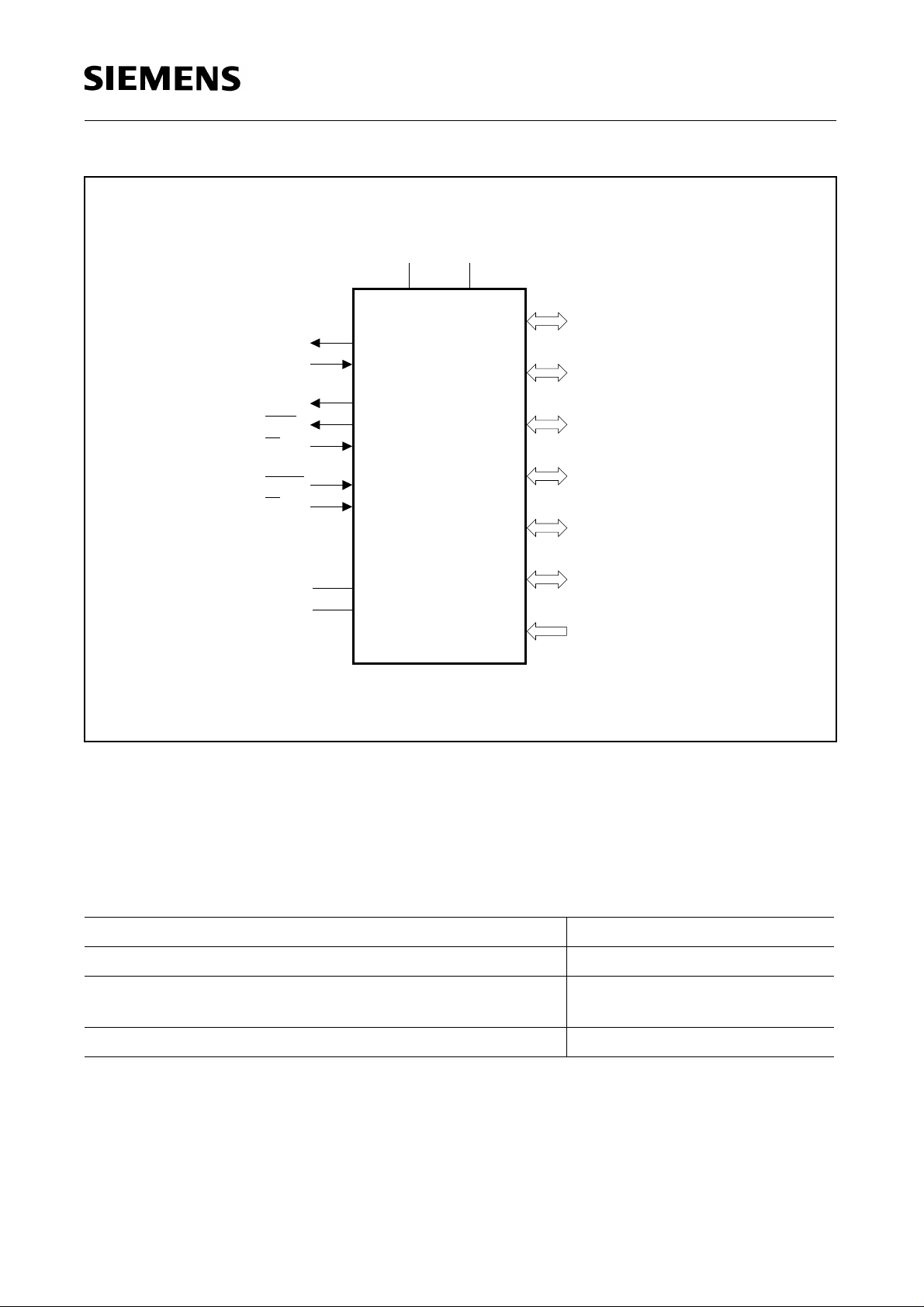
Figure 2
Logic Symbol
Additional Literature
For further information about the C515 the following literature is available:
Title Ordering Number
C515 8-Bit CMOS Microcontroller User’s Manual B158-H7049-X-X-7600
C500 Microcontroller Family
B158-H6987-X-X-7600
Architecture and Instruction Set User’s Manual
C500 Microcontroller Family - Pocket Guide B158-H6986-X-X-7600
Semiconductor Group 5 1997-08-01
Page 6
P0.7/AD7
P0.6/AD6
P5.7
P0.5/AD5
P0.4/AD4
P0.3/AD3
P0.2/AD2
P0.1/AD1
P0.0/AD0EAALE
N.C.
N.C.
PSEN
N.C.
P2.7/A15
P2.6/A14
P2.5/A13
P2.4/A12
P2.3/A11
4142434445464748495051525354555657585960
C515
P5.6
P5.5
P5.4
P5.3
P5.2
P5.1
P5.0
N.C.
V
CC
N.C.
N.C.
P4.0
P4.1
P4.2
PE
P4.3
P4.4
P4.5
P4.6
P4.7
62
63
64
65
66
67
68
69
70
71
72
73
74
75
76
77
78
79
80
12
345
4061
39
38
37
36
35
34
33
32
C515
31
30
29
28
27
26
25
24
23
22
21
6
7
8
9
10
11
12
13 14 15
16
17
18
19
20
P2.2/A10
P2.1/A9
P2.0/A8
XTAL1
XTAL2
N.C.
V
SS
V
CC
N.C.
P1.0/INT3/CC0
P1.1/INT4/CC1
P1.2/INT5/CC2
P1.3/INT6/CC3
P1.4/INT2
P1.5/T2EX
P1.6/CLKOUT
P1.7/T2
N.C.
P3.7/RD
P3.6/WR
AREF
N.C.
V
RESET
AGND
V
P6.7/AIN7
P6.5/AIN5
P6.6/AIN6
P6.3/AIN3
P6.4/AIN4
P6.2/AIN2
N.C.
N.C.
P6.0/AIN0
P6.1/AIN1
P3.1/TXD
P3.0/RXD
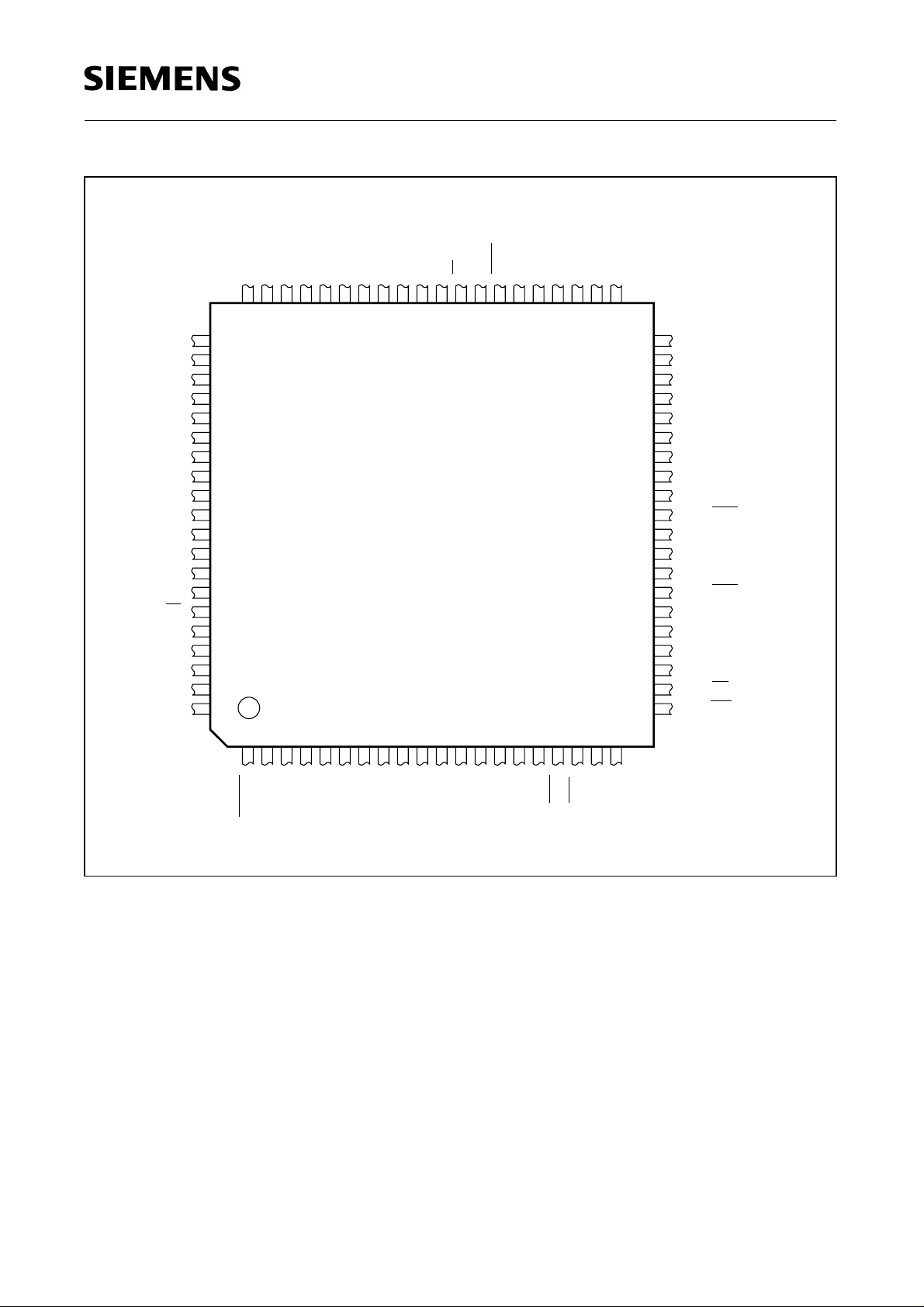
Figure 3
C515 Pin Configuration (P-MQFP-80 Package, Top View)
P3.4/T0
P3.2/INT0
P3.5/T1
P3.3/INT1
MCP03200
Semiconductor Group 6 1997-08-01
Page 7
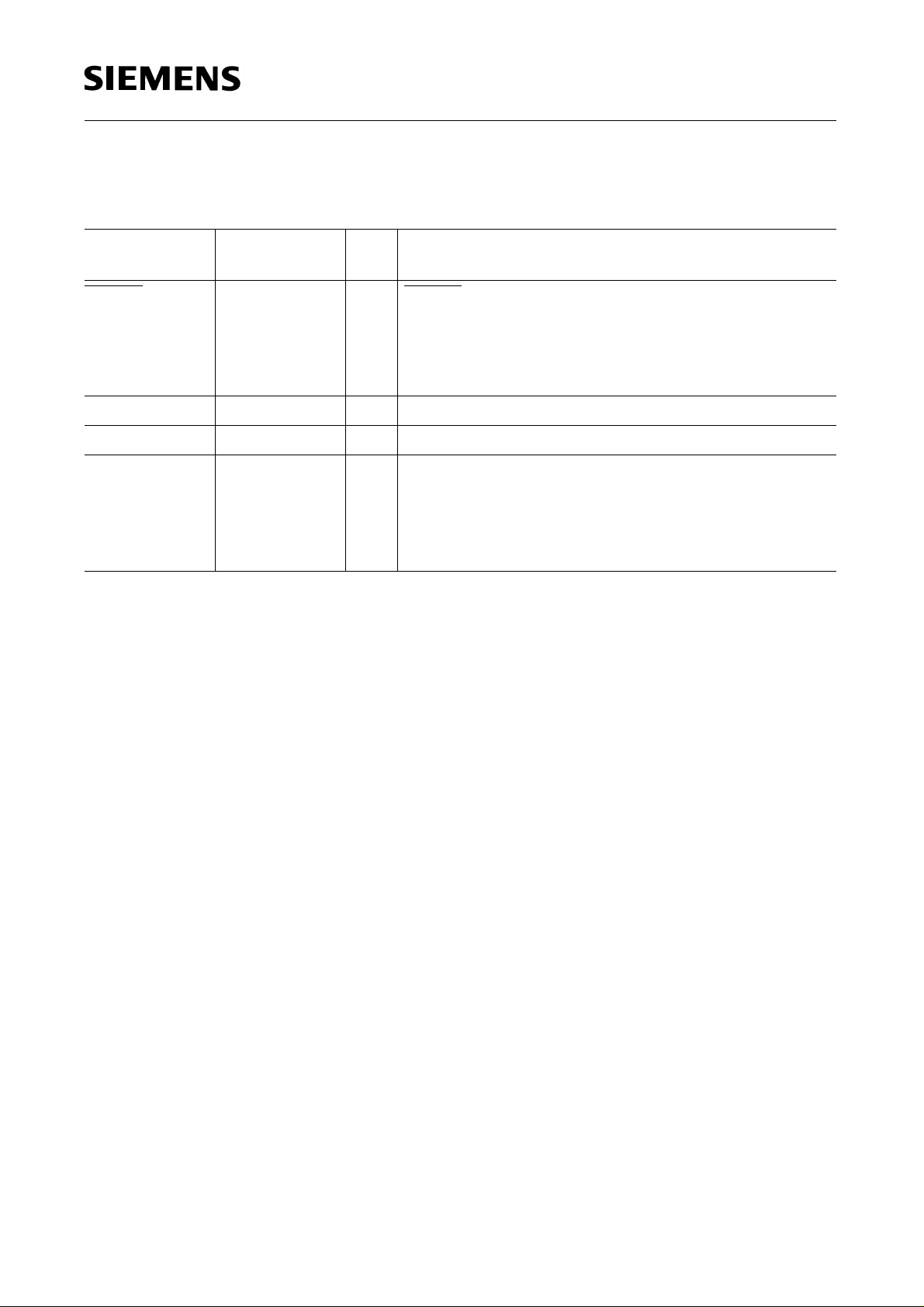
Table 1
Pin Definitions and Functions
C515
Symbol Pin Number
(P-MQFP-80)
RESET
1I
VAREF 3 –
VAGND 4 –
P6.0-P6.7 12-5 I
*) I = Input
O = Output
I/O*) Function
RESET
A low level on this pin for the duration of two machine
cycles while the oscillator is running resets the C515. A
small internal pullup resistor permits power-on reset
using only a capacitor connected to V
Reference voltage for the A/D converter
Reference ground for the A/D converter
Port 6
is an 8-bit unidirectional input port to the A/D converter.
Port pins can be used for digital input, if voltage levels
simultaneously meet the specifications for high/low input
voltages and for the eight multiplexed analog inputs.
SS
.
Semiconductor Group 7 1997-08-01
Page 8

Table 1
Pin Definitions and Functions (cont’d)
C515
Symbol Pin Number
(P-MQFP-80)
P3.0-P3.7 15-22
15
16
17
18
19
20
21
22
I/O*) Function
I/O Port 3
is an 8-bit quasi-bidirectional I/O port with internal pullup
resistors. Port 3 pins that have 1's written to them are
pulled high by the internal pullup resistors, and in that
state can be used as inputs. As inputs, port 3 pins being
externally pulled low will source current ( I
characteristics) because of the internal pullup resistors.
Port 3 also contains the interrupt, timer, serial port and
external memory strobe pins that are used by various
options. The output latch corresponding to a secondary
function must be programmed to a one (1) for that
function to operate. The secondary functions are
assigned to the pins of port 3 as follows:
P3.0 / RxD Receiver data input (asynch.) or data
P3.1 / TxD Transmitter data output (asynch.) or
P3.2 / INT0
P3.3 / INT1 External interrupt 1 input /
P3.4 / T0 Timer 0 counter input
P3.5 / T1 Timer 1 counter input
P3.6 / WR
P3.7 / RD RD control output; enables the
, in the DC
IL
input/output (synch.) of serial interface
clock output (synch.) of serial interface
External interrupt 0 input /
timer 0 gate control input
timer 1 gate control input
WR control output; latches the data byte
from port 0 into the external data
memory
external data memory
*) I = Input
O = Output
Semiconductor Group 8 1997-08-01
Page 9
Table 1
Pin Definitions and Functions (cont’d)
C515
Symbol Pin Number
(P-MQFP-80)
P1.0 - P1.7 31-24
31
30
29
28
27
26
25
24
I/O*) Function
I/O Port 1
is an 8-bit quasi-bidirectional I/O port with internal pullup
resistors. Port 1 pins that have 1's written to them are
pulled high by the internal pullup resistors, and in that
state can be used as inputs. As inputs, port 1 pins being
externally pulled low will source current ( I
characteristics) because of the internal pullup resistors.
The port is used for the low-order address byte during
program verification. Port 1 also contains the interrupt,
timer, clock, capture and compare pins that are used by
various options. The output latch corresponding to a
secondary function must be programmed to a one (1) for
that function to operate (except when used for the
compare functions). The secondary functions are
assigned to the port 1 pins as follows :
P1.0 / INT3 /
P1.1 / INT4 /CC1 Interrupt 4 input /
P1.2 / INT5 /CC2 Interrupt 5 input /
P1.3 / INT6 /CC3 Interrupt 6 input /
P1.4 / INT2
P1.5 / T2EX Timer 2 external reload /
P1.6 / CLKOUT System clock output
P1.7 / T2 Counter 2 input
CC0 Interrupt 3 input /
compare 0 output /
capture 0 input
compare 1 output /
capture 1 input
compare 2 output /
capture 2 input
compare 3 output /
capture 3 input
Interrupt 2 input
trigger input
, in the DC
IL
V
SS
V
CC
34 –
33, 69 –
Ground (0 V)
Supply voltage
during normal, idle, and power-down operation.
*) I = Input
O = Output
Semiconductor Group 9 1997-08-01
Page 10
Table 1
Pin Definitions and Functions (cont’d)
C515
Symbol Pin Number
(P-MQFP-80)
XTAL2 36 –
XTAL1 37 – XTAL1
P2.0-P2.7 38-45 I/O Port 2
I/O*) Function
XTAL2
Input to the inverting oscillator amplifier and input to the
internal clock generator circuits.
To drive the device from an external clock source,
XTAL2 should be driven, while XTAL1 is left
unconnected.
times as well as rise/fall times specified in the AC
characteristics must be observed.
Output of the inverting oscillator amplifier.
is an 8-bit quasi-bidirectional I/O port with internal pullup
resistors. Port 2 pins that have 1's written to them are
pulled high by the internal pullup resistors, and in that
state can be used as inputs. As inputs, port 2 pins being
externally pulled low will source current (I
characteristics) because of the internal pullup resistors.
Port 2 emits the high-order address byte during fetches
from external program memory and during accesses to
external data memory that use 16-bit addresses
(MOVX @DPTR). In this application it uses strong
internal pullup resistors when issuing 1's. During
accesses to external data memory that use 8-bit
addresses (MOVX @Ri), port 2 issues the contents of
the P2 special function register.
Minimum and maximum high and low
, in the DC
IL
PSEN
ALE 48 O The Address Latch enable
*) I = Input
O = Output
Semiconductor Group 10 1997-08-01
47 O The Program Store Enable
output is a control signal that enables the external
program memory to the bus during external fetch
operations. It is activated every six oscillator periods,
except during external data memory accesses. The
signal remains high during internal program execution.
output is used for latching the address into external
memory during normal operation. It is activated every six
oscillator periods, except during an external data
memory access.
Page 11
Table 1
Pin Definitions and Functions (cont’d)
C515
Symbol Pin Number
I/O*) Function
(P-MQFP-80)
EA 49 I External Access Enable
When held high, the C515 executes instructions from
the internal ROM (C515-1R) as long as the program
counter is less than 2000H. When held low, the C515
fetches all instructions from ext. program memory. For
the C515-L this pin must be tied low.
P0.0-P0.7 52-59 I/O Port 0
is an 8-bit open-drain bidirectional I/O port. Port 0 pins
that have 1's written to them float, and in that state can
be used as high-impedance inputs. Port 0 is also the
multiplexed low-order address and data bus during
accesses to external program and data memory. In this
application it uses strong internal pullup resistors when
issuing 1's. Port 0 also outputs the code bytes during
program verification in the C515-1R. External pullup
resistors are required during program verification.
P5.ß-P5.7 67-60 I/O Port 5
is an 8-bit quasi-bidirectional I/O port with internal pullup
resistors. Port 5 pins that have 1's written to them are
pulled high by the internal pullup resistors, and in that
state can be used as inputs. As inputs, port 5 pins being
externally pulled low will source current (I
characteristics) because of the internal pullup resistors.
, in the DC
IL
P4.0-P4.7 72-74,
76-80
I/O Port 4
is an 8-bit quasi-bidirectional I/O port with internal pullup resistors. Port 4 pins that have 1’s written to them are
pulled high by the internal pull-up resistors, and in that
state can be used as inputs. As inputs, port 4 pins being
externally pulled low will source current (I
, in the DC
IL
characteristics) because of the internal pull-up resistors.
PE
75 I Power saving mode enable
A low level on this pin allows the software to enter the
power saving modes (idle mode and power down
mode). When PE is held at high level it is impossible to
enter the power saving modes. When left unconnected
this pin is pulled high by a weak internal pull-up resistor.
*) I = Input
O = Output
Semiconductor Group 11 1997-08-01
Page 12

Table 1
Pin Definitions and Functions (cont’d)
C515
Symbol Pin Number
(P-MQFP-80)
N.C. 2, 13, 14, 23,
32, 35, 46, 50,
51, 68, 70, 71
*) I = Input
O = Output
I/O*) Function
– Not connected
These pins of the P-MQFP-80 package must not be
connected.
Semiconductor Group 12 1997-08-01
Page 13
XTAL1
XTAL2
ALE
C515
OSC & Timing
RAM ROM
256 x 8
8K x 8
C515
PSEN
EA
PE
RESET
V
AREF
V
AGND
CPU
Programmable
Watchdog Timer
Timer 0
Timer 1
Timer 2
USART
Baud Rate Generator
Interrupt Unit
Programmable
Reference Voltages
8-Bit
A/D Converter
Emulation
Support
Logic
Port 0
Port 1
Port 2
Port 3
Port 4
Port 5
Port 0
8 Bit Digital I/O
Port 1
8 Bit Digital I/O
Port 2
8 Bit Digital I/O
Port 3
8 Bit Digital I/O
Port 4
8 Bit Digital I/O
Port 5
8 Bit Digital I/O
Port 6
S & H
Analog
MUX
Port 6
MCB03201
8 Bit Digital I/O
Digital Input
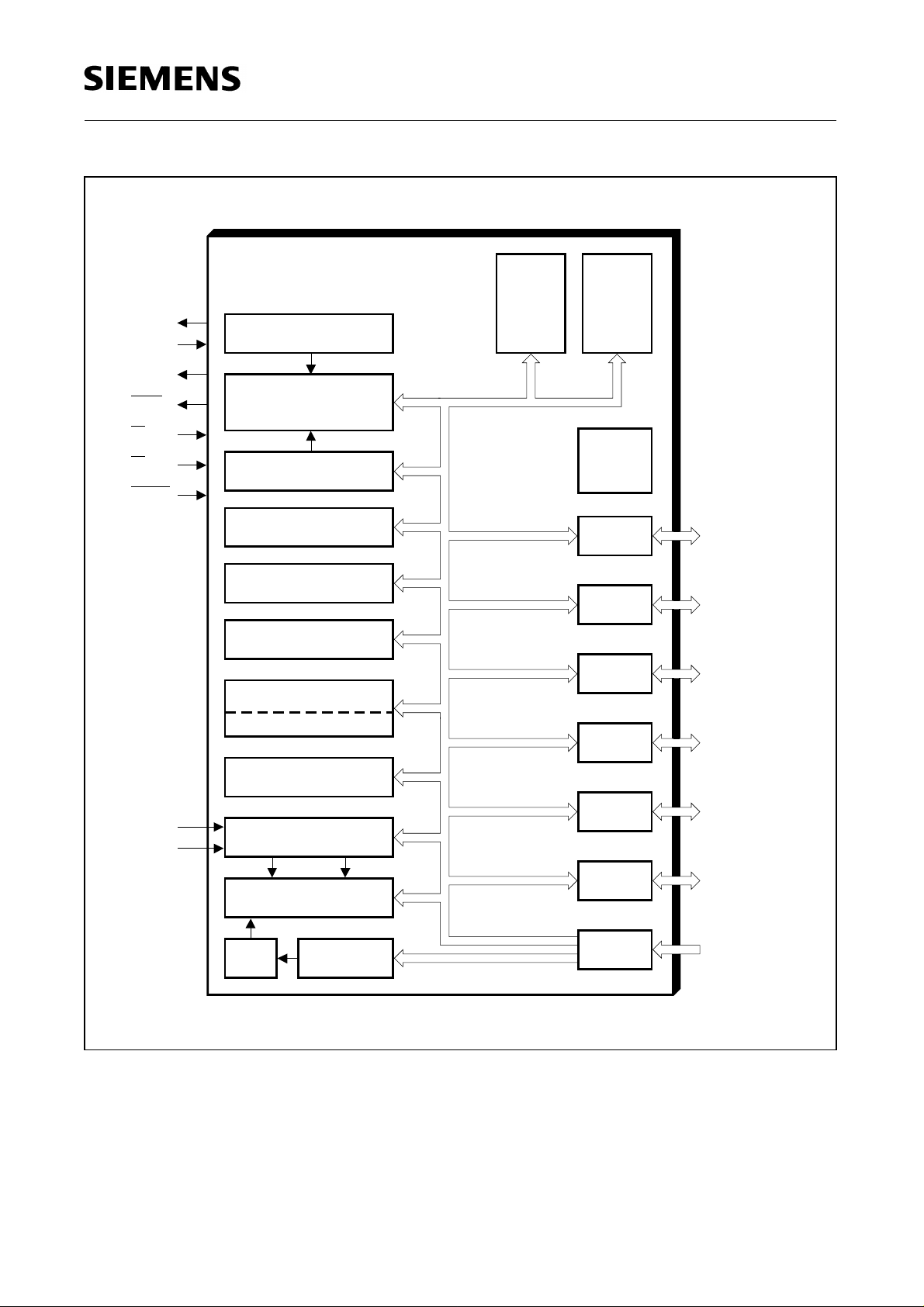
Figure 4
Block Diagram of the C515C
Semiconductor Group 13 1997-08-01
Page 14

C515
CPU
The C515 is efficient both as a controller and as an arithmetic processor. It has extensive facilities
for binary and BCD arithmetic and excels in its bit-handling capabilities. Efficient use of program
memory results from an instruction set consisting of 44 % one-byte, 41 % two-byte, and 15% threebyte instructions. With a 6 MHz crystal, 58% of the instructions are executed in 1.0µs (10 MHz: 600).
Special Function Register PSW (Address D0H) Reset Value : 00H
Bit No. MSB LSB
H
D7
CY AC
H
D6
H
D5
F0
H
D4
RS1 RS0 OV F1 PD0
Bit Function
CY Carry Flag
Used by arithmetic instruction.
AC Auxiliary Carry Flag
Used by instructions which execute BCD operations.
F0 General Purpose Flag
RS1
RS0
Register Bank select control bits
These bits are used to select one of the four register banks.
RS1 RS0 Function
0 0 Bank 0 selected, data address 00H-07
0 1 Bank 1 selected, data address 08H-0F
1 0 Bank 2 selected, data address 10H-17
1 1 Bank 3 selected, data address 18H-1F
H
D3
H
D2
H
D1
H
D0
H
PSW
H
H
H
H
OV Overflow Flag
Used by arithmetic instruction.
F1 General Purpose Flag
P Parity Flag
Set/cleared by hardware after each instruction to indicate an odd/even
number of "one" bits in the accumulator, i.e. even parity.
Semiconductor Group 14 1997-08-01
Page 15
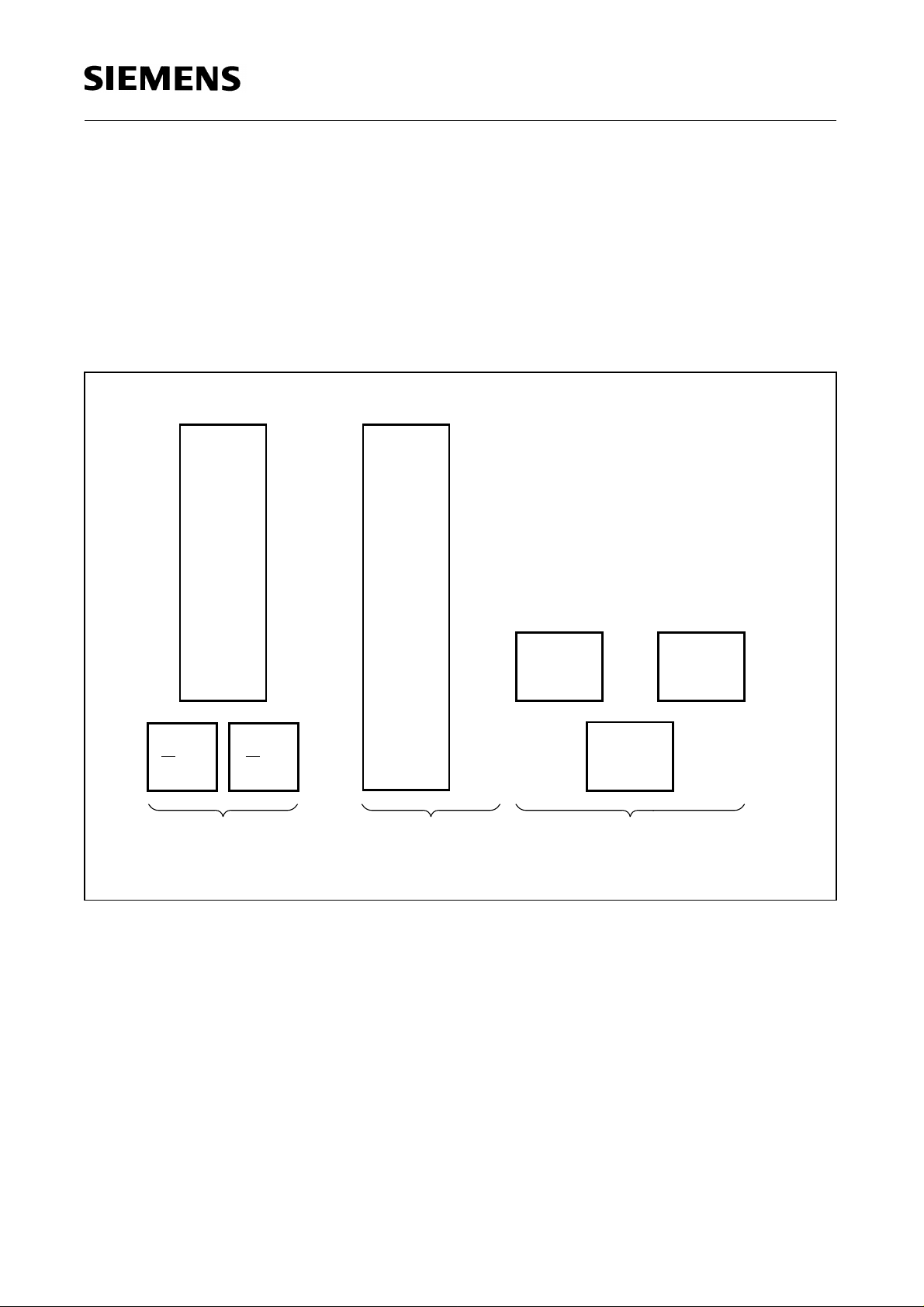
Memory Organization
The C515 CPU manipulates data and operands in the following four address spaces:
– up to 64 Kbyte of internal/external program memory
– up to 64 Kbyte of external data memory
– 256 bytes of internal data memory
– a 128 byte special function register area
Figure 5 illustrates the memory address spaces of the C515.
C515
External
Internal
"Code Space"
FFFF
2000
External
(EA = 0)1)=(EA
H
H
1FFF
0000
FFFF
H
External
Indirect
Address
FF
H
Internal
RAM
80
H
H
0000
H
"Data Space" "Internal Data Space"
H
Internal
RAM
Direct
Address
Special
Function
Register
7F
H
00
H
FF
H
80
H
MCD03202
Figure 5
C515 Memory Map
Semiconductor Group 15 1997-08-01
Page 16

C515
Reset and System Clock
The reset input is an active low input at pin RESET. Since the reset is synchronized internally, the
RESET pin must be held low for at least two machine cycles (24 oscillator periods) while the
oscillator is running. A pullup resistor is internally connected to VCC to allow a power-up reset with
an external capacitor only. An automatic reset can be obtained when VCC is applied by connecting
the RESET pin to VSS via a capacitor. Figure 6 shows the possible reset circuitries.
b)a)
&
+
Figure 6
Reset Circuitries
RESET
C515
RESET
C515
c)
+
RESET
C515
MCS03203
Semiconductor Group 16 1997-08-01
Page 17
C515
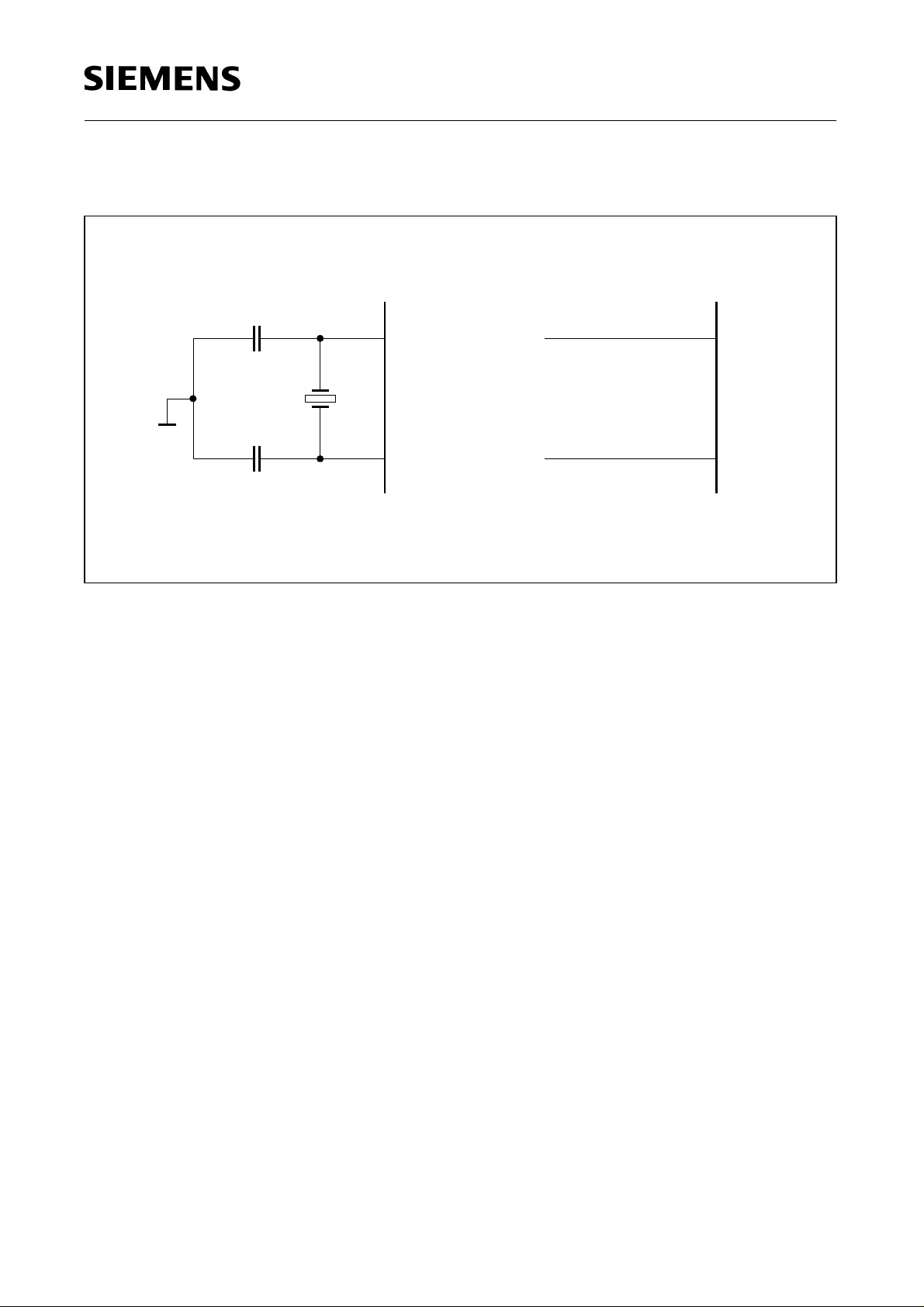
Figure 7 shows the recommended oscillator circuitries for crystal and external clock operation.
Crystal Oscillator Mode Driving from External Source
C
XTAL1
1-24 MHz
C
XTAL2 XTAL2
C
Crystal Mode :
= 20 pF±10 pF (incl. stray capacitance)
Figure 7
Recommended Oscillator Circuitries
N.C.
External Oscillator
Signal
XTAL1
MCS03204
Semiconductor Group 17 1997-08-01
Page 18

C515
Enhanced Hooks Emulation Concept
The Enhanced Hooks Emulation Concept of the C500 microcontroller family is a new, innovative
way to control the execution of C500 MCUs and to gain extensive information on the internal
operation of the controllers. Emulation of on-chip ROM based programs is possible, too.
Each production chip has built-in logic for the support of the Enhanced Hooks Emulation Concept.
Therefore, no costly bond-out chips are necessary for emulation. This also ensure that emulation
and production chips are identical.
1)
The Enhanced Hooks Technology
together with an EH-IC to function similar to a bond-out chip. This simplifies the design and reduces
costs of an ICE-system. ICE-systems using an EH-IC and a compatible C500 are able to emulate
all operating modes of the different versions of the C500 microcontrollers. This includes emulation
of ROM, ROM with code rollover and ROMless modes of operation. It is also able to operate in
single step mode and to read the SFRs after a break.
TM
, which requires embedded logic in the C500 allows the C500
SYSCON
PCON
TCON
Optional
I/O Ports
ICE-System Interface
to Emulation Hardware
RESET
EA
ALE
PSEN
C500
0
MCU Interface Circuit
Port 3 Port 1
Port
Port
2
Target System Interface
RSYSCON
RPCON
RTCON
Enhanced Hooks
RPort 0RPort 2
EH-IC
TEA TALE TPSEN
MCS03280
Figure 8
Basic C500 MCU Enhanced Hooks Concept Configuration
Port 0, port 2 and some of the control lines of the C500 based MCU are used by Enhanced Hooks
Emulation Concept to control the operation of the device during emulation and to transfer
informations about the programm execution and data transfer between the external emulation
hardware (ICE-system) and the C500 MCU.
1 “Enhanced Hooks Technology“ is a trademark and patent of Metalink Corporation licensed to Siemens.
Semiconductor Group 18 1997-08-01
Page 19

C515
Special Function Registers
The registers, except the program counter and the four general purpose register banks, reside in
the special function register area.
The 59 special function registers (SFRs) include pointers and registers that provide an interface
between the CPU and the other on-chip peripherals. All SFRs with addresses where address bits 02 are 0 (e.g. 80H, 88H, 90H, 98H, ..., F8H, FFH) are bitaddressable.
The SFRs of the C515 are listed in table 2 and table 3. In table 2 they are organized in groups
which refer to the functional blocks of the C515. Table 3 illustrates the contents of the SFRs in
numeric order of their addresses.
Semiconductor Group 19 1997-08-01
Page 20

C515
Table 2
Special Function Registers - Functional Blocks
Block Symbol Name Address Contents after
Reset
CPU ACC
B
DPH
DPL
PSW
SP
SYSCON
A/DConverter
ADCON
ADDAT
DAPR
Interrupt
System
IEN0
IEN1
2)
IP0
2)
2)
IP1
IRCON
TCON
T2CON
2)
Timer 0/
Timer 1
SCON
TCON
TH0
TH1
TL0
TL1
TMOD
Compare/
Capture
Unit /
Timer 2
CCEN
CCH1
CCH2
CCH3
CCL1
CCL2
CCL3
CRCH
CRCL
TH2
TL2
T2CON
1) Bit-addressable special function registers
2) This special function register is listed repeatedly since some bits of it also belong to other functional blocks.
3) “X“ means that the value is undefined and the location is reserved
Accumulator
B-Register
Data Pointer, High Byte
Data Pointer, Low Byte
Program Status Word Register
Stack Pointer
System Control Register
2)
A/D Converter Control Register
A/D Converter Data Register
A/D Converter Program Register
Interrupt Enable Register 0
Interrupt Enable Register 1
Interrupt Priority Register 0
Interrupt Priority Register 1
Interrupt Request Control Register
2)
Timer Control Register
2)
Timer 2 Control Register
Serial Channel Control Register
2)
Timer 0/1 Control Register
Timer 0, High Byte
Timer 1, High Byte
Timer 0, Low Byte
Timer 1, Low Byte
Timer Mode Register
Comp./Capture Enable Reg.
Comp./Capture Reg. 1, High Byte
Comp./Capture Reg. 2, High Byte
Comp./Capture Reg. 3, High Byte
Comp./Capture Reg. 1, Low Byte
Comp./Capture Reg. 2, Low Byte
Comp./Capture Reg. 3, Low Byte
Com./Rel./Capt. Reg. High Byte
Com./Rel./Capt. Reg. Low Byte
Timer 2, High Byte
Timer 2, Low Byte
2)
Timer 2 Control Register
E0
F0
83
82
D0
81
B1
D8
D9
DA
A8
B8
A9
B9
C0
88
C8
98
88
8C
8D
8A
8B
89
C1
C3
C5
C7
C2
C4
C6
CB
CA
CD
CC
C8
H
H
H
H
H
H
H
H
H
H
H
H
H
H
H
H
H
H
H
H
H
H
H
H
H
H
H
H
H
H
H
H
H
H
H
H
1)
1)
1)
1)
1)
1)
1)
1)
1)
1)
1)
1)
4)
00
H
00
H
00
H
00
H
00
H
07
H
XX1X XXXX
00X0 0000
00
H
00
H
00
H
00
H
X000 0000
XX00 0000
00
H
00
H
00
H
00
H
00
H
00
H
00
H
00
H
00
H
00
H
00
H
00
H
00
H
00
H
00
H
00
H
00
H
00
H
00
H
00
H
00
H
00
H
B
3)
B
3)
B
3)
B
3)
Semiconductor Group 20 1997-08-01
Page 21

C515
Table 2
Special Function Registers - Functional Blocks (cont’d)
Block Symbol Name Address Contents after
Reset
Ports P0
P1
P2
P3
P4
P5
P6
Serial
Channel
ADCON
PCON
SBUF
SCON
Watchdog IEN0
IEN1
2))
IP0
Power
PCON
Saving
Modes
Port 0
Port 1
Port 2
Port 3
Port 4
Port 5
Port 6, Analog/Digital Input
2)
A/D Converter Control Register
2)
Power Control Register
Serial Channel Buffer Register
2)
Serial Channel Control Register
2)
2)
Interrupt Enable Register 0
Interrupt Enable Register 1
Interrupt Priority Register 0
2)
Power Control Register 87
80
90
A0
B0
E8
F8
DB
D8
87
99
98
A8
B8
A9
H
H
H
H
H
H
H
H
H
H
H
H
H
H
1)
1)
1)
1
1)
1)
H
1
1)
1)
1)
FF
H
FF
H
FF
H
FF
H
FF
H
FF
H
–
00X0 0000
00
H
3)
XX
H
00
H
00
H
00
H
X000 0000
00
H
3)
B
3))
B
1) Bit-addressable special function registers
2) This special function register is listed repeatedly since some bits of it also belong to other functional blocks.
3) “X“ means that the value is undefined and the location is reserved
Semiconductor Group 21 1997-08-01
Page 22

Table 3
Contents of the SFRs, SFRs in numeric order of their addresses
C515
Addr Register Content
after
Reset
2)
80
81
82
83
87
88
89
P0 FF
H
SP 07
H
DPL 00
H
DPH 00
H
PCON 00
H
2)
TCON 00
H
TMOD 00
H
8AHTL0 00
8BHTL1 00
8CHTH0 00
8DHTH1 00
2)
90
98
99
A0
A8
P1 FF
H
2)
SCON 00
H
SBUF XX
H
2)
P2 FF
H
2)
IEN0 00
H
1)
H
H
H
H
H
H
H
H
H
H
H
H
H
H
H
H
A9HIP0 X000-
0000
B
2)
B0
P3 FF
H
H
B1HSYSCON XX1X-
B8
2)
IEN1 00
H
XXXX
B
H
B9HIP1 XX00-
0000
B
2)
C0
C1HCCEN 00
IRCON 00
H
H
H
Bit 7 Bit 6 Bit 5 Bit 4 Bit 3 Bit 2 Bit 1 Bit 0
.7 .6 .5 .4 .3 .2 .1 .0
.7 .6 .5 .4 .3 .2 .1 .0
.7 .6 .5 .4 .3 .2 .1 .0
.7 .6 .5 .4 .3 .2 .1 .0
SMOD PDS IDLS SD GF1 GF0 PDE IDLE
TF1 TR1 TF0 TR0 IE1 IT1 IE0 IT0
GATE C/T
M1 M0 GATE C/T M1 M0
.7 .6 .5 .4 .3 .2 .1 .0
.7 .6 .5 .4 .3 .2 .1 .0
.7 .6 .5 .4 .3 .2 .1 .0
.7 .6 .5 .4 .3 .2 .1 .0
T2 CLK-
T2EX INT2 INT6 INT5 INT4 INT3
OUT
SM0 SM1 SM2 REN TB8 RB8 TI RI
.7 .6 .5 .4 .3 .2 .1 .0
.7 .6 .5 .4 .3 .2 .1 .0
EAL WDT ET2 ES ET1 EX1 ET0 EX0
– WDTS .5 .4 .3 .2 .1 .0
RD WR T1 T0 INT1 INT0 TxD RxD
– – EALE –––––
EXEN2 SWDT EX6 EX5 EX4 EX3 EX2 EADC
– – .5.4.3.2.1.0
EXF2 TF2 IEX6 IEX5 IEX4 IEX3 IEX2 IADC
COCAH3COCAL3COCAH2COCAL2COCAH1COCAL1COCAH0COCAL
0
C2HCCL1 00
1) X means that the value is undefined and the location is reserved
2) Bit-addressable special function registers
H
.7 .6 .5 .4 .3 .2 .1 .0
Semiconductor Group 22 1997-08-01
Page 23

Table 3
Contents of the SFRs, SFRs in numeric order of their addresses (cont’d)
C515
Addr Register Content
Bit 7 Bit 6 Bit 5 Bit 4 Bit 3 Bit 2 Bit 1 Bit 0
after
H
H
H
H
H
H
H
H
H
H
H
H
H
1)
.7 .6 .5 .4 .3 .2 .1 .0
.7 .6 .5 .4 .3 .2 .1 .0
.7 .6 .5 .4 .3 .2 .1 .0
.7 .6 .5 .4 .3 .2 .1 .0
.7 .6 .5 .4 .3 .2 .1 .0
T2PS I3FR I2FR T2R1 T2R0 T2CM T2I1 T2I0
.7 .6 .5 .4 .3 .2 .1 .0
.7 .6 .5 .4 .3 .2 .1 .0
.7 .6 .5 .4 .3 .2 .1 .0
.7 .6 .5 .4 .3 .2 .1 .0
CY AC F0 RS1 RS0 OV F1 P
BD CLK – BSY ADM MX2 MX1 MX0
B
.7 .6 .5 .4 .3 .2 .1 .0
.7 .6 .5 .4 .3 .2 .1 .0
Reset
C3HCCH1 00
C4HCCL2 00
C5HCCH2 00
C6HCCL3 00
C7HCCH3 00
2)
C8
T2CON 00
H
CAHCRCL 00
CBHCRCH 00
CCHTL2 00
CDHTH2 00
2)
D0
D8
PSW 00
H
2)
ADCON 00X0-
H
0000
D9HADDAT 00
DAHDAPR 00
DBHP6 – .7.6.5.4.3.2.1.0
2)
E0
E8
F0
F8
1) X means that the value is undefined and the location is reserved
2) Bit-addressable special function registers
ACC 00
H
2)
P4 FF
H
2)
B 00
H
2)
P5 FF
H
H
H
H
H
.7 .6 .5 .4 .3 .2 .1 .0
.7 .6 .5 .4 .3 .2 .1 .0
.7 .6 .5 .4 .3 .2 .1 .0
.7 .6 .5 .4 .3 .2 .1 .0
Semiconductor Group 23 1997-08-01
Page 24

C515
Digital I/O Ports
The C515 allows for digital I/O on 48 lines grouped into 6 bidirectional 8-bit ports. Each port bit
consists of a latch, an output driver and an input buffer. Read and write accesses to the I/O ports P0
through P5 are performed via their corresponding special function registers P0 to P5.
The output drivers of port 0 and 2 and the input buffers of port 0 are also used for accessing external
memory. In this application, port 0 outputs the low byte of the external memory address, timemultiplexed with the byte being written or read. Port 2 outputs the high byte of the external memory
address when the address is 16 bits wide. Otherwise, the port 2 pins continue emitting the P2 SFR
contents.
Analog Input Ports
Ports 6 is available as input port only and provides two functions. When used as digital inputs, the
corresponding SFR P6 contains the digital value applied to the port 6 lines. When used for analog
inputs the desired analog channel is selected by a three-bit field in SFR ADCON. Of course, it
makes no sense to output a value to these input-only ports by writing to the SFR P6. This will have
no effect.
lf a digital value is to be read, the voltage levels are to be held within the input voltage specifications
(VIL/VIH). Since P6 is not bit-addressable, all input lines of P6 are read at the same time by byte
instructions.
Nevertheless, it is possible to use port 6 simultaneously for analog and digital input. However, care
must be taken that all bits of P6 that have an undetermined value caused by their analog function
are masked.
Semiconductor Group 24 1997-08-01
Page 25

Timer / Counter 0 and 1
Timer/Counter 0 and 1 can be used in four operating modes as listed in table 4 :
Table 4
Timer/Counter 0 and 1 Operating Modes
Mode Description TMOD Input Clock
M1 M0 internal external (max)
C515
0 8-bit timer/counter with a
00
f
/12x32 f
OSC
OSC
/24x32
divide-by-32 prescaler
1 16-bit timer/counter 1 1
2 8-bit timer/counter with
10
8-bit autoreload
3 Timer/counter 0 used as one
11
/12 f
OSC
OSC
/24
f
8-bit timer/counter and one
8-bit timer
Timer 1 stops
In the “timer” function (C/T = ‘0’) the register is incremented every machine cycle. Therefore the
count rate is f
OSC
/12.
In the “counter” function the register is incremented in response to a 1-to-0 transition at its
corresponding external input pin (P3.4/T0, P3.5/T1). Since it takes two machine cycles to detect a
falling edge the max. count rate is f
/24. External inputs INT0 and INT1 (P3.2, P3.3) can be
OSC
programmed to function as a gate to facilitate pulse width measurements. Figure 9 illustrates the
input clock logic.
f
/12
OSC
Timer 0/1
Input Clock
P3.4/T0
P3.5/T1
max
P3.2/INT0
P3.3/INT1
f
OSC
/24
f
OSC
TR 0/1
TCON
Gate
TMOD
=1
÷
12
C/T
TMOD
0
1
Control
&
_
<
1
MCS01768
Figure 9
Timer/Counter 0 and 1 Input Clock Logic
Semiconductor Group 25 1997-08-01
Page 26

C515
Timer/Counter 2 with Compare/Capture/Reload
The timer 2 of the C515 provides additional compare/capture/reload features. which allow the
selection of the following operating modes:
– Compare : up to 4 PWM signals with 16-bit/500 ns resolution
– Capture : up to 4 high speed capture inputs with 500 ns resolution
– Reload : modulation of timer 2 cycle time
The block diagram in figure 10 shows the general configuration of timer 2 with the additional
compare/capture/reload registers. The I/O pins which can used for timer 2 control are located as
multifunctional port functions at port 1.
P1.5/
T2EX
P1.7/
T2
OSC
Sync.
T2I0
T2I1
Sync.
&
12
÷ 12
f
OSC
÷ 24
T2PS
24
Bit16 16 Bit 16 Bit 16 Bit
Comparator
Comparator
Comparator
EXEN2
Reload
EXF2
Reload
Timer 2
TH2TL2
Compare
Comparator
Capture
_
<
1
TF2
Input/
Output
Control
Interrupt
Request
P1.0/
INT3/
CC0
P1.1/
INT4/
CC1
P1.2/
INT5/
CC2
P1.2/
INT6/
CCL3/CCH3
CCL2/CCH2
CCL1/CCH1
CRCL/CRCH
CC3
MCB03205
Figure 10
Timer 2 Block Diagram
Semiconductor Group 26 1997-08-01
Page 27

C515
Timer 2 Operating Modes
The timer 2, which is a 16-bit-wide register, can operate as timer, event counter, or gated timer. A
roll-over of the count value in TL2/TH2 from all 1’s to all 0’s sets the timer overflow flag TF2 in SFR
IRCON, which can generate an interrupt. The bits in register T2CON are used to control the timer
2 operation.
Timer Mode: In timer function, the count rate is derived from the oscillator frequency. A prescaler
offers the possibility of selecting a count rate of 1/12 or 1/24 of the oscillator frequency.
Gated Timer Mode: In gated timer function, the external input pin T2 (P1.7) functions as a gate to
the input of timer 2. lf T2 is high, the internal clock input is gated to the timer. T2 = 0 stops the
counting procedure. This facilitates pulse width measurements. The external gate signal is sampled
once every machine cycle.
Event Counter Mode: In the event counter function. the timer 2 is incremented in response to a 1to-0 transition at its corresponding external input pin T2 (P1.7). In this function, the external input is
sampled every machine cycle. Since it takes two machine cycles (24 oscillator periods) to recognize
a 1-to-0 transition, the maximum count rate is 1/24 of the oscillator frequency. There are no
restrictions on the duty cycle of the external input signal, but to ensure that a given level is sampled
at least once before it changes, it must be held for at least one full machine cycle.
Reload of Timer 2: Two reload modes are selectable:
In mode 0, when timer 2 rolls over from all 1’s to all 0’s, it not only sets TF2 but also causes the timer
2 registers to be loaded with the 16-bit value in the CRC register, which is preset by software.
In mode 1, a 16-bit reload from the CRC register is caused by a negative transition at the corresponding input pin P1.5/T2EX. This transition will also set flag EXF2 if bit EXEN2 in SFR IEN1 has been
set.
Semiconductor Group 27 1997-08-01
Page 28

C515
Timer 2 Compare Modes
The compare function of a timer/register combination operates as follows : the 16-bit value stored
in a compare or compare/capture register is compared with the contents of the timer register; if the
count value in the timer register matches the stored value, an appropriate output signal is generated
at a corresponding port pin and an interrupt can be generated.
Compare Mode 0
In compare mode 0, upon matching the timer and compare register contents, the output signal
changes from low to high. lt goes back to a low level on timer overflow. As long as compare mode
0 is enabled, the appropriate output pin is controlled by the timer circuit only and writing to the port
will have no effect. Figure 11 shows a functional diagram of a port circuit when used in compare
mode 0. The port latch is directly controlled by the timer overflow and compare match signals. The
input line from the internal bus and the write-to-latch line of the port latch are disconnected when
compare mode 0 is enabled.
Compare Register
Circuit
Compare Reg.
16 Bit
Comparator
Bit16
Timer Register
Timer Circuit
Compare
Match
Timer
Overflow
Figure 11
Port Latch in Compare Mode 0
Port Circuit
Internal
Bus
Write to
Latch
S
D
Latch
CLK
R
Read Latch
Q
Port
Q
Read Pin
V
CC
Port
Pin
MCS02661
Semiconductor Group 28 1997-08-01
Page 29

C515
Compare Mode 1
If compare mode 1 is enabled and the software writes to the appropriate output latch at the port, the
new value will not appear at the output pin until the next compare match occurs. Thus, it can be
chosen whether the output signal has to make a new transition (1-to-0 or 0-to-1, depending on the
actual pin-level) or should keep its old value at the time when the timer value matches the stored
compare value.
In compare mode 1 (see figure 12) the port circuit consists of two separate latches. One latch
(which acts as a "shadow latch") can be written under software control, but its value will only be
transferred to the port latch (and thus to the port pin) when a compare match occurs.
Port Circuit
Compare Register
Circuit
Compare Reg.
16 Bit
Comparator
16 Bit
Timer Register
Timer Circuit
Compare
Match
Internal
Bus
Write to
Latch
Figure 12
Compare Function in Compare Mode 1
D
Shadow
Latch
CLK
Read Latch
Q
D
Port
Latch
Read Pin
V
CC
Q
QCLK
Port
Pin
MCS02662
Semiconductor Group 29 1997-08-01
Page 30

C515
Serial Interface (USART)
The serial port is full duplex and can operate in four modes (one synchronous mode, three
asynchronous modes) as illustrated in table 5. The possible baudrates can be calculated using the
formulas given in table 5.
Table 5
USART Operating Modes
Mode
SCON Description
SM0 SM1
0 0 0 Shift register mode
Serial data enters and exits through R×D/ T×D outputs the shift
clock; 8-bit are transmitted/received (LSB first); fixed baud rate
1 0 1 8-bit UART, variable baud rate
10 bits are transmitted (through T×D) or received (at R×D)
2 1 0 9-bit UART, fixed baud rate
11 bits are transmitted (through T×D) or received (at R×D)
3 1 1 9-bit UART, variable baud rate
Like mode 2
For clarification some terms regarding the difference between "baud rate clock" and "baud rate"
should be mentioned. In the asynchronous modes the serial interfaces require a clock rate which is
16 times the baud rate for internal synchronization. Therefore, the baud rate generators/timers have
to provide a "baud rate clock" (output signal in figure 13 to the serial interface which - there divided
by 16 - results in the actual "baud rate". Further, the abbrevation f
refers to the oscillator
OSC
frequency (crystal or external clock operation).
The variable baud rates for modes 1 and 3 of the serial interface can be derived from either timer 1
or from the system clock (see figure 13).
Semiconductor Group 30 1997-08-01
Page 31

Timer
1
Overflow
/2
f
OSC
÷ 39
÷ 6
ADCON.7
(BD)
0
1
Mode
2
Mode
0
Mode 1
SCON.7
SCON.6
(SM0/
3Mode
SM1)
Only one mode
can be selected
÷ 2
PCON.7
(SMOD)
0
1
C515
Baud
Rate
Clock
Note: The switch configuration shows the reset state.
MCB03206
Figure 13
Block Diagram of Baud Rate Generation for the Serial Interface
Table 6 below lists the values/formulas for the baud rate calculation of the serial interface with its
dependencies of the control bits BD and SMOD.
Table 6
Serial Interface - Baud Rate Dependencies
Serial Interface 0
Operating Modes
Mode 0 (Shift Register) – – f
Mode 1 (8-bit UART)
Mode 3 (9-bit UART)
Active Control Bits Baud Rate Calculation
BD SMOD
/ 12
OSC
0 X Controlled by timer 1 overflow :
SMOD
(2
× timer 1 overflow rate) / 32
1 X Controlled by system clock divider circuits :
SMOD
Mode 2 (9-bit UART) – 0
(2
f
1
f
OSC
OSC
× f
/ 64
/ 32
) / 2496
OSC
Semiconductor Group 31 1997-08-01
Page 32

C515
8-Bit A/D Converter
The C515 provides an A/D converter with the following features:
– Eight multiplexed input channels
– The possibility of using the analog inputs (port 6) also as digital inputs
– Programmable internal reference voltages (16 steps each) via resistor array
– 8-bit resolution within the selected reference voltage range
– Internal start-of-conversion trigger
– Interrupt request generation after each conversion
For the A/D conversion, the method of successive approximation via capacitor array is used. The
externally applied reference voltage range has to be held on a fixed value within the specifications
(see section "A/D Converter Characteristics" in this data sheet). The internal reference voltages can
be varied to reduce the reference voltage range of the A/D converter and thus to achieve a higher
resolution. Figure 14 shows a block diagram of the A/D converter.
Semiconductor Group 32 1997-08-01
Page 33

IEN1 (B8 )
H
C515
Internal
Bus
Port 6
f
/2
OSC
EXEN2 SWDT
IRCON (C0 )
EXF2 TF2
ADCON (D8 )
BD CLK
MUX S & H
÷ 4
EX6
EX5
H
IEX6
IEX5
H
_
BSY
Conversion Clock
f
ADC
IEX4
ADM
IEX3
Single/
Continuous
Mode
Converter
0
MX1
A/D
EADCEX3EX4 ECAN
IADC
MX0MX2
ADDAT
(D9 )
H
LBS
.1
.2
.3
.4
.5
.6
MSB
Write to
DAPR
V
AREF
V
AGND
DAPR (DA )
.7 .6 .3.4.5
Shaded bit locations are not used in ADC-functions.
Figure 14
A/D Converter Block Diagram
Input Clock
f
IN
Internal Reference Voltages
H
Programming of
V
INTAREF
Start of
Conversion
V
INTAREF INTAGND
V
.2 .1 .0
Programming of
V
INTAGND
Internal
Bus
MCB03207
Semiconductor Group 33 1997-08-01
Page 34

C515
Interrupt System
The C515 provides 12 interrupt sources with four priority levels. Five interrupts can be generated by
the on-chip peripherals (timer 0, timer 1, timer 2, A/D converter, and serial interface) and seven
interrupts may be triggered externally (P3.2/INT0, P3.3/INT1, P1.4/INT2, P1.0/INT3, P1.1/INT4,
P1.2/INT5, P1.3/INT6).
This chapter shows the interrupt structure, the interrupt vectors and the interrupt related special
function registers. Figure 15 and 16 give a general overview of the interrupt sources and illustrate
the request and the control flags which are described in the next sections.
Semiconductor Group 34 1997-08-01
Page 35

P3.2/
INT0
IT0
TCON.0
IE0
TCON.1
EX0
IEN0.0
0003
C515
Highest
Priority Level
H
Lowest
Priority Level
A/D Converter
Timer 0
Overflow
P1.4/
INT2
I2FR
T2CON.5
P3.3/
INT1
IT1
TCON.2
IADC
IRCON.0
TF0
TCON.5
IEX2
IRCON.1
IE1
TCON.3
EADC
IEN1.0
ET0
IEN0.1
EX2
IEN1.1
EX1
IEN0.2
0043
000B
004B
0013
H
IP1.0
H
H
H
IP0.0
Polling Sequence
IP0.1IP1.1
P1.0/
INT3
CC0
I3FR
T2CON.6
Bit addressable
Request Flag is
cleared by hardware
IEX3
IRCON.2
EX3
IEN1.2
0053
H
EAL
IEN0.7
IP1.2
IP0.2
MCS03208
Figure 15
Interrupt Request Sources (Part 1)
Semiconductor Group 35 1997-08-01
Page 36

Timer 1
Overflow
P1.1/
INT4
CC1
TF1
TCON.7
IEX4
IRCON.3
ET1
IEN0.3
EX4
IEN1.3
001B
005B
C515
Highest
Priority Level
H
Lowest
Priority Level
H
USART
P1.2/
INT5
CC2
2
Timer
Overflow
P1.5/
T2EX
P1.3/
INT6
CC3
RI
SCON.0
SCON.1
EXEN2
IEN1.7
TI
TF2
IRCON.6
EXF2
IRCON.7
_
<
1
IEX5
IRCON.4
_
<
1
IEX6
IRCON.5
ES
IEN0.4
EX5
IEN1.4
ET2
IEN0.5
EX6
IEN1.5
0023
0063
002B
006B
IP1.3
IP0.3
H
H
Polling Sequence
IP0.4IP1.4
H
H
Bit addressable
EAL
IEN0.7
IP1.5 IP0.5
MCS03209
Request Flag is
cleared by hardware
Figure 16
Interrupt Request Sources (Part 2)
Semiconductor Group 36 1997-08-01
Page 37

Table 7
Interrupt Source and Vectors
Interrupt Source Interrupt Vector Address Interrupt Request Flags
C515
External Interrupt 0 0003
Timer 0 Overflow 000B
External Interrupt 1 0013
Timer 1 Overflow 001B
Serial Channel 0023
Timer 2 Overflow / Ext. Reload 002B
A/D Converter 0043
External Interrupt 2 004B
External Interrupt 3 0053
External Interrupt 4 005B
External Interrupt 5 0063
External Interrupt 6 006B
H
H
H
H
H
H
H
H
H
H
H
H
IE0
TF0
IE1
TF1
RI / TI
TF2 / EXF2
IADC
IEX2
IEX3
IEX4
IEX5
IEX6
Semiconductor Group 37 1997-08-01
Page 38

C515
Fail Save Mechanisms
As a means of graceful recovery from software or hardware upset a watchdog timer is provided in
the C515. lf the software fails to clear the watchdog timer at least every 65532 µs (at 12 MHz clock
rate), an internal hardware reset will be initiated. The software can be designed such that the
watchdog times out if the program does not progress properly. The watchdog will also time out if the
software error was due to hardware-related problems. This prevents the controller from
malfunctioning for longer than 65 ms if a 12-MHz oscillator is used. Figure 17 shows the block
diagram of the watchdog timer unit.
f
OSC
÷ 12
16-Bit Watchdog Timer
Reset
WDT Reset if WDT count is between
-------WDTS
External HW Reset
Control Logic
-
WDT
SWDT -
-
-
-
-
-
-
-
FFFC
FFFF-
HH
IP0 ( A9H)
-
--
IEN0
-
-
IEN1
A8()
H
)(B8
H
MCB03210
Figure 17
Block Diagram of the Watchdog Timer
The watchdog timer can be started by software (bit SWDT) but it cannot be stopped during active
mode of the C515. lf the software fails to clear the watchdog in time, an internally generated
watchdog reset is entered at the counter state FFFCH and lasts four instruction cycles. This internal
reset differs from an external reset only to the extent that the watchdog timer is not disabled. Bit
WDTS (was set by starting WDT) allows the software to examine from which source the reset was
initiated. lf it is set, the reset was caused by a watchdog timer overflow.
Semiconductor Group 38 1997-08-01
Page 39

C515
Power Saving Modes
The C515 provides two basic power saving modes, the idle mode and the power down mode.
Additionally, a slow down mode is available. This power saving mode reduces the internal clock
rate in normal operating mode and it can be also used for further power reduction in idle mode.
– Idle mode
The CPU is gated off from the oscillator. All peripherals are still provided with the clock and
are able to work. Idle mode is entered by software and can be left by an interrupt or reset.
– Power down mode
The operation of the C515 is completely stopped and the oscillator is turned off. This mode is
used to save the contents of the internal RAM with a very low standby current. Power down
mode is entered by software and can be left by reset or by a short low pulse at pin P3.2/INT0.
– Slow-down mode
The controller keeps up the full operating functionality, but its normal clock frequency is
internally divided by 8. This slows down all parts of the controller, the CPU and all peripherals,
to 1/8 th of their normal operating frequency. Slowing down the frequency significantly
reduces power consumption.
Table 8 gives a general overview of the entry and exit procedures of the power saving modes.
Table 8
Power Saving Modes Overview
Mode Entering
Leaving by Remarks
2-Instruction
Example
Idle mode ORL PCON, #01H
ORL PCON, #20H
Occurrence of an
interrupt from a
peripheral unit
Hardware Reset
CPU clock is stopped;
CPU maintains their data;
peripheral units are active (if
enabled) and provided with
clock
Power Down Mode ORL PCON, #02H
ORL PCON, #40H
Hardware Reset Oscillator is stopped;
contents of on-chip RAM and
SFR’s are maintained;
Slow Down Mode In normal mode :
ORL PCON,#10H
ANL PCON,#0EFH
or
Internal clock rate is reduced
to 1/8 of its nominal frequency
Hardware Reset
With idle mode :
ORL PCON,#01H
ORL PCON, #30H
Occurrence of an
interrupt from a
peripheral unit
Hardware reset
CPU clock is stopped;
CPU maintains their data;
peripheral units are active (if
enabled) and provided with 1/8
of its nominal frequency
In the power down mode of operation,
be ensured, however, that VCC is not reduced before the power down mode is invoked, and that V
V
can be reduced to minimize power consumption. It must
CC
CC
is restored to its normal operating level, before the power down mode is terminated.
Semiconductor Group 39 1997-08-01
Page 40

C515
Absolute Maximum Ratings
Ambient temperature under bias (TA) ......................................................... – 40 to 110 °C
Storage temperature (T
Voltage on VCC pins with respect to ground (VSS) ....................................... – 0.5 V to 6.5 V
Voltage on any pin with respect to ground (VSS)......................................... – 0.5 V to VCC +0.5 V
Input current on any pin during overload condition..................................... – 10 mA to 10 mA
Absolute sum of all input currents during overload condition ..................... I 100 mA I
Power dissipation........................................................................................ TBD
Note:Stresses above those listed under “Absolute Maximum Ratings” may cause permanent
damage of the device. This is a stress rating only and functional operation of the device at
these or any other conditions above those indicated in the operational sections of this
specification is not implied. Exposure to absolute maximum rating conditions for longer
periods may affect device reliability. During overload conditions (
Voltage on
V
absolute maximum ratings.
) .......................................................................... – 65 °C to 150 °C
stg
V
>
V
IN
pins with respect to ground (
CC
V
) must not exceed the values defined by the
SS
CC
or
V
<
V
SS
) the
IN
Semiconductor Group 40 1997-08-01
Page 41

C515
DC Characteristics
V
= 5 V + 10%, – 15%; VSS = 0 V TA = 0 to 70 °C for the SAB-C515-1RM
CC
T
= – 40 to 85 °C for the SAF-C515-1RM
A
T
= – 40 to 110 °C for the SAH-C515-1RM
A
Parameter Symbol Limit Values Unit Test Condition
min. max.
Input low voltages
all except EA
EA pin
Input high voltages
all except XTAL2 and RESET
XTAL2 pin
RESET pin
Output low voltages
Ports 1, 2, 3, 4, 5
Port 0, ALE, PSEN
Output high voltages
Ports 1, 2, 3, 4, 5
Port 0 in external bus mode,
ALE, PSEN
Logic 0 input current
Ports 1, 2, 3, 4, 5 I
Logical 0-to-1 transition current
Ports 1, 2, 3, 4, 5
V
IL
V
IL1
V
IH
V
IH1
V
IH2
V
OL
V
OL1
V
OH
V
OH2
IL
I
TL
– 0.5
– 0.5
0.2 VCC + 0.9
0.7 V
CC
0.6 V
CC
–
–
2.4
0.9 V
CC
2.4
0.9 V
CC
0.2 VCC - 0.1
0.2 VCC - 0.3VV
V
+ 0.5
CC
V
+ 0.5
CC
V
+ 0.5
CC
0.45
0.45
–
–
–
–
–
–
V
V
V
V
V
V
V
V
V
–
–
–
I
= 1.6 mA
OL
I
= 3.2 mA
OL
I
= – 80 µA
OH
I
= – 10 µA
OH
I
= – 800 µA
OH
I
= – 80 µA
OH
– 10 – 70 µA VIN = 0.45 V
– 65 – 650 µA VIN = 2 V
1)
1)
2)
Input leakage current
Port 0, AIN0-7 (Port 6), EA
I
LI
– ± 1 µA 0.45 < VIN < V
CC
Input low current
to RESET for reset
XTAL2
PE
Pin capacitance
Overload current
Notes on next page
I
I
I
C
I
LI2
LI3
LI4
OV
–10
–
–
IO
–10pFf
– ± 5mA
– 100
– 15
– 20
µA
µA
µA
V
= 0.45 V
IN
V
= 0.45 V
IN
V
= 0.45 V
IN
= 1 MHz,
c
T
= 25 °C
A
7) 8)
Semiconductor Group 41 1997-08-01
Page 42

C515
Power Supply Current
Parameter Symbol Limit Values Unit Test Condition
9)
typ.
Active mode 16 MHz
24 MHz
Idle mode 16 MHz
24 MHz
Active mode with
slow-down enabled
16 MHz
24 MHz
Power-down mode I
I
CC
I
CC
I
CC
I
CC
I
CC
I
CC
PD
13.7
19.6
6.9
9.1
4.9
6.5
10 30 µA VCC = 2…5.5 V
1) Capacitive loading on ports 0 and 2 may cause spurious noise pulses to be superimposed on the VOL of ALE
and ports1, 3, 4, and 5. The noise is due to external bus capacitance discharging into the port 0 and port 2 pins
when these pins make 1-to-0 transitions during bus operation. In the worst case (capacitive loading > 100 pF),
the noise pulse on ALE line may exceed 0.8 V. In such cases it may be desirable to qualify ALE with a schmitttrigger, or use an address latch with a schmitt-trigger strobe input.
max.
18.2
25
9.6
12.8
7.0
8.8
10)
mA
mA
mA
mA
mA
mA
4)
5)
6)
3)
V
2) Capacitive loading on ports 0 and 2 may cause the
V
0.9
specification when the address lines are stabilizing.
CC
on ALE and PSEN to momentarily fall below the
OH
3) IPD (power-down mode) is measured under following conditions:
= Port 0 = Port 6 = VCC ; RESET = VCC; XTAL1 = N.C.; PE = XTAL2 = VSS ; V
EA
I
other pins are disconnected. The typical
current is measured at VCC = 5 V.
PD
AGND
= VSS ; V
= VCC ; all
AREF
4) ICC (active mode) is measured with:
t
, t
XTAL2 driven with
= Port 0 = Port 6 = VCC ; RESET = VSS ; all other pins are disconnected.
EA
CLCH
= 5 ns , VIL = VSS + 0.5 V, VIH =
CHCL
V
– 0.5 V; XTAL1 = N.C.;
CC
5) ICC (idle mode) is measured with all output pins disconnected and with all peripherals disabled;
t
, t
XTAL2 driven with
= Port 0 = Port 6 = VCC ; RESET = VCC ; all other pins are disconnected;
EA
CLCH
= 5 ns, VIL = VSS + 0.5 V, VIH = VCC – 0.5 V; XTAL1 = N.C.;
CHCL
6) ICC (active mode with slow-down mode) is measured : TBD
7) ICC (active mode with slow-down mode) is measured : TBD
8) Overload conditions occur if the standard operating conditions are exceeded, ie. the voltage on any pin
V
exceeds the specified range (i.e.
> VCC + 0.5 V or VOV < VSS - 0.5 V). The supply voltage VCC and VSS must
OV
remain within the specified limits. The absolute sum of input currents on all port pins may not exceed 50 mA.
9) Not 100% tested, guaranteed by design characterization
I
10)The typical
values are periodically measured at T
CC
= +25 °C but not 100% tested.
A
Semiconductor Group 42 1997-08-01
Page 43

C515
30
mA
Ι
CC
25
20
15
10
5
0
0
4 8 12 16 20 24
Active mode
Idle mode
Active mode with slow-down
Ι
CC max
Ι
CC typ
Ι
:
Ι
:
Ι
:
Ι
:
Ι
Ι
= 0.68 x + 2.8
= 0.85 x + 4.6:
CC max
= 0.28 x + 2.4
CC typ
= 0.39 x + 3.4
CC max
= 0.18 x + 2.0
CC typ
= 0.23 x + 3.3:
CC max
Active Mode
Active Mode
Idle Mode
Idle Mode
Active Mode with Slow Down
f
OSC
f
OSCCC typ
f
OSC
f
OSC
f
OSC
f
OSC
f
OSC
MHz
Figure 18
ICC Diagram
f
is the oscillator frequency in MHz. values are given in mA.
Ι
CCOSC
MCD03282
Semiconductor Group 43 1997-08-01
Page 44

A/D Converter Characteristics
V
= 5 V + 10%, – 15%; VSS = 0 V TA = 0 to 70 °C for the SAB-C515-1RM
CC
T
= – 40 to 85 °C for the SAF-C515-1RM
A
T
= – 40 to 110 °C for the SAH-C515-1RM
A
V
– 0.25 V ≤ V
CC
≤ VCC + 0.25 V ; VSS – 0.2 V ≤ V
AREF
≤ Vss + 0.2 V; V
AGND
IntAREF
− V
IntAGND
Parameter Symbol Limit Values Unit Test Condition
min. max.
Analog input voltage
V
AIN
V
AGND
0.2
-
V
AREF
+
V
0.2
1)
C515
≥ 1 V;
A/D converter input clock t
Sample time
Conversion cycle time t
Total unadjusted error T
Internal resistance of
reference voltage source
Internal resistance of
IN
t
S
ADCC
UE
R
R
AREF
ASRC
– 2 x t
– 16 x t
– 80 x t
CLCL
ns
IN
ns
IN
ns
– ± 1 LSB V
–8 x tIN /500
kΩ
- 1
– tS / 500 - 1 kΩ
2)
3)
IntAREF
V
IntAGND
t
in [ns]
IN
t
in [ns]
S
= V
= V
AREF
AGND
5) 6)
2) 6)
= V
= V
CC
SS
analog source
ADC input capacitance C
AIN
–45 pF
Notes:
1) V
2) During the sample time the input capacitance C
may exceed V
AIN
AGND
these cases will be 00
or V
or FFH, respectively.
H
up to the absolute maximum ratings. However, the conversion result in
AREF
can be charged/discharged by the external source. The
AIN
internal resistance of the analog source must allow the capacitance to reach their final voltage level within t
After the end of the sample time t
, changes of the analog input voltage have no effect on the conversion
S
result.
3) This parameter includes the sample time t
is always 8 x tIN.
t
ADC
4) TUE is tested at V
AREF
= 5.0 V, V
AGND
and the conversion time tC. The values for the conversion clock
S
= 0 V, VCC = 4.9 V. It is guaranteed by design characterization for all
other voltages within the defined voltage range.
If an overload condition occurs on maximum 2 not selected analog input pins and the absolute sum of input
overload currents on all analog input pins does not exceed 10 mA, an additional conversion error of 1/2 LSB
is permissible.
6)
4)
.
S
5) During the conversion the ADC’s capacitance must be repeatedly charged or discharged. The internal
resistance of the reference source must allow the capacitance to reach their final voltage level within the
indicated time. The maximum internal resistance results from the programmed conversion timing.
6) Not 100% tested, but guaranteed by design characterization.
Semiconductor Group 44 1997-08-01
Page 45

C515
AC Characteristics (16 MHz)
V
= 5 V + 10%, – 15%; VSS = 0 V TA = 0 to 70 °C for the SAB-C515-1RM
CC
T
= – 40 to 85 °C for the SAF-C515-1RM
A
T
= – 40 to 110 °C for the SAH-C515-1RM
A
(CL for port 0, ALE and PSEN outputs = 100 pF; CL for all other outputs = 80 pF)
Program Memory Characteristics
Parameter Symbol Limit Values Unit
16 MHz
Clock
Variable Clock
1/
t
= 1 MHz to 16 MHz
CLCL
min. max. min. max.
ALE pulse width t
Address setup to ALE
Address hold after ALE
ALE low to valid instr in
ALE to PSEN
PSEN
PSEN
pulse width t
to valid instr in t
Input instruction hold after PSEN
Input instruction float after PSEN
Address valid after PSEN
Address to valid instr in
Address float to PSEN
*)
Interfacing the C515 to devices with float times up to 75 ns is permissible. This limited bus contention will not
cause any damage to port 0 drivers.
t
LHLL
t
AVLL
t
LLAX
t
LLIV
t
LLPL
PLPH
PLIV
t
PXIX
PXIZ
t
PXAV
t
AVIV
t
AZPL
*)
85 – 2t
33 – t
28 – t
– 150 – 4t
38 – t
153 – 3t
–88– 3t
– 40 – ns
CLCL
– 30 – ns
CLCL
– 35 – ns
CLCL
– 100 ns
CLCL
– 25 – ns
CLCL
– 35 – ns
CLCL
– 100 ns
CLCL
0–0–ns
–43– t
*)
55 – t
– 8 – ns
CLCL
– 198 – 5t
– 20 ns
CLCL
– 115 ns
CLCL
0–0–ns
CLKOUT Characteristics
Parameter Symbol Limit Values Unit
16 MHz
Clock
Variable Clock
1/t
= 1 MHz to 16 MHz
CLCL
min. max. min. max.
ALE to CLKOUT
CLKOUT high time
CLKOUT low time
CLKOUT low to ALE high
t
LLSH
t
SHSL
t
SLSH
t
SLLH
398 – 7 t
85 – 2 t
585 – 10 t
23 103 t
CLCL
– 40 – ns
CLCL
– 40 – ns
CLCL
– 40 – ns
CLCL
– 40 t
+ 40 ns
CLCL
Semiconductor Group 45 1997-08-01
Page 46

C515
AC Characteristics (16 MHz) (cont’d)
External Data Memory Characteristics
Parameter Symbol Limit Values Unit
pulse width t
RD
WR
pulse width t
Address hold after ALE
to valid data in t
RD
Data hold after RD
Data float after RD
ALE to valid data in
Address to valid data in
ALE to WR
Address valid to WR
WR
or RD high to ALE high t
Data valid to WR
or RD t
or RD t
transition t
Data setup before WR
Data hold after WR
Address float after RD
RLRH
WLWH
t
LLAX2
RLDV
t
RHDX
t
RHDZ
t
LLDV
t
AVDV
LLWL
AVWL
WHLH
QVWX
t
QVWH
t
WHQX
t
RLAZ
16 MHz
Clock
Variable Clock
1/
t
= 1 MHz to 16 MHz
CLCL
min. max. min. max.
275 – 6t
275 – 6t
90 – 2t
– 148 – 5t
– 100 – ns
CLCL
– 100 – ns
CLCL
– 35 – ns
CLCL
– 165 ns
CLCL
0–0–ns
–55– 2t
– 350 – 8t
– 398 – 9t
138 238 3t
120 – 4t
23 103 t
13 – t
288 – 7t
13 – t
– 50 3t
CLCL
– 130 – ns
CLCL
– 40 t
CLCL
– 50 – ns
CLCL
– 150 – ns
CLCL
– 50 – ns
CLCL
– 70 ns
CLCL
– 150 ns
CLCL
– 165 ns
CLCL
+ 50 ns
CLCL
+ 40 ns
CLCL
–0–0ns
External Clock Drive Characteristics
Parameter Symbol Limit Values Unit
Variable Clock
Freq. = 1 MHz to 16 MHz
min. max.
Oscillator period
High time
Low time
Rise time
Fall time
t
CLCL
t
CHCX
t
CLCX
t
CLCH
t
CHCL
62.5 1000 ns
15 t
15 t
CLCL
CLCL
– t
– t
CLCX
CHCX
ns
ns
–15ns
–15ns
Semiconductor Group 46 1997-08-01
Page 47

C515
AC Characteristics (24 MHz)
V
= 5 V + 10%, – 15%; VSS = 0 V TA = 0 to 70 °C for the SAB-C515-1RM
CC
T
= – 40 to 85 °C for the SAF-C515-1RM
A
T
= – 40 to 110 °C for the SAH-C515-1RM
A
(CL for port 0, ALE and PSEN outputs = 100 pF; CL for all other outputs = 80 pF)
Program Memory Characteristics
Parameter Symbol Limit Values Unit
24 MHz
Clock
Variable Clock
1/
t
= 1 MHz to 24 MHz
CLCL
min. max. min. max.
ALE pulse width t
Address setup to ALE
Address hold after ALE
ALE low to valid instr in
ALE to PSEN
PSEN
PSEN
pulse width t
to valid instr in t
Input instruction hold after PSEN
Input instruction float after PSEN
Address valid after PSEN
Address to valid instr in
Address float to PSEN
*)
Interfacing the C515 to devices with float times up to 37 ns is permissible. This limited bus contention will not
cause any damage to port 0 drivers.
t
LHLL
t
AVLL
t
LLAX
t
LLIV
t
LLPL
PLPH
PLIV
t
PXIX
PXIZ
t
PXAV
t
AVIV
t
AZPL
*)
43 – 2t
17 – t
17 – t
–80– 4t
22 – t
95 – 3t
–60– 3t
– 40 – ns
CLCL
– 25 – ns
CLCL
– 25 – ns
CLCL
– 87 ns
CLCL
– 20 – ns
CLCL
– 30 – ns
CLCL
– 65 ns
CLCL
0–0–ns
–32– t
*)
37 – t
– 5 – ns
CLCL
– 148 – 5t
– 10 ns
CLCL
– 60 ns
CLCL
0–0–ns
CLKOUT Characteristics
Parameter Symbol Limit Values Unit
24 MHz
Clock
Variable Clock
1/t
= 1 MHz to 24 MHz
CLCL
min. max. min. max.
ALE to CLKOUT
CLKOUT high time
CLKOUT low time
CLKOUT low to ALE high
t
LLSH
t
SHSL
t
SLSH
t
SLLH
252 – 7 t
43 – 2 t
377 – 10 t
282t
– 40 – ns
CLCL
– 40 – ns
CLCL
CLCL
– 40 t
CLCL
– 40 – ns
+ 40 ns
CLCL
Semiconductor Group 47 1997-08-01
Page 48

C515
AC Characteristics (24 MHz) (cont’d)
External Data Memory Characteristics
Parameter Symbol Limit Values Unit
pulse width t
RD
WR
pulse width t
Address hold after ALE
to valid data in t
RD
Data hold after RD
Data float after RD
ALE to valid data in
Address to valid data in
ALE to WR
Address valid to WR
WR
or RD high to ALE high t
Data valid to WR
or RD t
or RD t
transition t
Data setup before WR
Data hold after WR
Address float after RD
RLRH
WLWH
t
LLAX2
RLDV
t
RHDX
t
RHDZ
t
LLDV
t
AVDV
LLWL
AVWL
WHLH
QVWX
t
QVWH
t
WHQX
t
RLAZ
24 MHz
Clock
Variable Clock
1/
t
= 1 MHz to 24 MHz
CLCL
min. max. min. max.
180 – 6t
180 – 6t
15 – t
– 118 – 5t
– 70 – ns
CLCL
– 70 – ns
CLCL
– 27 – ns
CLCL
– 90 ns
CLCL
0–0–ns
–63– 2t
– 200 – 8t
– 220 – 9t
75 175 3t
67 – 4t
17 67 t
5–t
170 – 7t
15 – t
– 50 3t
CLCL
– 97 – ns
CLCL
– 25 t
CLCL
– 37 – ns
CLCL
– 122 – ns
CLCL
– 27 – ns
CLCL
– 20 ns
CLCL
– 133 ns
CLCL
– 155 ns
CLCL
+ 50 ns
CLCL
+ 25 ns
CLCL
–0–0ns
External Clock Drive Characteristics
Parameter Symbol Limit Values Unit
Variable Clock
Freq. = 1 MHz to 24 MHz
min. max.
Oscillator period
High time
Low time
Rise time
Fall time
t
CLCL
t
CHCX
t
CLCX
t
CLCH
t
CHCL
41.7 1000 ns
12 t
12 t
CLCL
CLCL
– t
– t
CLCX
CHCX
ns
ns
–12ns
–12ns
Semiconductor Group 48 1997-08-01
Page 49

ALE
t
LHLL
C515
PSEN
Port 0
Port 2
Figure 19
Program Memory Read Cycle
t
AVLL PLPH
t
LLIV
t
t
PLIV
t
AZPL
t
LLAX
t
LLPL
t
t
PXAV
t
PXIZ
PXIX
A0 - A7 Instr.IN A0 - A7
t
AVIV
A8 - A15 A8 - A15
MCT00096
Semiconductor Group 49 1997-08-01
Page 50

ALE
PSEN
RD
Port 0
t
WHLH
t
LLDV
t
LLWL
t
AVLL
t
LLAX2
A0 - A7 from
Ri or DPL from PCL
t
RLDV
t
RLAZ
t
RLRH
Data IN
t
RHDZ
t
RHDX
A0 - A7 Instr.
C515
IN
Port 2
Figure 20
Data Memory Read Cycle
t
AVWL
t
AVDV
A8 - A15 from PCHP2.0 - P2.7 or A8 - A15 from DPH
MCT00097
Figure 21
CLKOUT Timing
Semiconductor Group 50 1997-08-01
Page 51

ALE
PSEN
t
WHLH
C515
WR
t
AVLL
Port 0
A0 - A7 from
Ri or DPL from PCL
t
AVWL
Port 2
Figure 22
Data Memory Write Cycle
V
- 0.5V
CC
0.45V
0.2
0.7
V
t
LLAX2
CC
t
LLWL
V
CC
- 0.1
t
QVWX
Data OUT
t
CHCL
t
WLWH
t
QVWH
t
CLCX
t
CLCH
t
CLCL
t
CHCX
t
WHQX
A0 - A7
A8 - A15 from PCHP2.0 - P2.7 or A8 - A15 from DPH
Instr.IN
MCT00098
MCT00033
Figure 23
External Clock Drive at XTAL2
Semiconductor Group 51 1997-08-01
Page 52

C515
ROM Verification Characteristics for the C515-1RM
ROM Verification Mode 1
Parameter Symbol Limit Values Unit
min. max.
Address to valid data
P1.0 - P1.7
P2.0 - P2.4
Port 0
Address : P1.0 - P1.7 = A0 - A7
t
AVQV
Address
Data OUT
P2.0 - P2.4 = A8 - A12
P0.0 - P0.7 = D0 - D7
– 10 t
New Address
t
AVQV
New Data Out
Inputs : PSEN =
V
SS
ALE, EA =
RESET =Data :
V
V
IH
IL2
MCT03212
ns
CLCL
Figure 24
ROM Verification Mode 1
Semiconductor Group 52 1997-08-01
Page 53

C515
ROM Verification Mode 2
Parameter Symbol Limit Values Unit
min. typ max.
ALE pulse width
ALE period
Data valid after ALE
Data stable after ALE
P3.5 setup to ALE low
Oscillator frequency
ALE
Port 0
t
AWD
t
AS
t
DVA
t
AWD
t
ACY
t
DVA
t
DSA
t
AS
1/
t
CLCL
t
DSA
–2 t
– 12 t
––4 t
8 t
––ns
CLCL
– t
–ns
CLCL
–ns
CLCL
ns
CLCL
–ns
CLCL
1–24MHz
t
ACY
Data Valid
P3.5
Figure 25
ROM Verification Mode 2
MCT02613
Semiconductor Group 53 1997-08-01
Page 54

V
-0.5 V
CC
V
+0.90.2
CC
Test Points
V
0.2 -0.1
CC
0.45 V
MCT00039
AC Inputs during testing are driven at VCC - 0.5 V for a logic ’1’ and 0.45 V for a logic ’0’.
Timing measurements are made at V
for a logic ’1’ and V
IHmin
for a logic ’0’.
ILmax
Figure 26
AC Testing: Input, Output Waveforms
C515
-0.1 V
V
OH
V
+0.1 V
OL
MCT00038
V
Load
V
V
Load
Load
+0.1 V
Timing Reference
Points
-0.1 V
For timing purposes a port pin is no longer floating when a 100 mV
change from load voltage occurs and begins to float when a 100 mV change from the loaded
V
OH/VOL
level occurs.
Figure 27
AC Testing : Float Waveforms
Crystal Oscillator Mode Driving from External Source
C
XTAL1
N.C.
XTAL1
1-24 MHz
C
Crystal Mode :
C
XTAL2 XTAL2
= 20 pF±10 pF (incl. stray capacitance)
External Oscillator
Signal
MCS03204
Figure 28
Recommended Oscillator Circuits for Crystal Oscillator
Semiconductor Group 54 1997-08-01
Page 55

Plastic Package, P-MQFP-80-1 (SMD)
(Plastic Metric Quad Flat Package)
C515
Figure 29
P-MQFP-80-1 Package Outlines
Sorts of Packing
Package outlines for tubes, trays etc. are contained in our
Data Book “Package Information”
SMD = Surface Mounted Device
GPM05249
Dimensions in mm
Semiconductor Group 55 1997-08-01
 Loading...