

Page 1
REG1118
FEATURES
● SOURCES 800mA, SINKS 400mA
● 2.85V OUTPUT FOR SCSI ACTIVE
NEGATION TERMINATION
● 1.3V max DROPOUT VOLTAGE AT
I
O
= 800mA
● INTERNAL CURRENT LIMIT
● THERMAL OVERLOAD PROTECTION
● SOT-223 SURFACE MOUNT PACKAGE
800mA Low Dropout Positive Regulator
with Current Source and Sink Capability
®
©
1996 Burr-Brown Corporation PDS-1352B Printed in U.S.A. January, 1997
International Airport Industrial Park • Mailing Address: PO Box 11400, Tucson, AZ 85734 • Street Address: 6730 S. Tucson Blvd., Tucson, AZ 85706 • Tel: (520) 746-1111 • Twx: 910-952-1111
Internet: http://www.burr-brown.com/ • FAXLine: (800) 548-6133 (US/Canada Only) • Cable: BBRCORP • Telex: 066-6491 • FAX: (520) 889-1510 • Immediate Product Info: (800) 548-6132
APPLICATIONS
● SCSI-2 AND SCSI-3 DEVICES
● FAST-20 SCSI
● ACTIVE NEGATION SCSI TERMINATORS
● SUPPLY SPLITTER GROUND GENERATION
DESCRIPTION
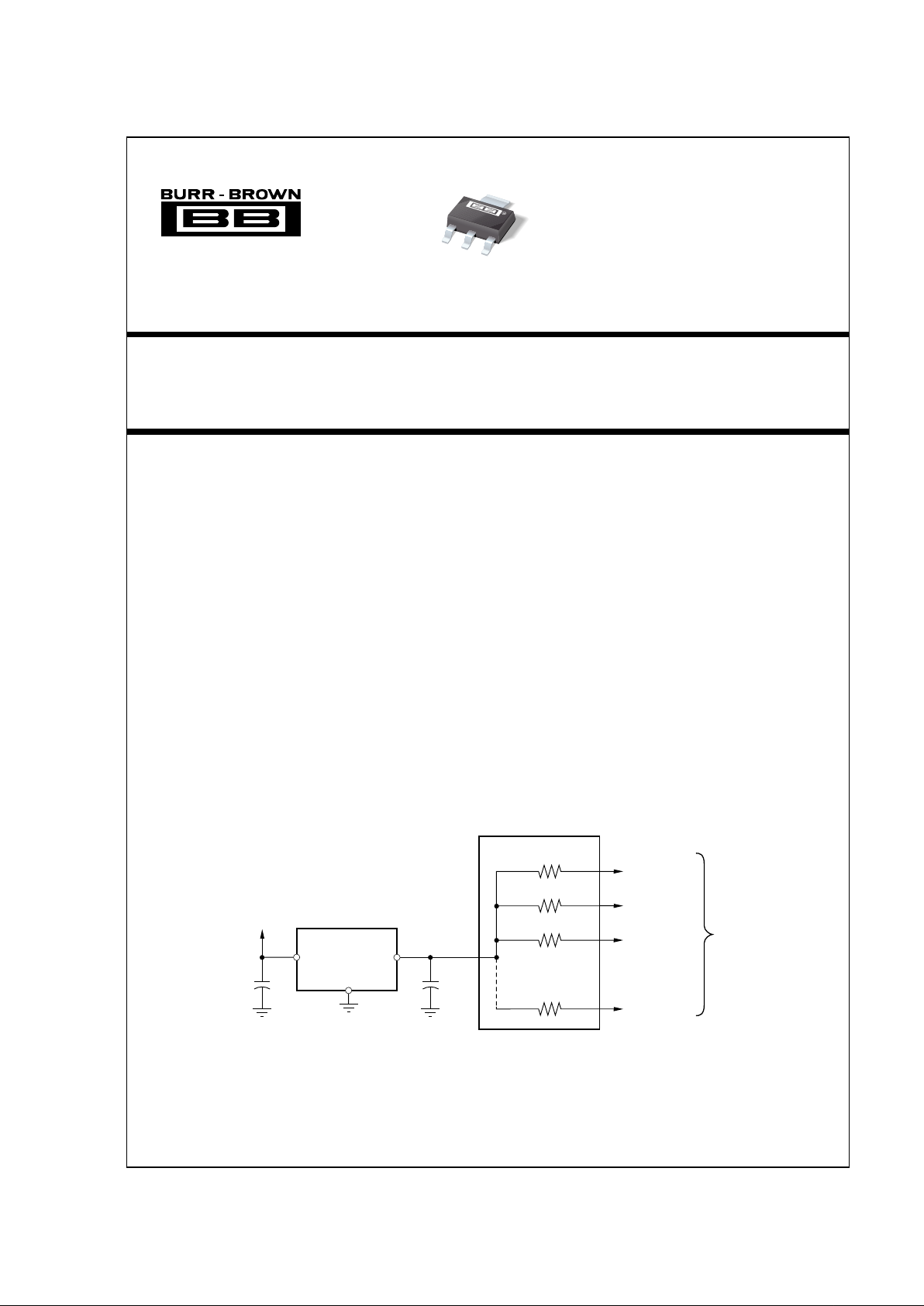
The REG1118-2.85 is a three-terminal voltage regulators capable of sourcing up to 800mA and sinking up
to 400mA. The sinking capability is important in SCSI
applications where active negation line drivers are
used. The REG1118-2.85 is useful for making a
27-line Boulay terminator capable of interfacing with
active negation drivers required in FAST-20 SCSI
applications. The regulator has active current limits
for both sink and source currents as well as internal
thermal limiting.
Laser trimming assures excellent output voltage accuracy. An NPN output stage allows output stage drive
current to contribute to the source load current for
maximum efficiency.
REG1118 is packaged in a SOT-223 surface-mount
package, suitable for reflow soldering techniques.
REG1118
REG1118
GND
V
IN
V
OUT
4.7µF10µF
TERMPWR
110Ω
110Ω
User Supplied
Resistor Network
REG1118-2.85 Used to Make Active Negation SCSI Terminator
Signal Line N
Signal Line 1
Signal Line 2
Signal Line 3
Up To
27 Lines
110Ω
110Ω
Page 2
®
REG1118
2
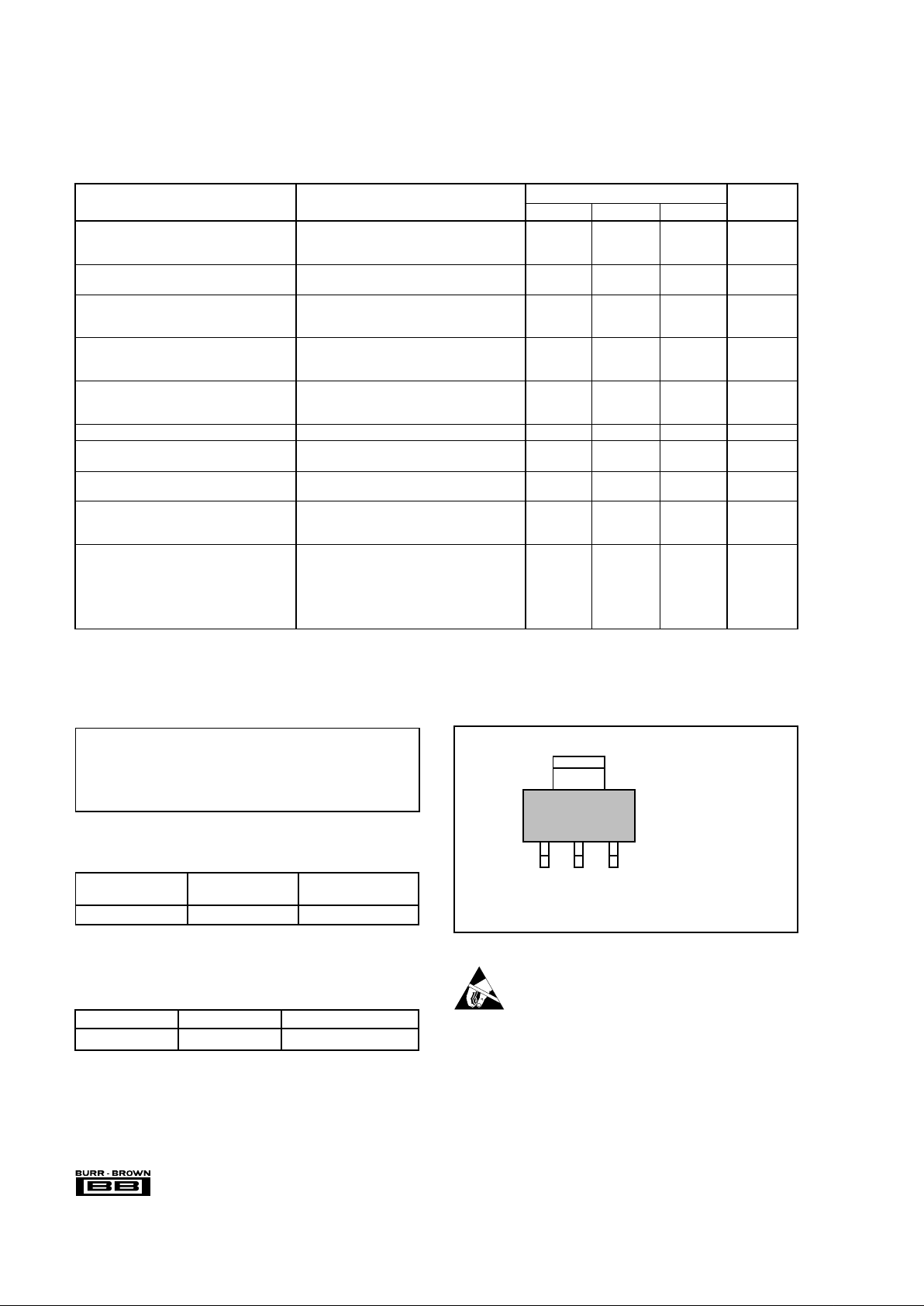
SPECIFICATIONS
At TA = 0°C to 70°C, TERMPWR = +5V, unless otherwise noted.
REG1118-2.85
PARAMETER CONDITIONS MIN TYP MAX UNITS
OUTPUT VOLTAGE
No Load, T
A
= 25°C 2.82 2.85 2.88 V
All Operating Conditions
(1)
2.79 2.85 2.91 V
LINE REGULATION
(2)
IO = 0, V
IN
= 4.75V to 6V 0.3 4 mV
LOAD REGULATION
(2)
IO = 0 to 800mA 2 25 mV
I
O
= –400 to 0mA 25 60 mV
DROPOUT VOLTAGE
(3)
TA = 25°C
I
O
= 100mA 0.8 1.1 V
I
O
= 800mA 1.1 1.3 V
CURRENT LIMIT T
A
= 25°C
Positive (I
SC
+)
(4)
800 1450 mA
Negative (I
SC
–) V
OUT
= 3.7V –750 –400 mA
QUIESCENT CURRENT I
O
= 0 3 7 mA
RIPPLE REJECTION T
A
= 25°C
f = 120Hz, V
IN
– V
OUT
= 2V, V
RIPPLE
= 0.5Vp-p 56 dB
LONG-TERM STABILITY
T
A
= +125°C, 1000Hr 0.2 %
THERMAL SHUTDOWN
Junction Temperature Shutdown 150 °C
Junction Temperature Reset 140 °C
THERMAL RESISTANCE
Specified Junction Temperature Range 0 70 °C
Operating Junction Temperature Range 0 125 °C
Storage Range –55 125 °C
Thermal Resistance
θ
JC
(Junction-to-Case at Tab) 15 °C/W
NOTES: (1) All operating conditions include the combined effects of load current, input voltage, and temperature over each parameter’s full specified range.
(2) Load and line regulation are tested at a constant junction temperature by low duty cycle testing. (3) Dropout voltage is defined as the minimum input-to-output
voltage that produces a 1% decrease in output voltage. (4) V
OUT
to ground through 1Ω.
ABSOLUTE MAXIMUM RATINGS
Input Voltage..........................................................................................7V
Output Voltage ........................................................... –0.2V to (V+) +0.5V
Short-Circuit Duration ..................................................................Indefinite
Operating Junction Temperature Range............................. 0°C to +125°C
Storage Temperature Range ..........................................–55°C to +125°C
Lead Temperature (soldering, 10s)
(1)
............................................. +300°C
NOTE: (1) See “Soldering Methods.”
Front View SOT-223
CONNECTION DIAGRAM
Tab is connected
to Ground
V
IN
GroundV
OUT
Plastic SOT-223
PRODUCT
(1)
PART MARKING PACKAGE
REG1118-2.85 BB11182 SOT-223
NOTE: (1) Available in Tape and Reel, add –TR to Model Number.
ORDERING INFORMATION
PACKAGE INFORMATION
PACKAGE DRAWING
PRODUCT PACKAGE NUMBER
(1)
REG1118-2.85 SOT-223 311
NOTE: (1) For detailed drawing and dimension table, please see end of data
sheet, or Appendix C of Burr-Brown IC Data Book.
ELECTROSTATIC
DISCHARGE SENSITIVITY
This integrated circuit can be damaged by ESD. Burr-Brown
recommends that all integrated circuits be handled with
appropriate precautions. Failure to observe proper handling
and installation procedures can cause damage.
Page 3

®
REG1118
3
LOAD TRANSIENT RESPONSE
0.2
0
–0.2
0.5
0
–0.5
Output Voltage
Deviation (V)
Load Current (A)
0 25 50 75 100 125 150 200175 250225
Time (µs)
Sinking 400mA
Sourcing
800mA
(Ceramic)(Tantalum)
10µF || 0.1µF
(Ceramic)(Tantalum)
4.7µF || 0.1µF
At TA = 25°C, TERMPWR = +5V, unless otherwise specified.
TYPICAL PERFORMANCE CURVE
QUIESCENT CURRENT vs TEMPERATURE
Temperature (°C)
30 40
5
4
3
2
–100 1020 5060708090
Quiescent Current (mA)
DROPOUT VOLTAGE vs TEMPERATURE
Temperature (°C)
30 40
1.3
1.2
1.1
1
0.9
0.8
0.7
0.6
–100 1020 5060708090
Dropout Voltage (V)
I
OUT
= 100mA
I
OUT
= 800mA
SHORT-CIRCUIT CURRENT vs TEMPERATURE
Temperature (°C)
30 40
1.8
1.6
1.4
1.2
1
0.8
0.6
0.4
–100 1020 5060708090
Short-Circuit Current mA
Source
Sink
LINE TRANSIENT RESPONSE
1
0
–1
0.1
0
–0.1
Output Voltage
Deviation (V)
Input Voltage
Deviation (V)
0 0.25 0.75 1.250.5 1 1.5 1.75 2.252 2.5
Time (ms)
CIN = 2.2µF
C
OUT
= 1µF
Page 4

®
REG1118
4
APPLICATIONS INFORMATION
Figure 1 shows the basic hookup diagram for the REG1118.
An output capacitor is required for proper operation and to
improve high frequency load regulation. A high quality
capacitor should be used to assure that the ESR (effective
series resistance) is less than 0.5Ω. A capacitor of at least
1µF is recommended. Increasing C
OUT
improves output
voltage deviation, see the typical curve “Load Transient
Response.” It is suggested that the input be decoupled with
10µF low ESR capacitor.
ambient temperature above that expected in normal operation until the device’s thermal shutdown is activated. If this
occurs at more than 40°C above the maximum expected
ambient temperature, then the T
J
will be less than 125°C
during normal operation.
SOLDERING METHODS
The REG1118 package is suitable for infrared reflow and
vapor-phase reflow soldering techniques. The high rate of
temperature change that occurs with wave soldering, or hand
soldering can damage the REG1118.
FIGURE 1. Basic Connections.
THERMAL CONSIDERATIONS
The REG1118 has current limit and thermal shutdown
circuits that protect it from overload. The thermal shutdown
activates at approximately T
J
= 150°C. For continuous op-
eration, however, the junction temperature should not be
allowed to exceed 125°C. Any tendency to activate the
thermal shutdown in normal use is an indication of an
inadequate heat sink or excessive power dissipation. The
power dissipation is equal to:
P
D
= (VIN – V
OUT
) I
OUT
The junction temperature can be calculated by:
T
J
= TA + PD (
θ
JA
)
where T
A
is the ambient temperature, and
θ
JA
is the junction-to-ambient thermal resistance
The REG1118 derives heat sinking from conduction through
its copper leads, especially the large mounting tab. These
must be soldered to a circuit board with a substantial amount
of copper remaining (see Figure 2). Circuit board traces
connecting to the tab and the leads should be made as large
as practical. Other nearby circuit traces, including those on
the back side of the circuit board, help conduct heat away
from the device, even though they are not electrically connected.
Make all nearby copper traces as wide as possible and leave
only narrow gaps between traces. In addition, multiple
contacts to internal power and ground planes increase heat
sinking with minimal increase in circuit board area.
Table I shows approximate values of
θ
JA
for various circuit
board and copper areas. Nearby heat dissipating components, circuit board mounting conditions and ventilation can
dramatically affect the actual
θ
JA
.
A simple experiment will determine whether the maximum
recommended junction temperature is exceeded in an actual
circuit board and mounting configuration: Increase the
FIGURE 2. Circuit Board Layout Example.
Total Area: 50 x 50mm
Without back-side copper:
JA
≈ 59°C/W
35 x 17 mm
16 x 10 mm 16 x 10 mm
θ
With solid back-side copper: JA ≈ 49°C/W
θ
TOPSIDE
(1)
BACKSIDE
TOTAL PC BOARD COPPER COPPER THERMAL RESISTANCE
AREA AREA AREA JUNCTION-TO-AMBIENT
2500mm
2
2500mm22500mm
2
46°C/W
2500mm
2
1250mm22500mm
2
47°C/W
2500mm
2
950mm22500mm
2
49°C/W
2500mm
2
2500mm
2
051°C/W
2500mm
2
1800mm
2
053°C/W
1600mm
2
600mm21600mm
2
55°C/W
2500mm
2
1250mm
2
058°C/W
2500mm
2
915mm
2
059°C/W
1600mm
2
600mm
2
067°C/W
900mm
2
340mm2900mm
2
72°C/W
900mm
2
340mm
2
085°C/W
NOTE: (1) Tab is attached to the topside copper.
TABLE I.
INSPEC Abstract Number: B91007604, C91012627
Kelly, E.G. “Thermal Characteristics of Surface 5WK9Ω
Packages.” The Proceedings of SMTCON. Surface Mount
Technology Conference and Exposition: Competitive Surface
Mount Technology, April 3-6, 1990, Atlantic City, NJ, USA.
Abstract Publisher: IC Manage, 1990, Chicago, IL, USA.
REG1118
V
O
V
IN
10µF
4.7µF
Page 5

®
REG1118
5
The information provided herein is believed to be reliable; however, BURR-BROWN assumes no responsibility for inaccuracies or omissions. BURR-BROWN assumes
no responsibility for the use of this information, and all use of such information shall be entirely at the user's own risk. Prices and specifications are subject to change
without notice. No patent rights or licenses to any of the circuits described herein are implied or granted to any third party. BURR-BROWN does not authorize or warrant
any BURR-BROWN product for use in life support devices and/or systems.
FIGURE 3. SCSI Active Termination Configuration.
4.7µF10µF
REG1118-2.85
110Ω110Ω
110Ω110Ω
10µF 4.7µF
1N5817
5V
TERMPWR
2.85V 2.85V
TERMPWR
1N5817
5V
(Up to 27 Lines)
REG1118-2.85
 Loading...