

Page 1
*Other brands and names are the property of their respective owners.
Information in this document is provided in connection with Intel products. Intel assumes no liability whatsoever, including infringement of any patent or
copyright, for sale and use of Intel products except as provided in Intel’s Terms and Conditions of Sale for such products. Intel retains the right to make
changes to these specifications at any time, without notice. Microcomputer Products may have minor variations to this specification known as errata.
November 1995COPYRIGHT©INTEL CORPORATION, 1996 Order Number: 290219-006
82596DX AND 82596SX
HIGH-PERFORMANCE 32-BIT LOCAL
AREA NETWORK COPROCESSOR
Y
Performs Complete CSMA/CD Medium
Access Control (MAC) FunctionsÐ
Independently of CPU
Ð IEEE 802.3 (EOC) Frame Delimiting
Y
Supports Industry Standard LANs
Ð IEEE TYPE 10BASE-T (TPE),
IEEE TYPE 10BASE5 (Ethernet*),
IEEE TYPE 10BASE2 (Cheapernet),
IEEE TYPE 1BASE5 (StarLAN),
and the Proposed Standard
TYPE 10BASE-F
Ð Proprietary CSMA/CD Networks Up
to 20 Mb/s
Y
On-Chip Memory Management
Ð Automatic Buffer Chaining
Ð Buffer Reclamation after Receipt of
Bad Frames; Optional Save Bad
Frames
Ð 32-Bit Segmented or Linear (Flat)
Memory Addressing Formats
Y
82586 Software Compatible
Y
Optimized CPU Interface
Ð 82596DX Bus Interface Optimized to
Intel’s 32-Bit i386
TM
DX
Ð 82596SX Bus Interface Optimized to
Intel’s 16-Bit i386
TM
SX
Ð Supports Big Endian and Little
Endian Byte Ordering
Y
High-Performance 16-/32-Bit Bus
Master Interface
Ð 66-MB/s Bus Bandwidth
Ð 33-MHz Clock, Two Clocks Per
Transfer
Ð Bus Throttle Timers
Ð Transfers Data at 100% of Serial
Bandwidth
Ð 128-Byte Receive FIFO, 64-Byte
Transmit FIFO
Y
Network Management and Diagnostics
Ð Monitor Mode
Ð 32-Bit Statistical Counters
Y
Self-Test Diagnostics
Y
Configurable Initialization Root for Data
Structures
Y
High-Speed, 5-V, CHMOS** IV
Technology
Y
132-Pin Plastic Quad Flat Pack (PQFP)
and PGA Package
(See Packaging Specifications Order Number: 240800-001,
Package Type KU and A)
i386
TM
is a trademark of Intel Corporation
*Ethernet is a registered trademark of Xerox Corporation.
**CHMOS is a patented process of Intel Corporation.
290219– 1
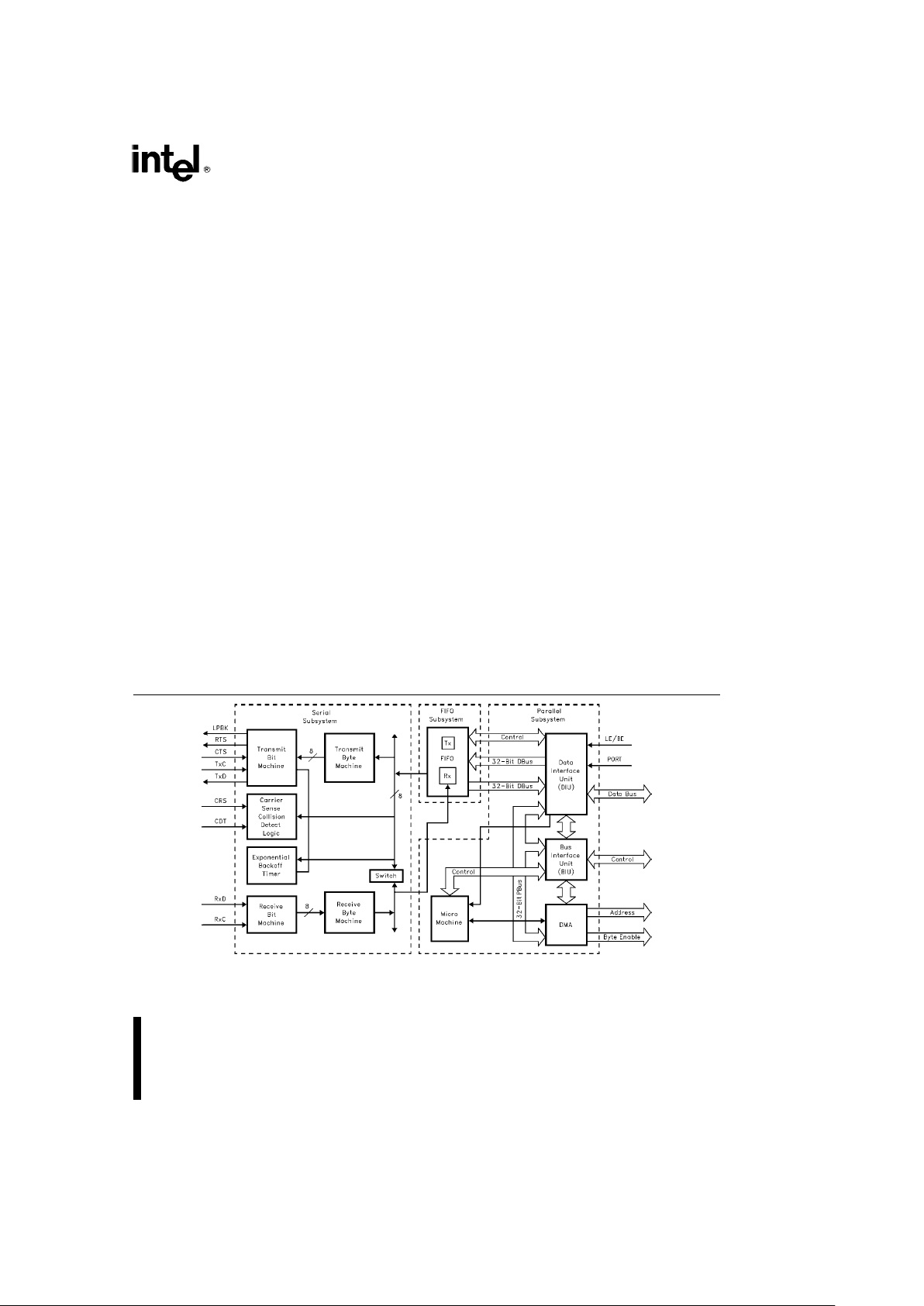
Figure 1. 82596DX/SX Block Diagram
Page 2

82596DX/SX
82596DX and 82596SX High-Performance
32-Bit Local Area Network Coprocessor
CONTENTS PAGE
INTRODUCTION
ААААААААААААААААААААААААААА 3
PIN DESCRIPTIONS АААААААААААААААААААААА 10
82596 AND HOST CPU
INTERACTION ААААААААААААААААААААААААА 14
82596 BUS INTERFACE АААААААААААААААААА 14
82596 MEMORY ADDRESSING АААААААААА 14
82596 SYSTEM MEMORY
STRUCTURE ААААААААААААААААААААААААААА 16
TRANSMIT AND RECEIVE MEMORY
STRUCTURES
ААААААААААААААААААААААААА 17
TRANSMITTING FRAMES АААААААААААААААА 20
RECEIVING FRAMES АААААААААААААААААААА 21
82596 NETWORK MANAGEMENT AND
DIAGNOSTICS ААААААААААААААААААААААААА 21
NETWORK PLANNING AND
MAINTENANCE АААААААААААААААААААААААА 23
STATION DIAGNOSTICS AND SELF-
TEST
ААААААААААААААААААААААААААААААААААА 24
82586 SOFTWARE COMPATIBILITY ААААА 24
INITIALIZING THE 82596 АААААААААААААААА 24
SYSTEM CONFIGURATION POINTER
(SCP) ААААААААААААААААААААААААААААААААААА 24
Writing the Sysbus АААААААААААААААААААААААА 25
INTERMEDIATE SYSTEM
CONFIGURATION POINTER
(ISCP)
АААААААААААААААААААААААААААААААААА 26
INITIALIZATION PROCESS АААААААААААААА 26
CONTROLLING THE 82596DX/SX ААААААА 27
82596 CPU ACCESS INTERFACE
(PORT
Ý
) ААААААААААААААААААААААААААААААА 27
MEMORY ADDRESSING FORMATS ААААА 28
LITTLE ENDIAN AND BIG ENDIAN
BYTE ORDERING
АААААААААААААААААААААА 28
COMMAND UNIT (CU) ААААААААААААААААААА 29
RECEIVE UNIT (RU) АААААААААААААААААААААА 30
SYSTEM CONTROL BLOCK (SCB) АААААА 30
SCB OFFSET ADDRESSES АААААААААААААА 33
CONTENTS PAGE
CBL Offset (Address)
ААААААААААААААААААААА 33
RFA Offset (Address) ААААААААААААААААААААА 34
SCB STATISTICAL COUNTERS АААААААААА 34
Statistical Counter Operation АААААААААААААА 34
ACTION COMMANDS AND
OPERATING MODES
АААААААААААААААААА 35
NOP АААААААААААААААААААААААААААААААААААААА 35
Individual Address Setup АААААААААААААААААА 36
Configure ААААААААААААААААААААААААААААААААА 37
Multicast-Setup ААААААААААААААААААААААААААА 43
Transmit АААААААААААААААААААААААААААААААААА 44
Jamming Rules ААААААААААААААААААААААААААА 46
TDR АААААААААААААААААААААААААААААААААААААА 47
Dump ААААААААААААААААААААААААААААААААААААА 49
Diagnose ААААААААААААААААААААААААААААААААА 52
RECEIVE FRAME DESCRIPTOR ААААААААА 52
Simplified Memory Structure ААААААААААААААА 53
Flexible Memory Structure ААААААААААААААААА 54
Receive Buffer Descriptor (RBD) ААААААА 55
PGA PACKAGE THERMAL
SPECIFICATION ААААААААААААААААААААААА 60
ELECTRICAL AND TIMING
CHARACTERISTICS
ААААААААААААААААААА 60
Absolute Maximum Ratings ААААААААААААААА 60
DC Characteristics АААААААААААААААААААААААА 60
AC Characteristics АААААААААААААААААААААААА 61
82596DX Input/Output System
Timings АААААААААААААААААААААААААААААА 61
82596SX Input/Output System
Timings
АААААААААААААААААААААААААААААА 63
Transmit/Receive Clock
Parameters АААААААААААААААААААААААААА 66
82596DX/SX BUS OPERATION АААААААААА 68
System Interface A.C. Timing
Characteristics АААААААААААААААААААААААААА 69
Input Waveforms АААААААААААААААААААААААААА 70
Serial A.C. Timing Characteristics АААААААААА 72
OUTLINE DIAGRAMS АААААААААААААААААААА 74
REVISION SUMMARY АААААААААААААААААААА 77
2
Page 3

82596DX/SX
INTRODUCTION
The 82596DX/SX is an intelligent, high-performance
32-bit Local Area Network coprocessor. The
82596DX/SX implements the CSMA/CD access
method and can be configured to support all existing IEEE 802.3 standardsÐTYPEs 10BASE-T,
10BASE5, 10BASE2, 1BASE5, and 10BROAD36. It
can also be used to implement the proposed standard TYPE 10BASE-F. The 82596DX/SX performs
high-level commands, command chaining, and interprocessor communications via shared memory, thus
relieving the host CPU of many tasks associated
with network control. All time-critical functions are
performed independently of the CPU, this increases
network performance and efficiency. The
82596DX/SX bus interface is optimized for Intel’s
i386
TM
DX and i386TMSX microprocessors.
The 82596DX/SX implements all IEEE 802.3 Medium Access Control and channel interface functions,
these include framing, preamble generation and
stripping, source address generation, destination address checking, short-frame detection, and automatic length-field handling. Data rates up to 20 Mb/s are
supported.
The 82596DX/SX provides a powerful host system
interface. It manages memory structures automatically, with command chaining and bidirectional data
chaining. An on-chip DMA controller manages four
channels, this allows autonomous transfer of data
blocks (buffers and frames) and relieves the CPU of
byte transfer overhead. Buffers containing errored or
collided frames can be automatically recovered without CPU intervention. The 82596DX/SX provides an
upgrade path for existing 82586 software drivers by
providing an 82586-software-compatible mode that
supports the current 82586 memory structure. The
82596DX/SX also has a Flexible memory structure
and a Simplified memory structure. The 82596DX/
SX can address up to 4 gigabytes of memory. The
82596DX/SX supports Little Endian and Big Endian
byte ordering.
The 82596DX/SX bus interface is optimized to Intel’s i386
TM
DX and i386 SX microprocessors, providing a bus transfer rate of up to 66 MB/s at
33 MHz. The bus interface employs bus throttle timers to regulate 82596DX/SX bus use. Two large, independent FIFOsÐ128 bytes for Receive and 64
bytes for TransmitÐtolerate long bus latencies and
provide programmable thresholds that allow the
user to optimize bus overhead for any worst-case
bus latency.
The 82596DX/SX provides a wide range of diagnostics and network management functions, these include internal and external loopback, exception condition tallies, channel activity indicators, optional
capture of all frames regardless of destination ad-
dress (promiscuous mode), optional capture of errored or collided frames, and time domain reflectometry for locating fault points on the network cable.
The statistical counters, in 32-bit segmented and linear modes, are 32-bits each and include CRC errors,
alignment errors, overrun errors, resource errors,
short frames, and received collisions. The
82596DX/SX also features a monitor mode for network analysis. In this mode the 82596DX/SX can
capture status bytes, and update statistical counters, of frames monitored on the link without transferring the contents of the frames to memory. This
can be done concurrently while transmitting and receiving frames destined for that station.
The 82596DX/SX can be used in both baseband
and broadband networks. It can be configured for
maximum network efficiency (minimum contention
overhead) with networks of any length. Its highly
flexible CSMA/CD unit supports address field
lengths of zero through six bytes for IEEE 802.3/
Ethernet frame delimitation. It also supports 16- or
32-bit cyclic redundancy checks. The CRC can be
transferred directly to memory for receive, operations or dynamically inserted for transmit operations.
The CSMA/CD unit can also be configured for full
duplex operation for high throughput in point-to-point
connections.
The 82596 C-Step incorporates several new features not found in previous steppings. The following
is a summary of the 82596 C-step’s new features.
#
The 82596 C-step fixes Errata found in the A1
and B steppings.
#
The 82596 C-step has improved AC timings over
both the A and B steppings.
#
The 82596 C-step has a New Enhanced Big Endian Mode where in Linear Addressing mode, true
32-bit Big Endian functionality is achieved. New
Enhanced Big Endian Mode is enabled by setting
bit 7 of the SYSBUS byte. This mode is software
compatible with the big endian mode of the Bstep with one exceptionÐno 32-bit addresses
need to be swapped by software in the C-step. In
this new mode, the 82596 C-step treats 32-bit address pointers as true 32-bit entities and the SCB
absolute address and statistical counters are still
treated as two 16-bit big endian entities. Not setting this mode will configure the 82596 C-step to
be 100% compatible to the A1-step bit endian
mode.
#
The 82596 C-step is hardware and software compatible to both the A1 and B steppings allowing
for easy ‘‘drop-in’’ to current designs. Pinout and
control structures remain unchanged.
The 82596DX/SX is fabricated with Intel’s reliable,
5-V, CHMOS IV (Process 648.8) technology. It is
available in a 132-pin PQFP or PGA package.
3
Page 4

82596DX/SX
290219– 2
Figure 2a. 82596DX PQFP Pin Configuration
4
Page 5
82596DX/SX
290219– 34
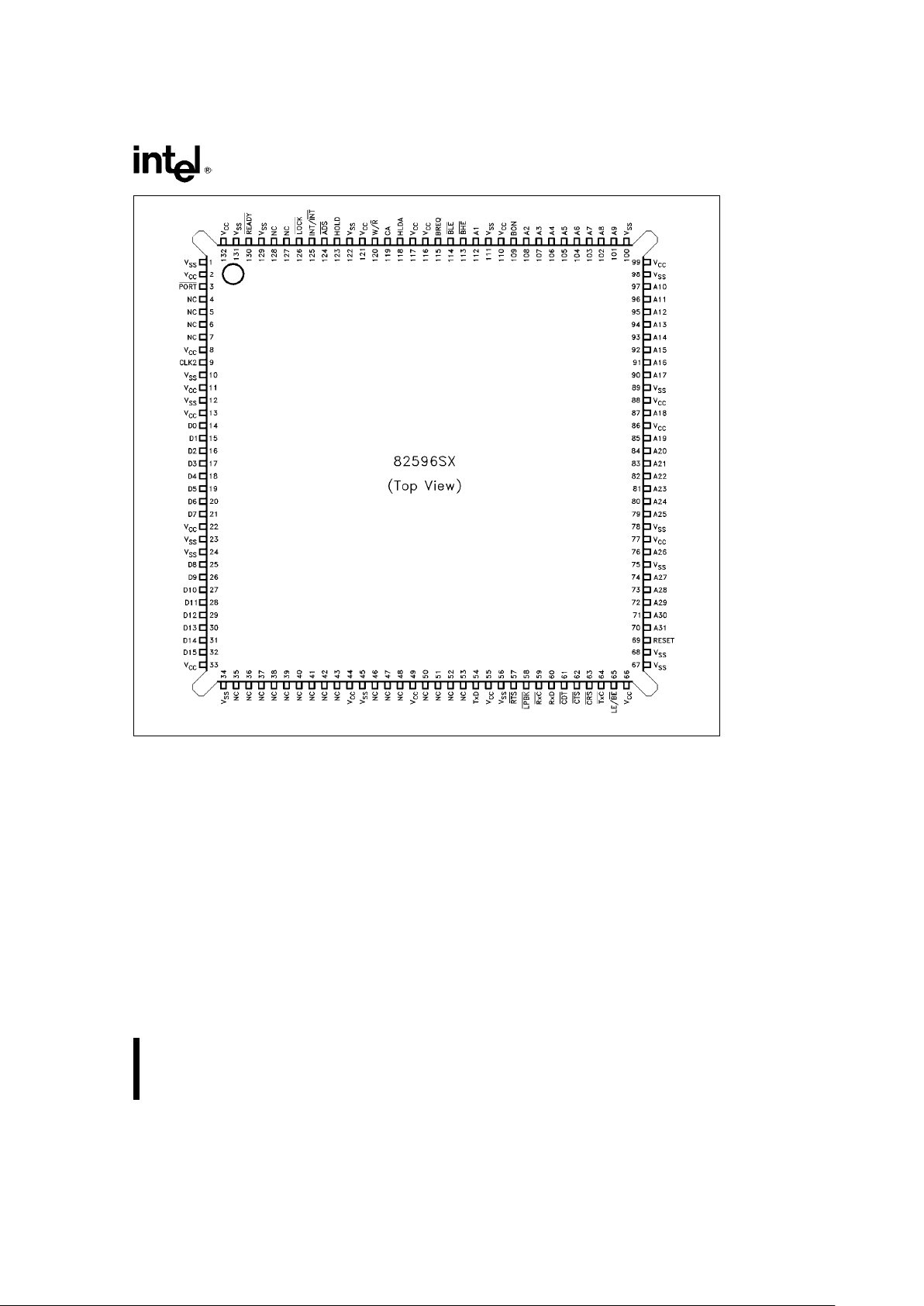
Figure 2b. 82596SX PQFP Pin Configuration
5
Page 6
82596DX/SX
290219– 3
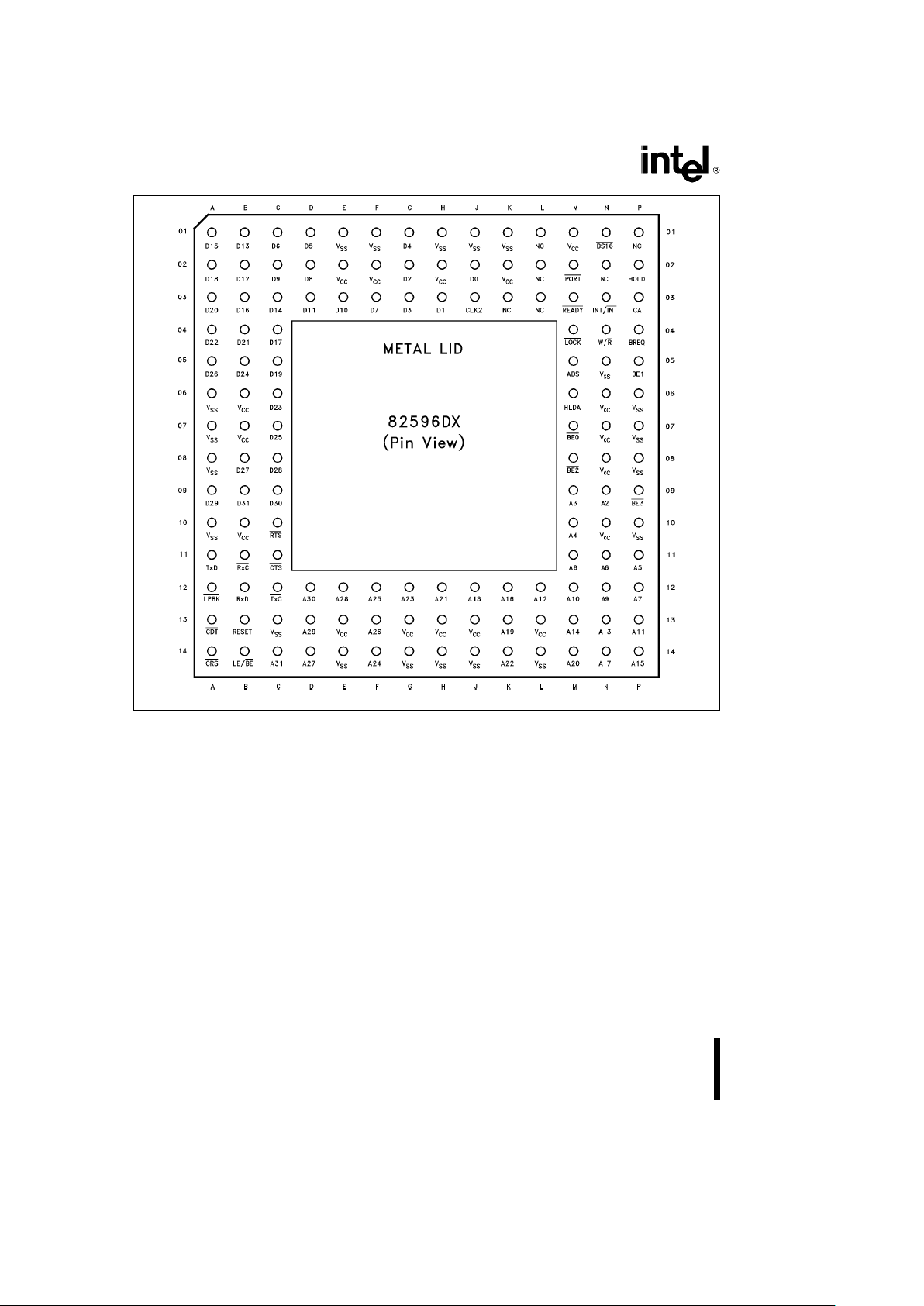
Figure 3a. 82596DX PGA Pin View Side
6
Page 7
82596DX/SX
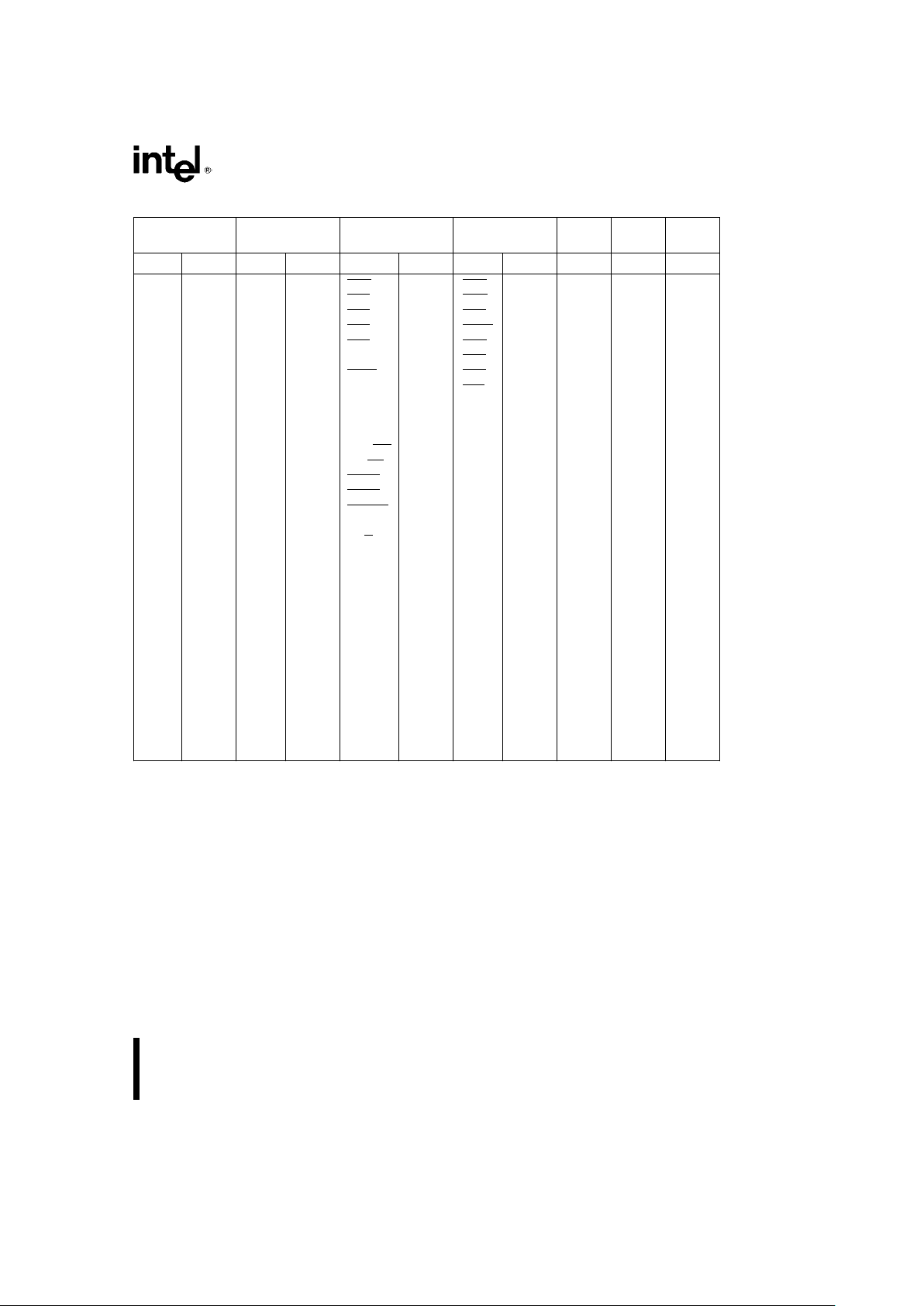
82596DX PGA Cross Reference by Pin Name
Address Data Control
Serial
N/C V
CC
V
SS
Interface
Signal Pin No. Signal Pin No. Signal Pin No. Signal Pin No. Pin No. Pin No. Pin No.
A
2
N9 D
0
J2 ADS M5 CDT A13 K3 B6 A6
A
3
M9 D
1
H3 BE0 M7 CRS A14 L1 B7 A7
A
4
M10 D
2
G2 BE1 P5 CTS C11 L2 B10 A8
A
5
P11 D
3
G3 BE2 M8 LPBK A12 L3 E2 A10
A
6
N11 D
4
G1 BE3 P9 RTS C10 N2 E13 C13
A
7
P12 D
5
D1 BREQ P4 RxC B11 P1 F2 E1
A
8
M11 D
6
C1 BS16 N1 RxD B12 G13 E14
A
9
N12 D
7
F3 CA P3 TxC C12 H2 F1
A
10
M12 D
8
D2 CLK2 J3 TxD A11 H13 G14
A
11
P13 D
9
C2 HLDA M6 J13 H1
A
12
L12 D
10
E3 HOLD P2 K2 H14
A
13
N13 D
11
D3 INT/INT N3 L13 J1
A
14
M13 D
12
B2 LE/BE B14 M1 J14
A
15
P14 D
13
B1 LOCK M4 N6 K1
A
16
K12 D
14
C3 PORT M2 N7 L14
A
17
N14 D
15
A1 READY M3 N8 N5
A
18
J12 D
16
B3 RESET B13 N10 P6
A
19
K13 D
17
C4 W/R N4 P7
A
20
M14 D
18
A2 P8
A
21
H12 D
19
C5 P10
A
22
K14 D
20
A3
A
23
G12 D
21
B4
A
24
F14 D
22
A4
A
25
F12 D
23
C6
A
26
F13 D
24
B5
A
27
D14 D
25
C7
A
28
E12 D
26
A5
A
29
D13 D
27
B8
A
30
D12 D
28
C8
A
31
C14 D
29
A9
D
30
C9
D
31
B9
7
Page 8

82596DX/SX
290219– 35
Figure 3b. 82596SX PGA Pin View Side
8
Page 9
82596DX/SX
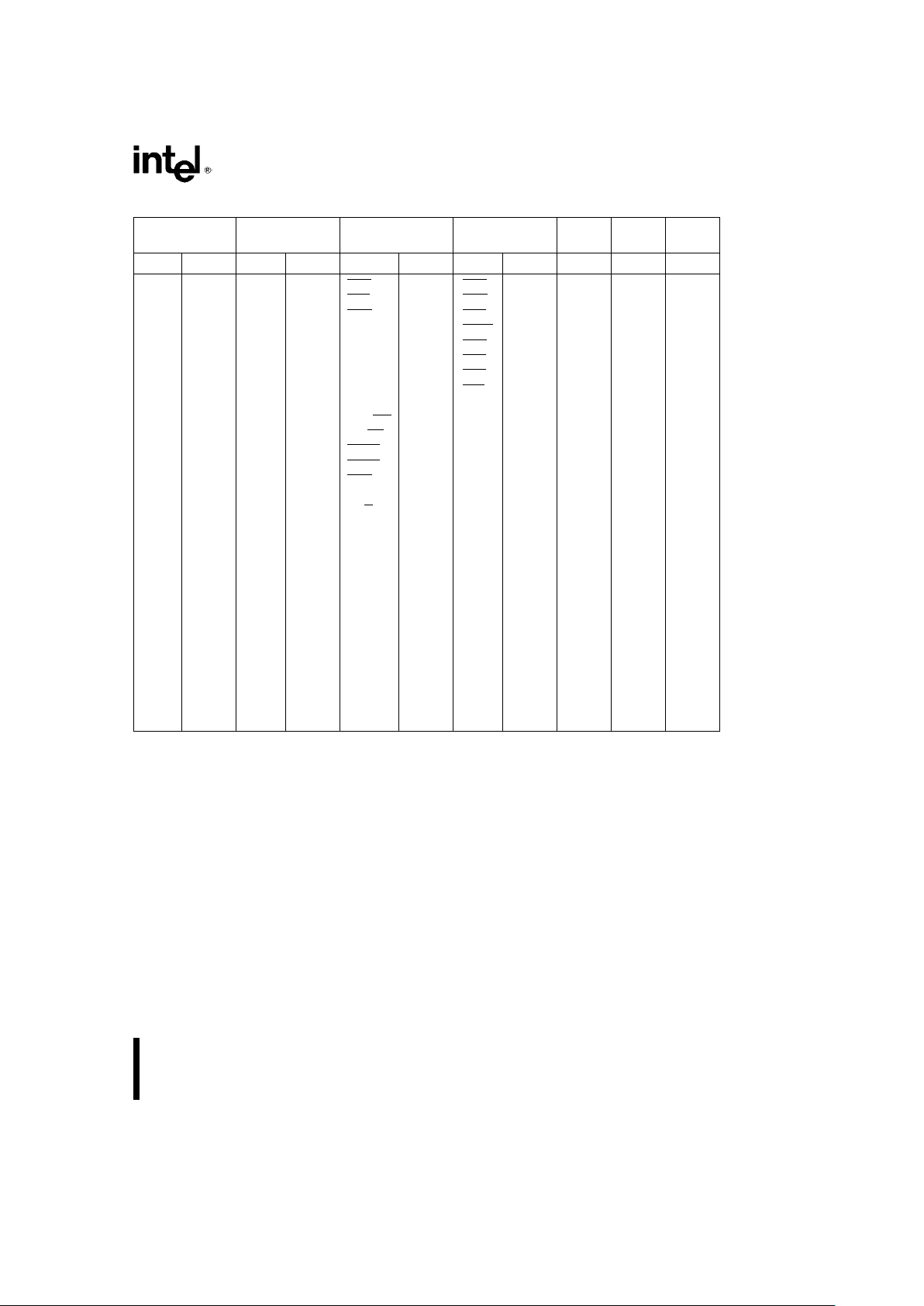
82596SX PGA Cross Reference by Pin Name
Address Data Control
Serial
N/C V
CC
V
SS
Interface
Signal Pin No. Signal Pin No. Signal Pin No. Signal Pin No. Pin No. Pin No. Pin No.
A
2
N9 D
0
J2 ADS M5 CDT A13 A2 B6 A6
A
3
M9 D
1
H3 BLE M7 CRS A14 A3 B7 A7
A
4
M10 D
2
G2 BHE P5 CTS C11 A4 B10 A8
A
5
P11 D
3
G3 BON P9 LPBK A12 A5 E2 A10
A
6
N11 D
4
G1 BREQ P4 RTS C10 A9 E13 C13
A
7
P12 D
5
D1 CA P3 RxC B11 B3 F2 E1
A
8
M11 D
6
C1 CLK2 J3 RxD B12 B4 G13 E14
A
9
N12 D
7
F3 HLDA M6 TxC C12 B5 H2 F1
A
10
M12 D
8
D2 HOLD P2 TxD A11 B8 H13 G14
A
11
P13 D
9
C2 INT/INT N3 B9 J13 H1
A
12
L12 D
10
E3 LE/BE B14 C4 K2 H14
A
13
N13 D
11
D3 LOCK M4 C5 L13 J1
A
14
M13 D
12
B2 PORT M2 C6 M1 J14
A
15
P14 D
13
B1 RDY M3 C7 N5 K1
A
16
K12 D
14
C3 RESET B13 C8 N6 L14
A
17
N14 D
15
A1 W/R N04 C9 N7 N1
A
18
J12 K3 N8 P6
A
19
K13 L1 N10 P7
A
20
M14 L2 P8
A
21
H12 L3 P10
A
22
K14 N2
A
23
G12 P1
A
24
F14
A
25
F12
A
26
F13
A
27
D14
A
28
E12
A
29
D13
A
30
D12
A
31
C14
9
Page 10

82596DX/SX
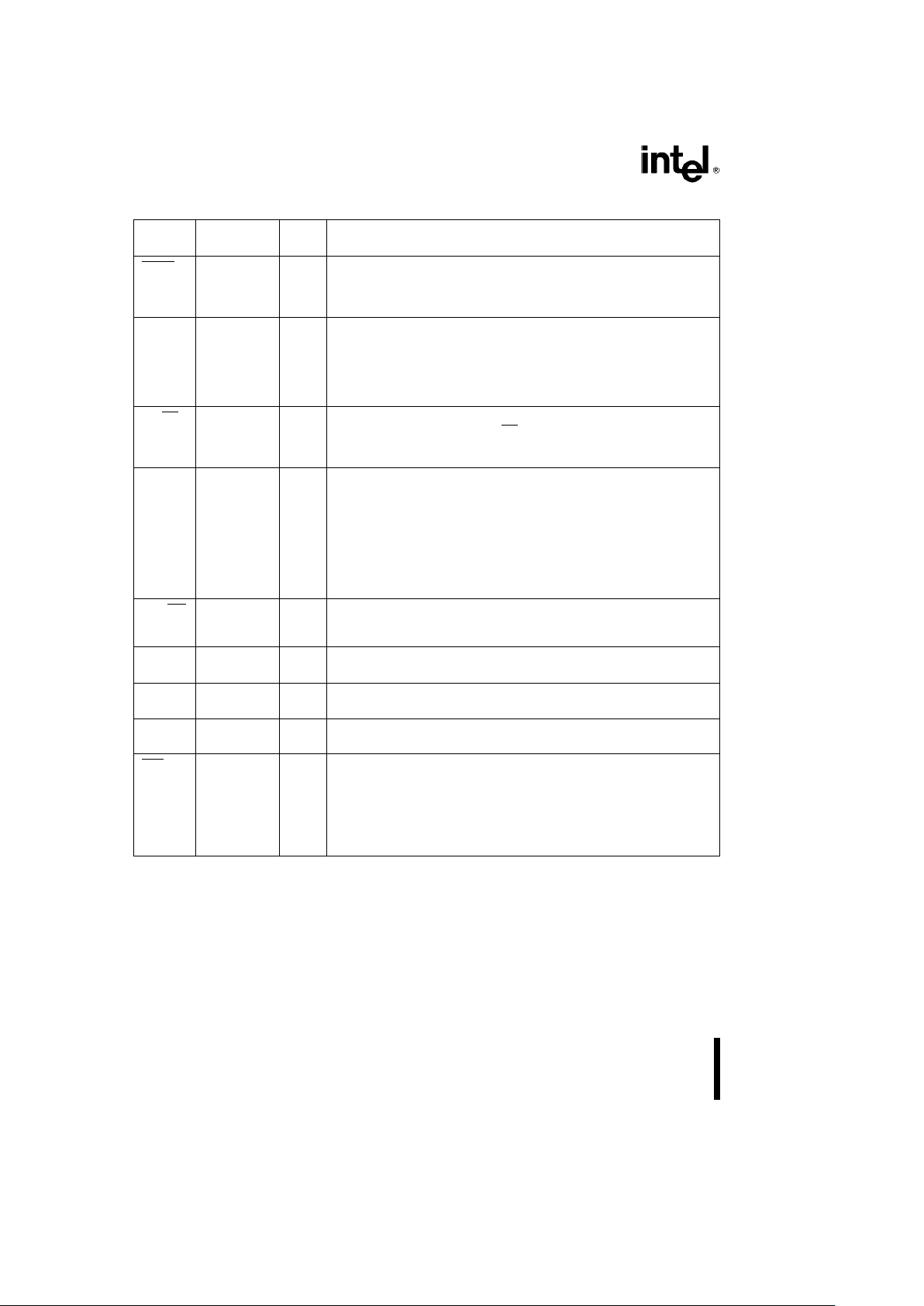
PIN DESCRIPTIONS
Symbol
PQFP
Type Name and Function
Pin No.
CLK2 9 I CLOCK. The system clock input provides the fundamental timing for
the 82596. It is internally divided by two to generate the 82596 clock.
All external timing parameters are specified in reference to the rising
edge of CLK2. For clock levels see D.C. Characteristics.
D31–D0 14–53 I/O DATA BUS. The 32 Data Bus lines are bidirectional, tri-state lines that
provide the general purpose data path between the 82596 and
memory. With the 82596DX the bus can be either 16 or 32 bits wide;
this is determined by the BS16
signal which is static. The 82596
always drives all 32 data lines during Write operations, even with a
16-bit bus. D0 – D31 are floated after a Reset or when the bus is not
acquired.
These lines are inputs during a CPU Port access; in this mode the CPU
writes the next address to the 82596 through the Data lines. During
PORT
commands (Relocatable SCP, Self-Test, and Dump) the
address must be aligned to a 16 byte boundary. This frees the D
3–D0
lines so they can be used to distinguish the commands. The following
is a summary of the decoding data.
D0 D1 D2 D3 D4–D31 Function
0000 0000 Reset
0100 ADDR Relocatable SCP
1000 ADDR Self-Test
1100 ADDR Dump Command
(D15–D0) 14 – 32 I/O These 16 Data Bus lines are bidirectional, tri-state lines that provide
the entire data path for the 82596SX. In the 82596SX D16 –D31 are
not connected (NC).
A31–A2 70 – 108 O ADDRESS LINES. These 30 tri-stated Address lines output the
address bits required for memory operation. These lines are floated
after a Reset or when the bus is not acquired.
A1 112 O The 82596SX requires this additional address line to output the
address bits required for memory operation.
BE3–BE0 109 – 114 O BYTE ENABLE. (82596DX only.) These tri-stated signals are used to
indicate which bytes are involved with the current memory access. The
number of Byte Enable signals asserted indicates the physical size of
the data being transferred (1, 2, 3, or 4 bytes).
#
BE0 indicates D0 – D7
#
BE1 indicates D8 – D15
#
BE2 indicates D16 – D23
#
BE3 indicates D24 – D31
These lines are floated after a Reset or when the bus is not acquired.
BHE, BLE 113–114 O (82596SX only.) These signals are the Byte High Enable and Byte Low
Enable signals for the 82596SX.
BON 109 O BUS ON. (82596SX only.) This signal is driven high when the 82596 is
holding the bus. This signal is tri-stated when the bus is relinquished.
BON has the same timing as the Byte Enables.
10
Page 11

82596DX/SX
PIN DESCRIPTIONS (Continued)
Symbol
PQFP
Type Name and Function
Pin No.
W/R 120 O WRITE/READ. This dual-function pin is used to distinguish Write and
Read cycles. This line is floated after a Reset or when the bus is not
acquired.
ADS 124 O ADDRESS STATUS. This tri-state pin is used by the 82596 to indicate
that a valid bus cycle has begun and that A31–A2, BE3–BE0, and
W/R
are being driven. It is asserted during t1 bus states. This line is
floated after a Reset or when the bus is not acquired.
RDY 130 I READY. Active low. This signal is the acknowledgment from
addressed memory that the transfer cycle can be completed. When
high, it causes wait states to be inserted. It is ignored at the end of the
first clock of the bus cycle’s data cycle. This active-low signal does not
have an internal pull-up resistor. This signal must meet the setup and
hold times to operate correctly.
LOCK 126 O LOCK. This tri-state pin is used to distinguish locked and unlocked bus
cycles. LOCK
generates a semaphore handshake to the CPU. LOCK
can be active for several memory cycles, it goes active during the first
locked memory cycle (t1) and goes inactive at the last locked cycle
(t2). This line is floated after a Reset or when the bus is not acquired.
LOCK
can be disabled via the sysbus byte in software.
BS16 129 I BUS SIZE. This signal allows the 82596DX to work with either 16- or
32-bit bytes. This signal is static and should be tied high for 32-bit
operation or low for 16-bit operation. In Little Endian mode the D0 –
D15 lines are driven when BS16
is inserted, in Big Endian mode the
D16–D31 lines are driven.
HOLD 123 O HOLD. The HOLD signal is active high, the 82596 uses it to request
local bus mastership. In normal operation HOLD goes inactive before
HLDA. The 82596 can be forced off the bus by deasserting HLDA or if
the bus throttle timers expire.
HLDA 118 I HOLD ACKNOWLEDGE. The HLDA signal is active high, it indicates
that bus mastership has been given to the 82596. HLDA is internally
synchronized; after HOLD is detected low, the CPU drives HLDA low.
NOTE
Do not connect HLDA to VCCÐit will cause a deadlock.
A user wanting
to give the 82596 permanent access to the bus should connect HLDA
to HOLD. If HLDA goes inactive before HOLD, the 82596 will release
the bus (by deasserting HOLD) within a specified number of system
clocks.
BREQ 115 I BUS REQUEST. This signal, when configured to an externally
activated mode, is used to trigger the bus throttle timers.
11
Page 12
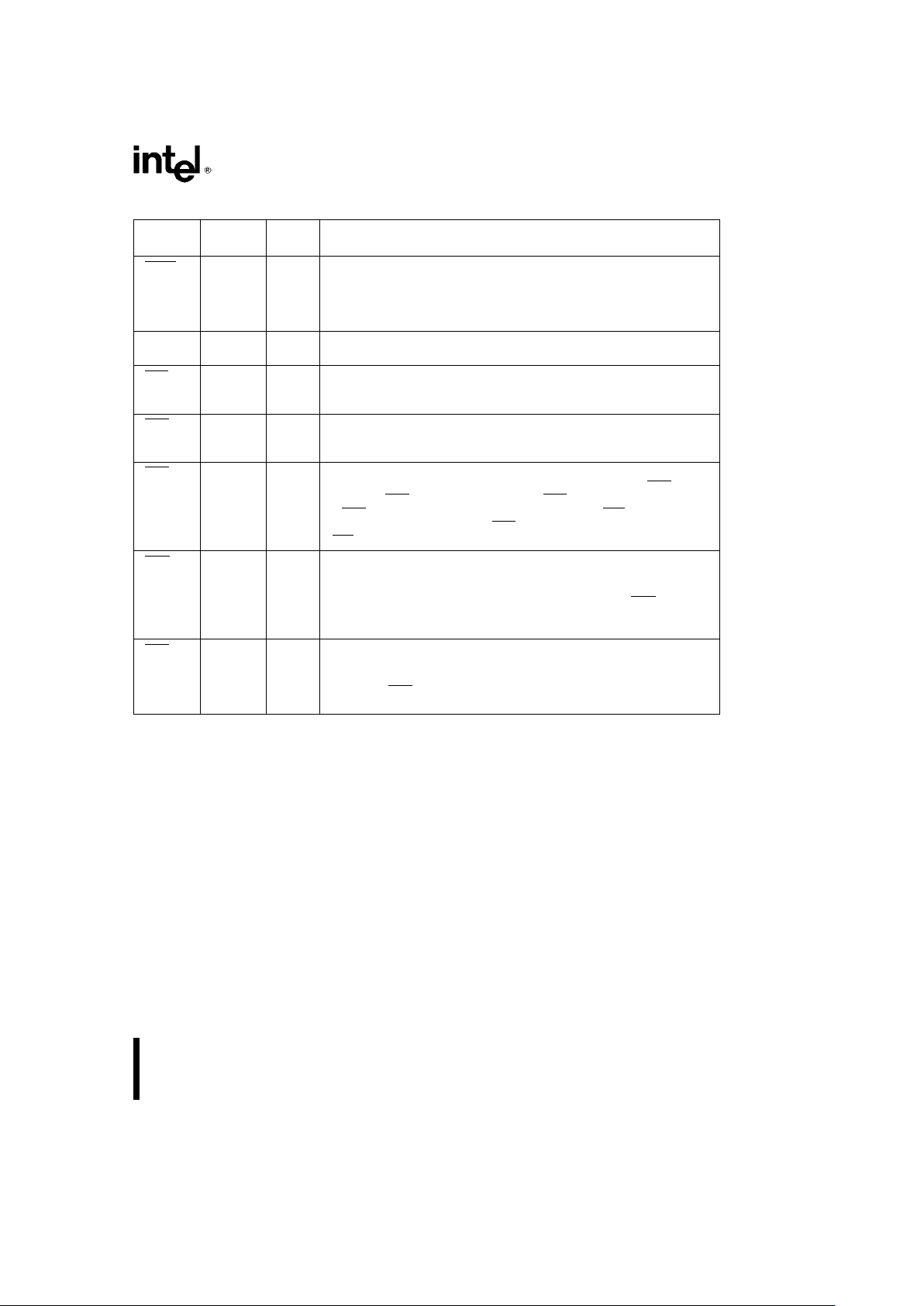
82596DX/SX
PIN DESCRIPTIONS (Continued)
Symbol
PQFP
Type Name and Function
Pin No.
PORT 3IPORT. When this signal is received, the 82596 latches the data on the
data bus into an internal 32-bit register. When the CPU is asserting this
signal it can write into the 82596 (via the data bus). This pin must be
activated twice during all CPU Port access commands.
RESET 69 I RESET. This active high, internally synchronized signal causes the
82596 to terminate current activity. The signal must be high for at least
five system clock cycles. After five system clock cycles and four TxC
clock cycles the 82596 will execute a Reset when it receives a high
RESET signal. When RESET returns to low, the 82596 waits for the
first CA signal and then begins the initialization sequence.
LE/BE 65 I LITTLE ENDIAN/BIG ENDIAN. This dual-function pin is used to
select byte ordering. When LE/BE is high, little endian byte ordering is
used; when low, big endian byte ordering is used for data in frames
(bytes) and for control (SCB, RFD, CBL, etc.).
CA 119 I CHANNEL ATTENTION. The CPU uses this pin to force the 82596 to
begin executing memory resident Command blocks. The CA signal is
internally synchronized. The signal must be high for at least one
system clock. It is latched internally on the high to low edge and then
detected by the 82596.
The first CA after a Reset forces the 82596 into the initialization
sequence beginning at location 00FFFFF6h or an SCP address written
to the 82596 using CPU Port access. All subsequent CA signals cause
the 82596 to begin executing new command sequences from the SCB.
INT/INT 125 O INTERRUPT. A high signal on this pin notifies the CPU that the 82596
is requesting an interrupt. This signal is an edge triggered interrupt
signal, and can be configured to be active high or low.
V
CC
18 Pins (DX) POWER.a5Vg10%.
19 Pins (SX)
V
SS
19 Pins GROUND. 0V.
(DX and SX)
TxD 54 O TRANSMIT DATA. This pin transmits data to the serial link. It is high
when not transmitting.
TxC 64 I TRANSMIT CLOCK. This signal provides the fundamental timing for
the serial subsystem. The clock is also used to transmit data
synchronously on the TxD pin. For NRZ encoding, data is transferred
to the TxD pin on the high to low clock transition. For Manchester
encoding, the transmitted bit center is aligned with the low to high
transition. Transmit clock should always be running for proper device
operation.
12
Page 13
82596DX/SX
PIN DESCRIPTIONS (Continued)
Symbol
PQFP
Type Name and Function
Pin No.
LPBK 58 O LOOPBACK. This TTL-level control signal enables the loopback
mode. In this mode serial data on the TxD input is routed through the
82C501 internal circuits and back to the RxD output without driving the
transceiver cable. To enable this signal, both internal and external
loopback need to be set with the Configure command.
RxD 60 I RECEIVE DATA. This pin receives NRZ serial data only. It must be
high when not receiving.
RxC 59 I RECEIVE CLOCK. This signal provides timing information to the
internal shifting logic. For NRZ data the state of the RxD pin is
sampled on the high to low transition of the clock.
RTS 57 O REQUEST TO SEND. When this signal is low the 82596 informs the
external interface that it has data to transmit. It is forced high after a
Reset or when transmission is stopped.
CTS 62 I CLEAR TO SEND. An active-low signal that enables the 82596 to
send data. It is normally used as an interface handshake to RTS
.
Asserting CTS
high stops transmission. CTS is internally synchronized.
If CTS
goes inactive, meeting the setup time to the TxC negative edge,
the transmission will stop and RTS
will go inactive within, at most, two
TxC cycles.
CRS 63 I CARRIER SENSE. This signal is active low, it is used to notify the
82596 that traffic is on the serial link. It is only used if the 82596 is
configured for external Carrier Sense. In this configuration external
circuitry is required for detecting traffic on the serial link. CRS
is
internally synchronized. To be accepted, the signal must remain active
for at least two serial clock cycles (for CRSF
e
0).
CDT 61 I COLLISION DETECT. This active-low signal informs the 82596 that a
collision has occurred. It is only used if the 82596 is configured for
external Collision Detect. External circuitry is required for collision
detection. CDT
is internally synchronized. To be accepted, the signal
must remain active for at least two serial clock cycles (for CDTF
e
0).
13
Page 14

82596DX/SX
82596 AND HOST CPU INTERACTION
The 82596DX/SX and the host CPU communicate
through shared memory. Because of its on-chip
DMA capability, the 82596 can make data block
transfers (buffers and frames) independently of the
CPU; this greatly reduces the CPU byte transfer
overhead.
NOTE:
The 82596DX and 82596SX differ in their address
pin definitions and their data bus sizes. Information
in this data sheet applies to both versions unless
otherwise stated.
The 82596 is a multitasking coprocessor that comprises two independent logical unitsÐthe Command
Unit (CU) and the Receive Unit (RU). The CU executes commands from shared memory. The RU handles all activities related to frame reception. The independence of the CU and RU enables the 82596 to
engage in both activities simultaneouslyÐthe CU
can fetch and execute commands from memory
while the RU is storing received frames in memory.
The CPU is only involved with this process after the
CU has executed a sequence of commands or the
RU has finished storing a sequence of frames.
The CPU and the 82596 use the hardware signals
Interrupt (INT) and Channel Attention (CA) to initiate
communication with the System Control Block
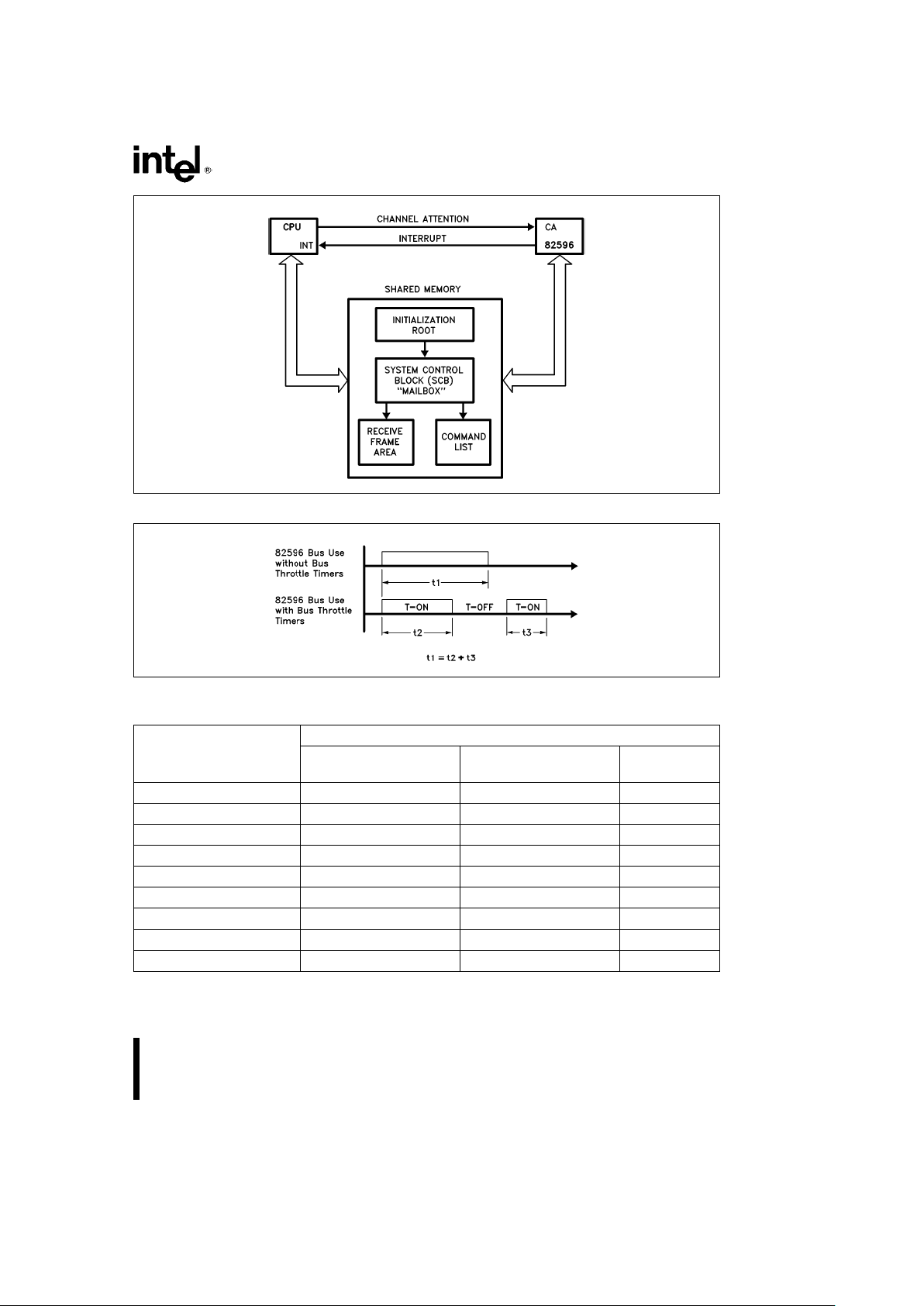
(SCB), see Figure 4. The 82596 uses INT to alert the
CPU of a change in the contents of the SCB, the
CPU uses CA to alert the 82596.
The 82596 has a CPU Port Access state that allows
the CPU to execute certain functions without accessing memory. The 82596 PORT
pin and data bus
pins are used to enable this feature. The CPU can
directly activate four operations when the 82596 is in
this state.
#
Write an alternative System Configuration Pointer
(SCP). This can be used when the 82596 cannot
use the default SCP address space.
#
Write a different Dump Command Pointer and execute Dump. This can be used for troubleshooting No Response problems.
#
The CPU can reset the 82596 via software without disturbing the rest of the system.
#
A self-test can be used for board testing; the
82596 will execute a self-test and write the results to memory.
82596 BUS INTERFACE
The 82596DX/SX has bus interface timings and pin
definitions that are compatible with Intel’s 32-bit i386
DX and i386 SX microprocessors. This eliminates
the need for additional bus interface logic. Operating
at 33 MHz, the 82596’s bus bandwidth can be as
high as 66 MB/s. Since Ethernet only requires
1.25 MB/s, this leaves a considerable amount of
bandwidth for the CPU. The 82596 also has a bus
throttle to regulate its use of the bus. Two timers can
be programmed through the SCB: one controls the
maximum time the 82596 can remain on the bus, the
other controls the time the 82596 must stay off the
bus (see Figure 5). The bus throttle can be programmed to trigger internally with HLDA or externally with BREQ. These timers can restrict the 82596
HOLD activation time and improve bus utilization.
82596 MEMORY ADDRESSING
The 82596 has a 32-bit memory address range,
which allows addressing up to four gigabytes of
memory. The 82596 has three memory addressing
modes (see Table 1).
#
82586 Mode. The 82596 has a 24-bit memory
address range. The System Control Block, Command List, Receive Descriptor List, and Buffer
Descriptors must reside in one 64-kB memory
segment. Transmit and Receive buffers can reside in a 24-bit address space.
#
32-Bit Segmented Mode. The 82596 has a 32bit memory address range. The System Control
Block, Command List, Receive Descriptor List,
and Buffer Descriptors must reside in one 64-kB
memory segment. Transmit and Receive buffers
can reside in a 32-bit address space.
#
Linear Mode. The 82596 has a 32-bit memory
address range. Any memory structure can reside
anywhere within the 32-bit memory address
range.
14
Page 15
82596DX/SX
290219– 4
Figure 4. 82596 and Host CPU Intervention
290219– 5
Figure 5. Bus Throttle Timers
Table 1. 82596 Memory Addressing Formats
Operation Mode
Pointer or Offset
82586
32-Bit
Linear
Segmented
ISCP ADDRESS 24-Bit Linear 32-Bit Linear 32-Bit Linear
SCB ADDRESS Base (24)aOffset (16) Base (32)aOffset (16) 32-Bit Linear
Command Block Pointers Base (24)aOffset (16) Base (32)aOffset (16) 32-Bit Linear
Rx Frame Descriptors Base (24)aOffset (16) Base (32)aOffset (16) 32-Bit Linear
Tx Frame Descriptors Base (24)aOffset (16) Base (32)aOffset (16) 32-Bit Linear
Rx Buffer Descriptors Base (24)aOffset (16) Base (32)aOffset (16) 32-Bit Linear
Tx Buffer Descriptors Base (24)aOffset (16) Base (32)aOffset (16) 32-Bit Linear
Rx Buffers 24-Bit Linear 32-Bit Linear 32-Bit Linear
Tx Buffers 24-Bit Linear 32-Bit Linear 32-Bit Linear
15
Page 16
82596DX/SX
290219– 6
Figure 6. 82596 Shared Memory Structure
82596 SYSTEM MEMORY
STRUCTURE
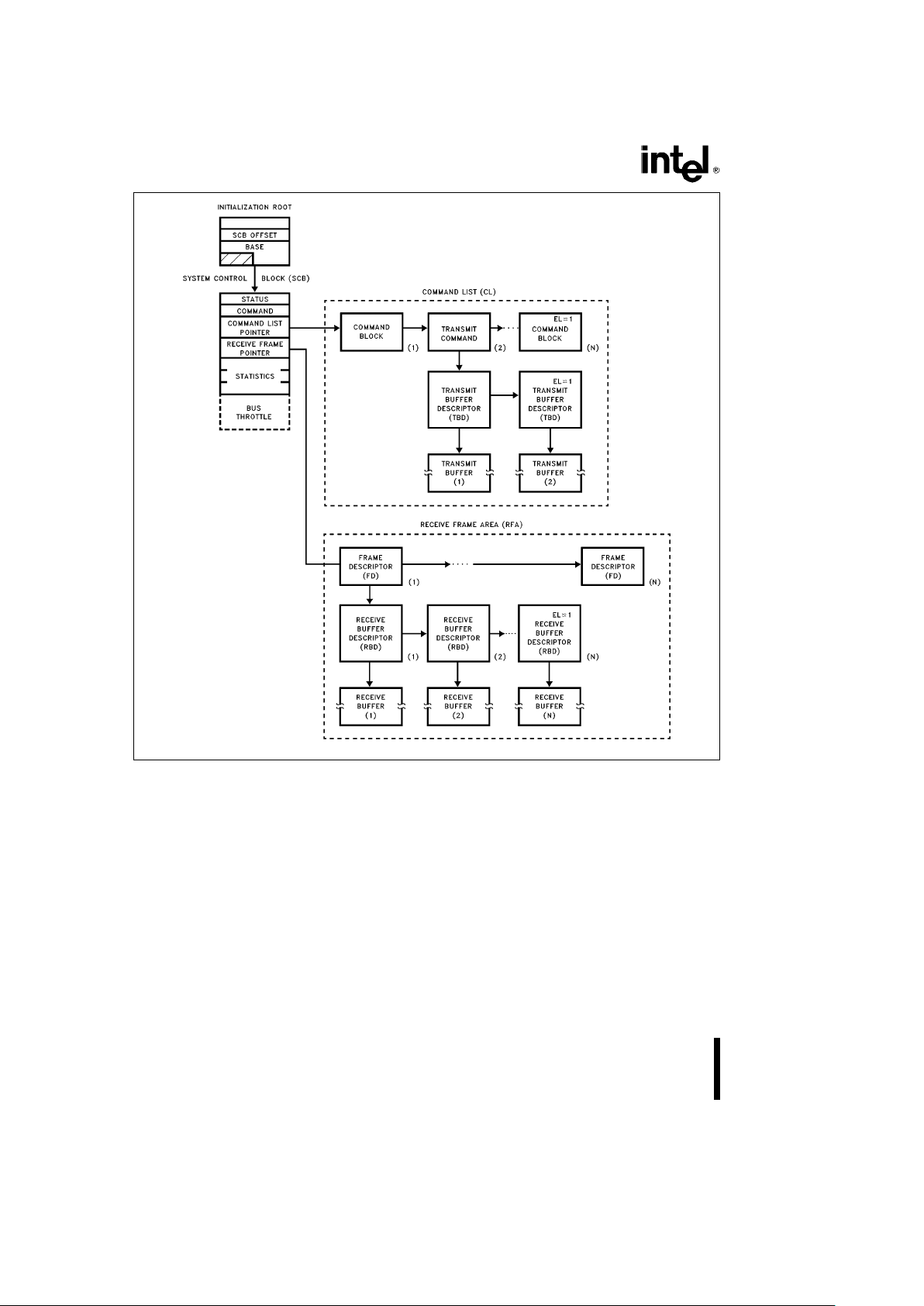
The Shared Memory structure consists of four parts:
the Initialization Root, the System Control Block, the
Command List, and the Receive Frame Area (see
Figure 6).
The Initialization Root is in an established location
known to the host CPU and the 82596 (00FFFFF6h).
However, the CPU can establish the Initialization
Root in another location by using the CPU Port access. This root is accessed during initialization, and
points to the System Control Block.
The System Control Block serves as a bidirectional
mail drop for the host CPU and the 82596 CU and
RU. It is the central point through which the CPU and
the 82596 exchange control and status information.
The SCB has two areas. The first contains instructions from the CPU to the 82596. These include:
control of the CU and RU (Start, Abort, Suspend,
and Resume), a pointer to the list of CU commands,
a pointer to the Receive Frame Area, a set of Interrupt Acknowledge bits, and the T-ON and T-OFF
timers for the bus throttle. The second area contains
status information the 82596 is sending to the CPU.
Such as, the CU and RU states (Idle, Active
16
Page 17

82596DX/SX
Ready, Suspended, No Receive Resources, etc.), interrupt bits (Command Completed, Frame Received,
CU Not Ready, and RU Not Ready), and statistical
counters.
The Command List functions as a program for the
CU; individual commands are placed in memory
units called Command Blocks (CBs). These CBs
contain the parameters and status of specific highlevel commands called Action Commands; e.g.,
Transmit or Configure.
Transmit causes the 82596 to transmit a frame. The
Transmit CB contains the destination address, the
length field, and a pointer to a list of linked buffers
holding the frame that is to be constructed from several buffers scattered throughout memory. The
Command Unit operates without CPU intervention;
the DMA for each buffer, and the prefetching of references to new buffers, is performed in parallel. The
CPU is notified only after a transmission is complete.
The Receive Frame Area is a list of Free Frame Descriptors (descriptors not yet used) and a list of userprepared buffers. Frames arrive at the 82596 unsolicited; the 82596 must always be ready to receive
and store them in the Free Frame Area. The Receive Unit fills the buffers when it receives frames,
and reformats the Free Buffer List into receivedframe structures. The frame structure is, for all practical purposes, identical to the format of the frame to
be transmitted. The first Frame descriptor is referenced by the SCB. Unless the 82596 is configured
to Save Bad Frames, the frame descriptor, and the
associated buffer descriptor, which is wasted when
a bad frame is received, are automatically reclaimed
and returned to the Free Buffer List.
Receive buffer chaining (storing incoming frames in
a linked buffer list) significantly improves memory
utilization. Without buffer chaining, the user must allocate consecutive blocks of memory, each capable
of containing a maximum frame (for Ethernet, 1518
bytes). Since an average frame is about 200 bytes,
this is very inefficient. With buffer chaining, the user
can allocate small buffers and the 82596 will only
use those that are needed.
Figure 7 A–D illustrates how the 82596 uses the
Receive Frame Area. Figure 7A shows an unused
Receive Frame Area composed of Free Frame Descriptors and Free Receive Buffers prepared by the
user. The SCB points to the first Frame Descriptor of
the Frame Descriptor List. Figure 7B shows the
same Receive Frame Area after receiving one
frame. This first frame occupies two Receive Buffers
and one Frame DescriptorÐa valid received frame
will only occupy one Frame Descriptor. After receiving this frame the 82596 sets the next Free Frame
Descriptor RBD pointer to the next Free RBD. Figure
7C shows the RFA after receiving a second frame.
In this example the second frame occupies only one
Receive Buffer and one RFD. The 82596 again sets
the RBD pointer. This process is repeated again in
Figure 7D, showing the reception of another frame
using one Receive Buffer; in this example there is an
extra Frame Descriptor.
TRANSMIT AND RECEIVE MEMORY
STRUCTURES
There are three memory structures for reception and
transmission. The 82586 memory structure, the
Flexible memory structure, and the Simplified memory structure. The 82586 mode is selected by configuring the 82596 during initialization. In this mode all
the 82596 memory structures are compatible with
the 82586 memory structures.
When the 82596 is not configured to the 82586
mode, the other two memory structures, Simplified
and Flexible, are available for transmitting and receiving. These structures are selected by setting the
S/F bit in the Transmit Command and/or the Receive Frame Descriptor (see Figures 29, 30, 41, and
42). It is recommended that any linked list of buffers
be relegated to a single typeÐeither simplified or
flexible. The Simplified memory structure offers a
simple structure for ease of programming (see Figure 8). All information about a frame is contained in
one structure; for example, during reception the RFD
and data field are contained in one structure.
The Flexible memory structure (see Figure 9) has a
control field that allows the programmer to specify
the amount of receive data the RFD will contain for
receive operations and the amount of transmit data
the Transmit Command Block will contain for transmit operations. For example, when the control field
in the RFD is set to 20 bytes during a reception, the
first 20 bytes of the data field are stored in the RFD
(6 Bytes of Destination Address, 6 Bytes of Source
Address, 2 Bytes of Length Field, and 6 Bytes of
Data), and the remainder of the data field is stored in
the Receive Data Buffers. This is useful for capturing
frame headers when header information is contained in the data field. The header information can
then be automatically stored in the RFD partitioned
from the Receive Data Buffer.
The control field can also be used for the Transmit
Command when the Flexible memory structure is
used. The quantity of data field bytes to be transmitted from the Transmit Command Block is specified
by the variable control field.
17
Page 18

82596DX/SX
290219– 7
Figure 7. Frame Reception in the RFA
18
Page 19

82596DX/SX
290219– 8
Figure 8. Simplified Memory Structure
290219– 9
Figure 9. Flexible Memory Structure
19
Page 20
82596DX/SX
TRANSMITTING FRAMES
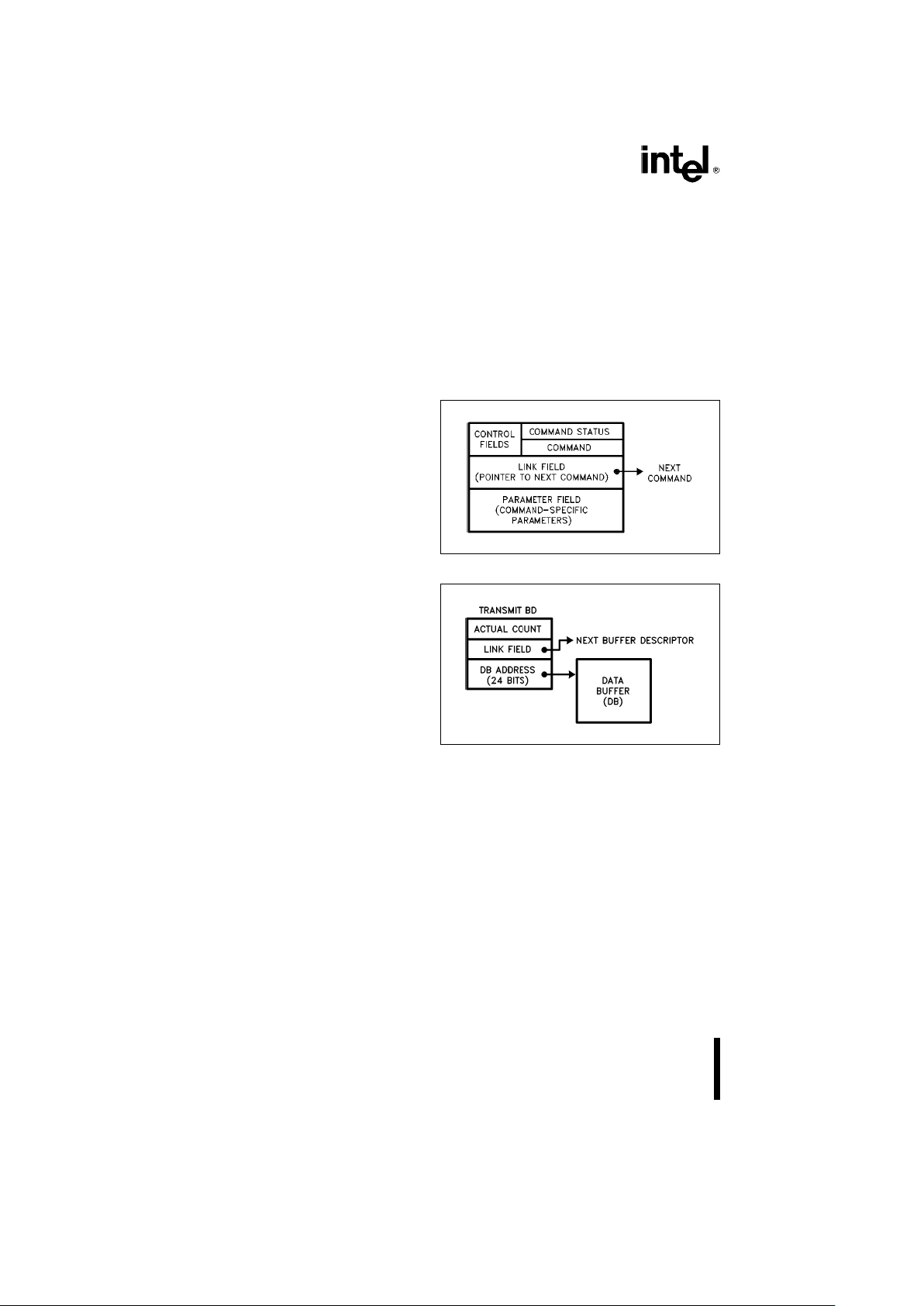
The 82596 executes high-level Action Commands
from the Command List in system memory. Action
Commands are fetched and executed in parallel with
the host CPU operation, thereby significantly improving system performance. The format of the Action
Commands is shown in Figure 10. Figure 28 shows
the 82586 mode, and Figures 29 and 30 shows the
command formats of the Linear and 32-bit Segmented modes.
A single Transmit command contains, as part of the
command-specific parameters, the destination address and length field of the transmitted frame and a
pointer to buffer area in memory containing the data
portion of the frame. The data field is contained in a
memory data structure consisting of a buffer descriptor (BD) and a data bufferÐor a linked list of
buffer descriptors and buffersÐas shown in Figure
11.
Multiple data buffers can be chained together using
the BDs. Thus, a frame with a long data field can be
transmitted using several (shorter) data buffers
chained together. This chaining technique allows the
system designer to develop efficient buffer management.
The 82596 automatically generates the preamble
(alternating 1s and 0s) and start frame delimiter,
fetches the destination address and length field from
the Transmit command, inserts its unique address
as the source address, fetches the data field specified by the Transmit command, and computes and
appends the CRC to the end of the frame (see Figure 12). In the Linear and 32-bit Segmented mode
the CRC can be optionally inserted on a frame-byframe basis by setting the NC bit in the Transmit
Command Block (see Figures 29 and 30).
The 82596 generates the standard End Of Carrier
(EOC) start and end frame delimiters. In EOC, the
start frame delimiter is 10101011 and the end frame
delimiter is indicated by the lack of a signal after the
last bit of the frame check sequence field has been
transmitted. In EOC, the 82596 can be configured to
extend short frames by adding pad bytes (7Eh) during transmission, according to the length field.
When a collision occurs, the 82596 manages the
jam, random wait, and retry processes, reinitializing
DMA pointers without CPU intervention. Multiple
frames can be sent by linking the appropriate number of Transmit commands together. This is particularly useful when transmitting a message larger than
the maximum frame size (1518 bytes for Ethernet).
290219– 10
Figure 10. Action Command Format
290219– 11
Figure 11. Data Buffer Descriptor and
Data Buffer Structure
20
Page 21

82596DX/SX
START
DESTINATION SOURCE LENGTH DATA
FRAME END
PREAMBLE FRAME
ADDRESS ADDRESS FIELD FIELD
CHECK FRAME
DELIMITER SEQUENCE DELIMITER
Figure 12. Frame Format
RECEIVING FRAMES
To reduce CPU overhead, the 82596 is designed to
receive frames without CPU supervision. The host
CPU first sets aside an adequate receive buffer
space and then enables the 82596 Receive Unit.
Once enabled, the RU watches for arriving frames
and automatically stores them in the Receive Frame
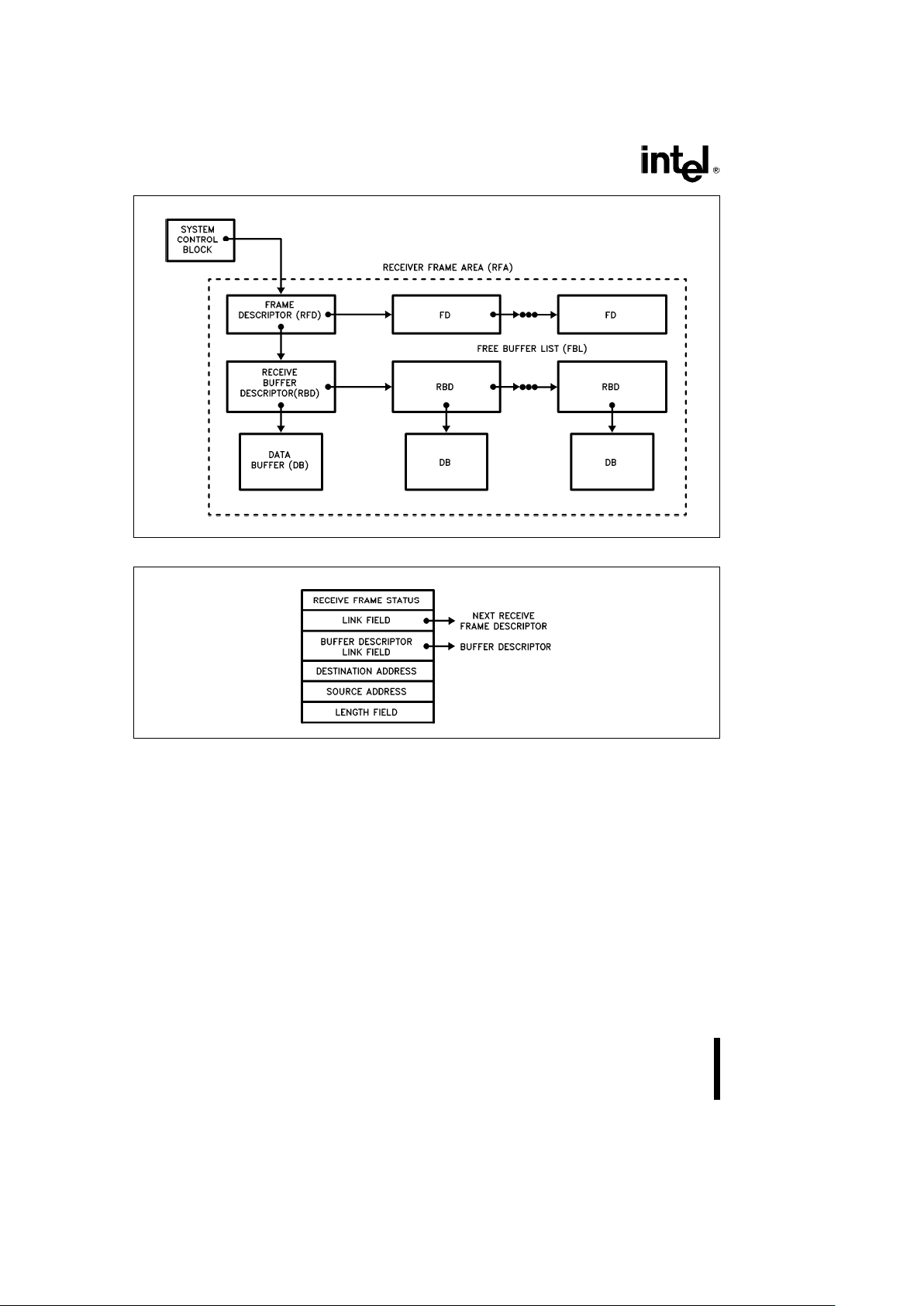
Area (RFA). The RFA contains Receive Frame Descriptors, Receive Buffer Descriptors, and Data Buffers (see Figure 13). The individual Receive Frame
Descriptors make up a Receive Descriptor List
(RDL) used by the 82596 to store the destination
and source addresses, the length field, and the
status of each frame received (see Figure 14).
Once enabled, the 82596 checks each passing
frame for an address match. The 82596 will recognize its own unique address, one or more multicast
addresses, or the broadcast address. If a match is
found the 82596 stores the destination and source
addresses and the length field in the next available
RFD. It then begins filling the next available Data
Buffer on the FBL, which is pointed to by the current
RFD, with the data portion of the incoming frame. As
one Data Buffer is filled, the 82596 automatically
fetches the next DB on the FBL until the entire frame
is received. This buffer chaining technique is particularly memory efficient because it allows the system
designer to set aside buffers to fit frames much
shorter than the maximum allowable frame length. If
AL-LOC
e
1, or if the flexible memory structure is
used, the addresses and length field can be placed
in the receive buffer.
Once the entire frame is received without error, the
82596 does the following housekeeping tasks.
#
The actual count field of the last Buffer Descriptor used to hold the frame just received is updated with the number of bytes stored in the associated Data Buffer.
#
The next available Receive Frame Descriptor is
fetched.
#
The address of the next available Buffer Descriptor is written to the next available Receive Frame
Descriptor.
#
A frame received interrupt status bit is posted in
the SCB.
#
An interrupt is sent to the CPU.
If a frame error occurs, for example a CRC error, the
82596 automatically reinitializes its DMA pointers
and reclaims any data buffers containing the bad
frame. The 82596 will continue to receive frames
without CPU help as long as Receive Frame Descriptors and Data Buffers are available.
82596 NETWORK MANAGEMENT
AND DIAGNOSTICS
The behavior of data communication networks is
normally very complex because of their distributed
and asynchronous nature. It is particularly difficult to
pinpoint a failure when it occurs. The 82596 has extensive diagnostic and network management functions that help improve reliability and testability. The
82596 reports on the following events after each
frame is transmitted.
#
Transmission successful.
#
Transmission unsuccessful. Lost Carrier Sense.
#
Transmission unsuccessful. Lost Clear to Send.
#
Transmission unsuccessful. A DMA underrun occurred because the system bus did not keep up
with the transmission.
#
Transmission unsuccessful. The number of collisions exceeded the maximum allowed.
#
Number of Collisions. The number of collisions
experienced during transmission of the frame.
#
Heartbeat Indicator. This indicates the presence
of a heartbeat during the last Interframe Spacing
(IFS) after transmission.
When configured to Save Bad Frames the 82596
checks each incoming frame and reports the following errors.
#
CRC error. Incorrect CRC in a properly aligned
frame.
#
Alignment error. Incorrect CRC in a misaligned
frame.
#
Frame too short. The frame is shorter than the
value configured for minimum frame length.
#
Overrun. Part of the frame was not placed in
memory because the system bus did not keep up
with incoming data.
#
Out of buffer. Part of the frame was discarded
because of insufficient memory storage space.
#
Receive collision. A collision was detected during
reception and the destination address of the incoming frame passes 82596 address filtering.
Collisions in the preamble are not counted.
#
Length error. A frame not matching the frame
length parameter was detected.
21
Page 22
82596DX/SX
290219– 12
Figure 13. Receive Frame Area Diagram
290219– 13
Figure 14. Receive Frame Descriptor
22
Page 23

82596DX/SX
NETWORK PLANNING AND
MAINTENANCE
To properly plan, operate, and maintain a communication network, the network management entity
must accumulate information on network behavior.
The 82596 provides a rich set of network-wide diagnostics that can serve as the basis for a network
management entity.
Information on network activity is provided in the
status of each frame transmitted. The 82596 reports
the following activity indicators after each frame.
#
Number of collisions. The number of collisions
the 82596 experienced while attempting to transmit the frame.
#
Deferred transmission. During the first transmission attempt the 82596 had to defer to traffic on
the link.
The 82596 updates its 32-bit statistical counters after each received frame that both passes address
filtering and is longer than the Minimum Frame
Length configuration parameter. The 82596 reports
the following statistics.
#
CRC errors. The number of well-aligned frames
that experienced a CRC error.
#
Alignment errors. The number of misaligned
frames that experienced a CRC error.
#
No resources. The number of frames that were
discarded because of insufficient resources for
reception.
#
Overrun errors. The number of frames that were
not completely stored in memory because the
system bus did not keep up with incoming data.
#
Receive Collision counter. The number of collisions detected during receive. Collisions occurring before the minimum frame length will be
counted as short frames. Collisions in the preamble will not be counted at all.
#
Short Frame counter. The number of frames that
were discarded because they were shorter than
the configured minimum frame length.
Once again, these counters are not updated until the
82596 decodes a destination address match.
The 82596 can be configured to Promiscuous mode.
In this mode it captures all frames transmitted on the
network without checking the Destination Address.
This is useful when implementing a monitoring station to capture all frames for analysis.
A useful method of capturing frame headers is to
use the Simplified memory mode, configure the
82596 to Save Bad Frames, and configure the
82596 to Promiscuous mode with space in the RFD
allocated for specific number of receive data bytes.
The 82596 will receive all frames and put them in the
RFD. Frames that exceed the available space in the
RFD will be truncated, the status will be updated,
and the 82596 will retrieve the next RFD. This allows
the user to capture the initial data bytes of each
frame (for instance, the header) and discard the remainder of the frame.
The 82596 also has a monitor mode for network
analysis. During normal operation the receive function enables the 82596 to receive frames which pass
address filtering. These frames must have the Start
of Frame Delimiter (SFD) field and must be longer
than the absolute minimum frame length of 5 bytes
(6 bytes in case of Multicast address filtering). Contents and status of the received frames are transferred to memory. The monitor function enables the
82596 to simply evaluate the incoming frames. The
82596 can monitor the frames that pass or do not
pass the address filtering. It can also monitor frames
which do not have the SFD fields. The 82596 can be
configured to only keep statistical information about
monitor frames. Three options are available in the
Monitor mode. These modes are selectable by the
two monitor mode configuration bits available in the
configuration command.
When the first option is selected, the 82596 receives
good frames that pass address filtering and transfers them to memory while monitoring frames that
do not pass address filtering or are shorter than the
minimum frame size (these frames are not transferred to memory). When this option is used the
82596 updates six counters: CRC errors, alignment
errors, no resource errors, overrun errors, short
frames, and total good frames received.
When the second option is selected, the receive
function is completely disabled. The 82596 monitors
only those frames that pass address filterings and
meet the minimum frame length requirement. When
this option is used the 82596 updates six counters:
CRC errors, alignment errors, total frames (good and
bad), short frames, collisions detected, and total
good frames.
When the third option is selected, the receive function is completely disabled. The 82596 monitors all
frames, including frames that do not have a Start
Frame Delimiter. When this option is used the 82596
updates six counter (CRC errors, alignment errors,
total frames (good and bad), short frames, collisions
detected, and total good frames.
23
Page 24

82596DX/SX
STATION DIAGNOSTICS
AND SELF-TEST
The 82596 provides a large set of diagnostic and
network management functions. These include internal and external loopback and time domain reflectometry for locating fault points in the network cable.
The 82596 ensures software reliability by dumping
the contents of the 82596 internal registers into system memory. The 82596 has a self-test mode that
enables it to run an internal self-test and place the
results in system memory.
82586 SOFTWARE COMPATIBILITY
The 82596 has a software-compatible state in which
all its memory structures are compatible with the
82586 memory structure. This includes all the Action
Commands, the Receive Frame Area (including the
RFD, Buffer Descriptors, and Data Buffers), the System Control Block, and the initialization procedures.
There are two minor differences between the 82596
in the 82586-Compatible memory structure and the
82586.
#
When the internal and external loopback bits in
the Configure command are set to 11 the 82596
is in external loopback and the LPBK
pin is activated; in the 82586 this situation would produce
internal loopback.
#
During a Dump command both the 82596 and
82586 dump the same number of bytes; however,
the data format is different.
INITIALIZING THE 82596
A Reset command is issued to the 82596 to prepare
it for normal operation. The 82596 is initialized
through two data structures that are addressed by
two pointers, the System Configuration Pointer
(SCP) and the Intermediate System Configuration
Pointer (ISCP). The initialization procedure begins
when a Channel Attention signal is asserted after
RESET. The 82596 uses the address of the double
word that contains the SCP as a defaultÐ
00FFFFF4h. Before the CA signal is asserted this
default address can be changed to any other available address by asserting the PORT
pin and provid-
ing the desired address over the D
31–D4
pins of the
address bus. Pins D
3–D0
must be 0010; i.e., any
alternative address must be aligned to 16 byte
boundaries. All addresses sent to the 82596 must be
word aligned, which means that all pointers and
memory structures must start on an even address
(A
0
e
zero).
SYSTEM CONFIGURATION POINTER
(SCP)
The SCP contains the SYSBUS byte and the location of the next structure of the initialization process,
the ISCP. The following parameters are selected in
the SYSBUS.
#
The 82596 operation mode.
#
The Bus Throttle timer triggering method.
#
Lock enabled.
#
Interrupt polarity.
#
Big Endian 32-bit entity mode.
Byte ordering is determined by the LE/BE
pin.
LE/BE
e
1 selects little endian byte ordering and
LE/BE
e
0 selects big endian byte ordering.
NOTE:
In the following, X indicates a bit not checked in
82586 mode. This bit must be set to 0 in all other
modes.
24
Page 25

82596DX/SX
The following diagram illustrates the format of the SCP.
31 16ODD WORD 15 0EVEN WORD
XXXXXXXX SYSBUS 00000000000000000FFFFF4h
XXXXXXXXXXXXXXXXXXXXXXXXXXXXXXXX0FFFFF8h
A31ААААААААААААААААA24 A23 A0ISCP ADDRESS 0FFFFFCh
A31ААААААААААААААААA24 are not checked in 82586 mode.
XААААААААААААААААААX areas are not checked in 82586 mode; they must be 0 in all other modes.
290219– 14
ISCP ADDRESSÐ The physical address of the ISCP. In the 82586 mode, bits A31–A24 are considered to
be zero.
Figure 15. The System Configuration Pointer
Writing the Sysbus
When writing the Sysbus byte it is important to pay attention to the byte order.
#
When a Little Endian processor is used, the Sysbus byte is located at byte address 00FFFFF6h (or address
n
a
2 if an alternative SCP addressnwas programmed).
#
When a processor using Big Endian byte ordering is used, the SYSBUS, alternative SCP, and ISCP addresses will be different.
#
The Sysbus byte is located at 00FFFFF7h.
#
If an alternative SCP address is programmed, the SYSBUS byte should be at byte address
n
a
1.
25
Page 26

82596DX/SX
INTERMEDIATE SYSTEM CONFIGURATION POINTER (ISCP)
The ISCP indicates the location of the System Control Block. Often the SCP is in ROM and the ISCP is in RAM.
The CPU loads the SCB address (or an equivalent data structure) into the ISCP and asserts CA. This Channel
Attention signal causes the 82596 to begin its initialization procedure and to get the SCB address from the
ISCP and SCP. In 82586 and 32-bit Segmented modes the SCP base address is also the base address of all
Command Blocks, Frame Descriptors, and Buffer Descriptors (but not buffers). All these data structures must
reside in one 64-kB segment; however, in Linear mode no such limitation is imposed.
The following diagram illustrates the ISCP format.
ODD WORD EVEN WORD
31 16 15 8 7 0
A15 A0SCB OFFSET BUSY ISCP
A23 A0SCB BASE ADDRESS ISCPa4
u
x x x x x x x x Ð in 82586 mode
A31 ААААААААААААААААA24 Р in 32-bit segmented mode
BUSY Ð Indicates that the 82596 is being initialized. The CPU sets the ISCP to 01h before it gives
the first CA to the 82596. The ISCP is cleared by the 82596 after the SCB base and offset
are read. Note that the most significant byte of the first word of the ISCP is not modified
when BUSY is cleared.
SCB OFFSETÐ This 16-bit quantity specifies the offset portion of the address of the SCB.
SCB BASE Ð Specifies the base portion of the address of the SCB. The base of SCB is also the base of
all 82596 Command Blocks, Frame Descriptors and Buffer Descriptors. In the 82586
mode, bits A31–A24 are considered to be zero.
Figure 16. The Intermediate System Configuration PointerÐ82586 and 32-Bit Segmented Modes
ODD WORD EVEN WORD
31 16 15 8 7 0
0 0 0 АААААААААААААААААААААААААААААААААААААААААААААААААААААА 0 0 0 BUSY ISCP
A31 A0SCB ABSOLUTE ADDRESS ISCPa4
BUSY Ð Indicates that the 82596 is being initialized. The ISCP is set to 01h by the CPU before its
first CA to the 82596. It is cleared by the 82596 after the SCB address is read.
SCB ADDRESSÐ This 32-bit quantity specifies the physical address of the SCB.
Figure 17. The Intermediate System Configuration PointerÐLinear Mode.
INITIALIZATION PROCESS
The CPU sets up the SCP, ISCP, and the SCB structures, and, if desired, an alternative SCP address. It also
sets BUSY to 01h. The 82596 is initialized when a Channel Attention signal follows a Reset signal, causing the
82596 to access the System Configuration Pointer. The sysbus byte, the operational mode, the bus throttle
timer triggering method, the interrupt polarity, and the state of LOCK
are read. After reset the bus throttle
26
Page 27

82596DX/SX
timers are essentially disabledÐthe T-ON value is infinite, the T-OFF value is zero. After the SCP is read, the
82596 reads the ISCP and saves the SCB address. In 82586 and 32-bit Segmented modes this address is
represented as a base address plus the offset (this base address is also the base address of all the control
blocks). In Linear mode the base address is also an absolute address. The 82596 clears BUSY, sets CX and
CNR to equal 1 in the SCB, clears the SCB command word, sends an interrupt to the CPU, and awaits another
Channel Attention signal. RESET configures the 82596 to its default state before CA is asserted.
CONTROLLING THE 82596DX/SX
The host CPU controls the 82596 with the commands, data structures, and methods described in this section.
The CPU and the 82596 communicate through shared memory structures. The 82596 contains two independent units: the Command Unit and the Receive Unit. The Command Unit executes commands from the CPU,
and the Receive Unit handles frame reception. These two units are controlled and monitored by the CPU
through a shared memory structure called the System Control Block (SCB). The CPU and the 82596 use the
CA and INT signals to communicate with the SCB.
82596 CPU ACCESS INTERFACE (PORT)
The 82596 has a CPU access interface that allows the host CPU to do four things.
#
Write an alternative System Configuration Pointer address.
#
Write an alternative Dump area pointer and perform Dump.
#
Execute a software reset.
#
Execute a self-test.
The following events initiate the CPU access state.
#
Presence of an address on the D31–D4data bus pins.
#
The D3–D0pins are used to select one of the four functions.
#
The PORT input pin is asserted, as in a regular write cycle.
NOTE
The SCP Dump and Self-Test addresses must be 16-byte aligned.
The 82596 requires two 16-bit write cycles for a port command. The first write holds the internal machines and
reads the first 16 bits, the second activates the PORT
command and reads the second 16 bits.
The PORT
Reset is useful when only the 82596 needs to be reset. The CPU must wait for 10-system and 5-se-
rial clocks before issuing another CA to the 82596; this new CA begins a new initialization process.
The Dump function is useful for troubleshooting No Response problems. If the chip is in a No Response state,
the PORT
Dump operation can be executed and a PORT Reset can be used to reinitialize the 82596 without
disturbing the rest of the system.
The Self-Test function can be used for board testing; the 82596 will execute a self-test and write the results to
memory.
Table 2. PORT
Function Selection
D31ААААААААААААААААААААААААААААААААААD4АААААААААААААААААААААААААААААD
0
Function Addresses and Results D
3
D
2
D
1
D
0
Reset A31 Don’t Care A4 0 0 0 0
Self-Test A31 Self-Test Results Address A4 0 0 0 1
SCP A31 Alternative SCP Address A4 0 0 1 0
Dump A31 Dump Area Pointer A4 0 0 1 1
27
Page 28

82596DX/SX
MEMORY ADDRESSING FORMATS
The 82596 accesses memory by 32-bit addresses. There are two types of 32-bit addresses: linear and segmented. The type of address used depends on the 82596 operating mode and the type of memory structure it
is addressing. The 82596 has three operating modes.
#
82586 Mode
#
A Linear address is a single 24-bit entity. Address pins A31–A24are always zero.
#
A Segmented address uses a 24-bit base and a 16-bit offset.
#
32-bit Segmented Mode
#
A Linear address is a single 32-bit entity.
#
A Segmented address uses a 32-bit base and a 16-bit offset.
NOTE:
In the previous two memory addressing modes, each command header (CB, TBD, RFD, RBD, and SCB)
must wholly reside within one segment. If the 82596 encounters a memory structure that does not follow this
restriction, the 82596 will fetch the next contiguous location in memory (beyond the segment).
#
Linear Mode
#
A Linear address is a single 32-bit entity.
#
There are no Segmented addresses.
Linear addresses are primarily used to address transmit and receive data buffers. In the 82586 and 32-bit
Segmented modes, segmented addresses (base plus offset) are used for all Command Blocks, Buffer Descriptors, Frame Descriptors, and System Control Blocks. When using Segmented addresses, only the offset
portion of the entity being addressed is specified in the block. The base for all offsets is the sameÐthat of the
SCB. See Table A.
LITTLE ENDIAN AND BIG ENDIAN BYTE ORDERING
The 82596 supports both Little Endian and Big Endian byte ordering for its memory structures.
The 82596A1 stepping supports Big Endian byte ordering for word and byte entities. Dword entities are not
supported with 82596A1 Big Endian byte ordering. This results in slightly different 82596 memory structures
for Big Endian operation. These structures are defined in the
32-Bit LAN Components A1 Manual.
28
Page 29

82596DX/SX
The 82596 B stepping supports Big Endian byte ordering for dword, word, and byte entities in Linear mode
only. All 82596 B 32-bit address pointers are treated as 32-bit Big Endian entities, however, the SCB absolute
address and statistical counters are treated as two 16-bit Big Endian entities. This 32-bit Big Endian entity
support is configured via bit 7 in the SYSBUS byte.
The 82596 C-step has a New Enhanced Big Endian Mode where in Linear Addressing mode, true 32-bit Big
Endian functionality is achieved. New Enhanced Big Endian Mode is enabled exactly the same as the B-step,
by setting bit 7 of the SYSBUS byte. This mode is software compatible with the big endian mode of the B-step
with one exceptionÐno 32-bit addresses need to be swapped by software in the C-step. In this new mode, the
82596 C-step treats 32-bit address pointers as true 32-bit entities and the SCB absolute address and statistical
counters are still treated as two 16-bit big endian entities. Not setting this mode will configure the 82596 C-step
to be 100% compatible to the A1-step big endian mode.
NOTE:
All 82596 memory entities must be word or dword aligned, except the transmit buffers can be byte aligned
for the 82596 B or C steppings.
An example of a double word entity is a frame descriptor command/status dword, whereas the raw data of the
frame are byte entities. Both 32- and 16-bit buses are supported. When a 16-bit bus is used with Big Endian
memory organization, data lines D
15–D0
are used. The 82596 has an internal crossover that handles these
swap operations.
COMMAND UNIT (CU)
The Command Unit is the logical unit that executes Action Commands from a list of commands very similar to
a CPU program. A Command Block is associated with each Action Command. The CU is modeled as a logical
machine that takes, at any given time, one of the following states.
#
Idle. The CU is not executing a command and is not associated with a CB on the list. This is the initial state.
#
Suspended. The CU is not executing a command; however, it is associated with a CB on the list. The
suspend state can only be reached if the CPU forces it through the SCB or sets the suspend bit in the RFD.
#
Active. The CU is executing an Action Command and pointing to its CB.
The CPU can affect CU operation in two ways: by issuing a CU Control Command or by setting bits in the
Command word of the Action Command.
When programming the 82596 CU, it is important to consider the asynchronous way the 82596 processes
commands. If a command is issued to the 82596 CU, it may be busy processing other commands. In order to
avoid asynchronous race conditions, the following guidelines are recommended to the 82596 programmer:
#
If the CU is already in the Active state, and another command needs to be executed, it is unwise to
immediately issue another CU Start command. If a new command (or list of commands) needs to be
started, first issue a CU Suspend command, wait for the CU to become Suspended, then issue the new CU
Start. This will insure that all commands are processed correctly.
#
In general, it is a good idea to make sure any CU command has been accepted and executed before
issuing a new control command to the CU.
29
Page 30

82596DX/SX
RECEIVE UNIT (RU)
The Receive Unit is the logical unit that receives frames and stores them in memory. The RU is modeled as a
logical machine that takes, at any given time, one of the following states.
#
Idle. The RU has no memory resources and is discarding incoming frames. This is the initial state.
#
No Resources. The RU has no memory resources and is discarding incoming frames. This state differs
from Idle in that the RU accumulates statistics on the number of discarded frames.
#
Suspended. The RU has memory available for storing frames, but is discarding them. The suspend state
can only be reached if the CPU forces it through the SCB or sets the suspend bit in the RFD.
#
Ready. The RU has memory available and is storing incoming frames.
The CPU can affect RU operation in three ways: by issuing a RU Control Command, by setting bits in the
Frame Descriptor Command word of the frame being received, or by setting the EL bit of the current buffer’s
Buffer Descriptor.
When programming the 82596 RU, it is important to consider the asynchronous way the 82596 processes
receive frames. If an RU Start is issued to the 82596 RU, it may be busy processing other incoming packets. In
order to avoid asynchronous race conditions, the following guidelines are recommended to the 82596 programmer:
#
If the RU is already in the Ready state, and a new RFA is required to be started, it is unwise to immediately
issue another RU Start command. If the new RFA needs to be started, first issue an RU Suspend command, wait for the RU to become Suspended, then issue the new RU Start. This will insure that all incoming
frames are received correctly.
#
In general, it is a good idea to make sure any RU command has been accepted and executed before
issuing a new control command to the RU.
SYSTEM CONTROL BLOCK (SCB)
The SCB is a memory block that plays a major role in communications between the CPU and the 82596. Such
communications include the following.
#
Commands issued by the CPU
#
Status reported by the 82596
Control commands are sent to the 82596 by writing them into the SCB and then asserting CA. The 82596
examines the command, performs the required action, and then clears the SCB command word. Control
commands perform the following types of tasks.
#
Operation of the Command Unit (CU). The SCB controls the CU by specifying the address of the Command
Block List (CBL) and by starting, suspending, resuming, or aborting execution of CBL commands.
30
Page 31

82596DX/SX
#
Operation of the Bus Throttle. The SCB controls the Bus Throttle timers by providing them with new values
and sending the Load and Start timer commands. The timers can be operated in both the 32-bit Segmented
and Linear modes.
#
Reception of frames by the Receive Unit (RU). The SCB controls the RU by specifying the address of the
Receive Frame Area and by starting, suspending, resuming, or aborting frame reception.
#
Acknowledgment of events that cause interrupts.
#
Resetting the chip.
The 82596 sends status reports to the CPU via the System Control Block. The SCB contains four types of
status reports.
#
The cause of the current interrupts. These interrupts are caused by one or more of the following 82596
events.
#
The Command Unit completes an Action Command that has itsIbit set.
#
The Receive Unit receives a frame.
#
The Command Unit becomes inactive.
#
The Receive Unit becomes not ready.
#
The status of the Command Unit.
#
The status of the Receive Unit.
#
Status reports from the 82596 regarding reception of corrupted frames.
Events can be cleared only by CPU acknowledgment. If some events are not acknowledged by the ACK field
the Interrupt signal (INT) will be reissued after Channel Attention (CA) is processed. Furthermore, if a new
event occurs while an interrupt is set, the interrupt is temporarily cleared to trigger edge-triggered interrupt
controllers.
The CPU uses the Channel Attention line to cause the 82596 to examine the SCB. This signal is trailing-edge
triggeredÐthe 82596 latches CA on the trailing edge. The latch is cleared by the 82596 before the SCB
control command is read.
31 16ODD WORD 15 0EVEN WORD
ACK X CUC R RUC X X X X STAT 0 CUS 0 RUS 0000SCB
RFA OFFSET CBL OFFSET SCBa4
ALIGNMENT ERRORS CRC ERRORS SCBa8
OVERRUN ERRORS RESOURCE ERRORS SCBa12
Figure 18. SCBÐ82586 Mode
31 16ODD WORD 15 0EVEN WORD
ACK 0 CUC R RUC 0 0 0 0 STAT 0 CUS RUS T 0 0 0 SCB
RFA OFFSET CBL OFFSET SCBa4
CRC ERRORS SCBa8
ALIGNMENT ERRORS SCBa12
RESOURCE ERRORS (*) SCBa16
OVERRUN ERRORS (*) SCBa20
RCVCDT ERRORS (*) SCBa24
SHORT FRAME ERRORS SCBa28
T-ON TIMER T-OFF TIMER SCBa32
*In MONITOR mode these counters change function
Figure 19. SCBÐ32-Bit Segmented Mode
31
Page 32

82596DX/SX
31 16ODD WORD 15 0EVEN WORD
ACK 0 CUC R RUC 0 0 0 0 STAT 0 CUS RUS T 0 0 0 SCB
COMMAND BLOCK ADDRESS SCBa4
RECEIVE FRAME AREA ADDRESS SCBa8
CRC ERRORS SCBa12
ALIGNMENT ERRORS SCBa16
RESOURCE ERRORS (*) SCBa20
OVERRUN ERRORS (*) SCBa24
RCVCDT ERRORS (*) SCBa28
SHORT FRAME ERRORS SCBa32
T-ON TIMER T-OFF TIMER SCBa36
*In MONITOR mode these counters change function
Figure 20. SCBÐLinear Mode
Command Word
31 16
ACK 0 CUC R RUC 0 0 0 0 SCBa2
These bits specifiy the action to be performed as a result of a CA. This word is set by the CPU and cleared by
the 82596. Defined bits are:
Bit 31 ACK-CX Ð Acknowledges that the CU completed an Action Command.
Bit 30 ACK-FR Ð Acknowledges that the RU received a frame.
Bit 29 ACK-CNA Ð Acknowledges that the Command Unit became not active.
Bit 28 ACK-RNR Ð Acknowledges that the Receive Unit became not ready.
Bits 24 –26 CUC Ð (3 bits) This field contains the command to the Command Unit. Valid values are:
0 Ð NOP (does not affect current state of the unit).
1 Ð Start execution of the first command on the CBL. If a command is executing,
complete it before starting the new CBL. The beginning of the CBL is in CBL
OFFSET (address).
2 Ð Resume the operation of the Command Unit by executing the next command.
This operation assumes that the Command Unit has been previously suspended.
3 Ð Suspend execution of commands on CBL after current command is complete.
4 Ð Abort current command immediately.
5 Ð Loads the Bus Throttle timers so they will be initialized with their new values
after the active timer (T-ON or T-OFF) reaches Terminal Count. If no timer is
active new values will be loaded immediately. This command is not valid in
82586 mode.
6 Ð Loads and immediately restarts the Bus Throttle timers with their new values.
This command is not valid in 82586 mode.
7 Ð Reserved.
32
Page 33

82596DX/SX
Bits 20 –22 RUC Ð (3 bits) This field contains the command to the Receive Unit. Valid values are:
0 Ð NOP (does not alter current state of unit).
1 Ð Start reception of frames. The beginning of the RFA is contained in the RFA
OFFSET (address). If a frame is being received complete reception before
starting.
2 Ð Resume frame reception (only when in suspended state).
3 Ð Suspend frame reception. If a frame is being received complete its reception
before suspending.
4 Ð Abort receiver operation immediately.
5–7 Ð Reserved.
Bit 23 RESET Ð Reset chip (logically the same as hardware RESET).
Status Word
15 0
STAT 0 CUS 0 RUS 0 0 0 0 SCB
82586 Mode
15 0
STAT 0 CUS RUS T 0 0 0 SCB
32-Bit Segmented and Linear Modes
Indicates the status of the 82596. This word is modified only by the 82596. Defined bits are:
Bit 15 CX Ð The CU finished executing a command with its
I
(interrupt) bit set.
Bit 14 FR Ð The RU finished receiving a frame.
Bit 13 CNA Ð The Command Unit left the Active state.
Bit 12 RNR Ð The Receive Unit left the Ready state.
Bits 8 –10 CUS Ð (3 bits) This field contains the status of the command unit. Valid values are:
0 Ð Idle
1 Ð Suspended
2 Ð Active
3–7 Ð Not used
Bits 4 –7 RUS Ð This field contains the status of the receive unit. Valid values are:
0h (0000) Ð Idle
1h (0001) Ð Suspended
2h (0010) Ð No resources. This bit indicates both no resources due to lack of RFDs
in the RDL and no resources due to lack of RBDs in the FBL.
4h (0100) Ð Ready
Ah (1010) Ð No resources due to no more RBDs. (Not in the 82586 mode.)
Ch (1100) Ð No more RBDs (not in the 82586 mode).
No other combinations are allowed.
Bit 3 T Ð Bus Throttle timers loaded (not in 82586 mode).
SCB OFFSET ADDRESSES
CBL Offset (Address)
In 82586 and 32-bit Segmented modes this 16-bit quantity indicates the offset portion of the address for the
first Command Block on the CBL. In Linear mode it is a 32-bit linear address for the first Command Block on
the CBL. It is accessed only if CUC equals Start.
33
Page 34

82596DX/SX
RFA Offset (Address)
In 82586 and 32-bit Segmented modes this 16-bit quantity indicates the offset portion of the address for the
Receive Frame Area. In Linear mode it is a 32-bit linear address for the Receive Frame Area. It is accessed
only if RUC equals Start.
SCB STATISTICAL COUNTERS
Statistical Counter Operation
#
The CPU is responsible for clearing all error counters before initializing the 82596. The 82596 updates
these counters by reading them, adding 1, and then writing them back to the SCB.
#
The counters are wraparound counters. After reaching FFFFFFFFh the counters wrap around to zero.
#
The 82596 updates the required counters for each frame. It is possible for more than one counter to be
updated; multiple errors will result in all affected counters being updated.
#
The 82596 executes the read-counter/increment/write-counter operation without relinquishing the bus
(locked operation). This is to ensure that no logical contention exists between the 82596 and the CPU due
to both attempting to write to the counters simultaneously. In the dual-port memory configuration the CPU
should not execute any write operation to a counter if LOCK
is asserted.
#
The counters are 32-bits wide and their behavior is fully compatible with the IEEE 802.3 standard. The
82596 supports all relevant statistics (mandatory, optional, and desired) through the status of the transmit
and receive header and directly through SCB statistics.
CRCERRS
This 32-bit quantity contains the number of aligned frames discarded because of a CRC error. This counter is
updated, if needed, regardless of the RU state.
ALNERRS
This 32-bit quantity contains the number of frames that both are misaligned (i.e., where CRS deasserts on a
nonoctet boundary) and contain a CRC error. The counter is updated, if needed, regardless of the RU state.
SHRTFRM
This 32-bit quantity contains the number of received frames shorter than the minimum frame length.
The last three counters change function in monitor mode.
RSCERRS
This 32-bit quantity contains the number of good frames discarded because there were no resources to
contain them. Frames intended for a host whose RU is in the No Receive Resources state, fall into this
category. This counter is updated only if the RU is in the No Resources state. When in Moniitor mode, this
counter counts the total number of frames.
OVRNERRS
This 32-bit quantity contains the number of frames known to be lost because the local system bus was not
available. If the traffic problem lasts longer than the duration of one frame, the frames that follow the first are
lost without an indicator, and they are not counted. This counter is updated, if needed, regardless of the RU
state.
RCVCDT
This 32-bit counter contains the number of collisions detected during frame reception. This counter will only be
updated if at least 64 bytes of data are received before the collision occurs. If a collision occurs before 64
bytes of data are received, the frame is counted as a short frame. If the collisions occurs in the preamble, no
counters are incremented.
34
Page 35

82596DX/SX
ACTION COMMANDS AND OPERATING MODES
This section lists all the Action Commands of the Command Unit Command Block List (CBL). Each command
contains the Command field, the Status and Control fields, the link to the next Action Command, and any
command-specific parameters. There are three basic types of action commands: 82596 Configuration and
Setup, Transmission, and Diagnostics. The following is a list of the actual commands.
#
NOP
#
Individual Address Setup
#
Configure
#
MC Setup
#
Transmit
#
TDR
#
Dump
#
Diagnose
The 82596 has three addressing modes. In the 82586 mode all the Action Commands look exactly like those
of the 82586.
#
82586 Mode. The 82596 software and memory structure is compatible with the 82586.
#
32-Bit Segmented Mode. The 82596 can access the entire system memory and use the two new memory
structuresÐSimplified and FlexibleÐwhile still using the segmented approach. This does not require any
significant changes to existing software.
#
Linear Mode. The 82596 operates in a flat, linear, 4 gigabyte memory space without segmentation. It can
also use the two new memory structures.
In the 32-bit Segmented mode there are some differences between the 82596 and 82586 action commands,
mainly in programming and activating new 82596 features. Those bits marked ‘‘don’t care’’ in the compatible
mode are not checked; however, we strongly recommend that those bits all be zeroes; this will allow future
enchancements and extensions.
In the Linear mode all of the address offsets become 32-bit address pointers. All new 82596 features are
accessible in this mode, and all bits previously marked ‘‘don’t care’’ must be zeroes.
The Action Commands, and all other 82596 memory structures, must begin on even byte boundaries, i.e., they
must be word aligned.
NOP
This command results in no action by the 82596 except for those performed in the normal command processing. It is used to manipulate the CBL manipulation. The format of the NOP command is shown in Figure 21.
NOPÐ82586 and 32-Bit Segmented Modes
31 16ODD WORD 15 0EVEN WORD
ELS I XXXXXXXXXX000CBOK00000000000000
XXXXXXXXXXXXXXXXA15 A0LINK OFFSET 4
NOPÐLinear Mode
31 16ODD WORD 15 0EVEN WORD
ELSI 0000000000000CBOK00000000000000
A31 A0LINK ADDRESS 4
Figure 21
35
Page 36

82596DX/SX
where:
LINK POINTER Ð In the 82586 or 32-bit Segmented modes this is a 16-bit offset to the next Command
Block. In the Linear mode this is the 32-bit address of the next Command Block.
EL Ð If set, this bit indicates that this command block is the last on the CBL.
S Ð If set to one, suspend the CU upon completion of this CB.
I Ð If set to one, the 82596 will generate an interrupt after execution of the command is
complete. If I is not set to one, the CX bit will not be set.
CMD (bits 16 – 18) Ð The NOP command. Value: 0h.
Bits 19 –28 Ð Reserved (zero in the 32-bit Segmented and Linear modes).
C Ð This bit indicates the execution status of the command. The CPU initially resets it to zero
when the Command Block is placed on the CBL. Following a command Completion, the
82596 will set it to one.
B Ð This bit indicates that the 82596 is currently executing the NOP command. It is initially
reset to zero by the CPU. The 82596 sets it to one when execution begins and to zero
when execution is completed. This bit is also set when the 82596 prefetches the command.
NOTE:
The C and B bits are modified in one operation.
OK Ð Indicates that the command was executed without error. If set to one no error occurred
(command executed OK). If zero an error occur.
INDIVIDUAL ADDRESS SETUP
This command is used to load the 82596 with the Individual Address. This address is used by the 82596 for
inserting the Source Address during transmission and recognizing the Destination Address during reception.
After RESET, and prior to Individual Address Setup Command execution, the 82596 assumes the Broadcast
Address is the Individual Address in all aspects, i.e.:
#
This will be the Individual Address Match reference.
#
This will be the Source Address of a transmitted frame (for AL-LOCe0 mode only).
The format of the Individual Address Setup command is shown in Figure 22.
IA SetupÐ82586 and 32-Bit Segmented Modes
31 16ODD WORD 15 0EVEN WORD
ELS I XXXXXXXXXX001CBOKA 0000000000000
INDIVIDUAL ADDRESS 1st byte A15 A0LINK OFFSET 4
6th byte 5th byte 4th byte 3rd byte 8
IA SetupÐLinear Mode
31 16ODD WORD 15 0EVEN WORD
ELSI 0000000000001CBOKA0000000000000
A31 A0LINK ADDRESS 4
4th byte 3rd byte INDIVIDUAL ADDRESS 1st byte 8
6th byte 5th byte C
Figure 22
where:
LINK ADDRESS, Ð As per standard Command Block (see the NOP command for details)
EL, B, C, I, S
A Ð Indicates that the command was abnormally terminated due to CU Abort control
command. If one, then the command was aborted, and if necessary it should be
repeated. If this bit is zero, the command was not aborted.
36
Page 37

82596DX/SX
Bits 19 –28 Ð Reserved (zero in the 32-bit Segmented and Linear modes).
CMD (bits 16 – 18) Ð The Address Setup command. Value: 1h.
INDIVIDUAL ADDRESS Ð The individual address of the node, 0 to 6 bytes long.
The least significant bit of the Individual Address must be zero for Ethernet (see the Command Structure).
However, no enforcement of 0 is provided by the 82596. Thus, an Individual Address with 1 as its least
significant bit is a valid Individual Address in all aspects.
The default address length is 6 bytes long, as in 802.3. If a different length is used the IA Setup command
should be executed after the Configure command.
CONFIGURE
The Configure command loads the 82596 with its operating parameters. It allows changing some of the
parameters by specifying a byte count less than the maximum number of configuration bytes (11 in the 82586
mode, 14 in the 32-Bit Segmented and Linear modes). The 82596 configuration depends on its mode of
operation.
#
In the 82586 mode the maximum number of configuration bytes is 12. Any number larger than 12 will be
reduced to 12 and any number less than 4 will be increased to 4. When configuring the 12
th
byte (Byte 11
undefined) in 82586 mode this byte should be all ones.
#
The additional features of the serial side are disabled in the 82586 mode.
#
In both the 32-Bit Segmented and Linear modes there are four additional configuration bytes, which hold
parameters for additional 82596 features. If these parameters are not accessed, the 82596 will follow their
default values.
#
For more detailed information refer to the
32-Bit LAN Components User’s Manual.
The format of the Configure command is shown in Figures 23, 24, and 25.
31 16ODD WORD 15 0EVEN WORD
ELS I XXXXXXXXXX010CBOKA00 00000000000
Byte 1 Byte 0 A15 A0LINK OFFSET 4
Byte 5 Byte 4 Byte 3 Byte 2 8
Byte 9 Byte 8 Byte 7 Byte 6 12
XXXXXXXXXXXXXXXXXXX XXXXX Byte 10 16
Figure 23. CONFIGUREÐ82586 Mode
31 16ODD WORD 15 0EVEN WORD
ELSI 0000000000010CBOKA0000000000000
Byte 1 Byte 0 A15 A0LINK OFFSET 4
Byte 5 Byte 4 Byte 3 Byte 2 8
Byte 9 Byte 8 Byte 7 Byte 6 12
Byte 13 Byte 12 Byte 11 Byte10 16
Figure 24. CONFIGUREÐ32-Bit Segmented Mode
37
Page 38

82596DX/SX
31 16ODD WORD 15 0EVEN WORD
ELSI 0000000000010CBOKA0000000000000
A31 A0LINK ADDRESS 4
Byte 3 Byte 2 Byte 1 Byte 0 8
Byte 7 Byte 6 Byte 5 Byte 4 12
Byte 11 Byte 10 Byte 9 Byte 8 16
XXXXXXXXXXXXXXXX Byte 13 Byte 12 20
Figure 25. CONFIGUREÐLinear Mode
LINK ADDRESS, Ð As per standard Command Block (see the NOP command for details)
EL, B, C, I, S
A Ð Indicates that the command was abnormally terminated due to a CU Abort control com-
mand. If 1, then the command was aborted and if necessary it should be repeated. If this
bit is 0, the command was not aborted.
Bits 19 –28 Ð Reserved (zero in the 32-Bit Segmented and Linear Modes)
CMD (bits 16 – 18) Ð The CONFIGURE command. Value: 2h.
The interpretation of the fields follows:
76543210
P X X X BYTE COUNT
BYTE 0
BYTE CNT (Bits 0 – 3) Byte Count. Number of bytes, including this one, that hold pa-
rameters to be configured.
PREFETCHED (Bit 7) Enable the 82596 to write the prefetched bit in all prefetch
RBDs.
NOTE:
The P bit is valid only in the new memory structure modes. In 82586 mode this bit is disabled
(i.e., no prefetched mark).
7 0
MONITOR X X FIFO LIMIT
BYTE 1
FIFO Limit (Bits 0 – 3) FIFO limit.
MONITOR
Ý
(Bits 6 –7) Receive monitor options. If the Byte Count of the configure
command is less than 12 bytes then these Monitor bits are
ignored.
DEFAULT: C8h
7 0
SAVBF10000RESUMEÐRD 0
BYTE 2
RESUMEÐRD (Bit 1) 0Ð The 82596 does not reread the next CB on the list when a CU RESUME
Control Command is issued.
1Ð The 82596 will reread the next CB on the list when a CU RESUME
Control Command is issued. This is available only on the 82596B stepping.
SAV BF (Bit 7) 0Ð Received bad frames are not saved in the memory.
1Ð Received bad frames are saved in the memory.
DEFAULT: 40h
38
Page 39

82596DX/SX
7 0
LOOP BACK
PREAMBLE LENGTH
NO SRC
ADDRESS LENGTH
MODE ADD INS
BYTE 3
ADR LEN (Bits 0 – 2) Address length (any kind).
NO SCR ADD INS (Bit 3) No Source Address Insertion.
In the 82586 this bit is called AL LOC.
PREAM LEN (Bits 4 – 5) Preamble length.
LP BCK MODE (Bits 6–7) Loopback mode.
DEFAULT: 26h
7 0
BOF METD EXPONENTIAL PRIORITY 0 LINEAR PRIORITY
BYTE 4
LIN PRIO (Bits 0 – 2) Linear Priority.
EXP PRIO (Bits 4 – 6) Exponential Priority.
BOF METD (Bit 7) Exponential Backoff method.
DEFAULT: 00h
7 0
INTER FRAME SPACING
BYTE 5
INTERFRAME SPACING Interframe spacing.
DEFAULT: 60h
7 0
SLOT TIME - LOW
BYTE 6
SLOT TIME (L) Slot time, low byte.
DEFAULT: 00h
7 0
MAXIMUM RETRY NUMBER 0 SLOT TIME - HIGH
BYTE 7
SLOT TIME (H) Slot time, high part.
(Bits 0 –2)
RETRY NUM (Bits 4 – 7) Number of transmission retries on collision.
DEFAULT: F2h
39
Page 40

82596DX/SX
7 0
PAD
BIT CRC16/ NO CRC Tx ON MAN/ BC PRM
STUFF CRC32 INSER NO CRS NRZ DIS MODE
BYTE 8
PRM (Bit 0) Promiscuous mode.
BC DIS (Bit 1) Broadcast disable.
MANCH/NRZ (Bit 2) Manchester or NRZ encoding. See specific timing require-
ments for TxC in Manchester mode.
TONO CRS (Bit 3) Transmit on no CRS.
NOCRC INS (Bit 4) No CRC insertion.
CRC-16/CRC-32 (Bit 5) CRC type.
BIT STF (Bit 6) Bit stuffing.
PAD (Bit 7) Padding.
DEFAULT: 00h
7 0
CDT SRC COLLISION DETECT FILTER CRS SRC CARRIER SENSE FILTER
BYTE 9
CRSF (Bits 0 – 2) Carrier Sense filter (length).
CRS SRC (Bit 3) Carrier Sense source.
CDTF (Bits 4 – 6) Collision Detect filter (length).
CDT SRC (Bit 7) Collision Detect source.
DEFAULT: 00h
7 0
MINIMUM FRAME LENGTH
BYTE 10
MIN FRAME LEN Minimum frame length.
DEFAULT: 40h
7 0
MONITOR MCÐALL CDBSAC AUTOTX CRCINM LNGFLD PRECRS
BYTE 11
PRECRS (Bit 0) Preamble until Carrier Sense
LNGFLD (Bit 1) Length field. Enables padding at the End-of-Carrier framing
(802.3).
CRCINM (Bit 2) Rx CRC appended to the frame in memory.
AUTOTX (Bit 3) Auto retransmit.
CDBSAC (Bit 4) Collision Detect by source address recognition.
MCÐALL (Bit 5) Enable to receive all MC frames.
MONITOR (Bits 6 – 7) Receive monitor options.
DEFAULT: FFH
40
Page 41

82596DX/SX
7 0
0FDX000000
BYTE 12
FDX (Bit 6) Enables Full Duplex operation.
DEFAULT: 00h
7 0
DISÐBOF MULTÐIA111111
BYTE 13
MULTÐIA (Bit 6) Multiple individual address.
DISÐBOF (Bit 7) Disable the backoff algorithm.
DEFAULT: 3Fh
41
Page 42

82596DX/SX
A reset (hardware or software) configures the 82596 according to the following defaults.
Table 4. Configuration Defaults
Parameter Default Value Units/Meaning
ADDRESS LENGTH **6 Bytes
A/L FIELD LOCATION 0 Located in FD
* AUTO RETRANSMIT 1 Auto Retransmit Enable
BITSTUFFING/EOC 0 EOC
BROADCAST DISABLE 0 Broadcast Reception Enabled
* CDBSAC 1 Disabled
CDT FILTER 0 Bit Times
CDT SRC 0 External Collision Detection
* CRC IN MEMORY 1 CRC Not Transferred to Memory
CRC-16/CRC-32 **0 CRC-32
CRS FILTER 0 0 Bit Times
CRS SRC 0 External CRS
* DISBOF 0 Backoff Enabled
EXT LOOPBACK 0 Disabled
EXPONENTIAL PRIORITY **0 802.3 Algorithm
EXPONENTIAL BACKOFF METHOD **0 802.3 Algorithm
* FULL DUPLEX (FDX) 0 CSMA/CD Protocol (No FDX)
FIFO THRESHOLD 8 TX: 32 Bytes, RX: 64 Bytes
INT LOOPBACK 0 Disabled
INTERFRAME SPACING **96 Bit Times
LINEAR PRIORITY **0 802.3 Algorithm
* LENGTH FIELD 1 Padding Disabled
MIN FRAME LENGTH **64 Bytes
* MC ALL 1 Disabled
* MONITOR 11 Disabled
MANCHESTER/NRZ 0 NRZ
* MULTI IA 0 Disabled
NUMBER OF RETRIES **15 Maximum Number of Retries
NO CRC INSERTION 0 CRC Appended to Frame
PREFETCH BIT IN RBD 0 Disabled (Valid Only in New Modes)
PREAMBLE LENGTH **7 Bytes
* Preamble Until CRS 1 Disabled
PROMISCUOUS MODE 0 Address Filter On
PADDING 0 No Padding
SLOT TIME **512 Bit Times
SAVE BAD FRAME 0 Discards Bad Frames
TRANSMIT ON NO CRS 0 Disabled
NOTES:
1. This configuration setup is compatible with the IEEE 802.3 specification.
2. The Asterisk ‘‘*’’ signifies a new configuration parameter not available in the 82586.
3. The default value of the Auto retransmit configuration parameter is enabled (1).
4. Double Asterisk ‘‘**’’ signifies IEEE 802.3 requirements.
42
Page 43

82596DX/SX
MULTICAST-SETUP
This command is used to load the 82596 with the Multicast-IDs that should be accepted. As noted previously,
the filtering done on the Multicast-IDs is not perfect and some unwanted frames may be accepted. This
command resets the current filter and reloads it with the specified Multicast-IDs. The format of the Multicastaddresses setup command is:
31 16ODD WORD 15 0EVEN WORD
ELS I XXXXXXXXXX011CBOKA000000000000
X X MC COUNT A15 A0LINK OFFSET
4th byte 1st byte
MULTICAST ADDRESSES LIST
Nth byte
Figure 26. MC SetupÐ82586 and 32-Bit Segmented Modes
31 16ODD WORD 15 0EVEN WORD
ELS I 0000000000011CBOKA000000000000
A31 A0LINK ADDRESS
2nd byte 1st byte X X MC COUNT
MULTICAST ADDRESSES LIST
Nth byte
Figure 27. MC SetupÐLinear Mode
where:
LINK ADDRESS, Ð As per standard Command Block (see the NOP command for details)
EL, B, C, I, S
A Ð Indicates that the command was abnormally terminated due to a CU Abort control
command. If one, then the command was aborted and if necessary it should be
repeated. If this bit is zero, the command was not aborted.
Bits 19 –28 Ð Reserved (0 in both the 32-Bit Segmented and Linear Modes).
CMD (bits 16 – 18) Ð The MC SETUP command value: 3h.
MC-CNT This 14-bit field indicates the number of bytes in the MC LIST field. The MC CNT
must be a multiple of the ADDR LEN; otherwise, the 82596 reduces the MC CNT to
the nearest ADDR LEN multiple. MC CNT
e
0 implies resetting the Hash table
which is equivalent to disabling the Multicast filtering mechanism.
MC LIST Ð A list of Multicast Addresses to be accepted by the 82596. The least significant bit
of each MC address must be 1.
NOTE:
The list is sequential; i.e., the most significant byte of an address is immediately followed by the least significant byte of the next address.
Ð When the 82596 is configured to recognize multiple Individual Address (Multi-IA),
the MC-Setup command is also used to set up the Hash table for the individual
address.
The least significant bit in the first byte of each IA address must be 0.
43
Page 44

82596DX/SX
TRANSMIT
This command is used to transmit a frame of user data onto the serial link. The format of a Transmit command
is as follows.
31 16ODD WORD 15 0EVEN WORD
EL S I X X X X X X X X X X 1 0 0 C B STATUS BITS MAXCOLL 0
A15 A0TBD OFFSET A15 A0LINK OFFSET 4
4th byte DESTINATION ADDRESS 1st byte 8
LENGTH FIELD 6th byte 12
Figure 28. TRANSMITÐ82586 Mode
31 16ODD WORD 15 0EVEN WORD
EL S I 0 0 0 0 0 0 0 0 NC SF 1 0 0 C B STATUS BITS MAXCOLL 0
A15 A0TBD OFFSET A15 A0LINK OFFSET 4
0 0 0 0 0 0 0 0 0 0 0 0 0 0 0 0 EOF 0 TCB COUNT 8
4th byte DESTINATION ADDRESS 1st byte 12
LENGTH FIELD 6th byte 16
OPTIONAL DATA
Figure 29. TRANSMITÐ32-Bit Segmented Mode
31 16ODD WORD 15 0EVEN WORD
EL S I 0 0 0 0 0 0 0 0 NC SF 1 0 0 C B STATUS BITS MAXCOLL 0
A31 A0LINK ADDRESS 4
A31 A0TRANSMIT BUFFER DESCRIPTOR ADDRESS 8
0 0 0 0 0 0 0 0 0 0 0 0 0 0 0 0 EOF 0 TCB COUNT 12
4th byte DESTINATION ADDRESS 1st byte 16
20 LENGTH FIELD 6th byte
OPTIONAL DATA
Figure 30. TRANSMITÐLinear Mode
31 16COMMAND WORD
ELSI 00000000NCSF1002
uu
0: No CRC Insertion disable; when the 0: Simplified Mode, all the Tx data is in
configure command is configured to the Transmit Command Block. The
not insert the CRC during Transmit Buffer Descriptor Address
transmission the NC has no effect. field is all 1s.
1: No CRC Insertion enable; when the 1: Flexible Mode. Data is in the TCB and
configure command is configured to in a linked list of TBDs.
insert the CRC during transmission
the CRC will not be inserted when
NC
e
1.
44
Page 45

82596DX/SX
where:
EL, B, C, I, S Ð As per standard Command Block (see the NOP command for details).
OK (Bit 13) Ð Error free completion.
A (Bit 12) Ð Indicates that the command was abnormally terminated due to CU Abort control
command. If 1, then the command was aborted, and if necessary it should be
repeated. If this bit is 0, the command was not aborted.
Bits 19 –28 Ð Reserved (0 in the 32-bit Segmented and Linear modes).
CMD (Bits 16 – 18) Ð The transmit command: 4h.
Status Bit 11 Ð Late collision. A late collision (a collision after the slot time is elapsed) is detected.
Status Bit 10 Ð No Carrier Sense signal during transmission. Carrier Sense signal is monitored
from the end of Preamble transmission until the end of the Frame Check Sequence
for TONOCRS
e
1 (Transmit On No Carrier Sense mode) it indicates that transmis-
sion has been executed despite a lack of CRS. For TONOCRS
e
0 (Ethernet
mode), this bit also indicates unsuccessful transmission (transmission stopped
when lack of Carrier Sense has been detected).
Status Bit 9 Ð Transmission unsuccessful (stopped) due to Loss of CTS
.
Status Bit 8 Ð Transmission unsuccessful (stopped) due to DMA Underrun; i.e., the system did
not supply data for transmission.
Status Bit 7 Ð Transmission Deferred, i.e., transmission was not immediate due to previous link
activity.
Status Bit 6 Ð Heartbeat Indicator, Indicates that after a previously performed transmission, and
before the most recently performed transmission, (Interframe Spacing) the CDT
signal was monitored as active. This indicates that the Ethernet Transceiver Collision Detect logic is performing properly. The Heartbeat is monitored during the
Interframe Spacing period.
Status Bit 5 Ð Transmission attempt was stopped because the number of collisions exceeded the
maximum allowable number of retries.
Status Bit 4 Ð 0 (Reserved).
MAX-COL Ð The number of Collisions experienced during this frame. Max Col
e
0 plus S5e1
(Bits 3 –0) indicates 16 collisions.
LINK OFFSET Ð As per standard Command Block (see the NOP for details).
TBD POINTER Ð In the 82586 and 32-bit Segmented modes this is the offset of the first Tx Buffer
Descriptor containing the data to be transmitted. In the Linear mode this is the 32bit address of the first Tx Buffer Descriptor on the list. If the TBD POINTER is all 1s
it indicates that no TBD is used.
DEST ADDRESS Ð Contains the Destination Address of the frame. The least significant bit (MC) indi-
cates the address type.
MC
e
0: Individual Address.
MC
e
1: Multicast or Broadcast Address.
If the Destination Address bits are all 1s this is a Broadcast Address.
LENGTH FIELD Ð The contents of this 2-byte field are user defined. In 802.3 it contains the length of
the data field. It is placed in memory in the same order it is transmitted; i.e., most
significant byte first, least significant byte second.
TCB COUNT Ð This 14-bit counter indicates the number of bytes that will be transmitted from the
Transmit Command Block, starting from the third byte after the TCB COUNT field
(address
n
a
12 in the 32-bit Segmented mode,
N
a
16 in the Linear mode). The
TCB COUNT field can be any number of bytes (including an odd byte), this allows
the user to transmit a frame with a header having an odd number of bytes. The
TCB COUNT field is not used in the 82586 mode.
EOF Bit Ð Indicates that the whole frame is kept in the Transmit Command Block. In the
Simplified memory model it must be always asserted.
45
Page 46

82596DX/SX
The interpretation of what is transmitted depends on the No Source Address insertion configuration bit and the
memory model being used.
NOTES
1. The Destination Address and the Length Field are sequential of the Length Field immediately follows the
most significant byte of the Destination Address.
2. In case the 82596 is configured with No Source Address insertion bit equal to 0, the 82596 inserts its
configured Source Address in the transmitted frame.
#
In the 82586 mode, or when the Simplified memory model is used, the Destination and Length fields of the
transmitted frame are taken from the Transmit Command Block.
#
If the FLEXIBLE memory model is used, the Destination and Length fields of the transmitted frame can be
found either in the TCB or TBD, depending on the TCB COUNT.
3. If the 82596 is configured with the Address/Length Field Location equal to 1, the 82596 does not insert its
configured Source Address in the transmitted frame. The first (2
c
Address Length)a2 bytes of the
transmitted frame are interpreted as Destination Address, Source Address, and Length fields respectively.
The location of the first transmitted byte depends on the operational mode of the 82596:
#
In the 82586 mode, it is always the first byte of the first Tx Buffer.
#
In both the 32-bit Segmented and Linear modes it depends on the SF bit and TCB COUNT:
Ð In the Simplified memory mode the first transmitted byte is always the third byte after the TCB COUNT
field.
Ð In the Flexible mode, if the TCB COUNT is greater than 0 then it is the third byte after the TCB COUNT
field. If TCB COUNT equals 0 then it is first byte of the first Tx Buffer.
#
Transmit frames shorter than six bytes are invalid. The transmission will be aborted (only in 82586 mode)
because of a DMA Underrun.
4. Frames which are aborted during transmission are jammed. Such an interruption of transmission can be
caused by any reason indicated by any of the status bits 8, 9, 10 and 12.
JAMMING RULES
1. Jamming will not start before completion of preamble transmission.
2. Collisions detected during transmission of the last 11 bits will not result in jamming.
The format of a Transmit Buffer Descriptor is:
82586 Mode
31 16ODD WORD 15 013 EVEN WORD
NEXT TBD OFFSET EOF X SIZE (ACT COUNT) 0
XXXXXXXX TRANSMIT BUFFER ADDRESS 4
32-Bit Segmented Mode
31 16ODD WORD 15 013 EVEN WORD
NEXT TBD OFFSET EOF 0 SIZE (ACT COUNT) 0
TRANSMIT BUFFER ADDRESS 4
Linear Mode
31 16ODD WORD 15 013 EVEN WORD
0000000000000000EOF0 SIZE (ACT COUNT) 0
NEXT TBD ADDRESS 4
TRANSMIT BUFFER ADDRESS 8
Figure 31
46
Page 47

82596DX/SX
where:
EOF Ð This bit indicates that this TBD is the last one associated with the frame being
transmitted. It is set by the CPU before transmit.
SIZE (ACT COUNT) Ð This 14-bit quantity specifies the number of bytes that hold information for the
current buffer. It is set by the CPU before transmission.
NEXT TBD ADDRESS Ð In the 82586 and 32-bit Segmented modes, it is the offset of the next TBD on the
list. In the Linear mode this is the 32-bit address of the next TBD on the list. It is
meaningless if EOF
e
1.
BUFFER ADDRESS Ð The starting address of the memory area that contains the data to be sent. In the
82586 mode, this is a 24-bit address (A31–A24 are considered to be zero). In the
32-bit Segmented and Linear modes this is a 32-bit address. This buffer can be
byte aligned for the 82596 B-step.
TDR
This operation activates Time Domain Reflectometry, which is a mechanism to detect open or short circuits on
the link and their distance from the diagnosing station. The TDR command has no parameters. The TDR
transmit sequence was changed, compared to the 82586, to form a regular transmission. The TDR command
is designed to be used statically. Make sure that both the CU and RU are idle before attempting a TDR
command. The TDR bit stream is as follows.
Ð Preamble
Ð Source address
Ð Another Source address (the TDR frame is transmitted back to the sending station,
so DEST ADR
e
SRC ADR).
Ð Data field containing 7Eh patterns.
Ð Jam Pattern, which is the inverse CRC of the transmitted frame.
Maximum length of the TDR frame is 2048 bits. If the 82596 senses collision while transmitting the TDR frame
it transmits the jam pattern and stops the transmission. The 82596 then triggers an internal timer (STC); the
timer is reset at the beginning of transmission and reset if CRS is returned. The timer measures the time
elapsed from the start of transmission until an echo is returned. The echo is indicated by Collision Detect going
active or a drop in the Carrier Sense signal. The following table lists the possible cases that the 82596 is able
to analyze.
Conditions of TDR as Interpreted by the 82596
Transceiver Type
Ethernet Non Ethernet
Condition
Carrier Sense was inactive for 2048-bit-time Short or Open on the NA
periods
Transceiver Cable
Carrier Sense signal dropped Short on the Ethernet cable NA
Collision Detect went active Open on the Ethernet cable Open on the Serial Link
The Carrier Sense Signal did not drop or the No Problem No Problem
Collision Detect did not go active within
2048-bit time period
An Ethernet transceiver is defined as one that returns transmitted data on the receive pair and activates the
Carrier Sense Signal while transmitting. A Non-Ethernet Transceiver is defined as one that does not do so.
47
Page 48

82596DX/SX
The format of the Time Domain Reflectometer command is:
82586 and 32-Bit Segmented Modes
31 16ODD WORD 15 0EVEN WORD
EL S I X XXXXXXXXX101CBOK0 000000000000
LNK XVR ET ET X TIME A15 A0LINK OFFSET
OK PRB OPN SRT (11 bits)
Linear Mode
31 16ODD WORD 15 0EVEN WORD
ELS I 0000000000101CBOK0000000000000
A31 A0LINK ADDRESS
0 0 0 0 0 0 0 0 0 0 0 0 0 0 0 0 LNK XVR ET ET X TIME
OK PRB OPN SRT (11 bits)
Figure 32. TDR
where:
LINK ADDRESS, Ð As per standard Command Block (see the NOP command for details).
EL, B, C, I, S
A Ð Indicates that the command was abnormally terminated due to CU Abort control
command. If one, then the command was aborted, and if necessary it should be
repeated. If this bit is zero, the command was not aborted.
Bits 19 –28 Ð Reserved (0 in the 32-bit Segmented and Linear Modes).
CMD (Bits 16 – 18) Ð The TDR command. Value: 5h.
TIME Ð An 11-bit field that specifies the number of TxC cycles that elapsed before an echo
was observed. No echo is indicated by a reception consisting of ‘‘1s’’ only. Because the network contains various elements such as transceiver links, transceivers, Ethernet, repeaters etc., the TIME is not exactly proportional to the problems
distance.
LNK OK (Bit 15) Ð No link problem identified. TIME
e
7FFh.
XCVR PRB (Bit 14) Ð Indicates a Transceiver problem. Carrier Sense was inactive for 2048-bit time peri-
od. LNK OK
e
0. TIMEe7FFh.
ET OPN (Bit 13) Ð The transmission line is not properly terminated. Collision Detect went active and
LNK OK
e
0.
ET SRT (Bit 12) Ð There is a short circuit on the transmission line. Carrier Sense Signal dropped and
LNK OK
e
0.
48
Page 49

82596DX/SX
DUMP
This command causes the contents of various 82596 registers to be placed in a memory area specified by the
user. It is supplied as a 82596 self-diagnostic tool, and to provide registers of interest to the user. The format
of the DUMP command is:
82586 and 32-Bit Segmented Modes
31 16ODD WORD 15 0EVEN WORD
ELS I XXXXXXXXXX110CBOK0000000000000
A15 A0BUFFER OFFSET A15 A0LINK OFFSET
Linear Mode
31 16ODD WORD 15 0EVEN WORD
ELS I XXXXXXXXXX110CBOK0000000000000
A31 A0LINK ADDRESS
A31 A0BUFFER ADDRESS
Figure 33. Dump
where:
LINK ADDRESS, Ð As per standard Command Block (see the NOP command for details).
EL, B, C, I, S
OK Ð Indicates error free completion.
Bits 19 –28 Ð Reserved (0 in the 32-bit Segmented and Linear Modes).
CMD (Bits 16 – 18) Ð The Dump command. Value: 6h.
BUFFER POINTER Ð In the 82586 and 32-bit Segmented modes this is the 16-bit-offset portion of the
dump area address. In the Linear mode this is the 32-bit linear address of the dump
area.
Dump Area Information Format
#
The 82596 is not Dump compatible with the 82586 because of the 32-bit internal architecture. In 82586
mode the 82596 will dump the same number of bytes as the 82586. The compatible data will be marked
with an asterisk.
#
In 82586 mode the dump area is 170 bytes.
#
The dump area format of the 32-bit Segmented and Linear modes is described in Figure 35.
#
The size of the dump area of the 32-bit Segmented and Linear modes is 304 bytes.
#
When the dump is executed by the Port command an extra word will be appended to the Dump Area. The
extra word is a copy of the Dump Area status word (containing the
C, B,
andOKbits). TheCandOKbits
are set when the 82596 has completed the Port Dump command.
49
Page 50

82596DX/SX
1514131211109876543210
DMA CONTROL REGISTER* 00
CONFIGURE BYTES 3, 2 02
CONFIGURE BYTES 5, 4 04
CONFIGURE BYTES 7, 6 06
CONFIGURE BYTES 9, 8 08
CONFIGURE BYTES 10 0A
I.A. BYTES 1, 0* 0C
I.A. BYTES 3, 2* 0E
I.A. BYTES 5, 4* 10
LAST T.X. STATUS* 12
T.X. CRC BYTES 1, 0* 14
T.X. CRC BYTES 3, 2* 16
R.X. CRC BYTES 1, 0* 18
R.X. CRC BYTES 3, 2* 1A
R.X. TEMP MEMORY 1, 0* 1C
R.X. TEMP MEMORY 3, 2* 1E
R.X. TEMP MEMORY 5, 4* 20
LAST RECEIVED STATUS* 22
HASH REGISTER BYTES 1, 0* 24
HASH REGISTER BYTES 3, 2* 26
HASH REGISTER BYTES 5, 4* 28
HASH REGISTER BYTES 7, 6* 2A
SLOT TIME COUNTER* 2C
WAIT TIME COUNTER* 2E
MICRO MACHINE** 30
.
REGISTER FILE .
.
60 BYTES 6A
MICRO MACHINE LFSR** 6C
MICRO MACHINE 6E
.
FLAG ARRAY .
.
14 BYTES 7A
QUEUE MEMORY** 7C
.
CU PORT .
8 BYTES 82
MICRO MACHINE ALU** 84
RESERVED** 86
M.M. TEMP A ROTATE R** 88
M.M. TEMP A** 8A
T.X. DMA BYTE COUNT** 8C
M.M. INPUT PORT ADDRESS** 8E
T.X. DMA ADDRESS** 90
M.M. OUTPUT PORT** 92
R.X. DMA BYTE COUNT** 94
M.M. OUTPUT PORT ADDRESS REGISTER** 96
R.X. DMA ADDRESS** 98
RESERVED** 9A
BUS THROTTLE TIMERS 9C
DIU CONTROL REGISTER** 9E
RESERVED** A0
DMA CONTROL REGISTER** A2
BIU CONTROL REGISTER** A4
M.M. DISPATCHER REGISTER** A6
M.M. STATUS REGISTER** A8
Figure 34. Dump Area FormatÐ82586 Mode
NOTE:
*The 82596 is not Dump compatible
with the 82586 because of the 32-bit
internal architecture. In 82586 mode
the 82596 will dump the same number
of bytes as the 82586. The compatible data will be marked with an asterisk.
**These bytes are not user defined,
results may vary from Dump command to Dump command.
50
Page 51

82596DX/SX
31 0
CONFIGURE BYTES 5, 4, 3, 2 00
CONFIGURE BYTES 9, 8, 7, 6 04
CONFIGURE BYTES 13, 12, 11, 10 08
I.A. BYTES 1, 0 X X X X X X X X 0C
I.A. BYTES 5, 2 10
TX CRC BYTES 0, 1 LAST T.X. STATUS 14
RX CRC BYTES 0, 1 TX CRC BYTES 3, 2 18
RX TEMP MEMORY 1, 0 RX CRC BYTES 3, 2 1C
R.X. TEMP MEMORY 5, 2 20
HASH REGISTERS 1, 0 LAST R.X. STATUS 24
HASH REGISTER BYTES 5, 2 28
SLOT TIME COUNTER HASH REGISTERS 7, 6 2C
RECEIVE FRAME LENGTH WAIT-TIME COUNTER 30
MICRO MACHINE** 34
.
REGISTER FILE .
.
128 BYTES B0
MICRO MACHINE LFSR** B4
MICRO MACHINE** B8
.
FLAG ARRAY .
.
28 BYTES D0
M.M. INPUT PORT** D4
16 BYTES E0
MICRO MACHINE ALU** E4
RESERVED** E8
M.M. TEMP A ROTATE R.** EC
M.M. TEMP A** F0
T.X. DMA BYTE COUNT** F4
M.M. INPUT PORT ADDRESS REGISTER** F8
T.X. DMA ADDRESS** FC
M.M. OUTPUT PORT REGISTER** 100
R.X. DMA BYTE COUNT** 104
M.M. OUTPUT PORT ADDRESS REGISTER** 108
R.X. DMA ADDRESS REGISTER** 10C
RESERVED** 110
BUS THROTTLE TIMERS 114
DIU CONTROL REGISTER** 118
RESERVED** 11C
DMA CONTROL REGISTER** 120
BIU CONTROL REGISTER** 124
M.M. DISPATCHER REG.** 128
M.M. STATUS REGISTER** 12C
Figure 35. Dump Area FormatÐLinear and 32-Bit Segmented Mode
NOTE:
The 82596 is not Dump compatible
with the 82586 because of the 32-bit
internal architecture. In 82586 mode
the 82596 will dump the same number
of bytes as the 82586. The compatible data will be marked with an asterisk.
**These bytes are not user defined,
results may vary from Dump command to Dump command.
51
Page 52

82596DX/SX
DIAGNOSE
The Diagnose Command triggers an internal self-test procedure that checks internal 82596 hardware, which
includes:
#
Exponential Backoff Random Number Generator (Linear Feedback Shift Register).
#
Exponential Backoff Timeout Counter.
#
Slot Time Period Counter.
#
Collision Number Counter.
#
Exponential Backoff Shift Register.
#
Exponential Backoff Mask Logic.
#
Timer Trigger Logic.
This procedure checks the operation of the Backoff block, which resides in the serial side and is not easily
controlled. The Diagnose command is performed in two phases.
The format of the 82596 Diagnose command is:
82586 and 32-Bit Segmented Modes
31 16ODD WORD 15 0EVEN WORD
ELS I XXXXXXXXXX111CBOK0F00000000000
XXXXXXXXXXXXXXXXA15 A0LINK OFFSET
Linear Mode
31 16ODD WORD 15 0EVEN WORD
ELS I 0000000000111CBOK0F00000000000
A31 A0LINK ADDRESS
Figure 36. Diagnose
where:
LINK ADDRESS, Ð As per standard Command Block (see the NOP command for details).
EL, B, C, I, S
Bits 19 –28 Ð Reserved (0 in the 32-bit Segmented and Linear Modes).
CMD (bits 16 – 18) Ð The Diagnose command. Value: 7h.
OK (bit 13) Ð Indicates error free completion.
F (bit 11) Ð Indicates that the self-test procedure has failed.
RECEIVE FRAME DESCRIPTOR
Each received frame is described by one Receive Frame Descriptor (see Figure 37). Two new memory
structures are available for the received frames. The structures are available only in the Linear and 32-bit
Segmented modes.
52
Page 53

82596DX/SX
290219– 15
Figure 37. The Receive Frame Area
Simplified Memory Structure
The first is the Simplified memory structure, the data section of the received frame is part of the RFD and is
located immediately after the Length Field. Receive Buffer Descriptors are not used with the Simplified structure, it is primarily used to make programming easier. If the length of the data area described in the Size Field
is smaller than the incoming frame, the following happens.
1. The received frame is truncated.
2. The No Resource error counter is updated.
3. If the 82596 is configured to Save Bad Frames the RFD is not reused; otherwise, the same RFD is used to
hold the next received frame, and the only action taken regarding the truncated frame is to update the
counter.
4. The 82596 continues to receive the next frame in the next RFD.
53
Page 54

82596DX/SX
Note that this sequence is very useful for monitoring. If the 82596 is configured to Save Bad Frames, to
receive in Promiscuous mode, and to use the Simplified memory structure, any programmed length of received
data can be saved in memory.
The Simplified memory structure is shown in Figure 38.
290219– 16
Figure 38. RFA Simplified Memory Structure
Flexible Memory Structure
The second structure is the Flexible memory structure, the data structure of the received frame is stored in
both the RFD and in a linked list of Receive BuffersÐReceive Buffer Descriptors. The received frame is placed
in the RFD as configured in the Size field. Any remaining data is placed in a linked list of RBDs.
The Flexible memory structure is shown in Figure 39.
54
Page 55

82596DX/SX
Buffers on the receive side can be different lengths. The 82596 will not place more bytes into a buffer than
indicated in the associated RBD. The 82596 will fetch the next RBD before it is needed. The 82596 will
attempt to receive frames as long as the FBL is not exhausted. If there are no more buffers, the 82596
Receive Unit will enter the No Resources state. Before starting the RU, the CPU must place the FBL pointer in
the RBD pointer field of the first RFD. All remaining RBD pointer fields for subsequent RFDs should be ‘‘1s.’’ If
the Receive Frame Descriptor and the associated Receive Buffers are not reused (e.g., the frame is properly
received or the 82596 is configured to Save Bad Frames), the 82596 writes the address of the next free RBD
to the RBD pointer field of the next RFD.
RECEIVE BUFFER DESCRIPTOR (RBD)
The RBDs are used to store received data in a flexible set of linked buffers. The portion of the frame’s data
field that is outside the RFD is placed in a set of buffers chained by a sequence of RBDs. The RFD points to
the first RBD, and the last RBD is flagged with an EOF bit set to 1. Each buffer in the linked list of buffers
related to a particular frame can be any size up to 2
14
bytes but must be word aligned (begin on an even
numbered byte). This ensures optimum use of the memory resources while maintaining low overhead. All
buffers in a frame are filled with the received data except for the last, in which the actual count can be smaller
than the allocated buffer space.
290219– 17
Figure 39. RFA Flexible Memory Structure
55
Page 56

82596DX/SX
31 16ODD WORD 15 0EVEN WORD
ELSXXXXXXXXXXXXXXCBOK0 STATUS BITS 0 000000
A15 A0RBD OFFSET A15 A0LINK OFFSET 4
4th byte DESTINATION ADDRESS 1st byte 8
SOURCE ADDRESS 1st byte 6th byte 12
6th byte 4th byte 16
XXXXXXXXXXXXXXXX LENGTH FIELD 20
Figure 40. Receive Frame DescriptorÐ82586 Mode
31 16ODD WORD 15 0EVEN WORD
ELS0000000000SF000 C BOK STATUS BITS 0
A15 A0RBD OFFSET A15 A0LINK OFFSET 4
0 0 SIZE EOF F ACTUAL COUNT 8
4th byte DESTINATION ADDRESS 1st byte 12
SOURCE ADDRESS 1st byte 6th byte 16
6th byte 4th byte 20
LENGTH FIELD 24
OPTIONAL DATA AREA
Figure 41. Receive Frame DescriptorÐ32-Bit Segmented Mode
31 16ODD WORD 15 0EVEN WORD
ELS0000000000SF000 C BOK STATUS BITS 0
A31 A0LINK ADDRESS 4
A31 A0RECEIVE BUFFER DESCRIPTOR ADDRESS 8
0 0 SIZE EOF F ACTUAL COUNT 12
4th byte DESTINATION ADDRESS 1st byte 16
SOURCE ADDRESS 1st byte 6th byte 20
6th byte 4th byte 24
LENGTH FIELD 28
OPTIONAL DATA AREA
Figure 42. Receive Frame DescriptorÐLinear Mode
56
Page 57

82596DX/SX
where:
EL Ð When set, this bit indicates that this RFD is the last one on the RDL.
S Ð When set, this bit suspends the RU after receiving the frame.
SF Ð This bit selects between the Simplified or the Flexible mode.
0 Ð Simplified mode, all the RX data is in the RFD. RBD ADDRESS field is all
‘‘1s.’’
1 Ð Flexible mode. Data is in the RFD and in a linked list of Receive Buffer De-
scriptors.
C Ð This bit indicates the completion of frame reception. It is set by the 82596.
B Ð This bit indicates that the 82596 is currently receiving this frame, or that the 82596
is ready to receive the frame. It is initially set to 0 by the CPU. The 82596 sets it to
1 when reception set up begins, and to 0 upon completion. The C and B bits are
set during the same operation.
OK (bit 13) Ð Frame received successfully, without errors. RFDs with bit 13 equal to 0 are possi-
ble only if the save bad frames configuration option is selected. Otherwise all
frames with errors will be discarded, although statistics will be collected on them.
STATUS Ð The results of the Receive operation. Defined bits are,
Bit 12: Length error if configured to check length
Bit 11: CRC error in an aligned frame
Bit 10: Alignment error (CRC error in misaligned frame)
Bit 9: Ran out of buffer spaceÐno resources
Bit 8: DMA Overrun failure to acquire the system bus.
Bit 7: Frame too short.
Bit 6: No EOP flag (for Bit stuffing only)
Bit 5: When the SF bit equals zero, and the 82596 is configured to save bad
frames, this bit signals that the received frame was truncated. Otherwise
it is zero.
Bits 2 –4: Zeros
Bit 1: When it is zero, the destination address of the received frame matches
the IA address. When it is 1, the destination address of the received
frame does not match the individual address. For example, a multicast
address or broadcast address will set this bit to a 1.
Bit 0: Receive collision. A collision is detected during reception, and the colli-
sion occurred after the destination address was received.
LINK ADDRESS Ð A 16-bit offset (32-bit address in the Linear mode) to the next Receive Frame
Descriptor. The Link Address of the last frame can be used to form a cyclical list.
RBD POINTER Ð The offset (address in the Linear mode) of the first RBD containing the received
frame data. An RBD pointer of all ones indicates no RBD.
EOF Ð These fields are for the Simplified and Flexible memory models. They are exactly
F the same as the respective fields in the Receive Buffer Descriptor. See the next
section for detailed explanation of their functions.
SIZE
ACT COUNT
MC Ð Multicast bit.
ÐDESTINATION The contents of the destination address of the receive frame. The field is 0 to 6
ADDRESS bytes long.
SOURCE ADDRESS Ð The contents of the Source Address field of the received frame. It is 0 to 6 bytes
long.
57
Page 58

82596DX/SX
LENGTH FIELD Ð The contents of this 2-byte field are user defined. In 802.3 it contains the length of
the data field. It is placed in memory in the same order it is received, i.e., most
significant byte first, least significant byte second.
NOTES
1. The Destination address, Source address and Length fields are packed, i.e., one field immediately follows
the next.
2. The affect of Address/Length Location (No Source Address Insertion) configuration parameter while receiving is as follows:
Ð 82586 Mode: The Destination address, Source address and Length field are not used, they are placed in
the RX data buffers.
Ð 32-Bit Segmented and Linear Modes: when the Simplified memory model is used, the Destination address,
Source address and Length fields reside in their respective fields in the RFD. When the Flexible memory
strucrture is used the Destination address, Source address, and Length field locations depend on the SIZE
field of the RFD. They can be placed in the RFD, in the RX data buffers, or partially in the RFD and the rest
in the RX data buffers, depending on the SIZE field value.
82586 Mode
31 16ODD WORD 15 0EVEN WORD
A15 A0NEXT RBD OFFSET EOF F ACTUAL COUNT 0
XXXXXXXXA23 A0RECEIVE BUFFER ADDRESS 4
XXXXXXXXXXXXXXXXELX SIZE 8
32-Bit Segmented Mode
31 16ODD WORD 15 0EVEN WORD
A15 A0NEXT RBD OFFSET EOF F ACTUAL COUNT 0
A31 A0RECEIVE BUFFER ADDRESS 4
0000000000000000ELP SIZE 8
Linear Mode
31 16ODD WORD 15 0EVEN WORD
0000000000000000EOFF ACTUAL COUNT 0
A31 A0NEXT RBD ADDRESS 4
A31 A0RECEIVE BUFFER ADDRESS 8
0000000000000000ELP SIZE
Figure 43. Receive Buffer Descriptor
58
Page 59

82596DX/SX
where:
EOF Ð Indicates that this is the last buffer related to the frame. It is cleared by the CPU
before starting the RU, and is written by the 82596 at the end of reception of the
frame.
F Ð Indicates that this buffer has already been used. The Actual Count has no meaning
unless the F bit equals one. This bit is cleared by the CPU before starting the RU,
and is set by the 82596 after the associated buffer has been. This bit has the same
meaning as the Complete bit in the RFD and CB.
ACT COUNT Ð This 14-bit quantity indicates the number of meaningful bytes in the buffer. It is
cleared by the CPU before starting the RU, and is written by the 82596 after the
associated buffer has already been used. In general, after the buffer is full, the
Actual Count value equals the size field of the same buffer. For the last buffer of
the frame, Actual Count can be less than the buffer size.
NEXT BD ADDRESS Ð The offset (absolute address in the Linear mode) of the next RBD on the list. It is
meaningless if EL
e
1.
BUFFER ADDRESS Ð The starting address of the memory area that contains the received data. In the
82586 mode, this is a 24-bit address (with pins A24–A31
e
0). In the 32-bit Seg-
mented and Linear modes this is a 32-bit address.
EL Ð Indicates that the buffer associated with this RBD is last in the FBL.
P Ð This bit indicates that the 82596 has already prefetched the RBDs and any change
in the RBD data will be ignored. This bit is valid only in the new 82596 memory
modes, and if this feature has been enabled during configure command. The
82596 Prefetches the RBDs in locked cycles; after prefetching the RBD the 82596
performs a write cycle where the P bit is set to one and the rest of the data remains
unchanged. The CPU is responsible for resetting it in all RBDs. The 82596 will not
check this bit before setting it.
SIZE Ð This 14-bit quantity indicates the size, in bytes, of the associated buffer. This quan-
tity must be an even number.
59
Page 60

82596DX/SX
PGA PACKAGE THERMAL
SPECIFICATION
Parameter Thermal Resistance
i
JC
3§C/W
i
JA
24§C/W
ELECTRICAL AND TIMING
CHARACTERISTICS
ABSOLUTE MAXIMUM RATINGS
Storage Temperature ААААААААААb65§Ctoa150§C
Case Temperature under Bias ÀÀÀb65§Ctoa110§C
Supply Voltage
with Respect to V
SS
АААААААААААb0.5V toa6.5V
Voltage on Other Pins АААААААb0.5V to V
CC
a
0.5V
D.C. CHARACTERISTICS
T
C
e
0§Ctoa85§C, V
CC
e
5Vg10% CLK2 and LE/BE have MOS levels (see V
MIL,VMIH
).
All other signals have TTL levels (see V
IL,VIH,VOL,VOH
).
Symbol Parameter Min Max Units Notes
V
IL
Input Low Voltage (TTL)
b
0.3
a
0.8 V
V
IH
Input High Voltage (TTL) 2.0 V
CC
a
0.3 V
V
MIL
Input Low Voltage (MOS)
b
0.3
a
0.8 V
V
MIH
Input High Voltage (MOS) 3.7 V
CC
a
0.3 V
V
OL
Output Low Voltage (TTL) 0.45 V I
OL
e
4.0 mA
V
CIL
RxC, TxC Input Low Voltage
b
0.5 0.6 V
V
CIH
RxC, TxC Input High Voltage 3.3 V
CC
a
0.5 V
V
OH
Output High Voltage (TTL) 2.4 V I
OH
e
0.9mA–1 mA
I
LI
Input Leakage Current
g
15 mA0
s
V
IN
s
V
CC
I
LO
Output Leakage Current
g
15 mA 0.45kV
OUT
k
V
CC
C
IN
Capacitance of Input Buffer 10 pF FCe1 MHz
C
OUT
Capacitance of Input/Output 12 pF FCe1 MHz
Buffer
C
CLK
CLK Capacitance 20 pF FCe1 MHz
I
CC
Power Supply 150 mA At 20 MHz
for the 82596SX
I
CC
Typicale90 mA
I
CC
Power Supply 200 mA At 25 MHz
I
CC
Typicale100 mA
I
CC
Power Supply 300 mA At 33 MHz
I
CC
Typicale150 mA
60
Page 61

82596DX/SX
A.C. CHARACTERISTICS
82596DX C-STEP INPUT/OUTPUT SYSTEM TIMINGS T
C
e
0§Ctoa85§,V
CC
e
5Vg10%
These timings assume the C
L
on all outputs is 50 pF unless otherwise specified. CLcan be 20 pF to 120 pF,
however, timings must be derated.
All timing requirements are given in nanoseconds.
Symbol Parameter
25 MHz
Notes
Min Max
Operating Frequency 12.5 MHz 25 MHz CLK2/2
T1 CLK2 Period 20 40
T2 CLK2 High 4 3.7V
T3 CLK2 Low 5 0.8V
T4 CLK2 Rise Time Ð 7 0.8V to 3.7V
T5 CLK2 Fall Time Ð 7 3.7V to 0.8V
T13 CA and BREQ Setup Time 7 1, 2, 3
T14 BREQ Hold Time 3 1, 2, 3
T14a CA Hold Time 5 1, 2, 3
T26 CA and BREQ, PORT Pulse Width 4 T1 3
T25 INT Valid Delay 1 26
T6 BEx Valid Delay 3 17
T6b LOCK Valid Delay 3 21
T6c A2 – A31 Valid Delay 3 18
T7 BEx, LOCK, and A2–A31 Float Delay 4 30
T8 W/R and ADS Valid Delay 3 21
T9 W/R and ADS Float Delay 4 30
T10 D0– D31 Write Data Valid Delay 3 19
T11 D0– D31 Write Data Float Delay 4 22
T27 D0– D31 CPU PORT Access Setup Time 7 2
T28 D0– D31 CPU PORT Access Hold Time 5 2
T29 PORT Setup Time 7 2
T30 PORT Hold Time 3 2
T17 RDY Setup Time 9 2
T18 RDY Hold Time 3 2
T19 D0– D31 READ Setup Time 7 2
T20 D0– D31 READ Hold Time 5 2
T12 HOLD Valid Delay 3 22
T21 HLDA Setup Time 10 1, 2
T22a HLDA Hold Time 3 1, 2
T23 RESET Setup Time 10 2
T24 RESET Hold Time 3 2
NOTE:
Timings shown are for the 82596CA C-Stepping. For information regarding timings for the 82596CA A1 or B-Step, contact
your local Intel representative.
61
Page 62

82596DX/SX
A.C. CHARACTERISTICS (Continued)
82596DX C-STEP INPUT/OUTPUT SYSTEM TIMINGS T
C
e
0§Ctoa85§C, V
CC
e
5Vg5%
These timings assume the C
L
on all outputs is 50 pF unless otherwise specified. CLcan be 20 pF to 120 pF,
however, timings must be derated.
All timing requirements are given in nanoseconds.
Symbol Parameter
33 MHz
Notes
Min Max
Operating Frequency 12.5 MHz 33 MHz CLK2/2
T1 CLK2 Period 15 40
T2 CLK2 High 4.5 3.7V
T3 CLK2 Low 4.5 0.8V
T4 CLK2 Rise Time Ð 4 3.7V to 0.8V
T5 CLK2 Fall Time Ð 4 0.8V to 3.7V
T13 CA and BREQ Setup Time 7 1, 2, 3
T14 BREQ Hold Time 3 1, 2, 3
T14a CA Hold Time 5 1, 2, 3
T26 CA and BREQ, PORT Pulse Width 4 T1 3
T25 INT Valid Delay 1 20
T6 BEx Valid Delay 3 17
T6b LOCK Valid Delay 3 16
T6c A2 – A31 Valid Delay 3 18
T7 BEx, LOCK, and A2–A31 Float Delay 4 20
T8 W/R and ADS Valid Delay 3 16
T9 W/R and ADS Float Delay 4 20
T10 D0– D31 Write Data Valid Delay 3 19
T11 D0– D31 Write Data Float Delay 4 17
T27 D0– D31 CPU PORT Access Setup Time 5 2
T28 D0– D31 CPU PORT Access Hold Time 3 2
T29 PORT Setup Time 7 2
T30 PORT Hold Time 3 2
T17 RDY Setup Time 8 2
T18 RDY Hold Time 3 2
T19 D0– D31 READ Setup Time 5.5 2
T20 D0– D31 READ Hold Time 4 2
T12 HOLD Valid Delay 3 19
T21 HLDA Setup Time 8 1, 2
T22a HLDA Hold Time 3 1, 2
T23 RESET Setup Time 9 2
T24 RESET Hold Time 3 2
NOTE:
Timings shown are for the 82596CA C-Stepping. For information regarding timings for the 82596CA A1 or B-Step, contact
your local Intel representative.
62
Page 63

82596DX/SX
A.C. CHARACTERISTICS (Continued)
82596SX C-STEP INPUT/OUTPUT SYSTEM TIMINGS T
C
e
0§Ctoa85§C, V
CC
e
5Vg10%
These timings assume the C
L
on all outputs is 50 pF unless otherwise specified. CLcan be 20 pF to 120 pF,
however, timings must be derated.
All timing requirements are given in nanoseconds.
Symbol Parameter
20 MHz
Notes
Min Max
Operating Frequency 12.5 MHz 20 MHz CLK2/2
T1 CLK2 Period 25 40
T2 CLK2 High 8 at 2.0V
T3 CLK2 Low 8 at 2.0V
T4 CLK2 Rise Time Ð 8 0.8V to 3.7V
T5 CLK2 Fall Time Ð 8 3.7V to 0.8V
T13 CA and BREQ Setup Time 10 1, 2, 3
T14 BREQ Hold Time 7 1, 2, 3
T14a CA Hold Time 8 1, 2, 3
T26 CA and BREQ, PORT Pulse Width 4 T1 3
T25 INT Valid Delay 1 35
T6 BHE, BLE, LOCK, BON, and A1 – A31 3 30
Valid Delay
T7 BHE, BLE, LOCK, BON, and A1 – A31 4 30
Float Delay
T8 W/R and ADS Valid Delay 3 26
T9 W/R and ADS Float Delay 4 30
T10 D0– D15 Write Data Valid Delay 3 38
T11 D0– D15 Write Data Float Delay 4 27
T27 D0– D15 CPU PORT Access Setup Time 9 2
T28 D0– D15 CPU PORT Access Hold Time 6 2
T29 PORT Setup Time 10 2
T30 PORT Hold Time 7 2
T17 RDY Setup Time 12 2
T18 RDY Hold Time 4 2
T19 D0– D15 READ Setup Time 9 2
T20 D0– D15 READ Hold Time 5 2
T12 HOLD Valid Delay 3 28
T21 HLDA Setup Time 15 1, 2
T22a HLDA Hold Time 7 1, 2
T23 RESET Setup Time 12 1, 2
T24 RESET Hold Time 4 1, 2
NOTE:
Timings shown are for the 82596CA C-Stepping. For information regarding timings for the 82596CA A1 or B-Step, contact
your local Intel representative.
63
Page 64

82596DX/SX
A.C. CHARACTERISTICS (Continued)
82596SX C-STEP INPUT/OUTPUT SYSTEM TIMINGS T
C
e
0§Ctoa85§C, V
CC
e
5Vg10%
These timings assume the CLon all outputs is 50 pF unless otherwise specified. CLcan be 20 pF to 120 pF,
however, timings must be derated.
All timing requirements are given in nanoseconds.
Symbol Parameter
16 MHz
Notes
Min Max
Operating Frequency 12.5 MHz 16 MHz CLK2/2
T1 CLK2 Period 31 40
T2 CLK2 High 9 2.0V
T3 CLK2 Low 9 2.0V
T4 CLK2 Rise Time Ð 8 0.8V to 3.7V
T5 CLK2 Fall Time Ð 8 3.7V to 0.8V
T13 CA and BREQ Setup Time 11 1, 2, 3
T14 CA and BREQ Hold Time 8 1, 2, 3
T26 CA and BREQ, PORT Pulse Width 4 T1 3
T25 INT Valid Delay 1 40
T6 BHE, BLE, BON, and A1 – A31 Valid Delay 3 36
T6b LOCKÝValid Delay 1 33
T7 BHE, BLE, LOCK, BON, and A1–A31 Float Delay 4 40
T8 W/R and ADS Valid Delay 1 33
T9 W/R and ADS Float Delay 4 35
T10 D0 – D15 Write Data Valid Delay 3 40
T11 D0 – D15 Write Data Float Delay 4 35
T27 D0 – D15 CPU PORT Access Setup Time 9 2
T28 D0 – D15 CPU PORT Access Hold Time 6 2
T29 PORT Setup Time 11 2
T30 PORT Hold Time 8 2
T17 RDY Setup Time 19 2
T18 RDY Hold Time 6 2
T19 D0 – D15 READ Setup Time 9 2
T20 D0 – D15 READ Hold Time 6 2
T12 HOLD Valid Delay 2 33
64
Page 65

82596DX/SX
A.C. CHARACTERISTICS (Continued)
82596SX C-STEP INPUT/OUTPUT SYSTEM TIMINGS T
C
e
0§Ctoa85§C, V
CC
e
5Vg10% (Continued)
These timings assume the CLon all outputs is 50 pF unless otherwise specified. CLcan be 20 pF to 120 pF,
however, timings must be derated.
All timing requirements are given in nanoseconds.
Symbol Parameter
16 MHz
Notes
Min Max
T21 HLDA Setup Time 15 1, 2
T22a HLDA Hold Time 7 1, 2
T23 RESET Setup Time 13 1, 2
T24 RESET Hold Time 4 1, 2
NOTES:
Timings shown are for the 82596CA C-Stepping. For information regarding timings for the 82596CA A1 or B-Step, contact
your local Intel representative.
1. RESET, HLDA, and CA are internally synchronized. This timing is to guarantee recognition at next clock for RESET,
HLDA, and CA.
2. All set-up, hold, and delay timings are at the maximum frequency specification Fmax, and must be derated according to
the following equation for operation at lower frequencies:
Tderated
e
(Fmax/Fopr)cT
where:
Tderated
e
Specifies the value to derate the specification.
Fmax
e
Maximum operating frequency.
Fopr
e
Actual operating frequency.
T
e
Specification at maximum frequency.
This calculation only provides a rough estimate for derating the frequency. For more detailed information contact your Intel
sales office for the data sheet supplement.
3. CA is internally synchronized; if the setup and hold times are met then CA needs to be only 2 T1. BREQ and PORT
are
not internally synchronized. BREQ must meet setup and hold times and need only be 2 T1 wide.
65
Page 66

82596DX/SX
TRANSMIT/RECEIVE CLOCK PARAMETERS
Symbol Parameter
20 MHz
Notes
Min Max
T36 TxC Cycle 50 1, 3
T38 TxC Rise Time 5 1
T39 TxC Fall Time 5 1
T40 TxC High Time 19 1, 3
T41 TxC Low Time 18 1, 3
T42 TxD Rise Time 10 4
T43 TxD Fall Time 10 4
T44 TxD Transition 20 2, 4
T45 TxC Low to TxD Valid 25 4, 6
T46 TxC Low to TxD Transition 25 2, 4
T47 TxC High to TxD Transition 25 2, 4
T48 TxC Low to TxD High (At End of Transition) 25 4
RTS AND CTS PARAMETERS
T49 TxC Low to RTS Low, 25 5
Time to Activate RTS
T50 CTS Low to TxC Low, CTS Setup Time 20
T51 TxC Low to CTS Invalid, CTS Hold Time 10 7
T52 TxC Low to RTS High 25 5
RECEIVE CLOCK PARAMETERS
T53 RxC Cycle 50 1, 3
T54 RxC Rise Time 5 1
T55 RxC Fall Time 5 1
T56 RxC High Time 19 1
T57 RxC Low Time 18 1
RECEIVED DATA PARAMETERS
T58 RxD Setup Time 20 6
T59 RxD Hold Time 10 6
66
Page 67

82596DX/SX
TRANSMIT/RECEIVE CLOCK PARAMETERS (Continued)
Symbol Parameter
20 MHz
Notes
Min Max
RECEIVED DATA PARAMETERS (Continued)
T60 RxD Rise Time 10
T61 RxD Fall Time 10
CRS AND CDT PARAMETERS
T62 CDT Low to TxC HIGH 20
External Collision Detect Setup Time
T63 TxC High to CDT Inactive, CDT Hold Time 10
T64 CDT Low to Jam Start 10
T65 CRS Low to TxC High, 20
Carrier Sense Setup Time
T66 TxC High to CRS Inactive, CRS Hold Time 10
T67 CRS High to Jamming Start, 12
(Internal Collision Detect)
T68 Jamming Period 11
T69 CRS High to RxC High, 30
CRS Inactive Setup Time
T70 RxC High to CRS High, 10
CRS
Inactive Hold Time
INTERFRAME SPACING PARAMETERS
T71 Interframe Delay 9
EXTERNAL LOOPBACK-PIN PARAMETERS
T72 TxC Low to LPBK Low T36 4
T73 TxC Low to LPBK High T36 4
NOTES:
1. Special MOS levels, V
CIL
e
0.9V and V
CIH
e
3.0V.
2. Manchester only.
3. Manchester. Needs 50% duty cycle.
4. 1 TTL load
a
50 pF.
5. 1 TTL load
a
100 pF.
6. NRZ only.
7. Abnormal end of transmissionÐCTS expires before RTS.
8. Normal end to transmission.
9. Programmable value:
T71
e
N
IFS
#
T36
where: N
IFS
e
the IFS configuration value
(if N
IFS
is less than 12 then N
IFS
is forced to 12).
10. Programmable value:
T64
e
(N
CDF
#
T36)
a
x
#
T36
(If the collision occurs after the preamble)
where:
N
CDF
e
the collision detect filter configuration value, and
x
e
12, 13, 14, or 15
11. T68
e
32#T36
12. Programmable value:
T67
e
(N
CSF
#
T36)
a
x
#
T36
where: N
CSF
e
the Carrier Sense Filter configuration value, and
x
e
12, 13, 14, or 15
13. To guarantee recognition on the next clock.
67
Page 68

82596DX/SX
82596DX/SX BUS OPERATION
The following figures show thae basic bus cycles for the 82596DX and 82596SX.
For more details refer to the
32-Bit LAN Components Manual.
290219– 42
Figure 44. Basic 82596DX Bus Cycles
290219– 43
Figure 45. Basic 82596SX Bus Cycles
68
Page 69

82596DX/SX
SYSTEM INTERFACE A.C. TIMING CHARACTERISTICS
The measurements should be done at:
#
T
C
e
0§C–85§C, V
CC
e
5Vg10%, Ce50 pF unless otherwise specified.
#
A.C. testing inputs are driven at 2.4V for a logic ‘‘1’’ and 0.45V for a logic ‘‘0’’.
#
Timing measurements are made at 1.5V for both logic ‘‘1’’ and ‘‘0’’.
#
Rise and Fall time of inputs and outputs signals are measured between 0.8V and 2.0V respectively unless
otherwise specified.
#
All timings are relative to CLK2 crossing the 1.5V level.
#
All A.C. parameters are valid only after 100 ms from power up.
290219– 18
290219– 19
Figure 46. CLK2 Timings
Two types of timing specifications are presented below:
1. Input TimingÐminimum setup and hold times.
2. Output TimingsÐoutput delays and float times from CLK2 rising edge.
Figure 45 defines how the measurements should be done:
290219– 20
LEGEND:
TseInput Setup Time
Th
e
Input Hold Time
Tn
e
Minimum output delay or Mininum float delay
Tx
e
Maximum output delay or Maximum float delay
Figure 47. Drive Levels and Measurements Points for A.C. Specifications
69
Page 70

82596DX/SX
INPUT WAVEFORMS
TseT13, T15, T17, T19, T21, T23, T27, T29, T31
Th
e
T14, T16, T18, T20, T22, T22a, T24, T28, T30, T32
290219– 21
Figure 48. CA and BREQ Input Timing
290219– 22
Figure 49. INT/INT Output Timing
290219– 23
Figure 50. HOLD/HLDA Timings
290219– 24
Figure 51. Input Setup and Hold Time
70
Page 71

82596DX/SX
290219– 25
Figure 52. Output Valid Delay Timing
290219– 26
Figure 53. Output Float Delay Timing
290219– 27
Figure 54. PORT Setup and Hold Time
71
Page 72

82596DX/SX
290219– 28
Figure 55. RESET Input Timing
SERIAL A.C. TIMING CHARACTERISTICS
290219– 29
Figure 56. Serial Input Clock Timing
290219– 30
Figure 57. Transmit Data Waveforms
72
Page 73

82596DX/SX
290219– 31
Figure 58. Transmit Data Waveforms
290219– 32
Figure 59. Receive Data Waveforms (NRZ)
290219– 33
Figure 60. Receive Data Waveforms (CRS)
73
Page 74

82596DX/SX
OUTLINE DIAGRAMS
132 LEAD CERAMIC PIN GRID ARRAY PACKAGE INTEL TYPE A
290219– 36
Family: Ceramic Pin Grid Array Package
Symbol
Millimeters Inches
Min Max Notes Min Max Notes
A 3.56 4.57 0.140 0.180
A
1
0.76 1.27 Solid Lid 0.030 0.050 Solid Lid
A
2
2.67 3.43 Solid Lid 0.105 0.135 Solid Lid
A
3
1.14 1.40 0.045 0.055
B 0.43 0.51 0.017 0.020
D 36.45 37.21 1.435 1.465
D
1
32.89 33.15 1.295 1.305
e
1
2.29 2.79 0.090 0.110
L 2.54 3.30 0.100 0.130
N 132 132
S
1
1.27 2.54 0.050 0.100
ISSUE IWS 10/12/88
74
Page 75

82596DX/SX
Intel Case Outline Drawings
Plastic Quad Flat Pack (PQFP)
0.025 Inch (0.635mm) Pitch
Symbol Description Min Max Min Max Min Max Min Max Min Max Min Max
N Leadcount 68 84 100 132 164 196
A Package Height 0.160 0.170 0.160 0.170 0.160 0.170 0.160 0.170 0.160 0.170 0.160 0.170
A1 Standoff 0.020 0.030 0.020 0.030 0.020 0.030 0.020 0.030 0.020 0.030 0.020 0.030
D, E Terminal Dimension 0.675 0.685 0.775 0.785 0.875 0.885 1.075 1.085 1.275 1.285 1.475 1.485
D1, E1 Package Body 0.547 0.553 0.647 0.653 0.747 0.753 0.947 0.953 1.147 1.153 1.347 1.353
D2, E2 Bumper Distance 0.697 0.703 0.797 0.803 0.897 0.903 1.097 1.103 1.297 1.303 1.497 1.503
D3, E3 Lead Dimension 0.400 REF 0.500 REF 0.600 REF 0.800 REF 1.000 REF 1.200 REF
D4, E4 Foot Radius Location 0.623 0.637 0.723 0.737 0.823 0.837 1.023 1.037 1.223 1.237 1.423 1.437
L1 Foot Length 0.020 0.030 0.020 0.030 0.020 0.030 0.020 0.030 0.020 0.030 0.020 0.030
Issue IWS Preliminary 12/12/88 INCH
Symbol Description Min Max Min Max Min Max Min Max Min Max Min Max
N Leadcount 68 84 100 132 164 196
A Package Height 4.06 4.32 4.06 4.32 4.06 4.32 4.06 4.32 4.06 4.32 4.06 4.32
A1 Standoff 0.51 0.76 0.51 0.76 0.51 0.76 0.51 0.76 0.51 0.76 0.51 0.76
D, E Terminal Dimension 17.15 17.40 19.69 19.94 22.23 22.48 27.31 27.56 32.39 32.64 37.47 37.72
D1, E1 Package Body 13.89 14.05 16.43 16.59 18.97 19.13 24.05 24.21 29.13 29.29 34.21 34.37
D2, E2 Bumper Distance 17.70 17.85 20.24 20.39 22.78 22.93 27.86 28.01 32.94 33.09 38.02 38.18
D3, E3 Lead Dimension 10.16 REF 12.70 REF 15.24 REF 20.32 REF 25.40 REF 30.48 REF
D4, E4 Foot Radius Location 15.82 16.17 18.36 18.71 21.25 21.25 25.89 26.33 31.06 31.41 36.14 36.49
L1 Foot Length 0.51 0.76 0.51 0.76 0.51 0.76 0.51 0.76 0.51 0.76 0.51 0.76
Issue IWS Preliminary 12/12/88 mm
75
Page 76

82596DX/SX
mm (inch)
290219– 37
Figure 61. Principal Dimensions and Datums
mm (inch)
290219– 38
Figure 62. Molded Details
mm (inch) 290219– 39
Figure 63. Terminal Details
76
Page 77

82596DX/SX
290219– 40
mm (inch)
Detail J Detail L
Figure 64. Typical Lead
290219– 41
mm (inch)
Figure 65. Detail M
REVISION SUMMARY
The following represents the key differences between version -005 and version -006 of the
82596CA Data Sheet.
1. A description of the 82596DX/SX C-stepping en-
hancements was added and the 82596DX/SX
B-step information was removed.
2. Recommendation to use only one type of buffer
(either Simplified or Flexible) in any given linked
list.
3. Added detailed description regarding operation of
RCVCDT counter.
4. Added New Enhanced Big Endian Mode section.
The New Enhanced Big Endian Mode applies only
to the 82596 C-stepping.
5. Added programming recommendations regarding
RU and CU Start commands. These warn against
Starting the CU while it is Active and Starting the
RU while it is Ready.
6. Emphasized that the TDR command is a static
command and should not be used in an active
network.
7. Improved 82596DX/SX C-step timings were added for all speeds.
77
 Loading...