

Page 1
Page 2

i
© Copyright 2006 Compex Systems Pte Ltd
All Rights Reserved
This document contains information that is protected by copyright. Reproduction, adaptation
or translation without prior permission is prohibited, except as allowed under the copyright laws.
Trademark Information
Compex®, ReadyLINK® and MicroHub® are registered trademarks of Compex, Inc. Microsoft
Windows and the Windows logo are the trademarks of Microsoft Corp. NetWare is the
registered trademark of Novell Inc. All other brand and product names are trademarks or
registered trademarks of their respecti ve owners.
Notice: Copyrights © 2006 by Compex, Inc. All rights reserved. Reproduction, adaptation, or
translation without prior permission of Compex, Inc. is prohibited, except as allowed under the
copyright laws.
Manual Revision by Daniel
Manual Number: U-0453-V1.3C Version 1.3, October 2006
Disclaimer
Compex, Inc. provides t his manual without warranty of any kind, either, expressed or impl ied,
including but not limited to the implied warranties of merchantability and fitness for a particular
purpose. Compex, Inc. may make improvements and/or changes to the product and/or
specifications of the product describe d in this manual, w ith o u t prior notice. Compex, Inc will not
be liable for any technical inaccuracies or typographical errors found in this guide. Changes
are periodically made to the information contained herein and will be incorporated into later
versions of the manual. The information contained is subject to change wi t hout prior notice.
Your Feedback
We value your feedback. If you find any erro rs in this user’s manual, or if you hav e suggestions
on improving, we would like to hear from you. Please cont act us at:
Fax: (65) 62809947
Email: feedback@compex.com.sg
FCC NOTICE
This device has been tested and found to compl y with the limits for a Class B digital device,
pursuant to Part 15 of the FCC Rules. These limits are designed to provide reasonable protection
against harmful interference in a residential installation. This device generates, uses and can
radiate radio frequency energy and, if not installed and used in accordance with the
instructions, may cause harmful interference to radio communications. However, there is no
guarantee that interference will not occur in a particular installation. If this device does cause
harmful interference to radio or television reception, the user is encouraged to try to correct the
interference by one or more of the following measures:
Reorient or relocate the receiving antenna.
Connect the computer into an outlet on a ci rcui t di ffer ent fr om that to which the receiver is
connected.
Increase the separation between the computer and receiver.
Consult the dealer or an experienced radio/TV t echnician for help.
Caution: Any changes or modifications not expr essly approved by the grantee of this device
could void the user's authority to operate the equipment.
Page 3

ii
FCC Compliance Statement
This device complies with Part 15 of the FCC Rules. Operation is subject to the following two
conditions:
1. This device may not cause harmful int er fer ence, and
2. This device must accept any interfer ence recei v ed, includi ng int erference that may cause
undesired operation.
Declaration of Conformity
Compex, Inc. declares the following:
Product Name: Dual Band Wireless A+G VPN Internet Router, NetPassage 18A
Model No: NetPassage 18A conforms to the following Product Standards :
The device complies with the Electromagnetic Compatibility Directive (89/336/EEC), Low
Voltage Directive (73/23/EEC) and the Amendment Directive (93/68/EEC) issued by the
Commission of the European Community. Compli ance with these directives impli es conformity
to the following European Norms (in brackets are t he equivalent international s tandards).
EN 55022 (CISPR 22) – Electromagnetic Interference (Conduction and Radiation)
EN 55024 (IEC61000-4-2, 3,4,5,6,8,11) – Electromagnetic Immunity
EN 61000-3-2 (IEC610000-3-2) – Power Line Harmonics
EN 61000-3-3 (IEC610000-3-3) – Product Safety
Therefore, this product is in conformity with the following regional standards:
FCC Class B ⎯ following the provisions of FCC Part 15 directives,
CE Mark ⎯ following the provisions of the EC directive.
This Class B digital apparatus complies with Canadian ICES-003.
Page 4
iii
Technical Support Information
The warranty information and registration form are found in the Quick Install Guide.
For technical support, you may contact Compex or its subsidiaries. For your convenience,
you may also seek technical assistance from the local distributor, or from the authorized
dealer/reseller that you have purchased this product from. For technical support by
email, write to
support@compex.com.sg.
Refer to the table below for the nearest Technical Support Centre.
Technical Support Centres
Contact the technic al support centre that services your location.
U.S.A., Canada, Latin America and South America
Write
Compex, Inc.
840 Columbia Street, Suite A
Brea, CA 92821, USA
Call
Fax
Tel:
Tel:
Fax:
+1 (714) 482-0333 (8 a.m.-5 p.m. Pacific time)
+1 (800) 279-8891 (Ext.122 Technical Support)
+1 (714) 482-0332
Europe
Write
ReadyLINK Networktechnology Gmbh
Albert Einstein Straβe 34/M21
63322 Rödermark, Germany
Tel:
Fax:
+49 (0) 6074 - 98017 (8 a.m.-5 p.m. local time)
+49 (0) 6074 - 90668
Call
Support Email:
readylink@compex.com.sg
Asia, Australia, New Zealand, Middle East and the rest of the
World
Write
Compex Systems Pte Ltd
135, Joo Seng Road #08-01, PM Industrial Building
Singapore 368363
Call
Tel:
Tel:
Fax:
(65) 6286-1805 (8 a.m.-5 p.m. local time)
(65) 6286-2086 (Ext.199 Technical Support)
(65) 6283-8337
Internet
access/
E-mail:
FTPsite:
support@compex.com.sg
Ftp.compex.com.sg
Website:
http://www.cpx.com or http://www.compex.com.sg
Fax
Fax
Page 5

iv
About This Document
The products described in this document, Compex Dual Band Wireless A+G VPN Internet
Router, NetPassage 18A series are licensed products of Compex Systems Pte Ltd.
Information provided: This document contains instructions for installing, configuring and
using all two versions of the Compex NetPassage 18A series. It also gives an overview of
key applications and networking concepts relevant to the products.
We feature the four devices interchangeably in our illustrations since this document is
applicable for all four models, unless stated otherwise.
Audience: This documentation is intended for both network administrators and end users
who possess some basic knowledge of networking structures and protocols.
Assumptions: Procedures listed in the document are intended for Microsoft Windows
users. If you are running a different operating system, you may need to refer to your
operating system’s documentation for relevant networking instructions.
Firmware
Please take note that this User’s Manual is written based on NetPassage 18A Firmware
Version 2.
Conventions
The class inclusive of all model versions in this series is often denoted as either NetPassage
18A or NP18A.
Page 6

i
TABLE OF CONTENTS
© COPYRIGHT 2006 COMPEX SYSTEMS PTE LTD ....................................................I
TRADEMARK INFORMATION......................................................................................I
DISCLAIMER...............................................................................................................I
YOUR FEEDBACK .......................................................................................................I
FCC NOTICE ...........................................................................................................I
FCC COMPLIANCE STATEMENT ..............................................................................II
DECLARATION OF CONFORMITY..............................................................................II
TECHNICAL SUPPORT INFORMATION..................................................................... III
TECHNICAL SUPPORT CENTRES ............................................................................. III
ABOUT THIS DOCUMENT ........................................................................................IV
FIRMWARE .............................................................................................................. IV
CONVENTIONS......................................................................................................... IV
CHAPTER 1: INTRODUCTION............................................................................... 1
INTRODUCING THE ROUTER........................................................................................1
CHAPTER 2: GETTING TO KNOW YOUR ROUTER.........................................2
KEY FEATURES ...........................................................................................................2
SECURITY FEATURES ..................................................................................................3
SECURITY FEATURES ..................................................................................................4
ADDITIONAL FEATURES..............................................................................................5
PANEL VIEWS .............................................................................................................7
PANEL DESCRIPTION...................................................................................................9
CHAPTER 3: HARDWARE SETUP.......................................................................12
CHAPTER 4: ACCESSING THE WEB INTERFACE.........................................14
OVERVIEW OF ALTERNATIVES ..................................................................................14
HOW TO UCONFIG TO THE WEB INTERFACE..............................................................14
HOW TO BROWSE TO THE WEB INTERFACE ..............................................................16
CHAPTER 5: SETTING UP A WLAN ...................................................................17
OPERATION MODES ..................................................................................................18
Access Point Mode...............................................................................................18
Client Mode..........................................................................................................19
Transparent Client Mode.....................................................................................20
TO SET UP A WIRELESS LAN...................................................................................22
POINT-TO-POINT & POINT-TO-MULTIPOINT SETUP..................................................25
HOW TO MAKE YOUR WLAN MORE SECURE..........................................................29
How to Setup WEP...............................................................................................32
How to Setup 802.1x............................................................................................35
How to Setup WPA Enterprise Modes .................................................................36
Page 7

ii
How to Setup WPA Personal ...............................................................................37
ADVANCED WLAN SETTINGS..................................................................................38
ANTENNA CONTROL .................................................................................................40
LONG DISTANCE PARAMETERS.................................................................................41
WMM ......................................................................................................................43
STATISTICS ...............................................................................................................46
VIRTUAL AP (MULTIPLE SSID) ...............................................................................47
PREFERRED APS (ONLY AVAILABLE IN CLIENT MODE)............................................49
ANTENNA ALIGNMENT .............................................................................................50
CHAPTER 6: CONFIGURATION..........................................................................51
SETTING UP THE ROUTER IN YOUR LAN..................................................................51
Setting Up Your LAN ...........................................................................................53
To view the active DHCP leases..........................................................................54
To reserve specific IP addresses for predetermined DHCP clients.....................55
BANDWIDTH CONTROL FOR WAN............................................................................57
BANDWIDTH CONTROL FOR LAN.............................................................................58
SNMP SETUP ...........................................................................................................62
SNMP TRAP.............................................................................................................63
CHAPTER 7: ENABLING AND DISABLING ROUTE R.....................................64
SETTING UP ROUTER ................................................................................................64
SETTING UP ACCESS POINT ......................................................................................65
CHAPTER 8: ROUTER SETUP..............................................................................66
BROADBAND INTERNET ............................................................................................66
WAN Setup............................................................................................................67
Static IP...........................................................................................................68
Dynamic IP.....................................................................................................69
PPPoE .............................................................................................................70
PPTP ...............................................................................................................72
L2TP................................................................................................................73
Email Notification..........................................................................................74
USING NAT..............................................................................................................76
Enabling/Disabling NAT......................................................................................76
To Setup a De-Militarised Zone Host ..................................................................77
To Setup Port Forwarding...................................................................................79
IP Forwarding .....................................................................................................84
ROUTING ..................................................................................................................86
Static Routing.......................................................................................................87
TELNET/SSH SETUP .................................................................................................89
TELNET CLI...........................................................................................................91
SSH CLI ...............................................................................................................92
USER MANAGEMENT ................................................................................................94
Page 8

iii
WEB MANAGEMENT SETUP ......................................................................................95
REMOTE MANAGEMENT ...........................................................................................97
UNIVERSAL PLUG AND PLAY (UPNP).......................................................................98
PARALLEL BROADBAND .........................................................................................100
Load Balancing..................................................................................................100
Fail-Over Redundancy.......................................................................................100
To Enable Parallel Broadband..........................................................................101
STATIC ADDRESS TRANSLATION ............................................................................102
STATIC ADDRESS TRANSLATION ............................................................................102
DNS REDIRECTION.................................................................................................104
DYNAMIC DNS SETUP............................................................................................105
CHAPTER 9: SECURITY CONFIGURATION..................................................110
Security Level.....................................................................................................110
Log Information.................................................................................................110
FIREWALL CONFIGURATION ...................................................................................111
FIREWALL LOGS .....................................................................................................117
PACKET FILTERING.................................................................................................118
URL FILTERING .....................................................................................................122
MULTICAST FILTERING........................................................................................... 124
CHAPTER 10: WEB INTERFACE UTILITIES..................................................125
USING THE SYSTEM TOOLS MENU.....................................................................125
Ping Utility.........................................................................................................125
Syslog.................................................................................................................127
To Identify Your System .....................................................................................128
Setting the Time of Your System.........................................................................129
To Upgrade the Firmware Version....................................................................130
Settings Profile...................................................................................................131
To Reboot...........................................................................................................133
Change Your Login Password...........................................................................134
To Logout...........................................................................................................135
USING THE HELP MENU ........................................................................................136
To Get Technical Support..................................................................................136
About Your System.............................................................................................137
CHAPTER 11: PRINTER SERVER SETUP........................................................138
ADDING A SHARED PRINTER VIA LPR IN WINDOWS XP .......................................138
ADDING A SHARED PRINTER VIA LPR IN WINDOWS 2000.....................................144
ADDING A SHARED PRINTER VIA LPR IN WINDOWS 98/ME ................................. 150
REMOVING THE SHARED PRINTER FROM THE ROUTER ...........................................156
CHAPTER 12: USB STORAGE DISK SHARING..............................................157
ACCESSING YOUR USB HARD DISK VIA FTP SERVER...........................................164
Page 9

iv
ACCESSING YOUR USB HARD DISK VIA WINDOWS FILE SERVER .........................165
USING WINDOWS FILE SERVER TO MAP TO NETWORK DRIVE................................166
CHAPTER 13: WEBCAM SETUP AND VIEW..................................................168
CONFIGURING INTERNET EXPLORER SECURITY..........................................................168
CONFIGURING THE WEBCAM SETUP .......................................................................169
VIEWING THE WEBCAM..........................................................................................172
APPENDIX A: CONFIGURING YOUR PC FOR NETWORK ACCESS........173
ADDING TCP/IP PROTOCOL FOR MICROSOFT WINDOWS 98/98SE/ME/2000 .........173
CONFIGURING DYNAMIC IP ADDRESS ALLOCATION ...............................................175
Microsoft Windows 98/98SE/ME/2000..............................................................175
CONFIGURING STATIC IP ADDRESS ALLOCATION ...................................................177
Microsoft Windows 98/98SE/ME/2000..............................................................177
CONFIGURING WIRELESS NETWORK SETTINGS FOR WINDOWS XP ........................179
APPENDIX B: TROUBLESHOOTING...............................................................180
SOLUTIONS TO COMMON PROBLEMS ......................................................................180
APPENDIX C CLI COMMANDS.........................................................................184
Get Operation List .........................................................................................................184
Set Operation List..........................................................................................................184
APPENDIX D: GLOSSARY OF TERMS.............................................................189
LIST OF COMMONLY USED TERMS ...........................................................................189
APPENDIX E: TECHNICAL SPECIFICATIONS..............................................194
Page 10
1
Chapter 1: Introduction
Introducing the Router
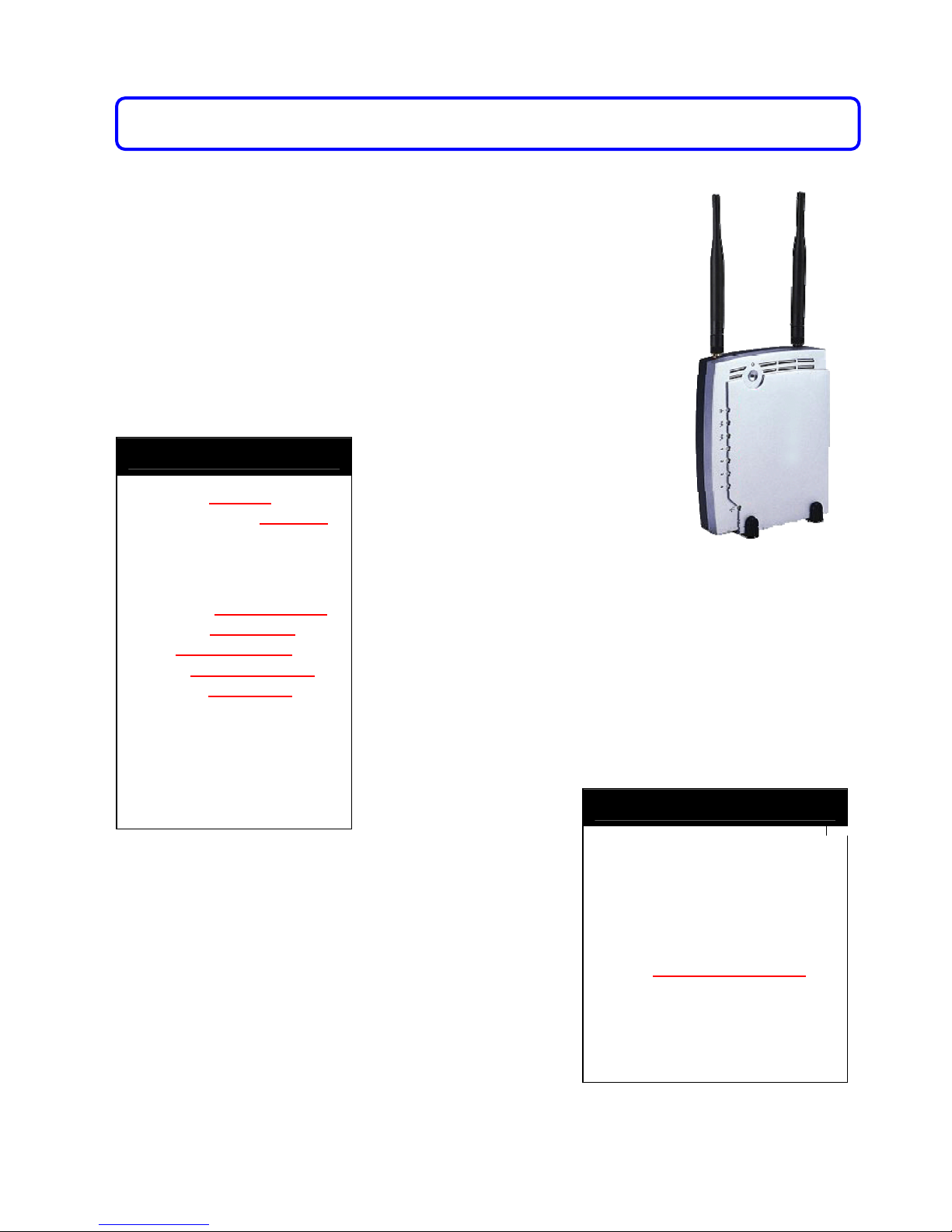
His is a Dual Band Wireless A+G V PN Internet
Router. It does not merely operate in wired
network environments, it additionally u pholds
simultaneous IEEE802.11a and IEEE802.11b/g
connections, as is often required in hotspots and other
public Internet access deployment.
Designed to support state-ofthe-art s ecurity standards
such as the Wi-Fi Protected
Access (WPA) protocol, the
802.1x authentication
standard and 64/128-bits Wired Equivalent
Privacy (WEP) encryption, the router also
sports built-in hardware encryption and
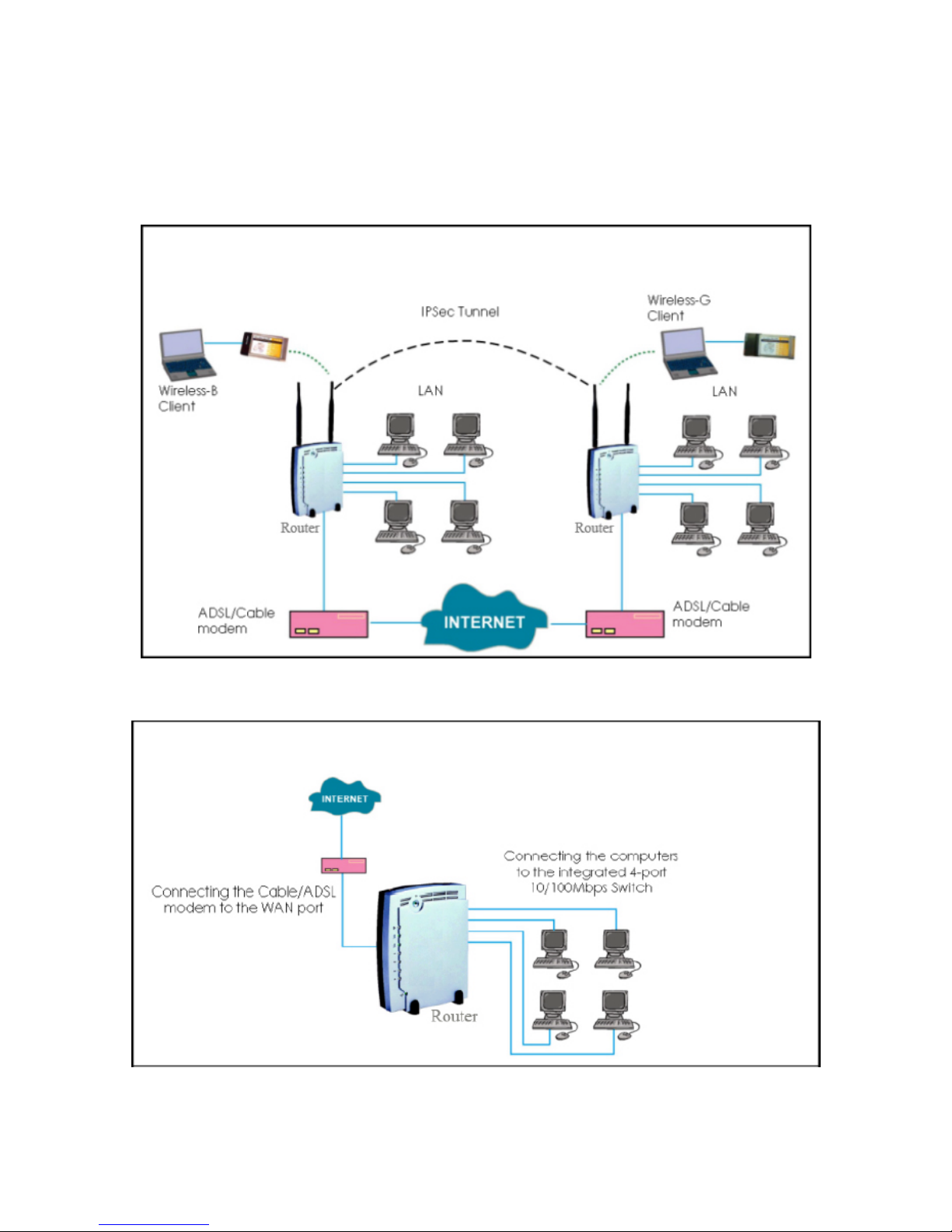
embedded VPN support that can create
multiple IPSec tunnels to remote locations,
thus promoting increased scalability within a
robust security infrastructure.
This highperformance
router also bears
advanced features such as Load Balancing,
Fail-Over Redundancy, and exclusives:
uConfig and Parallel Broadband. A fullfledged gatewa y with bu ilt-in DHCP server,
the router further supports Virtual Servers
based on IP and Port Forwarding, DeMilitarized Zone hosts, Packet Filtering and
much more!
T
Advanced Features
New 54Mbps 802.11a
& 802.11g 5X faster
than 802.11b!
Secure your wireless
data transmissions
with WPA protocol,
IEEE 802.1x
authentication and
64/128-bits WEP
Encryption!
Read on and find out
more about these
features!
Quickly access your
network device’s Web
administration setup with
uConfig!
Have you heard of
Parallel Broadband
?
If not, keep reading and
discover the ultimate
Internet solution is
delivered!
Page 11

2
Chapter 2: Getting to know your Router
The following will help you get more acquainted with the rich suite of
features o f f e r e d b y the router so tha t y o u a r e b e tter a b le to e x p l o it your
router’s full potential.
Key features
Compatible with IEEE 802.11g/b and IEEE 802.11a standards
Adopting the 802.11g standard, the router provides you the fastest wi reless access within
your office or home network. Since it is fully backward compatibl e with 802.11b, you can
safeguard your existing network investments.
Easy Management & Configuration
You can browse or uConfig to the web interface for effortle ss configuration.
Additionally, you can make use of these features:
• HTTPS (SSL) is supported in addition to the standard HTTP. HTTP (SSL) features
additional authentication and encryption for secure communication.
• Telnet allows a computer to remotely connect to the CLI (Command Line
Interface) for control and monitoring.
• SSH (Secure Shell Host) establishes a secure host connection to the CLI for
control and monitoring.
SSH is designed and created to provide the best
security when accessing another computer remotely. Not only does it
encrypt the session, it also provides better a uthentication facilit ies and
features that increase the security of other protocols. It can use different
forms of encryption and ciphers.
• SNMP feature for managing the network performance.
Page 12

3
Virtual AP (Multiple SSID)
Virtual AP implements mSSID (Multi-SSID)
This allows a single wireless card to be set up with up to 16 virtual AP connections with
different SSIDs or BSSID (Basic Service Set Identifier) and security modes.
Antenna Alignment
Antenna Alignment function finds the best alignment for the unit antenna by measuring the
quality of the signal.
WMM
WMM (Wireless Multimedia) improves the user experience for audio, video, and voice
applications by prioritizing data traffic.
Point-to-Point & Point-to-MultiPoint Support
Point-to-Point and Point-to-MultiPoint communication between different buildings enables
you to bridge wireless clients that are kilometres apart w hile unifying the networks.
Page 13

4
Security Features
You will be glad to learn about the security elements we have put in
place to better protect your data and privacy.
64/128-bit WEP encryption
The router supports the WEP (Wired Equivalent Privacy) protocol with key lengths of 64-bit
and 128-bit to protect data communication in your wireless network.
WPA (Wi-Fi Protected Access) Standard & 802.1x Authentication
The router supports the WPA standard for enhanced security in your wireles s network.
The WPA protocol combines two mechanisms: Dynamic Key Encryption and Mutual
Authentication for enhanced security in t he wireless LAN. This combination ensures that
all user s are authenticated through a c entral authority be fore being allowed network
access.
WPA Modes:
• WPA Personal
• WPA Enterprise
• WPA2 Personal
• WPA2 Enterprise
• WPA Auto Personal
• WPA Auto Enterprise
Detaile d information on the WPA Modes can be found in Chapter 5: Settin
g
Up A WL AN
–
Page 14

5
Additional Features
These features reveal the comprehensive range of advanced
functionalities when the router is further configured.
Static IP, Dynamic IP, PPPoE, PPTP, and L2TP WAN types
Whether you have subscribed to fixed IP, dynamic IP or PPPoE, you can use the router fo
r
broadband cable /ADSL Internet connection sharing.
Parallel Broadband
The unique Parallel Broadband technology features improved load balancing and fail-ove
r
Internet connectivity.
Built-in “NAT” firewall & Packet filtering
Since it handles the inco ming and outgoing data packet transactions betw een your LAN
and the external network, the router can validate individual packet information before
passin
g
it on to a LAN client. To complement NAT, you can use the packet filtering features
to regulate Internet access and control the transmission of TCP, UDP, ICMP or IGMP packets
to and from your LAN clients.
Virtual Servers based on Port-forwarding, IP-forwarding and DMZ’s
The router lets you set up Internet appl ication servers such as FTP file servers and HTTP web
servers based on Po rt-forwarding, IP-forward ing and Demilitarised Zone hosts.
Page 15
6
When to use which router
NetPassage 18A IB11US, 1A13EU, IB11US, and 1B13EU are
dualband wireless A+G VPN Internet router offering
simultaneous support of IEEE 802.11a and IEEE 802.11g/b wireless
LAN connections.
NetPassage 18A 1A00US, 1A00EU, 18A 1B00US, and 1B00EU are
VPN Internet routers used only in wired environments.
Page 16
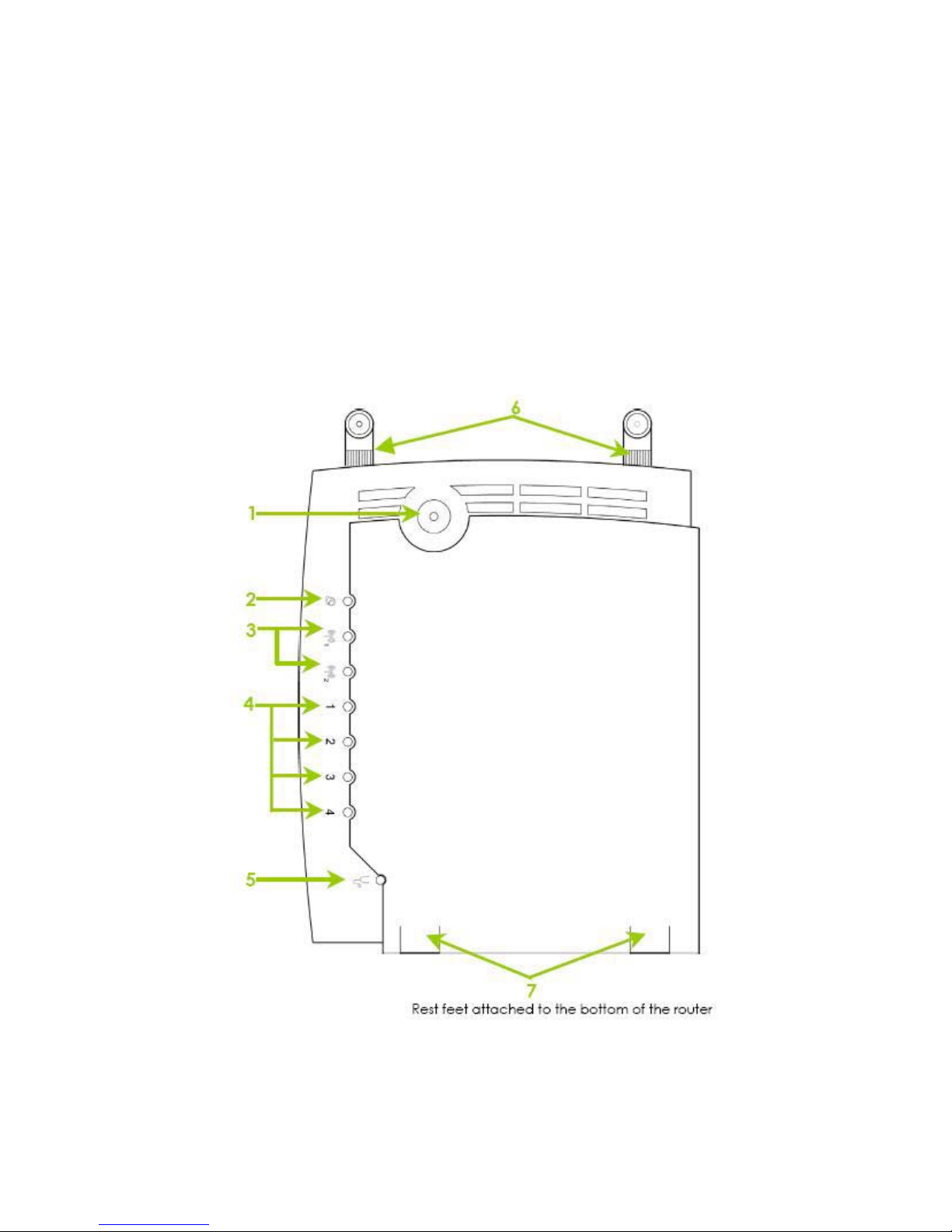
7
Panel Views
The router has been designed such that it can either be placed on a
desktop or mounted onto a wall.
LED indicators denoting network status and activity, are situated on the
front edge of the router for easy visibility. Moreover, two plastic feet
support the router in a standing arrangement, thus minimising desktop
clutter and ensuring better organization when setting up the hardware.
NOTICE: Actual product appearance may slightly differ depending
on the hardware version.
Page 17
8
Page 18

9
Panel Description
Name Description
Steady
Green
The device is powered up.
1 Power (LED)
Off No power is supplied to the
device.
Steady
Green
The WAN connection is ON.
2 WAN (Link/Activity LED)
Flashing
Green
Data transmission at WAN
connection.
Steady
Green
Wireless interface up and
running.
Ready for operation.
3 WLAN (1), (2)
(Link/Activity LED)
Flashing
Green
Activi ty i s detected i n the wireless
network.
These LEDs reflect the status of the integrated
Fast Ethernet Switch.
They will light up when connected with an
Ethernet cable.
Steady
Green
There is a connectivity link of
100Mbps.
Flashing
Green
100Mbps data transmission is
detected at the port
concerned.
Steady
Amber
There is a connectivity link of
10Mbps.
4 1, 2, 3, 4
(Link/Activity/Speed
LEDs)
Flashing
Amber
10Mbps data transmission is
detected at the port
concerned.
5 DIAG (LED) This LED is reserved for diagnostic purposes.
Page 19

10
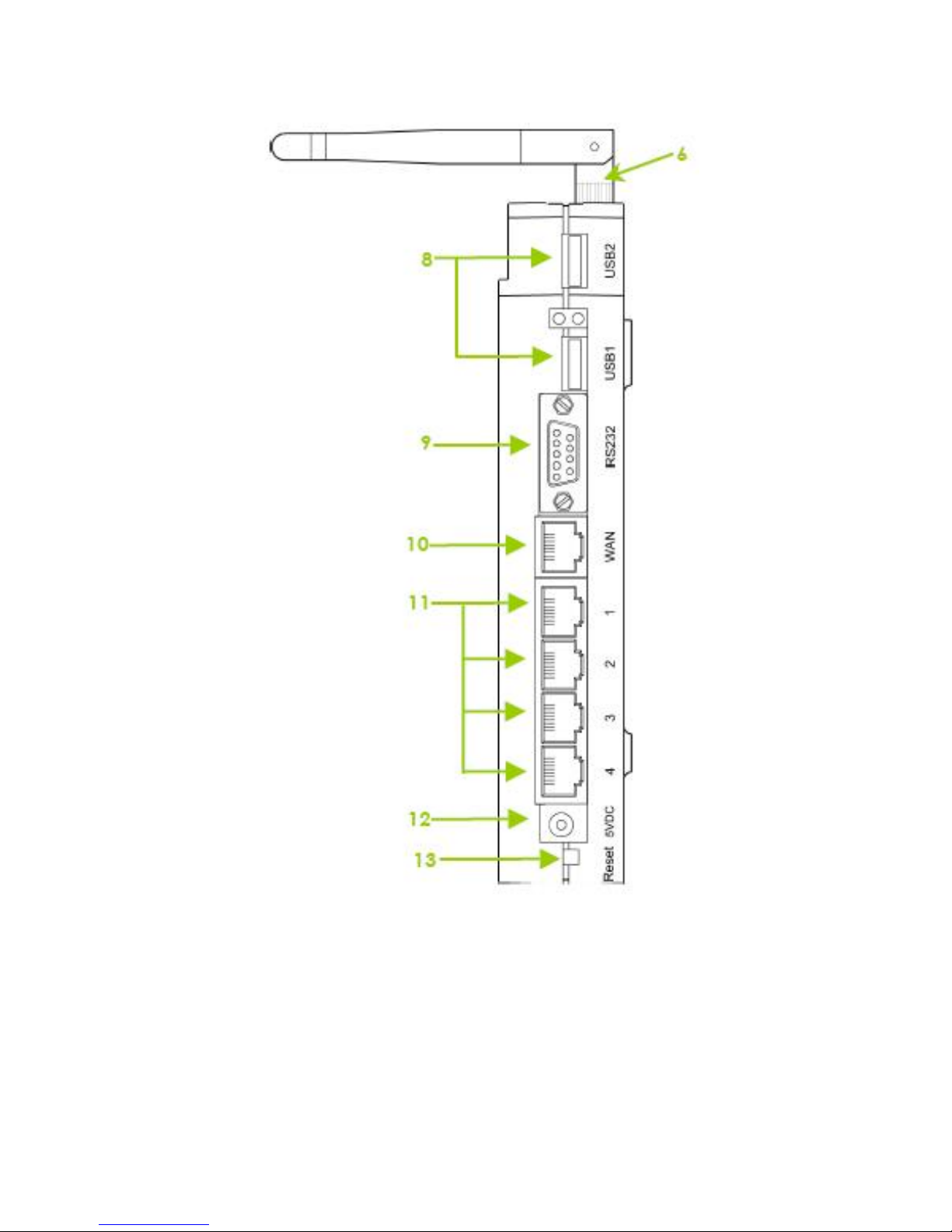
6 External Antennas SMA antennas
7 Rest Feet These rest feet hold the router in the standing
position.
8 USB1, USB2 USB Ports
(NP18A 1A, NP18A 2A)
These ports support printers, webcams, or
hard drives.
9 R232 (Integrated Serial
Interface)
Not in use.
Reserved for future update.
10 WAN (Ethernet Port)
10/100Base-T Port connects to Cable/ADSL
modem.
11 1, 2, 3, 4 (Ethernet Ports) Integrated 3-port 10/100Mbps Switching.
Ports 1, 2, 3, and 4 all function as normal
Ethernet ports except that Port 4 supports PoE
connection.
Connect Port 4 to PoE Injector if you wish to
use it to supply power to the unit.
12 DC Jack Direct Current jack.
If using power adapter to supply power to the
unit, attach the power adapter to the main
electrical supply and connect the power plug
into the DC Jack of the router.
Page 20
11
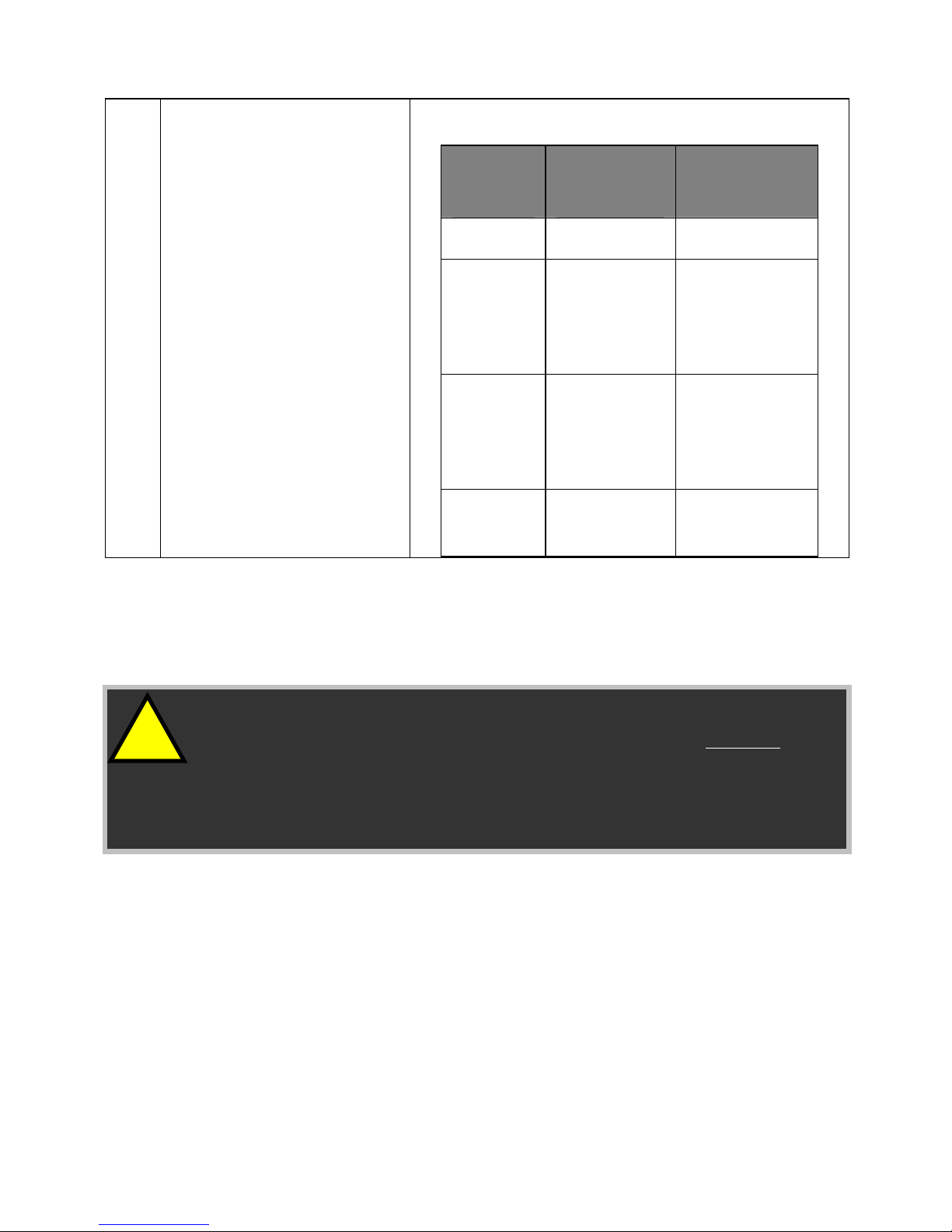
13 Reset (Push Button)
The table below ill ustrates the use of the Reset
button.
Reset
Push
Button
Diagnostic
LED
Router
Behavior
Less than
3 sec
On Reboots.
5 sec Fast Blinking Restores the
default login
password,
which is
‘password’.
Between
8 sec and
10 sec
Slow Blinking Restores all the
default factory
settings
including
password.
More
than 10
sec
Off Reset
cancelled.
11
!
NOTE:
Although the Ethernet ports are numbered 1 to 4, they DO NOT have
to be connected sequentially.
For example: in a network of two computers, you can choose to
connect one computer to Port 2 and another to Port 4.
Page 21
12
Chapter 3: Hardware Setup
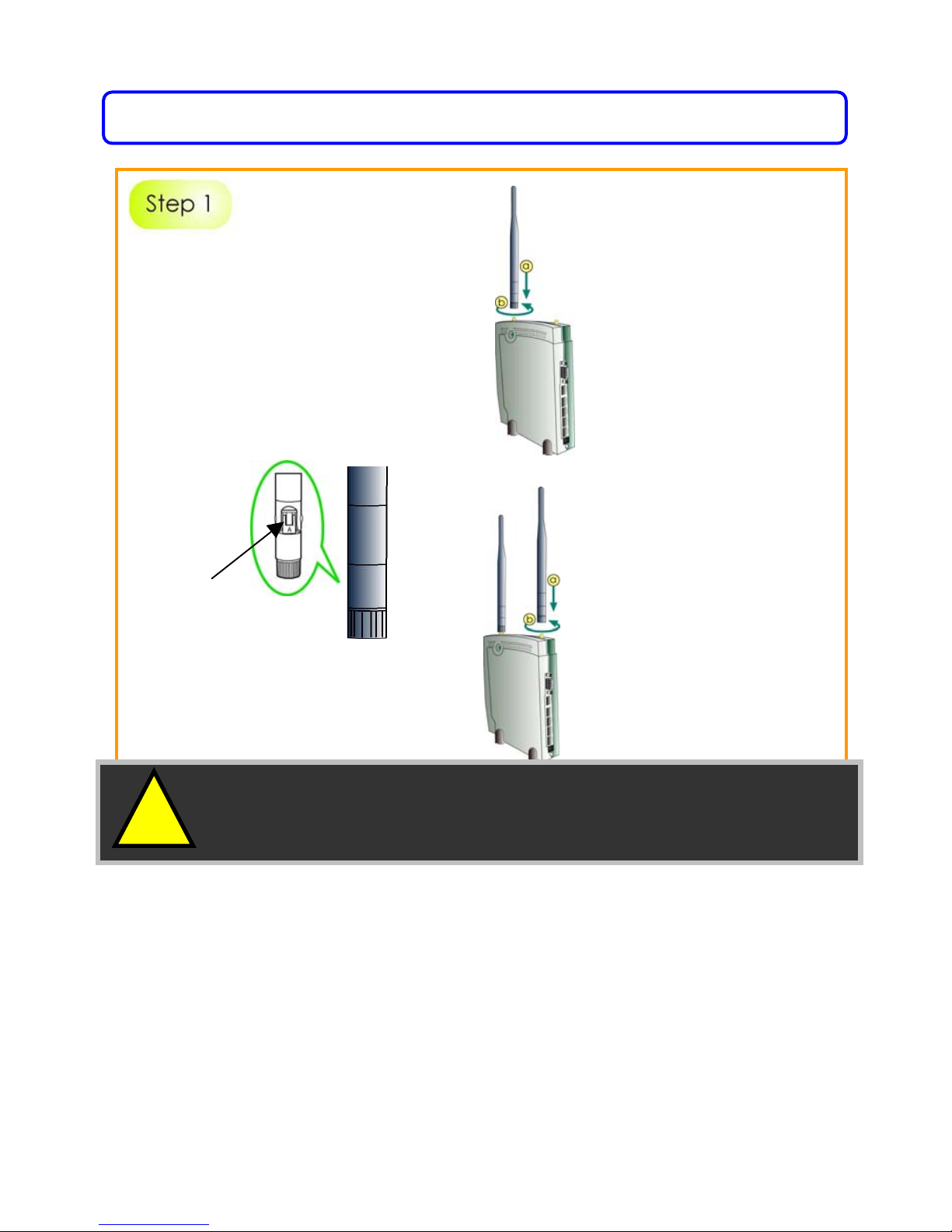
Before attaching a pair of
external antennas to the router,
take note of the ‘A’ marking on
one of the two antennas.
The antenna with the ‘A’ marking
is the Dualband AG Antenna.
The antenna without the marking
is the single-band G Antenna.
Connect the singleband G a ntenna to Ant2 on the RIGHT.
Connect the Dualband
AG antenna to Ant-1 on
the LEFT.
‘A’ marking
!
Important: To ensure proper functionality of the router,
these two antennas MUST NOT be swapped.
Page 22
13
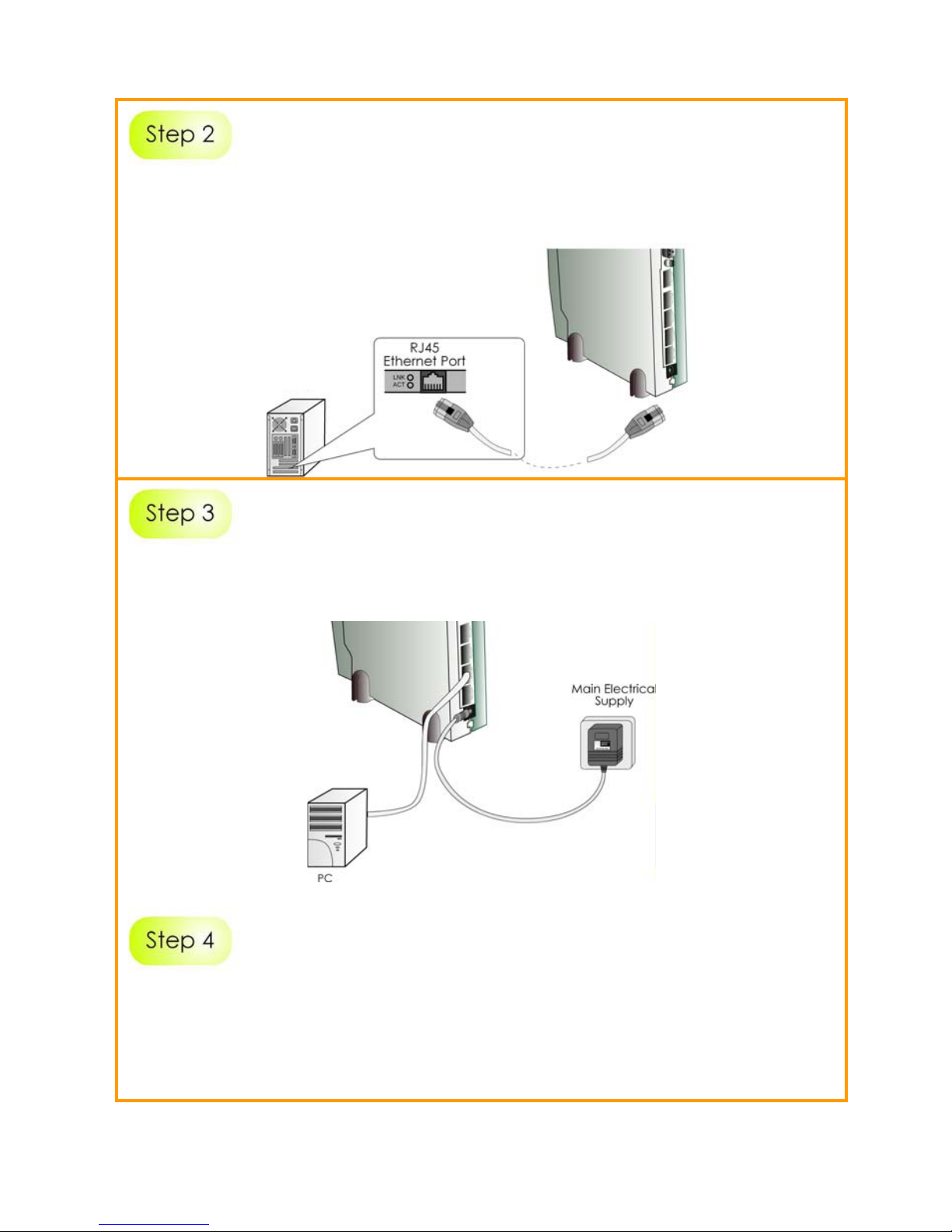
Insert one end of the RJ45 Ethernet cable to any of the LAN ports (1, 2,
3, or 4) on the router and the other end to your PC’s Ethernet network
adapter.
Attach the power adapter to the main electrical supply and connect
the power plug into the socket of the router.
Power on your PC.
Notice that the Power and the corresponding port LEDs have lighted
up.
This indicates that connection has been established successfully
between the router and your PC.
PC
Page 23

14
Chapter 4: Accessing the Web interface
This chapter consi sts of the following:
Overview of alternatives to access the web interface
How to uConfig to the web interface
How to browse to the web interface
Overview of alternatives
The router can be configured with the web interface.
After connecting the router to your PC, there are two methods of
accessing its web interface:
Installing and running the uConfig utility.
Changing your web browser settings.
How to uConfig to the Web Interface
The uConfig utility has been developed to allow access to the web
interface of your product without having to change the TCP/IP settings
of your PC.
Installing uConfig
exclusive!
Insert the Product CD into the CDROM drive.
It will automatically run and display
the web page.
1. Click on Utilities.
2. Select to install the uConfig utility on
your hard disk.
3. After installation, double-click on the
uConfig icon to run the program.
1
2
Page 24
15
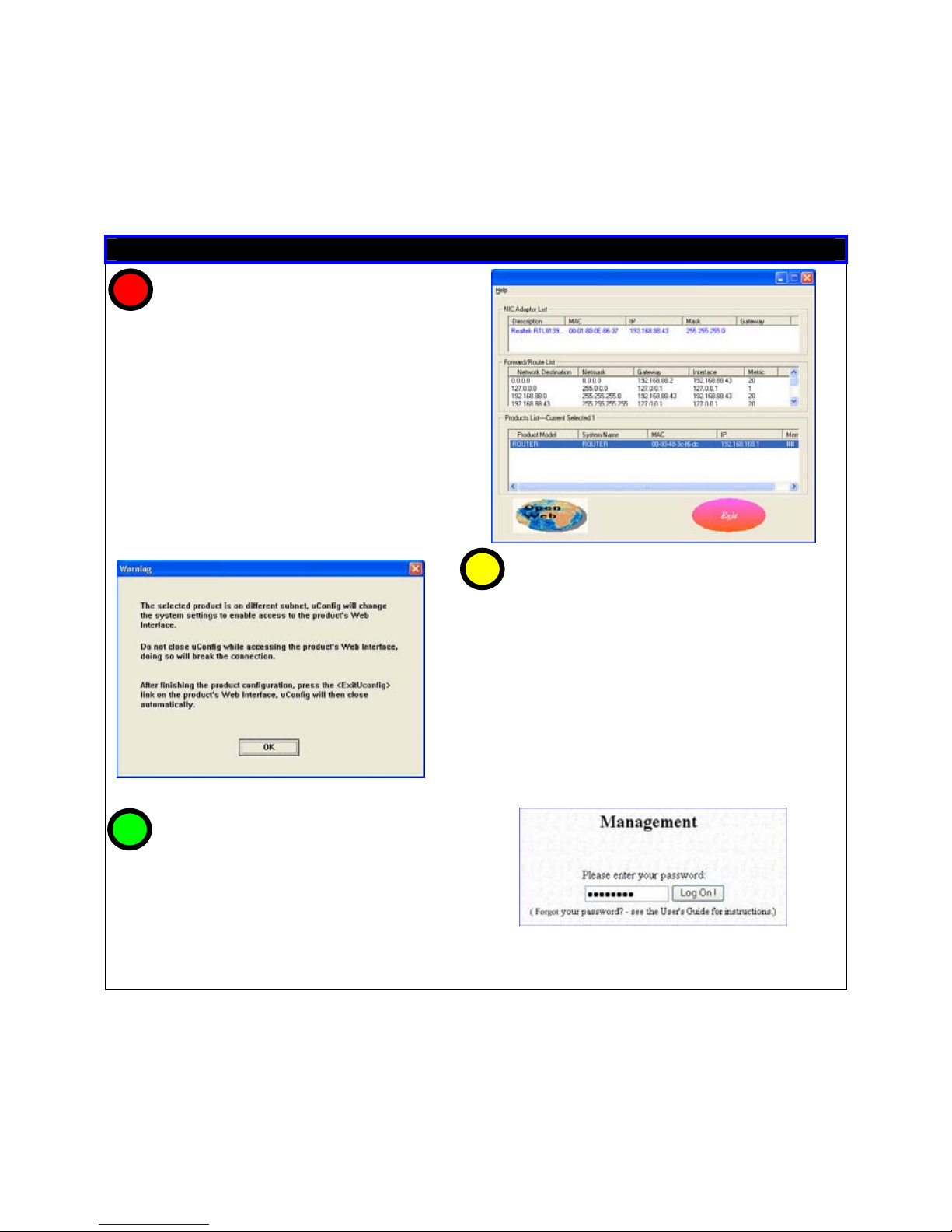
After installation, your PC will automatically detect connected
products.
Double-click on the uConfig utility icon to run the program.
Running uConfig
At the authentication page, click on
the LOGIN! button to enter the main
configuration page.
Note: The default password is
“password”
1. Ensure that the router is selected
under the Products List.
2. Click on Open Web.
This opens the router’s login
screen.
This screen prompts you not to exit uConfig
while accessing the web interface or else
connection to the device will fail.
Click on the
OK button to proceed.
1
2
3
Page 25
16
How to Browse to the Web Interface
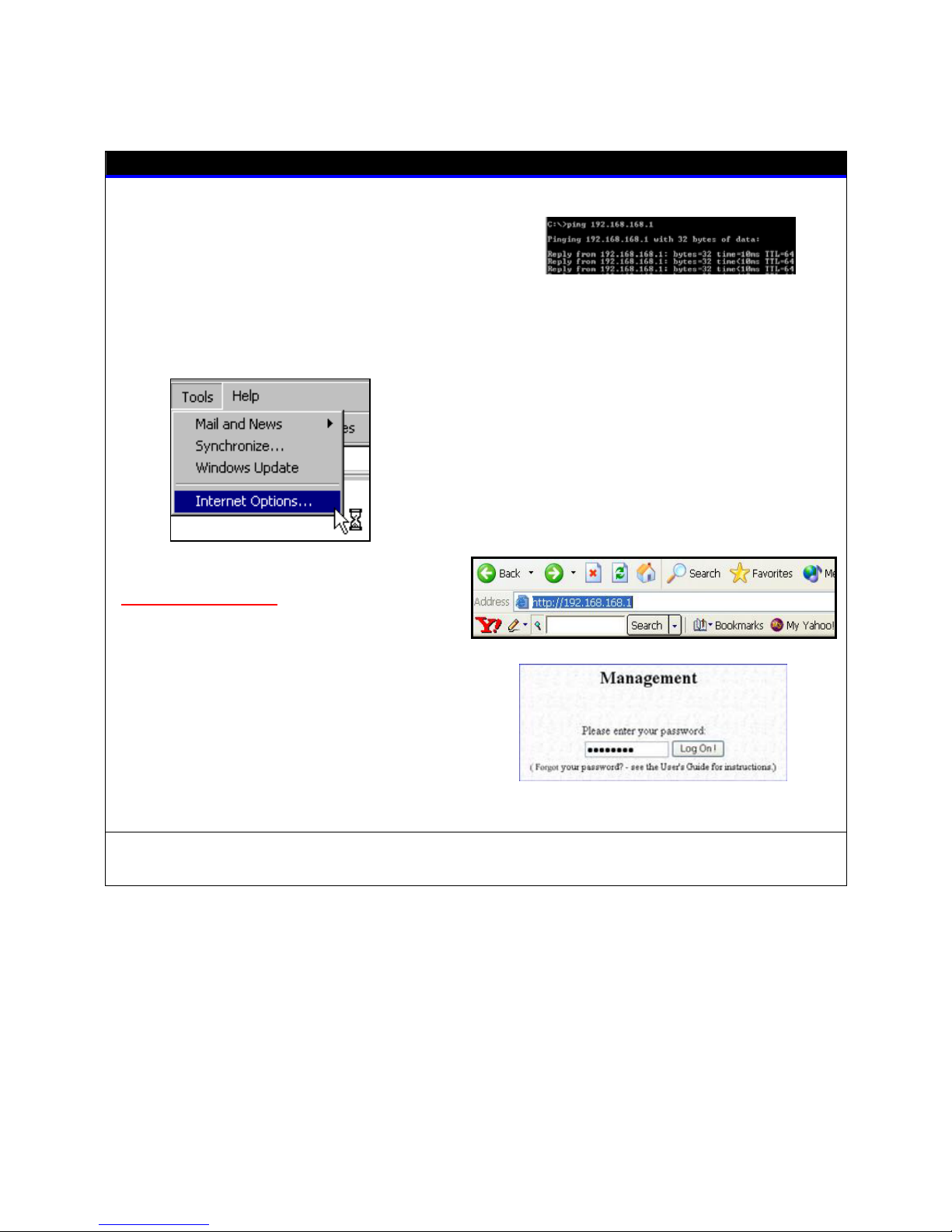
Browsing to the web interface
You will then reach the home page of the router’s web interface.
1. Launch your web browser.
2. Under the Tools tab, select
Internet Options.
3. Open the Connections tab.
4. In the LAN Settings section, di sable
all the option boxes.
1. At the address bar, type:
http://192.168.168.1
2. At the login page, press the
LOGIN! button to enter the
configuration pages.
Note: The default password is
“password”
Open your Command
prompt
window and type in: ping
192.168.168.1 to verify that your PC
can communicate with the router.
If your TCP/IP settings are
correct, you will
g
et replies to
this ping command.
Page 26

17
Chapter 5: Setting Up a WLAN
This chapter applies exclusively to Wireless Setup (a/b/g) and Wireless
Setup (b/g).
Wireless Setup (a/b/g) supports IEEE 802.11a and IEEE 802.11g/b wireless
LAN connections simultaneously.
Wireless Setup (b/g) supports IEEE 802.11b and IEEE 802.11g wireless LAN
connections simultaneously.
Whether you’re a home user or a network administrator, a WLAN
implementation will allow your roaming users to enjoy network
resources anywhere, anytime. It also provides convenience, and cost
savings, since deploying WLANs is less costly than setting up cables.
The next sections involve the following:
WLAN Setup
Wireless Security Settings
Advanced Settings
The steps featured are common to both Wireless Setup (a/b/g) and
Wireless Setup (b/g), unless otherwise stated.
Page 27
18
Operation Modes
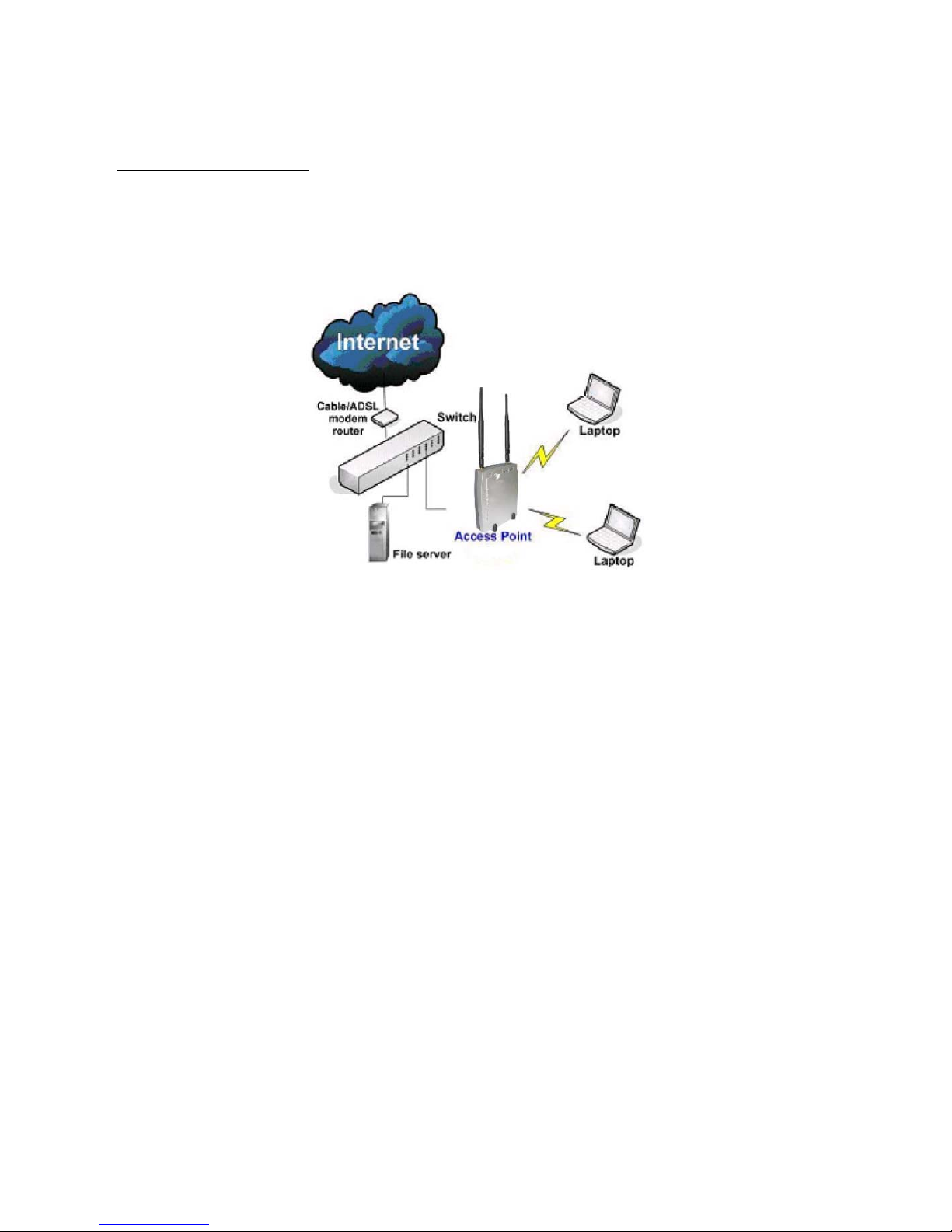
Access Point Mode
This is the default mode of your access point. The Access Point mode
enables you to bridge wireless clients to access the wired network
infrastructure and to communic ate with each other.
In the example above, the wireless users will be able to access the file
server connected to the switch through the access point in Access
Point mode.
Page 28
19
Client Mode
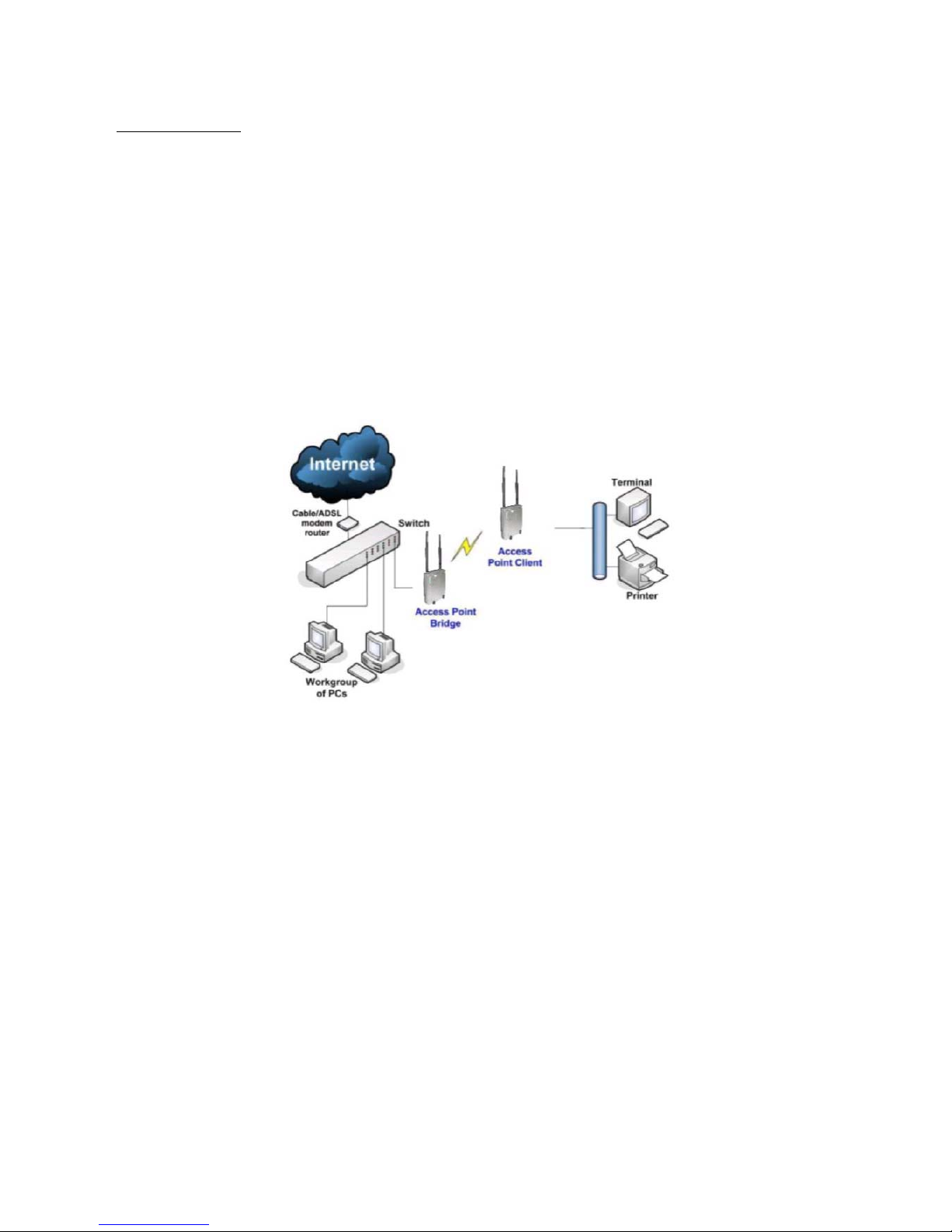
In Client mode, the device acts as a wireless Client.
When connected to an access point, it will create a network link
between the Ethernet network connected at this Client device, and
the wireless and Ethernet network connected at the access point.
In this mode it can only connect with an access point. Other wireless
clients cannot connect with it directly unless connected to the same
access point - allowing them to communicate with all devices
connected at the Ethernet port.
In the example above, the workgroup PCs will be able to access the
printer connected to the access point in Access Point Client mode.
Page 29
20
Transparent Client Mode
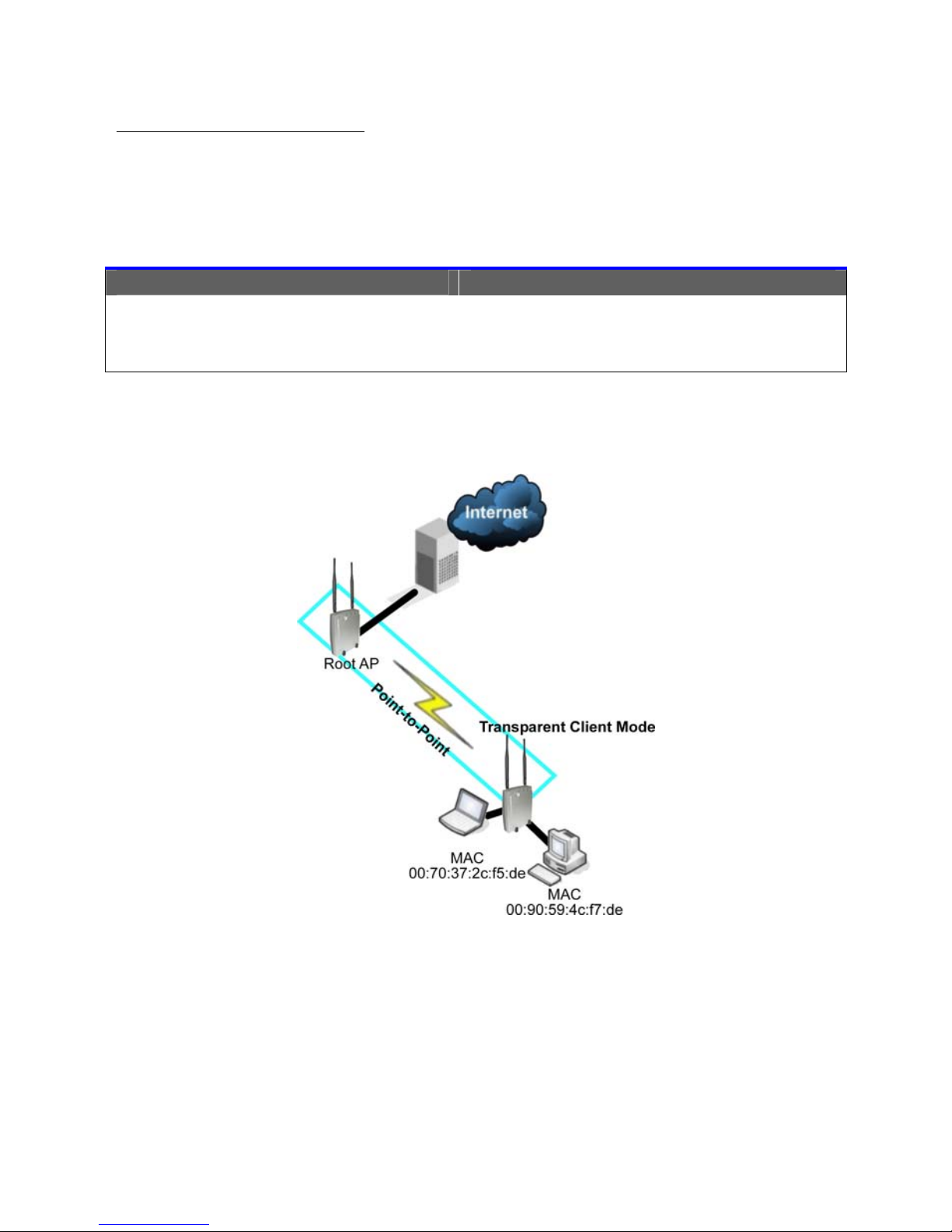
In Transparent Client Mode, th e access point provides connection with
an AP acting as Root AP. This operation mode is designed for
implementation of Poin t-to-Point and P oint-to-MultiPoint connections.
Point-to-Point
Point-to-MultiPoint
An access point acts as Root AP
and 1 other access point acts as
Transparent Client.
An access point acts as Root AP
and several other access point acts
as Transparent Clients.
This mode is generally used for outdoor connections over long
distances, or for indoor connections between local networks.
Page 30

21
Difference Between other client modes and Transparent Client Mode
Other client modes
Transparent Client Mode
Connectivity with any standard
APs.
Connectivity with RootAP-supported
APs.
All devices connected to the
Ethernet ports use a common
MAC address for
communications with the AP.
Devices connected to the Ethernet
ports flow through freely and
transparently with out the MAC
address restriction.
Transparent Client Mode is more transparent, making it more suitable for
linking two networks as point-to-p oint, or point-to-multi-point n etwork
connection.
Page 31

22
To Set Up a Wireless LAN
Follow these steps to setup your wireless LAN for IEEE 802.11a, IEEE
802.11b, and IEEE 802.11g.
WLAN Setup (a/b/g)
Click on WLAN Setup(a/b/g) from
the CONFIGURATION menu.
Select Basic to make changes.
If you disable the card, you will not be
able to use the features of this wireless
card.
If you wish to disable the card, click on
the Click to Disable This Wireless Card
button.
Click Reboot in Reboot System page.
Rebooting
page displays and machine
reboots.
The Wireless Card Disabled screen
indicates that the wireless card has
been disabled.
1
2
Page 32

23
Operation Mode : The router supports three types of modes such as Access
Point, Client, and Transparent Client.
WLAN name (ESSID) : Enter a preferred name for the wireless network.
Your wireless clients must be configured with the same ESSID
(sometimes referred to as SSID).
To change the wireless mode,
make a selection from the dropdown box.
The router supports wireless LAN
connectivity that is fully compliant
with the IEEE 802.11g, IEEE 802.11a,
and IEEE 802.11b standards.
It also employs different security
modes to secure the data
transmission of the wireless clients
within your network.
The Current Mode
is defaulted to
Access Point.
To change the mode, click on the
Change button.
3
4
Page 33

24
Wireless mode
:
Select from the list of wireless modes available:
802.11a (not supported by WLAN Setup for b/g)
This mode supports wireless A clients with data rates of up to
54Mbps in the frequency range of 5.4GHz.
802.11b only
This mode supports wireless B clients with data rates of up to
11Mbps in the frequency range of 2.4Hz.
802.11g only
This mode supports wireless G clients with data rates of up to
54Mbps in the frequency range of 2.4Hz.
802.11b/g mixed
This mode supports both wireless B and G clients.
The basic rates are: 1, 2, 5.5, 11, 6, 9, 12, 18, 24, 36, 48, and
54Mbps.
Country Code : Choose the Country where you are located.
Channel : This option allows you to select a frequency channel for
wireless communication.
Select SmartSelect to automatically scan and recommend
the best channel that can be utilised.
Tx Rate : Allow you to choose the rate of data transmission from
1Mbps to Fully Auto.
Maximum Associations : Allow y ou to l imi t the numb er of WLAN a ssoc iation s that ca n
be made from 1 to 128. Default: 32
Closed system
:
The router will suppress and not broadcast its WLAN name
(SSID) when Closed system is enabled.
Closed system is disabled by default.
Act as RootAP
:
The router will connect with one or multiple Transparent
Clients to create a point-to-point and point-to multi-point
connections network with 2 or more APs.
This connection method is fully compliant with 802.1h
standards.
VLANID
:
Select and specify the VLANID.
This is a number to identify the different virtual network
segments to which the network d evices are grouped.
This can be any number from 1 to 4094.
Page 34

25
Point-to-Point & Point-to-MultiPoint Setup
You can implement Point-to-Point connection by simply setting one
access point as RootAP in Access Point mode and setting the other
access points to Transparent Client mode.
You can set a root access point and a transparent client to allow pointto-point communication between different buildings and enable you to
bridge wireless clients that are kilometres apart while unifying the
networks. Or you can set a root access point and multiple transparent
clients to allow point-to-multiple-po int communicatio n between the
access point located at a facility and several other access points
installed in any direction from that facility.
Follow these steps to setup RootAP
RRoooottAAPP SStteepp 11::
Click on WWLLAANN SSeettuupp from the CCOONNFFIIGGUURRAATTIIOONN menu. You will see
the sub-menus expanded under WWLLAANN SSeettuupp. Click on BBaassiicc.
Ensure that TThhee CCuurr
r
reenntt MMooddee is set to AAcccceessss PPooiinntt.
To change TThhee CCuurrrreenntt MMooddee, please refer to: Common
Configuration – WLAN Setup - To Configure the Basic Setup of the
Wireless Mode.
Page 35

26
RRoooottAAPP SStteepp 22::
Select AAcctt aass RRoooottAAPP, click on the AAppppllyy button and reboot your
device to let your ch anges tak e effect.
Page 36

27
Follow these steps to setup Transparent Client/s.
TTrraannssppaarreenntt CClliieenntt SStteepp 11::
Click on WWLLAANN SSeettuupp from the CCOONNFFIIGGUURRAATTIIOONN menu. You will see
the sub-menus expanded under WWLLAANN SSeettuupp. Click on BBaassiicc.
Ensure that TThhee CCuurr
r
reenntt MMooddee is set to TTrraannssppaarreenntt CClliieenntt.
To change TThhee CCuurrrreenntt MMooddee, please refer to: Common
Configuration – WLAN Setup - To Configure the Basic Setup of the
Wireless Mode.
Page 37

28
TTrraannssppaarreenntt CClliieenntt SStteepp 22::
Select the RReemmoottee AAPP MMAACC checkbox.
Enter the RReemmoottee AAPP MMAACC.
Note:
When using RReemmoottee AAPP MMAACC, the EESSSSIIDD name must also match the
AP’s ESSID name, especially when Closed System is enabled on the
AP.
Repeat Transparent Client step to add more points to the Point-toMultiPoint connection.
Page 38

29
How to Make Your WLAN More Secure
All your network clients MUST share the same wireless settings as your
router to be able to communicate.
The router offers 8 types of security modes:
WEP
Short for Wired Equivalent Privacy, WEP is a security protocol basing on
a secret key to encrypt data packets before they are transmitted.
You MUST
remember to apply the same WEP settings and key to the
router as well as to all your wireless clients.
802.1x
This mode conforms to the IEEE 802.1x authentication standard that
ensures that a client is not given access t o network resources unless it
has been successfully authenticated.
There MUST
be a RADIUS server on your LAN for this security mode to
function.
WPA Personal
WPA, or Wi-Fi Protected Access, is a protocol for authorising and
authenticating users onto the wireless network and implements the
majority of the IEEE 802.11i standard.
WPA Personal mode implements a shared network password for clients
and access points.
The only interaction is between the router and the client, therefore, a
RADIUS server is NOT
required.
WPA Enterprise
WPA Enterprise mode implements the 802.1X authentication.
There MUST
be a RADIUS server on your LAN for this security mode to
function.
Page 39

30
WPA2 Personal
WPA2 Personal mode implements the full IEEE 802.11i standard with a
shared network password for clients and access points.
The only interaction is between the router and the client, therefore, a
RADIUS server is NOT
required.
WPA2 Enterprise
WPA2 Enterprise mode implements the full IEEE 802.11i standard and
802.1X authentication.
There MUST
be a RADIUS server on your LAN for this security mode to
function.
WPA Auto Personal
WPA Auto Personal mode implements a shared network password for
clients and access points and if there are no WPA enabled access
points available with the given SSID in WPA Personal mode, the unit will
attempt to associate with a non-WPA point with the given SSID, if
available.
The only interaction is between the router and the client, therefore, a
RADIUS server is NOT
required.
WPA Auto Enterprise
WPA Auto Enterprise implements 802.1X authentication and if there are
no WPA enabled access points available with the given SSID in WPA
Enterprise mode, the unit will attempt to associate with a non-WPA
point with the given SSID, if available.
There MUST
be a RADIUS server on your LAN for this security mode to
function.
Page 40

31
The subsequent sections illustrate how to configure each security
mode.
Begin with following the two common preliminary steps shown below to
select the most appropriate security mode to protect your wireless
communications.
Selecting a security mode
Click on WLAN Setup(a/b/g) from
the CONFIGURATION menu.
Select Security.
1
1. Make a selection from the
Security Mode drop down menu.
The Security Mode is disabled by
default.
2. Click on Apply.
2
Page 41

32
How to Setup WEP
WEP
You can define up to 4 WEP
keys.
For each key, you can specify:
The Key Entry Method, by
selecting either:
- Hexadecimal
- ASCII text
The encryption level, from
the dropdown list:
- 64-bit
- 128-bit
Click Edit to set the keys, and
then click Apply.
1
Page 42

33
For hexadecimal key entry:
1. Select the Hex radio button.
2. Select the radio button of
the key to be entered.
3. Select the key encryption
mode from the drop down
menu.
4. Fill in the key value.
A hexadecimal value is made of
digits 0-9 and letters A-F,
and is NO
T
case-sensitive.
For 64-bit encryption:
Your WEP key has to be 10
hex
digits long.
For 128-bit encryption:
Your WEP key has to be 26
hex
digits long.
5. Click on Apply.
6. I f the key format is valid, the
page will refresh and the
key will appear in encrypted
form.
2
Page 43

34
For ASCII key entry:
1. Select the ASCII radio
button.
2. Select the radio button
of the key to be
entered.
3. Select the key
encryption mode from
the drop down menu.
4. Fill in the key value.
An ASCII value can take in any
alphanumeric character and is
NOT case-sensitive.
For 64-bit encryption:
Your WEP key has to be 5
characters long.
For 128-bit encryption:
Your WEP key has to be 13
characters long.
5. Click on Save.
6. If the key format is valid,
the page will refresh
and the key will appea
r
in encrypted form.
3
To add more hexadecimal WEP keys,
repeat step 2.
To add more ASCII WEP keys, repeat
step 2.
You can set a maximum of 4 WEP keys
using different key entry methods and
encryption levels.
To specify which key to use:
1. Select the radio button of
the key to be used.
2. Click on Apply, then on
Reboot
to apply the
changes.
4
Page 44

35
How to Setup 802.1x
802.1x
1. Key in the IP address of
the Primary RADIUS Server in
your WLAN.
Optional: You may also key in a
Secondary RADIUS Server, if
any.
Note: The RADIUS server MUST
be
in the same subnet as your router.
2. The Authentication Port is
preset as 1812, but another port
number can be used.
Note: The Authentication Port
MUST
match the corresponding
port of the RADIUS server.
3. Enter the Shared Secre
t
Key, known only to you and the
RADIUS server.
4. The Accounting Port
is
preset as 1813, but another port
number can be used.
5. You can opt for a Ke
y
Length of either 64 bits (10 hex /
5 ASCII values) or 128 bits
(26
hex / 13 ASCII valu es).
6. Click on Apply.
7. Click on Reboot to restart
the system, after which the
settings will be effective.
1
Page 45

36
How to Setup WPA Enterprise Modes
Follow these steps to setup the router to use WPA Enterprise, WPA2
Enterprise, and WPA Auto Enterprise.
WPA Enterprise
1. Select the Cipher Type to
implement:
• TKIP
• AES
• AUTO
The Cipher Type is set to
AUTO by default
so that the
router can automatically
detect which cipher type
can be supported by the
client.
2. Key in the IP address of the
RADIUS Server in your WLAN.
Note: The RADIUS server MUST
be
in the same subnet as you
r
router.
3. The Authentication Port is
preset as 1812, but anothe
r
port number can be used.
Note: The Authentication Port
MUST
match the corresponding
port of the RADIUS server.
4. Enter the Shared Secret Key,
known only to you and the
RADIUS server.
5. The Accounting Port is preset
as 1813, but another port
number can be used.
1
6. Click Apply.
7. Click on Reboot to restart
the system, after which you
r
settings will become
effective.
Page 46

37
How to Setup WPA Personal
Follow these steps to setup the router for using WPA Personal, WPA2
Personal, and WPA Auto Personal.
WPA Personal
1. Fill in the Passphrase or pre-
shared network key.
2. Select the Cipher Type to
implement:
a. TKIP
b. AES
c. AUTO.
The Cipher Type is set to
AUTO by default
so that the
router can automatically
detect which cipher type
can be supported by the
client.
1
1. Click Apply.
2. Click Reboot to restart the
system, after which your settings
will become effective.
2
Page 47

38
Advanced WLAN Settings
Follow these steps to change the radio settings of your router.
Editing Advanced Settings
1. Click on WLAN Setup
(a/b/g) from the
CONFIGURATION menu.
2. Select Advanced.
1
1. Set the Beacon Interval (the time lapse
between every beacon sent) to any
value between 200 and 1000.
It is preset as 200 seconds.
2. Set the Data Beacon Rate
from 1 to
16384.
This determines how often the beacon
should contain a Delivery Traffic
Indication Message (DTIM) that tells
power-save clients that a packet is
waiting for them.
3. Set the RTS/CTS Threshold from 256 to
2346.
It is preset to 2346.
4. Set the Frag Threshold from 256 to 2346.
It is preset to 2346.
5. Transmission Power Control (TPC) offers
the flexibility to set the Transmit Power.
(802.11h compliant)
It is set to Maximum by default, but
should be reduced if there is more than
one unit using the same channel
frequency.
It can be set from Minimum to
Maximum, 1dBm to 20dBm, in
increments or 1dBm per step.
2
Page 48

39
6. Select whether to enable Station
Isolation.
This security feature implements
isolation, in order to prevent
network clients from attacking
other network clients.
7. The Antenna Control
function
allow you to control whether to
use the:
• MAIN antenna (Default)
• AUX (Auxiliary) antenna
OR
• Diversity, to monitor the
signal from each antenna
and automatically switch to
the one with the bette
r
signal.
For Antenna Control
recommended settings, please
refer to the next section.
8. Dynamic Frequency Selection
(DFS) support provides flexible
selection of the best frequency
channel for the wireless
communication to al low mobility
among networks.
It reduces interference by
detecting and avoiding other
frequencies in use.
(DFS is a component of, and
compliant with 802.11h
specifications.)
DFS is enabled by default.
1. Click Apply.
Changes will be enabled afte
r
reboot.
3
Page 49

40
Antenna Control
These are the recommended antenna control settings.
Antenna Control
If both antennas are
connected: set antenna
control to Diversity
If antenna is connected to main: set
antenna control to MAIN
If antenna is connected to
auxiliary: set antenna control
to AUX
Page 50

41
Long Distance Parameters
It is necessary to adjust the long distance parameters, only if the
distance is 100 meters and beyond.
Follow these steps to change the long distance parameters of your
router.
Editing Long Distance Parameters
1. Click Long Distance Parameters.
1. Click on WLAN Setup
(a/b/g) from the
CONFIGURATION menu.
2. Select Advanced.
1
2
Page 51

42
1. Select whether to
Enable or Disable
Outdoor operation.
2. Enter Distance of the
unit in meters.
3. Enter the SlotTi me.
4. Enter the
acknowledgement
timeout.
5. Enter the CTS timeout.
6. Click Apply.
To view recommended long
distance parameters:
Click Show Reference Data
button.
This dialog box displays if the Distance
entered is less than 100 meters.
3
Page 52

43
WMM
Wireless Multimedia (WMM) is a feature specially developed to improve
the user’s experience for audio, video, and voice applications by
prioritizing data traffic.
Page 53

44
Follow these steps to change the setup Wireless Multimedia on your
access point.
Setting WMM
Click WMM Settings.
1. Select to Enable Wireless
Multimedia (WMM)
2. Enter the desired WMM parameters.
Using the default parameters is
recommended.
3. Click Apply to apply the WMM
settings, click Default to reset all
parameters to defaul t, or cl ick Back
to discard any changes and return
to WLAN Basic Setup page.
3. Click on WLAN Setup
(a/b/g) from the
CONFIGURATION menu.
4. Select Advanced.
1
2
3
Page 54

45
WMM Parameters (for advanced users)
AIFs (Arbitrary Inter-
Frame Space)
Arbitrary Inter-Frame Space is the fixed wait time fo r different
data traffic to access the network.
Cwmin (Contention
Window Minimum)
Contention Window Minimum is the minimum random wait time
for different data traffic to access the network.
CwMax (Contention
Window Maximum)
Contention Window Maximum is the maximum random wait time
for different data traffic to access the network.
TxOp limit (Transmit
Opportunity Limit)
Transmit Opportunity limit specifies the duration that an end-user
device c an transmit data traffic. TxOp limit can be used to give
data traffic longer and shorter access.
NoAck (No
Acknowledgement)
No Acknowledgement provides control of the reliability of traffic
flow. Usually an acknowledge packet is returned for every
packet received, increasing traffic load and decreasing
performance.
Enabling No Acknowledgement cancels the acknowledgement.
This is useful for data traffic where speed of transmission is
important.
ACM (Admission
Control Mandatory)
Admission Control Mandatory enables WMM on the radio
interface. When ACM is enabled, associated clients must
complete the WMM admission control procedure before access.
BE (Best Effort)
Parameters for Data0 Best Effort.
Best Effort data traffic has no prioritization and applications
equally share availabl e bandwidth.
BK (Background)
Parameters for Data1 Background.
Background data traffic is de-prioritized and is mostly for backup
applications, or background transfers like backup applications or
background transfers like bulk copies that do not impact
ongoing traffic like Internet downloads.
VI (Video)
Parameters for video data traffic.
VO (Voice) Parameters for voice data traffic.
Page 55

46
Statistics
Follow these steps to view the WLAN detailed connections statistics per
WLAN station.
Statistics
1. Click on WLAN Setup (a/b/g)
from the CONFIGURATION
menu.
2. Select Statistics.
1. Select the WLAN connection to view
statistics of.
• Click Refresh to refresh the WLAN
Connection List.
• Click Back to return to the WLAN
Basic Setup page.
The WLAN connection’s statistics
displays.
Click Back to return to WLAN Basic
Setup page.
1
2
3
Page 56

47
Virtual AP (Multiple SSID)
Virtual AP implements mSSID (Multi-SSID) whereby a single wireless card
can be setup with up to 16 v irt ual AP connect ions wit h diffe rent SSIDs or
BSSID (Basic Service Set Identifier) and security modes.
Virtual AP delivers multiple services by VLAN segmentation: making the
network think there are many SSIDs available and channeling each
connection through different VLANs to the respective virtual network
segments on the Ethernet network.
How it Works
When WLAN PC 1 connects to VAP 1 its packets are channeled to
VLAN 10 group where only services connected to Port 2 and Port 3 are
available to this wireless connection.
It is similar for WLAN PC 2 and WLAN PC 3. Although they connect to
the same radio card as WLAN PC 1, WLAN PC 2 can only access the
services available at Port 6 and Port 7 and WLAN PC 3 can only access
the services available at Port 10 and Port 11.Follow these steps to setup
Virtual AP.
Page 57

48
Follow these steps to setup Virtual AP.
Virtual AP
1. Click on WLAN Setup (a/b/g) from the
CONFIGURATION menu.
2. Select Virtual AP.
Virtual AP List page displays.
• Click Apply to register changes.
• Click Clear to clear Virtual AP List.
• Click Back to return to WLAN Basic
Setup page.
• Select the Delete option beside
any Virtual APs you wish to delete.
Click Add to goto add Virtual AP page.
1. Enter ESSID name.
2. Settings:
• VLAN ID
• Closed System
• RootAP
3. Select Security Mode
4. Click Apply to make
changes or click Back to
return to Virtual AP List
page.
1
2
3
Page 58

49
Preferred APs (Only available in Client Mode)
When there is more than one AP with the same SSID, the Preferred APs
function allows you define the MAC address of the APs in order of
preference.
The MAC address at the top of the Preferred APs list has the highest
connection preference, and the MAC address at the bottom has the
lowest connection preference.
Follow these steps to specify your preferred APs.
Preferred APs
1. Click on WLAN Setup (a/b/g) from the
CONFIGURATION menu.
2. Select Preferred APs.
1. Enter the MAC addresses of the
preferred APs.
2. Click Apply to effect the
settings.
1
2
Page 59

50
Antenna Alignment
The antenna alignment function helps you find the best alignment for
the antenna by mea suring the quali ty of the signal.
For best results during the antenna alignment, turn off all wireless
networking devices within range except the device with which you are
trying to align the antenna.
Follow these steps to setup your wireless LAN.
Antenna Alignment
1. Click on WLAN Setup (a/b/g) from
the CONFIGURATION menu.
2. Select Antenna Alignment.
1. Enter the Remote AP MAC Address you
wish to align with.
2. Click Sta rt to perform antenna alignment.
1
2
!
NOTE: To ensure proper functionality of the device,
select to Stop after performing antenna alignment.
Alternatively, you may also reboot the device.
Page 60

51
Chapter 6: Configuration
This chapter describes the different features of your router and explains
how to customise them to meet your network requirements.
Setting up the router in your LAN
SNMP (Simple Network Management Protocol) Setup
Setting Up the Router in Your LAN
The following table lists out the parameters relevant to your LAN setup.
You can replace the default settings with appropriate values to suit the
needs of your LAN.
LAN Parameters Description
IP Address
The IP address of your router access point is 192.168.168.1
by default.
When the DHCP server of the access point is enabled, this
LAN <IP address> would be allocated as the Default
Gateway of the DHCP client unless you set a different
<DHCP Gateway IP address>
Network Mask
The Network Mask identifies the subnet in which your
router resides.
The default network mask is 255.255.255.0.
Management
Gateway IP
(Optional) As a bridge router, the router does not usually
communicate with devices on other I P subnets. However,
the Management Gateway here acts as the equivalent
of the Default Gateway of a PC, to allow the router to
communicate with devices on different subnets.
For instance, if you want to access the router from the
internet or from the router on the LA N, you can set the IP
address of the router as the Management Gateway IP.
The Management Gateway IP address of your router is set
to Nil by default.
The next two fields (DHCP Start IP Address and DHCP End IP Address) allow you
to define the range of IP addresses from which the DHCP Serv er can assign an
IP address to the LAN.
DHCP Start IP
Address
This is the fi rst IP address that the DHCP server will assign.
The value you enter should belong to the same subnet as
your router.
For example if the IP address and network mask of your
router are 192.168.168.1 and 255.255.255.0 res
p
ectively,
Page 61

52
the DHCP Start IP Address should be 192.168.168.X where
X is any value from 2 to 254.
It is preset to 192.168.168.100.
DHCP End IP
Address
This is the last I P address that the DHCP server can assign.
The value you enter should also belong to the same
subnet as your router.
For example if the IP address and network mask of your
router are 192.168.168.1 and 255.255.255.0 respectively,
the DHCP End IP Address should be 192.168.168.X where X
is any value from 2 to 254.
It is preset as 192.168.168.254.
DHCP Gateway IP
Address
Enter the IP address of the gateway to Internet or of the
router if this access point is the one connecting to the
Internet.
If your network uses multiple gateways / access points,
you may wish the router to act as DHCP server to a LAN
segment while another access point connects to the
Internet or to another LAN.
Though the DHCP server usually acts as the Default
Gateway of the DHCP client, you can define a different
<DHC P Gatewa y IP add ress>, wh ich wil l be all ocated as
the Default Gateway of the DHCP client.
The DHCP client will thus receive its dynamic IP address
from the router but will access the Internet or the other
LAN through the Default Gateway defined by the <DHCP
Gateway IP address>.
Always use these
DNS servers
Enable this option if you want the router to use only the
DNS server you have specified.
Primary DNS IP
Address
Your ISP usually provides the IP address of the DNS server.
Secondary DNS IP
Address
This optional fiel d is for the IP address of a secondary DNS
server.
DHCP Server
If DHCP server is disabled you will need to manually
configure the TCP/IP parameters of each computer in
your LAN.
Page 62

53
Setting Up Your LAN
Follow these steps to change the values and customise them for your
LAN settings.
LAN Setup
Click LAN Setup from the
CONFIGURATION menu.
1
2
2. Amend the relevant fields in the
LAN Setup page.
3. Click Apply, to apply the
changes.
Page 63

54
To view the active DHCP leases
The following will guide you to a display of the active IP address leases
that have been allocated by the built-in DHCP server.
To view the active DHCP leases
!
NOTE: Invalid date and time displayed in the Expires column
indicates that the clock of your router has not been set. Please
refer to the SYSTEM TOOLS section for more details on how to
set the router’s clock.
The DHCP Active Leases table displays:
The IP Address that has been
allocated to the DHCP clien t.
The Host Name of the DHCP
client.
The Hardware Address (MAC) of
the DHCP clie nt.
The date and time when the IP
address leased expires.
2
1
1. Click LAN Setup from the
CONFIGURATION menu.
2. In LAN Setup page, go to
Advanced DHCP Serve
r
Options.
3. Click Show Active DHCP
leases.
Page 64

55
To reserve specific IP addresses for predetermined DHCP clients
The ability to make IP reservations enables you to assign a fixed IP
address to a predetermine d client (identified by its MAC address), thus
informing the DHCP server to exclude that specific address from the
pool of free IP addresses it draws on for its dynamic address allocation.
For instance, if you set up a publicly accessible FTP/HTTP server within
your private LAN, while that server would require a fixed IP address, you
would still want the DHCP server to dynamically allocate IP add resses to
the rest of the PCs on the LAN.
The following shows you how to modify the settings of the built-in DHCP
server.
Advanced DHCP Options
1. Click LAN Setup from the
CONFIGURATION menu.
2. In LAN Setup page, go to
Advanced DHCP Serve
r
Options.
3. Click DHCP Serve
r
Reservations.
1
1. Enter:
The host portion of the IP Address
to reserve.
The Hardware Address, in 6 pairs
of two hex values
2. Click Add effect the changes.
3. The DHCP Reservations table will
refresh to display the currently
reserved IP addresses.
2
Page 65

56
If you do not need the DHCP
server to reserve an IP address
anymore, you can delete the
DHCP Server Reservation:
1. Select the reserved IP
address to delete.
2. Click Delete.
3. The DHCP Reservations
table will refresh to
reflect the changes.
3
Page 66

57
Bandwidth Control for WAN
Bandwidth Control allows you to decide the available bandwidth in
levels of 1kbit.
Follow these steps to setup Bandwidth Control for WAN.
Bandwidth Control for WAN
Click Bandwidth Control from the
CONFIGURATION menu.
Select whether to Enable or
Disable Bandwidth Control
and click Apply.
To apply Bandwidth Control on WAN, in WAN
Bandwidth Control Setup:
1. Enter the Download Total Rate in kbit. This
restricts the bandwidth available for
downloading.
2. Enter the Upload Total Rate in kbit. This
restricts the bandwidth available for
uploading.
3. Click Apply.
3
1
2
Page 67

58
Bandwidth Control for LAN
Bandwidth Control allows you to decide the available bandwidth in
levels of 1kbit.
Follow these steps to setup Bandwidth Control for LAN.
Bandwidth Control for LAN
Click Bandwidth Control from the
CONFIGURATION menu.
Select whether to Enable or
Disable Bandwidth Control
and click Apply.
Click Add to add a Bandwidth
Control Entry
1
2
3
Page 68

59
1. Enter the Bandwidth Control Rule
Name.
2. Enter the Committed Rate in kbit.
This sets the bandwidth committed.
3. Enter the Ceil Rate in kbit. This is
the ceiling rate which sets the
maximum bandwidth allowed.
4. Enter the Rule Type
Rule Types:
• Download by IP Address
• Download by MAC Address
• Upload by IP Address
• Upload by MAC Address
5. Enter the IP or MAC Address
according to the Ru le Type
selected.
6. Click Add to add this Bandwidth
Control Entry or click Cancel to
cancel to disregard your entry.
3
Page 69

60
STP Setup
Spanning Tree Protocol is a link management protocol that provides path
redundancy while preventing undesirabl e loops in the network. For an Ethernet
network to function properly, only one active path can exist between two
stations.
Multiple active paths between stations cause loops in the network. If a loop
exists in the network topology, the potential exists for duplication of messages.
When loops occur, some switches see stations appear on both sides of the
switch. This condition confuses the forwarding algorithm and resul ts in dupli cate
frames being forwarded.
Enabling Spanning Tree Protocol
Click STP Setup from the CONFIGURATION
menu.
Select Enable, and click Apply to allow
spanning tree protocol to be activated
on the router.
STP Status:
Spanning Tree Protocol (STP)
function makes your network more
resilient to link failure and avoids
loop formation.
1
2
Page 70

61
Priority:
Specify the pr iority given to the AP.
This value determines which access point acts as the central reference point, or Root
AP, for the STP sy stem — the l ower the priority v alue, the m ore likel y the access poin t is
to become the Root AP.
If the priority v alues are all the same, then the system will search for the access point
with the smallest MAC address and set it as the Root AP.
Hello Time:
Specify the time in seconds that elapses between the generation of configuration
messages (also known as Hello BPDUs) by an AP that assumes itself that it’s the Root
AP.
Forwarding Delay:
Specify the time in seconds an AP spends in the listening and learning states (l istening
for configuration messages.)
Max Aging Time:
Specify the maximum age in seconds of stored configuration message information,
after which it is judged as too old and are discarded.
Note: If an AP does not receive another configuration message after the Max Aging
Time, the system assumes that the link between itself and the Root AP has gone down
and reconfigures the network accordingly.
After specifying the values, click Apply to apply changes.
Page 71

62
SNMP Setup
SNMP (Simple Network Management Protocol) is a set of protocols that
facilita tes the ex ch an g e o f m a na ge me nt i nf o rm a tio n b etw ee n n etwo r k
devices. It enables network administrators to manage network
performance, detect and solve network problems, and plan for
network growth.
Follow these steps to setup SNMP.
SNMP Setup
1
2
Click SNMP Setup from the
System Tools menu.
3. From the SNMP drop-down list,
select Enable.
Read Password is set to public
and Read/Write Password
set
to private by default.
4. Enter the SNMP EngineID.
5. Press Apply.
6. Click Reboot.
You are recommended to change
to a different password.
Page 72

63
SNMP Trap
The SNMP Trap provides notification of significant network events
through unsolicited SNMP messages. This results in substantial sav ings of
network resources by eliminating the need for unnecessary SNMP
requests.
Follow these steps to setup SNMP Trap.
SNMP Trap
1
2
Click SNMP Setup from the
CONFIGURATION menu.
1. Select whether to Enable
or Disable the SNMP Trap.
2. Enter the Trap Destination
IP Address or Name.
This is the IP address of
the SNMP manager.
3. Enter the Community.
This is used to
authenticate messages
and is included in every
packet that is transmitted
between the SNMP
manager and agent.
4. Click Apply.
Page 73

64
Chapter 7: Enabling and Disabling Router
This chapter describes the switching capability of the unit to operate
either as a router or access point.
Setting Up Router
By default, the unit is operating as a router.
The simple procedure to enable the router is described.
Enable Router
Click Enable Router from the
CONFIGURATION menu.
1
2
The Enable Router Function
appears. Click on the Enable
Router button.
Page 74

65
Setting Up Access Point
Follow these steps to disable the router and switch back as an access
point.
Disable Router
2
Click WAN Setup from the
CONFIGURATION menu.
1
Click Disable Router.
3
The Disable Router Function screen
appears. Click Disable Router again.
Page 75

66
Chapter 8: Router Setup
This chapter describes the different feature s of your unit whe n it is set to
operate as a router.
Broadband Internet
Using NAT
Routing
Remote Management
Parallel Broadband
DDNS (Dynamic Domain Name System) Setup
Features unsuitable for office network:
Universal Plug and Play
DNS (Domain Name System) Redirection
Broadband Internet
Setting up the router in your network enables you to share a single cable or
ADSL Internet account among mul tiple LAN clients.
As the router supports several types of broadband Internet connections and
WAN protocols, you should verify your broadband Internet subscripti on type to
set up your router correctly.
!
NOTE: Universal Plug and Play and DNS Redirection
features are not designed for operation in an office
network.
To ensure proper functionality of the router, these
features should not be activated when connected to
an office network.
Page 76

67
WAN Setup
The configuration for each type of broadband Internet connection is shown in
the following indiv idual sections.
The system has to be restarted to effect changes in settings.
Start with these common steps to set the broadband connection type.
Changing the WAN Type
Click WAN Setup from the
CONFIGURATION menu.
The setup page of the WAN type last
implemented will be displayed.
As the router operates in Dynamic (DHCP)
Address Allocation mode by default,
initially the WAN Dynamic Setup page will
appear.
Clicking Change (which appears on the
setup pages of all the WAN Types),
displays the Select WAN Type page.
From Select WAN Type page, select the
WAN type to apply and click Apply.
The setup page of the selected WAN
type displays.
1
2
3
Page 77

68
Static IP
If you have subscribed to a specific I P address or to a fixed range of IP
addresses from your ISP, follow these steps.
Static IP Configuration
Select Static IP Address from Select WAN
Type page and click Apply.
At the Static IP WAN Setup page:
1. Enter the IP Address, Network Mask, and
Gateway IP Address provided by your
ISP.
2. Click Apply.
3. Click Reboot System to restar t the sy s tem
and let the chan ges take effect.
1
2
Page 78

69
Dynamic IP
This is the default WAN Type of your router.
In this connection mode, your ISP will automatically assign its IP address.
This connection mode applies to most cable Internet subscribers, for
instance:
Singapore Cable Vision subscribers.
@HOME Cable Service users.
Follow these steps to setup Dynamic IP.
Dynamic IP Configuration
Select Dynamic IP Address as WAN
Type.
At Dynamic IP WAN Setup page:
1. You can review the:
- IP Address
- Network Mask
- Gateway IP Address
- Primary DNS
- Secondary DNS
The DHCP server of your ISP
dynamically allocates these
parameters.
Click Reboot System to all ow the new
WAN type to take ef fect.
1
2
Page 79

70
PPPoE
Select this connection t ype if you have subscribe d to ADSL in a country
utilising standard PPPoE for authentication, for instance:
If you are in Germany, which uses T-1 connection.
If you are a SingNet Broadband or Pacific Int ernet Broadband user
in Singapore.
These are the parameters in the PPPoE setup.
PPPoE Parameter Description
Username
This refers to your broadband account username.
Password
This refers to your broadband account password.
On-Demand
If enabled, the router will automatically connect to the
ISP whenever a LAN client makes an Internet request.
Idle Timeout
This field is relevant only if On-Demand is enabled.
It allows you to specify an idle time allowed before the
router automatically goes offline.
It will only reconnect when a LAN client makes an Internet
request.
If the field i s set to 0, this feature will be disabl ed, and the
router will remain online unless disconnected by the ISP.
The default value is preset to 30 seconds.
Always-On
If this feature is enabled, the router will remain
permanently connected to the Internet.
Reconnect Time
Factor
This field is relevant only if Always-On is enabled and
allows you to specify an offline ti me allowed, before the
router automatically reconnects to the I nternet.
The default value is preset to 30 seconds.
Page 80

71
Follow these steps to setup PPPoE.
PPPoE Configuration
Select PPP over Ethernet from the Select WAN
Type menu.
At the PPPoE WAN Setup page:
1. Enter your broadband Internet account
parameters in the relevant fields.
2. The Status section displays your
connection settings such as:
IP Address
Network Mask
Gateway IP Address
Primary & Secondary DNS
3. If you are online, clicking Disconnect will
disconnect your connection.
4. Click Apply.
5. Click Reboot System button to resta rt the
system and allow the WAN type
changes to take effect.
To use Email Notification, please refer to
Chapter 8: Router Setup – Broadband Internet
Through the router – WAN Setup Email
Notification
2
1
Page 81

72
PPTP
The Point-to-Point Tunneling Protocol (PPTP) enables the
implementation of secure multi-protocol Virtual Private Networks (VPNs)
through public networks, enabling secure remote access at lower cost.
Follow these steps to setup PPTP.
PPTP Configuration
To use Email Notification,
please refer to Chapter 8:
Router Setup – Broadband
Internet Through the router –
WAN Setup Email Notification
Select PPTP as your WAN Type at Select WAN
Type page.
At the PPTP WAN Setup page:
1. Select whether to enable DHCP.
2. Enter Client IP Address.
3. Enter Network Mask.
4. Enter the Gateway.
5. Enter the Username of your Internet
account.
6. Enter the Password of your Internet
account.
7. Enter the IP address of your VPN Server.
8. Enter an Idle Timeout v alue between 30-
3600 seconds. Entering 0 will disable this
feature.
9. The Status section gives you a summary
of your connection settings such as:
• IP address
• Network Mask
• Gateway IP Address
10. If you are online, clicking Disconnect will
disconnect your connection.
11. Click Apply.
12. Click Reboot button to restar t the system
and allow the ch anges to take effect.
1
2
Page 82

73
L2TP
L2TP (Layer 2 Tunneling Protocol) is an extension to the PPP protocol
used for Virtual Private Networks (VPNs) that supports multiple protocols
and unregistered and privately administered IP addresses over the
Internet.
Follow these steps to setup L2TP
L2TP Configuration
Select L2TP as your WAN Type at Select WAN
Type page.
At the WAN L2TP Setup page:
1. Select whether to enable DHCP.
2. Enter Client IP Address.
3. Enter Network Mask.
4. Enter the Gateway.
5. Enter the Username of your Internet
account.
6. Enter the Password of your Internet
account.
7. Enter the IP address of your VPN Server.
8. Enter an Idle Timeout v alue between 30-
3600 seconds. Entering 0 will disable this
feature.
9. The Status section gives you a summary
of your connection settings such as:
• IP address
• Network Mask
• Gateway IP Address
10. If you are online, clicking Disconnect will
disconnect your connection.
13. Click Apply.
14. Click Reboot bu tton to restar t the system
and allow the ch anges to take effect.
1
2
Page 83

74
Email Notification
This feature notifies you by email if there is a change in the WAN IP
address.
Follow these steps to setup Email Notification.
Email Configuration
After applying WAN PPPoE Setup, WAN PPTP
Setup, or L2TP.
The WAN Setup screen of the WAN Type
displays. (PPPoE shown in this example.
Click Email Notification.
Click Enable and enter the following fields:
Email address of Receiver:
The email will be sent to this address.
IP address of Email Server:
This is the IP address of the SMTP server
through which the message would be
sent out.
Note: It is recommended to use your ISP’s
SMTP server).
User Name:
This is the email account user’s name
that should be entered if authentication
is required.
Password:
This is the email account user’s password
that should be entered if authentication
is required.
1
2
Page 84

75
Email address of Sender:
This is the email address that will appear
as the sender.
Needs Authentication specifies whether
the SMTP server requires authentication,
and is not selected by default.
Click Apply.
Page 85

76
Using NAT
NAT (Network Address Translation) functions by transforming the private
IP address of packets originating from hosts on your LAN so that they
appear to be coming from a single public IP address, and by restoring
the destination public IP address to the appropriate private IP address
for packets entering the private network. The multiple PCs on your LAN
would then appear as a single client to the WAN interface.
Enabling/Disabling NAT
NAT
Click NAT from the
CONFIGURATION menu.
1
The NAT Status radio button is
enabled by default.
To change NAT Status:
1. Select the appropriate radio
button.
2. Click Apply.
2
!
NOTE: Disabling NAT will disable Internet Sharing.
Broadband Internet sharing requires this option to be
ENABLED
.
Page 86

77
When NAT is enabled, your LAN is not accessible to the WAN. However,
implementing virtual servers allows you to host I nternet servers such as
web servers, FTP servers or Mail servers on your LAN, in spite of NAT.
To Setup a De-Militarised Zone Host
If NAT is enabled, a request from the client within the private network
first goes to the access point. Upon receiving a request, the access
point keeps track of which client is using which port number. Any reply
from Internet goes to the access point first, the access point (from the
port number in the reply packet) knows to which client to forward the
reply. If the access point does not recognize the port number, it will
discard the reply.
When using DMZ on a PC, any reply not recognized by the access point
will be forwarded to the DMZ-enabled PC instead.
You may wish to set up a DMZ host if you intend to use a specialpurpose Internet Service such as an online game for which no port
range information is available.
You can also host web pages or public information that can be served
to the outside world, o n the DMZ host.
Page 87

DMZ
1. Click NAT from the
CONFIGURATION menu.
2. Ensure that NAT Status is set
to Enable.
At the Advanced NAT Options
section:
3. Click DMZ.
1
1. In the Private IP Address field,
enter the IP address of the PC
you wish to place within the DMZ.
Private IP Address is set to 0.0.0.0
by default.
2. Click Apply.
2
To disable DMZ:
3. In Private IP Address
field enter 0.0.0.0.
4. Click Apply.
3
!
NOTE:
1. The Static IP Address configuration is
recommended for the DMZ host when DMZ is
enabled, as the address may change if allocated
by DHCP, causing improper functioning of the
DMZ.
2. The DMZ host is not invulnerable to malicious
attacks from the Internet as DMZ exposes ALL of
the host’s ports.
Page 88

79
To Setup Port Forwarding
Port forwarding allows the router to redirect any incoming Internet
request bearing a public IP address to a specific PC on your LAN,
based on the incoming packet’s TCP/UDP port number.
Hence, using TCP port forwarding, you can hide your web-server
behind the access point for added securit y, while UDP port forwarding
lets you run a secure multiplayer game server.
The following diagram shows a router with a public IP address of
203.120.90.3 and a private IP address of 192.168.168.1. Using
appropriate port forwarding settings, all incoming packets with port
number 80 will be forwarded to the web server, known on the LAN as
192.168.168.5, while those with port number 21 can be directed to the
FTP server, which has a private IP address of 192.168.168.8.
Page 89

80
Follow these steps to setup port forwarding.
Port Forwarding
1. Click NAT from the
CONFIGURATION menu.
2. Ensure that NAT Status is set
to Enable.
At the Advanced NAT Options
section:
3. Click Port Forwarding.
1
Page 90

81
The Port Forward Entries table displays
the list of current port-based entries.
Click Add.
2
For standard server applications
(HTTP/FTP/POP3/Netmeeting), go
to Known Server:
1. Enter the Private IP
Address.
2. Pick the appropriate
Server Type.
3. Enter the range in the
From: and To: fields.
4. Click Add.
3
We entered a Private IP Address of
192.168.168.55, defined ports 15 to 89
as
the application Ports, selected UDP
from
the Protocol drop-down list and labeled
the Server Type as LAN Game.
To set up Internet applications not
included under Known Server, go
to Custom Server:
1. Enter the Private IP
Address.
2. Define the Port
numbers
to use.
3. Select the relevant
Protocol from the drop
down list.
4. Identify the Server Type.
5. Enter the From: and To:
fields.
6. Click on Add.
Page 91

82
NAT Static Port Based Entries reflects
the new entry.
To assign more servers in your LAN:
1. Click Add.
This will bring you back to Add
New NAT Port-Based Entry.
2. Repeat Step 3 above.
To delete table entries:
1. Se lect the entry to delete.
2. Click Delete.
The table will refresh.
4
Page 92

83
The following is a non-exhaustive list of well-known port numbers:
Application Port Number
Echo 7
Daytime 13
FTP 21
SMTP (Simple Mail Transfer, i.e., email) 25
Telnet 23
Time 37
Nameserver 42
Gopher 70
WWW (World Wide Web) 80
Page 93

84
IP Forwarding
If you have subscribed to more than one IP address from your ISP, you
may define Virtual Servers based on their IP address so that incoming
Internet requests are forwarded to specific computers within the private
network.
Assuming you subscribe to the range of Public IP addresses 203.120.12.1
to 203.120.12.62 from your I SP and the PC hosting a server has a LAN IP
address of 192.168.168.100:
To define the Internet Server as having an IP address of 203.120.12.62,
you can set a NAT Static IP Address Entry such that Internet requests to
203.120.12.62 are forwarded to 192.168.168.100 regardless of the
TCP/UDP port.
Follow these steps to setup an IP-Forwarding Virtual Server.
IP Forwarding
1. Click NAT from the
CONFIGURATION menu.
2. Ensure NAT Status is set
to enable.
3. At Advanced NAT
Options:
Click IP Forwarding.
1
The NAT Static IP Address Entries table
displays the list of current port-based
entries.
Click Add.
2
Page 94

85
NAT Static IP Address Entries reflects
your new entry.
To assign more servers in your LAN:
1. Click Add.
This will bring you back to Add
New NAT IP Address Entry.
2. Repeat Step 3 above.
To delete table entries:
1. Se lect the entry to delete.
2. Click Delete.
The table will refresh.
4
1. Enter the Private IP Address
of your virtual server as
identified in your LAN.
2. Enter the Public IP Address
of the server, as known
outside your LAN.
3. Click Add.
3
!
NOTE: Please ensure that the public IP address specified to
forward from is the correct IP address to which you have
subscribed.
Page 95

86
Routing
The router supports both static routing for manual routing table entry
addition, a nd dynamic routing for automatic routing table update.
The following diagram illustrates a wireless LAN having subnet
192.168.168.0 in which a router (X) with IP address 192.168.168.1
functions as Internet access point while a router (Y) with IP address
195.165.150.2 connects to a remote office, of subnet 195.165.150.0.
In this scenario, if client A wants to communicate with the remote client
D, when the router (X) sees t he packets with the destination IP address
of D, it will search for and send the routing table information to the
router (Y) to route the packets to the specified destination.
!
NOTE: The default settings of the router allow broadband
Internet sharing so there is no need to configure any furthe
r
routing information.
Improper routing settings might cause improper functioning.
Page 96

87
Static Routing
Follow these steps to add entries to your access point’s routing table for
rerouting of IP packets to another network.
Static Routing
Click Routing from the
CONFIGURATION menu.
1
The IP Routing Table displays the list of
current routing entries.
To add static route in the IP Routing
Table click Add.
2
1. Enter the Destination IP
Address of your new entry.
2. Enter the Gateway IP
Address.
3. Click Apply.
The new entry will appear in
the IP Routing Table.
3
Page 97

88
The IP Routing Table reflects the ne
w
entry.
To add more routes:
1. Click Add.
This will bring you back to Add IP
Route GUI.
2. Repeat Step 3 above.
To delete a route:
1. Se lect the entry to delete.
2. Click Delete.
The table will refresh.
4
Page 98

89
Telnet/SSH Setup
Telnet allows a computer to remotely connect to the CLI (Command
Line Interface) for control and monitoring.
SSH (Secure Shell Host) establishes a secure host connection to the CLI
for control and monitoring.
Page 99

90
Follow these steps to setup Telnet/SSH.
Telnet/SSH Setup
1
Click Telnet/SSH Setup from the
Device Access Management
menu.
2
1. To enable Telnet Server:
Select Telnet Serve
r
Enable and enter the Po rt
Number.
2. To enable SSH server:
Select SSH Server Enable
and enter the Port
Number.
3. Click Apply.
Page 100

91
TELNET CLI
Telnet CLI (Command Line Interface)
The user may connect to the CLI (Command Line Interface) via a
TELNET session to the default IP, 192.168.168.1. This section uses Microsoft
TELNET command for instruction. You may use any TELNET client.
Connecting to CLI (Command Line Interface) via TELNET
1. Connect to CLI (Command Line Interface) with the following
command at DOS prompt. The TELNET application will then be launched and
connected.
C:\WINDOWS\TELNET 192.168.168.1
At the login prompt, type in “password” (default password) and press the <ENTER> key, as
shown in Figure 2.4c. You will then login to the CLI.
NOTE
Please refer to Appendix C for the list of commands
available at the console.
 Loading...