

Page 1
Page 2

i
© 2003 Compex Systems Pte Ltd
All Rights Reserved
This document contains information, which is protected by copyright. Reproduction, adaptation
or translation without prior permission is prohibited, except as allowed under the copyright
laws.
Trademark Information
Compex®, ReadyLINK® and MicroHub® are registered trademarks of Compex, Inc. Microsoft
Windows and the Windows logo are the trademarks of Microsoft Corp. NetWare is the
registered trademark of Novell Inc. All other brand and product names are trademarks or
registered trademarks of their respective owners.
Notice: Copyrights © 2003 by Compex, Inc. All rights reserved. Reproduction, adaptation, or
translation without prior permission of Compex, Inc. is prohibited, except as allowed under the
copyright laws.
Manual Revision by Jake
Manual Number: U-0363-V1.1C Version 1.1, January 2003
Disclaimer
Compex, Inc. provides this manual without warranty of any kind, either expressed or implied,
including but not limited to the implied warranties of merchantability and fitness for a particular
purpose. Compex, Inc. may make improvements and/or changes to the product and/or
specifications of the product described in this manual, without prior notice. Compex, Inc will
not be liable for any technical inaccuracies or typographical errors found in this guide. Changes
are periodically made to the information contained herein and will be incorporated into later
versions of the manual. The information contained is subject to change without prior notice.
Your Feedback
We value your feedback. If you find any errors in this user’s manual, or if you have suggestions
on improving, we would like to hear from you. Please contact us at:
Telephone: (65) 63810139
Fax: (65) 62809947
Email: feedback@compex.com.sg
Page 3

ii
FCC NOTICE
This device has been tested and found to comply with the limits for a Class A digital device,
pursuant to Part 15 of the FCC Rules. These limits are designed to provide reasonable
protection against harmful interference in a residential installation. This device generates, uses
and can radiate radio frequency energy and, if not installed and used in accordance with the
instructions, may cause harmful interference to radio communications. However, there is no
guarantee that interference will not occur in a particular installation. If this device does cause
harmful interference to radio or television reception, the user is encouraged to try to correct the
interference by one or more of the following measures:
Reorient or relocate the receiving antenna.
Connect the computer into an outlet on a circuit different from that to which the receiver is
connected.
Increase the separation between the computer and receiver.
Consult the dealer or an experienced radio/TV technician for help.
Caution: Any changes or modifications not expressly approved by the grantee of this device
could void the user's authority to operate the equipment.
FCC Compliance Statement: This device complies with Part 15 of the FCC Rules. Operation
is subject to the following two conditions:
This device may not cause harmful interference, and
This device must accept any interference received, including interference that may cause
undesired operation.
Declaration of Conformity
Compex, Inc. declares the following:
Product Name: Broadband Internet Gateway Model No.: Compex NetPassage 16A conforms
to the following Product Standards: Radiated Emission Standards: EN55022A, FCC Part 15
Class A; Conducted Emission Standards: EN60555Pt2 conducted emission; EN55022A
conducted emission, FCC Part 15 Class A; Immunity Standards: IEC 801-2; IEC 801-3; IEC
801-4. Therefore, this product is in conformity with the following regional standards
:
FCC
Class A - following the provisions of FCC Part 15 directive;
CE Mark - following the provisions of the EC directive.
This Class A digital apparatus complies with Canadian ICES-003.
15
th
January 2003
Page 4

iii
Technical Support Information
The warranty information and registration form are found in the Quick Install Guide.
For technical support, you may contact Compex or its subsidiaries. For your convenience, you
may also seek technical assistance from the local distributor, or from the authorized
dealer/reseller that you have purchased this product from. For technical support by email, write
to support@compex.com.sg.
Refer to the table below for the nearest Technical Support Centers:
Technical Support Centers
Contact the technical support center that services your location.
U.S.A., Canada, Latin America and South America
Write
Compex, Inc.
4051 E. La Palma, Unit A
Anaheim, CA 92807, USA
Call
Fax
Tel:
Tel:
Fax:
BBS:
+1 (714) 630-7302 (8 a.m.-5 p.m. Pacific time)
+1 (800) 279-8891 (Ext.122 Technical Support)
+1 (714) 630-6521
+1 (714) 630-2570 (24-hour access)
Europe
Write
ReadyLINK Networktechnology Gmbh
Albert Einstein StraEe 34/M21
63322 Rödermark, Germany
Tel:
Fax:
BBS:
+49 (0) 6074 - 98017 (8 a.m.-5 p.m. local time)
+49 (0) 6074 - 90668
+49 (0) 6074 - 93974 (24-hour access)
Call
Support Email: readylink@compex.com.sg
Asia, Australia, New Zealand, Middle East
and the rest of the World
Write
Compex Systems Pte Ltd
135, Joo Seng Road #08-01, PM Industrial Building
Singapore 368363
Call
Tel:
Tel:
Fax:
BBS:
(65) 6286-1805 (8 a.m.-5 p.m. local time)
(65) 6286-2086 (Ext.199 Technical Support)
(65) 6283-8337
(65) 6282-8854 (24-hour access)
Internet
access/
E-mail:
FTPsite:
support@compex.com.sg
ftp.compex.com.sg
Website:
http://www.cpx.com or http://www.compex.com.sg
Fax
Fax
Page 5
iv
About This Document
The product described in this document, Compex Broadband Internet Gateway Series,
NetPassage 16A is a licensed product of Compex Systems Pte Ltd. This document contains
instructions for installing, configuring and using Compex NetPassage 16A. It also gives an
overview of the key applications and the networking concepts with respect to the product.
This documentation is for both Network Administrators and the end users who possess some
basic knowledge in the networking structure and protocols.
It makes a few assumptions that the host computer has already been installed with TCP/IP and
ready to access Internet. Procedures for Windows 95/98/ME/2000/XP operating systems are
included in this document. However, for other operating system, you may need to refer to your
operating system’s documentation for networking.
How to Use this Document
The document is written in such a way that you as a user will find it convenient to find specific
information pertaining to the product. It comprises of chapters that explain in details on the
installation and configuration of Compex NetPassage 16A.
Software
Universal Configuration (uConfig) patent pending.
Conventions
In this document, special conventions are used to help and present the information clearly. The
Compex Broadband Internet Gateway NetPassage 16A is often referred to as Compex
NetPassage 16A in this document. Below is a list of conventions used throughout.
NOTE
This section will consist of important features or instructions
CAUTION
This section concerns risk of injury, system damage or loss of data
WARNING
This section concerns risk of severe injury
References on Menu Command, Push Button, Radio Button, LED and Label appear in Bold.
For example, “Click on the “Ok” button”
Page 6

Table of Contents
Copyrights © 2003 Compex Systems Pte Ltd ..................................................................................i
Trademark Information.....................................................................................................................i
Disclaimer ........................................................................................................................................i
Your Feedback..................................................................................................................................i
FCC NOTICE..................................................................................................................................ii
Declaration of Conformity...............................................................................................................ii
Technical Support Information...................................................................................................... iii
About This Document ....................................................................................................................iv
How to Use this Document.............................................................................................................iv
Firmware ........................................................................................................................................iv
Conventions....................................................................................................................................iv
Chapter 1 Product Overview.................................................................................... 1
1.1 Introduction............................................................................................................................1
1.2 Key Features ..........................................................................................................................2
1.2.1 Broadband Internet Sharing.......................................................................................2
1.2.2 Integrated 4-port 10/100Mbps Switch .......................................................................2
1.2.3 Wireless LAN Option ................................................................................................2
1.2.4 Firewall Security Features .........................................................................................2
1.2.5 Wireless Pseudo VLAN.............................................................................................2
1.2.6 56K Dial-Up Backup Connection ..............................................................................3
1.2.7 Built-In DHCP Server................................................................................................3
1.2.8 Virtual Server.............................................................................................................3
1.2.9 Time-based Access Management...............................................................................3
1.2.10 IP Packet Filtering .....................................................................................................3
1.2.11 Web-based Configuration Interface ...........................................................................3
1.2.12 Remote Management .................................................................................................4
1.3 Package Contents ...................................................................................................................4
1.4 Panel Views and Descriptions................................................................................................4
1.4.1 Panel Views ...............................................................................................................4
1.4.2 Panel Features............................................................................................................5
1.5 Specifications.........................................................................................................................7
1.5.1 Compex NetPassage 16A Specifications ...................................................................7
1.5.2 Wireless LAN Specifications.....................................................................................9
Chapter 2 Getting Started ...................................................................................... 10
2.1 Hardware Setup....................................................................................................................10
2.1.1 Distributing Broadband Internet Access to Fast Ethernet Network .........................10
2.1.2 Distributing Broadband Internet Access to Fast Ethernet & Wireless Network.......11
2.1.3 Wireless LAN-to-LAN Connection with Broadband Internet Access .....................12
2.2 Using Universal Configuration (uConfig) Program to access to Internet.............................13
2.3 NPfind Utility Software .......................................................................................................14
Page 7

Table of Contents
2.4 Alternative Approach to connect to the Configuration Interface..........................................15
2.4.1 Web-based Configuration Interface.........................................................................16
2.4.2 TELNET Command Console...................................................................................18
2.4.3 RS232 Serial Command Console.............................................................................19
2.5 TCP/IP Configuration of the Computers ..............................................................................21
2.5.1 Configuring your Computer to Dynamically Obtain IP Address.............................21
2.5.2 Configuring your Computer with Static IP Address ................................................23
Chapter 3 Configuring Compex NetPassage 16A................................................. 26
3.1 Setting up your LAN............................................................................................................26
3.1.1 Configuring IP Addressing......................................................................................26
3.1.2 Advanced Option for DHCP Server.........................................................................28
3.2 Configuring Compex NetPassage 16A with your Broadband Internet Account...................30
3.2.1 Cable Internet with Dynamic IP Assignment...........................................................31
3.2.2 Cable Internet with Static IP Assignment ................................................................34
3.2.3 ADSL Internet using PPP over Ethernet (PPPoE) ...................................................35
3.2.4 Singapore SingTel Magix SuperSurf .......................................................................38
3.2.5 Australia Big Pond Cable Internet ...........................................................................39
3.2.6 Point to Point Tunneling Protocol (PPTP) ...............................................................41
3.3 Network Address Translator (NAT).....................................................................................43
3.3.1 Introduction to Virtual Servers ................................................................................44
3.3.2 Defining Virtual Server based on De-Militarized Zone (DMZ)...............................45
3.3.3 Defining Virtual Server based on Port Forwarding..................................................47
3.3.4 Defining Virtual Server based on IP Forwarding.....................................................48
3.4 Static Address Translation (SAT) ........................................................................................50
3.4.1 Enable/disable Static Address Translation...............................................................50
3.5 DNS Redirection..................................................................................................................51
3.6 Configuring Routing Protocol..............................................................................................52
3.6.1 Static Routing ..........................................................................................................53
3.6.2 Dynamic Routing.....................................................................................................54
3.7 Managing Compex NetPassage 16A from the Internet ........................................................55
3.7.1 Activating Remote Router Management..................................................................55
3.8 Load Balancing & Fail-Over Redundancy with Parallel Broadband....................................56
3.8.1 Implementing Parallel Broadband............................................................................57
3.9 56K analog Dial-Up/ISDN Modem as Backup Link............................................................58
3.9.1 Setting Up 56K Dial-Up Access/ISDN Modem as Backup Link.............................58
Page 8

Table of Contents
3.10 Firewall Configuration .........................................................................................................60
3.11 Firewall Log.........................................................................................................................63
3.12 IP Packet Filtering................................................................................................................64
3.12.1 Time-based Access Management.............................................................................64
3.12.2 Internet Application Filtering...................................................................................66
3.13 8e6 Internet Filtering............................................................................................................67
3.14 Compex NetPassage 16A’s System Tools............................................................................69
3.14.1 Setting Router Identity.............................................................................................69
3.14.2 Synchronizing Router’s Clock with your Computer................................................70
3.14.3 Upgrading Router’s Firmware .................................................................................71
3.14.4 Profile Saving, Restore & Reset to Defaults ............................................................72
3.14.5 Rebooting Compex NetPassage 16A .......................................................................73
3.14.6 Changing Administrative Password.........................................................................73
Chapter 4 Wireless LAN Option ............................................................................ 74
4.1 Activating Compex NetPassage 16A Wireless LAN Option................................................74
4.2 Operating Mode of Compex NetPassage 16A Wireless LAN Option..................................75
4.3 Wireless Pseudo VLAN .......................................................................................................76
4.3.1 Per Node Wireless Pseudo VLAN ...........................................................................76
4.3.2 Per Group Wireless Pseudo VLAN..........................................................................77
4.4 Configuring Compex NetPassage 16A’s Wireless LAN Option ..........................................78
4.4.1 Configuring Compex NetPassage 16A in AP Mode ................................................78
4.4.2 Configuring Compex NetPassage 16A in Client Mode ...........................................80
4.4.3 Implementing Wireless Pseudo VLAN....................................................................82
4.4.4 Defining WEP Private Encryption...........................................................................85
Appendix A Console Commands ............................................................................... 89
Appendix B ISP-Specific Notes.................................................................................. 93
B1 Singapore SingNet Broadband ....................................................................93
B2 Singapore Pacific Internet Broadband .........................................................93
B3 Germany T-DSL & T-Online ......................................................................93
B4 Australia Optus@Home ..............................................................................93
Page 9

Table of Contents
Appendix C Frequently Asked Question .................................................................. 94
Page 10

Chapter 1 Product Overview
1
Chapter 1 Product Overview
1.1 Introduction
Compex NetPassage 16A is a Broadband Internet Gateway supporting external
Cable/ADSL modem for broadband Internet sharing. It is integrated with a 4-port
10/100Mbps Fast Ethernet Switch and a PCMCIA slot for Compex Wireless LAN card
to provide Wireless LAN option that allows seamless distribution of Internet access to
the wired and wireless networks.
With the unique Parallel Broadband, Compex NetPassage 16A delivers scalable Internet
bandwidth to your network, supporting Load Balancing and Fail-Over Redundancy with
multiple broadband channels.
In addition, Compex NetPassage 16A is also designed with Wireless Pseudo VLAN.
While WEP provides security for wireless LAN access, Wireless Pseudo VLAN ensures
privacy among the wireless clients.
Other advanced features such as Virtual Server, Time-based Access Management, IP
Packet Filtering and Remote Management have also been designed on Compex
NetPassage 16A. It is the complete Internet solution for your home and office.
*Wireless LAN Card not included.
Page 11

Chapter 1 Product Overview
2
1.2 Key Features
Compex NetPassage 16A, the Broadband Internet Gateway, is designed with the
following features:
1.2.1 Broadband Internet Sharing
Compex NetPassage 16A comes with a RJ45 Ethernet WAN port supporting
external Cable or ADSL modem, sharing a single Cable/ADSL Internet
subscription with multiple users.
1.2.2 Integrated 4-port 10/100Mbps Switch
Integrated with a 4-port 10/100Mbps Fast Ethernet Switch, Compex
NetPassage 16A provides an immediate solution for four users on private
LAN switching. With the auto-crossover mechanism, hubs or switches can be
easily cascaded to Compex NetPassage 16A easily to support more users.
1.2.3 Wireless LAN Option
Compex NetPassage 16A is designed with a Type II PCMCIA slot, supporting
Compex 11Mbps Wireless LAN card for Wireless LAN implementation.
Compex NetPassage 16A activated with wireless LAN distributes Internet
access to the 11Mbps Wireless LAN while bridging the wireless segment to
the Fast Ethernet segment. Alternatively, you may also configure the Wireless
LAN option to operate in Client Mode as a LAN-to-LAN Wireless Bridge
1.2.4 Firewall Security Features
Firewall function is built into Compex NetPassage 16A. This SPI firewall
improves the security of your network. It provides a first level of defense
against hackers.
1.2.5 Wireless Pseudo VLAN
While Wired Equivalent Privacy (WEP) provides security for wireless LAN
access, the Wireless Pseudo VLAN, engineered by Compex, offers another
level of privacy for the users. It segregates the Wireless LAN into multiple
Pseudo VLANs, supporting a single user per Pseudo VLAN, or a group of
users for each Pseudo VLAN.
Page 12

Chapter 1 Product Overview
3
1.2.6 56K Dial-Up Backup Connection
Designed with a RS232 serial interface, Compex NetPassage 16A may be
installed with a V.90 56k analog modem, utilizing the 56K dial-up connection
as the backup link to the Internet. In addition, it allows connectivity to Diva
ISDN modem.
1.2.7 Built-In DHCP Server
Compex NetPassage 16A is integrated with a DHCP server, dynamically
assigns IP address, gateway information and DNS server addresses to your
PCs in the wired and wireless networks. Simply configure your PCs to
dynamically obtain IP addresses.
1.2.8 Virtual Server
Compex NetPassage 16A supports Virtual Server that enables hosting of
Internet servers in your private network. Virtual Server based on Port
Forwarding and IP Forwarding may be defined on Compex NetPassage 16A.
1.2.9 Time-based Access Management
With Time-based Access Management, the network administrators may define
administrative function on Compex NetPassage 16A, restricting certain PCs to
access to the Internet during a pre-defined time.
1.2.10 IP Packet Filtering
The network administrators may also define functions on Compex NetPassage
16A to filter undesired Internet applications in the private network based on
the TCP/UDP ports.
1.2.11 Web-based Configuration Interface
Compex NetPassage 16A is integrated with an embedded HTTP server,
facilitating the configuration process with a user-friendly web-based interface.
Simply connect to Compex NetPassage 16A with a JAVA-enabled web
browser and complete the configuration process in just a few minutes.
Page 13
Chapter 1 Product Overview
4
1.2.12 Remote Management
Remote Management may be activated on Compex NetPassage 16A, enabling
the network administrator to manage the Broadband Internet Gateway over the
Internet with a HTTP or TELNET session.
1.3 Package Contents
Your Compex NetPassage 16A retail package contains the following items:
1 x Compex NetPassage 16A
1 x External Power Adapter (5V
DC
, 3A) and 1 x Power Cord
1 x Quick Install Guide with Warranty Registration Form
1 x Product CD (consist of User’s Manual, Firmware Recovery Tool & Utility)
1.4 Panel Views and Descriptions
1.4.1 Panel Views
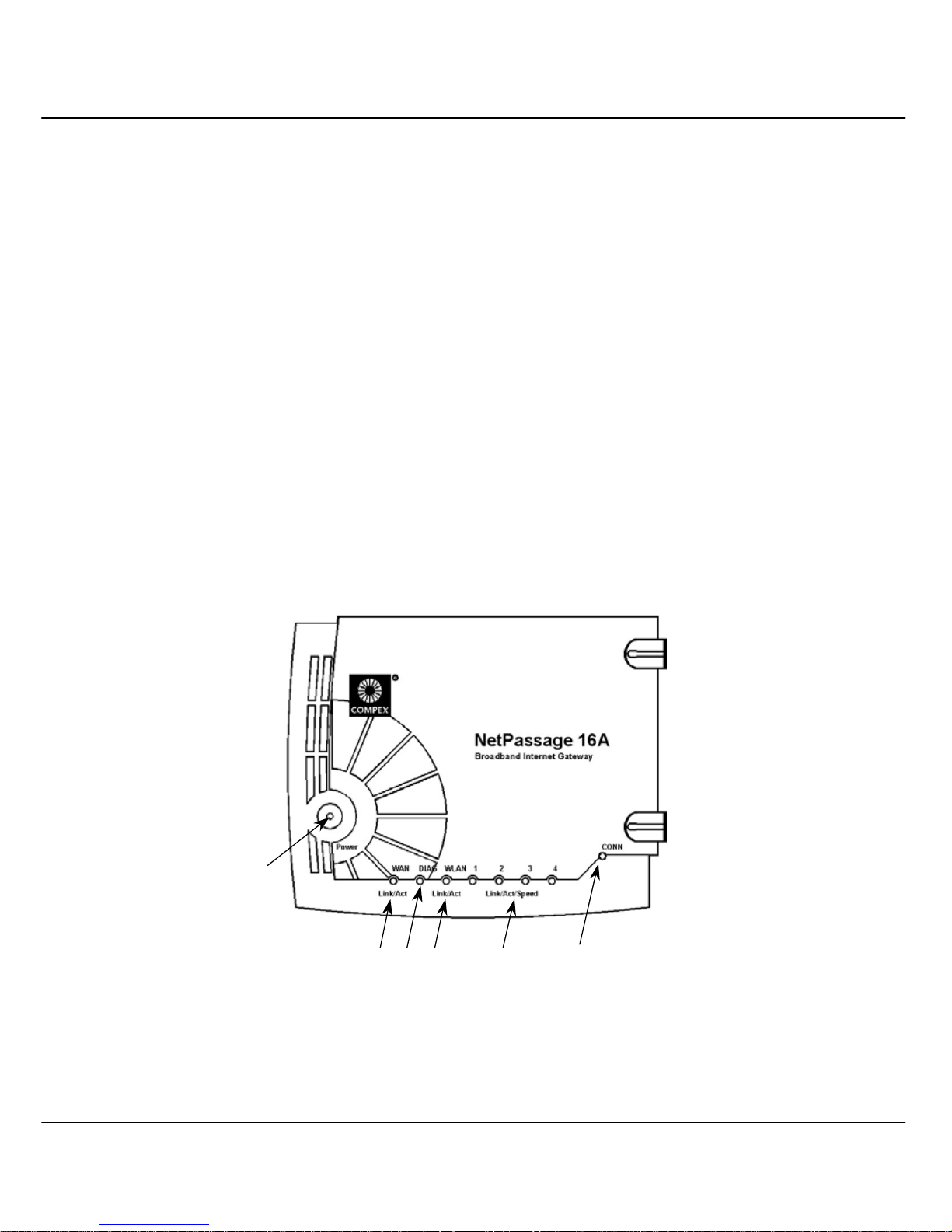
Figure 1.4a Front View of Compex NetPassage 16A
2 3 4 5 6
1
Page 14
Chapter 1 Product Overview
5
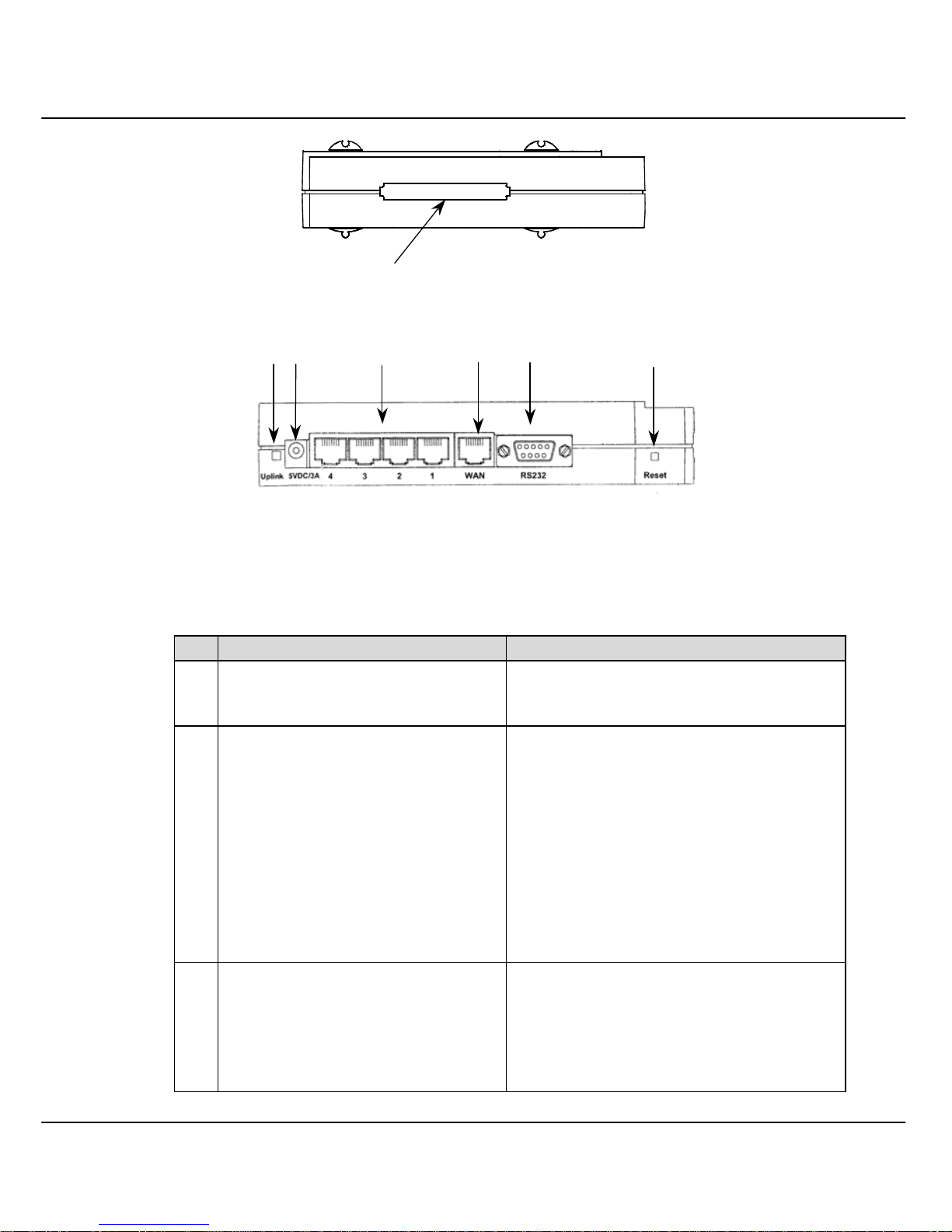
Figure 1.4b Side View of Compex NetPassage 16A
Figure 1.4c Back View of Compex NetPassage 16A
1.4.2 Panel Features
Indicator Description
1 Power (LED) Steady Green indicates that the power has
been turned on
2 WAN Link/Act (LED) Steady Amber indicates that the
connectivity is linked at 100Mbps
Flashing Amber indicates that 100Mbps
data transmission is detected at the
respective port
Steady Green indicates that the
connectivity is linked at 10Mbps
Flashing Green indicates that 10Mbps
data transmission is detected at the
respective port
3 DIAG (LED) Steady Green indicates potential problem
with router
7
8 9 10 11 12 13
Page 15

Chapter 1 Product Overview
6
Indicator Description
4 WLAN Link/Act (LED) Steady Green indicates that at least one
wireless client is present
Flashing Green indicates that activity is
detected in the wireless network
5 1, 2, 3, 4 Link/Act/Speed (LEDs) Four Link/Activity/Speed LEDs for the
integrated Fast Ethernet Switch.
Steady Amber indicates that the
connectivity is linked at 100Mbps
Flashing Amber indicates that 100Mbps
data transmission is detected at the
respective port
Steady Green indicates that the
connectivity is linked at 10Mbps
Flashing Green indicates that 10Mbps
data transmission is detected at the
respective port
6 CONN (LED)
Steady Green indicates that the WAN
connection is established
Flashing Green indicates that the WAN
connection is NOT established
Rapid Flashing Green indicates that the
firmware has been corrupted
If the WAN interface is configured with
Static IP, this LED will not light up
7 PCMCIA Slot PCMCIA slot for a Wireless LAN card to
be installed
8 UpLink (Push Button) Allows you to set Port 4 to become an
uplink port.
1)Push-in – normal
2)Push-out - uplink
9 5V DC/3A (DC Input) 5V, 3A DC power input
10 1, 2, 3, 4 (RJ45 Ports) Integrated 4-port 10/100Mbps Switch
11 WAN (RJ45 Ports) 10Base-T and 100Base-TX Port connects
to cable modem or xDSL modem.
Page 16

Chapter 1 Product Overview
7
12 RS232 (DB9 Serial Interface) RS232 Serial Interface for two functions:
Connecting to Compex NetPassage 16A
Command Console using RS232
crossover serial cable
Connected to an external V.90 56K
analog modem for 56K backup
connection
13 Reset (Push Button)
1) Push once and release
2) Push and hold 3-7 sec
3) Push and hold 7-12sec
4) Push and hold >12 sec
CONN LED Lights
1) Steady On indicates normal reboot
2) Blink fast (2 flash/sec) indicates
password reset to default
3) Blink slowly (1 flash/sec) indicates
configuration reset to factory default.
4) Steady On indicates normal reboot
1.5 Specifications
1.5.1 Compex NetPassage 16A Specifications
x
Industry Standards Complies with
IEEE 802.3 10Base-T, IEEE 802.3u
100Base-TX, IEEE 802.3x Flow
Control
CE Mark, FCC Class A, Gost, C-Tick, UL
x
WAN Interface One RJ45 Ethernet port (for external
Cable/ADSL modem)
One RS232 serial port (for external V.90
56K analog modem)
x
WAN Type Static IP
Dynamic IP
PPP Over Ethernet (PPPoE)
Remote Access Service
56K Analog Dial-Up
x
LAN Interface Integrated 4-port 10/100Mbps Switch
One Type II PCMCIA (for an 11Mbps
Wireless LAN Card)
x
IP Addressing All Classful/Classless Subnets
Page 17

Chapter 1 Product Overview
8
x
Built-In DHCP Server Yes
x
DHCP Reservation By MAC Address
x
NAT Firewall Yes
x
Load Balancing Parallel Broadband
x
Fail-Over Redundancy Parallel Broadband
x
Virtual Server Based on Port Forwarding & IP
Forwarding
x
Time-based Access Management Yes
x
IP Packet Filtering By TCP Port
By Source IP
x
IP Routing Static & Dynamic Entry
x
Routing Protocol RIP1 & RIP2
x
VPN Client Pass-Through PPTP
IPSec
L2TP
x
Microsoft NetMeeting Yes
x
Configuration Interface Web-based Configuration Interface
TELNET/RS232 Command Console
x
Remote Management HTTP & TELNET Session
x
Profile Backup & Restore Yes
x
Firmware Upgrade Yes
x
Environmental Requirement
Temperature
Humidity
Operating:
Storage:
Operating:
Storage:
0ºC to 40ºC
-20ºC to 70ºC
10% to 80% RH
5% to 90% RH
x
Physical Dimensions 180mm x 145mm x 33mm (L x W x H)
x
Weight
| 0.8Kg (including power adapter)
Page 18

Chapter 1 Product Overview
9
1.5.2 Wireless LAN Specifications
x
Industry Standards IEEE 802.11, IEEE 802.11b
x
Operating Frequency 2.4000 – 2.4835 (US & Canada)
2.4000 – 2.4970 (Europe)
2.4465 – 2.4835 (France)
x
Radio Technology Direct Sequence Spread Spectrum
x
Frequency Channels 11 Channels (US & Canada)
13 Channels (Europe)
4 Channels (France)
x
Data Rates 11Mbps, 5.5Mbps, 2Mbps, 1Mbps
x
Wireless LAN Architecture Infrastructure
x
Private Encryption 64/128-bit WEP
x
Wireless Pseudo VLAN Per Node & Per Group
x
Operating Mode Access Point Mode
Client Mode
Page 19
Chapter 2 Getting Started
10
Chapter 2 Getting Started
Compex NetPassage 16A may be used in different applications. It is integrated with an
embedded HTTP server providing a user-friendly web-based configuration interface to ensure
fast and easy configuration process for these applications. This chapter provides the information
on how to connect to the configuration interface, how to setup the hardware for configuration
and operation.
2.1 Hardware Setup
Compex NetPassage 16A may be installed in different applications. This section
summarizes the hardware setup for each application.
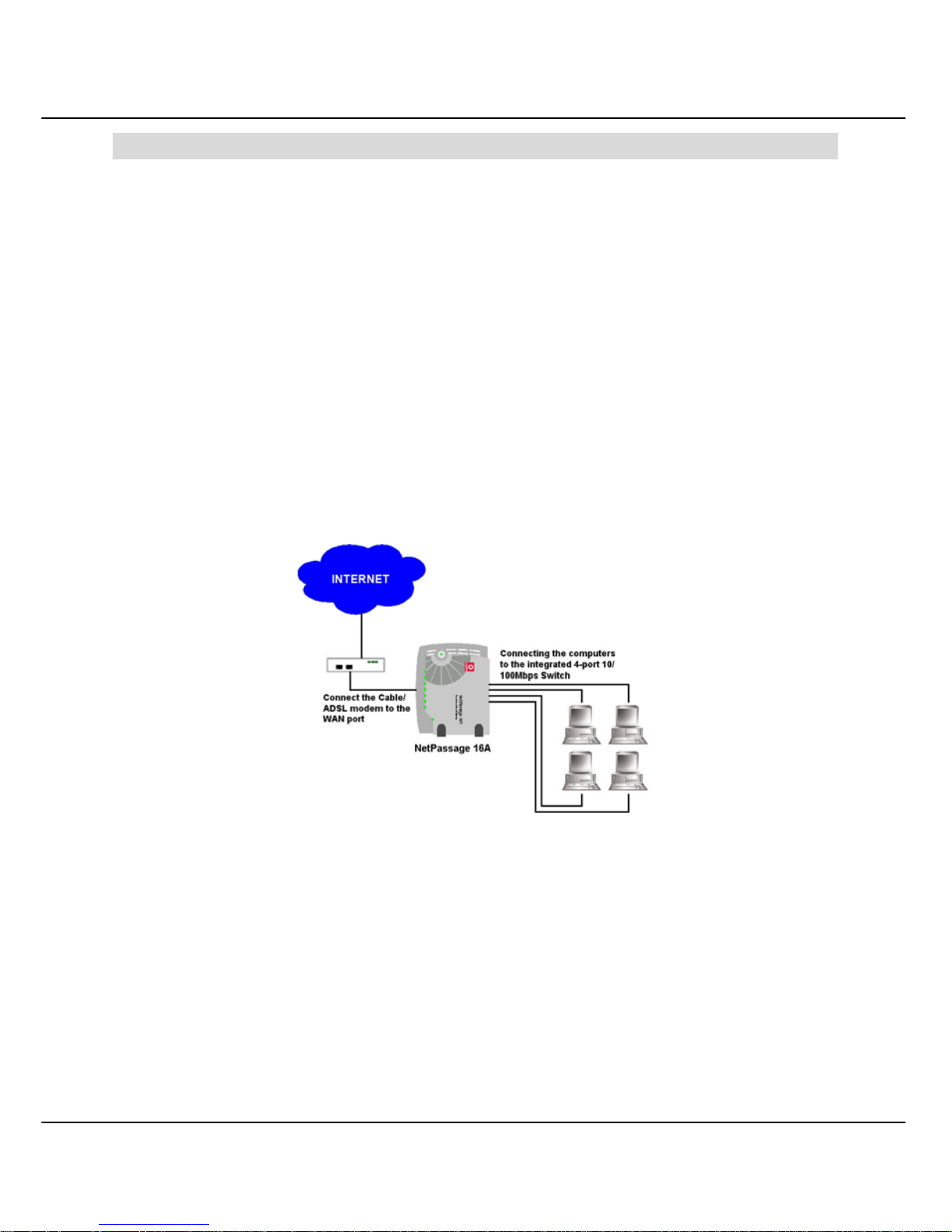
2.1.1 Distributing Broadband Internet Access to Fast Ethernet Network
Figure 2.1a Compex NetPassage 16A distributes broadband Internet access to
the Fast Ethernet segment
In this hardware setup, four computers are connected to the integrated 4-port
10/100Mbps Fast Ethernet Switch of Compex NetPassage 16A. These
computers are able to share a single broadband Internet account as well as
their resources. You may also cascade Compex NetPassage 16A to another
Hub or Switch to support more users. The Fast Ethernet ports of Compex
NetPassage 16A are designed with auto-crossover mechanism that can be
easily connected to another Hub or Switch regardless of the orientation of the
UTP cable (straight or crossover).
Page 20
Chapter 2 Getting Started
11
2.1.2 Distributing Broadband Internet Access to Fast Ethernet & Wireless
Network
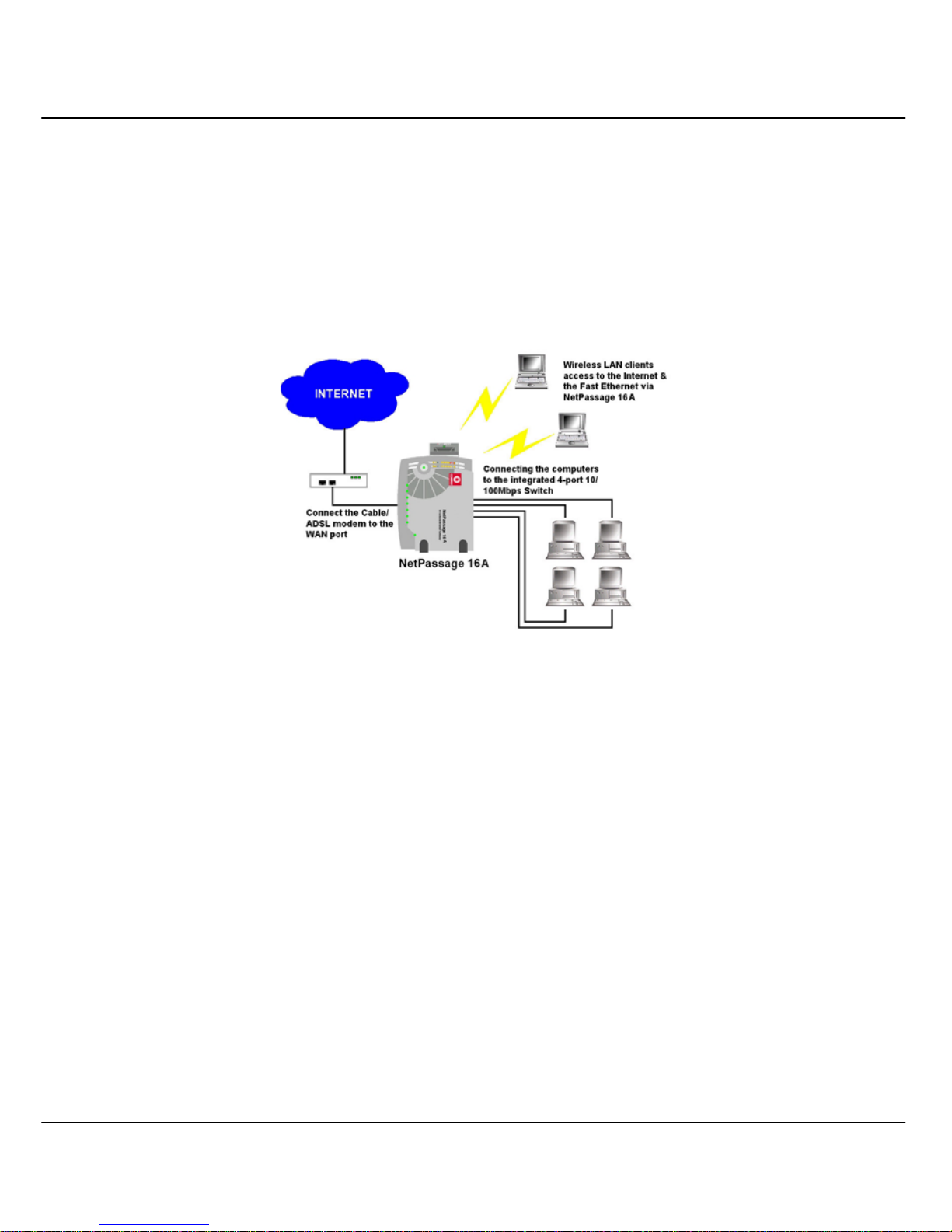
Compex NetPassage 16A may be installed with a PCMCIA Wireless LAN
card (iWavePort WL11A) to support broadband Internet sharing with wireless
LAN clients. To install the wireless LAN card into Compex NetPassage 16A,
you must first turn off the power supply of Compex NetPassage 16A, and
gently insert the wireless LAN card into the PCMCIA slot of Compex
NetPassage 16A.
Figure 2.1b Compex NetPassage 16A distributes broadband Internet access to
the Fast Ethernet and Wireless segment.
In this hardware setup, 4 computers are connected to the integrated 4-port
10/100Mbps Fast Ethernet Switch of Compex NetPassage 16A, whereas two
notebook computers are connected to Compex NetPassage 16A via the IEEE
802.11b Wireless LAN. All of these computers are able to share a single
broadband Internet account as well as sharing their resources.
Page 21
Chapter 2 Getting Started
12
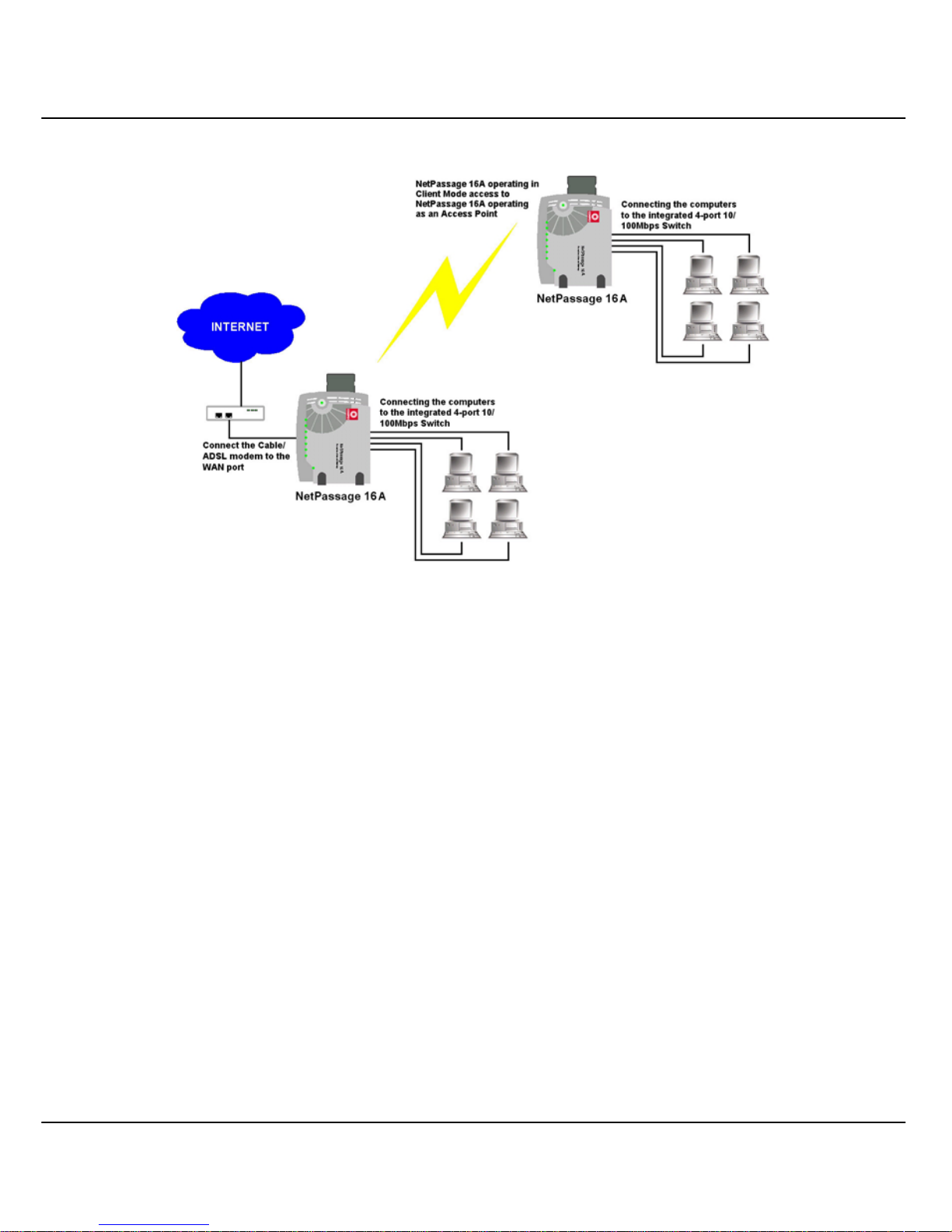
2.1.3 Wireless LAN-to-LAN Connection with Broadband Internet Access
Figure 2.1c Compex NetPassage 16A operating in Client Mode may access to
Compex NetPassage 16A operating as an Access Point.
If you have two Fast Ethernet segments that are environmentally not possible
to be connected by cable, you may configure two Compex NetPassage 16A in
different mode, one in Client Mode and one as an Access Point, as shown in
Figure 2.1c.
Page 22
Chapter 2 Getting Started
13
2.2 Using Universal Configuration (uConfig) Program to access to Internet
Compex NetPassage 16A supports Universal Configuration (uConfig) that enables you
to connect to the Web-based Configuration Interface in effortlessly. There is no need to
fiddle with the TCP/IP configuration of your computer. Compex NetPassage 16A comes
with a uConfig agent and a window-based utility UCONFIG.EXE.
To connect to Compex NetPassage 16A’s Web-based Configuration Interface via
Universal Configuration (uConfig):
Save the file UCONFIG.EXE from the Product CD into your preferred directory.
Launch the Universal Configuration by double-clicking the file UCONFIG.EXE.
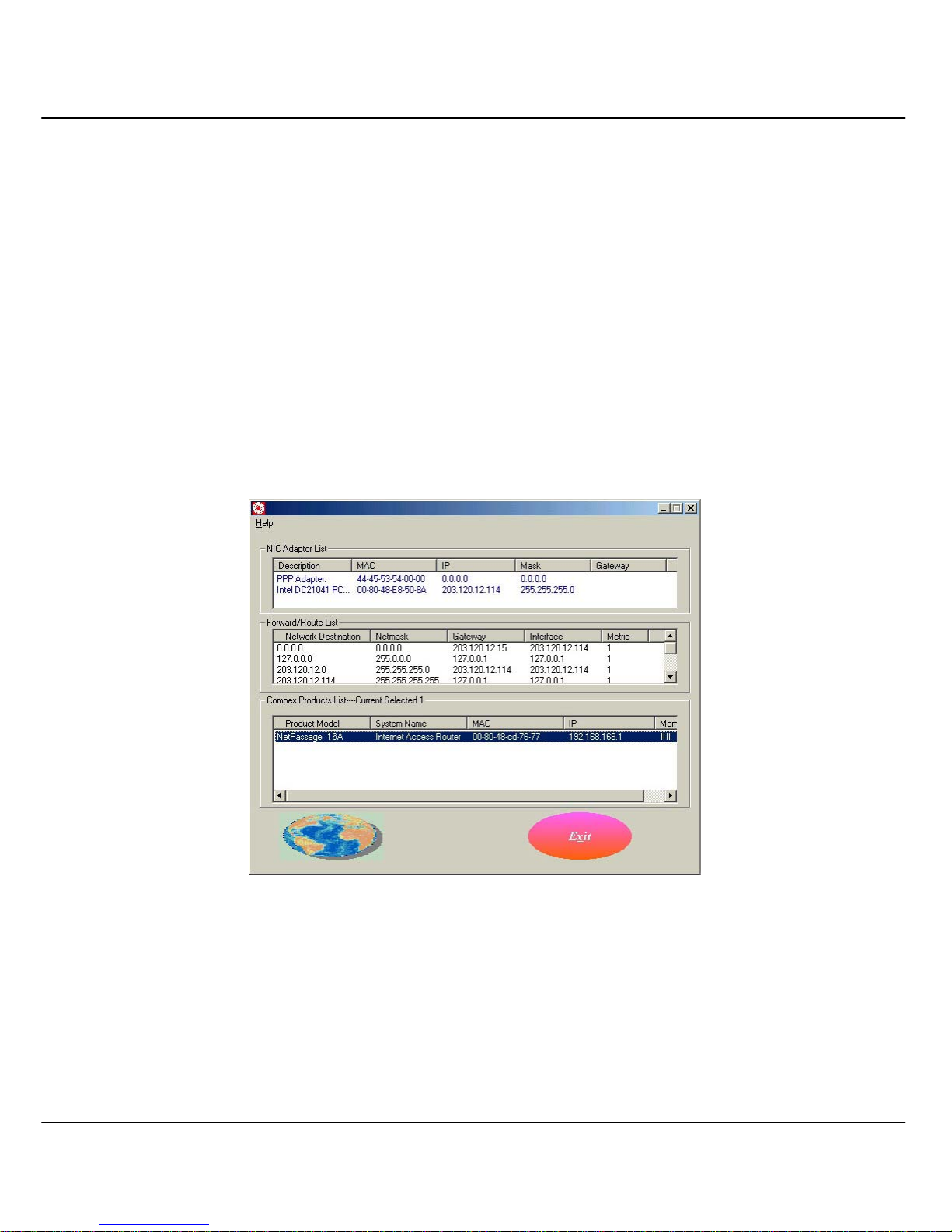
Universal Configuration will then display the information collected in the network, as
shown below.
Figure 2.2a Universal Configuration
Open
Web
Page 23

Chapter 2 Getting Started
14
Select Compex NetPassage 16A from Compex Product List window and press the
OpenWeb button. The login prompt shall appear.
Figure 2.2b Logon Page
Enter the password and press the Log On! button to login. The default password is
password.
After you have completed the configuration, click on the ExitUconfig from the
Command Menu. The Compex NetPassage 16A will then reboot.
Please proceed to Section 3.1 to read more about network configuration.
CAUTION
Click on the ExitUconfig from the Command Menu to exit from the
uConfig mode. If you do not exit the uConfig mode, the router may not
function correctly.
2.3 NPfind Utility Software
In the event that you have forgotten Compex NetPassage 16A IP Address, Npfind is a
utility program for Windows which can be used to find out the IP address of Compex’s
product. To check your IP Address of Compex NetPassage 16A,
1. Connect one end of the MDI straight cable to one of the LAN port of Compex
NetPassage 16A, and the other end to your PC.
2. Next, insert Product CD to your CD-ROM Drive.
3. Go to DRIVERS & UTILITIES section and click on Npfind Utility Software.
Page 24
Chapter 2 Getting Started
15
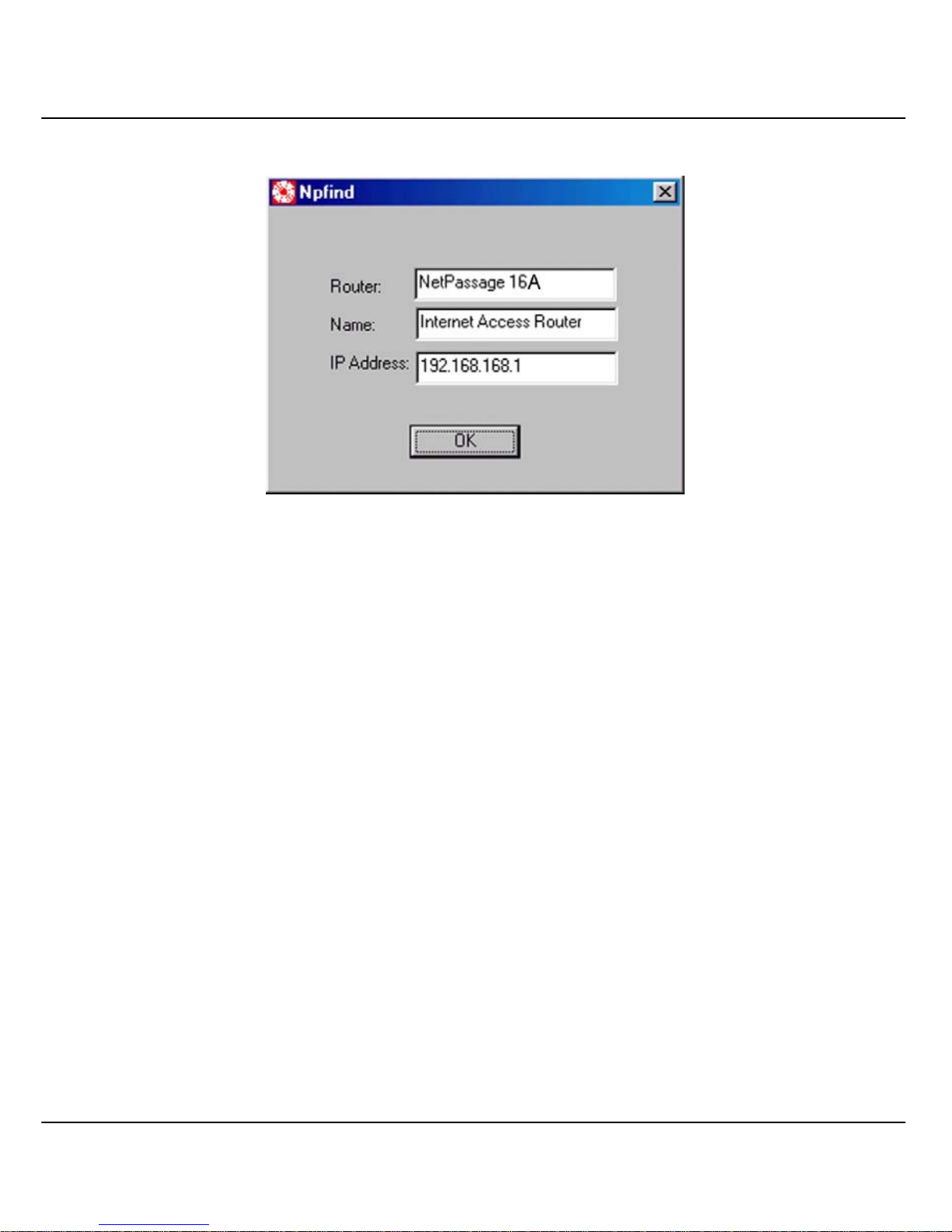
The program will automatically display the IP address of the device found.
Figure 2.3a Npfind discovered Compex Product
Contact your area of support for help if needed, or write to us at
support@compex.com.sg.
2.4 Alternative Approach to connect to the Configuration Interface
Compex NetPassage 16A is integrated with an embedded HTTP Server to provide a
user-friendly web-based configuration interface. Alternatively, you may also connect to
the Command Console of Compex NetPassage 16A via a TELNET session or a direct
serial connection.
This section assumes that the IP address of your Compex NetPassage 16A has not been
changed. It is still the default IP of 192.168.168.1.
This section also assumes that the TCP/IP settings of your computer have been
configured properly. To make sure that the TCP/IP of your computer has been
configured properly, perform the following command at the DOS prompt:
C:\WINDOWS\PING 192.168.168.1
If you receive replies from the above command, it indicates that your computer has been
properly configured with TCP/IP, else please proceed to Section 2.5 to set up your
TCP/IP for your computer.
Page 25
Chapter 2 Getting Started
16
2.4.1 Web-based Configuration Interface
To connect to the Web-based Configuration Interface of Compex NetPassage
16A, all you need is a web browser. The requirement of the web browser is
stated below:
Web Browser: Netscape Navigator 4.0 & above
or Internet Explorer 4.0 & above
JAVA: Enabled
Proxy Settings: Cleared
Proxy Auto Discovery: Disabled
Connecting to Web-based Configuration Interface
1. Launch the Internet Explorer or Netscape Navigator
2. Open the URL using the default IP of Compex NetPassage 16A. E.g. Type
in http://192.168.168.1 in the Address field of Internet Explorer.
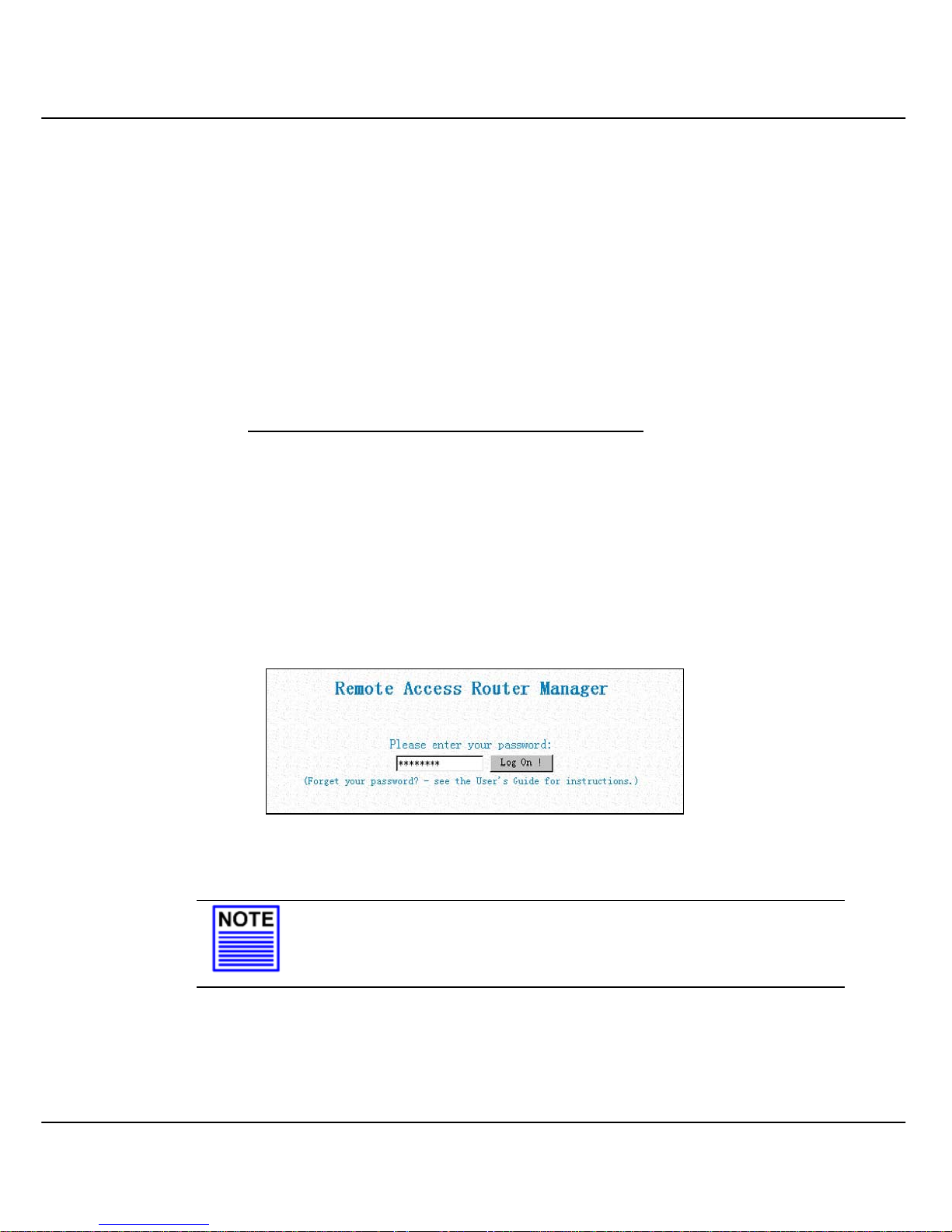
3. The logon page will then be displayed, as shown in Figure 2.4a. The
default password of Compex NetPassage 16A is “password” which is prefilled in the password text box. Press the Log On! button to log in to
Compex NetPassage 16A’s Configuration Interface.
Figure 2.4a Logon Page
NOTE
If the proxy settings of your web browser is not cleared, you will not
be able to connect to Compex NetPassage 16A’s web-based
configuration interface.
Page 26
Chapter 2 Getting Started
17
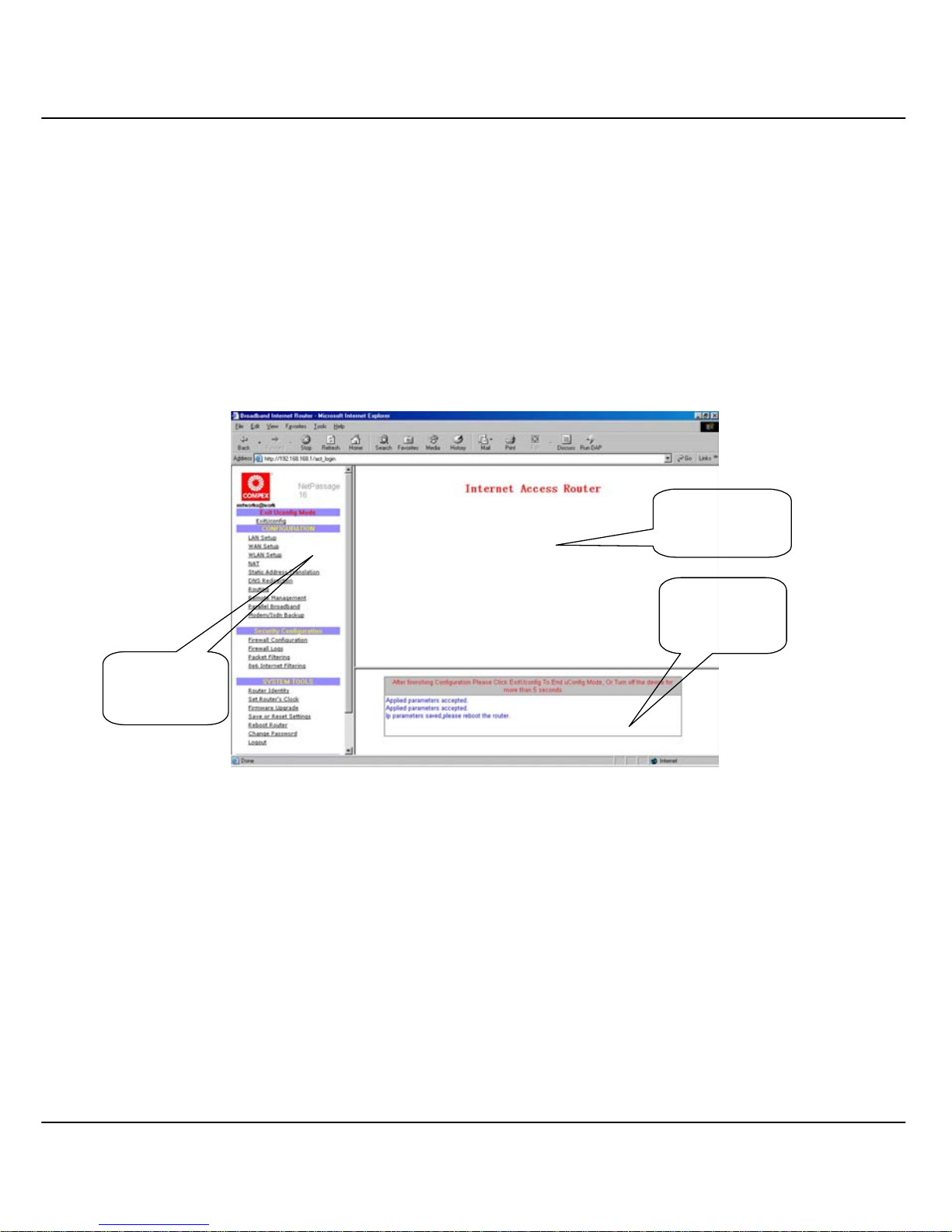
Once log on, you will see a web page consist of three frames, the Command
Menu, Configuration Window and Message Window, as shown below.
Command Menu
Enable the user to select feature to be configured
Configuration Window
Enable the user to configure the parameters associated with the selected
feature
Message Window
Display the message (if any) associated with the configuration process
Figure 2.4b Compex NetPassage 16A Configuration Interface
Configuration
Window
Message
Window
Command
Window
Page 27
Chapter 2 Getting Started
18
2.4.2 TELNET Command Console
Alternatively, the user may connect to the Command Console of Compex
NetPassage 16A via a TELNET session to the default IP of Compex
NetPassage 16A, 192.168.168.1. This section uses Microsoft TELNET
command for instruction. You may use any TELNET client.
Connecting to Compex NetPassage 16A’s Command Console via
TELNET
1. Connect to Compex NetPassage 16A’s Command Console with the
following command at DOS prompt. The TELNET application will then
be launched and connect to Compex NetPassage 16A.
C:\WINDOWS\TELNET 192.168.168.1
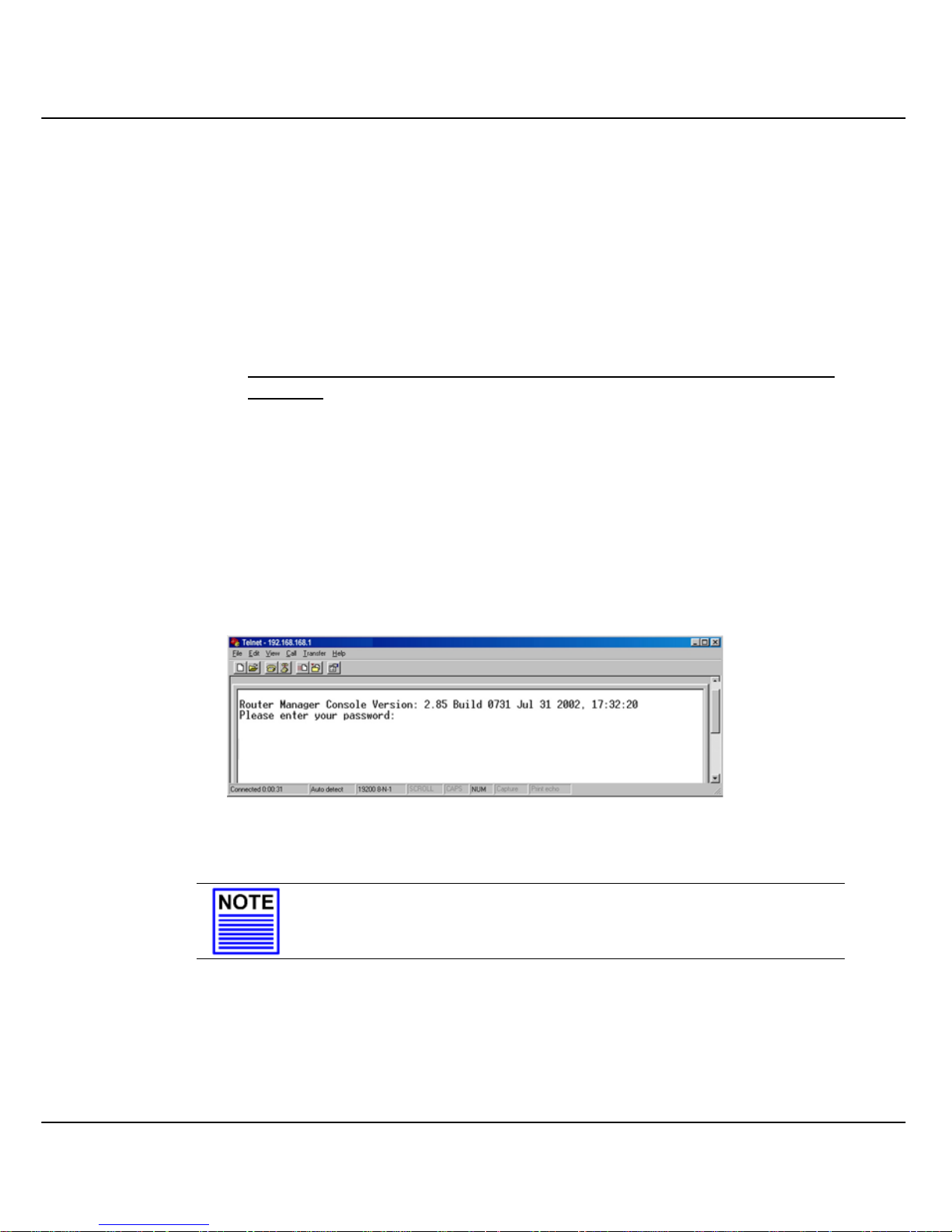
2. At the login prompt, type in “password” (default password) and press the
<ENTER> key, as shown in Figure 2.4c. You will then login to the
Command Console of Compex NetPassage 16A.
Figure 2.4c Command Console Login
NOTE
Please refer to Appendix A for the list of commands available at the
console.
Page 28
Chapter 2 Getting Started
19
2.4.3 RS232 Serial Command Console
Apart from TELNET session, you may also connect to Compex NetPassage
16A’s Command Console via direct serial connection using the RS232
crossover cable (also known as null modem cable). This section assumes that
Hyper Terminal has been installed properly.
Direct Serial Connection to Compex NetPassage 16A’s Command
Console
1. Connect the RS232 serial port of Compex NetPassage 16A to the serial
COM port of a computer using the RS232 crossover cable.
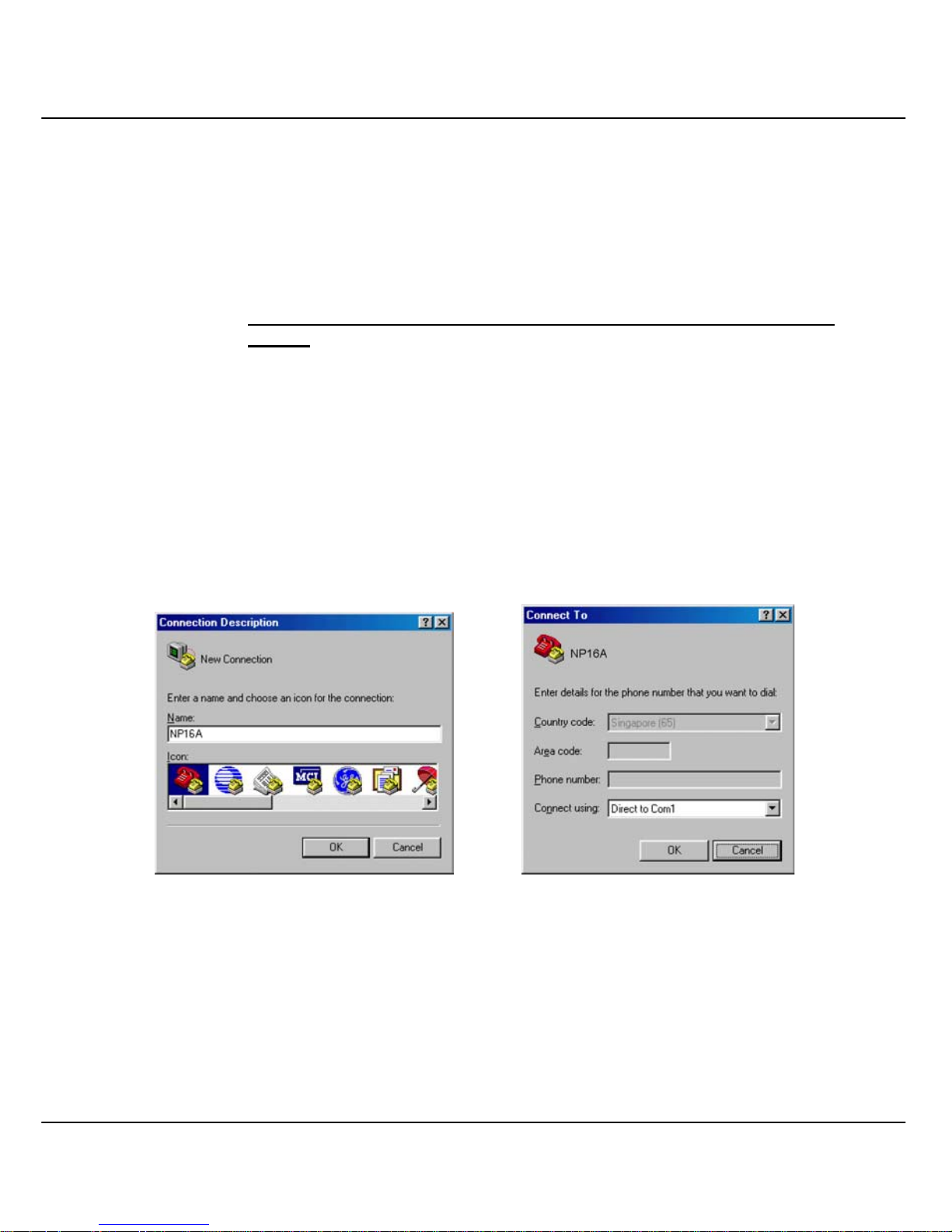
2. Power on Compex NetPassage 16A and launch the Hyper Terminal, as
shown in Figure 2.4d.
3. Select the connection type from the drop down menu. For example, if the
RS232 crossover cable is connected to the COM1 of your computer, select
Direct to Com 1, as shown in Figure 2.4e. Press the OK button to
proceed.
Figure 2.4d Launching Hyper Terminal Figure 2.4e Selecting Communication
Port
Page 29
Chapter 2 Getting Started
20
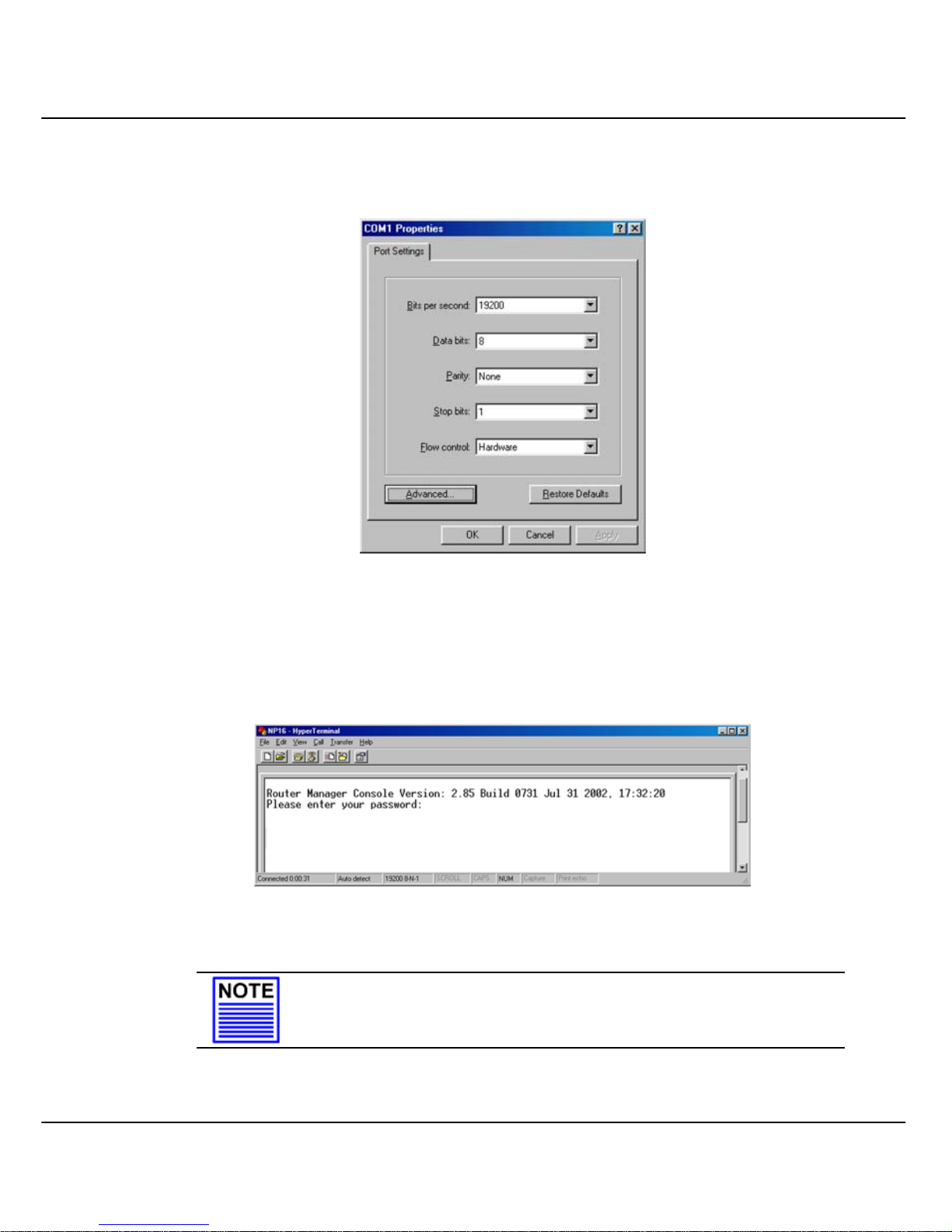
4. The Properties Window for the selected communication port will then be
displayed, as shown below. Configure the selected communication port
with the following settings and press the OK button to proceed.
Figure 2.4f Configuring Communication Port
5. Once the Properties Window is closed, hit the <ENTER> key once for the
login prompt to appear. Type in “password” (default password) and press
the <ENTER> key to login to the console.
Figure 2.4g Command Console Login
NOTE
Please refer to Appendix A for the list of commands available at the
console.
Page 30

Chapter 2 Getting Started
21
2.5 TCP/IP Configuration of the Computers
Compex NetPassage 16A is designed with a built-in DHCP server. You may manually
configure the TCP/IP settings of your computers, or simply configure them to
dynamically obtain IP address from the DHCP server. If you are not an expert user, you
are advised to configure your computers to dynamically obtain IP addresses from the
built-in DHCP server of Compex NetPassage 16A.
Before proceeding, please take note of the following default settings of Compex
NetPassage 16A:
IP (LAN): 192.168.168.1
Subnet Mask: 255.255.255.0
DHCP Server: Enabled
2.5.1 Configuring your Computer to Dynamically Obtain IP Address
To configure your computers to dynamically obtain IP address, gateway and
DNS information from Compex NetPassage 16A, perform the following
actions:
For Microsoft Windows 95/98/98SE/ME
Open the Control Panel from the Start menu
Double-click on the Network icon, the network configuration window shall
be displayed, as shown in Figure 2.5a.
Please ensure that the TCP/IP protocol is installed and bind to the
network adapter.
Double-click on the TCP/IP that is bound to your network adapter, the TCP/IP
configuration window shall be displayed, as shown in Figure 2.5b.
Press on the Obtain an IP address automatically radio button and press
the OK button.
Press the OK button again to close the network configuration window. The
Microsoft Windows will then prompt you to restart the computer. Press
the OK button to reboot.
Page 31

Chapter 2 Getting Started
22
Figure 2.5a Network Configuration
Window
Figure 2.5b TCP/IP Properties Window
When the Microsoft Windows restarts, Compex NetPassage 16A will assign
an IP address, Subnet Mask and Gateway information to the computer.
For Microsoft Windows 2000/XP:
Figure 2.5c Network Connection
1) Right click on the network icon on the task bar and click on status. Click on Properties
as in Figure 2.5c.
2) Highlight TCP/IP and click on Properties as in Figure 2.5d. Click on Obtain an IP
Address Automatically and click on OK as in Figure 2.5e.
Page 32

Chapter 2 Getting Started
23
Figure 2.5d Configuration Screen 1 Figure 2.5e Configuration Screen 2
2.5.2 Configuring your Computer with Static IP Address
If you have chosen to configure your computer with Static IP address, please
take note of the following default settings on Compex NetPassage 16A.
IP (LAN): 192.168.168.1
Netmask: 255.255.255.0
To log on to the Web-based Configuration Interface of Compex NetPassage
16A and to surf the Internet, you need to configure your computer with the
following network settings:
IP: 192.168.168.X
Subnet Mask: 255.255.255.0
Gateway: 192.168.168.1
DNS Server: <IP address of DNS server>
X is any integer from 2 to 254, and you cannot configure more than one
computer with the same IP address.
<IP address of DNS server> is the IP address of a DNS server. This
information is usually provided by your broadband Internet service provider.
NOTE
Compex NetPassage 16A is pre-configured with a subnet of 192.168.168.0. If you
wish to configure your network with another subnet, you may do so after logging on
to the configuration interface of Compex NetPassage 16A.
Page 33

Chapter 2 Getting Started
24
For Microsoft Windows 95/98/98SE/ME
*For Windows 2000/XP, follow the instructions in section 2.5.1 to get to the Network
Configuration page.
1. Open the Control Panel from the Start menu
2. Double-click on the Network icon, the network configuration window
shall be displayed, as shown in Figure 2.5a.
3. Double-click on the TCP/IP that is bound to your network adapter, the
TCP/IP configuration window shall be displayed, as shown in Figure 2.5f.
Type in the IP Address and Subnet Mask of 192.168.168.X and
255.255.255.0 respectively.
4. Select Gateway from the menu and the gateway configuration page shall
be displayed, as shown in Figure 2.5g.
Type in the New gateway as 192.168.168.1 and press the Add button.
Figure 2.5f Specify an IP Address Figure 2.5g Gateway Configuration
Window
Page 34

Chapter 2 Getting Started
25
5. Select DNS Configuration from the menu and the DNS configuration
page shall be displayed, as shown in Figure 2.5h.
Select the Enable DNS button. Type in a preferred name as the Host.
Type in the IP address of your DNS server in the DNS Server Search
Order field and press the Add button. Press the OK button to close this
window.
Figure 2.5h DNS Configuration Window Figure 2.5i Network Configuration Windows XP
NOTE
You must not configure more than one computer with the same host
name. This creates conflict in the network.
NOTE
The IP address of your DNS Server should be provided by your ISP.
If you are still not sure about it, please contact your ISP.
6. Press the OK button again to close the network configuration window.
The Microsoft Windows will then prompt you to restart the computer.
Press the OK button to reboot.
Page 35

Chapter 3 Configuring Compex NetPassage 16A
26
Chapter 3 Configuring Compex NetPassage 16A
This chapter explains the features of Compex NetPassage 16A in sections and how to
implement them.
3.1 Setting up your LAN
Compex NetPassage 16A is pre-configured with a default IP address 192.168.168.1
with a network mask of 255.255.255.0. By default, the DHCP Server has also been pre-
configured to assign IP addresses starting from 192.168.168.100 to 192.168.168.254. If
you do not wish to use these for your network, you may change these settings. You may
also wish to specify another IP address as a default gateway in the DHCP releases. If the
DHCP Gateway IP Address is set to 0.0.0.0, the DHCP server will automatically assigns
Compex NetPassage 16A as the default gateway.
3.1.1 Configuring IP Addressing
If you wish to modify the IP addressing of your Compex NetPassage 16A, you
may do so in the web-based configuration interface.
1. Log on to the web-based configuration interface of Compex NetPassage
16A with a web browser.
2. Click on the LAN Setup from the Command Menu and the LAN setup
window shall appear, as shown in Figure 3.1a.
Figure 3.1a LAN Setup
Page 36

Chapter 3 Configuring Compex NetPassage 16A
27
3. Fill in the parameters in the respective text boxes as shown on the
following page:
IP Address
This is the IP address of your Compex NetPassage
16A
Network Mask
This is the Network Mask of your Compex
NetPassage 16A’s IP address. It decides the subnet
of your Compex NetPassage 16A. For example, if
the IP address and network mask of your Compex
NetPassage 16A are 192.168.168.1 and
255.255.255.0 respectively, the subnet of your
Compex NetPassage 16A is 192.168.168.0.
DHCP Start IP
Address
This is the first IP address where the built-in DHCP
server of Compex NetPassage 16A assigns. It
should be in the same subnet as your Compex
NetPassage 16A. For example, if the IP address
and network mask of your Compex NetPassage
16A is 192.168.168.1 and 255.255.255.0
respectively, the DHCP Start IP Address should be
192.168.168.X, where X is (1-254)
DHCP End IP
Address
This is the last IP address where the built-in DHCP
server of Compex NetPassage 16A assigns. It
should be in the same subnet as your Compex
NetPassage 16A. For example, if the IP address
and network mask of your Compex NetPassage
16A is 192.168.168.1 and 255.255.255.0
respectively, the DHCP End IP Address should be
192.168.168.X, where X is (1-254)
DHCP Gateway
IP Address
The DHCP Server will automatically assigned a
Gateway IP Address the PC connected in the same
network.
Always use these
DNS servers
This checkbox is associated with the built-in
DHCP Server of Compex NetPassage 16A. If this
box is “checked”, the built-in DHCP Server will
configure the DNS information of the computers. If
this box is NOT “checked”, you need to manually
configure the DNS information in every computer
in the network.
Page 37

Chapter 3 Configuring Compex NetPassage 16A
28
Primary DNS IP
Address
If the Always use these DNS servers checkbox is
“checked”, fill in an IP address of a DNS server.
This information is normally provided by your ISP.
Secondary DNS
IP Address
This field contains the IP address of a secondary
DNS server (optional)
DHCP Server
Enable or disable the DHCP server. If you disable
the DHCP server, you need to manually configure
the TCP/IP of every computer in the network.
4. Press the Save button followed by Reboot button to complete the process.
3.1.2 Advanced Option for DHCP Server
You may configure the built-in DHCP Server of Compex NetPassage 16A to
release a specific IP address to a specific computer via the web-based
configuration interface. You may also view the IP releases online.
To reserve IP addresses for specific computers
1. Press the DHCP Server Reservations button from the LAN Setup
window shown in Figure 3.1a. The configuration window for DHCP
server reservation will be displayed.
Figure 3.1b DHCP Server Reservations
Page 38

Chapter 3 Configuring Compex NetPassage 16A
29
2. Specify the reserved IP Address, the Host Name or the Hardware
Address in the respective text boxes:
IP Address
This is the reserved IP address for a specific
computer
Host Name
This is the host name of the computer
Hardware Address
This is the hardware MAC address of the
Ethernet interface of the computer
NOTE
The reserved IP address must not be within the range of DHCP start
and end IP addresses.
3. Press the Add button to add this entry, and the Apply button to make it
effective.
To view the IP released by the DHCP Server
1. Press the Show Active Dhcp Leases button in the LAN Setup window
shown in Figure 3.1a. The list of released IP addresses will be displayed,
as shown in Figure 3.1c.
Figure 3.1c DHCP Server Reservations
NOTE
Invalid date and time shown under Expires column indicates that the
router’s clock of your Compex NetPassage 16A has not been set.
Refer to Section 3.14.2 on how to set the router’s clock.
Page 39

Chapter 3 Configuring Compex NetPassage 16A
30
3.2 Configuring Compex NetPassage 16A with your Broadband Internet
Account
Compex NetPassage 16A shares a single Cable or ADSL Internet account with multiple
computers in the network. It supports these broadband Internet connections with
different types of WAN protocol. This includes Dynamic IP, Static IP and PPP over
Ethernet (PPPoE). Compex NetPassage 16A has also been customized to support Big
Pond Cable Internet in Australia and Singtel Magix SuperSurf in Singapore. Successful
configuration of Compex NetPassage 16A to work with your broadband Internet
account requires you to identify the type of broadband Internet connection you have
subscribed. Refer to the following to select the correct WAN type for your broadband
Internet subscription.
If you have subscribed to Cable Internet of which your ISP dynamically assigns IP
address to you, please go to Section 3.2.1 titled Cable Internet with Dynamic IP
Assignment.
If you have subscribed to Cable Internet of which your ISP provides you with an IP or a
range of IP addresses, please go to Section 3.2.2 titled Cable Internet with Static
IP Assignment.
If you have subscribed to ADSL Internet that requires standard PPP over Ethernet
(PPPoE) for authentication, please go to Section 3.2.3 titled ADSL Internet using
PPPoE.
If you are a subscriber of Singtel Magix SuperSurf in Singapore, please go to Section
3.2.4 titled Singapore Singtel Magix SuperSurf.
If you are a subscriber of Big Pond Cable Internet in Australia, please go to Section
3.2.5 titled Australia Big Pond Cable Internet.
If you have subscribed to Point to Point Tunneling Protocol, please go to Section 3.2.6
titled Point to Point Tunneling Protocol.
You may find some important information concerning the broadband ISP in your
country in Appendix B of this User’s Manual.
Page 40

Chapter 3 Configuring Compex NetPassage 16A
31
3.2.1 Cable Internet with Dynamic IP Assignment
By default, Compex NetPassage 16A is pre-configured to support a WAN
type that dynamically obtain an IP address from the ISP. If you have
subscribed to Cable Internet of which your ISP dynamically assign an IP
address, you do not need to configure the WAN type.
However, there are exceptional cases where additional configuration is
required before an IP address is successfully obtained from the ISP:
Certain ISPs log the MAC address of the first device connected to the
broadband channel, and refuse to release an IP address unless the MAC
address matches the one in the log. If this is not a new Cable Internet
subscription and that the ISP refuses to release an IP address to you, you
may clone the “approved” MAC address to Compex NetPassage 16A.
Refer to the paragraph titled Cloning MAC Address to Compex
NetPassage 16A in this section.
Certain ISPs requires a DHCP Client ID to be authenticated before releasing
an IP address. To successfully obtain an IP address from such ISPs, you
need to configure Compex NetPassage 16A with a DHCP Client ID.
Compex NetPassage 16A uses Router Identity as the DHCP Client ID to
request for IP release. Refer to Section 3.14.1 titled Setting Router
Identity.
If your Compex NetPassage 16A has previously been configured with other
WAN type, you may re-configure it to support Cable Internet with Dynamic
IP Assignment.
1. Click on the WAN Setup from the Command Menu and the WAN
configuration page will be displayed, as shown in Figure 3.2a.
Figure 3.2a Changing WAN Type
Page 41

Chapter 3 Configuring Compex NetPassage 16A
32
NOTE
Figure 3.2a shows a WAN interface configured with static IP. If your
Compex NetPassage 16A has previously configured with PPPoE or
other WAN type, this page will show the respective configuration
page.
2. Press the Change button and the list of supported WAN type will be
displayed, as shown in Figure 3.2b.
Figure 3.2b WAN Type - Dynamic IP Address
3. Check the Dynamic IP Address radio button and press the Save button.
4. Press the Reboot button to restart Compex NetPassage 16A.
Page 42

Chapter 3 Configuring Compex NetPassage 16A
33
Cloning MAC Address to Compex NetPassage 16A
1. Click on the WAN Setup from the Command Menu and the WAN
configuration page will be displayed as shown.
Figure 3.2c Cloning MAC Address
2. Press the Clone Mac button to clone the MAC address of your managing
computer to Compex NetPassage 16A. The configuration interface will
then prompt you to reboot the router. Press the Reboot button to restart
your Compex NetPassage 16A.
Page 43

Chapter 3 Configuring Compex NetPassage 16A
34
3.2.2 Cable Internet with Static IP Assignment
Certain ISPs lease a static IP for their Internet subscriptions. For such Cable
Internet subscription, you need to configure the WAN interface of Compex
NetPassage 16A with static IP address.
1. Click on the WAN Setup from the Command Menu and the WAN
configuration page will be displayed.
Figure 3.2d Changing WAN Type
2. Press the Change button and the list of supported WAN type will be
displayed as shown.
Figure 3.2e WAN Type – Static IP Address
Page 44

Chapter 3 Configuring Compex NetPassage 16A
35
3. Check the Static IP Address radio button and press the Save button. The
following Static IP Configuration page will then be displayed.
Figure 3.2f Static IP Configuration Page
4. Enter the IP Address, the Network Mask and the ISP’s Gateway IP
Address into the fields. These information is provided by your ISP. Press
the Save button followed by the Reboot button to complete the
configuration process.
3.2.3 ADSL Internet using PPP over Ethernet (PPPoE)
If you have subscribed to ADSL Internet service using standard PPP over
Ethernet (PPPoE) for authentication, you need to configure your Compex
NetPassage 16A to support PPPoE.
1. Click on the WAN Setup from the Command Menu and the WAN
configuration page will be displayed, as shown in Figure 3.2a.
2. Press the Change button and the list of supported WAN type will be
displayed.
Figure 3.2g WAN Type – PPP over Ethernet
Page 45

Chapter 3 Configuring Compex NetPassage 16A
36
3. Check the PPP over Ethernet radio button and press the Save button. The
PPPoE Configuration page will then be displayed.
Figure 3.2h PPPoE Configuration Page
4. Fill in the parameters for your ADSL Internet service:
Username
Enter the username of your ADSL Internet
subscription in this field
Password
Enter the password of the username
Service Name
Enter the service name of your ADSL Internet
subscription (optional)
On-Demand
When this box is “checked”, your Compex
NetPassage 16A will automatically connect to the
ISP when an Internet request is present in the
network.
Idle Timeout
This field is associated with On-Demand option.
This field allows you to specify the idling timeout
value for Compex NetPassage 16A to disconnect
from the ISP. “0” value in this field disables idling
timeout function. When set to “0”, Compex
NetPassage 16A remains connected unless
Page 46

Chapter 3 Configuring Compex NetPassage 16A
37
disconnected by the ISP. Once disconnected,
Compex NetPassage 16A will stay offline until the
next Internet request is detected in the network.
Always-On
When this box is “checked”, your Compex
NetPassage 16A will always connect to the ISP,
with and without Internet requests.
Reconnect Time
Factor
This field is associated with Always-On option.
This field allows you to specify a Reconnect Time
Factor (RTF). The default value is 30 seconds. If
Always-On option is selected with an RTF of 30
seconds, your Compex NetPassage 16A will stay
connected to the ISP even when there is no Internet
traffic present. If disconnected by the ISP, Compex
NetPassage 16A will perform a delay for a random
period between 1 to RTF seconds (for RTF value
of 30, the random period is drawn between 1 to 30
seconds), and reconnect to the ISP.
Use nonstandard PPPOE
Ethernet type
Certain Ethernet-based ADSL modem requires
non-standard PPP over Ethernet for authentication.
If you are uncertain about this, DO NOT “check”
this box.
5. Press the Save button followed by the Reboot button to complete the
configuration process.
Page 47

Chapter 3 Configuring Compex NetPassage 16A
38
3.2.4 Singapore SingTel Magix SuperSurf
You should use this WAN type only if you are a subscriber of SingTel Magix
SuperSurf in Singapore. If you have subscribed to SingNet Broadband or
Pacific Internet Broadband, please go to Section 3.2.3 titled ADSL Internet
using PPP over Ethernet (PPPoE).
1. Click on the WAN Setup from the Command Menu and the WAN
configuration page will be displayed, as shown in Figure 3.2a.
2. Press the Change button and the list of supported WAN type will be
displayed.
Figure 3.2i WAN Type – Singapore ADSL
3. Check the Singapore ADSL (Ethernet 512K) radio button and press the
Save button. The configuration page for SingTel Magix SuperSurf will be
displayed as shown below.
Figure 3.2j SingTel Magix SuperSurf Configuration Page
Page 48

Chapter 3 Configuring Compex NetPassage 16A
39
4. Enter the Username, Password and Idling Timeout value to the fields
and press the Save button.
5. Press the Reboot button to complete the configuration process.
3.2.5 Australia Big Pond Cable Internet
You should select this WAN type only if you are a subscriber of Big Pond
Cable Internet in Australia. If you have subscribed to OPTUS in Australia,
please go to Section 3.2.1 titled Cable Internet with Dynamic IP
Assignment. Please take note that OPTUS requires a DHCP Client ID before
releasing an IP address to you.
1. Click on the WAN Setup from the Command Menu and the WAN
configuration page will be displayed, as shown in Figure 3.2a.
2. Press the Change button and the list of supported WAN type will be
displayed as shown below.
Figure 3.2k WAN Type – Australia BPA Cable
Page 49

Chapter 3 Configuring Compex NetPassage 16A
40
3. Check the Australia BPA Cable radio button and press the Save button.
The configuration page for Big Pond Australia will be displayed.
Figure 3.2l Big Pond Australia Configuration Page
4. Enter the Username, Password and Idling Timeout to the fields and
press the Save button.
5. Press the Reboot button to complete the configuration process.
Page 50

Chapter 3 Configuring Compex NetPassage 16A
41
3.2.6 Point to Point Tunneling Protocol (PPTP)
PPTP enables implementation of secure, multi-protocol Virtual Private
Networks (VPNs) through public data networks, such as Internet or PPTP.
1. Click on the WAN Setup from the Command Menu and the WAN
configuration page will be displayed, as shown in Figure 3.2a.
2. Press the Change button and the list of supported WAN type will be
displayed as shown below.
Figure 3.2m WAN Type – PPTP
Page 51

Chapter 3 Configuring Compex NetPassage 16A
42
3. Check the PPTP radio button and press the Save button. The
configuration page for PPTP will be displayed.
Figure 3.2n Configuration on PPTP
4. Fill in the parameters for your PPTP service:
Connect IP
Key in the IP Address of your Service Provider.
Username
Enter the username of your PPTP subscription.
Password
Enter the password of the username.
VPN Server
Enter the IP Address for VPN server.
Idle Timeout
This field allows you to specify the idling timeout
value for Compex NetPassage 16A to disconnect
from the ISP. “0” value in this field disables idling
timeout function. When set to “0”, Compex
NetPassage 16A remains connected unless
disconnected by the ISP. Once disconnected,
Compex NetPassage 16A will stay offline until the
next Internet request is detected in the network.
Page 52

Chapter 3 Configuring Compex NetPassage 16A
43
5. Press the Save button followed by the Reboot button to complete the
configuration process.
6. Enter all necessary information in the individual fields and press the Save
button.
7. Press the Reboot button to complete the configuration process.
3.3 Network Address Translator (NAT)
Compex NetPassage 16A has been designed with a Network Address Translator (NAT)
that supports Port Address Translation (PAT), sharing a single public IP address with
multiple computers in the private network by using different TCP ports for different
computers. By default, the NAT is enabled.
CAUTION
Disabling the NAT will cause your computers not being able to share the
broadband Internet service. DO NOT disable the NAT unless you are
certain on what you are doing.
Due to the translation, the computers behind the NAT are not reachable from the
Internet. However, with the support of Virtual Server, you may host the Internet servers
behind the NAT based on Port Forwarding or IP Forwarding.
Page 53

Chapter 3 Configuring Compex NetPassage 16A
44
3.3.1 Introduction to Virtual Servers
Compex NetPassage 16A supports two types of Virtual Server, one based on
Port Forwarding and the other based on IP Forwarding, where IP Forwarding
option is only available when the WAN interface of Compex NetPassage 16A
has been configured with a static IP.
Virtual Server based on Port Forwarding
When Virtual Server based on Port Forwarding is implemented, Internet
requests to the IP address of Compex NetPassage 16A’s WAN interface will
be forwarded to a specific computer in the private network based on the TCP
port of the Internet request. Refer to Figure 3.3a.
Figure 3.3a Virtual Server based on Port Forwarding
Figure 3.3a shows two Virtual Servers implemented, HTTP Virtual Server and
FTP Virtual Server. To implement the Virtual Server, you need to know the
TCP port that the intended application is using.
For example, suppose that your ISP has assigned an IP address of
203.120.12.10 to your Compex NetPassage 16A, and you wish to host a web
server in your private network on a computer with an IP address of
192.168.168.10; you need to define a Virtual Server at TCP Port 80 (used by
HTTP by default) to be forwarded to 192.168.168.10. Once implemented, all
“http://203.120.12.10” requests will be forwarded to the computer with
192.168.168.10 IP address. If you wish to host another FTP server in your
private network on a computer with an IP address of 192.168.168.20; you will
then need to define a Virtual Server at TCP Port 21 (used by FTP by default)
to be forwarded to 192.168.168.20.
Page 54

Chapter 3 Configuring Compex NetPassage 16A
45
Virtual Server based on IP Forwarding
If you have subscribed to a range of IP addresses from your ISP, you may also
define Virtual Servers based on IP Forwarding. This type of Virtual Server
forwards all Internet requests, regardless of the TCP port of the application, to
a computer in the private network. Refer to Figure 3.3b.
Figure 3.3b Virtual Server based on IP Forwarding
Figure 3.3b shows two Virtual Servers based on IP Forwarding. One maps the
public IP 203.120.12.11 to private IP 192.168.168.10, and the other maps the
public IP 203.120.12.12 to private IP 192.168.168.20.
3.3.2 Defining Virtual Server based on De-Militarized Zone (DMZ)
Due to the nature of Network Address Translator (NAT), the subnet behind
the NAT cannot be reached from the Internet. If you know the TCP/UDP port
of an application, such as HTTP, you can easily define a Virtual Server based
on Port Forwarding behind the NAT to support a Web Server in your private
subnet. However, if you are uncertain on the TCP/UDP port used by an
application (certain Internet games), or an application utilizes varying
TCP/UDP port, you may define a DMZ host of which Compex NetPassage
16A will direct all the unresolved Internet requests to.
For example, if the WAN interface of Compex NetPassage 16A has been
assigned an IP address of 203.120.12.20 and you have defined a DMZ host
with IP address of 192.168.168.10, all the unresolved Internet requests to
203.120.12.20 will be forwarded to 192.168.168.10, regardless of the
TCP/UDP port.
Page 55

Chapter 3 Configuring Compex NetPassage 16A
46
To define a DMZ host
1. Click on the NAT from the Command Menu and the NAT configuration
page will be displayed as shown below.
Figure 3.3c NAT Configuration Page
2. Press the DMZ button and the following DMZ Host Definition Window
will be displayed.
Figure 3.3d Configuring DMZ
3. Enter the IP address of the your designated computer and press the Apply
button.
4. Save the configuration profile.
NOTE
To disable DMZ, please enter the IP address as 0.0.0.0.
Page 56

Chapter 3 Configuring Compex NetPassage 16A
47
3.3.3 Defining Virtual Server based on Port Forwarding
To define Virtual Server based on Port Forwarding:
1. Click on the NAT from the Command Menu and the NAT configuration
page will be displayed, as shown in Figure 3.3c.
2. Press the Port Forwarding button and the list of defined Virtual Server
will be displayed, as shown in Figure 3.3e.
Figure 3.3e Table Showing Defined Virtual Server based on Port Forwarding
3. Press the Add button to define new Virtual Server as shown below.
Figure 3.3f Defining New Virtual Server based on Port Forwarding
4. For Known Server, select the Server Type from the drop down menu and
specify the private IP address of your Virtual Server.
5. For Custom Server, specify the IP address of the Virtual Server, select
the Protocol used by this application from the drop down menu, specify
the TCP/UDP port used by this application, and enter your preferred
reference name in the Server Type field.
6. Press the Add button to add this new Virtual Server into the list.
Page 57

Chapter 3 Configuring Compex NetPassage 16A
48
7. Press the Save or Reset Settings from the Command Menu and press the
Save button.
3.3.4 Defining Virtual Server based on IP Forwarding
If you have configured your Compex NetPassage 16A with Static IP WAN
type, you have the option to define Virtual Server based on IP Forwarding.
1. Click on the NAT from the Command Menu and the NAT configuration
page will be displayed as shown below.
Figure 3.3g NAT Configuration Window for Static IP WAN Type
2. Press the Static Ip Address Entries button and the list of defined Virtual
Server will be displayed, as shown in Figure 3.3h.
Figure 3.3h Table Showing Defined Virtual Server based on IP Forwarding
3. Press the Add button to define new Virtual Server as shown.
Page 58

Chapter 3 Configuring Compex NetPassage 16A
49
Figure 3.3i Defining New Virtual Server based on IP Forwarding
4. Enter the Public IP Address and the Private IP Address which it maps
to. Please ensure that you have subscribed to this Public IP Address.
5. Press the Add button to add this new Virtual Server into the list.
6. Click on the Save or Reset Settings from the Command Menu and press
the Save button.
Page 59

Chapter 3 Configuring Compex NetPassage 16A
50
3.4 Static Address Translation (SAT)
If you are a notebook user, it is probably very often that you connect to the Internet at
your home to retrieve emails or surf the Internet. Static Address Translation function
that allows your notebook computer to connect to the Internet even if it is NOT
configured with the same subnet as Compex NetPassage 16A’s.
For example, if Compex NetPassage 16A is configured with a Class C IP of
192.168.168.1 and your notebook is configured with Class C IP of 203.120.12.47, you
may access to the broadband Internet via Compex NetPassage 16A without the need of
reconfiguring the TCP/IP of your notebook. By default, this feature is disabled.
NOTE
If you are unsure whether to activate the SAT functionality, please disable
this function.
We at Compex always provide updated firmware on our website at
www.compex.com.sg. Constantly check to see if you have the updated
firmware.
3.4.1 Enable/disable Static Address Translation
1. Click on Static Address Translation option from the Command Menu
and the following window shall be displayed.
Figure 3.4a Static Address Translation
2. Press the Enable or Disable radio button to enable/disable this feature.
3. Press the Apply button for the changes to be affective.
4. Save the configuration.
Page 60

Chapter 3 Configuring Compex NetPassage 16A
51
3.5 DNS Redirection
Compex NetPassage 16A enables you to access to the internet without knowing the IP
Address of DNS server. You can simply key in any legal IP Address in the field of the
TCP/IP Properties window such as 10.10.10.10. Please refer to the figures shown
below:
Figure 3.5a TCP/IP for Window 95/98 Figure 3.5b TCP/IP for Window 2000
Click on the Enabled radio button followed by Apply button as shown below.
Figure 3.5c DNS Redirection
Now, you can easily surf the net without worries.
Page 61

Chapter 3 Configuring Compex NetPassage 16A
52
NOTE
If you set the IP Address of your PC to dynamic, enabling the DNS
Redirection function will not be activated.
CAUTION
You should not leave the DNS Server field in the TCP/IP Properties
window blankly or the router will not be able to assign an IP Address to
your PC. And this leads to inaccessible to the internet.
3.6 Configuring Routing Protocol
Compex NetPassage 16A allows the network administrator to add a static routing entry
into the routing table. Other than the default gateway to the Internet, Compex
NetPassage 16A may reroute the IP packets to another network. This is very useful for a
network with more than one router.
CAUTION
If you are configuring Compex NetPassage 16A for broadband Internet
sharing, you DO NOT need to configure any routing information. The
default routing settings of Compex NetPassage 16A are sufficient for
broadband Internet sharing. Improper routing configuration will cause
undesired effect.
For example, if you have two routers in the network, where one functions as an Internet
gateway and the other as a gateway to a remote office. You may define a static route in
Compex NetPassage 16A to re-route the packets to the remote office. Refer to Figure
3.6a.
Figure 3.6a Network with multiple gateways. One to the Internet and the other to the
remote office.
Page 62

Chapter 3 Configuring Compex NetPassage 16A
53
In this network, the main office of subnet 192.168.168.0 contains two routers, one
connected to the broadband Internet via Compex NetPassage 16A (IP 192.168.168.1)
and the other connected to a remote office via NetPassage 11A (IP 192.168.168.254).
The remote location resides on subnet 192.168.100.0. You may add a static routing
entry into Compex NetPassage 16A’s routing table to point the gateway
192.168.168.254 to subnet 192.168.100.0. Once added, packets with destination IP
address of 192.168.100.X will be re-routed to NetPassage 11A (IP 192.168.168.254).
Alternatively, you may also activate dynamic routing protocol on Compex NetPassage
16A. Compex NetPassage 16A supports two types of routing protocol, RIP1 and RIP2.
3.6.1 Static Routing
To add a static routing entry into Compex NetPassage 16A’s routing table:
1. Click on the Routing from the Command Menu, and the routing
configuration page will be displayed, as shown in Figure 3.6b.
Figure 3.6b Routing Configuration Page
Page 63

Chapter 3 Configuring Compex NetPassage 16A
54
2. To define a new static routing entry into the routing table, press the Add
button. The following page will be displayed, as shown in Figure 3.6c.
Figure 3.6c Adding New Static Routing Entry into the Routing Table
3. Enter the destination network address into the Destination IP Address
field and the IP address of the gateway connected to this network into the
Gateway IP Address field. For example if a gateway of IP
192.168.168.254 is connected to a remote network 192.168.100.0, enter
the Destination IP Address and Gateway IP Address as 192.168.100.0
and 192.168.168.254 respectively.
4. Press the Apply button to add the new static routing entry into Compex
NetPassage 16A’s routing table.
3.6.2 Dynamic Routing
To enable dynamic routing protocol:
1. Click to expand the Dynamic Routing drop down menu and select the
preferred dynamic routing protocol, RIP1 or RIP2. (Figure 3.6b)
2. Press the Apply button for the changes to be effective.
Page 64

Chapter 3 Configuring Compex NetPassage 16A
55
3.7 Managing Compex NetPassage 16A from the Internet
Compex NetPassage 16A is integrated with an HTTP Server, enabling router
management from the private network with just a JAVA-enabled web browser. It may
also be managed via a Command Console. In addition, Compex NetPassage 16A
supports Remote Router Management, allowing the network administrators to manage
the router from the Internet, either by a web browser or via a TELNET session.
3.7.1 Activating Remote Router Management
To activate Remote Router Management from the Internet:
1. Click on the Remote Management from the Command Menu and the
remote management activation page will be displayed, as shown below.
Figure 3.7a Activating Remote Router Management
2. Enter the desired TCP port that you wish to use for Remote Router
Management. Default value of “0” disables this feature.
HTTP Port
Specify the desired port for remote router management
via a web browser. If you have specified a nonstandard TCP port for this field, you need to specify
the port number when you connect to the management
interface from the Internet.
For example, if your ISP has assigned 203.120.12.30 to
Compex NetPassage 16A’s WAN interface and you
have chosen to use port 2000 for HTTP remote
management, you may connect to the router
management interface by using
http://203.120.12.30:2000
.
Page 65

Chapter 3 Configuring Compex NetPassage 16A
56
TELNET
Port
Specify the desired port for remote router management
via a TELNET session (Command Console). If you
have specified a non-standard TCP port for this field,
you need to specify the port number when you connect
to the command console from the Internet.
For example, if your ISP has assigned 203.120.12.30 to
Compex NetPassage 16A’s WAN interface and you
have chosen to use port 5000 for TELNET remote
console management, you may connect to the router
command console by TELNET to port 5000 of
203.120.12.30
3. Press the Save button followed by the Reboot button to complete the
process.
3.8 Load Balancing & Fail-Over Redundancy with Parallel Broadband
Designed with the unique Parallel Broadband technology, Compex NetPassage 16A
provides scalable Internet bandwidth with Load Balancing and Fail-Over Redundancy.
If multiple units of Compex NetPassage 16A are installed in the network, the Internet
traffic will be balanced across multiple broadband channels, delivering virtually a
combined aggregated bandwidth while functioning as Fail-Over Redundancy.
Figure 3.8a Parallel Broadband with Multiple Broadband Channels
NetPassage 16A
Page 66

Chapter 3 Configuring Compex NetPassage 16A
57
3.8.1 Implementing Parallel Broadband
To implement Parallel Broadband, you need to install two or more units of
Compex NetPassage 16A in the network, each connected to its broadband
Internet service account. There is no restriction on the type of broadband
Internet accounts that they are connected to. For example, if you have two
Compex NetPassage 16As in the network, you may have one connected to
Cable Internet whereas the other connected to ADSL line. Once the Parallel
Broadband is implemented, these two Compex NetPassage 16As will balance
the Internet traffic among them while functioning as Fail-Over Redundancy to
each other.
To activate Parallel Broadband
1. Click on the Parallel Broadband from the Command Menu and the
Parallel Broadband activation page will be displayed as shown.
Figure 3.8b Activating Parallel Broadband
2. Check the Enable radio button and press the Apply button.
NOTE
You DO NOT need to implement Parallel Broadband for Internet sharing
using one unit of Compex NetPassage 16A.
Page 67

Chapter 3 Configuring Compex NetPassage 16A
58
3.9 56K analog Dial-Up/ISDN Modem as Backup Link
An external V.90 56K analog/ISDN modem (selective) may be connected to the RS232
serial port of Compex NetPassage 16A, utilizing a 56K or ISDN modem dial-up Internet
account as the backup link to the Internet. In case of down time of your broadband ISP,
Compex NetPassage 16A will automatically establish a backup Internet connection via
the 56K or ISDN modem dial-up access.
3.9.1 Setting Up 56K Dial-Up Access/ISDN Modem as Backup Link
To setup an external V.90 56K analog/ISDN modem as the backup link to the
Internet,
1. Connect an external V.90 56K analog/ISDN modem to your Compex
NetPassage 16A and connect the telephone wire into it.
2. Click on Modem Backup from the Command Menu and the V.90/ISDN
modem Backup configuration page will be displayed.
Figure 3.9a Configuring 56K Analog/ISDN Modem Back-Up Connection
Page 68

Chapter 3 Configuring Compex NetPassage 16A
59
3. Click on the “Change” button to switch between the options of Direct and
Backup modem. The following GUI will appear.
Figure 3.9b Select the types of modem
4. Select the radio button of either Direct or Backup Modem and hit on
Apply button.
5. Next, check the Enable radio button, choose the Modem Type, enter the
dial-up Phone number, the Username & Password, and the Modem Init
String in the text box. Specify the preferred Idle Timeout and press the
Save button.
6. Reboot your device.
Page 69

Chapter 3 Configuring Compex NetPassage 16A
60
3.10 Firewall Configuration
Compex NetPassage 16A is specially designed with firewall function to prevent
unauthorized access to or from the network. All messages entering or leaving Compex
NetPassage 16A will pass through the firewall. It will then examines each message and
blocks those that do not meet the specified security criteria. The firewall can be
activated by purchasing an activation key from www.compex.com.sg
or www.cpx.com
website.
Compex NetPassage 16A uses Packet Filtering and Static inspection methods to control
the traffic flowing in and out of the network. This is much better than a normal firewall.
The packets that make it through the filters are sent to the requesting system and the rest
are discarded. Static inspection compares certain key parts of the packet to a database of
trusted information. All information that travels through the firewall is monitored for
specified defining characteristics, and the incoming information is compared to these
characteristics. If the comparison matches, the information is allowed to pass through,
otherwise, it is discarded. SPI Firewall is unlike the normal firewall that only checks the
headers of the packets, it also scrutinize the contents of the packets, ensuring the
integrity of the packets.
Figure 3.10a Configuration on Firewall
Page 70

Chapter 3 Configuring Compex NetPassage 16A
61
Security level
The level of security that you have chosen (low, medium, high) will determine how
many of these threats can be stopped by firewall. The highest level of security would be
to simply block almost everything. You can restrict the traffic flows through the firewall
so that only certain information, such as email, can get through.
Log Information
Different protocols served differently for filtering purposes:
TCP (Transport Control Protocol) is used to rebuild information that travels over the
Internet.
UDP (User Datagram Protocol) is used for the information that requires no response,
such as streaming audio and video.
ICMP (Internet Control Message Protocol) is used by Compex NetPassage 16A to
exchange the information with other routers.
IGMP (Internet Group Management Protocol) is used to establish host memberships in
particular multicast groups on a single network.
If you select any of packets from the Accepted section, these received packets which
has passed the filtering rules will be displayed in the firewall log section – figure 3.11a.
This also applies to the Denied section.
Page 71

Chapter 3 Configuring Compex NetPassage 16A
62
Adding Firewall Rules
If you wish to add in more rules for security purposes, simply,
1. Click on Add button and the following GUI will appear.
Figure 3.10b Firewall Rule configuration
2. After entering your preference entry to individual field, hit on the Apply button to
confirm the rules configuration.
Page 72

Chapter 3 Configuring Compex NetPassage 16A
63
3.11 Firewall Log
This Firewall log displays all necessary information such as the reasons on why the
packets are being accepted or discarded. The log will also inform you about the attack
on UDP flooding or SYN flooding.
Figure 3.11a Firewall Log
Click on Refresh button to update the latest information.
Page 73

Chapter 3 Configuring Compex NetPassage 16A
64
3.12 IP Packet Filtering
Compex NetPassage 16A enables the users to define administrative functions based on
packet filtering rule. With IP packet filtering, you may perform Time-based Access
Management and Internet Application Filtering.
Time-based Access Management selectively allow or disallow certain computers in
the network to access to the Internet in different time frame. For example, you may
define a function to allow your children to access to the Internet only between 8:00PM
to 10:00PM.
Internet Application Filtering selectively allow/disallow certain application to connect
to the Internet. For example, if you wish to allow only web browsing in the network,
you may define a function to allow only HTTP protocol to pass through Compex
NetPassage 16A.
3.12.1 Time-based Access Management
To define a function for Time-based Access Management:
1. Before proceeding to define a function for Time-based Access
Management, ensure that your Compex NetPassage 16A’s router clock
has been synchronized with your computer. Refer to Section 3.14.2 titled
Synchronizing Router’s Clock with your Computer on how to
synchronize the router’s clock.
2. Click on the Filtering from the Command Menu and the table listing
defined packet filter function will be displayed, as shown in Figure 3.12a.
In this page, you may Add, Delete or Edit a filtering function. You may
also select to send or discard the packet if it matches the filtering rules.
Figure 3.12a Table Listing Defined Filter Functions
Page 74

Chapter 3 Configuring Compex NetPassage 16A
65
3. Press the Add button to define a new function for Time-based Access
Management. The following page will be displayed as shown.
Figure 3.12b Defining Filtering Function
4. To define a rule for Time-based Access Management, you need to know
the IP address of the computers where this rule applies. For example, if
you wish to disallow two computers (IP address of 192.168.168.10 and
192.168.168.11) to access to the Internet between 10:00PM to 8:00AM,
you may define a rule with the following parameters:
Rule Name Enter your preferred name for this rule
IP Address Select Range from the drop down menu
(From) 192.168.168.10
(To) 192.168.168.11
Destination Port Any
(From) <blank>
(To) <blank>
Day of the Week Any
(From) Sun
(To) Sun
Time of the day Select Range from the drop down menu
(From) 22:00
(To) 08:00
Page 75

Chapter 3 Configuring Compex NetPassage 16A
66
5. Press the Apply button to add this filtering function into the list.
6. Ensure that the Sent radio button is “checked”.
7. Press the Apply button for the changes to be effective.
3.12.2 Internet Application Filtering
To define a function to perform Internet Application Filtering:
1. Press the Add button at the filtering configuration page as shown in
Figure 3.12a.
2. To define a rule to perform Internet Application Filtering, you need to
know the TCP port of the application of which this rule applies. For
example, if you wish to stop the computers from connecting to the Internet
via a TELNET (uses TCP Port 23) session, you may define a rule with the
following parameters:
Rule Name Enter your preferred name for this rule
IP Address Select Any from the drop down menu
(From) <blank>
(To) <blank>
Destination Port Select Single from the drop down menu
(From) 23
(To) <blank>
Day of the Week Any
(From) Sun
(To) Sun
Time of the day Select Any from the drop down menu
(From) <blank>
(To) <blank>
3. Press the Apply button to add this filtering function into the list.
4. Ensure that the Sent radio button is “checked”.
5. Press the Apply button for the changes to be effective.
Page 76

Chapter 3 Configuring Compex NetPassage 16A
67
3.13 8e6 Internet Filtering
8e6 Technologies is the original developer of X-Stop filtering solutions which has been
a pioneer in Internet Access Management technology. It develops customized Internet
Access Management network applications for businesses, ISPs and the education
market. Internet Filtering is important in this technological society as it helps to secure
others from accessing to certain websites, such as accessing to undesirable content
website in school or library, etc.
Figure 3.13a 8e6 Internet Filtering
Time Selection
Enabling the filtering function will prompt 8e6 to start checking the packets that are
being sent or received. If you wish to select certain period of time to activate the
filtering function, you can simply hit on the Time Selection option and the following
GUI will appears. Click on the Apply button to confirm the configuration.
Figure 3.13b Time Selection Configuration
Page 77

Chapter 3 Configuring Compex NetPassage 16A
68
URL Addition
For some of the website which the system administrator do not wish to others to access,
he can simply:
1. Open a new text document.
2. Type in the URL address and saved the document.
3. Click the URL Addition option as shown in Figure 3.13a.
4. The GUI in Figure 3.13c will appear. Click on the Browse.. button and locate your
saved text document.
5. Hit on the Load button to activate the filtering configuration.
Figure 3.13c URL Filter Configuration
Advanced Configuration
You may leave this section as its default setting. The information for this section is
provided by 8e6, therefore you do not need to do anything.
Figure 3.13d 8e6 Parameter Configuration
Page 78

Chapter 3 Configuring Compex NetPassage 16A
69
3.14 Compex NetPassage 16A’s System Tools
The web-based configuration interface of Compex NetPassage 16A comes with a set of
system tools for you to define the name for your Compex NetPassage 16A, setting the
router’s clock, upgrading the firmware, saving & restore router’s profile and changing
the administrative password.
3.14.1 Setting Router Identity
You may define a name for your Compex NetPassage 16A. This name will
also be used as a DHCP Client ID when it negotiates for an IP release from
your ISP.
1. Click on the Router Identity from the Command Menu and the router
identity configuration page will be displayed as shown below.
Figure 3.14a Configuring Router’s Identity
2. Enter the Name, the Contact person and the Location of Compex
NetPassage 16A.
3. Press the Apply button for the changes to be effective.
Page 79

Chapter 3 Configuring Compex NetPassage 16A
70
3.14.2 Synchronizing Router’s Clock with your Computer
Compex NetPassage 16A is specially designed with a SNTP compatibility and
router’s clock that can be synchronized with the managing computer. The
administrative function such as Time-based Access Management relies on the
router’s clock. Therefore, it is important that the router’s clock is set correctly.
1. Click on the Set Router’s Clock from the Command Menu and the
System Time Setting window will be displayed as shown below.
Figure 3.14b Synchronizing Router’s Clock
2. The Proposed Router Time will display the system time of your
managing computer.
3. Press the Enable radio button at Auto Time Setting and enter your
preferred time server in the text box, as shown above.
4. Press the Apply button for the changes to be effective.
5. Save the configuration profile.
Page 80

Chapter 3 Configuring Compex NetPassage 16A
71
3.14.3 Upgrading Router’s Firmware
Compex NetPassage 16A comes with the firmware upgrade capability. You
may download the latest firmware from Compex corporate website
(http://www.compex.com.sg or http://www.cpx.com) and update the firmware
of your Compex NetPassage 16A.
1. Click on the Firmware Upgrade from the Command Menu and the
firmware upgrade page will be displayed as shown below.
Figure 3.14c Upgrading Router’s Firmware
2. Press the Browse button and locate the firmware image from your
computer.
3. Press the Upgrade button to update your Compex NetPassage 16A’s
firmware. It is critical that the power supply is not cut off during the
firmware upgrade process. Once the firmware upgrade process is
completed, your Compex NetPassage 16A will restart.
CAUTION
Make sure that the power supply is not cut off during the firmware
upgrade process. If Compex NetPassage 16A looses power supply
during firmware upgrade process, the firmware will be corrupted and
Compex NetPassage 16A will no longer be functional.
Page 81

Chapter 3 Configuring Compex NetPassage 16A
72
3.14.4 Profile Saving, Restore & Reset to Defaults
You may save the configuration profile of your Compex NetPassage 16A onto
the hard disk of your managing computer and restore this profile in a later
time. You may also reset the configuration of your Compex NetPassage 16A
to factory defaults.
1. Click on the Save or Reset Settings from the Command Menu and the
following page will be displayed as shown below.
Figure 3.14d Saving, Restore and Reset Profile
2. Press the Save button if you wish to save the configuration profile into
Compex NetPassage 16A’s flash ROM. Press the Backup button if you
want to save the configuration profile onto the hard disk. If you want to
restore a profile, press the Browse button to select the file from the hard
disk and press the Restore button. If you wish to reset your Compex
NetPassage 16A back to factory defaults, press the Clear and Reset
button.
CAUTION
Pressing the Clear and Reset button will discard all the
configuration you have saved to Compex NetPassage 16A’s flash
ROM.
Page 82

Chapter 3 Configuring Compex NetPassage 16A
73
3.14.5 Rebooting Compex NetPassage 16A
You may reboot your Compex NetPassage 16A manually from the web-based
management interface. Please always ensure that the changes have been saved
before rebooting the router.
CAUTION
If you reboot Compex NetPassage 16A without saving the configuration,
all the unsaved configuration will be lost after reboot.
1. Click on the Reboot Router from the Command Menu.
2. Press the Yes button to reboot the router.
3.14.6 Changing Administrative Password
By default, the administrative password is “password”. You may change the
password to your preferred string.
1. Click on the Change Password from the Command Menu.
2. Type in the Old Password, the New Password and Confirm Password.
Press the Change Password button to make the changes effective.
Page 83

Chapter 4 Wireless LAN Option
74
Chapter 4 Wireless LAN Option
Compex NetPassage 16A supports a wireless LAN option fully compliant with IEEE 802.11b.
If you wish to activate the wireless LAN option, you may install a Compex iWavePort WL11A
or WL11A+ into the PCMCIA slot of your Compex NetPassage 16A. Compex NetPassage 16A
activated with wireless LAN option distributes broadband Internet access to the Fast Ethernet &
Wireless segment, shares the resources between the Fast Ethernet network and the wireless
LAN, or functions as a LAN-to-LAN Wireless Bridge.
In compliance with IEEE 802.11b, Compex NetPassage 16A wireless LAN option utilizes the
2.4GHz ISM (Industrial, Scientific & Medical) band for up to 11Mbps & 5.5Mbps data
transmission, while backward compatible with the older 2Mbps and 1Mbps standard. To ensure
security, Compex NetPassage 16A wireless LAN option uses private encryption key for
communication over the wireless network. This technology is known as Wire Equivalent
Privacy (WEP) encryption.
4.1 Activating Compex NetPassage 16A Wireless LAN Option
To activate Compex NetPassage 16A wireless LAN option, you may install a Compex
iWavePort WL11A or WL11A+ wireless LAN card into the PCMCIA slot of Compex
NetPassage 16A.
1. Turn off the power supply of Compex NetPassage 16A.
2. Gently insert Compex iWavePort WL11A or WL11A+ into the PCMCIA slot of
Compex NetPassage 16A.
NOTE
If you are install Compex iWavePort WL11A on Compex NetPassage
16A, please ensure that the firmware version of the WL11A is 0.8.3 or
above. If the firmware of the WL11A is earlier than 0.8.3, please obtain
the latest firmware from Compex corporate website
(http://www.compex.com.sg or http://www.cpx.com).
CAUTION
If the wireless LAN card is not detected, the WLAN setup option will not
be displayed.
Page 84

Chapter 4 Wireless LAN Option
75
4.2 Operating Mode of Compex NetPassage 16A Wireless LAN Option
Compex NetPassage 16A wireless LAN option supports two operating modes, the AP
Mode and the Client Mode. You may selectively choose the operating mode based on
your application.
In AP Mode, Compex NetPassage 16A distributes the broadband Internet access to the
Fast Ethernet & wireless network, and bridge the wireless LAN to the Fast Ethernet
network. Please refer to Figure 4.2a.
Figure 4.2a Compex NetPassage 16A Wireless LAN option functions in AP Mode
In Client Mode, Compex NetPassage 16A is capable of communicating to a Compex
NetPassage 16A in AP mode, or any other wireless access point, functioning as a LANto-LAN wireless Bridge. Please refer to Figure 4.2b.
Figure 4.2b Compex NetPassage 16A Wireless LAN option in Client Mode
Page 85

Chapter 4 Wireless LAN Option
76
4.3 Wireless Pseudo VLAN
With more deployments of IEEE 802.11b Wireless LAN in the public premises such as
the airport, university campus and fair ground, there has been a rising concern over the
privacy level that the 11Mbps wireless LAN can offer. Can you imagine yourself
surfing the Internet in the commercial hotspots and someone is peeking at your files?
WEP (Wire Equivalent Privacy) provides only privacy against unauthorized access to
the wireless network but assuming those who have already gained access to the network
to be “trusted”. While privacy remains an issue for most public Wireless LAN
implementations, the release of Wireless Pseudo VLAN, combines with WEP, brings
another level of privacy among users or groups of user.
The Wireless Pseudo VLAN defines a single Wireless LAN into multiple Virtual LANs.
Communication is only possible between wireless nodes of the same VLAN. The
Wireless Pseudo VLAN may be defined to contain a single user for each VLAN, or a
group of users per VLAN, referred as Per Node and Per Group respectively.
4.3.1 Per Node Wireless Pseudo VLAN
Per Node Pseudo VLAN, if implemented, segregates every wireless node in
its own Pseudo VLAN. Wireless clients may access to the Internet. However,
communications among wireless nodes are blocked. This type of Pseudo
VLAN is most suitable in public premises such as the airport. Users who surf
the Internet via the wireless network in the airport can be certain that their
files are not open for other users to view. WEP (Wire Equivalent Privacy) may
be defined in conjunction with Per Node Pseudo VLAN, providing security
against unauthorized access to the wireless network. Refer to Figure 4.3a.
Figure 4.3a Per Node Pseudo VLAN segregates every wireless clients in their own
VLAN
Page 86

Chapter 4 Wireless LAN Option
77
4.3.2 Per Group Wireless Pseudo VLAN
In contrasting with Per Node Pseudo VLAN that supports a single user for
each VLAN with a common WEP key, Per Group Pseudo VLAN supports
multiple wireless nodes per VLAN, with different WEP key for each Pseudo
VLAN. Users from the same Pseudo VLAN may access to one another
provided that the WEP key is correct. Users from two different Pseudo
VLANs, however, cannot communicate with one another. Please refer to
Figure 4.3b.
Figure 4.3b Per Group Pseudo VLAN defines 4 Pseudo VLANs, each with its own WEP
key and contains a group of users
Page 87

Chapter 4 Wireless LAN Option
78
4.4 Configuring Compex NetPassage 16A’s Wireless LAN Option
Before you start configuring Compex NetPassage 16A’s wireless LAN, you must ensure
that your Compex iWavePort WL11A or WL11A+ is inserted into the PCMCIA slot of
Compex NetPassage 16A.
If Compex iWavePort WL11A or WL11A+ is not properly inserted into Compex
NetPassage 16A, the following message will be displayed in the Message Window:
NOTICE: no wireless card detected
If you have installed a Compex iWaveport WL11A on Compex NetPassage 16A but the
firmware is not 0.8.3 or newer, the following message will be displayed in the Message
Window:
NOTICE: wireless card firmware must have v0.8.3 or higher
You may download a copy of WL11A Firmware Update Utility 0.8.3 from Compex
corporate website (http://www.compex.com.sg or http://www.cpx.com).
4.4.1 Configuring Compex NetPassage 16A in AP Mode
Before proceeding, you must first decide which operating mode that you want
your Compex NetPassage 16A to operate in, AP Mode or Client Mode. If
you intend to share the broadband Internet access with your wireless clients,
you should configure your Compex NetPassage 16A to AP Mode.
1. Click on the WLAN Setup from the Command Menu and the Wireless
LAN operating mode setup window will be displayed as shown below.
Figure 4.4a Setting Up Wireless Operating Mode
Page 88

Chapter 4 Wireless LAN Option
79
2. Select Access Point from the drop down menu and press the Apply
button. The access point configuration page will then be displayed.
Figure 4.4b Configuring Compex NetPassage 16A In AP Mode
3. Enter the parameters into the respective fields:
Access Point Name
Enter a preferred name for your Access Point.
ESSID
Enter a name as the ESSID. Your wireless clients
must be configured with the same ESSID in
order to access this Compex NetPassage 16A. Do
not modify the default name if you are not sure
what to do.
Channel
Select a frequency channel for wireless
communication.
Tx Rate
Select a transmission rate from the drop down
menu.
PS Mode
Disable/Enable the power saving mode.
RTS Threshold
Compex NetPassage 16A uses CSMA/CA
method to transmit short data packets but uses
RTS/CTS mechanism to transmit long data
packets. Packet size smaller than RTS Threshold
is considered short packet whereas larger or
equal to RTS Threshold is considered long
packet. Do not modify the default value if you
are not sure what to do.
Page 89

Chapter 4 Wireless LAN Option
80
Frag Threshold
This field is the Fragmentation Threshold. Packet
larger than Fragmentation Threshold will be
broken into pieces for transmission. Do not
modify the default value if you are not sure what
to do.
4. Press the Save button followed by the Reboot button. Once your Compex
NetPassage 16A restarts, it is ready to distribute broadband Internet access
to your wireless clients as well as sharing resources between the Fast
Ethernet and Wireless network.
If you wish to implement Wireless Pseudo VLAN, go to Section 4.4.3 titled
Implementing Wireless Pseudo VLAN. If you wish to define private
encryption for your wireless network, go to Section 4.4.4 titled Defining
WEP Private Encryption.
4.4.2 Configuring Compex NetPassage 16A in Client Mode
If you wish to connect two Fast Ethernet segments using two units of Compex
NetPassage 16A activated with wireless LAN options, you need to configure
one unit of them in AP Mode and other in Client Mode. Refer to Section 4.2
titled Operating Mode of Compex NetPassage 16A Wireless LAN Option
for the application of Client Mode.
1. Click on the WLAN Setup from the Command Menu and the Wireless
LAN operating mode setup window will be displayed, as shown in Figure
4.4a.
2. Select Access Point Client from the drop down menu and press the Apply
button. The configuration interface will then prompt you to reboot the
router, press the Reboot button to restart your Compex NetPassage 16A.
3. Re-log in to the configuration interface and click on the WLAN Setup
from the Command Menu again. You will see that the operating mode is
now set to Access Point Client.
Page 90

Chapter 4 Wireless LAN Option
81
4. Press the Apply button and the access point client configuration window
will then be displayed, as shown in Figure 4.4c.
Figure 4.4c Configuring Compex NetPassage 16A In Client Mode
5. Enter the parameters into the respective fields:
Station Name
Enter a preferred name for your Access Point Client.
SSID
Enter the SSID of the wireless access point that you
wish this access point client to access to.
Tx Rate
Select a transmission rate from the drop down menu.
PS Mode
Disable/Enable the power saving mode.
RTS Threshold
Compex NetPassage 16A uses CSMA/CA method to
transmit short data packets but uses RTS/CTS
mechanism to transmit long data packets. Packet size
smaller than RTS Threshold is considered short
packet whereas larger or equal to RTS Threshold is
considered long packet. Do not modify the default
value if you are not sure what to do.
Page 91

Chapter 4 Wireless LAN Option
82
Frag
Threshold
This field is the Fragmentation Threshold. Packet
larger than Fragmentation Threshold will be broken
into pieces for transmission. Do not modify the
default value if you are not sure what to do.
6. Press the Save button followed by the Reboot button to restart your
Compex NetPassage 16A. Once restarts, this Compex NetPassage 16A
will be operating in Client Mode.
If the Access Point that this Compex NetPassage 16A is accessing to has
implemented WEP private encryption, go to Section 4.4.4 titled Defining
WEP Private Encryption.
4.4.3 Implementing Wireless Pseudo VLAN
Compex NetPassage 16A Wireless LAN Option supports two types of
Wireless Pseudo VLAN, Per Node and Per Group. To understand Wireless
Pseudo VLAN and its application, please go to Section 4.3 titled Wireless
Pseudo VLAN.
To implement Per Node Wireless Pseudo VLAN:
NOTE
Wireless Pseudo VLAN can only be implemented when Compex
NetPassage 16A is operating in AP Mode.
1. Click on the WLAN Setup from the Command Menu and the Wireless
LAN operating mode setup window will be displayed, as shown in Figure
4.4a.
2. Press the Apply button and the access point configuration window will be
displayed, as shown in Figure 4.4b.
3. Expand the Pseudo VLAN drop down menu and select Per Node.
4. Press the Apply button and Compex NetPassage 16A shall reboot.
Once Compex NetPassage 16A restarts, Per Node Wireless Pseudo VLAN is
implemented. If you wish to implement WEP private encryption in
conjunction with Per Node Wireless Pseudo VLAN, please go to Section
4.4.4 titled Defining WEP Private Encryption.
Page 92

Chapter 4 Wireless LAN Option
83
To implement Per Group Wireless Pseudo VLAN:
1. Click on the WLAN Setup from the Command Menu and the Wireless
LAN operating mode setup window will be displayed, as shown in Figure
4.4a.
2. Press the Apply button and the access point configuration window will be
displayed, as shown in Figure 4.4b.
3. Expand the Pseudo VLAN drop down menu and select Per Group.
4. Press the Apply button and the Per Group Pseudo VLAN membership
definition window will be displayed, as shown in Figure 4.4d.
Figure 4.4d Defining Per Group VLAN Membership
5. Compex NetPassage 16A supports up to 4 Per Group Pseudo VLANs.
“Check” the VLAN Group box which Pseudo VLAN you wish to
implement. For example, if you wish to implement two Per Group Pseudo
VLAN, you may “check” the boxes on Group1 and Group 2.
Page 93

Chapter 4 Wireless LAN Option
84
6. Press the Add button to begin adding members into the Per Group Pseudo
VLAN, as shown in Figure 4.4e. The Per Group Pseudo VLAN
membership is defined based on the MAC address.
Figure 4.4e Configuring Compex NetPassage 16A In Client Mode
7. Select the Per Group Pseudo VLAN that you wish to add a member to by
selecting from the GroupID drop down menu. Enter the MAC address of
the wireless client that you wish to add to this Per Group Pseudo VLAN,
with the format as xx-xx-xx-xx-xx-xx. Press the Apply button to add this
MAC address into the Per Group Pseudo VLAN.
8. Repeat Step 7 & 8 until all the wireless clients have been added to their
respective Per Group Pseudo VLAN.
9. Press the Apply button followed by the Reboot button to complete the
process.
After Compex NetPassage 16A restarts, the Per Group Wireless Pseudo
VLANs have been implemented based on the membership you have defined.
Per Group Wireless Pseudo VLAN supports different WEP private encryption
key for different Pseudo VLAN. If you wish to define WEP private
encryption, please go to Section 4.4.4 titled Defining WEP Private
Encryption.
Page 94

Chapter 4 Wireless LAN Option
85
4.4.4 Defining WEP Private Encryption
Compex NetPassage 16A Wireless LAN option supports two types of WEP
private encryption, 64-bit WEP and 128-bit WEP.
WEP Private Encryption in AP Mode – Without Pseudo VLAN
1. Click on the WLAN Setup from the Command Menu and the Wireless
LAN operating mode setup window will be displayed, as shown in Figure
4.4a.
2. Press the Apply button and the access point configuration window will be
displayed, as shown in Figure 4.4b.
3. Expand the WEP encryption method drop down menu and select the
preferred private encryption, 64-bit or 128-bit. Press the Apply button and
the WEP definition page will be displayed, as shown in Figure 4.4f.
Figure 4.4f Defining WEP Private Encryption
4. The 64-bit WEP and 128-bit WEP are defined as 40-bit and 104-bit binary
number respectively, in hexadecimal format. Select the preferred Key ID
(Key0 to Key3) “checking” the radio button, and enter the WEP private
encryption key into the respective text box.
CAUTION
If you have chosen to use a specific Key ID, the wireless clients
accessing to this Compex NetPassage 16A must be configured with
the same Key ID in their WEP definitions.
5. Press the Save button and press the Reboot button to restart Compex
NetPassage 16A.
Page 95

Chapter 4 Wireless LAN Option
86
WEP Private Encryption in AP Mode – With Per Node Pseudo VLAN
1. Click on the WLAN Setup from the Command Menu and the Wireless
LAN operating mode setup window will be displayed, as shown in Figure
4.4a.
2. Press the Apply button and the access point configuration window will be
displayed, as shown in Figure 4.4g.
Figure 4.4g AP Mode Configuration Page
3. Expand the WEP encryption method drop down menu and select the
preferred private encryption, 64-bit or 128-bit. Press the Apply button and
the WEP definition page will be displayed, as shown in Figure 4.4f.
4. The 64-bit WEP and 128-bit WEP are defined as 40-bit and 104-bit binary
number respectively, in hexadecimal format. Select the preferred Key ID
(Key0 to Key3) “checking” the radio button, and enter the WEP private
encryption key into the respective text box.
CAUTION
If you have chosen to use a specific Key ID, the wireless clients
accessing to this Compex NetPassage 16A must be configured with
the same Key ID in their WEP definitions.
5. Press the Save button and press the Reboot button to restart Compex
NetPassage 16A.
Page 96

Chapter 4 Wireless LAN Option
87
WEP Private Encryption in AP Mode – With Per Group Pseudo VLAN
1. Click on the WLAN Setup from the Command Menu and the Wireless
LAN operating mode setup window will be displayed, as shown in Figure
4.4a.
2. Press the Apply button and the access point configuration window will be
displayed, as shown in Figure 4.4h.
Figure 4.4h AP Mode Configuration Page
3. Expand the WEP encryption method drop down menu and select the
preferred private encryption, 64-bit or 128-bit. Press the Apply button and
the WEP definition page will be displayed, as shown in Figure 4.4i.
Figure 4.4i Defining WEP Private Encryption for Per Group Pseudo VLAN
Page 97

Chapter 4 Wireless LAN Option
88
4. The 64-bit WEP and 128-bit WEP are defined as 40-bit and 104-bit binary
number respectively, in hexadecimal format. Each Per Group Pseudo
VLAN supports its own WEP key. Enter the WEP private encryption keys
into the respective text boxes.
5. Press the Save button followed by the Reboot button to complete the
process.
WEP Private Encryption in Client Mode
1. Click on the WLAN Setup from the Command Menu and the Wireless
LAN operating mode setup window will be displayed, as shown in Figure
4.4a.
2. Select Access Point from drop down menu.
3. Press the Apply button and the access point client configuration window
will be displayed, as shown in Figure 4.4c.
4. Expand the WEP encryption method drop down menu and select the
preferred private encryption, 64-bit or 128-bit. Press the Apply button and
the WEP definition page will be displayed, as shown in Figure 4.4f.
5. The 64-bit WEP and 128-bit WEP are defined as 40-bit and 104-bit binary
number respectively, in hexadecimal format. Select the preferred Key ID
(Key0 to Key3) “checking” the radio button, and enter the WEP private
encryption key into the respective text box.
Press the Save button followed by the Reboot button to complete the process.
Page 98

Appendix A Console Commands
89
Appendix A Console Commands
SHOW Command
SYNTAX DESCRIPTION
SHOW IP Display the IP information of the LAN and WAN
interface
SHOW IP STAT Display the statistics of the IP packets
SHOW ICMP STAT Display the statistics of the ICMP packets
SHOW UDP STAT Display the statistics of the UDP packets
SHOW TCP STAT Display the statistics of the TCP packets
SHOW IP ROUTE TABLE Display the routing table
SHOW IP STATIC NAT TABLE List defined virtual servers based on IP forwarding
SHOW PORT STATIC NAT TABLE List defined virtual servers based on port forwarding
SHOW SYSTEM Display the system information
SHOW RIP Display the status of the dynamic routing protocol
SHOW GATEWAY Display the gateway IP address of the WAN interface
SHOW DHCP Display the DHCP information
SHOW DHCP RESERVE Display the DHCP reservations
SHOW DHCP LEASE Display the leased IP information
SHOW ETHERNET ADDRESS Display the MAC address of the LAN & WAN
interface
SHOW TELNET SESSION Display the source IP of the open TELNET console
session
SHOW TIME Display current router’s time
SHOW NAT STAT Display the status of the NAT
Page 99

Appendix A Console Commands
90
SYNTAX DESCRIPTION
SHOW ARP TABLE Display the ARP table in the router
SHOW FILTER List defined IP packet filtering rules
SET Command
SYNTAX DESCRIPTION
SET IP LAN <IP ADDR>
<NETMASK>
Set the IP address of the LAN interface
SET IP WAN <IP ADDR>
<NETMASK>
Set the IP address of the WAN interface
SET GATEWAY <IP ADDR> Set the gateway IP address of the WAN interface
SET CONSOLE <BAUD RATE> Set the baud rate used by RS232 serial console
management
SET SYSTEM NAME <STRING> Set the router’s identity
SET SYSTEM CONTACT
<STRING>
Specify the contact person for this router
SET SYSTEM LOCATION
<STRING>
Specify the location of this router
SET PASSWORD Changing the administrative password
SET TIMEZONE <GMT DIFF> Set the timezone based on GMT time difference
SET TIME <HH:MM:SS> Set the router’s time
SET DATE <MM/DD/YYYY> Set the router’s date
SET DHCP SERVER Configure the DHCP server
SET PROMPT “<STRING>” Set the text appear at the command console
SET WAN TYPE Select the WAN type
SET FILTER MODE Set the option on IP packet filtering rules
Page 100

Appendix A Console Commands
91
PING Command
SYNTAX DESCRIPTION
PING <IP ADDR> Ping a host by its IP address
RESET Command
SYNTAX DESCRIPTION
RESET SYSTEM Reboot the router
RESET CONFIG Reset the configuration back to factory defaults
ADD Command
SYNTAX DESCRIPTION
ADD IP ROUTE <DES>
<GATEWAY>
Add an entry to the routing table
ADD IP STATIC NAT <PRI IP>
<PUB IP>
Add a virtual server based on IP forwarding
ADD PORT STATIC NAT <PRI IP>
<TCP/UDP> <FROM PORT> <TO
PORT> “<RULE NAME>”
Add a virtual server based on Port Forwarding
ADD DHCP RESERVE <PRIV IP>
“<HOST NAME>” <MAC ADDR>
Add a DHCP reservation
ADD FILTER Add a IP packet filtering rule
ENABLE Command
SYNTAX DESCRIPTION
ENABLE RIP <VERSION> Enable RIP version 1 or 2
ENABLE NAT Enable Network Address Translator
ENABLE DHCP SERVER Enable DHCP server
 Loading...