

Page 1

Page 2

i
© Copyright 2004 Compex Systems Pte Ltd
All Rights Reserved
This document contains information, which is protected by copyright. Reproduction, adaptation
or translation without prior permission is prohibited, except as allowed under the copyright
laws.
Trademark Information
Compex®, ReadyLINK® and MicroHub® are registered trademarks of Compex, Inc. Microsoft
Windows and the Windows logo are the trademarks of Microsoft Corp. NetWare is the
registered trademark of Novell Inc. All other brand and product names are trademarks or
registered trademarks of their respective owners.
Notice: Copyrights © 2004 by Compex, Inc. All rights reserved. Reproduction, adaptation, or
translation without prior permission of Compex, Inc. is prohibited, except as allowed under the
copyright laws.
Manual Revision by Ong
Manual Number: U-0355-V1.4C Version 1.4, July 2004
Disclaimer
Compex, Inc. provides this manual without warranty of any kind, either expressed or implied,
including but not limited to the implied warranties of merchantability and fitness for a particular
purpose. Compex, Inc. may make improvements and/or changes to the product and/or
specifications of the product described in this manual, without prior notice. Compex, Inc will
not be liable for any technical inaccuracies or typographical errors found in this guide. Changes
are periodically made to the information contained herein and will be incorporated into later
versions of the manual. The information contained is subject to change without prior notice.
Your Feedback
We value your feedback. If you find any errors in this user’s manual, or if you have suggestions
on improving, we would like to hear from you. Please contact us at:
Fax: (65) 62809947
Email: feedback@compex.com.sg
Page 3

ii
FCC NOTICE
This device has been tested and found to comply with the limits for a Class A digital device,
pursuant to Part 15 of the FCC Rules. These limits are designed to provide reasonable
protection against harmful interference in a residential installation. This device generates, uses
and can radiate radio frequency energy and, if not installed and used in accordance with the
instructions, may cause harmful interference to radio communications. However, there is no
guarantee that interference will not occur in a particular installation. If this device does cause
harmful interference to radio or television reception, the user is encouraged to try to correct the
interference by one or more of the following measures:
• Reorient or relocate the receiving antenna.
• Connect the computer into an outlet on a circuit different from that to which the receiver is
connected.
• Increase the separation between the computer and receiver.
• Consult the dealer or an experienced radio/TV technician for help.
Caution: Any changes or modifications not expressly approved by the grantee of this device
could void the user's authority to operate the equipment.
FCC Compliance Statement: This device complies with Part 15 of the FCC Rules. Operation
is subject to the following two conditions:
1. This device may not cause harmful interference, and
2. This device must accept any interference received, including interference that may cause
undesired operation.
Declaration of Conformity
Compex, Inc. declares the following:
Product Name: Compex 24-port 10/100 Mbps Managed Switch with 2 Optional Modules
Model No: CGX3224 conforms to the following Product Standards:
This device complies with the Electromagnetic Compatibility Directive (89/336/EEC) issued by
the Commission of the European Community.
Electromagnetic Interference (Conduction and Radiation)
: EN 55022 (CISPR 22)
Electromagnetic Immunity
: EN 55024 (IEC61000-4-2,3,4,5,6,8,11)
Power Line Harmonics
: EN 61000-3-2 (IEC610000-3-2)
Power Line Flicker
: EN 61000-3-3 (IEC610000-3-3)
Product Safety
: EN 60950 (IEC60950)
Page 4

iii
Therefore, this product is in conformity with the following regional standards: FCC Class A ⎯
following the provisions of FCC Part 15 directive; CE Mark ⎯ following the provisions of the
EC directive.
This Class A digital apparatus complies with Canadian ICES-003.
Page 5

iv
Technical Support Information
The warranty information and registration form are found in the Quick Install Guide.
For technical support, you may contact Compex or its subsidiaries. For your convenience, you
may also seek technical assistance from the local distributor, or from the authorized
dealer/reseller that you have purchased this product from. For technical support by email, write
to
support@compex.com.sg.
Refer to the table below for the nearest Technical Support Centers:
Technical Support Centers
Contact the technical support center that services your location.
U.S.A., Canada, Latin America and South Americ a
Write
Compex, Inc.
4051 E. La Palma, Unit A
Anaheim, CA 92807, USA
Call
Fax
Tel:
Tel:
Fax:
BBS:
+1 (714) 630-7302 (8 a.m.-5 p.m. Pacific time)
+1 (800) 279-8891 (Ext.122 Technical Support)
+1 (714) 630-6521
+1 (714) 630-2570 (24-hour access)
Europe
Write
ReadyLINK Networktechnology Gmbh
Albert Einstein Straβe 34/M21
63322 Rödermark, Germany
Tel:
Fax:
BBS:
+49 (0) 6074 - 98017 (8 a.m.-5 p.m. local time)
+49 (0) 6074 - 90668
+49 (0) 6074 - 93974 (24-hour access)
Call
Support Email: readylink@compex.com.sg
Asia, Australia, New Zealand, Middle East
and the rest of the World
Write
Compex Systems Pte Ltd
135, Joo Seng Road #08-01, PM Industrial Building
Singapore 368363
Call
Tel:
Tel:
Fax:
BBS:
(65) 6286-1805 (8 a.m.-5 p.m. local time)
(65) 6286-2086 (Ext.199 Technical Support)
(65) 6283-8337
(65) 6282-8854 (24-hour access)
Internet
access/
E-mail:
FTPsite:
support@compex.com.sg
ftp.compex.com.sg
Website: http://www.cpx.com or http://www.compex.com.sg
Fax
Fax
Page 6

v
About This Document
The product described in this document, Compex Web Management Switch Series, Compex
CGX3224 is a licensed product of Compex Systems Pte Ltd. This document contains
instructions for installing, configuring and using Compex CGX3224. It also gives an overview
of the key applications and the networking concepts with respect to the product.
This documentation is for both Network Administrators and the end user who possesses some
basic knowledge in the networking structure and protocols.
It makes a few assumptions that the host computer has already been installed with TCP/IP and
already up & running and accessing the Internet. Procedures for Windows 98/2000/XP
operating systems are included in this document. However, for other operating system, you may
need to refer to your operating system’s documentation for networking.
How to Use this Document
The document is written in such a way that you as a user will find it convenient to find specific
information pertaining to the product. It comprises of chapters that explain in details on the
installation and configuration of Compex CGX3224.
Firmware
This manual is written based on Firmware version 1.80 build 040730.
Conventions
In this document, special conventions are used to help and present the information clearly. The
Compex 24-port 10/100Mbps Managed Switch with 2 Optional Modules CGX3224 is often
referred to as Compex CGX3224 in this document. Below is a list of conventions used
throughout.
NOTE
This section will consist of important features or instructions
CAUTION
This section concerns risk of injury, system damage or loss of data
WARNING
This section concerns risk of severe injury
Page 7

vi
References on Menu Command, Push Button, Radio Button, LED and Label appear in Bold.
For example, “Click on the Ok button”
Page 8

Table of Contents
vii
Copyrights © 2004 Compex Systems Pte Ltd..................................................................................i
Trademark Information.....................................................................................................................i
Disclaimer ........................................................................................................................................i
Your Feedback..................................................................................................................................i
FCC NOTICE ..................................................................................................................................ii
Declaration of Conformity............................................................................................................. iii
Technical Support Information.......................................................................................................iv
About This Document .....................................................................................................................v
How to Use this Document..............................................................................................................v
Firmware .........................................................................................................................................v
Conventions.....................................................................................................................................v
Chapter 1 Product Overview.................................................................................... 1
1.1 Introduction............................................................................................................................1
1.2 Features and Benefits.............................................................................................................1
1.3 Packaging Content .................................................................................................................3
1.4 Overall Setup Procedure.........................................................................................................3
1.5 Network Applications ............................................................................................................4
Chapter 2 Hardware Installation............................................................................. 7
2.1 Physical Setup for Compex CGX3224...................................................................................7
2.1.1 Desktop Installation...................................................................................................7
2.1.2 Rack-Mounted Installation.........................................................................................7
2.1.3 Expansion Module Installation ..................................................................................8
2.1.4 Removing the Expansion Module..............................................................................8
Chapter 3 Hyper Terminal Configuration.............................................................. 9
Chapter 4 Access to Web-based Interface............................................................. 11
4.1 Login to Web Browser Interface..........................................................................................11
Chapter 5 Configure Compex CGX3224 using Web Interface........................... 16
5.1 Port Configuration................................................................................................................16
5.2 Virtual Local Area Network (VLAN) Configuration...........................................................18
5.2.1 Simple application on VLAN Configuration...........................................................19
5.3 Trunk Configuration.............................................................................................................19
5.3.1 Simple application on Port Trunking.......................................................................20
5.4 DHCP Configuration............................................................................................................21
Page 9

Table of Contents
viii
5.4.1 DHCP Active Leases...............................................................................................23
5.4.2 DHCP Server Reservations......................................................................................23
5.4.3 Delete IP Address in Server Reservations................................................................24
5.5 WAN Configuration.............................................................................................................25
Chapter 6 NAT Configuration............................................................................... 27
6.1 Static IP Setting (IP Forwarding).........................................................................................27
6.2 Static Port Setting (Port Forwarding)...................................................................................28
6.3 Filtering Setting....................................................................................................................29
Chapter 7 Configuring Your Wide Area Network............................................... 31
7.1 Selecting the right connection for your Broadband Internet Service ....................................31
7.2 Setup on Compex CGX3224 for Broadband Internet Access...............................................32
7.3 Configuring Static IP Connection ........................................................................................33
7.4 Configuring Dynamic IP Connection...................................................................................33
7.4.1 How to Configure Singapore Cable Vision (SCV) Service .....................................34
7.4.2 How to Configure @HOME Cable Service.............................................................35
7.5 Configuring PPP over Ethernet Session (PPPoE).................................................................36
7.5.1 How to Configure SingNet, PacNet &QALA DSL Broadband...............................36
Chapter 8 Advanced Configuration for Compex CGX3224................................ 39
8.1 STP Configuration ...............................................................................................................39
8.1.1 STP Port...................................................................................................................41
8.1.2 STP Bridge ..............................................................................................................43
8.2 IGMP Configuration ............................................................................................................44
8.2.1 Definition on IGMP v1.0 and v2.0 ..........................................................................46
8.3 Stack Configuration .............................................................................................................47
8.3.1 Simple Application on Stack Management..............................................................48
8.4 SNMP Configuration............................................................................................................51
8.5 RMON Statistics................................................................................................................ ..52
8.6 Port Security.........................................................................................................................53
8.6.1 To delete MAC Address/es......................................................................................54
8.7 MirrorPort Configuration.....................................................................................................54
8.7.1 Using Mirror Port to Monitor Traffic.......................................................................54
8.7.2 Simple Application on Port Mirroring.....................................................................55
8.8 Aging Control ......................................................................................................................56
8.9 Address Search.....................................................................................................................57
8.9.1 Host Search..............................................................................................................57
8.9.2 MAC Address Search ..............................................................................................58
Page 10

Table of Contents
ix
Chapter 9 Using SYSTEM TOOLS Menu............................................................ 59
9.1 Set System Clock............................................................................................................... ..59
9.2 Remote Management............................................................................................................60
9.3 System Configuration...........................................................................................................62
9.4 System Information..............................................................................................................63
9.5 Change Password.................................................................................................................64
9.5.1 Forget your Password ..............................................................................................64
9.6 Upgrading Compex CGX3224 Firmware.............................................................................65
9.7 Save or Reset Settings..........................................................................................................66
9.7.1 Save .........................................................................................................................67
9.7.2 Backup.....................................................................................................................67
9.7.3 Restore.....................................................................................................................68
9.7.4 Clear and Reset........................................................................................................68
9.8 Message Window.................................................................................................................69
9.9 Reboot Switch......................................................................................................................69
9.10 Logout..................................................................................................................................69
Chapter 10 Using HELP Menu ................................................................................ 70
10.1 Technical Support .............................................................................................................. ..70
Chapter 11 Application on Virtual LAN................................................................. 71
11.1 Untagged and Tag Configuration using Web-based Interface..............................................71
Appendix I Panel Views & Descriptions.................................................................. 74
Appendix II Specifications ......................................................................................... 77
Appendix III TCP/IP Configuration........................................................................... 79
AIII-1 For Windows 95/98/98SE/ME/2000..............................................................................79
AIII-2 Windows XP/NT...........................................................................................................81
Page 11

Chapter 1 Product Overview
1
Chapter 1 Product Overview
1.1 Introduction
Compex CGX3224 is a SNMP Managed Switch with 24 10/100Mbps Fast Ethernet
ports capable of full or half duplex transmission with flow control. CGX3224 has NWay Auto-Negotiation capability, thus allowing the ports to be automatically
configured for the highest possible operation mode between two network nodes. It
comes with 2 slots that allow insertions of 2 modular Gigabit modules or Fiber Optics
modules. Compex CGX3224 is integrated with an Aggregating Router supporting up to
4 broadband channels for Internet sharing and providing Load Balancing and Fail-Over
Redundancy to the Internet. Compex CGX3224 supports Port-based VLAN and Tagged
VLAN, improving network performance by reducing the broadcast traffic. It also
supports up to 8-level Priority Queuing, improving the performance of bandwidthdemanding applications. Compex CGX3224 is integrated with an embedded HTTP
server, providing a user-friendly web-based management interface. Compex CGX3224
is the complete solution for corporate network installation.
1.2 Features and Benefits
Compex CGX3224 is specially designed for building switched network system for large
enterprise and medium to small size workgroup. Enhanced features are introduced to
Compex CGX3224, making it a perfectly high-performance backbone switch for
today’s corporate network.
• Fast Ethernet Switching
Compex CGX3224 comes with 24 10/100 Mbps Fast Ethernet auto-sensing ports
supporting full and half duplex transmission on its 12Gbps switching bus.
• SNMP Management Functions
Compex CGX3224 has been designed with SNMP management functions, which
has the capability to support 4 groups of RMONS: Ethernet Statistic, History, Alarm
and Event.
• Aggregated Router Capability
Compex CGX3224 also has the ability to support Broadband Internet sharing. Up to
4 ports may be connected to external Cable/ADSL modems, delivering aggregated
bandwidth to the Internet while providing fail-over redundancy.
Page 12

Chapter 1 Product Overview
2
• Port Trunking
Up to 4 ports may be defined for Port Trunking, delivering up to 800 Mbps
cascading bandwidth between two switches.
• VLAN Support and Tagging
Compex CGX3224 can support up to 32 port-based VLANs and static configuration
of 802.1Q VLAN tagging. It allows the network administrator to separate the
network into a few segments by defining which port belongs to which VLAN
segment. This can effectively control broadcast and multi-cast packets flooding the
network. This not only improves the network performance, but also provides
security between workgroups.
• Optional Modules
Compex CGX3224 is designed with 2 expansion slots to support 3 types of optional
modules, 1000 Base-T Gigabit Fiber module, 1000 Base-SX Gigabit Fiber module
and 100 Base-FX Fast Ethernet Fiber module.
Please note that 1000 Base-LX and 100 Base-FX Single Mode modules are also
available upon request.
• Management Interface and Capabilities
Compex CGX3224 allows you to manage the switch through common management
software. Web based management is also provided so that you do not need to
purchase expensive management software in order to manage your Ethernet switch.
You can use any popular Web browser software to browse the HTTP server inside
Compex CGX3224. From the Web page, you can do any configuration and statistic
inquiry on the switch. FreedomView Pro SNMP application is also bundled together
in the package.
Through the management interface, you can also change the transmission mode of
all ports on Compex CGX3224 switch. This means that you can change the
operating mode of any port to 10 Base-T half duplex, 10 Base-T full duplex, 100
Base-TX half duplex, 100 Base-TX full duplex or N-way Auto-negotiation at any
time. It also means that you can change the transmission mode through the Web
browser interface, FreedomView Pro SNMP Manager Software, console port or
even Telnet interface.
• Spanning Tree Protocol
Provides redundant links while preventing network loops.
Page 13
Chapter 1 Product Overview
3
1.3 Packaging Content
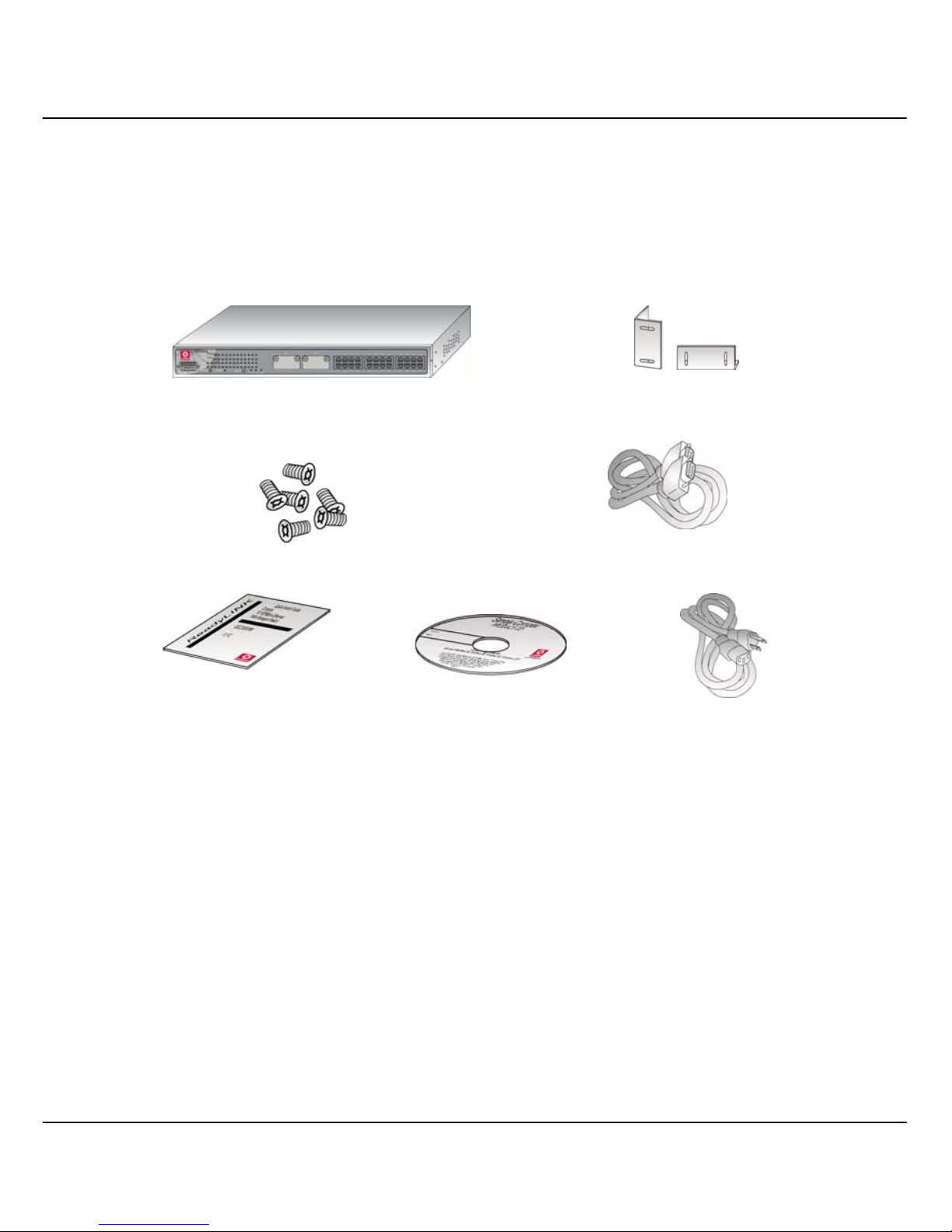
Thank you for purchasing the Compex Web Managed Switch CGX3224. You will find
the following items in the package:
Please note that the actual product appearance may slightly differ depending on the
hardware version.
1 x Compex CGX3224 unit
2 x brackets
6 x screws
1 x RS232 straight cable
1x Quick Install Guide with
warranty card
1 x CD-ROM
1 x Power Cord
1.4 Overall Setup Procedure
1. Hardware Installation of Compex CGX3224.
Refer to Chapter 2 “Hardware Installation” on Page 7
2. Set IP address to Static (Since the DHCP default setting for Compex CGX3224 is
disabled)
Refer to Appendix III “TCP/IP Configuration” on Page 79
3. Configure Compex CGX3224
Refer to Chapter 3 “Hyper Terminal Configuration” on Page 9 or Chapter 4
“Access to Web-based Interface” on Page 11
Page 14
Chapter 1 Product Overview
4
1.5 Network Applications
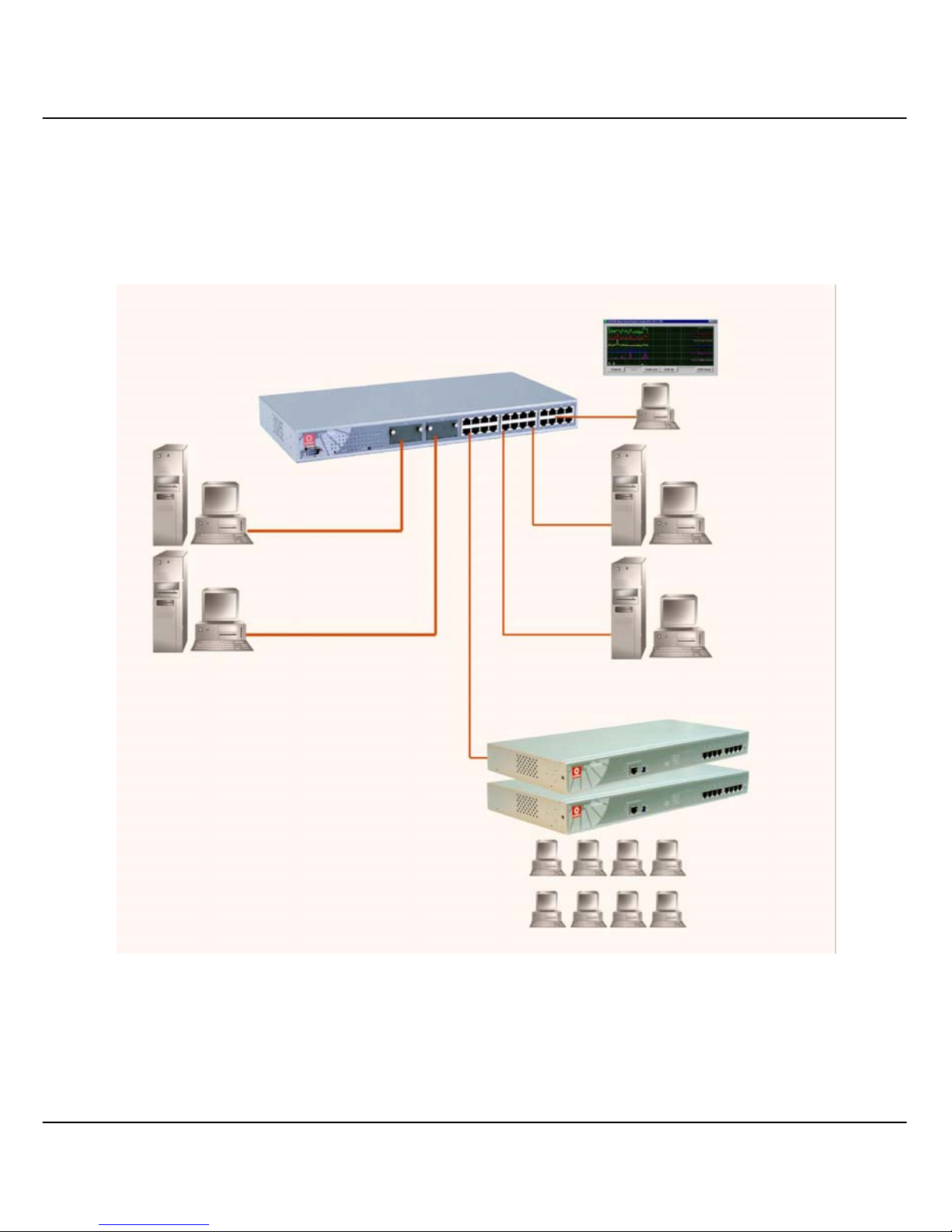
Compex CGX3224 may be used in the Backbone with an ADSL broadband internet
connection as shown in Figure 1.5a. Virtual LAN may be defined on Compex CGX3224
to logically segmentize your LAN into multiple broadcast domains with workgroup
classifications.
Figure 1.5a Compex CGX3224 in the Backbone
User groups on
Private LAN
Switching
SNMP
Manager
CGX3224
High
Bandwidth
Servers
Internet
Servers
GSC2008WM
Page 15

Chapter 1 Product Overview
5
You can connect Compex CGX3224 via the optional modules to an external Ethernet
Hub/Switch to increase the number of users for Internet access. Using a UTP network
cable, connect one end to Compex CGX3224 and the other to the network switch.
Figure 1.5b shows how Compex CGX3224 can be connected to an existing switch to
increase the Internet access for the LAN users from just one dedicated Internet access to
multiple accesses.
Figure 1.5b Compex CGX3224 installed with optional fiber optic module
Building B
Building C
Building A
Gigabit Ethernet on
Fiber (1000 Base-SX) or
Fast Ethernet on Fiber
(100 Base-FX)
CGX3224 Unit #1
CGX3224 Unit #2
CGX3224 Unit #3
Page 16

Chapter 1 Product Overview
6
Compex CGX3224 allows a maximum of up to four modem connections. With Compex
CGX3224 and any of the four modems power off, connect one end of the Ethernet cable
to any port of Compex CGX3224. The other end of the Ethernet cable is to be connected
to your own ADSL/Cable modem. (You may need to refer to your respective Modem’s
manual for the set up.)
Figure 1.5c Connecting four cable/ADSL modems to Compex CGX3224
NOTE
Connect Compex CGX3224 using one modem first. Once you have established
an Internet connection, then add additional modems as needed.
CGX3224
Workgroup
Cable/ADSL
Modems
Page 17

Chapter 2 Hardware Installation
7
Chapter 2 Hardware Installation
This chapter gives an overview on the hardware installation, from installing the physical cables
to resetting the device.
2.1 Physical Setup for Compex CGX3224
Compex CGX3224 is ideally suitable for office environment usage, which can be either
installed on a flat surface or mounted on a 19-inch rack. The following steps illustrate
how a proper installation is done.
2.1.1 Desktop Installation
1. Unpack Compex CGX3224.
2. Remove the backing strip from the 4 rubber feet and attach to the
underside of the switch chassis firmly.
3. Place it near a power outlet. Please put the device in the position that
would allow sufficient space for heat ventilation.
4. The surface to place Compex CGX3224 should be clean, smooth, level
and sturdy.
5. Ensure there is enough space around the unit to allow the attachment of
network cables.
6. Connect the power cord to the power socket on the rear panel of Compex
CGX3224.
2.1.2 Rack-Mounted Installation
1. Position one bracket to align with the holes on one side of Compex
CGX3224 and secure it with the smaller bracket screws (1/8-inch
diameter). Then attach the other bracket to another side of it.
2. After attaching both mounting brackets, position the device in the rack by
lining up the holes in the brackets with the appropriate holes on the rack.
Secure it to the rack using the rack-mounting screws (5/16 inches
diameters) and a screwdriver.
Page 18

Chapter 2 Hardware Installation
8
3. Connect the power cord to the power socket on the rear panel of Compex
CGX3224.
NOTE
For proper ventilation, do allow about 4 inches of clearance on the front and back
of the switch. This is especially important in an enclosed rack.
2.1.3 Expansion Module Installation
A series of optional expansion modules are available for Compex CGX3224
to upgrades its features. Please note that Compex CGX3224 is not shipped
with the Gigabit modules.
1. Power off the switch. Insert the module carefully into the expansion
module window and push it along the module rail until it stops. Ensure
that there is a secure connection to the PCB Board of Compex CGX3224.
2. Tighten the screws on the module.
2.1.4 Removing the Expansion Module
1. Power off the switch.
2. Disconnect any cable from the module.
3. Unscrew and pull out the module slowly from the expansion module slot.
4. Slide the module completely out of the chassis and cover the window with
the cover plates, fasten back using the original screws.
Page 19

Chapter 3 Hyper Terminal Configuration
9
Chapter 3 Hyper Terminal Configuration
This chapter explains the basic setup procedures of configuring Compex CGX3224. For more
detailed information about Compex CGX3224, please refer to Chapter 8 “Advanced
Configuration for Compex CGX3224” on Page 39.
We can configure Compex CGX3224 through Hyper Terminal. Please follow the procedures
stated below:
1. Go to control panel and double click Hyper
Terminal icon.
2. Type the name in the space provided.
Choose the COM Port which you have
selected from your PC.
3. Adjust the Port setting from the COM1
Properties screen. This will depend on the
console port that you are using.
Page 20
Chapter 3 Hyper Terminal Configuration
10
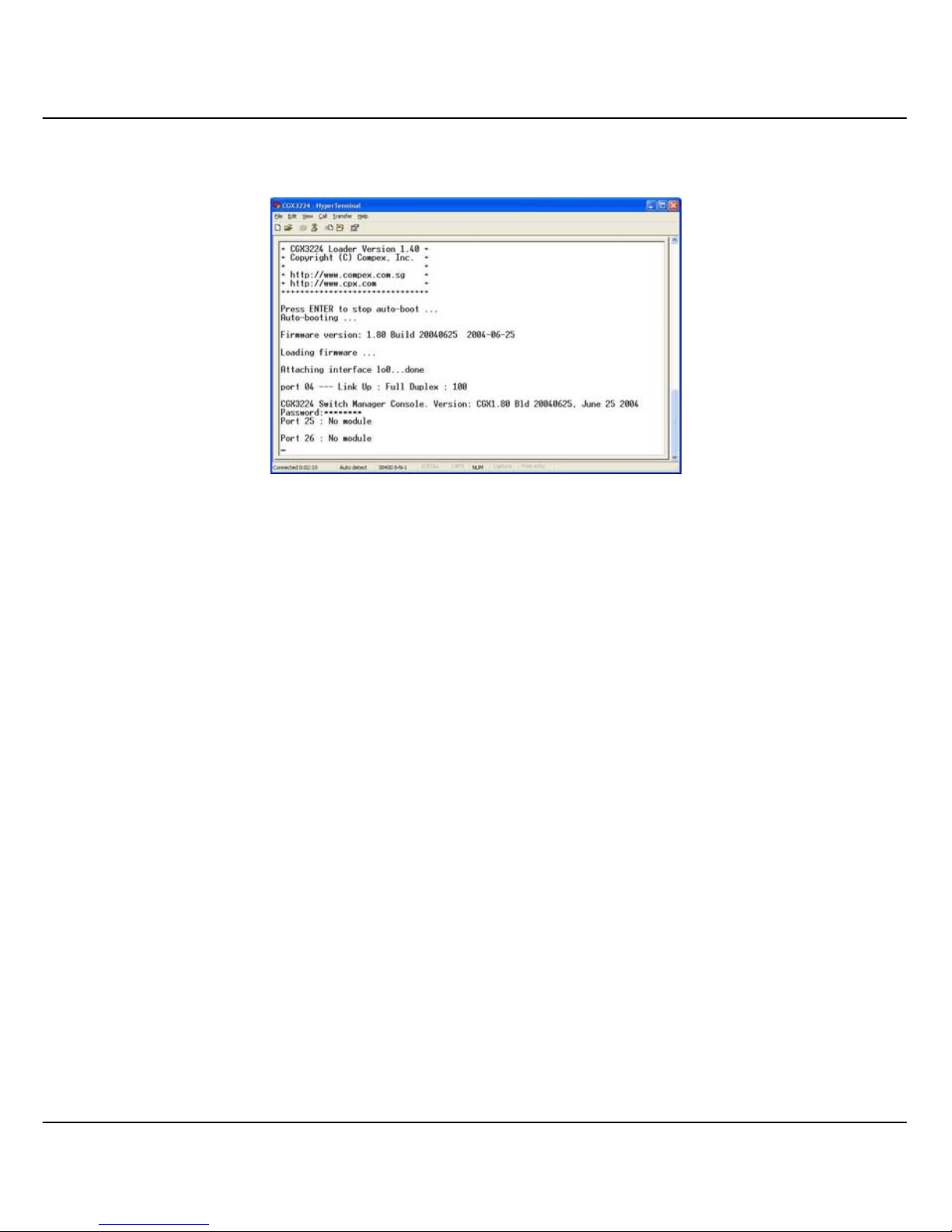
After setting all configurations, reset the power supply of Compex CGX3224. A Hyper
Terminal screen will appear to list out all configurations.
You can modify the configuration on the screen itself, such as changing the IP Address
after you have upgrade the firmware.
Page 21

Chapter 4 Access to Web-based Interface
11
Chapter 4 Access to Web-based Interface
After setting up Compex CGX3224, install a browser on the PC or workstation. Make sure that
TCP/IP protocol is installed and configured. Configuration will be much simpler if you decided
to obtain IP address dynamically and use the gateway default IP addresses. Compex CGX3224
is designed with a built-in DHCP server. When WAN setup has done, the system will
automatically assigns IP addresses, DNS and Gateway information to the computers connected
in the same network. It has been pre-configured with IP address and Subnet Mask of
192.168.100.128 and 255.255.255.0 respectively.
An Internet browser would be used to configure Compex CGX3224. The most commonly used
browsers include Netscape Navigator, Netscape Communicator and Microsoft Internet Explorer
browsers as they support frames and Java. We recommend you to use the Netscape
Communicator V4.06 and higher, or Microsoft Internet Explorer 4.0 and higher.
Start by running your browser on a workstation connected onto the same network as Compex
CGX3224. Enter URL Address,
http://192.168.100.128.
4.1 Login to Web Browser Interface
The following is a list of the various ways different browsers access a website. Follow
the instructions for the browser that you use.
In Netscape Navigator
1. Select the File menu, then select Open Location.
2. In the Open Location dialog box, enter the IP address of the Gateway. The default
address is
http://192.168.100.128.
3. Click on the Open button.
In Netscape Communicator
1. Select the File menu, and then press Open Page.
2. In the Open Page dialog box, enter the IP address of the Gateway. The default
address is
http://192.168.100.128.
3. Make sure the Navigator radio button is selected then click the Open button.
Page 22

Chapter 4 Access to Web-based Interface
12
In Internet Explorer
1. Select the File menu, then select Open.
2. In the Open dialog box, enter the IP address of the Gateway. The default address is
http://192.168.100.128.
3. Click on the OK button.
You will see the following screen appears on the Web browser program. Type in the
password and click Log On! button. The default password is “password”.
After logging in to the Management system, the Main Page will display as shown
below. The image of Compex CGX3224 is shown on the upper right window. The
status of each switch port (i.e. link, speed and duplex mode) can be seen clearly from
the LED displays on the image. The lower right window is used to display the web
pages of versatile configuration and operation.
Command Menu
Window
Configuration
Window
Page 23

Chapter 4 Access to Web-based Interface
13
The Main menu includes four sections in the Command Menu Window, namely
CONFIGURATION, ADVANCED, SYSTEM TOOLS and HELP. The overall
descriptions for individual sub-functions are listed as shown:
CONFIGURATION menu
• Port Configuration – configuration for communications via network
Please refer to Section 5.1 Port Configuration on Page 16
• VLAN Configuration – setup Virtual LAN, whether in tagged or untagged-based
Please refer to Section 5.2 Virtual LAN Configuration on Page 18
• Trunking Configuration – Extend the limitation of bandwidth
Please refer to Section 5.3 Trunk Configuration on Page 19
• DHCP Configuration – setup, reserve or activate DHCP
Please refer to Section 5.4 DHCP Configuration on Page 21
• WAN Configuration – support Static, Dynamic and PPP over Ethernet services
Please refer to Section 5.5 WAN Configuration on Page 25
• NAT Configuration – increase security by preventing unauthorized access through
WAN
Please refer to Chapter 6 NAT Configuration on Page 27
ADVANCED menu
• STP Configuration - discovers and eliminates redundant paths in the network
topology
Please refer to Section 8.1 STP Configuration on Page 39
• IGMP Configuration - allows the device to forward multicast traffic intelligently
Please refer to Section 8.2 IGMP Configuration on Page 44
• Stack Configuration – allows user to enable the stacking function of the switches
Please refer to Section 8.3 Stack Configuration on Page 47
• SNMP Configuration – monitors and oversees network
Please refer to Section 8.4 SNMP Configuration on Page 51
• RMON Statistic – enables various network monitors and console systems to
exchange network-monitoring data
Please refer to Section 8.5 RMON Statistic on Page 52
Page 24

Chapter 4 Access to Web-based Interface
14
• Port Security – secures/reserves certain port/s from other user’s access
Please refer to Section 8.6 Port Security on Page 53
• Mirror Port Configuration – duplicates a port's traffic on a port
Please refer to Section 8.7 MirrorPort Configuration on Page 54
• Aging Control – limits the resource in the forwarding table
Please refer to Section 8.8 Aging Control on Page 56
• Address Search – searches for Host and MAC address of the connected device in
the network
Please refer to Section 8.9 Address Search on Page 57
SYSTEM TOOLS menu
• System Clock – manages and utilizes timing based function
Please refer to Section 9.1 Set System Clock on Page 59
• Remote Management - access your Compex CGX3224 through Internet (WAN) or
Local Area Network.
Please refer to Section 9.2 Remote Management on Page 60
• System Configuration – allows change of IP Address, Subnet Mask or Gateway
Please refer to Section 9.3 System Configuration on Page 62
• System Information – indicates essential information of Compex CGX3224
Please refer to Section 9.4 System Information on Page 63
• Change Password – amends system administrator’s password
Please refer to Section 9.5 Change Password on Page 64
• Firmware Upgrade – uploading latest firmware to Compex CGX3224
Please refer to Section 9.6 Upgrading Compex CGX3224 Firmware on Page 65
• Save or Reset Settings – saves or resets all settings
Please refer to Section 9.7 Save or Reset Settings on Page 66
• Message Window – various actions which is taken previously while configuring
can be seen in this window
Please refer to Section 9.8 Message Window on Page 68
• Reboot Switch – restarts the device
Please refer to Section 9.9 Reboot Switch on Page 68
Page 25

Chapter 4 Access to Web-based Interface
15
• Logout – exit
Please refer to Section 9.10 Logout on Page 69
HELP menu
• Technical Support – make enquiries when you encounter problems while setting
up the device
Please refer to Chapter 10 Technical Support on Page 70
Page 26
Chapter 5 Configure Compex CGX3224 using Web Interface
16
Chapter 5 Configure Compex CGX3224 using Web Interface
This chapter explains the configuration menu tool that comes with Compex CGX3224 when
you use the web-based configuration interface. Here, we will briefly discuss each Menu
components and its functions.
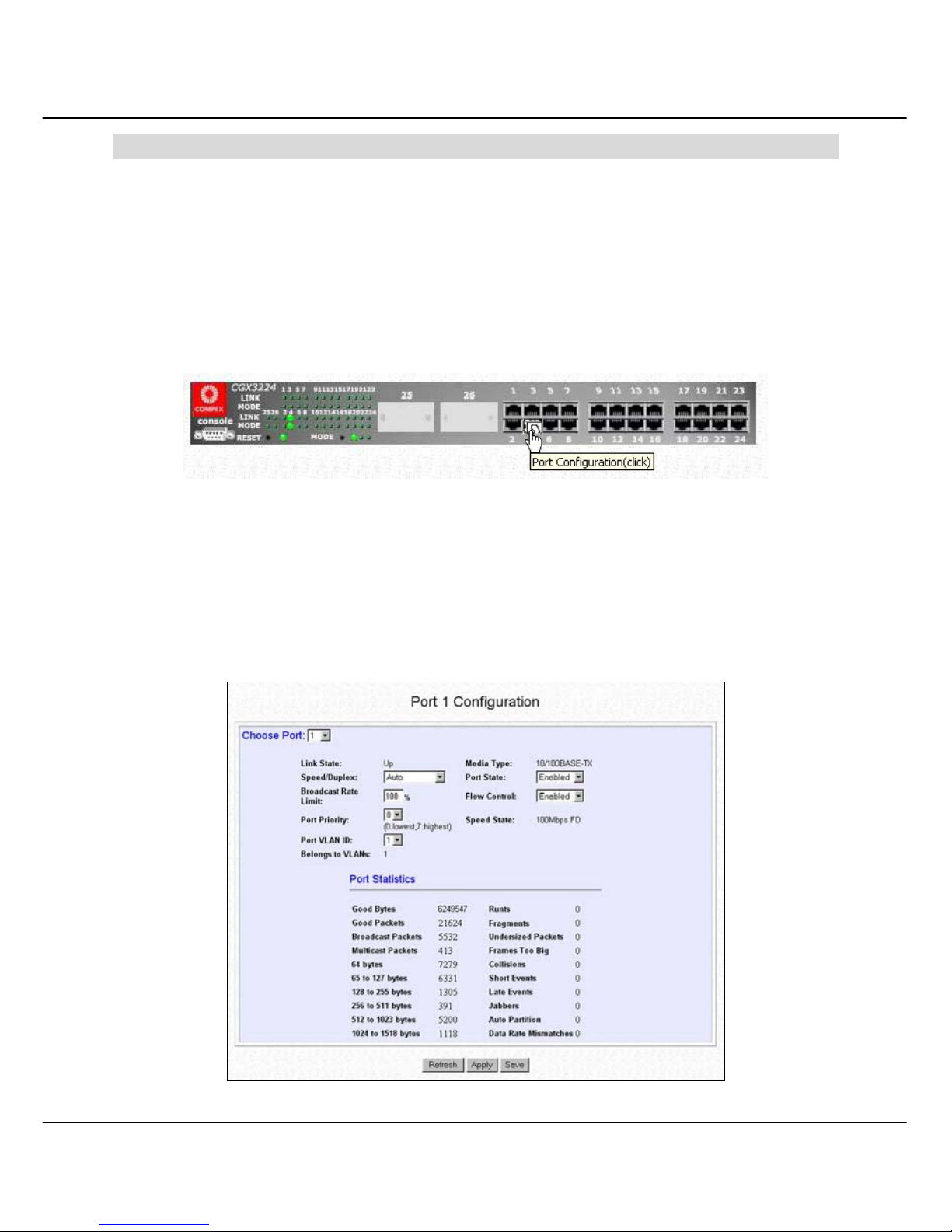
An interactive image is located at the main page of Compex CGX3224. It allows you to view
the real time situation in the network. In addition, you may click on any of the ports, including
the expansion module, to view the port status.
5.1 Port Configuration
This function allows you to have an easy access to the network via the ports of Compex
CGX3224. Notice that the “Link state” option indicates ‘Up’. This shows that the port is
connected to the network. It can either be in “Up” (Connected) or ‘Down’ (No
Connection) state.
Page 27

Chapter 5 Configure Compex CGX3224 using Web Interface
17
Description of parameters
Broadcast Rate
Limit
This function sets broadcast limit to the desired rate for the
specified port. It controls the reception of broadcasting packets.
The range for Broadcast Rate Limit can be set from 0% to 100%.
The higher the rate, the more data can pass through.
Port Priority
Allows you to specify the VLAN priority to expedite the VLAN
traffic.
Port VLAN ID
VLAN ID is the sequence number of a VLAN. Compex CGX3224
has 32 VLANs to specify and therefore the VLAN ID is from 1 to
4091.
Port State
Enabling this function allows the chosen port to receive, forward
packets, and learn the respective MAC Addresses of the source.
Flow Control
This feature reports the Flow Control setting of the port. Enabling
the Flow Control function allows Half and Full Duplex mode.
NOTE
If the port (management port) that is connected to your management PC has
disabled, the communication link between users and the management system will
be severed and the management cannot be proceed further. So, disabling the
management port will be rejected automatically by the management system.
Procedures
1. Go to Port Config from the Command window.
2. Click on the image to select a port or select from the ‘Choose Port’ field.
3. Enter the values in the respective field accordingly and click on the Apply button to
make the configuration effective.
4. Hit the Save button if you are satisfied with the setting.
NOTE
The screen is divided into two sections. The Port Statistics page displays detailed
information about each port. Click Refresh button to view the current port status
of Compex CGX3224.
Page 28
Chapter 5 Configure Compex CGX3224 using Web Interface
18
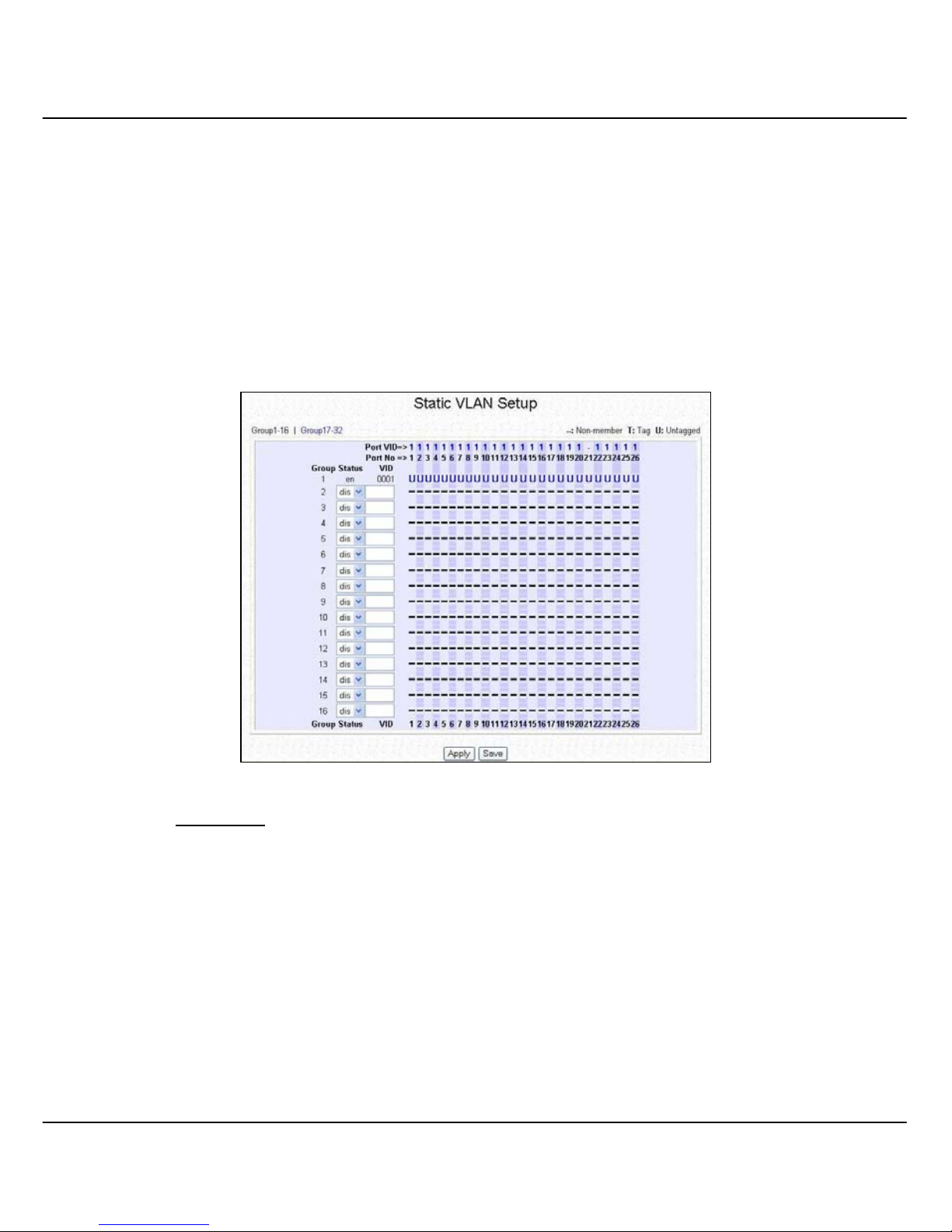
5.2 Virtual Local Area Network (VLAN) Configuration
Compex CGX3224 supports Virtual LAN, which logically groups every connection into
VLANs for traffic isolation and security purposes. Both tagged and untagged based
VLAN are supported with a total maximum of 32 groups. Each VLAN group only
forwards traffic within its member ports. For tagged VLAN, each port can be a member
of more than one VLAN group and it also supports eight levels of priority. You can also
create a Tagged VLAN and support a connection with a legacy untagged VLAN. The
VLAN configuration feature also allows you to build, delete, view tagged/untagged
VLAN groups and set priority for tagged VLANs. The range of VID starts from 2 to
4091. VID 001 is the default for Group 1.
Procedures
1. Go to VLAN Config from the Command window.
2. Decide which Group you want to set for monitoring using mirror port. Click status
column for that particular group and key in the VLAN ID.
3. Next, click on the dashed line ‘–’ to select either ‘T’ for Tagged or ‘U’ for
Untagged.
4. Hit on Apply button after you are satisfied with the setup. Click Save button to
update the configuration.
Page 29

Chapter 5 Configure Compex CGX3224 using Web Interface
19
5.2.1 Simple application on VLAN Configuration
Please refer to “Application on Virtual LAN” on Page 71.
5.3 Trunk Configuration
Port Trunking is the ability to group together several switch ports to increase the
bandwidth between Compex CGX3224 and other switch. This is an inexpensive method
to increase throughput between switches.
NOTE
To avoid broadcast storms, or looping in your network while configuring trunks,
you need to disable/disconnect all the ports that you wish to add/remove from
both sides of the trunk. Once you have finished configuring trunking, enable/reconnect the ports.
Procedures
1. Go to Trunk Config from the Command window.
2. You can choose up to 4 ports for trunking by selecting ‘-’ as ‘T’.
3. Click on Apply button to make the configuration effective and save the latest
setting.
NOTE
You may set up to 4 trunking ports for the switch.
Page 30

Chapter 5 Configure Compex CGX3224 using Web Interface
20
5.3.1 Simple application on Port Trunking
From the figure shown below, we are using two Compex CGX3224 to
perform Port Trunking. Port #25 and #26 are set as trunking ports for both
Unit #1 and #2. After selecting the trunking group (refer to Figure 5.3c),
CGX3224 Unit #1 and Unit #2 has created a pipeline with an aggregated
bandwidth of Port #25 and Port #26 combined.
Figure 5.3a Port 25 and 26 are set as Trunking Ports
CGX3224 Unit #1
CGX3224 Unit #2
Workgroup B
Workgroup A
CGX3224
Page 31

Chapter 5 Configure Compex CGX3224 using Web Interface
21
5.4 DHCP Configuration
Dynamic Host Configuration Protocol (DHCP) allows a PC to join an IP-based network
without the need of configuring the IP Addresses. It assigns a unique IP address to the
device. When this device leaves the network, DHCP server will release the IP address,
and when it re-joins, the DHCP server will then renew the IP address.
If you have set the TCP/IP protocol of your PC to dynamic IP address, the built-in
DHCP server will automatically assign the IP address/es within the range of DHCP
Start IP Address and DHCP End IP Address to the PCs connected in the same
network. For dynamic WAN IP, the DNS IP address is obtained automatically from the
ISP.
NOTE
If you are running different DHCP servers on your network, you will have to
enable only one DHCP server to prevent any conflict in the network addressing.
Description of parameters
IP Address
IP (Internet Protocol) address uniquely identifies the Gateway
in the network. This is the IP address that users should point
to as their Internet gateway if fixed IP addresses are
configured on the computers in the network. However, the
DHCP Server will assign this information if the computers are
configured to dynamically obtain IP addresses.
Page 32

Chapter 5 Configure Compex CGX3224 using Web Interface
22
Subnet Mask
This is the Subnet Mask to identify the class of the Gateway’s
IP address. By default, Class C Subnet Mask 255.255.255.0 is
set. The users may configure the network with Class A
(255.0.0.0) and Class B (255.255.0.0) Subnet Mask as well. In
addition, Compex CGX3224 can be configured for Classless
Subnet to support certain applications.
DHCP Start IP
Address & DHCP
End IP Address
These parameters specify the range of the IP addresses of
which the DHCP Server will assign.
Primary DNS IP
Address &
Secondary DNS IP
Address
DNS is an Internet service that translates domain names into
IP addresses. If your WAN connection uses Static IP, you
should configure the primary and secondary DNS IP
addresses with the DNS information provided by your
Broadband Internet Service Provider. For other WAN
connection types, the DNS IP addresses are automatically
obtained from the ISP. The “Always use these DNS servers:”
checkbox can be used to disable the automatic process, and
your preferred DNS IP addresses can be used.
DHCP Server
DHCP server dynamically assigns IP addresses to the PCs
connected in the same network. DHCP comes with a built-in
DHCP server that automatically assigns IP addresses, DNS
and Gateway information to the computers connected in the
same network. It has been pre-configured with IP address and
Subnet Mask of 192.168.100.128 and 255.255.255.0
respectively.
Procedures
1. Go to DHCP Config from the Command window.
2. Enter the values for IP Address, Subnet Mask, DHCP Start and End IP
Addresses to individual fields.
3. You can check on Always use these DNS servers: to disable the function of
retrieving DNS IP Address automatically, so that you can enter your preferred DNS
IP Address in the Primary and Secondary DNS IP Address field.
4. Next, you can set DHCP Server to Enable if you wish to use the built-in DHCP
server of Compex CGX3224.
5. Click on Save button to save your configuration.
Page 33

Chapter 5 Configure Compex CGX3224 using Web Interface
23
5.4.1 DHCP Active Leases
This section indicates the information of the PC whereby the IP addresses are
dynamically assigned to it in the same network. The Expire Time indicates the
time when the system needs to update the IP Address of that particular PC.
5.4.2 DHCP Server Reservations
DHCP Server can also be configured to reserve specific IP addresses for
specific host or Mac address.
CAUTION
The reserved IP address to be assigned should NOT have the same Dynamic IP
address range as the DHCP Start and End IP address.
Procedures
To reserve certain IP addresses for the specific workstation,
1. Enter the values and name in the respective fields provided.
NOTE
The DHCP server will ignore the Host Name if it finds a match in the Hardware
Address. It checks the Hardware Address first, so you need only to enter either
the Host Name or Hardware Address.
Page 34

Chapter 5 Configure Compex CGX3224 using Web Interface
24
2. Click Add button to create an entry into the DHCP Server Reservations.
3. After the address is entered, click on Save button to save your setting.
Keep on adding the IP Address onto it by repeating the procedures as
mentioned previously if you need to reserve more IP Addresses.
5.4.3 Delete IP Address in Server Reservations
Procedures
1. If you wish to delete any of the IP Addresses stated on the screen.
2. Highlight that particular IP Address.
3. Click on Delete button and the IP Address will be deleted instantly!
Page 35

Chapter 5 Configure Compex CGX3224 using Web Interface
25
5.5 WAN Configuration
Compex CGX3224 is pre-configured as WAN disabled. It can support Static IP,
Dynamic IP and also PPP Over Ethernet .
If you have chosen self-installation when you register for the broadband service, you
should first test the ADSL modem together with the logon account. Make sure that it
can connect successfully before attempting to run it with Compex CGX3224. For
purpose of illustration, it is assumed that LAN uses the IP address 192.168.100.xxx and
Compex CGX3224 is using the same settings as defaults. However, if you have
assigned a different IP address for Compex CGX3224, then use the new settings in the
setup procedures.
Description of parameters
WAN Port
You may configure any 4 of the 24 ports as WAN port and connect to
your ADSL/Cable modem.
WAN Type
Static IP Address:
Select this WAN type if you have subscribed to a specific IP address
or to a fixed range of IP addresses from your ISP.
Dynamic IP Address:
This IP address is automatically assigned by your ISP. This type of
connection applies to most Cable Internet subscribers such as:
• Singapore Cable Vision subscribers.
• @HOME Cable Service users.
PPPoE:
Select this connection type if you have subscribed to ADSL in a
country utilising standard PPPoE for authentication, for instance:
• If you are in Germany which uses T-1 connection.
• If you are a SingNet Broadband or Pacific Internet Broadband
user in Singapore.
Page 36

Chapter 5 Configure Compex CGX3224 using Web Interface
26
Procedures
1. Go to WAN Config from the Command window.
2. Select a WAN port and then a WAN Type. Any one of the 4 WAN Types are
eligible to configure, depending on which Internet Service Provider you subscribed.
3. Click Save button to update the configuration.
Details on various broadband Internet services can be seen on “Configuring Your
Wide Area Network” on Page 31.
Page 37

Chapter 6 NAT Configuration
27
Chapter 6 NAT Configuration
Network Address Translation allows an IP-based network to manage its public (Internet)
addresses separately from its private (intranet) addresses. With NAT, each private IP address
can be translated to a different public address, or multiple private addresses can be aliases to a
single public one. To accomplish this, NAT software snoops both incoming and outgoing
packets on the network. It modifies the source or destination address in the IP header to reflect
the mapping between internal and external addressing for that network.
NAT functionality appears on Compex CGX3224 with low-level access to packets at the
network boundary. Several variations on NAT have also been implemented to provide
additional support for application-level protocols.
6.1 Static IP Setting (IP Forwarding)
IP forwarding is used to control access to local area networks from the Internet. It
accomplishes this by determining whether or not IP packets (messages) are exchanged
between the local network and the Internet.
Procedures
To set a static IP Address,
1. Go to NAT Config from the Command window.
2. Enter a private IP Address, such as 192.168.100.20, in the field provid ed and click
Save button.
Please note that you must enable the NAT function in the Configuration window if
you are using a single IP address account (fixed static IP) and want to share this
connection on your LAN.
Page 38

Chapter 6 NAT Configuration
28
6.2 Static Port Setting (Port Forwarding)
Port Forwarding redirects any incoming Internet request on the Public IP, based on its
TCP/UDP Port number to another computer in the Private IP. Hence, when a user from
WAN sends a request to your network, Compex CGX3224 (based on the Port–
Forwarding configurations) will forward these requests to the assigned PC.
When your ISP assign you with only one fixed Public IP address, and you want to
define the various servers (such as, FTP, HTTP, Net meeting, Mail server etc) to
specific Private IP address in your LAN. You can choose to host the servers by using
the port-Forwarding Virtual server.
For example, suppose that you have a FTP Server with an IP address of 192.168.168.41.
Your broadband ISP has assigned a Public IP address of 203.120.12.100 to the gateway.
To support a Web Server in your Private Network, you need to define an NAT Static
Port-based Entry to forward TCP port 21 (used by FTP) to 192.168.168.41. Every
http://203.120.12.100 requests will then be forwarded to the FTP Server.
Procedures
Follow the steps shown below to configure Static Port.
1. Go to NAT function at the Command Window. Select the type of Server you wish
to configure as shown in the figure below:
2. Key in the Private IP Address.
3. Next, choose a transport protocol, either TCP or UDP, for the respective IP
Address.
Page 39

Chapter 6 NAT Configuration
29
The Internet makes two transport protocols available to its applications, namely TCP
and UDP.
Transmission Control Protocol
(TCP)
For building a reliable communications stream
on top of the unreliable packet Internet Protocol
(IP). TCP is the protocol that supports nearly all
Internet applications.
User Diagram Protocol (UDP)
A connectionless protocol that runs on top of IP
networks. UDP/IP provides very few error
recovery services, offering instead a direct way
to send and receive datagrams over an IP
network. It is used primarily for broadcasting
messages over a network.
6.3 Filtering Setting
Compex CGX3224 allows Packet Filtering rules be defined based on three factors,
Source IP Address, TCP Port and Time. IP Packet Filtering examines the outgoing
packets and decides whether to bypass or to block them. After the Packet Filtering rules
have been defined, the users may select to bypass or to block the outgoing packets that
do not match the rules.
For example, assume that a rule has been defined as "TCP Port 23 (used by TELNET)
from any IP on any day at any time". If the “forwarded” radio button is selected, all
outgoing packets will be sent except TELNET session. If the blocked radio button is
selected, all outgoing packets will be blocked except TELNET sessions.
Click on Filtering Setting at the Configuration window and the GUI will appear as
shown:
Page 40

Chapter 6 NAT Configuration
30
Procedures
1. Select Add button and the screen will facilitate the users to add rules for IP Packet
Filtering.
2. Enter the appropriate data in the respective entries for Rule Name, IP Address,
Destination Port, Day of the Week and Time of the Day.
3. Press the Apply button to add the new rule.
To delete a rule, select the rule on the Select to Edit column and click Delete button.
CAUTION
You must synchronize the clock of Compex CGX3224 to your PC’s time for
the rules to execute accurately. Refer to “Set System Clock” on Page 59 to
utilize the timing based function of Compex CGX3224.
Page 41

Chapter 7 Configuring Your Wide Area Network
31
Chapter 7 Configuring Your Wide Area Network
This section explains how to configure Compex CGX3224 to distribute Broadband Internet
Access to the Wide Area Network.
If you have chosen self-installation when you register for the broadband service, you should
first test the ADSL modem together with the logon account. Make sure it can connect
successfully before attempting to run it with Compex CGX3224.
For the purpose of illustration, it is assumed that LAN environment uses the IP address
192.168.100.xxx and Compex CGX3224 is using the default settings.
However, if you have assigned a different IP address for Compex CGX3224, then use the new
settings in the setup procedures.
7.1 Selecting the right connection for your Broadband Internet Service
Choosing the right connection type on Compex CGX3224 is important to ensure that
you are properly connected to your broadband Internet subscription. The following
summarizes the type of connection suitable for your broadband Internet subscription.
Static IP
This type of connection should only be used if and only if you have subscribed to fix IP
or a range of fix IP address from your service provider for your Cable Internet
connection or Direct Ethernet point.
Dynamic IP
This type of connection should be used if you are configuring Compex CGX3224 for
your Cable Internet service. Once powered on, Compex CGX3224 will request for an IP
address, which will be assigned by your service provider. Certain Cable Internet Service
Providers require DHCP Client ID to be passed in before an IP address is released. For
such cases, you must configure the System Config with a System Name equivalent to
the DHCP Client ID. The configuration of System Config may be found in “System
Configuration” on Page 62.
PPP Over Ethernet (PPPoE)
This type of connection should be chosen for ADSL services that use standard PPP
Over Ethernet (PPPoE) for authentication.
Page 42

Chapter 7 Configuring Your Wide Area Network
32
7.2 Setup on Compex CGX3224 for Broadband Internet Access
For such services, you should have the IP address info ready before proceeding. This is
provided by the ISP.
1. Connect a network cable from the Ethernet port of Compex CGX3224 to your
workstation.
2. Connect an Ethernet cable from Ethernet port of CGX3224 to the ADSL/Cable
modem.
3. Power on the broadband modem and wait for broadband modem to complete the
initialization process. That may take about 1 minute or more, depending on the
brand and design of individual modems.
4. Next, power on both your workstation and Compex CGX3224. The LINK/ACT
LED should light up, indicating that the connection has established.
5. You may start to configure Compex CGX3224 before connecting to the Internet.
Please refer to Chapter 5 “Configure Compex CGX3224 using Web-based
Interface” on Page 16.
6. Once everything is checked, you can now access to the Internet.
Workstation
CGX3224
Cable/ADSL Modem
Internet
Page 43

Chapter 7 Configuring Your Wide Area Network
33
7.3 Configuring Static IP Connection
Procedures
1. Go to WAN Config at Command Window, click on the pull-down menu from the
WAN Port field.
2. Next, select Static IP Address from the pull down menu at WAN Type field.
You may enter your IP Address, Subnet Mask and Gateway IP Address in the
individual fields. All these information can be obtained from your ISP/Network
Administrator.
3. Click on Save button to update the data.
The WAN Setup screen shows a Static IP Configuration that allows you to configure
your Static IP connection to your ISP.
7.4 Configuring Dynamic IP Connection
Compex CGX3224 uses Dynamic IP as the default WAN type. Hence, if you are using
Cable Internet, you do not need to configure the WAN connection.
However, if your account requires a DHCP Client ID in order to release an IP address,
you may need to configure the name of Compex CGX3224 with the DHCP Client ID
issued by your ISP.
See the section on “System Configuration” on Page 62, and remember to enter the
DHCP Client ID issued by the ISP into the System Name field in the System Identity.
Page 44

Chapter 7 Configuring Your Wide Area Network
34
NOTE
If your computer is not able to access any web site, please verify that your DNS
entry of the computer has been defined correctly.
7.4.1 How to Configure Singapore Cable Vision (SCV) Service
SCV provides Dynamic IP address connection service. Assume that your
CGX3224 is not in the Dynamic IP setting, please follow these procedures to
change to the appropriate WAN type.
Procedures
1. Go to WAN Config. Click on the pull-down menu from the WAN Port
field.
2. On the list of other WAN types select ion, select Dynamic IP Address and
hit on the Save button.
Page 45

Chapter 7 Configuring Your Wide Area Network
35
7.4.2 How to Configure @HOME Cable Service
Many broadband services require a simple DHCP request for connection. Two
such cable services are Optus@Home and
Roger@Home.
Description of parameters
System Name
You can obtain this information from your ISP.
System Contact and
Location
You may leave it as it is or fill in your ISP contact
and location information. They are for your future
reference only.
Procedures
To configure @HOME Cable Service,
1. Follow the steps stated in “Configuring for Singapore Cable Vision (SCV)
Service” on the previous section.
2. Next, click on System Config at the Command window under the
SYSTEM TOOLS menu and enter the required entry as shown.
3. Click on Apply and then Save button to set the System Configuration.
4. Reboot your device.
Page 46

Chapter 7 Configuring Your Wide Area Network
36
7.5 Configuring PPP over Ethernet Session (PPPoE)
For Broadband service providers such as Pacific Internet Broadband and SingNet
Broadband, you have to select the PPPoE WAN configuration. This includes Germany
who is using T-1 connection.
NOTE
Certain ADSL Internet subscriptions require Service Name to be specified in
order to establish a PPPoE connection.
7.5.1 How to Configure SingNet, PacNet &QALA DSL Broadband
This procedure assumes your ADSL modem and PC/notebook is operational
with the logon account from SingNet, Pacific Internet or QALA DSL
broadband service, and necessary hardware connection has been established.
NOTE
If you have chosen self-installation when you register for the broadband service,
you should first test the ADSL modem together with the logon account on your
PC. Make sure it can connect successfully before attempting to run it with
Compex CGX3224
Procedures
1. Go to WAN Config. Click on the pull-down menu from the WAN Port
field.
2. Click on WAN Type option and select PPP over Ethernet.
3. Click Save button to update your configuration.
Now, you may activate the Internet Explorer and start surfing the net.
Page 47

Chapter 7 Configuring Your Wide Area Network
37
The WAN Setup screen below shows PPPoE configuration that allows you to
configure your ADSL Internet subscription.
Description of parameters
Username and
Password
The information is given by the Internet Service
Provider.
Service Name
Certain ADSL Internet subscriptions require the user to
enter the service name. You may enter the service
name for your ADSL Internet subscription.
Idling Timeout
Idle Timeout is the count down time to cut off the
broadband connection when there is no traffic passing
through the WAN port i.e. when there is no more
activity at the WAN port after all your PCs are turn off.
NOTE
For Singapore users should follow the format below to enter their usernames:
Pacific Internet Broadband: username@pacific.net.sg
SingNet Broadband: username@singnet
QALA DSL: username@qala.com.sg
Page 48

Chapter 7 Configuring Your Wide Area Network
38
To connect to the Internet service, you can easily do so by clicking on the
Connect button. When the connection is established, the status appeared on
the screen will indicated as connected.
Please note that before you click on the Connection button, make sure you
have connected the broadband modem to Compex CGX3224’s remote port.
The cable connection is good when the indicating light for the LAN on the
broadband modem and the remote port on the switch is lighted up.
Click Disconnect button to terminate the Internet connection immediately.
Page 49

Chapter 8 Advanced Configuration for Compex CGX3224
39
Chapter 8 Advanced Configuration for Compex CGX3224
In this chapter, you can understand how the configuration on Spanning Tree Protocol (STP) can
be easily done. Compex CGX3224 implements Internet Group Multicast Protocol (IGMP)
function which forwards multicast traffic intelligently. Simple Network Management Protocol
(SNMP) is also introduced to provide a standard mechanism to monitor and control network
devices.
8.1 STP Configuration
Spanning Tree Protocol, designed to run on bridges and switches, is a link management
protocol that provides path redundancy while preventing undesirable loops in the
network. The main purpose of STP is to ensure that the system do not run in looping
situation when it has redundant paths in your network. For an Ethernet network to
function properly, only one active path can exist between two stations.
Multiple active paths between stations cause loops in the network. If a loop exists in the
network topology, the potential exists for duplication of messages. When loops occur,
some switches see stations appear on both sides of the switch. This condition confuses
the forwarding algorithm and allows duplicate frames to be forwarded. STP should be
used in situation where you want redundant links but not loops. If your primary system
fails, the backup links are activated so that users can continue using the network.
Without STP on the bridges or switches, such a situation may result in a loop.
The example shown in Figure 8.1a illustrates a redundant link between Compex
CGX3224 Unit #1 and #2. The probability of having a bridging loop is quite high. This
is because, a broadcast or multicast packets might be circulating repeatedly between
CGX3224 Unit #1 and #2.
Page 50

Chapter 8 Advanced Configuration for Compex CGX3224
40
However, if STP is activated on both switches, broadcast and multicast packets would
be transmitted as shown in Figure 8.1b. To provide this desired path redundancy, as well
as preventing bridging loops, STP defines a tree that spans all switches in an extended
network. STP forces certain redundant data paths into a blocked state, leaving others in
the forwarding state. If a link in forwarding state becomes unavailable, STP will
reconfigure the network and re-route the data paths by activating the appropriate
standby paths.
CGX3224 Unit #1
CGX3224 Unit #2
Workstation A
Workstation B
CGX3224 Unit #1
CGX3224 Unit #2
Workstation A
Workstation B
Broadcast
Broadcast
Before
implementing
STP
After
implementing
STP
Page 51

Chapter 8 Advanced Configuration for Compex CGX3224
41
8.1.1 STP Port
When Compex CGX3224 first powers up, all bridges will declare themselves
to be the root. The one with the lowest priority will be the root. The bridges
will stop advertising themselves and use the Bridge Protocol Data Units
(BPDUs) of the root bridge.
During normal operation for Compex CGX3224, the ports are either
forwarding or disabling.
Description of parameters
Bridge Port
(from Port 1 to 26)
This option shows the port of the bridge that
connects to the root bridge.
Path Cost
(from 1 to 65535)
This option sets the Spanning Tree path cost for this
port. A lower path cost represents higher
transmission speed.
Page 52

Chapter 8 Advanced Configuration for Compex CGX3224
42
Priority
(from 0 to 65535)
The lower the number the higher the priority.
Designated Cost
If the designated bridge is the root bridge itself, then
the cost is 0. The identity of the designated bridge is
shown in the Design Bridge field.
Designated Bridge
IEEE 802.1D specifics 17 multicast addresses,
ranging from 0x00180C2000000 to
0x0180C2000010, to be used by different bridge
protocols. These addresses are static addresses that
cannot be removed.
Regardless of the STP state, the switch receives but
does not forward packets destined for addresses
between 0x0180C2000010. If STP is disabled, the
switch forwards those packets as unknown multicast
addresses.
Designated Port
Active ports which can forward frames on the root
bridge
Forwarding State
Disabling State
Blocking State
STP allows the port to send and receive frames.
The port is not participating in STP. This occurs
when the port is disconnected or STP is disabled on
the port.
STP has blocked Layer 2 traffic on this port to
prevent a loop. The switch or VLAN can reach the
root bridge using another port, whose state is
FORWARDING. When a port is in this state, the
port does not transmit or receive user frames, but the
port does continue to receive STP BPDUs
Procedures
1. Select STP Config from the Command window.
2. Select one port from 1 to 26 to connect to the root bridge.
3. Key in the value for Path Cost (from 1-65535) and set the priority level
(0-255).
Page 53

Chapter 8 Advanced Configuration for Compex CGX3224
43
8.1.2 STP Bridge
Spanning-Tree Protocol defines a tree that spans all switches in an extended
network. It forces certain redundant data paths into a standby (blocked) state.
If one network segment in the Spanning-Tree Protocol becomes unreachable,
or if Spanning-Tree Protocol costs change, the spanning-tree algorithm
reconfigures the spanning-tree topology and reestablishes the link by
activating the standby path.
Spanning-Tree Protocol operation is transparent to end stations, which are
unaware whether they are connected to a single LAN segment or a switched
LAN of multiple segments.
This section shows how configuration is done in Spanning Tree parameters.
Description of parameters
STP State
When STP is enabled, it will dynamically detect
network looping owing to mis-configuration of the
network topology. The redundant connectors will be
disabled to avoid looping of packets. Looping would
often result in flooding of broadcast packets, halting
the normal traffic.
Root Priority
(from 0 to 65535)
The priority of the switch is currently acting as the
root. The bridge with the lowest value has the highest
Spanning Tree priority level and is related as the
root.
Page 54

Chapter 8 Advanced Configuration for Compex CGX3224
44
Hello Time
(from 1 to 10s)
Determines how often the switch broadcasts hello
messages to other switches.
Forward Delay
Determines how long each of the listening and
learning states last before the interface begins
forwarding. This wait is necessary so that other
switches on the network ensure no loop is formed
before they allow the port to forward packets.
Max Age
Determines the amount of time the switch stores
protocol information received on an interface.
Procedures
1. Select Spanning Tree state option and set Root Priority from 0 - 65535
s, and Hello Time from 1 - 10 s.
2. Key in the Forward Delay Time, Maximum Age and Hold Time.
3. Click Apply and Save button to update your configuration.
NOTE
The screen is divided into two sections. Current Spanning Tree Root section
displays the read-only Spanning Tree settings for the current root switch and the
parameters this switch is to use when it becomes the root switch only when you
click on Apply button.
8.2 IGMP Configuration
Internet Group Management Protocol (IGMP) is an Internet protocol that provides a
way for an Internet computer to report its
multicast group membership to adjacent
routers. It allows Compex CGX3224 to forward multicast traffic intelligently. The
switch "snoops" the IGMP query and report messages and forwards traffic to only the
ports that request the multicast traffic. This prevents the switch from broadcasting the
traffic to all ports and possibly affecting network performance.
Page 55

Chapter 8 Advanced Configuration for Compex CGX3224
45
The membership of a host group is dynamic - hosts may join and leave groups at any
time. There is no restriction on the location or number of members in a host group. A
host may be a member of more than one group at a time. A host need not be a member
of a group to send datagrams to it.
Description of parameters
Host Group Addresses
Host groups are identified by class D IP addresses, i.e.,
those with "1110" as their high-order four bits. Class E IP
addresses, i.e., those with "1111" as their high-order four
bits, are reserved for future addressing modes.
In Internet standard "dotted decimal" notation, host group
addresses range from 224.0.0.0 to 239.255.255.255. The
address 224.0.0.0 is guaranteed not to be assigned to any
group, and 224.0.0.1 is assigned to the permanent group of
all IP hosts (including gateways). This is used to address
all multicast hosts on the directly connected network.
There is no multicast address (or any other IP address) for
all hosts on the total Internet. The addresses of other wellknown, permanent groups are to be published in "Assigned
Numbers".
Procedures
1. Select IGMP Config from the Command window.
2. Choose enabled in the IGMP state field.
3. Click on the radio button to select the version for IGMP. Refer to the next
section for the explanation on IGMP v1.0 and v2.0
4. Hit on the Apply button and save your setting.
Page 56

Chapter 8 Advanced Configuration for Compex CGX3224
46
8.2.1 Definition on IGMP v1.0 and v2.0
For IGMP v1.0,
The Internet Group Management Protocol (IGMP v1.0) is used by IP hosts to
report their host group memberships to any immediately neighboring multicast
routers. IGMP is an asymmetric protocol and is specified here from the point
of view of a host, rather than a multicast router.
NOTE
IGMPv1 has no leave mechanism. If a host no longer wants to receive the
traffic, it simply quits. If it is the last, the switch will not have any answers to
its query and will delete the Group Destination Addresses (GDA) for that
subnet.
For IGMP v2.0,
IGMP v2.0 allows group membership termination to be quickly reported to the
routing protocol, which is important for high-bandwidth multicast groups
and/or subnets with highly volatile group membership.
Multicast routers use IGMP v2.0 to learn which groups have members on each
of their attached physical networks. A multicast router keeps a list of multicast
group memberships for each attached network, and a timer for each
membership. "Multicast group memberships" means the presence of at least
one member of a multicast group on a given attached network, not a list of all
of the members.
When a host receives a General Query, it sets delay timers for each group
(excluding the all-systems group) of which it is a member on the interface
from which it received the query.
When a router receives a Report, it adds the group being reported to the list of
multicast group memberships on the network on which it received the Report
and sets the timer for the membership to the [Group Membership Interval].
When a host joins a multicast group, it should immediately transmit an
unsolicited Version 2 Membership Report for that group, in case it is the first
member of that group on the network
When a host leaves a multicast group, if it was the last host to reply to a Query
with a Membership Report for that group, it SHOULD send a Leave Group
message to the all-routers multicast group.
Page 57

Chapter 8 Advanced Configuration for Compex CGX3224
47
8.3 Stack Configuration
Stacking Management can be implemented in a multi-storey building or even in a
geographically dispersed campus. Upon activating the stacking management functions,
the system administrator is able to access to other switches easily.
By selecting the switch from the Stack Access field, you can configure any of the
switches that are connected to the network.
NOTE
A stack can only accepts up to 4 switches, including the master switch. All
switches in a particular stack must be in the same IP subnet.
Upon clicking on the Stack Config option, the Stack Management GUI will appear. The
system will prompt you to manage the network through the master switch after enabling
it.
If you select Auto Select in the Stacking State field, the system will elect the switches
in connect in the stack with the smallest MAC address to be the master. The Master
switch election will start again when one of the following occurs:
• The master switch is power down.
• The master switch rebooted.
• The master switch failed.
However, if you select either Master or Slave, the connected switch will be set as your
choice.
Page 58

Chapter 8 Advanced Configuration for Compex CGX3224
48
A pull down menu is created under the CGX3224 image. From there, you may select the
types of switch you wish to access, and the information will be listed.
8.3.1 Simple Application on Stack Management
CGX3224 Unit #1, #2 and #3 are stacked accordingly. Individual switches are
linked to its respective workgroup, such as Workgroup A, B and C. Enabling
the stacking function allows the master switch to do the configuration on Unit
#2 or Unit #3.
In order to control all the slave switches, you need to enable the stacking
function for all switches. You may follow the procedures as shown below:
Switch
selection
CGX3224 Unit #3
(Slave)
192.168.100.128
CGX3224 Unit #2
(Slave)
192.168.100.128
CGX3224 Unit #1 (Master)
192.168.100.128
Workgroup B
Workgroup C
Workgroup A
Control
Station
Page 59

Chapter 8 Advanced Configuration for Compex CGX3224
49
1. Connect a RJ45 MDI straight Ethernet cable from the Control Station to
CGX3224 Unit #1. Enter
http://192.168.100.128 in the internet browser
and select Master option in the Stacking State field. You may name you r
switch for identification. Refer to Section 9.2 “System Configuration”
for details.
2. Next, disconnect one end of the Ethernet cable from CGX3224 Unit #1
and establish a link to Unit #2. Please refer to Figure 8.3a.
3. Go the MS DOS Prompt and enter this command:
arp –d 192.168.100.128
This will delete the ARP cache so that you can access to Compex
CGX3224 successfully. Please note that adding the IP address in the ARP
command allows system to delete the ARP cache which is belonged to
that particular device.
4. Enter
http://192.168.100.128 in the internet browser to select Slave option
in the field provided. Give a name to your switch.
NOTE
You may also use the console port to activate the stacking function of all
switches.
We are using 3 switches in this example, therefore, please repeat the
procedures of Steps 1 and 2 for CGX3224 Unit #3. Select Slave option in the
Stacking State field.
Figure 8.3a Establish a connection to CGX3224 Unit #2
CGX3224 Unit #2
CGX3224 Unit #1
Control Station
Page 60

Chapter 8 Advanced Configuration for Compex CGX3224
50
5. After selecting the options for individual switches, use RJ45 MDI straight
Ethernet cables to connect all three switches as shown in Figure 8.3b and
power up all switches.
6. Access to the web-based interface again. This time, you will be able to
view all switches attached to this stack.
7. Next, after clicking on the selected switch, you will be able to view the
necessary information for switches.
Page 61

Chapter 8 Advanced Configuration for Compex CGX3224
51
8.4 SNMP Configuration
SNMP is a communication specification that defines how management information is
exchanged between network management applications and management agents.
You can manage Compex CGX3224 using an SNMP application if the switch and the
application contains the same community string. Use this page to set or modify the
SNMP configuration parameters. The Community String settings in this page provide
different levels of access for SNMP management applications.
Description of parameters
Read Only Community String
The Read Only Community String is used for inband read-only SNMP operation.
Read Write Only Community
String
The Read Write Only Community String is used
for in-band read-write SNMP operations.
Procedures
1. Upon enabling SNMP function, enter all values in the respective fields.
2. After clicking Apply button, the changes will appear on that particular data row. To
save your configuration, hit Save button.
Page 62

Chapter 8 Advanced Configuration for Compex CGX3224
52
8.5 RMON Statistics
Remote monitoring (RMON) is a standard monitoring specification that enables various
network monitors and console systems to exchange network-monitoring data. RMON
provides network administrators with more freedom in selecting network-monitoring
probes and consoles with features that meet their particular networking needs.
1. Go to RMON Statistics from the Command window.
Page 63

Chapter 8 Advanced Configuration for Compex CGX3224
53
8.6 Port Security
Of all 26 ports, some of the ports may need to be assigned to one specific port. In order
to fulfill this act, MAC Address should be added to that particular port. This is to restrict
other users from using the static port. A port can accommodate up to 20 MAC
Addresses.
Procedures
1. Go to Port Security from the Command window.
2. Select a port and enter the MAC address in the field provided, e.g. 00-80-40-E8-85-
12.
3. Click on the Add button and the system will then add in the New MAC Address
into the listing on the right side of the screen.
Page 64

Chapter 8 Advanced Configuration for Compex CGX3224
54
8.6.1 To delete MAC Address/es
If you want to delete MAC Address/es, simply
• Click on Del Æ button for single MAC Address, or
• Hit on DeleteAll button to delete all the MAC Addresses.
8.7 MirrorPort Configuration
8.7.1 Using Mirror Port to Monitor Traffic
This function allows you to set up a ‘mirror’ port of any specified port/s, so
you can monitor the traffic of the monitored port/s without intervention. In
effect, the traffic on the monitored port/s are replicated on the mirror port,
allowing you to use a protocol analyzer to analyze the traffic for a specific
problem.
Procedures
1. Go to MirrorPort Config from the Command window.
2. Select one Mirror Port.
3. Click on the dashed line ‘–’ on that particular port if you want to select it
as a Mirrored Member (T).
4. Hit on Apply button after you are satisfied with the setup. Click Save
button to update the configuration.
Page 65

Chapter 8 Advanced Configuration for Compex CGX3224
55
8.7.2 Simple Application on Port Mirroring
From the example illustrated in Figure 8.7b, we are using Port 22 to monitor
the activities at PC #1 to 3. Notice that Port 22 is set as mirror port, and PC #1
to #3 is connected to Port 6, 12 and 16 respectively. A workstation is
connected to Port 2 to monitor the entire network system.
To do the above-mentioned setting, you may simply go to the web interface
management and click on MirrorPort Config in the command window menu.
Next, set the configuration as shown in Figure 8.7c and save it.
CGX3224
PC #1
Port 6
Workstation
Port 2
PC #2
Port 12
PC #3
Port 16
Mirror
Port 22
Page 66

Chapter 8 Advanced Configuration for Compex CGX3224
56
8.8 Aging Control
Aging control is for the aging of address entries in the switch’s forwarding table. If the
aging control is enabled, a learned address entry (not including the static entry) will be
removed from the forwarding table if there is no update within a pre-determined period.
It is useful because resources for the forwarding table is limited. Enabling the aging
control will not influence packet forwarding. The packet is forwarded to all other ports
when the destination MAC address cannot be found in the forwarding table. If the aging
control is disabled, all address entries will not be removed.
Procedures
1. Go to Aging Control from the Command window.
2. Select Enable from the Aging Control option.
3. Enter the Maximum Age of the Address Entries. If the aging control is enabled,
enter an integer from the range of 1 to 128 as the maximum age of address entries.
If the aging control is disabled, this step can be skipped.
Page 67

Chapter 8 Advanced Configuration for Compex CGX3224
57
8.9 Address Search
8.9.1 Host Search
Host Search is used for searching a host by IP address on the network, and
getting the port number to which the host is connected. It is useful while
configuring the VLAN. With this function, you can easily detect the port at
which a host is connected to, and have an idea about which ports should be
included in a VLAN.
Procedures
1. Go the Host Search from the Command window.
2. Enter the Host IP Address and click on Search button
The result will display as shown below.
Page 68

Chapter 8 Advanced Configuration for Compex CGX3224
58
8.9.2 MAC Address Search
This feature helps to look for the particular MAC Address stated in the field,
which provides a useful way while configuring the VLAN. The system will
search through the device for the port’s ownership of that particular PC.
Procedures
1. Enter the MAC Address in the field provided and click on the Search
button.
Page 69

Chapter 9 Using SYSTEM TOOLS Menu
59
Chapter 9 Using SYSTEM TOOLS Menu
In this chapter, you will be able to retrieve the system information of Compex CGX3224, to
change the administrator’s password and also upgrading new downloaded firmware version.
9.1 Set System Clock
It is recommended that you configure Compex CGX3224’s timer to synchronize with
your PC so that you can utilize the time-based functions.
NOTE
To manage and utilize the timing based functions provided in Compex
CGX3224, (such as the Filtering functions), you MUST set its clock to
synchronize with your managing workstation.
Procedures
1. Go to System Clock from the Command window.
2. Access to the System Clock function at the Command window.
3. Key in the appropriate time zone and click Apply button.
Page 70

Chapter 9 Using SYSTEM TOOLS Menu
60
9.2 Remote Management
This function allows you to access your Compex CGX3224 through Internet (WAN) or
Local Area Network.
The figure illustrates that you can configure the Compex CGX3224 even when you are
at home. This can be done by activating the remote management function from your
workplace.
Procedures
1. From your workplace, simply click on Remote Management from the Command
window.
2. Enter a HTTP Port in the field provided and click Save button to update the
changes.
Home
Workplace
WAN IP address:
203.120.12.12
HTTP Port:
50
Page 71

Chapter 9 Using SYSTEM TOOLS Menu
61
3. You may go to WAN Config to check for your WAN port’s IP address.
NOTE
You need to set the gateway of your Compex CGX3224 to 0.0.0.0 in order to
allow WAN access from your home.
4. Go to System Config from the Command
window. Ensure that your gateway is set to
0.0.0.0.
5. Click Save button to update the changes.
6. Next, from your home’s PC, open your Internet browser, enter this IP address
203.120.12.12:50 in the address bar, where 203.120.12.12 is WAN port’s IP address
of Compex CGX3224; and 50 is the http port.
NOTE
At any one time, the switch can be managed by only one user from either
LAN or WAN. Concurrent switch management by multiple users is
prohibited.
Page 72

Chapter 9 Using SYSTEM TOOLS Menu
62
9.3 System Configuration
This helps you configure the system. You can configure IP address, Subnet Mask or
Default Gateway of the management board in Compex CGX3224. It is likely that
several VLANs are on the single switch, and each VLAN can be regarded as an
independent network, so their network addresses may be different.
Description of parameters
System Name
A description on the device for easy identification.
System Location
The location of the device, e.g. in R&D Dept.
System Contact
The Person In Charge of the device.
Product Name
The naming of the device, e.g. Compex CGX3224.
IP Address
This is the IP address of Compex CGX3224. You
may change the address and save it.
Subnet Mask
Subnet mask is just like IP addresses which
contains four bytes (32 bits). It is often written
using the same "dotted-decimal" notation. For
example, a very common subnet mask in its binary
representation 11111111 11111111 11111111
00000000 is typically shown in the equivalent,
more readable form 255.255.255.0.
Default Gateway
The gateway address for the computer when
using this switch
Page 73

Chapter 9 Using SYSTEM TOOLS Menu
63
Procedures
1. Go to System Configuration from the Command window.
2. Enter the information in the respective field and click on the Apply button and save
the setting.
3. Upon making amendments on this page, the screen will appear a message, “Reboot
the switch?”. Click on Yes button to let the changes take effect.
Click on Logon button again if you still wish to access to Compex CGX3224 web page.
This cannot apply to the changing of IP Addresses.
CAUTION
After changing the IP Address of Compex CGX3224, the system will not lead
you to log in to the web page after you have clicked Logon button. Instead, a
page error will display on the screen, stating “The page cannot be displayed”.
Enter your NEW IP Address to login to the web page again.
9.4 System Information
System Information displays the necessary data about the management system.
Procedures
1. Click on System Information from the Command window.
Page 74

Chapter 9 Using SYSTEM TOOLS Menu
64
9.5 Change Password
This option allows the System Administrator to amend the current password.
Procedures
1. Go to Change Password from the Command
window.
2. After entering your new password, click on Change
Password button to activate the new setting.
The system will alert you that the password has been changed successfully.
9.5.1 Forget your Password
You can simply reset the password using Hyper Terminal program.
1. In the Hyper Terminal environment, switch OFF and ON Compex
SGX3226.
2. When “Press ENTER to stop auto-boot …” message appear on the
screen, hit “Enter” key on the keyboard within 5 seconds.
3. Upon seeing the word Password appeared on the screen, enter +=_-)0
and hit the Enter key from your keyboard to start resetting.
Page 75

Chapter 9 Using SYSTEM TOOLS Menu
65
4. Next, the screen will display " Default password restored successfully".
This indicates that the system has successfully reset the password to
default setting.
5. Type in reboot to switch your Compex SGX3226 to normal mode.
This time, you can enter the default password, which is password to
login to the configuration page.
You may change your password using Hyper Terminal program by typing the
command, sys set password and hit Enter key from your keyboard. If you
cannot remember the command, type in help and the command listing will be
listed.
9.6 Upgrading Compex CGX3224 Firmware
You can simply download the newer version Firmware from
http://www.compex.com.sg. Here, you will find links that allow easy access for
upgrading of future released updated firmware.
To check your current firmware version, refer to Section 9.4 on "System Information”
on Page 63. Once you downloaded the latest firmware, saved it into your hard disk.
Page 76

Chapter 9 Using SYSTEM TOOLS Menu
66
Procedures
1. Go to Firmware Upgrade from the Command window.
2. Click Browse button to select the file where you have just saved.
3. Next, click on the Upgrade button to start replacing the latest firmware revision.
The system will prompt you to reboot Compex CGX3224. Click Yes button to restart
the device.
Log on to the web site after 30 seconds if you still need to do some configuration on
Compex CGX3224.
9.7 Save or Reset Settings
The Save and Reset Settings allow you to execute the amendments or reset to the default
settings.
Page 77

Chapter 9 Using SYSTEM TOOLS Menu
67
9.7.1 Save
By clicking Save button, you will save all the changes made from Compex
CGX3224. You need to reboot the switch to ensure that the profile is updated
correctly.
9.7.2 Backup
This option allows you to backup the switch’s configuration into a file.
1. Click on the Backup button
and the system will prompt
you to either open or save the
file.
2. Select Save button and go to
your preferred folder to save
this file. Do remember the
location that you intend to
save this file. Click OK
button to proceed.
3. After downloading process has completed, the following message will
appear. Click Close button if you do not want to view the downloaded file.
Page 78

Chapter 9 Using SYSTEM TOOLS Menu
68
9.7.3 Restore
1. Click Browse button and select the file that you want the system to restore
back the configuration.
2. Click Restore button to start the process.
3. The system will request you to reboot Compex CGX3224. Click Yes
button to restart the switch.
4. Wait for 60 seconds and the system will automatically return to the Login
Web page, prompting you to enter password again.
9.7.4 Clear and Reset
By clicking this option, you will restore Compex CGX3224 to factory
defaults. And you will have to re-enter all the configuration information to the
network.
1. Click on Clear and Reset button. The system will prompt you to choose
whether you want to reset the configuration data.
2. Click Yes button to proceed and the system will automatically reset the IP
address to factory default, which is
http://192.168.100.128
3. Click Logon button if y ou want to make some more changes.
Page 79

Chapter 9 Using SYSTEM TOOLS Menu
69
9.8 Message Window
This window will list out the action/s taken while doing configuring. It helps you to dig
out the history of various action/s.
To save all your actions, click on SaveAs button. The system will prompt you to save
your file in your preferred location.
9.9 Reboot Switch
Rebooting of Compex CGX3224 is required after changes are
made in the configuration or setting.
1. Click on Reboot Switch from the Command window.
2. Click Yes to reboot the switch. The system will prompt you
to logon again after 30 seconds to see the effect:
9.10 Logout
By clicking Logout button, you will get a logout GUI as shown below. Alternatively,
you can log in again into the web-based browser via
http://192.168.100.128 or the new
IP address, which you have assigned to the switch.
NOTE
If you changed a new IP Address for Compex CGX3224, the system will NOT
automatically changed to the new IP address after you click on the Logon button.
Page 80

Chapter 10 Using HELP Menu
70
Chapter 10 Using HELP Menu
10.1 Technical Support
For more information on technical support, click on “Technical Support” in the HELP
menu. Here, you can refer to the respective technical group supported by Compex in the
different countries as shown below:
Page 81

Chapter 11 Application on Virtual LAN
71
Chapter 11 Application on Virtual LAN
In an untagged VLAN application, you can assign a group of ports within a switch as members
of a specific VLAN. Data traffic would be confined within the member ports. In this way,
devices connected with the switch can be partitioned into distinct groups each corresponds to a
different VLAN. The partition (VLAN) can be expanded when two untagged VLANs are
connected together through their member ports. No two VLANs can be overlapped. Each
VLAN is separate from the rest. It provides a simple means to implement a secure and managed
network.
In a tagged VLAN application, you still can assign specific ports within a switch to be a VLAN
group. In addition, the data transferred within the VLAN group is tagged with an ID as specified
with the 802.1Q Tagged VLAN standard. It allows the VLAN information to be carried along as
the data flow from switch to switch. It also allows a port to carry multiple VLANs data stream.
It is more flexible and scalable than the untagged VLAN application. However, all networking
devices have to support the 802.1Q Tagged VLAN standard for VLAN Tagging system to
work.
11.1 Untagged and Tag Configuration using Web-based Interface
Page 82

Chapter 11 Application on Virtual LAN
72
VLAN C, VLAN D and VLAN E are assigned with VID of 02, 03 and 04 respectively.
Switch 1 and Switch 2 are interconnected via Port 26, whereby the port are tagged with
an ID. Control Station, PC 1, PC 2 and PC 3 are connected to Port 2, 9, 16 and 22
respectively. All Ethernet Ports are configured as untagged. All users are able to
communicate with one another within the same VLAN. For example, the control unit is
able to communicate with PC 1, but failed to communicate with PC 2 and PC 3.
Creating VLAN E allows PC 2 to transmit data from switch 1 to switch 2 via tagged
Port 26, without the need to connect another link in VLAN D.
Configuration for Switch 1
VLAN C
1. Open a browser and key in the IP address for Switch 1, such as 192.168.100.128.
2. Select VLAN Config from the command window and enabled the Status at Group
2.
3. Set VID number to 2. (Any number between 2 to 4094.)
4. Click on ‘-’ to ‘U’ for Port 1 to Port 12 and ‘T’ for Port 26. Refer to Figure 10.1.
Notice that the picture illustrated on Page 71 used only Port 2, we still can allocate
the remaining ports to VLAN C for further usage.
VLAN D
5. Next, enabled the Status at Group 3. Set VID Number to 3.
6. Click on ‘-’ to ‘U’ for Port 13 to Port 24 and ‘T’ for Port 26. Also note that the
picture illustrated on Page 71 used only Port 16, we still can allocate the remaining
ports to VLAN D for further usage.
7. Click Save button upon confirmation.
VLAN E
8. Enabled the Status at Group 4. Set VID Number to 4.
9. Click on ‘-’ to ‘U’ for Port 1 to Port 24 and ‘T’ for Port 26. Refer to Figure 10.1.
10. Click Save button upon confirmation.
Page 83

Chapter 11 Application on Virtual LAN
73
Untagged and Tag VLAN setting for Switch 1
Configuration for Switch 2
Follow the procedures as shown in configuring Switch 1.
Now, users within the same VLAN is able to communicate with one another.
NOTE
Please note that for Tagged VLAN, VID number MUST BE the same from
Switch 1 and 2.
Page 84

Appendix I Panel Views & Descriptions
74
Appendix I Panel Views & Descriptions
Please note that the actual product appearance may slightly differ depending on the hardware
version.
Figure 11.1a Front Panel View of Compex CGX3224
Figure 11.1b Front Panel View of Compex CGX 3224 (Section #1)
Figure 11.1c Front Panel View of Compex CGX3224 (Section #2)
1 2
7 8 6 9 3 4 5
10 11
Page 85

Appendix I Panel Views & Descriptions
75
Figure 11.1d Back Panel View of Compex CGX3224
Features Status and Indication
Steady Green A link has established.
1 LINK LEDs
Off No connection is detected.
If the Mode button is in ACT mode,
Blinking Green Activity is present in the network.
Off No activity is present in the network.
If the Mode button is in FULL mode,
Steady Green The switch is operating in Full Duplex mode.
Off The switch is operating in Half Duplex mode.
If the Mode button is in 100M mode,
Steady Green The switch is running in 100Mbps.
2 MODE LEDs
Off The switch is running in 10Mbps.
Steady Green The Mode button is toggled to ACT mode.
3 ACT LED
Off The Mode button is either toggled to FULL or
100M mode.
Steady Green The Mode button is toggled to FULL mode.
4 FULL LED
Off The Mode button is either toggled to 100M or ACT
mode.
12
Page 86

Appendix I Panel Views & Descriptions
76
Features Status and Indication
Steady Green The Mode button is toggled to 100M mode.
5 100M LED
Off The Mode button is either toggled to ACT or FULL
mode.
6 POWER LED Steady Green Power supply is in normal condition.
7 Console Port A serial 9 Pin (DB9) socket is connected to PC COM Port for
monitoring the switch.
8 Reset Button By pushing the reset button once,
• The switch will clear all previous temporary error
• Switch would be re-configured with the settings stored in non-
volatile flash memory.
9 Mode Button By pressing it, you will be able to view the status of the selected mode
(Between ACT, FULL and 100M LEDs).
10 2 Open
Expansion
Module Slots
Types of Optional Module used:
• 1000Base-LX Gigabit on Fiber Module
• 1000Base-SX Gigabit on Fiber Module
• 100Base-FX Single Mode Fiber Fast Ethernet Module
• 100Base-FX Multi-Mode Fiber Fast Ethernet Module
• 1000Base-T Copper Module
11 24 RJ45
10/100Mbps
Ports
Use UTP/STP network cables to connect
• 10 Base-T
• 100 Base-TX
All ports will detect and automatically switch to uplink mode when
connected to a switch/hub.
12 Power Socket Power input at the range of 100V - 240V AC, 50-60Hz.
Page 87

Appendix II Specifications
77
Appendix II Specifications
Industry Standards Complies with
• IEEE 802.1d: Spanning Tree Protocol
• IEEE 802.1Q: Tagged VLAN
• IEEE 802.3: 10 Base-T
• IEEE 802.3u: 100 Base-TX, 100 Base-FX
• IEEE 802.3ab: 1000 Base-T
• IEEE 802.3ad: Link Aggregation
• IEEE 802.3z: 1000 Base-SX
• IEEE 802.3x: Flow Control
Certificate Standards • FCC Class A
• CE Mark
• C-Tick
• UL
Interface • 24 RJ45 UTP 10/100 Mbps ports
• 2 expandable slots
• 1 RS232 serial interface
SNMP Management
(4 groups of RMON)
• Group 1-Ethernet Statistic
• Group 2-History
• Group 3-Alarm
• Group 9-Events
Virtual LAN • Port-based VLAN
• Tagged VLAN
Spanning Tree Protocol Yes
Flash ROM 2 M Bytes
Port Mirroring Yes
Switching Method Store-and-Forward
Management Interface • Web-based Interface
• RS232
• Telnet Console
• SNMP
Port Trunking Up to 4 ports/trunk
Page 88

Appendix II Specifications
78
LED Indicators • Power
• Link
• Activity
• Mode
• Speed (10/100/1000Mbps)
• Duplex status
Operation Mode • N-Way Auto-negotiation
• Force Mode
Transmission Mode • Full Duplex
• Half Duplex
Optional Modules • 100Base-FX
• 1000Base-SX
Power Supply • Internal power supply is provided with voltage ratings of
100 V AC to 240 V AC, 50~60 Hz
• Power consumption is 40 W maximum.
Environment Requirements Operating Temperature:
Storage Temperature:
Operating Humidity:
Storage Humidity:
0°C to 40°C
-20°C to 70°C
10% to 80% RH
5% to 90%
RH=Relative Humidity
MAC Address Table 4K
Packet Buffer 24Mbytes
Back Plane Capacity 12Gbps
Physical Dimension 440mm x 200mm x 44mm (L x B x H)
Page 89

Appendix III TCP/IP Configuration
79
Appendix III TCP/IP Configuration
Compex CGX3224 is pre-configured with a default IP address 192.168.100.128 with a network
mask of 255.255.255.0. By default, the DHCP Server is not activated. You need to set your
PC’s IP address to static in order to configure Compex CGX3224. kindly follow the procedures
as shown below:
AIII-1 For Windows 95/98/98SE/ME/2000
1. Click on Control Panel and Network.
Choose the position where the TCP/IP
protocol is directed on your network
card.
2. Click on Properties. Here you
have to enter an IP address to
your PC.
Page 90

Appendix III TCP/IP Configuration
80
3. Click on DNS Configuration Tab and
select Disable DNS.
4. From the WINS Configuration tab,
remember to activate Use DHCP for
WINS Resolution.
4. Next, from the Gateway Configuration
tab, type in 192.168.100.1.
After you had saved the possible
necessary changes and had rebooted
your computer if required, you should
check the IP address assigned by
Compex CGX3224 to the PC.
5. From the Start menu, select Run, enter the command winipcfg and click OK. The
following screenshot will appear. From the list of network adapters availability,
select the adapter that you currently are using.
If the IP address stated is in the same subnet as your Compex CGX3224, you can
continue with the configuration under Chapter 7 “Configure Compex CGX3224
using Web Interface”.
Page 91

Appendix III TCP/IP Configuration
81
AIII-2 Windows XP/NT
When using these operation systems, you also need to set your IP addresses to dynamic.
For example, under Windows XP,
1. Select View Network Connections
and then click on LAN Area
Connections. Activate Properties
with the right mouse key and the
following window will appear:
2. Click on the Internet
Protocol Properties. Enter
an IP addresses in the field
provided.
3. Press OK to make possible
changes effective. Now the
configuration of the TCP/IP
protocol under Windows XP
is finished, and is time to
check if your computer gets
the right IP address.
Page 92

Appendix III TCP/IP Configuration
82
4. Go to Start menu, Accessories, select Command Prompt and execute the
command ipconfig/all. The following information will be displayed:
If the IP address stated is in the same subnet as your Compex CGX3224, you can
continue with the configuration under Chapter 7 “Configure Compex CGX3224
using Web Interface”.
 Loading...