

Page 1
Longview
Owner’s Manual
The instructions, specifications, and recommendations in this manual are based on current information when this
manual was released. Cleaire Advanced Emission Controls, LLC reserves the right to make changes at any time
without obligation. If you find differences between your system and the information in this manual, contact your
Cleaire dealer or call Cleaire at 1-800-308-2111.
The Cleaire logo, Cleaire Advanced Emission Controls, Allmetal, Horizon, Lonestar, LongMile, Longview,
MLC and Phoenix are registered trademarks of Cleaire Advanced Emission Controls, LLC.
Page 2

This page intentionally left blank
Page 3

Longview
Owner’s Manual
Table of Contents
General Information.................................................................................................................. 1
Cautions............................................................................................................................................................. 2
Safety Warnings ................................................................................................................................................ 2
Owner’s Legal Obligations................................................................................................................................. 2
Contact Information ........................................................................................................................................... 3
Installation.......................................................................................................................................................... 4
DPF Swapping ................................................................................................................................................... 4
System Re-Designation ..................................................................................................................................... 5
Engine Repower ................................................................................................................................................ 6
Acronyms ........................................................................................................................................................... 6
System Description .................................................................................................................. 7
Product Summary .............................................................................................................................................. 8
Catalyst Assembly ............................................................................................................................................. 9
Control System ................................................................................................................................................ 10
Fuel Injection System ...................................................................................................................................... 10
Major Component Pictures .............................................................................................................................. 11
CARB-Verification Labels ................................................................................................................................ 13
Operations ............................................................................................................................... 14
Pay Attention to the System, Engine and Vehicle ........................................................................................... 15
System Indicator Lights ................................................................................................................................... 15
Monitoring the Fuel System ............................................................................................................................. 17
Conditions That May Damage the Longview................................................................................................... 18
Maintenance and Repair ........................................................................................................ 19
Your Right to Maintenance Information ........................................................................................................... 20
The Importance of Engine Maintenance ......................................................................................................... 20
The Importance of Properly Maintaining a Diesel Emission Control Strategy ................................................ 20
Maintenance Schedule .................................................................................................................................... 20
Preventative Maintenance Labor and Parts .................................................................................................... 21
Service Calls .................................................................................................................................................... 22
Parts List .......................................................................................................................................................... 23
Troubleshooting Table ..................................................................................................................................... 24
Amber Light Flashing ....................................................................................................................................... 25
Repair and Maintenance Clarifications ............................................................................................................ 27
Engine Oil Consumption and Lube Oil Ash ..................................................................................................... 28
Specifications ......................................................................................................................... 30
Owner’s Obligations ............................................................................................................... 32
Warranty .................................................................................................................................. 34
Product Warranty ............................................................................................................................................. 35
Installation Warranty ........................................................................................................................................ 36
Cleaire Warranty Clarifications ........................................................................................................................ 36
CARB Executive Order for the Longview ............................................................................. 37
Longview_Owner's_Manual-2011-06
Page 4

G
ENERAL INFORMATION
Longview_Owner's_Manual-2011-06 Page 1
Page 5

Cautions
Please study this manual and understand the requirements for the Cleaire Longview
system before operating your vehicle.
The pictures and descriptions in this manual are for a typical Longview system. Some parts,
components and configurations for your particular system may vary from those shown here
depending on the vehicle and application.
The use of parts that are materially different than the verified retrofit parts or system may void
the verification and the warranty. Ultra-low sulfur diesel fuel (ULSD) is required for your
system (see p. 17) and all CARB Level 3 verified systems.
The Longview system is designed to operate automatically. This manual describes routine
observations, periodic maintenance requirements, and the owner’s obligations. Contact your
dealer or a Cleaire-authorized technician if you need further assistance.
Safety Warnings
• Do not touch the Longview catalyst assembly or tubing during or after operation.
All surfaces can become hot and may cause burns. At times, the catalyst
assembly (and especially the end cones) may be at a higher temperature than a
muffler would be under the same engine conditions.
• The catalyst assembly stays hotter much longer than a stock muffler will after the
engine is turned off.
• If it is necessary to move a hot catalyst module, use gloves and other appropriate
precautions (as previously mentioned, it is much heavier than a muffler).
Owner’s Legal Obligations
Use of any alternative diesel fuels and or fuel additives not specifically listed in the CARB
verification Executive Order (E.O.) is illegal and strictly prohibited. Operating with an
unapproved alternative diesel fuel or fuel additive violates the E.O., negates the verification for
that vehicle, and removes compliance status for the vehicle. The end-user must meet other
requirements in the E.O. for the Longview which is provided in this manual beginning on page
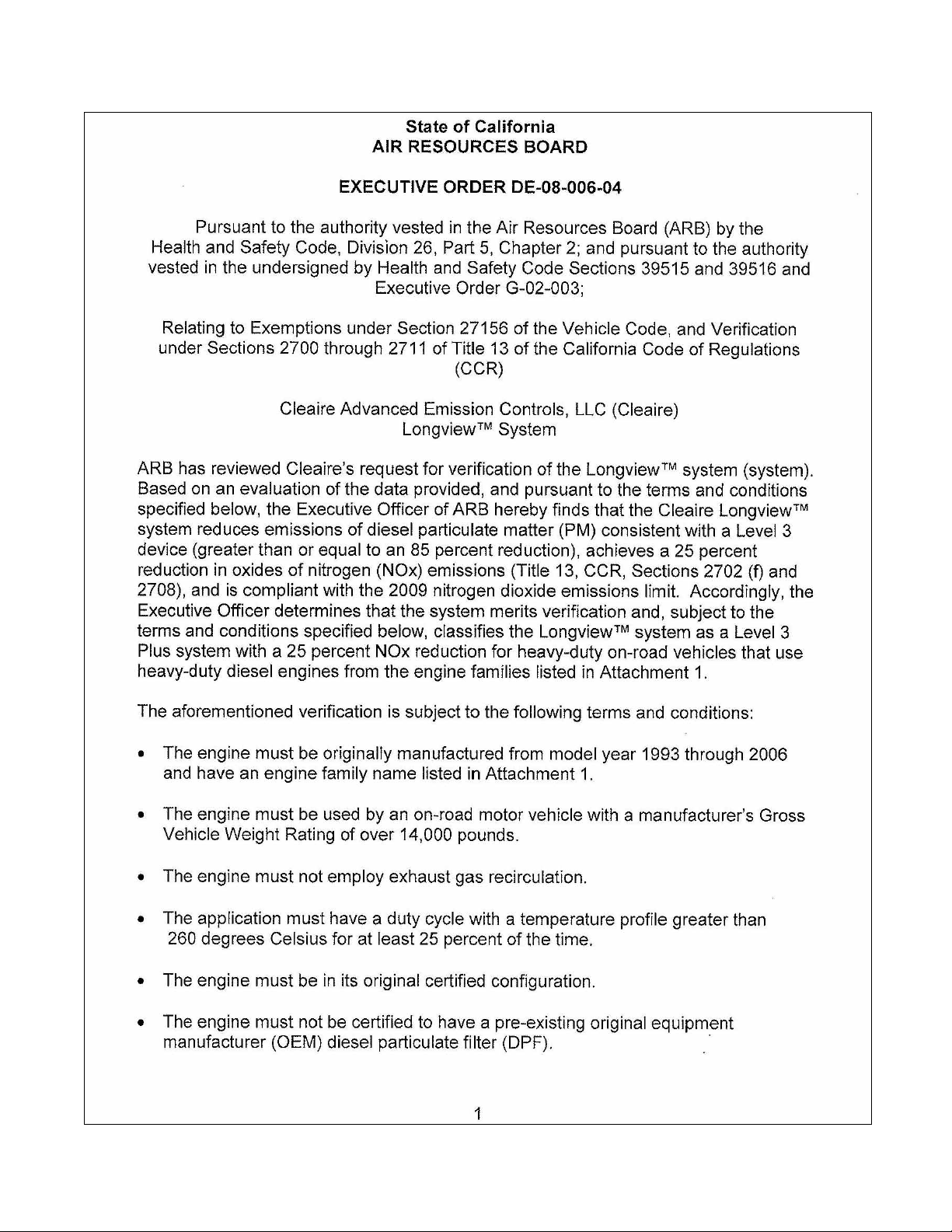
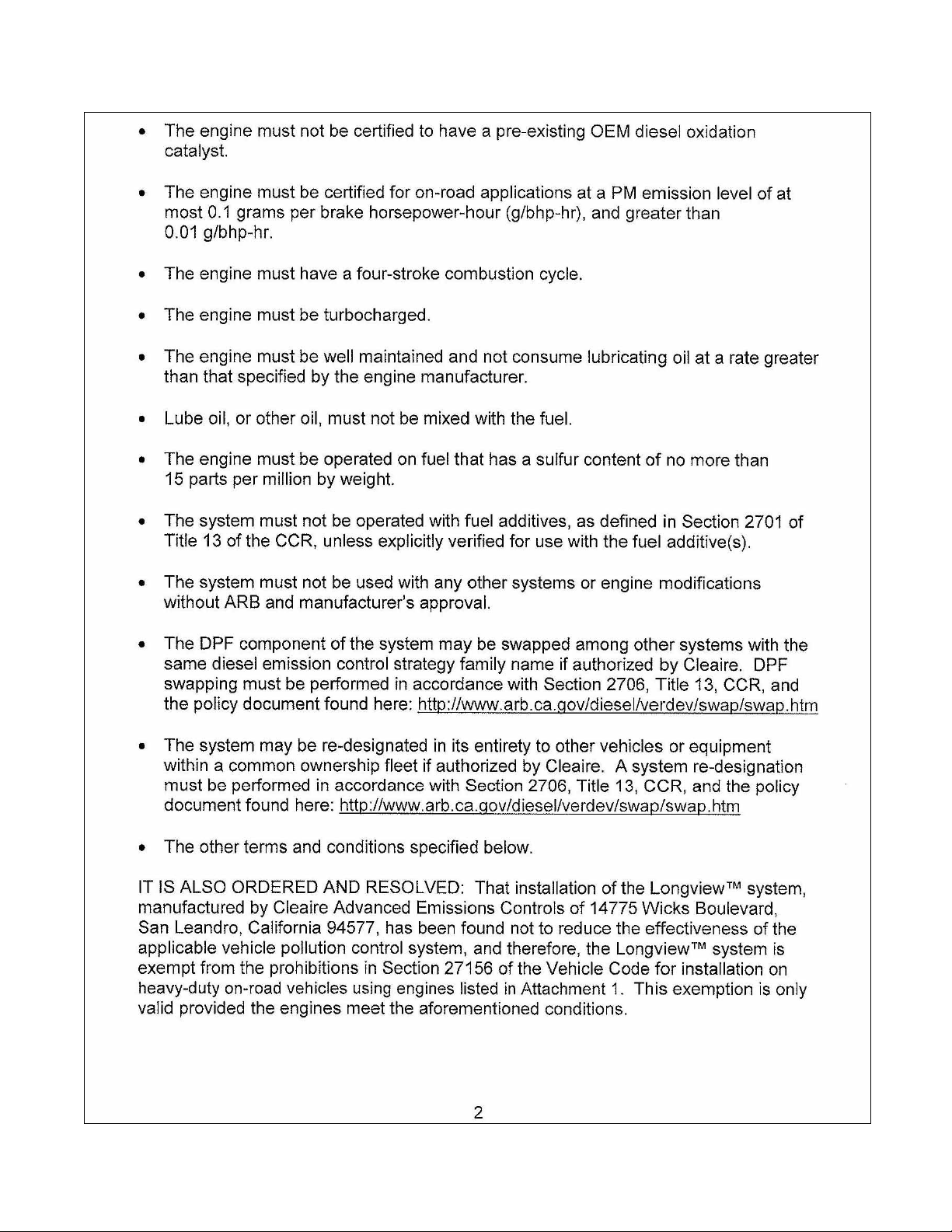
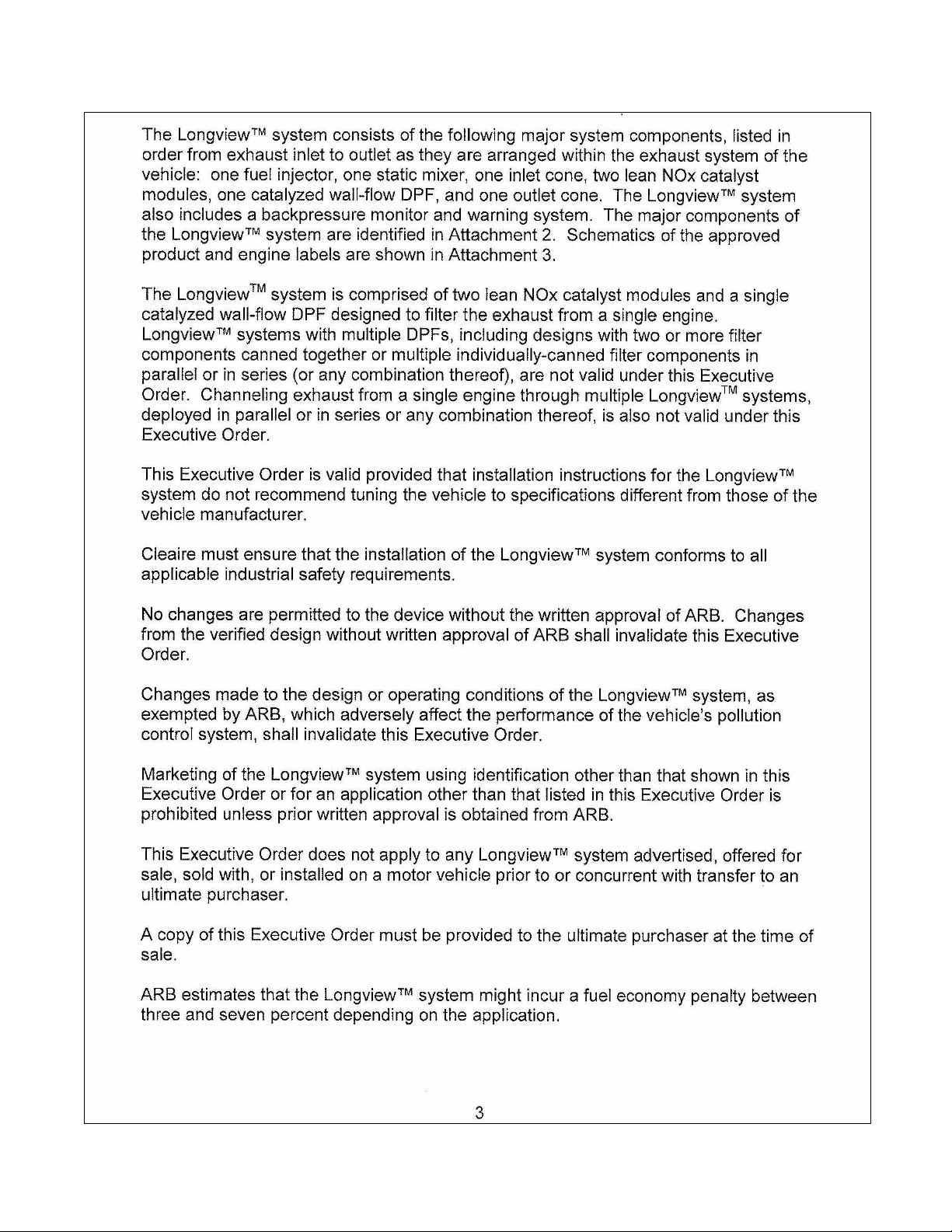
37. The E.O. for the Longview may also be obtained from the CARB website at
http://www.arb.ca.gov/diesel/verdev/level3/level3.htm.
The installation of the Longview system is based on the owner’s understanding that adding a
new part to or altering an original part of a certified configuration could be considered a
violation of the tampering prohibition of the Clean Air Act. The owner understands that the
installation of the Longview will not violate tampering provisions of the Act, at the time of
Longview_Owner's_Manual-2011-06 Page 2
Page 6

installation, because of the testing performed under the verification process and provided the
owner adheres to all installation instructions and meets all operating and maintenance
requirements for the Longview.
• Events that require action by the owner or operator are given in the “Owner’s
Obligations” section beginning on page 32.
• If any of these events occur, it is the owner’s obligation to take the appropriate
action. Failure to do so may be the basis for denying a warranty claim.
Contact Information
Contact a Cleaire-authorized dealer for any sales or service support for your Longview system.
The tables below for contact information are provided for the customer to complete at their
convenience. For more information, contact your local Cleaire product support representative,
call Cleaire at 800-308-2111, or visit www.cleaire.com.
Dealer
Address
Contact person
Contact person’s phone
Contact person’s fax
Contact person’s email
Name of local Cleaire product
support representative
Local Cleaire representative’s phone
Local Cleaire representative’s email
Longview_Owner's_Manual-2011-06 Page 3
Page 7

Installation
Cleaire recommends that a Cleaire-authorized technician install the Longview system. The
complete installation procedures are described in the Longview Installation Manual. Copies of
the manual are available upon request from your dealer or Cleaire. The installation warranty
(page 36) is the responsibility of the dealer that installs the Longview system.
Attention:
A Cleaire-certified technician must commission the system;
otherwise, that may be the basis for denying a warranty claim.
Warranty registration is submitted by the Cleaire-authorized dealer.
DPF Swapping
CARB defines component swapping as the movement of designated parts between different
vehicles/applications utilizing the same Diesel Emissions Control System (DECS). In this
case, Cleaire is limiting this process only to swapping of the diesel particulate filter (DPF)
module. Cleaire has a specified process for DPF swapping that has been approved by ARB.
Failure to follow the ARB-approved process completely could be the basis for enforcement
action against the end-user by ARB.
Attention:
Failure to follow the Cleaire swapping process may be grounds for enforcement action
by ARB against whoever performed or allowed the swapping to occur without following
the Cleaire-approved process.
Cleaire recommends that only a properly trained service technician perform DPF swapping.
This service is available from a Cleaire dealer. The end-user may attend Cleaire training
classes in order to become a properly trained technician. Please note: damage to the DPF
caused by improper handling or damage to other components of the system caused by
improper service techniques could be the basis for Cleaire to deny a warranty claim (in this
case, the person causing the damage will bear the warranty responsibility).
For end users who choose not to use a Cleaire-authorized technician, the detailed process for
DPF swapping is provided in the “Cleaire DPF Swapping Process” document. The Cleaire
DPF Swapping Manual is also available and it provides step-by-step instructions. Both of
these documents are available from a Cleaire dealer, Cleaire or at
www.cleaire.com/swapping/. In summary, the process involves:
• Technician confirms that there is not a solid amber LED; otherwise the cause of the
solid amber LED must be fixed before swapping can be done. Items requiring repair as
specified in the “Operations” section (page 14) should also be done before swapping.
• Technician removes DPF from a vehicle.
Longview_Owner's_Manual-2011-06 Page 4
Page 8

• Technician inspects the DPF:
o If DPF requires cleaning, technician will either perform the cleaning or have it
done.
o If the DPF fails the inspection, the technician will either acquire a new DPF from
a Cleaire dealer or a spare DPF from the end-user’s inventory.
• Technician will inspect the engine to confirm it is in good working condition, including:
o Oil consumption is within the engine manufacturer’s recommendation
o Injectors and turbo are in good condition and do not cause excessive soot in the
engine’s exhaust (at the inlet to the DPF).
o The fuel and tank are reasonably clean
• Technician installs the DPF on the recipient vehicle following all the specified service
procedures.
• Technician or administrative staff input the following data into Cleaire’s web-based
portal at www.cleaire.com/swapping/:
(Note: If you do not have Internet access, contact your Cleaire dealer or contact Cleaire
at 1-800-308-2111 or 14333 Wicks Blvd., San Leandro, CA 94577-6719.)
Donor vehicle/DPF
o CARB-verification label serial number for the DECS
o DPF part number
o DPF serial number
o Customer name (end user)
o Engine Serial Number
o Vehicle mileage or hours
o Date of DPF removal
Recipient vehicle/DPF (if known, or upon re-installation)
o CARB-verification label serial number for the DECS
o DPF part number
o DPF serial number
o Customer name (end user)
o Engine Serial Number
o Vehicle mileage or hours
o Date of DPF installation
• Warranty is maintained for the DPF by properly following this process in its entirety
System Re-Designation
CARB defines re-designation as the movement of a used verified Diesel Emissions Control
System (DECS) from an appropriate engine/application (donor) and installation on another
engine/application (recipient) meeting the terms and conditions of the DECS Executive Order
(E.O.) within the same common ownership fleet. At some point in the future, the customer
may want to remove the Cleaire DECS from the current vehicle and have it installed on a
different vehicle. There could be a variety of reasons such as retiring the current vehicle from
service. To avoid violation of the governing ARB Executive Order, violation of anti-tampering
laws, not complying with a fleet rule, and putting warranty coverage in jeopardy, the customer
should get approval from Cleaire for re-designation prior to movement.
Longview_Owner's_Manual-2011-06 Page 5
Page 9

Cleaire only allows the dealer to implement a re-designation; the customer must work through
the dealer if they want a DECS re-designated. Cleaire has a detailed process approved by
CARB for re-designating a DECS. In summary, the process involves:
• Pre-authorization (dealer collects information and submits it to Cleaire)
• Review (Cleaire confirms the recipient vehicle is compatible with the DECS)
• Notification (Cleaire notifies the dealer that the re-designation has been approved)
• DECS removed by the dealer from the donor application
• DECS installed by the dealer on the new approved application (and is fully
commissioned)
• Warranty (Cleaire activates the warranty on the new application with the remaining
warranty life)
Engine Repower
A DECS installed on a vehicle that is repowered may remain installed provided:
• The replacement engine meets all the terms and conditions of the governing Executive
Order or conditional verification letter,
• The DECS is not more than ten years old (based on the date of manufacture), and
• The appropriate DECS engine label is affixed to the replacement engine in a visible
location.
Acronyms
BP backpressure
CARB California Air Resources Board
CO carbon monoxide
DECS Diesel Emissions Control System
DPF diesel particulate filter
HC hydrocarbons
LED light emitting diode (system indicator light)
MLC® the electronic controller in the system
MLinC the software program used to communicate with the MLC
NOx nitrogen oxides
NRC NOx reduction catalyst
OEM original equipment manufacturer
PM particulate matter (diesel soot)
TC thermocouple
ULSD ultra-low sulfur diesel fuel
VDC volts direct current
Longview_Owner's_Manual-2011-06 Page 6
Page 10

S
YSTEM DESCRIPTION
Longview_Owner's_Manual-2011-06 Page 7
Page 11
Product Summary
The Longview system reduces oxides of nitrogen (NOx), particulate matter (PM), carbon
monoxide (CO) and unburned hydrocarbons (HC) from diesel engine exhaust. Features
include:
• NOx reduction catalyst (NRC)
• Diesel particulate filter (DPF)
• Cleaire MLC® (the electronic controller in the system)
• Stainless steel construction
• Modular design to facilitate installation, service and maintenance
• Sound attenuation eliminating the need for a muffler or silencer
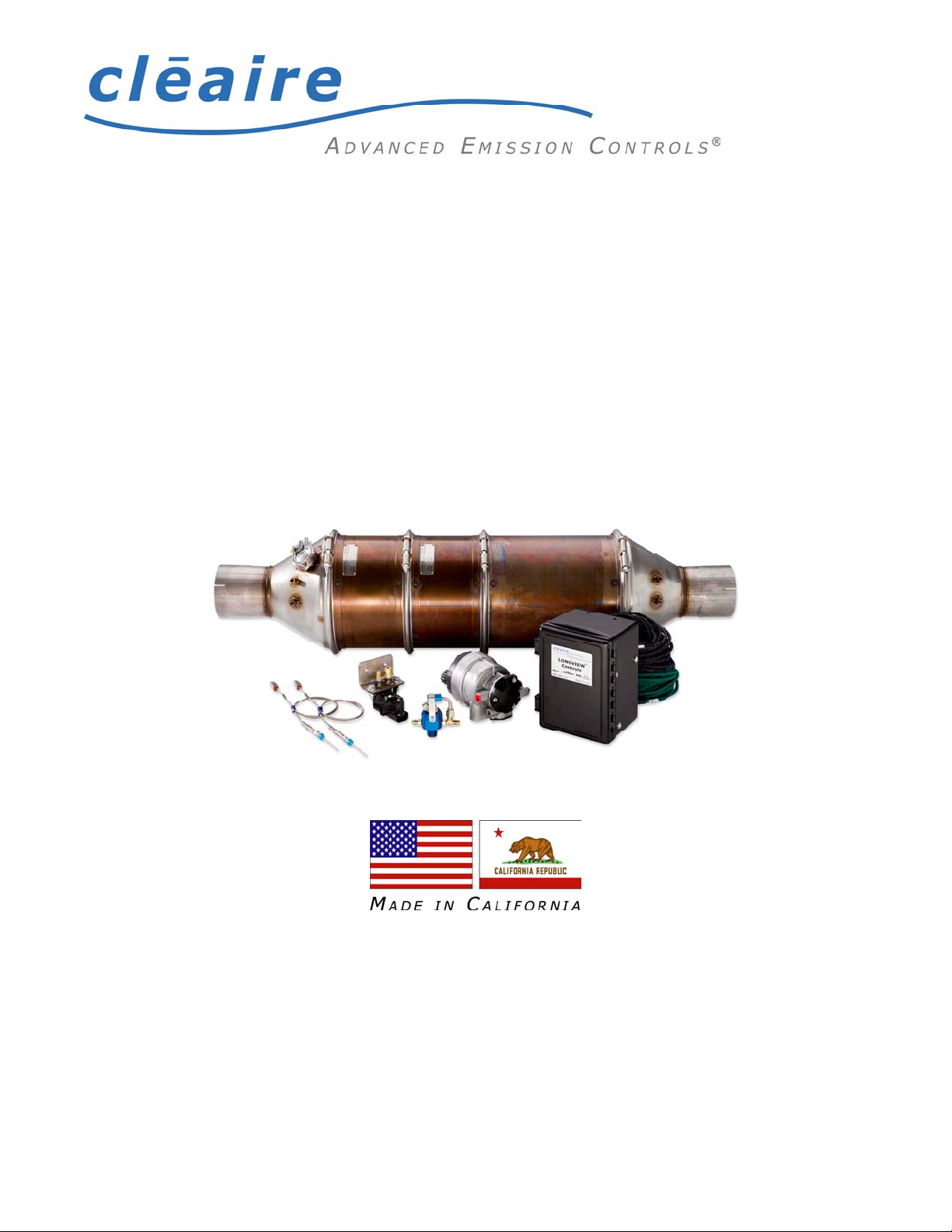
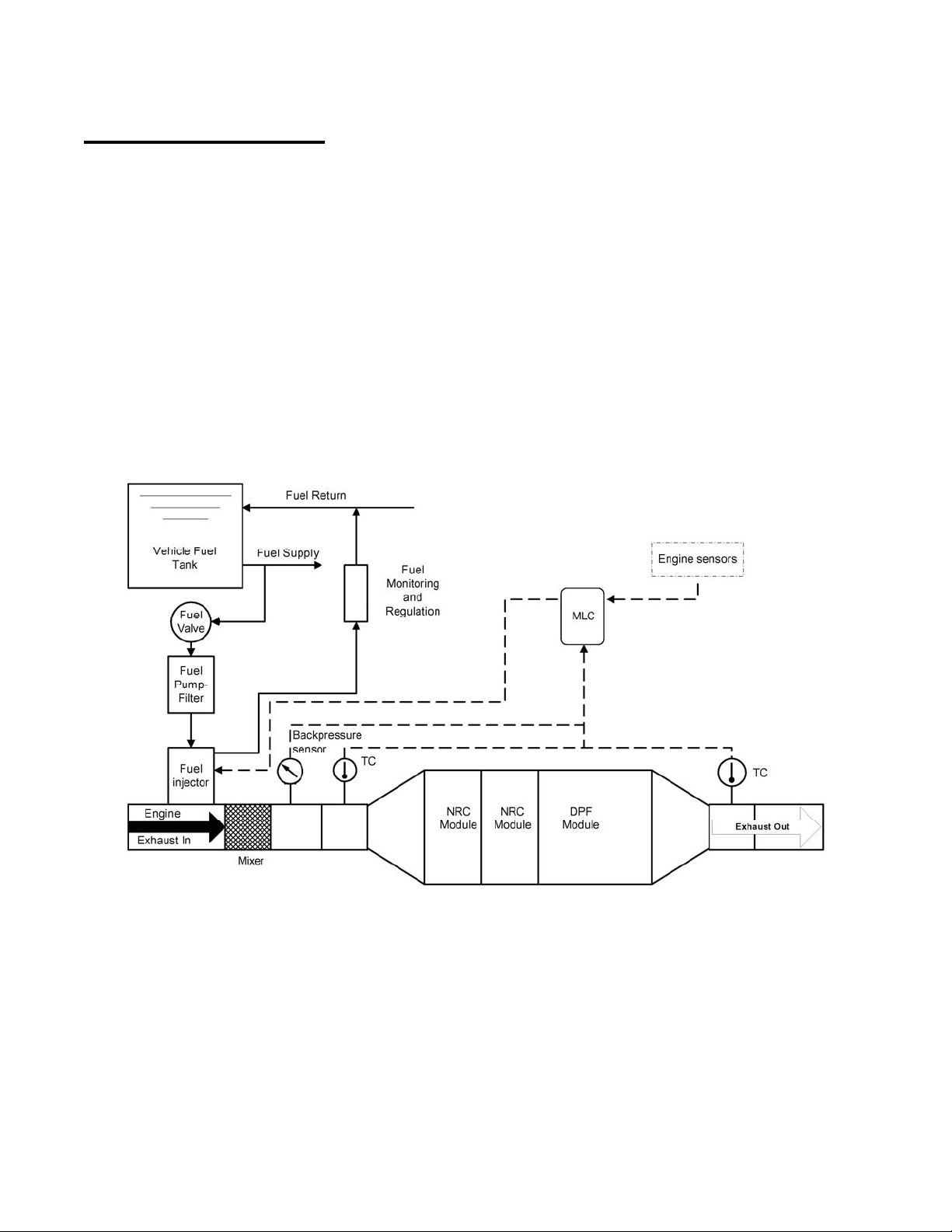
The Longview system shown in Figure 1 consists of three main subsystems: the catalyst
assembly, fuel delivery system, and the control system.
Figure 1: Cleaire Longview system.
The MLC® monitors engine conditions, Longview system operation and controls the fuel
addition. The injector adds fuel at the rate dictated by the MLC in order to provide a reducing
agent for the NRC. With the addition of diesel fuel to the engine exhaust by the fuel injector,
the NRC reduces the NOx emissions to the atmosphere. The catalyzed DPF reduces the PM,
HC and CO emissions.
Longview_Owner's_Manual-2011-06 Page 8
Page 12
Attention:
Catalyst Assembly
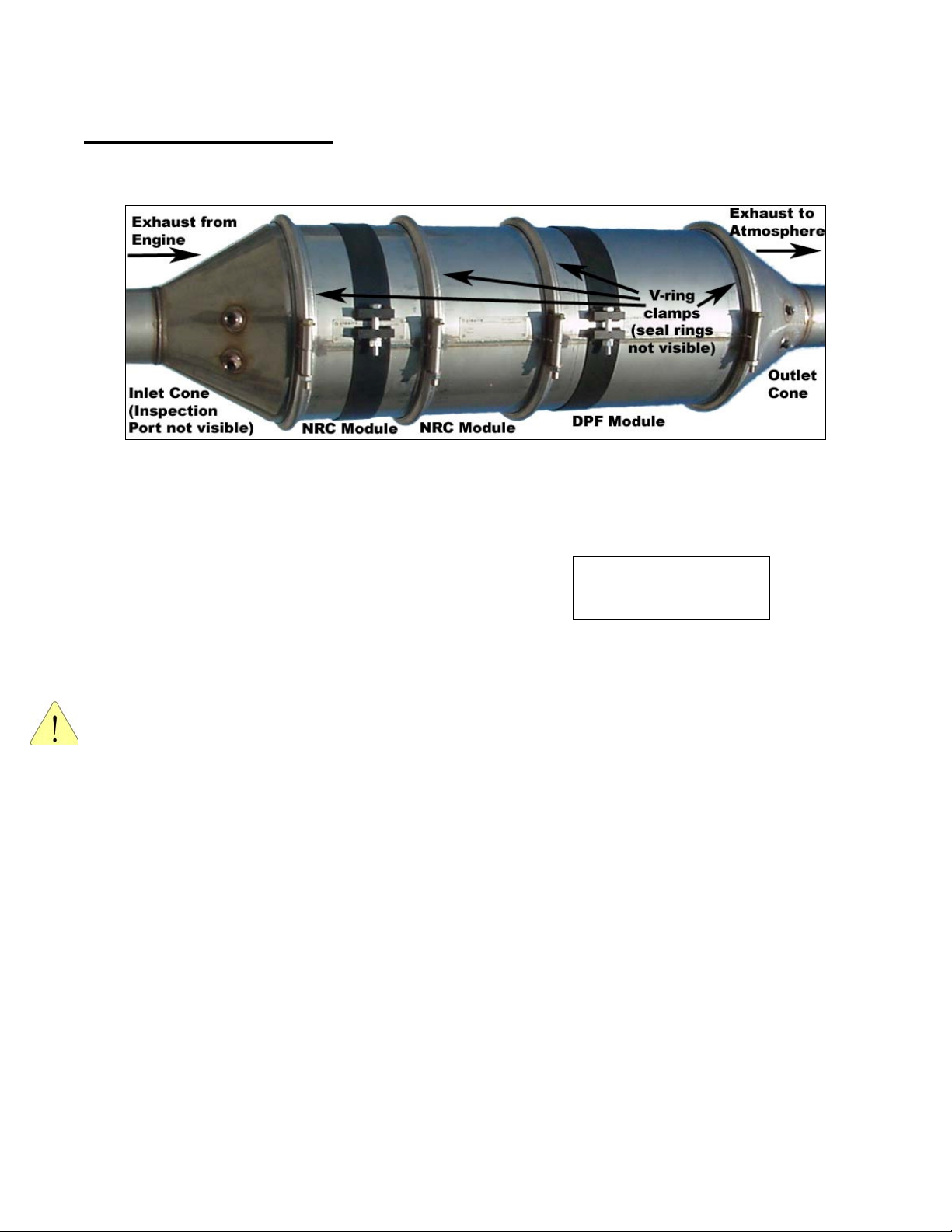
The catalyst assembly (Figure 2) is the core of the system and it replaces the stock muffler.
Cleaire provides a mounting assembly specifically designed for the Longview.
Figure 2: Catalyst Assembly (cone configurations vary depending on vehicle).
Care and handling requirements for the catalyst assembly are as follows:
1. Do not drop or hammer.
2. Use appropriate equipment when lifting.
3. Protect from water intrusion.
Handle with care!
4. Protect from accidental impacts.
5. Do not weld.
6. Protect the flanges during transport (use the foam shipping covers).
Although the catalyst assembly replaces the OEM muffler, be aware that the catalyst
assembly is approximately twice the weight of a typical muffler.
The catalyst assembly creates backpressure on the engine
The DPF provides high filtration efficiency, which results in backpressure on the engine. The
backpressure from the Longview varies instantaneously depending on the engine speed and
load and the soot and ash loading in the DPF. At times, the backpressure from the Longview
system may be higher than the backpressure caused by a muffler. However, other devices
such as exhaust brakes put much higher backpressure loads on the engine for short time
periods, and are approved by engine manufacturers. The backpressure caused by the
Longview system is not nearly high enough to lead to excessive exhaust manifold
temperatures or significant loss of performance. Typical average backpressure values from
the Longview are well within acceptable levels for the engine. The control system continuously
monitors backpressure and alerts the operator if necessary.
Longview_Owner's_Manual-2011-06 Page 9
Page 13
Control System
The control system consists of the MLC® and various sensors. The MLC reads the
backpressure sensor and uses the data to calculate the backpressure profile over a certain
period of operation. If the pre-programmed thresholds are exceeded, the MLC causes the
amber LED to blink, thus alerting the operator or other personnel that the system is
experiencing unusually high backpressure. The MLC also logs the time and conditions of the
occurrence. The constant monitoring of the backpressure sensor by the MLC ensures that the
backpressure is within safe limits and alerts the owner in time to take corrective action if
necessary.
The MLC not only monitors the system and alerts the operator if service is required, but also
continually logs operating data and records instances of unusual conditions. The MLC also
controls the fuel injection system.
Fuel Injection System
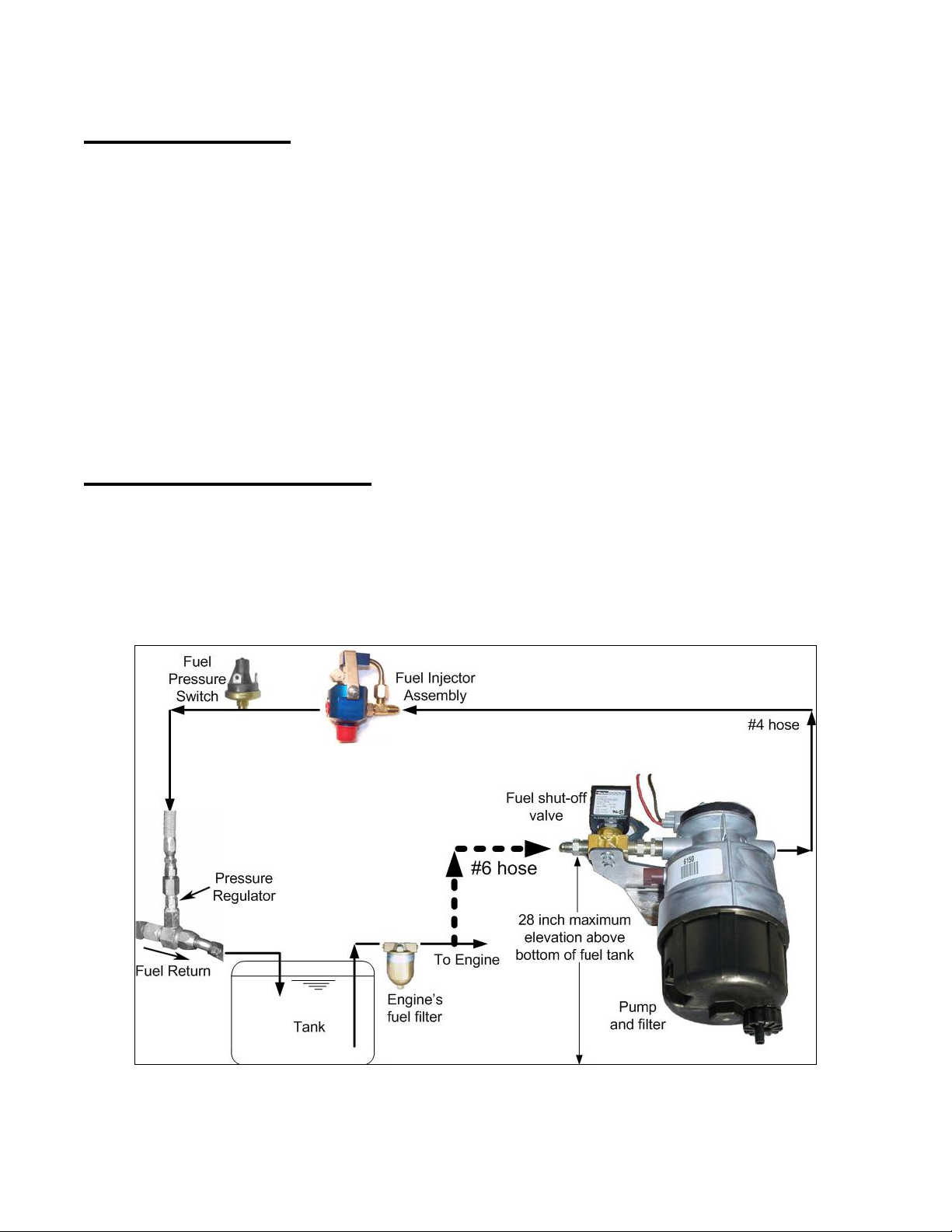
The Fuel Injection System is shown in Figure 3. Fuel is drawn directly from the engine fuel
supply system to ensure that it will not interfere with engine operation. A combination pump
and filter pressurizes the fuel to the injector. (Note: the Longview fuel pump does not turn on
until a few seconds after the engine starts.) The fuel injector is mounted in a fuel-cooled
assembly attached to the exhaust tube upstream of the catalyst assembly. The fuel flow is
monitored by the pressure switch and controlled by the pressure regulator and shut-off valve.
Figure 3: Fuel system flow diagram.
Longview_Owner's_Manual-2011-06 Page 10
Page 14
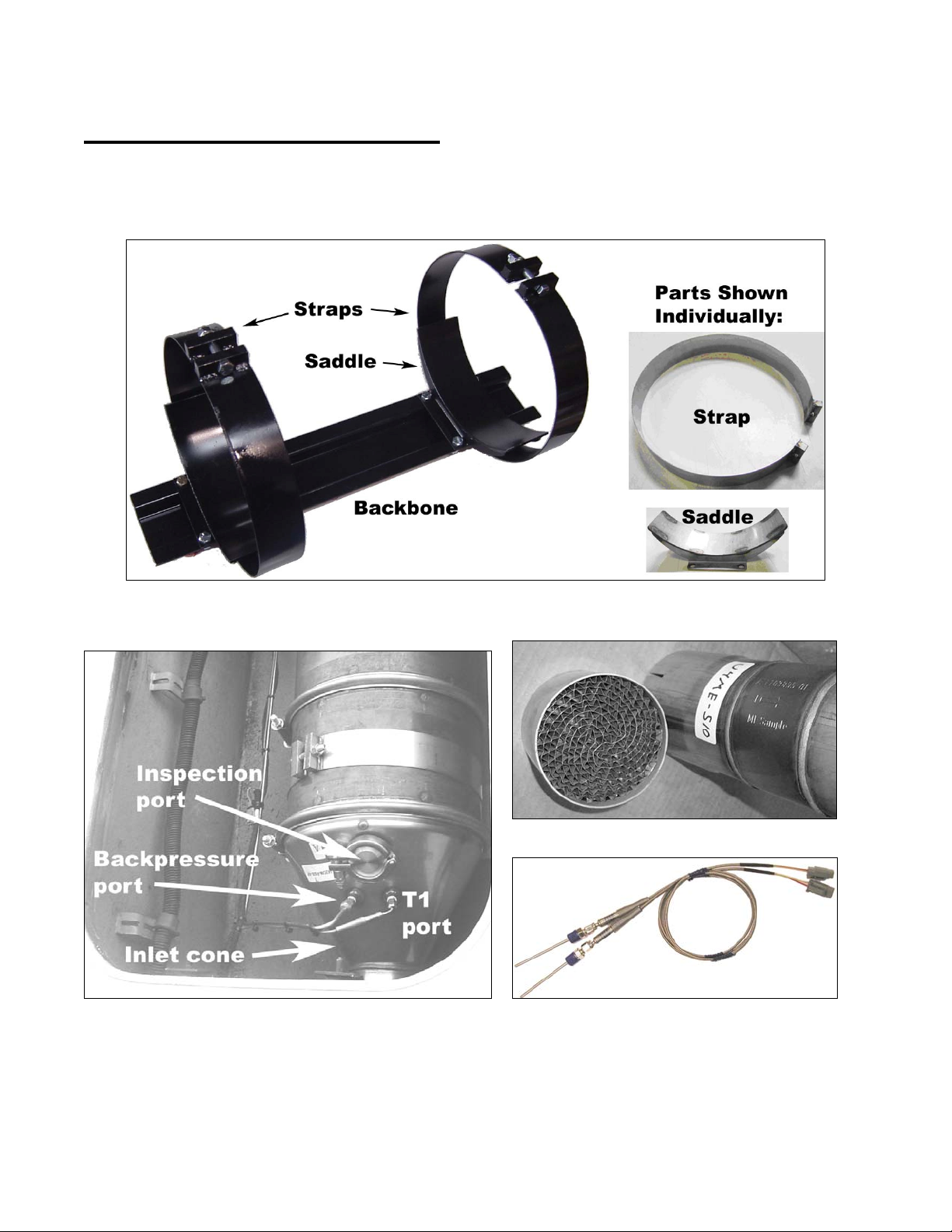
Major Component Pictures
The major components of the Longview system not previously shown are given in this section
(the catalyst assembly is shown in Figure 2 on page 9 and the fuel injection system
components are shown in Figure 3 on page 10).
Figure 4: Mounting Assembly: backbone, saddles and straps.
Figure 5: Inspection port.
Figure 6: Mixer
Figure 7: Thermocouples.
Longview_Owner's_Manual-2011-06 Page 11
Page 15
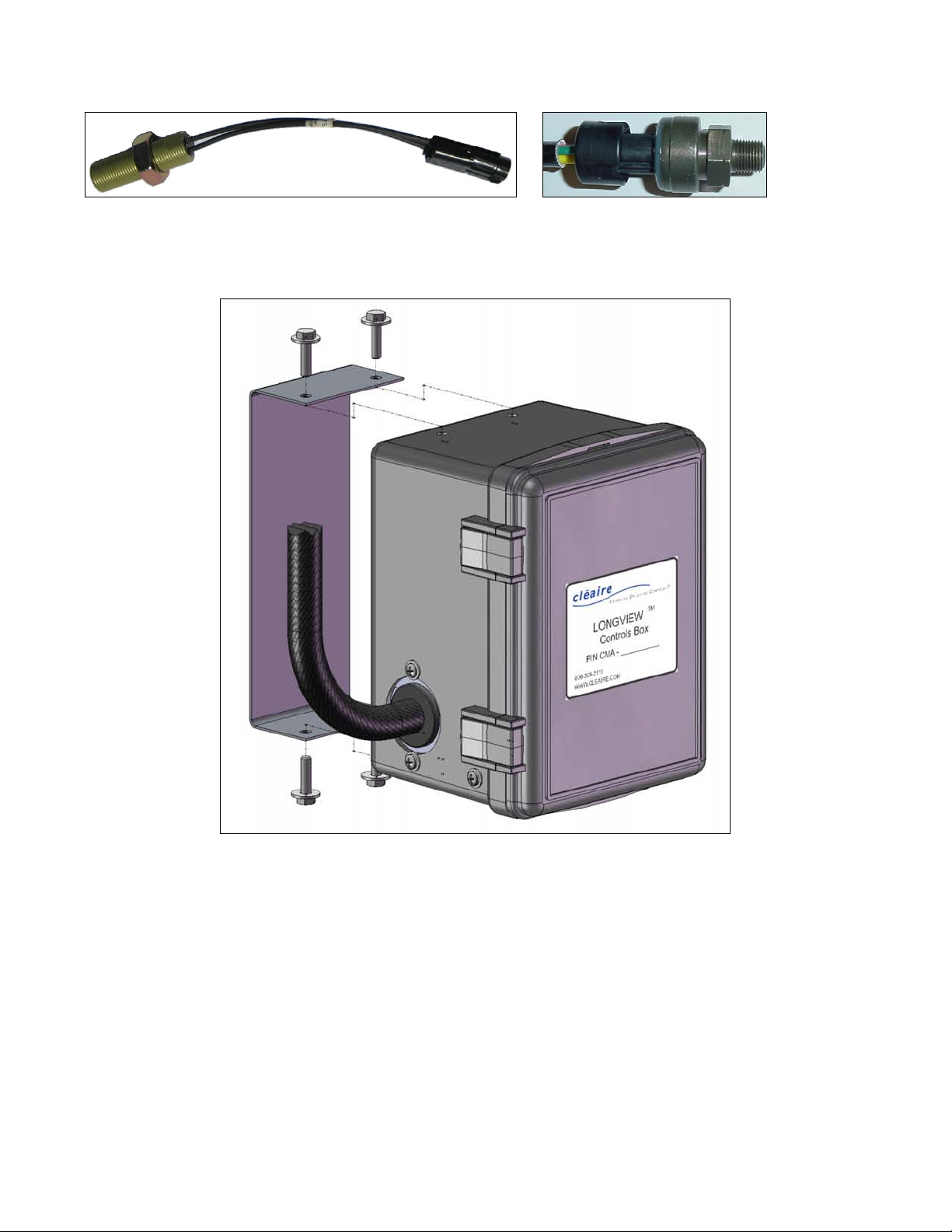
Figure 8:
Engine RPM sensor.
Manifold pressure sensor.
Figure 9:
Figure 10: Controls box.
Longview_Owner's_Manual-2011-06 Page 12
Page 16
CARB-Verification Labels
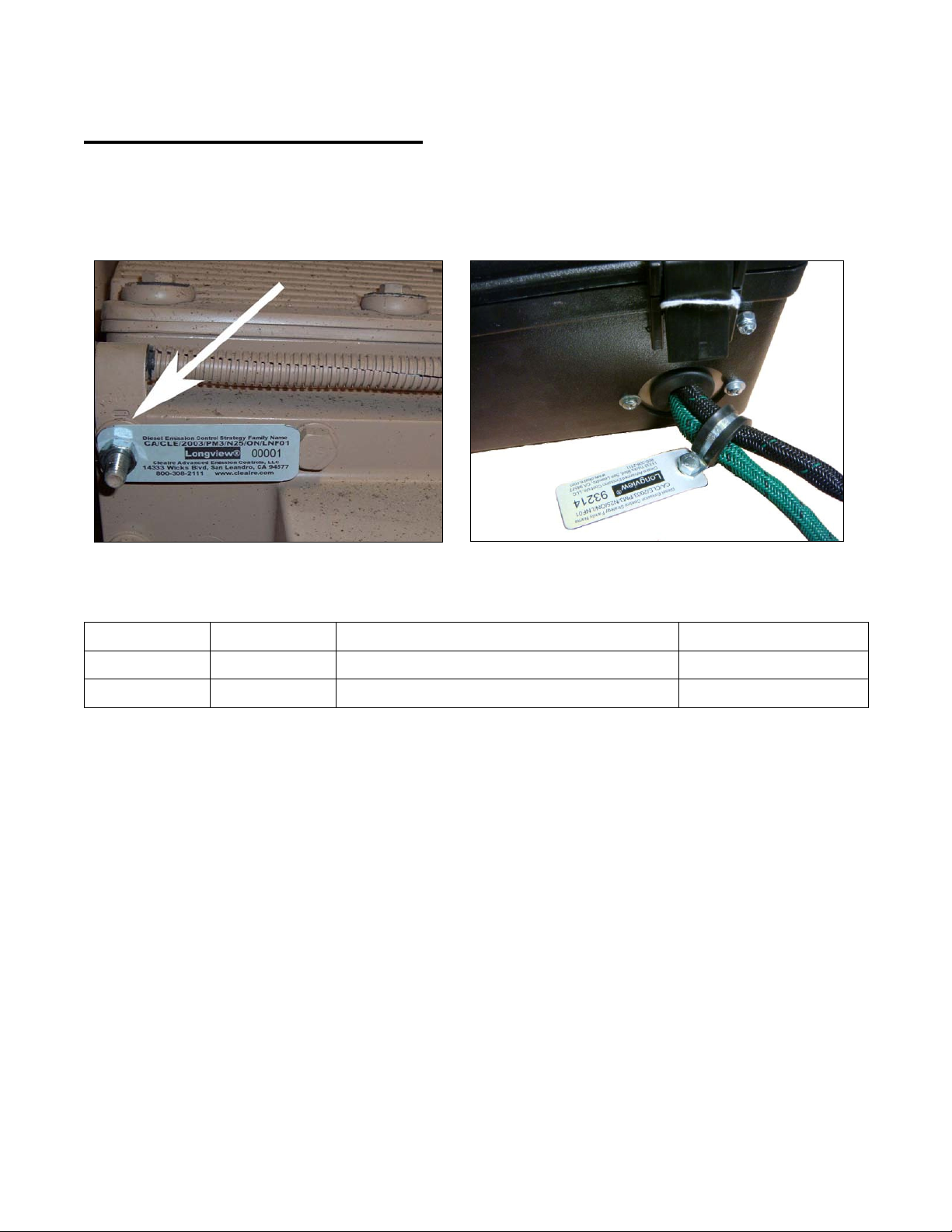
The system is provided with two CARB-verification labels. One is installed on the engine
(Figure 11) and the other one is attached to the wiring harness at the Controls Box (Figure 12).
If either one is missing, order a replacement label from a Cleaire-authorized dealer and be
sure to order the correct label for your application (see the table below the pictures).
Figure 11: Example of CARB-verification
label for Longview installed on engine.
Figure 12: CARB-verification label installed
on Longview wiring harness at Controls Box.
Product Application Verification Family Name Label Part Number
Longview On road CA/CLE/2008/PM3+/N25/ON/LNF01 CUH-748-1
Longview On road CA/CLE/2008/PM3+/N25/ON/LNF02 CUH-748-2
Longview_Owner's_Manual-2011-06 Page 13
Page 17

O
PERATIONS
Longview_Owner's_Manual-2011-06 Page 14
Page 18
Pay Attention to the System, Engine and Vehicle
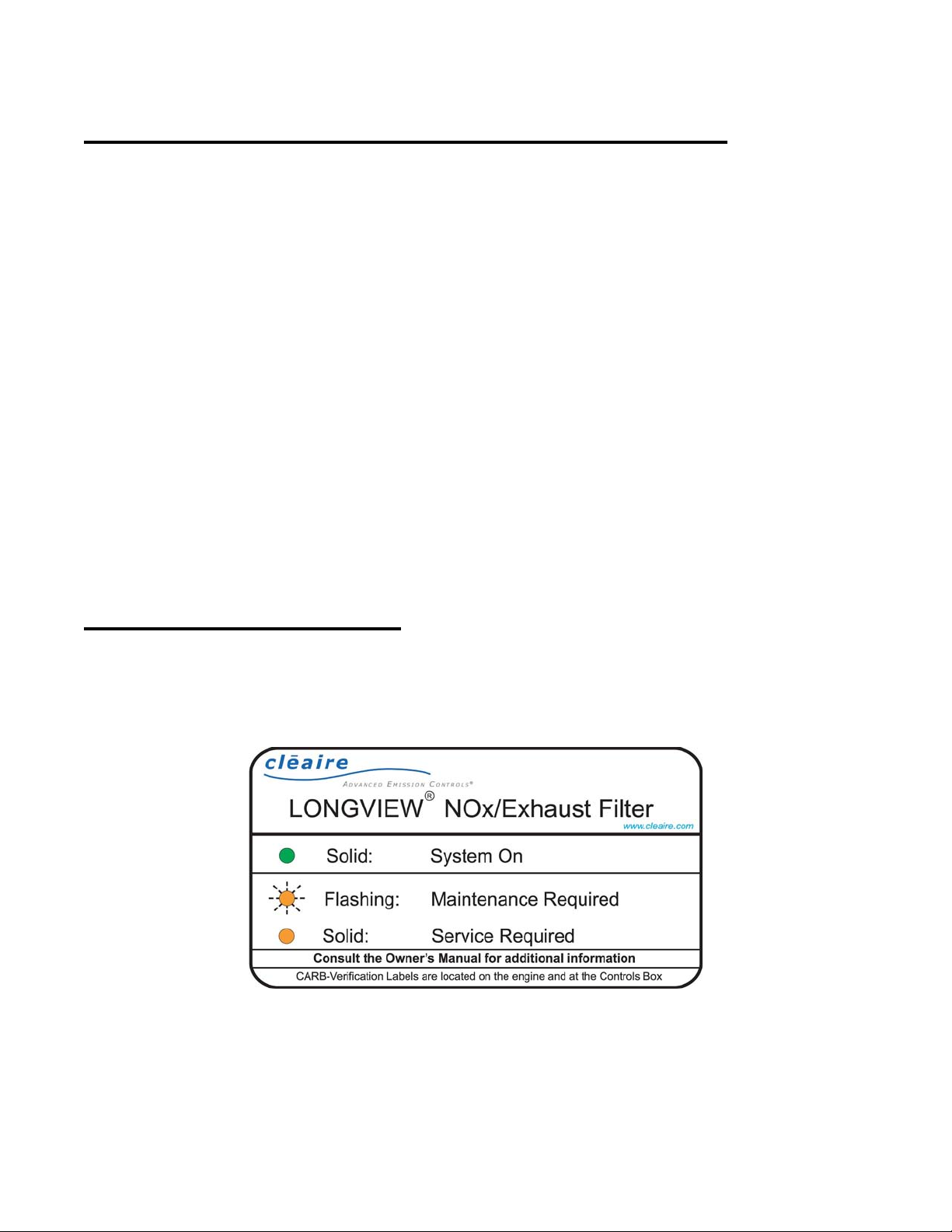
The green light on indicates that the system is operational. During normal operation, the
amber light will be off. If the amber light turns on or blinks, contact a Cleaire-authorized
technician (or a properly trained technician under the owner’s control) as soon as practical.
The indicator lights are described below. Refer to the Troubleshooting Table (page 24) if you
suspect the system is not operating properly.
1. The operator should observe the green and amber lights regularly during normal operation
and respond accordingly.
2. During engine operation, note any indications of unusual exhaust emissions or odor. Notify
a Cleaire-authorized technician or the owner’s technician if any unusual odors or emissions
are observed.
3. Periodically inspect the exhaust system for integrity. Note anything abnormal and make
repairs as warranted. For vertical exhaust stacks, make sure the rain cap is in place and
functioning properly. Contact a Cleaire-authorized technician as needed.
4. Periodically inspect the Longview fuel system for integrity. Note anything abnormal and
make repairs as needed. Contact a Cleaire-authorized technician as needed.
System Indicator Lights
The operator must observe the Longview system indicator lights on a regular basis and
respond accordingly. The label placed next to the lights (Figure 13) provides a brief
description of each light’s meaning. The light meanings are explained in greater detail after
the label below.
Figure 13: Label for Longview system indicator lights.
Longview_Owner's_Manual-2011-06 Page 15
Page 19
Condition Meaning Action
1. Green LED is off
(while engine is on)
2. Green LED is on solid MLC® is on
3. Amber LED flashing High backpressure
4. Amber LED on solid Longview needs service
o Green Light – On:
The green light indicates that the system power is on.
o Green Light – Off:
If the green light is off while the engine is operating, service is required.
See the “Troubleshooting Table” (page 24) for possible causes and remedies.
o Amber Light – Flashing:
A flashing amber light indicates high backpressure. Maintenance is required.
Longview needs service
Attention:
Contact a Cleaire-authorized
dealer for service.
No action required (unless
indicated by the amber light).
Follow the “Amber Light
Flashing” guide (p. 25).
Contact a Cleaire-authorized
dealer for service.
A number of factors can cause this situation such as excessive idling or the engine
producing excessive soot. These primary causes produce an overloaded DPF or soot
accumulation on the NRC, which in turn cause high backpressure.
See the “Troubleshooting Table” (page 24) for possible causes and remedies.
If the amber light is still flashing after following the recommended procedures, then contact
a Cleaire-authorized technician for maintenance.
o Amber Light – On Solid:
A solid amber light indicates a broken or disconnected sensor or a system fault.
Verify that all the wiring harness connections are properly attached. If the amber light stays
on, have the system serviced as soon as possible. For some faults, the solid amber light
can only be turned off through the service computer connection to the MLC.
The amber light will turn on solid for a few seconds after the engine starts. This allows the
operator to confirm that the LED itself is operational.
ATTENTION:
A solid or flashing amber light indicates that service is required.
Longview_Owner's_Manual-2011-06 Page 16
Page 20

Monitoring the Fuel System
The operator should observe both the engine and Longview system for the following:
o Fuel Leaks:
Clearly, any fuel leak presents a safety concern warranting immediate action. The first step is
to investigate and see if the problem can be resolved immediately and locally. In the event
that special parts (that is, Longview components) are at fault, then contact your dealer
immediately for further assistance.
o Fuel Consumption:
Fuel consumption varies with the specific application, driving habits and other factors.
Generally, the Longview system’s fuel consumption will be in the range of 3% to 5% (or less)
of the engine’s fuel consumption. If you experience excessive fuel consumption, please
contact the dealer.
o Fuel Supply:
The Longview system’s operation depends on a clean fuel supply. An integrated fuel pump
and filter is part of the Longview fuel system. The fuel filter should be inspected and replaced
if necessary during the Longview system’s preventative maintenance. Ultra-low sulfur diesel
fuel (ULSD) is required for CARB Level 3 verified Longview applications.
Longview_Owner's_Manual-2011-06 Page 17
Page 21

Conditions That May Damage the Longview
The operator should be aware of conditions that could result in damage to or failure of the
catalyst assembly or Longview system. If any of these events occur, it is the owner’s
responsibility to have the Longview inspected and, if necessary, repaired.
See the owner’s legal requirements under the Clean Air Act and CARB
regulations in the “Owner’s Legal Obligations” section on page 2.
Mechanical damage can occur if any system component is mishandled or accidentally
impacted. Internal damage to the catalyst assembly can occur from various forms of engine
failure such as losing a turbo or head gasket. These events would cause foreign debris to
enter the exhaust gas and then impact the catalyst assembly, likely causing some damage.
Furthermore, losing a turbo or other major oil leaks could result in excessively high
temperatures in the catalyst and DPF. If the engine loses the turbo, the driver should pull off
the road as soon as possible and shut the engine off.
Engine oil consumption has an impact on the operation and maintenance of the Longview. If
engine oil consumption exceeds the manufacturer’s specification, the engine should be
repaired. Failure to do so may damage the Longview and may be the basis for denying a
warranty claim. High oil consumption will increase the rate of ash accumulation in the diesel
particulate filter and will lead to more frequent maintenance. The “Engine Oil Consumption
and Lube Oil Ash” section on page 28 explains the impacts of oil consumption and ash content
on the operations and maintenance of the system.
Power washing the vehicle should not be a problem for the catalyst assembly, Longview
system. Avoid pointing the high-power wash at any Longview system connectors. However,
depending on the power washing technique, it may be possible to loosen an electrical
connector. If a connector comes loose, the amber LED will light. If the amber light comes on,
follow the procedures in the Troubleshooting Table (page 24).
For vertical stacks, be sure the rain cap is in place and functioning properly. It is important that
water does not enter the exhaust pipe where it could migrate to the catalysts or DPF. Avoid
low hanging branches or other obstacles that could knock off the rain cap.
Longview_Owner's_Manual-2011-06 Page 18
Page 22

M
AINTENANCE AND REPAIR
Longview_Owner's_Manual-2011-06 Page 19
Page 23

Your Right to Maintenance Information
The Air Resources Board requires that Cleaire provide detailed maintenance information for
the diesel emission control system upon delivery to the end-user pursuant to section
2706(h)(2), Title 13, California Code of Regulations, at no additional cost to the owner. If you
do not already have this information, contact Cleaire at 1-800-308-2111.
The Importance of Engine Maintenance
Proper engine maintenance is critical for the proper functioning of your diesel emission control
strategy. Failure to document proper engine maintenance, including oil consumption records,
may be grounds for denial of a warranty claim for a failed component of a diesel emission
control strategy.
The Importance of Properly Maintaining a Diesel Emission
Control Strategy
Proper maintenance is critical for the diesel emission control strategy to function as intended.
Failure to document proper diesel emission control strategy maintenance, including cleaning
and/or ash removal of the system, replacement of consumables, and replacement of
broken/failed parts, may be grounds for denial of a warranty claim for a failed component of a
diesel emission control strategy.
Maintenance Schedule
Cleaire recommends that a Cleaire-authorized technician or a properly trained technician
under the owner’s control perform the maintenance and repair of a Longview. Preventative
maintenance is required once a year (unlimited operating hours) or every 50,000 miles,
whichever comes first, to ensure the system is in good operating condition; however, the DPF
may require cleaning more often than that depending on the engine’s oil consumption rate.
See the “Engine Oil Consumption and Lube Oil Ash” section on page 28 for more information.
The owner is legally required to keep the Longview in good operating condition in
order to comply with the Clean Air Act and CARB regulations (for systems
operating in California). See the “Owner’s Legal Obligations” section on page 2.
Failure to have the preventative maintenance performed may be the basis for denying a
warranty claim. Maintenance or repairs done by anyone other than a Cleaire-authorized
technician is the responsibility of the person or organization performing the work. The cost of
parts and labor for preventative maintenance are not included in the purchase price of the
Longview system. The parts and labor included in preventative maintenance are listed in the
“Preventative Maintenance Labor and Parts” section below.
Longview_Owner's_Manual-2011-06 Page 20
Page 24

Preventative Maintenance Labor and Parts
Preventative maintenance by a Cleaire-authorized technician includes:
o Download data from the MLC and review the Instant Report.
o Confirm the system indicator lights are functioning properly.
o Inspect the fuel injector assembly.
o Replace the fuel filter and inspect the fuel pump.
o Inspect the Controls Box and components.
o Inspect and clean the backpressure sensor tubing and breather filter.
o Inspect the sensors and wiring harness.
o Inspect and clean the DPF.
o Inspect the NRC modules and clean if necessary.
o Inspect exhaust tubing.
o Reinstall the DPF and confirm the system is securely mounted.
o Upgrade the MLC program if necessary.
o Make repairs (if any of the above inspections showed repairs are needed).
o Perform comprehensive tests of the system’s operations.
Fuel Pump and Filter Maintenance
The integrated fuel pump and filter should be inspected during the scheduled annual
maintenance. Cleaire recommends changing the fuel filter at that time and anytime the engine
fuel filter is changed.
Catalyst Assembly and DPF Maintenance
It may be necessary to periodically clean the DPF module (in addition to the annual cleaning)
depending on the vehicle’s driving cycle and the ash content of the diesel fuel and lube oil.
The collection of inorganic ash results in an increase in backpressure from the catalyst
assembly over time. If ash in the DPF results in high backpressure then the amber light will
flash. Note: higher than normal oil consumption will increase the rate of ash accumulation in
the DPF, and thus may require more frequent maintenance.
Cleaire recommends the use of low-ash engine oils (CJ-4 oil). These products have been
specifically designed for use with a DPF, and can significantly reduce the buildup of ash in the
DPF and extend the filter cleaning interval. See the “Engine Oil Consumption and Lube Oil
Ash” section on page 28.
A Cleaire-authorized dealer can clean the DPF module. They also will ensure that the
collected material (ash and soot) is properly disposed in accordance with all applicable
Federal, State and local laws governing waste disposal.
Longview_Owner's_Manual-2011-06 Page 21
Page 25
The catalyst assembly is designed to process exhaust flow in only one direction. The
order of the individual modules within the catalyst assembly is also critical for the
proper operation of the Longview system. If any sections are disassembled for
maintenance (or any other reason), be sure that they are reinstalled in their proper
position. Also be aware that the DPF module has a flow direction arrow on it and must
be installed accordingly. The NRC modules can be installed in either direction as long
as they are installed in their proper sequence within the catalyst assembly.
Exhaust Tubing and Components
All tubing connections between the engine and the catalyst assembly should be maintained in
a gas-tight and leak-free manner. Also, all tubing between the engine and catalyst assembly
must be maintained in good condition. This requirement includes any other components such
as exhaust brakes. Aluminized mild steel tubing or rusty tubing could flake off into the exhaust
stream. If flaking occurs, the catalyst or DPF may plug, resulting in high backpressure and
engine power loss. Cleaire recommends using stainless steel tubing between the turbo and
the catalyst assembly. It is the engine owner or operator’s responsibility to ensure that
all tubing in this critical area be maintained in good condition.
Service Calls
The MLC® controls the green and amber indicator lights to provide system status as described
in the “System Indicator Lights” section (page 15). Not all conditions will be detected by the
MLC® (for example, an accident that physically damages the catalyst assembly). Therefore, it
is important for the owner and/or operator to observe the engine and Longview operations in
addition to watching the indicator lights. See the “Operations” section beginning on page 14
for routine observations that the driver and/or owner should perform. Also, see the “Owner’s
Obligations” section on page 32.
Upon any indication of a malfunction, promptly contact a Cleaire-authorized dealer (or the
owner’s technician). See the “Contact Information” section on page 3. Please be prepared
with the following information:
1. Fault information and descriptions in as much detail as possible.
2. The part number and serial number of each catalyst and DPF module (see Figure 14).
Figure 14: Example of NRC Module Data Plate.
Longview_Owner's_Manual-2011-06 Page 22
Page 26
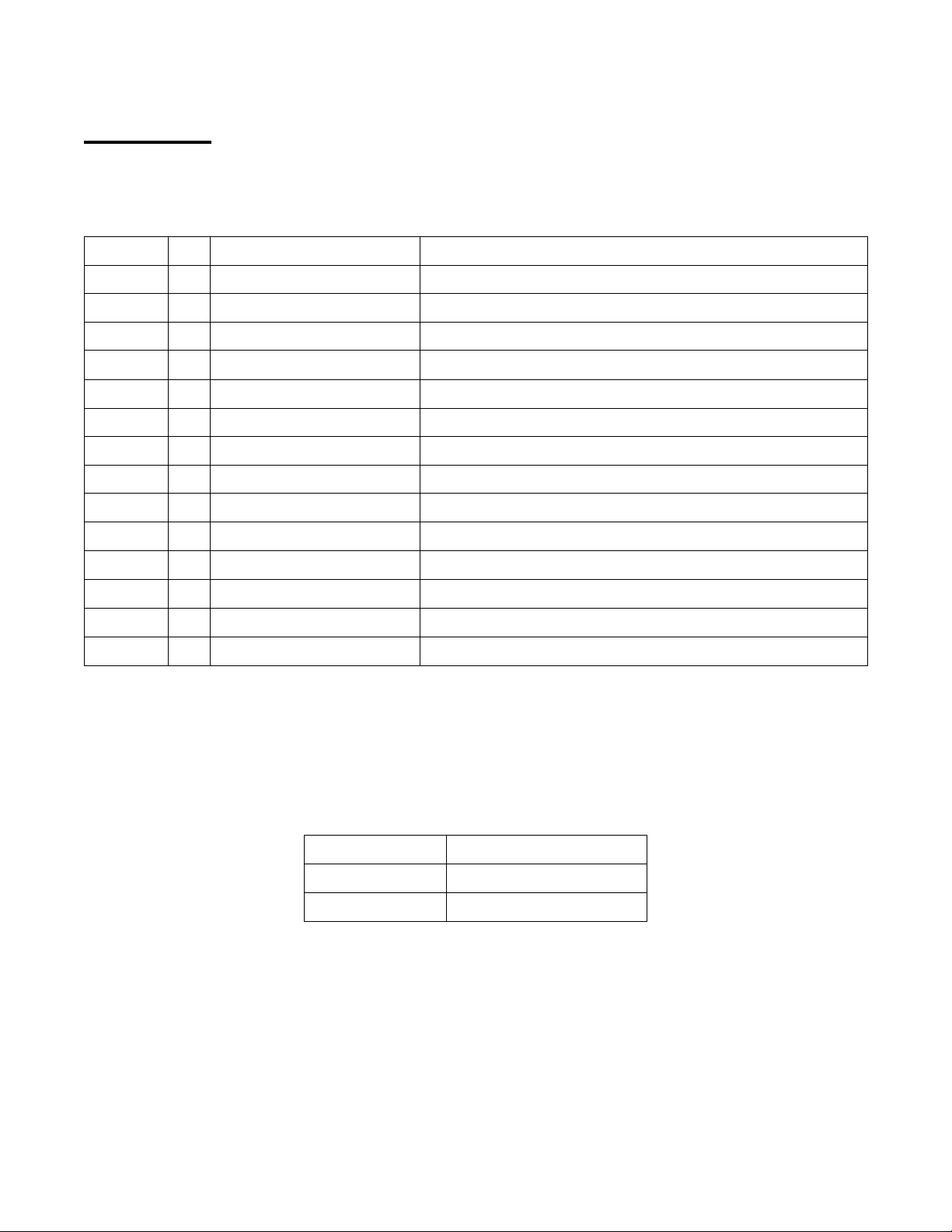
Parts List
A complete parts list was provided with the system. Contact your Cleaire-authorized dealer if
you need a replacement list. The major parts are listed in the table below.
Longview System Major Parts List
Item # Qty
1
2
3
4
5
6
7
8
9
10
11
12
13
14
1 C_F-_ Diesel Particulate Filter Assembly, Unidirectional
2 C_C-02 NOx reduction catalyst
1 C_ _ _D-__-AP__ Cone, inlet
1 C_ _ _-_ Cone, outlet
1 CMA-__-__ Sensor, RPM
2 CMA-4 Sensor, thermocouple
1 CMK-5.0_ or CMK-6.0_ MLC® (electronic control unit)
1 CUE-45 Sensor, backpressure
1 CU_ME-_ _ Static mixer assembly
1 CUE-55 Diesel fuel pump/filter
1 CUP-7 Fuel pressure regulator
1 CUE-1 Injector assembly
1 CUE-41 Sensor, manifold absolute pressure
1 CUH-748-1 or CUH-748-2 Kit, label, Verification, Longview
Part Number Description
Spaces represent variables depending on specific configuration and application.
Parts that may be required for preventative maintenance are not covered by the product
warranty as discussed in the “Maintenance Schedule” section on page 20 and are listed in the
table below.
Longview Maintenance Parts List
Part Number Description
CUP-49 Fuel pump filter (small)
CUP-50 Fuel pump filter (large)
Longview_Owner's_Manual-2011-06 Page 23
Page 27

1. Green LED
- On
•
•
2. Green LED
- Off
•
•
3. Amber LED blinks
•
•
4. Amber LED on
•
•
5. Fuel drips or leaks
•
•
6. Unusual odor or
•
•
7. White smoke
•
•
8. Light soot dusting
•
•
9. Visible emissions
•
•
10. Engine surges or
•
•
Troubleshooting Table
Use the table below to diagnose and resolve potential Longview operating problems. Most
abnormal conditions will require service or repair by a Cleaire-authorized technician or a
properly trained technician.
Condition Probable Cause Remedy
solid
exhaust noises
during startup
in exhaust tube
(white or black
smoke during
normal operations)
has power loss
MLC® has power
(desired condition)
No power or open fuse
• Loss of MLC program
(if amber on and green off)
• Faulty LED or wiring
High backpressure
(overloaded DPF or
soot accumulation on NRC)
Sensor connection loose
• Faulty sensor
• System malfunction
• Loss of MLC program
(if amber on and green off)
Loose connection(s)
• Defective hose
• Fatigued or damaged O-ring
• Faulty injector
Loose tubing connection(s)
• Loose clamp(s)
• Crack in exhaust tube
• Crack in catalyst assembly
• Loose injector mount
• Engine injector or turbo problem
Normal condensation inside
catalyst assembly
Normal condition
MLC® power or signal loss
• Fuel injector malfunction
• Sensor failure
• DPF failure
Engine malfunction
• Loose connection in fuel system
• Soot accumulation on NRC or
overloaded DPF (Amber light
should have been flashing)
No action required.
• Operate & monitor normally.
Check fuse, wires and power to
the MLC®.
• Contact a properly trained
technician for repair.
Follow the “Amber Light
Flashing” guide (p. 25).
• Contact a properly trained
technician for maintenance.
Check wiring connections.
• Contact a properly trained
technician promptly
(system needs maintenance as
soon as practical).
Tighten connection(s).
• Replace faulty parts.
• Contact a properly trained
technician for repair.
Tighten connection(s).
• Replace damaged tube.
• Contact a properly trained
technician for repair.
• Repair the engine.
No action required.
No action required.
Contact a properly trained
technician for repair.
Repair the engine.
• Contact a properly trained
technician for service.
There is additional troubleshooting information in the Longview and Lonestar Service Manual.
This manual is for trained technicians.
Longview_Owner's_Manual-2011-06 Page 24
Page 28
Amber Light Flashing
A flashing amber light indicates high backpressure. High backpressure is usually the result of
an overloaded DPF or soot accumulation on the front of the NRC.
The causes and remedies for an overloaded DPF or soot accumulation on the NRC are
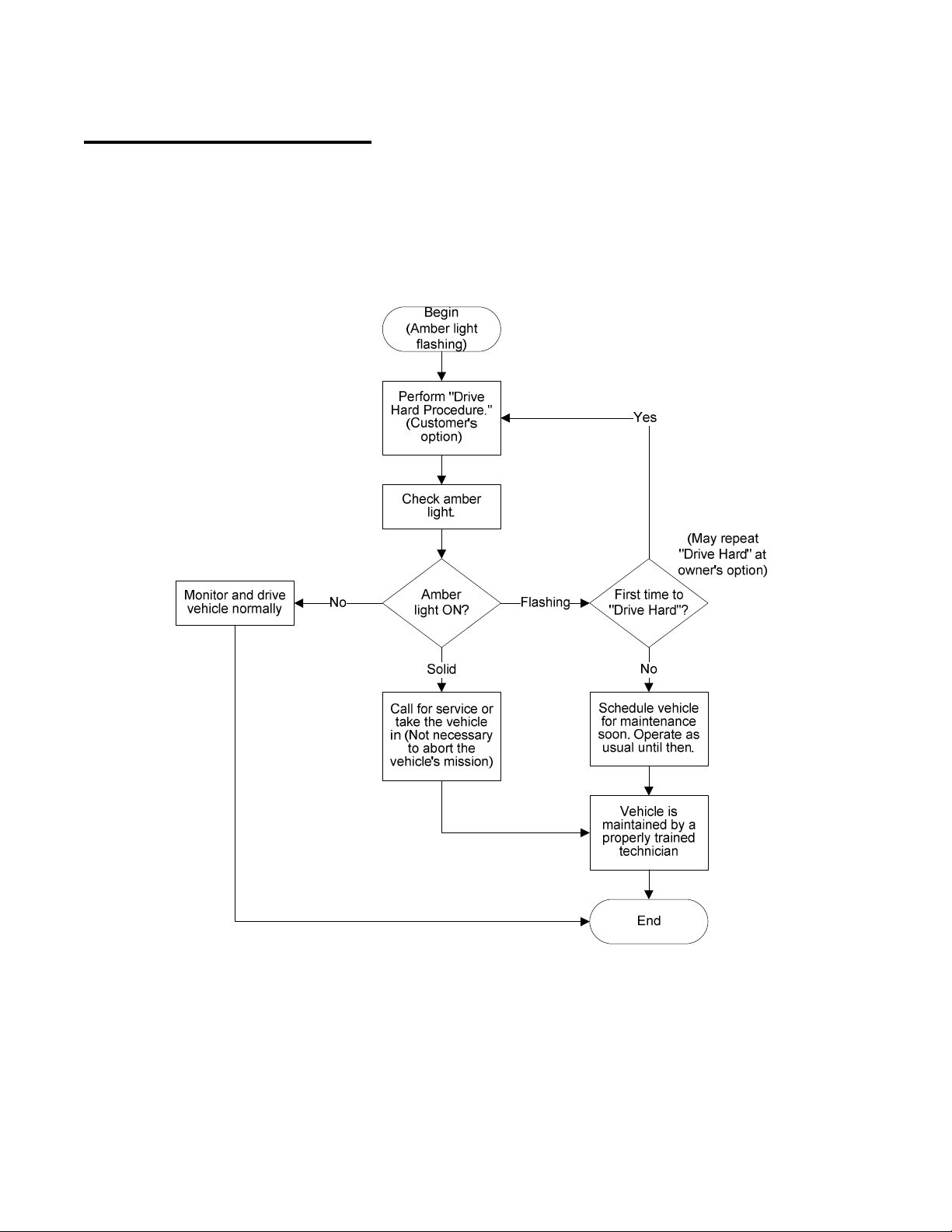
provided after the chart below. Follow Figure 15 to respond to a flashing amber light condition.
The “Drive Hard Procedure” is explained after the chart.
Figure 15: Flashing Amber Light Troubleshooting Process.
o Drive Hard Procedure
The customer may perform this procedure at their option. If they do not want to do it, then they
should schedule the Longview for maintenance by a properly trained technician as soon as
practicable. The vehicle may be operated normally until the maintenance appointment.
Longview_Owner's_Manual-2011-06 Page 25
Page 29

Run the engine hard, under as much load as possible, for at least 30 to 45 minutes at
sustained intervals. This operation may regenerate the DPF, and the light will reset itself.
Check the light again at the end of the day. If the amber light goes out, then operate normally
from that time onward. If the light stays on, the customer may repeat this process at their
option. If the amber light is still flashing after more than one “Drive Hard,” then schedule the
system for maintenance by a properly trained technician as soon as practicable. The operator
may use the vehicle normally until the maintenance appointment.
ATTENTION:
If the amber light turns on solid at anytime, then the Longview will require maintenance
by a properly trained technician.
o DPF overloaded with soot or ash
In some cases, driving the vehicle under load (Drive Hard Procedure) can regenerate a DPF
overloaded with soot. Sometimes though, the high backpressure from the DPF is the result of
ash loading in the DPF, which requires cleaning the DPF off of the vehicle.
If high backpressure from an overloaded DPF becomes repetitive, it might be that the engine is
producing high levels of soot or the vehicle’s duty cycle is relatively light. A light duty cycle
causes the engine’s average exhaust temperature to be too cold to regenerate the DPF
consistently. Long idle times could also be the cause. Rotating the vehicle to a tougher duty
cycle application or reducing idle time to a minimum may be sufficient to avoid repeat amber
light events caused by a DPF overloaded with soot.
Another cause of a frequently overloaded DPF may be engine problems such as excessive oil
consumption that result in a high rate of ash into the DPF. A Cleaire-authorized dealer can
provide the DPF cleaning service to remove the ash.
Since engine problems may be the cause of the Longview amber light coming on, Cleaire
recommends that the engine receive a thorough evaluation if the amber light does not turn off
after performing the “Drive Hard Procedure.”
o Soot accumulation on the NRC
Soot accumulation on the NRC face occurs on a small percentage of vehicles due to a variety
of factors including engine age and condition, bad fuel injectors, driver habits, driving cycle and
engine load.
If NRC soot accumulation has occurred, a properly trained technician will be able to diagnose
the condition and clean the NRC when the vehicle is brought in for maintenance according to
Figure 15. The Cleaire-authorized dealer will be able to assist the customer in minimizing the
impact of NRC soot accumulation on the vehicle’s use and availability.
Longview_Owner's_Manual-2011-06 Page 26
Page 30

Service Type (and subtype)
Definition/Example
Cost Responsibility
Since engine problems may be the cause of the excessive soot (and thus the amber light
flashing), Cleaire recommends that the engine receive a thorough evaluation if soot
accumulation is frequent.
Repair and Maintenance Clarifications
The warranty (page 34) includes a section titled “Owner’s Warranty Responsibility” which
clarifies that the owner or operator is responsible for making sure that the maintenance
described in this owner’s manual is performed. In addition to the annual maintenance, the
amber light is another indicator that maintenance is required.
ATTENTION:
The amber light indicates that service is required.
Maintenance items such as cleaning an overloaded DPF or soot accumulation on an NRC
(that are caused by engine or vehicle operating conditions) are not warrantable items. If a
repair is required, it may be covered under the installation or product warranty depending on
the cause. The table below provides a summary of service types (maintenance or repair) and
what organization is responsible for the cost of the service.
Maintenance
Repair
(unplanned)
(regularly planned)
(annual)
(warrantable)
(warrantable)
(non-warrantable)
High backpressure from NRC
soot accumulation or
overloaded DPF.
High backpressure from NRC
soot accumulation or
overloaded DPF.
De-ash filter, change fuel pump
filter, perform multi-step
complete system check out.
System or component fails in
normal application.
System or component failed
because it was installed
improperly.
System or component
damaged through abuse,
neglect, or misapplication.
Warranty period has lapsed.
Owner
Owner
Owner
Cleaire
Installer
Owner
Longview_Owner's_Manual-2011-06 Page 27
Page 31

Engine Oil Consumption and Lube Oil Ash
Cleaire recommends that owners monitor the oil consumption of their engines and know the
ash content of the engine oil to ensure that the DPF is scheduled for cleaning before it
becomes overloaded with ash. This section of the manual provides information to extend the
filter cleaning interval of the DPF.
The DPF is designed to capture all solid particles coming from the tailpipe. While most of the
captured material can be readily regenerated (oxidized) inside the filter, the DPF will
accumulate incombustible materials, collectively called “ash,” which cannot be regenerated
and must be removed through offline cleaning.
The majority of the ash comes directly from oil consumed during engine operation, though
small amounts of ash also come from the fuel and engine wear. Most of the ash that
accumulates in the DPF is part of the lube oil additive package, and since the DPF will capture
all solid materials coming from the engine exhaust, all the ash from oil consumption will
ultimately end up in the DPF. Thus, the ash content of the lube oil and the oil consumption
rate become critical factors in determining the rate of ash accumulation in the filter.
It is important to note that once the DPF captures approximately 200 grams (about 7 ounces)
of ash, it will no longer be possible to remove all the ash from the filter using existing cleaning
techniques. Therefore, it is important to proactively clean your DPF based on 1) oil
consumption rate, and 2) lube oil ash content.
Pre-2007, CI-4 oil typically contains between 1.2 and 1.5% ash by weight. The new CJ-4 oils,
designed especially for diesel engines with a DPF, contain approximately 1.0% ash, and will
therefore result in a lower filter loading for a given amount of oil consumption. Given the ash
content, the filter must be cleaned once the engine has consumed the following amount of oil:
Every 24 Quarts with CJ-4
Every 16 Quarts with CI-4
Using the ash content of these oils, the service intervals shown in Figure 16 are recommended
to ensure optimum performance and cleanability of the DPF.
Longview_Owner's_Manual-2011-06 Page 28
Page 32
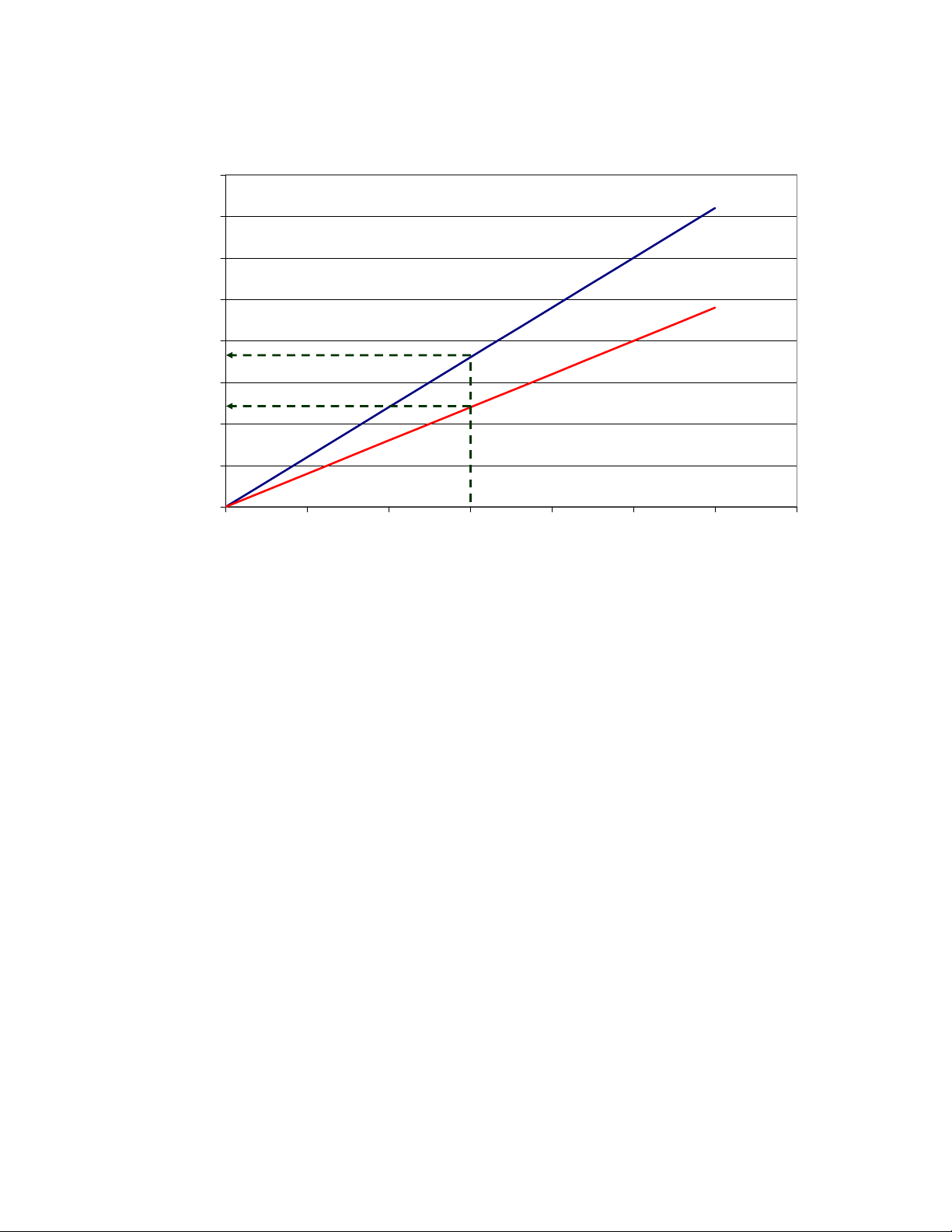
DPF Cleaning Interval for CI-4 and CJ-4 Oils
80,000
70,000
60,000
CJ-4
50,000
CI-4
40,000
CJ-4 Interval
30,000
Miles to DPF Cleaning
20,000
10,000
CI-4 Interval
0
0 500 1,000 1,500 2,000 2,500 3,000 3,500
Oil Consumption Rate (Miles/Quart)
Figure 16: DPF cleaning interval as a function of oil consumption rate.
(for a typical well maintained engine).
The values presented above are provided as estimations and may not apply to all filters in all
applications. Factors like engine duty cycle, soot composition, ash composition and others can
also have an impact on the filter cleaning interval. Furthermore, the guide applies only to ash
accumulation in the filter; if the engine does not meet the temperature requirements for
regeneration or if there are excessive soot emissions (e.g., from a failed injector), more
frequent filter cleaning may be required to remove the soot.
Cleaire, as an industry leader in filter cleaning techniques, continues its efforts to improve its
cost-effective filter cleaning solutions. As these techniques improve, we expect to be able to
clean filters with ash loadings greater than 200 grams, thereby extending the cleaning interval
beyond the values described above.
In summary, to ensure that the DPF is fully cleanable, Cleaire recommends that the customer
monitor their oil consumption rate and schedule filter cleaning before the filter has accumulated
200 grams of ash. Customers can extend their filter cleaning interval by:
• Maintaining their engines to minimize oil consumption
• Switching to low ash oils
Longview_Owner's_Manual-2011-06 Page 29
Page 33

S
PECIFICATIONS
Longview_Owner's_Manual-2011-06 Page 30
Page 34

Cleaire MLC
®
Longview System
J-Size System Total Weight 123 pounds
Catalyst Assembly Weight 98 pounds
Construction 304 Stainless Steel
Fuel Type (same as engine fuel) ULSD or CARB diesel
Fuel Consumption (maximum) 2.2 gallons/hour
Model Cleaire MLC®, Rev. 5
Voltage 9 to 15 VDC (12 V nominal)
Real time clock Battery-backed
Diagnostic and Programming I/O 9-pin DBF Serial (RS-232)
(adapter from harness required)
Inputs
Catalyst Assembly Inlet Temperature Type K thermocouple, ungrounded
Catalyst Assembly Outlet Temperature Type K thermocouple, ungrounded
Engine RPM Sensor (Frequency) 0.5 to 12 kHz
Catalyst Assembly Backpressure 0 – 5 VDC
Engine Manifold Absolute Pressure 0 – 5 VDC
Fuel Pressure Switch 0 – 5 VDC
Outputs
Fuel Pump Relay 12 VDC
Two Power Output Lines for Sensors 5 VDC
System Power On Indicator Green LED (on)
System Service Indicator Amber LED (on or flashing)
Pulse Width Modulation Channel One
Longview_Owner's_Manual-2011-06 Page 31
Page 35

O
WNER’S OBLIGATIONS
Longview_Owner's_Manual-2011-06 Page 32
Page 36

It is the owner or operator’s obligation to take the appropriate action if any of these events or
symptoms occurs. These actions are mandatory for proper system operation. Failure to follow
the required action(s) could be the basis for denying a warranty claim or a fine by CARB.
Event or Symptom Owner’s Action Item Manual Section
Initial installation of Longview
system.
Flashing amber light.
(high backpressure)
Solid amber light.
(bad sensor or system fault)
Engine failure (such as turbo
failure, injector failure, excess
oil consumption, or leaky
head gasket).
Road debris or other object
impacts Longview system or
components.
Tubing or exhaust component
(turbo or exhaust brake, for
example) between the engine
and the catalyst assembly is
removed, replaced or in poor
condition.
Review this manual and pay close attention to
each item in the “Operations” section.
May perform the “Drive Hard Procedure” at
the operator’s option. Contact a properly
trained technician as needed.
Contact a properly trained technician as soon
as possible.
If the turbo fails, get off the road safely ASAP
and shut the engine off. Contact a properly
trained technician immediately. (Longview
catalysts or system components may be
damaged from foreign material.)
Contact a properly trained technician
immediately since system components may
be damaged, including hidden damage to
internal catalyst components.
Ensure that the tubing or component is
installed properly and that no debris could
enter the exhaust stream. (Debris or foreign
matter in the exhaust stream can damage the
catalysts or system components. Also,
exhaust leaks may result in poor system
performance and safety hazards.)
“Operations” (page 14).
“System Indicator Lights”
(page 15) and
“Troubleshooting Table”
(page 24).
“System Indicator Lights”
(page 15) and
“Troubleshooting Table”
(page 24).
“Conditions That May
Damage the Longview”
(page 18).
“Catalyst Assembly” (page 9)
and “Conditions That May
Damage the Longview”
(page 18).
“Exhaust Tubing and
Components” (page 22).
For a vertical exhaust stack,
the rain cap is knocked off or
somehow missing.
Oil consumption is more than
the engine manufacturer’s
specification.
Replace the rain cap immediately. If any
water entered the exhaust pipe then contact
the dealer immediately.
Monitor and keep accurate records of the
engine’s oil consumption rate.
If oil consumption exceeds the specification,
repair the engine so that oil consumption is
within the manufacturer’s specification.
“Catalyst Assembly” (page 9)
and “Conditions That May
Damage the Longview”
(page 18).
“Conditions That May
Damage the Longview”
(page 18) and “Engine Oil
Consumption and Lube Oil
Ash” (page 28).
Longview_Owner's_Manual-2011-06 Page 33
Page 37

W
ARRANTY
Longview_Owner's_Manual-2011-06 Page 34
Page 38

Product Warranty
YOUR WARRANTY RIGHTS AND OBLIGATIONS
Cleaire Advanced Emission Controls (Cleaire) warrants the diesel emission control system in the application for which it is sold
or leased to be free from defects in design, materials, workmanship, or operation of the diesel emission control system which
cause the diesel emission control system to fail to conform to the emission control performance level it was verified to, or to
the requirements in the California Code of Regulations, Title 13, Sections 2700 to 2706, and 2710, for the periods of time listed
in Table 1, provided there has been no abuse, neglect, or improper maintenance of your diesel emission control system,
vehicle or equipment, as specified in the owner’s manuals. Where a warrantable condition exists, this warranty also covers
the engine from damage caused by the diesel emission control system, subject to the same exclusions for abuse, neglect or
improper maintenance of your vehicle or equipment. Please review your owner’s manual for other warranty information. Your
diesel emission control system may include a core part (e.g., particulate filter, diesel oxidation catalyst, selective catalytic
reduction converter) as well as hoses, connectors, a back pressure monitor (if applicable), and other emission-related
assemblies. Where a warrantable condition exists, Cleaire will repair or replace your diesel emission control system at no cost
to you including diagnosis, parts, and labor.
Table 1: Warranty Period
Engine Type Engine Size
Warranty Period
Light heavy-duty, 70 to 170 hp, Gross Vehicle Weight Rating (GVWR) less
than 19,500 lbs.
5 years or
On-Road
Medium heavy-duty, 170 to 250 hp, GVWR from 19,500 lbs. to 33,000 lbs.
Heavy heavy-duty, exceeds 250 hp, GVWR exceeds 33,000 lbs.
150,000 miles
Heavy heavy-duty, exceeds 250 hp, GVWR exceeds 33,000 lbs., and the
truck is:
1. Typically driven over 100,000 miles per year, and
2 years,
unlimited miles
2. Has less than 300,000 miles on the odometer at the time of installation.
Off-Road
(includes
Under 25 hp, and for constant speed engines rated under 50 hp with rated
speeds greater than or equal to 3,000 rpm
3 years or
1,600 hours
portable
engines),
Stationary,
At or above 25 hp and under 50 hp
4 years or
2,600 hours
Marine,
Locomotives,
TRU and
At or above 50 hp
5 years or
4,200 hours
APU
WARRANTY COVERAGE
For an engine used in an application listed in Table 1, the warranty period will be the years or hours or miles of operation
shown in Table 1, whichever occurs first. If any emission-related part of your diesel emission control system is defective in
design, materials, workmanship, or operation of the diesel emission control system thus causing the diesel emission control
system to fail to conform to the emission control performance level it was verified to, or to the requirements in the California
Code of Regulations, Title 13, Sections 2700 to 2706, and 2710, within the warranty period, as defined above, Cleaire will
repair or replace the diesel emission control system, including parts and labor.
In addition, Cleaire will replace or repair the engine components to the condition they were in prior to the failure, including
parts and labor, for damage to the engine proximately caused by the verified diesel emission control strategy. This also
includes those relevant diagnostic expenses in the case in which a warranty claim is valid. Cleaire may, at its option, instead
pay the fair market value of the engine prior to the time the failure occurs.
Longview_Owner's_Manual-2011-06 Page 35
Page 39

OWNER’S WARRANTY RESPONSIBILITY
As the vehicle, engine, or equipment owner, you are responsible for performing the required maintenance described in your
owner’s manual. Cleaire recommends that you retain all maintenance records and receipts for maintenance expenses for your
vehicle, engine, or equipment, and diesel emission control system. If you do not keep your receipts or fail to perform all
scheduled maintenance, Cleaire may have grounds to deny warranty coverage. You are responsible for presenting your
vehicle, equipment, or engine, and diesel emission control system to a Cleaire dealer as soon as a problem is detected. The
warranty repair or replacement should be completed in a reasonable amount of time, not to exceed 30 days. If a replacement
is needed, this may be extended to 90 days should a replacement not be available, but must be performed as soon as a
replacement becomes available.
If you have questions regarding your warranty rights and responsibilities, you should contact Cleaire at 1-800-308-2111 or the
California Air Resources Board at 9528 Telstar Avenue, El Monte, California 91731, or (800) 363-7664, or electronic mail:
[email protected].
Installation Warranty
YOUR WARRANTY RIGHTS AND OBLIGATIONS
The installer must warrant that the installation of a diesel emission control system is free from defects in workmanship or
materials which cause the diesel emission control system to fail to conform to the emission control performance level it was
verified to, or to the requirements in the California Code of Regulations, Title 13, Sections 2700 to 2706. The warranty period
and the extent of the warranty coverage provided by the installer must be the same as the warranty provided by Cleaire, and
the same exclusions apply.
OWNER’S WARRANTY RESPONSIBILITY
As the vehicle, engine, or equipment owner, you are responsible for presenting your vehicle, engine, or equipment, and diesel
emission control system to the installer as soon as a problem with the installation is detected.
If you have questions regarding your warranty rights and responsibilities, you should contact the installer or Cleaire at 1-800308-2111 or the California Air Resources Board at 9528 Telstar Avenue, El Monte, California 91731, or (800) 363-7664, or
electronic mail: [email protected].
Cleaire Warranty Clarifications
(Which do not limit or modify the provisions of the Product Warranty or Installation Warranty in any way)
The product warranty above is the sole warranty made by Cleaire Advanced Emission Controls, LLC. There are no other
warranties, expressed or implied, of merchantability or fitness for a particular purpose.
For the purpose of the product warranty and installation warranty, abuse or neglect includes vehicle accidents, ignoring the
system indicator lights, blending lubricating oil with fuel, or any engine failure or condition that are not proximately caused by
the diesel emission control system that allows excess lubricating oil, coolant, contaminants or debris to enter the exhaust
system. The owner shall not use any fuel additive or lube oil additive that is not approved by EPA or CARB for use in diesel
engines equipped with catalytic mufflers.
Cleaire recommends that the verified diesel emissions control strategy be installed and serviced by Cleaire authorized
personnel. Improper installation or service by unauthorized or untrained personnel may result in a denial of coverage under
the product warranty or installation warranty.
Longview_Owner's_Manual-2011-06 Page 36
Page 40

CARB E
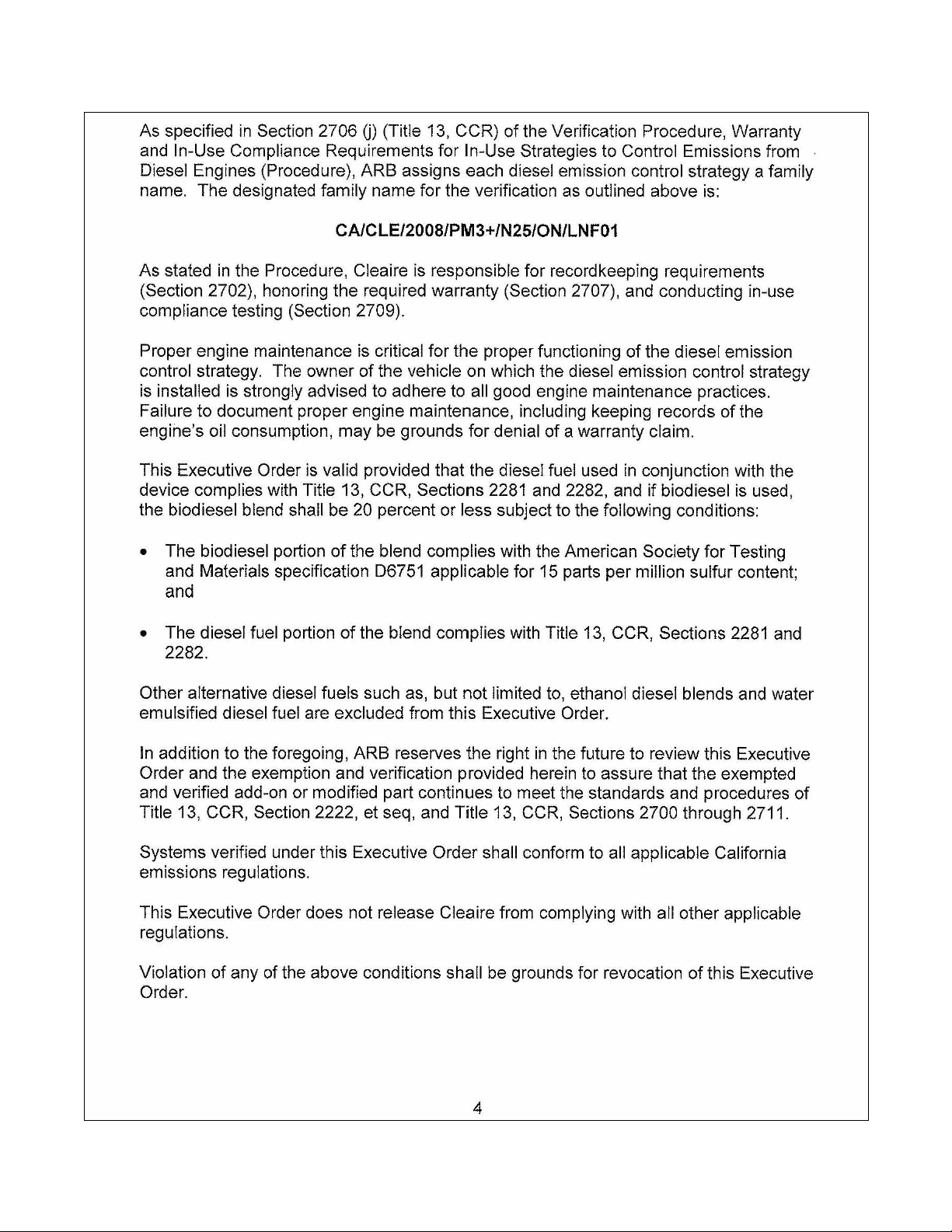
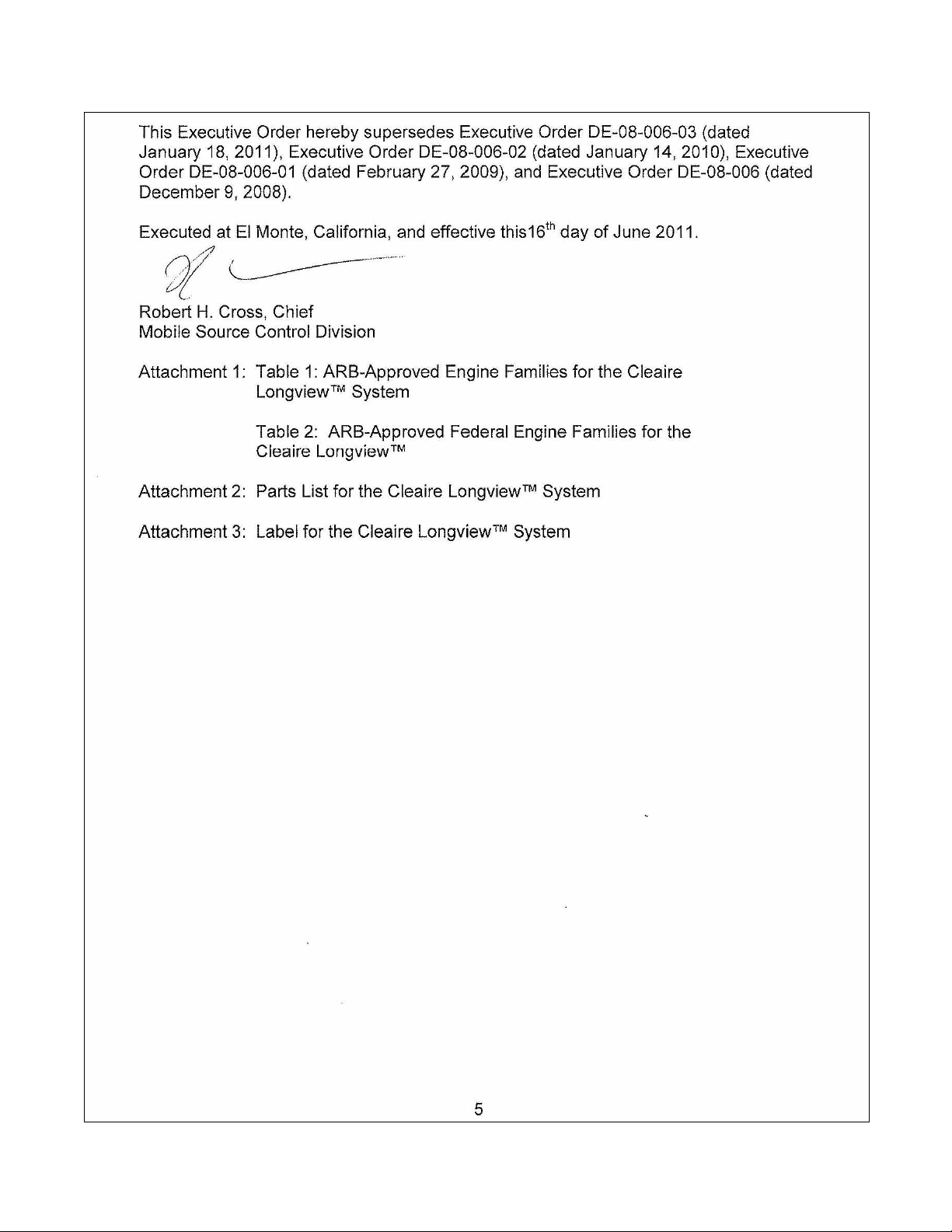
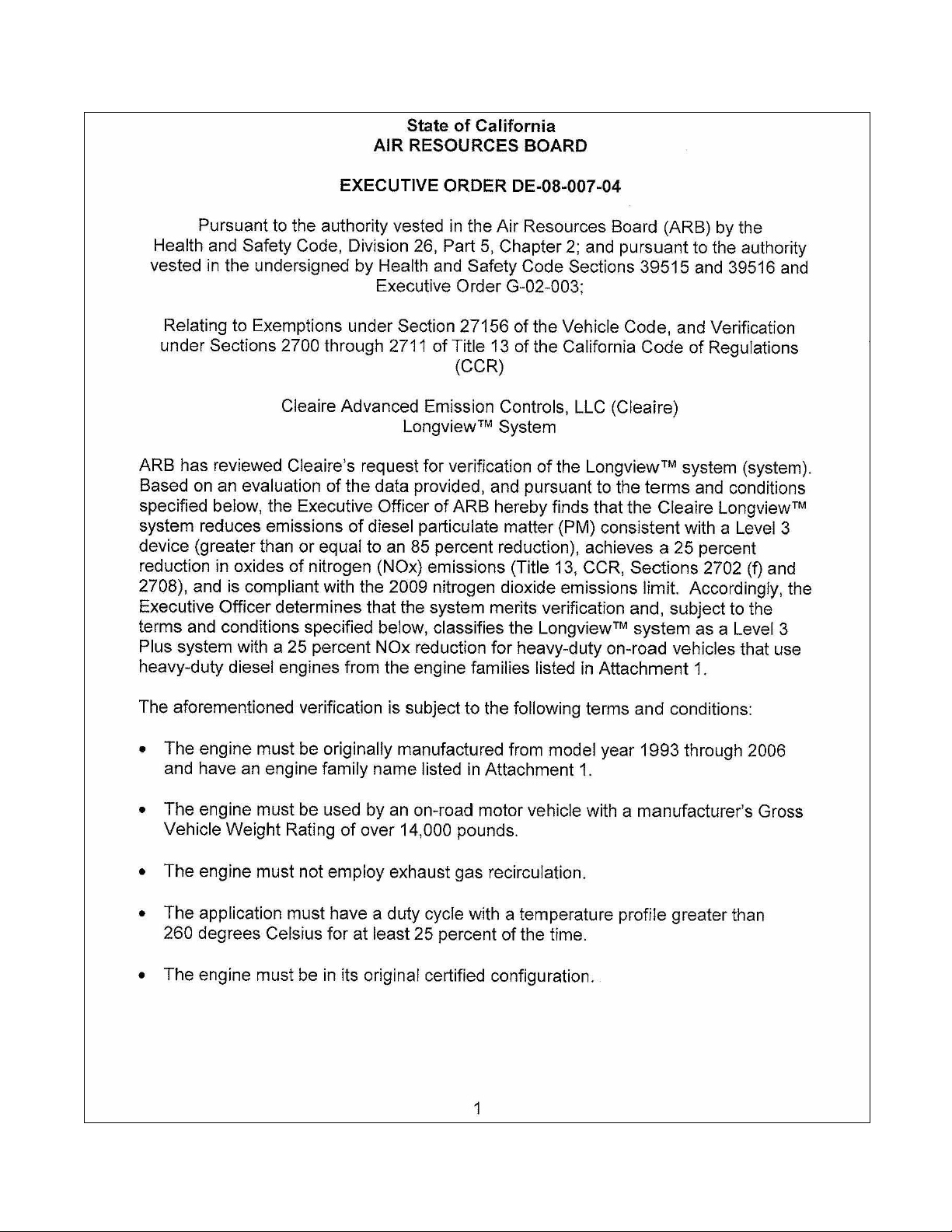
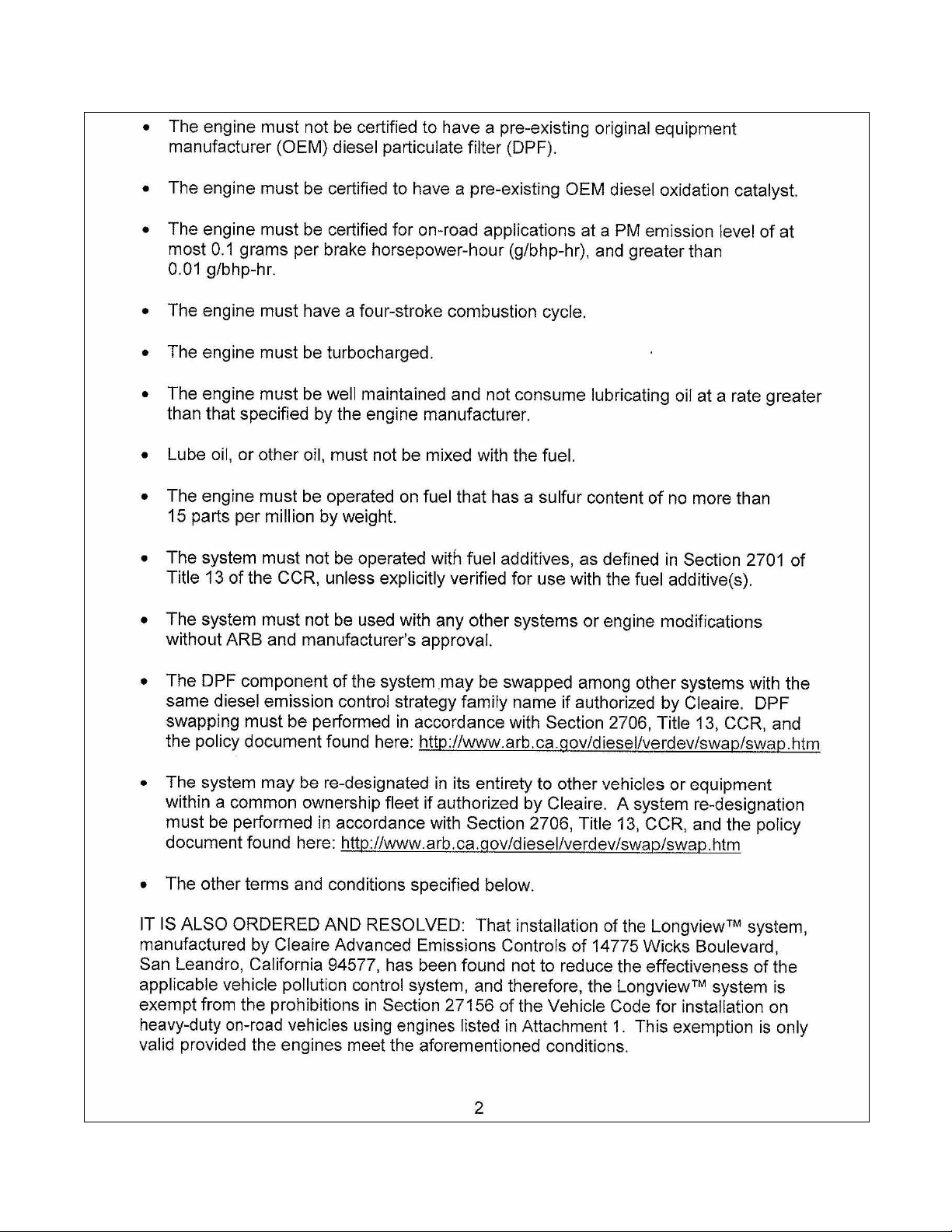
XECUTIVE ORDER FOR THE LONGVIEW
Longview_Owner's_Manual-2011-06 Page 37
Page 41
Longview_Owner's_Manual-2011-06 Page 38
Page 42
Longview_Owner's_Manual-2011-06 Page 39
Page 43
Longview_Owner's_Manual-2011-06 Page 40
Page 44
Longview_Owner's_Manual-2011-06 Page 41
Page 45
Longview_Owner's_Manual-2011-06 Page 42
Page 46
Longview_Owner's_Manual-2011-06 Page 43
Page 47
Longview_Owner's_Manual-2011-06 Page 44
Page 48
Longview_Owner's_Manual-2011-06 Page 45
Page 49
Longview_Owner's_Manual-2011-06 Page 46
Page 50
Longview_Owner's_Manual-2011-06 Page 47
Page 51

This page intentionally left blank
Longview_Owner's_Manual-2011-06 Page 48
Page 52

Cleaire Advanced Emission Controls, LLC
14333 Wicks Blvd.
San Leandro, CA 94577-6719
1-800-308-2111
Longview_Owner's_Manual-2011-06 Page 49
 Loading...