

Page 1
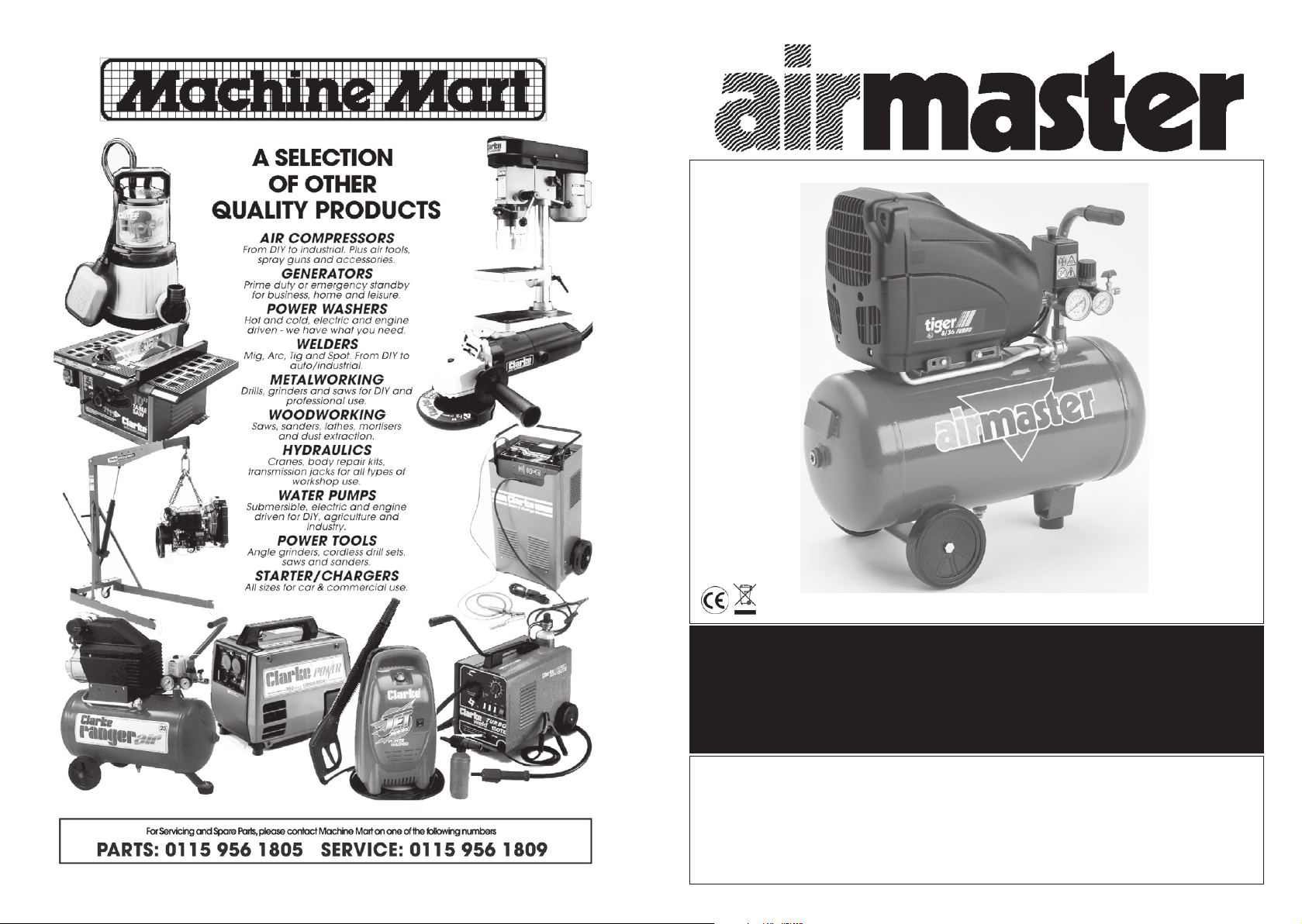
TIGER 8/36 OIL FREE
AIR COMPRESSOR
OPERATION & MAINTENANCE
INSTRUCTIONS
1
1107
Page 2
Thank you for purchasing this AIRMASTER Oil Free Air Compressor, which is
designed for DIY use only. This machine is not designed to run continuously
when delivering pressures greater than 7 bar. Please refer to the Duty Cycle
details, under specifications on page 22.
Please read this leaflet thoroughly and carefully follow all instructions. In doing
so you will ensure the safety of yourself and that of others around you, and you
can look forward to the compressor giving you long and satisfactory service.
GUARANTEE
This product is guaranteed against faulty manufacture for a period of 12 months
from the date of purchase. Please keep your receipt as proof of purchase. This
guarantee is invalid if the product is found to have been abused or tampered
with in any way, or not used for the purpose for which it was intended.
Faulty goods should be returned to their place of purchase, no product can be
returned without prior permission. This guarantee does not effect your statutory
rights.
When disposing of this product, ensure it is disposed of according to all local ordinances. It must
not be disposed of with general household waste.
2
27
Page 3
CONTENTS PAGE
Safety Precautions ........................................................................... 4
Warning Symbols ............................................................................. 9
Electrical Connections ...................................................................... 10
Parts Identification ............................................................................ 11
Assembly .......................................................................................... 12
Preperation for use ........................................................................... 14
Operating instructions ...................................................................... 15
Routine Maintenance ....................................................................... 19
Troubleshooting ............................................................................... 21
Specifications ................................................................................... 22
Spares and servicing ........................................................................ 23
Parts Diagram .................................................................................. 24
Parts List .......................................................................................... 25
Declaration of Conformity ................................................................. 26
26
3
Page 4
SAFETY PRECAUTIONS
WARNING!
As with all machinery, there are certain hazards involved with their operation
and use. Exercising respect and caution will considerably lessen the risk of
personal injury. However, if normal safety precautions are overlooked, or
ignored, personal injury to the operator, or damage to property may result. It
is in your own interest to read and pay attention to the following rules:
WARNING!
When using the air compressor, you should follow basic safety precautions
including the following to reduce the risk of personal injury. Make sure that
you have read all of the instructions before using the air compressor. Keep
this booklet with the compressor for future reference by the operator. Persons
who have not read this booklet should not use the air compressor.
WARNING!
Compressed air can be dangerous. Death or serious injury could result from
improper or unsafe use of this compressor. To avoid these risks, use your
common sense and follow these basic safety instructions. Compressed air
should never be inhaled as it may contain toxic vapours or solid particles.
Always work in good ventilation, especially when spraying paints or other
toxic substances and always wear a suitable face mask. Do not spray near
sources of possible ignition.
PARTS LIST
No. Description Part No.
1 FRONT HOUSING FN116ZQ0002
2 CRANKPIN FN116HP0005
3 WASHER FN130203225
4 CRANK FN116ZQ0005
5 SHAFT FN116ZQ0004
6 CASING FN116120006
7 CYLINDER GASKET FN116120013
8 CYLINDER FN116ZQ0003
9 PISTON+CON.ROD FN416HP0004
10 BEARING FN033055000
11 VALVE HOLDER PLATE FN116120100
12 HEAD GASKET FN116120014
13 3/8 HEAD FN116120015
14 M6X35 TAP-TITE SCREW FN 014013031
15 M8X105 SCREW FN014001076
16 OVERLOAD CUTOUT FN008277000
17 M5 NUT FN161190010
18 CONDENSER FN009200004
19 BEARING FN033143000
20 ROTOR FN034139000
21 WOUND STATOR FN316ZQ1604
22 BEARING FN033005000
23 REAR COVER FN116120007
24 FAN FN116120008
25 CIRCLIP FN015083000
26 M5X80 SCREW FN014002122
27 REAR HOUSING FN116ZQ0001
28 FILTERING ELEMENT FN116120017
50 PLUG FN011008000
51 TANK FN168HQ1001
No. Description Part No.
52 TAPPING SCREW FN014013042
53 WHEEL SPINDLE FN168HQ0004
54 WHEEL FN020188000
55 NUT FN014003005
56 DRAIN VALVE FN022021000
57 CUSHION FN020146000
58 PUMP OL1850 230V/50Hz FN516ZQ01604
59 KNOB FN020147000
60 RILSAN TUBE FN046001000
61 SMALL GAUGE FN330006000
62 QUICK COUPLER NIPPLE FN011731000
63 QUICK COUPLER FN322053000
64 PRESSURE REDUCER FN119108001
65 NIPPLE FN011017000
66 POWER CABLE FN164A04600
67 PRESSURE SWITCH FN321028000
68 SAFETY VALVE FN047205000
69 BIG GAUGE FN330004000
70 NIPPLE FN199110140
71 CHECK VALVE FN347043000
72 O-RING FN010041000
73 TAPERED SPRING FN047113002
74 SEAL FN047113001
75 COMPASS FN011304000
76 DELIVERY PIPE ALUMINU FN168HQ0014
77 L JOINT FN011117001
78 COMPRESSION RING FN011117000
79 LOCKNUT FN011117002
80 LOCKNUT FN199437000
WARNING!
Attachments, hoses and accessories must meet or exceed the maximum
pressure rating of this compressor.
If low pressure parts are used, the air pressure could cause them to explode
or fly apart, resulting in serious injury. Always take great care when releasing
the pressure and connecting/disconnecting tools.
WARNING!
This compressor must be connected to a power socket that is safeguarded
by a suitable circuit breaker or fuse.
4
25
Page 5
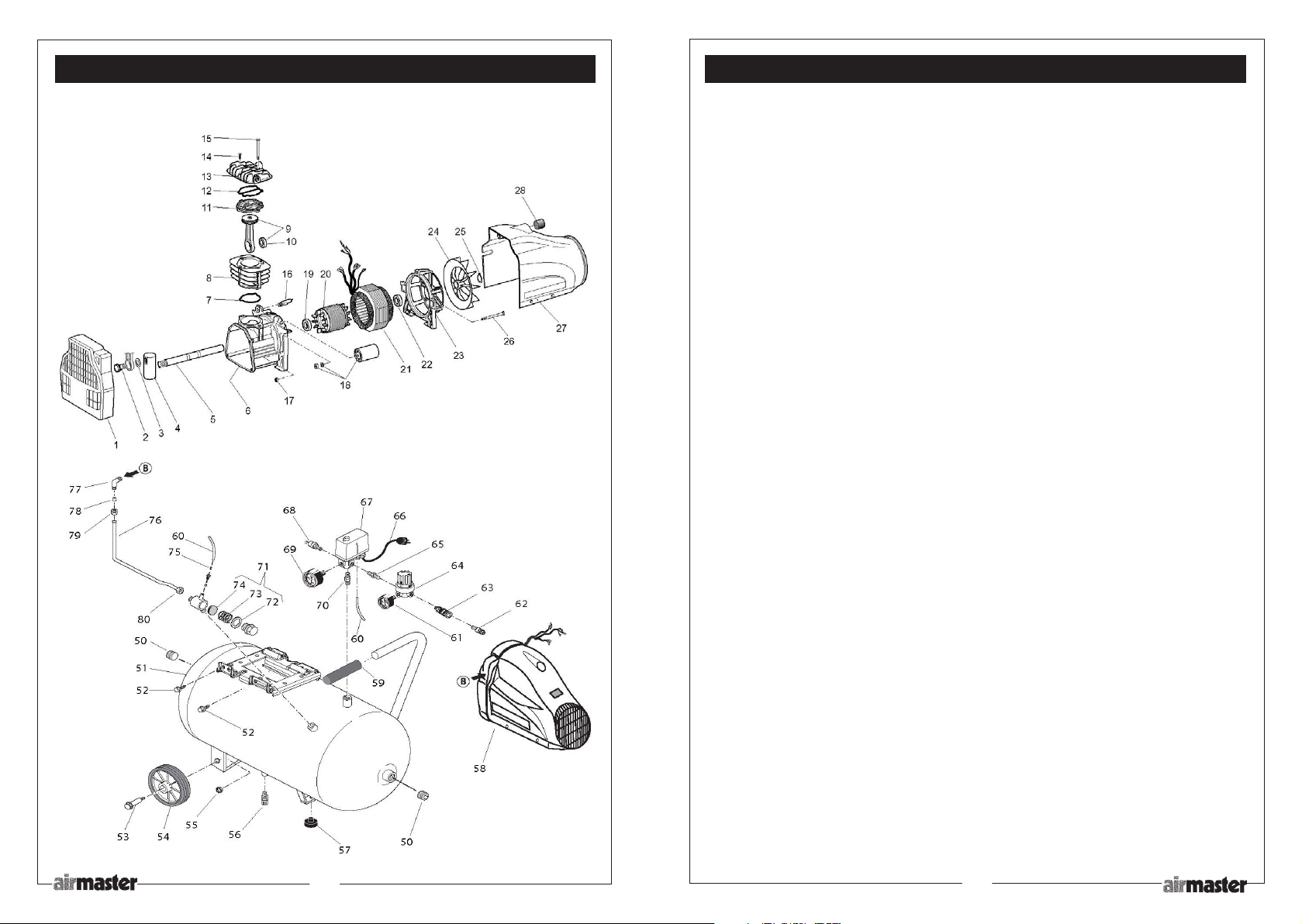
PARTS DIAGRAM
SAFETY PRECAUTIONS
TRAINING: Prior to use all operators should become familiar with the instructions
in this booklet. In particular, become familiar with the ON/OFF control for
emergency stopping.
ALWAYS WEAR EYE PROTECTION: When operating the air compressor, always
wear eye protection, and make sure that other people in the work area are also
wearing eye protection. Eye protectors must provide protection from flying
particles both from the front and from the side.
NEVER TOUCH MOVING PARTS: Never place your hand near any moving parts
on the air compressor or operate with the covers removed.
PROTECT YOUR SELF AGAINST ELECTRIC SHOCK: Never operate the air
compressor in wet or damp locations.
DRESS PROPERLY: Do not wear loose clothing or jewellery as they may be caught
in moving parts. Tie long hair out of the way.
KEEP VISITORS/CHILDREN AWAY: Do not allow visitors/children to handle the air
compressor or attachments and ensure that any people in the work area are
suitably dressed.
KEEP THE WORK AREA CLEAN: Cluttered areas invite accidents, clear the work
area of all unnecessary tools, debris and furniture.
DISCONNECT THE AIR COMPRESSOR: Always disconnect the air compressor from
the mains power supply and decompress before performing maintenance,
changing any parts and when not in use.
24
DO NOT ABUSE THE CABLE: Never pull on the cable when removing the plug
from the mains socket, or lift the compressor by the mains cable.
BREATHING QUALITY AIR: This compressor should not be used to supply breathing
quality air.
DO NOT ABUSE THE COMPRESSOR: Do not stand on the compressor.
SAFETY VALVE: Never remove or attempt to adjust the safety valve. Keep the
safety valve free from paint and other accumulations.
AVOID UNINTENTIONAL STARTING: Do not move the air compressor when it is
connected to the mains power supply. When connecting the air compressor to
the mains supply make sure the red button on top of the air compressor is in the
OFF (down) position.
5
Page 6
SAFETY PRECAUTIONS
STORE THE AIR COMPRESSOR PROPERLY: When not in use the air compressor
should be stored in a secure, dry place out of the reach of children. Always lock
up the storage area.
PROTECT YOUR HEARING: Ear protection should be worn when operating this
compressor.
MAINTAIN THE AIR COMPRESSOR WITH CARE: If the air compressor is damaged in
any way, have it repaired by a qualified service engineer.
SPARE PARTS AND SERVICE
For spare parts and service, please contact your nearest dealer, or Machine
Mart, on one of the following numbers.
PARTS TEL:................................. 0115 956 1805
SERVICE TEL:............................. 0115 956 1809
EXTENSION LEAD: Only use extension leads that are of an appropriate power
rating and suitable for the work environment. Extension leads must have an
earth connection. Inspect the extension lead regularly and replace if
damaged.
ONLY USE PARTS AND ACCESSORIES RECOMMENDED IN THIS MANUAL: The use of
unauthorised accessories or attachments is not permitted and may result in
personal injury and damage to the air compressor. Do not attempt to repair or
modify the air compressor.
STAY ALERT: Watch what you are doing, use common sense, and do not operate
the air compressor when you are tired. The air compressor should not be used if
you are under the influence of alcohol, drugs or any medication that makes
you drowsy.
BEFORE EACH USE CHECK THE AIR COMPRESSOR AND HOSE FOR DAMAGED
PARTS: Never use the air compressor if it has been damaged in any way. Have
the air compressor repaired by a qualified service engineer. Do not use the air
compressor if the On/Off switch does not operate correctly.
HANDLE THE AIR COMPRESSOR CAREFULLY: Operate the air compressor
according to the instructions contained within this instruction booklet. This air
compressor should never be operated by children or individuals unfamiliar with
its operation.
KEEP THE MOTOR AIR VENT CLEAR: Keep the motor vent clear and free from dust,
wipe regularly to maintain an adequate supply of clean air to the air
compressor.
CUSTOMER CARE LINE: ........... 0115 956 1810
OR: ........................................... 0115 955 9999
OPERATE THE AIR COMPRESSOR AT THE CORRECT VOLTAGE: Make sure that the
mains supply voltage is the same as the voltage shown on the rating plate.
DO NOT WIPE THE PLASTIC PARTS WITH SOLVENT: Do not use solvents or thinners
such as petrol, benzene, carbon tetrachloride or alcohol to clean the air
compressor, as these chemicals will damage the finish. With the air compressor
unplugged from the supply, use a dry cloth to wipe over the plastic casing.
6
23
Page 7

SPECIFICATIONS
Electrical Supply ..................................... 230 V, 1 Phase 50Hz
Max. Operating Pressure ....................... 8 bar (116 lbf/in2)
Motor Rating ........................................... 1.5 HP
Air Displacement .................................... 6.3 cuft/min
Air Receiver............................................. 24 litre
Nett Weight ............................................. 21 kg
Dimensions ( L x W x H ) ......................... 585 x 285 x 595 mm
Duty Cycle .............................................. S3 40% **
Part No. .................................................... 2225345
SAFETY PRECAUTIONS
KEEP ALL SCREWS AND COVERS TIGHTLY IN PLACE: Check the screws and covers
periodically.
ADEQUATE VENTILATION: The compressor should only be used in areas with
adequate ventilation and should not be exposed to heat, or used near
inflammable substances.
NEVER USE AN AIR COMPRESSOR WHICH APPEARS DEFECTIVE OR IS OPERATING
ABNORMALLY: If the compressor operates unusually or makes strange noises,
switch off immediately and purge the air tank. Arrange repair with an
authorised service centre.
DO NOT MODIFY THE AIR COMPRESSOR: Do not attempt to modify the air
compressor, tank, fittings or attachments in any way. Doing so will invalidate the
guarantee and could result in personal injury.
**The machine may not be run for more than 4 minutes in any 10 minute period.
Please note that the details and specifications contained herein, are correct at the time of going to
print. However, Machine Mart reserve the right to change specifications at any time without prior
notice. Always consult the machine’s data plate
DO NOT MODIFY THE TANK: Do not modify the tank or operate at pressures or
temperatures outside the limits stated in this booklet.
TURN OFF THE AIR COMPRESSOR WHEN NOT IN USE: When not in use, turn off the
air compressor by pressing the On/Off switch, remove the plug from the mains
supply and slowly undo the drain valve to release the pressure from the tank.
Remember to close the drain valve before storage and ensure it is fully
tightened before use.
DO NOT TOUCH HOT SURFACES: During operation, the motor, connections,
compressor body, cylinder head and tubes may get hot, please take care.
DO NOT DIRECT THE AIR STREAM AT THE BODY: Do not direct the air stream at
people or animals, as injury may result. Compressed air can cause soft tissue
damage and propel dirt and other particles at high speed.
ONLY USE RECOMMENDED PARTS: To avoid the risk of bursting, only hoses with a
rated pressure of 8 bar, or more should be used. Never attempt to repair faulty
hoses.
DO NOT USE THIS COMPRESSOR TO INFLATE SMALL, LOW-PRESSURE OBJECTS: Items
such as children's toys or footballs can explode if over-inflated.
AVOID KINKING OR TRAPPING THE AIR HOSE: Always replace faulty hoses - never
attempt a repair if a leak is detected.
DRAIN TANK: Drain the tank after each use. Switch off and slowly open the drain
valve to release the air then tilt the compressor to empty condensed water.
22
7
Page 8
SAFETY PRECAUTIONS
NEVER STOP THE COMPRESSOR BY REMOVING THE PLUG OR SWITCHING OFF AT
THE MAINS SUPPLY: Always use the On/Off switch on the compressor.
NEVER OPERATE WITHOUT ALL GUARDS IN PLACE: Never operate without all
guards or safety features in place and in proper working order.
NEVER OPERATE IN THE PRESENCE OF FLAMMABLE LIQUIDS OR GASES: The air
compressor produces sparks during operation.
CHECK FOR DAMAGED PARTS AND AIR LEAKS: If any part of the compressor is
damaged, it should be carefully checked to determine that it will operate
correctly and perform its intended function. Check for the alignment of parts,
damage to parts, air leaks and any other conditions that may affect its
operation. A guard or any other part that is damaged or defective should be
properly repaired or replaced by an authorised service centre. Defective
pressure switches must be replaced prior to further use of the compressor.
ONLY USE WITHIN THE RECOMMENDED OPERATING TEMPERATURE RANGE: This
compressor should only be used in an ambient temperature of between 0OC
and 25OC.
CLEANING AND CONDITION OF THE COMPRESSOR: Keep the external surfaces of
the tank clean. Avoid impact damage and do not allow the tank to come into
contact with abrasive or corrosive materials.
MOVING THE COMPRESSOR: Always transport the compressor by lifting or pulling
it with the appropriate grips or handles.
USING THE COMPRESSOR FOR PAINTING:
• Do not work in enclosed areas or near naked flames.
• Make sure that the area in which you are working has good ventilation.
• Protect your nose and mouth with a suitable face mask.
• Always check the safety data sheets for substances being sprayed &
ensure manufacturers instructions are followed.
MOTOR HOUSING: Do not insert your fingers or other objects inside the motor
housing to avoid physical damage or damage to the compressor.
TROUBLE SHOOTING
With considerate use, your AIRMASTER Air Compressor should provide you with
long and trouble free service. Routine checks should be made on both the
electrical supply as well as on all the compressed air lines and connections. If
any fault appears, the reason for which is not immediately obvious, we
recommend that you contact Machine Mart.
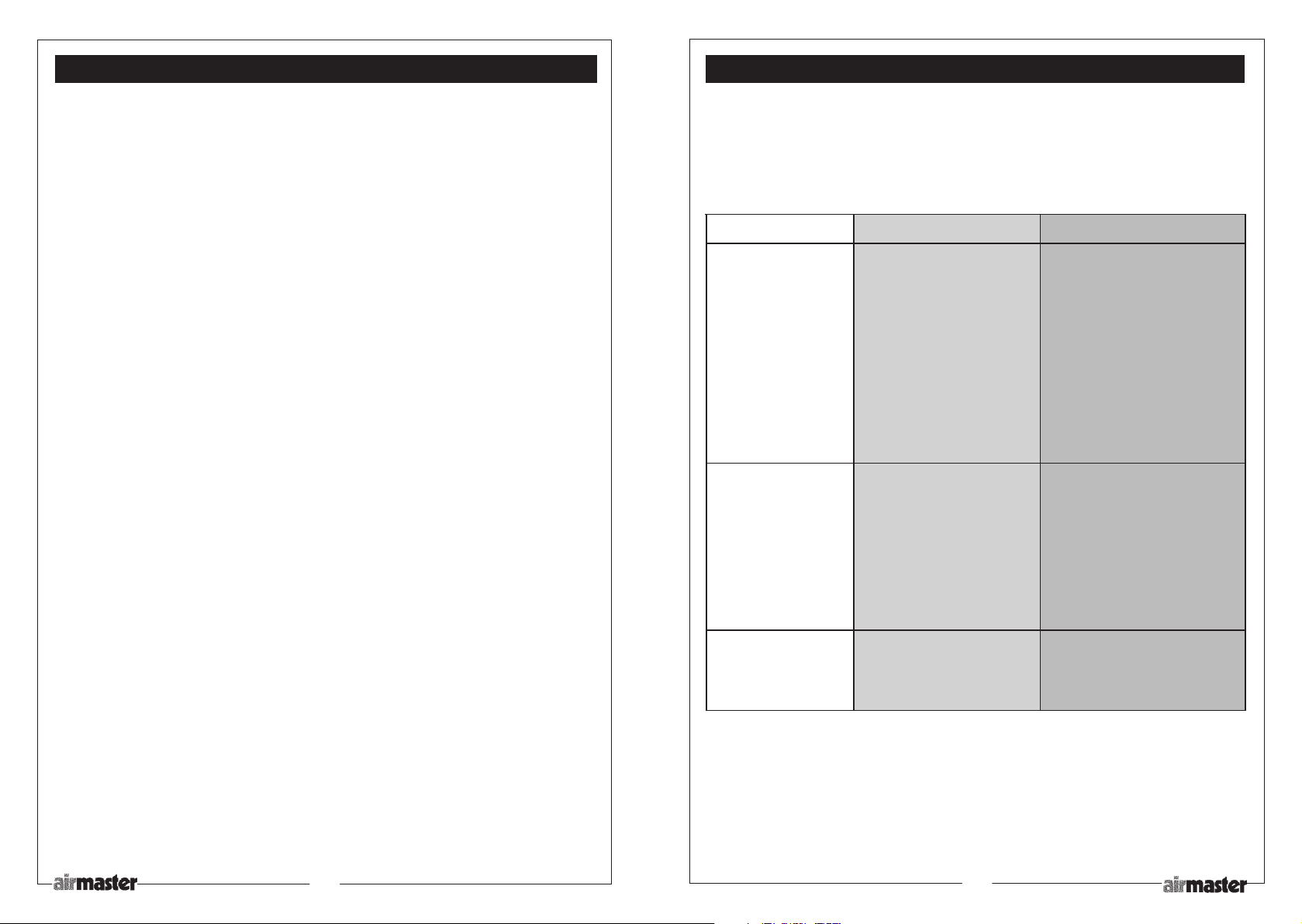
tluaF esuaC ydemeR
rosserpmocehT
.snoitcennocdaB
seoddnadeppots
.tratston
hctiwstuotucdaolrevO
ytudrodeppirtsah
neebsahelcyc
.dedeecxe
tnrubsgnidniwrotoM
tcatnoCtraMenihcaMrof
.tuo
rosserpmocehT
hcaertonseod
teseht
erusserp
.nekorb
daehrosserpmoC
evlavronwolbteksag
staehrevodna
.ylisae
.traM
seodrosserpmoC
degrahcreviecerriA lepxeotevlavniardnepO
.tratston
.secuder
lacirtcelekcehC
dnanaelC.snoitcennoc
.yrassecensanethgit
tiawdnaffohctiwS
erofebsetunim5xorppa
ehtgnisserp
nottubteser
.rotomtnemecalpera
otrosserpmocroftiaW
elbmessasid,nwodlooc
ynaecalperdnadaeh
.stnenopmocnekorb
ebsecafrus
erof
enihcaMruoytcatnoc
dluohsrosserpmoC.ria
.niaganognihctiwsdna
gnilaesllanaelcylluferaC
tbuodnifI.gnilbmessaer
erusserpnehwniagatrats
CAUTION Do not attempt any repair or adjustment if you are uncertain as
to how it should be done. If you have any queries, contact Machine Mart.
8
21
Page 9
ROUTINE MAINTENANCE
WARNING SYMBOLS
Every six months
Make sure that all bolts are securely tightened.
Clean all the external parts of the compressor.
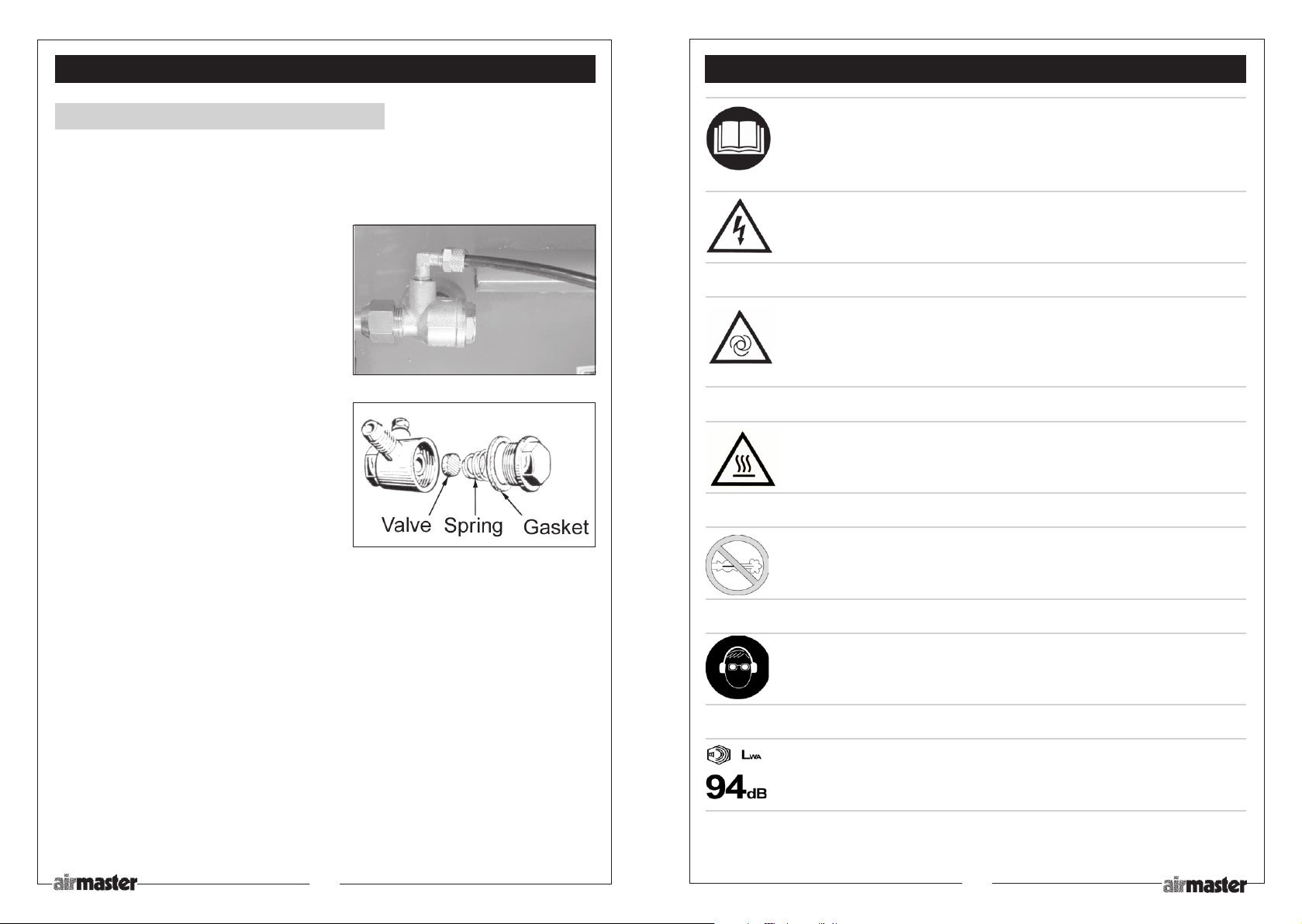
Non Return Valve
Examine the non-return valve, and
replace the gasket and valve if
necessary
Figure 14
Figure 15
READ THIS INSTRUCTION BOOKLET CAREFULLY BEFORE
POSITIONING, OPERATING OR ADJUSTING THE
COMPRESSOR.
Risk of electric shock. The compressor must be disconnected
from the mains supply before removing any covers. Do not
use in a damp environment.
Risk of accidental start-up. The compressor could start
automatically in the event of a power cut and subsequent
reset. Do not carry the compressor while it is connected to the
power source, or when the tank is filled with compressed air.
This compressor contains surfaces which may reach a high
temperature during operation. Never operate with the motor
housing removed.
Air and condensation water can burst from the compressor
when the drain plug is removed.
20
Wear a safety goggles and ear protectors when using this
compressor
This compressor produces a high sound level during
operation. Ear protection should be worn.
9
Page 10
ELECTRICAL CONNECTIONS
ROUTINE MAINTENANCE
Connect the mains lead to a standard, 230 Volt (50Hz) electrical supply through
an approved 13 amp BS 1363 plug, or a suitably fused isolator switch.
WARNING! THIS APPLIANCE MUST BE EARTHED
IMPORTANT: The wires in the mains lead are coloured in accordance with
the following code:
Green & Yellow - Earth
Blue - Neutral
Brown - Live
As the colours of the flexible lead of this appliance may not correspond with the
coloured markings identifying terminals in your plug proceed as follows:
• Connect GREEN & YELLOW cord to terminal marked with a letter “E”
or Earth symbol “ ” or coloured GREEN or GREEN & YELLOW.
• Connect BROWN cord to terminal marked with a letter “L” or
coloured RED.
• Connect BLUE cord to terminal marked with a letter “N” or coloured
BLACK.
If this appliance is fitted with a plug which is moulded onto the electric cable
(i.e. non-rewireable) please note:
1. The plug must be thrown away if it is cut from the electric cable.
There is a danger of electric shock if it is subsequently inserted into a
socket outlet.
2. Never use the plug without the fuse cover fitted.
3. When replacing a detachable fuse carrier, ensure the correct
replacement is used (as indicated by marking or colour code).
4. Replacement fuse covers can be obtained from your local dealer
or most electrical stockists.
IMPORTANT: Before carrying out any maintenance, always disconnect the
compressor from the mains supply, drain the air reservoir and, if necessary,
allow the machine to cool down before starting work.
Daily
Drain the tank
After use, always open the drain valve to ensure that any liquid that may have
condensed, is drained off. See page 18.
Monthly
The air intake filter should be inspected on a MONTHLY basis, and more often in
dusty conditions,
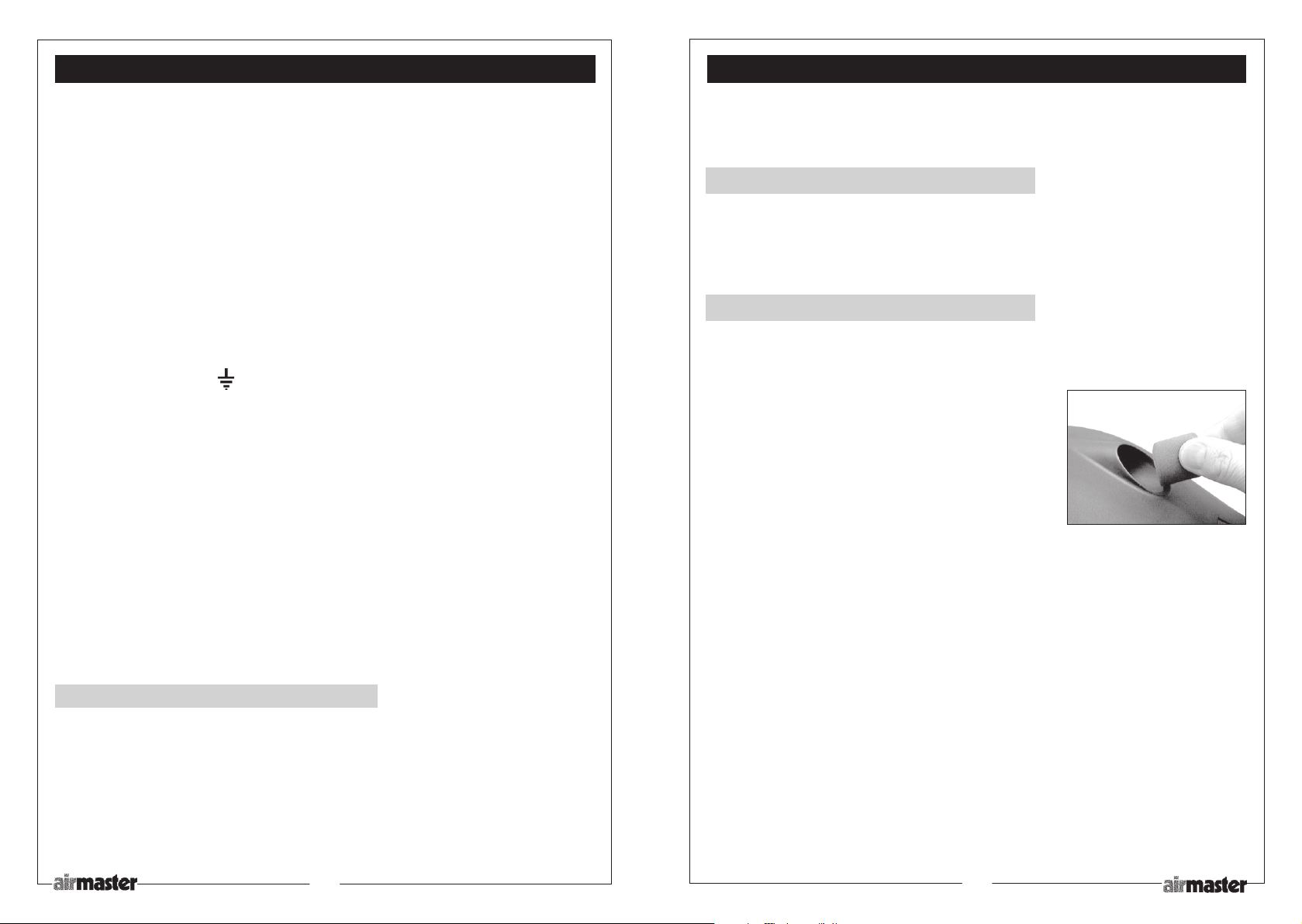
To clean the air intake filter,
1. Remove the sponge element shown in fig.11.
2. Clean the sponge and the inner housing using
a soft brush.
• If necessary, the sponge filter may be gently
washed in warm soapy water,
3. Rinse and allow the filter to dry thoroughly
before refitting.
Figure 11
FUSE RATING
The fuse in the plug must be replaced with one of the same rating (13 amps)
and this replacement must be ASTA approved to BS1362.
We strongly recommend that this machine is connected to the mains supply via
a Residual Current Device (RCD)
If in any doubt, consult a qualified electrician. DO NOT attempt any repairs
yourself.
10
19
Page 11
OPERATING INSTRUCTIONS
PARTS IDENTIFICATION
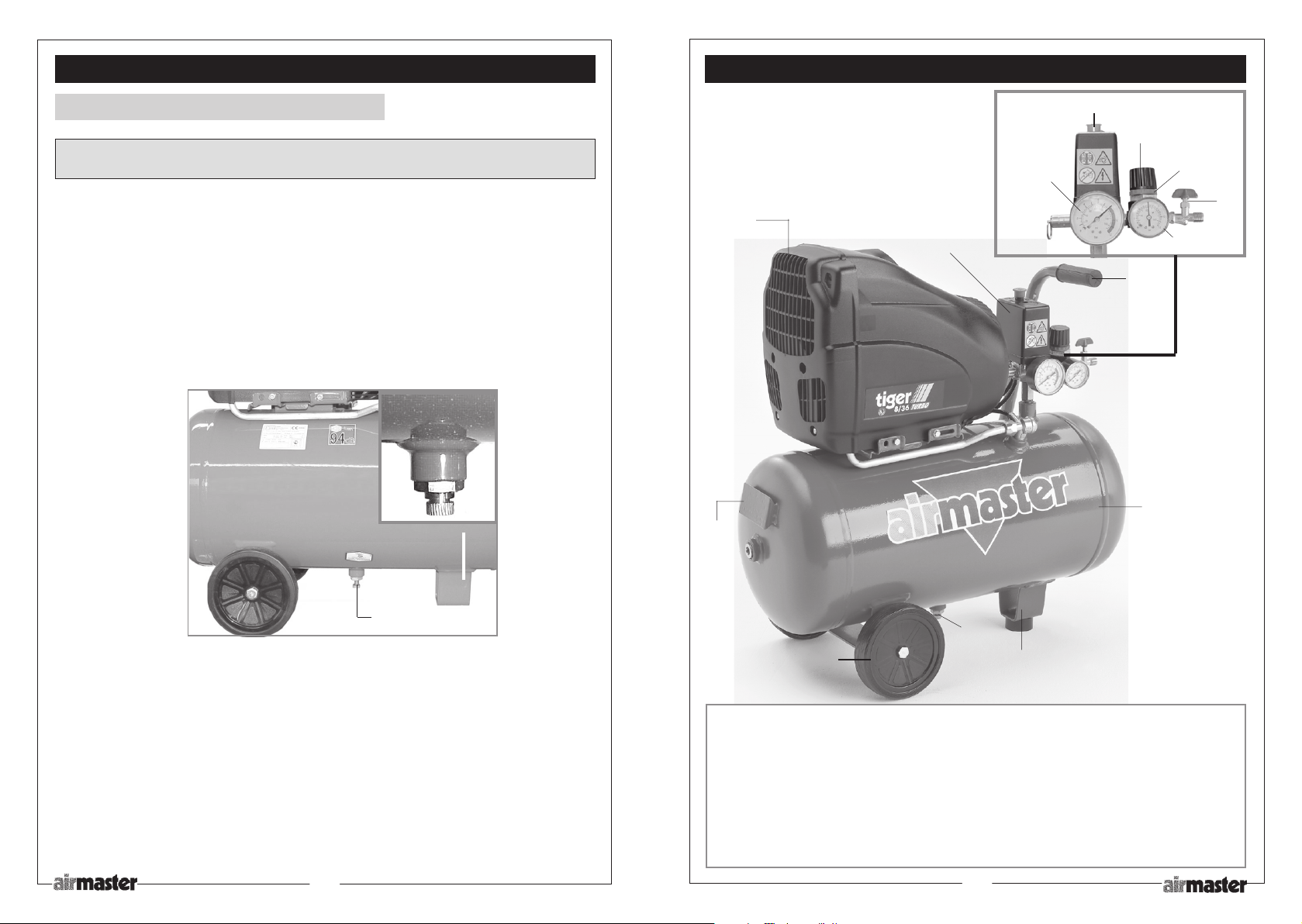
Draining the reservoir
CAUTION! It is important to drain the reservoir before storage.
1 Switch the air compressor off, by pressing down the red On/Off button, and
remove the plug from the mains supply.
• Place a suitable container beneath the compressor to catch any
condensation.
2 Carefully undo the drain valve anti-clockwise until you hear a hissing noise,
this is the reservoir depressurising.
• When the gauge indicates zero and the hissing has stopped, tighten the
drain outlet nut again.
12
2
4
3
5
14
1
13
6
7
10
Figure 10
18
Drain outlet
11
1 Motor housing
2 On/Off switch (red button)
3 Main reservoir pressure gauge
4 Pressure regulator
5 Regulator locking ring
6 Output pressure gauge
7 Trolley handle
9
8
8 Support foot
9 Drain valve
10 Compressed air reservoir
11 Transportation wheel
12 Data plate
13 Pressure regulator and cut-out
14 Outlet tap
11
Page 12
ASSEMBLY
OPERATING INSTRUCTIONS
WARNING!
Before assembling and using the air compressor, make sure that you have
read and understood all of the safety instructions.
Installation
Take care when lifting the compressor from the packaging.
CAUTION! Do not lift the compressor by the pressure regulator and cut-out. Get
assistance if necessary. This unit weighs 21 kg.
After removing the compressor from its packaging, check the integrity of the
unit, making sure it has not been damaged in transit.
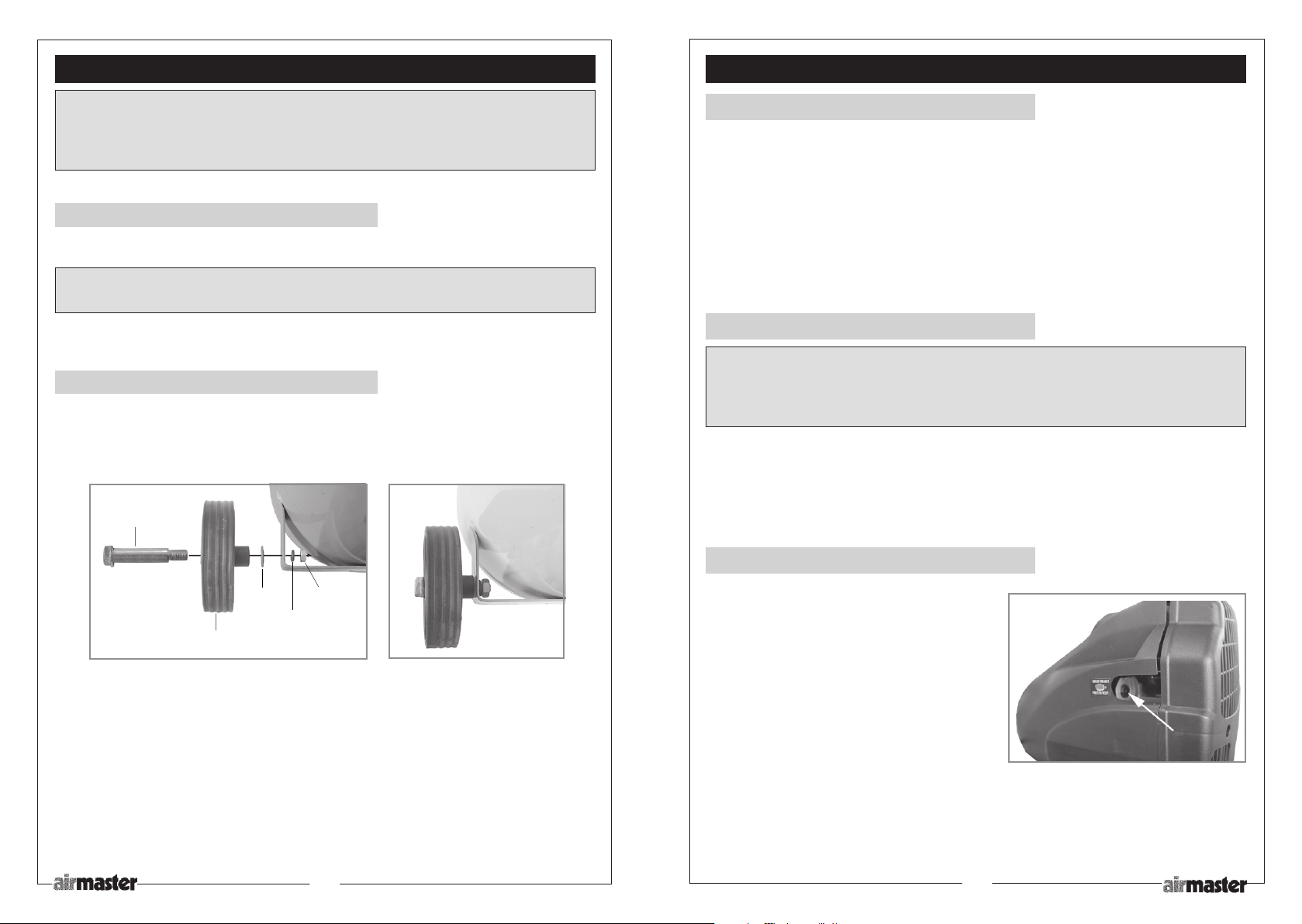
Fitting the transportation wheels
Fit the transportation wheels to either side of the compressor as shown in figures
1 & 2 using a 17mm spanner.
Bolt
Switching the air compressor OFF
To switch the air compressor off,
1. Close the outlet tap and press down the on/off switch (red button)
located on top of the air compressor.
2. Switch off the mains supply and remove the plug.
• You should never leave the compressor air reservoir unattended while
under pressure, as this may result in an accident.
• Always release the pressure from the reservoir when not in use or prior
to storage, as described in 'Draining the reservoir' on page 18.
Removing a tool from the air hose
WARNING!
Always set the pressure regulator to zero before attempting to remove or
replace a tool.
1 Press down the on/off switch (red button) located on top of the air
compressor.
2 Close the air outlet tap and trigger the equipment (spraygun, air tool etc),
to release air from the air hose BEFORE disconnecting the hose from the
machine.
Figure 1
Wheel
Washer
Spring
washer
Nut
12
Figure 2
Reset button
This compressor is equipped with a thermal
overload device, which operates as a
safety device to protect the motor.
When the motor overheats for any reason,
the overload cutout automatically cuts
the power thereby preventing damage to
the motor.
Wait around 5 minutes for the motor to
cool and press the reset button.
If you restart the compressor and the
overload cutout activates again, switch off the compressor, remove the plug
from the mains and have your compressor checked by a qualified service
agent.
Figure 9
17
Page 13
3
3
OPERATING INSTRUCTIONS
ASSEMBLY
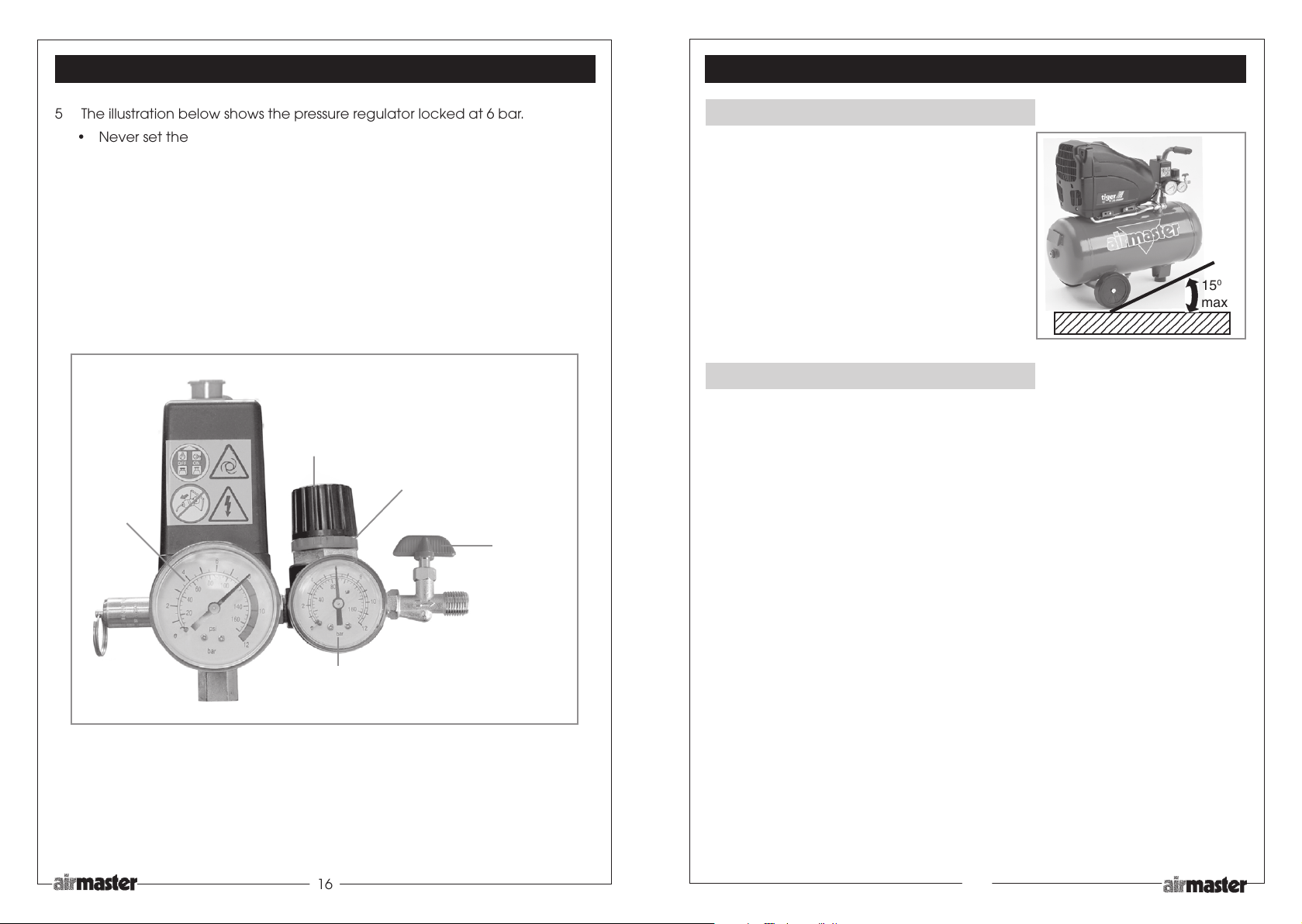
5 The illustration below shows the pressure regulator locked at 6 bar.
• Never set the pressure higher than the rated pressure of the attachments
being used, as there is a risk of bursting and resultant injury.
To increase the output pressure from this preset value you will need to
intentionally loosen the locking ring.
• Only alter this setting if you are using an air tool with a higher pressure
requirement.
6 Open the outlet tap.
7 Test the tool function and adjust the regulator valve/locking ring if
necessary. Always test the tool on a piece of similar scrap material before
using on the final surface to confirm correct operation.
Pressure regulator
Main
reservoir
pressure
gauge
Regulator locking ring
locked at desired
pressure.
Outlet
tap
Locating the air compressor
This compressor should be positioned on a
stable, flat surface (or one with a maximum
inclination of 15O). See figure 3, and ensure
that it is copletely stable.
Do not cover or box in the compressor.
Always position it with good all round
ventilation.
234567890123456789012
234567890123456789012
15
max
0
Figure 3
Moving the air compressor
Before moving the compressor, switch off and disconnect it from the mains
power supply.
• Always use the handle and wheels.
• Do not lift by (or put strain on) air taps, valves or hoses.
• Take care when moving the compressor to avoid damaging the valves or
fittings.
The compressor is heavy, take care when lifting and moving this compressor to
avoid personal injury. Get assistance if necessary.
Figure 8
Output pressure gauge
16
13
Page 14
PREPARING FOR USE
OPERATING INSTRUCTIONS
Before connecting your compressor to the mains supply, check the following:-
• The mains voltage is 230V.
• The ON/OFF switch is in the OFF (lower) position.
• The pressure regulator should be set at its lowest setting, i.e. turned fully
anticlockwise.
• If the machine has not been used for 24 hours or so, open the drain valve
to drain any condensate which may have accumulated. When clear,
close the valve, finger tight.
IMPORTANT: If the receiver is under pressure, keep your hands well away
from the air being expelled.... remember, compressed air is DANGEROUS!
WARNING!
Before connecting any air tool, make sure you have read and fully
understood the manufacturers instruction booklet for the tool being used.
Also ensure that the tool is compatible with the compressor and hose
specifications.
If the pressure rating of the tool is less than 8 bar, the pressure regulator must
be used to adjust the output pressure.
1 Attach the air hose to the air outlet tap
using the hose nut. See figure 4.
• Ensure that the drain valve is finger
tight. For the location of the drain
valve, see page 11.
2 Finally, plug the mains cable into the
supply socket and switch on the power.
Hose nut
Figure 4
Switching the air compressor ON
The compressor will make a continuous loud noise when the reservoir is
charging - this is normal.
1 Lift the red On/Off switch located on
top of the pressure regulator to switch
the compressor ON.
• The compressor will then charge
the reservoir to 8 bar (116 psi).
When this pressure is reached, the
compressor will switch itself off.
• The compressor will restart
automatically whenever the
pressure in the reservoir falls below
around 6 bar (87 psi).
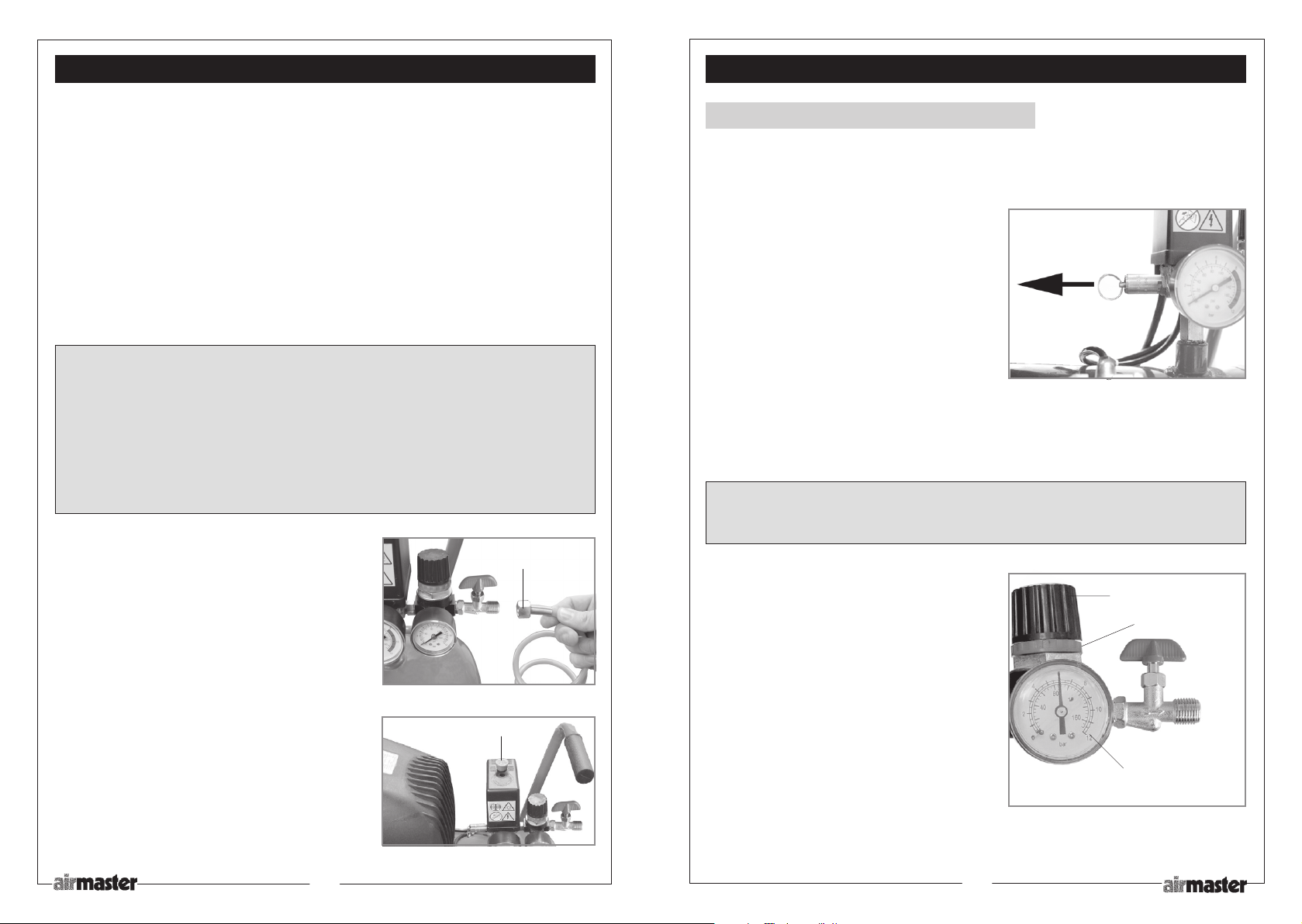
2 Check the operation of the safety
valve, under pressure, daily by pulling the ring as shown in figure 6. Air
should be released you pull the ring and stop when the ring is released.
• If the valve does not operate as described, or if the valve is stuck, it must
be replaced by qualified service personnel before using the compressor.
WARNING!
Do not remove or attempt to adjust the safety valve.
3 Loosen the locking ring and select the
pressure you need using the pressure
regulator.
4 Tighten the locking ring by holding the
pressure regulator firmly in place and
rotating the locking ring anticlockwise
until it tightens against the underside
of the pressure regulator. See figure 7.
Figure 6
Figure 10
Pressure
regulator
Locking ring
14
On/Off Switch
Output pressure
gauge
Figure 7
Figure 5
15
 Loading...