

Page 1
WARNING: Do not use the compressor without reading this manual
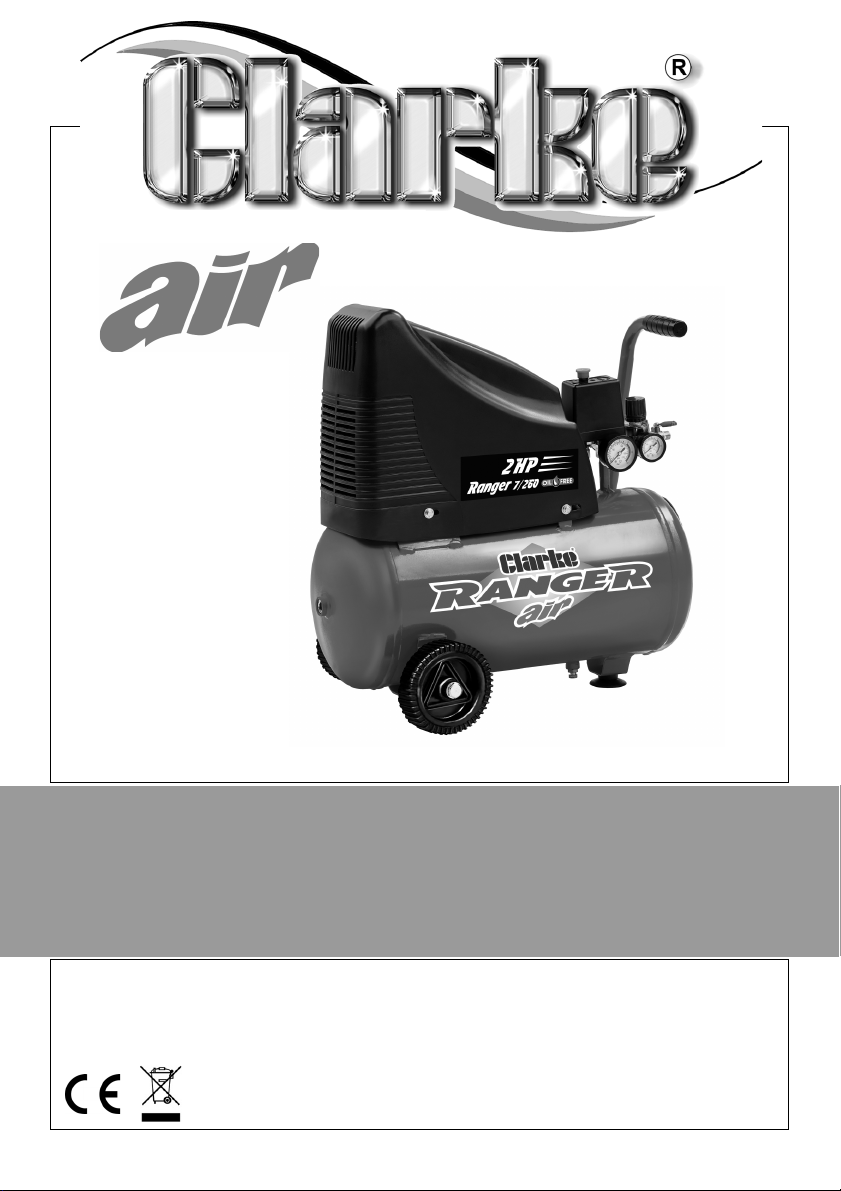
OIL FREE AIR COMPRESSOR
MODEL NO: RANGER 7-260
PART NO: 2242030
OPERATION & MAINTENANCE
INSTRUCTIONS
ORIGINAL INSTRUCTIONS GC0822-rev 1
Page 2
INTRODUCTION
Before you use this product, read this manual and follow the instructions
carefully. In doing so you will ensure the safety of yourself and others around
you, and you can also expect your purchase to give you a long and
satisfactory service.
SPECIFICATIONS
Max Pressure 8 Bar/116 psi
Voltage 230 VAC (50 Hz)
Air Displacement 7.8 CFM
Receiver Capacity 24 L
Flow rate 220L/min
Ingress protection IP20
Fuse Rating 13 A
Dimensions (L x W x H) 546 x 352 x 560 mm
Guaranteed Sound Power Level 96 dB(A)
Weight 22.7 kg
Please note that the details and specifications contained herein, are correct
at the time of going to print. We reserve the right to change specifications at
any time without prior notice.
GUARANTEE
This product is guaranteed against faulty manufacture for a period of 12
months from the date of purchase. Please keep your receipt which will be
required as proof of purchase.
This guarantee is invalid if the product is tampered with in any way, or not used
for the purpose for which it was intended.
Faulty goods should be returned to their place of purchase, no product can
be returned to us without prior permission. This guarantee does not effect your
statutory rights.
2
Parts & Service: 020 8988 7400 / E-mail: [email protected] or [email protected]
Page 3
GENERAL SAFETY WARNINGS
WARNING: WHEN USING ELECTRICAL TOOLS, BASIC SAFETY
PRECAUTIONS SHOULD ALWAYS BE FOLLOWED TO REDUCE THE RISK OF
FIRE, ELECTRIC SHOCK AND PERSONAL INJURY
WARNING: READ ALL THESE INSTRUCTIONS BEFORE ATTEMPTING TO
OPERATE THIS PRODUCT AND KEEP THESE INSTRUCTIONS IN A SAFE PLACE.
WORK AREA
1. Keep the work area clean and well lit. Floors should always be kept clear.
Cluttered or dark areas invite accidents.
2. Keep children and bystanders away while operating a compressor.
Distractions can cause loss of control.
3. The compressor should only be used in areas with adequate ventilation
and should not be exposed to heat or used near flammable substances
PERSONAL SAFETY
1. ALWAYS stay alert, watch what you are doing and use common sense
when operating the compressor. DO NOT use the compressor while you are
tired or under the influence of medication, drugs or alcohol. A moment of
inattention can result in personal injury.
2. ALWAYS use eye protection when operating compressed air equipment,
and ensure that others in the work area are protected from flying particles
from the front and from the side.
3. ALWAYS protect yourself against electric shock. NEVER operate the
compressor in wet or damp locations.
4. NEVER over-reach. Keep your proper footing and balance at all times to
enable better control of the compressor in unexpected situations.
5. NEVER attempt any complex repairs yourself. If you have a technical
problem contact your local CLARKE dealer.
6. ALWAYS store the compressor out of reach of children.
7. ALWAYS protect your hearing. Ear protection should be worn when
operating this compressor and it’s associated air tools.
8. NEVER direct the air stream at people or animals, as injury may result.
Compressed air can cause soft tissue damage and propel dirt and other
particles at high speed.
9. NEVER insert your fingers or other objects inside the motor housing. NEVER
operate the compressor without the cover in place.
3
Parts & Service: 020 8988 7400 / E-mail: [email protected] or [email protected]
Page 4

10. NEVER touch hot surfaces. During operation, the motor, connections,
compressor body, cylinder head and tubes may get hot. DO NOT touch
these until the compressor has cooled down.
GENERAL MACHINE USE AND CARE
1. Prior to use, all operators should become familiar with the instructions in this
booklet especially the ON/OFF switch for emergency stopping.
2. ALWAYS maintain the compressor with care and keep it clean for best /
safest performance.
3. NEVER use this compressor if any part is damaged. Have it inspected and
repaired by your CLARKE dealer.
4. NEVER attempt to modify the air compressor, tank, fittings or attachments in
any way. Doing so will invalidate the guarantee and could result in
personal injury.
5. NEVER abuse the power cable. NEVER pull on the cable when removing
the plug from the socket, or lift the compressor by the power cable.
6. ONLY use extension leads that are of an appropriate power rating and
suitable for the work environment. Extension leads must have an earth
connection. Inspect the extension lead regularly and replace if damaged.
7. ONLY USE RECOMMENDED PARTS: To avoid the risk of bursting, only hoses
with a rated pressure of 10 bar, or more should be used. Never attempt to
repair damaged hoses.
8. NEVER abuse the compressor by standing on it.
AIRLINE HOSES
1. ALWAYS ensure that equipment or power tools used in conjunction with the
compressor have a safe working pressure exceeding that of the machine.
2. ALWAYS keep the air hose away from any attached air tools and ensure
that the operator is not restricted by the length of the hose.
3. ALWAYS take care when a long air hose is required in the work area as it
presents a trip hazard. Coil the hose away as soon as the job is finished.
4. ALWAYS avoid kinking or trapping the air hose. ALWAYS replace faulty
hoses and never attempt a repair if a leak is detected.
5. NEVER abuse hoses or connectors. NEVER carry an air tool by the hose, or
yank it to disconnect from the air supply. Keep hoses away from heat, oil
and sharp edges. Check hoses for leaks or worn condition before use and
ensure that all connections are secure.
6. ALWAYS ensure that the air supply is turned off at the machine outlet and
any air pressure vented from within the compressor and any attached
equipment when disconnecting air hoses or other equipment.
4
Parts & Service: 020 8988 7400 / E-mail: [email protected] or [email protected]
Page 5

AIR COMPRESSOR SAFETY INSTRUCTIONS
1. ONLY USE WITHIN THE RECOMMENDED OPERATING TEMPERATURE RANGE:
This compressor should only be used in an ambient temperature of
between +5
2. NEVER USE AN AIR COMPRESSOR WHICH APPEARS DEFECTIVE OR IS
OPERATING ABNORMALLY: If the compressor operates unusually or makes
strange noises, switch off immediately and purge the air reservoir. Arrange
repairs with your nearest CLARKE dealer.
3. BREATHING QUALITY AIR: This compressor should not be used to supply
breathing quality air.
4. SAFETY VALVE: NEVER remove or attempt to adjust the safety valve. The
maximum pressure is factory set. Keep the safety valve free from paint and
other accumulations.
5. AVOID UNINTENTIONAL STARTING: DO NOT move the compressor when it is
connected to the mains power supply. When connecting the compressor
to the power supply make sure the red button on top of the control box is in
the OFF (down) position.
6. BEFORE EACH USE CHECK THE COMPRESSOR AND HOSE FOR DAMAGED
PARTS: NEVER use the compressor if it has been damaged in any way. Have
the compressor repaired by a qualified service engineer. DO NOT use the
compressor if the On/Off switch does not operate correctly.
7. KEEP THE MOTOR AIR VENTS CLEAR: Wipe regularly to maintain an
adequate supply of clean air. Avoid using in dusty conditions.
8. OPERATE THE COMPRESSOR AT THE CORRECT VOLTAGE: Make sure that the
mains supply voltage is the same as the voltage shown on the label.
9. ALWAYS adjust the pressure regulator to the recommended setting for the
particular spray gun or air tool being used.
10. When using the compressor for painting:
• DO NOT work in enclosed areas or near naked flames.
• ENSURE that the area in which you are working has good ventilation.
• Protect your nose and mouth with a suitable face mask.
• ALWAYS check the safety data sheets for substances being sprayed &
ensure manufacturer’s instructions are followed.
11. DO NOT USE THIS COMPRESSOR TO INFLATE SMALL, LOW-PRESSURE OBJECTS:
Items such as children's toys or footballs can explode if over-inflated.
12. NEVER STOP THE COMPRESSOR BY REMOVING THE PLUG OR SWITCHING OFF
AT THE MAINS SUPPLY: Always use the On/Off switch on the compressor.
O
C and +40OC (never at or below freezing temperatures).
5
Parts & Service: 020 8988 7400 / E-mail: [email protected] or [email protected]
Page 6
SAFETY SYMBOLS
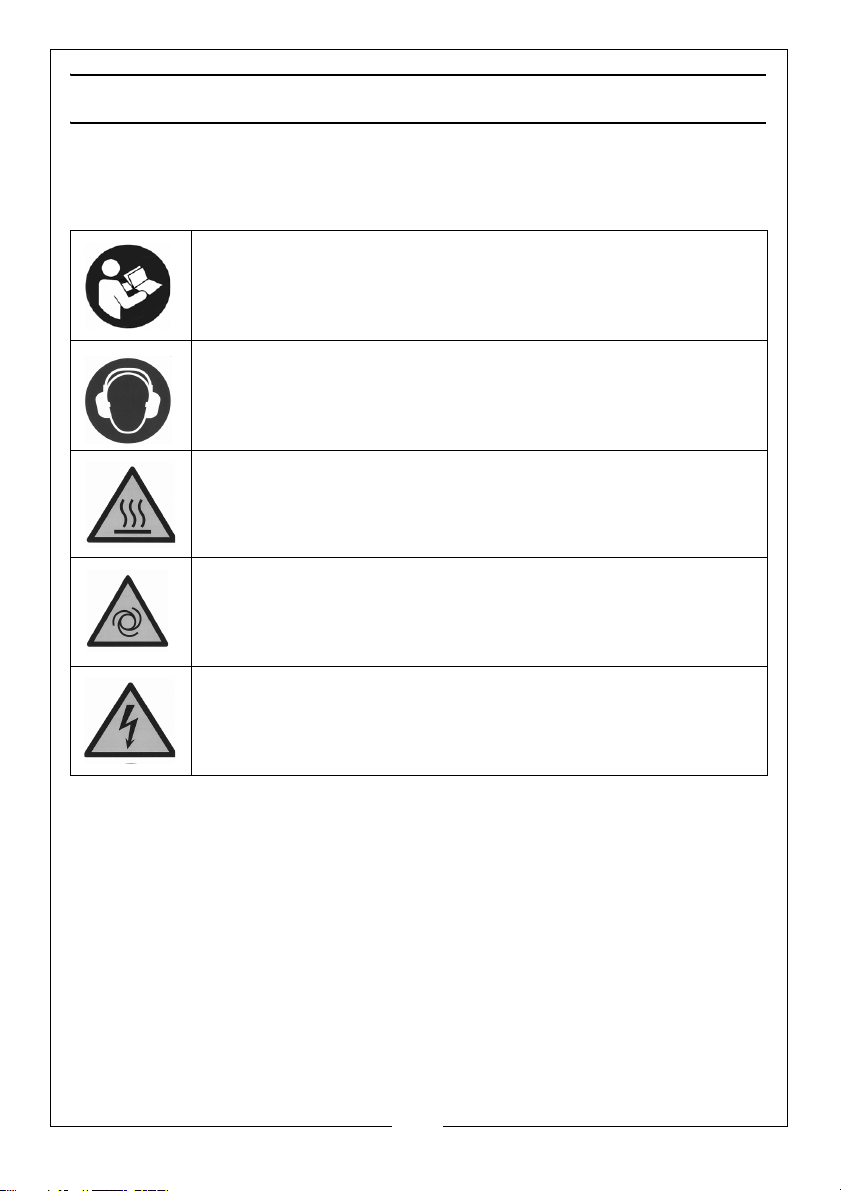
The following safety symbols are shown on the product or it’s packaging.
Please read all of the safety and operating instructions carefully before using
this product.
Read this instruction booklet carefully before positioning,
operating or adjusting the compressor.
This compressor produces a high sound level during operation.
Ear protection should be worn.
This compressor contains surfaces which may get hot during
operation. NEVER operate with the motor housing removed.
Risk of accidental start-up. The compressor could start
automatically in the event of a power cut and subsequent reset.
DO NOT carry the compressor while it is connected to the power
source, or when the receiver is filled with compressed air.
Risk of electric shock. The compressor must be disconnected
from the mains supply before removing any covers. DO NOT use
in a damp environment.
6
Parts & Service: 020 8988 7400 / E-mail: [email protected] or [email protected]
Page 7
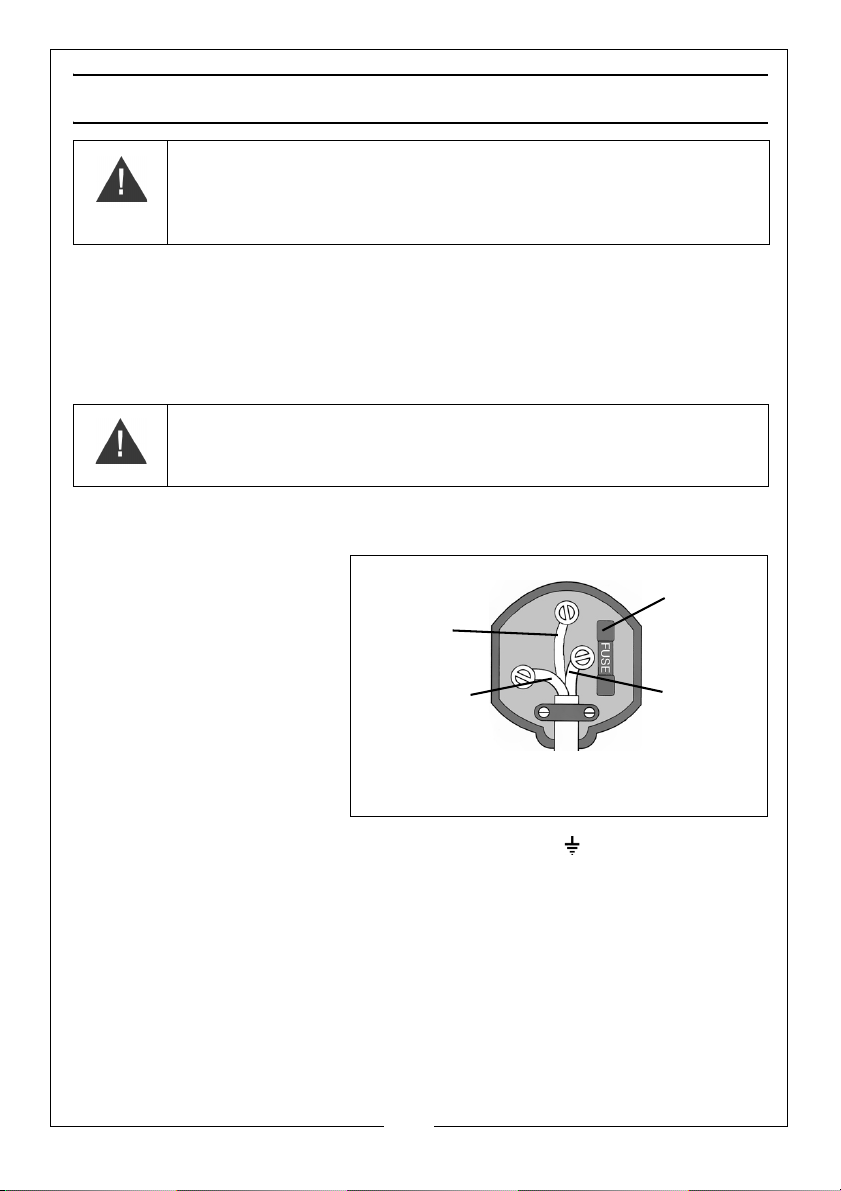
ELECTRICAL CONNECTIONS
Plug must be BS1363/A approved.
Always fit
Ensure that the outer sheath of
Neutral
(Blue)
Live
(Brown)
Earth
(Green and
a 13 Amp
the cable is firmly held by the clamp
fuse.
Yel low)
WARNING: READ THESE ELECTRICAL SAFETY INSTRUCTIONS
THOROUGHLY BEFORE CONNECTING THE PRODUCT TO THE MAINS
SUPPLY.
Connect the mains lead to a standard, 230 Volt (50Hz) electrical supply
through an approved 13 amp BS 1363 plug, or a suitably fused isolator switch.
If the plug has to be changed because it is not suitable for your socket, or
because of damage, it must be removed and a replacement fitted, following
the wiring instructions shown below. The old plug must be discarded safely, as
insertion into a power socket could cause an electrical hazard.
WARNING: THE WIRES IN THE POWER CABLE OF THIS PRODUCT ARE
COLOURED IN ACCORDANCE WITH THE FOLLOWING CODE:
BLUE = NEUTRAL BROWN = LIVE YELLOW AND GREEN = EARTH
If the colours of the wires in the power cable do not agree with the markings
on the plug:
• The BLUE wire must be
connected to the
terminal which is
marked N or coloured
black.
• The BROWN wire must
be connected to the
terminal which is
marked L or coloured
red.
• The YELLOW AND
GREEN wire must be
connected to the terminal which is marked E or or coloured green.
We strongly recommend that this machine is connected to the mains supply
through a Residual Current Device (RCD)
If you are not sure, consult a qualified electrician. DO NOT try to do any
repairs.
Parts & Service: 020 8988 7400 / E-mail: [email protected] or [email protected]
7
Page 8
PREPARATION FOR USE
UNPACKING
Take care when lifting the compressor from the packaging and obtain
assistance if necessary to avoid personal injury or damage to the machine.
Always use the handle and frame.
CAUTION: NEVER TAKE THE WEIGHT OF THE COMPRESSOR BY HOLDING
THE PRESSURE CONTROL SWITCH OR OTHER ATTACHED PARTS.
After removing the compressor from its packaging, check that it has not been
damaged in transit. Report any damage immediately to the dealer where the
item was purchased.
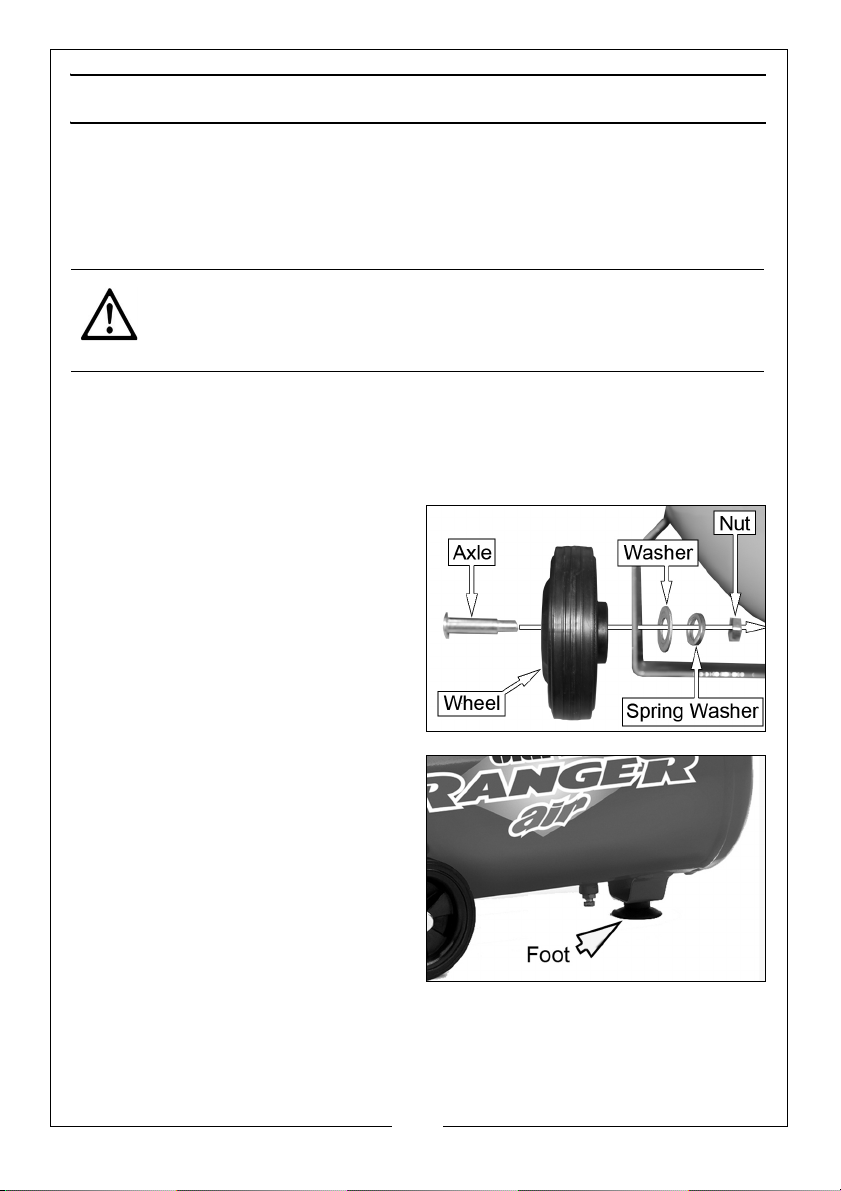
ATTACHING THE WHEELS
Use a suitable spanner to attach the
wheels to the compressor.
Use the washers and spring washer in
the positions shown.
ATTACHING THE SUPPORT FOOT
Fit the support foot into the position
shown.
8
Parts & Service: 020 8988 7400 / E-mail: [email protected] or [email protected]
Page 9
BEFORE USE
Before connecting your compressor to the power supply, check the following:-
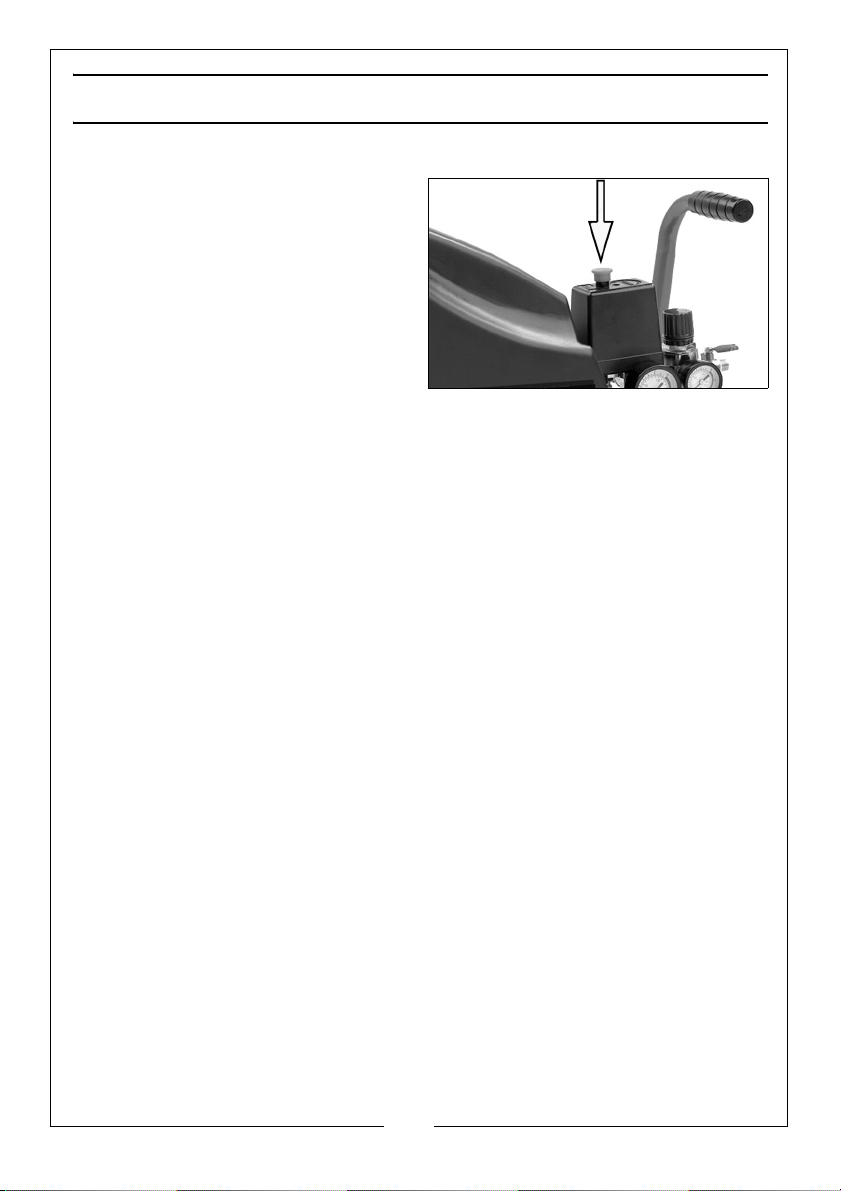
• Set the ON/OFF switch to the
OFF position (pushed down).
• Ensure the compressor is
standing on level ground.
• Make sure that the power
supply is suitable.
POSITIONING THE COMPRESSOR
This compressor should be positioned
on a stable, flat surface.
NOTE: Note: the compressor should not be operated on a steep slope or
floor angle of greater than 15
If the compressor is placed on a shelf or raised off the ground, it should be
secured appropriately to prevent it from falling off during use.
Do not cover the compressor. Always position it with good ventilation.
MOVING THE COMPRESSOR
When moving the compressor;
• Always use the handle wherever possible.
• Do not lift by (or place a strain on) the airline fittings or hoses.
• Take care to avoid damaging the valves or fittings.
• Ensure it is switched off and disconnected from the power supply.
O
.
9
Parts & Service: 020 8988 7400 / E-mail: [email protected] or [email protected]
Page 10
OPERATION
If the compressor has not been used for more then 24 hours, open the drain
valve on the bottom of the reservoir and drain any condensate which has
collected. See page 12.
ATTACHING AIR TOOLS
WARNING: BEFORE CONNECTING AIR TOOLS, MAKE SURE THAT YOU
READ THE INSTRUCTIONS SUPPLIED WITH THE TOOL, ALSO ENSURE THAT
THE AIR TOOL IS SUITABLE FOR USE WITH THE COMPRESSOR AND HOSE
SPECIFICATIONS.
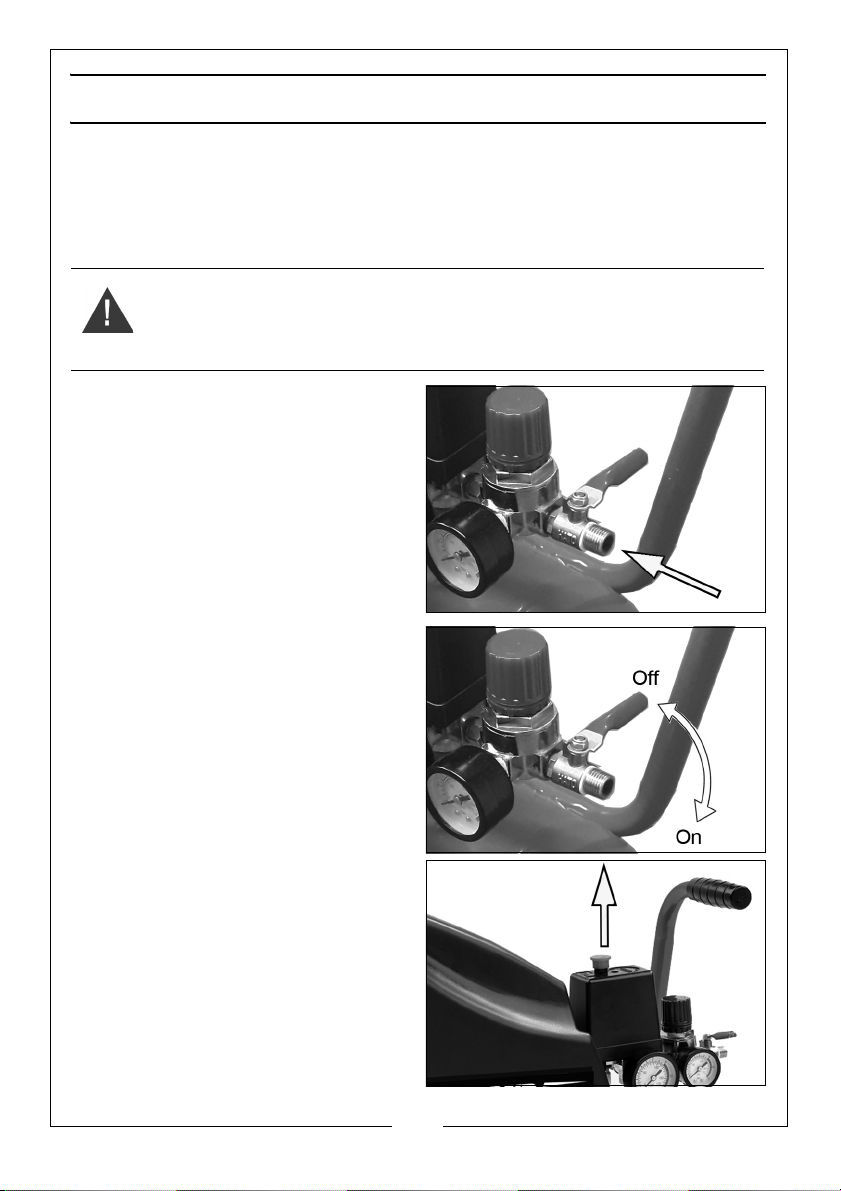
1. Attach the air hose to the ¼" BSP
outlet valve.
2. Attach the tool to the end of the
air hose.
3. Turn the outlet valve handle to the
on position.
NOTE: The outlet valve is shown
without the air hose fitted for
clarity.
TURNING THE COMPRESSOR ON
1. Plug the compressor into the
power supply.
2. Lift the On/Off button.
• The compressor will operate
until the reservoir is fully
pressurised. It will then shut
down.
• The compressor will start up
again when the pressure in the
reservoir decreases.
10
Parts & Service: 020 8988 7400 / E-mail: [email protected] or [email protected]
Page 11
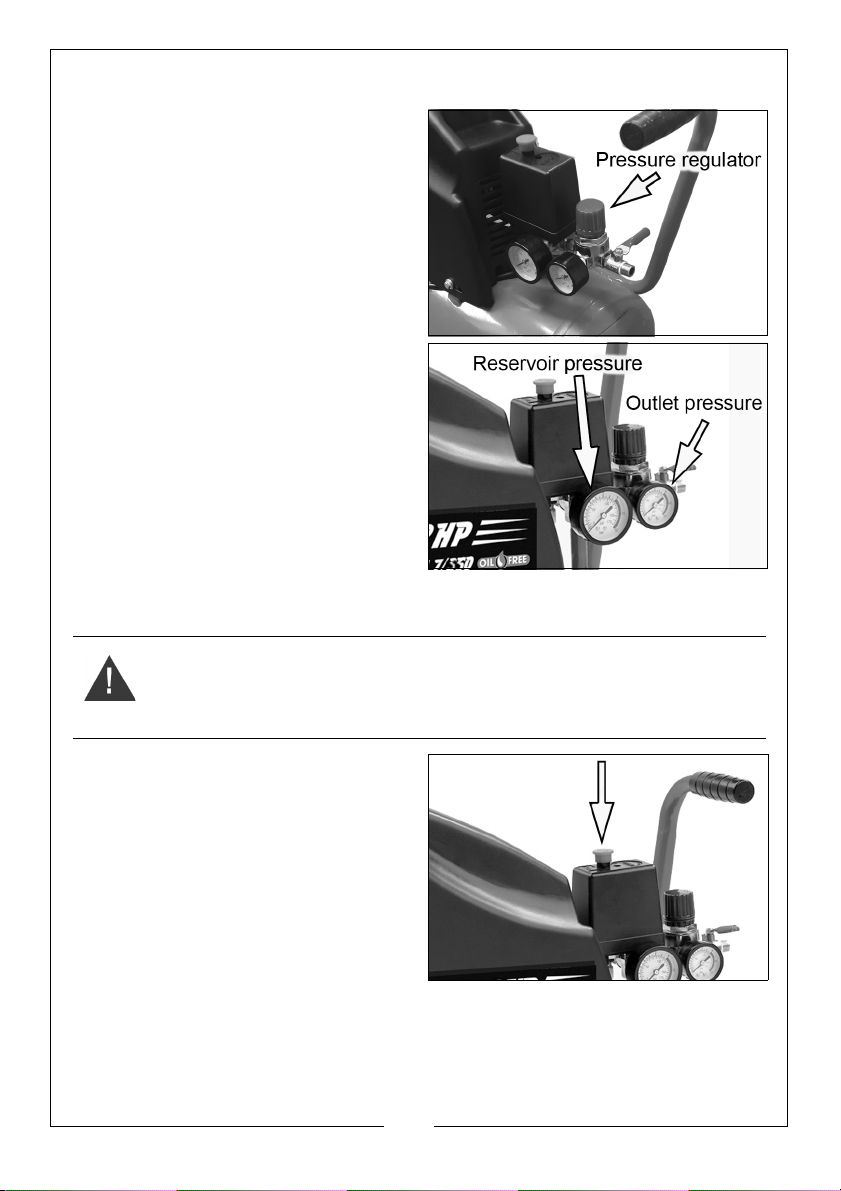
SET THE OUTPUT PRESSURE
1. Use the pressure regulator to set
the output pressure of the left
hand outlet valve.
• Turn clockwise to increase the
pressure.
• Turn counterclockwise to
decrease the pressure.
GAUGES
1. The reservoir pressure gauge
shows the current pressure in the
reservoir.
2. The outlet pressure gauge shows
the ‘user set’ outlet pressure. This
can be adjusted as shown above.
REMOVING TOOLS FROM THE AIR HOSE
WARNING: ALWAYS SET THE PRESSURE REGULATOR TO ZERO BEFORE YOU
REMOVE OR REPLACE A TOOL.
1. Push down on the On/Off button
to stop the compressor.
11
Parts & Service: 020 8988 7400 / E-mail: [email protected] or [email protected]
Page 12
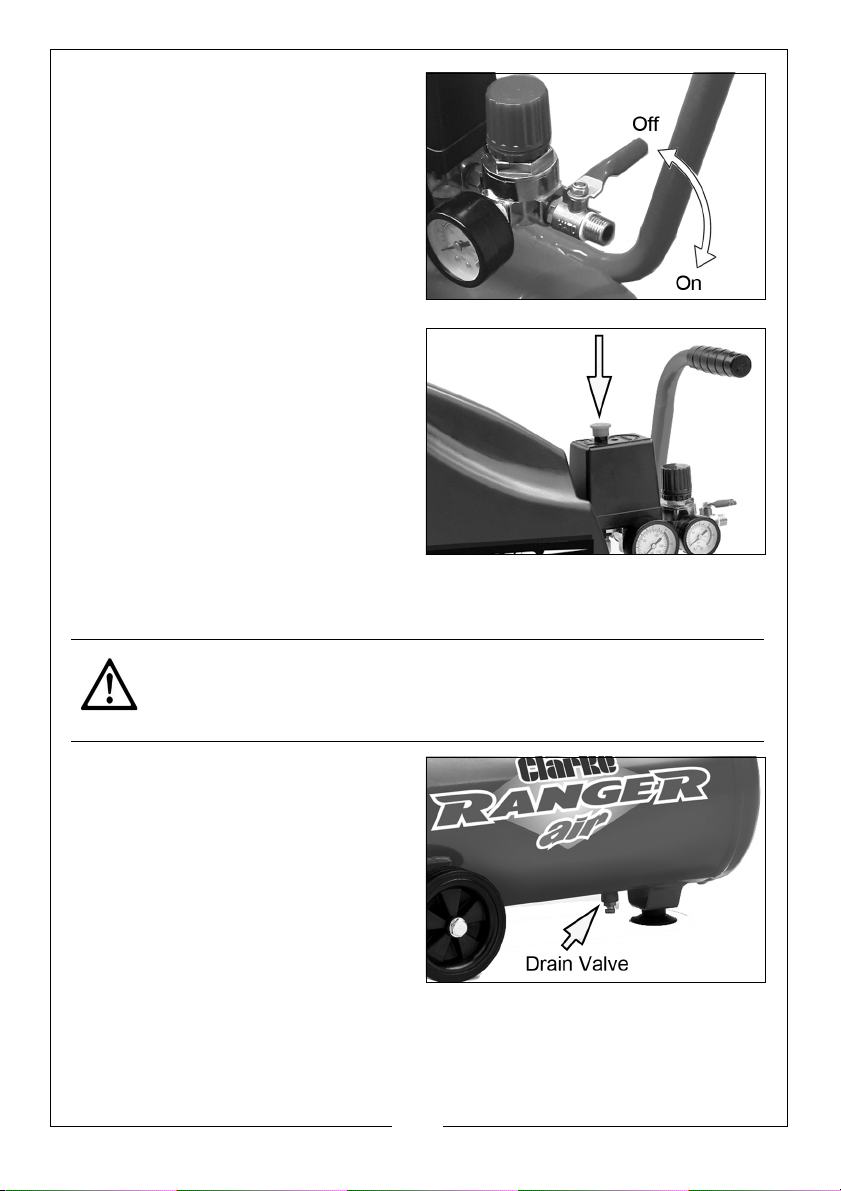
2. Turn the outlet valve handle to the
off position.
3. Operate the tool to depressurise
the air hose.
4. Disconnect the tool from the hose.
TURNING THE COMPRESSOR OFF
1. Follow steps 1-3 in “Removing Tools
from the Air Hose” above.
2. Disconnect the compressor from
the power supply.
3. Slowly open the outlet valve to
depressurise the reservoir.
• You will hear a hissing sound as
the reservoir depressurises.
• Do not leave the compressor
unattended if the reservoir is pressurised.
DRAINING THE RESERVOIR
CAUTION: YOU MUST DRAIN THE RESERVOIR AFTER EACH DAYS USE AND
BEFORE YOU PUT YOUR COMPRESSOR INTO STORAGE.
1. Turn the compressor off and
disconnect from the power
supply.
2. Put a container below the drain
valve to collect the condensate.
3. Open the drain valve slowly.
• Condensation will drain from
the reservoir.
4. Close the drain valve when the
reservoir has fully drained.
12
Parts & Service: 020 8988 7400 / E-mail: [email protected] or [email protected]
Page 13
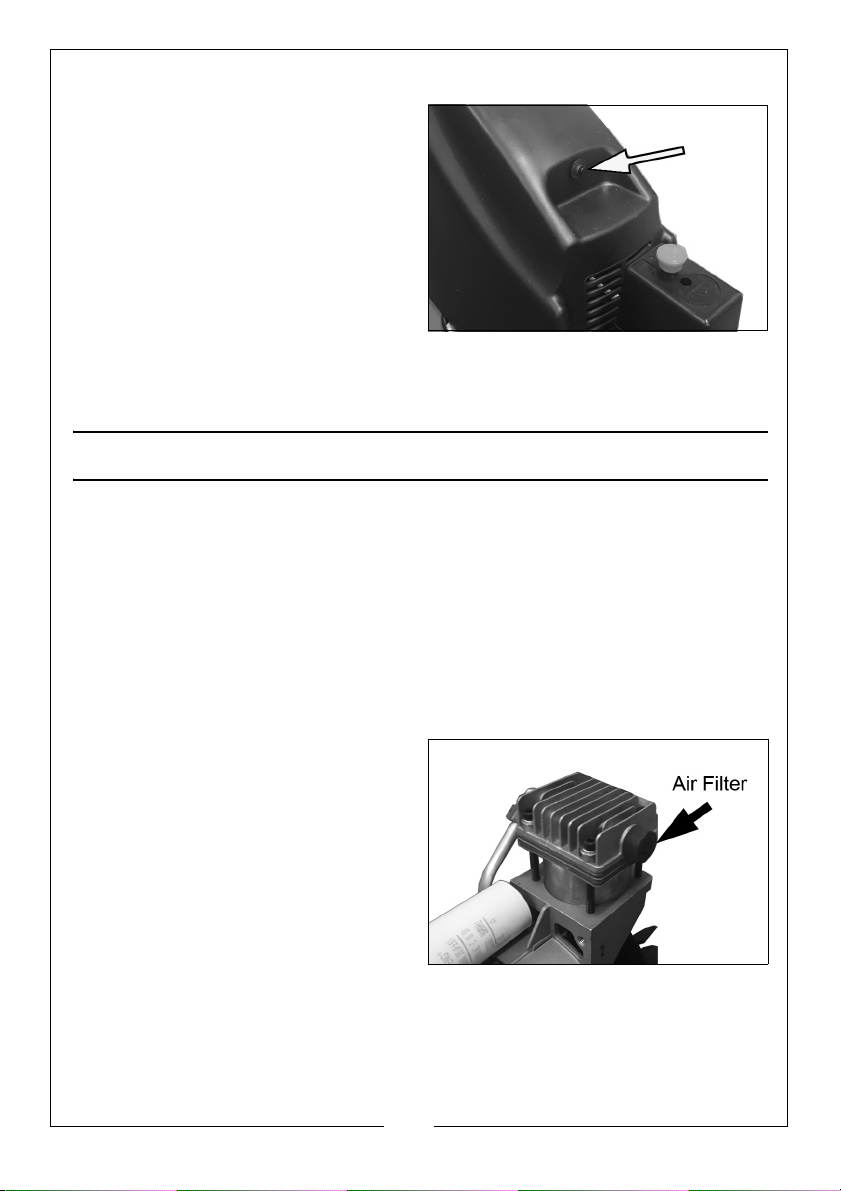
RESET BUTTON
This compressor has a thermal
overload device.
If the motor gets too hot, the thermal
overload device cuts the power
which prevents damage to the motor.
If the thermal overload device
operates, let the motor cool down for
5 minutes and push the reset button.
If you start the compressor and the
overload cutout operates again, stop
the compressor and disconnect from the power supply and have your
compressor examined by a qualified service agent.
MAINTENANCE
CAUTION: ALWAYS DISCONNECT FROM THE POWER SUPPLY BEFORE CARRYING
OUT ANY MANTENANCE
DRAINING THE RESERVOIR
After use, always open the drain valve to make sure that any condensate is
drained off.
CLEANING THE AIR FILTER
The air filter should be examined occasionally in dusty conditions,
1. Unscrew the plastic shroud from
the compressor to expose the
working components.
2. Clean the sponge filter using a
soft brush. If necessary, the filter
can be carefully cleaned in warm
soapy water.
• Rinse and let the filter dry
completely before refitting.
3. Refit the filter assembly before
use.
• If the filter is damaged it must be replaced.
4. Refit the plastic shroud. This should always be fitted before reconnecting
and starting the compressor.
13
Parts & Service: 020 8988 7400 / E-mail: [email protected] or [email protected]
Page 14
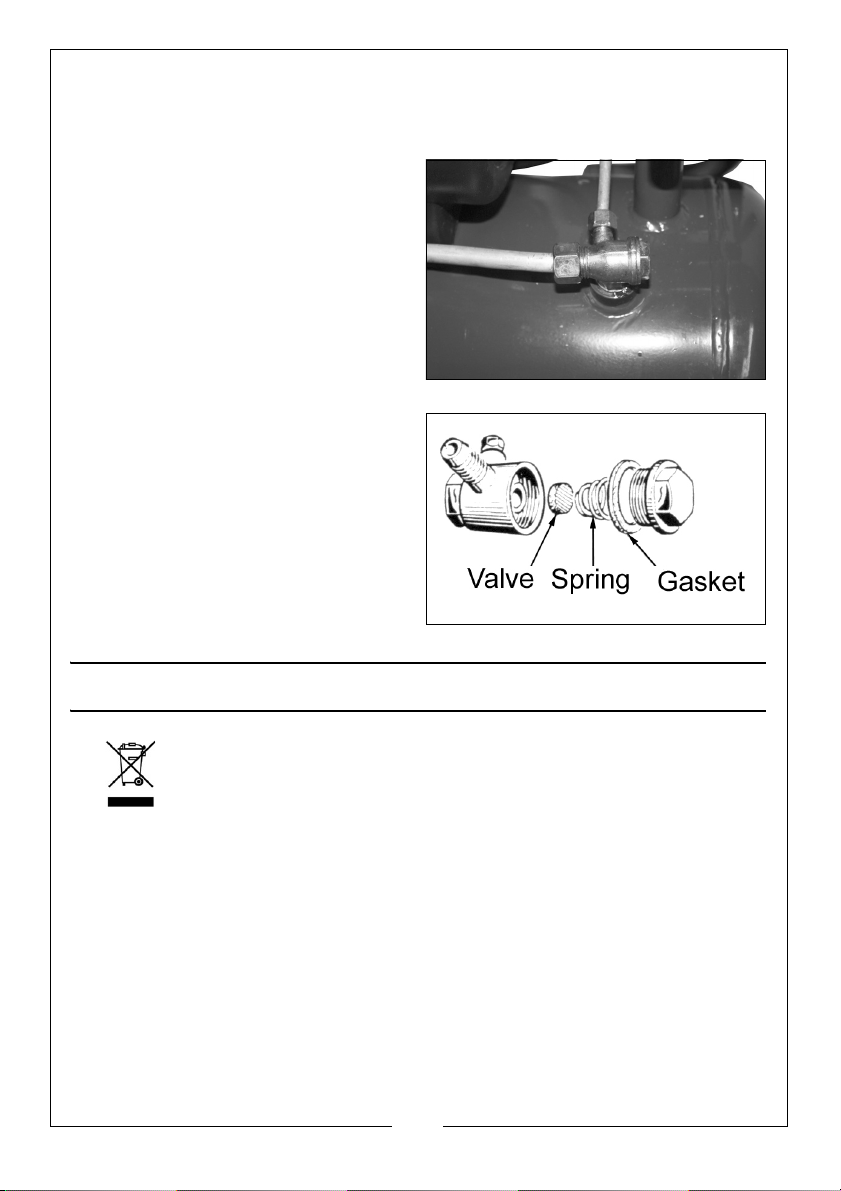
CHECKING THE NON-RETURN VALVE
If the reservoir pressure decreases for no apparent reason it is possible that the
non-return valve is leaking. To check;
1. Make sure that the reservoir is not
under pressure and the
compressor is switched OFF.
2. Examine the non-return valve,
and replace the gasket and valve
if necessary.
ENVIRONMENTAL PROTECTION
Recycle unwanted materials instead of disposing of them as waste.
All tools, accessories and packaging should be sorted and taken to
a recycling centre for disposed in a manner compatible with the
environment.
By purchasing this product, the customer is taking on the obligation to deal
with its safe disposal in accordance with the Waste Electrical and Electronic
Equipment (WEEE).
In effect, this means that this product must not be disposed of with general
household waste. It must be disposed of according to the laws governing
Waste Electrical and Electronic Equipment (WEEE) at a recognised disposal
facility. If disposing of this product or any damaged components, do not
dispose of with general waste. This product contains valuable raw materials.
Metal products should be taken to your local civic amenity site for recycling of
metal products.Should any components become completely unserviceable
and require disposal plastic and metal should be disposed of according to
local regulations.
14
Parts & Service: 020 8988 7400 / E-mail: [email protected] or [email protected]
Page 15
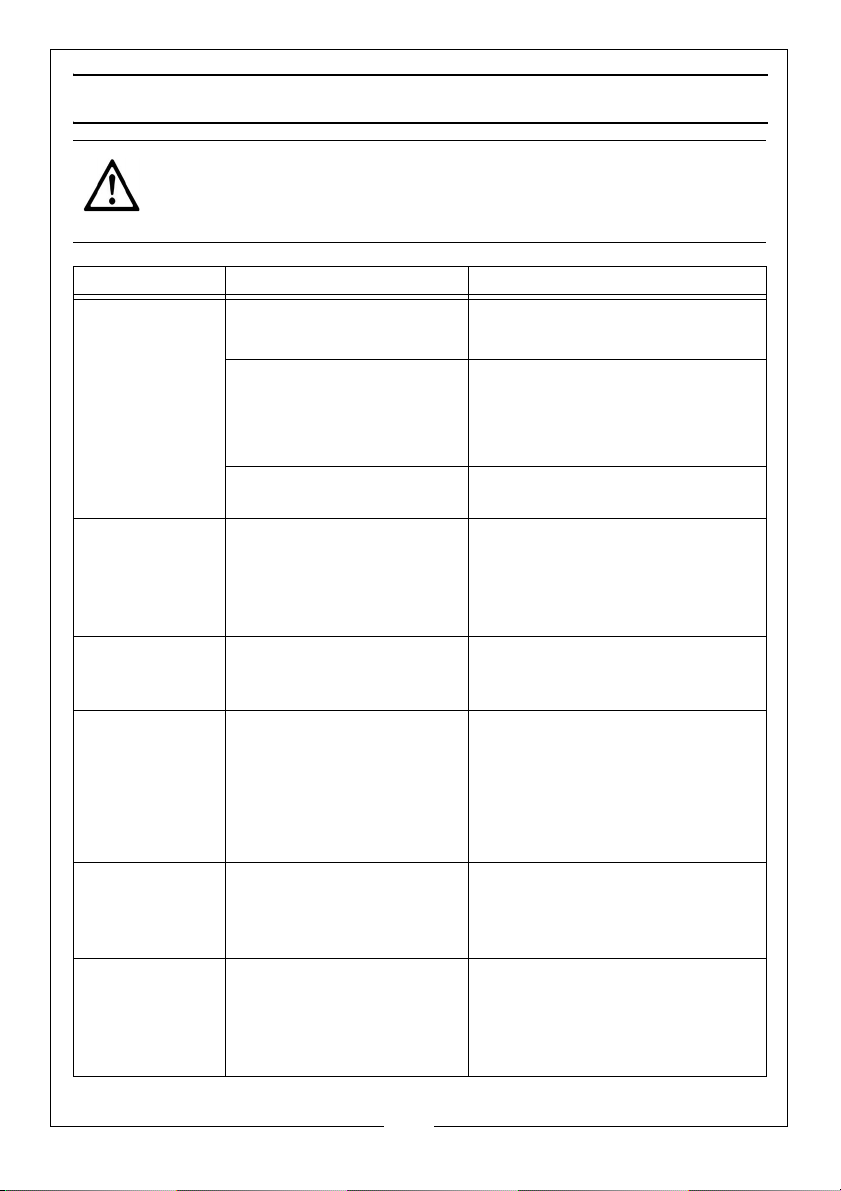
TROUBLESHOOTING
CAUTION: DO NOT TRY TO REPAIR OR ADJUST THIS COMPRESSOR IF YOU
ARE UNCERTAIN. IF YOU HAVE ANY QUERIES, CONTACT YOUR DEALER.
PROBLEM PROBABLE CAUSE REMEDY
The compressor
has stopped
and does not
start.
The compressor
does not reach
the set pressure
and overheats
easily.
Compressor
does not start.
Air leaking from
the non-return
valve when the
compressor is
not running.
Air pressure
from the
regulator will
not adjust.
Compressor is
very noisy and
makes a
metallic knocking sound.
Bad electrical connection 1.Check electrical connections.
2.Clean and tighten if necessary.
Overload cutout switch
has tripped.
Motor windings burnt out. 1.Contact your CLARKE dealer
Compressor head gasket
blown or valve broken.
The reservoir has already
fully pressurised.
Faulty non-return valve. 1.Drain receiver completely of
The diaphragm within the
regulator body is broken.
Compressor damaged
and needs overhaul.
1.Switch off and wait approx 5
minutes.
2. Press the reset button and
switch on again.
for a replacement motor.
1.Return the machine to your
nearest CLARKE dealer.
1.Open drain valve to expel air.
Compressor should start again
when pressure reduces.
air.
2.Remove the valve end plug.
3.Carefully clean the valve seat
and the gasket
4.Reassemble.
1.Replace regulator
1.Return the machine to your
nearest CLARKE dealer.
15
Parts & Service: 020 8988 7400 / E-mail: [email protected] or [email protected]
Page 16
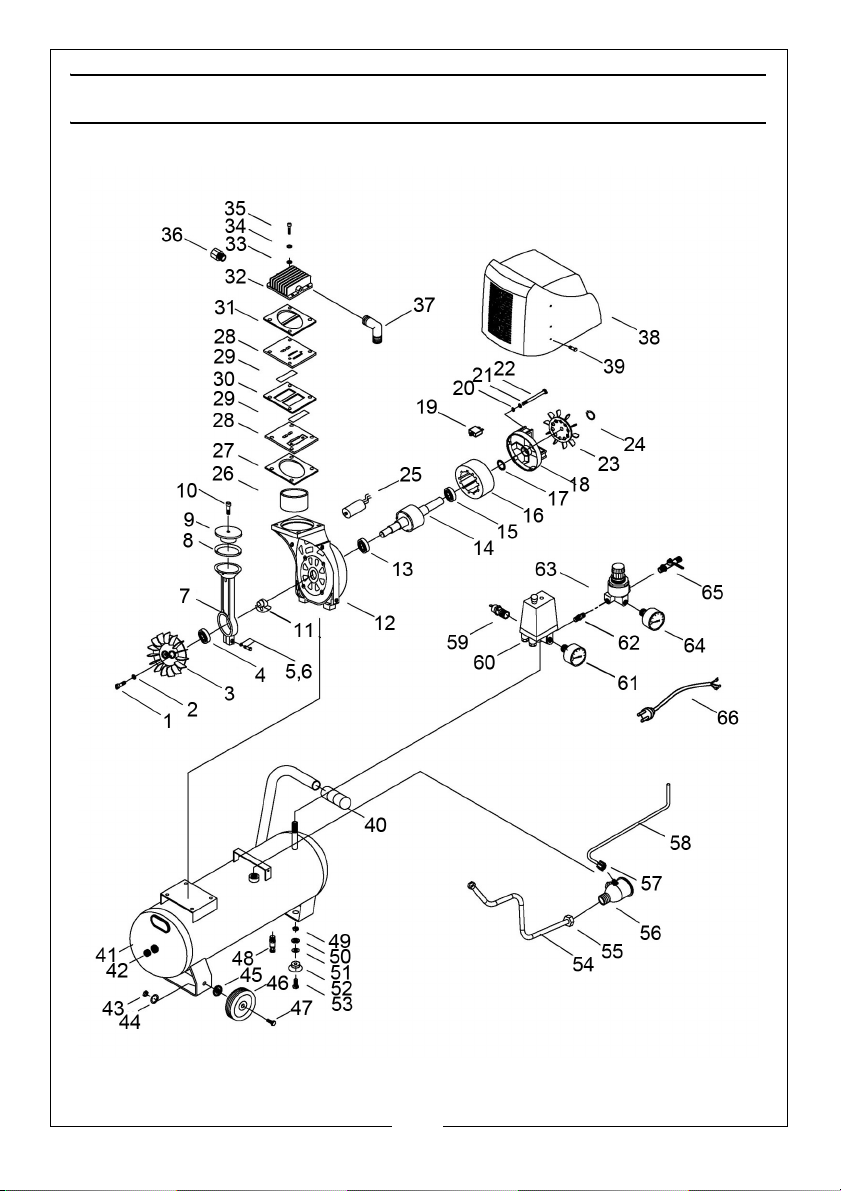
Page 17
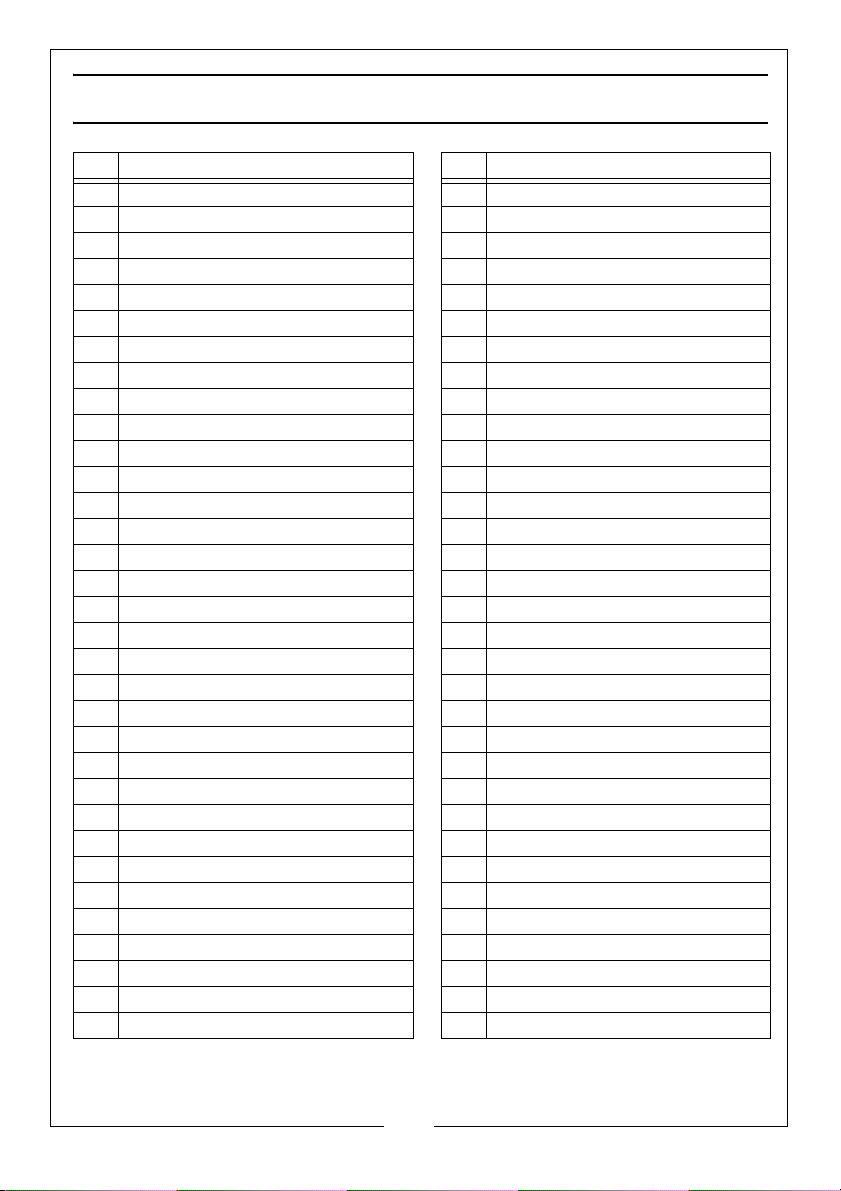
COMPONENT PARTS
NO DESCRIPTION NO DESCRIPTION
1 Bolt 34 Spring washer
2 Washer 35 Bolt
3 Fan 36 Air filter
4 Bearing 37 Elbow
5 Washer 38 Shroud
6 Bolt 39 Bolt
7 Connecting rod 40 Handle cover
8 Seal cup 41 Tank
9 Pressplate 42 Checking hole plug
10 Bolt 43 Hex nut
11 Crankshaft 44 Spring washer
12 Crankcase 45 Flat washer
13 Bearing 46 Wheel
14 Rotor 47 Bolt
15 Bearing 48 Drain valve
16 Stator 49 Nut
17 Wave gasket 50 Spring washer
18 Bearing seat 51 Flat washer
19 Overload protector 52 Foot
20 Flat washer 53 Bolt
21 Spring washer 54 Exhaust pipe
22 Long bolt 55 Hex nut
23 Fan 56 Check valve
24 Pin clip 57 Discharge pipe nut
25 Capacitor 58 Discharge pipe
26 Cylinder 59 Safety valve
27 Valve plate gasket 60 Pressure switch
28 Valve plate 61 Pressure gauge(50mm)
29 Valve reed 62 Connector
30 Aluminium gasket 63 Regulator
31 Head cover gasket 64 Pressure gauge(40mm)
32 Head cover 65 Air tap
33 Flat Washer 66 Power cable
17
Parts & Service: 020 8988 7400 / E-mail: [email protected] or [email protected]
Page 18
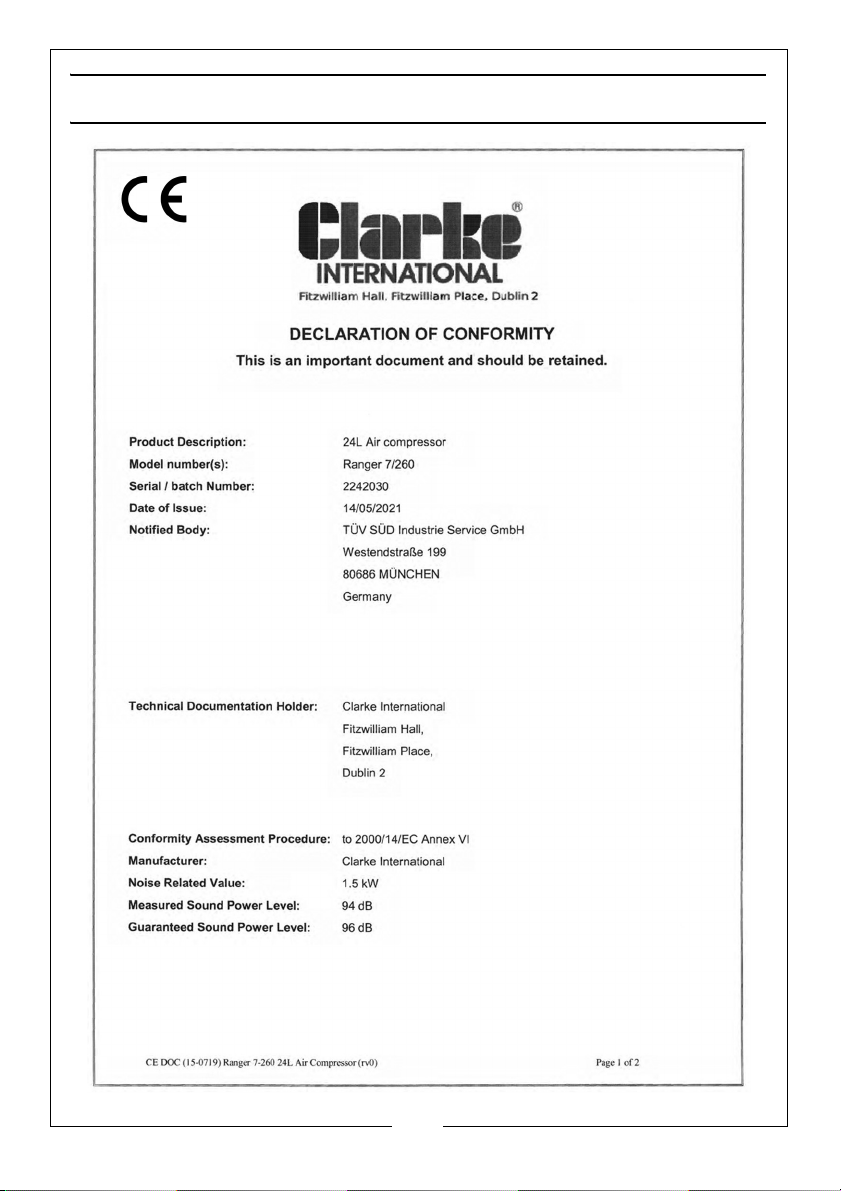
DECLARATION OF CONFORMITY
18
Parts & Service: 020 8988 7400 / E-mail: [email protected] or [email protected]
Page 19
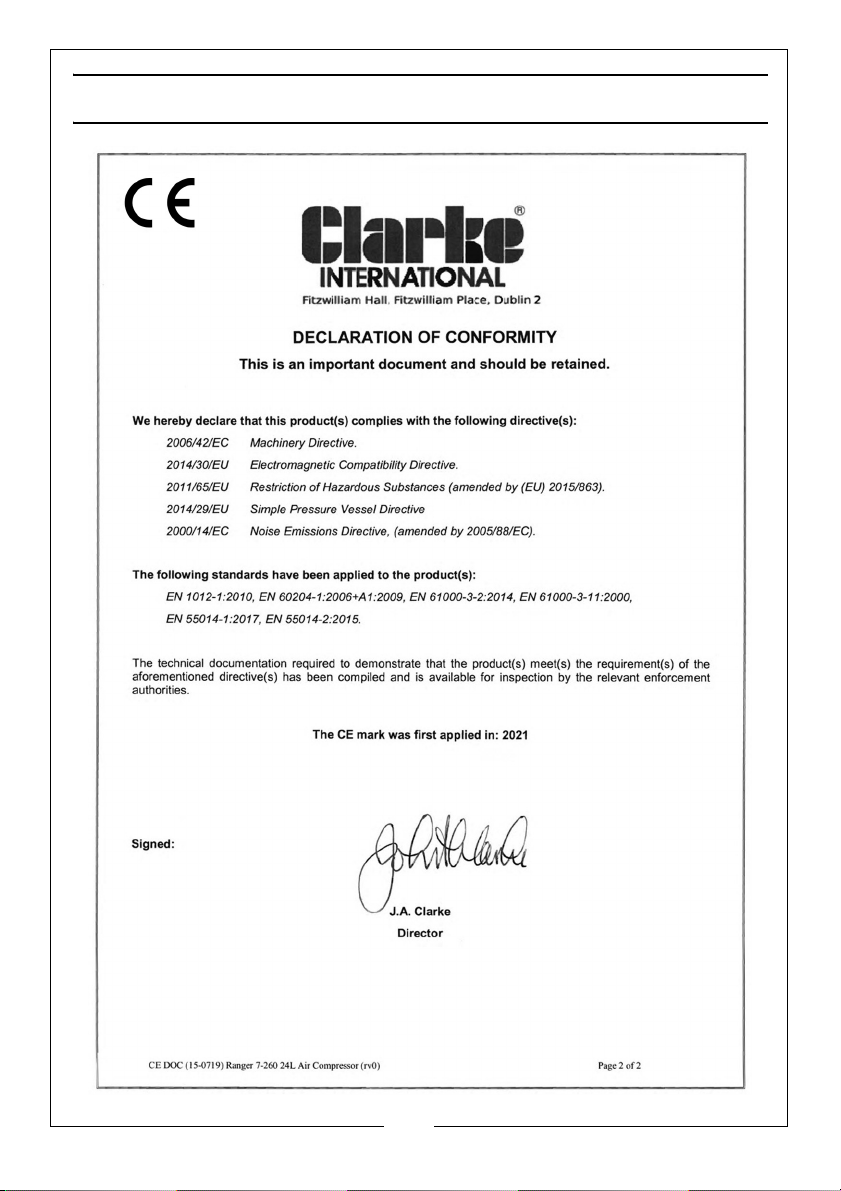
DECLARATION OF CONFORMITY
19
Parts & Service: 020 8988 7400 / E-mail: [email protected] or [email protected]
Page 20

 Loading...