

Page 1
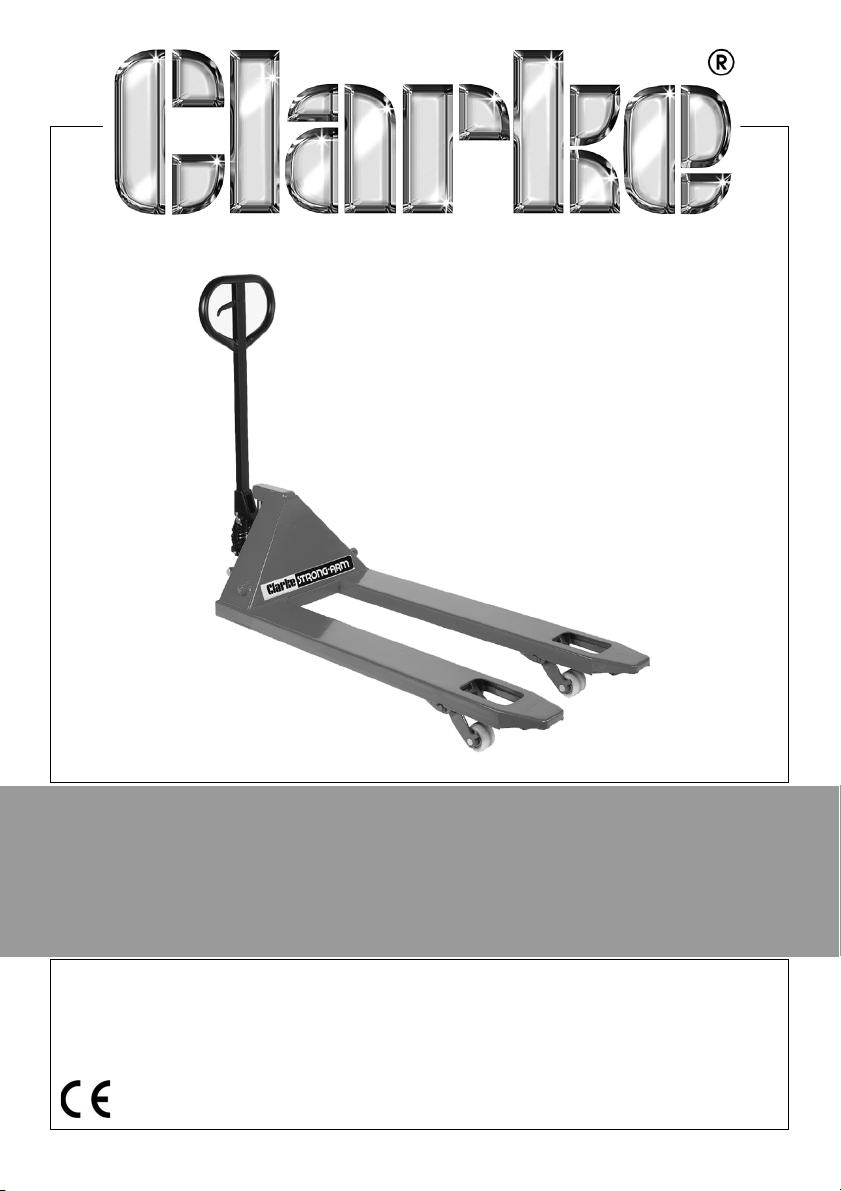
HYDRAULIC PALLET TRUCK
MODEL NO: PT550
PART NO: 7630171
OPERATION & MAINTENANCE
INSTRUCTIONS
ORIGINAL INSTRUCTION GC1016
Page 2
INTRODUCTION
Thank you for purchasing this CLARKE Hydraulic Pallet Truck.
Before attempting to use this product, please read this manual thoroughly and
follow the instructions carefully. In doing so you will ensure the safety of yourself
and that of others around you, and you can look forward to your purchase
giving you long and satisfactory service.
INTENDED USE
This pallet truck is a manually operated hand pallet truck designed to lift and
transport the rated load on industrial pallets.
Do not lift or carry people and don’t use this pallet truck for any other purpose
than its intended use. incorrect usage can cause injuries or can damage
equipment.
The operator / operating company has to ensure the correct usage and that
this pallet truck is used only by staff who are trained and authorized to use this
pallet truck.
WARNING: THE TRUCK HAS TO BE USED ON SUBSTANTIALLY FIRM,
SMOOTH, LEVEL AND PREPARED SURFACES. THE LOAD MUST BE PLACED
CENTRALLY ON THE FORKS.
GUARANTEE
This product is guaranteed against faulty manufacture for a period of 12
months from the date of purchase. Please keep your receipt which will be
required as proof of purchase.
This guarantee is invalid if the product is found to have been abused or
tampered with in any way, or not used for the purpose for which it was
intended.
Faulty goods should be returned to their place of purchase, no product can
be returned to us without prior permission.
This guarantee does not effect your statutory rights.
2
Parts & Service: 020 8988 7400 / E-mail: [email protected] or [email protected]
Page 3

ENVIRONMENTAL PROTECTION
Do not dispose of this product or its packaging with general household waste.
All tools, accessories and packaging should be sorted, taken to a recycling
centre and disposed of appropriately.
To avoid pollution due to oil leakage, the user should provide some absorbent
materials to capture any escape of oil during refilling of the hydraulic
mechanism. Such materials should then be disposed of appropriately.
SAFETY INSTRUCTIONS
1. The operator should read all warning signs and instructions here and on the
pallet truck before use.
2. Keep these instructions safe for future reference.
3. Do not operate a hand pallet truck unless you are familiar with it and have
been trained or authorized to do so.
4. Examine the condition of the pallet truck before use, with particular
attention to the wheels, handle, forks and lift/lower controls. Do not use the
pallet truck if any defects are found.
5. Do not make any changes or modifications to the pallet truck.
6. Do not use if the wheels or rollers are damaged. Have them replaced
immediately.
7. Keep the work area tidy and well lit.
8. Keep children and bystanders away from the work area.
9. Do not exceed the safe working load of the pallet truck. Refer to the
labelling on the pallet truck and the specifications section in this manual.
10. Do not use on rough terrain. The pallet truck is designed for use on smooth
flooring only.
11. Do not use the pallet truck on a gradient if the load is too heavy to be
easily handled by the operator. The pallet truck must not be used by
anyone not capable of handling the full weight of the pallet truck when
loaded.
12. Watch for differences in floor levels when moving the truck. The load may
overbalance or the truck could become uncontrollable.
13. Do not let the pallet truck come into direct contact with foodstuff.
14. Do not use the truck in explosive atmospheres.
3
Parts & Service: 020 8988 7400 / E-mail: [email protected] or [email protected]
Page 4
15. The operator must wear safety shoes.
16. Do not allow personnel to stand in front of or behind the truck when it is
moving or lifting/lowering.
17. Never put your foot in front of rolling wheels, Injury could result.
18. Never allow hands or feet to be placed under the forks within the range of
movement of the lifting components. Take care not to trap fingers in the
moving parts.
19. Do not use the pallet truck as a jack.
20. Load the pallet truck evenly with the centre of gravity of the load above
the centre of the forks. Do not move unstable or loosely stacked loads. Use
extra care when moving long, tall or wide loads which impair your view.
21. Keep watching the load. Stop, if the load becomes unstable.
22. When not in use, always make sure that the truck is stored where it is not a
danger to others. Do not leave the truck on a gradient without first securely
chocking the wheels.
23. Carry out maintenance work according to the maintenance section on
page 9.
24. This pallet truck is not designed to be water resistant, therefore use it in a
dry environment.
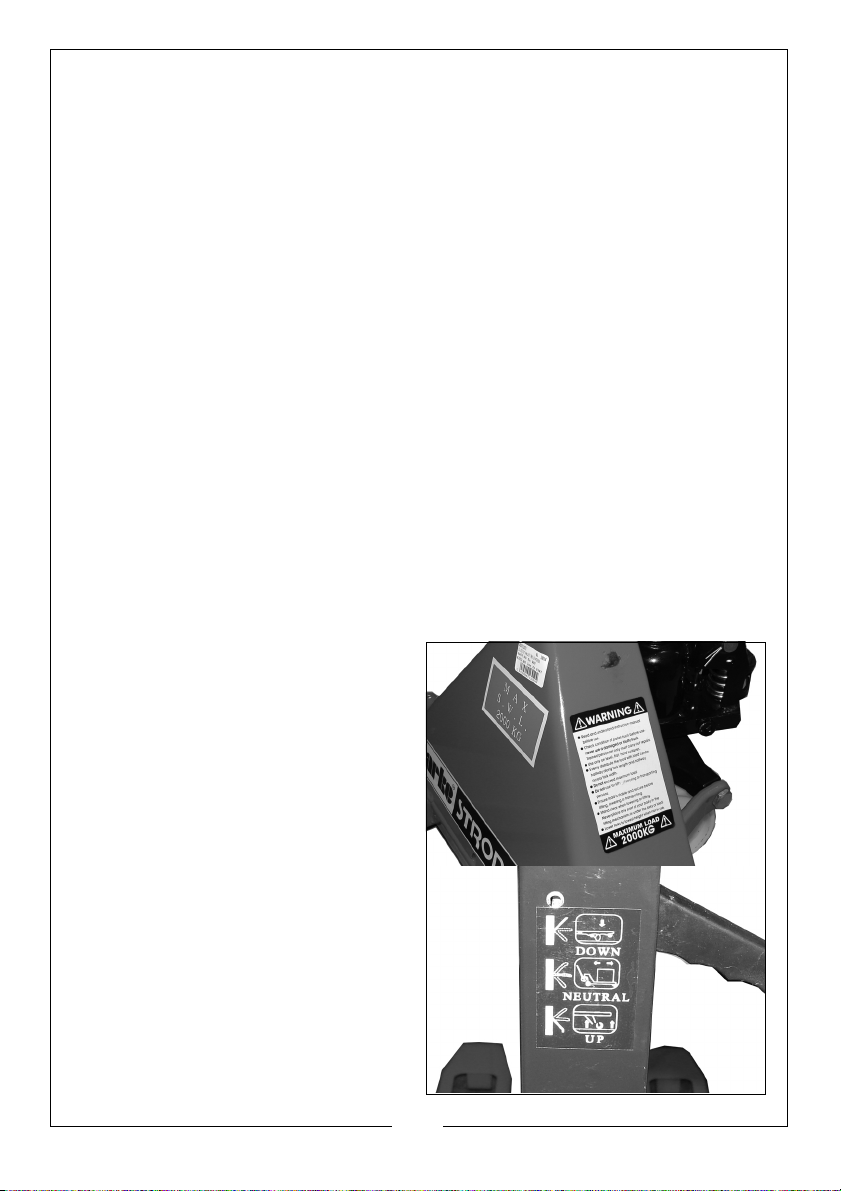
MARKINGS AND DECALS
Before using the pallet truck, ensure
that all markings and decals are on
the right place and not damaged. If
necessary replace the decals.
• A. Operating Instruction label
• B. Capacity label
• C. Warnings label
4
Parts & Service: 020 8988 7400 / E-mail: [email protected] or [email protected]
Page 5
ASSEMBLY
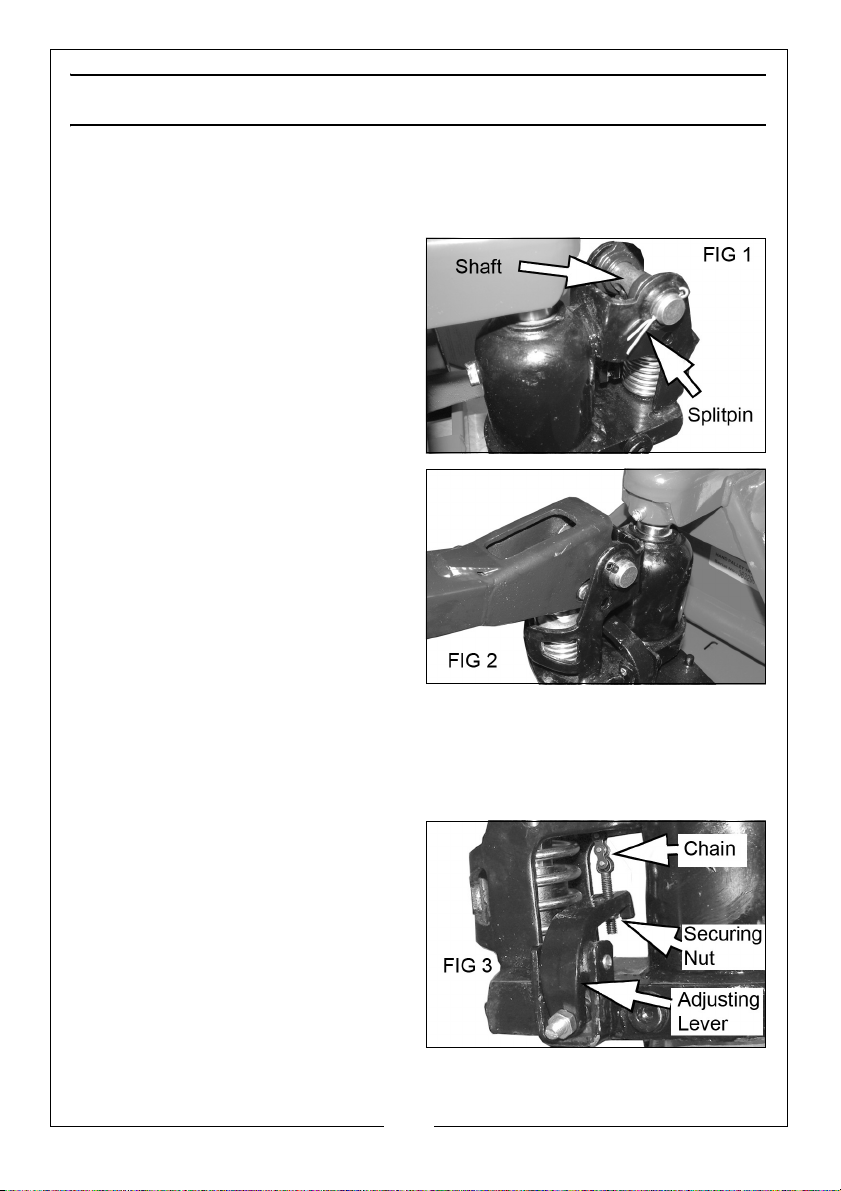
Your new pallet truck is delivered with the operating handle removed. To fit the
operating handle proceed as follows;
The numbers in brackets refer to the diagram on page 12.
1. Remove the split pin. (74) from the
shaft, (23) and keep safe for use
later.
2. Remove the shaft from the pump
body.
3. Insert the operating handle (8)
(with the warning label
underneath and the trigger on
the R/H side) between the side
ears of the pump body as shown.
4. Connect the operating handle to
the pump body by sliding the
shaft back through the fitting
holes in the pump body and the
operating handle.
NOTE: The handle needs to be held at an angle of approx 45º in order to
fit the shaft.
5. Turn the shaft so that the central hole is vertical. DO NOT push fully home
yet.
6. Pass the chain, (10), through the
centre hole in the shaft, Locate
the securing nut on the end of the
chain into the slot of the adjusting
lever, (52).
7. Turn the shaft so that the roll pin
lines up with the slot in the pump
body. Push the shaft fully home
and refit the split pin removed
earlier. This secures the handle in
place.
5
Parts & Service: 020 8988 7400 / E-mail: [email protected] or [email protected]
Page 6
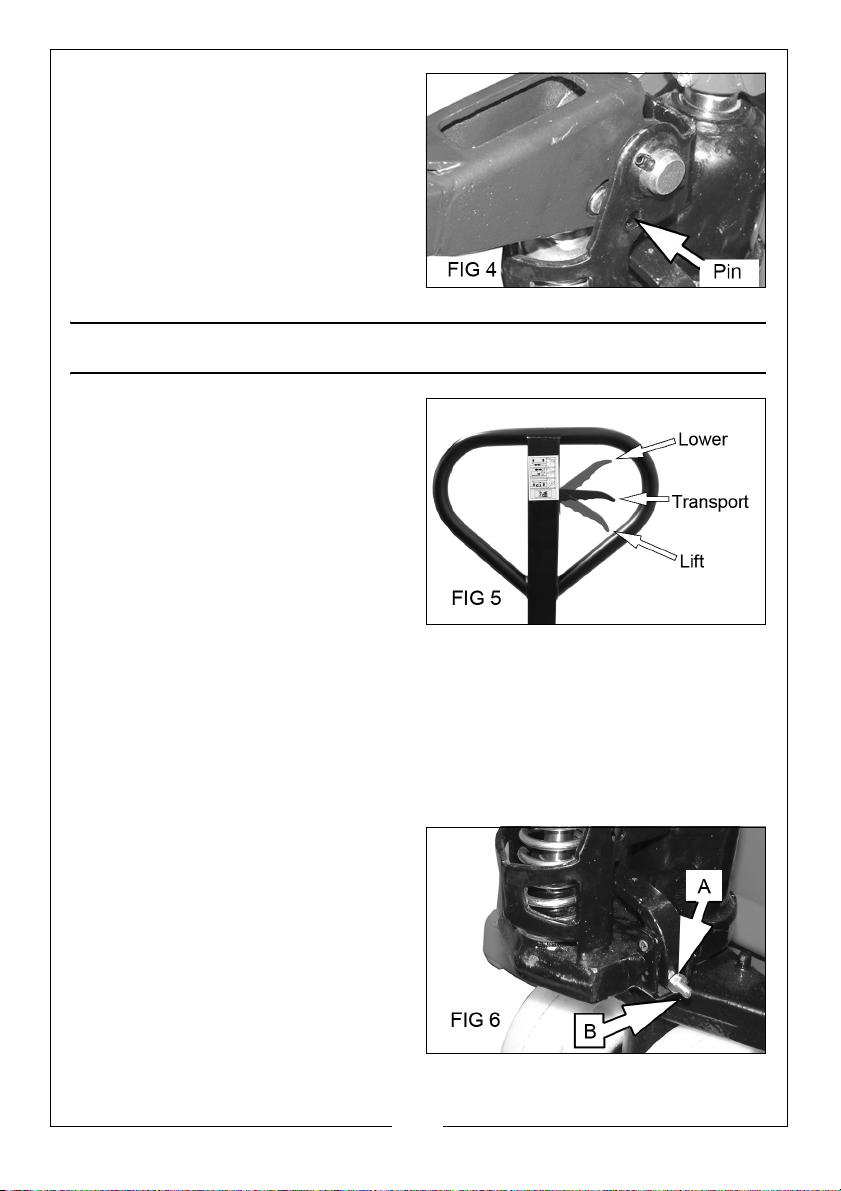
8. Push the handle down to a
horizontal position and withdraw
the travel pin (used to retain the
spring) from its hole in the pump
body.
• Store the pin in a safe place for
use should the pallet truck
need to be dismantled again.
ADJUSTMENT
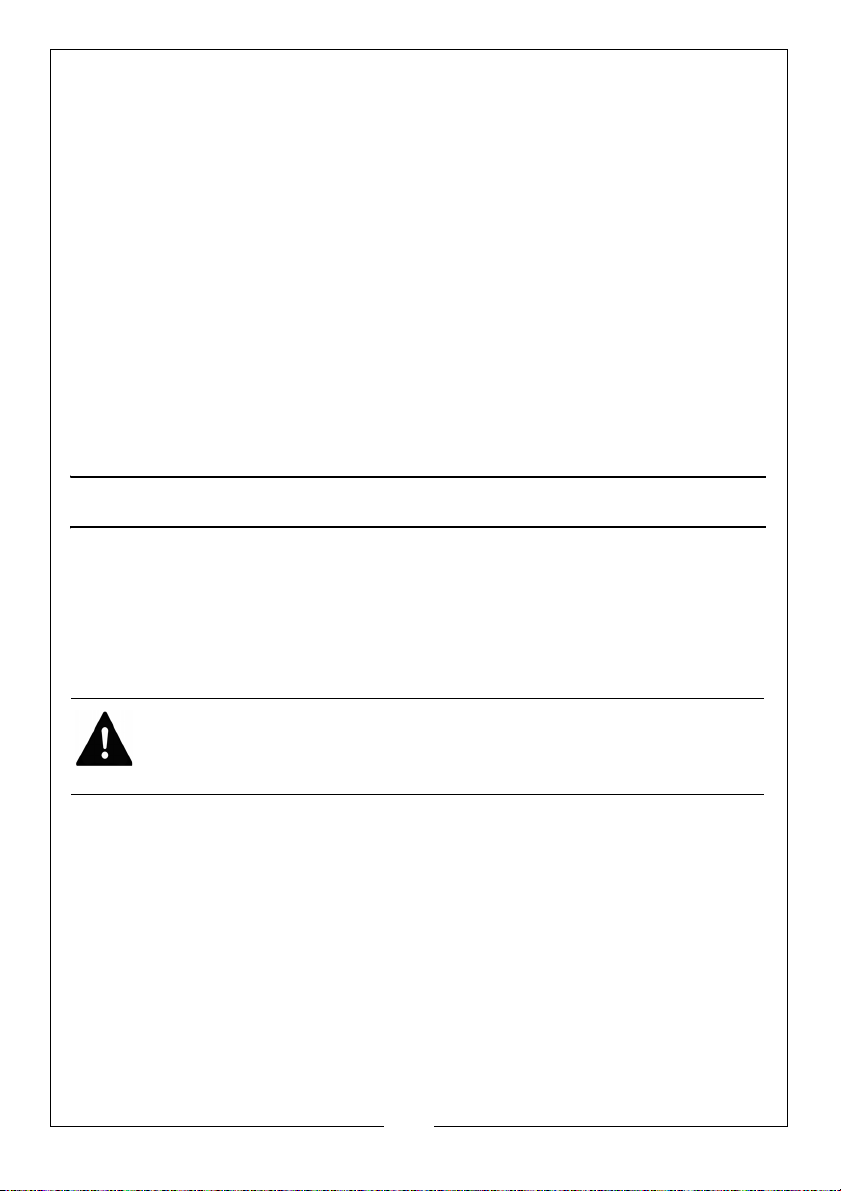
The control lever has three positions
shown and indicated by the label on
the handle.
• With the lever pulled to the
upper position, the forks will
lower.
• The middle position allows the
load to be transported.
• The lower position will cause
the forks to lift when the handle
is pumped.
Raise the forks by pushing the control lever down until it latches, then pump
the handle backwards and forwards.
• The forks should lift and should remain in the up position.
If the forks drop, without raising the lever up to the lowering position, proceed
as follows:
1. Loosen the locknut A, Fig 6 (53)
and turn the screw B (54)
anticlockwise one full turn and
tighten the locknut.
2. Repeat steps 1 & 2 again if the
forks continue to drop. Turn the
screw another full turn and keep
repeating this procedure until the
forks stay up until the trigger is
operated to lower the truck. If the
forks do not lower when operating
the trigger, turn the screw clockwise, test and repeat until it does.
6
Parts & Service: 020 8988 7400 / E-mail: [email protected] or [email protected]
Page 7
3. If the forks rise while pumping in the TRANSPORT position, release the
locking nut (A) and turn the adjusting screw (B) clockwise until the
pumping action does not raise the forks and they remain in position in the
TRANSPORT position.
4. If the forks descend while pumping in the TRANSPORT position, turn the
adjusting screw (B) anti-clockwise until the forks do not lower.
5. If the forks do not descend when the control handle is in the LOWER
position, turn the adjusting screw (B) clockwise until raising the control
handle lowers the forks. Check it’s operation in the TRANSPORT position.
6. If the forks do not elevate while pumping in the LIFT position, turn the
adjusting screw (B) anti-clockwise until the forks raise while pumping in the
LIFT position. Finally check the operation in the LOWER and TRANSPORT
positions.
7. When satisfied that the truck is lifting correctly, tighten the locknut item A,
Fig 6.
OPERATING INSTRUCTIONS
When first using the truck for the first time, familiarise yourself with the controls,
i.e. raise and lower the forks without any load, practice steering the empty
truck so as to be familiar how the truck reacts.
DAILY INSPECTION
Daily inspection is effective to find any malfunction or fault on the pallet truck.
WARNING: BEFORE OPERATING THE TRUCK, ENSURE YOU HAVE READ AND
UNDERSTOOD THE INSTRUCTIONS IN THIS MANUAL, PAYING PARTICULAR
ATTENTION TO THE SAFETY PRECAUTIONS. DO NOT USE THE PALLET TRUCK
IF ANY MALFUNCTION OR DEFECT IS FOUND.
1. Check the following points before operation.
• Visually check for structural deformation or cracks and listen for any
unusual noise or binding of the lifting mechanism.
• Check if there is any oil leakage.
• Raise/lower the forks to check for vertical creep.
•Check for any damage to the wheels and that they rotate smoothly.
• Check that all the bolts and nuts are tight.
• Verify that all labels are in place.
7
Parts & Service: 020 8988 7400 / E-mail: [email protected] or [email protected]
Page 8

PARKING
When parking the pallet truck, lower the forks to the lowest position and park
on smooth, even level ground where it is not an obstruction.
Chock the wheels if necessary to prevent the truck moving accidentally.
LIFTING
1. Check that the load does not exceed the rated capacity of the truck.
2. Roll the pallet truck with its forks slowly under the pallet/load until the back
end of the fork rests against the load.
3. Move the operating lever down to the ‘Lifting’ position. Lift the load by
moving the handle assembly up and down.
• The load must be evenly distributed across both forks.
• Make visual checks to ensure the load is secure and will not topple off
when lifted, also check the pallet is not broken etc.
• DO NOT OVERLOAD THE PALLET TRUCK!
4. Once the load has lifted sufficiently, put the trigger into the central position
(neutral) before moving the truck.
MOVING
Move the truck by pushing or pulling the handle assembly.
• Do not operate the truck on a slope.
• Watch for differences in the floor level when moving the pallet truck.
• Make sure that the load is stable.
• If the pallet truck is moving, do not turn the handle at a right angle to
stop the pallet truck.
LOWERING
Before lowering the load, ensure it is clear to do so, making sure that nobody’s
feet, including your own are underneath the pallet etc
Lower the load by moving the operating lever up to the lowering position
carefully.
• By releasing the lever, the lowering movement will stop.
Ensure there is adequate clearance behind you, then withdraw the pallet
truck from the load.
• The forks will drop much faster when a loaded and the heavier the load
the faster still the rate of descent.
8
Parts & Service: 020 8988 7400 / E-mail: [email protected] or [email protected]
Page 9
MALFUNCTIONS
If there are any malfunctions, stop using the pallet truck until it is repaired.
PURGING AIR FROM THE HYDRAULIC SYSTEM
If the pallet truck has been
transported over any distance or has
been overturned at any time, air may
have entered the hydraulic system.
This will make it impossible to raise the
forks under load.
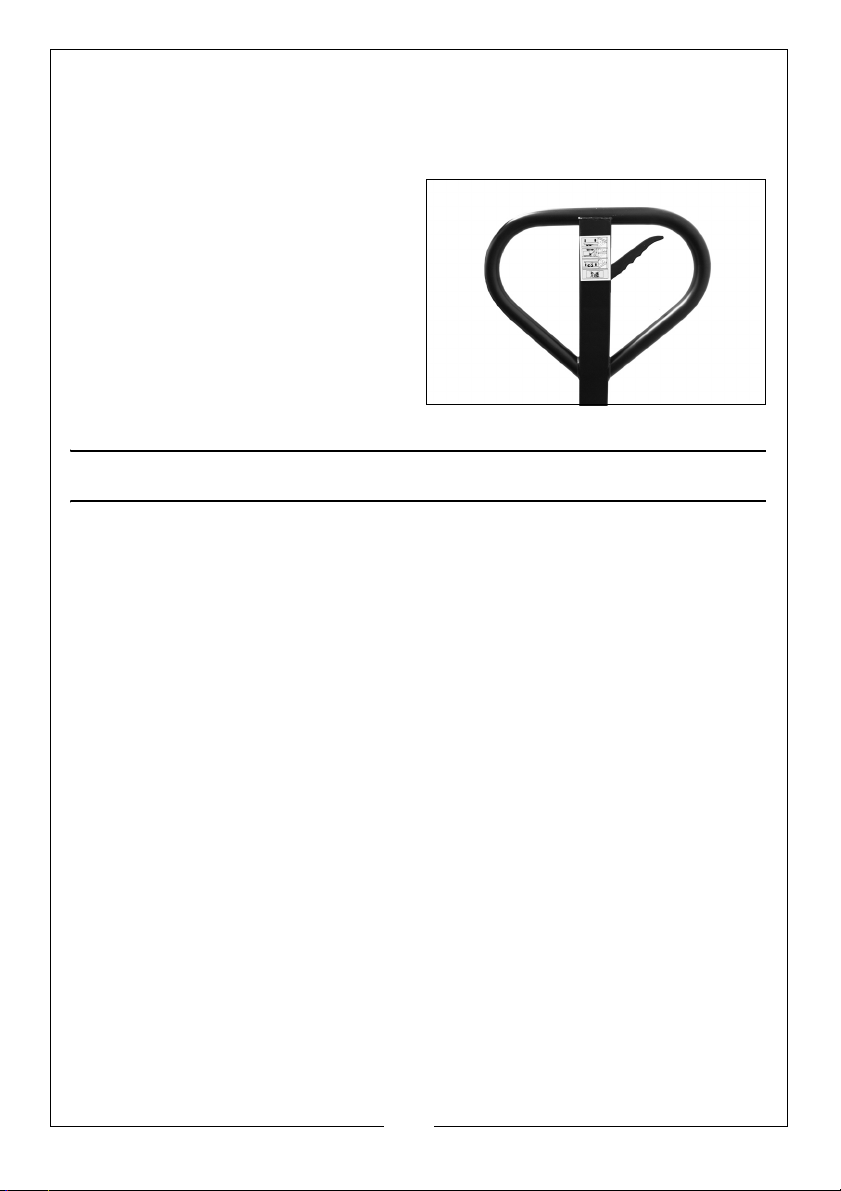
1. Hold the control handle in the
‘lower’ position.
2. Move the handle up and down
several times.
MAINTENANCE
Whilst the pallet truck requires very little maintenance, the following care will
be beneficial.
DAILY/BEFORE USE
Inspect the pallet truck for signs of damage, distortion of components,
damage to castors etc.
OCCASIONALLY
1. Check the action of the hydraulic ram and inspect for leaks. If leaks are
apparent, DO NOT USE THE TRUCK, but send for repair to your Clarke
dealer). Always make every effort to contain any escape of oil and
prevent ingress into the local water course.
• Be aware that oil leaks can produce hazardous environmental
conditions. All leaks must be cleaned immediately and sand/sawdust or
similar absorbent material should cover the contaminated area (which
should be isolated), until it is completely cleaned and dried.
2. The hydraulic system may be topped up with any commonly available
hydraulic oil such as Clarke hydraulic oil (part number 3050830).
3. Remove any corrosion and repaint for protection.
4. Check the piston rod periodically for signs of corrosion. Clean any exposed
areas with a clean oiled cloth.
5. Ensure that labels and warning notices are in place and legible.
9
Parts & Service: 020 8988 7400 / E-mail: [email protected] or [email protected]
Page 10
6. Inspect for security of all nuts and bolts.
7. Keep all moving parts lightly lubricated to prevent corrosion.
CHECKING THE OIL
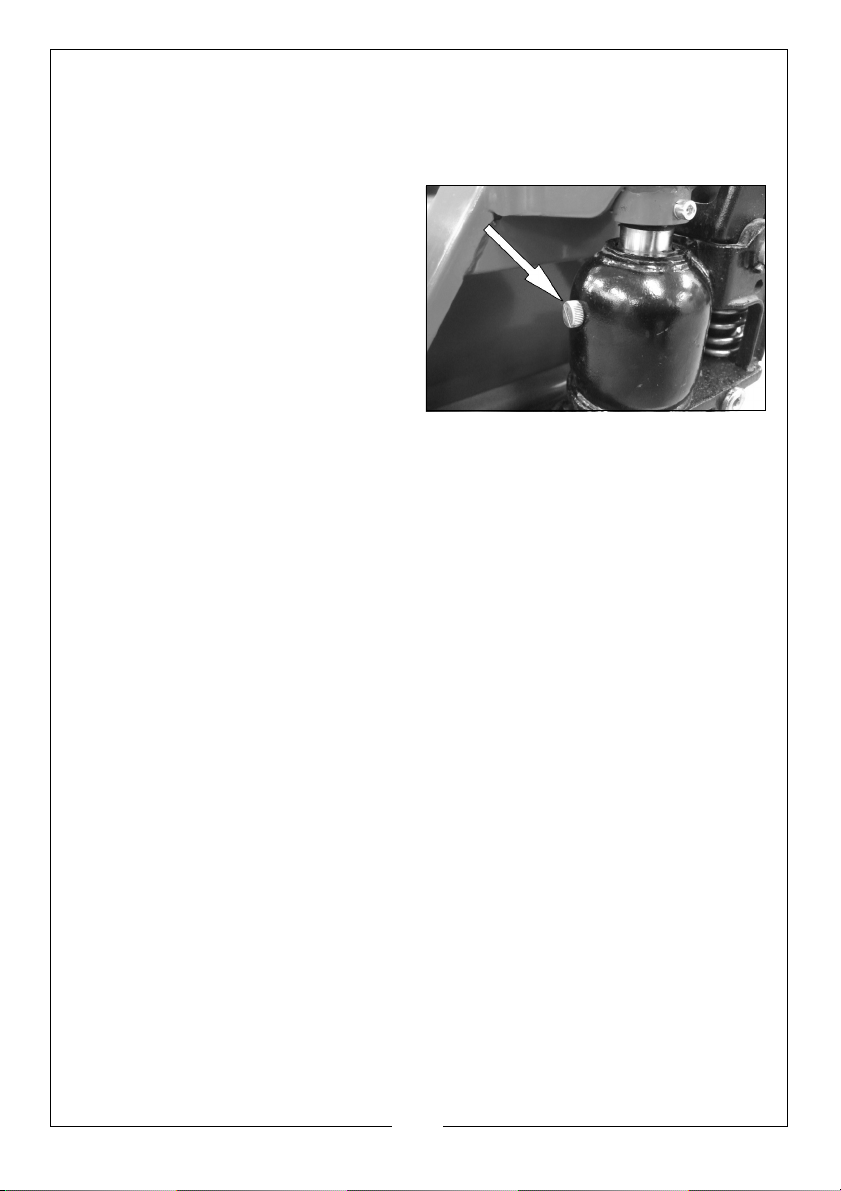
1. Check the oil level every six
months if in regular use, by
topping up if necessary at the filler
plug.
• The capacity is approximately
0.3 litre.
• The recommended type is L-
HV46 Hydraulic oil, provided
the truck is not to be used
outside the temperature range
of -20°C to +40°C.
• In the case of a persistent oil leak which requires the dismantling of the
hydraulic parts to correct, the lift table should be taken to your Clarke
dealer for overhaul.
STORAGE
• Store in a dry place with the ram fully lowered to minimise ram (piston)
corrosion. If stored for long periods, inspect at least once a year, clean
and re-oil. For servicing, contact your CLARKE dealer, or CLARKE
International Service Department.
DECOMMISSIONING THE PRODUCT
Should the product become completely un serviceable and require disposal,
draw off the oil into a suitable container and dispose of the product and the
oil at an approved recycling centre, according to local regulations.
Take care to ensure that any spilt hydraulic oil is cleaned away using sand, or
treated with absorbent granules designed for the purpose.
Always make every effort to contain any spillage and prevent ingress into the
local water course.
• This product contains valuable raw materials. At the end of the products
life all materials should be taken to a recycling centre for disposal and
re-use.
10
Parts & Service: 020 8988 7400 / E-mail: [email protected] or [email protected]
Page 11
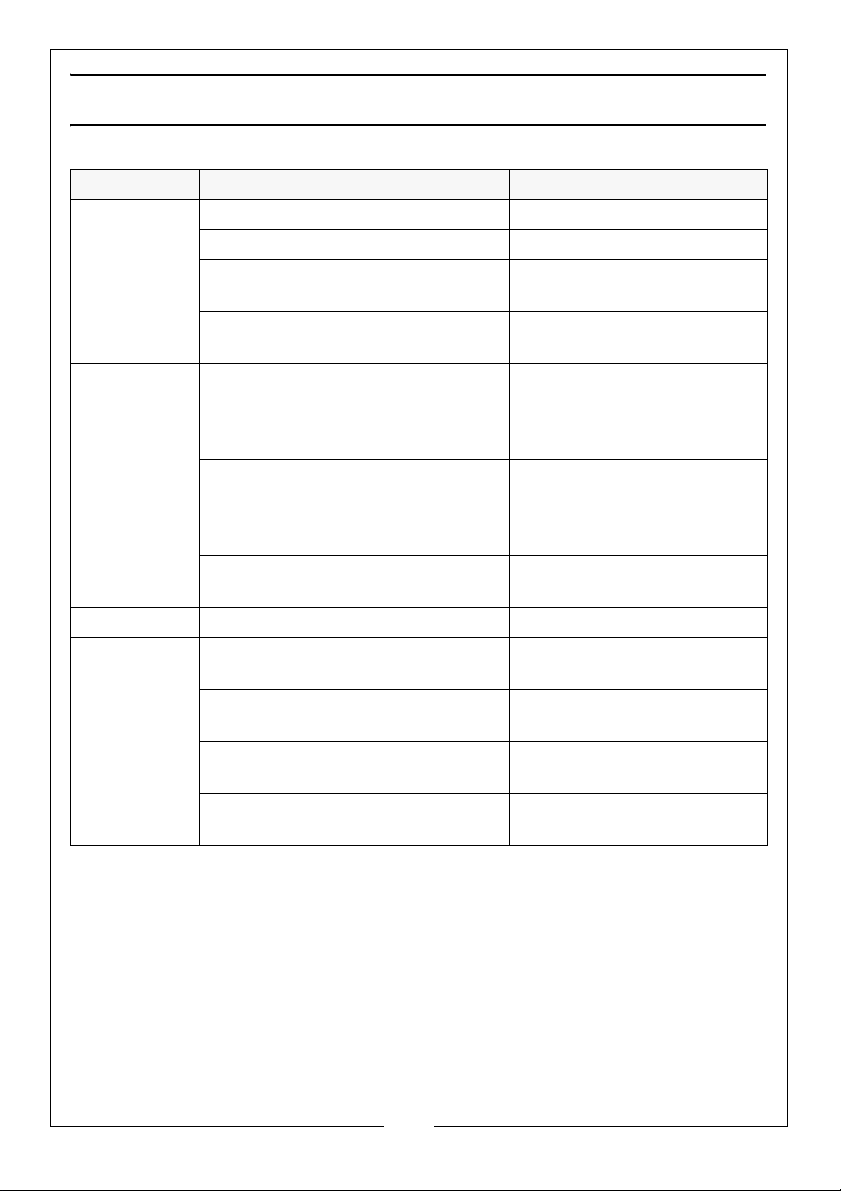
TROUBLESHOOTING
PROBLEM CAUSE ACTION
The forks
cannot be
raised to
the max
height
The forks
cannot be
lowered
Oil leaks Oil seals worn or damaged. Replace with the new one.
The forks
lower
on their
own.
Hydraulic oil is low Top up with oil.
The oil has impurities Change the oil.
The adjusting screw is not in the
correct position.
Air in the hydraulic system. Bleed the hydraulic
The piston rod or pump body is
deformed resulting from partial
loading slanting to one side or
over loading.
The fork was kept in the high
position for long time with piston
rod exposed which caused
rusting and jamming of the rod.
The adjusting screw is not in the
correct position.
Impurities in the oil cause the
release valve to remain open.
Leaks from the hydraulic system. Inspect and replace the
Air in the hydraulic system. Purge the hydraulic
The adjusting screw is not in the
correct position.
See page 6.
system.
Replace the piston rod or
the pump body.
Keep the fork in the lowest
position when not in use,
and lubricate the piston
rod.
See page 6.
Replace with the new oil.
broken parts.
system. see page 8.
See page 6.
Do not attempt to repair the pallet truck unless you are trained or authorized to
do so.
11
Parts & Service: 020 8988 7400 / E-mail: [email protected] or [email protected]
Page 12
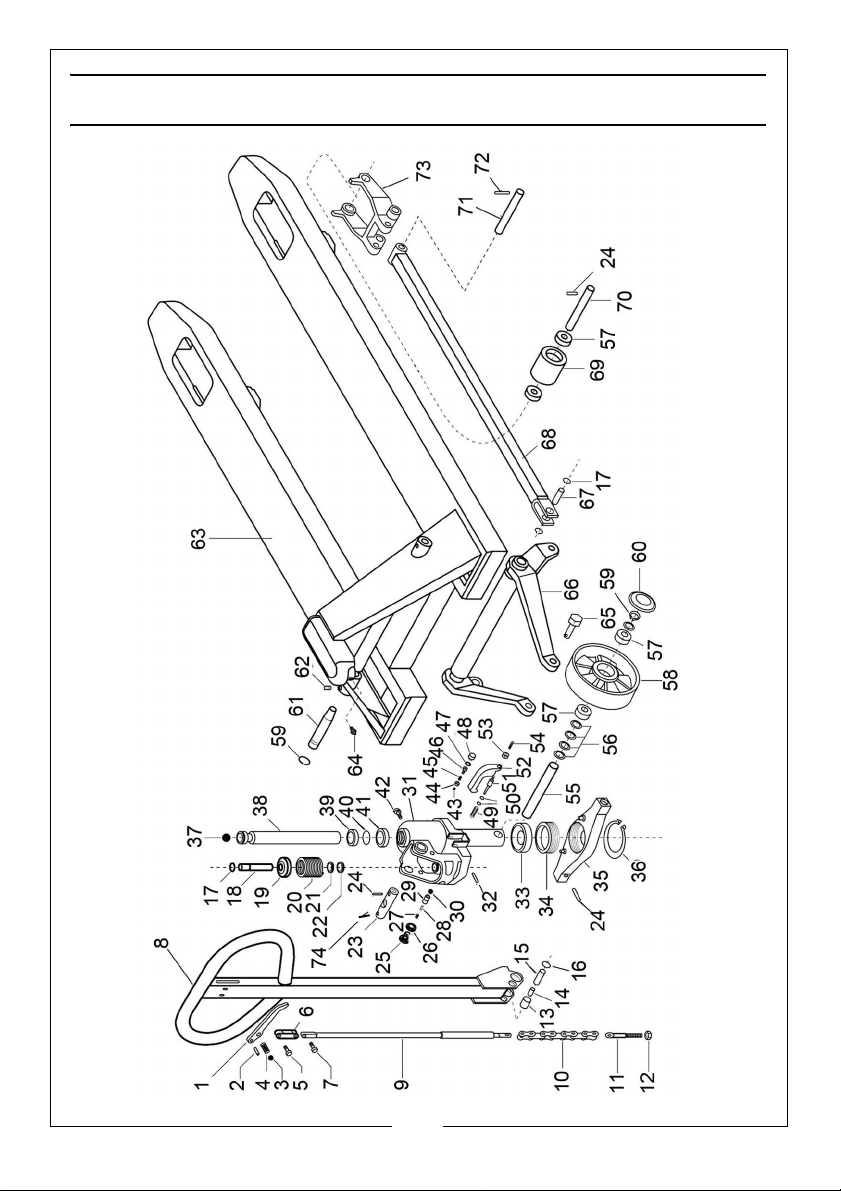
Page 13
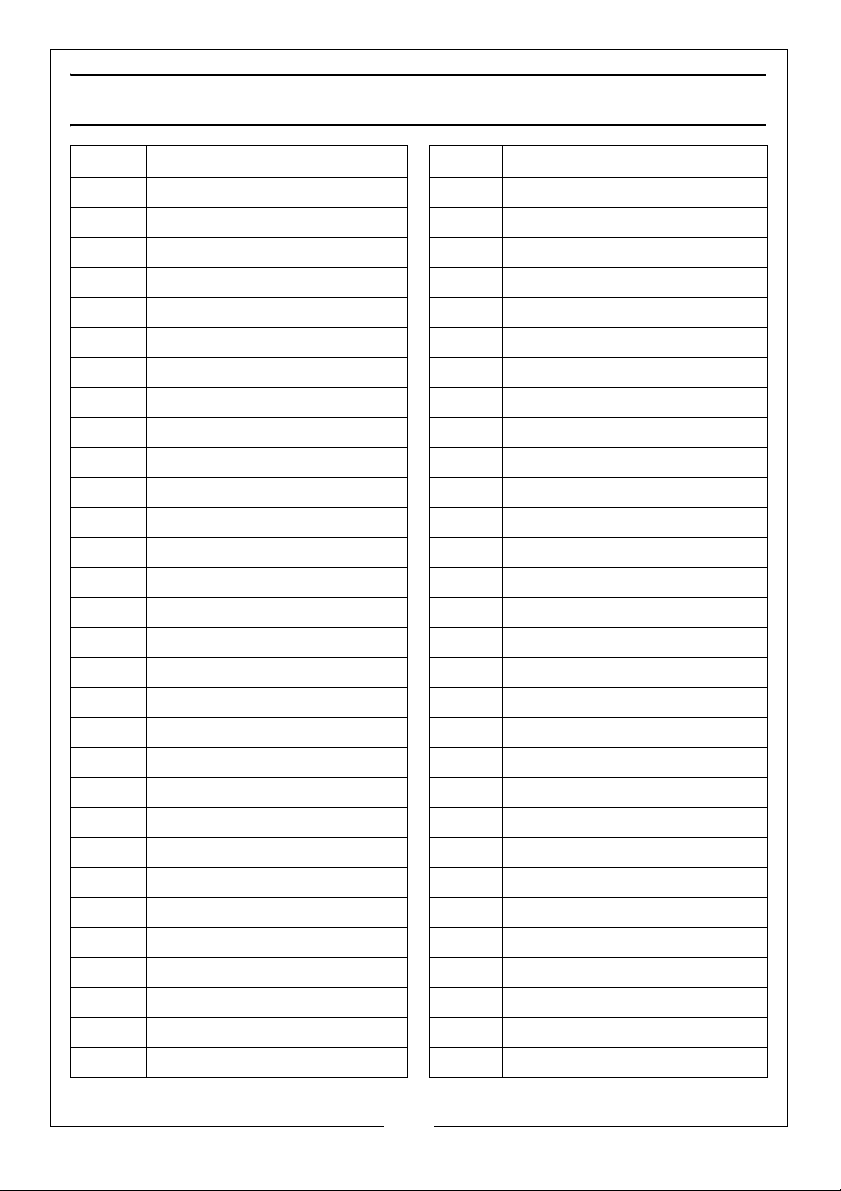
PARTS LIST
No Description No Description
1 Lever 31 Pump Body
2 Roll Pin 32 Roll Pin
3 Steel ball 33 Bowl Washer
4 Spring 34 Lower Bearing
5 Rivet 35 Supporting Base
6 Link 36 Circlip
7 Rivet 37 Steel Ball
8 Handle 38 Piston
9 Pull Shaft 39 Dust Ring
10 Chain 40 O-Ring
11 Adjusting Screw 41 Y-Ring
12 Lock Nut 42 Oil Plug
13 Pressure Roller 43 Steel Ball
14 Bush 44 Base
15 Pin 45 Spring
16 Circlip 46 Regulator Screw
17 Circlip 47 Copper Washer
18 Plunger 48 Plug
19 Spring Cover 49 Spring
20 Spring 50 O-Ring
21 Dust Ring 51 Striker Pin
22 Y-Ring 52 Lever Plate
23 Spindle 53 Lock Nut
24 Roll Pin 54 Regulator Screw
25 Plug 55 Large Wheel Axle
26 Copper Washer 56 Washer
27 Spring 57 Bearing
28 Damping Valve Spindle 58 Nylon Wheel
29 Damping Valve Seat 59 Circlip
30 Steel ball 60 Dust Cover
13
Parts & Service: 020 8988 7400 / E-mail: [email protected] or [email protected]
Page 14
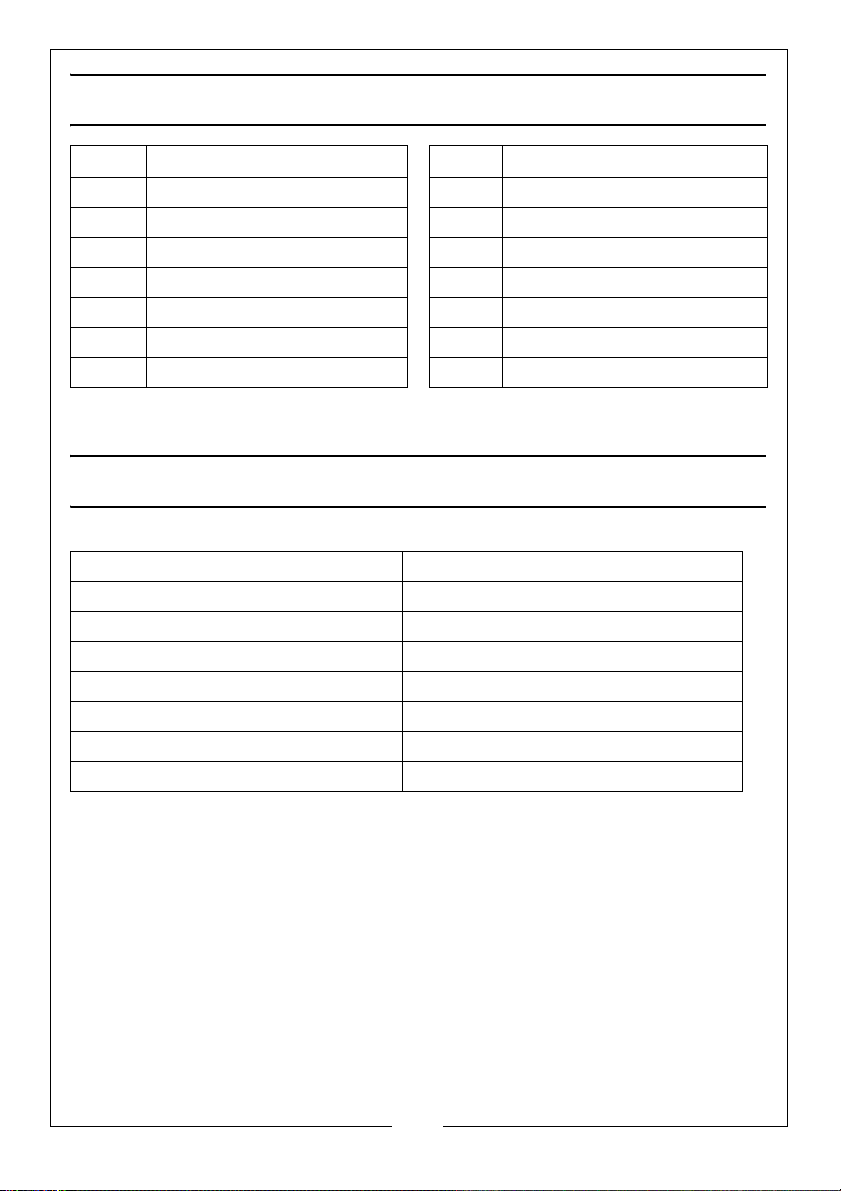
PARTS LIST
No Description No Description
61 Shaft 68 Connecting Bar
62 Bolt 69 Fork Wheel
63 Fork Frame 70 Axle
64 Bolt 71 Pivot Pin
65 Bolt 72 Roll Pin
66 Rocker Arm 73 Trunnion
67 Hinge Pin 74 Split Pin
Please quote ZJPTE550 + Part Number above when ordering parts.
SPECIFICATION
PTE550
Fork Length 1100 mm
Fork Height (lowered) 75mm
Fork Height (raised) 190mm
Gap between forks 250 mm
Overall width to outside forks 550mm
Maximum Safe Working Load 2000 kg
Weight 56 kg
Please note that the details and specifications contained herein, are correct
at the time of going to print. However, CLARKE International reserve the right
to change specifications at any time without prior notice.
14
Parts & Service: 020 8988 7400 / E-mail: [email protected] or [email protected]
Page 15
DECLARATION OF CONFORMITY
15
Parts & Service: 020 8988 7400 / E-mail: [email protected] or [email protected]
Page 16
 Loading...