

Page 1
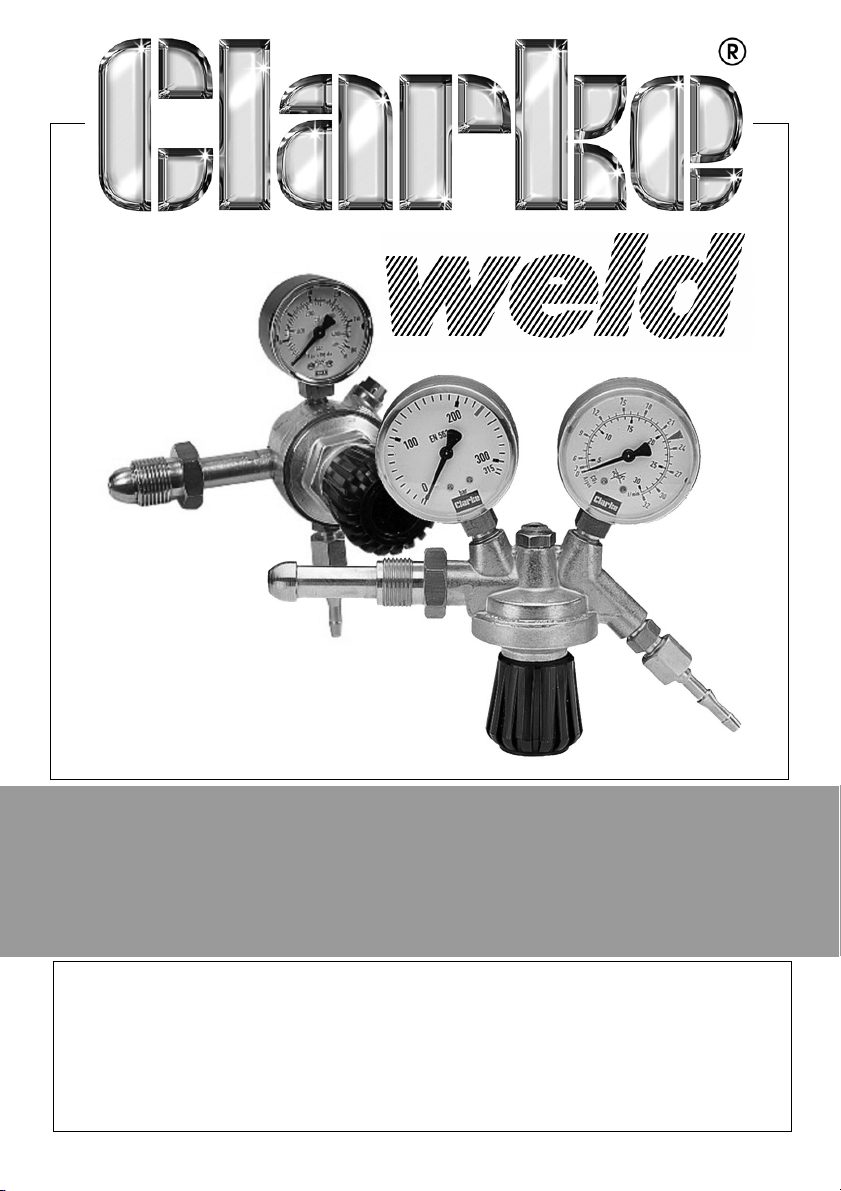
PRESSURE REGULATOR
MODEL NO: IR1A, IR2A, IR1C & IR2C
PART NO: 8134060, 8134070, 8134090 & 8134100
OPERATING & MAINTENANCE
INSTRUCTIONS
ORIGINAL INSTRUCTIONS GC0821 REV 1
Page 2
INTRODUCTION
Thank you for purchasing this CLARKE Industrial Pressure Regulator.
Before attempting to use this product, please read this manual thoroughly and
follow the instructions carefully. In doing so you will ensure the safety of yourself
and that of others around you, and you can look forward to your purchase
giving you long and satisfactory service.
Your regulator has been designed to give long and trouble free service. If,
however, having followed the instructions in this booklet carefully, you
encounter problems, take the unit to your local CLARKE dealer.
SPECIFICATIONS
Colour Black
ID-Code N
K-Class 1
Inlet Pressure (P1) bar 300
Outlet Pressure(P2) bar 4
3
Delivery flow (Q1) m
/h
2
GUARANTEE
This product is guaranteed against faulty manufacture for a period of 12
months from the date of purchase. Please keep your receipt which will be
required as proof of purchase.
This guarantee is invalid if the product is found to have been abused or
tampered with in any way, or not used for the purpose for which it was
intended.
Faulty goods should be returned to their place of purchase, no product can
be returned to us without prior permission.
This guarantee does not effect your statutory rights.
2
Parts & Service: 020 8988 7400 / E-mail: [email protected] or [email protected]
Page 3
SAFETY PRECAUTIONS
CAUTION: FAILURE TO FOLLOW THESE PRECAUTIONS COULD RESULT IN
PERSONAL INJURY, AND/OR DAMAGE TO PROPERTY.
• Incorrect use of the pressure reducer can cause serious damage.
• Users must be trained technicians or else, under full supervision.
• ALWAYS check to ensure the reducer is the correct model for the
type of gas being used.
• The pressure reducer must be treated as a precision instrument.
• Protect it from accidental knocks, dust, oil and other sources of dirt.
• DO NOT use the pressure reducer if it is not in perfect working order.
• When you draw gas, the cylinder must be placed upright and
protected from falling.
• Ensure the inlet connection gasket (2) is always in place and in good
condition (CO2 ONLY).
FUNCTION
The function of the pressure regulator is to reduce and stabilise the pressure of
a gas; the reducer changes the pressure at which the gas is kept in the
cylinder into the pressure needed for use.
The pressure reducer has been designed to be used exclusively with the type
of gas, and at the pressure, which is shown by the markings (see ‘Markings’ page 6) and the metal I.D. tag.
IMPORTANT: To use the pressure reducer with types of gasses and pressures
other than Argon/CO2 could be dangerous.
3
Parts & Service: 020 8988 7400 / E-mail: [email protected] or [email protected]
Page 4
ASSEMBLY
Refer to parts diagram - page 7.
CONNECTION OF THE PRESSURE REDUCER
1. Check to ensure the pressure reducer is correct both for the type of gas
and the pressure in the cylinder to be used.
2. Turn the pressure adjuster (6) fully anticlockwise, to ensure the pressure
reducer valve is closed.
3. Before screwing on the pressure reducer, briefly open the cylinder valve (1)
then close it, in order to remove any impurity, dust etc. from the outlet.
4. Replace the gasket (2) if damaged or lost (CO2 ONLY).
NOTE: During this operation DO NOT place your hands over the cylinder
outlet.
5. Screw the inlet connection (3) tightly to the cylinder valve, using a suitable
spanner.
HOSE CONNECTION
1. Attach the hose to the hose connection of the outlet connection (8) and
tighten with suitable clamps (not provided).
INSTRUCTIONS FOR USE
OPENING THE PRESSURE VALVE
1. Check to ensure the reducer is completely closed (turn the pressure
adjusting knob (6) fully anticlockwise).
2. Slowly open the cylinder valve (1). The high pressure gauge (4) will indicate
the cylinder pressure.
WARNING: OPENING THE CYLINDER VALVE TOO QUICKLY MAY CAUSE THE GAUGE
TO MALFUNCTION.
3. Turn the pressure adjusting knob (6) very slowly clockwise. The low pressure
gauge (5), if fitted, will indicate the outlet pressure.
4
Parts & Service: 020 8988 7400 / E-mail: [email protected] or [email protected]
Page 5
HOW TO REGULATE THE PRESSURE
1. To increase pressure; slowly turn the reducer pressure adjuster (6) clockwise
until the reading on the gauge (if fitted) is at the pressure recommended
by the tools’ manufacturer.
2. To decrease pressure; slowly turn the reducer pressure adjuster (6)
anticlockwise.
NOTES
• As the pressure drops, compensate by screwing the adjuster knob
(6) clockwise.
• Outlet pressure must not be regulated higher than the pressure you
need to use.
• Outlet pressure must not be regulated higher than the red mark on
the low pressure gauge (when fitted).
SHUTTING DOWN
1. Close the cylinder valve (1)
2. Release the gas, by operating the tool, until the reducer gauge indicates
“zero”, or no more gas can be heard exhausting.
3. Turn the pressure adjuster (6) anticlockwise until it is completely closed.
THE RELIEF VALVE
For safety reasons, the pressure reducer is equipped with a safety pressure
valve.
In case of malfunctioning, this valve allows gas, at excessive pressure, to
escape.
WARNING: DO NOT ATTEMPT TO RE-CALIBRATE THE RELIEF VALVE.
STORAGE
The pressure reducer must be treated as a precision instrument. When it is not
to be used for long periods, store it in its wrapping or in its box, to prevent
contact with dust, oil and other sources of dirt.
5
Parts & Service: 020 8988 7400 / E-mail: [email protected] or [email protected]
Page 6
MAINTENANCE
Do not carry out maintenance or repairs other than the following.
• Use only original CLARKE spare parts and accessories. (see your
dealer).
• DO NOT dismantle the gauge assembly. Return to your CLARKE
dealer for servicing.
• DO NOT clean the gauge glass with solvents - petrol etc.
MALFUNCTIONS
DO NOT use the pressure reducer if the following conditions prevail:
• The pressure reducer or any of its parts (gauge, inlet connection,
outlet connection) are damaged or dirty, oily etc.
• There are any leaky connections.
• The relief valve adjustment has been modified or the valve leaks.
If the gauge malfunctions during use, (e.g. leaks in the gauges or in the relief
valves) discontinue use immediately and close the cylinder valve.
Return the regulator to your dealer to be checked and repaired.
CHECKING FOR LEAKS
This check must be carried out only in the open air: use either soapy water or a
gas leak detector. DO NOT use a naked flame.
• Spray detector or apply soapy water to the area to be checked.
• The forming of bubbles or foam is a sign of a leak.
PRODUCT MARKINGS
1. Lot (number/year)
2. Type of gas (code)
3. Pressure regulator class
4. Maximum inlet pressure
6
Parts & Service: 020 8988 7400 / E-mail: [email protected] or [email protected]
Page 7
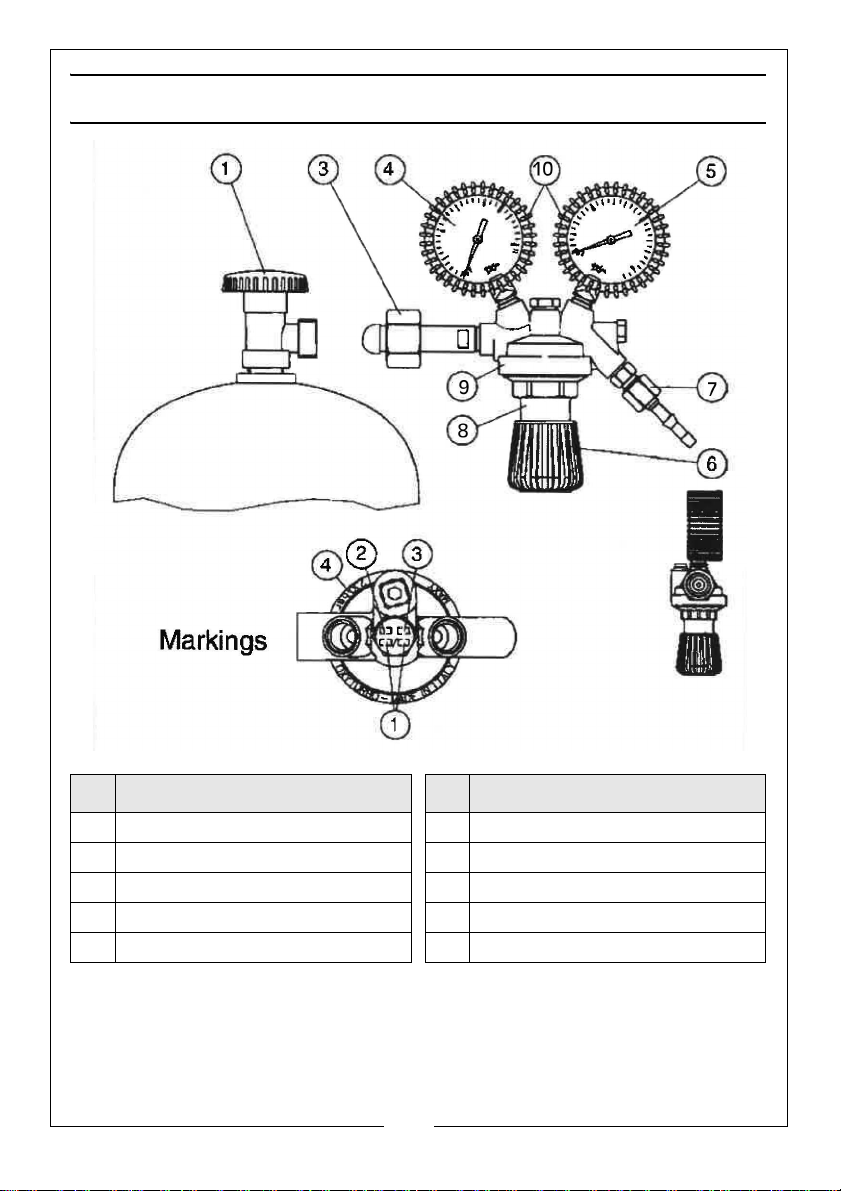
PARTS LIST & DIAGRAM
No Description No Description
1 Cylinder Valve 6 Pressure adjusting knob
2 Inlet connection gasket 7 Outlet connection
3 Inlet connection 8 Cover
4High pressure gauge 9Body
5 Low pressure gauge 10 Gauge cover
ACCESSORIES
A wide range of welding accessories is available.
Contact your CLARKE dealer for further information or CLARKE International
Service Department.
7
Parts & Service: 020 8988 7400 / E-mail: [email protected] or [email protected]
Page 8
 Loading...