

Page 1
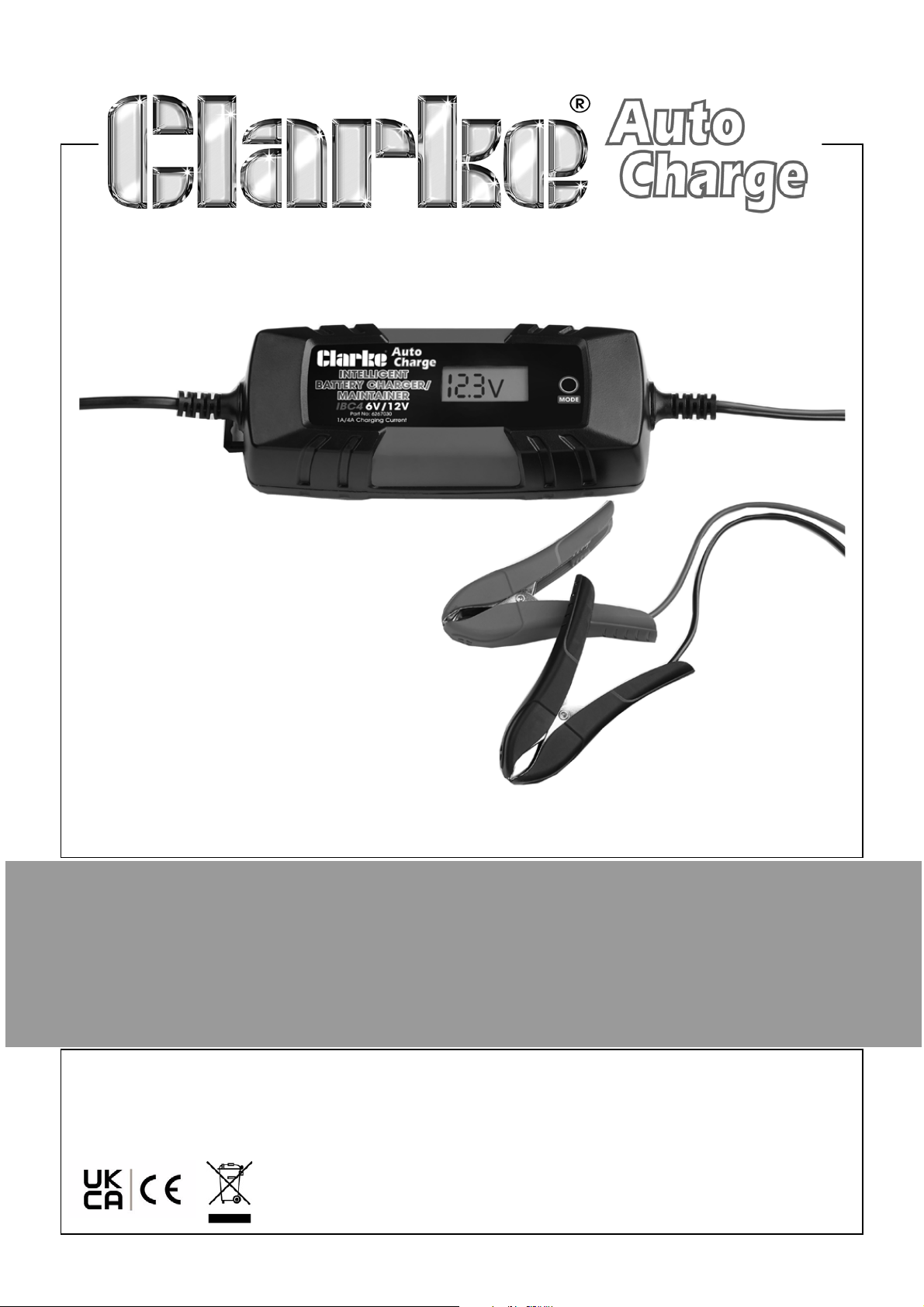
6V/12V INTELLIGENT BATTERY CHARGER
MODEL NO: IBC4
PART NO: 6267030
OPERATION & MAINTENANCE
INSTRUCTIONS
ORIGINAL INSTRUCTIONS DL0721
Page 2

INTRODUCTION
Thank you for purchasing this CLARKE Battery Charger.
Please read this manual thoroughly, before attempting to operate this
product and carefully follow all instructions given.
It is vitally important that ALL precautions are taken, as specified, which will not
only provide protection for yourself and that of others around you, but will also
ensure that the battery charger will give you long and satisfactory service.
GUARANTEE
This CLARKE product is guaranteed against faulty manufacture for a period of
12 months from the date of purchase. Please keep your receipt as proof of
purchase.
This guarantee is invalid if the product is found to have been abused or
tampered with in any way, or not used for the purpose for which it was
intended.
Faulty goods should be returned to their place of purchase, no product can
be returned to us without prior permission.
This guarantee does not effect your statutory rights.
ENVIRONMENTAL RECYCLING POLICY
Through purchase of this product, the customer is taking on the
obligation to deal with the WEEE in accordance with the WEEE
regulations in relation to the treatment, recycling & recovery and
environmentally sound disposal of the WEEE.
In effect, this means that this product must not be disposed of with
general household waste. It must be disposed of according to the laws
governing Waste Electrical and Electronic Equipment (WEEE) at a recognised
disposal facility.
2
Parts & Service: 020 8988 7400 / E-mail: [email protected] or [email protected]
Page 3
SPECIFICATIONS
Model Number IBC4
Input Voltage / Current 230 V, 50Hz
Battery Charging Voltages: 6V & 12V
Power Variable Power, 60W Max
Charging Current 6V: 1A, 12V: 1A/4A
Charging Steps 8 steps, (smart charger)
Charging Battery Size 6V: From 1.2 up to 40Ah
12V: From 1.2 up to 120Ah
IP Rating IP54
Operating Temperature Range 0 to 40°C
Dimensions (L x W x H) 190mm x 80mm x 50mm
Power Cable Length 1.8m
Charging Clamp Cable Length 1.32m
Weight 600g
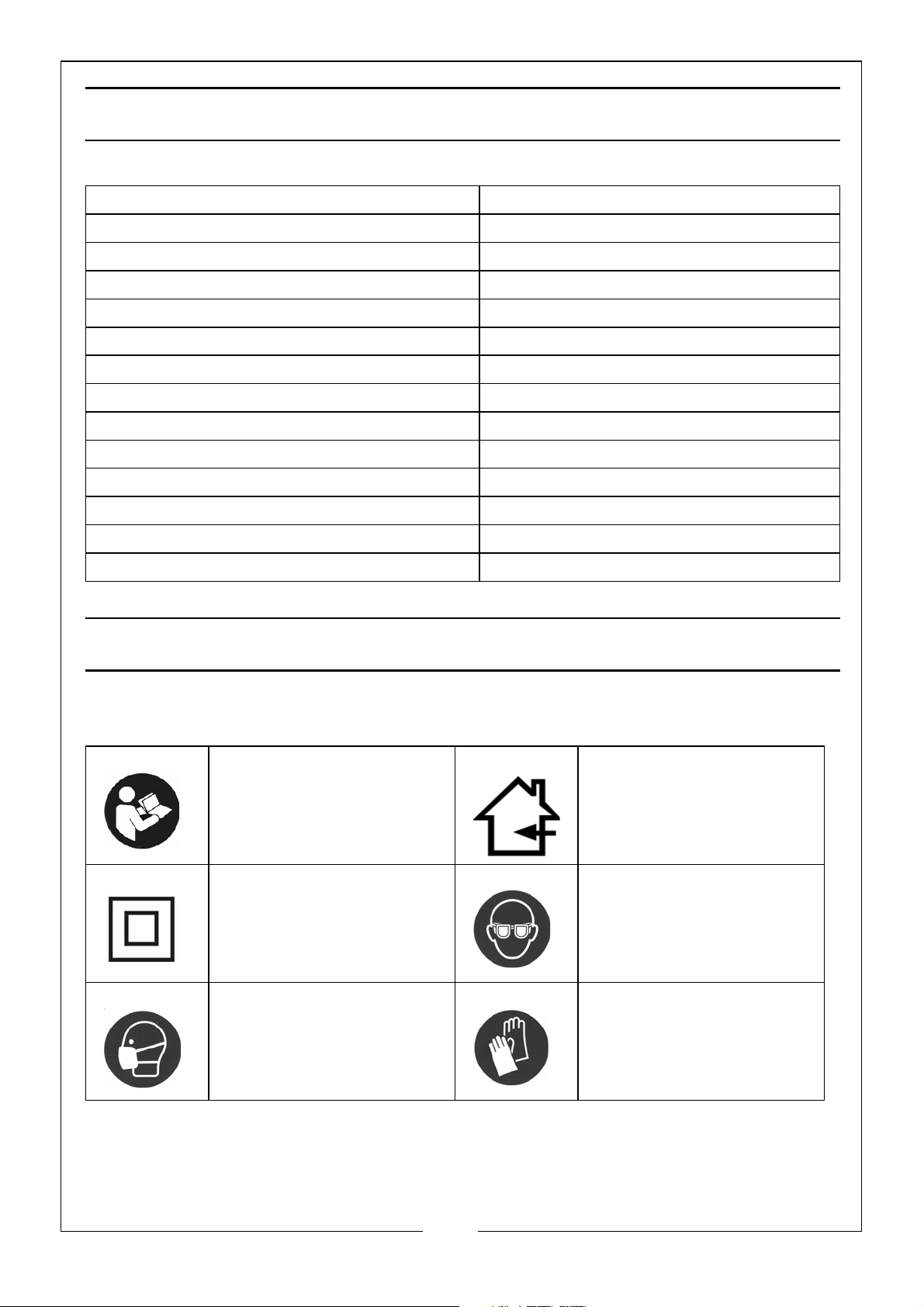
SAFETY SYMBOLS
Before Use, Read The
Instructions Fully
Class II Appliance Wear Eye Protection
Wear a Protective Mask Wear Protective Gloves
For Indoor Use Only
3
Parts & Service: 020 8988 7400 / E-mail: [email protected] or [email protected]
Page 4

SAFETY PRECAUTIONS
WARNING: ALWAYS SWITCH OFF THE CHARGER WHEN CONNECTING OR
DISCONNECTING LEADS TO AVOID SPARKING AS HIGHLY INFLAMMABLE
HYDROGEN GAS CAN BE RELEASED IN THE PROCESS OF BATTERY
CHARGING
PLEASE READ BEFORE USING THIS UNIT
1. Batteries can generate explosive gases during normal operation. ALWAYS
use in well ventilated area.
2. DO NOT smoke, strike a match or cause a spark in the vicinity of the battery
or engine. Avoid explosive gas, flames and sparks.
3. Remove all personal jewellery, such as rings, bracelets, necklaces and
watches while working with a vehicle battery. These items may produce a
short circuit and could cause severe burns.
4. Be extra cautious to reduce the risk of dropping a metal tool onto the
battery. It may spark or short circuit the battery or other electrical
hardware which may cause an explosion or fire.
5. Wear complete eye protection, hand and clothing protection. AV O I D
touching eyes while working near a battery.
6. Study all battery manufacturers specific precautions, such as removing or
not removing cell caps while charging and recommended rates of
charge.
7. Clean battery terminals before connection with the charger. Be careful to
keep corrosion from coming in to contact with eyes.
8. When it is necessary to remove the battery from the vehicle to charge,
always remove grounded terminal from the battery first. Make sure all
accessories in the vehicle are switched off in order to prevent an arc.
9. This charger is NOT intended to supply power to an extra low voltage
electrical system or to charge dry cell batteries. Charging dry cell batteries
may cause the battery to burst and cause injury to person or property.
10. NEVER charge a frozen, damaged, leaking or non rechargeable battery.
11. If battery electrolyte contacts skin or clothing, wash immediately with soap
and water. If electrolyte enters your eye, immediately flood eye with
running clean cold water for at least 15 minutes and seek medical
attention immediately.
12. DO NOT place the charger in the engine compartment, near moving parts
or near the battery. Place as far away from them as the cable permits.
4
Parts & Service: 020 8988 7400 / E-mail: [email protected] or [email protected]
Page 5

NEVER place the charger directly above the battery being charged, gases
or fluids from the battery will corrode and/or damage the charger.
13. DO NOT cover the charger while charging.
14. DO NOT expose to rain or wet conditions.
15. Connect and disconnect the DC output connections only after
disconnecting the charger from the mains power supply.
16. Use of an attachment not recommended or sold by the manufacturer may
result in a risk of fire, electric shock or injury to persons.
17. DO NOT overcharge batteries by selecting the wrong charge mode.
18. To reduce the risk of damage to the electric plug and cord, pull by the
plug rather than the cord when disconnecting charger from mains power
supply.
19. To reduce risk of electric shock, unplug charger from mains power supply
before attempting any maintenance or cleaning.
20. Operate with caution if the charger has received a direct hit of force or
been dropped. Have it checked and repaired if damaged.
21. NEVER attempt any repairs yourself. If you have a problem with your
charger contact your local CLARKE dealer or contact
[email protected]
22. When charging is complete, ensure that the vehicle battery leads are
secured to the proper terminals which should be clean, and lightly
smeared with petroleum jelly to prevent corrosion. Finally, re-check the
electrolyte level.
5
Parts & Service: 020 8988 7400 / E-mail: [email protected] or [email protected]
Page 6
ELECTRICAL CONNECTIONS
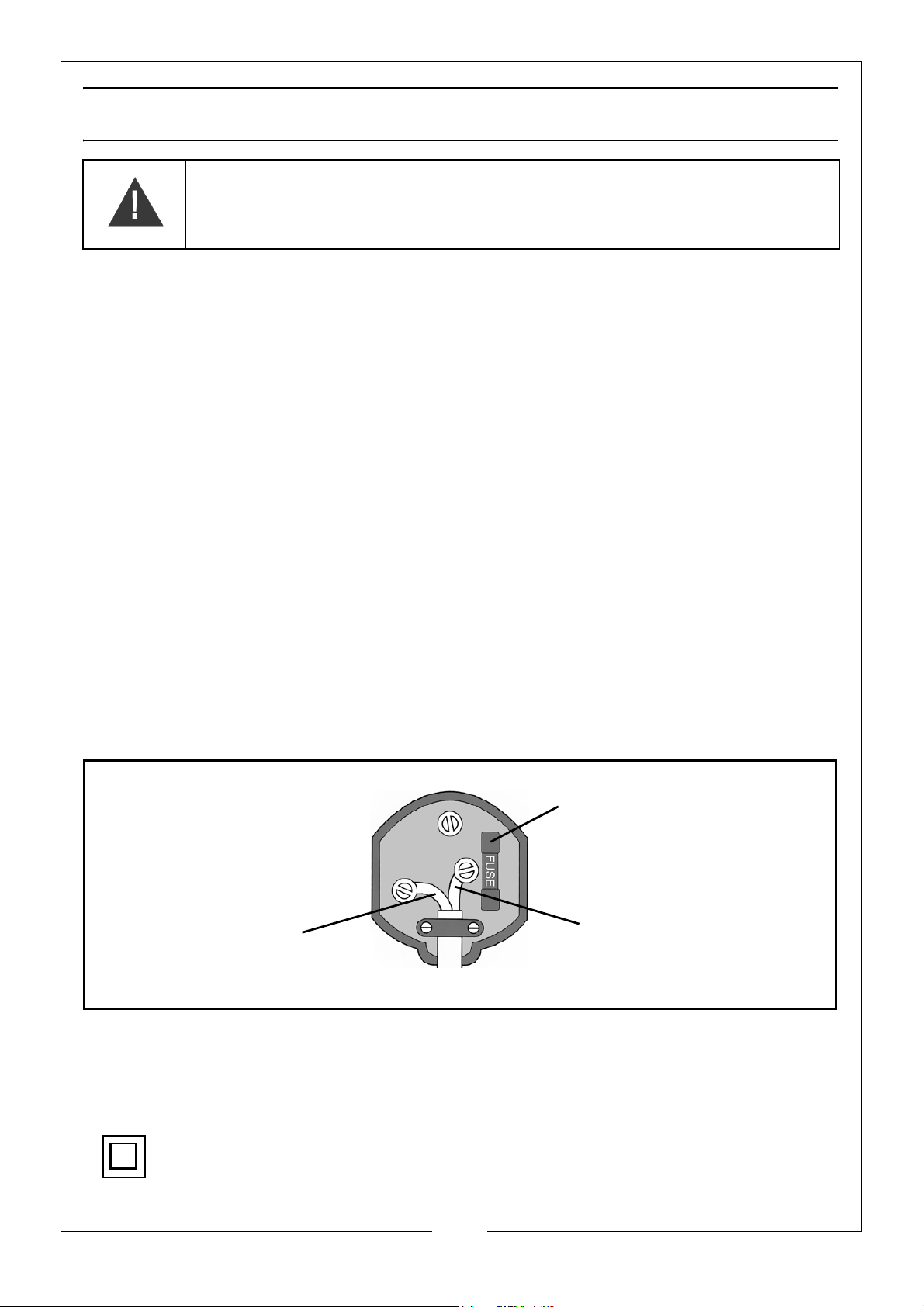
Plug must be BS1363/A approved.
Always fit a 5 Amp fuse.
Ensure that the outer sheath of the cable is firmly held by the clamp
Neutral
(Blue)
Live
(Brown)
WARNING! READ THESE ELECTRICAL SAFETY INSTRUCTIONS
THOROUGHLY BEFORE CONNECTING THE PRODUCT TO THE
MAINS SUPPLY.
Before switching the product on, make sure that the voltage of your electricity
supply is the same as that indicated on the rating plate. This product is
designed to operate on 230VAC 50Hz. Connecting it to any other power
source may cause damage.
This product may be fitted with a non-rewireable plug. If it is necessary to
change the fuse in the plug, the fuse cover must be refitted. If the fuse cover
becomes lost or damaged, the plug must not be used until a suitable
replacement is obtained.
If the plug has to be changed because it is not suitable for your socket, or due
to damage, it should be cut off and a replacement fitted, following the wiring
instructions shown below. The old plug must be disposed of safely, as insertion
into a mains socket could cause an electrical hazard.
If the colours of the wires in the power cable of this product do not correspond
with the markings on the terminals of your plug, proceed as follows.
•The Blue wire must be connected to the terminal marked N or coloured
Black.
•The Brown wire must be connected to the terminal marked L or
coloured Red.
We strongly recommend that this machine is connected to the mains supply
via a Residual Current Device (RCD)
If in any doubt, consult a qualified electrician. DO NOT attempt any repairs
yourself.
This symbol indicates that this is a Class II product, and does not require
an earth connection.
Parts & Service: 020 8988 7400 / E-mail: [email protected] or [email protected]
6
Page 7
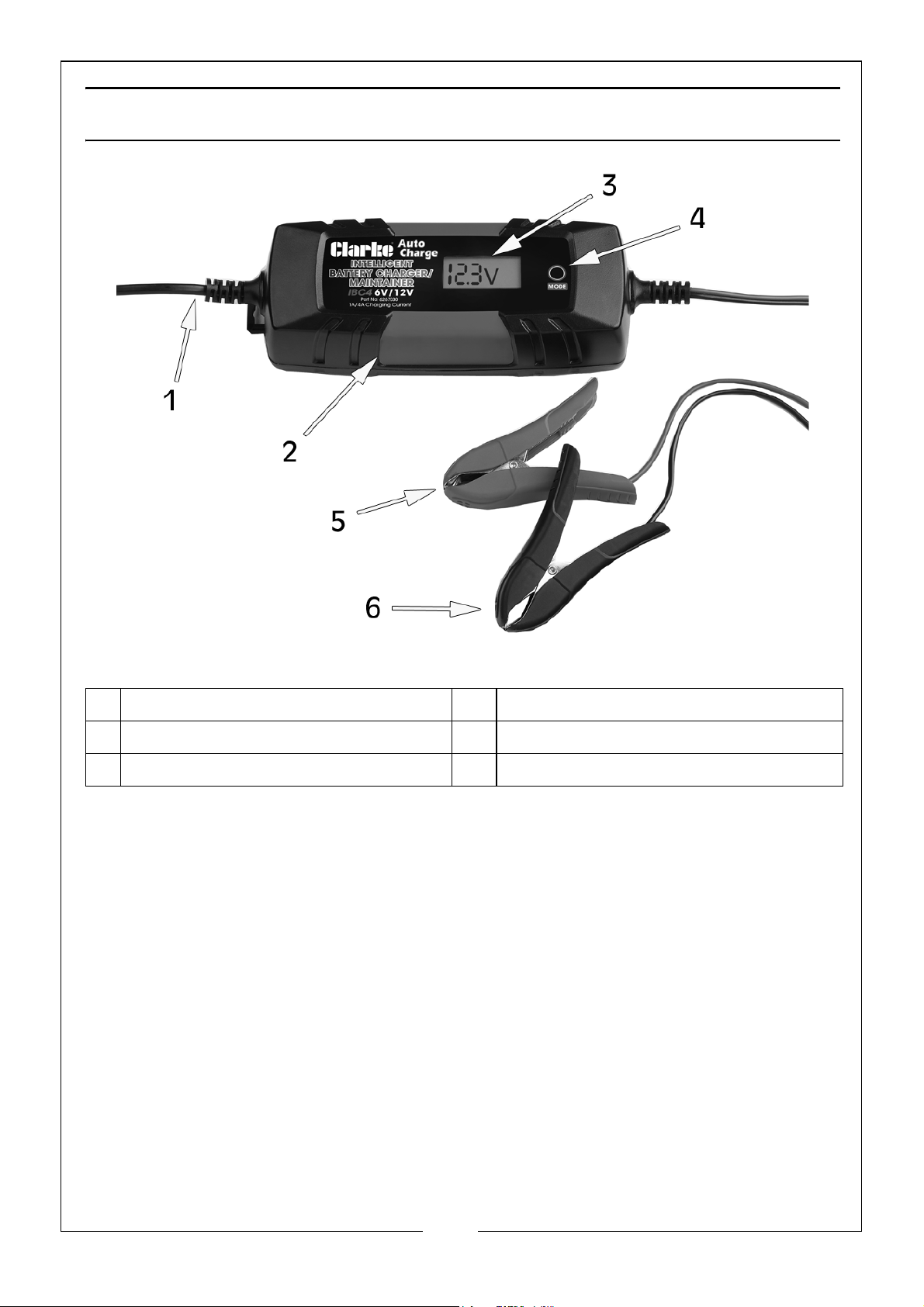
OVERVIEW
1 Power Cable 4 Mode Button
2 Battery Charger Unit 5 Charging Clamp Positive (Red)
3 LCD Display Screen 6 Charging Clamp Negative (Black)
The IBC4 is designed to charge all types of 1.2-30AH 6V & 1.2-120AH 12V leadacid batteries, including WET (Flooded), MF (Maintenance Free), EFB
(Enhanced Flooded Battery), VRLA, Lead Calcium, SLA, GEL and AGM
(Absorbed Glass Mat) batteries.
DO NOT use this product to charge other type of batteries like Nickel
Cadmium (NiCad), Nickel-Metal Hydride (Ni-MH), Lithium-Ion, Dry Cell etc.
7
Parts & Service: 020 8988 7400 / E-mail: [email protected] or [email protected]
Page 8

PREPARATION
1. It may be necessary to remove the battery from a vehicle to charge it.
• Always remove the grounded terminal from the battery first.
• Ensure all accessories in the vehicle are switched off to prevent sparking.
2. Clean the battery terminals. Be careful to keep any corrosive matter from
coming in contact with eyes.If corrosive matter enters your eye,
immediately flood eye with running clean cold water for at least 15 minutes
and seek medical attention immediately.
3. If the battery can be topped up, add distilled water to each cell until the
battery acid reaches the level specified by the battery manufacturer. This
helps remove unwanted gas from the cell. DO NOT overfill. For a battery
without cell caps, follow the manufacturer's instructions.
4. Study all the battery manufacturer's specified precautions: for example,
removing or not removing cell caps while being charged and
recommended rates of charge.
5. Refer to the vehicle manual and battery rating plate to find the voltage of
the battery and make sure that the output is set to the correct voltage.
6. If the charger has adjustable charge rate, charge the battery initially at the
lowest rate.
CHARGER LOCATION
1. Place the charger as far away from the battery as possible.
2. DO NOT position the charger above the battery during the charging
procedure. Gases from the battery may corrode and damage the
charger.
3. DO NOT let battery acid drip on the charger when reading a hydrometer
for specific gravity or when you fill the battery.
4. DO NOT use the charger in an enclosed space with reduced airflow.
8
Parts & Service: 020 8988 7400 / E-mail: [email protected] or [email protected]
Page 9
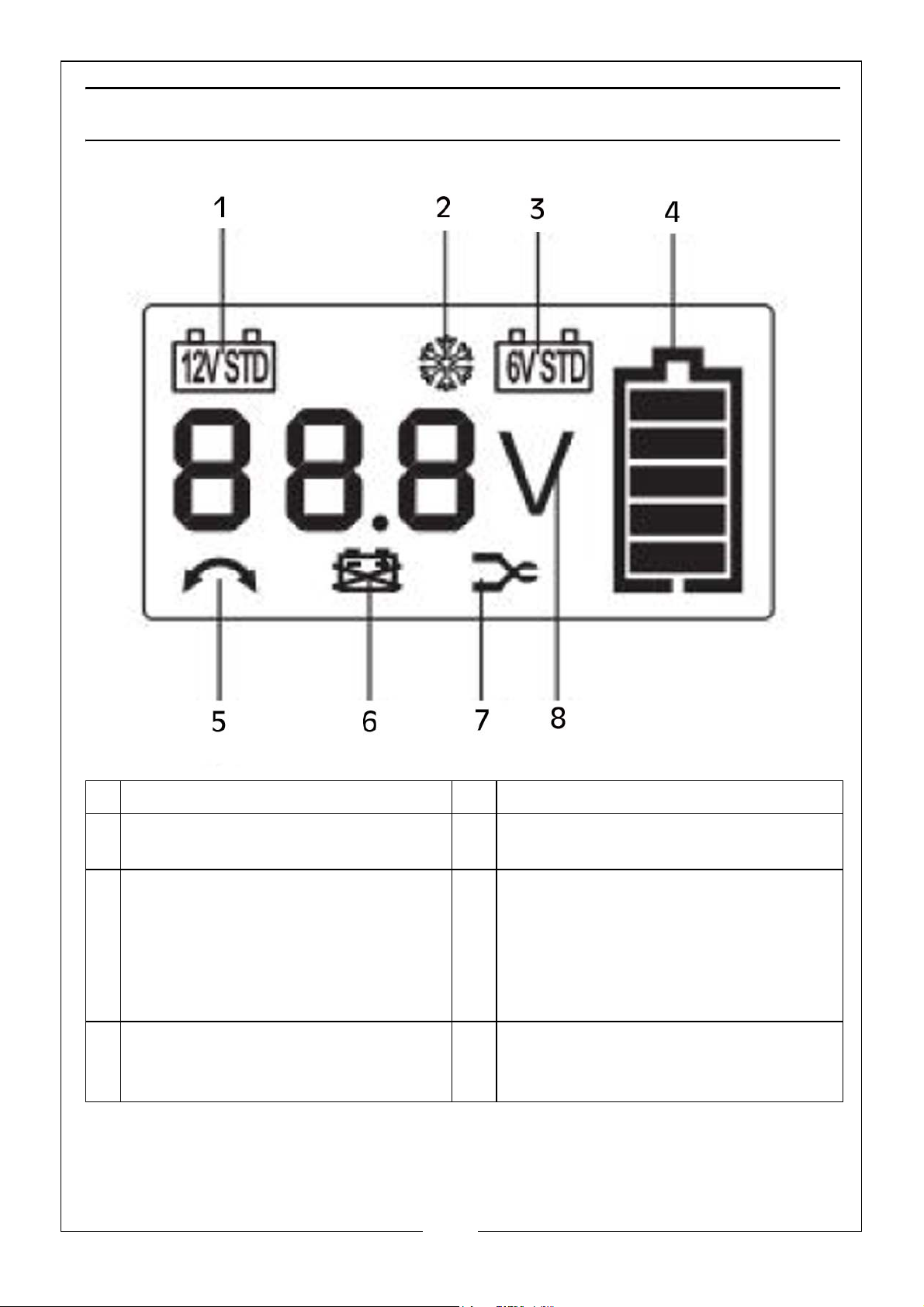
BATTERY CHARGER DISPLAY INDICATORS
1 12V STD Mode 2 COLD Mode
3 6V STD Mode 4 Battery Charging Level Indicator
(in 20% increments)
5 Reverse Polarity Connection
Indicator
7 Clamp Indicator (Open Circuit/
Dirty Battery Posts/Dead Battery/
Output Short Circuit)
Parts & Service: 020 8988 7400 / E-mail: [email protected] or [email protected]
6 Faulty Battery Indicator (Battery
voltage is lower than 1V/Battery
can’t hold the charge/Battery
voltage can’t reach to the
threshold after after charging in
the required period)
8 Battery Voltage Indicator (Press &
Hold Mode button for 3 seconds to
display the battery’s voltage)
9
Page 10
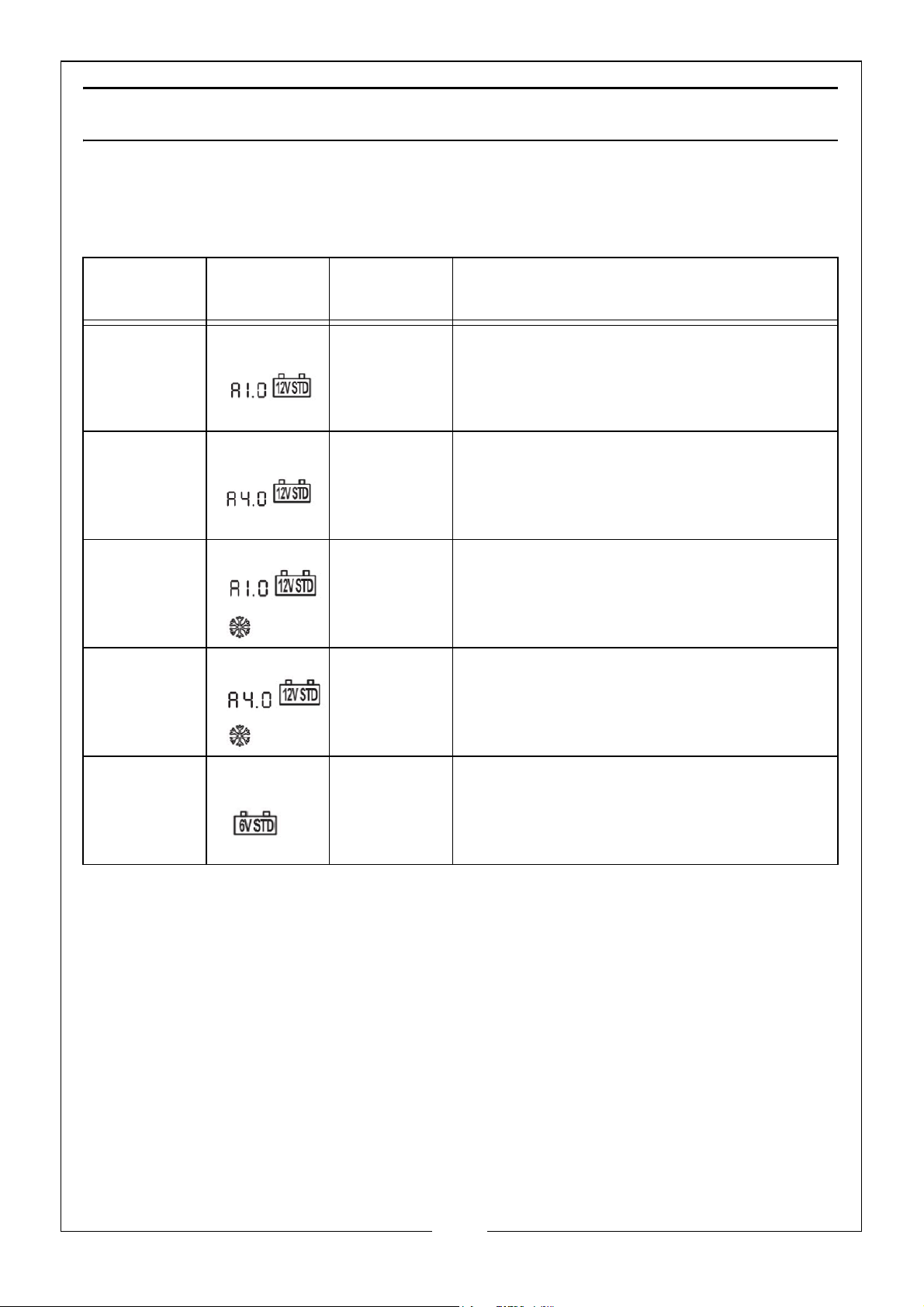
CHARGING MODES
The IBC4 battery charger has the following five modes. DO NOT operate the
charger until you have confirmed the appropriate charge mode for your
battery.
M
ODE
ICON
D
ISPLAY
BATTERY
S
IZE (AH)
1A 12V STD 1.2 - 30 Charging 12V
WET/GEL/MF/EFB Batteries
4A 12V STD 2 - 120 Charging 12V
WET/GEL/MF/EFB Batteries
1A 12V
COLD
4A 12V
COLD
1.2 - 30 Charging 12V
WET/GEL/MF/EFB Batteries below 10
o
F) or AGM Batteries
(50
2 - 120 Charging 12V
WET/GEL/MF/EFB Batteries below 10
o
F) or AGM Batteries
(50
E
XPLANATION
o
o
C
C
1A 6V STD 1.2 - 30 Charging 6V
WET/GEL/MF/EFB/AGM Batteries
10
Parts & Service: 020 8988 7400 / E-mail: [email protected] or [email protected]
Page 11
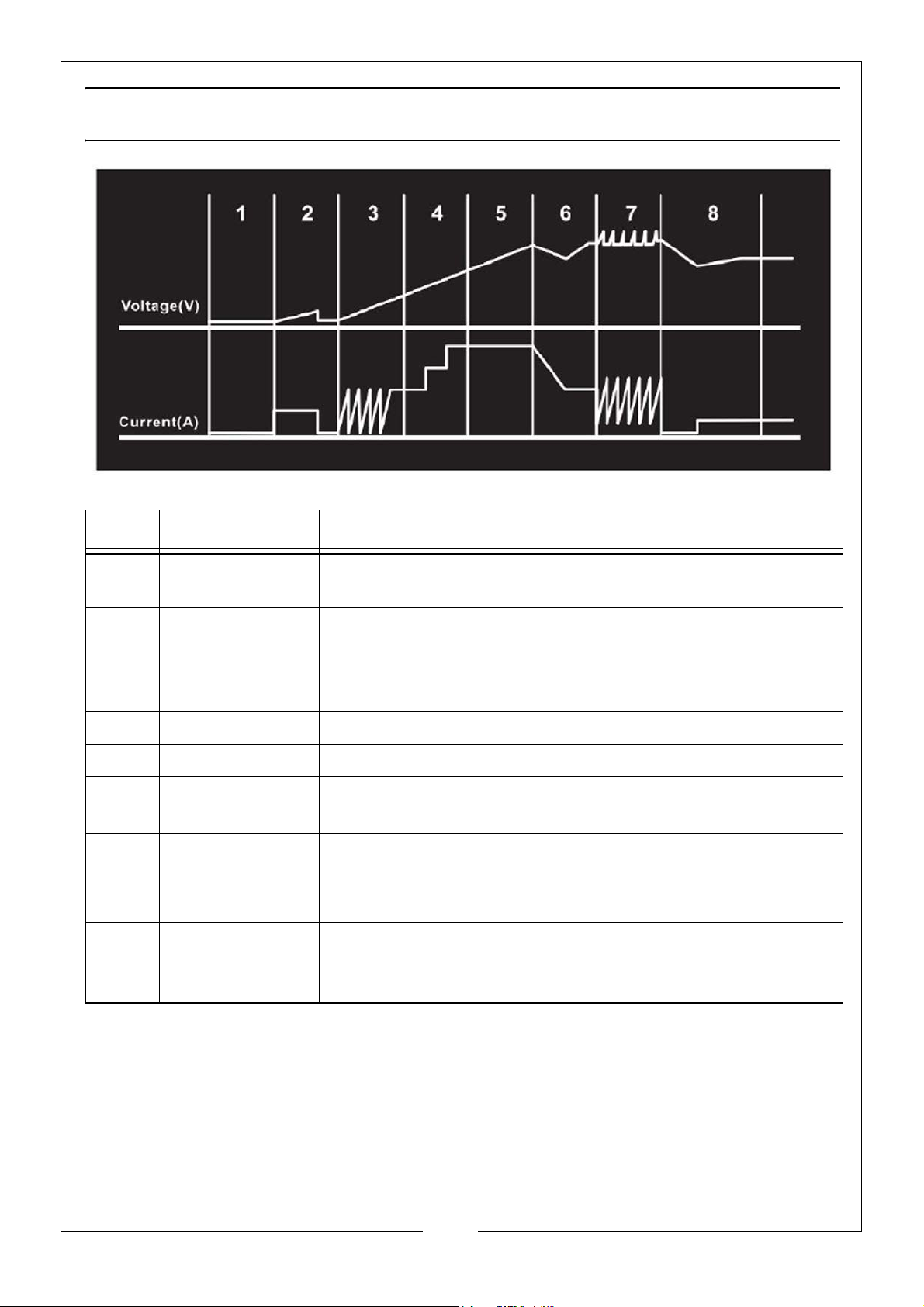
CHARGE CYCLES
STAGE FUNCTION DESCRIPTION
1 Testing Checking if battery has connected with the charger
and also check battery voltage
2 Analysis Will show the vehicle battery’s voltage on the screen
first. Analyse if the connected battery is 12v or 6V, and
will enter into the corresponding charging mode in 1
minute
3 Desulphation Desulphation process by pulsing
4 Soft-Start Charge with echelon constant current
5 Bulk Charge with constant maximum current until battery
voltage has reached the threshold
6 Absorption Provide gradually declining current charge for
maximum battery voltage
7 Pulse Charge Pulse with trickle current
8 Maintaining Continuously monitor the battery, and once the
voltage is lower than the threshold, the charge will
enter trickle charge
11
Parts & Service: 020 8988 7400 / E-mail: [email protected] or [email protected]
Page 12
OPERATION
CONNECTING TO THE BATTERY
1. Identify the polarity of the battery terminals. The positive battery terminal is
typically marked by the letters or symbols (POS,P,+). The negative battery
terminal is typically marked by the letters or symbols (NEG,N,-).
2. DO NOT make any connections to the carburetor, fuel lines or thin metal
parts.
3. Identify if you have a negative or positive grounded vehicle. This can be
done by identifying which battery post (POS or NEG) is connected to the
vehicle chassis.
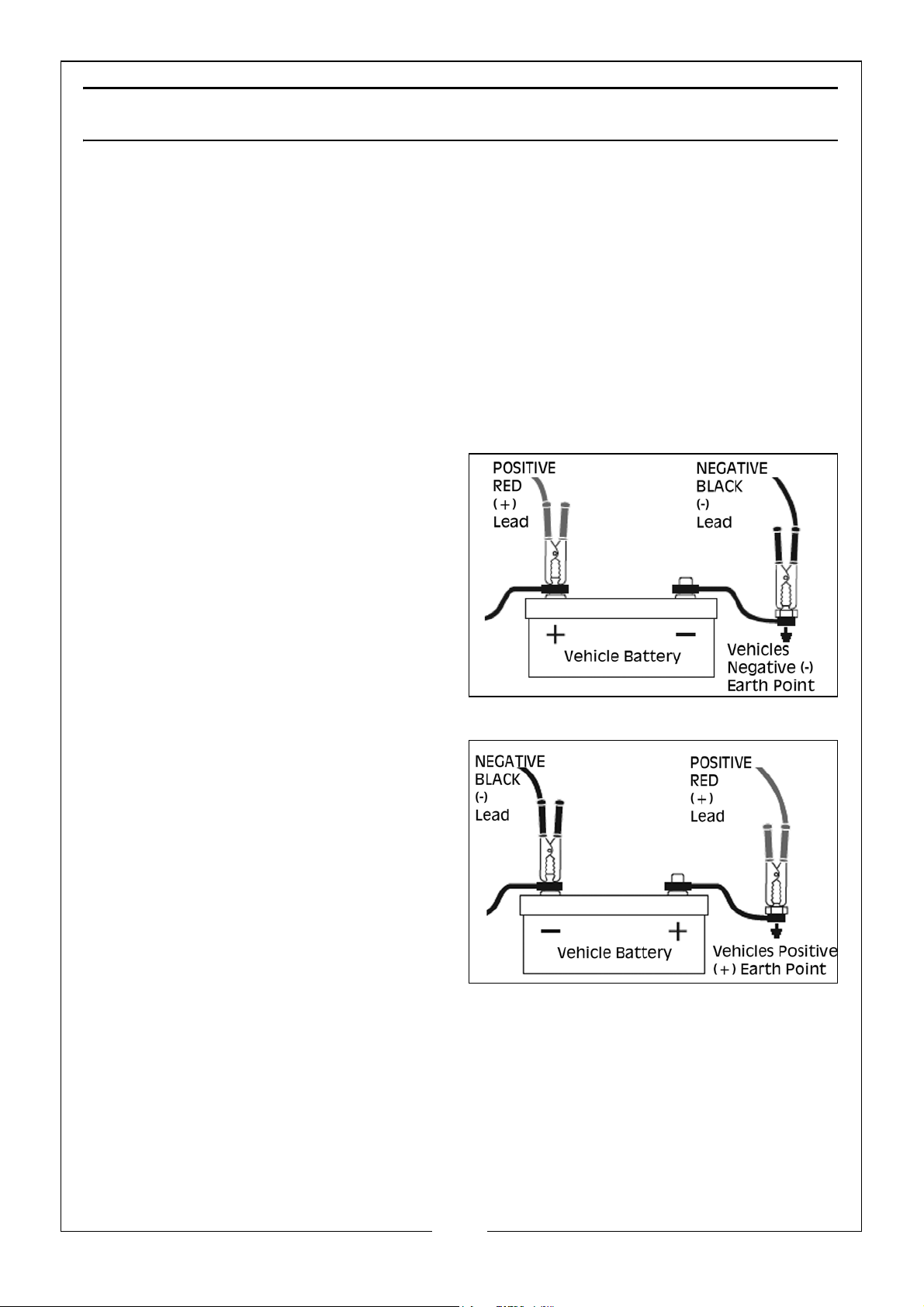
4. For a negative grounded vehicle
(most common): Connect the
RED POSITIVE battery clamp first to
the positive battery terminal, then
connect the BLACK NEGATIVE
battery clamp to the negative
battery terminal or vehicle chassis.
5. For a positive grounded vehicle
(very uncommon): Connect the
BLACK NEGATIVE battery clamp
first to the negative battery
terminal, then connect the RED
POSITIVE battery clamp to the
positive battery terminal or
vehicle chassis.
6. When disconnecting, disconnect in the reverse sequence of points 4 or 5,
depending if your vehicle is negatively or positively grounded.
7. A marine (boat) battery must be removed and charged on shore. To
charge it on board requires equipment specially designed for marine use.
12
Parts & Service: 020 8988 7400 / E-mail: [email protected] or [email protected]
Page 13

CARE & MAINTANENCE
This battery charger requires minimal maintenance. As with any appliance or
tool, a few common sense rules will prolong its working life.
WARNING: ALWAYS BE SURE THE CHARGER IS UNPLUGGED BEFORE
PERFORMING ANY MAINTENANCE OR CLEANING. ANY REPAIRS MUST BE
DONE BY A QUALIFIED SERVICE TECHNICIAN.
1. Wind up the leads when not in use. Examine the leads at regular intervals
for damage and have them replaced if necessary.
2. Clean the case and leads if necessary with a moist cloth and clean any
corrosion from the clamps with a solution of water and baking soda.
13
Parts & Service: 020 8988 7400 / E-mail: [email protected] or [email protected]
Page 14
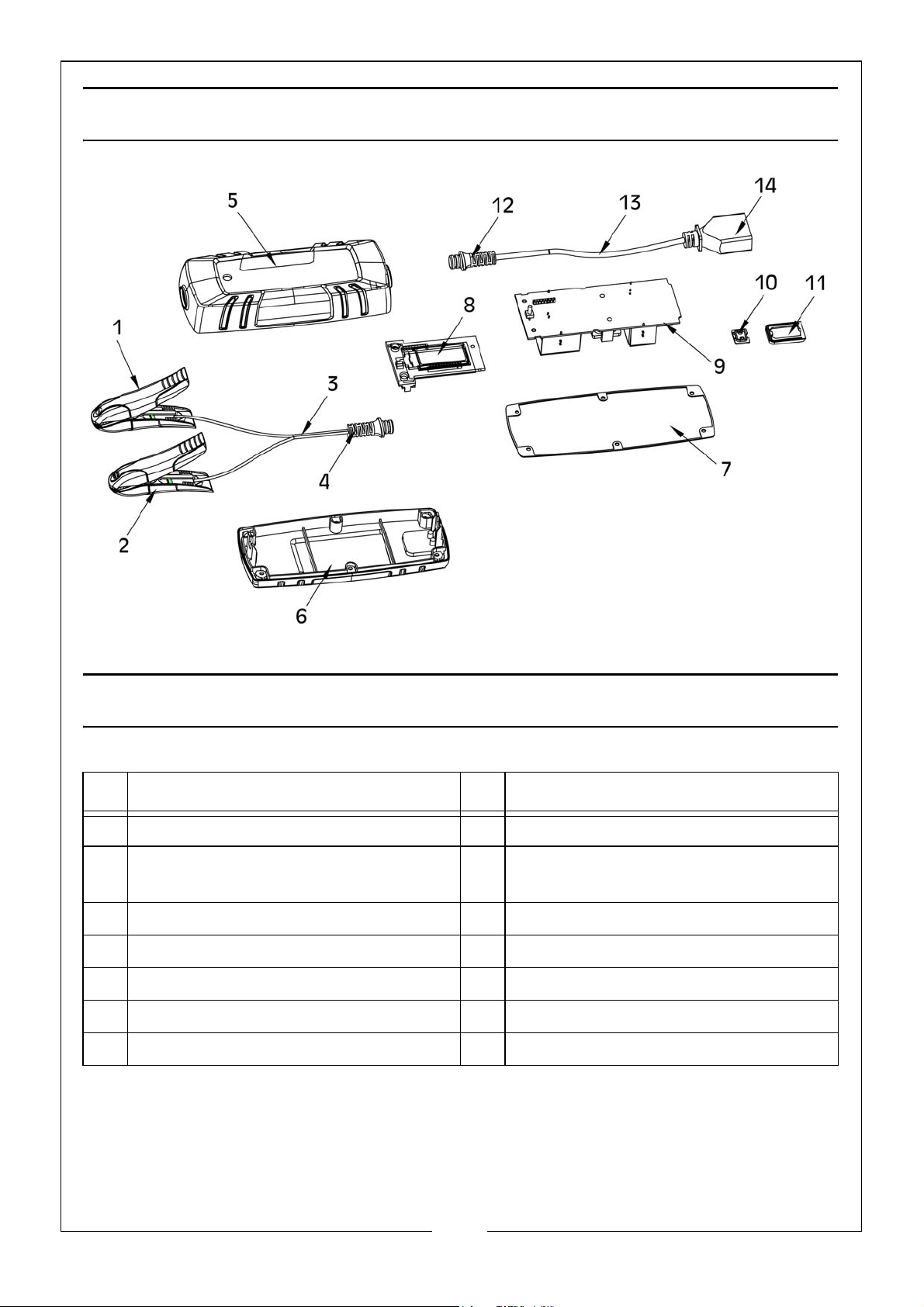
PARTS DIAGRAM
PARTS LIST
NO DESCRIPTION NO DESCRIPTION
1 Charging Clamp Positive (Red) 8 LCD Display Screen
2 Charging Clamp Negative
(Black)
3 Charging Cable 10 Hanging Hook Clamp
4 Grommet 11 Hanging Hook
5 Case Front Cover 12 Grommet
6 Case Back Cover 13 Power Cable
7 Case Seal 14 5A Fused 3 Pin Plug
9Printed Circuit Board
14
Parts & Service: 020 8988 7400 / E-mail: [email protected] or [email protected]
Page 15
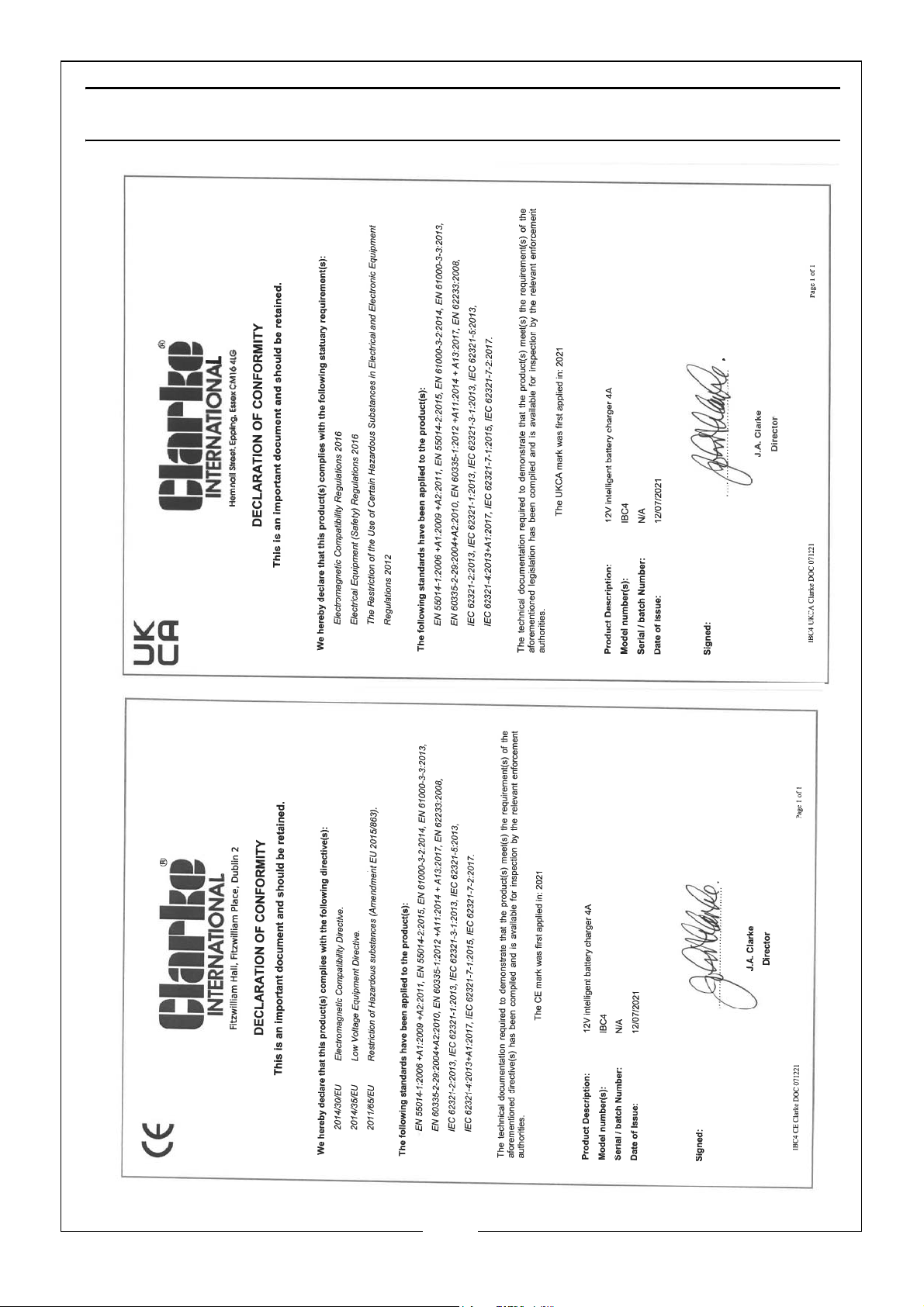
DECLARATION OF CONFORMITY
15
Parts & Service: 020 8988 7400 / E-mail: [email protected] or [email protected]
Page 16

 Loading...