

Page 1
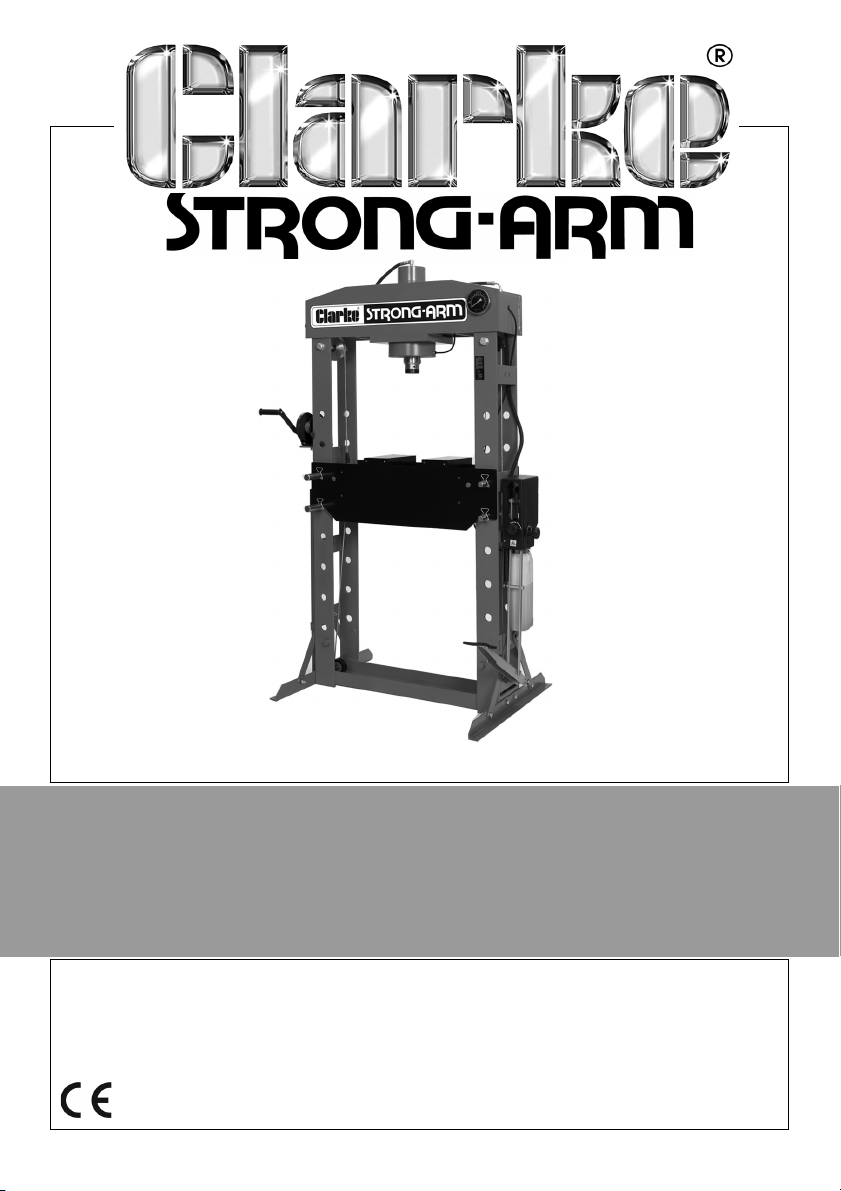
WARNING: Read these instructions before using the press
50 TONNE HYDRAULIC PRESS
MODEL NO: CSA50FPB
PART NO: 7615203
OPERATION & MAINTENANCE
INSTRUCTIONS
ORIGINAL INSTRUCTIONS GC1221 - rev 1
Page 2
INTRODUCTION
Thank you for purchasing this CLARKE 50 Tonne Hydraulic Press.
Before attempting to operate the press, it is essential that you read this manual
thoroughly and carefully follow all instructions given. In doing so you will ensure
the safety of yourself and that of others around you, and you can also look
forward to the press giving you long and satisfactory service.
Ensure the press and its components suffered no damage during transit and
that all components are present. Should any loss or damage become
apparent, please contact your CLARKE dealer immediately.
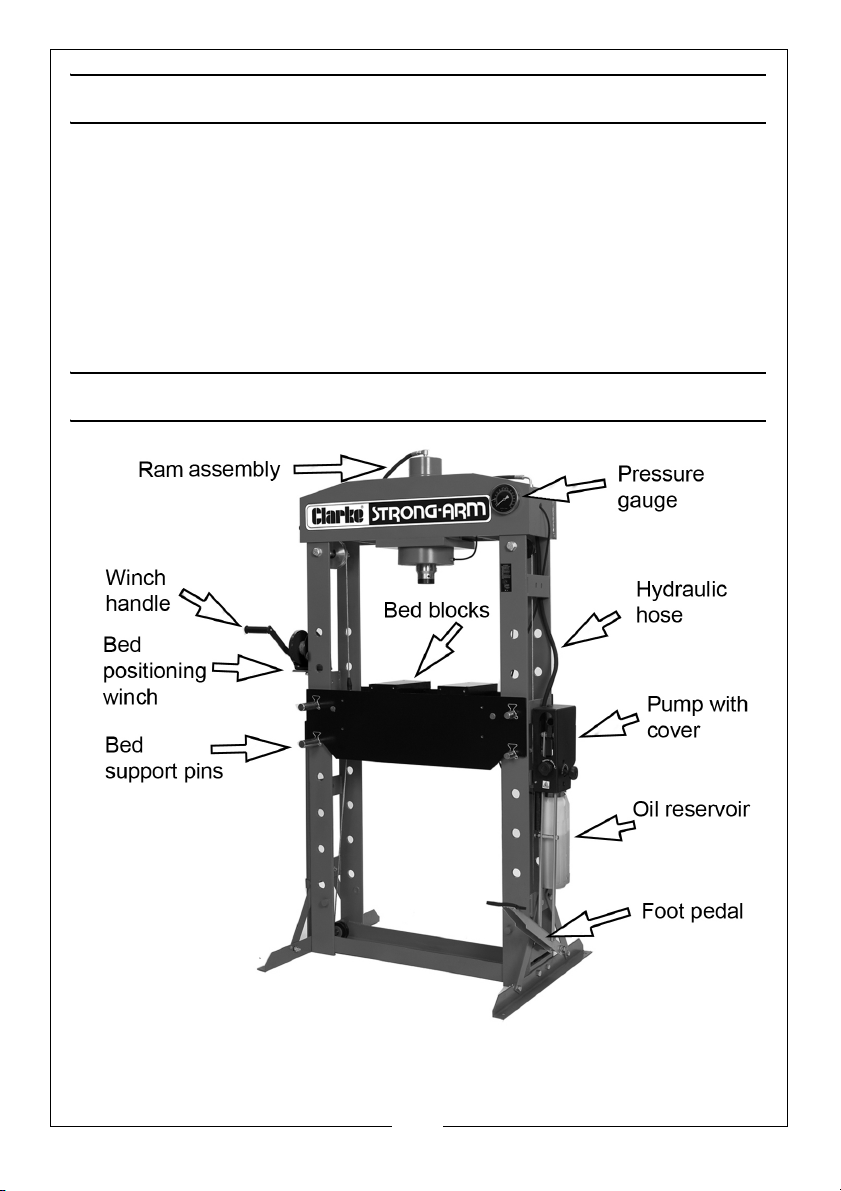
OPERATING FEATURES
2
Parts & Service: 020 8988 7400 / E-mail: [email protected] or [email protected]
Page 3
TECHNICAL SPECIFICATIONS
Rated Load 50 Tonne (50,000 kg)
Operating Pressure 64 Mpa (9200 psi)
Ram Travel 265 mm
Ram Shaft Diameter 63 mm
Net Weight 293 kg
Dimensions D x W x H 800 x 1300 x 1960 mm
Throat Width 710 mm
Throat Depth (Ram to pressing plate) Platform at highest;- 0 mm
Platform at lowest;- 950mm
No of bed positions 8 @ 140 mm centres
Ram travel per stroke 1.72 mm
No of strokes to full extension 78
Pressure Gauge type Accuracy class 2.5
Length of Handle 900 mm
Oil capacity 1.7 L
Oil type (VG13 grade hydraulic oil)
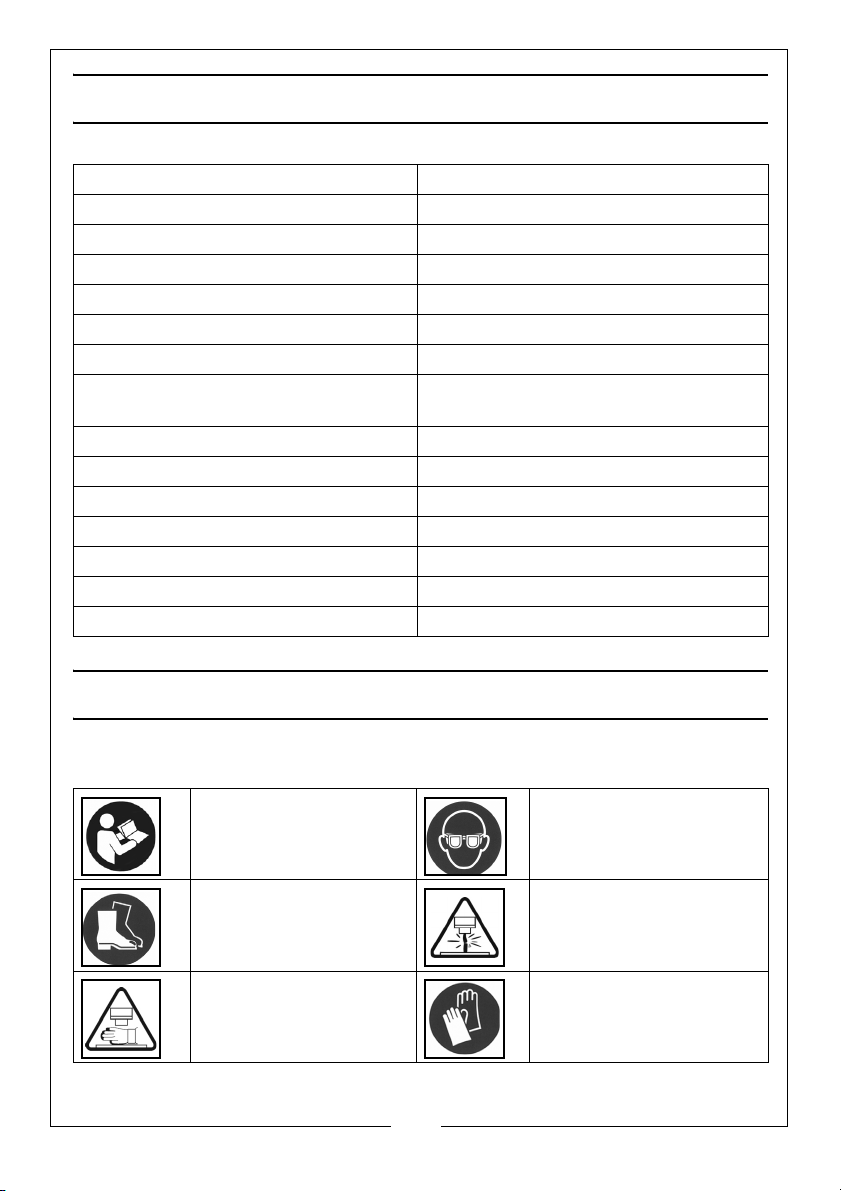
SAFETY SYMBOLS
The following safety symbols appear on the product.
Read instruction
manual before use
Wear Safety Shoes Hazard;-shattered
Hazard:- crushed
hands
3
Parts & Service: 020 8988 7400 / E-mail: [email protected] or [email protected]
Wear safety glasses
workpiece
Wear protective gloves
Page 4

SAFETY PRECAUTIONS
1. Due to the weight of the press, lifting equipment and the help of an
assistant will be required during installation. Fix the press to the floor using
suitable anchor bolts.
2. Before starting work, check for signs of cracked welds, loose or missing
bolts, damaged screen, or any other damage. Do not use if any of these
conditions exist. Have repairs made only by authorised service centre.
3. Before work, always ensure that hydraulic hoses and couplings are
completely sound.
4. NEVER tamper with the press components or modify them. The safety valve
is set and sealed at the factory; do not attempt to adjust the setting.
5. Use only the recommended hydraulic oil.
6. The components of this press are designed to withstand the rated load. Do
not substitute any other components or exceed the rated load of the press.
7. Before applying pressure, ensure the workpiece is firmly secure and stable.
8. ALWAYS clean up spills of hydraulic oil immediately as this can be
dangerous in a workshop environment.
9. Do not let any person who is unfamiliar with hydraulic presses use the press
unless they are under direct supervision.
10. Keep children and unauthorised personnel away from the work area.
11. ALWAYS position the (optional) safety screen directly front of the workpiece.
12. ALWAYS apply the load under the centre of the ram. Offset loads can
damage the ram and may cause the work piece to be ejected.
13. ALWAYS ensure the work piece is properly supported by the press bed.
14. When using accessories such as pressing plates, be certain they are
centered below the ram and are in full contact with the bed.
15. Parts being pressed may shatter or be ejected from the press. Always use
adequate guards and wear eye protection and protective clothing when
using this press.
16. Keep hands and fingers away from parts that may pinch or shift.
17. NEVER use extension tubes to increase the length of the pump handle or
foot pedal. Excessive effort can cause damage and/or accidents.
18. Wear ANSI approved impact safety goggles heavy duty work gloves.
19. Failure to heed these warnings may result in damage to the equipment, or
serious personal injury.
4
Parts & Service: 020 8988 7400 / E-mail: [email protected] or [email protected]
Page 5
PREPARATION FOR USE
WARNING: DUE TO THE WEIGHT OF THE PRESS, LIFTING EQUIPMENT OR THE
HELP OF AN ASSISTANT WILL BE REQUIRED DURING INSTALLATION.
LOCATING THE PRESS
Using suitable lifting equipment if required, lift the frame assembly upright and
manoeuvre it to its intended location in the workshop.
The press must be firmly secured to a firm and level floor using expansion bolts
(not supplied). Holes are provided in the feet for this purpose.
Do not locate your press where it will be exposed to the elements as harsh
weather conditions will damage the hydraulic parts.
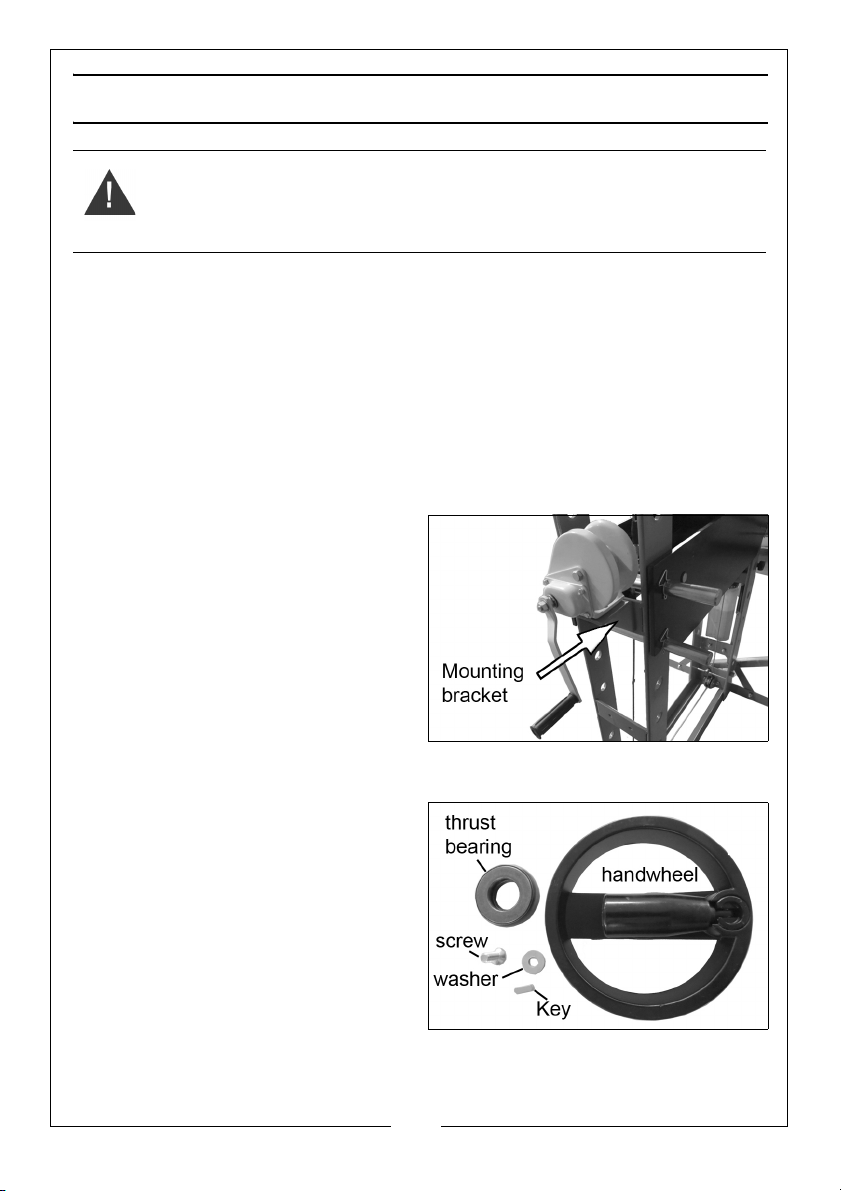
FITTING THE WINCH
During transit, the winch is positioned
o
at 180
the frame and must be correctly
mounted.
1. Turn the winch and bracket
to its working position inside
around and re-fit to the frame
with the bolts and washers
supplied, noting that the handle
will be outside the frame for
operation.
FITTING THE HANDWHEEL
The handwheel which is used to
position the ram within the frame is
supplied loose and requires fitting.
5
Parts & Service: 020 8988 7400 / E-mail: [email protected] or [email protected]
Page 6
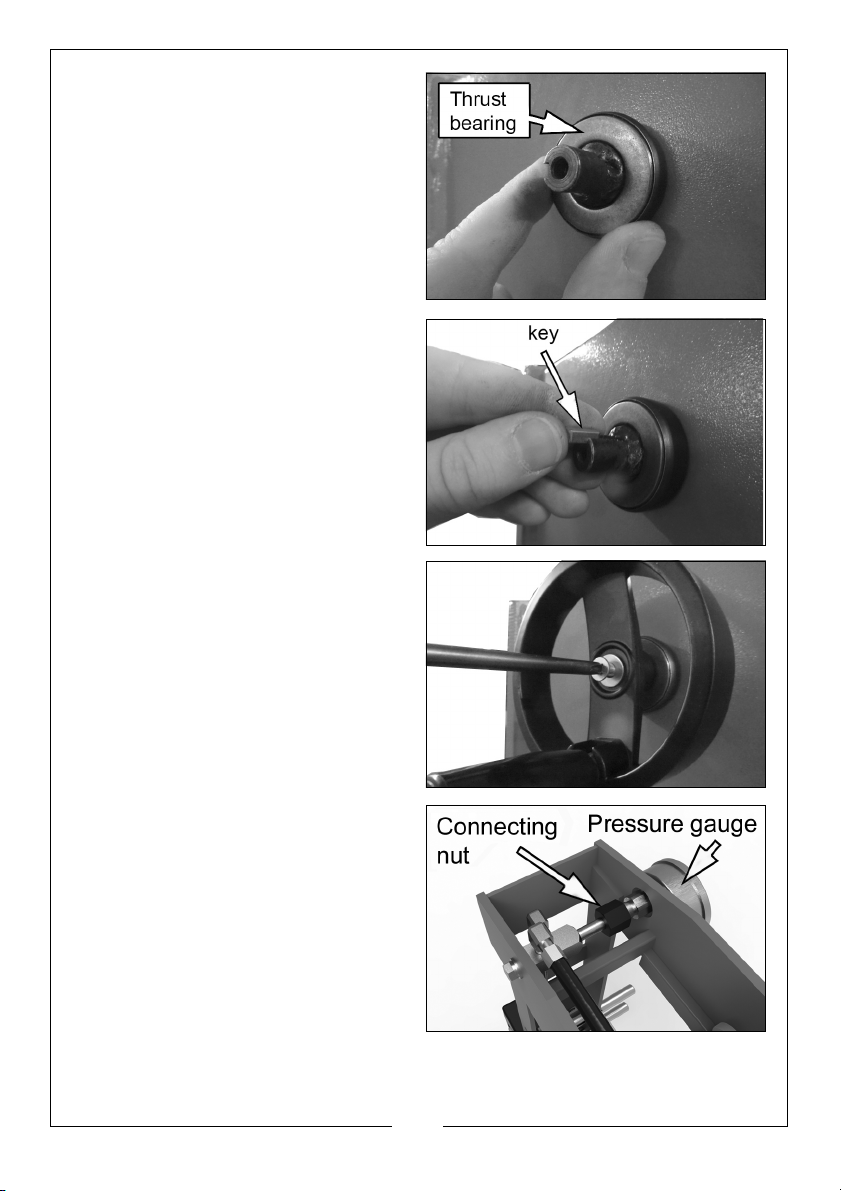
1. Fit the thrust bearing to the end of
the axle.
2. Check that the direction of the
thrust bearing is with the silver
metal side facing outwards.
3. Fit the key into the slot in the shaft
and tap it into place.
4. Install the handwheel onto the
shaft, lining up the slot in the
wheel with the retaining key.
5. Secure the handwheel with the
spring washer, flat washer and
cross-headed screw supplied.
6. Remove the travel plug and install
the pressure gauge.
7. Fit the gauge through the frame
and secure with the connecting
nut supplied.
•We recommend sealing threads
with PTFE tape where hydraulic oil is
to be contained. Take care not to
let any oil escape while connecting
the hoses.
6
Parts & Service: 020 8988 7400 / E-mail: [email protected] or [email protected]
Page 7
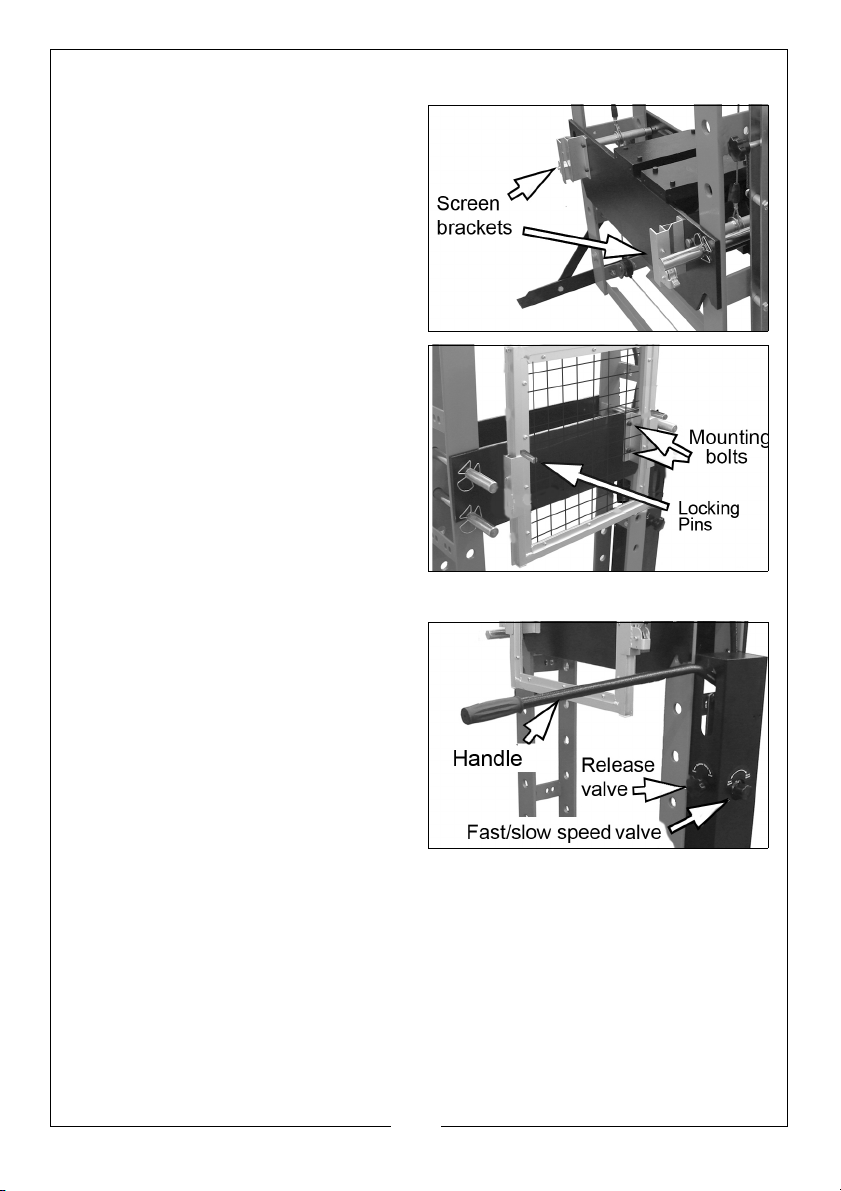
PROTECTIVE SCREEN (OPTIONAL)
A protective screen CPS50T is
available from your CLARKE dealer,
part no: 7615262.
1. Bolt the protective screen
brackets to the pressing bedplate.
2. Fit the protective screen assembly
to the brackets and ensure it can
be set in one of the available
positions using the latches on
each side.
PURGING THE HYDRAULIC SYSTEM
1. Open the release valve by turning
anti-clockwise.
2. Pump the handle or foot pedal
several full strokes to eliminate any
air bubbles from the system.
3. Close the release valve, turning
clockwise.
7
Parts & Service: 020 8988 7400 / E-mail: [email protected] or [email protected]
Page 8
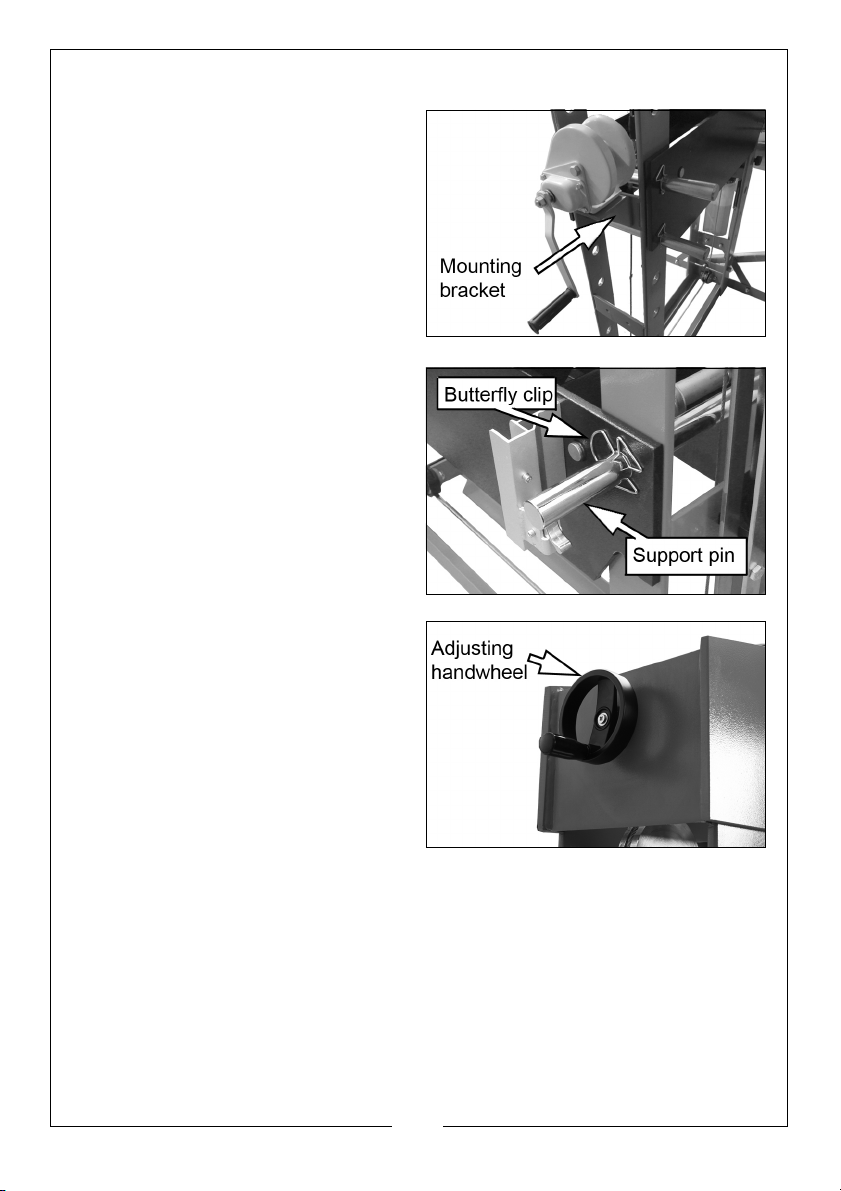
POSITIONING THE PRESSING BED
1. Use the winch to raise the pressing
bed into a suitable position.
• The arrows on the winch
indicate the direction of
movement.
• The pressing bed should be as
close as possible to the ram
when the workpiece is
mounted on it.
2. When satisfied that the bed is at
the correct height insert the
locking pins into their positions
and secure with the butterfly clips.
POSITIONING THE RAM
1. Position the carriage horizontally
along the cross-beam using the
adjusting handwheel on the side
of the press.
• Always position the ram
directly above the workpiece
which should be as close to
the centre of the press as
possible.
8
Parts & Service: 020 8988 7400 / E-mail: [email protected] or [email protected]
Page 9
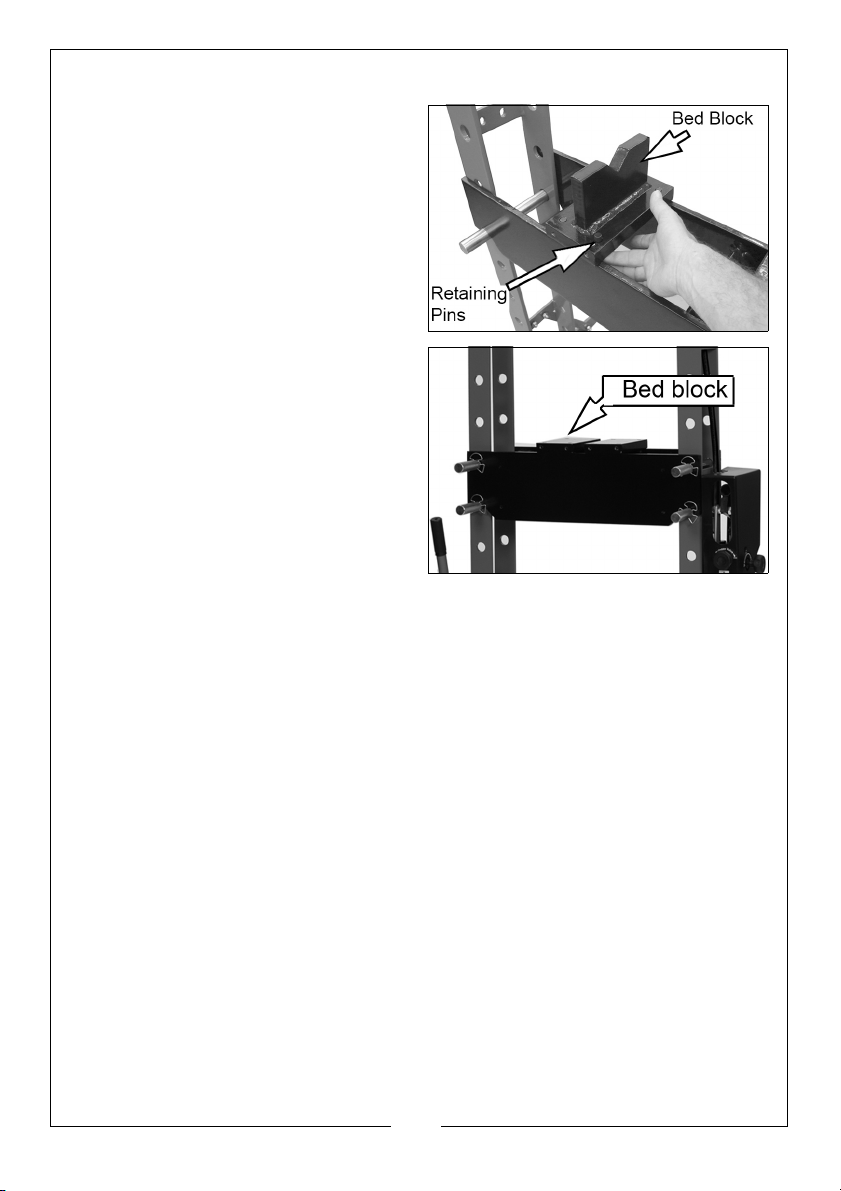
POSITIONING THE PRESSING BED BLOCKS
The bed blocks can be placed on
the bed with either the flat face or
the V-supports facing upwards.
They are prevented from slipping out
of position by the retaining pins which
drop down within the confines of the
bed side members.
Check all parts are secure and
correctly aligned before using the
press.
9
Parts & Service: 020 8988 7400 / E-mail: [email protected] or [email protected]
Page 10
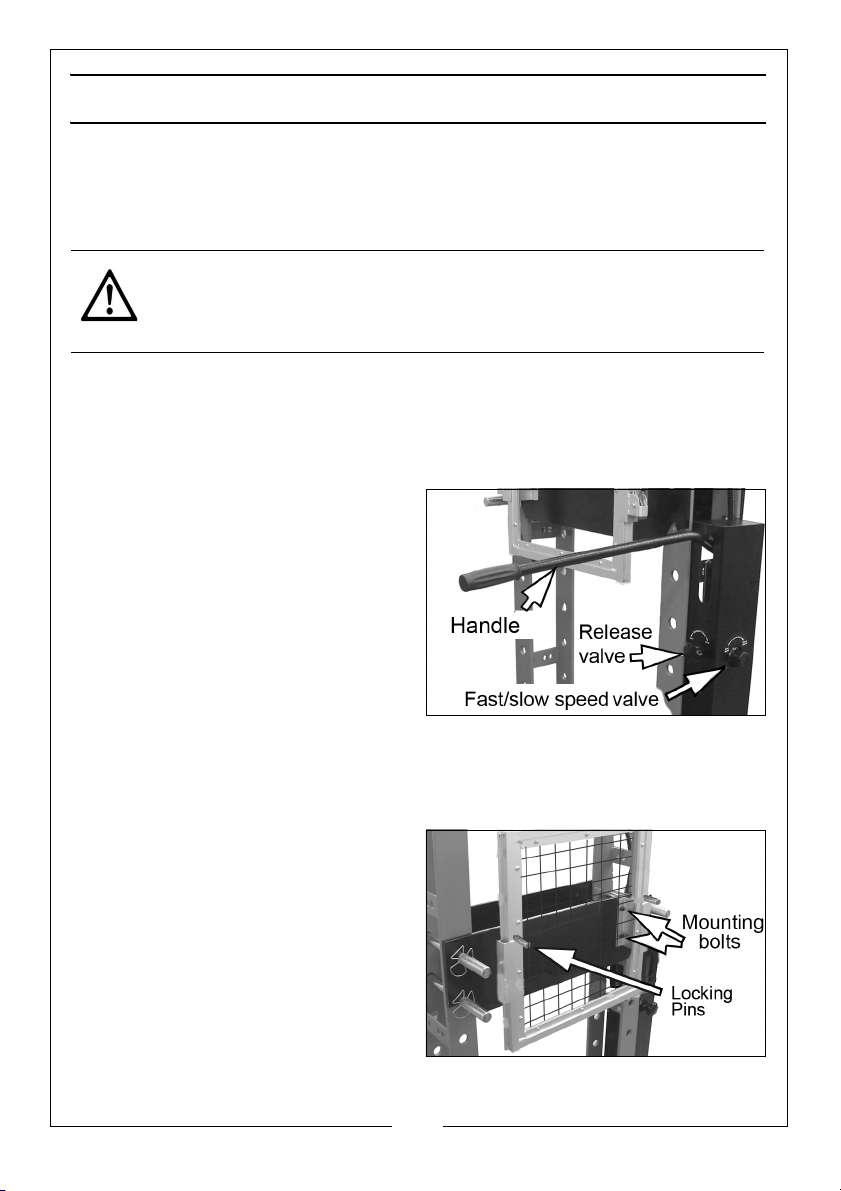
OPERATION
1. Place the workpiece on the bed. It must be completely stable and
supported by packing or shims where required. Pressing plates (bed blocks)
are supplied, which locate on the bed. Place the workpiece on these to
give it stability.
CAUTION: DO NOT POINT LOAD SUCH ACCESSORIES AS THEY ARE NOT
DESIGNED TO TAKE THE FULL FORCE OF THE RAM IN ONE SPOT. ENSURE
THEY ARE ADEQUATELY SUPPORTED.
NOTE: Any packing pieces or shims used MUST be capable of
withstanding the pressure that will be brought to bear, and MUST
be of sufficient size with sufficient surface area, so as to avoid the
possibility of slipping or springing out. Mating surfaces MUST be
horizontal so that the force being exerted will NOT be at an angle.
2. Close the release valve by turning
clockwise until tightly closed.
3. Select either SLOW SPEED or FAST
SPEED using the knob on the side
of the pump cover.
• Fast speed allows faster
movement but greater effort
will be required.
4. Pump the handle or foot pedal to
bring the ram very lightly into
contact with the workpiece.
5. Manoeuvre the workpiece or slide the ram to one side so that the desired
point of contact is directly beneath the centre of the ram.
6. When satisfied that the workpiece
is correctly aligned and is
completely stable in that position,
slide the protective screen (if
fitted) into position before starting
any pressing.
• The latches will support the
screen in a selection of
positions.
10
Parts & Service: 020 8988 7400 / E-mail: [email protected] or [email protected]
Page 11

7. Slowly pump the handle or foot pedal so that the ram begins to exert
pressure on the workpiece.
8. Continue to pump the handle and constantly monitor the pressing,
ensuring the ram and work remain completely in line with no risk of slipping.
9. Observe the reading on the pressure gauge and take care not to exceed
the rated working pressure of the press.
• The scale from 50 metric tonnes upward is highlighted in red, indicating
pressure is being applied above the rated maximum working pressure.
10. When the pressing task is complete, turn the release valve control knob
anticlockwise in small increments to release ram pressure and allow
removal of the workpiece and lower the protective screen.
11
Parts & Service: 020 8988 7400 / E-mail: [email protected] or [email protected]
Page 12

MAINTENANCE
ROUTINELY
A visual inspection must be made before each use of the press, checking for
leaking hydraulic fluid and damaged, loose, or missing parts.
Owners and/or users should be aware that repair of this equipment requires
specialised knowledge and facilities. It is recommended that a thorough
annual inspection of the press be made and that any defective parts be
replaced with genuine CLARKE parts.
If the press appears to be damaged in any way, is found to be badly worn, or
operates abnormally SHOULD BE REMOVED FROM SERVICE until the necessary
repairs are made.
If the press is not to be used for any length of time, store it with the ram piston
withdrawn to protect the surface of the moving parts.
PERIODICALLY
Check the press to make sure all bolts are tight and inspect for cracked welds,
bent, loose or missing parts.
Clean any foreign material from the ram carrier. Keep the protective screen (if
fitted) clean at all times.
Check the hydraulic connections for leaks. Replace or properly repair any
damaged or leaking hydraulic components before using. Note any loss of oil
and if oil is seen to become foul, replace using CLARKE hydraulic oil, Part No.
3050830.
If any rust is apparent on the structure it must be removed completely and the
paint restored.
DISPOSAL OF UNWANTED MATERIALS
One of the most damaging sources of environmental pollution is oil products.
Never throw away used oil with domestic refuse or flush it down a sink or drain.
Collect any oil in a leak proof container and take it to your local waste
disposal site.
Should hydraulic components become completely unserviceable and require
disposal, draw off the oil into an approved container and dispose of the
product and the oil according to local regulations.
When requesting spare parts, please quote the number on the diagrams/parts
lists on pages 14-18.
12
Parts & Service: 020 8988 7400 / E-mail: [email protected] or [email protected]
Page 13
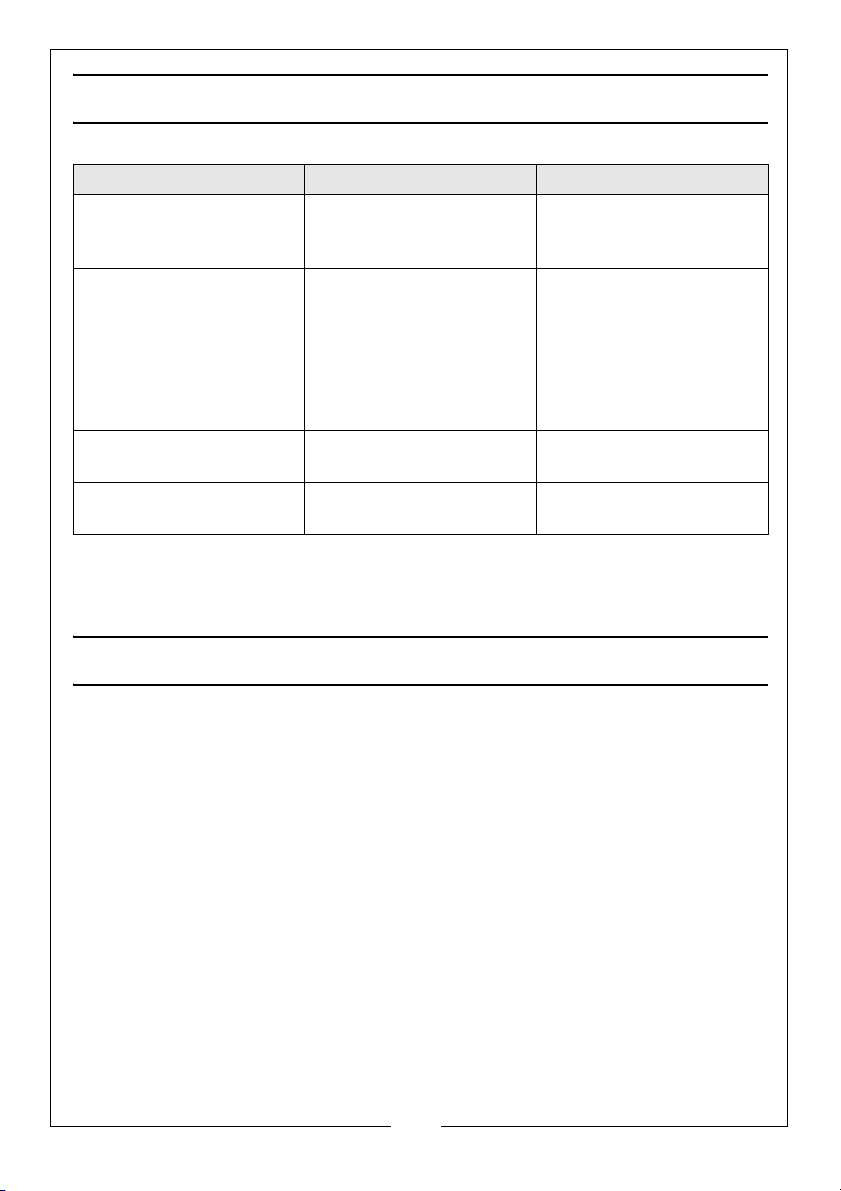
TROUBLESHOOTING
Problem Probable Cause Remedy
Pump will not work. Dirt on valve seat/worn
seals.
Pump will not produce
pressure.
Pump feels hesitant
under load.
Pump feels hesitant
under load.
Piston will not retract
completely.
If this does not solve the problem, contact the CLARKE Sevice department on
020 8988 7400.
Air-lock. See “Purging the
Pump cup seal could be
worn out.
Air-lock. Release air by removing
Bleed pump unit or have
unit overhauled with new
seals by your dealer.
Hydraulic System” on
page 7. Open the
release valve and pump
the handle a couple of
full strokes. Close the
release valve.
Have the cup seal
replaced by your dealer.
the filler plug.
GUARANTEE
This product is guaranteed against faulty manufacture for a period of 12
months from the date of purchase. Please keep your receipt which will be
required as proof of purchase.
This guarantee is invalid if the product is found to have been abused or
tampered with in any way, or not used for its intended purpose. Faulty goods
should be returned to their place of purchase, no product can be returned to
us without prior permission.
This guarantee does not effect your statutory rights.
13
Parts & Service: 020 8988 7400 / E-mail: [email protected] or [email protected]
Page 14
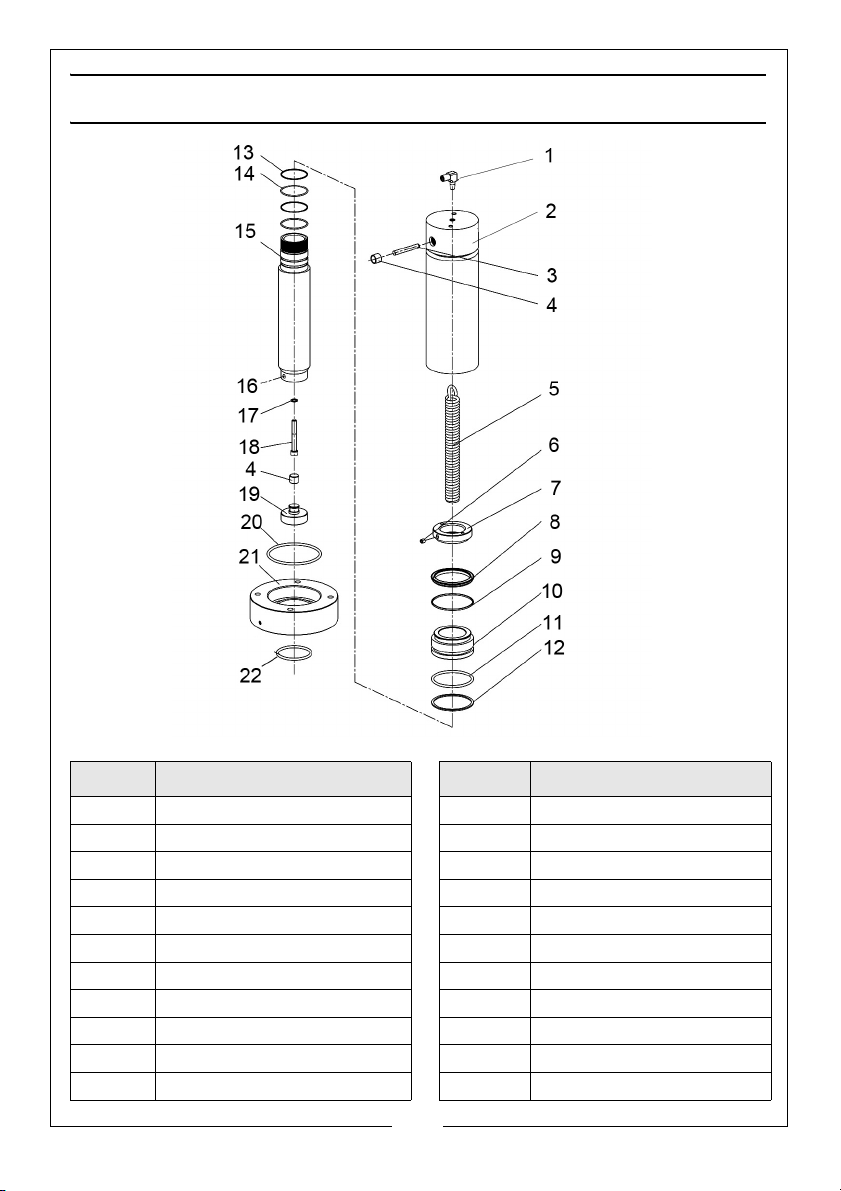
RAM PARTS DIAGRAM
NO DESCRIPTION NO DESCRIPTION
1 Elbow connector 12 Ring
2Ram cylinder 13Ring
3 Pin 14 O-ring 60.5x2.5
4Nut 15Piston
5 Spring 16 Grub screw
6 Grub screw 17 Washer
7Nut 18Bolt M10 x80
8Y-ring 19Ram Toe
9 Back ring 20 O-ring 120x5.3
10 Piston head 21 Mounting Collar
11 O-ring 90.5 x 5.3 22 O-ring 74.5x5.3
14
Parts & Service: 020 8988 7400 / E-mail: [email protected] or [email protected]
Page 15
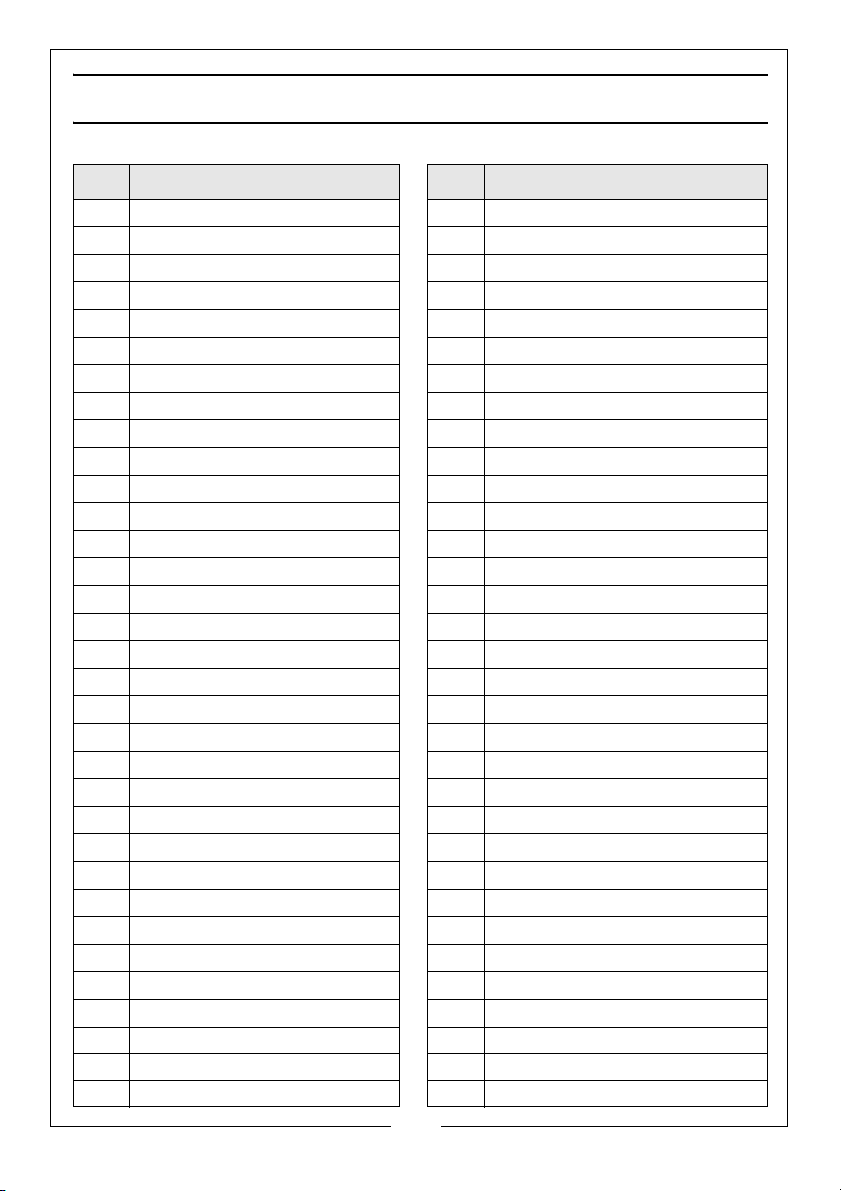
FRAME ASSEMBLY PARTS LIST
NO DESCRIPTION NO DESCRIPTION
1 Bolt M12 x 120 34 Grub screw
2 Spring 35 Pressure gauge
3 Bolt M8 x 12 36 Sealing ring
4 Spring washer 37 Gauge connector
5 Screw adjuster assembly 38 Connector
6 Carriage beam 39 Gauge connecting nut
7 Bearing 6202-2Z 40 T-connector
8 Clip 15 41 Connector
9 Nut M20 42 Bolt M12x20
10 Upper roller 43 Ram bearing plate
11 E-Clip 44 Bolt M12 x 40
12 Washer 45 Straight connector
13 Pivot bolt 46 Long roller
14 Bolt M10 x 25 47 Roller
15 Winch assembly 48 Circlip 20
16 Bolt 49 Pressing block set
17 Winch support bracket 50 Pressing beam
18 Washer 10 51 Butterfly clip
19 Spring Washer 10 52 Pressing beam support pin
20 Nut M10 53 Hydraulic pump assembly
21 Bolt M12 x 30 54 Frame upright
22 Bolt M12 x 35 55 Pedal footpad
23 Support beam 56 Screw
24 Support beam 57 Sleeve
25 Base support section 58 O-ring
26 Short roller shaft 59 Connecting hose
27 Roller cover plate 60 Hose connecting sleeve
28 Roller spool 61 Rivet
29 Roller cover 62 Hose fixing plate
30 Washer 12 63 Washer 14
31 Spring washer 64 Spring washer 14
32 Nut M12 65 Nut M14
33 Ram assembly complete
15
Parts & Service: 020 8988 7400 / E-mail: [email protected] or [email protected]
Page 16
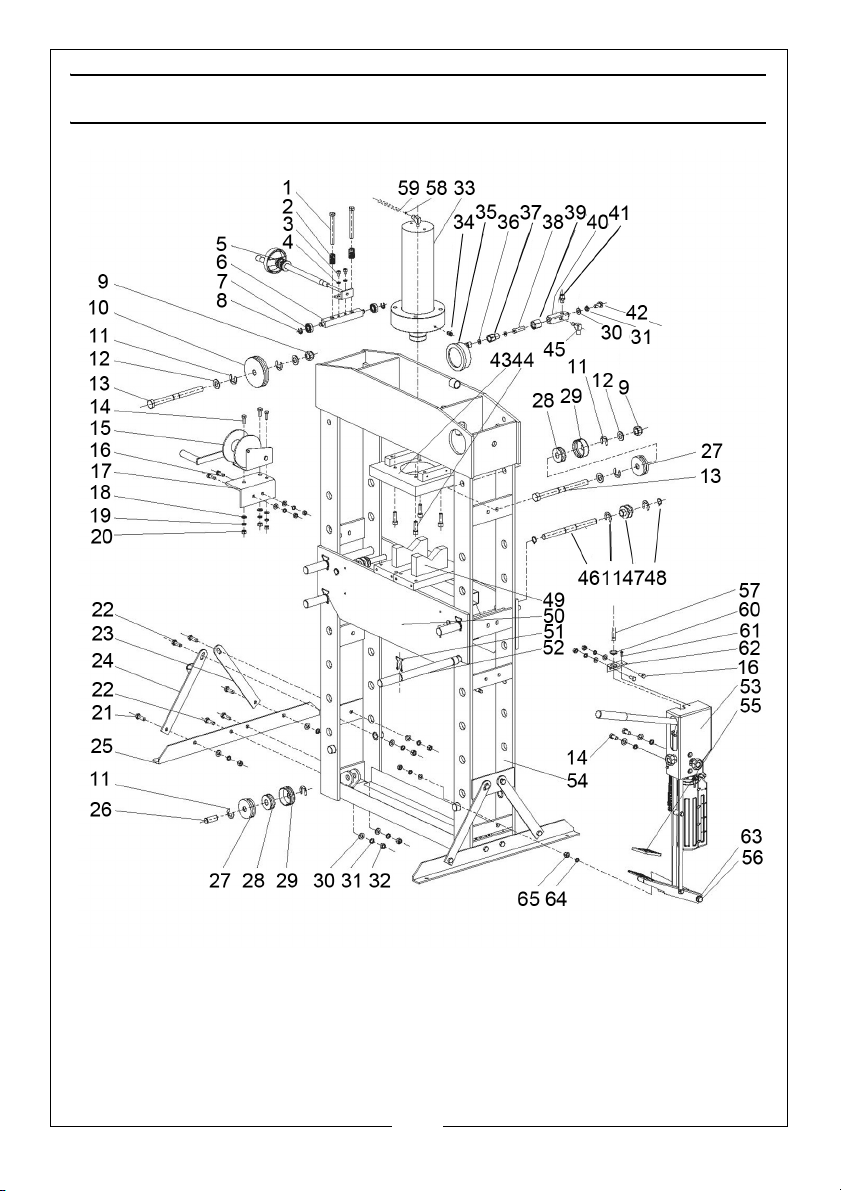
FRAME ASSEMBLY PARTS DIAGRAM
16
Parts & Service: 020 8988 7400 / E-mail: [email protected] or [email protected]
Page 17
PUMP PARTS LIST
NO DESCRIPTION NO DESCRIPTION
1 Handle Sleeve 32 Bolt M10 x 70
2 Handle 33 Connecting rod
3 Handle Socket 34 Cap nut M5
4 Nut M14 35 Plastic protective shell
5 Connector 36 Speed regulator valve part
6 Connector pin 37 X-headed screw M5x8
7 Handle socket pin 38 Nut M10
8 Torsion spring bolt A 39 O-ring
9 Torsion spring bolt B 40 End Ring
10 High pressure oil plug 41 Oil pick-up pipe assembly
11 O-ring 5 x 1.8 42 Shaft M6 x 25
12 Hose connector 43 Bush
13 High pressure washer 44 Lock nut M6
14 High pressure oil spring 45 Hoop
15 Steel ball 13.5mm 46 Shaft M10x80
16 Low pressure oil sucking spring 47 Flat washer 6mm
17 Steel ball 9.5mm 48 Spring washer
18 Pump core 49 Inner hex bolt M6 x 16
19 Star O-ring 50 Oil reservoir
20 Pump core back ring 51 Reformed bolt
21 Pump core O-ring 52 Flat washer 14
22 Pump core sleeve 53 Spring washer 14
23 Pump core Y-ring 54 Foot pedal
24 High pressure oil sucking spring 55 Tension spring
25 Base unit 56 Pressure regulating screw
26 Support rod 57 O-ring
27 Oil return sleeve copper pad 58 Pressure regulating spring
28 Return valve stem sleeve 59 Spring base
29 Lock nut M10 60 Steel ball 3mm
30 O-ring 5.7 x 1.9 61 Flat washer 10
31 Oil release stem part 62 Flat washer 12
17
Parts & Service: 020 8988 7400 / E-mail: [email protected] or [email protected]
Page 18
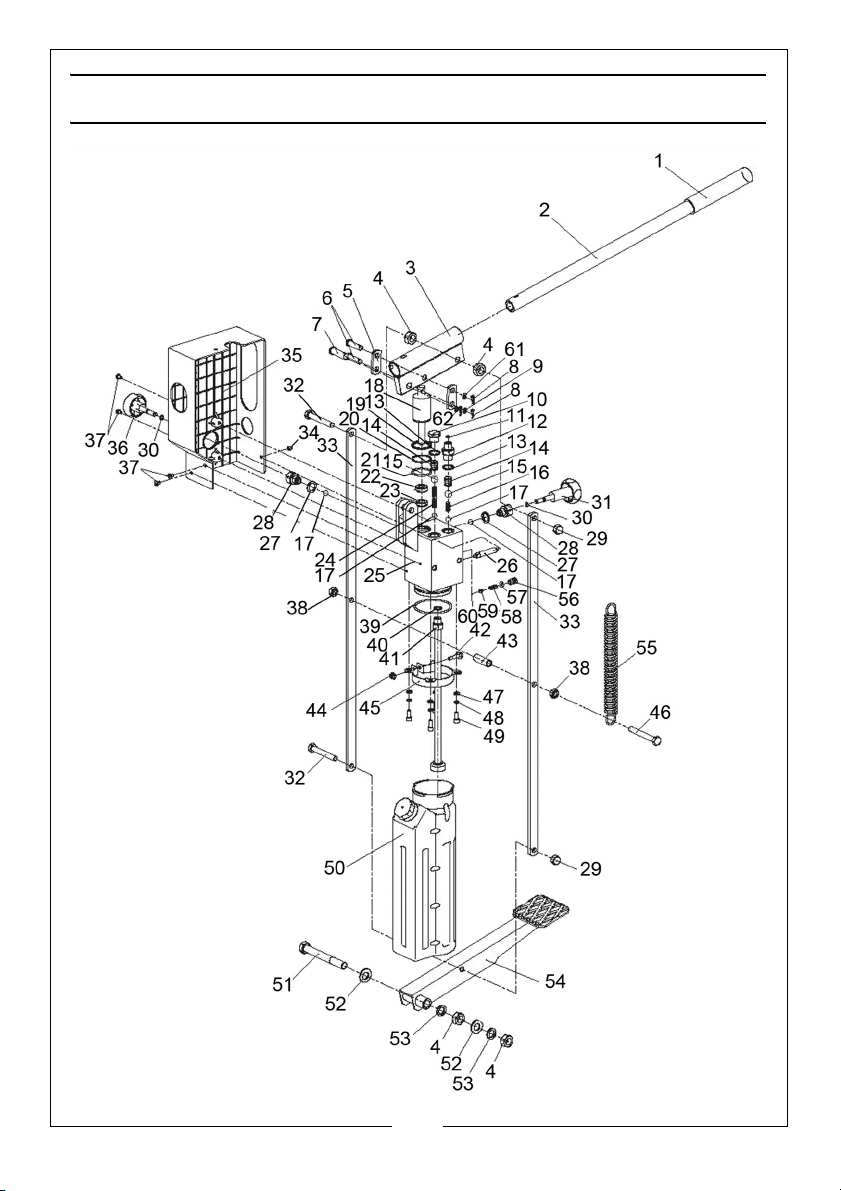
PUMP PARTS DIAGRAM
18
Parts & Service: 020 8988 7400 / E-mail: [email protected] or [email protected]
Page 19
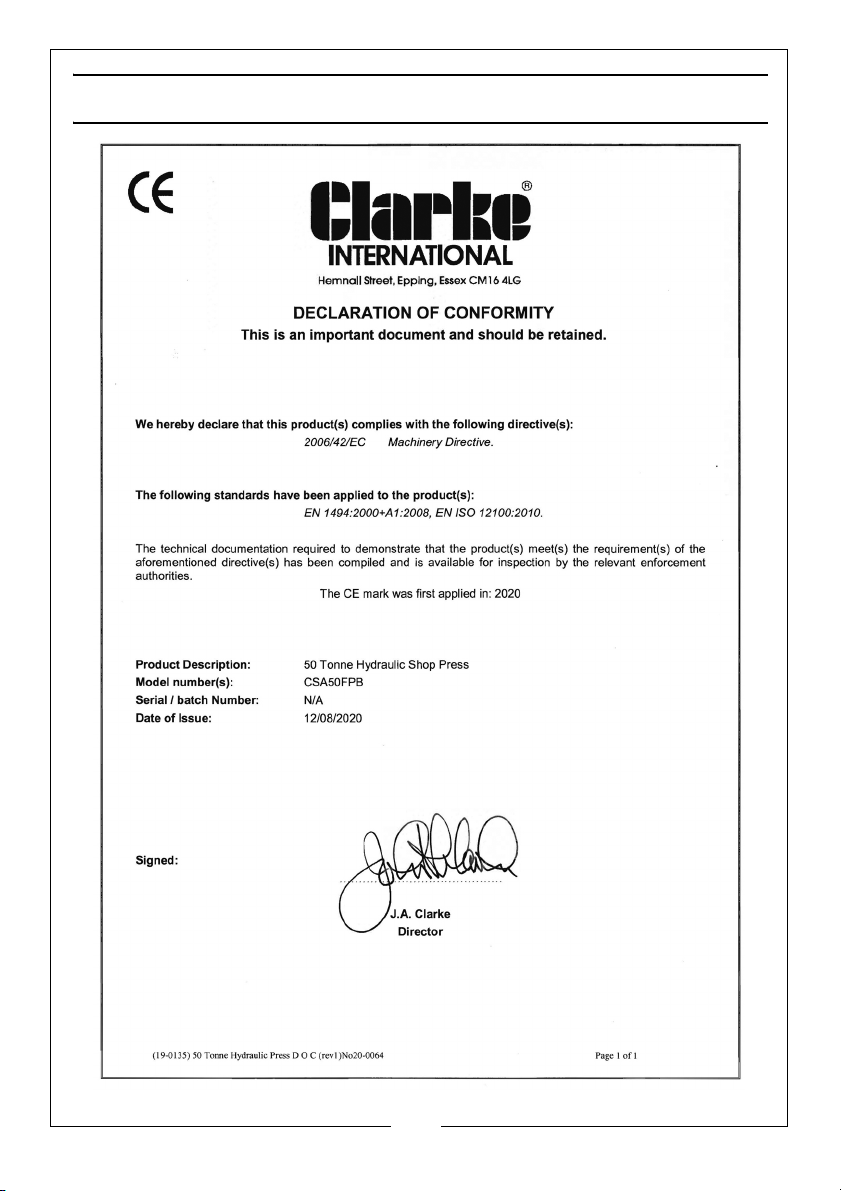
DECLARATION OF CONFORMITY
19
Parts & Service: 020 8988 7400 / E-mail: [email protected] or [email protected]
Page 20
 Loading...