

Page 1
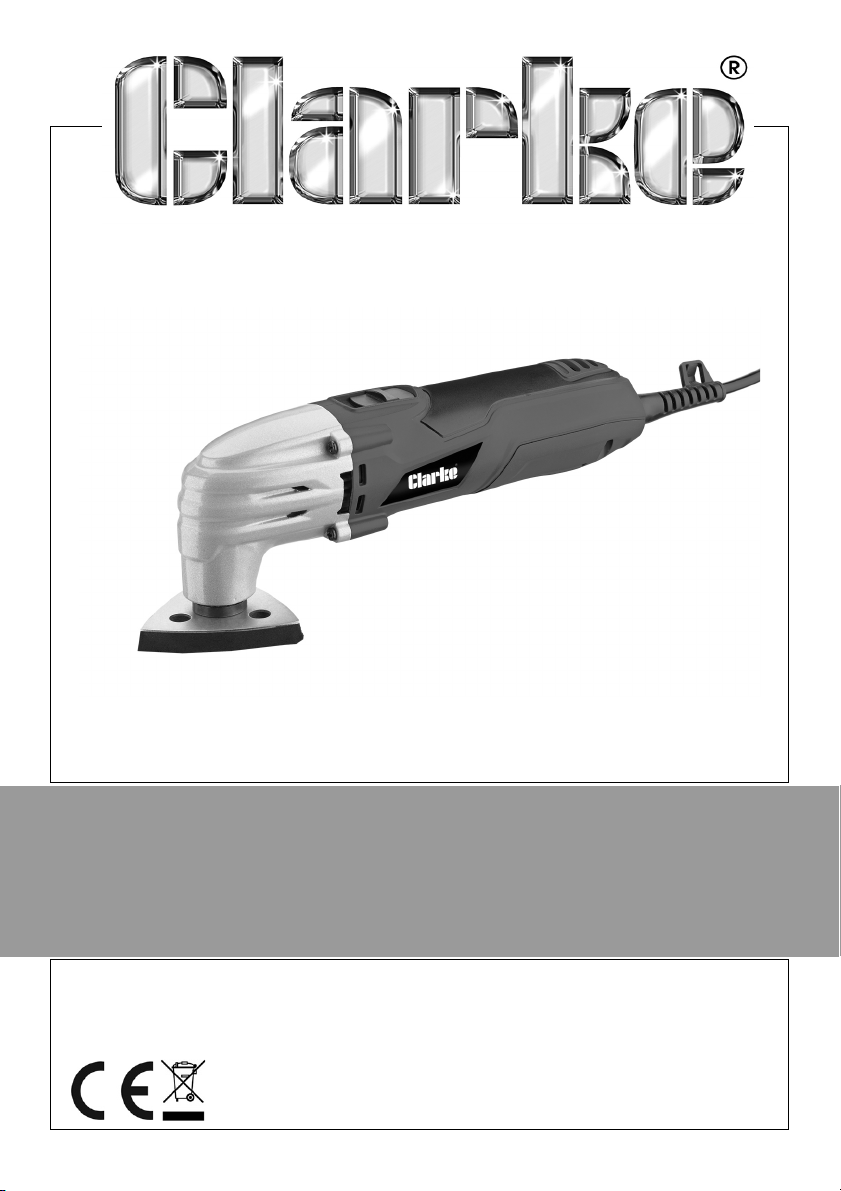
MULTI FUNCTION TOOL
MODEL NO: CMFT220
PART NO: 6462199
OPERATION & MAINTENANCE
INSTRUCTIONS
ORIGINAL INSTRUCTIONS
LS0719 - ISS 3
Page 2
INTRODUCTION
Thank you for selecting this Clarke Multi Function Tool.
Read this manual before use, the warnings and cautions in this manual will
help you operate the Multi Function Tool safely.
GUARANTEE
The Multi Function Tool is guaranteed against faulty manufacture for a period
of 12 months from the date of purchase. Your receipt is required as proof of
purchase.
This guarantee is invalid if the Multi Function Tool has been abused, tampered
with, or not used for the function for which it was intended.
Defective goods must be returned to their place of purchase. The Multi
Function Tool must not be returned to Clarke international without prior
permission.
This guarantee does not effect your statutory rights.
ENVIRONMENTAL PROTECTION
Through purchase of this Multi Function Tool, the customer is taking on
the obligation to deal with the WEEE in accordance with the WEEE
regulations in relation to the treatment, recycling & recovery and
environmentally sound disposal of the WEEE.
In effect, this means that this Multi Function Tool must not be discarded with
general waste. Refer to the laws governing Waste Electrical and Electronic
Equipment (WEEE) at a recognised disposal facility.
2
Parts & Service: 020 8988 7400 / E-mail: [email protected] or [email protected]
Page 3
SAFETY PRECAUTIONS
WARNING: READ ALL INSTRUCTIONS. FAILURE TO FOLLOW ALL
INSTRUCTIONS LISTED BELOW MAY RESULT IN ELECTRIC SHOCK, FIRE AND/
OR SERIOUS INJURY. THE TERM “POWER TOOL” IN ALL WARNINGS LISTED
BELOW REFERS TO YOUR MULTI FUNCTION TOOL AND CHARGER.
1) WORK AREA SAFETY
a. Keep work area clean and well lit. Cluttered or dark areas invite accidents.
b. Do not operate power tools in explosive atmospheres, such as in the presence of
flammable liquids, gases or dust. Power tools create sparks which may ignite the
dust or fumes.
c. Keep children and bystanders away while operating a power tool. Distractions
can cause you to lose control.
2) ELECTRICAL SAFETY
a. Power tool plugs must match the outlet. Never modify the plug in any way. Do
not use any adapter plugs with earthed (grounded) power tools. Unmodified
plugs and matching outlets will reduce risk of electric shock.
b. Avoid body contact with earthed or grounded surfaces, such as pipes, radiators,
ranges and refrigerators. There is an increased risk of electric shock if your body is
earthed or grounded.
c. Do not expose power tools to rain or wet conditions. Water entering a power tool
will increase the risk of electric shock.
d. Do not abuse the cord. Never use the cord for carrying, pulling or unplugging the
power tool. Keep cord away from heat, oil, sharp edges or moving parts.
Damaged or entangled cords increase the risk of electric shock.
e. When operating a power tool outdoors, use an extension cord suitable for
outdoor use. Use of a cord suitable for outdoor use reduces the risk of electric
shock.
f. If operating a power tool in a damp location is unavoidable, use a residual
current device (RCD) protected supply. Use of an RCD reduces the risk of electric
shock.
3) PERSONAL SAFETY
a. Stay alert, watch what you are doing and use common sense when operating a
power tool. Do not use a power tool while you are tired or under the influence of
drugs, alcohol or medication. A moment of inattention while operating power
tools may result in serious personal injury.
b. Use personal protective equipment. Always wear eye protection. Protective
equipment such as dust mask, non-skid safety shoes, hard hat, or hearing
protection used for appropriate conditions will reduce personal injuries.
3
Parts & Service: 020 8988 7400 / E-mail: [email protected] or [email protected]
Page 4

c. Prevent unintentional starting. Ensure the switch is in the off-position before
connecting to power source and/or battery pack, picking up or carrying the
tool. Carrying power tools with your finger on the switch or energising power tools
that have the switch on invites accidents.
d. Remove any adjusting key or wrench before turning the power tool on. A wrench
or a key left attached to a rotating part o the power tool may result in personal
injury.
e. Do not overreach. Keep proper footing and balance at all times. This enables
better control of the power tool in unexpected situations.
f. Dress properly. Do not wear loose clothing or jewellery. Keep your hair, clothing
and gloves away from moving parts. Loose clothes, jewellery or long hair can be
caught in moving parts.
g. If devices are provided for the connection of dust extraction and collection
facilities, ensure these are connected and properly used. Use of dust collection
can reduce dust-related hazards.
4) POWER TOOL USE AND CARE
a. Do not force the power tool. Use the correct power tool for your application. The
correct power tool will do the job better and safer at the rate for which it was
designed.
b. Do not use the power tool if the switch does not turn it on and off. Any power tool
that cannot be controlled with the switch is dangerous and must be repaired.
c. Disconnect the plug from the power source and/or the battery pack from the
power tool before making any adjustments, changing accessories, or storing
power tools. Such preventive safety measures reduce the risk of starting the
power tool accidentally.
d. Store idle power tools out of the reach of children and do not allow persons
unfamiliar with the power tool or these instructions to operate the power tool.
Power tools are dangerous in the hands of untrained users.
e. Maintain power tools. Check for misalignment or binding of moving parts,
breakage of parts and any other condition that may affect the power tool's
operation. If damaged, have the power tool repaired before use. Many
accidents are caused by poorly maintained power tools.
f. Keep cutting tools sharp and clean. Properly maintained cutting tools with sharp
cutting edges are less likely to bind and are easier to control.
g. Use the power tool, accessories and tool bits etc. in accordance with these
instructions, taking into account the working conditions and the work to be
performed. Use of the power tool for operations different from those intended
could result in a hazardous situation.
5) SERVICE
a. Have your power tool serviced by a qualified repair person using only identical
replacement parts. This will ensure that the safety of the power tool is
maintained.
4
Parts & Service: 020 8988 7400 / E-mail: [email protected] or [email protected]
Page 5

SAFETY RULES FOR OSCILLATING SAWS & SANDERS
1. Hold power tools by insulated gripping surfaces when performing an operation
where the cutting tools may contact hidden wiring. Contact with a “live” wire will
make exposed metal parts of the tool “live” and shock the operator. Do not cut or
break into existing walls or other blind areas where electrical wiring may exist. If this
situation is unavoidable, disconnect all fuses or circuit breakers feeding this worksite.
2. Use a metal detector to determine if there are gas or water pipes hidden in the work
area or call the local utility company for assistance before beginning the operation.
Striking or cutting into a gas line will result in explosion. Water entering an electrical
device may cause electrocution.
3. Keep hands away from cutting area. Do not reach under the material being cut. The
proximity of the blade to your hand is hidden from your sight.
4. Do not use dull or damaged blades. Bent blades can break easily or cause
kickback.
5. Exercise caution when handling the accessories. The accessories are very sharp.
6. Wear protective gloves when changing cutting accessories. Accessories become
hot after prolonged usage.
7. Limit the exposure time to vibration by taking frequent rest periods. Vibration caused
by the tool may be harmful to the hands and arms.
8. Before scraping, check the workpiece for nails. If found, either remove them or set
them well below intended finished surface. Striking a nail with accessory edge could
cause the tool to jump.
9. Do not wet sand with this tool. Water entering the motor housing is an electrical
shock hazard.
10. Never work in area which is wet or damp such as newly applied wallpaper. There is
an electrical shock hazard when working in such conditions with a power tool and
heating of the water caused by scraping action may cause harmful vapours to be
emitted from workpiece.
11. Always wear eye protection and a dust mask for dusty applications and when
sanding overhead. Sanding particles can be absorbed by your eyes and inhaled
easily and may cause health complications.
12. Use special precautions when sanding chemically pressure treated lumber, lead-
based paint, or any other material that may contain carcinogens. A suitable
breathing respirator and protective clothing must be worn by persons entering the
work area. The work area should be sealed by plastic sheeting and persons not
protected should be kept out until work area is thoroughly cleaned.
13. Do not use sandpaper intended for larger sanding pads. Larger sandpaper will
extend beyond the sanding pad causing snagging, tearing of the paper or kickback. Extra paper extending beyond the sanding pad can also cause cuts.
14. Please keep these instructions in a safe place for future reference.
5
Parts & Service: 020 8988 7400 / E-mail: [email protected] or [email protected]
Page 6
ENVIRONMENTAL PROTECTION
Recycle unwanted materials instead of disposing of them as
waste. All tools, accessories and packaging should be sorted,
taken to a recycling centre and disposed of in a manner which is
compatible with the environment.
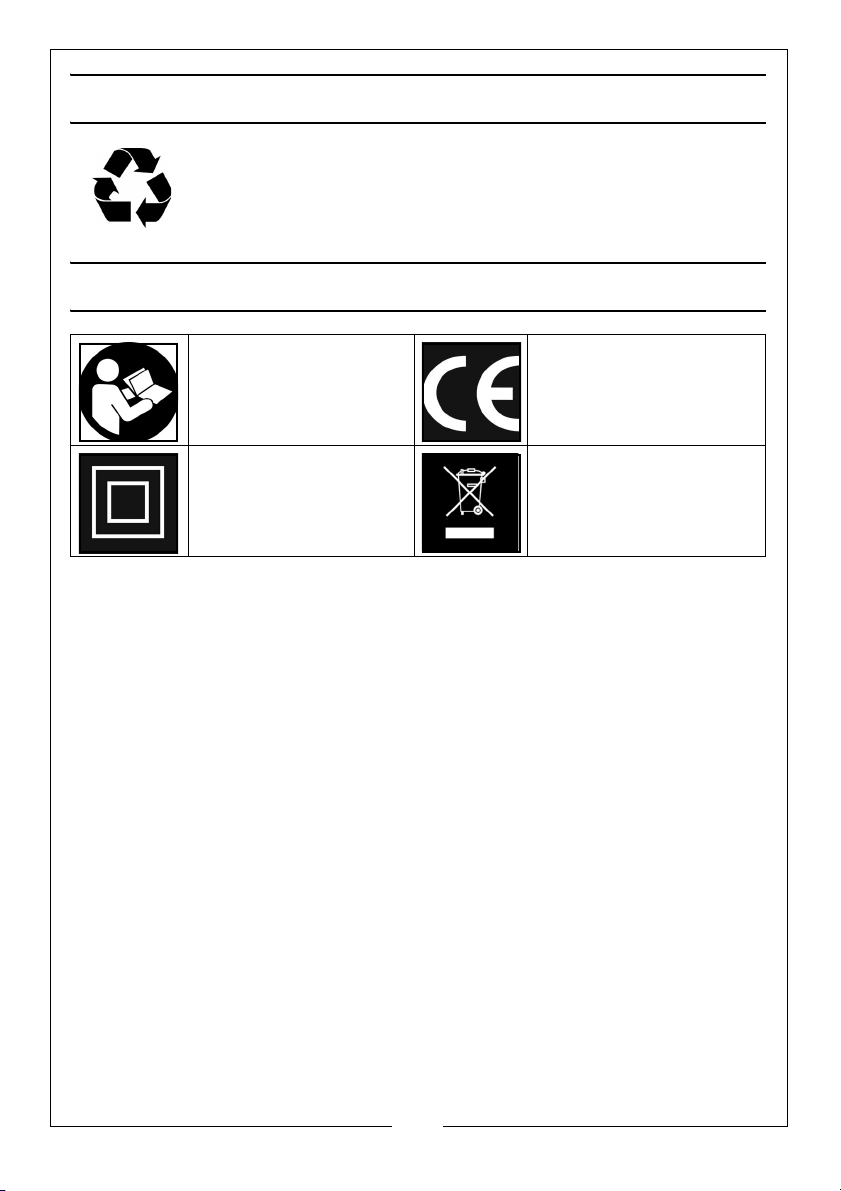
SAFETY SYMBOLS
Read instruction
manual before use
Class II Double
Insulated
CE Mark
Weee Symbol
6
Parts & Service: 020 8988 7400 / E-mail: [email protected] or [email protected]
Page 7
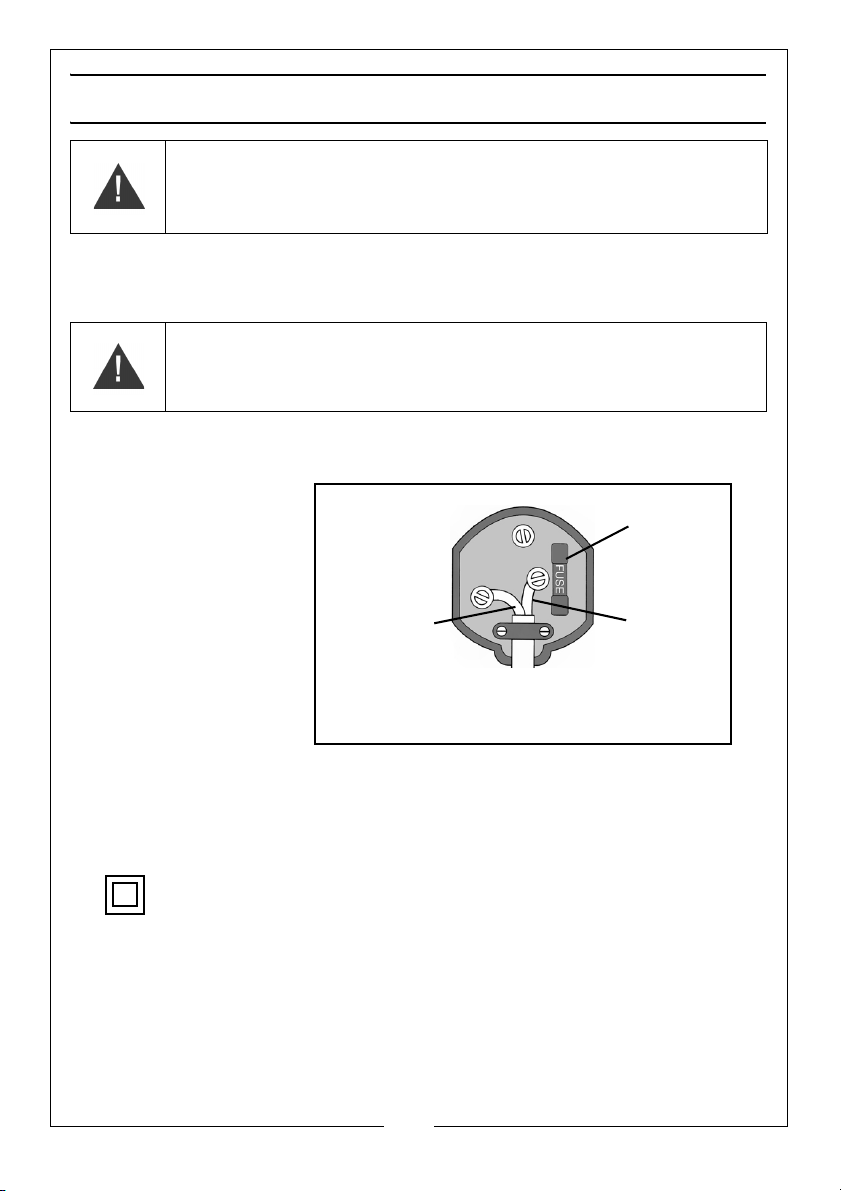
ELECTRICAL CONNECTIONS
Plug must be BS1363/A approved.
Always fit
make sure that the outer sheath of
Neutral
(Blue)
Live
(Brown)
a 3 Amp
the cable is firmly held by the clamp
fuse.
WARNING: READ THESE ELECTRICAL SAFETY INSTRUCTIONS FULLY
BEFORE CONNECTING THE PRODUCT TO THE MAINS SUPPLY.
This product is provided with a standard 13 amp, 230 volt (50Hz), BS 1363 plug,
for connection to a standard, domestic electrical supply. Should the plug
need changing, make sure that a plug of identical specification is used.
WARNING: THE WIRES IN THE CABLE ARE COLOURED AS FOLLOWS:
BLUE = NEUTRAL BROWN = LIVE
If the colours of the wires in the power cable do not correspond with the
markings on the terminals of your plug, proceed as follows.
• Connect the blue
wire to the
terminal which is
marked N.
• Connect the
brown wire to the
terminal which is
marked L.
AN APPROVED RESIDUAL CURRENT DEVICE (RCD) WHICH HAS A TRIPPING
CURRENT OF LESS THAN 30mA MUST BE USED.
If you are not sure, consult a qualified electrician. DO NOT try to do any
repairs.
This symbol indicates that this is a Class II product, and does not require an
earth connection.
Parts & Service: 020 8988 7400 / E-mail: [email protected] or [email protected]
7
Page 8
BEFORE USE
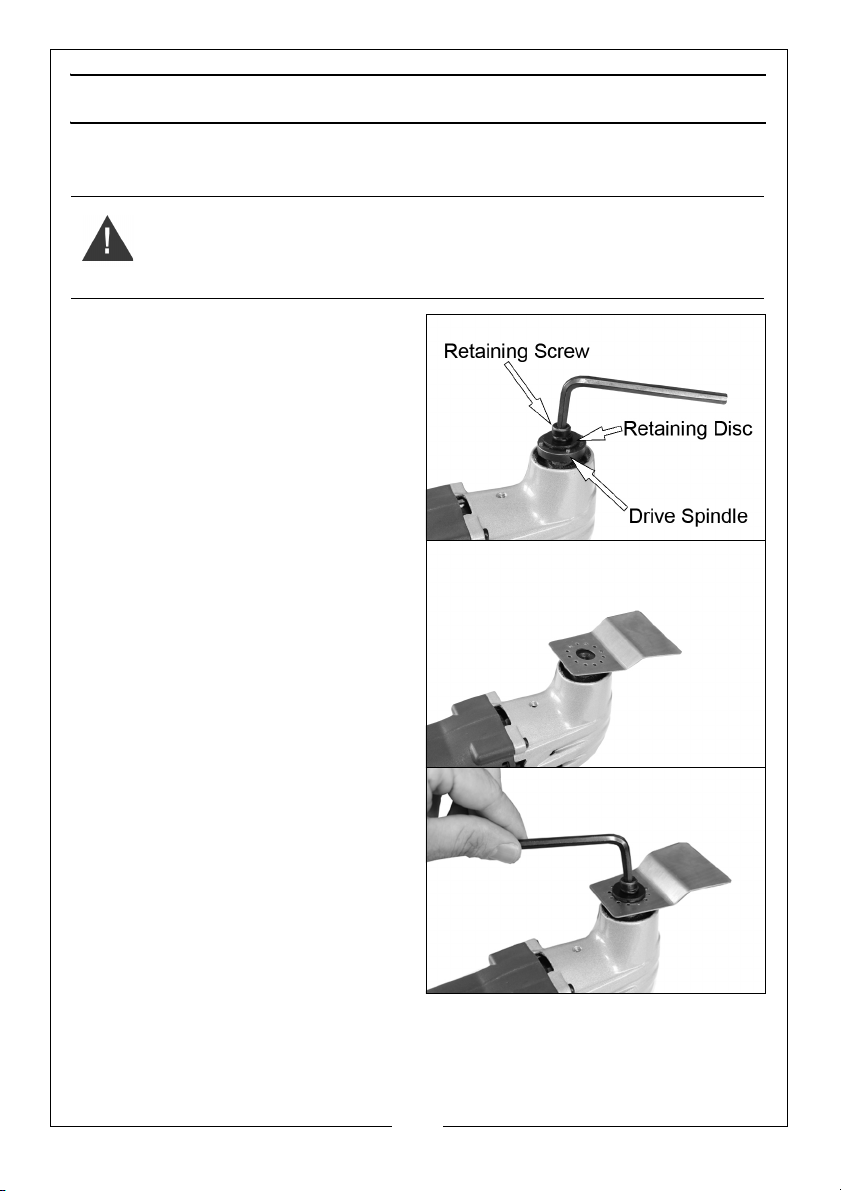
FITTING THE ACCESSORIES
WARNING: REMOVE THE PLUG FROM THE POWER SUPPLY BEFORE FITTING
OR REMOVING THE ACCESSORIES.
1. If attached, use the hex key
supplied to remove the retaining
screw and retaining disc.
2. Fit your chosen accessory onto
the drive spindle.
• Make sure that the locating
pins engage with the
corresponding holes in the
accessory and that the
accessory lays flat on the
spindle.
3. Replace the retaining disc.
• Make sure that the ridged face
of the retaining disc is in
contact with the accessory.
4. Use the hex key supplied to secure
with the retaining screw.
• Do not overtighten.
8
Parts & Service: 020 8988 7400 / E-mail: [email protected] or [email protected]
Page 9
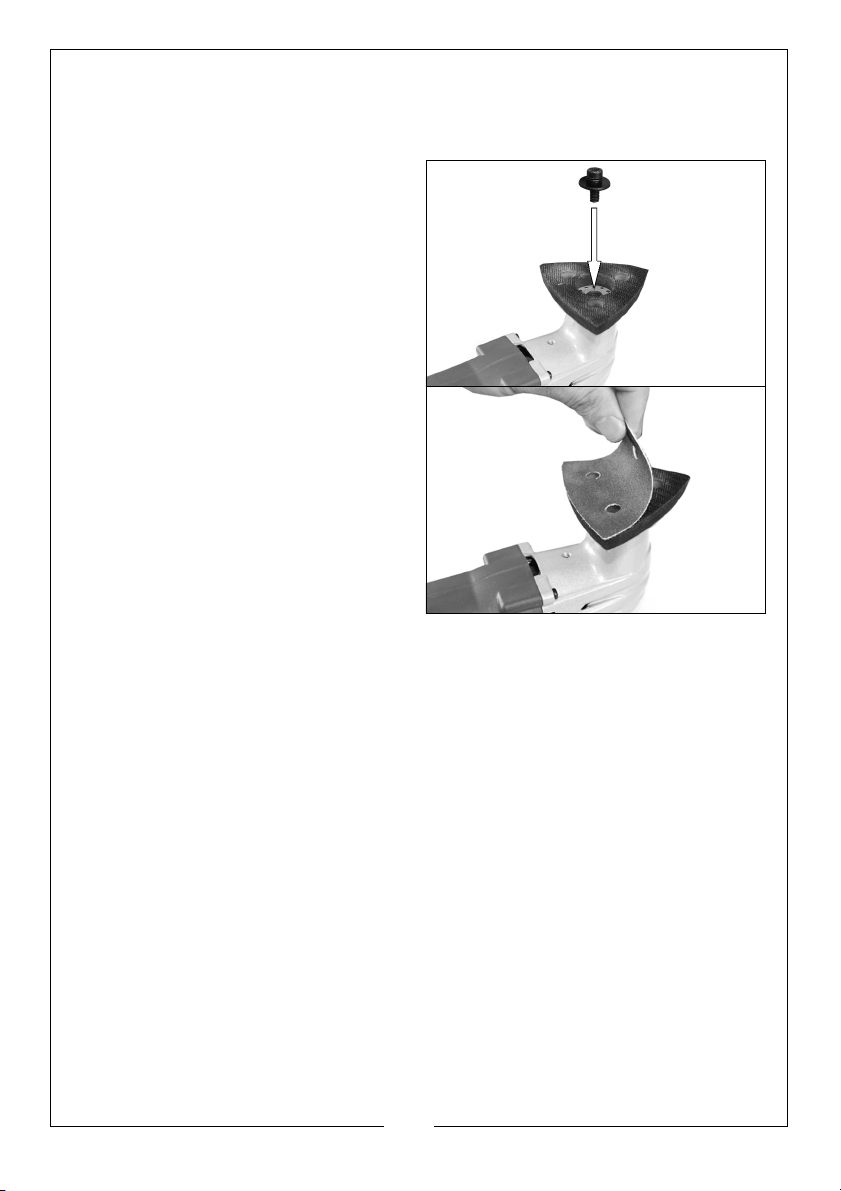
HOW TO ATTACH A SANDING SHEET
The sanding pad has a hook and loop material to which the sanding sheets
are attached.
1. Attach the sanding pad to the
tool.
• Use the screw and washer
supplied and tighten with a
hexagonal key.
2. Fit the sanding sheet to the
sanding pad.
• Make sure that the holes in the
sanding sheet align with the
holes in the sanding pad.
3. To remove the sanding sheet, hold
it at one of the points and pull it
from the sanding pad.
9
Parts & Service: 020 8988 7400 / E-mail: [email protected] or [email protected]
Page 10
OPERATION
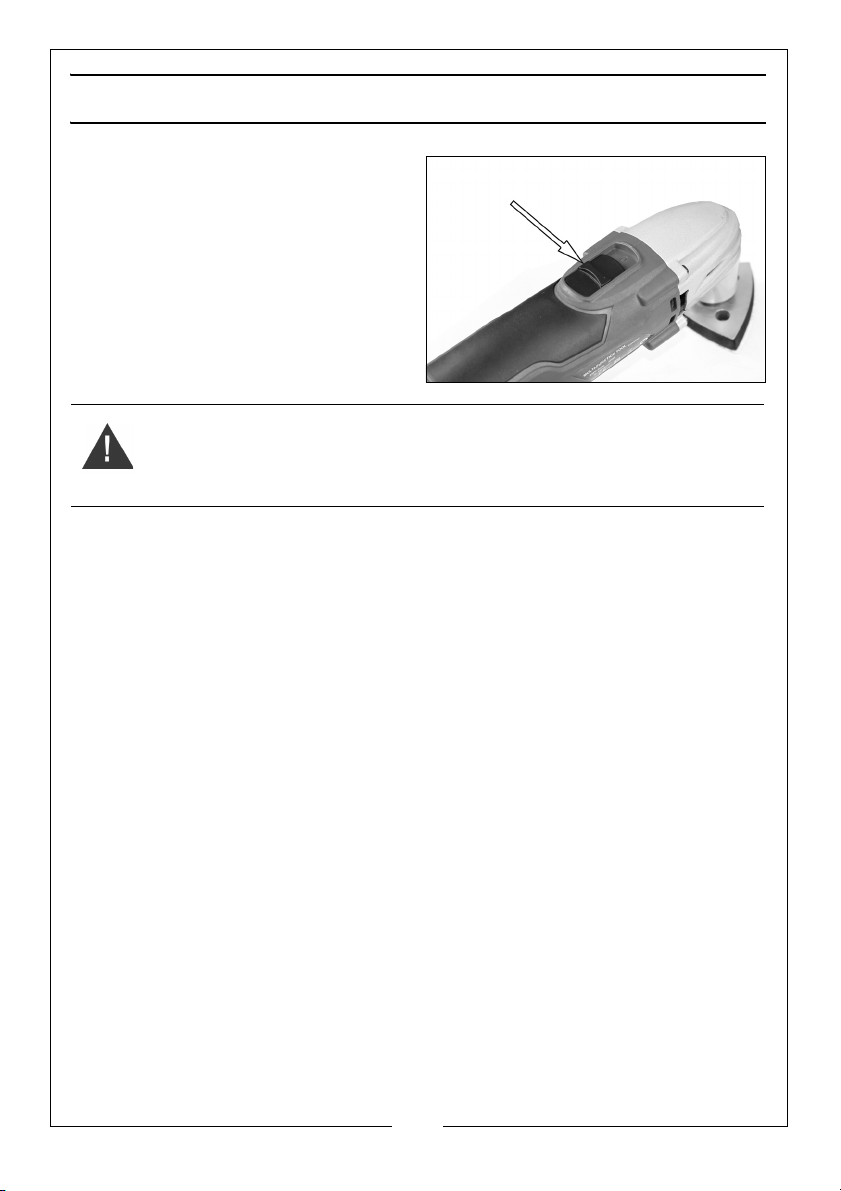
1. Hold the tool tightly and move the
On/Off switch forward.
• The multi tool will operate
continuously.
2. Slowly apply the tool to the work
piece.
• Apply light pressure as you
move it across the work.
WARNING: MAKE SURE THAT THE POSITION USED DOES NOT CAUSE
FATIGUE WHICH CAN CAUSE LOSS OF CONTROL.
3. Move the switch to the rear to stop the multi tool.
10
Parts & Service: 020 8988 7400 / E-mail: [email protected] or [email protected]
Page 11
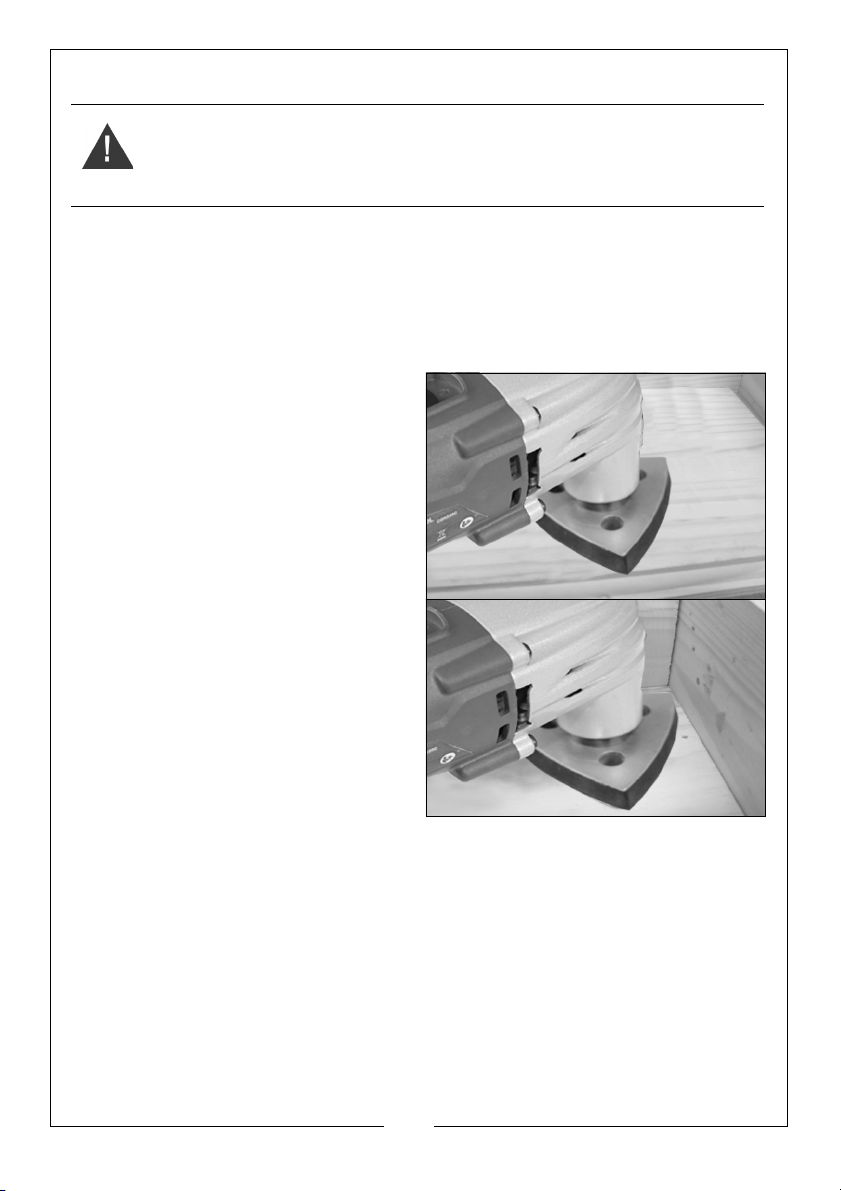
USING THE SANDING ATTACHMENT
WARNING: ALWAYS WEAR EYE PROTECTION AND A DUST MASK.
SELECT THE CORRECT SANDING SHEET
The ‘grit’ of the sanding sheet is identified by a number on the back of the
sheet. The lower numbers are more abrasive. (use lower grit for rough wood
and higher grit for finishing)
SANDING
1. Hold the tool tightly and move the
On/Off switch forward.
2. Set the tool on the workpiece.
3. Let the tool to do the work and do
not apply excessive pressure to
the sanding pad.
• Applying excessive pressure will
cause the sanding sheets to
wear out faster and can
damage the motor.
4. If sanding into corners, use the tip
or corner of the sanding pad.
• When sanding, the sanding sheet can heat up. You must let the sanding
sheet cool down regularly.
11
Parts & Service: 020 8988 7400 / E-mail: [email protected] or [email protected]
Page 12
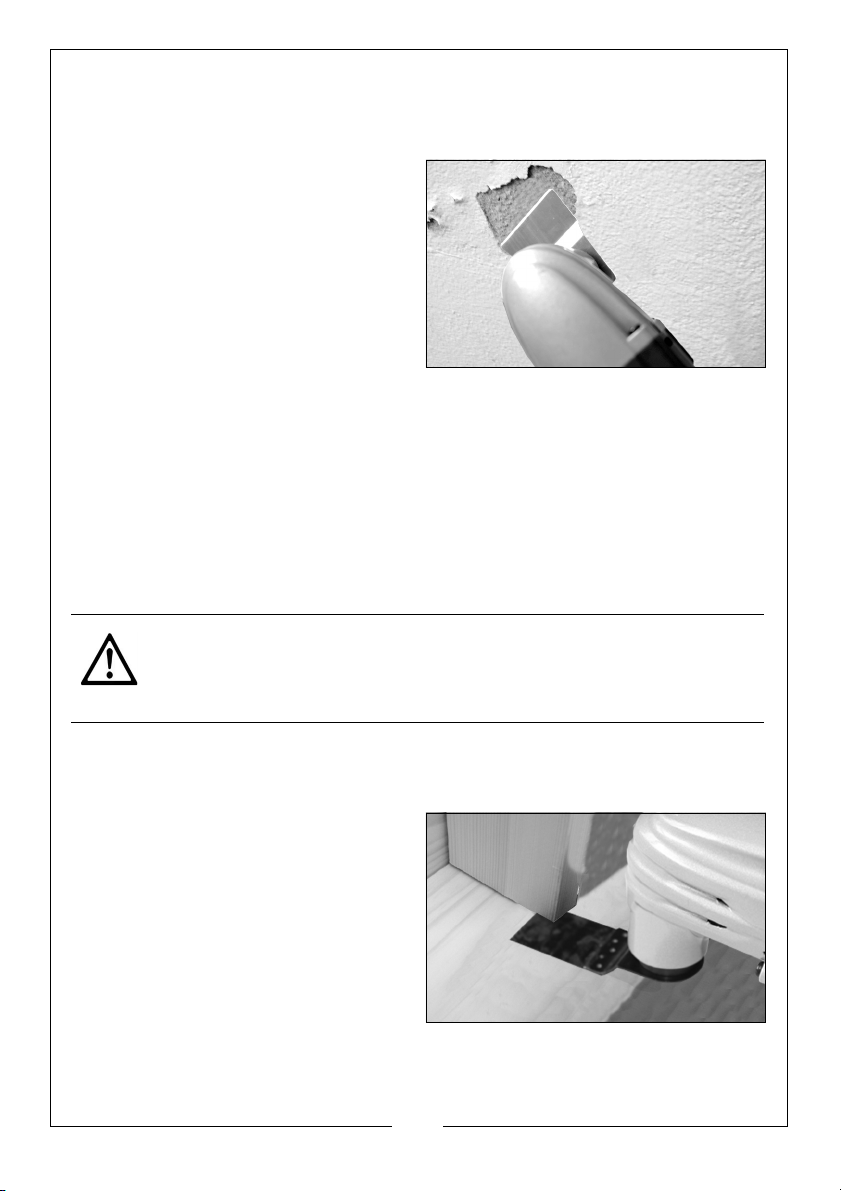
USING THE SCRAPER
The scraper is used to remove paint, sealant, adhesives and vinyl/fabrics from
a workpiece.
1. Hold the tool tightly and move the
On/Off switch forward.
2. Put the tool against the workpiece
at a low angle and apply light
pressure to the scraper blade.
• Let the tool to do the work and
do not apply excessive
pressure, which can cut into
the surface and overload the
tool.
NOTE: The scraping blade is designed for scraping soft materials from flat
surfaces.
NOTE: The scraper blade is sharp and can dig into the surface of soft
materials such as timber in the same way as a chisel.
USING THE SAW ATTACHMENT
The saw attachment is used to cut materials such as wood, plastics and sheet
metal such as aluminium.
CAUTION: CLAMP THE WORKPIECE SECURELY IF POSSIBLE BEFORE
STARTING WORK.
CAUTION: ALWAYS CHECK THAT THERE ARE NO NAILS OR SCREWS IN THE
WORKPIECE BEFORE CUTTING.
NOTE: Ensure the blade is sharp and not damaged before starting work.
SAWING WITH THE STRAIGHT BLADE
1. Hold the tool tightly and move the
On/Off switch forward.
2. If making a plunge cut use a slight
pendulum motion to allow chip/
debris removal.
NOTE: Plunge cuts should only be
attempted on soft materials
such as softwood and
plaster boards.
12
Parts & Service: 020 8988 7400 / E-mail: [email protected] or [email protected]
Page 13
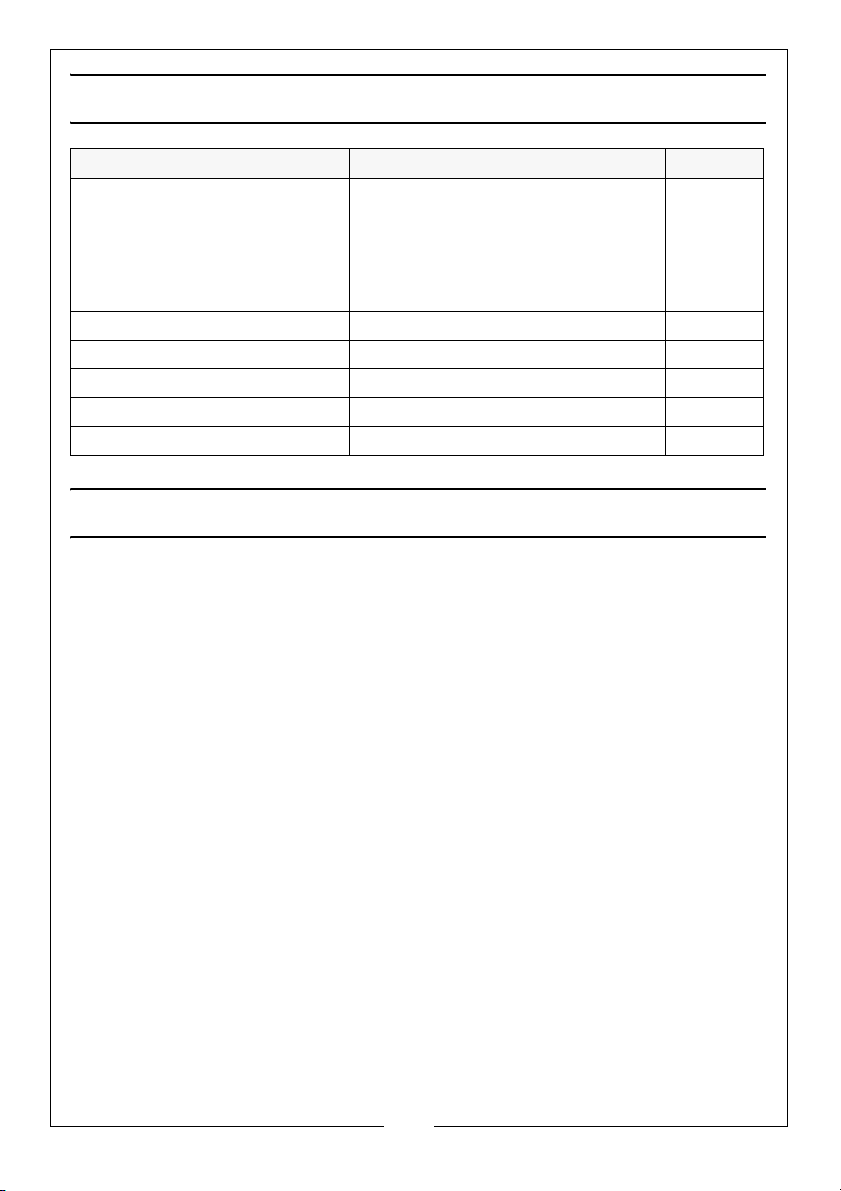
OPTIONAL ACCESSORIES
ACCESSORY CONTAINS PART NO
12 Piece Multi Tool Accessory Kit 1 x grout removing disc
1 x semi-circular saw blade
6 x sanding sheets
1 x 10 mm straight cutting blade
1 x 20 mm straight cutting blade
2 x 32 mm straight cutting blades
32 mm Wood Plunge Saw Blade Pack of 3 blades 6462222
Wood & Metal Hss Blade 87 mm Pack of 3 blades 6462224
Sanding Sheets 60 Grit Pack of 10 sheets 6462290
Sanding Sheets 120 Grit Pack of 10 sheets 6462294
Sanding Sheets 240 Grit Pack of 10 sheets 6462296
6462205
MAINTENANCE
Remove the plug from the power supply before you carry out any cleaning or
maintenance.
CLEANING
1. Make sure that any ventilation slots are clear.
2. Clean the outside of the tool with a soft cleaning cloth.
3. Do not use any chemicals, harsh abrasives, or solvents when cleaning
plastic parts.
GENERAL MAINTENANCE
• All bearings are sufficiently lubricated for the life of the tool.
• Speak to your Clarke Supplier if internal maintenance is necessory.
13
Parts & Service: 020 8988 7400 / E-mail: [email protected] or [email protected]
Page 14

SPECIFICATIONS
Voltage 230V AC, 50 Hz
No-load speed 20000 Oscillations /Minute
Weight 1. 3 kg
Dimensions (L x W x H) 255 x 57 x 93 mm
Sound Power Level (LWA) 92.8 dB(A)
Sound pressure Level (LPA) 81.7 dB(A)
Sound Uncertainty Value (K) 3 dB(A)
Vibration 3.332 m/s² (Uncertainty Value (K) 1.5 m/s²)
14
Parts & Service: 020 8988 7400 / E-mail: [email protected] or [email protected]
Page 15
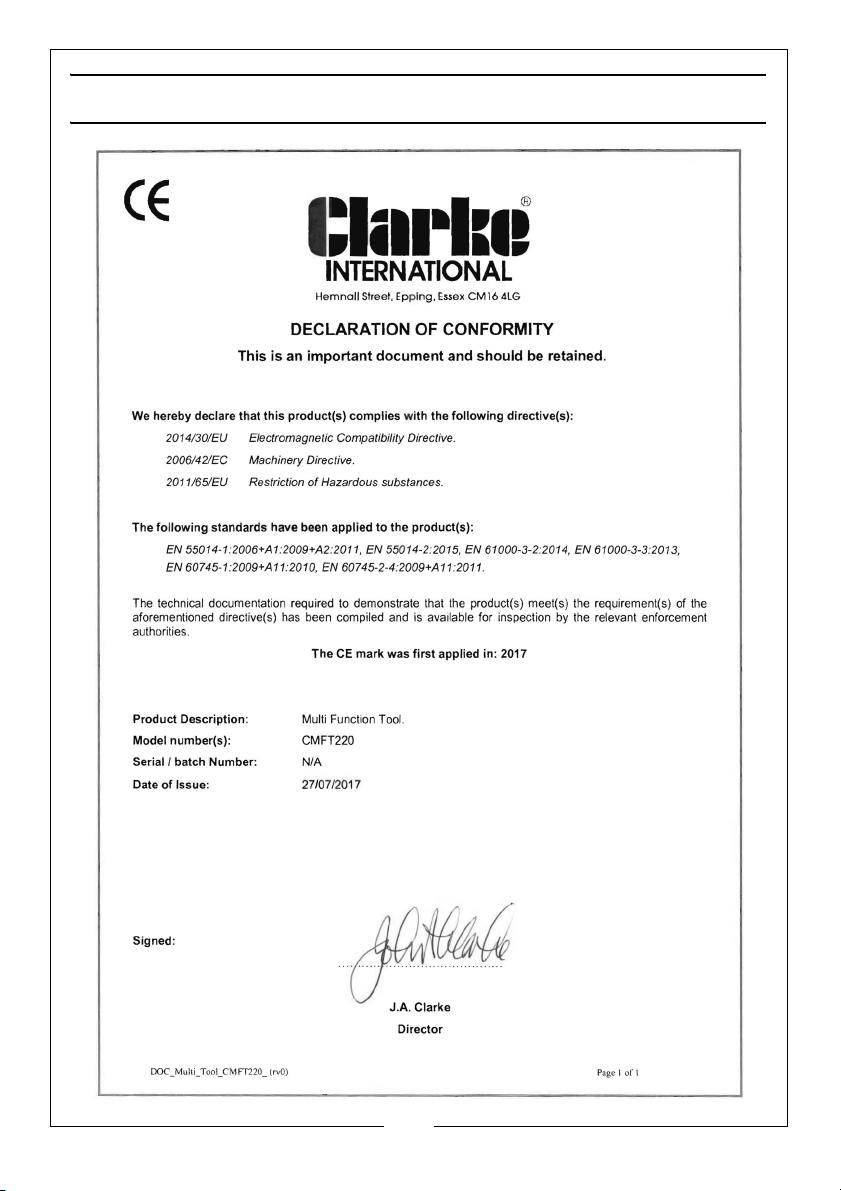
DECLARATION OF CONFORMITY
15
Parts & Service: 020 8988 7400 / E-mail: [email protected] or [email protected]
Page 16

 Loading...